IPR protection - submission of patent applications at
University
PCT Group
Be creative...
we begin…
You will learn about the four main types of
intellectual property rights (IPRs) administered by the IP
Center at University of Novi Sad. This IP Center plays a key
role in supporting University’s innovation and productivity
by delivering and granting quality and timely IP rights.
Before
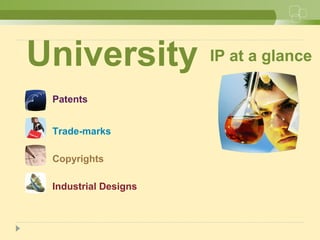
IP at a glanceUniversity
Patents
Trade-marks
Copyrights
Industrial Designs
What is a prior art?
•Any information available to the public, which may be
identical to your invention or so similar that the publicly
available information could be easily modified to develop
your invention.
•Published book, periodic journal, newspaper, conferences,
trade fairs, exhibitions, etc.
•Any found info source can be cited as Prior Art.
•Check if there is any prior art (including search using
commercial and/or public (EPO, WIPO, USPTO) web sites
•File a patent application before publicly disclosing the
details of the invention!!!
Patents
SPECIFIC CRITERIA DEFINED BY LAW
Novelty, Non-obviousness, Utility
BURDEN OF PROOF ON THE APPLICANT
Applicant must prove in the examination that the invention
meets the criteria
CAREFUL EXAMINATION
Technically qualified examiners
Review of the “prior art”
May take two to five years
EVERY COUNTRY HAS A DIFFERENT SYSTEM
Patents are granted by national offices
One invention may differ in coverage from country to country
Patent cooperation Treaty and the European Patent Office
Patents
TERM OF PATENTS
20 years from date of application
Most countries have similar terms (harmonization)
COST OF A PATENT
Expensive to apply - legal costs and fees
Expensive to maintain - maintenance fees
“FIRST-TO-FILE” vs. “FIRST-TO-INVENT”
U.S. is sole major “first -to-invent” country
May mean an invention in Europe will not get a U.S. patent
Criteria for Patentability
• NEW- no “prior art” - a novel invention has not been
publicly disclosed has not been made or sold in
commerce
• NOT OBVIOUS- not obvious to a person “skilled in the
art no “prior art” which would suggest the invention
• USEFUL- has a purpose
What is Patentable?
May include anything “under the sun” made by man...
Process—a method of doing something (e.g., manufacturing
steel, surgical or medical procedures)
Machine—combination of mechanical elements
Article of manufacture—anything which has been manufactured
Composition of matter—a new chemical, a new formulation of
elements, a genetic construct
Ideas, formulas, and “principles of nature” are not
patentable.
“8 Golden Rules” for Patenting
1. Avoid early public disclosure. File first, then disclose.
2. Do not publish interim results or speculate on broader
applications of a discovery.
3. Do research on the commercial market and technical novelty
of an invention before filing a patent application.
4. Consider the possibilities to license or develop an invention
before filing.
5. If you cannot protect the patent from infringement, don’t file.
6. File locally first. Drop international applications if there is no
interest in development in a reasonable time.
7. If you cannot prove the concept of a new invention in a
reasonable time, drop the application.
8. Periodically clean out your patent portfolio if you are a
research institute. Do not pay for non-productive patents.
Why Software is Problematic?
Software as intellectual property fits into one of two
difficult categories:
» Software as a “writing”— traditionally copyright-
protected
» Software as part of a “machine”— traditionally
patent-protected
Since software tends to be a mixture, it causes
problems for the legal system
Patents
New inventions or any new and
useful improvement of
an existing invention
• Novel: must be new, first in the world
• Useful: functional and operative
• Inventive: must show ingenuity and must not be
obvious to someone of average skill in the field of
invention
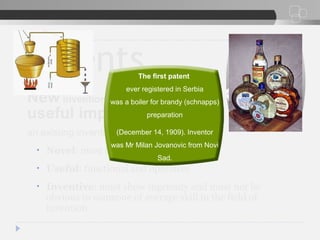
The first patent
ever registered in Serbia
was a boiler for brandy (schnapps)
preparation
(December 14, 1909). Inventor
was Mr Milan Jovanovic from Novi
Sad.
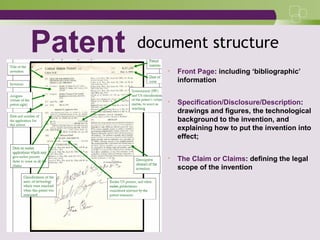
document structure
• Front Page: including ‘bibliographic’
information
• Specification/Disclosure/Description:
drawings and figures, the technological
background to the invention, and
explaining how to put the invention into
effect;
• The Claim or Claims: defining the legal
scope of the invention
Patent
Did you know?
90%
of patents are for
improvements
to existing patented inventions
Trade-marks
A word (or words), a design, or a combination
of these used to distinguish
the goods and services
of one person or organization from
those of others in the marketplace
Trade-marks can be used
to uniquely identify a brand
Copyrights
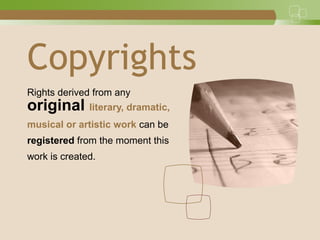
Rights derived from any
original literary, dramatic,
musical or artistic work can be
registered from the moment this
work is created.
copyrights
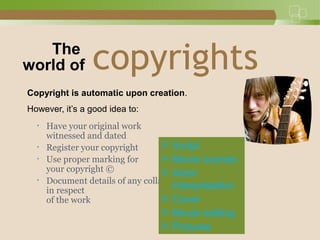
Copyright is automatic upon creation.
However, it’s a good idea to:
• Have your original work
witnessed and dated
• Register your copyright
• Use proper marking for
your copyright ©
• Document details of any collaboration
in respect
of the work
The
world of
© Script
© Movie scenes
© Actor
interpretation
© Cover
© Movie editing
© Pictures
Industrial
designs
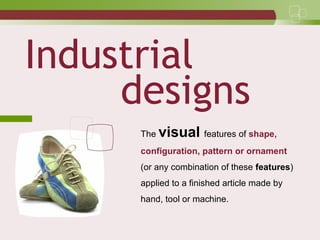
The visual features of shape,
configuration, pattern or ornament
(or any combination of these features)
applied to a finished article made by
hand, tool or machine.
Features
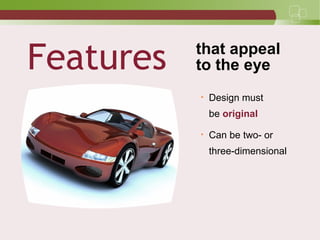
• Design must
be original
• Can be two- or
three-dimensional
that appeal
to the eye
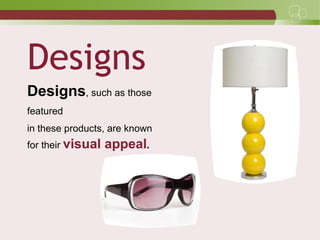
Designs
Designs, such as those
featured
in these products, are known
for their visual appeal.
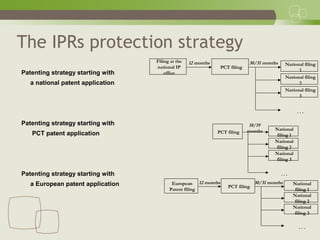
The IPRs protection strategy
Patenting strategy starting with
a national patent application
Patenting strategy starting with
PCT patent application
Patenting strategy starting with
a European patent application
Filing at the
national IP
office
PCT filing
12 months National filing
1
National filing
2
National filing
3
. . .
30/31 months
PCT filing
National
filing 1
National
filing 2
National
filing 3
. . .
18/19
months
European
Patent filing
PCT filing
12 months National
filing 1
National
filing 2
National
filing 3
. . .
30/31 months
Benefits
• Identify trends and new developments
• Generate new ideas
• Gain competitive intelligence
• License new products
• Solve technical problems
• Identify manufacturing partners
of doing
IP searches
Support of innovation activities resulted from R&D projects
• identification and evaluation of inventions in the R&D results;
• research of the prior art;
• drafting of claims and preparation of patent application;
• submitting and managing of patent application on national and
international – PCT level
• assistance in commercialization process
• URL: http://www.ipcentar.uns.ac.rs/indexe.html
THE MAIN OBJECTIVES OF UNS/FTS IP
CENTRE
The goals
• Increase of competitiveness & attractiveness of the university
• Creating IP culture at the university
• Facilitating the establishment of spin-off companies
• Encourage the innovative approach and entrepreneurship at the
university
• IP assets management (defining, packaging, controlling)
• Increase of :
• number of patent applications related to R&D, diffuse of
technical information
• ranking (institutional, personal)
• value of product/company based on invention
• technology transfer through spin-off companies and/or
licensing
Decision Factors for the
University
Nature of the market.
Nature of the technology.
What does the commercialization entity (to be selected) need to do well?
What does the inventor want to do? VERY IMPORTANT.
Does the commercialization path enhance other mission goals? (e.g., research
development, quality teaching, regional economic development)
PCT
 High-quality and cost-effective services to a clients in industry and academia
 Areas of expertise include:
 video and audio coding, TV/STB technology, mobile phones, electronics, ICs,
advanced algorithms and data processing, contemporary network and
communication technology, general physics and mathematics
 Organization:
 Core team (8 engineers)
 Experts from the industry and university
PCT Group of
PCT Services Overview
I. Patent and Intellectual Property Management
 Patent general/technical valuation
 Patent claim chart generation
 Patent portfolio evaluation
I. Market and Company Analysis
II. IP Support Activities
PCT Group of
Patent portfolio management and monetization
 Patents Evaluation:
 Technological
- Expert analysis of patent applicability, broadness etc.
 Commercial
- Assessment how it fits to specific market / target company /
specific products
 Legal quality of the patents
- Infringement analysis of the patent
- Analysis of the validity of patents (advice level
PCT Group of
Patent portfolio management and monetization
 Drafting of claim charts
 search & matching of a product(s) with features covered
by the patent claims
 Managing IP portfolio
 The strength and weaknesses of the patent portfolio
 Matching potential customers to related patents
 Search for licensing opportunity
 Comparative analysis of IP portfolios of the companies
 Landscaping of the IP portfolios
PCT Group of
Patent portfolio management and monetization
 Market Analysis
 Company analysis (existing products, market share, future
technologies/products)
 Litigation issues
 Valuation of a company's IP portfolio
 Patents vs. Market Analysis
 Products infringing patents from our portfolio (making claim
charts)
 Patents covering main product areas of the Company
 Offensive patents (against competitors) in any area of competitors
business
 Protecting patents – related to ongoing litigation
 R&D patents (future technology)
PCT Group of
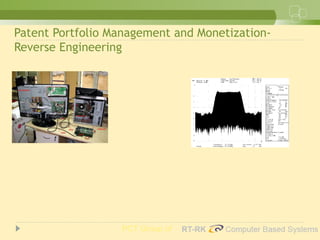
Patent Portfolio Management and Monetization-
Reverse Engineering
PCT Group of
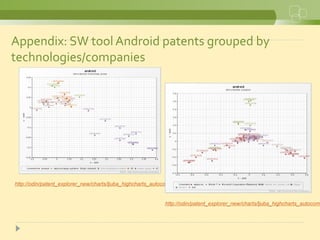
Appendix: SW tool Android patents grouped by
technologies/companies
http://odin/patent_explorer_new/charts/ljuba_highcharts_autocomplete_newlook_v5.3.php?idTable=29
http://odin/patent_explorer_new/charts/ljuba_highcharts_autocom
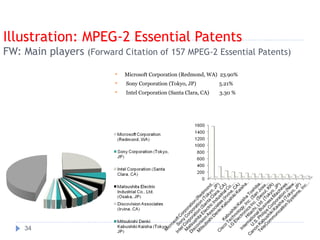
Illustration: MPEG-2 Essential Patents
FW: Main players (Forward Citation of 157 MPEG-2 Essential Patents)
34
 Microsoft Corporation (Redmond, WA) 23.90%
 Sony Corporation (Tokyo, JP) 5.21%
 Intel Corporation (Santa Clara, CA) 3.30 %
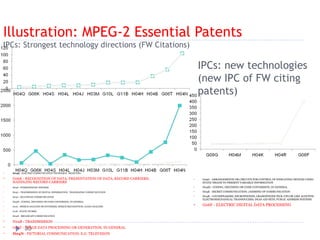
Illustration: MPEG-2 Essential Patents
IPCs: Strongest technology directions (FW Citations)
35
 H04Q - ELECTRIC COMMUNICATION TECHNIQUE SELECTING
 G06K - RECOGNITION OF DATA; PRESENTATION OF DATA; RECORD CARRIERS;
HANDLING RECORD CARRIERS
 H04S - STEREOPHONIC SYSTEMS
 H04L - TRANSMISSION OF DIGITAL INFORMATION, TELEGRAPHIC COMMUNICATION
 H04J - MULTIPLEX COMMUNICATION
 H03M - CODING, DECODING OR CODE CONVERSION, IN GENERAL
 G10L - SPEECH ANALYSIS OR SYNTHESIS; SPEECH RECOGNITION; AUDIO ANALYSIS
 G11B - STATIC STORES
 H04H - BROADCAST COMMUNICATION
 H04B - TRANSMISSION
 G06T - IMAGE DATA PROCESSING OR GENERATION, IN GENERAL
 H04N - PICTORIAL COMMUNICATION, E.G. TELEVISION
• G09G - ARRANGEMENTS OR CIRCUITS FOR CONTROL OF INDICATING DEVICES USING
STATIC MEANS TO PRESENT VARIABLE INFORMATION
• H04M - CODING, DECODING OR CODE CONVERSION, IN GENERAL
• H04K - SECRET COMMUNICATION; JAMMING OF COMMUNICATION
• H04R - LOUDSPEAKERS, MICROPHONES, GRAMOPHONE PICK-UPS OR LIKE ACOUSTIC
ELECTROMECHANICAL TRANSDUCERS; DEAF-AID SETS; PUBLIC ADDRESS SYSTEMS
• G06F - ELECTRIC DIGITAL DATA PROCESSING
IPCs: new technologies
(new IPC of FW citing
patents)
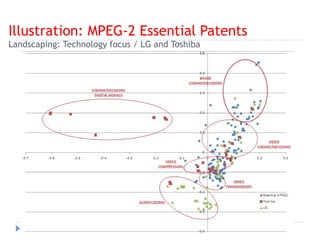
Illustration: MPEG-2 Essential Patents
Landscaping: Technology focus / LG and Toshiba
36
Examples
Scotland, Slovenia....
Where are we?
The Scottish Government
 Strategic Research 2011-2016
 The Scottish Government's Rural and Environment Science and Analytical Services Division (RESAS) is funding a
portfolio of Strategic Research over 2011-16 that aims to build a platform of knowledge that strengthens policy and
contributes to the delivery of national outcomes and the Scottish Government's single purpose.
 Knowledge exchange - getting the research findings to people who can use them - is an essential
part of the research commissioned and an area where the Main Research Providers (MRPs) have widely acknowledged
strengths. Knowledge exchange activities have an outward facing, wealth creation focus, stimulating innovation,
exploiting intellectual property rights and engaging with
industry. MRPs use a collaborative initiative, knowledge Scotland, to help deliver key outputs from the scientific
community to policymakers in Scotland and beyond.
 Impacts - The impacts of the research are expected to contribute particularly to the Wealthier, Healthier and
Greener strategic objectives of the Scottish Government and thus to help deliver sustainable economic growth.
 University of Edinburgh, Edinburgh Research and Innovation, Edinburgh Technopole, Scottish Institute for Enterprise,
Edinburgh Pre-Incubation Programme ,Edinburgh City Council
Government
Initiative
Government
Initiative
Edinburgh Technology
Transfer Centre
 The Edinburgh Technology Transfer Centre opened its first incubation facility on the University of Edinburgh’s King’s
Buildings campus in 1987.
 For companies moving through ETTC’s two to three year incubation programme, the package of services is tailored to
meet their diverse and sophisticated needs. As well as bespoke service delivery and provisions such as Strategic Clinics
and Development Workshops, ETTC provides access to a wide network of business professionals, potential non-
executive directors, business angels, venture capitalists and science and technology parks.
 The Edinburgh Technology Transfer Centre provides
specialist laboratories and high-spec office accommodation
to spin-out and start-up companies and project teams
involved in research and development programmes.
 University of Edinburgh, Edinburgh Research and Innovation, Edinburgh Technopole, Scottish Institute for Enterprise, Edinburgh Pre-Incubation
Programme ,Edinburgh City Council
University
Initiative
University
Initiative
University of Edinburgh
Research and Innovation
 Technology Licensing
 The University of Edinburgh has demonstrated the international
stature of its intellectual property over many years, with major
scientific advances, inventions and innovation, and is
commercializing these world-changing discoveries through
company spin-outs and technology licensing with industry around
the world.
 Current Licensing Opportunities
 * ALL technology licensing opportunities
 o Drug Discovery, Medical Devices,Reagents & Antibodies,
Therapeutics, Communications, Energy & Environment,IT &
Software, Materials, Engineering & Electronics
http://www.research-innovation.ed.ac.uk/licensing/
University
Initiative
University
Initiative
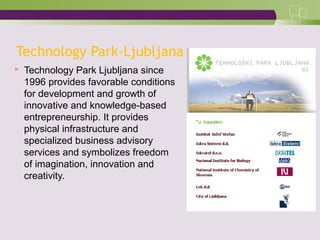
Technology Park-Ljubljana
 Technology Park Ljubljana since
1996 provides favorable conditions
for development and growth of
innovative and knowledge-based
entrepreneurship. It provides
physical infrastructure and
specialized business advisory
services and symbolizes freedom
of imagination, innovation and
creativity.
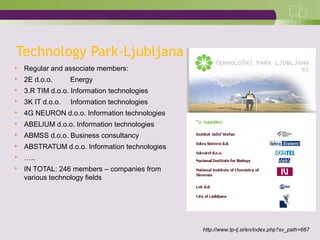
Technology Park-Ljubljana
 Regular and associate members:
 2E d.o.o. Energy
 3.R TIM d.o.o. Information technologies
 3K IT d.o.o. Information technologies
 4G NEURON d.o.o. Information technologies
 ABELIUM d.o.o. Information technologies
 ABMSS d.o.o. Business consultancy
 ABSTRATUM d.o.o. Information technologies
 …..
 IN TOTAL: 246 members – companies from
various technology fields
http://www.tp-lj.si/en/index.php?sv_path=667
Strategy for Universities
Develop IP centers within University
 Educate students and staff in importance of IP
 Provide framework within University whereby the ideas developed within projects
will lead to IP and commercialization – Knowledge Transfer Centers
 Initial state investment which should lead to self-finance
Definition of Technology Transfer
Technology transfer [and commercialization] is defined as the transfer of results of basic and
applied research to the design, development, production, and commercialization of new and
improved products, services or processes. That which is transferred is often not really
technology but rather a particular kind of knowledge that is a precursor of technology.
The transfer process emphasizes the value and protection of the intellectual product of
the researchers.
Gary Matkin, Technology Transfer and the University, 1991
Technology Transfer is a Process
It has stages, phases, and typical behaviour.
It operates and can be understood at different levels (e.g.,
technology policy, individual scientists).
It involves different “stakeholder” perspectives (e.g.,
developers and users).
It is therefore a “communication process.”
Contact us
For more information:
Faculty of Technical Sciences, Univ. of Novi Sad
UNS IP Center
Prof. Dr Dragan Kukolj
dragan.kukolj@rt-rk.com
Milana Vitas
milana.vitas@rt-rk.com
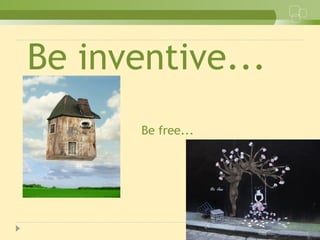
Be inventive...
Be free...

Ip on a coffe break... be inventive... be creative... be free

  • 1.
    IPR protection -submission of patent applications at University PCT Group
  • 2.
  • 3.
    we begin… You willlearn about the four main types of intellectual property rights (IPRs) administered by the IP Center at University of Novi Sad. This IP Center plays a key role in supporting University’s innovation and productivity by delivering and granting quality and timely IP rights. Before
  • 4.
    IP at aglanceUniversity Patents Trade-marks Copyrights Industrial Designs
  • 5.
    What is aprior art? •Any information available to the public, which may be identical to your invention or so similar that the publicly available information could be easily modified to develop your invention. •Published book, periodic journal, newspaper, conferences, trade fairs, exhibitions, etc. •Any found info source can be cited as Prior Art. •Check if there is any prior art (including search using commercial and/or public (EPO, WIPO, USPTO) web sites •File a patent application before publicly disclosing the details of the invention!!!
  • 6.
    Patents SPECIFIC CRITERIA DEFINEDBY LAW Novelty, Non-obviousness, Utility BURDEN OF PROOF ON THE APPLICANT Applicant must prove in the examination that the invention meets the criteria CAREFUL EXAMINATION Technically qualified examiners Review of the “prior art” May take two to five years EVERY COUNTRY HAS A DIFFERENT SYSTEM Patents are granted by national offices One invention may differ in coverage from country to country Patent cooperation Treaty and the European Patent Office
  • 7.
    Patents TERM OF PATENTS 20years from date of application Most countries have similar terms (harmonization) COST OF A PATENT Expensive to apply - legal costs and fees Expensive to maintain - maintenance fees “FIRST-TO-FILE” vs. “FIRST-TO-INVENT” U.S. is sole major “first -to-invent” country May mean an invention in Europe will not get a U.S. patent
  • 8.
    Criteria for Patentability •NEW- no “prior art” - a novel invention has not been publicly disclosed has not been made or sold in commerce • NOT OBVIOUS- not obvious to a person “skilled in the art no “prior art” which would suggest the invention • USEFUL- has a purpose
  • 9.
    What is Patentable? Mayinclude anything “under the sun” made by man... Process—a method of doing something (e.g., manufacturing steel, surgical or medical procedures) Machine—combination of mechanical elements Article of manufacture—anything which has been manufactured Composition of matter—a new chemical, a new formulation of elements, a genetic construct Ideas, formulas, and “principles of nature” are not patentable.
  • 10.
    “8 Golden Rules”for Patenting 1. Avoid early public disclosure. File first, then disclose. 2. Do not publish interim results or speculate on broader applications of a discovery. 3. Do research on the commercial market and technical novelty of an invention before filing a patent application. 4. Consider the possibilities to license or develop an invention before filing.
  • 11.
    5. If youcannot protect the patent from infringement, don’t file. 6. File locally first. Drop international applications if there is no interest in development in a reasonable time. 7. If you cannot prove the concept of a new invention in a reasonable time, drop the application. 8. Periodically clean out your patent portfolio if you are a research institute. Do not pay for non-productive patents.
  • 12.
    Why Software isProblematic? Software as intellectual property fits into one of two difficult categories: » Software as a “writing”— traditionally copyright- protected » Software as part of a “machine”— traditionally patent-protected Since software tends to be a mixture, it causes problems for the legal system
  • 13.
    Patents New inventions orany new and useful improvement of an existing invention • Novel: must be new, first in the world • Useful: functional and operative • Inventive: must show ingenuity and must not be obvious to someone of average skill in the field of invention The first patent ever registered in Serbia was a boiler for brandy (schnapps) preparation (December 14, 1909). Inventor was Mr Milan Jovanovic from Novi Sad.
  • 14.
    document structure • FrontPage: including ‘bibliographic’ information • Specification/Disclosure/Description: drawings and figures, the technological background to the invention, and explaining how to put the invention into effect; • The Claim or Claims: defining the legal scope of the invention Patent
  • 15.
    Did you know? 90% ofpatents are for improvements to existing patented inventions
  • 16.
    Trade-marks A word (orwords), a design, or a combination of these used to distinguish the goods and services of one person or organization from those of others in the marketplace Trade-marks can be used to uniquely identify a brand
  • 17.
    Copyrights Rights derived fromany original literary, dramatic, musical or artistic work can be registered from the moment this work is created.
  • 18.
    copyrights Copyright is automaticupon creation. However, it’s a good idea to: • Have your original work witnessed and dated • Register your copyright • Use proper marking for your copyright © • Document details of any collaboration in respect of the work The world of © Script © Movie scenes © Actor interpretation © Cover © Movie editing © Pictures
  • 19.
    Industrial designs The visual featuresof shape, configuration, pattern or ornament (or any combination of these features) applied to a finished article made by hand, tool or machine.
  • 20.
    Features • Design must beoriginal • Can be two- or three-dimensional that appeal to the eye
  • 21.
    Designs Designs, such asthose featured in these products, are known for their visual appeal.
  • 22.
    The IPRs protectionstrategy Patenting strategy starting with a national patent application Patenting strategy starting with PCT patent application Patenting strategy starting with a European patent application Filing at the national IP office PCT filing 12 months National filing 1 National filing 2 National filing 3 . . . 30/31 months PCT filing National filing 1 National filing 2 National filing 3 . . . 18/19 months European Patent filing PCT filing 12 months National filing 1 National filing 2 National filing 3 . . . 30/31 months
  • 23.
    Benefits • Identify trendsand new developments • Generate new ideas • Gain competitive intelligence • License new products • Solve technical problems • Identify manufacturing partners of doing IP searches
  • 24.
    Support of innovationactivities resulted from R&D projects • identification and evaluation of inventions in the R&D results; • research of the prior art; • drafting of claims and preparation of patent application; • submitting and managing of patent application on national and international – PCT level • assistance in commercialization process • URL: http://www.ipcentar.uns.ac.rs/indexe.html THE MAIN OBJECTIVES OF UNS/FTS IP CENTRE
  • 25.
    The goals • Increaseof competitiveness & attractiveness of the university • Creating IP culture at the university • Facilitating the establishment of spin-off companies • Encourage the innovative approach and entrepreneurship at the university • IP assets management (defining, packaging, controlling) • Increase of : • number of patent applications related to R&D, diffuse of technical information • ranking (institutional, personal) • value of product/company based on invention • technology transfer through spin-off companies and/or licensing
  • 26.
    Decision Factors forthe University Nature of the market. Nature of the technology. What does the commercialization entity (to be selected) need to do well? What does the inventor want to do? VERY IMPORTANT. Does the commercialization path enhance other mission goals? (e.g., research development, quality teaching, regional economic development)
  • 27.
    PCT  High-quality andcost-effective services to a clients in industry and academia  Areas of expertise include:  video and audio coding, TV/STB technology, mobile phones, electronics, ICs, advanced algorithms and data processing, contemporary network and communication technology, general physics and mathematics  Organization:  Core team (8 engineers)  Experts from the industry and university PCT Group of
  • 28.
    PCT Services Overview I.Patent and Intellectual Property Management  Patent general/technical valuation  Patent claim chart generation  Patent portfolio evaluation I. Market and Company Analysis II. IP Support Activities PCT Group of
  • 29.
    Patent portfolio managementand monetization  Patents Evaluation:  Technological - Expert analysis of patent applicability, broadness etc.  Commercial - Assessment how it fits to specific market / target company / specific products  Legal quality of the patents - Infringement analysis of the patent - Analysis of the validity of patents (advice level PCT Group of
  • 30.
    Patent portfolio managementand monetization  Drafting of claim charts  search & matching of a product(s) with features covered by the patent claims  Managing IP portfolio  The strength and weaknesses of the patent portfolio  Matching potential customers to related patents  Search for licensing opportunity  Comparative analysis of IP portfolios of the companies  Landscaping of the IP portfolios PCT Group of
  • 31.
    Patent portfolio managementand monetization  Market Analysis  Company analysis (existing products, market share, future technologies/products)  Litigation issues  Valuation of a company's IP portfolio  Patents vs. Market Analysis  Products infringing patents from our portfolio (making claim charts)  Patents covering main product areas of the Company  Offensive patents (against competitors) in any area of competitors business  Protecting patents – related to ongoing litigation  R&D patents (future technology) PCT Group of
  • 32.
    Patent Portfolio Managementand Monetization- Reverse Engineering PCT Group of
  • 33.
    Appendix: SW toolAndroid patents grouped by technologies/companies http://odin/patent_explorer_new/charts/ljuba_highcharts_autocomplete_newlook_v5.3.php?idTable=29 http://odin/patent_explorer_new/charts/ljuba_highcharts_autocom
  • 34.
    Illustration: MPEG-2 EssentialPatents FW: Main players (Forward Citation of 157 MPEG-2 Essential Patents) 34  Microsoft Corporation (Redmond, WA) 23.90%  Sony Corporation (Tokyo, JP) 5.21%  Intel Corporation (Santa Clara, CA) 3.30 %
  • 35.
    Illustration: MPEG-2 EssentialPatents IPCs: Strongest technology directions (FW Citations) 35  H04Q - ELECTRIC COMMUNICATION TECHNIQUE SELECTING  G06K - RECOGNITION OF DATA; PRESENTATION OF DATA; RECORD CARRIERS; HANDLING RECORD CARRIERS  H04S - STEREOPHONIC SYSTEMS  H04L - TRANSMISSION OF DIGITAL INFORMATION, TELEGRAPHIC COMMUNICATION  H04J - MULTIPLEX COMMUNICATION  H03M - CODING, DECODING OR CODE CONVERSION, IN GENERAL  G10L - SPEECH ANALYSIS OR SYNTHESIS; SPEECH RECOGNITION; AUDIO ANALYSIS  G11B - STATIC STORES  H04H - BROADCAST COMMUNICATION  H04B - TRANSMISSION  G06T - IMAGE DATA PROCESSING OR GENERATION, IN GENERAL  H04N - PICTORIAL COMMUNICATION, E.G. TELEVISION • G09G - ARRANGEMENTS OR CIRCUITS FOR CONTROL OF INDICATING DEVICES USING STATIC MEANS TO PRESENT VARIABLE INFORMATION • H04M - CODING, DECODING OR CODE CONVERSION, IN GENERAL • H04K - SECRET COMMUNICATION; JAMMING OF COMMUNICATION • H04R - LOUDSPEAKERS, MICROPHONES, GRAMOPHONE PICK-UPS OR LIKE ACOUSTIC ELECTROMECHANICAL TRANSDUCERS; DEAF-AID SETS; PUBLIC ADDRESS SYSTEMS • G06F - ELECTRIC DIGITAL DATA PROCESSING IPCs: new technologies (new IPC of FW citing patents)
  • 36.
    Illustration: MPEG-2 EssentialPatents Landscaping: Technology focus / LG and Toshiba 36
  • 37.
  • 38.
    The Scottish Government Strategic Research 2011-2016  The Scottish Government's Rural and Environment Science and Analytical Services Division (RESAS) is funding a portfolio of Strategic Research over 2011-16 that aims to build a platform of knowledge that strengthens policy and contributes to the delivery of national outcomes and the Scottish Government's single purpose.  Knowledge exchange - getting the research findings to people who can use them - is an essential part of the research commissioned and an area where the Main Research Providers (MRPs) have widely acknowledged strengths. Knowledge exchange activities have an outward facing, wealth creation focus, stimulating innovation, exploiting intellectual property rights and engaging with industry. MRPs use a collaborative initiative, knowledge Scotland, to help deliver key outputs from the scientific community to policymakers in Scotland and beyond.  Impacts - The impacts of the research are expected to contribute particularly to the Wealthier, Healthier and Greener strategic objectives of the Scottish Government and thus to help deliver sustainable economic growth.  University of Edinburgh, Edinburgh Research and Innovation, Edinburgh Technopole, Scottish Institute for Enterprise, Edinburgh Pre-Incubation Programme ,Edinburgh City Council Government Initiative Government Initiative
  • 39.
    Edinburgh Technology Transfer Centre The Edinburgh Technology Transfer Centre opened its first incubation facility on the University of Edinburgh’s King’s Buildings campus in 1987.  For companies moving through ETTC’s two to three year incubation programme, the package of services is tailored to meet their diverse and sophisticated needs. As well as bespoke service delivery and provisions such as Strategic Clinics and Development Workshops, ETTC provides access to a wide network of business professionals, potential non- executive directors, business angels, venture capitalists and science and technology parks.  The Edinburgh Technology Transfer Centre provides specialist laboratories and high-spec office accommodation to spin-out and start-up companies and project teams involved in research and development programmes.  University of Edinburgh, Edinburgh Research and Innovation, Edinburgh Technopole, Scottish Institute for Enterprise, Edinburgh Pre-Incubation Programme ,Edinburgh City Council University Initiative University Initiative
  • 40.
    University of Edinburgh Researchand Innovation  Technology Licensing  The University of Edinburgh has demonstrated the international stature of its intellectual property over many years, with major scientific advances, inventions and innovation, and is commercializing these world-changing discoveries through company spin-outs and technology licensing with industry around the world.  Current Licensing Opportunities  * ALL technology licensing opportunities  o Drug Discovery, Medical Devices,Reagents & Antibodies, Therapeutics, Communications, Energy & Environment,IT & Software, Materials, Engineering & Electronics http://www.research-innovation.ed.ac.uk/licensing/ University Initiative University Initiative
  • 41.
    Technology Park-Ljubljana  TechnologyPark Ljubljana since 1996 provides favorable conditions for development and growth of innovative and knowledge-based entrepreneurship. It provides physical infrastructure and specialized business advisory services and symbolizes freedom of imagination, innovation and creativity.
  • 42.
    Technology Park-Ljubljana  Regularand associate members:  2E d.o.o. Energy  3.R TIM d.o.o. Information technologies  3K IT d.o.o. Information technologies  4G NEURON d.o.o. Information technologies  ABELIUM d.o.o. Information technologies  ABMSS d.o.o. Business consultancy  ABSTRATUM d.o.o. Information technologies  …..  IN TOTAL: 246 members – companies from various technology fields http://www.tp-lj.si/en/index.php?sv_path=667
  • 43.
    Strategy for Universities DevelopIP centers within University  Educate students and staff in importance of IP  Provide framework within University whereby the ideas developed within projects will lead to IP and commercialization – Knowledge Transfer Centers  Initial state investment which should lead to self-finance
  • 44.
    Definition of TechnologyTransfer Technology transfer [and commercialization] is defined as the transfer of results of basic and applied research to the design, development, production, and commercialization of new and improved products, services or processes. That which is transferred is often not really technology but rather a particular kind of knowledge that is a precursor of technology. The transfer process emphasizes the value and protection of the intellectual product of the researchers. Gary Matkin, Technology Transfer and the University, 1991
  • 45.
    Technology Transfer isa Process It has stages, phases, and typical behaviour. It operates and can be understood at different levels (e.g., technology policy, individual scientists). It involves different “stakeholder” perspectives (e.g., developers and users). It is therefore a “communication process.”
  • 46.
    Contact us For moreinformation: Faculty of Technical Sciences, Univ. of Novi Sad UNS IP Center Prof. Dr Dragan Kukolj dragan.kukolj@rt-rk.com Milana Vitas milana.vitas@rt-rk.com
  • 47.