Patent Infringement
 ContentsWhat Is Patent Infringement?1Types of Patent Infringement2Basic Features of Patent Infringement3How to Judge Patent Infringement?45Several Cases of Patent Infringement
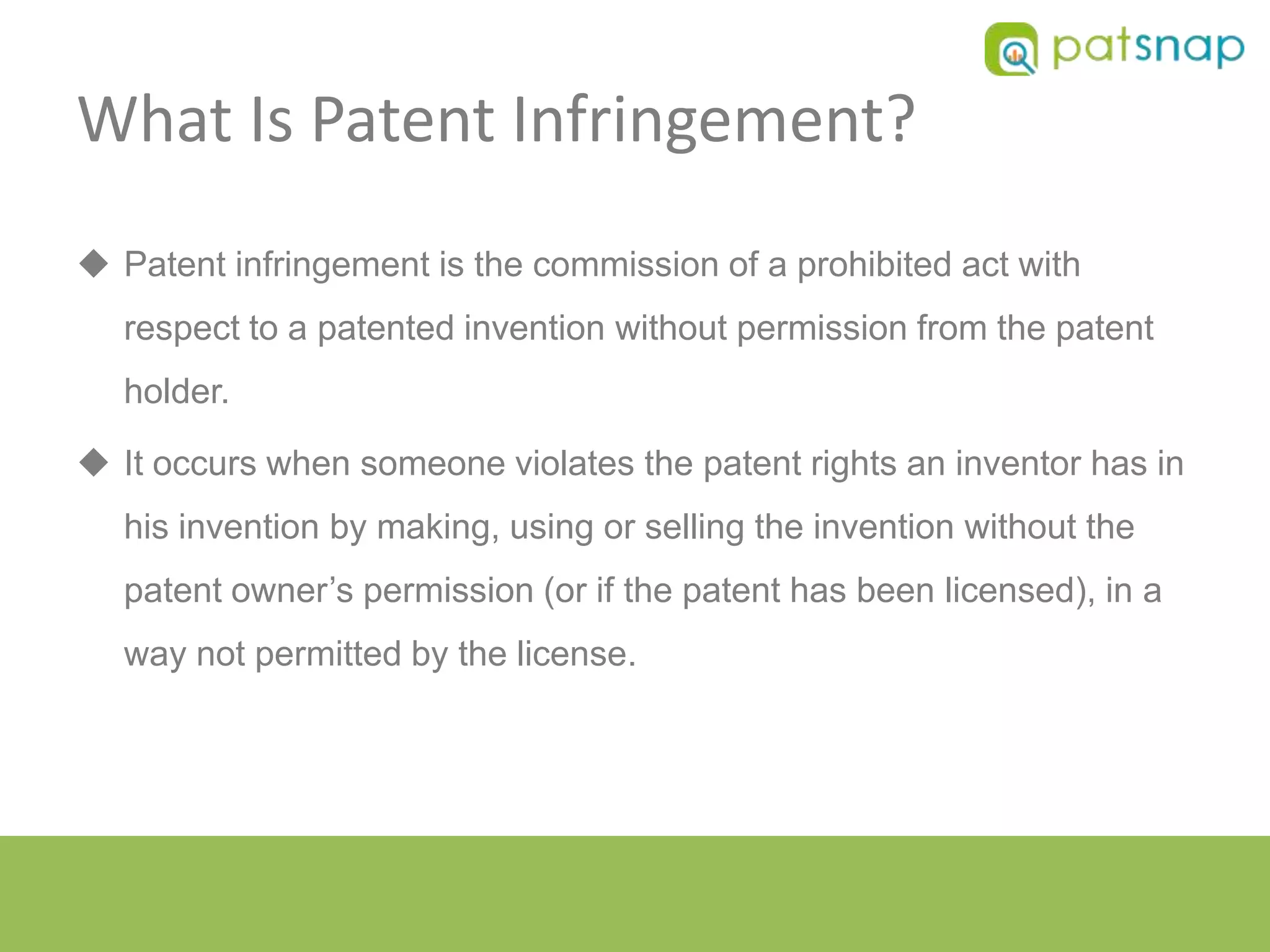
What Is Patent Infringement?Patent infringement is the commission of a prohibited act with respect to a patented invention without permission from the patent holder.
It occurs when someone violates the patent rights an inventor has in his invention by making, using or selling the invention without the patent owner’s permission (or if the patent has been licensed), in a way not permitted by the license. Types of Patent Infringement 1. Direct Infringement It directly states that the third party has willfully or intentionally stole the technology from the inventor without his prior permission.
It occurs when someone directly makes, uses or sells the patented invention within the United States.   2. Indirect Infringement  It refers to the unfair practice that does not give a clear indication that the patent is bought and sold in the market.
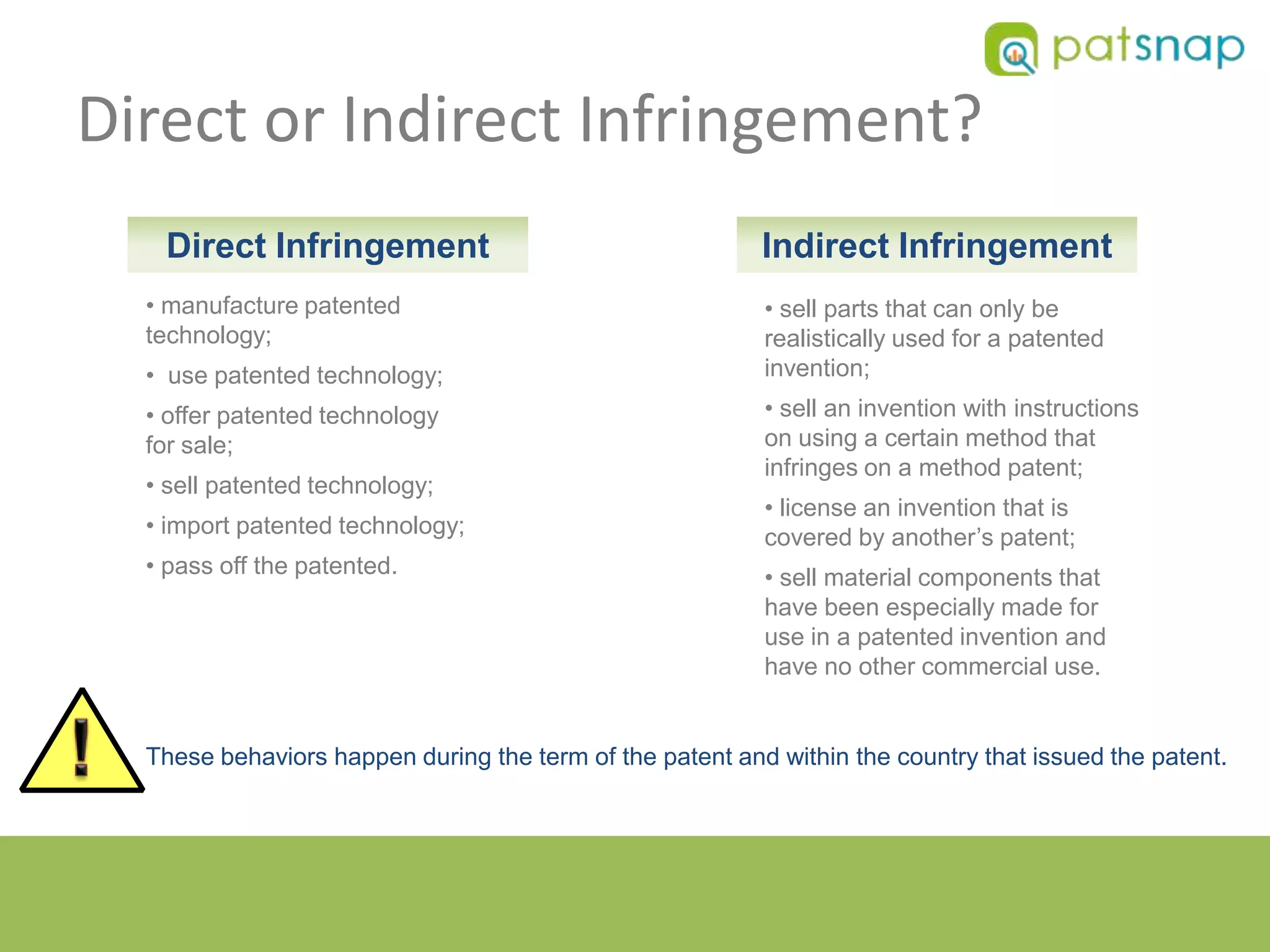
It occurs, for instance, when a device is claimed in a patent and a third party supplies a product which can only be reasonably used to make the claimed device.Direct or Indirect Infringement?Direct Infringement Indirect Infringement  manufacture patented technology;
  use patented technology;
 offer patented technology for sale;
 sell patented technology;
 import patented technology;
 pass off the patented.
 sell parts that can only be realistically used for a patented invention;
 sell an invention with instructions on using a certain method that infringes on a method patent;
 license an invention that is covered by another’s patent;

Patent infringement

  • 1.
  • 2.
    ContentsWhat IsPatent Infringement?1Types of Patent Infringement2Basic Features of Patent Infringement3How to Judge Patent Infringement?45Several Cases of Patent Infringement
  • 3.
    What Is PatentInfringement?Patent infringement is the commission of a prohibited act with respect to a patented invention without permission from the patent holder.
  • 4.
    It occurs when someoneviolates the patent rights an inventor has in his invention by making, using or selling the invention without the patent owner’s permission (or if the patent has been licensed), in a way not permitted by the license. Types of Patent Infringement 1. Direct Infringement It directly states that the third party has willfully or intentionally stole the technology from the inventor without his prior permission.
  • 5.
    It occurs whensomeone directly makes, uses or sells the patented invention within the United States.   2. Indirect Infringement It refers to the unfair practice that does not give a clear indication that the patent is bought and sold in the market.
  • 6.
    It occurs, forinstance, when a device is claimed in a patent and a third party supplies a product which can only be reasonably used to make the claimed device.Direct or Indirect Infringement?Direct Infringement Indirect Infringement manufacture patented technology;
  • 7.
    usepatented technology;
  • 8.
    offer patentedtechnology for sale;
  • 9.
    sell patentedtechnology;
  • 10.
    import patentedtechnology;
  • 11.
    pass offthe patented.
  • 12.
    sell partsthat can only be realistically used for a patented invention;
  • 13.
    sell aninvention with instructions on using a certain method that infringes on a method patent;
  • 14.
    license aninvention that is covered by another’s patent;
  • 15.
    sell materialcomponents that have been especially made for use in a patented invention and have no other commercial use.!These behaviors happen during the term of the patent and within the country that issued the patent.
  • 16.
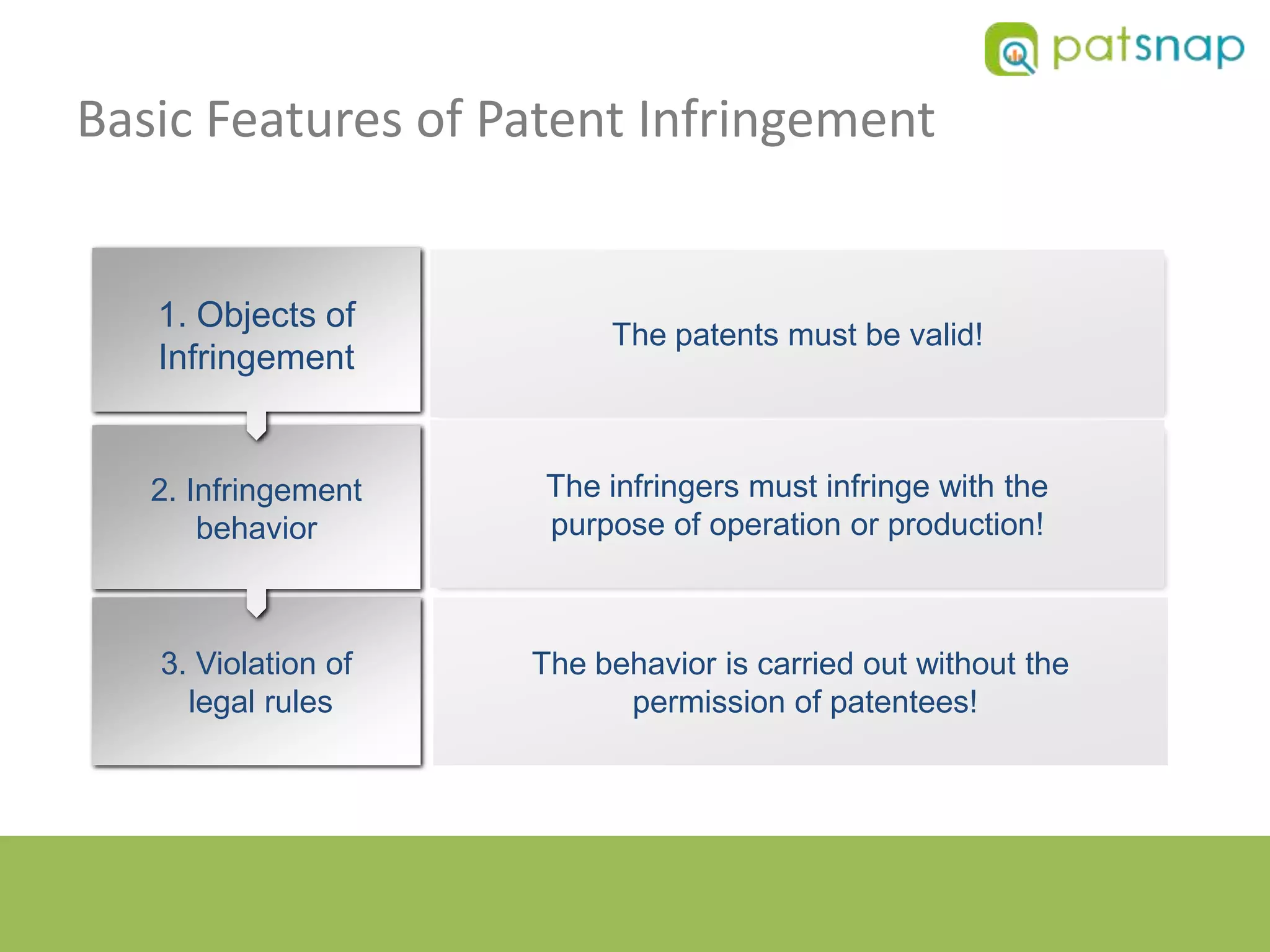
    Basic Features ofPatent InfringementThe infringers must infringe with thepurpose of operation or production!The patents must be valid!1. Objects of Infringement 2. Infringement behavior 3. Violation of legal rules The behavior is carried out without the permission of patentees!
  • 17.
    Possible Consequences ofPatent Infringement1. A huge barrier for independent innovation; 2. Great challenge to the social civilization and sanctity of the law.3. A damage to the economic laws and law of value.4. An illegal behavior that destroys the fair and orderly market competitive order. What consequences can we expect from patent infringement?
  • 18.
    How to JudgePatent Infringement?“ComparePatent Claims ”5PrinciplesDoctrine of EquivalentsDoctrine of Complete CoverageDoctrine of CompromiseDoctrine of EstoppelDoctrine of Superfluity
  • 19.
    How to JudgePatent Infringement?A determination of patent infringement involves a two-step process:1. The claims are analyzed by studying all the relevant patent documents;2. The claims must “read on” the accused device or process. In a word, the claims are tested to see whether they describe the accused infringement.
  • 20.
    About Patent Claims A preamble that recites the class of the invention, and optionally its primary properties, purpose, or field.Defines the scope of protection A "transitional" phrase that characterizes the elements that follow.The utmost important both during prosecution and litigation A set of "limitations" that together describe the invention.The possible parts contained in a claim may be:Optionally, a purpose clause that further describes the overall operation of the Invention.
  • 21.
    Legal Responsibilities ThatInfringers Will Take When patent infringement happens, the patentee may sue for relief in the appropriate Federal court.
  • 22.
    Remedies of PatentInfringement Monetary Relief Cost & Attorney’s FeesEquitable Relief 1. Compensatory damages -- a patent owner may recover lost profits or infringement2. Increased damages-- up to three times the compensatory damages can be recovered in cases of willful or deliberate infringementCosts are typically recoverable and in rare cases where there has been willful infringement , so are attorney’s fees. 1. Preliminary injunctions2. Permanent injunctions
  • 23.
    Several Cases ofPatent Infringement
  • 24.
    Thank You!AboutIP guideand more patent knowledgeVisit school.patsnap.comfor your weekly dose of Intellectual Property guide for early ventures, written by PatSnap’s patent minutes’ team. Rev up your patent knowledge in just 10 minutes.