This document discusses different types of evidence used in forensic science, including testimonial, physical, and eyewitness evidence. It describes factors that affect eyewitness testimony and methods for identifying suspects. It also classifies physical evidence as transient, pattern, or conditional and provides examples. Finally, it discusses classifying evidence by nature or type, and the major activities involved in forensic investigations.
Overview of evidence types: testimonial evidence is direct; physical evidence, including hair and fingerprints, is indirect.
Factors affecting eyewitness accuracy include witness characteristics and prior relationships; physical evidence is more reliable for linking suspects.
Physical evidence aids in answering crime scene questions, including event sequences and identifying suspects; various types like transient and pattern evidence are crucial.
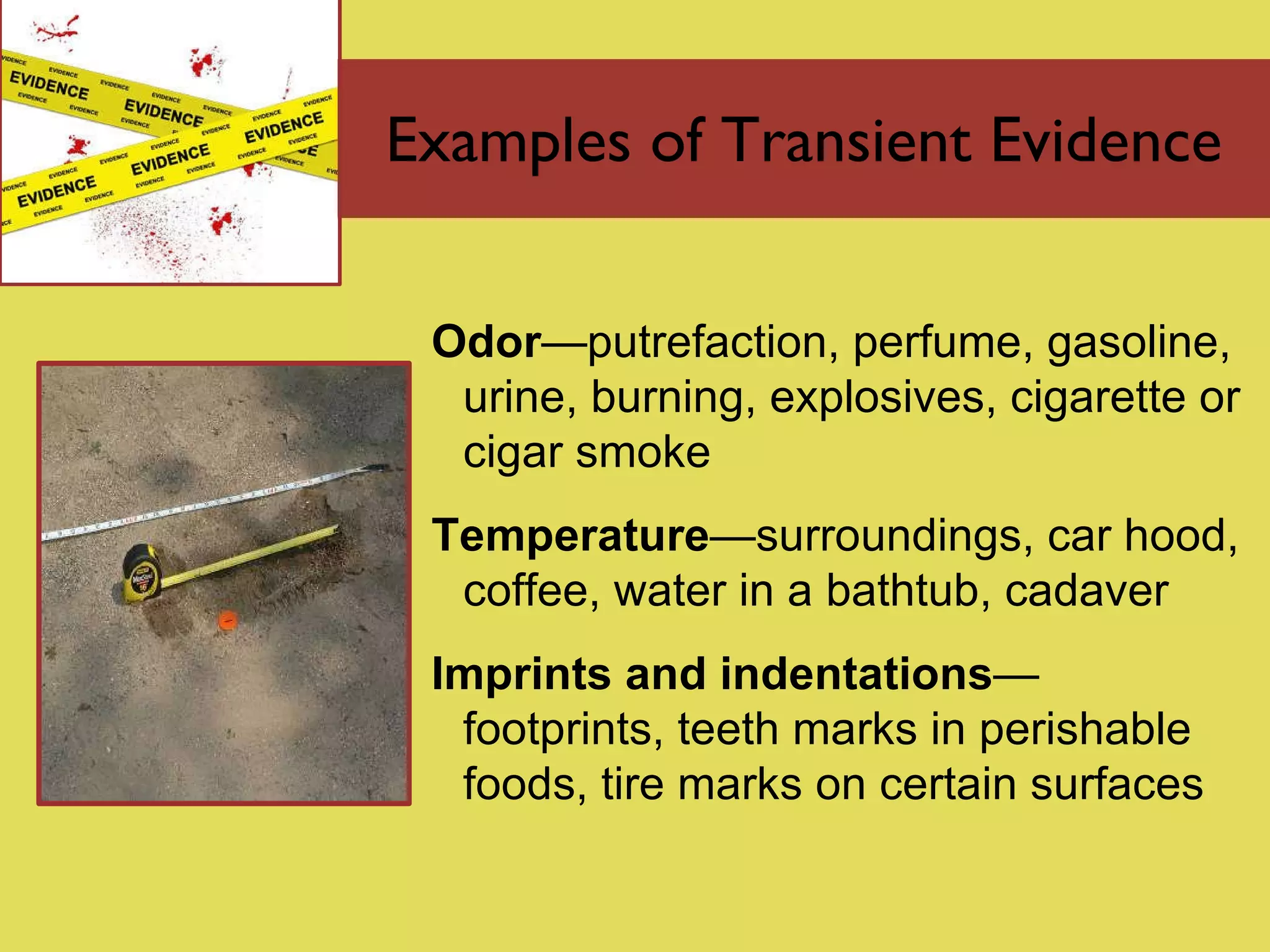
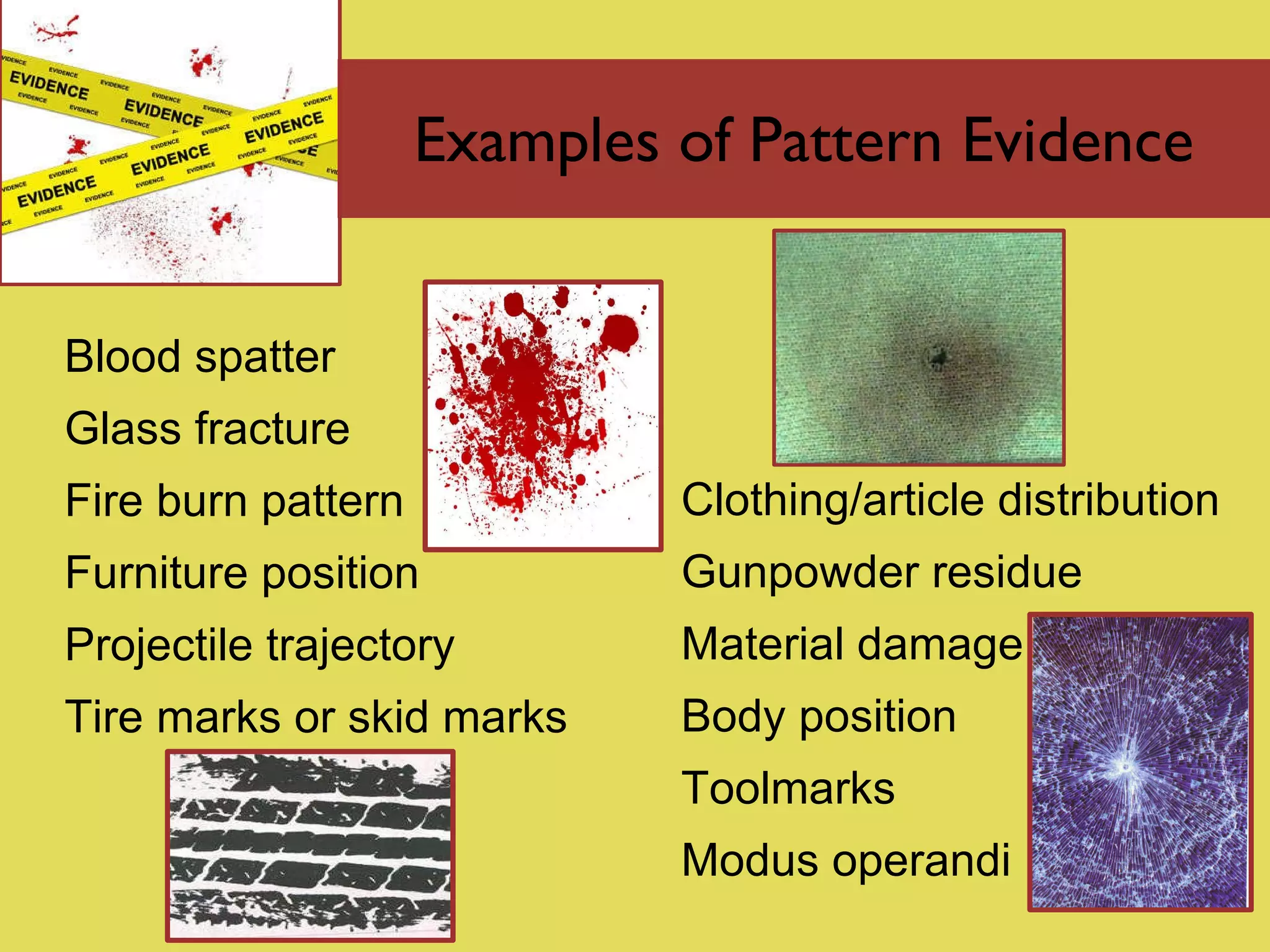
Examples include transient evidence (odors, temperatures), pattern evidence (blood spatter, gunpowder), and conditional evidence related to light and smoke.
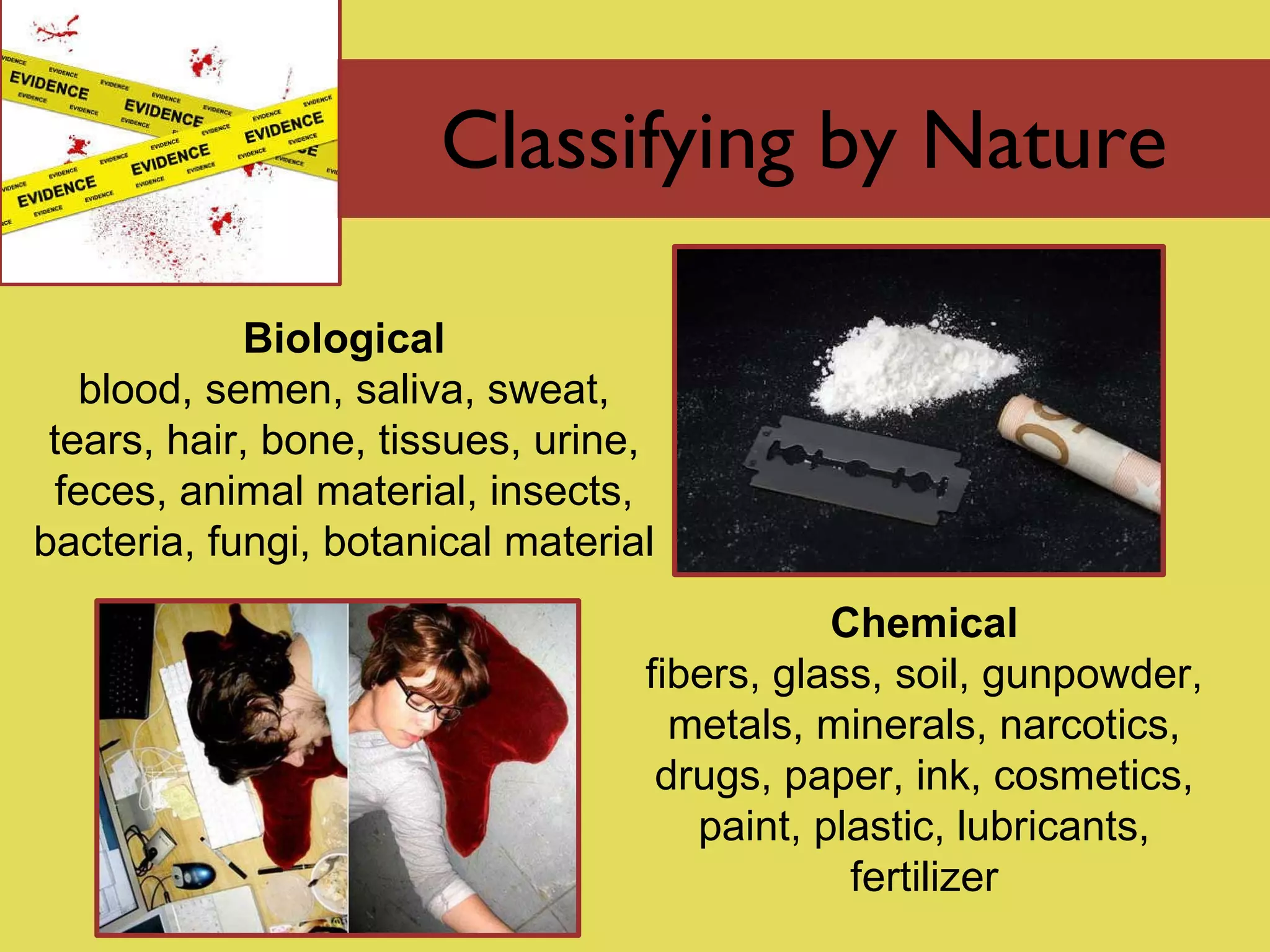
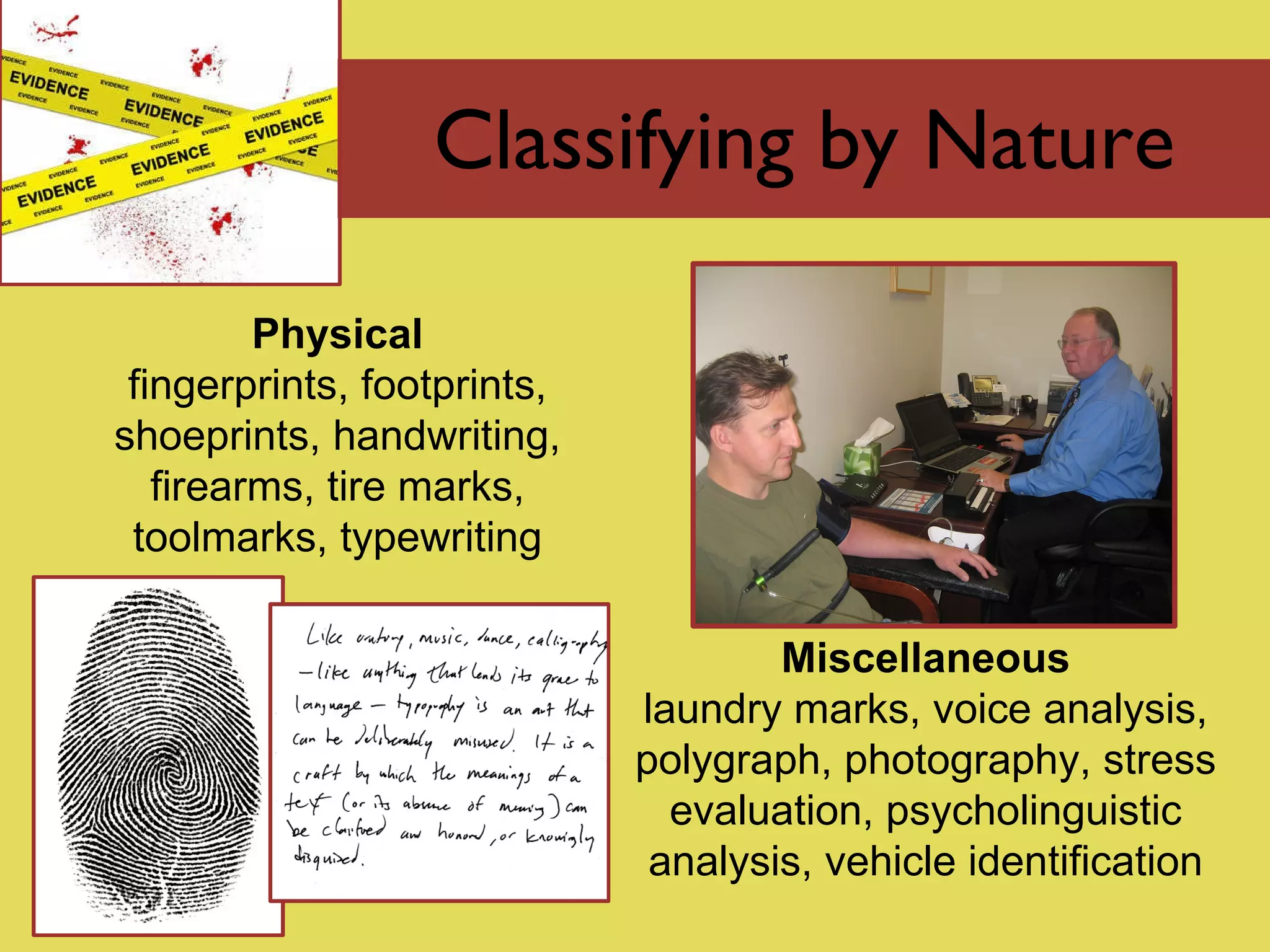
Classification by nature includes biological and chemical types; transfer and associative evidence link suspects/victims to crime scenes.
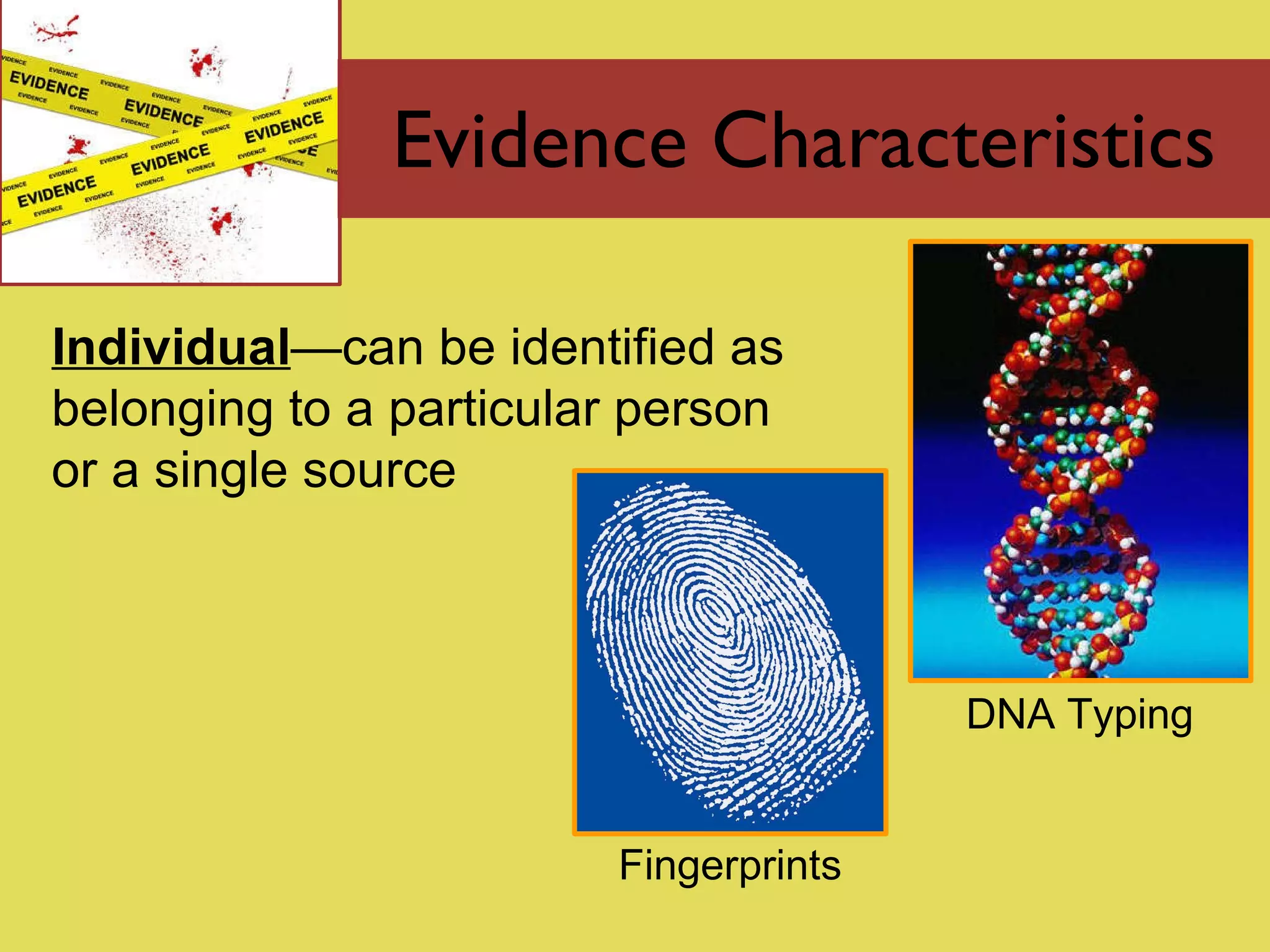
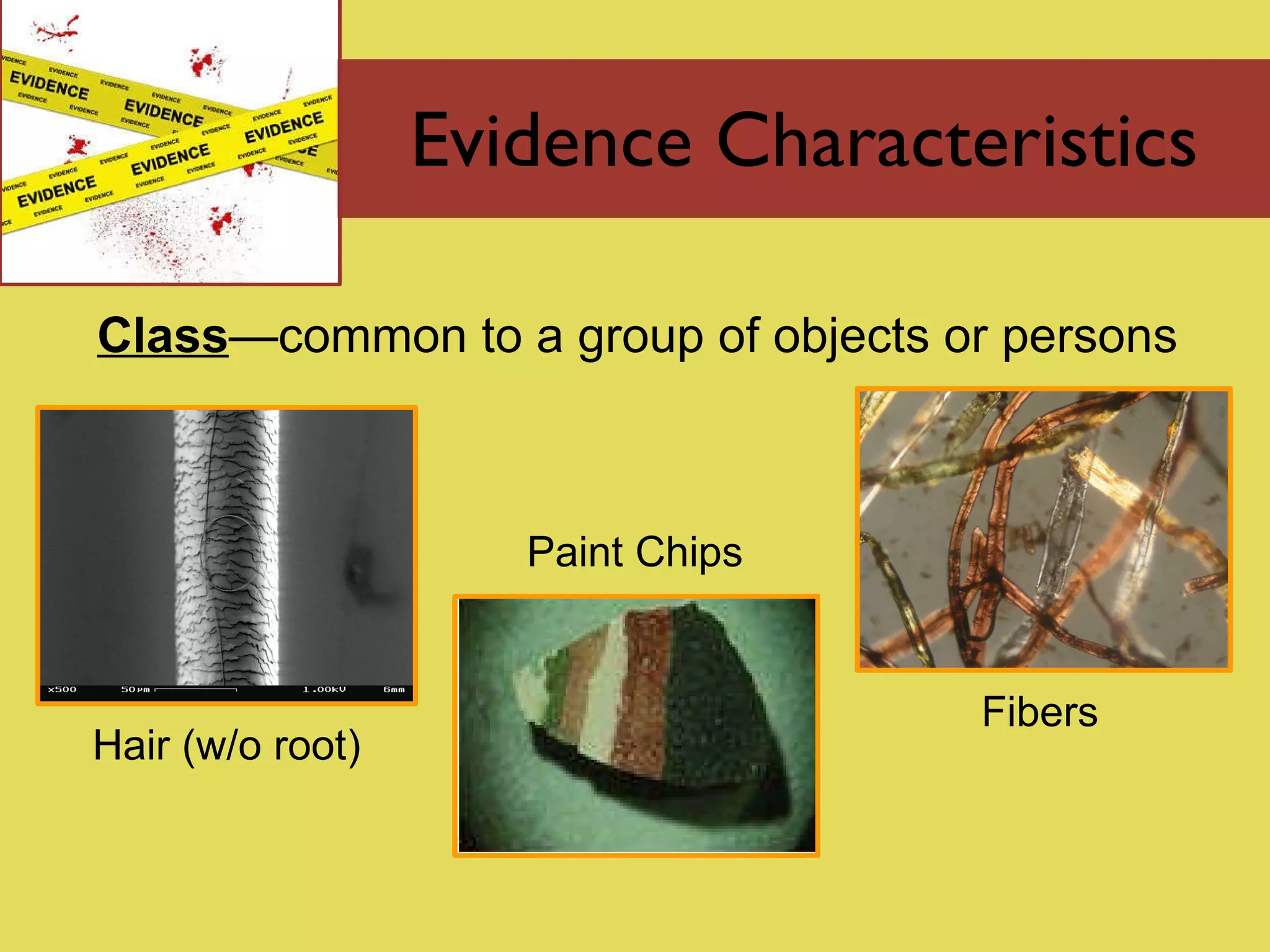
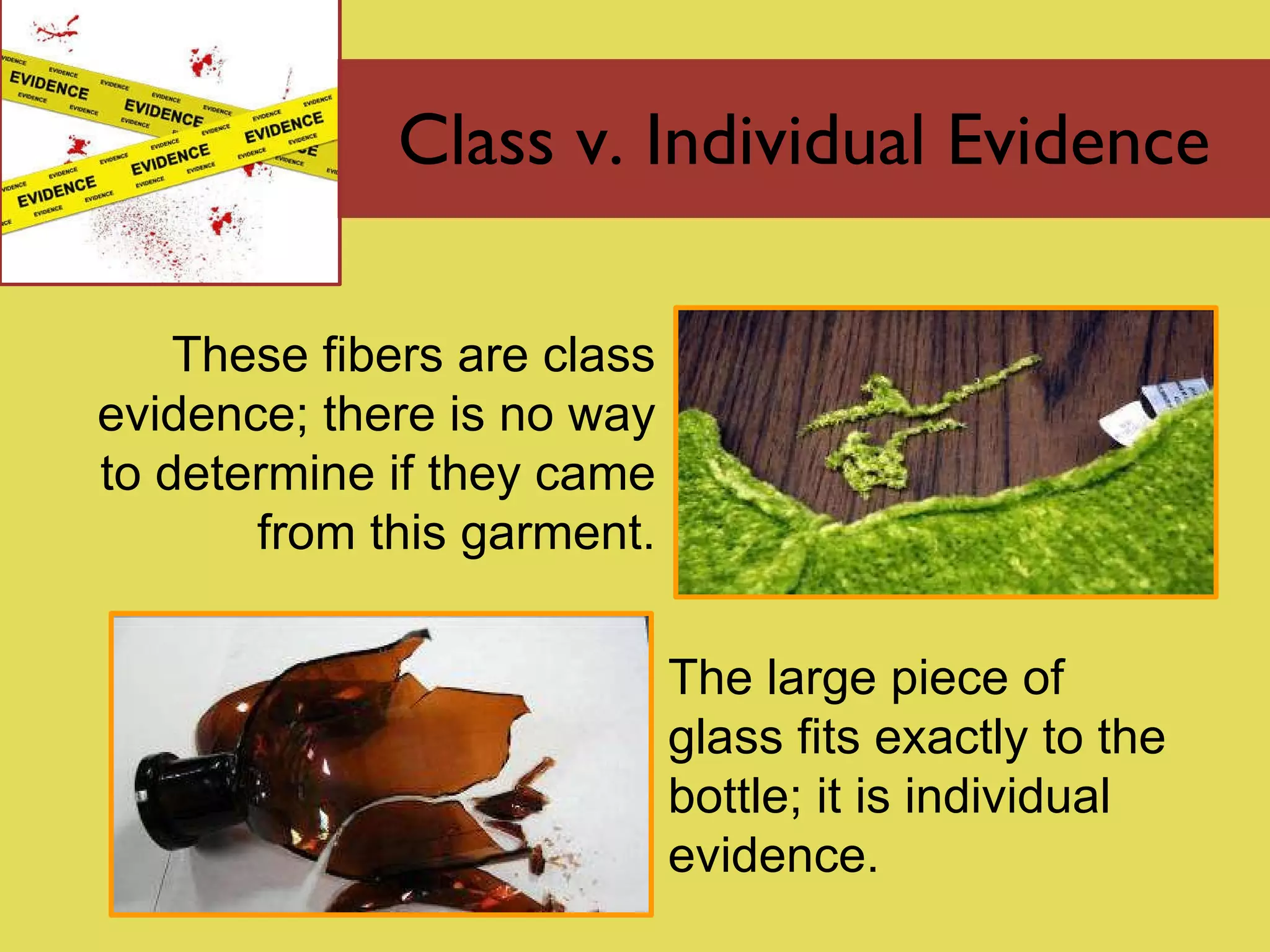
Evidence can be individual ( DNA, fingerprints) or class (hair, paint); a piece of glass may be unique, while fibers are class evidence.
Forensic investigations include recognition of evidence, preservation, identification, comparison, interpretation, and reconstruction of events.
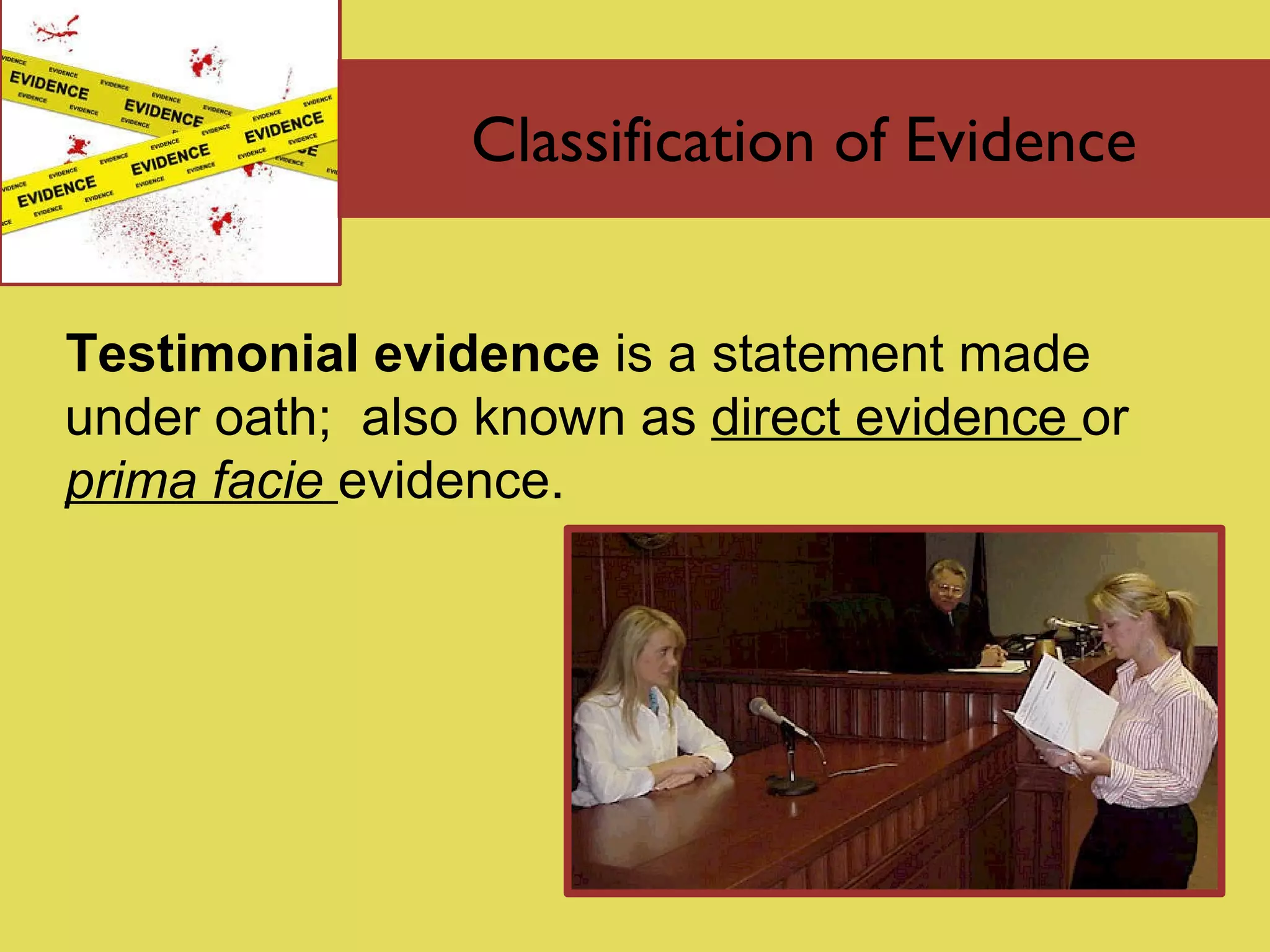
Classification of EvidenceTestimonial evidence is a statement made under oath; also known as direct evidence or prima facie evidence.
3.
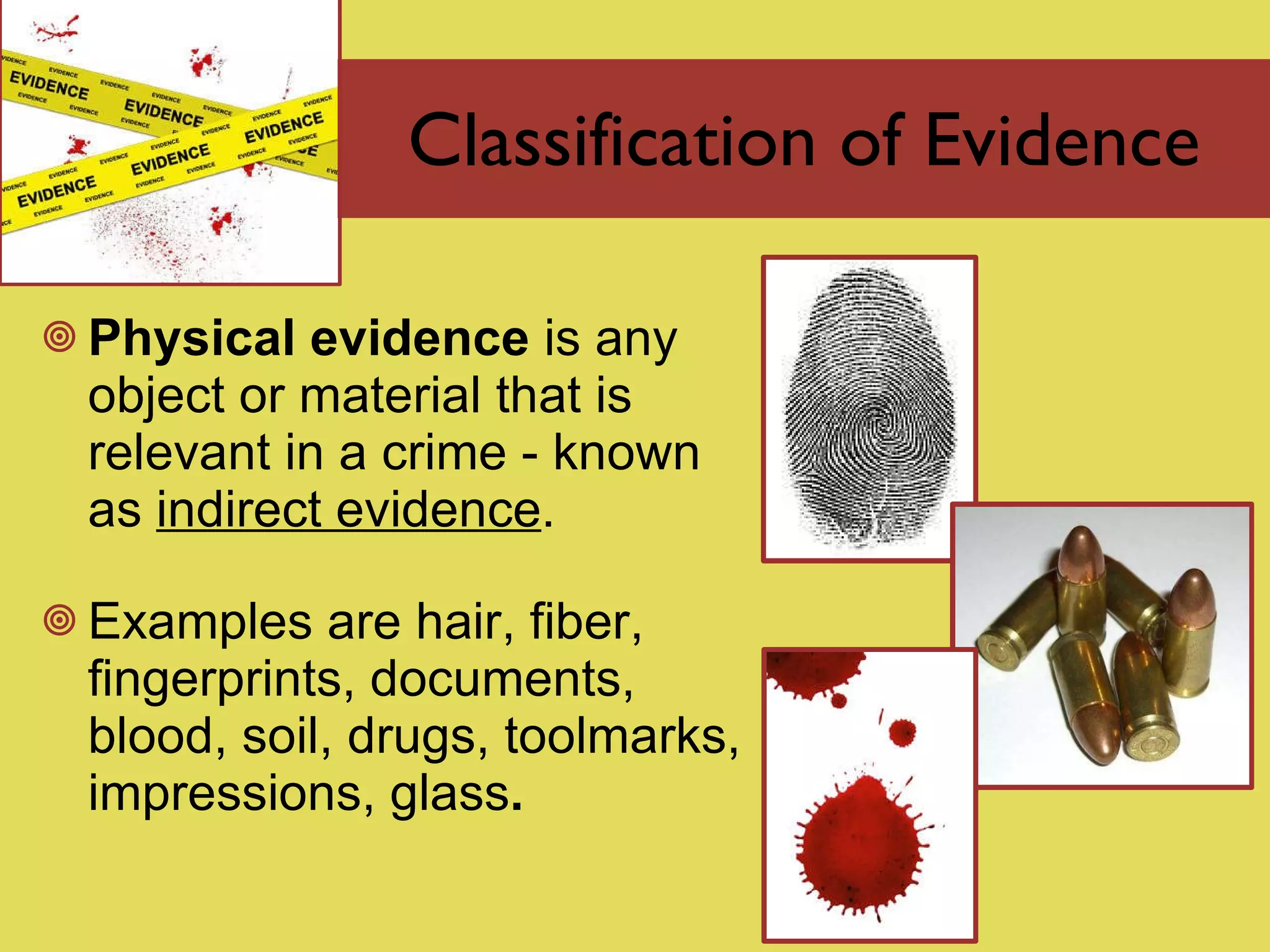
Classification of EvidencePhysical evidence is any object or material that is relevant in a crime - known as indirect evidence . Examples are hair, fiber, fingerprints, documents, blood, soil, drugs, toolmarks, impressions, glass .
4.
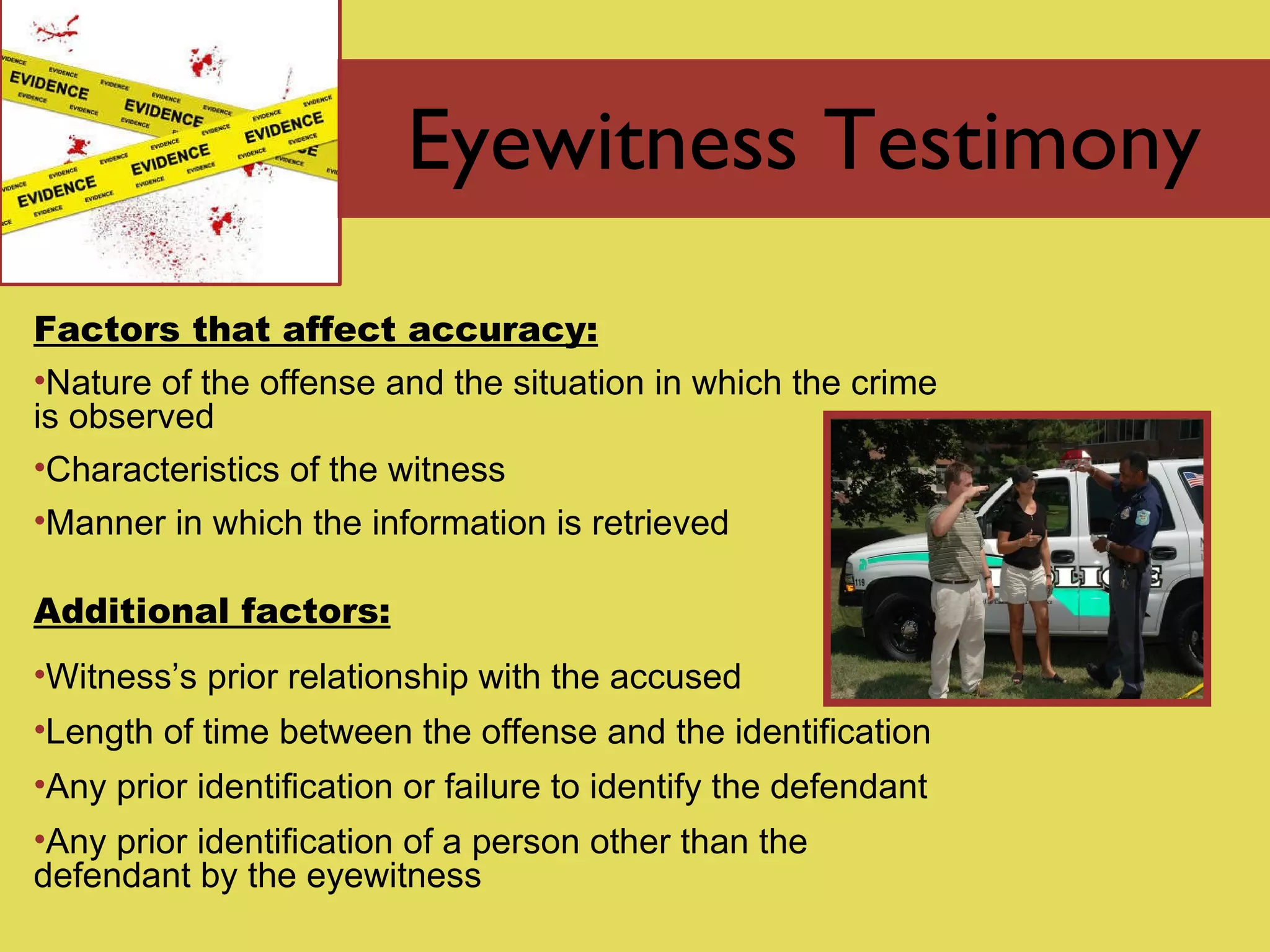
Eyewitness Testimony Factorsthat affect accuracy: Nature of the offense and the situation in which the crime is observed Characteristics of the witness Manner in which the information is retrieved Additional factors: Witness’s prior relationship with the accused Length of time between the offense and the identification Any prior identification or failure to identify the defendant Any prior identification of a person other than the defendant by the eyewitness
5.
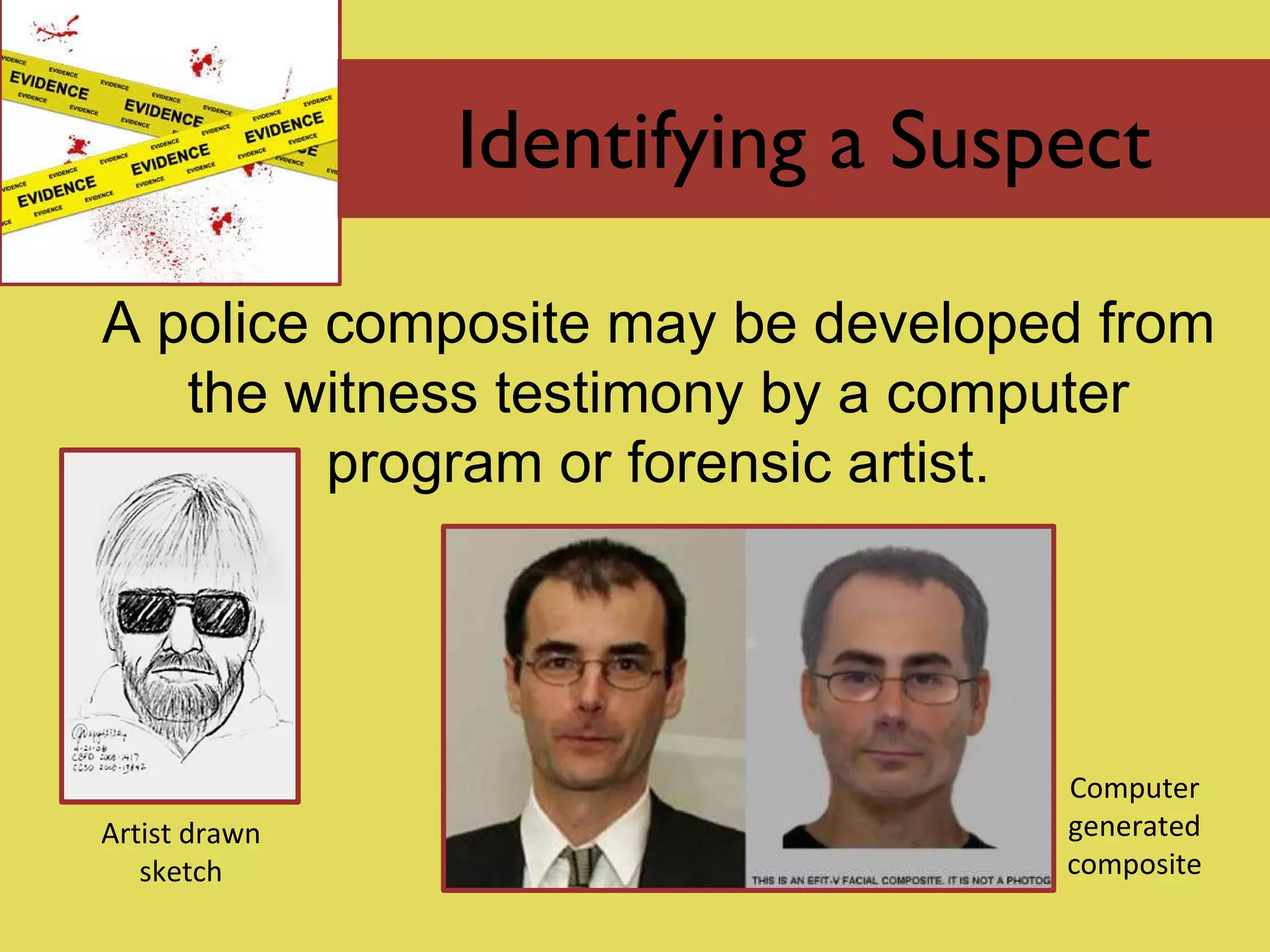
Identifying a SuspectA police composite may be developed from the witness testimony by a computer program or forensic artist. Artist drawn sketch Computer generated composite
6.
Physical Evidence Isgenerally more reliable than testimonial evidence Can prove that a crime has been committed Can corroborate or refute testimony As a result of the influences on eyewitness memory, physical evidence becomes critical. Can link a suspect with a victim or with a crime scene Can establish the identity of persons associated with a crime Can allow reconstruction of events of a crime
7.
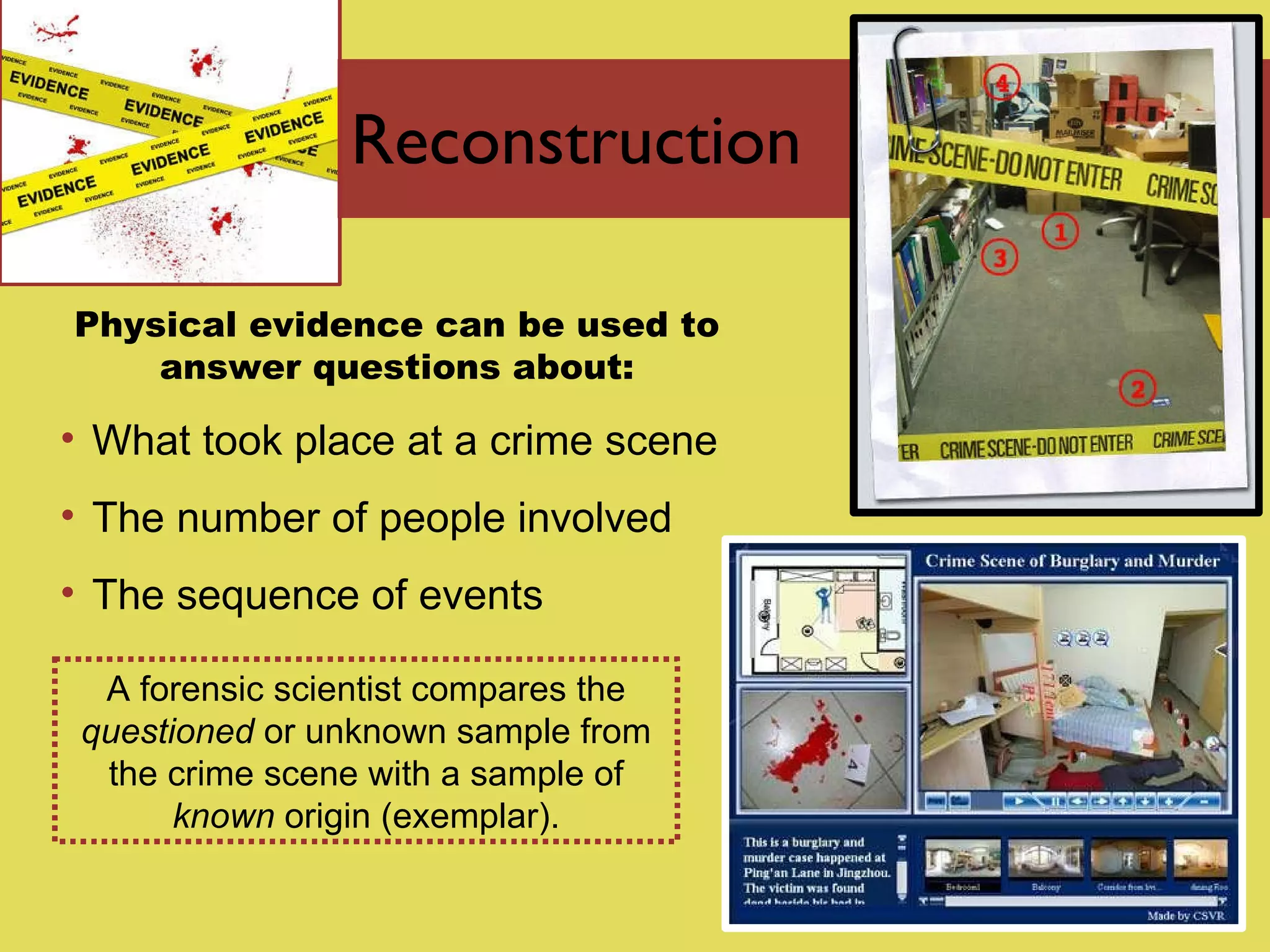
Reconstruction Physical evidencecan be used to answer questions about: What took place at a crime scene The number of people involved The sequence of events A forensic scientist compares the questioned or unknown sample from the crime scene with a sample of known origin (exemplar).
8.
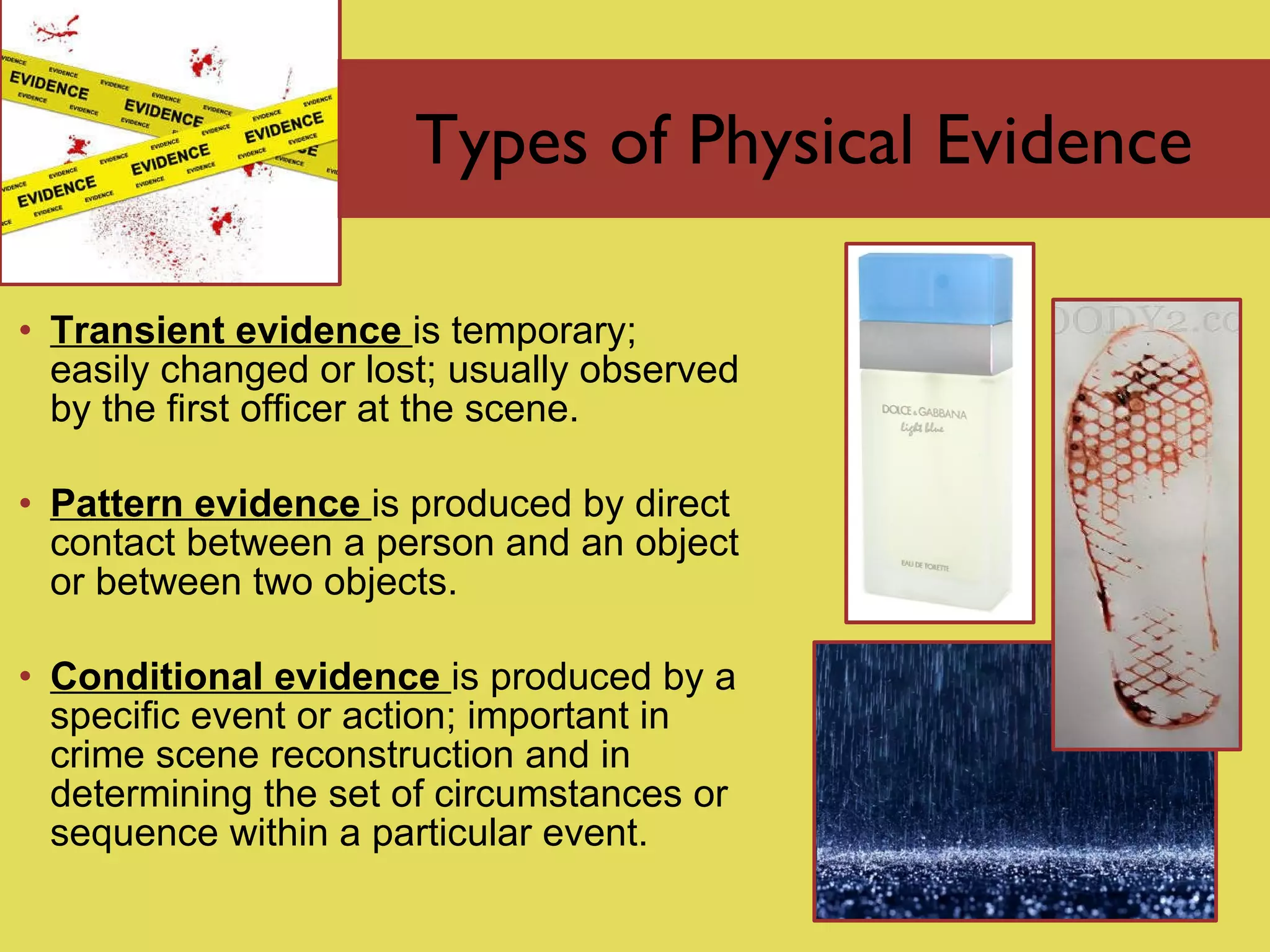
Types of PhysicalEvidence Transient evidence is temporary; easily changed or lost; usually observed by the first officer at the scene. Pattern evidence is produced by direct contact between a person and an object or between two objects. Conditional evidence is produced by a specific event or action; important in crime scene reconstruction and in determining the set of circumstances or sequence within a particular event.
9.
Examples of TransientEvidence Odor — putrefaction, perfume, gasoline, urine, burning, explosives, cigarette or cigar smoke Temperature — surroundings, car hood, coffee, water in a bathtub, cadaver Imprints and indentations — footprints, teeth marks in perishable foods, tire marks on certain surfaces
10.
Examples of PatternEvidence Clothing/article distribution Gunpowder residue Material damage Body position Toolmarks Modus operandi Blood spatter Glass fracture Fire burn pattern Furniture position Projectile trajectory Tire marks or skid marks
11.
Examples of ConditionalEvidence Light — headlight, lighting conditions, lights on or off Smoke — color, direction of travel, density, odor Fire — color and direction of the flames, speed of spread, temperature and condition of fire Location — of injuries or wounds, of bloodstains, of the victim’s vehicle, of weapons or cartridge cases, of broken glass Vehicles — doors locked or unlocked, windows opened or closed, radio off or on, odometer mileage Body — position and types of wounds; rigor, livor, and algor mortis Scene — condition of furniture, doors and windows, any disturbance or signs of a struggle
Types of PhysicalEvidence Transfer evidence : produced by contact between person(s) and object(s), or between person(s) and person(s). Associative evidence : something that may associate a victim or suspect with a scene or with each other; e.g., personal belongings.
Class v. IndividualEvidence The large piece of glass fits exactly to the bottle ; it is individual evidence. These fibers are class evidence ; there is no way to determine if they came from this garment.
18.
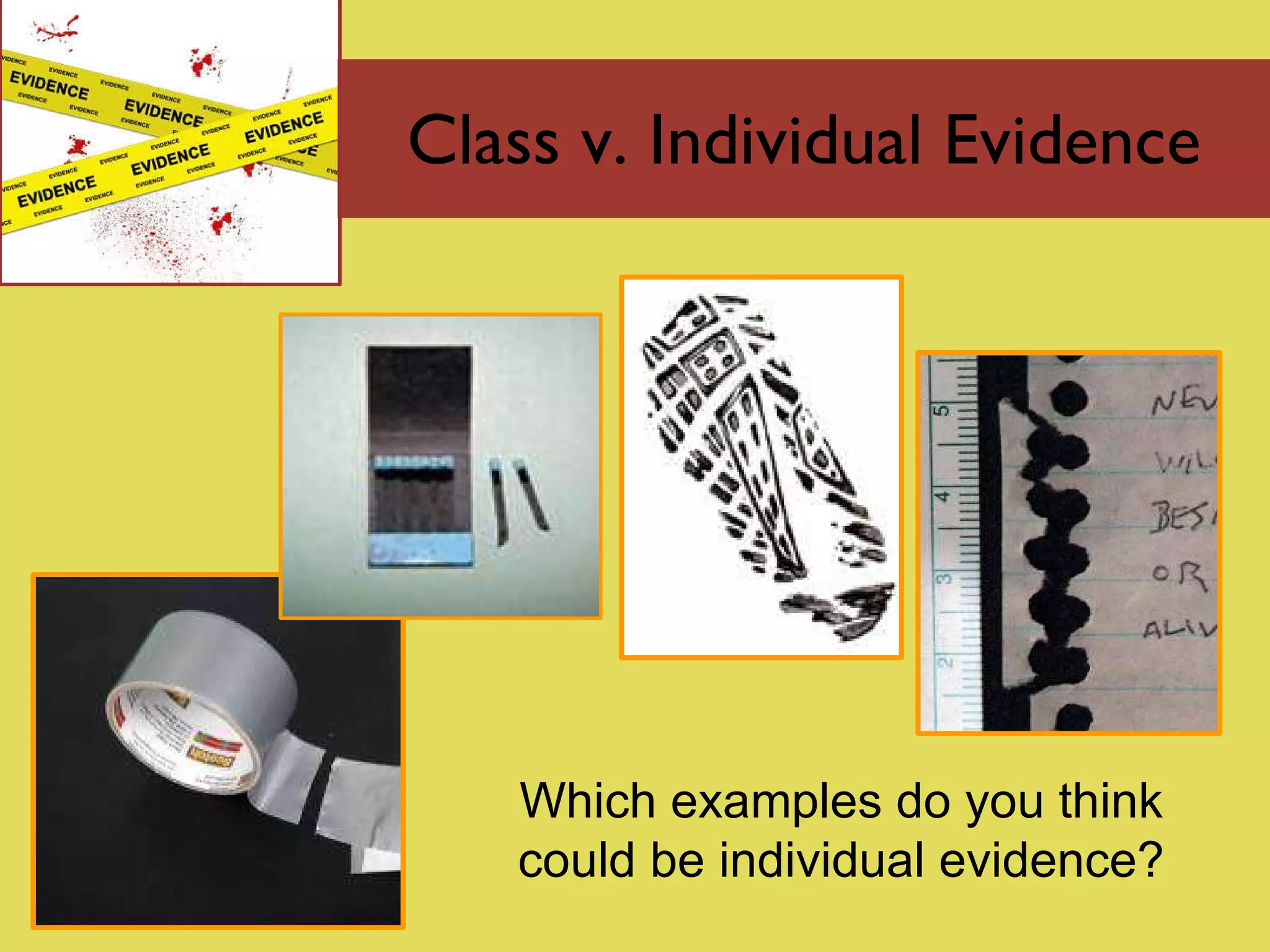
Class v. IndividualEvidence Which examples do you think could be individual evidence?
19.
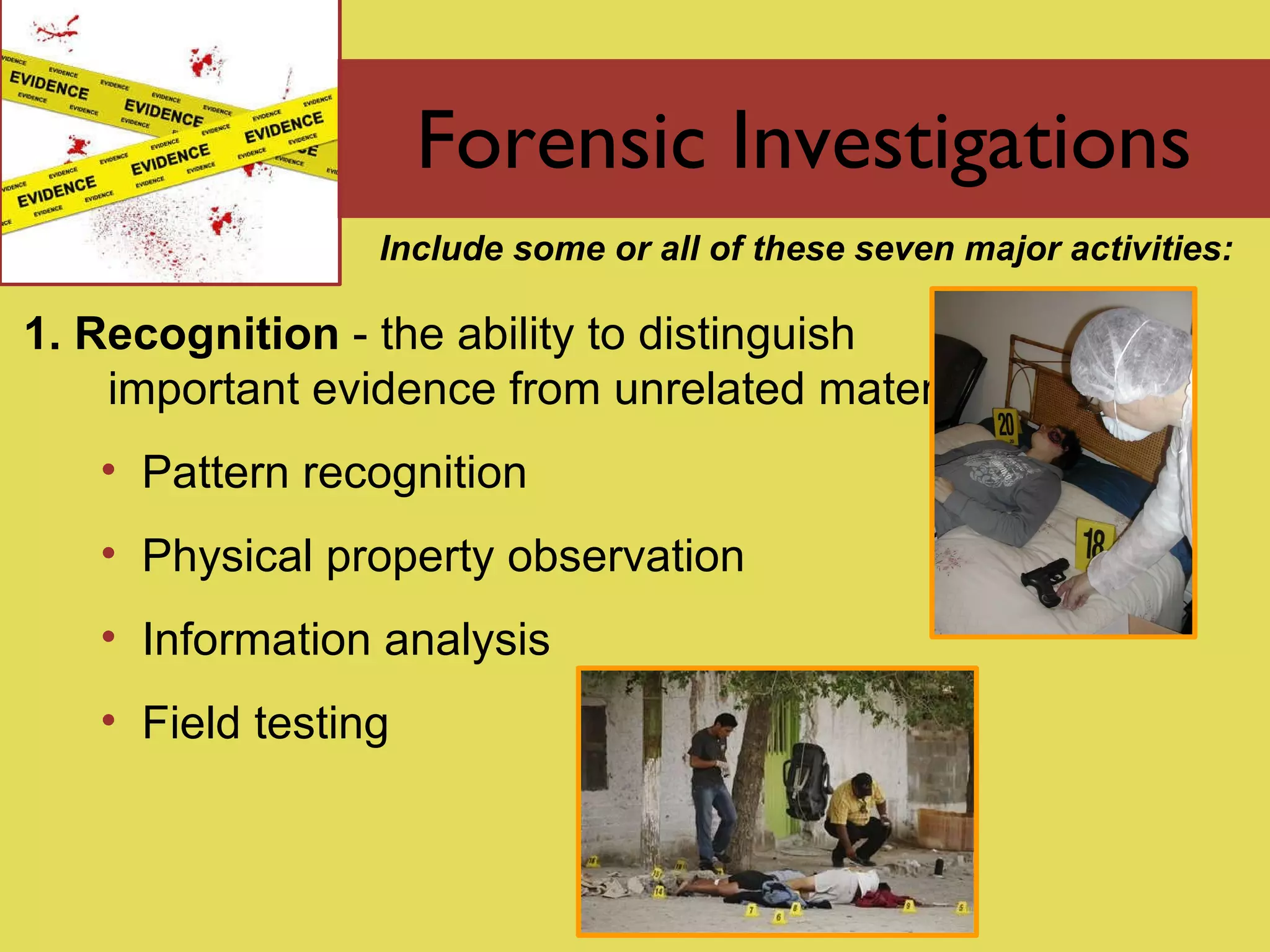
Forensic Investigations 1.Recognition - the ability to distinguish important evidence from unrelated material Pattern recognition Physical property observation Information analysis Field testing Include some or all of these seven major activities:
20.
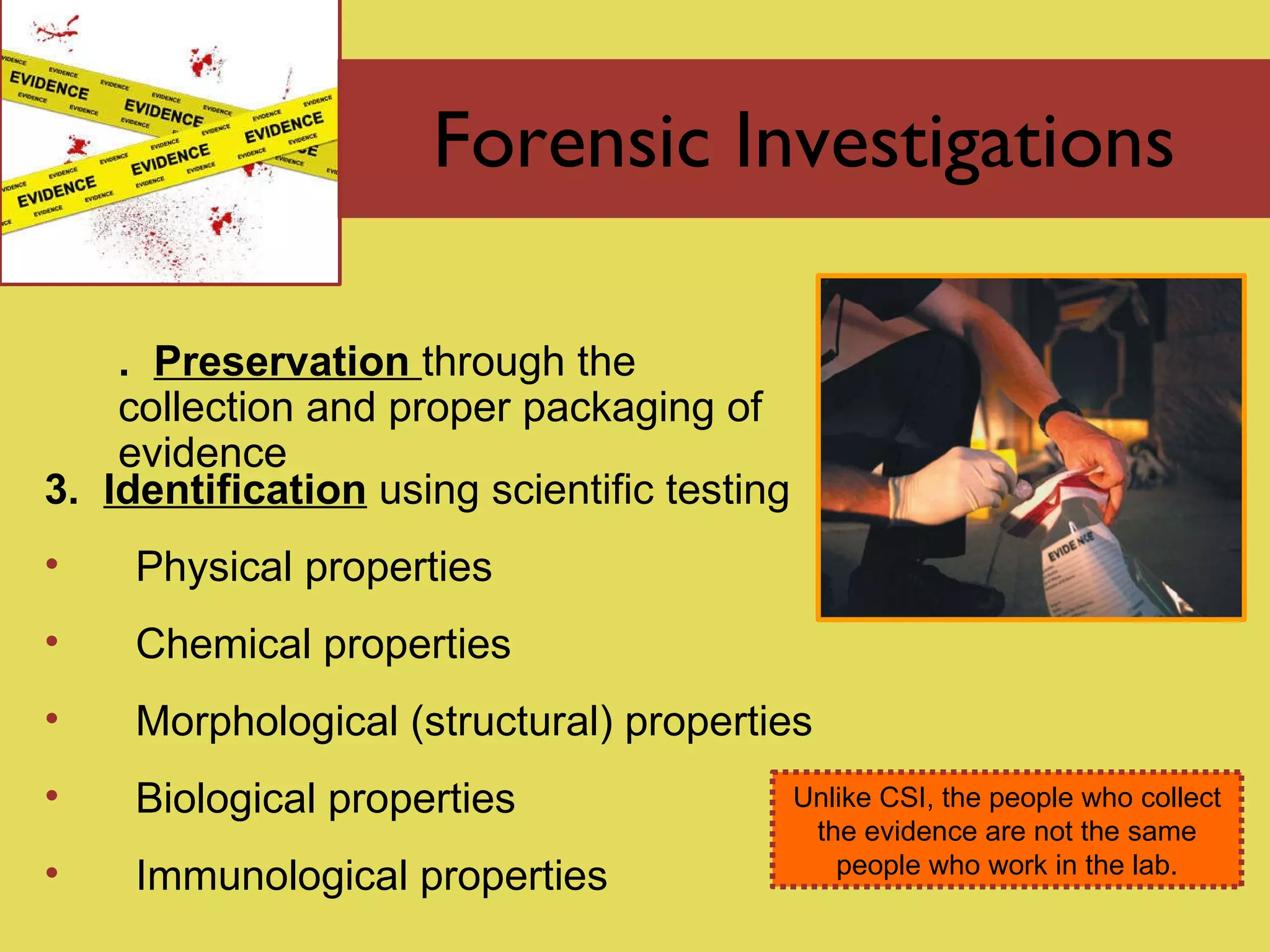
Forensic Investigations 2. Preservation through the collection and proper packaging of evidence 3. Identification using scientific testing Physical properties Chemical properties Morphological (structural) properties Biological properties Immunological properties Unlike CSI, the people who collect the evidence are not the same people who work in the lab.
21.
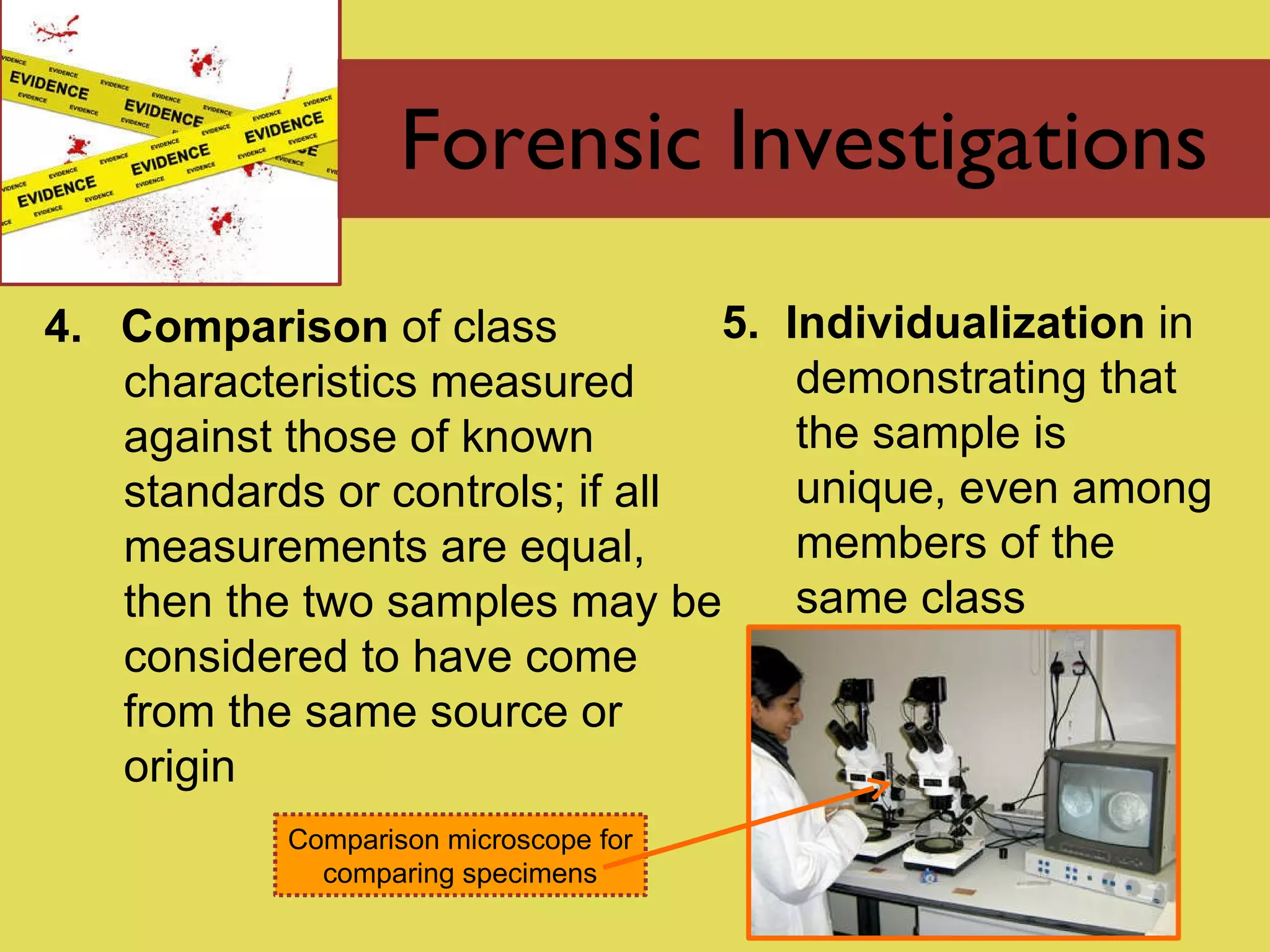
Forensic Investigations 4. Comparison of class characteristics measured against those of known standards or controls; if all measurements are equal, then the two samples may be considered to have come from the same source or origin 5. Individualization in demonstrating that the sample is unique, even among members of the same class Comparison microscope for comparing specimens
22.
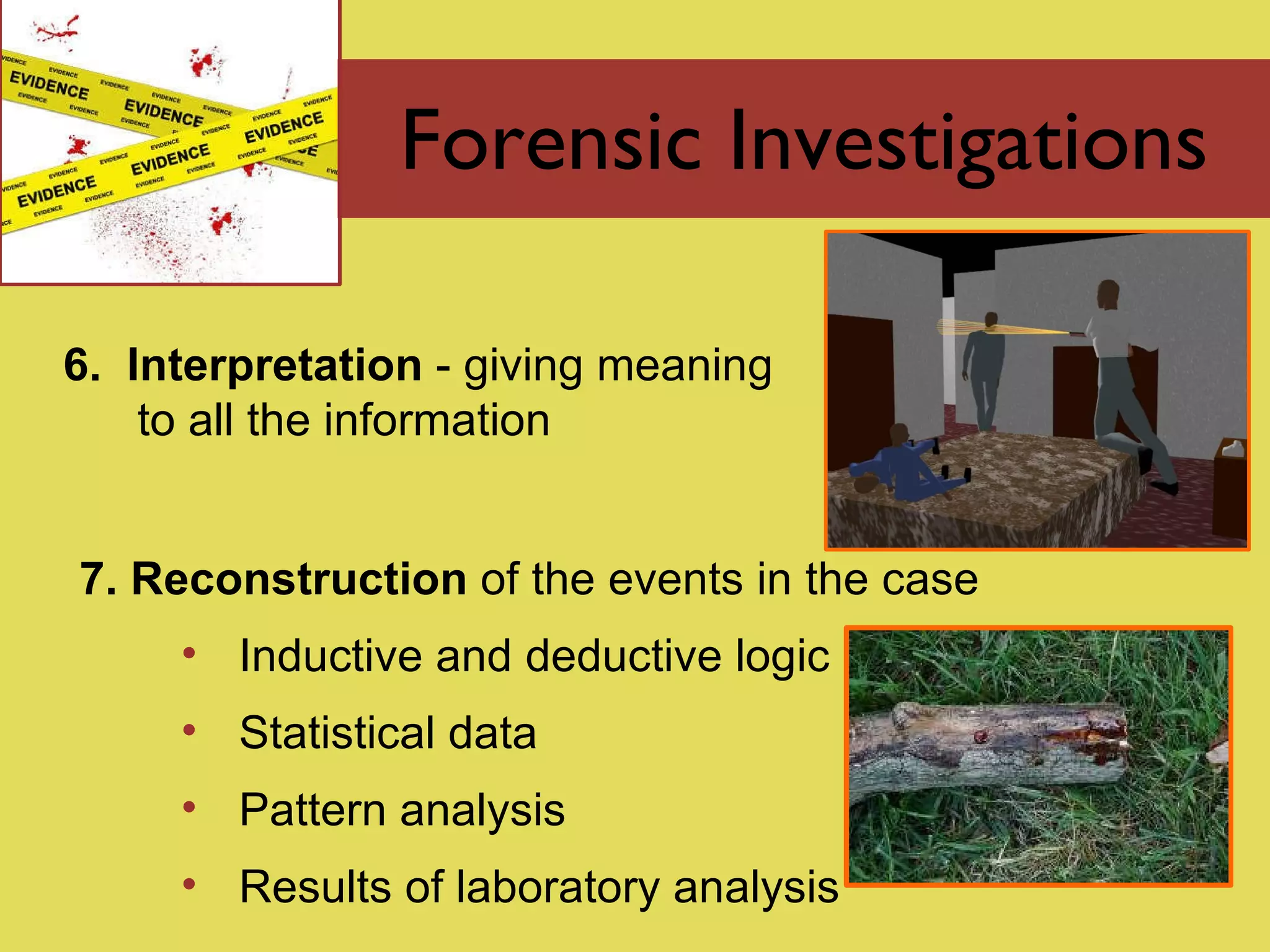
Forensic Investigations 6. Interpretation - giving meaning to all the information 7. Reconstruction of the events in the case Inductive and deductive logic Statistical data Pattern analysis Results of laboratory analysis