Metric Prefixes
What is the difference between a meter, a centimeter, a
millimeter …?
Purpose
• The metric system exists to represent quantities whether large or small as
manageable numbers. Instead of saying your computer operates at
2,500,000,000 hertz, one can say it operates at 2.5 gigahertz. By placing
the prefix giga- in front of hertz, it is understood how it affects the
number. In this lesson, you will learn some the most commonly used
metric prefixes.
First let’s look at a meter stick
The box above represents 1 meter in length.
If you cut the box into 100 equal pieces, you get the box above. It represents 1
centimeter. This is the same as one one-hundredth of a meter (1/100 m or 0.01 m)
If you cut the meter box into 1000 equal pieces, you get the box above. It represents 1
millimeter. This is the same as one one-thousandth of a meter (1/1000 m or 0.001 m)
1 meter
1 centimeter
1 millimeter
Notice how the prefix changes the magnitude
• Adding centi- in front of meter means that we have one one-hudredth of a
meter
• Adding milli- in front of meter means that we have one one-thousandth of
a meter
1 meter
1 centimeter 1 millimeter
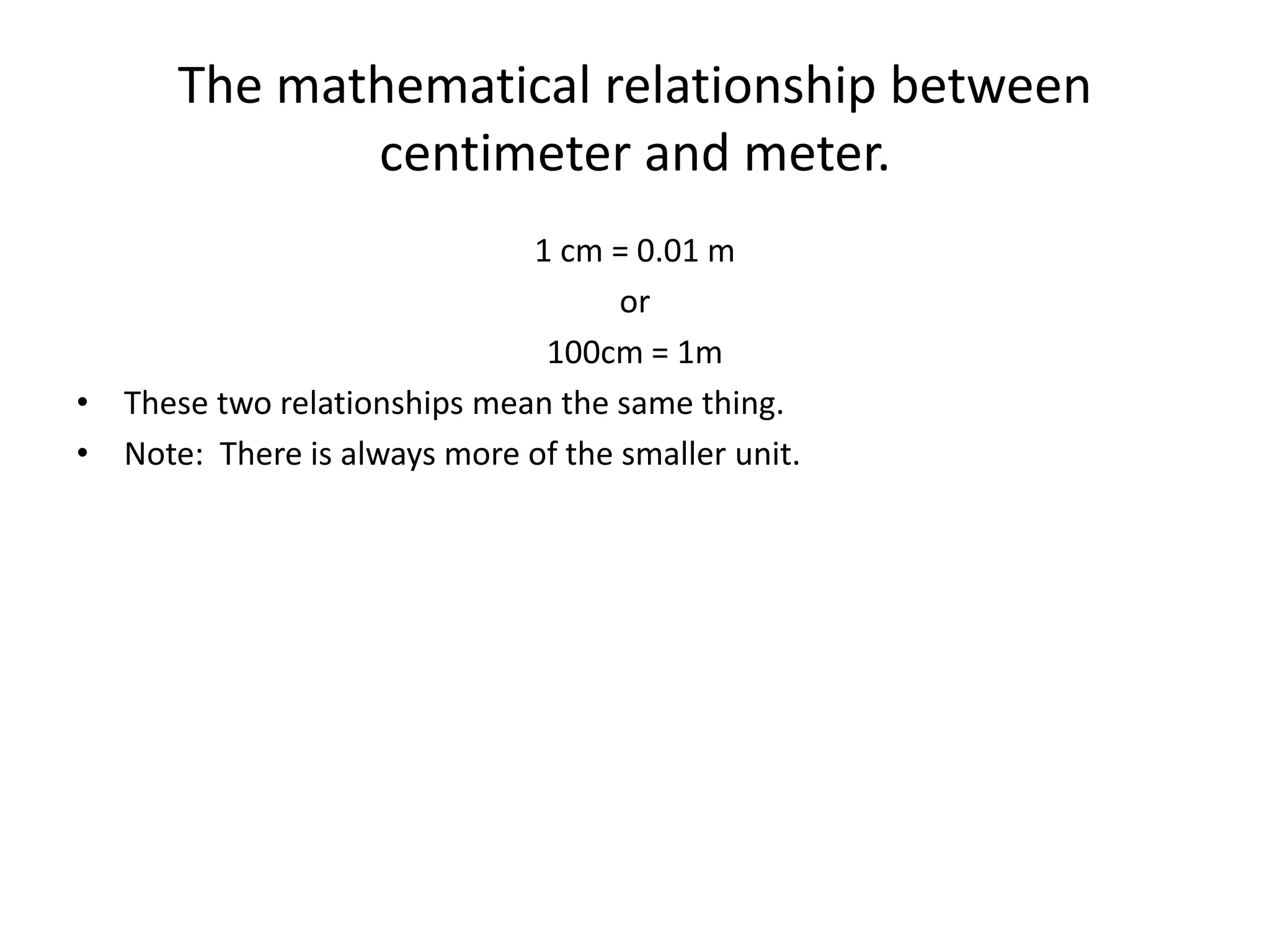
The mathematical relationship between
centimeter and meter.
1 cm = 0.01 m
or
100cm = 1m
• These two relationships mean the same thing.
• Note: There is always more of the smaller unit.
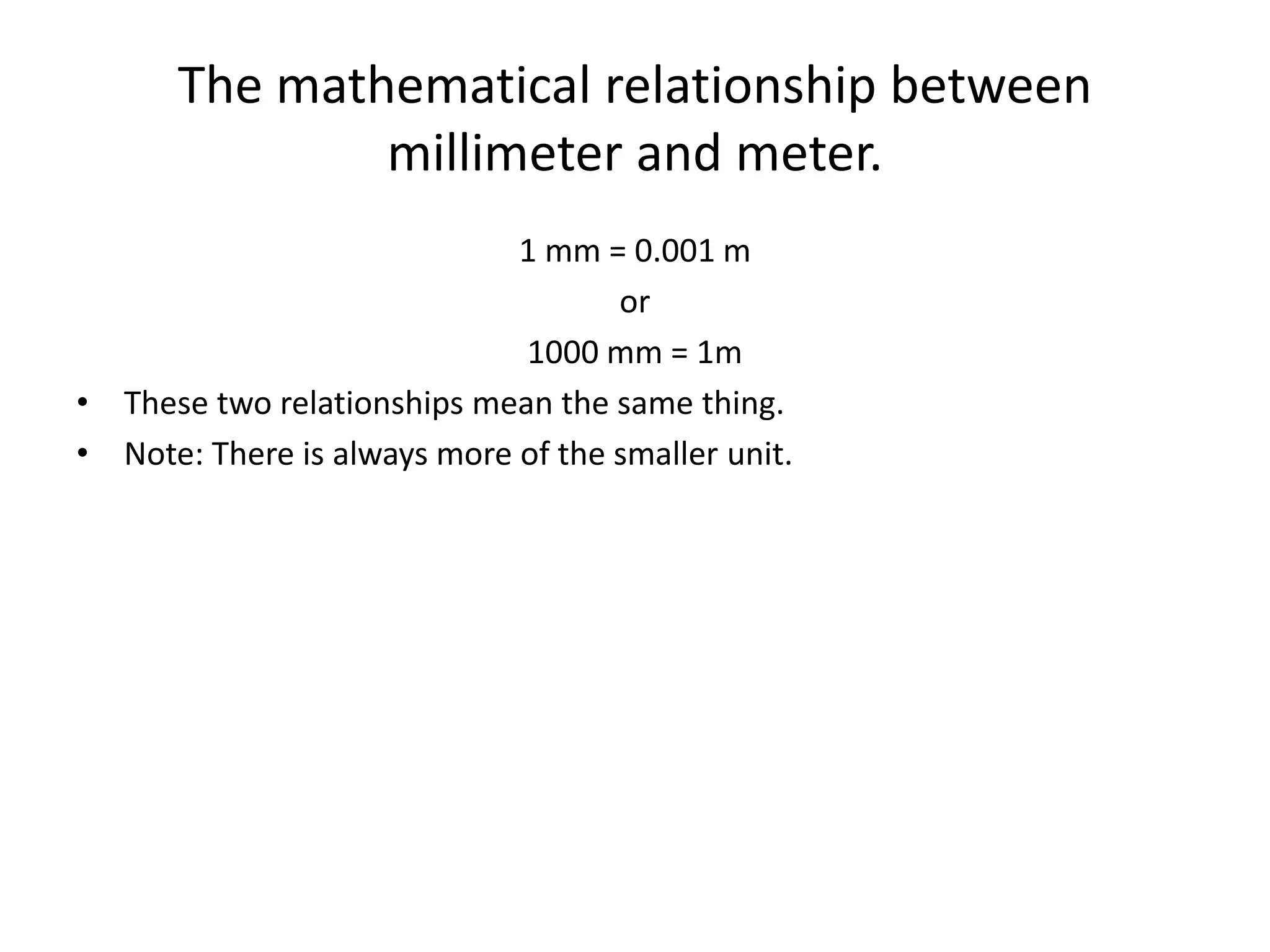
The mathematical relationship between
millimeter and meter.
1 mm = 0.001 m
or
1000 mm = 1m
• These two relationships mean the same thing.
• Note: There is always more of the smaller unit.
Milli- and centi- are just two of the metric
prefixes you should know.
Prefix Abbreviation Meaning Sci. Not.
mega M 1,000,000 106
kilo k 1000 103
no prefix - 1
deci d 0.1 (1/10) 10-1
centi c 0.01 (1/100) 10-2
milli m 0.001 (1/1000) 10-3
micro μ 0.000001 (1/1,000,000) 10-6
nano n 0.000000001 (1/1,000,000,000) 10-9
Note:
The symbol for micro is the greek letter mu.
Sci. Not. stands for scientific notation
Aside from deci- and centi- notice how they
change by magnitudes of 1000 ( 103)
Prefix Abbreviation Sci. Not. Example
mega M 106 1 Mm = 1 x 10⁶ m
kilo k 103 1 km = 1 x 10³ m
no prefix - 100
deci d 10-1 1dm = 1 x 10⁻¹ m
centi c 10-2 1 cm = 1x10⁻² m
milli m 10-3 1 mm = 1 x 10⁻³ m
micro μ 10-6 1 μm = 1 x 10⁻⁶ m
nano n 10-9 1 nm = 1 x 10⁻⁹ m
Note:
The symbol for micro is the greek letter mu.
Sci. Not. stands for scientific notation
Memorize the order
• First learn the order for those that change by 103:
– Nano, micro, milli, no prefix, kilo, mega
– 10-9, 10-6, 10-3, 100, 103, 106
• deci- and centi- should be easy to remember as one tenth (0.1 or 10-1) and
one one-hundredth (0.01 or 10-2)
Sometimes negative exponents are hard to visualize.
It may be easier to think about the examples this way.
Prefix Original Example New Example
mega 1 Mm = 1 x 10⁶ m 1 Mm = 1 x 10⁶ m
kilo 1 km = 1 x 10³ m 1 km = 1 x 10³ m
no prefix
deci 1dm = 1 x 10⁻¹ m 10dm = 1m
centi 1 cm = 1x10⁻² m 100 cm = 1m
milli 1 mm = 1 x 10⁻³ m 1000 mm = 1m
micro 1 μm = 1 x 10⁻⁶ m 1,000,000 μm = 1 m
nano 1 nm = 1 x 10⁻⁹ m 1,000,000,000 nm = 1 m
Note:
As always, notice how the number in front of the smaller unit is always larger than
the number in front of the bigger unit.
Misconception alert
• When you see just m, it is meter not milli-.
– 10 m is 10 meters not 10 milli-
• To be milli-, the m must be before another unit.
– 10 ms is 10 milliseconds
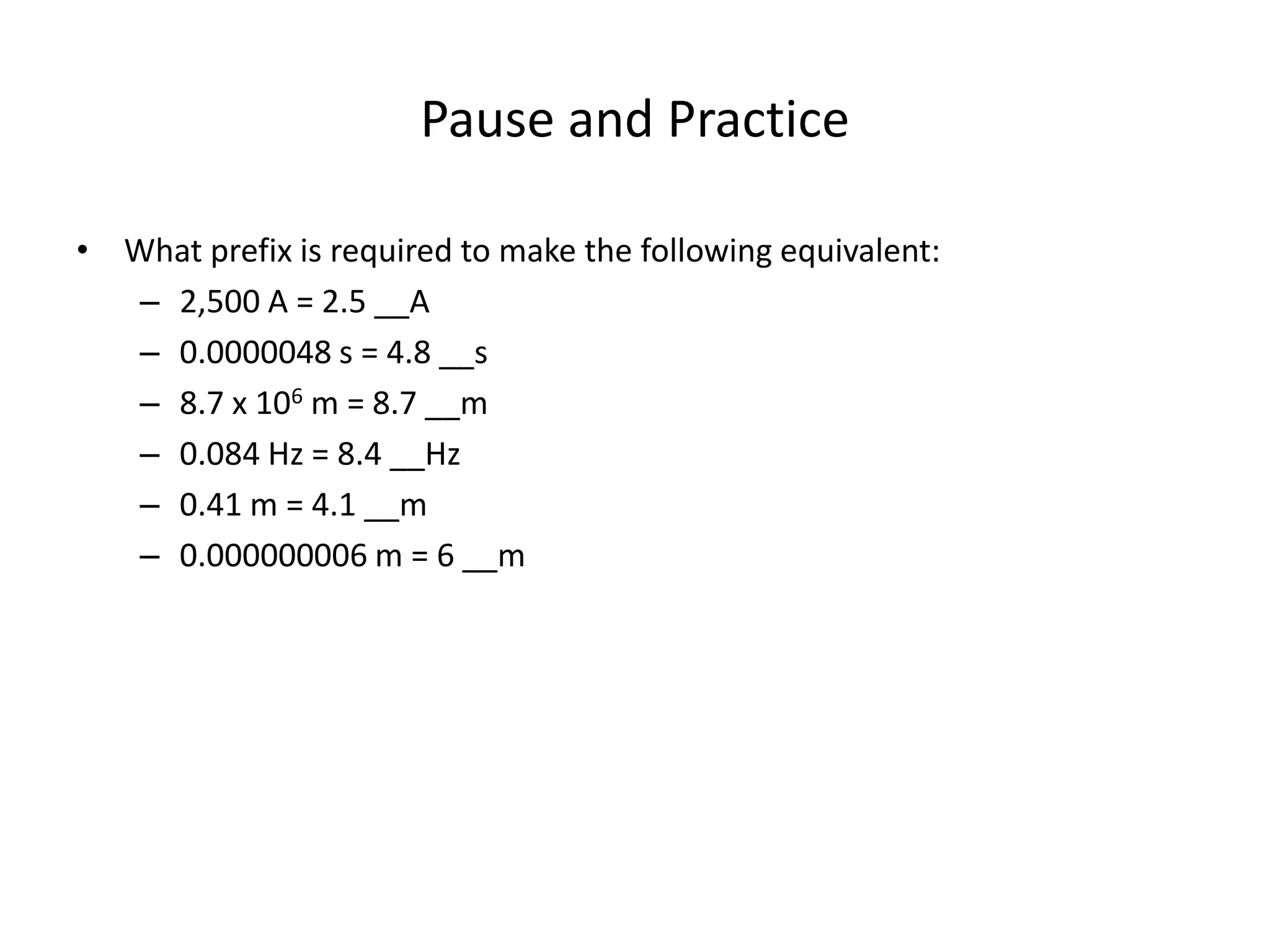
Pause and Practice
• What prefix is required to make the following equivalent:
– 2,500 A = 2.5 __A
– 0.0000048 s = 4.8 __s
– 8.7 x 10⁶ m = 8.7 __m
– 0.084 Hz = 8.4 __Hz
– 0.41 m = 4.1 __m
– 0.000000006 m = 6 __m
Pause and Practice
• What prefix is required to make the following equivalent:
– 2,500 A = 2.5 kA
– 0.0000048 s = 4.8 μs
– 8.7 x 10⁶ m = 8.7 Mm
– 0.084 Hz = 8.4 cHz
– 0.41 m = 4.1 dm
– 0.000000006 m = 6 nm
Now complete the exercises.

2 4 metric prefixes

  • 1.
    Metric Prefixes What isthe difference between a meter, a centimeter, a millimeter …?
  • 2.
    Purpose • The metricsystem exists to represent quantities whether large or small as manageable numbers. Instead of saying your computer operates at 2,500,000,000 hertz, one can say it operates at 2.5 gigahertz. By placing the prefix giga- in front of hertz, it is understood how it affects the number. In this lesson, you will learn some the most commonly used metric prefixes.
  • 3.
    First let’s lookat a meter stick The box above represents 1 meter in length. If you cut the box into 100 equal pieces, you get the box above. It represents 1 centimeter. This is the same as one one-hundredth of a meter (1/100 m or 0.01 m) If you cut the meter box into 1000 equal pieces, you get the box above. It represents 1 millimeter. This is the same as one one-thousandth of a meter (1/1000 m or 0.001 m) 1 meter 1 centimeter 1 millimeter
  • 4.
    Notice how theprefix changes the magnitude • Adding centi- in front of meter means that we have one one-hudredth of a meter • Adding milli- in front of meter means that we have one one-thousandth of a meter 1 meter 1 centimeter 1 millimeter
  • 5.
    The mathematical relationshipbetween centimeter and meter. 1 cm = 0.01 m or 100cm = 1m • These two relationships mean the same thing. • Note: There is always more of the smaller unit.
  • 6.
    The mathematical relationshipbetween millimeter and meter. 1 mm = 0.001 m or 1000 mm = 1m • These two relationships mean the same thing. • Note: There is always more of the smaller unit.
  • 7.
    Milli- and centi-are just two of the metric prefixes you should know. Prefix Abbreviation Meaning Sci. Not. mega M 1,000,000 106 kilo k 1000 103 no prefix - 1 deci d 0.1 (1/10) 10-1 centi c 0.01 (1/100) 10-2 milli m 0.001 (1/1000) 10-3 micro μ 0.000001 (1/1,000,000) 10-6 nano n 0.000000001 (1/1,000,000,000) 10-9 Note: The symbol for micro is the greek letter mu. Sci. Not. stands for scientific notation
  • 8.
    Aside from deci-and centi- notice how they change by magnitudes of 1000 ( 103) Prefix Abbreviation Sci. Not. Example mega M 106 1 Mm = 1 x 10⁶ m kilo k 103 1 km = 1 x 10³ m no prefix - 100 deci d 10-1 1dm = 1 x 10⁻¹ m centi c 10-2 1 cm = 1x10⁻² m milli m 10-3 1 mm = 1 x 10⁻³ m micro μ 10-6 1 μm = 1 x 10⁻⁶ m nano n 10-9 1 nm = 1 x 10⁻⁹ m Note: The symbol for micro is the greek letter mu. Sci. Not. stands for scientific notation
  • 9.
    Memorize the order •First learn the order for those that change by 103: – Nano, micro, milli, no prefix, kilo, mega – 10-9, 10-6, 10-3, 100, 103, 106 • deci- and centi- should be easy to remember as one tenth (0.1 or 10-1) and one one-hundredth (0.01 or 10-2)
  • 10.
    Sometimes negative exponentsare hard to visualize. It may be easier to think about the examples this way. Prefix Original Example New Example mega 1 Mm = 1 x 10⁶ m 1 Mm = 1 x 10⁶ m kilo 1 km = 1 x 10³ m 1 km = 1 x 10³ m no prefix deci 1dm = 1 x 10⁻¹ m 10dm = 1m centi 1 cm = 1x10⁻² m 100 cm = 1m milli 1 mm = 1 x 10⁻³ m 1000 mm = 1m micro 1 μm = 1 x 10⁻⁶ m 1,000,000 μm = 1 m nano 1 nm = 1 x 10⁻⁹ m 1,000,000,000 nm = 1 m Note: As always, notice how the number in front of the smaller unit is always larger than the number in front of the bigger unit.
  • 11.
    Misconception alert • Whenyou see just m, it is meter not milli-. – 10 m is 10 meters not 10 milli- • To be milli-, the m must be before another unit. – 10 ms is 10 milliseconds
  • 12.
    Pause and Practice •What prefix is required to make the following equivalent: – 2,500 A = 2.5 __A – 0.0000048 s = 4.8 __s – 8.7 x 10⁶ m = 8.7 __m – 0.084 Hz = 8.4 __Hz – 0.41 m = 4.1 __m – 0.000000006 m = 6 __m
  • 13.
    Pause and Practice •What prefix is required to make the following equivalent: – 2,500 A = 2.5 kA – 0.0000048 s = 4.8 μs – 8.7 x 10⁶ m = 8.7 Mm – 0.084 Hz = 8.4 cHz – 0.41 m = 4.1 dm – 0.000000006 m = 6 nm
  • 14.
    Now complete theexercises.