Top Five Ideas for Project Management

Loading...

Flash Player 9 (or above) is needed to view presentations.
We have detected that you do not have it on your computer. To install it, go here.

0 comments

Post a comment

    Post a comment
    Embed Video
    Edit your comment Cancel

    Favorites, Groups & Events

    Top Five Ideas for Project Management - Presentation Transcript

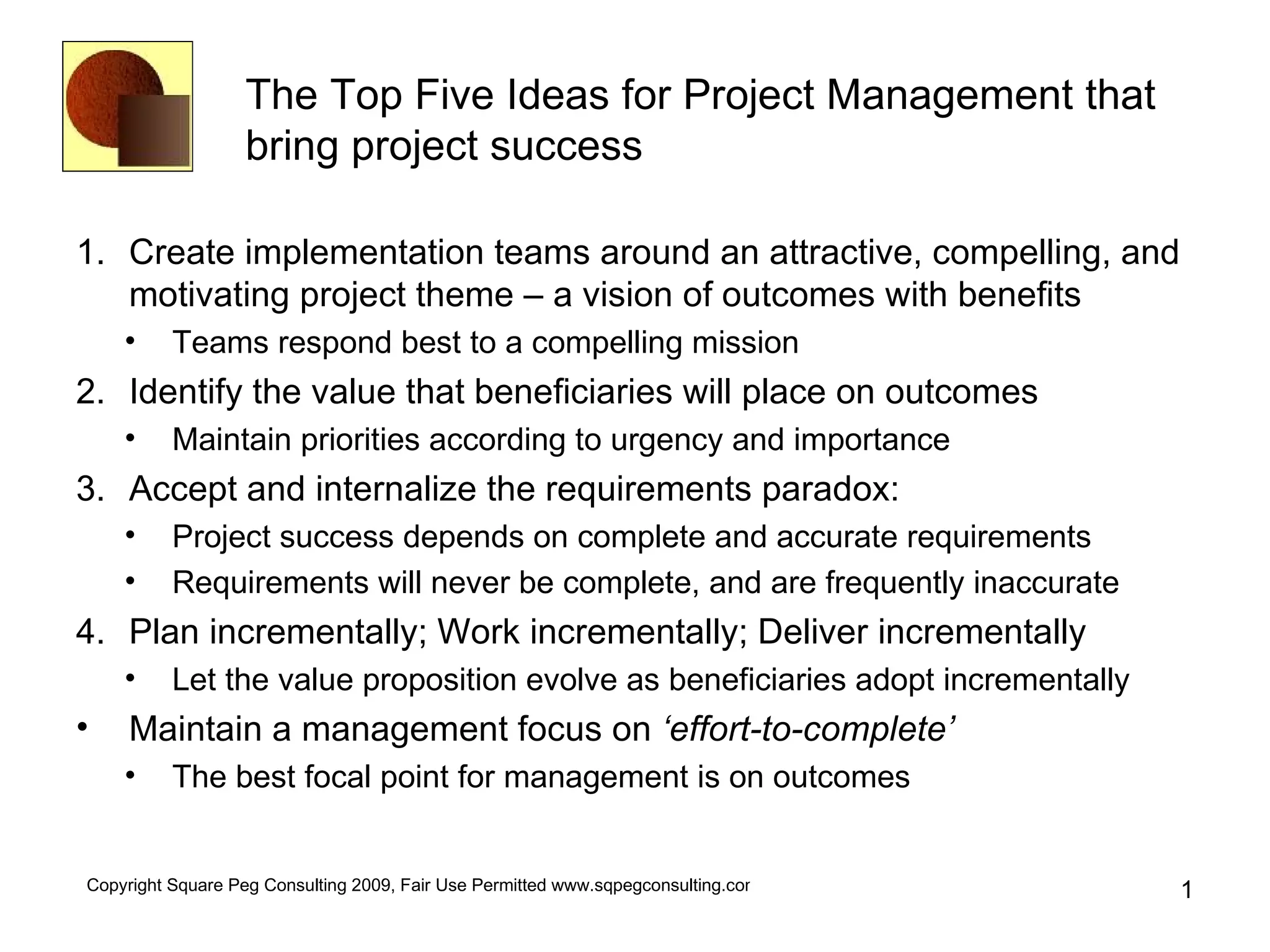
    1. The Top Five Ideas for Project Management that bring project success
      • Create implementation teams around an attractive, compelling, and motivating project theme – a vision of outcomes with benefits
        • Teams respond best to a compelling mission
      • Identify the value that beneficiaries will place on outcomes
        • Maintain priorities according to urgency and importance
      • Accept and internalize the requirements paradox:
        • Project success depends on complete and accurate requirements
        • Requirements will never be complete, and are frequently inaccurate
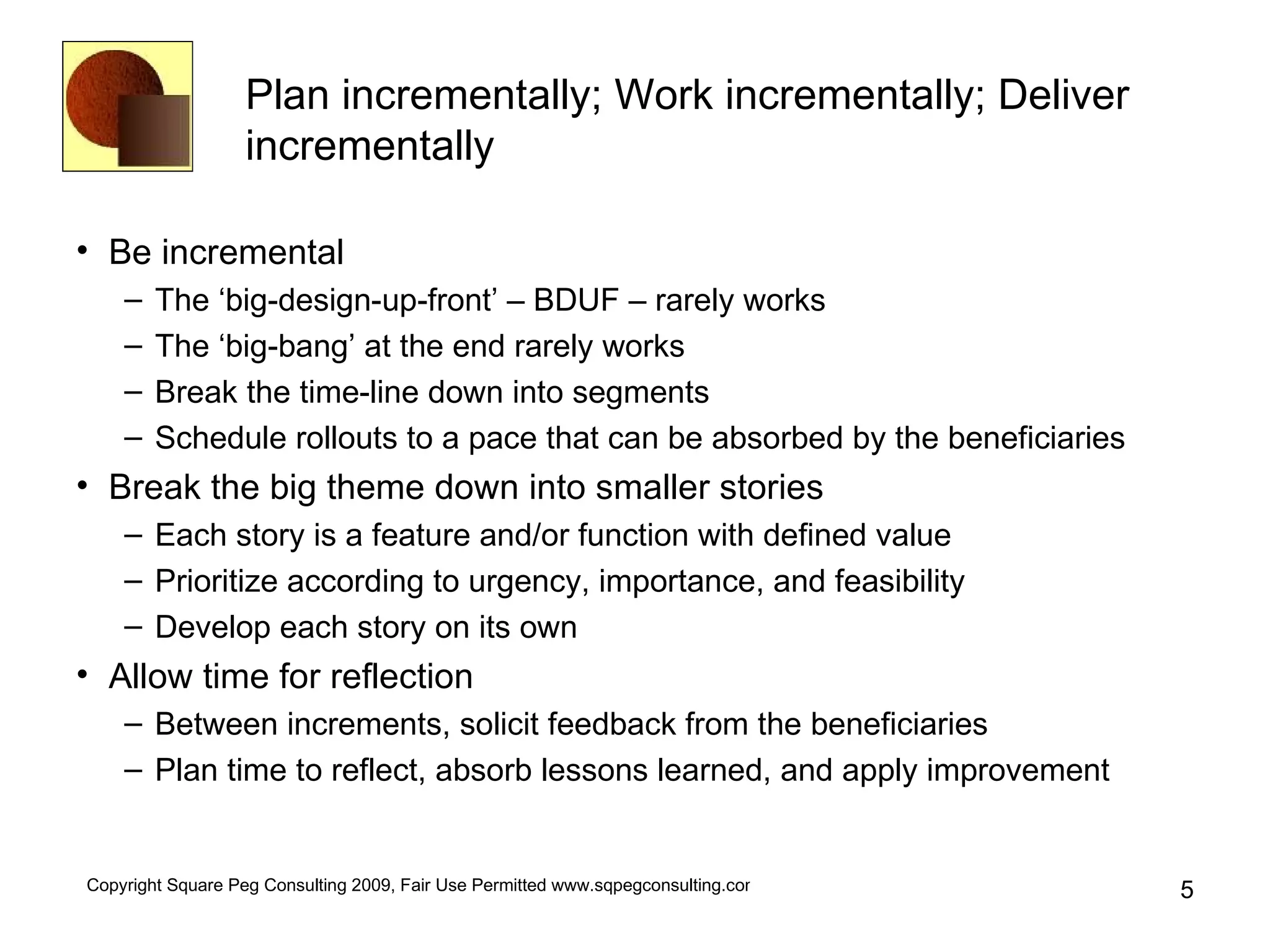
      • Plan incrementally; Work incrementally; Deliver incrementally
        • Let the value proposition evolve as beneficiaries adopt incrementally
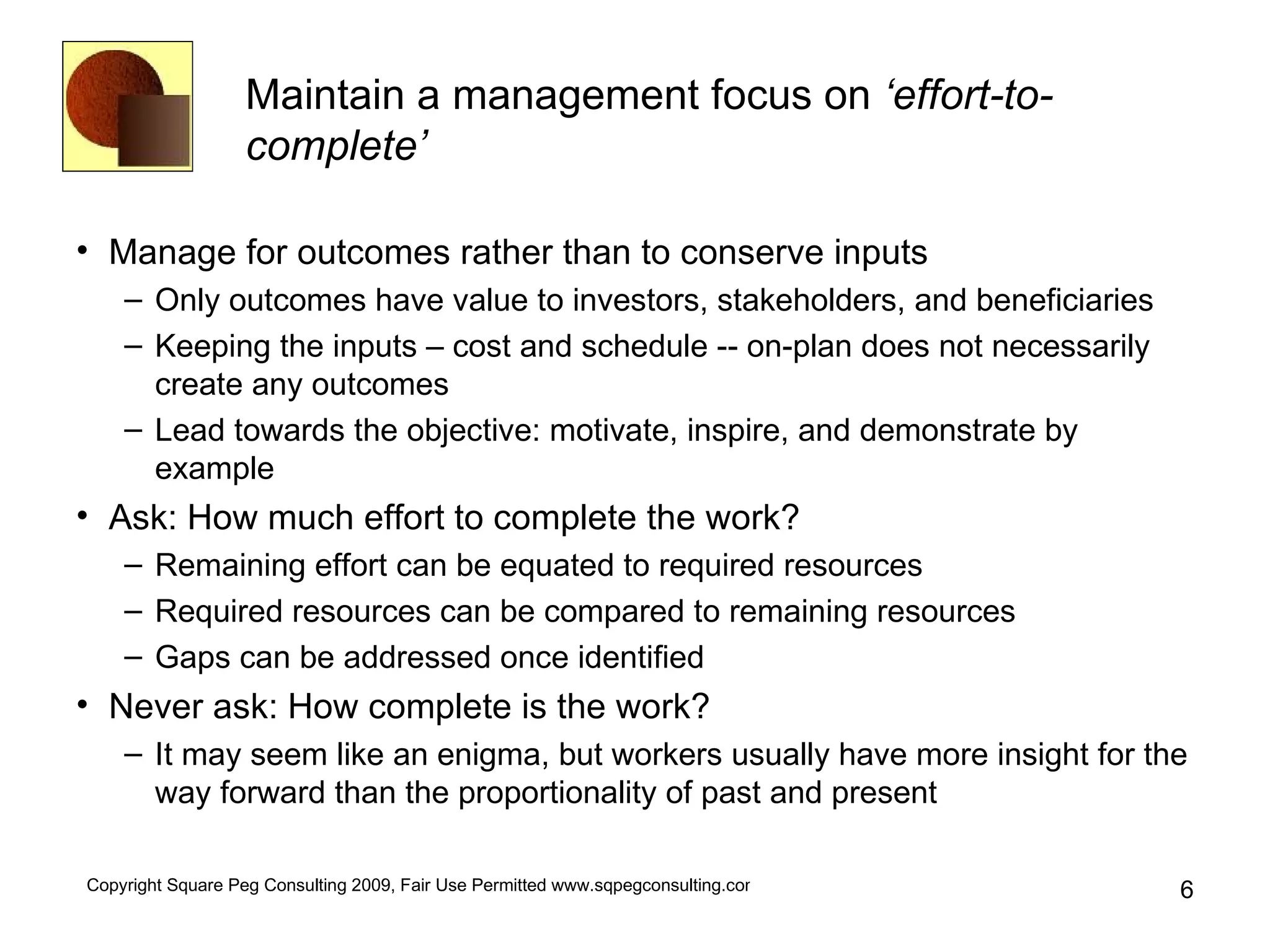
      • Maintain a management focus on ‘effort-to-complete’
        • The best focal point for management is on outcomes
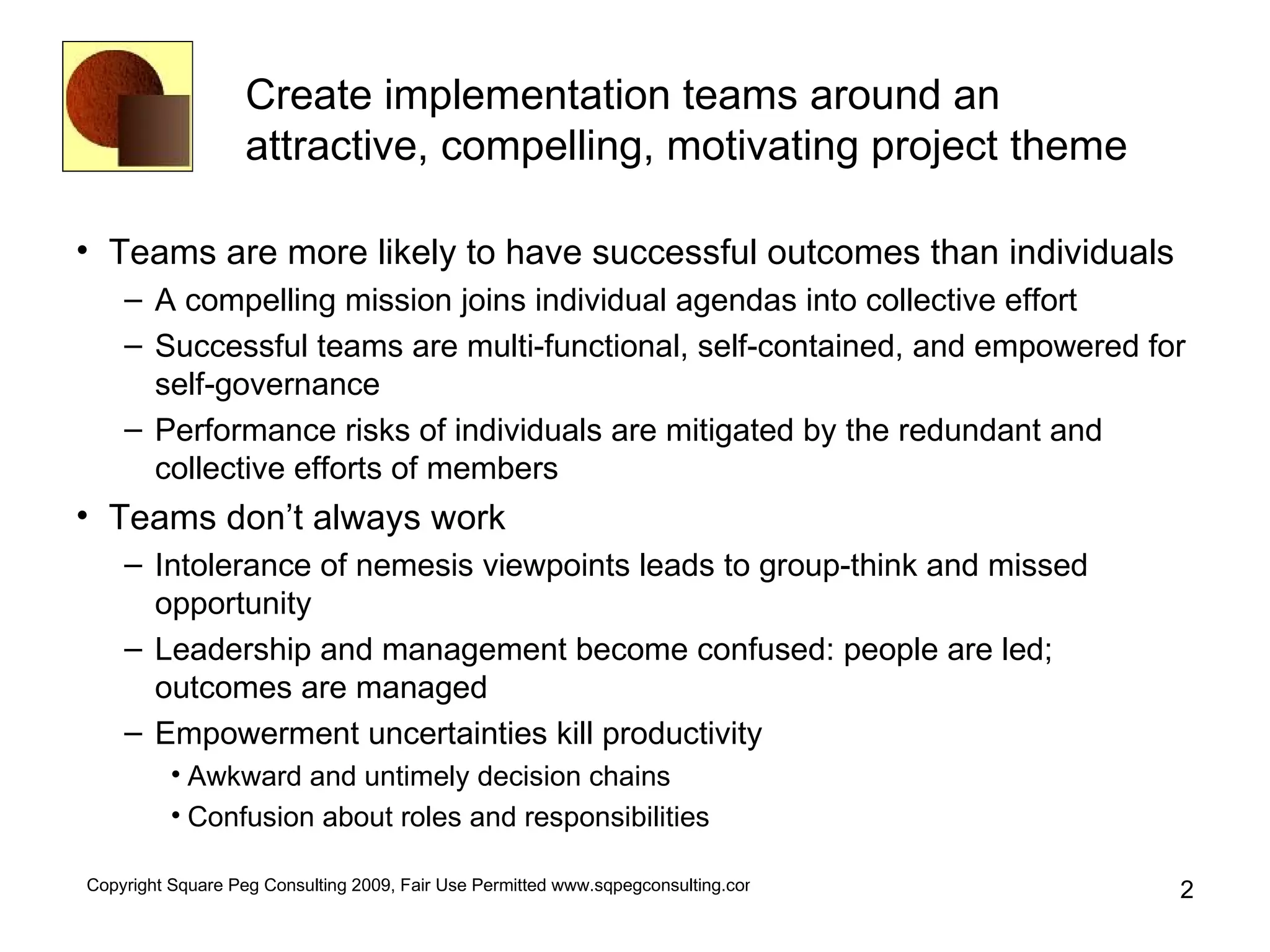
    2. Create implementation teams around an attractive, compelling, motivating project theme
      • Teams are more likely to have successful outcomes than individuals
        • A compelling mission joins individual agendas into collective effort
        • Successful teams are multi-functional, self-contained, and empowered for self-governance
        • Performance risks of individuals are mitigated by the redundant and collective efforts of members
      • Teams don’t always work
        • Intolerance of nemesis viewpoints leads to group-think and missed opportunity
        • Leadership and management become confused: people are led; outcomes are managed
        • Empowerment uncertainties kill productivity
          • Awkward and untimely decision chains
          • Confusion about roles and responsibilities
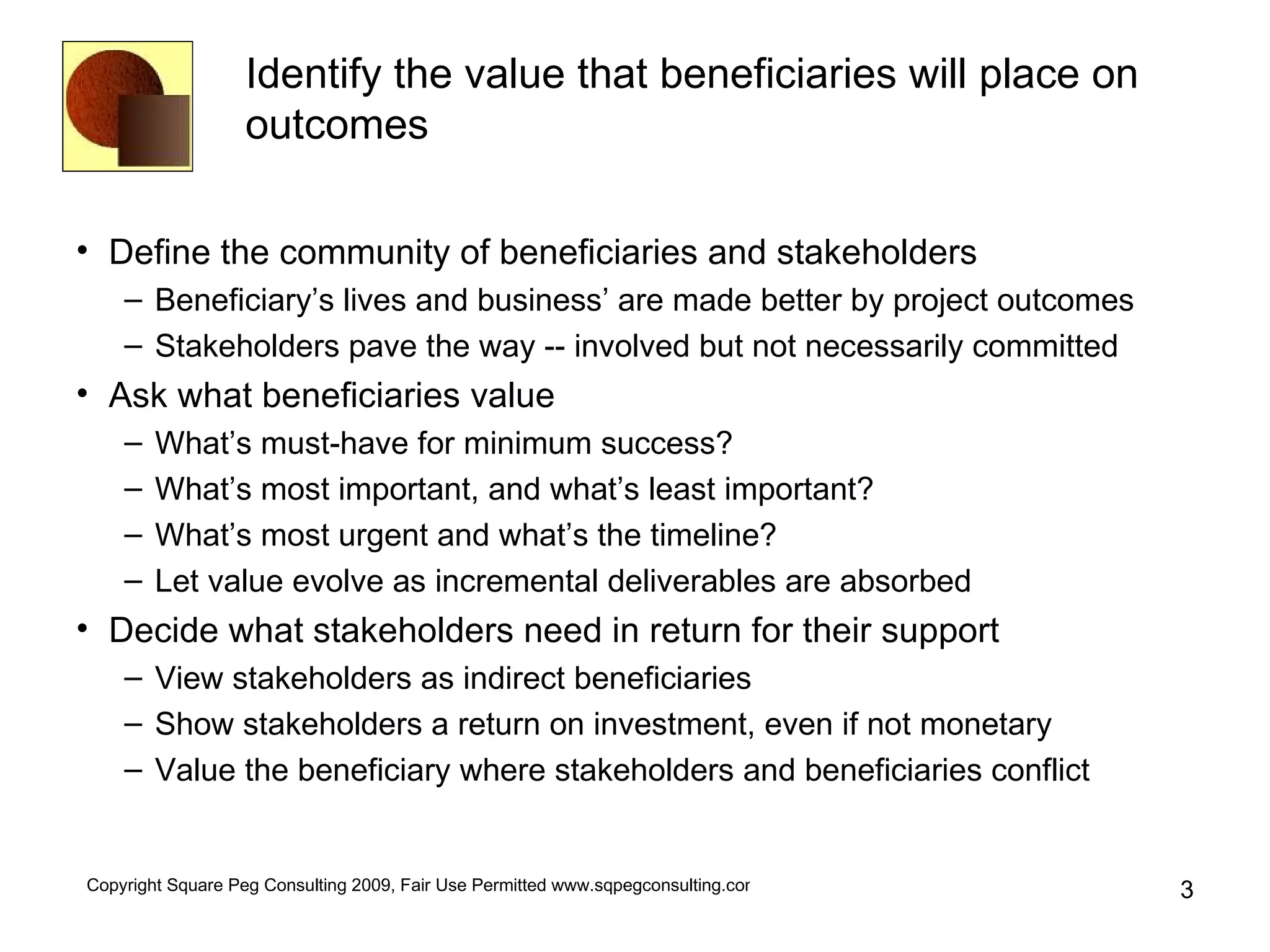
    3. Identify the value that beneficiaries will place on outcomes
      • Define the community of beneficiaries and stakeholders
        • Beneficiary’s lives and business’ are made better by project outcomes
        • Stakeholders pave the way -- involved but not necessarily committed
      • Ask what beneficiaries value
        • What’s must-have for minimum success?
        • What’s most important, and what’s least important?
        • What’s most urgent and what’s the timeline?
        • Let value evolve as incremental deliverables are absorbed
      • Decide what stakeholders need in return for their support
        • View stakeholders as indirect beneficiaries
        • Show stakeholders a return on investment, even if not monetary
        • Value the beneficiary where stakeholders and beneficiaries conflict
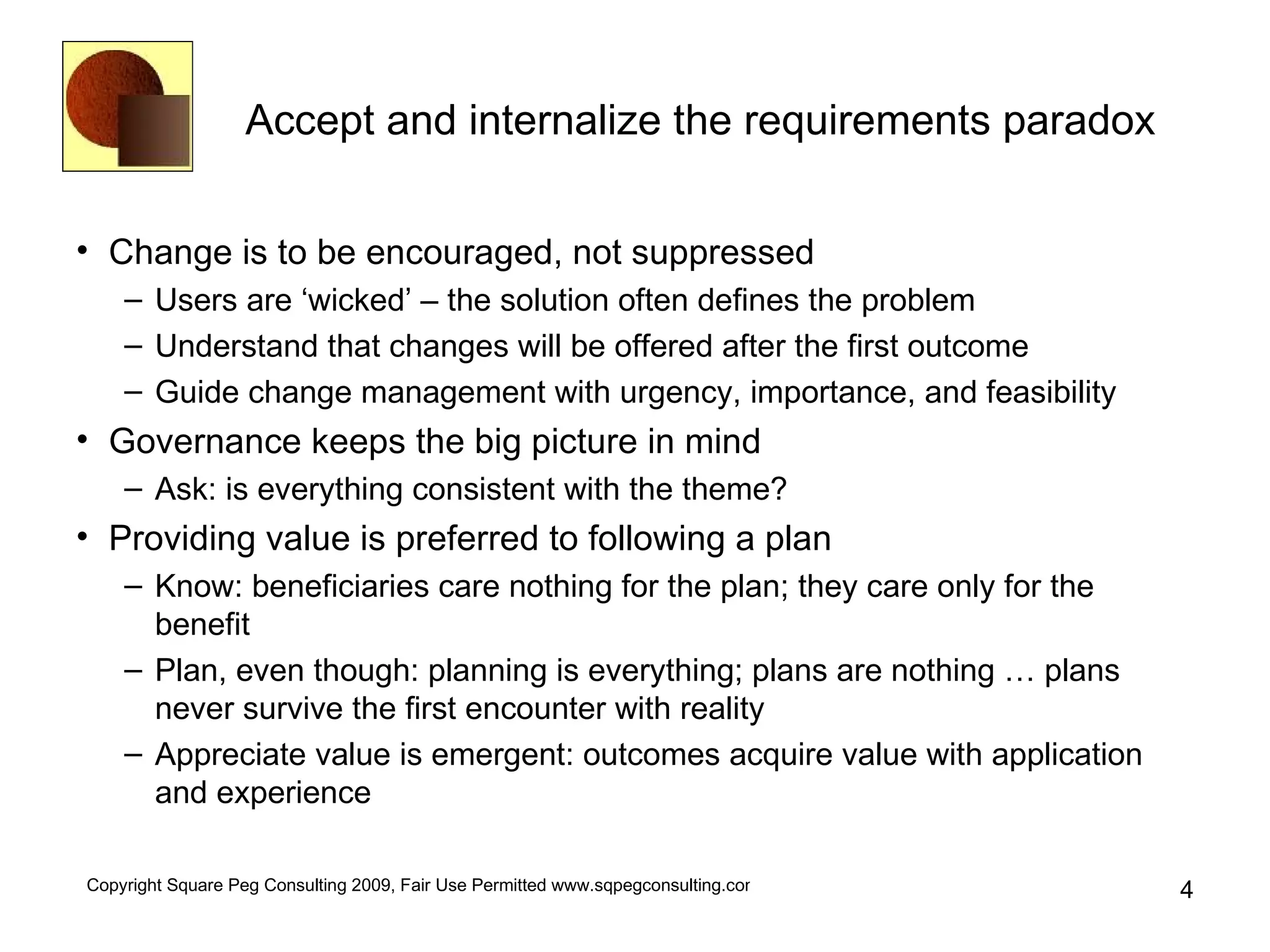
    4. Accept and internalize the requirements paradox
      • Change is to be encouraged, not suppressed
        • Users are ‘wicked’ – the solution often defines the problem
        • Understand that changes will be offered after the first outcome
        • Guide change management with urgency, importance, and feasibility
      • Governance keeps the big picture in mind
        • Ask: is everything consistent with the theme?
      • Providing value is preferred to following a plan
        • Know: beneficiaries care nothing for the plan; they care only for the benefit
        • Plan, even though: planning is everything; plans are nothing … plans never survive the first encounter with reality
        • Appreciate value is emergent: outcomes acquire value with application and experience
    5. Plan incrementally; Work incrementally; Deliver incrementally
      • Be incremental
        • The ‘big-design-up-front’ – BDUF – rarely works
        • The ‘big-bang’ at the end rarely works
        • Break the time-line down into segments
        • Schedule rollouts to a pace that can be absorbed by the beneficiaries
      • Break the big theme down into smaller stories
        • Each story is a feature and/or function with defined value
        • Prioritize according to urgency, importance, and feasibility
        • Develop each story on its own
      • Allow time for reflection
        • Between increments, solicit feedback from the beneficiaries
        • Plan time to reflect, absorb lessons learned, and apply improvement
    6. Maintain a management focus on ‘effort-to-complete’
      • Manage for outcomes rather than to conserve inputs
        • Only outcomes have value to investors, stakeholders, and beneficiaries
        • Keeping the inputs – cost and schedule -- on-plan does not necessarily create any outcomes
        • Lead towards the objective: motivate, inspire, and demonstrate by example
      • Ask: How much effort to complete the work?
        • Remaining effort can be equated to required resources
        • Required resources can be compared to remaining resources
        • Gaps can be addressed once identified
      • Never ask: How complete is the work?
        • It may seem like an enigma, but workers usually have more insight for the way forward than the proportionality of past and present
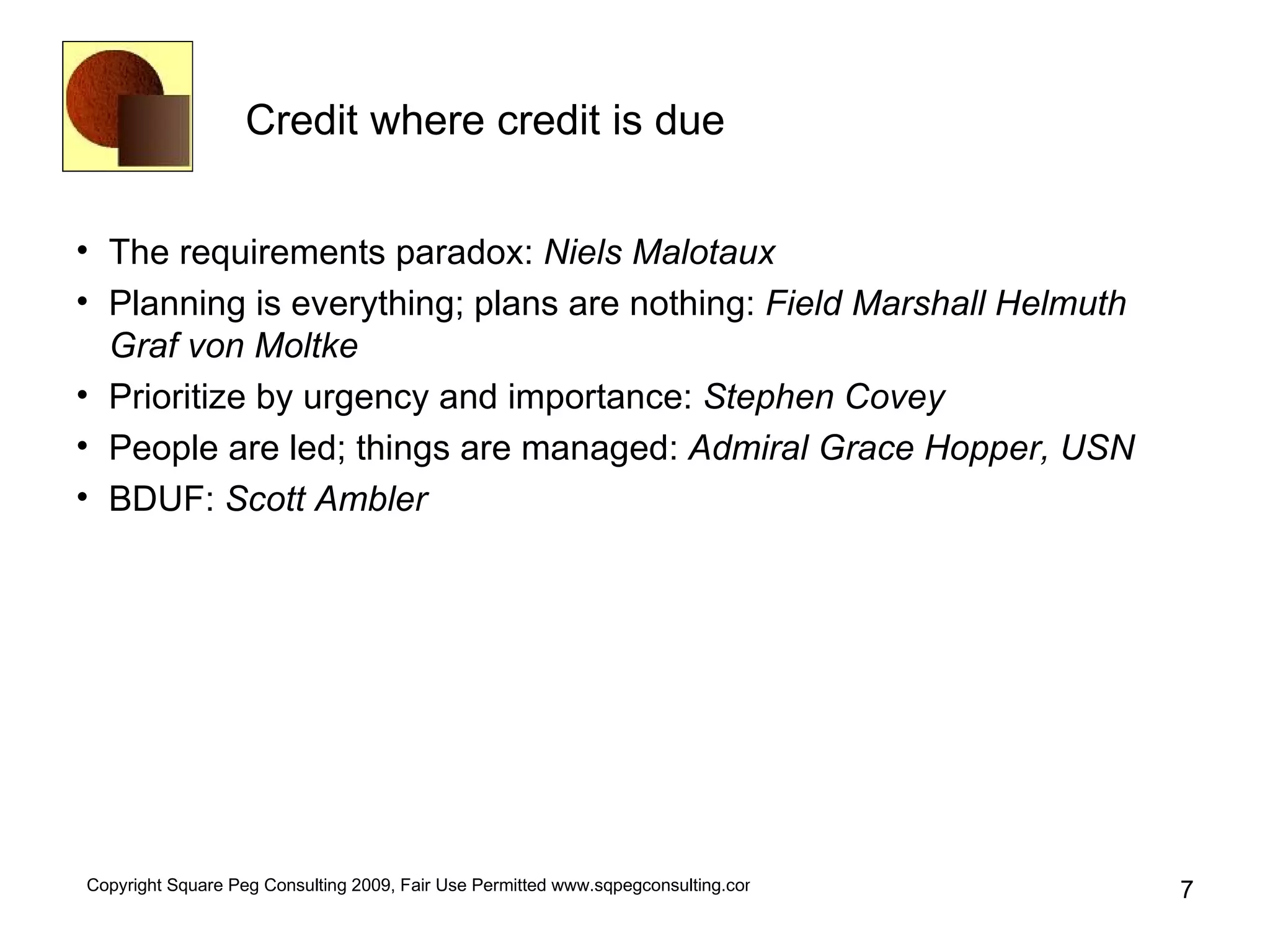
    7. Credit where credit is due
      • The requirements paradox: Niels Malotaux
      • Planning is everything; plans are nothing: Field Marshall Helmuth Graf von Moltke
      • Prioritize by urgency and importance: Stephen Covey
      • People are led; things are managed: Admiral Grace Hopper, USN
      • BDUF: Scott Ambler
    SlideShare Zeitgeist 2009

    + John GoodpastureJohn Goodpasture Nominate

    custom

    364 views, 0 favs, 4 embeds more stats

    The top five things a project manager, or an accide more

    More info about this document

    CC Attribution License

    Go to text version

    • Total Views 364
      • 359 on SlideShare
      • 5 from embeds
    • Comments 0
    • Favorites 0
    • Downloads 40
    Most viewed embeds
    • 2 views on http://www.johngoodpasture.com
    • 1 views on http://johngoodpasture.blogspot.com
    • 1 views on http://q5cgjagla895uasnsntipfsk9i8bu69k-a-sites-opensocial.googleusercontent.com
    • 1 views on http://wildfire.gigya.com

    more

    All embeds
    • 2 views on http://www.johngoodpasture.com
    • 1 views on http://johngoodpasture.blogspot.com
    • 1 views on http://q5cgjagla895uasnsntipfsk9i8bu69k-a-sites-opensocial.googleusercontent.com
    • 1 views on http://wildfire.gigya.com

    less

    Flagged as inappropriate Flag as inappropriate
    Flag as inappropriate

    Select your reason for flagging this presentation as inappropriate. If needed, use the feedback form to let us know more details.

    Cancel
    File a copyright complaint
    Having problems? Go to our helpdesk?

    Categories