Chapter 1Introduction to Physics
In this chapter, we will discuss the following:Definition of PhysicsBranches and sub-branches of PhysicsMeasurement of Quantities
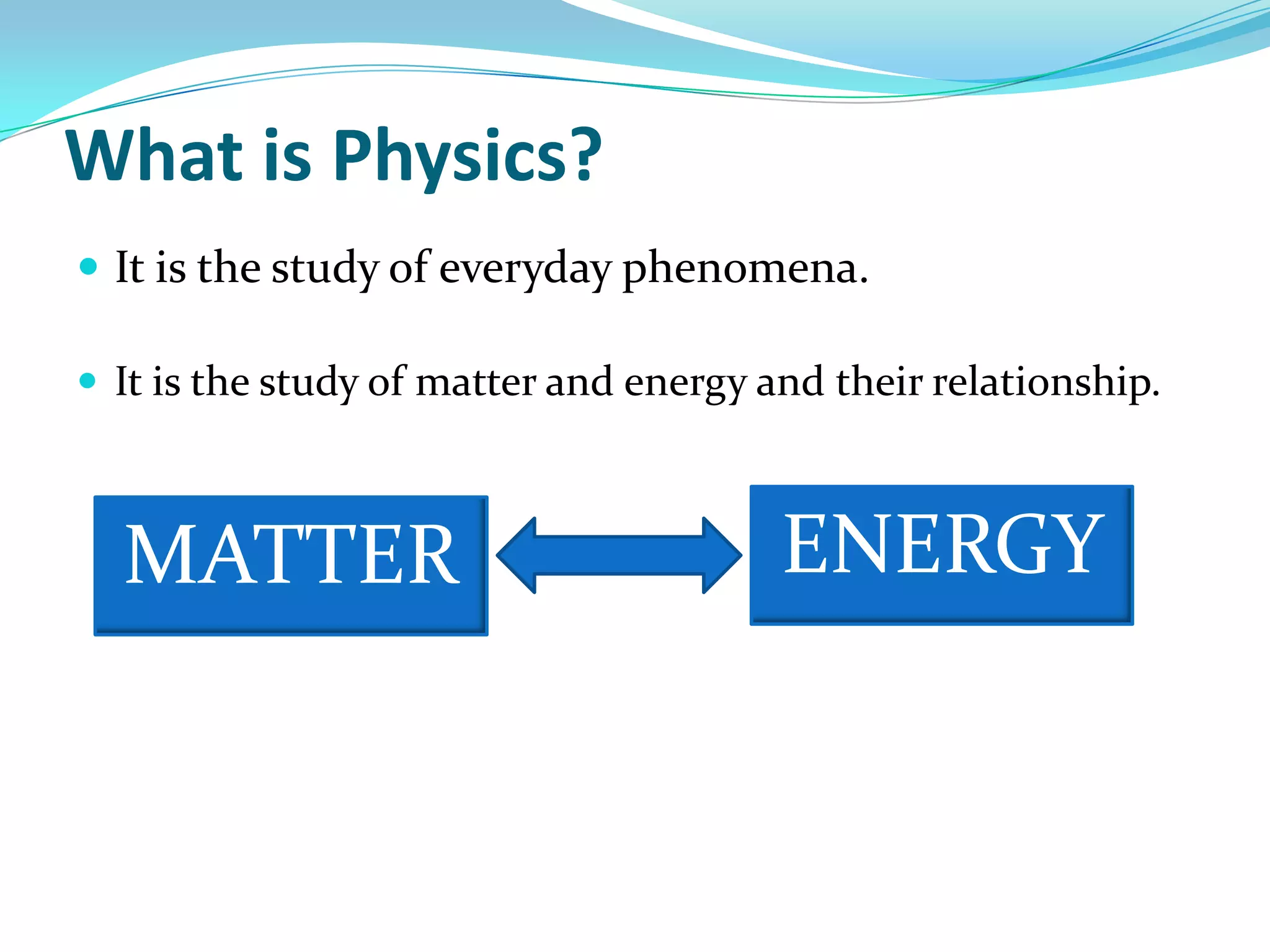
What is Physics?ENERGYMATTERIt is the study of everyday phenomena.It is the study of matter and energy and their relationship.What are the Branches Physics?
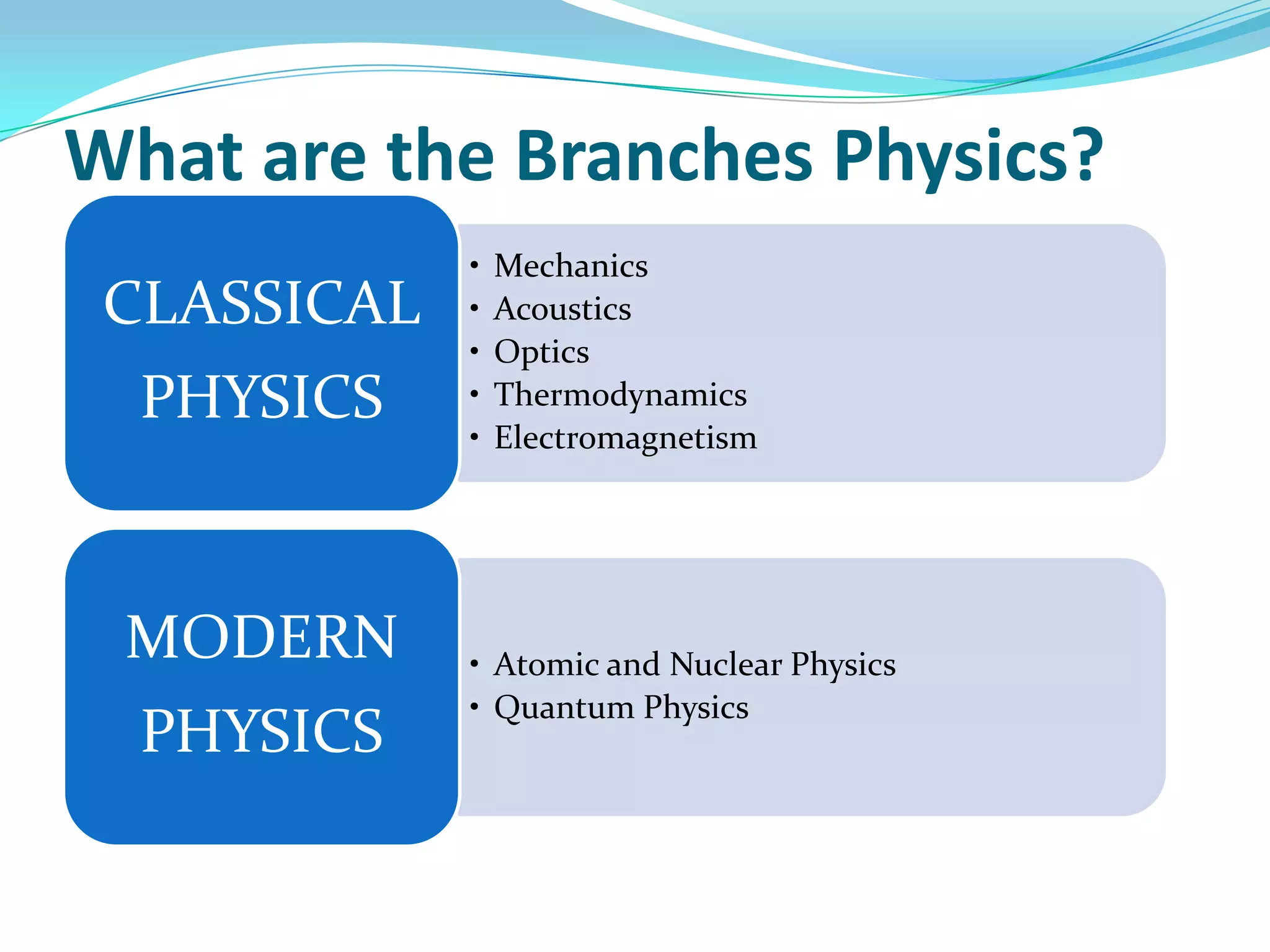
Classical PhysicsMechanics – the study of forces acting on bodies.Statics – on bodies at rest.Kinematics – on motion without regard to its cause.Dynamics – on motion and forces that affect it.Acoustics – study of the production of and the propagation of sound waves.Optics -  study of light.Thermodynamics – study of the relationship between heat and other forms of energy.Electromagnetism – study of the properties of electric current and magnetism, and their relationship.
Modern PhysicsAtomic and Nuclear Physics – study of the components, structure and behavior of the nucleus of the atom.Quantum Physics – study of the discrete nature of the phenomena at the atomic and sub-atomic levels. It focuses on the unit of energy called quanta.
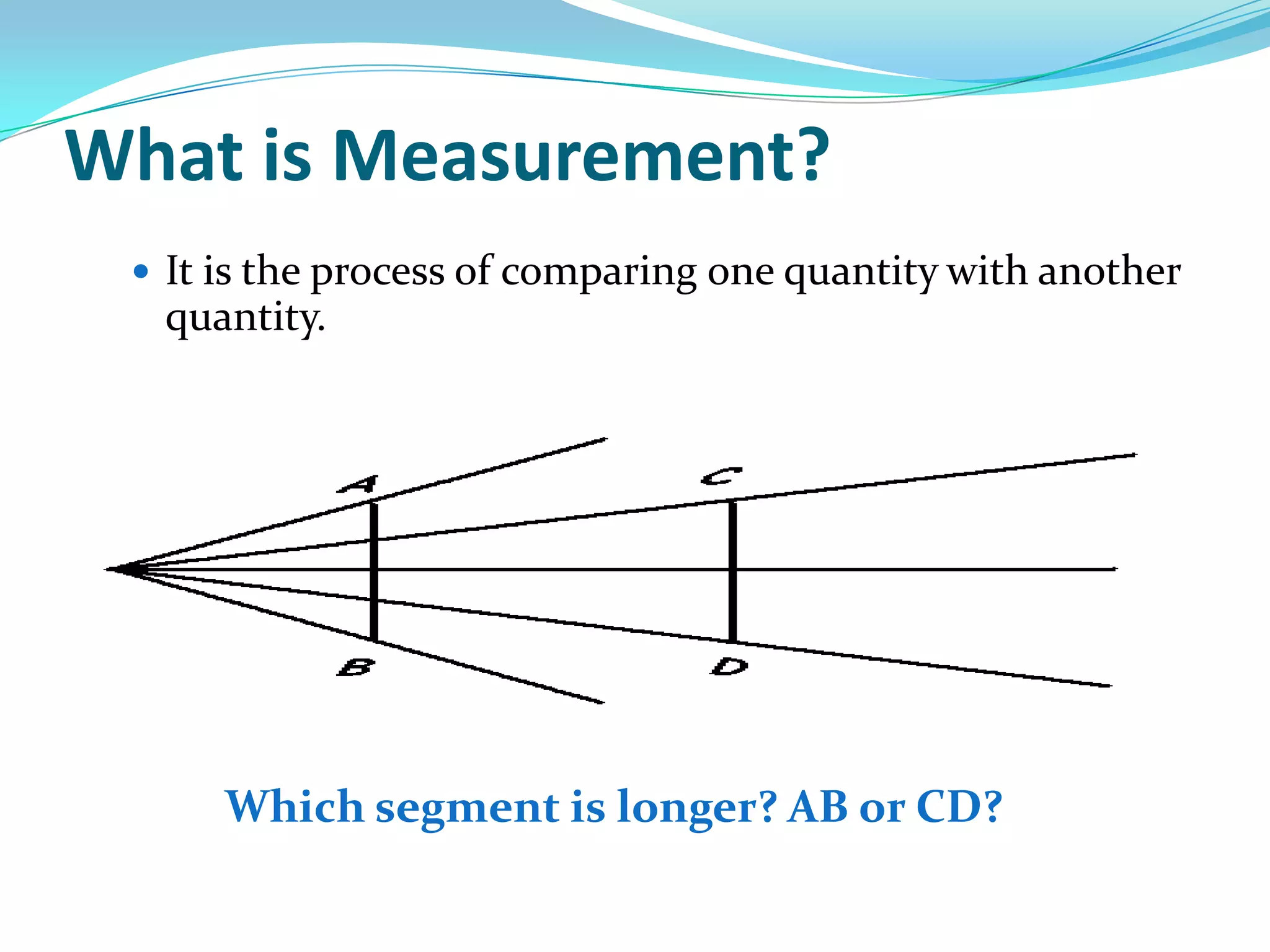
What is Measurement?It is the process of comparing one quantity with another quantity.Which segment is longer? AB or CD?
What is a standard/unit of measurement?It is a quantity or amount that everyone agrees on.		For instance, in the ancient period, the cubit,  which is agreed upon by the ancient people as the measure from a man’s elbow to the tip of the middle finger.
The Metric System or International System of Measurements (SI)In 1790, the French National Assembly appointed a committee (Academy of Science) that created the metric system.In 1960, the metric system was named International System of Measurements, abbreviated as SI.The SI includes fundamental quantities and derived quantities which are described by base units and derived units, respectively.
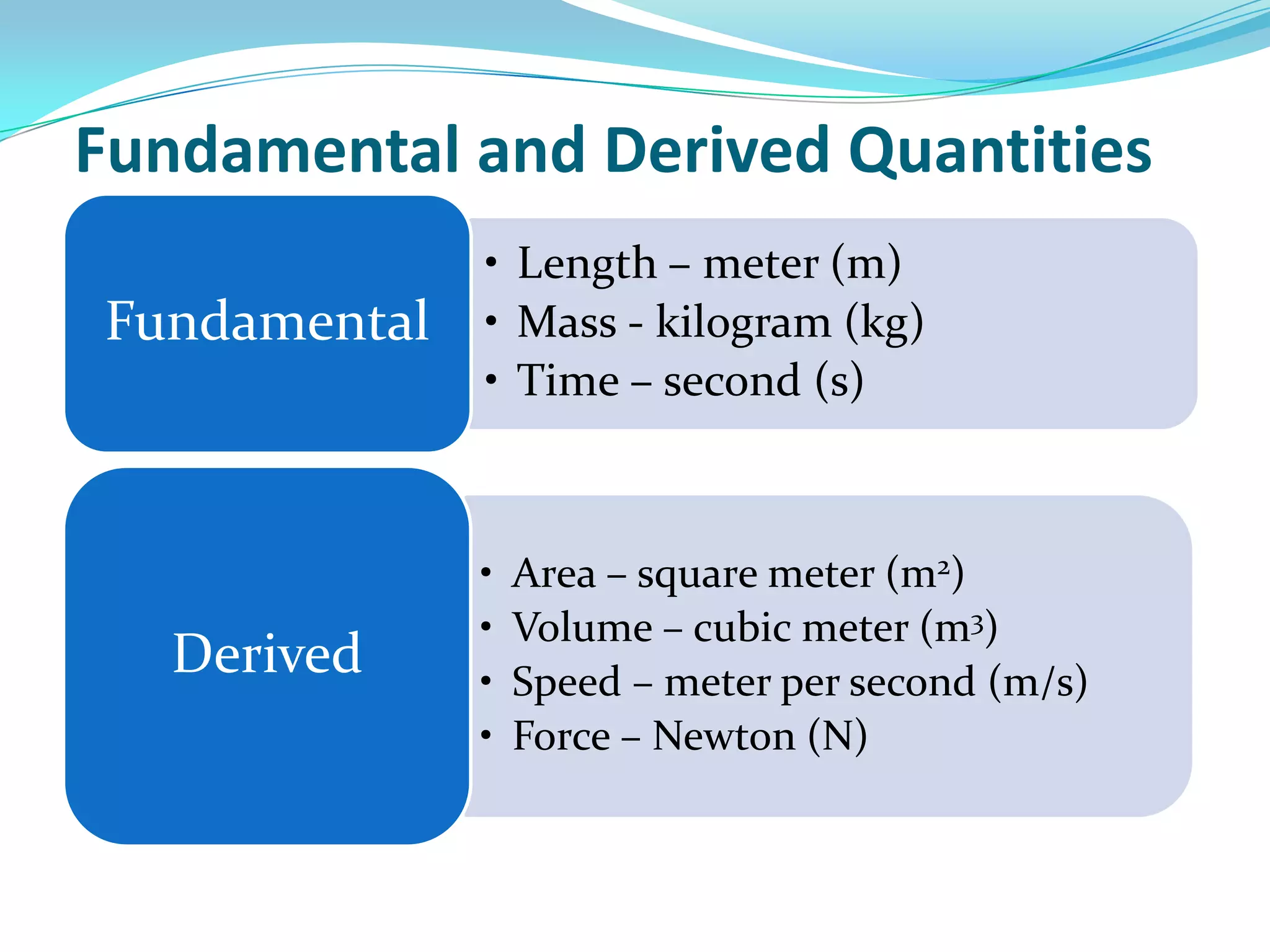
Fundamental and Derived Quantities
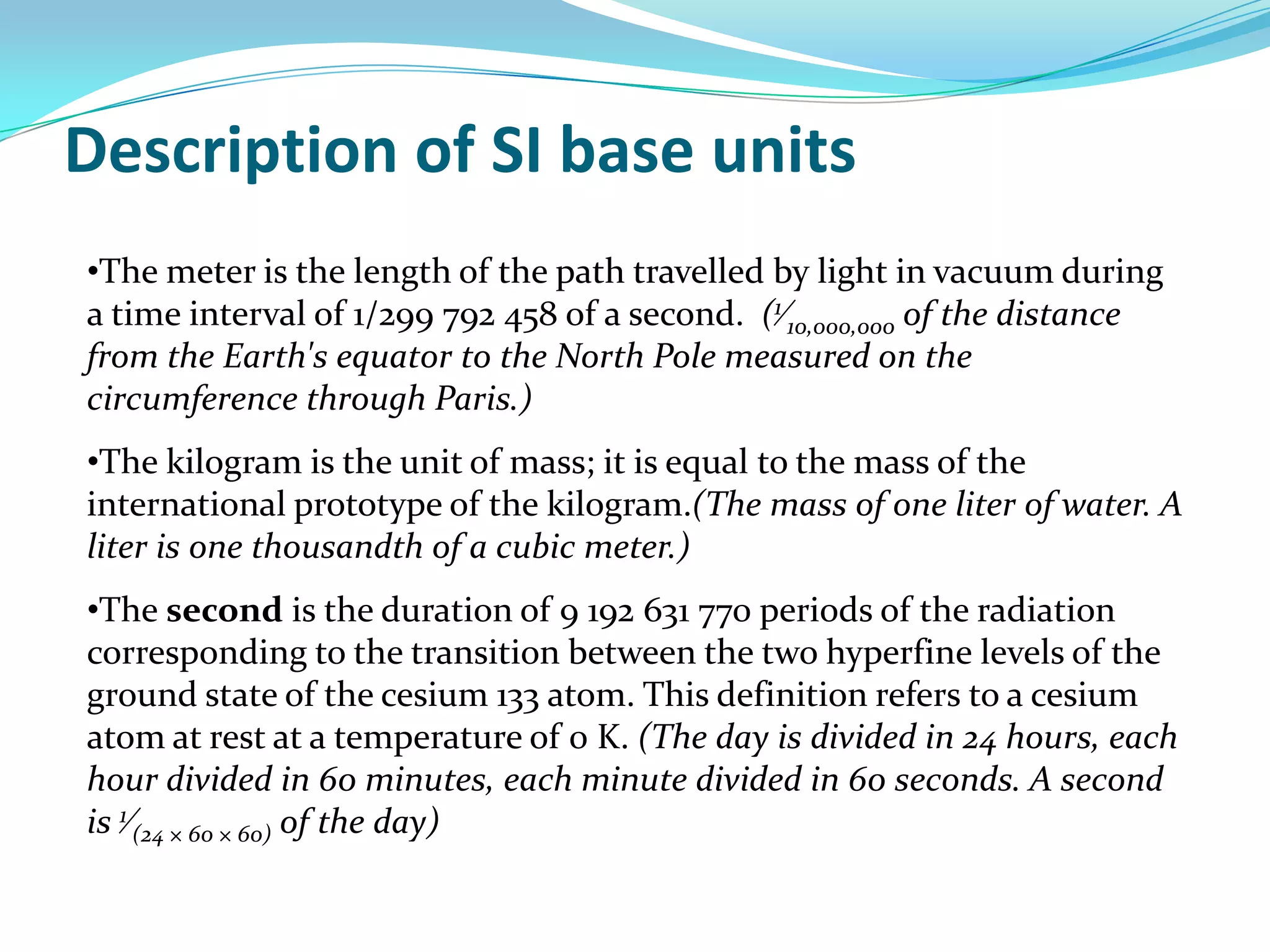
Description of SI base unitsThe meter is the length of the path travelled by light in vacuum during a time interval of 1/299 792 458 of a second.  (1⁄10,000,000 of the distance from the Earth's equator to the North Pole measured on the circumference through Paris.)
The kilogram is the unit of mass; it is equal to the mass of the international prototype of the kilogram.(The mass of one liter of water. A liter is one thousandth of a cubic meter.)
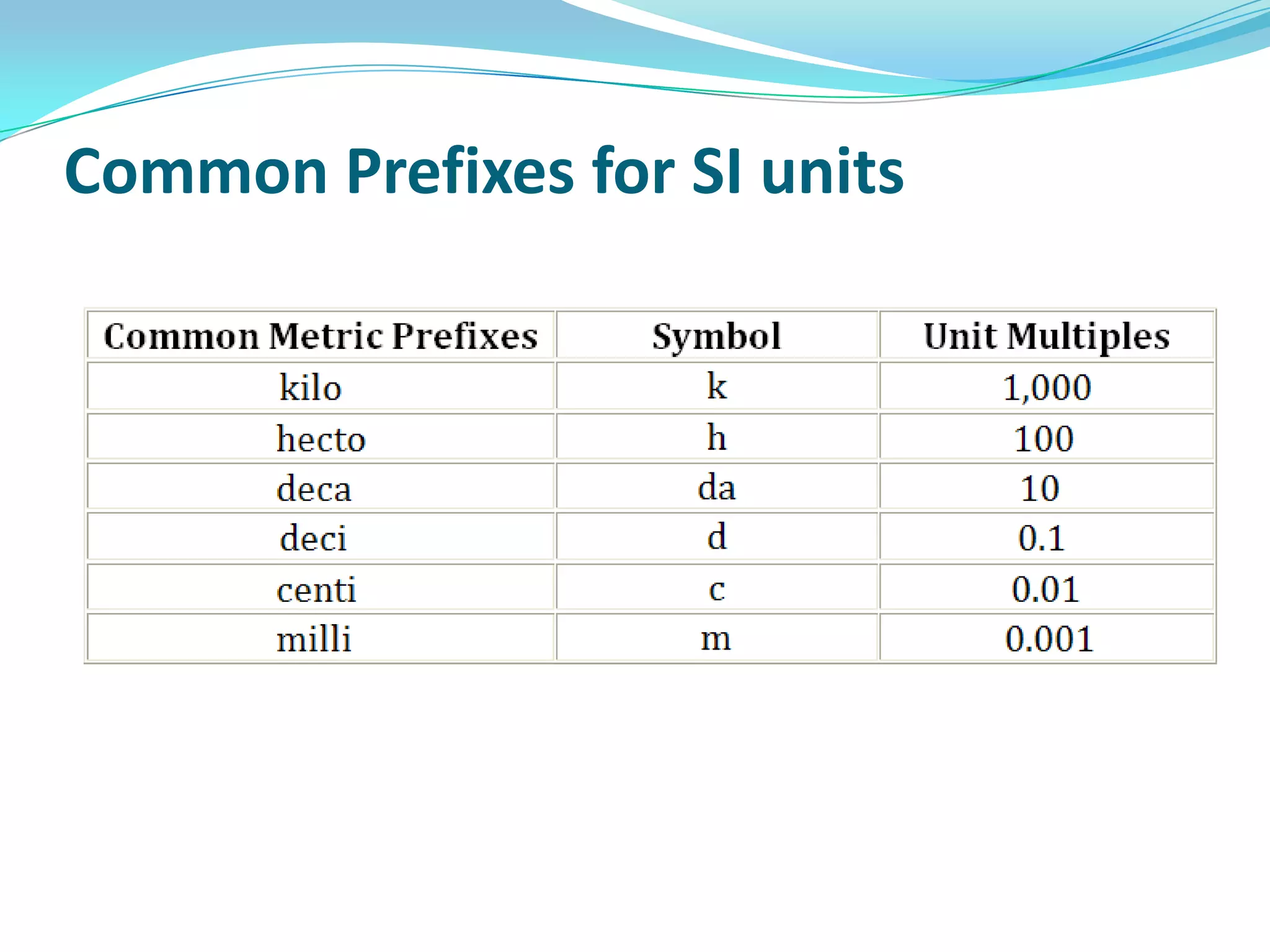
The second is the duration of 9 192 631 770 periods of the radiation corresponding to the transition between the two hyperfine levels of the ground state of the cesium 133 atom. This definition refers to a cesium atom at rest at a temperature of 0 K. (The day is divided in 24 hours, each hour divided in 60 minutes, each minute divided in 60 seconds. A second is 1⁄(24 × 60 × 60) of the day)Common Prefixes for SI units
Conversion of Units		One of the simplest method of converting one unit of measurement is using the chain-link conversion method.The chain-link conversion method uses a conversion factor. A conversion factor is a ratio which is equal to one and which contains the original unit and the unit which you want the quantity to be converted to.

Chapter 1

  • 1.
  • 2.
    In this chapter,we will discuss the following:Definition of PhysicsBranches and sub-branches of PhysicsMeasurement of Quantities
  • 3.
    What is Physics?ENERGYMATTERItis the study of everyday phenomena.It is the study of matter and energy and their relationship.What are the Branches Physics?
  • 4.
    Classical PhysicsMechanics –the study of forces acting on bodies.Statics – on bodies at rest.Kinematics – on motion without regard to its cause.Dynamics – on motion and forces that affect it.Acoustics – study of the production of and the propagation of sound waves.Optics - study of light.Thermodynamics – study of the relationship between heat and other forms of energy.Electromagnetism – study of the properties of electric current and magnetism, and their relationship.
  • 5.
    Modern PhysicsAtomic andNuclear Physics – study of the components, structure and behavior of the nucleus of the atom.Quantum Physics – study of the discrete nature of the phenomena at the atomic and sub-atomic levels. It focuses on the unit of energy called quanta.
  • 6.
    What is Measurement?Itis the process of comparing one quantity with another quantity.Which segment is longer? AB or CD?
  • 7.
    What is astandard/unit of measurement?It is a quantity or amount that everyone agrees on. For instance, in the ancient period, the cubit, which is agreed upon by the ancient people as the measure from a man’s elbow to the tip of the middle finger.
  • 8.
    The Metric Systemor International System of Measurements (SI)In 1790, the French National Assembly appointed a committee (Academy of Science) that created the metric system.In 1960, the metric system was named International System of Measurements, abbreviated as SI.The SI includes fundamental quantities and derived quantities which are described by base units and derived units, respectively.
  • 9.
  • 10.
    Description of SIbase unitsThe meter is the length of the path travelled by light in vacuum during a time interval of 1/299 792 458 of a second. (1⁄10,000,000 of the distance from the Earth's equator to the North Pole measured on the circumference through Paris.)
  • 11.
    The kilogram isthe unit of mass; it is equal to the mass of the international prototype of the kilogram.(The mass of one liter of water. A liter is one thousandth of a cubic meter.)
  • 12.
    The second isthe duration of 9 192 631 770 periods of the radiation corresponding to the transition between the two hyperfine levels of the ground state of the cesium 133 atom. This definition refers to a cesium atom at rest at a temperature of 0 K. (The day is divided in 24 hours, each hour divided in 60 minutes, each minute divided in 60 seconds. A second is 1⁄(24 × 60 × 60) of the day)Common Prefixes for SI units
  • 13.
    Conversion of Units Oneof the simplest method of converting one unit of measurement is using the chain-link conversion method.The chain-link conversion method uses a conversion factor. A conversion factor is a ratio which is equal to one and which contains the original unit and the unit which you want the quantity to be converted to.