The document discusses different types of metadata schemas used for digital collections, including Dublin Core (DC), Qualified Dublin Core (QDC), MARC, MARCXML, MODS, VRA Core, CDWA Lite, GEM, LOM, TEI, and EAD. It provides information on the purpose, content standards, limitations, and best uses of each schema. The document is intended as a workshop on metadata for digital collections.
Introduction of metadata and its significance in digital collections by Jenn Riley, IU Digital Library Program.
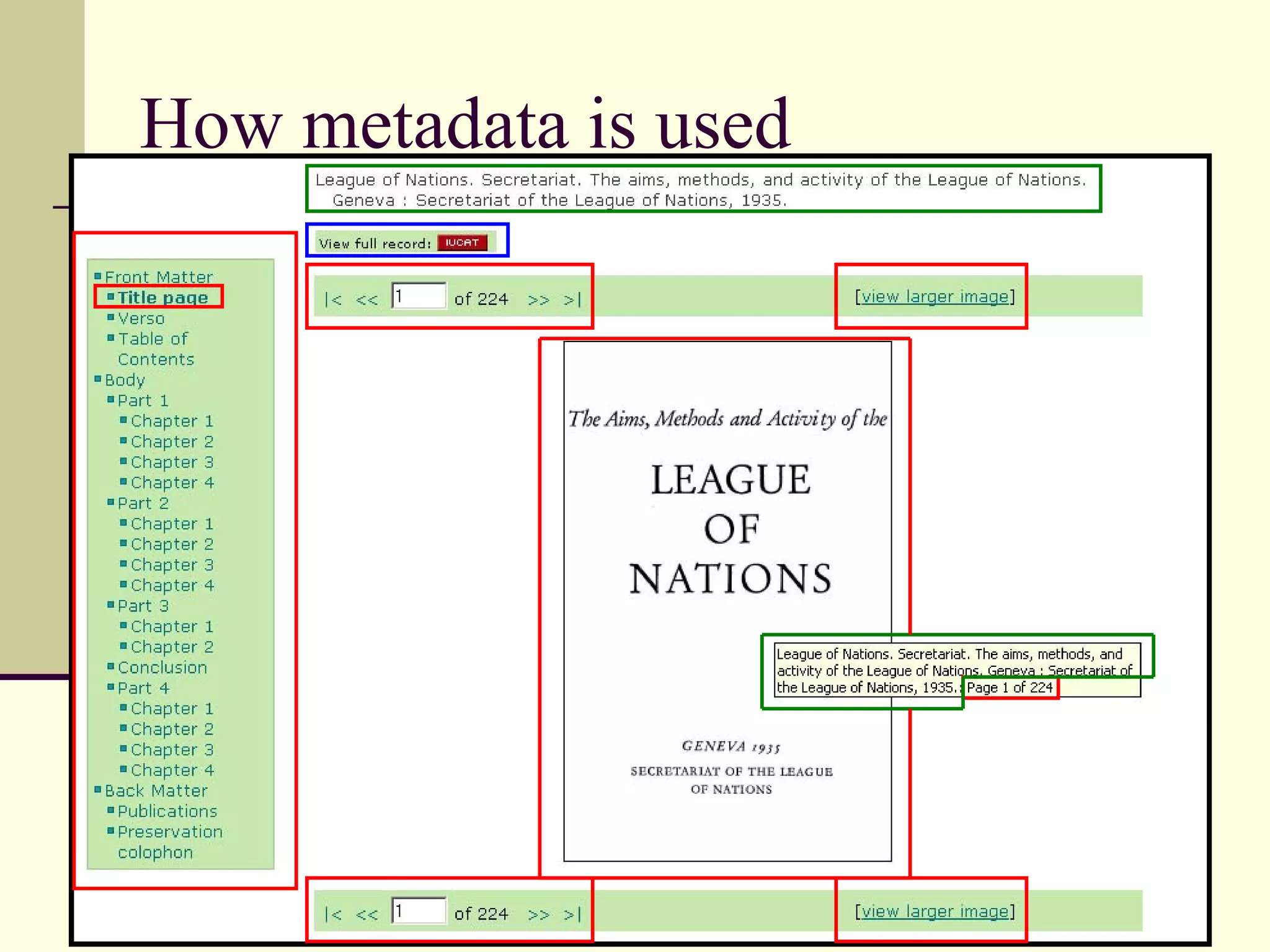
Variations and refinement of metadata definitions, including characteristics like structure, control, and generation.
Uses of metadata by specialists and novices in cataloging, managing digital objects, and preparing web content.
Role and types of metadata in digital library projects, including descriptive, technical, and preservation metadata.
Standards and principles of Dublin Core, its mission, and general schema limitations for effective resource discovery.
Details of Qualified Dublin Core (QDC), its added specificity, limitations, and appropriate use cases compared to DC.
Background of MARC as a standard for library metadata, its structure, advantages, and limitations, emphasizing its adoption.
MARCXML's characteristics, limitations, and differences from MODS, showcasing MODS developments and uses.
Introduction to various standards like VRA Core and EAD for managing visual arts and archival descriptions.
Importance of data structure, content standards, and vocabulary encoding schemes in metadata practices.
Overview of FRBR principles, implications for metadata creation, and assessing existing metadata for improved practices.
Overview of technical, preservation, rights, and structural metadata, including standards and their significance.
Characteristics of effective digital collections, emphasizing interoperability, persistence, and reusability of resources. Methods for sharing metadata via OAI, advantages for libraries, and structures of data provider and service provider.
Workflow for metadata sharing, importance of crosswalking, and creating shareable metadata that adheres to standards.
The necessity of creating shareable metadata in the context of changing user needs and supporting technologies.
3/6/07 INCOLSA Workshop2
Many definitions of metadata
“Data about data”
“Structured information about an information
resource of any media type or format.”
(Caplan)
“Any data used to aid the identification,
description and location of networked
electronic resources.” (IFLA)
…
3.
3/6/07 INCOLSA Workshop3
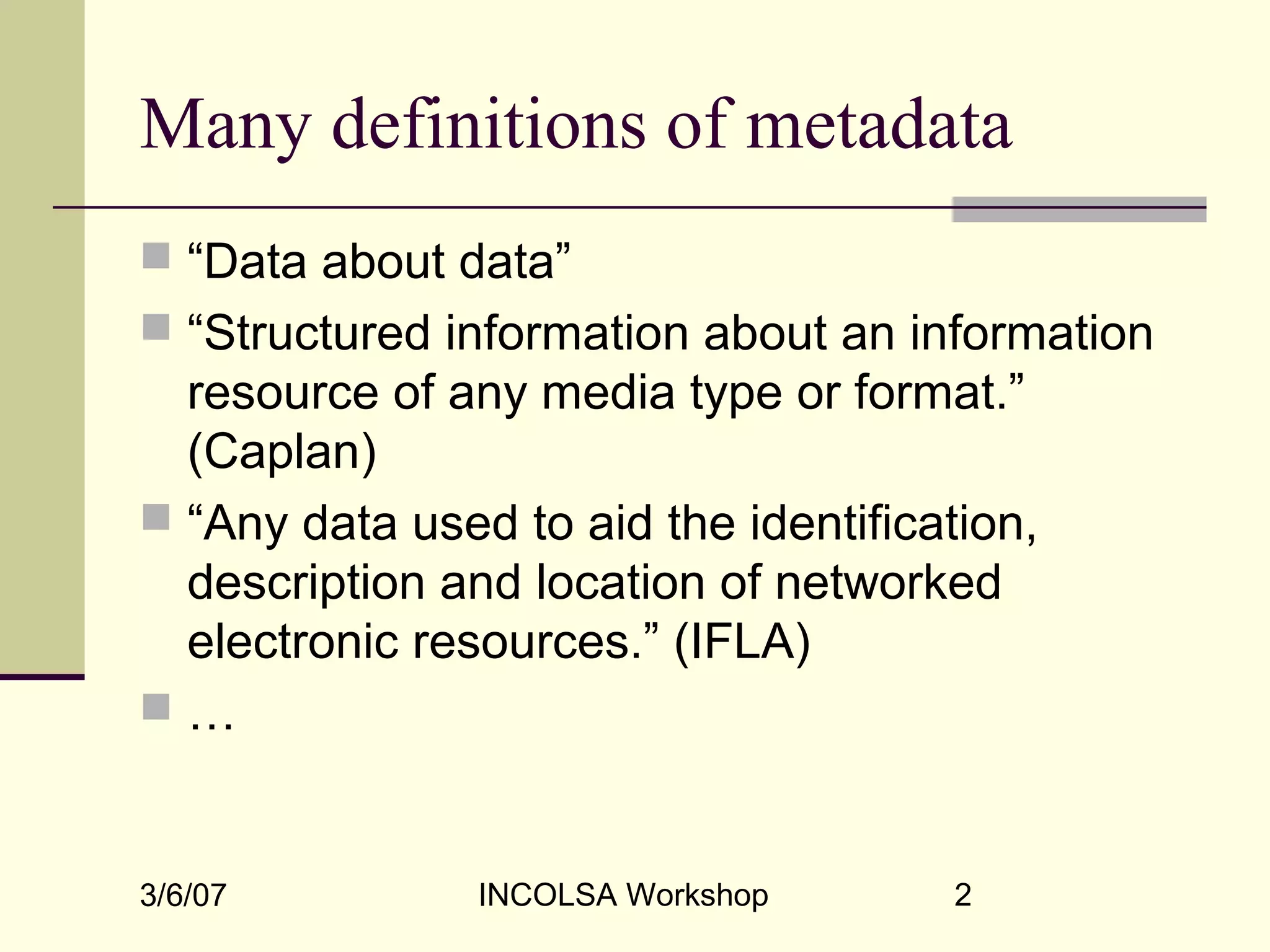
Refining a definition
Other characteristics
Structure
Control
Origin
Machine-generated
Human-generated
In practice, the term often covers data and
meta-metadata
4.
3/6/07 INCOLSA Workshop4
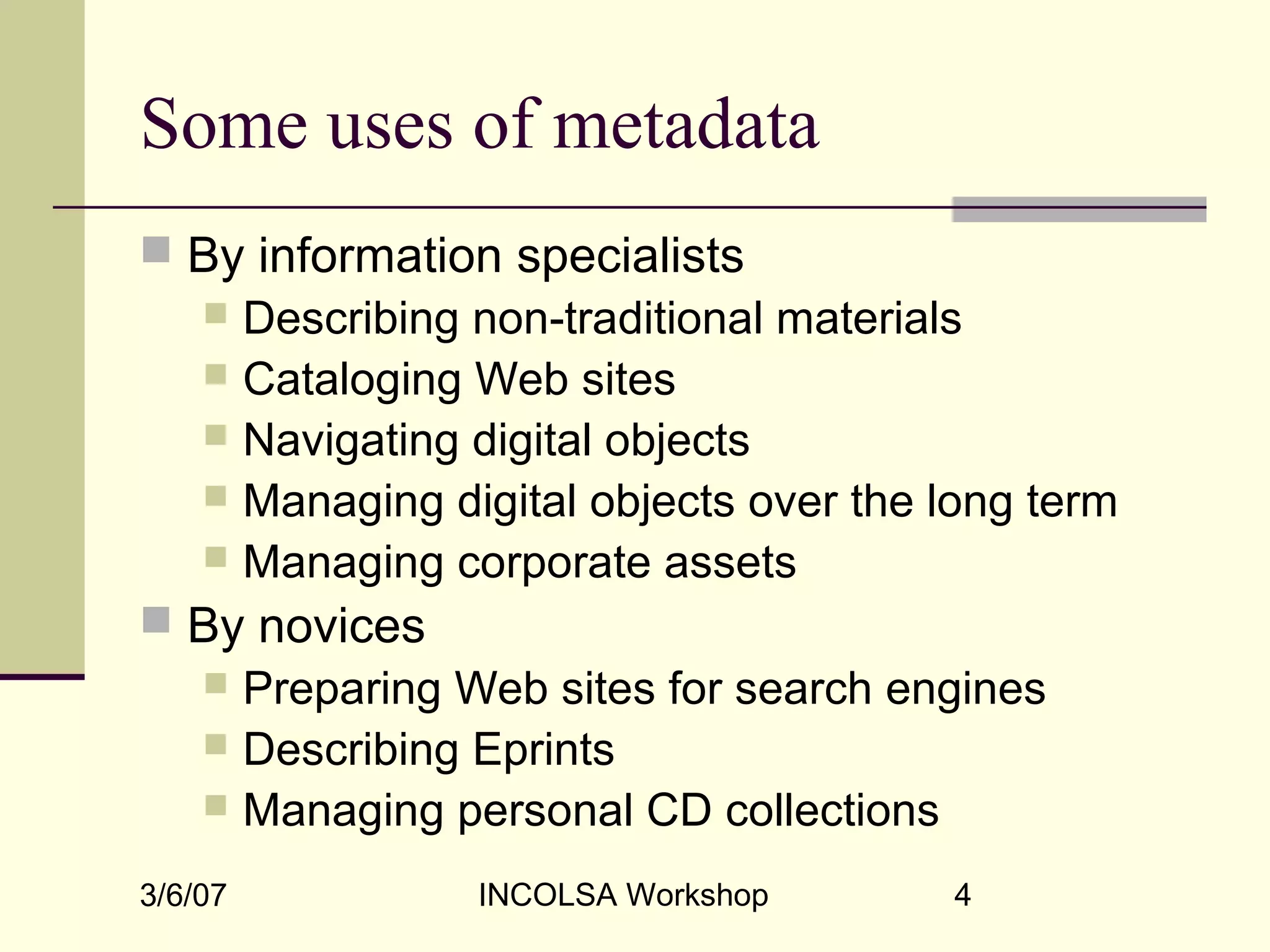
Some uses of metadata
By information specialists
Describing non-traditional materials
Cataloging Web sites
Navigating digital objects
Managing digital objects over the long term
Managing corporate assets
By novices
Preparing Web sites for search engines
Describing Eprints
Managing personal CD collections
5.
3/6/07 INCOLSA Workshop5
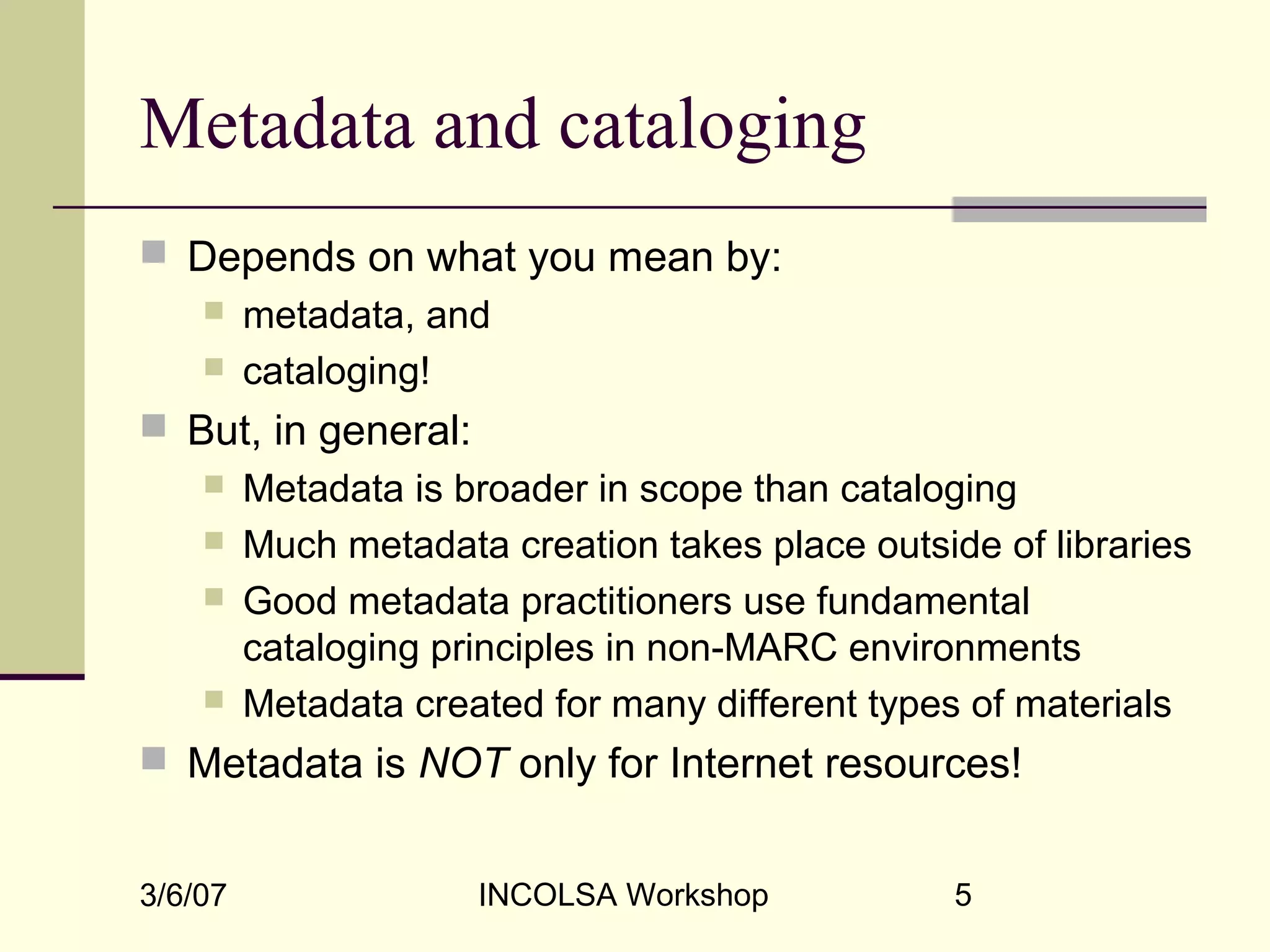
Metadata and cataloging
Depends on what you mean by:
metadata, and
cataloging!
But, in general:
Metadata is broader in scope than cataloging
Much metadata creation takes place outside of libraries
Good metadata practitioners use fundamental
cataloging principles in non-MARC environments
Metadata created for many different types of materials
Metadata is NOT only for Internet resources!
6.
3/6/07 INCOLSA Workshop6
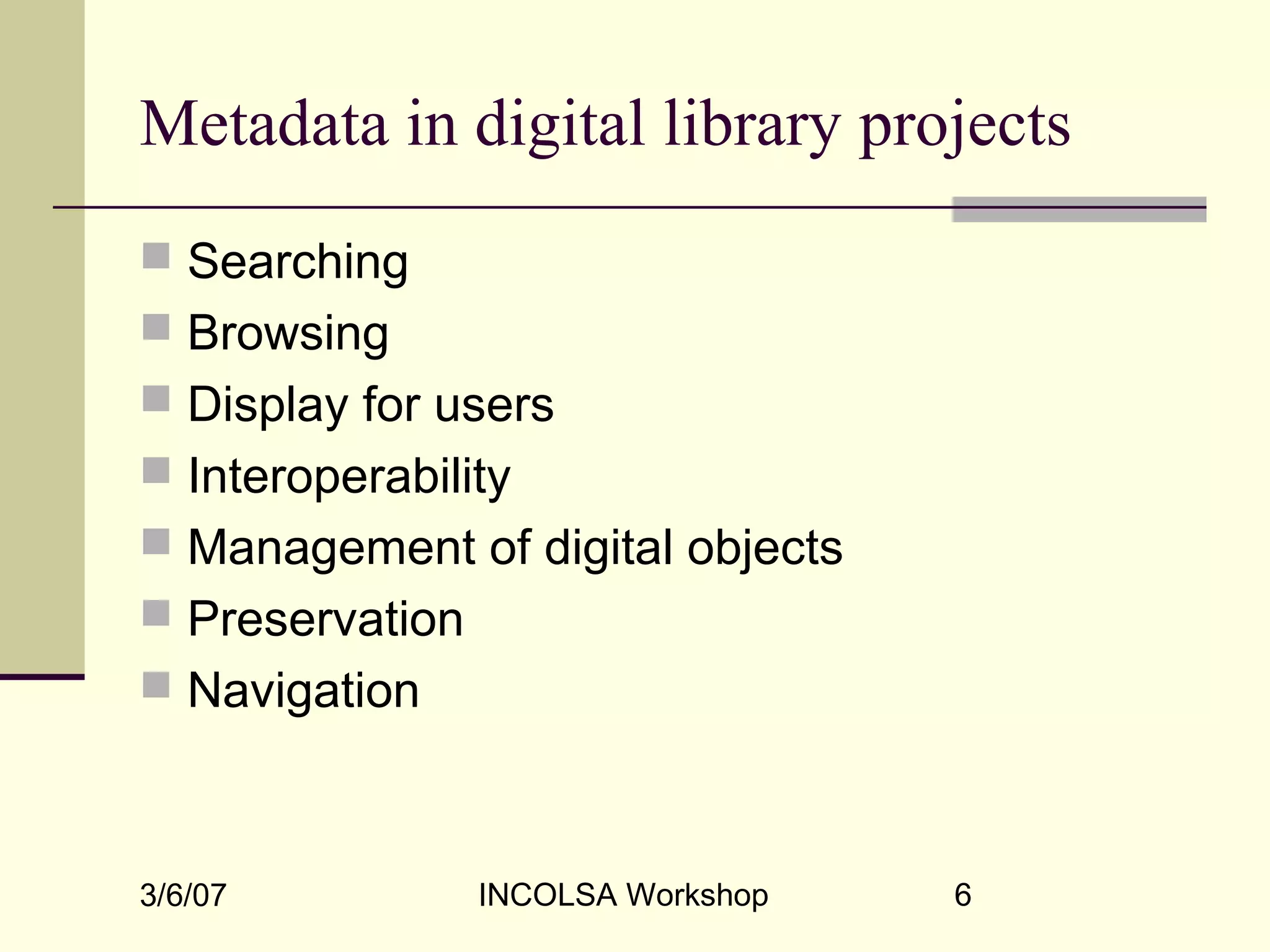
Metadata in digital library projects
Searching
Browsing
Display for users
Interoperability
Management of digital objects
Preservation
Navigation
7.
3/6/07 INCOLSA Workshop7
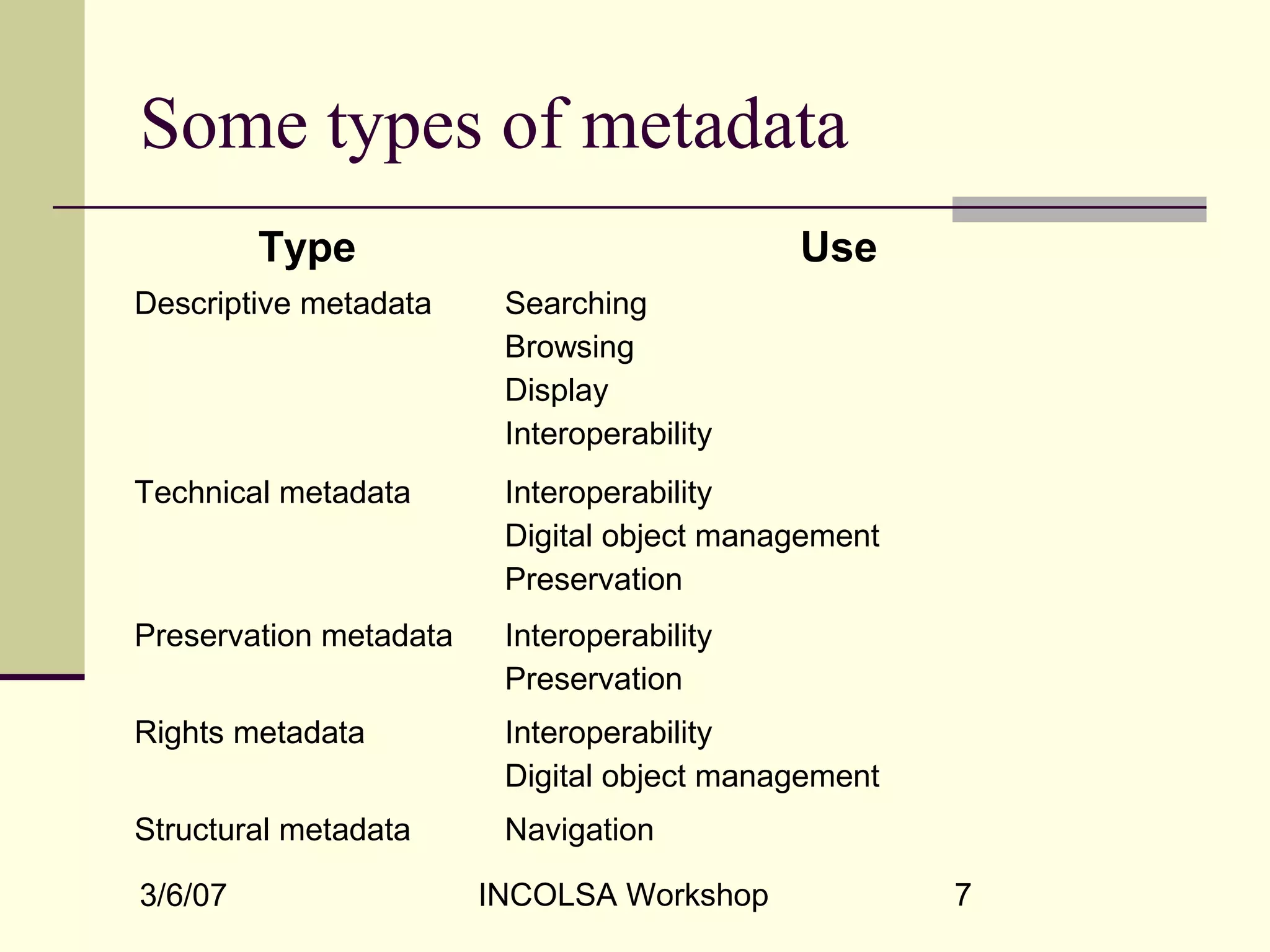
Some types of metadata
Type Use
Descriptive metadata Searching
Browsing
Display
Interoperability
Technical metadata Interoperability
Digital object management
Preservation
Preservation metadata Interoperability
Preservation
Rights metadata Interoperability
Digital object management
Structural metadata Navigation
3/6/07 INCOLSA Workshop9
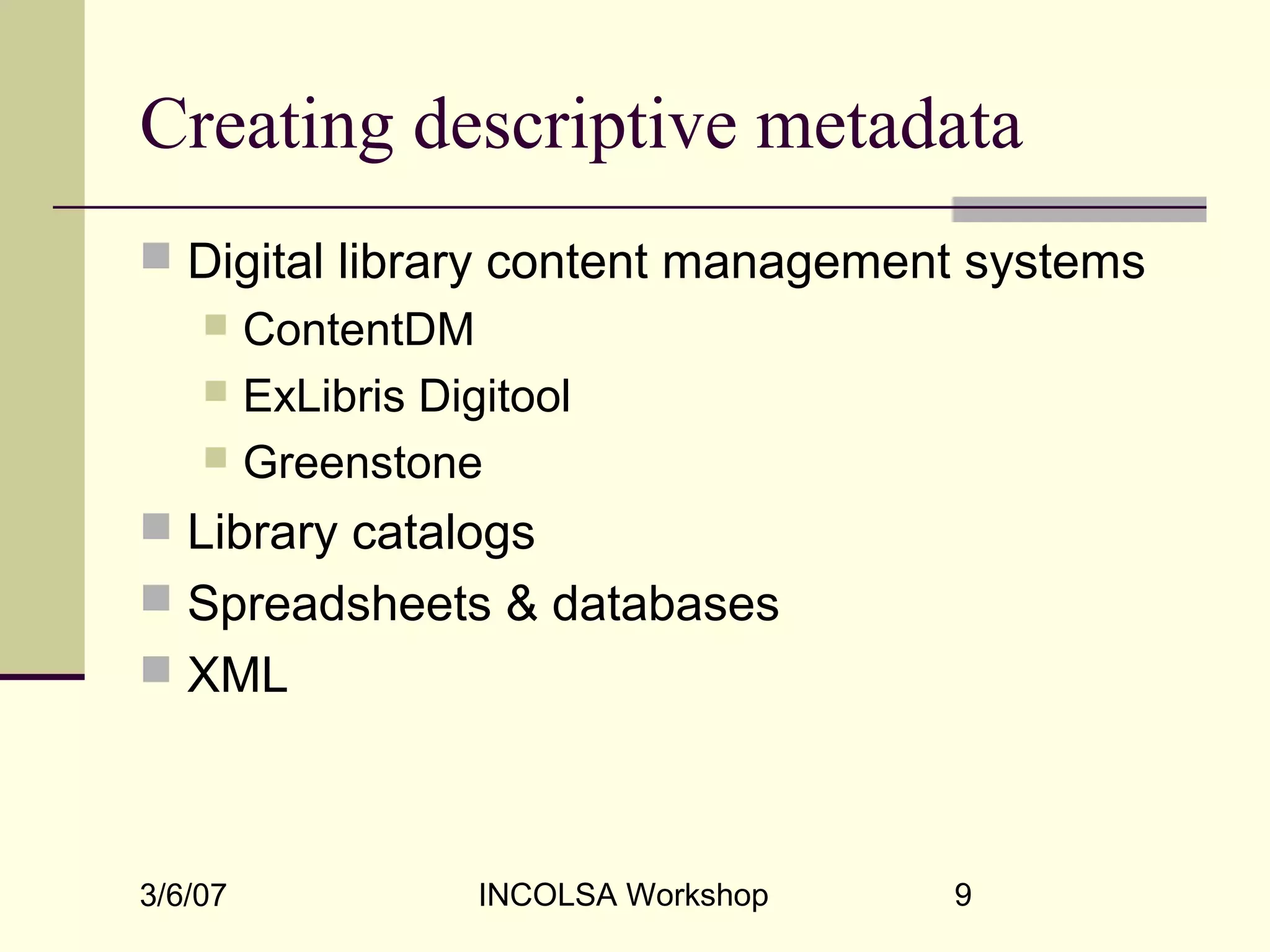
Creating descriptive metadata
Digital library content management systems
ContentDM
ExLibris Digitool
Greenstone
Library catalogs
Spreadsheets & databases
XML
10.
3/6/07 INCOLSA Workshop10
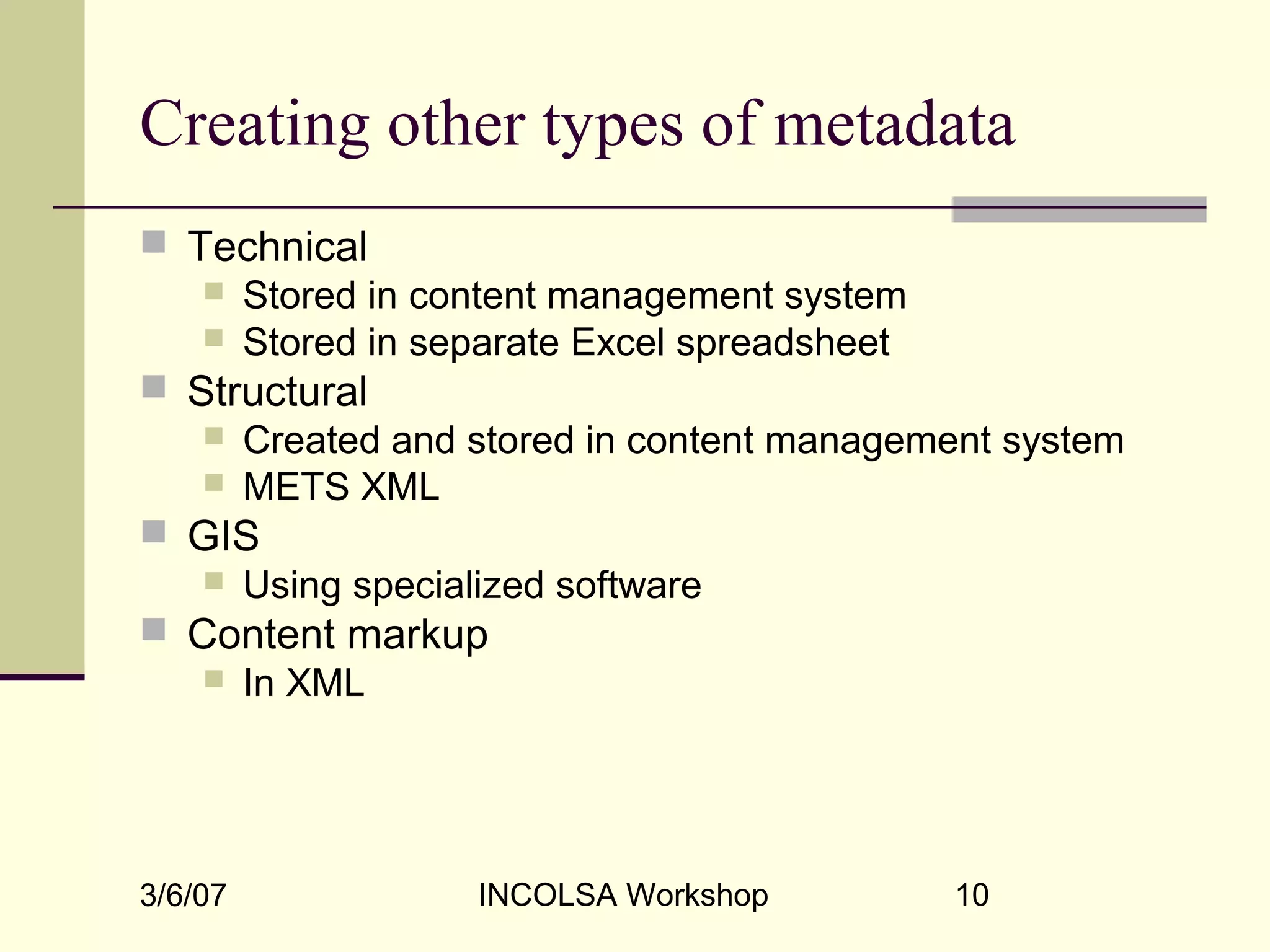
Creating other types of metadata
Technical
Stored in content management system
Stored in separate Excel spreadsheet
Structural
Created and stored in content management system
METS XML
GIS
Using specialized software
Content markup
In XML
11.
3/6/07 INCOLSA Workshop11
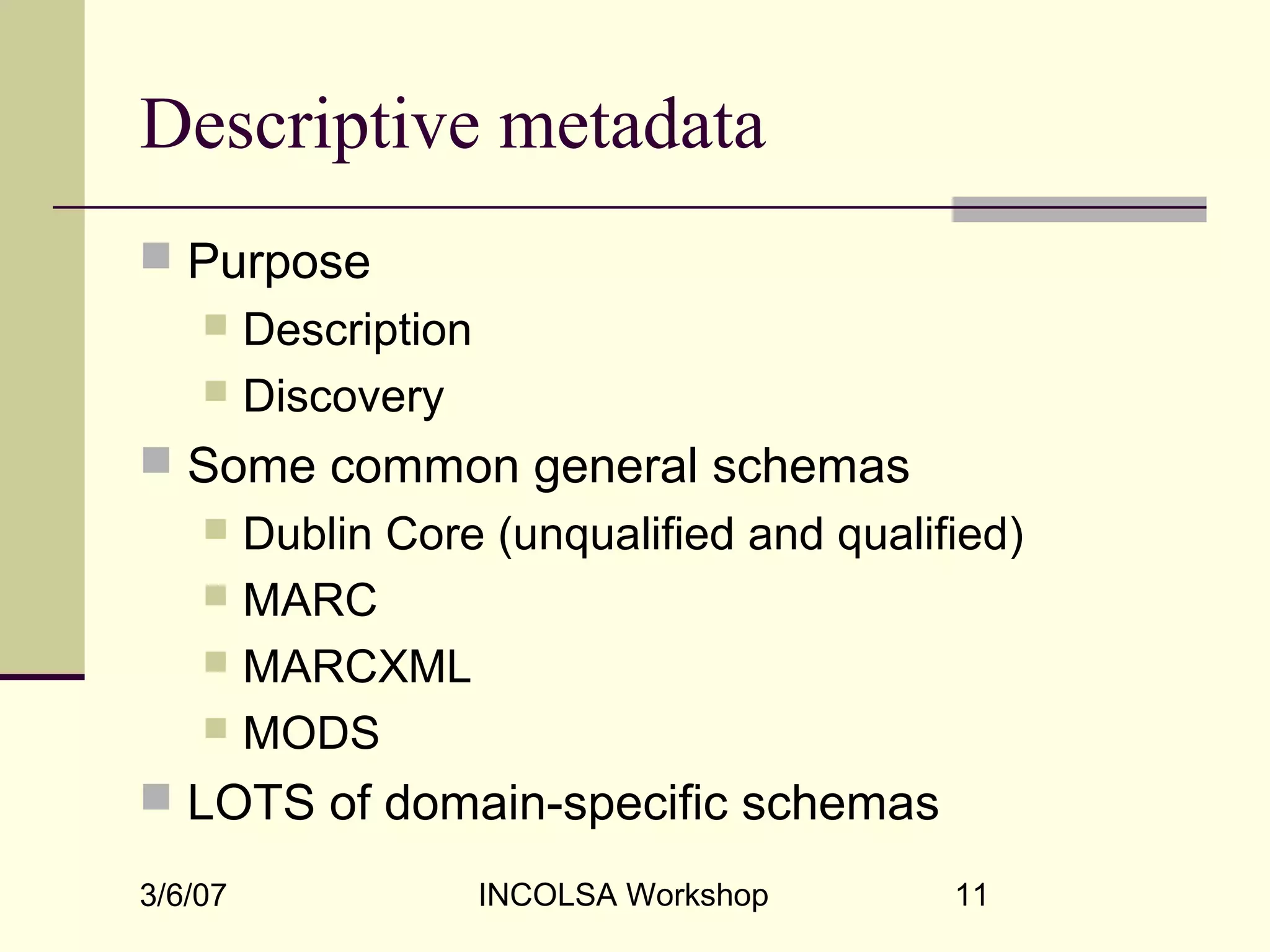
Descriptive metadata
Purpose
Description
Discovery
Some common general schemas
Dublin Core (unqualified and qualified)
MARC
MARCXML
MODS
LOTS of domain-specific schemas
12.
3/6/07 INCOLSA Workshop12
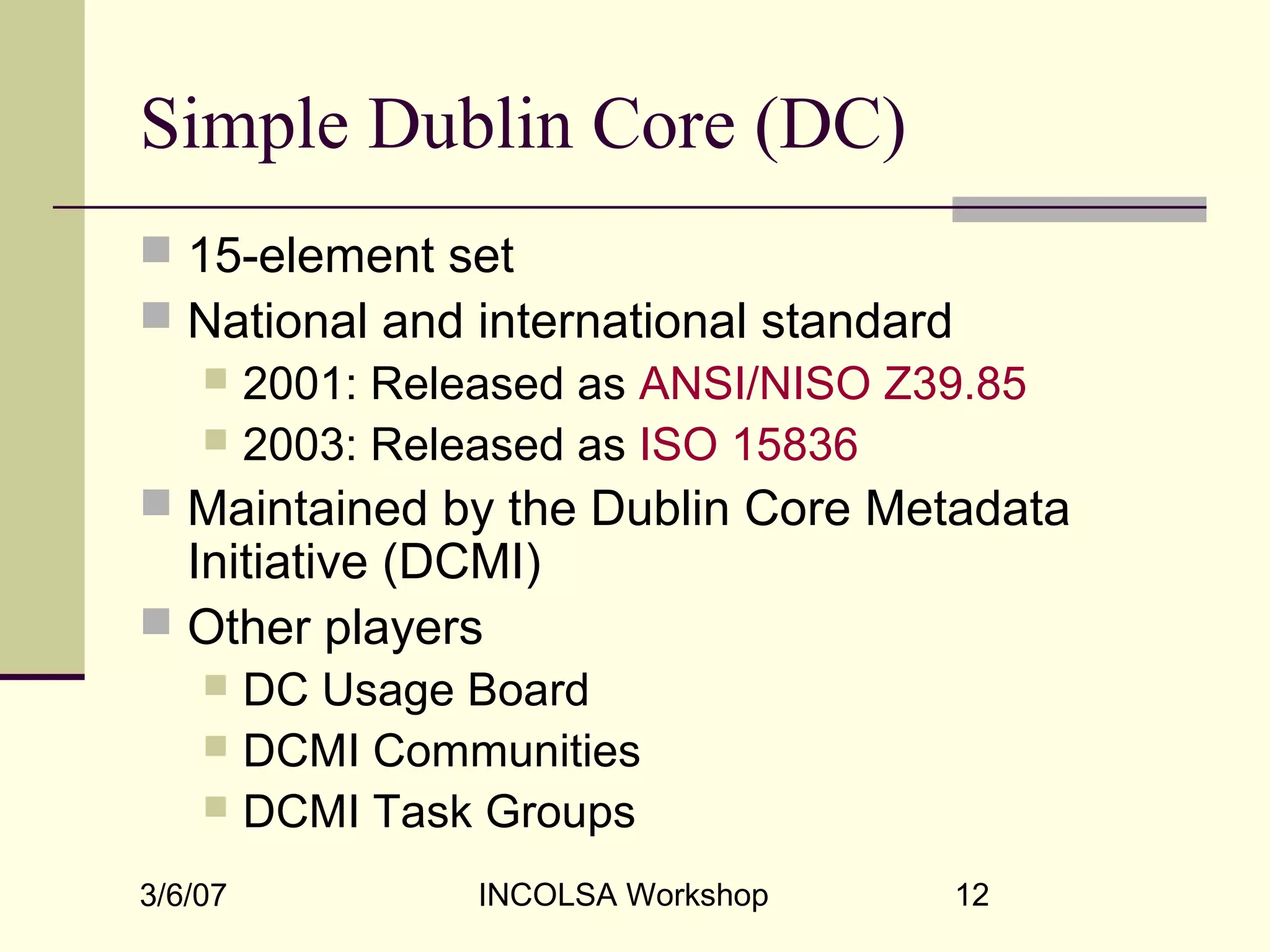
Simple Dublin Core (DC)
15-element set
National and international standard
2001: Released as ANSI/NISO Z39.85
2003: Released as ISO 15836
Maintained by the Dublin Core Metadata
Initiative (DCMI)
Other players
DC Usage Board
DCMI Communities
DCMI Task Groups
13.
3/6/07 INCOLSA Workshop13
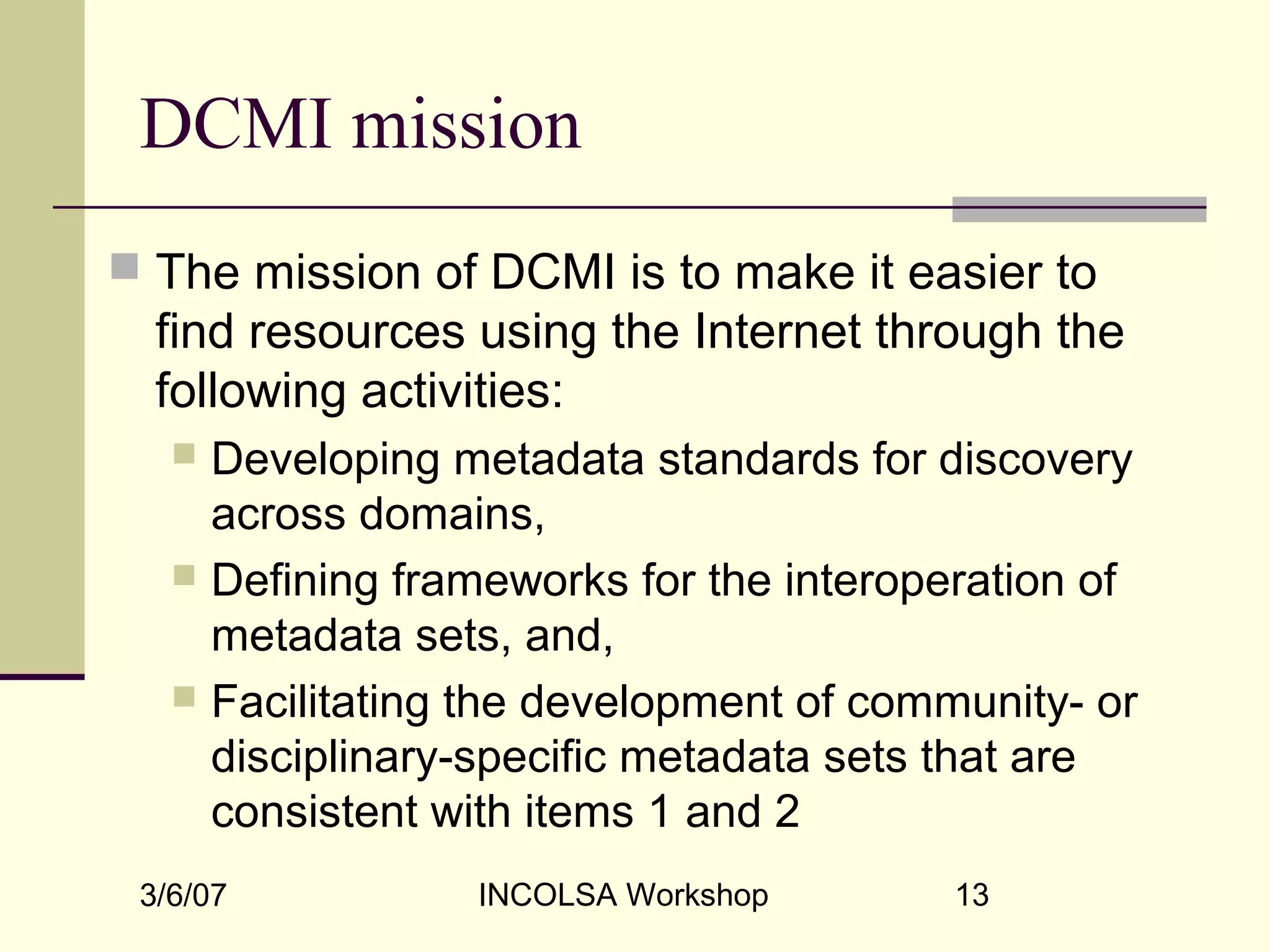
DCMI mission
The mission of DCMI is to make it easier to
find resources using the Internet through the
following activities:
Developing metadata standards for discovery
across domains,
Defining frameworks for the interoperation of
metadata sets, and,
Facilitating the development of community- or
disciplinary-specific metadata sets that are
consistent with items 1 and 2
14.
3/6/07 INCOLSA Workshop14
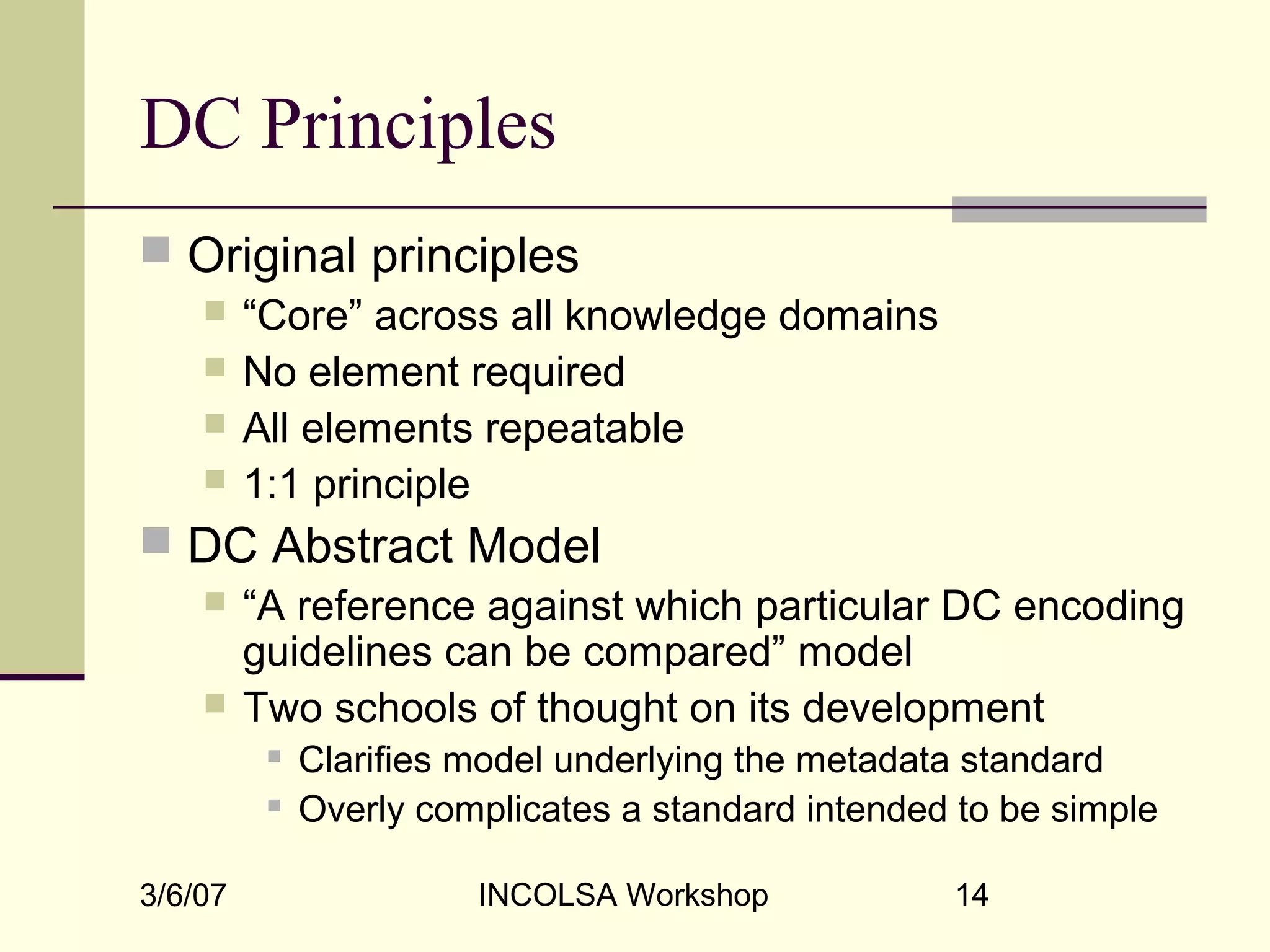
DC Principles
Original principles
“Core” across all knowledge domains
No element required
All elements repeatable
1:1 principle
DC Abstract Model
“A reference against which particular DC encoding
guidelines can be compared” model
Two schools of thought on its development
Clarifies model underlying the metadata standard
Overly complicates a standard intended to be simple
15.
3/6/07 INCOLSA Workshop15
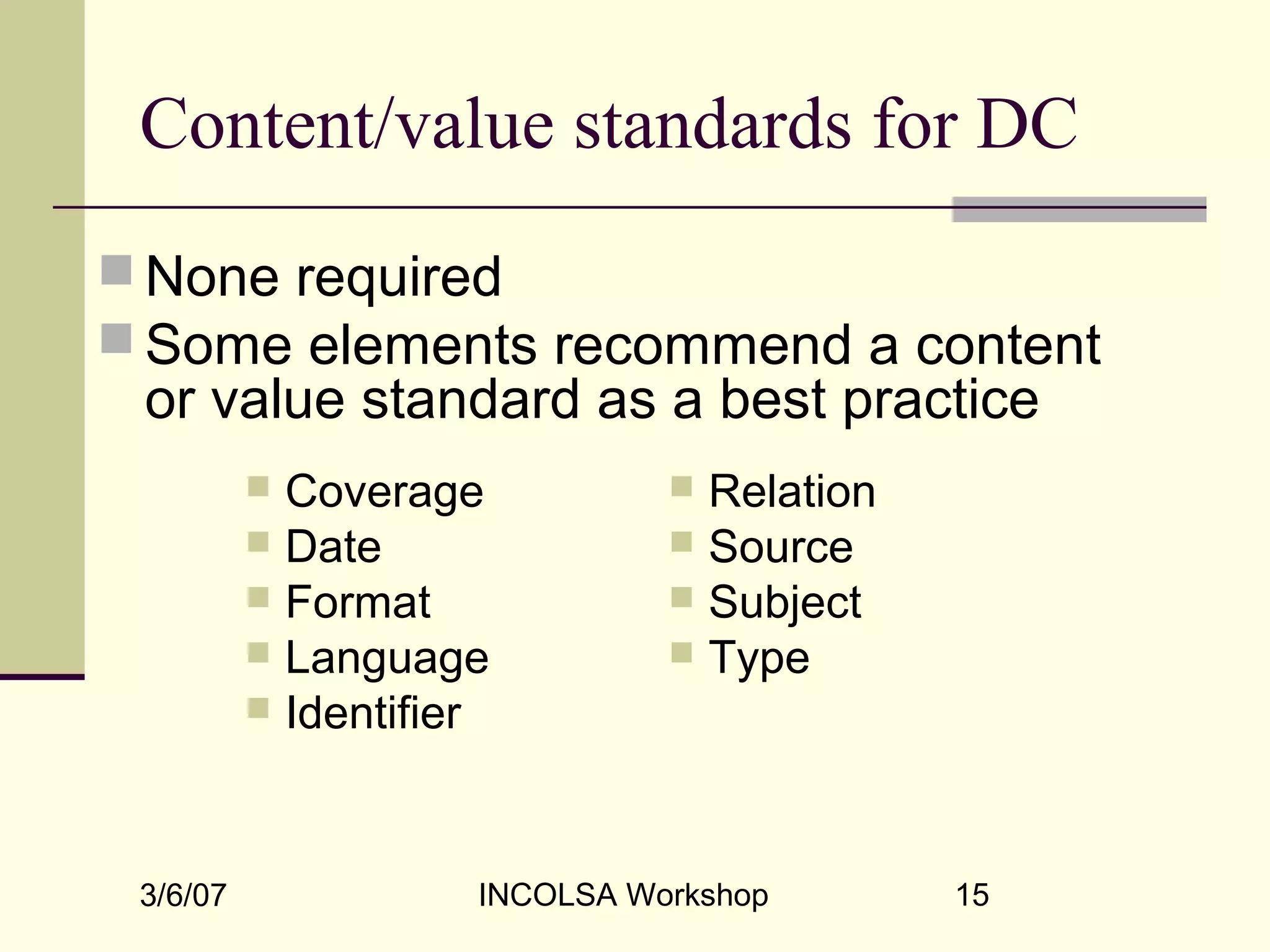
Content/value standards for DC
None required
Some elements recommend a content
or value standard as a best practice
Relation
Source
Subject
Type
Coverage
Date
Format
Language
Identifier
16.
3/6/07 INCOLSA Workshop16
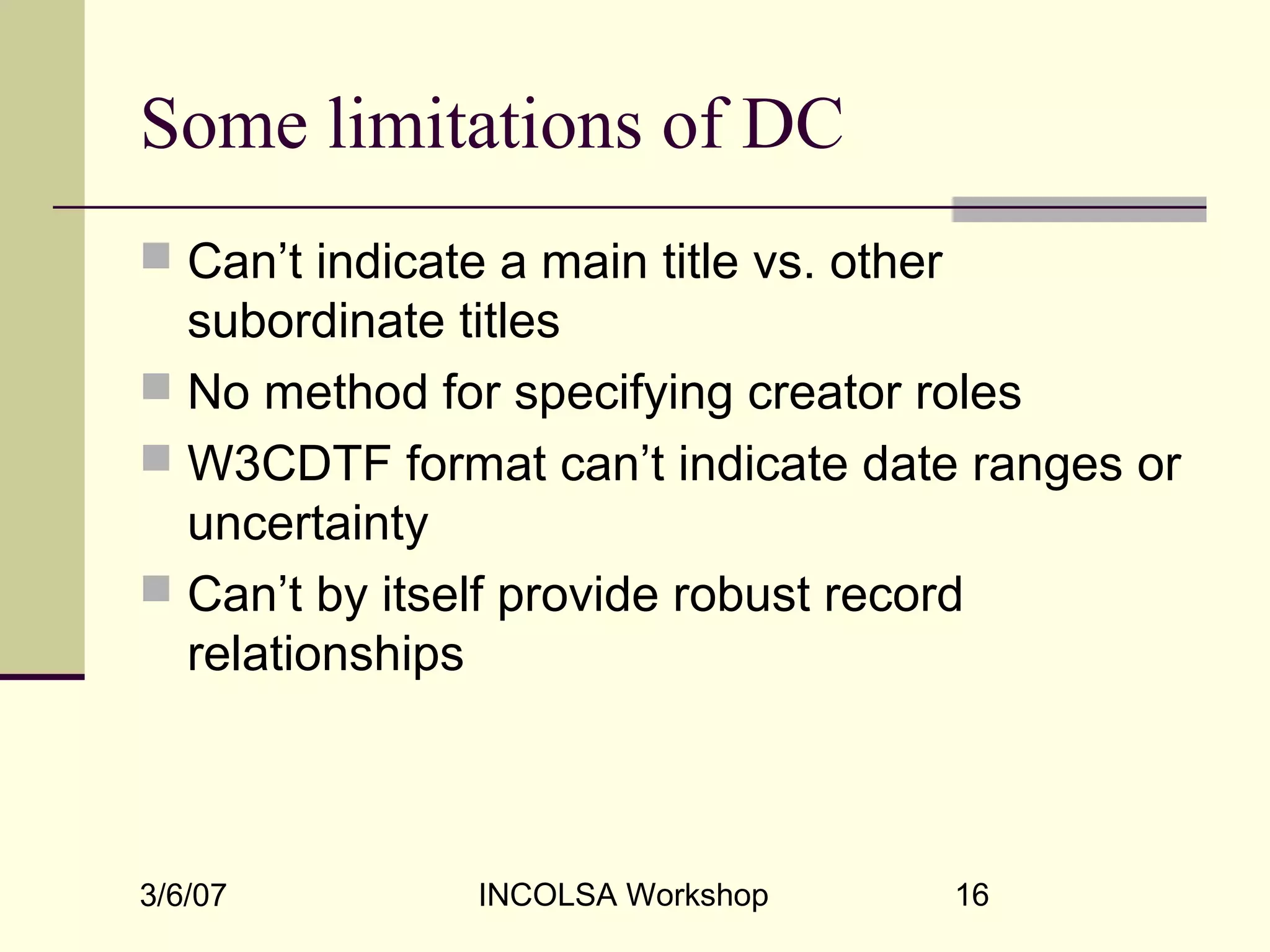
Some limitations of DC
Can’t indicate a main title vs. other
subordinate titles
No method for specifying creator roles
W3CDTF format can’t indicate date ranges or
uncertainty
Can’t by itself provide robust record
relationships
17.
3/6/07 INCOLSA Workshop17
Good times to use DC
Cross-collection searching
Cross-domain discovery
Metadata sharing
Describing some types of simple resources
Metadata creation by novices
3/6/07 INCOLSA Workshop19
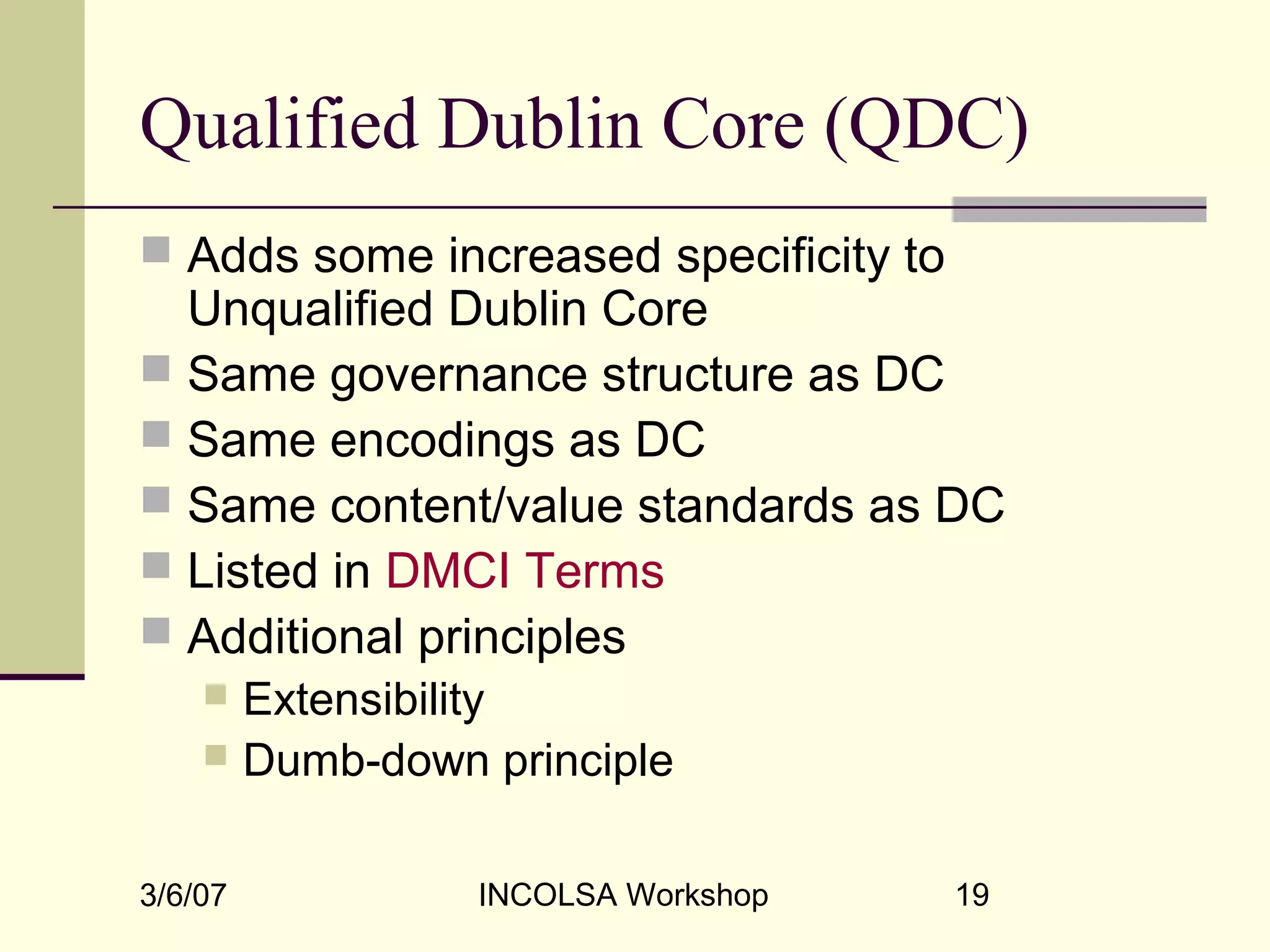
Qualified Dublin Core (QDC)
Adds some increased specificity to
Unqualified Dublin Core
Same governance structure as DC
Same encodings as DC
Same content/value standards as DC
Listed in DMCI Terms
Additional principles
Extensibility
Dumb-down principle
20.
3/6/07 INCOLSA Workshop20
Types of DC qualifiers
Additional elements
Element refinements
Encoding schemes
Vocabulary encoding schemes
Syntax encoding schemes
21.
3/6/07 INCOLSA Workshop21
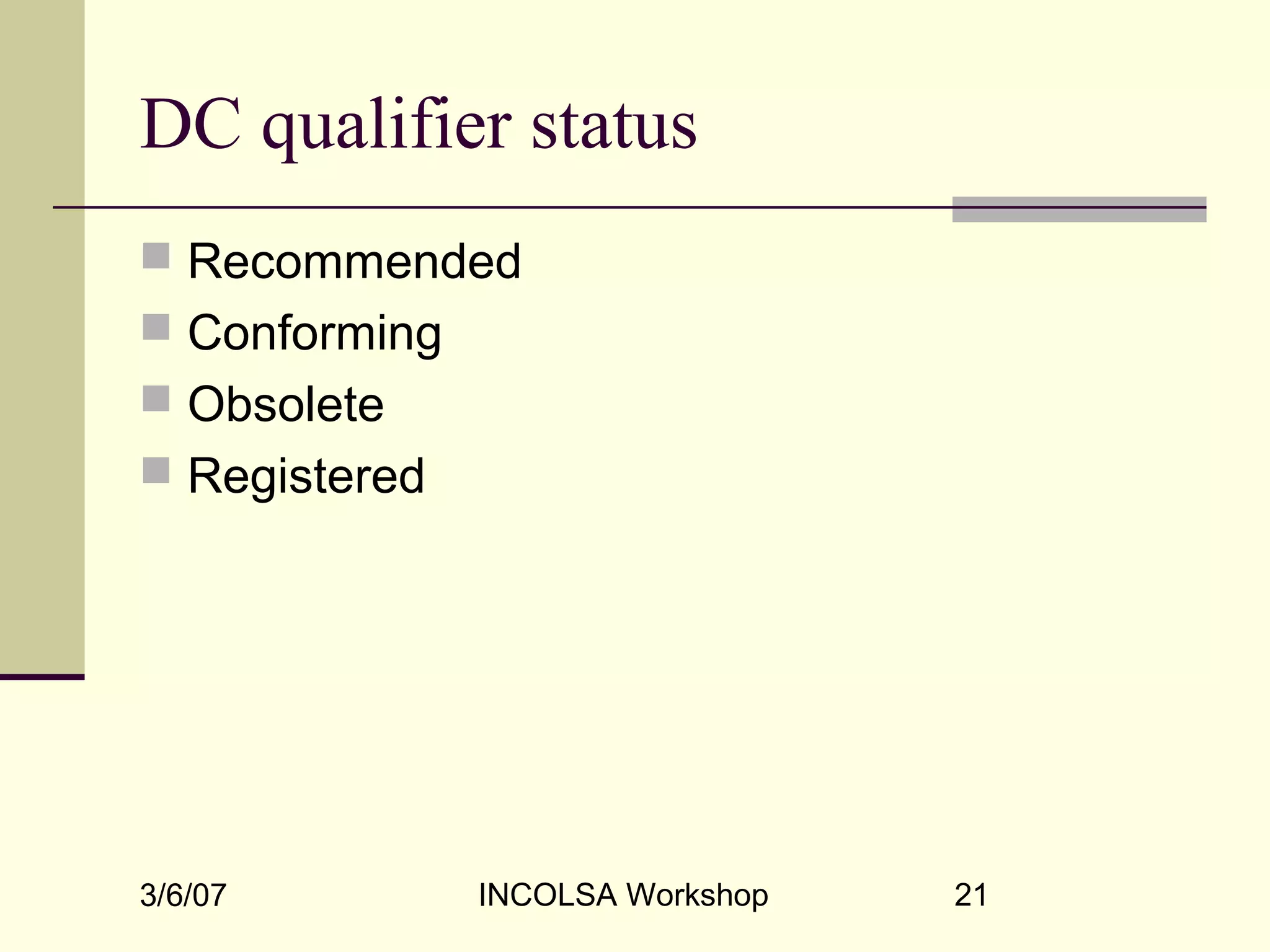
DC qualifier status
Recommended
Conforming
Obsolete
Registered
22.
3/6/07 INCOLSA Workshop22
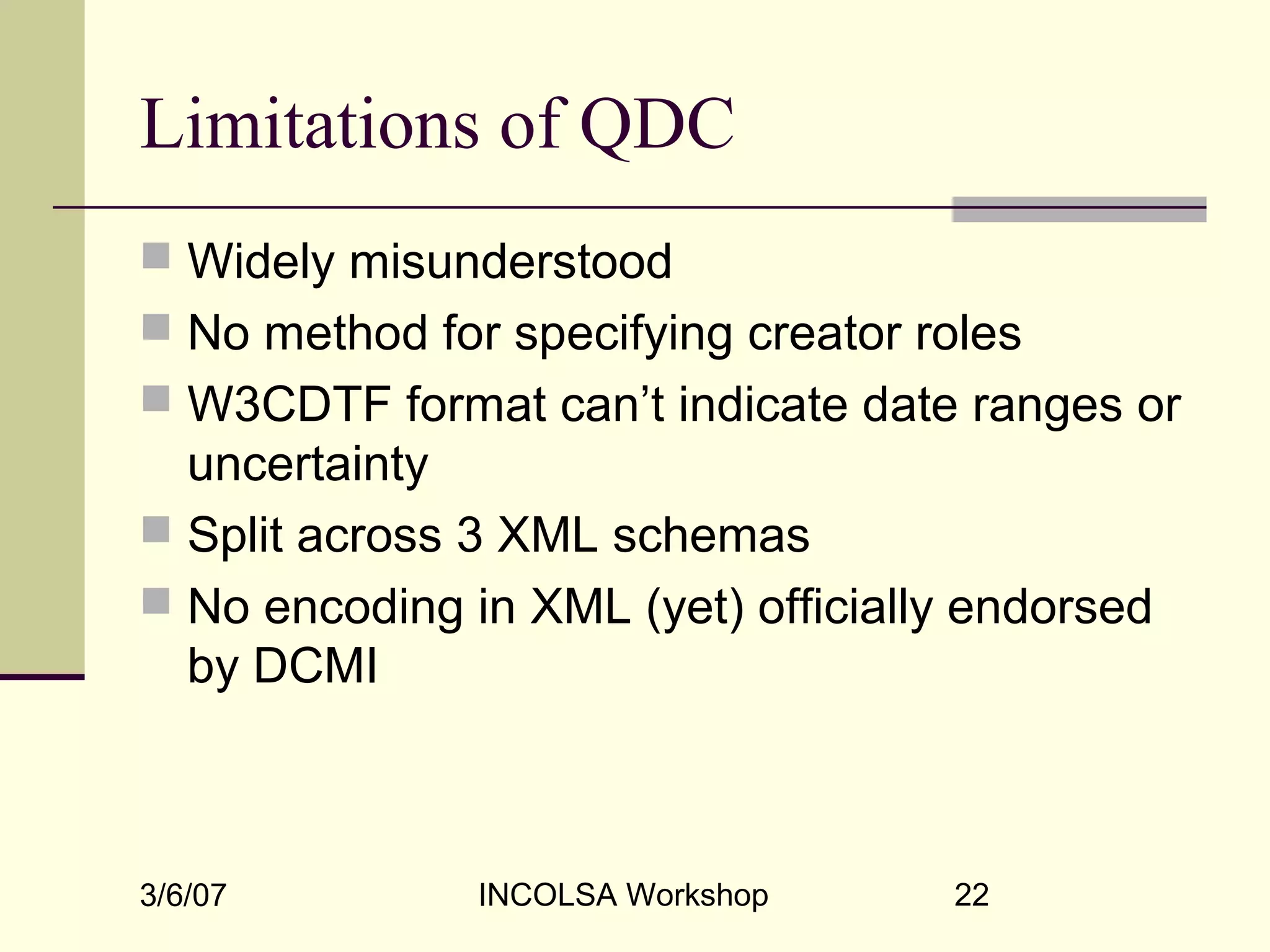
Limitations of QDC
Widely misunderstood
No method for specifying creator roles
W3CDTF format can’t indicate date ranges or
uncertainty
Split across 3 XML schemas
No encoding in XML (yet) officially endorsed
by DCMI
23.
3/6/07 INCOLSA Workshop23
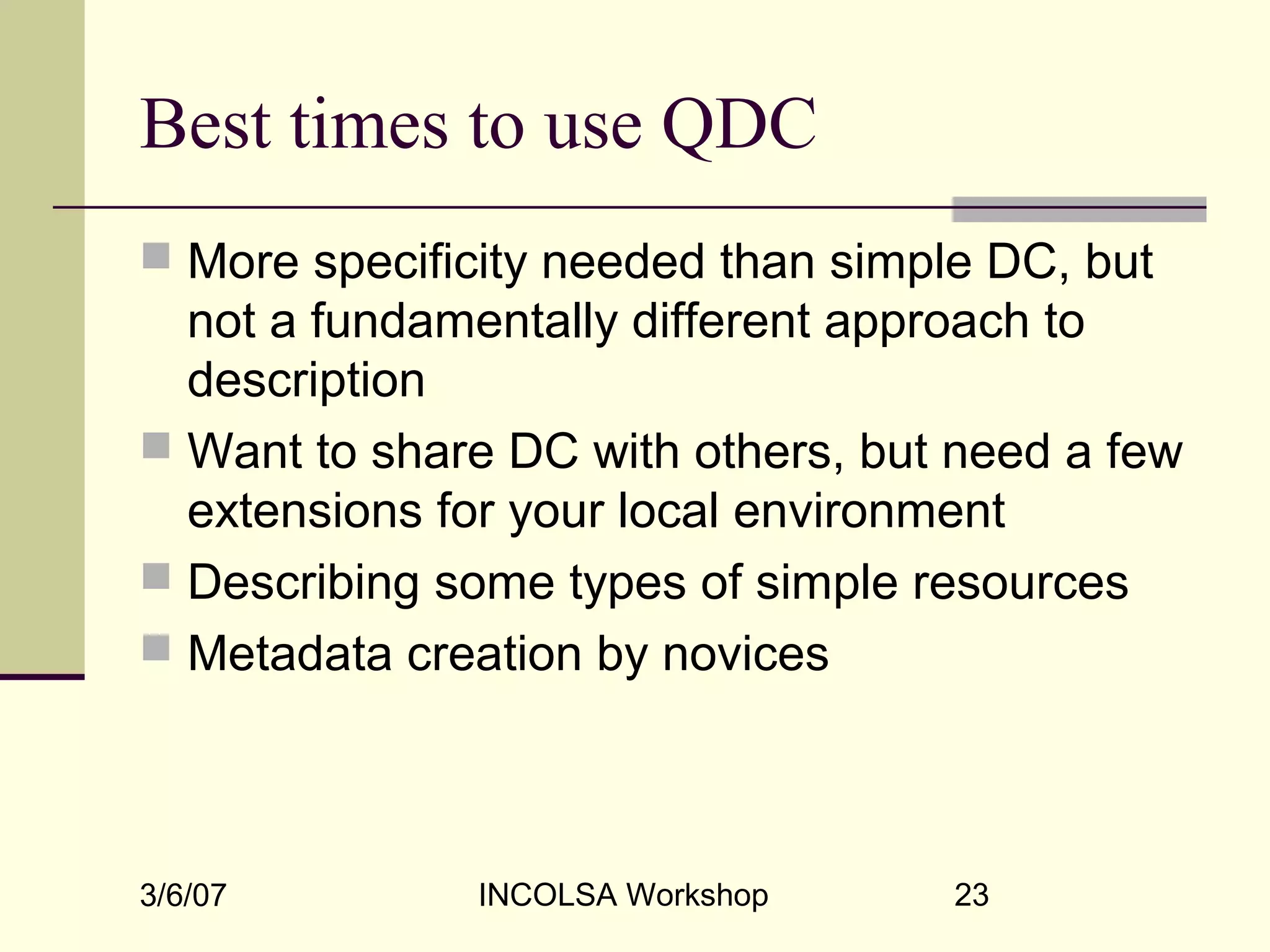
Best times to use QDC
More specificity needed than simple DC, but
not a fundamentally different approach to
description
Want to share DC with others, but need a few
extensions for your local environment
Describing some types of simple resources
Metadata creation by novices
3/6/07 INCOLSA Workshop25
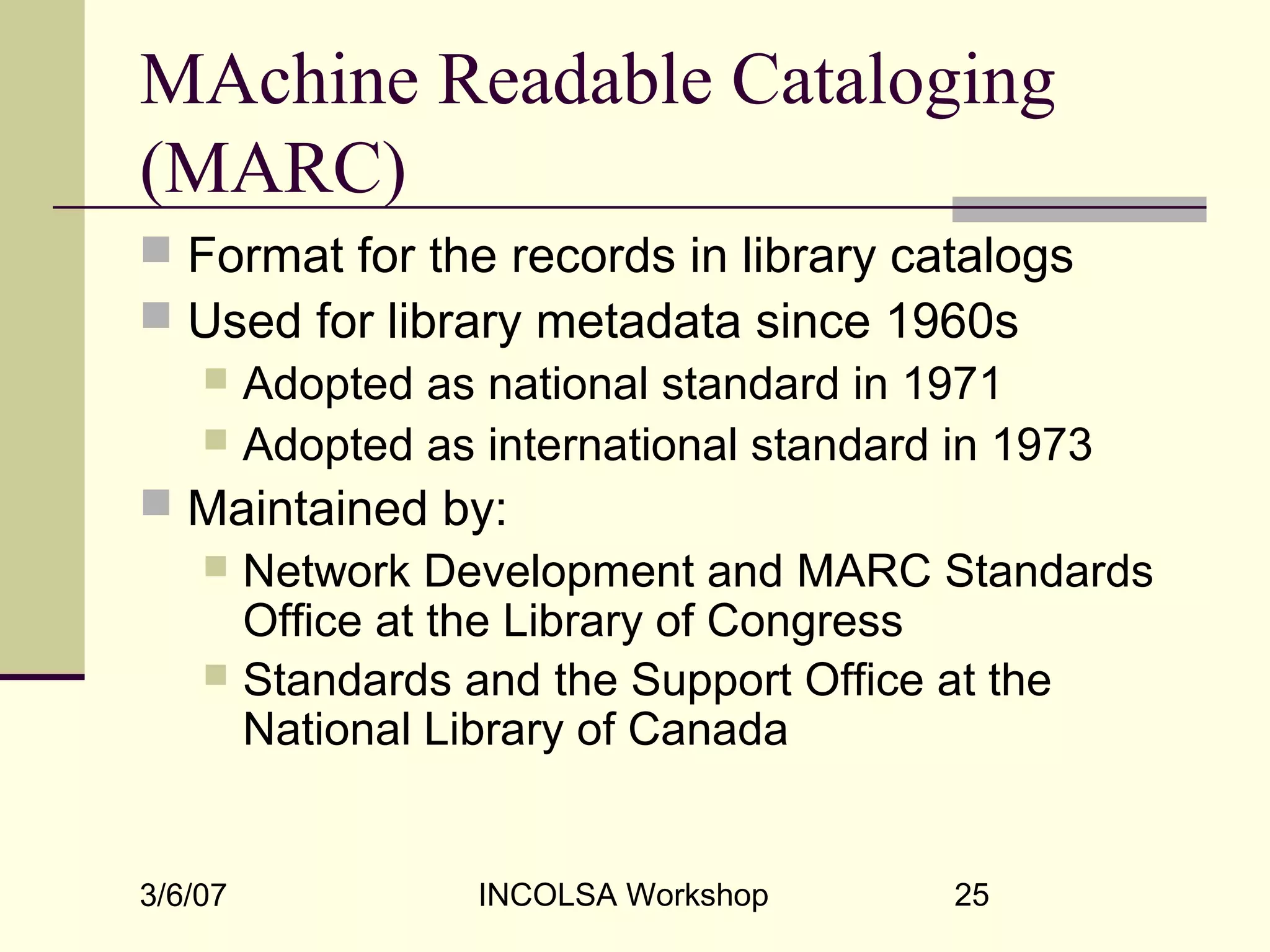
MAchine Readable Cataloging
(MARC)
Format for the records in library catalogs
Used for library metadata since 1960s
Adopted as national standard in 1971
Adopted as international standard in 1973
Maintained by:
Network Development and MARC Standards
Office at the Library of Congress
Standards and the Support Office at the
National Library of Canada
26.
3/6/07 INCOLSA Workshop26
More about MARC
Actually a family of MARC standards
throughout the world
U.S. & Canada use MARC21
Structured as a binary interchange format
ANSI/NISO Z39.2
ISO 2709
Field names
Numeric fields
Alphabetic subfields
27.
3/6/07 INCOLSA Workshop27
Content/value standards for MARC
None required by the format itself
But US record creation practice relies
heavily on:
AACR2r
ISBD
LCNAF
LCSH
28.
3/6/07 INCOLSA Workshop28
Limitations of MARC
Use of all its potential is time-consuming
OPACs don’t make full use of all possible
data
OPACs virtually the only systems to use
MARC data
Requires highly-trained staff to create
Local practice differs greatly
29.
3/6/07 INCOLSA Workshop29
Good times to use MARC
Integration with other records in OPAC
Resources are like those traditionally found in
library catalogs
Maximum compatibility with other libraries is
needed
Have expert catalogers for metadata creation
3/6/07 INCOLSA Workshop31
MARC in XML (MARCXML)
Copies the exact structure of MARC21 in an
XML syntax
Numeric fields
Alphabetic subfields
Implicit assumption that content/value
standards are the same as in MARC
32.
3/6/07 INCOLSA Workshop32
Limitations of MARCXML
Not appropriate for direct data entry
Extremely verbose syntax
Full content validation requires tools external
to XML Schema conformance
33.
3/6/07 INCOLSA Workshop33
Best times to use MARCXML
As a transition format between a MARC
record and another XML-encoded metadata
format
Materials lend themselves to library-type
description
Need more robustness than DC offers
Want XML representation to store within
larger digital object but need lossless
conversion to MARC
3/6/07 INCOLSA Workshop35
Metadata Object Description
Schema (MODS)
Developed and managed by the Library of
Congress Network Development and MARC
Standards Office
For encoding bibliographic information
Influenced by MARC, but not equivalent
Usable for any format of materials
First released for trial use June 2002
MODS 3.2 released late 2006
36.
3/6/07 INCOLSA Workshop36
MODS differences from MARC
MODS is “MARC-like” but intended to be
simpler
Textual tag names
Encoded in XML
Some specific changes
Some regrouping of elements
Removes some elements
Adds some elements
37.
3/6/07 INCOLSA Workshop37
Content/value standards for MODS
Many elements indicate a given content/value
standard should be used
Generally follows MARC/AACR2/ISBD
conventions
But not all enforced by the MODS XML
schema
Authority attribute available on many
elements
38.
3/6/07 INCOLSA Workshop38
Limitations of MODS
No lossless round-trip conversion from and to
MARC
Still largely implemented by library community
only
Some semantics of MARC lost
39.
3/6/07 INCOLSA Workshop39
Good times to use MODS
Materials lend themselves to library-type
description
Want to reach both library and non-library
audiences
Need more robustness than DC offers
Want XML representation to store within
larger digital object
3/6/07 INCOLSA Workshop41
Visual Resources Association
(VRA) Core
From Visual Resources Association
Separates Work from Image
Library focus
Inspiration from Dublin Core
Version 3.0 released on 2002
Version 4.0 currently in Beta
42.
3/6/07 INCOLSA Workshop42
Categories for the Description of
Works of Art (CDWA) Lite
Reduced version of the Categories for the
Description of Works of Art (512 categories)
From J. Paul Getty Trust
Museum focus
Conceived for record sharing
43.
3/6/07 INCOLSA Workshop43
Structure standards for learning
materials
Gateway to Educational Materials (GEM)
From the U.S. Department of Education
Based on Qualified Dublin Core
Adds elements for instructional level, instructional method,
etc.
“GEM's goal is to improve the organization and accessibility
of the substantial collections of materials that are already
available on various federal, state, university, non-profit, and
commercial Internet sites.”*
IEEE Learning Object Metadata (LOM)
Elements for technical and descriptive metadata about
learning resources
* From <http://www.thegateway.org/about/documentation/schemas>
44.
3/6/07 INCOLSA Workshop44
Text Encoding Initiative (TEI)
TEI in Libraries
For encoding full texts of documents
Literary texts
Letters
…etc.
Requires specialized search engine
Delivery requires specialized software or
offline conversion to HTML
45.
3/6/07 INCOLSA Workshop45
Encoded Archival Description
(EAD)
Maintained by the Society for American
Archivists EAD Working Group
Markup language for archival finding aids
Designed to accommodate multi-level
description
Requires specialized search engine
Delivery requires specialized software or
offline conversion to HTML
EAD 1.0 released in 1998
EAD2002 finalized in December 2002
46.
3/6/07 INCOLSA Workshop46
Levels of control
Data structure standards (e.g., MARC)
Data content standards (e.g., AACR2r)
Encoding schemes
Vocabulary
Syntax
High-level models (e.g., FRBR)
Very few metadata standards include a
counterpart to the AACR “chief source of
information”
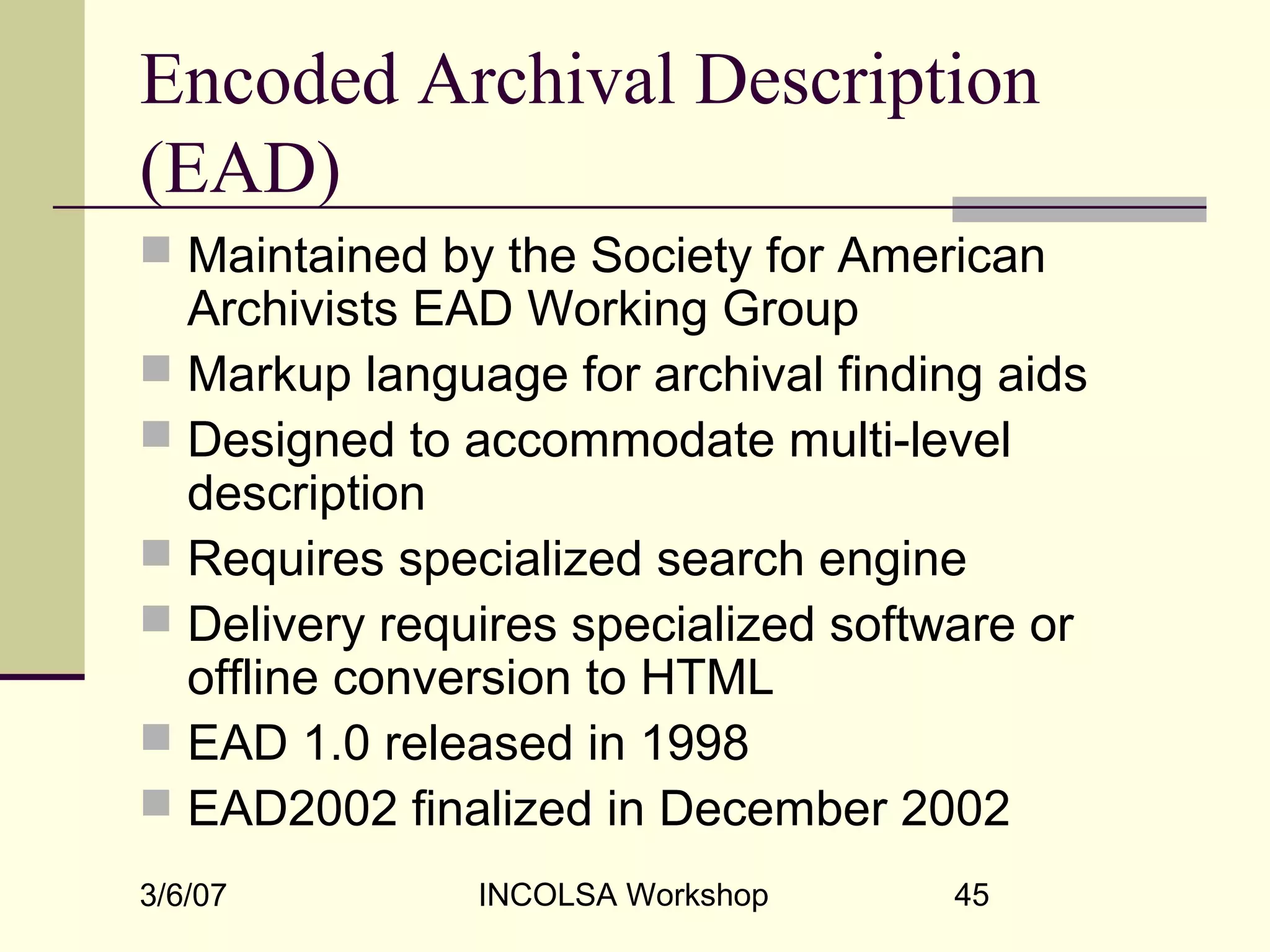
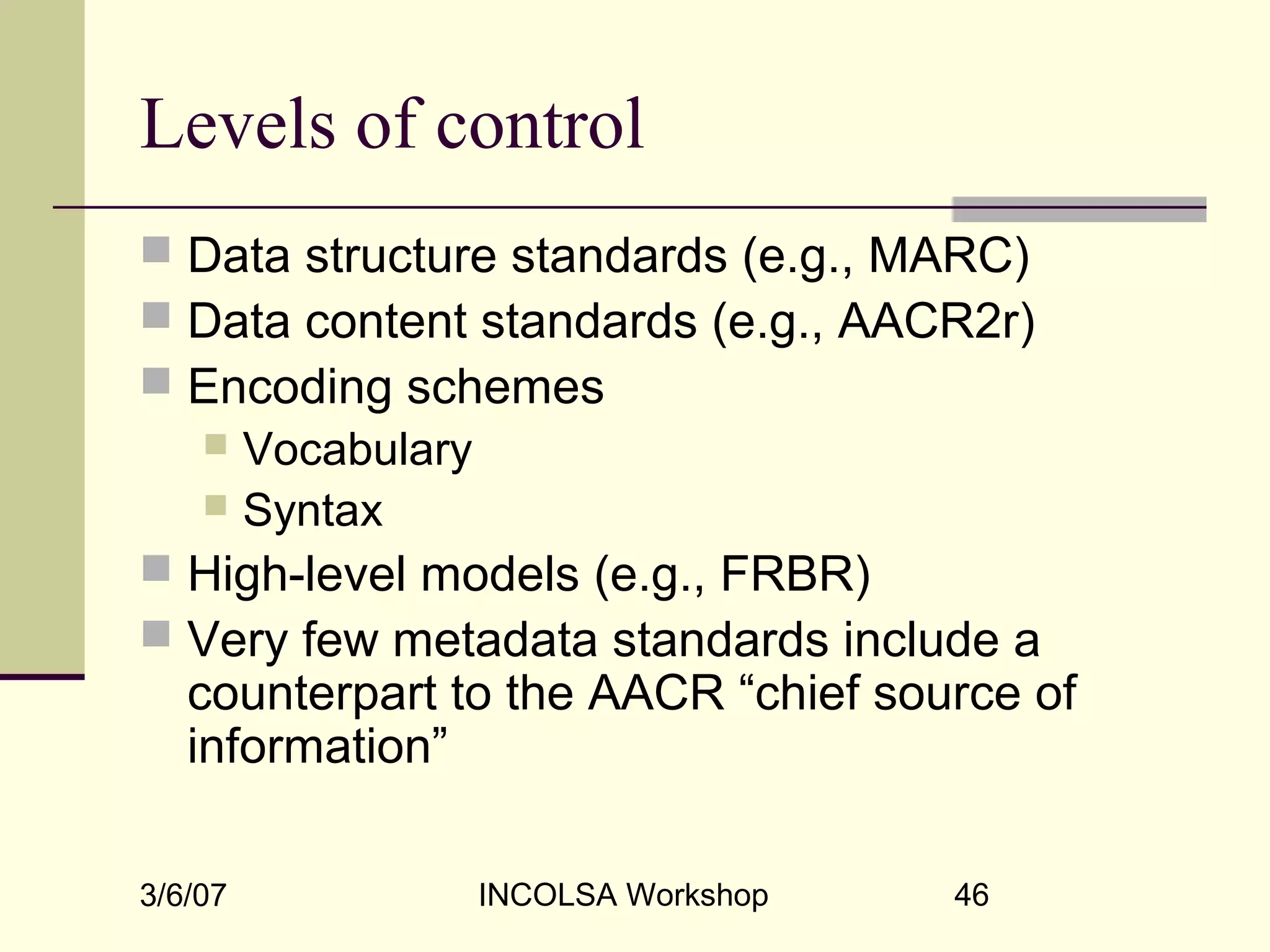
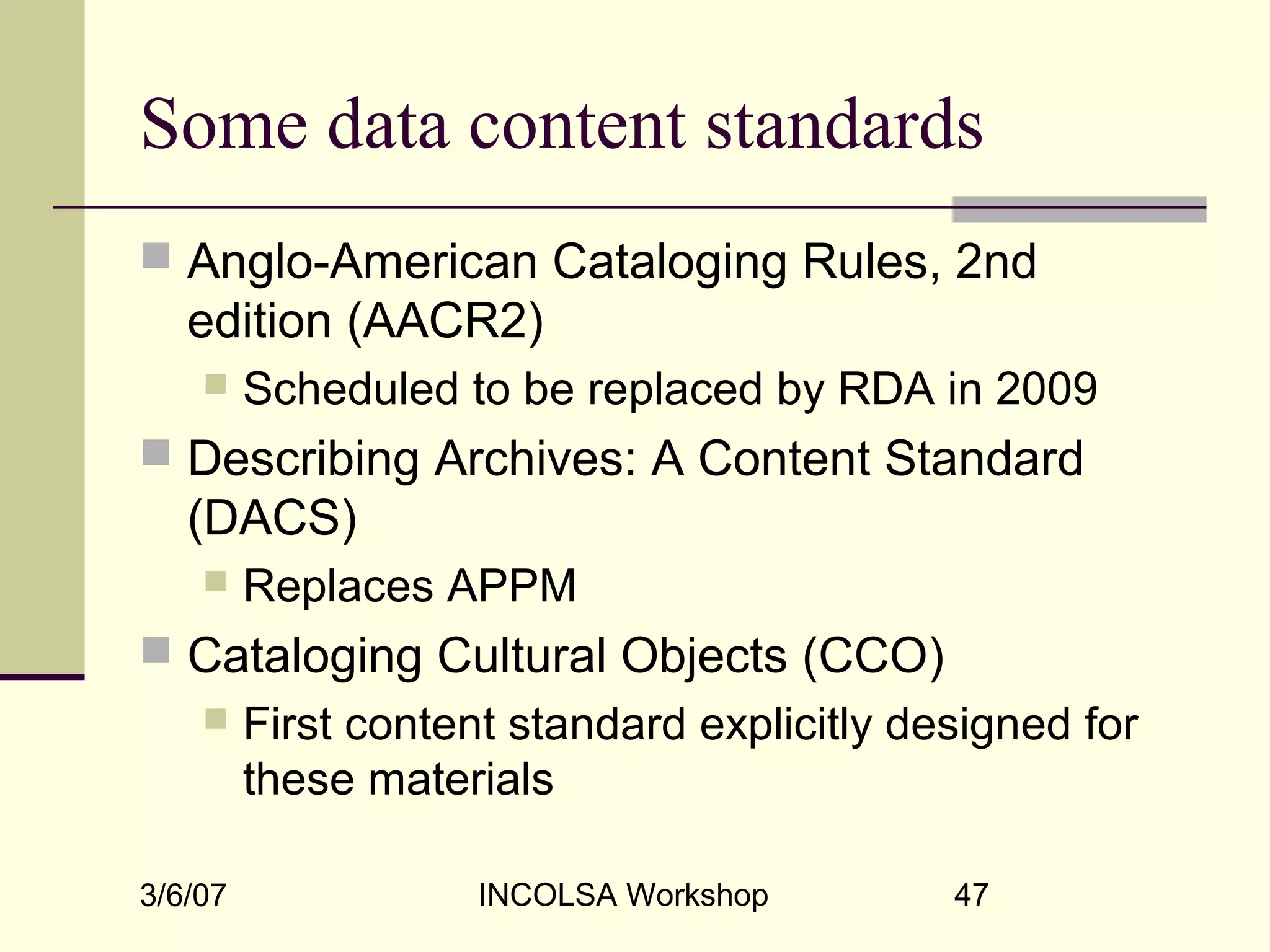
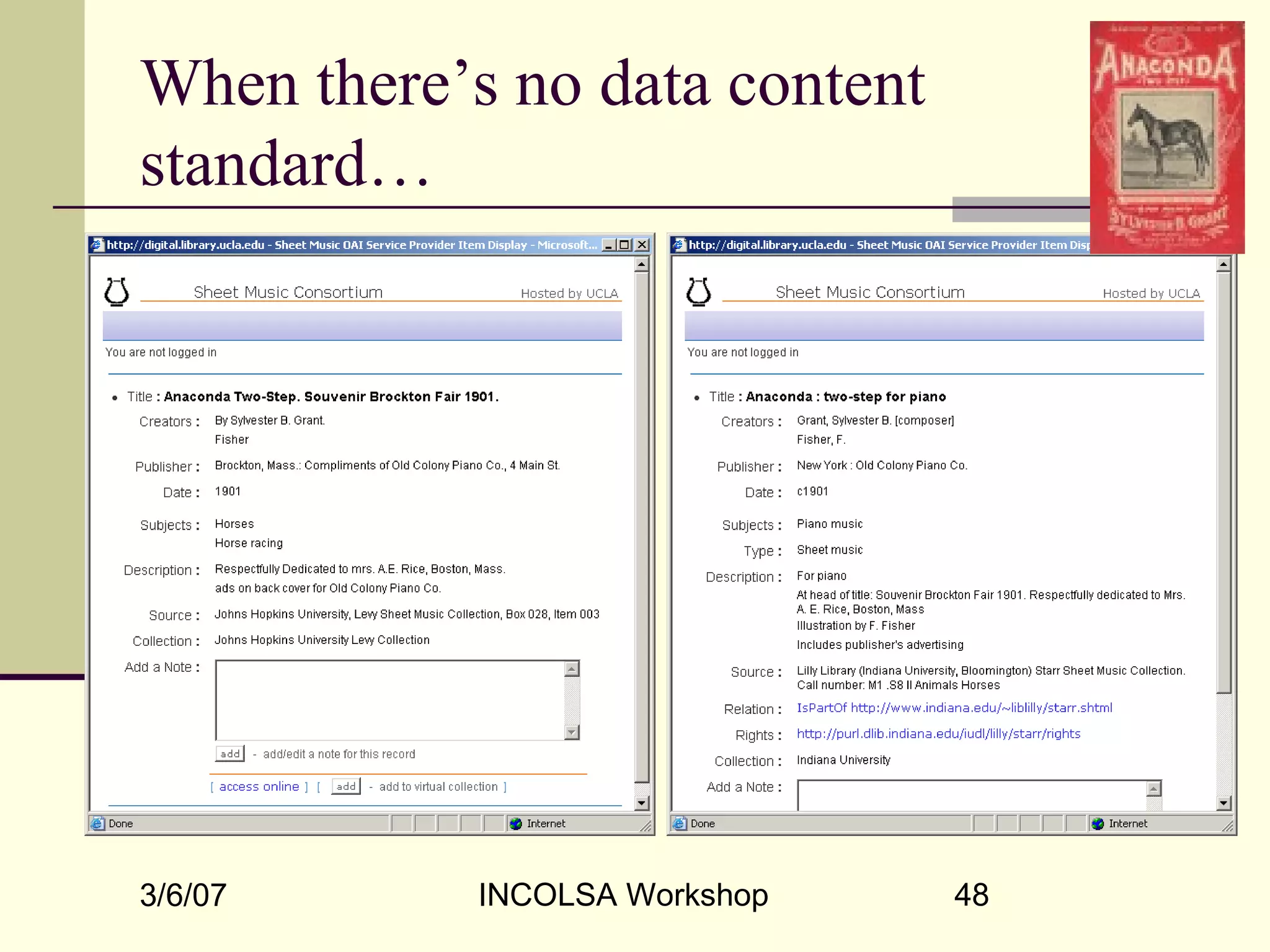
47.
3/6/07 INCOLSA Workshop47
Some data content standards
Anglo-American Cataloging Rules, 2nd
edition (AACR2)
Scheduled to be replaced by RDA in 2009
Describing Archives: A Content Standard
(DACS)
Replaces APPM
Cataloging Cultural Objects (CCO)
First content standard explicitly designed for
these materials
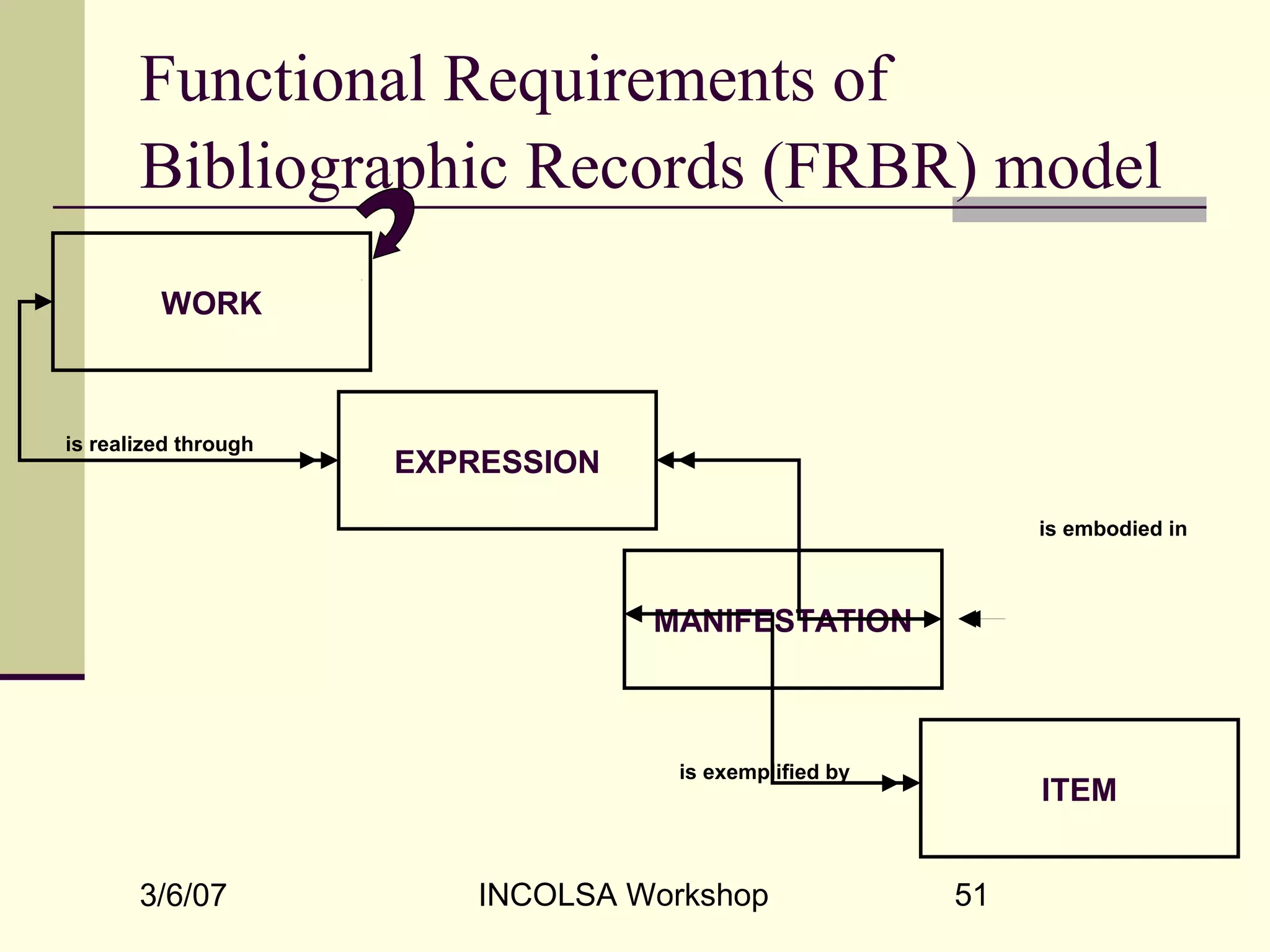
3/6/07 INCOLSA Workshop51
Functional Requirements of
Bibliographic Records (FRBR) model
WORK
EXPRESSION
MANIFESTATION
ITEM
is realized through
is embodied in
is exemplified by
52.
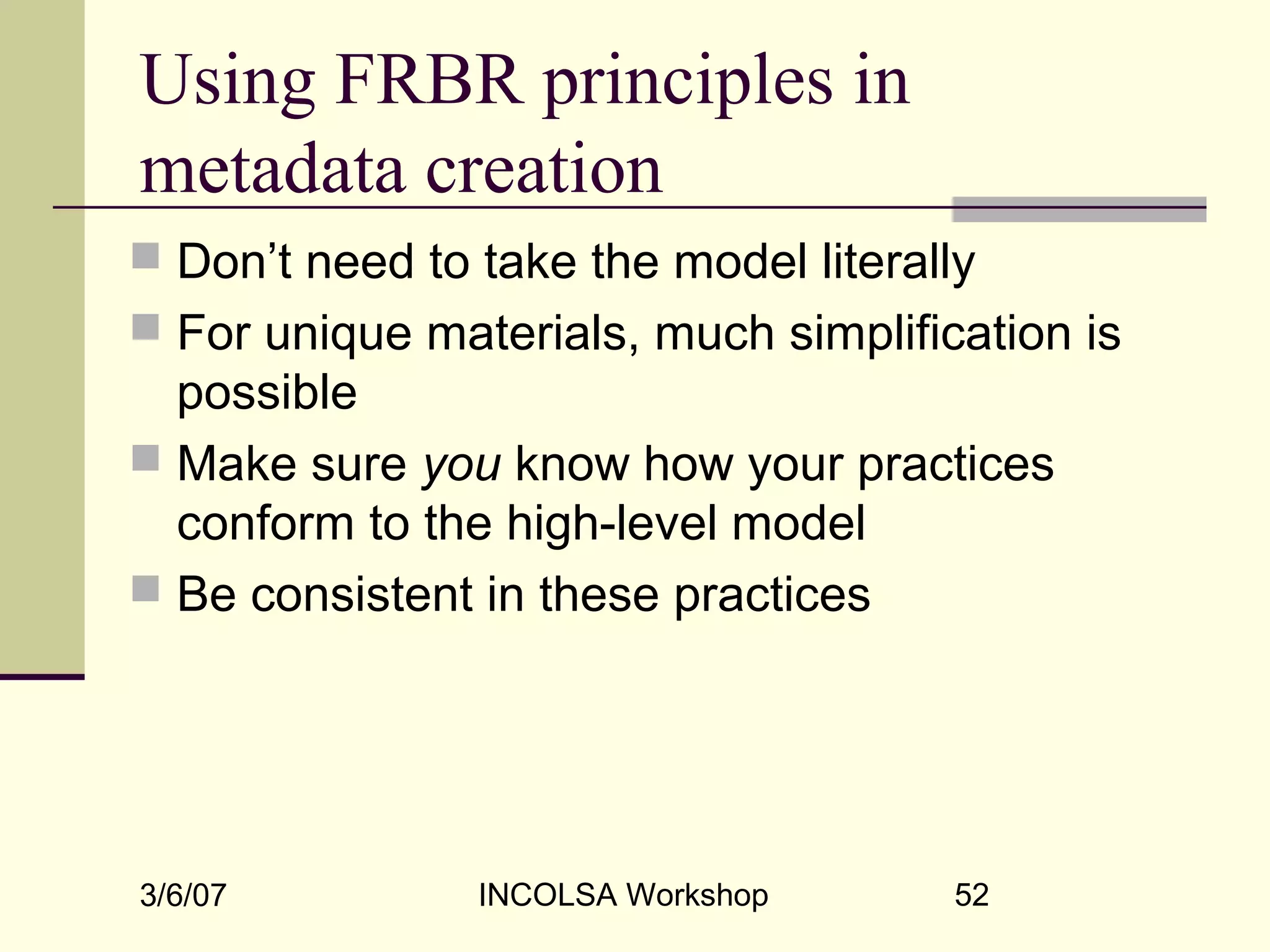
3/6/07 INCOLSA Workshop52
Using FRBR principles in
metadata creation
Don’t need to take the model literally
For unique materials, much simplification is
possible
Make sure you know how your practices
conform to the high-level model
Be consistent in these practices
53.
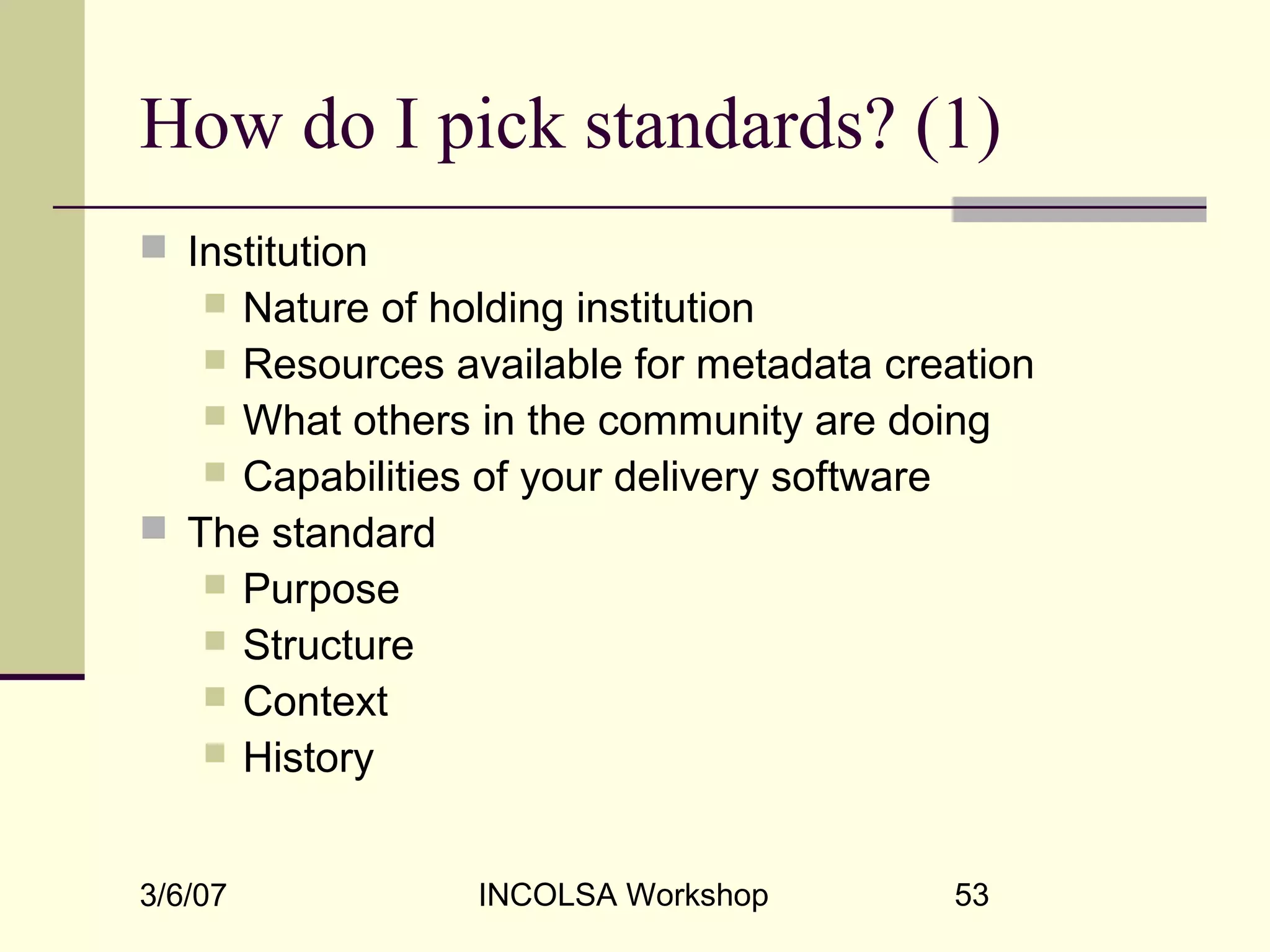
3/6/07 INCOLSA Workshop53
How do I pick standards? (1)
Institution
Nature of holding institution
Resources available for metadata creation
What others in the community are doing
Capabilities of your delivery software
The standard
Purpose
Structure
Context
History
54.
3/6/07 INCOLSA Workshop54
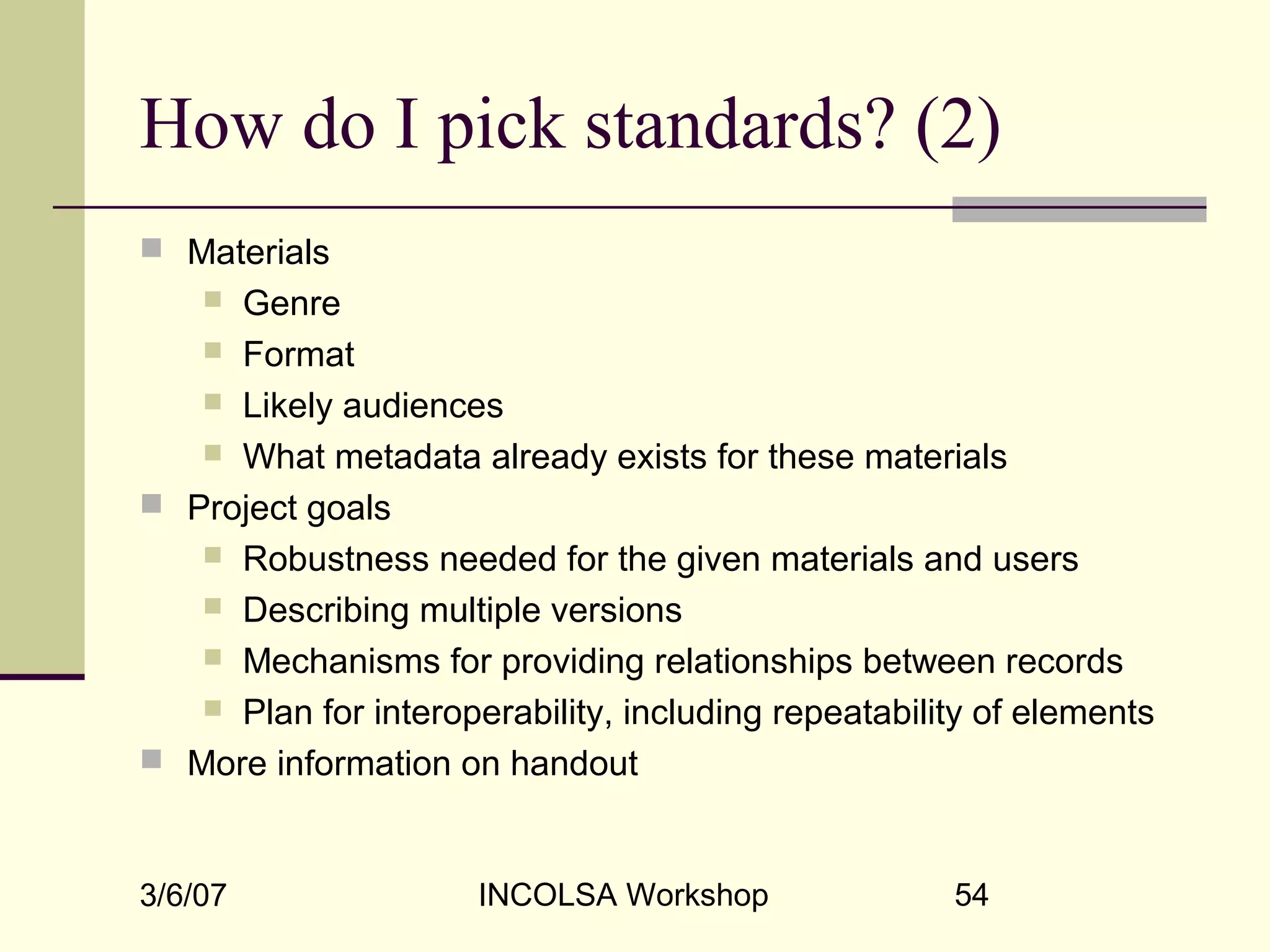
How do I pick standards? (2)
Materials
Genre
Format
Likely audiences
What metadata already exists for these materials
Project goals
Robustness needed for the given materials and users
Describing multiple versions
Mechanisms for providing relationships between records
Plan for interoperability, including repeatability of elements
More information on handout
55.
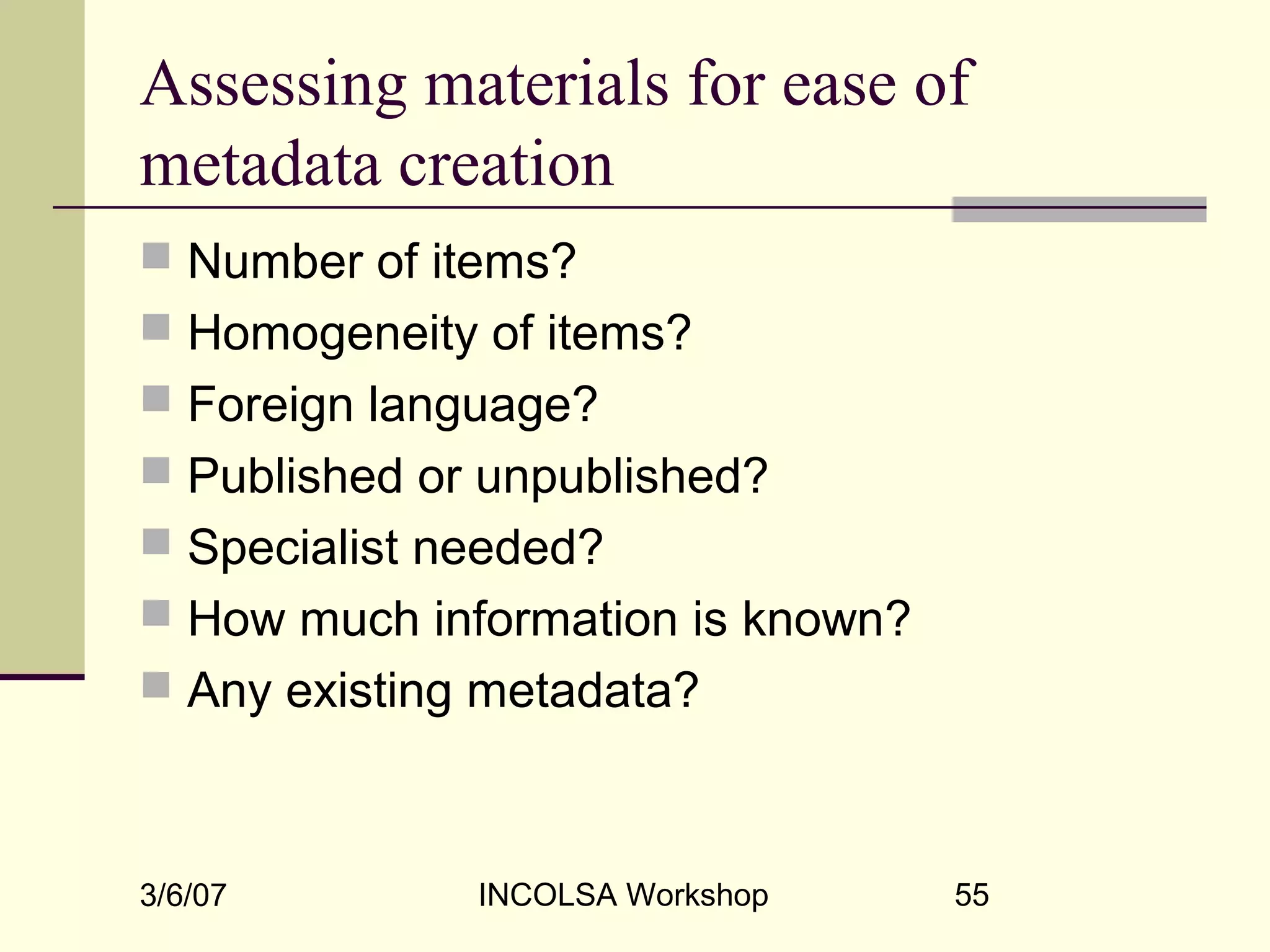
3/6/07 INCOLSA Workshop55
Assessing materials for ease of
metadata creation
Number of items?
Homogeneity of items?
Foreign language?
Published or unpublished?
Specialist needed?
How much information is known?
Any existing metadata?
56.
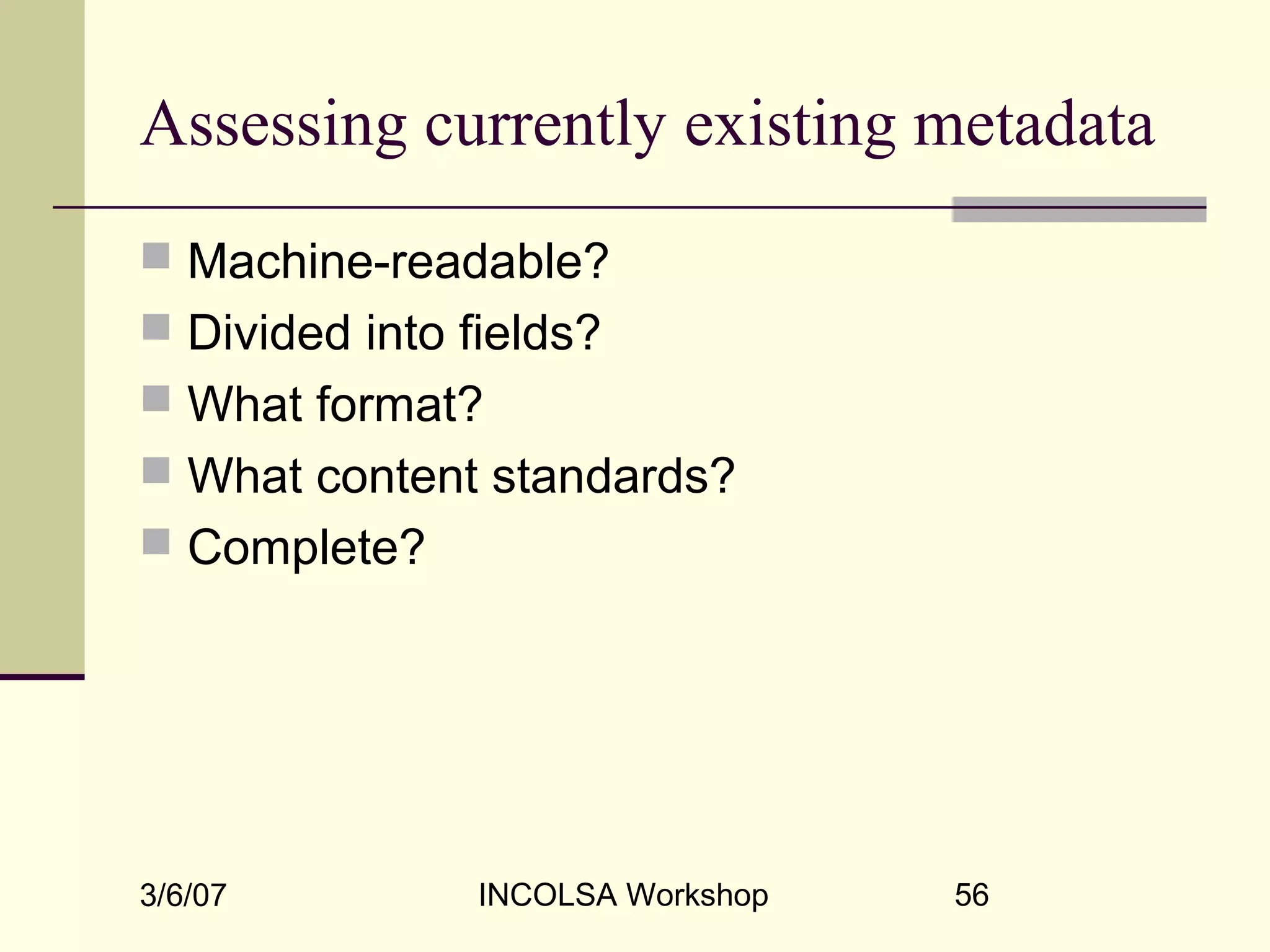
3/6/07 INCOLSA Workshop56
Assessing currently existing metadata
Machine-readable?
Divided into fields?
What format?
What content standards?
Complete?
57.
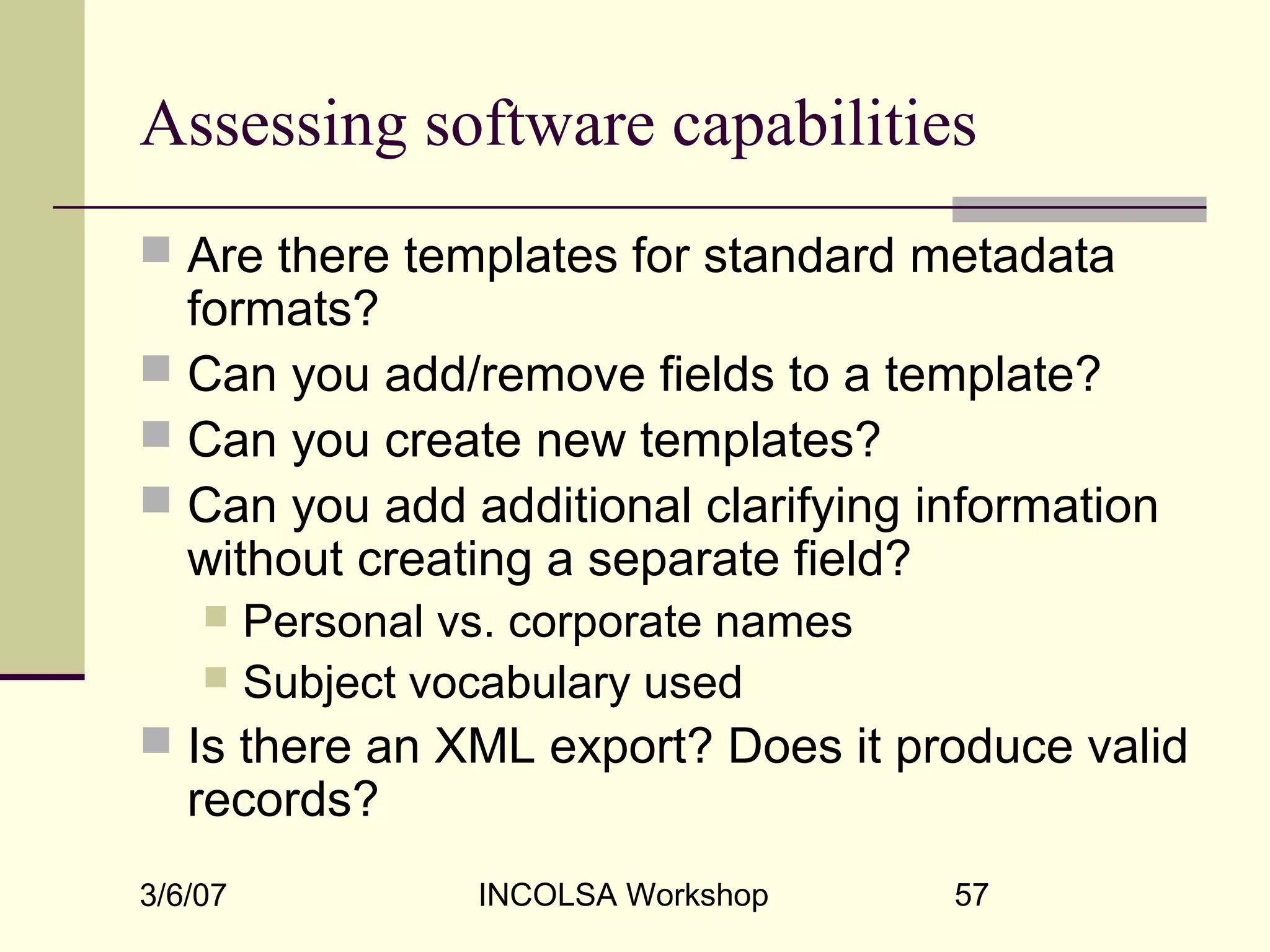
3/6/07 INCOLSA Workshop57
Assessing software capabilities
Are there templates for standard metadata
formats?
Can you add/remove fields to a template?
Can you create new templates?
Can you add additional clarifying information
without creating a separate field?
Personal vs. corporate names
Subject vocabulary used
Is there an XML export? Does it produce valid
records?
58.
3/6/07 INCOLSA Workshop58
Case studies in choosing standards
Describe your institution
Describe one collection you’d like to digitize
Describe your technical infrastructure
3/6/07 INCOLSA Workshop60
Technical metadata
For recording technical aspects of digital objects
For long-term maintenance of data
Migration
Emulation
Much can be generate automatically, but not all
Some examples:
NISO Z39.87: Data Dictionary – Technical Metadata for Digi
& MIX
Schema for Technical Metadata for Text
Forthcoming standard for audio from the Audio
Engineering Society
LC VMD draft schema for technical metadata for video
files
61.
3/6/07 INCOLSA Workshop61
Image technical metadata
Might include:
Color space
Bit depth
Byte order
Compression scheme
Camera settings
Operator name
62.
3/6/07 INCOLSA Workshop62
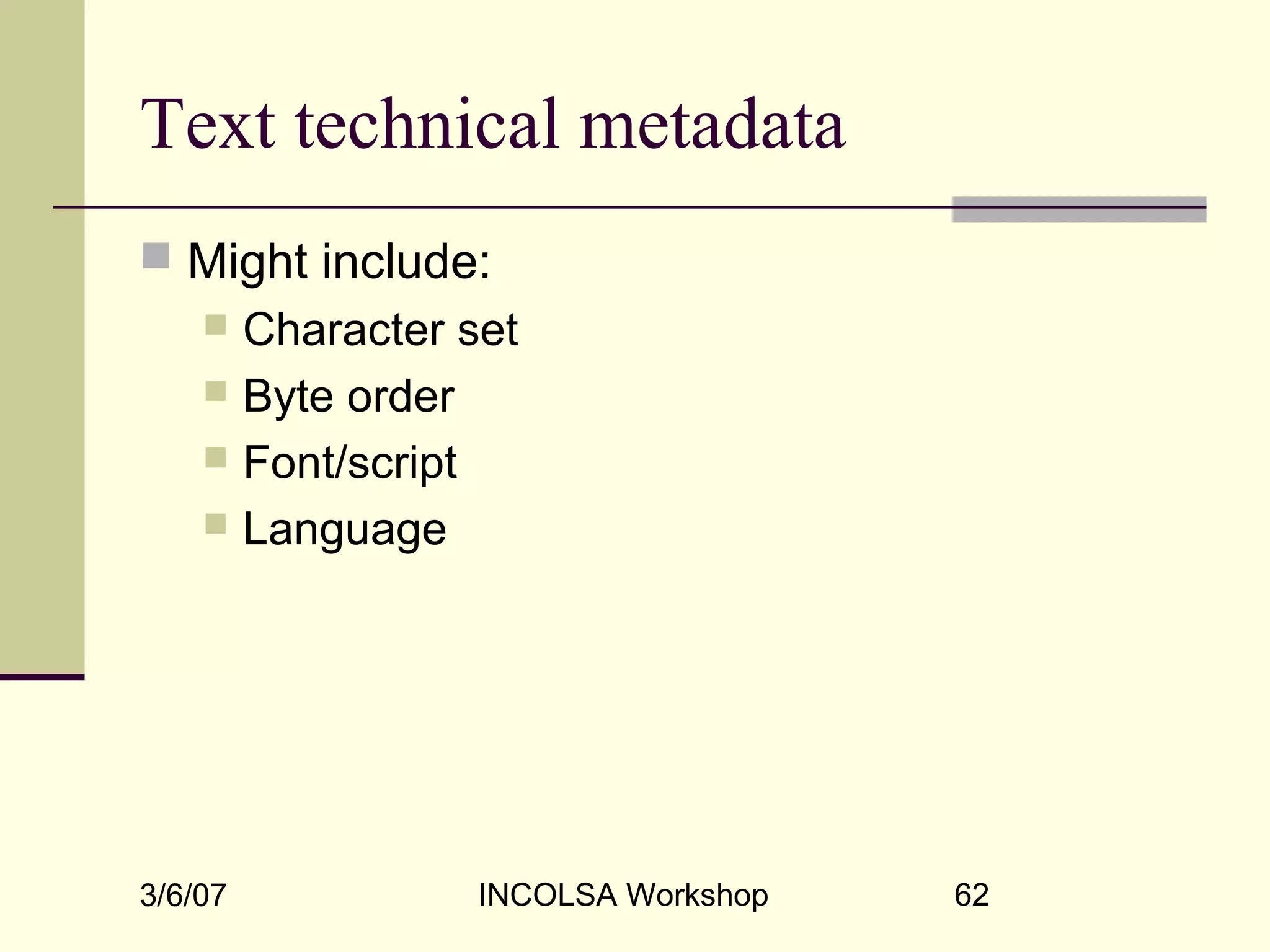
Text technical metadata
Might include:
Character set
Byte order
Font/script
Language
63.
3/6/07 INCOLSA Workshop63
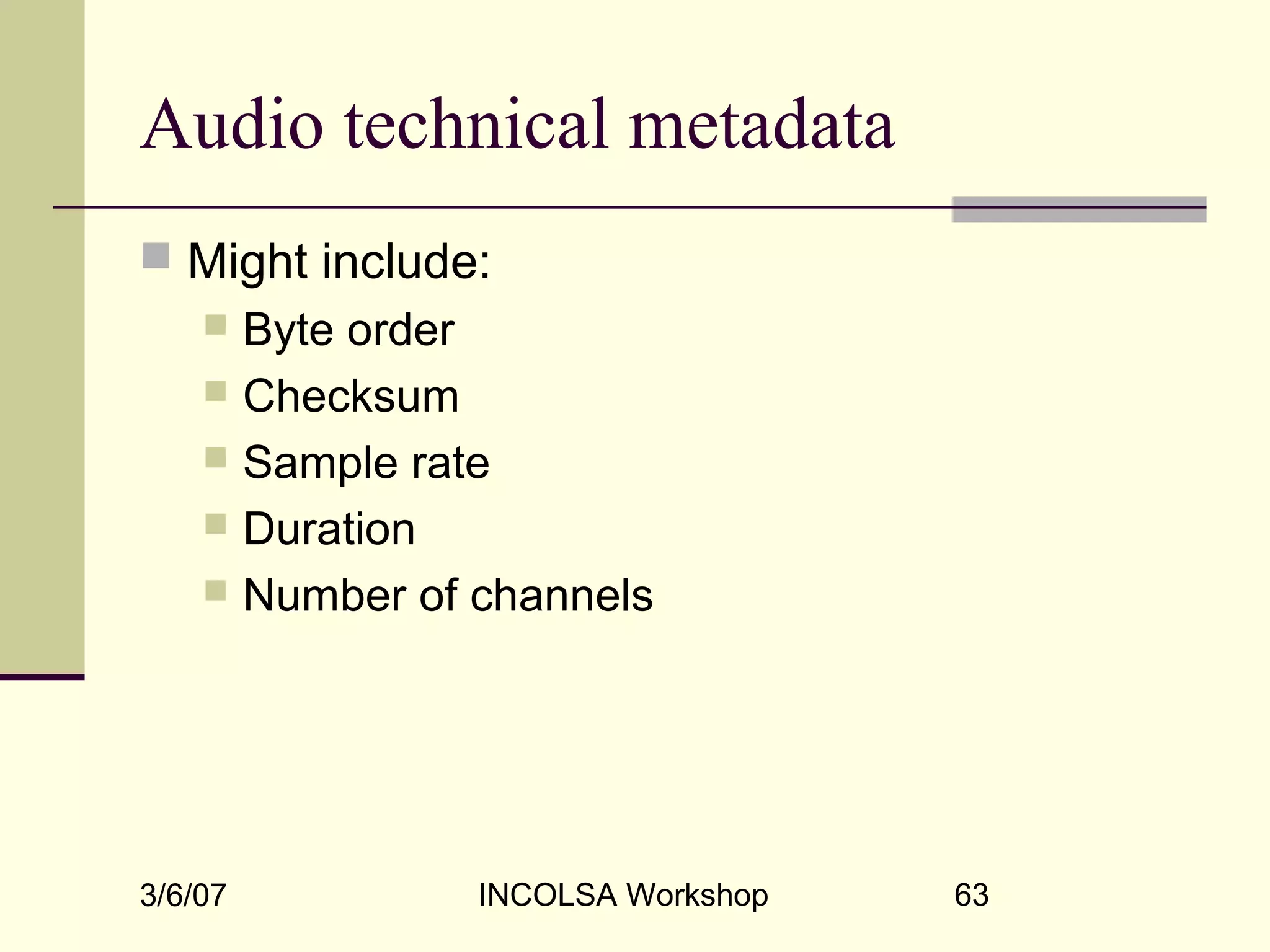
Audio technical metadata
Might include:
Byte order
Checksum
Sample rate
Duration
Number of channels
64.
3/6/07 INCOLSA Workshop64
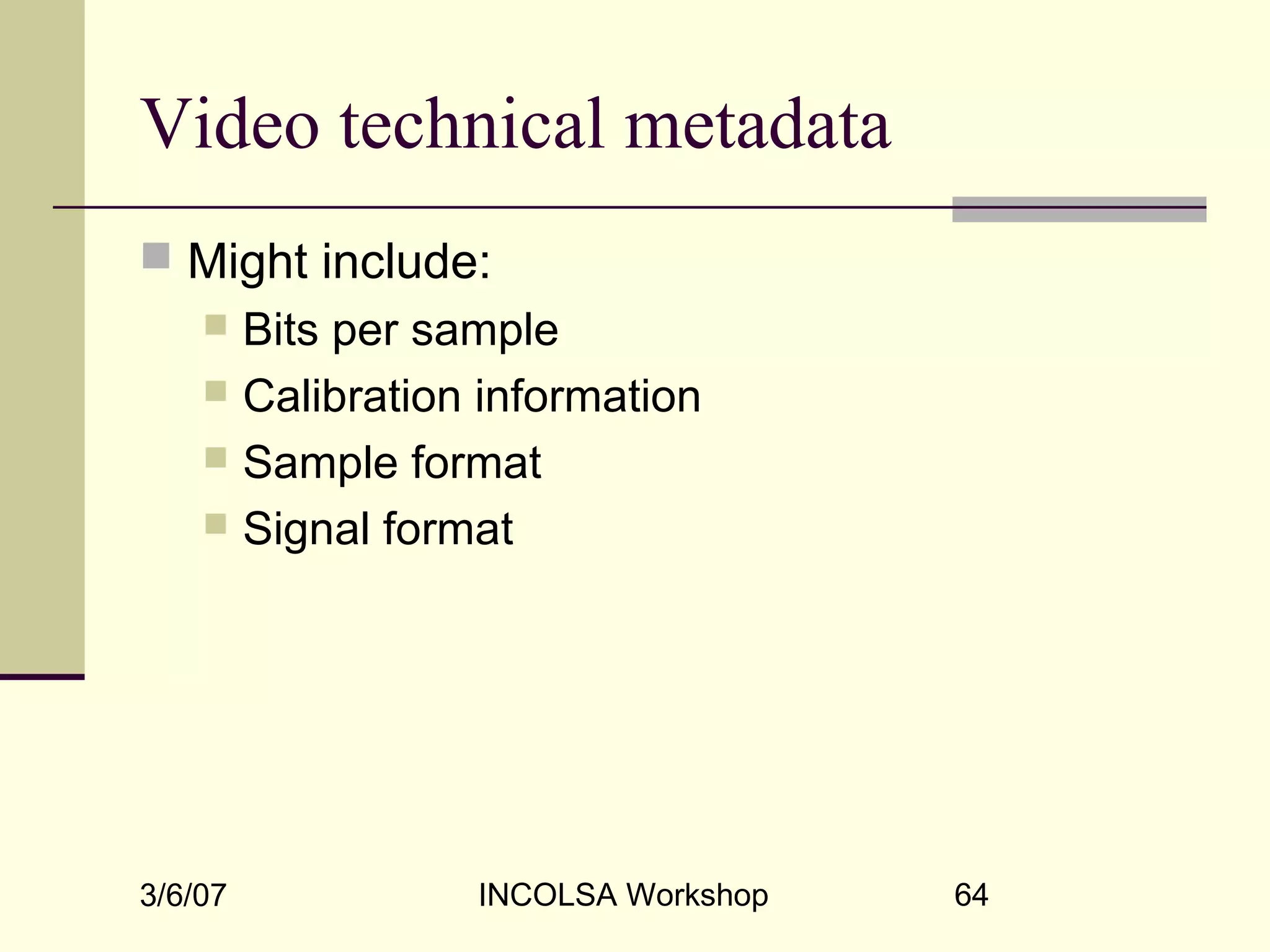
Video technical metadata
Might include:
Bits per sample
Calibration information
Sample format
Signal format
65.
3/6/07 INCOLSA Workshop65
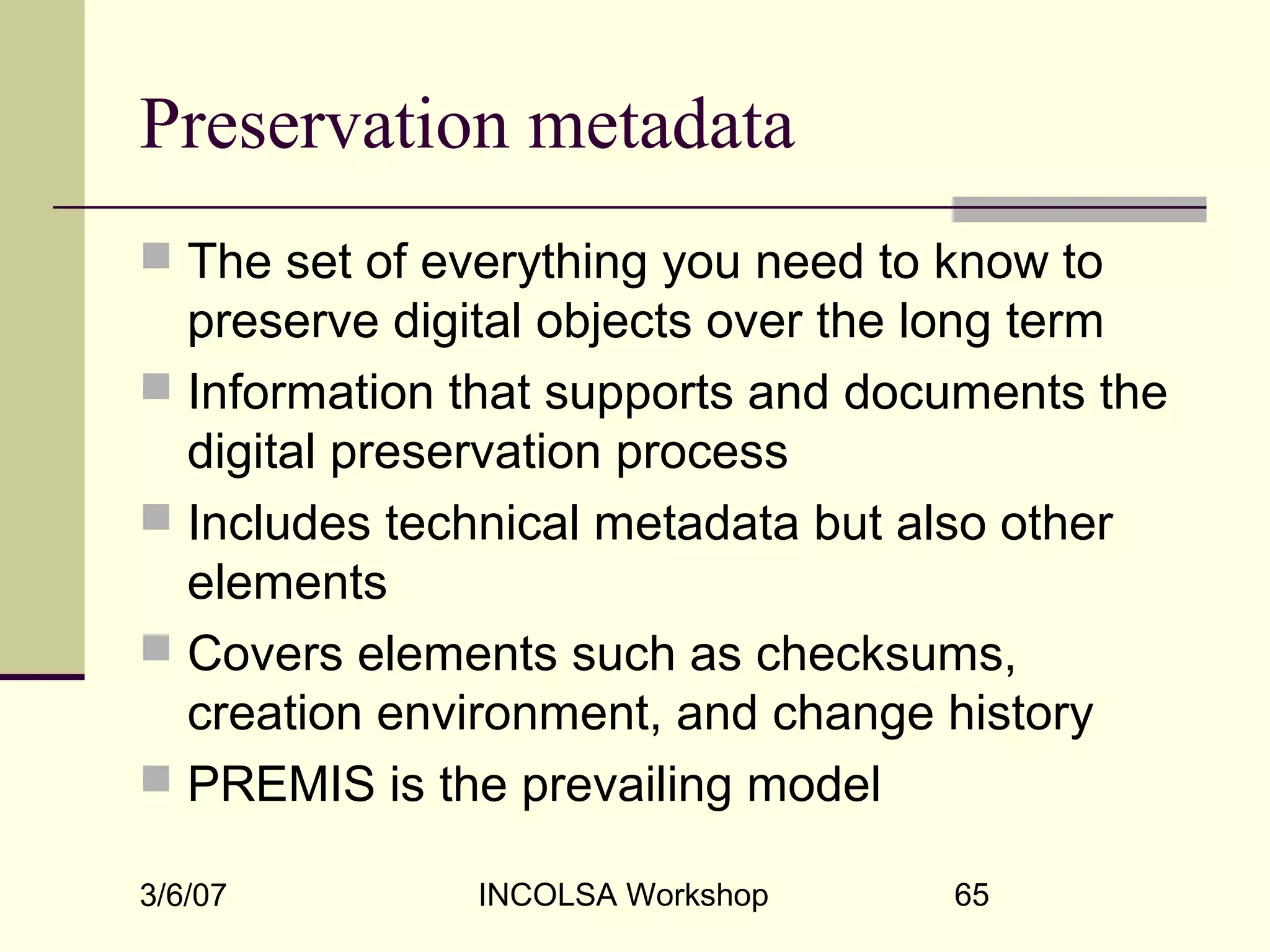
Preservation metadata
The set of everything you need to know to
preserve digital objects over the long term
Information that supports and documents the
digital preservation process
Includes technical metadata but also other
elements
Covers elements such as checksums,
creation environment, and change history
PREMIS is the prevailing model
66.
3/6/07 INCOLSA Workshop66
Rights metadata
Machine- or human-readable indications of
rights information for a resource
Can be used to determine if a user can
access a resource
Can indicate rights holder of a resource for
payment purposes
Some current schemas
METS rights
XrML
ODRL
67.
3/6/07 INCOLSA Workshop67
Structural metadata
For creating a logical structure between
digital objects
Multiple copies/versions of same item
Multiple pages within item
Multiple sizes of each page
Meaningful groups of content
Often handled transparently by a delivery
system
METS is the current primary standard
68.
3/6/07 INCOLSA Workshop68
Why you should care about these
standards
You will migrate from your current system to
another, probably in the next few years
File formats become obsolete
We have too many interesting collections to
have to re-do work we’ve already done
Standards promote interoperability
69.
3/6/07 INCOLSA Workshop69
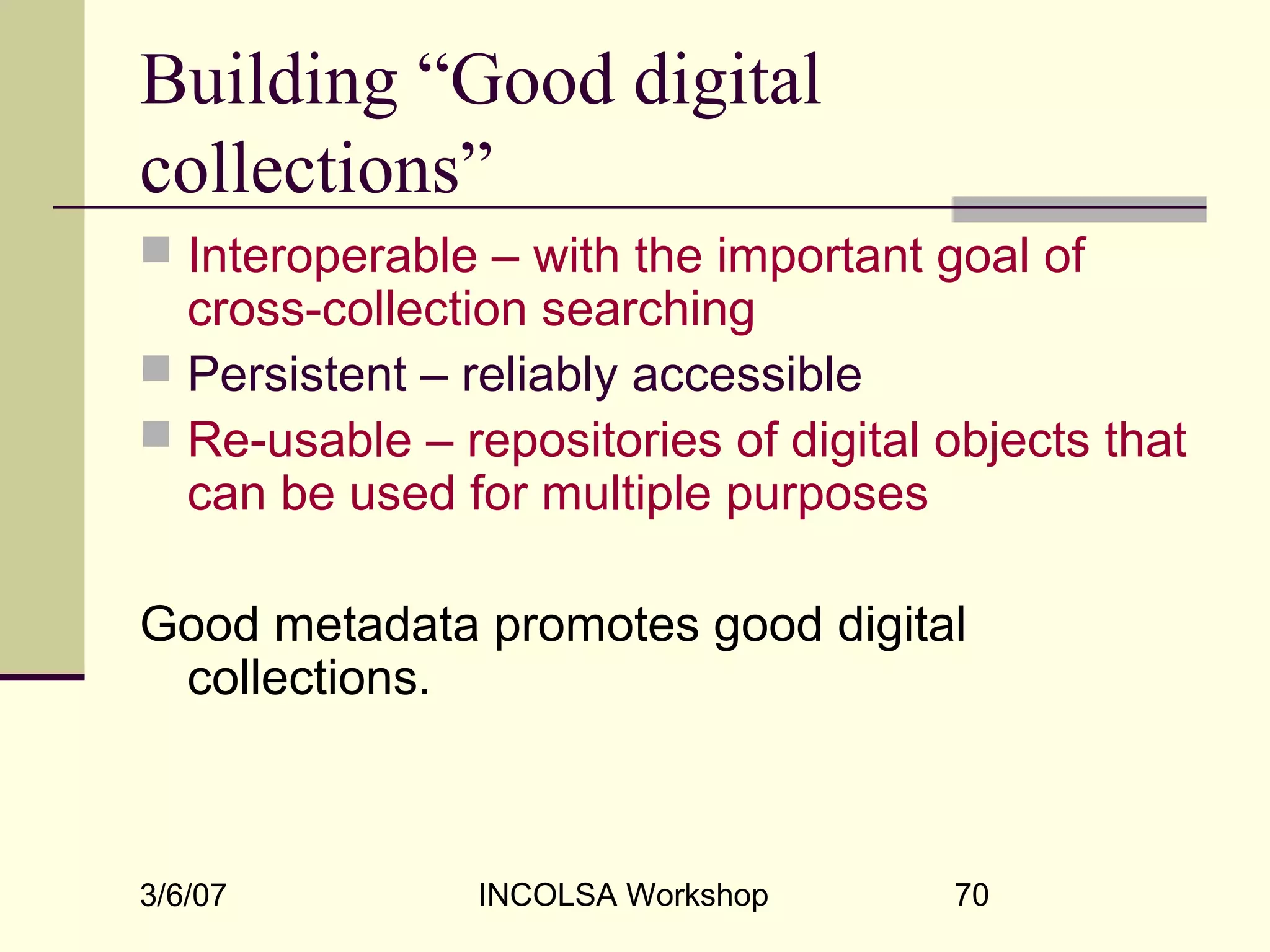
Building “Good digital
collections”*
Interoperable – with the important goal
of cross-collection searching
Persistent – reliably accessible
Re-usable – repositories of digital
objects that can be used for multiple
purposes
*Institute for Museum and Library Services. A Framework of Guidance for Building Good Digital
Collections. Washington, D.C.: Institute for Museum and Library Services, November 2001.
http://www.niso.org/framework/Framework2.html
70.
3/6/07 INCOLSA Workshop70
Building “Good digital
collections”
Interoperable – with the important goal of
cross-collection searching
Persistent – reliably accessible
Re-usable – repositories of digital objects that
can be used for multiple purposes
Good metadata promotes good digital
collections.
71.
3/6/07 INCOLSA Workshop71
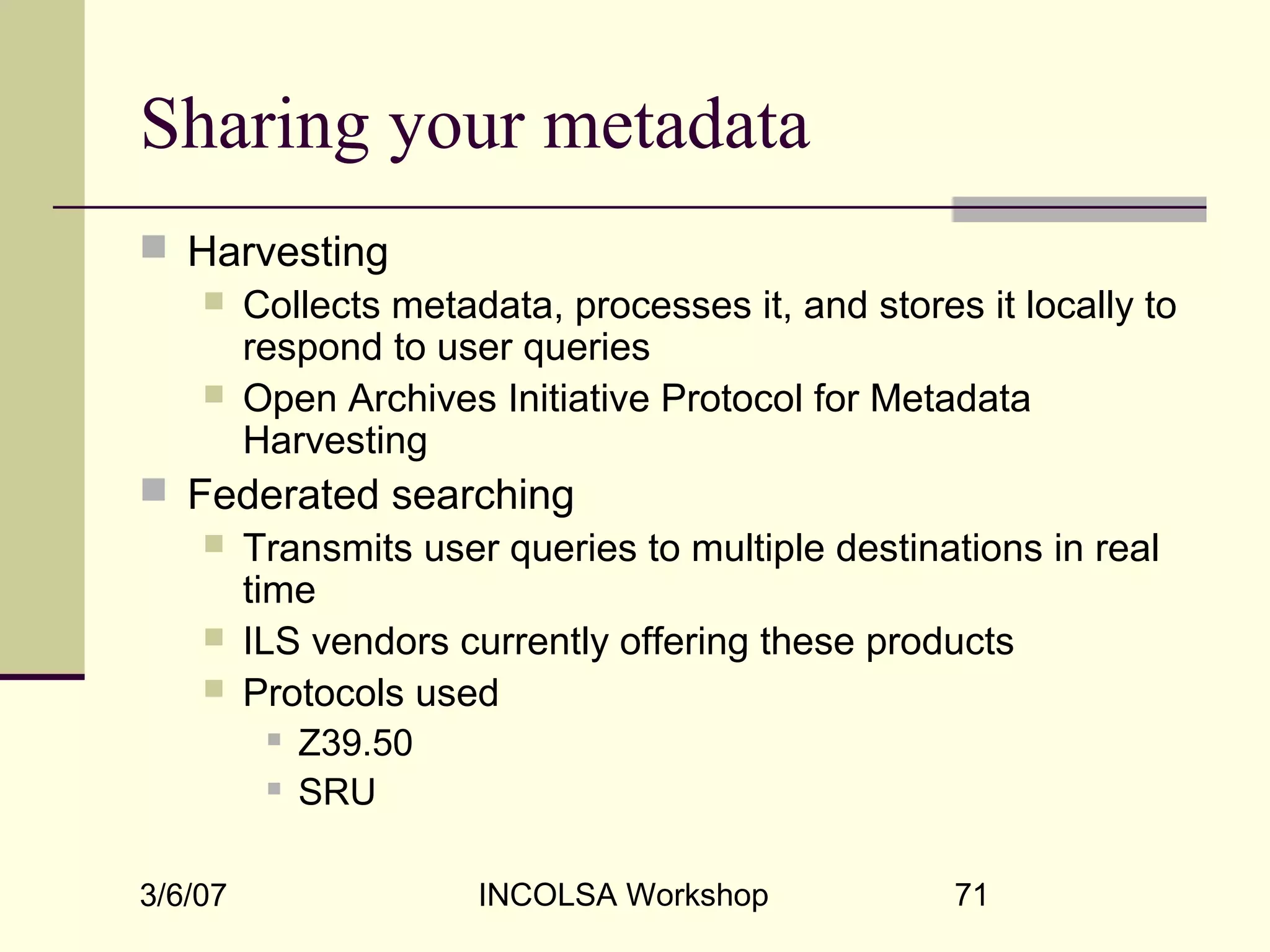
Sharing your metadata
Harvesting
Collects metadata, processes it, and stores it locally to
respond to user queries
Open Archives Initiative Protocol for Metadata
Harvesting
Federated searching
Transmits user queries to multiple destinations in real
time
ILS vendors currently offering these products
Protocols used
Z39.50
SRU
72.
3/6/07 INCOLSA Workshop72
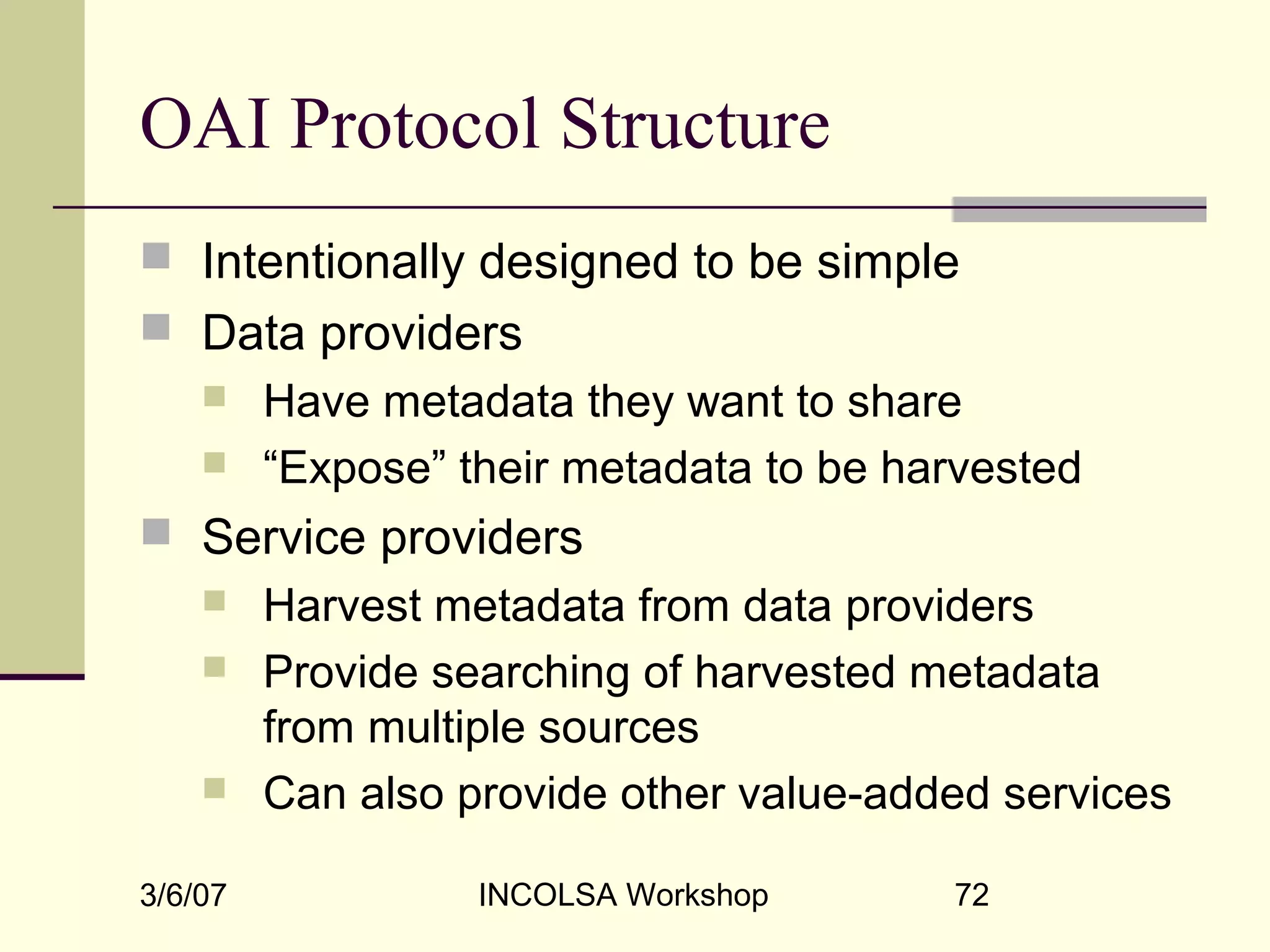
OAI Protocol Structure
Intentionally designed to be simple
Data providers
Have metadata they want to share
“Expose” their metadata to be harvested
Service providers
Harvest metadata from data providers
Provide searching of harvested metadata
from multiple sources
Can also provide other value-added services
73.
3/6/07 INCOLSA Workshop73
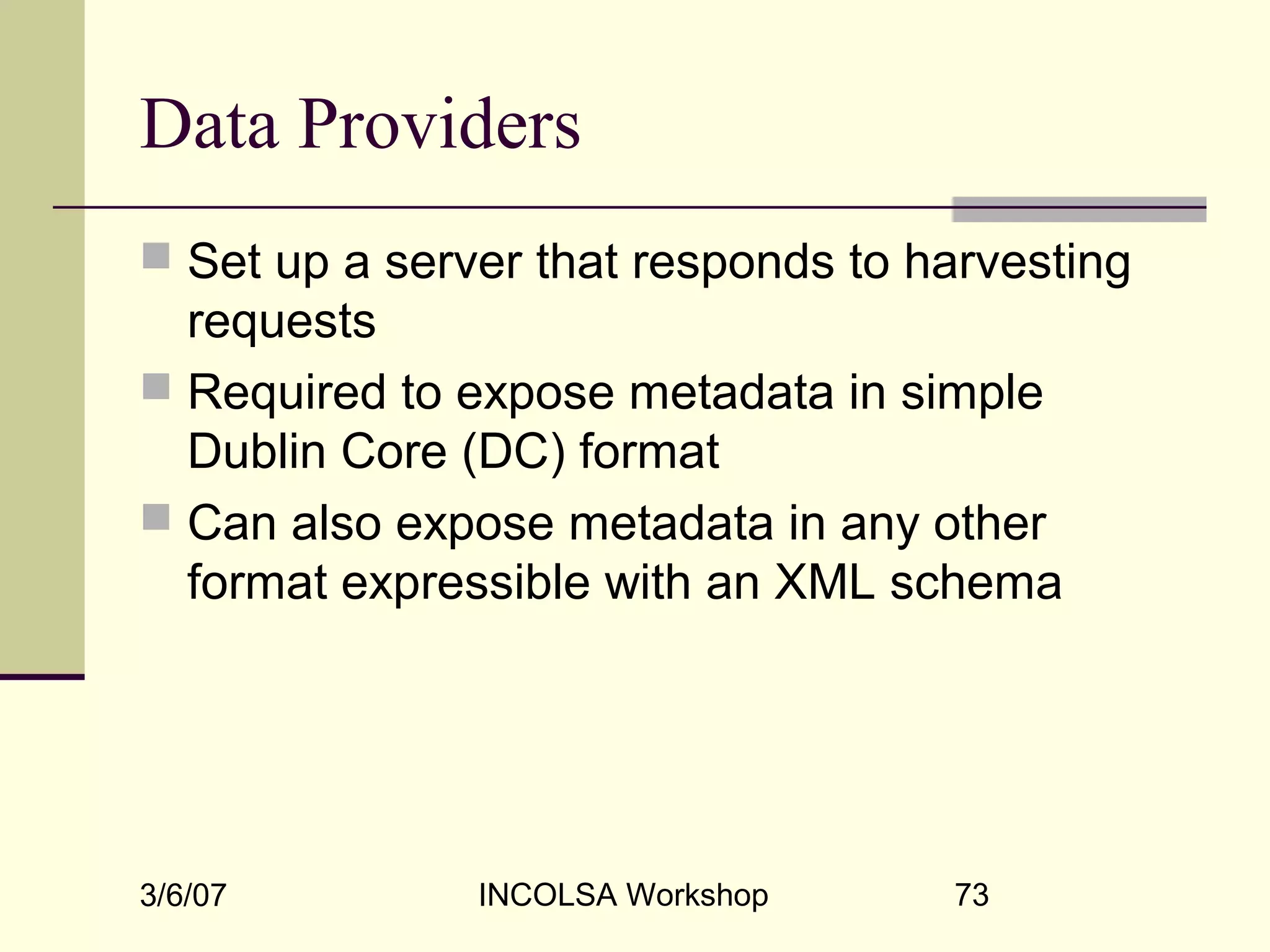
Data Providers
Set up a server that responds to harvesting
requests
Required to expose metadata in simple
Dublin Core (DC) format
Can also expose metadata in any other
format expressible with an XML schema
74.
3/6/07 INCOLSA Workshop74
Service Providers
Harvest and store metadata
Generally provide search/browse access to
this metadata
Can be general or domain-specific
Can choose to collect metadata in formats
other than DC
Generally link out to holding institutions for
access to digital content
75.
3/6/07 INCOLSA Workshop75
Advantages for Libraries
Any existing rules for description can be
used
Can share metadata without sacrificing local
granularity
Location of unique materials by many users
Domain-specific service providers
Middle ground between Google and OCLC
One of a suite of tools to provide users with
access to all of your materials
76.
3/6/07 INCOLSA Workshop76
Why share metadata?
Benefits to users
One-stop searching
Aggregation of subject-specific resources
Benefits to institutions
Increased exposure for collections
Broader user base
Bringing together of distributed collections
Don’t expect users will know about your
collection and remember to visit it.
77.
3/6/07 INCOLSA Workshop77
Why share metadata with OAI?
“Low barrier” protocol
Shares metadata only, not content,
simplifying rights issues
Same effort on your part to share with one or
a hundred service providers (basically)
Wide adoption in the cultural heritage sector
Quickly eclipsed older methods such as
Z39.50
78.
3/6/07 INCOLSA Workshop78
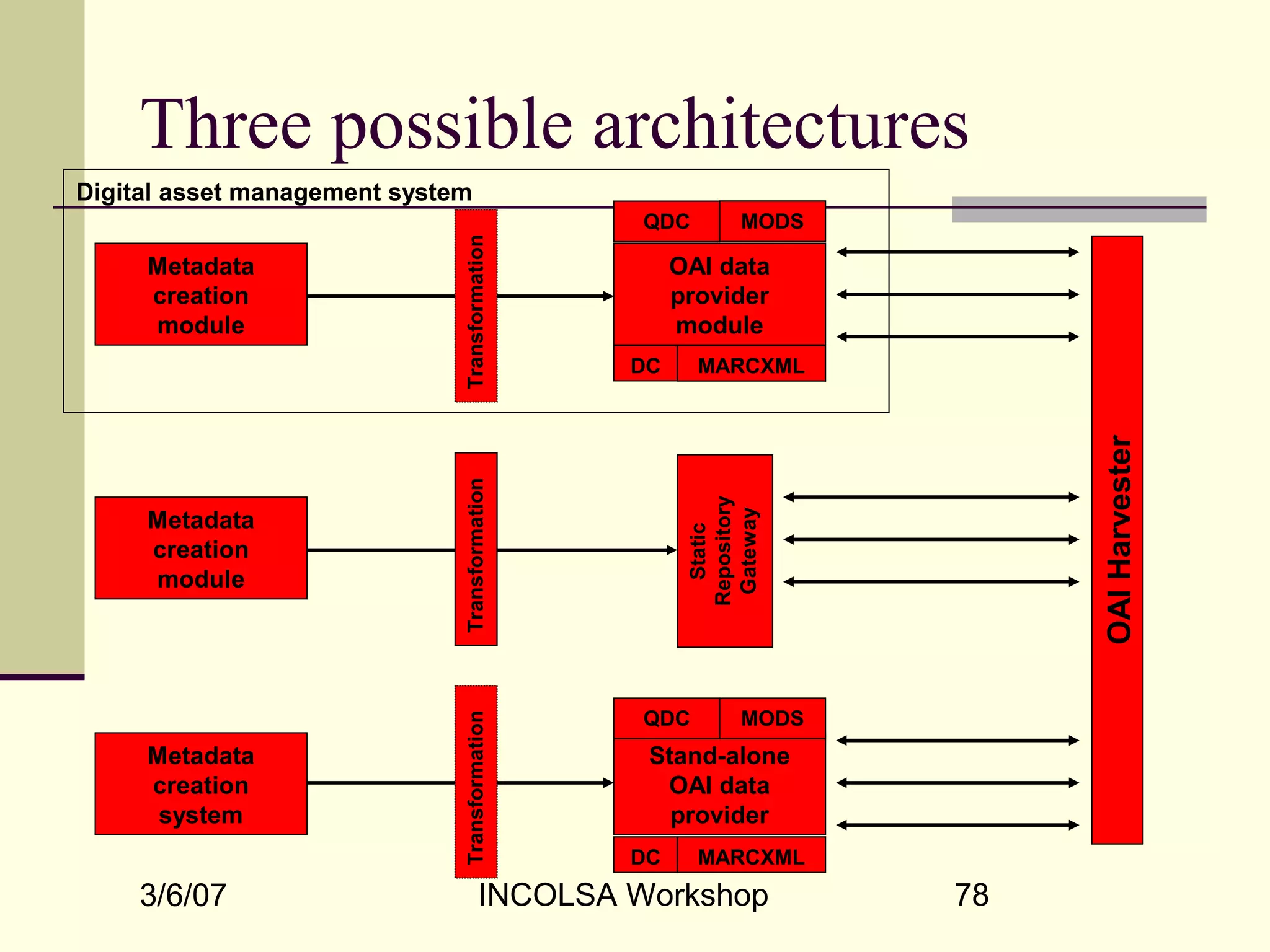
Three possible architectures
OAIHarvester
Digital asset management system
Metadata
creation
module
OAI data
provider
module
Transformation
Metadata
creation
system
Stand-alone
OAI data
provider
Transformation
DC
QDC MODS
MARCXML
DC MARCXML
QDC MODS
Metadata
creation
module
Static
Repository
Gateway
Transformation
79.
3/6/07 INCOLSA Workshop79
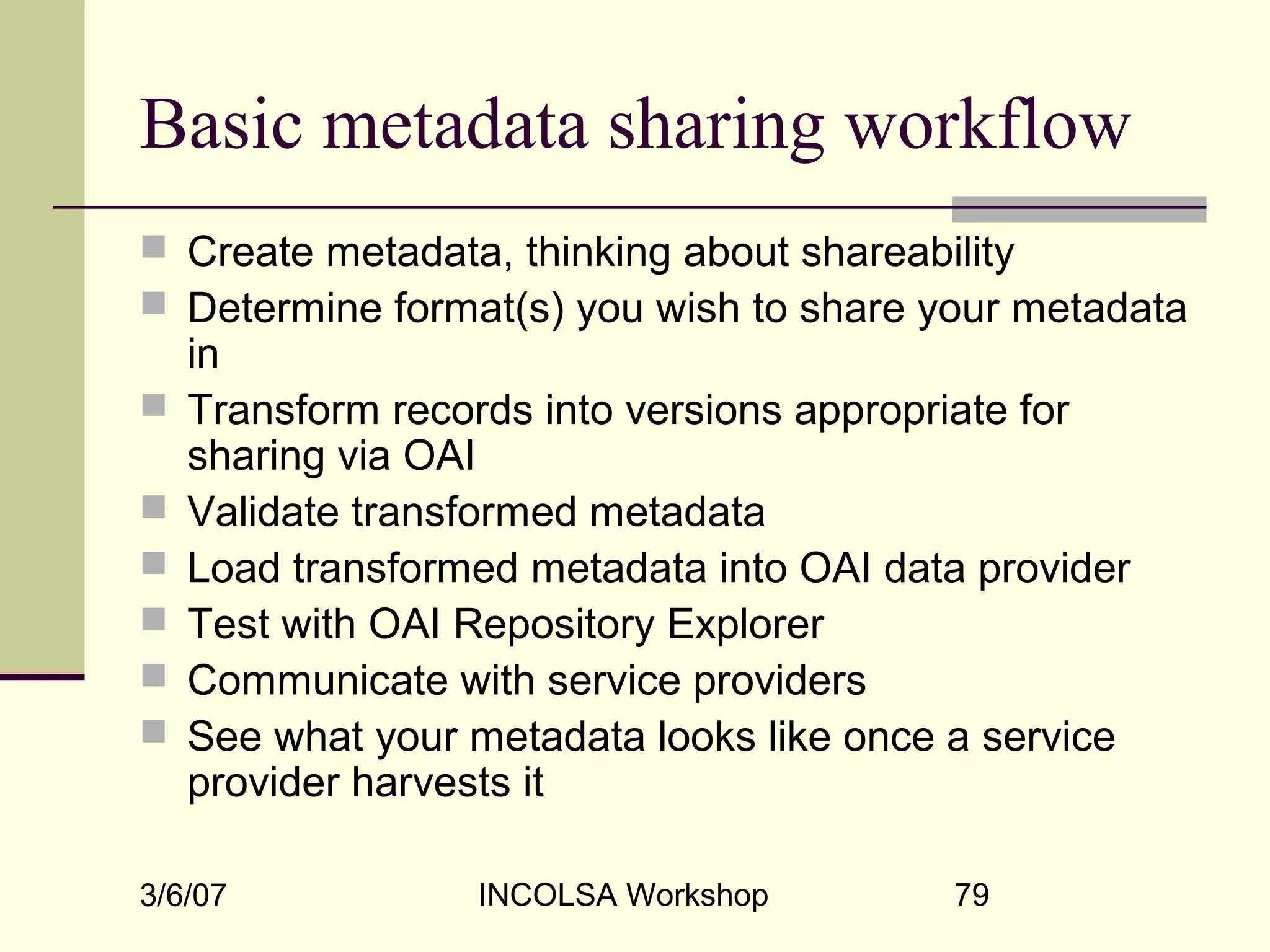
Basic metadata sharing workflow
Create metadata, thinking about shareability
Determine format(s) you wish to share your metadata
in
Transform records into versions appropriate for
sharing via OAI
Validate transformed metadata
Load transformed metadata into OAI data provider
Test with OAI Repository Explorer
Communicate with service providers
See what your metadata looks like once a service
provider harvests it
80.
3/6/07 INCOLSA Workshop80
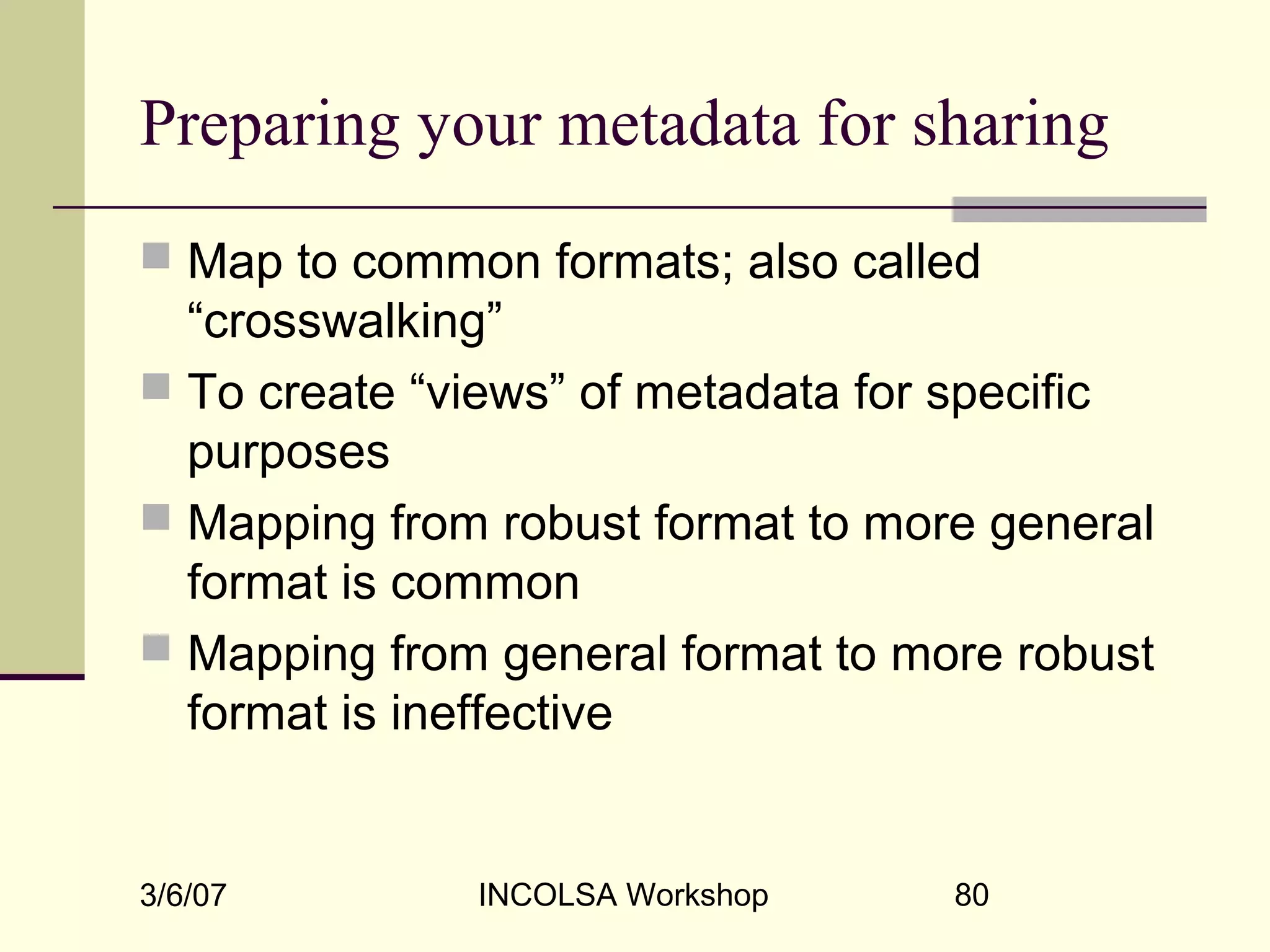
Preparing your metadata for sharing
Map to common formats; also called
“crosswalking”
To create “views” of metadata for specific
purposes
Mapping from robust format to more general
format is common
Mapping from general format to more robust
format is ineffective
81.
3/6/07 INCOLSA Workshop81
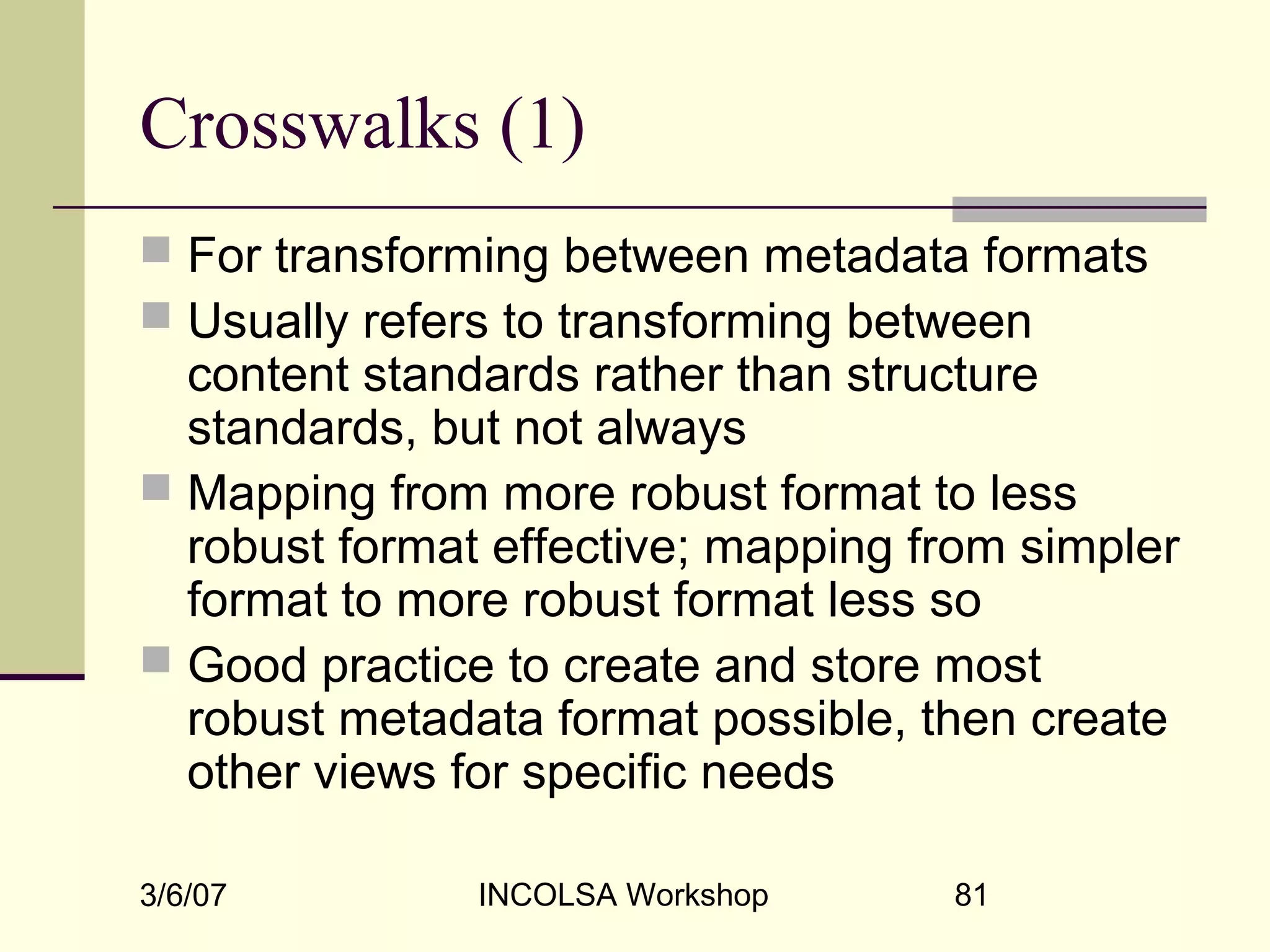
Crosswalks (1)
For transforming between metadata formats
Usually refers to transforming between
content standards rather than structure
standards, but not always
Mapping from more robust format to less
robust format effective; mapping from simpler
format to more robust format less so
Good practice to create and store most
robust metadata format possible, then create
other views for specific needs
82.
3/6/07 INCOLSA Workshop82
Crosswalks (2)
Can be in many formats
Logical sets of rules [example]
Actual code [example]
Often need to tweak a generic crosswalk for a
specific implementation
Accommodating local practice
Adding institution-specific information
Adding context not available locally
83.
3/6/07 INCOLSA Workshop83
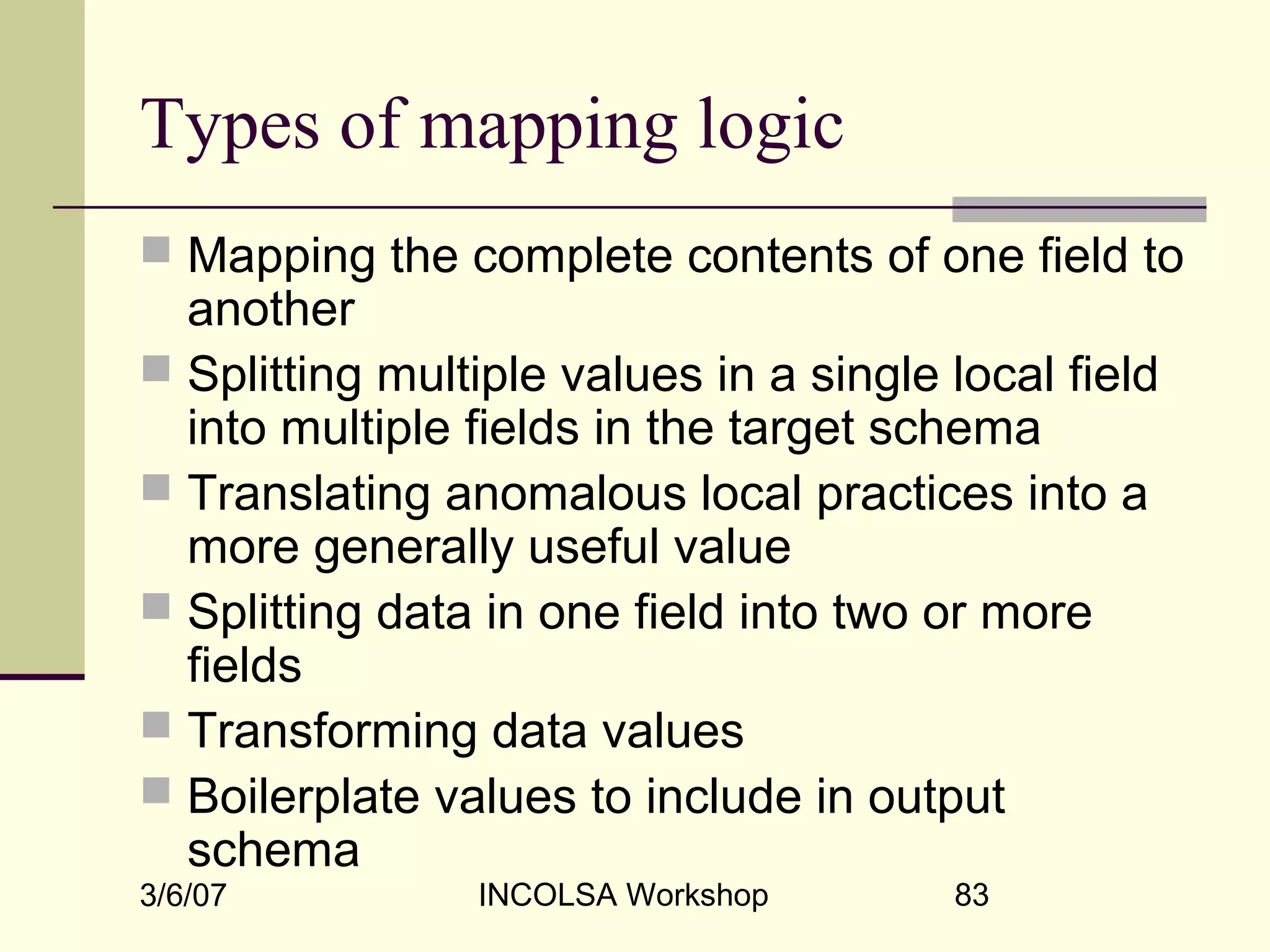
Types of mapping logic
Mapping the complete contents of one field to
another
Splitting multiple values in a single local field
into multiple fields in the target schema
Translating anomalous local practices into a
more generally useful value
Splitting data in one field into two or more
fields
Transforming data values
Boilerplate values to include in output
schema
84.
3/6/07 INCOLSA Workshop84
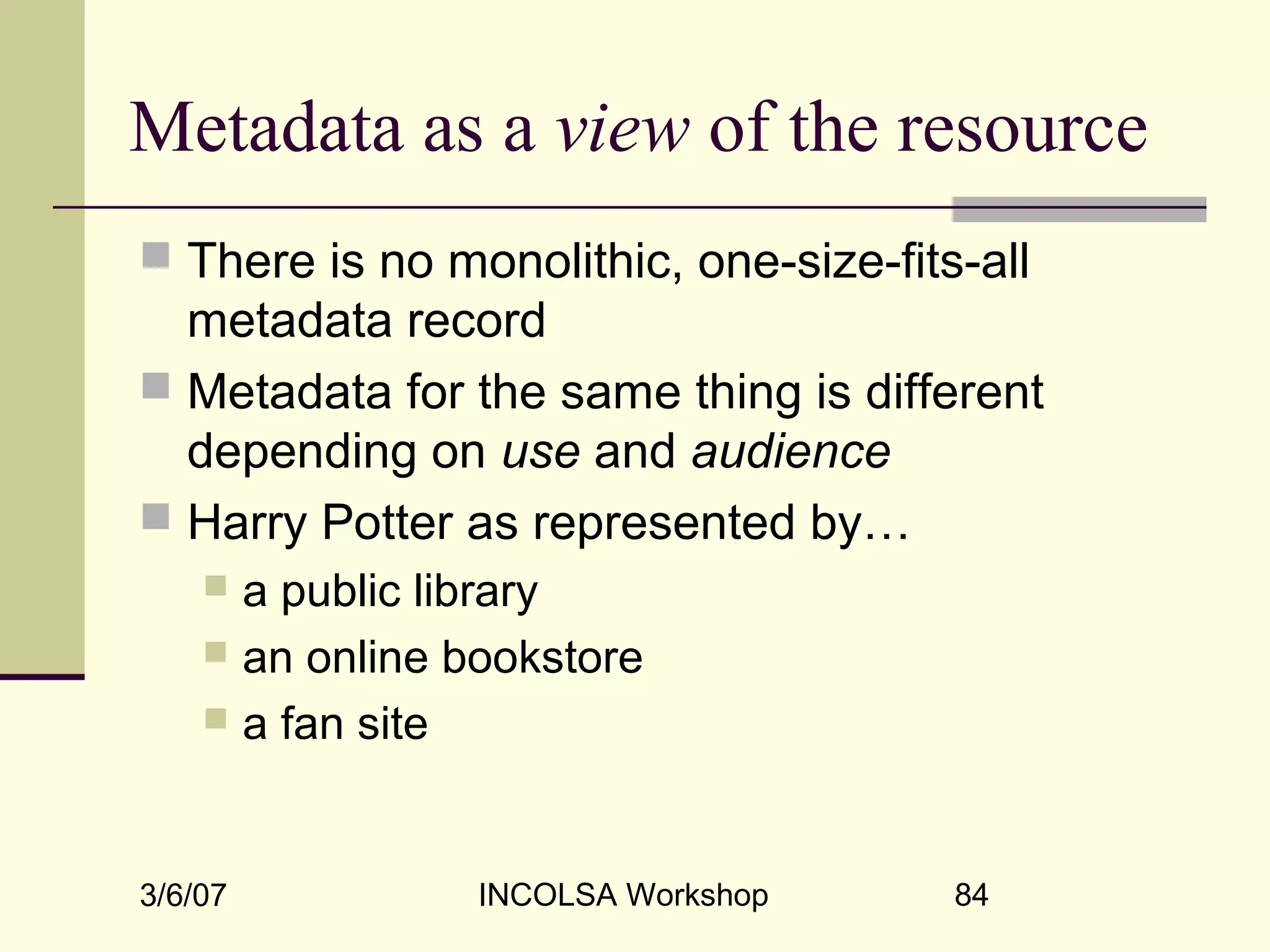
Metadata as a view of the resource
There is no monolithic, one-size-fits-all
metadata record
Metadata for the same thing is different
depending on use and audience
Harry Potter as represented by…
a public library
an online bookstore
a fan site
85.
3/6/07 INCOLSA Workshop85
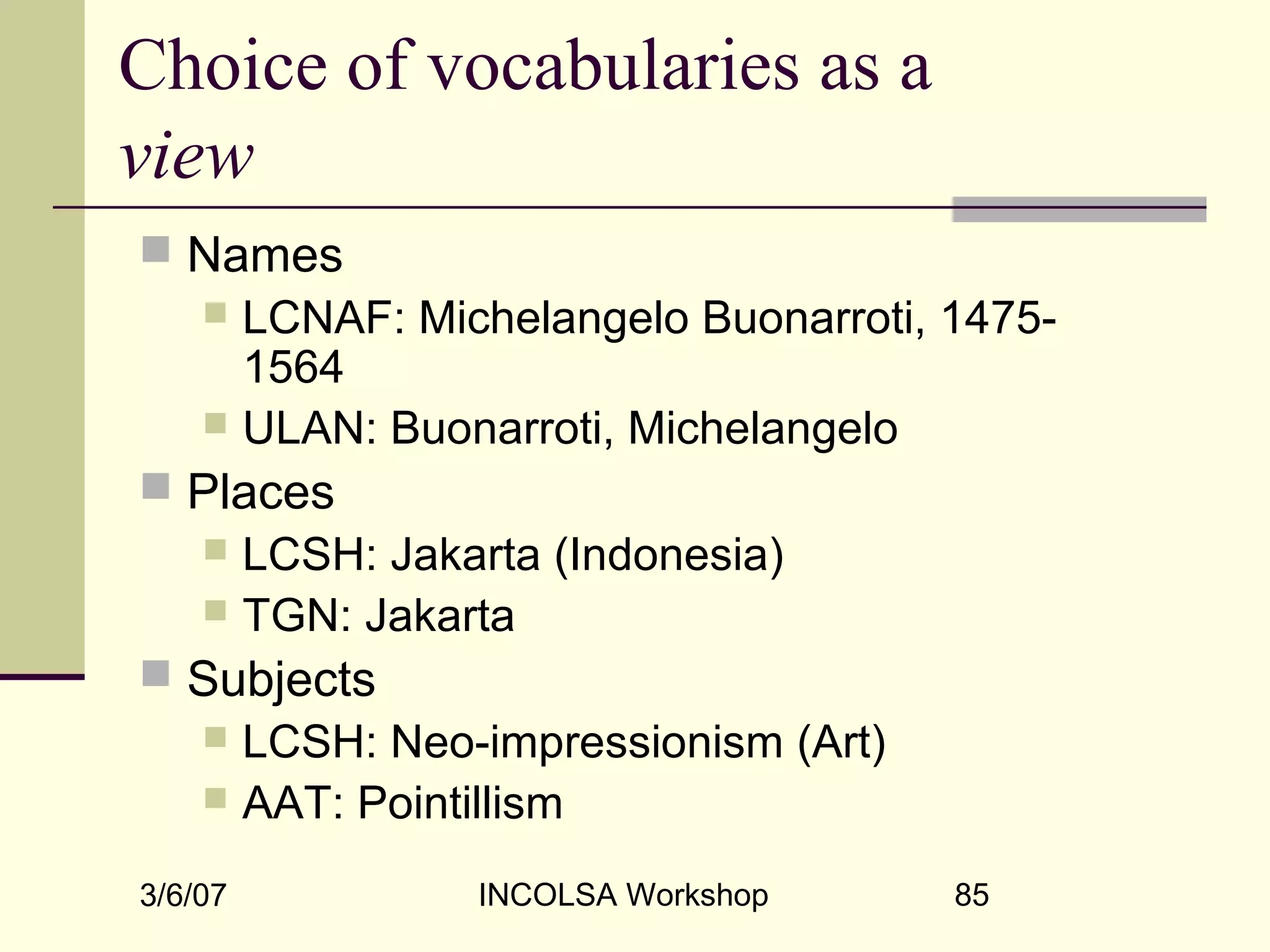
Choice of vocabularies as a
view
Names
LCNAF: Michelangelo Buonarroti, 1475-
1564
ULAN: Buonarroti, Michelangelo
Places
LCSH: Jakarta (Indonesia)
TGN: Jakarta
Subjects
LCSH: Neo-impressionism (Art)
AAT: Pointillism
86.
3/6/07 INCOLSA Workshop86
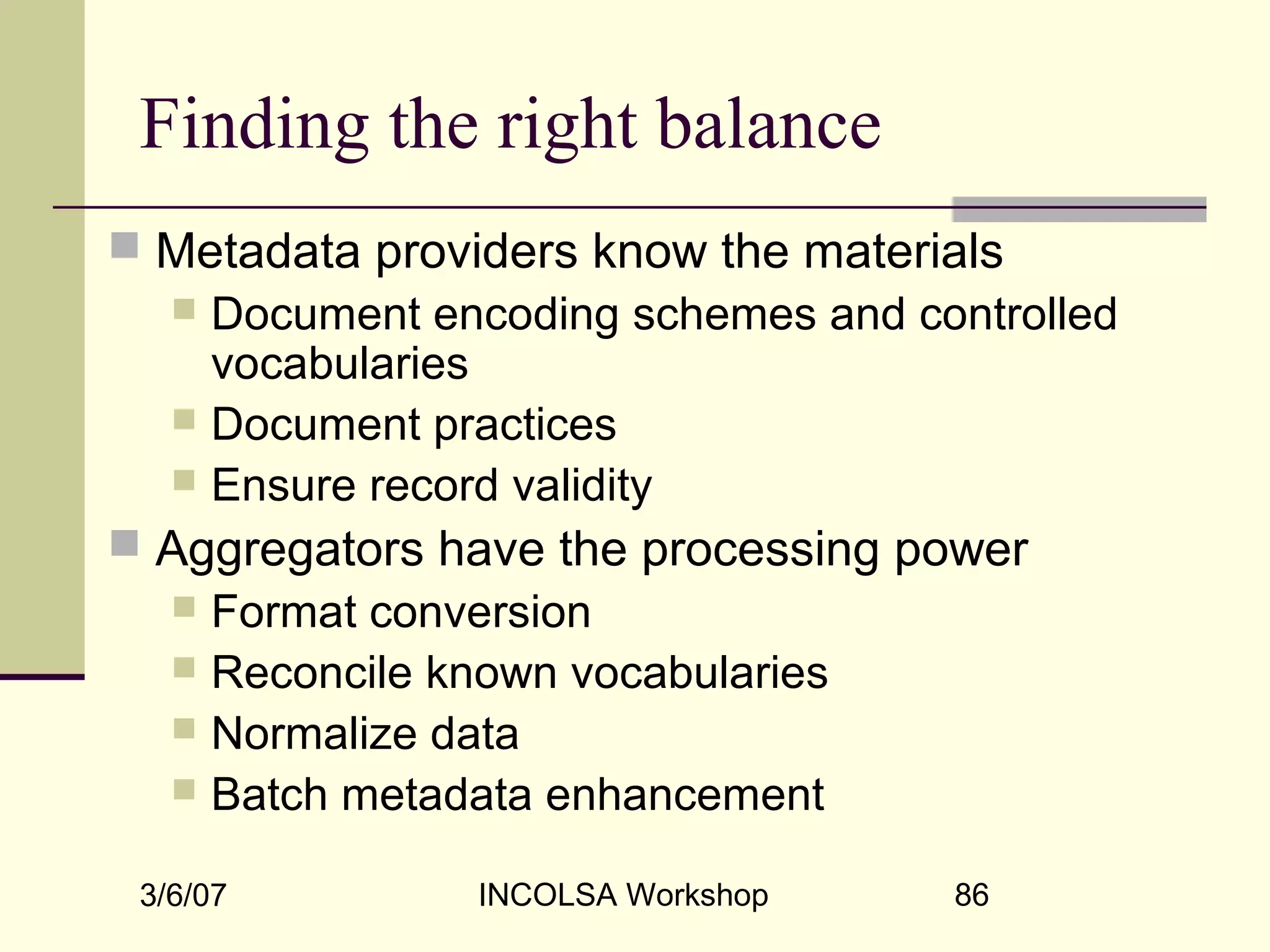
Finding the right balance
Metadata providers know the materials
Document encoding schemes and controlled
vocabularies
Document practices
Ensure record validity
Aggregators have the processing power
Format conversion
Reconcile known vocabularies
Normalize data
Batch metadata enhancement
87.
3/6/07 INCOLSA Workshop87
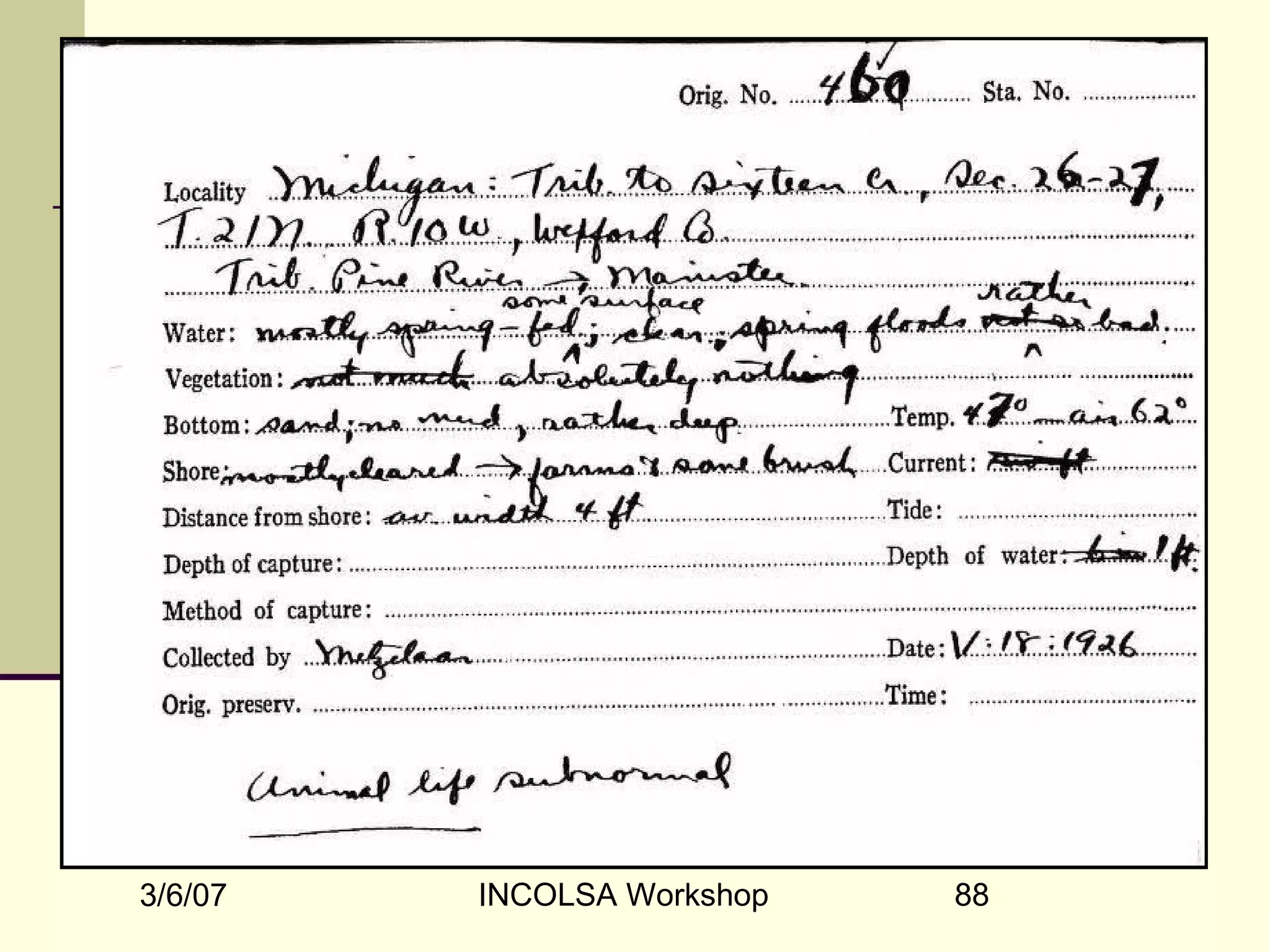
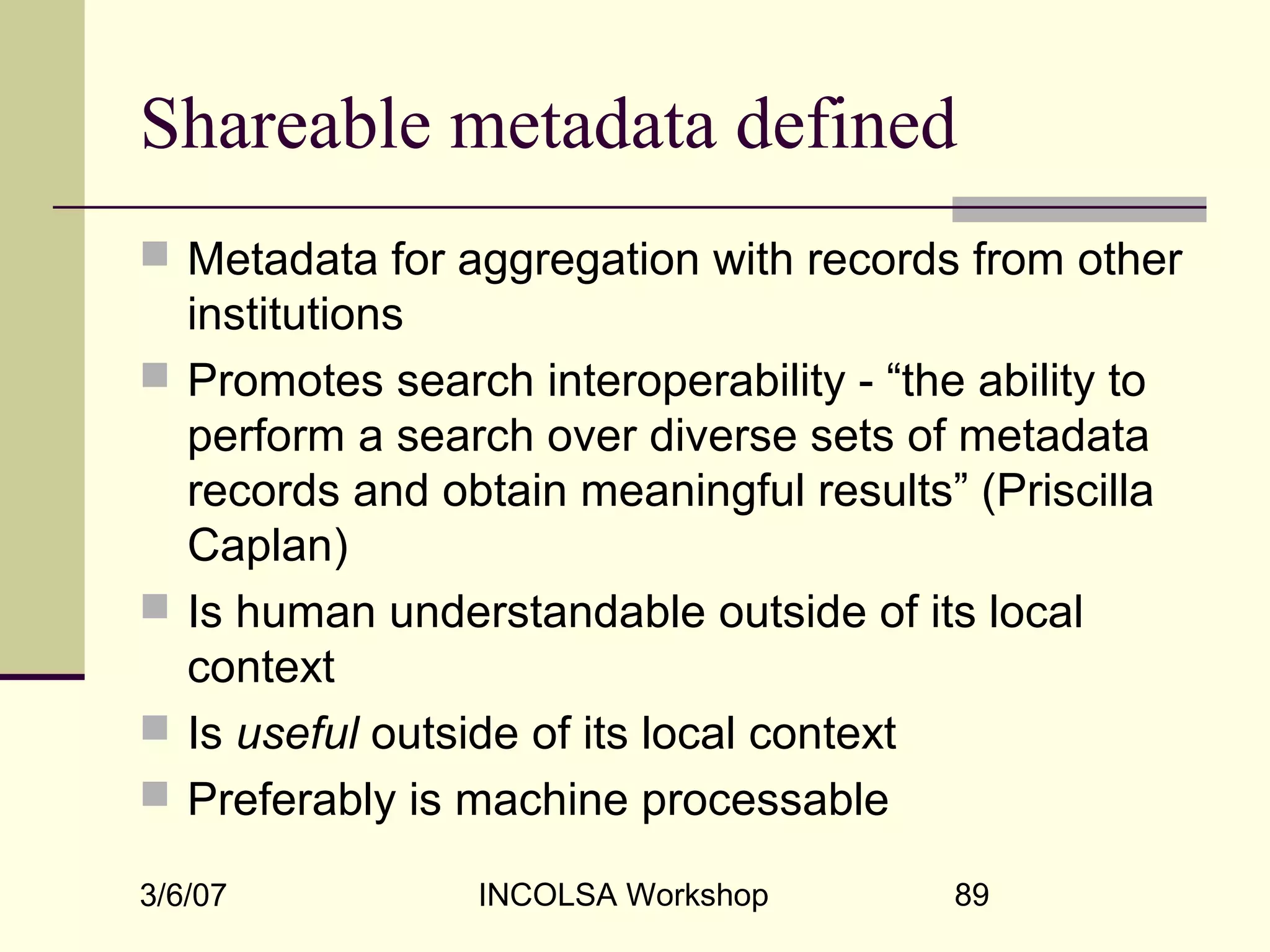
What does this record describe?
identifier: http://name.university.edu/IC-FISH3IC-X0802]1004_112
publisher: Museum of Zoology, Fish Field Notes
format: jpeg
rights: These pages may be freely searched and displayed.
Permission must be received for subsequent distribution in
print or electronically.
type: image
subject: 1926-05-18; 1926; 0812; 18; Trib. to Sixteen Cr. Trib. Pine
River, Manistee R.; JAM26-460; 05; 1926/05/18; R10W;
S26; S27; T21N
language: UND
source: Michigan 1926 Metzelaar, 1926--1926;
description: Flora and Fauna of the Great Lakes Region
Example courtesy of Sarah Shreeves, University of Illinois at Urbana-Champaign
3/6/07 INCOLSA Workshop89
Shareable metadata defined
Metadata for aggregation with records from other
institutions
Promotes search interoperability - “the ability to
perform a search over diverse sets of metadata
records and obtain meaningful results” (Priscilla
Caplan)
Is human understandable outside of its local
context
Is useful outside of its local context
Preferably is machine processable
90.
3/6/07 INCOLSA Workshop90
6 Cs and lots of Ss of shareable
metadata
Content
Consistency
Coherence
Context
Communication
Conformance
Metadata standards
Vocabulary and encoding standards
Descriptive content standards
Technical standards
91.
3/6/07 INCOLSA Workshop91
Content
Choose appropriate vocabularies
Choose appropriate granularity
Make it obvious what to display
Make it obvious what to index
Exclude unnecessary “filler”
Make it clear what links point to
92.
3/6/07 INCOLSA Workshop92
Consistency
Records in a set should all reflect the same
practice
Fields used
Vocabularies
Syntax encoding schemes
Allows aggregators to apply same
enhancement logic to an entire group of
records
93.
3/6/07 INCOLSA Workshop93
Coherence
Record should be self-explanatory
Values must appear in appropriate elements
Repeat fields instead of “packing” to explicitly
indicate where one value ends and another
begins
94.
3/6/07 INCOLSA Workshop94
Context
Include information not used locally
Exclude information only used locally
Current safe assumptions
Users discover material through shared
record
User then delivered to your environment for
full context
Context driven by intended use
95.
3/6/07 INCOLSA Workshop95
Communication
Method for creating shared records
Vocabularies and content standards used in
shared records
Record updating practices and schedules
Accrual practices and schedules
Existence of analytical or supplementary
materials
Provenance of materials
96.
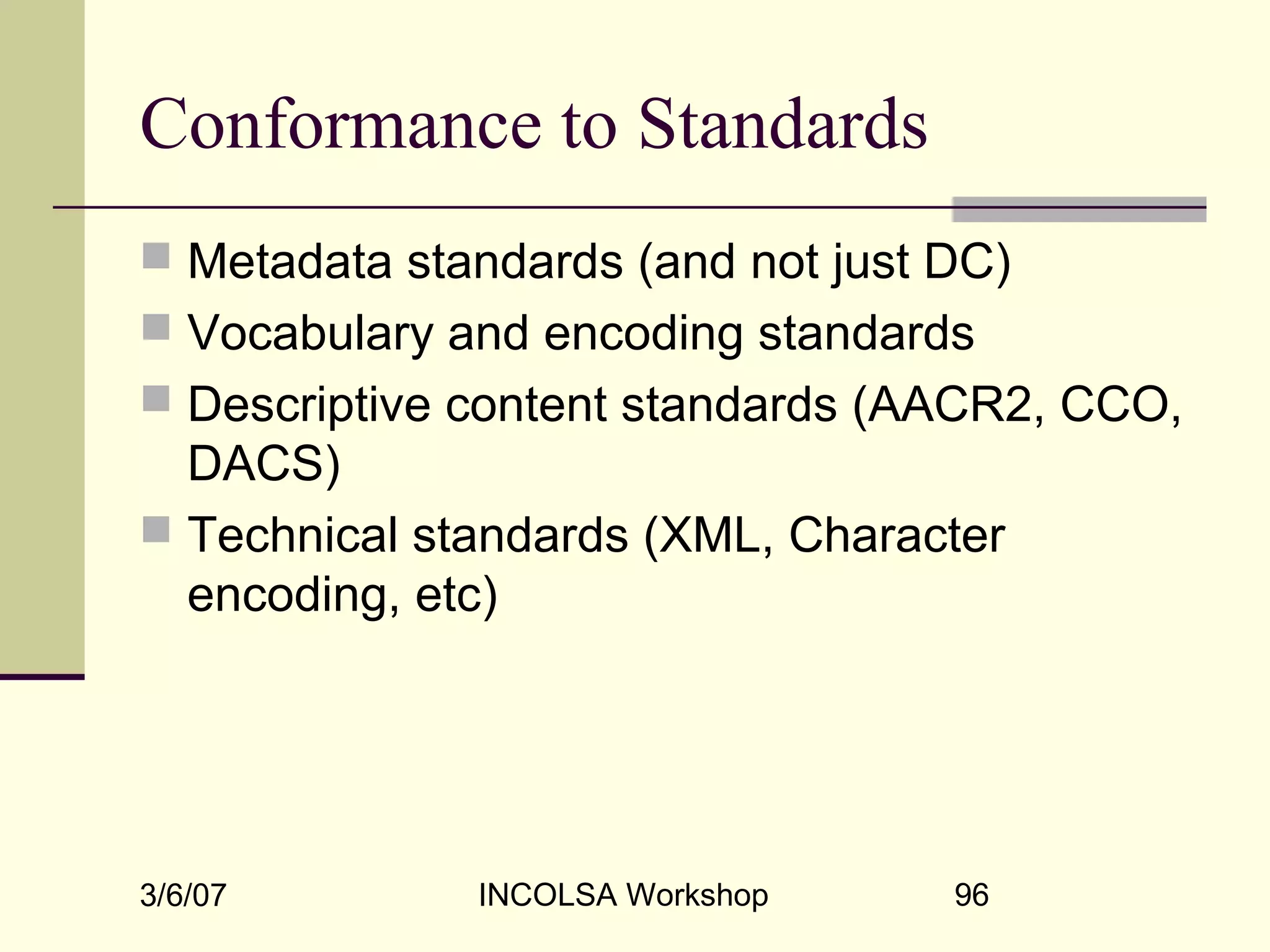
3/6/07 INCOLSA Workshop96
Conformance to Standards
Metadata standards (and not just DC)
Vocabulary and encoding standards
Descriptive content standards (AACR2, CCO,
DACS)
Technical standards (XML, Character
encoding, etc)
97.
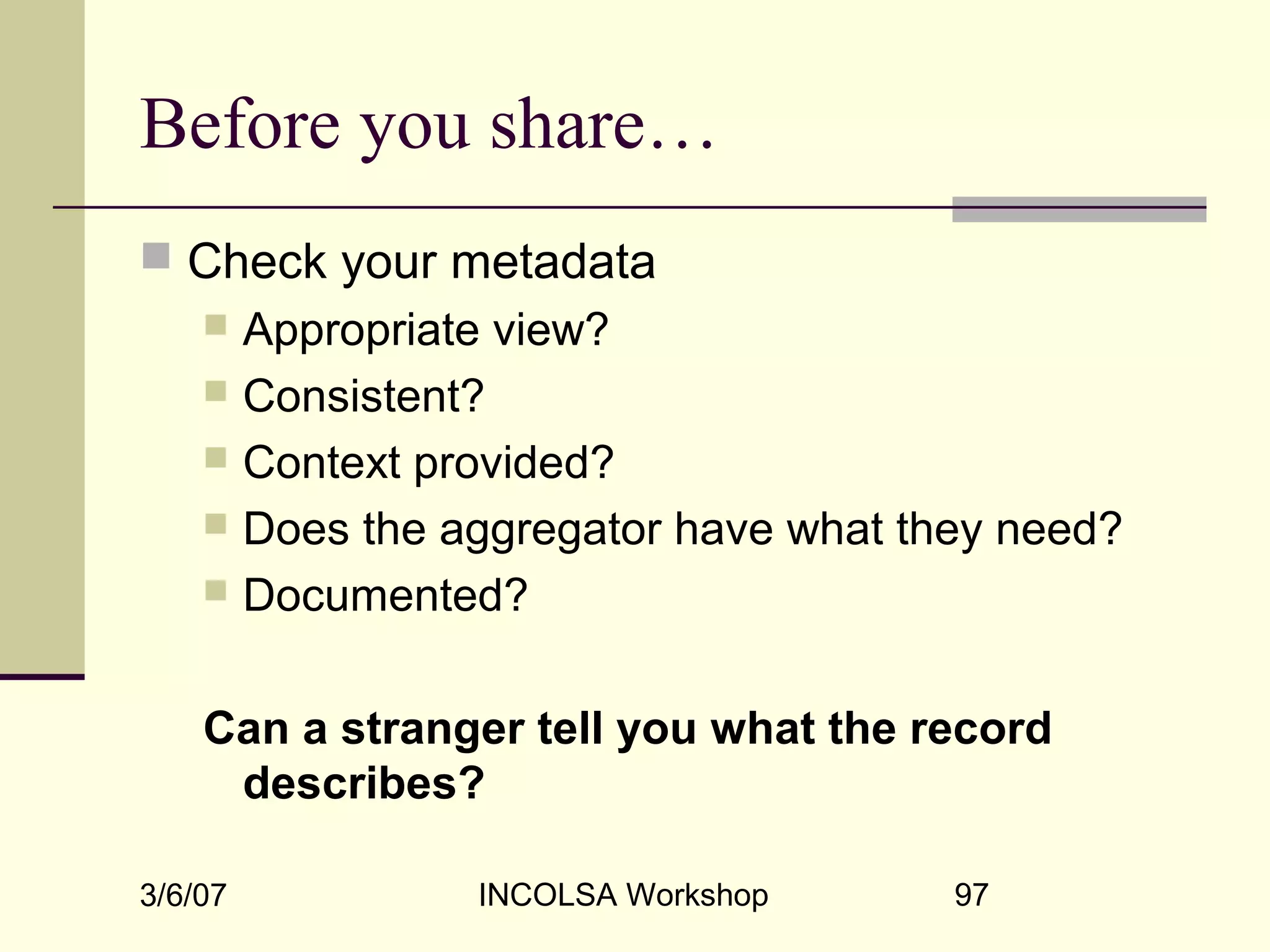
3/6/07 INCOLSA Workshop97
Before you share…
Check your metadata
Appropriate view?
Consistent?
Context provided?
Does the aggregator have what they need?
Documented?
Can a stranger tell you what the record
describes?
98.
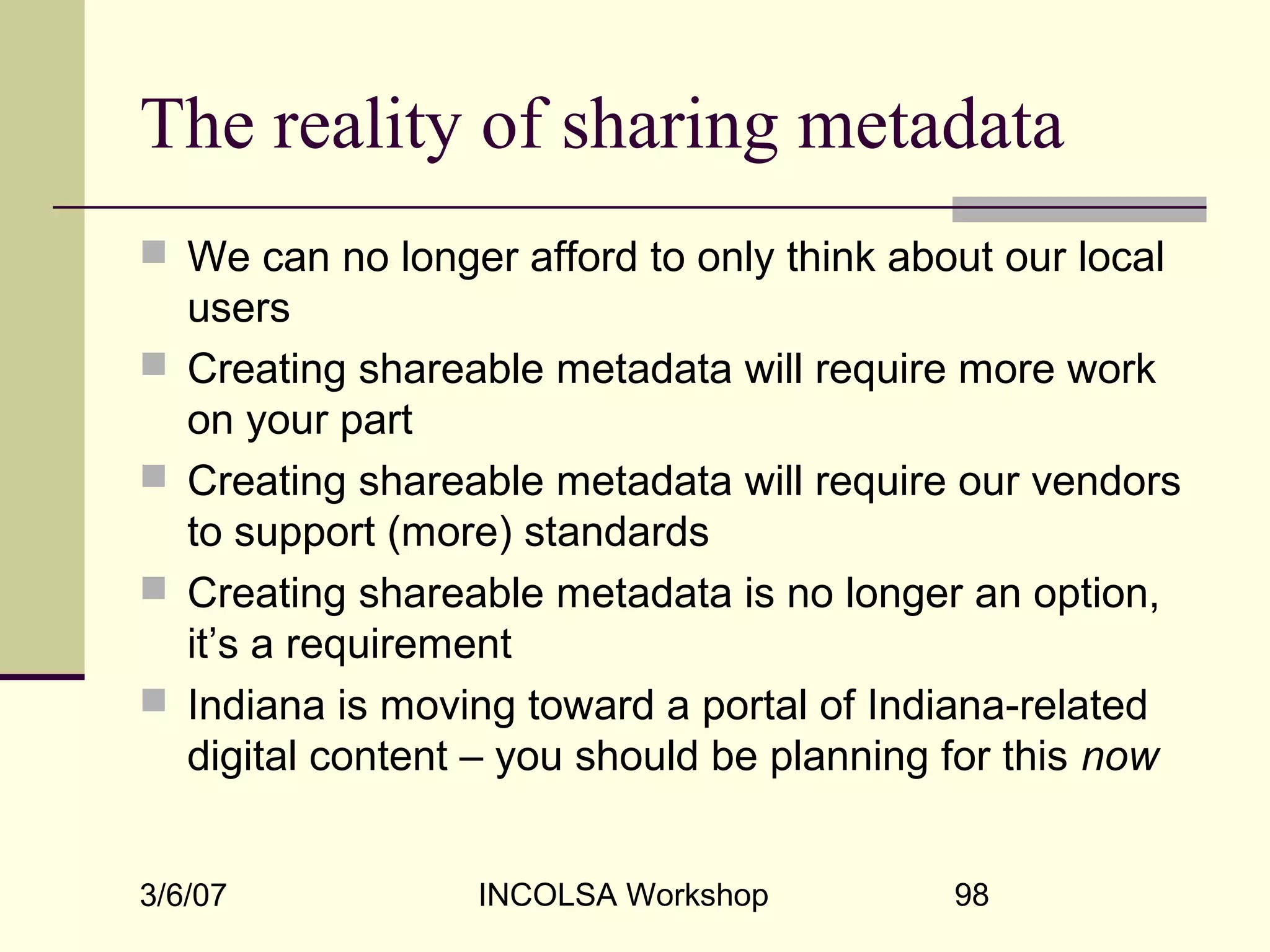
3/6/07 INCOLSA Workshop98
The reality of sharing metadata
We can no longer afford to only think about our local
users
Creating shareable metadata will require more work
on your part
Creating shareable metadata will require our vendors
to support (more) standards
Creating shareable metadata is no longer an option,
it’s a requirement
Indiana is moving toward a portal of Indiana-related
digital content – you should be planning for this now
99.
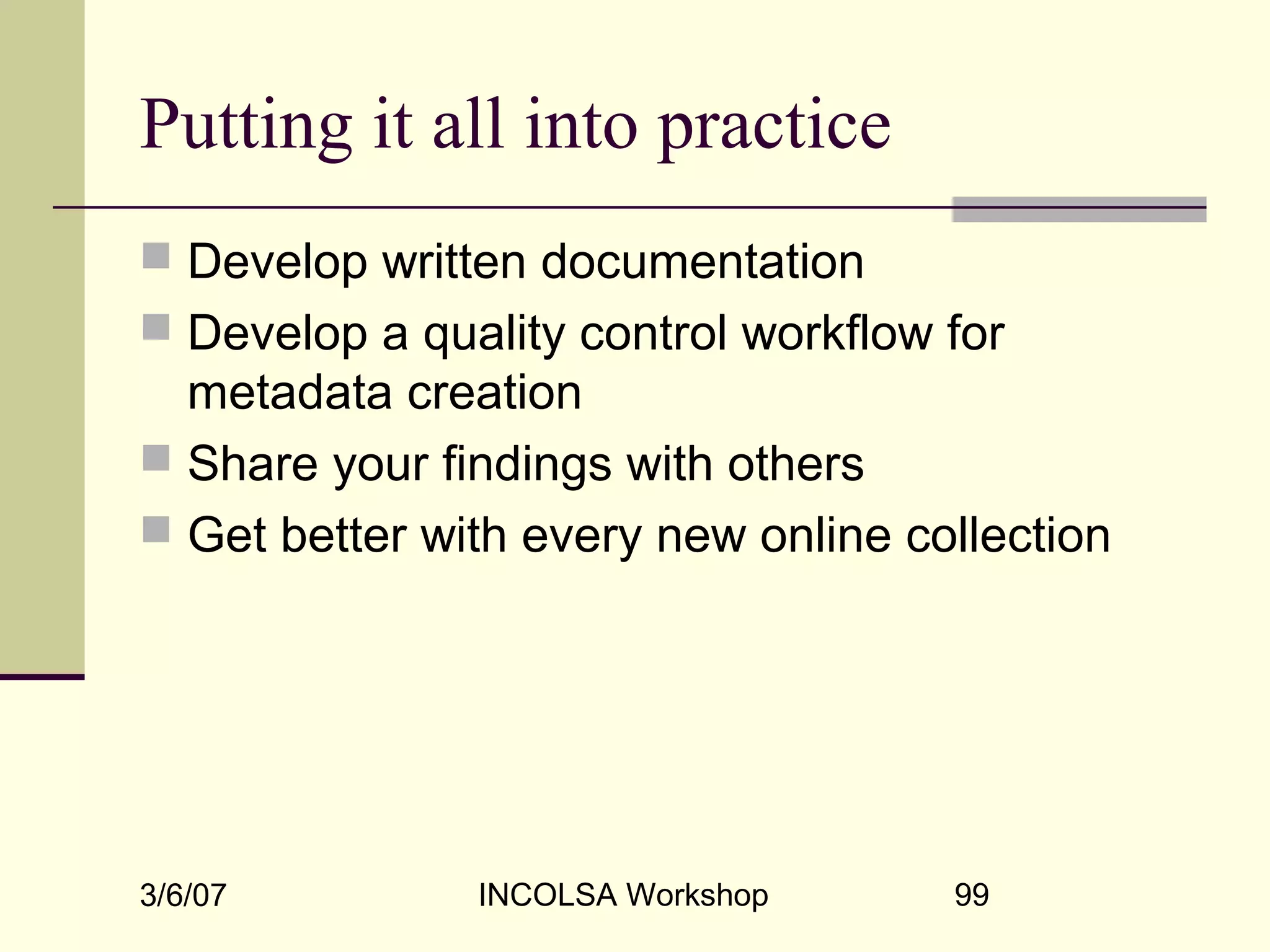
3/6/07 INCOLSA Workshop99
Putting it all into practice
Develop written documentation
Develop a quality control workflow for
metadata creation
Share your findings with others
Get better with every new online collection
100.
3/6/07 INCOLSA Workshop100
Further information
jenlrile@indiana.edu
These presentation slides: <
http://www.dlib.indiana.edu/~jenlrile/presentations/incolsa2007/incolsa.ppt>
Metadata librarians listserv: <http:
//metadatalibrarians.monarchos.com>
Priscilla Caplan: Metadata Fundamentals for
all Librarians, 2003
Editor's Notes
#20 Extensibility: via Application Profiles and local qualifiers. Local qualifiers maybe not kosher but there are no metadata police. Usually.
#22 Recommended: Elements, Element Refinements, and DCMI-maintained Vocabulary Terms (e.g., member terms of the DCMI Type Vocabulary) useful for resource discovery across domains.
Conforming: Elements, Element Refinements and Application Profiles may be assigned a status of conforming. Elements and Element Refinements assigned a status of conforming are those for which an implementation community has a demonstrated need and which conform to the grammar of Elements and Element Refinements, though without necessarily meeting the stricter criteria of usefulness across domains or usefulness for resource discovery.
Obsolete: For Elements and Element Refinements that have been superseded, deprecated, or rendered obsolete. Such terms will remain in the registry for use in interpreting legacy metadata.
Registered: Used for Vocabulary Encoding Schemes and language translations for which the DCMI provides information but not necessarily a specific recommendation.
#76 Can use as much or as little authority control as you want. CVs not required – use if you think they’re important for material. Can use collection-level description instead of item-level description if you want. Shared metadata only for discovery purposes – not necessarily complete description. Complete description is done locally. Domain-specific service providers can be for library interests, or merge library materials with those held in archives, museums, etc.
![DC
[record]
QDC
[record]
[collection]
MARC
[record]
[collection]
MARCXML
[record]
MODS
[record]
[collection]
Record
format
XML
RDF
(X)HTML
Field labels Text
Reliance on
AACR
None
Common
method of
creation
By novices, by
specialists,
and by
derivation](https://image.slidesharecdn.com/incolsa-140316194057-phpapp02/75/Metadata-for-your-Digital-Collections-18-2048.jpg)
![DC
[record]
QDC
[record]
[collection]
MARC
[record]
[collection]
MARCXML
[record]
MODS
[record]
[collection]
Record
format
XML
RDF
(X)HTML
XML
RDF
(X)HTML
Field labels Text Text
Reliance on
AACR
None None
Common
method of
creation
By novices, by
specialists,
and by
derivation
By novices, by
specialists,
and by
derivation](https://image.slidesharecdn.com/incolsa-140316194057-phpapp02/75/Metadata-for-your-Digital-Collections-24-2048.jpg)
![DC
[record]
QDC
[record]
[collection]
MARC
[record]
[collection]
MARCXML
[record]
MODS
[record]
[collection]
Record
format
XML
RDF
(X)HTML
XML
RDF
(X)HTML
ISO 2709
[ANSI Z39.2]
Field labels Text Text Numeric
Reliance on
AACR
None None Strong
Common
method of
creation
By novices, by
specialists,
and by
derivation
By novices, by
specialists,
and by
derivation
By
specialists](https://image.slidesharecdn.com/incolsa-140316194057-phpapp02/75/Metadata-for-your-Digital-Collections-30-2048.jpg)
![DC
[record]
QDC
[record]
[collection]
MARC
[record]
[collection]
MARCXML
[record]
MODS
[record]
[collection]
Record
format
XML
RDF
(X)HTML
XML
RDF
(X)HTML
ISO 2709
[ANSI Z39.2]
XML
Field labels Text Text Numeric Numeric
Reliance on
AACR
None None Strong Strong
Common
method of
creation
By novices, by
specialists,
and by
derivation
By novices, by
specialists,
and by
derivation
By
specialists
By derivation](https://image.slidesharecdn.com/incolsa-140316194057-phpapp02/75/Metadata-for-your-Digital-Collections-34-2048.jpg)
![DC
[record]
QDC
[record]
[collection]
MARC
[record]
[collection]
MARCXML
[record]
MODS
[record]
[collection]
Record
format
XML
RDF
(X)HTML
XML
RDF
(X)HTML
ISO 2709
[ANSI Z39.2]
XML XML
Field labels Text Text Numeric Numeric Text
Reliance on
AACR
None None Strong Strong Implied
Common
method of
creation
By novices, by
specialists,
and by
derivation
By novices, by
specialists,
and by
derivation
By
specialists
By derivation
By specialists
and by
derivation](https://image.slidesharecdn.com/incolsa-140316194057-phpapp02/75/Metadata-for-your-Digital-Collections-40-2048.jpg)

![3/6/07 INCOLSA Workshop 82
Crosswalks (2)
Can be in many formats
Logical sets of rules [example]
Actual code [example]
Often need to tweak a generic crosswalk for a
specific implementation
Accommodating local practice
Adding institution-specific information
Adding context not available locally](https://image.slidesharecdn.com/incolsa-140316194057-phpapp02/75/Metadata-for-your-Digital-Collections-82-2048.jpg)
![3/6/07 INCOLSA Workshop 87
What does this record describe?
identifier: http://name.university.edu/IC-FISH3IC-X0802]1004_112
publisher: Museum of Zoology, Fish Field Notes
format: jpeg
rights: These pages may be freely searched and displayed.
Permission must be received for subsequent distribution in
print or electronically.
type: image
subject: 1926-05-18; 1926; 0812; 18; Trib. to Sixteen Cr. Trib. Pine
River, Manistee R.; JAM26-460; 05; 1926/05/18; R10W;
S26; S27; T21N
language: UND
source: Michigan 1926 Metzelaar, 1926--1926;
description: Flora and Fauna of the Great Lakes Region
Example courtesy of Sarah Shreeves, University of Illinois at Urbana-Champaign](https://image.slidesharecdn.com/incolsa-140316194057-phpapp02/75/Metadata-for-your-Digital-Collections-87-2048.jpg)