METADATA: a library perspective
NINES Summer Workshop 2008
Jody Perkins, Miami University Libraries
METADATA CREATION IN LIBRARIES:
YESTERDAY AND TODAY
Anglo American Cataloging Rules
Authority Control
Collocation
Authorized Headings
Content Standards
Controlled Vocabulary
Fields and Subfields
Hierarchical Relationships
Information Retrieval
Non-authorized Terms
Precision and Recall Ratios
Synthetic Languages
METADATA IN LIBRARIES: TODAY AND TOMORROW
Resource Description and Access
Findability
Clustering
Tag Clouds
Resource Discovery
Folksonomy
Natural language
Elements & Attributes
Application Profiles
Usage Guidelines
METADATA IN LIBRARIES
the quick tour
Challenges Ahead
METADATA FOR ALL:
Practical Aspects
METADATA IS US but not ONLY US:
Where we’re going
METADATA WAS US:
Where we’ve been
METADATA DEFINED
“Metadata consists of statements we make about resources to
help us find, identify, use, manage, evaluate, and preserve
them.”
Concepts come from three traditions:
–Database Management Systems (“Schemas of relational
databases”)
–Library Cataloging Traditions (MARC & AACR2)
–The World Wide Web (since the mid-1990’s)
Stuart A. Sutton, Basic Semantics, International Conference on Dublin Core
and Metadata Applications—Singapore, 2007 http://www.dc2007.sg/T1-
BasicSemantics.pdf
BASIC TYPES OF METADATA
 Administrative
 Descriptive
 Structural
TERMS
 Element
 Schema
 Content Standard
 Vocabulary Encoding Scheme
 Granularity
 Crosswalk
 Application Profile
 Interoperability
Woodley, Mary. “DCMI Glossary”
http://dublincore.org/documents/usageguide/glossary.shtml#S
PRIMARY FUNCTIONS OF METADATA
To support users in the following tasks:
 Locate
 Identify
 Select
 Acquire
 Navigate
Svenonius, Elaine. 2001. The Intellectual Foundation of Information
Organization. Cambridge, Massachusetts, MIT Press.
CHARACTERISTICS OF HIGH QUALITY
METADATA
 Completeness
 Provenance
 Accuracy
 Conformance to Expectations
 Consistency and Coherence
 Timeliness
Thomas R. Bruce and Diane I. Hillman, 2004. “The continuum of metadata quality:
defining, expressing, exploiting,” In: Diane I. Hillman and Elaine Westbrooks
(editors). Metadata in Practice. Chicago: ALA Editions, pp. 238-256.
BASIC COMPONENTS OF
METADATA CREATION IN LIBRARIES
 Schemas
 Content Standards
 Controlled Values
 Encoding and Transmission Standards
 Best Practices
SCHEMAS
 General Purpose
 Dublin Core
 MARC, MODS
 Specialized
 VRA Core
 EAD
 TEI and many others . . .
CONTENT STANDARDS
 General Purpose
 AACR2 (RDA)
 DCMI Dublin Core Usage Guide
 Specialized
 Cataloging Cultural Objects (VRA-CCO)
 Describing Archives (DACS)
CONTROLLED VOCABULARIES BY HEADING TYPE
Topical Terms:
 LCSH, FAST, TGM, AAT
Genre Terms:
 ACRL/RBMS, TGM II, AAT, DCMI Type
Names:
 LCNAF, ULAN, TGN, FAST
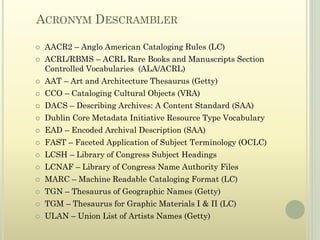
ACRONYM DESCRAMBLER
 AACR2 – Anglo American Cataloging Rules (LC)
 ACRL/RBMS – ACRL Rare Books and Manuscripts Section
Controlled Vocabularies (ALA/ACRL)
 AAT – Art and Architecture Thesaurus (Getty)
 CCO – Cataloging Cultural Objects (VRA)
 DACS – Describing Archives: A Content Standard (SAA)
 Dublin Core Metadata Initiative Resource Type Vocabulary
 EAD – Encoded Archival Description (SAA)
 FAST – Faceted Application of Subject Terminology (OCLC)
 LCSH – Library of Congress Subject Headings
 LCNAF – Library of Congress Name Authority Files
 MARC – Machine Readable Cataloging Format (LC)
 TGN – Thesaurus of Geographic Names (Getty)
 TGM – Thesaurus for Graphic Materials I & II (LC)
 ULAN – Union List of Artists Names (Getty)
FOOTNOTE ON TOPICAL ACCESS ISSUES
 LCSH
 Specialized Controlled Vocabularies
 Local Controlled Vocabularies
 Keywords
 Folksonomies
STANDARDS FOR ENCODING,
TRANSMISSION AND HARVESTING
 XML
 OAI-PMH
 METS
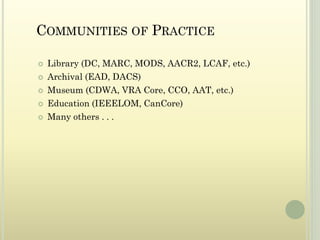
COMMUNITIES OF PRACTICE
 Library (DC, MARC, MODS, AACR2, LCAF, etc.)
 Archival (EAD, DACS)
 Museum (CDWA, VRA Core, CCO, AAT, etc.)
 Education (IEEELOM, CanCore)
 Many others . . .
MARC & TEI HEADERS
AACR2: AREAS OF DESCRIPTION
 Title and statement of responsibility
 Edition
 Publication
 Physical description
 Series
 Notes
 Standard number and terms of availability
MARC TAGGING SYSTEM (SIMPLIFIED)
 0xx - Control and Fixed Data Fields
 1xx - Main Entries (authors)
 2xx - Title, Edition, Imprint
 3xx - Physical Description
 4xx - Series Statements
 5xx - Notes
 6xx - Subject Entries
 7xx - Added Entries (other than subject or series)
 8xx - Added Entries (Series)
 841+ Holdings Information
 9xx - Locally defined information
MARC RECORD
 LEADER 00000cam 2200457 a 4500
 001 68192310
 005 20070112000000.0
 008 060418s2007 alua b s001 0 eng
 010 2006013112
 020 0817315381 (alk. paper)
 020 9780817315382 (alk. paper)
 024 3 9780817315382
 040 DLC|cDLC |dBAKER
 043 n-us---
 049 MIAA
 050 00 PS1342.R4|bB87 2007
 100 1 Bush, Harold K.|q(Harold Karl),|d1956-
 245 10 Mark Twain and the spiritual crisis of his age /|cHarold K. Bush, Jr
 260 Tuscaloosa :|bUniversity of Alabama Press,|cc2007
 300 340 p. :|bill. ;|c24 cm
 440 0 Studies in American literary realism and naturalism
 504 Includes bibliographical references (p. [311]-331) and index
 505 0 Mark Twain's roots : Hannibal, the river, and the west -- Mark Twain's wife : the moral ethos of
the
 600 10 Twain, Mark,|d1835-1910|xReligion
 650 0 Christianity and literature |zUnited States|xHistory|y19th century
 947 kmf
TITLE FIELD EXAMPLE
245 14 $aThe school library /$cBlanche Web.
MARC TO TEI: A SIMPLIFIED CROSSWALK
 100 <titleStmt>
 <author>
 245 <titleStmt>
 <title type=”****”>
 260 <publicationStmt>
 <publisher>
 <pubPlace>
 <date>
 300 <extent>

 500 <noteStmt>
 <note>
MARC RECORD EXAMPLE
Marko, Lynn and Christina Powell. 2001. Descriptive metadata strategy for TEI
headers: a University of Michigan Library case study. OCLC Systems & Services 17n3:
117-121.
SAME RECORD AS A TEI HEADER
FRAGMENT
Marko, Lynn and Christina Powell. 2001. Descriptive metadata strategy for TEI
headers: a University of Michigan Library case study. OCLC Systems & Services 17n3:
117-121.
LINKS TO BEST PRACTICE DOCUMENTS AND
PROJECTS USING MARC DATA IN TEI HEADERS
 TEI Text Encoding in Libraries Guidelines for Best
Encoding Practices http://www.diglib.org/standards/tei.htm
(see section IV. The TEI Header)
 Description of Text Encoding Initiatives (TEI)
Header Elements and Corresponding USMARC Fields.
Appendix to TEI/MARC Best Practices
http://etext.lib.virginia.edu/tei/tei-usmarc.html
 Marko, Lynn and Christina Powell. 2001. Descriptive
metadata strategy for TEI headers: a University of
Michigan Library case study. OCLC Systems & Services
17n3: 117-121.
METS
METS
Metadata Encoding and Transmission Standard
 “. . . a standard for packaging descriptive, administrative and
structural metadata. It allows for metadata which adheres to
existing standards (such as Dublin Core and MARC) to be
embedded in a METS record, or stored outside the METS
record and referenced. METS is therefore not a metadata
standard but rather a wrapper for associating existing
metadata of various types within a single object, document, or
collection structure.”
Source:
http://staffweb.library.northwestern.edu/dl/metadata/standardsinvent
ory/metssummary.html
PARTS OF A METS DOCUMENT
 METS Header <metsHdr>
 Descriptive Metadata <dmdSec>
 Administrative Metadata <amdSec>
 File Section <fileSec>
 Structural Map <structMap>
 Structural Links <smLink>
 Behavior <behaviorSec>
Examples from:
http://www.loc.gov/standards/mets/METSOverview.v2.html
METS HEADER
<metsHdr CREATEDATE="2003-07-04T15:00:00“ RECORDSTATUS="Complete">
<agent ROLE="CREATOR" TYPE="INDIVIDUAL">
<name>Jerome McDonough</name>
</agent>
<agent ROLE="ARCHIVIST" TYPE="INDIVIDUAL">
<name>Ann Butler</name>
</agent>
</metsHdr>
DESCRIPTIVE METADATA
Example referencing external metadata:
<dmdSec ID="dmd001">
<mdRef LOCTYPE="URN" MIMETYPE="application/xml" MDTYPE="EAD"
LABEL="Berol Collection Finding Aid">urn:x-nyu:fales1735
</mdRef>
</dmdSec>
DESCRIPTIVE METADATA
Example internal metadata:
<dmdSec ID="dmd002">
<mdWrap MIMETYPE="text/xml" MDTYPE="DC" LABEL="Dublin Core
Metadata">
<xmlData>
<dc:title>Alice's Adventures in Wonderland</dc:title>
<dc:creator>Lewis Carroll</dc:creator>
<dc:date>between 1872 and 1890</dc:date>
<dc:publisher>McCloughlin Brothers</dc:publisher>
<dc:type>text</dc:type>
</xmlData>
</mdWrap>
</dmdSec>
ADMINISTRATIVE METADATA
<amdSec>
<techMD ID="AMD001">
<mdWrap MIMETYPE="text/xml" MDTYPE="NISOIMG" LABEL="NISO
Img. Data">
<xmlData>
<niso:MIMEtype>image/tiff</niso:MIMEtype>
<niso:Compression>LZW</niso:Compression>
<niso:PhotometricInterpretation>8</niso:PhotometricInterpretation>
<niso:Orientation>1</niso:Orientation>
<niso:ScanningAgency>NYU Press</niso:ScanningAgency>
</xmlData>
</mdWrap>
</techMD>
FILE SECTION
<fileSec>
<fileGrp ID="VERS1">
<file ID="FILE001" MIMETYPE="application/xml" SIZE="257537" CREATED="2001-06-10">
<FLocat LOCTYPE="URL">http://dlib.nyu.edu/tamwag/beame.xml</FLocat>
</file>
</fileGrp>
<fileGrp ID="VERS2">
<file ID="FILE002" MIMETYPE="audio/wav" SIZE="64232836" CREATED="2001-05-17“
GROUPID="AUDIO1">
<FLocat LOCTYPE="URL">http://dlib.nyu.edu/tamwag/beame.wav</FLocat> </file>
</fileGrp>
STRUCTURAL MAP
<structMap TYPE="logical">
<div ID="div1" LABEL="Oral History: Mayor Abraham Beame" TYPE="oral history">
<div ID="div1.1" LABEL="Interviewer Introduction" ORDER="1">
<fptr FILEID="FILE001">
<area FILEID="FILE001" BEGIN="INTVWBG" END="INTVWND" BETYPE="IDREF" />
</fptr>
<fptr FILEID="FILE002">
<area FILEID="FILE002" BEGIN="00:00:00" END="00:01:47" BETYPE="TIME" />
</fptr>
<fptr FILEID="FILE003">
<area FILEID="FILE003" BEGIN="00:00:00" END="00:01:47" BETYPE="TIME" /> </fptr>
</div>
<div ID="div1.2" LABEL="Family History" ORDER="2">
<fptr FILEID="FILE001">
<area FILEID="FILE001" BEGIN="FHBG" END="FHND" BETYPE="IDREF" />
</fptr>
</div>
</div>
</structMap>
STRUCTURAL LINKS
<smLink>
<div ID="P1" TYPE="page" LABEL="Page 1">
<fptr FILEID="HTMLF1"/>
<div ID="IMG1" TYPE="image" LABEL="Image Hyperlink to Page 2">
<fptr FILEID="JPGF1"/>
</div>
<div ID="P2" TYPE="page" LABEL="Page 2">
<fptr FILEID="HTMLF2"/>
</div>
BEHAVIOR SECTION
<METS:behavior ID="DISS1.1" STRUCTID="S1.1" BTYPE="uva-bdef:stdImage"
CREATED="2002-05-25T08:32:00" LABEL="UVA Std Image Disseminator"
GROUPID="DISS1" ADMID="AUDREC1">
<METS:interfaceDef LABEL="UVA Standard Image Behavior Definition"
LOCTYPE="URN" xlink:href="uva-bdef:stdImage"/>
<METS:mechanism LABEL="A NEW AND IMPROVED Image Mechanism"
LOCTYPE="URN" xlink:href="uva-bmech:BETTER-imageMech"/>
</METS:behavior>
textMD
• Extension for METS
<amdSec>
• XML Schema for text-
based digital objects
• Used for technical
metadata that
specifies encoding,
character attributes,
languages, markup,
processing,
pagination, display
requirements
• www.loc.gov/standard
s/textMD/
CHALLENGES
BARRIERS TO INTEROPERABILITY:
 Semantic differences
 Different practices
 Differences in representation
 Different vocabularies
 Multiple versions
Priscilla Caplan, “Metadata Fundamentals for All Librarians,”
(Chicago: ALA, 2003): 41-42.
INTEROPERABILITY IS CRITICAL FOR. . .
 Federated Searching
 Harvesting
 Inter and Intra Institutional Collaboration
 Future Proofing
SOME WAYS TO FACILITATE
INTEROPERABILITY:
 Compliance with standards and best practices
 Application Profiles
 Framework
 Conversion
 Integration
 Registries
Lois Mai Chan and Marcia Lei Zeng, "Metadata Interoperability and
Standardization - A Study of Methodology Part I." D-Lib Magazine, 12, no. 6
(2006). http://www.dlib.org/dlib/june06/chan/06chan.html (accessed August 30,
2007) and Metadata Interoperability and Standardization - A Study of
Methodology Part II." D-Lib Magazine, 12, no. 6 (2006).
http://www.dlib.org/dlib/june06/zeng/06zeng.html (accessed August 30, 2007)
SELECTED RESOURCES
GENERAL GUIDELINES
Framework of Guidance for Building Good Digital Collections. 3rd
ed. 2007. Bethesda, MD : National Information Standards
Organization, NISO Framework Advisory Group. Accessed 23
July 2008. http://www.niso.org/publications/rp/framework3.pdf
NINCH Guide to Good Practice in the Digital Representation and
Management of Cultural Heritage Materials. 2002. Humanities
Advanced Technology and Information Institute (HATII),
University of Glasgow, and the National Initiative for a
Networked Cultural Heritage. Accessed 23 July 2008.
http://www.nyu.edu/its/humanities/ninchguide/
METADATA SCHEMAS
Dublin Core Metadata Element Set, Version 1.1. Dec. 18,
2006. Dublin Core Metadata Initiative. Accessed 23 July
2008. http://dublincore.org/documents/dces/
MARC and MARC Related Standards (MODS, MARCXML,
etc.) Accessed 23 July 2008. http://www.loc.gov/marc/
VRA Core Categories, Version 4.0. 2007. Visual Resources
Association Data Standards Committee. Accessed 23 July
2008. http://www.vraweb.org/projects/vracore4/index.html
CONTENT STANDARDS
American Library Association, et al. AACR2 Anglo-American
Cataloguing Rules, 2nd ed. Chicago : American Library
Association, 2002. Also available in a concise edition.
Society of American Archivists. Describing Archives: A
Content Standard. Chicago : Society of American
Archivists, 2004.
Visual Resources Association. Cataloging Cultural Objects: A
Guide to Describing Cultural Works and Their Images.
Chicago : American Library Association, 2006.
CONTROLLED VALUE SCHEMES
Controlled Vocabularies for Use in Rare Book and Special Collections
Cataloging. ACRL/RBMS. Accessed 23 July 2008.
http://www.rbms.info/committees/bibliographic_standards/controlled_voc
abularies/index.shtml
FAST: Faceted Application of Subject Terminology. OCLC Online Computer
Library Center. Accessed 23 July 2008. Interface http://fast.oclc.org/
Information http://www.oclc.org/research/projects/fast/
Getty Vocabulary Program. J. Paul Getty Trust. Accessed 23 July 2008.
http://www.getty.edu/research/conducting_research/vocabularies/
Library of Congress Authorities. 2006. Library of Congress. Accessed 23
July 2008. http://authorities.loc.gov/
LC Thesaurus for Graphic Materials. 1995. Library of Congress. Print and
Photographs Division. Accessed 23 July 2008.
http://lcweb.loc.gov/rr/print/tgm1
BEST PRACTICES
Best Practices for Shareable Metadata. NSF, August 2005. Digital Library
Federation and the National Science Digital Library. Accessed 23 July
2008. http://oai-best.comm.nsdl.org/cgi-bin/wiki.pl?PublicTOC
Description of Text Encoding Initiatives (TEI) Header Elements and
Corresponding USMARC Fields. Appendix to TEI/MARC Best Practices
Accessed 23 July 2008. http://etext.lib.virginia.edu/tei/tei-usmarc.html
TEI Text Encoding in Libraries Guidelines for Best Encoding Practices.
Accessed 23 July 2008. http://www.diglib.org/standards/tei.htm (see
section IV. The TEI Header)
Marko, Lynn and Christina Powell. 2001. Descriptive metadata strategy for
TEI headers: a University of Michigan Library case study. OCLC Systems
& Services 17n3: 117-121.
CONTACT INFORMATION:
Jody Perkins, Metadata Librarian
Miami University Libraries
perkintj@muohio.edu

Metadata: a library perspective

  • 1.
    METADATA: a libraryperspective NINES Summer Workshop 2008 Jody Perkins, Miami University Libraries
  • 2.
    METADATA CREATION INLIBRARIES: YESTERDAY AND TODAY Anglo American Cataloging Rules Authority Control Collocation Authorized Headings Content Standards Controlled Vocabulary Fields and Subfields Hierarchical Relationships Information Retrieval Non-authorized Terms Precision and Recall Ratios Synthetic Languages
  • 3.
    METADATA IN LIBRARIES:TODAY AND TOMORROW Resource Description and Access Findability Clustering Tag Clouds Resource Discovery Folksonomy Natural language Elements & Attributes Application Profiles Usage Guidelines
  • 4.
  • 5.
    Challenges Ahead METADATA FORALL: Practical Aspects METADATA IS US but not ONLY US: Where we’re going METADATA WAS US: Where we’ve been
  • 6.
    METADATA DEFINED “Metadata consistsof statements we make about resources to help us find, identify, use, manage, evaluate, and preserve them.” Concepts come from three traditions: –Database Management Systems (“Schemas of relational databases”) –Library Cataloging Traditions (MARC & AACR2) –The World Wide Web (since the mid-1990’s) Stuart A. Sutton, Basic Semantics, International Conference on Dublin Core and Metadata Applications—Singapore, 2007 http://www.dc2007.sg/T1- BasicSemantics.pdf
  • 7.
    BASIC TYPES OFMETADATA  Administrative  Descriptive  Structural
  • 8.
    TERMS  Element  Schema Content Standard  Vocabulary Encoding Scheme  Granularity  Crosswalk  Application Profile  Interoperability Woodley, Mary. “DCMI Glossary” http://dublincore.org/documents/usageguide/glossary.shtml#S
  • 9.
    PRIMARY FUNCTIONS OFMETADATA To support users in the following tasks:  Locate  Identify  Select  Acquire  Navigate Svenonius, Elaine. 2001. The Intellectual Foundation of Information Organization. Cambridge, Massachusetts, MIT Press.
  • 10.
    CHARACTERISTICS OF HIGHQUALITY METADATA  Completeness  Provenance  Accuracy  Conformance to Expectations  Consistency and Coherence  Timeliness Thomas R. Bruce and Diane I. Hillman, 2004. “The continuum of metadata quality: defining, expressing, exploiting,” In: Diane I. Hillman and Elaine Westbrooks (editors). Metadata in Practice. Chicago: ALA Editions, pp. 238-256.
  • 11.
    BASIC COMPONENTS OF METADATACREATION IN LIBRARIES  Schemas  Content Standards  Controlled Values  Encoding and Transmission Standards  Best Practices
  • 12.
    SCHEMAS  General Purpose Dublin Core  MARC, MODS  Specialized  VRA Core  EAD  TEI and many others . . .
  • 13.
    CONTENT STANDARDS  GeneralPurpose  AACR2 (RDA)  DCMI Dublin Core Usage Guide  Specialized  Cataloging Cultural Objects (VRA-CCO)  Describing Archives (DACS)
  • 14.
    CONTROLLED VOCABULARIES BYHEADING TYPE Topical Terms:  LCSH, FAST, TGM, AAT Genre Terms:  ACRL/RBMS, TGM II, AAT, DCMI Type Names:  LCNAF, ULAN, TGN, FAST
  • 15.
    ACRONYM DESCRAMBLER  AACR2– Anglo American Cataloging Rules (LC)  ACRL/RBMS – ACRL Rare Books and Manuscripts Section Controlled Vocabularies (ALA/ACRL)  AAT – Art and Architecture Thesaurus (Getty)  CCO – Cataloging Cultural Objects (VRA)  DACS – Describing Archives: A Content Standard (SAA)  Dublin Core Metadata Initiative Resource Type Vocabulary  EAD – Encoded Archival Description (SAA)  FAST – Faceted Application of Subject Terminology (OCLC)  LCSH – Library of Congress Subject Headings  LCNAF – Library of Congress Name Authority Files  MARC – Machine Readable Cataloging Format (LC)  TGN – Thesaurus of Geographic Names (Getty)  TGM – Thesaurus for Graphic Materials I & II (LC)  ULAN – Union List of Artists Names (Getty)
  • 16.
    FOOTNOTE ON TOPICALACCESS ISSUES  LCSH  Specialized Controlled Vocabularies  Local Controlled Vocabularies  Keywords  Folksonomies
  • 17.
    STANDARDS FOR ENCODING, TRANSMISSIONAND HARVESTING  XML  OAI-PMH  METS
  • 18.
    COMMUNITIES OF PRACTICE Library (DC, MARC, MODS, AACR2, LCAF, etc.)  Archival (EAD, DACS)  Museum (CDWA, VRA Core, CCO, AAT, etc.)  Education (IEEELOM, CanCore)  Many others . . .
  • 19.
    MARC & TEIHEADERS
  • 20.
    AACR2: AREAS OFDESCRIPTION  Title and statement of responsibility  Edition  Publication  Physical description  Series  Notes  Standard number and terms of availability
  • 21.
    MARC TAGGING SYSTEM(SIMPLIFIED)  0xx - Control and Fixed Data Fields  1xx - Main Entries (authors)  2xx - Title, Edition, Imprint  3xx - Physical Description  4xx - Series Statements  5xx - Notes  6xx - Subject Entries  7xx - Added Entries (other than subject or series)  8xx - Added Entries (Series)  841+ Holdings Information  9xx - Locally defined information
  • 23.
    MARC RECORD  LEADER00000cam 2200457 a 4500  001 68192310  005 20070112000000.0  008 060418s2007 alua b s001 0 eng  010 2006013112  020 0817315381 (alk. paper)  020 9780817315382 (alk. paper)  024 3 9780817315382  040 DLC|cDLC |dBAKER  043 n-us---  049 MIAA  050 00 PS1342.R4|bB87 2007  100 1 Bush, Harold K.|q(Harold Karl),|d1956-  245 10 Mark Twain and the spiritual crisis of his age /|cHarold K. Bush, Jr  260 Tuscaloosa :|bUniversity of Alabama Press,|cc2007  300 340 p. :|bill. ;|c24 cm  440 0 Studies in American literary realism and naturalism  504 Includes bibliographical references (p. [311]-331) and index  505 0 Mark Twain's roots : Hannibal, the river, and the west -- Mark Twain's wife : the moral ethos of the  600 10 Twain, Mark,|d1835-1910|xReligion  650 0 Christianity and literature |zUnited States|xHistory|y19th century  947 kmf
  • 24.
    TITLE FIELD EXAMPLE 24514 $aThe school library /$cBlanche Web.
  • 25.
    MARC TO TEI:A SIMPLIFIED CROSSWALK  100 <titleStmt>  <author>  245 <titleStmt>  <title type=”****”>  260 <publicationStmt>  <publisher>  <pubPlace>  <date>  300 <extent>   500 <noteStmt>  <note>
  • 26.
    MARC RECORD EXAMPLE Marko,Lynn and Christina Powell. 2001. Descriptive metadata strategy for TEI headers: a University of Michigan Library case study. OCLC Systems & Services 17n3: 117-121.
  • 27.
    SAME RECORD ASA TEI HEADER FRAGMENT Marko, Lynn and Christina Powell. 2001. Descriptive metadata strategy for TEI headers: a University of Michigan Library case study. OCLC Systems & Services 17n3: 117-121.
  • 28.
    LINKS TO BESTPRACTICE DOCUMENTS AND PROJECTS USING MARC DATA IN TEI HEADERS  TEI Text Encoding in Libraries Guidelines for Best Encoding Practices http://www.diglib.org/standards/tei.htm (see section IV. The TEI Header)  Description of Text Encoding Initiatives (TEI) Header Elements and Corresponding USMARC Fields. Appendix to TEI/MARC Best Practices http://etext.lib.virginia.edu/tei/tei-usmarc.html  Marko, Lynn and Christina Powell. 2001. Descriptive metadata strategy for TEI headers: a University of Michigan Library case study. OCLC Systems & Services 17n3: 117-121.
  • 29.
  • 30.
    METS Metadata Encoding andTransmission Standard  “. . . a standard for packaging descriptive, administrative and structural metadata. It allows for metadata which adheres to existing standards (such as Dublin Core and MARC) to be embedded in a METS record, or stored outside the METS record and referenced. METS is therefore not a metadata standard but rather a wrapper for associating existing metadata of various types within a single object, document, or collection structure.” Source: http://staffweb.library.northwestern.edu/dl/metadata/standardsinvent ory/metssummary.html
  • 31.
    PARTS OF AMETS DOCUMENT  METS Header <metsHdr>  Descriptive Metadata <dmdSec>  Administrative Metadata <amdSec>  File Section <fileSec>  Structural Map <structMap>  Structural Links <smLink>  Behavior <behaviorSec> Examples from: http://www.loc.gov/standards/mets/METSOverview.v2.html
  • 32.
    METS HEADER <metsHdr CREATEDATE="2003-07-04T15:00:00“RECORDSTATUS="Complete"> <agent ROLE="CREATOR" TYPE="INDIVIDUAL"> <name>Jerome McDonough</name> </agent> <agent ROLE="ARCHIVIST" TYPE="INDIVIDUAL"> <name>Ann Butler</name> </agent> </metsHdr>
  • 33.
    DESCRIPTIVE METADATA Example referencingexternal metadata: <dmdSec ID="dmd001"> <mdRef LOCTYPE="URN" MIMETYPE="application/xml" MDTYPE="EAD" LABEL="Berol Collection Finding Aid">urn:x-nyu:fales1735 </mdRef> </dmdSec>
  • 34.
    DESCRIPTIVE METADATA Example internalmetadata: <dmdSec ID="dmd002"> <mdWrap MIMETYPE="text/xml" MDTYPE="DC" LABEL="Dublin Core Metadata"> <xmlData> <dc:title>Alice's Adventures in Wonderland</dc:title> <dc:creator>Lewis Carroll</dc:creator> <dc:date>between 1872 and 1890</dc:date> <dc:publisher>McCloughlin Brothers</dc:publisher> <dc:type>text</dc:type> </xmlData> </mdWrap> </dmdSec>
  • 35.
    ADMINISTRATIVE METADATA <amdSec> <techMD ID="AMD001"> <mdWrapMIMETYPE="text/xml" MDTYPE="NISOIMG" LABEL="NISO Img. Data"> <xmlData> <niso:MIMEtype>image/tiff</niso:MIMEtype> <niso:Compression>LZW</niso:Compression> <niso:PhotometricInterpretation>8</niso:PhotometricInterpretation> <niso:Orientation>1</niso:Orientation> <niso:ScanningAgency>NYU Press</niso:ScanningAgency> </xmlData> </mdWrap> </techMD>
  • 36.
    FILE SECTION <fileSec> <fileGrp ID="VERS1"> <fileID="FILE001" MIMETYPE="application/xml" SIZE="257537" CREATED="2001-06-10"> <FLocat LOCTYPE="URL">http://dlib.nyu.edu/tamwag/beame.xml</FLocat> </file> </fileGrp> <fileGrp ID="VERS2"> <file ID="FILE002" MIMETYPE="audio/wav" SIZE="64232836" CREATED="2001-05-17“ GROUPID="AUDIO1"> <FLocat LOCTYPE="URL">http://dlib.nyu.edu/tamwag/beame.wav</FLocat> </file> </fileGrp>
  • 37.
    STRUCTURAL MAP <structMap TYPE="logical"> <divID="div1" LABEL="Oral History: Mayor Abraham Beame" TYPE="oral history"> <div ID="div1.1" LABEL="Interviewer Introduction" ORDER="1"> <fptr FILEID="FILE001"> <area FILEID="FILE001" BEGIN="INTVWBG" END="INTVWND" BETYPE="IDREF" /> </fptr> <fptr FILEID="FILE002"> <area FILEID="FILE002" BEGIN="00:00:00" END="00:01:47" BETYPE="TIME" /> </fptr> <fptr FILEID="FILE003"> <area FILEID="FILE003" BEGIN="00:00:00" END="00:01:47" BETYPE="TIME" /> </fptr> </div> <div ID="div1.2" LABEL="Family History" ORDER="2"> <fptr FILEID="FILE001"> <area FILEID="FILE001" BEGIN="FHBG" END="FHND" BETYPE="IDREF" /> </fptr> </div> </div> </structMap>
  • 38.
    STRUCTURAL LINKS <smLink> <div ID="P1"TYPE="page" LABEL="Page 1"> <fptr FILEID="HTMLF1"/> <div ID="IMG1" TYPE="image" LABEL="Image Hyperlink to Page 2"> <fptr FILEID="JPGF1"/> </div> <div ID="P2" TYPE="page" LABEL="Page 2"> <fptr FILEID="HTMLF2"/> </div>
  • 39.
    BEHAVIOR SECTION <METS:behavior ID="DISS1.1"STRUCTID="S1.1" BTYPE="uva-bdef:stdImage" CREATED="2002-05-25T08:32:00" LABEL="UVA Std Image Disseminator" GROUPID="DISS1" ADMID="AUDREC1"> <METS:interfaceDef LABEL="UVA Standard Image Behavior Definition" LOCTYPE="URN" xlink:href="uva-bdef:stdImage"/> <METS:mechanism LABEL="A NEW AND IMPROVED Image Mechanism" LOCTYPE="URN" xlink:href="uva-bmech:BETTER-imageMech"/> </METS:behavior>
  • 40.
    textMD • Extension forMETS <amdSec> • XML Schema for text- based digital objects • Used for technical metadata that specifies encoding, character attributes, languages, markup, processing, pagination, display requirements • www.loc.gov/standard s/textMD/
  • 41.
  • 42.
    BARRIERS TO INTEROPERABILITY: Semantic differences  Different practices  Differences in representation  Different vocabularies  Multiple versions Priscilla Caplan, “Metadata Fundamentals for All Librarians,” (Chicago: ALA, 2003): 41-42.
  • 43.
    INTEROPERABILITY IS CRITICALFOR. . .  Federated Searching  Harvesting  Inter and Intra Institutional Collaboration  Future Proofing
  • 44.
    SOME WAYS TOFACILITATE INTEROPERABILITY:  Compliance with standards and best practices  Application Profiles  Framework  Conversion  Integration  Registries Lois Mai Chan and Marcia Lei Zeng, "Metadata Interoperability and Standardization - A Study of Methodology Part I." D-Lib Magazine, 12, no. 6 (2006). http://www.dlib.org/dlib/june06/chan/06chan.html (accessed August 30, 2007) and Metadata Interoperability and Standardization - A Study of Methodology Part II." D-Lib Magazine, 12, no. 6 (2006). http://www.dlib.org/dlib/june06/zeng/06zeng.html (accessed August 30, 2007)
  • 45.
  • 46.
    GENERAL GUIDELINES Framework ofGuidance for Building Good Digital Collections. 3rd ed. 2007. Bethesda, MD : National Information Standards Organization, NISO Framework Advisory Group. Accessed 23 July 2008. http://www.niso.org/publications/rp/framework3.pdf NINCH Guide to Good Practice in the Digital Representation and Management of Cultural Heritage Materials. 2002. Humanities Advanced Technology and Information Institute (HATII), University of Glasgow, and the National Initiative for a Networked Cultural Heritage. Accessed 23 July 2008. http://www.nyu.edu/its/humanities/ninchguide/
  • 47.
    METADATA SCHEMAS Dublin CoreMetadata Element Set, Version 1.1. Dec. 18, 2006. Dublin Core Metadata Initiative. Accessed 23 July 2008. http://dublincore.org/documents/dces/ MARC and MARC Related Standards (MODS, MARCXML, etc.) Accessed 23 July 2008. http://www.loc.gov/marc/ VRA Core Categories, Version 4.0. 2007. Visual Resources Association Data Standards Committee. Accessed 23 July 2008. http://www.vraweb.org/projects/vracore4/index.html
  • 48.
    CONTENT STANDARDS American LibraryAssociation, et al. AACR2 Anglo-American Cataloguing Rules, 2nd ed. Chicago : American Library Association, 2002. Also available in a concise edition. Society of American Archivists. Describing Archives: A Content Standard. Chicago : Society of American Archivists, 2004. Visual Resources Association. Cataloging Cultural Objects: A Guide to Describing Cultural Works and Their Images. Chicago : American Library Association, 2006.
  • 49.
    CONTROLLED VALUE SCHEMES ControlledVocabularies for Use in Rare Book and Special Collections Cataloging. ACRL/RBMS. Accessed 23 July 2008. http://www.rbms.info/committees/bibliographic_standards/controlled_voc abularies/index.shtml FAST: Faceted Application of Subject Terminology. OCLC Online Computer Library Center. Accessed 23 July 2008. Interface http://fast.oclc.org/ Information http://www.oclc.org/research/projects/fast/ Getty Vocabulary Program. J. Paul Getty Trust. Accessed 23 July 2008. http://www.getty.edu/research/conducting_research/vocabularies/ Library of Congress Authorities. 2006. Library of Congress. Accessed 23 July 2008. http://authorities.loc.gov/ LC Thesaurus for Graphic Materials. 1995. Library of Congress. Print and Photographs Division. Accessed 23 July 2008. http://lcweb.loc.gov/rr/print/tgm1
  • 50.
    BEST PRACTICES Best Practicesfor Shareable Metadata. NSF, August 2005. Digital Library Federation and the National Science Digital Library. Accessed 23 July 2008. http://oai-best.comm.nsdl.org/cgi-bin/wiki.pl?PublicTOC Description of Text Encoding Initiatives (TEI) Header Elements and Corresponding USMARC Fields. Appendix to TEI/MARC Best Practices Accessed 23 July 2008. http://etext.lib.virginia.edu/tei/tei-usmarc.html TEI Text Encoding in Libraries Guidelines for Best Encoding Practices. Accessed 23 July 2008. http://www.diglib.org/standards/tei.htm (see section IV. The TEI Header) Marko, Lynn and Christina Powell. 2001. Descriptive metadata strategy for TEI headers: a University of Michigan Library case study. OCLC Systems & Services 17n3: 117-121.
  • 51.
    CONTACT INFORMATION: Jody Perkins,Metadata Librarian Miami University Libraries perkintj@muohio.edu