IB Biology
2 Cells
2.1 Cell Theory
All syllabus statements ©IBO 2007
All images CC or public domain or link to original material.


Jason de Nys


                                                               http://www.flickr.com/photos/thejcb/4078621178/
2.1.1 Outline the cell theory.


                                           Cells are the basic unit of life.


                                                                 New cells are
                                                                 formed from other
                                                                 pre-existing cells.
                              KEY
                               POINTS      Cells and cell products make up all of
                                           the structures in living things.


                                                        What is the difference between a
                                               TOK      scientific theory and the more general
                                                        use of the word “Theory”


http://en.wikipedia.org/wiki/Cell_theory
2.1.2 Discuss the evidence for cell theory


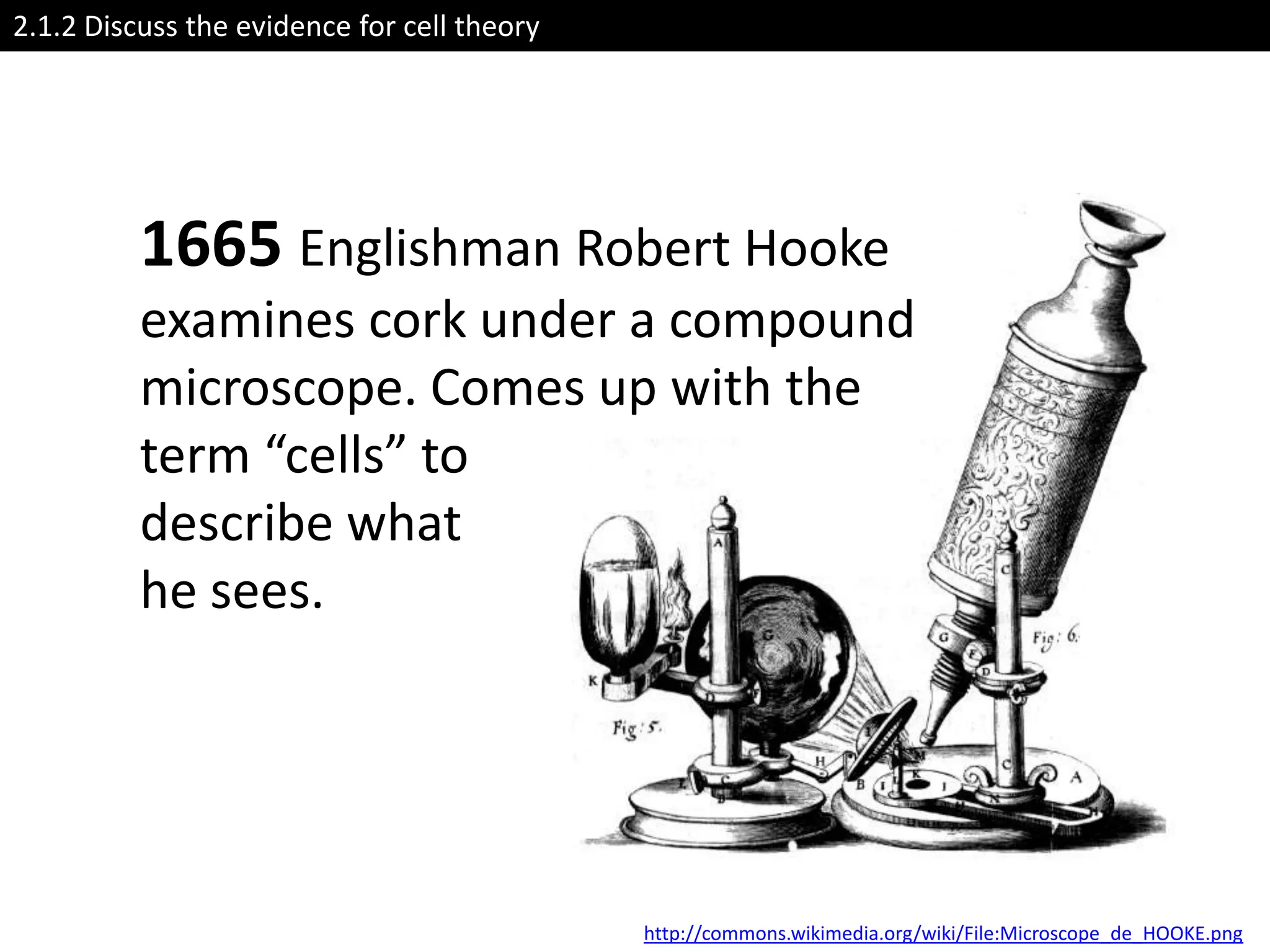
          1665 Englishman Robert Hooke
          examines cork under a compound
          microscope. Comes up with the
          term “cells” to
          describe what
          he sees.


                                             http://commons.wikimedia.org/wiki/File:Microscope_de_HOOKE.png
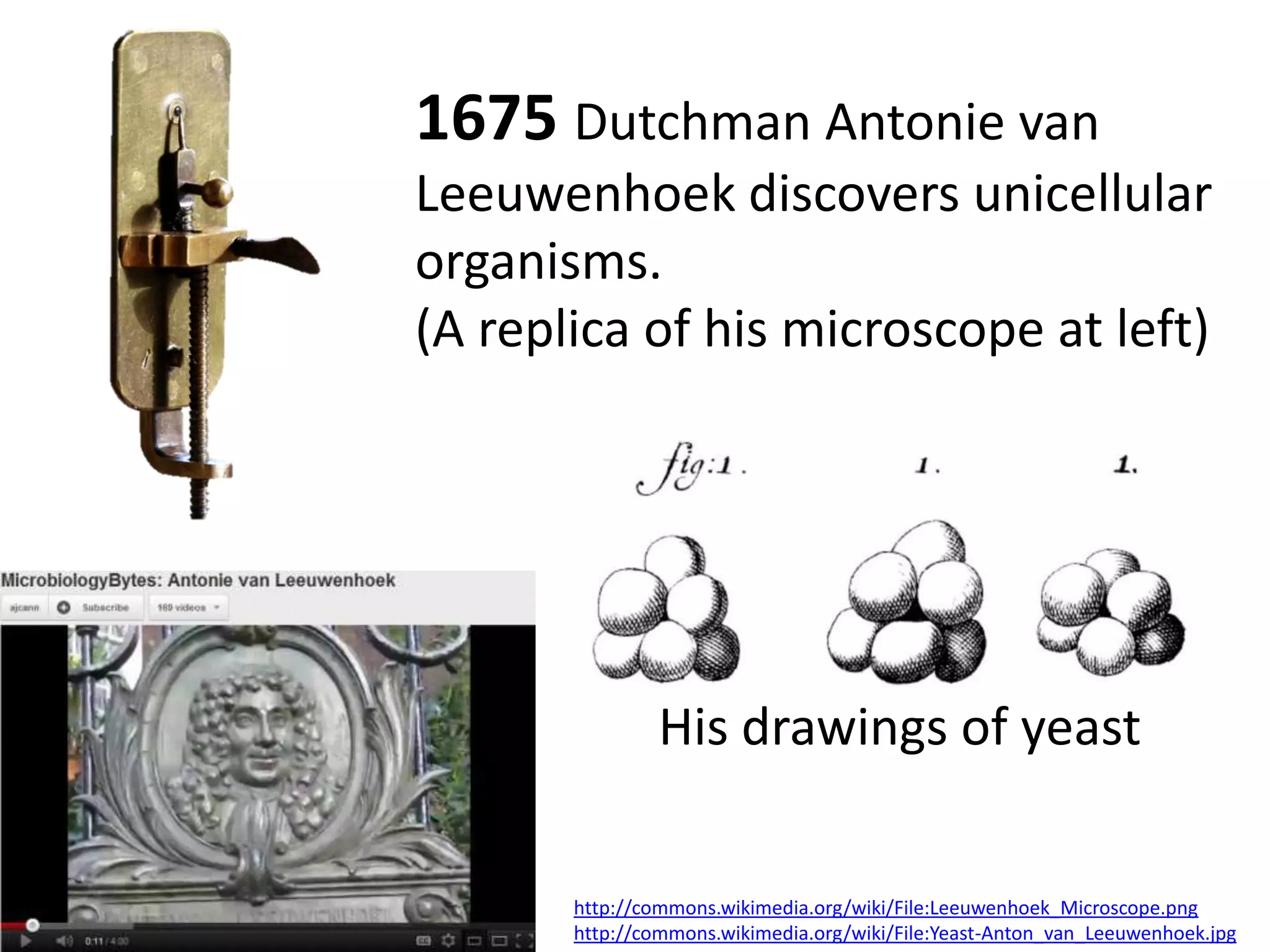
1675 Dutchman Antonie van
Leeuwenhoek discovers unicellular
organisms.
(A replica of his microscope at left)


               His drawings of yeast


       http://commons.wikimedia.org/wiki/File:Leeuwenhoek_Microscope.png
       http://commons.wikimedia.org/wiki/File:Yeast-Anton_van_Leeuwenhoek.jpg
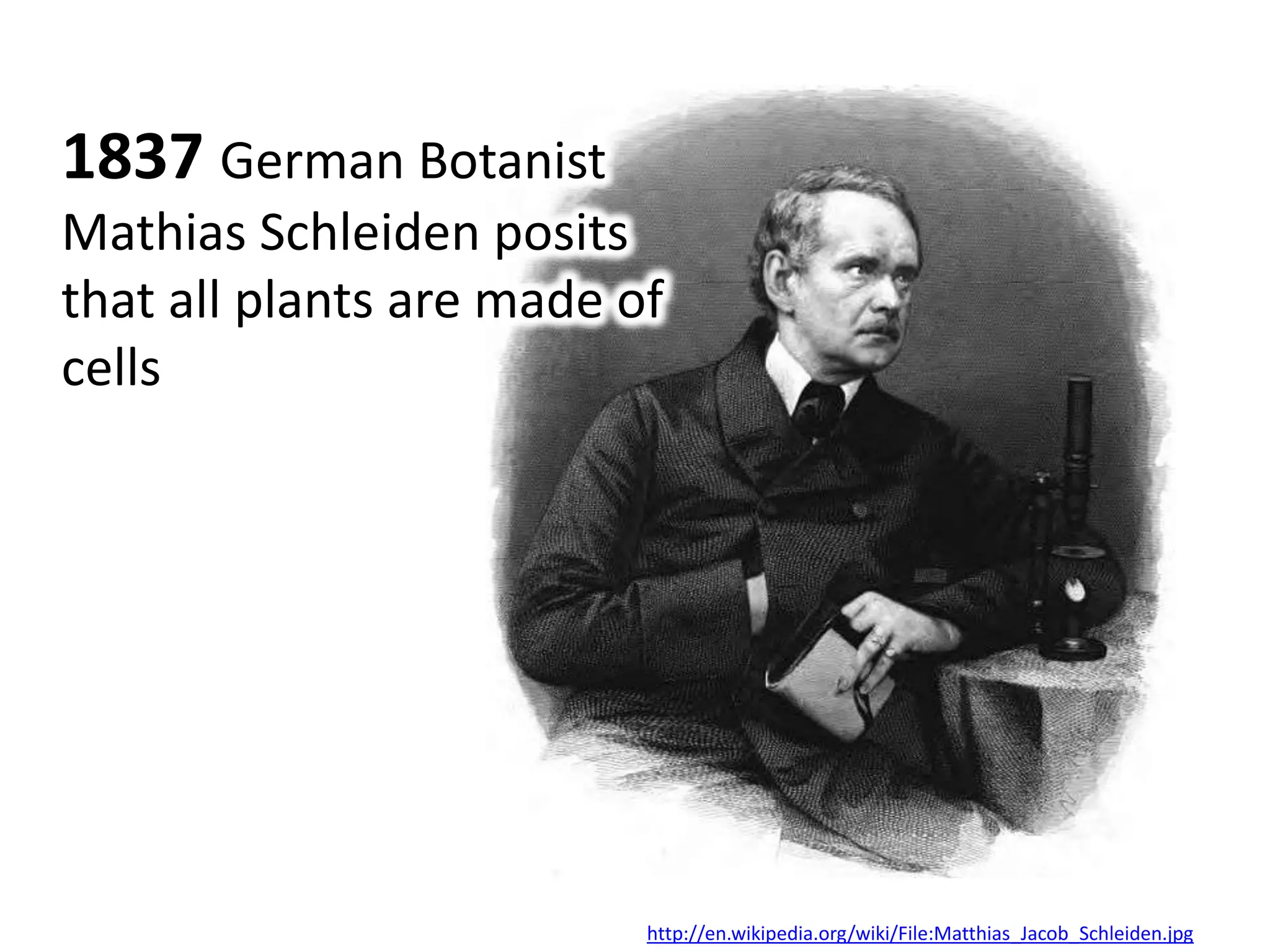
1837 German Botanist
Mathias Schleiden posits
that all plants are made of
cells


                          http://en.wikipedia.org/wiki/File:Matthias_Jacob_Schleiden.jpg
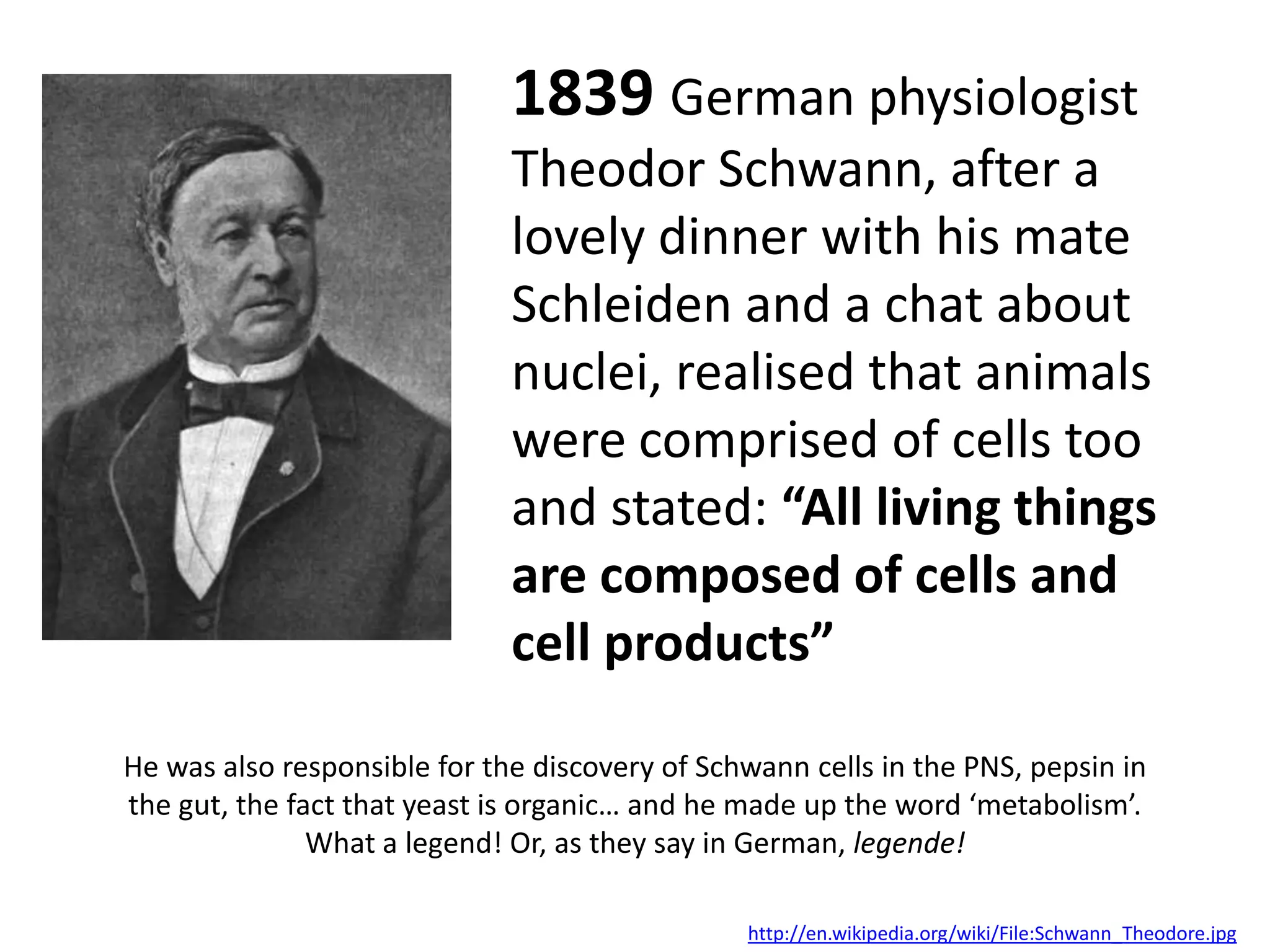
1839 German physiologist
                              Theodor Schwann, after a
                              lovely dinner with his mate
                              Schleiden and a chat about
                              nuclei, realised that animals
                              were comprised of cells too
                              and stated: “All living things
                              are composed of cells and
                              cell products”

He was also responsible for the discovery of Schwann cells in the PNS, pepsin in
the gut, the fact that yeast is organic… and he made up the word ‘metabolism’.
               What a legend! Or, as they say in German, legende!

                                                http://en.wikipedia.org/wiki/File:Schwann_Theodore.jpg
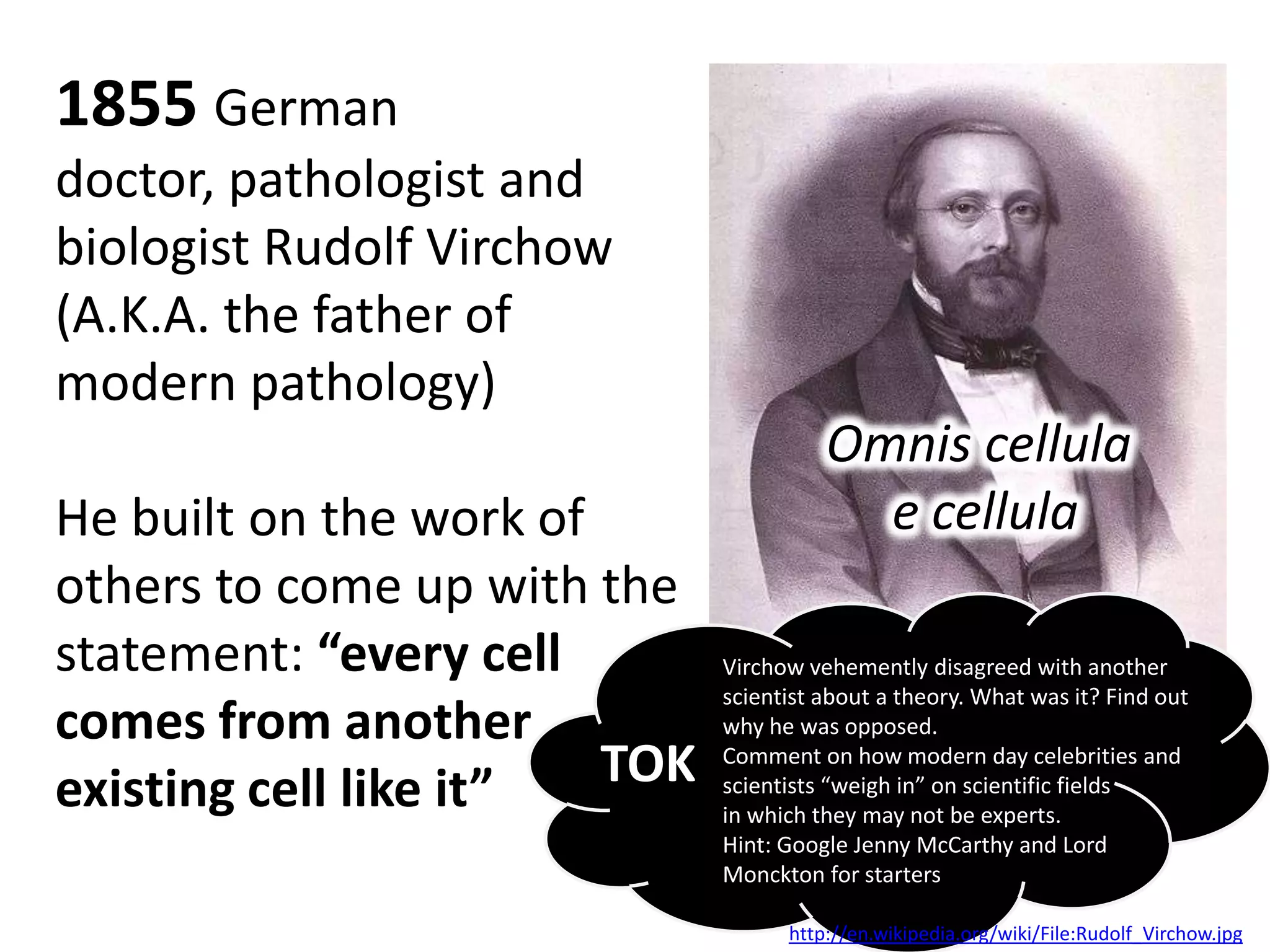
1855 German
doctor, pathologist and
biologist Rudolf Virchow
(A.K.A. the father of
modern pathology)
                                        Omnis cellula
He built on the work of                   e cellula
others to come up with the
statement: “every cell        Virchow vehemently disagreed with another
                              scientist about a theory. What was it? Find out
comes from another            why he was opposed.
existing cell like it”  TOK   Comment on how modern day celebrities and
                              scientists “weigh in” on scientific fields
                              in which they may not be experts.
                              Hint: Google Jenny McCarthy and Lord
                              Monckton for starters

                                    http://en.wikipedia.org/wiki/File:Rudolf_Virchow.jpg
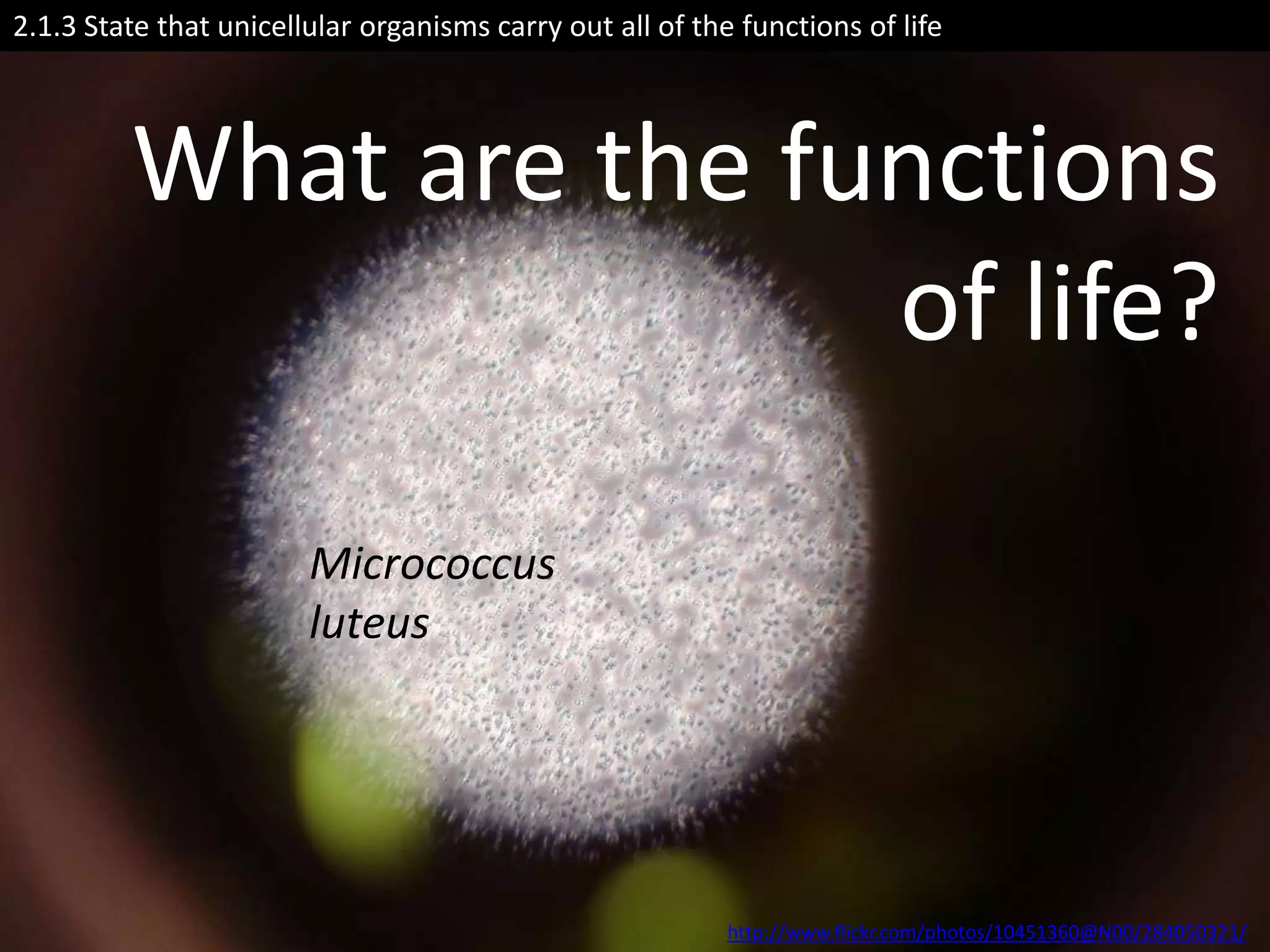
2.1.3 State that unicellular organisms carry out all of the functions of life


         What are the functions
                        of life?

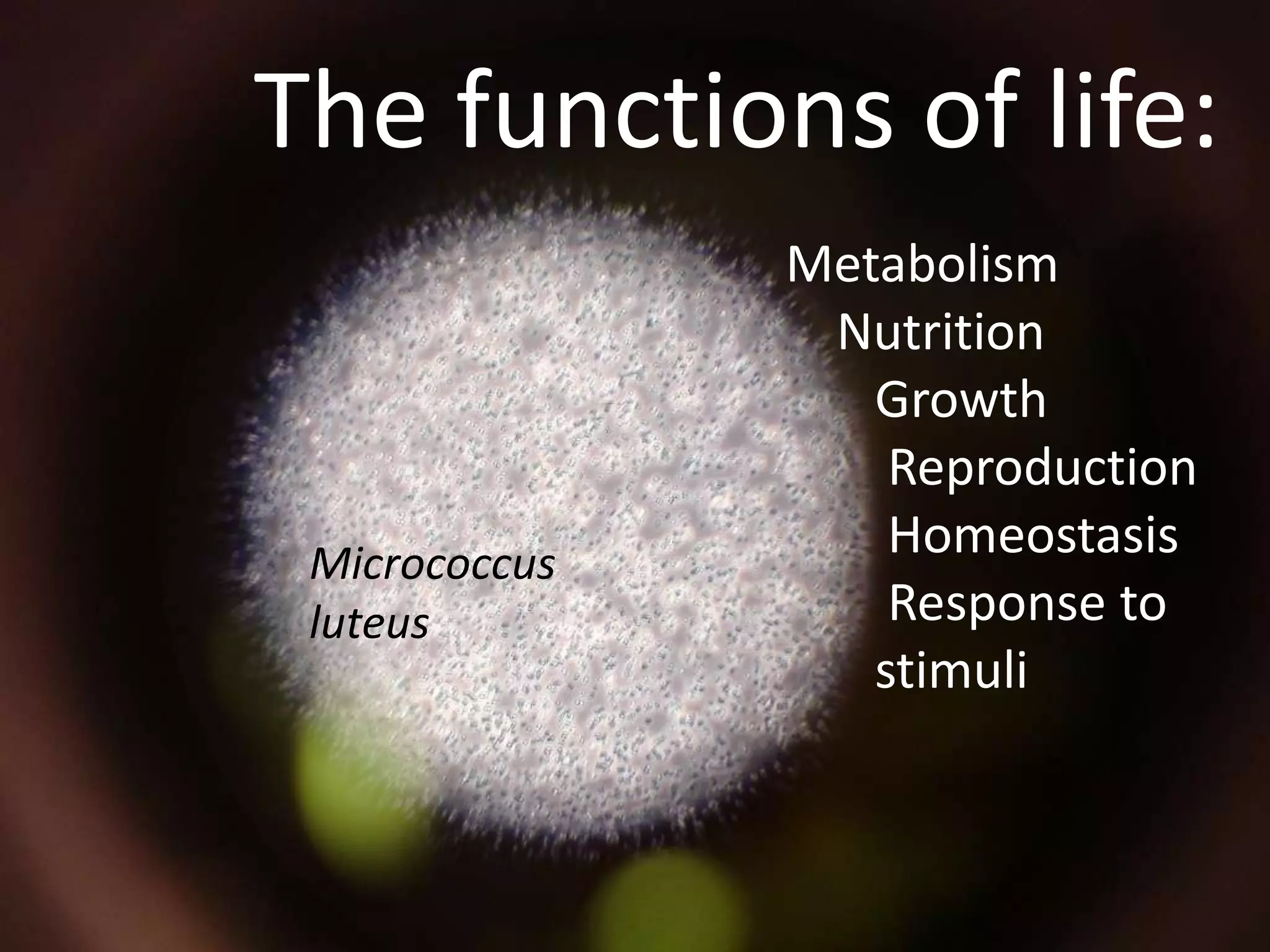
                        Micrococcus
                        luteus


                                                           http://www.flickr.com/photos/10451360@N00/284050321/
The functions of life:
               Metabolism
                Nutrition
                  Growth
                   Reproduction
 Micrococcus
                   Homeostasis
 luteus            Response to
                  stimuli
2.1.4 Compare the relative size of molecules, cell membrane thickness, viruses, bacteria,
organelles and cells, using appropriate SI units


      Use the


                 10x
                                                        rule

                                                               of

                                                          thumb


                                                             http://www.flickr.com/photos/sanna_nixi/799023133/
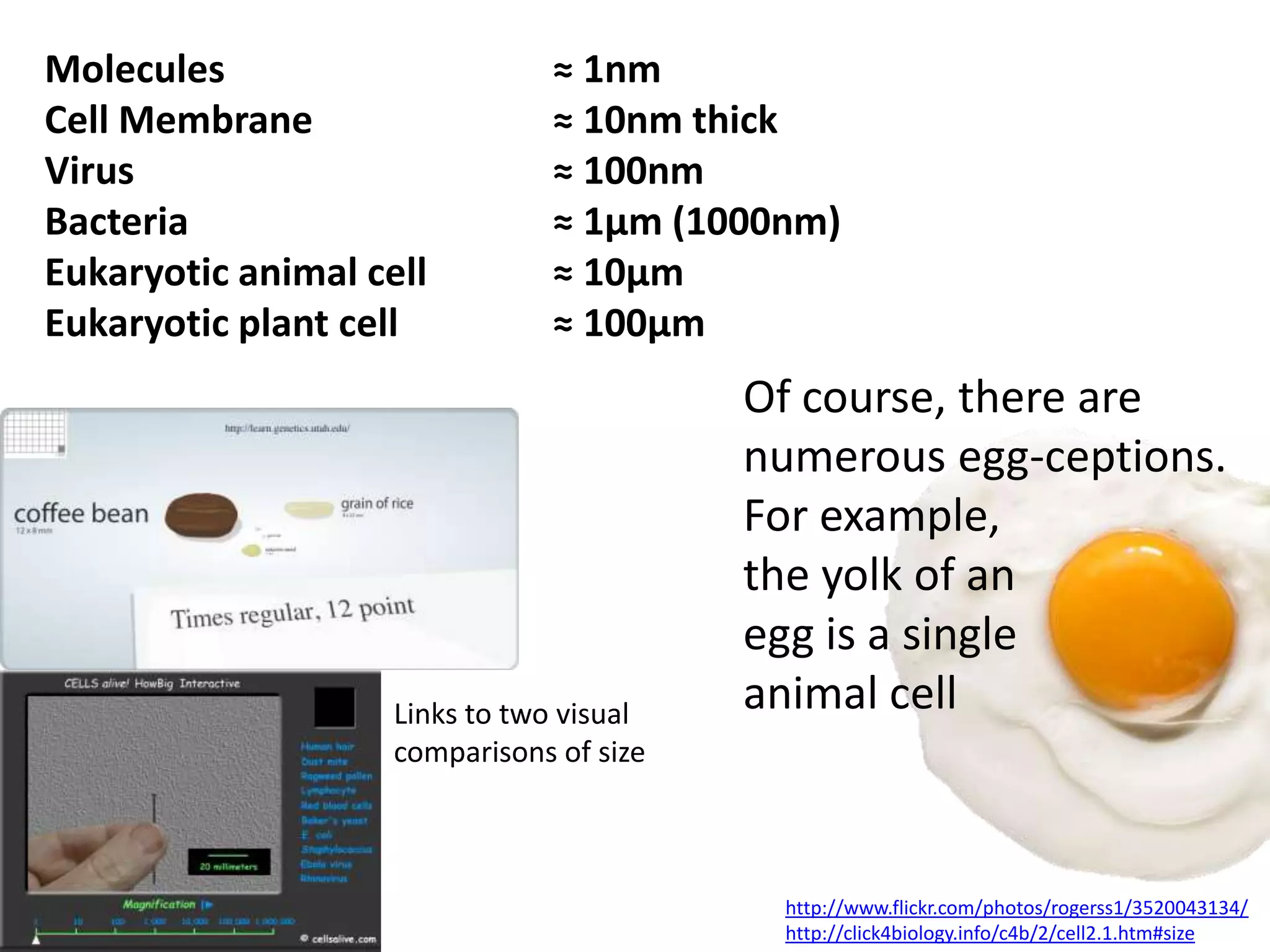
Molecules                      ≈ 1nm
Cell Membrane                  ≈ 10nm thick
Virus                          ≈ 100nm
Bacteria                       ≈ 1μm (1000nm)
Eukaryotic animal cell         ≈ 10μm
Eukaryotic plant cell          ≈ 100μm
                                          Of course, there are
                                          numerous egg-ceptions.
                                          For example,
                                          the yolk of an
                                          egg is a single
                    Links to two visual   animal cell
                    comparisons of size


                                           http://www.flickr.com/photos/rogerss1/3520043134/
                                           http://click4biology.info/c4b/2/cell2.1.htm#size
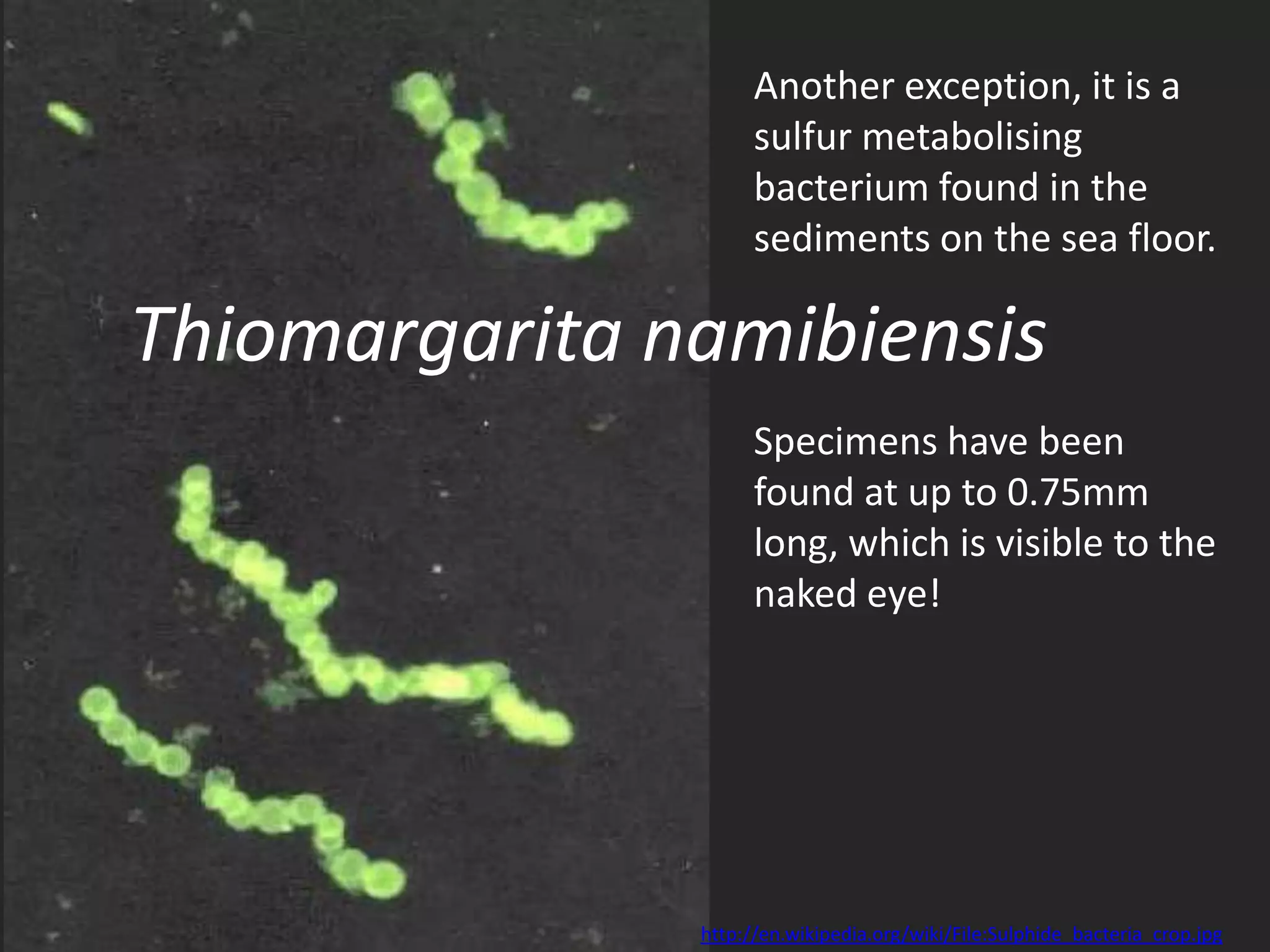
Another exception, it is a
                     sulfur metabolising
                     bacterium found in the
                     sediments on the sea floor.

Thiomargarita namibiensis
                     Specimens have been
                     found at up to 0.75mm
                     long, which is visible to the
                     naked eye!


               http://en.wikipedia.org/wiki/File:Sulphide_bacteria_crop.jpg
2.1.5 Calculate linear magnification of drawings and the actual size of specimens in images of
known magnification


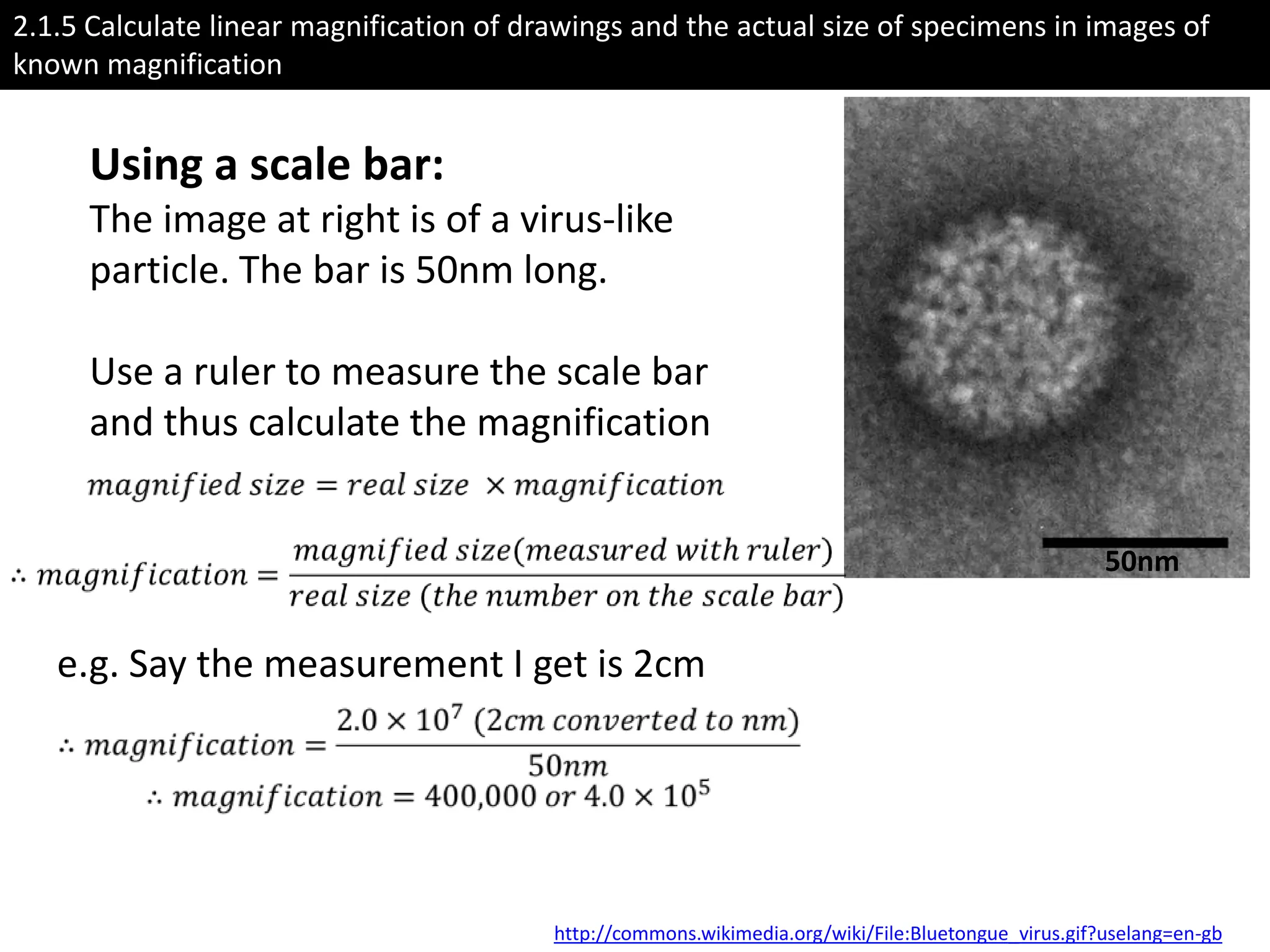
      Using a scale bar:
      The image at right is of a virus-like
      particle. The bar is 50nm long.

      Use a ruler to measure the scale bar
      and thus calculate the magnification


                                                                                                      50nm


   e.g. Say the measurement I get is 2cm


                                          http://commons.wikimedia.org/wiki/File:Bluetongue_virus.gif?uselang=en-gb
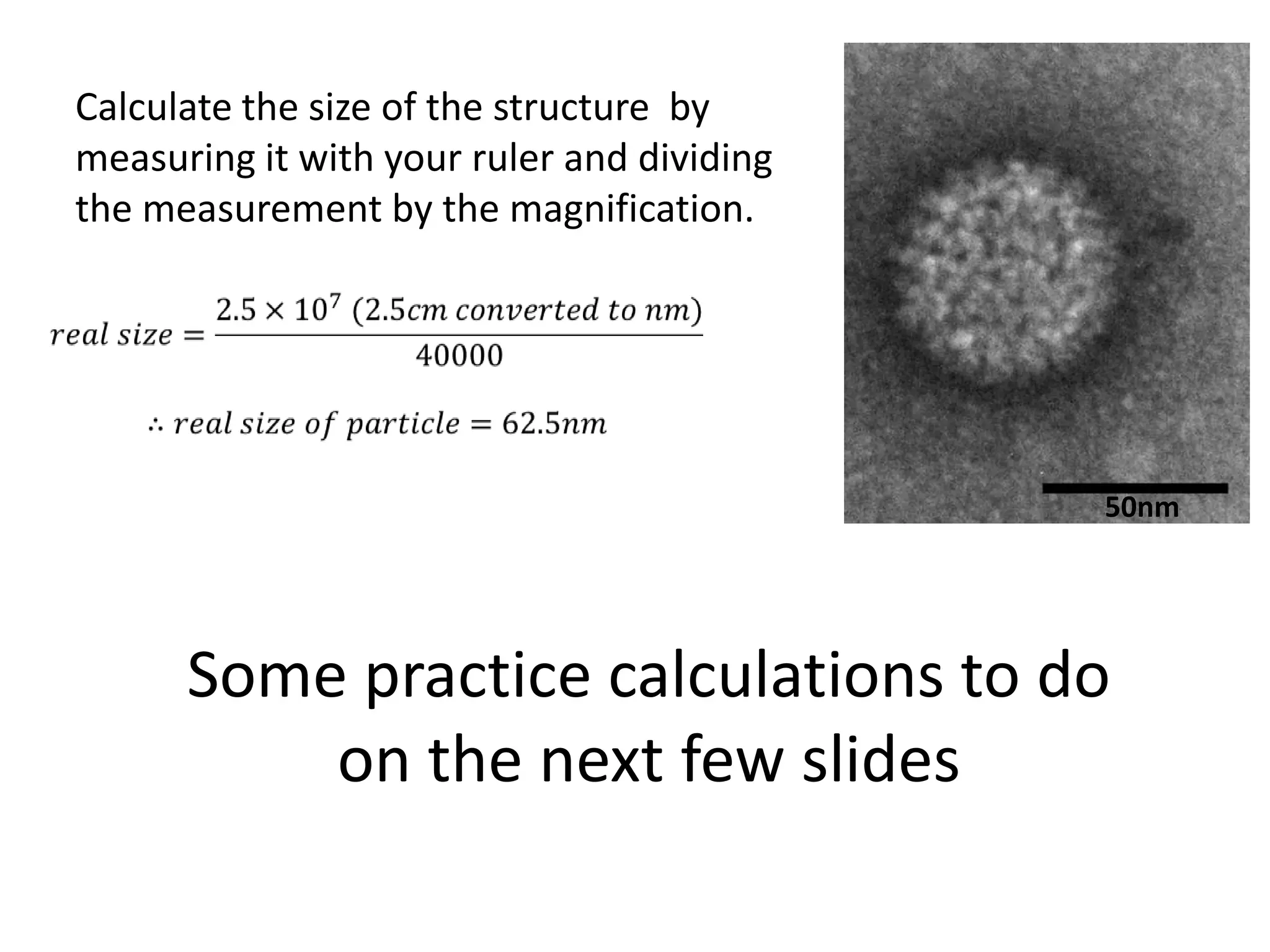
Calculate the size of the structure by
measuring it with your ruler and dividing
the measurement by the magnification.


                                            50nm


      Some practice calculations to do
          on the next few slides
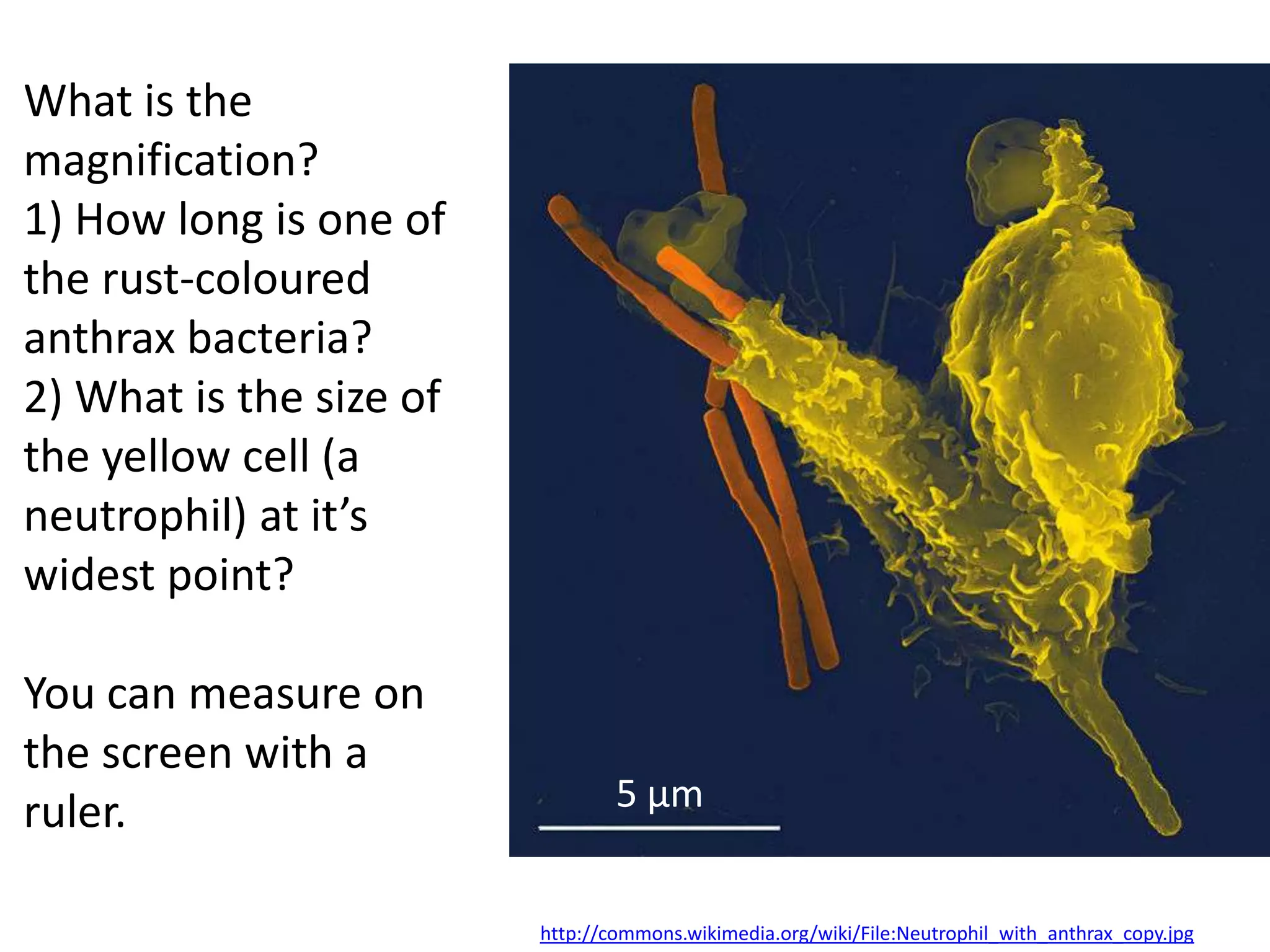
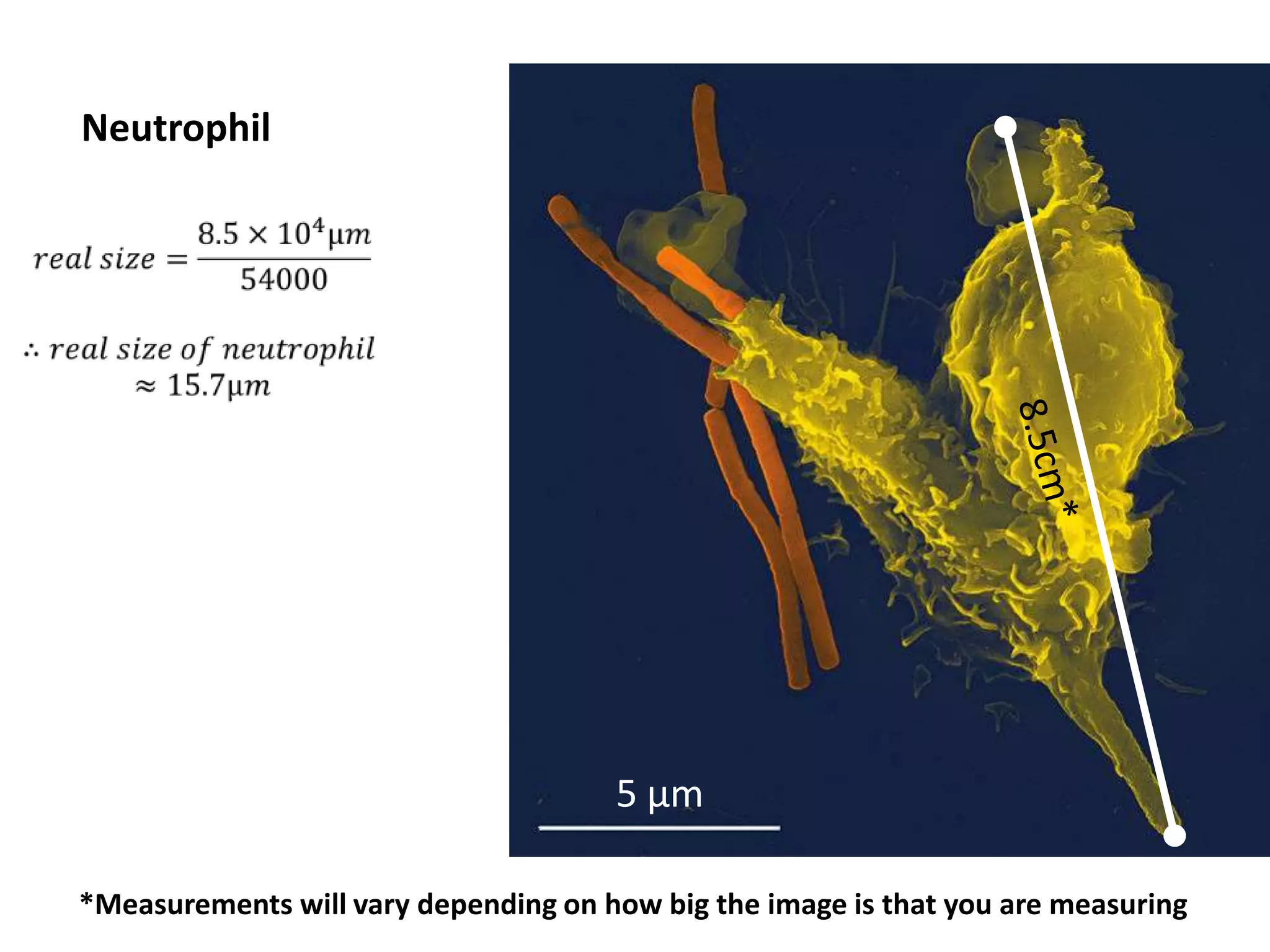
What is the
magnification?
1) How long is one of
the rust-coloured
anthrax bacteria?
2) What is the size of
the yellow cell (a
neutrophil) at it’s
widest point?

You can measure on
the screen with a
ruler.                           5 μm


                         http://commons.wikimedia.org/wiki/File:Neutrophil_with_anthrax_copy.jpg
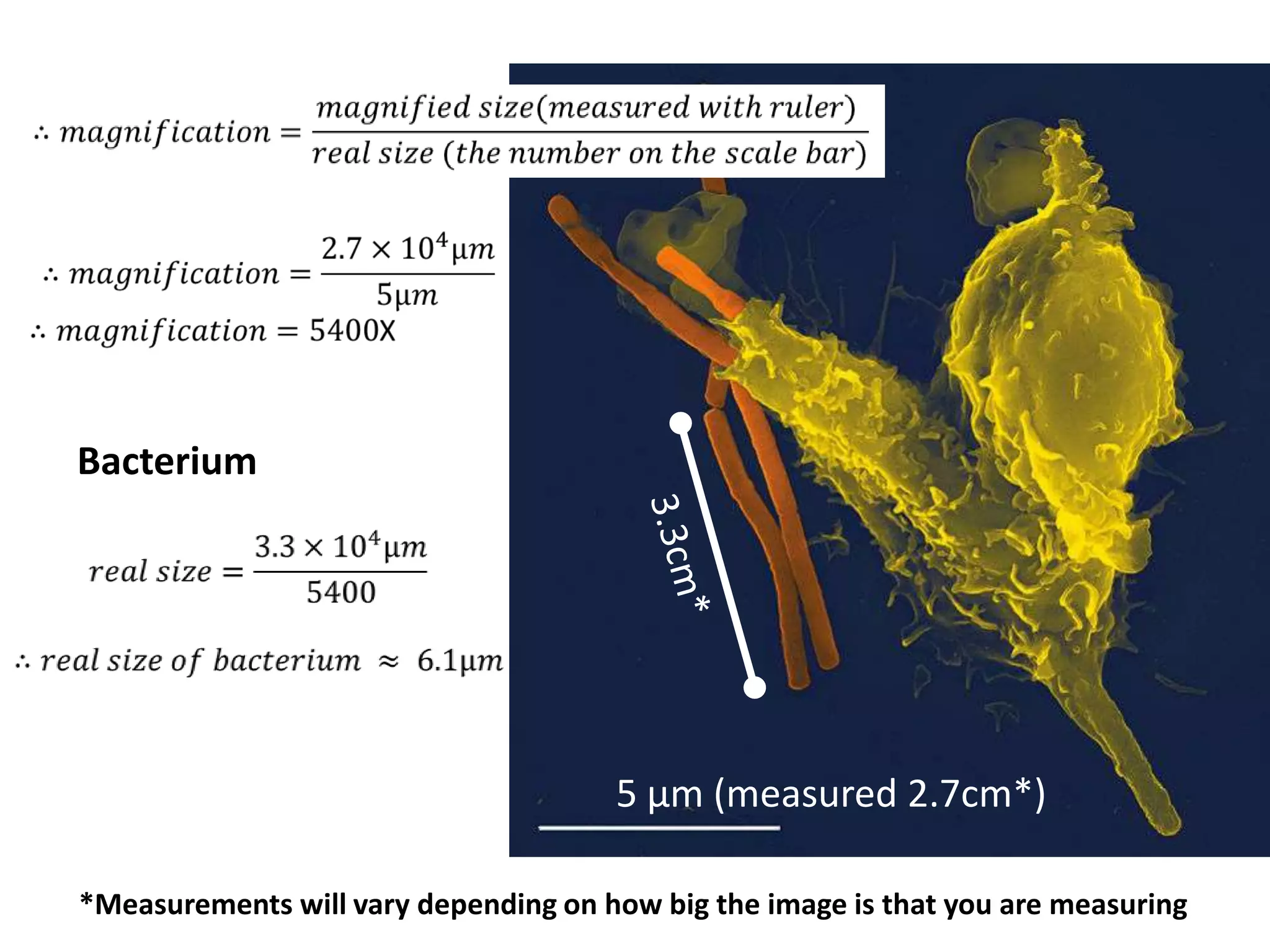
Bacterium


                                      5 μm (measured 2.7cm*)

*Measurements will vary depending on how big the image is that you are measuring
Neutrophil


                                      5 μm

*Measurements will vary depending on how big the image is that you are measuring
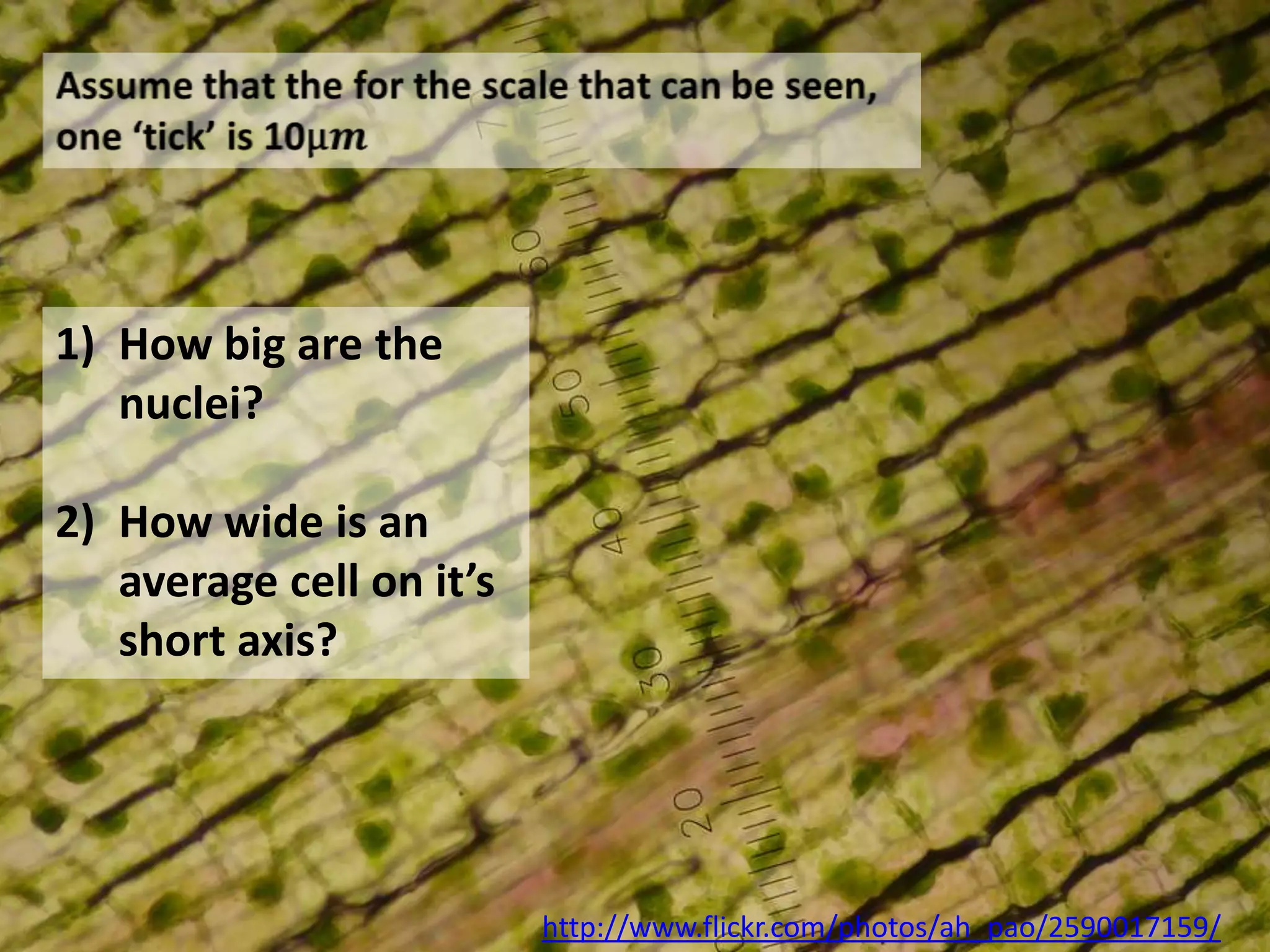
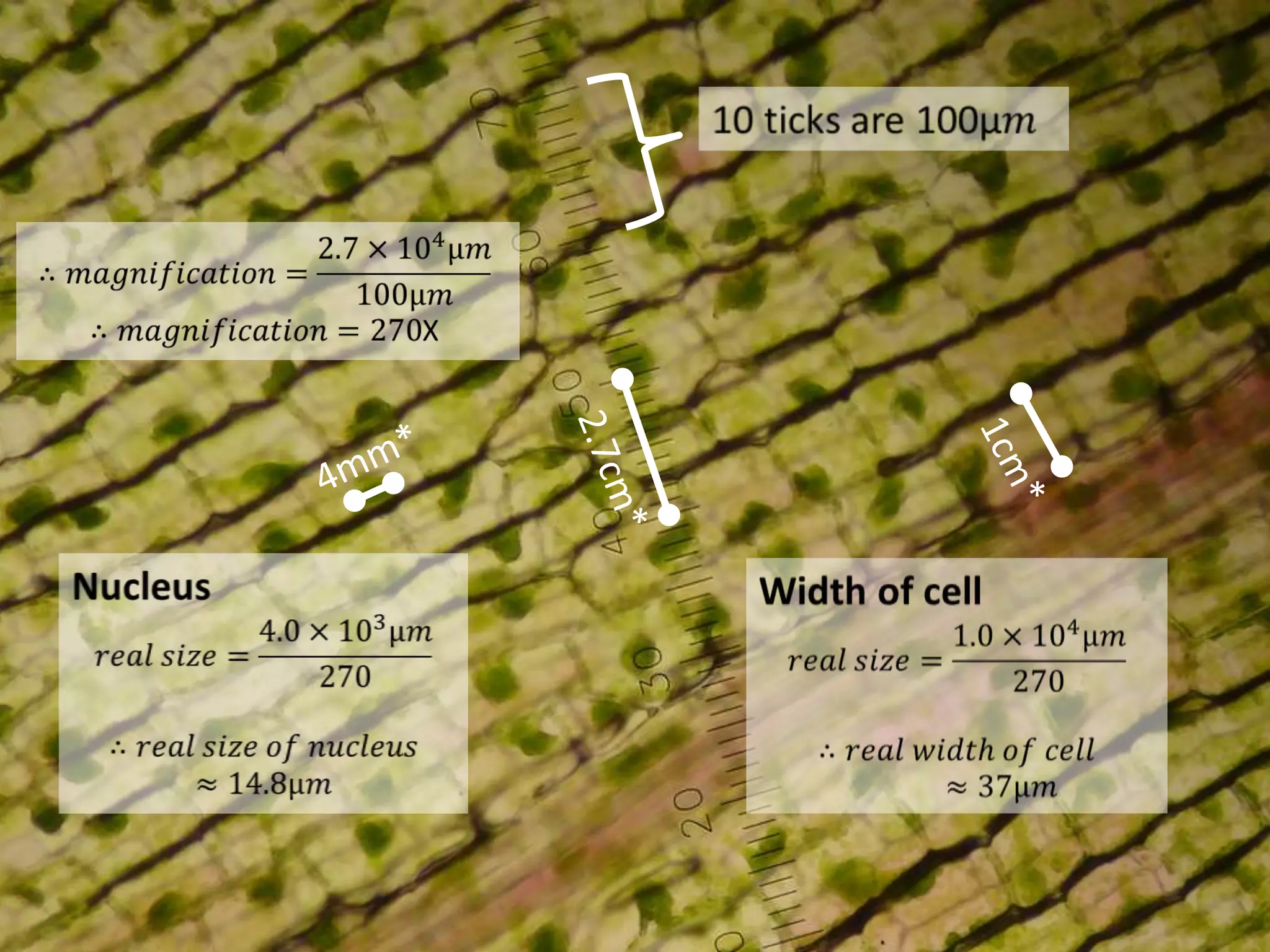
1) How big are the
   nuclei?

2) How wide is an
   average cell on it’s
   short axis?


                          http://www.flickr.com/photos/ah_pao/2590017159/
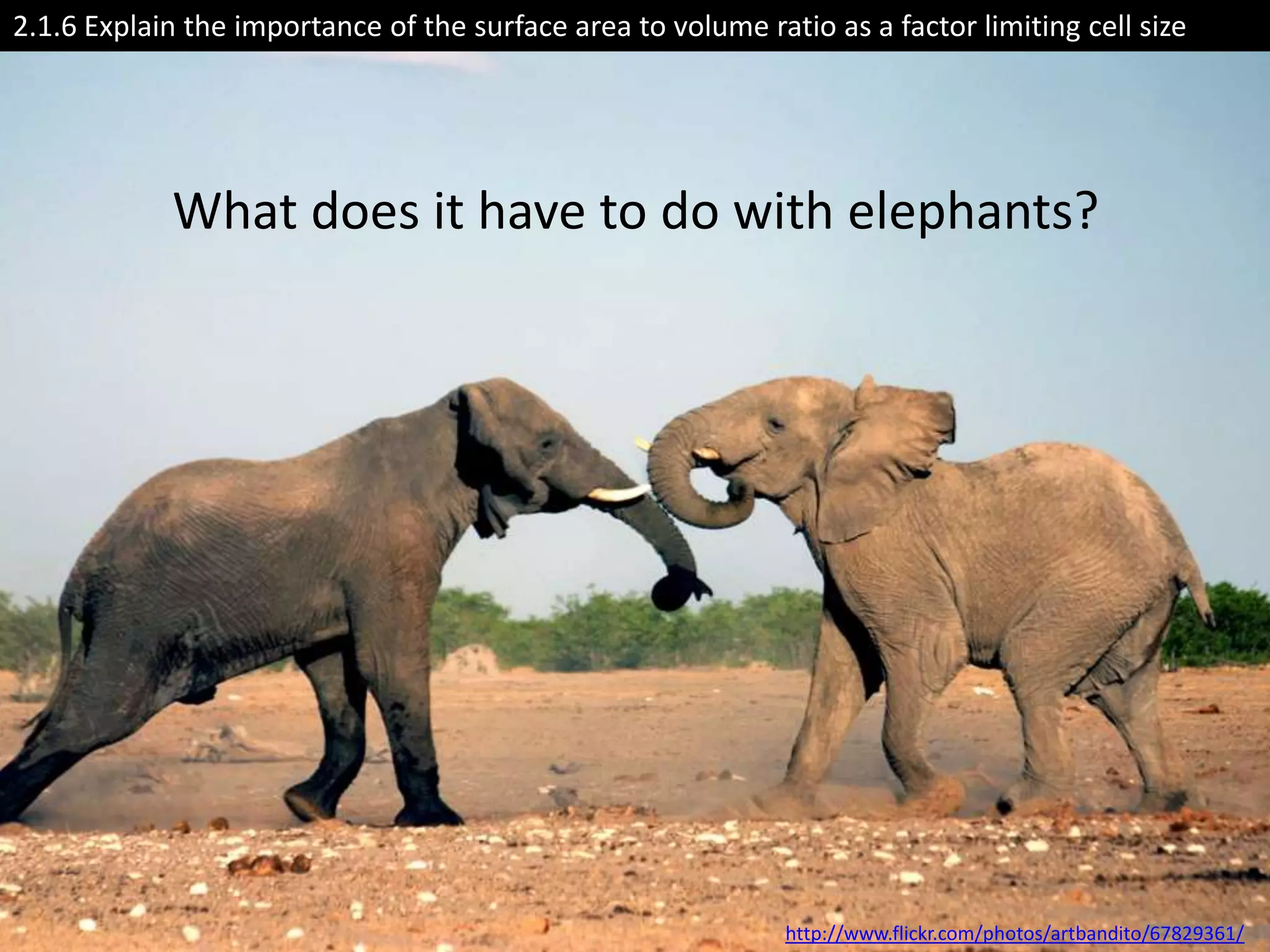
2.1.6 Explain the importance of the surface area to volume ratio as a factor limiting cell size


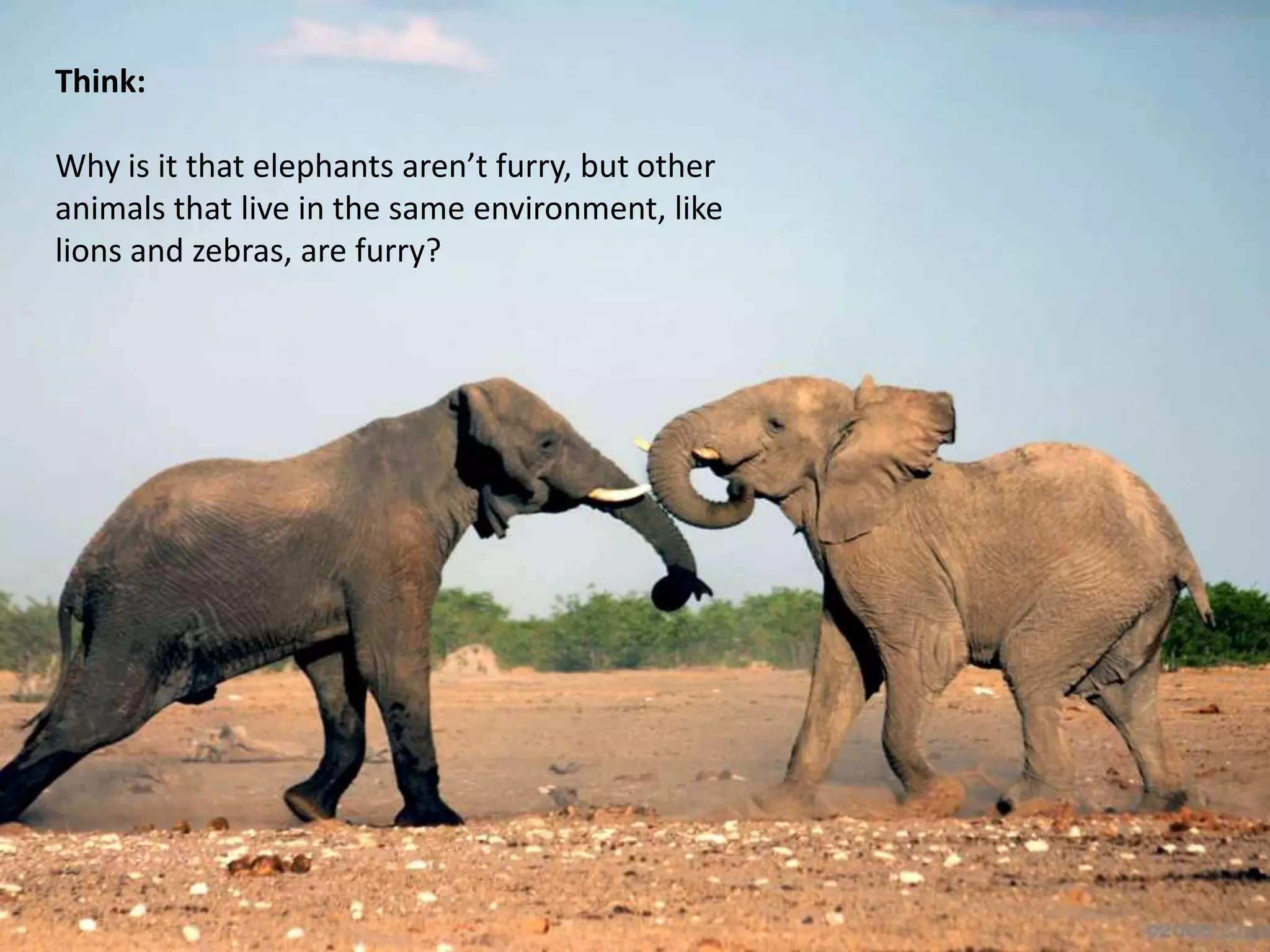
            What does it have to do with elephants?


                                                              http://www.flickr.com/photos/artbandito/67829361/
Think:

Why is it that elephants aren’t furry, but other
animals that live in the same environment, like
lions and zebras, are furry?
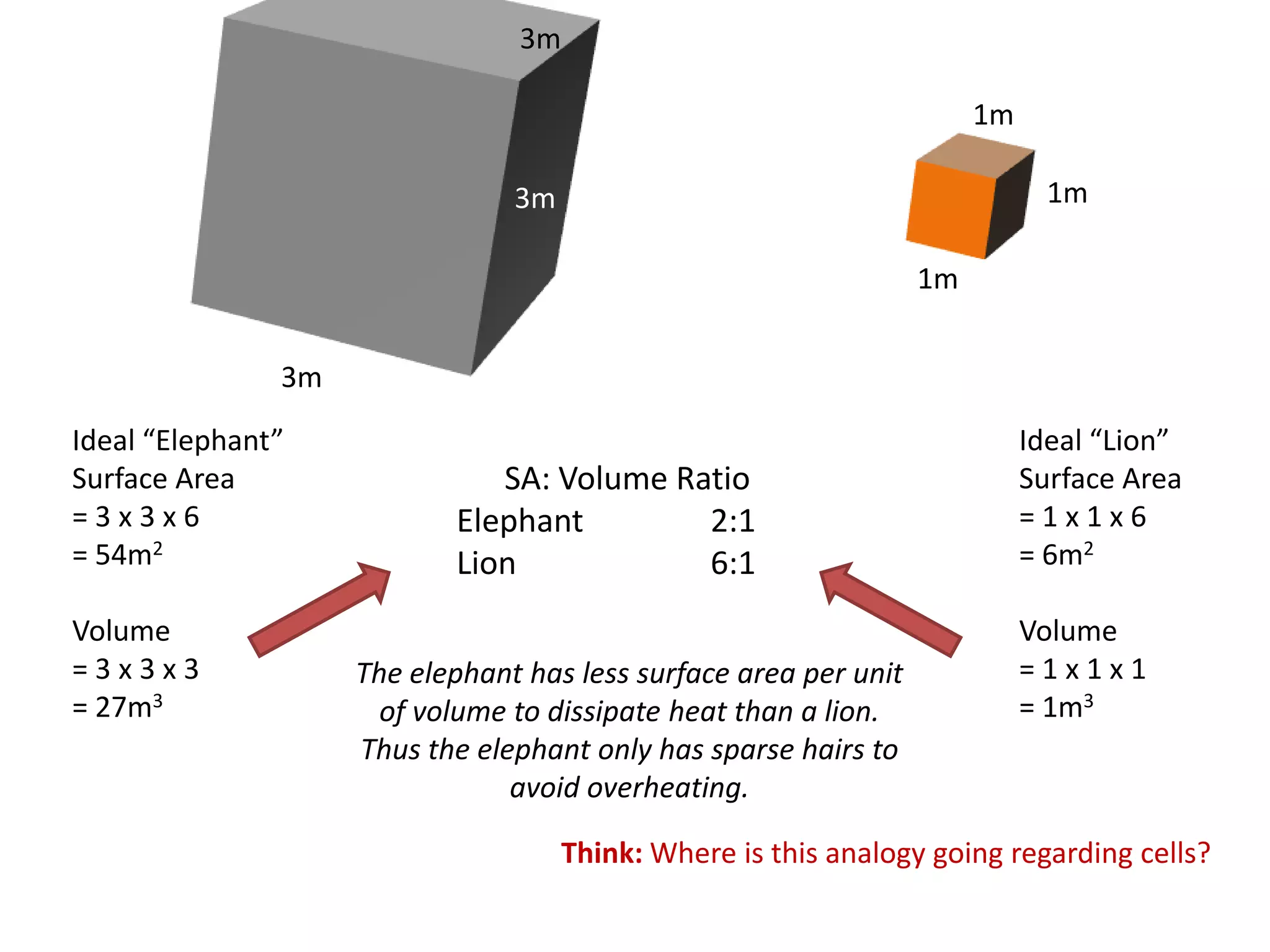
3m

                                                                       1m

                                3m                                            1m

                                                                  1m


               3m
Ideal “Elephant”                                                            Ideal “Lion”
Surface Area                  SA: Volume Ratio                              Surface Area
=3x3x6                     Elephant        2:1                              =1x1x6
= 54m2                     Lion            6:1                              = 6m2

Volume                                                                      Volume
=3x3x3              The elephant has less surface area per unit             =1x1x1
= 27m3                of volume to dissipate heat than a lion.              = 1m3
                    Thus the elephant only has sparse hairs to
                                avoid overheating.

                                     Think: Where is this analogy going regarding cells?
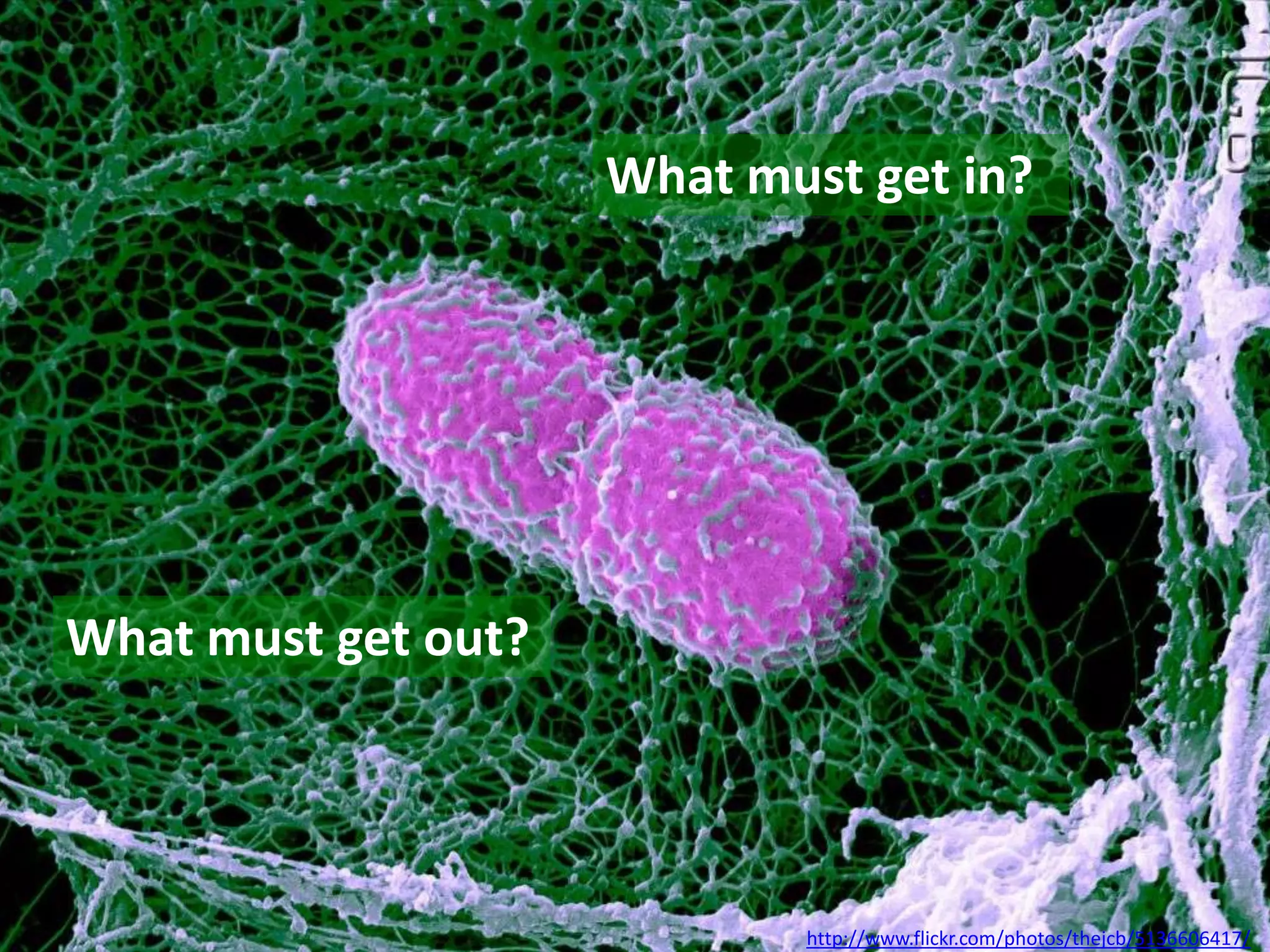
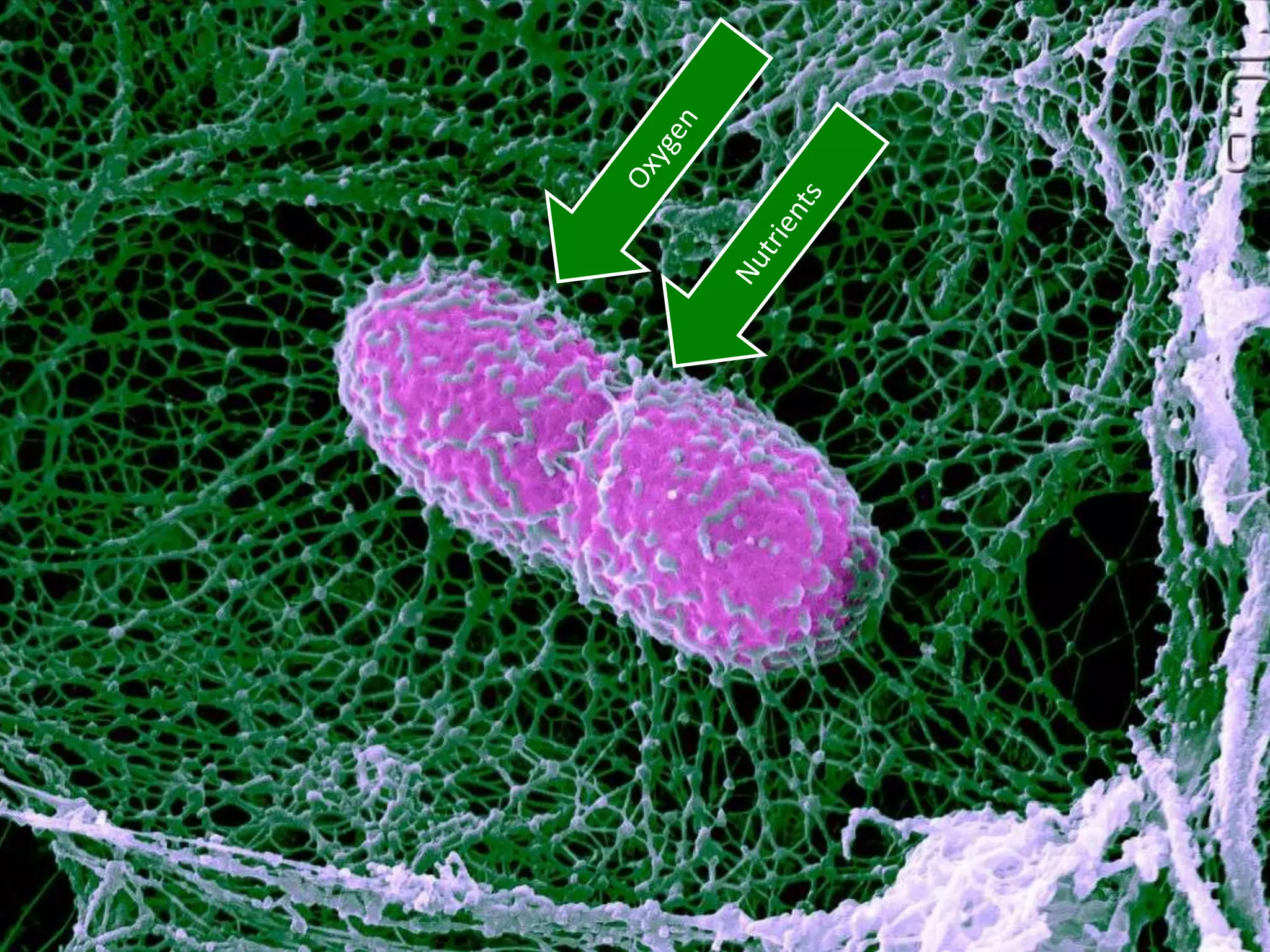
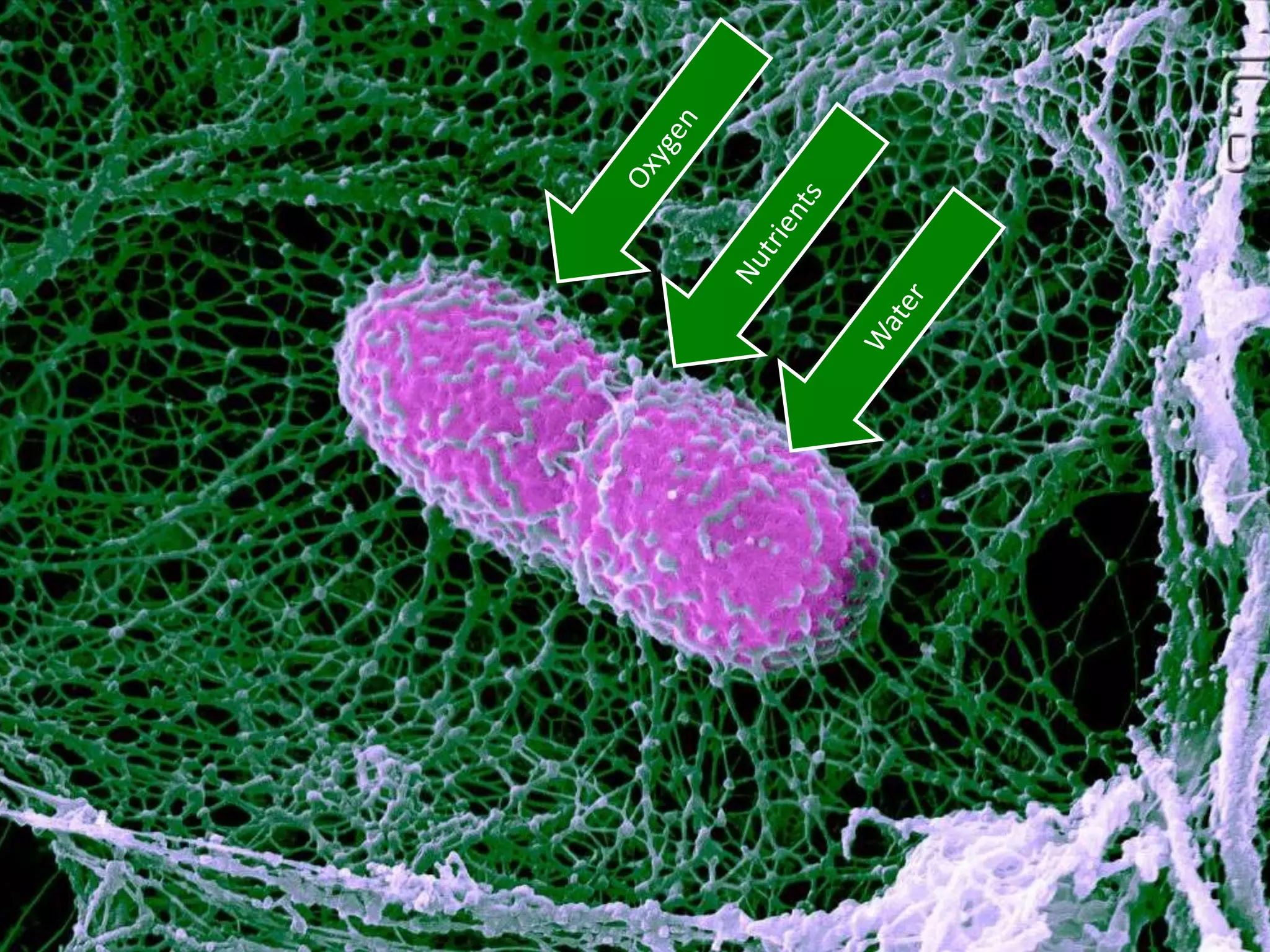
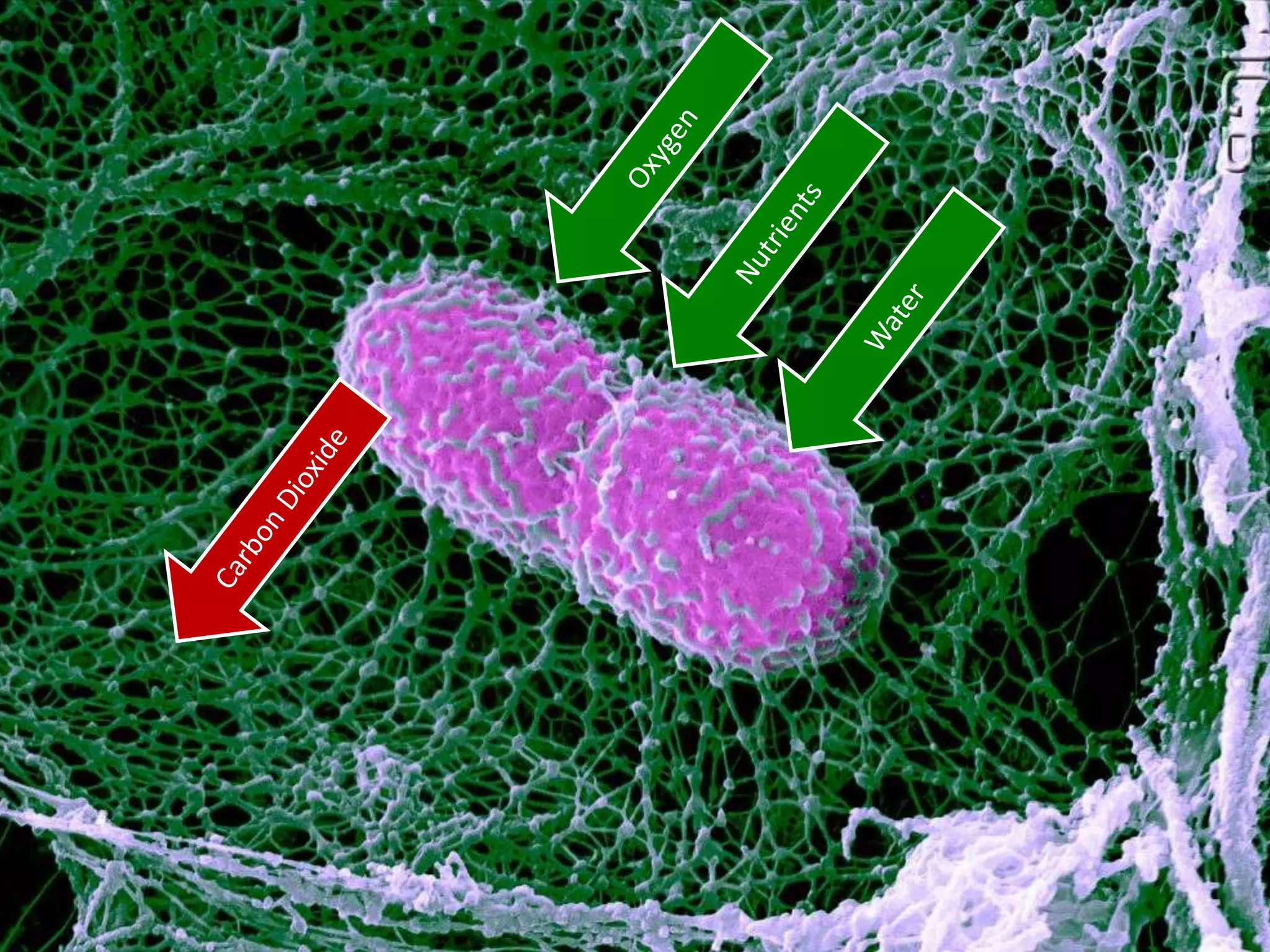
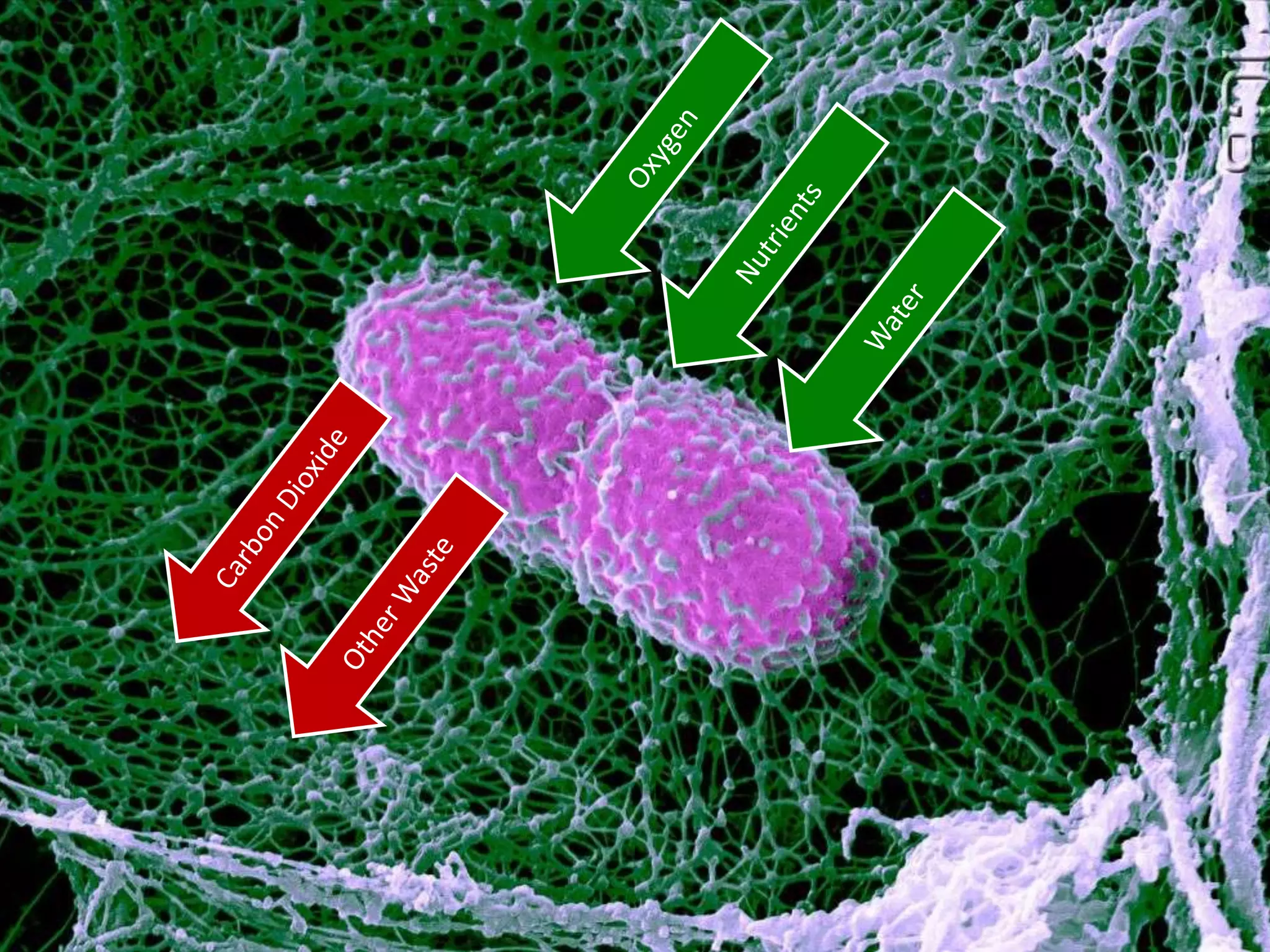
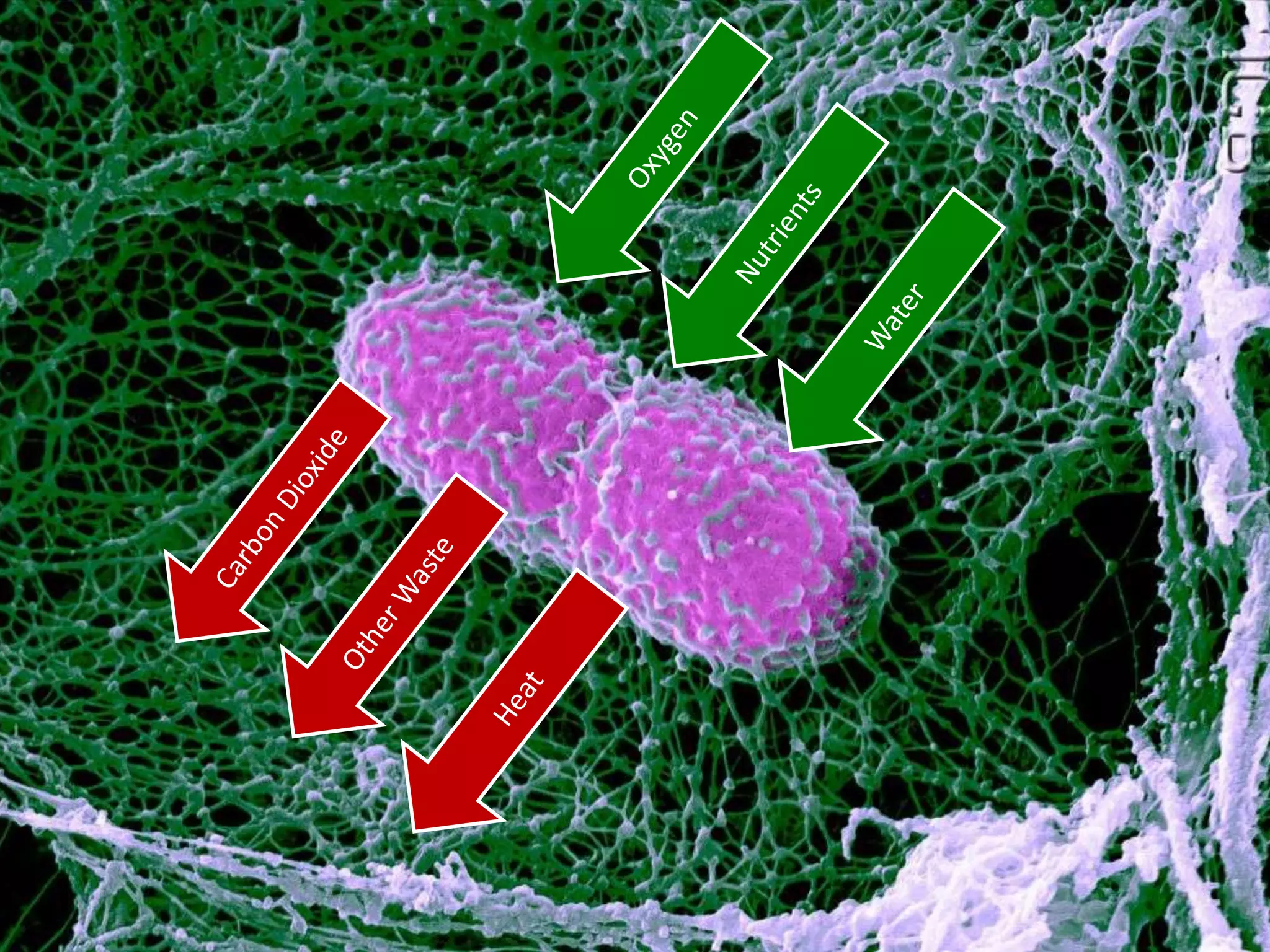
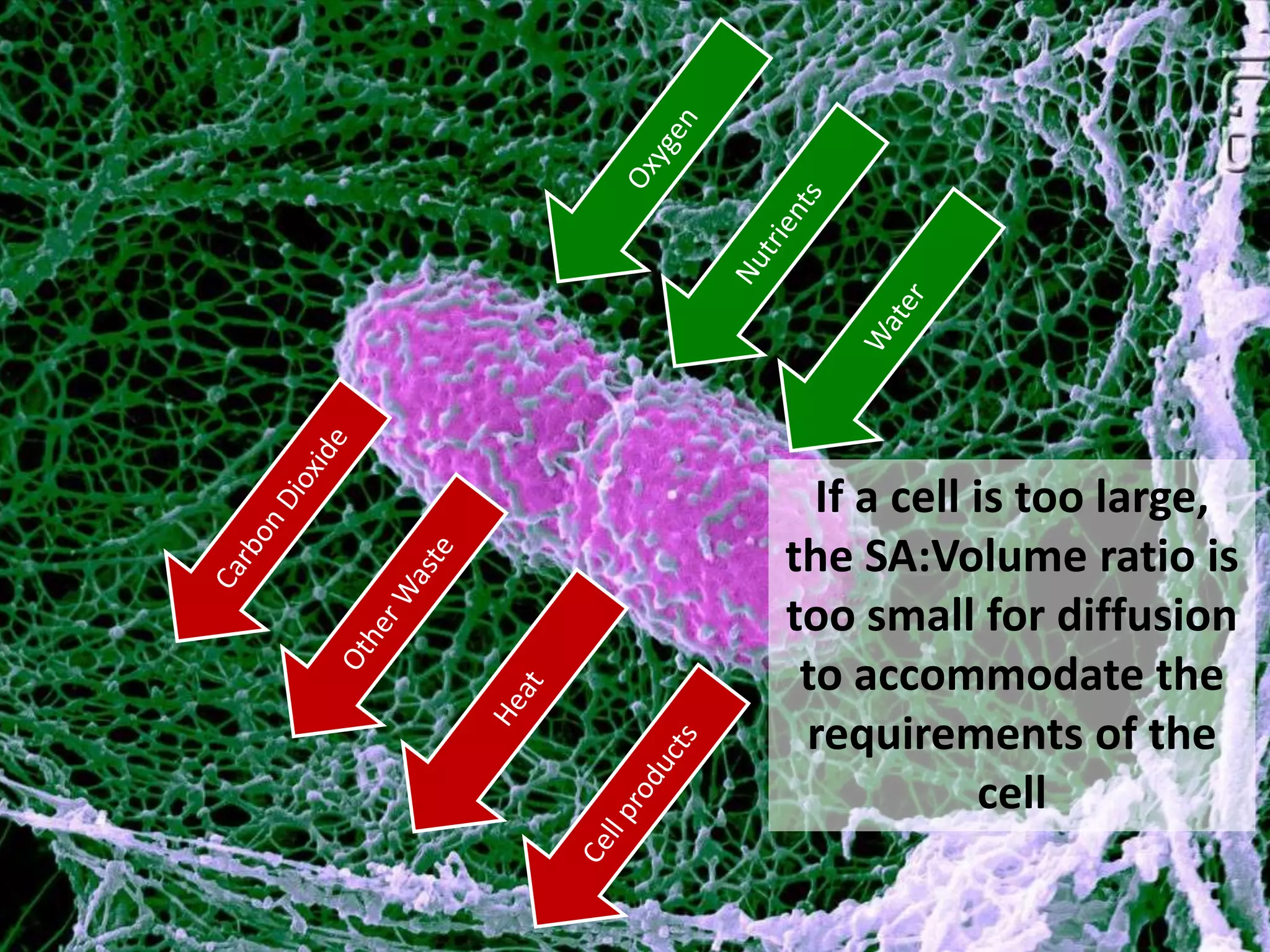
What must get in?


What must get out?


                            http://www.flickr.com/photos/thejcb/5136606417/
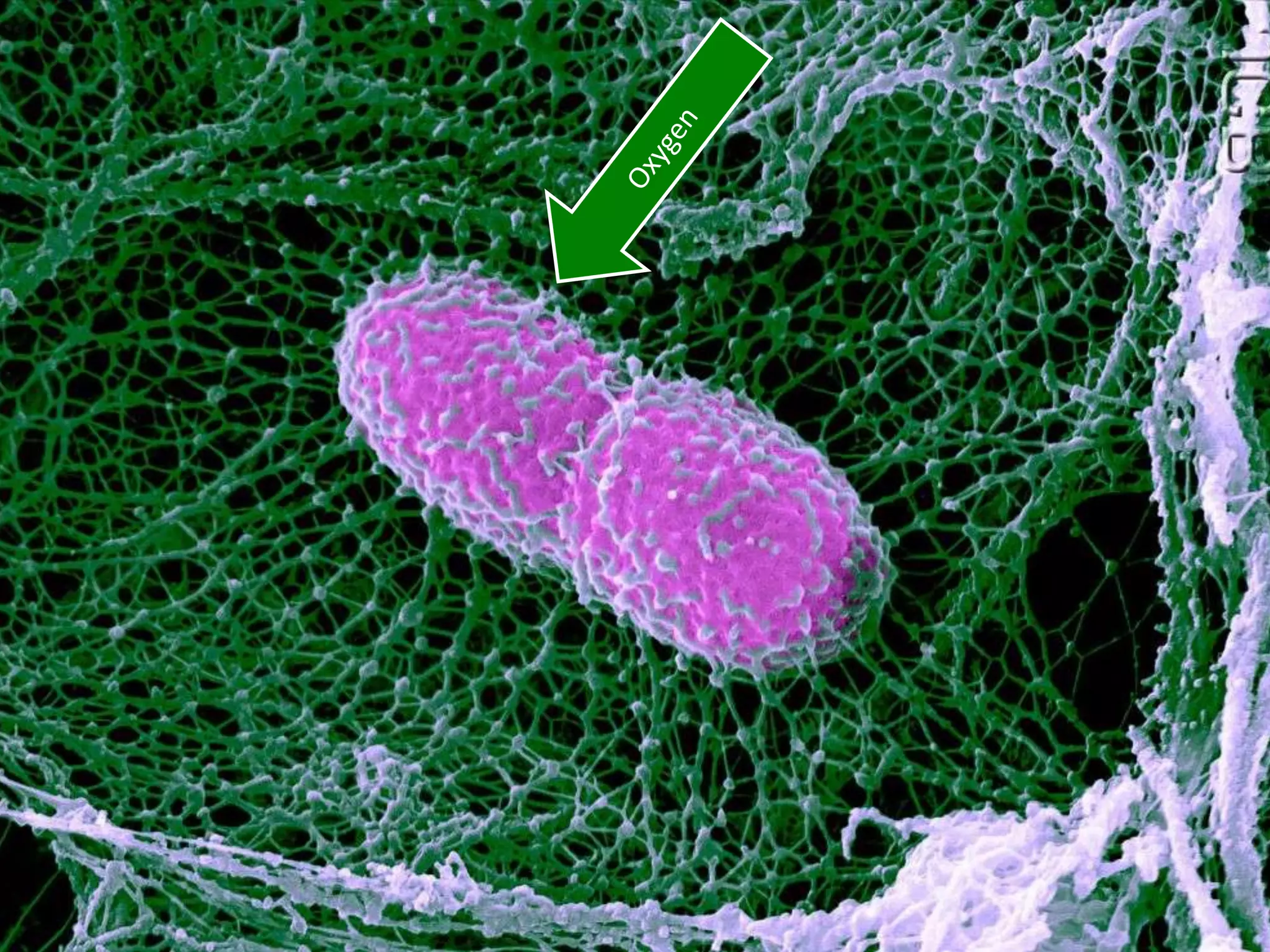
If a cell is too large,
the SA:Volume ratio is
too small for diffusion
 to accommodate the
 requirements of the
            cell
Cells can get around this problem by
growing projections, having a flattened
form, or being long and thin.

Multicellular organisms have developed
circulatory systems to deliver nutrients
and oxygen and remove wastes.
Exchange structures with large surface
areas, such as the lungs and the
gut, have evolved.
2.1.7 State that multicellular organisms show emergent properties.


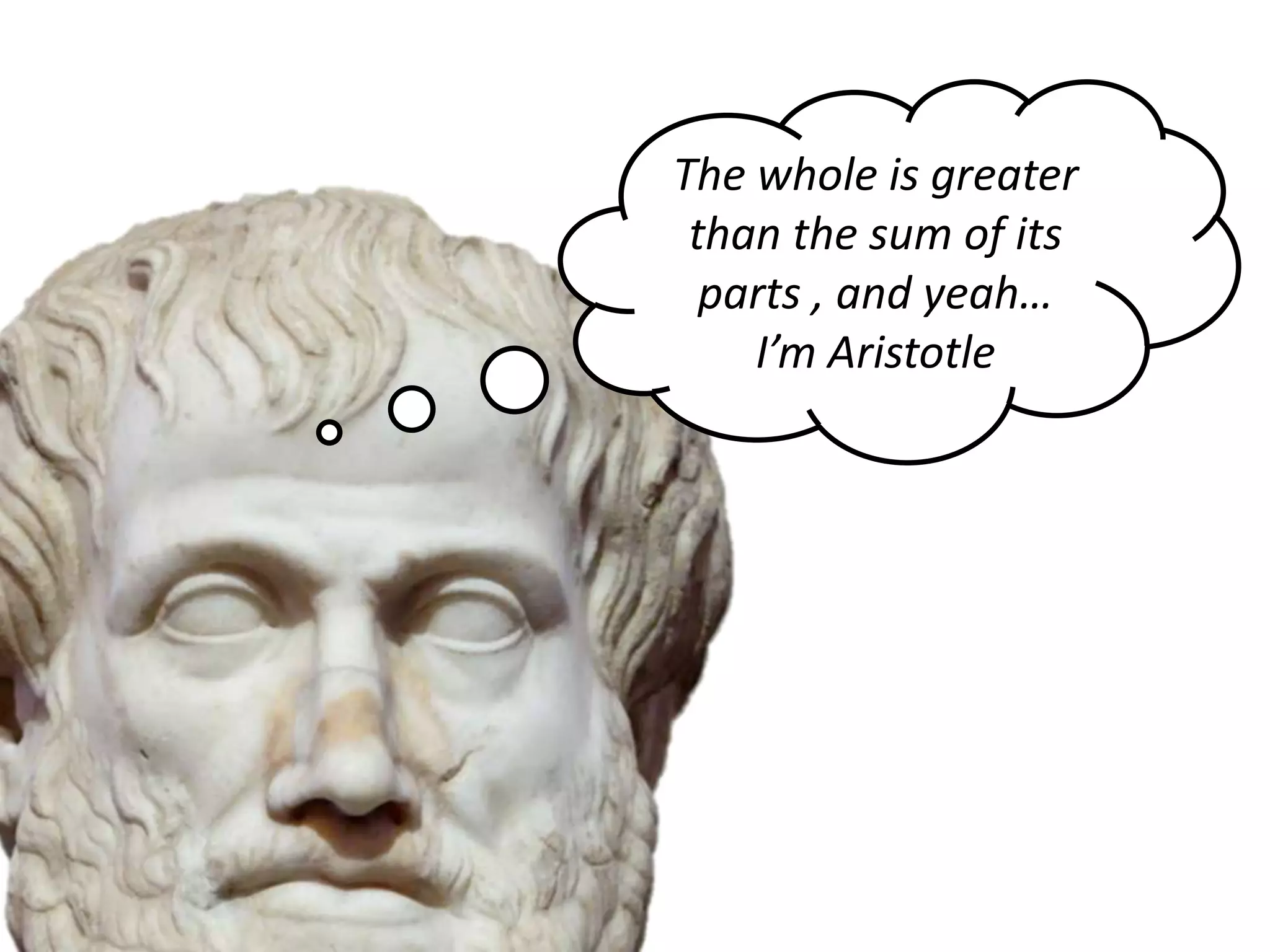
                                             http://commons.wikimedia.org/wiki/File:Aristotle_Altemps_Inv8575.jpg
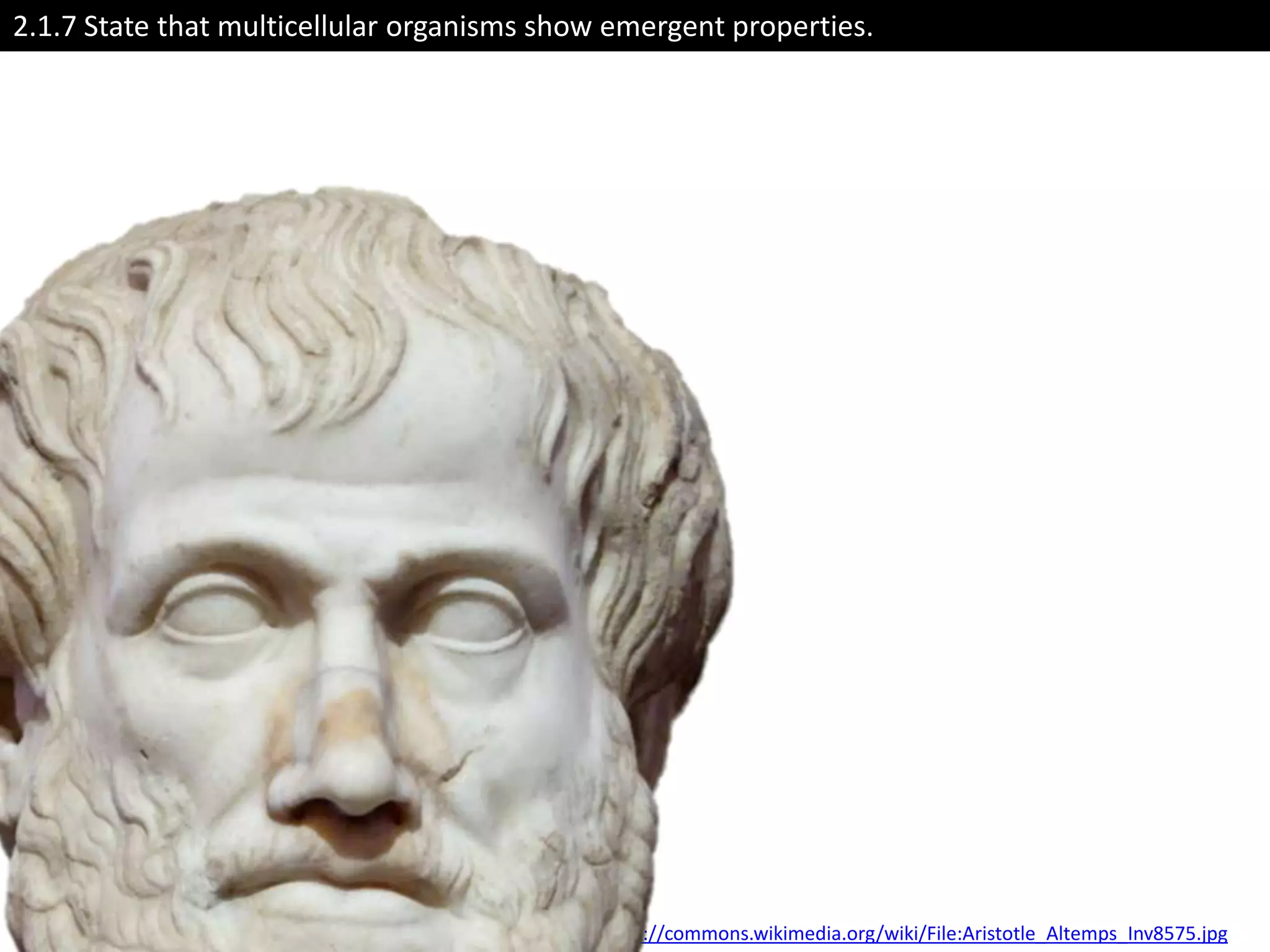
The whole is greater
 than the sum of its
  parts , and yeah…
    I’m Aristotle
…Individual atoms can be combined to
form molecules such as polypeptide chains, which in
turn fold and refold to form proteins, which in turn
create even more complex structures.

These proteins, assuming their functional status
from their spatial conformation, interact together
and with other molecules to achieve higher
biological functions and eventually create
an organism. (Wikipedia)
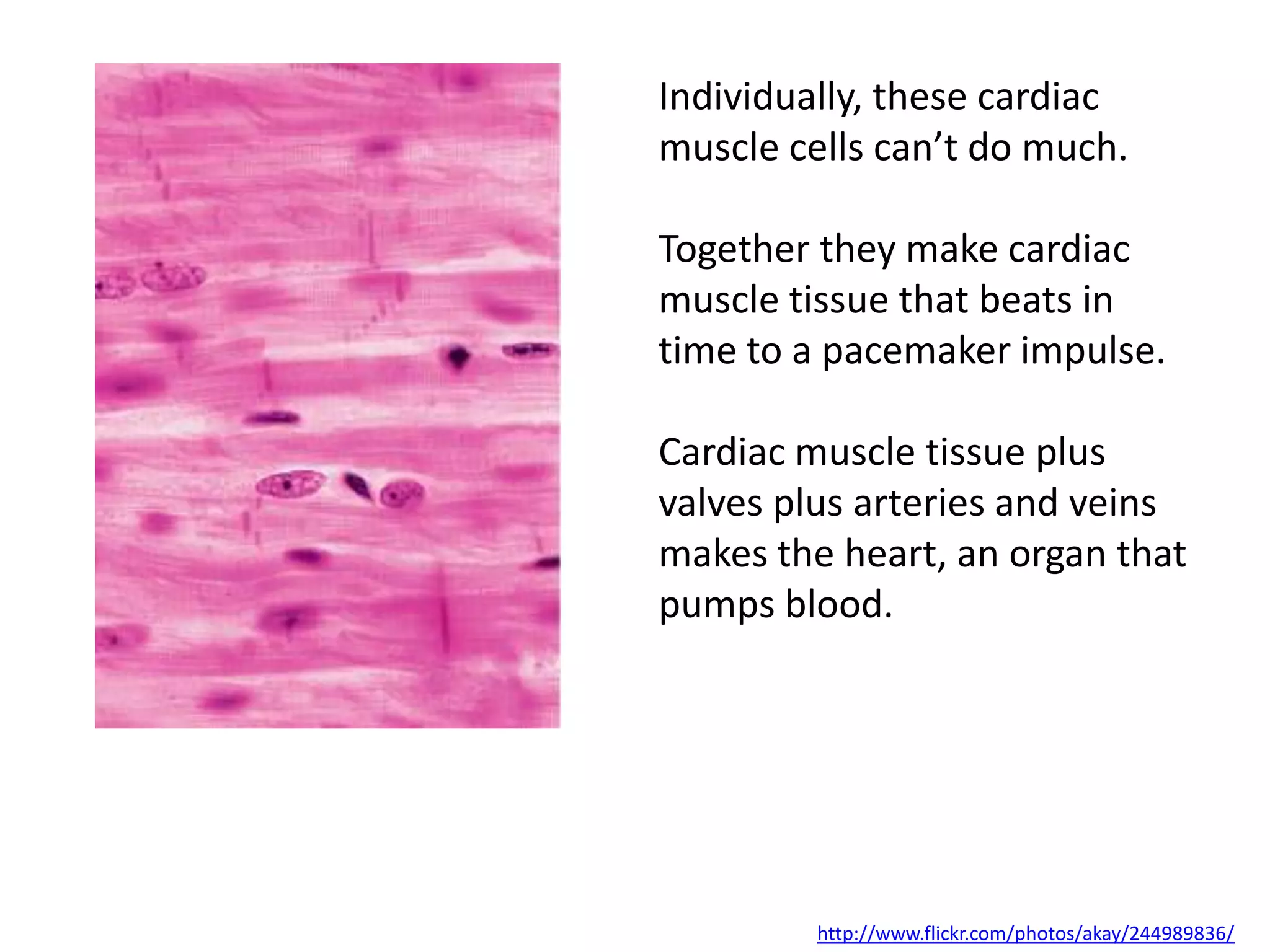
Individually, these cardiac
muscle cells can’t do much.

Together they make cardiac
muscle tissue that beats in
time to a pacemaker impulse.

Cardiac muscle tissue plus
valves plus arteries and veins
makes the heart, an organ that
pumps blood.


         http://www.flickr.com/photos/akay/244989836/
2.1.8 Explain that cells in multicellular organisms differentiate to carry out specialised functions
by expressing some of their genes but not others.


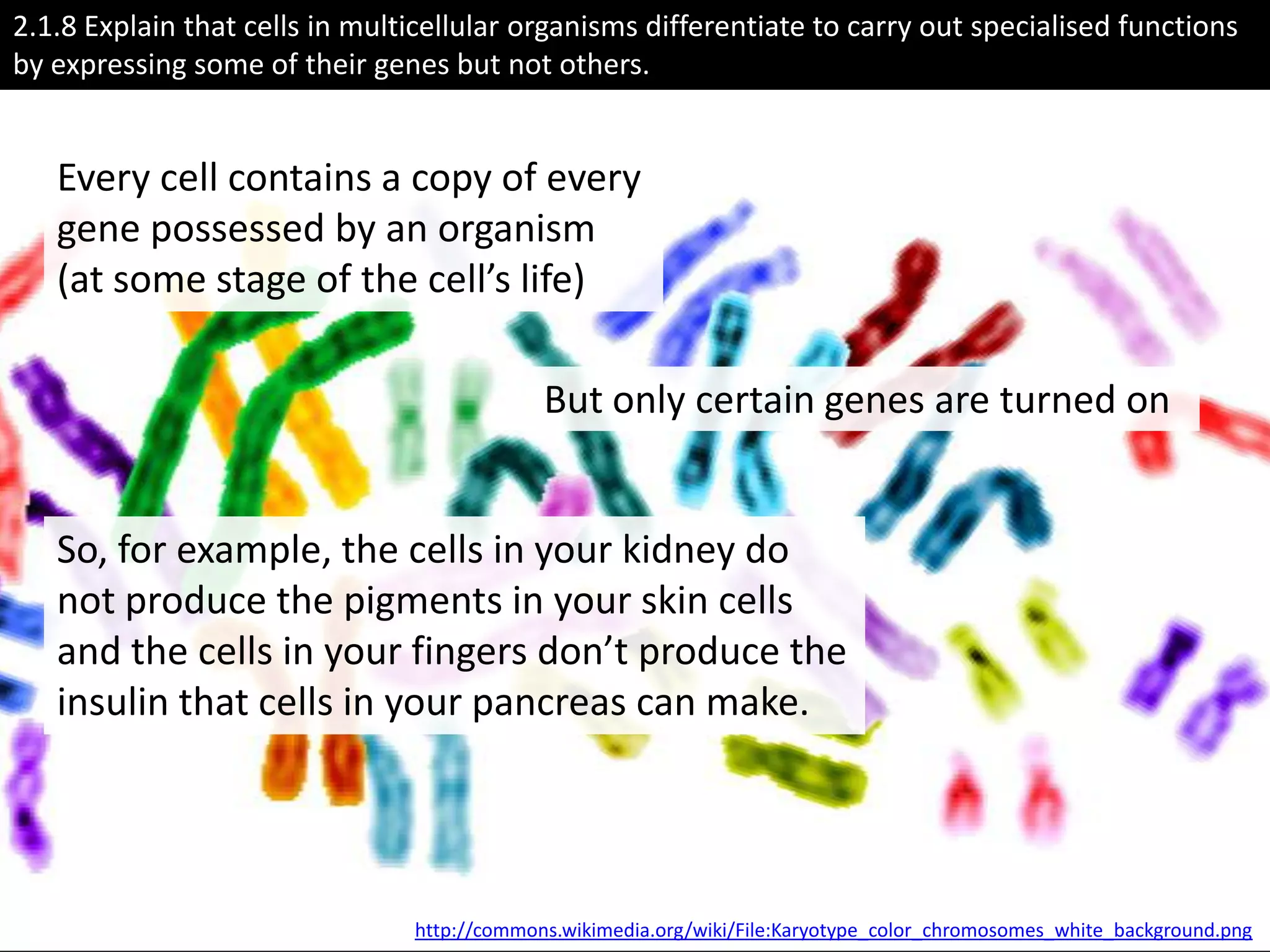
   Every cell contains a copy of every
   gene possessed by an organism
   (at some stage of the cell’s life)

                                             But only certain genes are turned on


   So, for example, the cells in your kidney do
   not produce the pigments in your skin cells
   and the cells in your fingers don’t produce the
   insulin that cells in your pancreas can make.


                                http://commons.wikimedia.org/wiki/File:Karyotype_color_chromosomes_white_background.png
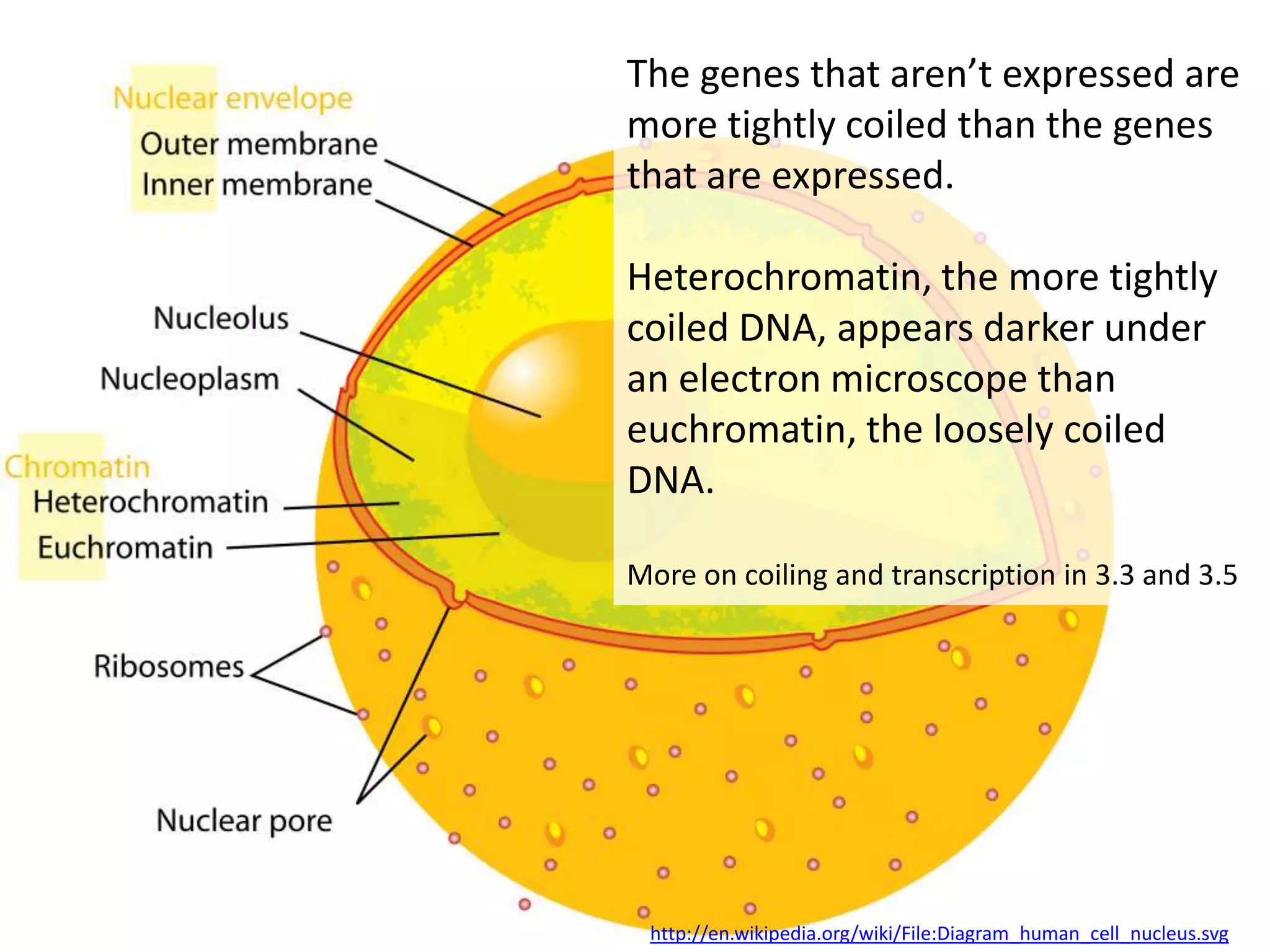
The genes that aren’t expressed are
more tightly coiled than the genes
that are expressed.

Heterochromatin, the more tightly
coiled DNA, appears darker under
an electron microscope than
euchromatin, the loosely coiled
DNA.

More on coiling and transcription in 3.3 and 3.5


 http://en.wikipedia.org/wiki/File:Diagram_human_cell_nucleus.svg
2.1.9 State that stem cells retain the capacity to divide and have the ability to differentiate along
different pathways


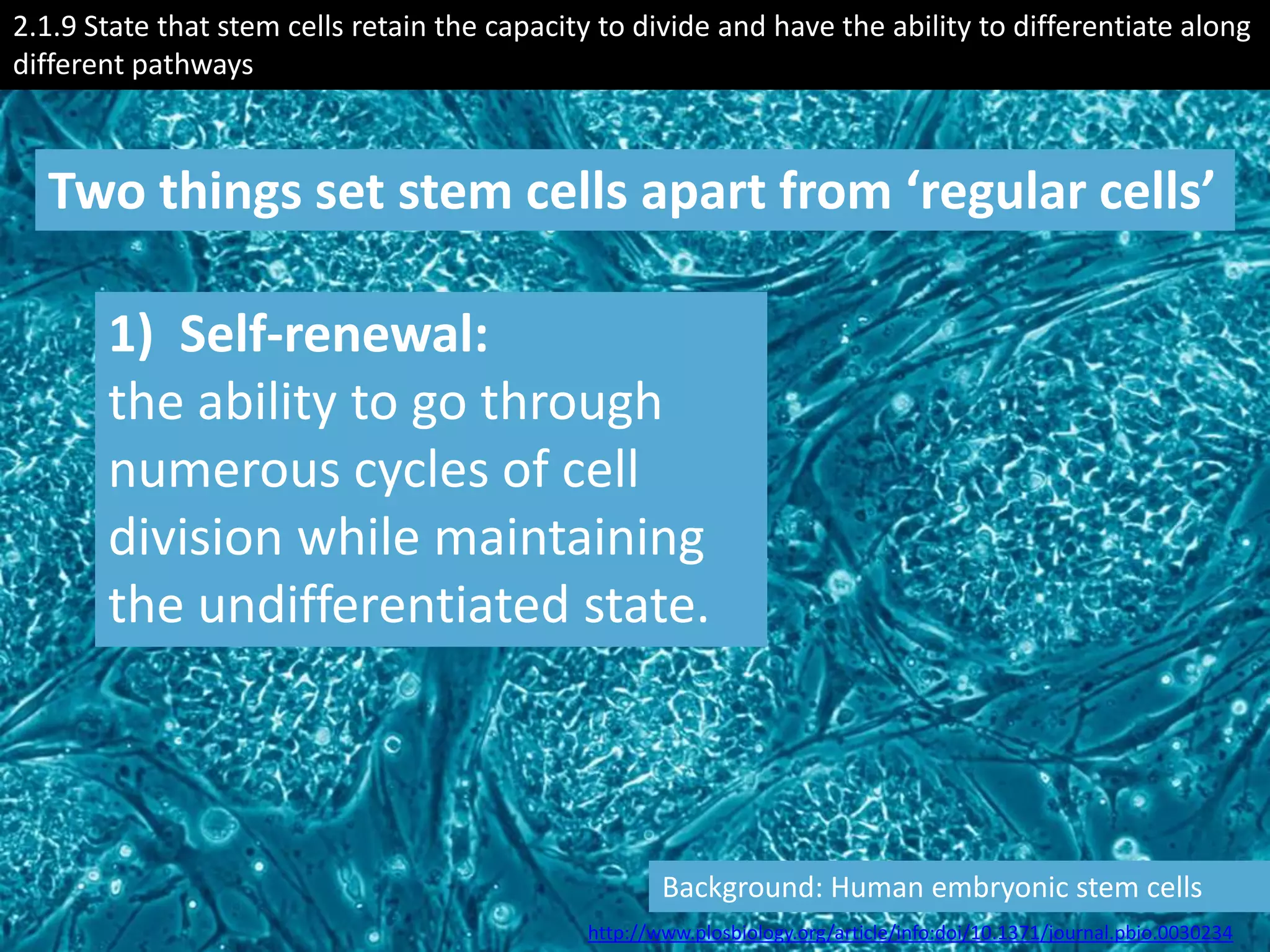
  Two things set stem cells apart from ‘regular cells’

       1) Self-renewal:
       the ability to go through
       numerous cycles of cell
       division while maintaining
       the undifferentiated state.


                                                      Background: Human embryonic stem cells
                                              http://www.plosbiology.org/article/info:doi/10.1371/journal.pbio.0030234
2) Potency:
Stem cells are
undifferentiated and
have the capacity
to differentiate down
different paths into
specialised cell types.

This requires stem cells
to be either totipotent
or pluripotent to be
able to give rise to any
mature cell type


                           http://www.flickr.com/photos/pfly/188629337/
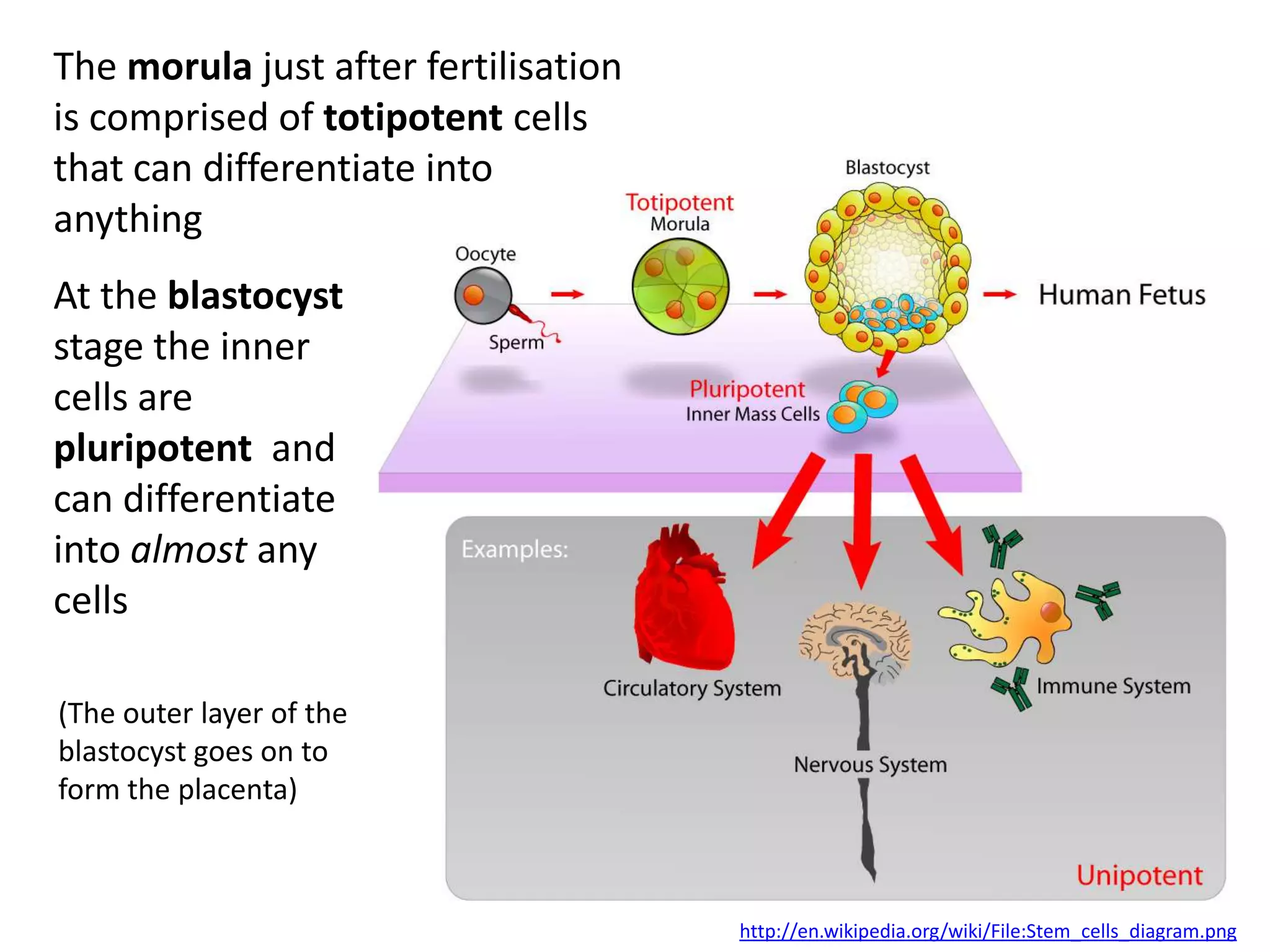
The morula just after fertilisation
is comprised of totipotent cells
that can differentiate into
anything
At the blastocyst
stage the inner
cells are
pluripotent and
can differentiate
into almost any
cells

(The outer layer of the
blastocyst goes on to
form the placenta)


                                      http://en.wikipedia.org/wiki/File:Stem_cells_diagram.png
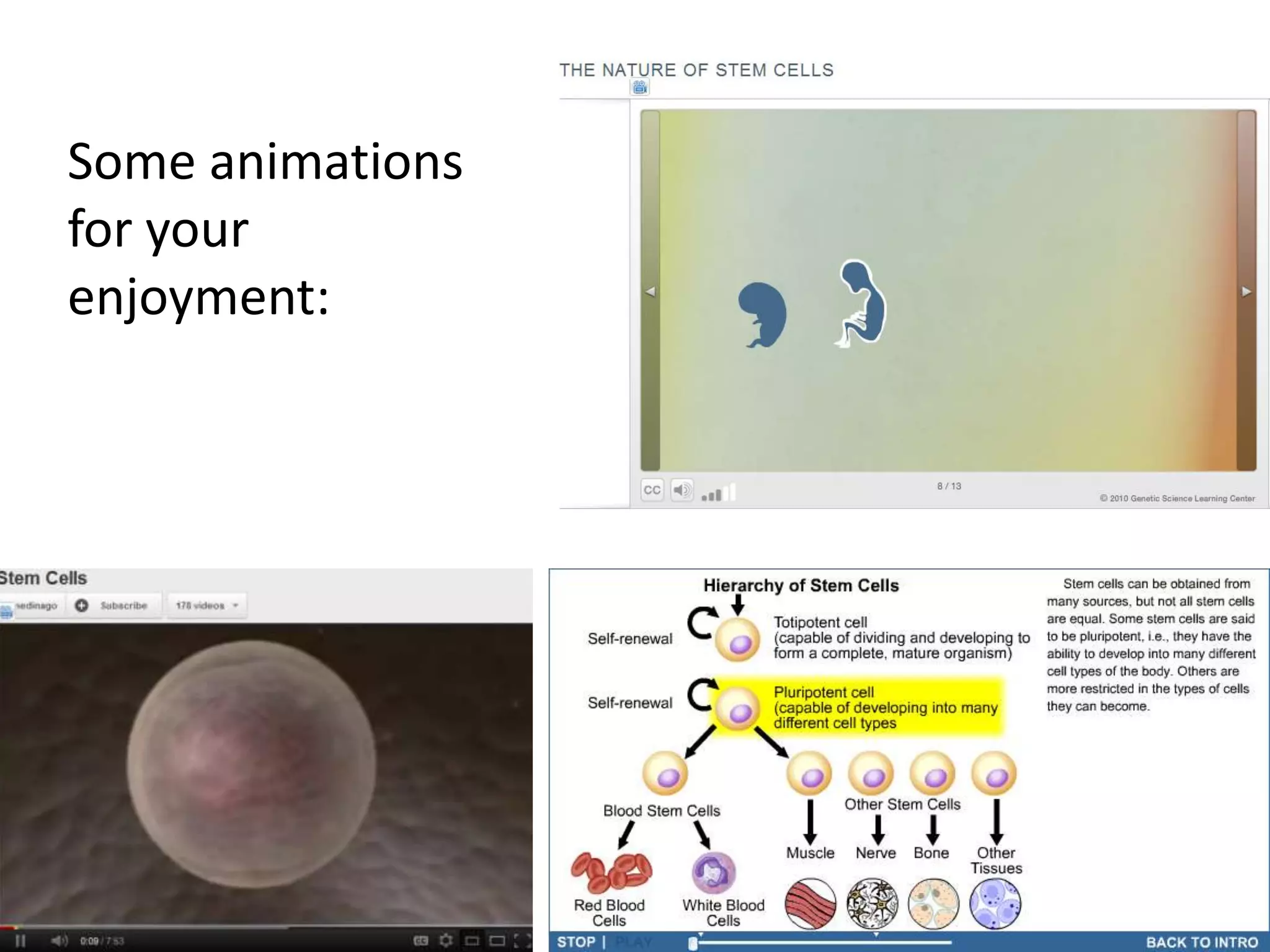
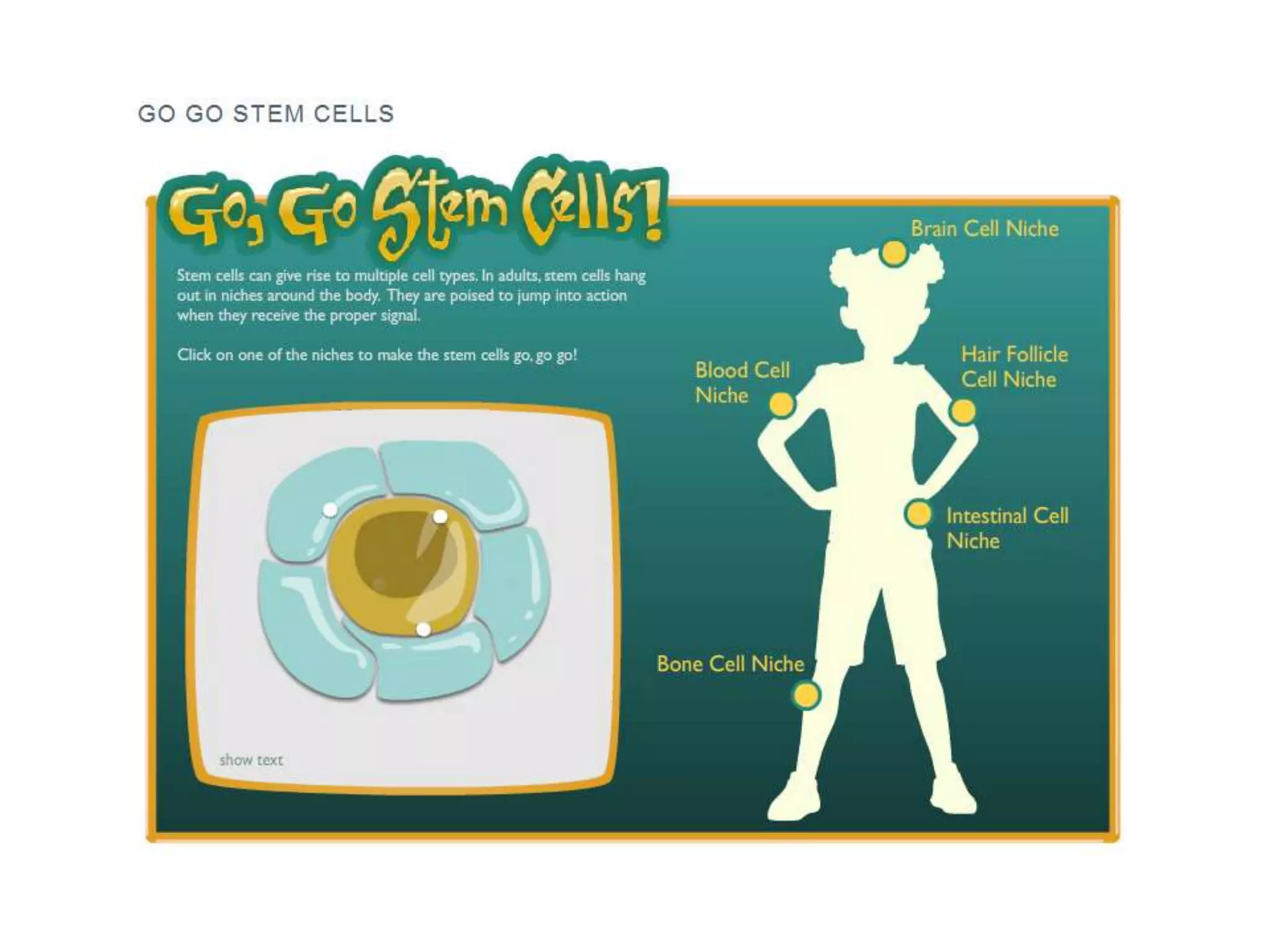
Some animations
for your
enjoyment:
2.1.10 Outline one therapeutic use of stem cells


            Take a few minutes to do your own research:
            1) Find out about a therapeutic use of stem cells
            2) Where do the stem cells used come from?
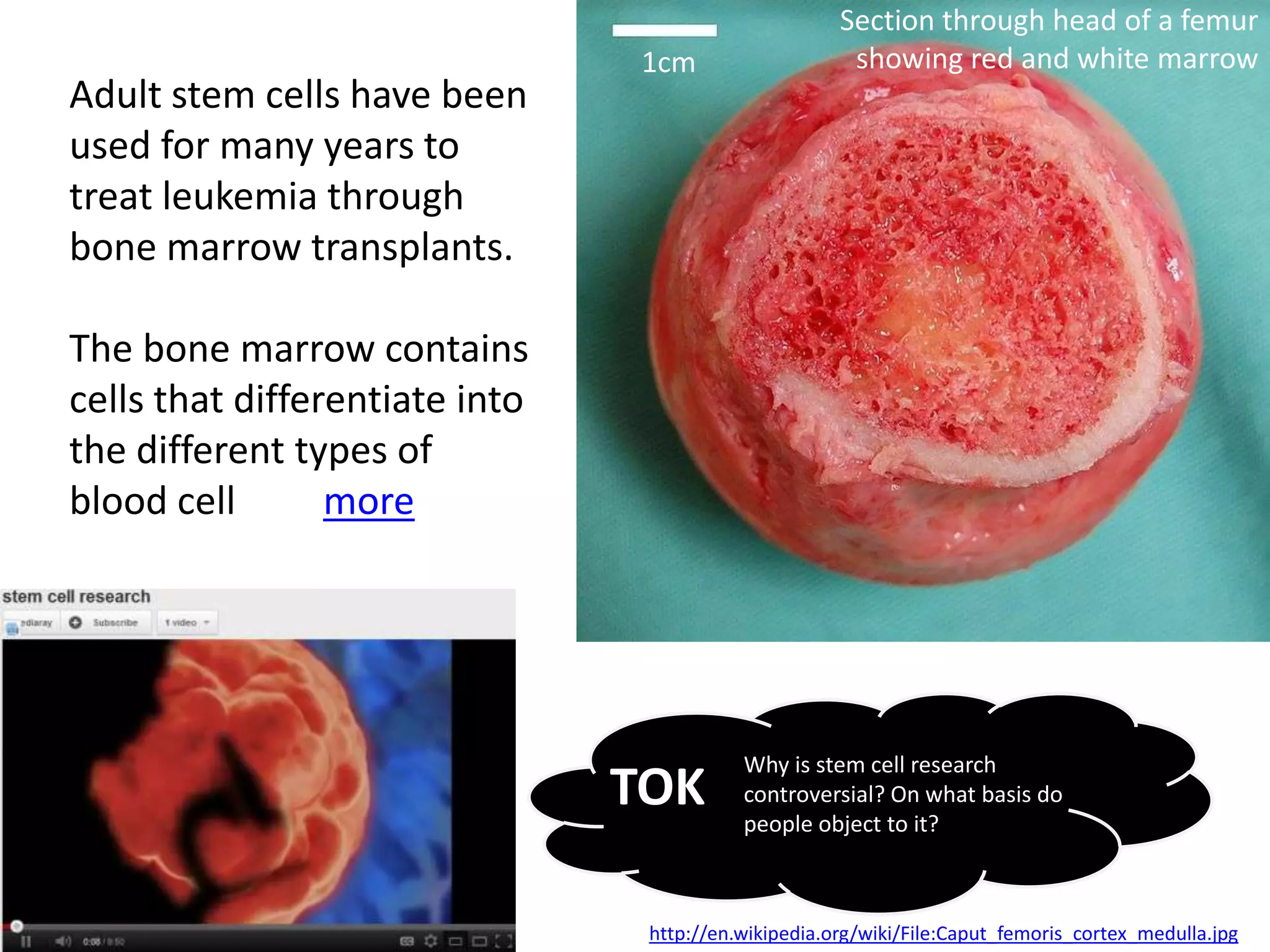
Section through head of a femur
                                1cm                    showing red and white marrow
Adult stem cells have been
used for many years to
treat leukemia through
bone marrow transplants.

The bone marrow contains
cells that differentiate into
the different types of
blood cell       more


                                           Why is stem cell research
                                TOK        controversial? On what basis do
                                           people object to it?


                                 http://en.wikipedia.org/wiki/File:Caput_femoris_cortex_medulla.jpg
Further information:


                                             Perky Professor Poffenroth!
                                                         Great short videos


                       Amazing work by Stephen Taylor with more
                       detail and extension. Use it to add to your
                       notes, contains more practice questions for
                       calculating actual size.

IB Biology Core 2.1: Cell Theory

  • 1.
    IB Biology 2 Cells 2.1Cell Theory All syllabus statements ©IBO 2007 All images CC or public domain or link to original material. Jason de Nys http://www.flickr.com/photos/thejcb/4078621178/
  • 2.
    2.1.1 Outline thecell theory. Cells are the basic unit of life. New cells are formed from other pre-existing cells. KEY POINTS Cells and cell products make up all of the structures in living things. What is the difference between a TOK scientific theory and the more general use of the word “Theory” http://en.wikipedia.org/wiki/Cell_theory
  • 3.
    2.1.2 Discuss theevidence for cell theory 1665 Englishman Robert Hooke examines cork under a compound microscope. Comes up with the term “cells” to describe what he sees. http://commons.wikimedia.org/wiki/File:Microscope_de_HOOKE.png
  • 4.
    1675 Dutchman Antonievan Leeuwenhoek discovers unicellular organisms. (A replica of his microscope at left) His drawings of yeast http://commons.wikimedia.org/wiki/File:Leeuwenhoek_Microscope.png http://commons.wikimedia.org/wiki/File:Yeast-Anton_van_Leeuwenhoek.jpg
  • 5.
    1837 German Botanist MathiasSchleiden posits that all plants are made of cells http://en.wikipedia.org/wiki/File:Matthias_Jacob_Schleiden.jpg
  • 6.
    1839 German physiologist Theodor Schwann, after a lovely dinner with his mate Schleiden and a chat about nuclei, realised that animals were comprised of cells too and stated: “All living things are composed of cells and cell products” He was also responsible for the discovery of Schwann cells in the PNS, pepsin in the gut, the fact that yeast is organic… and he made up the word ‘metabolism’. What a legend! Or, as they say in German, legende! http://en.wikipedia.org/wiki/File:Schwann_Theodore.jpg
  • 7.
    1855 German doctor, pathologistand biologist Rudolf Virchow (A.K.A. the father of modern pathology) Omnis cellula He built on the work of e cellula others to come up with the statement: “every cell Virchow vehemently disagreed with another scientist about a theory. What was it? Find out comes from another why he was opposed. existing cell like it” TOK Comment on how modern day celebrities and scientists “weigh in” on scientific fields in which they may not be experts. Hint: Google Jenny McCarthy and Lord Monckton for starters http://en.wikipedia.org/wiki/File:Rudolf_Virchow.jpg
  • 8.
    2.1.3 State thatunicellular organisms carry out all of the functions of life What are the functions of life? Micrococcus luteus http://www.flickr.com/photos/10451360@N00/284050321/
  • 9.
    The functions oflife: Metabolism Nutrition Growth Reproduction Micrococcus Homeostasis luteus Response to stimuli
  • 10.
    2.1.4 Compare therelative size of molecules, cell membrane thickness, viruses, bacteria, organelles and cells, using appropriate SI units Use the 10x rule of thumb http://www.flickr.com/photos/sanna_nixi/799023133/
  • 11.
    Molecules ≈ 1nm Cell Membrane ≈ 10nm thick Virus ≈ 100nm Bacteria ≈ 1μm (1000nm) Eukaryotic animal cell ≈ 10μm Eukaryotic plant cell ≈ 100μm Of course, there are numerous egg-ceptions. For example, the yolk of an egg is a single Links to two visual animal cell comparisons of size http://www.flickr.com/photos/rogerss1/3520043134/ http://click4biology.info/c4b/2/cell2.1.htm#size
  • 12.
    Another exception, itis a sulfur metabolising bacterium found in the sediments on the sea floor. Thiomargarita namibiensis Specimens have been found at up to 0.75mm long, which is visible to the naked eye! http://en.wikipedia.org/wiki/File:Sulphide_bacteria_crop.jpg
  • 13.
    2.1.5 Calculate linearmagnification of drawings and the actual size of specimens in images of known magnification Using a scale bar: The image at right is of a virus-like particle. The bar is 50nm long. Use a ruler to measure the scale bar and thus calculate the magnification 50nm e.g. Say the measurement I get is 2cm http://commons.wikimedia.org/wiki/File:Bluetongue_virus.gif?uselang=en-gb
  • 14.
    Calculate the sizeof the structure by measuring it with your ruler and dividing the measurement by the magnification. 50nm Some practice calculations to do on the next few slides
  • 15.
    What is the magnification? 1)How long is one of the rust-coloured anthrax bacteria? 2) What is the size of the yellow cell (a neutrophil) at it’s widest point? You can measure on the screen with a ruler. 5 μm http://commons.wikimedia.org/wiki/File:Neutrophil_with_anthrax_copy.jpg
  • 16.
    Bacterium 5 μm (measured 2.7cm*) *Measurements will vary depending on how big the image is that you are measuring
  • 17.
    Neutrophil 5 μm *Measurements will vary depending on how big the image is that you are measuring
  • 18.
    1) How bigare the nuclei? 2) How wide is an average cell on it’s short axis? http://www.flickr.com/photos/ah_pao/2590017159/
  • 20.
    2.1.6 Explain theimportance of the surface area to volume ratio as a factor limiting cell size What does it have to do with elephants? http://www.flickr.com/photos/artbandito/67829361/
  • 21.
    Think: Why is itthat elephants aren’t furry, but other animals that live in the same environment, like lions and zebras, are furry?
  • 22.
    3m 1m 3m 1m 1m 3m Ideal “Elephant” Ideal “Lion” Surface Area SA: Volume Ratio Surface Area =3x3x6 Elephant 2:1 =1x1x6 = 54m2 Lion 6:1 = 6m2 Volume Volume =3x3x3 The elephant has less surface area per unit =1x1x1 = 27m3 of volume to dissipate heat than a lion. = 1m3 Thus the elephant only has sparse hairs to avoid overheating. Think: Where is this analogy going regarding cells?
  • 23.
    What must getin? What must get out? http://www.flickr.com/photos/thejcb/5136606417/
  • 30.
    If a cellis too large, the SA:Volume ratio is too small for diffusion to accommodate the requirements of the cell
  • 31.
    Cells can getaround this problem by growing projections, having a flattened form, or being long and thin. Multicellular organisms have developed circulatory systems to deliver nutrients and oxygen and remove wastes. Exchange structures with large surface areas, such as the lungs and the gut, have evolved.
  • 32.
    2.1.7 State thatmulticellular organisms show emergent properties. http://commons.wikimedia.org/wiki/File:Aristotle_Altemps_Inv8575.jpg
  • 33.
    The whole isgreater than the sum of its parts , and yeah… I’m Aristotle
  • 34.
    …Individual atoms canbe combined to form molecules such as polypeptide chains, which in turn fold and refold to form proteins, which in turn create even more complex structures. These proteins, assuming their functional status from their spatial conformation, interact together and with other molecules to achieve higher biological functions and eventually create an organism. (Wikipedia)
  • 35.
    Individually, these cardiac musclecells can’t do much. Together they make cardiac muscle tissue that beats in time to a pacemaker impulse. Cardiac muscle tissue plus valves plus arteries and veins makes the heart, an organ that pumps blood. http://www.flickr.com/photos/akay/244989836/
  • 36.
    2.1.8 Explain thatcells in multicellular organisms differentiate to carry out specialised functions by expressing some of their genes but not others. Every cell contains a copy of every gene possessed by an organism (at some stage of the cell’s life) But only certain genes are turned on So, for example, the cells in your kidney do not produce the pigments in your skin cells and the cells in your fingers don’t produce the insulin that cells in your pancreas can make. http://commons.wikimedia.org/wiki/File:Karyotype_color_chromosomes_white_background.png
  • 37.
    The genes thataren’t expressed are more tightly coiled than the genes that are expressed. Heterochromatin, the more tightly coiled DNA, appears darker under an electron microscope than euchromatin, the loosely coiled DNA. More on coiling and transcription in 3.3 and 3.5 http://en.wikipedia.org/wiki/File:Diagram_human_cell_nucleus.svg
  • 38.
    2.1.9 State thatstem cells retain the capacity to divide and have the ability to differentiate along different pathways Two things set stem cells apart from ‘regular cells’ 1) Self-renewal: the ability to go through numerous cycles of cell division while maintaining the undifferentiated state. Background: Human embryonic stem cells http://www.plosbiology.org/article/info:doi/10.1371/journal.pbio.0030234
  • 39.
    2) Potency: Stem cellsare undifferentiated and have the capacity to differentiate down different paths into specialised cell types. This requires stem cells to be either totipotent or pluripotent to be able to give rise to any mature cell type http://www.flickr.com/photos/pfly/188629337/
  • 40.
    The morula justafter fertilisation is comprised of totipotent cells that can differentiate into anything At the blastocyst stage the inner cells are pluripotent and can differentiate into almost any cells (The outer layer of the blastocyst goes on to form the placenta) http://en.wikipedia.org/wiki/File:Stem_cells_diagram.png
  • 41.
  • 42.
    2.1.10 Outline onetherapeutic use of stem cells Take a few minutes to do your own research: 1) Find out about a therapeutic use of stem cells 2) Where do the stem cells used come from?
  • 43.
    Section through headof a femur 1cm showing red and white marrow Adult stem cells have been used for many years to treat leukemia through bone marrow transplants. The bone marrow contains cells that differentiate into the different types of blood cell more Why is stem cell research TOK controversial? On what basis do people object to it? http://en.wikipedia.org/wiki/File:Caput_femoris_cortex_medulla.jpg
  • 45.
    Further information: Perky Professor Poffenroth! Great short videos Amazing work by Stephen Taylor with more detail and extension. Use it to add to your notes, contains more practice questions for calculating actual size.