

Talk About Apache Cassandra
           Boris Yen
           byan@ruckuswireless.com
Outline
•   Overview
•   Architecture Overview
•   Partitioning and Replication
•   Data Consistency
Overview
• Distributed
  – Data partitioned among all nodes
• Extremely Scalable
  – Add new node = Add more capacity
  – Easy to add new node
• Fault tolerant
  – All nodes are the same
  – Read/Write anywhere
  – Automatic Data replication
Overview
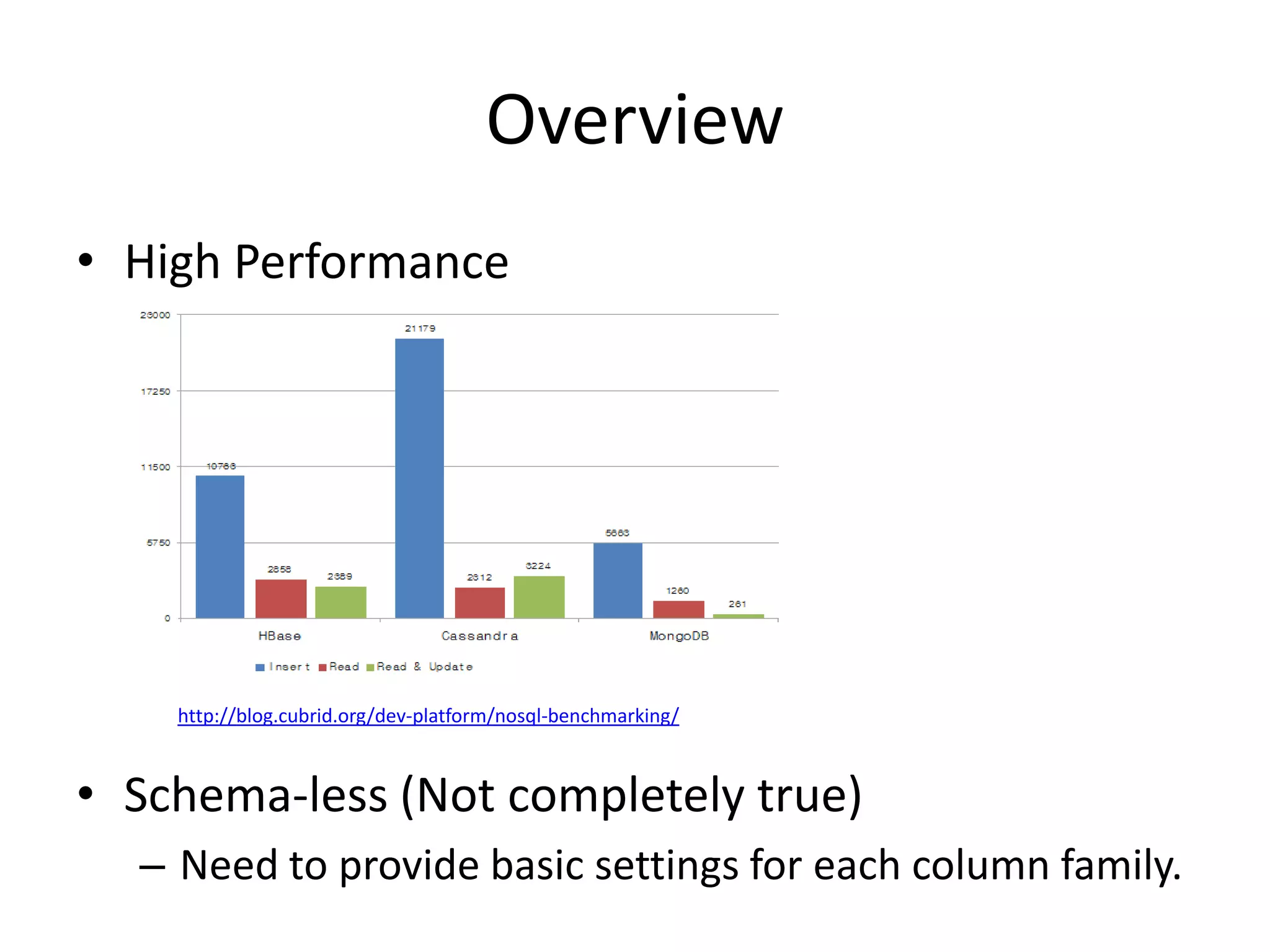
• High Performance


    http://blog.cubrid.org/dev-platform/nosql-benchmarking/


• Schema-less (Not completely true)
  – Need to provide basic settings for each column family.
Architecture Overview
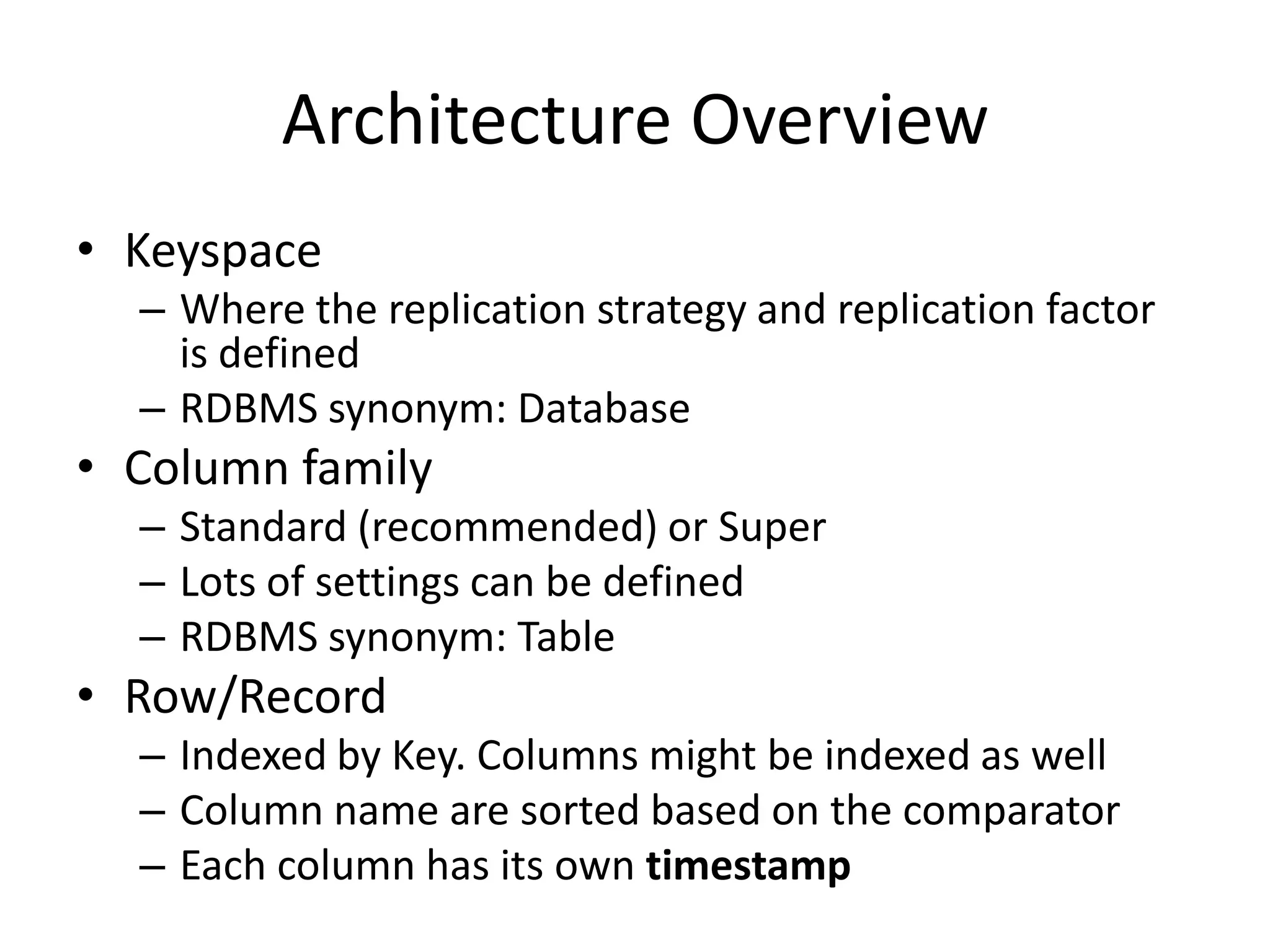
• Keyspace
  – Where the replication strategy and replication factor
    is defined
  – RDBMS synonym: Database
• Column family
  – Standard (recommended) or Super
  – Lots of settings can be defined
  – RDBMS synonym: Table
• Row/Record
  – Indexed by Key. Columns might be indexed as well
  – Column name are sorted based on the comparator
  – Each column has its own timestamp
Architecture Overview
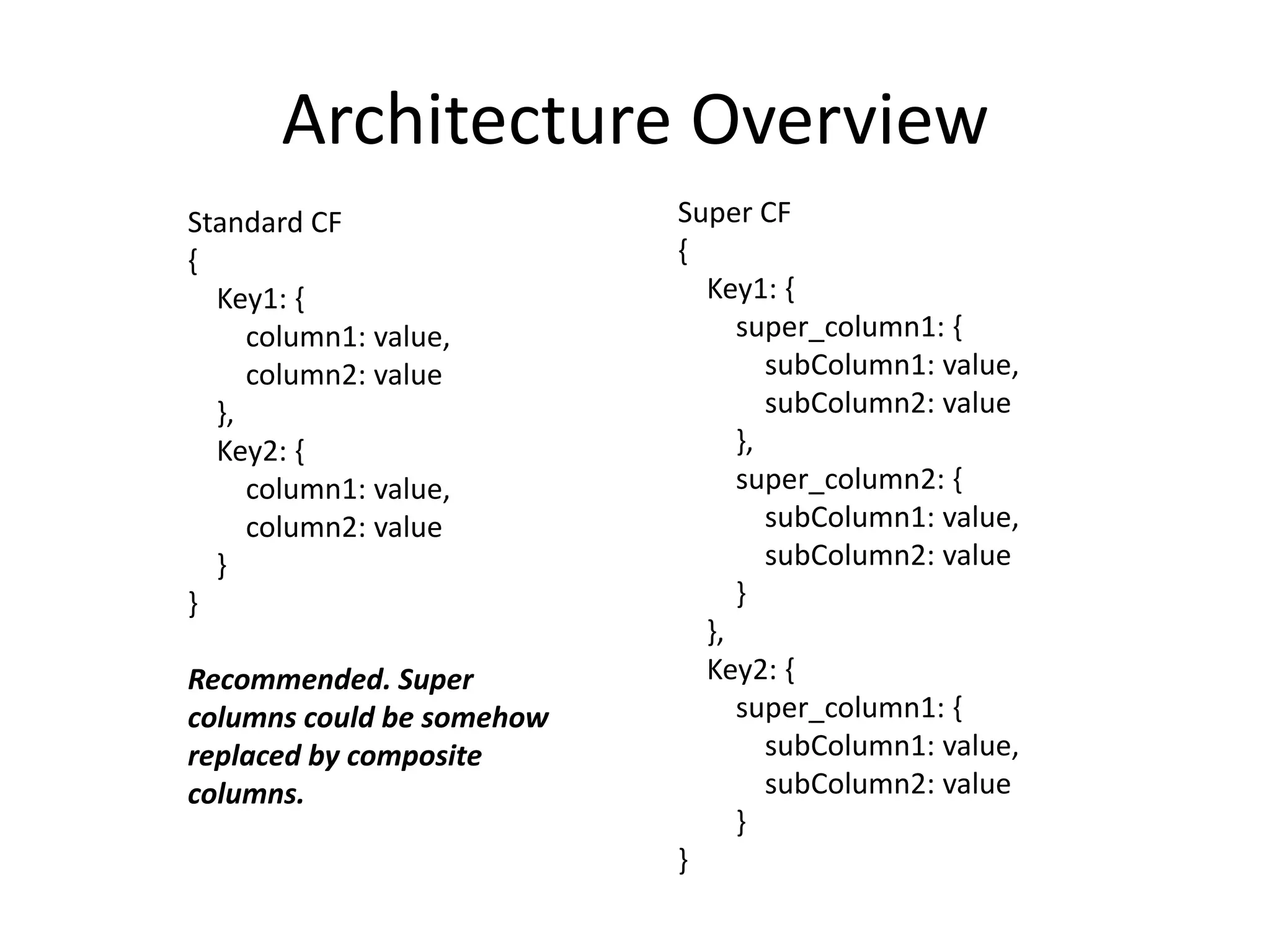
Standard CF                Super CF
{                          {
  Key1: {                    Key1: {
     column1: value,            super_column1: {
     column2: value                subColumn1: value,
  },                               subColumn2: value
  Key2: {                       },
     column1: value,            super_column2: {
     column2: value                subColumn1: value,
  }                                subColumn2: value
}                               }
                             },
Recommended. Super           Key2: {
columns could be somehow        super_column1: {
replaced by composite              subColumn1: value,
columns.                           subColumn2: value
                                }
                           }
Architecture Overview
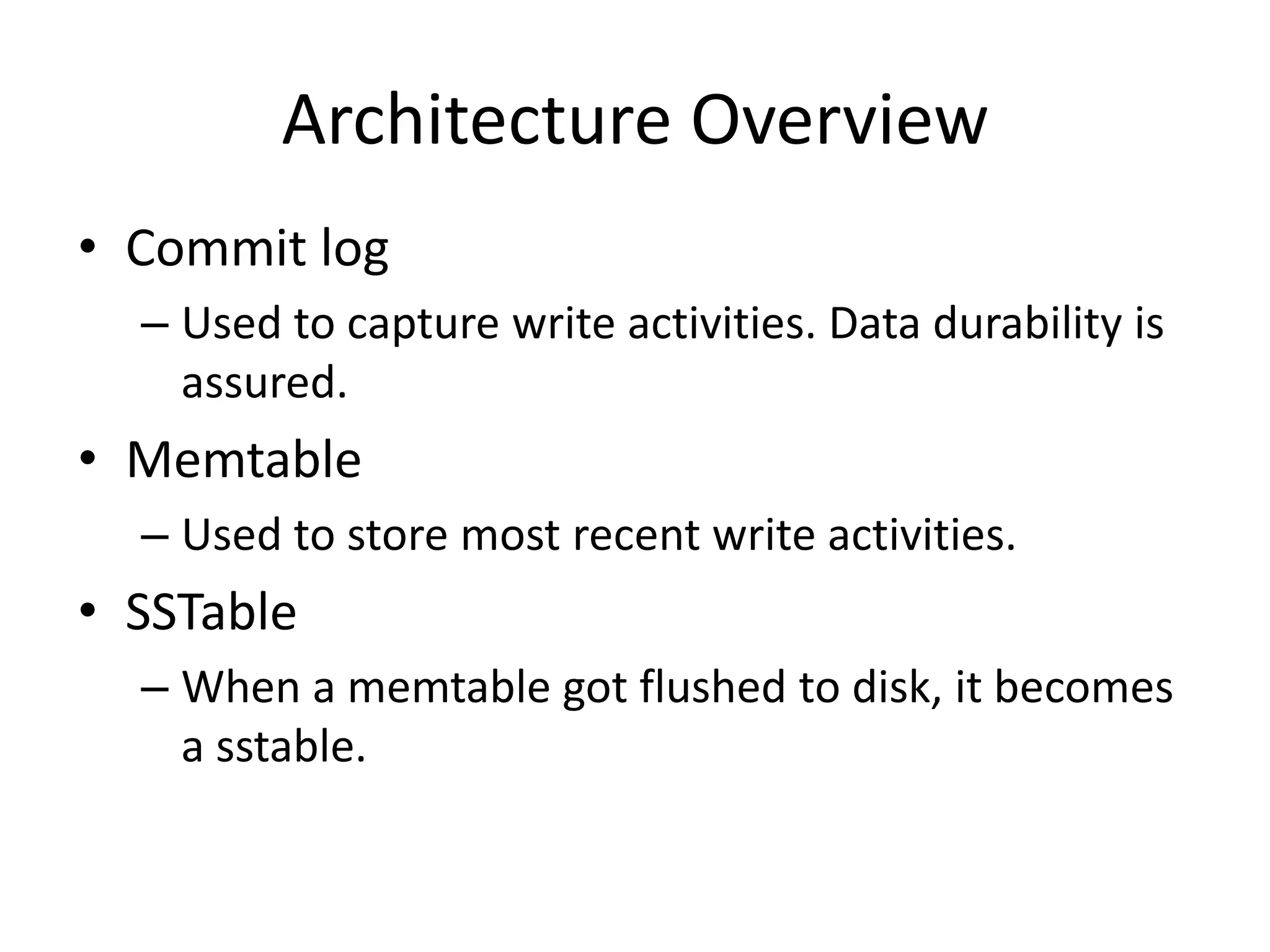
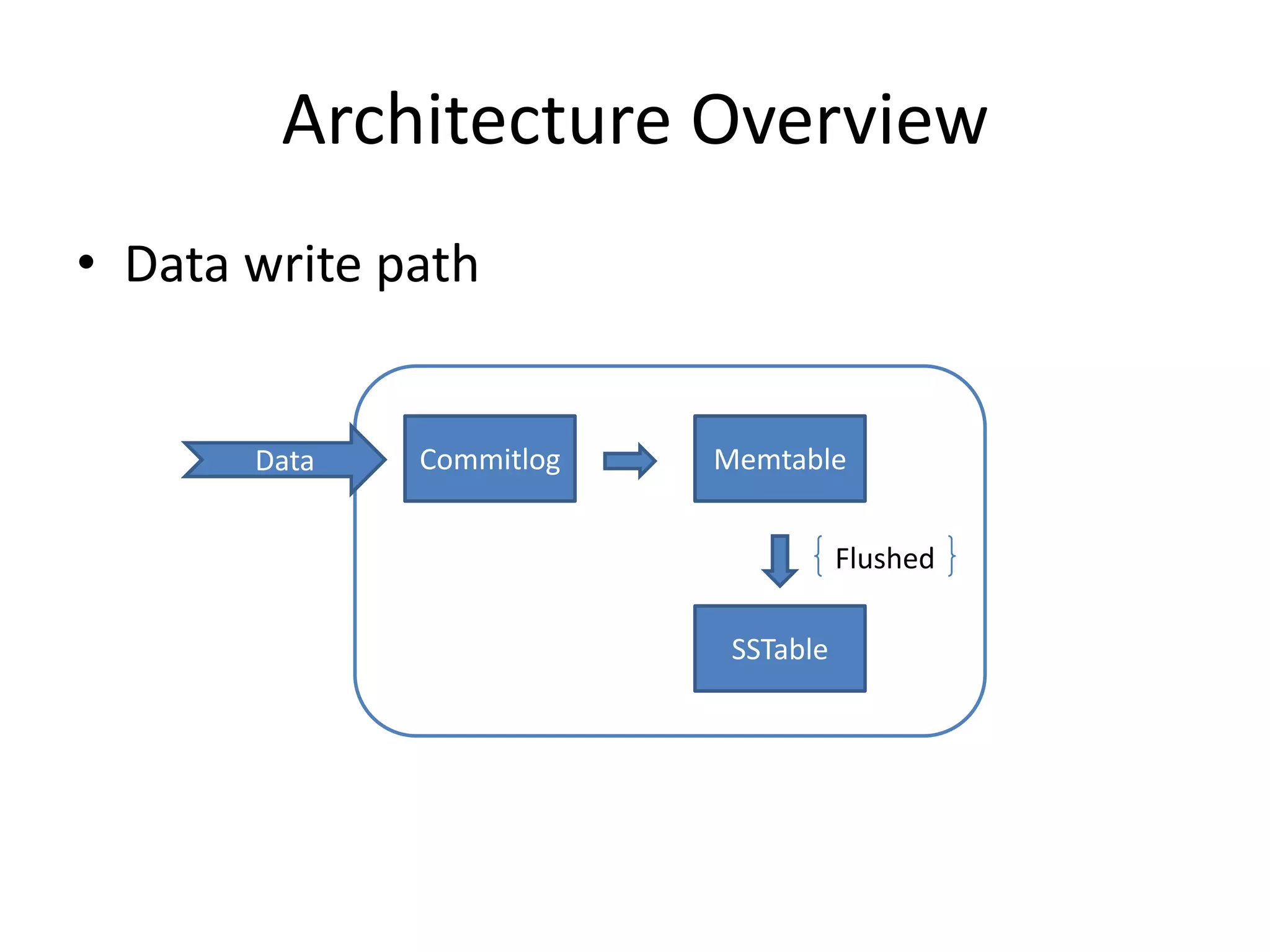
• Commit log
  – Used to capture write activities. Data durability is
    assured.
• Memtable
  – Used to store most recent write activities.
• SSTable
  – When a memtable got flushed to disk, it becomes
    a sstable.
Architecture Overview
• Data write path


       Data   Commitlog   Memtable


                                     Flushed

                           SSTable
Architecture Overview
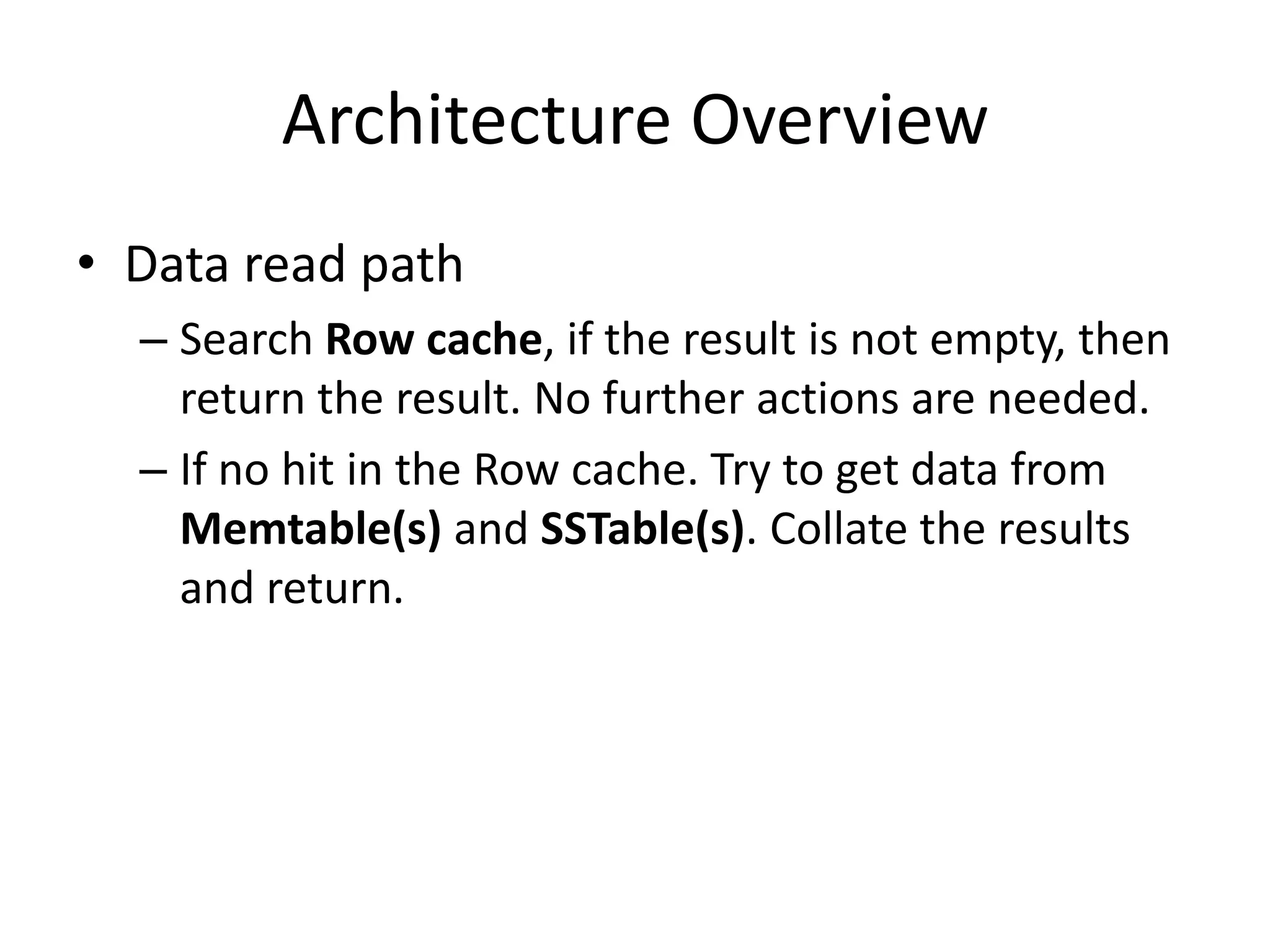
• Data read path
  – Search Row cache, if the result is not empty, then
    return the result. No further actions are needed.
  – If no hit in the Row cache. Try to get data from
    Memtable(s) and SSTable(s). Collate the results
    and return.
Partitioning and Replication
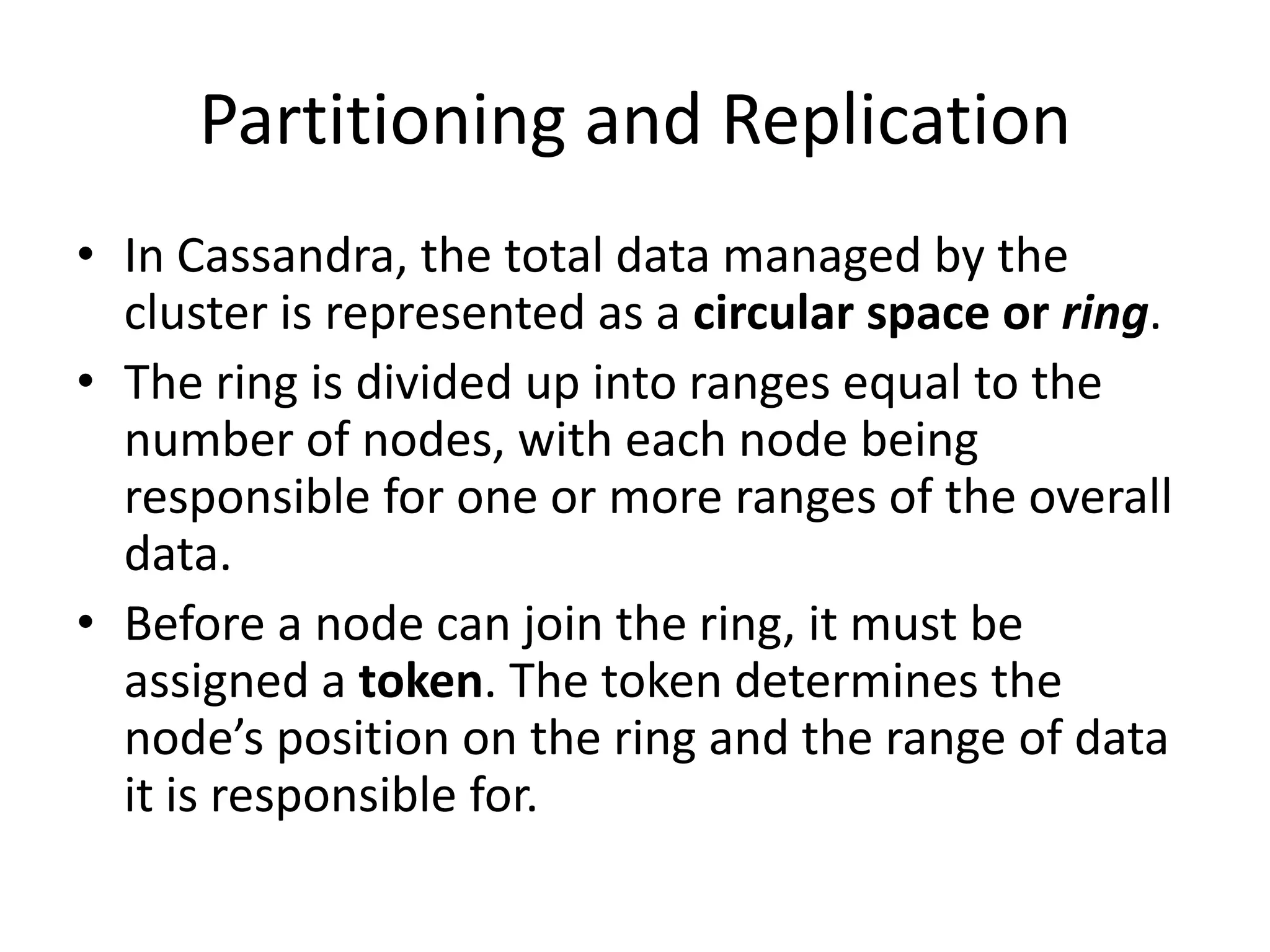
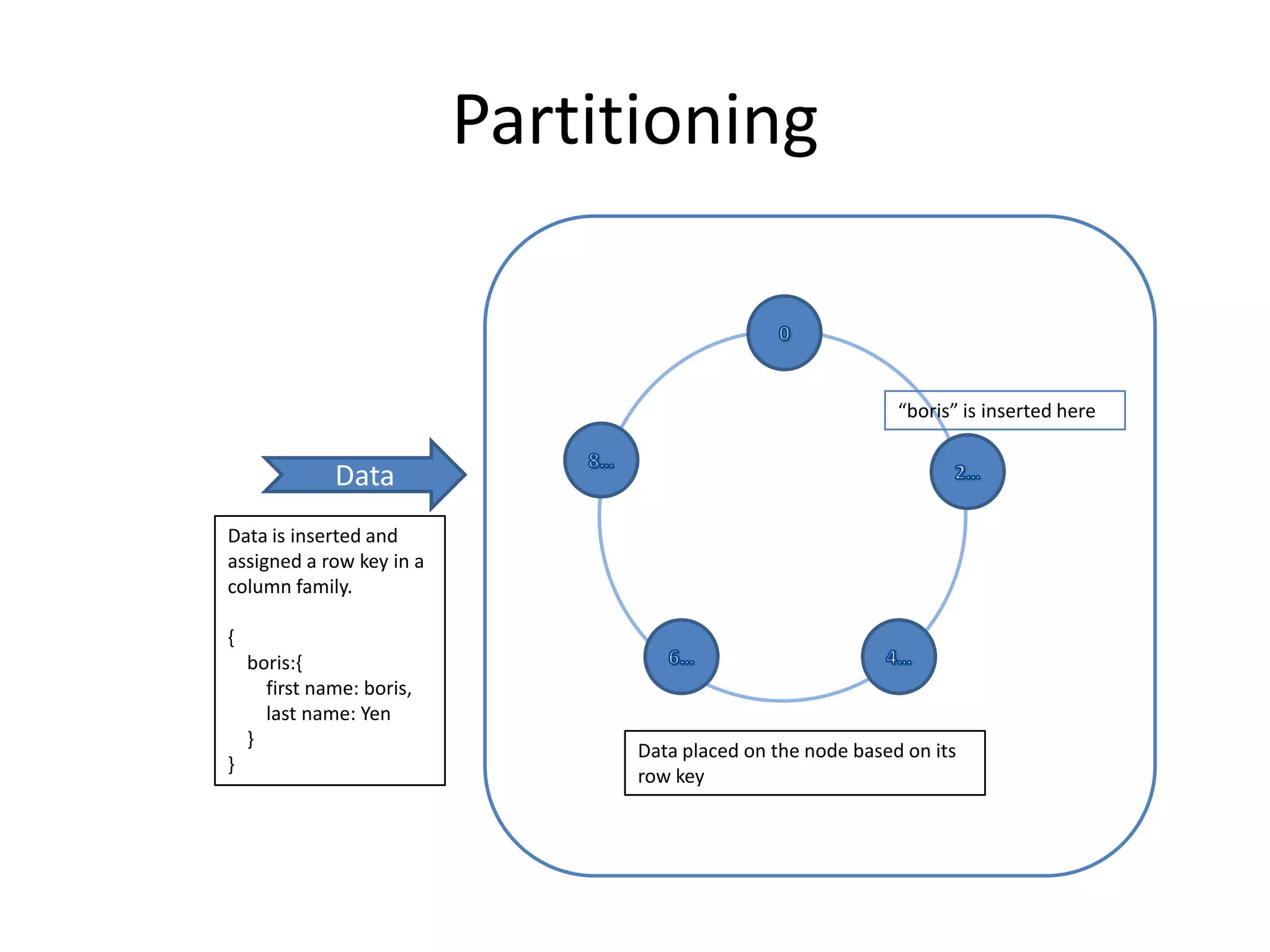
• In Cassandra, the total data managed by the
  cluster is represented as a circular space or ring.
• The ring is divided up into ranges equal to the
  number of nodes, with each node being
  responsible for one or more ranges of the overall
  data.
• Before a node can join the ring, it must be
  assigned a token. The token determines the
  node’s position on the ring and the range of data
  it is responsible for.
Partitioning


                                                              “boris” is inserted here


              Data
Data is inserted and
assigned a row key in a
column family.

{
    boris:{
      first name: boris,
      last name: Yen
    }
                                 Data placed on the node based on its
}
                                 row key
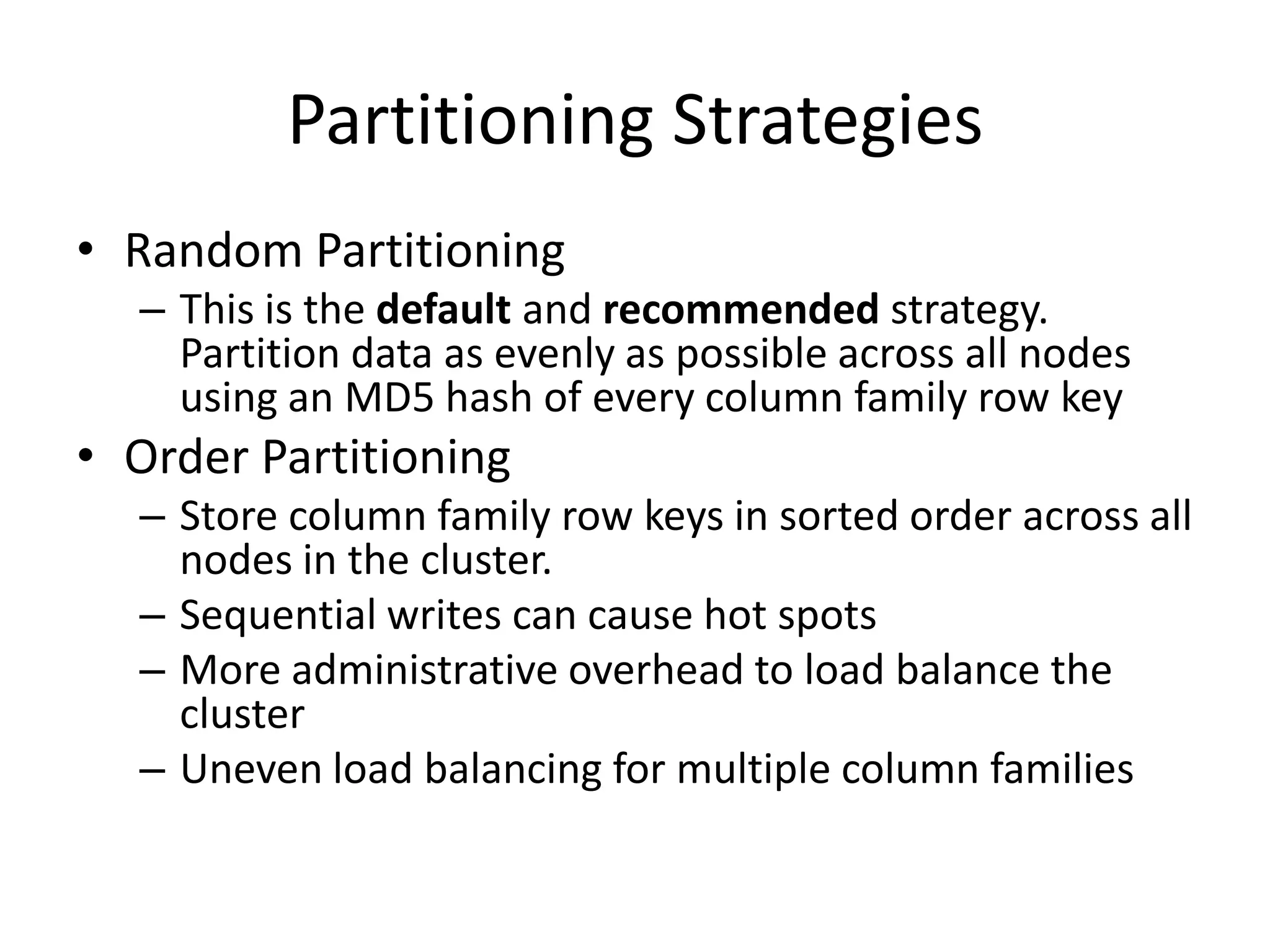
Partitioning Strategies
• Random Partitioning
  – This is the default and recommended strategy.
    Partition data as evenly as possible across all nodes
    using an MD5 hash of every column family row key
• Order Partitioning
  – Store column family row keys in sorted order across all
    nodes in the cluster.
  – Sequential writes can cause hot spots
  – More administrative overhead to load balance the
    cluster
  – Uneven load balancing for multiple column families
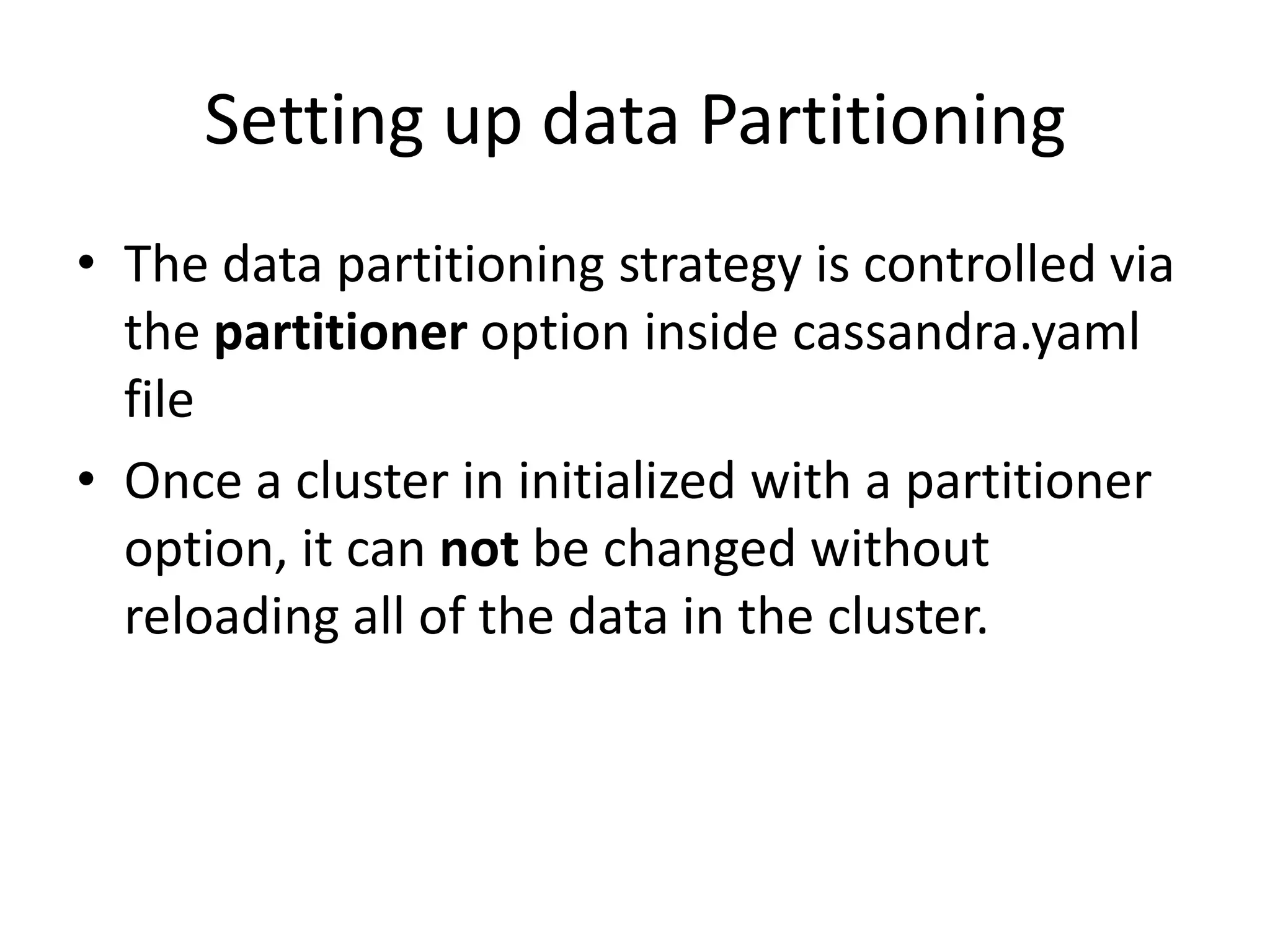
Setting up data Partitioning
• The data partitioning strategy is controlled via
  the partitioner option inside cassandra.yaml
  file
• Once a cluster in initialized with a partitioner
  option, it can not be changed without
  reloading all of the data in the cluster.
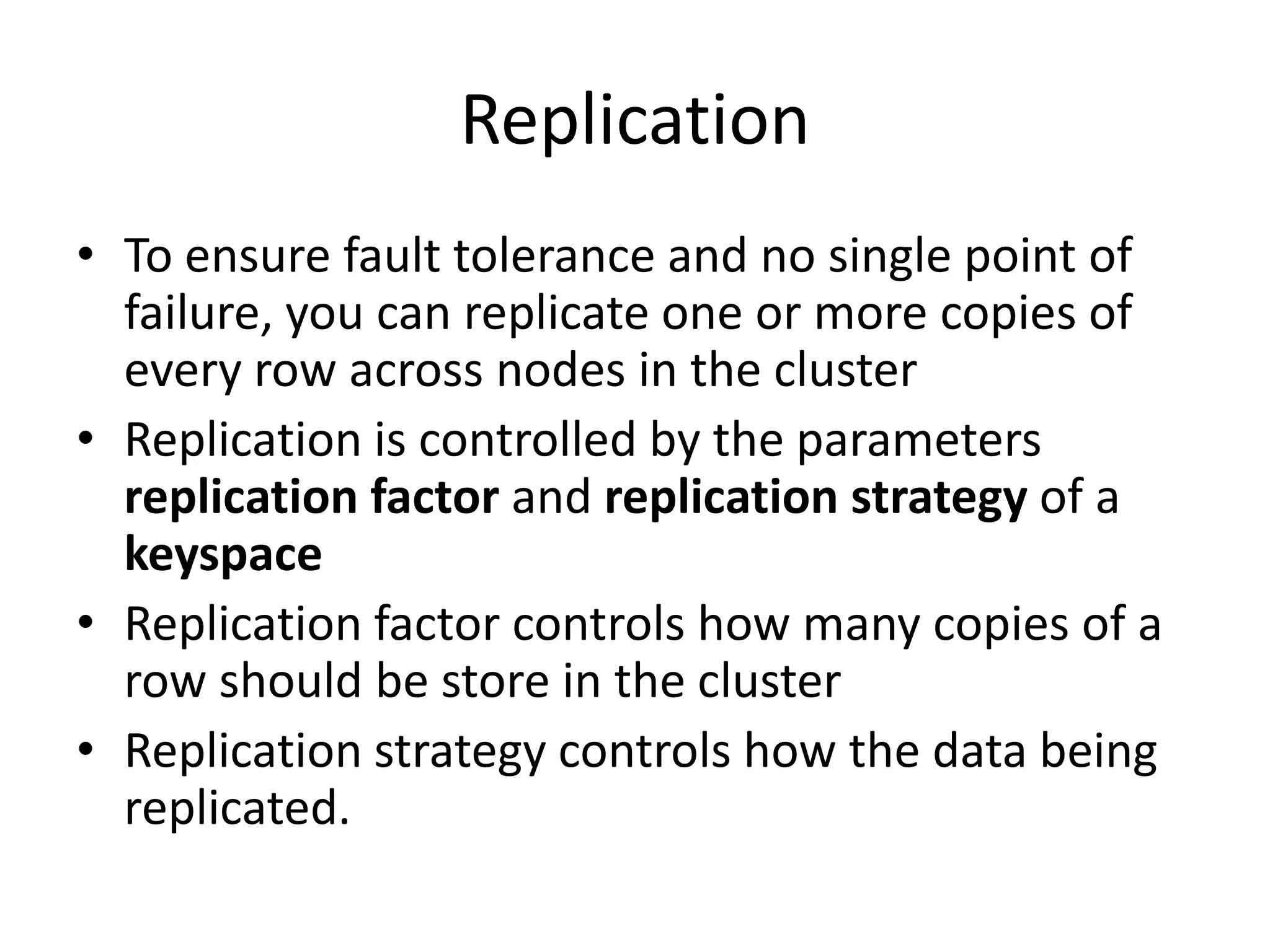
Replication
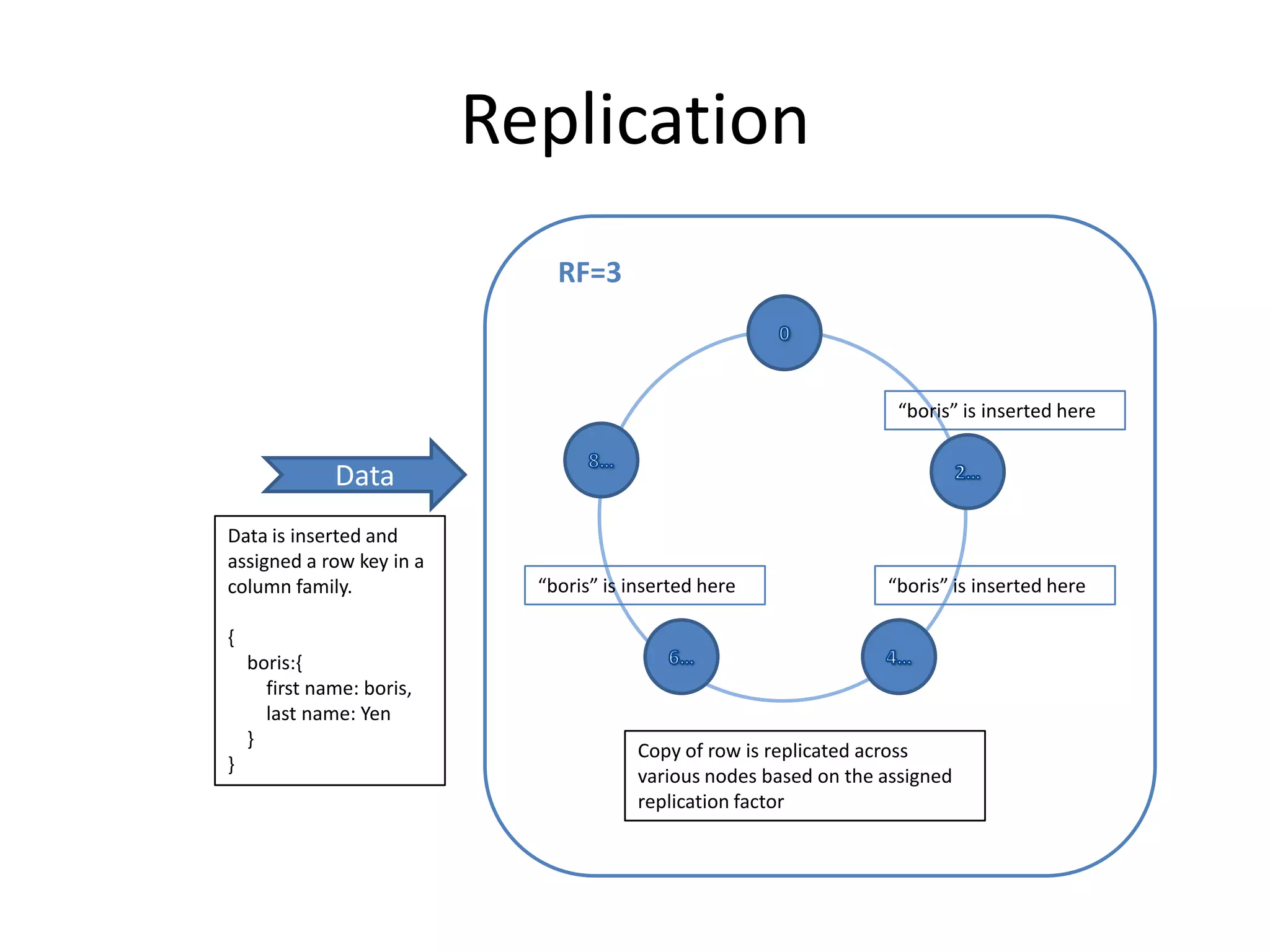
• To ensure fault tolerance and no single point of
  failure, you can replicate one or more copies of
  every row across nodes in the cluster
• Replication is controlled by the parameters
  replication factor and replication strategy of a
  keyspace
• Replication factor controls how many copies of a
  row should be store in the cluster
• Replication strategy controls how the data being
  replicated.
Replication
                               RF=3


                                                                     “boris” is inserted here


              Data
Data is inserted and
assigned a row key in a
column family.               “boris” is inserted here               “boris” is inserted here

{
    boris:{
      first name: boris,
      last name: Yen
    }
                                         Copy of row is replicated across
}
                                         various nodes based on the assigned
                                         replication factor
Replication Strategies
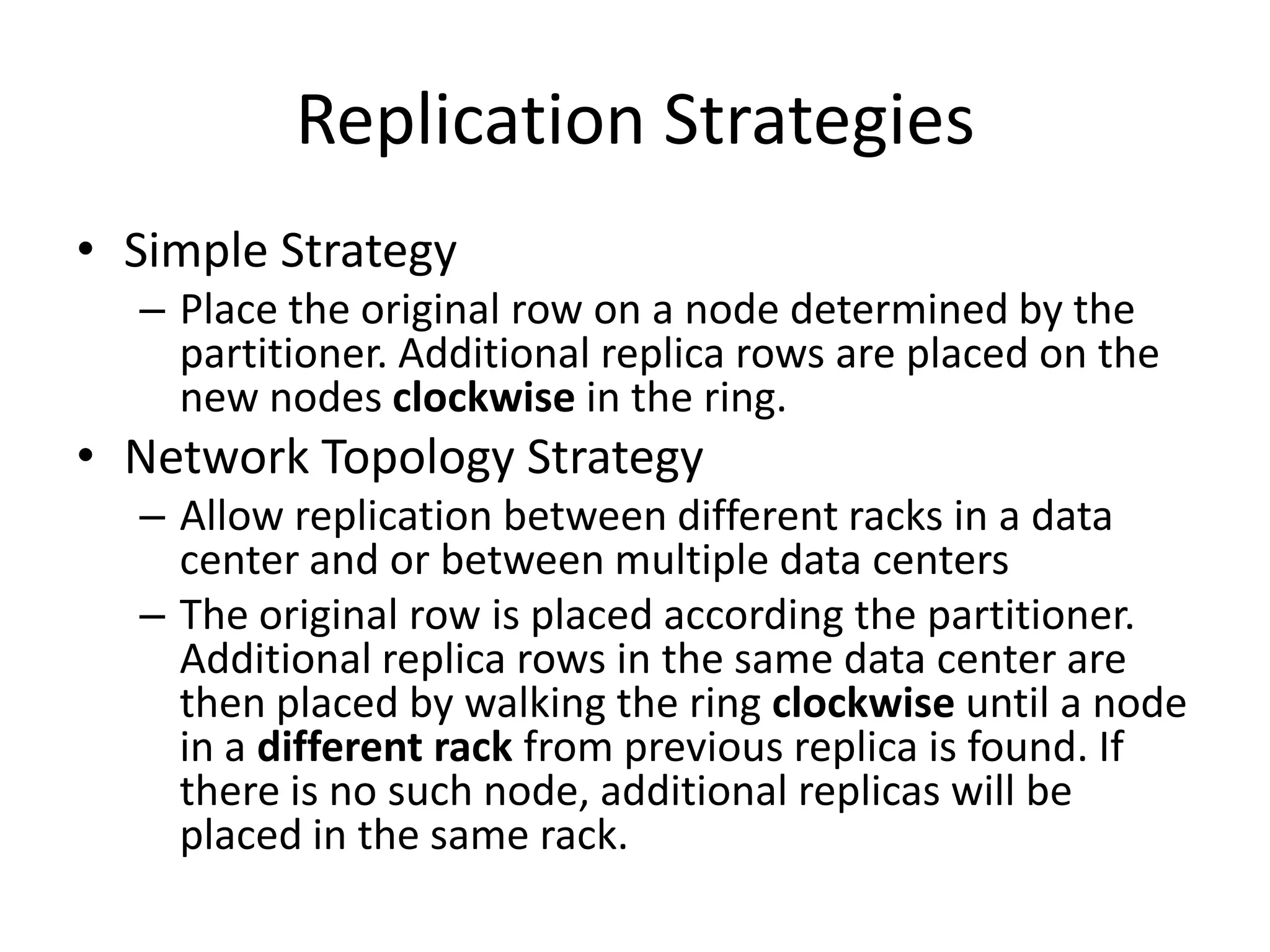
• Simple Strategy
  – Place the original row on a node determined by the
    partitioner. Additional replica rows are placed on the
    new nodes clockwise in the ring.
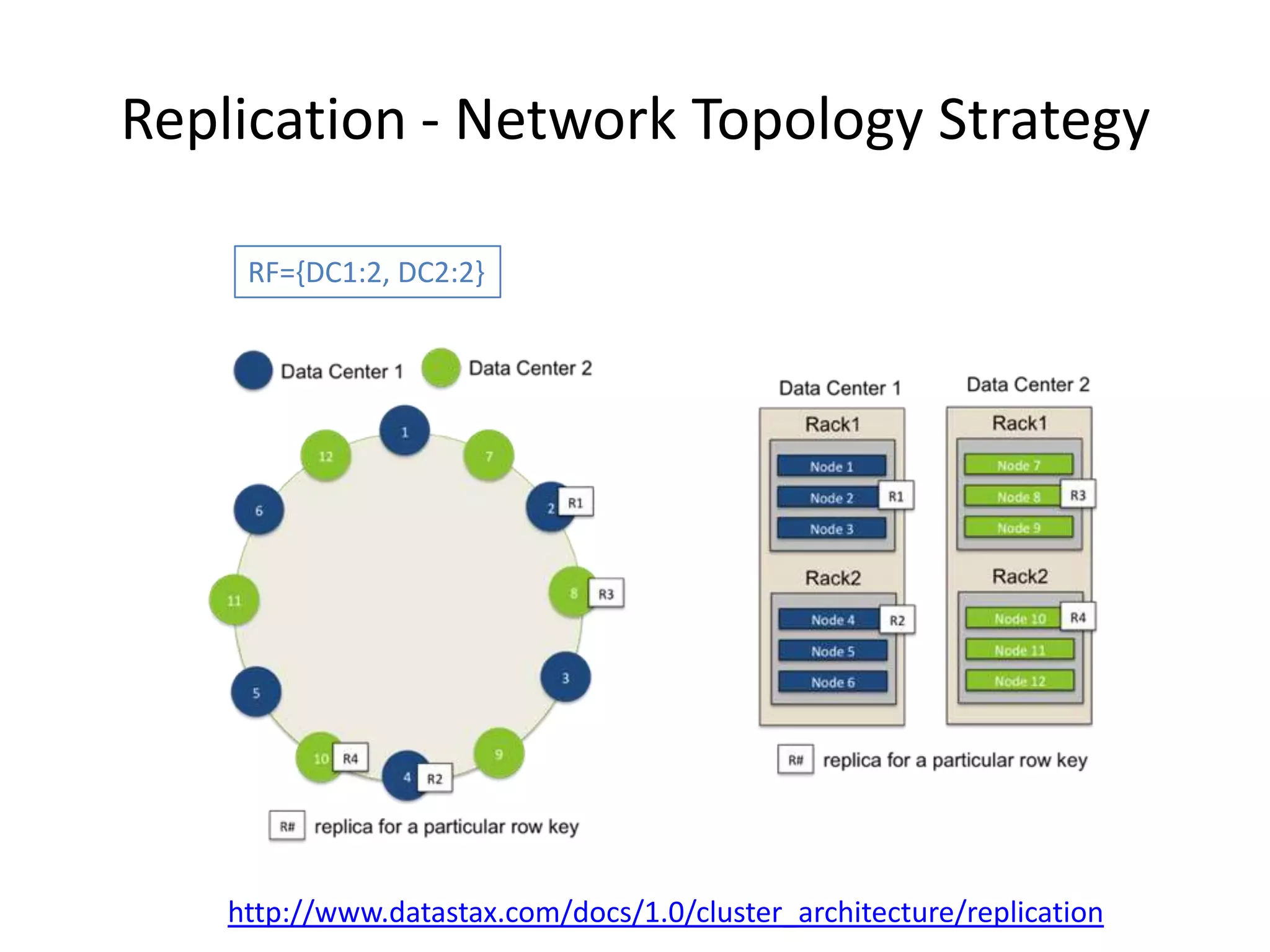
• Network Topology Strategy
  – Allow replication between different racks in a data
    center and or between multiple data centers
  – The original row is placed according the partitioner.
    Additional replica rows in the same data center are
    then placed by walking the ring clockwise until a node
    in a different rack from previous replica is found. If
    there is no such node, additional replicas will be
    placed in the same rack.
Replication - Network Topology Strategy

     RF={DC1:2, DC2:2}


    http://www.datastax.com/docs/1.0/cluster_architecture/replication
Replication Mechanics
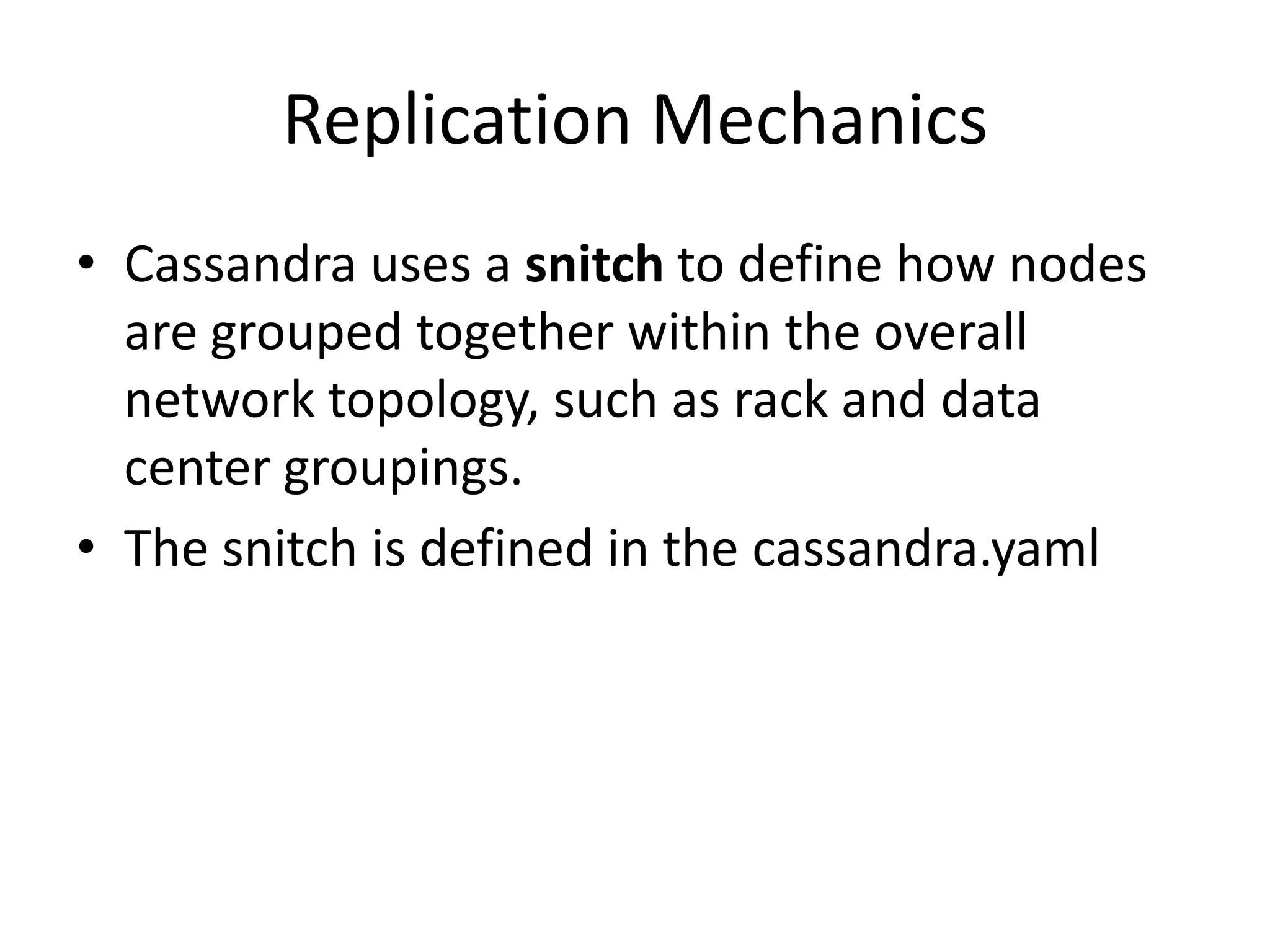
• Cassandra uses a snitch to define how nodes
  are grouped together within the overall
  network topology, such as rack and data
  center groupings.
• The snitch is defined in the cassandra.yaml
Replication Mechanics - Snitches
• Simple Snitch
   – The default and used for simple replication strategy
• Rack Inferring Snitch
   – Infers the topology of the network by analyzing the
     node IP addresses. This snitch assumes that the
     second octet identifies the data center where a node
     is located, and third octet identifies the rack
• Property File Snitch
   – Determines the location of nodes by referring to a
     user-defined file, cassandra-topology.properties
• EC2 Snitch
   – Is for deployments on Amazon EC2 only
Data Consistency
• Cassandra supports tunable data consistency
• Choose from strong and eventual consistency
  depending on the need
• Can be done on a per-operation basis, and for
  both reads and writes.
• Handles multi-data center operations
Consistency Level for Writes
• Any
   – A write must succeed on any available node (hint included)
• One
   – A write must succeed on any node responsible for that row
     (either primary or replica)
• Quorum
   – A write mush succeed on a quorum of replica nodes (RF/2 + 1)
• Local_Quorum
   – A write mush succeed on a quorum of replica nodes in the same
     data center as the coordinator node.
• Each_Quorum
   – A write must succeed on a quorum of replica nodes in all data
     centers
• All
   – A write must succeed on all replica nodes for a row key
Consistency Level for Reads
• One
   – Reads from the closest node holding the data
• Quorum
   – Returns a result from a quorum of servers with the most recent
     timestamp for the data
• Local_Quorum
   – Returns a result from a quorum of servers with the most recent
     timestamp for the data in the same data center as the
     coordinator node
• Each_Quorum
   – Returns a result from a quorum of servers with the most recent
     timestamp in all data centers
• All
   – Returns a result from all replica nodes for a row key
Built-in Consistency Repair Features
• Read Repair
  – When a read is done, the coordinator node
    compares the data from all the remaining replicas
    that own the row in the background, and If they
    are inconsistent, issues writes to the out-of-date
    replicas to update the row.
• Anti-Entropy Node Repair
• Hinted Handoff
What is New in 1.0
• Column Family Compression
  – 2x-4x reduction in data size
  – 25-35% performance improvement on reads
  – 5-10% performance improvement on writes
• Improved Memory and Disk Space Management
  – Off-heap row cache
  – Storage engine self-tuning
  – Faster disk space reclamation
• Tunable Compaction Strategy
  – Support LevelDB style compaction algorithm that can
    be enabled on a per-column family basis.
What is New in 1.0
• Cassandra Windows Service
• Improved Write Consistency and Performance
  – Hint data is stored more efficiently
  – Coordinator nodes no longer need to wait for the
    failure detector to mark a node as down before
    saving hints for unresponsive nodes.
     • Running a full node repair to reconcile missed writes is
       not necessary. Full node repair is only necessary when
       simultaneous multi-node fails o losing a node entirely
     • Default read repair probability has been reduced from
       100% to 10%
Anti-Patterns
• Non-Sun JVM
• CommitLog+Data on the same Disk
  – Does not apply to SSDs or EC2
• Oversized JVM heaps
  – 6-8 GB is good
  – 10-12 is possible and in some circumstances
    “correct”
  – 16GB == max JVM heap size
  – > 16GB => badness
       http://www.slideshare.net/mattdennis/cassandra-antipatterns
Anti-Patterns
• Large batch mutations
  – Timeout => entire mutation must be retried =>
    wasted work
  – Keep the batch mutations to 10-100 (this really
    depends on the HW)
• Ordered partitioner
  – Creates hot spots
  – Requires extra cares from operators
• Cassnadra auto selection of tokens
  – Always specify your initial token.
       http://www.slideshare.net/mattdennis/cassandra-antipatterns
Anti-Patterns
• Super Column
  – 10-15 percent performance penalty on reads and
    writes
  – Easier/Better to use to composite columns
• Read Before write
• Winblows


       http://www.slideshare.net/mattdennis/cassandra-antipatterns
Want to Learn More
• http://www.datastax.com/resources/tutorials
• http://www.datastax.com/docs/1.0/index


         P.S. Most of the content in this presentation is actually
                    coming from the websites above
Q&A
We are hiring people
• If you are interesting in what we are doing,
  please contact us.

Talk About Apache Cassandra

  • 1.
    Talk About ApacheCassandra Boris Yen byan@ruckuswireless.com
  • 2.
    Outline • Overview • Architecture Overview • Partitioning and Replication • Data Consistency
  • 3.
    Overview • Distributed – Data partitioned among all nodes • Extremely Scalable – Add new node = Add more capacity – Easy to add new node • Fault tolerant – All nodes are the same – Read/Write anywhere – Automatic Data replication
  • 4.
    Overview • High Performance http://blog.cubrid.org/dev-platform/nosql-benchmarking/ • Schema-less (Not completely true) – Need to provide basic settings for each column family.
  • 5.
    Architecture Overview • Keyspace – Where the replication strategy and replication factor is defined – RDBMS synonym: Database • Column family – Standard (recommended) or Super – Lots of settings can be defined – RDBMS synonym: Table • Row/Record – Indexed by Key. Columns might be indexed as well – Column name are sorted based on the comparator – Each column has its own timestamp
  • 6.
    Architecture Overview Standard CF Super CF { { Key1: { Key1: { column1: value, super_column1: { column2: value subColumn1: value, }, subColumn2: value Key2: { }, column1: value, super_column2: { column2: value subColumn1: value, } subColumn2: value } } }, Recommended. Super Key2: { columns could be somehow super_column1: { replaced by composite subColumn1: value, columns. subColumn2: value } }
  • 7.
    Architecture Overview • Commitlog – Used to capture write activities. Data durability is assured. • Memtable – Used to store most recent write activities. • SSTable – When a memtable got flushed to disk, it becomes a sstable.
  • 8.
    Architecture Overview • Datawrite path Data Commitlog Memtable Flushed SSTable
  • 9.
    Architecture Overview • Dataread path – Search Row cache, if the result is not empty, then return the result. No further actions are needed. – If no hit in the Row cache. Try to get data from Memtable(s) and SSTable(s). Collate the results and return.
  • 10.
    Partitioning and Replication •In Cassandra, the total data managed by the cluster is represented as a circular space or ring. • The ring is divided up into ranges equal to the number of nodes, with each node being responsible for one or more ranges of the overall data. • Before a node can join the ring, it must be assigned a token. The token determines the node’s position on the ring and the range of data it is responsible for.
  • 11.
    Partitioning “boris” is inserted here Data Data is inserted and assigned a row key in a column family. { boris:{ first name: boris, last name: Yen } Data placed on the node based on its } row key
  • 12.
    Partitioning Strategies • RandomPartitioning – This is the default and recommended strategy. Partition data as evenly as possible across all nodes using an MD5 hash of every column family row key • Order Partitioning – Store column family row keys in sorted order across all nodes in the cluster. – Sequential writes can cause hot spots – More administrative overhead to load balance the cluster – Uneven load balancing for multiple column families
  • 13.
    Setting up dataPartitioning • The data partitioning strategy is controlled via the partitioner option inside cassandra.yaml file • Once a cluster in initialized with a partitioner option, it can not be changed without reloading all of the data in the cluster.
  • 14.
    Replication • To ensurefault tolerance and no single point of failure, you can replicate one or more copies of every row across nodes in the cluster • Replication is controlled by the parameters replication factor and replication strategy of a keyspace • Replication factor controls how many copies of a row should be store in the cluster • Replication strategy controls how the data being replicated.
  • 15.
    Replication RF=3 “boris” is inserted here Data Data is inserted and assigned a row key in a column family. “boris” is inserted here “boris” is inserted here { boris:{ first name: boris, last name: Yen } Copy of row is replicated across } various nodes based on the assigned replication factor
  • 16.
    Replication Strategies • SimpleStrategy – Place the original row on a node determined by the partitioner. Additional replica rows are placed on the new nodes clockwise in the ring. • Network Topology Strategy – Allow replication between different racks in a data center and or between multiple data centers – The original row is placed according the partitioner. Additional replica rows in the same data center are then placed by walking the ring clockwise until a node in a different rack from previous replica is found. If there is no such node, additional replicas will be placed in the same rack.
  • 17.
    Replication - NetworkTopology Strategy RF={DC1:2, DC2:2} http://www.datastax.com/docs/1.0/cluster_architecture/replication
  • 18.
    Replication Mechanics • Cassandrauses a snitch to define how nodes are grouped together within the overall network topology, such as rack and data center groupings. • The snitch is defined in the cassandra.yaml
  • 19.
    Replication Mechanics -Snitches • Simple Snitch – The default and used for simple replication strategy • Rack Inferring Snitch – Infers the topology of the network by analyzing the node IP addresses. This snitch assumes that the second octet identifies the data center where a node is located, and third octet identifies the rack • Property File Snitch – Determines the location of nodes by referring to a user-defined file, cassandra-topology.properties • EC2 Snitch – Is for deployments on Amazon EC2 only
  • 20.
    Data Consistency • Cassandrasupports tunable data consistency • Choose from strong and eventual consistency depending on the need • Can be done on a per-operation basis, and for both reads and writes. • Handles multi-data center operations
  • 21.
    Consistency Level forWrites • Any – A write must succeed on any available node (hint included) • One – A write must succeed on any node responsible for that row (either primary or replica) • Quorum – A write mush succeed on a quorum of replica nodes (RF/2 + 1) • Local_Quorum – A write mush succeed on a quorum of replica nodes in the same data center as the coordinator node. • Each_Quorum – A write must succeed on a quorum of replica nodes in all data centers • All – A write must succeed on all replica nodes for a row key
  • 22.
    Consistency Level forReads • One – Reads from the closest node holding the data • Quorum – Returns a result from a quorum of servers with the most recent timestamp for the data • Local_Quorum – Returns a result from a quorum of servers with the most recent timestamp for the data in the same data center as the coordinator node • Each_Quorum – Returns a result from a quorum of servers with the most recent timestamp in all data centers • All – Returns a result from all replica nodes for a row key
  • 23.
    Built-in Consistency RepairFeatures • Read Repair – When a read is done, the coordinator node compares the data from all the remaining replicas that own the row in the background, and If they are inconsistent, issues writes to the out-of-date replicas to update the row. • Anti-Entropy Node Repair • Hinted Handoff
  • 24.
    What is Newin 1.0 • Column Family Compression – 2x-4x reduction in data size – 25-35% performance improvement on reads – 5-10% performance improvement on writes • Improved Memory and Disk Space Management – Off-heap row cache – Storage engine self-tuning – Faster disk space reclamation • Tunable Compaction Strategy – Support LevelDB style compaction algorithm that can be enabled on a per-column family basis.
  • 25.
    What is Newin 1.0 • Cassandra Windows Service • Improved Write Consistency and Performance – Hint data is stored more efficiently – Coordinator nodes no longer need to wait for the failure detector to mark a node as down before saving hints for unresponsive nodes. • Running a full node repair to reconcile missed writes is not necessary. Full node repair is only necessary when simultaneous multi-node fails o losing a node entirely • Default read repair probability has been reduced from 100% to 10%
  • 26.
    Anti-Patterns • Non-Sun JVM •CommitLog+Data on the same Disk – Does not apply to SSDs or EC2 • Oversized JVM heaps – 6-8 GB is good – 10-12 is possible and in some circumstances “correct” – 16GB == max JVM heap size – > 16GB => badness http://www.slideshare.net/mattdennis/cassandra-antipatterns
  • 27.
    Anti-Patterns • Large batchmutations – Timeout => entire mutation must be retried => wasted work – Keep the batch mutations to 10-100 (this really depends on the HW) • Ordered partitioner – Creates hot spots – Requires extra cares from operators • Cassnadra auto selection of tokens – Always specify your initial token. http://www.slideshare.net/mattdennis/cassandra-antipatterns
  • 28.
    Anti-Patterns • Super Column – 10-15 percent performance penalty on reads and writes – Easier/Better to use to composite columns • Read Before write • Winblows http://www.slideshare.net/mattdennis/cassandra-antipatterns
  • 29.
    Want to LearnMore • http://www.datastax.com/resources/tutorials • http://www.datastax.com/docs/1.0/index P.S. Most of the content in this presentation is actually coming from the websites above
  • 30.
  • 31.
    We are hiringpeople • If you are interesting in what we are doing, please contact us.