Organic Chemistry William H. Brown Christopher S. Foote Brent L. Iverson
Alkenes: Structure and Nomenclature Chapter 5
Unsaturated Hydrocarbons Unsaturated hydrocarbon:   contains one or more carbon-carbon double or triple bonds Alkene:   contains a carbon-carbon double bond and has the general formula C n H 2n Alkyne:   contains a carbon-carbon triple bond and has the general formula C n H 2n-2
Unsaturated Hydrocarbons Arenes:   benzene and its derivatives (Ch 21-22) we do not study arenes until Chapters 21 & 22 however, we show structural formulas of compounds containing the phenyl group before that time the phenyl group is not  reactive under any of the conditions we describe in Ch 6-20
Structure of Alkenes A double bond consists of  one sigma bond formed by the overlap of  sp 2  hybrid orbitals and one  pi bond formed by the overlap of parallel 2 p  orbitals the two carbon atoms of a double bond and the four atoms bonded to them lie in a plane, with bond angles of approximately 120°
Structure of Alkenes it takes approximately 264 kJ (63 kcal)/mol to break the pi bond in ethylene; that is, to rotate one carbon by 90° with respect to the other so that there is no overlap between 2 p  orbitals on adjacent carbons
Cis,Trans  Isomerism in Alkenes Cis,trans  isomers:  isomers that have the same connectivity but a different arrangement of their atoms in space due to the presence of either a ring or a carbon-carbon double bond
Index of Hydrogen Deficiency Index of hydrogen deficiency (IHD):  the sum of the number of rings and pi bonds in a molecule To determine IHD, compare the number of hydrogens in an unknown compound with the number in a reference hydrocarbon of the same number of carbons and with no rings or pi bonds the molecular formula of the reference hydrocarbon is C n H 2n+2
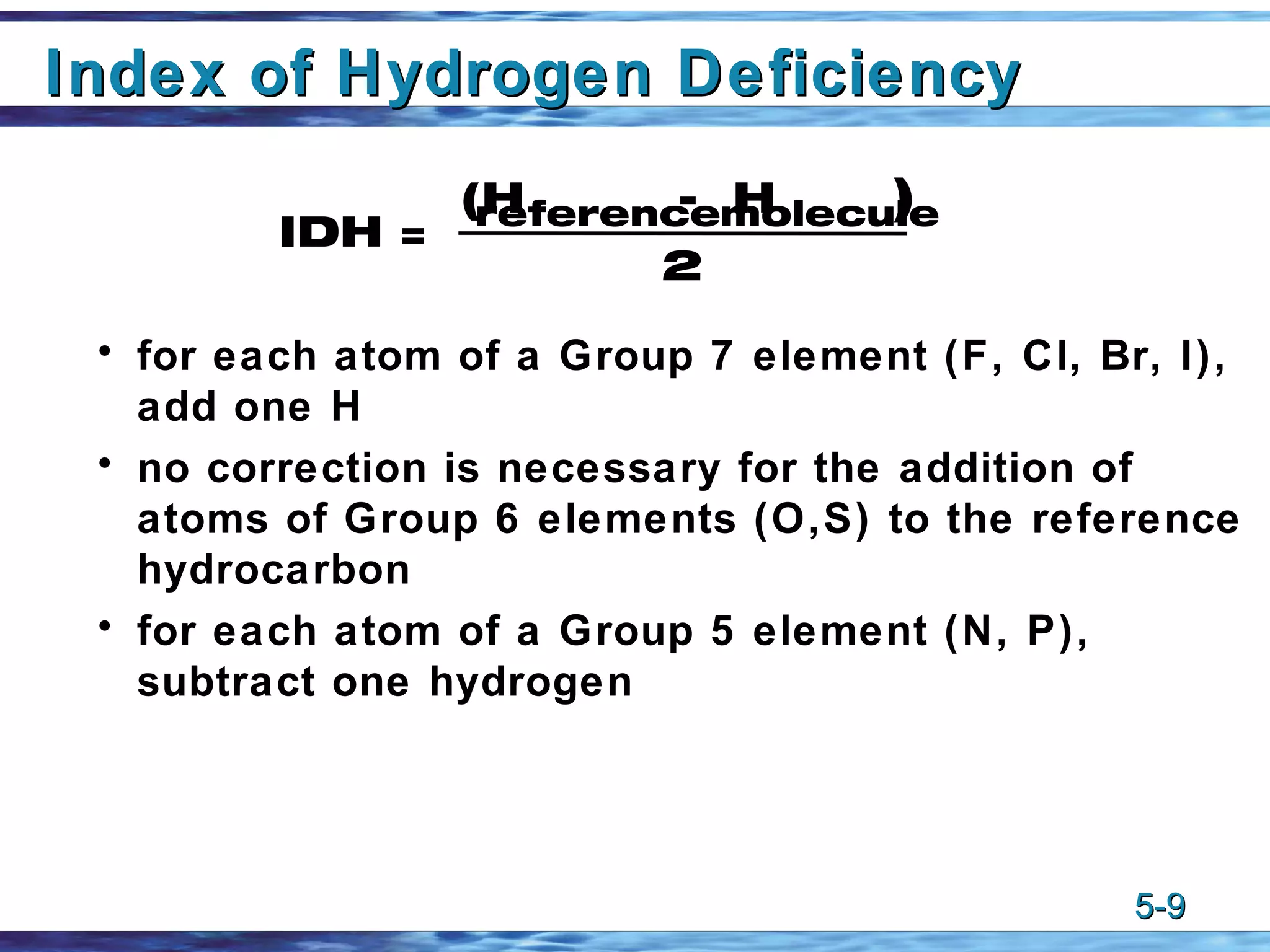
Index of Hydrogen Deficiency for each atom of a Group 7 element (F, Cl, Br, I), add one H no correction is necessary for the addition of atoms of Group 6 elements (O,S) to the reference hydrocarbon for each atom of a Group 5 element (N, P), subtract one hydrogen IDH = 2 (H reference -  H molecule )
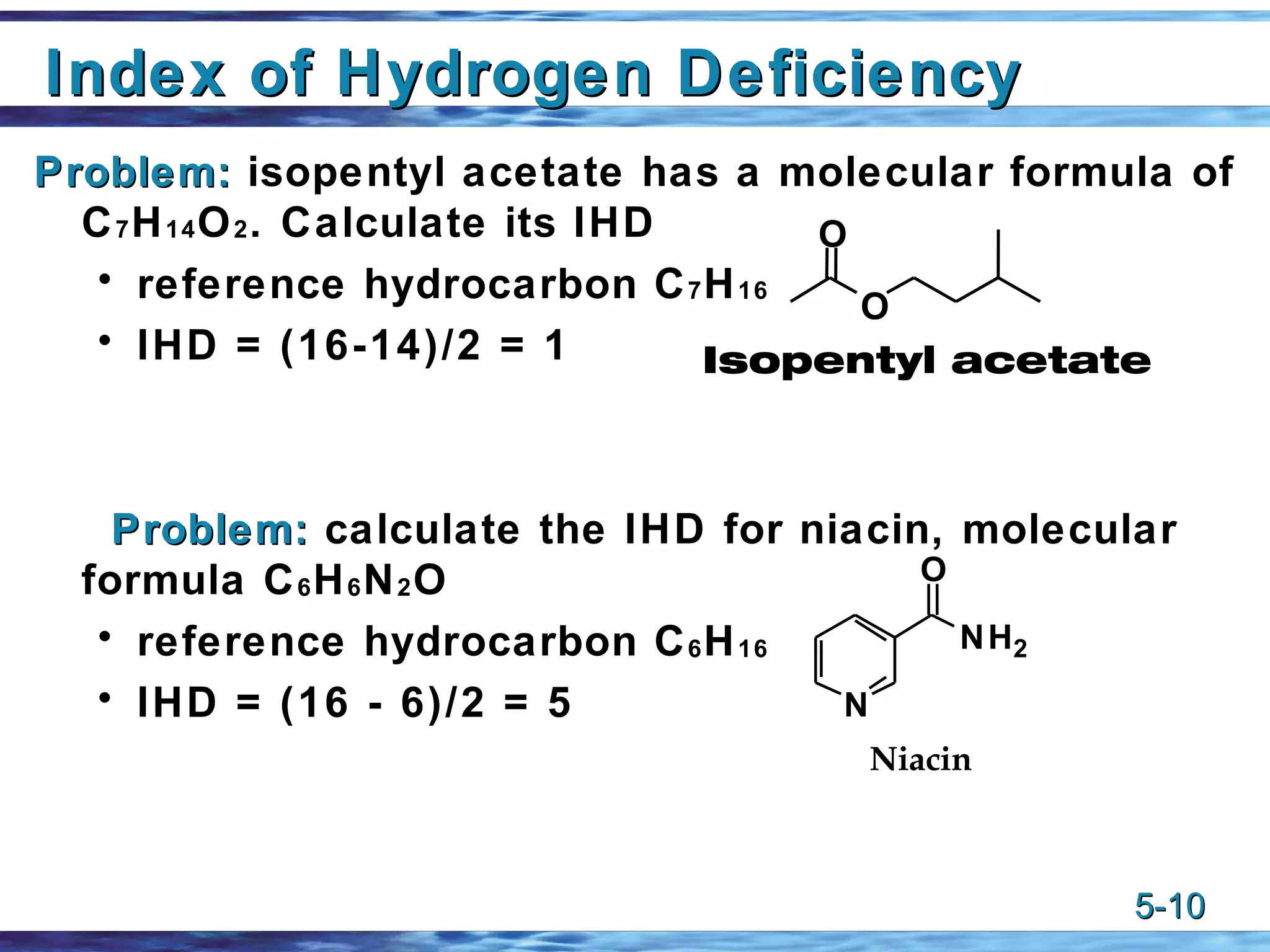
Index of Hydrogen Deficiency Problem:  isopentyl acetate has a molecular formula of C 7 H 14 O 2 . Calculate its IHD reference hydrocarbon C 7 H 16 IHD = (16-14)/2 = 1 Problem:  calculate the IHD for niacin, molecular formula C 6 H 6 N 2 O reference hydrocarbon C 6 H 16 IHD = (16 - 6)/2 = 5 O O Isopentyl acetate
IUPAC Nomenclature 1. Number the longest chain of carbon atoms that contains the double bond in the direction that gives the carbons of the double bond the lowest numbers 2. Locate the double bond by the number of its first carbon 3. Name substituents 4. Number the carbon, locate and name substituents, locate the double bond, and name the main chain
Common Names Despite the precision and universal acceptance of IUPAC nomenclature, some alkenes, particularly low-molecular-weight ones, are known almost exclusively by their common names
Common Names the common names methylene, vinyl, and allyl are often used to show the presence of the following alkenyl groups
The  Cis , Trans  System Configuration is determined by the orientation of atoms of the main chain
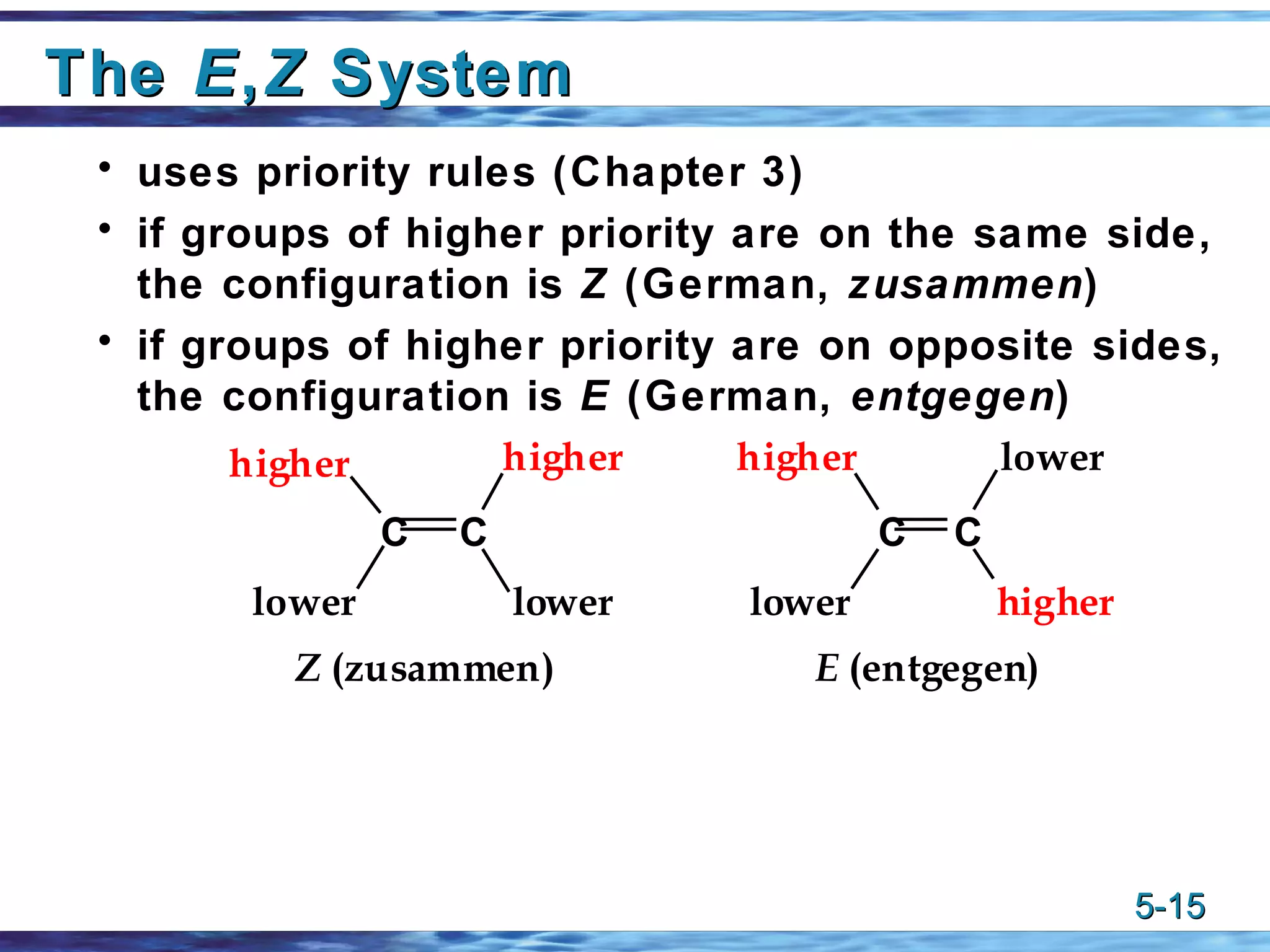
The  E , Z  System uses priority rules (Chapter 3)  if groups of higher priority are on the same side, the configuration is  Z  (German,  zusammen ) if groups of higher priority are on opposite sides, the configuration is  E  (German,  entgegen )
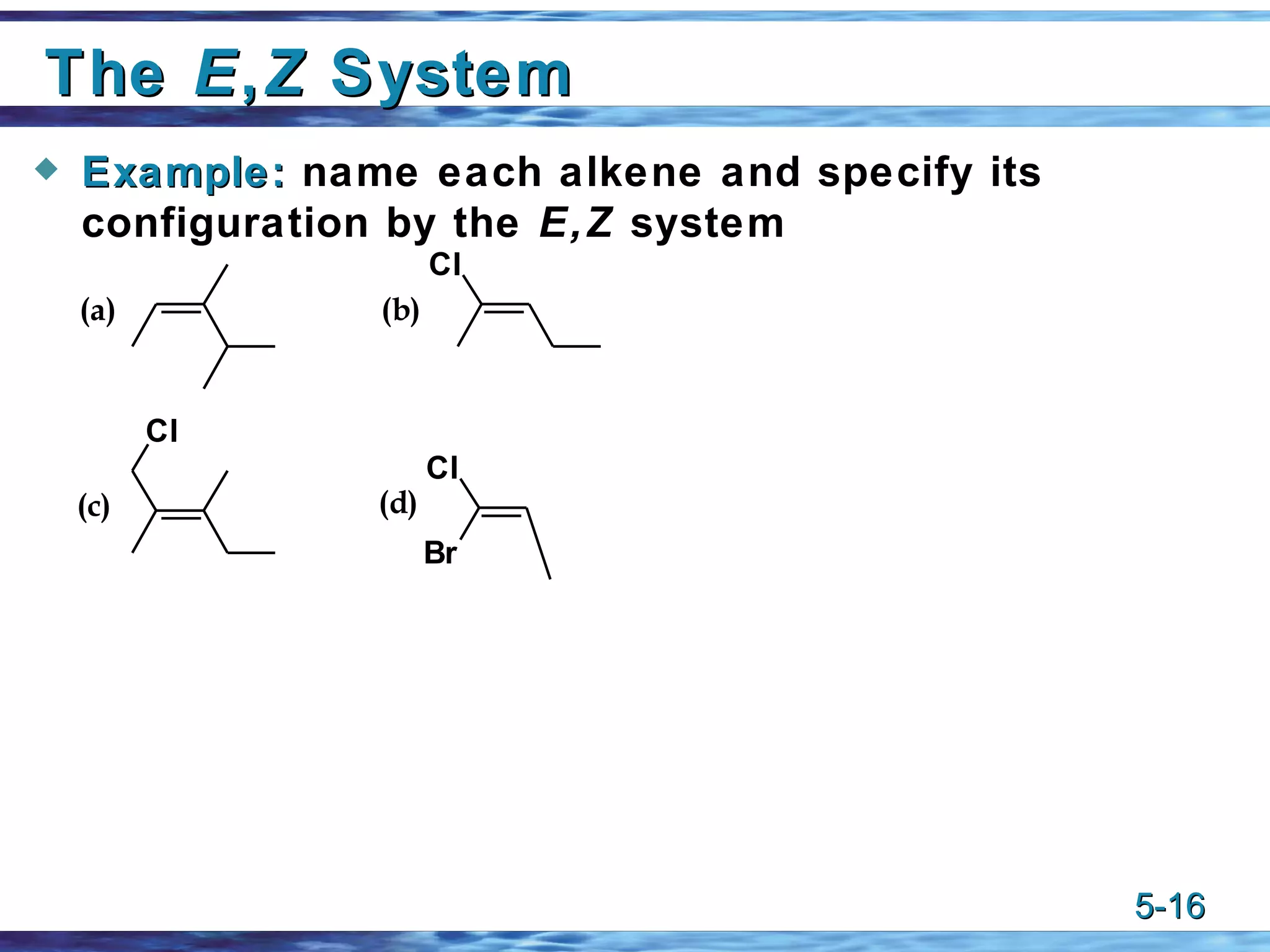
The  E , Z  System Example:   name each alkene and specify its configuration by the  E,Z  system
Cis,Trans  Isomerism Cycloalkenes in small-ring cycloalkenes, the configuration of the double bond is  cis   these rings are not large enough to accommodate a  trans  double bond
Cis,Trans  Isomerism trans -cyclooctene is the smallest  trans  cyclooctene that has been prepared in pure form and is stable at room temperature the  cis  isomer is 38 kJ (9.1 kcal)/mol more stable than the  trans  isomer the  trans  isomer is chiral even though it has no chiral center
Dienes, Trienes, and Polyenes For alkenes containing two or more double bonds, change the infix - en - to - adien -, - atrien -, etc. those containing several double bonds are often referred more generally as polyenes following are three dienes
Dienes, Trienes, and Polyenes for alkenes with  n  double bonds, each of which can show  cis,trans  isomerism,  2 n  stereoisomers are possible example: 2 2  = 4  cis,trans  isomers are possible for 2,4-heptadiene
Dienes, Trienes, and Polyenes vitamin A, a biologically important compound for which a number of  cis,trans  isomers is possible there are four double bonds about which  cis,trans  isomerism is possible, for 2 4  = 16 stereoisomers
Physical Properties Alkenes are nonpolar compounds The only attractive forces between their molecules are dispersion forces The physical properties of alkenes are similar to those of alkanes
Terpenes Terpene:   a compound whose carbon skeleton can be divided into two or more units identical with the carbon skeleton of isoprene
Terpenes Myrcene, C 10 H 16 , a component of bayberry wax and oils of bay and verbena Menthol, from peppermint
Terpenes  -Pinene, from turpentine camphor, from the camphor tree
Fatty Acids Animal fats and vegetable oils are both triesters of glycerol, hence the name  triglyceride hydrolysis of a triglyceride in aqueous base followed by acidification gives glycerol and three fatty acids fatty acids with no C=C double bonds are called saturated fatty acid those with one or more C=C double bonds are called unsaturated fatty acids
Fatty Acids the most common fatty acids have an even number of carbons, and between 12 and 20 carbons in an unbranched chain the C=C double bonds in almost all naturally occurring fatty acids have a  cis  configuration the greater degree of unsaturation, the lower the melting point triglycerides rich in unsaturated fatty acids are generally liquid at room temperature and are called  oils triglycerides rich in saturated fatty acids are generally semisolids or solids at room temperature and are called  fats
Fatty Acids the four most abundant fatty acids
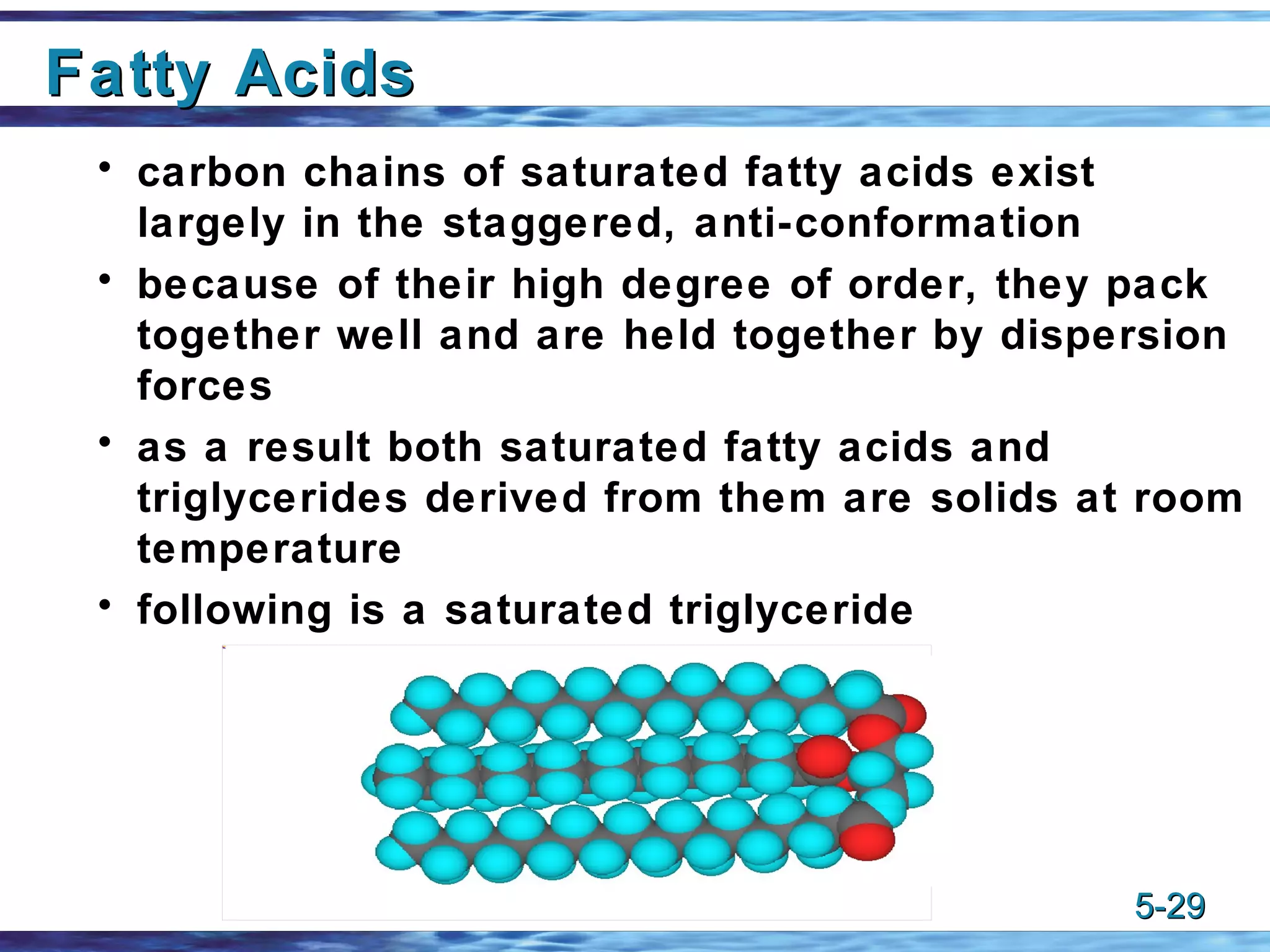
Fatty Acids carbon chains of saturated fatty acids exist largely in the staggered, anti-conformation because of their high degree of order, they pack together well and are held together by dispersion forces as a result both saturated fatty acids and triglycerides derived from them are solids at room temperature following is a saturated triglyceride
Fatty Acids cis  double bonds place kinks in the chains of unsaturated fatty acids unsaturated fatty acids and the triglycerides derived from them do not pack as well in a crystal lattice as their saturated counterparts, and have weaker dispersion forces between their molecules butter fat, for example, has a high content of saturated fatty acids and is a solid at room temperature salad oils (from plant oils) have a high content of polyunsaturated fatty acids and are liquid at room temperature
Alkenes: Structure and Nomenclature End Chapter 5

Ch5

  • 1.
    Organic Chemistry WilliamH. Brown Christopher S. Foote Brent L. Iverson
  • 2.
    Alkenes: Structure andNomenclature Chapter 5
  • 3.
    Unsaturated Hydrocarbons Unsaturatedhydrocarbon: contains one or more carbon-carbon double or triple bonds Alkene: contains a carbon-carbon double bond and has the general formula C n H 2n Alkyne: contains a carbon-carbon triple bond and has the general formula C n H 2n-2
  • 4.
    Unsaturated Hydrocarbons Arenes: benzene and its derivatives (Ch 21-22) we do not study arenes until Chapters 21 & 22 however, we show structural formulas of compounds containing the phenyl group before that time the phenyl group is not reactive under any of the conditions we describe in Ch 6-20
  • 5.
    Structure of AlkenesA double bond consists of one sigma bond formed by the overlap of sp 2 hybrid orbitals and one pi bond formed by the overlap of parallel 2 p orbitals the two carbon atoms of a double bond and the four atoms bonded to them lie in a plane, with bond angles of approximately 120°
  • 6.
    Structure of Alkenesit takes approximately 264 kJ (63 kcal)/mol to break the pi bond in ethylene; that is, to rotate one carbon by 90° with respect to the other so that there is no overlap between 2 p orbitals on adjacent carbons
  • 7.
    Cis,Trans Isomerismin Alkenes Cis,trans isomers: isomers that have the same connectivity but a different arrangement of their atoms in space due to the presence of either a ring or a carbon-carbon double bond
  • 8.
    Index of HydrogenDeficiency Index of hydrogen deficiency (IHD): the sum of the number of rings and pi bonds in a molecule To determine IHD, compare the number of hydrogens in an unknown compound with the number in a reference hydrocarbon of the same number of carbons and with no rings or pi bonds the molecular formula of the reference hydrocarbon is C n H 2n+2
  • 9.
    Index of HydrogenDeficiency for each atom of a Group 7 element (F, Cl, Br, I), add one H no correction is necessary for the addition of atoms of Group 6 elements (O,S) to the reference hydrocarbon for each atom of a Group 5 element (N, P), subtract one hydrogen IDH = 2 (H reference - H molecule )
  • 10.
    Index of HydrogenDeficiency Problem: isopentyl acetate has a molecular formula of C 7 H 14 O 2 . Calculate its IHD reference hydrocarbon C 7 H 16 IHD = (16-14)/2 = 1 Problem: calculate the IHD for niacin, molecular formula C 6 H 6 N 2 O reference hydrocarbon C 6 H 16 IHD = (16 - 6)/2 = 5 O O Isopentyl acetate
  • 11.
    IUPAC Nomenclature 1.Number the longest chain of carbon atoms that contains the double bond in the direction that gives the carbons of the double bond the lowest numbers 2. Locate the double bond by the number of its first carbon 3. Name substituents 4. Number the carbon, locate and name substituents, locate the double bond, and name the main chain
  • 12.
    Common Names Despitethe precision and universal acceptance of IUPAC nomenclature, some alkenes, particularly low-molecular-weight ones, are known almost exclusively by their common names
  • 13.
    Common Names thecommon names methylene, vinyl, and allyl are often used to show the presence of the following alkenyl groups
  • 14.
    The Cis, Trans System Configuration is determined by the orientation of atoms of the main chain
  • 15.
    The E, Z System uses priority rules (Chapter 3) if groups of higher priority are on the same side, the configuration is Z (German, zusammen ) if groups of higher priority are on opposite sides, the configuration is E (German, entgegen )
  • 16.
    The E, Z System Example: name each alkene and specify its configuration by the E,Z system
  • 17.
    Cis,Trans IsomerismCycloalkenes in small-ring cycloalkenes, the configuration of the double bond is cis these rings are not large enough to accommodate a trans double bond
  • 18.
    Cis,Trans Isomerismtrans -cyclooctene is the smallest trans cyclooctene that has been prepared in pure form and is stable at room temperature the cis isomer is 38 kJ (9.1 kcal)/mol more stable than the trans isomer the trans isomer is chiral even though it has no chiral center
  • 19.
    Dienes, Trienes, andPolyenes For alkenes containing two or more double bonds, change the infix - en - to - adien -, - atrien -, etc. those containing several double bonds are often referred more generally as polyenes following are three dienes
  • 20.
    Dienes, Trienes, andPolyenes for alkenes with n double bonds, each of which can show cis,trans isomerism, 2 n stereoisomers are possible example: 2 2 = 4 cis,trans isomers are possible for 2,4-heptadiene
  • 21.
    Dienes, Trienes, andPolyenes vitamin A, a biologically important compound for which a number of cis,trans isomers is possible there are four double bonds about which cis,trans isomerism is possible, for 2 4 = 16 stereoisomers
  • 22.
    Physical Properties Alkenesare nonpolar compounds The only attractive forces between their molecules are dispersion forces The physical properties of alkenes are similar to those of alkanes
  • 23.
    Terpenes Terpene: a compound whose carbon skeleton can be divided into two or more units identical with the carbon skeleton of isoprene
  • 24.
    Terpenes Myrcene, C10 H 16 , a component of bayberry wax and oils of bay and verbena Menthol, from peppermint
  • 25.
    Terpenes  -Pinene,from turpentine camphor, from the camphor tree
  • 26.
    Fatty Acids Animalfats and vegetable oils are both triesters of glycerol, hence the name triglyceride hydrolysis of a triglyceride in aqueous base followed by acidification gives glycerol and three fatty acids fatty acids with no C=C double bonds are called saturated fatty acid those with one or more C=C double bonds are called unsaturated fatty acids
  • 27.
    Fatty Acids themost common fatty acids have an even number of carbons, and between 12 and 20 carbons in an unbranched chain the C=C double bonds in almost all naturally occurring fatty acids have a cis configuration the greater degree of unsaturation, the lower the melting point triglycerides rich in unsaturated fatty acids are generally liquid at room temperature and are called oils triglycerides rich in saturated fatty acids are generally semisolids or solids at room temperature and are called fats
  • 28.
    Fatty Acids thefour most abundant fatty acids
  • 29.
    Fatty Acids carbonchains of saturated fatty acids exist largely in the staggered, anti-conformation because of their high degree of order, they pack together well and are held together by dispersion forces as a result both saturated fatty acids and triglycerides derived from them are solids at room temperature following is a saturated triglyceride
  • 30.
    Fatty Acids cis double bonds place kinks in the chains of unsaturated fatty acids unsaturated fatty acids and the triglycerides derived from them do not pack as well in a crystal lattice as their saturated counterparts, and have weaker dispersion forces between their molecules butter fat, for example, has a high content of saturated fatty acids and is a solid at room temperature salad oils (from plant oils) have a high content of polyunsaturated fatty acids and are liquid at room temperature
  • 31.
    Alkenes: Structure andNomenclature End Chapter 5