Geoff Cain & Charlene Gore Tacoma Community College
Students unprepared for the technological challenges of school and the workplace Faculty unprepared for teaching in a connected world Full online program with little community; students not connected to campus or one another Faculty teaching technology while trying to teach content
Create an academic and professional network Teach students how to use the technology early in the program Teach the students how to create networks Networks becoming  increasingly complex.
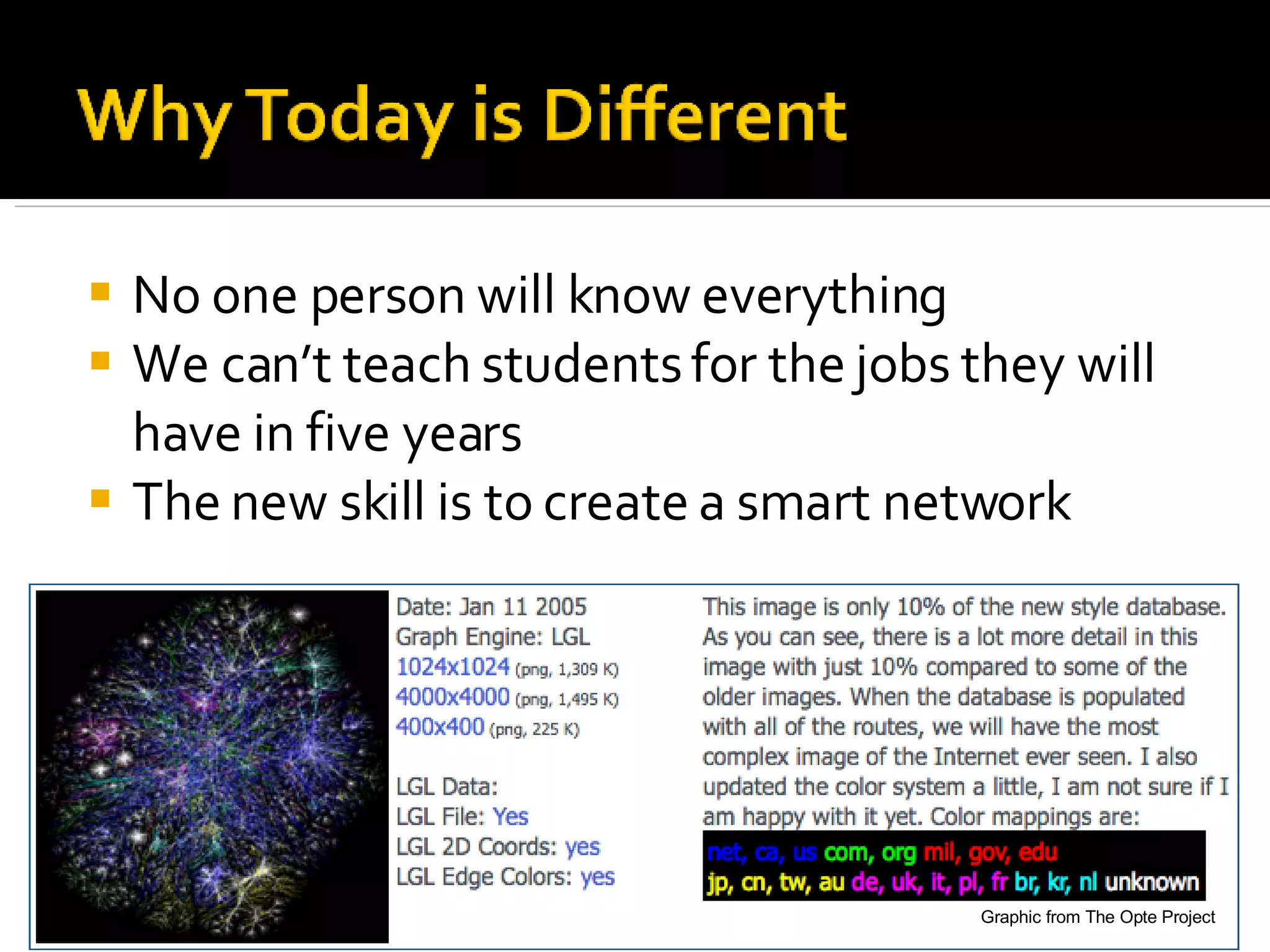
No one person will know everything We can’t teach students for the jobs they will have in five years The new skill is to create a smart network Graphic from The Opte Project
Learning and knowledge rests in a diversity of opinions Learning is a process of making connections The capacity to know is more important than what is currently known The ability to see connections is a core skill Decision making itself is a learning process Detail from Matt Thorton’s  Indra’s Web  <http://www.straightblastgym.com/blog/web-indrasnet.jpg>
Students report a greater comfort with technology Faculty spend less time teaching technology Students using the tools in other classes Students creating extensive networks Graphic by Gail Atkins <http://www.angelfire.com/realm/bodhisattva/indras-net.html>
More student-led learning (Starfish and the Spider) Roll course out to campus Larger classes
Brafman, Ori and Beckstrom, Rod A. (2007)  The Starfish and the Spider.   <http://www.starfishandspider.com> Cain, Geoff. (2008).  Brainstorm in Progress . <http://cain.blogspot.com> Includes link to syllabus and the resources below. Cormier, Dave. (2008). “Rhizomatic Education: Community as Curriculum”   <http://www.innovateonline.info/index.php?view=article&id=550> Dron, J. & Anderson, T. (2007). Collectives, Networks and Groups in Social Software for E-Learning. In G. Richards (Ed.), Proceedings of World Conference on E-Learning in Corporate, Government, Healthcare, and Higher Education 2007 (pp. 2460-2467). Chesapeake, VA: AACE.  Siemens, George. (2004) “Connectivism: A Learning Theory for the Digital Age”  <http://www.elearnspace.org/Articles/connectivism.htm>

The Connectivist Classroom

  • 1.
    Geoff Cain &Charlene Gore Tacoma Community College
  • 2.
    Students unprepared forthe technological challenges of school and the workplace Faculty unprepared for teaching in a connected world Full online program with little community; students not connected to campus or one another Faculty teaching technology while trying to teach content
  • 3.
    Create an academicand professional network Teach students how to use the technology early in the program Teach the students how to create networks Networks becoming increasingly complex.
  • 4.
    No one personwill know everything We can’t teach students for the jobs they will have in five years The new skill is to create a smart network Graphic from The Opte Project
  • 5.
    Learning and knowledgerests in a diversity of opinions Learning is a process of making connections The capacity to know is more important than what is currently known The ability to see connections is a core skill Decision making itself is a learning process Detail from Matt Thorton’s Indra’s Web <http://www.straightblastgym.com/blog/web-indrasnet.jpg>
  • 6.
    Students report agreater comfort with technology Faculty spend less time teaching technology Students using the tools in other classes Students creating extensive networks Graphic by Gail Atkins <http://www.angelfire.com/realm/bodhisattva/indras-net.html>
  • 7.
    More student-led learning(Starfish and the Spider) Roll course out to campus Larger classes
  • 8.
    Brafman, Ori andBeckstrom, Rod A. (2007) The Starfish and the Spider. <http://www.starfishandspider.com> Cain, Geoff. (2008). Brainstorm in Progress . <http://cain.blogspot.com> Includes link to syllabus and the resources below. Cormier, Dave. (2008). “Rhizomatic Education: Community as Curriculum” <http://www.innovateonline.info/index.php?view=article&id=550> Dron, J. & Anderson, T. (2007). Collectives, Networks and Groups in Social Software for E-Learning. In G. Richards (Ed.), Proceedings of World Conference on E-Learning in Corporate, Government, Healthcare, and Higher Education 2007 (pp. 2460-2467). Chesapeake, VA: AACE. Siemens, George. (2004) “Connectivism: A Learning Theory for the Digital Age” <http://www.elearnspace.org/Articles/connectivism.htm>