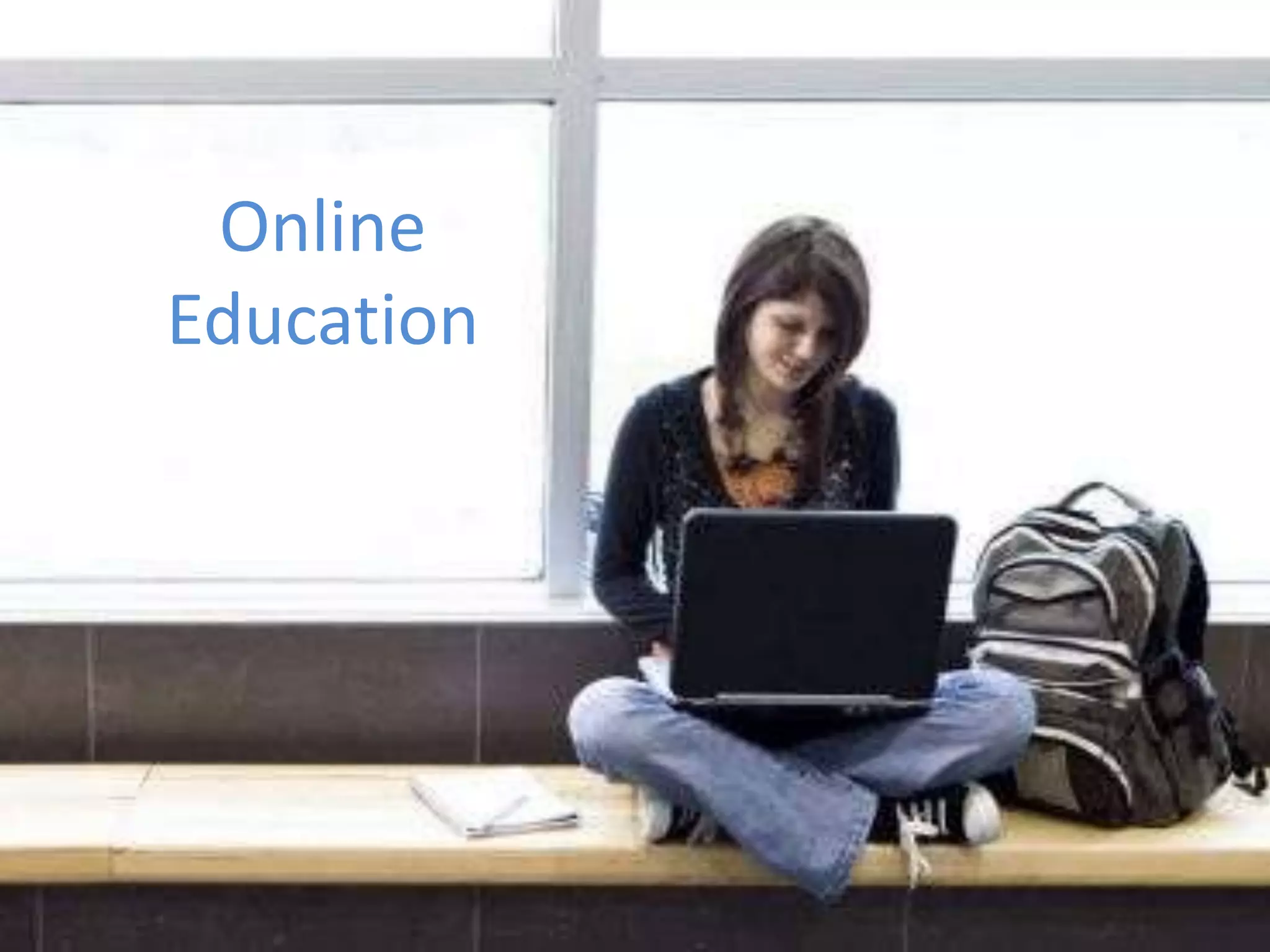
Online
Education
What is “Online Education”?
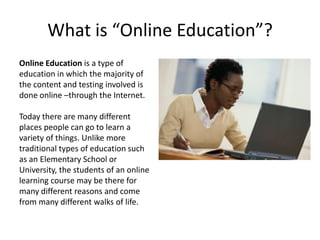
Online Education is a type of
education in which the majority of
the content and testing involved is
done online –through the Internet.

Today there are many different
places people can go to learn a
variety of things. Unlike more
traditional types of education such
as an Elementary School or
University, the students of an online
learning course may be there for
many different reasons and come
from many different walks of life.
Opening Discussion
• What do you think might be some of the
  benefits and weaknesses of online education?
• Have you ever studied anything on the
  internet? What did you use? Where did you
  go?
• Are some things easier to teach online than
  others? What might be the best things to
  learn online?
Podcast
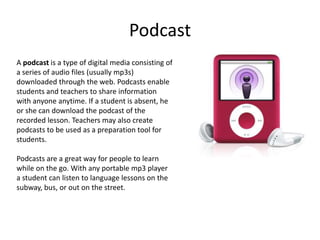
A podcast is a type of digital media consisting of
a series of audio files (usually mp3s)
downloaded through the web. Podcasts enable
students and teachers to share information
with anyone anytime. If a student is absent, he
or she can download the podcast of the
recorded lesson. Teachers may also create
podcasts to be used as a preparation tool for
students.

Podcasts are a great way for people to learn
while on the go. With any portable mp3 player
a student can listen to language lessons on the
subway, bus, or out on the street.
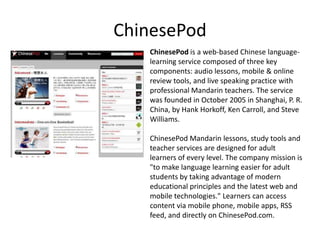
ChinesePod
   ChinesePod is a web-based Chinese language-
   learning service composed of three key
   components: audio lessons, mobile & online
   review tools, and live speaking practice with
   professional Mandarin teachers. The service
   was founded in October 2005 in Shanghai, P. R.
   China, by Hank Horkoff, Ken Carroll, and Steve
   Williams.

   ChinesePod Mandarin lessons, study tools and
   teacher services are designed for adult
   learners of every level. The company mission is
   "to make language learning easier for adult
   students by taking advantage of modern
   educational principles and the latest web and
   mobile technologies." Learners can access
   content via mobile phone, mobile apps, RSS
   feed, and directly on ChinesePod.com.
Screencast
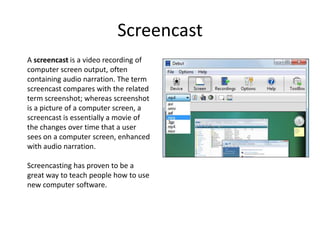
A screencast is a video recording of
computer screen output, often
containing audio narration. The term
screencast compares with the related
term screenshot; whereas screenshot
is a picture of a computer screen, a
screencast is essentially a movie of
the changes over time that a user
sees on a computer screen, enhanced
with audio narration.

Screencasting has proven to be a
great way to teach people how to use
new computer software.
Online Traffic School
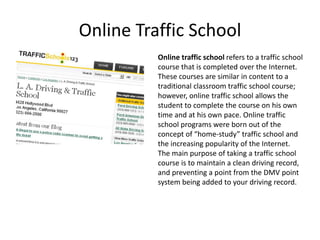
          Online traffic school refers to a traffic school
          course that is completed over the Internet.
          These courses are similar in content to a
          traditional classroom traffic school course;
          however, online traffic school allows the
          student to complete the course on his own
          time and at his own pace. Online traffic
          school programs were born out of the
          concept of “home-study” traffic school and
          the increasing popularity of the Internet.
          The main purpose of taking a traffic school
          course is to maintain a clean driving record,
          and preventing a point from the DMV point
          system being added to your driving record.
What do you think?
• Is a free education as good as one you pay
  for? Why or why not?
• Do you ever use your mp3 player to listen to
  anything besides music? What do you listen
  to?
• Can you think of a better way to teach people
  over the internet?
• Do you think that people can learn about good
  driving from the Internet?
SlideShare


SlideShare is a Web 2.0 based slide hosting service. Users can upload
files privately or publicly as PowerPoint presentations and view them
online. Launched on October 4, 2006, the website is considered to be
similar to YouTube, but for slideshows.

The website gets an estimated 58 million unique visitors a month, and
has about 16 million registered users. SlideShare.com was voted
amongst by the World's Top 10 tools for education & e-learning in 2010.
Khan Academy


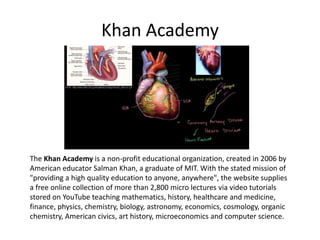
The Khan Academy is a non-profit educational organization, created in 2006 by
American educator Salman Khan, a graduate of MIT. With the stated mission of
"providing a high quality education to anyone, anywhere", the website supplies
a free online collection of more than 2,800 micro lectures via video tutorials
stored on YouTube teaching mathematics, history, healthcare and medicine,
finance, physics, chemistry, biology, astronomy, economics, cosmology, organic
chemistry, American civics, art history, microeconomics and computer science.
Online Degree
                                    An online degree is an academic degree (usually a
                                    university degree, but sometimes the term
                                    includes high school diplomas or other certificate
                                    programs) that can be earned primarily or entirely
                                    through the use of an Internet-connected
                                    computer, rather than attending college in a
                                    traditional campus setting. Improvements in
                                    technology and the increasing use of the Internet
                                    worldwide have led to a proliferation of online
                                    colleges that award associate, bachelor's,
                                    master's, and doctoral degrees.


There are several online universities are fully accredited by the educational
departments of many countries, including the United States. This means that the
degree is as official as a degree offered by traditional university.
The Open University
site: http://www.open.ac.uk/

The Open University (commonly Open University or its
initialism OU, but officially "The" is part of its name) is a
distance learning and research university founded in the
United Kingdom. The university is funded by a
combination of student fees, contract income, and
government funds. It is notable for having an open entry
policy, i.e. students' previous academic achievements are
not taken into account for entry to most undergraduate
courses. The majority of the OU's undergraduate
students are based in the United Kingdom and
principally study off-campus, but many of its courses
(both undergraduate and postgraduate) can be studied
off-campus anywhere in the world.
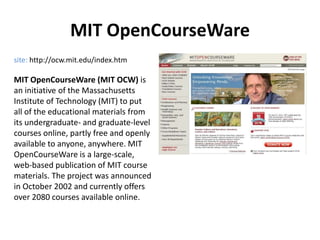
MIT OpenCourseWare
site: http://ocw.mit.edu/index.htm

MIT OpenCourseWare (MIT OCW) is
an initiative of the Massachusetts
Institute of Technology (MIT) to put
all of the educational materials from
its undergraduate- and graduate-level
courses online, partly free and openly
available to anyone, anywhere. MIT
OpenCourseWare is a large-scale,
web-based publication of MIT course
materials. The project was announced
in October 2002 and currently offers
over 2080 courses available online.
What do you think?
• Do you think a University education is more
  valuable than an online course? Why or why
  not?
• In the future do you think there will be more
  or less people getting online degrees?
• If you were the boss, would you hire someone
  who got their degree online?

      You can review this presentation anytime by going to
                     www.englishslide.com

Online Education

  • 1.
  • 2.
    What is “OnlineEducation”? Online Education is a type of education in which the majority of the content and testing involved is done online –through the Internet. Today there are many different places people can go to learn a variety of things. Unlike more traditional types of education such as an Elementary School or University, the students of an online learning course may be there for many different reasons and come from many different walks of life.
  • 3.
    Opening Discussion • Whatdo you think might be some of the benefits and weaknesses of online education? • Have you ever studied anything on the internet? What did you use? Where did you go? • Are some things easier to teach online than others? What might be the best things to learn online?
  • 4.
    Podcast A podcast isa type of digital media consisting of a series of audio files (usually mp3s) downloaded through the web. Podcasts enable students and teachers to share information with anyone anytime. If a student is absent, he or she can download the podcast of the recorded lesson. Teachers may also create podcasts to be used as a preparation tool for students. Podcasts are a great way for people to learn while on the go. With any portable mp3 player a student can listen to language lessons on the subway, bus, or out on the street.
  • 5.
    ChinesePod ChinesePod is a web-based Chinese language- learning service composed of three key components: audio lessons, mobile & online review tools, and live speaking practice with professional Mandarin teachers. The service was founded in October 2005 in Shanghai, P. R. China, by Hank Horkoff, Ken Carroll, and Steve Williams. ChinesePod Mandarin lessons, study tools and teacher services are designed for adult learners of every level. The company mission is "to make language learning easier for adult students by taking advantage of modern educational principles and the latest web and mobile technologies." Learners can access content via mobile phone, mobile apps, RSS feed, and directly on ChinesePod.com.
  • 6.
    Screencast A screencast isa video recording of computer screen output, often containing audio narration. The term screencast compares with the related term screenshot; whereas screenshot is a picture of a computer screen, a screencast is essentially a movie of the changes over time that a user sees on a computer screen, enhanced with audio narration. Screencasting has proven to be a great way to teach people how to use new computer software.
  • 7.
    Online Traffic School Online traffic school refers to a traffic school course that is completed over the Internet. These courses are similar in content to a traditional classroom traffic school course; however, online traffic school allows the student to complete the course on his own time and at his own pace. Online traffic school programs were born out of the concept of “home-study” traffic school and the increasing popularity of the Internet. The main purpose of taking a traffic school course is to maintain a clean driving record, and preventing a point from the DMV point system being added to your driving record.
  • 8.
    What do youthink? • Is a free education as good as one you pay for? Why or why not? • Do you ever use your mp3 player to listen to anything besides music? What do you listen to? • Can you think of a better way to teach people over the internet? • Do you think that people can learn about good driving from the Internet?
  • 9.
    SlideShare SlideShare is aWeb 2.0 based slide hosting service. Users can upload files privately or publicly as PowerPoint presentations and view them online. Launched on October 4, 2006, the website is considered to be similar to YouTube, but for slideshows. The website gets an estimated 58 million unique visitors a month, and has about 16 million registered users. SlideShare.com was voted amongst by the World's Top 10 tools for education & e-learning in 2010.
  • 10.
    Khan Academy The KhanAcademy is a non-profit educational organization, created in 2006 by American educator Salman Khan, a graduate of MIT. With the stated mission of "providing a high quality education to anyone, anywhere", the website supplies a free online collection of more than 2,800 micro lectures via video tutorials stored on YouTube teaching mathematics, history, healthcare and medicine, finance, physics, chemistry, biology, astronomy, economics, cosmology, organic chemistry, American civics, art history, microeconomics and computer science.
  • 11.
    Online Degree An online degree is an academic degree (usually a university degree, but sometimes the term includes high school diplomas or other certificate programs) that can be earned primarily or entirely through the use of an Internet-connected computer, rather than attending college in a traditional campus setting. Improvements in technology and the increasing use of the Internet worldwide have led to a proliferation of online colleges that award associate, bachelor's, master's, and doctoral degrees. There are several online universities are fully accredited by the educational departments of many countries, including the United States. This means that the degree is as official as a degree offered by traditional university.
  • 12.
    The Open University site:http://www.open.ac.uk/ The Open University (commonly Open University or its initialism OU, but officially "The" is part of its name) is a distance learning and research university founded in the United Kingdom. The university is funded by a combination of student fees, contract income, and government funds. It is notable for having an open entry policy, i.e. students' previous academic achievements are not taken into account for entry to most undergraduate courses. The majority of the OU's undergraduate students are based in the United Kingdom and principally study off-campus, but many of its courses (both undergraduate and postgraduate) can be studied off-campus anywhere in the world.
  • 13.
    MIT OpenCourseWare site: http://ocw.mit.edu/index.htm MITOpenCourseWare (MIT OCW) is an initiative of the Massachusetts Institute of Technology (MIT) to put all of the educational materials from its undergraduate- and graduate-level courses online, partly free and openly available to anyone, anywhere. MIT OpenCourseWare is a large-scale, web-based publication of MIT course materials. The project was announced in October 2002 and currently offers over 2080 courses available online.
  • 14.
    What do youthink? • Do you think a University education is more valuable than an online course? Why or why not? • In the future do you think there will be more or less people getting online degrees? • If you were the boss, would you hire someone who got their degree online? You can review this presentation anytime by going to www.englishslide.com