MUHAMMAD SHAFIQ
Lecture 5
Problem Definition and the
Research Proposal
A TALE
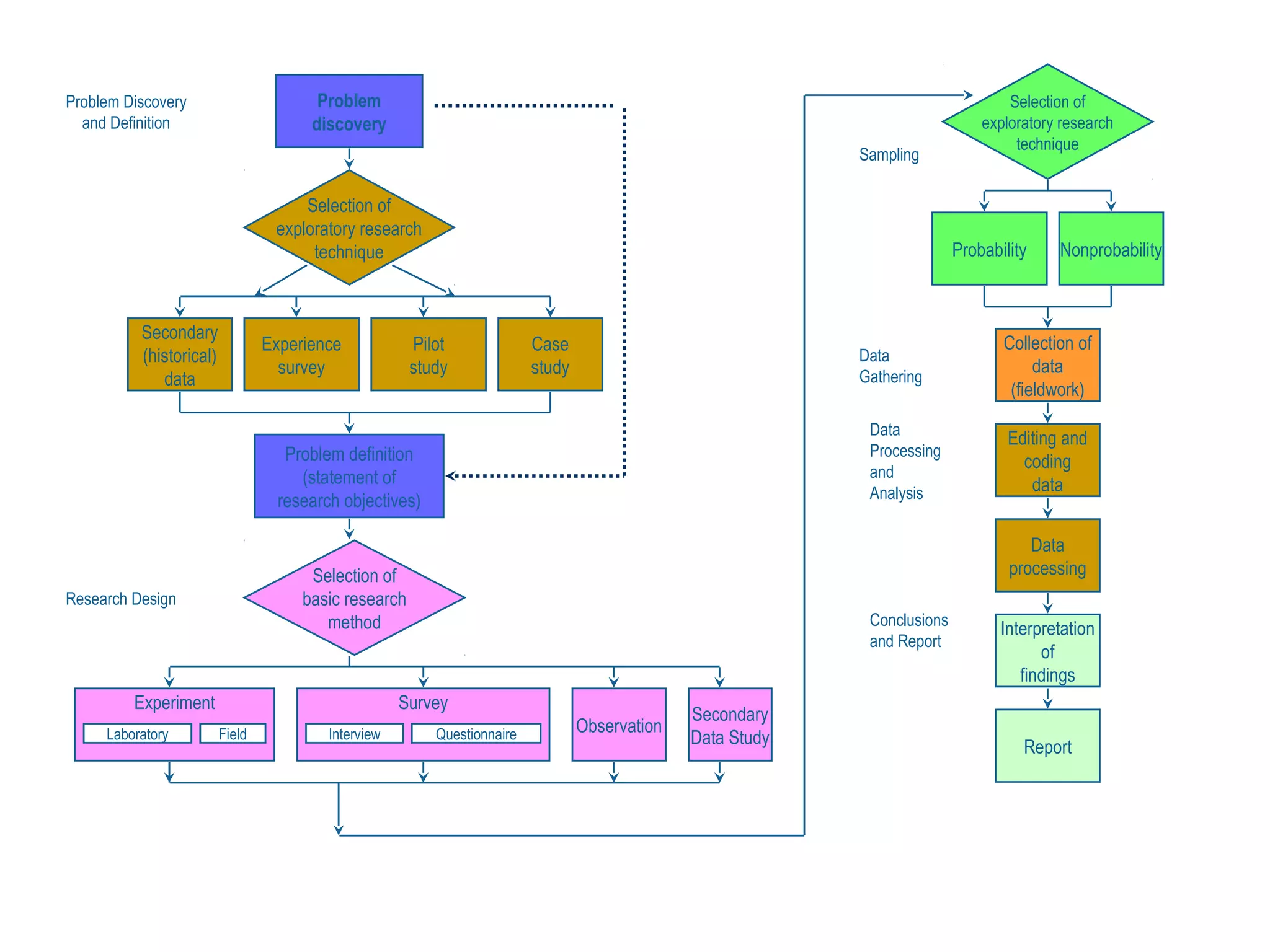
Problem
discovery
Problem definition
(statement of
research objectives)
Secondary
(historical)
data
Experience
survey
Pilot
study
Case
study
Selection of
exploratory research
technique
Selection of
basic research
method
Experiment Survey
Observation
Secondary
Data StudyLaboratory Field Interview Questionnaire
Selection of
exploratory research
technique
Sampling
Probability Nonprobability
Collection of
data
(fieldwork)
Editing and
coding
data
Data
processing
Interpretation
of
findings
Report
Data
Gathering
Data
Processing
and
Analysis
Conclusions
and Report
Research Design
Problem Discovery
and Definition
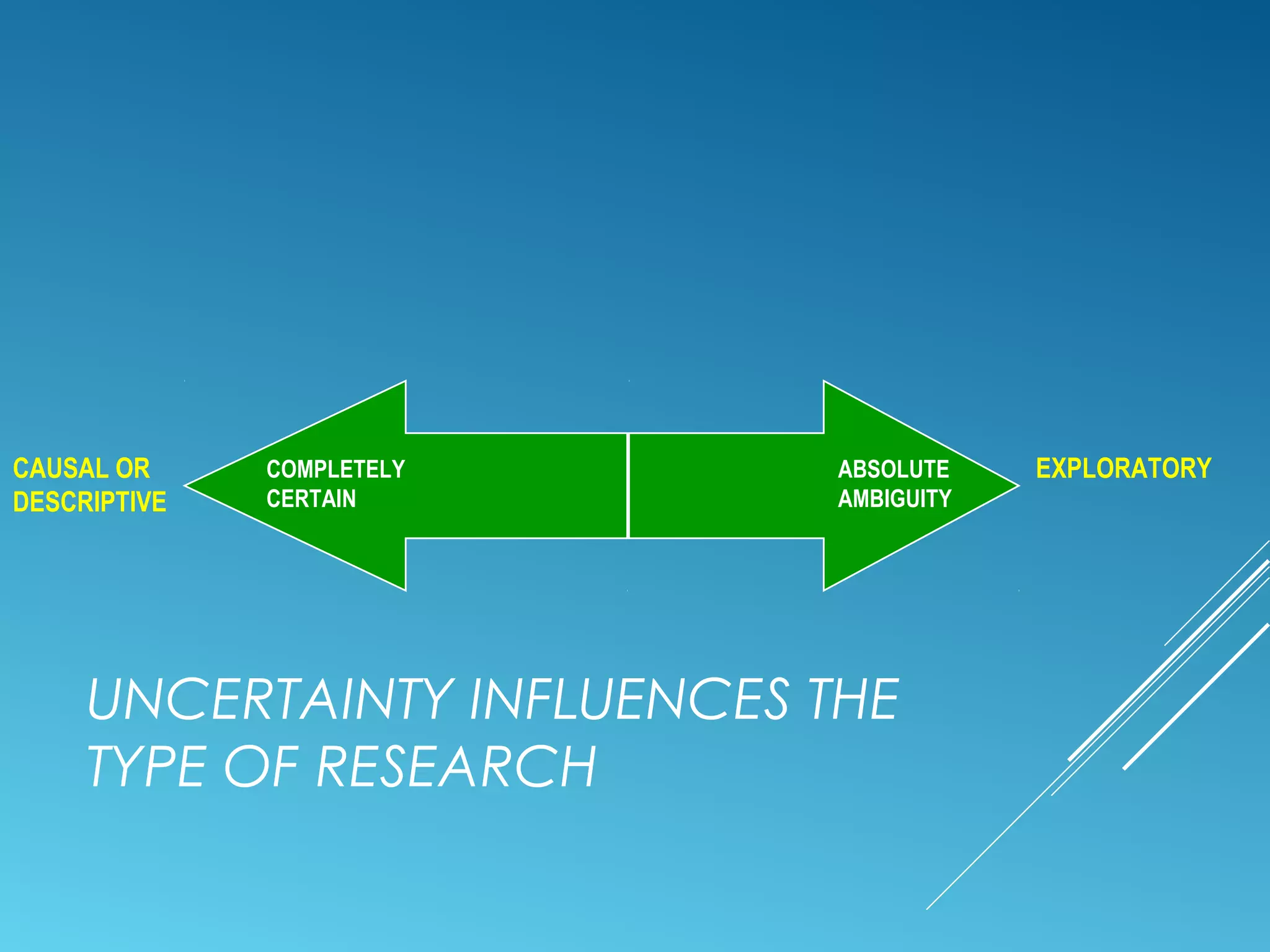
COMPLETELY
CERTAIN
ABSOLUTE
AMBIGUITY
CAUSAL OR
DESCRIPTIVE
EXPLORATORY
UNCERTAINTY INFLUENCES THE
TYPE OF RESEARCH
IMPORTANCE OF STARTING WITH
A GOOD PROBLEM DEFINITION
 Translating research situation into specific
research objective
 Res project proof useful---- how well the research
objective
 Chapter looks at translation of business situation
into relevant actionable research
 Good answer but bad question- coke others
STATEMENT OF PROBLEM
 Translating a reseach situation into something that can
be researched
 Translation of something form one language to another.

 Starts from statement of problem
STATEMENT OF PROBLEM
 A written expression of the key question(s)that the
researcher wishes to answer
PROBLEM DEFINITION
 The indication of a specific business decision
area that will be clarified by answering some
research questions.
PROBLEM DEFINITION
 The process of defining and developing a research
statement and the steps involved in translating it into more
precise research terminology, including a set of research
objective
 Process breaks-----research may be useless, irrelevant not
assist decision making
 Wrong prob definition: waste resources and poor direction
PROBLEM DEFINITION
 Can’t say any step is more important than others but
problem definition
 it develop problem statement which guides towards
actionable research
Even, the best research
procedure will not
overcome poor problem
definition
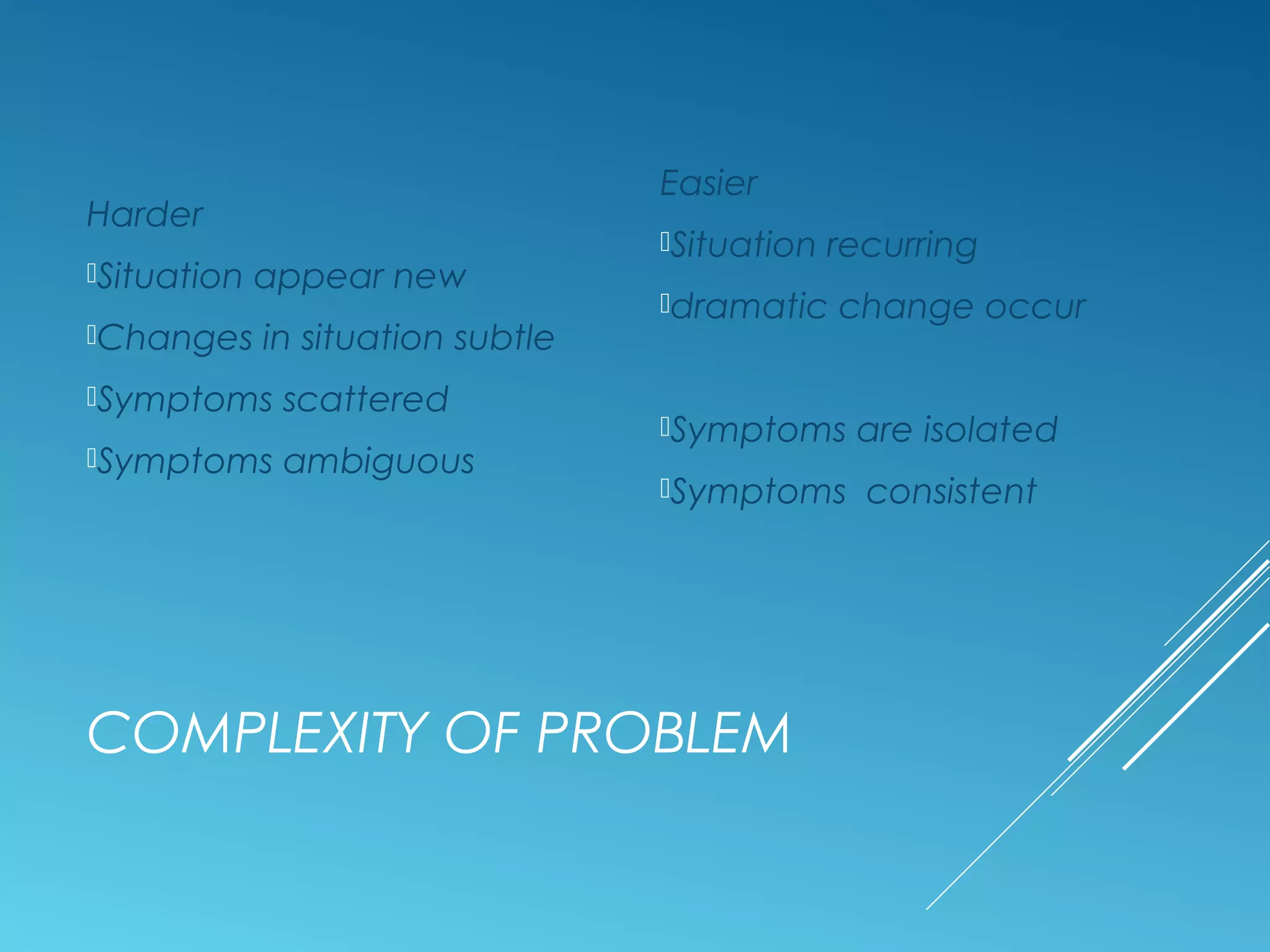
COMPLEXITY OF PROBLEM
Harder
Situation appear new
Changes in situation subtle
Symptoms scattered
Symptoms ambiguous
Easier
Situation recurring
dramatic change occur
Symptoms are isolated
Symptoms consistent
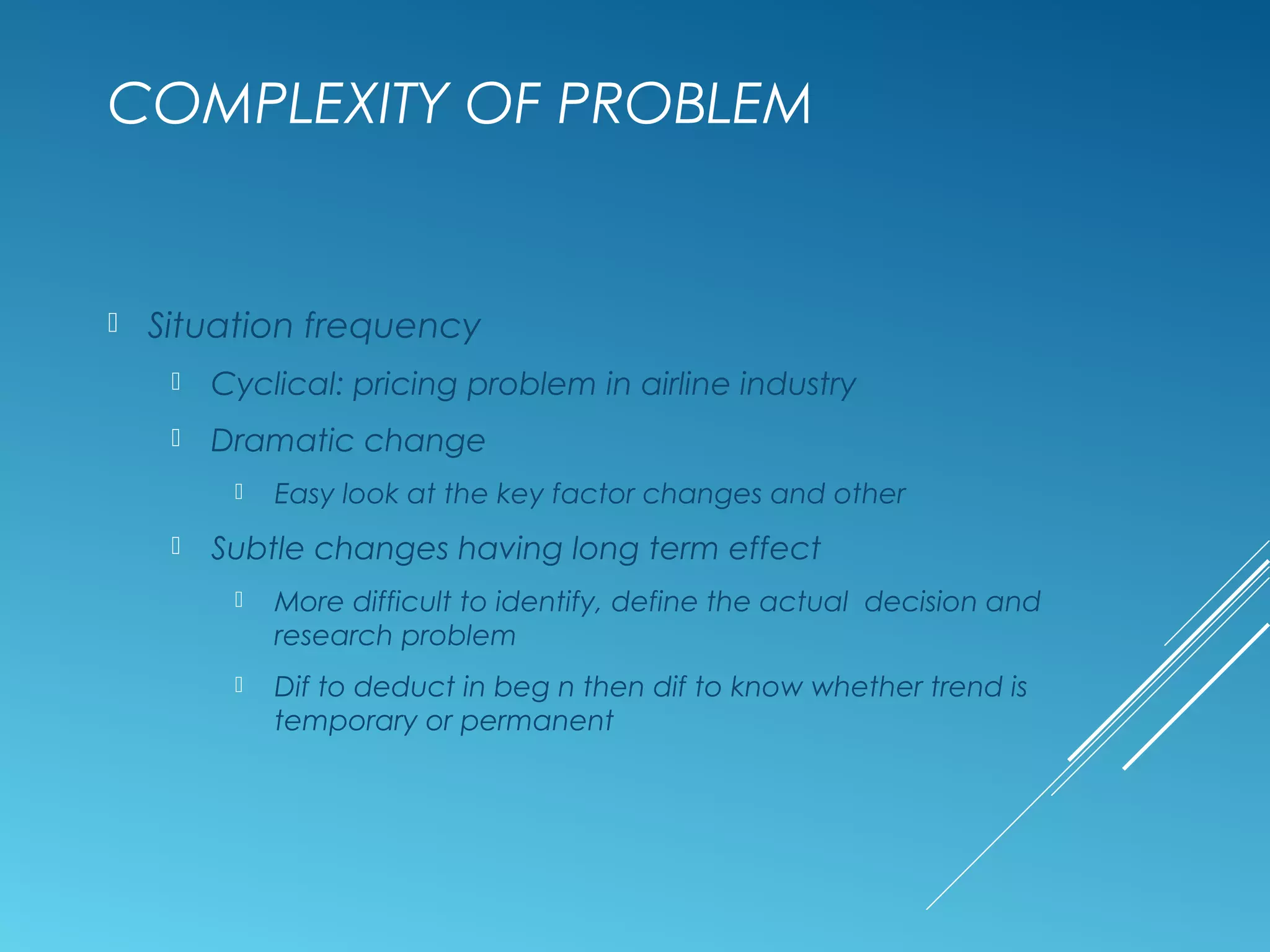
COMPLEXITY OF PROBLEM
 Situation frequency
 Cyclical: pricing problem in airline industry
 Dramatic change
 Easy look at the key factor changes and other
 Subtle changes having long term effect
 More difficult to identify, define the actual decision and
research problem
 Dif to deduct in beg n then dif to know whether trend is
temporary or permanent
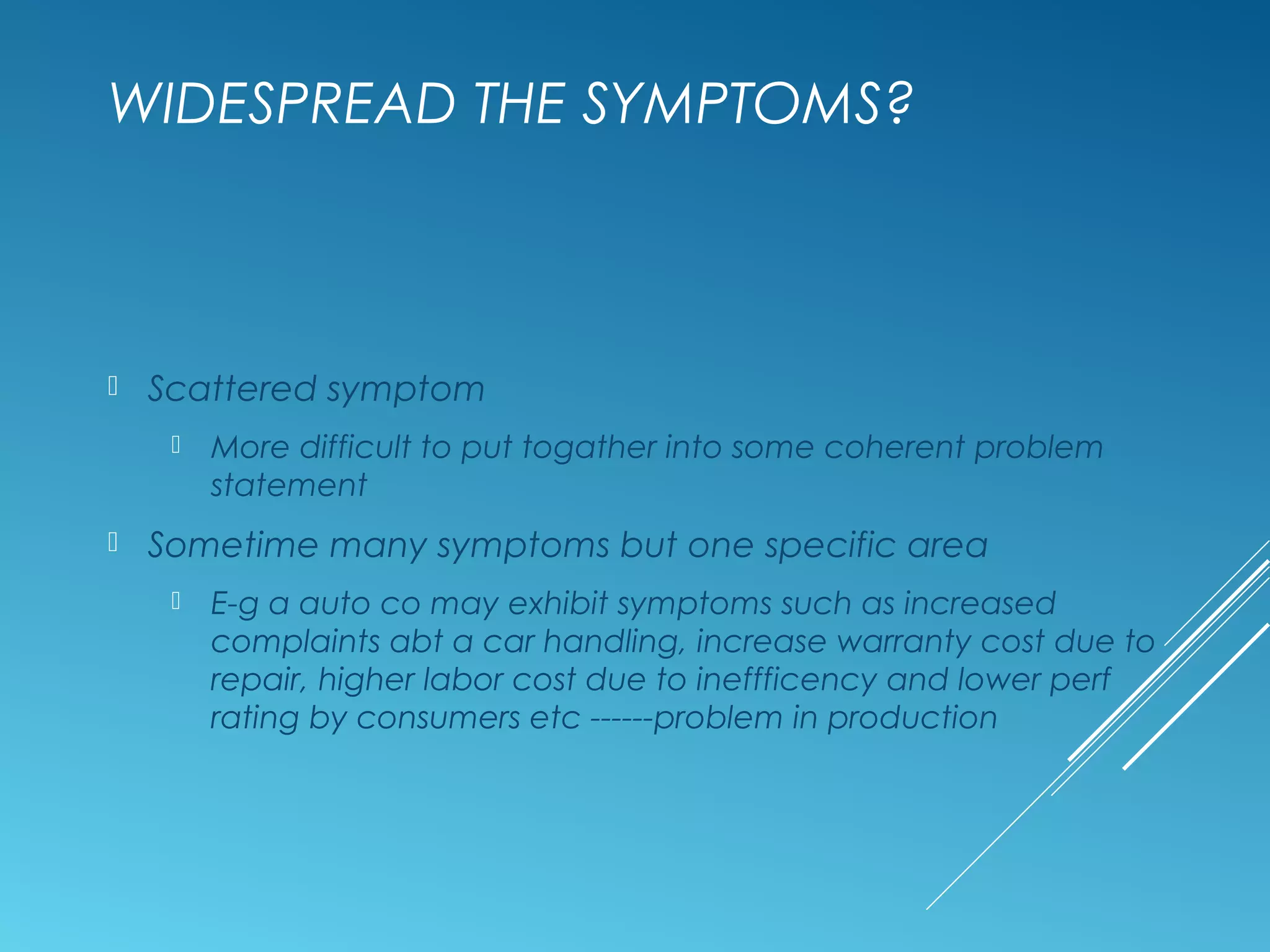
WIDESPREAD THE SYMPTOMS?
 Scattered symptom
 More difficult to put togather into some coherent problem
statement
 Sometime many symptoms but one specific area
 E-g a auto co may exhibit symptoms such as increased
complaints abt a car handling, increase warranty cost due to
repair, higher labor cost due to ineffficency and lower perf
rating by consumers etc ------problem in production
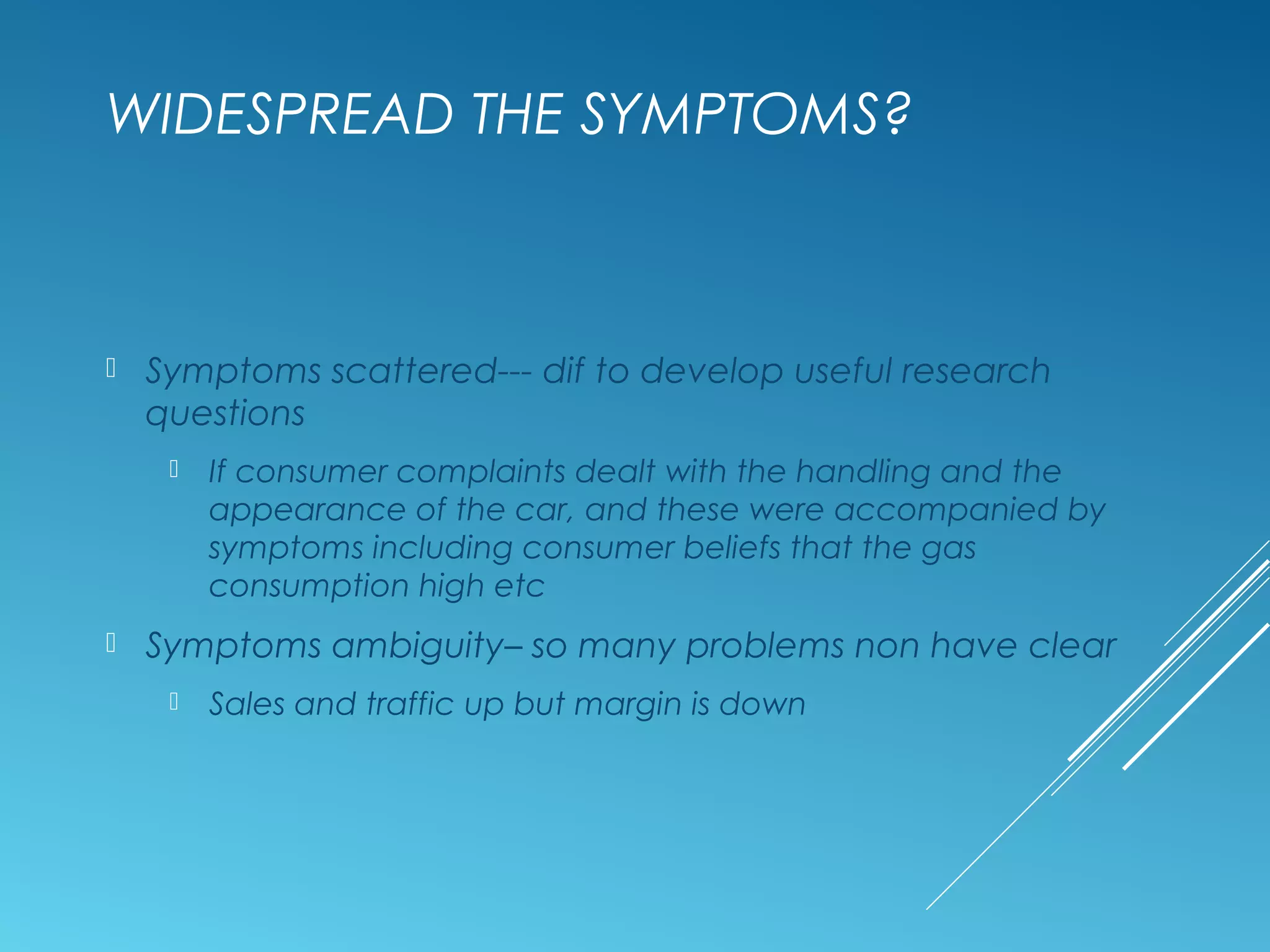
WIDESPREAD THE SYMPTOMS?
 Symptoms scattered--- dif to develop useful research
questions
 If consumer complaints dealt with the handling and the
appearance of the car, and these were accompanied by
symptoms including consumer beliefs that the gas
consumption high etc
 Symptoms ambiguity– so many problems non have clear
 Sales and traffic up but margin is down
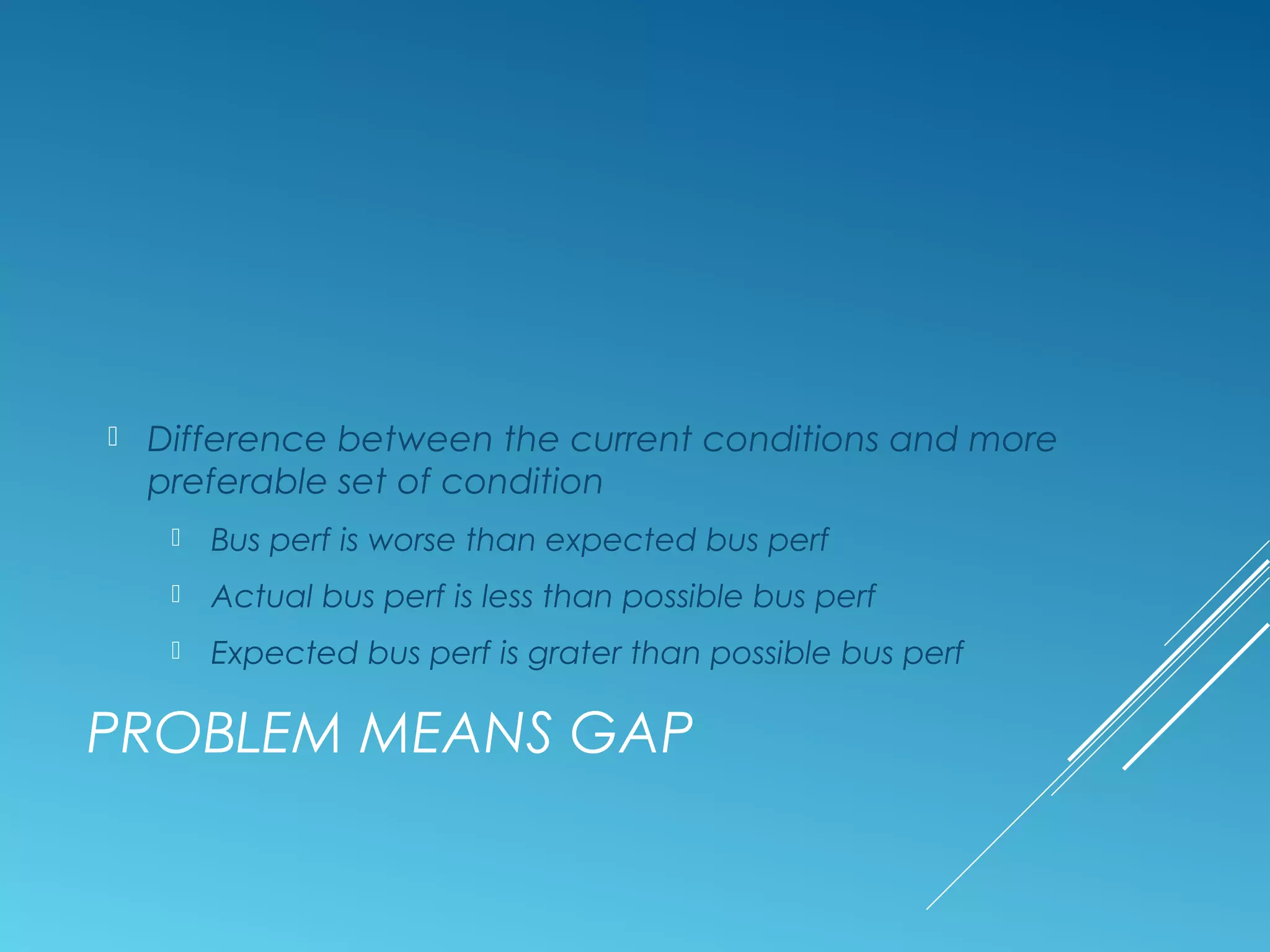
PROBLEM MEANS GAP
 Difference between the current conditions and more
preferable set of condition
 Bus perf is worse than expected bus perf
 Actual bus perf is less than possible bus perf
 Expected bus perf is grater than possible bus perf
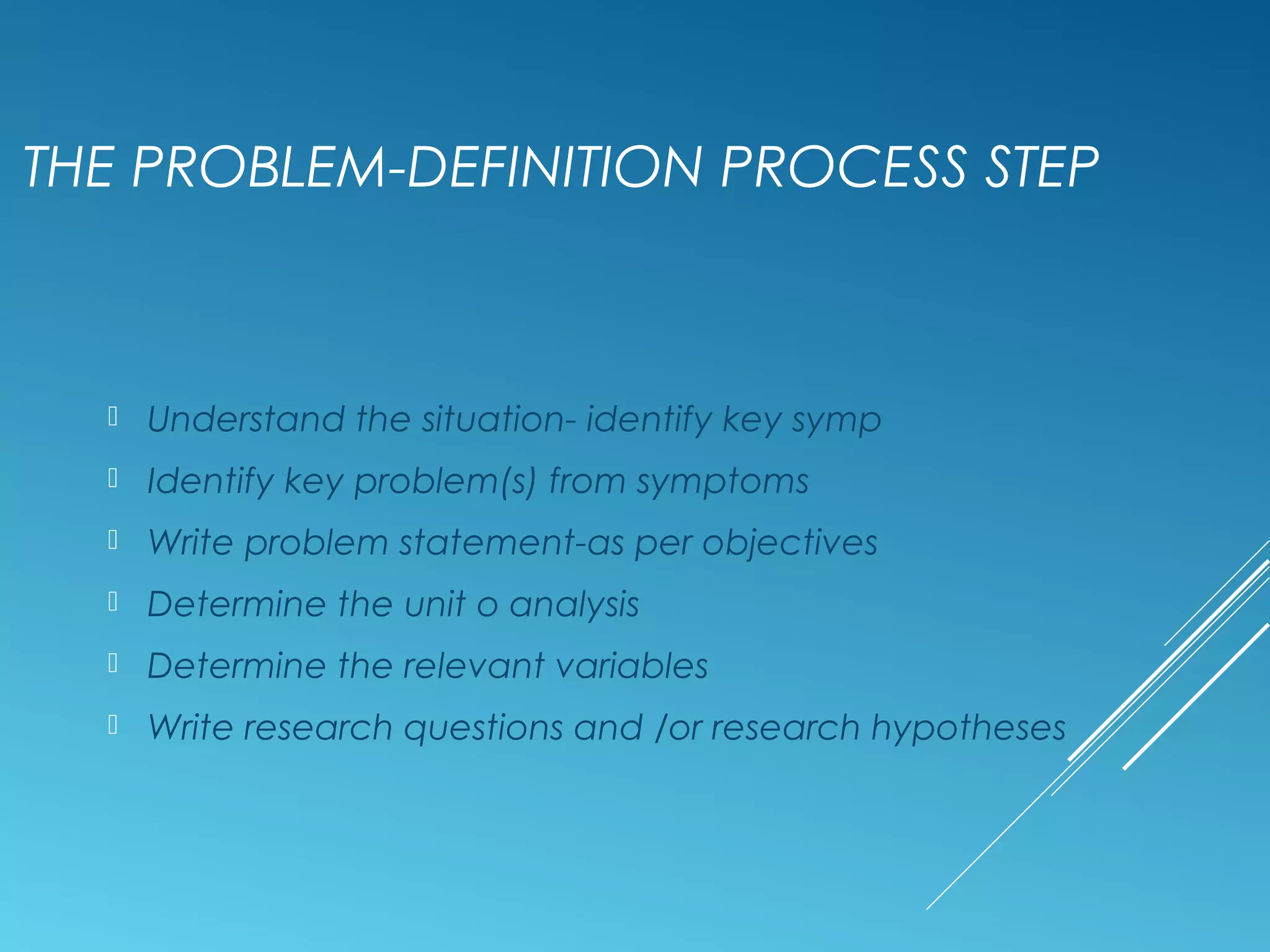
THE PROBLEM-DEFINITION PROCESS STEP
 Understand the situation- identify key symp
 Identify key problem(s) from symptoms
 Write problem statement-as per objectives
 Determine the unit o analysis
 Determine the relevant variables
 Write research questions and /or research hypotheses
“THE FORMULATION OF THE
PROBLEM IS OFTEN MORE
ESSENTIAL THAN ITS SOLUTION.”
Albert Einstein
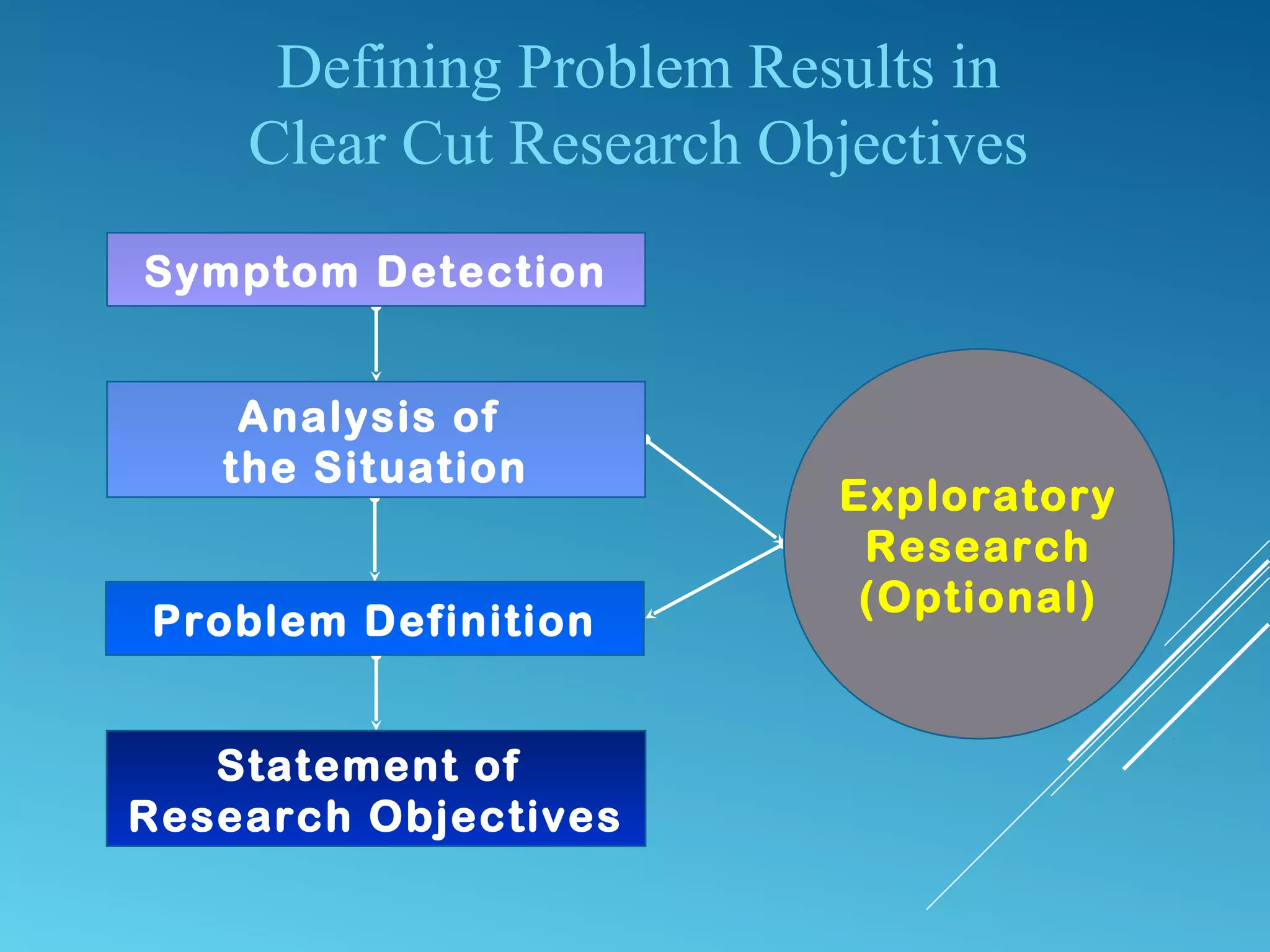
Statement of
Research Objectives
Problem Definition
Defining Problem Results in
Clear Cut Research Objectives
Exploratory
Research
(Optional)
Analysis of
the Situation
Symptom Detection
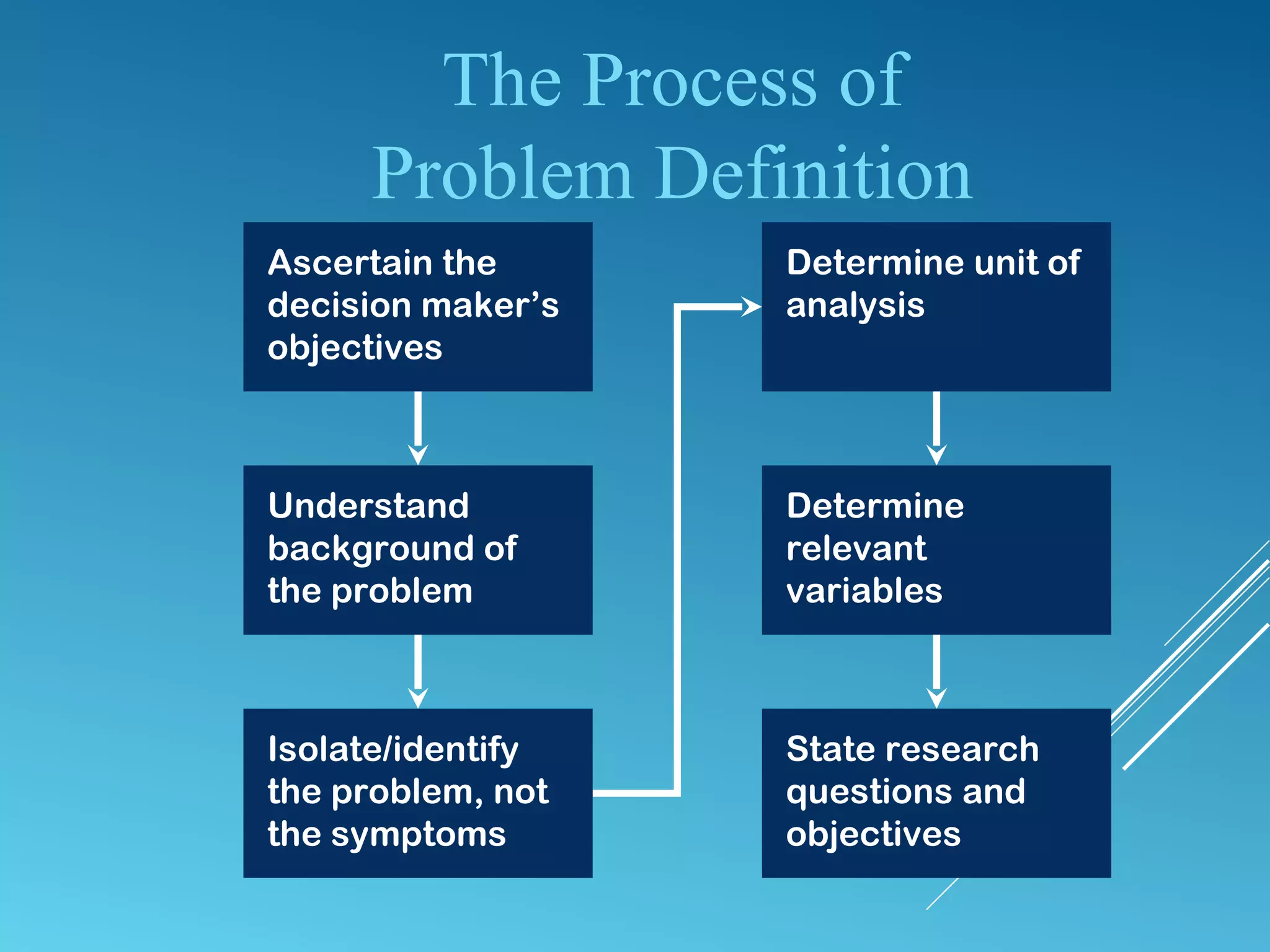
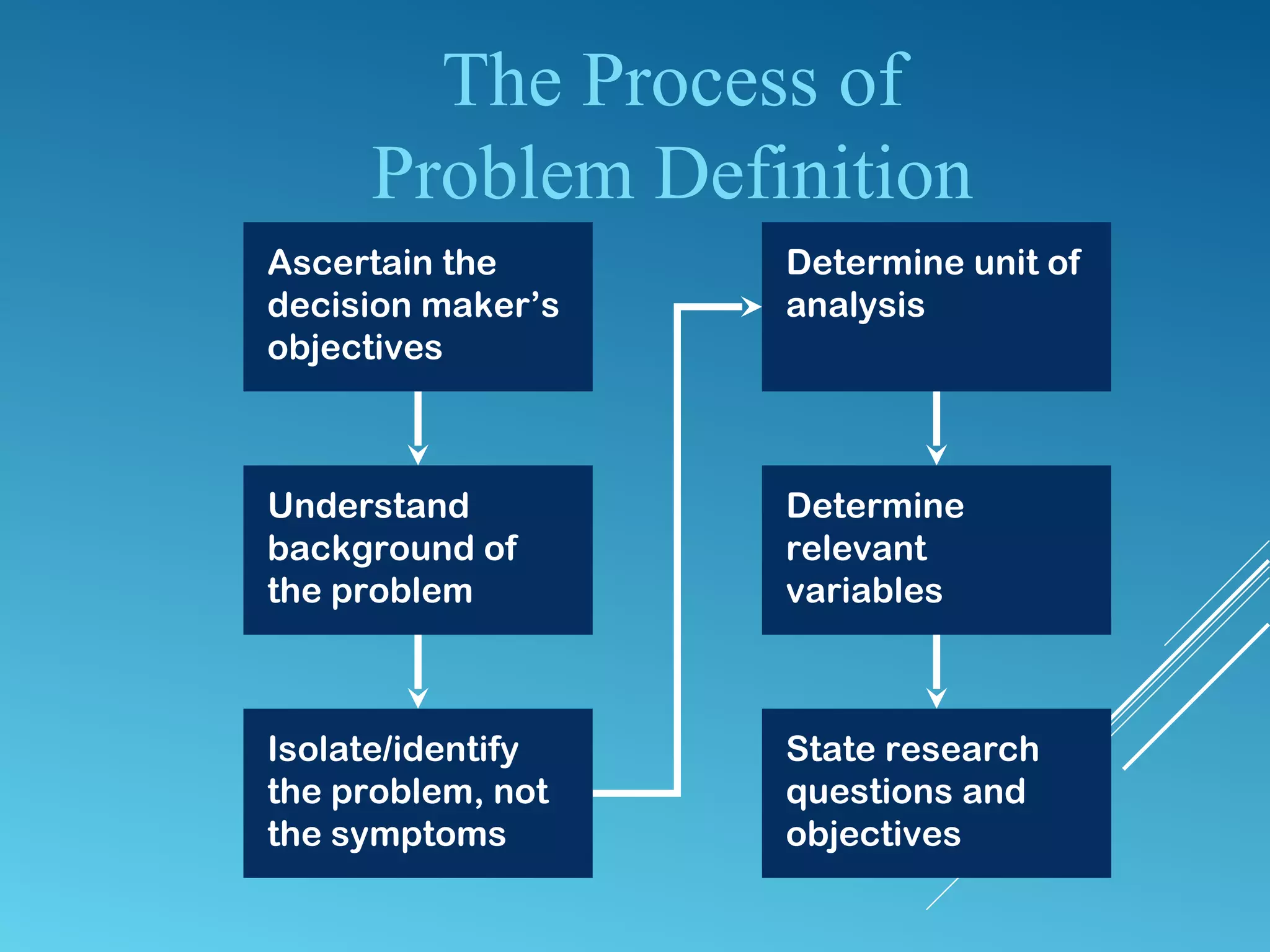
The Process of
Problem Definition
Ascertain the
decision maker’s
objectives
Understand
background of
the problem
Isolate/identify
the problem, not
the symptoms
Determine unit of
analysis
Determine
relevant
variables
State research
questions and
objectives
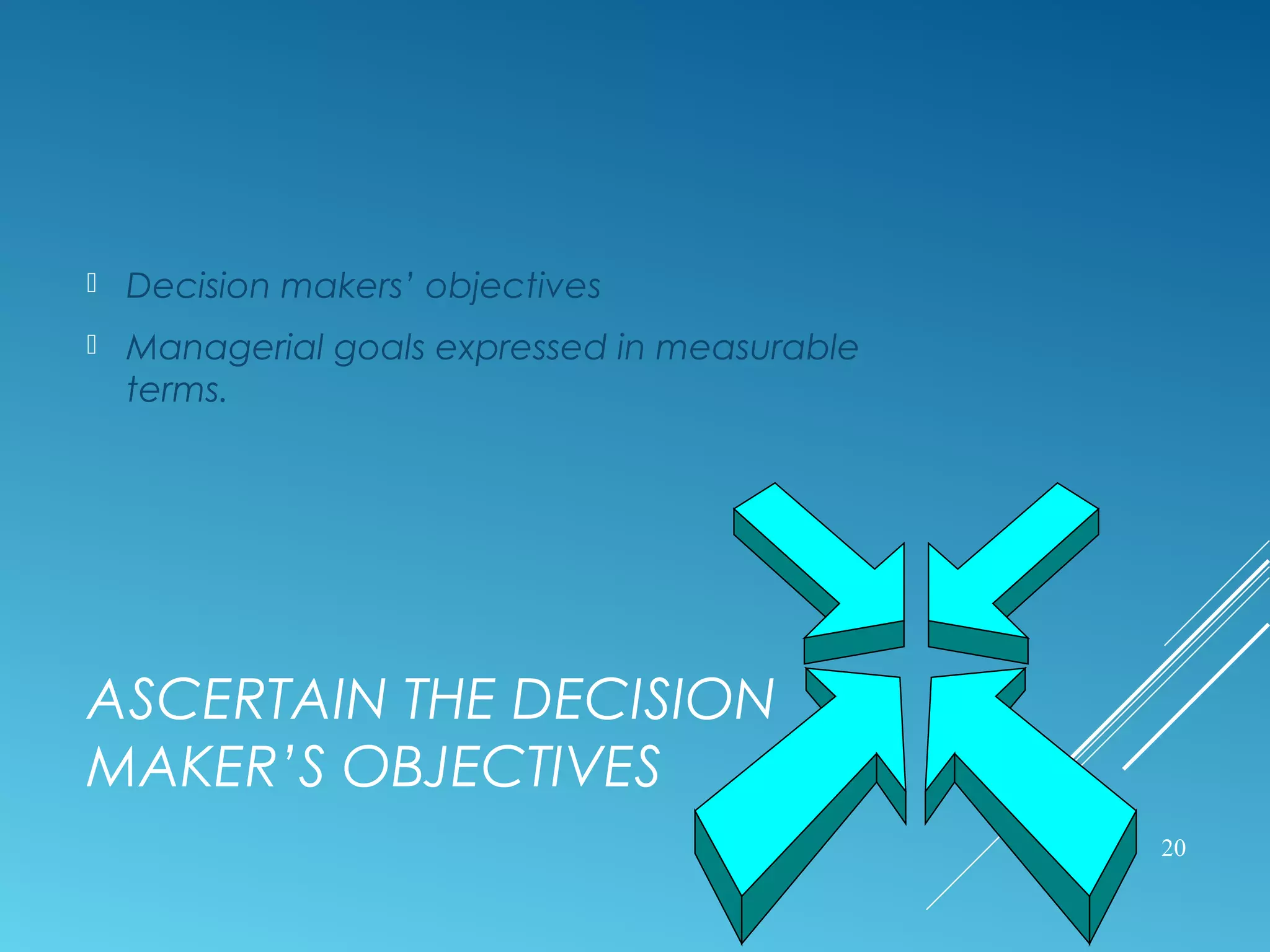
ASCERTAIN THE DECISION
MAKER’S OBJECTIVES
 Decision makers’ objectives
 Managerial goals expressed in measurable
terms.
20
THE ICEBERG PRINCIPLE
 he principle indicating that the dangerous part of many
business problems is neither visible to nor understood by
managers.
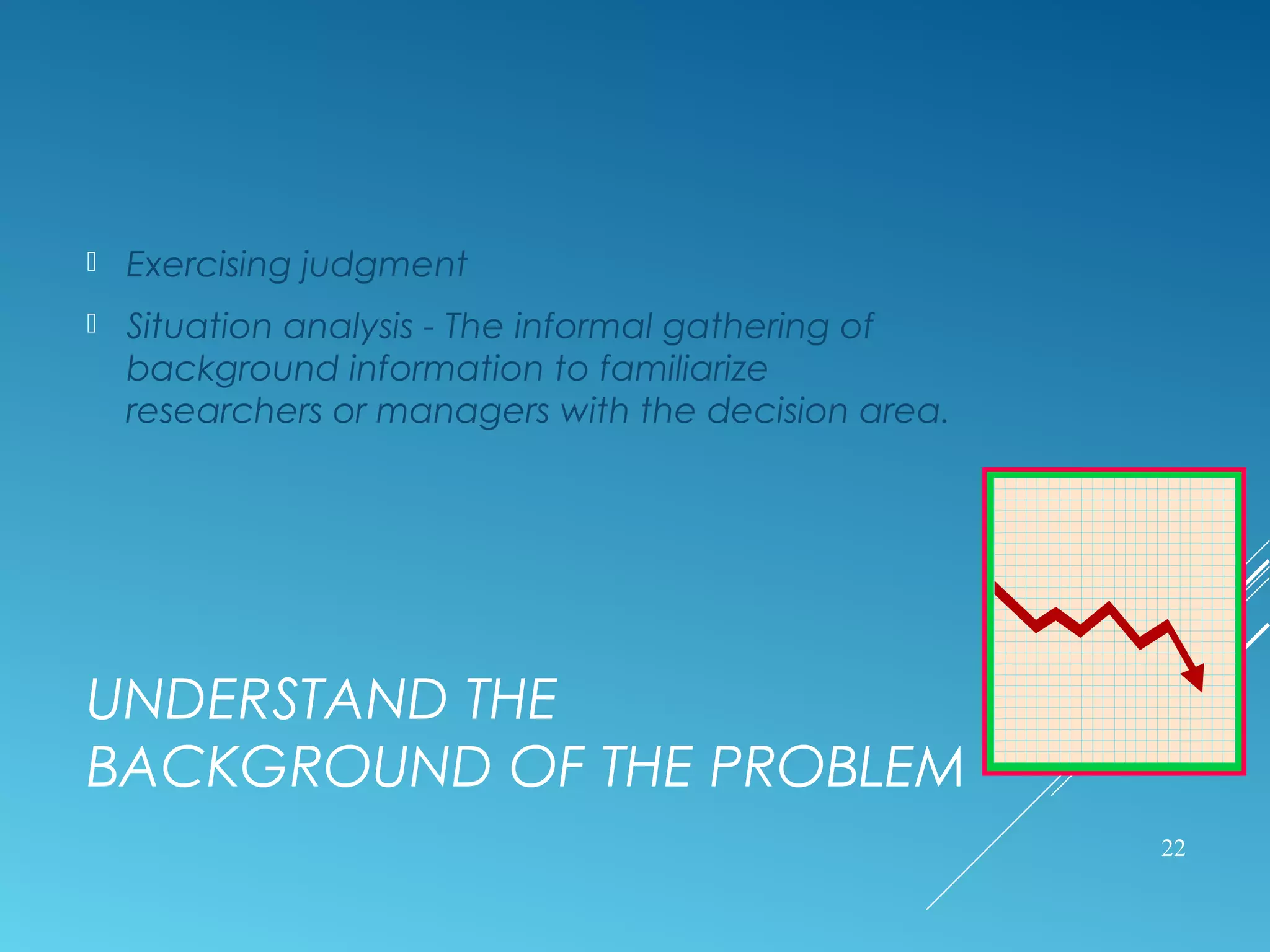
UNDERSTAND THE
BACKGROUND OF THE PROBLEM
 Exercising judgment
 Situation analysis - The informal gathering of
background information to familiarize
researchers or managers with the decision area.
22
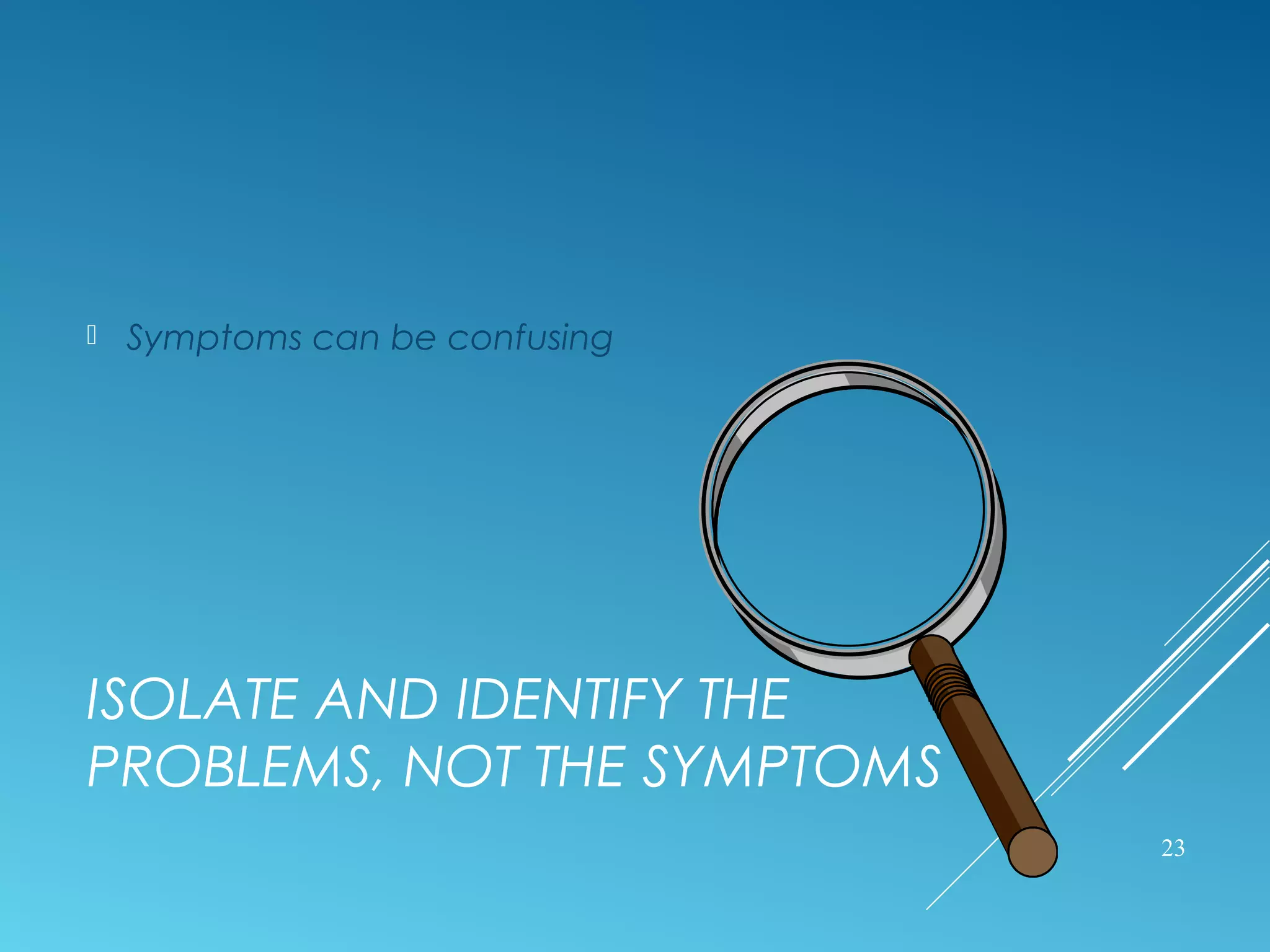
ISOLATE AND IDENTIFY THE
PROBLEMS, NOT THE SYMPTOMS
 Symptoms can be confusing
23
SYMPTOMS CAN BE CONFUSING
Twenty-year-old neighborhood swimming
association:
 Membership has been declining for years.
 New water park -residents prefer the expensive
water park????
 Demographic changes: Children have grown up
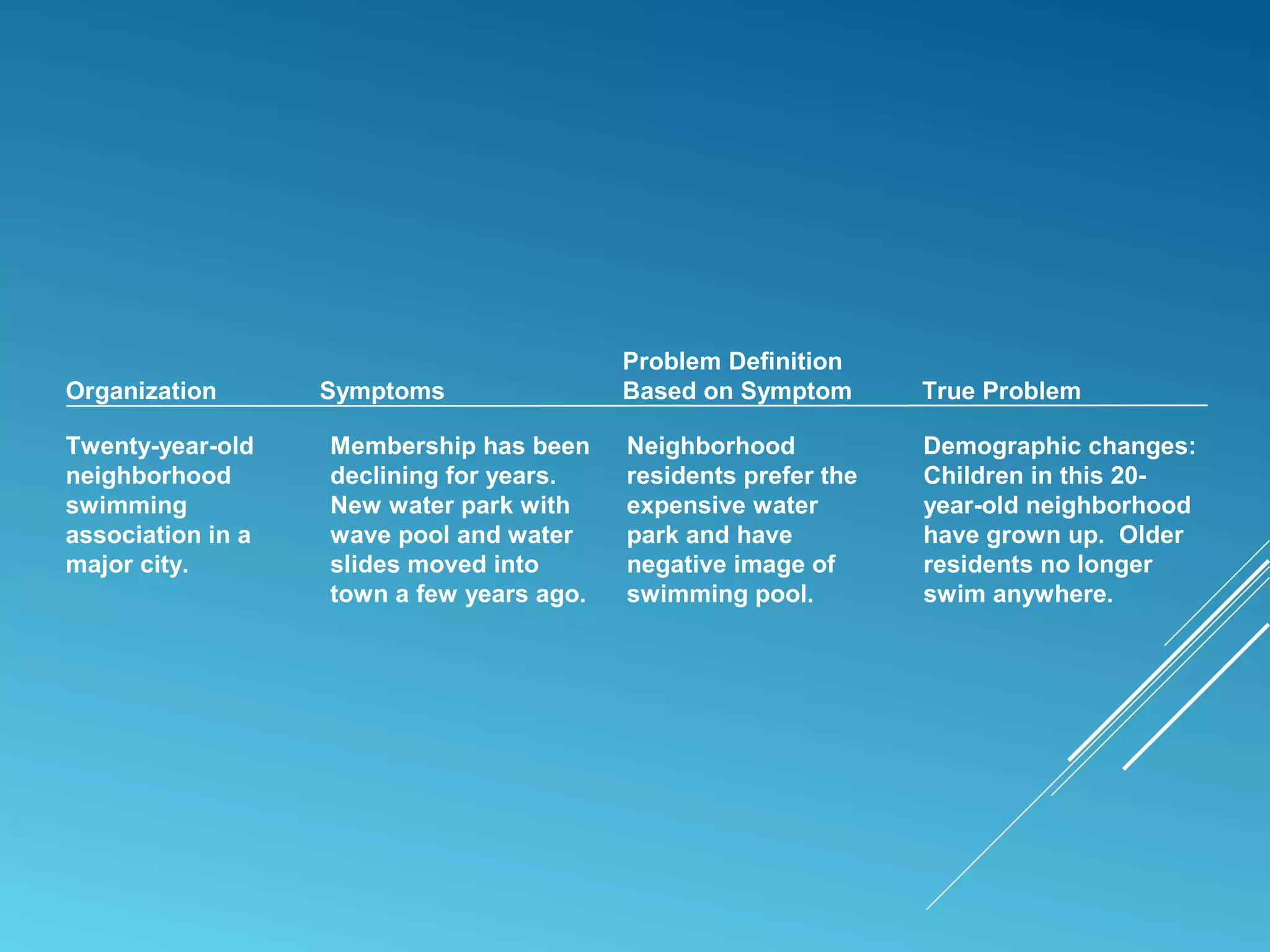
Problem Definition
Organization Symptoms Based on Symptom True Problem
Twenty-year-old
neighborhood
swimming
association in a
major city.
Membership has been
declining for years.
New water park with
wave pool and water
slides moved into
town a few years ago.
Neighborhood
residents prefer the
expensive water
park and have
negative image of
swimming pool.
Demographic changes:
Children in this 20-
year-old neighborhood
have grown up. Older
residents no longer
swim anywhere.
TOTI
EMUL
ESTO
WHAT LANGUAGE IS WRITTEN ON
THIS STONE FOUND BY
ARCHAEOLOGISTS?
TOTI
EMUL
ESTO
THE LANGUAGE IS ENGLISH: TO
TIE MULES TO
DETERMINE THE UNIT OF
ANALYSIS
 Individuals, households, organizations, etc.
 In many studies, the family rather than the
individual is the appropriate unit of analysis.
28
DETERMINE THE RELEVANT
VARIABLE
 Anything that may assume different numerical
values
29
TYPES OF VARIABLES
 Categorical- (groups or color or gender)
 Continuous (take on arage of vlues that corresponds to
some quatitative amount –consumer attitude towards
performance)
 Dependent (y)
 Independent (X)
 Relevant and actionable variable rather than superfluous
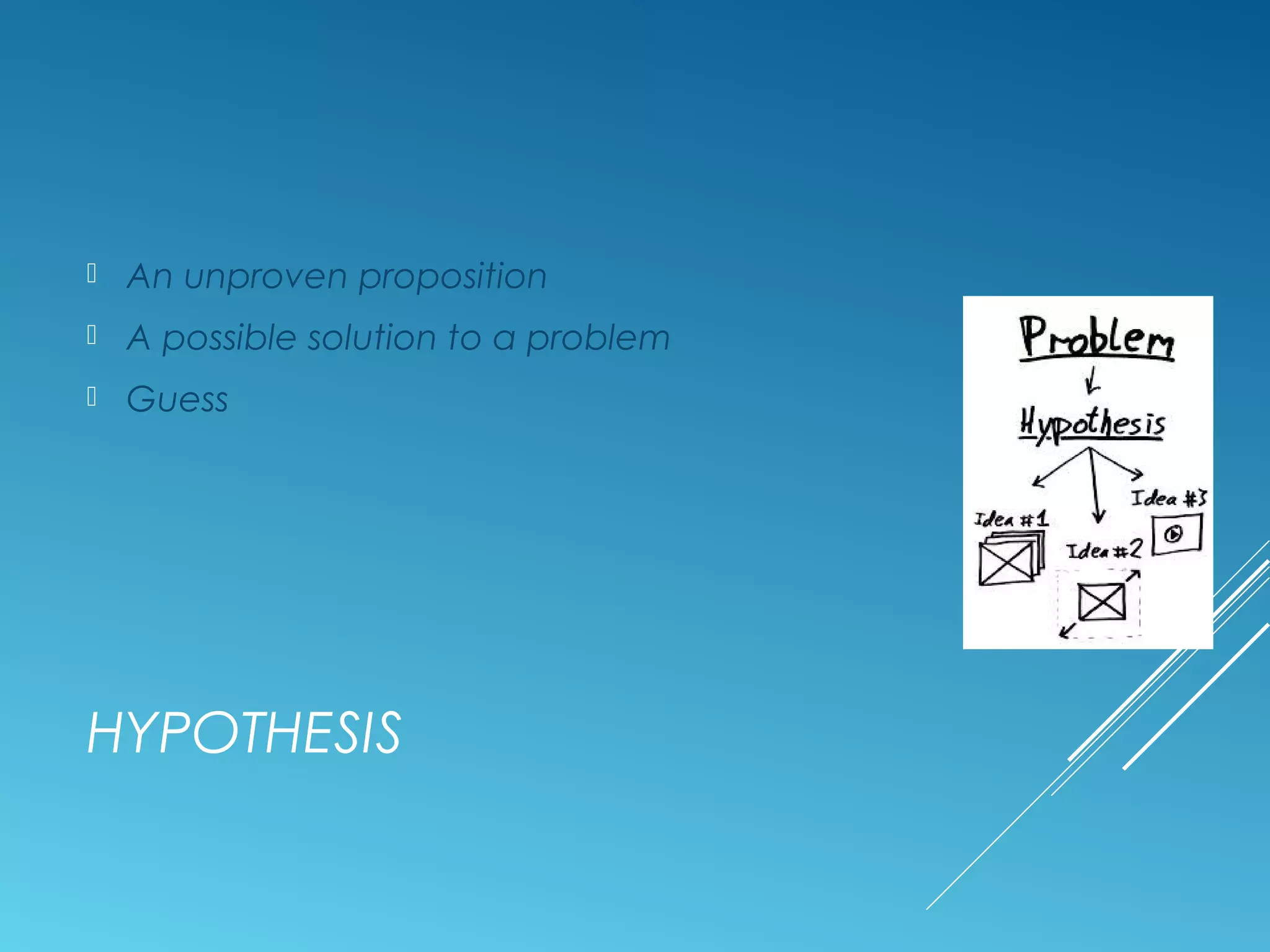
HYPOTHESIS
 An unproven proposition
 A possible solution to a problem
 Guess
STATE THE RESEARCH QUESTIONS AND
RESEARCH OBJECTIVES
32
RESEARCH QUESTION
 Translation of the problem into specific inquiry
 Can be too vague and general
 Is advertising copy 1 is better than 2
Advertising effectiveness can be measured b sales, brand
awareness, intention to buy…
 Should provide input that can be used as a standard for
selecting from among alternative solutions
RESEARCH QUESTIONS
 It expresses the research objectives in terms of questions
that can be addressed by research
 Example are wages and long haul distance related to driver
loyalty and retention
 Research questions are more general than hypothesis
 Dif between the two: hypotheses can generally speecigy
the direction of the relationship
IF YOU DO NOT KNOW WHERE
YOU ARE GOING,
ANY ROAD WILL TAKE YOU
THERE.
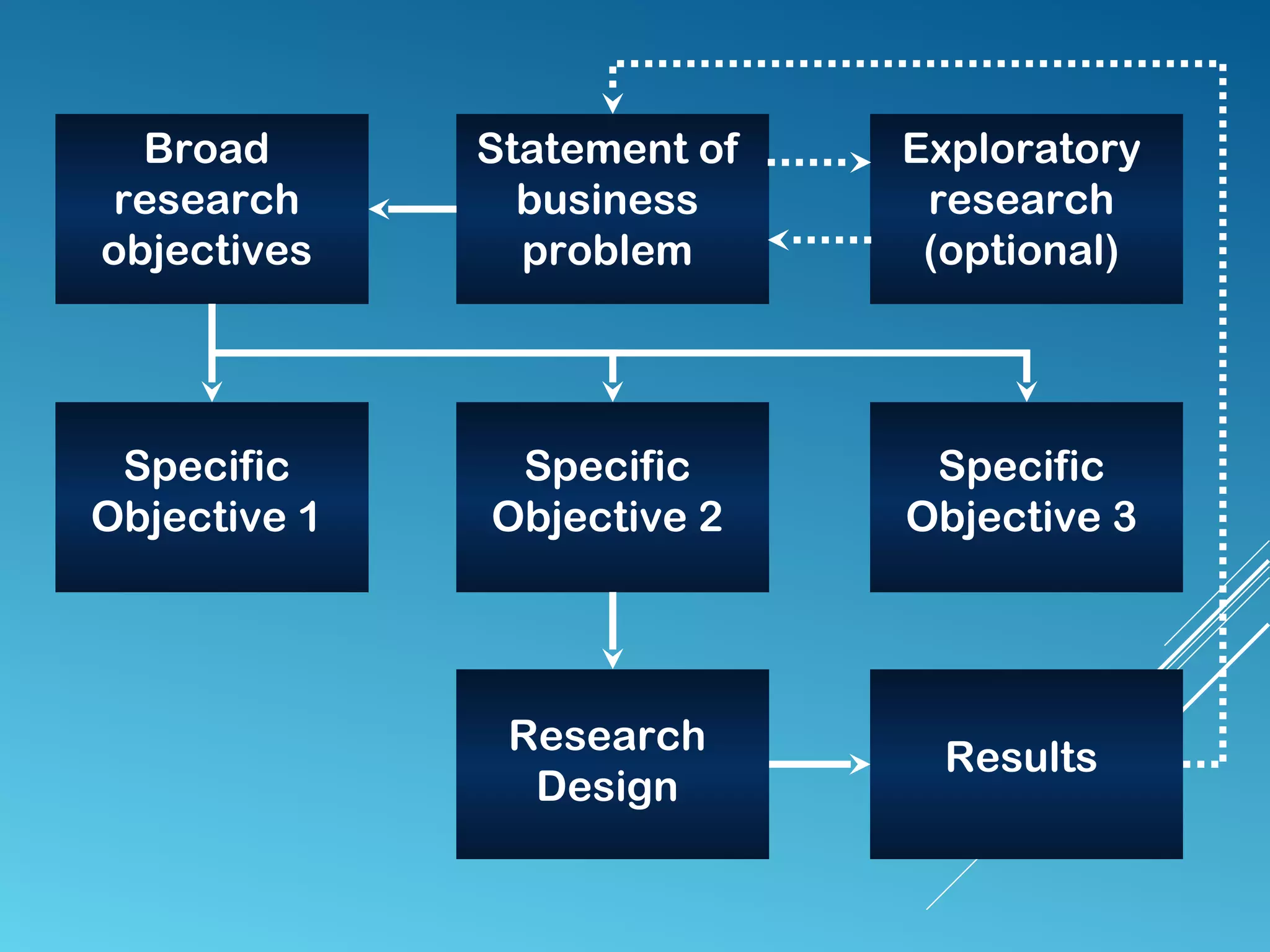
Statement of
business
problem
Exploratory
research
(optional)
Statement of
business
problem
Broad
research
objectives
Specific
Objective 1
Specific
Objective 2
Specific
Objective 3
Research
Design
Results
The Process of
Problem Definition
Ascertain the
decision maker’s
objectives
Understand
background of
the problem
Isolate/identify
the problem, not
the symptoms
Determine unit of
analysis
Determine
relevant
variables
State research
questions and
objectives
RESEARCH PROPOSAL
 A written statement of the research design that
includes a statement explaining the purpose of
the study
 Detailed outline of procedures associated with a
particular methodology
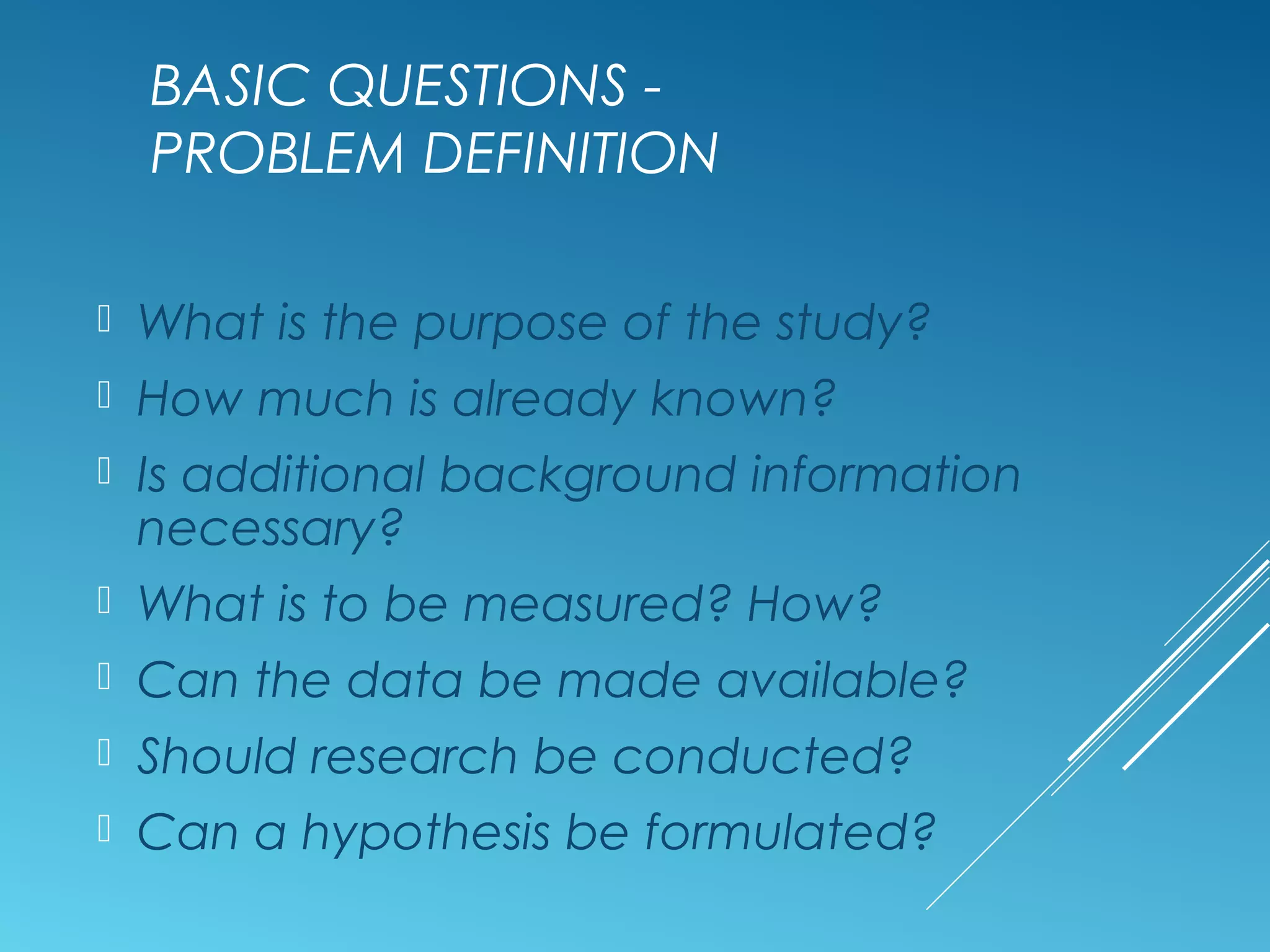
BASIC QUESTIONS -
PROBLEM DEFINITION
 What is the purpose of the study?
 How much is already known?
 Is additional background information
necessary?
 What is to be measured? How?
 Can the data be made available?
 Should research be conducted?
 Can a hypothesis be formulated?
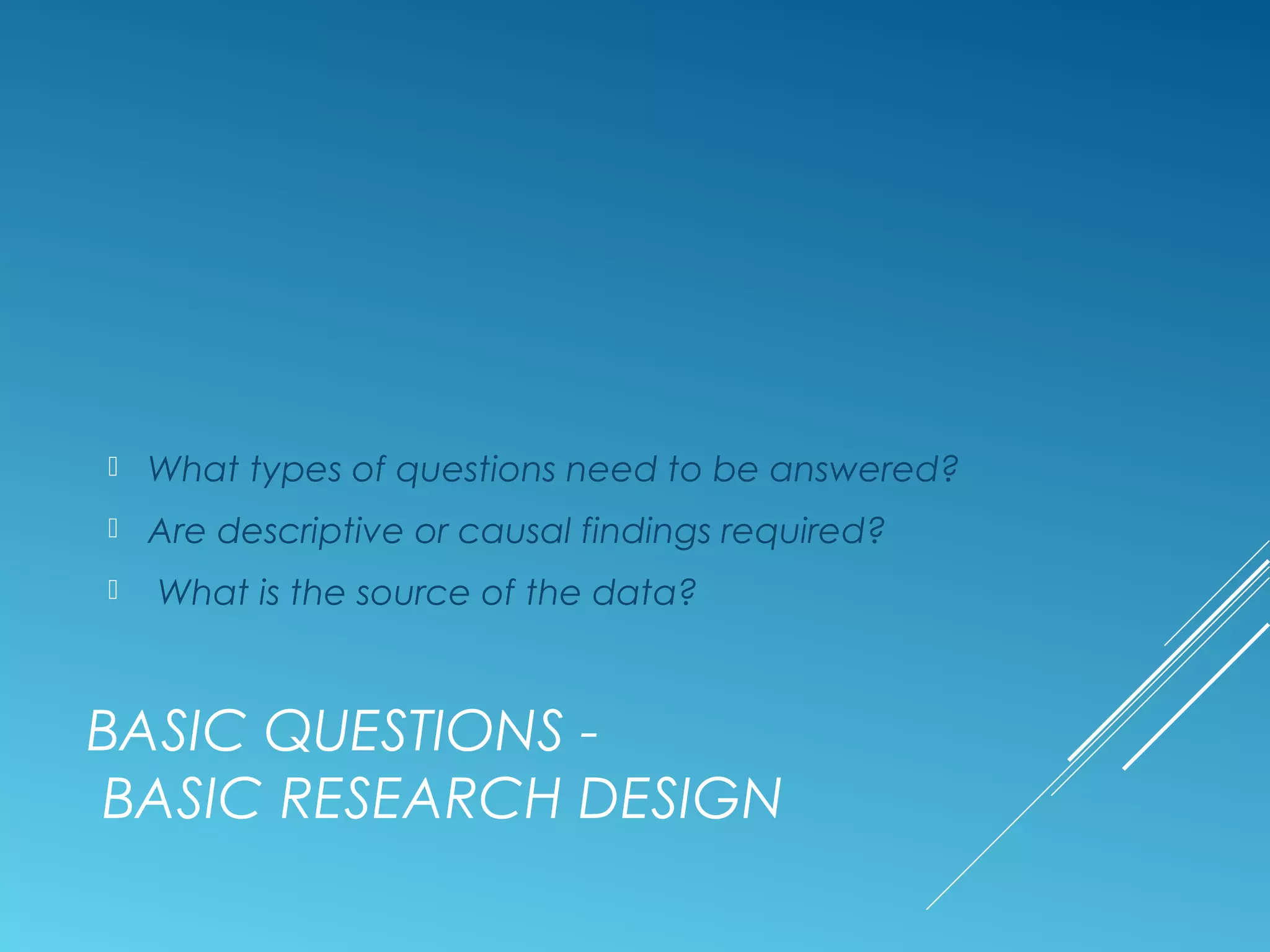
BASIC QUESTIONS -
BASIC RESEARCH DESIGN
 What types of questions need to be answered?
 Are descriptive or causal findings required?
 What is the source of the data?
BASIC QUESTIONS -
BASIC RESEARCH DESIGN
 Can objective answers be obtained by asking
people?
 How quickly is the information needed?
 How should survey questions be worded?
 How should experimental manipulations be
made?
BASIC QUESTIONS -
SELECTION OF SAMPLE
 Who or what is the source of the
data?
 Can the target population be
identified?
 Is a sample necessary?
 How accurate must the sample be?
 Is a probability sample necessary?
 Is a national sample necessary?
 How large a sample is necessary?
 How will the sample be selected?
BASIC QUESTIONS -
DATA GATHERING
 Who will gather the data?
 How long will data gathering take?
 How much supervision is needed?
 What operational procedures need to be
followed?
BASIC QUESTIONS -
DATA ANALYSIS
 Will standardized editing and coding
procedures be used?
 How will the data be categorized?
 What statistical software will be used?
 What is the nature of the data?
 What questions need to be answered?
 How many variables are to be
investigated simultaneously?
 Performance criteria for evaluation?
BASIC QUESTIONS -
TYPE OF REPORT
 Who will read the report?
 Are managerial recommendations requested?
 How many presentations are required?
 What will be the format of the written report?
BASIC QUESTIONS -
OVERALL EVALUATION
 How much will the study cost?
 Is the time frame acceptable?
 Is outside help needed?
 Will this research design attain the stated
research objectives?
 When should the research be scheduled to
begin?
I DON’T KNOW WHAT IS KEY TO
SUCCESS BUT THE KEY TO FAILURE IS
TRYING TO PLEASE EVERYONE

Problem definition Lecture-6

  • 1.
    MUHAMMAD SHAFIQ Lecture 5 ProblemDefinition and the Research Proposal
  • 2.
  • 3.
    Problem discovery Problem definition (statement of researchobjectives) Secondary (historical) data Experience survey Pilot study Case study Selection of exploratory research technique Selection of basic research method Experiment Survey Observation Secondary Data StudyLaboratory Field Interview Questionnaire Selection of exploratory research technique Sampling Probability Nonprobability Collection of data (fieldwork) Editing and coding data Data processing Interpretation of findings Report Data Gathering Data Processing and Analysis Conclusions and Report Research Design Problem Discovery and Definition
  • 4.
  • 5.
    IMPORTANCE OF STARTINGWITH A GOOD PROBLEM DEFINITION  Translating research situation into specific research objective  Res project proof useful---- how well the research objective  Chapter looks at translation of business situation into relevant actionable research  Good answer but bad question- coke others
  • 6.
    STATEMENT OF PROBLEM Translating a reseach situation into something that can be researched  Translation of something form one language to another.  Starts from statement of problem
  • 7.
    STATEMENT OF PROBLEM A written expression of the key question(s)that the researcher wishes to answer
  • 8.
    PROBLEM DEFINITION  Theindication of a specific business decision area that will be clarified by answering some research questions.
  • 9.
    PROBLEM DEFINITION  Theprocess of defining and developing a research statement and the steps involved in translating it into more precise research terminology, including a set of research objective  Process breaks-----research may be useless, irrelevant not assist decision making  Wrong prob definition: waste resources and poor direction
  • 10.
    PROBLEM DEFINITION  Can’tsay any step is more important than others but problem definition  it develop problem statement which guides towards actionable research Even, the best research procedure will not overcome poor problem definition
  • 11.
    COMPLEXITY OF PROBLEM Harder Situationappear new Changes in situation subtle Symptoms scattered Symptoms ambiguous Easier Situation recurring dramatic change occur Symptoms are isolated Symptoms consistent
  • 12.
    COMPLEXITY OF PROBLEM Situation frequency  Cyclical: pricing problem in airline industry  Dramatic change  Easy look at the key factor changes and other  Subtle changes having long term effect  More difficult to identify, define the actual decision and research problem  Dif to deduct in beg n then dif to know whether trend is temporary or permanent
  • 13.
    WIDESPREAD THE SYMPTOMS? Scattered symptom  More difficult to put togather into some coherent problem statement  Sometime many symptoms but one specific area  E-g a auto co may exhibit symptoms such as increased complaints abt a car handling, increase warranty cost due to repair, higher labor cost due to ineffficency and lower perf rating by consumers etc ------problem in production
  • 14.
    WIDESPREAD THE SYMPTOMS? Symptoms scattered--- dif to develop useful research questions  If consumer complaints dealt with the handling and the appearance of the car, and these were accompanied by symptoms including consumer beliefs that the gas consumption high etc  Symptoms ambiguity– so many problems non have clear  Sales and traffic up but margin is down
  • 15.
    PROBLEM MEANS GAP Difference between the current conditions and more preferable set of condition  Bus perf is worse than expected bus perf  Actual bus perf is less than possible bus perf  Expected bus perf is grater than possible bus perf
  • 16.
    THE PROBLEM-DEFINITION PROCESSSTEP  Understand the situation- identify key symp  Identify key problem(s) from symptoms  Write problem statement-as per objectives  Determine the unit o analysis  Determine the relevant variables  Write research questions and /or research hypotheses
  • 17.
    “THE FORMULATION OFTHE PROBLEM IS OFTEN MORE ESSENTIAL THAN ITS SOLUTION.” Albert Einstein
  • 18.
    Statement of Research Objectives ProblemDefinition Defining Problem Results in Clear Cut Research Objectives Exploratory Research (Optional) Analysis of the Situation Symptom Detection
  • 19.
    The Process of ProblemDefinition Ascertain the decision maker’s objectives Understand background of the problem Isolate/identify the problem, not the symptoms Determine unit of analysis Determine relevant variables State research questions and objectives
  • 20.
    ASCERTAIN THE DECISION MAKER’SOBJECTIVES  Decision makers’ objectives  Managerial goals expressed in measurable terms. 20
  • 21.
    THE ICEBERG PRINCIPLE he principle indicating that the dangerous part of many business problems is neither visible to nor understood by managers.
  • 22.
    UNDERSTAND THE BACKGROUND OFTHE PROBLEM  Exercising judgment  Situation analysis - The informal gathering of background information to familiarize researchers or managers with the decision area. 22
  • 23.
    ISOLATE AND IDENTIFYTHE PROBLEMS, NOT THE SYMPTOMS  Symptoms can be confusing 23
  • 24.
    SYMPTOMS CAN BECONFUSING Twenty-year-old neighborhood swimming association:  Membership has been declining for years.  New water park -residents prefer the expensive water park????  Demographic changes: Children have grown up
  • 25.
    Problem Definition Organization SymptomsBased on Symptom True Problem Twenty-year-old neighborhood swimming association in a major city. Membership has been declining for years. New water park with wave pool and water slides moved into town a few years ago. Neighborhood residents prefer the expensive water park and have negative image of swimming pool. Demographic changes: Children in this 20- year-old neighborhood have grown up. Older residents no longer swim anywhere.
  • 26.
    TOTI EMUL ESTO WHAT LANGUAGE ISWRITTEN ON THIS STONE FOUND BY ARCHAEOLOGISTS?
  • 27.
    TOTI EMUL ESTO THE LANGUAGE ISENGLISH: TO TIE MULES TO
  • 28.
    DETERMINE THE UNITOF ANALYSIS  Individuals, households, organizations, etc.  In many studies, the family rather than the individual is the appropriate unit of analysis. 28
  • 29.
    DETERMINE THE RELEVANT VARIABLE Anything that may assume different numerical values 29
  • 30.
    TYPES OF VARIABLES Categorical- (groups or color or gender)  Continuous (take on arage of vlues that corresponds to some quatitative amount –consumer attitude towards performance)  Dependent (y)  Independent (X)  Relevant and actionable variable rather than superfluous
  • 31.
    HYPOTHESIS  An unprovenproposition  A possible solution to a problem  Guess
  • 32.
    STATE THE RESEARCHQUESTIONS AND RESEARCH OBJECTIVES 32
  • 33.
    RESEARCH QUESTION  Translationof the problem into specific inquiry  Can be too vague and general  Is advertising copy 1 is better than 2 Advertising effectiveness can be measured b sales, brand awareness, intention to buy…  Should provide input that can be used as a standard for selecting from among alternative solutions
  • 34.
    RESEARCH QUESTIONS  Itexpresses the research objectives in terms of questions that can be addressed by research  Example are wages and long haul distance related to driver loyalty and retention  Research questions are more general than hypothesis  Dif between the two: hypotheses can generally speecigy the direction of the relationship
  • 36.
    IF YOU DONOT KNOW WHERE YOU ARE GOING, ANY ROAD WILL TAKE YOU THERE.
  • 37.
  • 38.
    The Process of ProblemDefinition Ascertain the decision maker’s objectives Understand background of the problem Isolate/identify the problem, not the symptoms Determine unit of analysis Determine relevant variables State research questions and objectives
  • 39.
    RESEARCH PROPOSAL  Awritten statement of the research design that includes a statement explaining the purpose of the study  Detailed outline of procedures associated with a particular methodology
  • 40.
    BASIC QUESTIONS - PROBLEMDEFINITION  What is the purpose of the study?  How much is already known?  Is additional background information necessary?  What is to be measured? How?  Can the data be made available?  Should research be conducted?  Can a hypothesis be formulated?
  • 41.
    BASIC QUESTIONS - BASICRESEARCH DESIGN  What types of questions need to be answered?  Are descriptive or causal findings required?  What is the source of the data?
  • 42.
    BASIC QUESTIONS - BASICRESEARCH DESIGN  Can objective answers be obtained by asking people?  How quickly is the information needed?  How should survey questions be worded?  How should experimental manipulations be made?
  • 43.
    BASIC QUESTIONS - SELECTIONOF SAMPLE  Who or what is the source of the data?  Can the target population be identified?  Is a sample necessary?  How accurate must the sample be?  Is a probability sample necessary?  Is a national sample necessary?  How large a sample is necessary?  How will the sample be selected?
  • 44.
    BASIC QUESTIONS - DATAGATHERING  Who will gather the data?  How long will data gathering take?  How much supervision is needed?  What operational procedures need to be followed?
  • 45.
    BASIC QUESTIONS - DATAANALYSIS  Will standardized editing and coding procedures be used?  How will the data be categorized?  What statistical software will be used?  What is the nature of the data?  What questions need to be answered?  How many variables are to be investigated simultaneously?  Performance criteria for evaluation?
  • 46.
    BASIC QUESTIONS - TYPEOF REPORT  Who will read the report?  Are managerial recommendations requested?  How many presentations are required?  What will be the format of the written report?
  • 47.
    BASIC QUESTIONS - OVERALLEVALUATION  How much will the study cost?  Is the time frame acceptable?  Is outside help needed?  Will this research design attain the stated research objectives?  When should the research be scheduled to begin?
  • 49.
    I DON’T KNOWWHAT IS KEY TO SUCCESS BUT THE KEY TO FAILURE IS TRYING TO PLEASE EVERYONE