Models of Communication Dr. Eduardo Bustos Farías
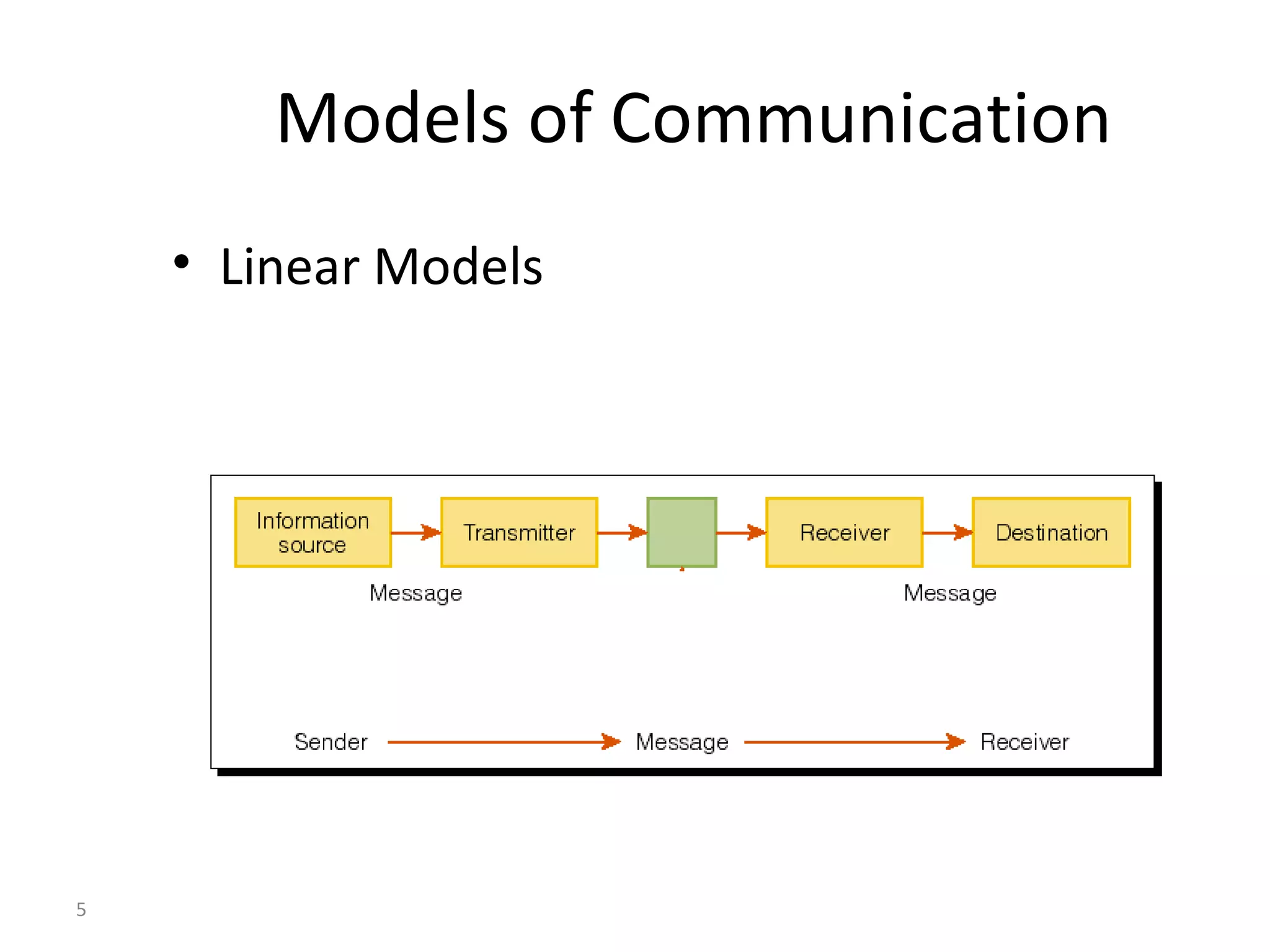
Models of Communication Linear Models
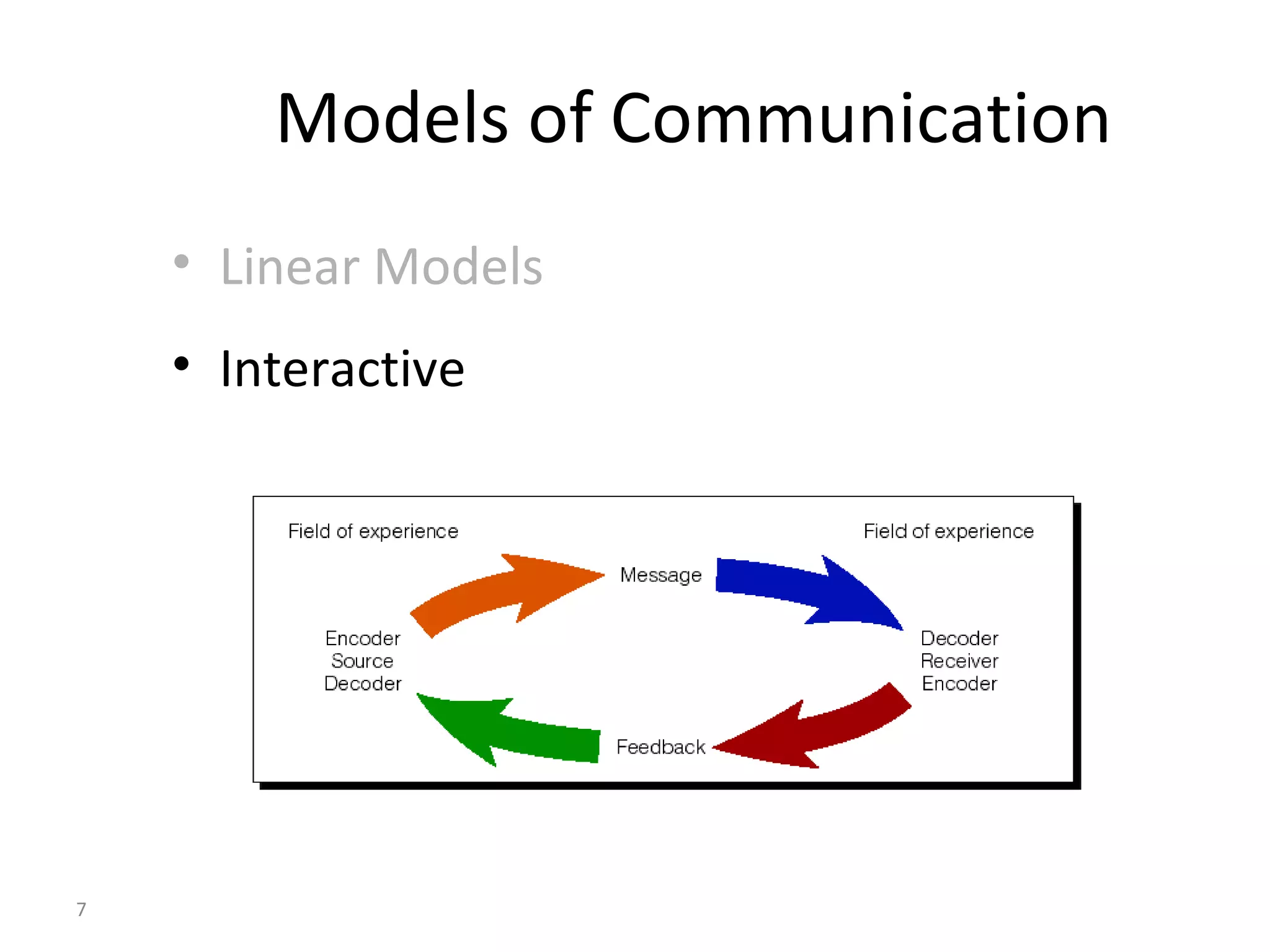
Models of Communication Linear Models Interactive
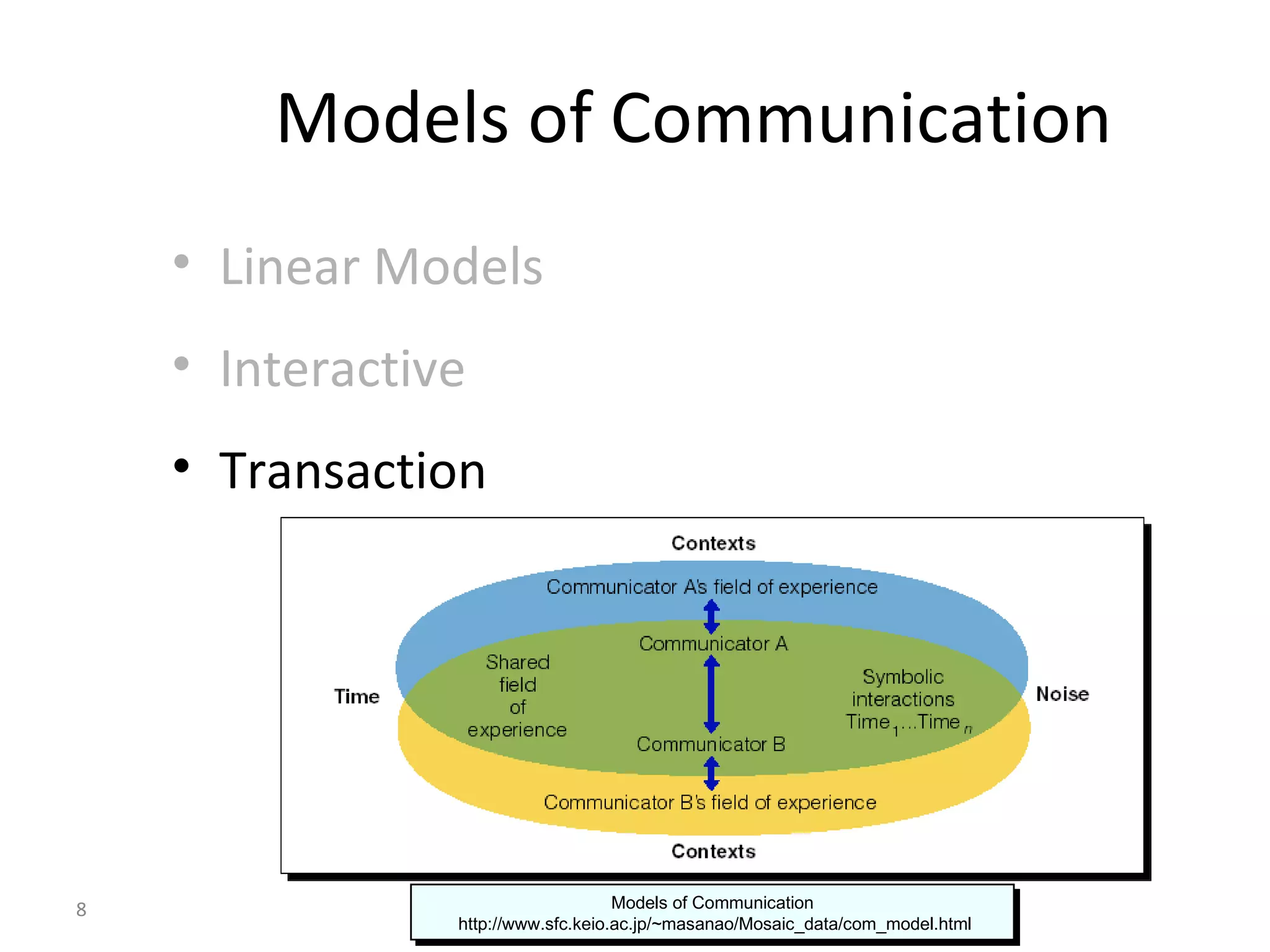
Models of Communication Linear Models Interactive Transaction Models of Communication http://www.sfc.keio.ac.jp/~masanao/Mosaic_data/com_model.html
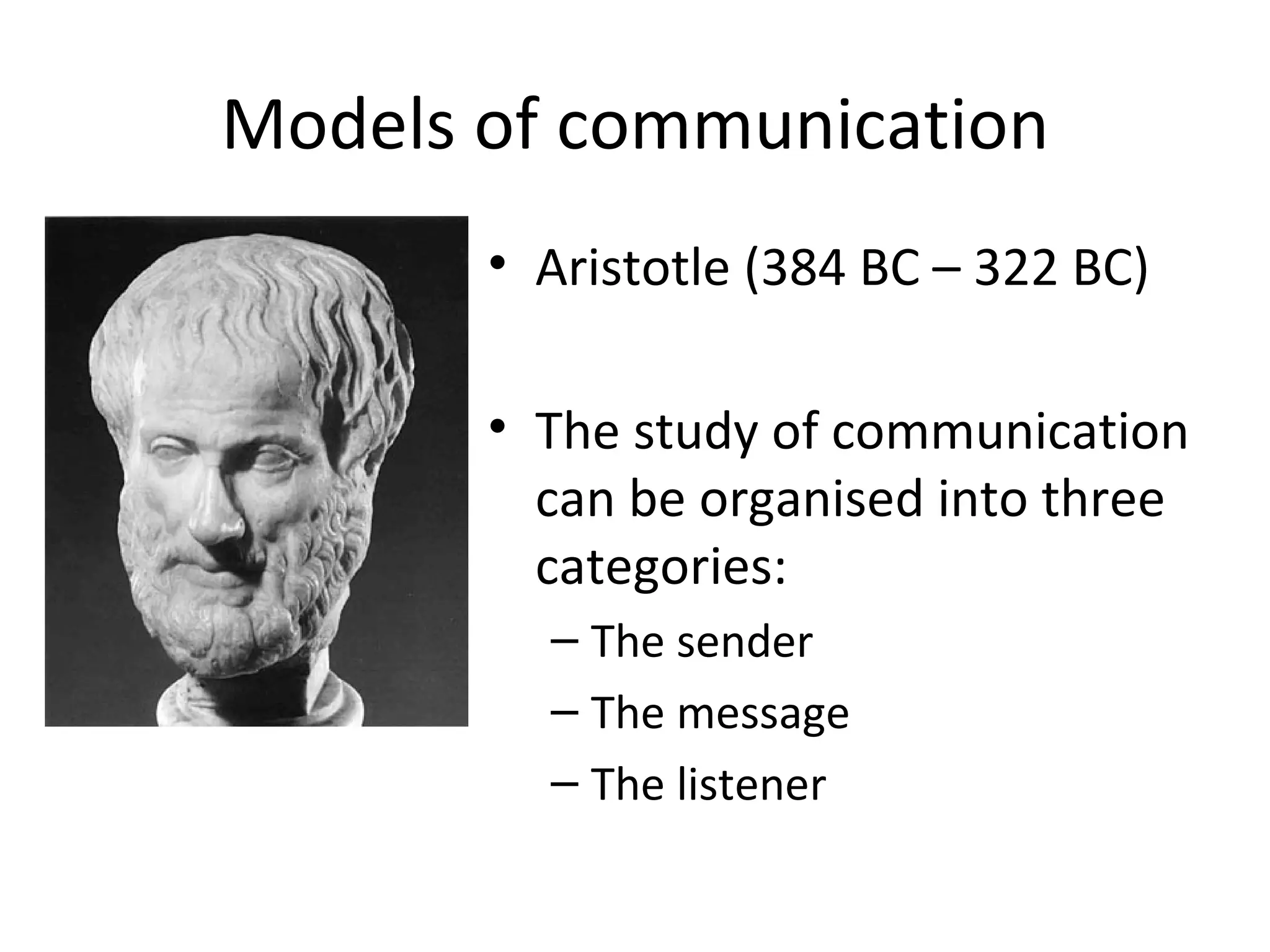
Models of communication Aristotle (384 BC – 322 BC) The study of communication can be organised into three categories: The sender The message The listener
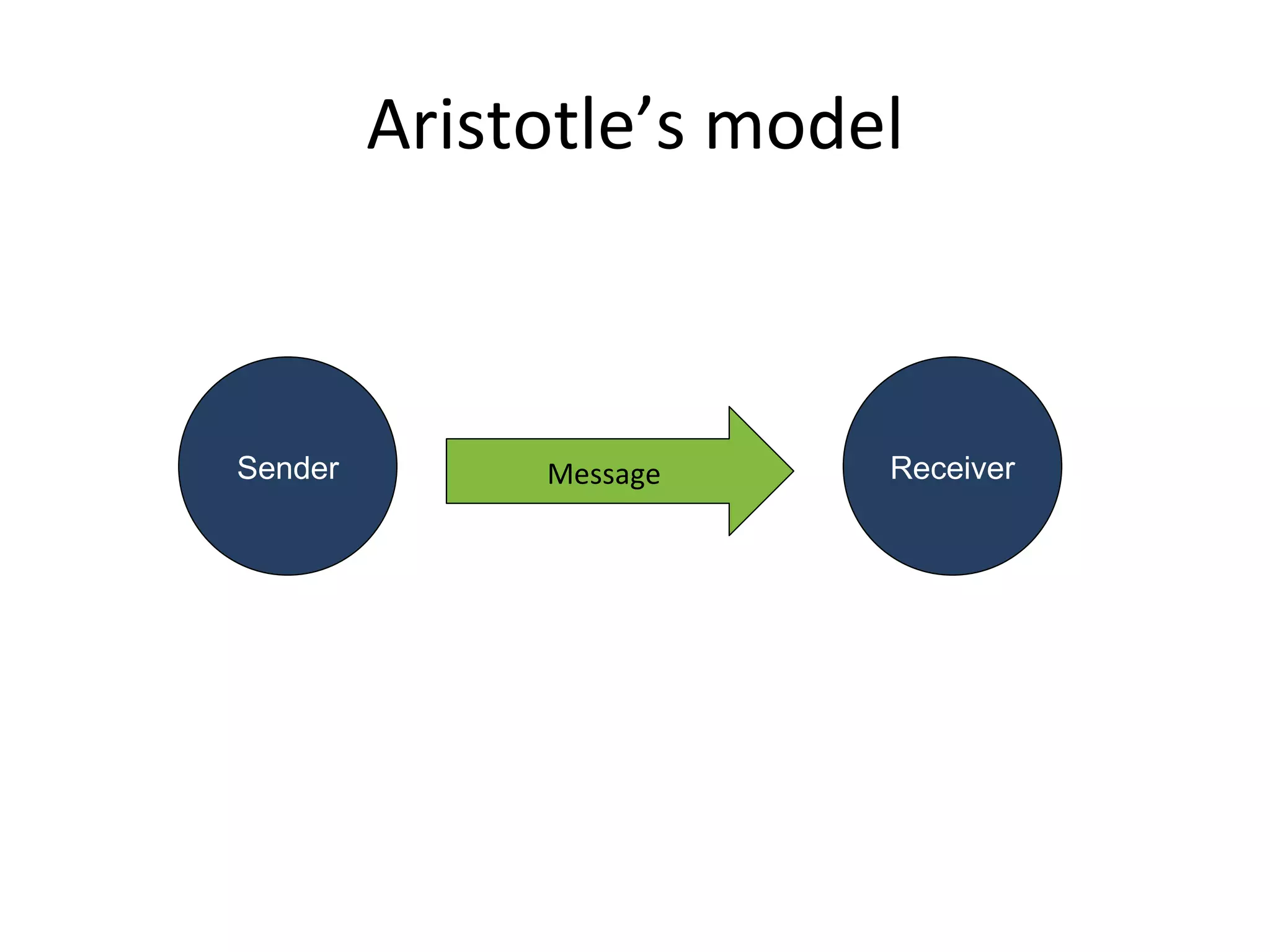
Aristotle’s model Sender Receiver Message
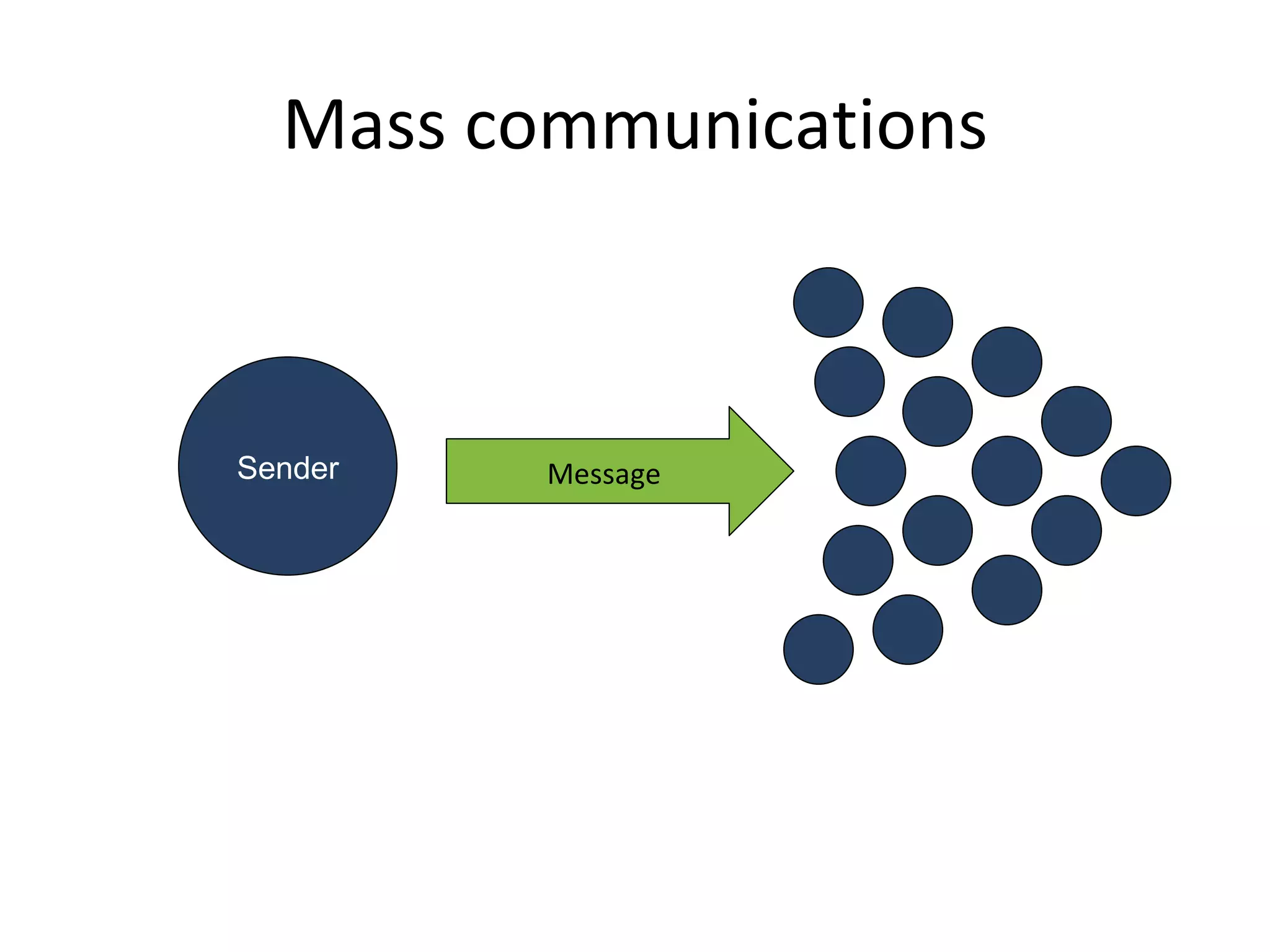
Mass communications Sender Message
Communications research 1920-40 Level A The technical problem How accurately can the symbols of communication be transmitted? Level B The semantic problem How precisely do the transmitted symbols convey the desired meaning? Level C The effectiveness problem How effectively does the received meaning affect behaviour in the desired way?
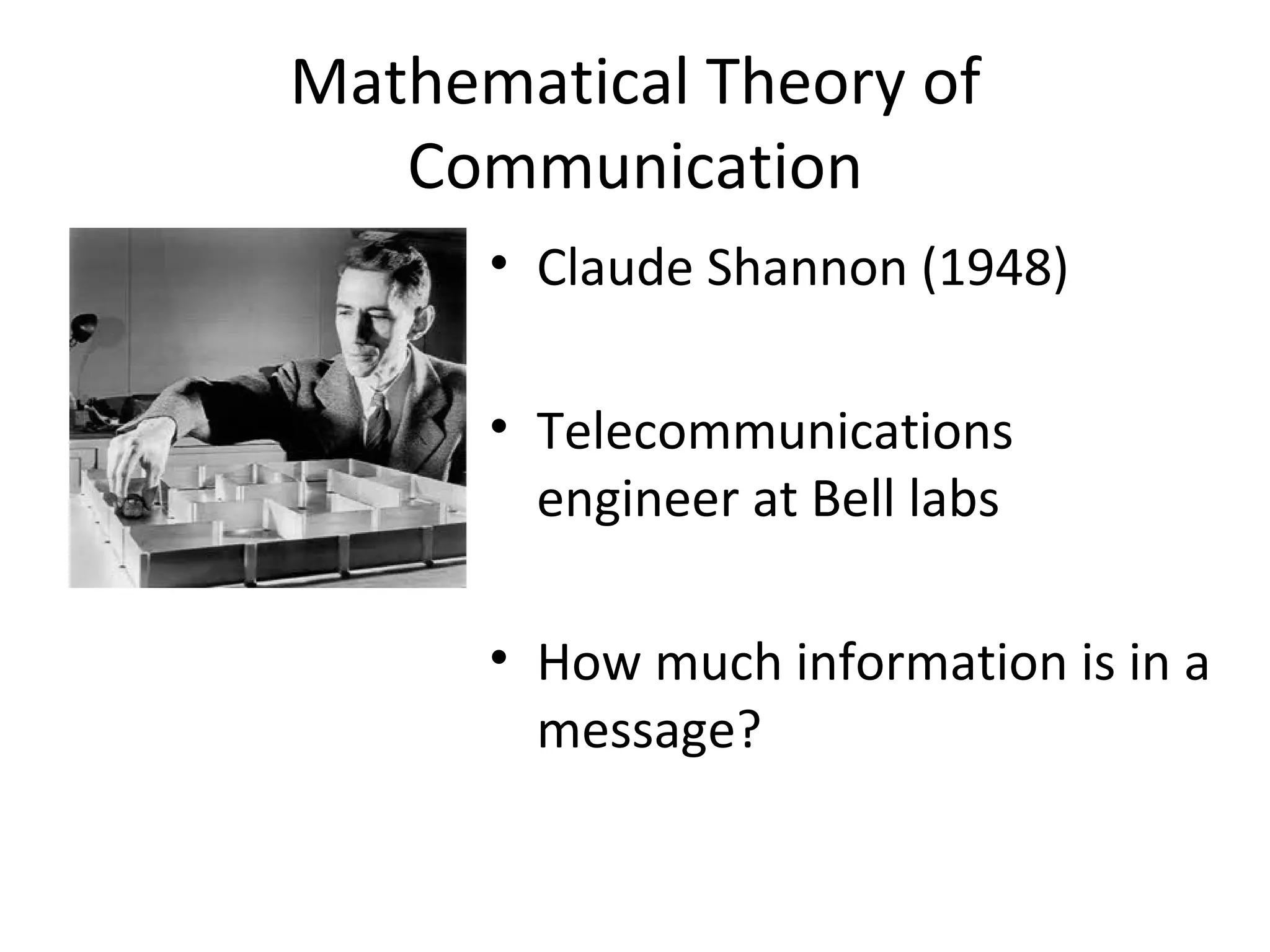
Mathematical Theory of Communication Claude Shannon (1948) Telecommunications engineer at Bell labs How much information is in a message?
Main People Claude Shannon – Developed the initial theory of communication.  With Warren Weaver developed the Shannon-Weaver model of Communication Theory W. Scramm – Added concept of field of experience to Shannon-Weaver model David Berlo – Developed SMCR ( Sender Message Channel Receiver)  model, stressing relationship between source and receiver Howard Lasswell – Introduced content analysis
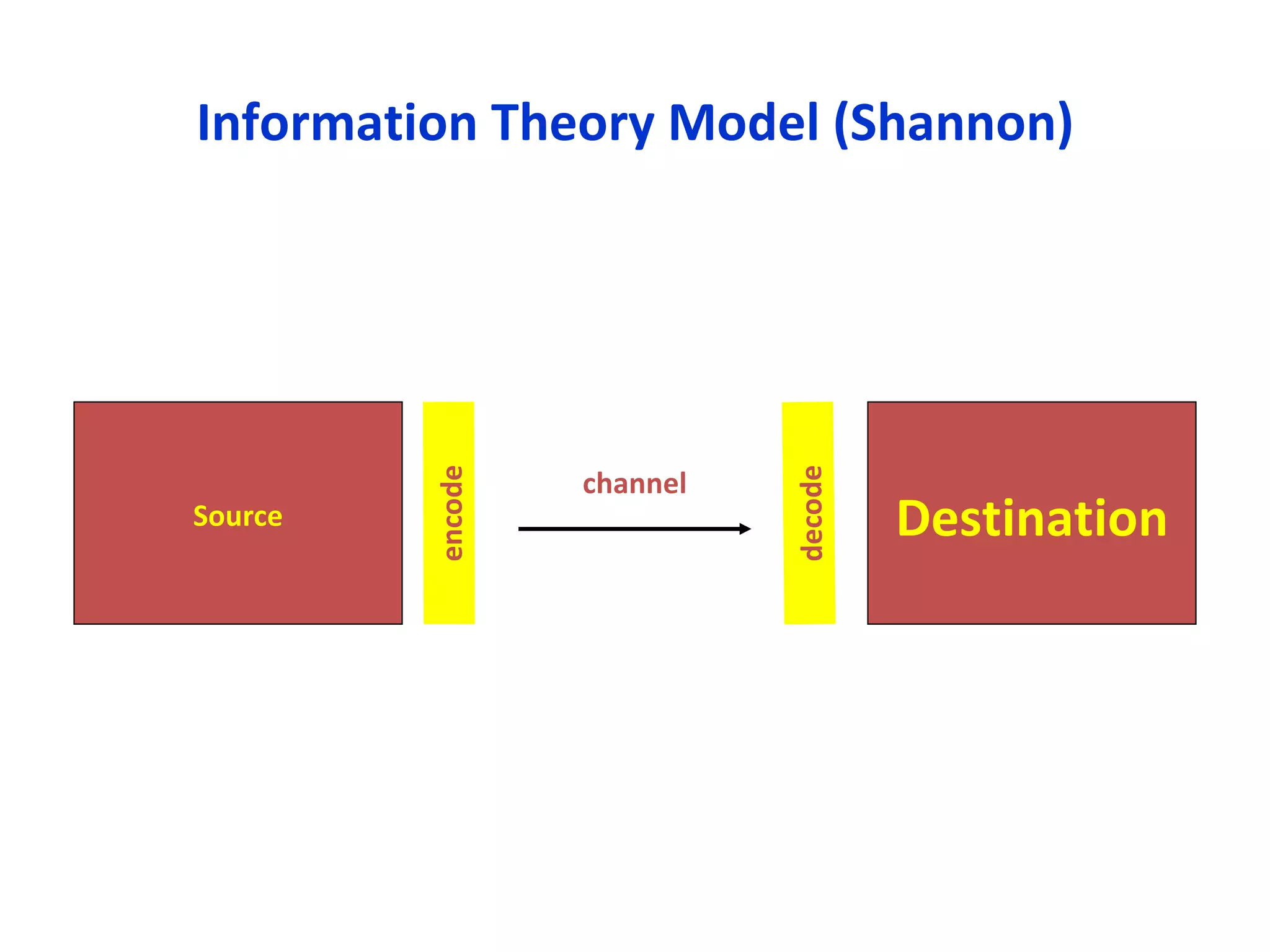
Information Theory Model (Shannon) Source Destination encode decode channel
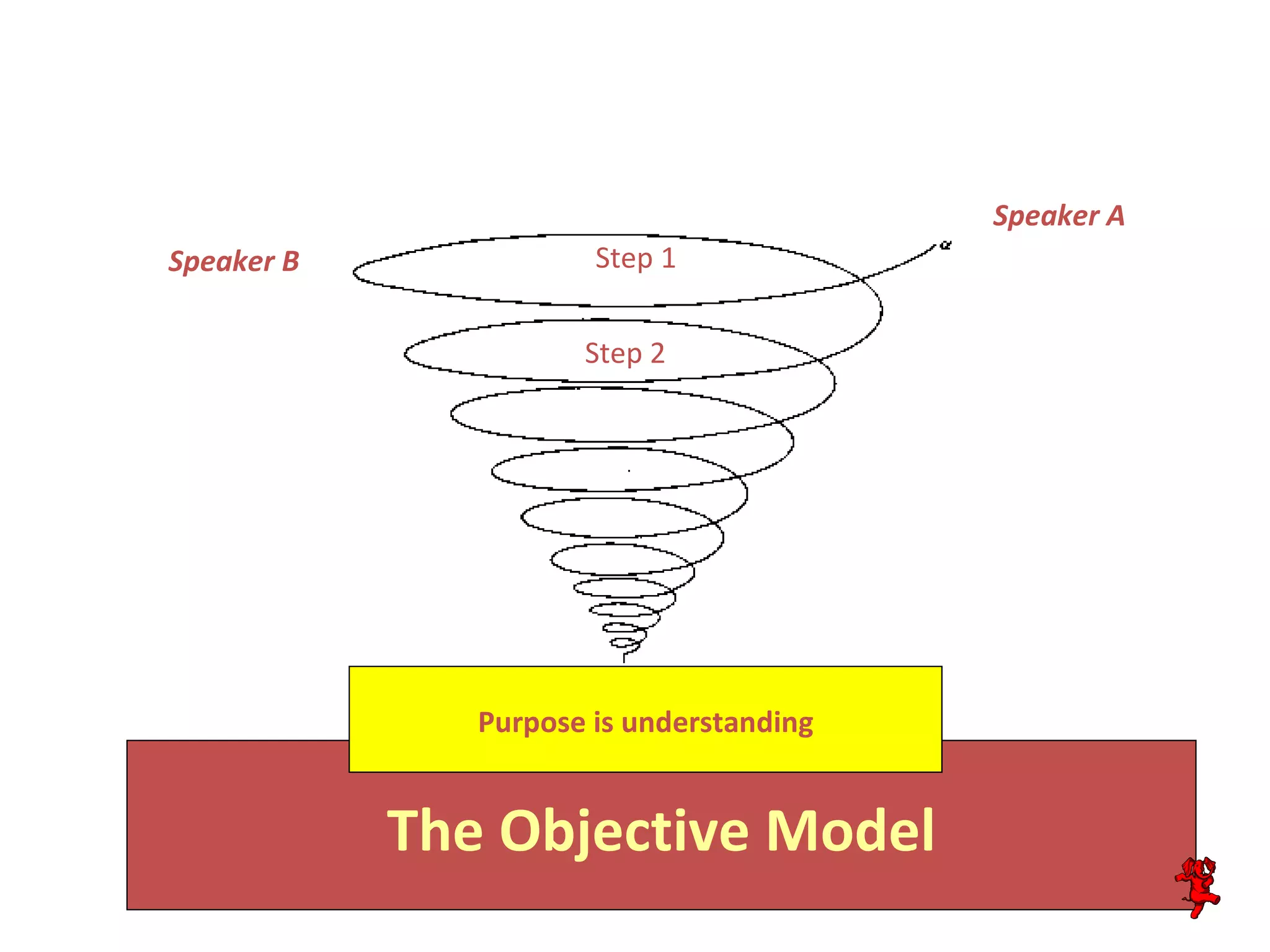
The Objective Model Speaker A Speaker B Purpose is understanding Step 1 Step 2
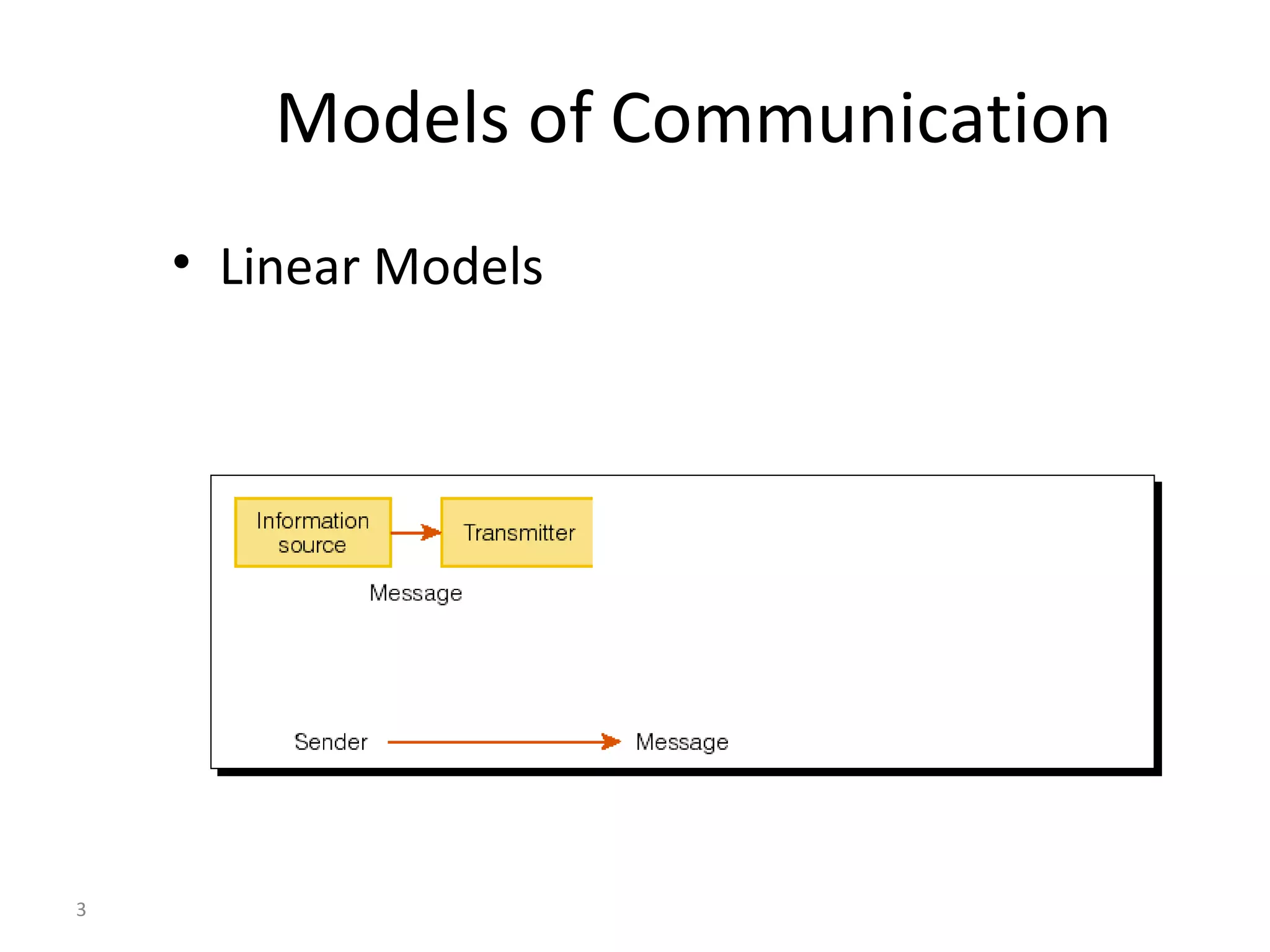
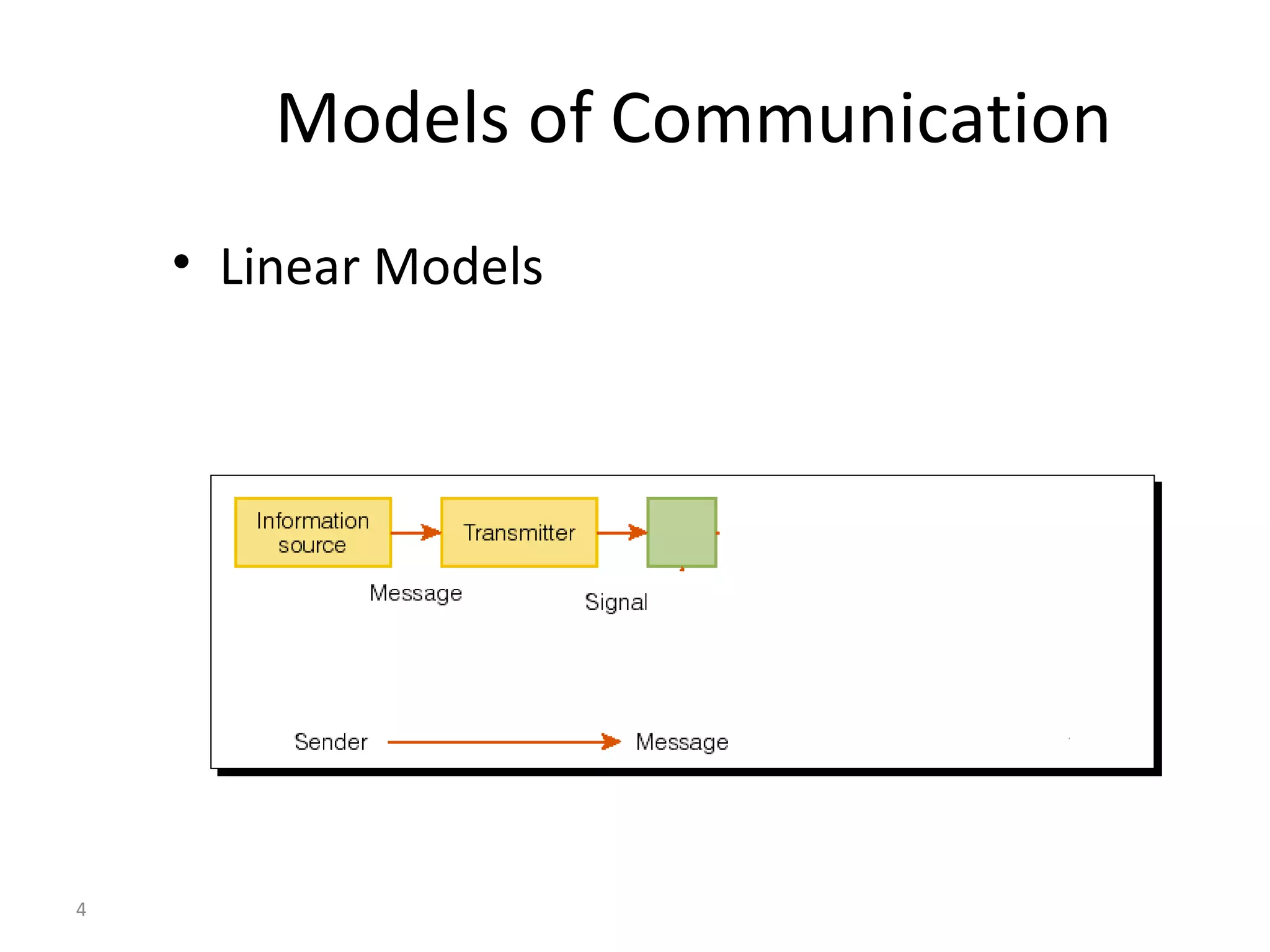
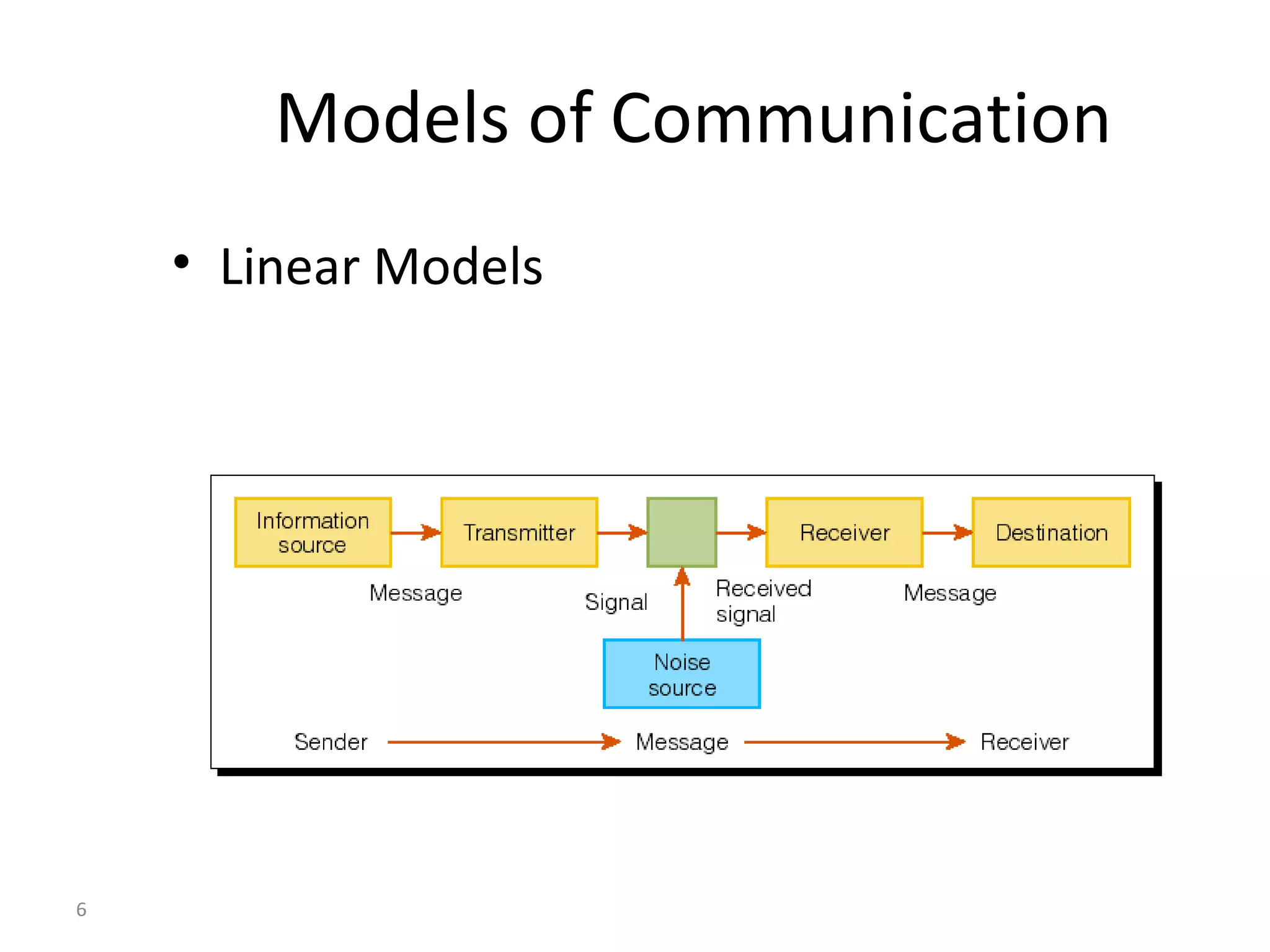
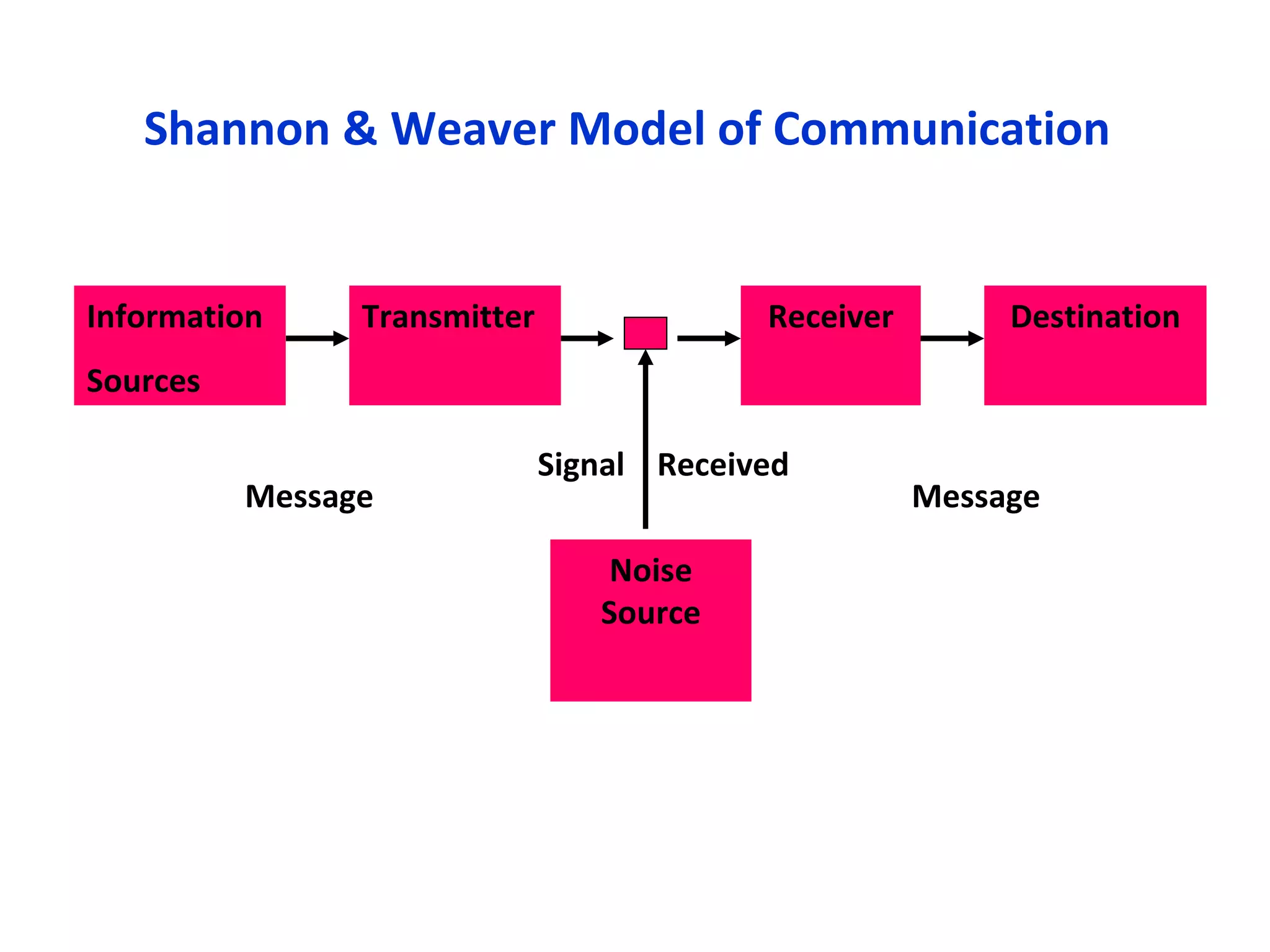
Shannon & Weaver Model of Communication   Information Sources Transmitter Receiver Destination Signal  Received Noise Source Message Message
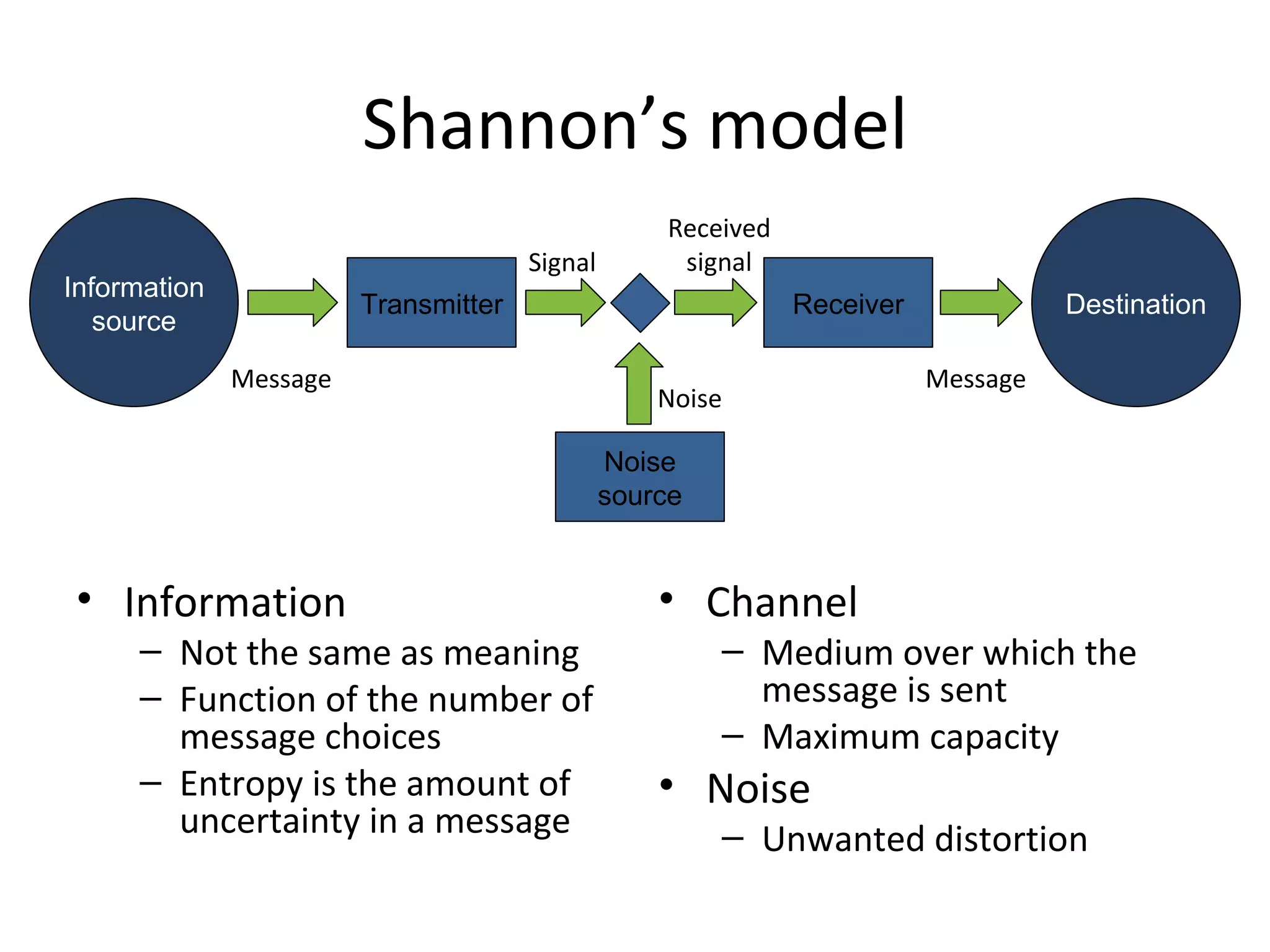
Shannon’s model Information Not the same as meaning Function of the number of message choices Entropy is the amount of uncertainty in a message Channel Medium over which the message is sent Maximum capacity Noise Unwanted distortion Information source Destination Transmitter Receiver Message Message Signal Received signal Noise Noise source
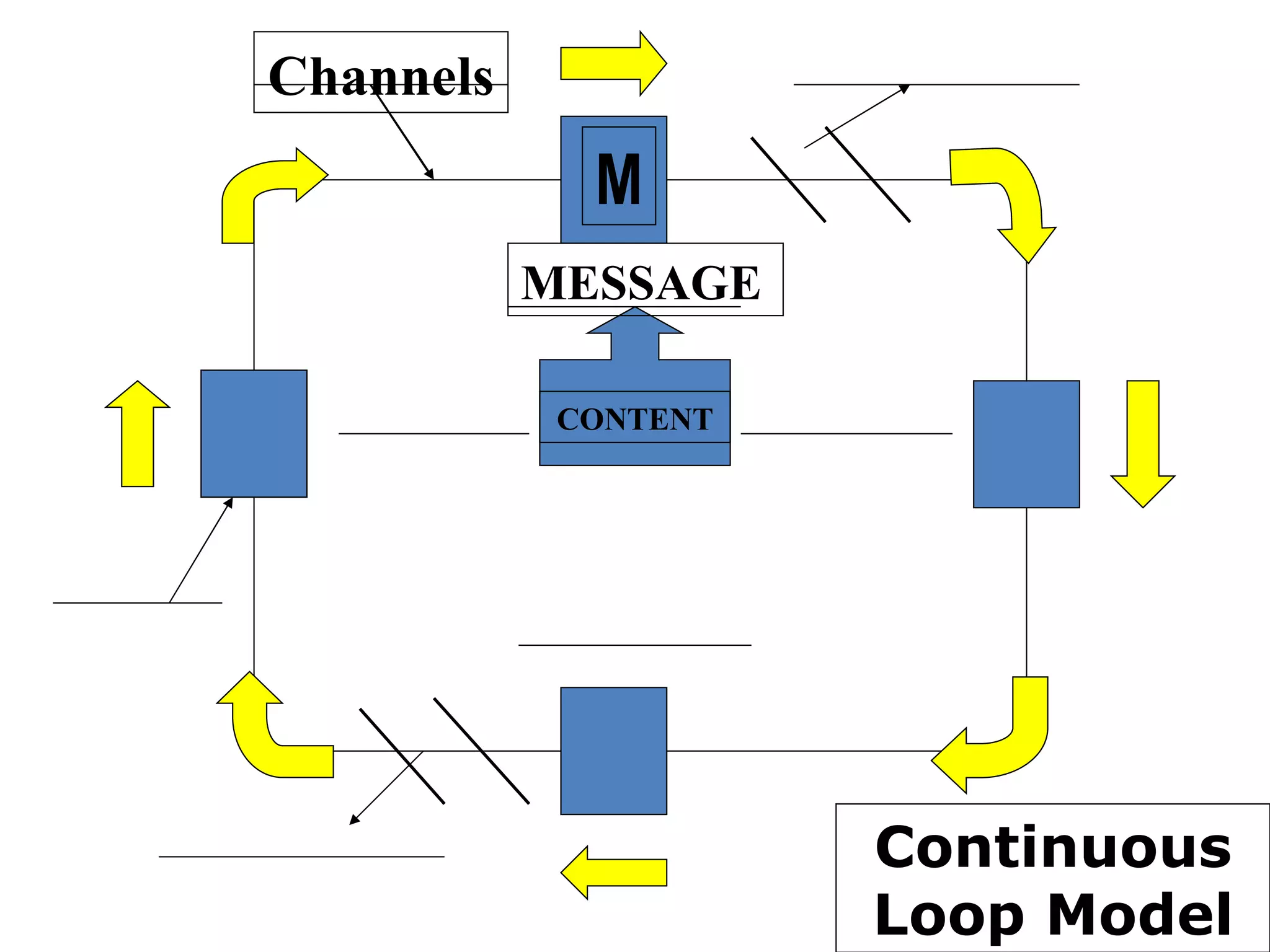
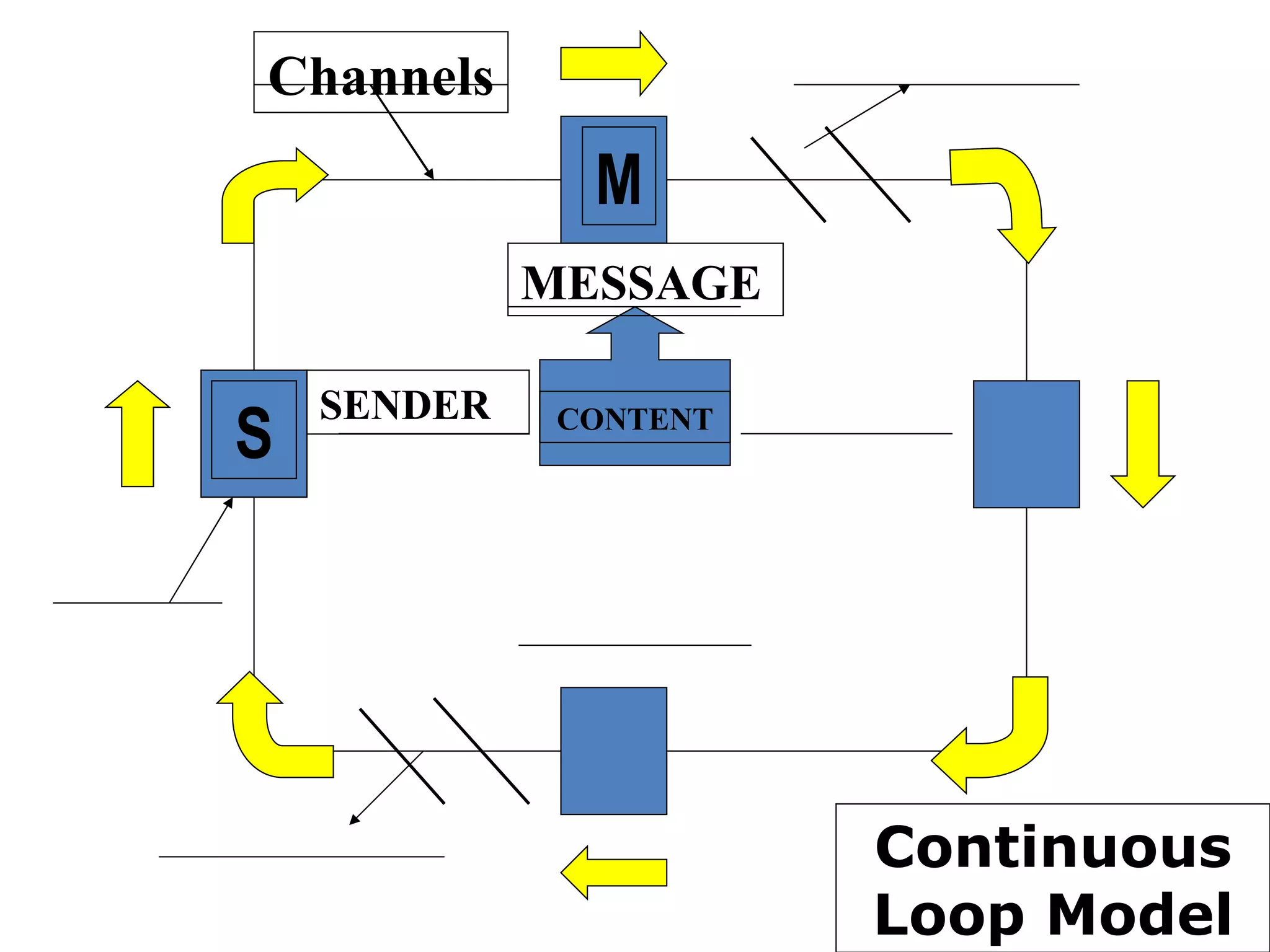
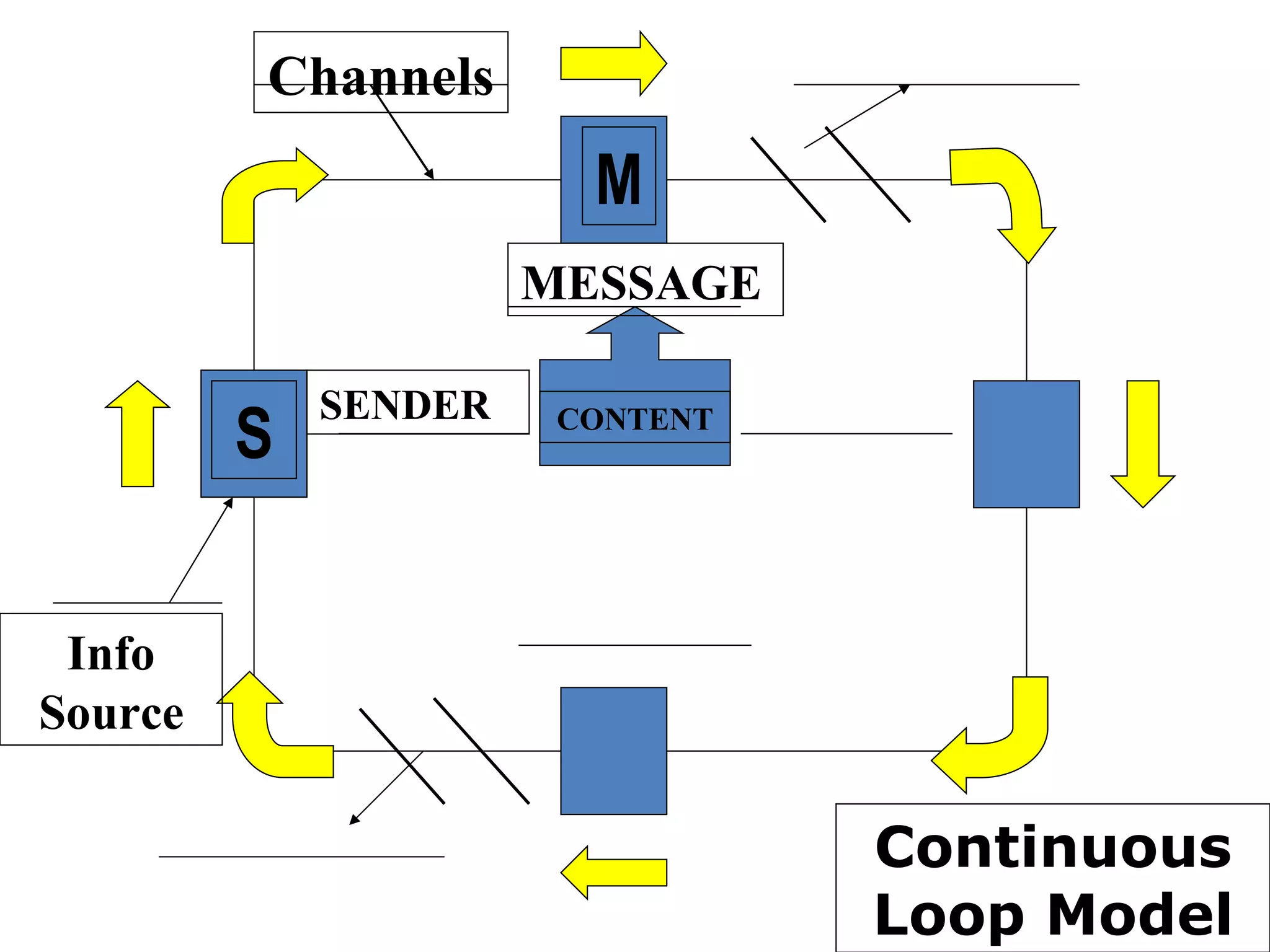
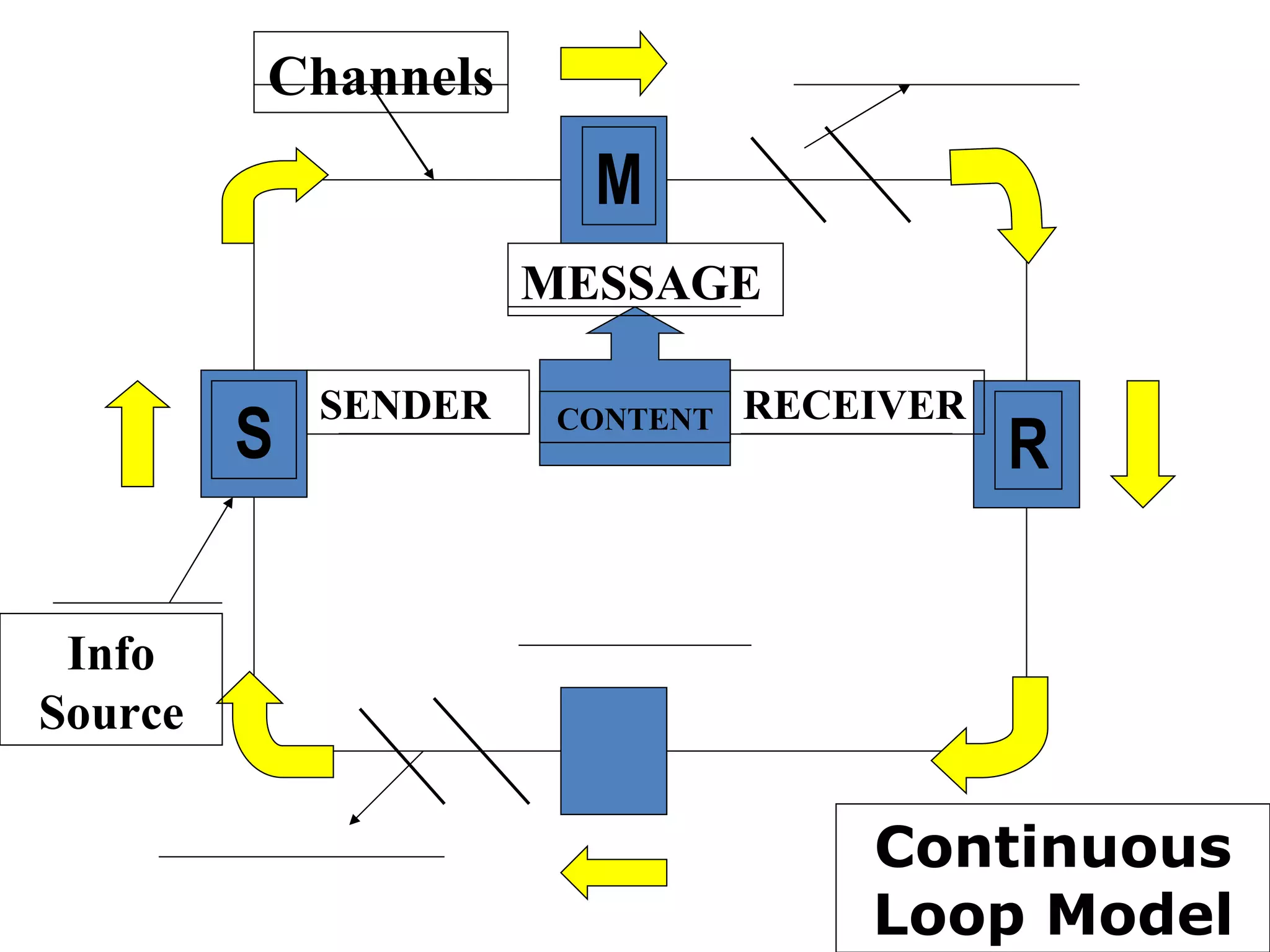
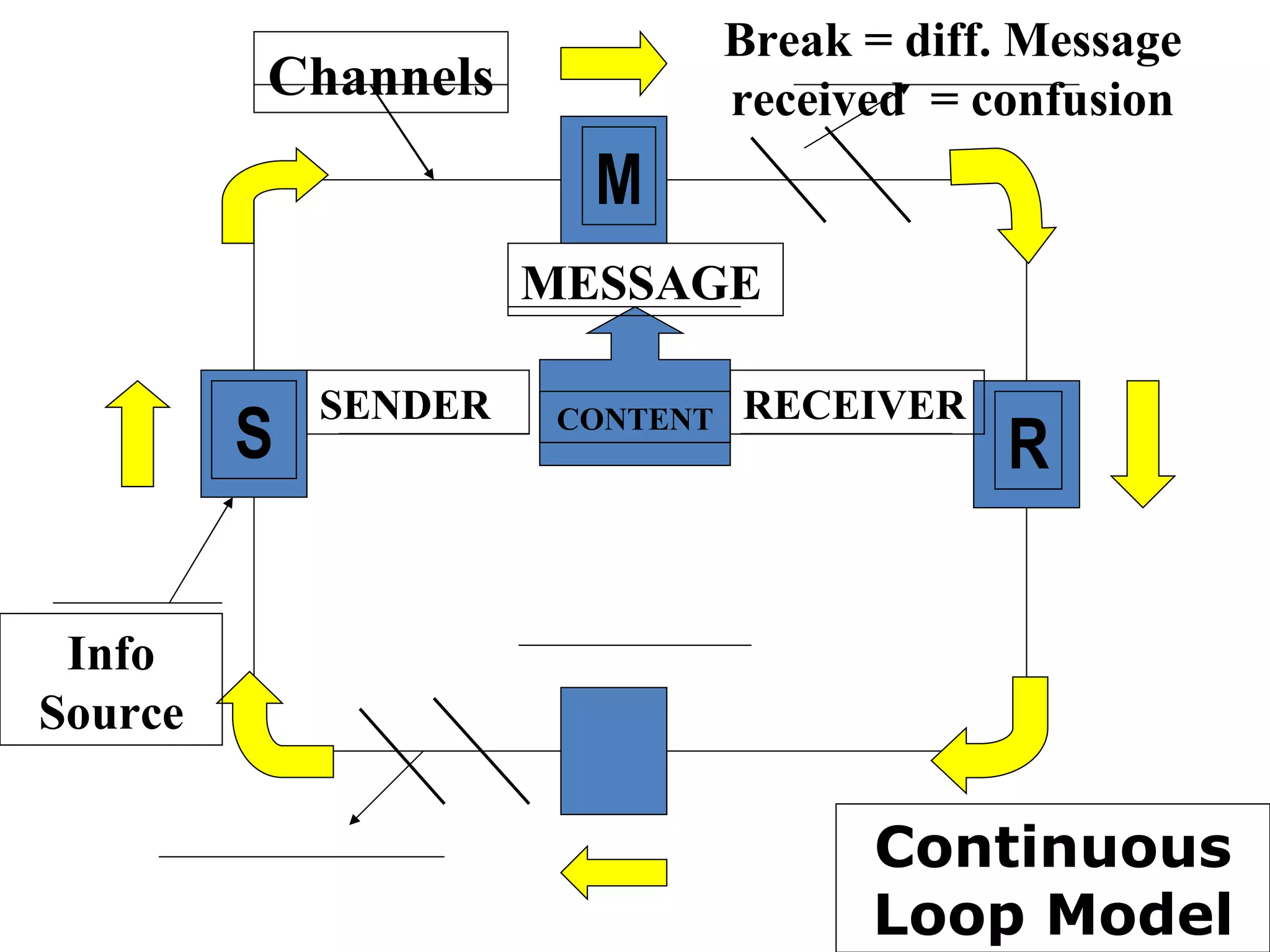
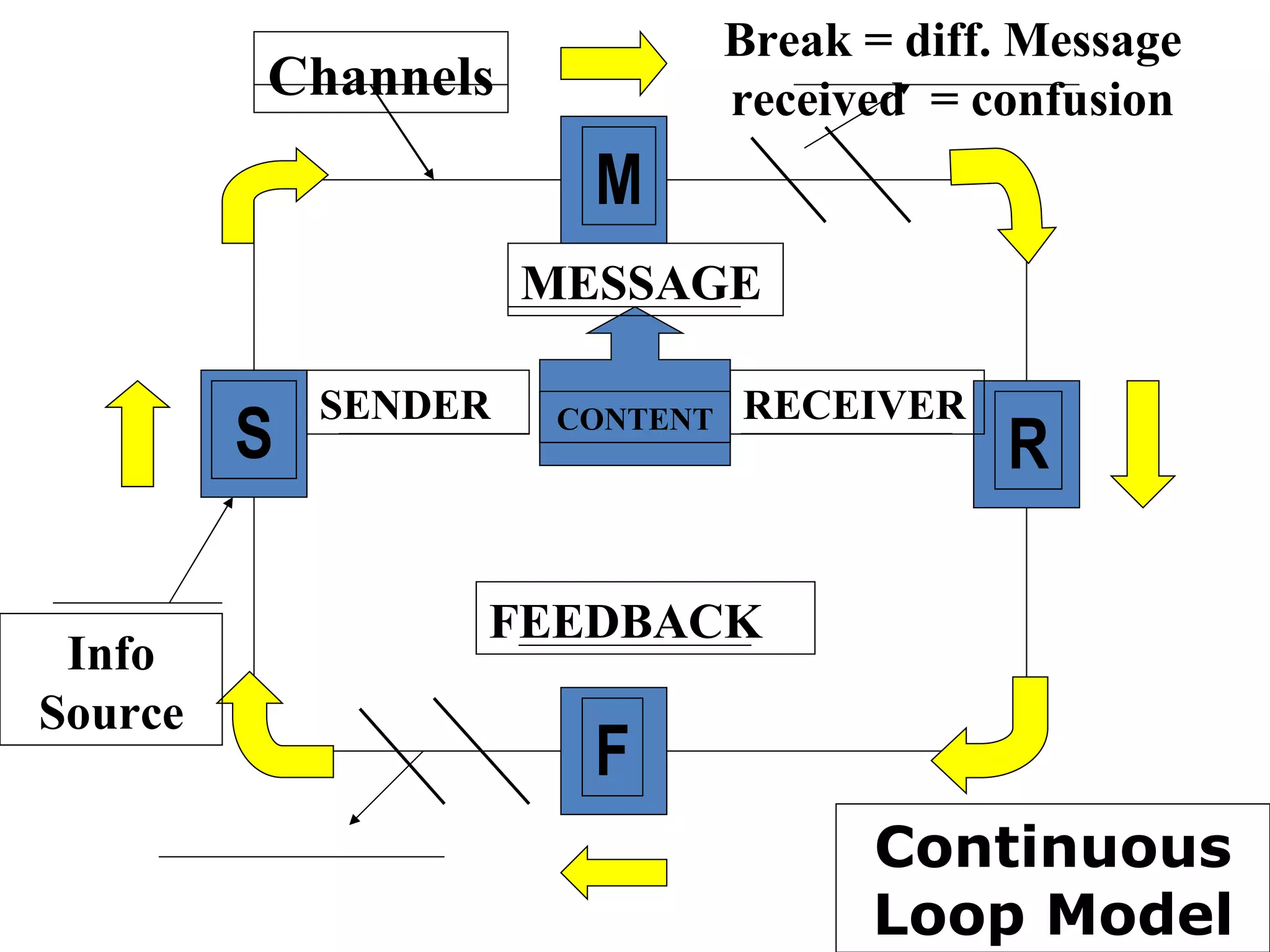
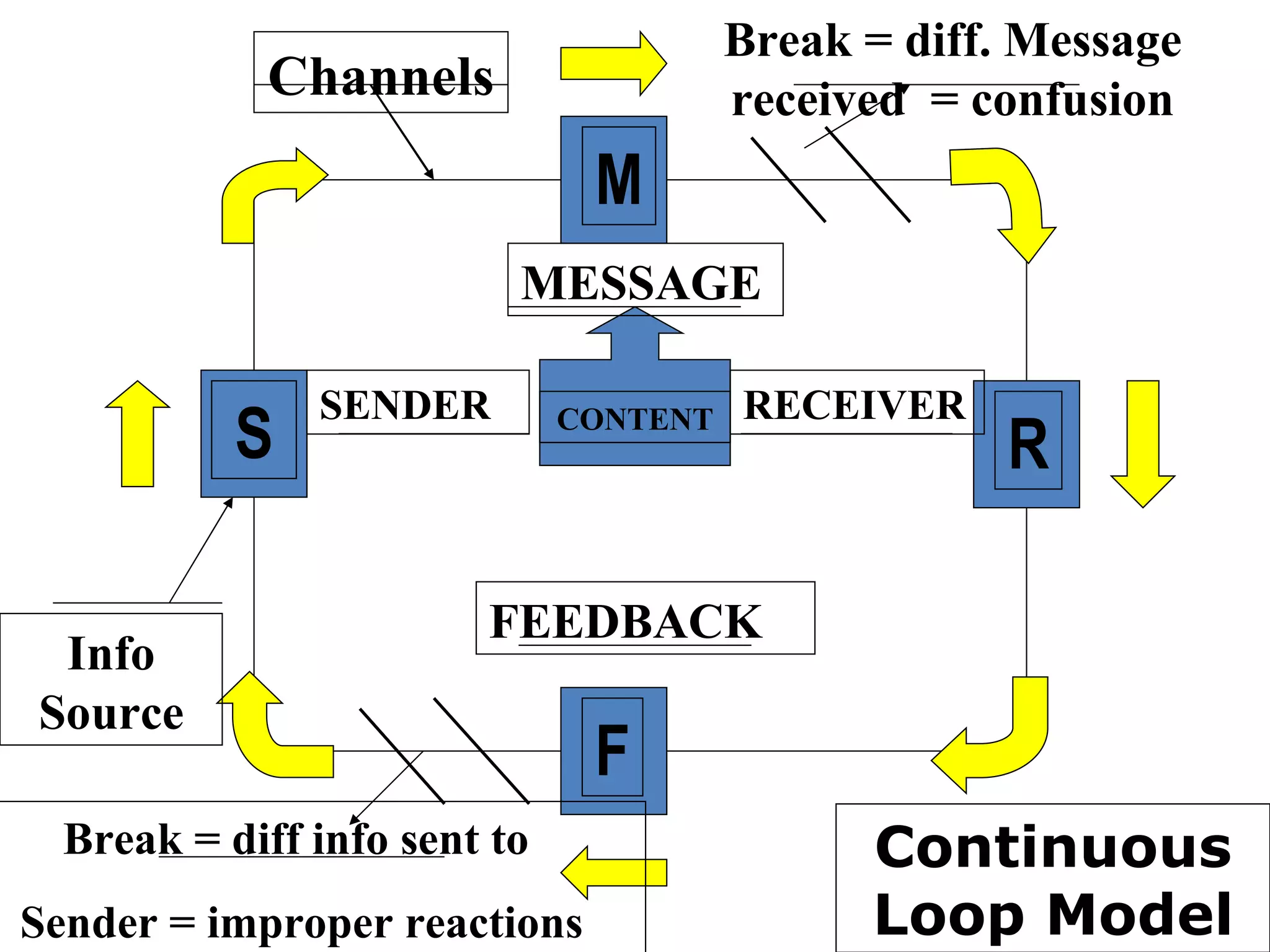
MODEL #1: CONTINUOUS LOOP MODEL This is the EARLIEST model of communication that has been presented and accepted by others who study the field. It is also the SIMPLEST model (though it might not look like it at first). It includes all of the basic parts/players in the communication process. There are still a few problems, though!
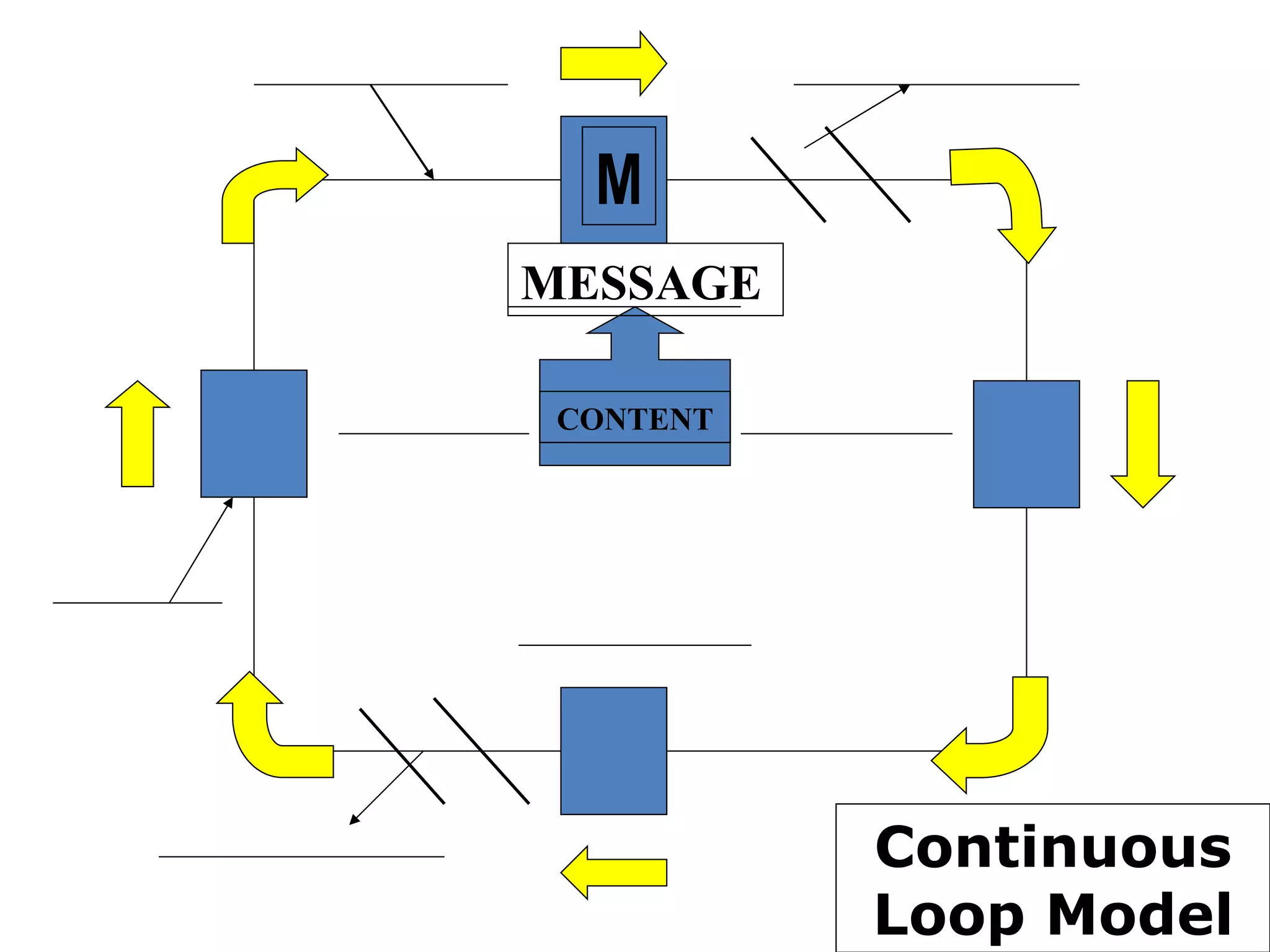
Continuous Loop Model
Continuous Loop Model CONTENT
Continuous Loop Model M MESSAGE CONTENT
Continuous Loop Model M Channels MESSAGE CONTENT
Continuous Loop Model S M Channels SENDER MESSAGE CONTENT
Continuous Loop Model S M Info Source Channels SENDER MESSAGE CONTENT
Continuous Loop Model S M R Info Source Channels SENDER MESSAGE RECEIVER CONTENT
Continuous Loop Model S M R Info Source Channels Break = diff. Message received  = confusion SENDER MESSAGE RECEIVER CONTENT
Continuous Loop Model S M R F Info Source Channels Break = diff. Message received  = confusion SENDER MESSAGE RECEIVER FEEDBACK CONTENT
Continuous Loop Model S M R F Info Source Channels Break = diff. Message received  = confusion SENDER MESSAGE RECEIVER FEEDBACK Break = diff info sent to  Sender = improper reactions CONTENT
CONTINUOUS LOOP This model is based upon the concept that language is a system or a machine. In this machine, communication acts as the “gears” for the machine to work properly. Any breakdowns hurt efficiency!
CONTINUOUS LOOP While this is the EARLIEST model of communication, it is not known who the developer or the creator of the model was. The only thing we know for sure is that it was most-likely developed in the 1920s or 1930s.
CONTINUOUS LOOP One of the flaws of the model is that it assumes “continuous” communication. There are times when we choose to stop communicating. In other words, this is good on paper, but it does not fit all situations.
Models of Communication “ Model” = “theory” Mathematical theory of communication Claude Shannon “ linear” model of communication Also known as “information theory” Concepts Information, Message, Information source, Signal, Channel, Transmitter, Noise source, Received signal, Receiver, Destination
Main Points – Shannon Weaver Model A linear view of communication: messages are encoded by a source and sent through a channel.  Messages are then decoded by a receiver, who then sends the source feedback.  Messages may be disrupted by noise. Schramm adds the factor of fields of experience of the sender and receiver, life experiences which can enhance communication when they overlap.
Mathematical theory of communication - 1 Information Not to be confused with  meaning log 2  of of the number of possible messages This is called entropy Information source Message: transmitted by information source Signal: physical form of message
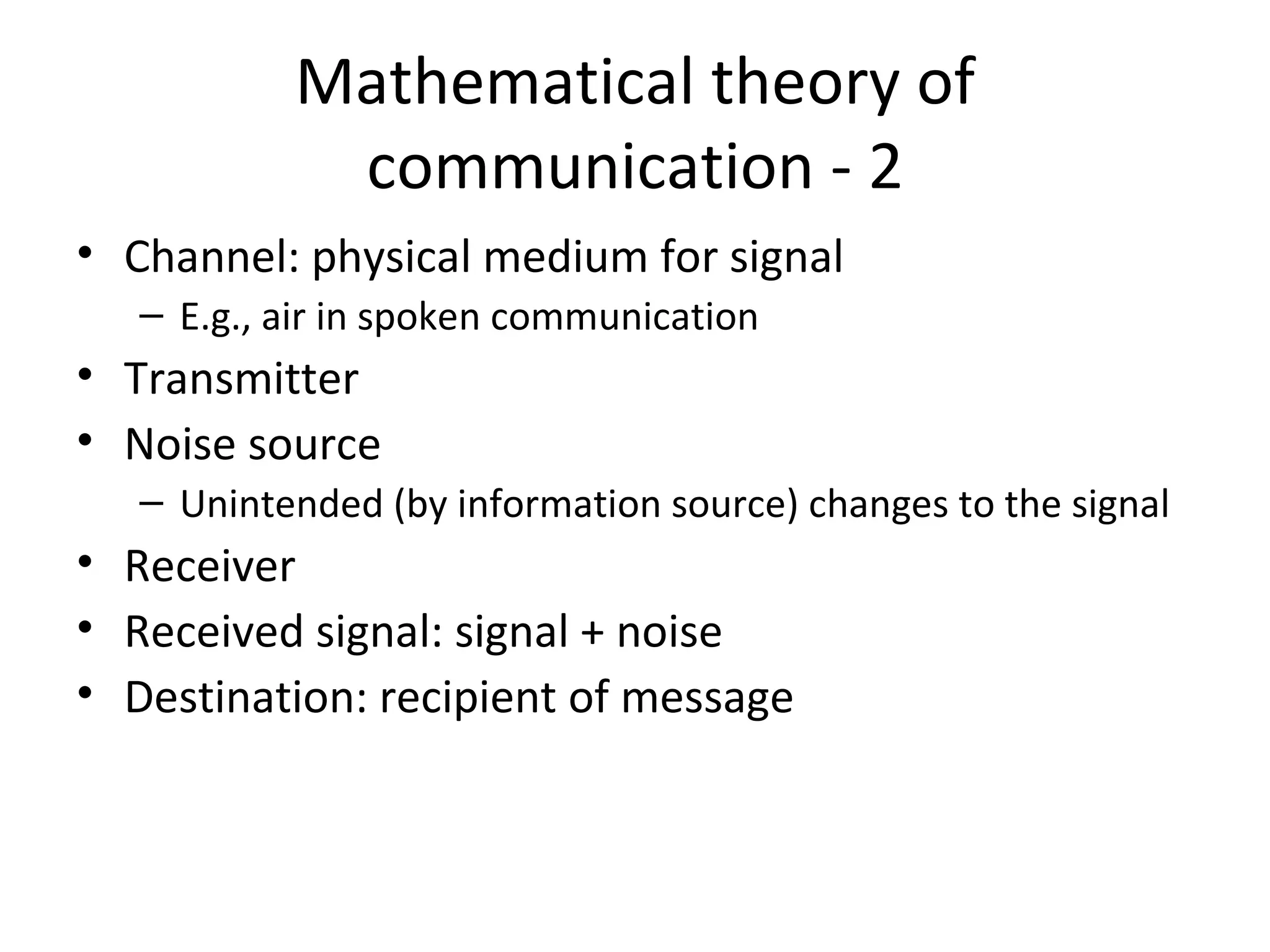
Mathematical theory of communication - 2 Channel: physical medium for signal E.g., air in spoken communication Transmitter Noise source Unintended (by information source) changes to the signal Receiver Received signal: signal + noise Destination: recipient of message
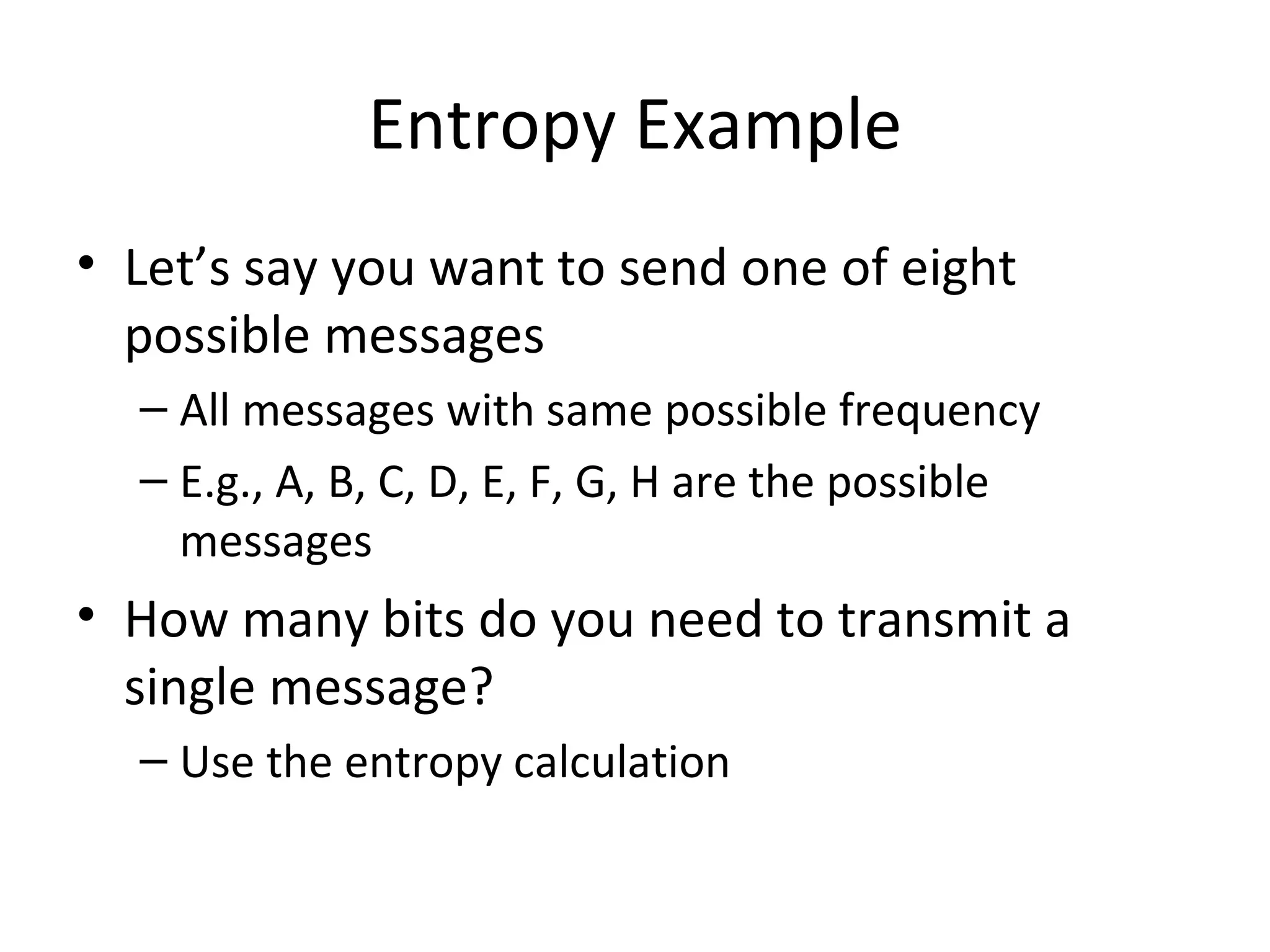
Entropy Example Let’s say you want to send one of eight possible messages All messages with same possible frequency E.g., A, B, C, D, E, F, G, H are the possible messages How many bits do you need to transmit a single message? Use the entropy calculation
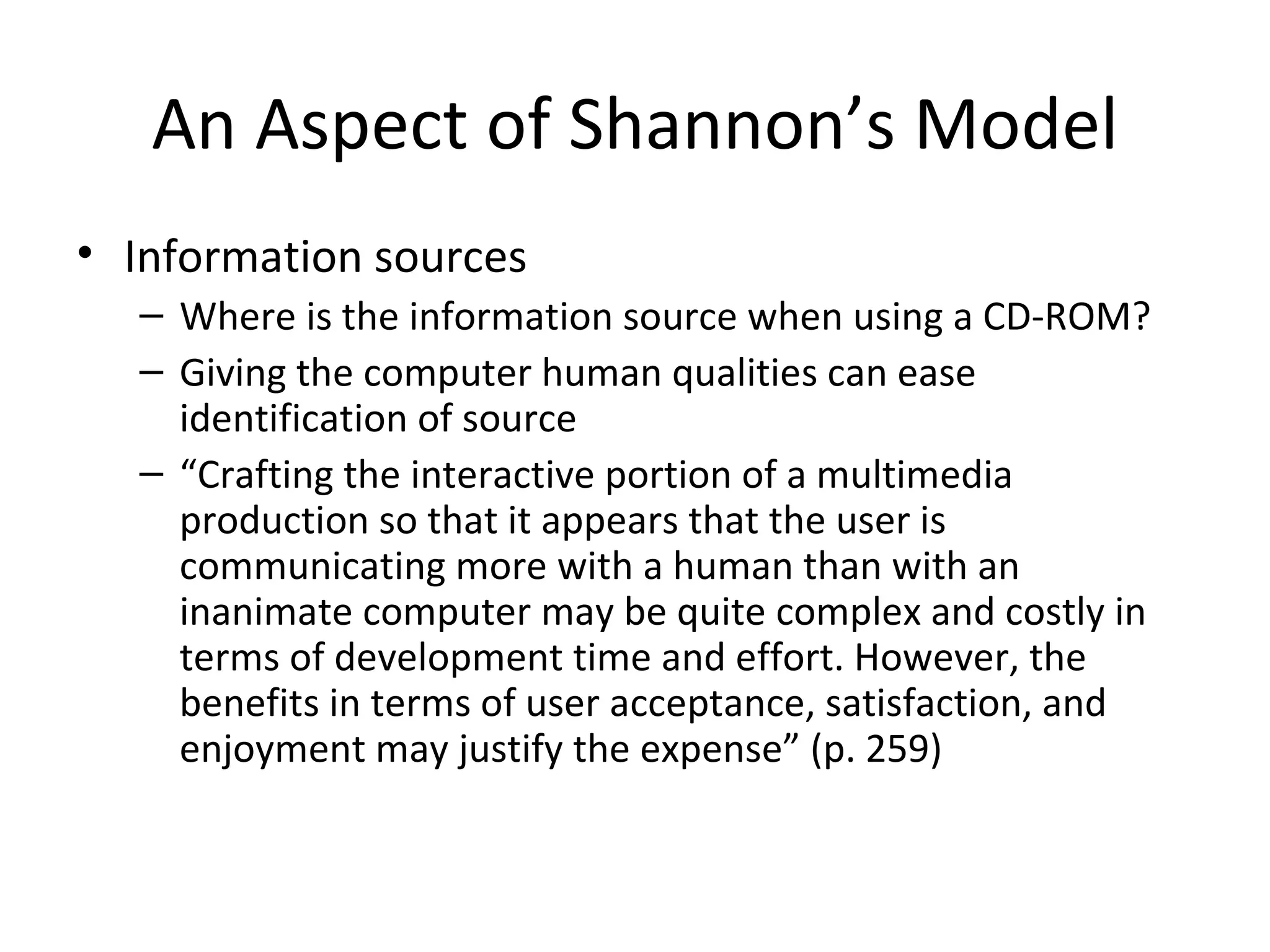
An Aspect of Shannon’s Model Information sources Where is the information source when using a CD-ROM? Giving the computer human qualities can ease identification of source “ Crafting the interactive portion of a multimedia production so that it appears that the user is communicating more with a human than with an inanimate computer may be quite complex and costly in terms of development time and effort. However, the benefits in terms of user acceptance, satisfaction, and enjoyment may justify the expense” (p. 259)
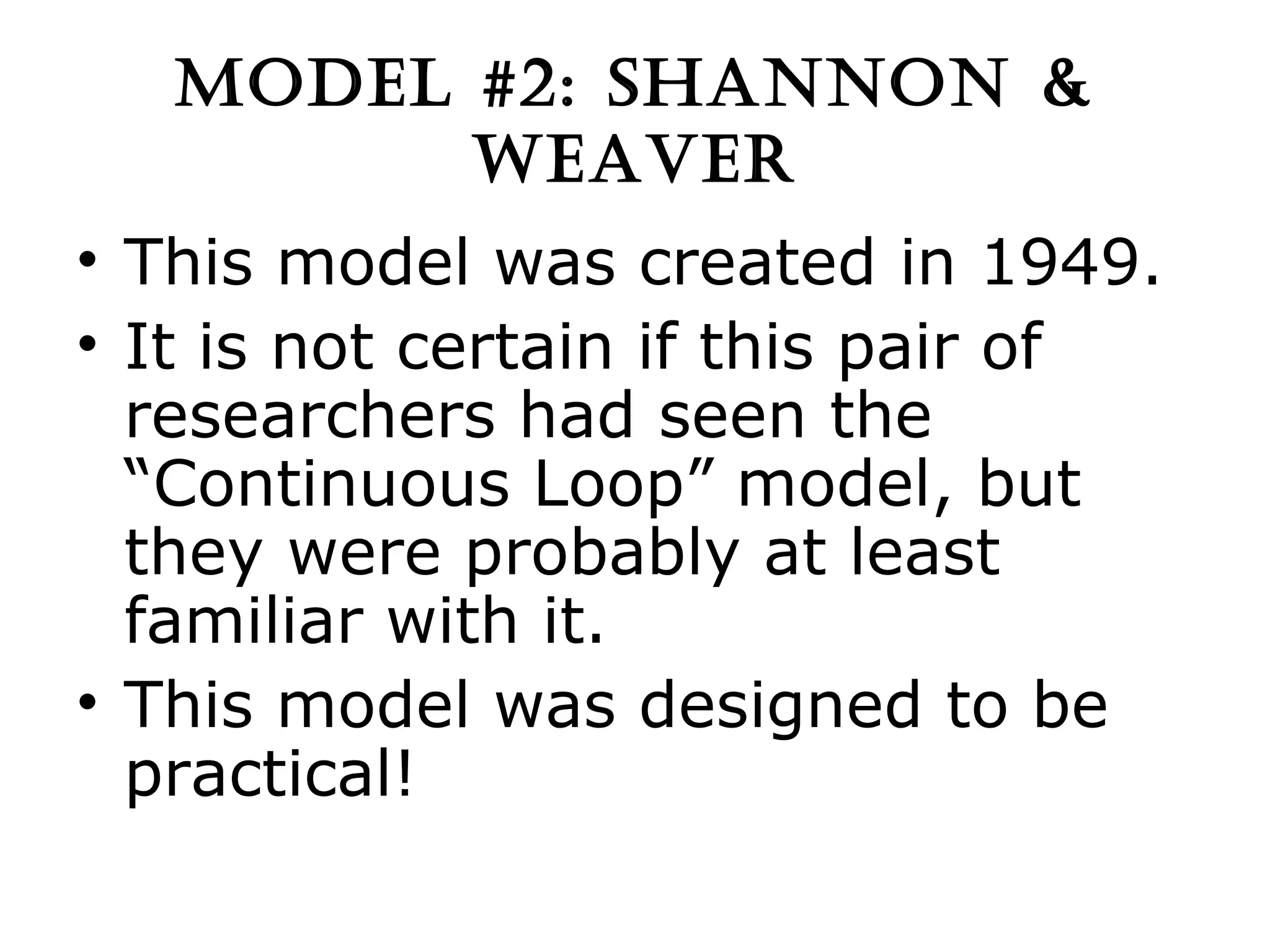
MODEL #2: SHANNON & WEAVER This model was created in 1949. It is not certain if this pair of researchers had seen the “Continuous Loop” model, but they were probably at least familiar with it. This model was designed to be practical!
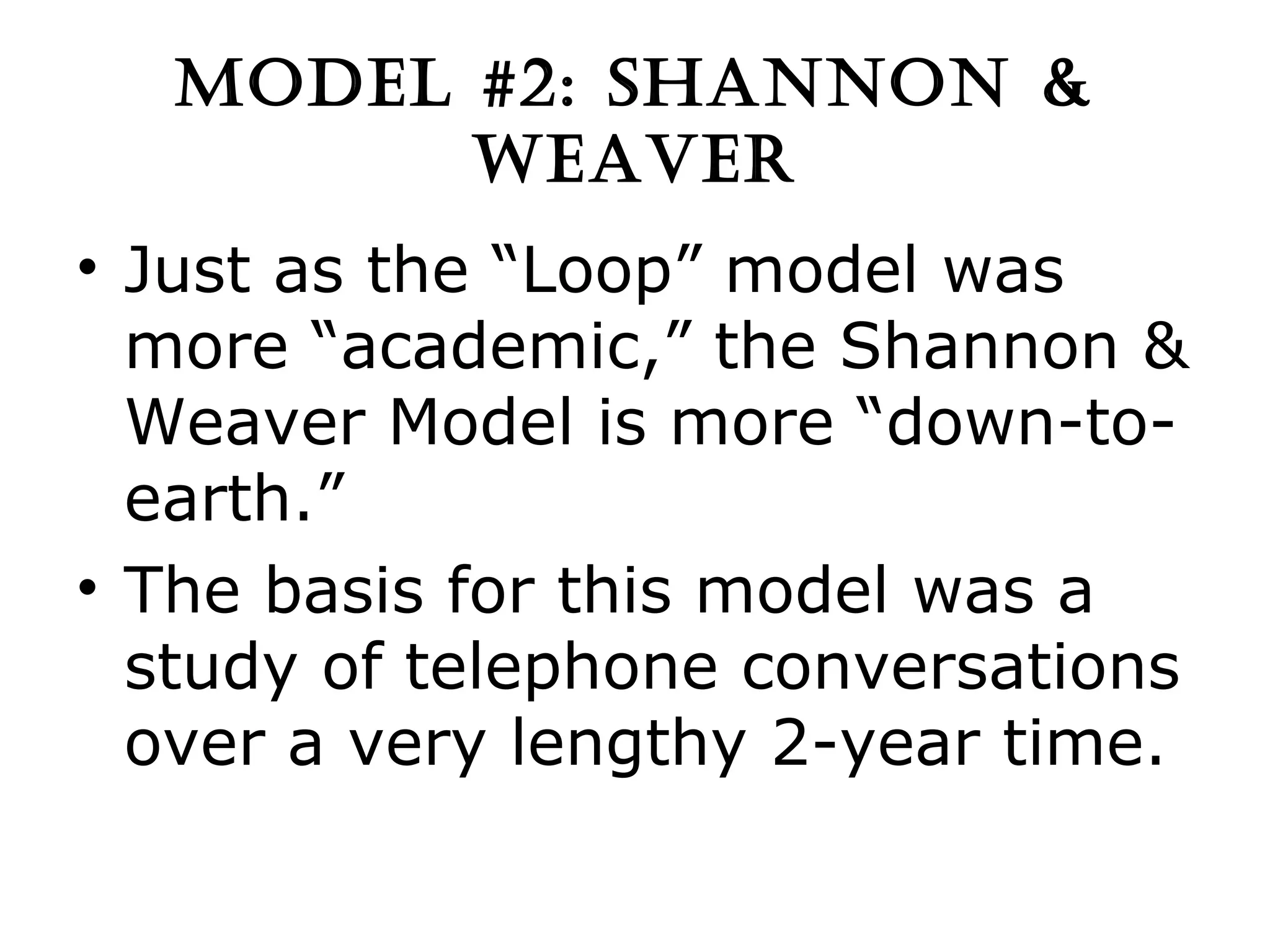
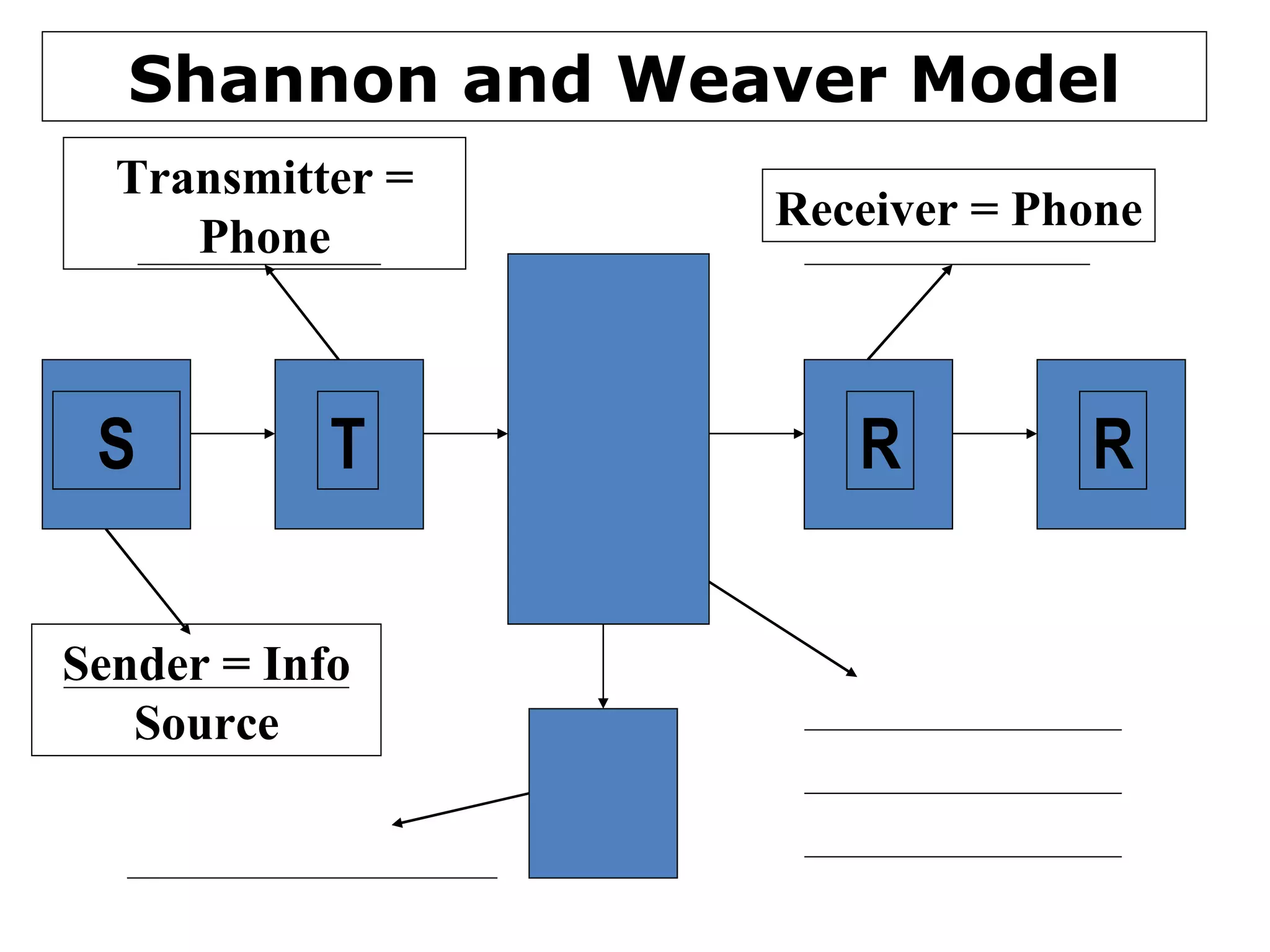
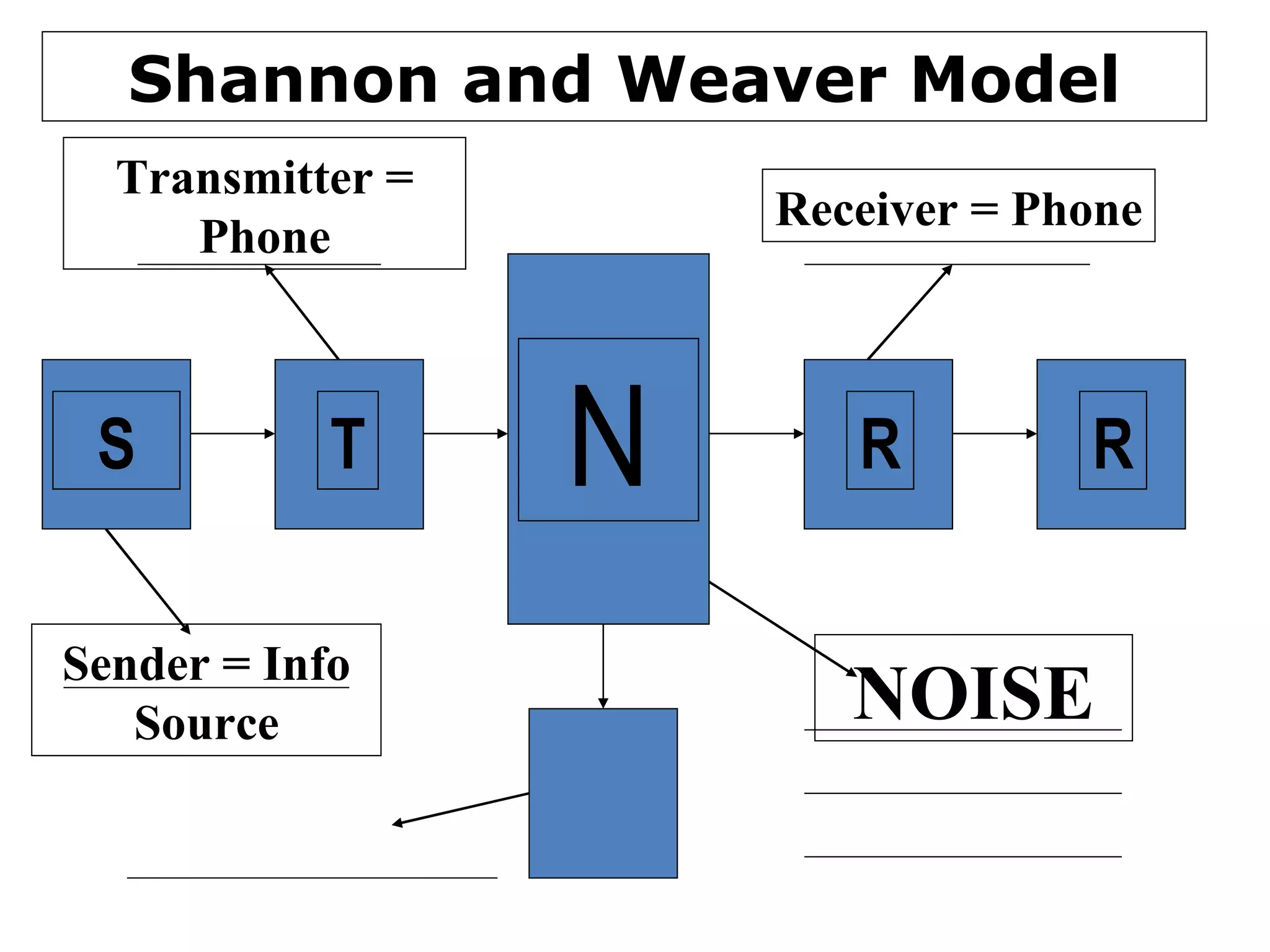
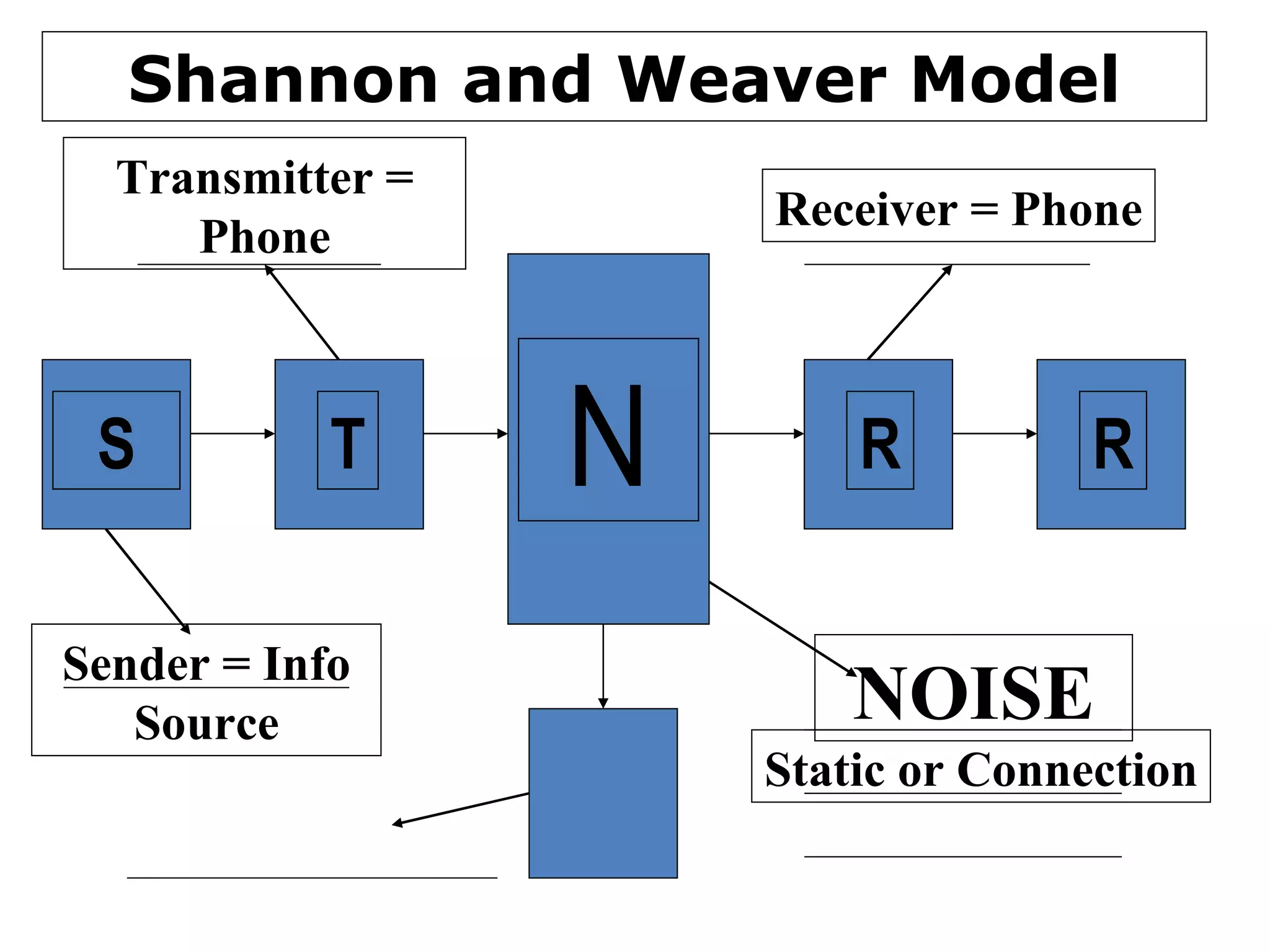
MODEL #2: SHANNON & WEAVER Just as the “Loop” model was more “academic,” the Shannon & Weaver Model is more “down-to-earth.” The basis for this model was a study of telephone conversations over a very lengthy 2-year time.
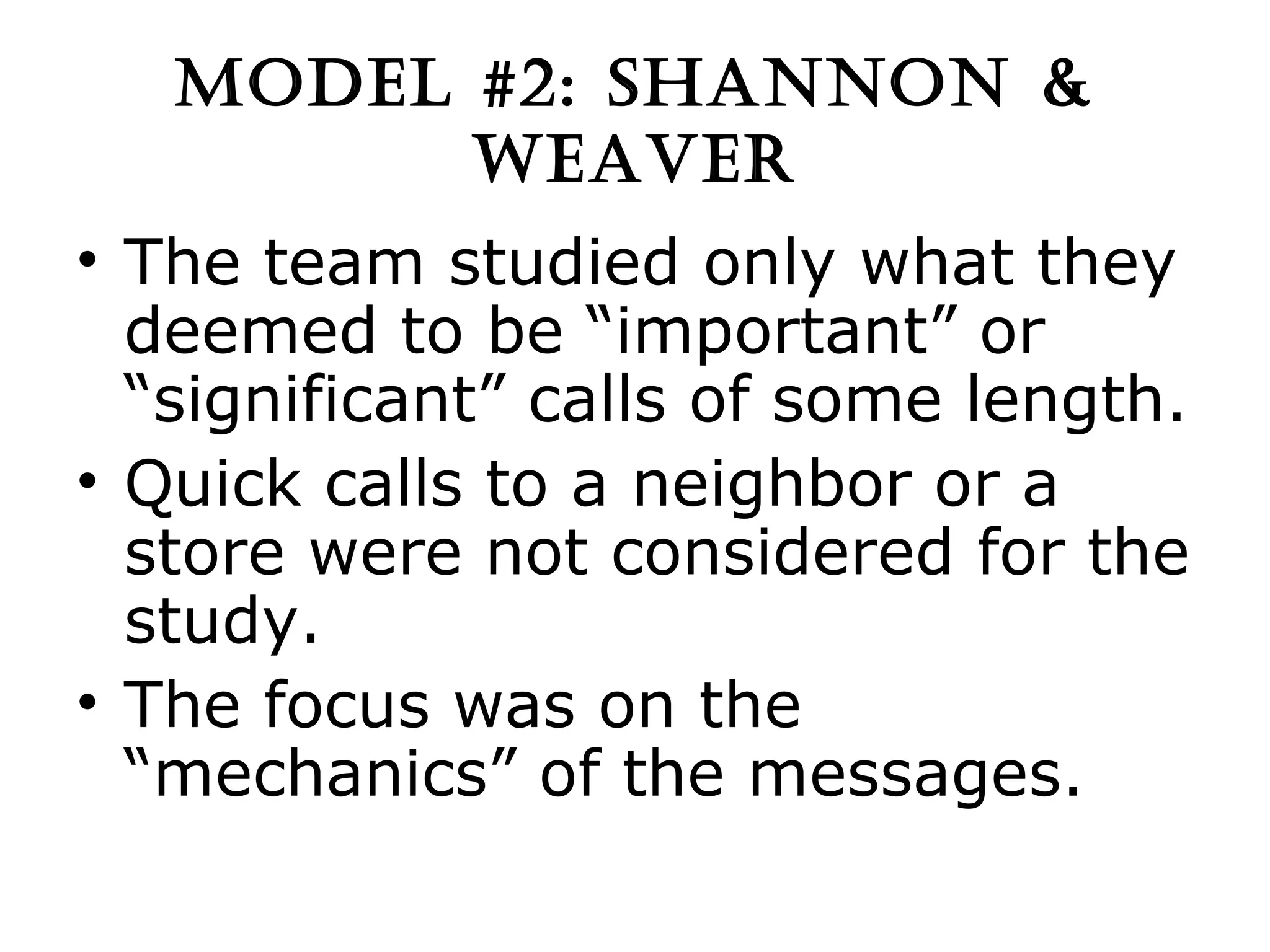
MODEL #2: SHANNON & WEAVER The team studied only what they deemed to be “important” or “significant” calls of some length. Quick calls to a neighbor or a store were not considered for the study. The focus was on the “mechanics” of the messages.
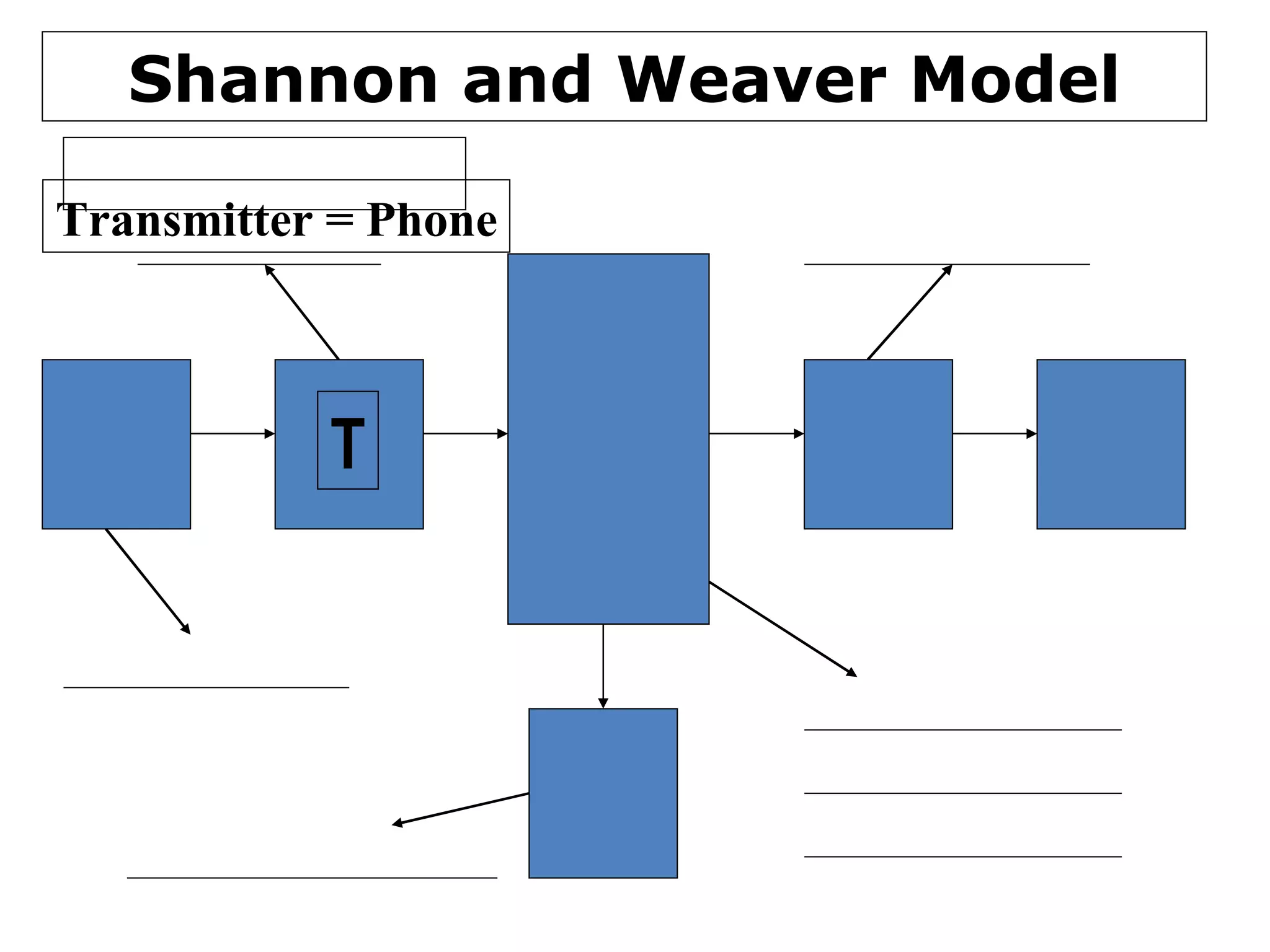
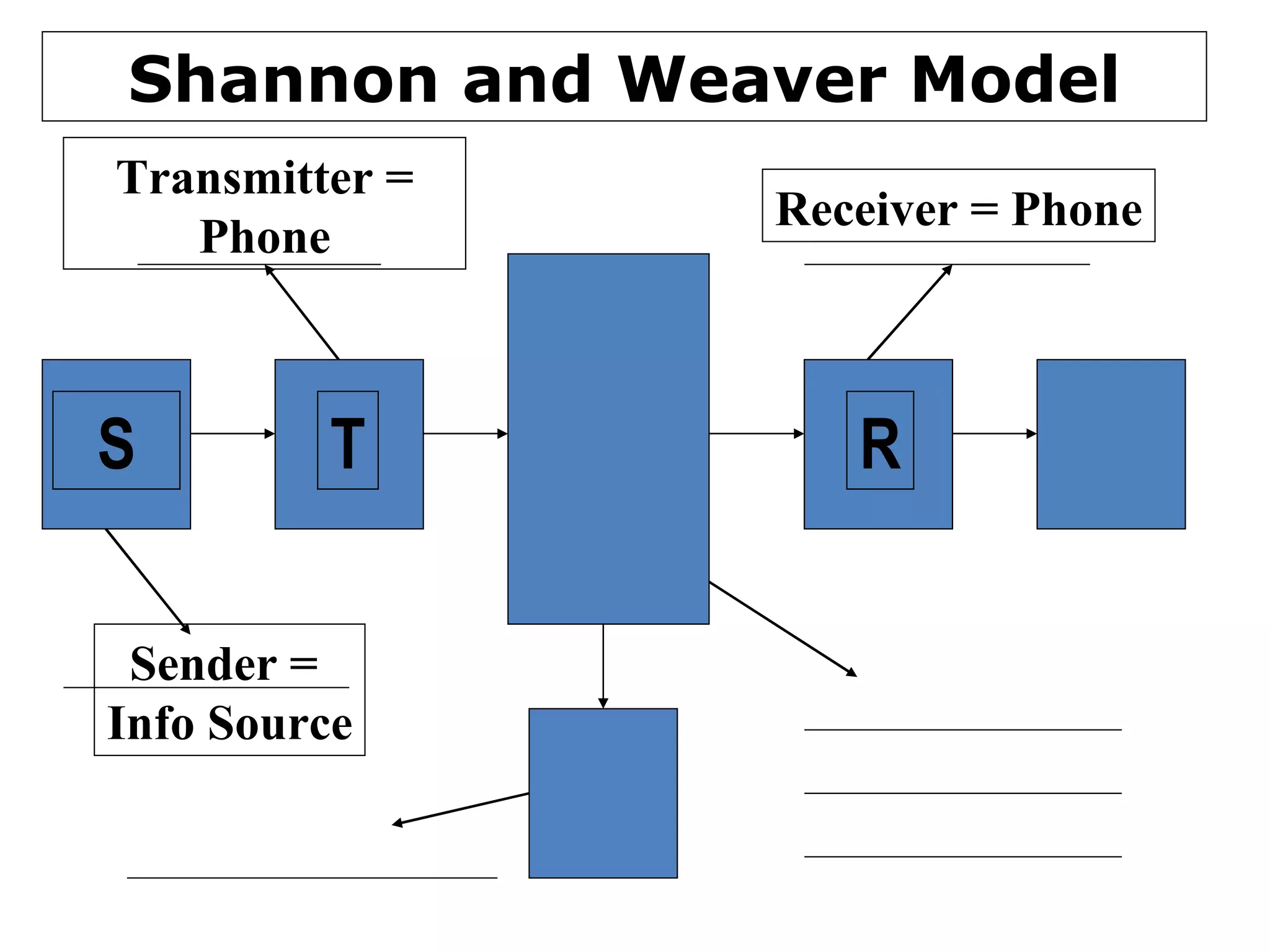
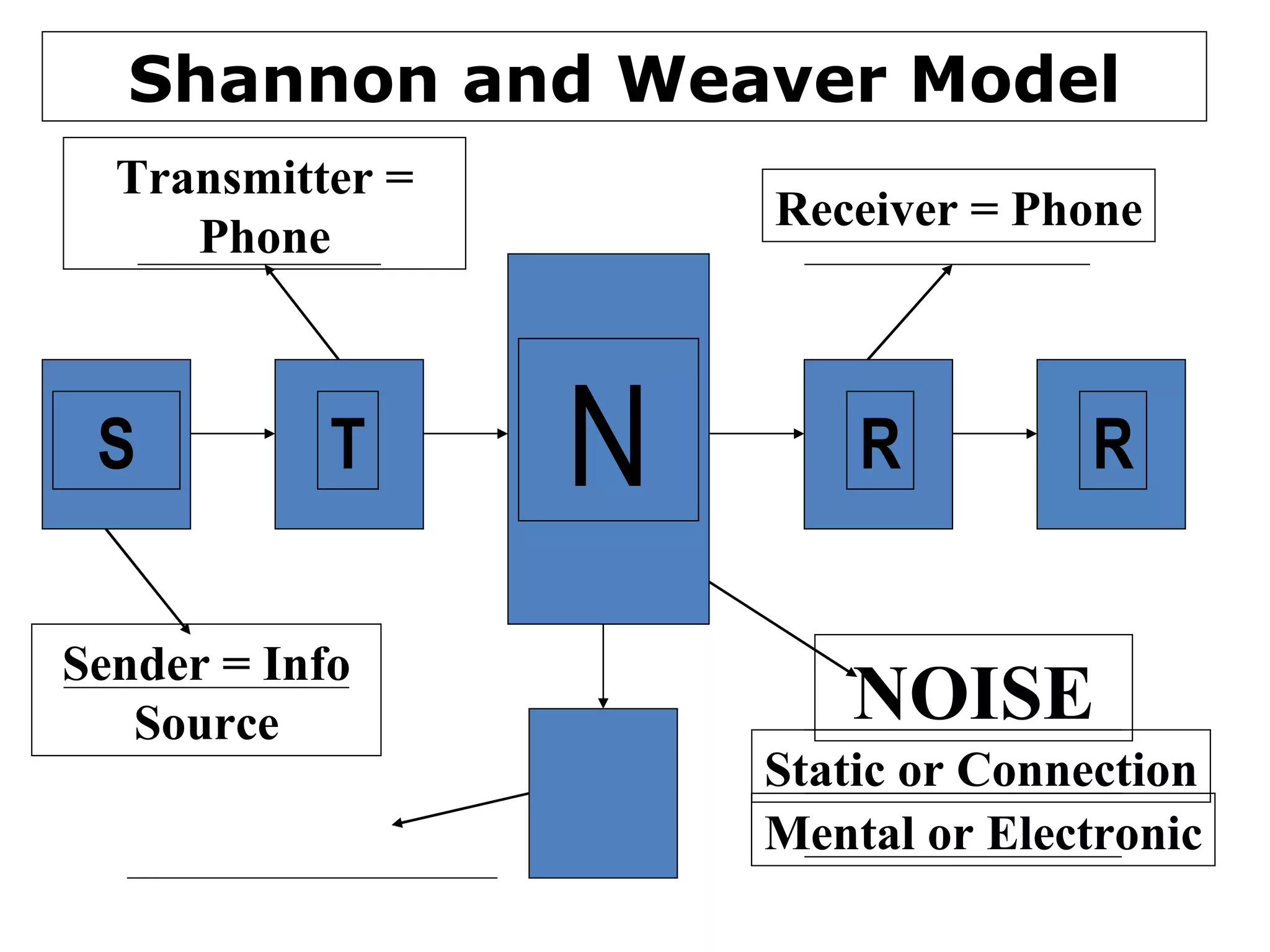
Shannon and Weaver Model T Transmitter = Phone
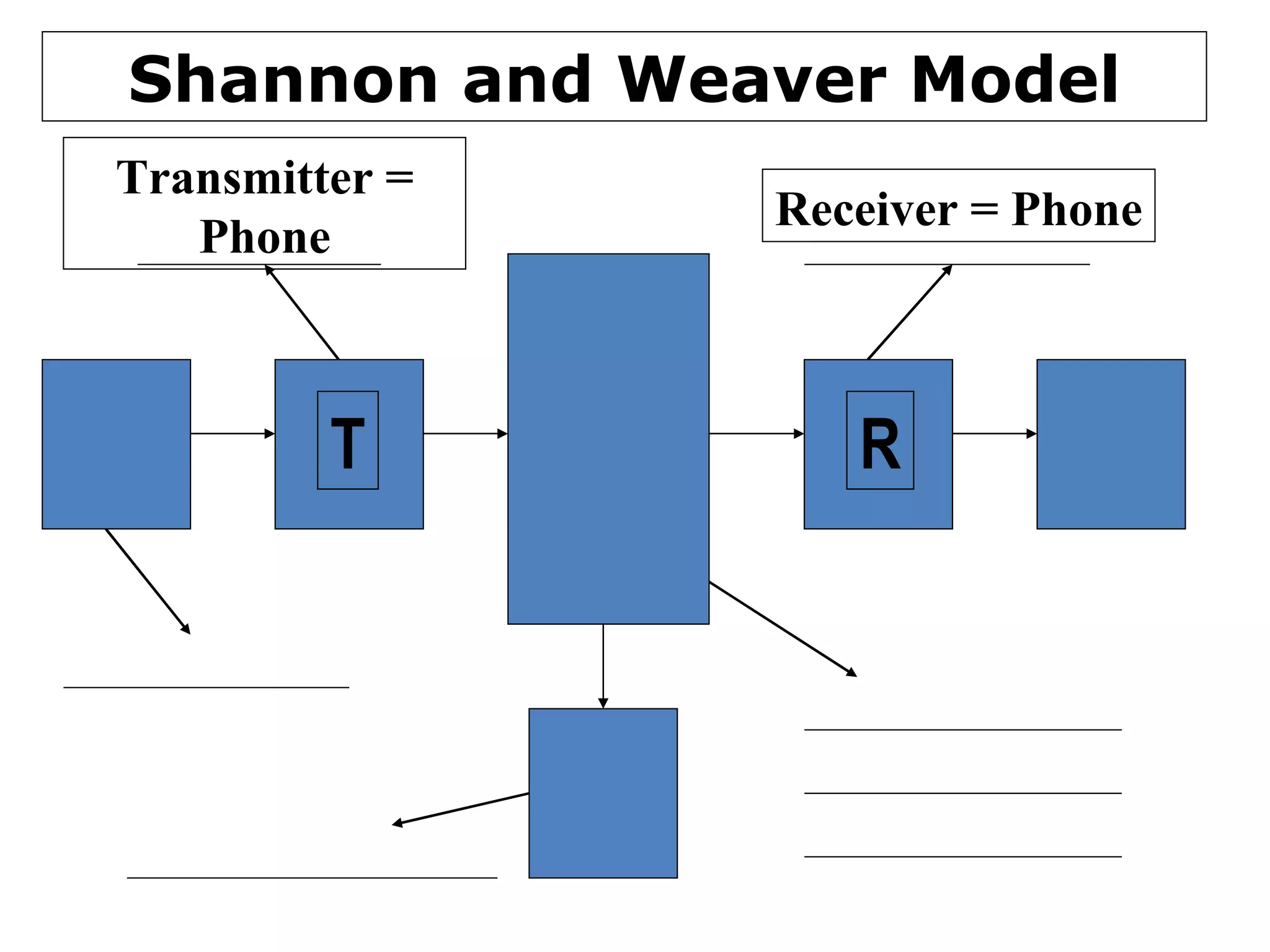
Shannon and Weaver Model T R Transmitter = Phone Receiver = Phone
Shannon and Weaver Model S T R Transmitter = Phone Receiver = Phone Sender =  Info Source
Shannon and Weaver Model S T R R Sender = Info Source Transmitter = Phone Receiver = Phone
Shannon and Weaver Model S T R R N Sender = Info Source Transmitter = Phone Receiver = Phone NOISE
Shannon and Weaver Model S T R R N Sender = Info Source Transmitter = Phone Receiver = Phone NOISE Static or Connection
Shannon and Weaver Model S T R R N Sender = Info Source Transmitter = Phone Receiver = Phone NOISE Static or Connection Mental or Electronic
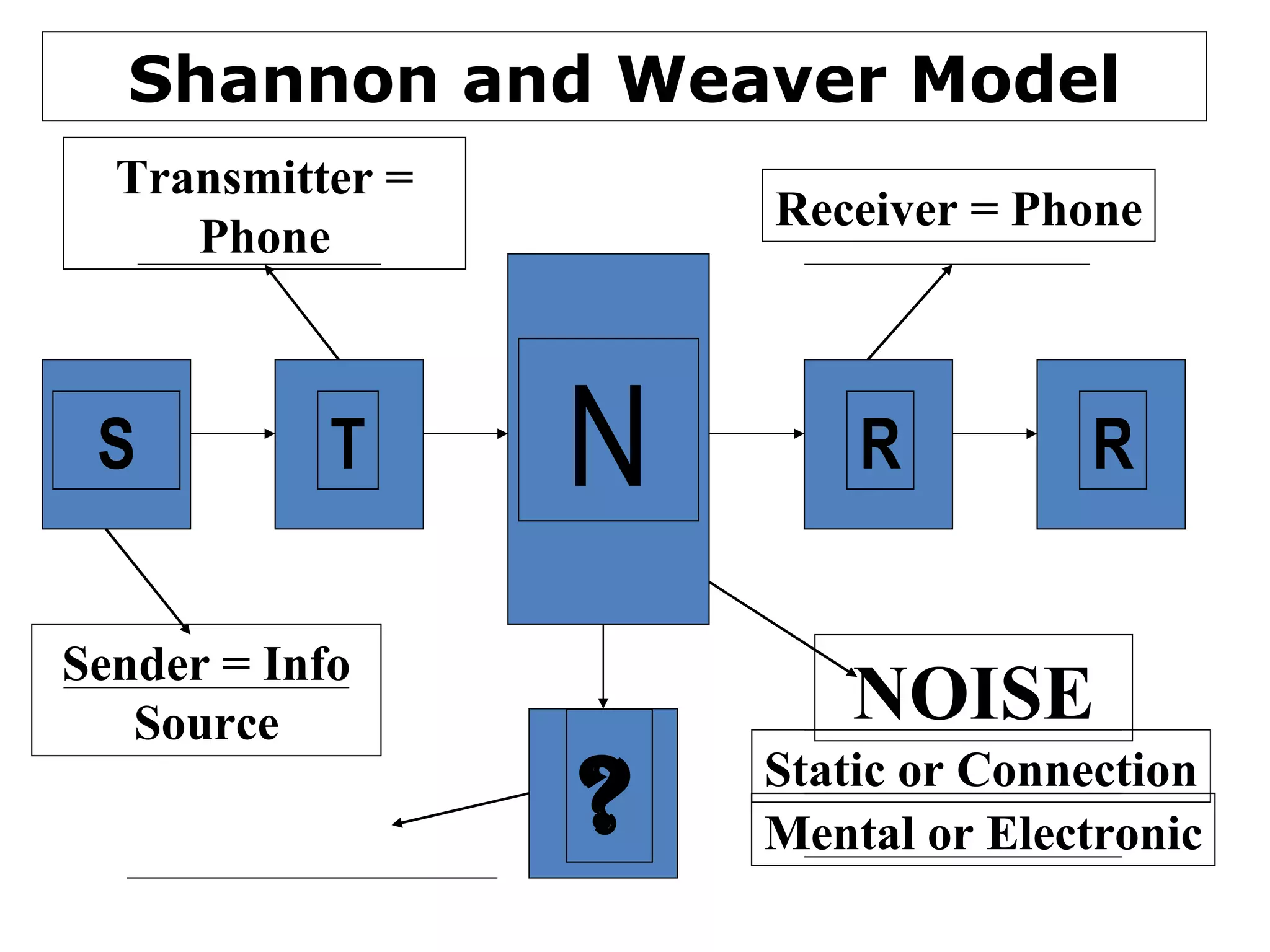
Shannon and Weaver Model S T R R N ? Sender = Info Source Transmitter = Phone Receiver = Phone NOISE Static or Connection Mental or Electronic
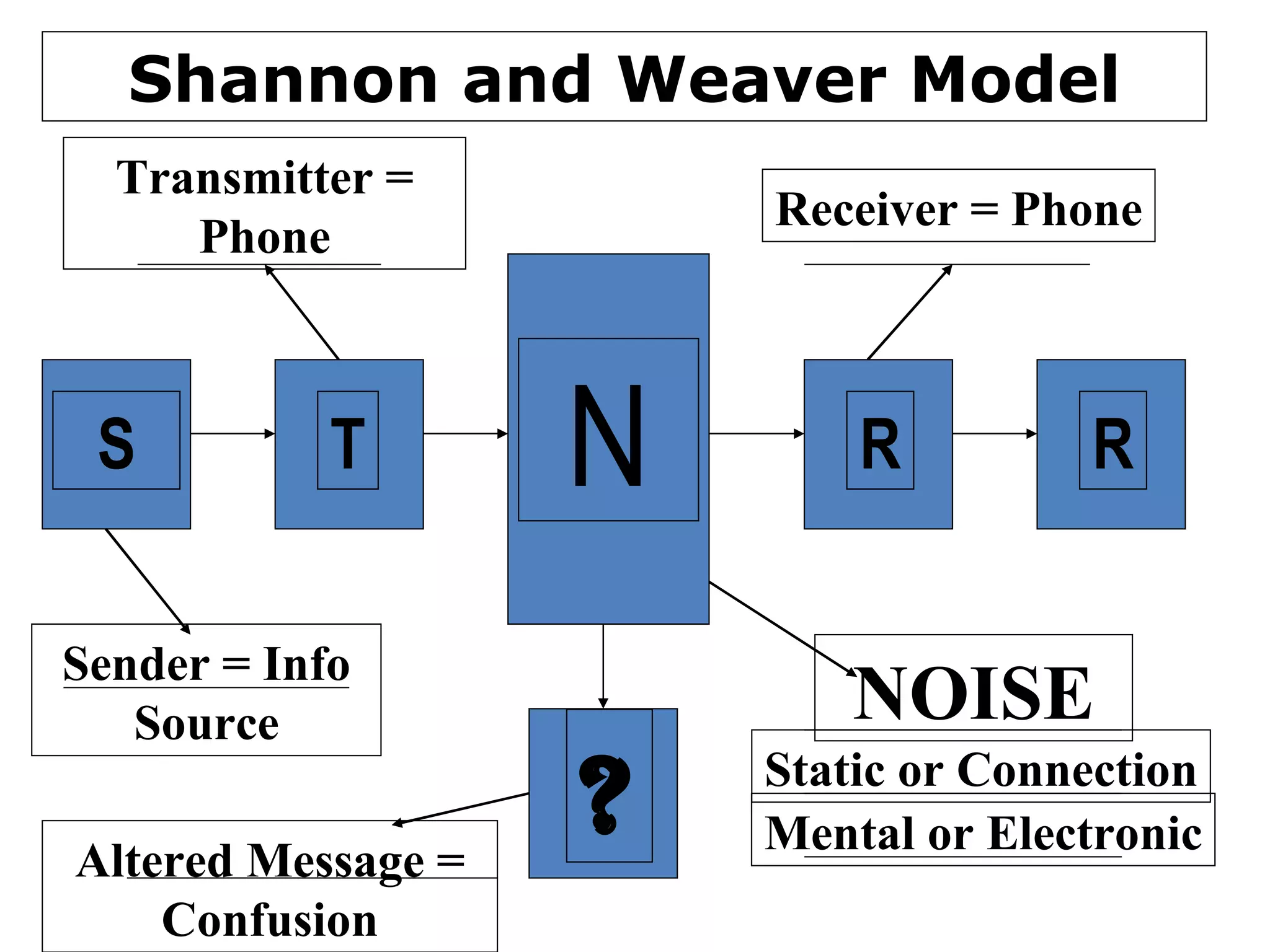
Shannon and Weaver Model S T R R N ? Sender = Info Source Transmitter = Phone Receiver = Phone Altered Message = Confusion NOISE Static or Connection Mental or Electronic
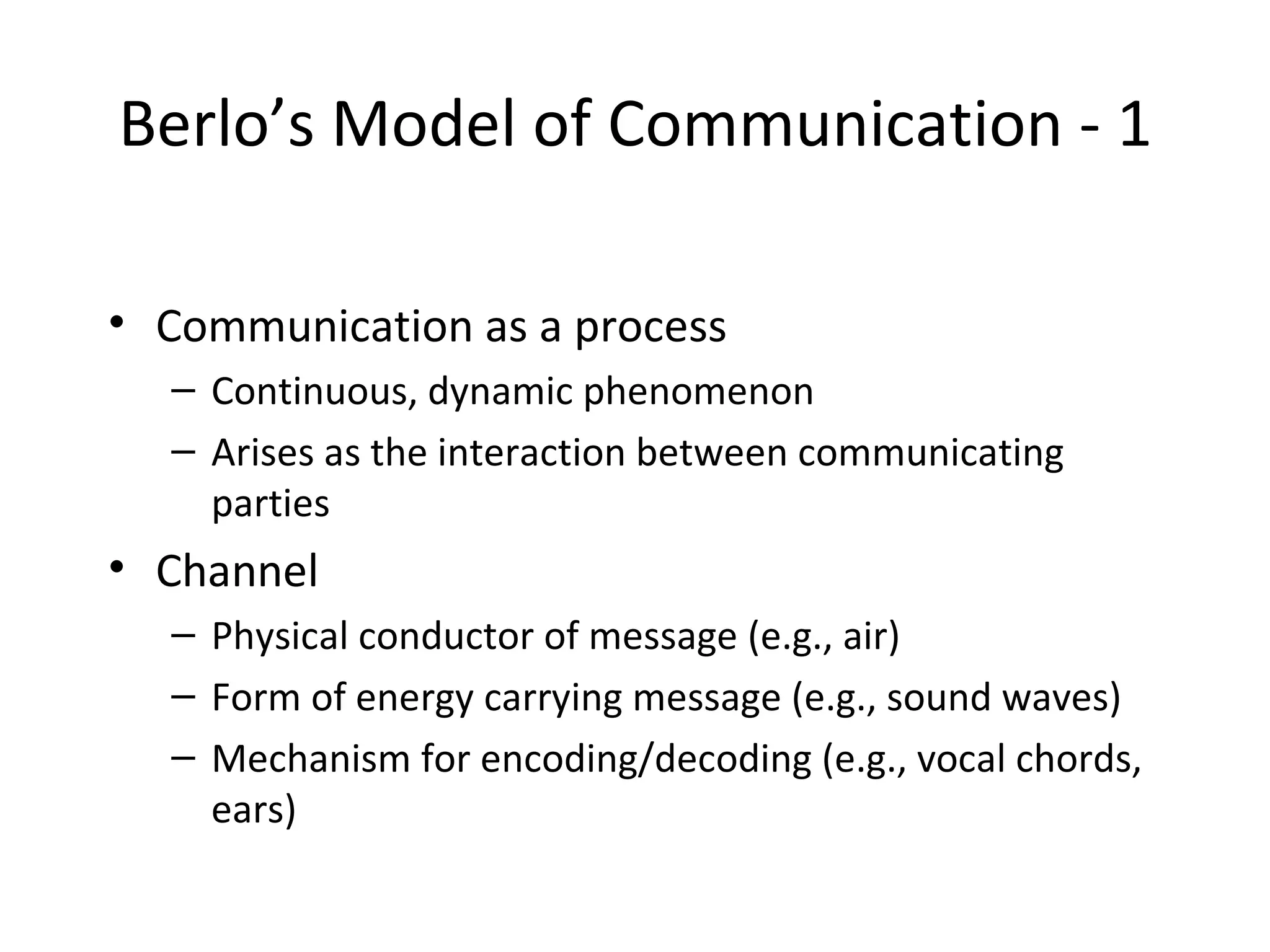
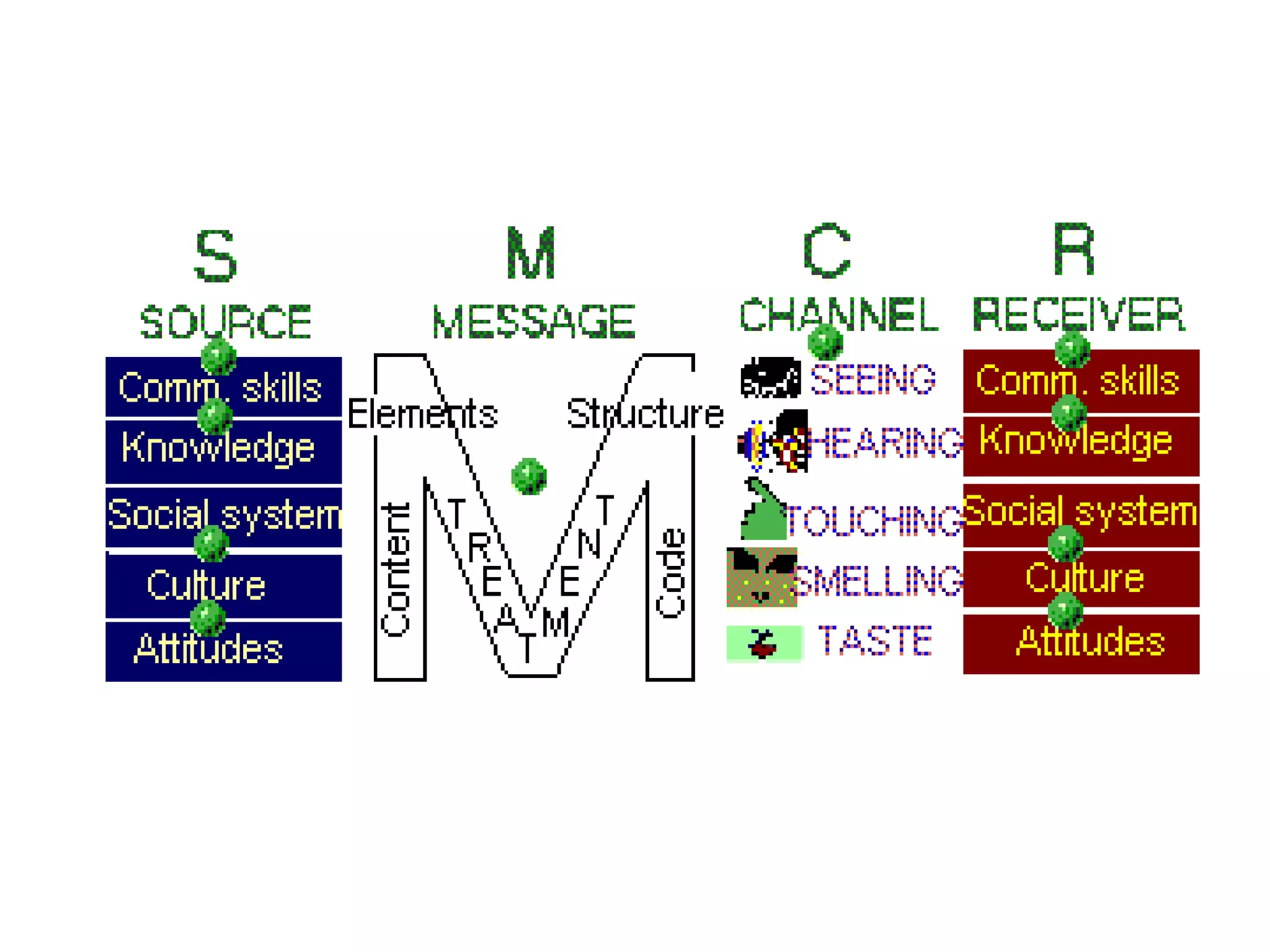
Berlo’s Model of Communication - 1 Communication as a process Continuous, dynamic phenomenon Arises as the interaction between communicating parties Channel Physical conductor of message (e.g., air) Form of energy carrying message (e.g., sound waves) Mechanism for encoding/decoding (e.g., vocal chords, ears)
Berlo’s Model of Communication - 2 Fidelity effectiveness in achieving senders purpose Sender and receiver issues Factors in fidelity Communication skills Attitudes Knowledge level Position within a sociocultural system
Relevant Questions What sorts of materials should be presented spoken form? What in writing? What sorts of sounds (music, sound effects, etc.) are most effective in various situations? What types of images (still, drawings, animations, video) are most efficient and effective for different purposes? Chapter 7 of text has some relevant guidelines
Other Guidelines Simultaneous use of multiple channels often enhance effectiveness “ Words alone cannot convey a message with anywhere near the efficiency of words and images together” “ The receiver will be more likely to decode a message accurately if he can see it and hear it at the same time. We know, too, that the receiver cannot retain as much oral information as he can visual, other things being equal” (Berlo, 1960, p. 68)
Views of Communication Transmission view Sending, giving, imparting information Clear aspects of mechanistic view; computer and information processing Directed towards achieving goals, purpose Ritual view Communication to transmit the “social reality as perceived by that society” Symbols as representations both  for  and  of  reality Not directed towards achieving goals? Part of learning to communicate?
MODEL #3: BERLO’S “MODEL” This is the MOST RECENT model of communication study. An exact date is not given for the study, but it is believed to have been completed in the late 1970s or the early 1980s. This one is not designed to be “academic” or “practical.”  It is designed to be “ALL-INCLUSIVE”
MODEL #3: BERLO’S “MODEL” Even with all of the good things that this “model” illustrates and tries to describe, there is still one little issue to remember…
MODEL #3: BERLO’S “MODEL” IT’S NOT REALLY EVEN A TRUE MODEL IN THE FIRST PLACE!
MODEL #3: BERLO’S “MODEL” It is NOT a model because it was never actually tested. Berlo designed what he thought would be the ideal system to describe communication, but never had a chance to put it to the test in real life.
MODEL #3: BERLO’S “MODEL” Since it was never “field-tested,” the “model” that Berlo developed has to take on a new title…
MODEL #3: BERLO’S “MODEL” IT HAS TO BE CALLED A “THEORY”
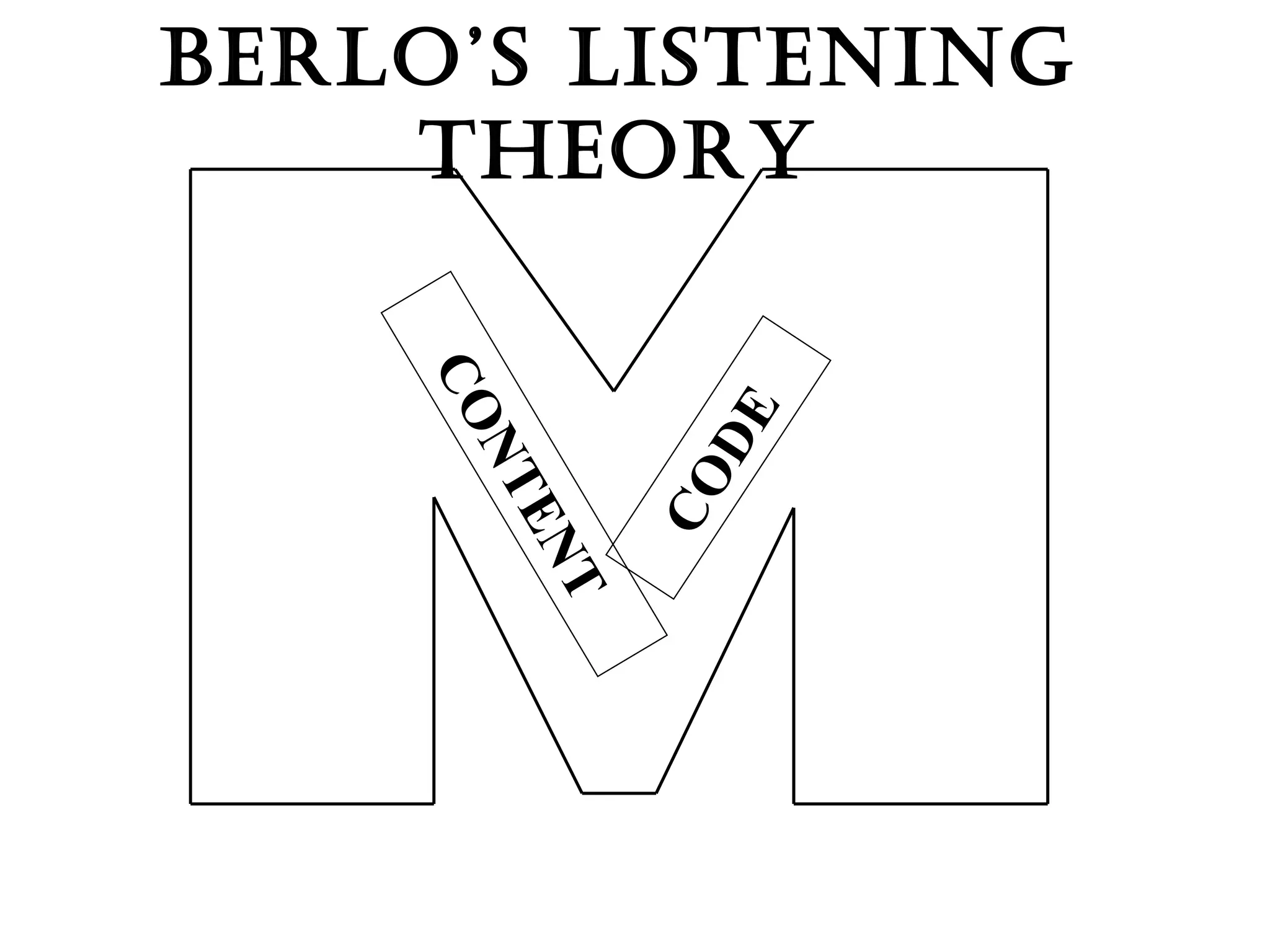
Berlo’s Listening Theory
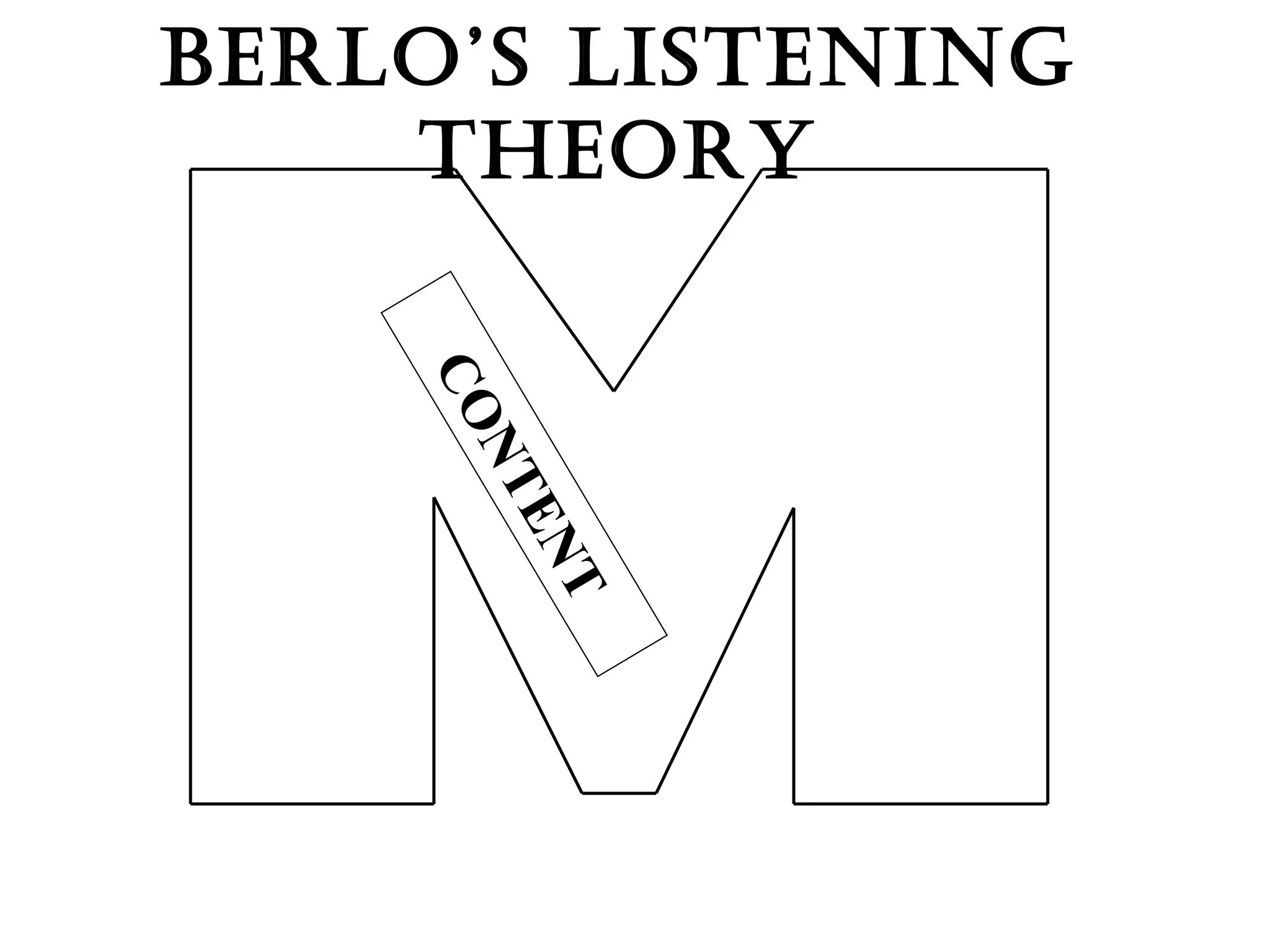
Berlo’s Listening Theory CONTENT
Berlo’s Listening Theory CONTENT CODE
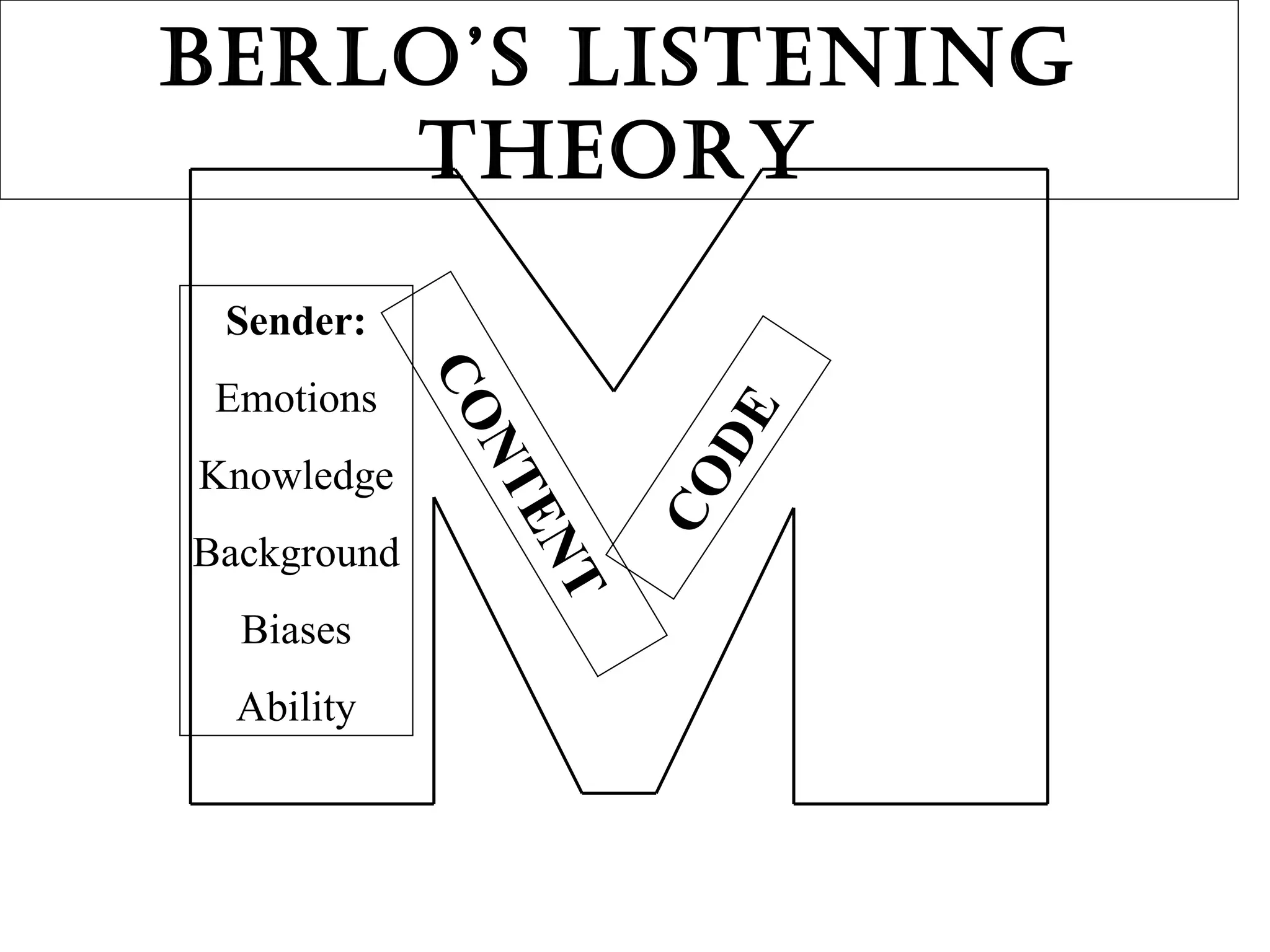
Berlo’s Listening Theory CONTENT CODE Sender: Emotions Knowledge Background Biases Ability
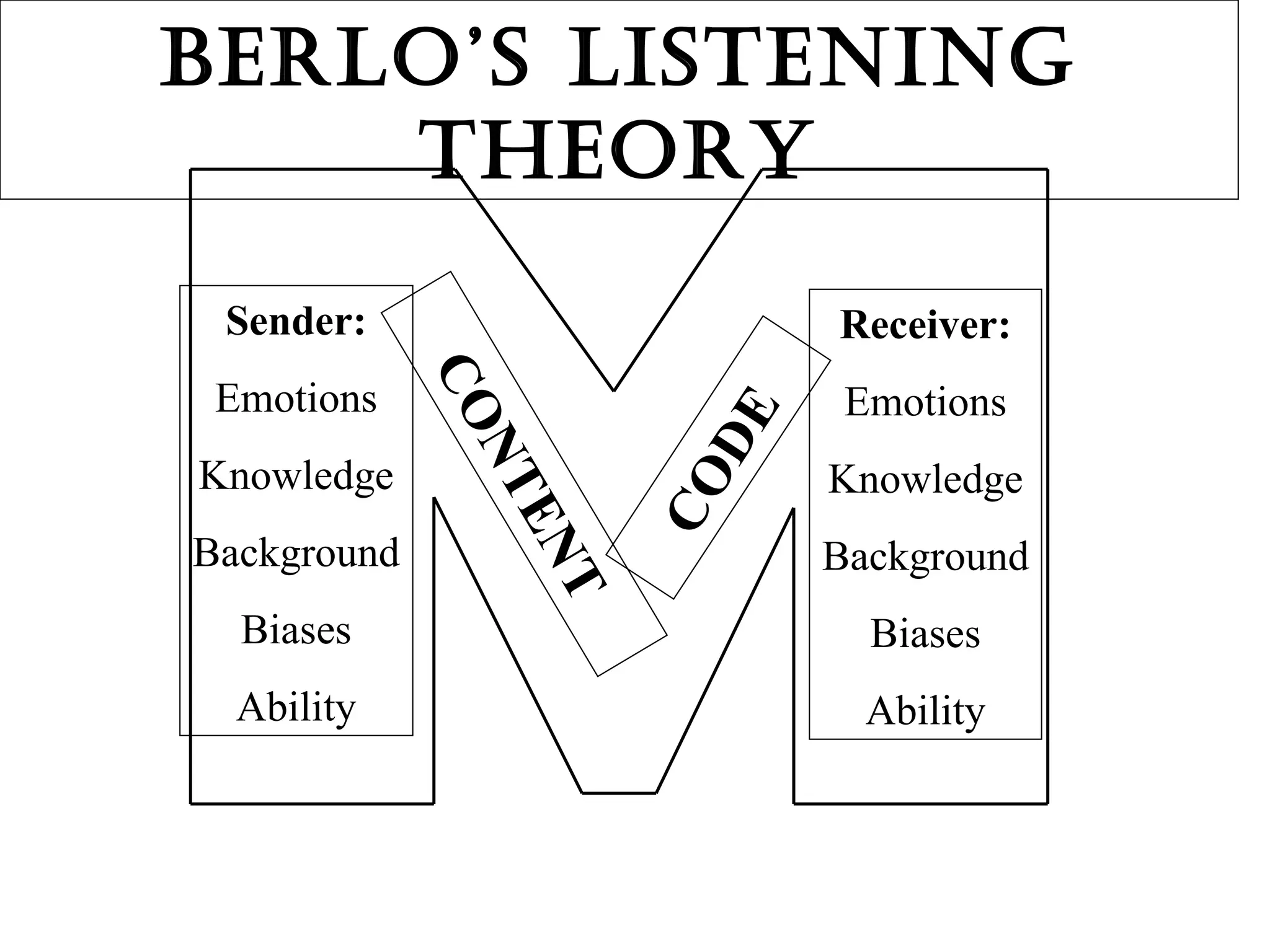
Berlo’s Listening Theory CONTENT CODE Sender: Emotions Knowledge Background Biases Ability Receiver: Emotions Knowledge Background Biases Ability
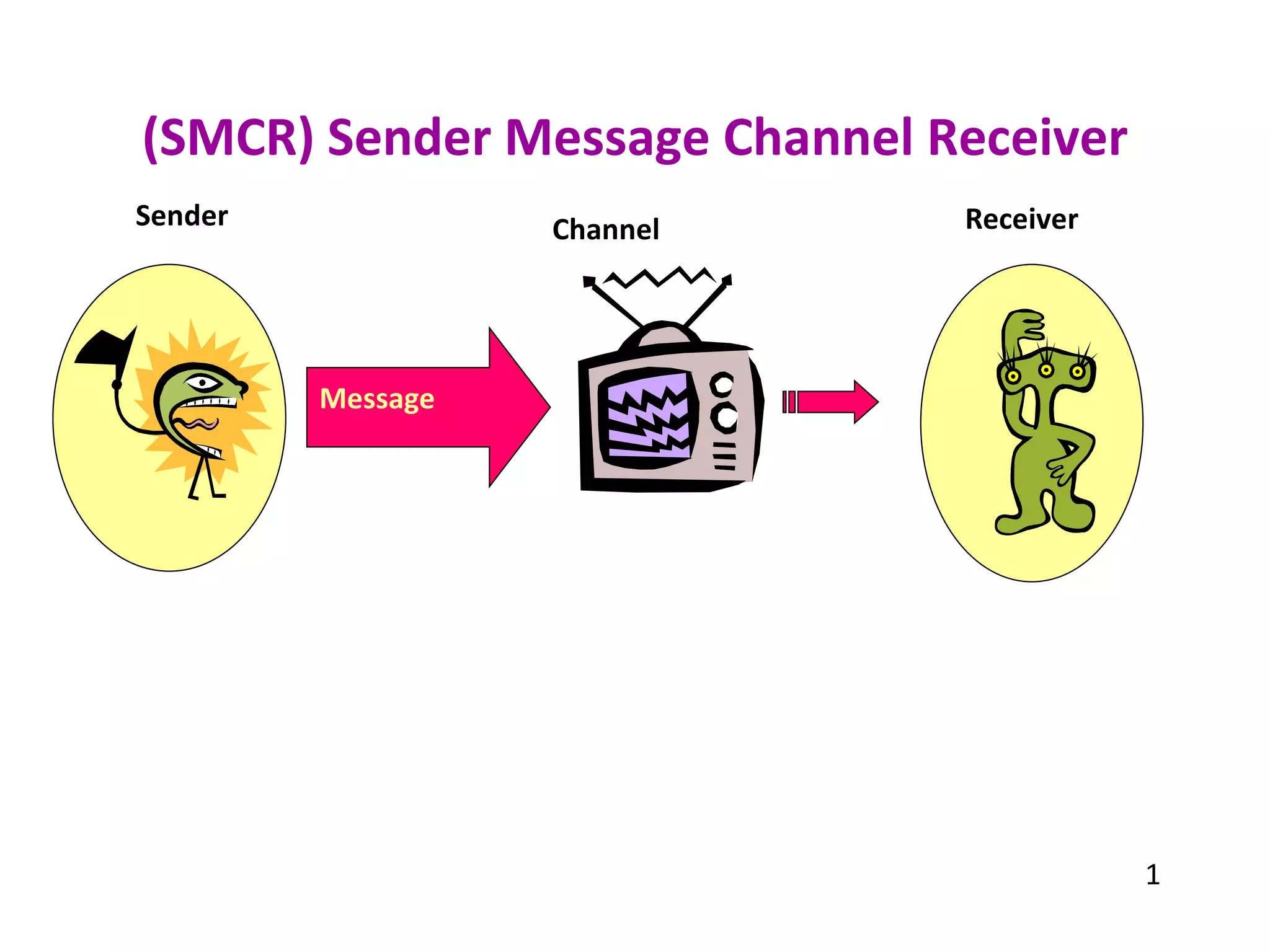
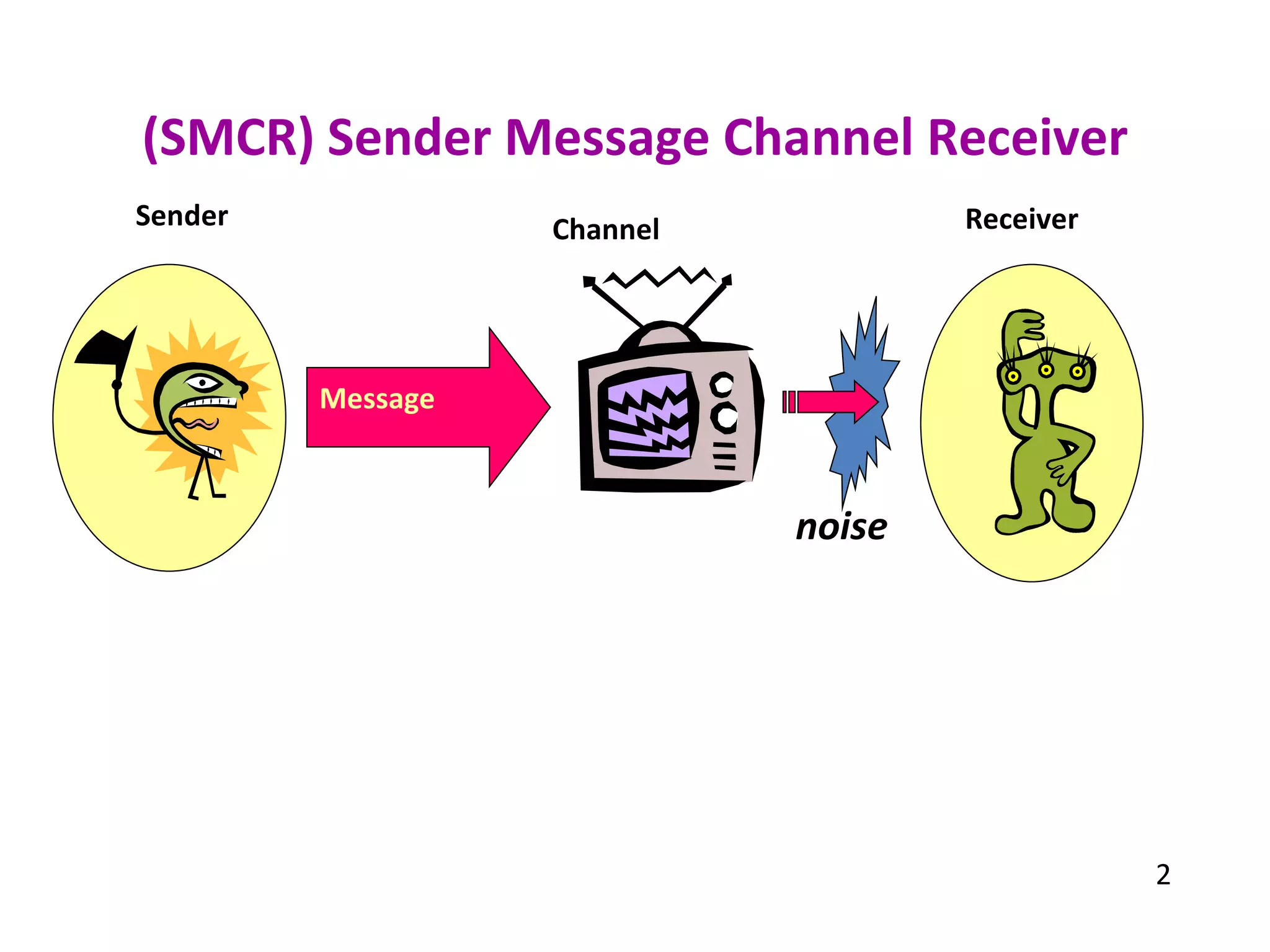
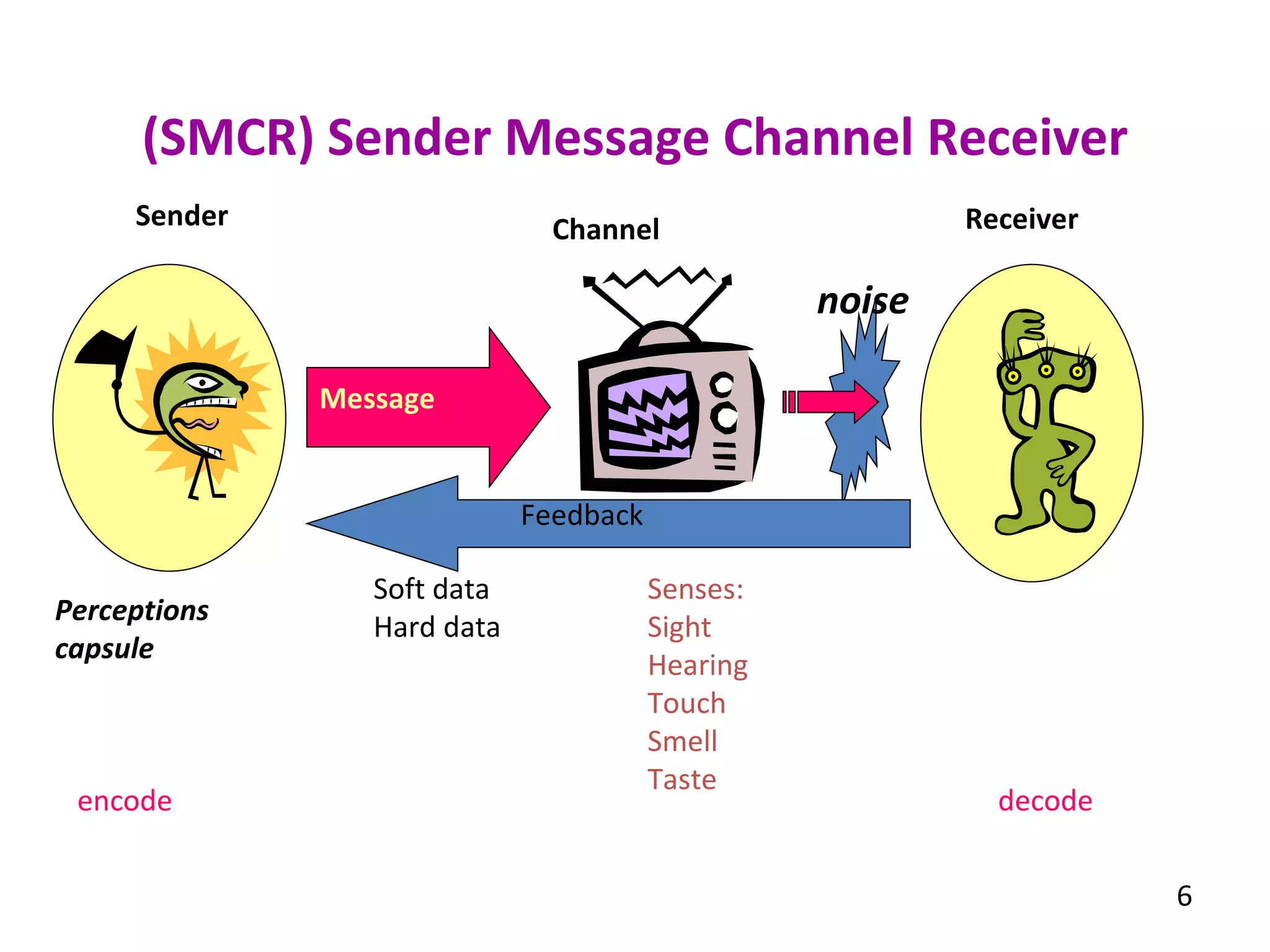
(SMCR) Sender Message Channel Receiver Sender Message Receiver Channel 1
(SMCR) Sender Message Channel Receiver Sender Message Receiver Channel noise 2
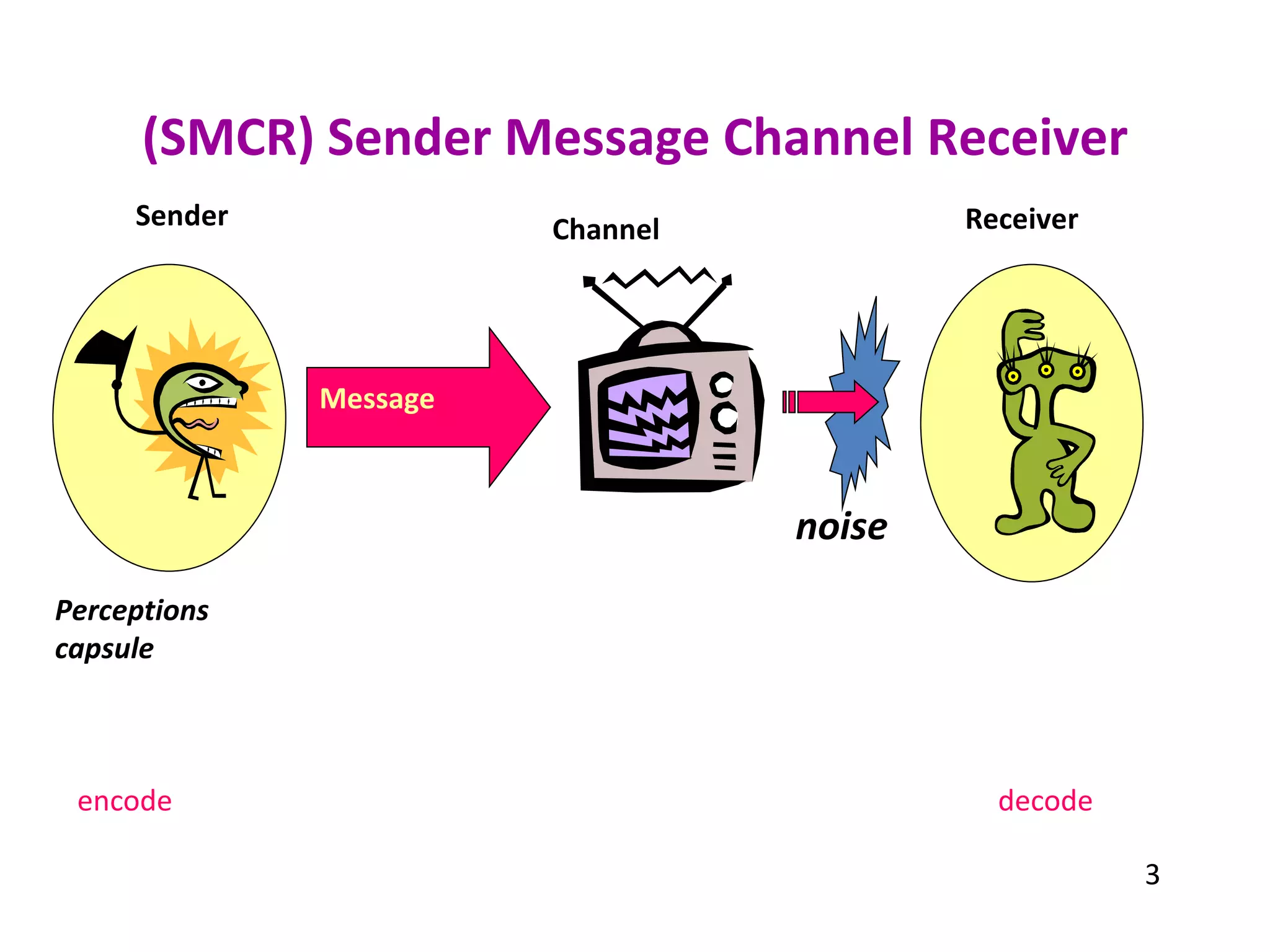
(SMCR) Sender Message Channel Receiver Perceptions capsule Sender Message Receiver Channel noise encode decode 3
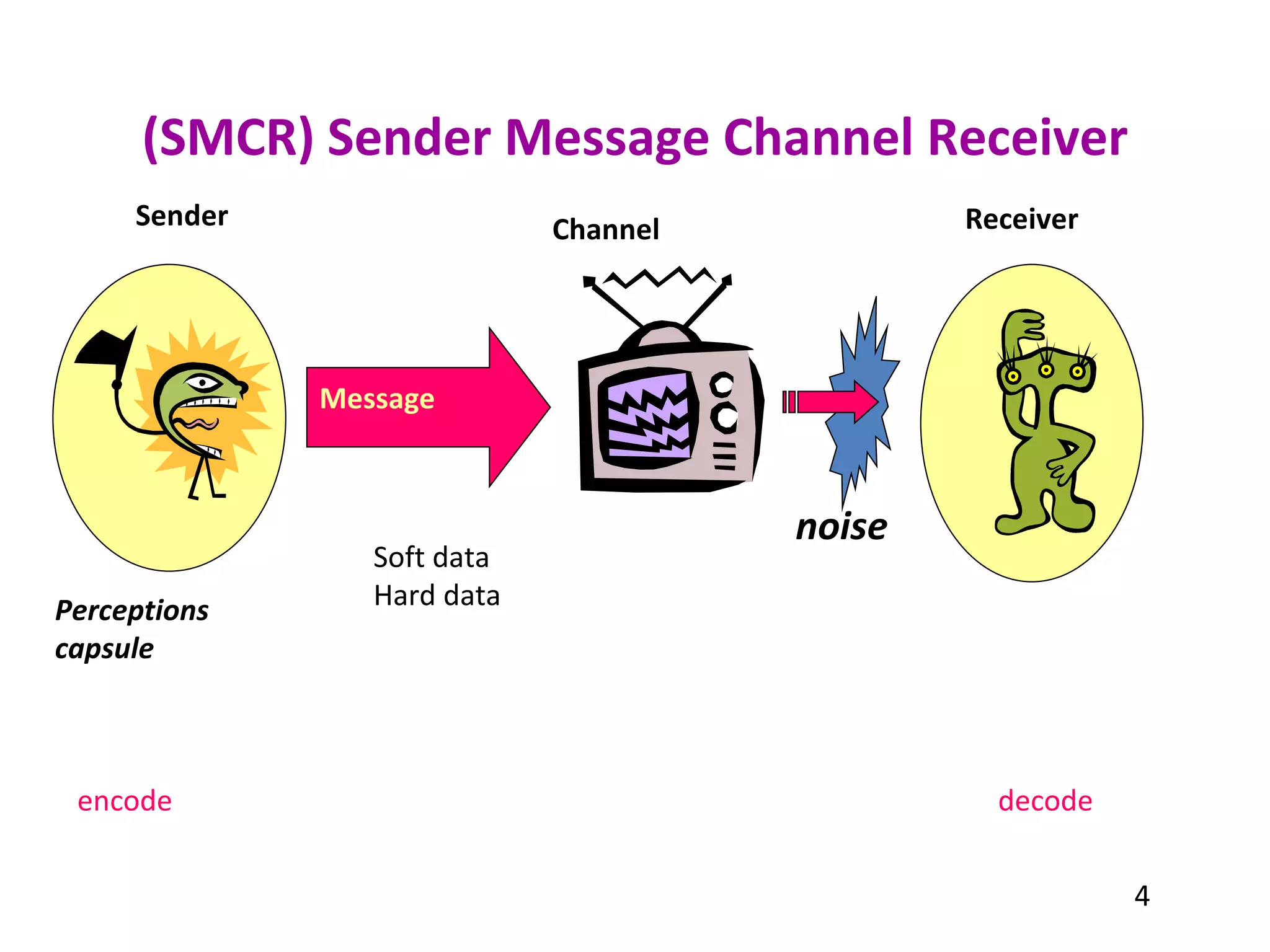
(SMCR) Sender Message Channel Receiver Perceptions capsule Sender Message Receiver Channel noise Soft data Hard data encode decode 4
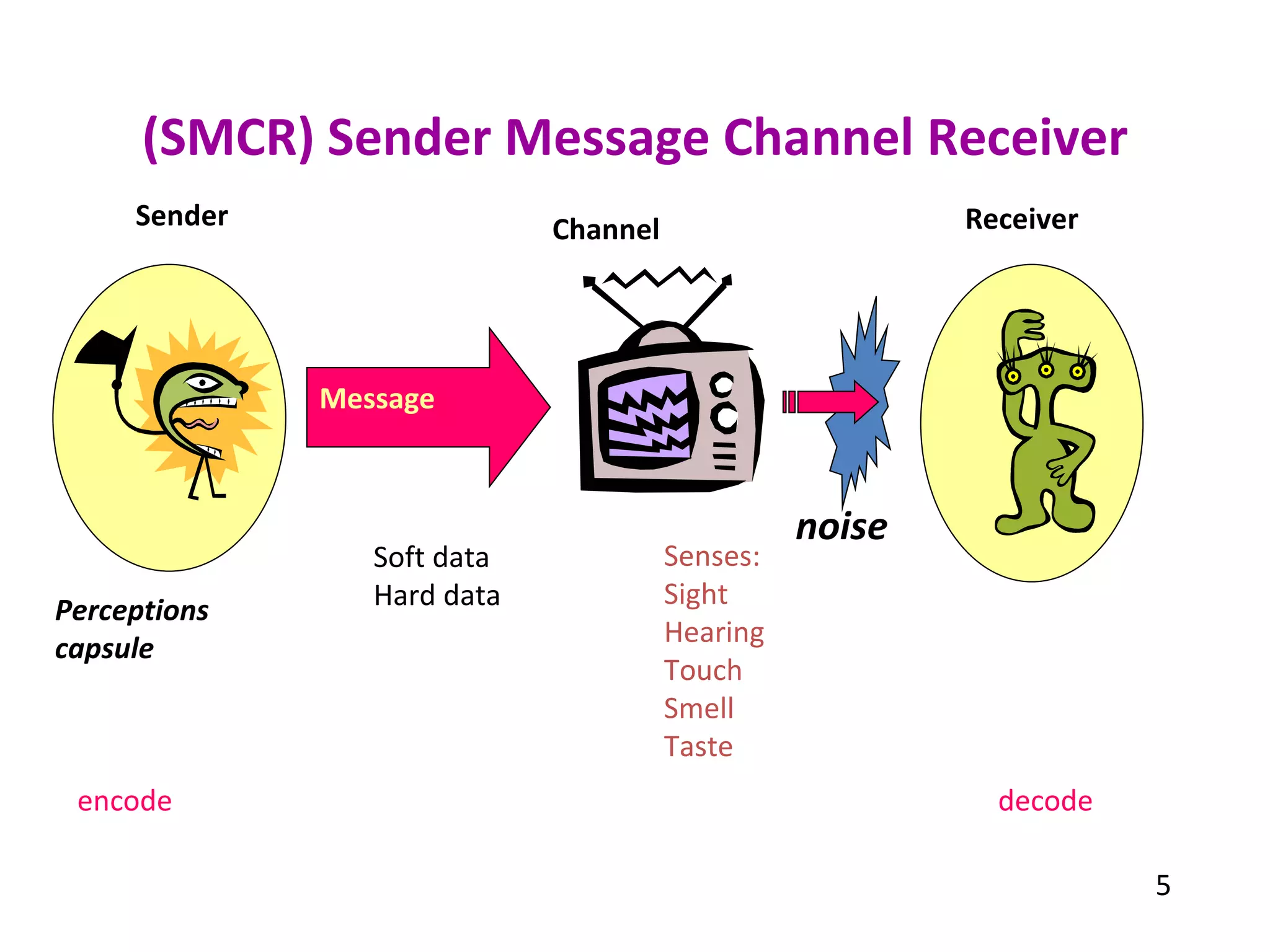
(SMCR) Sender Message Channel Receiver Perceptions capsule Sender Message Receiver Channel noise Soft data Hard data Senses: Sight Hearing Touch Smell Taste encode decode 5
(SMCR) Sender Message Channel Receiver Perceptions capsule Sender Message Receiver Channel noise Soft data Hard data Senses: Sight Hearing Touch Smell Taste encode decode Feedback 6
(SMCR) Sender Message Channel Receiver Perceptions capsule Sender Message Receiver Channel noise Soft data Hard data Senses: Sight Hearing Touch Smell Taste encode decode Feedback Uncertainty Uncertainty 7
 
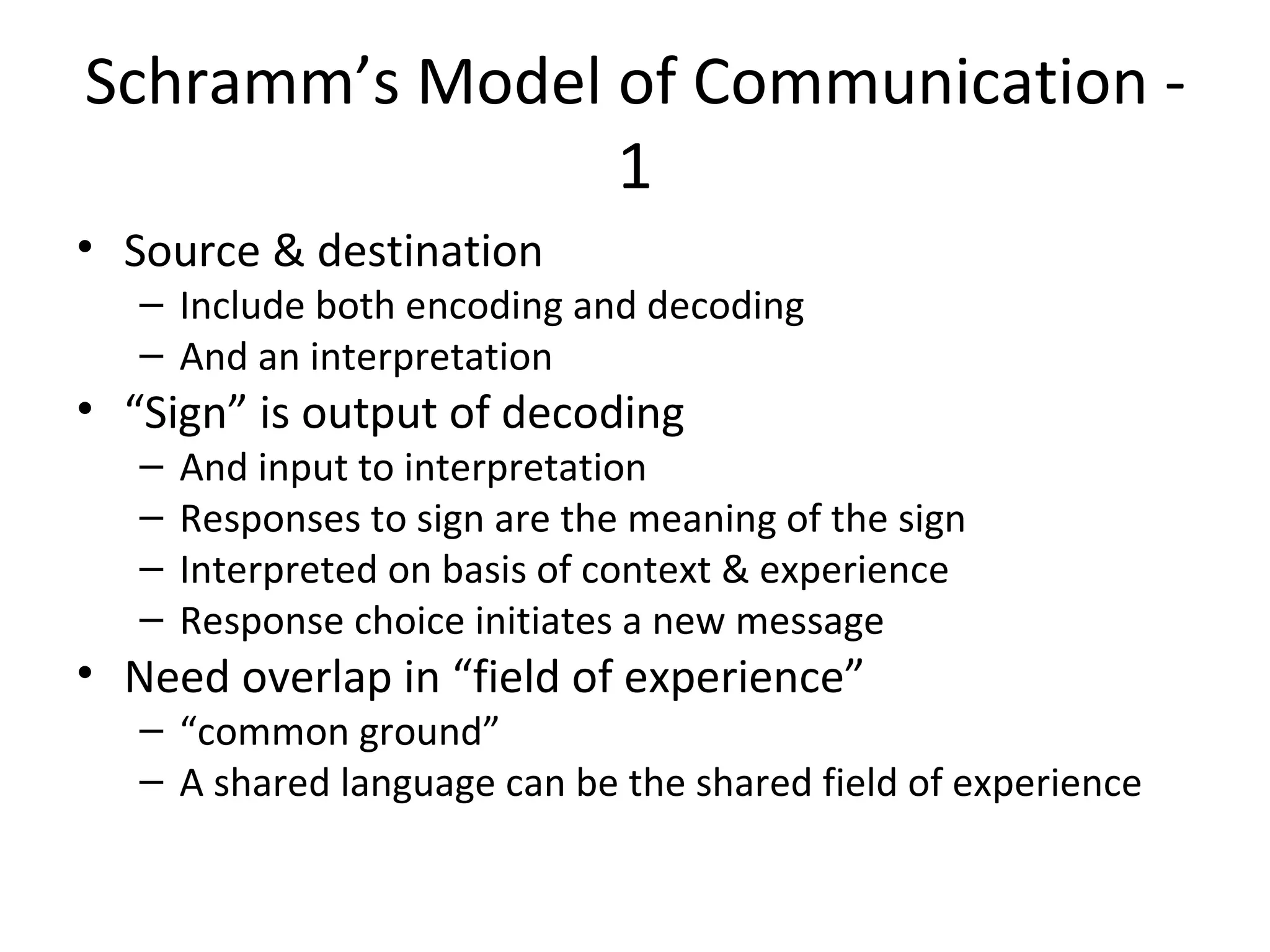
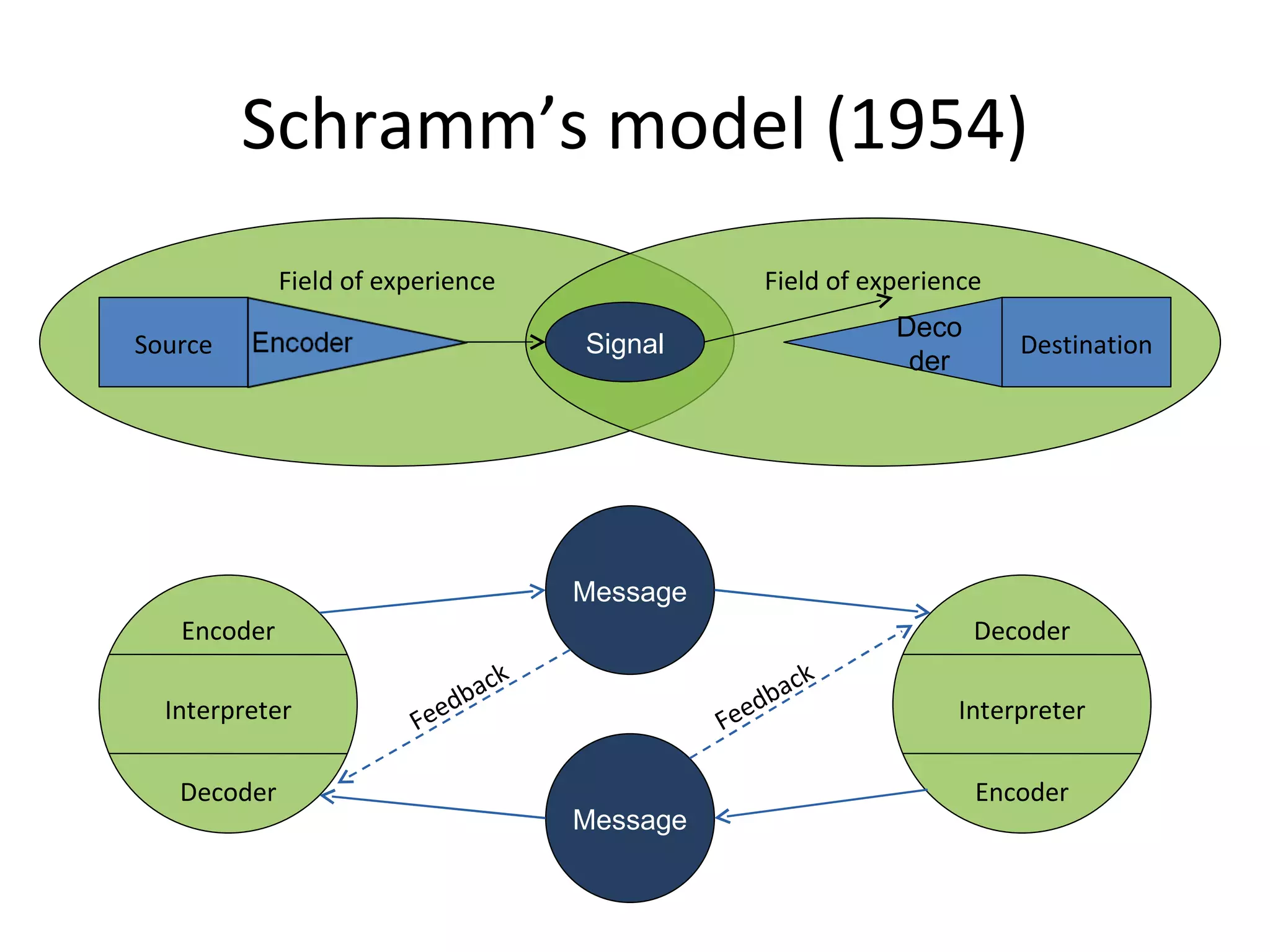
Schramm’s Model of Communication - 1 Source & destination Include both encoding and decoding And an interpretation “ Sign” is output of decoding And input to interpretation Responses to sign are the meaning of the sign Interpreted on basis of context & experience Response choice initiates a new message Need overlap in “field of experience” “ common ground” A shared language can be the shared field of experience
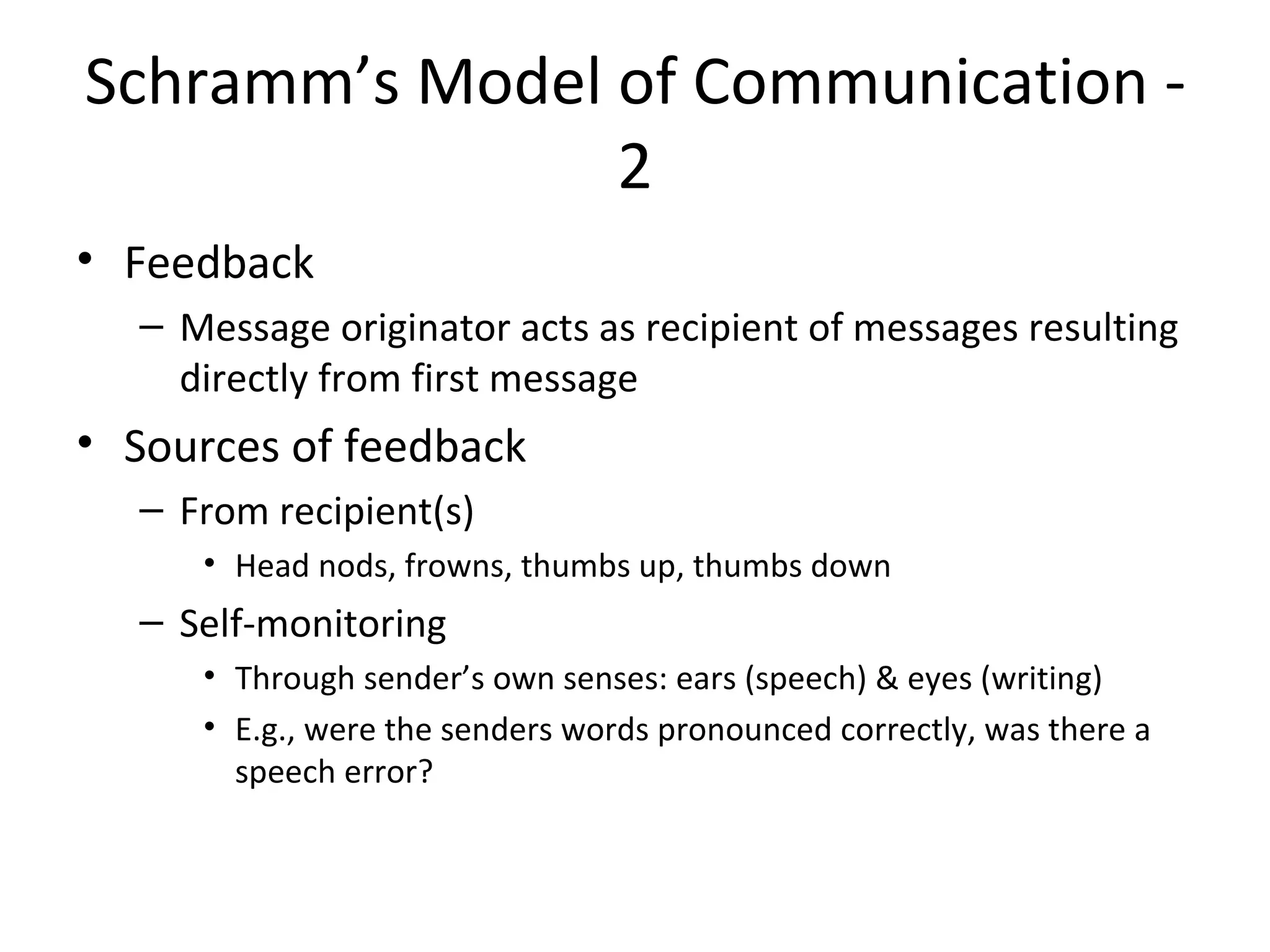
Schramm’s Model of Communication - 2 Feedback Message originator acts as recipient of messages resulting directly from first message Sources of feedback From recipient(s) Head nods, frowns, thumbs up, thumbs down Self-monitoring Through sender’s own senses: ears (speech) & eyes (writing) E.g., were the senders words pronounced correctly, was there a speech error?
Schramm’s model (1954) Field of experience Field of experience Signal Source Decoder Destination Message Message Feedback Feedback Encoder Interpreter Decoder Decoder Interpreter Encoder
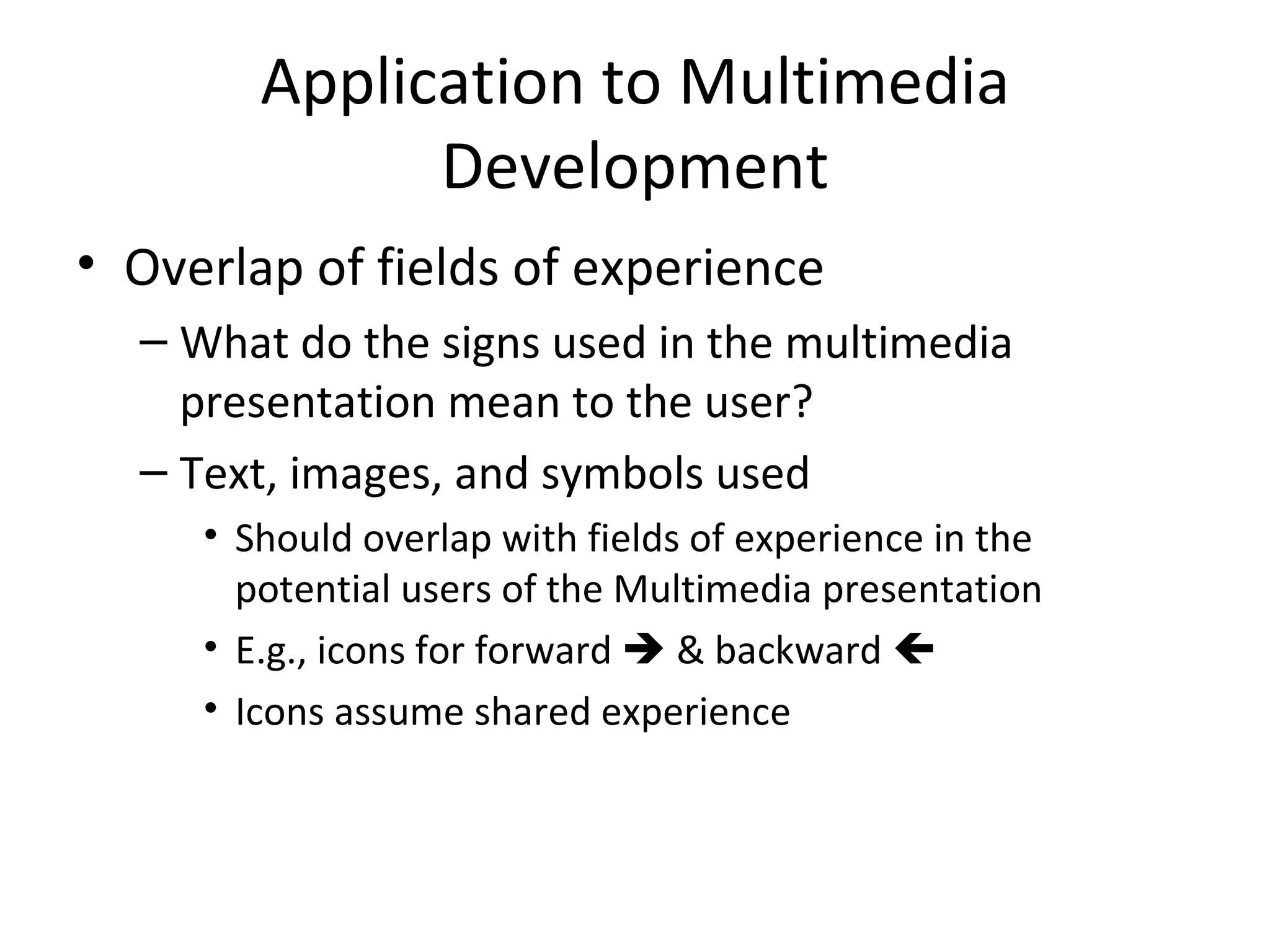
Application to Multimedia Development Overlap of fields of experience What do the signs used in the multimedia presentation mean to the user? Text, images, and symbols used Should overlap with fields of experience in the potential users of the Multimedia presentation E.g., icons for forward    & backward   Icons assume shared experience
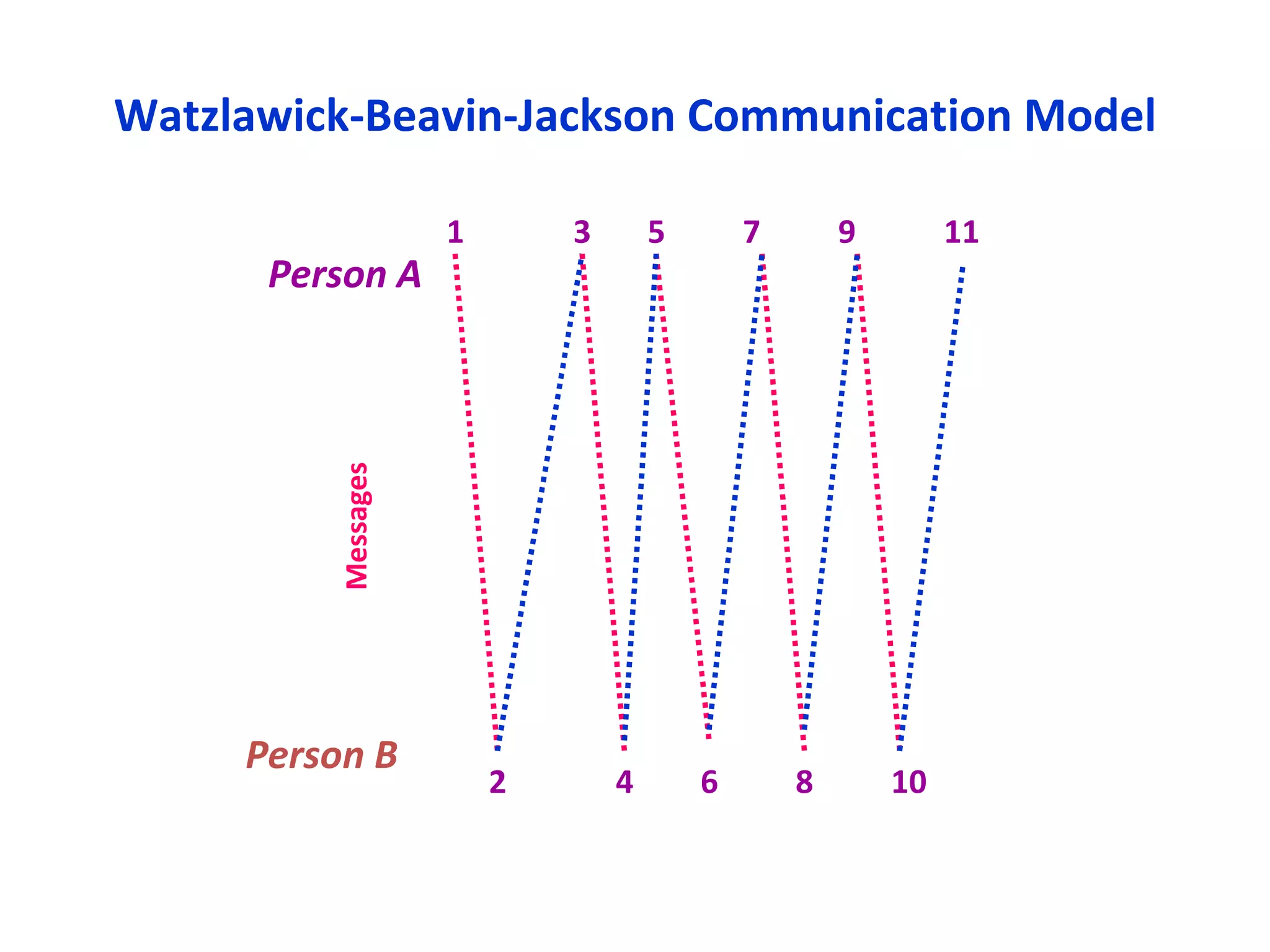
Watzlawick-Beavin-Jackson Communication Model 1 3 5 7 9 11 2 4 6 8 10 Person A Person B Messages
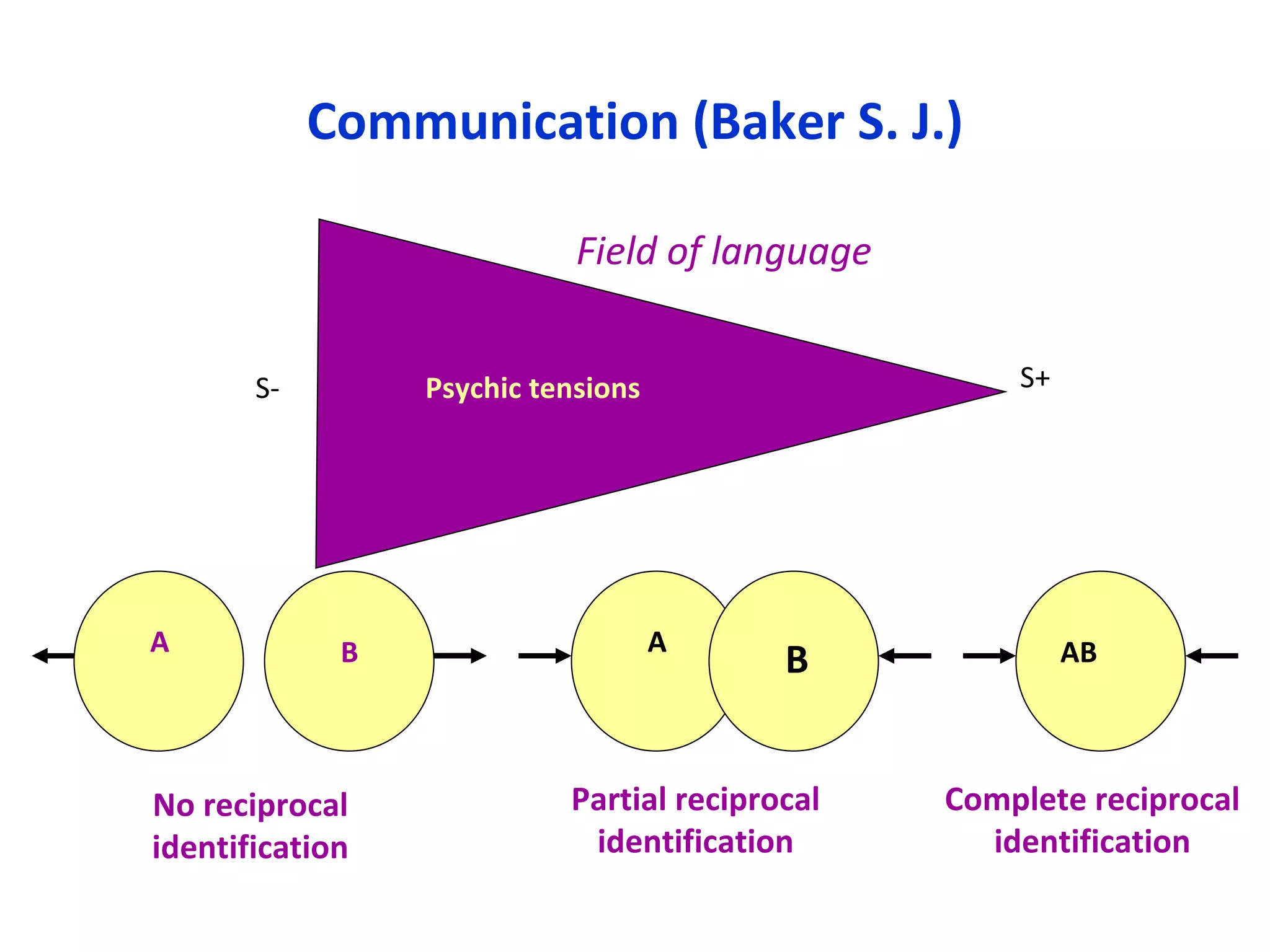
Communication (Baker S. J.) Psychic tensions A B A AB B No reciprocal identification Partial reciprocal identification Complete reciprocal identification Field of language S+ S-
References Aristotle (c. 350 BC)  Rhetoric Chomsky, Noam (1956). Three models for the description of language.  IRE Transactions on Information Theory  (2), 113–124. Schramm, W. (1954) Procedures and effects of mass communication in Henry, N. B. (1954)  Mass, media and education: The fifty-third yearbook of the national society for the study of education, Part II . University of Chicago Press: Chicago. Shannon, C. & Weaver, W. (1949)  The mathematical theory of communication . University of Illinois Press: Urbana.

3 models of communication

  • 1.
    Models of CommunicationDr. Eduardo Bustos Farías
  • 2.
  • 3.
  • 4.
  • 5.
  • 6.
  • 7.
    Models of CommunicationLinear Models Interactive
  • 8.
    Models of CommunicationLinear Models Interactive Transaction Models of Communication http://www.sfc.keio.ac.jp/~masanao/Mosaic_data/com_model.html
  • 9.
    Models of communicationAristotle (384 BC – 322 BC) The study of communication can be organised into three categories: The sender The message The listener
  • 10.
  • 11.
  • 12.
    Communications research 1920-40Level A The technical problem How accurately can the symbols of communication be transmitted? Level B The semantic problem How precisely do the transmitted symbols convey the desired meaning? Level C The effectiveness problem How effectively does the received meaning affect behaviour in the desired way?
  • 13.
    Mathematical Theory ofCommunication Claude Shannon (1948) Telecommunications engineer at Bell labs How much information is in a message?
  • 14.
    Main People ClaudeShannon – Developed the initial theory of communication. With Warren Weaver developed the Shannon-Weaver model of Communication Theory W. Scramm – Added concept of field of experience to Shannon-Weaver model David Berlo – Developed SMCR ( Sender Message Channel Receiver) model, stressing relationship between source and receiver Howard Lasswell – Introduced content analysis
  • 15.
    Information Theory Model(Shannon) Source Destination encode decode channel
  • 16.
    The Objective ModelSpeaker A Speaker B Purpose is understanding Step 1 Step 2
  • 17.
    Shannon & WeaverModel of Communication Information Sources Transmitter Receiver Destination Signal Received Noise Source Message Message
  • 18.
    Shannon’s model InformationNot the same as meaning Function of the number of message choices Entropy is the amount of uncertainty in a message Channel Medium over which the message is sent Maximum capacity Noise Unwanted distortion Information source Destination Transmitter Receiver Message Message Signal Received signal Noise Noise source
  • 19.
    MODEL #1: CONTINUOUSLOOP MODEL This is the EARLIEST model of communication that has been presented and accepted by others who study the field. It is also the SIMPLEST model (though it might not look like it at first). It includes all of the basic parts/players in the communication process. There are still a few problems, though!
  • 20.
  • 21.
  • 22.
    Continuous Loop ModelM MESSAGE CONTENT
  • 23.
    Continuous Loop ModelM Channels MESSAGE CONTENT
  • 24.
    Continuous Loop ModelS M Channels SENDER MESSAGE CONTENT
  • 25.
    Continuous Loop ModelS M Info Source Channels SENDER MESSAGE CONTENT
  • 26.
    Continuous Loop ModelS M R Info Source Channels SENDER MESSAGE RECEIVER CONTENT
  • 27.
    Continuous Loop ModelS M R Info Source Channels Break = diff. Message received = confusion SENDER MESSAGE RECEIVER CONTENT
  • 28.
    Continuous Loop ModelS M R F Info Source Channels Break = diff. Message received = confusion SENDER MESSAGE RECEIVER FEEDBACK CONTENT
  • 29.
    Continuous Loop ModelS M R F Info Source Channels Break = diff. Message received = confusion SENDER MESSAGE RECEIVER FEEDBACK Break = diff info sent to Sender = improper reactions CONTENT
  • 30.
    CONTINUOUS LOOP Thismodel is based upon the concept that language is a system or a machine. In this machine, communication acts as the “gears” for the machine to work properly. Any breakdowns hurt efficiency!
  • 31.
    CONTINUOUS LOOP Whilethis is the EARLIEST model of communication, it is not known who the developer or the creator of the model was. The only thing we know for sure is that it was most-likely developed in the 1920s or 1930s.
  • 32.
    CONTINUOUS LOOP Oneof the flaws of the model is that it assumes “continuous” communication. There are times when we choose to stop communicating. In other words, this is good on paper, but it does not fit all situations.
  • 33.
    Models of Communication“ Model” = “theory” Mathematical theory of communication Claude Shannon “ linear” model of communication Also known as “information theory” Concepts Information, Message, Information source, Signal, Channel, Transmitter, Noise source, Received signal, Receiver, Destination
  • 34.
    Main Points –Shannon Weaver Model A linear view of communication: messages are encoded by a source and sent through a channel. Messages are then decoded by a receiver, who then sends the source feedback. Messages may be disrupted by noise. Schramm adds the factor of fields of experience of the sender and receiver, life experiences which can enhance communication when they overlap.
  • 35.
    Mathematical theory ofcommunication - 1 Information Not to be confused with meaning log 2 of of the number of possible messages This is called entropy Information source Message: transmitted by information source Signal: physical form of message
  • 36.
    Mathematical theory ofcommunication - 2 Channel: physical medium for signal E.g., air in spoken communication Transmitter Noise source Unintended (by information source) changes to the signal Receiver Received signal: signal + noise Destination: recipient of message
  • 37.
    Entropy Example Let’ssay you want to send one of eight possible messages All messages with same possible frequency E.g., A, B, C, D, E, F, G, H are the possible messages How many bits do you need to transmit a single message? Use the entropy calculation
  • 38.
    An Aspect ofShannon’s Model Information sources Where is the information source when using a CD-ROM? Giving the computer human qualities can ease identification of source “ Crafting the interactive portion of a multimedia production so that it appears that the user is communicating more with a human than with an inanimate computer may be quite complex and costly in terms of development time and effort. However, the benefits in terms of user acceptance, satisfaction, and enjoyment may justify the expense” (p. 259)
  • 39.
    MODEL #2: SHANNON& WEAVER This model was created in 1949. It is not certain if this pair of researchers had seen the “Continuous Loop” model, but they were probably at least familiar with it. This model was designed to be practical!
  • 40.
    MODEL #2: SHANNON& WEAVER Just as the “Loop” model was more “academic,” the Shannon & Weaver Model is more “down-to-earth.” The basis for this model was a study of telephone conversations over a very lengthy 2-year time.
  • 41.
    MODEL #2: SHANNON& WEAVER The team studied only what they deemed to be “important” or “significant” calls of some length. Quick calls to a neighbor or a store were not considered for the study. The focus was on the “mechanics” of the messages.
  • 42.
    Shannon and WeaverModel T Transmitter = Phone
  • 43.
    Shannon and WeaverModel T R Transmitter = Phone Receiver = Phone
  • 44.
    Shannon and WeaverModel S T R Transmitter = Phone Receiver = Phone Sender = Info Source
  • 45.
    Shannon and WeaverModel S T R R Sender = Info Source Transmitter = Phone Receiver = Phone
  • 46.
    Shannon and WeaverModel S T R R N Sender = Info Source Transmitter = Phone Receiver = Phone NOISE
  • 47.
    Shannon and WeaverModel S T R R N Sender = Info Source Transmitter = Phone Receiver = Phone NOISE Static or Connection
  • 48.
    Shannon and WeaverModel S T R R N Sender = Info Source Transmitter = Phone Receiver = Phone NOISE Static or Connection Mental or Electronic
  • 49.
    Shannon and WeaverModel S T R R N ? Sender = Info Source Transmitter = Phone Receiver = Phone NOISE Static or Connection Mental or Electronic
  • 50.
    Shannon and WeaverModel S T R R N ? Sender = Info Source Transmitter = Phone Receiver = Phone Altered Message = Confusion NOISE Static or Connection Mental or Electronic
  • 51.
    Berlo’s Model ofCommunication - 1 Communication as a process Continuous, dynamic phenomenon Arises as the interaction between communicating parties Channel Physical conductor of message (e.g., air) Form of energy carrying message (e.g., sound waves) Mechanism for encoding/decoding (e.g., vocal chords, ears)
  • 52.
    Berlo’s Model ofCommunication - 2 Fidelity effectiveness in achieving senders purpose Sender and receiver issues Factors in fidelity Communication skills Attitudes Knowledge level Position within a sociocultural system
  • 53.
    Relevant Questions Whatsorts of materials should be presented spoken form? What in writing? What sorts of sounds (music, sound effects, etc.) are most effective in various situations? What types of images (still, drawings, animations, video) are most efficient and effective for different purposes? Chapter 7 of text has some relevant guidelines
  • 54.
    Other Guidelines Simultaneoususe of multiple channels often enhance effectiveness “ Words alone cannot convey a message with anywhere near the efficiency of words and images together” “ The receiver will be more likely to decode a message accurately if he can see it and hear it at the same time. We know, too, that the receiver cannot retain as much oral information as he can visual, other things being equal” (Berlo, 1960, p. 68)
  • 55.
    Views of CommunicationTransmission view Sending, giving, imparting information Clear aspects of mechanistic view; computer and information processing Directed towards achieving goals, purpose Ritual view Communication to transmit the “social reality as perceived by that society” Symbols as representations both for and of reality Not directed towards achieving goals? Part of learning to communicate?
  • 56.
    MODEL #3: BERLO’S“MODEL” This is the MOST RECENT model of communication study. An exact date is not given for the study, but it is believed to have been completed in the late 1970s or the early 1980s. This one is not designed to be “academic” or “practical.” It is designed to be “ALL-INCLUSIVE”
  • 57.
    MODEL #3: BERLO’S“MODEL” Even with all of the good things that this “model” illustrates and tries to describe, there is still one little issue to remember…
  • 58.
    MODEL #3: BERLO’S“MODEL” IT’S NOT REALLY EVEN A TRUE MODEL IN THE FIRST PLACE!
  • 59.
    MODEL #3: BERLO’S“MODEL” It is NOT a model because it was never actually tested. Berlo designed what he thought would be the ideal system to describe communication, but never had a chance to put it to the test in real life.
  • 60.
    MODEL #3: BERLO’S“MODEL” Since it was never “field-tested,” the “model” that Berlo developed has to take on a new title…
  • 61.
    MODEL #3: BERLO’S“MODEL” IT HAS TO BE CALLED A “THEORY”
  • 62.
  • 63.
  • 64.
  • 65.
    Berlo’s Listening TheoryCONTENT CODE Sender: Emotions Knowledge Background Biases Ability
  • 66.
    Berlo’s Listening TheoryCONTENT CODE Sender: Emotions Knowledge Background Biases Ability Receiver: Emotions Knowledge Background Biases Ability
  • 67.
    (SMCR) Sender MessageChannel Receiver Sender Message Receiver Channel 1
  • 68.
    (SMCR) Sender MessageChannel Receiver Sender Message Receiver Channel noise 2
  • 69.
    (SMCR) Sender MessageChannel Receiver Perceptions capsule Sender Message Receiver Channel noise encode decode 3
  • 70.
    (SMCR) Sender MessageChannel Receiver Perceptions capsule Sender Message Receiver Channel noise Soft data Hard data encode decode 4
  • 71.
    (SMCR) Sender MessageChannel Receiver Perceptions capsule Sender Message Receiver Channel noise Soft data Hard data Senses: Sight Hearing Touch Smell Taste encode decode 5
  • 72.
    (SMCR) Sender MessageChannel Receiver Perceptions capsule Sender Message Receiver Channel noise Soft data Hard data Senses: Sight Hearing Touch Smell Taste encode decode Feedback 6
  • 73.
    (SMCR) Sender MessageChannel Receiver Perceptions capsule Sender Message Receiver Channel noise Soft data Hard data Senses: Sight Hearing Touch Smell Taste encode decode Feedback Uncertainty Uncertainty 7
  • 74.
  • 75.
    Schramm’s Model ofCommunication - 1 Source & destination Include both encoding and decoding And an interpretation “ Sign” is output of decoding And input to interpretation Responses to sign are the meaning of the sign Interpreted on basis of context & experience Response choice initiates a new message Need overlap in “field of experience” “ common ground” A shared language can be the shared field of experience
  • 76.
    Schramm’s Model ofCommunication - 2 Feedback Message originator acts as recipient of messages resulting directly from first message Sources of feedback From recipient(s) Head nods, frowns, thumbs up, thumbs down Self-monitoring Through sender’s own senses: ears (speech) & eyes (writing) E.g., were the senders words pronounced correctly, was there a speech error?
  • 77.
    Schramm’s model (1954)Field of experience Field of experience Signal Source Decoder Destination Message Message Feedback Feedback Encoder Interpreter Decoder Decoder Interpreter Encoder
  • 78.
    Application to MultimediaDevelopment Overlap of fields of experience What do the signs used in the multimedia presentation mean to the user? Text, images, and symbols used Should overlap with fields of experience in the potential users of the Multimedia presentation E.g., icons for forward  & backward  Icons assume shared experience
  • 79.
    Watzlawick-Beavin-Jackson Communication Model1 3 5 7 9 11 2 4 6 8 10 Person A Person B Messages
  • 80.
    Communication (Baker S.J.) Psychic tensions A B A AB B No reciprocal identification Partial reciprocal identification Complete reciprocal identification Field of language S+ S-
  • 81.
    References Aristotle (c.350 BC) Rhetoric Chomsky, Noam (1956). Three models for the description of language. IRE Transactions on Information Theory (2), 113–124. Schramm, W. (1954) Procedures and effects of mass communication in Henry, N. B. (1954) Mass, media and education: The fifty-third yearbook of the national society for the study of education, Part II . University of Chicago Press: Chicago. Shannon, C. & Weaver, W. (1949) The mathematical theory of communication . University of Illinois Press: Urbana.