EARL GUZMAN holds a
Bachelor’s Degree in Political
Science and has a
professional experience that
spans 5 years. Among his
most notable roles are:
Legislative Staff Officer at the
Senate Electoral Tribunal and
Catalog Writer for ABS – CBN.
He currently works as an
Online Content Writer under
the creative marketing
department of tech
merchandising company
Beyond the Box.
PART I
T H E L A S S W E L
L F O R M U L A
WHO WAS HAROLD LASSWELL
THE LASSWELL FORMULA EXPLAINED
BACKGROUND HAROLD
LASSWELL
WHY DO WE NEED TO KNOW ABOUT
LASSWELL?
Because it will enable us to better understand how his theory works, what
it is intended for, under what paradigm it operates, and what it seeks to
describe.
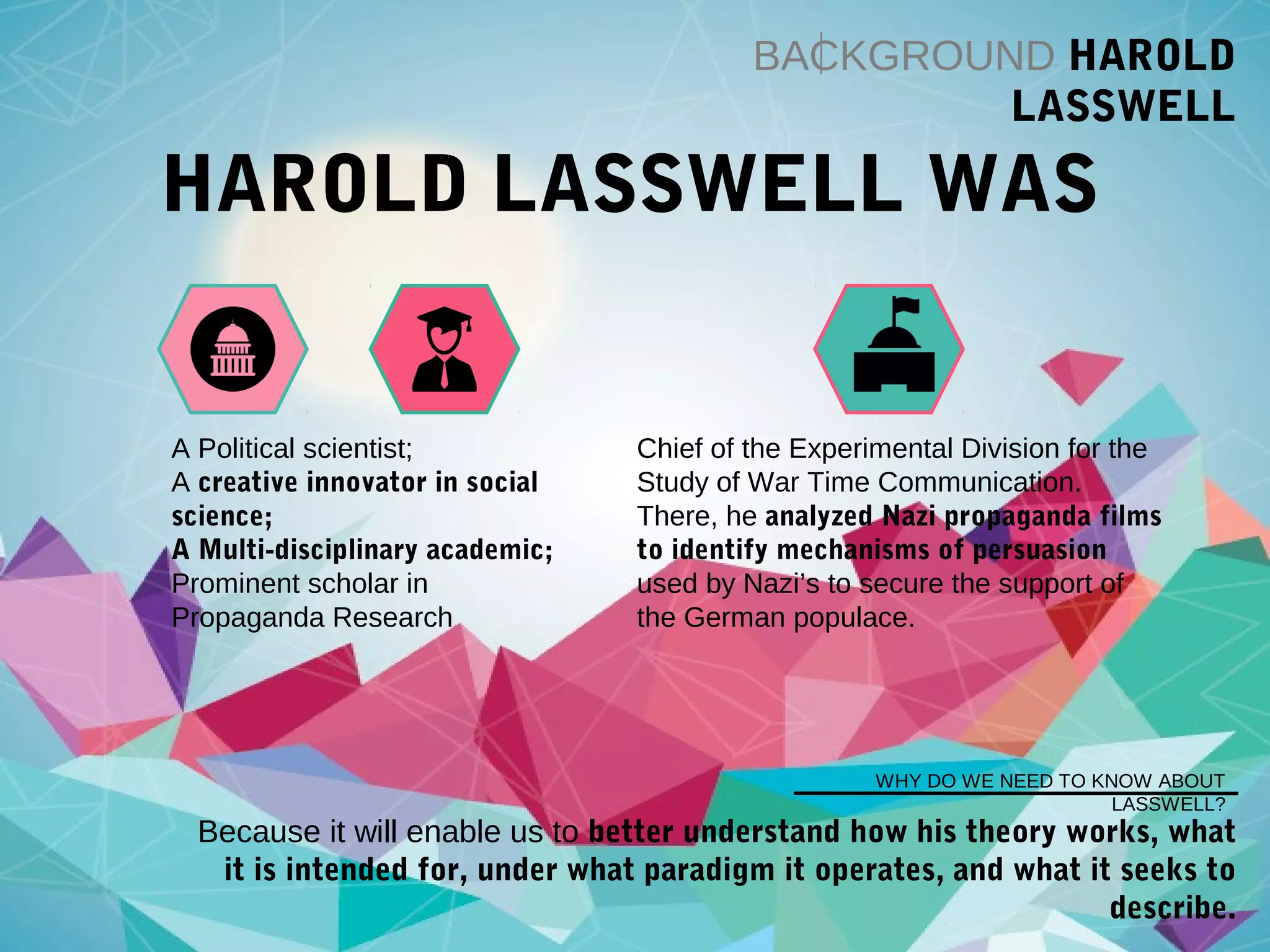
HAROLD LASSWELL WAS
A Political scientist;
A creative innovator in social
science;
A Multi-disciplinary academic;
Prominent scholar in
Propaganda Research
Chief of the Experimental Division for the
Study of War Time Communication.
There, he analyzed Nazi propaganda films
to identify mechanisms of persuasion
used by Nazi’s to secure the support of
the German populace.
THEORY HOW DOES IT WORK?
THE LASSWELL FORMULA
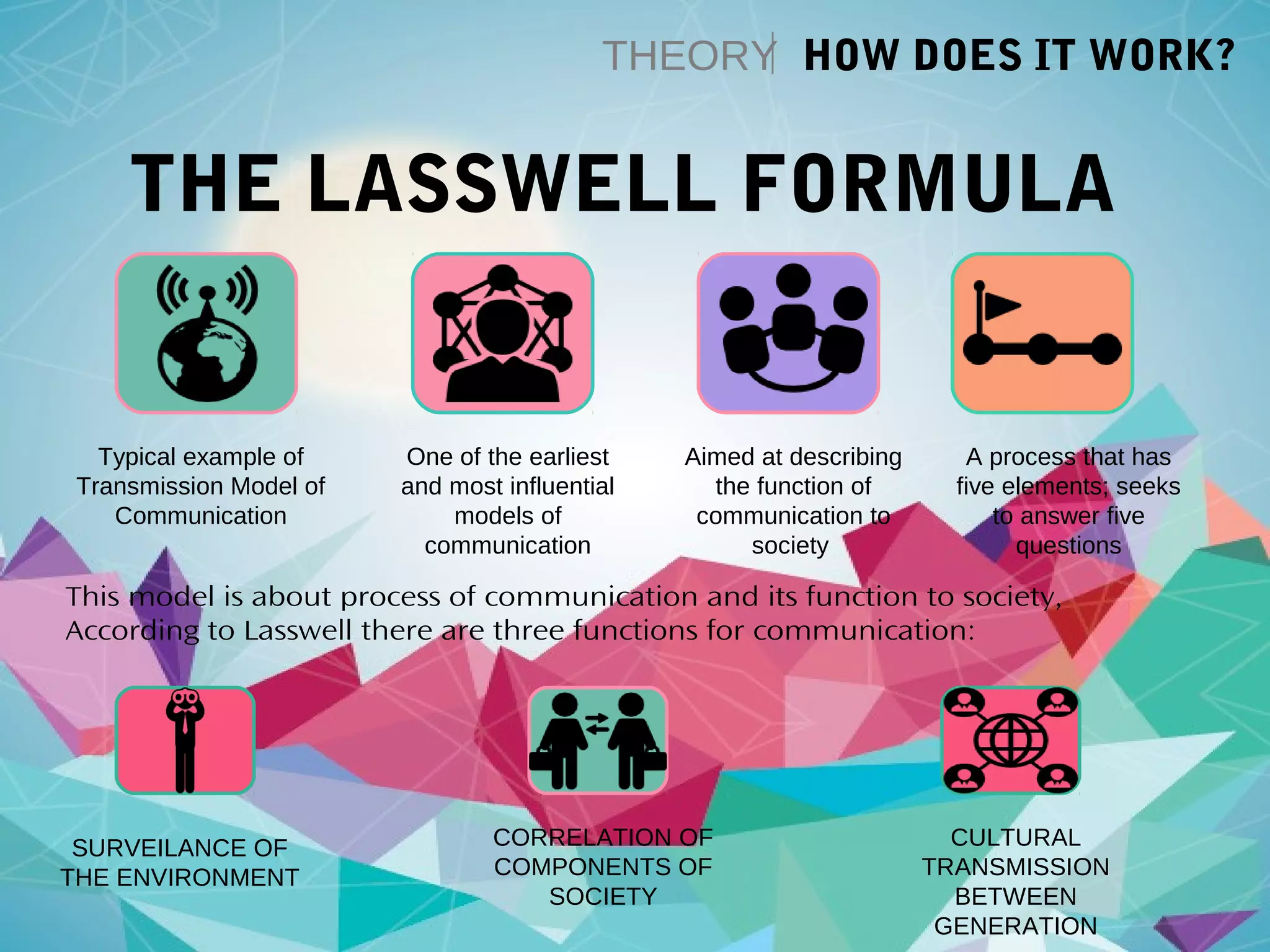
Typical example of
Transmission Model of
Communication
One of the earliest
and most influential
models of
communication
Aimed at describing
the function of
communication to
society
A process that has
five elements; seeks
to answer five
questions
This model is about process of communication and its function to society,
According to Lasswell there are three functions for communication:
SURVEILANCE OF
THE ENVIRONMENT
CORRELATION OF
COMPONENTS OF
SOCIETY
CULTURAL
TRANSMISSION
BETWEEN
GENERATION
THEORY HOW DOES IT WORK?
THE LASSWELL FORMULA
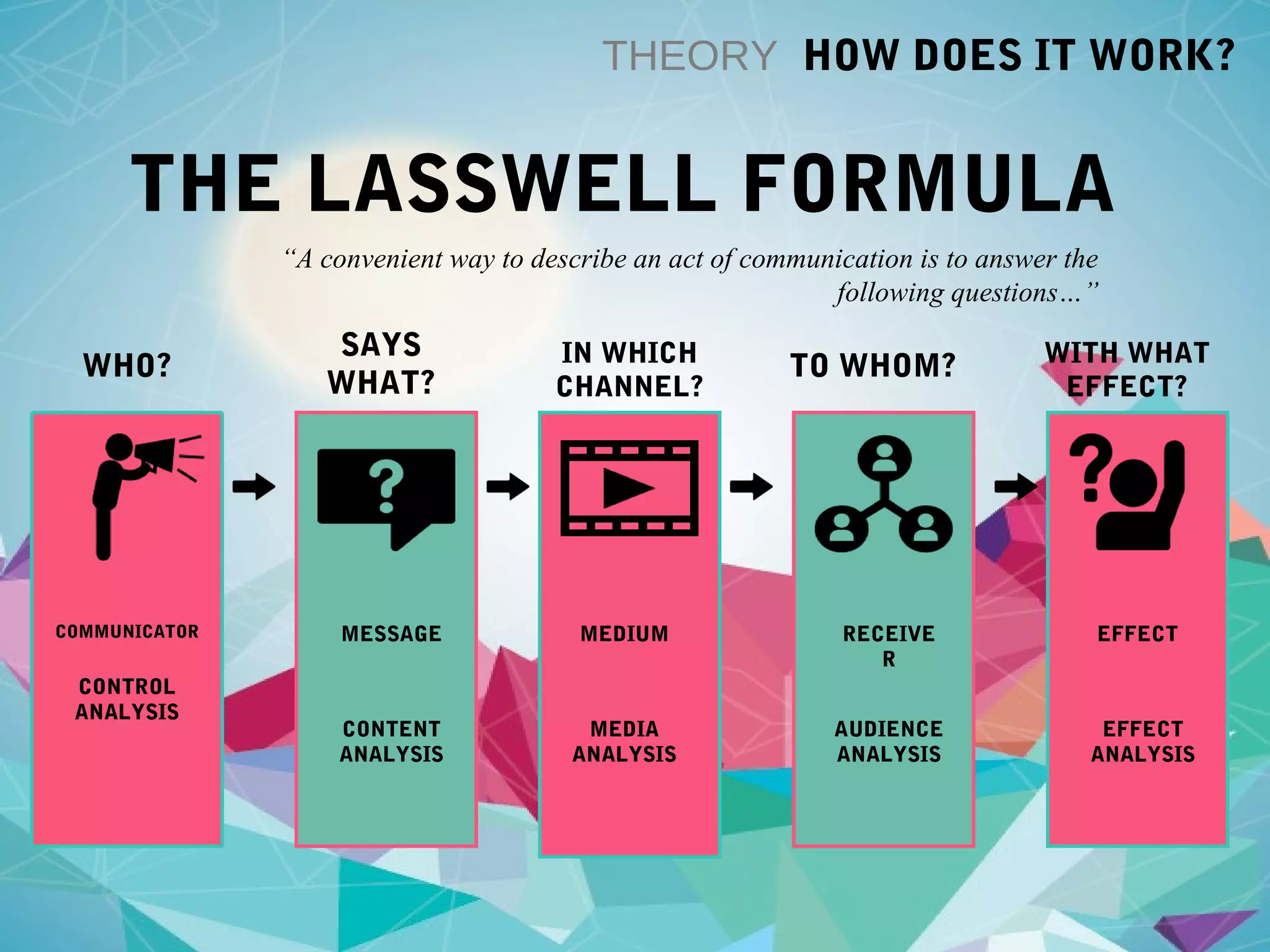
“A convenient way to describe an act of communication is to answer the
following questions…”
WHO?
SAYS
WHAT?
IN WHICH
CHANNEL?
TO WHOM? WITH WHAT
EFFECT?
COMMUNICATOR MESSAGE MEDIUM RECEIVE
R
EFFECT
CONTROL
ANALYSIS
CONTENT
ANALYSIS
MEDIA
ANALYSIS
AUDIENCE
ANALYSIS
EFFECT
ANALYSIS
WHO THEORY HOW DOES IT WORK?
THE LASSWELL FORMULAE X P L A N A T I O N
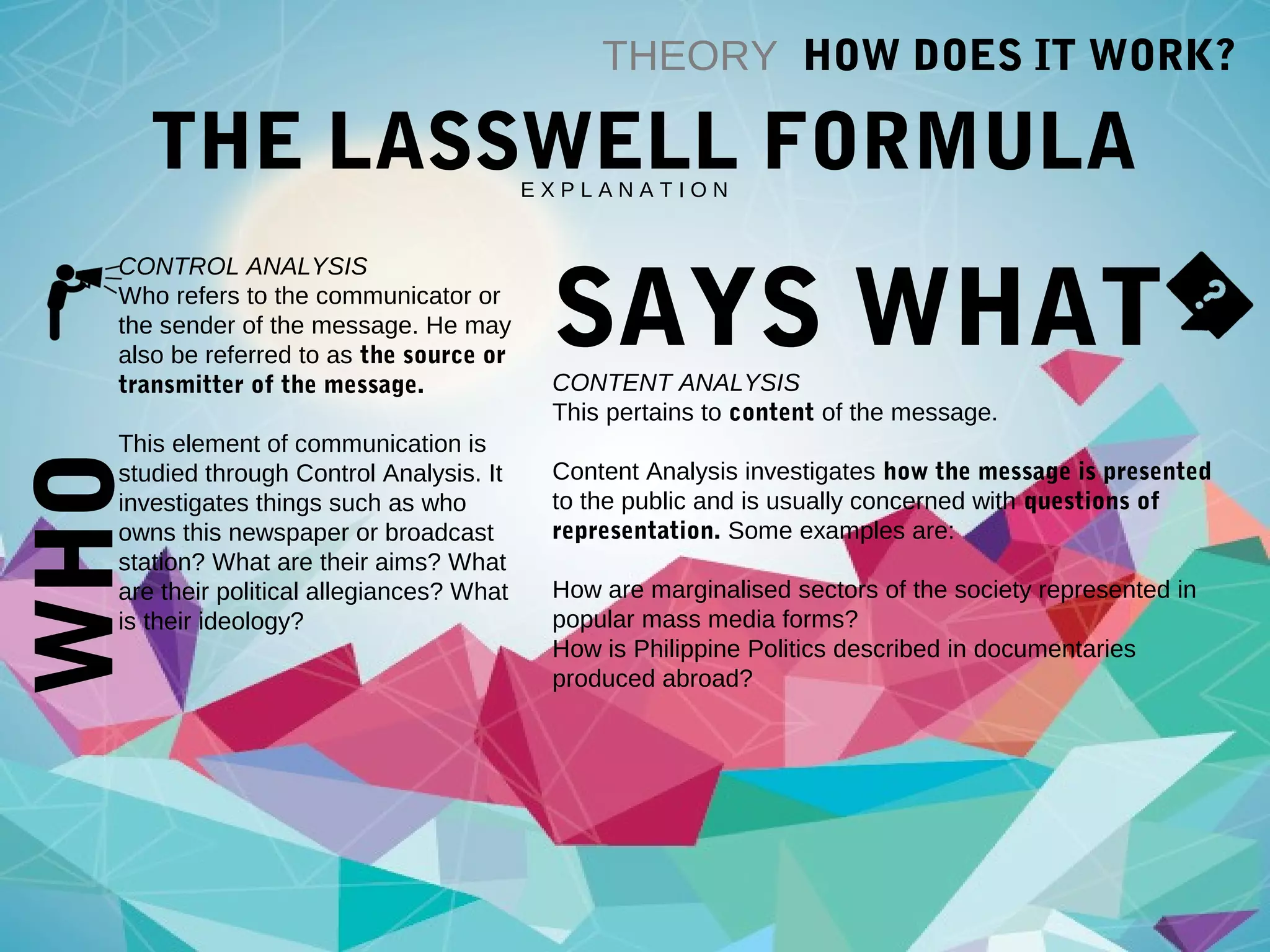
CONTROL ANALYSIS
Who refers to the communicator or
the sender of the message. He may
also be referred to as the source or
transmitter of the message.
This element of communication is
studied through Control Analysis. It
investigates things such as who
owns this newspaper or broadcast
station? What are their aims? What
are their political allegiances? What
is their ideology?
SAYS WHATCONTENT ANALYSIS
This pertains to content of the message.
Content Analysis investigates how the message is presented
to the public and is usually concerned with questions of
representation. Some examples are:
How are marginalised sectors of the society represented in
popular mass media forms?
How is Philippine Politics described in documentaries
produced abroad?
THE LASSWELL FORMULA
THEORY HOW DOES IT WORK?
E X P L A N A T I O N
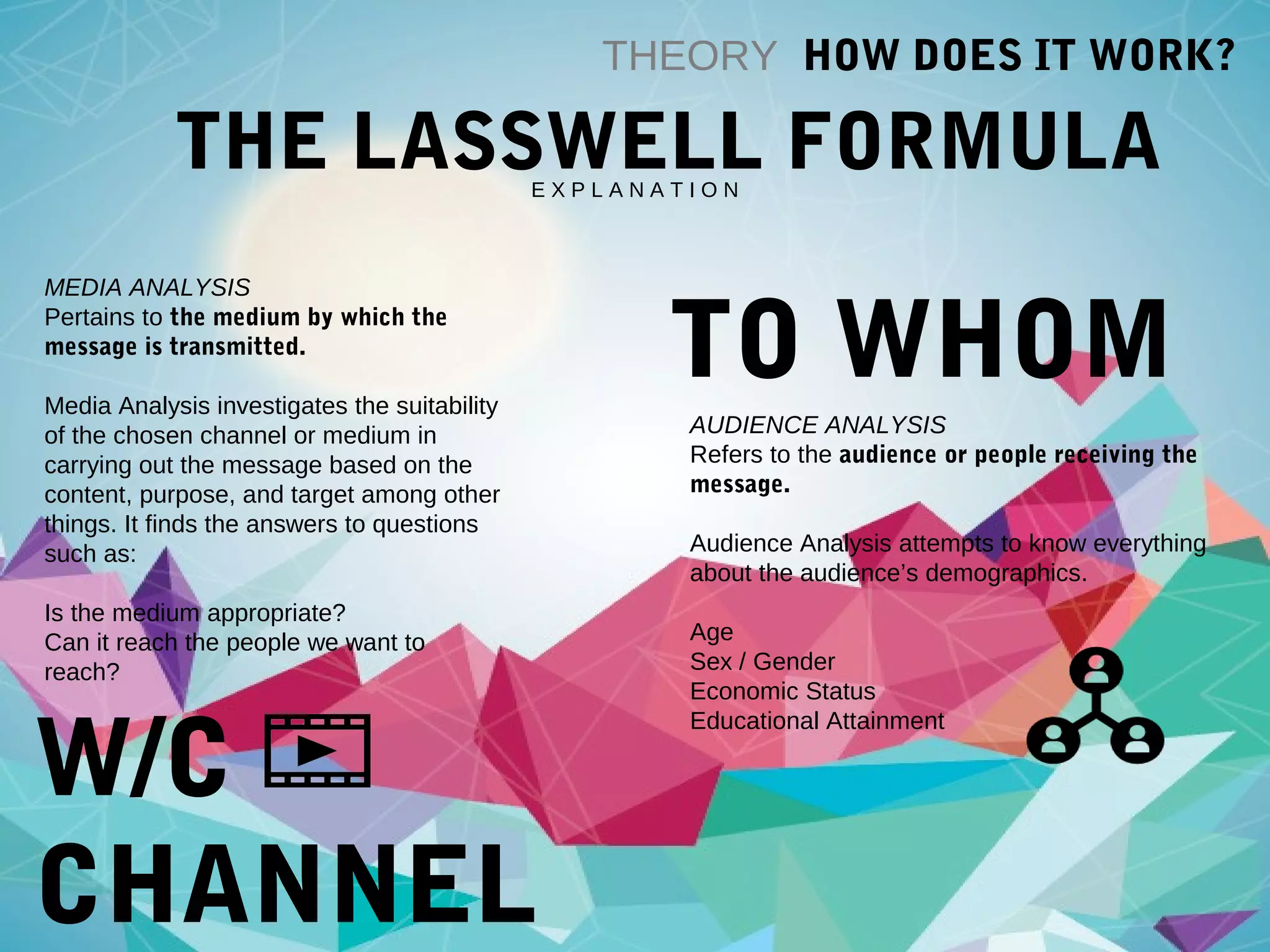
MEDIA ANALYSIS
Pertains to the medium by which the
message is transmitted.
Media Analysis investigates the suitability
of the chosen channel or medium in
carrying out the message based on the
content, purpose, and target among other
things. It finds the answers to questions
such as:
Is the medium appropriate?
Can it reach the people we want to
reach?
W/C
CHANNEL
TO WHOM
AUDIENCE ANALYSIS
Refers to the audience or people receiving the
message.
Audience Analysis attempts to know everything
about the audience’s demographics.
Age
Sex / Gender
Economic Status
Educational Attainment
THE LASSWELL FORMULA
THEORY HOW DOES IT WORK?
E X P L A N A T I O N
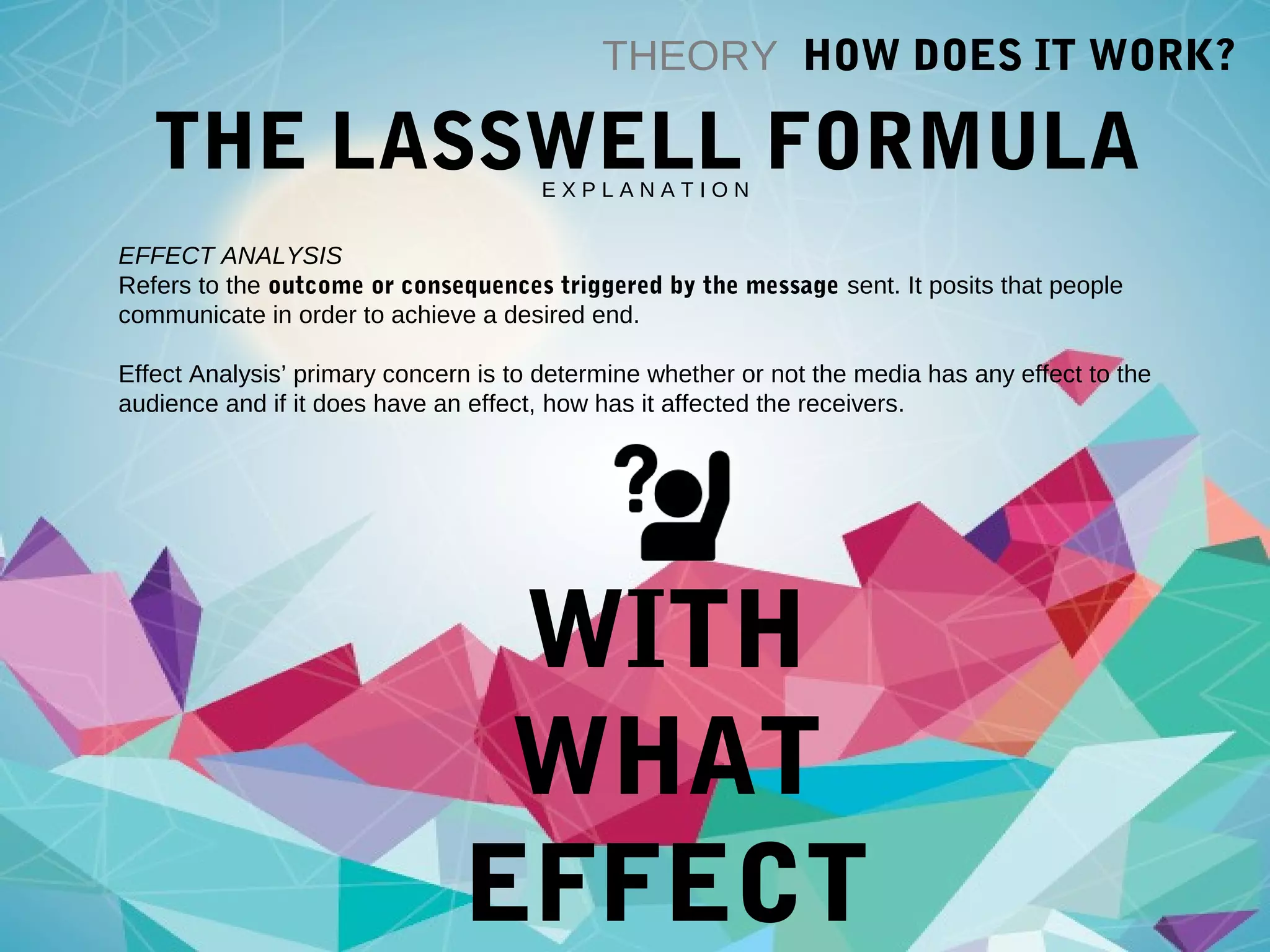
EFFECT ANALYSIS
Refers to the outcome or consequences triggered by the message sent. It posits that people
communicate in order to achieve a desired end.
Effect Analysis’ primary concern is to determine whether or not the media has any effect to the
audience and if it does have an effect, how has it affected the receivers.
WITH
WHAT
EFFECT
THE LASSWELL FORMULA
THEORY HOW DOES IT WORK?
E X A M P L E
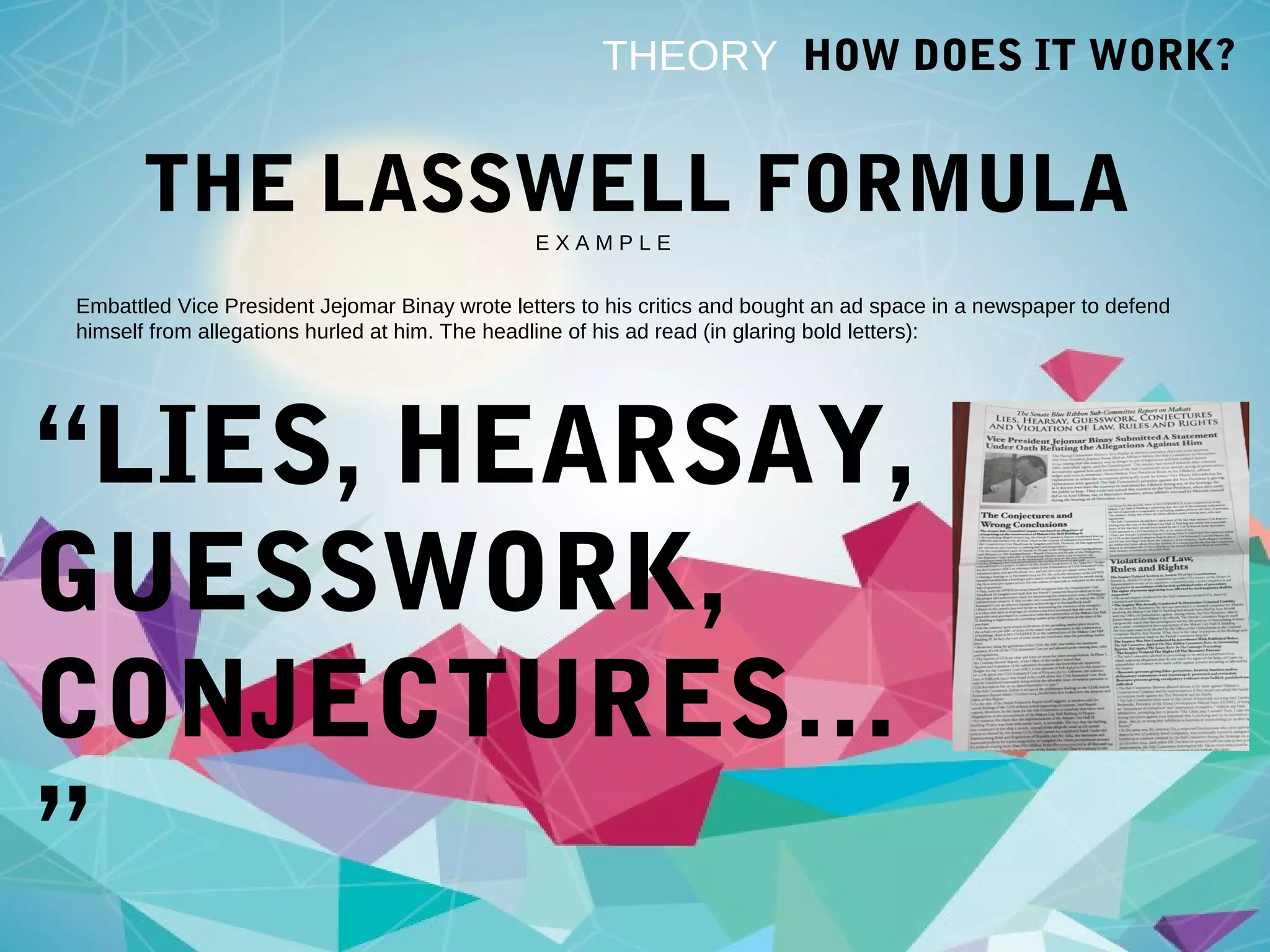
Embattled Vice President Jejomar Binay wrote letters to his critics and bought an ad space in a newspaper to defend
himself from allegations hurled at him. The headline of his ad read (in glaring bold letters):
“LIES, HEARSAY,
GUESSWORK,
CONJECTURES…
”
THEORY EXAMPLE
THE LASSWELL FORMULA
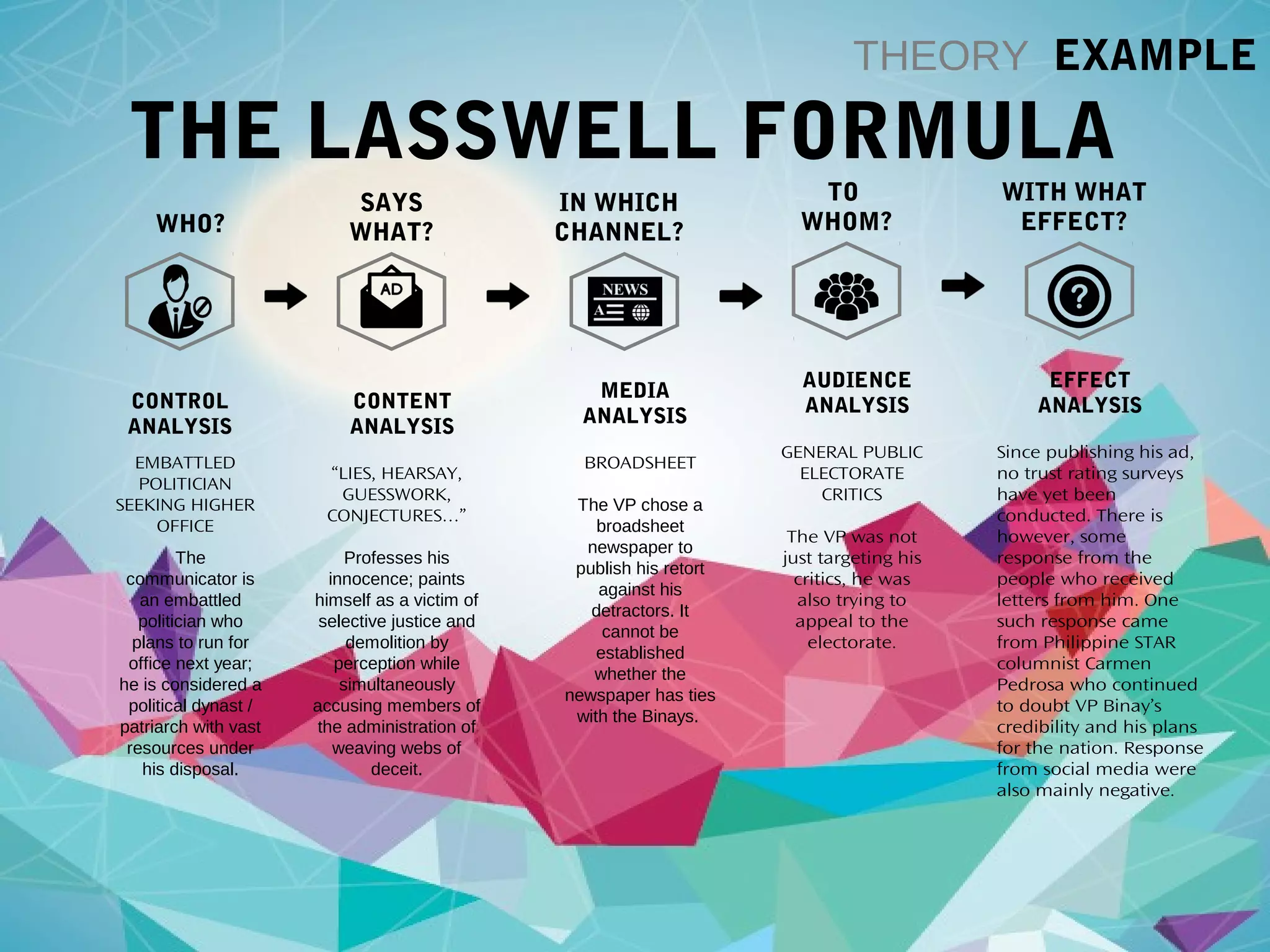
WHO?
SAYS
WHAT?
IN WHICH
CHANNEL?
TO
WHOM?
WITH WHAT
EFFECT?
CONTROL
ANALYSIS
CONTENT
ANALYSIS
MEDIA
ANALYSIS
AUDIENCE
ANALYSIS
EFFECT
ANALYSIS
The
communicator is
an embattled
politician who
plans to run for
office next year;
he is considered a
political dynast /
patriarch with vast
resources under
his disposal.
“LIES, HEARSAY,
GUESSWORK,
CONJECTURES…”
Professes his
innocence; paints
himself as a victim of
selective justice and
demolition by
perception while
simultaneously
accusing members of
the administration of
weaving webs of
deceit.
BROADSHEET
The VP chose a
broadsheet
newspaper to
publish his retort
against his
detractors. It
cannot be
established
whether the
newspaper has ties
with the Binays.
GENERAL PUBLIC
ELECTORATE
CRITICS
The VP was not
just targeting his
critics, he was
also trying to
appeal to the
electorate.
EMBATTLED
POLITICIAN
SEEKING HIGHER
OFFICE
Since publishing his ad,
no trust rating surveys
have yet been
conducted. There is
however, some
response from the
people who received
letters from him. One
such response came
from Philippine STAR
columnist Carmen
Pedrosa who continued
to doubt VP Binay’s
credibility and his plans
for the nation. Response
from social media were
also mainly negative.
PART II
S H A N N O N &
W E A V E R ‘ S
M A T H E M A T I C A L
M O D E L
BACKGROUND SHANNON & WEAVER
Dubbed as the mother of all
models, the Shannon & Weaver
Model is the embodiments of
concepts such as information
source, message, transmitter,
signal, channel, noise, receiver,
and slew of others.
MATHEMATICAL MODEL OF
COMMUNICATION
In 1948, American
mathematician Claude
Shannon and electronic
Engineer Warren Weaver
collaborated to write an article
called the “Mathematical
Theory of Communication”
with the primary goal of
improving technical
communication.
THEORY SHANNON & WEAVER
MATHEMATICAL MODEL OF
COMMUNICATION
MATHEMATICAL MODEL OF
COMMUNICATION
THEORY SHANNON & WEAVER
The Shannon & Weaver model bears a strong semblance to Lasswell’s
model, albeit, this one has some elements which the other model
lacked: feedback and noise.
While Lasswell’s model was more concerned with the effect of the
message and the function of communication with respect to society,
Weaver& Shannon’s model’s primary concern was to find out the most
effective means of human communication.
MATHEMATICAL MODEL OF
COMMUNICATION
THEORY SHANNON & WEAVER
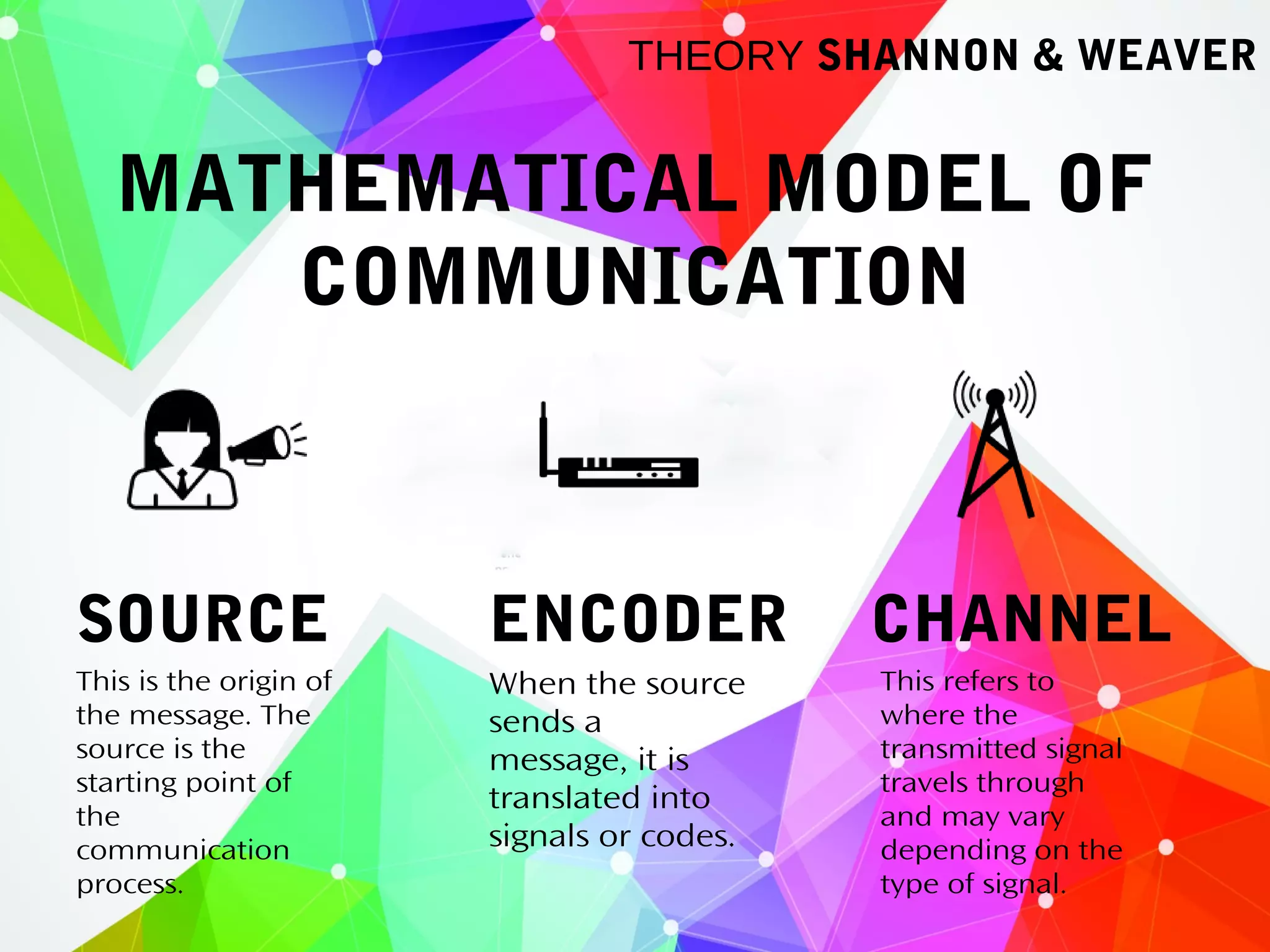
SOURCE ENCODER CHANNEL
This is the origin of
the message. The
source is the
starting point of
the
communication
process.
When the source
sends a
message, it is
translated into
signals or codes.
This refers to
where the
transmitted signal
travels through
and may vary
depending on the
type of signal.
MATHEMATICAL MODEL OF
COMMUNICATION
THEORY SHANNON & WEAVER
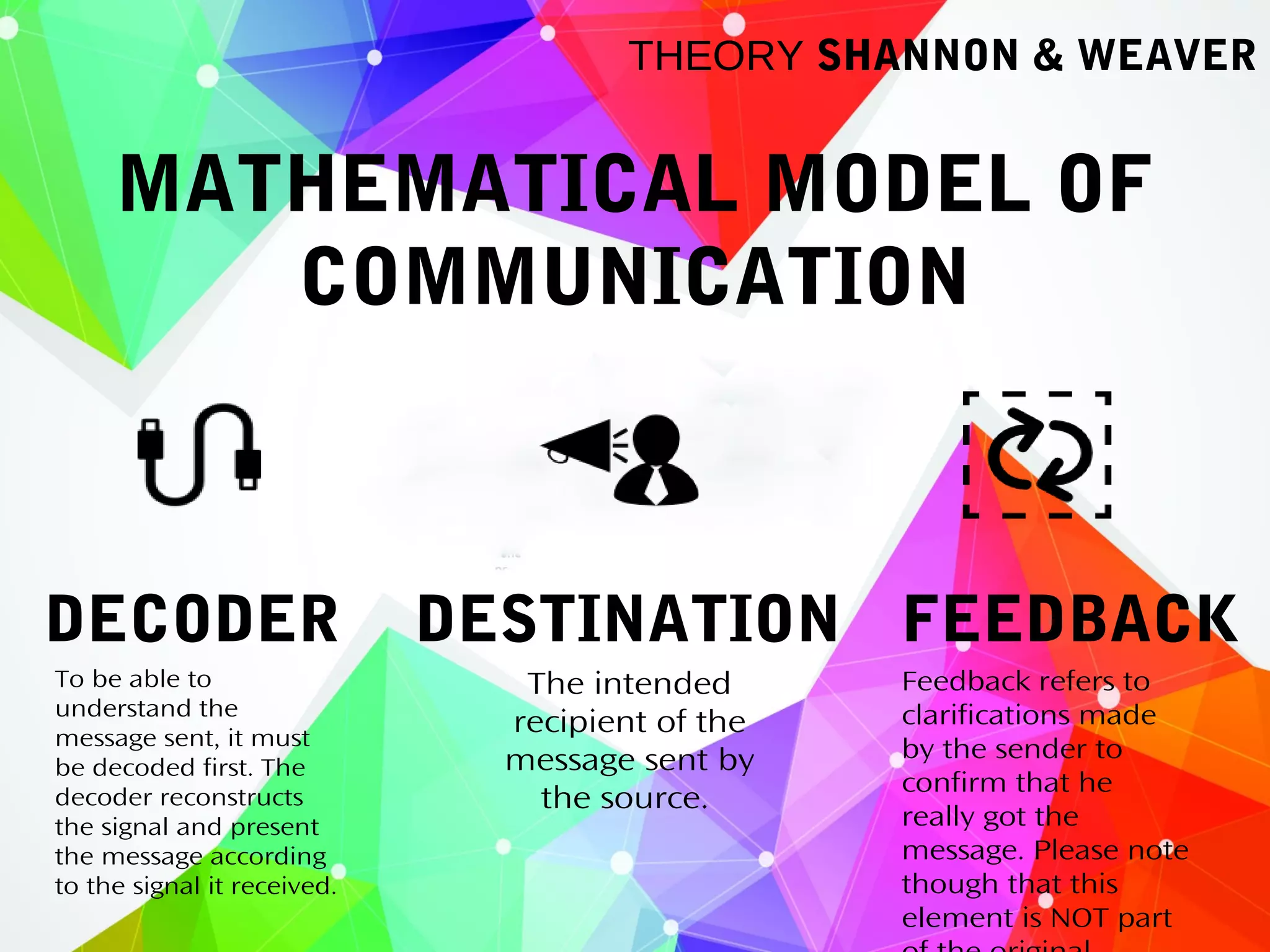
DECODER DESTINATION FEEDBACK
To be able to
understand the
message sent, it must
be decoded first. The
decoder reconstructs
the signal and present
the message according
to the signal it received.
The intended
recipient of the
message sent by
the source.
Feedback refers to
clarifications made
by the sender to
confirm that he
really got the
message. Please note
though that this
element is NOT part
MATHEMATICAL MODEL OF
COMMUNICATION
THEORY SHANNON & WEAVER
NOISE
Refers to
internal or
external
interruptions
to the signal
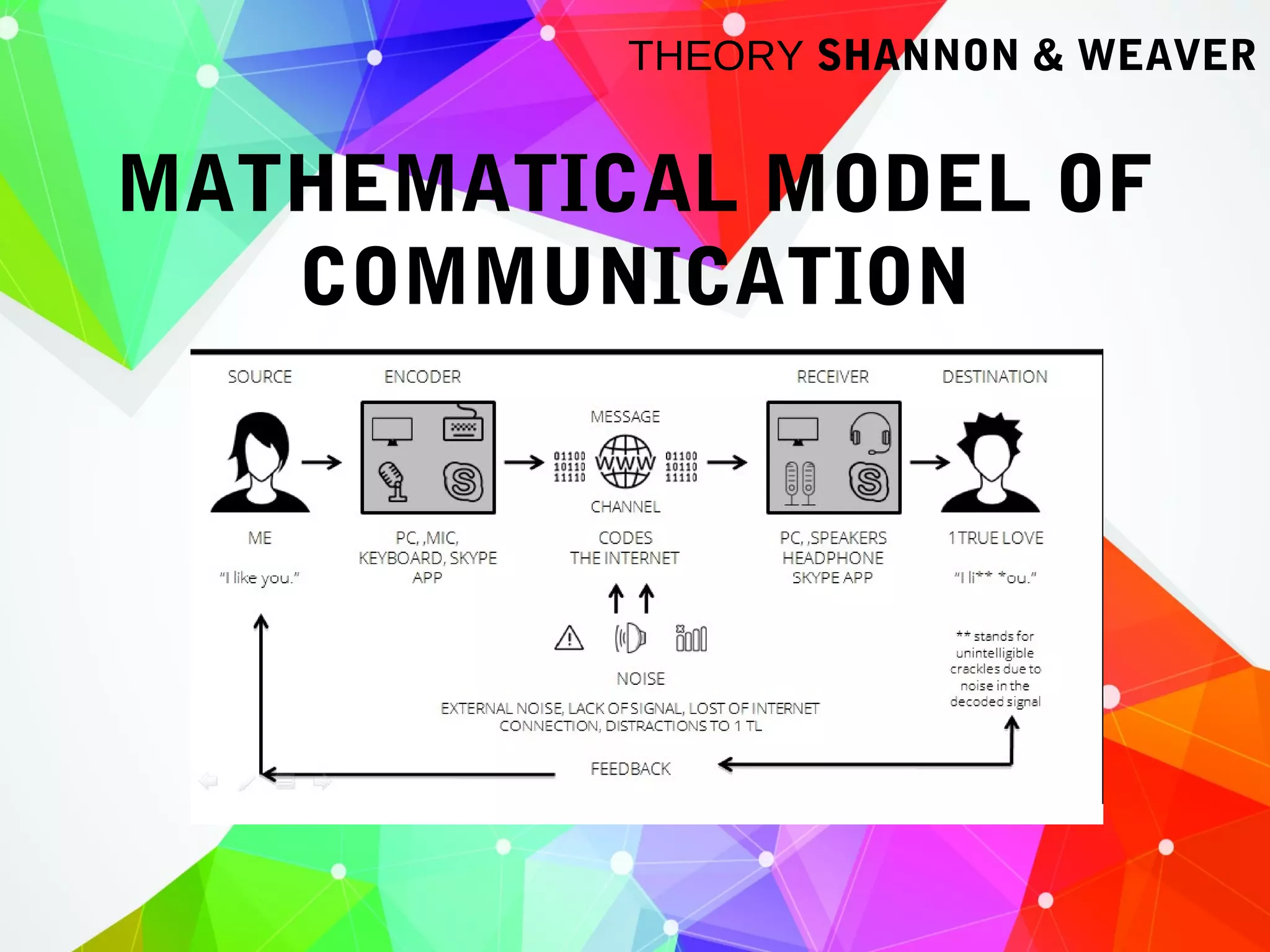
The model suggests that a message begins at
an information source, which is then relayed
through a transmitter and sent via signals to
the receiver. Once you speak, your voice
(signal) is carried through the air toward the
listener’s ear. As the sound waves produced
by your voice travel, it is joined by a myriad
of other sounds and distractions (noise). The
receiver takes in everything, trying to
maximize the message while minimizing the
noise, after which, the receiver conveys its
message back to the sender.

Basic Linear Communication Models: Lasswell, Shannon and Weaver

  • 1.
    EARL GUZMAN holdsa Bachelor’s Degree in Political Science and has a professional experience that spans 5 years. Among his most notable roles are: Legislative Staff Officer at the Senate Electoral Tribunal and Catalog Writer for ABS – CBN. He currently works as an Online Content Writer under the creative marketing department of tech merchandising company Beyond the Box.
  • 2.
    PART I T HE L A S S W E L L F O R M U L A WHO WAS HAROLD LASSWELL THE LASSWELL FORMULA EXPLAINED
  • 3.
    BACKGROUND HAROLD LASSWELL WHY DOWE NEED TO KNOW ABOUT LASSWELL? Because it will enable us to better understand how his theory works, what it is intended for, under what paradigm it operates, and what it seeks to describe. HAROLD LASSWELL WAS A Political scientist; A creative innovator in social science; A Multi-disciplinary academic; Prominent scholar in Propaganda Research Chief of the Experimental Division for the Study of War Time Communication. There, he analyzed Nazi propaganda films to identify mechanisms of persuasion used by Nazi’s to secure the support of the German populace.
  • 4.
    THEORY HOW DOESIT WORK? THE LASSWELL FORMULA Typical example of Transmission Model of Communication One of the earliest and most influential models of communication Aimed at describing the function of communication to society A process that has five elements; seeks to answer five questions This model is about process of communication and its function to society, According to Lasswell there are three functions for communication: SURVEILANCE OF THE ENVIRONMENT CORRELATION OF COMPONENTS OF SOCIETY CULTURAL TRANSMISSION BETWEEN GENERATION
  • 5.
    THEORY HOW DOESIT WORK? THE LASSWELL FORMULA “A convenient way to describe an act of communication is to answer the following questions…” WHO? SAYS WHAT? IN WHICH CHANNEL? TO WHOM? WITH WHAT EFFECT? COMMUNICATOR MESSAGE MEDIUM RECEIVE R EFFECT CONTROL ANALYSIS CONTENT ANALYSIS MEDIA ANALYSIS AUDIENCE ANALYSIS EFFECT ANALYSIS
  • 6.
    WHO THEORY HOWDOES IT WORK? THE LASSWELL FORMULAE X P L A N A T I O N CONTROL ANALYSIS Who refers to the communicator or the sender of the message. He may also be referred to as the source or transmitter of the message. This element of communication is studied through Control Analysis. It investigates things such as who owns this newspaper or broadcast station? What are their aims? What are their political allegiances? What is their ideology? SAYS WHATCONTENT ANALYSIS This pertains to content of the message. Content Analysis investigates how the message is presented to the public and is usually concerned with questions of representation. Some examples are: How are marginalised sectors of the society represented in popular mass media forms? How is Philippine Politics described in documentaries produced abroad?
  • 7.
    THE LASSWELL FORMULA THEORYHOW DOES IT WORK? E X P L A N A T I O N MEDIA ANALYSIS Pertains to the medium by which the message is transmitted. Media Analysis investigates the suitability of the chosen channel or medium in carrying out the message based on the content, purpose, and target among other things. It finds the answers to questions such as: Is the medium appropriate? Can it reach the people we want to reach? W/C CHANNEL TO WHOM AUDIENCE ANALYSIS Refers to the audience or people receiving the message. Audience Analysis attempts to know everything about the audience’s demographics. Age Sex / Gender Economic Status Educational Attainment
  • 8.
    THE LASSWELL FORMULA THEORYHOW DOES IT WORK? E X P L A N A T I O N EFFECT ANALYSIS Refers to the outcome or consequences triggered by the message sent. It posits that people communicate in order to achieve a desired end. Effect Analysis’ primary concern is to determine whether or not the media has any effect to the audience and if it does have an effect, how has it affected the receivers. WITH WHAT EFFECT
  • 9.
    THE LASSWELL FORMULA THEORYHOW DOES IT WORK? E X A M P L E Embattled Vice President Jejomar Binay wrote letters to his critics and bought an ad space in a newspaper to defend himself from allegations hurled at him. The headline of his ad read (in glaring bold letters): “LIES, HEARSAY, GUESSWORK, CONJECTURES… ”
  • 10.
    THEORY EXAMPLE THE LASSWELLFORMULA WHO? SAYS WHAT? IN WHICH CHANNEL? TO WHOM? WITH WHAT EFFECT? CONTROL ANALYSIS CONTENT ANALYSIS MEDIA ANALYSIS AUDIENCE ANALYSIS EFFECT ANALYSIS The communicator is an embattled politician who plans to run for office next year; he is considered a political dynast / patriarch with vast resources under his disposal. “LIES, HEARSAY, GUESSWORK, CONJECTURES…” Professes his innocence; paints himself as a victim of selective justice and demolition by perception while simultaneously accusing members of the administration of weaving webs of deceit. BROADSHEET The VP chose a broadsheet newspaper to publish his retort against his detractors. It cannot be established whether the newspaper has ties with the Binays. GENERAL PUBLIC ELECTORATE CRITICS The VP was not just targeting his critics, he was also trying to appeal to the electorate. EMBATTLED POLITICIAN SEEKING HIGHER OFFICE Since publishing his ad, no trust rating surveys have yet been conducted. There is however, some response from the people who received letters from him. One such response came from Philippine STAR columnist Carmen Pedrosa who continued to doubt VP Binay’s credibility and his plans for the nation. Response from social media were also mainly negative.
  • 11.
    PART II S HA N N O N & W E A V E R ‘ S M A T H E M A T I C A L M O D E L
  • 12.
    BACKGROUND SHANNON &WEAVER Dubbed as the mother of all models, the Shannon & Weaver Model is the embodiments of concepts such as information source, message, transmitter, signal, channel, noise, receiver, and slew of others. MATHEMATICAL MODEL OF COMMUNICATION In 1948, American mathematician Claude Shannon and electronic Engineer Warren Weaver collaborated to write an article called the “Mathematical Theory of Communication” with the primary goal of improving technical communication.
  • 13.
    THEORY SHANNON &WEAVER MATHEMATICAL MODEL OF COMMUNICATION
  • 14.
    MATHEMATICAL MODEL OF COMMUNICATION THEORYSHANNON & WEAVER The Shannon & Weaver model bears a strong semblance to Lasswell’s model, albeit, this one has some elements which the other model lacked: feedback and noise. While Lasswell’s model was more concerned with the effect of the message and the function of communication with respect to society, Weaver& Shannon’s model’s primary concern was to find out the most effective means of human communication.
  • 15.
    MATHEMATICAL MODEL OF COMMUNICATION THEORYSHANNON & WEAVER SOURCE ENCODER CHANNEL This is the origin of the message. The source is the starting point of the communication process. When the source sends a message, it is translated into signals or codes. This refers to where the transmitted signal travels through and may vary depending on the type of signal.
  • 16.
    MATHEMATICAL MODEL OF COMMUNICATION THEORYSHANNON & WEAVER DECODER DESTINATION FEEDBACK To be able to understand the message sent, it must be decoded first. The decoder reconstructs the signal and present the message according to the signal it received. The intended recipient of the message sent by the source. Feedback refers to clarifications made by the sender to confirm that he really got the message. Please note though that this element is NOT part
  • 17.
    MATHEMATICAL MODEL OF COMMUNICATION THEORYSHANNON & WEAVER NOISE Refers to internal or external interruptions to the signal The model suggests that a message begins at an information source, which is then relayed through a transmitter and sent via signals to the receiver. Once you speak, your voice (signal) is carried through the air toward the listener’s ear. As the sound waves produced by your voice travel, it is joined by a myriad of other sounds and distractions (noise). The receiver takes in everything, trying to maximize the message while minimizing the noise, after which, the receiver conveys its message back to the sender.