The document provides an overview of key topics in biomechanics including Newton's laws of motion, musculoskeletal levers, mechanical advantage, force classification systems, and vector analysis. Newton's laws describe inertia, acceleration, and action-reaction. There are three classes of levers that determine mechanical advantage. Forces can be classified as linear, concurrent, or parallel. Vector addition and resolution methods allow decomposition of forces into perpendicular and parallel components, with applications to analyzing forces in human movement.
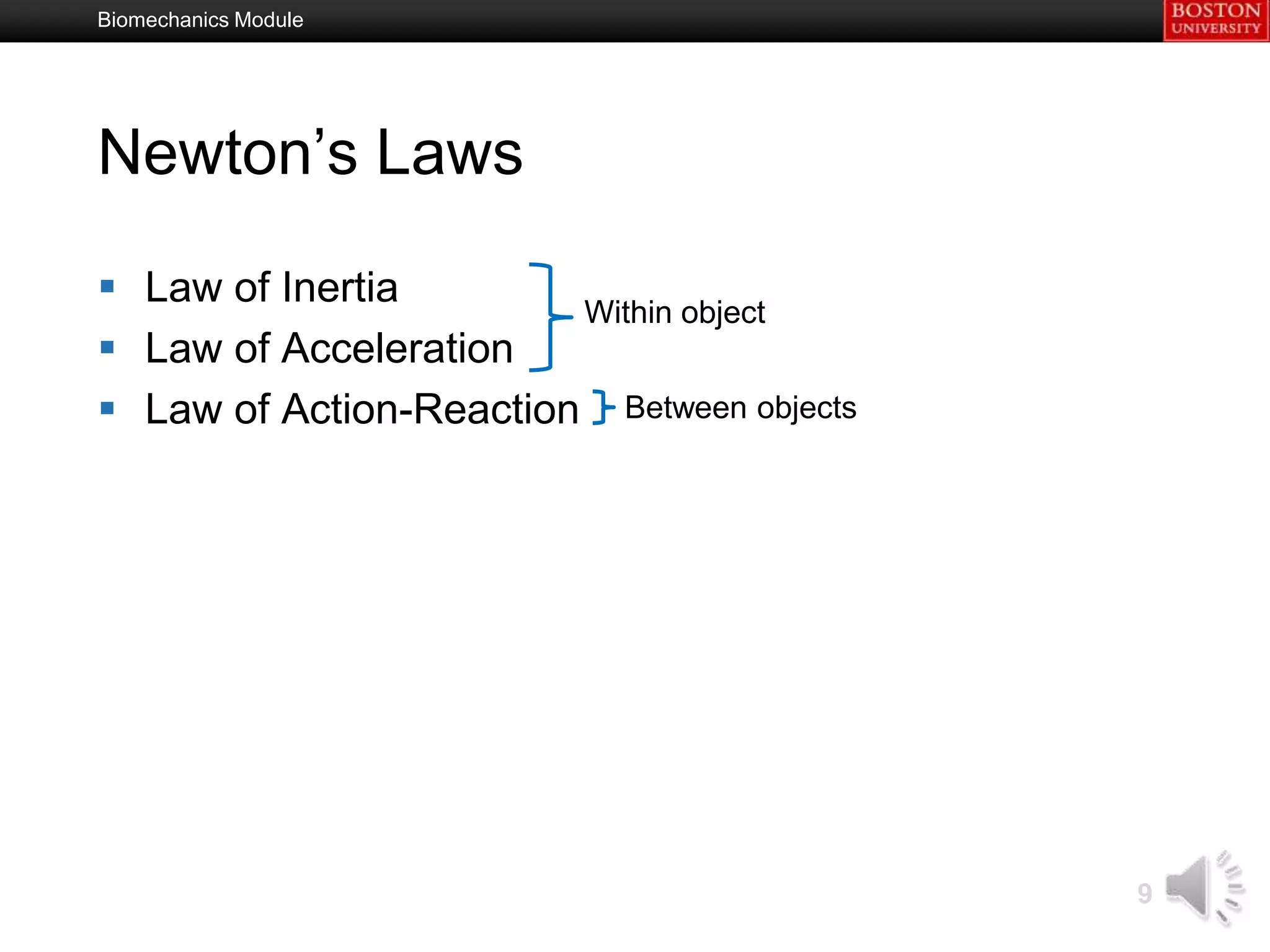
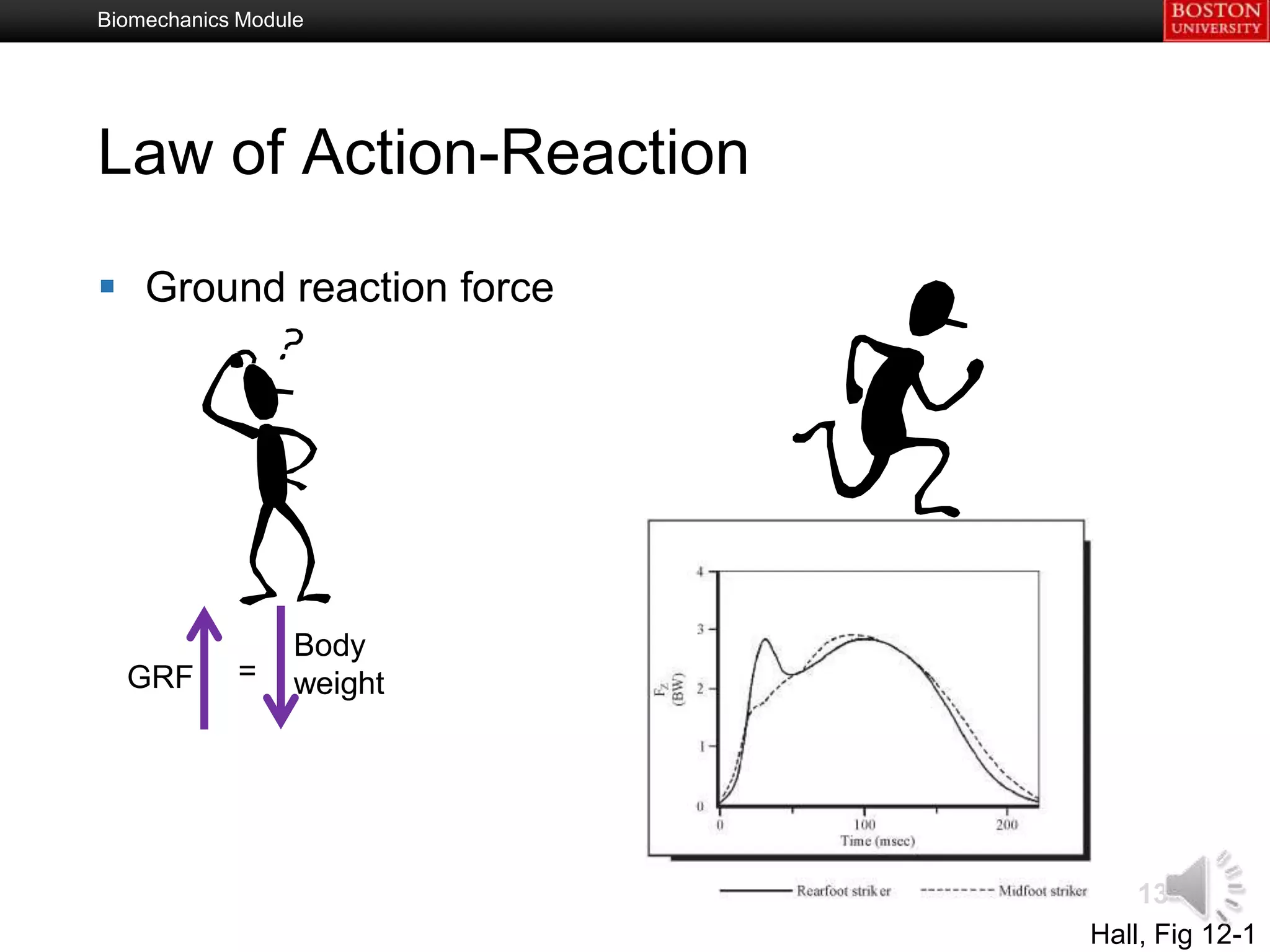
Overview of Newton's Laws: Inertia, Acceleration, Action-Reaction with key principles grounded in biomechanics.Details on the Law of Action-Reaction, emphasizing ground reaction force and interaction between objects.
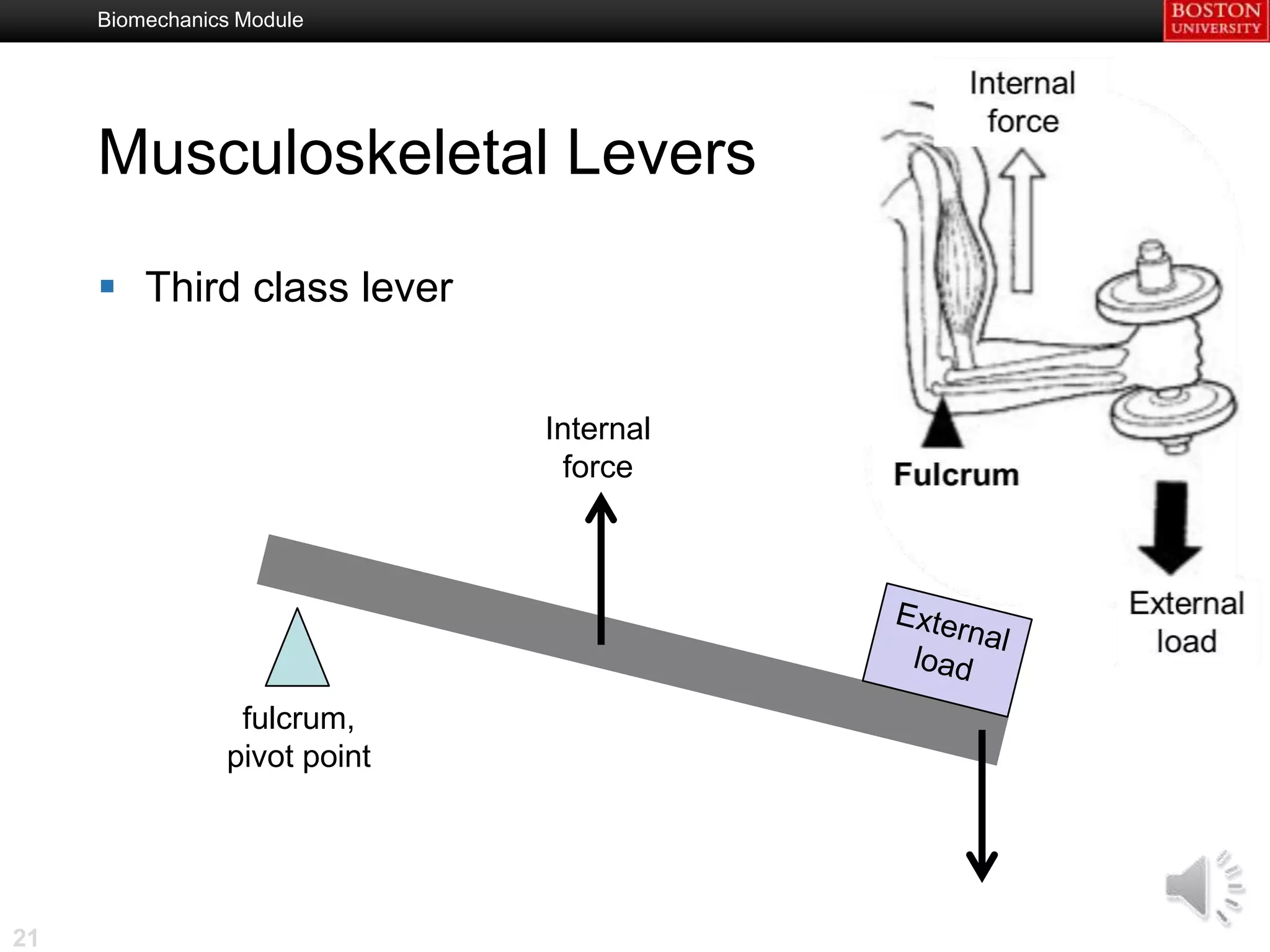
Analysis of musculoskeletal levers, including force interactions, different lever types, and their advantages.
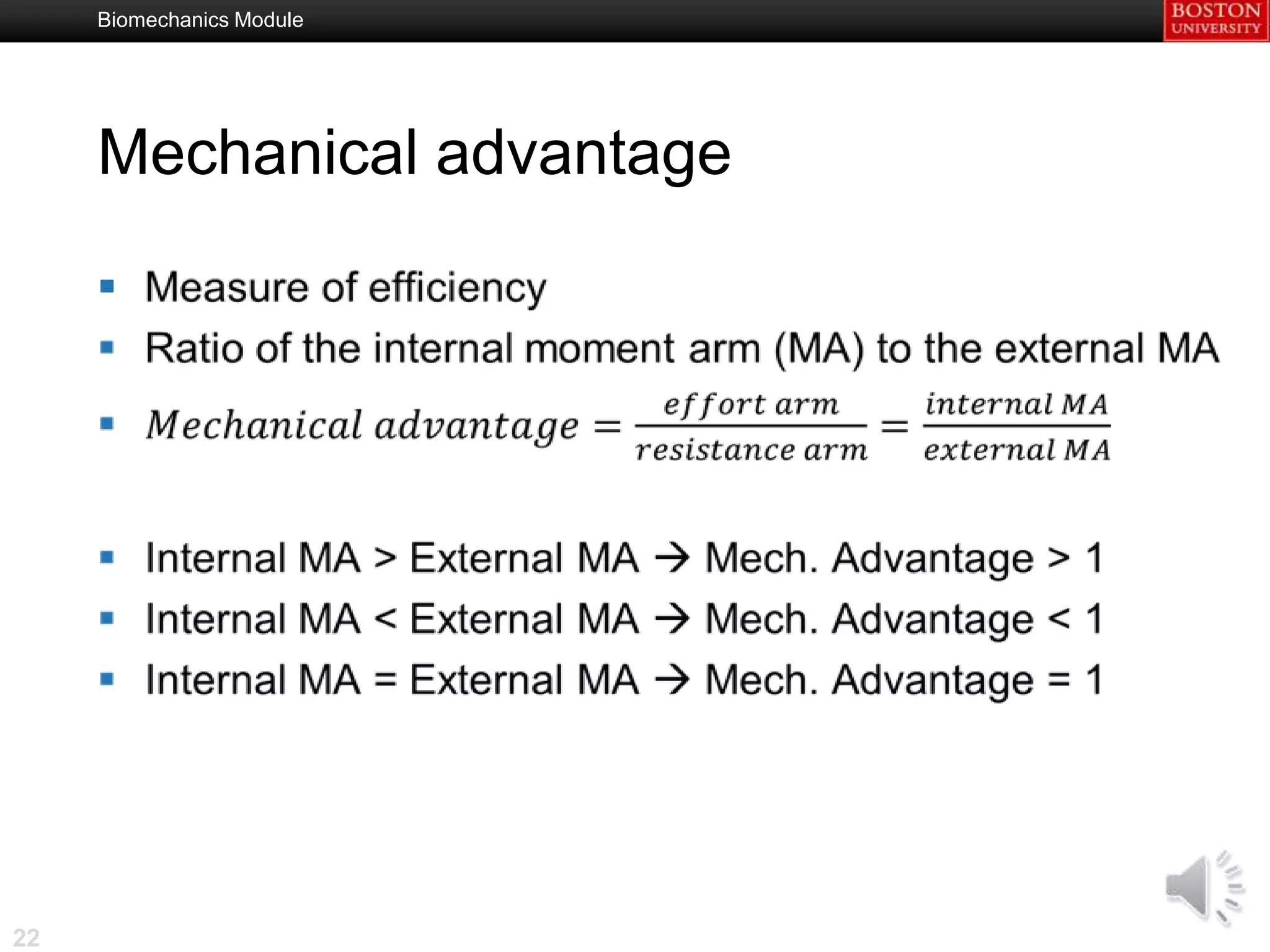
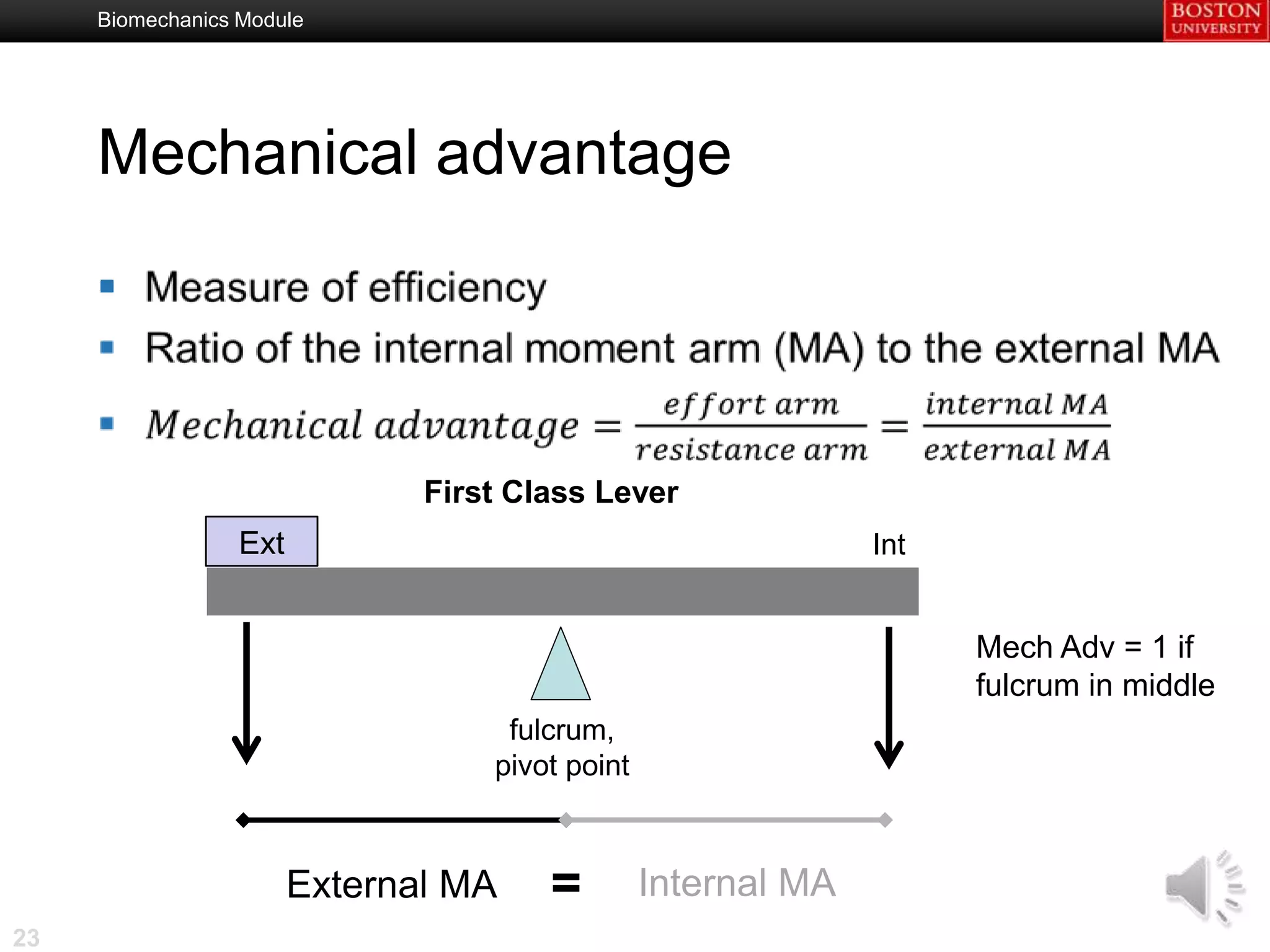
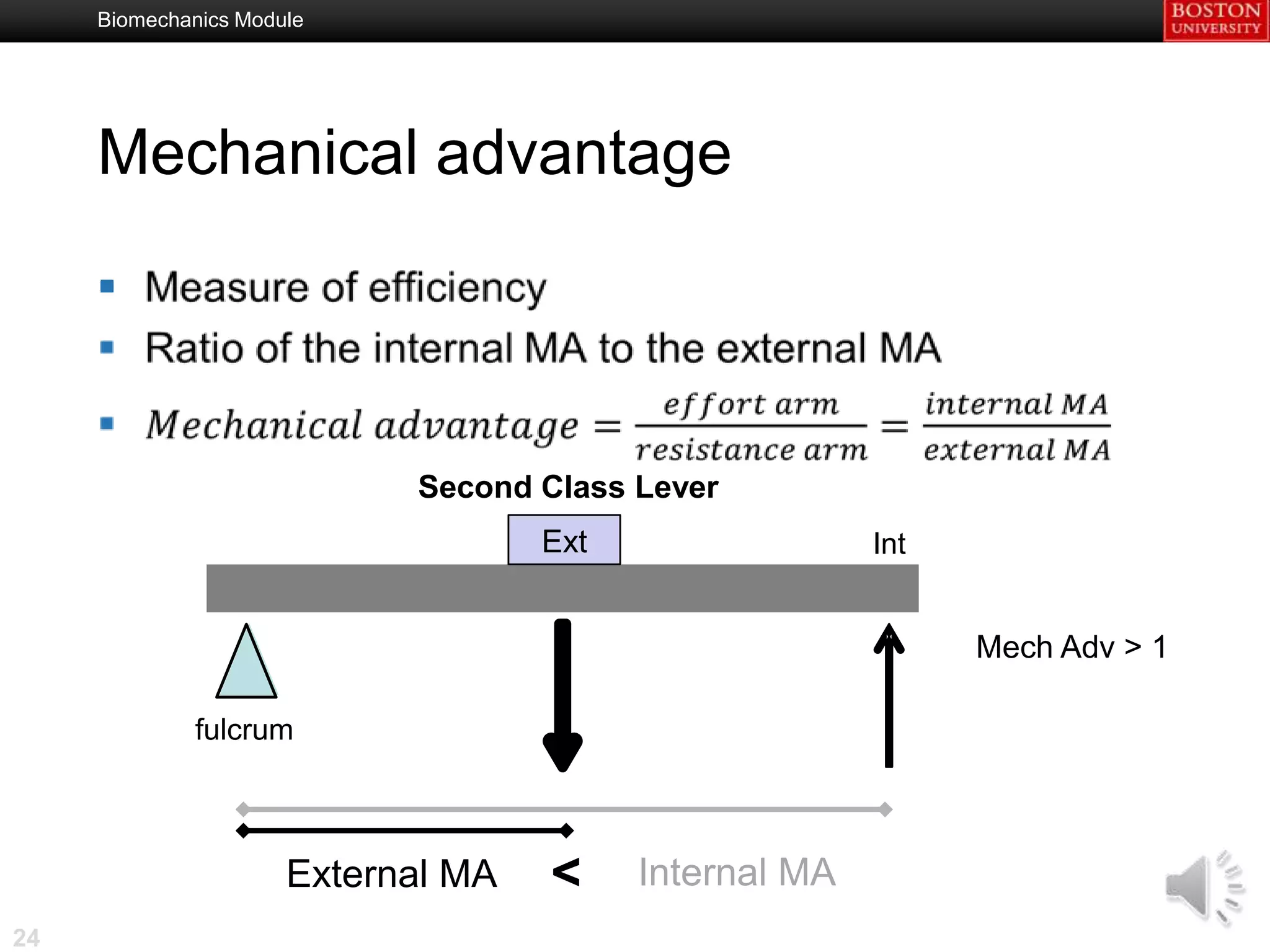
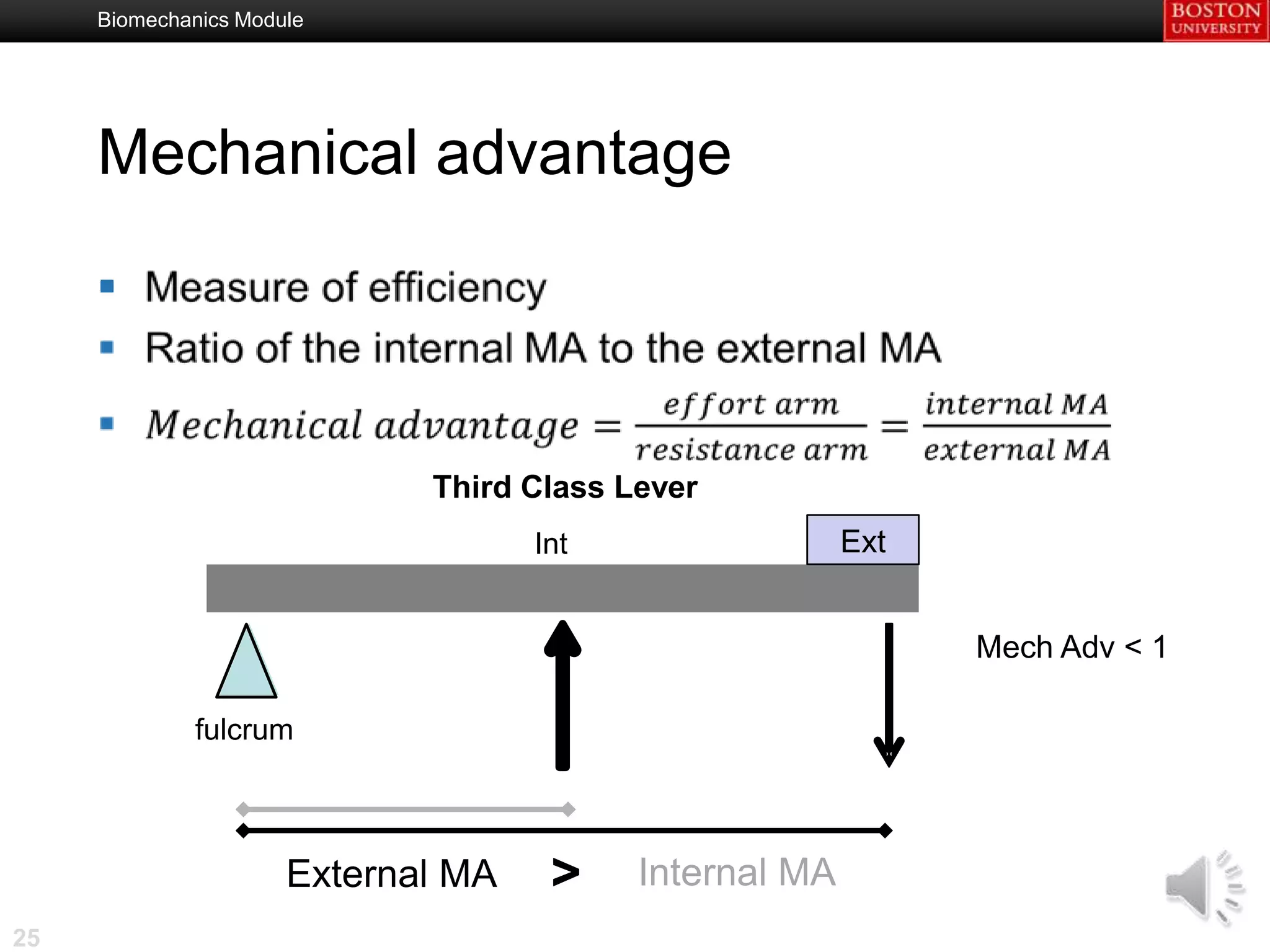
Explanation of mechanical advantage in first, second, and third class levers with comparative advantages.
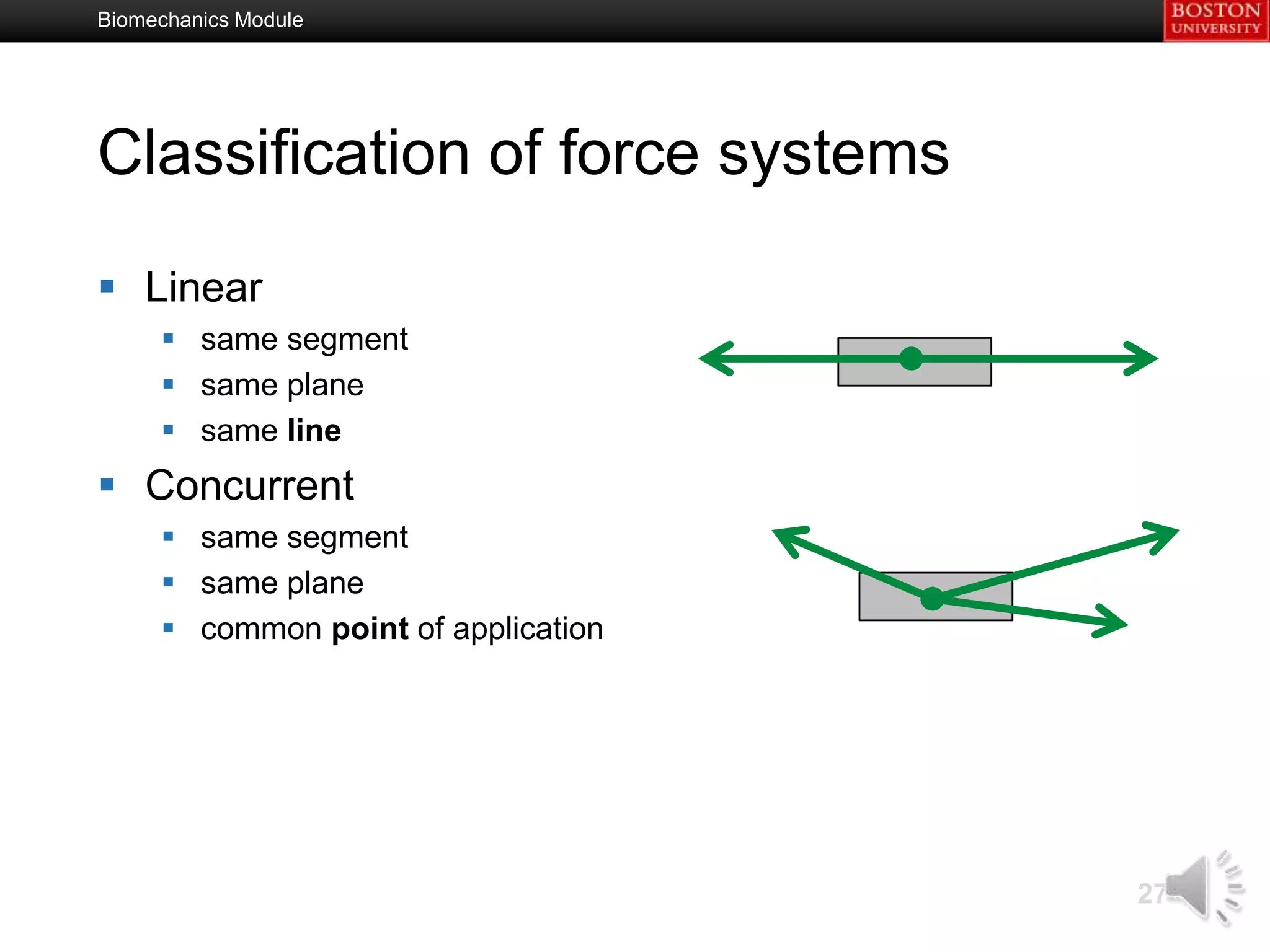
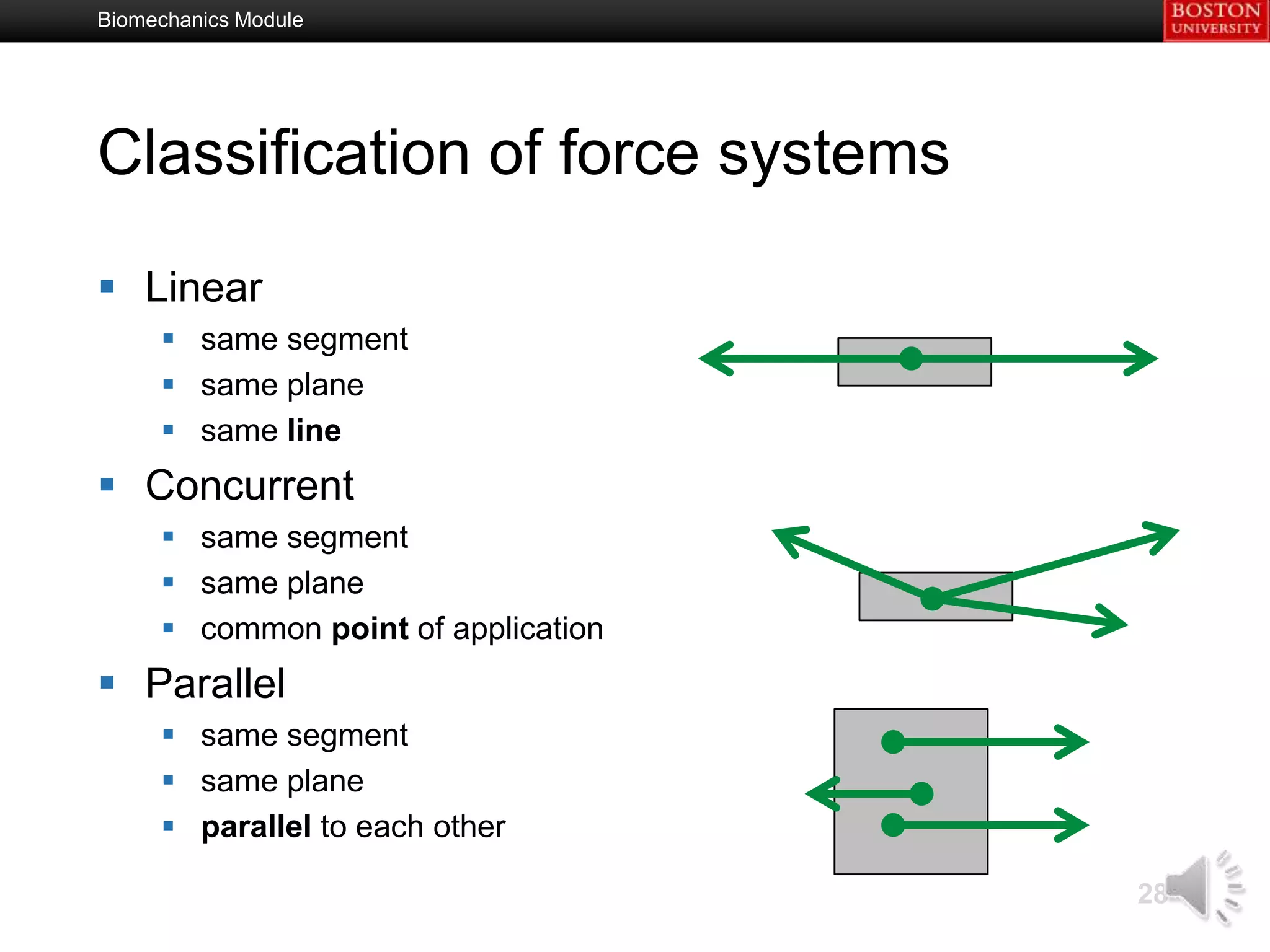
Overview of force systems classification including linear, concurrent, and parallel systems in biomechanics.
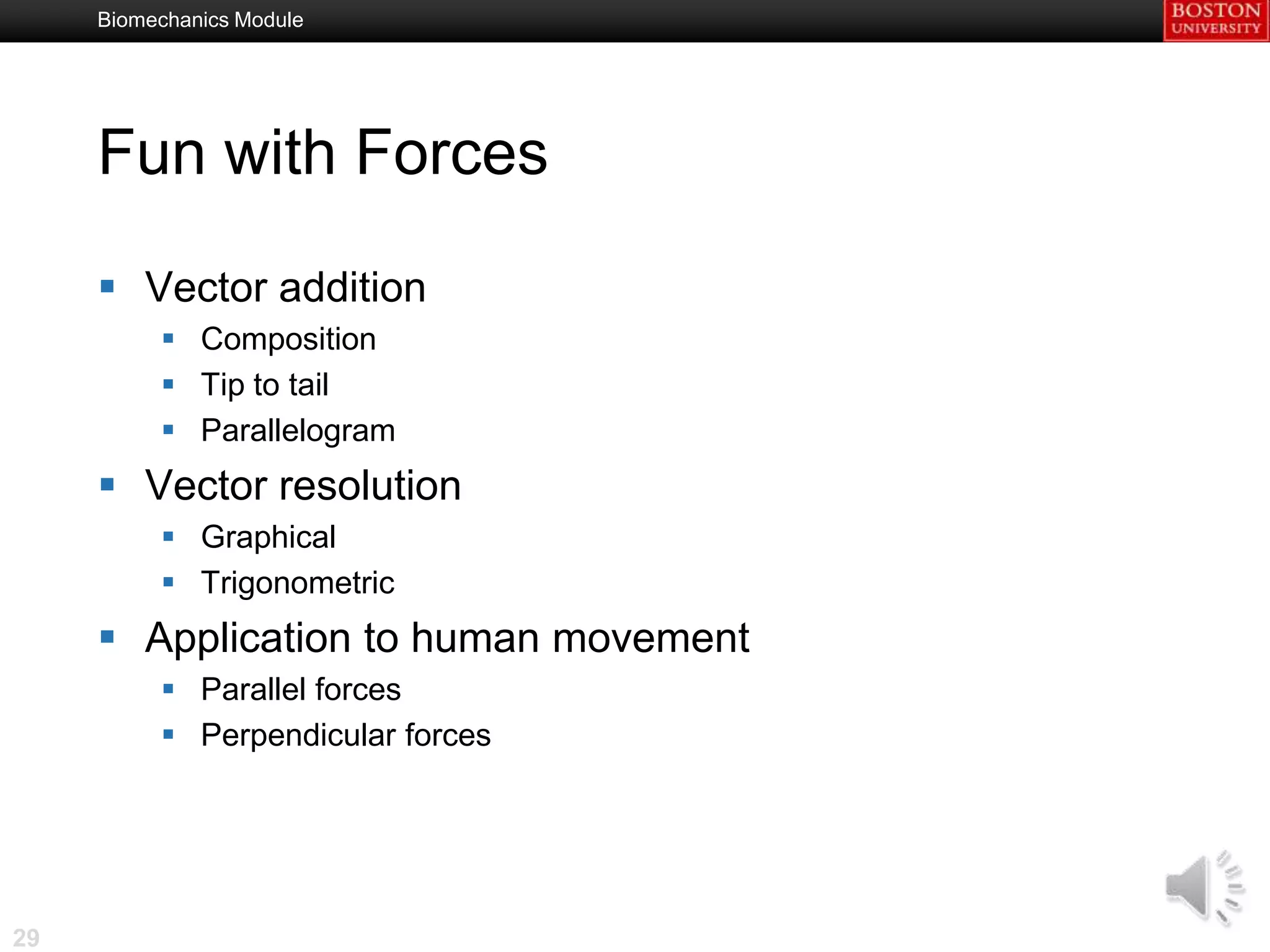
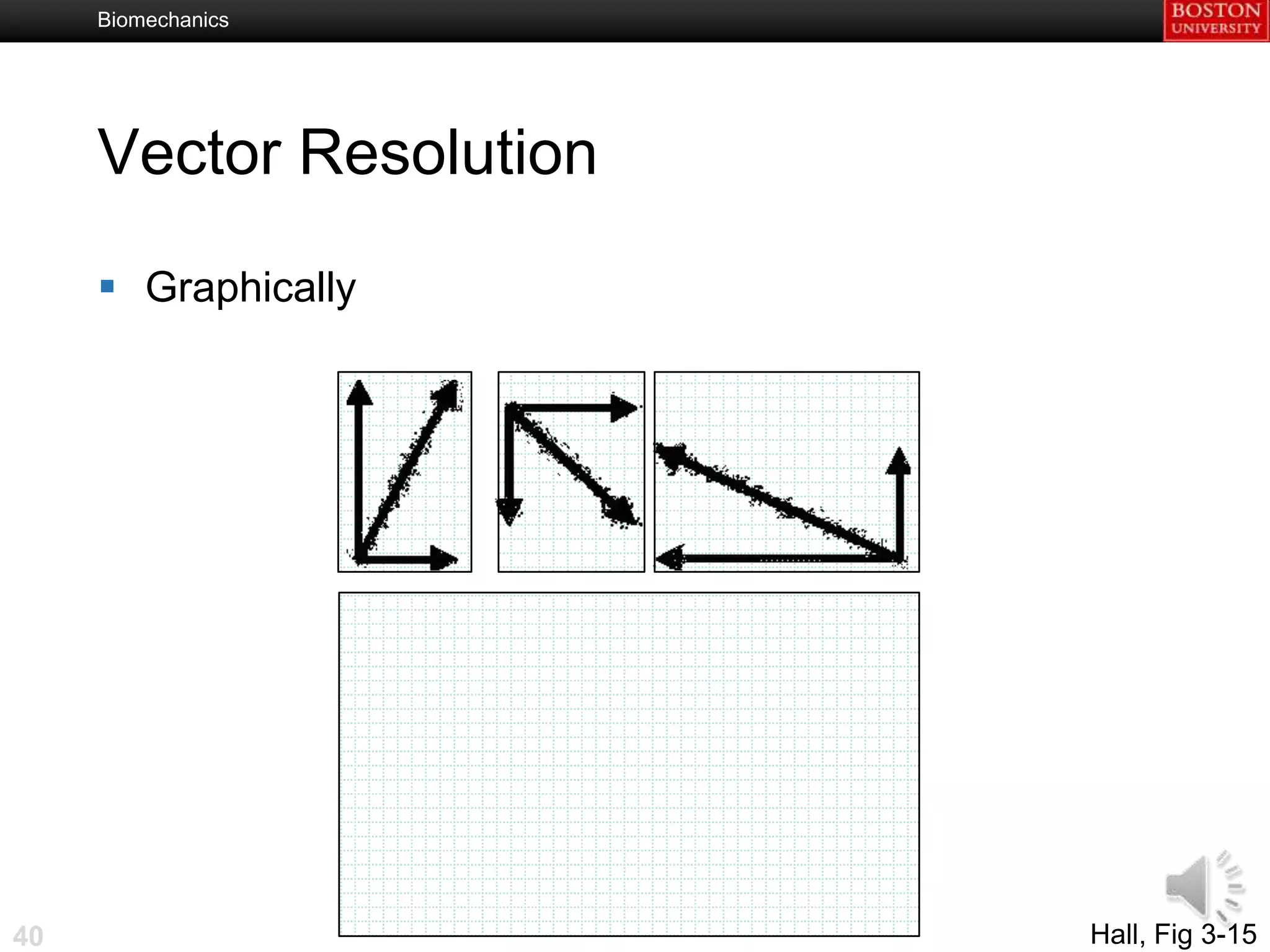
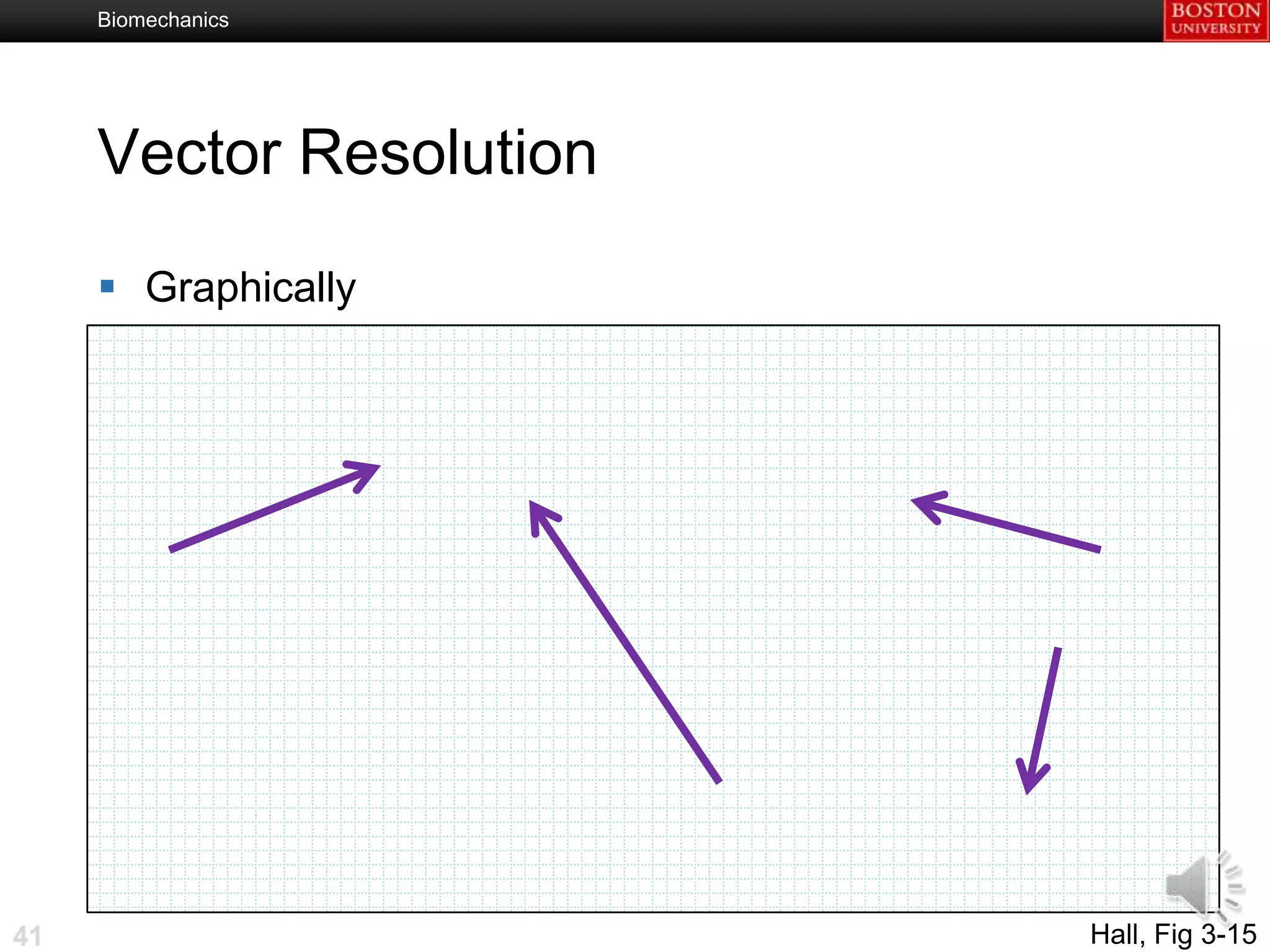
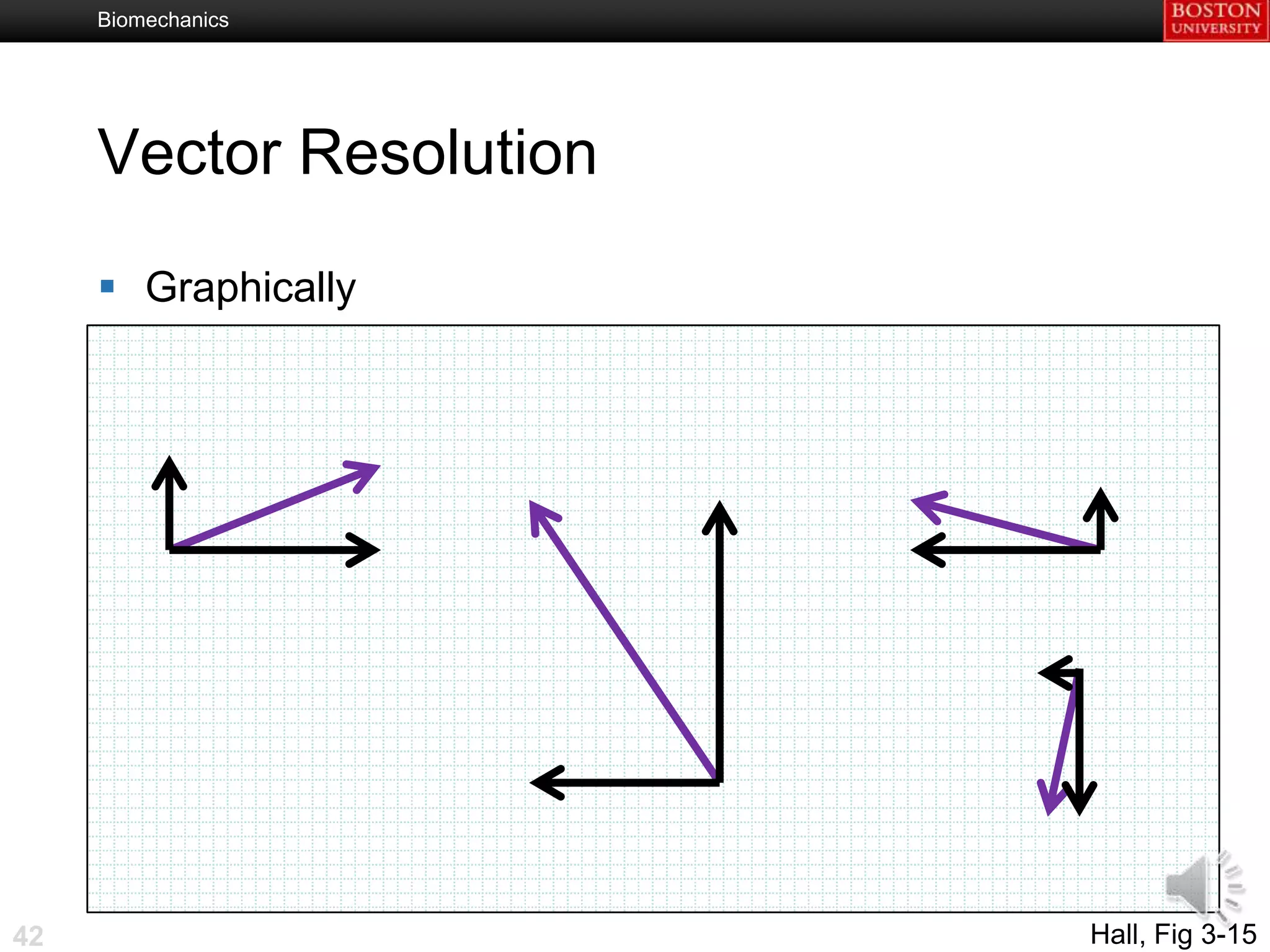
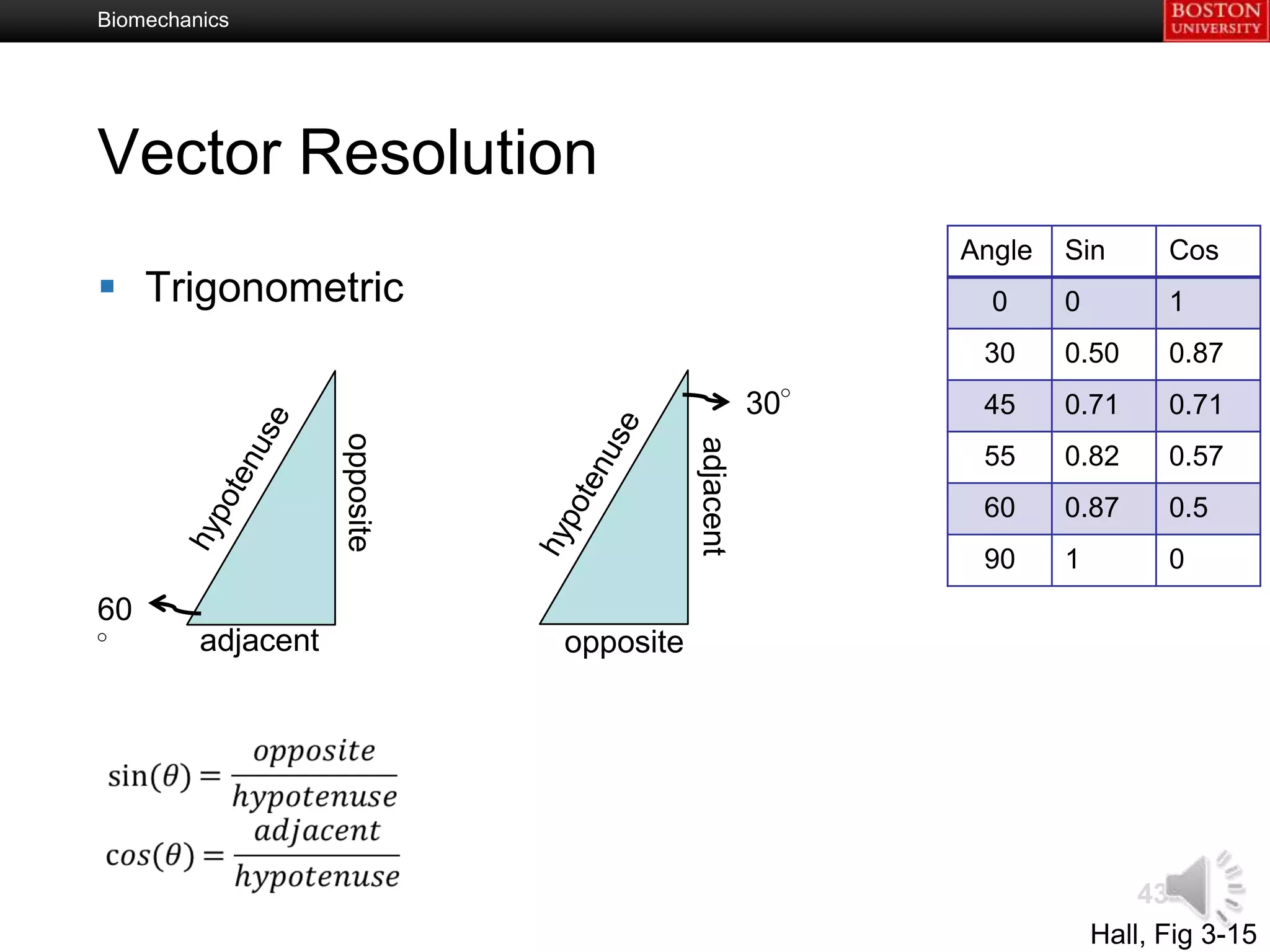
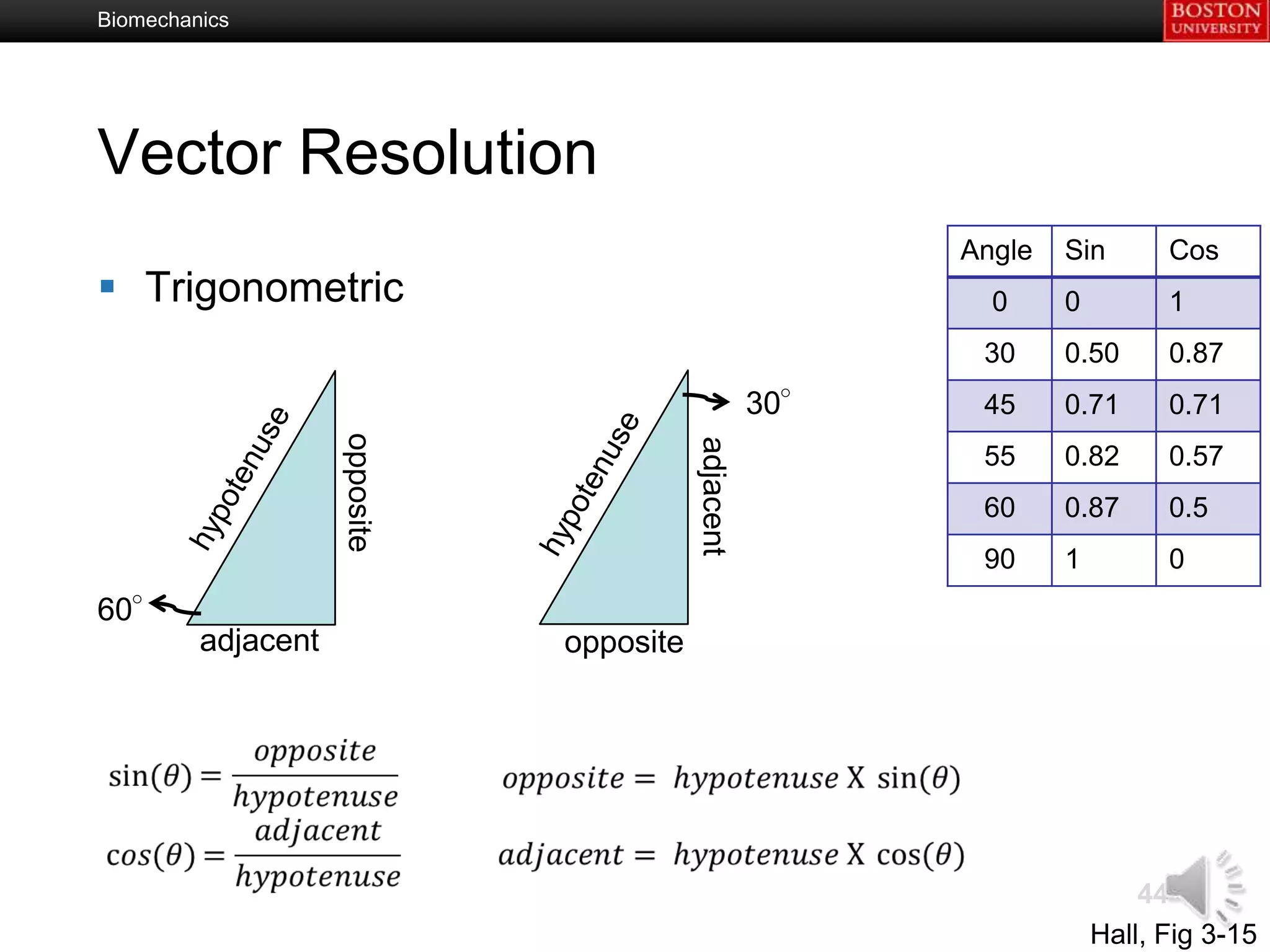
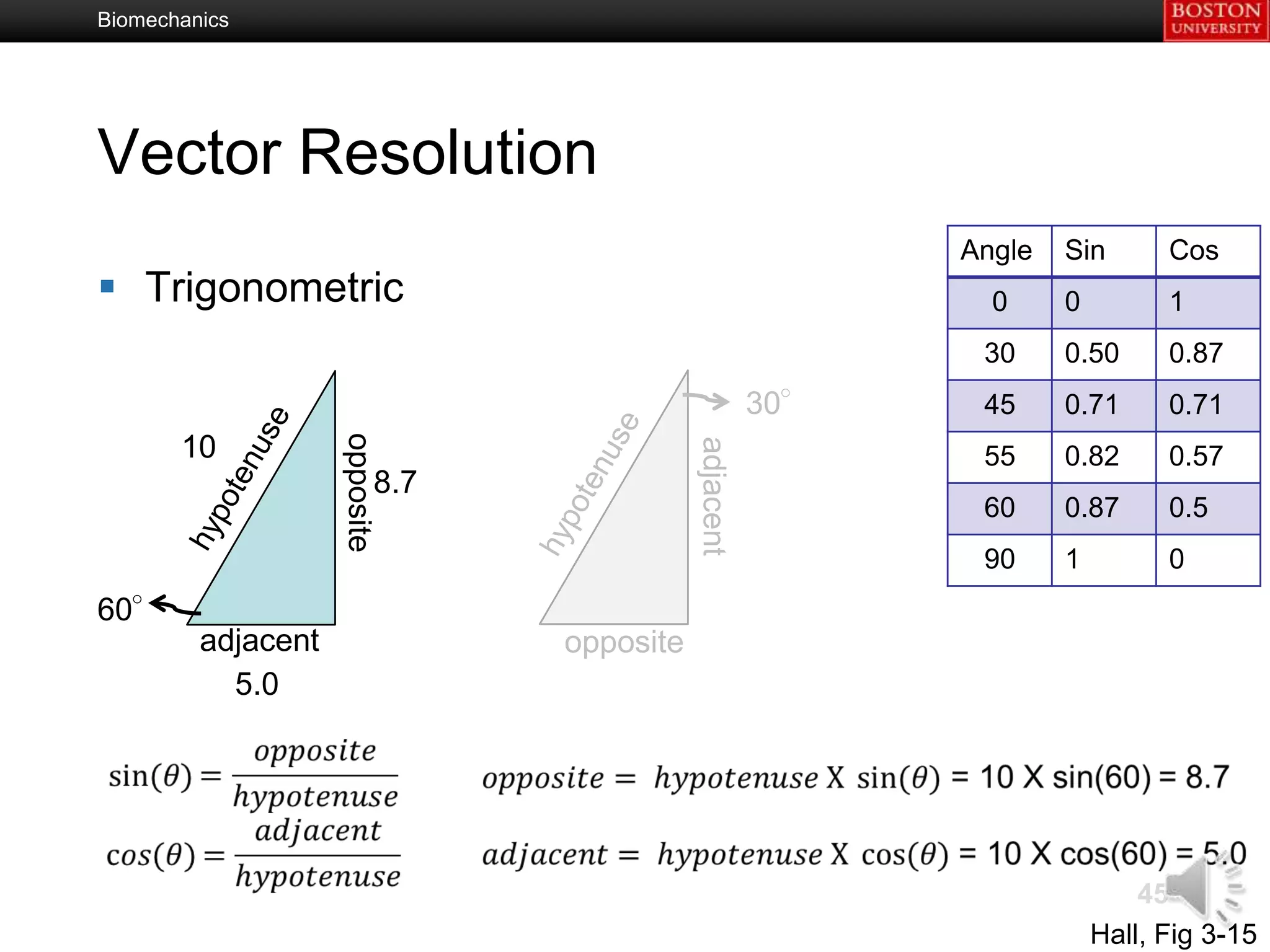
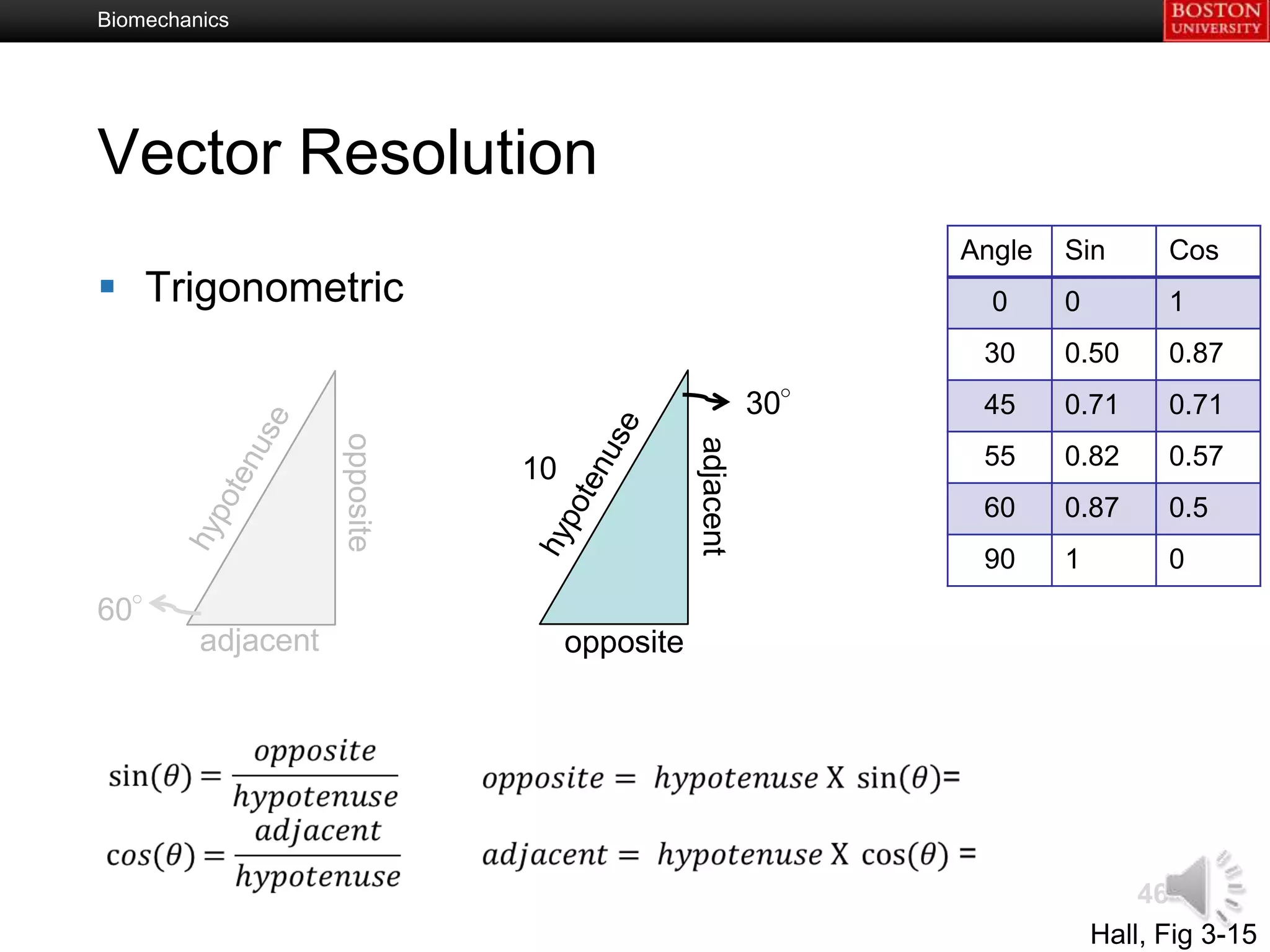
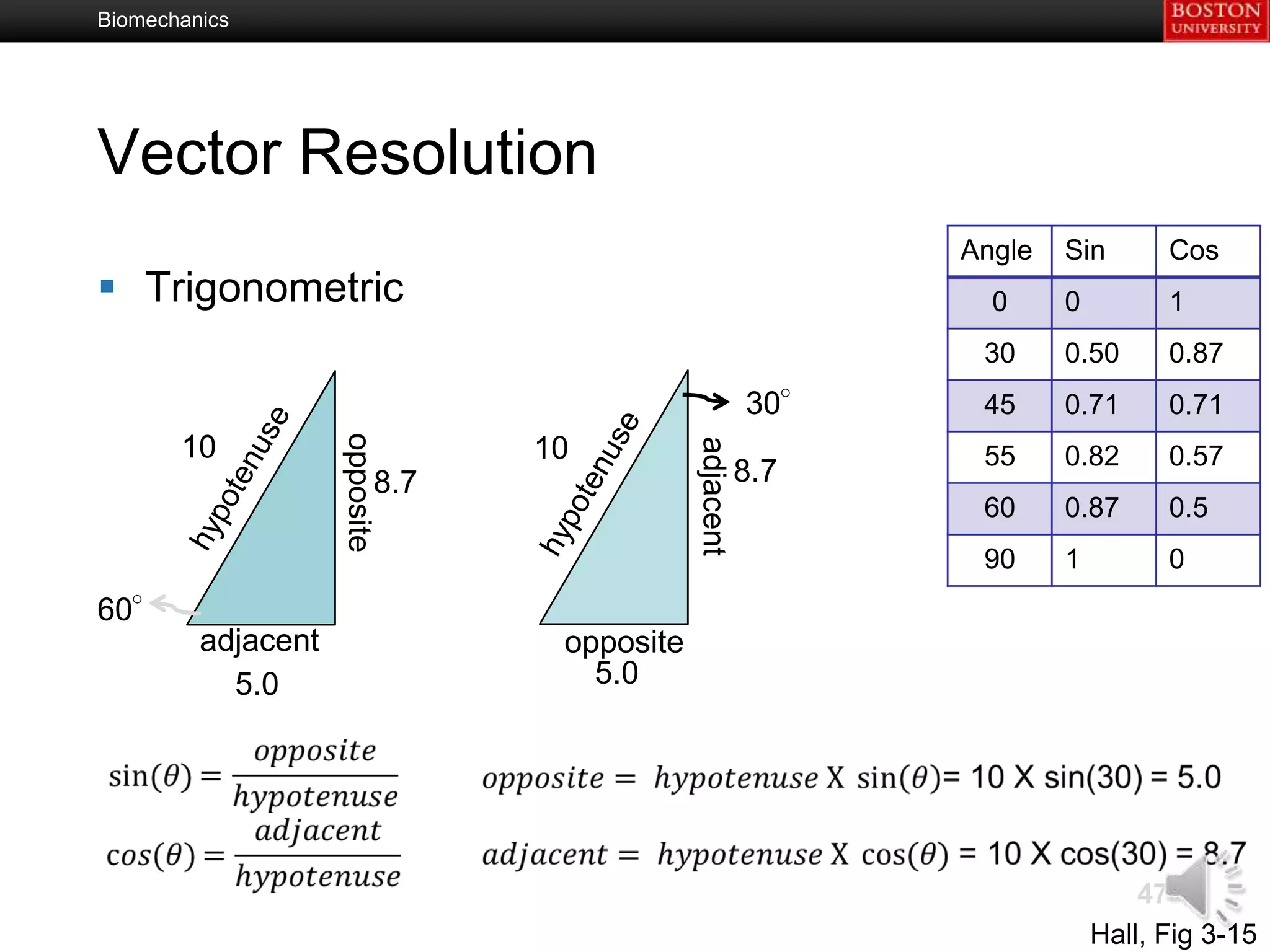
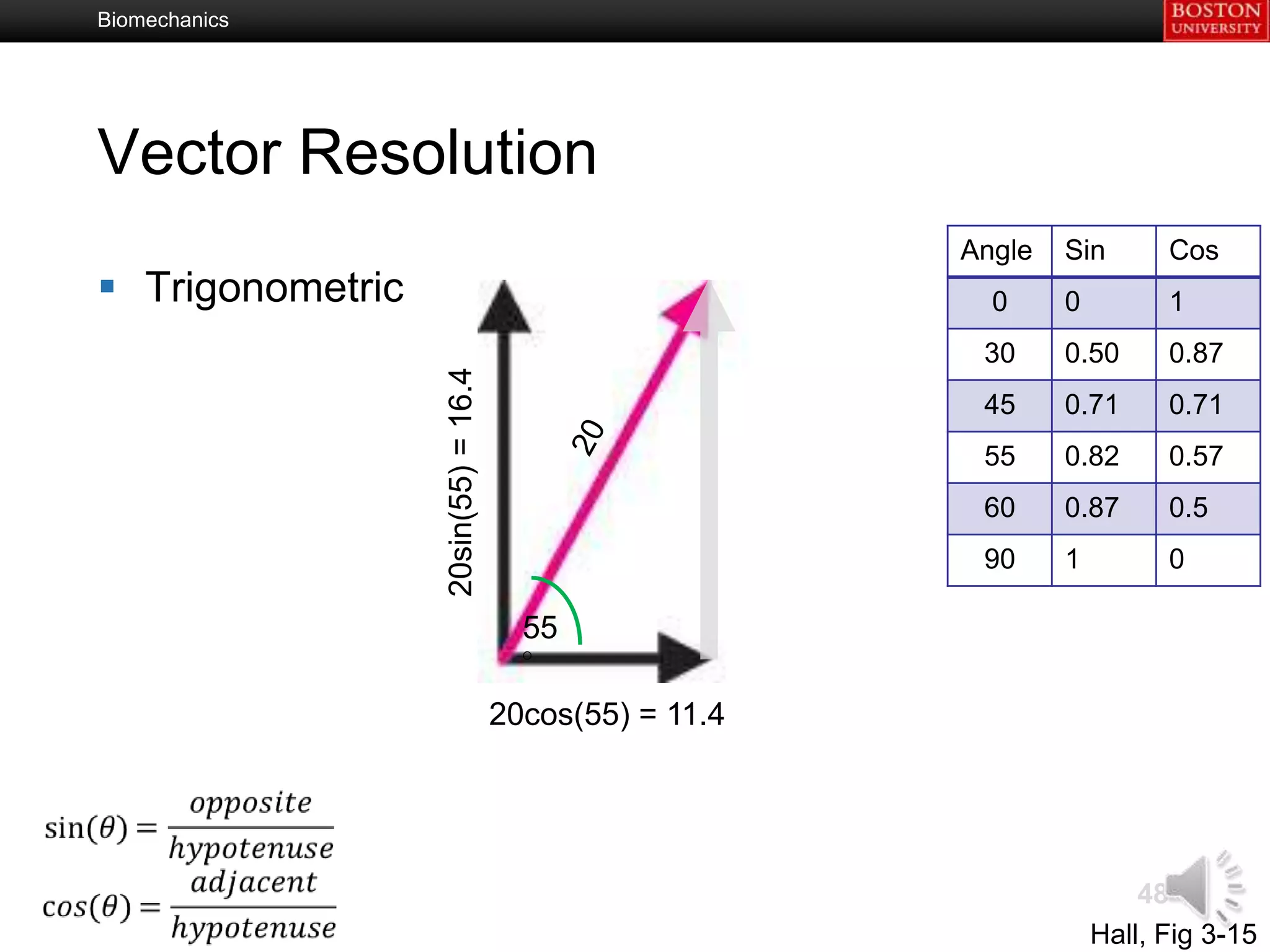
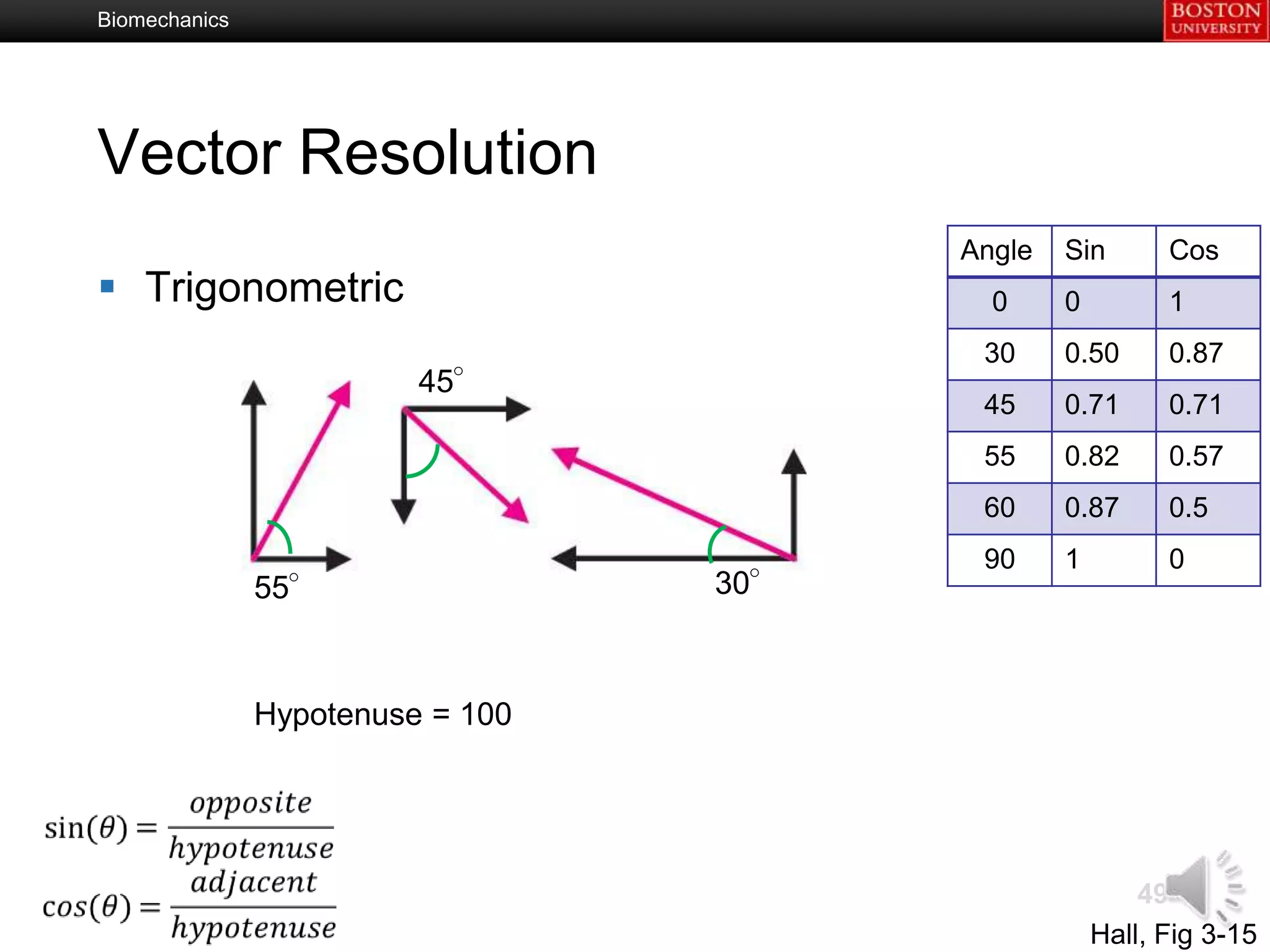
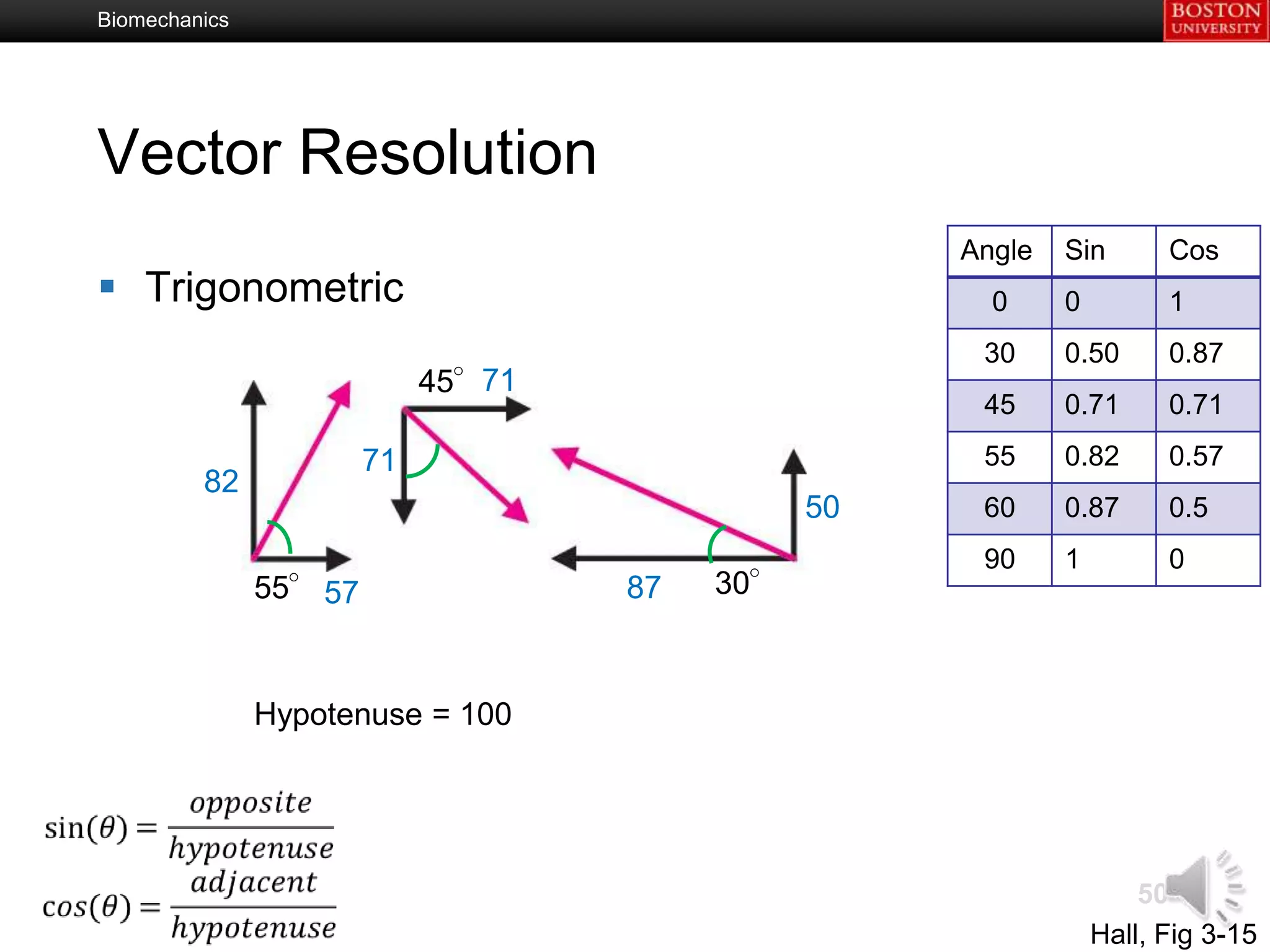
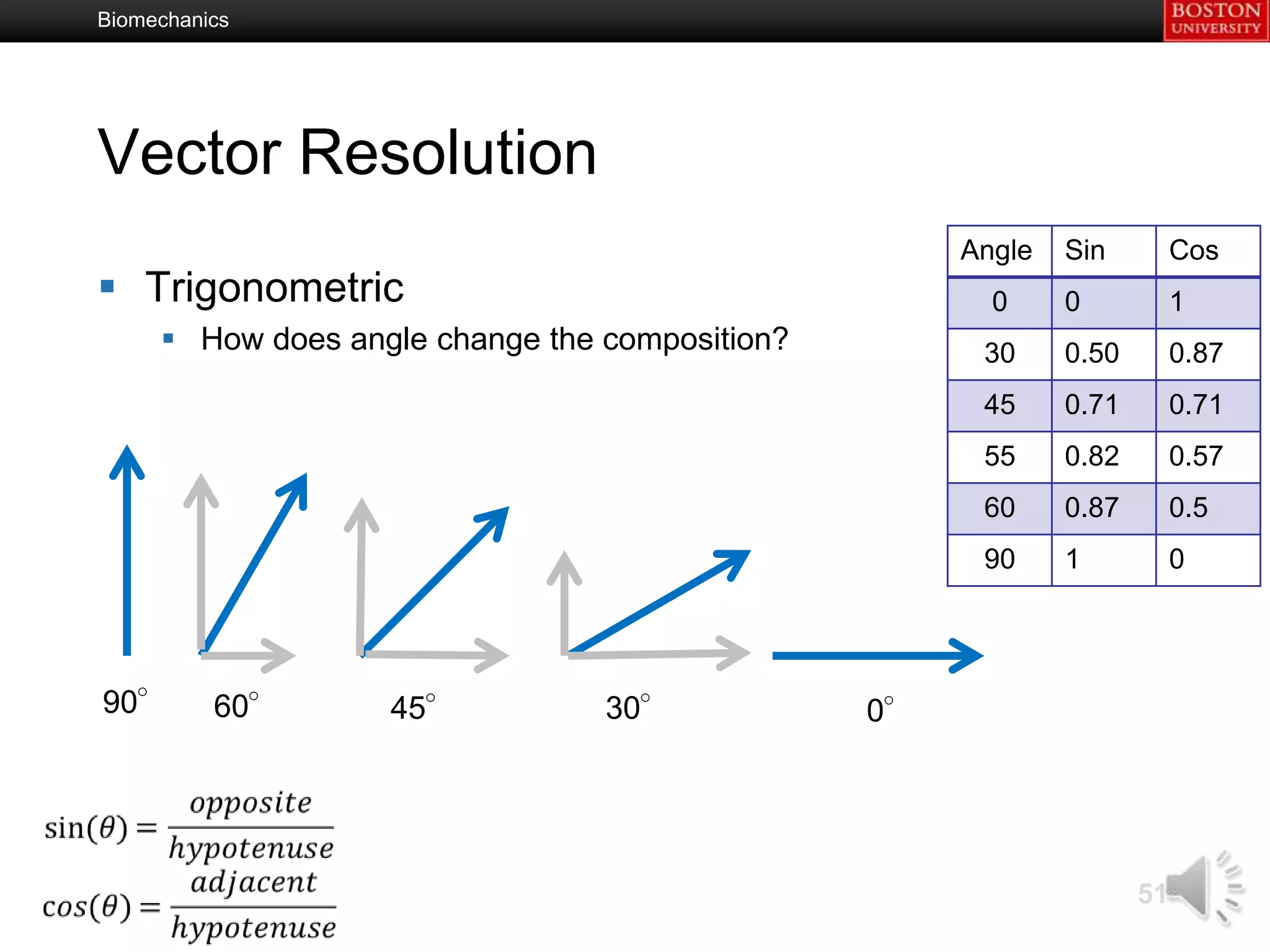
Intro to vector addition and resolution, illustrating how forces interact and apply to human movement.Methods for resolving vectors into components via graphic and trigonometric approaches.
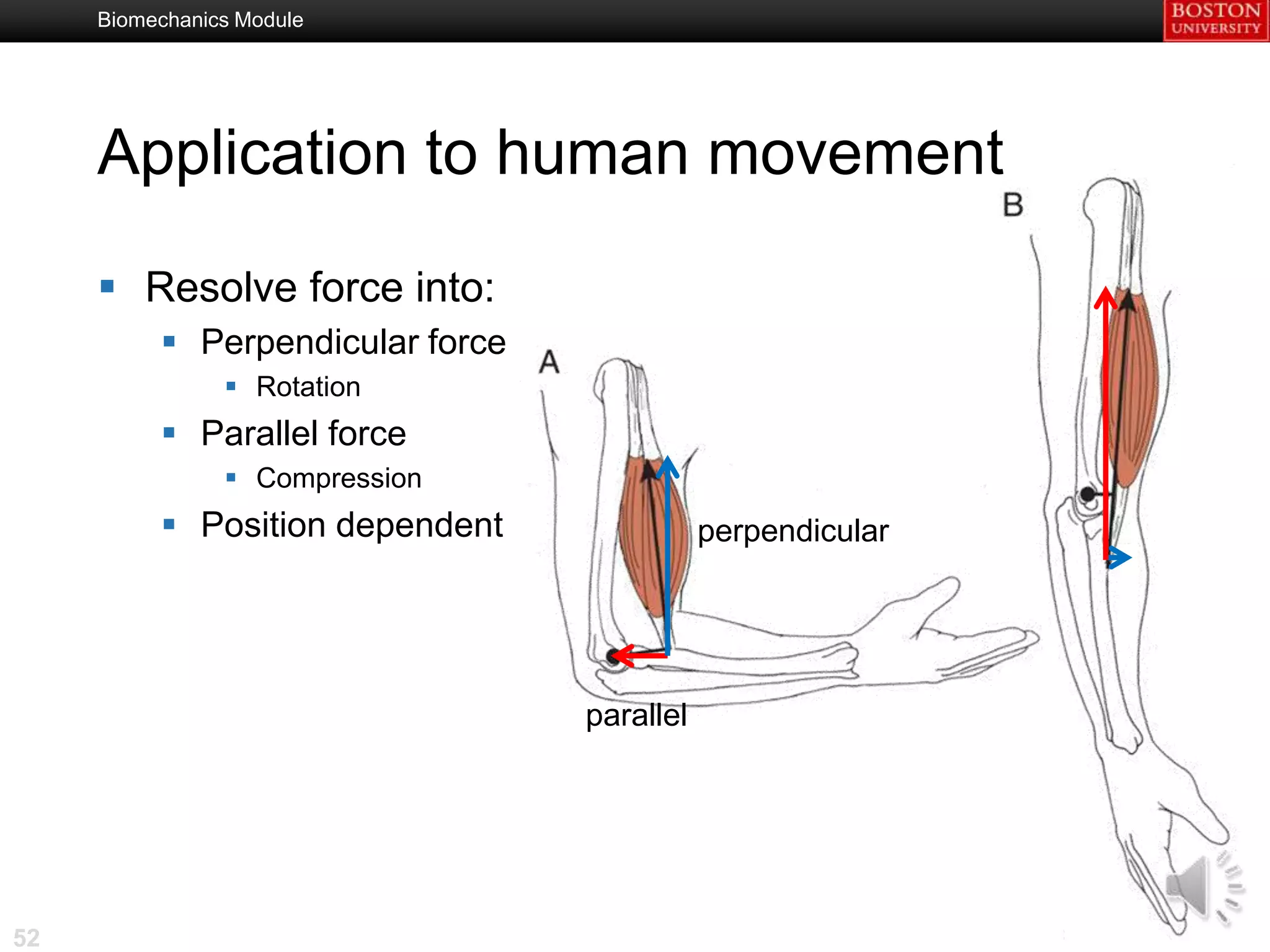
Application of vector resolution to human movement, highlighting perpendicular and parallel forces.
Wrap-up of the Biomechanics Module with a reminder to complete the quiz for assessment.
Biomechanics Module
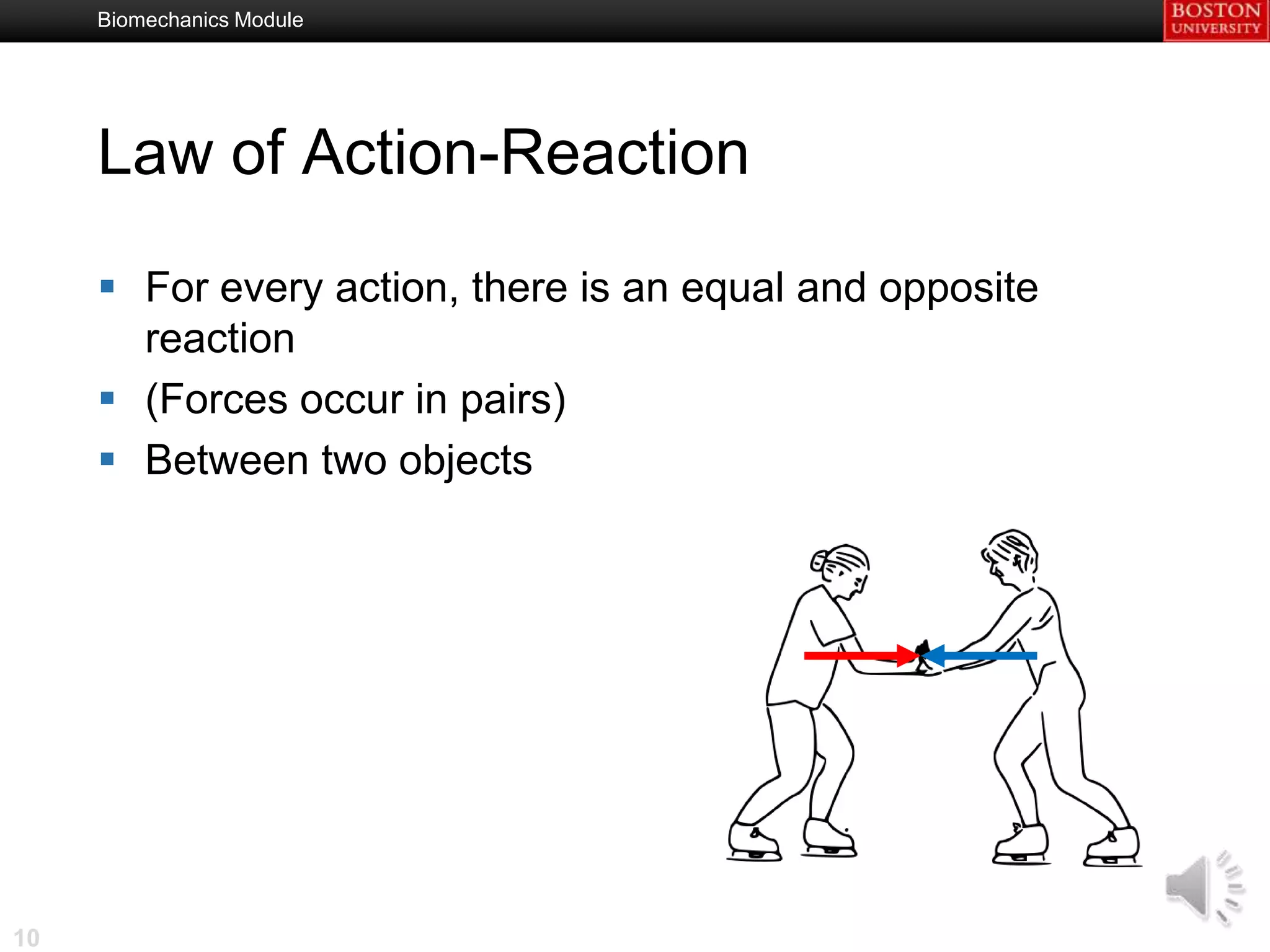
Law of Action-Reaction
For every action, there is an equal and opposite
reaction
(Forces occur in pairs)
Between two objects
10
11.
Biomechanics Module
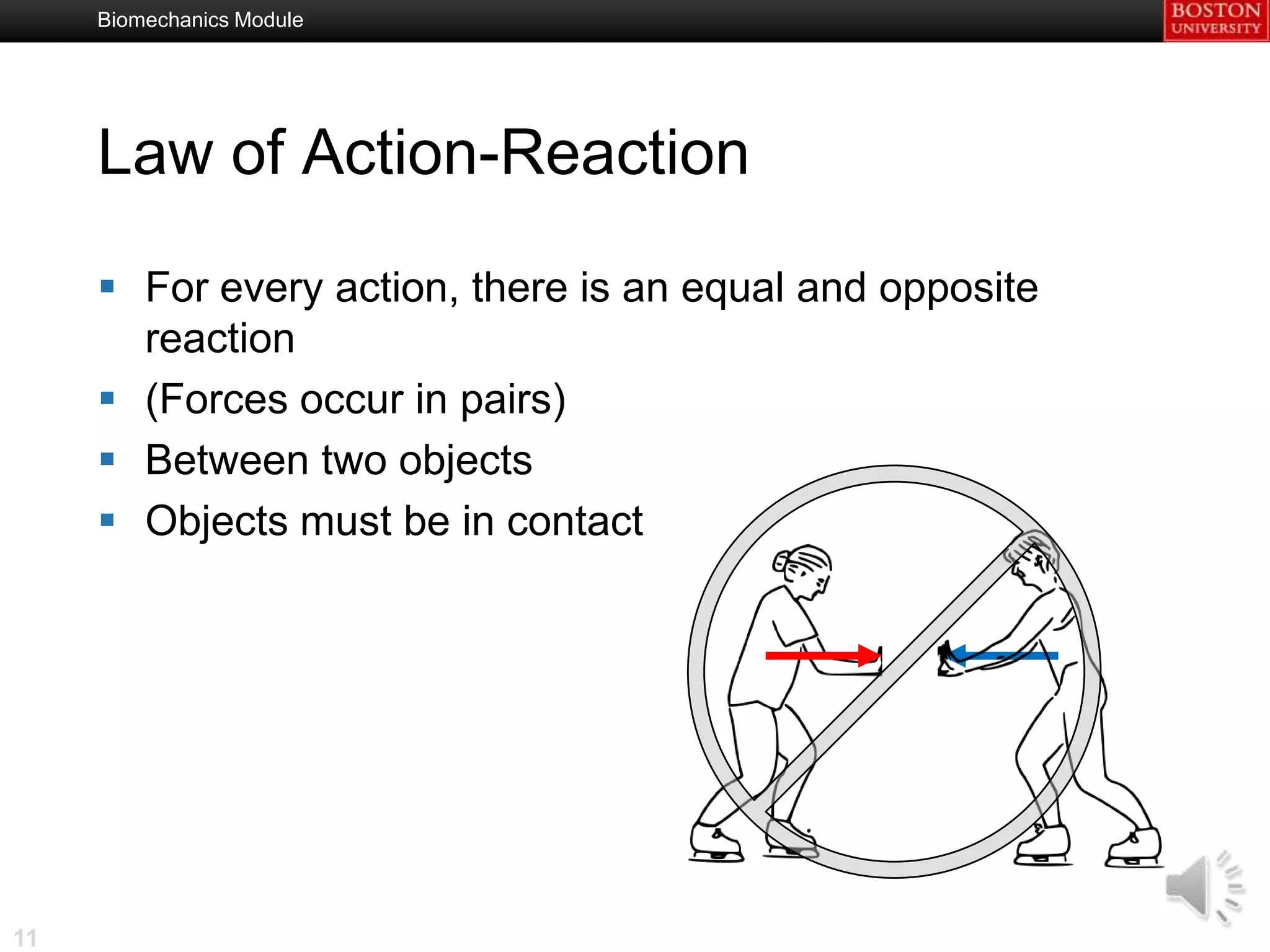
Law of Action-Reaction
For every action, there is an equal and opposite
reaction
(Forces occur in pairs)
Between two objects
Objects must be in contact
11
12.
Biomechanics Module
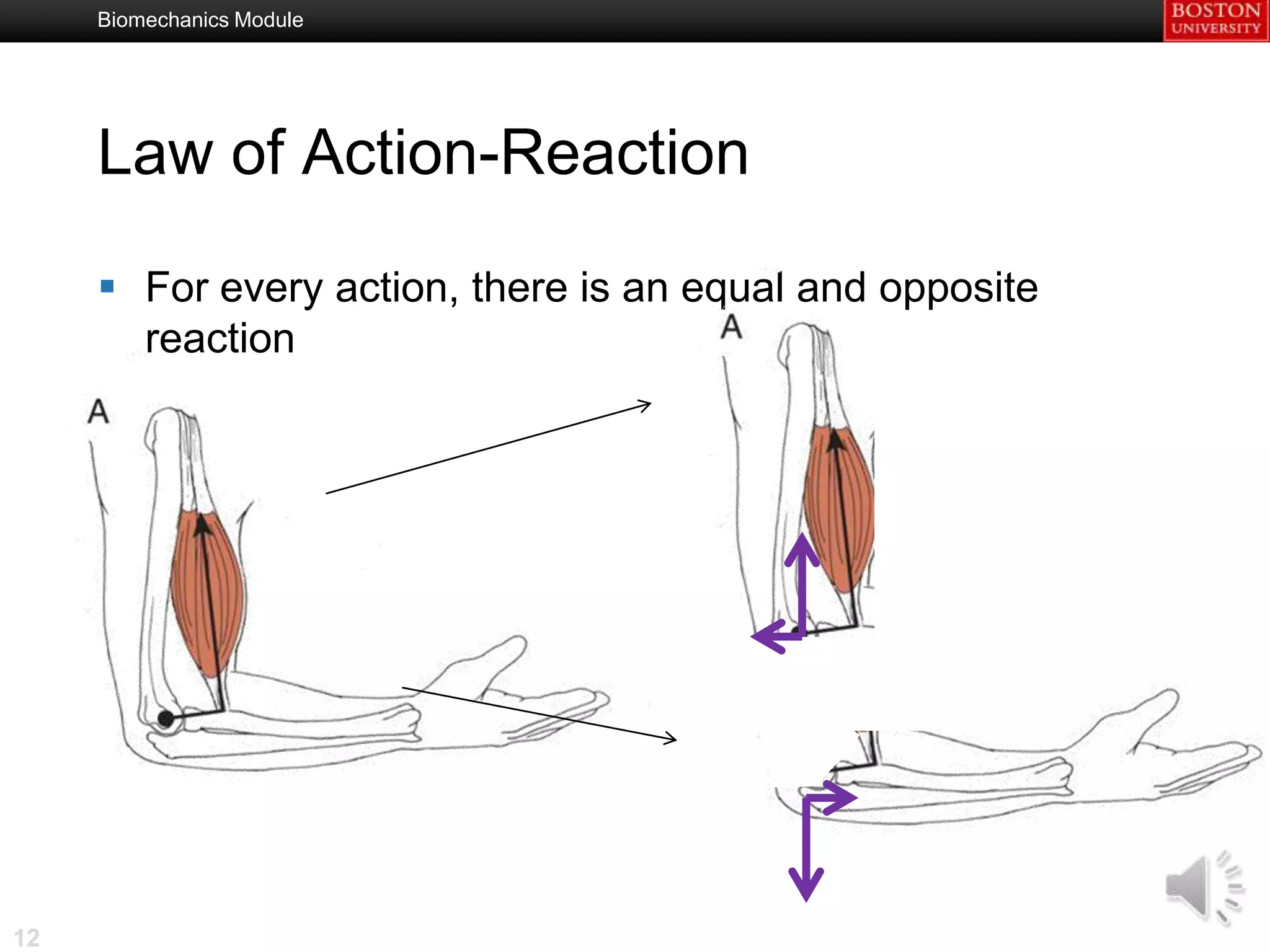
Law of Action-Reaction
For every action, there is an equal and opposite
reaction
12
Biomechanics Module
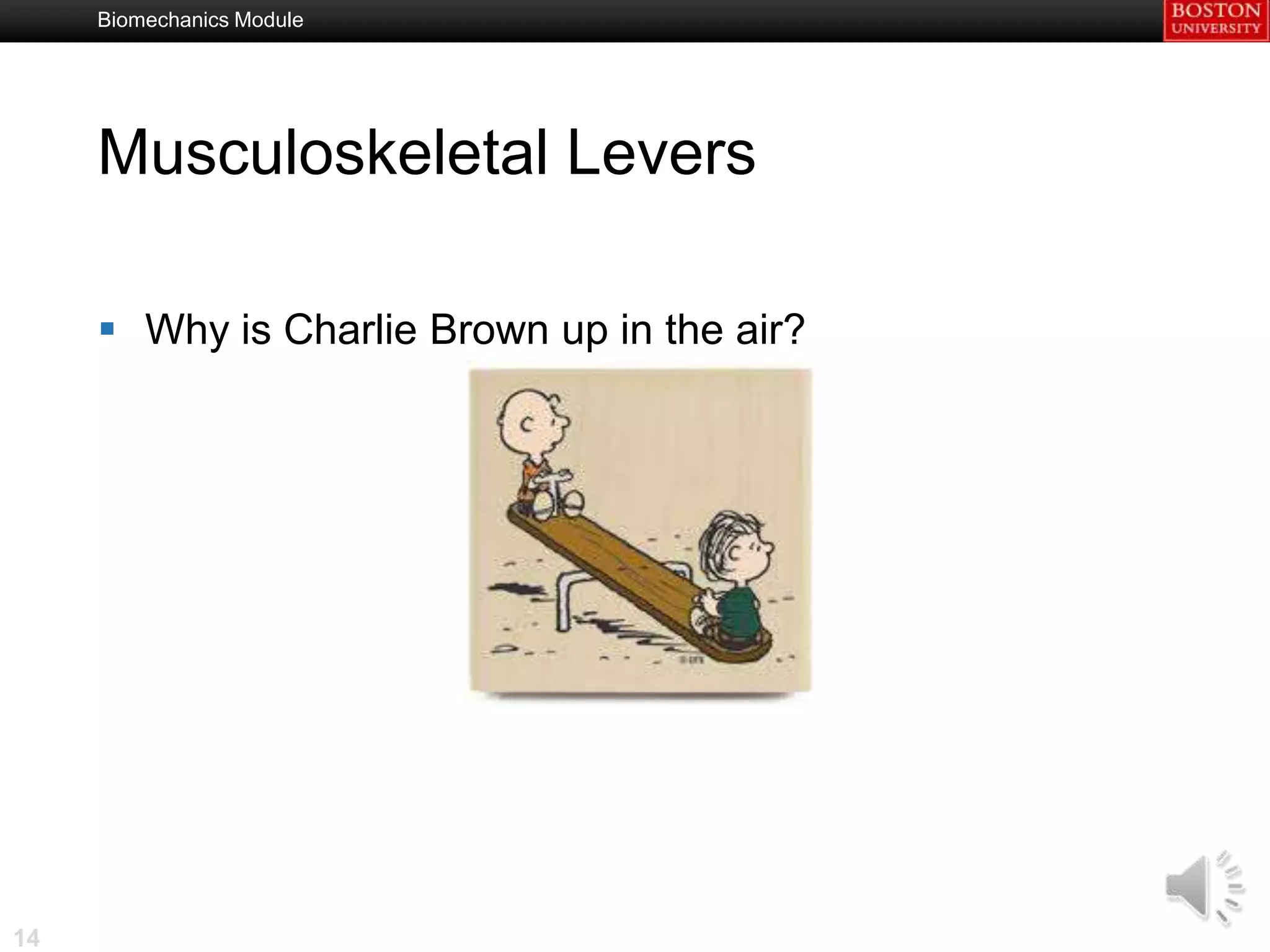
Musculoskeletal Levers
Why is Charlie Brown up in the air?
14
15.
Biomechanics Module
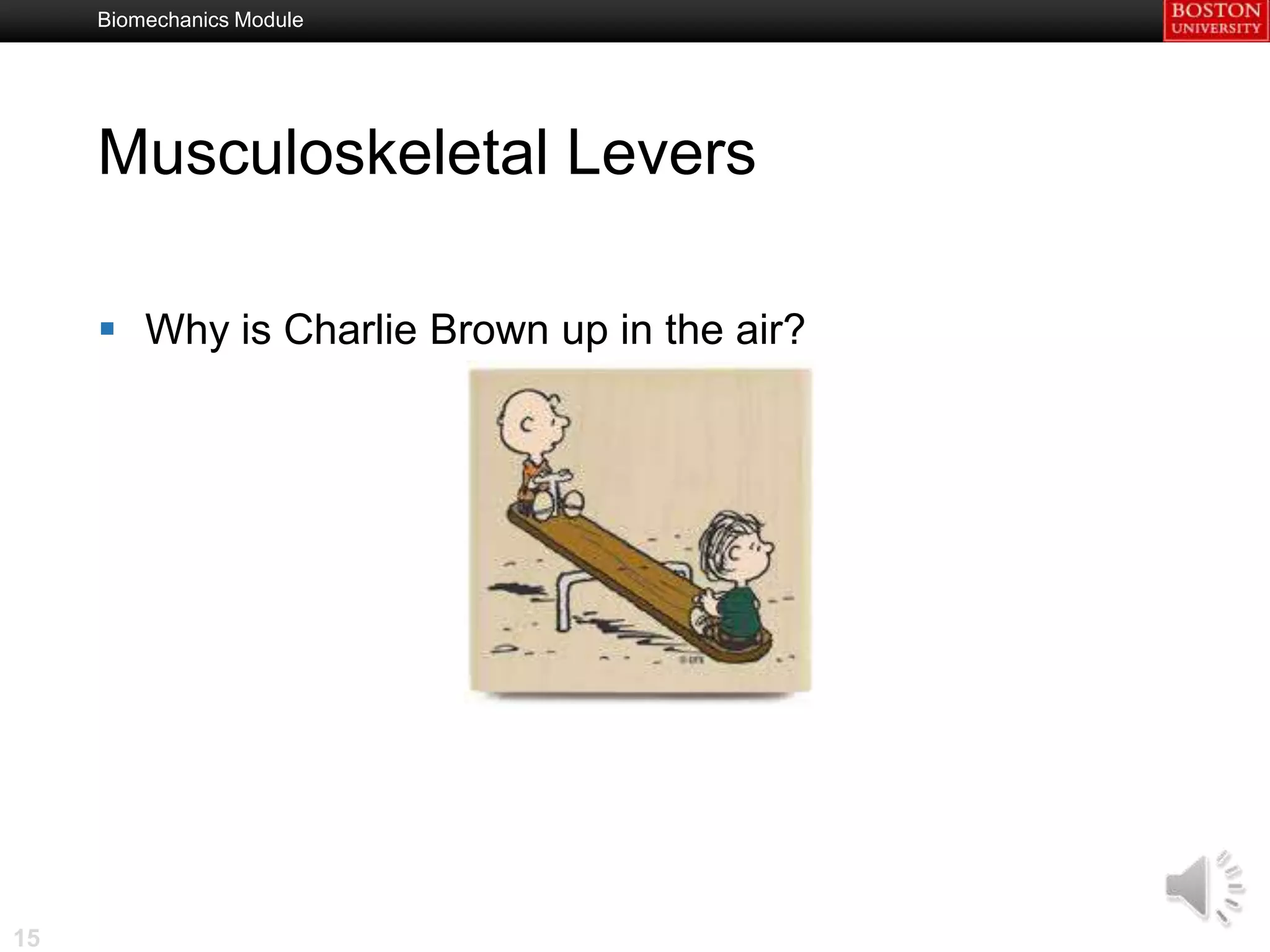
Musculoskeletal Levers
Why is Charlie Brown up in the air?
15
16.
Biomechanics Module
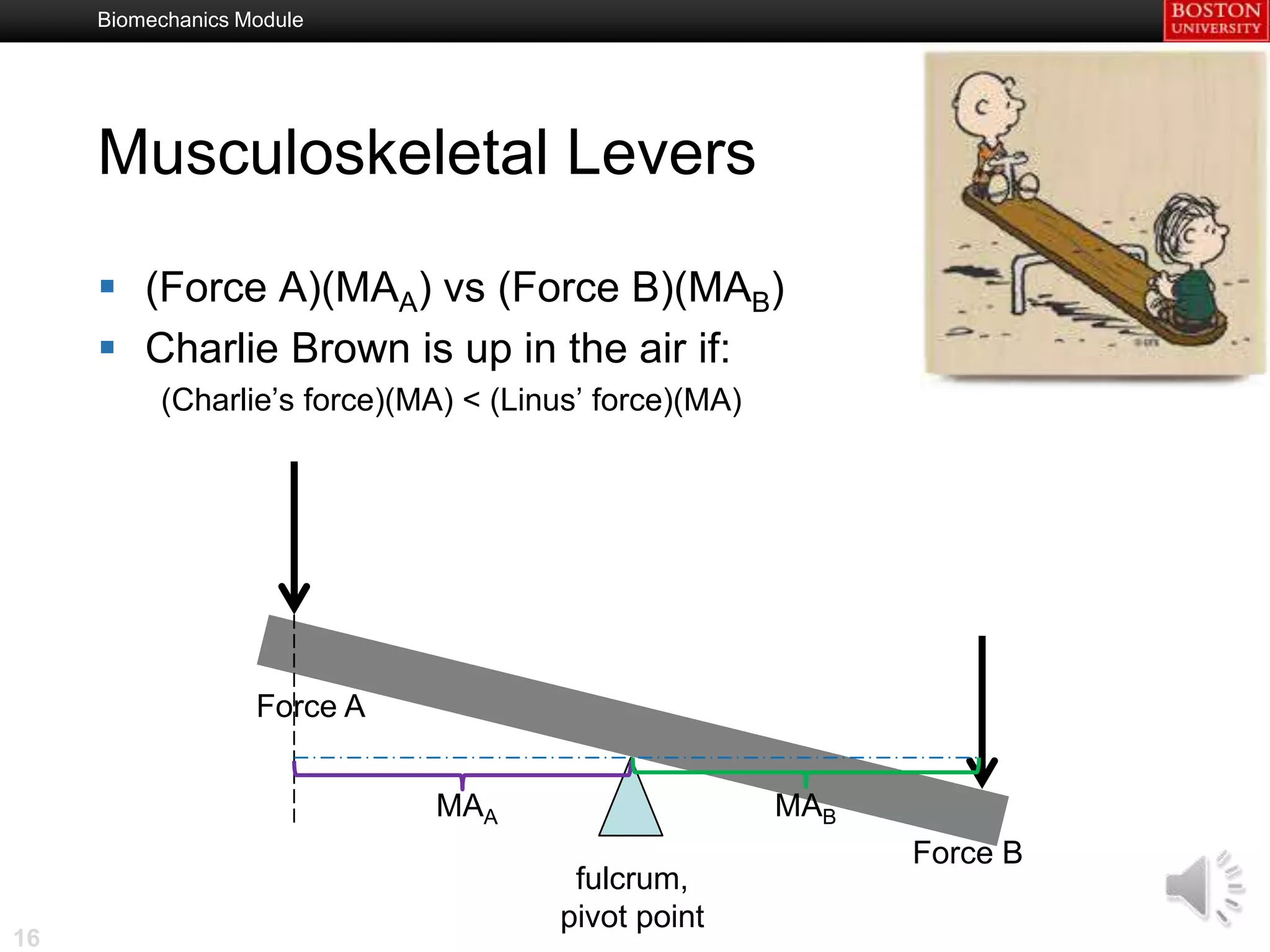
Musculoskeletal Levers
(Force A)(MAA) vs (Force B)(MAB)
Charlie Brown is up in the air if:
(Charlie’s force)(MA) < (Linus’ force)(MA)
Force A
MAA MAB
Force B
fulcrum,
pivot point
16
17.
Biomechanics Module
Musculoskeletal Levers
Interaction between the forces or loads on the
segment and the joint
Levers: two forces and a pivot point (fulcrum, axis)
Internal force (muscle)
External load (gravity etc)
Pivot point (joint)
(N.B. not consistent w/ Levangie)
17
18.
Biomechanics Module
Musculoskeletal Levers
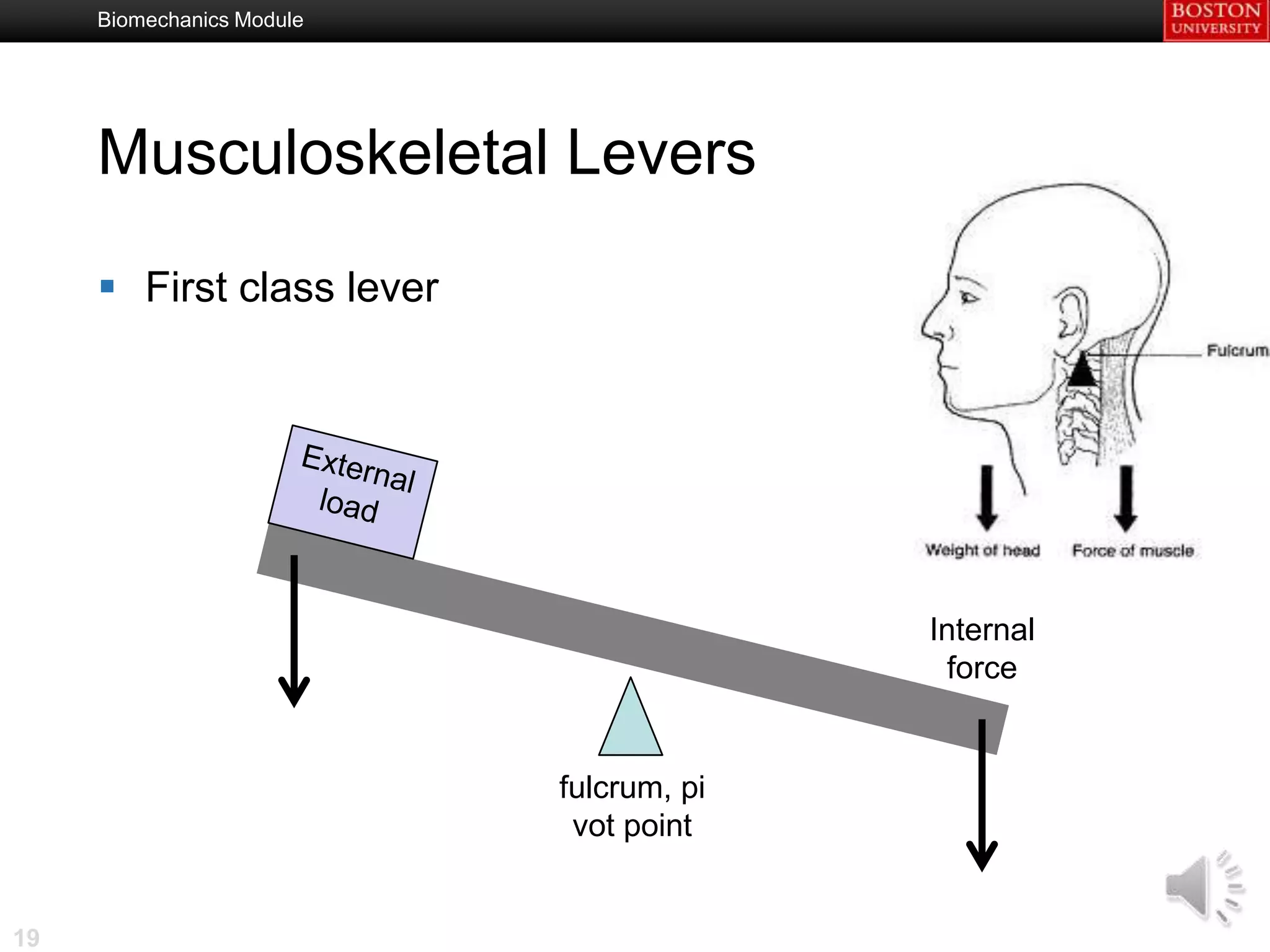
First class lever
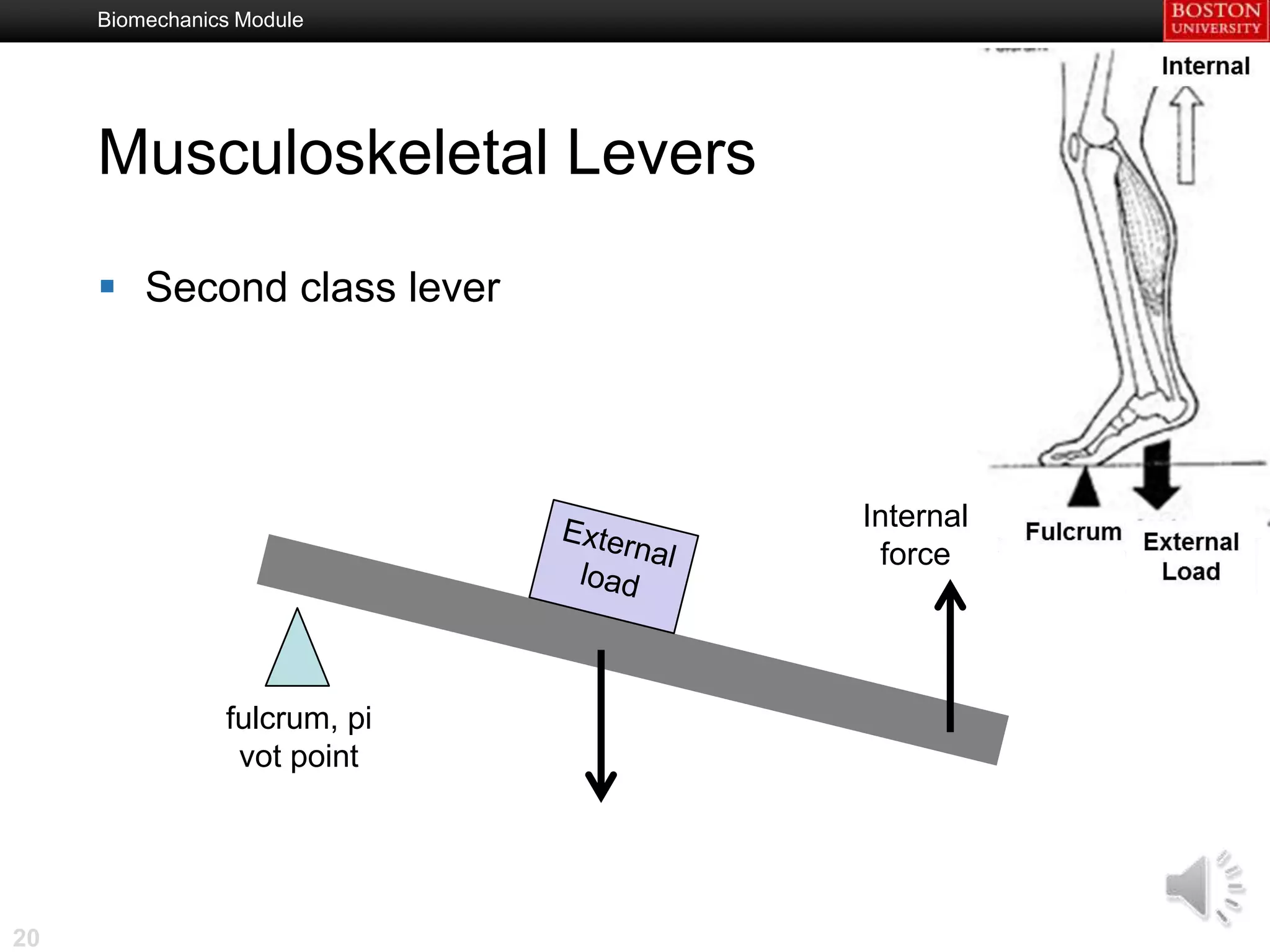
Second class lever
Third class lever
Differentiated by the relative position of the internal force, external
load, and pivot point
18
19.
Biomechanics Module
Musculoskeletal Levers
First class lever
Internal
force
fulcrum, pi
vot point
19
20.
Biomechanics Module
Musculoskeletal Levers
Second class lever
Internal
force
fulcrum, pi
vot point
20
21.
Biomechanics Module
Musculoskeletal Levers
Third class lever
Internal
force
fulcrum,
pivot point
21
Biomechanics Module
Mechanical advantage
First Class Lever
Ext
Ext Int
Mech Adv = 1 if
fulcrum in middle
fulcrum,
pivot point
External MA = Internal MA
23
24.
Biomechanics Module
Mechanical advantage
Second Class Lever
Ext Int
Mech Adv > 1
fulcrum
External MA < Internal MA
24
25.
Biomechanics Module
Mechanical advantage
Third Class Lever
Int Ext
Mech Adv < 1
fulcrum
External MA > Internal MA
25
Biomechanics Module
Classification offorce systems
Linear
same segment
same plane
same line
Concurrent
same segment
same plane
common point of application
27
28.
Biomechanics Module
Classification offorce systems
Linear
same segment
same plane
same line
Concurrent
same segment
same plane
common point of application
Parallel
same segment
same plane
parallel to each other
28
29.
Biomechanics Module
Fun with Forces
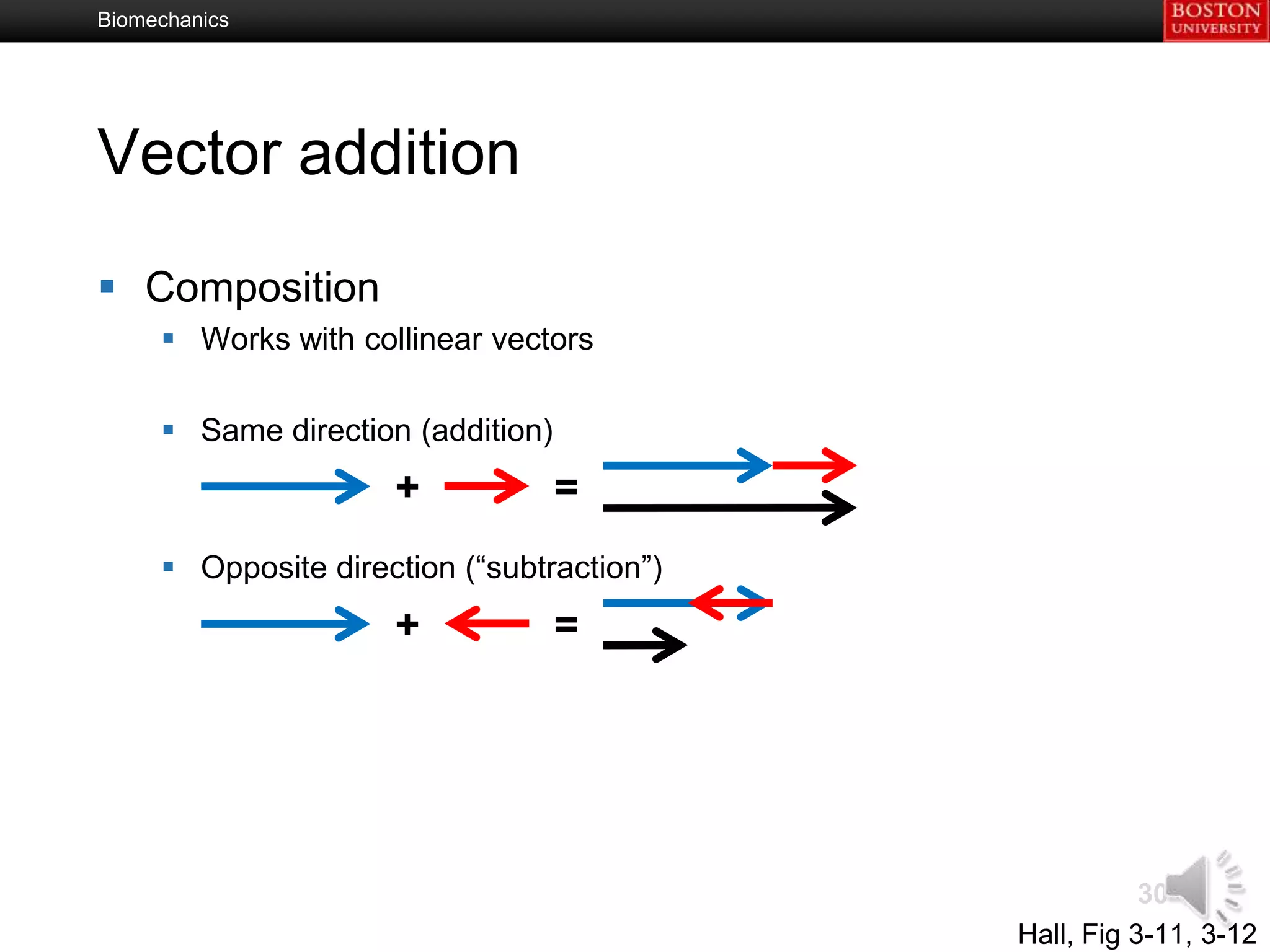
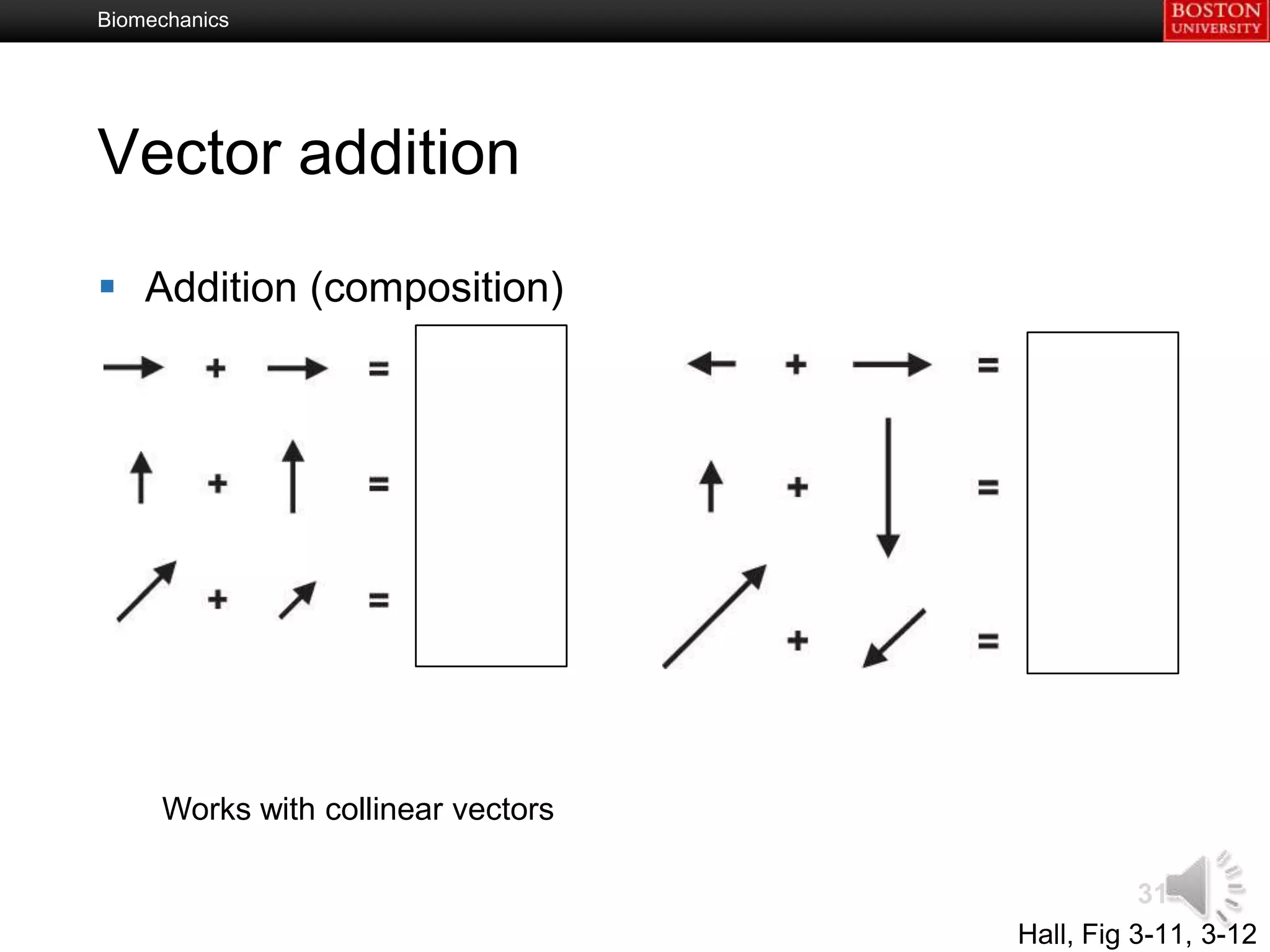
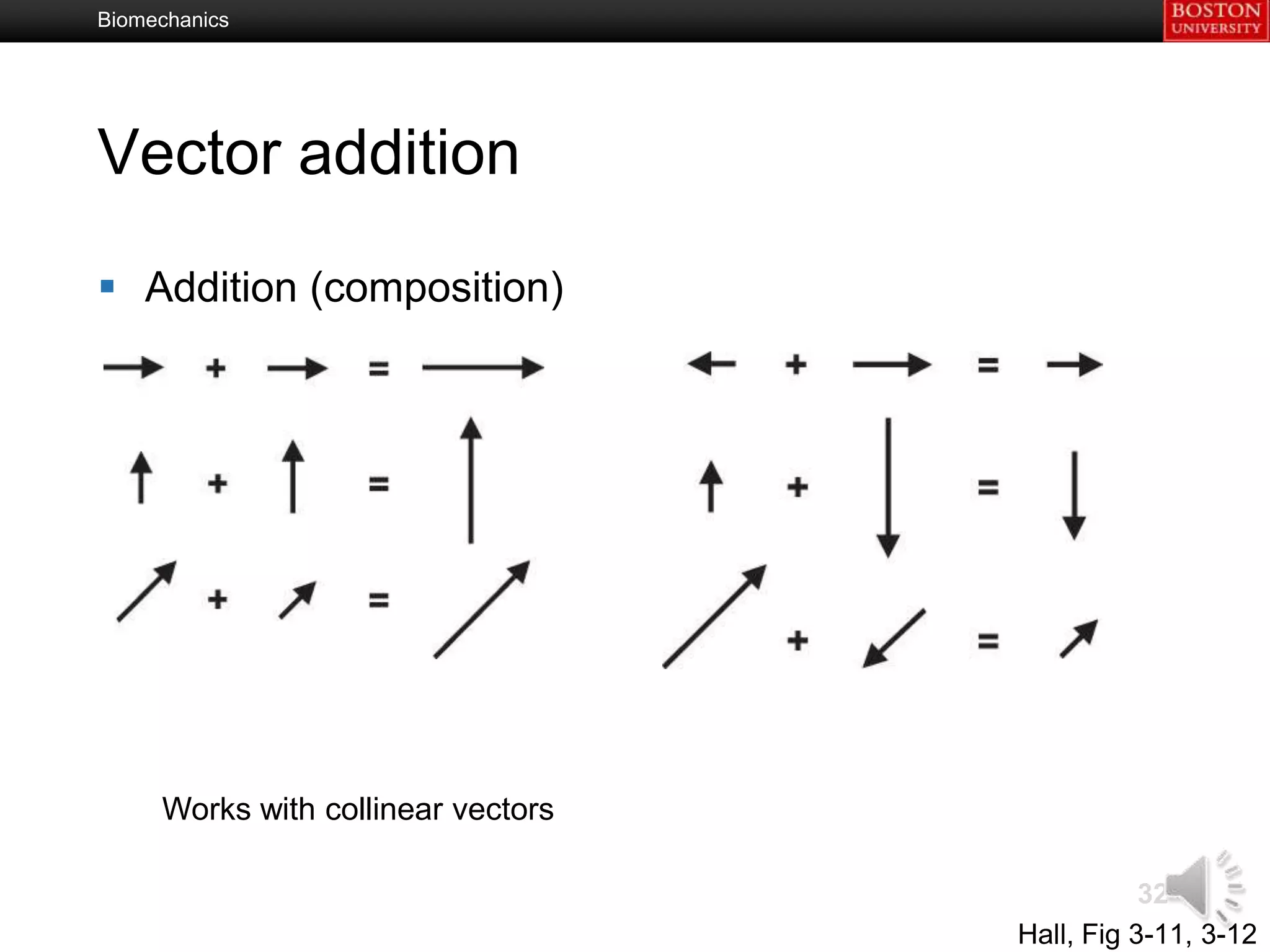
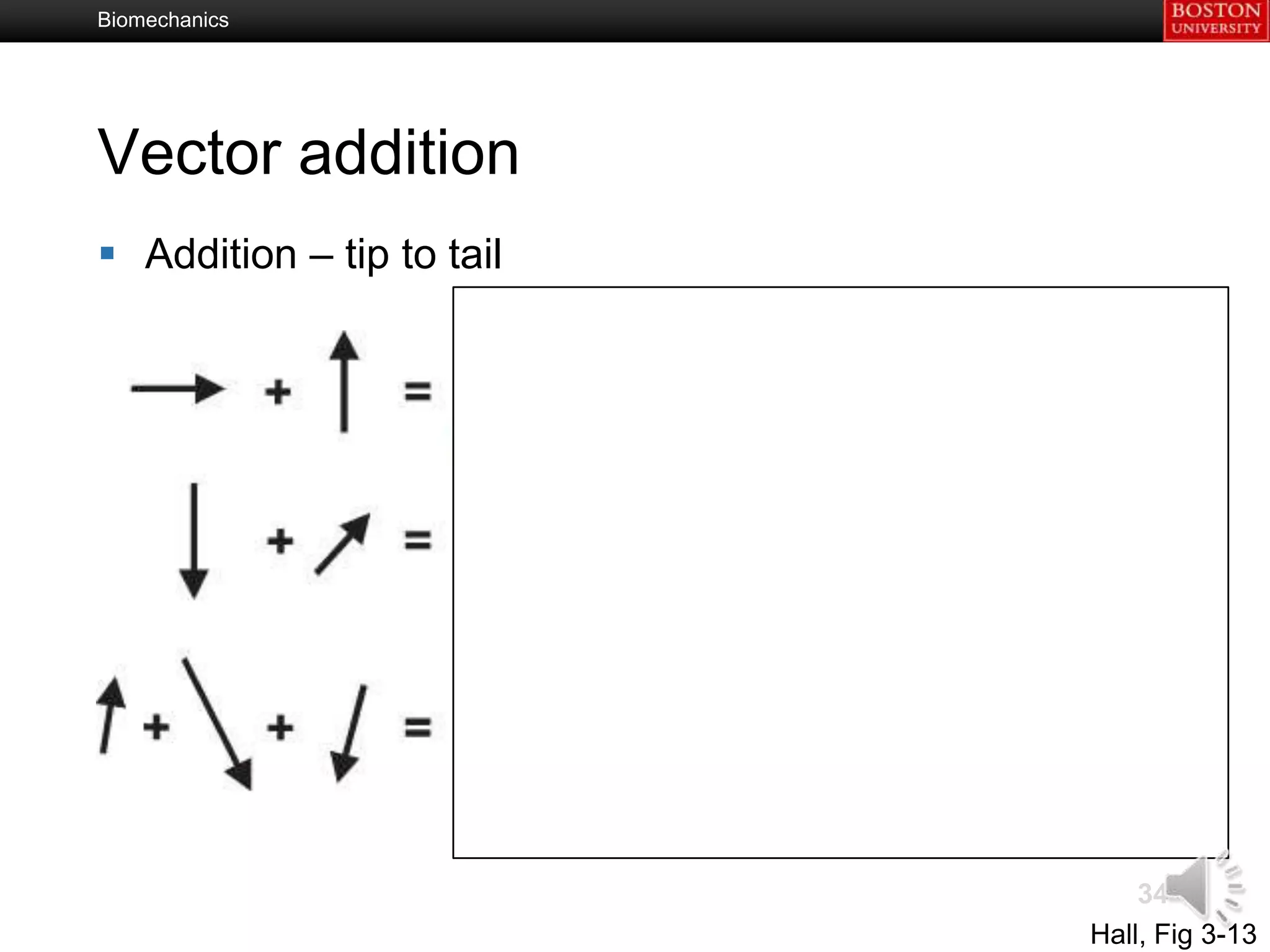
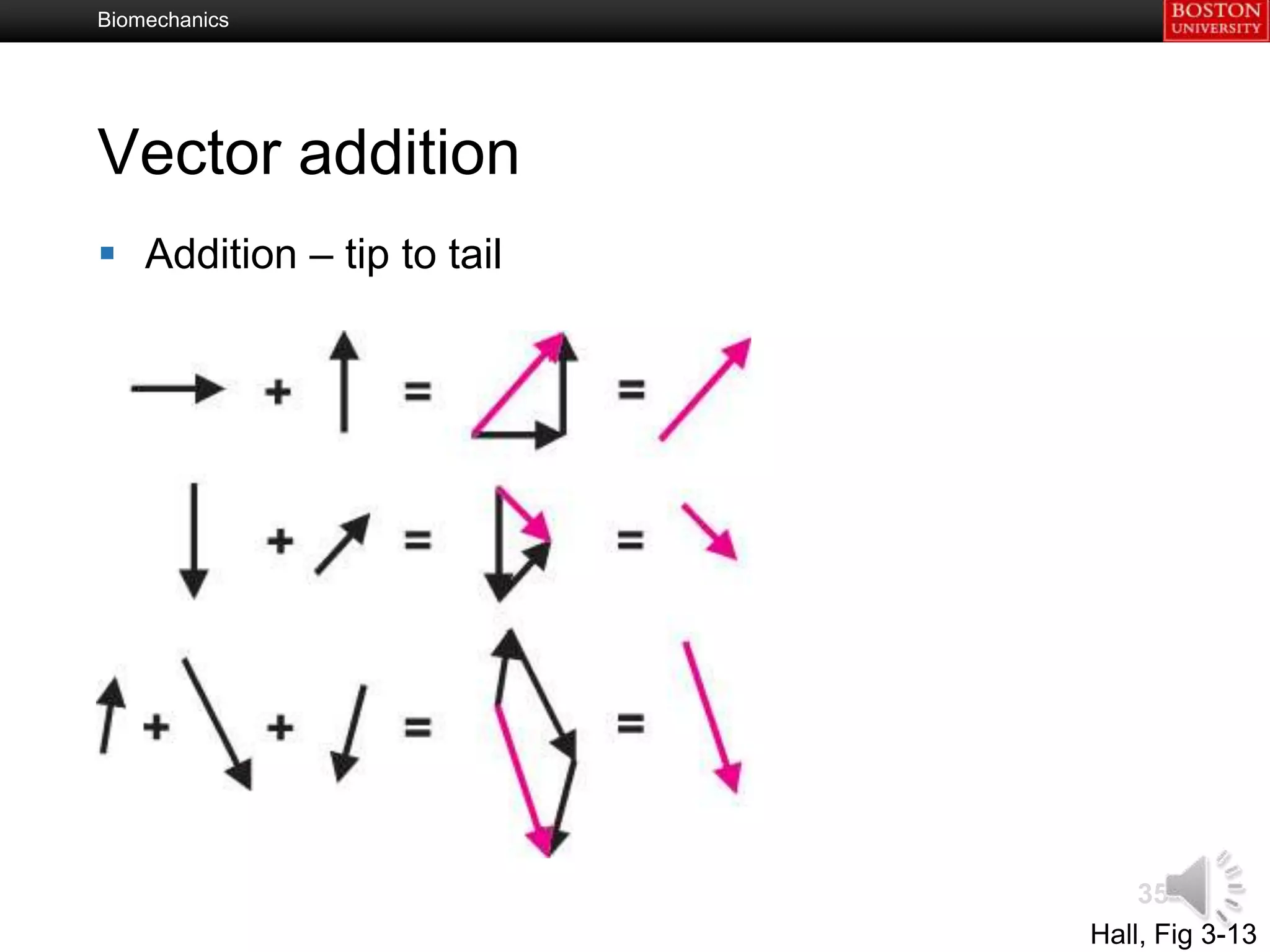
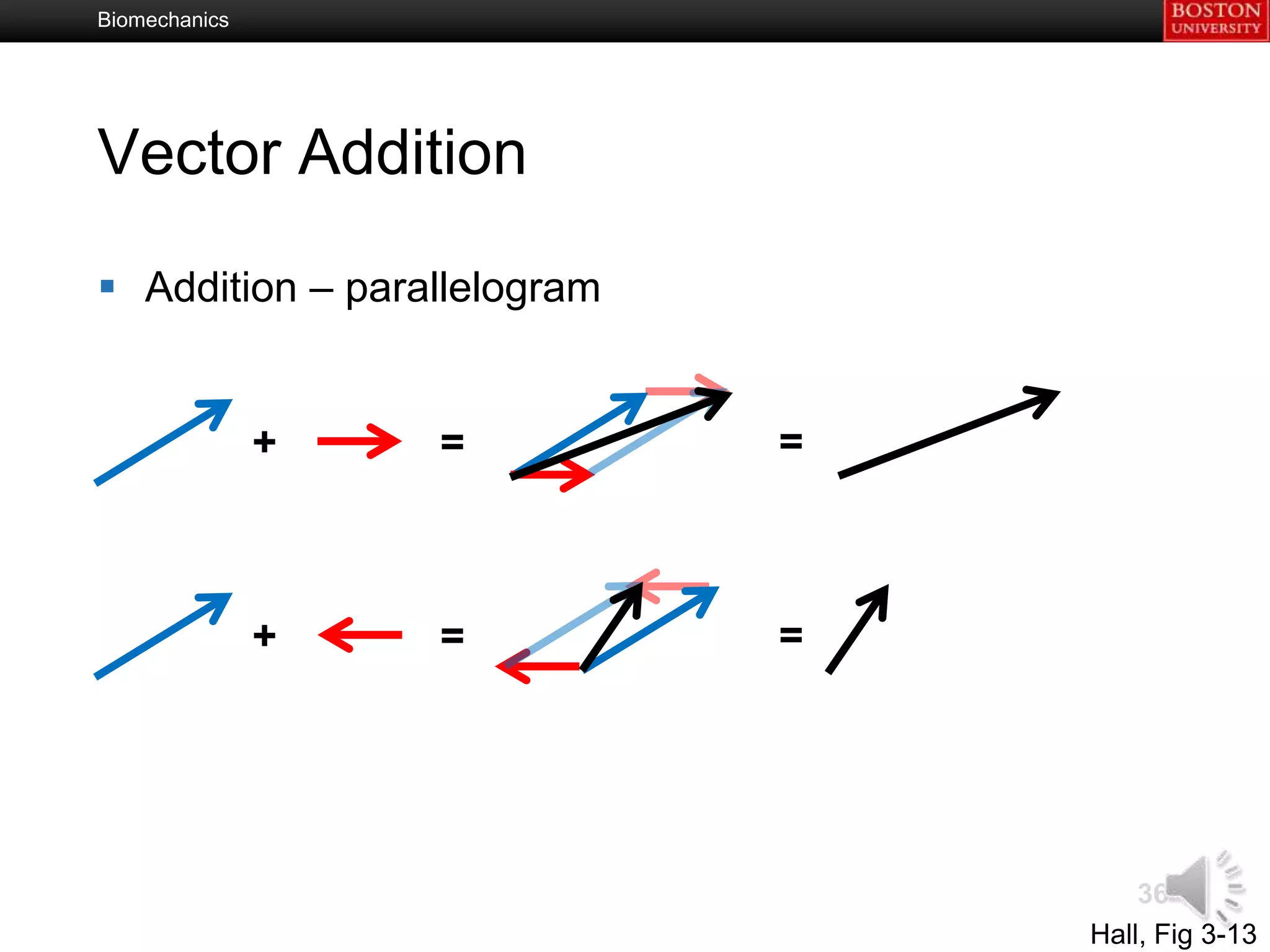
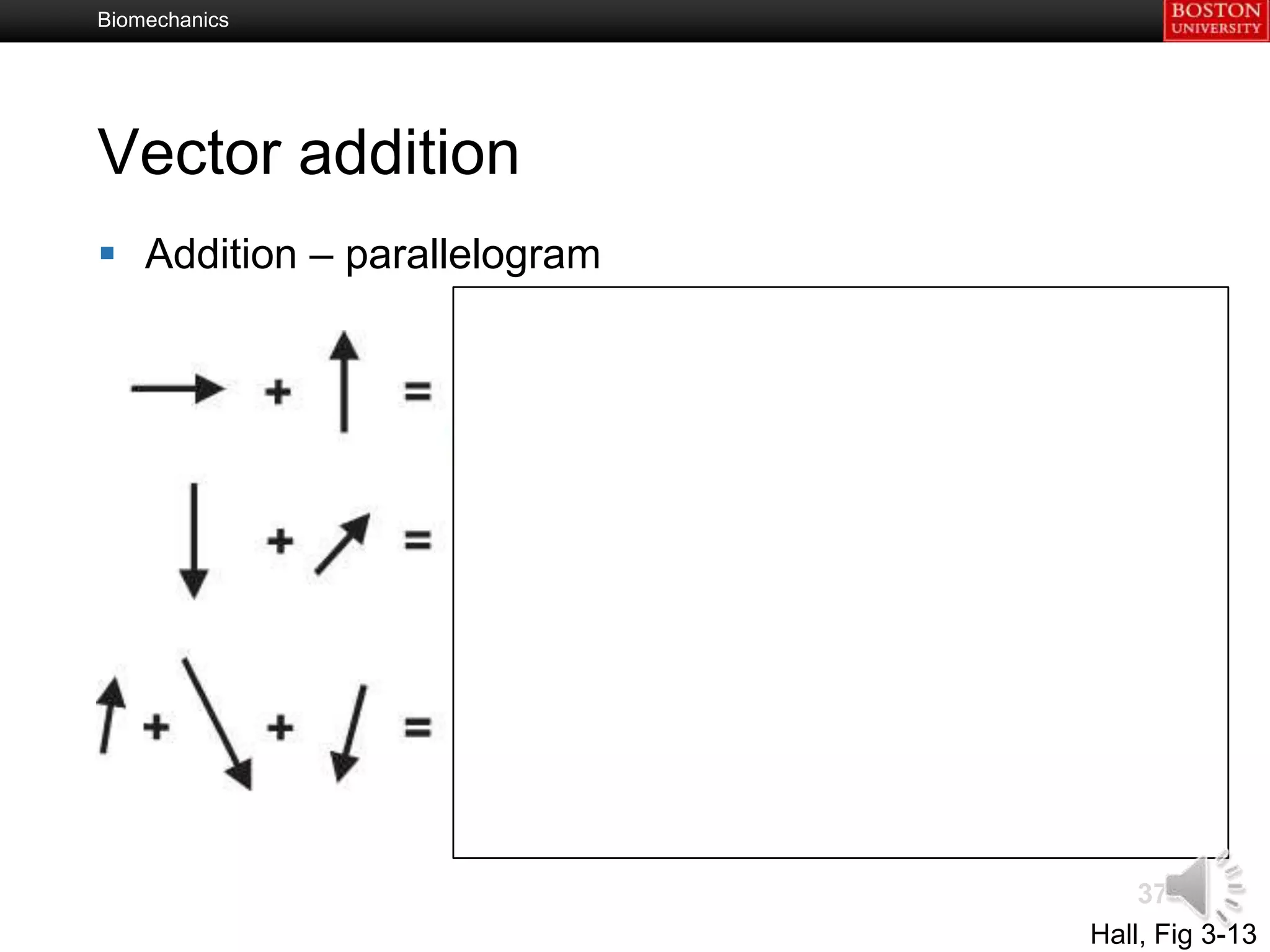
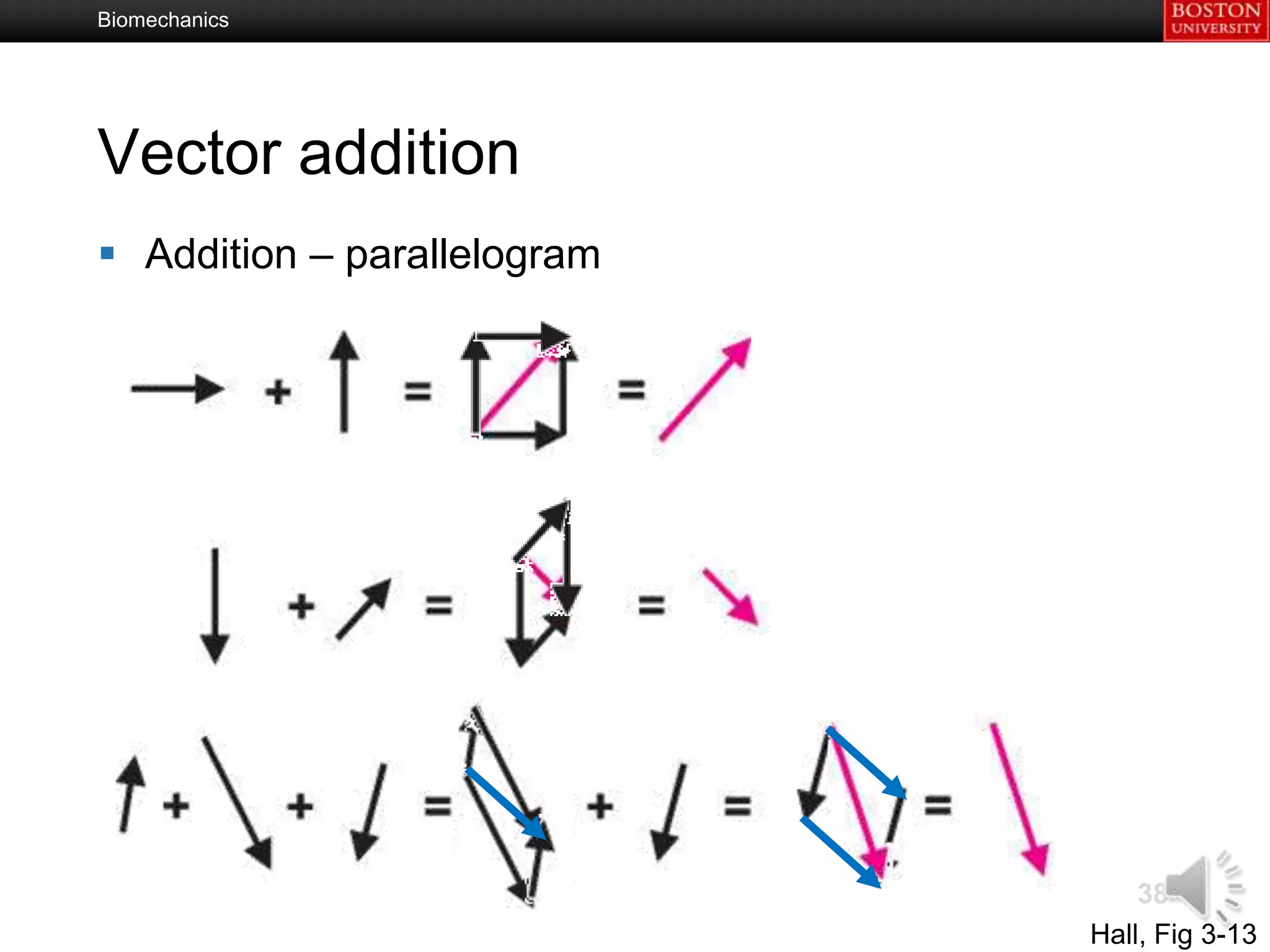
Vector addition
Composition
Tip to tail
Parallelogram
Vector resolution
Graphical
Trigonometric
Application to human movement
Parallel forces
Perpendicular forces
29
Biomechanics
Vector Resolution
Angle Sin Cos
Trigonometric 0 0 1
How does angle change the composition? 30 0.50 0.87
45 0.71 0.71
55 0.82 0.57
60 0.87 0.5
90 1 0
90° 60° 45° 30° 0°
51
52.
Biomechanics Module
Application to human movement
Resolve force into:
Perpendicular force
Rotation
Parallel force
Compression
Position dependent perpendicular
parallel
52
53.
Biomechanics Module
End of Biomechanics Module
Don’t forget to take the quiz
53




![Vibe Coding vs. Spec-Driven Development [Free Meetup]](https://cdn.slidesharecdn.com/ss_thumbnails/vibecodingvsspecdrivendevelopment-251209105622-43f455e7-thumbnail.jpg?width=640&height=640&fit=bounds)


