Biomechanics
• is adiscipline within physical education that
applies form physics, biology, and engineering
to the study of the movements and forces of
living organisms, especially the human body.
• the term biomechanics is derived from the
Greek words: Bio - meaning life, Mechanics -
referring to the physics and forces that act on
moving bodies.
3.
• biomechanics hasmany practical
applications, such as developing new
medical treatments, designing better
sports equipment, improving athletic
training techniques, and optimizing
workplace ergonomics.
• by analyzing movement and mechanics,
biomechanics can enhance human
performance, prevent injuries, and
improve quality of life.
• it helps us understand how the body
moves, the forces acting on biological
structures such as muscles and bones,
and the mechanics of biological systems.
4.
Elements of Biomechanics
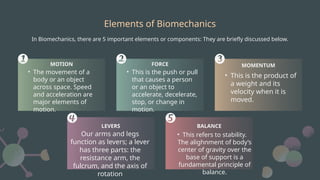
InBiomechanics, there are 5 important elements or components: They are briefly discussed below.
• The movement of a
body or an object
across space. Speed
and acceleration are
major elements of
motion.
MOTION
• This is the push or pull
that causes a person
or an object to
accelerate, decelerate,
stop, or change in
motion.
FORCE
• This refers to stability.
The alighnment of body’s
center of gravity over the
base of support is a
fundamental principle of
balance.
BALANCE
Our arms and legs
function as levers; a lever
has three parts: the
resistance arm, the
fulcrum, and the axis of
rotation
LEVERS
• This is the product of
a weight and its
velocity when it is
moved.
MOMENTUM
5.
Principles Used inBiomechanics
Dynamics: The study focuses on
analyzing forces.
Kinetics: The study is to analyze the forces
that cause motion.
Static: The study is concerned with analyzing bodies
that are at rest or in a state of balance.
Kinematics: The study is to analyze the position, velocity, and
acceleration of the body segments and joints without
considering the force that cause motion. it describes the motion
in terms of space and time.
6.
Objectives of Biomechanics
•The primary objective of biomechanics of a sport and
physical exercise is to increase performance in a
particular sport or physical exercise. In a broader sense,
the objective of biomechanics of sport and physical
exercise is to improve physical fitness. For example, the
proper biomechanics of running enables athletes to
engage in regular physical activity for extended periods
of time without being substantially hindered by injuries
and their effects.
• The secondary objective of biomechanics of sport and
physical exercise is to make recommendations for injury
prevention and rehabilitation. This secondary objective
of sport biomechanics is inextricably linked to the first
objective since a healthy athlete will outperform an
injured athlete.
7.
Biomechanics is afascinating field that allows
us to understand human movements like
never before. By utilizing a variety of tools
and instruments, we can measure and analyze
physical performance with incredible
accuracy.
Tools used in biomechanics
8.
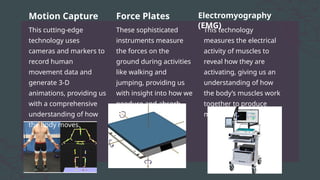
This cutting-edge
technology uses
camerasand markers to
record human
movement data and
generate 3-D
animations, providing us
with a comprehensive
understanding of how
the body moves.
These sophisticated
instruments measure
the forces on the
ground during activities
like walking and
jumping, providing us
with insight into how we
peoduce and absorb
force.
This technology
measures the electrical
activity of muscles to
reveal how they are
activating, giving us an
understanding of how
the body’s muscles work
together to produce
movement.
Motion Capture Force Plates Electromyography
(EMG)
9.
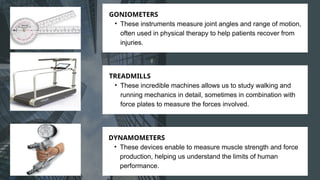
GONIOMETERS
• These instrumentsmeasure joint angles and range of motion,
often used in physical therapy to help patients recover from
injuries.
TREADMILLS
• These incredible machines allows us to study walking and
running mechanics in detail, sometimes in combination with
force plates to measure the forces involved.
DYNAMOMETERS
• These devices enable to measure muscle strength and force
production, helping us understand the limits of human
performance.
10.
VISION
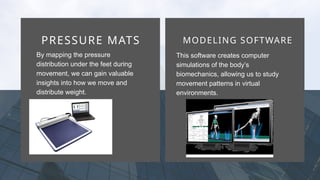
PRESSURE MATS MODELINGSOFTWARE
By mapping the pressure
distribution under the feet during
movement, we can gain valuable
insights into how we move and
distribute weight.
This software creates computer
simulations of the body’s
biomechanics, allowing us to study
movement patterns in virtual
environments.
11.
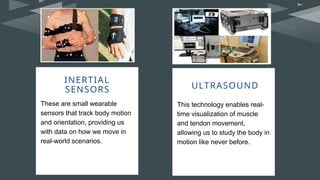
INERTIAL
SENSORS
These are smallwearable
sensors that track body motion
and orientation, providing us
with data on how we move in
real-world scenarios.
ULTRASOUND
This technology enables real-
time visualization of muscle
and tendon movement,
allowing us to study the body in
motion like never before.
Ingoude Company
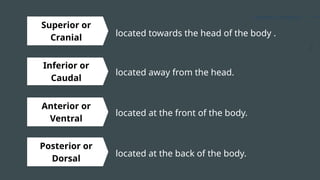
Superior or
Cranial
Inferioror
Caudal
Anterior or
Ventral
located towards the head of the body .
Posterior or
Dorsal
located away from the head.
located at the front of the body.
located at the back of the body.
14.
These directional termsare commonly used in anatomy and
physiology to described the relative positions of body
structures and locations. It is essential to understand these
terms to communicate effectively and accurately about the
human body’s structure and functions.
On the other hand, body planes are imaginary lines or
planes that are used to divide the body into sections,
allowing for more precise description and communication
of anatomical structures and locations.
15.
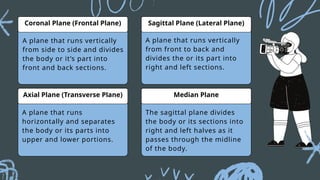
A plane thatruns vertically
from side to side and divides
the body or it’s part into
front and back sections.
Coronal Plane (Frontal Plane) Sagittal Plane (Lateral Plane)
Axial Plane (Transverse Plane) Median Plane
A plane that runs vertically
from front to back and
divides the or its part into
right and left sections.
A plane that runs
horizontally and separates
the body or its parts into
upper and lower portions.
The sagittal plane divides
the body or its sections into
right and left halves as it
passes through the midline
of the body.
16.
Understanding these planesis
essential for accurately describing the
location and relationships between
anatomical structures. By using these
planes in combination with directional
terms, healthcare professionals can
effectively communicate with one
another and provide the best possible
care for their patients.
17.
The Anatomical movementsand locations are described using
terminologies below:
• FLEXION - bending joint, as in knee oe elbow flexion, to
reduce the angle between two bones.
• EXTENSION - the opposite of flexion, in which a joint is
straighten to widen the angle formed by two bones, as when
straightening an elbow or knee.
• MEDIAL ROTATION - the movement of a limb or body part in
the direction of the body’s midline, as when the
shoulder is turned in that direction.
18.
ADDUCTION
• bringing abody part
closer to the body’s
midline or center, as
when bringing the legs
together
ABDUCTION
• moving a body part
from the midline or the
enter of the body, as
when the legs spread.
DEPRESSION
• lowering or dropping a
body part, such as
lowering the shoulder.
ELEVATION
• raising or lifting a body
part.
LATERAL ROTATION
• moving a limb or body
part away from the
body’s midline, as in
moving the shoulder
outward.
19.
CIRCUMDUCTION
• moving alimb or body
part in circular motion,
such as tracing a circle
with the arm.
PROTRACTION
• moving a body part
forward toward or away
from the body’s midline,
such as pushing the
shoulders forward.
OPPOSITION
• touching the thumb to
the tips of the of the
finger, such as making a
fist.
RETRACTION
• pulling back a body part,
such as the shoulders, or
moving it toward the
midline of the body.
20.
REPOSITION
• returning thethumb from opposition to its
neutral position.
PRONATION
• rotating the forearm so that the palm faces
downward, such as turning the hand over to
pour a cup of water.
SUPINATION
• rotating the forearm so that the palm faces
upward, such as turning the hand over to
hold a cup of water.
21.
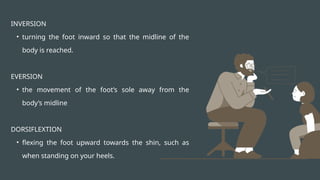
INVERSION
• turning thefoot inward so that the midline of the
body is reached.
EVERSION
• the movement of the foot’s sole away from the
body’s midline
DORSIFLEXTION
• flexing the foot upward towards the shin, such as
when standing on your heels.
22.
PLANTARFLEXION
• pointing thefoot
downward, such as
when standing on your
toes
PALMARFLEXION
• flexing the wrist
towards the palm, such
as making a fist
These movements are crucial for comprehending human anatomy and physiology as well
as for identity and treating musculoskeletal injuries and disorder. Athletes, dancers, and
other performers who rely on pricise movements for their craft can also benefit from
them.
23.
Fundamental Movement Skills
01
02
Bodymanagement skills:
• which involve balancing, maintaining equilibrium and postural control of the body in
stillness and in motion such as rolling, stopping, stretching, bending, twisting, landing,
climbing, and running.
Locomotor skills:
• which involve transporting the body in any direction from one point to another such as
walking, running, jumping, hopping, galloping, marching, and skipping.
03
Object control skills:
• require controlling implements and objects such as balls, hoops, bats, and ribbons that
involve the use of body parts, such as hands and feet.
Are particular set of skills that require the use of different body parts, such as feet, legs,
shoulders, body, head, arms, and hands. They are the foundation for more advanced and
specialized skills that learners will need to participate in various games, sports, and leisure
activities during their lives.
24.
Fundamental body movementsare classified as Locomotor,
Non-locomotor, or Manipulative.
Types of Fundamental Body Movements
25.
Locomotor Movements
• areessential for human beings as they are
necessary for basic mobility and
transportation.
• these movements involve coordination and
control of multiple body parts and require a
combination of balance, rhythm, and
coordination.
• they also help to enhance cardiovascular
health, muscular strength and endurance,
and overall physical fitness.
26.
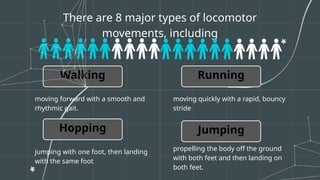
There are 8major types of locomotor
movements, including
Walking
moving forward with a smooth and
rhythmic gait.
moving quickly with a rapid, bouncy
stride
Running
Hopping
jumping with one foot, then landing
with the same foot
Jumping
propelling the body off the ground
with both feet and then landing on
both feet.
27.
LEAPING
• jumping offone and
landing on the other foot.
GALLOPING
• moving forward with a
step-slide-step-slide
pattern.
SKIPPING
• a type of walk where one
foot is lifted higher than
the other.
SLIDING
• moving laterally with a
side-step-slide pattern.
28.
Non-locomotor movements
• onthe other hand, are critical for
developing body awareness, control, and
coordination.
• they involve isolated movement of specific
body parts and are often used in dance and
other forms of artistic expression.
• can also help to improve flexibility, range of
motion, and posture.
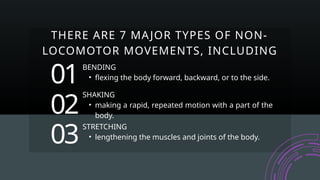
29.
BENDING
• flexing thebody forward, backward, or to the side.
01
02
03
SHAKING
• making a rapid, repeated motion with a part of the
body.
STRETCHING
• lengthening the muscles and joints of the body.
THERE ARE 7 MAJOR TYPES OF NON-
LOCOMOTOR MOVEMENTS, INCLUDING
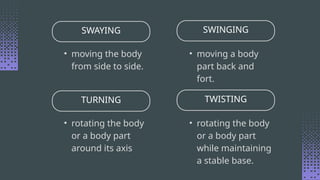
30.
SWAYING SWINGING
• movingthe body
from side to side.
• moving a body
part back and
fort.
TURNING TWISTING
• rotating the body
or a body part
around its axis
• rotating the body
or a body part
while maintaining
a stable base.
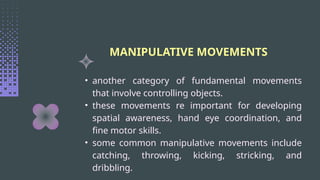
31.
MANIPULATIVE MOVEMENTS
• anothercategory of fundamental movements
that involve controlling objects.
• these movements re important for developing
spatial awareness, hand eye coordination, and
fine motor skills.
• some common manipulative movements include
catching, throwing, kicking, stricking, and
dribbling.
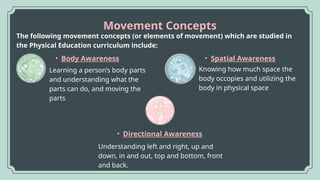
32.
Movement Concepts
Learning aperson’s body parts
and understanding what the
parts can do, and moving the
parts
• Body Awareness
• Directional Awareness
• Spatial Awareness
Understanding left and right, up and
down, in and out, top and bottom, front
and back.
Knowing how much space the
body occopies and utilizing the
body in physical space
The following movement concepts (or elements of movement) which are studied in
the Physical Education curriculum include:
33.
The construction ofan
internal time structure that
identifies movement-time
relationships
Understanding with what the
body makes movements, or
with whom the body makes
movements.
• Temporal Awareness • Relationship Awareness
34.
Movement Strategies
• referto various approaches that will help you
or your team successfully achieve a movement
outcome or goal. Movement strategies include
moving into physical space to receive a pass
from a teammate or hitting a ball away from
opponents to make if difficult to retrieve or
return the ball.
• Different games and sports may require
similar activities and will use identical
movement strategies to achieve success.
35.
Balance
• The capacityto sustain the body’s
line of gravity within the support
base with minimal postural sway.
Centering
• Your human body’s core, where all
body movements emanate and hold
you as you move together.
Center of Gravity
• The balance point or that point
where all the body’s weight is
distributed equally across all sides.
Posture
• The body’s presumed position either
with support during muscle activity
or a coordinated action by a group of
muscles working to maintain stability.
• provide a solid foundation for physical activities in any environment, which or without any
equipment. They can be introduced in simple, age-appropriate ways to help students improve their
movement’s efficiency and effectiveness. The application of these principles becomes more refined
as movement competence improves.
Movement Principles
36.
Gesture
• The useof the body
to convey emotions
and ideas through
movement patterns
as an expressive
instrument.
Rhythm
• The pattern and
emphasis of beats.
Breathing
• The use of
inhalation and
exhalation to give
fluidity and
harmony to a
person’s
movement.
37.
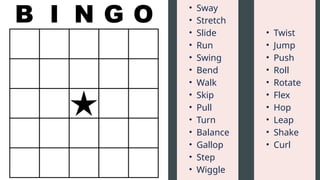
• Sway
• Stretch
•Slide
• Run
• Swing
• Bend
• Walk
• Skip
• Pull
• Turn
• Balance
• Gallop
• Step
• Wiggle
• Twist
• Jump
• Push
• Roll
• Rotate
• Flex
• Hop
• Leap
• Shake
• Curl
38.
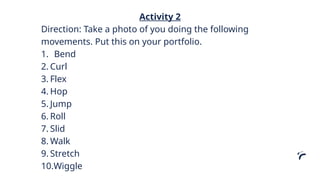
Activity 2
Direction: Takea photo of you doing the following
movements. Put this on your portfolio.
1. Bend
2. Curl
3. Flex
4. Hop
5. Jump
6. Roll
7. Slid
8. Walk
9. Stretch
10.Wiggle