Department of Orthopaedics
       MH Kirkee
          SEMINAR


        LIMB SALVAGE

                    Maj Rohit Vikas
                    Resident
LIMB SALVAGE


 INTRODUCTION
1970s amputation was
standard treatment
LIMB SALVAGE


   PRINCIPLES
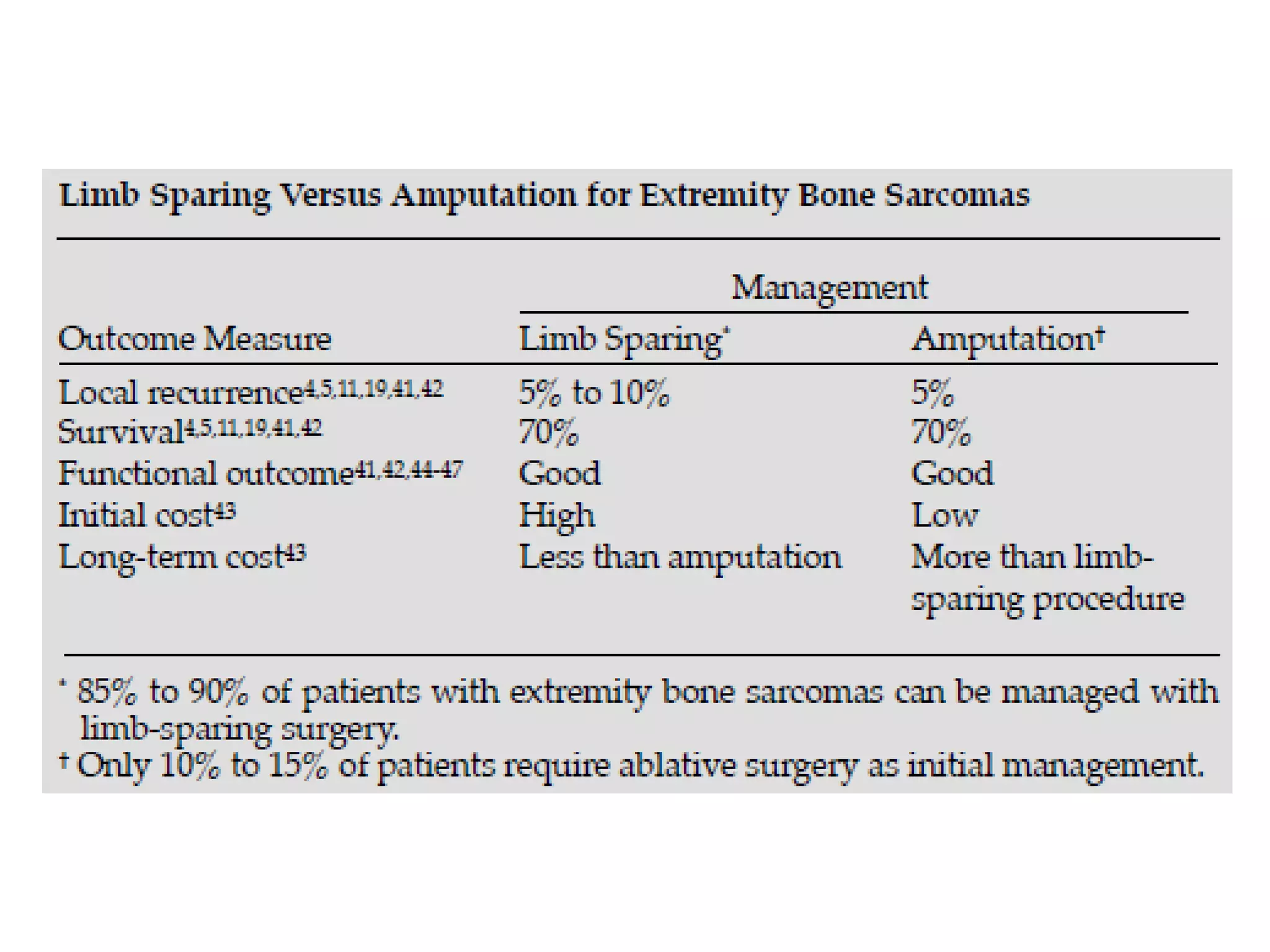
COMPARED WITH AMPUTATION AND PROSTHETIC REHABILITATION


                                SURVIVAL
                                RECURRENCE
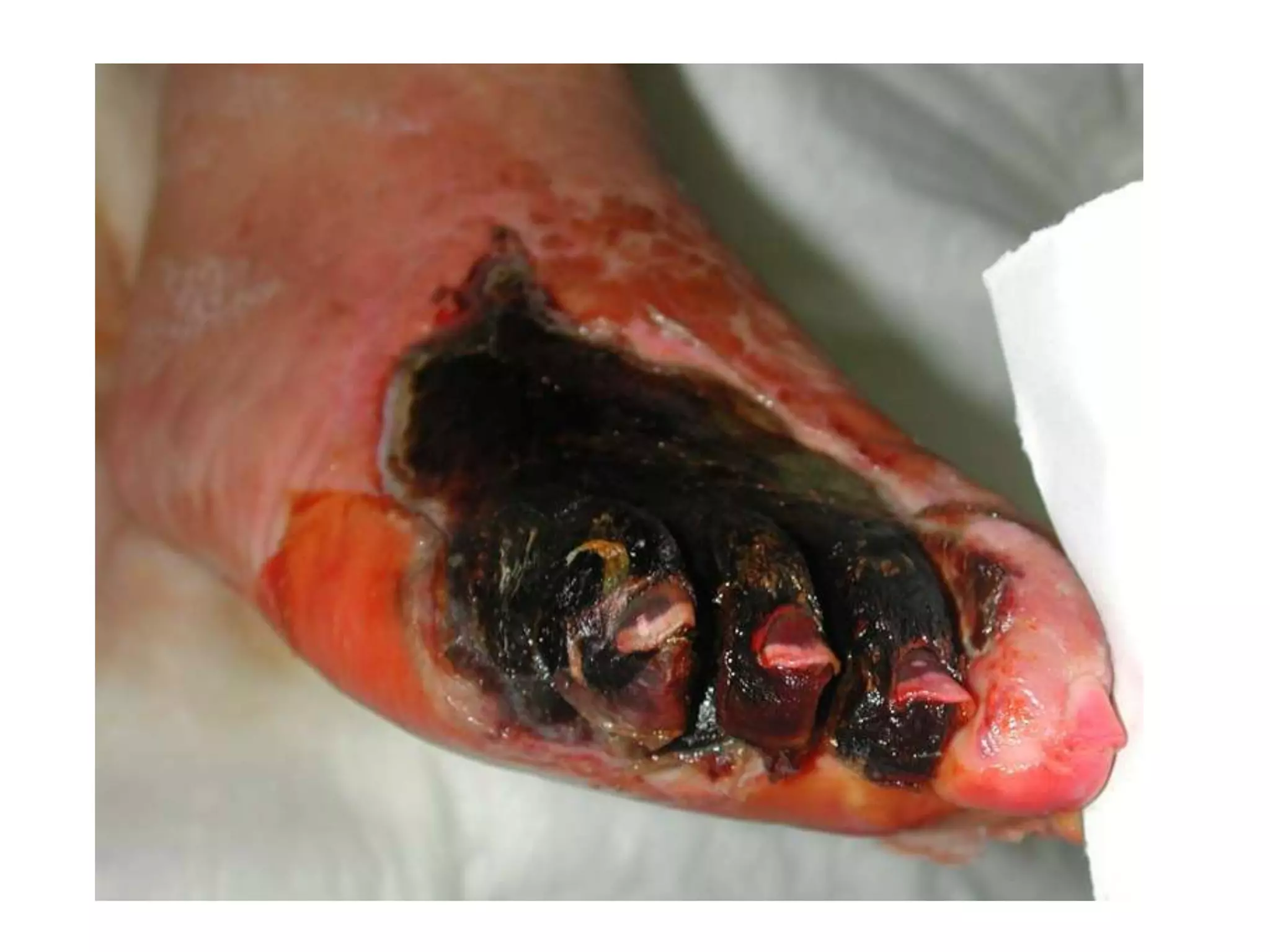
       Oscar Pistorius          FUNCTION
                                DURABILITY
                                COMPLICATIONS
                                NEOADJUVANT CHEMOTHERAPY
CONTRAINDICATIONS
                             BARRIERS TO LIMB SALVAGE

Relative Contraindications to Limb-Sparing Procedures
Major neurovascular structures encased by tumor when vascular bypass is not feasible

Pathologic fracture with hematoma violating compartment boundary

Inappropriately performed biopsy or biopsy-site complications

Severe infection in the surgical field

Immature skeletal age with predicted leg-length discrepancy >8 cm

Extensive muscle or soft-tissue involvement

Poor response to preoperative chemotherapy
Clinical Evaluation
Pre Op Staging
Biopsy Principles
Neoadjuvant Chemotherapy

Tumour Resection
       Avoiding local recurrence is the criterion of success
       Wide Resection
       En bloc removal of all biopsy sites contaminated tissue
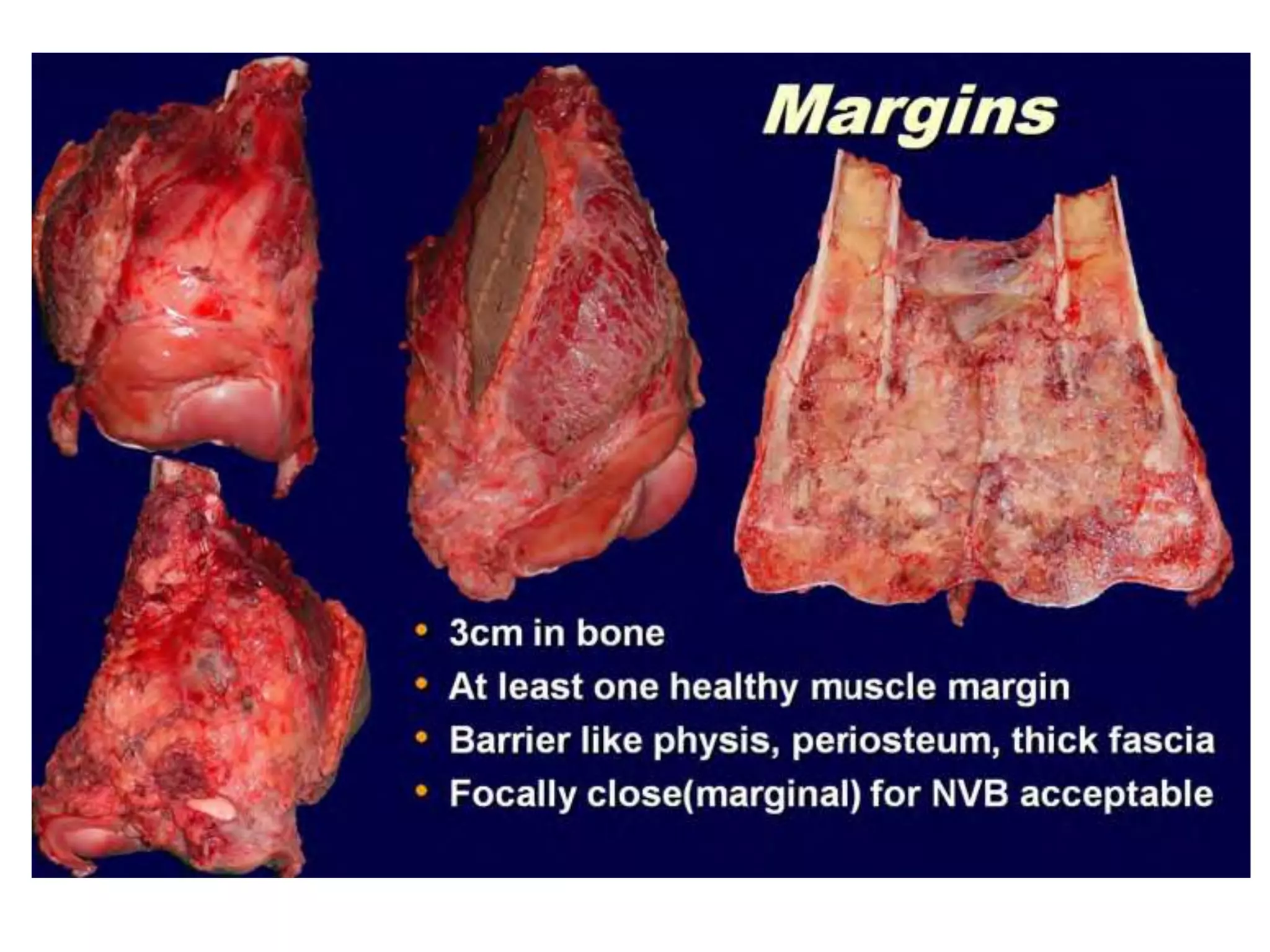
       Adequate margins
       Resection of bone 3 to 4 cm beyond abnormal uptake
       Frozen Section

Skeletal Reconstruction
Reconstruction of Soft Tissue and Wound Cover

Post op Chemotherapy
LIMB SALVAGE


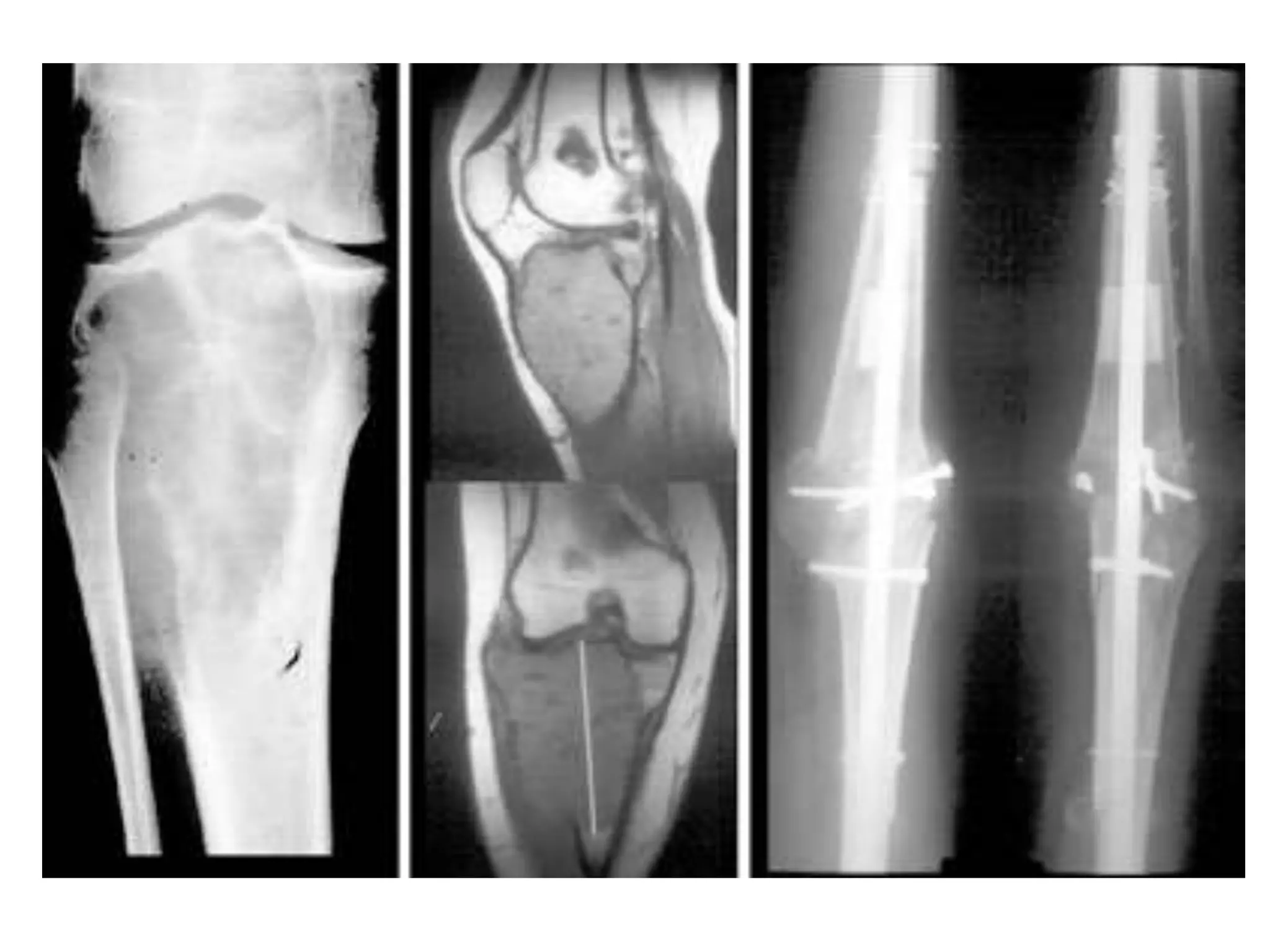
RESECTION ARTHRODESIS
EXTERNAL FIXATOR
                INTRAMEDULLARY NAIL
                      BONE GRAFTS
                   INTERNAL FIXATION


Dual fibular autografts
Chondrosarcoma, primary central -
Distal femur
LIMB SALVAGE


RESECTION + RECONSTRUCTION
        AUTOGRAFT
LIMB SALVAGE


RESECTION + RECONSTRUCTION
       BONE CEMENT
LIMB SALVAGE


RESECTION + RECONSTRUCTION
        ALLOGRAFT
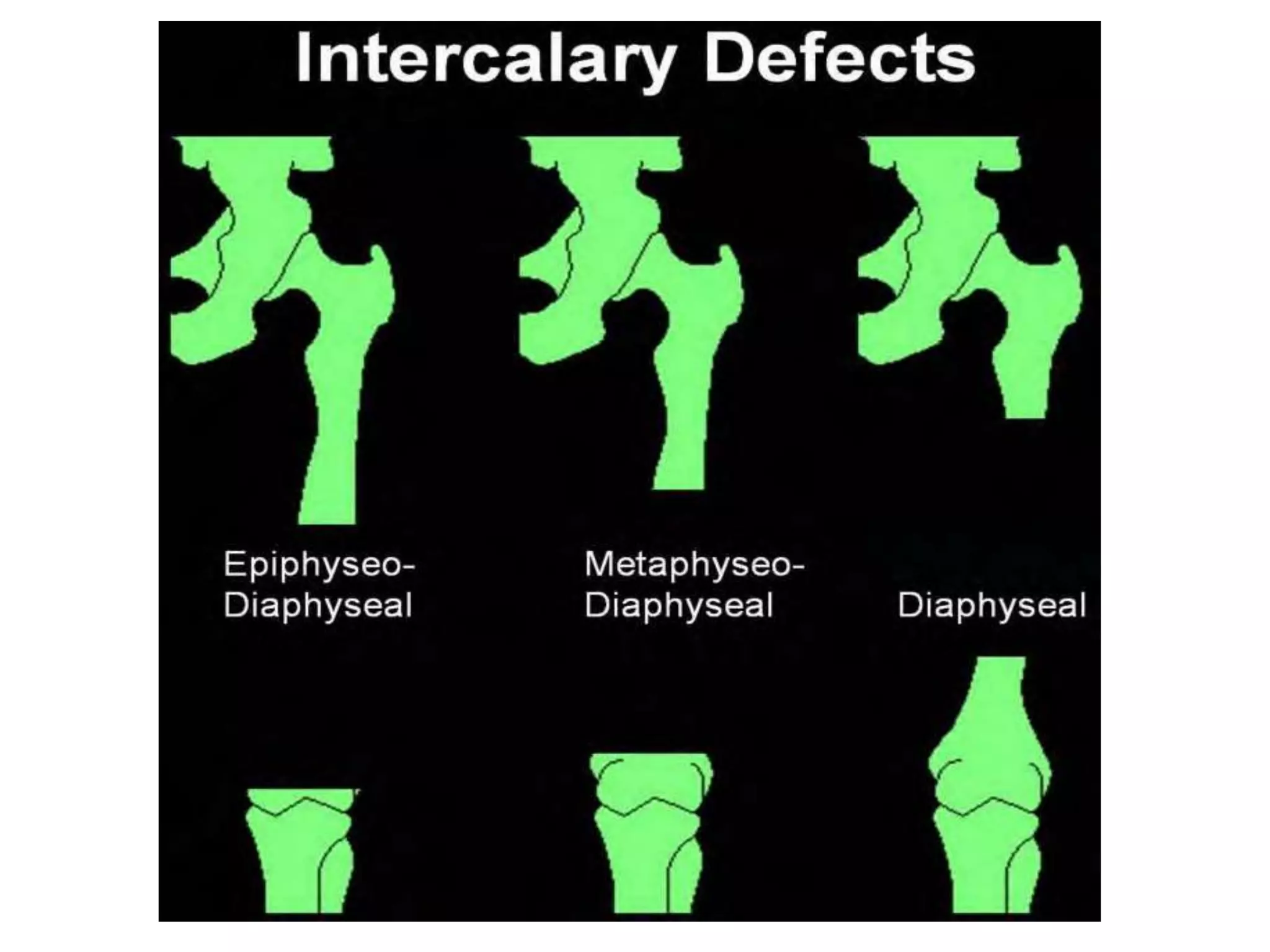
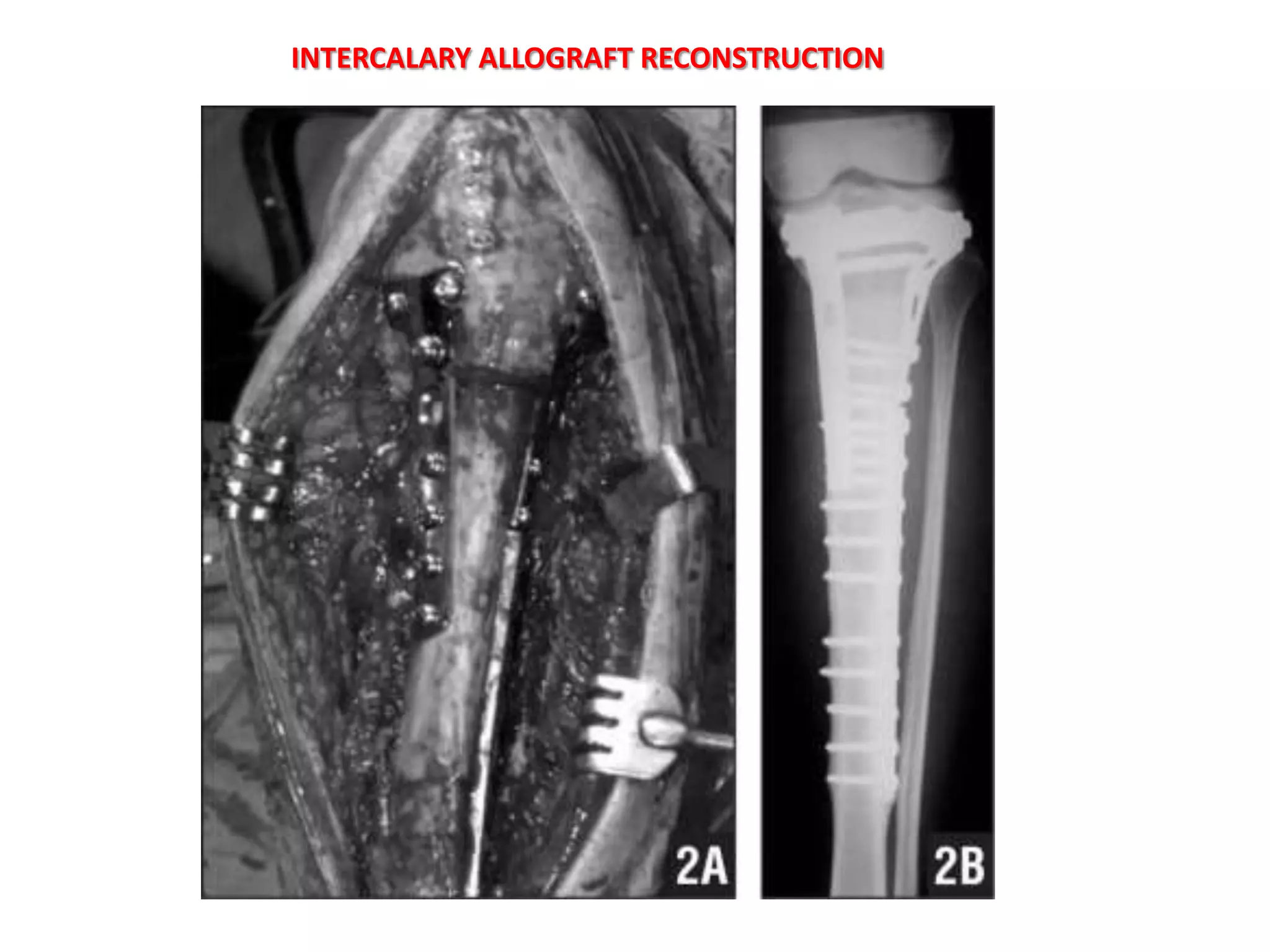
INTERCALARY ALLOGRAFT RECONSTRUCTION


                                   Disadvantages
                                   High rates of
                                   infection, nonunion, # of
                                   allograft.

                                   Adjuvant chemo slows
                                   allograft incorporation

                                   Transmission of
                                   infections

                                   Slow remodelling –
                                   hardware used cannot be
                                   removed

                                   80% good results
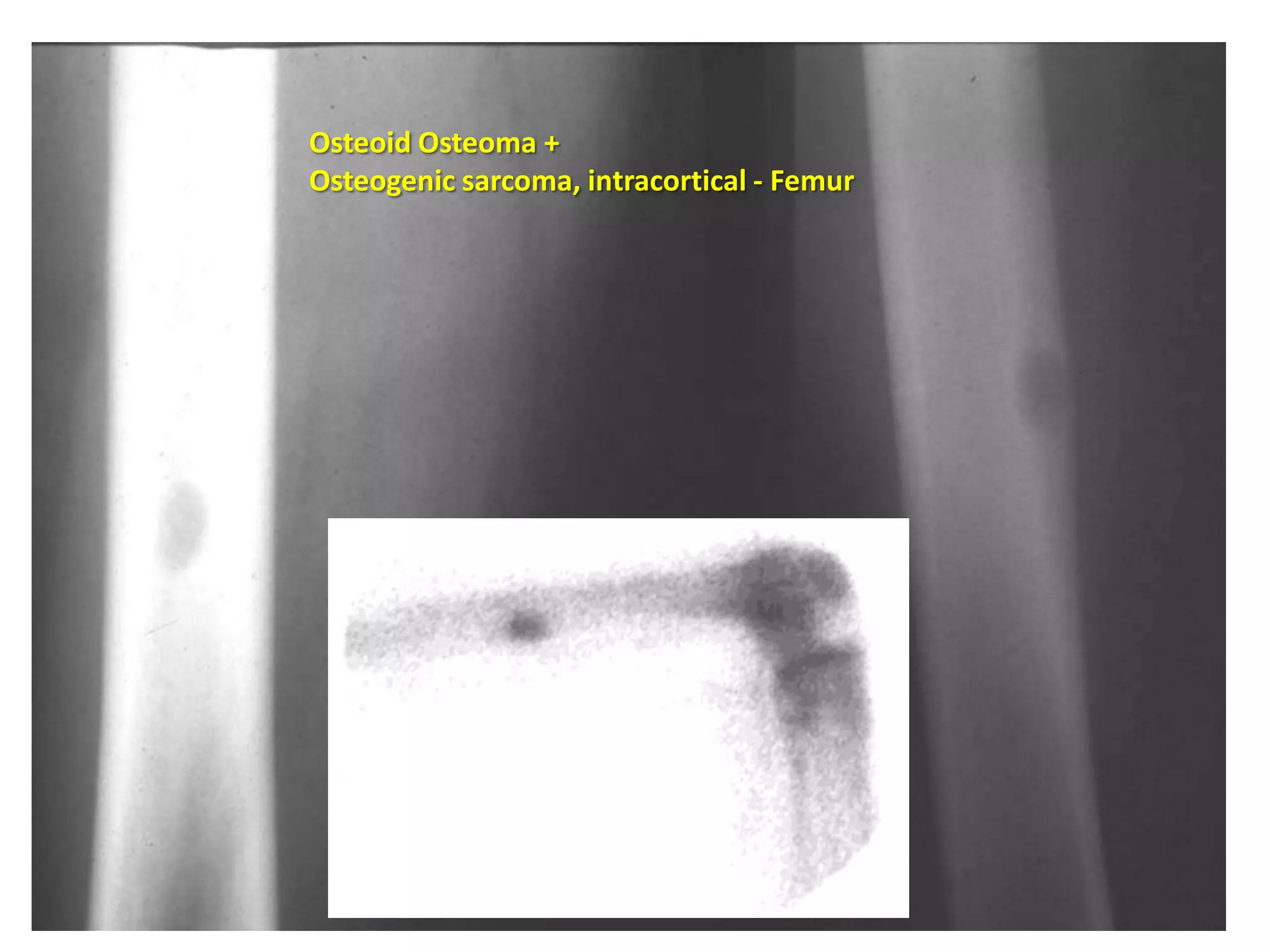
Osteoid Osteoma +
Osteogenic sarcoma, intracortical - Femur
osteoid-forming tumor being produced by
osteoblastic cells with a low mitotic index
without an aggressive pattern. This is
compatible with the diagnosis of osteoid
osteoma
Painful recurrence with a lytic area twice
as large as the original nidus.
A neoplastic osteoid formation
by osteoblastic cells that have
the appearance of an low grade
osteosarcoma.
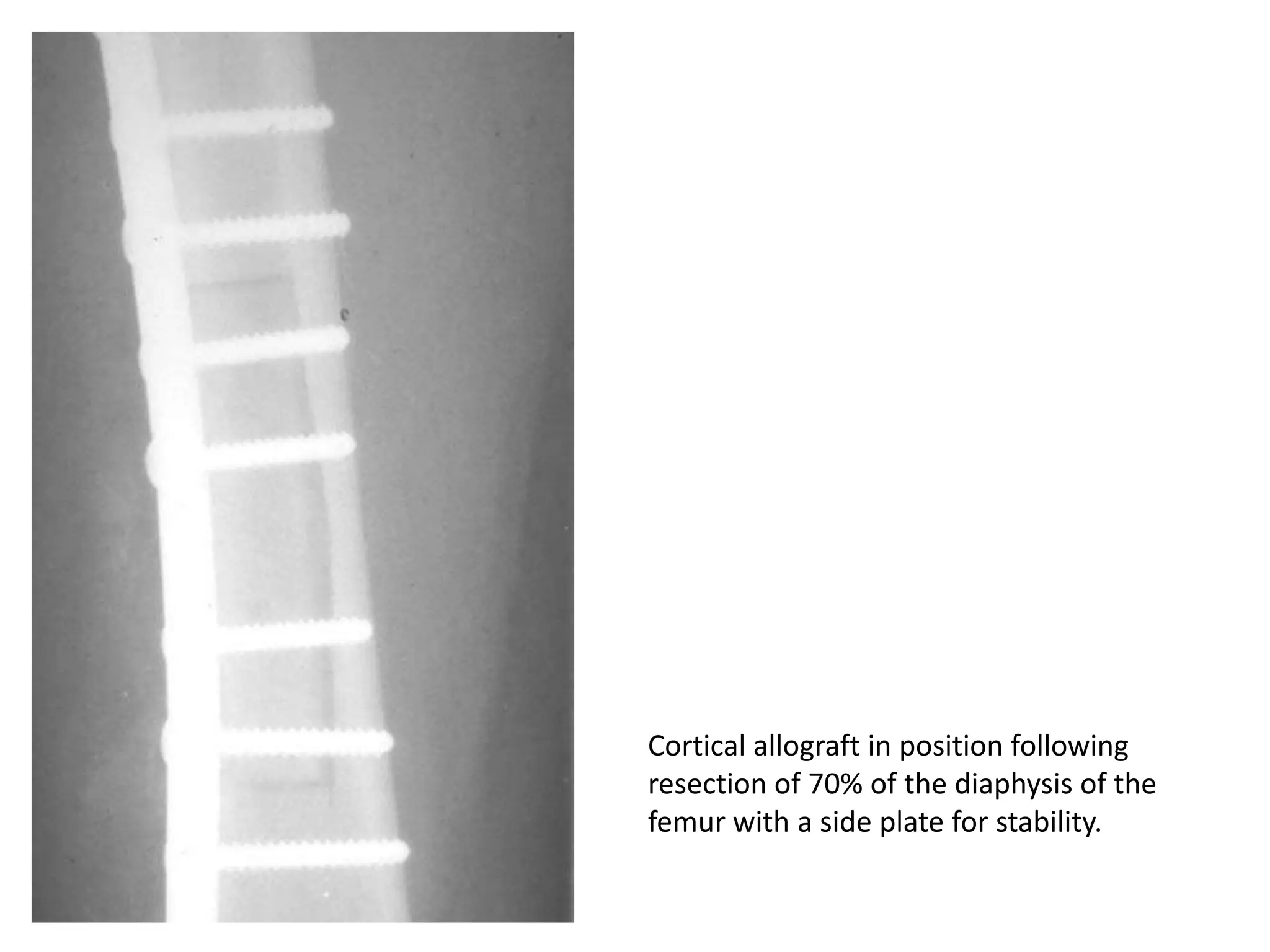
Cortical allograft in position following
resection of 70% of the diaphysis of the
femur with a side plate for stability.
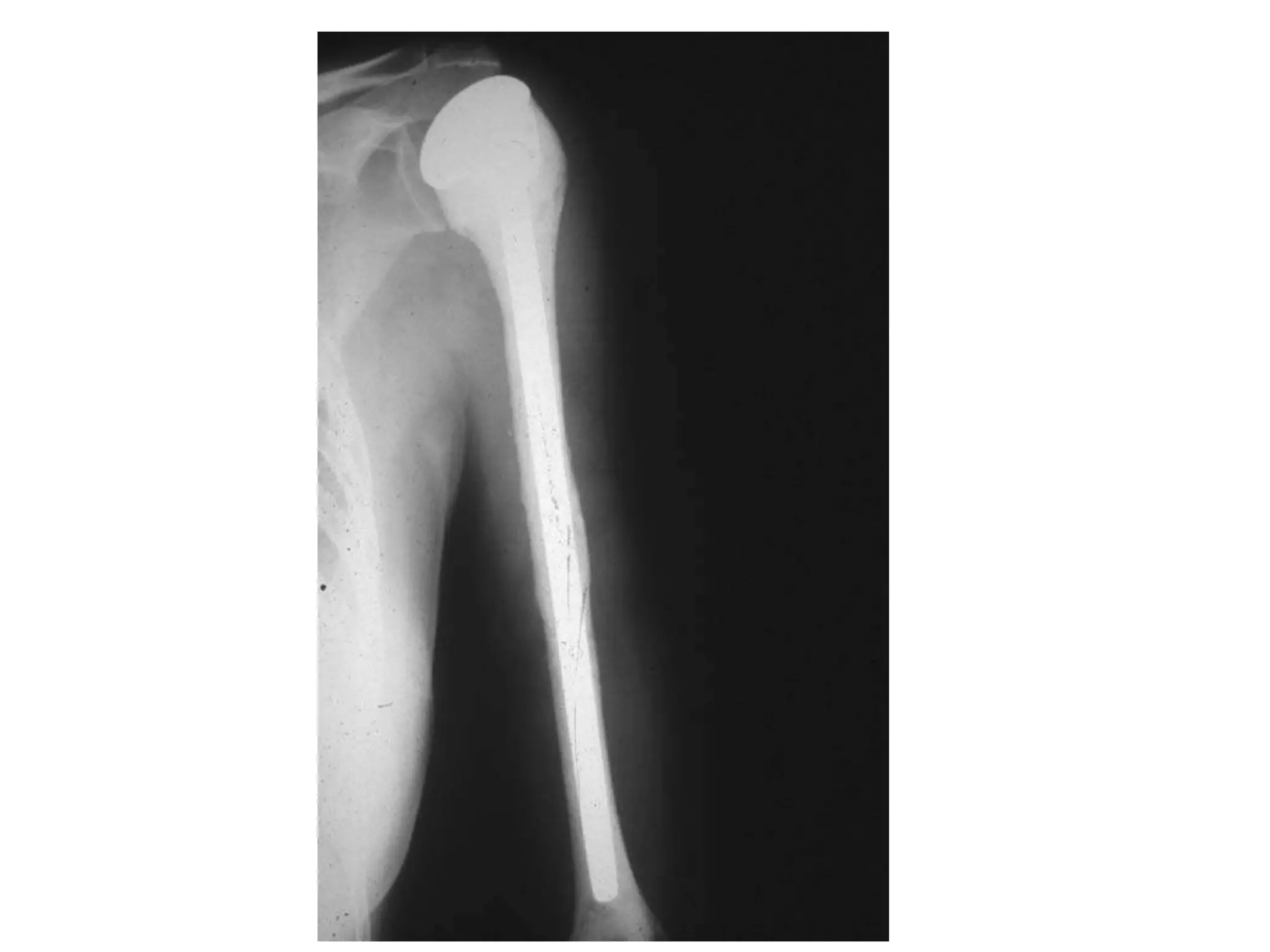
Osteogenic sarcoma, intracortical -
Distal humerus
Wide resection of the distal portion of the
 humeral diaphysis was carried out, leaving the
 elbow joint intact.

 The defect was reconstructed with an allograft
 fixed into postion with a recon plate.


ADVANTAGES
Availability in all sizes and shapes

Progressive incorporation into host bone

Conventional arthroplasty instead of custom made
prosthesis

Attachment sites available for resected muscles and
joint stabilisers – better function

No donor site morbidity

Failed allograft – further options available
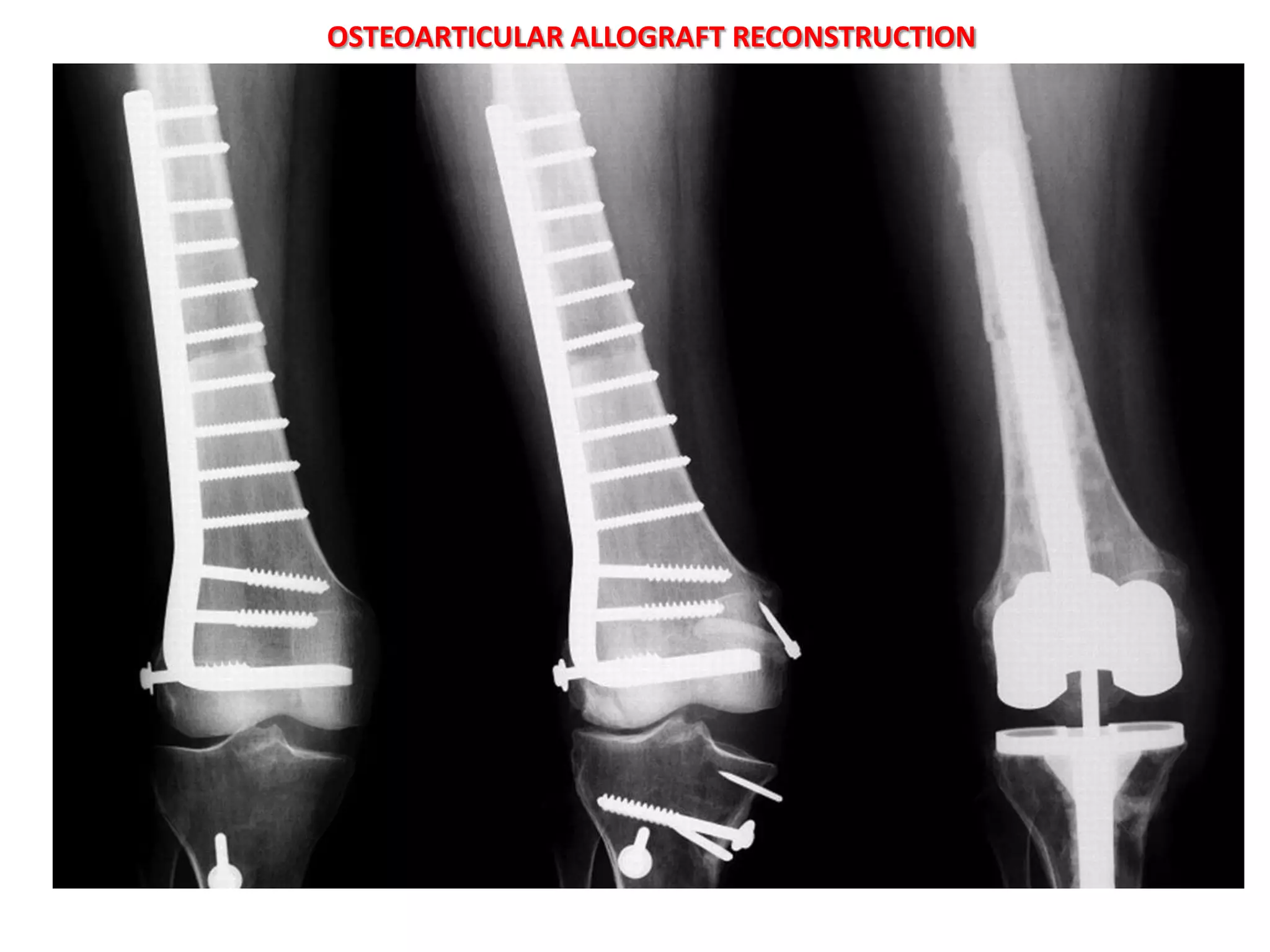
OSTEOARTICULAR ALLOGRAFT RECONSTRUCTION
GCT – Extended Curettage + PMMA    Replaced with a hemicondylar
Lateral compartment degeneration   osteoarticular allograft.
LIMB SALVAGE


RESECTION + RECONSTRUCTION
 VASCULARISED BONE GRAFT
GCT
Radiation associated ST # Femur with Nonunion managed with Vascularised fibular Graft
LIMB SALVAGE


RESECTION + RECONSTRUCTION
        PROSTHESIS
PROSTHETIC RECONSTRUCTION

• Advantage – earliest mobilisation and weight bearing

• 10-year survival of modular prosthesis for
   –   Distal femur – 90%.
   –   Proximal humerus – 98%.
   –   Proximal femur – 100%.
   –   Proximal tibia – 78%.
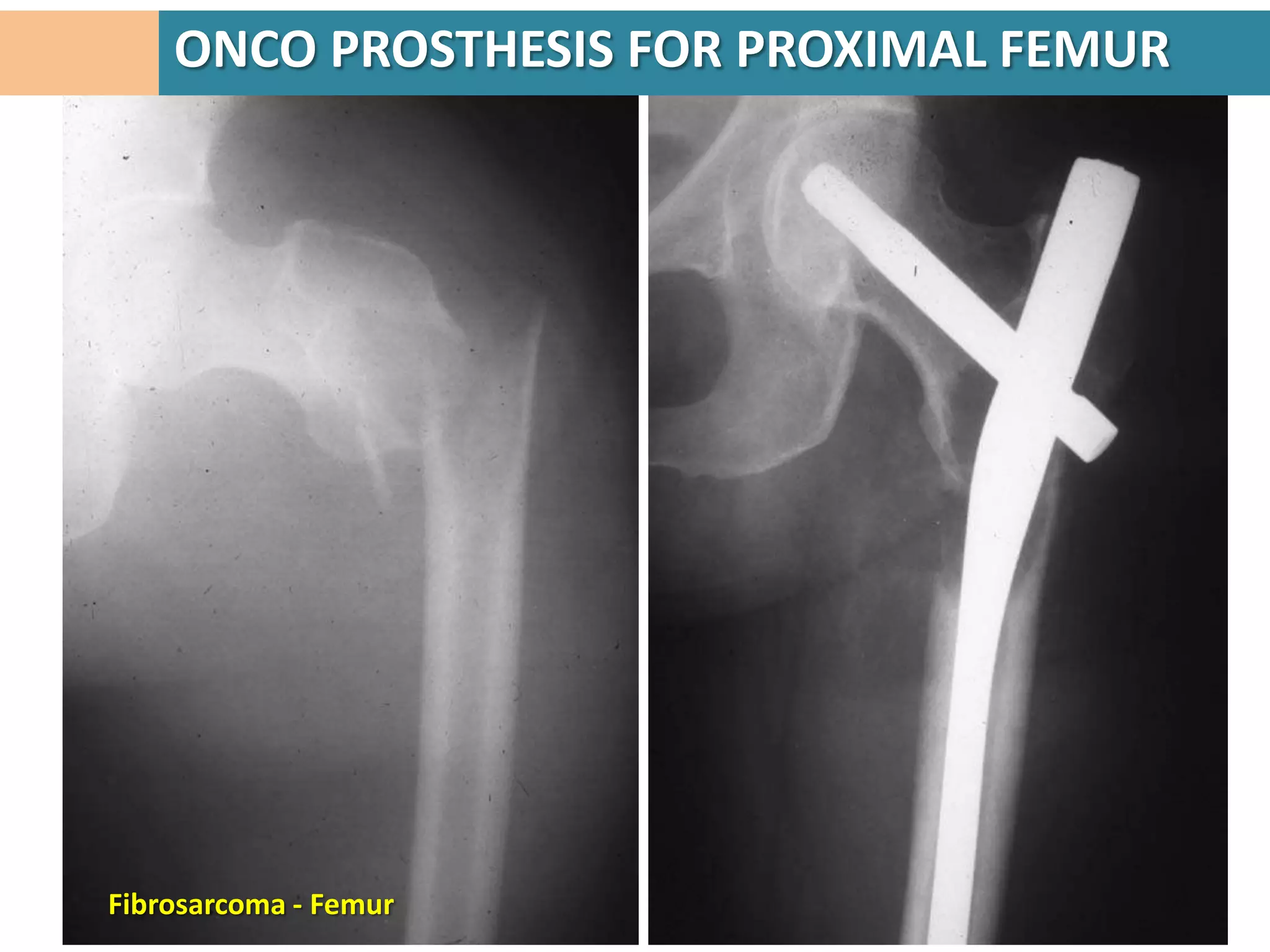
ONCO PROSTHESIS FOR PROXIMAL FEMUR


Fibrosarcoma - Femur
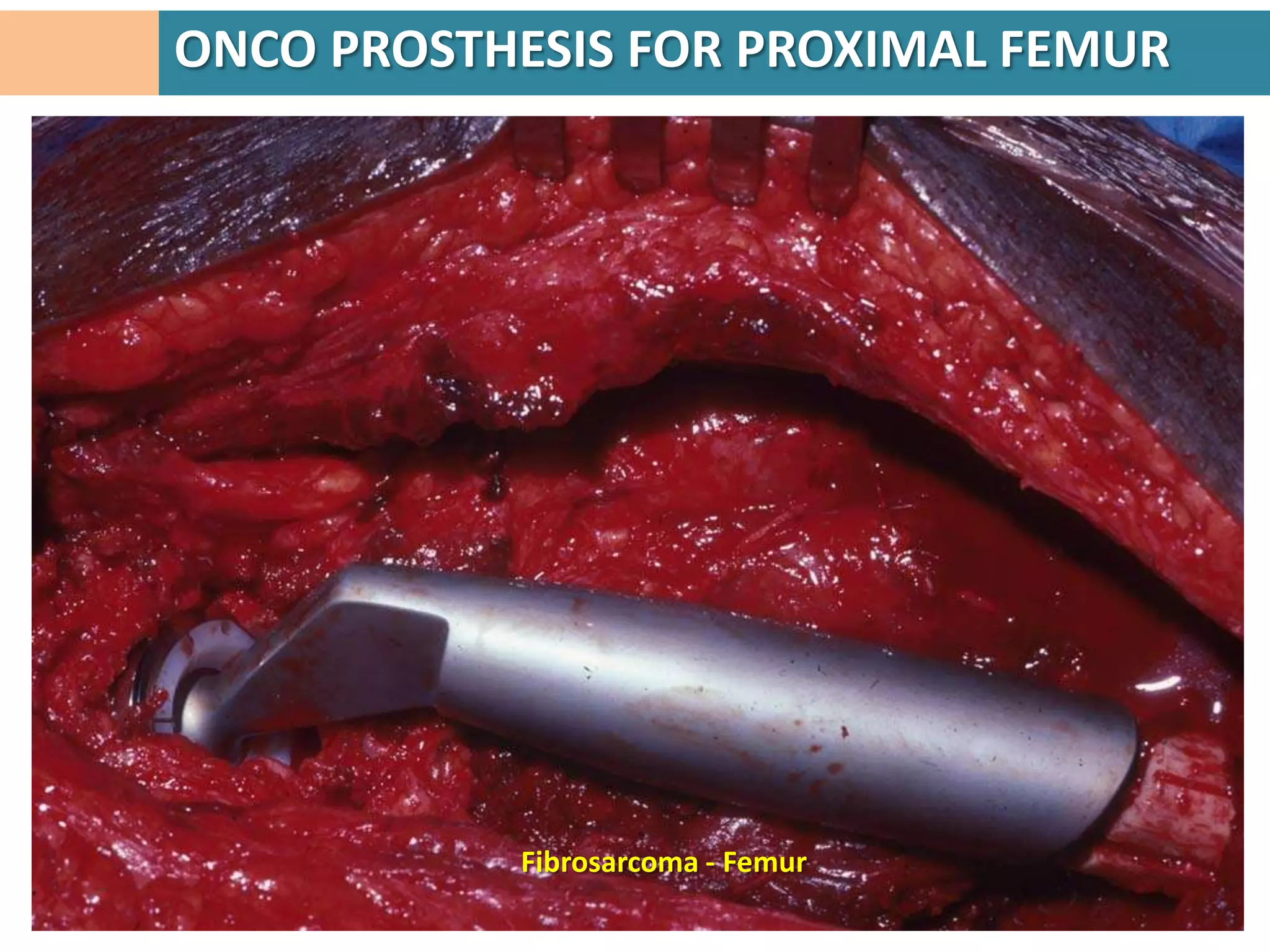
ONCO PROSTHESIS FOR PROXIMAL FEMUR


           Fibrosarcoma - Femur
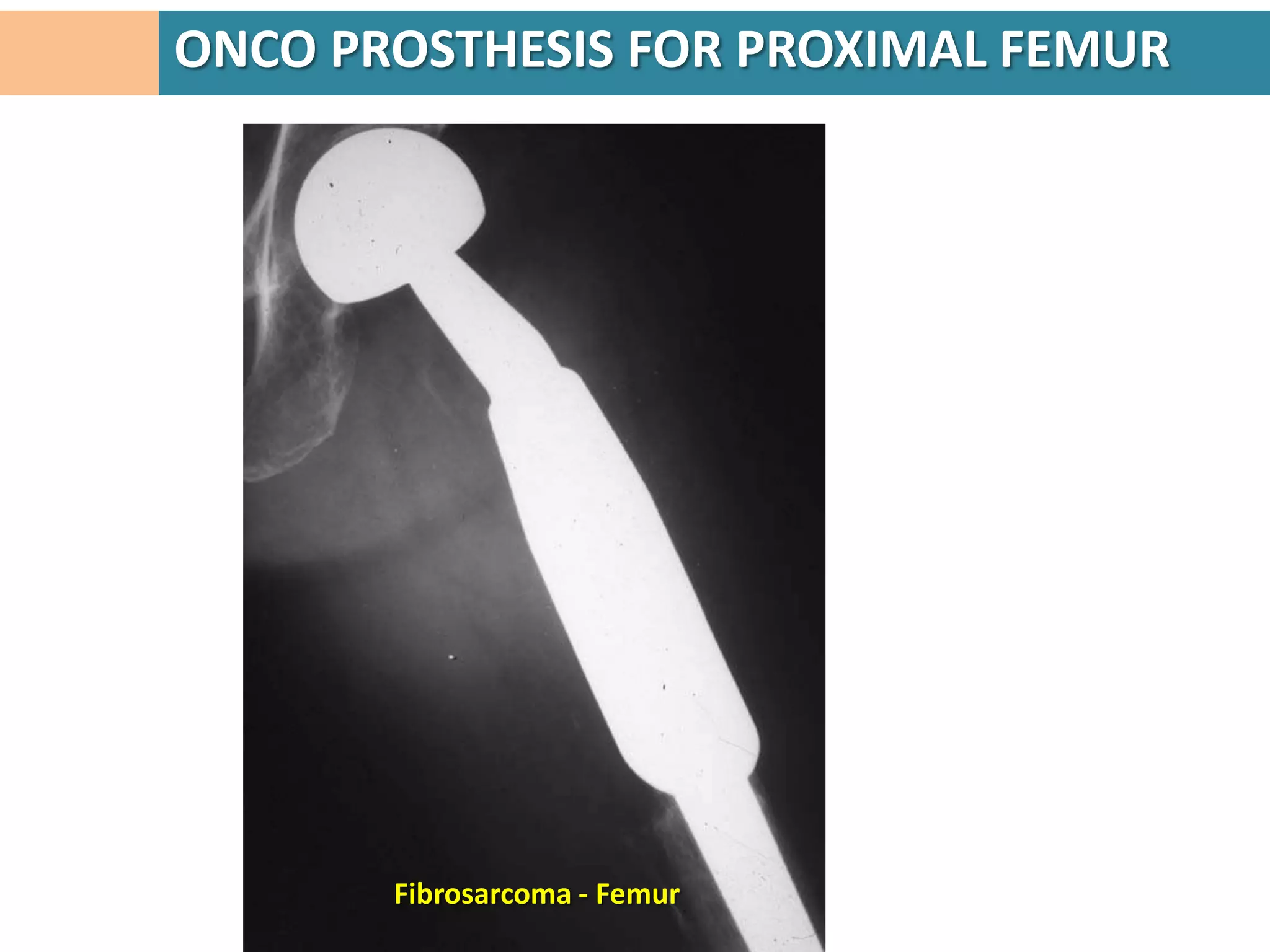
ONCO PROSTHESIS FOR PROXIMAL FEMUR


Fibrosarcoma - Femur
ONCO PROSTHESIS FOR PROXIMAL FEMUR


           Fibrosarcoma - Femur
ONCO PROSTHESIS FOR PROXIMAL FEMUR


       Fibrosarcoma - Femur
ONCO PROSTHESIS FOR PROXIMAL FEMUR


    Radiation associated Fracture of Proximal Femur
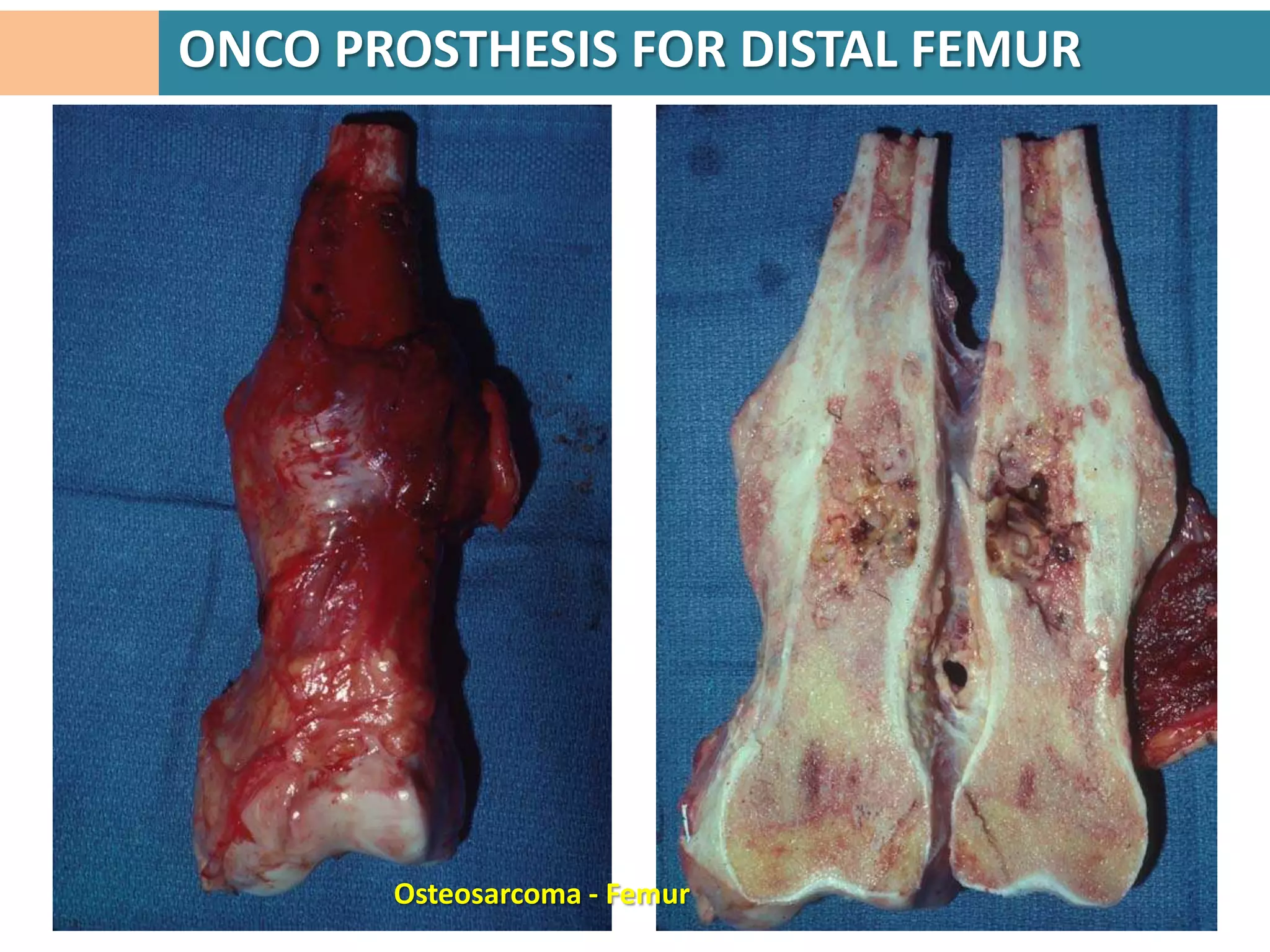
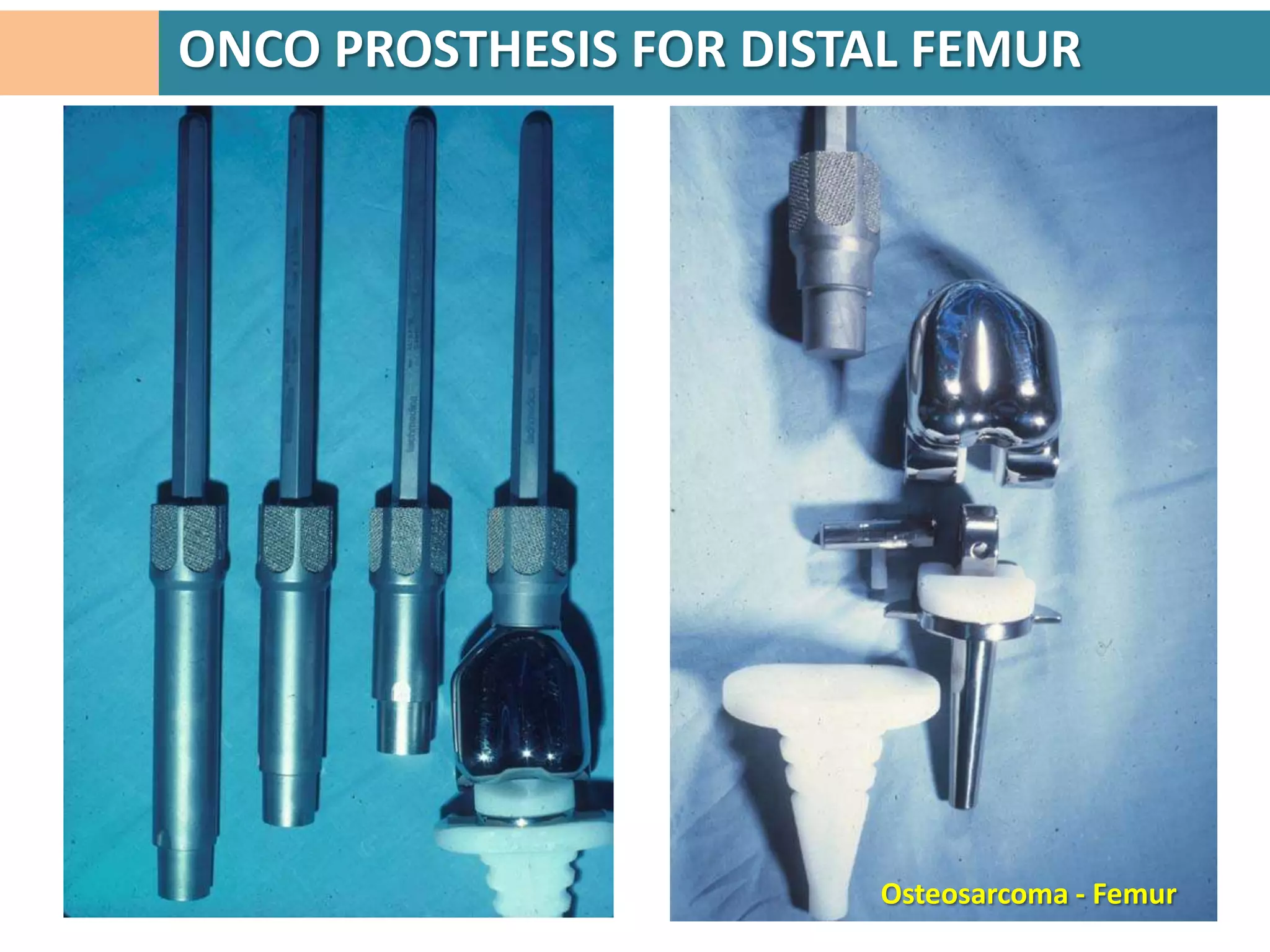
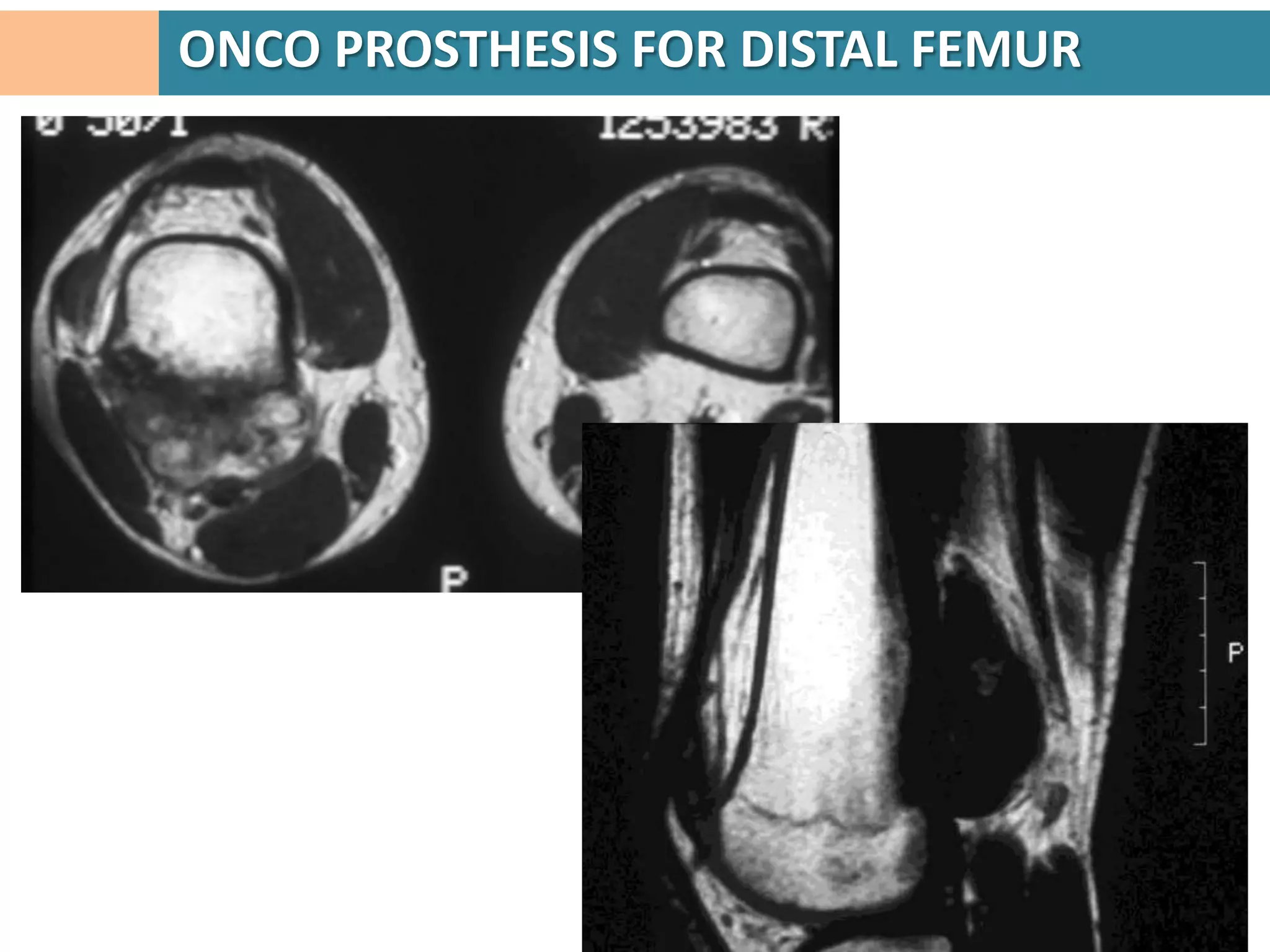
ONCO PROSTHESIS FOR DISTAL FEMUR


       Osteosarcoma - Femur
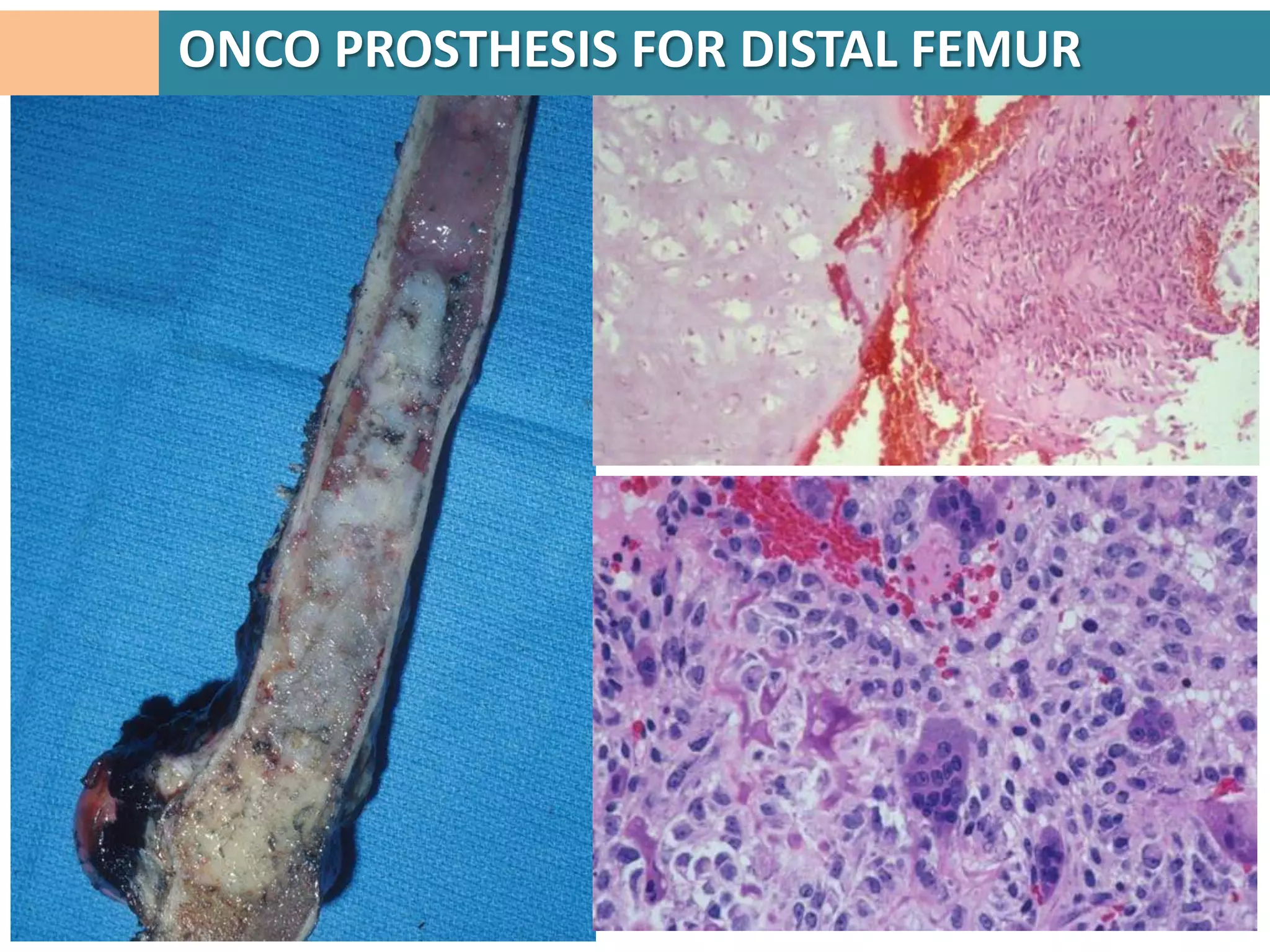
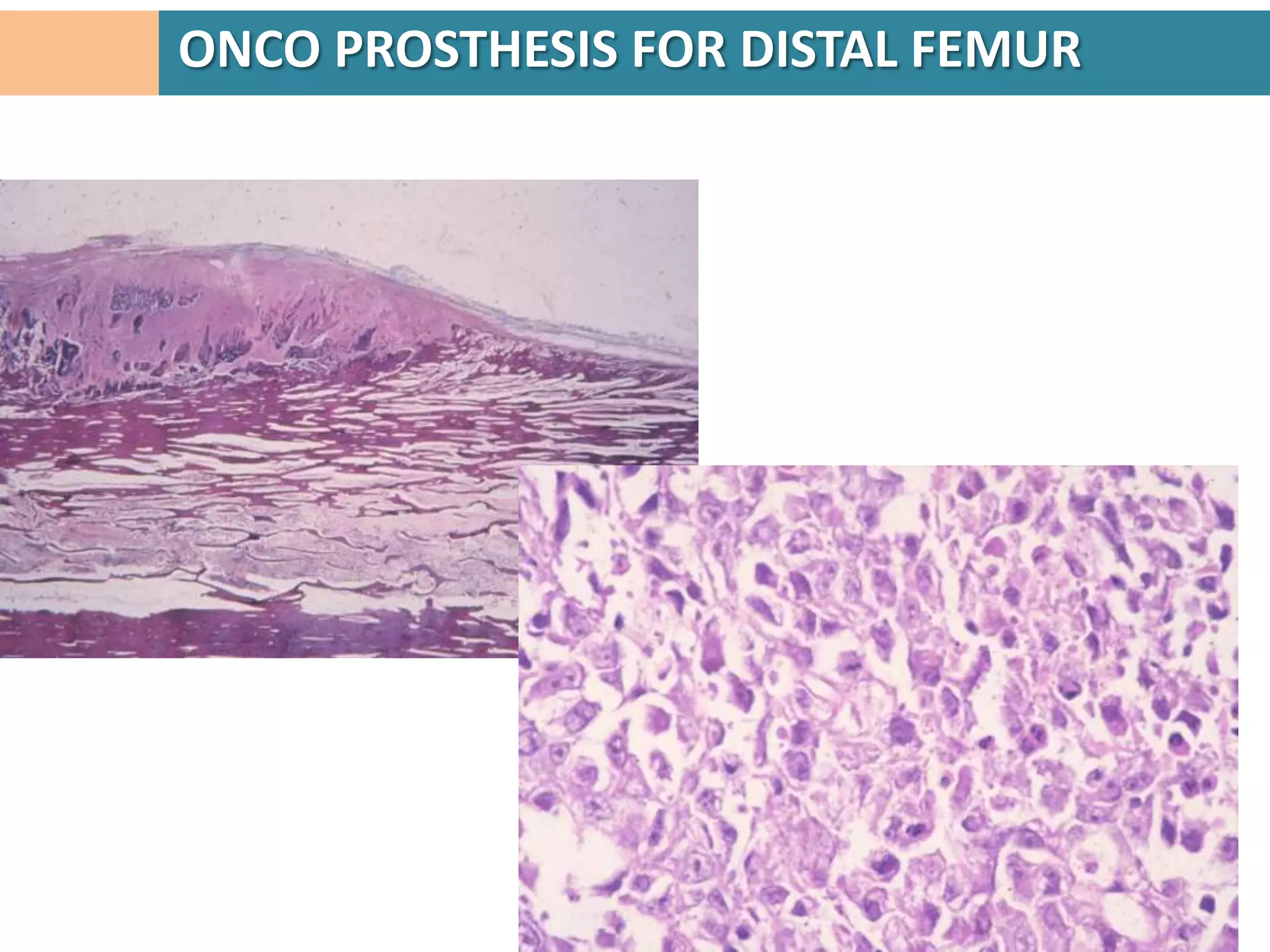
ONCO PROSTHESIS FOR DISTAL FEMUR


   Osteosarcoma - Femur
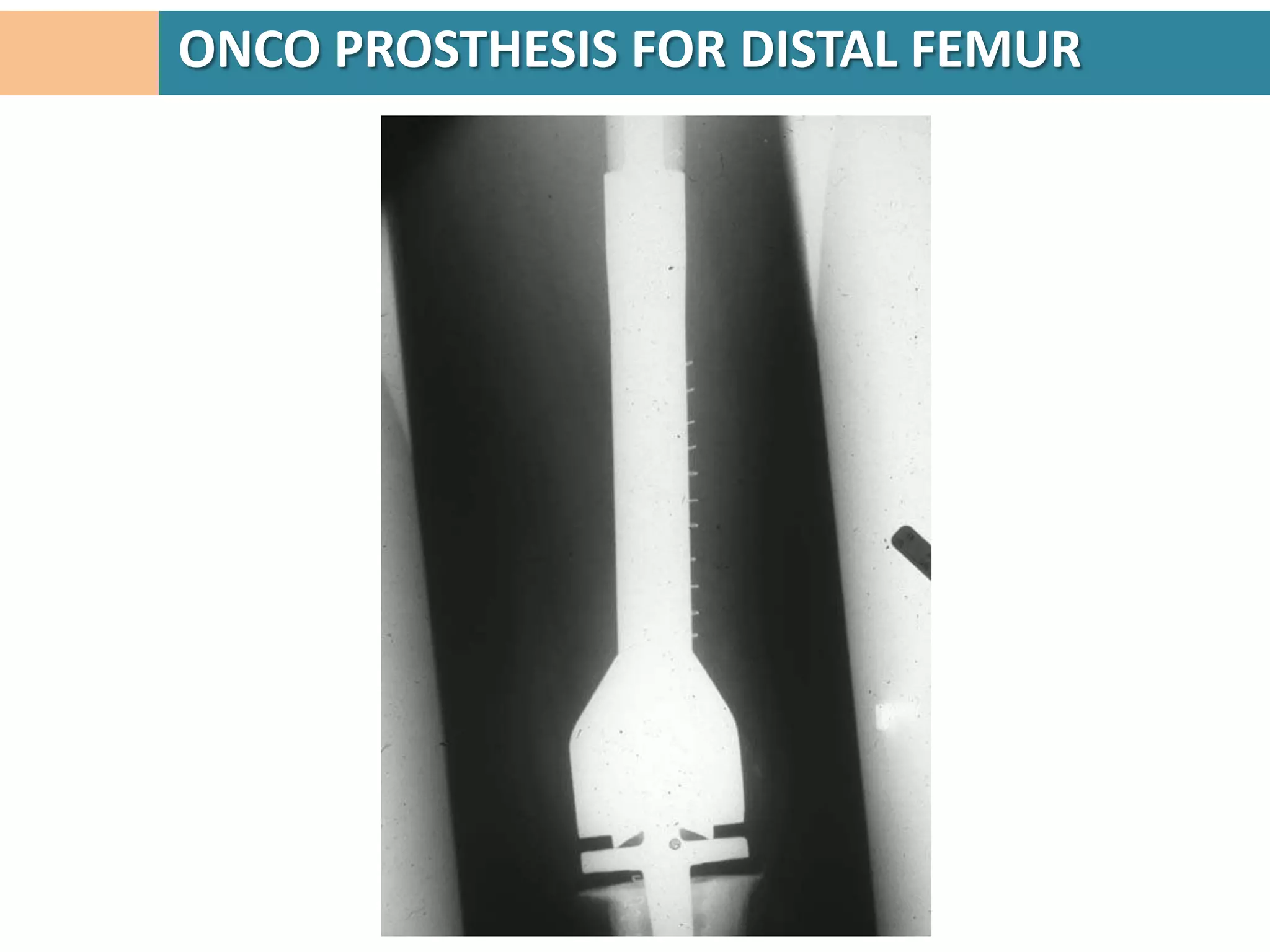
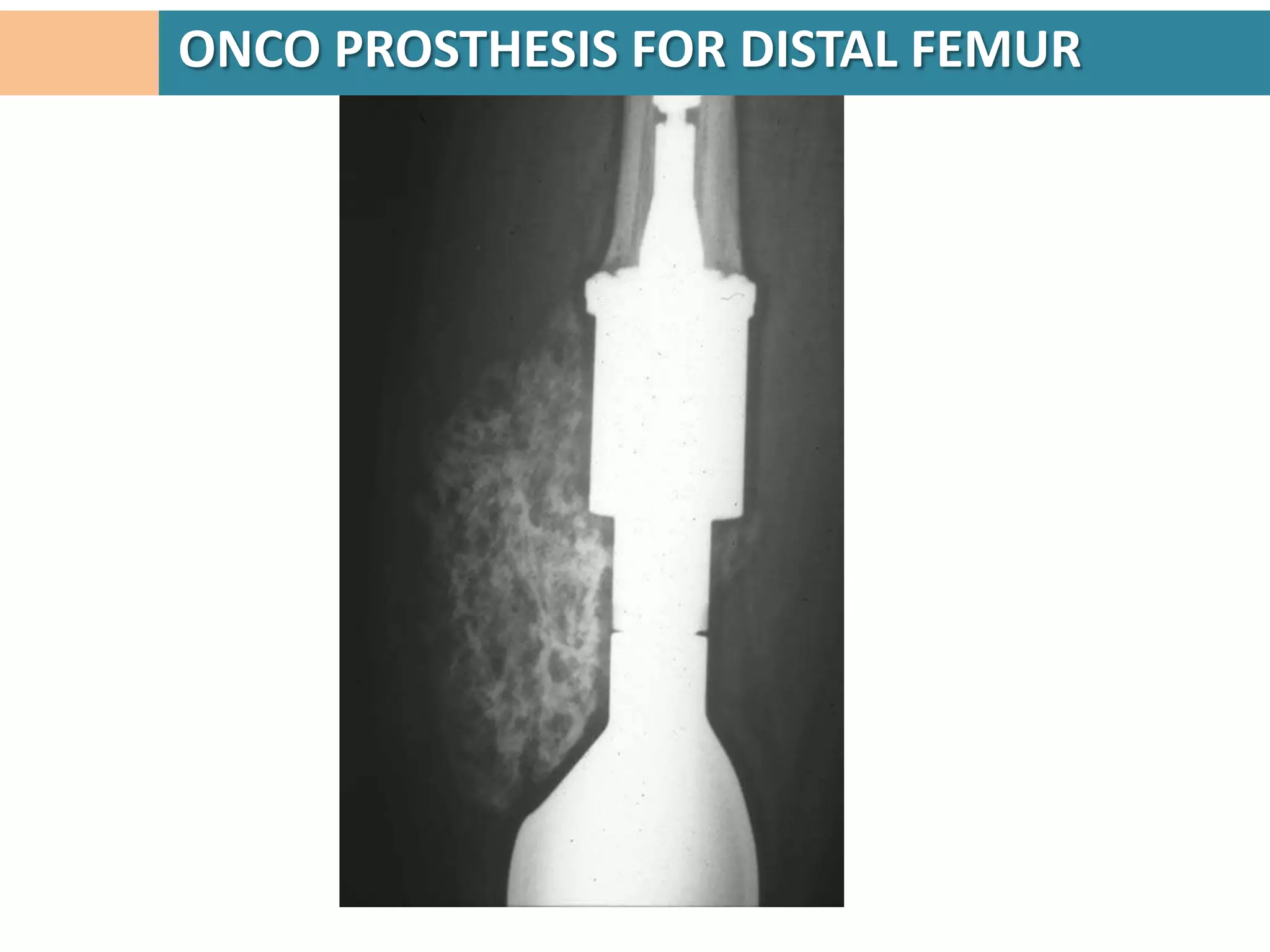
ONCO PROSTHESIS FOR DISTAL FEMUR


       Osteosarcoma - Femur
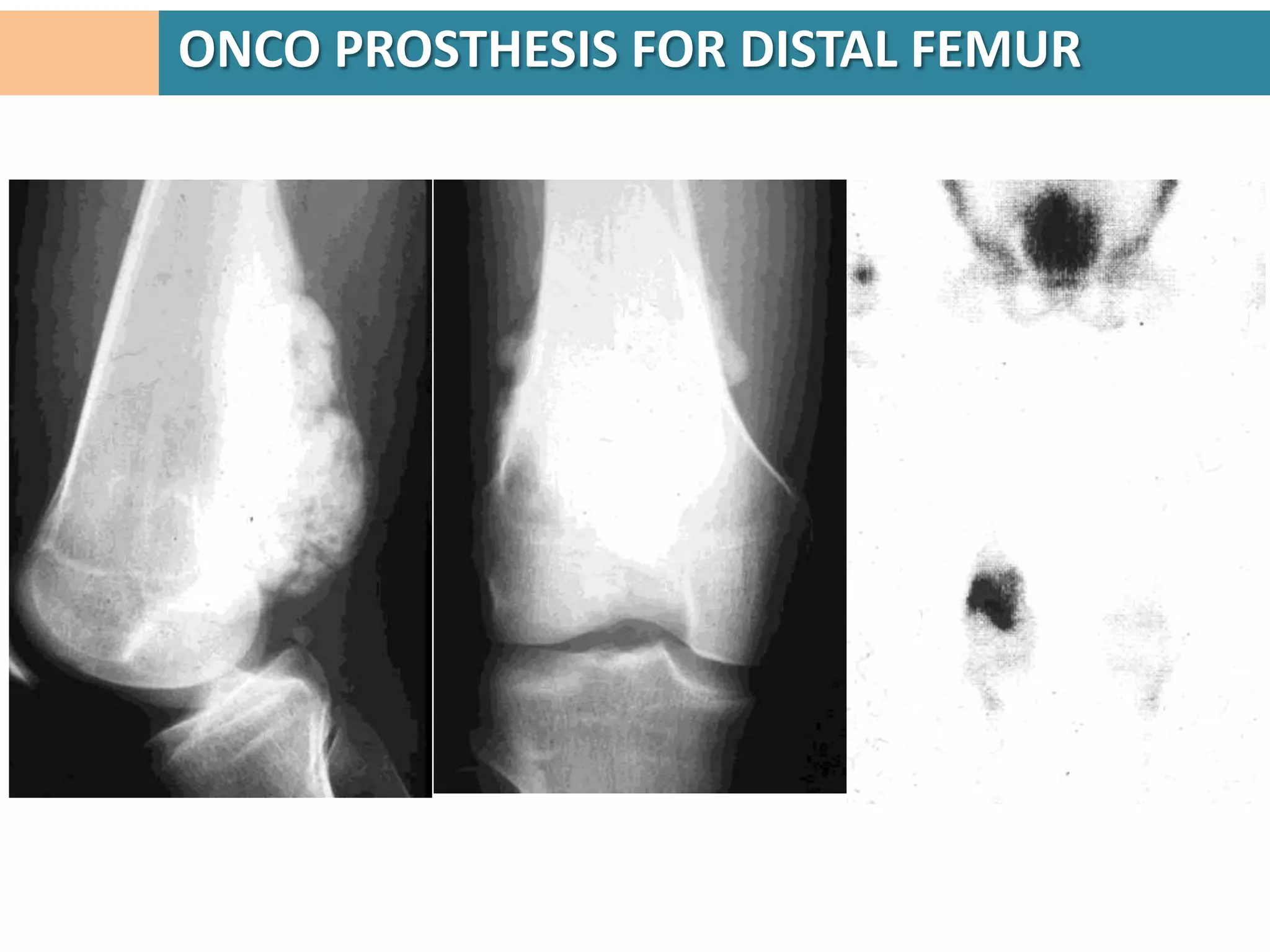
ONCO PROSTHESIS FOR DISTAL FEMUR
          Osteosarcoma - Femur
ONCO PROSTHESIS FOR DISTAL FEMUR


                        Osteosarcoma - Femur
ONCO PROSTHESIS FOR DISTAL FEMUR


                 Osteosarcoma - Femur
ONCO PROSTHESIS FOR DISTAL FEMUR


Chondrosarcoma – Dedifferentiated ,Femur
ONCO PROSTHESIS FOR DISTAL FEMUR


Recalcitrant Non union of Radiation associated Fracture SC Femur
ONCO PROSTHESIS FOR DISTAL FEMUR


                 TMH-NICE
                 (New Indigenous Customised
                 Endoprosthesis)joint
ONCO PROSTHESIS FOR PROXIMAL HUMERUS
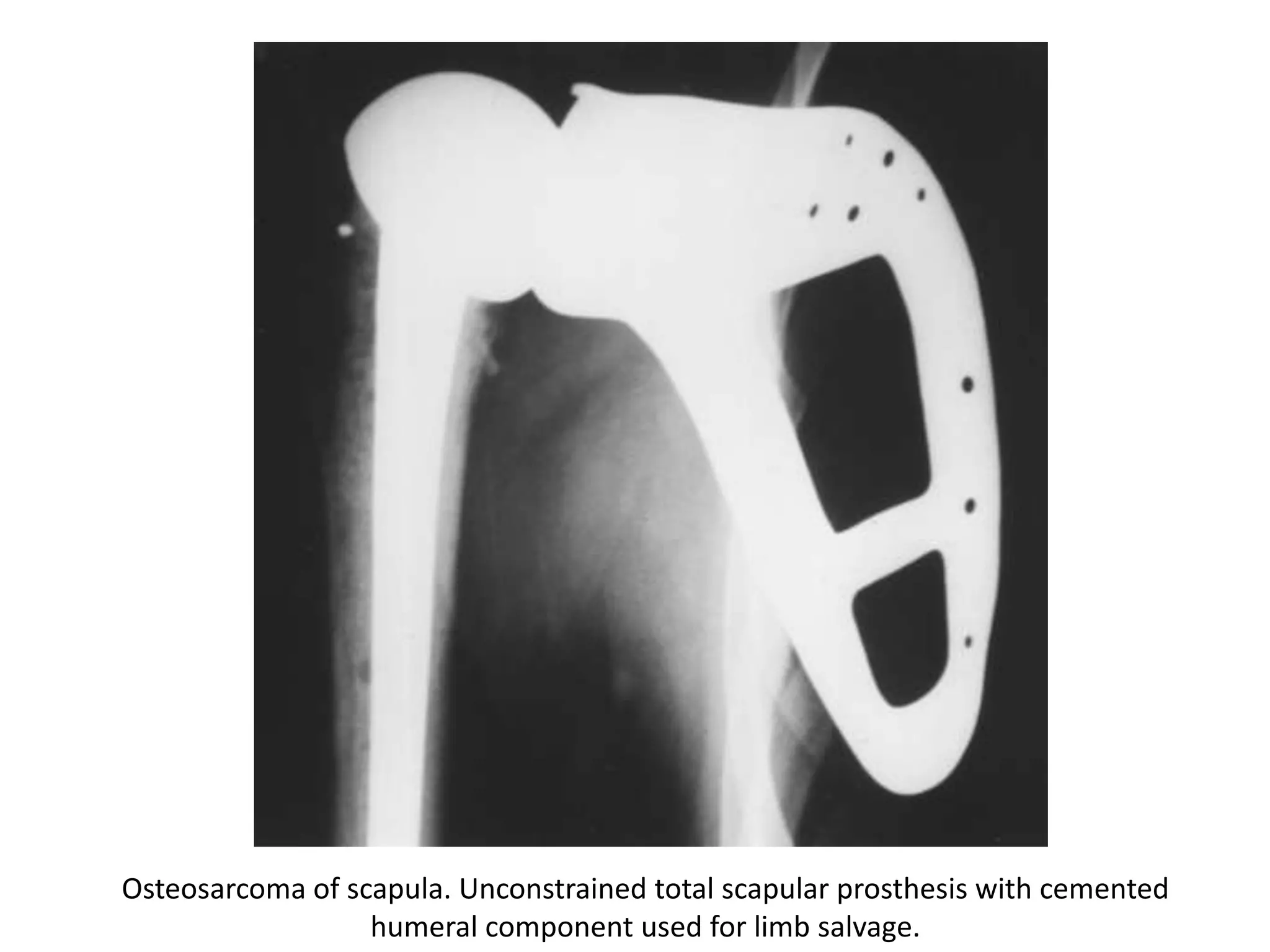
Osteosarcoma of scapula. Unconstrained total scapular prosthesis with cemented
                  humeral component used for limb salvage.
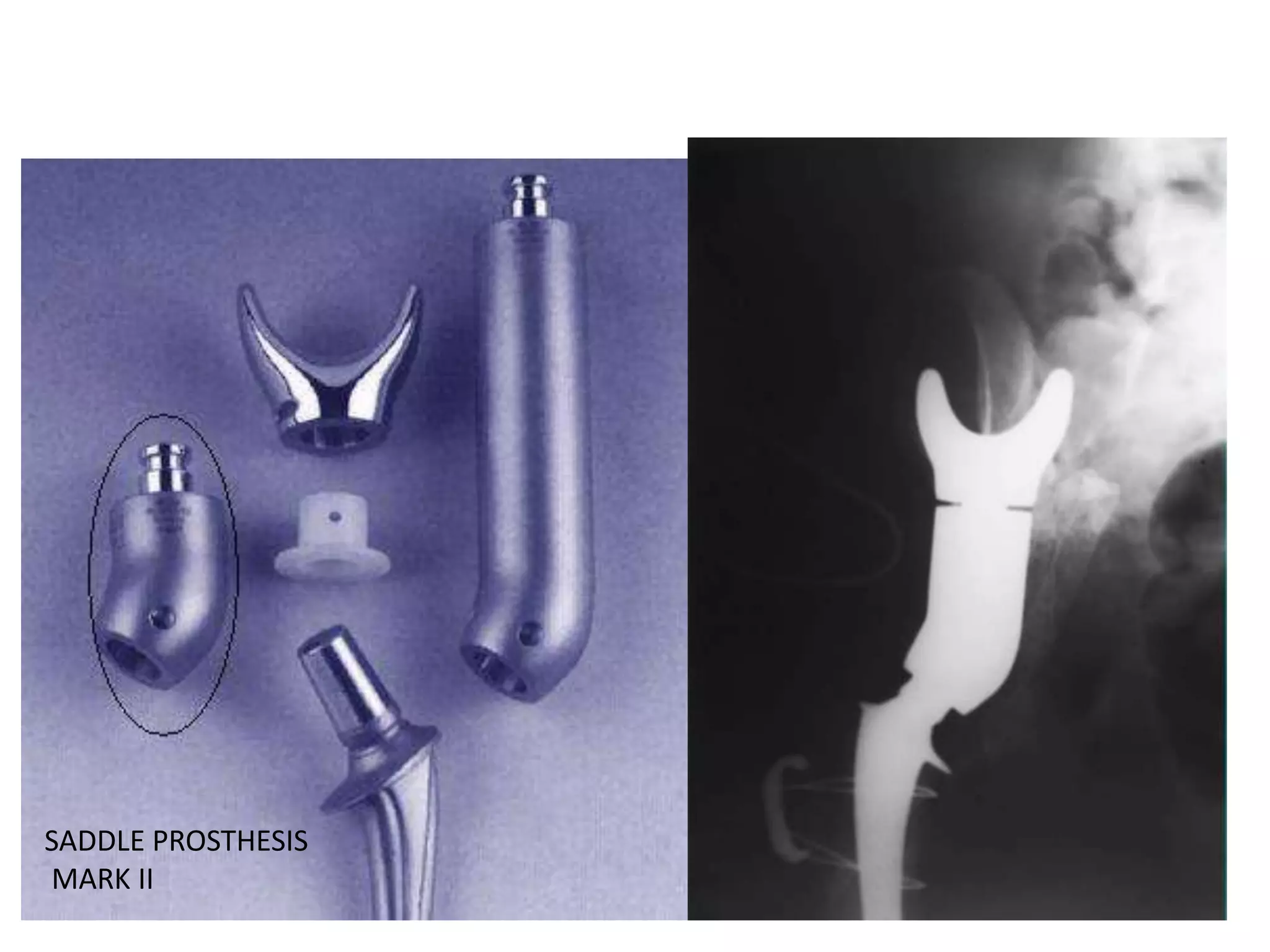
SADDLE PROSTHESIS
MARK II
LIMB SALVAGE


  RESECTION + RECONSTRUCTION
ALLOGRAFT PROSTHESIS COMPOSITE

     Attachment sites available for resected
   muscles and joint stabilisers – better function
Combined allograft and
cemented Neer prosthesis
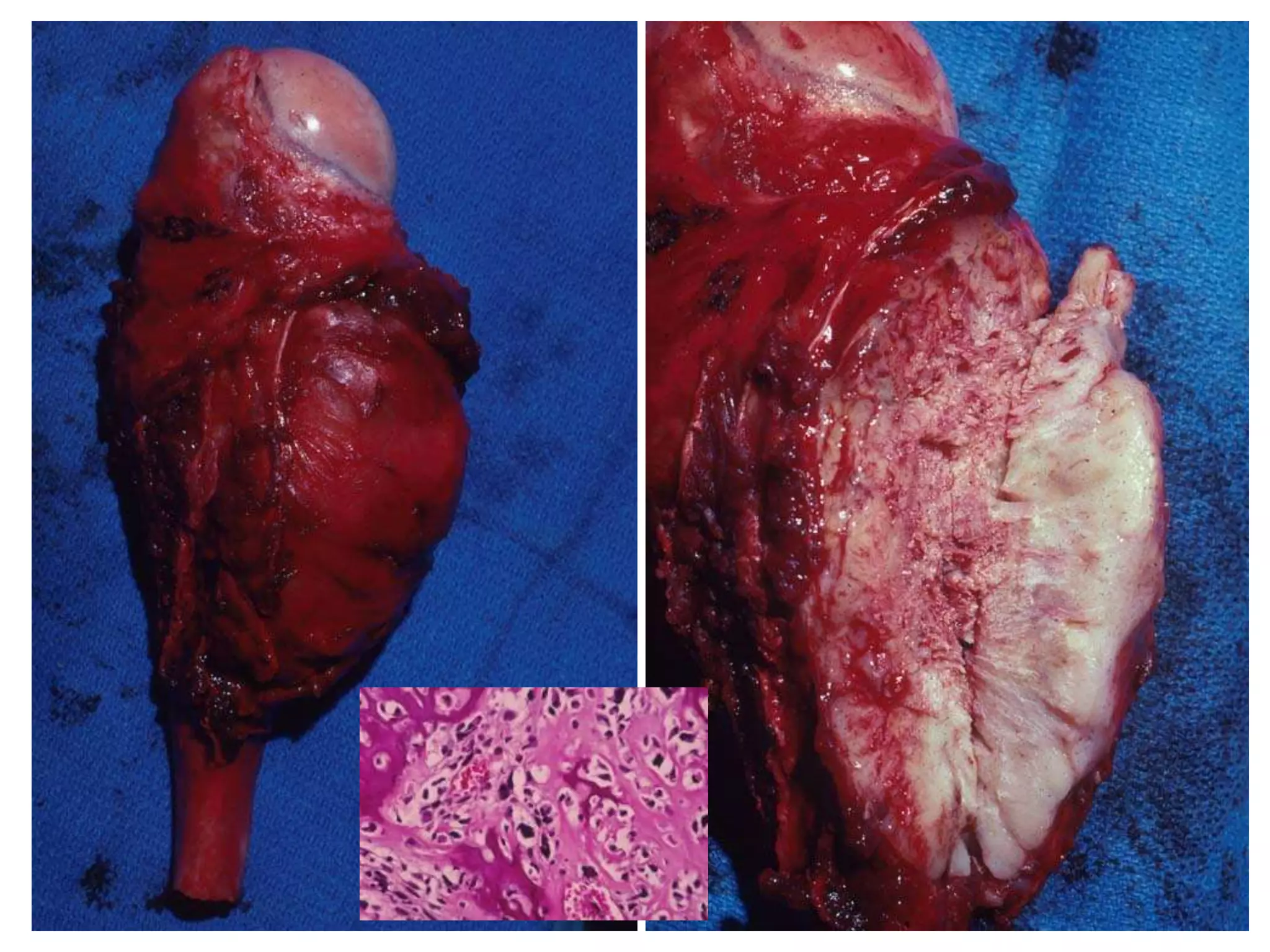
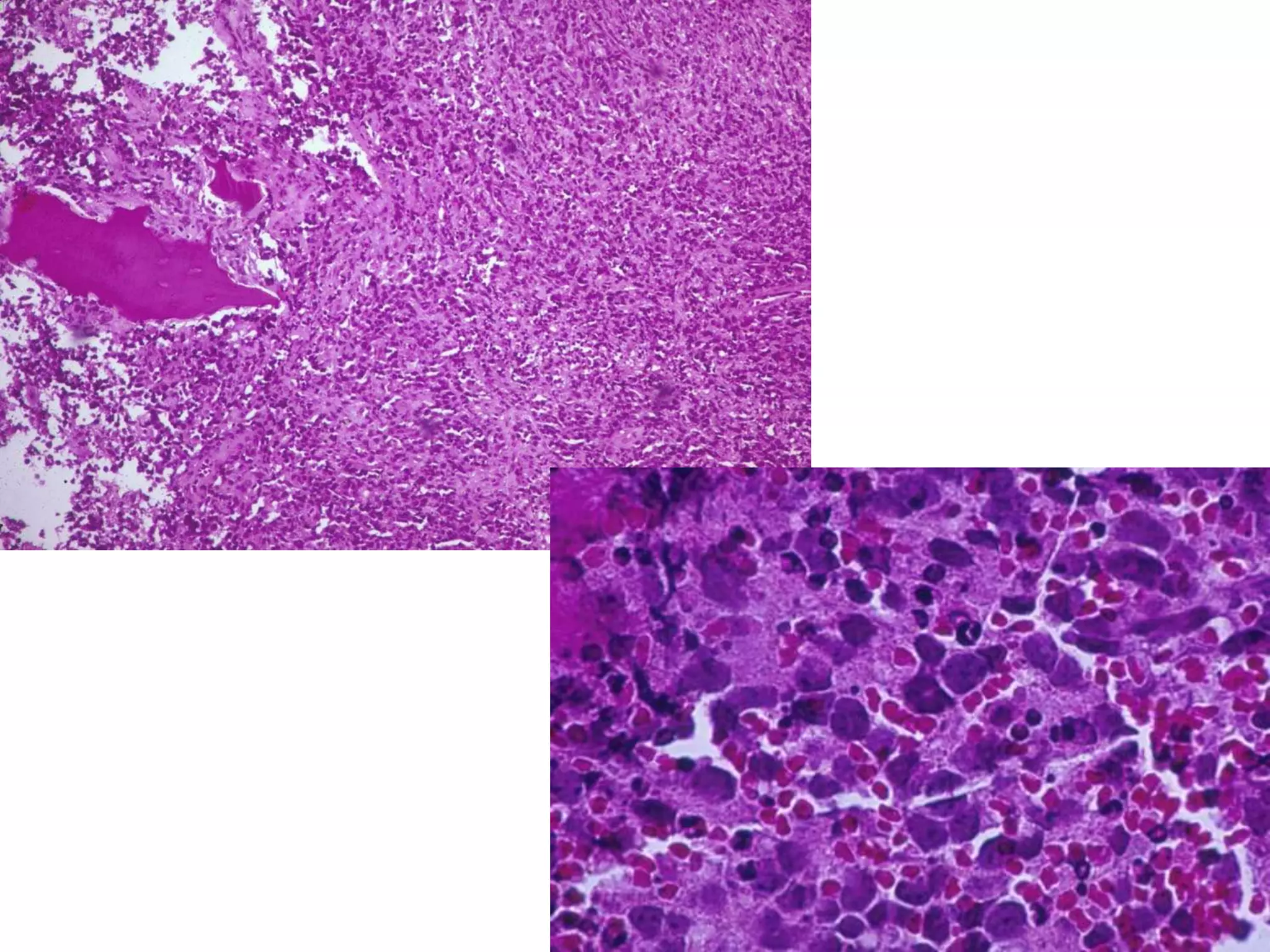
Low-grade cartilaginous tumor but with areas in the central portion that show osteoid
being produced by the tumor as well
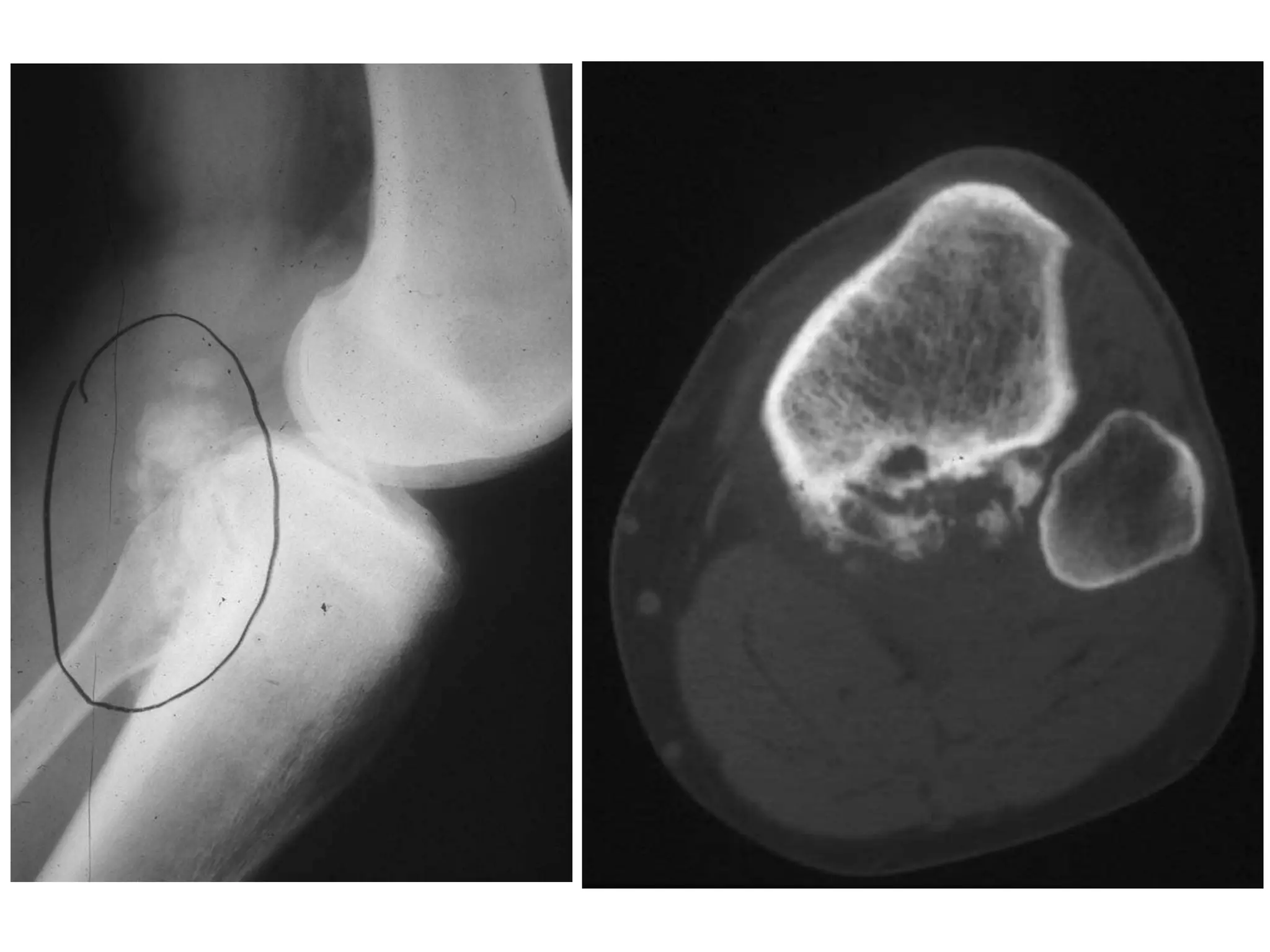
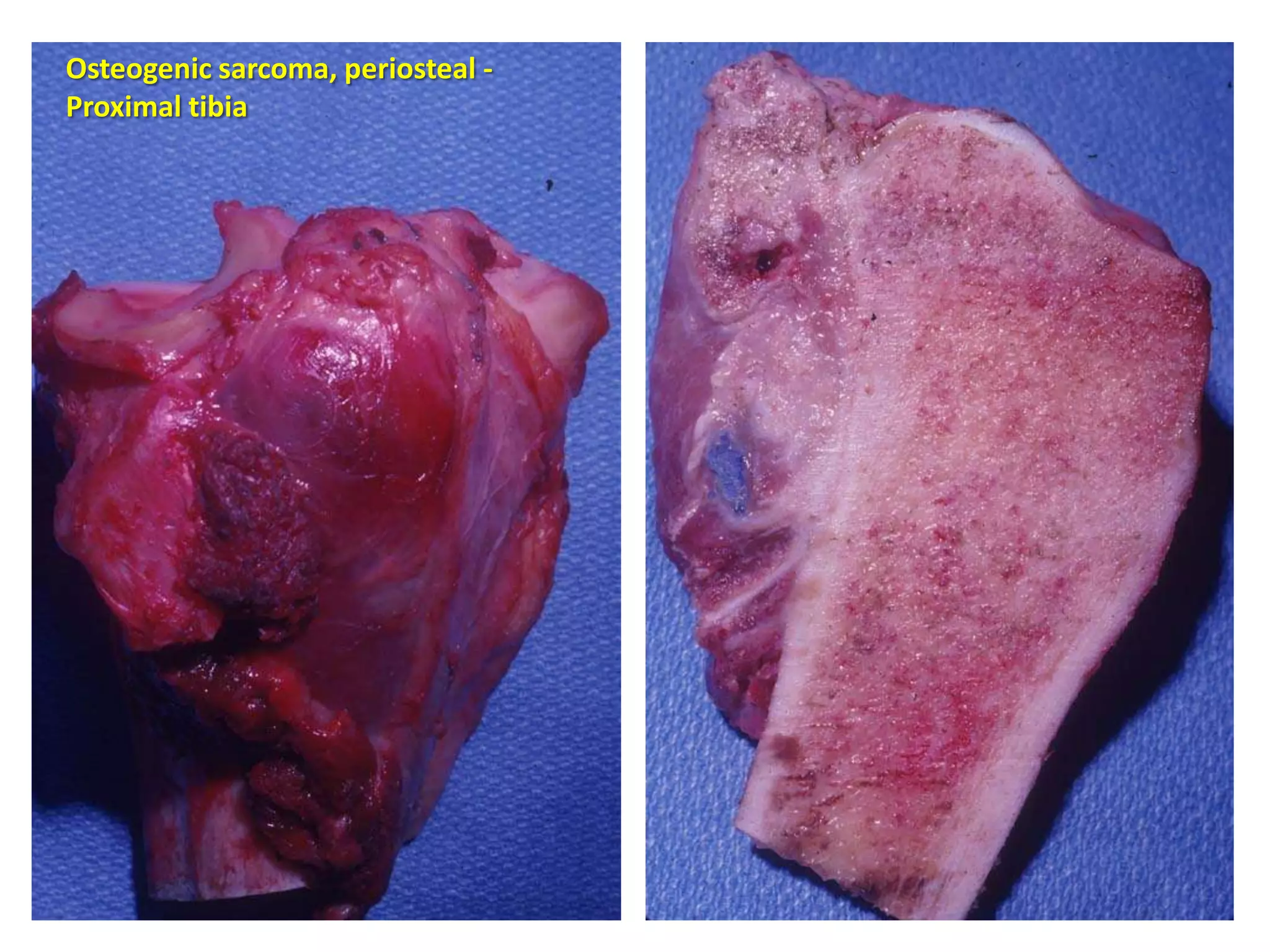
Osteogenic sarcoma, periosteal -
Proximal tibia
A total knee implant with an allograft placed over the
proximal portion of the tibial component and a short
side plate to control rotation of the allograft.
Restoring bone stock

Preventing loosening by increasing interface
surface between prosthesis and bone

Limiting proximal bone resorption
LIMB SALVAGE


RESECTION + RECONSTRUCTION
 AUTOCLAVED BONE GRAFT +/-
        PROSTHESIS
Malignant fibrous histiocytoma - Proximal
humerus
Part of the reconstructive procedure
consists of autoclaving the surgical
specimen at 130 degrees centigrade
for 4 min.
This kills the tumor but preserves
the physical aspects of the
bone, which is then placed back
over a long-stem Neer prosthesis
and cemented into position.
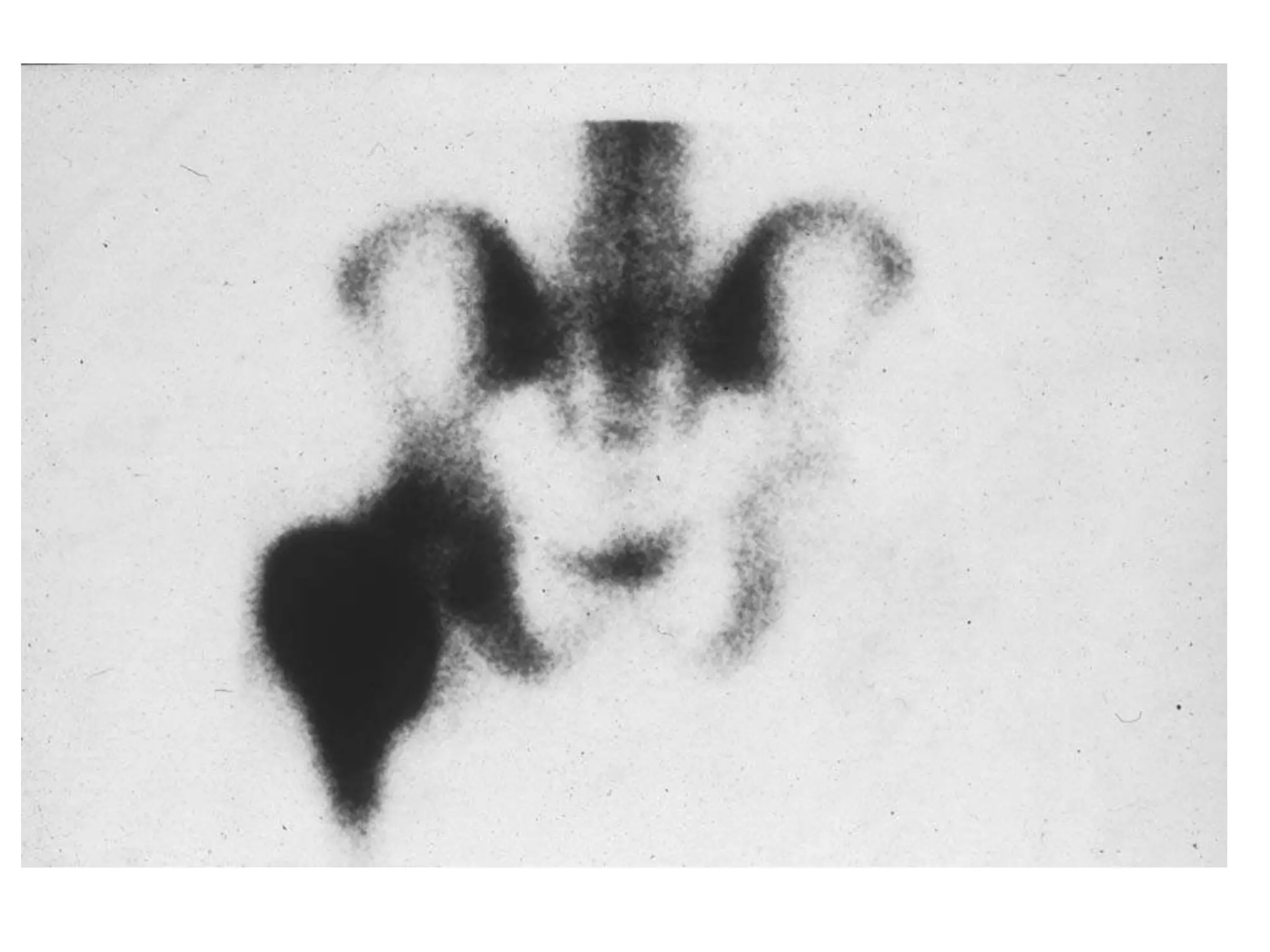
Acetabulum following the resection
showing the hyperemic changes in the
acetabular synovial tissues, a response
to the antigen stimulation of the
nearby tumor in the upper femur.
There is no crossover into the
acetabular structures preventing the
need for a more aggressive internal
hemipelvectomy reconstruction.
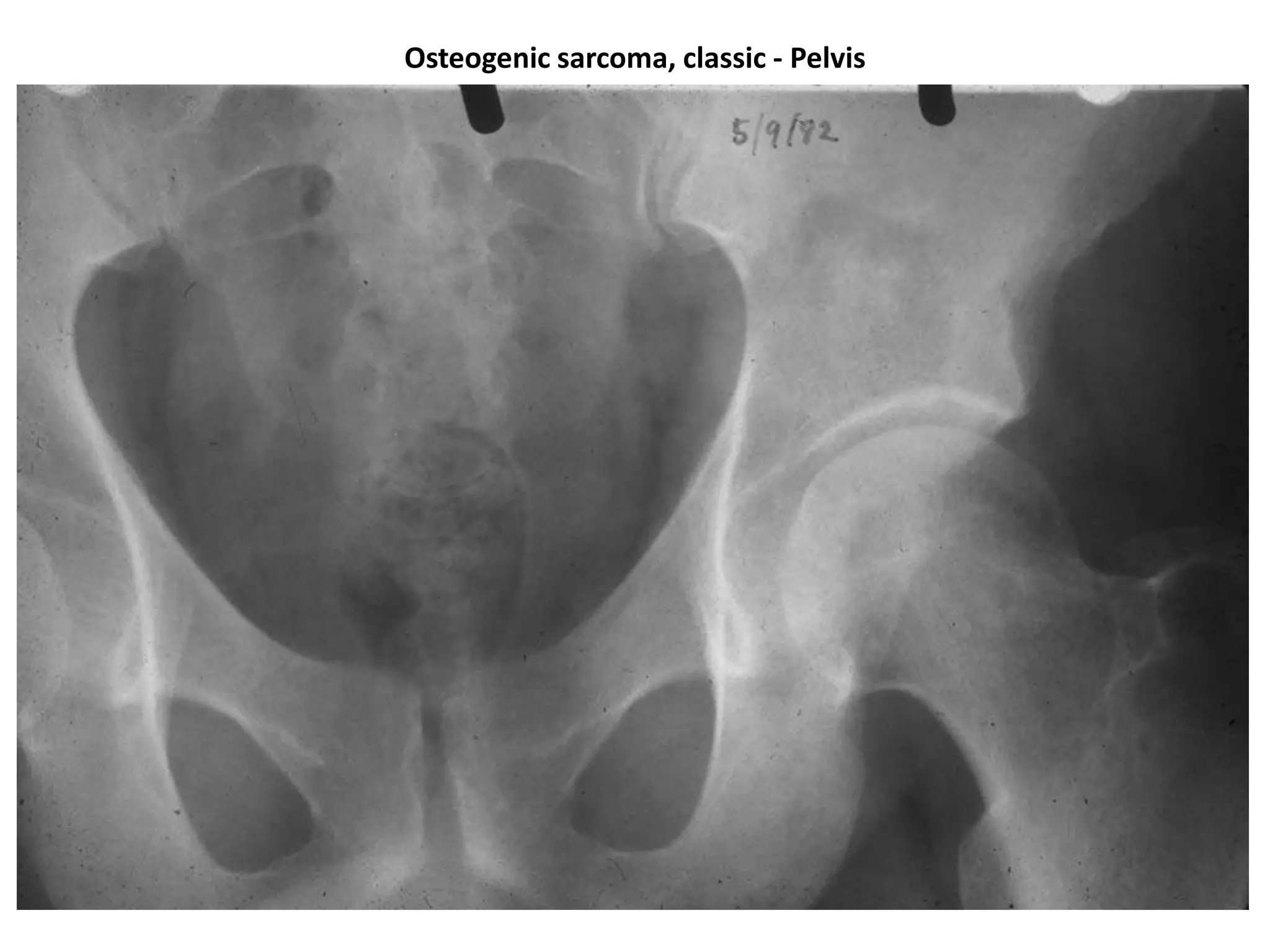
Osteogenic sarcoma, classic - Pelvis
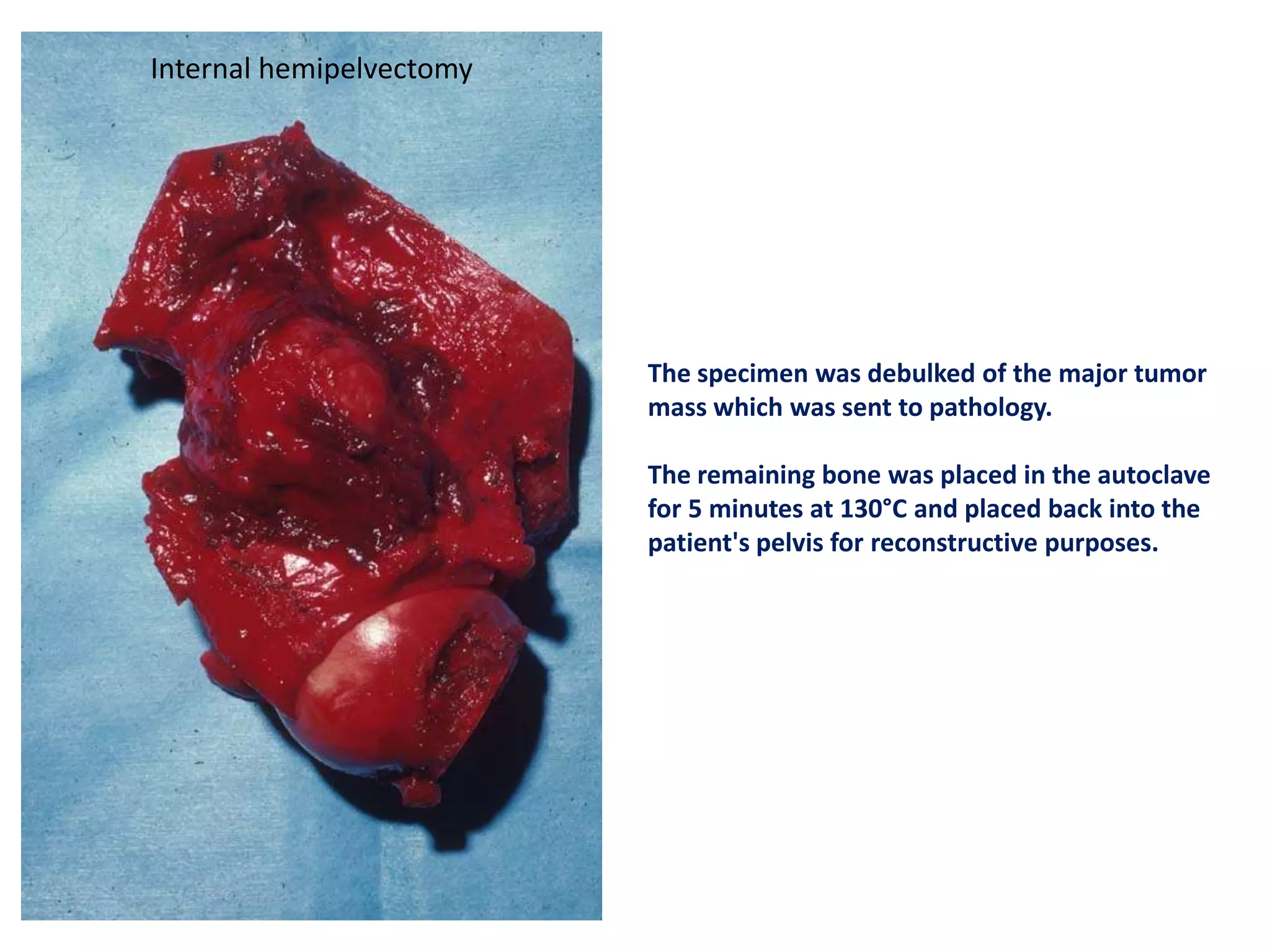
Internal hemipelvectomy


                          The specimen was debulked of the major tumor
                          mass which was sent to pathology.

                          The remaining bone was placed in the autoclave
                          for 5 minutes at 130°C and placed back into the
                          patient's pelvis for reconstructive purposes.
Pins were placed through the autoclaved autograft along with
screws and plates.
A routine total hip prosthesis was cemented into position on   Entire acetabulum recemented in anatomical position that
top of the threaded Steinmann pins.                            allows for excellent weight bearing function
LIMB SALVAGE


RESECTION + RECONSTRUCTION
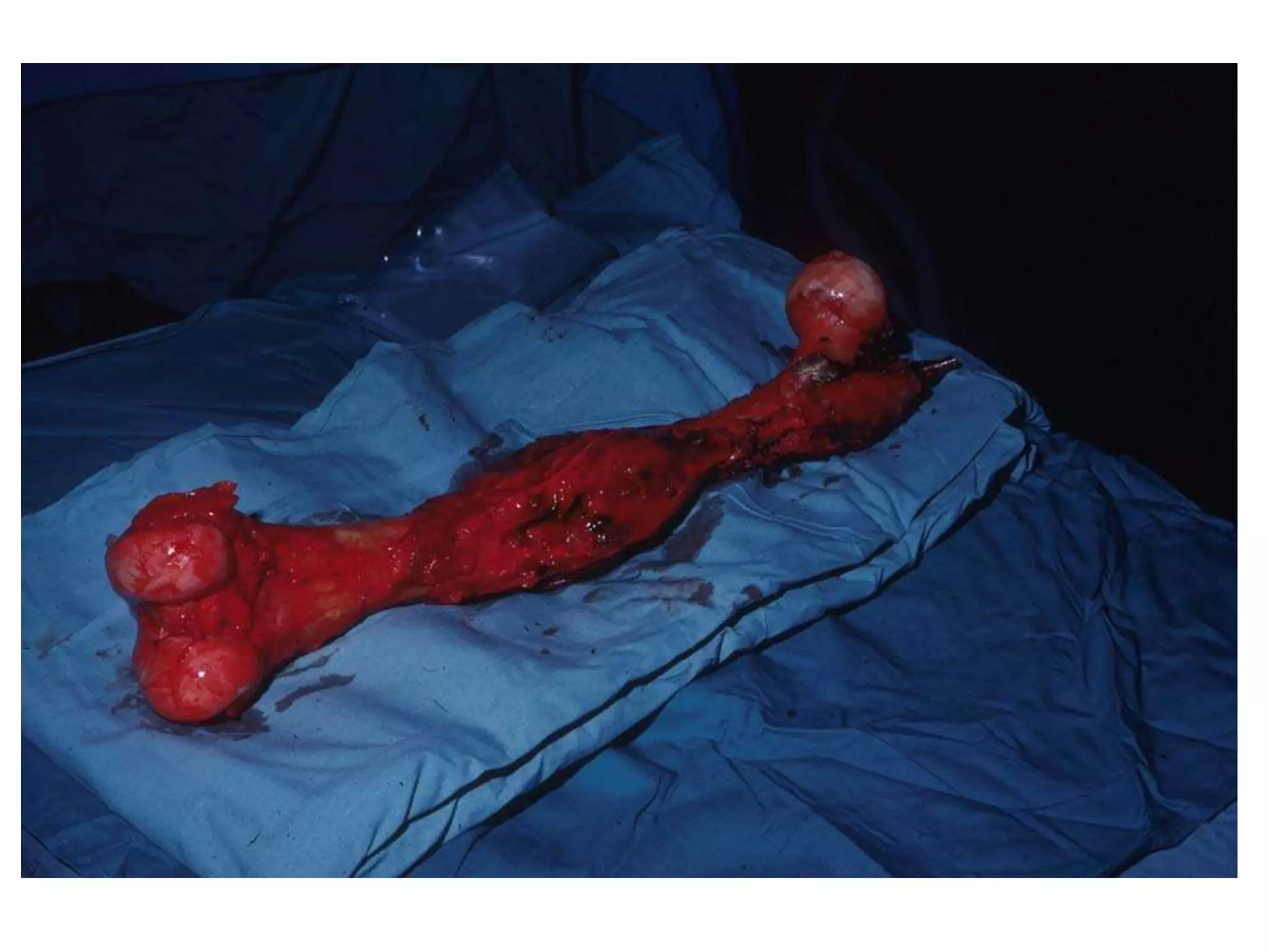
        TOTAL FEMUR
Ewing's sarcoma – Femur With Pathological fracture from biopsy site
Custom total femoral implant
LIMB SALVAGE


RESECTION + RECONSTRUCTION
      ROTATIONPLASTY
ROTATIONPLASTY

• Group AI— Distal Femur.
ROTATIONPLASTY

• Group AII—Proximal Tibia.
ROTATIONPLASTY

• Group BI— Proximal Femur sparing the hip joint and gluteal muscles.
ROTATIONPLASTY

• Group BII— Proximal Femur with involvement of hip joint and
   contiguous soft tissue.
ROTATIONPLASTY


• Group BIII—Lesion in midfemur.
ROTATIONPLASTY


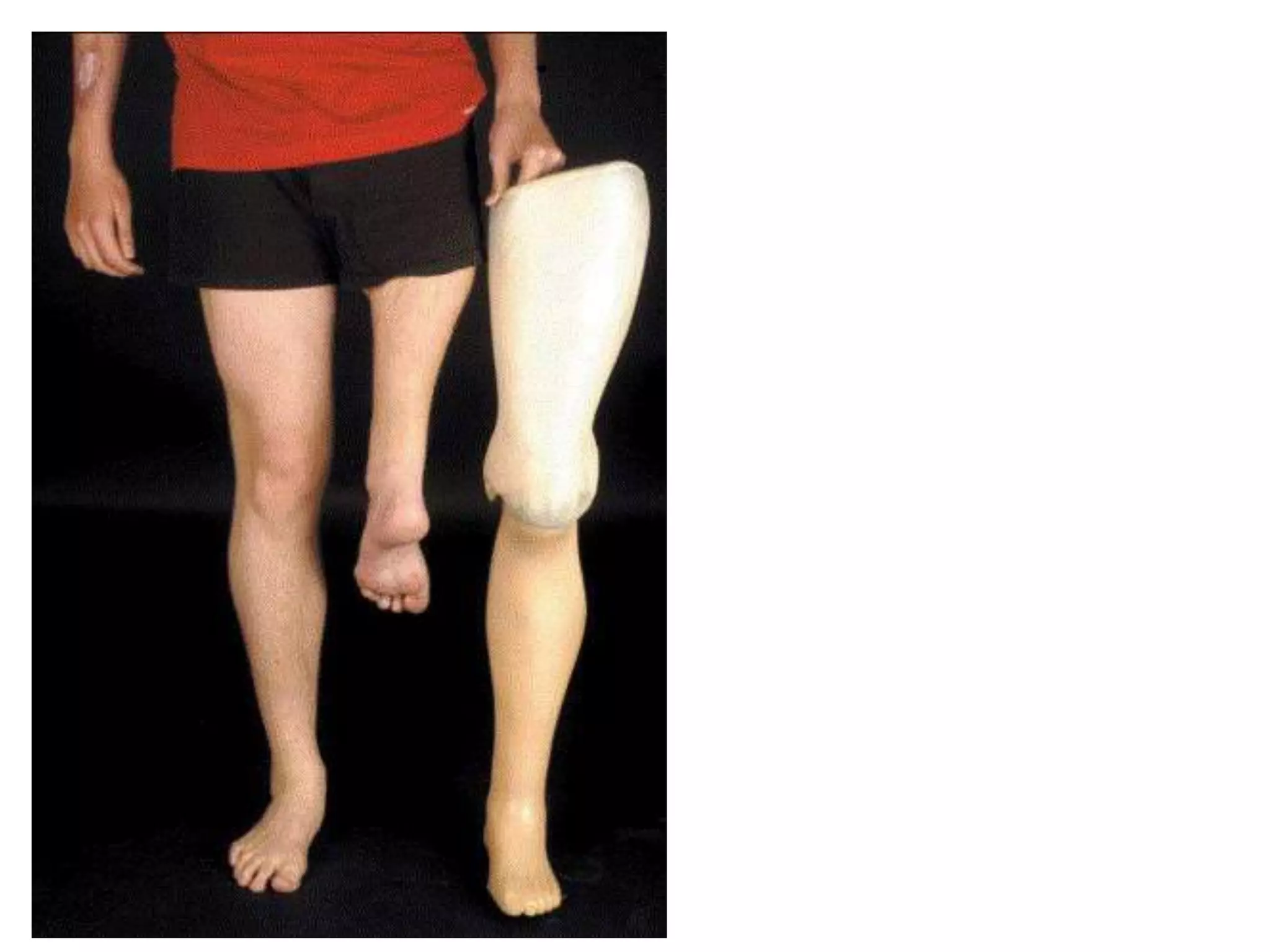
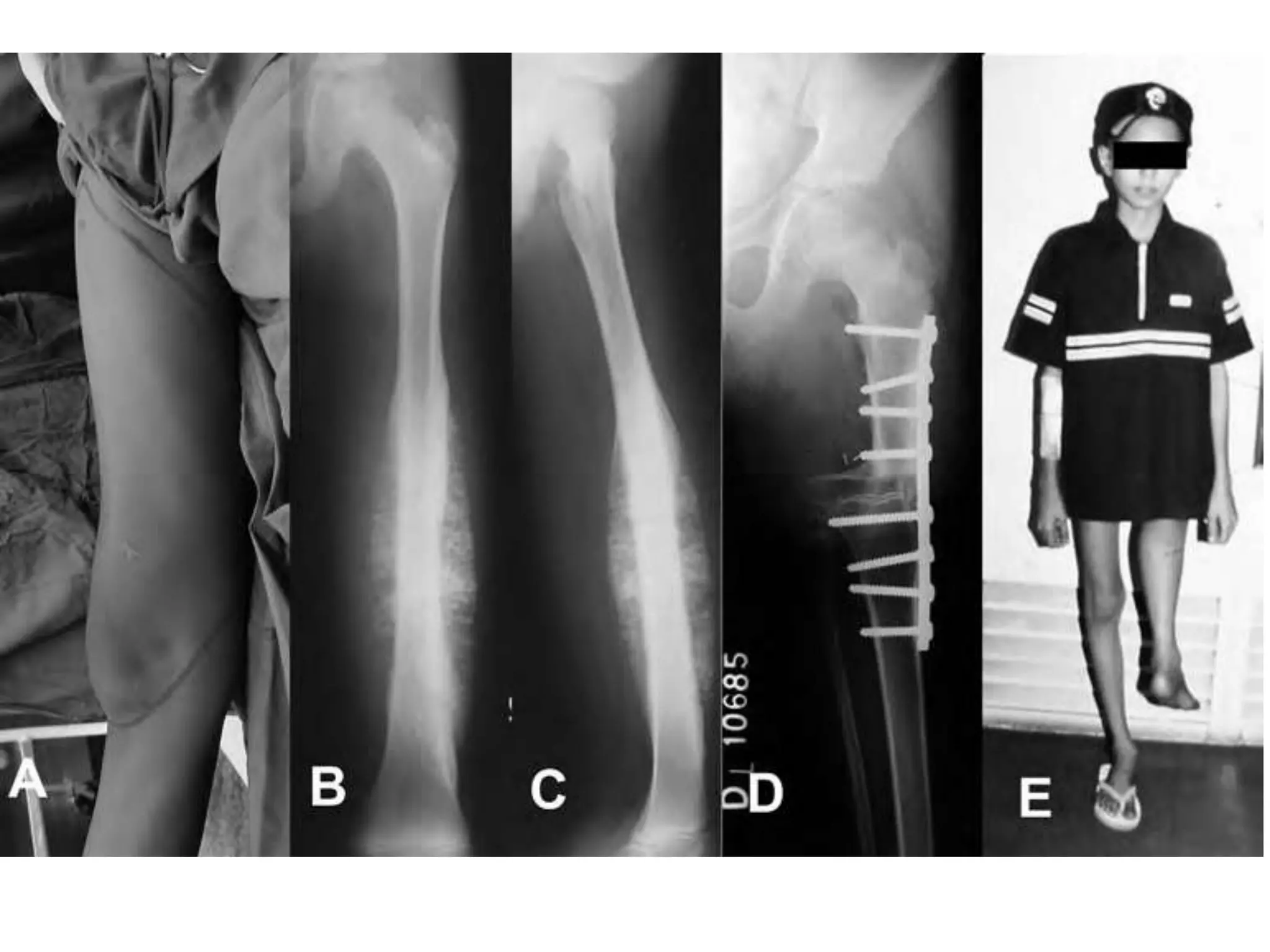
Borggreve-Van Nes rotationplasty
ROTATIONPLASTY
ROTATIONPLASTY
ROTATIONPLASTY
ROTATIONPLASTY
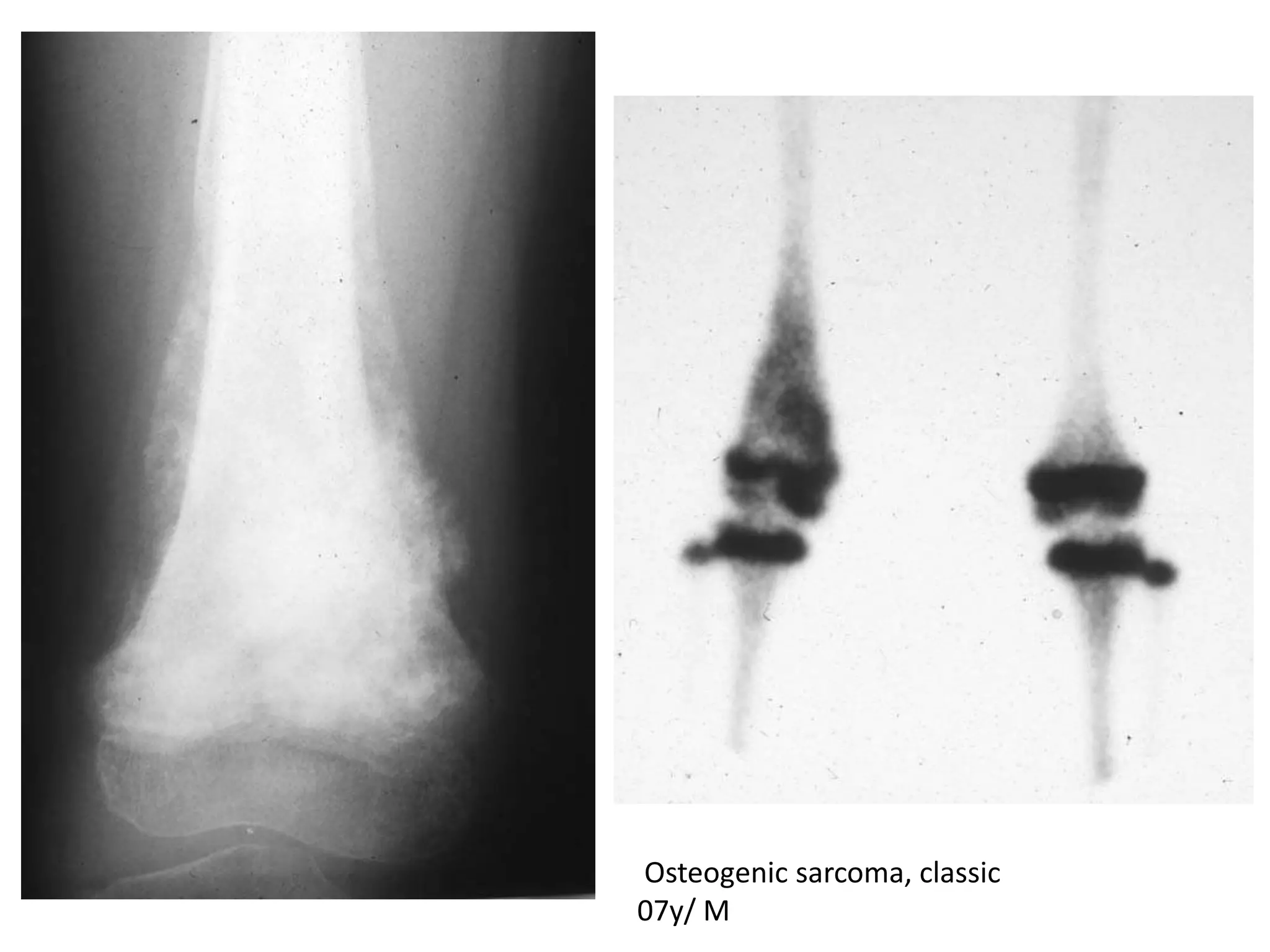
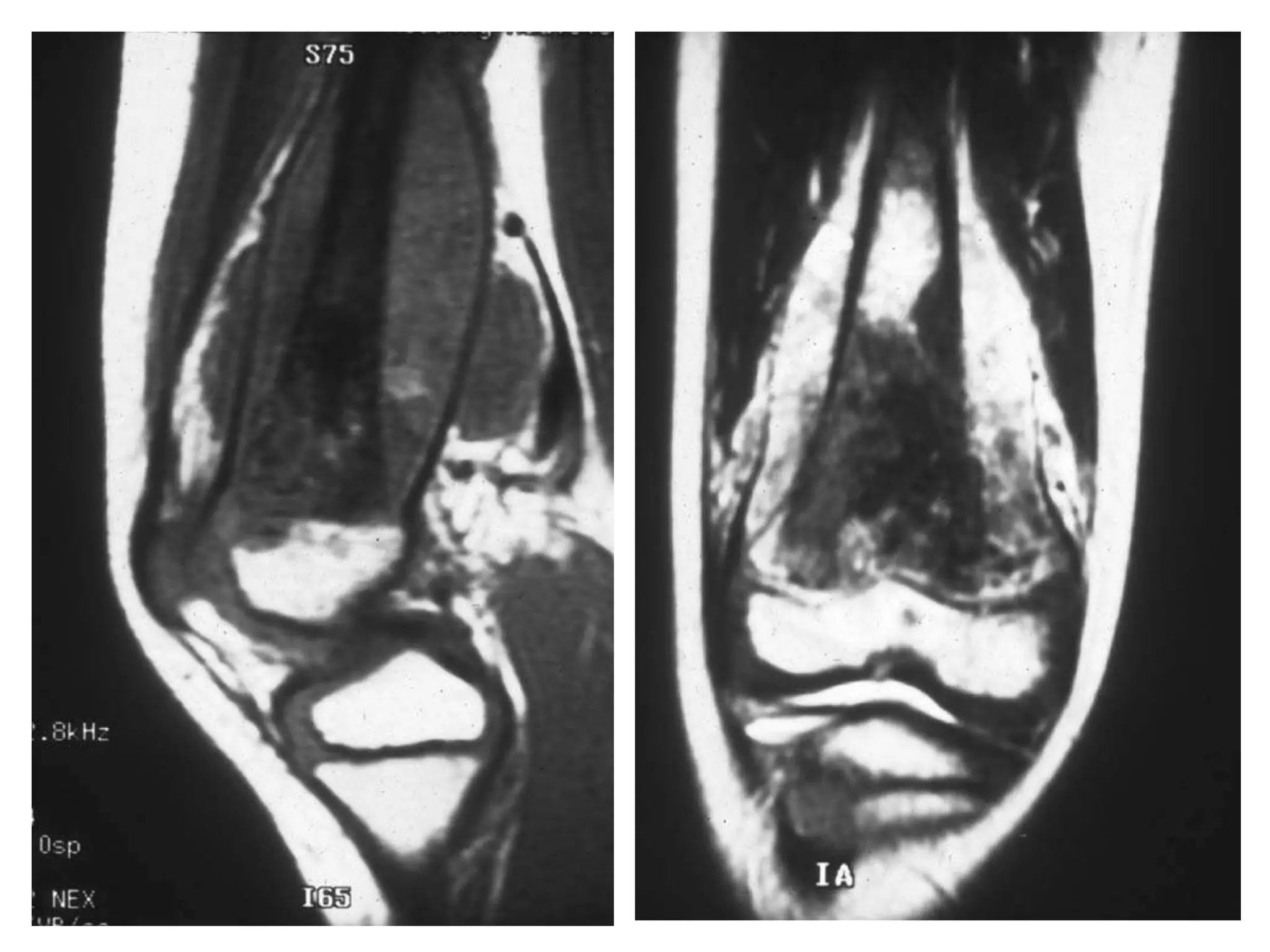
Osteogenic sarcoma, classic
07y/ M
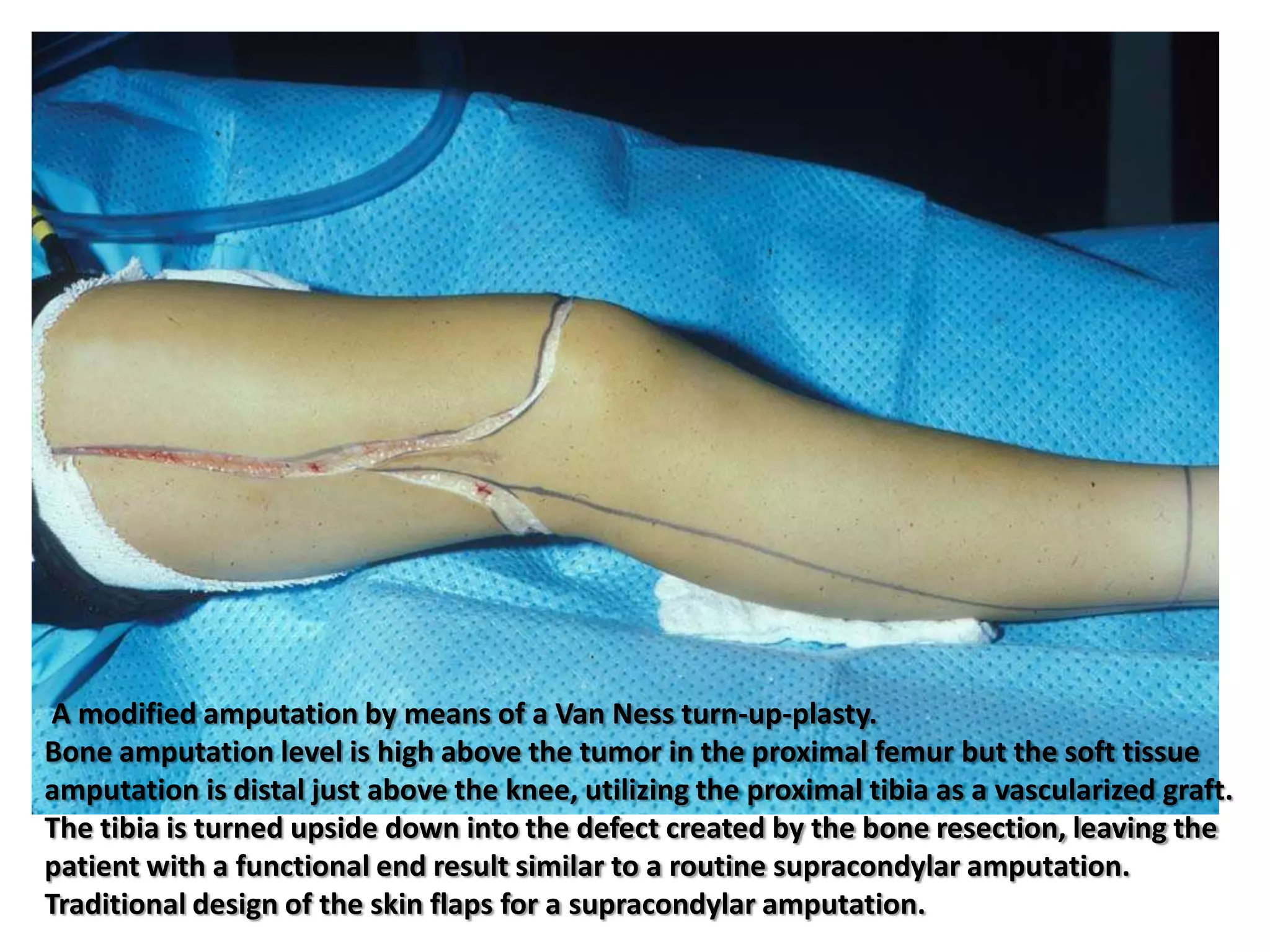
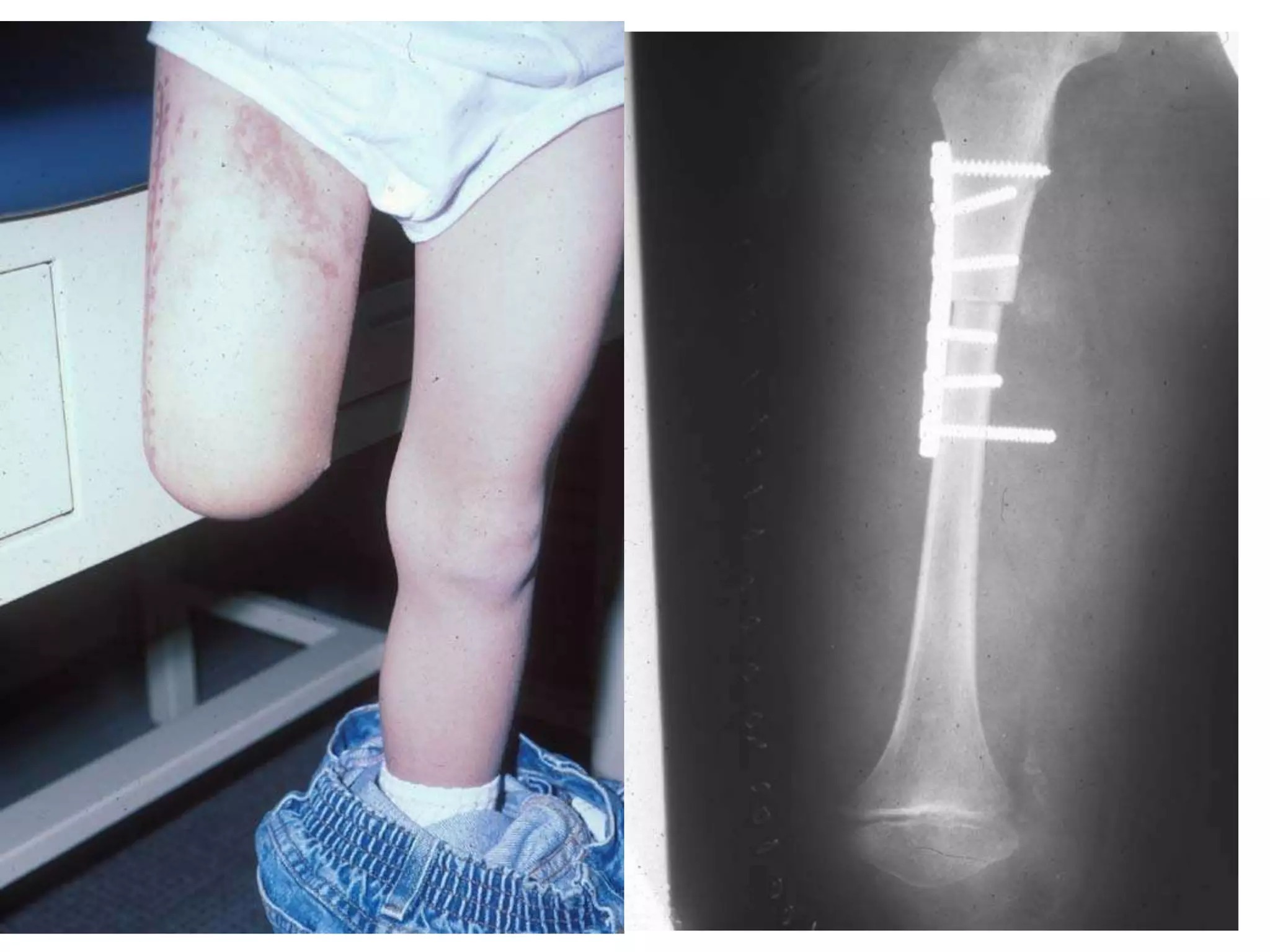
A modified amputation by means of a Van Ness turn-up-plasty.
Bone amputation level is high above the tumor in the proximal femur but the soft tissue
amputation is distal just above the knee, utilizing the proximal tibia as a vascularized graft.
The tibia is turned upside down into the defect created by the bone resection, leaving the
patient with a functional end result similar to a routine supracondylar amputation.
Traditional design of the skin flaps for a supracondylar amputation.
The proximal 10 inches of the tibia has been mobilized from its surrounding soft
tissue, leaving only the anterior compartment and the deep posterior compartment
intact. The popliteal vessels are intact proximally just beneath the tibial plateau, still
supplying vascular nutrition to the resected tibia.
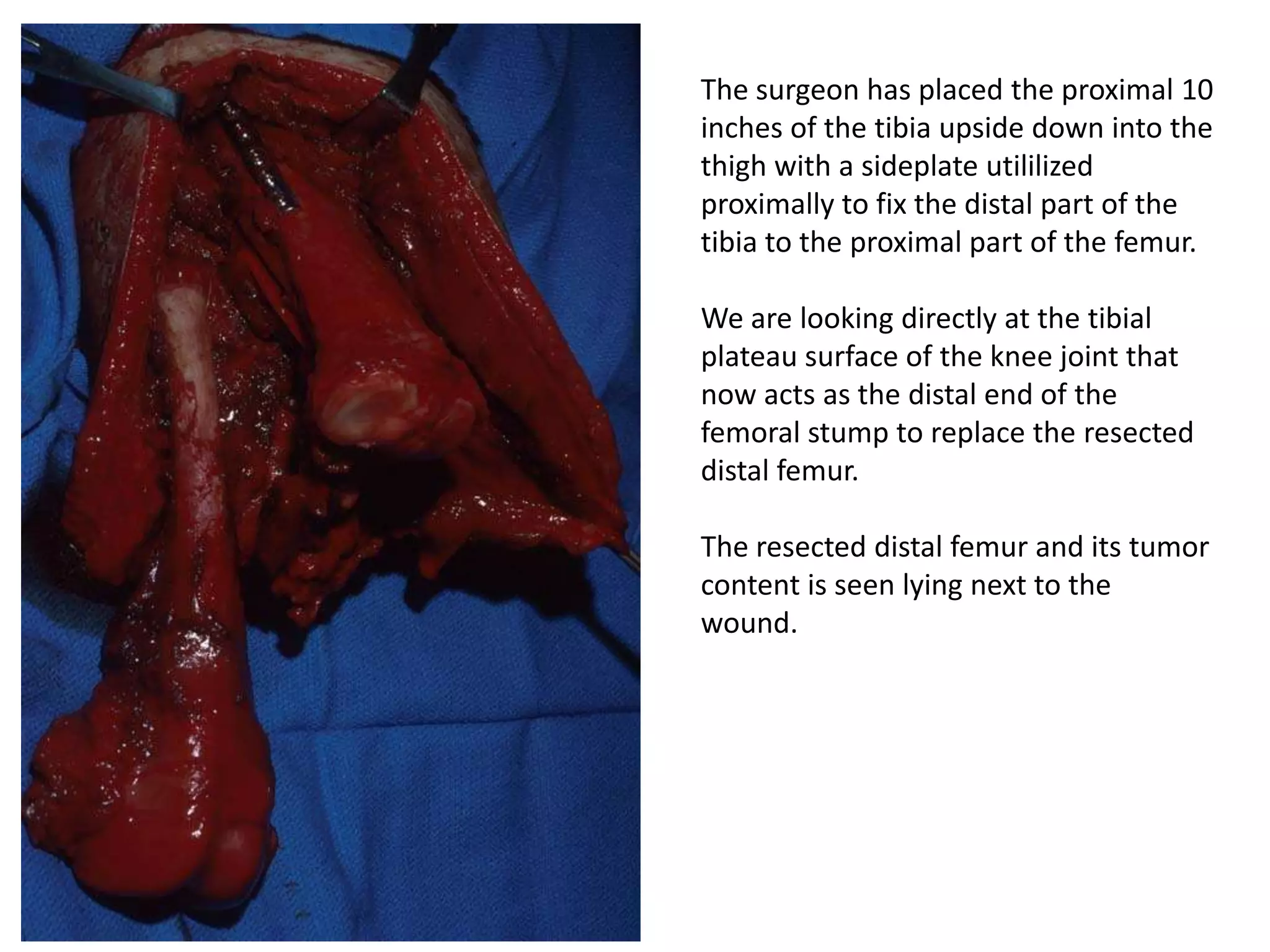
The surgeon has placed the proximal 10
inches of the tibia upside down into the
thigh with a sideplate utililized
proximally to fix the distal part of the
tibia to the proximal part of the femur.

We are looking directly at the tibial
plateau surface of the knee joint that
now acts as the distal end of the
femoral stump to replace the resected
distal femur.

The resected distal femur and its tumor
content is seen lying next to the
wound.
LIMB SALVAGE


   RESECTION +
LIMB LENGTHENING
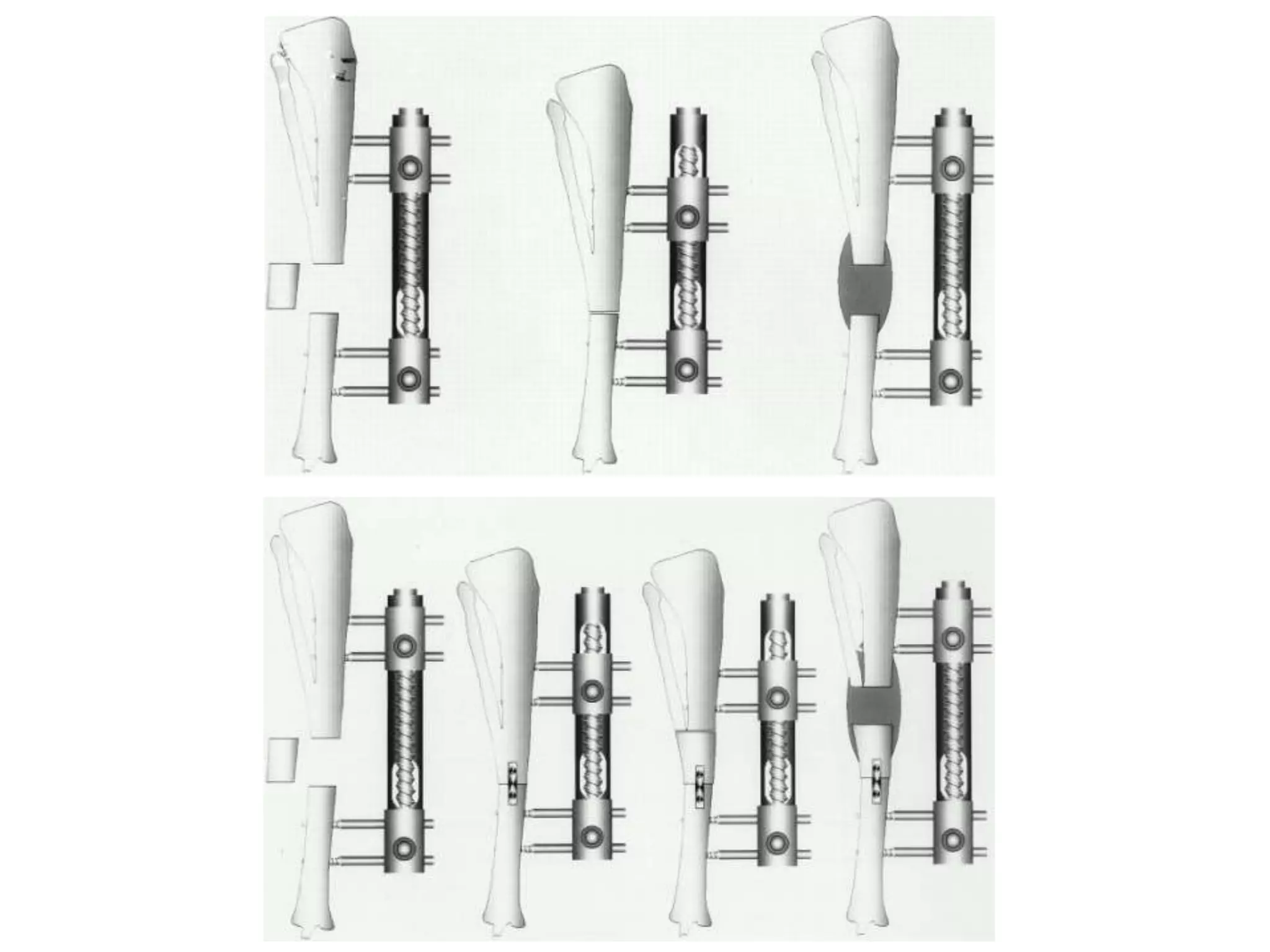
BONE TRANSPORT
BONE TRANSPORT
LIMB SALVAGE


COMPOSITE TISSUE
  ALLOGRAFT
COMPOSITE TISSUE ALLOGRAFT


 First hand transplant by Dubernard et al in 1998


More than 100 CTA transplantations have been performed since 1998

These transplantations have included the upper extremity, laryngeal tissue, abdominal
wall, face, bone, joint, uterus, nerve, tongue, and genitals.


Still an experimental reconstructive procedure.
COMPOSITE TISSUE ALLOGRAFT


Skin - most antigenic and immunoreactive tissue in CTA
COMPOSITE TISSUE ALLOGRAFT


In the United States, 5 hands have been transplanted in five patients since 1999
at the University of Louisville

3 hands have been transplanted in two patients at the University of Pittsburgh
Medical Center in 2009.


   Composite Tissue Allotransplantation. Available at: http://www.handtransplant.com/. Accessed December 30,2009.

   Successful Hand Transplants Performed. Available at: http://www.mirm.pitt.edu/ news/article.asp?qEmpID=434. Accessed
   December 30, 2009.
LIMB SALVAGE


  IN CHILDREN
LIMB SALVAGE IN CHILDREN

• Biologic
   – Allografts, vascularised autografts
   – Best for diaphyseal defects but not osteoarticular defects
• Nonbiologic
   – Using a prosthesis
   – Early weight bearing, joint motion
   – Expensive ,Complications increase with survival
• Combined (biologic and nonbiologic).
LIMB SALVAGE IN CHILDREN


Expandable prosthesis
• Restoration of limb length desirable
   – Lower limb
      • Gait abnormalities, leg pain, and back pain
   – Upper limb
      • short arm is cosmetically embarrassing
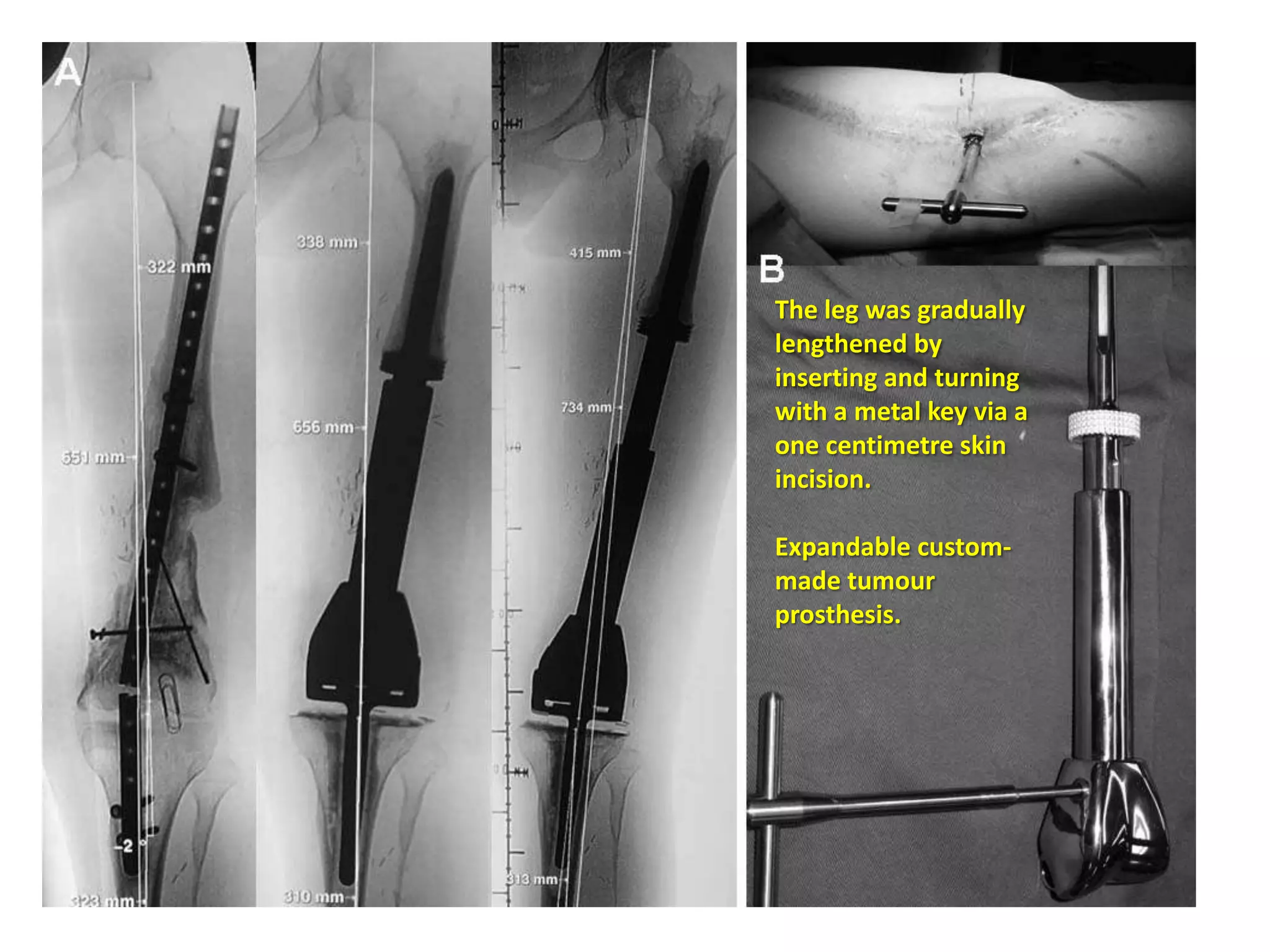
The leg was gradually
lengthened by
inserting and turning
with a metal key via a
one centimetre skin
incision.

Expandable custom-
made tumour
prosthesis.
Electromagnetic external drive machine
LIMB SALVAGE IN CHILDREN

– Extendable prostheses required when
   • Estimated leg-length discrepancy at skeletal maturity is
     more than 3 cm / when the arm-length discrepancy is
     more than 5 cm.


– Girls older than 11 years or boys older than 13
  years rarely require extendable prostheses
LIMB SALVAGE


    RESULTS
CLINICAL RESULTS

• Nonmetastatic osteosarcoma of distal femur
   – 11% recurrence with limb salvage
   – 8% recurrence with AK amputation
   – No recurrence after hip disarticulation

• Rate of local recurrence
   – 8% for poor histologic responders
   – 3% for good histologic responders

• Most important determinant of local recurrence was the type
  of surgical margin and the response to chemotherapy.
ADVANCES
• Use of bio artificial Hydroxyapatite – fixation of bone cells on HA-can be
  used in lieu of autografts

• Osteointegrable prosthesis
   – Osteoinduction by BMP
   – Biodegradable synthetic carrier – Polylactate-Polyethylene glycol (PLA-
     PEG)

• Dacron fabric enveloped alumina ceramic prosthesis for large bone
  defects – for better ancourage of soft tissues

• IM nailing instead of plating for fixation of allografts (Endolock, Titanium
  Dynamic nailing)
Limb salvage

Limb salvage

  • 1.
    Department of Orthopaedics MH Kirkee SEMINAR LIMB SALVAGE Maj Rohit Vikas Resident
  • 2.
  • 3.
  • 10.
    LIMB SALVAGE PRINCIPLES
  • 11.
    COMPARED WITH AMPUTATIONAND PROSTHETIC REHABILITATION SURVIVAL RECURRENCE Oscar Pistorius FUNCTION DURABILITY COMPLICATIONS NEOADJUVANT CHEMOTHERAPY
  • 13.
    CONTRAINDICATIONS BARRIERS TO LIMB SALVAGE Relative Contraindications to Limb-Sparing Procedures Major neurovascular structures encased by tumor when vascular bypass is not feasible Pathologic fracture with hematoma violating compartment boundary Inappropriately performed biopsy or biopsy-site complications Severe infection in the surgical field Immature skeletal age with predicted leg-length discrepancy >8 cm Extensive muscle or soft-tissue involvement Poor response to preoperative chemotherapy
  • 14.
    Clinical Evaluation Pre OpStaging Biopsy Principles Neoadjuvant Chemotherapy Tumour Resection Avoiding local recurrence is the criterion of success Wide Resection En bloc removal of all biopsy sites contaminated tissue Adequate margins Resection of bone 3 to 4 cm beyond abnormal uptake Frozen Section Skeletal Reconstruction Reconstruction of Soft Tissue and Wound Cover Post op Chemotherapy
  • 15.
  • 16.
    EXTERNAL FIXATOR INTRAMEDULLARY NAIL BONE GRAFTS INTERNAL FIXATION Dual fibular autografts
  • 18.
  • 21.
    LIMB SALVAGE RESECTION +RECONSTRUCTION AUTOGRAFT
  • 22.
    LIMB SALVAGE RESECTION +RECONSTRUCTION BONE CEMENT
  • 24.
    LIMB SALVAGE RESECTION +RECONSTRUCTION ALLOGRAFT
  • 25.
    INTERCALARY ALLOGRAFT RECONSTRUCTION Disadvantages High rates of infection, nonunion, # of allograft. Adjuvant chemo slows allograft incorporation Transmission of infections Slow remodelling – hardware used cannot be removed 80% good results
  • 27.
    Osteoid Osteoma + Osteogenicsarcoma, intracortical - Femur
  • 28.
    osteoid-forming tumor beingproduced by osteoblastic cells with a low mitotic index without an aggressive pattern. This is compatible with the diagnosis of osteoid osteoma
  • 29.
    Painful recurrence witha lytic area twice as large as the original nidus.
  • 30.
    A neoplastic osteoidformation by osteoblastic cells that have the appearance of an low grade osteosarcoma.
  • 31.
    Cortical allograft inposition following resection of 70% of the diaphysis of the femur with a side plate for stability.
  • 32.
  • 34.
    Wide resection ofthe distal portion of the humeral diaphysis was carried out, leaving the elbow joint intact. The defect was reconstructed with an allograft fixed into postion with a recon plate. ADVANTAGES Availability in all sizes and shapes Progressive incorporation into host bone Conventional arthroplasty instead of custom made prosthesis Attachment sites available for resected muscles and joint stabilisers – better function No donor site morbidity Failed allograft – further options available
  • 35.
  • 36.
    GCT – ExtendedCurettage + PMMA Replaced with a hemicondylar Lateral compartment degeneration osteoarticular allograft.
  • 37.
    LIMB SALVAGE RESECTION +RECONSTRUCTION VASCULARISED BONE GRAFT
  • 39.
  • 40.
    Radiation associated ST# Femur with Nonunion managed with Vascularised fibular Graft
  • 41.
    LIMB SALVAGE RESECTION +RECONSTRUCTION PROSTHESIS
  • 42.
    PROSTHETIC RECONSTRUCTION • Advantage– earliest mobilisation and weight bearing • 10-year survival of modular prosthesis for – Distal femur – 90%. – Proximal humerus – 98%. – Proximal femur – 100%. – Proximal tibia – 78%.
  • 44.
    ONCO PROSTHESIS FORPROXIMAL FEMUR Fibrosarcoma - Femur
  • 45.
    ONCO PROSTHESIS FORPROXIMAL FEMUR Fibrosarcoma - Femur
  • 46.
    ONCO PROSTHESIS FORPROXIMAL FEMUR Fibrosarcoma - Femur
  • 47.
    ONCO PROSTHESIS FORPROXIMAL FEMUR Fibrosarcoma - Femur
  • 48.
    ONCO PROSTHESIS FORPROXIMAL FEMUR Fibrosarcoma - Femur
  • 49.
    ONCO PROSTHESIS FORPROXIMAL FEMUR Radiation associated Fracture of Proximal Femur
  • 50.
    ONCO PROSTHESIS FORDISTAL FEMUR Osteosarcoma - Femur
  • 51.
    ONCO PROSTHESIS FORDISTAL FEMUR Osteosarcoma - Femur
  • 52.
    ONCO PROSTHESIS FORDISTAL FEMUR Osteosarcoma - Femur
  • 53.
    ONCO PROSTHESIS FORDISTAL FEMUR Osteosarcoma - Femur
  • 54.
    ONCO PROSTHESIS FORDISTAL FEMUR Osteosarcoma - Femur
  • 55.
    ONCO PROSTHESIS FORDISTAL FEMUR Osteosarcoma - Femur
  • 56.
    ONCO PROSTHESIS FORDISTAL FEMUR Chondrosarcoma – Dedifferentiated ,Femur
  • 57.
    ONCO PROSTHESIS FORDISTAL FEMUR
  • 58.
    ONCO PROSTHESIS FORDISTAL FEMUR
  • 59.
    ONCO PROSTHESIS FORDISTAL FEMUR
  • 60.
    ONCO PROSTHESIS FORDISTAL FEMUR Recalcitrant Non union of Radiation associated Fracture SC Femur
  • 61.
    ONCO PROSTHESIS FORDISTAL FEMUR TMH-NICE (New Indigenous Customised Endoprosthesis)joint
  • 62.
    ONCO PROSTHESIS FORPROXIMAL HUMERUS
  • 63.
    Osteosarcoma of scapula.Unconstrained total scapular prosthesis with cemented humeral component used for limb salvage.
  • 64.
  • 65.
    LIMB SALVAGE RESECTION + RECONSTRUCTION ALLOGRAFT PROSTHESIS COMPOSITE Attachment sites available for resected muscles and joint stabilisers – better function
  • 68.
  • 71.
    Low-grade cartilaginous tumorbut with areas in the central portion that show osteoid being produced by the tumor as well
  • 72.
  • 73.
    A total kneeimplant with an allograft placed over the proximal portion of the tibial component and a short side plate to control rotation of the allograft.
  • 74.
    Restoring bone stock Preventingloosening by increasing interface surface between prosthesis and bone Limiting proximal bone resorption
  • 75.
    LIMB SALVAGE RESECTION +RECONSTRUCTION AUTOCLAVED BONE GRAFT +/- PROSTHESIS
  • 76.
  • 79.
    Part of thereconstructive procedure consists of autoclaving the surgical specimen at 130 degrees centigrade for 4 min. This kills the tumor but preserves the physical aspects of the bone, which is then placed back over a long-stem Neer prosthesis and cemented into position.
  • 85.
    Acetabulum following theresection showing the hyperemic changes in the acetabular synovial tissues, a response to the antigen stimulation of the nearby tumor in the upper femur. There is no crossover into the acetabular structures preventing the need for a more aggressive internal hemipelvectomy reconstruction.
  • 88.
  • 89.
    Internal hemipelvectomy The specimen was debulked of the major tumor mass which was sent to pathology. The remaining bone was placed in the autoclave for 5 minutes at 130°C and placed back into the patient's pelvis for reconstructive purposes.
  • 90.
    Pins were placedthrough the autoclaved autograft along with screws and plates. A routine total hip prosthesis was cemented into position on Entire acetabulum recemented in anatomical position that top of the threaded Steinmann pins. allows for excellent weight bearing function
  • 92.
    LIMB SALVAGE RESECTION +RECONSTRUCTION TOTAL FEMUR
  • 93.
    Ewing's sarcoma –Femur With Pathological fracture from biopsy site
  • 97.
  • 98.
    LIMB SALVAGE RESECTION +RECONSTRUCTION ROTATIONPLASTY
  • 99.
  • 100.
  • 101.
    ROTATIONPLASTY • Group BI—Proximal Femur sparing the hip joint and gluteal muscles.
  • 102.
    ROTATIONPLASTY • Group BII—Proximal Femur with involvement of hip joint and contiguous soft tissue.
  • 103.
  • 104.
  • 105.
  • 106.
  • 107.
  • 108.
  • 109.
  • 111.
    A modified amputationby means of a Van Ness turn-up-plasty. Bone amputation level is high above the tumor in the proximal femur but the soft tissue amputation is distal just above the knee, utilizing the proximal tibia as a vascularized graft. The tibia is turned upside down into the defect created by the bone resection, leaving the patient with a functional end result similar to a routine supracondylar amputation. Traditional design of the skin flaps for a supracondylar amputation.
  • 112.
    The proximal 10inches of the tibia has been mobilized from its surrounding soft tissue, leaving only the anterior compartment and the deep posterior compartment intact. The popliteal vessels are intact proximally just beneath the tibial plateau, still supplying vascular nutrition to the resected tibia.
  • 113.
    The surgeon hasplaced the proximal 10 inches of the tibia upside down into the thigh with a sideplate utililized proximally to fix the distal part of the tibia to the proximal part of the femur. We are looking directly at the tibial plateau surface of the knee joint that now acts as the distal end of the femoral stump to replace the resected distal femur. The resected distal femur and its tumor content is seen lying next to the wound.
  • 115.
    LIMB SALVAGE RESECTION + LIMB LENGTHENING
  • 117.
  • 118.
  • 119.
  • 120.
    COMPOSITE TISSUE ALLOGRAFT First hand transplant by Dubernard et al in 1998 More than 100 CTA transplantations have been performed since 1998 These transplantations have included the upper extremity, laryngeal tissue, abdominal wall, face, bone, joint, uterus, nerve, tongue, and genitals. Still an experimental reconstructive procedure.
  • 121.
    COMPOSITE TISSUE ALLOGRAFT Skin- most antigenic and immunoreactive tissue in CTA
  • 122.
    COMPOSITE TISSUE ALLOGRAFT Inthe United States, 5 hands have been transplanted in five patients since 1999 at the University of Louisville 3 hands have been transplanted in two patients at the University of Pittsburgh Medical Center in 2009. Composite Tissue Allotransplantation. Available at: http://www.handtransplant.com/. Accessed December 30,2009. Successful Hand Transplants Performed. Available at: http://www.mirm.pitt.edu/ news/article.asp?qEmpID=434. Accessed December 30, 2009.
  • 123.
    LIMB SALVAGE IN CHILDREN
  • 124.
    LIMB SALVAGE INCHILDREN • Biologic – Allografts, vascularised autografts – Best for diaphyseal defects but not osteoarticular defects • Nonbiologic – Using a prosthesis – Early weight bearing, joint motion – Expensive ,Complications increase with survival • Combined (biologic and nonbiologic).
  • 125.
    LIMB SALVAGE INCHILDREN Expandable prosthesis • Restoration of limb length desirable – Lower limb • Gait abnormalities, leg pain, and back pain – Upper limb • short arm is cosmetically embarrassing
  • 126.
    The leg wasgradually lengthened by inserting and turning with a metal key via a one centimetre skin incision. Expandable custom- made tumour prosthesis.
  • 127.
  • 128.
    LIMB SALVAGE INCHILDREN – Extendable prostheses required when • Estimated leg-length discrepancy at skeletal maturity is more than 3 cm / when the arm-length discrepancy is more than 5 cm. – Girls older than 11 years or boys older than 13 years rarely require extendable prostheses
  • 129.
  • 130.
    CLINICAL RESULTS • Nonmetastaticosteosarcoma of distal femur – 11% recurrence with limb salvage – 8% recurrence with AK amputation – No recurrence after hip disarticulation • Rate of local recurrence – 8% for poor histologic responders – 3% for good histologic responders • Most important determinant of local recurrence was the type of surgical margin and the response to chemotherapy.
  • 131.
    ADVANCES • Use ofbio artificial Hydroxyapatite – fixation of bone cells on HA-can be used in lieu of autografts • Osteointegrable prosthesis – Osteoinduction by BMP – Biodegradable synthetic carrier – Polylactate-Polyethylene glycol (PLA- PEG) • Dacron fabric enveloped alumina ceramic prosthesis for large bone defects – for better ancourage of soft tissues • IM nailing instead of plating for fixation of allografts (Endolock, Titanium Dynamic nailing)

Editor's Notes

  • #100 The distal femur, knee joint, and proximal tibia are resected, leg is rotated 180 degrees, and the tibia is joined to the remaining femur.
  • #101 The distalmost femur, knee joint, and proximal tibia are resected. Rotation of 180 degrees, the distal tibia is joined to the distal femur.
  • #102 The upper femur and hip joint are resected, and the leg is rotated 180 degrees. The distal femur is joined to the pelvis so the knee functions as the hip and the ankle as the knee.
  • #103 The upper femur, hip joint, and lower hemipelvis are resected, and the leg is rotated 180 degrees. Then the remaining femur is joined to the remnant of the ilium so the knee functions as a hinged hip joint and the ankle functions as the knee.
  • #104 The entire femur is resected. The tibia is then attached to the pelvis using an endoprosthesis.