ANTERIOR CEREBRAL
   CIRCULATION

                Dr.Mohammed Sadiq Azam
        Postgraduate, Prof.Siraj’s unit, M:I
        Deccan College of Medical Sciences
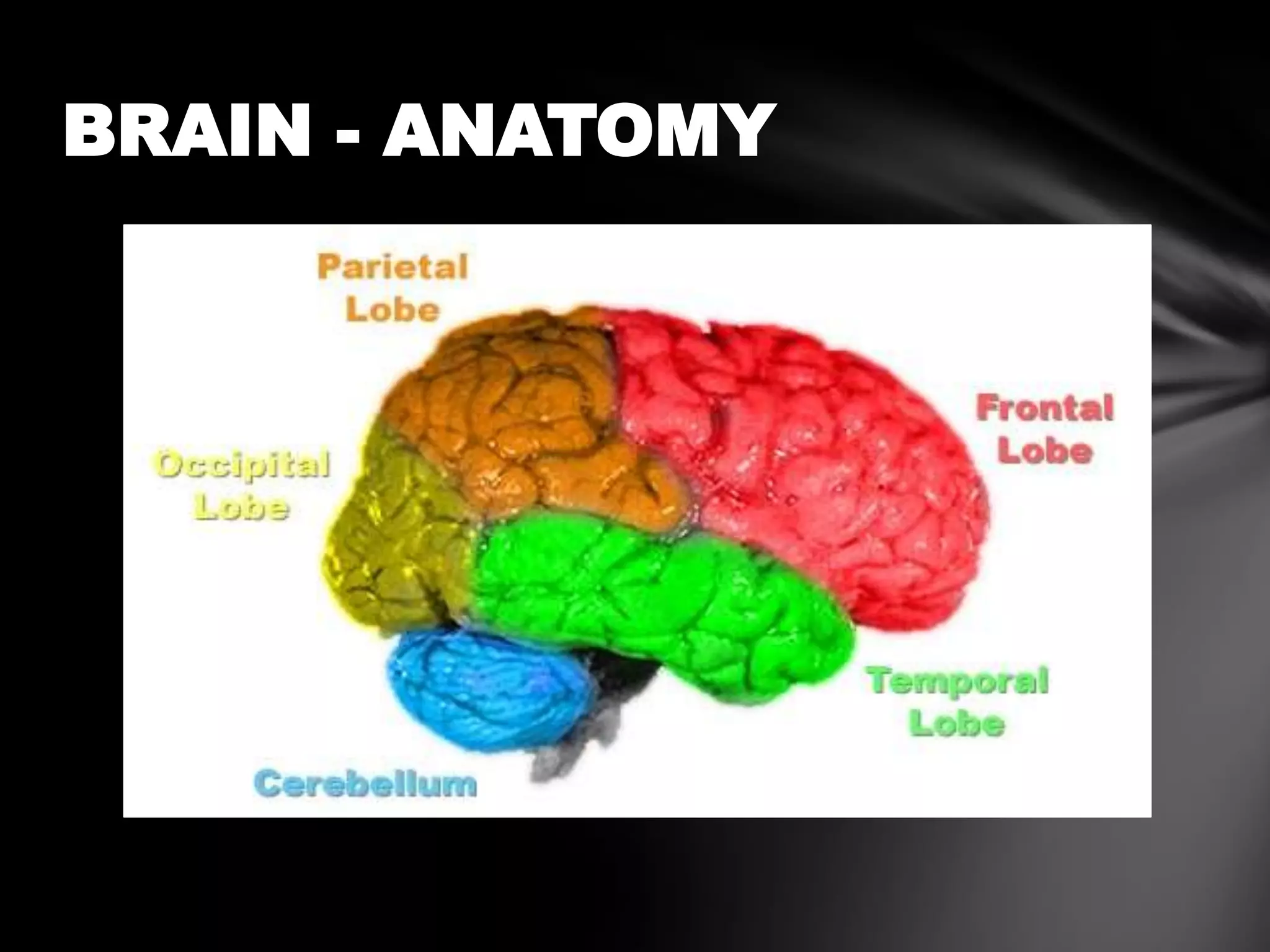
BRAIN - ANATOMY
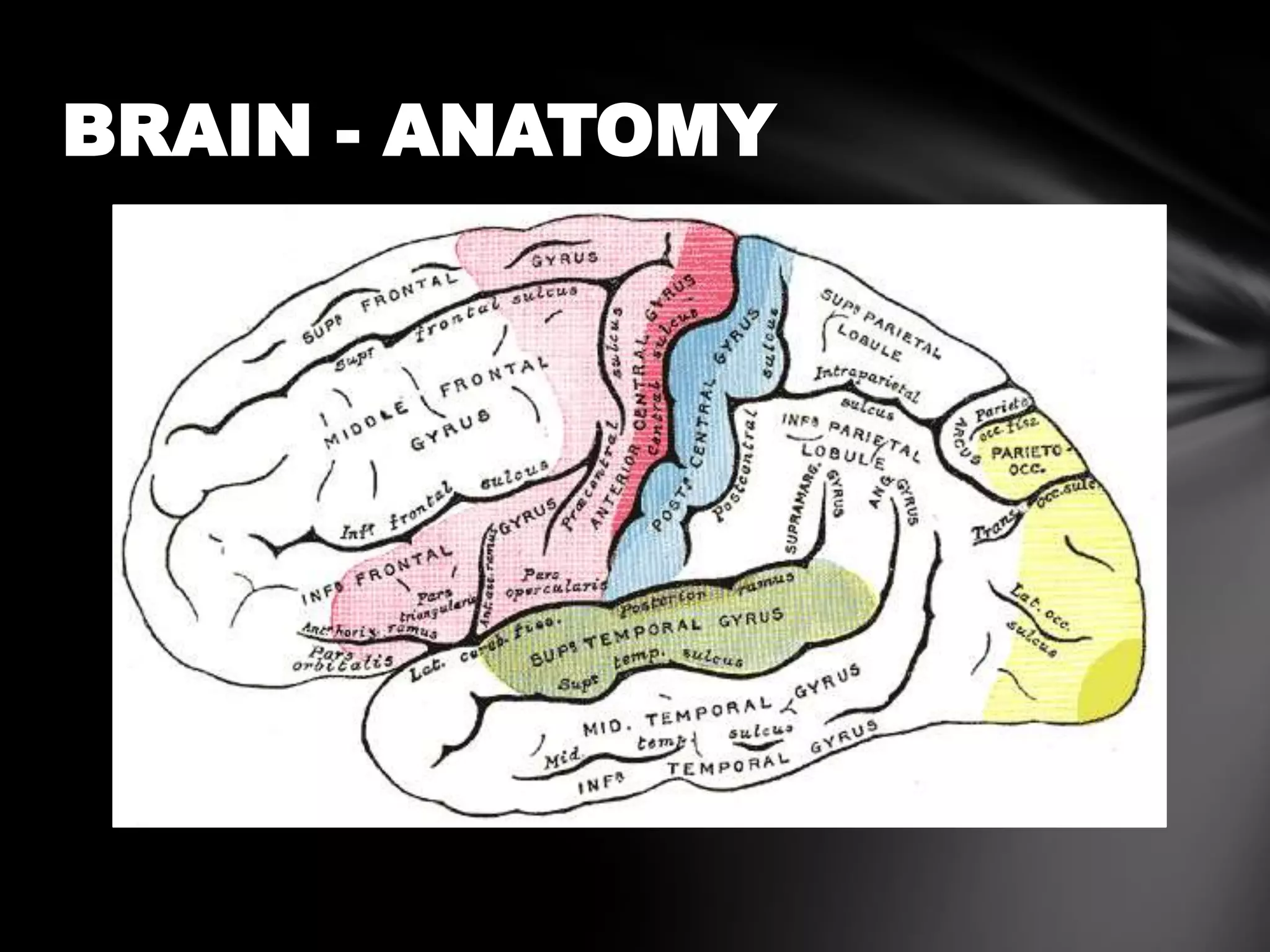
BRAIN - ANATOMY
BRAIN - ANATOMY
ANTERIOR CIRCULATION
• Internal Carotid Artery - main
  artery
• Terminates into :
    • Anterior cerebral artery
    • Middle cerebral artery
• Forms the crux of the anterior
  circulation.
MIDDLE CEREBRAL ARTERY (MCA)

• Supplies most of the temporal lobe, anterolateral frontal lobe,
  and parietal lobe.
• Perforating branches supply the posterior limb of the internal
  capsule, part of the head and body of the caudate and globus
  pallidus.
• Unilateral occlusion of Middle Cerebral Arteries at the stem
  (proximal M1 segment) results in:
 • Contralateral hemiplegia affecting face, arm, and leg (lesser).
 • Homonymous hemianopia - Ipsilateral head/eye deviation.
 • If on left: global aphasia.
• Usually occlusion is embolic in nature - thrombotic occlusion
  more common in carotids.
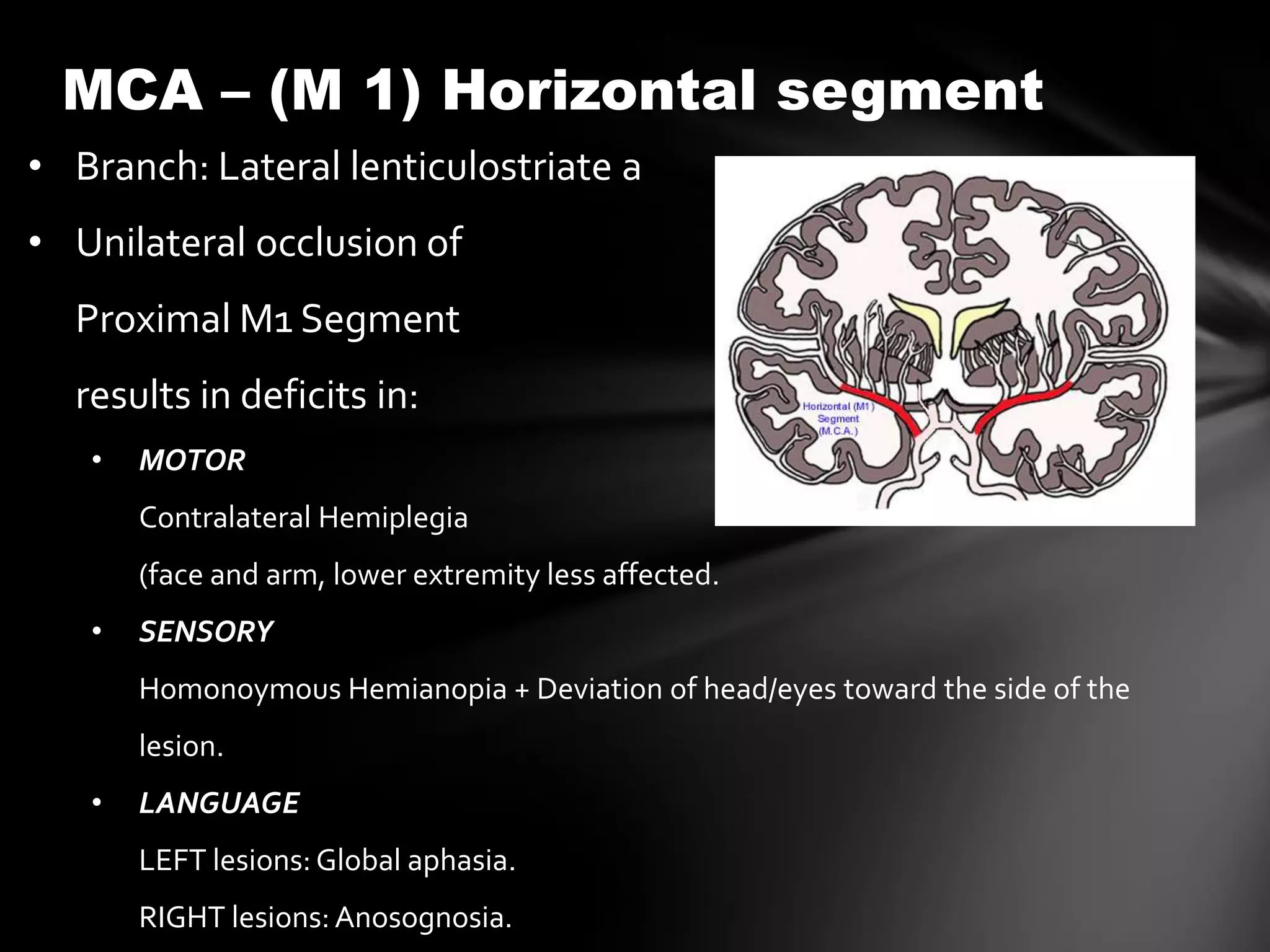
MCA – (M 1) Horizontal segment
• Branch: Lateral lenticulostriate a
• Unilateral occlusion of
  Proximal M1 Segment
  results in deficits in:
   •   MOTOR
       Contralateral Hemiplegia
       (face and arm, lower extremity less affected.
   •   SENSORY
       Homonoymous Hemianopia + Deviation of head/eyes toward the side of the
       lesion.
   •   LANGUAGE
       LEFT lesions: Global aphasia.
       RIGHT lesions: Anosognosia.
MCA – (M 1) Lateral
 lenticulostriate art.

• Branch of M1 Segment of MCA.
• Supplies basal ganglia structures:
• Part of head and body of caudate, globus pallidus, putamen,
   and the posterior limb of the internal capsule.


Effect of lesion:
• Damage to the internal capsule resulting in contralateral
   hemiparesis and sensory deficit.
• Speech may be affected (medial temporal lobe) as well as
   visual function (Meyer's loop: optic radiations affected).
MCA – (M 2) Sylvian segment


• Divides into superior and inferior divisions: can be a site for an embolus to
  lodge.
• Branches supply:
  Temporal Lobe and Insular Cortex (sensory language area of Wernicke)
  Parietal Lobe
  (Sensory cortical areas)
  Inferolateral frontal lobe
MCA – (M 2) Sylvian segment
• Superior Division Infarction:
  "Brachiofacial paralysis"
  Sensorimotor deficit involving face and arm, leg to a lesser
  extent. Foot is spared.
  Ipsilateral deviation of head/eyes.
  With Left lesion may have initial global aphasia -> motor
  aphasia.
  No impairment of alertness.


• Inferior Division Infarction:
  Rarer than Superior Division Infarctions.
  Superior quadrantanopia / homonymous hemianopia.
  LEFT lesion: Wernicke aphasia (deficit in comprehension of
  spoken/written language)
  RIGHT lesion: Left-sided visual neglect.
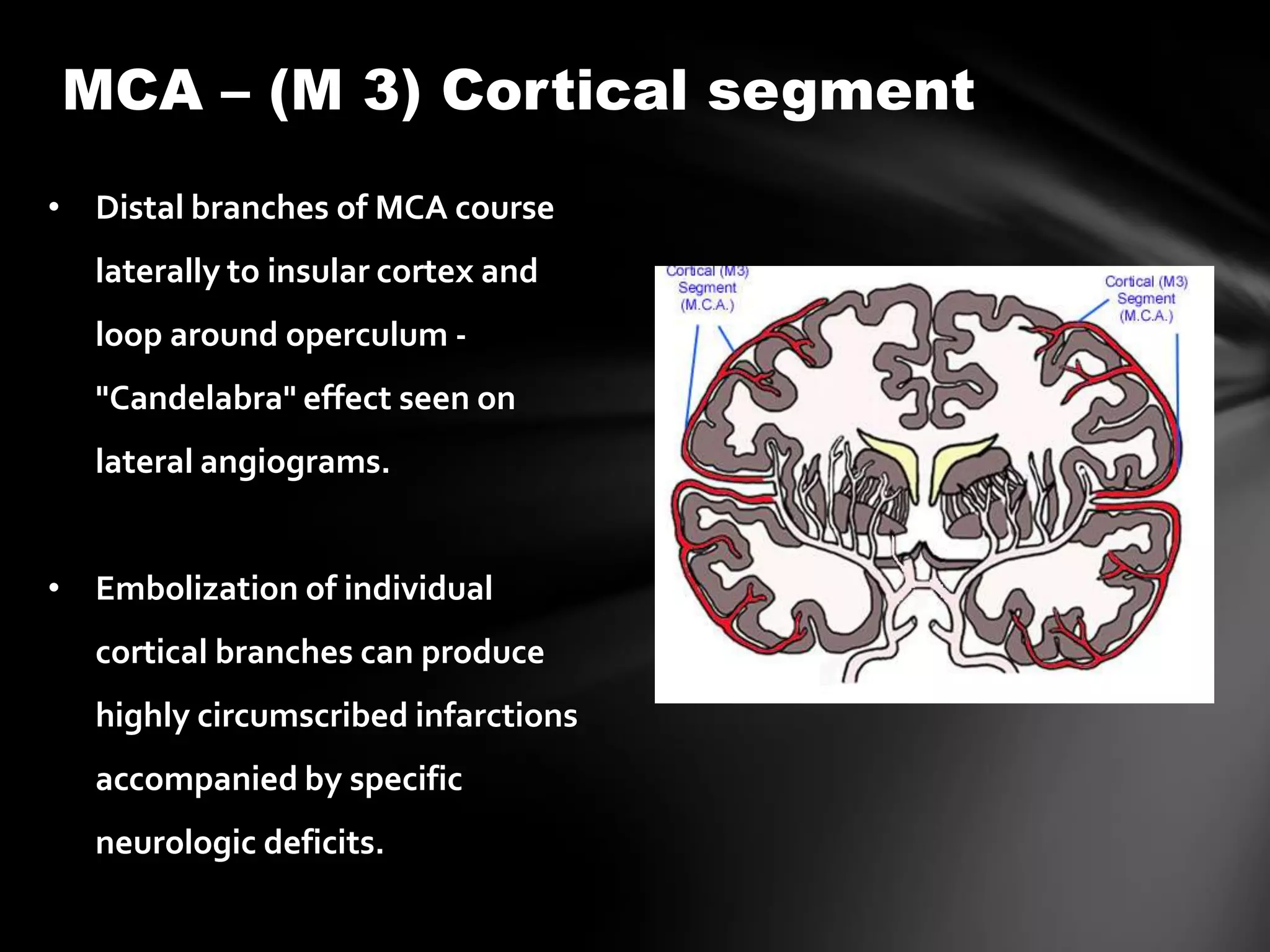
MCA – (M 3) Cortical segment
• Distal branches of MCA course
  laterally to insular cortex and
  loop around operculum -
  "Candelabra" effect seen on
  lateral angiograms.


• Embolization of individual
  cortical branches can produce
  highly circumscribed infarctions
  accompanied by specific
  neurologic deficits.
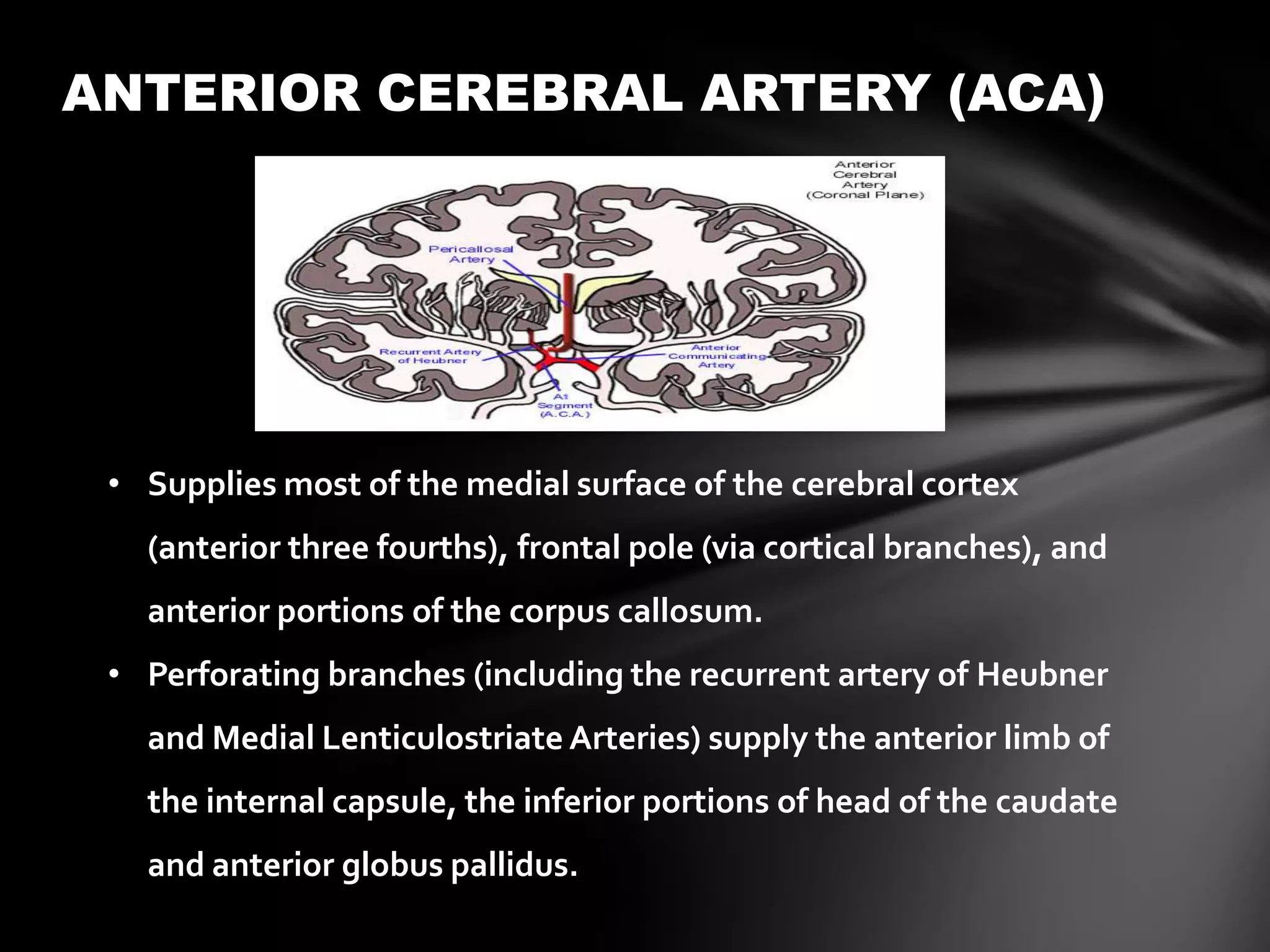
ANTERIOR CEREBRAL ARTERY (ACA)


 • Supplies most of the medial surface of the cerebral cortex
   (anterior three fourths), frontal pole (via cortical branches), and
   anterior portions of the corpus callosum.
 • Perforating branches (including the recurrent artery of Heubner
   and Medial Lenticulostriate Arteries) supply the anterior limb of
   the internal capsule, the inferior portions of head of the caudate
   and anterior globus pallidus.
ANTERIOR CEREBRAL ARTERY (ACA)
• Bilateral occlusion of Anterior Cerebral Arteries at their stems results in
  infarction of the anteromedial surface of the cerebral hemispheres:
    • Paraplegia affecting lower extremities and sparing face/hands.
    • Incontinence
    • Abulic and motor aphasia
    • Frontal lobe Symptoms: personality change, contralateral grasp
       reflex.
• Unilateral occlusion (distal to Ant. Comm. origin) of Anterior Cerebral
  Artery produces contralateral sensorimotor deficits mainly involving
  the lower extremity with sparing of face and hands (think of the
  humunculus)
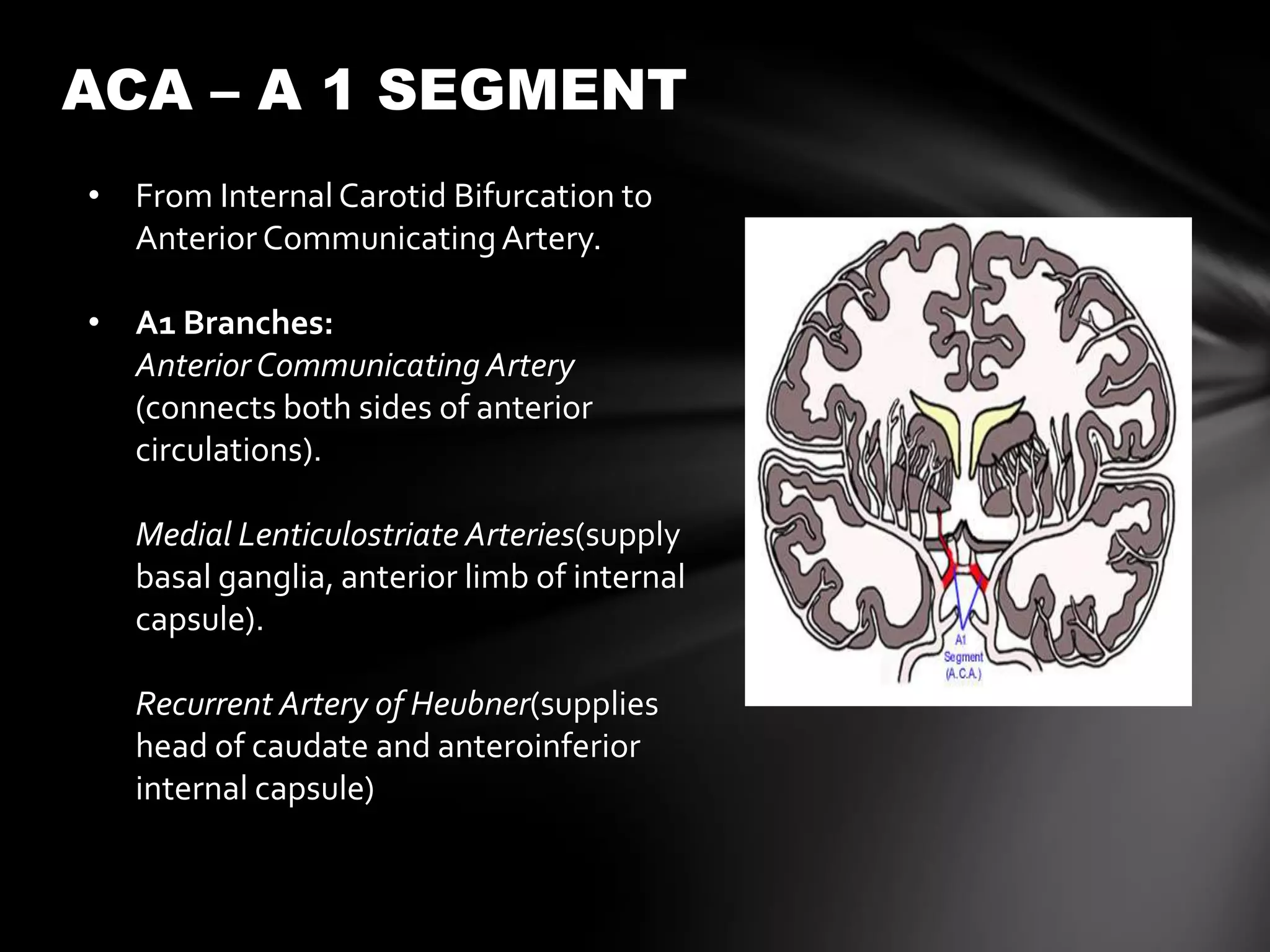
ACA – A 1 SEGMENT
• From Internal Carotid Bifurcation to
  Anterior Communicating Artery.

• A1 Branches:
  Anterior Communicating Artery
  (connects both sides of anterior
  circulations).

   Medial Lenticulostriate Arteries(supply
   basal ganglia, anterior limb of internal
   capsule).

   Recurrent Artery of Heubner(supplies
   head of caudate and anteroinferior
   internal capsule)
ACA – Anterior communicating art


• Connects bilateral anterior
  circulations.

   Common location for cerebral
   aneurysms.
ACA – Recurrent artery of Heubner


• Supplies head of caudate
  and anteroinferior
  internal capsule.
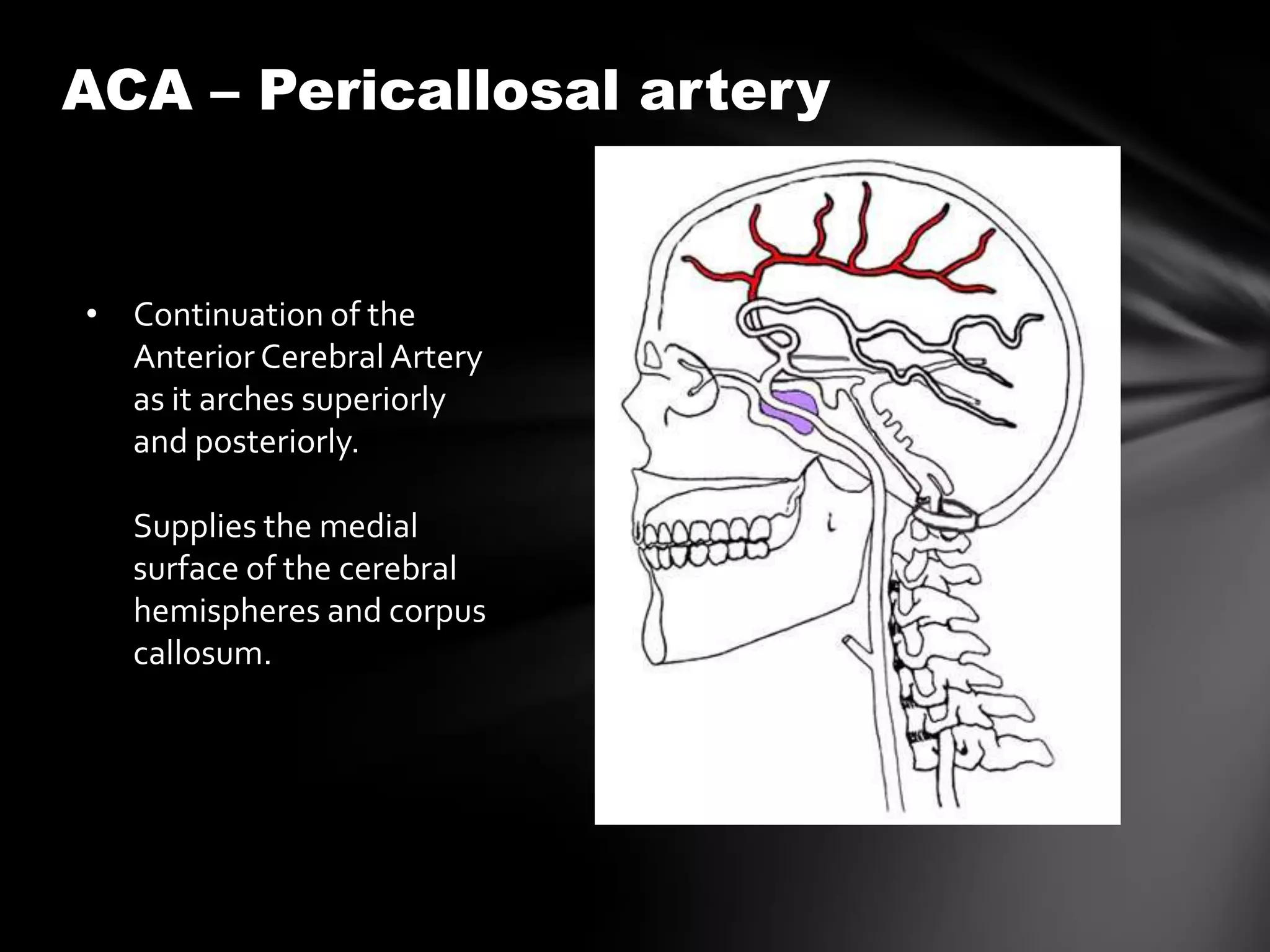
ACA – Pericallosal artery


• Continuation of the
  Anterior Cerebral Artery
  as it arches superiorly
  and posteriorly.

   Supplies the medial
   surface of the cerebral
   hemispheres and corpus
   callosum.
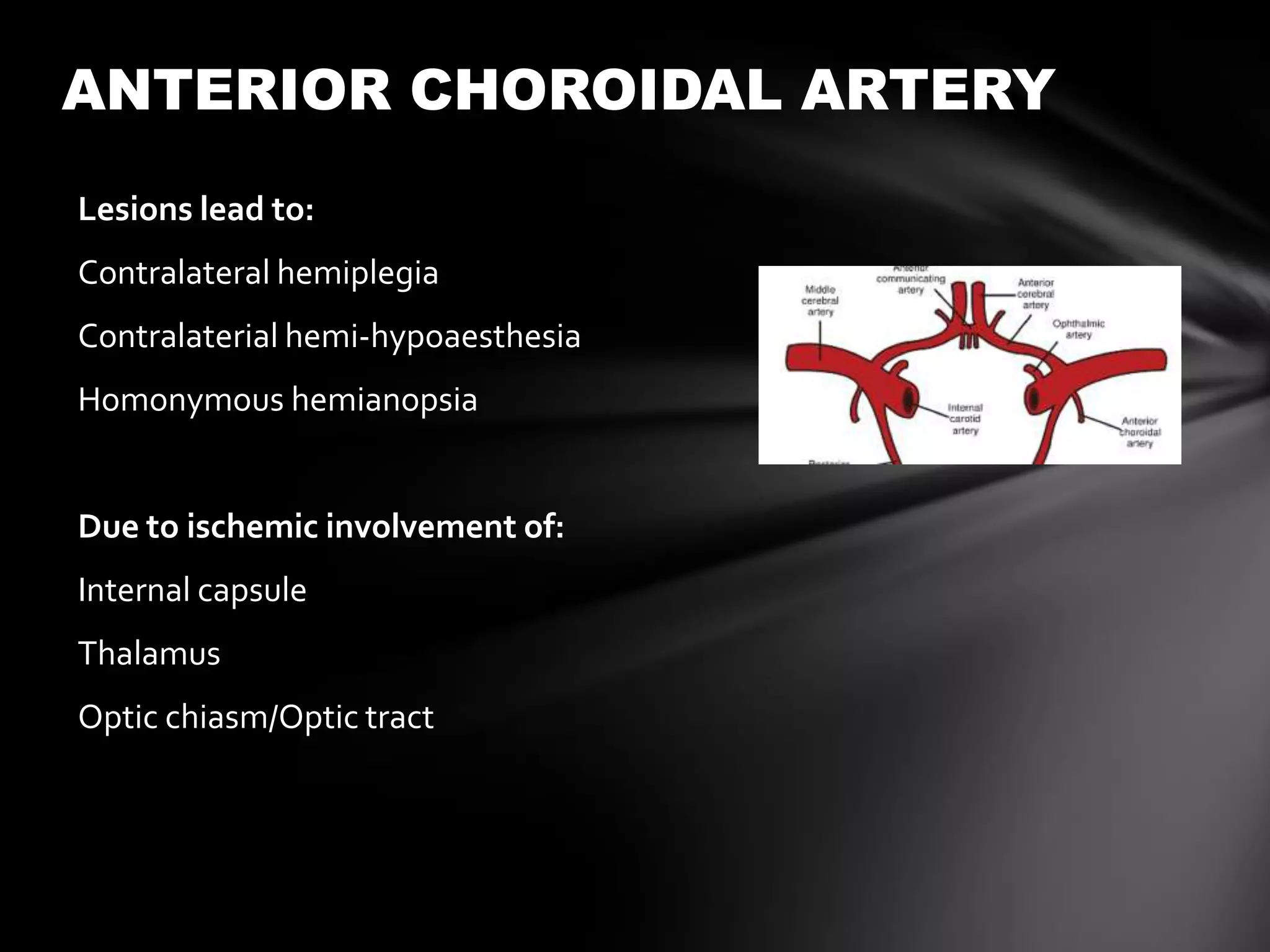
ANTERIOR CHOROIDAL ARTERY
Arises from ICA (rarely from MCA also)
The anterior choroidal artery serves many structures in the
cerebrum:
• choroid plexus of the lateral ventricle and third ventricle
• optic chiasm and optic tract
• internal capsule
• lateral geniculate body
• globus pallidus
• tail of the caudate nucleus, hippocampus, amygdala
• substantia nigra
• red nucleus
• crus cerebri
ANTERIOR CHOROIDAL ARTERY
Lesions lead to:
Contralateral hemiplegia
Contralaterial hemi-hypoaesthesia
Homonymous hemianopsia


Due to ischemic involvement of:
Internal capsule
Thalamus
Optic chiasm/Optic tract
CIRCLE OF WILLIS
• Communication between the anterior and posterior circulations
WATERSHED AREAS
WATERSHED AREAS

There are two patterns of border zone infarcts:


Cortical border zone infarctions:
Infarctions of the cortex and adjacent subcortical white matter located at the
border zone of ACA/MCA and MCA/PCA


Internal border zone infarctions
Infarctions of the deep white matter of the centrum semi-ovale and corona
radiata at the border zone between lenticulostriate perforators and the deep
penetrating cortical branches of the MCA or at the border zone of deep white
matter branches of the MCA and the ACA
THANK YOU

Anterior cerebral circulation

  • 1.
    ANTERIOR CEREBRAL CIRCULATION Dr.Mohammed Sadiq Azam Postgraduate, Prof.Siraj’s unit, M:I Deccan College of Medical Sciences
  • 2.
  • 3.
  • 4.
  • 5.
    ANTERIOR CIRCULATION • InternalCarotid Artery - main artery • Terminates into : • Anterior cerebral artery • Middle cerebral artery • Forms the crux of the anterior circulation.
  • 6.
  • 7.
    MIDDLE CEREBRAL ARTERY(MCA) • Supplies most of the temporal lobe, anterolateral frontal lobe, and parietal lobe. • Perforating branches supply the posterior limb of the internal capsule, part of the head and body of the caudate and globus pallidus. • Unilateral occlusion of Middle Cerebral Arteries at the stem (proximal M1 segment) results in: • Contralateral hemiplegia affecting face, arm, and leg (lesser). • Homonymous hemianopia - Ipsilateral head/eye deviation. • If on left: global aphasia. • Usually occlusion is embolic in nature - thrombotic occlusion more common in carotids.
  • 8.
    MCA – (M1) Horizontal segment • Branch: Lateral lenticulostriate a • Unilateral occlusion of Proximal M1 Segment results in deficits in: • MOTOR Contralateral Hemiplegia (face and arm, lower extremity less affected. • SENSORY Homonoymous Hemianopia + Deviation of head/eyes toward the side of the lesion. • LANGUAGE LEFT lesions: Global aphasia. RIGHT lesions: Anosognosia.
  • 9.
    MCA – (M1) Lateral lenticulostriate art. • Branch of M1 Segment of MCA. • Supplies basal ganglia structures: • Part of head and body of caudate, globus pallidus, putamen, and the posterior limb of the internal capsule. Effect of lesion: • Damage to the internal capsule resulting in contralateral hemiparesis and sensory deficit. • Speech may be affected (medial temporal lobe) as well as visual function (Meyer's loop: optic radiations affected).
  • 10.
    MCA – (M2) Sylvian segment
  • 11.
    MCA – (M2) Sylvian segment • Divides into superior and inferior divisions: can be a site for an embolus to lodge. • Branches supply: Temporal Lobe and Insular Cortex (sensory language area of Wernicke) Parietal Lobe (Sensory cortical areas) Inferolateral frontal lobe
  • 12.
    MCA – (M2) Sylvian segment • Superior Division Infarction: "Brachiofacial paralysis" Sensorimotor deficit involving face and arm, leg to a lesser extent. Foot is spared. Ipsilateral deviation of head/eyes. With Left lesion may have initial global aphasia -> motor aphasia. No impairment of alertness. • Inferior Division Infarction: Rarer than Superior Division Infarctions. Superior quadrantanopia / homonymous hemianopia. LEFT lesion: Wernicke aphasia (deficit in comprehension of spoken/written language) RIGHT lesion: Left-sided visual neglect.
  • 13.
    MCA – (M3) Cortical segment • Distal branches of MCA course laterally to insular cortex and loop around operculum - "Candelabra" effect seen on lateral angiograms. • Embolization of individual cortical branches can produce highly circumscribed infarctions accompanied by specific neurologic deficits.
  • 14.
  • 15.
    ANTERIOR CEREBRAL ARTERY(ACA) • Supplies most of the medial surface of the cerebral cortex (anterior three fourths), frontal pole (via cortical branches), and anterior portions of the corpus callosum. • Perforating branches (including the recurrent artery of Heubner and Medial Lenticulostriate Arteries) supply the anterior limb of the internal capsule, the inferior portions of head of the caudate and anterior globus pallidus.
  • 16.
    ANTERIOR CEREBRAL ARTERY(ACA) • Bilateral occlusion of Anterior Cerebral Arteries at their stems results in infarction of the anteromedial surface of the cerebral hemispheres: • Paraplegia affecting lower extremities and sparing face/hands. • Incontinence • Abulic and motor aphasia • Frontal lobe Symptoms: personality change, contralateral grasp reflex. • Unilateral occlusion (distal to Ant. Comm. origin) of Anterior Cerebral Artery produces contralateral sensorimotor deficits mainly involving the lower extremity with sparing of face and hands (think of the humunculus)
  • 17.
    ACA – A1 SEGMENT • From Internal Carotid Bifurcation to Anterior Communicating Artery. • A1 Branches: Anterior Communicating Artery (connects both sides of anterior circulations). Medial Lenticulostriate Arteries(supply basal ganglia, anterior limb of internal capsule). Recurrent Artery of Heubner(supplies head of caudate and anteroinferior internal capsule)
  • 18.
    ACA – Anteriorcommunicating art • Connects bilateral anterior circulations. Common location for cerebral aneurysms.
  • 19.
    ACA – Recurrentartery of Heubner • Supplies head of caudate and anteroinferior internal capsule.
  • 20.
    ACA – Pericallosalartery • Continuation of the Anterior Cerebral Artery as it arches superiorly and posteriorly. Supplies the medial surface of the cerebral hemispheres and corpus callosum.
  • 21.
    ANTERIOR CHOROIDAL ARTERY Arisesfrom ICA (rarely from MCA also) The anterior choroidal artery serves many structures in the cerebrum: • choroid plexus of the lateral ventricle and third ventricle • optic chiasm and optic tract • internal capsule • lateral geniculate body • globus pallidus • tail of the caudate nucleus, hippocampus, amygdala • substantia nigra • red nucleus • crus cerebri
  • 22.
    ANTERIOR CHOROIDAL ARTERY Lesionslead to: Contralateral hemiplegia Contralaterial hemi-hypoaesthesia Homonymous hemianopsia Due to ischemic involvement of: Internal capsule Thalamus Optic chiasm/Optic tract
  • 23.
    CIRCLE OF WILLIS •Communication between the anterior and posterior circulations
  • 24.
  • 25.
    WATERSHED AREAS There aretwo patterns of border zone infarcts: Cortical border zone infarctions: Infarctions of the cortex and adjacent subcortical white matter located at the border zone of ACA/MCA and MCA/PCA Internal border zone infarctions Infarctions of the deep white matter of the centrum semi-ovale and corona radiata at the border zone between lenticulostriate perforators and the deep penetrating cortical branches of the MCA or at the border zone of deep white matter branches of the MCA and the ACA
  • 26.