MCA & ACA
Syndromes
Patrick M. Yalung, MD, MBA, FPNA
November 16, 2021
Pre-Test
Pre-Test
1. Identify Artery involved:
a. Lateral Lenticulostriate
b. Recurrent Artery of Heubner
c. MCA, leptomeningeal branch
d. MCA, superior division
e. MCA, parasylvian
Pre-Test
2. Identify Artery involved:
a. Lateral Lenticulostriate
b. Recurrent Artery of Heubner
c. MCA, leptomeningeal branch
d. MCA, superior division
e. MCA, parasylvian
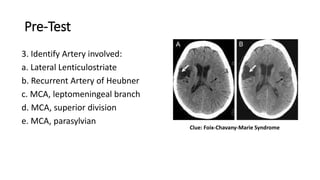
Pre-Test
3. Identify Artery involved:
a. Lateral Lenticulostriate
b. Recurrent Artery of Heubner
c. MCA, leptomeningeal branch
d. MCA, superior division
e. MCA, parasylvian
Clue: Foix-Chavany-Marie Syndrome
Pre-Test
4. Identify Artery involved:
a. Lateral Lenticulostriate
b. Recurrent Artery of Heubner
c. MCA, leptomeningeal branch
d. MCA, superior division
e. MCA, parasylvian
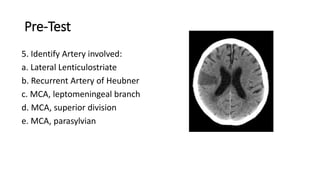
Pre-Test
5. Identify Artery involved:
a. Lateral Lenticulostriate
b. Recurrent Artery of Heubner
c. MCA, leptomeningeal branch
d. MCA, superior division
e. MCA, parasylvian
References:
1. Park, H., Jeong, Y. S., Lee, S. H., Jang, S. H., Kwon, D. H.,
Hong, J.-H., Sohn, S.-I., & Yoo, J. (2021). Clinical
prognosis of isolated anterior cerebral artery territory
infarction: a retrospective study. In BMC Neurology
(Vol. 21, Issue 1). Springer Science and Business Media
LLC.
2. Odier, C., & Michel, P. (2019). Common Stroke
Syndromes. In Textbook of Stroke Medicine (pp. 169–
181). Cambridge University Press.
3. Heiss, W.-D. (2015). Malignant MCA Infarction:
Pathophysiology and Imaging for Early Diagnosis and
Management Decisions. In Cerebrovascular Diseases
(Vol. 41, Issues 1–2, pp. 1–7). S. Karger AG.
4. Harrigan, M. R., & Deveikis, J. P. (2012). Essential
Neurovascular Anatomy. In Handbook of
Cerebrovascular Disease and Neurointerventional
Technique (pp. 3–98). Humana Press.
5. González Delgado, M., & Bogousslavsky, J. (2012).
Superficial Middle Cerebral Artery Territory Infarction.
In Frontiers of Neurology and Neuroscience (pp. 111–
114). KARGER.
Middle Cerebral Artery
(MCA)
• Supplies most of the temporal lobe,
anterolateral frontal lobe,
and parietal lobe
Harrigan, M. R., & Deveikis, J. P. (2012). Essential Neurovascular Anatomy. In Handbook of Cerebrovascular Disease and Neurointerventional Technique (pp. 3–98). Humana Press.
Middle Cerebral Artery
(MCA)
Harrigan, M. R., & Deveikis, J. P. (2012). Essential Neurovascular Anatomy. In Handbook of Cerebrovascular Disease and Neurointerventional Technique (pp. 3–98). Humana Press.
Middle Cerebral Artery
(MCA)
• 4 segments:
o M1 (Sphenoidal/Horizontal)—
ICA to bifurcation (or trifurcation)
o M2 (Insular)—MCA bifurcation to
circular sulcus of the insula
o M3 (Opercular)—circular sulcus
to superficial aspect of the
sylvian fissure
o M4 (Cortical)—cortical branches
Harrigan, M. R., & Deveikis, J. P. (2012). Essential Neurovascular Anatomy. In Handbook of Cerebrovascular Disease and Neurointerventional Technique (pp. 3–98). Humana Press.
M1 Sphenoidal/Horizontal
• from ICA, travels laterally,
parallel to the sphenoid wing
• 16 mm in length
• usually twice the size of the A1
• terminates into the M2
segments:
o bifurcates (71%)
o trifurcates (20%)
o four branches (9%)
Harrigan, M. R., & Deveikis, J. P. (2012). Essential Neurovascular Anatomy. In Handbook of Cerebrovascular Disease and Neurointerventional Technique (pp. 3–98). Humana Press.
M1 Sphenoidal/Horizontal
• Branches:
1. Lateral lenticulostriate
2. Anterior temporal artery
Harrigan, M. R., & Deveikis, J. P. (2012). Essential Neurovascular Anatomy. In Handbook of Cerebrovascular Disease and Neurointerventional Technique (pp. 3–98). Humana Press.
Lateral Lenticulostriate
• 80% arise from superior aspect
of M1 segment
• average 10 in number
• enter the anterior perforated
substance to supply the
anterior commissure, internal
capsule, caudate nucleus,
putamen, globus pallidus, and
substantia innominata
Harrigan, M. R., & Deveikis, J. P. (2012). Essential Neurovascular Anatomy. In Handbook of Cerebrovascular Disease and Neurointerventional Technique (pp. 3–98). Humana Press.
Anterior Temporal
• arises near the midpoint of the M1
segment
• Less commonly, it arises from the
inferior division of M2 or as part of
an M1 trifurcation
• travels anteriorly and inferiorly over
the temporal tip and does not enter
the sylvian
• supplies the anterior temporal lobe
Harrigan, M. R., & Deveikis, J. P. (2012). Essential Neurovascular Anatomy. In Handbook of Cerebrovascular Disease and Neurointerventional Technique (pp. 3–98). Humana Press.
M2 Insular
• from the main division point of
the M1
• over the insula within the sylvian
fissure, and terminate at the
circular sulcus of the insula
• divisions are equal in size (18%)
• superior division dominant
(28%)
• inferior division dominant (32%)
Harrigan, M. R., & Deveikis, J. P. (2012). Essential Neurovascular Anatomy. In Handbook of Cerebrovascular Disease and Neurointerventional Technique (pp. 3–98). Humana Press.
M2 Insular
• cortical area supplied
o superior division—
orbitofrontal area to the
posterior parietal area
o inferior division—temporal
pole to the angular area
• 6-8 arteries at the point of
transition into the M3 segments
Harrigan, M. R., & Deveikis, J. P. (2012). Essential Neurovascular Anatomy. In Handbook of Cerebrovascular Disease and Neurointerventional Technique (pp. 3–98). Humana Press.
M3 Opercular
• begin at the circular sulcus
• end at the surface of the
sylvian fissure
• give rise to the 8 stem arteries
which in turn give rise to 1-5
the cortical branches
Harrigan, M. R., & Deveikis, J. P. (2012). Essential Neurovascular Anatomy. In Handbook of Cerebrovascular Disease and Neurointerventional Technique (pp. 3–98). Humana Press.
M4 Cortical
• begin at the surface of the
sylvian fissure and extend over
the surface of the cerebral
hemisphere
• smallest arise from the
anterior; largest ones emerge
from posterior sylvian fissure
• 12 subdivision system—
actually exist as several
branches (up to 5) from a
single stem artery
Harrigan, M. R., & Deveikis, J. P. (2012). Essential Neurovascular Anatomy. In Handbook of Cerebrovascular Disease and Neurointerventional Technique (pp. 3–98). Humana Press.
M4 Cortical
Superior division
o Lateral Orbitofrontal
o Prefrontal
o Precentral
o Central
Inferior division
o Temporopolar
o Temporo-occipital
o Angular
o Anterior Temporal
o Middle Temporal
o Posterior Temporal
Dominant division
o Anterior Parietal
o Posterior Parietal
Harrigan, M. R., & Deveikis, J. P. (2012). Essential Neurovascular Anatomy. In Handbook of Cerebrovascular Disease and Neurointerventional Technique (pp. 3–98). Humana Press.
MCA Territory Infarction
• 2/3 of all ischemic stroke occurs
in the MCA territory
• can be subtle or devastating
clinical syndrome, depending on
site of occlusion, the extent of
ischemia, etiology, and collateral
arterial network
• Involves—frontal, temporal,
parietal, basal ganglia
Odier, C., & Michel, P. (2019). Common Stroke Syndromes. In Textbook of Stroke Medicine (pp. 169–181). Cambridge University Press.
MCA Territory Infarction
• Large infarcts—involvement of
2 of the 3 MCA territories
(deep, superior, and inferior
divisions)
• Malignant MCA stroke—
complete or near complete
MCA territory infarction with
ensuing mass effect from brain
edema
Odier, C., & Michel, P. (2019). Common Stroke Syndromes. In Textbook of Stroke Medicine (pp. 169–181). Cambridge University Press.
MCA Territory Infarction
Left hemisphere Right hemisphere
• Right hemiparesis—Variable
involvement of face, arm, leg
• Right-sided sensory loss—pattern
similar to motor deficit, usually
involves all modalities, decreased
stereognosis, agraphesthesia, left-
right confusion
• Right homonymous hemianopia
• Dysarthria
• Aphasia, fluent and non-fluent
• Alexia, Agraphia, Acalculia, Apraxia
• Left hemiparesis
• Left-sided sensory loss
• Left homonymous hemianopia
• Dysarthria
• Neglect of the left side of
environment
• Anosognosia
• Asomatognosia
• Loss of prosody of speech
• Flat affect
Odier, C., & Michel, P. (2019). Common Stroke Syndromes. In Textbook of Stroke Medicine (pp. 169–181). Cambridge University Press.
MCA Superior Division
Infarction
• one of the most common
locations of embolic stroke,
either from proximal arterial
source or from the heart
• contralateral hemiparesis—face,
arm > leg
• contralateral hemisensory loss
MRI T2 FLAIR—prominent bright signal affecting the left frontal
lobe above the Sylvian fissure
Odier, C., & Michel, P. (2019). Common Stroke Syndromes. In Textbook of Stroke Medicine (pp. 169–181). Cambridge University Press.
MCA Superior Division
Infarction
• contralateral visual field deficit
predominantly affecting the
lower fields (pie on the floor)
• gaze preference to the ipsilateral
side
• Left-sided infarct—expressive
(Broca’s) aphasia
• Right-sided infarct—neglect
Odier, C., & Michel, P. (2019). Common Stroke Syndromes. In Textbook of Stroke Medicine (pp. 169–181). Cambridge University Press.
MCA Inferior Division
Infarction
• less commonly affected by
emboli than the superior
division
• do NOT cause any weakness
or sensory loss
• misdiagnosed initially as
primary psychiatric disorder Cranial CT scan—3 days post ictus; large lesion in the left temporal
and posterior parietal lobes
Odier, C., & Michel, P. (2019). Common Stroke Syndromes. In Textbook of Stroke Medicine (pp. 169–181). Cambridge University Press.
MCA Inferior Division
Infarction
• contralateral visual field deficit
predominantly affecting the upper
fields (pie in the sky)
• Left-sided infarct—receptive
(Wernicke's) aphasia
• Right-sided infarct—neglect,
constructional and clothing
dyspraxia, spatial disorientation,
behavioral changes, impairment of
visuospatial skills
Odier, C., & Michel, P. (2019). Common Stroke Syndromes. In Textbook of Stroke Medicine (pp. 169–181). Cambridge University Press.
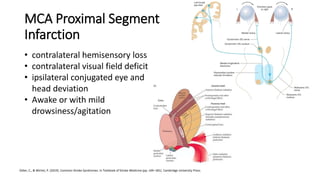
MCA Proximal Segment
Infarction
• affect the:
o superior division
o inferior divisions
o lenticulostriates
• contralateral hemiplegia—face,
arm, and leg
o leg is plegic as well due to
involvement of
lenticulostriates which supply
the internal capsule Cranial CT scan—3 days post ictus; hypodensity involving
distribution of entire MCA as well as deeper basal ganglia
Odier, C., & Michel, P. (2019). Common Stroke Syndromes. In Textbook of Stroke Medicine (pp. 169–181). Cambridge University Press.
MCA Proximal Segment
Infarction
• contralateral hemisensory loss
• contralateral visual field deficit
• ipsilateral conjugated eye and
head deviation
• Awake or with mild
drowsiness/agitation
Odier, C., & Michel, P. (2019). Common Stroke Syndromes. In Textbook of Stroke Medicine (pp. 169–181). Cambridge University Press.
MCA Proximal Segment
Infarction
• Left-sided infarct—global
aphasia, ideomotor apraxia
• Right-sided infarct—neglect
syndrome, anosognosia,
asomatognosia, impairment of
visuospatial skills
Odier, C., & Michel, P. (2019). Common Stroke Syndromes. In Textbook of Stroke Medicine (pp. 169–181). Cambridge University Press.
Malignant MCA Infarction
• annual incidence 10–20 per 100,000
• females > men
• younger patients are more
susceptible
• brain edema  high ICP 
herniation
• deterioration typically within
48–72 hours
• death in up to 80% within the first
week
Odier, C., & Michel, P. (2019). Common Stroke Syndromes. In Textbook of Stroke Medicine (pp. 169–181). Cambridge University Press.
Malignant MCA Infarction
• new cortical symptoms may occur
because of infarction of ACA or PCA
which become compressed against
interhemispheric falx and cerebellar
tentorium
• Uncal herniation  ipsilateral fixed
mydriasis and ipsilateral corticospinal
signs (Kernohan’s notch
phenomenon)
• bilateral ptosis, headache, vomiting,
papilledema, decreasing sensorium
Odier, C., & Michel, P. (2019). Common Stroke Syndromes. In Textbook of Stroke Medicine (pp. 169–181). Cambridge University Press.
Superficial/Parasylvian
MCA Infarction
• Affects distal MCA, at the
bifurcation, sparing the
lenticulostriate arteries
• Contralateral weakness of face
and arm
• Contralateral hemisensory loss on
face and arm
• Contralateral homonymous
hemianopia or a quadrantanopsia
Odier, C., & Michel, P. (2019). Common Stroke Syndromes. In Textbook of Stroke Medicine (pp. 169–181). Cambridge University Press.
González Delgado, M., & Bogousslavsky, J. (2012). Superficial Middle Cerebral Artery Territory Infarction. In Frontiers of Neurology and Neuroscience (pp. 111–114). KARGER.
Superficial/Parasylvian
MCA Infarction
• Deviation of the head and the
eyes is more transitory
• Cognitive deficit less pronounced
or rapidly improving
• Left-sided infarct—conduction
aphasia, apraxia, Gerstmann
syndrome
• Right-sided infarct—
constructional apraxia
Odier, C., & Michel, P. (2019). Common Stroke Syndromes. In Textbook of Stroke Medicine (pp. 169–181). Cambridge University Press.
González Delgado, M., & Bogousslavsky, J. (2012). Superficial Middle Cerebral Artery Territory Infarction. In Frontiers of Neurology and Neuroscience (pp. 111–114). KARGER.
Superficial/Parasylvian
MCA Infarction
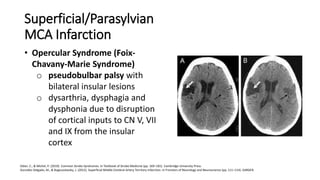
• Opercular Syndrome (Foix-
Chavany-Marie Syndrome)
o pseudobulbar palsy with
bilateral insular lesions
o dysarthria, dysphagia and
dysphonia due to disruption
of cortical inputs to CN V, VII
and IX from the insular
cortex
Odier, C., & Michel, P. (2019). Common Stroke Syndromes. In Textbook of Stroke Medicine (pp. 169–181). Cambridge University Press.
González Delgado, M., & Bogousslavsky, J. (2012). Superficial Middle Cerebral Artery Territory Infarction. In Frontiers of Neurology and Neuroscience (pp. 111–114). KARGER.
Lenticulostriate Infarction
• Can have severe deficits with
small lesion
• Cortical signs are absent or
minor due to interruption of
subcortical–cortical pathways
• Hemiparesis
• Hemihypesthesia
• Dysarthria
• Abnormal movements
Odier, C., & Michel, P. (2019). Common Stroke Syndromes. In Textbook of Stroke Medicine (pp. 169–181). Cambridge University Press.
Leptomeningeal Branch
Infarction
• Involvement of M3 or M4
branches
• produce highly circumscribed
infarcts accompanied by specific
neurological deficits
• most of the time related to
embolism Cranial CT scan—3 days post ictus
wedge shaped infarct in distribution of MCA branch
involving the right posterior frontal area
Odier, C., & Michel, P. (2019). Common Stroke Syndromes. In Textbook of Stroke Medicine (pp. 169–181). Cambridge University Press.
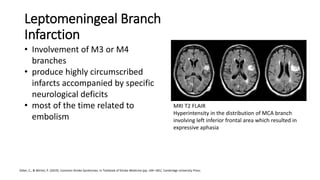
Leptomeningeal Branch
Infarction
• Involvement of M3 or M4
branches
• produce highly circumscribed
infarcts accompanied by specific
neurological deficits
• most of the time related to
embolism
Odier, C., & Michel, P. (2019). Common Stroke Syndromes. In Textbook of Stroke Medicine (pp. 169–181). Cambridge University Press.
MRI T2 FLAIR
Hyperintensity in the distribution of MCA branch
involving left inferior frontal area which resulted in
expressive aphasia
Anterior Cerebral Artery
(ACA)
Harrigan, M. R., & Deveikis, J. P. (2012). Essential Neurovascular Anatomy. In Handbook of Cerebrovascular Disease and Neurointerventional Technique (pp. 3–98). Humana Press.
• Medial and superior parts of frontal,
anterior parietal lobes
Anterior Cerebral Artery
(ACA)
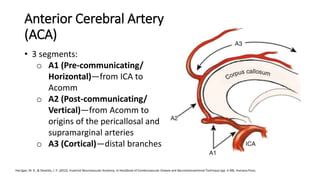
• 3 segments:
o A1 (Pre-communicating/
Horizontal)—from ICA to
Acomm
o A2 (Post-communicating/
Vertical)—from Acomm to
origins of the pericallosal and
supramarginal arteries
o A3 (Cortical)—distal branches
Harrigan, M. R., & Deveikis, J. P. (2012). Essential Neurovascular Anatomy. In Handbook of Cerebrovascular Disease and Neurointerventional Technique (pp. 3–98). Humana Press.
A1 Pre-Communicating/Horizontal
Harrigan, M. R., & Deveikis, J. P. (2012). Essential Neurovascular Anatomy. In Handbook of Cerebrovascular Disease and Neurointerventional Technique (pp. 3–98). Humana Press.
• extends from the ICA
bifurcation to its junction with
Acomm within or inferior to the
interhemispheric fissure
• superior to optic chiasm inferior
to the anterior perforated
substance
• 4.0 mm in length
A1 Pre-Communicating/Horizontal
Harrigan, M. R., & Deveikis, J. P. (2012). Essential Neurovascular Anatomy. In Handbook of Cerebrovascular Disease and Neurointerventional Technique (pp. 3–98). Humana Press.
• asymmetric in up to 80%
• Right A1 tends to be longer, more
tortuous, and narrow
• 10% are hypoplastic
• 1-2% are absent on one side
Acomm Complex
Harrigan, M. R., & Deveikis, J. P. (2012). Essential Neurovascular Anatomy. In Handbook of Cerebrovascular Disease and Neurointerventional Technique (pp. 3–98). Humana Press.
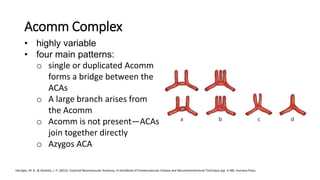
• highly variable
• four main patterns:
o single or duplicated Acomm
forms a bridge between the
ACAs
o A large branch arises from
the Acomm
o Acomm is not present—ACAs
join together directly
o Azygos ACA
A1 and Acomm Branches
Harrigan, M. R., & Deveikis, J. P. (2012). Essential Neurovascular Anatomy. In Handbook of Cerebrovascular Disease and Neurointerventional Technique (pp. 3–98). Humana Press.
• A1 Perforating Branches
1. Superior branches—Medial
Lenticulostriate
2. Inferior branches
• Acomm Perforating Branches
• Recurrent artery of Heubner
A1 Perforating Branches
Harrigan, M. R., & Deveikis, J. P. (2012). Essential Neurovascular Anatomy. In Handbook of Cerebrovascular Disease and Neurointerventional Technique (pp. 3–98). Humana Press.
• Superior branches—Medial
Lenticulostriate
o 2–15 branches
o supply the anterior
hypothalamus, septum
pellucidum, anterior
commissure, fornix, and anterior
striatum
• Inferior branches
o supply the optic chiasm and
optic nerves
Acomm Perforating Branches
Harrigan, M. R., & Deveikis, J. P. (2012). Essential Neurovascular Anatomy. In Handbook of Cerebrovascular Disease and Neurointerventional Technique (pp. 3–98). Humana Press.
Najera, E., Alves Belo, J. T., Truong, H. Q., Gardner, P. A., & Fernandez-Miranda, J. C. (2018). Surgical Anatomy of the Subcallosal Artery: Implications for Transcranial and Endoscopic Endonasal Surgery in the Suprachiasmatic
Region. In Operative Neurosurgery (Vol. 17, Issue 1, pp. 79–87). Oxford University Press (OUP). https://doi.org/10.1093/ons/opy276
• Subcallosal
o single, largest
o supplies the septum pellucidum, columns of the fornix,
corpus callosum and lamina terminalis
• Hypothalamic
o smaller and multiple
• Chiasmatic
o present only in 20%
A2 Post-Communicating/Vertical
Harrigan, M. R., & Deveikis, J. P. (2012). Essential Neurovascular Anatomy. In Handbook of Cerebrovascular Disease and Neurointerventional Technique (pp. 3–98). Humana Press.
• travels in a vertical direction to its
division into the pericallosal and
callosomarginal arteries
• anterior to the genu of corpus
callosum
• 43 mm
• travel in the interhemispheric
fissure
• right A2 is more often (72%)
anterior to the left A2
A2 Branches
Harrigan, M. R., & Deveikis, J. P. (2012). Essential Neurovascular Anatomy. In Handbook of Cerebrovascular Disease and Neurointerventional Technique (pp. 3–98). Humana Press.
• A2 Perforators
• Recurrent artery of Heubner
• Orbitofrontal Artery
• Frontopolar Artery
A2 Perforators
Harrigan, M. R., & Deveikis, J. P. (2012). Essential Neurovascular Anatomy. In Handbook of Cerebrovascular Disease and Neurointerventional Technique (pp. 3–98). Humana Press.
• along the first 5 mm of the
segment
• penetrate the gyrus rectus and
olfactory sulcus
Recurrent Artery of Heubner
Harrigan, M. R., & Deveikis, J. P. (2012). Essential Neurovascular Anatomy. In Handbook of Cerebrovascular Disease and Neurointerventional Technique (pp. 3–98). Humana Press.
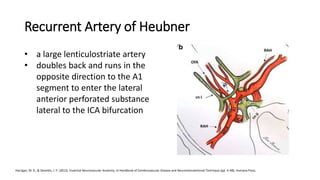
• a large lenticulostriate artery
• doubles back and runs in the
opposite direction to the A1
segment to enter the lateral
anterior perforated substance
lateral to the ICA bifurcation
Recurrent Artery of Heubner
Harrigan, M. R., & Deveikis, J. P. (2012). Essential Neurovascular Anatomy. In Handbook of Cerebrovascular Disease and Neurointerventional Technique (pp. 3–98). Humana Press.
• arise from:
o A2 branch (57-78%)
o A1 (17-45%)
o ACA-Acomm junction (35%)
Recurrent Artery of Heubner
Harrigan, M. R., & Deveikis, J. P. (2012). Essential Neurovascular Anatomy. In Handbook of Cerebrovascular Disease and Neurointerventional Technique (pp. 3–98). Humana Press.
• Supplies head of the caudate
nucleus, genu and anterior limb of
the internal capsule, anterior third
of the putamen
Orbitofrontal Artery
Harrigan, M. R., & Deveikis, J. P. (2012). Essential Neurovascular Anatomy. In Handbook of Cerebrovascular Disease and Neurointerventional Technique (pp. 3–98). Humana Press.
• First cortical branch of the
A2 segment
• 2-3 vessels
• runs close to the midline in
an anterior direction to the
gyrus rectus, olfactory bulb,
and medial aspect of the
inferior frontal lobe
Frontopolar Artery
Harrigan, M. R., & Deveikis, J. P. (2012). Essential Neurovascular Anatomy. In Handbook of Cerebrovascular Disease and Neurointerventional Technique (pp. 3–98). Humana Press.
• may also appear as a group of
vessels
• arises from distal A2
segment, below the corpus
callosum
• travels anteriorly and
superiorly towards the frontal
pole
A3 Cortical
Harrigan, M. R., & Deveikis, J. P. (2012). Essential Neurovascular Anatomy. In Handbook of Cerebrovascular Disease and Neurointerventional Technique (pp. 3–98). Humana Press.
• include all the ACA branches
distal to the origin of the
pericallosal and
callosomarginal arteries
• around the genu
• A4, A5 segments—over the
corpus callosum
A3 Cortical
Harrigan, M. R., & Deveikis, J. P. (2012). Essential Neurovascular Anatomy. In Handbook of Cerebrovascular Disease and Neurointerventional Technique (pp. 3–98). Humana Press.
(1) Orbitofrontal artery; (2) frontopolar artery; (3) anterior internal
frontal artery; (4) middle internal frontal artery; (5) posterior internal
frontal artery; (6) paracentral artery; (7) superior parietal artery;
(8) inferior parietal artery; (9) callosomarginal artery;
(10) pericallosal artery
• Branches:
1. Pericallosal artery
2. Callosomarginal artery
3. Internal frontal branches
o Anterior internal frontal
o Middle internal frontal
o Posterior internal frontal
4. Paracentral artery
5. Parietal arteries
o Superior parietal
o Inferior parietal
Pericallosal Artery
Harrigan, M. R., & Deveikis, J. P. (2012). Essential Neurovascular Anatomy. In Handbook of Cerebrovascular Disease and Neurointerventional Technique (pp. 3–98). Humana Press.
• main trunk of the ACA
• anastomose with the
splenial artery of the
PCA
Callosomarginal Artery
Harrigan, M. R., & Deveikis, J. P. (2012). Essential Neurovascular Anatomy. In Handbook of Cerebrovascular Disease and Neurointerventional Technique (pp. 3–98). Humana Press.
• second largest distal
branch of the ACA
• travels superiorly over the
cingulate gyrus to run in a
posterior direction within
the cingulate sulcus
• absent in 18%
Internal Frontal Branches
Harrigan, M. R., & Deveikis, J. P. (2012). Essential Neurovascular Anatomy. In Handbook of Cerebrovascular Disease and Neurointerventional Technique (pp. 3–98). Humana Press.
• identified according to which
part of the superior frontal
gyrus they supply
• may arise from the
pericallosal or the
callosomarginal artery
o Anterior internal frontal
(3)
o Middle internal frontal
(4)
o Posterior internal frontal
(5)
Paracental Artery
Harrigan, M. R., & Deveikis, J. P. (2012). Essential Neurovascular Anatomy. In Handbook of Cerebrovascular Disease and Neurointerventional Technique (pp. 3–98). Humana Press.
• arises from pericallosal or
callosomarginal artery
midway between the genu
and splenium of the
corpus callosum
• supply the paracentral
lobule
Parietal Arteries
Harrigan, M. R., & Deveikis, J. P. (2012). Essential Neurovascular Anatomy. In Handbook of Cerebrovascular Disease and Neurointerventional Technique (pp. 3–98). Humana Press.
• final and most distal
branches
• supply medial aspect of the
hemisphere above the
corpus callosum and most of
the precuneus
• anastomose with the parieto-
occipital branch of PCA
• divided into:
o Superior parietal artery
(7)
o Inferior parietal artery
ACA Territory Infarction
Park, H., Jeong, Y. S., Lee, S. H., Jang, S. H., Kwon, D. H., Hong, J.-H., Sohn, S.-I., & Yoo, J. (2021). Clinical prognosis of isolated anterior cerebral artery territory infarction: a retrospective study. In BMC Neurology (Vol. 21, Issue 1).
Springer Science and Business Media LLC.
• Isolated ACA territory infarction is
a rare phenomenon
• 0.5–3 % of all cerebral infarctions
• diameter of the A1 segment is
only approximately half that of the
MCA
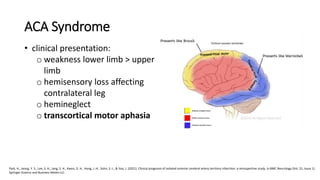
ACA Syndrome
Park, H., Jeong, Y. S., Lee, S. H., Jang, S. H., Kwon, D. H., Hong, J.-H., Sohn, S.-I., & Yoo, J. (2021). Clinical prognosis of isolated anterior cerebral artery territory infarction: a retrospective study. In BMC Neurology (Vol. 21, Issue 1).
Springer Science and Business Media LLC.
• clinical presentation:
o weakness lower limb > upper
limb
o hemisensory loss affecting
contralateral leg
o hemineglect
o transcortical motor aphasia
ACA Syndrome
Park, H., Jeong, Y. S., Lee, S. H., Jang, S. H., Kwon, D. H., Hong, J.-H., Sohn, S.-I., & Yoo, J. (2021). Clinical prognosis of isolated anterior cerebral artery territory infarction: a retrospective study. In BMC Neurology (Vol. 21, Issue 1).
Springer Science and Business Media LLC.
• Isolated infarction in territory of
recurrent artery of Heubner
o restricted diffusion in caudate
nucleus, anterior limb of the
internal capsule, and anterior
aspect of the putamen and
globus pallidus
o can be clinically silent
o hemiparesis most prominent in
face and upper extremity
ACA Syndrome
Park, H., Jeong, Y. S., Lee, S. H., Jang, S. H., Kwon, D. H., Hong, J.-H., Sohn, S.-I., & Yoo, J. (2021). Clinical prognosis of isolated anterior cerebral artery territory infarction: a retrospective study. In BMC Neurology (Vol. 21, Issue 1).
Springer Science and Business Media LLC.
• clinical presentation:
o Sphincter dysfunction
o Anterograde amnesia
o Grasping
o Abulia, Akinetic mutism
ACA Syndrome
Park, H., Jeong, Y. S., Lee, S. H., Jang, S. H., Kwon, D. H., Hong, J.-H., Sohn, S.-I., & Yoo, J. (2021). Clinical prognosis of isolated anterior cerebral artery territory infarction: a retrospective study. In BMC Neurology (Vol. 21, Issue 1).
Springer Science and Business Media LLC.
• clinical presentation:
o callosal disconnection
syndrome—interruption of
connection from the right
hemisphere to the cognitive
center in the left hemisphere
hence ideomotor apraxia,
agraphia, tactile anomia alien-
hand syndrome of left hand
Thank you!
Answers to
Pre-Test
Pre-Test
1. Identify Artery involved:
a. Lateral Lenticulostriate
b. Recurrent Artery of Heubner
c. MCA, leptomeningeal branch
d. MCA, superior division
e. MCA, parasylvian
Pre-Test
1. Identify Artery involved:
a. Lateral Lenticulostriate
b. Recurrent Artery of Heubner
c. MCA, leptomeningeal branch
d. MCA, superior division
e. MCA, parasylvian
Pre-Test
2. Identify Artery involved:
a. Lateral Lenticulostriate
b. Recurrent Artery of Heubner
c. MCA, leptomeningeal branch
d. MCA, superior division
e. MCA, parasylvian
Pre-Test
2. Identify Artery involved:
a. Lateral Lenticulostriate
b. Recurrent Artery of Heubner
c. MCA, leptomeningeal branch
d. MCA, superior division
e. MCA, parasylvian
Pre-Test
3. Identify Artery involved:
a. Lateral Lenticulostriate
b. Recurrent Artery of Heubner
c. MCA, leptomeningeal branch
d. MCA, superior division
e. MCA, parasylvian
Clue: Foix-Chavany-Marie Syndrome
Pre-Test
3. Identify Artery involved:
a. Lateral Lenticulostriate
b. Recurrent Artery of Heubner
c. MCA, leptomeningeal branch
d. MCA, superior division
e. MCA, parasylvian
Clue: Foix-Chavany-Marie Syndrome
Pre-Test
4. Identify Artery involved:
a. Lateral Lenticulostriate
b. Recurrent Artery of Heubner
c. MCA, leptomeningeal branch
d. MCA, superior division
e. MCA, parasylvian
Pre-Test
4. Identify Artery involved:
a. Lateral Lenticulostriate
b. Recurrent Artery of Heubner
c. MCA, leptomeningeal branch
d. MCA, superior division
e. MCA, parasylvian
Pre-Test
5. Identify Artery involved:
a. Lateral Lenticulostriate
b. Recurrent Artery of Heubner
c. MCA, leptomeningeal branch
d. MCA, superior division
e. MCA, parasylvian
Pre-Test
5. Identify Artery involved:
a. Lateral Lenticulostriate
b. Recurrent Artery of Heubner
c. MCA, leptomeningeal branch
d. MCA, superior division
e. MCA, parasylvian

Mca & aca syndromes

  • 1.
    MCA & ACA Syndromes PatrickM. Yalung, MD, MBA, FPNA November 16, 2021
  • 2.
  • 3.
    Pre-Test 1. Identify Arteryinvolved: a. Lateral Lenticulostriate b. Recurrent Artery of Heubner c. MCA, leptomeningeal branch d. MCA, superior division e. MCA, parasylvian
  • 4.
    Pre-Test 2. Identify Arteryinvolved: a. Lateral Lenticulostriate b. Recurrent Artery of Heubner c. MCA, leptomeningeal branch d. MCA, superior division e. MCA, parasylvian
  • 5.
    Pre-Test 3. Identify Arteryinvolved: a. Lateral Lenticulostriate b. Recurrent Artery of Heubner c. MCA, leptomeningeal branch d. MCA, superior division e. MCA, parasylvian Clue: Foix-Chavany-Marie Syndrome
  • 6.
    Pre-Test 4. Identify Arteryinvolved: a. Lateral Lenticulostriate b. Recurrent Artery of Heubner c. MCA, leptomeningeal branch d. MCA, superior division e. MCA, parasylvian
  • 7.
    Pre-Test 5. Identify Arteryinvolved: a. Lateral Lenticulostriate b. Recurrent Artery of Heubner c. MCA, leptomeningeal branch d. MCA, superior division e. MCA, parasylvian
  • 8.
    References: 1. Park, H.,Jeong, Y. S., Lee, S. H., Jang, S. H., Kwon, D. H., Hong, J.-H., Sohn, S.-I., & Yoo, J. (2021). Clinical prognosis of isolated anterior cerebral artery territory infarction: a retrospective study. In BMC Neurology (Vol. 21, Issue 1). Springer Science and Business Media LLC. 2. Odier, C., & Michel, P. (2019). Common Stroke Syndromes. In Textbook of Stroke Medicine (pp. 169– 181). Cambridge University Press. 3. Heiss, W.-D. (2015). Malignant MCA Infarction: Pathophysiology and Imaging for Early Diagnosis and Management Decisions. In Cerebrovascular Diseases (Vol. 41, Issues 1–2, pp. 1–7). S. Karger AG. 4. Harrigan, M. R., & Deveikis, J. P. (2012). Essential Neurovascular Anatomy. In Handbook of Cerebrovascular Disease and Neurointerventional Technique (pp. 3–98). Humana Press. 5. González Delgado, M., & Bogousslavsky, J. (2012). Superficial Middle Cerebral Artery Territory Infarction. In Frontiers of Neurology and Neuroscience (pp. 111– 114). KARGER.
  • 9.
    Middle Cerebral Artery (MCA) •Supplies most of the temporal lobe, anterolateral frontal lobe, and parietal lobe Harrigan, M. R., & Deveikis, J. P. (2012). Essential Neurovascular Anatomy. In Handbook of Cerebrovascular Disease and Neurointerventional Technique (pp. 3–98). Humana Press.
  • 10.
    Middle Cerebral Artery (MCA) Harrigan,M. R., & Deveikis, J. P. (2012). Essential Neurovascular Anatomy. In Handbook of Cerebrovascular Disease and Neurointerventional Technique (pp. 3–98). Humana Press.
  • 11.
    Middle Cerebral Artery (MCA) •4 segments: o M1 (Sphenoidal/Horizontal)— ICA to bifurcation (or trifurcation) o M2 (Insular)—MCA bifurcation to circular sulcus of the insula o M3 (Opercular)—circular sulcus to superficial aspect of the sylvian fissure o M4 (Cortical)—cortical branches Harrigan, M. R., & Deveikis, J. P. (2012). Essential Neurovascular Anatomy. In Handbook of Cerebrovascular Disease and Neurointerventional Technique (pp. 3–98). Humana Press.
  • 12.
    M1 Sphenoidal/Horizontal • fromICA, travels laterally, parallel to the sphenoid wing • 16 mm in length • usually twice the size of the A1 • terminates into the M2 segments: o bifurcates (71%) o trifurcates (20%) o four branches (9%) Harrigan, M. R., & Deveikis, J. P. (2012). Essential Neurovascular Anatomy. In Handbook of Cerebrovascular Disease and Neurointerventional Technique (pp. 3–98). Humana Press.
  • 13.
    M1 Sphenoidal/Horizontal • Branches: 1.Lateral lenticulostriate 2. Anterior temporal artery Harrigan, M. R., & Deveikis, J. P. (2012). Essential Neurovascular Anatomy. In Handbook of Cerebrovascular Disease and Neurointerventional Technique (pp. 3–98). Humana Press.
  • 14.
    Lateral Lenticulostriate • 80%arise from superior aspect of M1 segment • average 10 in number • enter the anterior perforated substance to supply the anterior commissure, internal capsule, caudate nucleus, putamen, globus pallidus, and substantia innominata Harrigan, M. R., & Deveikis, J. P. (2012). Essential Neurovascular Anatomy. In Handbook of Cerebrovascular Disease and Neurointerventional Technique (pp. 3–98). Humana Press.
  • 15.
    Anterior Temporal • arisesnear the midpoint of the M1 segment • Less commonly, it arises from the inferior division of M2 or as part of an M1 trifurcation • travels anteriorly and inferiorly over the temporal tip and does not enter the sylvian • supplies the anterior temporal lobe Harrigan, M. R., & Deveikis, J. P. (2012). Essential Neurovascular Anatomy. In Handbook of Cerebrovascular Disease and Neurointerventional Technique (pp. 3–98). Humana Press.
  • 16.
    M2 Insular • fromthe main division point of the M1 • over the insula within the sylvian fissure, and terminate at the circular sulcus of the insula • divisions are equal in size (18%) • superior division dominant (28%) • inferior division dominant (32%) Harrigan, M. R., & Deveikis, J. P. (2012). Essential Neurovascular Anatomy. In Handbook of Cerebrovascular Disease and Neurointerventional Technique (pp. 3–98). Humana Press.
  • 17.
    M2 Insular • corticalarea supplied o superior division— orbitofrontal area to the posterior parietal area o inferior division—temporal pole to the angular area • 6-8 arteries at the point of transition into the M3 segments Harrigan, M. R., & Deveikis, J. P. (2012). Essential Neurovascular Anatomy. In Handbook of Cerebrovascular Disease and Neurointerventional Technique (pp. 3–98). Humana Press.
  • 18.
    M3 Opercular • beginat the circular sulcus • end at the surface of the sylvian fissure • give rise to the 8 stem arteries which in turn give rise to 1-5 the cortical branches Harrigan, M. R., & Deveikis, J. P. (2012). Essential Neurovascular Anatomy. In Handbook of Cerebrovascular Disease and Neurointerventional Technique (pp. 3–98). Humana Press.
  • 19.
    M4 Cortical • beginat the surface of the sylvian fissure and extend over the surface of the cerebral hemisphere • smallest arise from the anterior; largest ones emerge from posterior sylvian fissure • 12 subdivision system— actually exist as several branches (up to 5) from a single stem artery Harrigan, M. R., & Deveikis, J. P. (2012). Essential Neurovascular Anatomy. In Handbook of Cerebrovascular Disease and Neurointerventional Technique (pp. 3–98). Humana Press.
  • 20.
    M4 Cortical Superior division oLateral Orbitofrontal o Prefrontal o Precentral o Central Inferior division o Temporopolar o Temporo-occipital o Angular o Anterior Temporal o Middle Temporal o Posterior Temporal Dominant division o Anterior Parietal o Posterior Parietal Harrigan, M. R., & Deveikis, J. P. (2012). Essential Neurovascular Anatomy. In Handbook of Cerebrovascular Disease and Neurointerventional Technique (pp. 3–98). Humana Press.
  • 21.
    MCA Territory Infarction •2/3 of all ischemic stroke occurs in the MCA territory • can be subtle or devastating clinical syndrome, depending on site of occlusion, the extent of ischemia, etiology, and collateral arterial network • Involves—frontal, temporal, parietal, basal ganglia Odier, C., & Michel, P. (2019). Common Stroke Syndromes. In Textbook of Stroke Medicine (pp. 169–181). Cambridge University Press.
  • 22.
    MCA Territory Infarction •Large infarcts—involvement of 2 of the 3 MCA territories (deep, superior, and inferior divisions) • Malignant MCA stroke— complete or near complete MCA territory infarction with ensuing mass effect from brain edema Odier, C., & Michel, P. (2019). Common Stroke Syndromes. In Textbook of Stroke Medicine (pp. 169–181). Cambridge University Press.
  • 23.
    MCA Territory Infarction Lefthemisphere Right hemisphere • Right hemiparesis—Variable involvement of face, arm, leg • Right-sided sensory loss—pattern similar to motor deficit, usually involves all modalities, decreased stereognosis, agraphesthesia, left- right confusion • Right homonymous hemianopia • Dysarthria • Aphasia, fluent and non-fluent • Alexia, Agraphia, Acalculia, Apraxia • Left hemiparesis • Left-sided sensory loss • Left homonymous hemianopia • Dysarthria • Neglect of the left side of environment • Anosognosia • Asomatognosia • Loss of prosody of speech • Flat affect Odier, C., & Michel, P. (2019). Common Stroke Syndromes. In Textbook of Stroke Medicine (pp. 169–181). Cambridge University Press.
  • 24.
    MCA Superior Division Infarction •one of the most common locations of embolic stroke, either from proximal arterial source or from the heart • contralateral hemiparesis—face, arm > leg • contralateral hemisensory loss MRI T2 FLAIR—prominent bright signal affecting the left frontal lobe above the Sylvian fissure Odier, C., & Michel, P. (2019). Common Stroke Syndromes. In Textbook of Stroke Medicine (pp. 169–181). Cambridge University Press.
  • 25.
    MCA Superior Division Infarction •contralateral visual field deficit predominantly affecting the lower fields (pie on the floor) • gaze preference to the ipsilateral side • Left-sided infarct—expressive (Broca’s) aphasia • Right-sided infarct—neglect Odier, C., & Michel, P. (2019). Common Stroke Syndromes. In Textbook of Stroke Medicine (pp. 169–181). Cambridge University Press.
  • 26.
    MCA Inferior Division Infarction •less commonly affected by emboli than the superior division • do NOT cause any weakness or sensory loss • misdiagnosed initially as primary psychiatric disorder Cranial CT scan—3 days post ictus; large lesion in the left temporal and posterior parietal lobes Odier, C., & Michel, P. (2019). Common Stroke Syndromes. In Textbook of Stroke Medicine (pp. 169–181). Cambridge University Press.
  • 27.
    MCA Inferior Division Infarction •contralateral visual field deficit predominantly affecting the upper fields (pie in the sky) • Left-sided infarct—receptive (Wernicke's) aphasia • Right-sided infarct—neglect, constructional and clothing dyspraxia, spatial disorientation, behavioral changes, impairment of visuospatial skills Odier, C., & Michel, P. (2019). Common Stroke Syndromes. In Textbook of Stroke Medicine (pp. 169–181). Cambridge University Press.
  • 28.
    MCA Proximal Segment Infarction •affect the: o superior division o inferior divisions o lenticulostriates • contralateral hemiplegia—face, arm, and leg o leg is plegic as well due to involvement of lenticulostriates which supply the internal capsule Cranial CT scan—3 days post ictus; hypodensity involving distribution of entire MCA as well as deeper basal ganglia Odier, C., & Michel, P. (2019). Common Stroke Syndromes. In Textbook of Stroke Medicine (pp. 169–181). Cambridge University Press.
  • 29.
    MCA Proximal Segment Infarction •contralateral hemisensory loss • contralateral visual field deficit • ipsilateral conjugated eye and head deviation • Awake or with mild drowsiness/agitation Odier, C., & Michel, P. (2019). Common Stroke Syndromes. In Textbook of Stroke Medicine (pp. 169–181). Cambridge University Press.
  • 30.
    MCA Proximal Segment Infarction •Left-sided infarct—global aphasia, ideomotor apraxia • Right-sided infarct—neglect syndrome, anosognosia, asomatognosia, impairment of visuospatial skills Odier, C., & Michel, P. (2019). Common Stroke Syndromes. In Textbook of Stroke Medicine (pp. 169–181). Cambridge University Press.
  • 31.
    Malignant MCA Infarction •annual incidence 10–20 per 100,000 • females > men • younger patients are more susceptible • brain edema  high ICP  herniation • deterioration typically within 48–72 hours • death in up to 80% within the first week Odier, C., & Michel, P. (2019). Common Stroke Syndromes. In Textbook of Stroke Medicine (pp. 169–181). Cambridge University Press.
  • 32.
    Malignant MCA Infarction •new cortical symptoms may occur because of infarction of ACA or PCA which become compressed against interhemispheric falx and cerebellar tentorium • Uncal herniation  ipsilateral fixed mydriasis and ipsilateral corticospinal signs (Kernohan’s notch phenomenon) • bilateral ptosis, headache, vomiting, papilledema, decreasing sensorium Odier, C., & Michel, P. (2019). Common Stroke Syndromes. In Textbook of Stroke Medicine (pp. 169–181). Cambridge University Press.
  • 33.
    Superficial/Parasylvian MCA Infarction • Affectsdistal MCA, at the bifurcation, sparing the lenticulostriate arteries • Contralateral weakness of face and arm • Contralateral hemisensory loss on face and arm • Contralateral homonymous hemianopia or a quadrantanopsia Odier, C., & Michel, P. (2019). Common Stroke Syndromes. In Textbook of Stroke Medicine (pp. 169–181). Cambridge University Press. González Delgado, M., & Bogousslavsky, J. (2012). Superficial Middle Cerebral Artery Territory Infarction. In Frontiers of Neurology and Neuroscience (pp. 111–114). KARGER.
  • 34.
    Superficial/Parasylvian MCA Infarction • Deviationof the head and the eyes is more transitory • Cognitive deficit less pronounced or rapidly improving • Left-sided infarct—conduction aphasia, apraxia, Gerstmann syndrome • Right-sided infarct— constructional apraxia Odier, C., & Michel, P. (2019). Common Stroke Syndromes. In Textbook of Stroke Medicine (pp. 169–181). Cambridge University Press. González Delgado, M., & Bogousslavsky, J. (2012). Superficial Middle Cerebral Artery Territory Infarction. In Frontiers of Neurology and Neuroscience (pp. 111–114). KARGER.
  • 35.
    Superficial/Parasylvian MCA Infarction • OpercularSyndrome (Foix- Chavany-Marie Syndrome) o pseudobulbar palsy with bilateral insular lesions o dysarthria, dysphagia and dysphonia due to disruption of cortical inputs to CN V, VII and IX from the insular cortex Odier, C., & Michel, P. (2019). Common Stroke Syndromes. In Textbook of Stroke Medicine (pp. 169–181). Cambridge University Press. González Delgado, M., & Bogousslavsky, J. (2012). Superficial Middle Cerebral Artery Territory Infarction. In Frontiers of Neurology and Neuroscience (pp. 111–114). KARGER.
  • 36.
    Lenticulostriate Infarction • Canhave severe deficits with small lesion • Cortical signs are absent or minor due to interruption of subcortical–cortical pathways • Hemiparesis • Hemihypesthesia • Dysarthria • Abnormal movements Odier, C., & Michel, P. (2019). Common Stroke Syndromes. In Textbook of Stroke Medicine (pp. 169–181). Cambridge University Press.
  • 37.
    Leptomeningeal Branch Infarction • Involvementof M3 or M4 branches • produce highly circumscribed infarcts accompanied by specific neurological deficits • most of the time related to embolism Cranial CT scan—3 days post ictus wedge shaped infarct in distribution of MCA branch involving the right posterior frontal area Odier, C., & Michel, P. (2019). Common Stroke Syndromes. In Textbook of Stroke Medicine (pp. 169–181). Cambridge University Press.
  • 38.
    Leptomeningeal Branch Infarction • Involvementof M3 or M4 branches • produce highly circumscribed infarcts accompanied by specific neurological deficits • most of the time related to embolism Odier, C., & Michel, P. (2019). Common Stroke Syndromes. In Textbook of Stroke Medicine (pp. 169–181). Cambridge University Press. MRI T2 FLAIR Hyperintensity in the distribution of MCA branch involving left inferior frontal area which resulted in expressive aphasia
  • 39.
    Anterior Cerebral Artery (ACA) Harrigan,M. R., & Deveikis, J. P. (2012). Essential Neurovascular Anatomy. In Handbook of Cerebrovascular Disease and Neurointerventional Technique (pp. 3–98). Humana Press. • Medial and superior parts of frontal, anterior parietal lobes
  • 40.
    Anterior Cerebral Artery (ACA) •3 segments: o A1 (Pre-communicating/ Horizontal)—from ICA to Acomm o A2 (Post-communicating/ Vertical)—from Acomm to origins of the pericallosal and supramarginal arteries o A3 (Cortical)—distal branches Harrigan, M. R., & Deveikis, J. P. (2012). Essential Neurovascular Anatomy. In Handbook of Cerebrovascular Disease and Neurointerventional Technique (pp. 3–98). Humana Press.
  • 41.
    A1 Pre-Communicating/Horizontal Harrigan, M.R., & Deveikis, J. P. (2012). Essential Neurovascular Anatomy. In Handbook of Cerebrovascular Disease and Neurointerventional Technique (pp. 3–98). Humana Press. • extends from the ICA bifurcation to its junction with Acomm within or inferior to the interhemispheric fissure • superior to optic chiasm inferior to the anterior perforated substance • 4.0 mm in length
  • 42.
    A1 Pre-Communicating/Horizontal Harrigan, M.R., & Deveikis, J. P. (2012). Essential Neurovascular Anatomy. In Handbook of Cerebrovascular Disease and Neurointerventional Technique (pp. 3–98). Humana Press. • asymmetric in up to 80% • Right A1 tends to be longer, more tortuous, and narrow • 10% are hypoplastic • 1-2% are absent on one side
  • 43.
    Acomm Complex Harrigan, M.R., & Deveikis, J. P. (2012). Essential Neurovascular Anatomy. In Handbook of Cerebrovascular Disease and Neurointerventional Technique (pp. 3–98). Humana Press. • highly variable • four main patterns: o single or duplicated Acomm forms a bridge between the ACAs o A large branch arises from the Acomm o Acomm is not present—ACAs join together directly o Azygos ACA
  • 44.
    A1 and AcommBranches Harrigan, M. R., & Deveikis, J. P. (2012). Essential Neurovascular Anatomy. In Handbook of Cerebrovascular Disease and Neurointerventional Technique (pp. 3–98). Humana Press. • A1 Perforating Branches 1. Superior branches—Medial Lenticulostriate 2. Inferior branches • Acomm Perforating Branches • Recurrent artery of Heubner
  • 45.
    A1 Perforating Branches Harrigan,M. R., & Deveikis, J. P. (2012). Essential Neurovascular Anatomy. In Handbook of Cerebrovascular Disease and Neurointerventional Technique (pp. 3–98). Humana Press. • Superior branches—Medial Lenticulostriate o 2–15 branches o supply the anterior hypothalamus, septum pellucidum, anterior commissure, fornix, and anterior striatum • Inferior branches o supply the optic chiasm and optic nerves
  • 46.
    Acomm Perforating Branches Harrigan,M. R., & Deveikis, J. P. (2012). Essential Neurovascular Anatomy. In Handbook of Cerebrovascular Disease and Neurointerventional Technique (pp. 3–98). Humana Press. Najera, E., Alves Belo, J. T., Truong, H. Q., Gardner, P. A., & Fernandez-Miranda, J. C. (2018). Surgical Anatomy of the Subcallosal Artery: Implications for Transcranial and Endoscopic Endonasal Surgery in the Suprachiasmatic Region. In Operative Neurosurgery (Vol. 17, Issue 1, pp. 79–87). Oxford University Press (OUP). https://doi.org/10.1093/ons/opy276 • Subcallosal o single, largest o supplies the septum pellucidum, columns of the fornix, corpus callosum and lamina terminalis • Hypothalamic o smaller and multiple • Chiasmatic o present only in 20%
  • 47.
    A2 Post-Communicating/Vertical Harrigan, M.R., & Deveikis, J. P. (2012). Essential Neurovascular Anatomy. In Handbook of Cerebrovascular Disease and Neurointerventional Technique (pp. 3–98). Humana Press. • travels in a vertical direction to its division into the pericallosal and callosomarginal arteries • anterior to the genu of corpus callosum • 43 mm • travel in the interhemispheric fissure • right A2 is more often (72%) anterior to the left A2
  • 48.
    A2 Branches Harrigan, M.R., & Deveikis, J. P. (2012). Essential Neurovascular Anatomy. In Handbook of Cerebrovascular Disease and Neurointerventional Technique (pp. 3–98). Humana Press. • A2 Perforators • Recurrent artery of Heubner • Orbitofrontal Artery • Frontopolar Artery
  • 49.
    A2 Perforators Harrigan, M.R., & Deveikis, J. P. (2012). Essential Neurovascular Anatomy. In Handbook of Cerebrovascular Disease and Neurointerventional Technique (pp. 3–98). Humana Press. • along the first 5 mm of the segment • penetrate the gyrus rectus and olfactory sulcus
  • 50.
    Recurrent Artery ofHeubner Harrigan, M. R., & Deveikis, J. P. (2012). Essential Neurovascular Anatomy. In Handbook of Cerebrovascular Disease and Neurointerventional Technique (pp. 3–98). Humana Press. • a large lenticulostriate artery • doubles back and runs in the opposite direction to the A1 segment to enter the lateral anterior perforated substance lateral to the ICA bifurcation
  • 51.
    Recurrent Artery ofHeubner Harrigan, M. R., & Deveikis, J. P. (2012). Essential Neurovascular Anatomy. In Handbook of Cerebrovascular Disease and Neurointerventional Technique (pp. 3–98). Humana Press. • arise from: o A2 branch (57-78%) o A1 (17-45%) o ACA-Acomm junction (35%)
  • 52.
    Recurrent Artery ofHeubner Harrigan, M. R., & Deveikis, J. P. (2012). Essential Neurovascular Anatomy. In Handbook of Cerebrovascular Disease and Neurointerventional Technique (pp. 3–98). Humana Press. • Supplies head of the caudate nucleus, genu and anterior limb of the internal capsule, anterior third of the putamen
  • 53.
    Orbitofrontal Artery Harrigan, M.R., & Deveikis, J. P. (2012). Essential Neurovascular Anatomy. In Handbook of Cerebrovascular Disease and Neurointerventional Technique (pp. 3–98). Humana Press. • First cortical branch of the A2 segment • 2-3 vessels • runs close to the midline in an anterior direction to the gyrus rectus, olfactory bulb, and medial aspect of the inferior frontal lobe
  • 54.
    Frontopolar Artery Harrigan, M.R., & Deveikis, J. P. (2012). Essential Neurovascular Anatomy. In Handbook of Cerebrovascular Disease and Neurointerventional Technique (pp. 3–98). Humana Press. • may also appear as a group of vessels • arises from distal A2 segment, below the corpus callosum • travels anteriorly and superiorly towards the frontal pole
  • 55.
    A3 Cortical Harrigan, M.R., & Deveikis, J. P. (2012). Essential Neurovascular Anatomy. In Handbook of Cerebrovascular Disease and Neurointerventional Technique (pp. 3–98). Humana Press. • include all the ACA branches distal to the origin of the pericallosal and callosomarginal arteries • around the genu • A4, A5 segments—over the corpus callosum
  • 56.
    A3 Cortical Harrigan, M.R., & Deveikis, J. P. (2012). Essential Neurovascular Anatomy. In Handbook of Cerebrovascular Disease and Neurointerventional Technique (pp. 3–98). Humana Press. (1) Orbitofrontal artery; (2) frontopolar artery; (3) anterior internal frontal artery; (4) middle internal frontal artery; (5) posterior internal frontal artery; (6) paracentral artery; (7) superior parietal artery; (8) inferior parietal artery; (9) callosomarginal artery; (10) pericallosal artery • Branches: 1. Pericallosal artery 2. Callosomarginal artery 3. Internal frontal branches o Anterior internal frontal o Middle internal frontal o Posterior internal frontal 4. Paracentral artery 5. Parietal arteries o Superior parietal o Inferior parietal
  • 57.
    Pericallosal Artery Harrigan, M.R., & Deveikis, J. P. (2012). Essential Neurovascular Anatomy. In Handbook of Cerebrovascular Disease and Neurointerventional Technique (pp. 3–98). Humana Press. • main trunk of the ACA • anastomose with the splenial artery of the PCA
  • 58.
    Callosomarginal Artery Harrigan, M.R., & Deveikis, J. P. (2012). Essential Neurovascular Anatomy. In Handbook of Cerebrovascular Disease and Neurointerventional Technique (pp. 3–98). Humana Press. • second largest distal branch of the ACA • travels superiorly over the cingulate gyrus to run in a posterior direction within the cingulate sulcus • absent in 18%
  • 59.
    Internal Frontal Branches Harrigan,M. R., & Deveikis, J. P. (2012). Essential Neurovascular Anatomy. In Handbook of Cerebrovascular Disease and Neurointerventional Technique (pp. 3–98). Humana Press. • identified according to which part of the superior frontal gyrus they supply • may arise from the pericallosal or the callosomarginal artery o Anterior internal frontal (3) o Middle internal frontal (4) o Posterior internal frontal (5)
  • 60.
    Paracental Artery Harrigan, M.R., & Deveikis, J. P. (2012). Essential Neurovascular Anatomy. In Handbook of Cerebrovascular Disease and Neurointerventional Technique (pp. 3–98). Humana Press. • arises from pericallosal or callosomarginal artery midway between the genu and splenium of the corpus callosum • supply the paracentral lobule
  • 61.
    Parietal Arteries Harrigan, M.R., & Deveikis, J. P. (2012). Essential Neurovascular Anatomy. In Handbook of Cerebrovascular Disease and Neurointerventional Technique (pp. 3–98). Humana Press. • final and most distal branches • supply medial aspect of the hemisphere above the corpus callosum and most of the precuneus • anastomose with the parieto- occipital branch of PCA • divided into: o Superior parietal artery (7) o Inferior parietal artery
  • 62.
    ACA Territory Infarction Park,H., Jeong, Y. S., Lee, S. H., Jang, S. H., Kwon, D. H., Hong, J.-H., Sohn, S.-I., & Yoo, J. (2021). Clinical prognosis of isolated anterior cerebral artery territory infarction: a retrospective study. In BMC Neurology (Vol. 21, Issue 1). Springer Science and Business Media LLC. • Isolated ACA territory infarction is a rare phenomenon • 0.5–3 % of all cerebral infarctions • diameter of the A1 segment is only approximately half that of the MCA
  • 63.
    ACA Syndrome Park, H.,Jeong, Y. S., Lee, S. H., Jang, S. H., Kwon, D. H., Hong, J.-H., Sohn, S.-I., & Yoo, J. (2021). Clinical prognosis of isolated anterior cerebral artery territory infarction: a retrospective study. In BMC Neurology (Vol. 21, Issue 1). Springer Science and Business Media LLC. • clinical presentation: o weakness lower limb > upper limb o hemisensory loss affecting contralateral leg o hemineglect o transcortical motor aphasia
  • 64.
    ACA Syndrome Park, H.,Jeong, Y. S., Lee, S. H., Jang, S. H., Kwon, D. H., Hong, J.-H., Sohn, S.-I., & Yoo, J. (2021). Clinical prognosis of isolated anterior cerebral artery territory infarction: a retrospective study. In BMC Neurology (Vol. 21, Issue 1). Springer Science and Business Media LLC. • Isolated infarction in territory of recurrent artery of Heubner o restricted diffusion in caudate nucleus, anterior limb of the internal capsule, and anterior aspect of the putamen and globus pallidus o can be clinically silent o hemiparesis most prominent in face and upper extremity
  • 65.
    ACA Syndrome Park, H.,Jeong, Y. S., Lee, S. H., Jang, S. H., Kwon, D. H., Hong, J.-H., Sohn, S.-I., & Yoo, J. (2021). Clinical prognosis of isolated anterior cerebral artery territory infarction: a retrospective study. In BMC Neurology (Vol. 21, Issue 1). Springer Science and Business Media LLC. • clinical presentation: o Sphincter dysfunction o Anterograde amnesia o Grasping o Abulia, Akinetic mutism
  • 66.
    ACA Syndrome Park, H.,Jeong, Y. S., Lee, S. H., Jang, S. H., Kwon, D. H., Hong, J.-H., Sohn, S.-I., & Yoo, J. (2021). Clinical prognosis of isolated anterior cerebral artery territory infarction: a retrospective study. In BMC Neurology (Vol. 21, Issue 1). Springer Science and Business Media LLC. • clinical presentation: o callosal disconnection syndrome—interruption of connection from the right hemisphere to the cognitive center in the left hemisphere hence ideomotor apraxia, agraphia, tactile anomia alien- hand syndrome of left hand
  • 67.
  • 68.
  • 69.
    Pre-Test 1. Identify Arteryinvolved: a. Lateral Lenticulostriate b. Recurrent Artery of Heubner c. MCA, leptomeningeal branch d. MCA, superior division e. MCA, parasylvian
  • 70.
    Pre-Test 1. Identify Arteryinvolved: a. Lateral Lenticulostriate b. Recurrent Artery of Heubner c. MCA, leptomeningeal branch d. MCA, superior division e. MCA, parasylvian
  • 71.
    Pre-Test 2. Identify Arteryinvolved: a. Lateral Lenticulostriate b. Recurrent Artery of Heubner c. MCA, leptomeningeal branch d. MCA, superior division e. MCA, parasylvian
  • 72.
    Pre-Test 2. Identify Arteryinvolved: a. Lateral Lenticulostriate b. Recurrent Artery of Heubner c. MCA, leptomeningeal branch d. MCA, superior division e. MCA, parasylvian
  • 73.
    Pre-Test 3. Identify Arteryinvolved: a. Lateral Lenticulostriate b. Recurrent Artery of Heubner c. MCA, leptomeningeal branch d. MCA, superior division e. MCA, parasylvian Clue: Foix-Chavany-Marie Syndrome
  • 74.
    Pre-Test 3. Identify Arteryinvolved: a. Lateral Lenticulostriate b. Recurrent Artery of Heubner c. MCA, leptomeningeal branch d. MCA, superior division e. MCA, parasylvian Clue: Foix-Chavany-Marie Syndrome
  • 75.
    Pre-Test 4. Identify Arteryinvolved: a. Lateral Lenticulostriate b. Recurrent Artery of Heubner c. MCA, leptomeningeal branch d. MCA, superior division e. MCA, parasylvian
  • 76.
    Pre-Test 4. Identify Arteryinvolved: a. Lateral Lenticulostriate b. Recurrent Artery of Heubner c. MCA, leptomeningeal branch d. MCA, superior division e. MCA, parasylvian
  • 77.
    Pre-Test 5. Identify Arteryinvolved: a. Lateral Lenticulostriate b. Recurrent Artery of Heubner c. MCA, leptomeningeal branch d. MCA, superior division e. MCA, parasylvian
  • 78.
    Pre-Test 5. Identify Arteryinvolved: a. Lateral Lenticulostriate b. Recurrent Artery of Heubner c. MCA, leptomeningeal branch d. MCA, superior division e. MCA, parasylvian