BLOOD SUPPLY OF BRAIN
BY
PROF. DR. ANSARI
(BDS-II SEMESTER RAKCODS)
1/7/2014

1
A 78 year old man was admitted from a residential home having

.

collapsed suddenly
been a smoker.

He was known to have been hypertensive and had

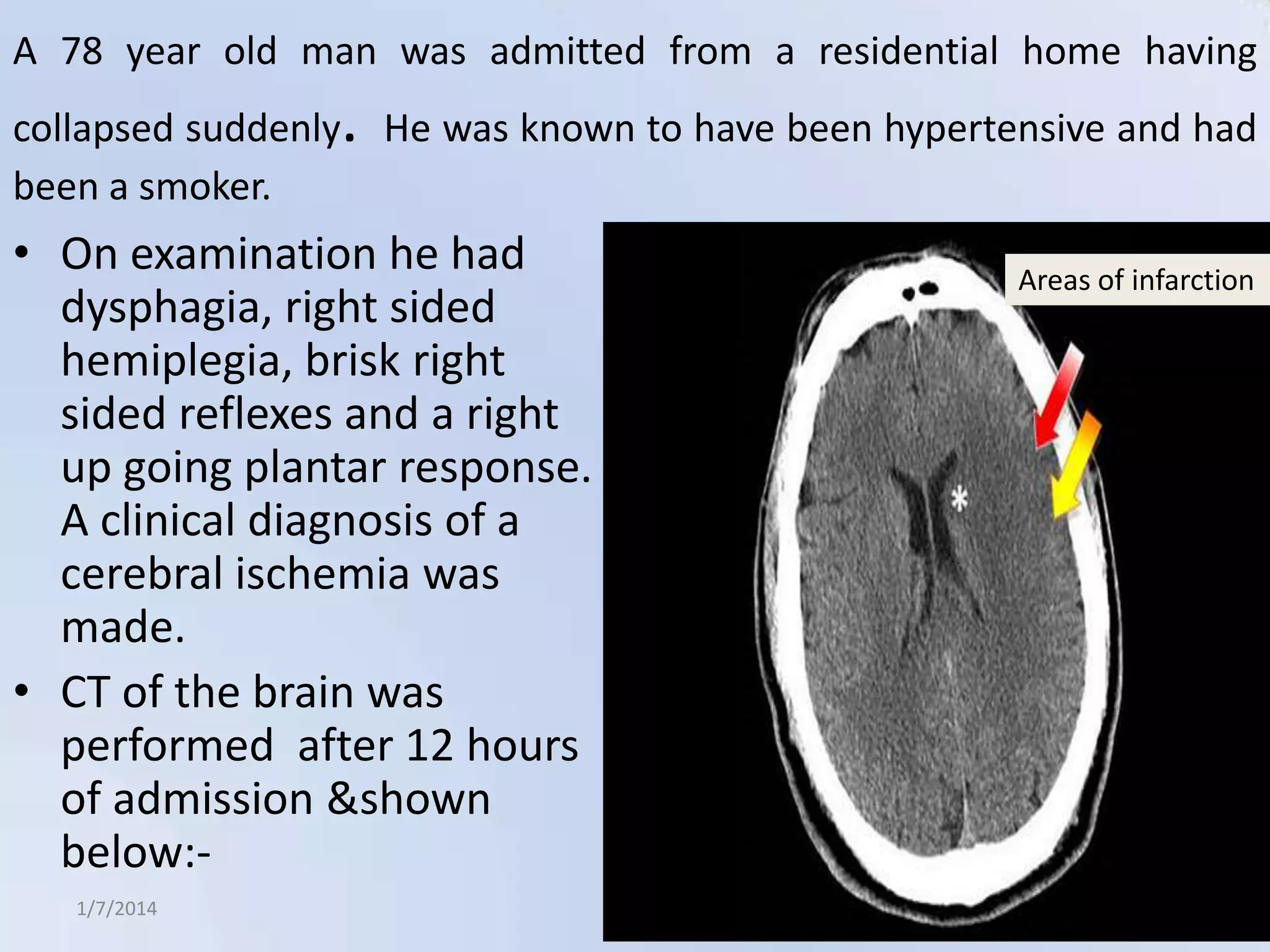
• On examination he had
dysphagia, right sided
hemiplegia, brisk right
sided reflexes and a right
up going plantar response.
A clinical diagnosis of a
cerebral ischemia was
made.
• CT of the brain was
performed after 12 hours
of admission &shown
below:1/7/2014

Areas of infarction

2
Circle of Willis
At the base of brain

1/7/2014

3
The objectives are
• Formation of circle of Willis/ Circulus Arteriosus
• Areas of cerebrum and cerebellum supplied by each
branch from vertebrobasilar arterial arcade.
• Venous drainage from cerebrum and cerebellum.
• Applied anatomy of vertebrobasilar insufficiency.
1/7/2014

4
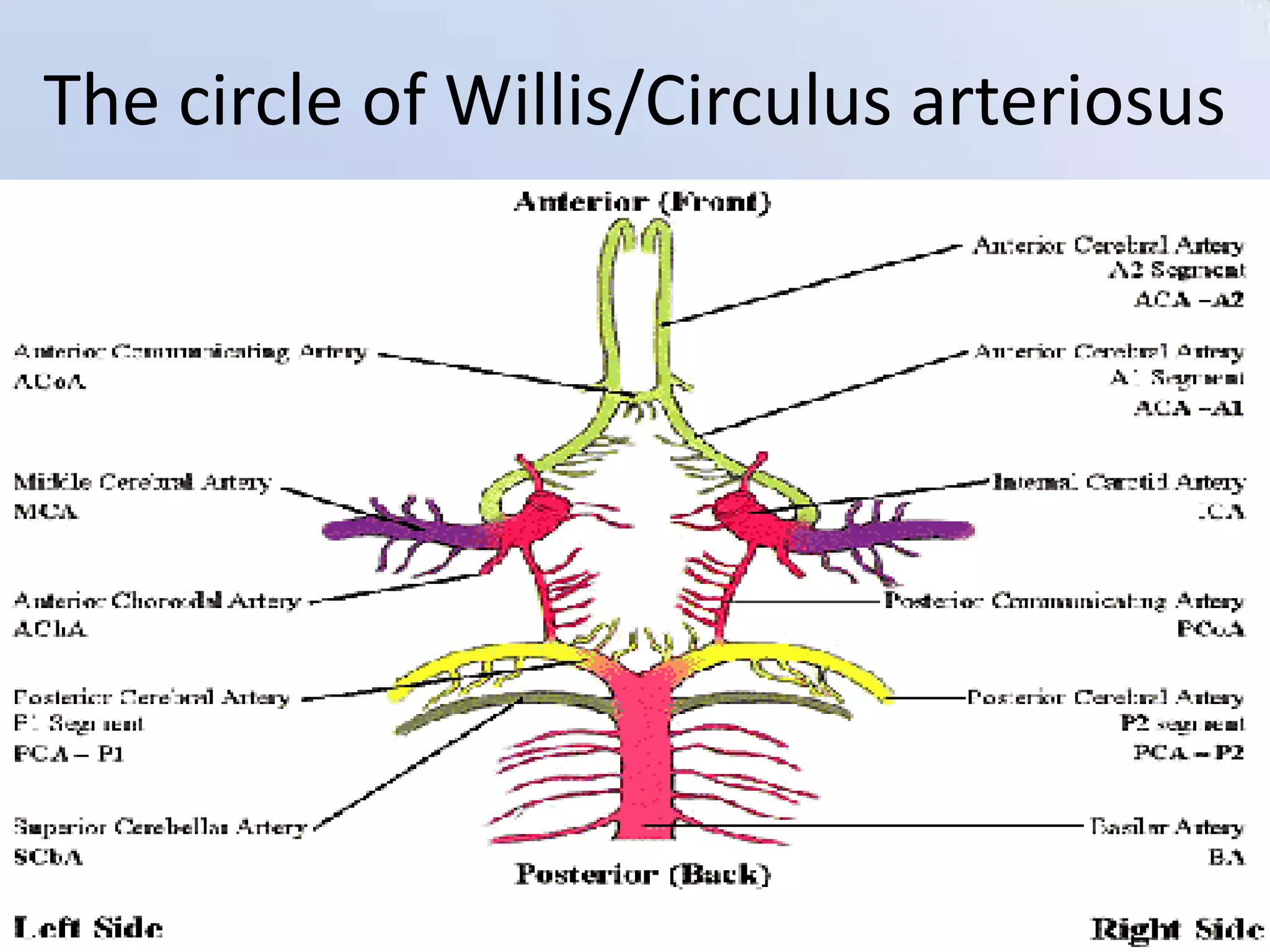
The circle of Willis/Circulus arteriosus

1/7/2014

5
The circulus arteriosus is formed
• Between branches of internal carotid arteries and
vertebral arteries.
• It is placed in the cisterna interpeduncularis, at the
base of the brain.
• The internal carotid arteries, right and left enters
the cranium passing through the internal carotid
foramina.
• The two vertebral arteries enter the cranium
through the foramen magnum.
1/7/2014

6
The right sided arteries communicate
with the left sided
• By means of one anterior and two posterior
communicating arteries.
• The members of circle are:• (a) anterior cerebral
• (b) anterior communicating
• © Posterior communicating &
• (d) posterior cerebral
• There are two types of branches arising from the
circle.
1/7/2014

7
The cortical branches
• Are superficial branches visible on the
surfaces of the brain and they supply the
cortical gray matter.
• The deep branches are central branches that
perforates the substance of brain and supply
the deep nuclei.
• These deep branches are end arteries, they
never form anatomosis with their neighbours.
1/7/2014

8
1/7/2014

9
The brain needs glucose and oxygen
• For its proper functioning. The astrocytes form the
blood brain barrier along with the endothelium of the
capillaries.
• Brain cannot sustain anoxia for more than few
minutes, there will be permanent damage to the
neurons, if the blood supply is not restored after few
minutes & brain death will occur.
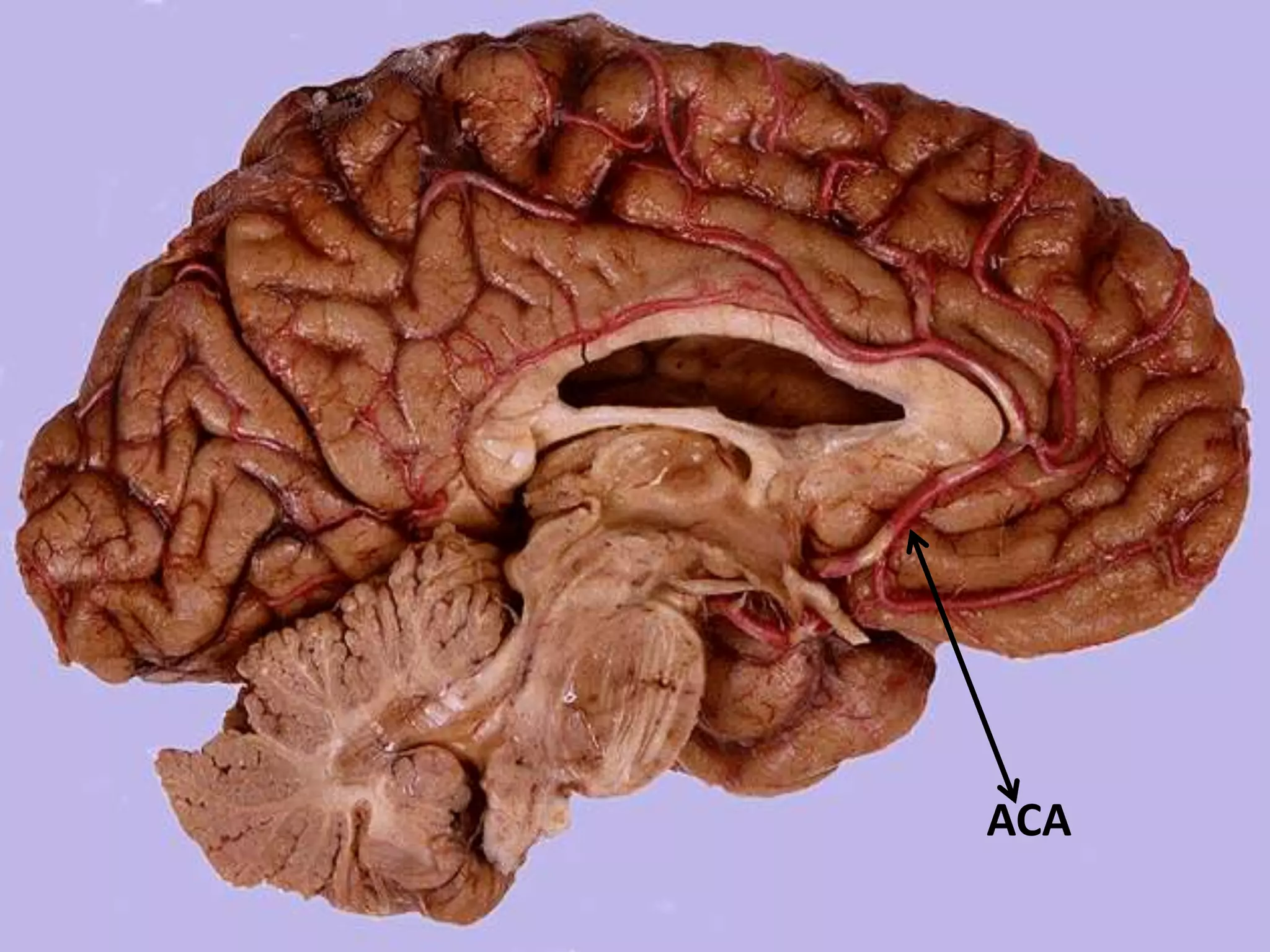
• The medial surface of the cerebral hemisphere is
supplied by anterior cerebral artery, the branches cross
over the superior border and supply a fingers breadth
area on the superiolateral surface of hemisphere.
1/7/2014

10
ACA
1/7/2014

11
Obstruction of anterior cerebral artery
leads to paraplegia

1/7/2014

12
Personality dysfunction occur due to
infarction of both anterior cerebral arteries
• If both anterior cerebral arteries arise from one
stem major disturbances occur with infarction
occurring at the medial aspects of both cerebral
hemispheres resulting in aphasia, paraplegia,
incontinence and frontal lobe/personality
dysfunction.

1/7/2014

13
Occlusion of one anterior cerebral
artery distal to anterior
communicating artery results in
–

Contra lateral weakness and sensory loss, affecting mainly
distal contra lateral leg (foot/leg more affected than thigh).
– Mild or no involvement of upper extremity.
– Head and eyes may be deviated toward side of lesion
acutely.
– Urinary incontinence with contra lateral grasp reflex and
paratonic rigidity may be present.
– May produce transcortical motor aphasia if left side is
affected.
1/7/2014
14
– Disturbances in gait and stance = gait apraxia.
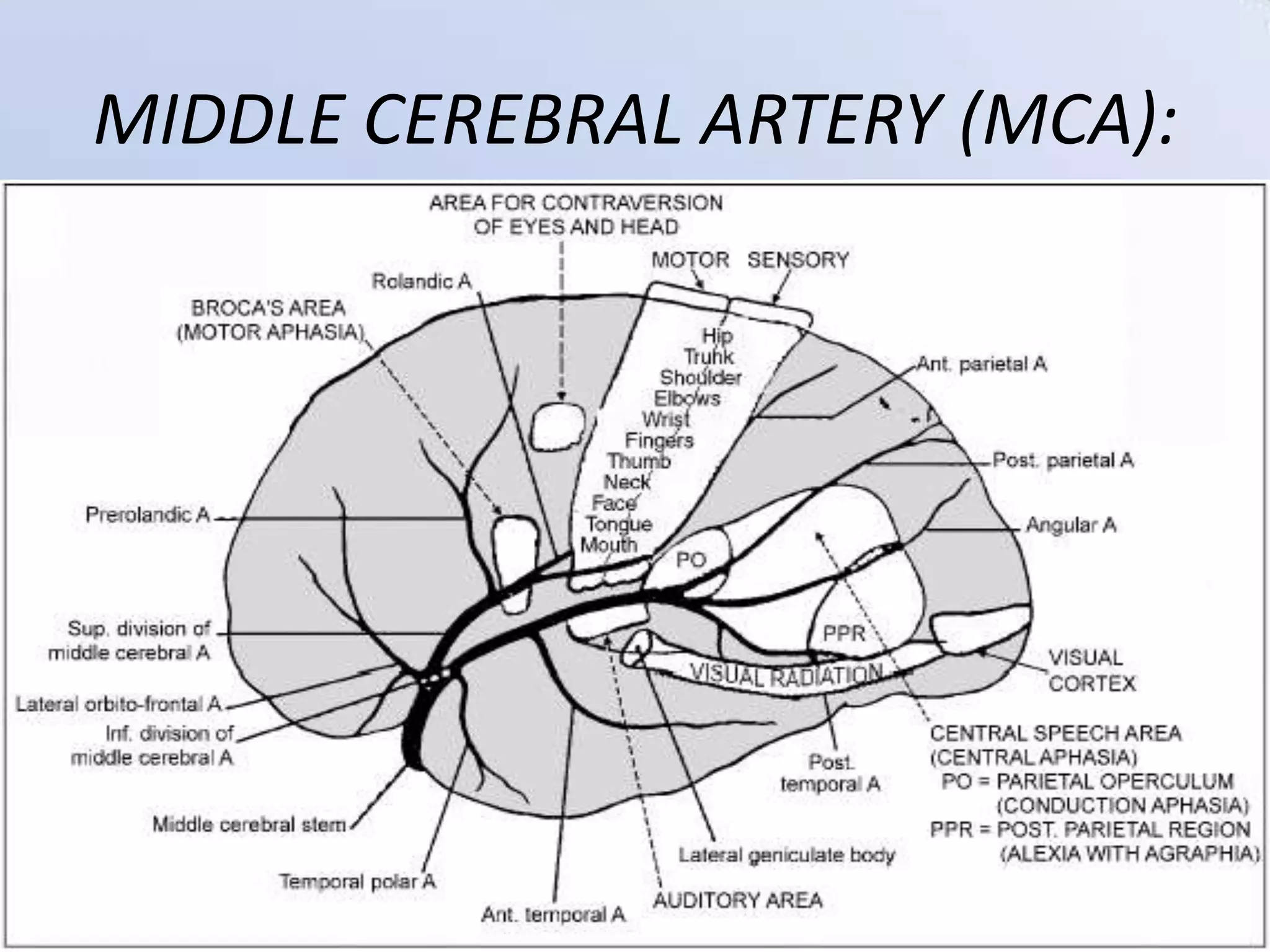
MIDDLE CEREBRAL ARTERY (MCA):

1/7/2014

15
• Sensory and motor deficits on contralateral face
and arm > leg
• Head and eyes deviated toward side of infarct
• With left-side lesion (dominant hemisphere)—
global aphasia initially, then turns into Broca's
aphasia (motor speech disorder)
• Right side lesion (nondominant hemisphere)—
deficits on spatial perception, hemi-neglect,
constructional apraxia, dressing apraxia
• Muscle tone usually decreased initially and
gradually increases over days or weeks to spasticity
• Transient loss of consciousness is uncommon
1/7/2014

16
Wallenberg's syndrome also known as lateral
medullary syndrome, PICA syndrome, and
vertebral artery syndrome.
– Ipsilateral side
• Horner's syndrome (ptosis, anhydrosis, and miosis)
• decrease in pain and temperature sensation on the
ipsilateral face
• cerebellar signs such as ataxia on ipsilateral extremities
(patient falls to side of lesion)
– Contralateral side
• Decreased pain and temperature on contralateral body
– Dysphagia, dysarthria, hoarseness, paralysis of vocal cord
– Vertigo; nausea and vomiting
1/7/2014
17
– Hiccups
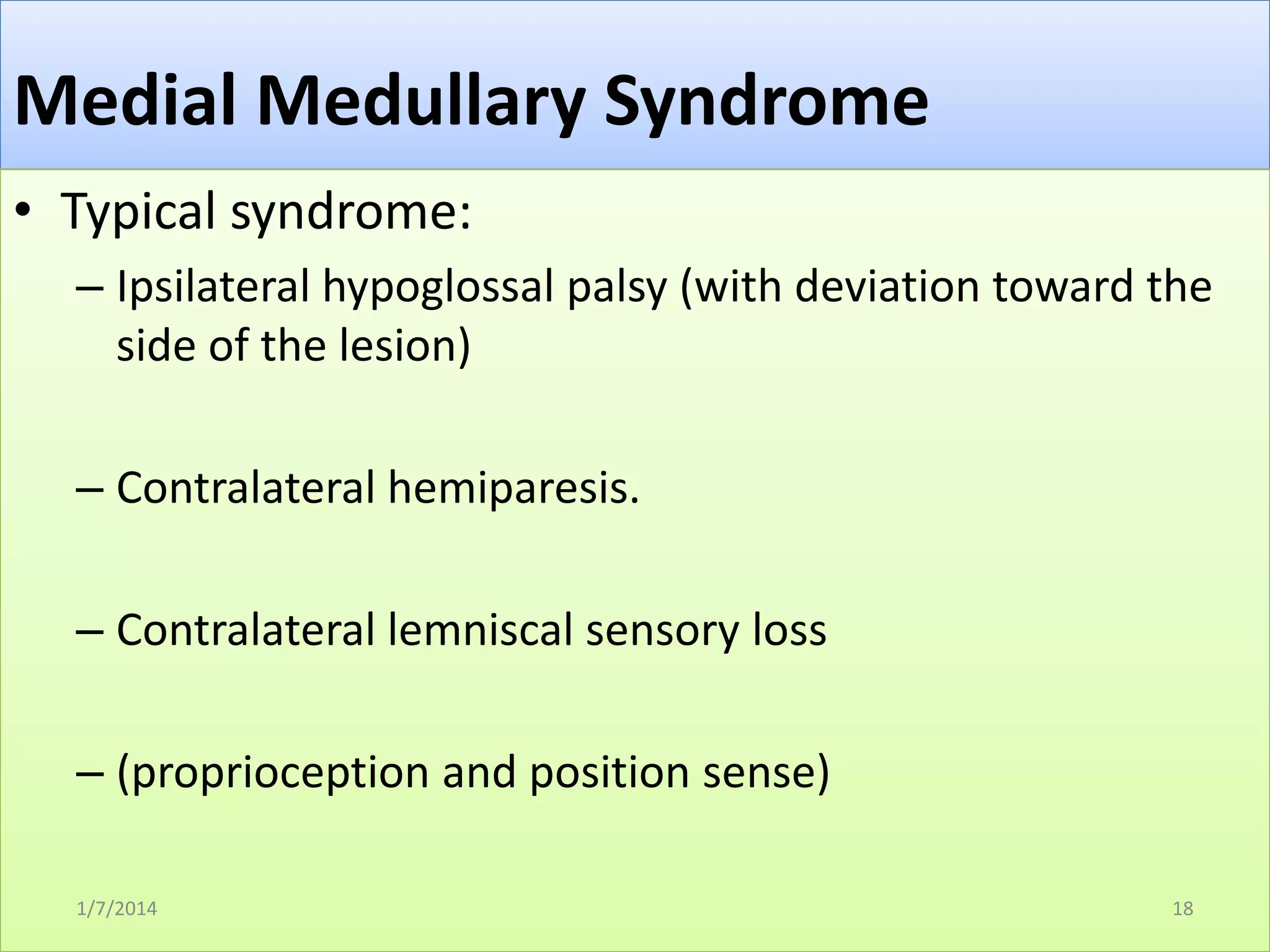
Medial Medullary Syndrome
• Typical syndrome:
– Ipsilateral hypoglossal palsy (with deviation toward the
side of the lesion)
– Contralateral hemiparesis.
– Contralateral lemniscal sensory loss

– (proprioception and position sense)
1/7/2014

18
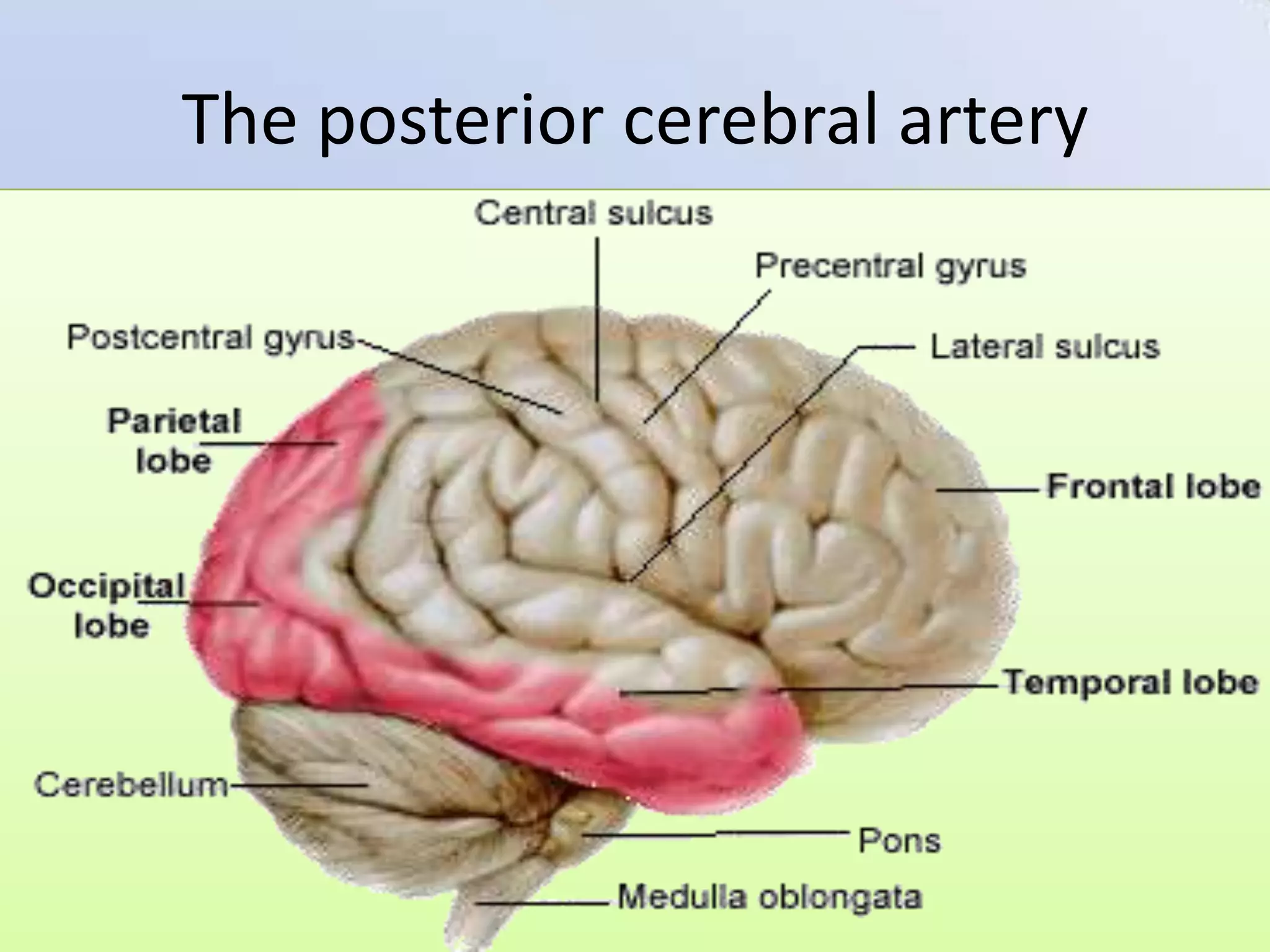
Occlusion of Posterior cerebral artery
•
•
•
•
•

Visual field cuts (including cortical blindness when bilateral)
May have prosopagnosia (can't read faces)
palinopsia (abnormal recurring visual imagery)
alexia (can't read)
transcortical sensory aphasia (loss of power to comprehend
written or spoken words; patient can repeat)
• Structures supplied by the interpeduncular branches of the
PCA include the oculomotor cranial nerve (CN 3) and
trochlear (CN 4) nuclei and nerves
• Clinical syndromes caused by the occlusion of these branches
include oculomotor palsy with contralateral hemiplegia =
Weber's syndrome and palsies of vertical gaze (trochlear
nerve palsy)
1/7/2014
19
The superiolateral surface of cerebral
hemisphere is supplied by MCA

1/7/2014

20
The posterior cerebral artery

1/7/2014

21
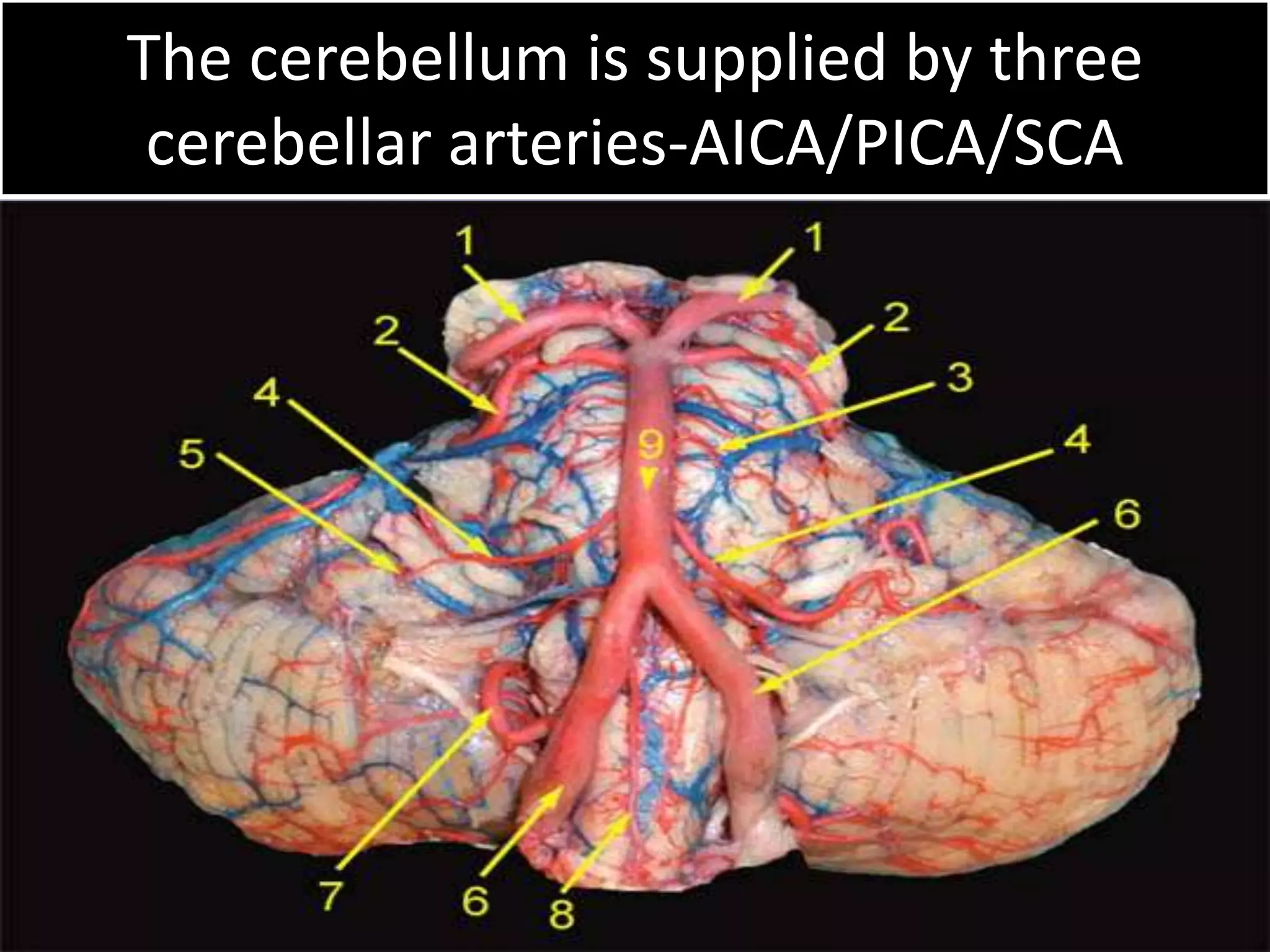
The cerebellum is supplied by three
cerebellar arteries-AICA/PICA/SCA

1/7/2014

22
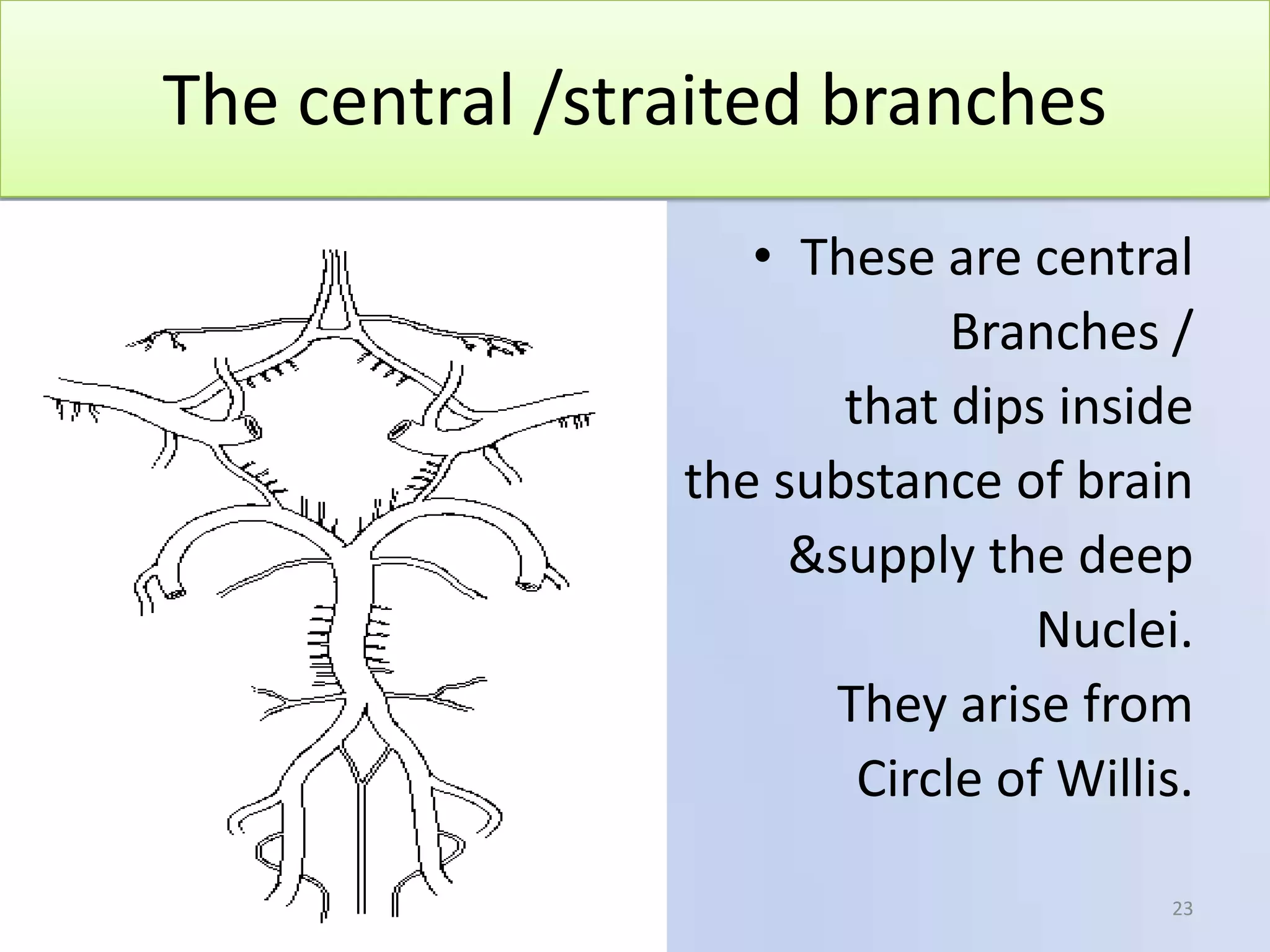
The central /straited branches
• These are central
Branches /
that dips inside
the substance of brain
&supply the deep
Nuclei.
They arise from
Circle of Willis.
1/7/2014

23
• By apoplexy is meant the rupture of a blood-vessel
with consequent extravasations of blood, either in
or on the brain.
• It may occur in any portion of the brain, and either
from the arteries of the base, or from the smaller
arteries of the cortex.
• The former is the more frequent. The arteries that
most often rupture are the branches of the middle
cerebral which enter the anterior perforated space,
especially its outer portion.
• One of the largest of these anterolateral arteries, as
has already been mentioned, known as the
lenticulostriate, has been called by Charcot the
artery of cerebral hemorrhage
1/7/2014

24
HYPERTENSIVE HEMORRAGE IN THE BASAL GANGLIA & THALAMUS

1/7/2014

25
Berry aneurysm

1/7/2014

26
Large aneurysm at the cerebello-pontine
angle

1/7/2014

27
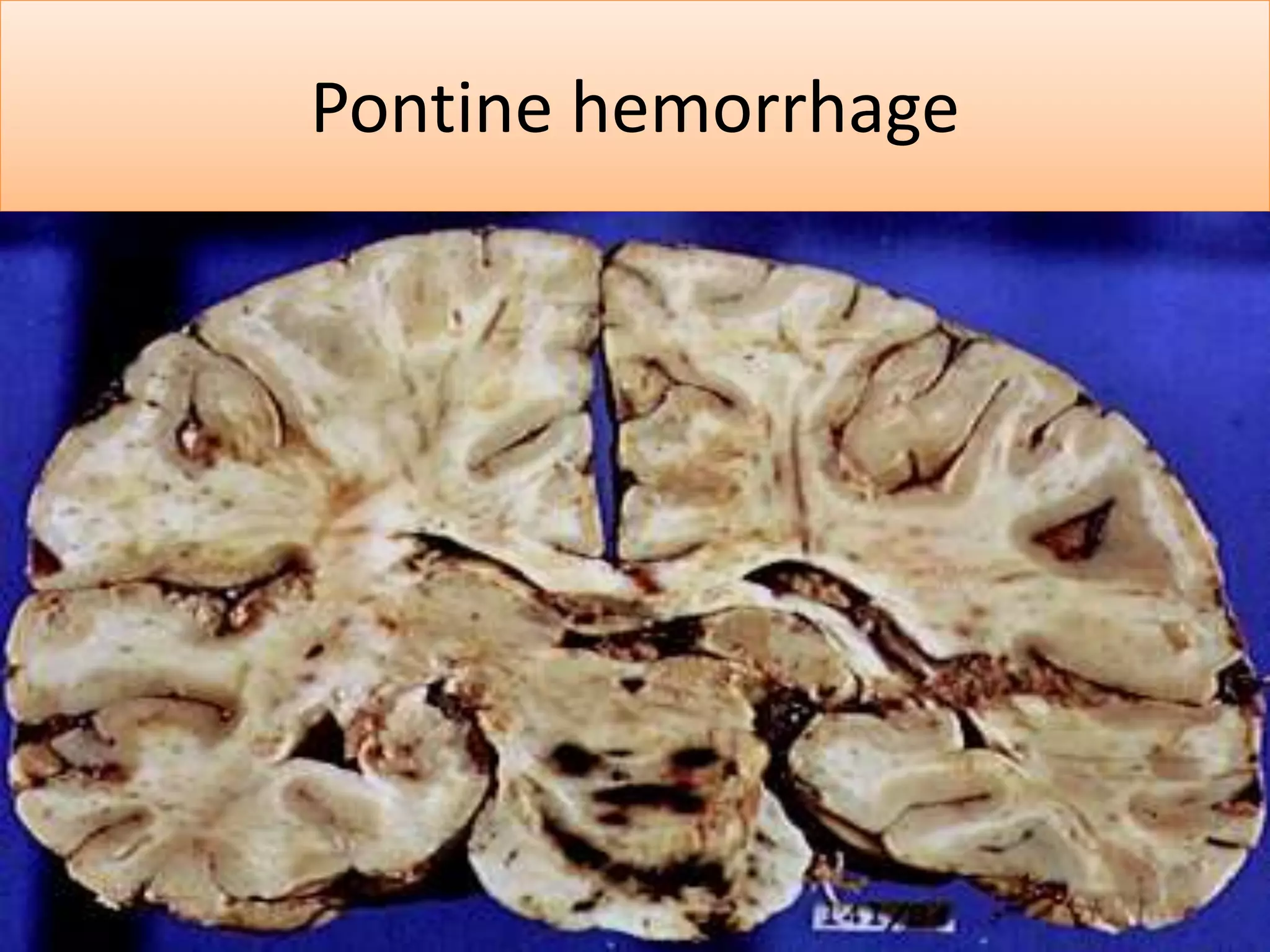
Pontine hemorrhage

1/7/2014

28
Pontine hemorrhage
• Patients with a large central hemorrhage present with a progressive
decrease in the level of consciousness rapidly leading to coma.
• Bilateral bulbar muscle weakness, "pinpoint" pupils, hyperthermia,
and hyperventilation are common associated findings.
• This presentation is seen most often in patients with uncontrolled
hypertension .
• . Contralateral hyperhidrosis in the subacute or late phase after
pontine hemorrhage may be seen.
• This is thought to be secondary to disruption of contralateral
inhibitory sweating pathway .
• Up to one third of patients may develop a severe headache before
the onset of focal signs .
• Vomiting may be seen in 20% of patients, and seizures (mostly flexor
spasms and not true convulsions) have been reported in 30% of 29
1/7/2014
The venous drainage of brain
• Cerebral veins drain the surfaces of brain, they run
in the sulci and gyri and drains into near by dural
venous sinuses.
• Deep cerebral veins drain in to the straight sinus.
• The cerebellum is drained by cerebellar veins which
ends up into the near by dural venous sinuses.
• All dural sinuses emerges from the internal jugular
foramen and comes out as internal jugular vein.
1/7/2014

30
1/7/2014

31
Cavernous sinus

1/7/2014

32
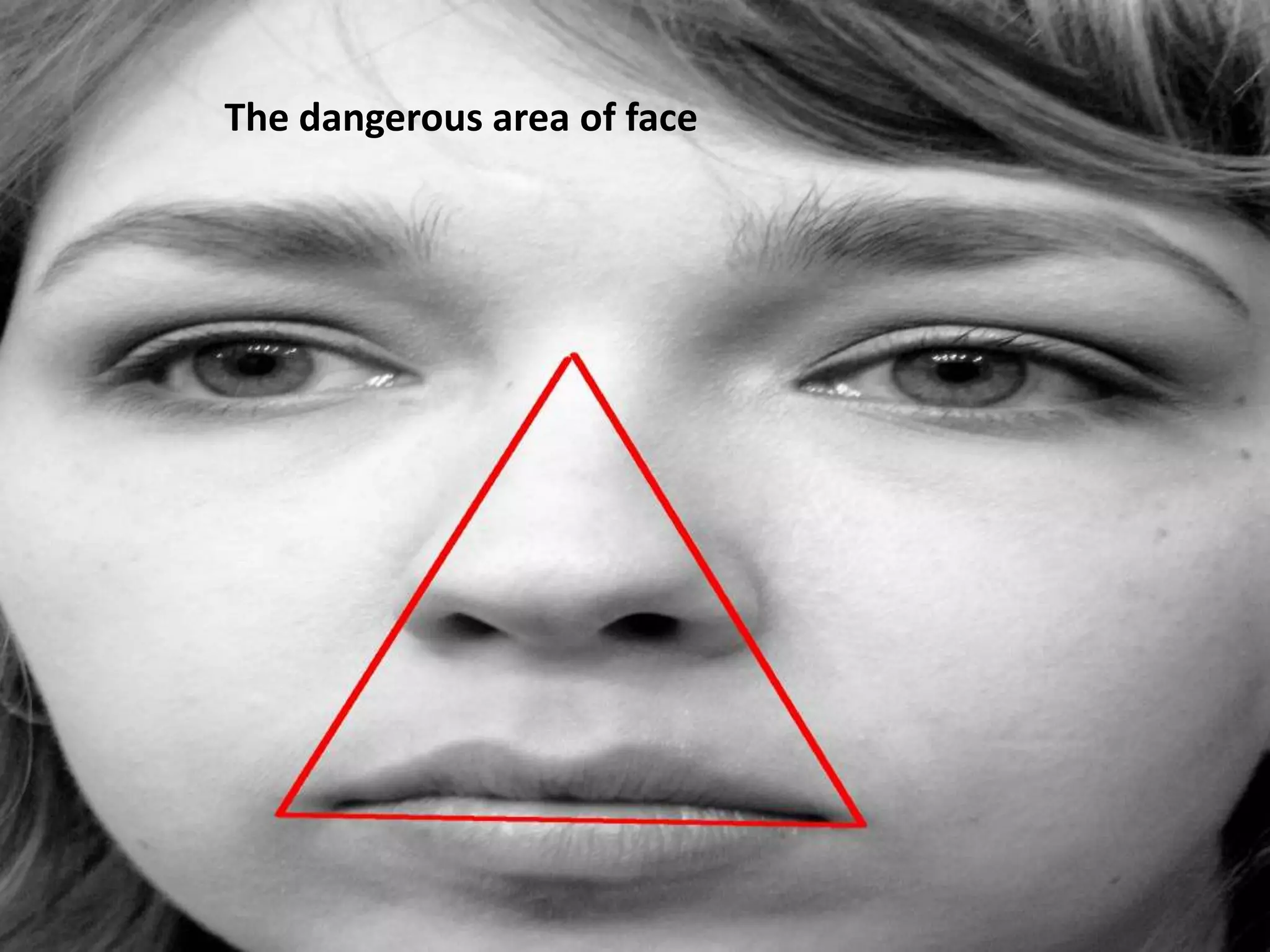
The dangerous area of face

1/7/2014

33
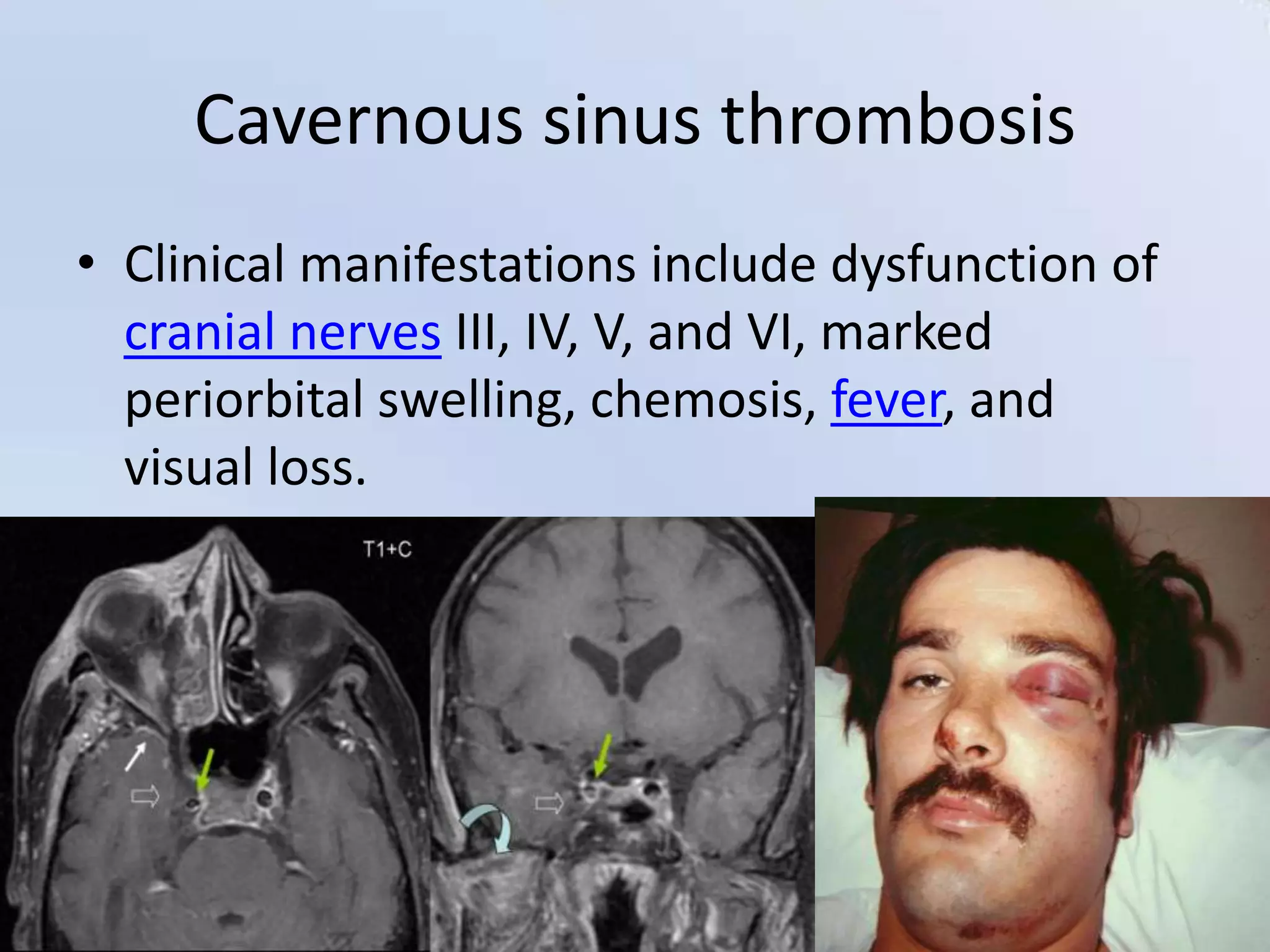
Cavernous sinus thrombosis
• Clinical manifestations include dysfunction of
cranial nerves III, IV, V, and VI, marked
periorbital swelling, chemosis, fever, and
visual loss.

1/7/2014

34
The dural venous sinuses

1/7/2014

35
1/7/2014

36

Blood supply of brain (2)

  • 1.
    BLOOD SUPPLY OFBRAIN BY PROF. DR. ANSARI (BDS-II SEMESTER RAKCODS) 1/7/2014 1
  • 2.
    A 78 yearold man was admitted from a residential home having . collapsed suddenly been a smoker. He was known to have been hypertensive and had • On examination he had dysphagia, right sided hemiplegia, brisk right sided reflexes and a right up going plantar response. A clinical diagnosis of a cerebral ischemia was made. • CT of the brain was performed after 12 hours of admission &shown below:1/7/2014 Areas of infarction 2
  • 3.
    Circle of Willis Atthe base of brain 1/7/2014 3
  • 4.
    The objectives are •Formation of circle of Willis/ Circulus Arteriosus • Areas of cerebrum and cerebellum supplied by each branch from vertebrobasilar arterial arcade. • Venous drainage from cerebrum and cerebellum. • Applied anatomy of vertebrobasilar insufficiency. 1/7/2014 4
  • 5.
    The circle ofWillis/Circulus arteriosus 1/7/2014 5
  • 6.
    The circulus arteriosusis formed • Between branches of internal carotid arteries and vertebral arteries. • It is placed in the cisterna interpeduncularis, at the base of the brain. • The internal carotid arteries, right and left enters the cranium passing through the internal carotid foramina. • The two vertebral arteries enter the cranium through the foramen magnum. 1/7/2014 6
  • 7.
    The right sidedarteries communicate with the left sided • By means of one anterior and two posterior communicating arteries. • The members of circle are:• (a) anterior cerebral • (b) anterior communicating • © Posterior communicating & • (d) posterior cerebral • There are two types of branches arising from the circle. 1/7/2014 7
  • 8.
    The cortical branches •Are superficial branches visible on the surfaces of the brain and they supply the cortical gray matter. • The deep branches are central branches that perforates the substance of brain and supply the deep nuclei. • These deep branches are end arteries, they never form anatomosis with their neighbours. 1/7/2014 8
  • 9.
  • 10.
    The brain needsglucose and oxygen • For its proper functioning. The astrocytes form the blood brain barrier along with the endothelium of the capillaries. • Brain cannot sustain anoxia for more than few minutes, there will be permanent damage to the neurons, if the blood supply is not restored after few minutes & brain death will occur. • The medial surface of the cerebral hemisphere is supplied by anterior cerebral artery, the branches cross over the superior border and supply a fingers breadth area on the superiolateral surface of hemisphere. 1/7/2014 10
  • 11.
  • 12.
    Obstruction of anteriorcerebral artery leads to paraplegia 1/7/2014 12
  • 13.
    Personality dysfunction occurdue to infarction of both anterior cerebral arteries • If both anterior cerebral arteries arise from one stem major disturbances occur with infarction occurring at the medial aspects of both cerebral hemispheres resulting in aphasia, paraplegia, incontinence and frontal lobe/personality dysfunction. 1/7/2014 13
  • 14.
    Occlusion of oneanterior cerebral artery distal to anterior communicating artery results in – Contra lateral weakness and sensory loss, affecting mainly distal contra lateral leg (foot/leg more affected than thigh). – Mild or no involvement of upper extremity. – Head and eyes may be deviated toward side of lesion acutely. – Urinary incontinence with contra lateral grasp reflex and paratonic rigidity may be present. – May produce transcortical motor aphasia if left side is affected. 1/7/2014 14 – Disturbances in gait and stance = gait apraxia.
  • 15.
    MIDDLE CEREBRAL ARTERY(MCA): 1/7/2014 15
  • 16.
    • Sensory andmotor deficits on contralateral face and arm > leg • Head and eyes deviated toward side of infarct • With left-side lesion (dominant hemisphere)— global aphasia initially, then turns into Broca's aphasia (motor speech disorder) • Right side lesion (nondominant hemisphere)— deficits on spatial perception, hemi-neglect, constructional apraxia, dressing apraxia • Muscle tone usually decreased initially and gradually increases over days or weeks to spasticity • Transient loss of consciousness is uncommon 1/7/2014 16
  • 17.
    Wallenberg's syndrome alsoknown as lateral medullary syndrome, PICA syndrome, and vertebral artery syndrome. – Ipsilateral side • Horner's syndrome (ptosis, anhydrosis, and miosis) • decrease in pain and temperature sensation on the ipsilateral face • cerebellar signs such as ataxia on ipsilateral extremities (patient falls to side of lesion) – Contralateral side • Decreased pain and temperature on contralateral body – Dysphagia, dysarthria, hoarseness, paralysis of vocal cord – Vertigo; nausea and vomiting 1/7/2014 17 – Hiccups
  • 18.
    Medial Medullary Syndrome •Typical syndrome: – Ipsilateral hypoglossal palsy (with deviation toward the side of the lesion) – Contralateral hemiparesis. – Contralateral lemniscal sensory loss – (proprioception and position sense) 1/7/2014 18
  • 19.
    Occlusion of Posteriorcerebral artery • • • • • Visual field cuts (including cortical blindness when bilateral) May have prosopagnosia (can't read faces) palinopsia (abnormal recurring visual imagery) alexia (can't read) transcortical sensory aphasia (loss of power to comprehend written or spoken words; patient can repeat) • Structures supplied by the interpeduncular branches of the PCA include the oculomotor cranial nerve (CN 3) and trochlear (CN 4) nuclei and nerves • Clinical syndromes caused by the occlusion of these branches include oculomotor palsy with contralateral hemiplegia = Weber's syndrome and palsies of vertical gaze (trochlear nerve palsy) 1/7/2014 19
  • 20.
    The superiolateral surfaceof cerebral hemisphere is supplied by MCA 1/7/2014 20
  • 21.
    The posterior cerebralartery 1/7/2014 21
  • 22.
    The cerebellum issupplied by three cerebellar arteries-AICA/PICA/SCA 1/7/2014 22
  • 23.
    The central /straitedbranches • These are central Branches / that dips inside the substance of brain &supply the deep Nuclei. They arise from Circle of Willis. 1/7/2014 23
  • 24.
    • By apoplexyis meant the rupture of a blood-vessel with consequent extravasations of blood, either in or on the brain. • It may occur in any portion of the brain, and either from the arteries of the base, or from the smaller arteries of the cortex. • The former is the more frequent. The arteries that most often rupture are the branches of the middle cerebral which enter the anterior perforated space, especially its outer portion. • One of the largest of these anterolateral arteries, as has already been mentioned, known as the lenticulostriate, has been called by Charcot the artery of cerebral hemorrhage 1/7/2014 24
  • 25.
    HYPERTENSIVE HEMORRAGE INTHE BASAL GANGLIA & THALAMUS 1/7/2014 25
  • 26.
  • 27.
    Large aneurysm atthe cerebello-pontine angle 1/7/2014 27
  • 28.
  • 29.
    Pontine hemorrhage • Patientswith a large central hemorrhage present with a progressive decrease in the level of consciousness rapidly leading to coma. • Bilateral bulbar muscle weakness, "pinpoint" pupils, hyperthermia, and hyperventilation are common associated findings. • This presentation is seen most often in patients with uncontrolled hypertension . • . Contralateral hyperhidrosis in the subacute or late phase after pontine hemorrhage may be seen. • This is thought to be secondary to disruption of contralateral inhibitory sweating pathway . • Up to one third of patients may develop a severe headache before the onset of focal signs . • Vomiting may be seen in 20% of patients, and seizures (mostly flexor spasms and not true convulsions) have been reported in 30% of 29 1/7/2014
  • 30.
    The venous drainageof brain • Cerebral veins drain the surfaces of brain, they run in the sulci and gyri and drains into near by dural venous sinuses. • Deep cerebral veins drain in to the straight sinus. • The cerebellum is drained by cerebellar veins which ends up into the near by dural venous sinuses. • All dural sinuses emerges from the internal jugular foramen and comes out as internal jugular vein. 1/7/2014 30
  • 31.
  • 32.
  • 33.
    The dangerous areaof face 1/7/2014 33
  • 34.
    Cavernous sinus thrombosis •Clinical manifestations include dysfunction of cranial nerves III, IV, V, and VI, marked periorbital swelling, chemosis, fever, and visual loss. 1/7/2014 34
  • 35.
    The dural venoussinuses 1/7/2014 35
  • 36.