Los Angeles R Users’ Group


              NumPy and SciPy for Data Mining and Data Analysis
                  Including iPython, SciKits, and matplotlib

                                            Ryan R. Rosario


                                            March 29, 2011


Ryan R. Rosario
NumPy/SciPy for Data Mining and Analysis                           Los Angeles R Users’ Group
What is NumPy?


      NumPy is the standard package for scientific and numerical computing in
      Python:

              powerful N-dimensional array object.
              sophisticated (broadcasting) functions.
              tools for integrating C/C++ and Fortran code (R is similar)
              useful linear algebra, Fourier transform and random number capabilities.

      Additionally...
              data structures can be used as efficient multi-dimensional container of
              arbitrary data types.

Ryan R. Rosario
NumPy/SciPy for Data Mining and Analysis                                 Los Angeles R Users’ Group
So, What is SciPy?


      Often (incorrectly) used as a synonym of NumPy.
              SciPy depends on NumPy’s data structures.
              OSS for mathematics, science, and engineering.
              provides efficient numerical routines for numerical integration and
              optimization.

      “NumPy provides the data structures, SciPy provides the application layer.”


Ryan R. Rosario
NumPy/SciPy for Data Mining and Analysis                                 Los Angeles R Users’ Group
Getting NumPy
      The ease of installation is highly dependent on OS and CPU.
          Official releases are recommended and available for
                  1   32 bit MacOS X
                            Caveat: Must use Python Python, not Apple Python.
                  2   32 bit Windows
              Unofficial/third-party binary releases for
                  1   All Linux (use platform package system)
                  2   64 bit MacOS X (SciPy Superpack)
                            Requires Apple Python 2.6.1
                  3   64-bit Windows (Christoph Gohlke, UC Irvine)
              Source Code
              Enthought is to SciPy/Numpy as Revolution is to R.
      Main download link is http://www.scipy.org/Download
Ryan R. Rosario
NumPy/SciPy for Data Mining and Analysis                               Los Angeles R Users’ Group
Disclaimer


      Time is even more limited than usual, so the goal is to illustrate
      what NumPy is, and what NumPy, SciPy and its colleagues can
      achieve. Some goals:
              Brief NumPy tutorial via demo.
              Uses of NumPy and SciPy, including SciKits.
              Brief data analysis demo with NumPy, SciPy and matplotlib.
              Concluding remarks.


Ryan R. Rosario
NumPy/SciPy for Data Mining and Analysis                      Los Angeles R Users’ Group
NumPy Basics

      The main data structure is a homogeneous multidimensional array
      – a table of elements all of the same type, indexed by a tuple of
      positive integers. Some examples are vectors, matrices, images and
      spreadsheets.


      Why not just a use a list of lists? NumPy provides functions
      that operate on an entire array at once (like R), Python does
      not...really.


      NumPy is full of syntax and time is limited, so let’s jump straight
      into a demo...

Ryan R. Rosario
NumPy/SciPy for Data Mining and Analysis                      Los Angeles R Users’ Group
NumPy Basics


      Demo


Ryan R. Rosario
NumPy/SciPy for Data Mining and Analysis   Los Angeles R Users’ Group
Keep in Mind: Broadcasting vs. Recycling


      In NumPy, if two arrays do not have the same length and we try
      to, say, add them, 1 is appended to the smaller array so that the
      dimensions match.


      In R, if two vectors do not have the same length, the values in the
      shorter vector are recycled and a warning is generated.
      Personally, recycling seems more practical.


Ryan R. Rosario
NumPy/SciPy for Data Mining and Analysis                     Los Angeles R Users’ Group
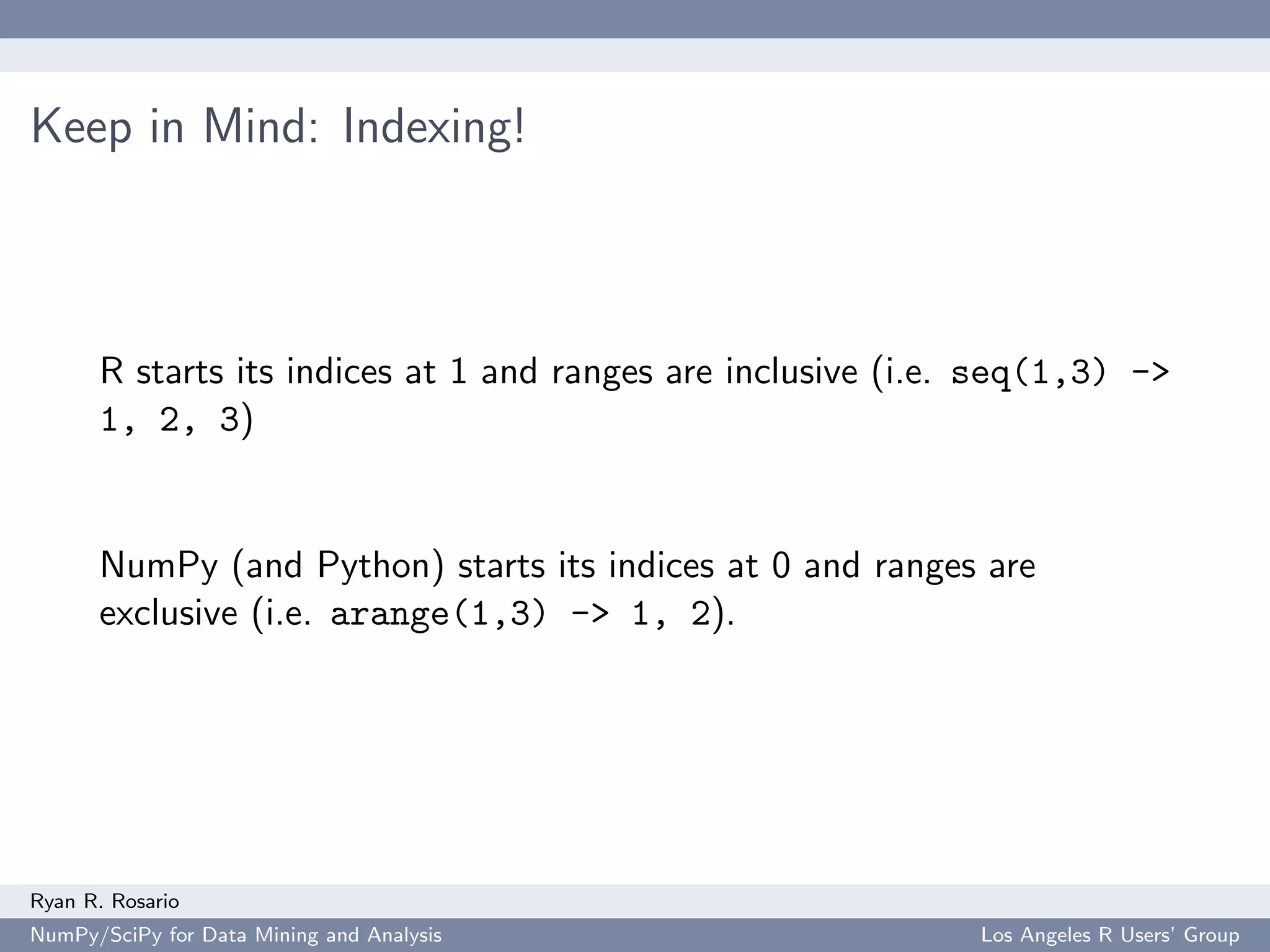
Keep in Mind: Indexing!


      R starts its indices at 1 and ranges are inclusive (i.e. seq(1,3) ->
      1, 2, 3)


      NumPy (and Python) starts its indices at 0 and ranges are
      exclusive (i.e. arange(1,3) -> 1, 2).


Ryan R. Rosario
NumPy/SciPy for Data Mining and Analysis                     Los Angeles R Users’ Group
Keep in Mind: Data Type Matters!


      R does a good job of using the correct data type.


      NumPy requires you to make decisions about data type. Using
      int64 for 1 is typically wasteful.


Ryan R. Rosario
NumPy/SciPy for Data Mining and Analysis                  Los Angeles R Users’ Group
ipython: a replacement CLI I


      IPython is the recommended CLI for NumPy/SciPy. I will use
      IPython in my demo.
          1   an enhanced interactive Python shell.
          2   an architecture for interactive parallel computing.


Ryan R. Rosario
NumPy/SciPy for Data Mining and Analysis                            Los Angeles R Users’ Group
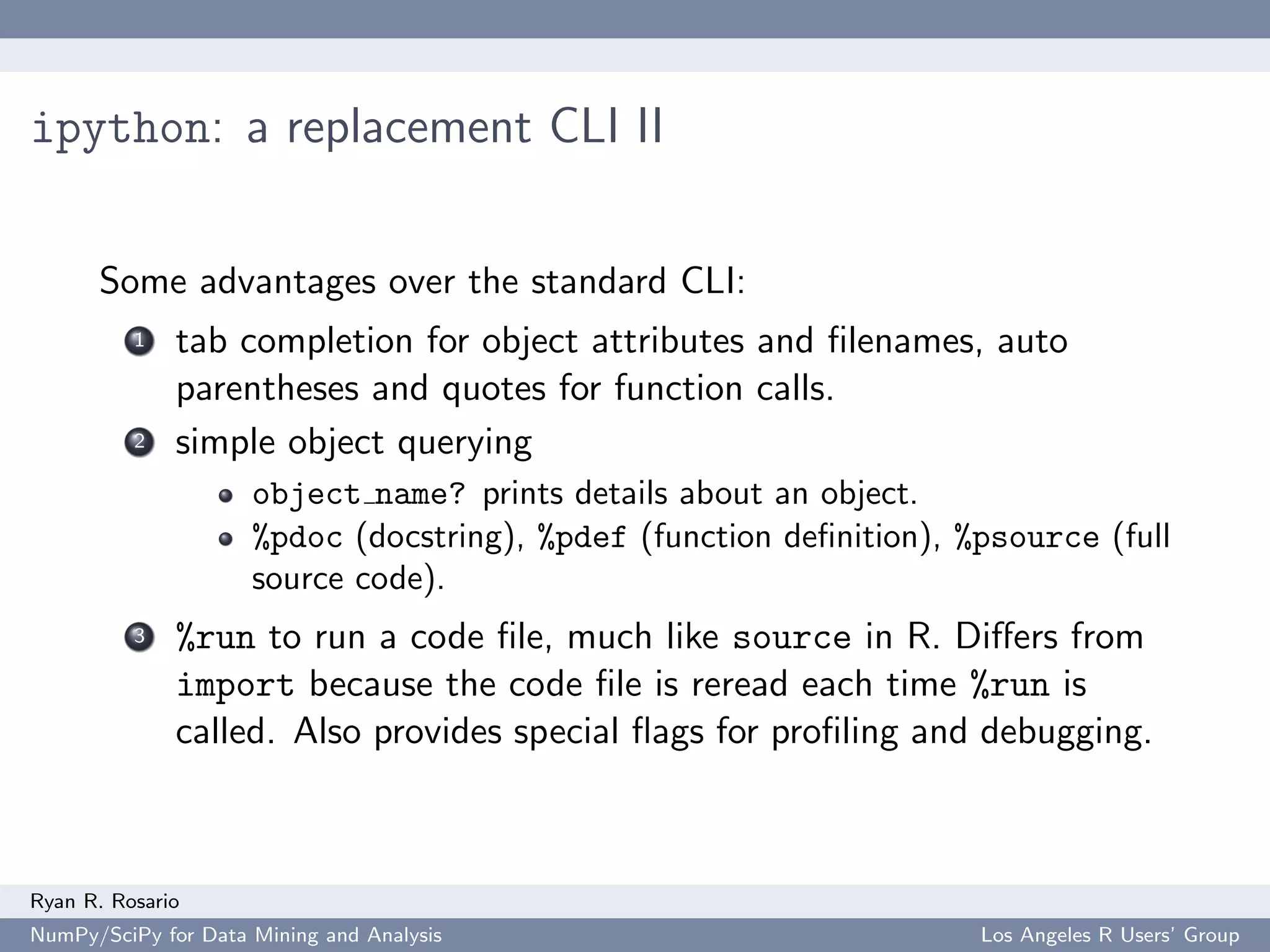
ipython: a replacement CLI II


      Some advantages over the standard CLI:
          1   tab completion for object attributes and filenames, auto
              parentheses and quotes for function calls.
          2   simple object querying
                     object name? prints details about an object.
                     %pdoc (docstring), %pdef (function definition), %psource (full
                     source code).
          3   %run to run a code file, much like source in R. Differs from
              import because the code file is reread each time %run is
              called. Also provides special flags for profiling and debugging.


Ryan R. Rosario
NumPy/SciPy for Data Mining and Analysis                             Los Angeles R Users’ Group
ipython: a replacement CLI III
          4   %pdb for spawning a pdb debug session.
          5   Output cache saves the results of executing each line of
              code. , ,      save the last three results.
          6   Input cache allows re-execution of previously executed code
              using a snapshot of the original input data in variable In. (to
              rexecute lines 22 through 28, and line 34: exec In[22:29]
              + In[34].
          7   Command history with(out) line numbers using %hist. Can
              also toggle journaling with %logstart.
          8   Execute system commands from within IPython as if you are
              in the terminal by prefixing with !. Use !!, %sc, %sx to get
              output into a Python variable (var = !ls -la). Use Python
              variables when calling the shell.
Ryan R. Rosario
NumPy/SciPy for Data Mining and Analysis                         Los Angeles R Users’ Group
ipython: a replacement CLI IV

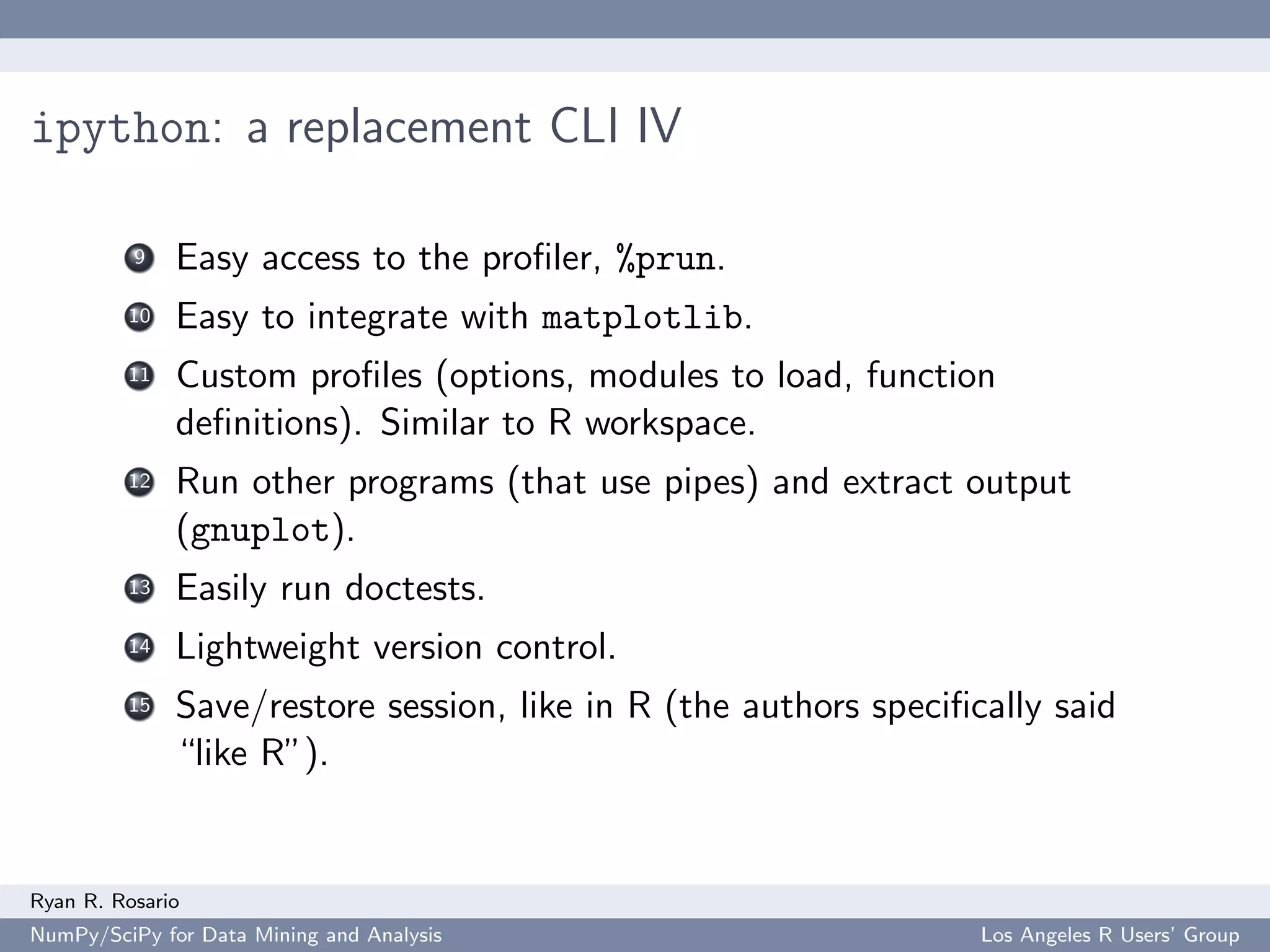
          9   Easy access to the profiler, %prun.
         10   Easy to integrate with matplotlib.
         11   Custom profiles (options, modules to load, function
              definitions). Similar to R workspace.
         12   Run other programs (that use pipes) and extract output
              (gnuplot).
         13   Easily run doctests.
         14   Lightweight version control.
         15   Save/restore session, like in R (the authors specifically said
              “like R”).


Ryan R. Rosario
NumPy/SciPy for Data Mining and Analysis                          Los Angeles R Users’ Group
matplotlib: SciPy’s Graphics System I


      2D graphics library for Python that produces publication quality
      figures. Quality with respect to R is in the eye of the beholder.
              Graphics in R are much easier to construct, and require less
              code.
              Graphics in matplotlib may look nicer; require much more
              code.


Ryan R. Rosario
NumPy/SciPy for Data Mining and Analysis                        Los Angeles R Users’ Group
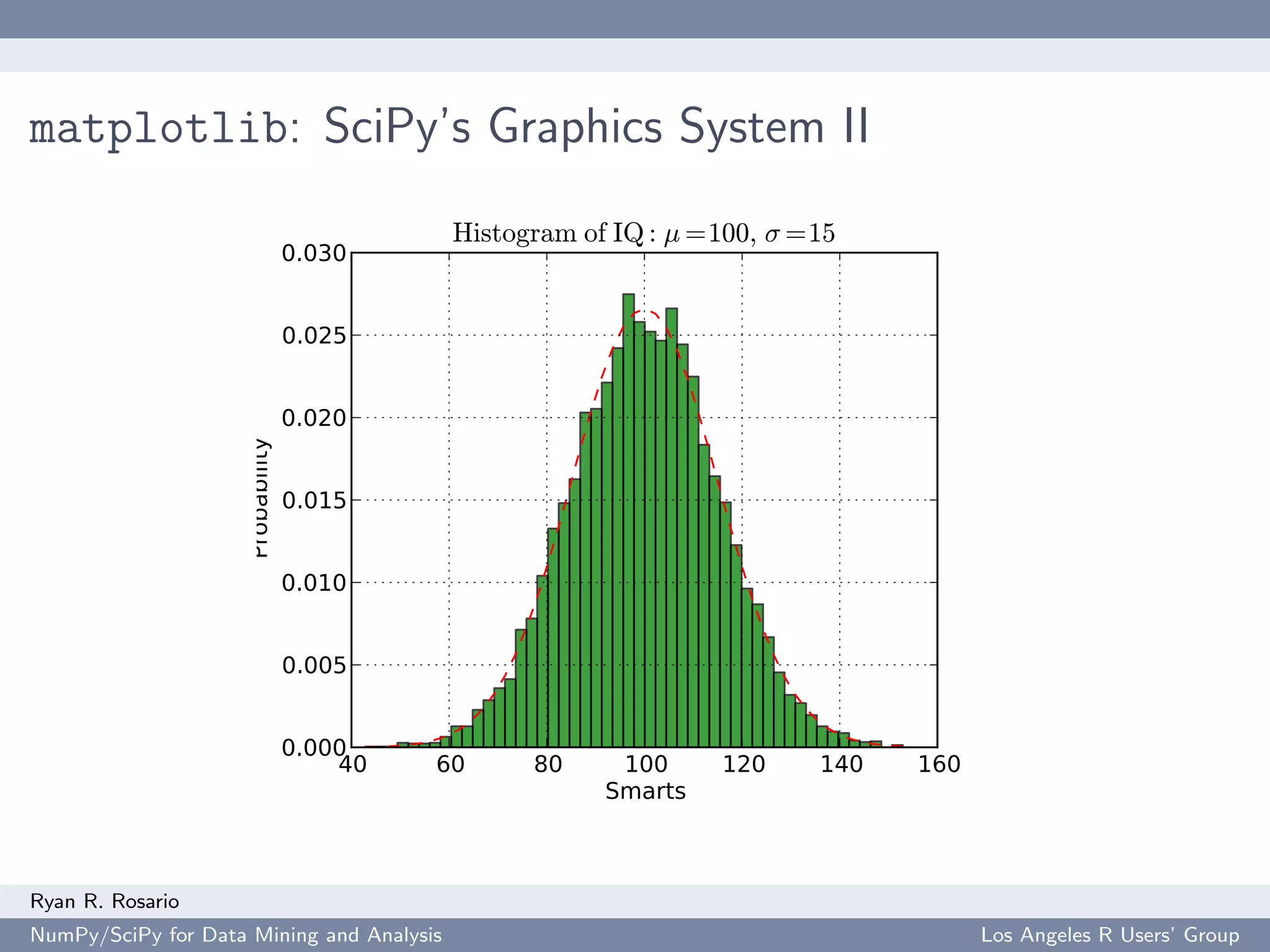
matplotlib: SciPy’s Graphics System II


Ryan R. Rosario
NumPy/SciPy for Data Mining and Analysis   Los Angeles R Users’ Group
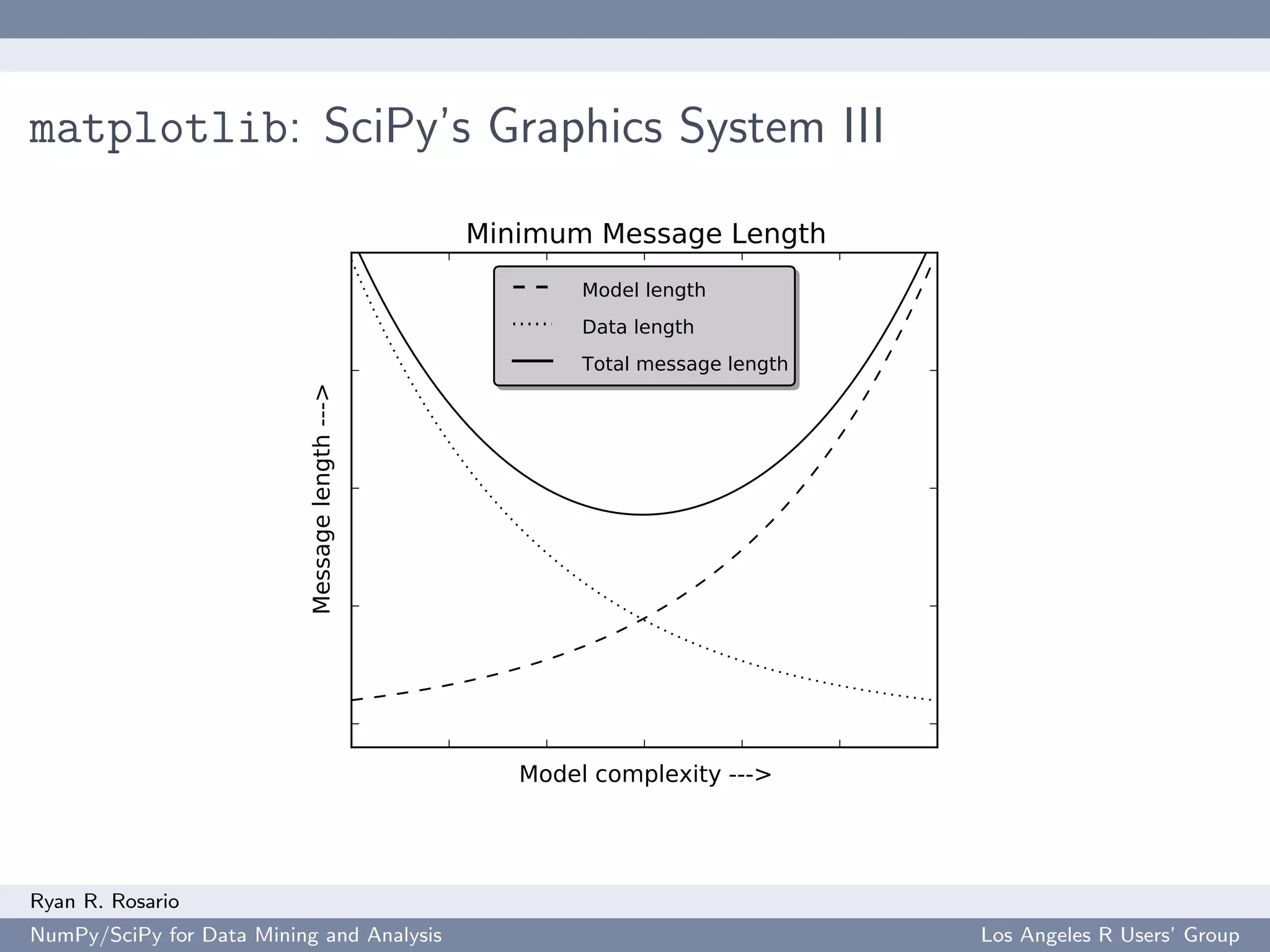
matplotlib: SciPy’s Graphics System III


Ryan R. Rosario
NumPy/SciPy for Data Mining and Analysis   Los Angeles R Users’ Group
matplotlib: SciPy’s Graphics System IV


      Show matplotlib gallery.


      I will do a demo of matplotlib in the data analysis demo, if time.


Ryan R. Rosario
NumPy/SciPy for Data Mining and Analysis                    Los Angeles R Users’ Group
Quick Linear Regression Demo


      Demo here.


Ryan R. Rosario
NumPy/SciPy for Data Mining and Analysis   Los Angeles R Users’ Group
SciKits I


      SciKits are modules or “plug-ins” for SciPy; they are too
      specialized to be included in SciPy itself. Below is a list of some
      relevant SciKits.
          1   statsmodels: OLS, GLS, WLS, GLM, M-estimators for
              robust regression.
          2   timeseries: time series analysis.
          3   bootstrap: bootstrap error-estimation.
          4   learn: machine learning and data mining


Ryan R. Rosario
NumPy/SciPy for Data Mining and Analysis                       Los Angeles R Users’ Group
SciKits II


          5   sparse: sparse matrices
          6   cuda: Python interface to GPU powered libraries.
          7   image: image processing
          8   optimization: numerical optimization
      For more information, see
      http://scikits.appspot.com/scikits.


Ryan R. Rosario
NumPy/SciPy for Data Mining and Analysis                         Los Angeles R Users’ Group
Scientific Software Relying on SciPy I

      Many exciting software packages rely on SciPy

                              Python Based Reinforcement Learning, Artificial Intelligence and
                              Neural Network Library. Built around a neural networks kernel.
                              Provides unsupervised learning and evolution.
                              http://www.pybrain.org


                              PyMC Pythonic Markov Chain Monte Carlo. MCMC, Gibbs
                              sampling, diagnostics


                              PyML: SVM, nearest neighbor, ridge regression, multiclass methods,
                              model selection, filtering, CV, ROC.


Ryan R. Rosario
NumPy/SciPy for Data Mining and Analysis                                       Los Angeles R Users’ Group
Scientific Software Relying on SciPy II


                              Monte: gradient based learning machines, logistic regression,
                              conditional random fields.


                              MILK: SVM, k-NN, random forests, decision trees, feature selection,
                              affinity propagation.


                              Modular toolkit for Data Processing: signal processing, PCA, ICA,
                              manifold learning, factor analysis, regression, neural networks,
                              mixture models.


Ryan R. Rosario
NumPy/SciPy for Data Mining and Analysis                                         Los Angeles R Users’ Group
Scientific Software Relying on SciPy III


                              PyEvolve: Genetic algorithms


                              Theano: Theano is a Python library that allows you to define,
                              optimize, and evaluate mathematical expressions involving
                              multi-dimensional arrays efficiently: GPUs, symbolic expressions,
                              dynamic C code generation.


                              Orange: Data mining, visualization and machine learning. Full GUI
                              and Python scripting.


Ryan R. Rosario
NumPy/SciPy for Data Mining and Analysis                                        Los Angeles R Users’ Group
Scientific Software Relying on SciPy IV


                              SAGE: a hodgepodge of open-source software designed to be one
                              analysis platform.


Ryan R. Rosario
NumPy/SciPy for Data Mining and Analysis                                     Los Angeles R Users’ Group
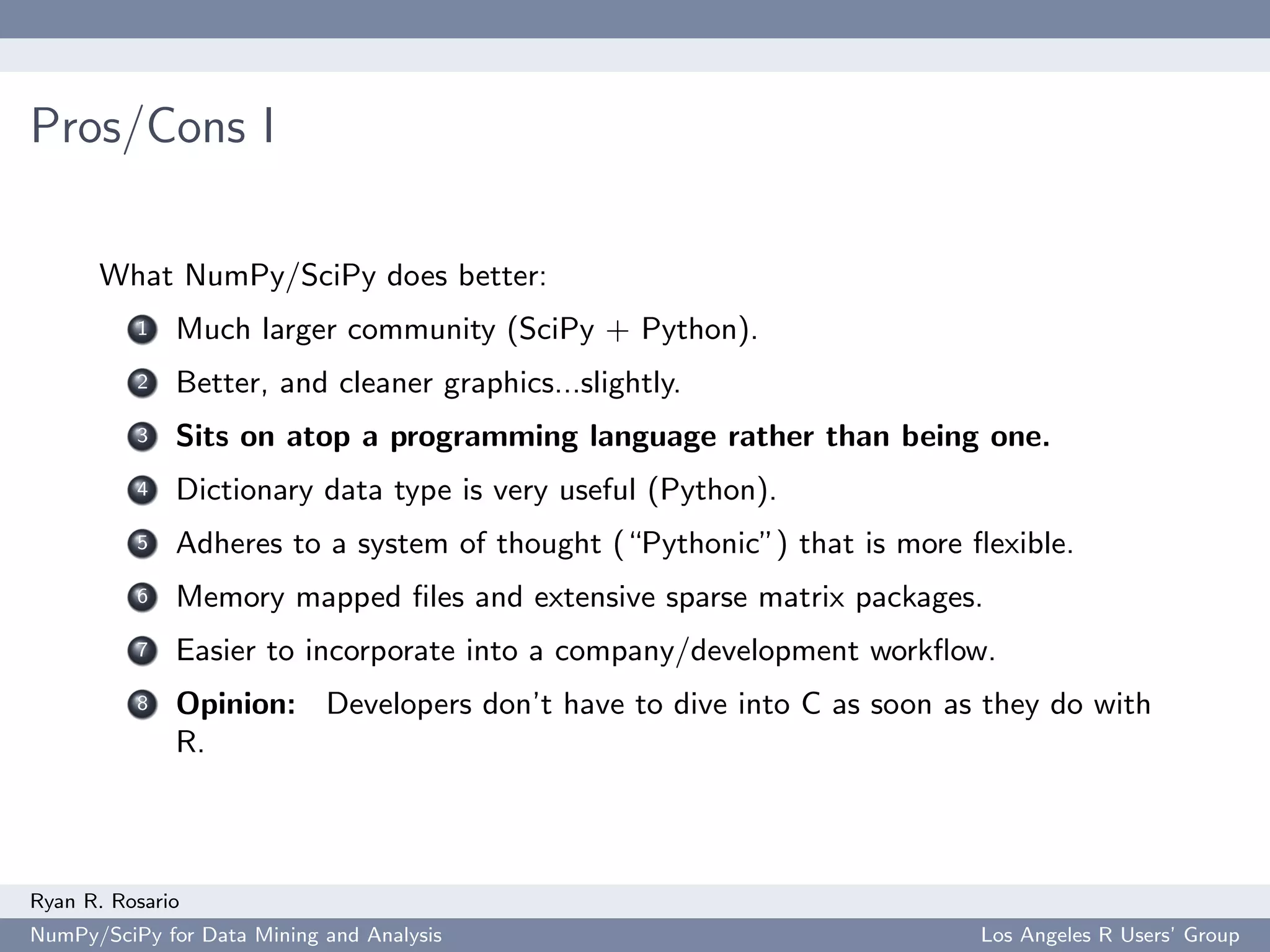
Pros/Cons I

      What NumPy/SciPy does better:
          1   Much larger community (SciPy + Python).
          2   Better, and cleaner graphics...slightly.
          3   Sits on atop a programming language rather than being one.
          4   Dictionary data type is very useful (Python).
          5   Adheres to a system of thought (“Pythonic”) that is more flexible.
          6   Memory mapped files and extensive sparse matrix packages.
          7   Easier to incorporate into a company/development workflow.
          8   Opinion: Developers don’t have to dive into C as soon as they do with
              R.


Ryan R. Rosario
NumPy/SciPy for Data Mining and Analysis                                Los Angeles R Users’ Group
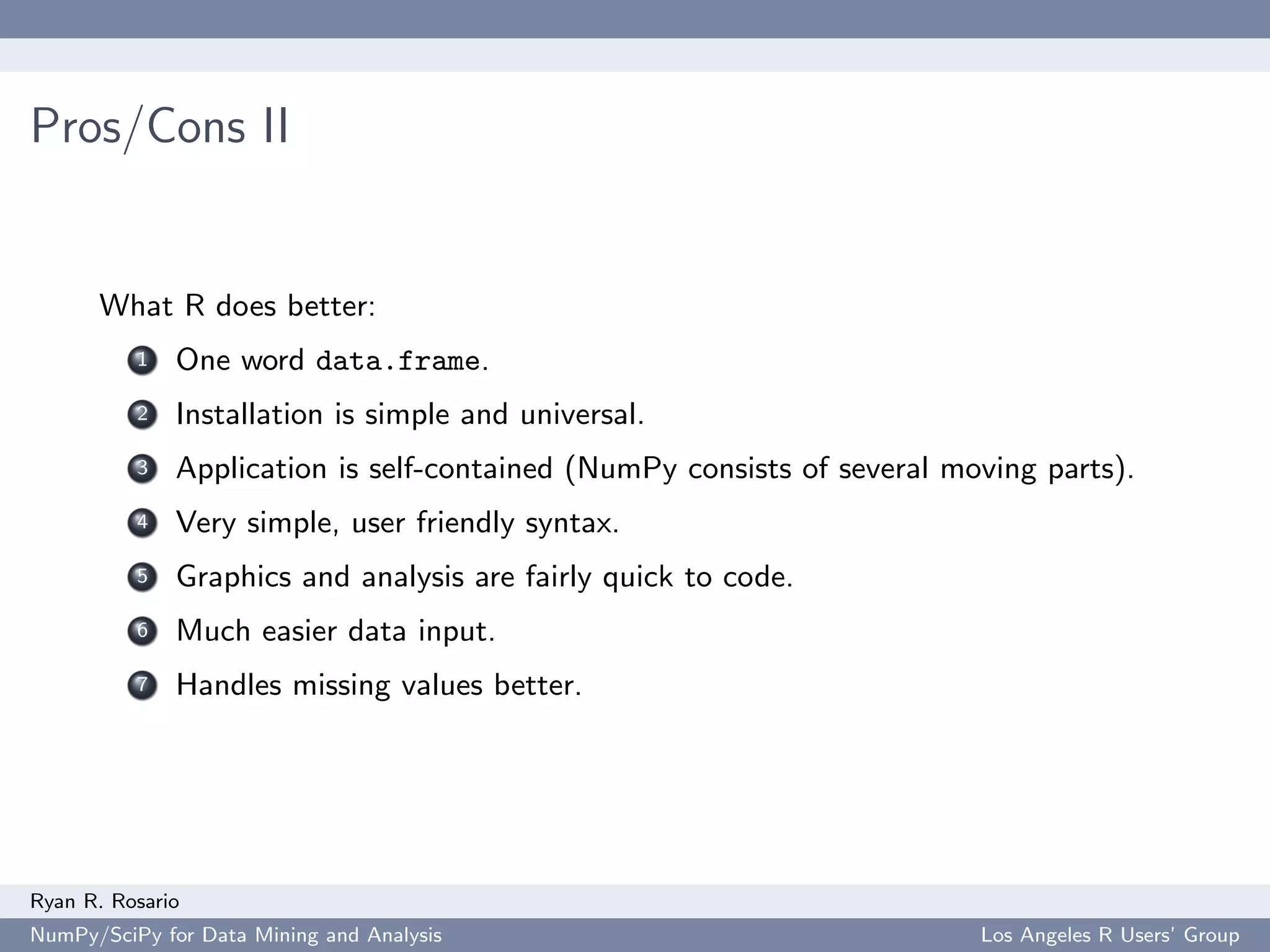
Pros/Cons II


      What R does better:
          1   One word data.frame.
          2   Installation is simple and universal.
          3   Application is self-contained (NumPy consists of several moving parts).
          4   Very simple, user friendly syntax.
          5   Graphics and analysis are fairly quick to code.
          6   Much easier data input.
          7   Handles missing values better.


Ryan R. Rosario
NumPy/SciPy for Data Mining and Analysis                                 Los Angeles R Users’ Group
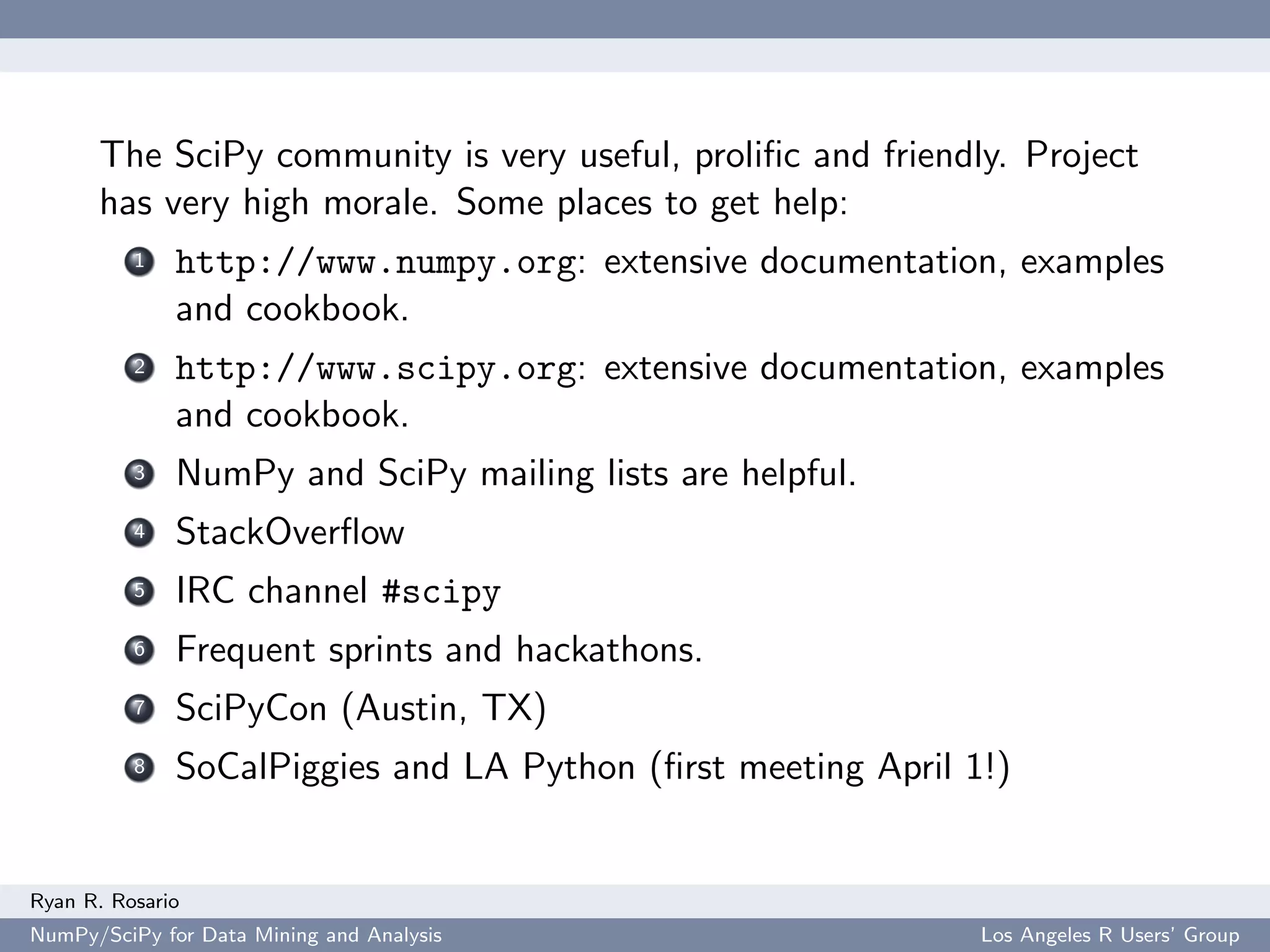
The SciPy community is very useful, prolific and friendly. Project
      has very high morale. Some places to get help:
          1   http://www.numpy.org: extensive documentation, examples
              and cookbook.
          2   http://www.scipy.org: extensive documentation, examples
              and cookbook.
          3   NumPy and SciPy mailing lists are helpful.
          4   StackOverflow
          5   IRC channel #scipy
          6   Frequent sprints and hackathons.
          7   SciPyCon (Austin, TX)
          8   SoCalPiggies and LA Python (first meeting April 1!)


Ryan R. Rosario
NumPy/SciPy for Data Mining and Analysis                      Los Angeles R Users’ Group
Keep in Touch!


      My email: ryan@stat.ucla.edu

      My blog: http://www.bytemining.com

      Follow me on Twitter: @datajunkie


Ryan R. Rosario
NumPy/SciPy for Data Mining and Analysis   Los Angeles R Users’ Group
References


          1   NumPy http://www.numpy.org
          2   SciPy http://www.scipy.org
          3   SciKits http://scikits.appspot.com
          4   iPython http://ipython.scipy.org/moin/
          5   matplotlib http://matplotlib.sourceforge.net/


Ryan R. Rosario
NumPy/SciPy for Data Mining and Analysis                Los Angeles R Users’ Group

NumPy and SciPy for Data Mining and Data Analysis Including iPython, SciKits, and matplotlib

  • 1.
    Los Angeles RUsers’ Group NumPy and SciPy for Data Mining and Data Analysis Including iPython, SciKits, and matplotlib Ryan R. Rosario March 29, 2011 Ryan R. Rosario NumPy/SciPy for Data Mining and Analysis Los Angeles R Users’ Group
  • 2.
    What is NumPy? NumPy is the standard package for scientific and numerical computing in Python: powerful N-dimensional array object. sophisticated (broadcasting) functions. tools for integrating C/C++ and Fortran code (R is similar) useful linear algebra, Fourier transform and random number capabilities. Additionally... data structures can be used as efficient multi-dimensional container of arbitrary data types. Ryan R. Rosario NumPy/SciPy for Data Mining and Analysis Los Angeles R Users’ Group
  • 3.
    So, What isSciPy? Often (incorrectly) used as a synonym of NumPy. SciPy depends on NumPy’s data structures. OSS for mathematics, science, and engineering. provides efficient numerical routines for numerical integration and optimization. “NumPy provides the data structures, SciPy provides the application layer.” Ryan R. Rosario NumPy/SciPy for Data Mining and Analysis Los Angeles R Users’ Group
  • 4.
    Getting NumPy The ease of installation is highly dependent on OS and CPU. Official releases are recommended and available for 1 32 bit MacOS X Caveat: Must use Python Python, not Apple Python. 2 32 bit Windows Unofficial/third-party binary releases for 1 All Linux (use platform package system) 2 64 bit MacOS X (SciPy Superpack) Requires Apple Python 2.6.1 3 64-bit Windows (Christoph Gohlke, UC Irvine) Source Code Enthought is to SciPy/Numpy as Revolution is to R. Main download link is http://www.scipy.org/Download Ryan R. Rosario NumPy/SciPy for Data Mining and Analysis Los Angeles R Users’ Group
  • 5.
    Disclaimer Time is even more limited than usual, so the goal is to illustrate what NumPy is, and what NumPy, SciPy and its colleagues can achieve. Some goals: Brief NumPy tutorial via demo. Uses of NumPy and SciPy, including SciKits. Brief data analysis demo with NumPy, SciPy and matplotlib. Concluding remarks. Ryan R. Rosario NumPy/SciPy for Data Mining and Analysis Los Angeles R Users’ Group
  • 6.
    NumPy Basics The main data structure is a homogeneous multidimensional array – a table of elements all of the same type, indexed by a tuple of positive integers. Some examples are vectors, matrices, images and spreadsheets. Why not just a use a list of lists? NumPy provides functions that operate on an entire array at once (like R), Python does not...really. NumPy is full of syntax and time is limited, so let’s jump straight into a demo... Ryan R. Rosario NumPy/SciPy for Data Mining and Analysis Los Angeles R Users’ Group
  • 7.
    NumPy Basics Demo Ryan R. Rosario NumPy/SciPy for Data Mining and Analysis Los Angeles R Users’ Group
  • 8.
    Keep in Mind:Broadcasting vs. Recycling In NumPy, if two arrays do not have the same length and we try to, say, add them, 1 is appended to the smaller array so that the dimensions match. In R, if two vectors do not have the same length, the values in the shorter vector are recycled and a warning is generated. Personally, recycling seems more practical. Ryan R. Rosario NumPy/SciPy for Data Mining and Analysis Los Angeles R Users’ Group
  • 9.
    Keep in Mind:Indexing! R starts its indices at 1 and ranges are inclusive (i.e. seq(1,3) -> 1, 2, 3) NumPy (and Python) starts its indices at 0 and ranges are exclusive (i.e. arange(1,3) -> 1, 2). Ryan R. Rosario NumPy/SciPy for Data Mining and Analysis Los Angeles R Users’ Group
  • 10.
    Keep in Mind:Data Type Matters! R does a good job of using the correct data type. NumPy requires you to make decisions about data type. Using int64 for 1 is typically wasteful. Ryan R. Rosario NumPy/SciPy for Data Mining and Analysis Los Angeles R Users’ Group
  • 11.
    ipython: a replacementCLI I IPython is the recommended CLI for NumPy/SciPy. I will use IPython in my demo. 1 an enhanced interactive Python shell. 2 an architecture for interactive parallel computing. Ryan R. Rosario NumPy/SciPy for Data Mining and Analysis Los Angeles R Users’ Group
  • 12.
    ipython: a replacementCLI II Some advantages over the standard CLI: 1 tab completion for object attributes and filenames, auto parentheses and quotes for function calls. 2 simple object querying object name? prints details about an object. %pdoc (docstring), %pdef (function definition), %psource (full source code). 3 %run to run a code file, much like source in R. Differs from import because the code file is reread each time %run is called. Also provides special flags for profiling and debugging. Ryan R. Rosario NumPy/SciPy for Data Mining and Analysis Los Angeles R Users’ Group
  • 13.
    ipython: a replacementCLI III 4 %pdb for spawning a pdb debug session. 5 Output cache saves the results of executing each line of code. , , save the last three results. 6 Input cache allows re-execution of previously executed code using a snapshot of the original input data in variable In. (to rexecute lines 22 through 28, and line 34: exec In[22:29] + In[34]. 7 Command history with(out) line numbers using %hist. Can also toggle journaling with %logstart. 8 Execute system commands from within IPython as if you are in the terminal by prefixing with !. Use !!, %sc, %sx to get output into a Python variable (var = !ls -la). Use Python variables when calling the shell. Ryan R. Rosario NumPy/SciPy for Data Mining and Analysis Los Angeles R Users’ Group
  • 14.
    ipython: a replacementCLI IV 9 Easy access to the profiler, %prun. 10 Easy to integrate with matplotlib. 11 Custom profiles (options, modules to load, function definitions). Similar to R workspace. 12 Run other programs (that use pipes) and extract output (gnuplot). 13 Easily run doctests. 14 Lightweight version control. 15 Save/restore session, like in R (the authors specifically said “like R”). Ryan R. Rosario NumPy/SciPy for Data Mining and Analysis Los Angeles R Users’ Group
  • 15.
    matplotlib: SciPy’s GraphicsSystem I 2D graphics library for Python that produces publication quality figures. Quality with respect to R is in the eye of the beholder. Graphics in R are much easier to construct, and require less code. Graphics in matplotlib may look nicer; require much more code. Ryan R. Rosario NumPy/SciPy for Data Mining and Analysis Los Angeles R Users’ Group
  • 16.
    matplotlib: SciPy’s GraphicsSystem II Ryan R. Rosario NumPy/SciPy for Data Mining and Analysis Los Angeles R Users’ Group
  • 17.
    matplotlib: SciPy’s GraphicsSystem III Ryan R. Rosario NumPy/SciPy for Data Mining and Analysis Los Angeles R Users’ Group
  • 18.
    matplotlib: SciPy’s GraphicsSystem IV Show matplotlib gallery. I will do a demo of matplotlib in the data analysis demo, if time. Ryan R. Rosario NumPy/SciPy for Data Mining and Analysis Los Angeles R Users’ Group
  • 19.
    Quick Linear RegressionDemo Demo here. Ryan R. Rosario NumPy/SciPy for Data Mining and Analysis Los Angeles R Users’ Group
  • 20.
    SciKits I SciKits are modules or “plug-ins” for SciPy; they are too specialized to be included in SciPy itself. Below is a list of some relevant SciKits. 1 statsmodels: OLS, GLS, WLS, GLM, M-estimators for robust regression. 2 timeseries: time series analysis. 3 bootstrap: bootstrap error-estimation. 4 learn: machine learning and data mining Ryan R. Rosario NumPy/SciPy for Data Mining and Analysis Los Angeles R Users’ Group
  • 21.
    SciKits II 5 sparse: sparse matrices 6 cuda: Python interface to GPU powered libraries. 7 image: image processing 8 optimization: numerical optimization For more information, see http://scikits.appspot.com/scikits. Ryan R. Rosario NumPy/SciPy for Data Mining and Analysis Los Angeles R Users’ Group
  • 22.
    Scientific Software Relyingon SciPy I Many exciting software packages rely on SciPy Python Based Reinforcement Learning, Artificial Intelligence and Neural Network Library. Built around a neural networks kernel. Provides unsupervised learning and evolution. http://www.pybrain.org PyMC Pythonic Markov Chain Monte Carlo. MCMC, Gibbs sampling, diagnostics PyML: SVM, nearest neighbor, ridge regression, multiclass methods, model selection, filtering, CV, ROC. Ryan R. Rosario NumPy/SciPy for Data Mining and Analysis Los Angeles R Users’ Group
  • 23.
    Scientific Software Relyingon SciPy II Monte: gradient based learning machines, logistic regression, conditional random fields. MILK: SVM, k-NN, random forests, decision trees, feature selection, affinity propagation. Modular toolkit for Data Processing: signal processing, PCA, ICA, manifold learning, factor analysis, regression, neural networks, mixture models. Ryan R. Rosario NumPy/SciPy for Data Mining and Analysis Los Angeles R Users’ Group
  • 24.
    Scientific Software Relyingon SciPy III PyEvolve: Genetic algorithms Theano: Theano is a Python library that allows you to define, optimize, and evaluate mathematical expressions involving multi-dimensional arrays efficiently: GPUs, symbolic expressions, dynamic C code generation. Orange: Data mining, visualization and machine learning. Full GUI and Python scripting. Ryan R. Rosario NumPy/SciPy for Data Mining and Analysis Los Angeles R Users’ Group
  • 25.
    Scientific Software Relyingon SciPy IV SAGE: a hodgepodge of open-source software designed to be one analysis platform. Ryan R. Rosario NumPy/SciPy for Data Mining and Analysis Los Angeles R Users’ Group
  • 26.
    Pros/Cons I What NumPy/SciPy does better: 1 Much larger community (SciPy + Python). 2 Better, and cleaner graphics...slightly. 3 Sits on atop a programming language rather than being one. 4 Dictionary data type is very useful (Python). 5 Adheres to a system of thought (“Pythonic”) that is more flexible. 6 Memory mapped files and extensive sparse matrix packages. 7 Easier to incorporate into a company/development workflow. 8 Opinion: Developers don’t have to dive into C as soon as they do with R. Ryan R. Rosario NumPy/SciPy for Data Mining and Analysis Los Angeles R Users’ Group
  • 27.
    Pros/Cons II What R does better: 1 One word data.frame. 2 Installation is simple and universal. 3 Application is self-contained (NumPy consists of several moving parts). 4 Very simple, user friendly syntax. 5 Graphics and analysis are fairly quick to code. 6 Much easier data input. 7 Handles missing values better. Ryan R. Rosario NumPy/SciPy for Data Mining and Analysis Los Angeles R Users’ Group
  • 28.
    The SciPy communityis very useful, prolific and friendly. Project has very high morale. Some places to get help: 1 http://www.numpy.org: extensive documentation, examples and cookbook. 2 http://www.scipy.org: extensive documentation, examples and cookbook. 3 NumPy and SciPy mailing lists are helpful. 4 StackOverflow 5 IRC channel #scipy 6 Frequent sprints and hackathons. 7 SciPyCon (Austin, TX) 8 SoCalPiggies and LA Python (first meeting April 1!) Ryan R. Rosario NumPy/SciPy for Data Mining and Analysis Los Angeles R Users’ Group
  • 29.
    Keep in Touch! My email: ryan@stat.ucla.edu My blog: http://www.bytemining.com Follow me on Twitter: @datajunkie Ryan R. Rosario NumPy/SciPy for Data Mining and Analysis Los Angeles R Users’ Group
  • 30.
    References 1 NumPy http://www.numpy.org 2 SciPy http://www.scipy.org 3 SciKits http://scikits.appspot.com 4 iPython http://ipython.scipy.org/moin/ 5 matplotlib http://matplotlib.sourceforge.net/ Ryan R. Rosario NumPy/SciPy for Data Mining and Analysis Los Angeles R Users’ Group