A Practical Guide to CMDB Deployment in a Tivoli Environment Presented by: Antonio Rolle VP of Professional Services One Step Ahead of IT. IN STEP   With Your Business .
Today’s Topics generationE Technologies Overview CMDB Overview CMDB Development Stages Populating the CMDB Managing CMDB Related Processess
This session focuses on the significance of the CMDB to your organization and offers practical guidelines for successful population of the CMDB utilizing the Tivoli Netcool suite of products.  Specific products discussed include Precision for IP Networks, Tivoli Application Dependency Discovery Manager (TADDM), Tivoli Business Service Manager (TBSM) and Maximo. After attending this session you will leave with a better understanding of CMDB Development Stages and how Precision IP, TADDM, TBSM and Maximo can be used to facilitate this process.  The solution discussed during this session will help you to build a more strategic CMDB solution — one that focuses more on business impact of changes to protect business and IT service continuity.
generationE Background Founded in 1999; Headquarters in Oak Brook, IL Our Clients At a Glance: 40% Service Providers (Telco, ISPs, MSPs, Cable, Wireless, etc.) 40% Financial Service Enterprises 20% Other Enterprises Serve Regional to Fortune 50 Customers Regions: North Central, South Central & West  Offices in Chicago, Dallas, Southern California.   Revenue Centers:  Software Solution Sales Integration & Consulting Services Managed Services
generationE Offerings We offer, integrate and support  leading  technology solutions to address customer needs.  Examples include: Business Service Assurance Solutions Technology and consulting services addresses pains such as “How can I ensure little to no downtime of my IT services?” and “How can I enable higher network performance and increased network reliability and flexibility?  IT Service Management Solutions–  For improvement of service levels and efficiency. ITSM products provide automated, scaleable, & workflow customizable solutions to quickly resolve incidents and problems, control change, manage IT assets and monitor service levels that fits the specific needs of an organization and its industry. Performance Monitoring Solutions  Interoperability with other IT management systems is provided, such as provisioning, configuration, fault and event management to eliminate redundancy and minimize resource requirements within ESM and OSS models. Job Scheduling
Service Offerings IT consulting services include architecture design, customizations, process optimization, ITIL enablement and 24 x7 Support. Deploy ‘out-of the box’ solutions to full-scale enterprise deployments Provide a roadmap for customers to achieve a true Business Service Management (BSM) strategy.  What is Business Service Management?  Enterprise IT operations departments are beginning to consider themselves service-centric organizations. A “Service” helps package the IT functional groups’ deliverables into a set of logical associations that are consumed by business to enable business users to accomplish their business activities, functions, processes and the overall mission.
Premier Tivoli-Netcool ®  Partner 2005 Micromuse PARTNER OF THE YEAR  Strong Client-Service experience across all  IBM Tivoli Netcool ®  Products including Netcool/Omnibus, Netcool/Impact, Netcool/Precision TN, Netcool/Precision IP, Netcool/RAD/TBSM Over 30 Tivoli Netcool® subject matter experts and professionals (and growing) Largest Certified Professional Services Team  Continue to Increase 24 x 7 Tivoli Netcool Certified Support Engineering Team The Top Sponsor at ’03, ’04, ’05, and ‘06 National Netcool Users Conference and ’06   IBM Tivoli Technical User Conference
Today’s Topics generationE Technologies Overview CMDB Overview CMDB Development Stages Populating the CMDB Managing CMDB Related Processess
ITIL What is ITIL? Set of best practices, processes and functions Being a framework, ITIL describes the contours of organizing Service Management. Aligns IT services with business requirements Enables optimal service provision at a justifiable cost Provides a proven method for planning common processes, roles and activities with appropriate reference to each other and how the communication lines should exist between them ITIL is NOT… A methodology Step-by-step instructions List of every action required on a day-to-day basis
The CMDB should - ... (1.)  Hold the (a.)relationships  between all system components, including incidents, problems, known errors, changes and releases… (b.) information  about incidents, known errors and problems, and corporate data about employees, locations and business units... often… (c.) details of services  and to (2.)  relate them to the underlying IT components …and  (3.)  store inventory details … such as suppliers, cost, purchase date, and renewal date for a license.. SOURCE:   Office of Government Commerce   “ ”
The CMDB vs Inventory Tools Discover the environment Hardware, software, perhaps some relationships Provide federated or consolidated views of the infrastructure May flag inconsistencies between scans for manual reconciliation May provide data for other management tools to consume Stores data about the environment Hardware, software, people, services & relationships Provides federated views of the infrastructure Provides  near-real time  view of CIs  … and… Provides  authorized  view of CIs Matches change history with scans for reconciliation Integrates change & configuration management processes Provides a platform for other processes to operate upon Inventory Tools The CMDB
Today’s Topics generationE Technologies Overview CMDB Overview CMDB Development Stages Populating the CMDB Managing CMDB Related Processess
CMDB Development Stages   Assemble the Project Team  & Define the Project Define Requirements & Create  the IT Service Model Blueprint Select CMDB Solution and Tools Construct & Maintain the CMDB Drive Ongoing Value SOURCE:  Step by Step Guide to Building a CMDB,  Malcolm Fry
CMDB Development Stages – Stage 1   Create Project Executive Board Select Project Manager Scope Key Activities Select Project Team Finalize Project Plan Assemble the Project Team & Define the Project
CMDB Development Stages – Stage 2   Identify & Review Governance Requirements Review and Select Supporting Best Practices Identify Requirements to Address Potential Problems Identify Inventory & Asset Management Requirements Define Service Catalog Requirements  Define CMDB Requirements to Support Other Processes Define CI Level & IT Service Model Define CI Relationships Define CI Attributes Design IT Service Model Blueprint Define Requirements & Create  the IT Service Model Blueprint
CMDB Development Stages – Stage 3   Select CMDB Solution Plan the CMDB Population Select Tools to Automate CMDB Solution Calculate Project ROI Select CMDB Solution and Tools
CMDB Development Stages – Stage 4   Construct your CMDB Create CI Lifecycle Management process Build supporting processes Populate your CMDB Train the CMDB Team and Users Construct & Maintain the CMDB
CMDB Development Stages – Stage 5   Implement measures and metrics Create a Service Improvement Program Drive Ongoing Value
CMDB Development Stages   Assemble the Project Team  & Define the Project Define Requirements & Create  the IT Service Model Blueprint Select CMDB Solution and Tools Construct & Maintain the CMDB Drive Ongoing Value SOURCE:  Step by Step Guide to Building a CMDB,  Malcolm Fry
Today’s Topics generationE Technologies Overview CMDB Overview CMDB Development Stages Populating the CMDB Managing CMDB Related Processess
The CMDB – What Goes Into It? Inventory details (on CIs)  - Including supplier, cost, purchase date, license renewal, maintenance agreements. Data Reconciliation  - Reconciles data between data sources. Service Level Management  - Supports Service Level Management by linking configuration items to supported services Configuration Item Dependencies  - Hold relationships between system components, including Incidents, Problems, Known errors, Changes and Releases.  Configuration Records  -  Holds information about changes that were made to configuration items. Workflow Automation  - Automates the management of configuration item details to reduce errors and costs.  Business Information  -  Holds corporate data about employees, suppliers, locations and business units.
Today’s Topics generationE Technologies Overview CMDB Overview CMDB Development Stages Populating the CMDB With Application & Server Data With Network Data With Service Level Data Managing CMDB Related Processess
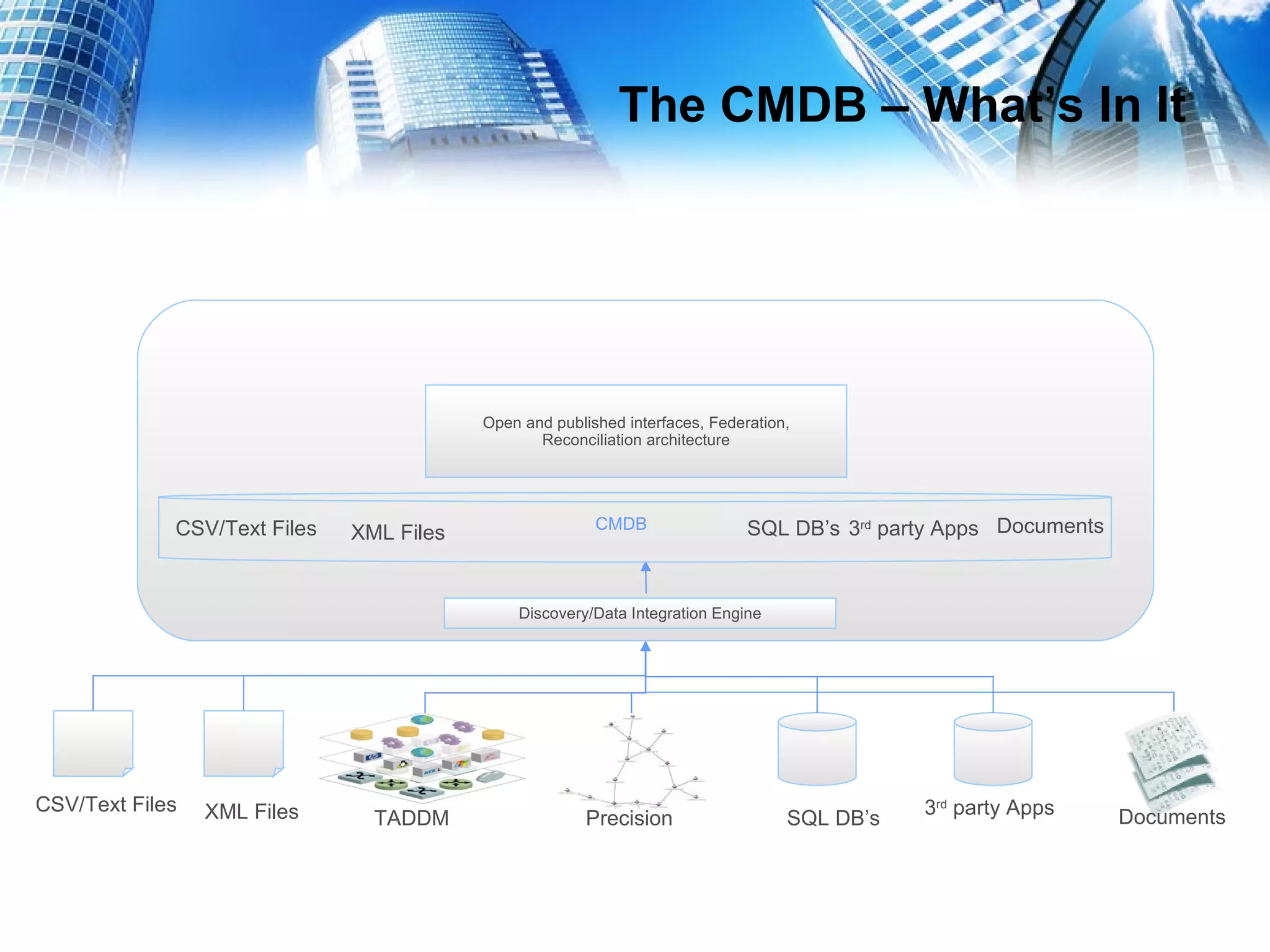
The CMDB – What’s In It CMDB Open and published interfaces, Federation, Reconciliation architecture CSV/Text Files SQL DB’s 3 rd  party Apps XML Files Documents TADDM Precision
Clarke’s Third Law Any sufficiently advanced technology is indistinguishable from magic. Source: Arthur C. Clarke “ ”
Tivoli Application Dependency Discovery Manager Provides a top-down view of how the IT infrastructure delivers business critical applications. Delivers agent-free creation of complete cross-tier dependency maps and topological views, change tracking, event propagation, and detailed reports and analytics.
The CMDB – What Goes Into It? Inventory details (on CIs)  - Including supplier, cost, purchase date, license renewal, maintenance agreements. Data Reconciliation  - Reconciles data between data sources. Service Level Management  - Supports Service Level Management by linking configuration items to supported services Configuration Item Dependencies  - Hold relationships between system components, including Incidents, Problems, Known errors, Changes and Releases.  Configuration Records  -  Holds information about changes that were made to configuration items. Workflow Automation  - Automates the management of configuration item details to reduce errors and costs.  Business Information -  Holds corporate data about employees, suppliers, locations and business units.
The CMDB – What Goes Into It? TADDM Reporting on Configuration Changes Compare any component (including entire business applications) with similar components either within or between versions Can compare any number of components at one time
Audit Configuration Items via Comparison Dissimilar attribute values are highlighted Enables easy comparison of like CIs to a ‘master’ copy
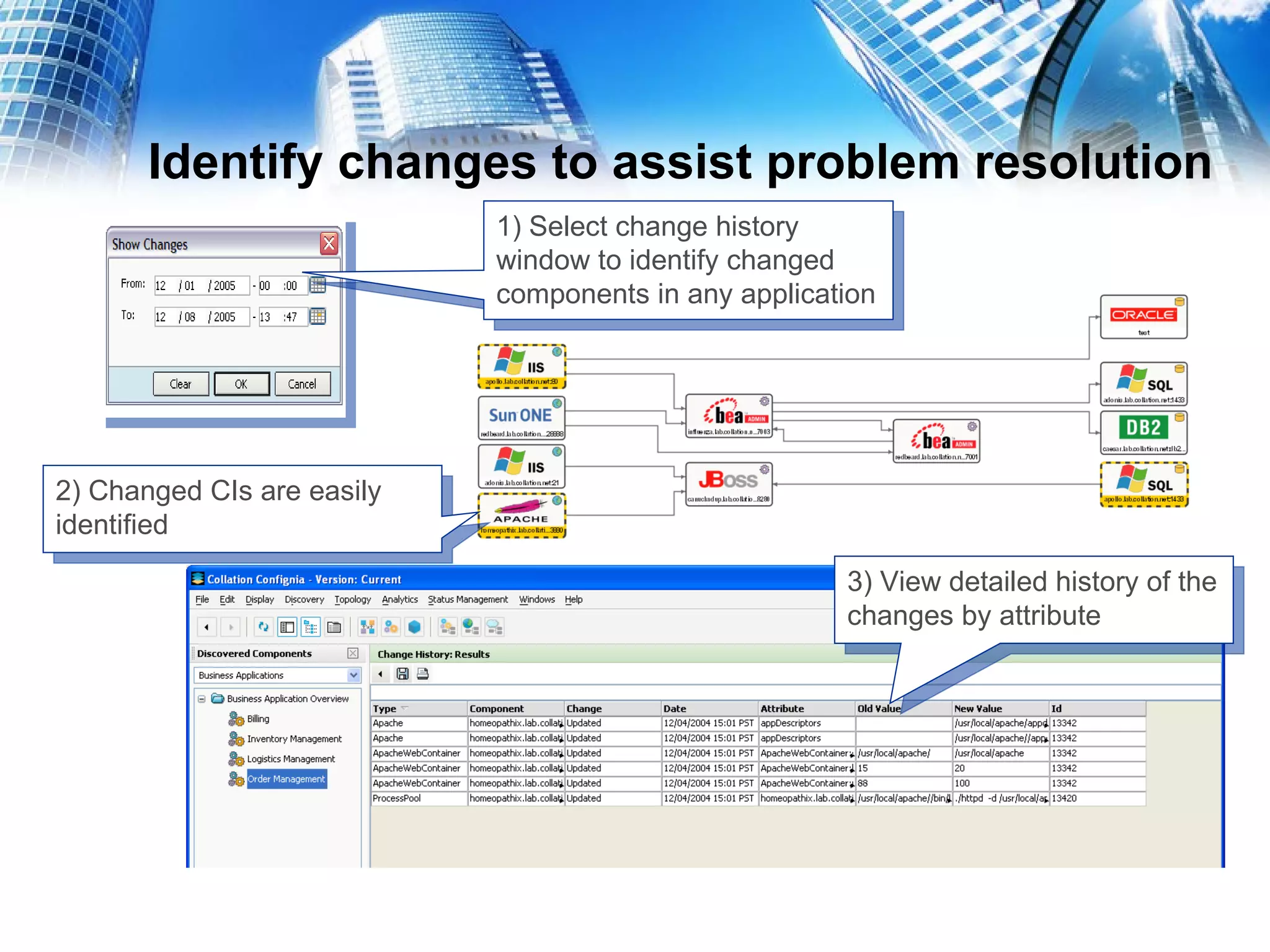
Identify changes to assist problem resolution 1) Select change history window to identify changed components in any application 2) Changed CIs are easily identified 3) View detailed history of the changes by attribute
The CMDB – What Goes Into It? Inventory details (on CIs)  - Including supplier, cost, purchase date, license renewal, maintenance agreements. Data Reconciliation  - Reconciles data between data sources. Service Level Management  - Supports Service Level Management by linking configuration items to supported services Configuration Item Dependencies  - Hold relationships between system components, including  Incidents, Problems, Known errors , Changes  and Releases .  Configuration Records -  Holds information about changes that were made to configuration items. Workflow Automation  - Automates the management of configuration item details to reduce errors and costs.  Business Information -  Holds corporate data about employees, suppliers, locations and business units.
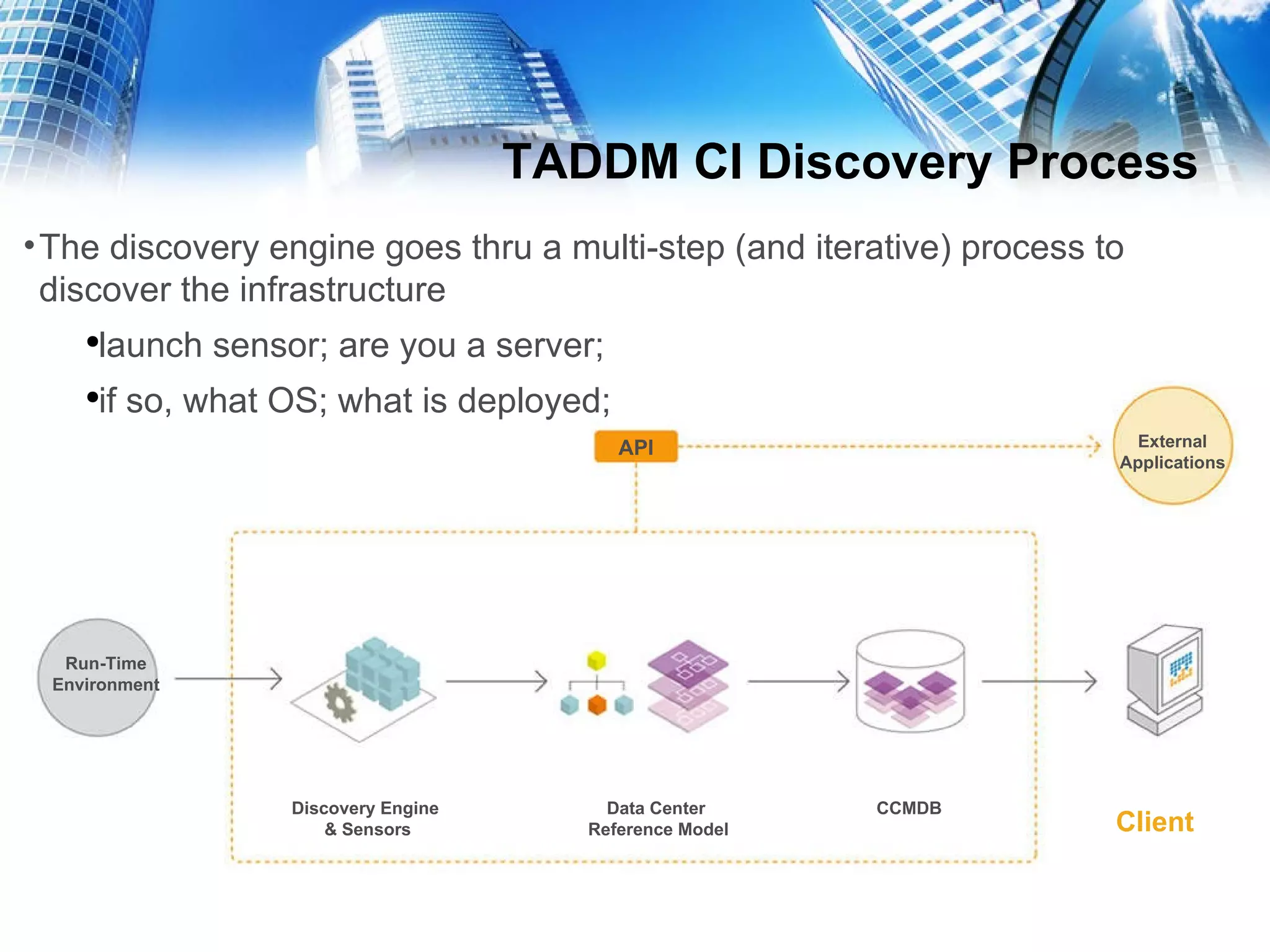
TADDM CI Discovery Process  API Discovery Engine & Sensors Data Center  Reference Model CCMDB Run-Time Environment External Applications Client The discovery engine goes thru a multi-step (and iterative) process to discover the infrastructure  launch sensor; are you a server;  if so, what OS; what is deployed;
What TADDM Discovers Application components System components Network components Services
What TADDM Discovers Application components, such as Web servers, application servers, and databases  System components Network components Services
What TADDM Discovers Application components System components, such as hosts, operating systems, load balancers, and database servers  Network components Services
What TADDM Discovers Application components System components Network components, such as routers, switches, and firewalls  Services
What TADDM Discovers Application components System components Network components Services, such as DNS and LDAP services
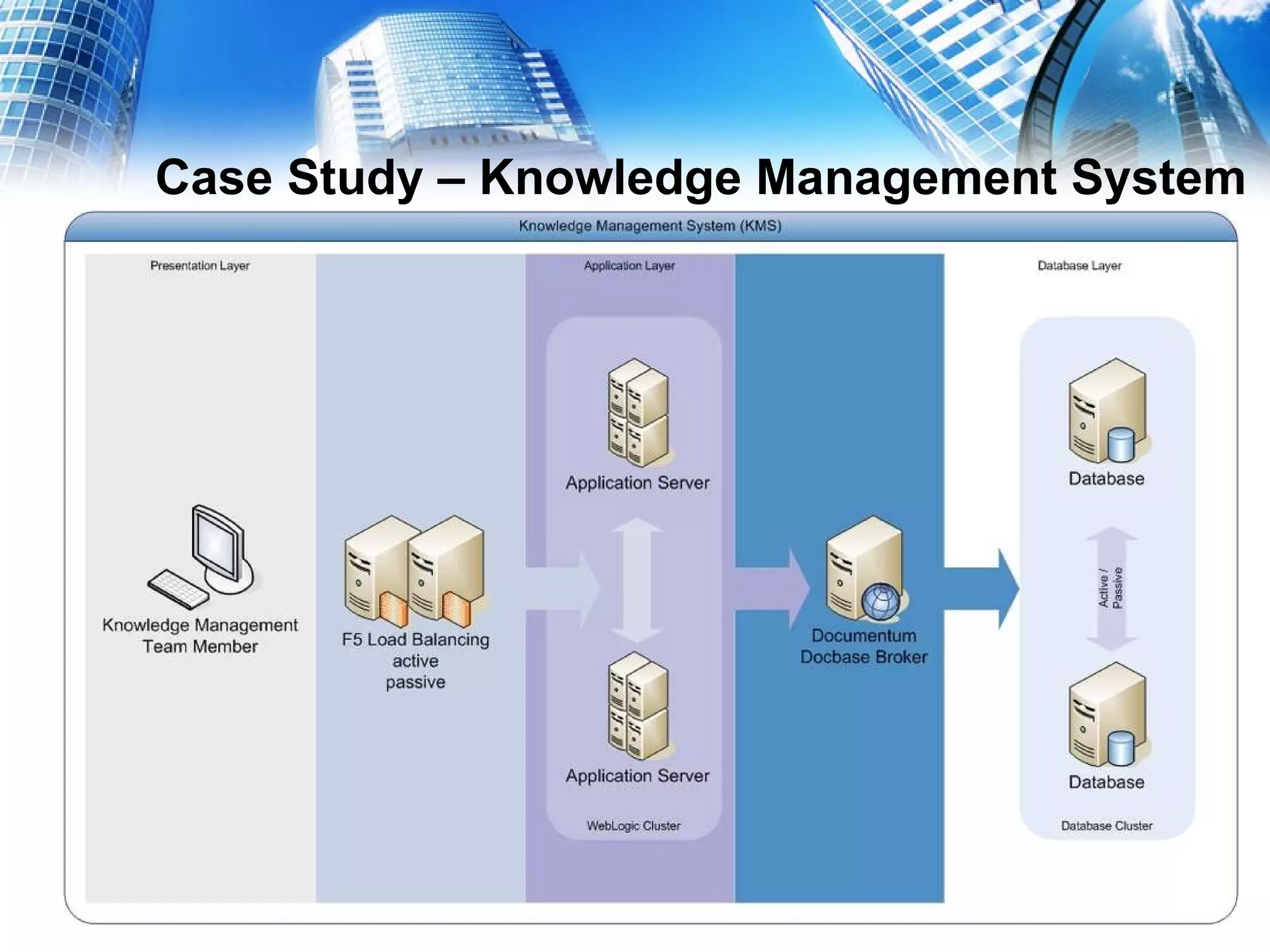
Case Study – Knowledge Management System
TADDM Discovery of Environment
BMC Atrium CMDB 2.0 Overview Business Process  Data People Data BMC Atrium CMDB Relationships Relationships Drift Tracking Status Accounting Discovery CI Viewer CI Browser Analytics Management Console Infrastructure Data Mainframes Batch Processes SOA
BMC Atrium CMDB –Common Data Model Extend common data model to include: Business processes  User identity and roles  Mainframes  Batch processes Service oriented architectures Common Data Model Extensions Provides enhanced mechanisms that make it easier to configure/customize the CDM Ease of data migration
Populating Atrium – The Common Data Model
Populating Atrium – The Common Data Model BMC_ComputerSystem HostName TotalPhysicalMemory BMC_System BMC_BaseElement BMC_ApplicationSystem Build Number PatchNumber ServicePack DatasetID, Description, ManufacturerName, Model, Name, VersionNumber
BMC Atrium CMDB  – Integration Capabilities Expansion of programmatic interfaces to simplify external access to CMDB Web Services enabled Create, modify, and query CMDB Reconciliation engine control added to CMDB API
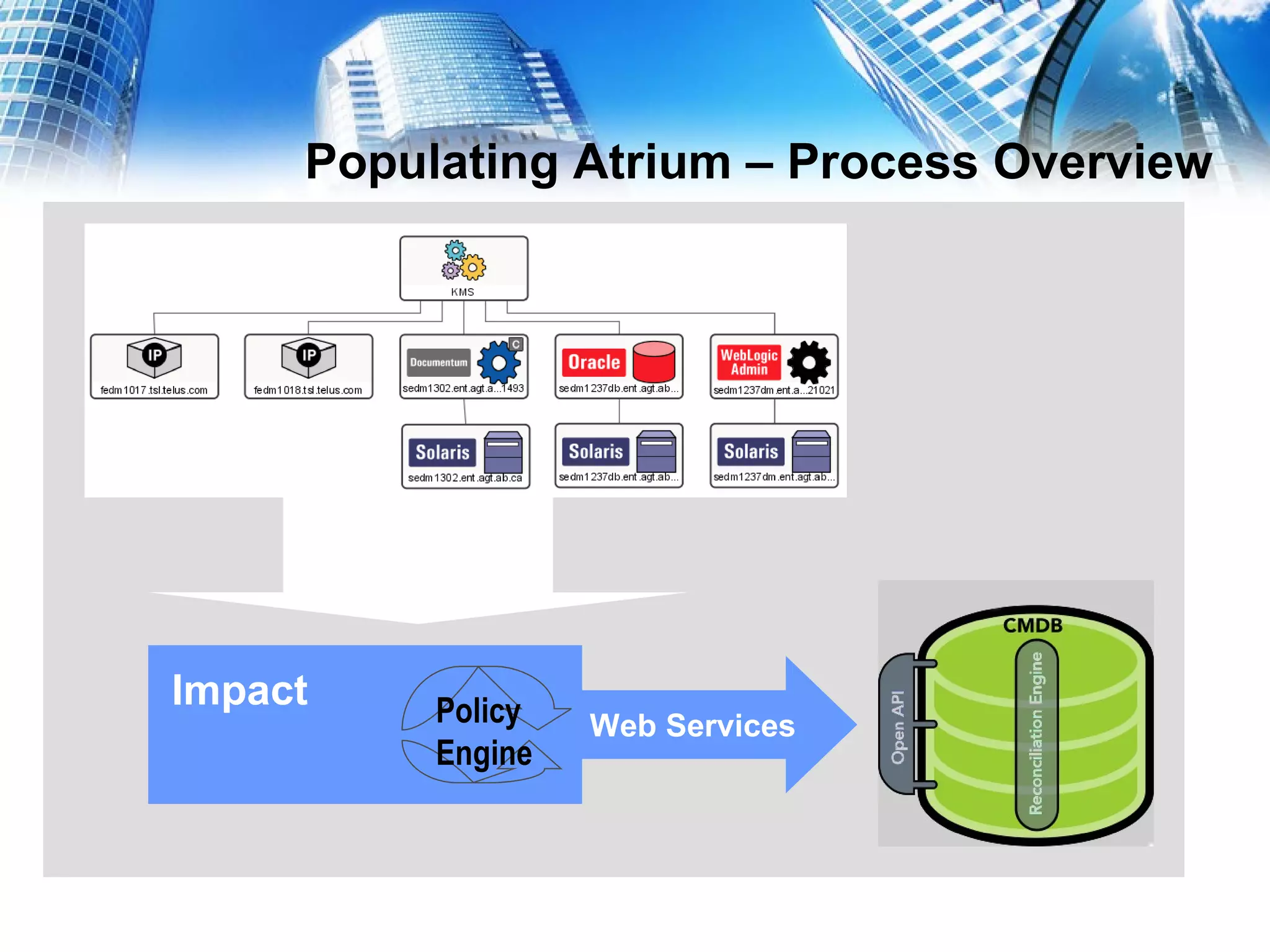
Populating Atrium – Process Overview Policy  Engine Impact Web Services XML Extract TADDM Discovery
The CMDB – What’s In It Discovery/Data Integration Engine CMDB Open and published interfaces, Federation, Reconciliation architecture TADDM
Today’s Topics generationE Technologies Overview CMDB Overview CMDB Development Stages Populating the CMDB With Application & Server Data With Network Data With Service Level Data Managing CMDB Related Processess
Precision for IP Networks Scalable Network Discovery and Centralized Data Repository Extendable discovery for layers 1, 2 & 3 devices, interfaces and connectivity Broad support; IP, HSRP, CDP, Ethernet, VLAN, MPLS IP VPNs, Layer  Ethernet VPNs, IP over ATM Dynamic, always active and event driven to detect network change as it occurs
The CMDB – What Goes Into It? Inventory details (on CIs)  - Including supplier, cost, purchase date, license renewal, maintenance agreements. Data Reconciliation  - Reconciles data between data sources. Service Level Management  - Supports Service Level Management by linking configuration items to supported services Configuration Item Dependencies  - Hold relationships between system components , including Incidents , Problems, Known errors, Changes and Releases.   Configuration Records -  Holds information about changes that were made to configuration items. Workflow Automation  - Automates the management of configuration item details to reduce errors and costs.  Business Information -  Holds corporate data about employees, suppliers, locations and business units.
Precision CI Discovery SNMP support (175 MIBs), including: Discovery extensions modules (88 agents): ATM Forum MIB RFC 1695 for ATM switches ATM Forum PNNI (Single Pier) MIB ATM Forum ILMI MIB ATM Forum LANE Client MIB Frame Relay MIB RFC 1315 FDDI MIB RFC 1512 ASAgent  ASM  AlcatelSwitch  AlliedTelesynATSwitch  AlteonStp  AlteonSwitch  AlteonVRRP  ArpCache  AssocAddress  AtmForumPnni  BayEthernetHub  CDP  CM  CMTS  CellPath90  CentillionSwitch  ChipcomDistributedMM  ChipcomEthernetMM  CiscoBGPTelnet  CiscoFrameRelay  CiscoMPLSSnmp  CiscoMPLSTelnet  CiscoNATTelnet  CiscoOSPFTelnet  CiscoPVC  CiscoRoutedVLANInterface  CiscoSRP  CiscoSRPTelnet  CiscoStp  CiscoSwitchSnmp  CiscoSwitchTelnet  CiscoVTP  CoreBuilder3ComSwitch  DasanSwitchTelnet  DefaultEthernetHub  Details  Entity  ExtraDetails  ExtremeESRP  ExtremeSwitch  FddiCiscoConc  FddiDefault  FoundrySwitch  FoundryVRRP  HPNetworkTeaming  HPSwitch  HSRPSnmp  HuaweiSwitchTelnet  ILMI  ILMIForeSys  ISISExperimental  IfStackTable  Interface  IpBackupRoutes  IpForwardingTable  IpRoutingTable  JuniperERXIfStack  JuniperMPLSSnmp  JuniperMPLSTelnet  LaurelMPLSTelnet  LoopbackDetails  MACFromArpCache  Marconi3810  MariposaAtm  NATGatewayAgent  NATNetScreen  NATTextFileAgent  NokiaVRRP  NortelSwitch  PnniForeSys  RFC2787VRRP  RedbackContext  SSM  SSMOracle  SecureFast  StandardBgp  StandardOSPF  StandardStp  StandardSwitch  SunIfStackTable  SuperStack3ComSwitch  TraceRoute  UnisphereERXContext  UnisphereMPLSTelnet  XyplexEthernetHub. Broad Vendor support: 3Com Alcatel  AlliedTelesysn Alteon  Bay Centillion Chipcom Cisco  Dasan Extreme Foundry HP Huawei Juniper Laurel Nokia Nortel Redback Xylan Xyplex Bridge MIB RFC 1493  MIB-II RFC 1213/2096  RMON MIBs OSPF MIB BGP MIB ifStack MIB VRRP MIB 31 different Cisco MIBs (including MPLS VPNs) 21 Nortel MIBs 6 different Extreme Networks MIBs (inc VLANs) Juniper MPLS VPN support
Precision CI Discovery
Impact’s Precicion Data Source Adapter Bi-directional DSA that allows Impact to query Precision’s database. Precision Listener allows Impact to receive notifications from Precision that things have changed.
The CMDB – What’s In It Discovery/Data Integration Engine CMDB Open and published interfaces, Federation, Reconciliation architecture TADDM Precision
Populating the CMDB with Precision IP Data  Policy  Engine Impact DSA XML Extract Precision Discovery CMDB
Today’s Topics generationE Technologies Overview CMDB Overview CMDB Development Stages Populating the CMDB With Application & Server Data With Network Data With Service Level Data Managing CMDB Related Processess
RAD/TBSM Delivers real-time information to respond to alerts effectively and in line with business requirements, and to meet Service Level Agreements (SLAs). Build a service model that integrates with OMNIbus alerts or with data from a SQL data source. Native Integrations:  IBM Tivoli Monitoring (ITM), Tivoli Enterprise Console (TEC), and NETVIEW data  via IBM Tivoli EIF probe  Tivoli Application Dependency Discovery Manager (TADDM)  Tivoli Enterprise Portal (TEP)  Tivoli Service Level Advisor (TSLA) Tivoli Netcool/Internet Service Monitors (Netcool/ISMs)  Tivoli Netcool/Impact
Today’s Topics generationE Technologies Overview CMDB Overview CMDB Development Stages Populating the CMDB Managing CMDB Related Processess
CMDB Data Sources Tivoli Netcool Microsoft Enterprise Project Manager HP OpenView Service Desk Mercury Application Mapping PeopleSoft Troux Technologies 4 Platform CMDB BMC Remedy Atrium CMDB Voyence Control CA Unicenter Altiris Home Grown …
The CMDB – What Goes Into It? Inventory details (on CIs)  - Including supplier, cost, purchase date, license renewal, maintenance agreements. Data Reconciliation  - Reconciles data between data sources. Service Level Management  - Supports Service Level Management by linking configuration items to supported services Configuration Item Dependencies  - Hold relationships between system components, including Incidents, Problems, Known errors, Changes and Releases.  Configuration Records  -  Holds information about changes that were made to configuration items. Workflow Automation  - Automates the management of configuration item details to reduce errors and costs.  Business Information  -  Holds corporate data about employees, suppliers, locations and business units.
CMDB Related Uses of Impact Customers use Impact to: Gather additional information about an event (“ enrichment ”) Decide which events should be filtered out (“ suppression ”) Set markers in diverse data sources (“ correlation ”) Alert staff about a high-priority condition (“ notification ”) And escalate, if none of the above actions produced the desired results (“ escalation ”)
SQL Data Sources Oracle DB2 Netcool/OMNIbus Sybase MS SQL PostgreSQL MySQL Informix ODBC Socket DSA Standard Technologies JMS Web Services XML (RO) POP3/SMTP Instant Messaging LDAP SNMP Flat File (RO) Applications Netcool/Precision Smallworld (RO) Alcatel 5620 (RO) Cramer Dimension TIBCO Netcool/Impact Data Source Adapters
The CMDB – What’s In It Discovery/Data Integration Engine CMDB Open and published interfaces, Federation, Reconciliation architecture CSV/Text Files SQL DB’s 3 rd  party Apps XML Files Documents TADDM Precision CSV/Text Files XML Files SQL DB’s 3 rd  party Apps Documents
Today’s Topics generationE Technologies Overview CMDB Overview CMDB Development Stages Populating the CMDB Managing CMDB Related Processess
The CMDB – What Goes Into It? Inventory details (on CIs)  - Including supplier, cost, purchase date, license renewal, maintenance agreements. Data Reconciliation  - Reconciles data between data sources. Service Level Management  - Supports  Service Level Management  by linking configuration items to supported services Configuration Item Dependencies  - Hold relationships between system components, including Incidents, Problems, Known errors, Changes and Releases.  Configuration Records -  Holds information about changes that were made to configuration items. Workflow Automation  - Automates the management of configuration item details to reduce errors and costs.  Business Information -  Holds corporate data about employees, suppliers, locations and business units.
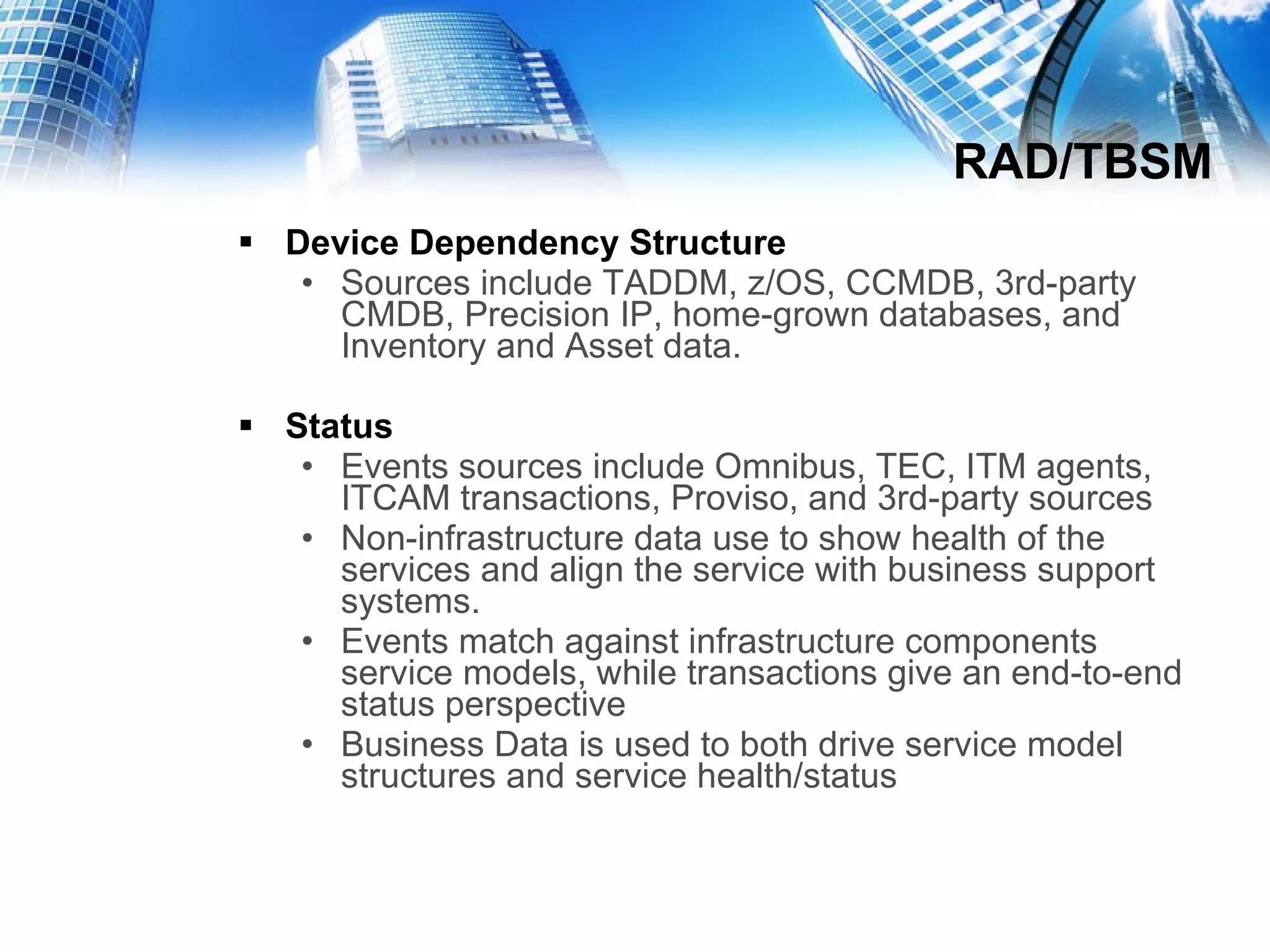
RAD/TBSM Device Dependency Structure Sources include TADDM, z/OS, CCMDB, 3rd-party CMDB, Precision IP, home-grown databases, and Inventory and Asset data. Status Events sources include Omnibus, TEC, ITM agents, ITCAM transactions, Proviso, and 3rd-party sources Non-infrastructure data use to show health of the services and align the service with business support systems. Events match against infrastructure components service models, while transactions give an end-to-end status perspective Business Data is used to both drive service model structures and service health/status
Visualizing CMDB Data with Netcool RAD/TBSM : Service-centric CMDB Views Dashboards views and KPIs  are driven by the realtime service model, service state, SLA and  numerical business & operational indicators.   Impact : Data-centric CMDB Views  Custom virtual CMDB views, messages and actions are based on any mix of events, messages & time-based variables
The CMDB – What’s In It CSV/Text Files SQL DB’s 3 rd  party Apps XML Files Documents TADDM Precision Discovery/Data Integration Engine CMDB Open and published interfaces, Visualization Federation, Reconciliation architecture CSV/Text Files XML Files SQL DB’s 3 rd  party Apps Documents
The Impact of Change Research has shown that as much as 80% of system unavailability is caused by incorrectly applied change This includes: Changes made at unauthorized times or without approved change tickets Approved changes that are not properly executed
Key CMDB Processes  Change Management:  Changes arise as a result of problems. Changes are releases or actions made to the IT infrastructure or services. The goal is to ensure that standardized methods and procedures are used for handling all changes to minimize incidents and improve efficiency. Configuration Management:  Provides a logical model of the infrastructure or service by identifying, controlling and maintaining versions and records about Configuration Items in existence.
Tivoli IT Service Management Platform Configuration Management Database Open, federated model API and GUI reporting access Automated Application Resource Discovery and Mapping Workflow Engine Based on WebSphere technology Process modeling and simulation Automated process execution Real-time monitoring and reporting Automated Process Workflows Change & configuration management
Manage the Change Process with CCMDB View and claim assigned tasks View RFC details and complete task Refer to previously completed tasks, including SME documentation
The CMDB – What’s In It CSV/Text Files SQL DB’s 3 rd  party Apps XML Files Documents TADDM Precision Discovery/Data Integration Engine Open and published interfaces, Visualization Federation, Reconciliation architecture CSV/Text Files XML Files SQL DB’s 3 rd  party Apps Documents Configuration Change
Related Processes CMDB
ROI Examples More than 70 percent  reduction in service downtime ROI up by more than 1,000 percent Savings of nearly $200 million annually 50% reduction in new product cycles According to the ITSM Forum, some savings organizations have achieved through utilizing ITIL & the CMDB include:
Additional Discussion Antonio Rolle [email_address] http://www.generationetech.com

A Practical Guide to CMDB Deployment in a Tivoli Environment

  • 1.
    A Practical Guideto CMDB Deployment in a Tivoli Environment Presented by: Antonio Rolle VP of Professional Services One Step Ahead of IT. IN STEP With Your Business .
  • 2.
    Today’s Topics generationETechnologies Overview CMDB Overview CMDB Development Stages Populating the CMDB Managing CMDB Related Processess
  • 3.
    This session focuseson the significance of the CMDB to your organization and offers practical guidelines for successful population of the CMDB utilizing the Tivoli Netcool suite of products. Specific products discussed include Precision for IP Networks, Tivoli Application Dependency Discovery Manager (TADDM), Tivoli Business Service Manager (TBSM) and Maximo. After attending this session you will leave with a better understanding of CMDB Development Stages and how Precision IP, TADDM, TBSM and Maximo can be used to facilitate this process. The solution discussed during this session will help you to build a more strategic CMDB solution — one that focuses more on business impact of changes to protect business and IT service continuity.
  • 4.
    generationE Background Foundedin 1999; Headquarters in Oak Brook, IL Our Clients At a Glance: 40% Service Providers (Telco, ISPs, MSPs, Cable, Wireless, etc.) 40% Financial Service Enterprises 20% Other Enterprises Serve Regional to Fortune 50 Customers Regions: North Central, South Central & West Offices in Chicago, Dallas, Southern California. Revenue Centers: Software Solution Sales Integration & Consulting Services Managed Services
  • 5.
    generationE Offerings Weoffer, integrate and support leading technology solutions to address customer needs. Examples include: Business Service Assurance Solutions Technology and consulting services addresses pains such as “How can I ensure little to no downtime of my IT services?” and “How can I enable higher network performance and increased network reliability and flexibility? IT Service Management Solutions– For improvement of service levels and efficiency. ITSM products provide automated, scaleable, & workflow customizable solutions to quickly resolve incidents and problems, control change, manage IT assets and monitor service levels that fits the specific needs of an organization and its industry. Performance Monitoring Solutions Interoperability with other IT management systems is provided, such as provisioning, configuration, fault and event management to eliminate redundancy and minimize resource requirements within ESM and OSS models. Job Scheduling
  • 6.
    Service Offerings ITconsulting services include architecture design, customizations, process optimization, ITIL enablement and 24 x7 Support. Deploy ‘out-of the box’ solutions to full-scale enterprise deployments Provide a roadmap for customers to achieve a true Business Service Management (BSM) strategy. What is Business Service Management? Enterprise IT operations departments are beginning to consider themselves service-centric organizations. A “Service” helps package the IT functional groups’ deliverables into a set of logical associations that are consumed by business to enable business users to accomplish their business activities, functions, processes and the overall mission.
  • 7.
    Premier Tivoli-Netcool ® Partner 2005 Micromuse PARTNER OF THE YEAR Strong Client-Service experience across all IBM Tivoli Netcool ® Products including Netcool/Omnibus, Netcool/Impact, Netcool/Precision TN, Netcool/Precision IP, Netcool/RAD/TBSM Over 30 Tivoli Netcool® subject matter experts and professionals (and growing) Largest Certified Professional Services Team Continue to Increase 24 x 7 Tivoli Netcool Certified Support Engineering Team The Top Sponsor at ’03, ’04, ’05, and ‘06 National Netcool Users Conference and ’06 IBM Tivoli Technical User Conference
  • 8.
    Today’s Topics generationETechnologies Overview CMDB Overview CMDB Development Stages Populating the CMDB Managing CMDB Related Processess
  • 9.
    ITIL What isITIL? Set of best practices, processes and functions Being a framework, ITIL describes the contours of organizing Service Management. Aligns IT services with business requirements Enables optimal service provision at a justifiable cost Provides a proven method for planning common processes, roles and activities with appropriate reference to each other and how the communication lines should exist between them ITIL is NOT… A methodology Step-by-step instructions List of every action required on a day-to-day basis
  • 10.
    The CMDB should- ... (1.) Hold the (a.)relationships between all system components, including incidents, problems, known errors, changes and releases… (b.) information about incidents, known errors and problems, and corporate data about employees, locations and business units... often… (c.) details of services and to (2.) relate them to the underlying IT components …and (3.) store inventory details … such as suppliers, cost, purchase date, and renewal date for a license.. SOURCE: Office of Government Commerce “ ”
  • 11.
    The CMDB vsInventory Tools Discover the environment Hardware, software, perhaps some relationships Provide federated or consolidated views of the infrastructure May flag inconsistencies between scans for manual reconciliation May provide data for other management tools to consume Stores data about the environment Hardware, software, people, services & relationships Provides federated views of the infrastructure Provides near-real time view of CIs … and… Provides authorized view of CIs Matches change history with scans for reconciliation Integrates change & configuration management processes Provides a platform for other processes to operate upon Inventory Tools The CMDB
  • 12.
    Today’s Topics generationETechnologies Overview CMDB Overview CMDB Development Stages Populating the CMDB Managing CMDB Related Processess
  • 13.
    CMDB Development Stages Assemble the Project Team & Define the Project Define Requirements & Create the IT Service Model Blueprint Select CMDB Solution and Tools Construct & Maintain the CMDB Drive Ongoing Value SOURCE: Step by Step Guide to Building a CMDB, Malcolm Fry
  • 14.
    CMDB Development Stages– Stage 1 Create Project Executive Board Select Project Manager Scope Key Activities Select Project Team Finalize Project Plan Assemble the Project Team & Define the Project
  • 15.
    CMDB Development Stages– Stage 2 Identify & Review Governance Requirements Review and Select Supporting Best Practices Identify Requirements to Address Potential Problems Identify Inventory & Asset Management Requirements Define Service Catalog Requirements Define CMDB Requirements to Support Other Processes Define CI Level & IT Service Model Define CI Relationships Define CI Attributes Design IT Service Model Blueprint Define Requirements & Create the IT Service Model Blueprint
  • 16.
    CMDB Development Stages– Stage 3 Select CMDB Solution Plan the CMDB Population Select Tools to Automate CMDB Solution Calculate Project ROI Select CMDB Solution and Tools
  • 17.
    CMDB Development Stages– Stage 4 Construct your CMDB Create CI Lifecycle Management process Build supporting processes Populate your CMDB Train the CMDB Team and Users Construct & Maintain the CMDB
  • 18.
    CMDB Development Stages– Stage 5 Implement measures and metrics Create a Service Improvement Program Drive Ongoing Value
  • 19.
    CMDB Development Stages Assemble the Project Team & Define the Project Define Requirements & Create the IT Service Model Blueprint Select CMDB Solution and Tools Construct & Maintain the CMDB Drive Ongoing Value SOURCE: Step by Step Guide to Building a CMDB, Malcolm Fry
  • 20.
    Today’s Topics generationETechnologies Overview CMDB Overview CMDB Development Stages Populating the CMDB Managing CMDB Related Processess
  • 21.
    The CMDB –What Goes Into It? Inventory details (on CIs) - Including supplier, cost, purchase date, license renewal, maintenance agreements. Data Reconciliation - Reconciles data between data sources. Service Level Management - Supports Service Level Management by linking configuration items to supported services Configuration Item Dependencies - Hold relationships between system components, including Incidents, Problems, Known errors, Changes and Releases. Configuration Records - Holds information about changes that were made to configuration items. Workflow Automation - Automates the management of configuration item details to reduce errors and costs. Business Information - Holds corporate data about employees, suppliers, locations and business units.
  • 22.
    Today’s Topics generationETechnologies Overview CMDB Overview CMDB Development Stages Populating the CMDB With Application & Server Data With Network Data With Service Level Data Managing CMDB Related Processess
  • 23.
    The CMDB –What’s In It CMDB Open and published interfaces, Federation, Reconciliation architecture CSV/Text Files SQL DB’s 3 rd party Apps XML Files Documents TADDM Precision
  • 24.
    Clarke’s Third LawAny sufficiently advanced technology is indistinguishable from magic. Source: Arthur C. Clarke “ ”
  • 25.
    Tivoli Application DependencyDiscovery Manager Provides a top-down view of how the IT infrastructure delivers business critical applications. Delivers agent-free creation of complete cross-tier dependency maps and topological views, change tracking, event propagation, and detailed reports and analytics.
  • 26.
    The CMDB –What Goes Into It? Inventory details (on CIs) - Including supplier, cost, purchase date, license renewal, maintenance agreements. Data Reconciliation - Reconciles data between data sources. Service Level Management - Supports Service Level Management by linking configuration items to supported services Configuration Item Dependencies - Hold relationships between system components, including Incidents, Problems, Known errors, Changes and Releases. Configuration Records - Holds information about changes that were made to configuration items. Workflow Automation - Automates the management of configuration item details to reduce errors and costs. Business Information - Holds corporate data about employees, suppliers, locations and business units.
  • 27.
    The CMDB –What Goes Into It? TADDM Reporting on Configuration Changes Compare any component (including entire business applications) with similar components either within or between versions Can compare any number of components at one time
  • 28.
    Audit Configuration Itemsvia Comparison Dissimilar attribute values are highlighted Enables easy comparison of like CIs to a ‘master’ copy
  • 29.
    Identify changes toassist problem resolution 1) Select change history window to identify changed components in any application 2) Changed CIs are easily identified 3) View detailed history of the changes by attribute
  • 30.
    The CMDB –What Goes Into It? Inventory details (on CIs) - Including supplier, cost, purchase date, license renewal, maintenance agreements. Data Reconciliation - Reconciles data between data sources. Service Level Management - Supports Service Level Management by linking configuration items to supported services Configuration Item Dependencies - Hold relationships between system components, including Incidents, Problems, Known errors , Changes and Releases . Configuration Records - Holds information about changes that were made to configuration items. Workflow Automation - Automates the management of configuration item details to reduce errors and costs. Business Information - Holds corporate data about employees, suppliers, locations and business units.
  • 31.
    TADDM CI DiscoveryProcess API Discovery Engine & Sensors Data Center Reference Model CCMDB Run-Time Environment External Applications Client The discovery engine goes thru a multi-step (and iterative) process to discover the infrastructure launch sensor; are you a server; if so, what OS; what is deployed;
  • 32.
    What TADDM DiscoversApplication components System components Network components Services
  • 33.
    What TADDM DiscoversApplication components, such as Web servers, application servers, and databases System components Network components Services
  • 34.
    What TADDM DiscoversApplication components System components, such as hosts, operating systems, load balancers, and database servers Network components Services
  • 35.
    What TADDM DiscoversApplication components System components Network components, such as routers, switches, and firewalls Services
  • 36.
    What TADDM DiscoversApplication components System components Network components Services, such as DNS and LDAP services
  • 37.
    Case Study –Knowledge Management System
  • 38.
    TADDM Discovery ofEnvironment
  • 39.
    BMC Atrium CMDB2.0 Overview Business Process Data People Data BMC Atrium CMDB Relationships Relationships Drift Tracking Status Accounting Discovery CI Viewer CI Browser Analytics Management Console Infrastructure Data Mainframes Batch Processes SOA
  • 40.
    BMC Atrium CMDB–Common Data Model Extend common data model to include: Business processes User identity and roles Mainframes Batch processes Service oriented architectures Common Data Model Extensions Provides enhanced mechanisms that make it easier to configure/customize the CDM Ease of data migration
  • 41.
    Populating Atrium –The Common Data Model
  • 42.
    Populating Atrium –The Common Data Model BMC_ComputerSystem HostName TotalPhysicalMemory BMC_System BMC_BaseElement BMC_ApplicationSystem Build Number PatchNumber ServicePack DatasetID, Description, ManufacturerName, Model, Name, VersionNumber
  • 43.
    BMC Atrium CMDB – Integration Capabilities Expansion of programmatic interfaces to simplify external access to CMDB Web Services enabled Create, modify, and query CMDB Reconciliation engine control added to CMDB API
  • 44.
    Populating Atrium –Process Overview Policy Engine Impact Web Services XML Extract TADDM Discovery
  • 45.
    The CMDB –What’s In It Discovery/Data Integration Engine CMDB Open and published interfaces, Federation, Reconciliation architecture TADDM
  • 46.
    Today’s Topics generationETechnologies Overview CMDB Overview CMDB Development Stages Populating the CMDB With Application & Server Data With Network Data With Service Level Data Managing CMDB Related Processess
  • 47.
    Precision for IPNetworks Scalable Network Discovery and Centralized Data Repository Extendable discovery for layers 1, 2 & 3 devices, interfaces and connectivity Broad support; IP, HSRP, CDP, Ethernet, VLAN, MPLS IP VPNs, Layer Ethernet VPNs, IP over ATM Dynamic, always active and event driven to detect network change as it occurs
  • 48.
    The CMDB –What Goes Into It? Inventory details (on CIs) - Including supplier, cost, purchase date, license renewal, maintenance agreements. Data Reconciliation - Reconciles data between data sources. Service Level Management - Supports Service Level Management by linking configuration items to supported services Configuration Item Dependencies - Hold relationships between system components , including Incidents , Problems, Known errors, Changes and Releases. Configuration Records - Holds information about changes that were made to configuration items. Workflow Automation - Automates the management of configuration item details to reduce errors and costs. Business Information - Holds corporate data about employees, suppliers, locations and business units.
  • 49.
    Precision CI DiscoverySNMP support (175 MIBs), including: Discovery extensions modules (88 agents): ATM Forum MIB RFC 1695 for ATM switches ATM Forum PNNI (Single Pier) MIB ATM Forum ILMI MIB ATM Forum LANE Client MIB Frame Relay MIB RFC 1315 FDDI MIB RFC 1512 ASAgent ASM AlcatelSwitch AlliedTelesynATSwitch AlteonStp AlteonSwitch AlteonVRRP ArpCache AssocAddress AtmForumPnni BayEthernetHub CDP CM CMTS CellPath90 CentillionSwitch ChipcomDistributedMM ChipcomEthernetMM CiscoBGPTelnet CiscoFrameRelay CiscoMPLSSnmp CiscoMPLSTelnet CiscoNATTelnet CiscoOSPFTelnet CiscoPVC CiscoRoutedVLANInterface CiscoSRP CiscoSRPTelnet CiscoStp CiscoSwitchSnmp CiscoSwitchTelnet CiscoVTP CoreBuilder3ComSwitch DasanSwitchTelnet DefaultEthernetHub Details Entity ExtraDetails ExtremeESRP ExtremeSwitch FddiCiscoConc FddiDefault FoundrySwitch FoundryVRRP HPNetworkTeaming HPSwitch HSRPSnmp HuaweiSwitchTelnet ILMI ILMIForeSys ISISExperimental IfStackTable Interface IpBackupRoutes IpForwardingTable IpRoutingTable JuniperERXIfStack JuniperMPLSSnmp JuniperMPLSTelnet LaurelMPLSTelnet LoopbackDetails MACFromArpCache Marconi3810 MariposaAtm NATGatewayAgent NATNetScreen NATTextFileAgent NokiaVRRP NortelSwitch PnniForeSys RFC2787VRRP RedbackContext SSM SSMOracle SecureFast StandardBgp StandardOSPF StandardStp StandardSwitch SunIfStackTable SuperStack3ComSwitch TraceRoute UnisphereERXContext UnisphereMPLSTelnet XyplexEthernetHub. Broad Vendor support: 3Com Alcatel AlliedTelesysn Alteon Bay Centillion Chipcom Cisco Dasan Extreme Foundry HP Huawei Juniper Laurel Nokia Nortel Redback Xylan Xyplex Bridge MIB RFC 1493 MIB-II RFC 1213/2096 RMON MIBs OSPF MIB BGP MIB ifStack MIB VRRP MIB 31 different Cisco MIBs (including MPLS VPNs) 21 Nortel MIBs 6 different Extreme Networks MIBs (inc VLANs) Juniper MPLS VPN support
  • 50.
  • 51.
  • 52.
    Impact’s Precicion DataSource Adapter Bi-directional DSA that allows Impact to query Precision’s database. Precision Listener allows Impact to receive notifications from Precision that things have changed.
  • 53.
    The CMDB –What’s In It Discovery/Data Integration Engine CMDB Open and published interfaces, Federation, Reconciliation architecture TADDM Precision
  • 54.
    Populating the CMDBwith Precision IP Data Policy Engine Impact DSA XML Extract Precision Discovery CMDB
  • 55.
    Today’s Topics generationETechnologies Overview CMDB Overview CMDB Development Stages Populating the CMDB With Application & Server Data With Network Data With Service Level Data Managing CMDB Related Processess
  • 56.
    RAD/TBSM Delivers real-timeinformation to respond to alerts effectively and in line with business requirements, and to meet Service Level Agreements (SLAs). Build a service model that integrates with OMNIbus alerts or with data from a SQL data source. Native Integrations: IBM Tivoli Monitoring (ITM), Tivoli Enterprise Console (TEC), and NETVIEW data via IBM Tivoli EIF probe Tivoli Application Dependency Discovery Manager (TADDM) Tivoli Enterprise Portal (TEP) Tivoli Service Level Advisor (TSLA) Tivoli Netcool/Internet Service Monitors (Netcool/ISMs) Tivoli Netcool/Impact
  • 57.
    Today’s Topics generationETechnologies Overview CMDB Overview CMDB Development Stages Populating the CMDB Managing CMDB Related Processess
  • 58.
    CMDB Data SourcesTivoli Netcool Microsoft Enterprise Project Manager HP OpenView Service Desk Mercury Application Mapping PeopleSoft Troux Technologies 4 Platform CMDB BMC Remedy Atrium CMDB Voyence Control CA Unicenter Altiris Home Grown …
  • 59.
    The CMDB –What Goes Into It? Inventory details (on CIs) - Including supplier, cost, purchase date, license renewal, maintenance agreements. Data Reconciliation - Reconciles data between data sources. Service Level Management - Supports Service Level Management by linking configuration items to supported services Configuration Item Dependencies - Hold relationships between system components, including Incidents, Problems, Known errors, Changes and Releases. Configuration Records - Holds information about changes that were made to configuration items. Workflow Automation - Automates the management of configuration item details to reduce errors and costs. Business Information - Holds corporate data about employees, suppliers, locations and business units.
  • 60.
    CMDB Related Usesof Impact Customers use Impact to: Gather additional information about an event (“ enrichment ”) Decide which events should be filtered out (“ suppression ”) Set markers in diverse data sources (“ correlation ”) Alert staff about a high-priority condition (“ notification ”) And escalate, if none of the above actions produced the desired results (“ escalation ”)
  • 61.
    SQL Data SourcesOracle DB2 Netcool/OMNIbus Sybase MS SQL PostgreSQL MySQL Informix ODBC Socket DSA Standard Technologies JMS Web Services XML (RO) POP3/SMTP Instant Messaging LDAP SNMP Flat File (RO) Applications Netcool/Precision Smallworld (RO) Alcatel 5620 (RO) Cramer Dimension TIBCO Netcool/Impact Data Source Adapters
  • 62.
    The CMDB –What’s In It Discovery/Data Integration Engine CMDB Open and published interfaces, Federation, Reconciliation architecture CSV/Text Files SQL DB’s 3 rd party Apps XML Files Documents TADDM Precision CSV/Text Files XML Files SQL DB’s 3 rd party Apps Documents
  • 63.
    Today’s Topics generationETechnologies Overview CMDB Overview CMDB Development Stages Populating the CMDB Managing CMDB Related Processess
  • 64.
    The CMDB –What Goes Into It? Inventory details (on CIs) - Including supplier, cost, purchase date, license renewal, maintenance agreements. Data Reconciliation - Reconciles data between data sources. Service Level Management - Supports Service Level Management by linking configuration items to supported services Configuration Item Dependencies - Hold relationships between system components, including Incidents, Problems, Known errors, Changes and Releases. Configuration Records - Holds information about changes that were made to configuration items. Workflow Automation - Automates the management of configuration item details to reduce errors and costs. Business Information - Holds corporate data about employees, suppliers, locations and business units.
  • 65.
    RAD/TBSM Device DependencyStructure Sources include TADDM, z/OS, CCMDB, 3rd-party CMDB, Precision IP, home-grown databases, and Inventory and Asset data. Status Events sources include Omnibus, TEC, ITM agents, ITCAM transactions, Proviso, and 3rd-party sources Non-infrastructure data use to show health of the services and align the service with business support systems. Events match against infrastructure components service models, while transactions give an end-to-end status perspective Business Data is used to both drive service model structures and service health/status
  • 66.
    Visualizing CMDB Datawith Netcool RAD/TBSM : Service-centric CMDB Views Dashboards views and KPIs are driven by the realtime service model, service state, SLA and numerical business & operational indicators. Impact : Data-centric CMDB Views Custom virtual CMDB views, messages and actions are based on any mix of events, messages & time-based variables
  • 67.
    The CMDB –What’s In It CSV/Text Files SQL DB’s 3 rd party Apps XML Files Documents TADDM Precision Discovery/Data Integration Engine CMDB Open and published interfaces, Visualization Federation, Reconciliation architecture CSV/Text Files XML Files SQL DB’s 3 rd party Apps Documents
  • 68.
    The Impact ofChange Research has shown that as much as 80% of system unavailability is caused by incorrectly applied change This includes: Changes made at unauthorized times or without approved change tickets Approved changes that are not properly executed
  • 69.
    Key CMDB Processes Change Management: Changes arise as a result of problems. Changes are releases or actions made to the IT infrastructure or services. The goal is to ensure that standardized methods and procedures are used for handling all changes to minimize incidents and improve efficiency. Configuration Management: Provides a logical model of the infrastructure or service by identifying, controlling and maintaining versions and records about Configuration Items in existence.
  • 70.
    Tivoli IT ServiceManagement Platform Configuration Management Database Open, federated model API and GUI reporting access Automated Application Resource Discovery and Mapping Workflow Engine Based on WebSphere technology Process modeling and simulation Automated process execution Real-time monitoring and reporting Automated Process Workflows Change & configuration management
  • 71.
    Manage the ChangeProcess with CCMDB View and claim assigned tasks View RFC details and complete task Refer to previously completed tasks, including SME documentation
  • 72.
    The CMDB –What’s In It CSV/Text Files SQL DB’s 3 rd party Apps XML Files Documents TADDM Precision Discovery/Data Integration Engine Open and published interfaces, Visualization Federation, Reconciliation architecture CSV/Text Files XML Files SQL DB’s 3 rd party Apps Documents Configuration Change
  • 73.
  • 74.
    ROI Examples Morethan 70 percent reduction in service downtime ROI up by more than 1,000 percent Savings of nearly $200 million annually 50% reduction in new product cycles According to the ITSM Forum, some savings organizations have achieved through utilizing ITIL & the CMDB include:
  • 75.
    Additional Discussion AntonioRolle [email_address] http://www.generationetech.com

Editor's Notes

  • #10 Stands for: Information Technology Infrastructure Library Is a non-proprietary set of best practices – public domain developed and maintained by the Government of the United Kingdom, i.e. Office of Government Commerce – OCG Aims at aligning IT services with business requirements Is a set of “best practices”, not a methodology Provides guidance, not a step-by-step how-to manual; the implementation of ITIL processes will vary from organization to organization based on parameters such as IS organization size Helps IS organizations in the provision of optimal IT service at a justifiable cost Background Origin - U.K. government initiative to create a standard for IT processes within its departments. Administered - U.K. government's Office of Government Commerce (OGC; www.ogc.gov.uk) Own ITIL Work with organizations internationally on world-class best-practice framework. Review content Promoted - IT Service Management Forum , or itSMF Separate nonprofit foundation and review board organization 15 member organizations that test, modify and promote ITIL Partner with OGC Published a series of 7 books on ITIL covering various areas of focus. Current Adoption Greatest popularity in the UK and in Northern Europe Quickly gaining popularity among leading-edge Enterprises & SPs in NA Benefits of ITIL include: Improved quality service provision; Cost justifiable service quality; Services that meet Business, Customer and User demands; Integrated centralized processes; Individual roles and responsibilities in service provision; Learning from previous experience; Demonstrable performance indicators.
  • #12 What is the CMDB? The Configuration Management Database (CMDB) is at the heart of aligning business with IT The CMDB is NOT… An Asset Management Database An Inventory Database A Silver Bullet
  • #22 At the heart of BSM and ITIL is the Configuration Management Database (CMDB) which provides a single view of configurable IT assets like servers, desktops, routers and their relationships to each other and to IT processes. As a centralized approach to managing everything from customer-specific data, to changes in infrastructure and incident and problem management, the CMDB strives to deliver a common, consistent and standardized point around which to drive all critical IT processes and functions. Central to the ITIL concept of a CMDB is the requirement for a common data schema applied across all local data stores, to allow data to be passed to one central CMDB. The CMDB is like a data warehouse in that it can be viewed as a way to get disparate data from disparate management tools. In effect, the CMDB becomes the home for all relevant data across all areas of the IT service delivery process.
  • #26 The three key differentiators of our solution are: Complete application visibility The value of the solution is only realized if you have support all the components within the data center. So Collation provides the widest breadth in terms of components we support – we offer support to over 200 components via our sensors today (body of knowledge that understands how to identify and model a discovered components) out of the box today. Breath is only as good as depth. We offer the most depth in terms of discovering and modeling all the configurations of the components we discover. For example, we will provide visibility into All the EJB’s deployed within an application server as well as their changes over time All the configurations of a load balancer that allows you to identify how the LB supports its back end systems We support over 95% of the commonly found data center elements today; for the 5% we don’t, we have built in extensibility with our product to help us do it quickly in the field. The only solution built for integration We realized very early on that the application maps are critical to supporting a lot of other initiatives and projects within the IT organizations – for example Governance, compliance. We are the only vendors who provides you an open and published API/SDK to easily share this data with other applications For example at the WB, we have been integrated to a wide variety of products (Remedy for ITIL CMDB, Managed Objects for BSM dashboard, Tivoli for event correlation etc.). The WB integration has been done by our integration partner and has been concluded in a couple of months – a testament to how easy is it to integrate our solution to a wide variety of solutions in the field Rapid Time to Value Lastly, our discovery solution is agent-less, which means that we require no installation of agents in order to discover your application infrastructure. Since we require no instrumentation of your environment allows us to install and provide you application maps in a matter of days and not months. So to recap, the three key differentiators of Confignia are: Comprehensive breadth and depth which provides comprehensive and accurate visibility Openness of our interfaces, which allows you to integrate our maps easily into your initiatives Our agent-free solution that provides rapid time to value
  • #27 At the heart of BSM and ITIL is the Configuration Management Database (CMDB) which provides a single view of configurable IT assets like servers, desktops, routers and their relationships to each other and to IT processes. As a centralized approach to managing everything from customer-specific data, to changes in infrastructure and incident and problem management, the CMDB strives to deliver a common, consistent and standardized point around which to drive all critical IT processes and functions. Central to the ITIL concept of a CMDB is the requirement for a common data schema applied across all local data stores, to allow data to be passed to one central CMDB. The CMDB is like a data warehouse in that it can be viewed as a way to get disparate data from disparate management tools. In effect, the CMDB becomes the home for all relevant data across all areas of the IT service delivery process.
  • #30 Now assume that you have identified a degradation in the application performance (thru 3 rd party transaction monitoring solutions). As you know, 50% of application performance. Issues are typically change related (Gartner). Using the Confignia change engine, you can quickly identify what has changed in this app between any two time periods. The components in yellow identify the changed components We also identify all the changes in the component configuration, which allows you to quickly narrow down and isolate the configuration changes that may be causing the problem. That’s the power of Confignia – this would have taken days if not weeks if done manually.
  • #31 At the heart of BSM and ITIL is the Configuration Management Database (CMDB) which provides a single view of configurable IT assets like servers, desktops, routers and their relationships to each other and to IT processes. As a centralized approach to managing everything from customer-specific data, to changes in infrastructure and incident and problem management, the CMDB strives to deliver a common, consistent and standardized point around which to drive all critical IT processes and functions. Central to the ITIL concept of a CMDB is the requirement for a common data schema applied across all local data stores, to allow data to be passed to one central CMDB. The CMDB is like a data warehouse in that it can be viewed as a way to get disparate data from disparate management tools. In effect, the CMDB becomes the home for all relevant data across all areas of the IT service delivery process.
  • #33 TADDM discovers configurations and interdependencies across the following environment entities: Application components, such as Web servers, application servers, and databases System components, such as hosts, operating systems, load balancers, and database servers Network components, such as routers, switches, and firewalls Services, such as DNS and LDAP services
  • #34 TADDM discovers configurations and interdependencies across the following environment entities: Application components, such as Web servers, application servers, and databases System components, such as hosts, operating systems, load balancers, and database servers Network components, such as routers, switches, and firewalls Services, such as DNS and LDAP services
  • #35 TADDM discovers configurations and interdependencies across the following environment entities: Application components, such as Web servers, application servers, and databases System components, such as hosts, operating systems, load balancers, and database servers Network components, such as routers, switches, and firewalls Services, such as DNS and LDAP services
  • #36 TADDM discovers configurations and interdependencies across the following environment entities: Application components, such as Web servers, application servers, and databases System components, such as hosts, operating systems, load balancers, and database servers Network components, such as routers, switches, and firewalls Services, such as DNS and LDAP services
  • #37 TADDM discovers configurations and interdependencies across the following environment entities: Application components, such as Web servers, application servers, and databases System components, such as hosts, operating systems, load balancers, and database servers Network components, such as routers, switches, and firewalls Services, such as DNS and LDAP services
  • #41 Situation: “Where do put my data?” Customers had a hard time getting started with the Common Data Model (CDM) 1.0 and they didn’t know where to put their CI data from existing sources. Too many classes CDM 1.0: 120 CI Classes  CDM 2.0: 75 Classes CDM 1.0: 60 relationship classes  CDM 2.0: 16 Classes Classes names weren’t always obvious Too many relationship types What did we do different in 2.0? Reduced the “clutter” in the data model Leverage namespaces to partition the data model Created the concept of “extension classes” Benefits Easier to use, customize and migrate data to/from the Atrium CMDB.
  • #45 TADDM Common Data Model Definition of data center infrastructure components Extensive support for common data center components Software applications (web, application, DB servers) Host/OS Network Elements (routers, switches, load balancers, firewalls) Software services (DNS/NIS, LDAP, NFS, AD) Extracted to XML Data Schema
  • #49 At the heart of BSM and ITIL is the Configuration Management Database (CMDB) which provides a single view of configurable IT assets like servers, desktops, routers and their relationships to each other and to IT processes. As a centralized approach to managing everything from customer-specific data, to changes in infrastructure and incident and problem management, the CMDB strives to deliver a common, consistent and standardized point around which to drive all critical IT processes and functions. Central to the ITIL concept of a CMDB is the requirement for a common data schema applied across all local data stores, to allow data to be passed to one central CMDB. The CMDB is like a data warehouse in that it can be viewed as a way to get disparate data from disparate management tools. In effect, the CMDB becomes the home for all relevant data across all areas of the IT service delivery process.
  • #50 Discuss…. Please turn to the next slide.
  • #60 At the heart of BSM and ITIL is the Configuration Management Database (CMDB) which provides a single view of configurable IT assets like servers, desktops, routers and their relationships to each other and to IT processes. As a centralized approach to managing everything from customer-specific data, to changes in infrastructure and incident and problem management, the CMDB strives to deliver a common, consistent and standardized point around which to drive all critical IT processes and functions. Central to the ITIL concept of a CMDB is the requirement for a common data schema applied across all local data stores, to allow data to be passed to one central CMDB. The CMDB is like a data warehouse in that it can be viewed as a way to get disparate data from disparate management tools. In effect, the CMDB becomes the home for all relevant data across all areas of the IT service delivery process.
  • #65 At the heart of BSM and ITIL is the Configuration Management Database (CMDB) which provides a single view of configurable IT assets like servers, desktops, routers and their relationships to each other and to IT processes. As a centralized approach to managing everything from customer-specific data, to changes in infrastructure and incident and problem management, the CMDB strives to deliver a common, consistent and standardized point around which to drive all critical IT processes and functions. Central to the ITIL concept of a CMDB is the requirement for a common data schema applied across all local data stores, to allow data to be passed to one central CMDB. The CMDB is like a data warehouse in that it can be viewed as a way to get disparate data from disparate management tools. In effect, the CMDB becomes the home for all relevant data across all areas of the IT service delivery process.
  • #70 . The goal of Configuration Management is to provide a logical model of the infrastructure and services by identifying, controlling and maintaining the versions of the Configuration Items in existence and their relationships to each other Configuration Management manages the relationships between assets or CIs – it sets up configuration structures for all CIs and documentation about them. This information is stored in the Configuration Management Database. Account for all the IT assets and configurations Accurate information about the configurations Audits by checking CIs against actual live environment and checks they are recorded in the CMDB