WRITING EFFECTIVE
RESEARCH STATEMENTS
FOR FELLOWSHIP & JOB
APPLICATIONS
Presenters
Dr. Ilene Alexander, Center for Teaching and
Learning
Dr. Noro Andriamanalina, The Graduate School
Dr. Karin Matchett, College of Veterinary Medicine
WELCOME
 Please make a name tag:
name & graduate program
 Find a seat according to interest:
fellowship—front of room
non-academic job—middle
academic job—back of room
Today’s Agenda
 Opening Segment
 Purpose of the research statement
 Audiences
 Structures
 Shaping for your audience(s)
 Audience analysis
 Grant/position description, institutional context
 Decision making processes and conventions
Today’s Agenda
 Organizing for the Specific Context
 Fellowships/grants—dissertation, early career
 Non-academic—industry, consulting, NGO, non-
profit
 Academic—institution, position type, research
home
 Create an Action Plan
 Rubric  
 Peer review
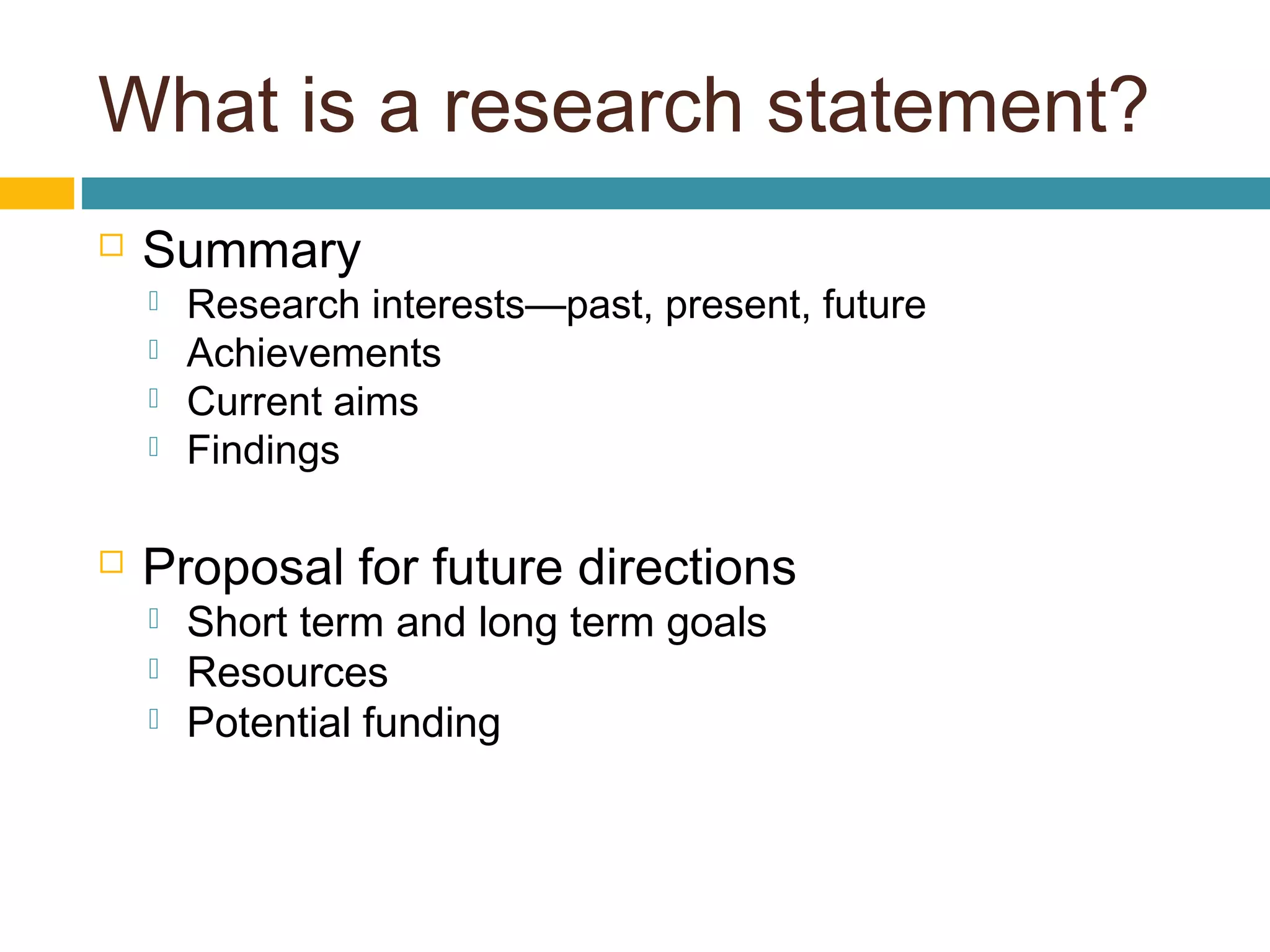
What is a research statement?
 Summary
 Research interests—past, present, future
 Achievements
 Current aims
 Findings
 Proposal for future directions
 Short term and long term goals
 Resources
 Potential funding
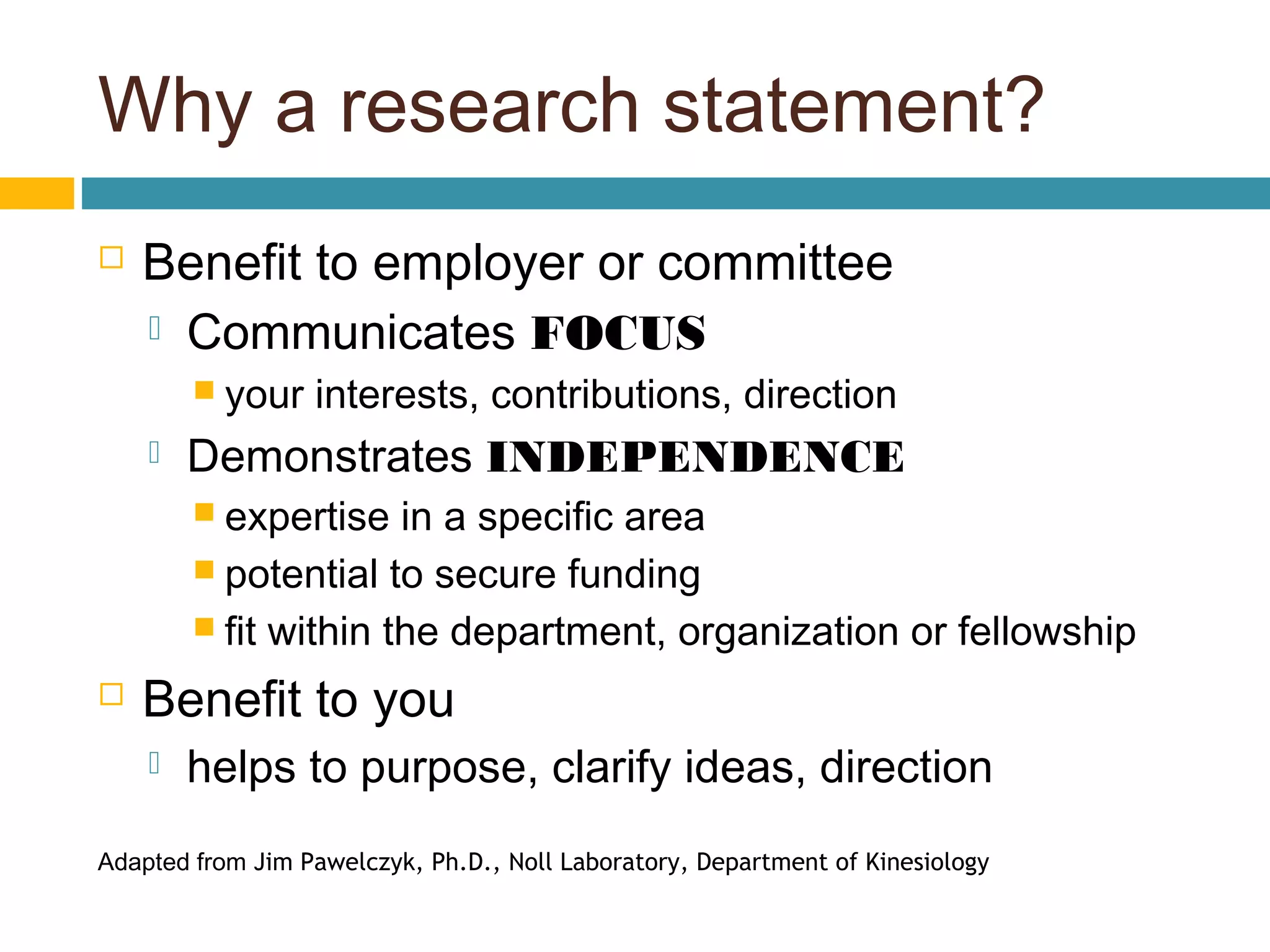
Why a research statement?
 Benefit to employer or committee
 Communicates FOCUS
 your interests, contributions, direction
 Demonstrates INDEPENDENCE
 expertise in a specific area
 potential to secure funding
 fit within the department, organization or fellowship
 Benefit to you
 helps to purpose, clarify ideas, direction
Adapted from Jim Pawelczyk, Ph.D., Noll Laboratory, Department of Kinesiology
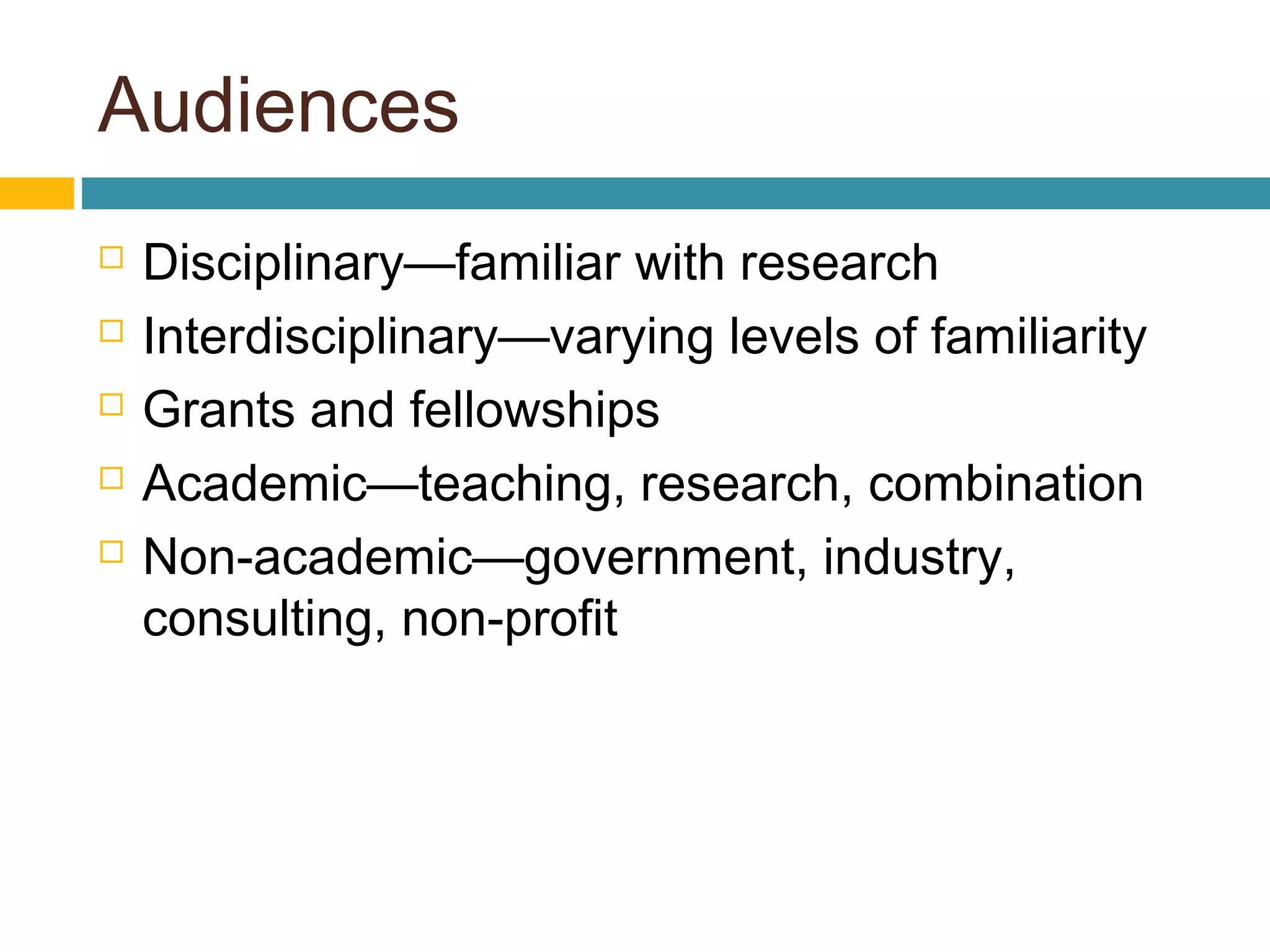
Audiences
 Disciplinary—familiar with research
 Interdisciplinary—varying levels of familiarity
 Grants and fellowships
 Academic—teaching, research, combination
 Non-academic—government, industry,
consulting, non-profit
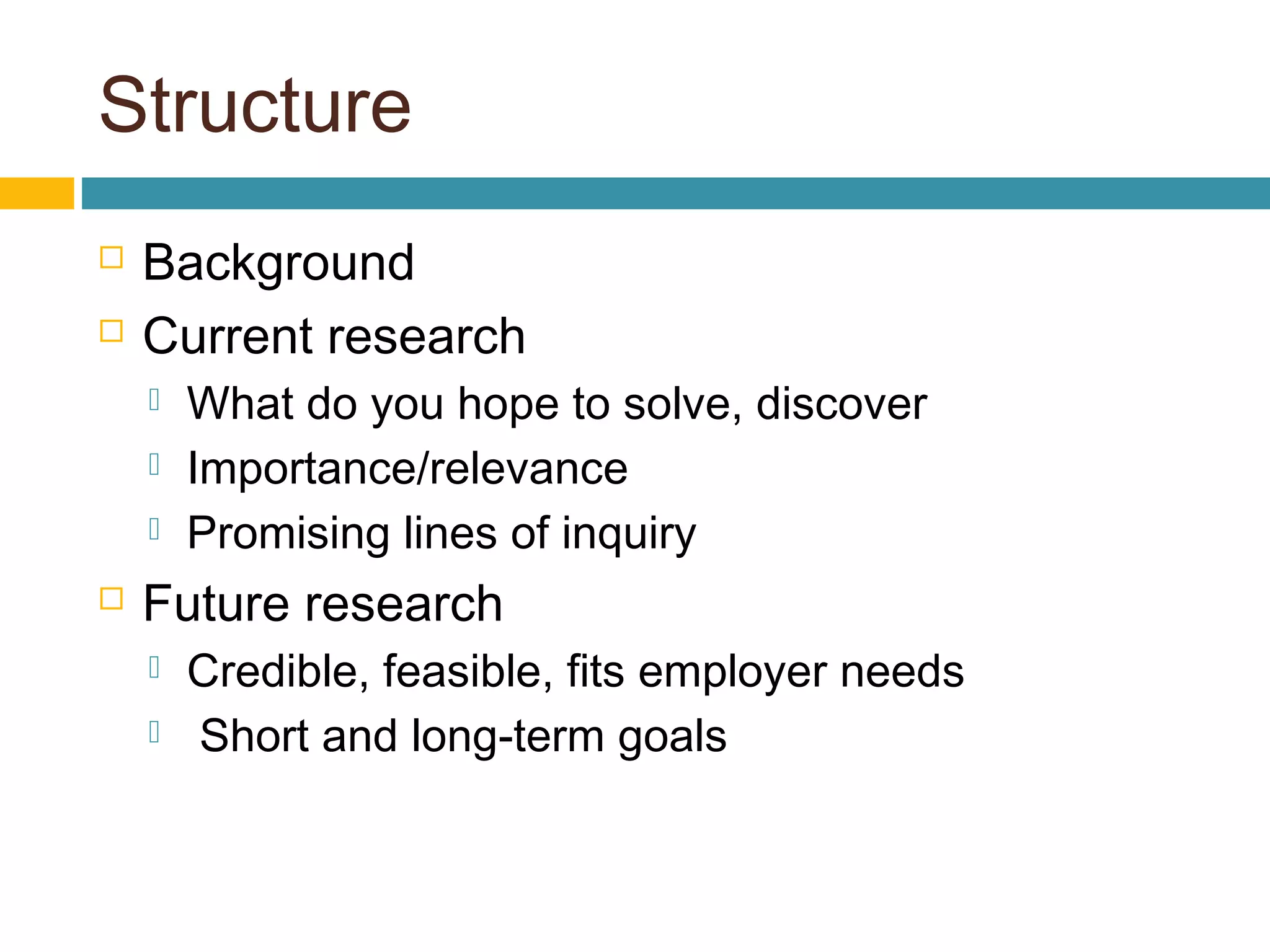
Structure
 Background
 Current research
 What do you hope to solve, discover
 Importance/relevance
 Promising lines of inquiry
 Future research
 Credible, feasible, fits employer needs
 Short and long-term goals
Style and Formatting
 Clear and concise
 Use headings and subheadings to highlight
significant topics
 No more than two pages
 No page-long paragraphs
 Get feedback from peers, senior graduate
students, postdocs and mentors
Content
 FOCUS
 Why is your research important
 What will you do within and beyond the time
allotted (fellowship, tenure process, etc.)
 INDEPENDENCE
 Logical progression from past, current, future
research
 Articulates why you are the best person to
conduct the research
 Show innovation—different from past research
Audience Analysis
Audience Analysis
 Job Posting – keywords, order, required/hoped
for
 Hiring Entity – mission, structure, context
 overall
 specific unit
 selection/hiring team
 Career Paths – short to long term
 institution’s pathways – tracks, hierarchies
 your current stage – starting place, initial phase
 your future goals – career home, scholarly growth
Audience Analysis
 Explicit and Implicit Dimensions of “Fit”
 academic specialty(ies) and interest(s)
 approach(es) to research
 methodological frame(s) / skills & synergies
 compatibility with local research efforts
 potential for earning funding / reputation
 other research-related duties set out in job
posting
Audience Analysis
 Explicit and Implicit Dimensions
 interplay of scholarly independence,
collaboration and leadership
 preparation for non-research dimensions of
research role: staff management, budgeting,
social networking the research, editorial skills
 preparation for presenting, teaching, mentoring,
and other public/interactive roles associated
with postion
Multiple Audiences
 Static Level
 Who are your readers – expert and not?
 What do you know about your readers – research
history, current goals, mission?
 What would your potential coworkers presume to
assume about you and your type of work?
 What do you assume and actually know about
research role/overall work life at targeted
institution?
 Given trends in targeted institution, what do
potential coworkers need to understand first and
foremost about you and your type of work?
Multiple Audiences
 Dynamic Level
 Job Posting / Position Description
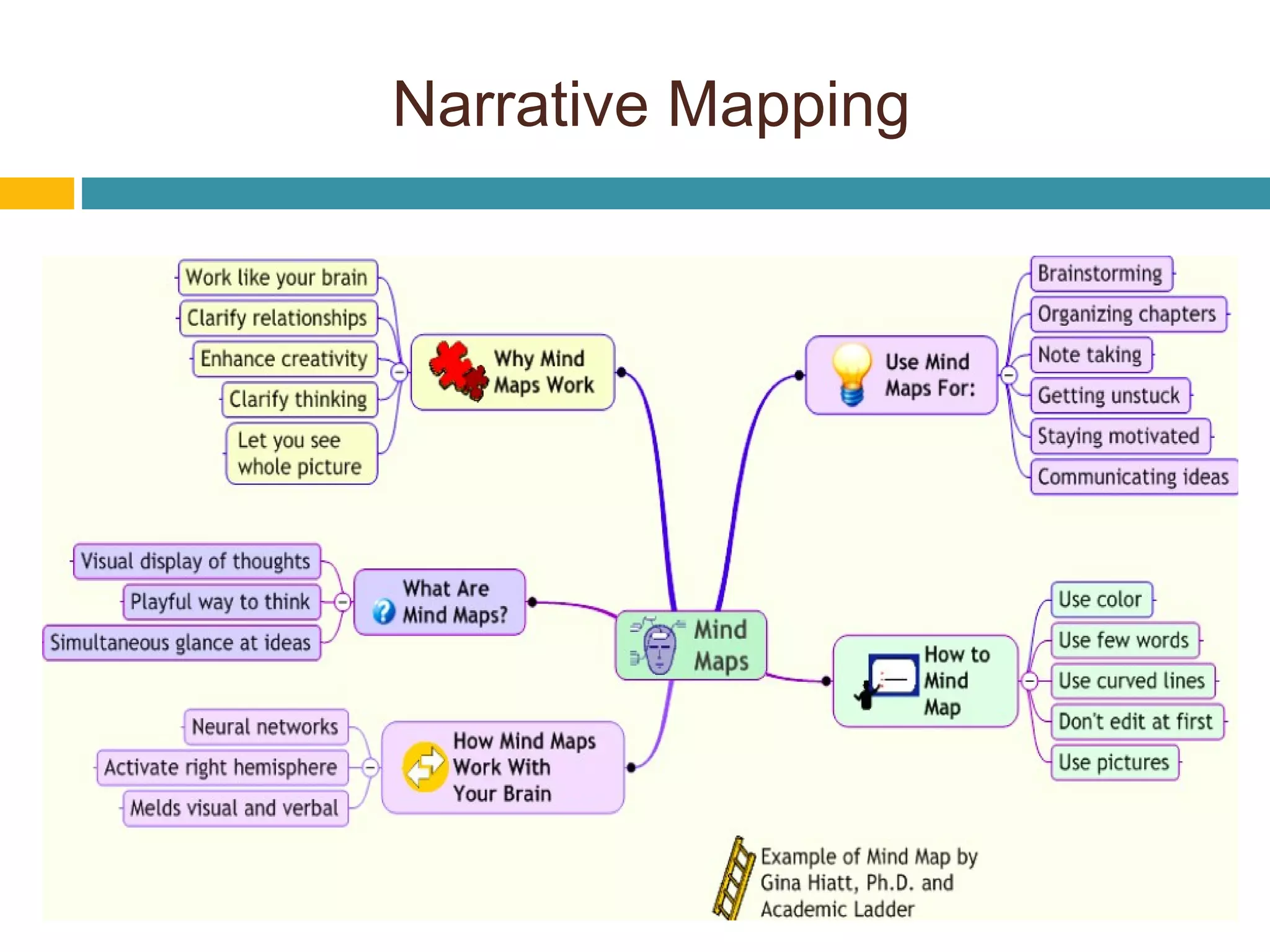
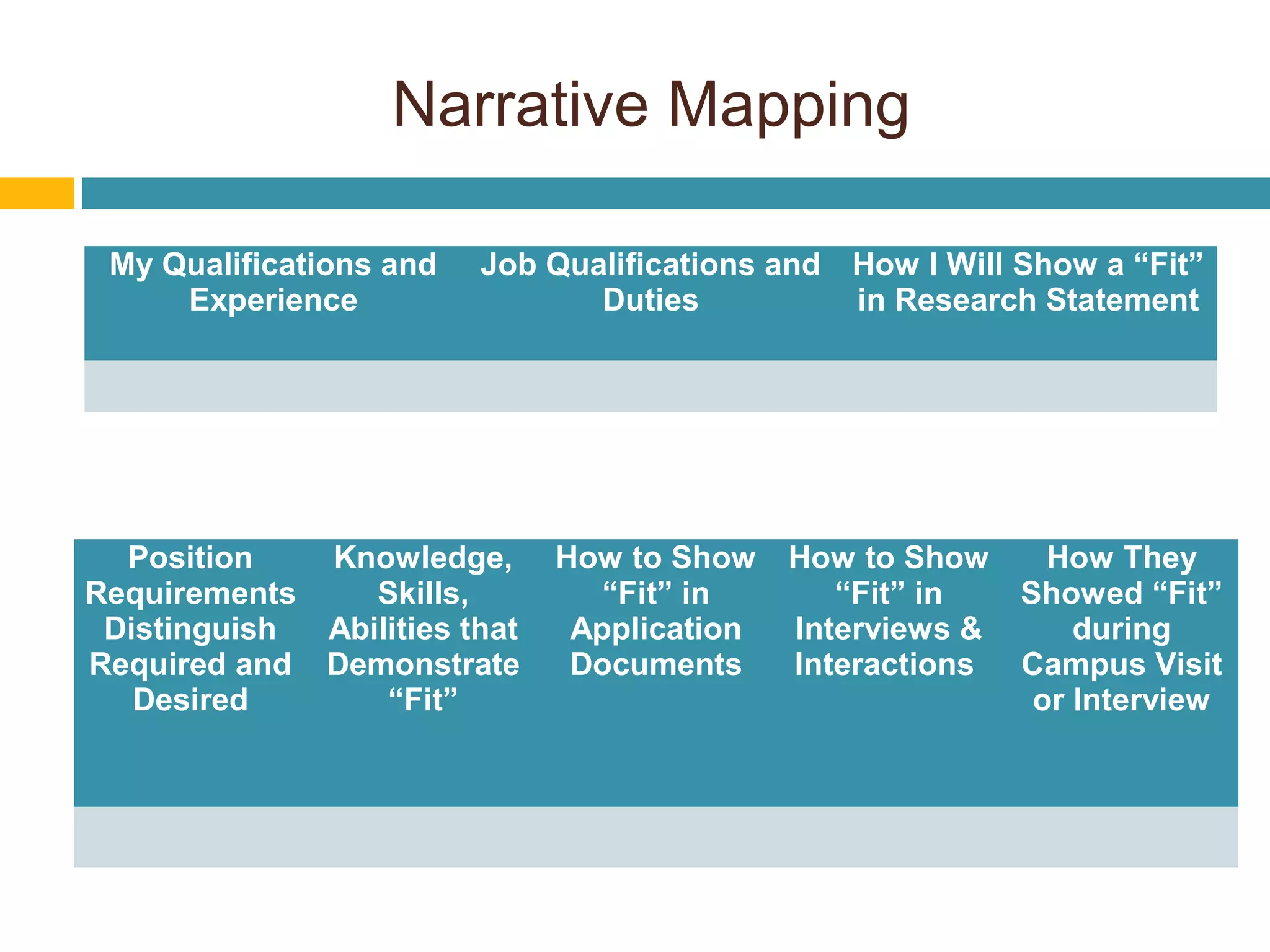
 Narrative Mapping
 Titling Documents
 Signposts & Keywords within Document
 Language throughout Document
 Professional Self across Documents
Narrative Mapping
Narrative Mapping
My Qualifications and
Experience
Job Qualifications and
Duties
How I Will Show a “Fit”
in Research Statement
Position
Requirements
Distinguish
Required and
Desired
Knowledge,
Skills,
Abilities that
Demonstrate
“Fit”
How to Show
“Fit” in
Application
Documents
How to Show
“Fit” in
Interviews &
Interactions
How They
Showed “Fit”
during
Campus Visit
or Interview
Research Statement
Grants and fellowships
Karin Matchett, Ph.D.
College of Veterinary Medicine
Describe your research
Your description of your research interests and
accomplishments must be extremely well thought out.
Often, the most effective way to work out your thoughts
is on paper, revision by revision.
To achieve optimal flow, tone, and language requires
reworking your initial draft and incorporating suggestions
that you garner from your colleagues. You must reach:
Researchers in your field
Readers outside your field
Structure the description of your
research
Before you delve into your research, you must
establish a compelling rationale for its
importance:
What’s the problem?
What’s the pressing need?
What’s the gap in knowledge that’s keeping us
from meeting the pressing need?
Problem, need, and gap in
knowledge
The problem
What is known?
What is currently unknown?
The pressing need
What is the most important need relative to this important
problem?
The gap in knowledge
What specific lack of knowledge is standing between us
and a solution to the problem?
Each component must be designed to point directly and ruthlessly
at your proposed research.
Choose your terminology carefully
Each of these can be expressed with more or less
technical detail. Your decisions about level of detail
must be based on your audience’s familiarity with your
research. Or lack thereof.
Problem
Pressing need
Gap in knowledge
In the research statement, you won’t use the terms of
conversation that you enjoy with your colleagues. For
the review panel, you must articulate your rationale and
your research more comprehensively and more
carefully.
What’s the problem?
Cancer
Metastasis
sLuD-modified core 5 N-glycans
What’s the pressing need?
More effective treatments
Strategies for halting metastatic tumors
Understanding the mechanism underlying the alteration
of sLuD-modified core 5 N-glycans
Approach
Now that you’ve outlined a compelling rationale
for the problem you’re addressing, the
description of your proposed work fits perfectly
into the gap you’ve described and justified.
If your research is hypothesis-driven:
I hypothesize that…
To test this hypothesis I will…
If not (explicitly) hypothesis-driven:
My approach will be to…
Impact
Finally, state clearly what the benefit of the completed
research will be—to your field and to the world.
A common first draft might go something like this:
“Upon completion, the proposed studies will provide
insight into the causes of social stratification among
urban teens.”
Good. Now push yourself to get more specific. Arriving
at a sharp, meaningful statement of the impact often
takes two or three revisions, each more specific than the
last.
Components of a strong
research statement
The problem
The specific sub-problem
The pressing needs, both large and small
What’s the major gap in knowledge?
What’s currently known?
What is unknown?
Your hypothesis
Your approach
The impact and benefit of your research
Dissertation fellowships
Describe your long-range scholarly and research goals,
looking ahead five years, in terms customized to the
expertise of your audience.
Explain why your research matters to scholars in the
field and to people outside of your field.
Be specific. Write in such a way as to help the non-
experts talk to one another about your work.
Describe your strategy for transitioning to independent
status in academia: your desired post-dissertation
position and potential funding sources for the next stage
of your research.
Postdoctoral fellowships
Describe your long-range scholarly and research
goals, looking ahead five to ten years, in terms
customized to the expertise of your audience.
Explain how you will exhibit leadership in your
mentoring activities.
Again, be specific!
Describe your strategy for transitioning to independent
status in academia: your plan for moving from the
postdoc to a faculty position or job in industry or
government, and your plan for securing funding for the
next stage of your research.
Interdisciplinary research: How you write and what
you say
The more interdisciplinary your research, the more
important it is to write clearly. Be even more careful to
not fall into a jargon-rich narrative.
Interdisciplinary research must be couched in
rationales that are persuasive to multiple audiences.
Choose your readers even more carefully, and make
sure they’re representative of the selection committee
(as best you can guess).
Even if you don’t think of your research as
interdisciplinary right now, cultivate the ability to
communicate and problem-solve across disciplines.
You never know!
Language and style
Keep the subject and verb close to one
another, to avoid exhausting your readers.
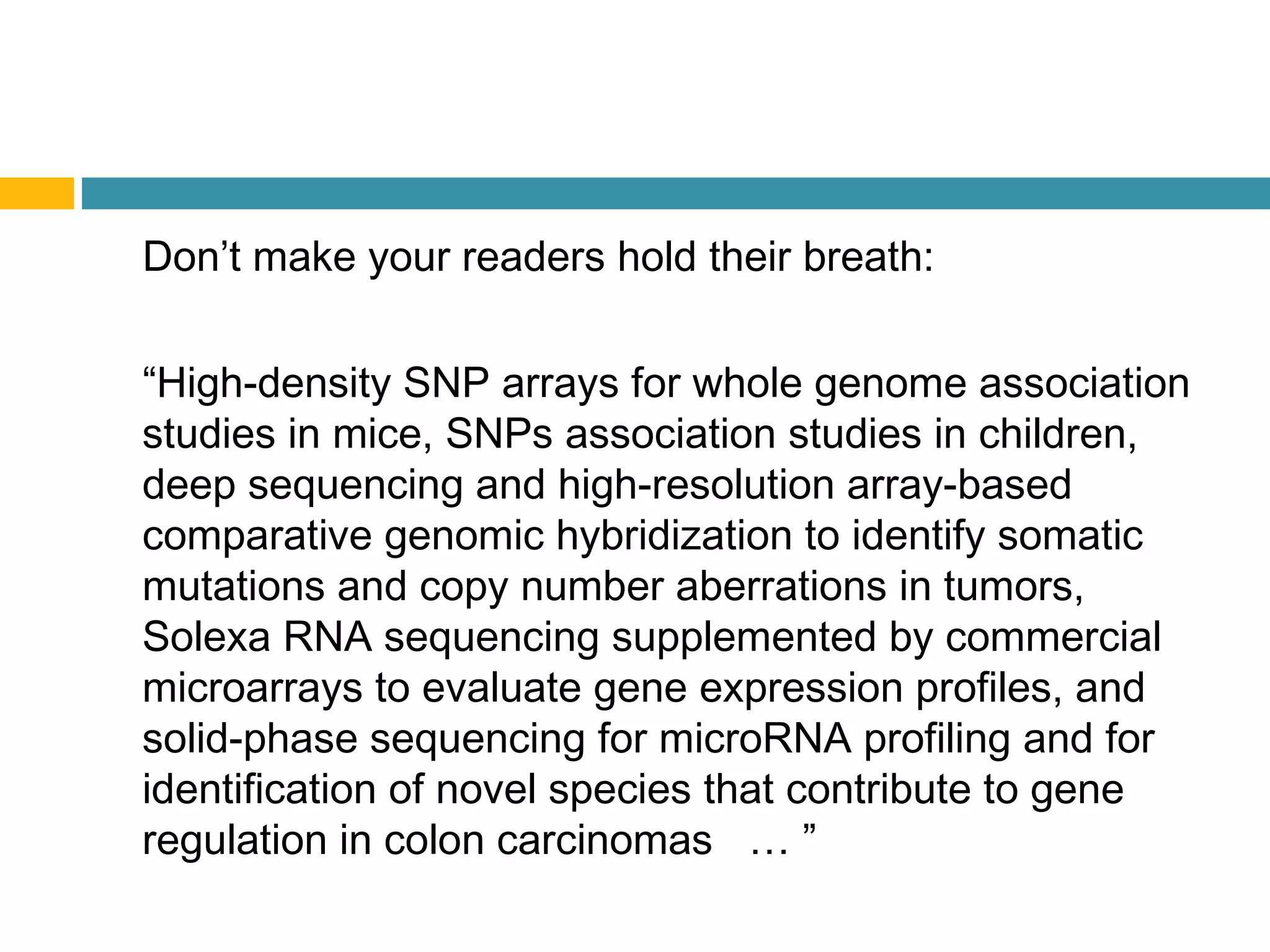
Don’t make your readers hold their breath:
“High-density SNP arrays for whole genome association
studies in mice, SNPs association studies in children,
deep sequencing and high-resolution array-based
comparative genomic hybridization to identify somatic
mutations and copy number aberrations in tumors,
Solexa RNA sequencing supplemented by commercial
microarrays to evaluate gene expression profiles, and
solid-phase sequencing for microRNA profiling and for
identification of novel species that contribute to gene
regulation in colon carcinomas … ”
“High-density SNP arrays for whole genome association
studies in mice, SNPs association studies in children,
deep sequencing and high-resolution array-based
comparative genomic hybridization to identify somatic
mutations and copy number aberrations in tumors,
Solexa RNA sequencing supplemented by commercial
microarrays to evaluate gene expression profiles, and
solid-phase sequencing for microRNA profiling and for
identification of novel species that contribute to gene
regulation in colon carcinomas have been well
established. [But these have left question X
unanswered.] In the proposed studies, we will develop a
novel approach…”
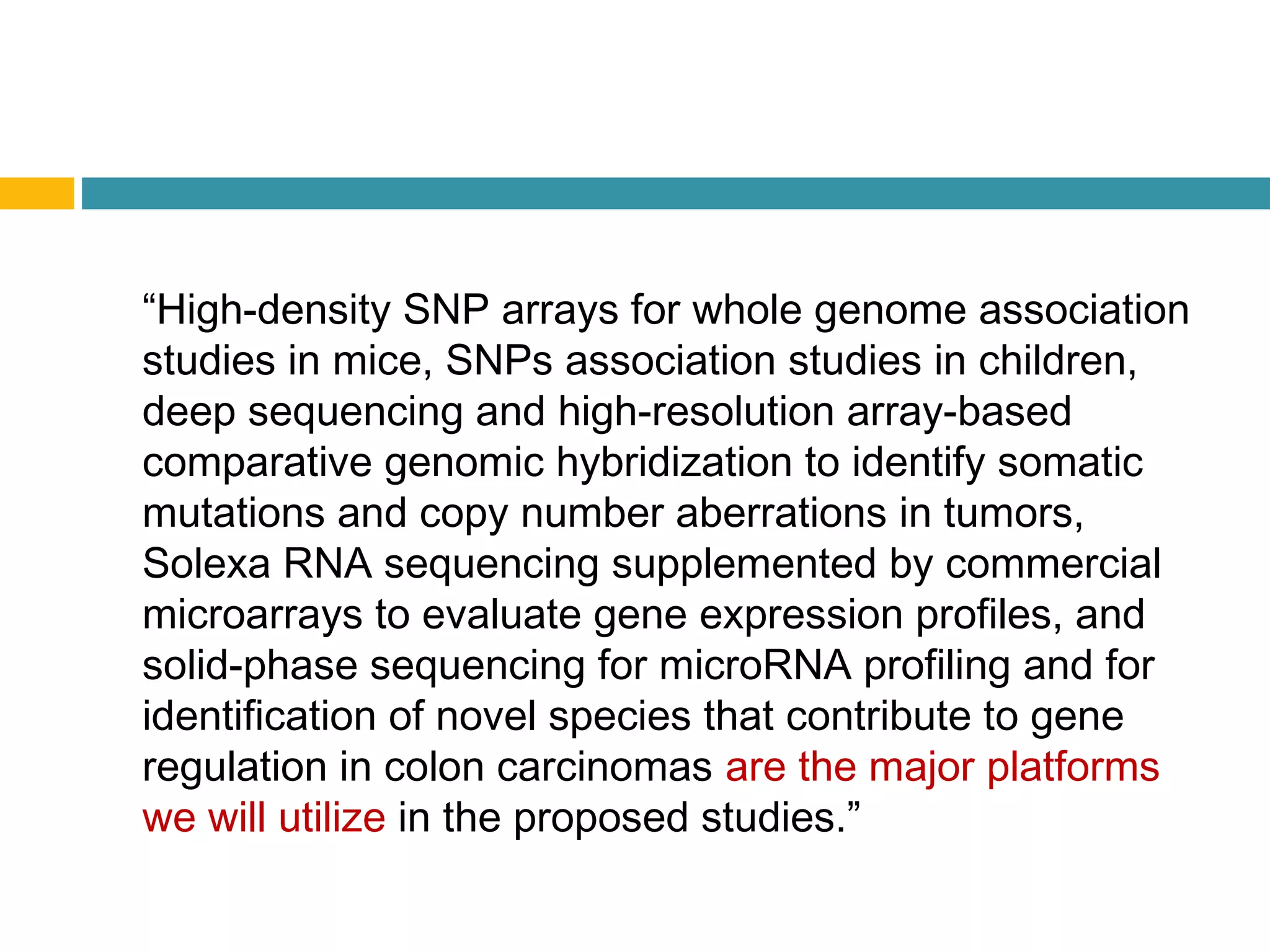
“High-density SNP arrays for whole genome association
studies in mice, SNPs association studies in children,
deep sequencing and high-resolution array-based
comparative genomic hybridization to identify somatic
mutations and copy number aberrations in tumors,
Solexa RNA sequencing supplemented by commercial
microarrays to evaluate gene expression profiles, and
solid-phase sequencing for microRNA profiling and for
identification of novel species that contribute to gene
regulation in colon carcinomas are the major platforms
we will utilize in the proposed studies.”
Language and style
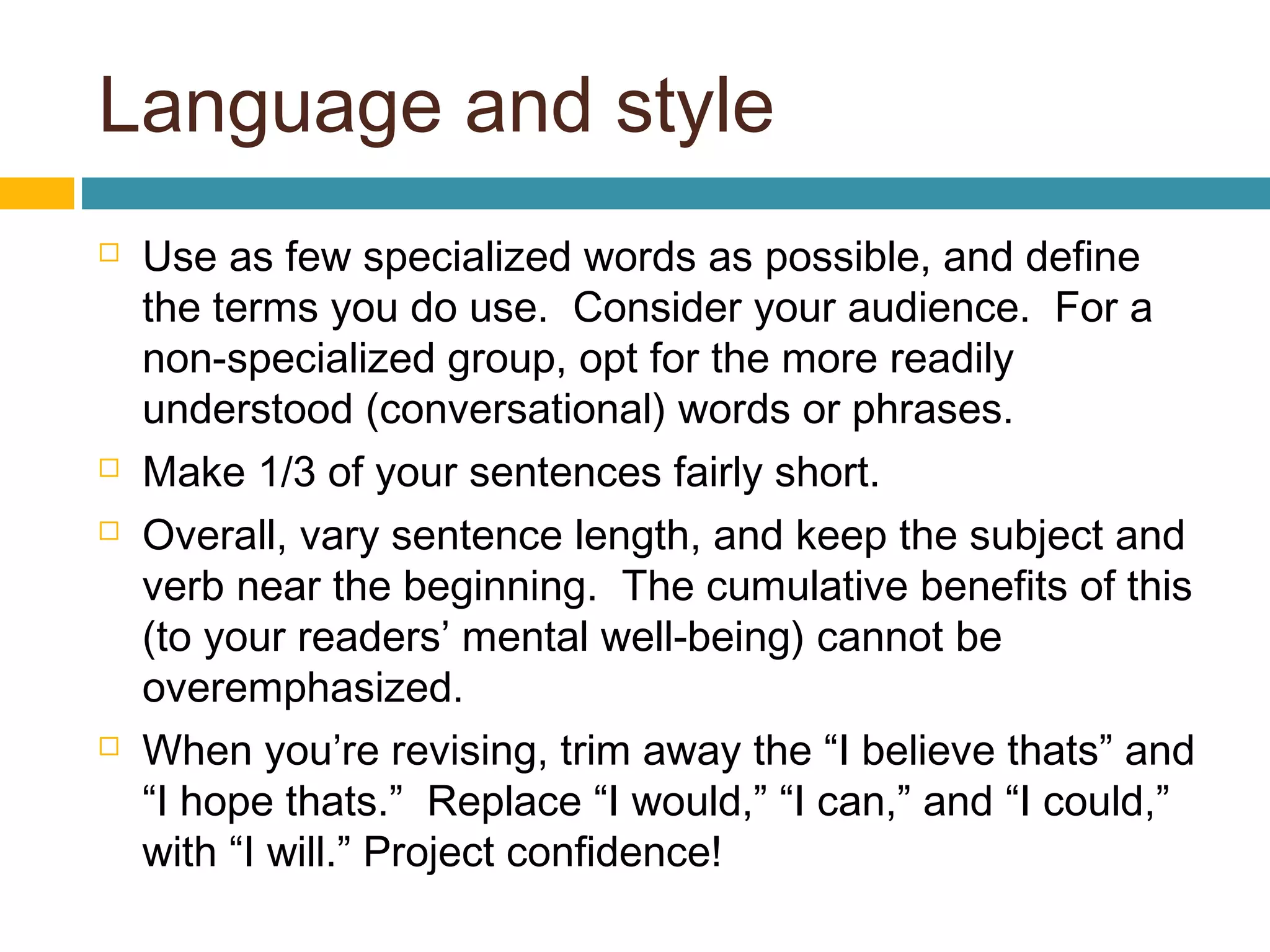
 Use as few specialized words as possible, and define
the terms you do use. Consider your audience. For a
non-specialized group, opt for the more readily
understood (conversational) words or phrases.
 Make 1/3 of your sentences fairly short.
 Overall, vary sentence length, and keep the subject and
verb near the beginning. The cumulative benefits of this
(to your readers’ mental well-being) cannot be
overemphasized.
 When you’re revising, trim away the “I believe thats” and
“I hope thats.” Replace “I would,” “I can,” and “I could,”
with “I will.” Project confidence!
Research Statements
Non-Academic Sectors
Noro Andriamanalina, Ph.D.
The Graduate Schol
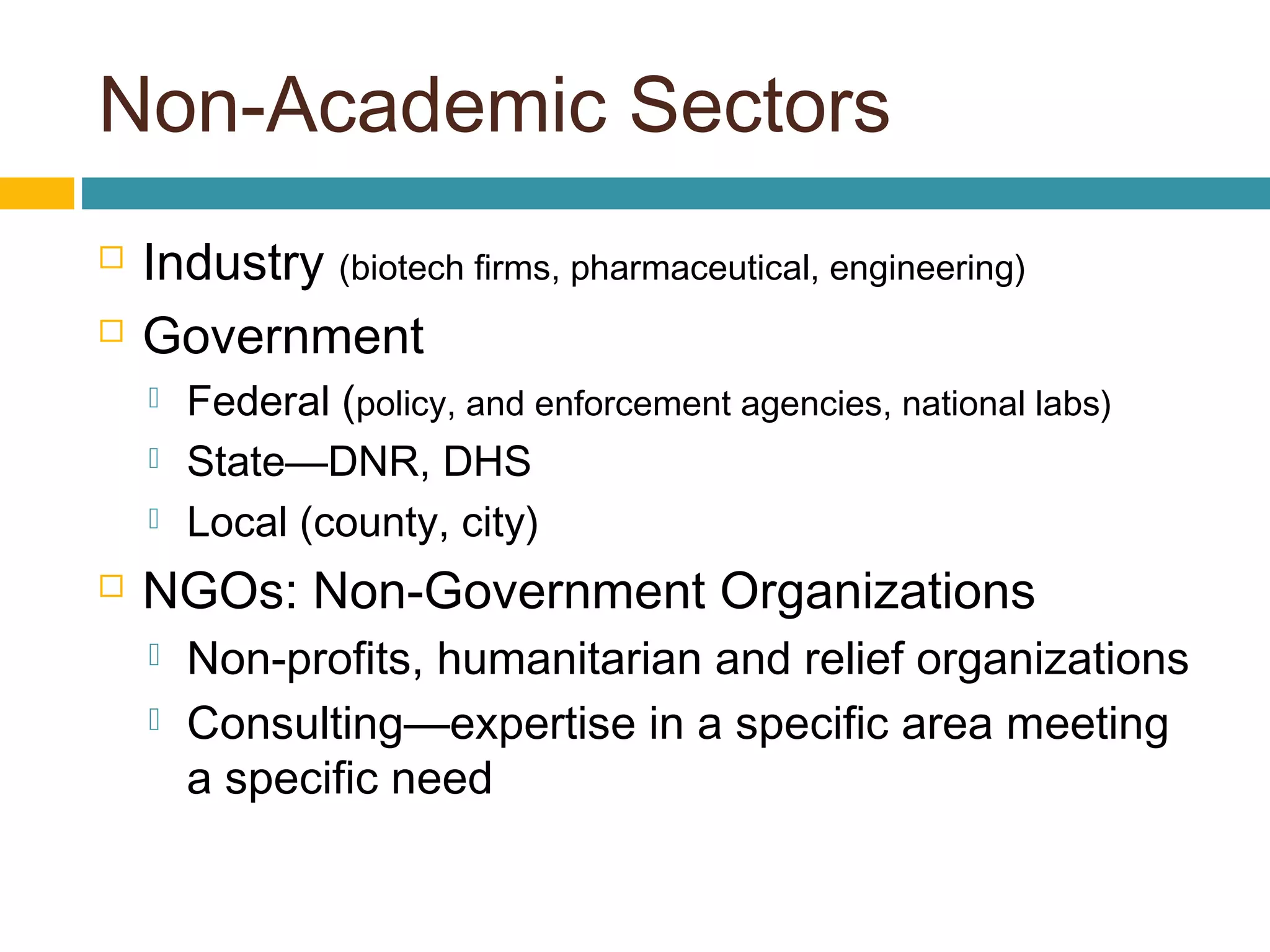
Non-Academic Sectors
 Industry (biotech firms, pharmaceutical, engineering)
 Government
 Federal (policy, and enforcement agencies, national labs)
 State—DNR, DHS
 Local (county, city)
 NGOs: Non-Government Organizations
 Non-profits, humanitarian and relief organizations
 Consulting—expertise in a specific area meeting
a specific need
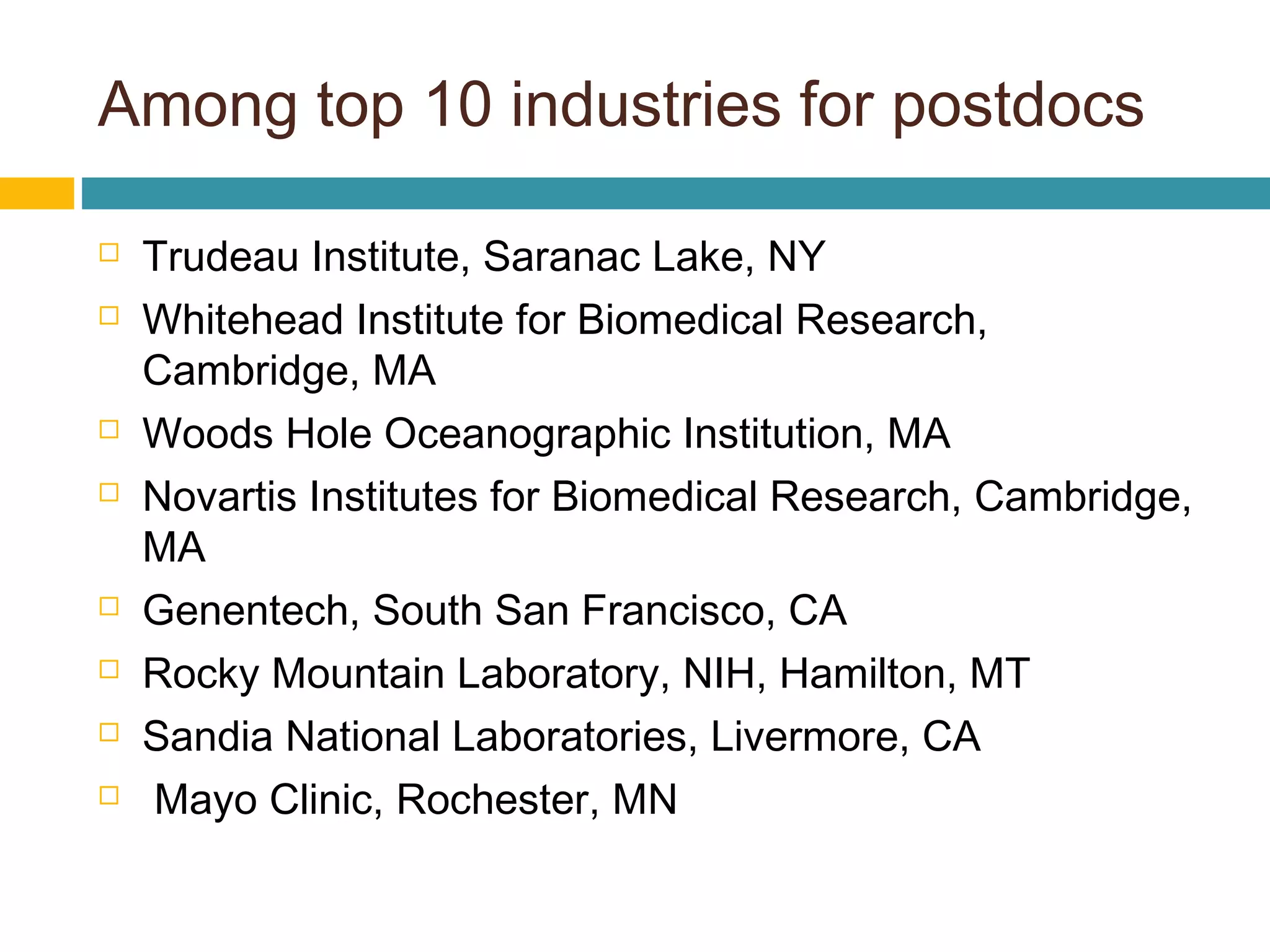
Among top 10 industries for postdocs
 Trudeau Institute, Saranac Lake, NY
 Whitehead Institute for Biomedical Research,
Cambridge, MA
 Woods Hole Oceanographic Institution, MA
 Novartis Institutes for Biomedical Research, Cambridge,
MA
 Genentech, South San Francisco, CA
 Rocky Mountain Laboratory, NIH, Hamilton, MT
 Sandia National Laboratories, Livermore, CA
 Mayo Clinic, Rochester, MN
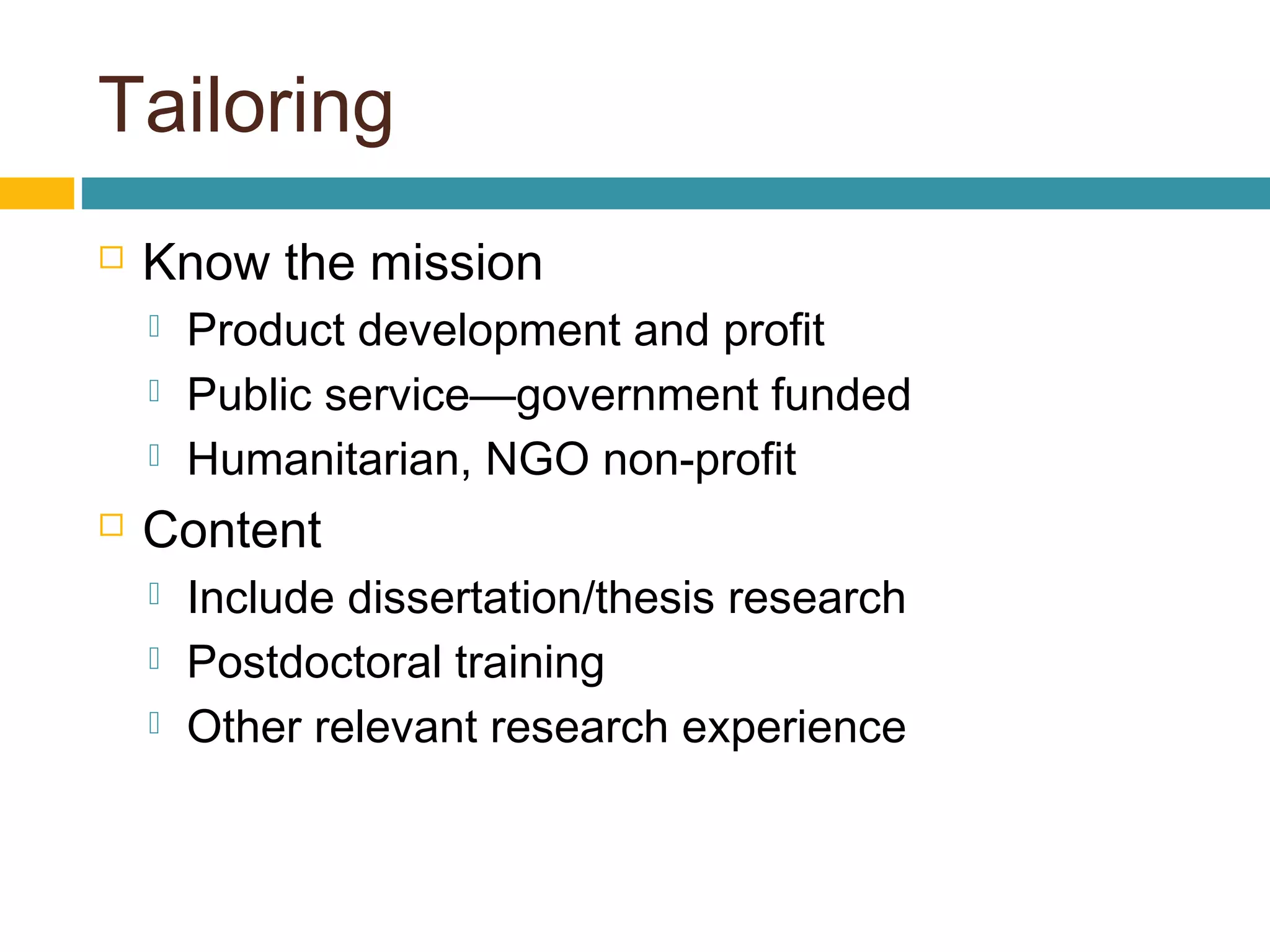
Tailoring
 Know the mission
 Product development and profit
 Public service—government funded
 Humanitarian, NGO non-profit
 Content
 Include dissertation/thesis research
 Postdoctoral training
 Other relevant research experience
Types of positions
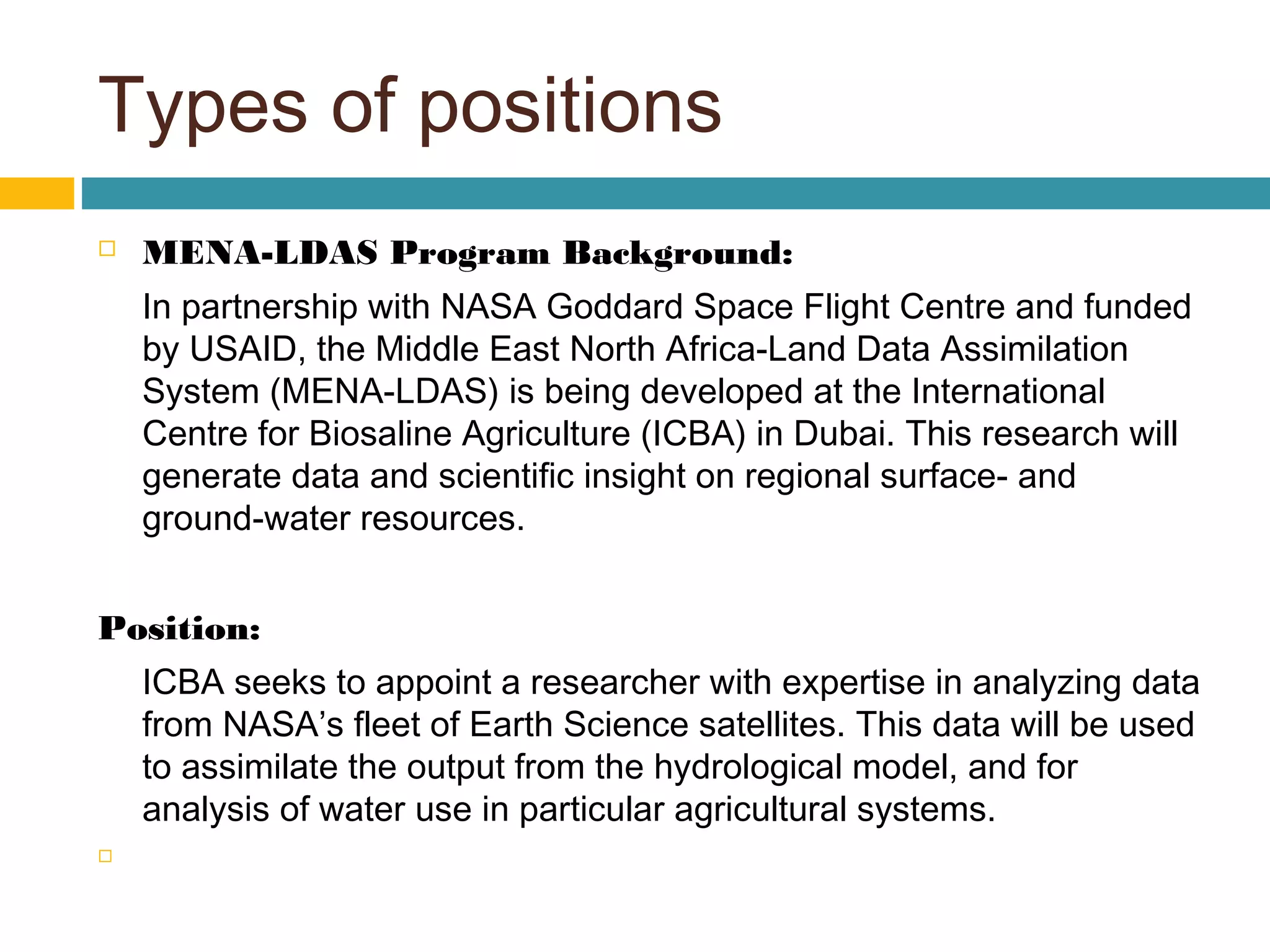
 MENA-LDAS Program Background:
In partnership with NASA Goddard Space Flight Centre and funded
by USAID, the Middle East North Africa-Land Data Assimilation
System (MENA-LDAS) is being developed at the International
Centre for Biosaline Agriculture (ICBA) in Dubai. This research will
generate data and scientific insight on regional surface- and
ground-water resources.
Position:
ICBA seeks to appoint a researcher with expertise in analyzing data
from NASA’s fleet of Earth Science satellites. This data will be used
to assimilate the output from the hydrological model, and for
analysis of water use in particular agricultural systems.
  
Types of positions
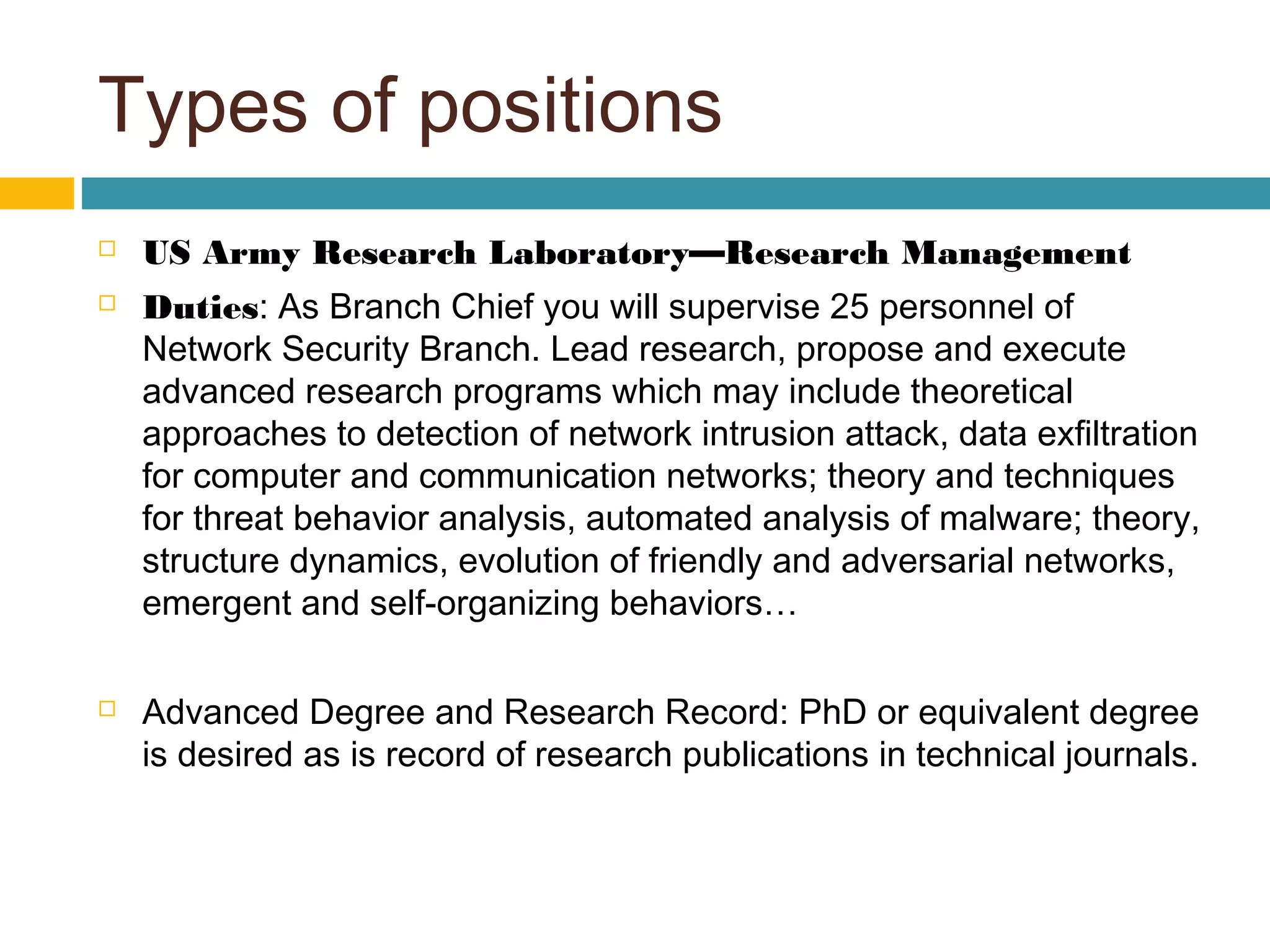
 US Army Research Laboratory—Research Management
 Duties: As Branch Chief you will supervise 25 personnel of
Network Security Branch. Lead research, propose and execute
advanced research programs which may include theoretical
approaches to detection of network intrusion attack, data exfiltration
for computer and communication networks; theory and techniques
for threat behavior analysis, automated analysis of malware; theory,
structure dynamics, evolution of friendly and adversarial networks,
emergent and self-organizing behaviors…
 Advanced Degree and Research Record: PhD or equivalent degree
is desired as is record of research publications in technical journals.
Types of positions
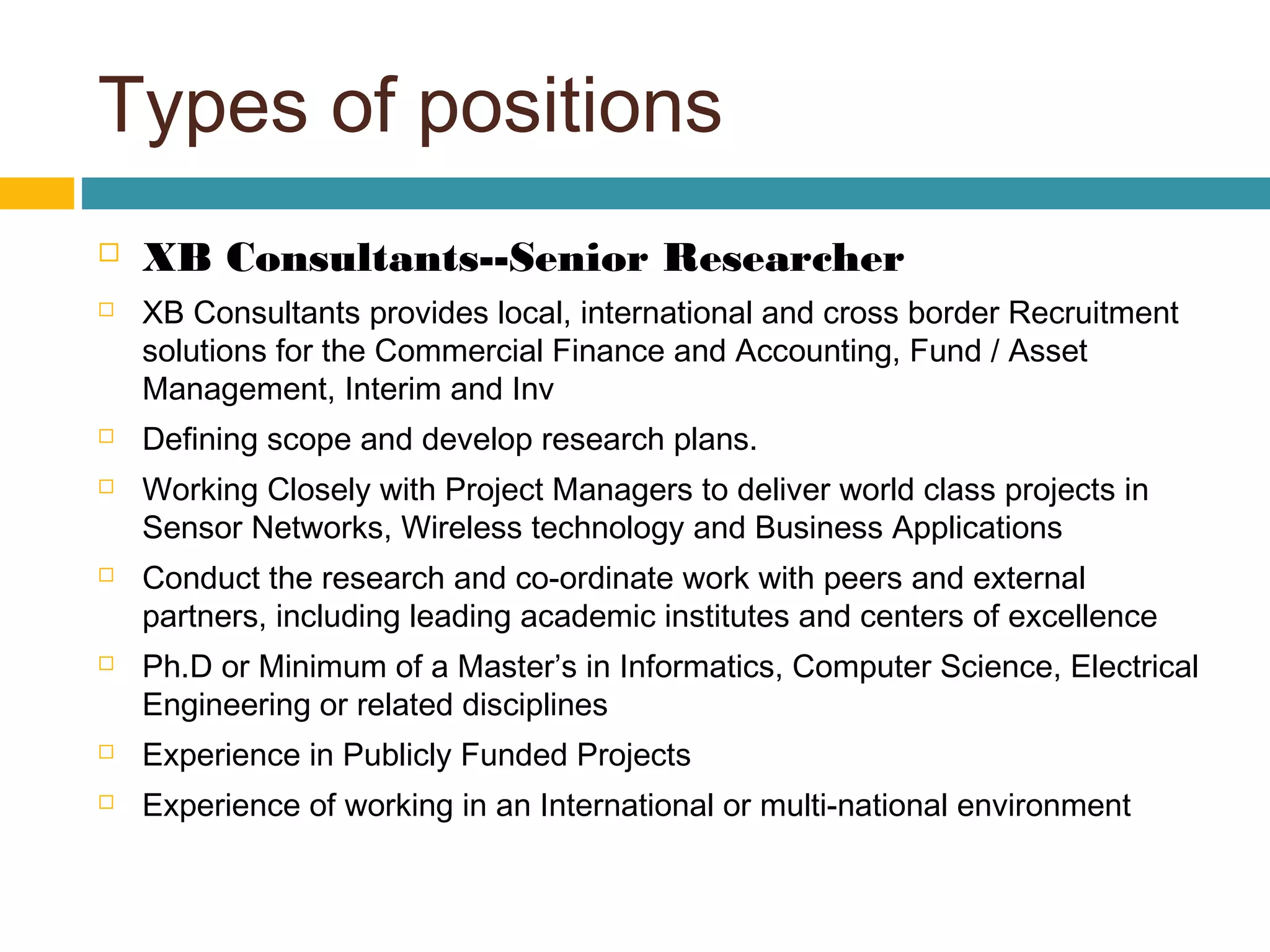
 XB Consultants--Senior Researcher
 XB Consultants provides local, international and cross border Recruitment
solutions for the Commercial Finance and Accounting, Fund / Asset
Management, Interim and Inv
 Defining scope and develop research plans.
 Working Closely with Project Managers to deliver world class projects in
Sensor Networks, Wireless technology and Business Applications
 Conduct the research and co-ordinate work with peers and external
partners, including leading academic institutes and centers of excellence
 Ph.D or Minimum of a Master’s in Informatics, Computer Science, Electrical
Engineering or related disciplines
 Experience in Publicly Funded Projects
 Experience of working in an International or multi-national environment
Interdisciplinary
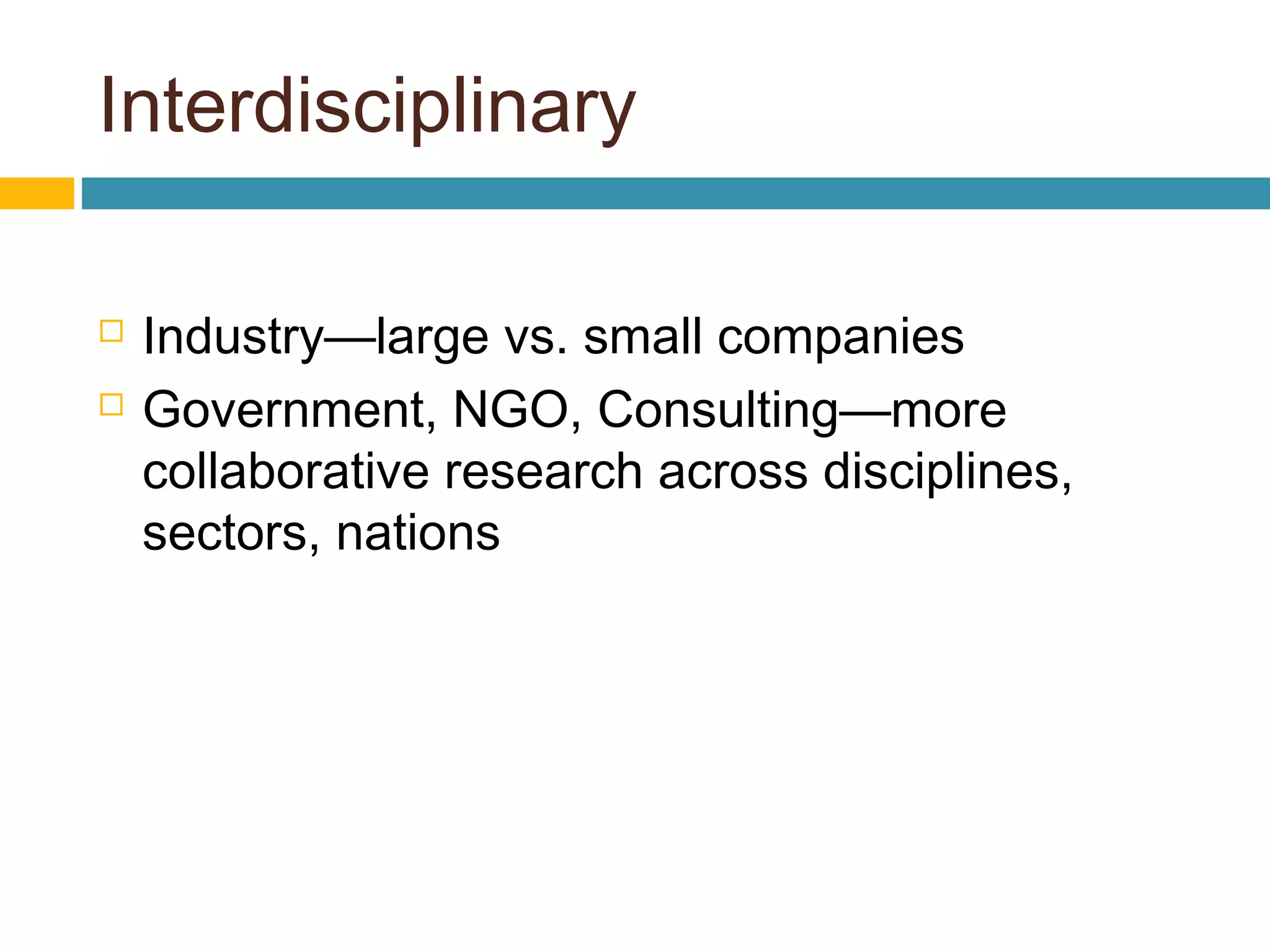
 Industry—large vs. small companies
 Government, NGO, Consulting—more
collaborative research across disciplines,
sectors, nations
Research Statements
Academic Positions
Keywords: nimble, nebulous, dynamic
 Ilene Alexander, Ph.D.
 Center for Teaching for Learning
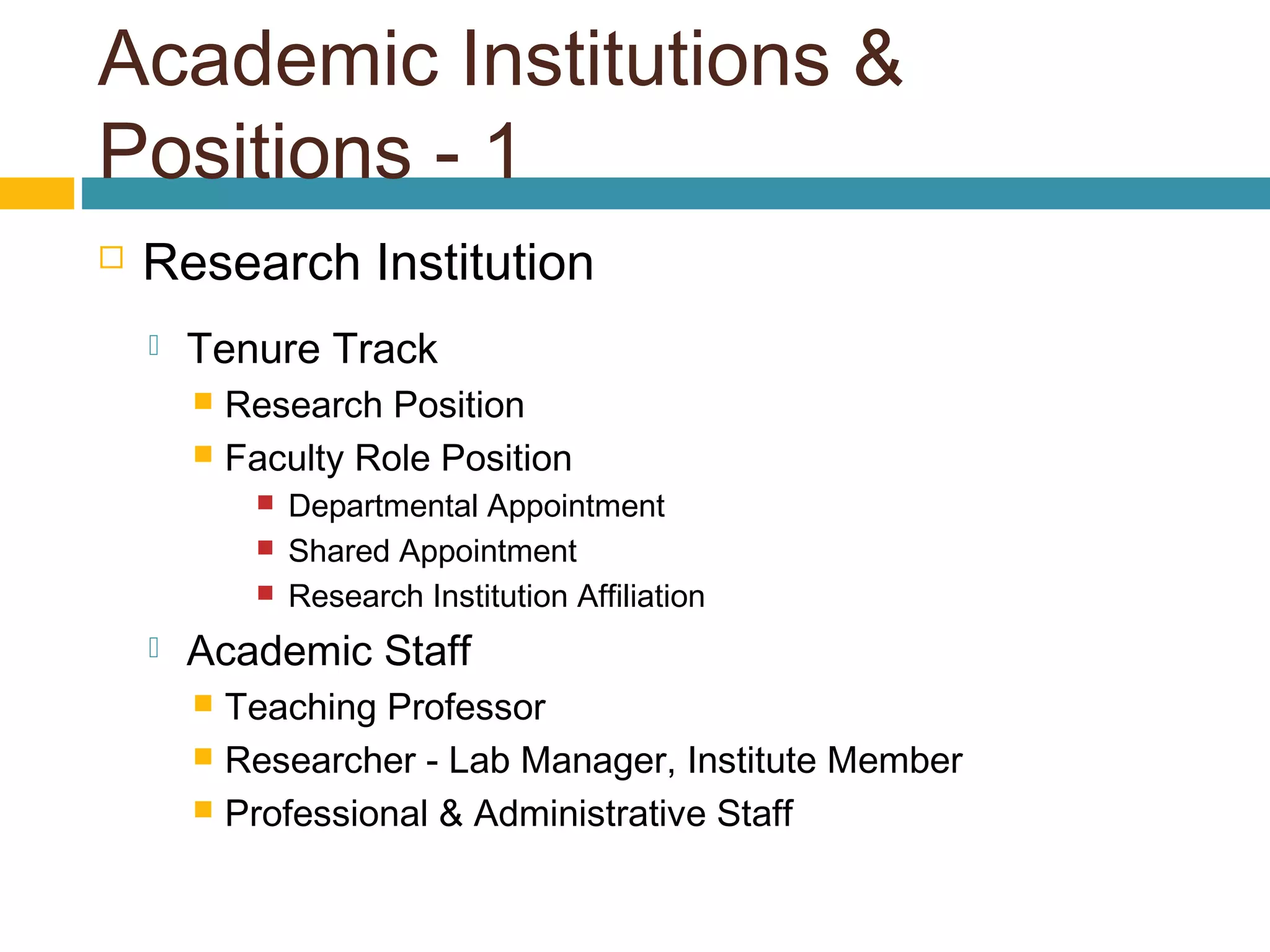
Academic Institutions &
Positions - 1
 Research Institution
 Tenure Track
 Research Position
 Faculty Role Position
 Departmental Appointment
 Shared Appointment
 Research Institution Affiliation
 Academic Staff
 Teaching Professor
 Researcher - Lab Manager, Institute Member
 Professional & Administrative Staff
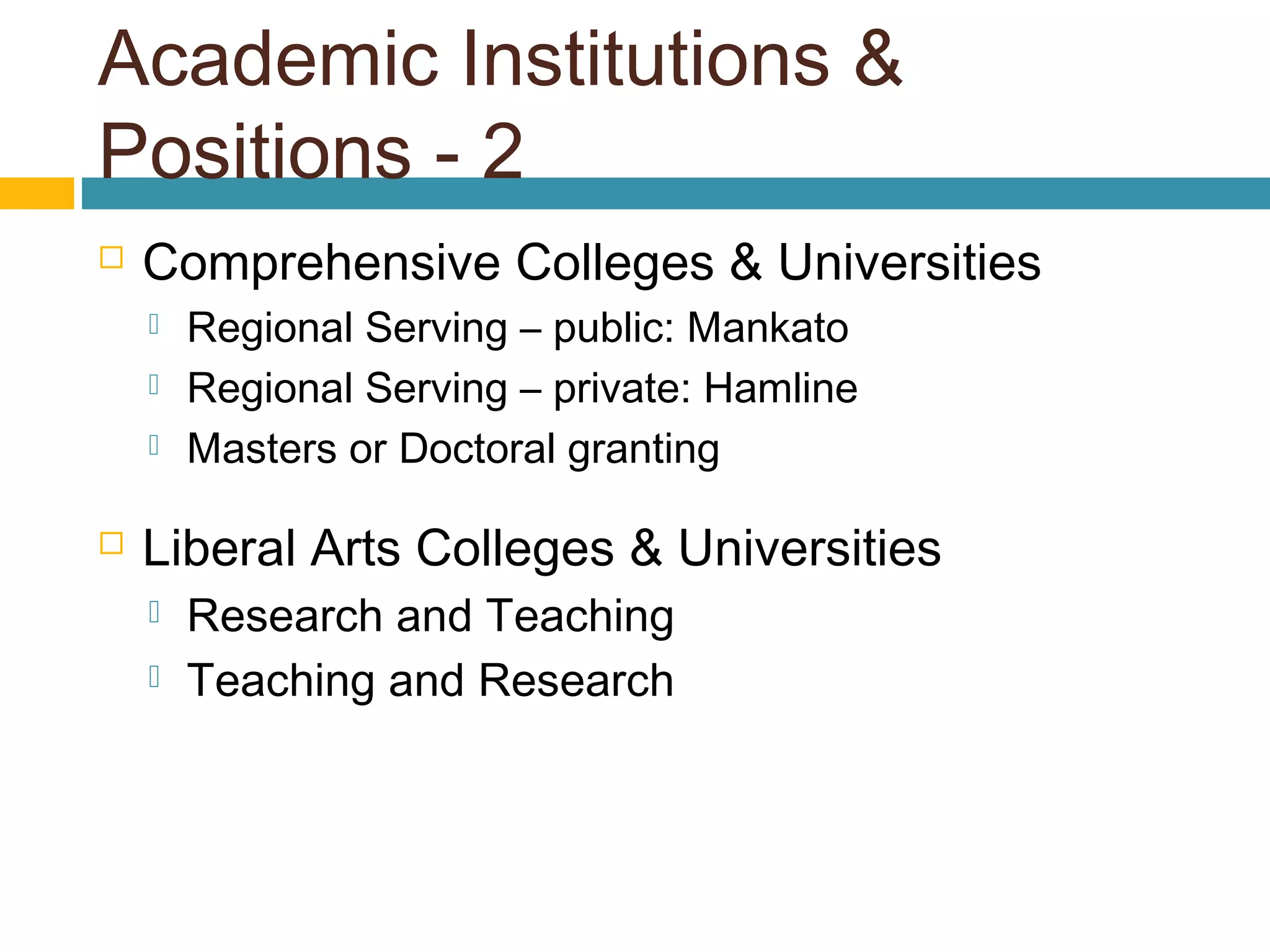
Academic Institutions &
Positions - 2
 Comprehensive Colleges & Universities
 Regional Serving – public: Mankato
 Regional Serving – private: Hamline
 Masters or Doctoral granting
 Liberal Arts Colleges & Universities
 Research and Teaching
 Teaching and Research
Tailoring - 1
 Diagram the position description
 Chart the audience analysis
 Establish just documents are being requested
 Research Statement
 Research Philosophy / Philosophy of Research
 Statement of Teaching and Research [Interests]
 Cover letter only, but directive about knowledge,
skills, abilities to be addressed
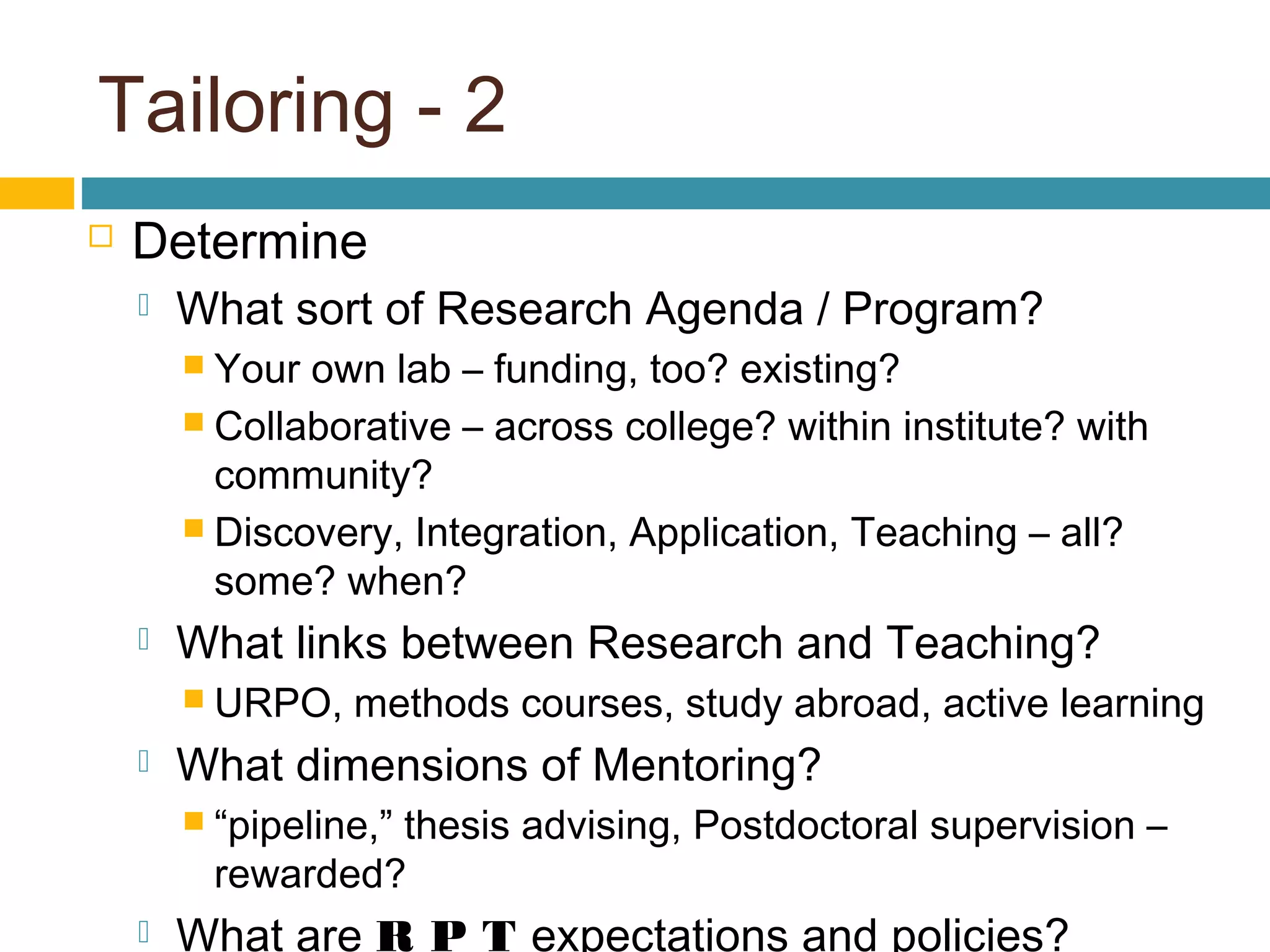
Tailoring - 2
 Determine
 What sort of Research Agenda / Program?
 Your own lab – funding, too? existing?
 Collaborative – across college? within institute? with
community?
 Discovery, Integration, Application, Teaching – all?
some? when?
 What links between Research and Teaching?
 URPO, methods courses, study abroad, active learning
 What dimensions of Mentoring?
 “pipeline,” thesis advising, Postdoctoral supervision –
rewarded?
 What are R P T expectations and policies?
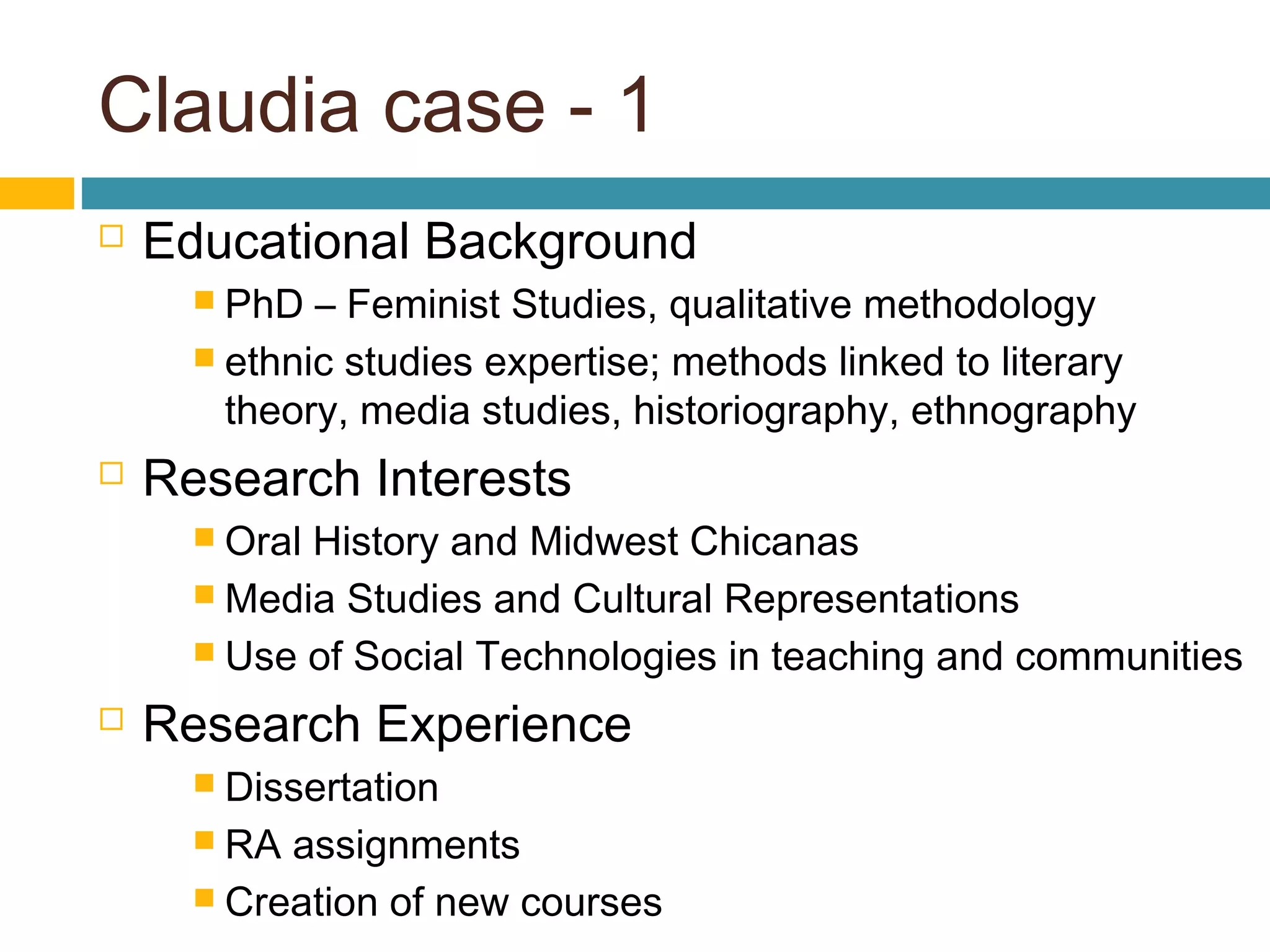
Claudia case - 1
 Educational Background
 PhD – Feminist Studies, qualitative methodology
 ethnic studies expertise; methods linked to literary
theory, media studies, historiography, ethnography
 Research Interests
 Oral History and Midwest Chicanas
 Media Studies and Cultural Representations
 Use of Social Technologies in teaching and communities
 Research Experience
 Dissertation
 RA assignments
 Creation of new courses
Claudia case - 2
 Possible Fits
 History
 Literature
 Chican@ Studies
 Gender / Women’s / Sexuality Studies
 Cultural Studies
 Unique Characteristics
 Technology
 In teaching
 In research
 As research
 Teaching Experience crosses 4 disciplines
 Work Experience includes educational community
Claudia case - 3
 Positions Applied for
 History – Comprehensive & Lib Arts; joint appts w/
WmSt
 Literature – Lib Arts asst prof w/ Chican@ expertise
 Chican@ Studies – R1 and Lib Arts, asst prof
positions
 Gender, Women’s, Sexuality Studies – all
institutional types for asst prof; multiple department
teaching expectations but single research & tenure
home
 Ethnic Studies – R1 postdocs, Lib Arts asst prof
 Variety of postdoctoral posts
Claudia case - 4
 Decisions in Writing about Research
 Three versions
 for single disciplines, incorporating Chican@ Studies
expertise
 Ethnic Studies positions, organizing based on job posting
 Women’s Studies positions, organized based on job
posting
 Three segments
 Current Research to Planned Next Stages
 Specifics regarding current, on-going, and future ways
of working with Students
 Long Term, first setting out a vision to convey research
philosophy as linked to student learning and community
Samples in the Handout Packet
 Applied Economist linking experimental
frameworks to policy issues by pursuing
research to generate knowledge, applying
behavioral insights to development, health and
environmental questions in collaboration with
private, public, academic sectors.
 Research Scientist from Psychology base
centering work around themes of diversity,
performance, health & well-being in
workplaces using various methodologies and
statistical techniques to address pressing
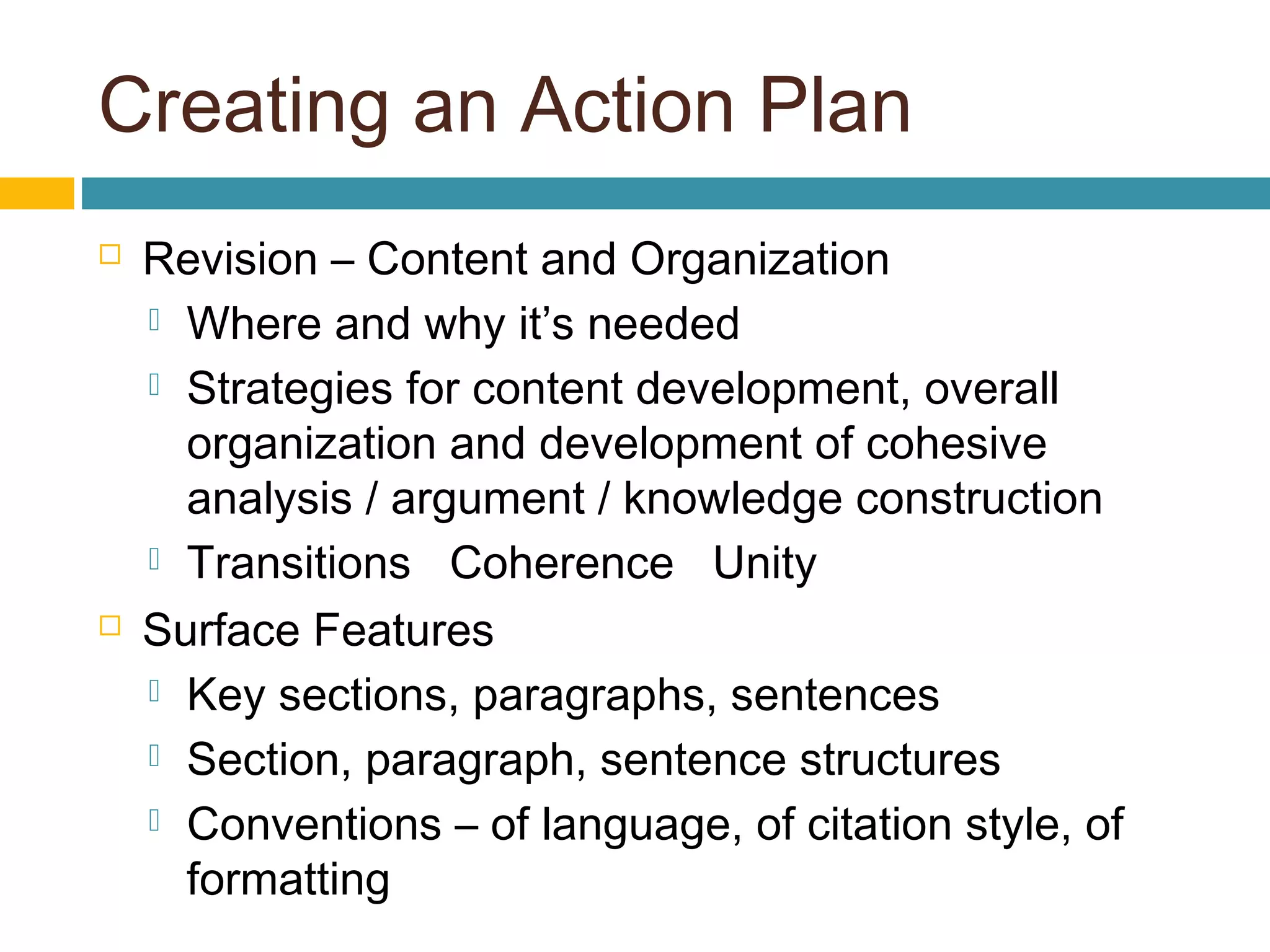
Creating an Action Plan
 Revision – Content and Organization
 Where and why it’s needed
 Strategies for content development, overall
organization and development of cohesive
analysis / argument / knowledge construction
 Transitions Coherence Unity
 Surface Features
 Key sections, paragraphs, sentences
 Section, paragraph, sentence structures
 Conventions – of language, of citation style, of
formatting
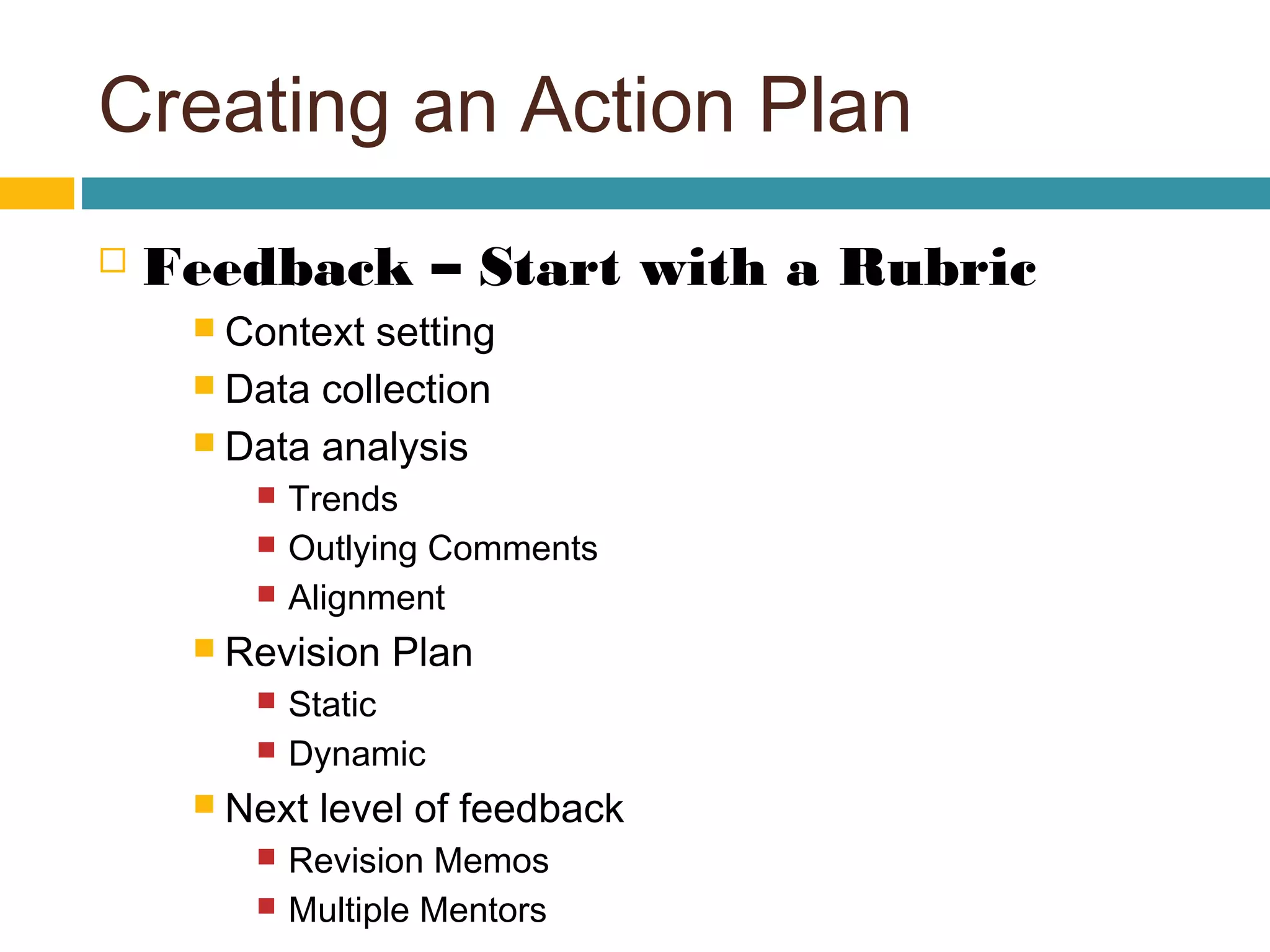
Creating an Action Plan
 Feedback – Start with a Rubric
 Context setting
 Data collection
 Data analysis
 Trends
 Outlying Comments
 Alignment
 Revision Plan
 Static
 Dynamic
 Next level of feedback
 Revision Memos
 Multiple Mentors
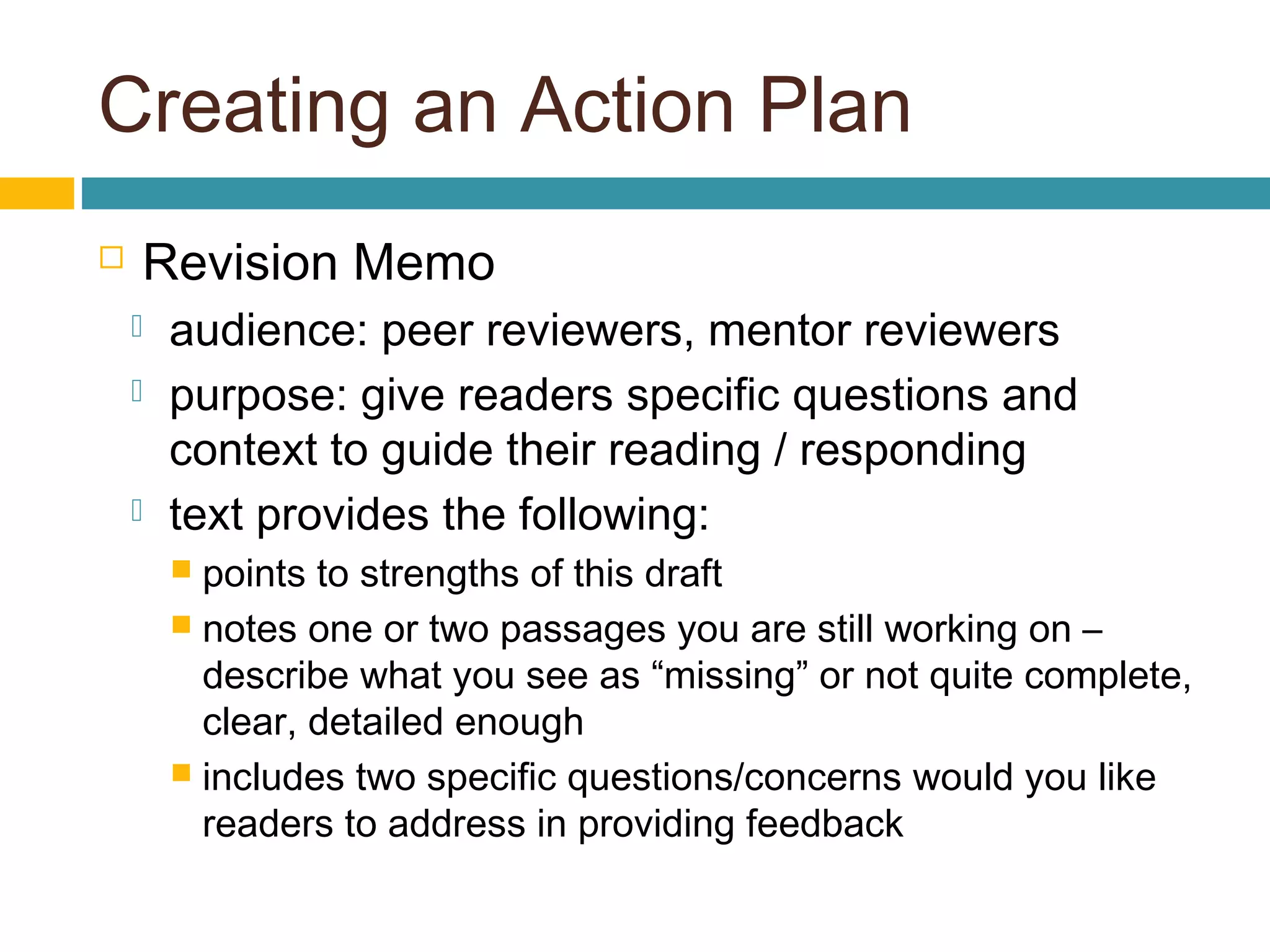
Creating an Action Plan
 Revision Memo
 audience: peer reviewers, mentor reviewers
 purpose: give readers specific questions and
context to guide their reading / responding
 text provides the following:
 points to strengths of this draft
 notes one or two passages you are still working on –
describe what you see as “missing” or not quite complete,
clear, detailed enough
 includes two specific questions/concerns would you like
readers to address in providing feedback
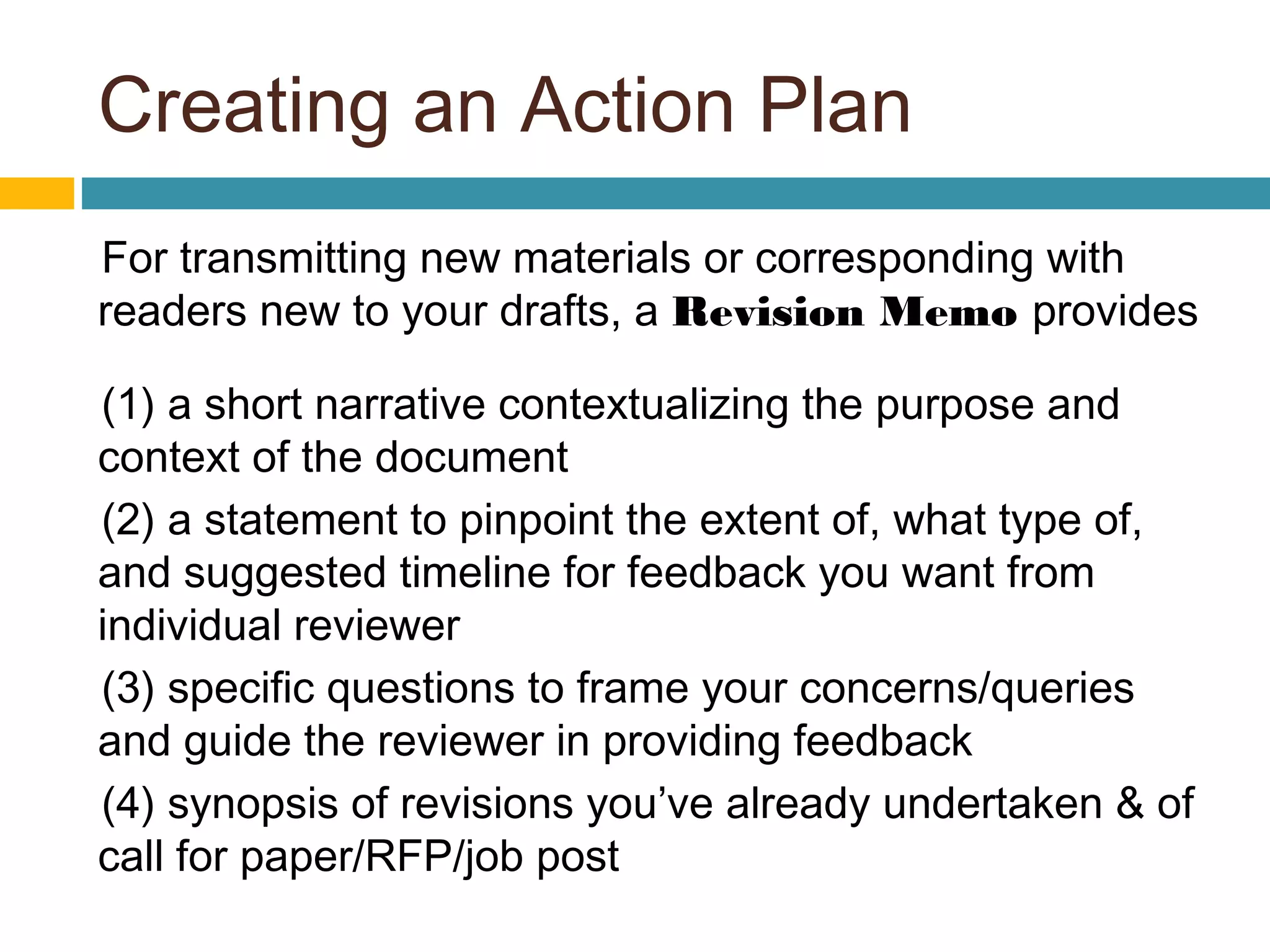
Creating an Action Plan
For transmitting new materials or corresponding with
readers new to your drafts, a Revision Memo provides
(1) a short narrative contextualizing the purpose and
context of the document
(2) a statement to pinpoint the extent of, what type of,
and suggested timeline for feedback you want from
individual reviewer
(3) specific questions to frame your concerns/queries
and guide the reviewer in providing feedback
(4) synopsis of revisions you’ve already undertaken & of
call for paper/RFP/job post

Writing a Research Statement

  • 1.
    WRITING EFFECTIVE RESEARCH STATEMENTS FORFELLOWSHIP & JOB APPLICATIONS Presenters Dr. Ilene Alexander, Center for Teaching and Learning Dr. Noro Andriamanalina, The Graduate School Dr. Karin Matchett, College of Veterinary Medicine
  • 2.
    WELCOME  Please makea name tag: name & graduate program  Find a seat according to interest: fellowship—front of room non-academic job—middle academic job—back of room
  • 3.
    Today’s Agenda  OpeningSegment  Purpose of the research statement  Audiences  Structures  Shaping for your audience(s)  Audience analysis  Grant/position description, institutional context  Decision making processes and conventions
  • 4.
    Today’s Agenda  Organizingfor the Specific Context  Fellowships/grants—dissertation, early career  Non-academic—industry, consulting, NGO, non- profit  Academic—institution, position type, research home  Create an Action Plan  Rubric    Peer review
  • 5.
    What is aresearch statement?  Summary  Research interests—past, present, future  Achievements  Current aims  Findings  Proposal for future directions  Short term and long term goals  Resources  Potential funding
  • 6.
    Why a researchstatement?  Benefit to employer or committee  Communicates FOCUS  your interests, contributions, direction  Demonstrates INDEPENDENCE  expertise in a specific area  potential to secure funding  fit within the department, organization or fellowship  Benefit to you  helps to purpose, clarify ideas, direction Adapted from Jim Pawelczyk, Ph.D., Noll Laboratory, Department of Kinesiology
  • 7.
    Audiences  Disciplinary—familiar withresearch  Interdisciplinary—varying levels of familiarity  Grants and fellowships  Academic—teaching, research, combination  Non-academic—government, industry, consulting, non-profit
  • 8.
    Structure  Background  Currentresearch  What do you hope to solve, discover  Importance/relevance  Promising lines of inquiry  Future research  Credible, feasible, fits employer needs  Short and long-term goals
  • 9.
    Style and Formatting Clear and concise  Use headings and subheadings to highlight significant topics  No more than two pages  No page-long paragraphs  Get feedback from peers, senior graduate students, postdocs and mentors
  • 10.
    Content  FOCUS  Whyis your research important  What will you do within and beyond the time allotted (fellowship, tenure process, etc.)  INDEPENDENCE  Logical progression from past, current, future research  Articulates why you are the best person to conduct the research  Show innovation—different from past research
  • 11.
  • 12.
    Audience Analysis  JobPosting – keywords, order, required/hoped for  Hiring Entity – mission, structure, context  overall  specific unit  selection/hiring team  Career Paths – short to long term  institution’s pathways – tracks, hierarchies  your current stage – starting place, initial phase  your future goals – career home, scholarly growth
  • 13.
    Audience Analysis  Explicitand Implicit Dimensions of “Fit”  academic specialty(ies) and interest(s)  approach(es) to research  methodological frame(s) / skills & synergies  compatibility with local research efforts  potential for earning funding / reputation  other research-related duties set out in job posting
  • 14.
    Audience Analysis  Explicitand Implicit Dimensions  interplay of scholarly independence, collaboration and leadership  preparation for non-research dimensions of research role: staff management, budgeting, social networking the research, editorial skills  preparation for presenting, teaching, mentoring, and other public/interactive roles associated with postion
  • 15.
    Multiple Audiences  StaticLevel  Who are your readers – expert and not?  What do you know about your readers – research history, current goals, mission?  What would your potential coworkers presume to assume about you and your type of work?  What do you assume and actually know about research role/overall work life at targeted institution?  Given trends in targeted institution, what do potential coworkers need to understand first and foremost about you and your type of work?
  • 16.
    Multiple Audiences  DynamicLevel  Job Posting / Position Description  Narrative Mapping  Titling Documents  Signposts & Keywords within Document  Language throughout Document  Professional Self across Documents
  • 17.
  • 18.
    Narrative Mapping My Qualificationsand Experience Job Qualifications and Duties How I Will Show a “Fit” in Research Statement Position Requirements Distinguish Required and Desired Knowledge, Skills, Abilities that Demonstrate “Fit” How to Show “Fit” in Application Documents How to Show “Fit” in Interviews & Interactions How They Showed “Fit” during Campus Visit or Interview
  • 19.
    Research Statement Grants andfellowships Karin Matchett, Ph.D. College of Veterinary Medicine
  • 20.
    Describe your research Yourdescription of your research interests and accomplishments must be extremely well thought out. Often, the most effective way to work out your thoughts is on paper, revision by revision. To achieve optimal flow, tone, and language requires reworking your initial draft and incorporating suggestions that you garner from your colleagues. You must reach: Researchers in your field Readers outside your field
  • 21.
    Structure the descriptionof your research Before you delve into your research, you must establish a compelling rationale for its importance: What’s the problem? What’s the pressing need? What’s the gap in knowledge that’s keeping us from meeting the pressing need?
  • 22.
    Problem, need, andgap in knowledge The problem What is known? What is currently unknown? The pressing need What is the most important need relative to this important problem? The gap in knowledge What specific lack of knowledge is standing between us and a solution to the problem? Each component must be designed to point directly and ruthlessly at your proposed research.
  • 23.
    Choose your terminologycarefully Each of these can be expressed with more or less technical detail. Your decisions about level of detail must be based on your audience’s familiarity with your research. Or lack thereof. Problem Pressing need Gap in knowledge In the research statement, you won’t use the terms of conversation that you enjoy with your colleagues. For the review panel, you must articulate your rationale and your research more comprehensively and more carefully.
  • 24.
    What’s the problem? Cancer Metastasis sLuD-modifiedcore 5 N-glycans What’s the pressing need? More effective treatments Strategies for halting metastatic tumors Understanding the mechanism underlying the alteration of sLuD-modified core 5 N-glycans
  • 25.
    Approach Now that you’veoutlined a compelling rationale for the problem you’re addressing, the description of your proposed work fits perfectly into the gap you’ve described and justified. If your research is hypothesis-driven: I hypothesize that… To test this hypothesis I will… If not (explicitly) hypothesis-driven: My approach will be to…
  • 26.
    Impact Finally, state clearlywhat the benefit of the completed research will be—to your field and to the world. A common first draft might go something like this: “Upon completion, the proposed studies will provide insight into the causes of social stratification among urban teens.” Good. Now push yourself to get more specific. Arriving at a sharp, meaningful statement of the impact often takes two or three revisions, each more specific than the last.
  • 27.
    Components of astrong research statement The problem The specific sub-problem The pressing needs, both large and small What’s the major gap in knowledge? What’s currently known? What is unknown? Your hypothesis Your approach The impact and benefit of your research
  • 28.
    Dissertation fellowships Describe yourlong-range scholarly and research goals, looking ahead five years, in terms customized to the expertise of your audience. Explain why your research matters to scholars in the field and to people outside of your field. Be specific. Write in such a way as to help the non- experts talk to one another about your work. Describe your strategy for transitioning to independent status in academia: your desired post-dissertation position and potential funding sources for the next stage of your research.
  • 29.
    Postdoctoral fellowships Describe yourlong-range scholarly and research goals, looking ahead five to ten years, in terms customized to the expertise of your audience. Explain how you will exhibit leadership in your mentoring activities. Again, be specific! Describe your strategy for transitioning to independent status in academia: your plan for moving from the postdoc to a faculty position or job in industry or government, and your plan for securing funding for the next stage of your research.
  • 30.
    Interdisciplinary research: Howyou write and what you say The more interdisciplinary your research, the more important it is to write clearly. Be even more careful to not fall into a jargon-rich narrative. Interdisciplinary research must be couched in rationales that are persuasive to multiple audiences. Choose your readers even more carefully, and make sure they’re representative of the selection committee (as best you can guess). Even if you don’t think of your research as interdisciplinary right now, cultivate the ability to communicate and problem-solve across disciplines. You never know!
  • 31.
    Language and style Keepthe subject and verb close to one another, to avoid exhausting your readers.
  • 32.
    Don’t make yourreaders hold their breath: “High-density SNP arrays for whole genome association studies in mice, SNPs association studies in children, deep sequencing and high-resolution array-based comparative genomic hybridization to identify somatic mutations and copy number aberrations in tumors, Solexa RNA sequencing supplemented by commercial microarrays to evaluate gene expression profiles, and solid-phase sequencing for microRNA profiling and for identification of novel species that contribute to gene regulation in colon carcinomas … ”
  • 33.
    “High-density SNP arraysfor whole genome association studies in mice, SNPs association studies in children, deep sequencing and high-resolution array-based comparative genomic hybridization to identify somatic mutations and copy number aberrations in tumors, Solexa RNA sequencing supplemented by commercial microarrays to evaluate gene expression profiles, and solid-phase sequencing for microRNA profiling and for identification of novel species that contribute to gene regulation in colon carcinomas have been well established. [But these have left question X unanswered.] In the proposed studies, we will develop a novel approach…”
  • 34.
    “High-density SNP arraysfor whole genome association studies in mice, SNPs association studies in children, deep sequencing and high-resolution array-based comparative genomic hybridization to identify somatic mutations and copy number aberrations in tumors, Solexa RNA sequencing supplemented by commercial microarrays to evaluate gene expression profiles, and solid-phase sequencing for microRNA profiling and for identification of novel species that contribute to gene regulation in colon carcinomas are the major platforms we will utilize in the proposed studies.”
  • 35.
    Language and style Use as few specialized words as possible, and define the terms you do use. Consider your audience. For a non-specialized group, opt for the more readily understood (conversational) words or phrases.  Make 1/3 of your sentences fairly short.  Overall, vary sentence length, and keep the subject and verb near the beginning. The cumulative benefits of this (to your readers’ mental well-being) cannot be overemphasized.  When you’re revising, trim away the “I believe thats” and “I hope thats.” Replace “I would,” “I can,” and “I could,” with “I will.” Project confidence!
  • 36.
    Research Statements Non-Academic Sectors NoroAndriamanalina, Ph.D. The Graduate Schol
  • 37.
    Non-Academic Sectors  Industry(biotech firms, pharmaceutical, engineering)  Government  Federal (policy, and enforcement agencies, national labs)  State—DNR, DHS  Local (county, city)  NGOs: Non-Government Organizations  Non-profits, humanitarian and relief organizations  Consulting—expertise in a specific area meeting a specific need
  • 38.
    Among top 10industries for postdocs  Trudeau Institute, Saranac Lake, NY  Whitehead Institute for Biomedical Research, Cambridge, MA  Woods Hole Oceanographic Institution, MA  Novartis Institutes for Biomedical Research, Cambridge, MA  Genentech, South San Francisco, CA  Rocky Mountain Laboratory, NIH, Hamilton, MT  Sandia National Laboratories, Livermore, CA  Mayo Clinic, Rochester, MN
  • 39.
    Tailoring  Know themission  Product development and profit  Public service—government funded  Humanitarian, NGO non-profit  Content  Include dissertation/thesis research  Postdoctoral training  Other relevant research experience
  • 40.
    Types of positions MENA-LDAS Program Background: In partnership with NASA Goddard Space Flight Centre and funded by USAID, the Middle East North Africa-Land Data Assimilation System (MENA-LDAS) is being developed at the International Centre for Biosaline Agriculture (ICBA) in Dubai. This research will generate data and scientific insight on regional surface- and ground-water resources. Position: ICBA seeks to appoint a researcher with expertise in analyzing data from NASA’s fleet of Earth Science satellites. This data will be used to assimilate the output from the hydrological model, and for analysis of water use in particular agricultural systems.   
  • 41.
    Types of positions US Army Research Laboratory—Research Management  Duties: As Branch Chief you will supervise 25 personnel of Network Security Branch. Lead research, propose and execute advanced research programs which may include theoretical approaches to detection of network intrusion attack, data exfiltration for computer and communication networks; theory and techniques for threat behavior analysis, automated analysis of malware; theory, structure dynamics, evolution of friendly and adversarial networks, emergent and self-organizing behaviors…  Advanced Degree and Research Record: PhD or equivalent degree is desired as is record of research publications in technical journals.
  • 42.
    Types of positions XB Consultants--Senior Researcher  XB Consultants provides local, international and cross border Recruitment solutions for the Commercial Finance and Accounting, Fund / Asset Management, Interim and Inv  Defining scope and develop research plans.  Working Closely with Project Managers to deliver world class projects in Sensor Networks, Wireless technology and Business Applications  Conduct the research and co-ordinate work with peers and external partners, including leading academic institutes and centers of excellence  Ph.D or Minimum of a Master’s in Informatics, Computer Science, Electrical Engineering or related disciplines  Experience in Publicly Funded Projects  Experience of working in an International or multi-national environment
  • 43.
    Interdisciplinary  Industry—large vs.small companies  Government, NGO, Consulting—more collaborative research across disciplines, sectors, nations
  • 44.
    Research Statements Academic Positions Keywords:nimble, nebulous, dynamic  Ilene Alexander, Ph.D.  Center for Teaching for Learning
  • 45.
    Academic Institutions & Positions- 1  Research Institution  Tenure Track  Research Position  Faculty Role Position  Departmental Appointment  Shared Appointment  Research Institution Affiliation  Academic Staff  Teaching Professor  Researcher - Lab Manager, Institute Member  Professional & Administrative Staff
  • 46.
    Academic Institutions & Positions- 2  Comprehensive Colleges & Universities  Regional Serving – public: Mankato  Regional Serving – private: Hamline  Masters or Doctoral granting  Liberal Arts Colleges & Universities  Research and Teaching  Teaching and Research
  • 47.
    Tailoring - 1 Diagram the position description  Chart the audience analysis  Establish just documents are being requested  Research Statement  Research Philosophy / Philosophy of Research  Statement of Teaching and Research [Interests]  Cover letter only, but directive about knowledge, skills, abilities to be addressed
  • 48.
    Tailoring - 2 Determine  What sort of Research Agenda / Program?  Your own lab – funding, too? existing?  Collaborative – across college? within institute? with community?  Discovery, Integration, Application, Teaching – all? some? when?  What links between Research and Teaching?  URPO, methods courses, study abroad, active learning  What dimensions of Mentoring?  “pipeline,” thesis advising, Postdoctoral supervision – rewarded?  What are R P T expectations and policies?
  • 49.
    Claudia case -1  Educational Background  PhD – Feminist Studies, qualitative methodology  ethnic studies expertise; methods linked to literary theory, media studies, historiography, ethnography  Research Interests  Oral History and Midwest Chicanas  Media Studies and Cultural Representations  Use of Social Technologies in teaching and communities  Research Experience  Dissertation  RA assignments  Creation of new courses
  • 50.
    Claudia case -2  Possible Fits  History  Literature  Chican@ Studies  Gender / Women’s / Sexuality Studies  Cultural Studies  Unique Characteristics  Technology  In teaching  In research  As research  Teaching Experience crosses 4 disciplines  Work Experience includes educational community
  • 51.
    Claudia case -3  Positions Applied for  History – Comprehensive & Lib Arts; joint appts w/ WmSt  Literature – Lib Arts asst prof w/ Chican@ expertise  Chican@ Studies – R1 and Lib Arts, asst prof positions  Gender, Women’s, Sexuality Studies – all institutional types for asst prof; multiple department teaching expectations but single research & tenure home  Ethnic Studies – R1 postdocs, Lib Arts asst prof  Variety of postdoctoral posts
  • 52.
    Claudia case -4  Decisions in Writing about Research  Three versions  for single disciplines, incorporating Chican@ Studies expertise  Ethnic Studies positions, organizing based on job posting  Women’s Studies positions, organized based on job posting  Three segments  Current Research to Planned Next Stages  Specifics regarding current, on-going, and future ways of working with Students  Long Term, first setting out a vision to convey research philosophy as linked to student learning and community
  • 53.
    Samples in theHandout Packet  Applied Economist linking experimental frameworks to policy issues by pursuing research to generate knowledge, applying behavioral insights to development, health and environmental questions in collaboration with private, public, academic sectors.  Research Scientist from Psychology base centering work around themes of diversity, performance, health & well-being in workplaces using various methodologies and statistical techniques to address pressing
  • 54.
    Creating an ActionPlan  Revision – Content and Organization  Where and why it’s needed  Strategies for content development, overall organization and development of cohesive analysis / argument / knowledge construction  Transitions Coherence Unity  Surface Features  Key sections, paragraphs, sentences  Section, paragraph, sentence structures  Conventions – of language, of citation style, of formatting
  • 55.
    Creating an ActionPlan  Feedback – Start with a Rubric  Context setting  Data collection  Data analysis  Trends  Outlying Comments  Alignment  Revision Plan  Static  Dynamic  Next level of feedback  Revision Memos  Multiple Mentors
  • 56.
    Creating an ActionPlan  Revision Memo  audience: peer reviewers, mentor reviewers  purpose: give readers specific questions and context to guide their reading / responding  text provides the following:  points to strengths of this draft  notes one or two passages you are still working on – describe what you see as “missing” or not quite complete, clear, detailed enough  includes two specific questions/concerns would you like readers to address in providing feedback
  • 57.
    Creating an ActionPlan For transmitting new materials or corresponding with readers new to your drafts, a Revision Memo provides (1) a short narrative contextualizing the purpose and context of the document (2) a statement to pinpoint the extent of, what type of, and suggested timeline for feedback you want from individual reviewer (3) specific questions to frame your concerns/queries and guide the reviewer in providing feedback (4) synopsis of revisions you’ve already undertaken & of call for paper/RFP/job post