The Next Step in Your
Biomedical Sciences Career
C Gita Bosch, PhD, MBA
Academic & Educational Consulting
theacademicconsultant.com
Topics to be covered
 Preparing and planning for
graduate/professional school – the
undergraduate years
 Finding information and selecting a school
 The application and admissions process
 Financing your education
B
theacademicconsultant.com
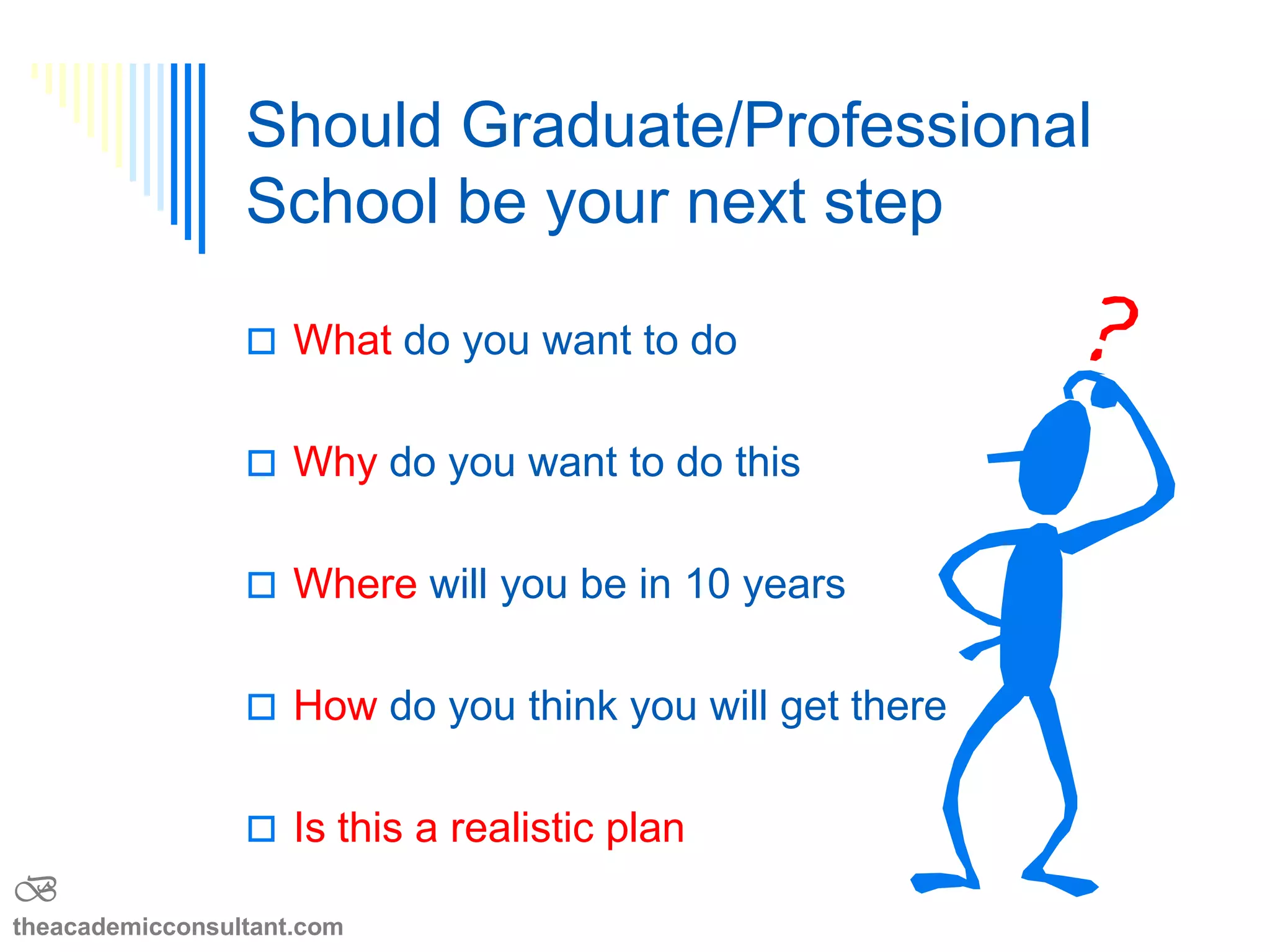
What is your right next step
 What do you want to do
 Why do you want to do this
 Where will you be in 10 years
 How do you think you will get there
 Is this a realistic plan
B
theacademicconsultant.com
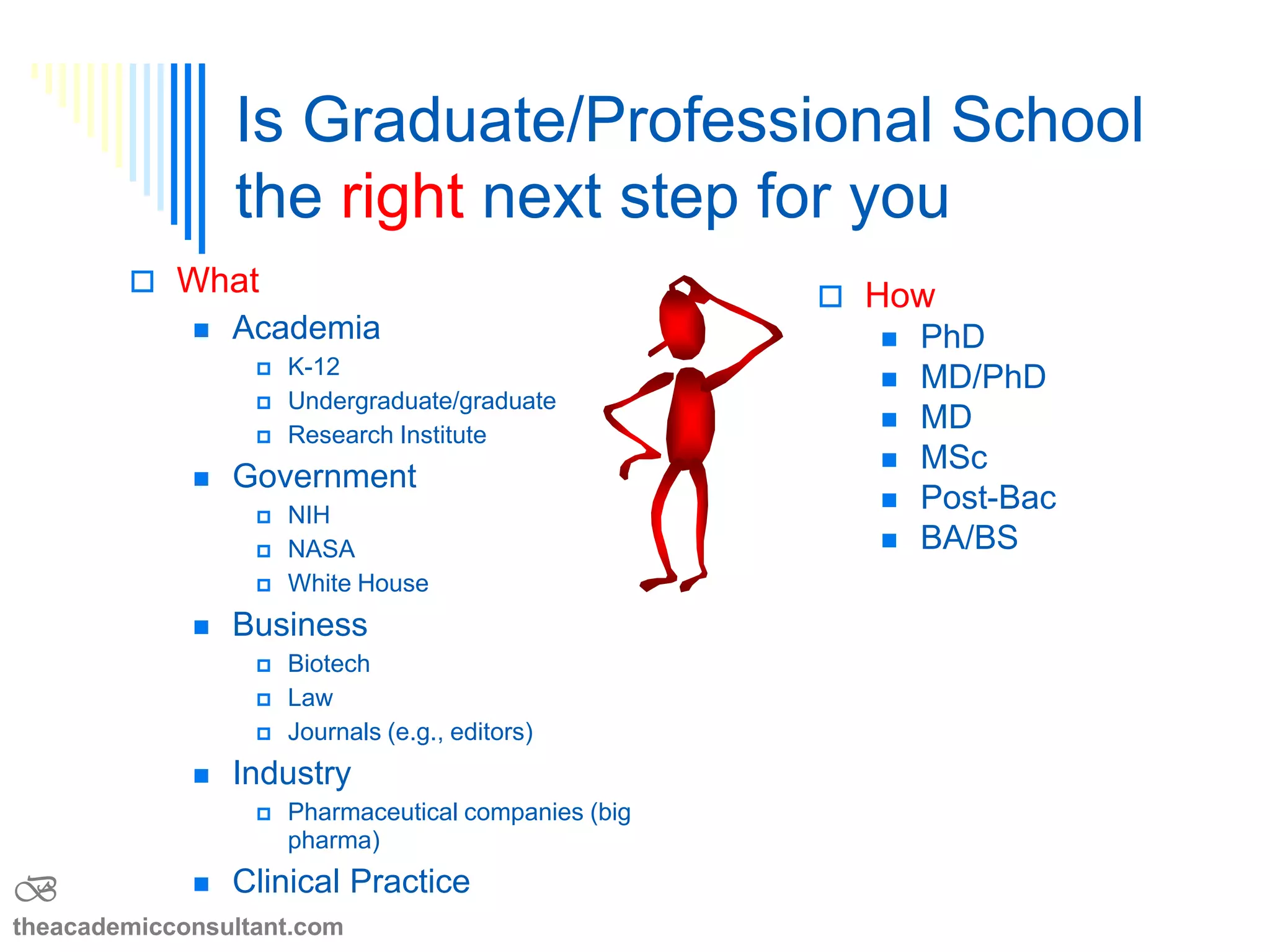
Career Education
 What/Where
 Academia
 K-12
 Undergraduate/graduate
 Research Institute
 Government
 NIH
 NASA
 White House
 Business
 Biotech
 Law
 Journals (e.g., editors)
 Industry
 Pharmaceutical companies (big
pharma)
 Clinical Practice
 How
 PhD
 MD/PhD
 MD
 MSc
 PSM
 Post-Bac
 BA/BS
B
theacademicconsultant.com
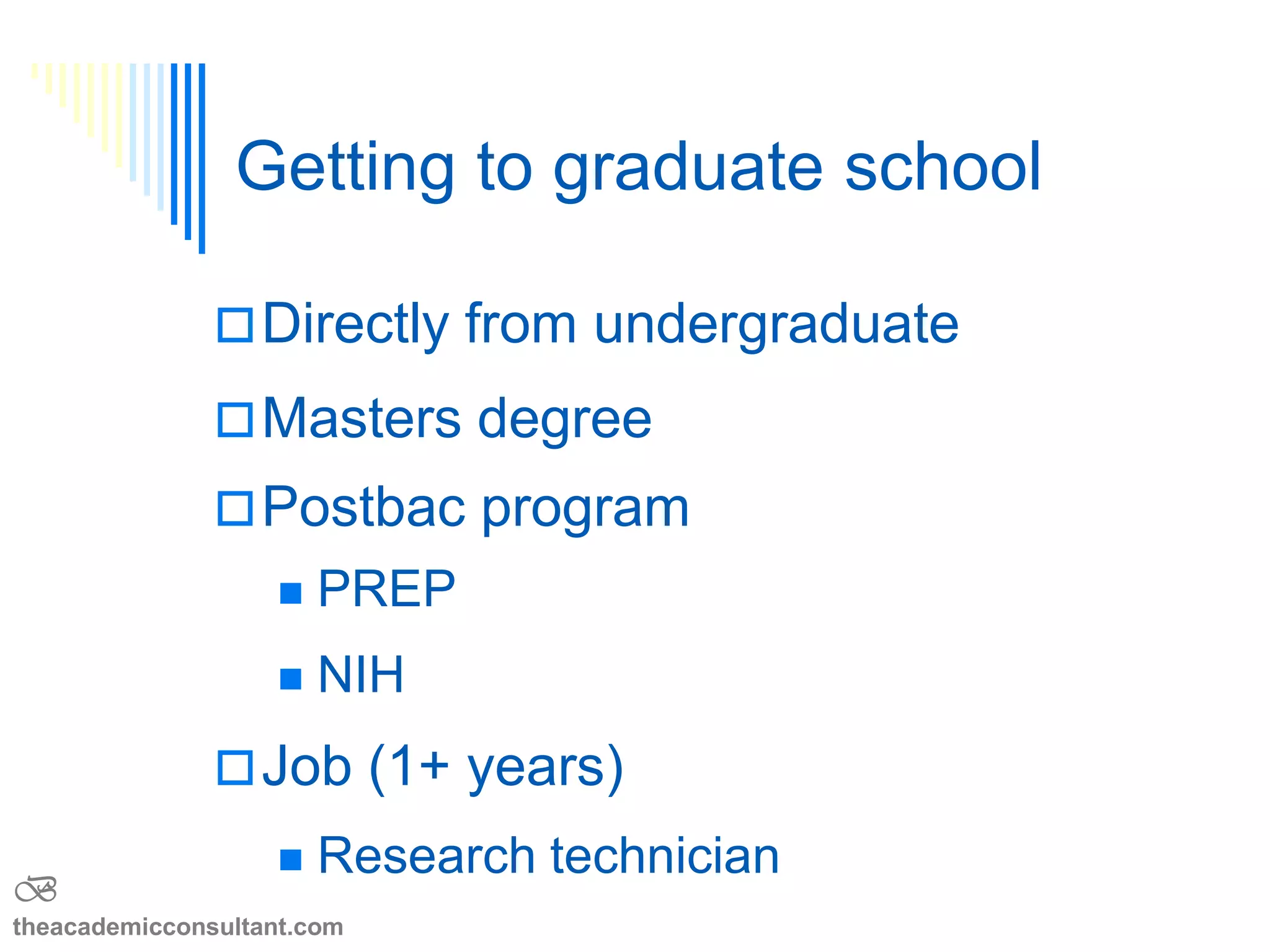
Getting to graduate school
 Directly from undergraduate
 Masters degree
 Postbac program
 PREP
 NIH
 Job (1+ years)
 Research technician
B
theacademicconsultant.com
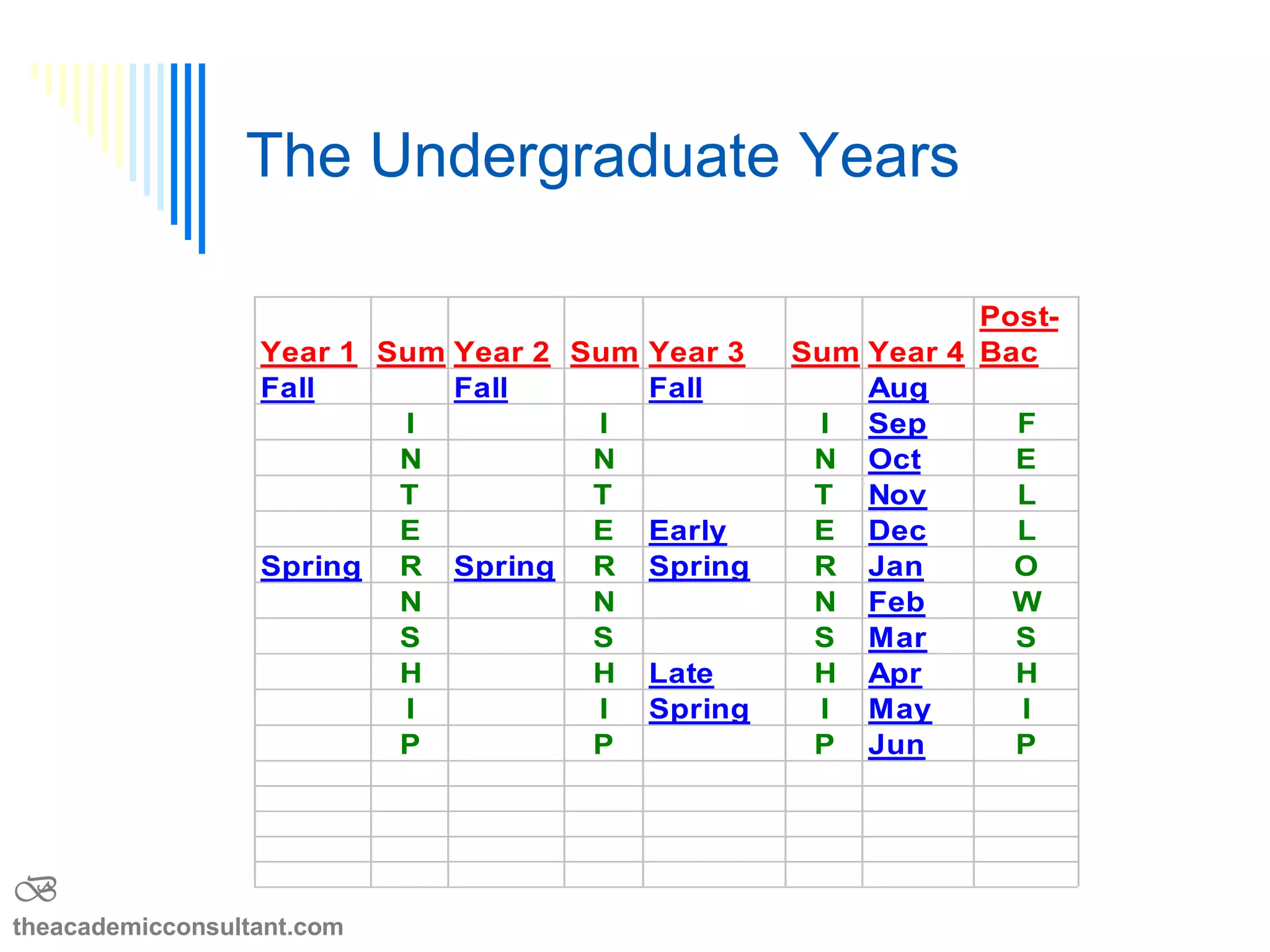
The Undergraduate Years
Year 1 Sum Year 2 Sum Year 3 Sum Year 4
Post-
Bac
Fall Fall Fall Aug
I I I Sep F
N N N Oct E
T T T Nov L
E E Early E Dec L
Spring R Spring R Spring R Jan O
N N N Feb W
S S S Mar S
H H Late H Apr H
I I Spring I May I
P P P Jun P
B
theacademicconsultant.com
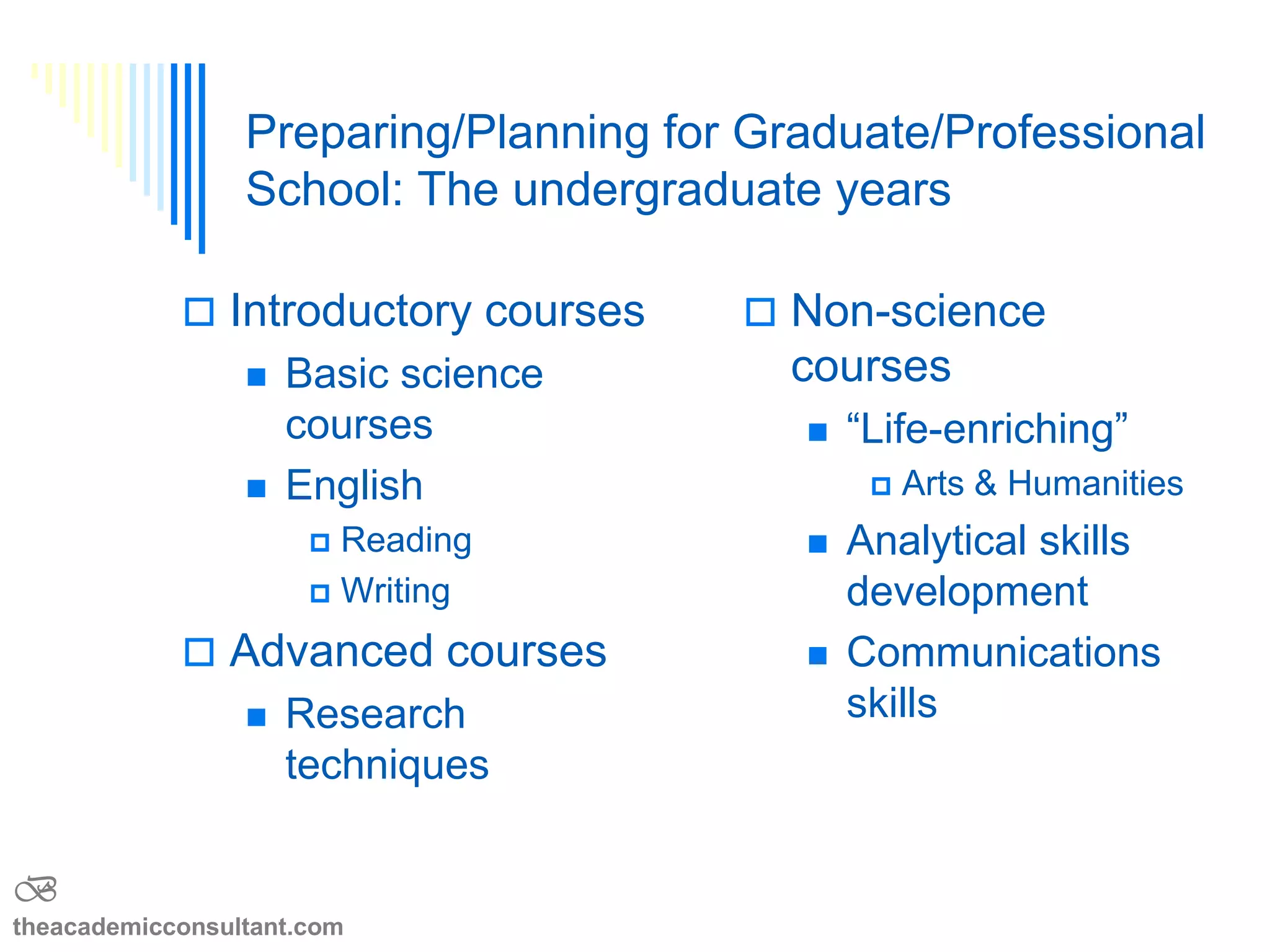
The undergraduate years
 Introductory courses
 Basic science
courses
 English
 Reading
 Writing
 Advanced courses
 Research
techniques
 Non-science
courses
 ―Life-enriching‖
 Arts & Humanities
 Analytical skills
 Communications
skills
B
theacademicconsultant.com
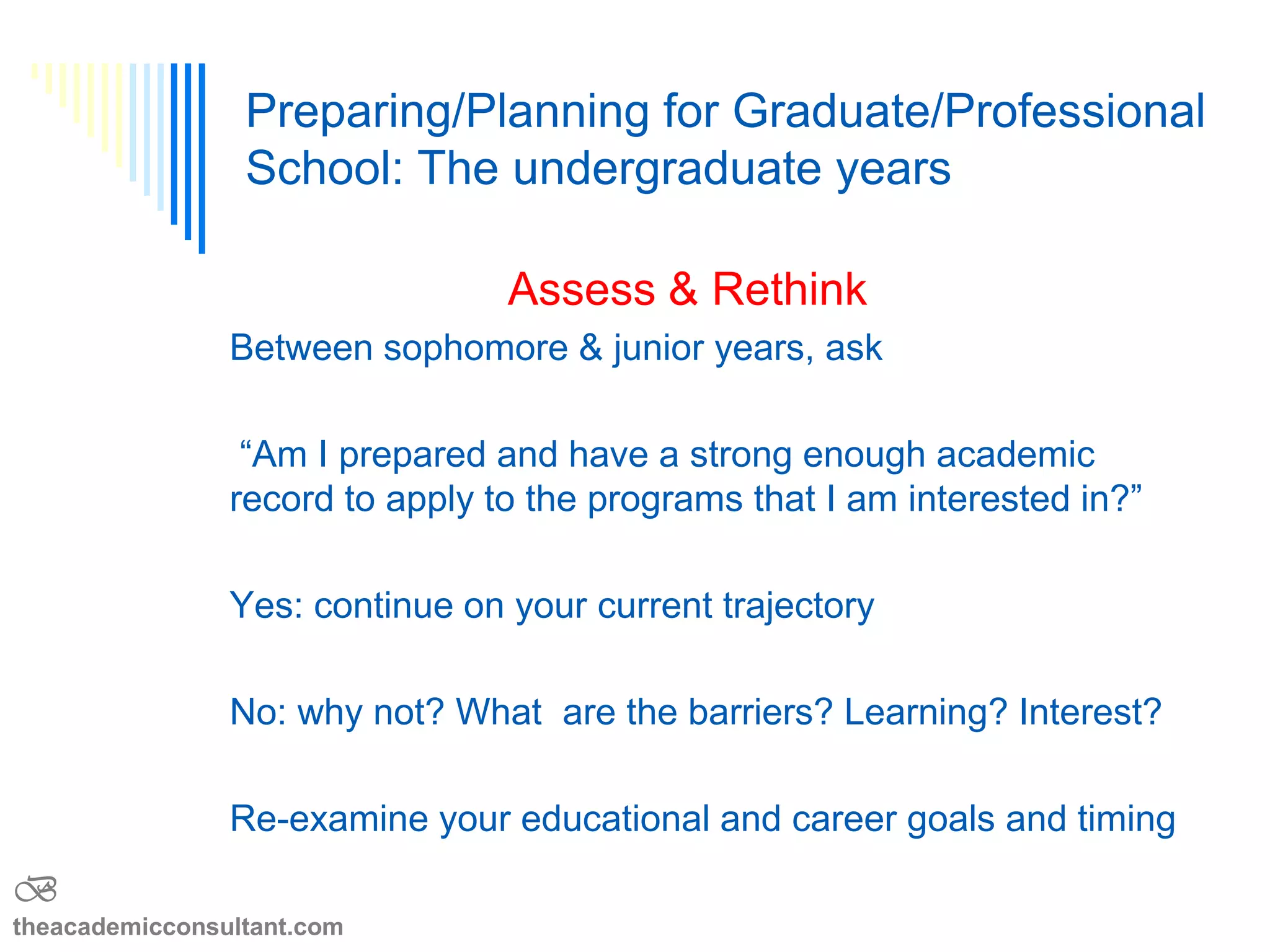
Between sophomore & junior years
―Am I prepared and have a strong enough
academic record to apply to the programs that I am
interested in?‖
Yes: continue on your current trajectory
No: why not? What are the barriers? Learning?
Interest?
Re-examine your educational/career goals v timing
Asses and rethink
B
theacademicconsultant.com
 Independent
research
 Prep courses and
standardized tests
 GRE
 MCAT
 Prepare application
materials
 Retake standardized
tests if needed
 Summer programs
The undergraduate years
B
theacademicconsultant.com
Research Opportunities-PhD & MD/PhD
 Hands-on research
 Cutting-edge projects
 Become intellectually immersed
 Gain problem-solving and critical
analysis skills
 Foster scientific confidence and maturity
 A look into the life of a graduate student
B
theacademicconsultant.com
Clinical Opportunities-MD/PhD & MD
 A look into the life of a physician
 Experience with interpersonal skills
 Networking opportunities
 Interactions w/ healthcare providers
 Learn more about a medical specialty
B
theacademicconsultant.com
The undergraduate years
Introductory Science Courses
Explore Programs: Advisors, Grad School Fairs, ABRCMS, etc.
Freshman Sophomore Junior Senior PostBac
Take the GRE/MCAT Apply
Research Experiences
Advanced Science Courses
Interview
www.aamc.org/phd
B
theacademicconsultant.com
Topics to be covered
 Preparing and planning for graduate/professional
school – the undergraduate years
 Finding information and selecting a school
 The application and admissions process
 Financing your education
B
theacademicconsultant.com
How/Where to find information
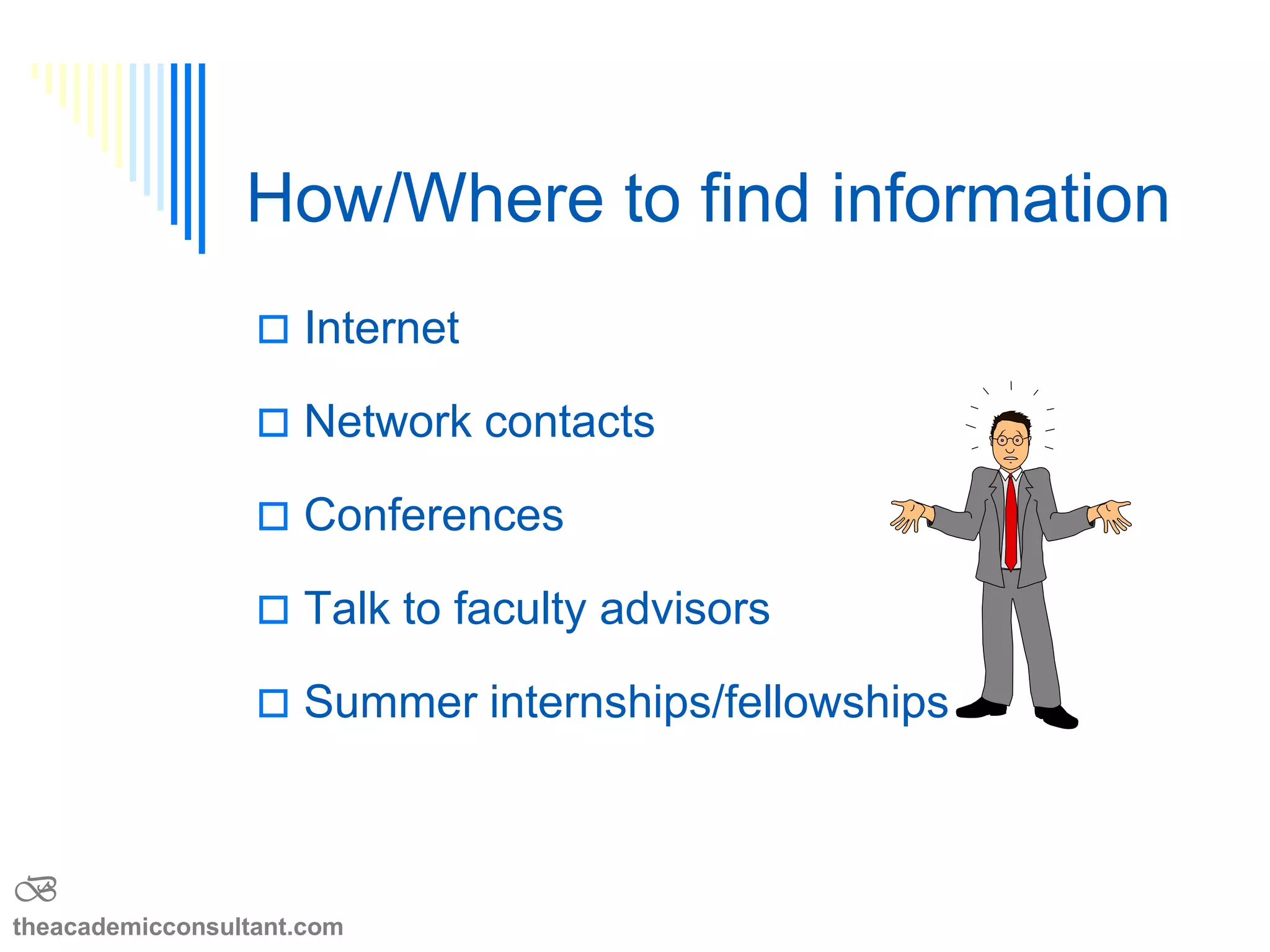
 Internet
 Network contacts
 Conferences
 Talk to faculty advisors
 Summer internships/fellowships
B
theacademicconsultant.com
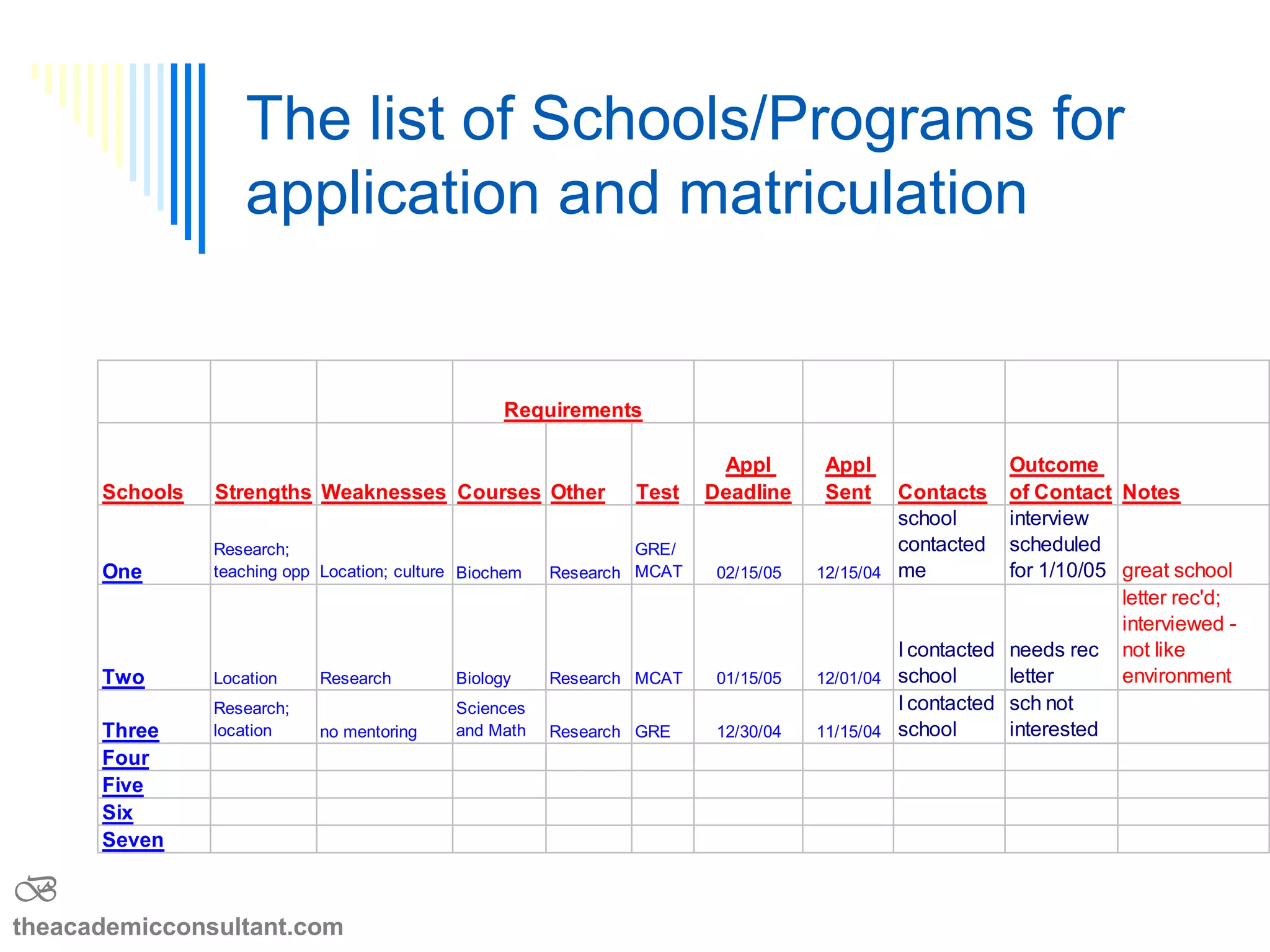
SWOT Analysis
Schools Strengths Weaknesses Courses Other Test
Appl
Deadline
Appl
Sent Contacts
Outcome
of Contact Notes
One
Research;
teaching
opp
Location;
culture Biochem Research
GRE/
MCAT 12/15/12 12/14/12
school
contacted
me
interview
scheduled
for 1/10/13 great school
Two Location Research Biology ResearchMCAT 01/15/13 12/15/12
I contacted
school
needs rec
letter
letter rec'd;
interviewed - not
like environment
Three
Research;
location no mentoring
Sciences
and Math ResearchGRE 12/30/12 11/24/12
I contacted
school
sch not
interested
Four
Five
Six
Seven
Requirements
B
theacademicconsultant.com
“…all great institutions are continually
changing---renovating, building,
recruiting, developing new programs
and collaborations, and pursuing new
ideas.”(Harold Varmus)
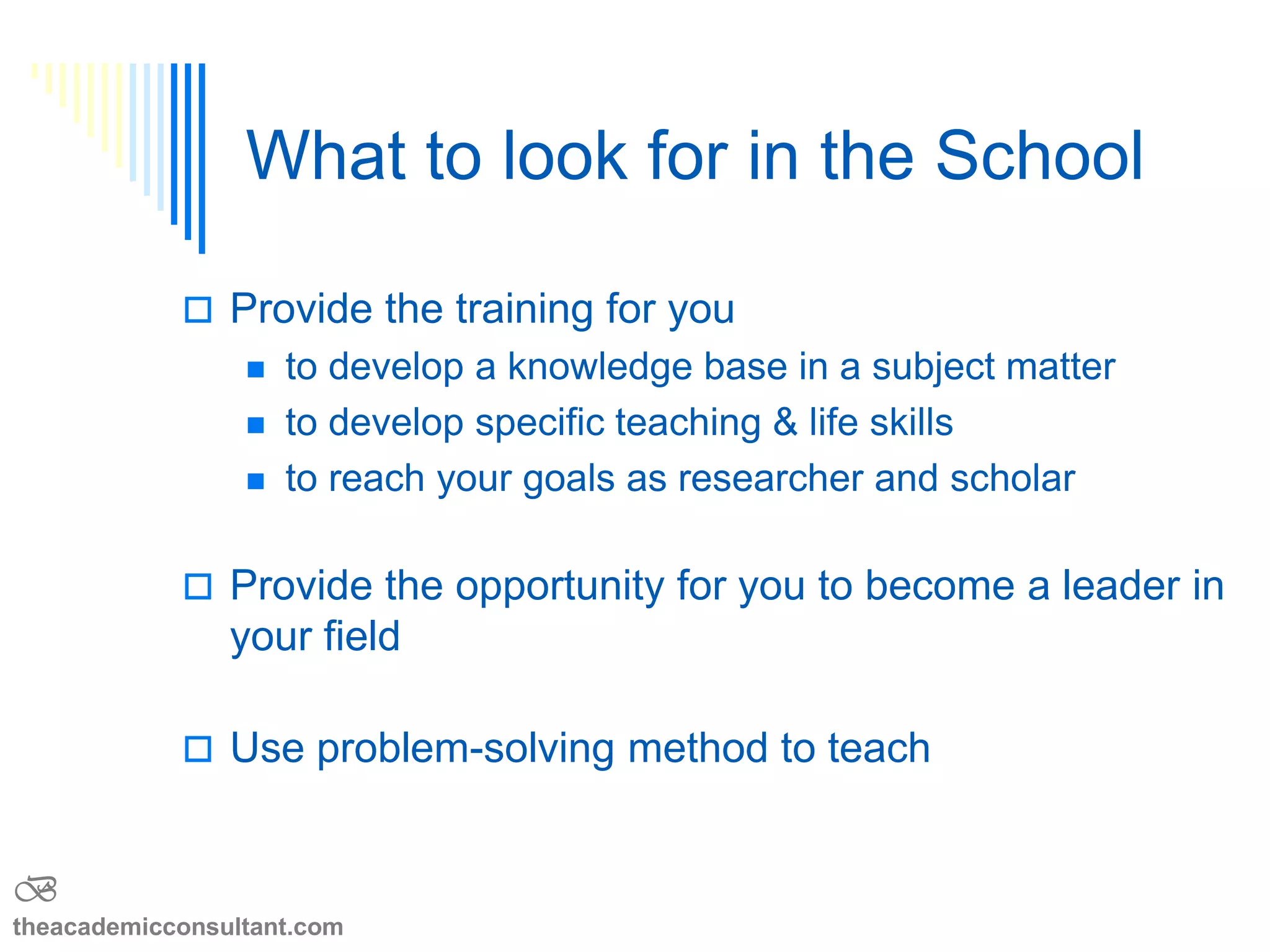
What to look for in an Institution
B
theacademicconsultant.com
What to look for in a Program?
vs
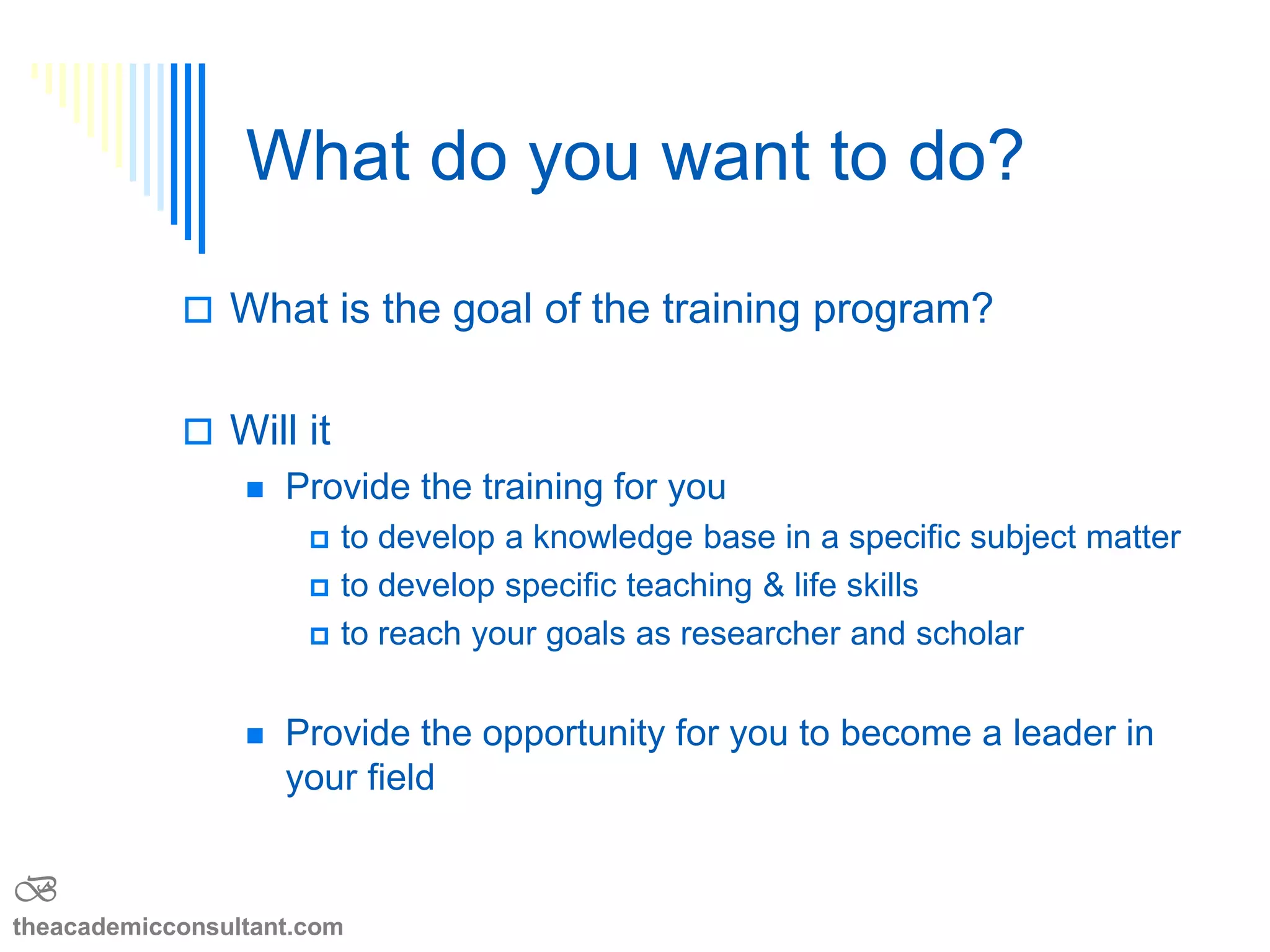
What do you want to do?
B
theacademicconsultant.com
What is the goal of the program?
 Provide the training for you
 develop a knowledge base in a specific area
 develop specific teaching & life skills
 reach your goals as researcher and scholar
Provide the opportunity for you to become
a leader in your field
B
theacademicconsultant.com
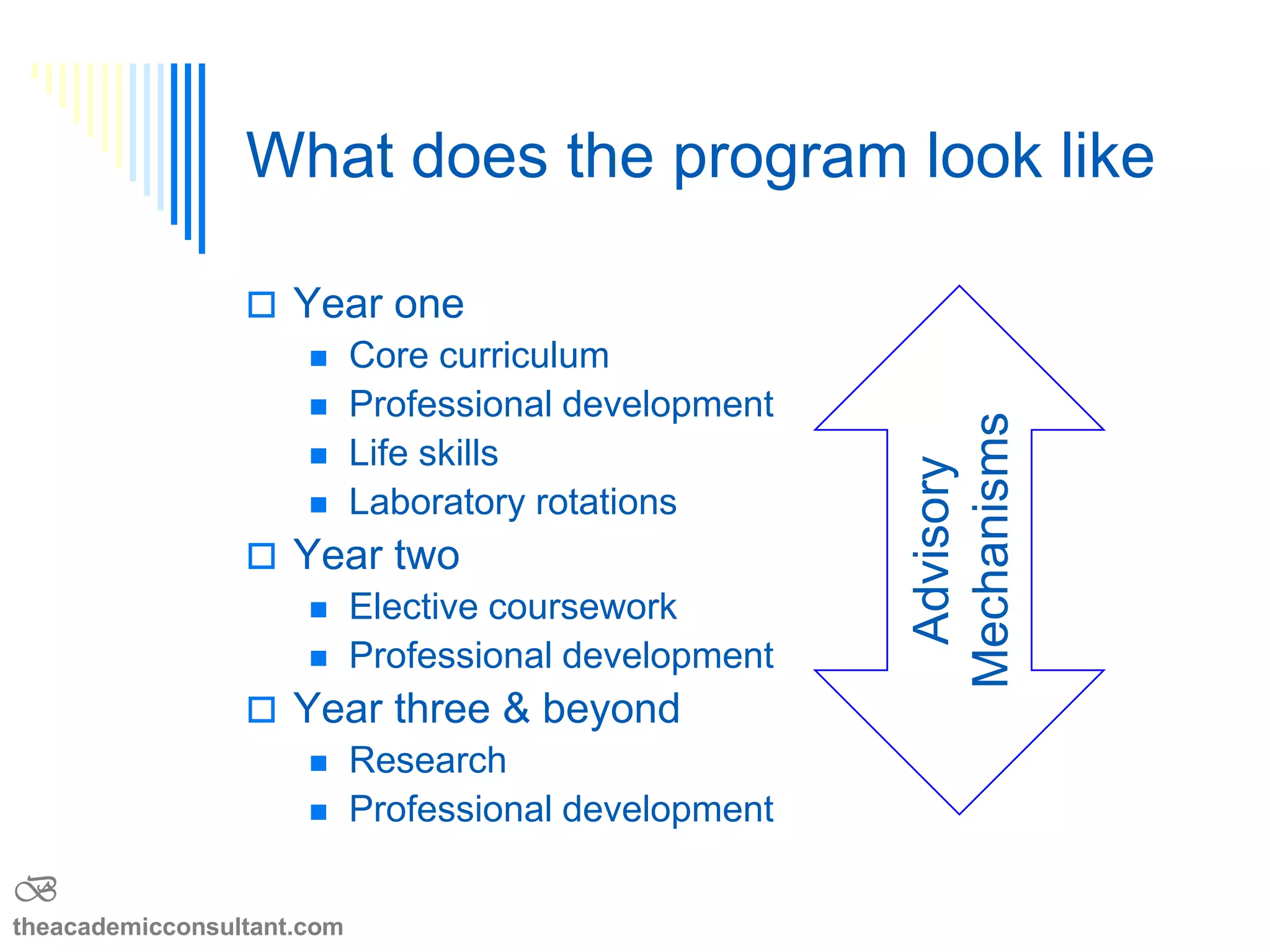
What does the program look like
 Year one
 Core curriculum
 Life skills
 Laboratory rotations
 Year two
 Elective coursework
 Year three & beyond
 Research
B
theacademicconsultant.com
Coursework
Rotations Qualifying Exam Dissertation Research Defense of Dissertation
Year 1 Year 2 Year 3 Year 4 Year 5 …
Select Mentor & Advisers
Professional Development
Presenting Your Research
Milestones * * * *
Funding Your Graduate Education
PhD
Graduate School
www.aamc.org/phd
Structure & Organization
 What is the structure/organization of the
programs
 Are there enough faculty in your area of
interest
 Is there academic help if you need it
 Are there special programs for students
B
theacademicconsultant.com
The Facilities
 What do the facilities/laboratories look like
 Where is the campus located
 What is there to do when you are not in class
 Are there cultural/sports events in the area
 Housing
 Are there special amenities/services for students
 Is it easy to get from place to place
B
theacademicconsultant.com
Topics to be covered
 Preparing and planning for graduate/professional
school – the undergraduate years
 Finding information and selecting a school
 The application and admissions process
 Financing your education
B
theacademicconsultant.com
The Admissions File
 Application Form
 complete the entire application form, i.e., answer all questions
 Scores & GPA
 a strong academic record is essential
 verify and have transcripts and test scores sent early
 Personal Statement
 Letters of Recommendation
 Interview
B
theacademicconsultant.com
Personal Statement
 Introduction of you
 Writing skills
 Commitment and motivation
 Inform and persuade
Who am I?
What do I
want to do?
B
theacademicconsultant.com
What does the school want
to know? BE HONEST
 Your goals—degree, field, specialty
 Why are you pursuing this degree?
 What events brought you to this point?
 What makes you qualified to do this?
 Why are you applying to this School?
 How will they help you reach your goals?
B
theacademicconsultant.com
Inform and persuade
 Beginning
 Interesting & captivating = the hook
 Who are you?
 Why do you want to go to graduate school?
 Middle
 Substance = Research Statements
 Experiences
 Ending
 Reader wants to meet you
 Why this program
B
theacademicconsultant.com
SKGSBS
Writing about your research
 Introduce the overall purpose of the
research
 Describe specifically what you worked
on and what you did
 Describe how your work fitted into the
overall objective of the main project, the
field and human health
B
theacademicconsultant.com
Research paragraph
One of the goals of the laboratory is to ….
We studied ….. My project involved ….. The
resulting structures were …. Because they
….. these structures could be used to …..
B
theacademicconsultant.com
Read it
out loud
The Final Touch
 No errors!
 Grammar. Spelling. Language.
 Proofread!
 Punctuation: commas, colons, & semicolons
 Apostrophes and hyphens
 Subject-Verb agreement
 Word usage
Listen to
it
B
theacademicconsultant.com
Personal Statement
 Deliberate & thoughtful
 Clear & simple language
 Concise (trim the fat)
 Interesting & creative
 Style & tone
 Vary the sentence forms
 Seamless transitions between paragraphs
 More is not necessarily better
B
theacademicconsultant.com
ERROR-
FREE
ZONE
Letters of Recommendation
 What is the purpose of the letters of
recommendation?
 How many should there be?
 Who should write your letters?
 To waive your right to access or not to
waive your right to access?
B
theacademicconsultant.com
Letters of Recommendation
 Ask recommenders if they can write you a
strong letter of recommendation
 Give them a copy of the personal
statement; if possible, ask them to meet
 Give them plenty of time to write a
thoughtful substantive letter
B
theacademicconsultant.com
The interview -- objectives
School
Be interviewed by
the faculty,
students and
administration
 They want to see
the application
come to life
You
Interview the
faculty, students
and
administration
 Is this the right fit
for you?
B
theacademicconsultant.com
The interview -- objectives
 Make a positive
and professional
first impression
 Learn about the
facilities
 Be
 Professional
 Prepared
 Personable
 Enthusiastic
 Engaging/
interesting
 Knowledgeable
B
theacademicconsultant.com
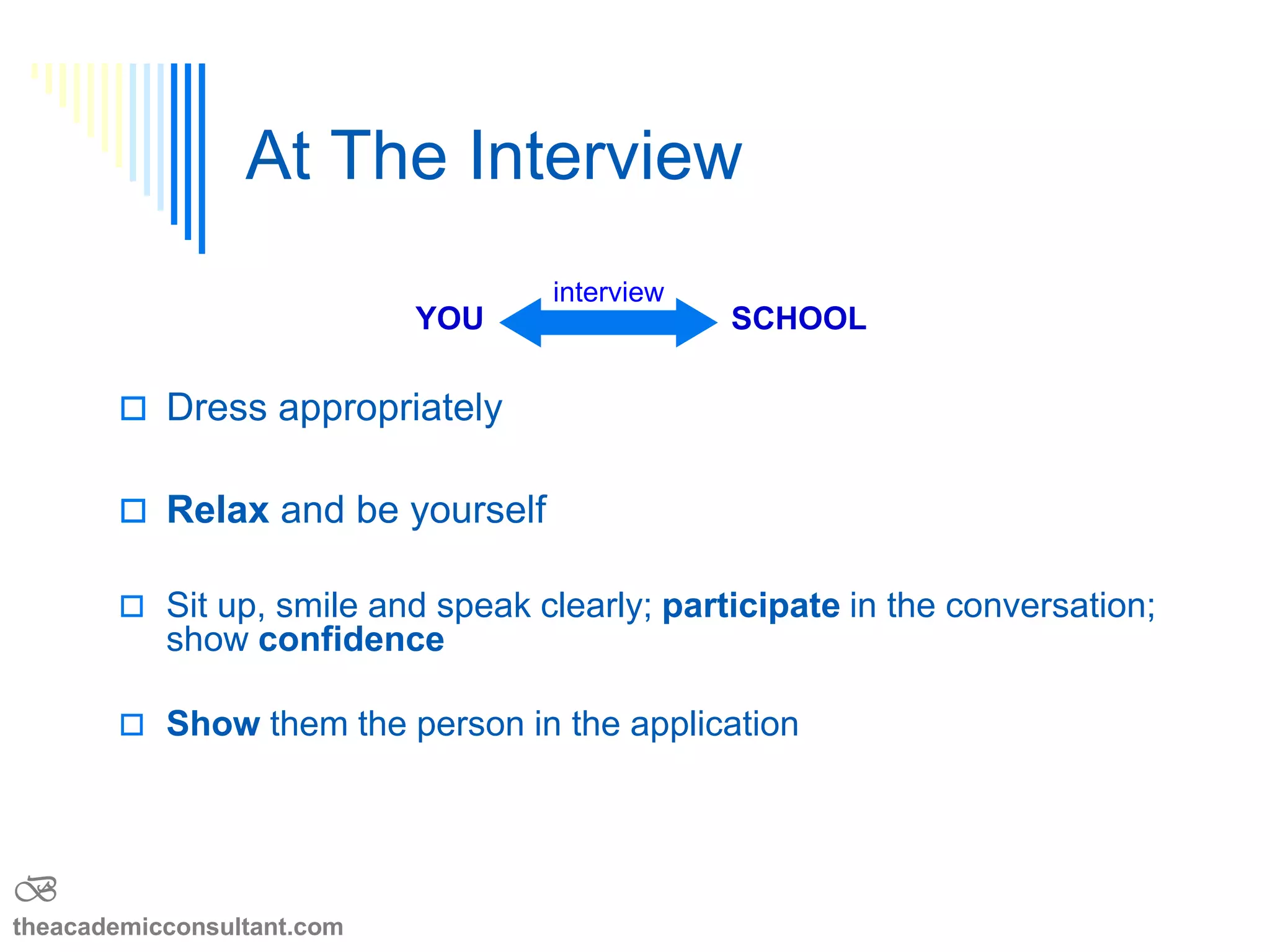
At the interview
 Dress professionally
 Clothing, shoes, jewelry, make-up
 Relax and be professional & social
 Introduce yourself (the handshake)
 Sit up, smile and speak clearly; participate in the
conversation; show confidence
B
theacademicconsultant.com
Show them the
person you presented
in the application
At the interview
 You are always ―on‖
 Be careful of bad behavior
 Emphasize your strengths and experiences
 Show enthusiasm & commitment when you talk
about your research
 Show some interest in the interviewer’s research
 It is OK to say ―I do not know‖
YOU SCHOOL
B
theacademicconsultant.com
What Schools look for
 Commitment
 Motivation
 Maturity
 Academic record/Coursework
 Aptitude for science/Critical thinking
 Research experiences
 Extracurricular activities/Life experiences
B
theacademicconsultant.com
The Application Year
Jul/Aug
2012
Apr
2012
Mar
2012
Feb
2012
Jan
2012
Dec
2011
Nov
2011
Oct
2011
Sep
2011
Aug
2011
Select schools
Start application form
Request letters
Schedule/Take GREs
Submit application form
Request transcripts
Check on documents
Interviews/2nd visits
Receive offers
Decision 4/15
Matriculate!
B
theacademicconsultant.com
Topics to be covered
 Preparing and planning for graduate/professional
school – the undergraduate years
 Finding information and selecting a school
 The application and admissions process
 Financing your education
B
theacademicconsultant.com
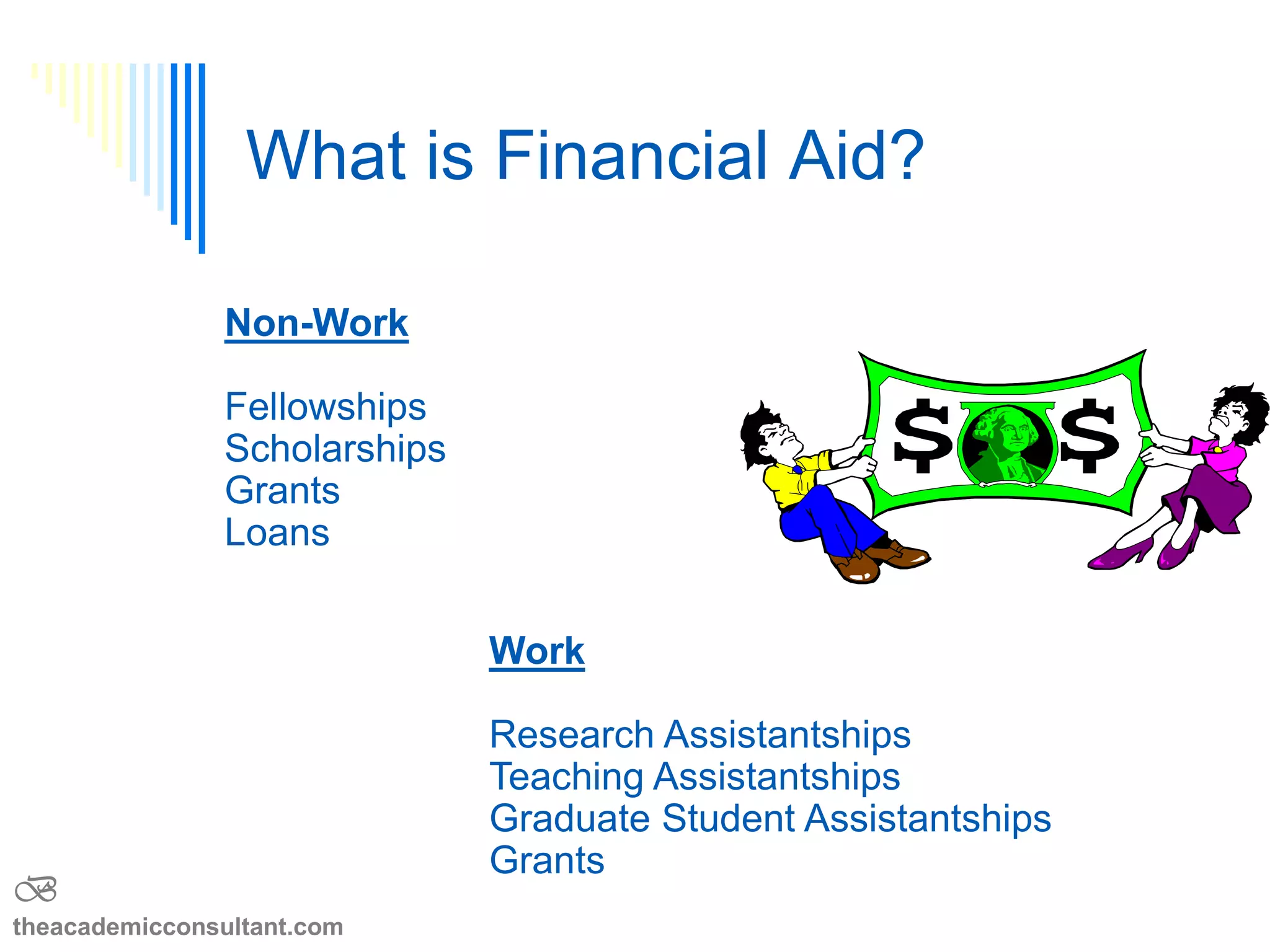
What is Financial Aid?
Work
Research Assistantships
Teaching Assistantships
Graduate Student Assistantships
Grants
Non-Work
Fellowships
Scholarships
Grants
Loans
B
theacademicconsultant.com
Cost
 Costs & FA are
different for
 PhD
 MD/PhD
 MD
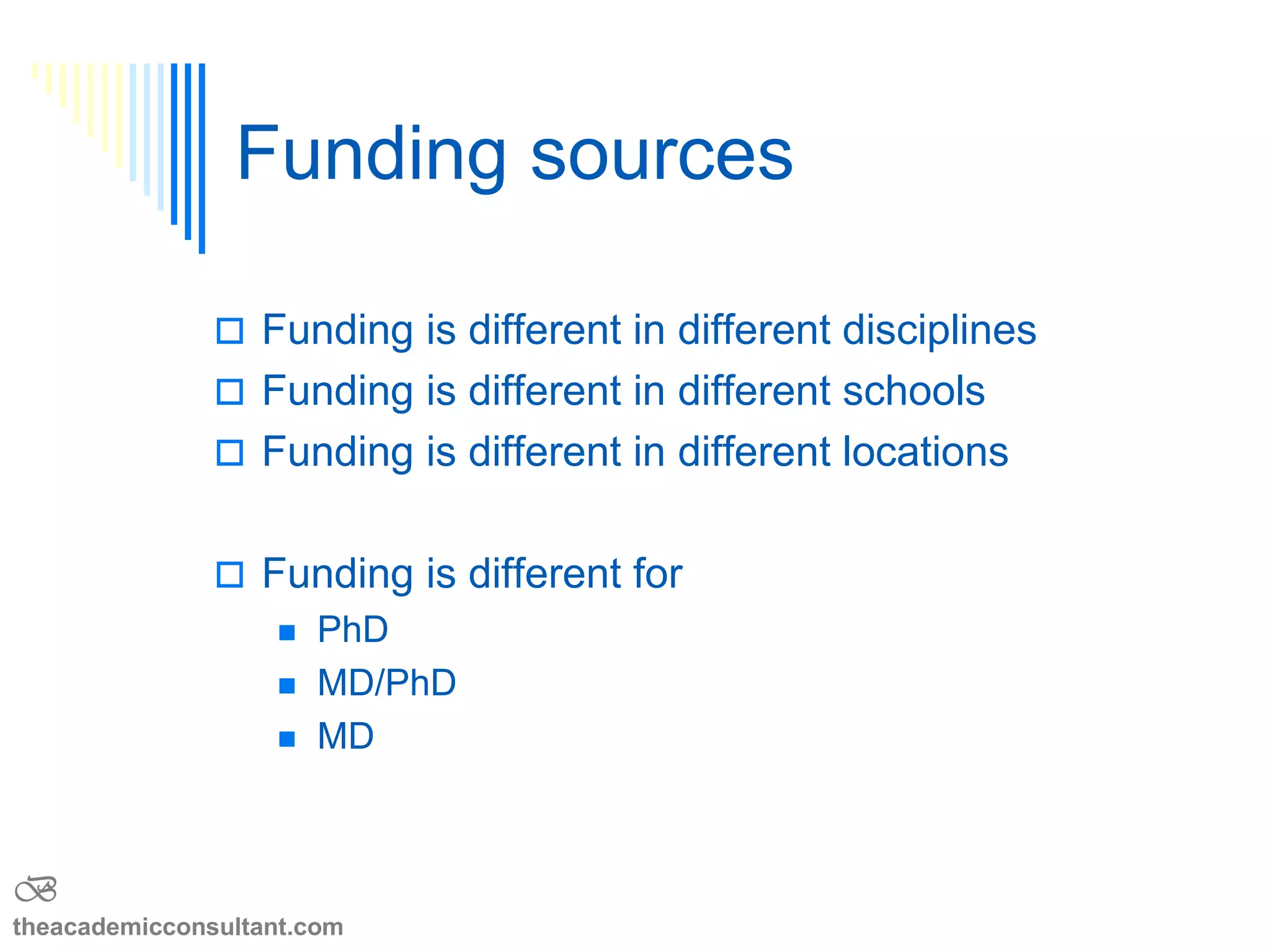
 Sources of funding
are different for
 PhD
 MD/PhD
 MD
 Expenses
 Tuition & Fees
 Living Expenses
 Revenues
 Fellowships, etc
 Loans
 Grants
 Job
B
theacademicconsultant.com
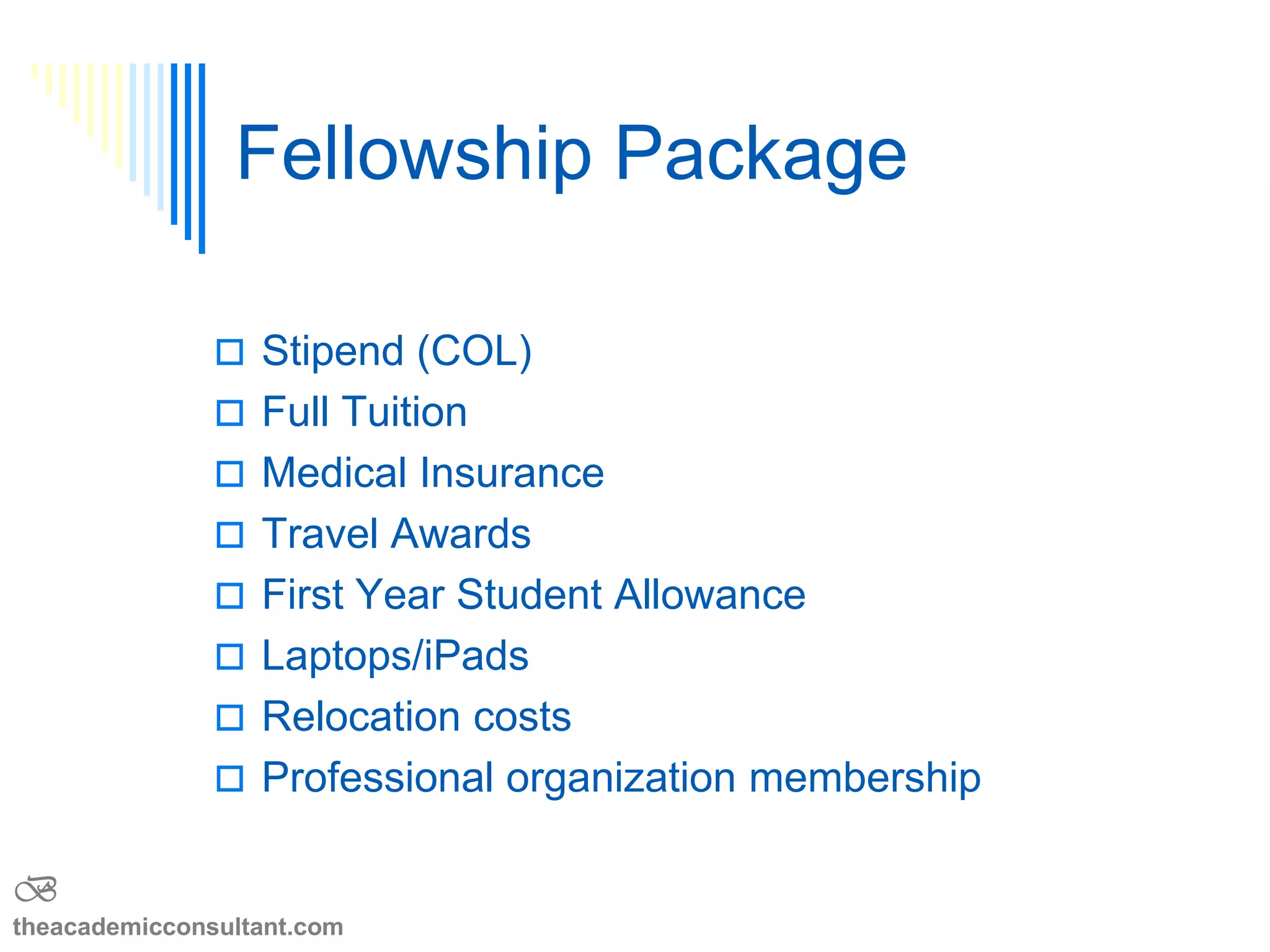
 Stipend (COL)
 Full Tuition
 Medical Insurance
 Travel Awards
 First Year Student Allowance
 Laptops/iPads
 Relocation costs
 Professional organization membership
Fellowship Package
PhD & MD/PhD
B
theacademicconsultant.com
 Institutional
 Central
 Departmental
 External
 National Institutes of Health (NIH)
 National Science Foundation (NSF)
 Ford Foundation
 Howard Hughes Medical Institute (HHMI)
 Professional Associations
Funding sources for fellowships
B
theacademicconsultant.com
 What if it is not enough for me to live on?
 Is renewal automatic each year?
 If not, what is the renewal process?
 Are there restrictions on the uses of the
funds?
 Does the fellowship provide health
insurance? Travel?
MAQ about fellowships
B
theacademicconsultant.com
 Can you request special supplements,
such as monies to purchase a computer?
 When does the award start?
 Is the start date flexible?
 Can the award period be extended? How?
 What happens if I do not complete the
Program?
 Are there payback obligations?
MAQ about fellowships
B
theacademicconsultant.com
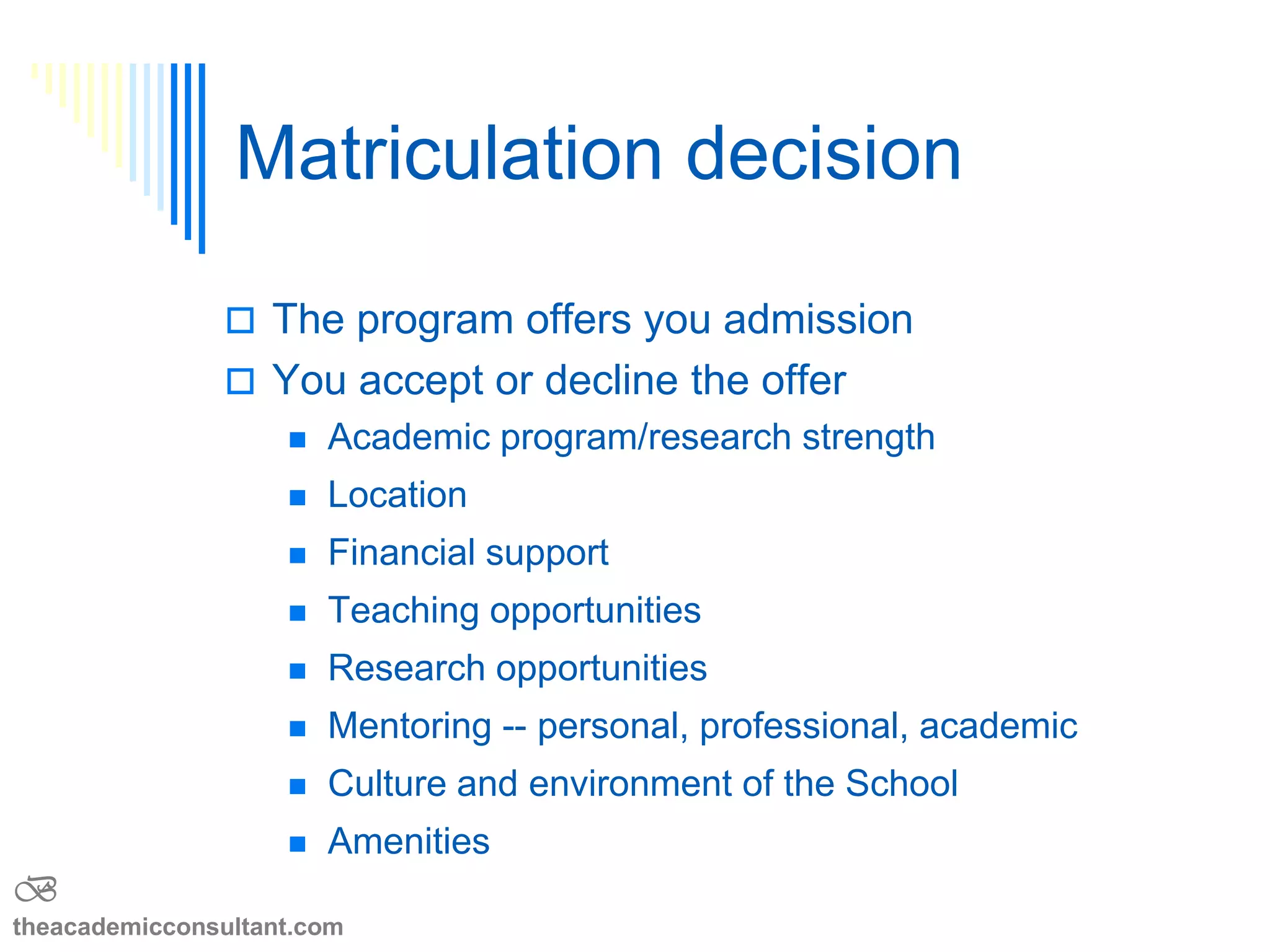
 The program offers you admission
 You accept or decline the offer
 Academic program/research strength/faculty
 Location
 Financial support
 Teaching opportunities
 Research opportunities
 Mentoring -- personal, professional, academic
 Culture and environment of the School
 Amenities
Matriculation decision
B
theacademicconsultant.com
Data Analysis
Schools Strengths Weaknesses Courses Other Test
Appl
Deadline
Appl
Sent Contacts
Outcome
of Contact
Interview
Notes
One
Research;
teaching
opp
Location;
culture Biochem Research
GRE/
MCAT 12/15/12 12/14/12
school
contacted
me
interview
scheduled
for 1/10/13 great school
Two Location Research Biology ResearchMCAT 01/15/13 12/15/12
I contacted
school
needs rec
letter
letter rec'd;
interviewed - not
like environment
Three
Research;
location no mentoring
Sciences
and Math ResearchGRE 12/30/12 11/24/12
I contacted
school
sch not
interested
Four
Five
Six
Seven
Requirements
B
theacademicconsultant.com
We must not forget that when radium was
discovered no one knew that it would prove
useful in hospitals. The work was one of pure
science. And this is a proof that scientific work
must not be considered from the point of view
of the direct usefulness of it. It must be done
for itself, for the beauty of science, and then
there is always the chance that a scientific
discovery may become like the radium a
benefit for humanity. Marie Curie
B
theacademicconsultant.com

Applying To Graduate School

  • 1.
    The Next Stepin Your Biomedical Sciences Career C Gita Bosch, PhD, MBA Academic & Educational Consulting theacademicconsultant.com
  • 2.
    Topics to becovered  Preparing and planning for graduate/professional school – the undergraduate years  Finding information and selecting a school  The application and admissions process  Financing your education B theacademicconsultant.com
  • 3.
    What is yourright next step  What do you want to do  Why do you want to do this  Where will you be in 10 years  How do you think you will get there  Is this a realistic plan B theacademicconsultant.com
  • 4.
    Career Education  What/Where Academia  K-12  Undergraduate/graduate  Research Institute  Government  NIH  NASA  White House  Business  Biotech  Law  Journals (e.g., editors)  Industry  Pharmaceutical companies (big pharma)  Clinical Practice  How  PhD  MD/PhD  MD  MSc  PSM  Post-Bac  BA/BS B theacademicconsultant.com
  • 5.
    Getting to graduateschool  Directly from undergraduate  Masters degree  Postbac program  PREP  NIH  Job (1+ years)  Research technician B theacademicconsultant.com
  • 6.
    The Undergraduate Years Year1 Sum Year 2 Sum Year 3 Sum Year 4 Post- Bac Fall Fall Fall Aug I I I Sep F N N N Oct E T T T Nov L E E Early E Dec L Spring R Spring R Spring R Jan O N N N Feb W S S S Mar S H H Late H Apr H I I Spring I May I P P P Jun P B theacademicconsultant.com
  • 7.
    The undergraduate years Introductory courses  Basic science courses  English  Reading  Writing  Advanced courses  Research techniques  Non-science courses  ―Life-enriching‖  Arts & Humanities  Analytical skills  Communications skills B theacademicconsultant.com
  • 8.
    Between sophomore &junior years ―Am I prepared and have a strong enough academic record to apply to the programs that I am interested in?‖ Yes: continue on your current trajectory No: why not? What are the barriers? Learning? Interest? Re-examine your educational/career goals v timing Asses and rethink B theacademicconsultant.com
  • 9.
     Independent research  Prepcourses and standardized tests  GRE  MCAT  Prepare application materials  Retake standardized tests if needed  Summer programs The undergraduate years B theacademicconsultant.com
  • 10.
    Research Opportunities-PhD &MD/PhD  Hands-on research  Cutting-edge projects  Become intellectually immersed  Gain problem-solving and critical analysis skills  Foster scientific confidence and maturity  A look into the life of a graduate student B theacademicconsultant.com
  • 11.
    Clinical Opportunities-MD/PhD &MD  A look into the life of a physician  Experience with interpersonal skills  Networking opportunities  Interactions w/ healthcare providers  Learn more about a medical specialty B theacademicconsultant.com
  • 12.
    The undergraduate years IntroductoryScience Courses Explore Programs: Advisors, Grad School Fairs, ABRCMS, etc. Freshman Sophomore Junior Senior PostBac Take the GRE/MCAT Apply Research Experiences Advanced Science Courses Interview www.aamc.org/phd B theacademicconsultant.com
  • 13.
    Topics to becovered  Preparing and planning for graduate/professional school – the undergraduate years  Finding information and selecting a school  The application and admissions process  Financing your education B theacademicconsultant.com
  • 14.
    How/Where to findinformation  Internet  Network contacts  Conferences  Talk to faculty advisors  Summer internships/fellowships B theacademicconsultant.com
  • 15.
    SWOT Analysis Schools StrengthsWeaknesses Courses Other Test Appl Deadline Appl Sent Contacts Outcome of Contact Notes One Research; teaching opp Location; culture Biochem Research GRE/ MCAT 12/15/12 12/14/12 school contacted me interview scheduled for 1/10/13 great school Two Location Research Biology ResearchMCAT 01/15/13 12/15/12 I contacted school needs rec letter letter rec'd; interviewed - not like environment Three Research; location no mentoring Sciences and Math ResearchGRE 12/30/12 11/24/12 I contacted school sch not interested Four Five Six Seven Requirements B theacademicconsultant.com
  • 16.
    “…all great institutionsare continually changing---renovating, building, recruiting, developing new programs and collaborations, and pursuing new ideas.”(Harold Varmus) What to look for in an Institution B theacademicconsultant.com
  • 17.
    What to lookfor in a Program? vs What do you want to do? B theacademicconsultant.com
  • 18.
    What is thegoal of the program?  Provide the training for you  develop a knowledge base in a specific area  develop specific teaching & life skills  reach your goals as researcher and scholar Provide the opportunity for you to become a leader in your field B theacademicconsultant.com
  • 19.
    What does theprogram look like  Year one  Core curriculum  Life skills  Laboratory rotations  Year two  Elective coursework  Year three & beyond  Research B theacademicconsultant.com
  • 20.
    Coursework Rotations Qualifying ExamDissertation Research Defense of Dissertation Year 1 Year 2 Year 3 Year 4 Year 5 … Select Mentor & Advisers Professional Development Presenting Your Research Milestones * * * * Funding Your Graduate Education PhD Graduate School www.aamc.org/phd
  • 21.
    Structure & Organization What is the structure/organization of the programs  Are there enough faculty in your area of interest  Is there academic help if you need it  Are there special programs for students B theacademicconsultant.com
  • 22.
    The Facilities  Whatdo the facilities/laboratories look like  Where is the campus located  What is there to do when you are not in class  Are there cultural/sports events in the area  Housing  Are there special amenities/services for students  Is it easy to get from place to place B theacademicconsultant.com
  • 23.
    Topics to becovered  Preparing and planning for graduate/professional school – the undergraduate years  Finding information and selecting a school  The application and admissions process  Financing your education B theacademicconsultant.com
  • 24.
    The Admissions File Application Form  complete the entire application form, i.e., answer all questions  Scores & GPA  a strong academic record is essential  verify and have transcripts and test scores sent early  Personal Statement  Letters of Recommendation  Interview B theacademicconsultant.com
  • 25.
    Personal Statement  Introductionof you  Writing skills  Commitment and motivation  Inform and persuade Who am I? What do I want to do? B theacademicconsultant.com
  • 26.
    What does theschool want to know? BE HONEST  Your goals—degree, field, specialty  Why are you pursuing this degree?  What events brought you to this point?  What makes you qualified to do this?  Why are you applying to this School?  How will they help you reach your goals? B theacademicconsultant.com
  • 27.
    Inform and persuade Beginning  Interesting & captivating = the hook  Who are you?  Why do you want to go to graduate school?  Middle  Substance = Research Statements  Experiences  Ending  Reader wants to meet you  Why this program B theacademicconsultant.com
  • 28.
    SKGSBS Writing about yourresearch  Introduce the overall purpose of the research  Describe specifically what you worked on and what you did  Describe how your work fitted into the overall objective of the main project, the field and human health B theacademicconsultant.com
  • 29.
    Research paragraph One ofthe goals of the laboratory is to …. We studied ….. My project involved ….. The resulting structures were …. Because they ….. these structures could be used to ….. B theacademicconsultant.com
  • 30.
    Read it out loud TheFinal Touch  No errors!  Grammar. Spelling. Language.  Proofread!  Punctuation: commas, colons, & semicolons  Apostrophes and hyphens  Subject-Verb agreement  Word usage Listen to it B theacademicconsultant.com
  • 31.
    Personal Statement  Deliberate& thoughtful  Clear & simple language  Concise (trim the fat)  Interesting & creative  Style & tone  Vary the sentence forms  Seamless transitions between paragraphs  More is not necessarily better B theacademicconsultant.com ERROR- FREE ZONE
  • 32.
    Letters of Recommendation What is the purpose of the letters of recommendation?  How many should there be?  Who should write your letters?  To waive your right to access or not to waive your right to access? B theacademicconsultant.com
  • 33.
    Letters of Recommendation Ask recommenders if they can write you a strong letter of recommendation  Give them a copy of the personal statement; if possible, ask them to meet  Give them plenty of time to write a thoughtful substantive letter B theacademicconsultant.com
  • 34.
    The interview --objectives School Be interviewed by the faculty, students and administration  They want to see the application come to life You Interview the faculty, students and administration  Is this the right fit for you? B theacademicconsultant.com
  • 35.
    The interview --objectives  Make a positive and professional first impression  Learn about the facilities  Be  Professional  Prepared  Personable  Enthusiastic  Engaging/ interesting  Knowledgeable B theacademicconsultant.com
  • 36.
    At the interview Dress professionally  Clothing, shoes, jewelry, make-up  Relax and be professional & social  Introduce yourself (the handshake)  Sit up, smile and speak clearly; participate in the conversation; show confidence B theacademicconsultant.com Show them the person you presented in the application
  • 37.
    At the interview You are always ―on‖  Be careful of bad behavior  Emphasize your strengths and experiences  Show enthusiasm & commitment when you talk about your research  Show some interest in the interviewer’s research  It is OK to say ―I do not know‖ YOU SCHOOL B theacademicconsultant.com
  • 38.
    What Schools lookfor  Commitment  Motivation  Maturity  Academic record/Coursework  Aptitude for science/Critical thinking  Research experiences  Extracurricular activities/Life experiences B theacademicconsultant.com
  • 39.
    The Application Year Jul/Aug 2012 Apr 2012 Mar 2012 Feb 2012 Jan 2012 Dec 2011 Nov 2011 Oct 2011 Sep 2011 Aug 2011 Selectschools Start application form Request letters Schedule/Take GREs Submit application form Request transcripts Check on documents Interviews/2nd visits Receive offers Decision 4/15 Matriculate! B theacademicconsultant.com
  • 40.
    Topics to becovered  Preparing and planning for graduate/professional school – the undergraduate years  Finding information and selecting a school  The application and admissions process  Financing your education B theacademicconsultant.com
  • 41.
    What is FinancialAid? Work Research Assistantships Teaching Assistantships Graduate Student Assistantships Grants Non-Work Fellowships Scholarships Grants Loans B theacademicconsultant.com
  • 42.
    Cost  Costs &FA are different for  PhD  MD/PhD  MD  Sources of funding are different for  PhD  MD/PhD  MD  Expenses  Tuition & Fees  Living Expenses  Revenues  Fellowships, etc  Loans  Grants  Job B theacademicconsultant.com
  • 43.
     Stipend (COL) Full Tuition  Medical Insurance  Travel Awards  First Year Student Allowance  Laptops/iPads  Relocation costs  Professional organization membership Fellowship Package PhD & MD/PhD B theacademicconsultant.com
  • 44.
     Institutional  Central Departmental  External  National Institutes of Health (NIH)  National Science Foundation (NSF)  Ford Foundation  Howard Hughes Medical Institute (HHMI)  Professional Associations Funding sources for fellowships B theacademicconsultant.com
  • 45.
     What ifit is not enough for me to live on?  Is renewal automatic each year?  If not, what is the renewal process?  Are there restrictions on the uses of the funds?  Does the fellowship provide health insurance? Travel? MAQ about fellowships B theacademicconsultant.com
  • 46.
     Can yourequest special supplements, such as monies to purchase a computer?  When does the award start?  Is the start date flexible?  Can the award period be extended? How?  What happens if I do not complete the Program?  Are there payback obligations? MAQ about fellowships B theacademicconsultant.com
  • 47.
     The programoffers you admission  You accept or decline the offer  Academic program/research strength/faculty  Location  Financial support  Teaching opportunities  Research opportunities  Mentoring -- personal, professional, academic  Culture and environment of the School  Amenities Matriculation decision B theacademicconsultant.com
  • 48.
    Data Analysis Schools StrengthsWeaknesses Courses Other Test Appl Deadline Appl Sent Contacts Outcome of Contact Interview Notes One Research; teaching opp Location; culture Biochem Research GRE/ MCAT 12/15/12 12/14/12 school contacted me interview scheduled for 1/10/13 great school Two Location Research Biology ResearchMCAT 01/15/13 12/15/12 I contacted school needs rec letter letter rec'd; interviewed - not like environment Three Research; location no mentoring Sciences and Math ResearchGRE 12/30/12 11/24/12 I contacted school sch not interested Four Five Six Seven Requirements B theacademicconsultant.com
  • 49.
    We must notforget that when radium was discovered no one knew that it would prove useful in hospitals. The work was one of pure science. And this is a proof that scientific work must not be considered from the point of view of the direct usefulness of it. It must be done for itself, for the beauty of science, and then there is always the chance that a scientific discovery may become like the radium a benefit for humanity. Marie Curie B theacademicconsultant.com