Shear Zones-Mylonites
        By Abzal Alpysbayev

       BSc Petroleum Geology


                               S
Introduction


S Shear zones and their importance

S Shear zone analyse

S The geometry of a mylonite zone

S Microstructures of mylonites in terms of shear sense

S Eriboll mylonite classification
Shear zones


- Shear Zones are tabular zones of strain localization in the crust;
 -Shear zones occur on all scales;
-Like faults, shear zones tend to involve a considerable amount of wall-parallel movement
(Simple shear)
-Just like faults, shear zones may be reverse, normal, strike slip or show oblique
displacements.
Shear zones
Shear zones


http://www.see.leeds.ac.uk/structure/shearzones/
Analyzing shear zones

              1 step                               2 step


http://www.see.leeds.ac.uk/structure/shearzones/
Analyzing shear zone

              Step 3                               Step 4


http://www.see.leeds.ac.uk/structure/shearzones/
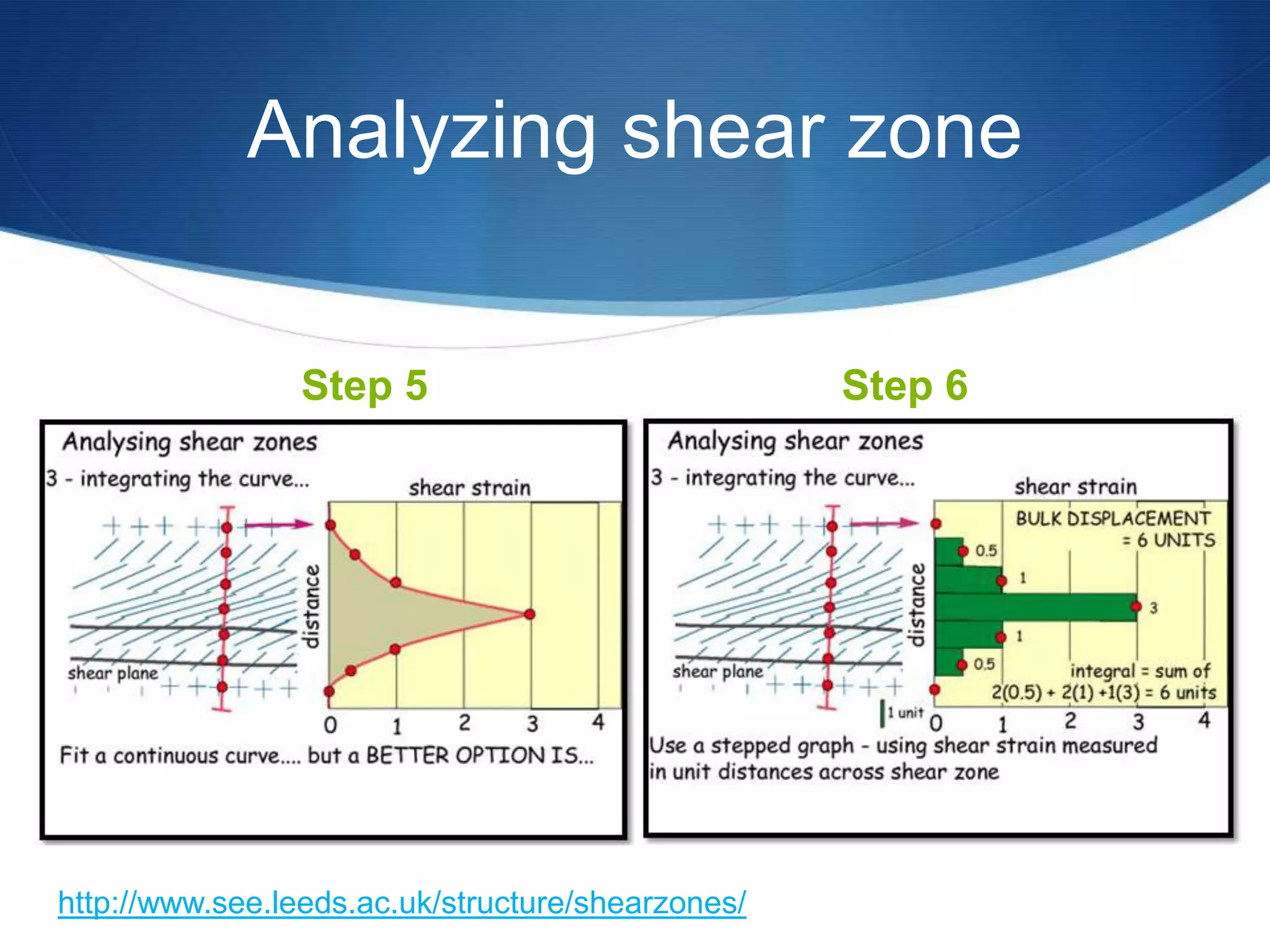
Analyzing shear zone

                Step 5                             Step 6


http://www.see.leeds.ac.uk/structure/shearzones/
Mylonite

S   The word “mylonite” derives from the Greek word and translated as a mill. 1st
    described by (Lapworth 1885)

S   Foliated and lineated metamorphic rock-ductile deformation (ductile flow)

S   Contains fabric elements with monoclinic shape symmetry

S   Mylonites occur in high strain zones known as “mylonite zone” interpreted as
    exhumed, “fossil” ductile shear zone

S   Grain size in the mylonite is usually smaller than that in the wall rock

S   Dynamics of mylonite development – “softening” or strain softening”

S   Characteristic fabric elements - porphyroclasts
The geometry of a mylonite zone and the nomenclature
                            used


Parallel to the aggregate lineation, the most common
types of shear sense indicators (For thin section)
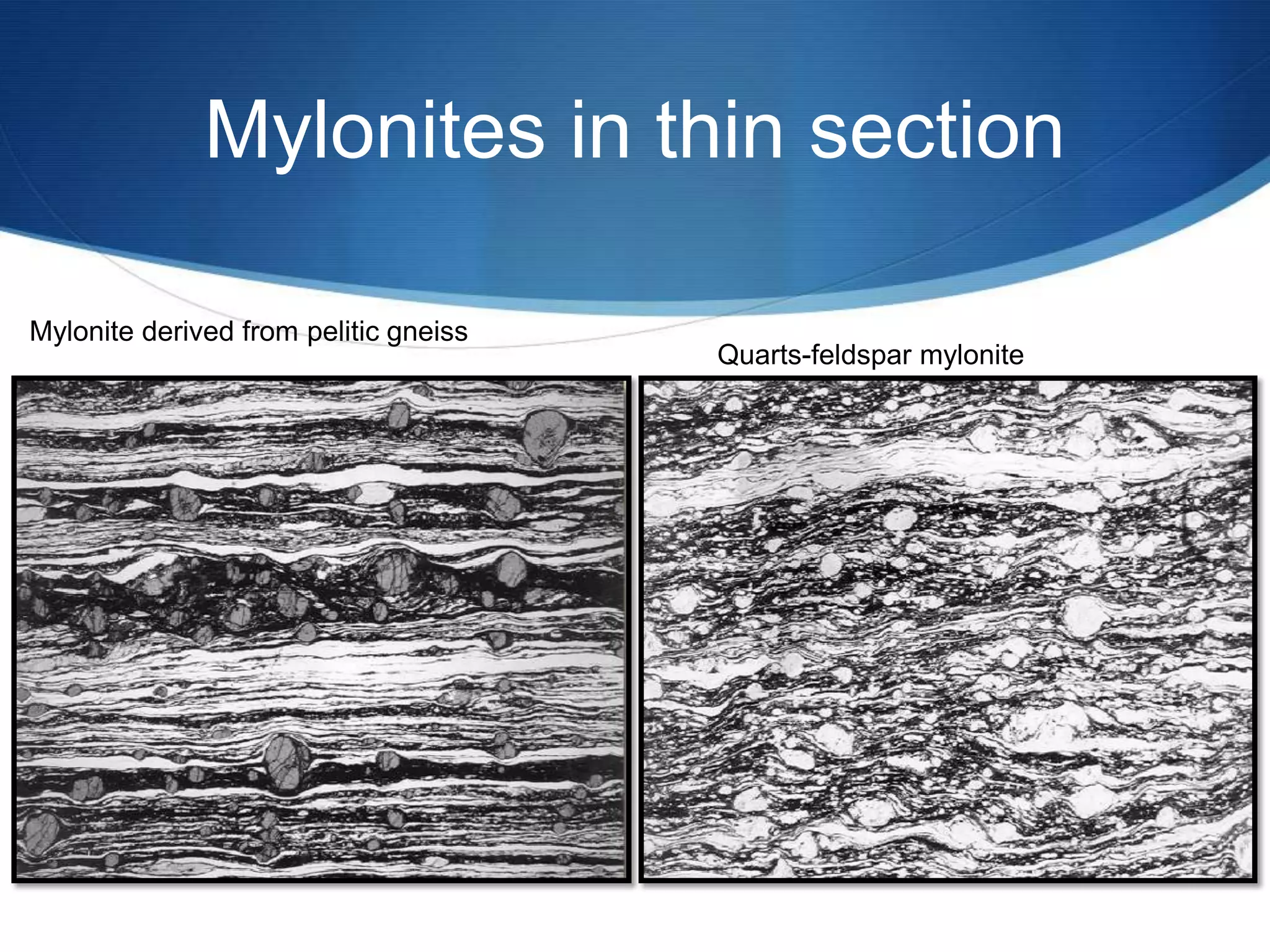
Mylonites in thin section

Mylonite derived from pelitic gneiss
                                       Quarts-feldspar mylonite
Mylonite outcrop
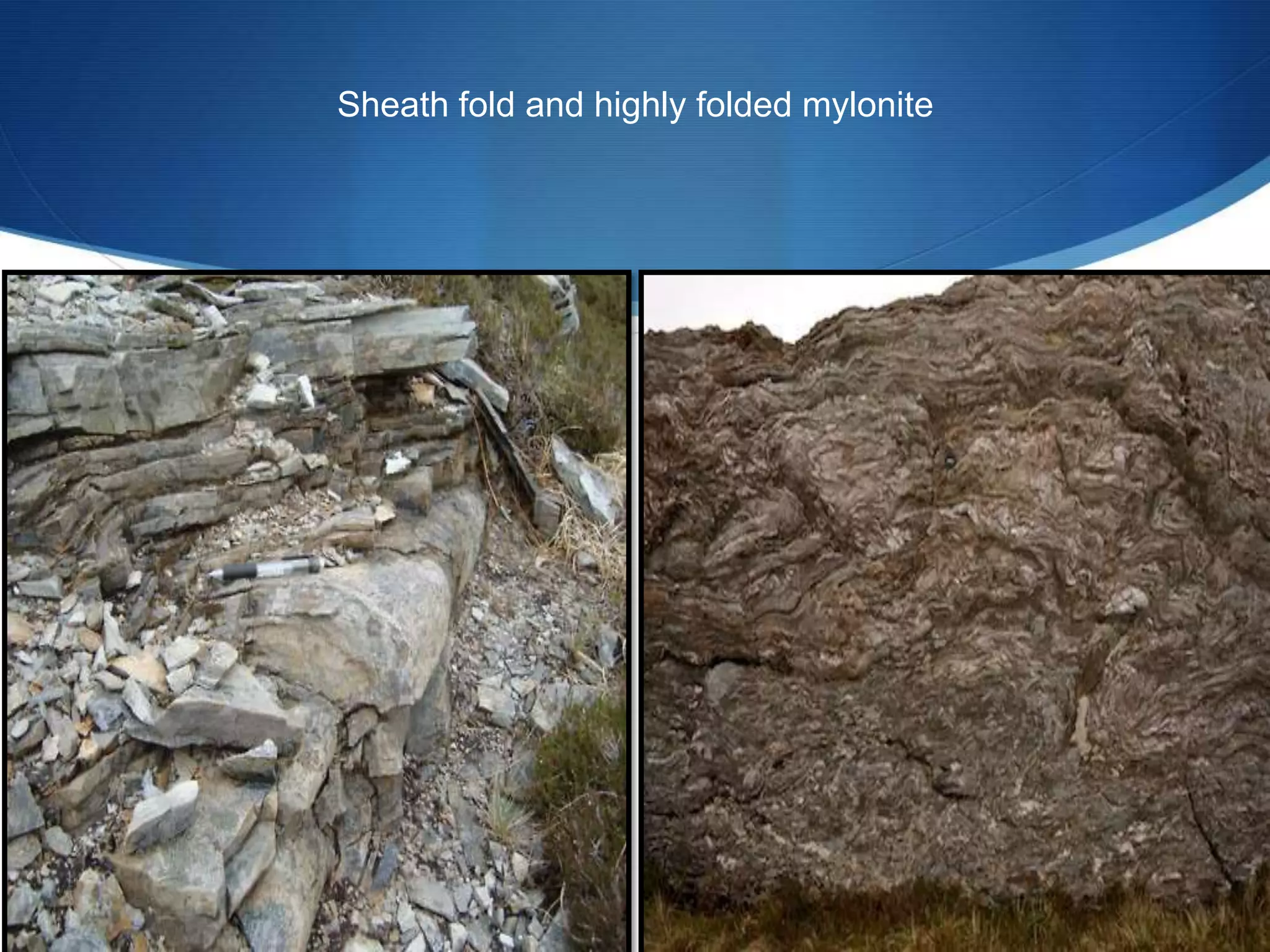
Sheath fold and highly folded mylonite
Deformed mylonites


50cm
Eriboll Mylonites Classification


                 S   Quarts Mylonite

                 -The rock has a very well developed platy
                     texture, and splits into thin flags

                 -It shows the intense fine- banding

                 -surface has a striation on it that shows the
                      direction of movement of the thrust sheet

                 -Probable protolith: Eriboll Sandstone
                     Formation
Eriboll Mylonite Classification


   Oyster shell mylonite
                           S   Mylonitic chlorite-muscovite
                               phyllonite, locally garnet
                               bearing

                           S   Also described as a “Variegated
                               schist” which could have the
                               appearance of frilled schist,
                               veined schist, mica schist-
                               Phyllitic mylonites (Lapworth
                               1885a)
30 cm
                           S   Protolith mainly Lewisian gneiss
S Green Mylonite


Eriboll
Mylonites
- Mylonitic Lewisian complex:
Green Mylonite

-Very rich in chlorites ,
hornblende, amphibole, feldspar
and mica

-Medium metamorphic grade

-Pegmatite fragments (rich in
feldspars)
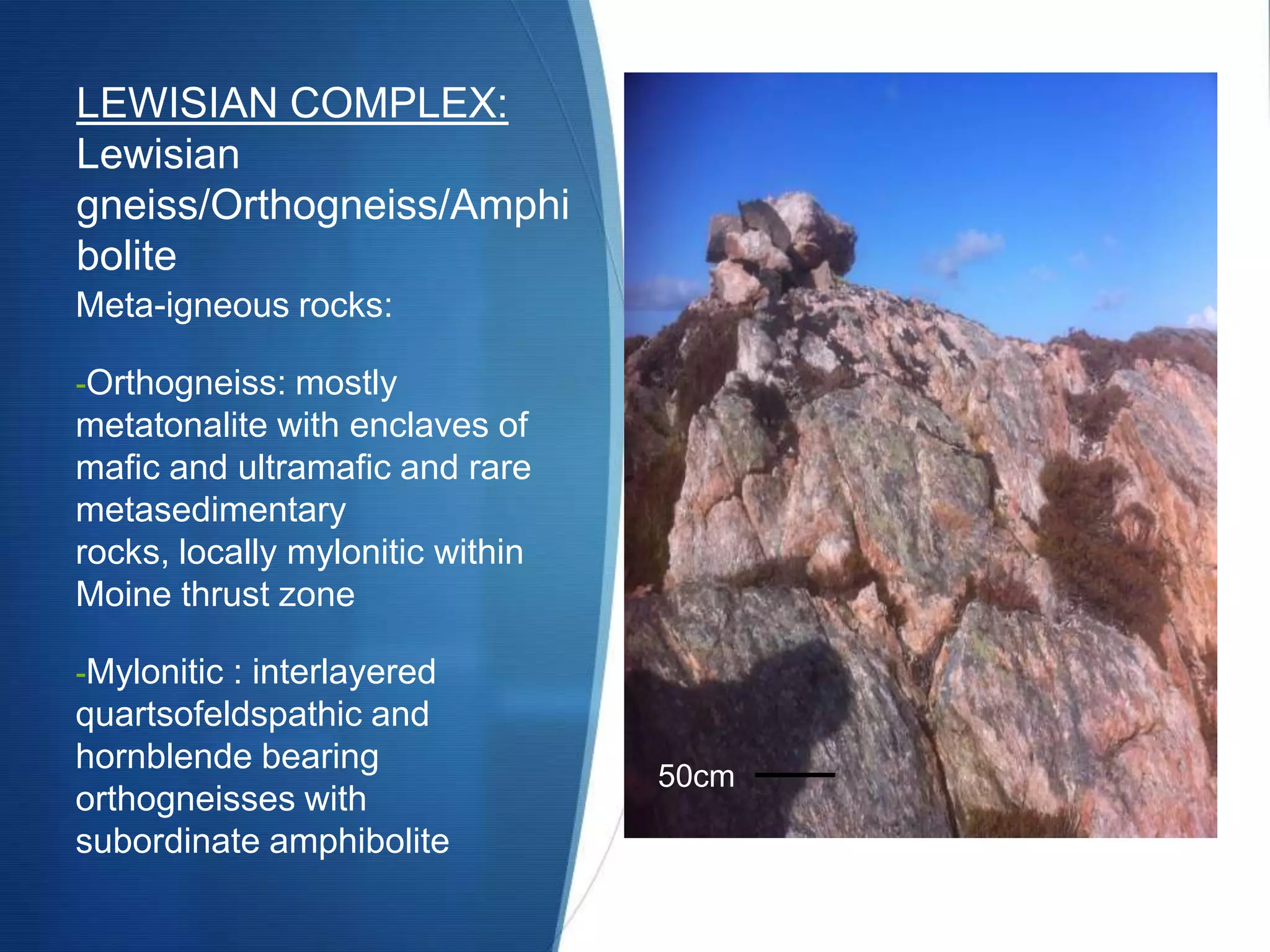
LEWISIAN COMPLEX:
Lewisian
gneiss/Orthogneiss/Amphi
bolite
Meta-igneous rocks:

-Orthogneiss: mostly
metatonalite with enclaves of
mafic and ultramafic and rare
metasedimentary
rocks, locally mylonitic within
Moine thrust zone

-Mylonitic : interlayered
quartsofeldspathic and
hornblende bearing
                                  50cm
orthogneisses with
subordinate amphibolite
Amphibolite


http://www.earth.ox.ac.uk/~oesis/nws/nw
s-rocktypes.html
Summary


S Deformation in a shear zone causes development of
  characteristic fabrics and mineral assemblages that reflect
  P-T conditions, flow type, movement sense and
  deformation history in the shear zone;

S Mylonites act as a “fossil indicator” to recognize a past
  presence of high strain plastic shear zones;

S Eriboll mylonites are result of a complex deformation event
References


S   Micro-tectonics , Cees W.Passchier, Rudolph A.J.Trouw;

S   http://www.see.leeds.ac.uk/structure/shearzones/

S   http://www.earth.ox.ac.uk/~oesis/nws/nws-rocktypes.html

S   Haakon Fossen, Structural Geology;

shear zone-mylonites

  • 1.
    Shear Zones-Mylonites By Abzal Alpysbayev BSc Petroleum Geology S
  • 2.
    Introduction S Shear zonesand their importance S Shear zone analyse S The geometry of a mylonite zone S Microstructures of mylonites in terms of shear sense S Eriboll mylonite classification
  • 3.
    Shear zones - ShearZones are tabular zones of strain localization in the crust; -Shear zones occur on all scales; -Like faults, shear zones tend to involve a considerable amount of wall-parallel movement (Simple shear) -Just like faults, shear zones may be reverse, normal, strike slip or show oblique displacements.
  • 4.
  • 5.
  • 6.
    Analyzing shear zones 1 step 2 step http://www.see.leeds.ac.uk/structure/shearzones/
  • 7.
    Analyzing shear zone Step 3 Step 4 http://www.see.leeds.ac.uk/structure/shearzones/
  • 8.
    Analyzing shear zone Step 5 Step 6 http://www.see.leeds.ac.uk/structure/shearzones/
  • 9.
    Mylonite S The word “mylonite” derives from the Greek word and translated as a mill. 1st described by (Lapworth 1885) S Foliated and lineated metamorphic rock-ductile deformation (ductile flow) S Contains fabric elements with monoclinic shape symmetry S Mylonites occur in high strain zones known as “mylonite zone” interpreted as exhumed, “fossil” ductile shear zone S Grain size in the mylonite is usually smaller than that in the wall rock S Dynamics of mylonite development – “softening” or strain softening” S Characteristic fabric elements - porphyroclasts
  • 10.
    The geometry ofa mylonite zone and the nomenclature used Parallel to the aggregate lineation, the most common types of shear sense indicators (For thin section)
  • 11.
    Mylonites in thinsection Mylonite derived from pelitic gneiss Quarts-feldspar mylonite
  • 12.
  • 13.
    Sheath fold andhighly folded mylonite
  • 14.
  • 15.
    Eriboll Mylonites Classification S Quarts Mylonite -The rock has a very well developed platy texture, and splits into thin flags -It shows the intense fine- banding -surface has a striation on it that shows the direction of movement of the thrust sheet -Probable protolith: Eriboll Sandstone Formation
  • 16.
    Eriboll Mylonite Classification Oyster shell mylonite S Mylonitic chlorite-muscovite phyllonite, locally garnet bearing S Also described as a “Variegated schist” which could have the appearance of frilled schist, veined schist, mica schist- Phyllitic mylonites (Lapworth 1885a) 30 cm S Protolith mainly Lewisian gneiss
  • 17.
    S Green Mylonite Eriboll Mylonites -Mylonitic Lewisian complex: Green Mylonite -Very rich in chlorites , hornblende, amphibole, feldspar and mica -Medium metamorphic grade -Pegmatite fragments (rich in feldspars)
  • 18.
    LEWISIAN COMPLEX: Lewisian gneiss/Orthogneiss/Amphi bolite Meta-igneous rocks: -Orthogneiss:mostly metatonalite with enclaves of mafic and ultramafic and rare metasedimentary rocks, locally mylonitic within Moine thrust zone -Mylonitic : interlayered quartsofeldspathic and hornblende bearing 50cm orthogneisses with subordinate amphibolite
  • 19.
  • 20.
    Summary S Deformation ina shear zone causes development of characteristic fabrics and mineral assemblages that reflect P-T conditions, flow type, movement sense and deformation history in the shear zone; S Mylonites act as a “fossil indicator” to recognize a past presence of high strain plastic shear zones; S Eriboll mylonites are result of a complex deformation event
  • 21.
    References S Micro-tectonics , Cees W.Passchier, Rudolph A.J.Trouw; S http://www.see.leeds.ac.uk/structure/shearzones/ S http://www.earth.ox.ac.uk/~oesis/nws/nws-rocktypes.html S Haakon Fossen, Structural Geology;

Editor's Notes

  • #4 Shear zones can be subdivided into brittle zones or faults, and ductile zones. Ductile shear zones are usually active at higher metamorphic conditions than brittle shear zones. The depth of the transition between brittle and ductile behavior depends on factors such as bulk strain rate, geothermal gradient, grain size, lithotype, fluid pressure, orientation of the stress field and pre-existing fabrics
  • #5 Distribution of the main types of fault rocks with depth in the crust. A) Schematic cross section through a transcurrent shear zone;