JourmdolStructural(;eolog~, Vol. 6. No 6. pp. ¢q7 to h38, 1984                                                              (llt)l-xl41/b;4 $1~3.()11+ IU)()
Printed in Great Britain.                                                                                                  © 1984 Pergamon Ihcss IAd.


                                                                 S--C Mylonites
                                                                   G. S. LISTER*

                     Department of Structural Geology, Institute for Earth Sciences, University of Utrecht, 351)8, TA Utrecht,
                                                                The Netherlands


                                                                         and

                                                                  A. W. SNOKEt

                                Department of Geology, University of South Carolina, Columbia, SC 292118, U.S.A.

                                         (Received 7 October 1983, accepted in revised form 26 March 1984)

                  AbstractmTwo types of foliations are commonly developed in mylonites and mylonitic rocks: (a) S-surfaces
                  related to the accumulation of finite strain and (b) C-surfaces related to displacement discontinuities or zones of
                  relatively high shear strain. There are two types of S--Cmylonites. Type I S-C mylonites, described by Berthe et
                  aL. typically occur in deformed granitoids. They involve narrow zones of intense shear strain which cut across
                  (mylonitic) foliation.
                    Type II S-C mylonites (described here) have widespread occurrence in quartz-mica rocks involved in zones of
                  intense non-coaxial laminar flow. The C-surfaces are defined by trails of mica "fish"formed as the result of
                  microscopic displacement discontinuities or zones of very high shear strain. The S-surfacesare defined by oblique
                  foliations in the adjacent quartz aggregates, formed as the result of dynamic recrystallization which periodically
                  resets the ~finite-strain clockL These oblique foliations are characterized by grain elongations, alignments of
                  segments of the grain boundary enveloping surfaces, and by trails of grains with similar c-axis orientations.
                     Examples of this aspect of foliation development in mylonitic rocks are so widespread that we suggest the
                  creation of a broad class of S--Ctectonites, and a deviation from the general tradition of purely geometric analysis
                  of foliation and time relationships. Kinematic indicators such as those discussed here allow the recognition of
                  kilometre-scale zones of intense non-coaxial laminar flow in crustal rocks, and unambiguous determination of thc
                  sense of shear.

                            INTRODUCTION                                     of a mylonite stems from an unfortunate failure to
                                                                             recognize evidence for crystalline plasticity in mylonites
MYLONITES have two important properties: (a) they are                        (Higgins 1971). Cataclastic processes are certainly
usually rocks which m a r k the locus of a zone of intense                   involved during mylonitization, since although the mat-
non-coaxial deformation; and (b) during flow the matrix                      rix minerals deform via crystal-plastic processes, other
minerals of a mylonite (e.g. quartz) d e f o r m crystal-plas-               minerals in the mylonite (e.g. feldspar) may deform in a
tically. Two effects result because large strains are                        brittle fashion. In extreme cases, cataclasis of individual
a c c o m m o d a t e d by the crystal-plastic behaviour of the              grains or groups of grains occurs. O t h e r processes also
matrix minerals of the mylonite: (a) the matrix minerals                     take place, for example sliding on grain boundaries,
undergo extensive dynamic recrystallization, normally                        sliding on transient displacement discontinuities, and
with the result that reduction in grainsize takes place and                  diffusional mass-transfer. H o w e v e r , since crystal-plastic
(b) strong patterns of preferred crystallographic orienta-                   d e f o r m a t i o n dominates, mylonites should not be
tion typically develop (e.g. quartz c-axis fabrics). These                   regarded as cataclastic rocks.
characteristics are so widespread that they are almost                           T h e b r o a d division of mylonitic rocks versus cataclas-
essential to the definition of a mylonite. T h e r e are,                    tic rocks (Sibson 1975, 1977) may occasionally require
however, other aspects which need to be considered in                        sophisticated microstructural analysis before a definitive
the definition of mylonite (see Bell & Etheridge 1973),                      classification can be m a d e , but the advantages of this
and there are complications: for example, superplastic                       terminology far outweigh the disadvantages.
mylonites need not develop strong crystallographic fab-
rics. Controversy has surrounded issues raised by each                       Pure shear vs simple shear
of the above points.
                                                                                Controversy has also surrounded questions concern-
Cataclastic vs mylonitic rocks                                               ing the type of flow involved in the production of a
                                                                             mylonite, centred on the issue as to whether or not
   Much of the criticism levelled at the above definition                    mylonites exist that formed in zones involving strictly
                                                                             coaxial deformation. This controversy has been fueled
                                                                             by difficulties associated with determining the type of
*Present address: Bureau of Mineral Resources. Geolog} and                   flow that has taken place in specific shear zones.
Geophysics. P.O. Box 378. Canberra City. 2601 Australia.
+Present address: Department of Geology and Geophysics. University           Ambiguity could be resolved if it was possible to specify
ol Wyoming. Laramie. WY 82071. U.S.A.                                        the magnitude of relative displacements across the boun-

 .........                                                               617
618                                          G.S. LISTERand A. W. SNOKE

daries of a mylonite zone, but evidence for relative
displacement is usually only circumstantial. Fabric and
microstructural studies are important in clarifying the                  1     2      3
situation, but extrapolation of small-scale observations                                     4      5
                                                                                                           6      7
to apply to the bulk scale is rarely straightforward,                                                                              M.yr
because heterogeneous deformation results in the move-
ment picture varying in a complex way from place to
place, and with time.
    The present state of this controversy can be sum-
marized as follows. (a) Mylonites which form by strictly
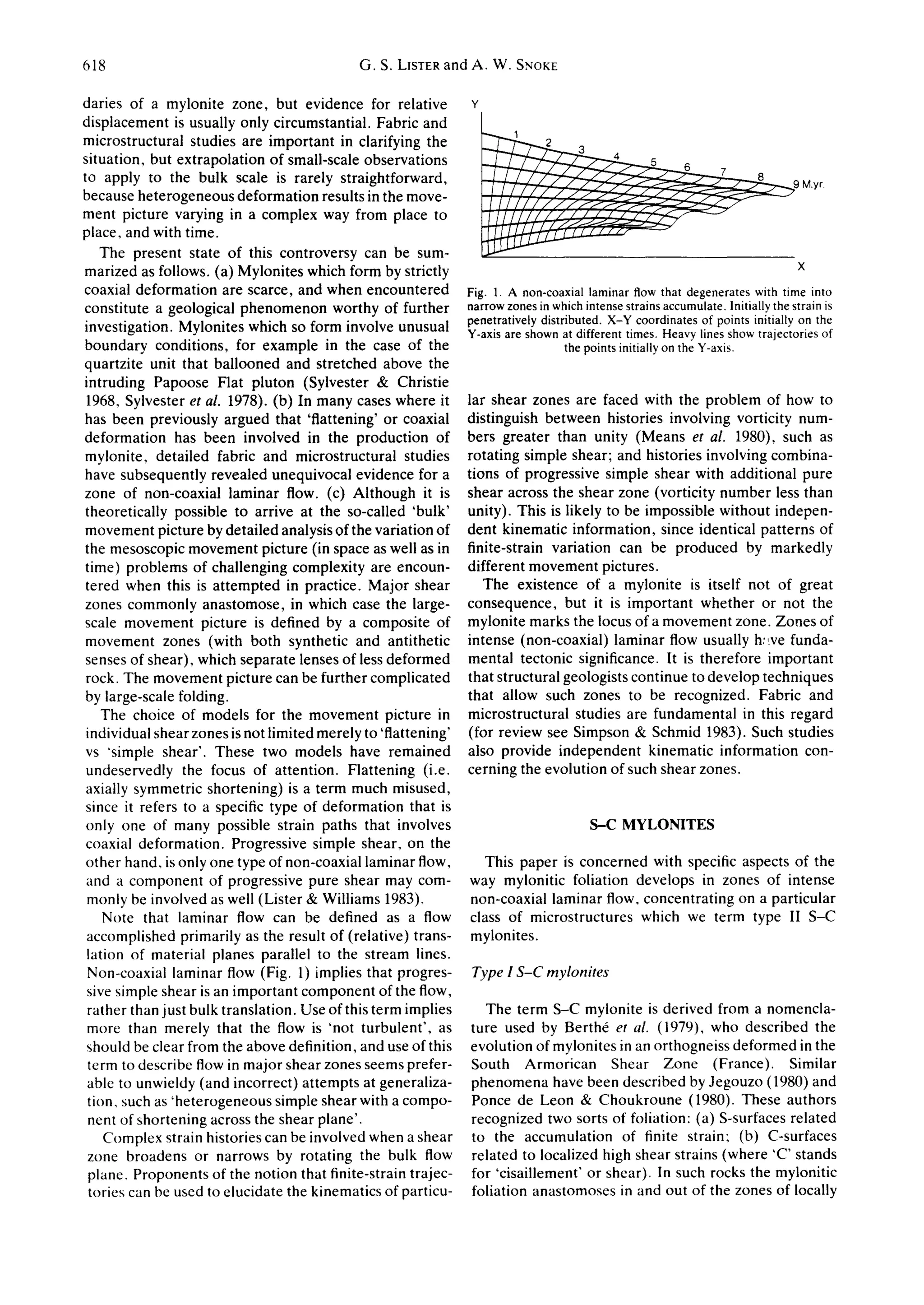
coaxial deformation are scarce, and when encountered            Fig. 1. A non-coaxial laminar flow that degenerates with time into
constitute a geological phenomenon worthy of further            narrow zones in which intense strains accumulate. Initially the strain is
                                                                penetratively distributed. X - Y coordinates of points initially on the
investigation. Mylonites which so form involve unusual          Y-axis are shown at different times. Heavy lines show trajectories of
boundary conditions, for example in the case of the                                the points initially on the Y-axis.
quartzite unit that ballooned and stretched above the
intruding Papoose Flat pluton (Sylvester & Christie
 1968, Sylvester et al. 1978). (b) In many cases where it       lar shear zones are faced with the problem of how to
has been previously argued that 'flattening' or coaxial         distinguish between histories involving vorticity num-
deformation has been involved in the production of              bers greater than unity (Means et al. 1980), such as
mylonite, detailed fabric and microstructural studies           rotating simple shear; and histories involving combina-
have subsequently revealed unequivocal evidence for a           tions of progressive simple shear with additional pure
zone of non-coaxial laminar flow. (c) Although it is            shear across the shear zone (vorticity number less than
theoretically possible to arrive at the so-called 'bulk'        unity). This is likely to be impossible without indepen-
movement picture by detailed analysis of the variation of       dent kinematic information, since identical patterns of
the mesoscopic movement picture (in space as well as in         finite-strain variation can be produced by markedly
time) problems of challenging complexity are encoun-            different movement pictures.
 tered when this is attempted in practice. Major shear             The existence of a mylonite is itself not of great
zones commonly anastomose, in which case the large-             consequence, but it is important whether or not the
scale movement picture is defined by a composite of             mylonite marks the locus of a movement zone. Zones of
 movement zones (with both synthetic and antithetic             intense (non-coaxial) laminar flow usually h:,.ve funda-
senses of shear), which separate lenses of less deformed        mental tectonic significance. It is therefore important
 rock. The movement picture can be further complicated          that structural geologists continue to develop techniques
 by large-scale folding.                                        that allow such zones to be recognized. Fabric and
    The choice of models for the movement picture in            microstructural studies are fundamental in this regard
 individual shear zones is not limited merely to 'flattening'   (for review see Simpson & Schmid 1983). Such studies
 vs 'simple shear'. These two models have remained              also provide independent kinematic information con-
 undeservedly the focus of attention. Flattening (i.e.          cerning the evolution of such shear zones.
 axially symmetric shortening) is a term much misused,
 since it refers to a specific type of deformation that is
 only one of many possible strain paths that involves                                     S--C MYLONITES
 coaxial deformation. Progressive simple shear, on the
 other hand, is only one type of non-coaxial laminar flow,         This paper is concerned with specific aspects of the
 and a component of progressive pure shear may com-             way mylonitic foliation develops in zones of intense
 monly be involved as well (Lister & Williams 1983).            non-coaxial laminar flow, concentrating on a particular
    Note that laminar flow can be defined as a flow             class of microstructures which we term type II S-C
 accomplished primarily as the result of (relative) trans-      mylonites.
 lation of material planes parallel to the stream lines.
 Non-coaxial laminar flow (Fig. 1) implies that progres-         Type 1 S - C mylonites
 sive simple shear is an important component of the flow,
 rather than just bulk translation. Use of this term implies      The term S-C myionite is derived from a nomencla-
 more than merely that the flow is 'not turbulent', as          ture used by Berth6 et al. (1979), who described the
 should be clear from the above definition, and use of this     evolution of mylonites in an orthogneiss deformed in the
 term to describe flow in major shear zones seems prefer-       South Armorican Shear Zone (France). Similar
 ablc to unwieldy (and incorrect) attempts at generaliza-       phenomena have been described by Jegouzo (1980) and
 tion, such as 'heterogeneous simple shear with a compo-        Ponce de Leon & Choukroune (1980). These authors
 nent of shortening across the shear plane'.                    recognized two sorts of foliation: (a) S-surfaces related
    Complex strain histories can be involved when a shear       to the accumulation of finite strain: (b) C-surfaces
 zone broadens or narrows by rotating the bulk flow             related to localized high shear strains (where 'C' stands
  plane. Proponents of the notion that finite-strain trajec-    for 'cisaillement' or shear). In such rocks the mylonitic
  tories can be used to elucidate the kinematics of particu-    foliation anastomoses in and out of the zones of locally
S-C Mylonites                                                               619


                                  ~     z


                                                                                                         band
                          i                                                                              c-surfaces


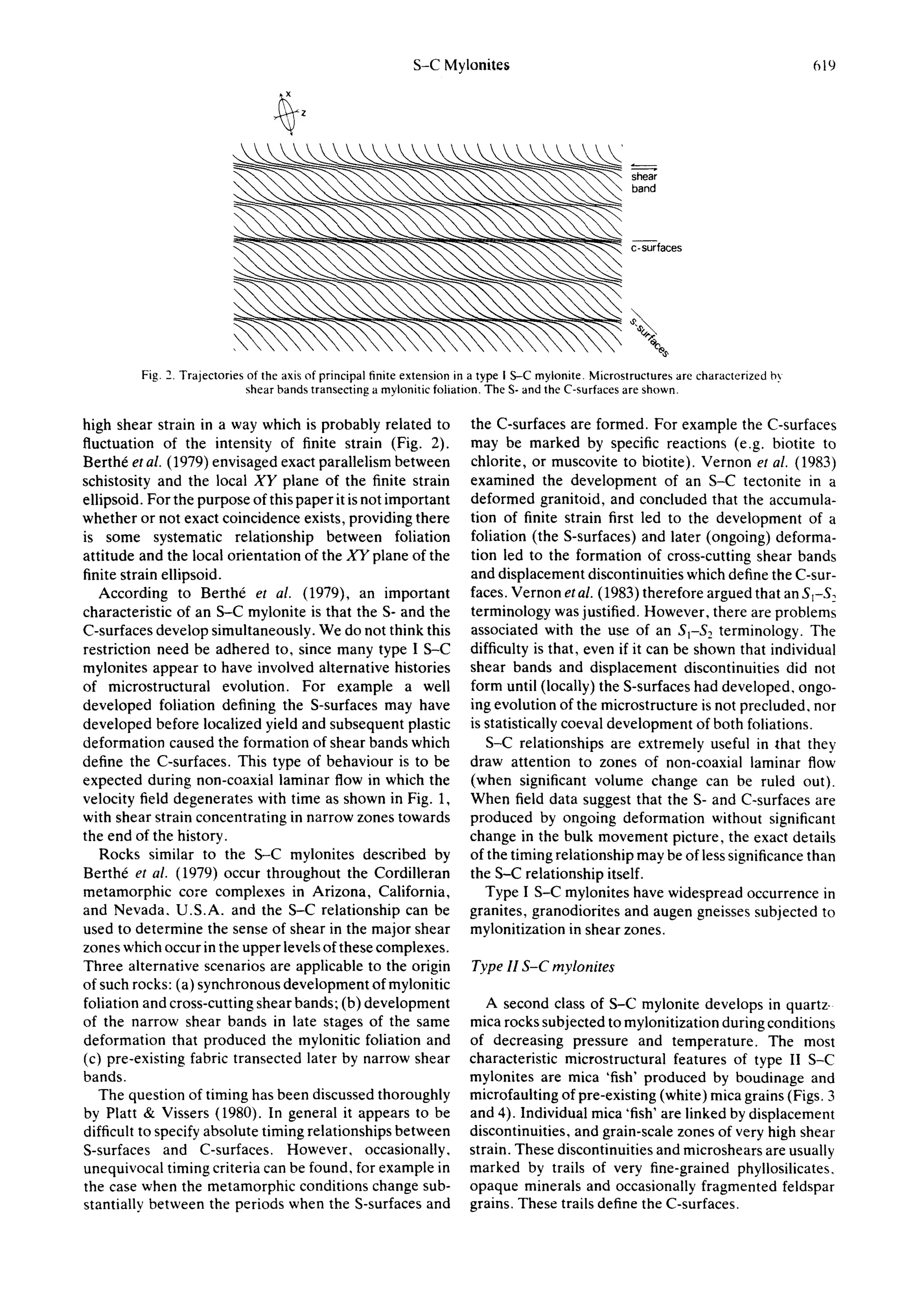
         Fig. 2. Trajectories of the axis of principal finite extension in a type I S--C mylonite. Microstructures are characterized b~
                              shear bands transecting a mylonitic foliation. The S- and the C-surfaces are shown.


high shear strain in a way which is probably related to                  the C-surfaces are formed. For example the C-surfaces
fluctuation of the intensity of finite strain (Fig. 2).                  may be marked by specific reactions (e.g. biotite to
Berth6 et al. (1979) envisaged exact parallelism between                 chlorite, or muscovite to biotite). Vernon et al. (1983)
schistosity and the local XY plane of the finite strain                  examined the development of an S-C tectonite in a
ellipsoid. For the purpose of this paper it is not important             deformed granitoid, and concluded that the accumula-
whether or not exact coincidence exists, providing there                 tion of finite strain first led to the development of a
is some systematic relationship between foliation                        foliation (the S-surfaces) and later (ongoing) deforma-
attitude and the local orientation of the XY plane of the                tion led to the formation of cross-cutting shear bands
finite strain ellipsoid.                                                 and displacement discontinuities which define the C-sur-
   According to Berth6 et al. (1979), an important                       faces. Vernon et al. (1983) therefore argued that an S~-Sz
characteristic of an S-C mylonite is that the S- and the                 terminology was justified. However, there are problems
C-surfaces develop simultaneously. We do not think this                  associated with the use of an $1-$2 terminology. The
restriction need be adhered to, since many type I S-C                    difficulty is that, even if it can be shown that individual
mylonites appear to have involved alternative histories                  shear bands and displacement discontinuities did not
of microstructural evolution. For example a well                         form until (locally) the S-surfaces had developed, ongo-
developed foliation defining the S-surfaces may have                     ing evolution of the microstructure is not precluded, nor
developed before localized yield and subsequent plastic                  is statistically coeval development of both foliations.
deformation caused the formation of shear bands which                       S-C relationships are extremely useful in that they
define the C-surfaces. This type of behaviour is to be                   draw attention to zones of non-coaxial laminar flow
expected during non-coaxial laminar flow in which the                    (when significant volume change can be ruled out).
velocity field degenerates with time as shown in Fig. 1,                 When field data suggest that the S- and C-surfaces are
with shear strain concentrating in narrow zones towards                  produced by ongoing deformation without significant
the end of the history.                                                  change in the bulk movement picture, the exact details
   Rocks similar to the S-C mylonites described by                       of the timing relationship may be of less significance than
Berth6 et al. (1979) occur throughout the Cordilleran                    the S-C relationship itself.
metamorphic core complexes in Arizona, California,                          Type I S-C mylonites have widespread occurrence in
and Nevada, U.S.A. and the S-C relationship can be                       granites, granodiorites and augen gneisses subjected to
used to determine the sense of shear in the major shear                  mylonitization in shear zones.
zones which occur in the upper levels of these complexes.
Three alternative scenarios are applicable to the origin                 Type II S - C mylonites
of such rocks: (a) synchronous development of mylonitic
foliation and cross-cutting shear bands; (b) development                    A second class of S-C myionite develops in quartz-
of the narrow shear bands in late stages of the same                     mica rocks subjected to mylonitization during conditions
deformation that produced the mylonitic foliation and                    of decreasing pressure and temperature. The most
(c) pre-existing fabric transected later by narrow shear                 characteristic microstructural features of type II S-C
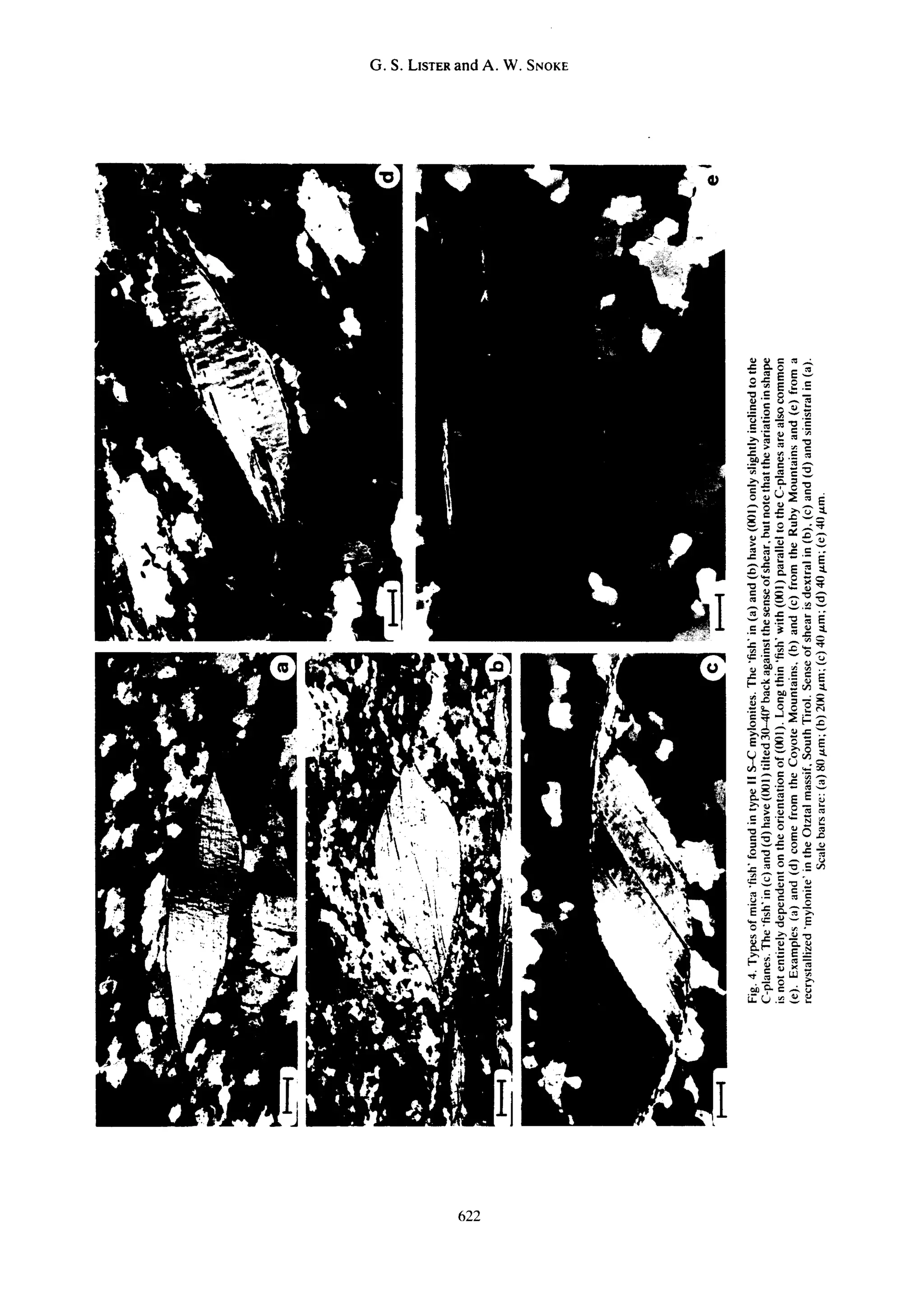
bands.                                                                   mylonites are mica 'fish' produced by boudinage and
   The question of timing has been discussed thoroughly                  microfaulting of pre-existing (white) mica grains (Figs. 3
by Platt & Vissers (1980). In general it appears to be                   and 4). Individual mica 'fish' are linked by displacement
difficult to specify absolute timing relationships between               discontinuities, and grain-scale zones of very high shear
S-surfaces and C-surfaces. However, occasionally,                        strain. These discontinuities and microshears are usually
unequivocal timing criteria can be found, for example in                 marked by trails of very fine-grained phyllosilicates.
the case when the metamorphic conditions change sub-                     opaque minerals and occasionally fragmented feldspar
stantially between the periods when the S-surfaces and                   grains. These trails define the C-surfaces.
620                                          G.S. LISTERand A. W. SNOKE

    The essential difference between type I S-C myloniteslarge (white) mica grains are boudinaged by a combina-
and type II S-C mylonites lies in the relative importancetion of brittle and crystal-plastic processes (e.g. Eis-
of the S- and C-surfaces. In type I S-C mylonites the S- bacher 1970). The remriant clasts are usually asymmetric
surfaces are clearly discernible on the mesoscopic scale,in shape, and the (001) cleavage is either tilted back
anastomosing in and out of the narrow zones of high shearagainst the sense of shear (Fig. 5) or sub-parallel to the C-
strain which define the C-surfaces. Furthermore, in most surfaces. In these orientations the easy slip plane in the
type I S-C mylonites, continuity is maintained across    mica lies in the extension field of the flow, and since the
these narrow (ductile) shear zones. In type II S-C mylo- mica (001) is relatively strong, the clasts are relatively
                                                         undistorted in these orientations. However, if the (001)
nites, on the other hand, the C-surfaces define the domin-
ant mesoscopic foliation, and the S-surfaces are not     plane of the mica is (even locally) tilted forward with
                                                         respect to the C-surfaces, intense kinking, microfolding
always clearly discernible. Even on the microscopic scale,
many C-surfaces in type II S-C mylonites appear to have  and/or cleavage fracturing results (Figs. 5i & j). The mica
involved transient displacement discontinuities.         'fish' are usually linked by trails of fragments, and when
                                                         extensively developed, these trails commonly stair-step
    In type II S-C mylonites the S-surfaces are not always as
obvious as C-surfaces. Commonly they can be represen-    from one mica 'fish' to the next (Figs. 3 and 4). Each of
                                                         the above microstructural characteristics is a useful
ted by foliations in the adjacent quartz aggregates, which
form oblique to the C-surfaces. These foliations are de- kinematic indicator by itself.
fined by alignments of segments of the traces of the envel- The mechanisms by which mica 'fish' form can be
oping surfacesofthe grain boundaries, elongate recrystai-inferred from microstructural observations, because the
lized grain shapes, and alignments of groups of similarlyresults of micro-boudinage can still be recognized, as
oriented recrystallized grains (Fig. 3). They appear to  well as evidence for the existence of displacement dis-
result because the quartz aggregate underwent (dynamic)  continuities in the flow field. The early developmental
recrystallization as shear movements took place, syn-    stages of a new mica 'fish' are occasionally preserved at a
chronously with the formation of the C-surfaces.         stage before the 'fish' has been separated from the host
    Such microstructures are spectacularly developed in  clast by a displacement discontinuity. As illustrated in
quartz myionites from the metamorphic core complexes     Fig. 5, the host clast is transected by microfauits and
of the western North American Cordillera (in Arizona,    microshears, which can form in either synthetic or anti-
California and Nevada), in particular in the Coyote      thetic relationships with the bulk shear sense. Different
 Mountains, SW of Tucson, Arizona (see acknowledge-      effects result, depending on the orientation of the (001)
ments), and from the Ruby Mountains, Nevada (Snoke       cleavage (Fig. 5). Notable amongst these are cleavage
 1980). Detailed studies have led to the conclusion that peels, through-cleavage microshears, and qistric normal'
these microstructures are useful and consistent indi-    faults. Note again that the (001) planes tend to be either
cators of the sense of shear in rocks subjected to large-parallel to the trails linking the 'fish' (i.e. the C-surfaces)
scale non-coaxial laminar flow, and their presence pro-  or tilted back against the bulk shear sense.
 vides conclusive evidence that major shear zones are       One fairly intricate mechanism for the generation of
 involved in the development of the Cordilleran          mica 'fish' should be described in detail because it
 metamorphic core complexes. More importantly, this is   appears to have taken place in many of the different
                                                         mylonites we have examined, and because it produces a
 a class of microstructures in which the dominant foliation
 is related to shear surfaces, directly contradicting thedistinctive shape of 'fish', which itself allows microstruc-
                                                         tural assessment of bulk shear sense, independent of
 view that foliations develop in exact relationships to the
 state of finite strain. We decided, therefore, to make aother kinematic indicators. The mechanism is initiated
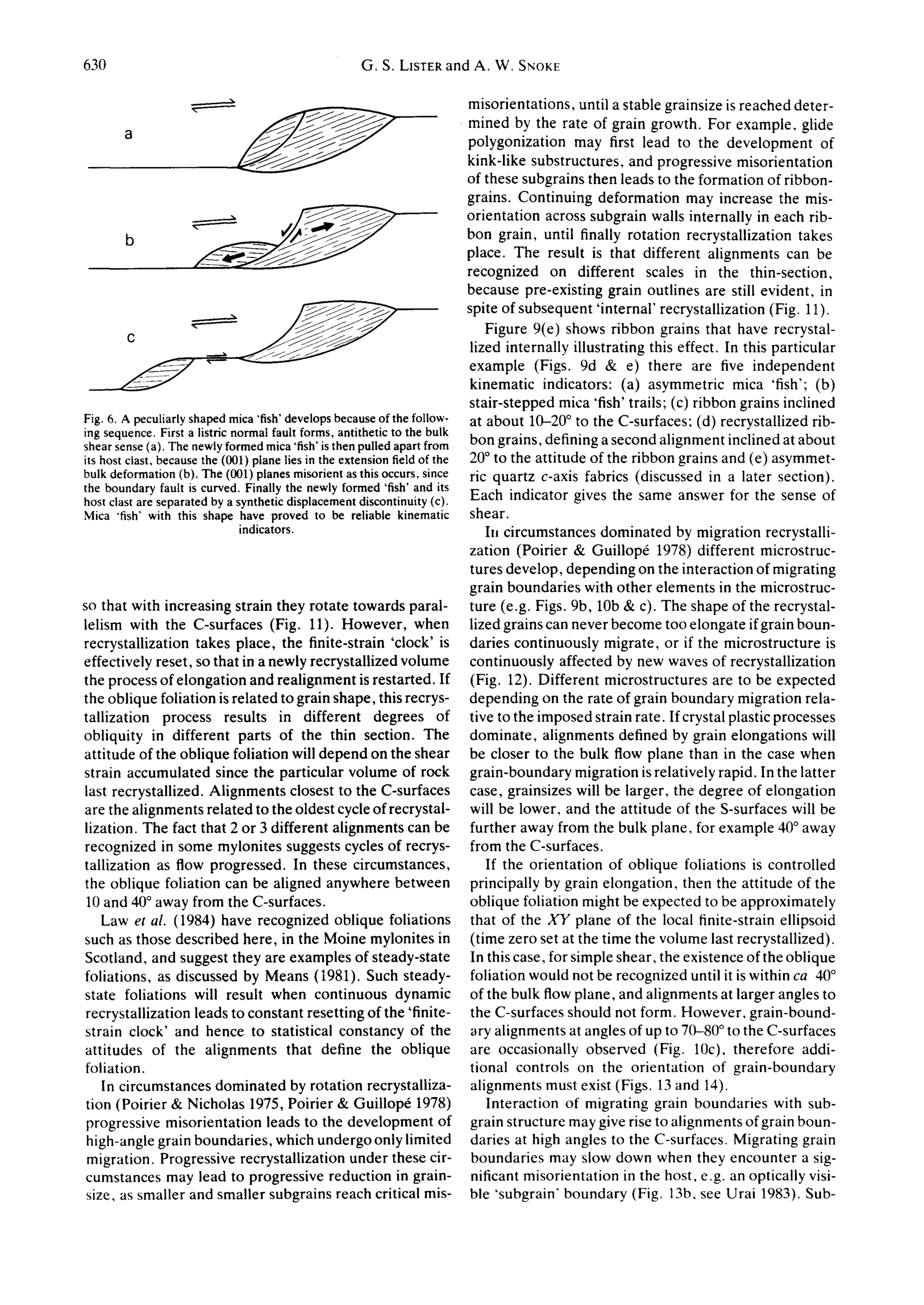
 detailed fabric and microstructural study of type II S-Cby the formation of a 'listric normal' microfault, antithe-
 mylonites to characterize their properties.             tic to the bulk shear sense, which first cuts down through
     Similar microstructures have also been recorded in  the cleavage then curves into parallelism with it (Fig. 6a).
 mylonites from the axial zone of the Pyrenees, from the The two segments are then drawn apart by continuing
 Seve-K61i thrust-slice complex in the Scandinavian      deformation, because the (001) plane lies in the exten-
 Caledonides, from mylonites in various parts of the     sion field (Fig. 6b). Displacements on the curved micro-
 Alpine orogenic belt (e.g. mylonitic complexes in the   fault continue to be antithetic to the bulk shear sense,
 Cycladic Archipelago, Greece), and from vertical shear  and because the fault is curved, the (001) planes in the
 zones in the Australian Precambrian (in retrograde      new-formed segment rotate with respect to those of the
 shear zones in granulites of the Arunta complex in Cen- host, as the two segments slide apart. A synthetic micro-
 tral Australia). Hence type II S-C mylonites have wide- shear or microfault is eventually responsible for the dis-
  spread occurrence, and they form a valuable addition toplacement discontinuity which causes the wide separa-
                                                         tion of the originally adjacent segments (Fig. 6c).
  the catalogue of kinematic indicators which a structural
  geologist can use to draw inferences concerning the       The most common mechanisms whereby "fish' multi-
  movement picture.                                       ply are illustrated in Figs. 7 and 8. 'Listric normal' micro-
                                                          faults are found repeatedly in mica "fish' in S-C mylo-
                      MICA 'FISH'                         nites (Fig. 8). Attention has already been drawn to the
                                                         peculiar shape of mica 'fish' that results (Fig. 8a) and its
   Mica 'fish' form commonly in rocks where pre-existing usefulness as a reliable kinematic indicator.
S-C Mylonites


                ~,~                  -~ ~..~
                ~                    '.~ ~-'-


                o~_o                 ~_,"


                t-- ¢~ •o .= ~ ~-'r,
                  • .~     ,"  m ,...
                •- o =_o ~.__.--

                       ~,~ ~ . _ ~          ~    .


                e..-       . ~          ~.,1"~

                       0     ~._-.   ~l~Z ~


                -.=          ~'~        ~ , ~ , ..
                ~ - . ~ 0 ~..,~


                ~ . o b = u ,--


                o .~ e .N


                ~      ~.~-


                             0


                ~.---        0 0
                0.~          ~7


                       ~ "       ,~ .~ :~ '7-

                ,~           ~ ~ '~.~


     621
G. S. L~STEgand A. W. SNOKE


                                 .~_ ~
                                  •~ .'~ .~ "=
                              -~,.~ .~ ~.~
                              .-~.= ~ "~,


                                 ~ -~ ~ .= .°


                              ._=~ ~ . ~


                              ~-~: ~


                                         u~
                              ",. ~ ~ ' . ~ _ ~


                              -~ ~.~¢


           622
S-C   Mylonites


                                                                                                      2~                -
                                                                                                      _    u.~          .=       ~


                                                                                                      e-   L~   C            C   I.


                                                                                                      ~..=~¢        =   ,-.=     ,-


l ~                  ~ ~     ~    ~   ~

                                                                           II
                                                                                                                ~l~          ~ ~

                                                                                                      "r-~.     ~   ," " o "r-


      ,.                     ,.            ~'   ,         ..It,            ~    -
                                                                                                      =',--         ~ ~=         ~
                     i            ,       II


                                                                                                      ~ ~._"                 -


           tt.-;~.       ,                          .o.           ,   ,J


                                                                                          623
G. S. LISTER and A. W. SNOKE


                               ~ . = ~ ~.~


                               ~2E~ ~2
                               -~e.E q e


                               gg..=


                               ~.~ ~ =


                                              N


                                 N ,-,._= e


                                 .1~   -.'~


            624
S - C Mylonites


                                                                      E'~              ~-


                                                                •~    I-    ~..~       ~.~


                                                                •~ , ~                       ~~
                                                                "t-   ~'~          ~   ~     , ~


                                                                ~     ~ ,~. ".~ --~ ~ ~
                                                                 ~" ,,1~ , ~       ~   ~      ,


                                                                N=eE~_e=
                                                                N--'~ m N - £ , ~


                                                                .-    ~     ~,.-       ~           ~


     ....    .         #       ~   ,,,+. -+

i+
~           ", t   ++1~ ':+-
                                          '
                                                                ~'= ~ _~~

                                                                ~              . ~-.~ z
                                                                ~.~-,-          ~ ~=~

                                                                0 ~-~ , ~ . = . ~


5i           ..            '


                                                    625
G. S. LISTER and A. W. S~OK~


                               •~        ~ ~ ~'~


                                ~" o ~ - ~ < ~
                               '.~   ~   ~   ~.-~.~     ~


                                ~,.~ ~.          ~.=_
                                   ~._          "~ ~


                                = ,-.=-         N ~- ~-
                                ~..-


                               .._- .~ ._ ¢ ~.---


                                 ,..~    ~   ~ ~,.~


            626
S-C Myionites


J


                    o       ,.-   =-


f


                    • -~ ~ 2 ~ , . - . ~


                    .£ ~= ,'," .~ y , . ,


                             _-        ".~_~-
                             ~         .__.~


                                       ~aY


                        ~              -.- _ ..=
                        u.~            < ~= ..=


          627
G . S. LISTER a n d A . W . SNOKE


                                                                     ~.-           ~ . ~                  ~


                                                                     x
          

                                                                     ,_'~'                  .__ ~ , ~
     ,~       "
                                                                    •' ~   ~       --      .,,..~-


                                                                    ~      ~                ~~
                                                                                            ,~~
                                                                           •              ,-.~       ~-

                                                                     ~ '~ ' - .~ "~ .~_ ~
~%
                                                                    •~ ,   ~-----                    0    ~

                                                                     ~.~_ ,~.~                       ~
 •                .


                         •                                          .~.~            ~ ~              ~


                                                                      ~ ~,p               ,, ~ ' ~ . -


                                                              ,~; "" ._..
                                                      ,.i ~           "~       .    -~.       -      ~    ~..


                                                                    ~E~--~.-
                                                                    ~--~ ~.-- ~'E_~
                             i


                                                                           .~=~,~


                                   ti                           .


                                 628
S-C Mylon!tes                                                                  629


                                                                                                                   b


                                                     e


                                                     0


                         - - ~ .                      I

         Fig. 5. The effect of variation in the attitude of (001) in mica 'fish' on microstructures, illustrating the mechanisms whereby
         mica "fish" are peeled off their host clasts. Bulk sense of shear is dextral. New mica "fish" are generated by fracture of a mica
         porphyroclast, involving combinations of cleavage fractures (c--d) or through-cleavage micro-faults (e). Mica "fish" are
         usually tilted back against the sense of shear (dextral) but the angle of tilt varies from about 30° (a) to almost parallel to the
         C-surfaces (b). Cleavage-splits result in antithetic (c) or synthetic (d) microfaults. Through-cleavage microfaults are also
         common (e-f). Combinations of these two types of microfauit lead to "listric normal" microfaults (g) or "thrust' microfaults
         (h). again depending on the orientation of the (001) cleavage. Even with the (001) plane tilted back 30° against the bulk fiord
         plane, heterogeneities in the flow occasionally force the (001) plane into the shortening field, in which case on the rim of
         individual 'fish' tight to isoclinal folds can be found in the cleavage planes (i). When (001) is less steeply inclined, the entire
                                                          'fish" may be isoclinally folded (j).


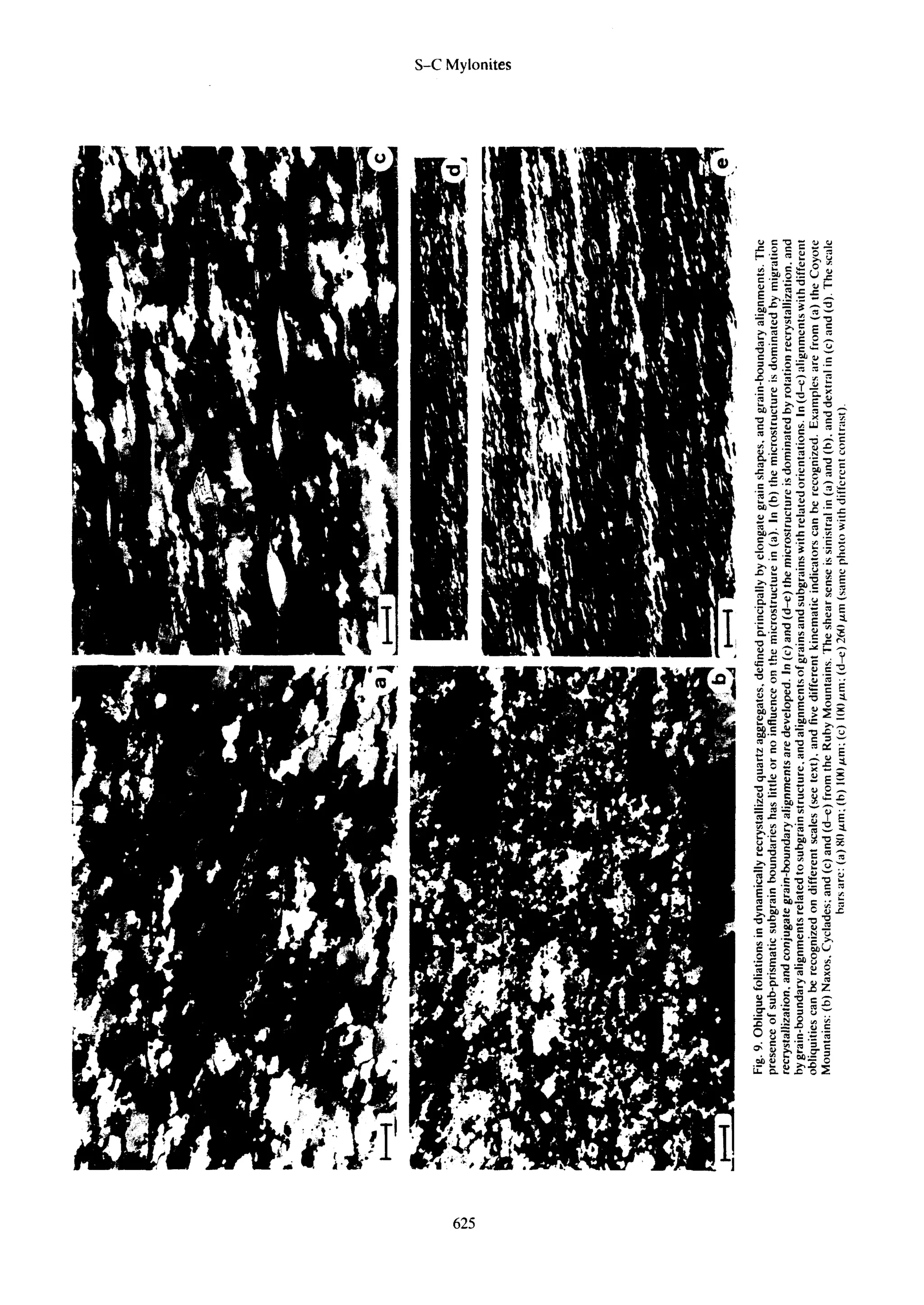
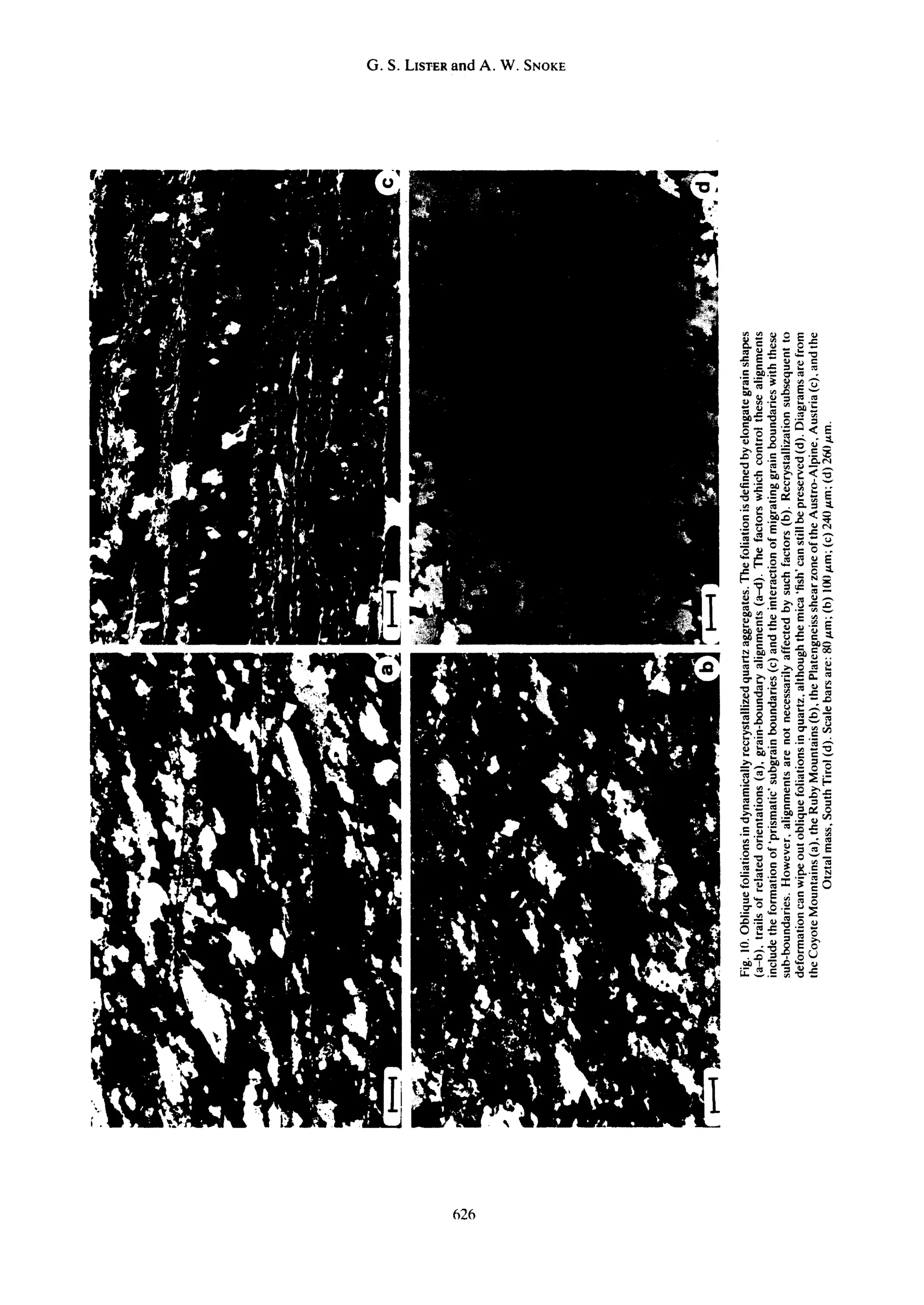
  A comment can be made on the deformation                                 cent to the mica 'fish' trails (Figs. 9 and 10) are defined by
mechanism of muscovite in nature, since brittle proces-                    combinations of the following elements: (a) elongate
ses are important in the production of 'fish' in this                      grain shapes (these can include ribbon grains as well as
material. Fractures parallel the (001) cleavage are com-                   recrystallized grains with smaller aspect ratios): (b)
mon, even though the mica is oriented with its easy slip                   alignments of segments of the traces of the enveloping
plane in the ideal orientation for undergoing substantial                  surfaces to grain boundaries or groups of grain bound-
shear. A model that explains this behaviour is that dislo-                 aries; (c) elongate zones in which the crystallographic
cation pile-ups at obstacles in the glide plane eventually                 orientations of the recrystaUized grains appear to be
result in the initiation of a cleavage fracture, suggesting                related. These alignments of families of related orienta-
that cross-slip and climb are difficult.                                   tions are best seen with the gypsum (i.e. first order
                                                                           retardation) plate inserted. These microstructures are
                                                                           related to the effects of dynamic recrystallization of the
   OBLIQUE FOLIATIONS IN DYNAMICALLY                                       quartz.
   RECRYSTALLIZED QUARTZ AGGREGATES                                           If it were possible to examine the quartz aggregates
                                                                           between the mica 'fish' trails as they recrystallized, one
  The oblique foliations in the quartz aggregates adja-                    might expect to see individual grains slowly elongating,
630                                              G.S. LISTERand A. W. SNOKE

                                                                        misorientations, until a stable grainsize is reached deter-
                                                                        mined by the rate of grain growth. For example, glide
                                                                        polygonization may first lead to the development of
                                                                        kink-like substructures, and progressive misorientation
                                                                        of these subgrains then leads to the formation of ribbon-
                                                                        grains. Continuing deformation may increase the mis-
                                                                        orientation across subgrain walls internally in each rib-
         b                                                              bon grain, until finally rotation recrystallization takes
                                                                        place. The result is that different alignments can be
                                                                        recognized on different scales in the thin-section,
                                                                        because pre-existing grain outlines are still evident, in
                                                                        spite of subsequent 'internal' recrystallization (Fig. 11).
                                                                            Figure 9(e) shows ribbon grains that have recrystal-
                                                                         lized internally illustrating this effect. In this particular
                                                                        example (Figs. 9d 8,: e) there are five independent
                                                                        kinematic indicators: (a) asymmetric mica 'fish': (b)
                                                                        stair-stepped mica 'fish' trails; (c) ribbon grains inclined
Fig. 6. A peculiarlyshaped mica 'fish'developsbecauseof the follow- at about 10-20 ° to the C-surfaces: (d) recrystallized rib-
ing sequence. First a listricnormal fault forms,antitheticto the bulk
shear sense(a). The newlyformedmica'fish"is then pulledapart from bon grains, defining a second alignment inclined at about
its host clast, becausethe (001) plane lies in the extensionfieldof the 20° to the attitude of the ribbon grains and (e) asymmet-
bulk deformation(b). The (00l) planes misorientas this occurs, since ric quartz c-axis fabrics (discussed in a later section).
the boundaryfault is curved. Finallythe newlyformed 'fish' and its
host clast are separated by a syntheticdisplacementdiscontinuity(c). Each indicator gives the same answer for the sense of
Mica "fish"with this shape have proved to be reliable kinematic shear.
                               indicators.                                  In circumstances dominated by migration recrystalli-
                                                                        zation (Poirier & Guillop~ 1978) different microstruc-
                                                                         tures develop, depending on the interaction of migrating
                                                                        grain boundaries with other elements in the microstruc-
so that with increasing strain they rotate towards paral-               ture (e.g. Figs. 9b, 10b & c). The shape of the recrystal-
lelism with the C-surfaces (Fig. 11). However, when lized grains can never become too elongate if grain boun-
recrystallization takes place, the finite-strain 'clock' is daries continuously migrate, or if the microstructure is
effectively reset, so that in a newly recrystallized volume continuously affected by new waves of recrystallization
the process of elongation and realignment is restarted. If (Fig. 12). Different microstructures are to be expected
the oblique foliation is related to grain shape, this recrys- depending on the rate of grain boundary migration rela-
tallization process results in different degrees of tive to the imposed strain rate. If crystal plastic processes
obliquity in different parts of the thin section. The dominate, alignments defined by grain elongations will
attitude of the oblique foliation will depend on the shear be closer to the bulk flow plane than in the case when
strain accumulated since the particular volume of rock grain-boundary migration is relatively rapid. In the latter
last recrystallized. Alignments closest to the C-surfaces case, grainsizes will be larger, the degree of elongation
are the alignments related to the oldest cycle of recrystal- will be lower, and the attitude of the S-surfaces will be
lization. The fact that 2 or 3 different alignments can be further away from the bulk plane, for example 40° away
recognized in some mylonites suggests cycles of recrys- from the C-surfaces.
tallization as flow progressed. In these circumstances,                     If the orientation of oblique foliations is controlled
the oblique foliation can be aligned anywhere between principally by grain elongation, then the attitude of the
 10 and 40° away from the C-surfaces.                                    oblique foliation might be expected to be approximately
    Law et al. (1984) have recognized oblique foliations that of the XY plane of the local finite-strain ellipsoid
such as those described here, in the Moine mylonites in (time zero set at the time the volume last recrystallized).
Scotland, and suggest they are examples of steady-state In this case, for simple shear, the existence of the oblique
foliations, as discussed by Means (1981). Such steady- foliation would not be recognized until it is within ca 40°
state foliations will result when continuous dynamic of the bulk flow plane, and alignments at larger angles to
 recrystailization leads to constant resetting of the 'finite- the C-surfaces should not form. However, grain-bound-
strain clock' and hence to statistical constancy of the ary alignments at angles of up to 70-80 ° to the C-surfaces
attitudes of the alignments that define the oblique are occasionally observed (Fig. 10c), therefore addi-
foliation.                                                               tional controls on the orientation of grain-boundary
    In circumstances dominated by rotation recrystalliza- alignments must exist (Figs. 13 and 14).
 tion (Poirier & Nicholas 1975, Poirier & Guillop6 1978)                    Interaction of migrating grain boundaries with sub-
 progressive misorientation leads to the development of grain structure may give rise to alignments of grain boun-
 high-angle grain boundaries, which undergo only limited daries at high angles to the C-surfaces. Migrating grain
 migration. Progressive recrystallization under these cir- boundaries may slow down when they encounter a sig-
 cumstances may lead to progressive reduction in grain- nificant misorientation in the host, e.g. an optically visi-
 size, as smaller and smaller subgrains reach critical mis- ble 'subgrain' boundary (Fig. 13b, see Urai 1983). Sub-
S-C Mylonites                                                         631


                                             ,                                          /


                             -%


          Fig. I 1. Dynamic recrystallization periodically resets the "finite-strain clock'. Diagrams show a sequence where a grain
          deforms and then internally recrystallizes (by a combination of rotation and migration recrystallization), and thc new
          recrystallized grains in turn become elongate as deformation goes on. defining a new oblique foliation. The elongate shape
               of the "old" grains can still be recognized by virtue of a clustering of the orientations (stippled) of the new grains.


prismatic subgrain boundaries in quartz are common,                       iineation (e.g. Fig. 10c). There are numerous cases, how-
and these commonly have preferred alignments at high                      ever, where the alignment of grain boundaries is at 2(I--
angles to the extension lineation, simply because plasti-                 40 ° to the dominant subgrain-boundary orientation, so
cally deformed quartz aggregates usually exhibit pat-                     only in specific circumstances does preferred alignment
terns of preferred crystallographic orientation with a                    of subgrain boundaries control the orientation of aligned
single (a) direction aligned close to the bulk shear direc-               grain boundaries in deformed and recrystallized
tion. If recrystallization takes place so that subgrain                   quartzite.
structure affects grain-boundary alignment, then                             Some oblique foliations are controlled by grain-boun-
oblique foliations form at high angles to the extension                   dary alignments (e.g. Figs. 9b and 14a), usually in cir-
                                                                          cumstances where migration recrystallization domi-
                                                                          nated the microstructure. These alignments have been
                                                                          suggested by Lister & Dornsiepen (1980) to be the result
                                                                          of interaction between rapidly migrating grain bound-
                                                                          aries with microscopic shears or slides initiating at suita-
                                                                          bly oriented grain boundaries (Fig. 14b). These slides or
                                                                          microshears may exert mimetic control on the attitude of
                                                                          the migrating grain boundary as the result of segregation
                                                                          of impurities, or second phase particles. Small second
                                                             s.-          phase 'impurities' on the C-surfaces pin the migrating
                                                                          grain boundary and hinder the movement of boundaries
                                                                          attempting to cross the C-surfaces (Fig. 14c). A similar
                                                   i!                     effect may be involved when slip polygonization leads to
                                                                          the development of kink-like structures which evolve
                                                                          into ribbon grains. Growth of small second-phase qm-
                                                                          purities' on the new formed grain boundaries hinders
                                                                          their further migration, and is an important factor lead-
                                                                          ing to the development of oblique foliations.

                                                                                          QUARTZ C-AXIS FABRICS

                                                                            Questions concerning the asymmetry of quartz c-axis
                                                                          fabrics in shear zones have been discussed extensively in
                                                                          the literature, and the reader is referred to five recent
                                                                          papers, namely those by Bouchez & Pecher (1981),
                                                                          Bouchez et al. ,(1983), Lister & Williams (1979),
                                                                          Behrmann & Platt (1982) and Simpson & Schmid (1983).
                                                                          Of interest to us here are two methods for determining
                                                                          the sense of shear using quartz c-axis fabrics: (a) skeletal
Fig l2. Dynamic recrystallization resets the "finite-strain clock' in
another way when migration recrystallization takes place. In diagram      analysis, a technique proposed by Lister & Williams
(a) grains have become elongate and a weak grain-boundary aligment        (1979) and applied by Behrmann & Platt (1982); and (b)
is observed. However. before grains can be too elongate, they are         various techniques concerned with asymmetry of the
consumed as the result of grain boundaries sweeping across the
microstructure. The "finite-grain clock' is thereby effectively reset.    c-axis or a-axis orientation distribution (see reviews by
The newly grown grains are shown darker.                                  Bouchez et al. 1983, Simpson & Schmid 1983).
632                                                    G.S. LISTERand A. W. SNORE


                                                                                                   S
                                                                                  /

                                                                                          Nt "~


           Fig. 13. Factors that affect the development of oblique foliations in dynamically recrystallized quartzite are illustrated. Glide
           polygonization leads to the formation of kink-like structures (a). Grain-boundary migration is sensitive to the relative
           orientation of the lattic of the grain being consumed ahead of the migrating recrystallization front. Migrating grain
           boundaries may stop or slow down in the vicinity of subgrain boundaries (b). Grain elongation can also lead to a statistical
           alignment of grain boundaries (c-d). Such alignments of families of grains with related orientations can also help mark
                              oblique foliations, and one mechanism for producing such alignments is shown in (e-f).


                                                                            Behrmann & Platt (1982) and Garcia Celma (1982,
                                                                            1983) demonstrate effects related to domainal variation
                                                                            of fabric, and Behrmann & Platt (1982) demonstrate the
                                                                            advantages of skeletal analysis in this situation.
                                                                               Quartz c-axis fabrics have been measured in a number
                                                                            of the S-C myionites illustrated in this paper. The
                                                                            asymmetry of the fabric with respect to the C-surfaces
       a                                                                    gives a clear indication of the sense of shear, and this is
                                                                            consistent with the sense of shear obtained using the
                                                                            other kinematic indicators which have been so far
                                                                            described. This work allows a comment to be made on
                                                                            one puzzling fact to do with the asymmetry of quartz
                                                                            c-axis fabrics in highly sheared rock. If fabrics form
                                                                            during progressive simple shear, and the flow plane
                                                                            remains constant in orientation, then the obliquity of the
                                                                            fabric skeleton can theoretically be used to estimate the
                                                                            orientation of the flow plane, and the amount of shear
                                                                            strain to which the rock has been subjected (Lister &
                                   b                                        Hobbs 1979, Bouchez et al. 1983). In this case, for very
                                                                            large shear strains, the fabric skeleton should have only
                                                                            a slight obliquity to the C-surfaces, assuming the C-sur-
                                                                            faces have an orientation close to that of the bulk shear
                                                                            plane. Typical quartz c-axis fabrics from the Coyote
                                                                            Mountains, and from the Ruby Mountains, are shown in
                                                                            Fig. 15, and since these fabrics have these characteristics,
                                                                            some support is gained for these assertions.
                                                                               However, in a number of cases, the amount of shear
                                                                            strain estimated in this way appears to be too small, and
Fig. 14. Grain boundary alignments at higher metamorphic grades can         much less than estimates obtained using the relative
be caused by the interaction of migration recrystallization with grain      displacements between mica 'fish' as a guide. This is
boundary slides and microshears. Strong (conjugate) grain boundary
alignments (a) result if boundaries sweep up to the position of the
                                                                            probably because the fabric skeleton is sensitive to
microshear and then decelerate. Microstructures such as (b) are             changes in the movement picture during the closing
diagnostic for the prior existence of a grain boundary microshear.          stages of deformation. If folds begin to develop, the
Trails of small second phase grains (for example on C-surfaces) also
lead to grain-boundary alignments (c) as a result of effects related to     instantaneous stretching axes rotate away from their
              the pinning of migrating grain boundaries.                    initial orientation; and even if only 20% additiona! strain
S-C Mylonites                                                               633


                                                                                                            0


         Fig. 15. Typical c-axis fabrics in type I1 S-C mylonites from the Coyote Mountains and the Ruby Mountains metamorphic
         core complexes. Girdles arc only slightly inclined to the C-surfaces, consistent with the large shear strains undergone. In (a
         from the Rub,,' Mountains (RI5) 250 grains were measured, and in (b) from the Coyote Mountains 312 grains were
                                                measured. Sense of shear in both cases is dextral.


is involved, and a finite structure is hardly discernible,               less easily modified, and remain as the only indicator
the fabric skeleton can be rotated 10° away from its                     that early deformation may have involved (intense)
original position. This type of effect commonly takes                    non-coaxial laminar flow.
place in mylonite zones in localities where folds have                      In the following two sections, the effect of recrystalli-
developed, for example in the Ruby Mountains (see figs.                  zation on mica 'fish' will be described, pointing out the
12 and 15b of Snoke 1980), and in the mylonites of the                   different circumstances that result depending on
Cap de Creus (Carreras et al. 1977). It is fortunate that                whether or not significant grain-boundary diffusion
these changes usually occur in such a way that they                      accompanies grain-boundary migration.
accentuate the obliquity of the fabric skeleton, and do
not reverse it.                                                          Recrystallization without diffusion along the
                                                                         grain boundaries
  THE EFFECTS OF RECRYSTALLIZATION ON
               MICA 'FISH'                                                  The moving grain boundary may simply involve trans-
                                                                         fer oF groups of atoms and ions across the interface. The
   Trails of mica 'fish' are easy to recognize if the original           process does not necessarily involve diffusional mass-
microstructures are preserved. However, in some cases,                   transfer along the migrating grain boundary. As the
although a rock mass may have experienced intense                        grain boundary sweeps across the structure, material
non-coaxial laminar flow during an earlier stage of the                  simply changes its crystallographic orientation, not its
deformation history, subsequent events have obliterated                  spatial location. Movement of the recrystallization front
microstructural evidence for the non-coaxial character                   involves no metamorphic transformations or changes of
of the initial deformation. Recrystallization is particu-                composition of any kind.
larly notorious in this regard. It is, therefore, not surpriz-              A necessary corollary of this type of behaviour to the
ing that evidence of large-scale non-coaxial flow usually                exclusion of all other types of recrystallization, is that
comes from rocks which have experienced deformation                      only grain boundaries separating the same mineral
while mean stress and temperature both decreased. If                     species are mobile. In other words a mica 'fish' sur-
mean stress and temperature are increasing during                        rounded by quartz may be capable of recrystallizing
deformation, and intense non-coaxial laminar flow takes                  internally, but is not capable of any change in its external
place, subsequent deformation events and associated                      shape or form.
recrystallization ensure that most of the kinematic infor-                  Microstructures which suggest this type of recrystalli-
mation about the early history is difficult, or impossible,              zation are illustrated in Figs. 16 and 17. Shear at the
to discern.                                                              boundaries of a mica 'fish' rotates the cleavage plane
   In rocks subject to complex histories, there would                    towards parallelism with the boundary. These are the
seem little chance for the preservation of oblique folia-                most likely sites for the initiation of recrystallization,
tions in the dynamically recrystallized quartz aggregates,               since as shown in Fig. 17(a), differential shear bends the
since microstructures in quartz are particularly suscepti-               distorted and disrupted (001) segments until they
ble to modification by later events. Figure 10(d) shows                  become parallel to the boundary of the 'fish'. Migration
what is most likely a Hercynian mylonite subjected to                    recrystallization involving rapid growth parallel to direc-
Alpine reheating (from the Otztal massif, South Tirol).                  tions lying in the (001) plane initially results in asymmet-
No evidence of myionitization remains in the (recrystal-                 ric microstructures as illustrated in Fig. 16(a). The
lized) quartz microstructure. Mica 'fish', however, are                  recrystallization front then begins to penetrate into the
634                                                G . S . LISTERand A. W. SNOKE


                                                                   .°__   L . ~ 2 r " ~                   ------.             -   _ -c~,'~   . . . . . . . . . .       --     - llD'--


                                                                      .   .   .   .   .   .   .   .   .   .   .   .   .   .       ~     .......     8   . . . . . . . . . .   ~          . . . . . . . . . . .   t   . . . . . .


        Fig. 16. The (001)cleavageat the edge of a mica 'fish"is often sheared over parallel to the boundary, and new growth initially
        results in the microstructure shown in (a). Continued recrystallizationresults in the thin skin of new grown mica expanding
        into the interior of the mica 'fish' (b). The recrystallizationfront is approximatelyparallel to (001). Occasionally,however,
        new mica grains form on the exterior part of the "fish"(c). At higher grades one lattice orientation can take over the entire
        mica volume (d). With significantgrain-boundarydiffusion, the external shape or form of the mica 'fish"can change (e), and
                         the microstructure defined by mica 'fish' and trails linking the "fish' is strongly modified (f).


interior of the clast, migrating in a direction roughly                           can be quite irregular (Fig. 16d), and the trails usually
perpendicular to (001). Microstructures as in Figs. 16(b)                         separate quartz-rich.areas in which extensive migration
and 17(b) result.                                                                 recrystallization took place. The presence of the mica
   Migration of recrystallization fronts, without signifi-                        trails seems to have hindered migration of grain bound-
cant mass-transfer by diffusion along the migrating grain                         aries attempting to cross from one quartz-rich domain to
boundaries, can eventually result in replacement of the                           another; for example as observed in upper-amphibolite
deformed mica clast by only one lattice orientation,                              facies 'ribbon mylonites'. Such microstructures may
without disturbance of external shape or form (Fig. 16d)                          indicate relict C-surfaces in which the mica has under-
of the clast. Since mica 'fish' do not generally form from                        gone extensive recrystallization, so that the characteris-
a single crystal host without bending and distorting the                          tic 'fish' shape is not preserved. Since such microstruc-
cleavage planes, the existence of mica 'fish' with an                             tures are commonly encountered in medium grade
almost undistorted lattice suggests this type of recrystal-                       metamorphic rocks, by implication major zones of non-
lization has taken place.                                                         coaxial laminar flow may be more prevalent than is
                                                                                  currently acknowledged. The microstructural evidence
Recrystallization with significant diffusion along                                for the existence of such zones is all too easily removed
grain boundaries                                                                  by subsequent recrystallization.

  Under conditions favouring diffusion, such as high
temperature, significant mass transfer may take place                                                     A BROAD CLASS OF S-C T E C T O N I T E S
along the grain boundary at the same time as it migrates.
This means that grain boundaries separating two phases                               Because of the importance of S-C relationships as
may also be mobile, and grain boundary diffusion will                             kinematic indicators, we suggest the creation of a broad
then allow mica 'fish' to change their external shape and                         class of S-C tectonites. This concept of an S-C tectonite
form (Figs. 16e and 17d).                                                         is something quite distinct from the classical tradition of
  Trails of small blocky white micas (Fig. 16f) are                               purely geometric analysis of foliation and time relation-
common in medium grade deformed metamorphic                                       ships. The nature of the macroscopic structure is passed
rocks, and commonly these trails link larger (also                                over in favour of determining the kinematic significance
blocky) mica grains. The grain boundaries of these micas                          of the various structural elements.
S-C Mylonites                                                                 635


          Fig. 19. Complexities in S-C relations beneath a (subsequently rotated) low-angle normal fault. The non-metamorphic
          upper plate is underlain by S-C mylonites. Low-strainshear bands have formed with orientations strongly divergent from
          that of the bulk shear plane, presumably as a response of the anisotropy to stretching (a). These shear bands may be
          synthetic or antithetic to the bulk shear sense. Individuallayers may be asymmetricallysliced by these shear bands (b), with
          foliation being back-rotated by spin countering the effects of asymmetrical shear. Fortunately, type !1 S-C mylonites also
          occur (c), and since these record very high shear strains, they are a reliable indicator of both the orientation of the bulk shear
          plane, and the bulk (dextral) shear sense. Antithetic shears are common in individual bands (d), and in suitably oriented
          heterogeneities. The cross-cuttingdyke (e) is spun clockwiseand layer-parallelshear results in antithetie shear sense in the
                                                               deformed dyke rock.

   The usage of the term S-C tectonite can be extended                         Recognition of S--C relationships involving large shear
to cover any deformed rock in which there are two                           strains allows the statement that (on the scale of observa-
families of surfaces, S-surfaces and C-surfaces. The term                   tion) intense non-coaxial laminar flow has taken place,
S-surface can be used as a general term for a statistically                 and locally the orientation of the bulk shear plane and
defined foliation in the sense of Paterson & Weiss (1961).                  direction of shear can be estimated. The sense of shear is
Alternatively, S-surfaces may be regarded as primarily                      immediately apparent.
the result of the accumulation of finite strain, and usage                     Examples of S-C tectonites are numerous, falling into
of the term S-surface restricted to foliations which are                    three categories depending on the timing relationships
approximately parallel to the local orientation of the XY                   between the S- and the C-surfaces.
plane of the finite strain ellipsoid. The term C-surface
can be used to describe the orientation of displacement                     S-C Tectonites where both surfaces form in the
discontinuities developed during flow, as well as being                     same deformation
applied to describe the locus of zones of relatively
intense shear strain.                                                          We have already discussed the case when S- and
   However, it is often difficult to interpret the signifi-                  C-surfaces form synchronously, or during the same
cance of S-C relationships without some understanding                        deformation. It is probably more c o m m o n that the
of the macroscopic structure, since the m o v e m e n t pic-                 mylonitic foliation forms early in the deformation his-
ture can vary in a complicated way from place to place,                      tory, and the C-surfaces begin to form later as a response
for example as illustrated in Figs. 18 and 19. If shear                      to the development of anisotropy. The C-surfaces are
bands involve only low shear strains, they can deviate                       then merely the later stages of the evolutionary process
significantly in orientation from the attitude of the bulk                   by which foliations form (see also Platt & Vissers 1980).
shear plane (Fig. 19). In this case both synthetic and
antithetic relationships are common, and obviously it is                     S-C Tectonites where an $1-$2 terminology is justified
difficult to use such microstructures to infer the orienta-
tion of the bulk shear plane, or even the bulk shear                            The case when C-surfaces form during the last stages
sense, without a fairly d e t a i l e d u n d e r s t a n d i n g of the     of the deformation which produced the S-surfaces may
macroscopic structure. Such problems are not encoun-                         fall under this category, but the situation we have in
tered when S-C relationships have been formed by                             mind is that of an older metamorphic complex involved
deformations involving large shear strains (Fig. 19c).                       in a later shear zone, where older S-surfaces are trans-
636                                              G.S. LISTERand A. W. STOKE


                                                                    /


         Fig. 20. Button schists of the SE Appalachian Piedmont. An example of S-C relations developed in mctapeli~ic schists,
                                      Modoc zone, South Carolina Piedmont. southern Appalachians.


ected by C-surfaces produced during the younger                     metamorphic core complex described by Thorman
deformation.                                                        (1981). In early stages of the deformation, the anisotropy
   The most important factor which determines how                   was folded. In later stages, it was transected by shear
structures will develop under these circumstances is                zones. It can be seen that the stage of folding was
whether the older anisotropy finds itself in the extension          separated from the stage at which localized shear zones
field or the shortening field of the later flow. If the             began to form, since aplite veins have been intruded
pre-existing anisotropy is in the extension field, foliation        parallel to the axial plane of the folds, and then sheared.
boudinage will take place or extensional crenulations               This relationship has some unusual implications con-
will develop as the result of the development of shear              cerning the local stress history, but field relations suggest
bands (Platt & Vissers 1980). In many S-C tectonites,               that an ongoing deformation process was involved
the dominant foliation is in fact an older modified fabric,         (Thorman 1981).
a circumstance which can be misleading in terms of the
qualitative assessment of strain during mylonitization.             S-C Tectonites where there are folded C-surfaces
   Platt & Vissers (1980) suggest that extensional crenu-
lation cleavages can form during progressive deforma-                  During ongoing deformation, changes in the pattern
tion, successive sets of shear bands forming as older sets          of flow can switch earlier formed C-surfaces into the
of shear bands rotate into the main fabric. In this case the        shortening field. Only a few degrees rotation of the
older fabric is intensively modified, and S~-$2 terminol-           bulk flow plane is necessary. The result can be as illus-
ogy is not justified. However, in other circumstances the           trated in Fig. 18(d) which shows a folded mica 'fish" trail,
pre-existing foliation may be merely stretched, and                 where the synchronously developing oblique foliation in
rotated towards the bulk shear plane, at the same time              the adjacent dynamically recrystallizing quartzite has
being transected by (discrete) shear bands. This appears            now an axial plane relationship. The relationships can be
to be the case in the 'button schists' of the Southern              more complex, for example if previously formed C-sur-
Appalachian Piedmont (Fig. 20). In the mylonitic rocks              faces are folded during a later deformation, and axial
from the Ruby Mountains, the obvious mesoscopic folia-              plane S-surfaces form that have no relationship what-
tion is commonly related to C-surfaces which transect               soever to the previous mylonitic history. In this case the
micaceous layers formed as differentiated axial plane               C-surfaces can be termed S~, and the later formed
schistosity in a previous (unrelated) part of the deforma-          S-surfaces S,.
tion history.                                                          When large shear strains are involved on individual
   The case when the pre-existing anisotropy is in the              C-surfaces, they usually have orientations close to the
shortening field of the later flow is illustrated in Fig. 18.       local orientation of the flow plane, and they therefore
The pre-existing anisotropy usually folds rather than               readily pass into the shortening field during the same
accommodating the imposed shortening by uniform                     deformation in which they formed, for example as the
flow. The spectacular examples illustrated in Figs. 18(a)-          result of a local perturbation of the local flow field. The
(c) are from a marble quarry behind Laas in the South               result will be that the C-surface is contorted and folded
Tirol, Eastern European Alps. The rock is cut by narrow             by ongoing deformation, with S-surfaces related to
(0.1-10 mm wide) shear zones in which the pre-existing              accumulating finite strain continuing to develop, but
layering has been rotated into the extension field. Note            now in an axial-plane relationship to the folding C-sur-
the enormous shear strains which accumulated in these               face (Fig. 18d). This type of effect can occur on a larger
narrow zones (even assuming up to 100% extension of                 scale, for example when a rock slice (either a "thrust
the material in between the zones, shear strains between            slice' or an "extensional allochthon') is caught up in a
100 and 2000 have taken place).                                     zone of laminar flow. The slice may be initially stretched
   Figure 18(e) illustrates a more complicated situation,           so that mylonites develop, but then a variation in the
in an example from the Pinaleno Mountains, Arizona, a               flow field sets the slice into the shortening field, at which
S-C Mylonltes                                                      637

stage it contorts and begins to fold internally as well as                           CONCLUSIONS
externally.
   The situation seems to apply to the Ruby Mountains              S-C mylonites (of all types) are an important addition
where onc of the uppermost slices (an extensional               to the catalogue of structures and microstructures that
allochthon) is folded during a late stage of the myloniti-      can be used to help understand the evolution of com-
zation event. In this slice, c-axis fabrics are commonly       plexly deformed bodies of rock. Preliminary investiga-
inclined more than 2(/-30 ° to the C-surfaces. Although         tions suggest that kilometre-scale zones of penetrative
the inclination of the c-axis fabrics may give the correct      non-coaxial laminar flow are more prevalent than cur-
sense of shear, caution needs to be exercised since it is       rently acknowledged.
clear that the asymmetry in this case is related to effects        There are two types of S-C mylonites commonly
to be expected in a flow involving spin. Obviously,             found in zones of high shear strain. Type I (reported by
especially in cases such as these, it should not always be      Berth6 et al. 1979) involves shear bands on a scale larger
assumed that C-surfaces are within a few degrees of the         than that of the grain scale, and the mylonitic foliation
bulk flow plane, even if they appear to have been               anastomoses in and out of zones of relatively high shear
associated with the accommodation of large shear                strain. Type II S-C mylonites involve C-surfaces defined
strains.                                                        by mica fish trails, caused by displacement discon-
                                                               tinuities and microscopic zones of very high shear strain.
                                                               Oblique foliations are often developed in the adjacent
     R H E O L O G 1 C A L IMPLICATIONS OF THE                  masses of dynamically recrystallized quartz, charac-
           EXISTENCE OF SHEAR BANDS                             terized by grain elongations, alignments of segments of
                                                               the enveloping surfaces to the grain boundaries, and
   The existence of shear bands has rheological implica-       alignments of families of grains with related orienta-
tions in either, or both, of the following directions: (a)     tions. These oblique foliations appear to have been
because shear bands commonly seem to develop after a           caused by dynamic recrystallization which periodically
foliation has developed, shear bands may be the result of      reset the 'finite-strain clock' as deformation took place.
a local yield p h e n o m e n o n , for example, involving a       This study suggests a number of kinematic indicators
critical yield stress: (b) because shear bands lead to         which can be used to infer the presence of a zone of
intense shear strains accumulating in narrow zones, the        non-coaxial laminar flow, and the sense of shear in the
existence of shear bands may imply the initiation of           zone: (a) asymmetric mica 'fish'; (b) asymmetric rela-
material softening as deformation in a shear band pro-         tions of the mica 'fish" with adjacent trails which consist
ceeds. Such theological softening will ensure localization     of mica fragments, recrystallized small grains, and
of even the most intense shear strains in narrow zones.        metamorphic reaction products; (c) stair-stepping of the
The velocity will change with time as illustrated in Fig. 1,   mica 'fish' trails from one mica clast to the next; (d)
if the material softens, with localization of strain into      presence of antithetic "listric normal faults" or clast
narrow zones as time goes on. A laminar flow can be            shapes with characteristic asymmetry, which indicate
repartitioned to give zones where deformation is essen-        the prior existence of such microfaults; (el presence of
tially coaxial, separated by zones in which the deforma-       various oblique foliations in the dynamically recrystal-
tion is intensely non-coaxial.                                 lized quartz masses adjacent to the C-surfaces); (f) S-C
   Major movement zones can be described as evolving           relationships in general, as long as only one sense of
with space and time through various rheological                shear is dominant overall: and (g) asymmetric quartz
regimes. Conditions vary spatially, so that major move-        c-axis fabrics.
ment zones pass with increasing depth from a zone of               A broad class of S-C tectonites is proposed. The
faulting and cataclasis to a zone of ductile deformation       S-surfaces can be defined by any statistically penetrative
where mylonites form (Sibson 1977). This has an impor-         foliation, not necessarily a foliation directly related to
tant influence on the evolution of microstructure,             the accumulation of finite strain. The C-surfaces are
because a particular body of rock is transported with          defined by zones of intense shear strain or displacement
time from one rheological environment to another. A            discontinuities. Further, a deviation from the tradition
sequence of behaviour which is not uncommon is as              of purely geometric analysis of foliation and time
follows: (a) a period of penetrative plastic deformation       relationships is suggested. With respect to timing
involving large-scale non-coaxial laminar flow; (b) plas-      relationships, we emphasize that the most relevant ques-
tic deformation which concentrates in increasingly nar-        tion is whether the S-C relationship in a tectonite is a
row zones of intense shear strain, leading to the forma-       product of ongoing deformation, or simply a coinciden-
tion of S-C relationships: (c) brecciation and cataclasis,     tal relationship, with shear bands passing through a body
at which stage fault melts may have transient existence,       of rock which contains other foliations produced during
depending on the presence or absence of pore fluid, and        previous epochs of deformation.
on rock composition: (d) formation of (often anastomos-
ing) discrete brittle faults which slice into the previously   Acknowledgements--We acknowledge support of National Science
                                                               Foundation Grant EAR 8121188. George Davis is thanked for the
deformed rocks. This time history has to be considered         assistance and encouragement he gave this project. Many of the
when discussing the kinematic significance of a group of       examples shown in this paper come from the Coyote Mountains, SW
m~ lonitic rocks.                                              of Tucson. Arizona. and we are grateful to Anne Gardulski and
638                                                  G . S . L I S T E R a n d A . W . SNORE

George Davis for allowing us to use this material for illustrative        Lister, G. S. & Dornsiepen. U. F. 1980. Fabric transitions in the
purposes in this paper. Examples from the Betic Cordillera were             Saxony Granulite terrain. J. Struct. Geol. 4, 81-92.
donated by Reinoud Vissers, and examples from Naxos, Cyclades,            Lister, G. S. & Williams, P. F. 1979. Fabric development in shear
Greece, by Olaf Schuiling, University of Utrecht. Specimens from the        zones: theoretical controls and observed phenomena. J. Struct.
'platengneiss' of the Austro-AIpine were collected by courtesy of Prof.     Geol. 1,283--297.
W. Frank, University of Vienna, and specimens of the Windy Point          Lister, G. S. & Williams, P. F. 1983. The partitioning of deformation
gneiss, from the Catalina Mountains, Arizona, by courtesy of Stan           in flowing rock masses. Tectonophysics 92, 1-34.
Keith, Tucson, Arizona. Discussions with George Davis, Lee DiTul-         Means, W. D. 1981. The concept of steady state foliation. Tec-
lio, Bob Krantz, Elizabeth Miller, John Platt, Steve Reynolds and           tonophysics 78, 179-199.
Reinoud Vissers, helped clarify the concepts presented in this paper.     Means, W. D., Hobbs, B. E.. Lister, G. S. & Williams, P. F. 1980.
                                                                            Vorticity and non-coaxiality in progressive deformations. J. Struct.
                                                                            Geol. 2,371-378.
                                                                          Paterson, M. S. & Weiss, L. E. 1961. Symmetry concepts in the
                         REFERENCES                                         structural analysis of deformed rocks. Bull. geol. Soc. Am. 72,
                                                                            841-882.
Behrmann, J. H. & Platt, J. P. 1982. Sense of nappe emplacement           Platt, J. P. & Vissers, R. L. M. 1980. Extensional structures in
  from quartz c-axis fabrics; an example from the Betic Cordilleras         anisotropic rocks. J. Struct. Geol. 2,397-410.
  (Spain). Earth Planet. Sci. Lett. 59,208-215.                           Poirier, J.-P. & Nicholas, A. 1975. Deformation-induced recrystalliza-
Bell, T. H. & Etheridge, M. A. 1973. Microstructures of mylonites and       tion due to progressive misorientation of subgrains, with special
  their descriptive terminology. Lithos 6, 337-348.                         reference to mantle peridotites. J. Geol. 83,707-720.
Berth6, D., Choukroune, P. & Jegouzo, P. 1979. Orthogneiss, mylo-         Poirier, J.-P., & Guillop~, M. 1978. Deformation induced recrystalli-
  nite and non coaxial deformation of granites: the example of the          zation of minerals. Bull. Soc. fr. Min~r. Cristallogr. 102, 67-74.
  South Amorican Shear-Zone. J. Struct. Geol. 1, 31-42.                   Ponce de Leon, M. I. & Choukroune, P. 1980. Shear zones in the
Bouchez, J.-L., Lister, G. S. & Nicholas, A. 1983. Fabric asymmetry         Iberian Arc. J. Struct. Geol. 2, 63-68~
  and shear sense in movement zones. Geol. Rdsch. 72,401-420.             Sibson, R. H. 1975. Generation of pseudotachylite by ancient seismic
Bouchez, J.-L. & Pecher, A. 1981. The Himalayan Main Central                faulting. Geophys. J. R. astr. Soc. 43,775-794.
  Thrust pile and its quartz rich tectonites in central Nepal. Tec-       Sibson, R. H. 1977. Fault rocks and fault mechanisms. J. geol. Soc.
  tonophysics 78, 23-50.                                                    Lond. 133,191-213.
Carreras, J., Estrada, A. & White, S. H. 1977. The effects of folding     Simpson, C. & Schmid., S. M, 1983. Microstructural indicators of
  on the c-axis fabrics of a quartz mylonite. Tectonophysics 39, 3-24.      sense of shear in shear-zones. Bull. geol. Soc. Am. 94, 1281-1288.
Eisbacher, G. H. 1970. Deformation mechanics of mylonite rocks and        Snoke, A. W. 1980. Transition from infrastructure to suprastructure in
  fractured granites in Cobequid Mountains, Novia Scotia, Canada.           the northern Ruby Mountains, Nevada. In: Cordilleran Metamor-
  Bull. geol. Soc. Am. 81, 2009-2020.                                       phic Core Complexes (edited by Crittenden, M. D., Jr. etal.). Mern.
Garcia Celma, A. 1982. Domainal and fabric heterogeneities in the           geol. Soc. Am. 153,287-333.
  Cap de Creus Quartz mylonites. J. Struct. Geol. 4,443--456.             Sylvester, A. G. & Christie, J. M. 1968. The origin of crossed-girdle
Garcia Celma, A. 1983. C-axis and shape fabrics in quartz mylonites of      orientations of optic axes in deformed quartzites. J. Geol. 76,
  Cap de Creus (Spain); their properties and development. Ph.D.             571-580.
  thesis, Insitute of Earth Sciences, University of Utrecht. (Available   Sylvester, A. G., Oertel, G., Nelson, C. A. et al. 1978. Papoose Flat
  from library.)                                                            Pluton; a granitic blister in the Inyo Mountains, California. Bull.
Jegouzo, P. 1980. The South Armorican shear zone. J. Struct. Geol. 2,       geol. Soc. Am. 89, 1205-1219.
  39-47.                                                                  Thorman, C. H. 1981. Geology of the Pinaleno Mountains, Arizona.
Higgins, M. W. 1971. Cataclastic rocks. Prof. Pap. U.S. geol. Surv.         A preliminary report. Ariz. geol. Soc. Digest 13, 5-112.
  687, 1-97.                                                              Urai, J. L. 1983. Deformation of wet salt rocks: an investigation into
Law, R. D., Knipe, R. J. & Dayan, H. 1984. Strain path partitioning         the interaction between mechanical properties and microstructural
  within thrust sheets: microstructural and petrofabric evidence from       processes during deformation of polycrystalline carnallite and
  the Moine Thrust zone at Loch Eriboll, Northwest Scotland. J.             bischofite in the presence of a pore fluid. Ph.D. thesis, Institute for
  Struct. Geol. 6, 477-497.                                                 Earth Sciences, University of Utrecht. (Available from library.)
Lister, G. S. & Hobbs, B. E. 1979. The simulation of fabric develop-      Vernon, R. H., Williams, V. A. & D'Arcy, W~ F. 1983. Grain size
  ment during plastic deformation and its application to quartzite: the     reduction and foliation development in a deformed granite
  influence of deformation history. J. Struct. Geol. 1,283--297.            batholith. Tectonophysics 92,123-146.

Lister & snoke 1984 s c mylonites

  • 1.
    JourmdolStructural(;eolog~, Vol. 6.No 6. pp. ¢q7 to h38, 1984 (llt)l-xl41/b;4 $1~3.()11+ IU)() Printed in Great Britain. © 1984 Pergamon Ihcss IAd. S--C Mylonites G. S. LISTER* Department of Structural Geology, Institute for Earth Sciences, University of Utrecht, 351)8, TA Utrecht, The Netherlands and A. W. SNOKEt Department of Geology, University of South Carolina, Columbia, SC 292118, U.S.A. (Received 7 October 1983, accepted in revised form 26 March 1984) AbstractmTwo types of foliations are commonly developed in mylonites and mylonitic rocks: (a) S-surfaces related to the accumulation of finite strain and (b) C-surfaces related to displacement discontinuities or zones of relatively high shear strain. There are two types of S--Cmylonites. Type I S-C mylonites, described by Berthe et aL. typically occur in deformed granitoids. They involve narrow zones of intense shear strain which cut across (mylonitic) foliation. Type II S-C mylonites (described here) have widespread occurrence in quartz-mica rocks involved in zones of intense non-coaxial laminar flow. The C-surfaces are defined by trails of mica "fish"formed as the result of microscopic displacement discontinuities or zones of very high shear strain. The S-surfacesare defined by oblique foliations in the adjacent quartz aggregates, formed as the result of dynamic recrystallization which periodically resets the ~finite-strain clockL These oblique foliations are characterized by grain elongations, alignments of segments of the grain boundary enveloping surfaces, and by trails of grains with similar c-axis orientations. Examples of this aspect of foliation development in mylonitic rocks are so widespread that we suggest the creation of a broad class of S--Ctectonites, and a deviation from the general tradition of purely geometric analysis of foliation and time relationships. Kinematic indicators such as those discussed here allow the recognition of kilometre-scale zones of intense non-coaxial laminar flow in crustal rocks, and unambiguous determination of thc sense of shear. INTRODUCTION of a mylonite stems from an unfortunate failure to recognize evidence for crystalline plasticity in mylonites MYLONITES have two important properties: (a) they are (Higgins 1971). Cataclastic processes are certainly usually rocks which m a r k the locus of a zone of intense involved during mylonitization, since although the mat- non-coaxial deformation; and (b) during flow the matrix rix minerals deform via crystal-plastic processes, other minerals of a mylonite (e.g. quartz) d e f o r m crystal-plas- minerals in the mylonite (e.g. feldspar) may deform in a tically. Two effects result because large strains are brittle fashion. In extreme cases, cataclasis of individual a c c o m m o d a t e d by the crystal-plastic behaviour of the grains or groups of grains occurs. O t h e r processes also matrix minerals of the mylonite: (a) the matrix minerals take place, for example sliding on grain boundaries, undergo extensive dynamic recrystallization, normally sliding on transient displacement discontinuities, and with the result that reduction in grainsize takes place and diffusional mass-transfer. H o w e v e r , since crystal-plastic (b) strong patterns of preferred crystallographic orienta- d e f o r m a t i o n dominates, mylonites should not be tion typically develop (e.g. quartz c-axis fabrics). These regarded as cataclastic rocks. characteristics are so widespread that they are almost T h e b r o a d division of mylonitic rocks versus cataclas- essential to the definition of a mylonite. T h e r e are, tic rocks (Sibson 1975, 1977) may occasionally require however, other aspects which need to be considered in sophisticated microstructural analysis before a definitive the definition of mylonite (see Bell & Etheridge 1973), classification can be m a d e , but the advantages of this and there are complications: for example, superplastic terminology far outweigh the disadvantages. mylonites need not develop strong crystallographic fab- rics. Controversy has surrounded issues raised by each Pure shear vs simple shear of the above points. Controversy has also surrounded questions concern- Cataclastic vs mylonitic rocks ing the type of flow involved in the production of a mylonite, centred on the issue as to whether or not Much of the criticism levelled at the above definition mylonites exist that formed in zones involving strictly coaxial deformation. This controversy has been fueled by difficulties associated with determining the type of *Present address: Bureau of Mineral Resources. Geolog} and flow that has taken place in specific shear zones. Geophysics. P.O. Box 378. Canberra City. 2601 Australia. +Present address: Department of Geology and Geophysics. University Ambiguity could be resolved if it was possible to specify ol Wyoming. Laramie. WY 82071. U.S.A. the magnitude of relative displacements across the boun- ......... 617
  • 2.
    618 G.S. LISTERand A. W. SNOKE daries of a mylonite zone, but evidence for relative displacement is usually only circumstantial. Fabric and microstructural studies are important in clarifying the 1 2 3 situation, but extrapolation of small-scale observations 4 5 6 7 to apply to the bulk scale is rarely straightforward, M.yr because heterogeneous deformation results in the move- ment picture varying in a complex way from place to place, and with time. The present state of this controversy can be sum- marized as follows. (a) Mylonites which form by strictly coaxial deformation are scarce, and when encountered Fig. 1. A non-coaxial laminar flow that degenerates with time into constitute a geological phenomenon worthy of further narrow zones in which intense strains accumulate. Initially the strain is penetratively distributed. X - Y coordinates of points initially on the investigation. Mylonites which so form involve unusual Y-axis are shown at different times. Heavy lines show trajectories of boundary conditions, for example in the case of the the points initially on the Y-axis. quartzite unit that ballooned and stretched above the intruding Papoose Flat pluton (Sylvester & Christie 1968, Sylvester et al. 1978). (b) In many cases where it lar shear zones are faced with the problem of how to has been previously argued that 'flattening' or coaxial distinguish between histories involving vorticity num- deformation has been involved in the production of bers greater than unity (Means et al. 1980), such as mylonite, detailed fabric and microstructural studies rotating simple shear; and histories involving combina- have subsequently revealed unequivocal evidence for a tions of progressive simple shear with additional pure zone of non-coaxial laminar flow. (c) Although it is shear across the shear zone (vorticity number less than theoretically possible to arrive at the so-called 'bulk' unity). This is likely to be impossible without indepen- movement picture by detailed analysis of the variation of dent kinematic information, since identical patterns of the mesoscopic movement picture (in space as well as in finite-strain variation can be produced by markedly time) problems of challenging complexity are encoun- different movement pictures. tered when this is attempted in practice. Major shear The existence of a mylonite is itself not of great zones commonly anastomose, in which case the large- consequence, but it is important whether or not the scale movement picture is defined by a composite of mylonite marks the locus of a movement zone. Zones of movement zones (with both synthetic and antithetic intense (non-coaxial) laminar flow usually h:,.ve funda- senses of shear), which separate lenses of less deformed mental tectonic significance. It is therefore important rock. The movement picture can be further complicated that structural geologists continue to develop techniques by large-scale folding. that allow such zones to be recognized. Fabric and The choice of models for the movement picture in microstructural studies are fundamental in this regard individual shear zones is not limited merely to 'flattening' (for review see Simpson & Schmid 1983). Such studies vs 'simple shear'. These two models have remained also provide independent kinematic information con- undeservedly the focus of attention. Flattening (i.e. cerning the evolution of such shear zones. axially symmetric shortening) is a term much misused, since it refers to a specific type of deformation that is only one of many possible strain paths that involves S--C MYLONITES coaxial deformation. Progressive simple shear, on the other hand, is only one type of non-coaxial laminar flow, This paper is concerned with specific aspects of the and a component of progressive pure shear may com- way mylonitic foliation develops in zones of intense monly be involved as well (Lister & Williams 1983). non-coaxial laminar flow, concentrating on a particular Note that laminar flow can be defined as a flow class of microstructures which we term type II S-C accomplished primarily as the result of (relative) trans- mylonites. lation of material planes parallel to the stream lines. Non-coaxial laminar flow (Fig. 1) implies that progres- Type 1 S - C mylonites sive simple shear is an important component of the flow, rather than just bulk translation. Use of this term implies The term S-C myionite is derived from a nomencla- more than merely that the flow is 'not turbulent', as ture used by Berth6 et al. (1979), who described the should be clear from the above definition, and use of this evolution of mylonites in an orthogneiss deformed in the term to describe flow in major shear zones seems prefer- South Armorican Shear Zone (France). Similar ablc to unwieldy (and incorrect) attempts at generaliza- phenomena have been described by Jegouzo (1980) and tion, such as 'heterogeneous simple shear with a compo- Ponce de Leon & Choukroune (1980). These authors nent of shortening across the shear plane'. recognized two sorts of foliation: (a) S-surfaces related Complex strain histories can be involved when a shear to the accumulation of finite strain: (b) C-surfaces zone broadens or narrows by rotating the bulk flow related to localized high shear strains (where 'C' stands plane. Proponents of the notion that finite-strain trajec- for 'cisaillement' or shear). In such rocks the mylonitic tories can be used to elucidate the kinematics of particu- foliation anastomoses in and out of the zones of locally
  • 3.
    S-C Mylonites 619 ~ z band i c-surfaces Fig. 2. Trajectories of the axis of principal finite extension in a type I S--C mylonite. Microstructures are characterized b~ shear bands transecting a mylonitic foliation. The S- and the C-surfaces are shown. high shear strain in a way which is probably related to the C-surfaces are formed. For example the C-surfaces fluctuation of the intensity of finite strain (Fig. 2). may be marked by specific reactions (e.g. biotite to Berth6 et al. (1979) envisaged exact parallelism between chlorite, or muscovite to biotite). Vernon et al. (1983) schistosity and the local XY plane of the finite strain examined the development of an S-C tectonite in a ellipsoid. For the purpose of this paper it is not important deformed granitoid, and concluded that the accumula- whether or not exact coincidence exists, providing there tion of finite strain first led to the development of a is some systematic relationship between foliation foliation (the S-surfaces) and later (ongoing) deforma- attitude and the local orientation of the XY plane of the tion led to the formation of cross-cutting shear bands finite strain ellipsoid. and displacement discontinuities which define the C-sur- According to Berth6 et al. (1979), an important faces. Vernon et al. (1983) therefore argued that an S~-Sz characteristic of an S-C mylonite is that the S- and the terminology was justified. However, there are problems C-surfaces develop simultaneously. We do not think this associated with the use of an $1-$2 terminology. The restriction need be adhered to, since many type I S-C difficulty is that, even if it can be shown that individual mylonites appear to have involved alternative histories shear bands and displacement discontinuities did not of microstructural evolution. For example a well form until (locally) the S-surfaces had developed, ongo- developed foliation defining the S-surfaces may have ing evolution of the microstructure is not precluded, nor developed before localized yield and subsequent plastic is statistically coeval development of both foliations. deformation caused the formation of shear bands which S-C relationships are extremely useful in that they define the C-surfaces. This type of behaviour is to be draw attention to zones of non-coaxial laminar flow expected during non-coaxial laminar flow in which the (when significant volume change can be ruled out). velocity field degenerates with time as shown in Fig. 1, When field data suggest that the S- and C-surfaces are with shear strain concentrating in narrow zones towards produced by ongoing deformation without significant the end of the history. change in the bulk movement picture, the exact details Rocks similar to the S-C mylonites described by of the timing relationship may be of less significance than Berth6 et al. (1979) occur throughout the Cordilleran the S-C relationship itself. metamorphic core complexes in Arizona, California, Type I S-C mylonites have widespread occurrence in and Nevada, U.S.A. and the S-C relationship can be granites, granodiorites and augen gneisses subjected to used to determine the sense of shear in the major shear mylonitization in shear zones. zones which occur in the upper levels of these complexes. Three alternative scenarios are applicable to the origin Type II S - C mylonites of such rocks: (a) synchronous development of mylonitic foliation and cross-cutting shear bands; (b) development A second class of S-C myionite develops in quartz- of the narrow shear bands in late stages of the same mica rocks subjected to mylonitization during conditions deformation that produced the mylonitic foliation and of decreasing pressure and temperature. The most (c) pre-existing fabric transected later by narrow shear characteristic microstructural features of type II S-C bands. mylonites are mica 'fish' produced by boudinage and The question of timing has been discussed thoroughly microfaulting of pre-existing (white) mica grains (Figs. 3 by Platt & Vissers (1980). In general it appears to be and 4). Individual mica 'fish' are linked by displacement difficult to specify absolute timing relationships between discontinuities, and grain-scale zones of very high shear S-surfaces and C-surfaces. However, occasionally, strain. These discontinuities and microshears are usually unequivocal timing criteria can be found, for example in marked by trails of very fine-grained phyllosilicates. the case when the metamorphic conditions change sub- opaque minerals and occasionally fragmented feldspar stantially between the periods when the S-surfaces and grains. These trails define the C-surfaces.
  • 4.
    620 G.S. LISTERand A. W. SNOKE The essential difference between type I S-C myloniteslarge (white) mica grains are boudinaged by a combina- and type II S-C mylonites lies in the relative importancetion of brittle and crystal-plastic processes (e.g. Eis- of the S- and C-surfaces. In type I S-C mylonites the S- bacher 1970). The remriant clasts are usually asymmetric surfaces are clearly discernible on the mesoscopic scale,in shape, and the (001) cleavage is either tilted back anastomosing in and out of the narrow zones of high shearagainst the sense of shear (Fig. 5) or sub-parallel to the C- strain which define the C-surfaces. Furthermore, in most surfaces. In these orientations the easy slip plane in the type I S-C mylonites, continuity is maintained across mica lies in the extension field of the flow, and since the these narrow (ductile) shear zones. In type II S-C mylo- mica (001) is relatively strong, the clasts are relatively undistorted in these orientations. However, if the (001) nites, on the other hand, the C-surfaces define the domin- ant mesoscopic foliation, and the S-surfaces are not plane of the mica is (even locally) tilted forward with respect to the C-surfaces, intense kinking, microfolding always clearly discernible. Even on the microscopic scale, many C-surfaces in type II S-C mylonites appear to have and/or cleavage fracturing results (Figs. 5i & j). The mica involved transient displacement discontinuities. 'fish' are usually linked by trails of fragments, and when extensively developed, these trails commonly stair-step In type II S-C mylonites the S-surfaces are not always as obvious as C-surfaces. Commonly they can be represen- from one mica 'fish' to the next (Figs. 3 and 4). Each of the above microstructural characteristics is a useful ted by foliations in the adjacent quartz aggregates, which form oblique to the C-surfaces. These foliations are de- kinematic indicator by itself. fined by alignments of segments of the traces of the envel- The mechanisms by which mica 'fish' form can be oping surfacesofthe grain boundaries, elongate recrystai-inferred from microstructural observations, because the lized grain shapes, and alignments of groups of similarlyresults of micro-boudinage can still be recognized, as oriented recrystallized grains (Fig. 3). They appear to well as evidence for the existence of displacement dis- result because the quartz aggregate underwent (dynamic) continuities in the flow field. The early developmental recrystallization as shear movements took place, syn- stages of a new mica 'fish' are occasionally preserved at a chronously with the formation of the C-surfaces. stage before the 'fish' has been separated from the host Such microstructures are spectacularly developed in clast by a displacement discontinuity. As illustrated in quartz myionites from the metamorphic core complexes Fig. 5, the host clast is transected by microfauits and of the western North American Cordillera (in Arizona, microshears, which can form in either synthetic or anti- California and Nevada), in particular in the Coyote thetic relationships with the bulk shear sense. Different Mountains, SW of Tucson, Arizona (see acknowledge- effects result, depending on the orientation of the (001) ments), and from the Ruby Mountains, Nevada (Snoke cleavage (Fig. 5). Notable amongst these are cleavage 1980). Detailed studies have led to the conclusion that peels, through-cleavage microshears, and qistric normal' these microstructures are useful and consistent indi- faults. Note again that the (001) planes tend to be either cators of the sense of shear in rocks subjected to large-parallel to the trails linking the 'fish' (i.e. the C-surfaces) scale non-coaxial laminar flow, and their presence pro- or tilted back against the bulk shear sense. vides conclusive evidence that major shear zones are One fairly intricate mechanism for the generation of involved in the development of the Cordilleran mica 'fish' should be described in detail because it metamorphic core complexes. More importantly, this is appears to have taken place in many of the different mylonites we have examined, and because it produces a a class of microstructures in which the dominant foliation is related to shear surfaces, directly contradicting thedistinctive shape of 'fish', which itself allows microstruc- tural assessment of bulk shear sense, independent of view that foliations develop in exact relationships to the state of finite strain. We decided, therefore, to make aother kinematic indicators. The mechanism is initiated detailed fabric and microstructural study of type II S-Cby the formation of a 'listric normal' microfault, antithe- mylonites to characterize their properties. tic to the bulk shear sense, which first cuts down through Similar microstructures have also been recorded in the cleavage then curves into parallelism with it (Fig. 6a). mylonites from the axial zone of the Pyrenees, from the The two segments are then drawn apart by continuing Seve-K61i thrust-slice complex in the Scandinavian deformation, because the (001) plane lies in the exten- Caledonides, from mylonites in various parts of the sion field (Fig. 6b). Displacements on the curved micro- Alpine orogenic belt (e.g. mylonitic complexes in the fault continue to be antithetic to the bulk shear sense, Cycladic Archipelago, Greece), and from vertical shear and because the fault is curved, the (001) planes in the zones in the Australian Precambrian (in retrograde new-formed segment rotate with respect to those of the shear zones in granulites of the Arunta complex in Cen- host, as the two segments slide apart. A synthetic micro- tral Australia). Hence type II S-C mylonites have wide- shear or microfault is eventually responsible for the dis- spread occurrence, and they form a valuable addition toplacement discontinuity which causes the wide separa- tion of the originally adjacent segments (Fig. 6c). the catalogue of kinematic indicators which a structural geologist can use to draw inferences concerning the The most common mechanisms whereby "fish' multi- movement picture. ply are illustrated in Figs. 7 and 8. 'Listric normal' micro- faults are found repeatedly in mica "fish' in S-C mylo- MICA 'FISH' nites (Fig. 8). Attention has already been drawn to the peculiar shape of mica 'fish' that results (Fig. 8a) and its Mica 'fish' form commonly in rocks where pre-existing usefulness as a reliable kinematic indicator.
  • 5.
    S-C Mylonites ~,~ -~ ~..~ ~ '.~ ~-'- o~_o ~_," t-- ¢~ •o .= ~ ~-'r, • .~ ," m ,... •- o =_o ~.__.-- ~,~ ~ . _ ~ ~ . e..- . ~ ~.,1"~ 0 ~._-. ~l~Z ~ -.= ~'~ ~ , ~ , .. ~ - . ~ 0 ~..,~ ~ . o b = u ,-- o .~ e .N ~ ~.~- 0 ~.--- 0 0 0.~ ~7 ~ " ,~ .~ :~ '7- ,~ ~ ~ '~.~ 621
  • 6.
    G. S. L~STEgandA. W. SNOKE .~_ ~ •~ .'~ .~ "= -~,.~ .~ ~.~ .-~.= ~ "~, ~ -~ ~ .= .° ._=~ ~ . ~ ~-~: ~ u~ ",. ~ ~ ' . ~ _ ~ -~ ~.~¢ 622
  • 7.
    S-C Mylonites 2~ - _ u.~ .= ~ e- L~ C C I. ~..=~¢ = ,-.= ,- l ~ ~ ~ ~ ~ ~ II ~l~ ~ ~ "r-~. ~ ," " o "r- ,. ,. ~' , ..It, ~ - =',-- ~ ~= ~ i , II ~ ~._" - tt.-;~. , .o. , ,J 623
  • 8.
    G. S. LISTERand A. W. SNOKE ~ . = ~ ~.~ ~2E~ ~2 -~e.E q e gg..= ~.~ ~ = N N ,-,._= e .1~ -.'~ 624
  • 9.
    S - CMylonites E'~ ~- •~ I- ~..~ ~.~ •~ , ~ ~~ "t- ~'~ ~ ~ , ~ ~ ~ ,~. ".~ --~ ~ ~ ~" ,,1~ , ~ ~ ~ , N=eE~_e= N--'~ m N - £ , ~ .- ~ ~,.- ~ ~ .... . # ~ ,,,+. -+ i+ ~ ", t ++1~ ':+- ' ~'= ~ _~~ ~ . ~-.~ z ~.~-,- ~ ~=~ 0 ~-~ , ~ . = . ~ 5i .. ' 625
  • 10.
    G. S. LISTERand A. W. S~OK~ •~ ~ ~ ~'~ ~" o ~ - ~ < ~ '.~ ~ ~ ~.-~.~ ~ ~,.~ ~. ~.=_ ~._ "~ ~ = ,-.=- N ~- ~- ~..- .._- .~ ._ ¢ ~.--- ,..~ ~ ~ ~,.~ 626
  • 11.
    S-C Myionites J o ,.- =- f • -~ ~ 2 ~ , . - . ~ .£ ~= ,'," .~ y , . , _- ".~_~- ~ .__.~ ~aY ~ -.- _ ..= u.~ < ~= ..= 627
  • 12.
    G . S.LISTER a n d A . W . SNOKE ~.- ~ . ~ ~ x ,_'~' .__ ~ , ~ ,~ " •' ~ ~ -- .,,..~- ~ ~ ~~ ,~~ • ,-.~ ~- ~ '~ ' - .~ "~ .~_ ~ ~% •~ , ~----- 0 ~ ~.~_ ,~.~ ~ • . • .~.~ ~ ~ ~ ~ ~,p ,, ~ ' ~ . - ,~; "" ._.. ,.i ~ "~ . -~. - ~ ~.. ~E~--~.- ~--~ ~.-- ~'E_~ i .~=~,~ ti . 628
  • 13.
    S-C Mylon!tes 629 b e 0 - - ~ . I Fig. 5. The effect of variation in the attitude of (001) in mica 'fish' on microstructures, illustrating the mechanisms whereby mica "fish" are peeled off their host clasts. Bulk sense of shear is dextral. New mica "fish" are generated by fracture of a mica porphyroclast, involving combinations of cleavage fractures (c--d) or through-cleavage micro-faults (e). Mica "fish" are usually tilted back against the sense of shear (dextral) but the angle of tilt varies from about 30° (a) to almost parallel to the C-surfaces (b). Cleavage-splits result in antithetic (c) or synthetic (d) microfaults. Through-cleavage microfaults are also common (e-f). Combinations of these two types of microfauit lead to "listric normal" microfaults (g) or "thrust' microfaults (h). again depending on the orientation of the (001) cleavage. Even with the (001) plane tilted back 30° against the bulk fiord plane, heterogeneities in the flow occasionally force the (001) plane into the shortening field, in which case on the rim of individual 'fish' tight to isoclinal folds can be found in the cleavage planes (i). When (001) is less steeply inclined, the entire 'fish" may be isoclinally folded (j). A comment can be made on the deformation cent to the mica 'fish' trails (Figs. 9 and 10) are defined by mechanism of muscovite in nature, since brittle proces- combinations of the following elements: (a) elongate ses are important in the production of 'fish' in this grain shapes (these can include ribbon grains as well as material. Fractures parallel the (001) cleavage are com- recrystallized grains with smaller aspect ratios): (b) mon, even though the mica is oriented with its easy slip alignments of segments of the traces of the enveloping plane in the ideal orientation for undergoing substantial surfaces to grain boundaries or groups of grain bound- shear. A model that explains this behaviour is that dislo- aries; (c) elongate zones in which the crystallographic cation pile-ups at obstacles in the glide plane eventually orientations of the recrystaUized grains appear to be result in the initiation of a cleavage fracture, suggesting related. These alignments of families of related orienta- that cross-slip and climb are difficult. tions are best seen with the gypsum (i.e. first order retardation) plate inserted. These microstructures are related to the effects of dynamic recrystallization of the OBLIQUE FOLIATIONS IN DYNAMICALLY quartz. RECRYSTALLIZED QUARTZ AGGREGATES If it were possible to examine the quartz aggregates between the mica 'fish' trails as they recrystallized, one The oblique foliations in the quartz aggregates adja- might expect to see individual grains slowly elongating,
  • 14.
    630 G.S. LISTERand A. W. SNOKE misorientations, until a stable grainsize is reached deter- mined by the rate of grain growth. For example, glide polygonization may first lead to the development of kink-like substructures, and progressive misorientation of these subgrains then leads to the formation of ribbon- grains. Continuing deformation may increase the mis- orientation across subgrain walls internally in each rib- b bon grain, until finally rotation recrystallization takes place. The result is that different alignments can be recognized on different scales in the thin-section, because pre-existing grain outlines are still evident, in spite of subsequent 'internal' recrystallization (Fig. 11). Figure 9(e) shows ribbon grains that have recrystal- lized internally illustrating this effect. In this particular example (Figs. 9d 8,: e) there are five independent kinematic indicators: (a) asymmetric mica 'fish': (b) stair-stepped mica 'fish' trails; (c) ribbon grains inclined Fig. 6. A peculiarlyshaped mica 'fish'developsbecauseof the follow- at about 10-20 ° to the C-surfaces: (d) recrystallized rib- ing sequence. First a listricnormal fault forms,antitheticto the bulk shear sense(a). The newlyformedmica'fish"is then pulledapart from bon grains, defining a second alignment inclined at about its host clast, becausethe (001) plane lies in the extensionfieldof the 20° to the attitude of the ribbon grains and (e) asymmet- bulk deformation(b). The (00l) planes misorientas this occurs, since ric quartz c-axis fabrics (discussed in a later section). the boundaryfault is curved. Finallythe newlyformed 'fish' and its host clast are separated by a syntheticdisplacementdiscontinuity(c). Each indicator gives the same answer for the sense of Mica "fish"with this shape have proved to be reliable kinematic shear. indicators. In circumstances dominated by migration recrystalli- zation (Poirier & Guillop~ 1978) different microstruc- tures develop, depending on the interaction of migrating grain boundaries with other elements in the microstruc- so that with increasing strain they rotate towards paral- ture (e.g. Figs. 9b, 10b & c). The shape of the recrystal- lelism with the C-surfaces (Fig. 11). However, when lized grains can never become too elongate if grain boun- recrystallization takes place, the finite-strain 'clock' is daries continuously migrate, or if the microstructure is effectively reset, so that in a newly recrystallized volume continuously affected by new waves of recrystallization the process of elongation and realignment is restarted. If (Fig. 12). Different microstructures are to be expected the oblique foliation is related to grain shape, this recrys- depending on the rate of grain boundary migration rela- tallization process results in different degrees of tive to the imposed strain rate. If crystal plastic processes obliquity in different parts of the thin section. The dominate, alignments defined by grain elongations will attitude of the oblique foliation will depend on the shear be closer to the bulk flow plane than in the case when strain accumulated since the particular volume of rock grain-boundary migration is relatively rapid. In the latter last recrystallized. Alignments closest to the C-surfaces case, grainsizes will be larger, the degree of elongation are the alignments related to the oldest cycle of recrystal- will be lower, and the attitude of the S-surfaces will be lization. The fact that 2 or 3 different alignments can be further away from the bulk plane, for example 40° away recognized in some mylonites suggests cycles of recrys- from the C-surfaces. tallization as flow progressed. In these circumstances, If the orientation of oblique foliations is controlled the oblique foliation can be aligned anywhere between principally by grain elongation, then the attitude of the 10 and 40° away from the C-surfaces. oblique foliation might be expected to be approximately Law et al. (1984) have recognized oblique foliations that of the XY plane of the local finite-strain ellipsoid such as those described here, in the Moine mylonites in (time zero set at the time the volume last recrystallized). Scotland, and suggest they are examples of steady-state In this case, for simple shear, the existence of the oblique foliations, as discussed by Means (1981). Such steady- foliation would not be recognized until it is within ca 40° state foliations will result when continuous dynamic of the bulk flow plane, and alignments at larger angles to recrystailization leads to constant resetting of the 'finite- the C-surfaces should not form. However, grain-bound- strain clock' and hence to statistical constancy of the ary alignments at angles of up to 70-80 ° to the C-surfaces attitudes of the alignments that define the oblique are occasionally observed (Fig. 10c), therefore addi- foliation. tional controls on the orientation of grain-boundary In circumstances dominated by rotation recrystalliza- alignments must exist (Figs. 13 and 14). tion (Poirier & Nicholas 1975, Poirier & Guillop6 1978) Interaction of migrating grain boundaries with sub- progressive misorientation leads to the development of grain structure may give rise to alignments of grain boun- high-angle grain boundaries, which undergo only limited daries at high angles to the C-surfaces. Migrating grain migration. Progressive recrystallization under these cir- boundaries may slow down when they encounter a sig- cumstances may lead to progressive reduction in grain- nificant misorientation in the host, e.g. an optically visi- size, as smaller and smaller subgrains reach critical mis- ble 'subgrain' boundary (Fig. 13b, see Urai 1983). Sub-
  • 15.
    S-C Mylonites 631 , / -% Fig. I 1. Dynamic recrystallization periodically resets the "finite-strain clock'. Diagrams show a sequence where a grain deforms and then internally recrystallizes (by a combination of rotation and migration recrystallization), and thc new recrystallized grains in turn become elongate as deformation goes on. defining a new oblique foliation. The elongate shape of the "old" grains can still be recognized by virtue of a clustering of the orientations (stippled) of the new grains. prismatic subgrain boundaries in quartz are common, iineation (e.g. Fig. 10c). There are numerous cases, how- and these commonly have preferred alignments at high ever, where the alignment of grain boundaries is at 2(I-- angles to the extension lineation, simply because plasti- 40 ° to the dominant subgrain-boundary orientation, so cally deformed quartz aggregates usually exhibit pat- only in specific circumstances does preferred alignment terns of preferred crystallographic orientation with a of subgrain boundaries control the orientation of aligned single (a) direction aligned close to the bulk shear direc- grain boundaries in deformed and recrystallized tion. If recrystallization takes place so that subgrain quartzite. structure affects grain-boundary alignment, then Some oblique foliations are controlled by grain-boun- oblique foliations form at high angles to the extension dary alignments (e.g. Figs. 9b and 14a), usually in cir- cumstances where migration recrystallization domi- nated the microstructure. These alignments have been suggested by Lister & Dornsiepen (1980) to be the result of interaction between rapidly migrating grain bound- aries with microscopic shears or slides initiating at suita- bly oriented grain boundaries (Fig. 14b). These slides or microshears may exert mimetic control on the attitude of the migrating grain boundary as the result of segregation of impurities, or second phase particles. Small second s.- phase 'impurities' on the C-surfaces pin the migrating grain boundary and hinder the movement of boundaries attempting to cross the C-surfaces (Fig. 14c). A similar i! effect may be involved when slip polygonization leads to the development of kink-like structures which evolve into ribbon grains. Growth of small second-phase qm- purities' on the new formed grain boundaries hinders their further migration, and is an important factor lead- ing to the development of oblique foliations. QUARTZ C-AXIS FABRICS Questions concerning the asymmetry of quartz c-axis fabrics in shear zones have been discussed extensively in the literature, and the reader is referred to five recent papers, namely those by Bouchez & Pecher (1981), Bouchez et al. ,(1983), Lister & Williams (1979), Behrmann & Platt (1982) and Simpson & Schmid (1983). Of interest to us here are two methods for determining the sense of shear using quartz c-axis fabrics: (a) skeletal Fig l2. Dynamic recrystallization resets the "finite-strain clock' in another way when migration recrystallization takes place. In diagram analysis, a technique proposed by Lister & Williams (a) grains have become elongate and a weak grain-boundary aligment (1979) and applied by Behrmann & Platt (1982); and (b) is observed. However. before grains can be too elongate, they are various techniques concerned with asymmetry of the consumed as the result of grain boundaries sweeping across the microstructure. The "finite-grain clock' is thereby effectively reset. c-axis or a-axis orientation distribution (see reviews by The newly grown grains are shown darker. Bouchez et al. 1983, Simpson & Schmid 1983).
  • 16.
    632 G.S. LISTERand A. W. SNORE S / Nt "~ Fig. 13. Factors that affect the development of oblique foliations in dynamically recrystallized quartzite are illustrated. Glide polygonization leads to the formation of kink-like structures (a). Grain-boundary migration is sensitive to the relative orientation of the lattic of the grain being consumed ahead of the migrating recrystallization front. Migrating grain boundaries may stop or slow down in the vicinity of subgrain boundaries (b). Grain elongation can also lead to a statistical alignment of grain boundaries (c-d). Such alignments of families of grains with related orientations can also help mark oblique foliations, and one mechanism for producing such alignments is shown in (e-f). Behrmann & Platt (1982) and Garcia Celma (1982, 1983) demonstrate effects related to domainal variation of fabric, and Behrmann & Platt (1982) demonstrate the advantages of skeletal analysis in this situation. Quartz c-axis fabrics have been measured in a number of the S-C myionites illustrated in this paper. The asymmetry of the fabric with respect to the C-surfaces a gives a clear indication of the sense of shear, and this is consistent with the sense of shear obtained using the other kinematic indicators which have been so far described. This work allows a comment to be made on one puzzling fact to do with the asymmetry of quartz c-axis fabrics in highly sheared rock. If fabrics form during progressive simple shear, and the flow plane remains constant in orientation, then the obliquity of the fabric skeleton can theoretically be used to estimate the orientation of the flow plane, and the amount of shear strain to which the rock has been subjected (Lister & b Hobbs 1979, Bouchez et al. 1983). In this case, for very large shear strains, the fabric skeleton should have only a slight obliquity to the C-surfaces, assuming the C-sur- faces have an orientation close to that of the bulk shear plane. Typical quartz c-axis fabrics from the Coyote Mountains, and from the Ruby Mountains, are shown in Fig. 15, and since these fabrics have these characteristics, some support is gained for these assertions. However, in a number of cases, the amount of shear strain estimated in this way appears to be too small, and Fig. 14. Grain boundary alignments at higher metamorphic grades can much less than estimates obtained using the relative be caused by the interaction of migration recrystallization with grain displacements between mica 'fish' as a guide. This is boundary slides and microshears. Strong (conjugate) grain boundary alignments (a) result if boundaries sweep up to the position of the probably because the fabric skeleton is sensitive to microshear and then decelerate. Microstructures such as (b) are changes in the movement picture during the closing diagnostic for the prior existence of a grain boundary microshear. stages of deformation. If folds begin to develop, the Trails of small second phase grains (for example on C-surfaces) also lead to grain-boundary alignments (c) as a result of effects related to instantaneous stretching axes rotate away from their the pinning of migrating grain boundaries. initial orientation; and even if only 20% additiona! strain
  • 17.
    S-C Mylonites 633 0 Fig. 15. Typical c-axis fabrics in type I1 S-C mylonites from the Coyote Mountains and the Ruby Mountains metamorphic core complexes. Girdles arc only slightly inclined to the C-surfaces, consistent with the large shear strains undergone. In (a from the Rub,,' Mountains (RI5) 250 grains were measured, and in (b) from the Coyote Mountains 312 grains were measured. Sense of shear in both cases is dextral. is involved, and a finite structure is hardly discernible, less easily modified, and remain as the only indicator the fabric skeleton can be rotated 10° away from its that early deformation may have involved (intense) original position. This type of effect commonly takes non-coaxial laminar flow. place in mylonite zones in localities where folds have In the following two sections, the effect of recrystalli- developed, for example in the Ruby Mountains (see figs. zation on mica 'fish' will be described, pointing out the 12 and 15b of Snoke 1980), and in the mylonites of the different circumstances that result depending on Cap de Creus (Carreras et al. 1977). It is fortunate that whether or not significant grain-boundary diffusion these changes usually occur in such a way that they accompanies grain-boundary migration. accentuate the obliquity of the fabric skeleton, and do not reverse it. Recrystallization without diffusion along the grain boundaries THE EFFECTS OF RECRYSTALLIZATION ON MICA 'FISH' The moving grain boundary may simply involve trans- fer oF groups of atoms and ions across the interface. The Trails of mica 'fish' are easy to recognize if the original process does not necessarily involve diffusional mass- microstructures are preserved. However, in some cases, transfer along the migrating grain boundary. As the although a rock mass may have experienced intense grain boundary sweeps across the structure, material non-coaxial laminar flow during an earlier stage of the simply changes its crystallographic orientation, not its deformation history, subsequent events have obliterated spatial location. Movement of the recrystallization front microstructural evidence for the non-coaxial character involves no metamorphic transformations or changes of of the initial deformation. Recrystallization is particu- composition of any kind. larly notorious in this regard. It is, therefore, not surpriz- A necessary corollary of this type of behaviour to the ing that evidence of large-scale non-coaxial flow usually exclusion of all other types of recrystallization, is that comes from rocks which have experienced deformation only grain boundaries separating the same mineral while mean stress and temperature both decreased. If species are mobile. In other words a mica 'fish' sur- mean stress and temperature are increasing during rounded by quartz may be capable of recrystallizing deformation, and intense non-coaxial laminar flow takes internally, but is not capable of any change in its external place, subsequent deformation events and associated shape or form. recrystallization ensure that most of the kinematic infor- Microstructures which suggest this type of recrystalli- mation about the early history is difficult, or impossible, zation are illustrated in Figs. 16 and 17. Shear at the to discern. boundaries of a mica 'fish' rotates the cleavage plane In rocks subject to complex histories, there would towards parallelism with the boundary. These are the seem little chance for the preservation of oblique folia- most likely sites for the initiation of recrystallization, tions in the dynamically recrystallized quartz aggregates, since as shown in Fig. 17(a), differential shear bends the since microstructures in quartz are particularly suscepti- distorted and disrupted (001) segments until they ble to modification by later events. Figure 10(d) shows become parallel to the boundary of the 'fish'. Migration what is most likely a Hercynian mylonite subjected to recrystallization involving rapid growth parallel to direc- Alpine reheating (from the Otztal massif, South Tirol). tions lying in the (001) plane initially results in asymmet- No evidence of myionitization remains in the (recrystal- ric microstructures as illustrated in Fig. 16(a). The lized) quartz microstructure. Mica 'fish', however, are recrystallization front then begins to penetrate into the
  • 18.
    634 G . S . LISTERand A. W. SNOKE .°__ L . ~ 2 r " ~ ------. - _ -c~,'~ . . . . . . . . . . -- - llD'-- . . . . . . . . . . . . . . ~ ....... 8 . . . . . . . . . . ~ . . . . . . . . . . . t . . . . . . Fig. 16. The (001)cleavageat the edge of a mica 'fish"is often sheared over parallel to the boundary, and new growth initially results in the microstructure shown in (a). Continued recrystallizationresults in the thin skin of new grown mica expanding into the interior of the mica 'fish' (b). The recrystallizationfront is approximatelyparallel to (001). Occasionally,however, new mica grains form on the exterior part of the "fish"(c). At higher grades one lattice orientation can take over the entire mica volume (d). With significantgrain-boundarydiffusion, the external shape or form of the mica 'fish"can change (e), and the microstructure defined by mica 'fish' and trails linking the "fish' is strongly modified (f). interior of the clast, migrating in a direction roughly can be quite irregular (Fig. 16d), and the trails usually perpendicular to (001). Microstructures as in Figs. 16(b) separate quartz-rich.areas in which extensive migration and 17(b) result. recrystallization took place. The presence of the mica Migration of recrystallization fronts, without signifi- trails seems to have hindered migration of grain bound- cant mass-transfer by diffusion along the migrating grain aries attempting to cross from one quartz-rich domain to boundaries, can eventually result in replacement of the another; for example as observed in upper-amphibolite deformed mica clast by only one lattice orientation, facies 'ribbon mylonites'. Such microstructures may without disturbance of external shape or form (Fig. 16d) indicate relict C-surfaces in which the mica has under- of the clast. Since mica 'fish' do not generally form from gone extensive recrystallization, so that the characteris- a single crystal host without bending and distorting the tic 'fish' shape is not preserved. Since such microstruc- cleavage planes, the existence of mica 'fish' with an tures are commonly encountered in medium grade almost undistorted lattice suggests this type of recrystal- metamorphic rocks, by implication major zones of non- lization has taken place. coaxial laminar flow may be more prevalent than is currently acknowledged. The microstructural evidence Recrystallization with significant diffusion along for the existence of such zones is all too easily removed grain boundaries by subsequent recrystallization. Under conditions favouring diffusion, such as high temperature, significant mass transfer may take place A BROAD CLASS OF S-C T E C T O N I T E S along the grain boundary at the same time as it migrates. This means that grain boundaries separating two phases Because of the importance of S-C relationships as may also be mobile, and grain boundary diffusion will kinematic indicators, we suggest the creation of a broad then allow mica 'fish' to change their external shape and class of S-C tectonites. This concept of an S-C tectonite form (Figs. 16e and 17d). is something quite distinct from the classical tradition of Trails of small blocky white micas (Fig. 16f) are purely geometric analysis of foliation and time relation- common in medium grade deformed metamorphic ships. The nature of the macroscopic structure is passed rocks, and commonly these trails link larger (also over in favour of determining the kinematic significance blocky) mica grains. The grain boundaries of these micas of the various structural elements.
  • 19.
    S-C Mylonites 635 Fig. 19. Complexities in S-C relations beneath a (subsequently rotated) low-angle normal fault. The non-metamorphic upper plate is underlain by S-C mylonites. Low-strainshear bands have formed with orientations strongly divergent from that of the bulk shear plane, presumably as a response of the anisotropy to stretching (a). These shear bands may be synthetic or antithetic to the bulk shear sense. Individuallayers may be asymmetricallysliced by these shear bands (b), with foliation being back-rotated by spin countering the effects of asymmetrical shear. Fortunately, type !1 S-C mylonites also occur (c), and since these record very high shear strains, they are a reliable indicator of both the orientation of the bulk shear plane, and the bulk (dextral) shear sense. Antithetic shears are common in individual bands (d), and in suitably oriented heterogeneities. The cross-cuttingdyke (e) is spun clockwiseand layer-parallelshear results in antithetie shear sense in the deformed dyke rock. The usage of the term S-C tectonite can be extended Recognition of S--C relationships involving large shear to cover any deformed rock in which there are two strains allows the statement that (on the scale of observa- families of surfaces, S-surfaces and C-surfaces. The term tion) intense non-coaxial laminar flow has taken place, S-surface can be used as a general term for a statistically and locally the orientation of the bulk shear plane and defined foliation in the sense of Paterson & Weiss (1961). direction of shear can be estimated. The sense of shear is Alternatively, S-surfaces may be regarded as primarily immediately apparent. the result of the accumulation of finite strain, and usage Examples of S-C tectonites are numerous, falling into of the term S-surface restricted to foliations which are three categories depending on the timing relationships approximately parallel to the local orientation of the XY between the S- and the C-surfaces. plane of the finite strain ellipsoid. The term C-surface can be used to describe the orientation of displacement S-C Tectonites where both surfaces form in the discontinuities developed during flow, as well as being same deformation applied to describe the locus of zones of relatively intense shear strain. We have already discussed the case when S- and However, it is often difficult to interpret the signifi- C-surfaces form synchronously, or during the same cance of S-C relationships without some understanding deformation. It is probably more c o m m o n that the of the macroscopic structure, since the m o v e m e n t pic- mylonitic foliation forms early in the deformation his- ture can vary in a complicated way from place to place, tory, and the C-surfaces begin to form later as a response for example as illustrated in Figs. 18 and 19. If shear to the development of anisotropy. The C-surfaces are bands involve only low shear strains, they can deviate then merely the later stages of the evolutionary process significantly in orientation from the attitude of the bulk by which foliations form (see also Platt & Vissers 1980). shear plane (Fig. 19). In this case both synthetic and antithetic relationships are common, and obviously it is S-C Tectonites where an $1-$2 terminology is justified difficult to use such microstructures to infer the orienta- tion of the bulk shear plane, or even the bulk shear The case when C-surfaces form during the last stages sense, without a fairly d e t a i l e d u n d e r s t a n d i n g of the of the deformation which produced the S-surfaces may macroscopic structure. Such problems are not encoun- fall under this category, but the situation we have in tered when S-C relationships have been formed by mind is that of an older metamorphic complex involved deformations involving large shear strains (Fig. 19c). in a later shear zone, where older S-surfaces are trans-
  • 20.
    636 G.S. LISTERand A. W. STOKE / Fig. 20. Button schists of the SE Appalachian Piedmont. An example of S-C relations developed in mctapeli~ic schists, Modoc zone, South Carolina Piedmont. southern Appalachians. ected by C-surfaces produced during the younger metamorphic core complex described by Thorman deformation. (1981). In early stages of the deformation, the anisotropy The most important factor which determines how was folded. In later stages, it was transected by shear structures will develop under these circumstances is zones. It can be seen that the stage of folding was whether the older anisotropy finds itself in the extension separated from the stage at which localized shear zones field or the shortening field of the later flow. If the began to form, since aplite veins have been intruded pre-existing anisotropy is in the extension field, foliation parallel to the axial plane of the folds, and then sheared. boudinage will take place or extensional crenulations This relationship has some unusual implications con- will develop as the result of the development of shear cerning the local stress history, but field relations suggest bands (Platt & Vissers 1980). In many S-C tectonites, that an ongoing deformation process was involved the dominant foliation is in fact an older modified fabric, (Thorman 1981). a circumstance which can be misleading in terms of the qualitative assessment of strain during mylonitization. S-C Tectonites where there are folded C-surfaces Platt & Vissers (1980) suggest that extensional crenu- lation cleavages can form during progressive deforma- During ongoing deformation, changes in the pattern tion, successive sets of shear bands forming as older sets of flow can switch earlier formed C-surfaces into the of shear bands rotate into the main fabric. In this case the shortening field. Only a few degrees rotation of the older fabric is intensively modified, and S~-$2 terminol- bulk flow plane is necessary. The result can be as illus- ogy is not justified. However, in other circumstances the trated in Fig. 18(d) which shows a folded mica 'fish" trail, pre-existing foliation may be merely stretched, and where the synchronously developing oblique foliation in rotated towards the bulk shear plane, at the same time the adjacent dynamically recrystallizing quartzite has being transected by (discrete) shear bands. This appears now an axial plane relationship. The relationships can be to be the case in the 'button schists' of the Southern more complex, for example if previously formed C-sur- Appalachian Piedmont (Fig. 20). In the mylonitic rocks faces are folded during a later deformation, and axial from the Ruby Mountains, the obvious mesoscopic folia- plane S-surfaces form that have no relationship what- tion is commonly related to C-surfaces which transect soever to the previous mylonitic history. In this case the micaceous layers formed as differentiated axial plane C-surfaces can be termed S~, and the later formed schistosity in a previous (unrelated) part of the deforma- S-surfaces S,. tion history. When large shear strains are involved on individual The case when the pre-existing anisotropy is in the C-surfaces, they usually have orientations close to the shortening field of the later flow is illustrated in Fig. 18. local orientation of the flow plane, and they therefore The pre-existing anisotropy usually folds rather than readily pass into the shortening field during the same accommodating the imposed shortening by uniform deformation in which they formed, for example as the flow. The spectacular examples illustrated in Figs. 18(a)- result of a local perturbation of the local flow field. The (c) are from a marble quarry behind Laas in the South result will be that the C-surface is contorted and folded Tirol, Eastern European Alps. The rock is cut by narrow by ongoing deformation, with S-surfaces related to (0.1-10 mm wide) shear zones in which the pre-existing accumulating finite strain continuing to develop, but layering has been rotated into the extension field. Note now in an axial-plane relationship to the folding C-sur- the enormous shear strains which accumulated in these face (Fig. 18d). This type of effect can occur on a larger narrow zones (even assuming up to 100% extension of scale, for example when a rock slice (either a "thrust the material in between the zones, shear strains between slice' or an "extensional allochthon') is caught up in a 100 and 2000 have taken place). zone of laminar flow. The slice may be initially stretched Figure 18(e) illustrates a more complicated situation, so that mylonites develop, but then a variation in the in an example from the Pinaleno Mountains, Arizona, a flow field sets the slice into the shortening field, at which
  • 21.
    S-C Mylonltes 637 stage it contorts and begins to fold internally as well as CONCLUSIONS externally. The situation seems to apply to the Ruby Mountains S-C mylonites (of all types) are an important addition where onc of the uppermost slices (an extensional to the catalogue of structures and microstructures that allochthon) is folded during a late stage of the myloniti- can be used to help understand the evolution of com- zation event. In this slice, c-axis fabrics are commonly plexly deformed bodies of rock. Preliminary investiga- inclined more than 2(/-30 ° to the C-surfaces. Although tions suggest that kilometre-scale zones of penetrative the inclination of the c-axis fabrics may give the correct non-coaxial laminar flow are more prevalent than cur- sense of shear, caution needs to be exercised since it is rently acknowledged. clear that the asymmetry in this case is related to effects There are two types of S-C mylonites commonly to be expected in a flow involving spin. Obviously, found in zones of high shear strain. Type I (reported by especially in cases such as these, it should not always be Berth6 et al. 1979) involves shear bands on a scale larger assumed that C-surfaces are within a few degrees of the than that of the grain scale, and the mylonitic foliation bulk flow plane, even if they appear to have been anastomoses in and out of zones of relatively high shear associated with the accommodation of large shear strain. Type II S-C mylonites involve C-surfaces defined strains. by mica fish trails, caused by displacement discon- tinuities and microscopic zones of very high shear strain. Oblique foliations are often developed in the adjacent R H E O L O G 1 C A L IMPLICATIONS OF THE masses of dynamically recrystallized quartz, charac- EXISTENCE OF SHEAR BANDS terized by grain elongations, alignments of segments of the enveloping surfaces to the grain boundaries, and The existence of shear bands has rheological implica- alignments of families of grains with related orienta- tions in either, or both, of the following directions: (a) tions. These oblique foliations appear to have been because shear bands commonly seem to develop after a caused by dynamic recrystallization which periodically foliation has developed, shear bands may be the result of reset the 'finite-strain clock' as deformation took place. a local yield p h e n o m e n o n , for example, involving a This study suggests a number of kinematic indicators critical yield stress: (b) because shear bands lead to which can be used to infer the presence of a zone of intense shear strains accumulating in narrow zones, the non-coaxial laminar flow, and the sense of shear in the existence of shear bands may imply the initiation of zone: (a) asymmetric mica 'fish'; (b) asymmetric rela- material softening as deformation in a shear band pro- tions of the mica 'fish" with adjacent trails which consist ceeds. Such theological softening will ensure localization of mica fragments, recrystallized small grains, and of even the most intense shear strains in narrow zones. metamorphic reaction products; (c) stair-stepping of the The velocity will change with time as illustrated in Fig. 1, mica 'fish' trails from one mica clast to the next; (d) if the material softens, with localization of strain into presence of antithetic "listric normal faults" or clast narrow zones as time goes on. A laminar flow can be shapes with characteristic asymmetry, which indicate repartitioned to give zones where deformation is essen- the prior existence of such microfaults; (el presence of tially coaxial, separated by zones in which the deforma- various oblique foliations in the dynamically recrystal- tion is intensely non-coaxial. lized quartz masses adjacent to the C-surfaces); (f) S-C Major movement zones can be described as evolving relationships in general, as long as only one sense of with space and time through various rheological shear is dominant overall: and (g) asymmetric quartz regimes. Conditions vary spatially, so that major move- c-axis fabrics. ment zones pass with increasing depth from a zone of A broad class of S-C tectonites is proposed. The faulting and cataclasis to a zone of ductile deformation S-surfaces can be defined by any statistically penetrative where mylonites form (Sibson 1977). This has an impor- foliation, not necessarily a foliation directly related to tant influence on the evolution of microstructure, the accumulation of finite strain. The C-surfaces are because a particular body of rock is transported with defined by zones of intense shear strain or displacement time from one rheological environment to another. A discontinuities. Further, a deviation from the tradition sequence of behaviour which is not uncommon is as of purely geometric analysis of foliation and time follows: (a) a period of penetrative plastic deformation relationships is suggested. With respect to timing involving large-scale non-coaxial laminar flow; (b) plas- relationships, we emphasize that the most relevant ques- tic deformation which concentrates in increasingly nar- tion is whether the S-C relationship in a tectonite is a row zones of intense shear strain, leading to the forma- product of ongoing deformation, or simply a coinciden- tion of S-C relationships: (c) brecciation and cataclasis, tal relationship, with shear bands passing through a body at which stage fault melts may have transient existence, of rock which contains other foliations produced during depending on the presence or absence of pore fluid, and previous epochs of deformation. on rock composition: (d) formation of (often anastomos- ing) discrete brittle faults which slice into the previously Acknowledgements--We acknowledge support of National Science Foundation Grant EAR 8121188. George Davis is thanked for the deformed rocks. This time history has to be considered assistance and encouragement he gave this project. Many of the when discussing the kinematic significance of a group of examples shown in this paper come from the Coyote Mountains, SW m~ lonitic rocks. of Tucson. Arizona. and we are grateful to Anne Gardulski and
  • 22.
    638 G . S . L I S T E R a n d A . W . SNORE George Davis for allowing us to use this material for illustrative Lister, G. S. & Dornsiepen. U. F. 1980. Fabric transitions in the purposes in this paper. Examples from the Betic Cordillera were Saxony Granulite terrain. J. Struct. Geol. 4, 81-92. donated by Reinoud Vissers, and examples from Naxos, Cyclades, Lister, G. S. & Williams, P. F. 1979. Fabric development in shear Greece, by Olaf Schuiling, University of Utrecht. Specimens from the zones: theoretical controls and observed phenomena. J. Struct. 'platengneiss' of the Austro-AIpine were collected by courtesy of Prof. Geol. 1,283--297. W. Frank, University of Vienna, and specimens of the Windy Point Lister, G. S. & Williams, P. F. 1983. The partitioning of deformation gneiss, from the Catalina Mountains, Arizona, by courtesy of Stan in flowing rock masses. Tectonophysics 92, 1-34. Keith, Tucson, Arizona. Discussions with George Davis, Lee DiTul- Means, W. D. 1981. The concept of steady state foliation. Tec- lio, Bob Krantz, Elizabeth Miller, John Platt, Steve Reynolds and tonophysics 78, 179-199. Reinoud Vissers, helped clarify the concepts presented in this paper. Means, W. D., Hobbs, B. E.. Lister, G. S. & Williams, P. F. 1980. Vorticity and non-coaxiality in progressive deformations. J. Struct. Geol. 2,371-378. Paterson, M. S. & Weiss, L. E. 1961. Symmetry concepts in the REFERENCES structural analysis of deformed rocks. Bull. geol. Soc. Am. 72, 841-882. Behrmann, J. H. & Platt, J. P. 1982. Sense of nappe emplacement Platt, J. P. & Vissers, R. L. M. 1980. Extensional structures in from quartz c-axis fabrics; an example from the Betic Cordilleras anisotropic rocks. J. Struct. Geol. 2,397-410. (Spain). Earth Planet. Sci. Lett. 59,208-215. Poirier, J.-P. & Nicholas, A. 1975. Deformation-induced recrystalliza- Bell, T. H. & Etheridge, M. A. 1973. Microstructures of mylonites and tion due to progressive misorientation of subgrains, with special their descriptive terminology. Lithos 6, 337-348. reference to mantle peridotites. J. Geol. 83,707-720. Berth6, D., Choukroune, P. & Jegouzo, P. 1979. Orthogneiss, mylo- Poirier, J.-P., & Guillop~, M. 1978. Deformation induced recrystalli- nite and non coaxial deformation of granites: the example of the zation of minerals. Bull. Soc. fr. Min~r. Cristallogr. 102, 67-74. South Amorican Shear-Zone. J. Struct. Geol. 1, 31-42. Ponce de Leon, M. I. & Choukroune, P. 1980. Shear zones in the Bouchez, J.-L., Lister, G. S. & Nicholas, A. 1983. Fabric asymmetry Iberian Arc. J. Struct. Geol. 2, 63-68~ and shear sense in movement zones. Geol. Rdsch. 72,401-420. Sibson, R. H. 1975. Generation of pseudotachylite by ancient seismic Bouchez, J.-L. & Pecher, A. 1981. The Himalayan Main Central faulting. Geophys. J. R. astr. Soc. 43,775-794. Thrust pile and its quartz rich tectonites in central Nepal. Tec- Sibson, R. H. 1977. Fault rocks and fault mechanisms. J. geol. Soc. tonophysics 78, 23-50. Lond. 133,191-213. Carreras, J., Estrada, A. & White, S. H. 1977. The effects of folding Simpson, C. & Schmid., S. M, 1983. Microstructural indicators of on the c-axis fabrics of a quartz mylonite. Tectonophysics 39, 3-24. sense of shear in shear-zones. Bull. geol. Soc. Am. 94, 1281-1288. Eisbacher, G. H. 1970. Deformation mechanics of mylonite rocks and Snoke, A. W. 1980. Transition from infrastructure to suprastructure in fractured granites in Cobequid Mountains, Novia Scotia, Canada. the northern Ruby Mountains, Nevada. In: Cordilleran Metamor- Bull. geol. Soc. Am. 81, 2009-2020. phic Core Complexes (edited by Crittenden, M. D., Jr. etal.). Mern. Garcia Celma, A. 1982. Domainal and fabric heterogeneities in the geol. Soc. Am. 153,287-333. Cap de Creus Quartz mylonites. J. Struct. Geol. 4,443--456. Sylvester, A. G. & Christie, J. M. 1968. The origin of crossed-girdle Garcia Celma, A. 1983. C-axis and shape fabrics in quartz mylonites of orientations of optic axes in deformed quartzites. J. Geol. 76, Cap de Creus (Spain); their properties and development. Ph.D. 571-580. thesis, Insitute of Earth Sciences, University of Utrecht. (Available Sylvester, A. G., Oertel, G., Nelson, C. A. et al. 1978. Papoose Flat from library.) Pluton; a granitic blister in the Inyo Mountains, California. Bull. Jegouzo, P. 1980. The South Armorican shear zone. J. Struct. Geol. 2, geol. Soc. Am. 89, 1205-1219. 39-47. Thorman, C. H. 1981. Geology of the Pinaleno Mountains, Arizona. Higgins, M. W. 1971. Cataclastic rocks. Prof. Pap. U.S. geol. Surv. A preliminary report. Ariz. geol. Soc. Digest 13, 5-112. 687, 1-97. Urai, J. L. 1983. Deformation of wet salt rocks: an investigation into Law, R. D., Knipe, R. J. & Dayan, H. 1984. Strain path partitioning the interaction between mechanical properties and microstructural within thrust sheets: microstructural and petrofabric evidence from processes during deformation of polycrystalline carnallite and the Moine Thrust zone at Loch Eriboll, Northwest Scotland. J. bischofite in the presence of a pore fluid. Ph.D. thesis, Institute for Struct. Geol. 6, 477-497. Earth Sciences, University of Utrecht. (Available from library.) Lister, G. S. & Hobbs, B. E. 1979. The simulation of fabric develop- Vernon, R. H., Williams, V. A. & D'Arcy, W~ F. 1983. Grain size ment during plastic deformation and its application to quartzite: the reduction and foliation development in a deformed granite influence of deformation history. J. Struct. Geol. 1,283--297. batholith. Tectonophysics 92,123-146.