Textural classification of
igneous rocks
Phaneritic: crystals visible with naked eye
Plutonic or intrusive rocks
Aphanitic: crystal too small for naked eye
Volcanic or extrusive rocks
Porphyritic: two different, dominant grain sizes
Large xtals = phenocrysts; small xtals = groundmass
Fragmental: composed of disagregated igneous material
Pyroclastic rocks
Textural classification of
igneous rocks
Pegmatitic: very large xtals (cm to 10s of cm); i.e., slowly cooled
Forms veins or layers within plutonic body
Glassy: non-crystalline; cools very fast (e.g., obsidian)
Volcanic rocks
Vesicular: vesicles (holes, pores, cavities) form as gases expand
Volcanic rocks
Compositional terms for
igneous rocks
Felsic: feldspar + silica
~55-70% silica, K-feldspar > 1/3 of feldspars present
light-colored silicate minerals — Continental crust
Intermediate: between felsic and mafic
~55-65% silica, plag > 2/3 of feldspars present
Na-rich plag predominates over Ca-rich plag
Mafic: magnesium + ferric iron
~45-50% silica; Ca-rich plag dominant feldspar
dark silicate minerals — Oceanic crust
Ultramafic: >90% mafic minerals, silica < 45%, few or no feldspars
Mantle-derived
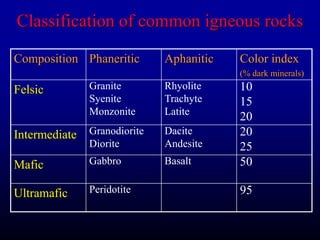
Classification of common igneous rocks
Composition Phaneritic Aphanitic Color index
(% dark minerals)
Felsic Granite
Syenite
Monzonite
Rhyolite
Trachyte
Latite
10
15
20
Intermediate Granodiorite
Diorite
Dacite
Andesite
20
25
Mafic Gabbro Basalt 50
Ultramafic Peridotite 95
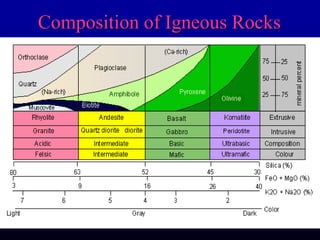
Composition of Igneous Rocks
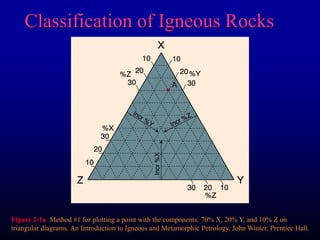
Classification of Igneous Rocks
Figure 2-1a. Method #1 for plotting a point with the components: 70% X, 20% Y, and 10% Z on
triangular diagrams. An Introduction to Igneous and Metamorphic Petrology, John Winter, Prentice Hall.
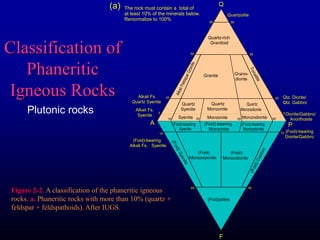
Classification of
Phaneritic
Igneous Rocks
Figure 2-2. A classification of the phaneritic igneous
rocks. a. Phaneritic rocks with more than 10% (quartz +
feldspar + feldspathoids). After IUGS.
The rock must contain a total of
at least 10% of the minerals below.
Renormalize to 100%
(a)
Quartz-rich
Granitoid
90
90
60
60
20
20
Alkali Fs.
Quartz Syenite
Quartz
Syenite
Quartz
Monzonite
Quartz
Monzodiorite
Syenite Monzonite Monzodiorite
(Foid)-bearing
Syenite
5
10 35 65
(Foid)-bearing
Monzonite
(Foid)-bearing
Monzodiorite
90
Alkali Fs.
Syenite
(Foid)-bearing
Alkali Fs. Syenite
10
(Foid)
Monzosyenite
(Foid)
Monzodiorite
Qtz. Diorite/
Qtz. Gabbro
5
10
Diorite/Gabbro/
Anorthosite
(Foid)-bearing
Diorite/Gabbro
60
(Foid)olites
Quartzolite
Granite Grano-
diorite
Q
A P
F
60
Plutonic rocks
Classification of Igneous Rocks
Figure 2-2. A classification of the phaneritic
igneous rocks. b. Gabbroic rocks. c. Ultramafic
rocks. After IUGS.
Plagioclase
Olivine
Pyroxene
G
a
b
b
r
o
T
r
o
c
t
o
l
i
t
e
Olivine
gabbro
Plagioclase-bearing ultramafic rocks
90
(b)
Anorthosite
Olivine
Clinopyroxene
Orthopyroxene
Lherzolite
Websterite
Orthopyroxenite
Clinopyroxenite
Olivine Websterite
Peridotites
Pyroxenites
90
40
10
10
Dunite
(c)
Gabbroic
rocks
Ultramafic
rocks
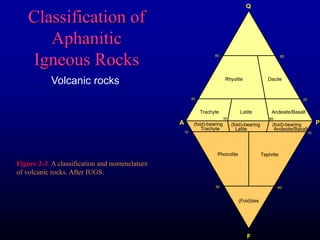
Classification of
Aphanitic
Igneous Rocks
Figure 2-3. A classification and nomenclature
of volcanic rocks. After IUGS.
(foid)-bearing
Trachyte
(foid)-bearing
Latite
(foid)-bearing
Andesite/Basalt
(Foid)ites
10
60 60
35 65
10
20 20
60 60
F
A P
Q
Rhyolite Dacite
Trachyte Latite Andesite/Basalt
Phonolite Tephrite
Volcanic rocks
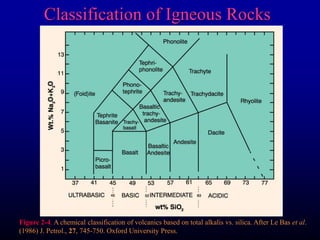
Classification of Igneous Rocks
Figure 2-4. A chemical classification of volcanics based on total alkalis vs. silica. After Le Bas et al.
(1986) J. Petrol., 27, 745-750. Oxford University Press.
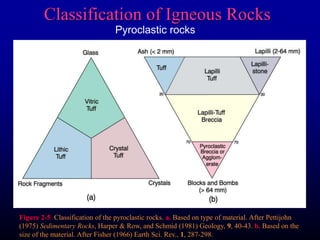
Classification of Igneous Rocks
Figure 2-5. Classification of the pyroclastic rocks. a. Based on type of material. After Pettijohn
(1975) Sedimentary Rocks, Harper & Row, and Schmid (1981) Geology, 9, 40-43. b. Based on the
size of the material. After Fisher (1966) Earth Sci. Rev., 1, 287-298.
Pyroclastic rocks
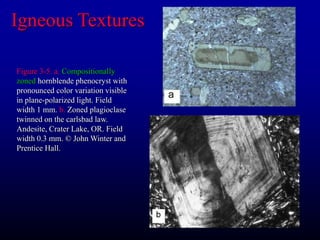
Igneous Textures
Figure 3-5. a. Compositionally
zoned hornblende phenocryst with
pronounced color variation visible
in plane-polarized light. Field
width 1 mm. b. Zoned plagioclase
twinned on the carlsbad law.
Andesite, Crater Lake, OR. Field
width 0.3 mm. © John Winter and
Prentice Hall.
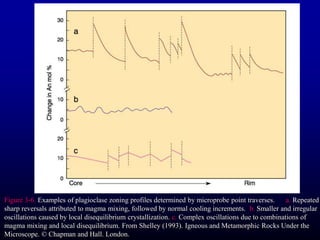
Figure 3-6. Examples of plagioclase zoning profiles determined by microprobe point traverses. a. Repeated
sharp reversals attributed to magma mixing, followed by normal cooling increments. b. Smaller and irregular
oscillations caused by local disequilibrium crystallization. c. Complex oscillations due to combinations of
magma mixing and local disequilibrium. From Shelley (1993). Igneous and Metamorphic Rocks Under the
Microscope. © Chapman and Hall. London.
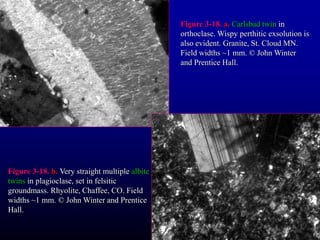
Figure 3-18. a. Carlsbad twin in
orthoclase. Wispy perthitic exsolution is
also evident. Granite, St. Cloud MN.
Field widths ~1 mm. © John Winter
and Prentice Hall.
Figure 3-18. b. Very straight multiple albite
twins in plagioclase, set in felsitic
groundmass. Rhyolite, Chaffee, CO. Field
widths ~1 mm. © John Winter and Prentice
Hall.
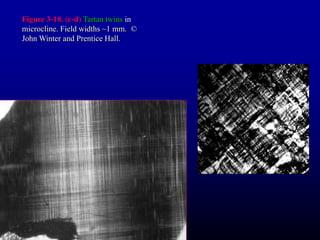
Figure 3-18. (c-d) Tartan twins in
microcline. Field widths ~1 mm. ©
John Winter and Prentice Hall.
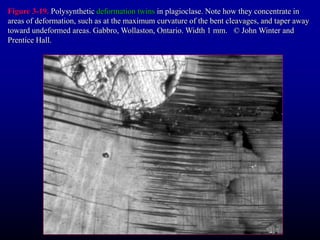
Figure 3-19. Polysynthetic deformation twins in plagioclase. Note how they concentrate in
areas of deformation, such as at the maximum curvature of the bent cleavages, and taper away
toward undeformed areas. Gabbro, Wollaston, Ontario. Width 1 mm. © John Winter and
Prentice Hall.
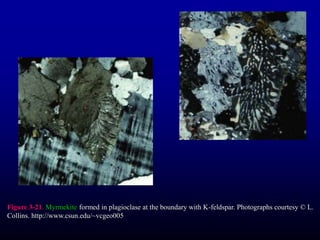
Figure 3-21. Myrmekite formed in plagioclase at the boundary with K-feldspar. Photographs courtesy © L.
Collins. http://www.csun.edu/~vcgeo005
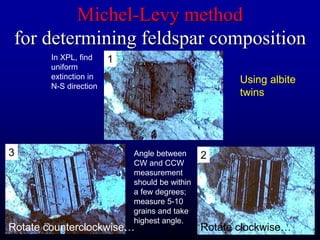
Michel-Levy method
for determining feldspar composition
1
2
3
Rotate clockwise…
Rotate counterclockwise…
Using albite
twins
In XPL, find
uniform
extinction in
N-S direction
Angle between
CW and CCW
measurement
should be within
a few degrees;
measure 5-10
grains and take
highest angle.

igneous-class-text.ppt

  • 1.
    Textural classification of igneousrocks Phaneritic: crystals visible with naked eye Plutonic or intrusive rocks Aphanitic: crystal too small for naked eye Volcanic or extrusive rocks Porphyritic: two different, dominant grain sizes Large xtals = phenocrysts; small xtals = groundmass Fragmental: composed of disagregated igneous material Pyroclastic rocks
  • 2.
    Textural classification of igneousrocks Pegmatitic: very large xtals (cm to 10s of cm); i.e., slowly cooled Forms veins or layers within plutonic body Glassy: non-crystalline; cools very fast (e.g., obsidian) Volcanic rocks Vesicular: vesicles (holes, pores, cavities) form as gases expand Volcanic rocks
  • 3.
    Compositional terms for igneousrocks Felsic: feldspar + silica ~55-70% silica, K-feldspar > 1/3 of feldspars present light-colored silicate minerals — Continental crust Intermediate: between felsic and mafic ~55-65% silica, plag > 2/3 of feldspars present Na-rich plag predominates over Ca-rich plag Mafic: magnesium + ferric iron ~45-50% silica; Ca-rich plag dominant feldspar dark silicate minerals — Oceanic crust Ultramafic: >90% mafic minerals, silica < 45%, few or no feldspars Mantle-derived
  • 4.
    Classification of commonigneous rocks Composition Phaneritic Aphanitic Color index (% dark minerals) Felsic Granite Syenite Monzonite Rhyolite Trachyte Latite 10 15 20 Intermediate Granodiorite Diorite Dacite Andesite 20 25 Mafic Gabbro Basalt 50 Ultramafic Peridotite 95
  • 5.
  • 6.
    Classification of IgneousRocks Figure 2-1a. Method #1 for plotting a point with the components: 70% X, 20% Y, and 10% Z on triangular diagrams. An Introduction to Igneous and Metamorphic Petrology, John Winter, Prentice Hall.
  • 7.
    Classification of Phaneritic Igneous Rocks Figure2-2. A classification of the phaneritic igneous rocks. a. Phaneritic rocks with more than 10% (quartz + feldspar + feldspathoids). After IUGS. The rock must contain a total of at least 10% of the minerals below. Renormalize to 100% (a) Quartz-rich Granitoid 90 90 60 60 20 20 Alkali Fs. Quartz Syenite Quartz Syenite Quartz Monzonite Quartz Monzodiorite Syenite Monzonite Monzodiorite (Foid)-bearing Syenite 5 10 35 65 (Foid)-bearing Monzonite (Foid)-bearing Monzodiorite 90 Alkali Fs. Syenite (Foid)-bearing Alkali Fs. Syenite 10 (Foid) Monzosyenite (Foid) Monzodiorite Qtz. Diorite/ Qtz. Gabbro 5 10 Diorite/Gabbro/ Anorthosite (Foid)-bearing Diorite/Gabbro 60 (Foid)olites Quartzolite Granite Grano- diorite Q A P F 60 Plutonic rocks
  • 8.
    Classification of IgneousRocks Figure 2-2. A classification of the phaneritic igneous rocks. b. Gabbroic rocks. c. Ultramafic rocks. After IUGS. Plagioclase Olivine Pyroxene G a b b r o T r o c t o l i t e Olivine gabbro Plagioclase-bearing ultramafic rocks 90 (b) Anorthosite Olivine Clinopyroxene Orthopyroxene Lherzolite Websterite Orthopyroxenite Clinopyroxenite Olivine Websterite Peridotites Pyroxenites 90 40 10 10 Dunite (c) Gabbroic rocks Ultramafic rocks
  • 9.
    Classification of Aphanitic Igneous Rocks Figure2-3. A classification and nomenclature of volcanic rocks. After IUGS. (foid)-bearing Trachyte (foid)-bearing Latite (foid)-bearing Andesite/Basalt (Foid)ites 10 60 60 35 65 10 20 20 60 60 F A P Q Rhyolite Dacite Trachyte Latite Andesite/Basalt Phonolite Tephrite Volcanic rocks
  • 10.
    Classification of IgneousRocks Figure 2-4. A chemical classification of volcanics based on total alkalis vs. silica. After Le Bas et al. (1986) J. Petrol., 27, 745-750. Oxford University Press.
  • 11.
    Classification of IgneousRocks Figure 2-5. Classification of the pyroclastic rocks. a. Based on type of material. After Pettijohn (1975) Sedimentary Rocks, Harper & Row, and Schmid (1981) Geology, 9, 40-43. b. Based on the size of the material. After Fisher (1966) Earth Sci. Rev., 1, 287-298. Pyroclastic rocks
  • 12.
    Igneous Textures Figure 3-5.a. Compositionally zoned hornblende phenocryst with pronounced color variation visible in plane-polarized light. Field width 1 mm. b. Zoned plagioclase twinned on the carlsbad law. Andesite, Crater Lake, OR. Field width 0.3 mm. © John Winter and Prentice Hall.
  • 13.
    Figure 3-6. Examplesof plagioclase zoning profiles determined by microprobe point traverses. a. Repeated sharp reversals attributed to magma mixing, followed by normal cooling increments. b. Smaller and irregular oscillations caused by local disequilibrium crystallization. c. Complex oscillations due to combinations of magma mixing and local disequilibrium. From Shelley (1993). Igneous and Metamorphic Rocks Under the Microscope. © Chapman and Hall. London.
  • 14.
    Figure 3-18. a.Carlsbad twin in orthoclase. Wispy perthitic exsolution is also evident. Granite, St. Cloud MN. Field widths ~1 mm. © John Winter and Prentice Hall. Figure 3-18. b. Very straight multiple albite twins in plagioclase, set in felsitic groundmass. Rhyolite, Chaffee, CO. Field widths ~1 mm. © John Winter and Prentice Hall.
  • 15.
    Figure 3-18. (c-d)Tartan twins in microcline. Field widths ~1 mm. © John Winter and Prentice Hall.
  • 16.
    Figure 3-19. Polysyntheticdeformation twins in plagioclase. Note how they concentrate in areas of deformation, such as at the maximum curvature of the bent cleavages, and taper away toward undeformed areas. Gabbro, Wollaston, Ontario. Width 1 mm. © John Winter and Prentice Hall.
  • 17.
    Figure 3-21. Myrmekiteformed in plagioclase at the boundary with K-feldspar. Photographs courtesy © L. Collins. http://www.csun.edu/~vcgeo005
  • 18.
    Michel-Levy method for determiningfeldspar composition 1 2 3 Rotate clockwise… Rotate counterclockwise… Using albite twins In XPL, find uniform extinction in N-S direction Angle between CW and CCW measurement should be within a few degrees; measure 5-10 grains and take highest angle.