Fuse Simplified SPICE Behavioral Model All Rights Reserved Copyright (C) Bee Technologies Corporation 2011
Contents Benefit of the Model Model Feature Parameter Settings Fuse Specification (Example)  Fusing Time vs. DC Current Fusing Time vs. Current Pattern Specific Fuse Model Library Files and Symbol Files Location Simulation Index All Rights Reserved Copyright (C) Bee Technologies Corporation 2011
1. Benefit of the Model Easily create your own fuse models by setting a few parameters, that’s usually provided by the manufacturer’s datasheet. Enables circuit designer to safely test and optimize their circuit protection design, and to predict component and circuit stress under extreme conditions (e.g. at the fuse blow). The model is optimized to reduce the convergence error. All Rights Reserved Copyright (C) Bee Technologies Corporation 2011
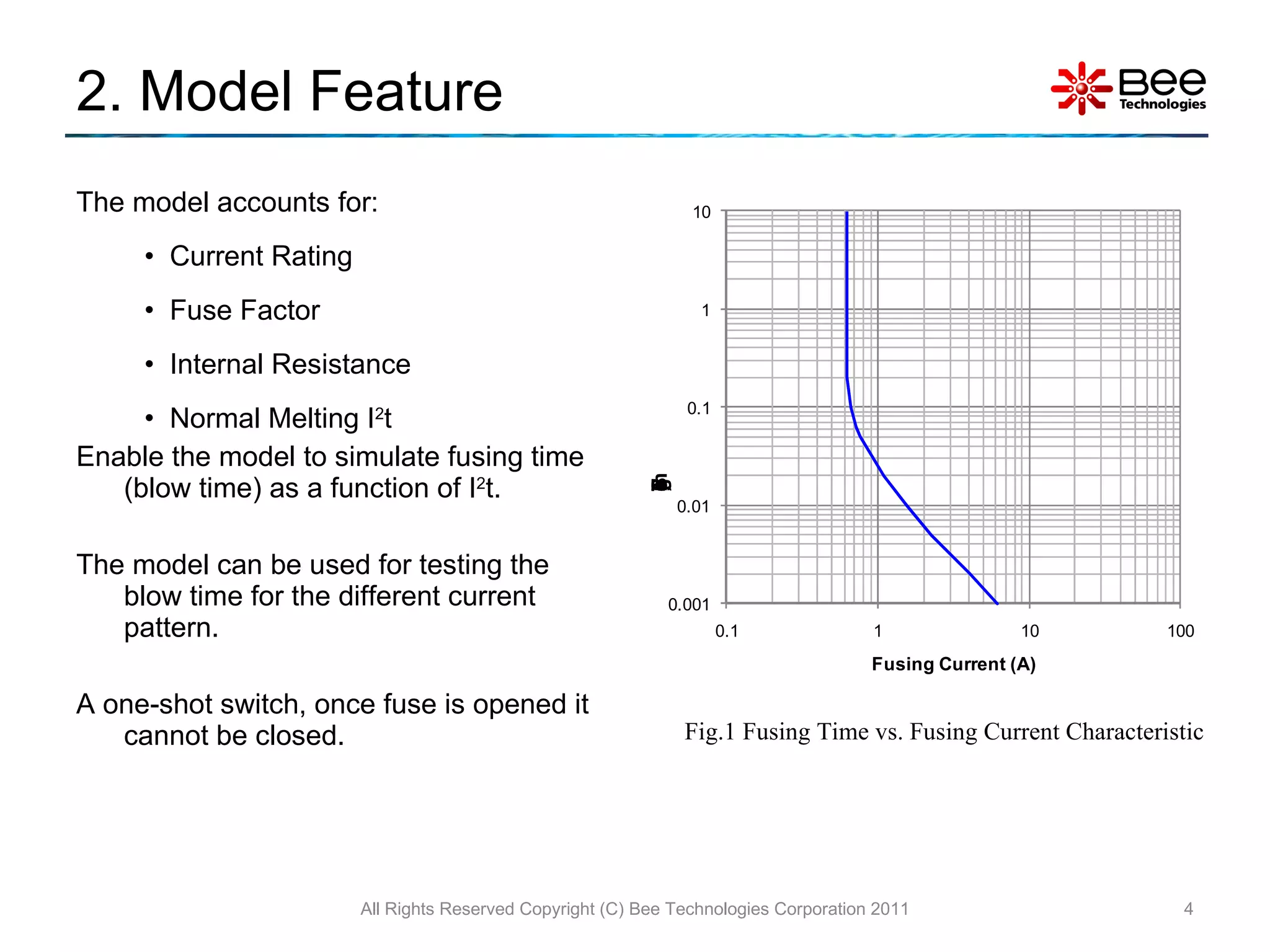
2. Model Feature The model accounts for: Current Rating Fuse Factor Internal Resistance Normal Melting I 2 t Enable the model to simulate fusing time (blow time) as a function of I 2 t. The model can be used for testing the blow time for the different current pattern. A one-shot switch, once fuse is opened it cannot be closed. All Rights Reserved Copyright (C) Bee Technologies Corporation 2011 Fig.1 Fusing Time vs. Fusing Current Characteristic
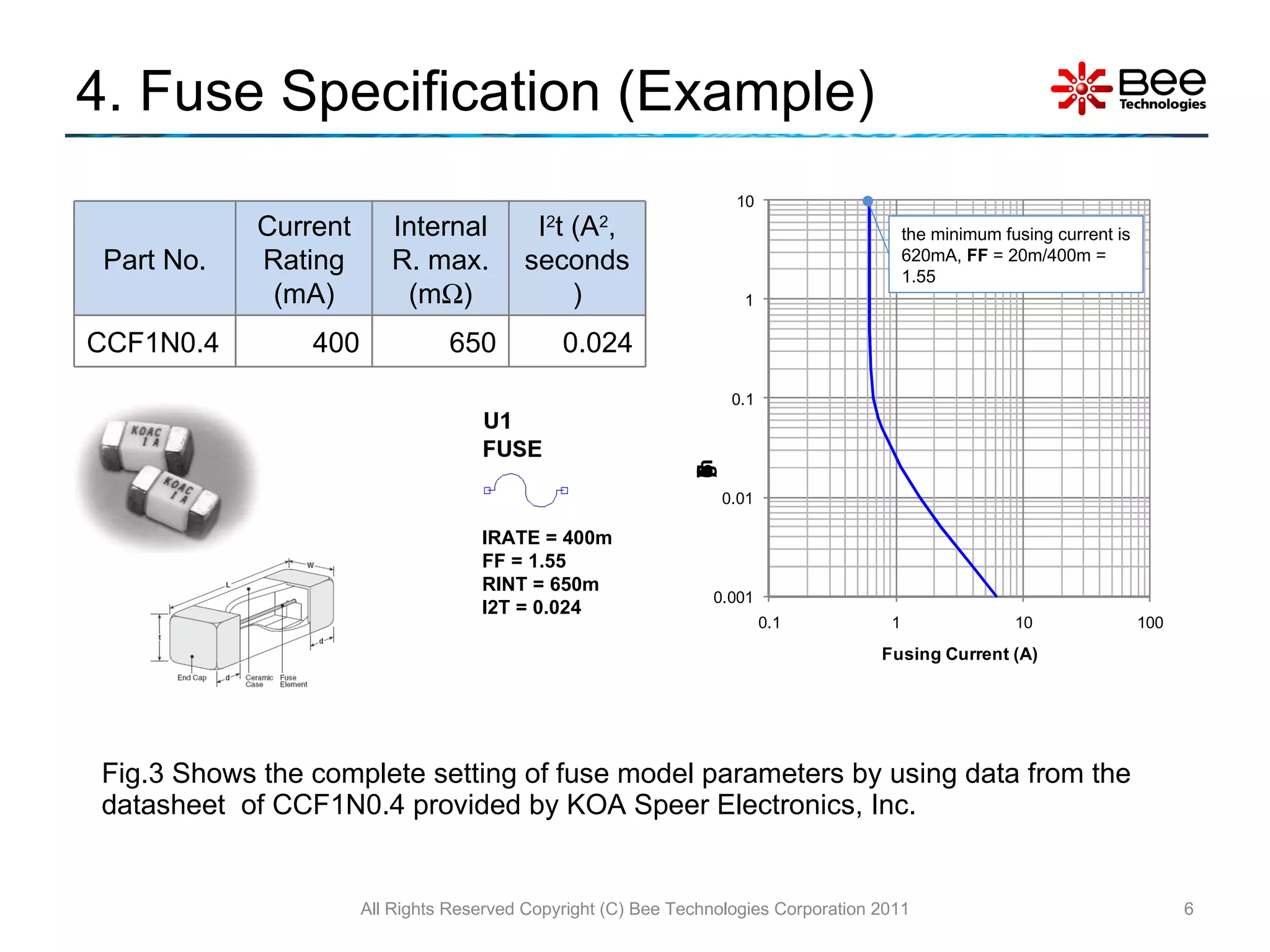
3. Parameter Settings Irate  = the current rating of fuse [A] FF   =  Fusing Factor, the ratio of the  minimum fusing current (the current  that fuse start to heat up) to  Irate . (e.g.  Irate  =400mA and the minimum  fusing current is 620mA then  FF  =  620m/400m = 1.55) Rint  =  internal resistance of fuse I2t   =  Normal Melting value [A 2 , seconds] From the fuse specification, the model is characterized by setting parameters Irate, FF, Rint and I2t. All Rights Reserved Copyright (C) Bee Technologies Corporation 2011 Model Parameters: Fig.2 Fuse model with default parameters IRATE = 400m FF = 1.55 RINT = 650m I2T = 0.024
4. Fuse Specification (Example) Fig.3 Shows the complete setting of fuse model parameters by using data from the datasheet  of CCF1N0.4 provided by KOA Speer Electronics, Inc.  All Rights Reserved Copyright (C) Bee Technologies Corporation 2011 the minimum fusing current is 620mA,  FF  = 20m/400m = 1.55 IRATE = 400m FF = 1.55 RINT = 650m I2T = 0.024 Part No. Current Rating (mA) Internal R. max. (m  ) I 2 t (A 2 , seconds) CCF1N0.4 400 650 0.024
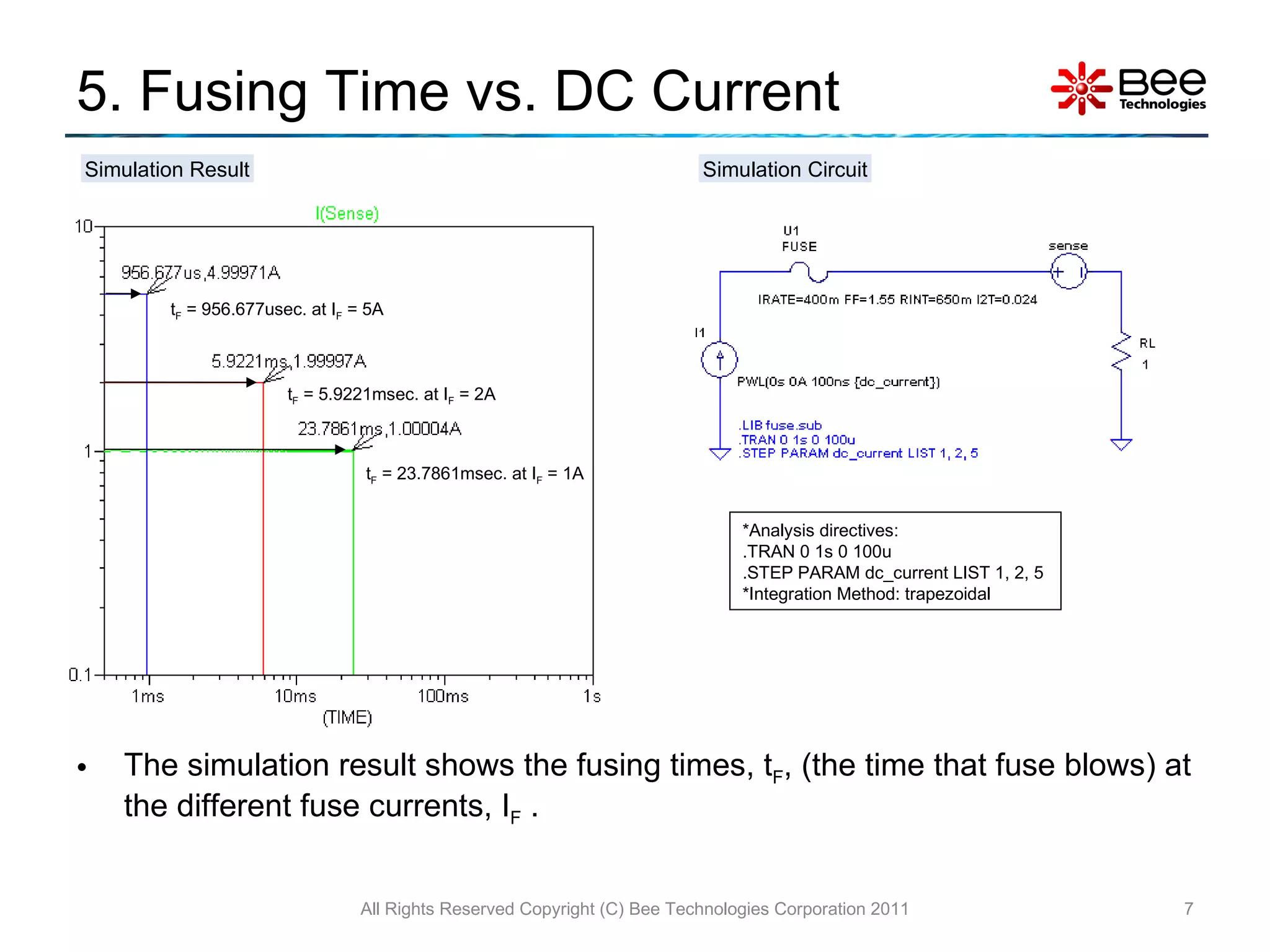
5. Fusing Time vs. DC Current The simulation result shows the fusing times, t F , (the time that fuse blows) at the different fuse currents, I F  . All Rights Reserved Copyright (C) Bee Technologies Corporation 2011 t F  = 956.677usec. at I F  = 5A  t F  = 5.9221msec. at I F  = 2A  t F  = 23.7861msec. at I F  = 1A  Simulation Circuit *Analysis directives:  .TRAN 0 1s 0 100u .STEP PARAM dc_current LIST 1, 2, 5  *Integration Method: trapezoidal Simulation Result
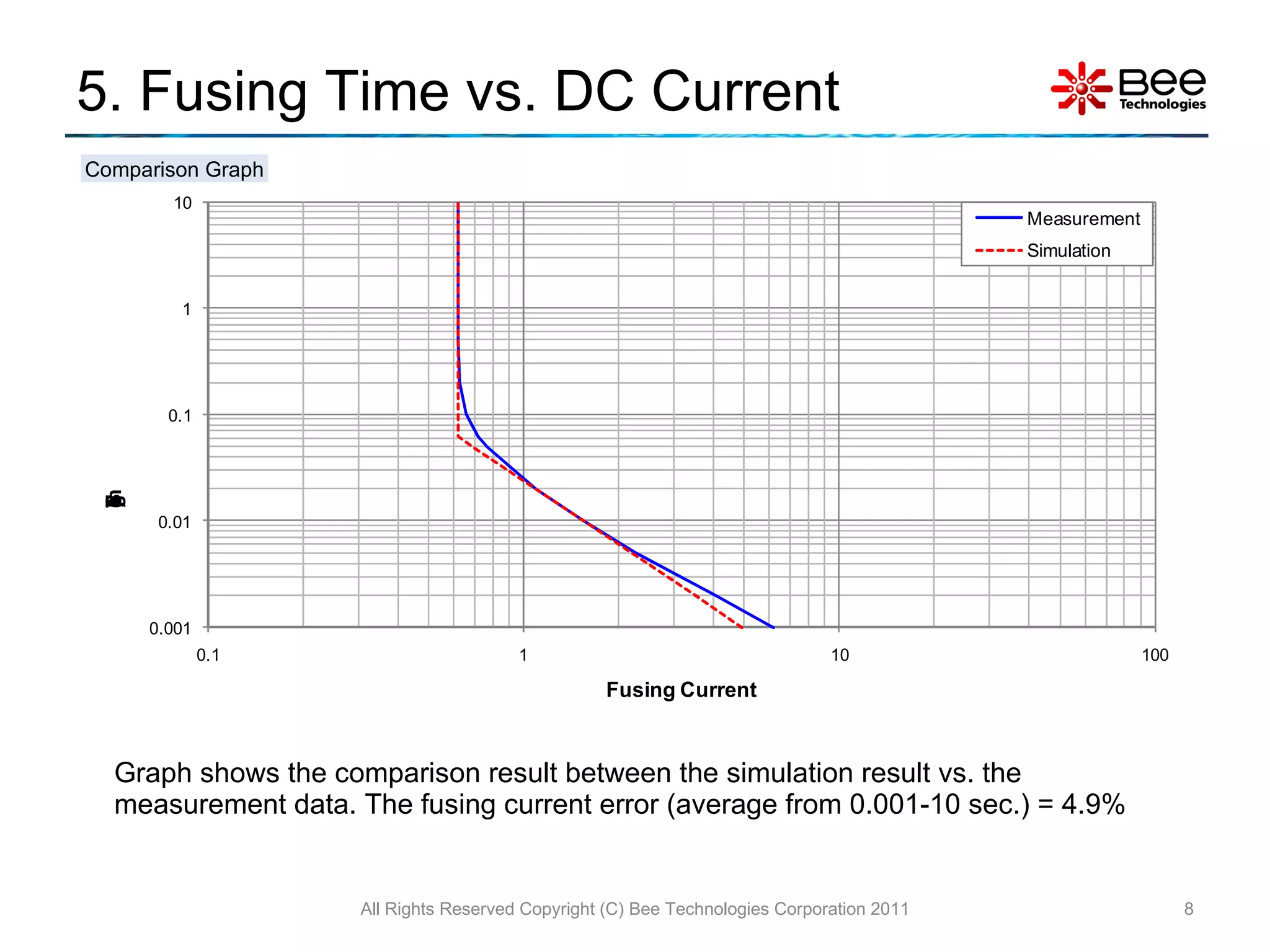
5. Fusing Time vs. DC Current Graph shows the comparison result between the simulation result vs. the measurement data. The fusing current error (average from 0.001-10 sec.) = 4.9% All Rights Reserved Copyright (C) Bee Technologies Corporation 2011 Comparison Graph
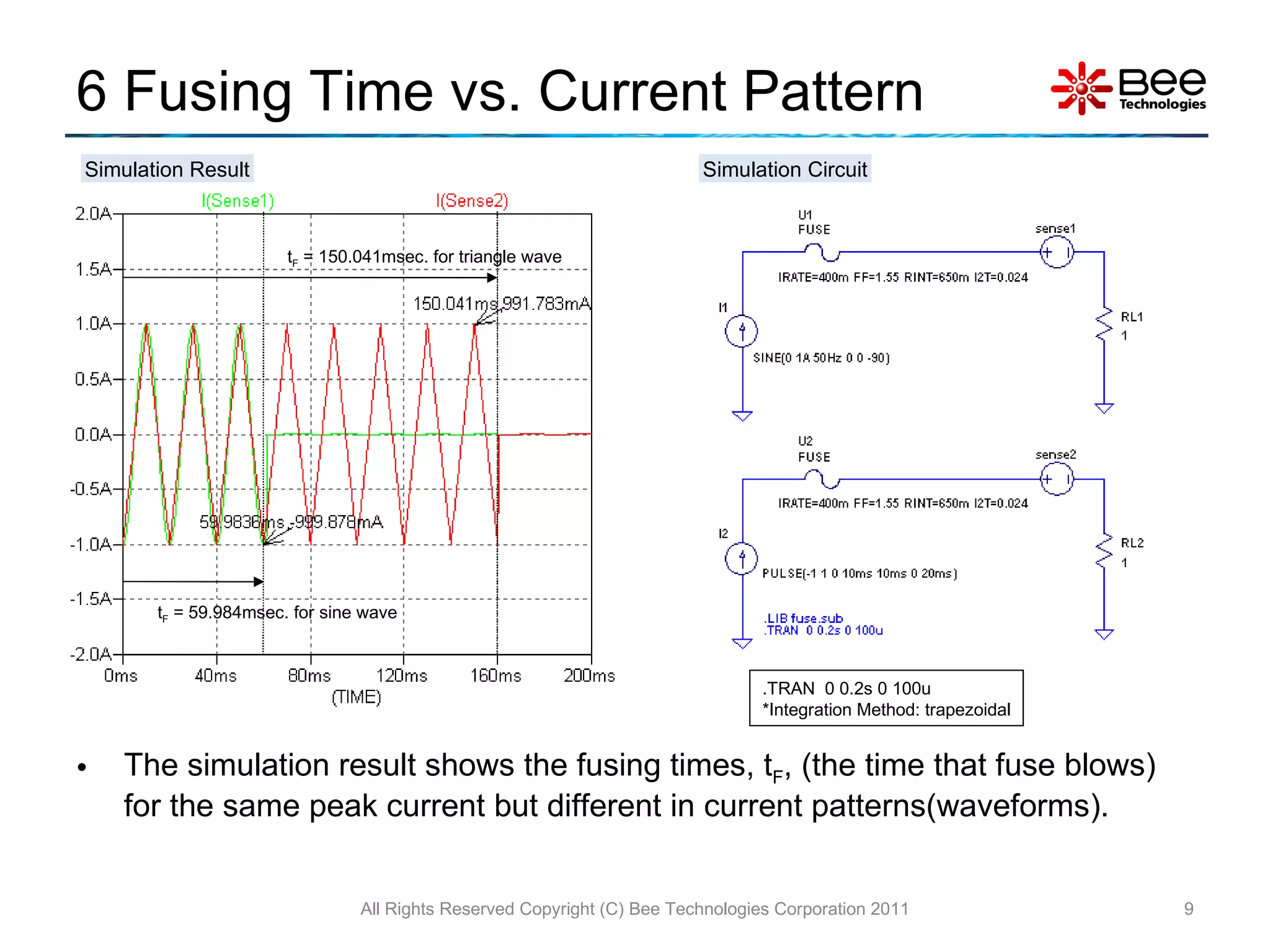
6 Fusing Time vs. Current Pattern The simulation result shows the fusing times, t F , (the time that fuse blows) for the same peak current but different in current patterns(waveforms). All Rights Reserved Copyright (C) Bee Technologies Corporation 2011 t F  = 59.984msec. for sine wave  t F  = 150.041msec. for triangle wave  Simulation Circuit Simulation Result .TRAN  0 0.2s 0 100u *Integration Method: trapezoidal
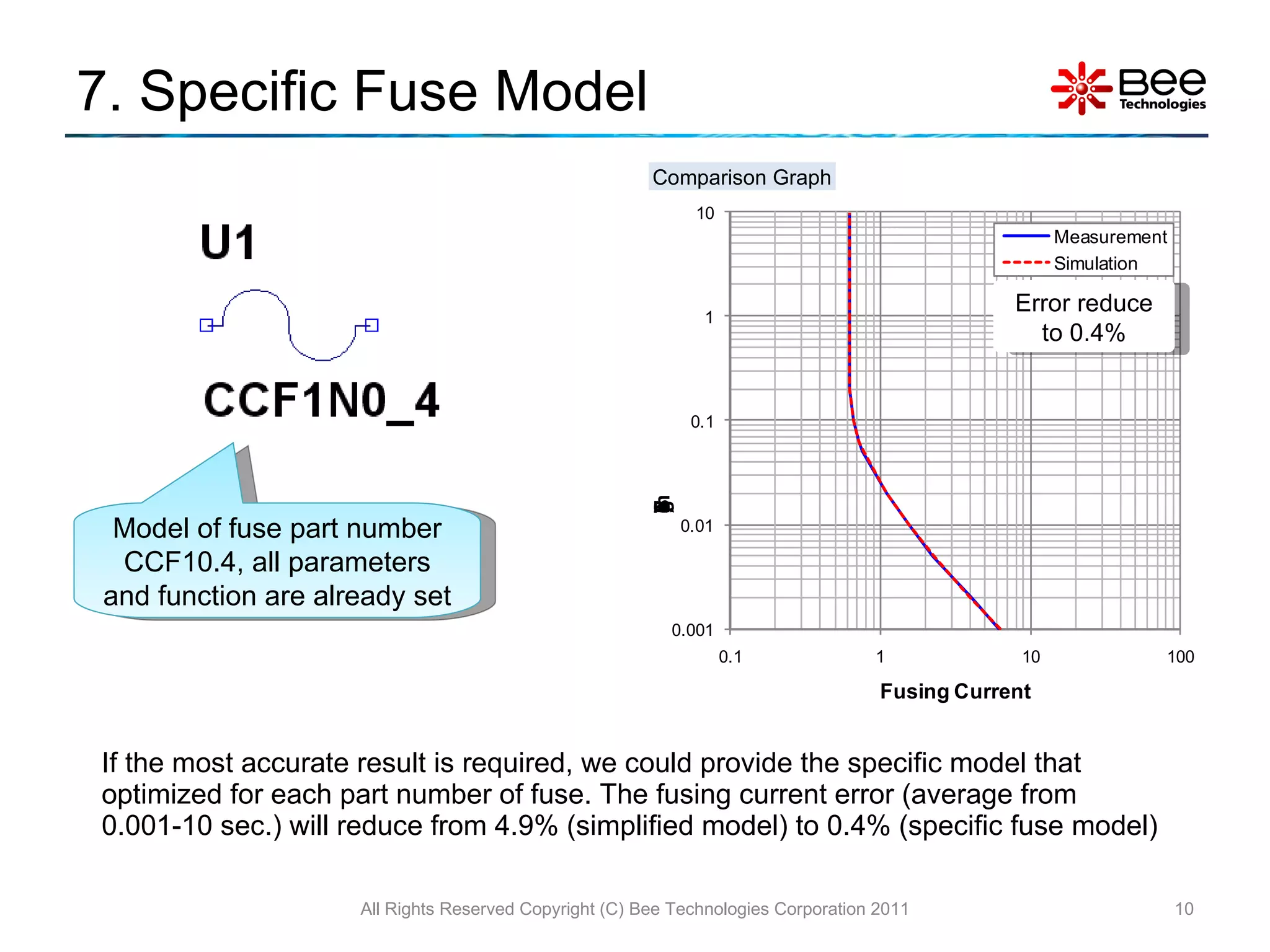
7. Specific Fuse Model If the most accurate result is required, we could provide the specific model that optimized for each part number of fuse.  The fusing current error (average from 0.001-10 sec.) will reduce from 4.9% (simplified model) to 0.4% (specific fuse model) All Rights Reserved Copyright (C) Bee Technologies Corporation 2011 Model of fuse part number CCF10.4, all parameters and function are already set  Error reduce to 0.4% Comparison Graph
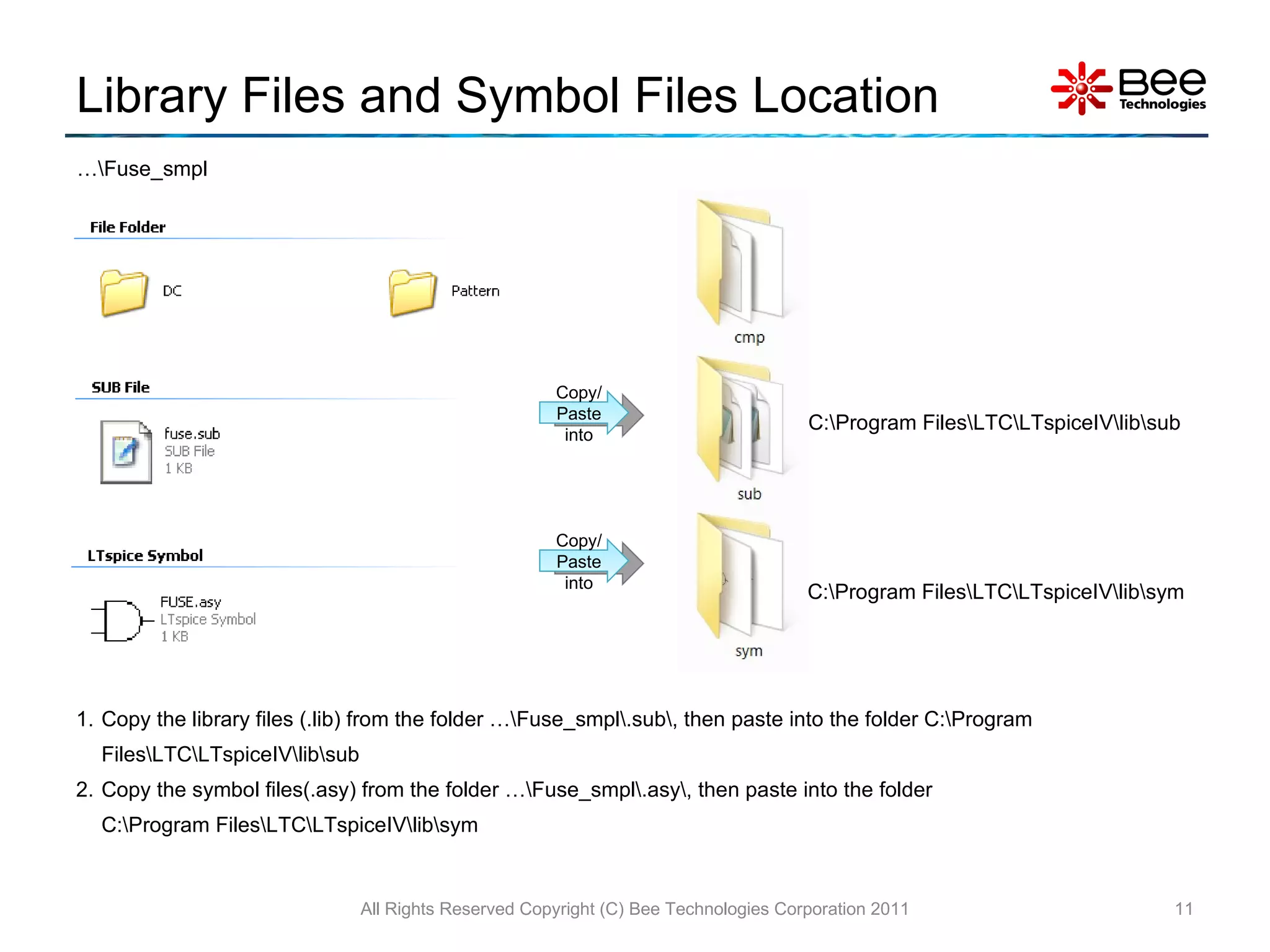
Library Files and Symbol Files Location All Rights Reserved Copyright (C) Bee Technologies Corporation 2011 … \Fuse_smpl C:\Program Files\LTC\LTspiceIV\lib\sub C:\Program Files\LTC\LTspiceIV\lib\sym Copy/Paste into Copy/Paste into Copy the library files (.lib) from the folder …\Fuse_smpl\.sub\, then paste into the folder C:\Program Files\LTC\LTspiceIV\lib\sub Copy the symbol files(.asy) from the folder …\Fuse_smpl\.asy\, then paste into the folder C:\Program Files\LTC\LTspiceIV\lib\sym
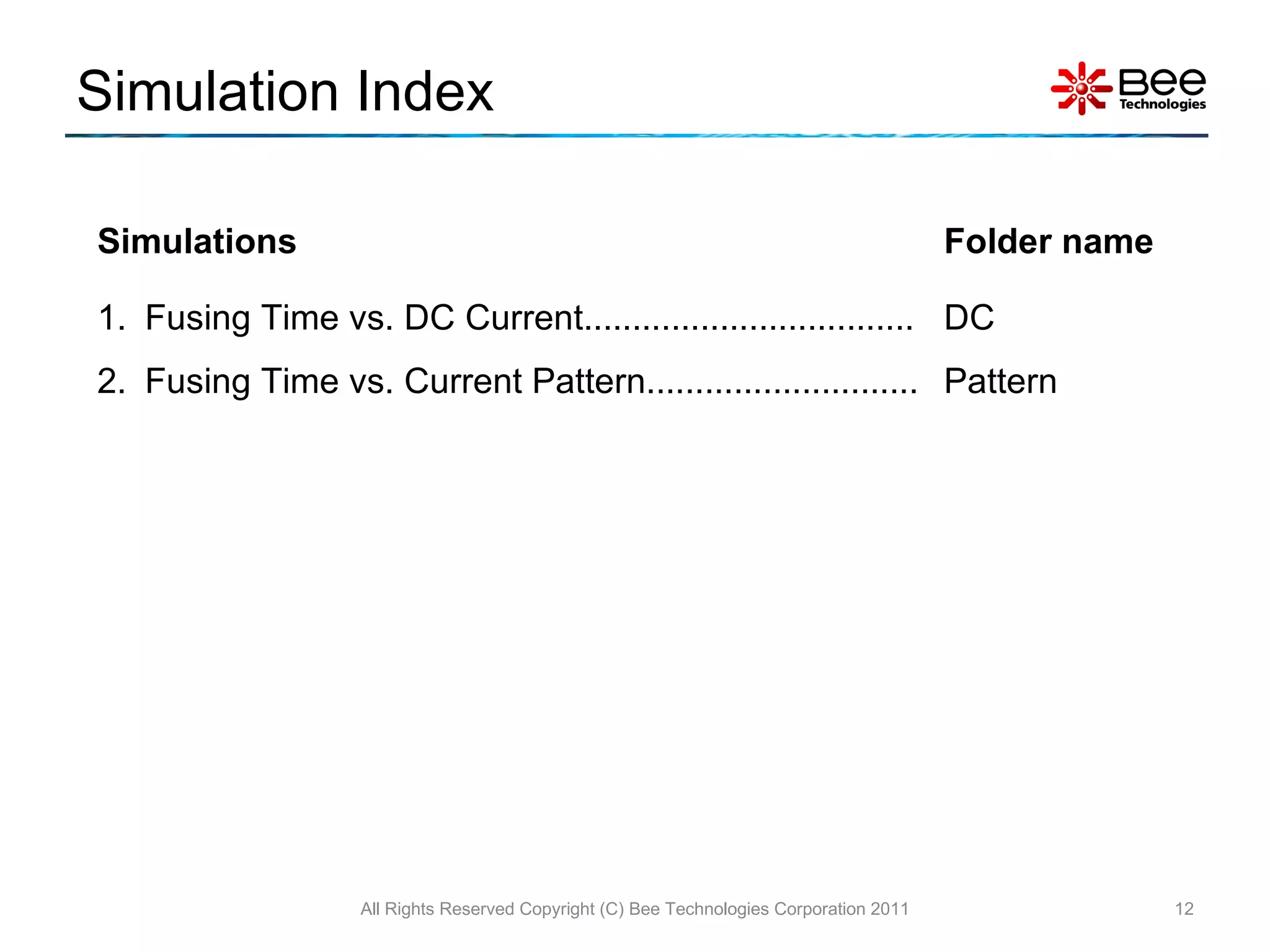
Simulation Index All Rights Reserved Copyright (C) Bee Technologies Corporation 2011 Simulations Folder name Fusing Time vs. DC Current.................................. Fusing Time vs. Current Pattern............................ DC Pattern

Simple model of Fuse(LTspice)

  • 1.
    Fuse Simplified SPICEBehavioral Model All Rights Reserved Copyright (C) Bee Technologies Corporation 2011
  • 2.
    Contents Benefit ofthe Model Model Feature Parameter Settings Fuse Specification (Example) Fusing Time vs. DC Current Fusing Time vs. Current Pattern Specific Fuse Model Library Files and Symbol Files Location Simulation Index All Rights Reserved Copyright (C) Bee Technologies Corporation 2011
  • 3.
    1. Benefit ofthe Model Easily create your own fuse models by setting a few parameters, that’s usually provided by the manufacturer’s datasheet. Enables circuit designer to safely test and optimize their circuit protection design, and to predict component and circuit stress under extreme conditions (e.g. at the fuse blow). The model is optimized to reduce the convergence error. All Rights Reserved Copyright (C) Bee Technologies Corporation 2011
  • 4.
    2. Model FeatureThe model accounts for: Current Rating Fuse Factor Internal Resistance Normal Melting I 2 t Enable the model to simulate fusing time (blow time) as a function of I 2 t. The model can be used for testing the blow time for the different current pattern. A one-shot switch, once fuse is opened it cannot be closed. All Rights Reserved Copyright (C) Bee Technologies Corporation 2011 Fig.1 Fusing Time vs. Fusing Current Characteristic
  • 5.
    3. Parameter SettingsIrate = the current rating of fuse [A] FF = Fusing Factor, the ratio of the minimum fusing current (the current that fuse start to heat up) to Irate . (e.g. Irate =400mA and the minimum fusing current is 620mA then FF = 620m/400m = 1.55) Rint = internal resistance of fuse I2t = Normal Melting value [A 2 , seconds] From the fuse specification, the model is characterized by setting parameters Irate, FF, Rint and I2t. All Rights Reserved Copyright (C) Bee Technologies Corporation 2011 Model Parameters: Fig.2 Fuse model with default parameters IRATE = 400m FF = 1.55 RINT = 650m I2T = 0.024
  • 6.
    4. Fuse Specification(Example) Fig.3 Shows the complete setting of fuse model parameters by using data from the datasheet of CCF1N0.4 provided by KOA Speer Electronics, Inc. All Rights Reserved Copyright (C) Bee Technologies Corporation 2011 the minimum fusing current is 620mA, FF = 20m/400m = 1.55 IRATE = 400m FF = 1.55 RINT = 650m I2T = 0.024 Part No. Current Rating (mA) Internal R. max. (m  ) I 2 t (A 2 , seconds) CCF1N0.4 400 650 0.024
  • 7.
    5. Fusing Timevs. DC Current The simulation result shows the fusing times, t F , (the time that fuse blows) at the different fuse currents, I F . All Rights Reserved Copyright (C) Bee Technologies Corporation 2011 t F = 956.677usec. at I F = 5A t F = 5.9221msec. at I F = 2A t F = 23.7861msec. at I F = 1A Simulation Circuit *Analysis directives: .TRAN 0 1s 0 100u .STEP PARAM dc_current LIST 1, 2, 5 *Integration Method: trapezoidal Simulation Result
  • 8.
    5. Fusing Timevs. DC Current Graph shows the comparison result between the simulation result vs. the measurement data. The fusing current error (average from 0.001-10 sec.) = 4.9% All Rights Reserved Copyright (C) Bee Technologies Corporation 2011 Comparison Graph
  • 9.
    6 Fusing Timevs. Current Pattern The simulation result shows the fusing times, t F , (the time that fuse blows) for the same peak current but different in current patterns(waveforms). All Rights Reserved Copyright (C) Bee Technologies Corporation 2011 t F = 59.984msec. for sine wave t F = 150.041msec. for triangle wave Simulation Circuit Simulation Result .TRAN 0 0.2s 0 100u *Integration Method: trapezoidal
  • 10.
    7. Specific FuseModel If the most accurate result is required, we could provide the specific model that optimized for each part number of fuse. The fusing current error (average from 0.001-10 sec.) will reduce from 4.9% (simplified model) to 0.4% (specific fuse model) All Rights Reserved Copyright (C) Bee Technologies Corporation 2011 Model of fuse part number CCF10.4, all parameters and function are already set Error reduce to 0.4% Comparison Graph
  • 11.
    Library Files andSymbol Files Location All Rights Reserved Copyright (C) Bee Technologies Corporation 2011 … \Fuse_smpl C:\Program Files\LTC\LTspiceIV\lib\sub C:\Program Files\LTC\LTspiceIV\lib\sym Copy/Paste into Copy/Paste into Copy the library files (.lib) from the folder …\Fuse_smpl\.sub\, then paste into the folder C:\Program Files\LTC\LTspiceIV\lib\sub Copy the symbol files(.asy) from the folder …\Fuse_smpl\.asy\, then paste into the folder C:\Program Files\LTC\LTspiceIV\lib\sym
  • 12.
    Simulation Index AllRights Reserved Copyright (C) Bee Technologies Corporation 2011 Simulations Folder name Fusing Time vs. DC Current.................................. Fusing Time vs. Current Pattern............................ DC Pattern