Development Processes and
Organizations
Teaching materials to accompany:
Product Design and Development
Chapter 2
Product Design and Development
Karl T. Ulrich and Steven D. Eppinger
5th edition, Irwin McGraw-Hill, 2012.
Chapter Table of Contents:
1.Introduction
2.Development Processes and Organizations
3.Opportunity Identification
4.Product Planning
5.Identifying Customer Needs
6.Product Specifications
7.Concept Generation
8.Concept Selection
9.Concept Testing
10.Product Architecture
11.Industrial Design
12.Design for Environment
13.Design for Manufacturing
14.Prototyping
15.Robust Design
16.Patents and Intellectual Property
17.Product Development Economics
18.Managing Projects
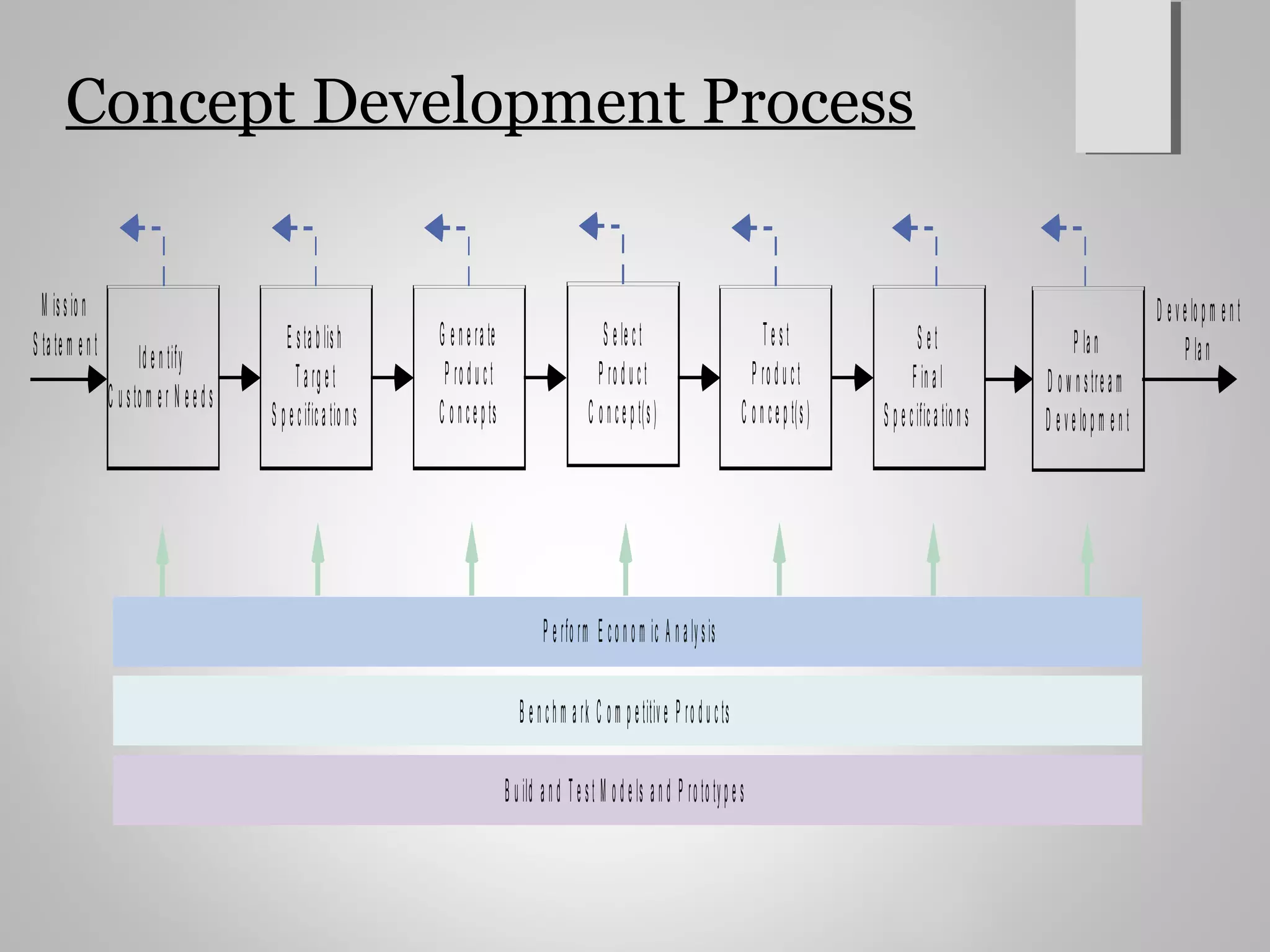
Concept Development Process
Iden tify
C ustom er N eeds
E stablish
Target
S pecifications
G enerate
P roduct
C oncepts
Test
P roduct
C oncept(s)
S et
Final
S pecifications
P lan
D ow nstream
D evelopm ent
D evelopm ent
P lan
M ission
S tatem ent S elect
P roduct
C oncept(s)
P erform E conom ic A nalysis
B enchm ark C om petitive P roducts
B uild and Test M odels and P rototypes
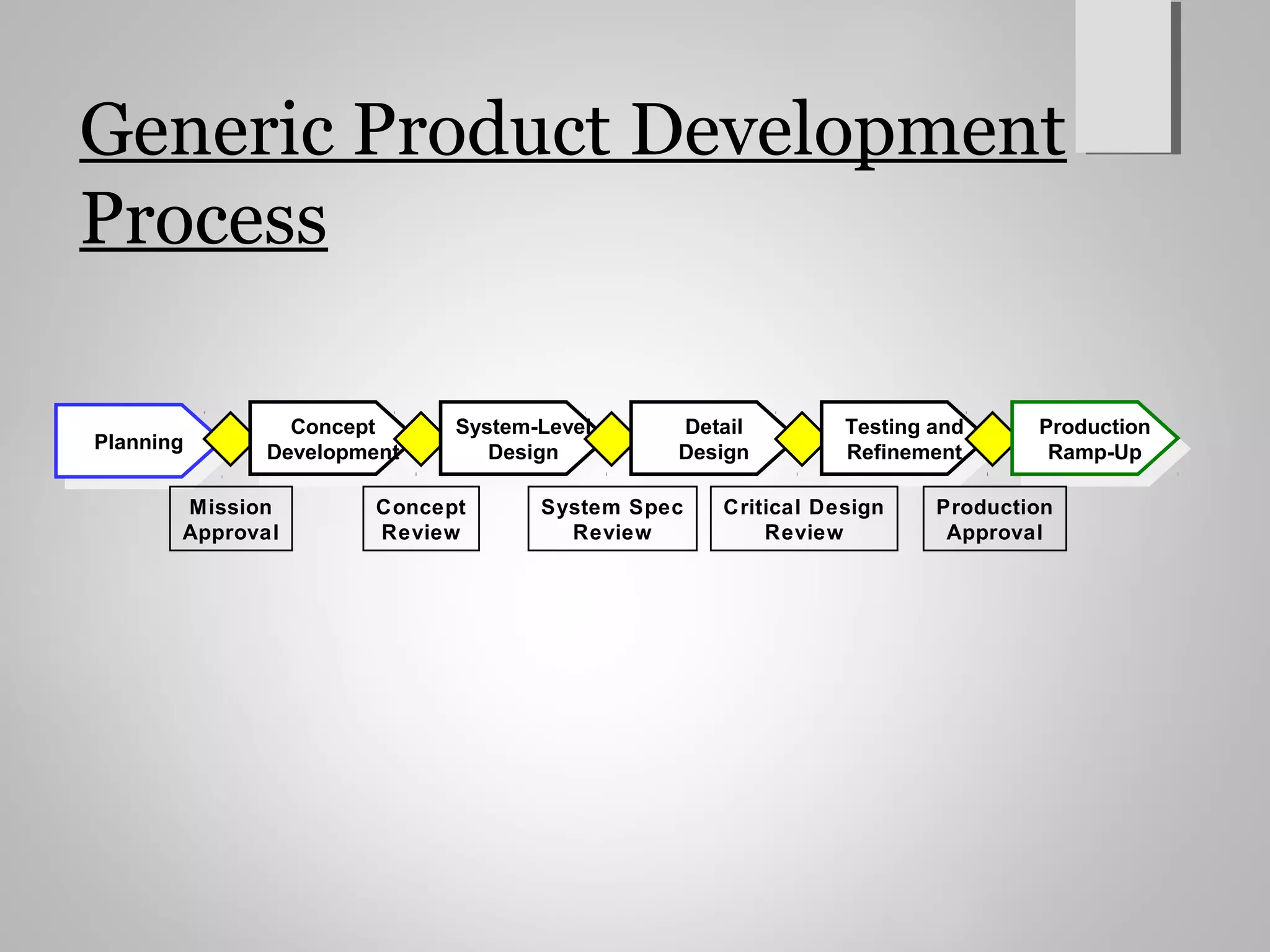
Generic Product Development
Process
Planning
Planning Concept
Development
Concept
Development
System-Level
Design
System-Level
Design
Detail
Design
Detail
Design
Testing and
Refinement
Testing and
Refinement
Production
Ramp-Up
Production
Ramp-Up
Mission
Approval
Concept
Review
System Spec
Review
Critical Design
Review
Production
Approval
Core development stages
 Solution approach
 Concept design
 Architectural design
 Detailed design
 Process design
 Fabrication and assembly
 Test and deployment
5
Solution Approach
 Concept for solutions
 DFX
6
Concept development
 A description of the form, function, and features of a
product
 A set of specifications
 An economic justification of the project.
7
System (architectural) design
 Definition of product architecture, with an assembly
layout.
 Division of the product into subsystems and
components, each with a functional specification.
8
Detailed design
 Complete specification of the geometry, materials, and
tolerances of each of the unique parts
 Identification of all standard parts to be purchased.
 Establishment of a process plan and tooling
9
Test and refinement
 Construction and evaluation of multiple pre-production
versions of the product.
 Early (alpha) prototypes are usually built with production-
intent parts (but may not be with the intended production
processes) for testing in the designer's environment, if the
design intent and key customer needs are met.
 Later (beta) prototypes are built with parts supplied by the
intended production processes (but may not be with the
intended-assembly process), tested by customers in their
environment, and to evaluate product performance and
reliability.
10
Production ramp-up
 The product is made using the intended production
system.
 To train the work force and to work out any remaining
problems in the production processes.
11
A generic concept development
process
 Identifying customer needs
 Establishing target specifications
 Concept generation
 Concept selection
 Concept testing
 Setting final specifications
 Project planning
 Economic analysis
 Benchmarking of competitive products
 Modeling and prototyping
12
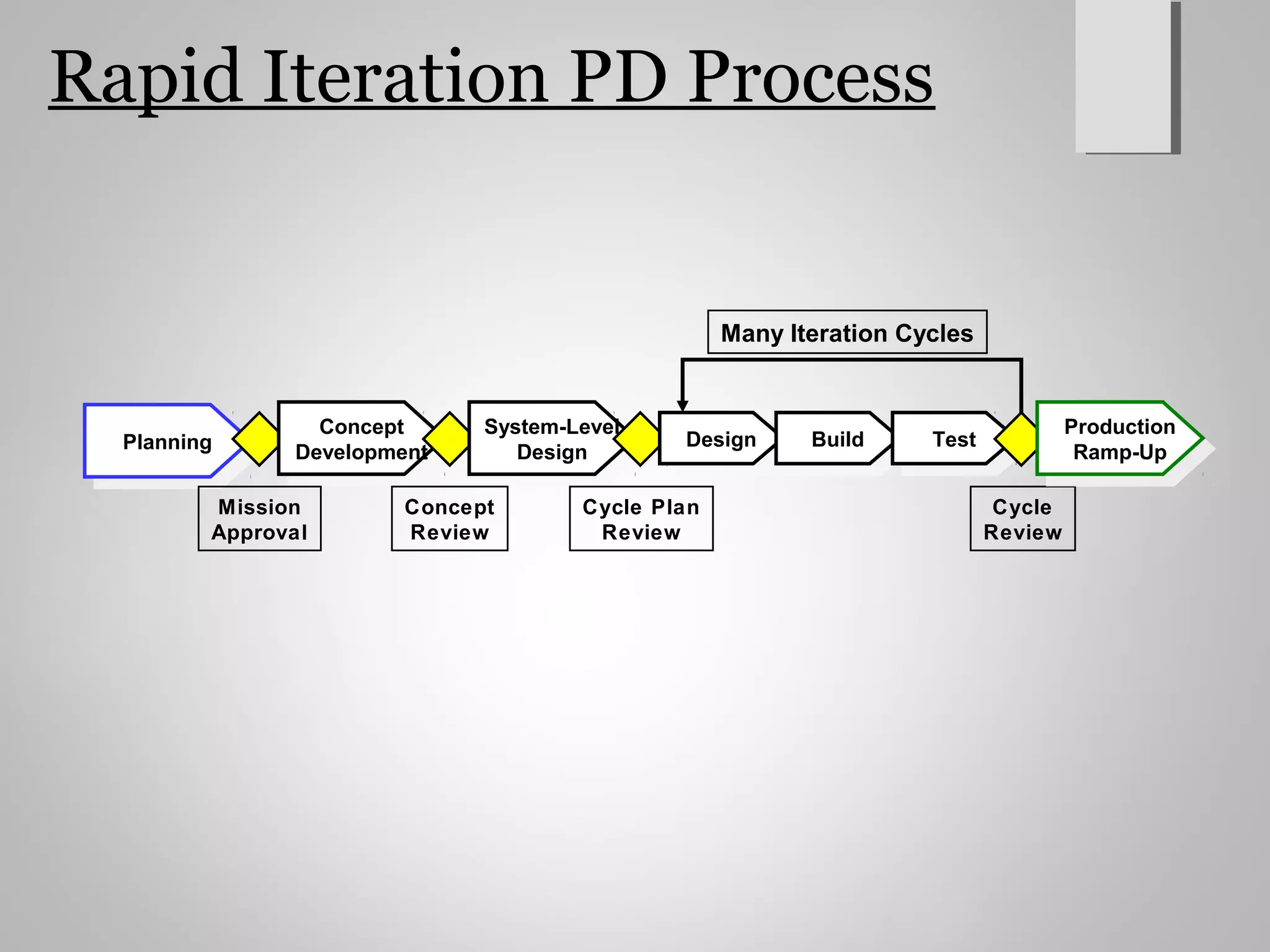
Rapid Iteration PD Process
Many Iteration Cycles
Planning
Planning Concept
Development
Concept
Development
System-Level
Design
System-Level
Design
Mission
Approval
Concept
Review
Cycle Plan
Review
Design
Design
Cycle
Review
Build
Build
Test
Test Production
Ramp-Up
Production
Ramp-Up
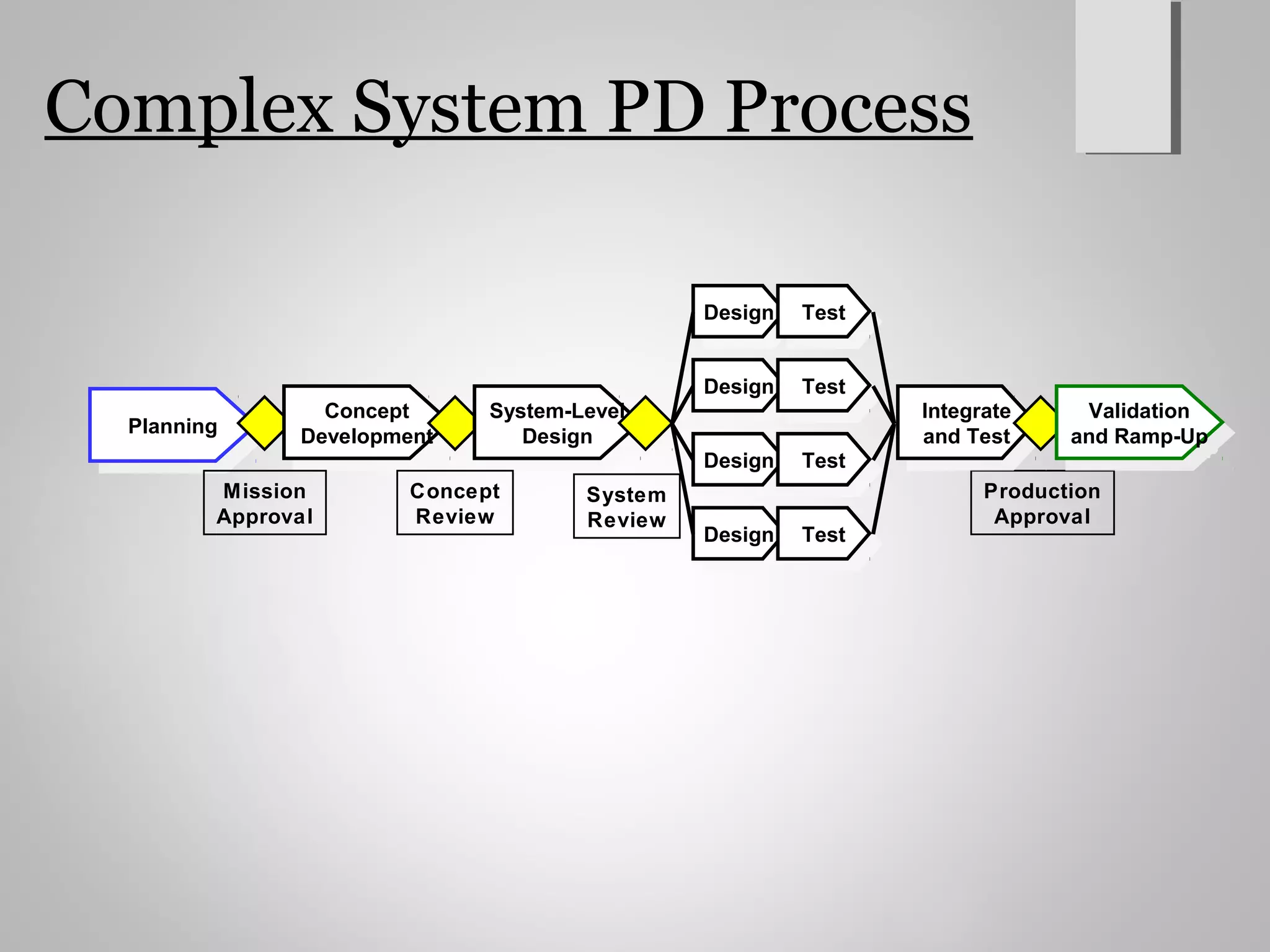
Complex System PD Process
Planning
Planning Concept
Development
Concept
Development
System-Level
Design
System-Level
Design
Mission
Approval
Concept
Review
System
Review
Design
Design
Production
Approval
Test
Test
Design
Design
Test
Test
Design
Design
Test
Test
Design
Design
Test
Test
Integrate
and Test
Integrate
and Test
Validation
and Ramp-Up
Validation
and Ramp-Up
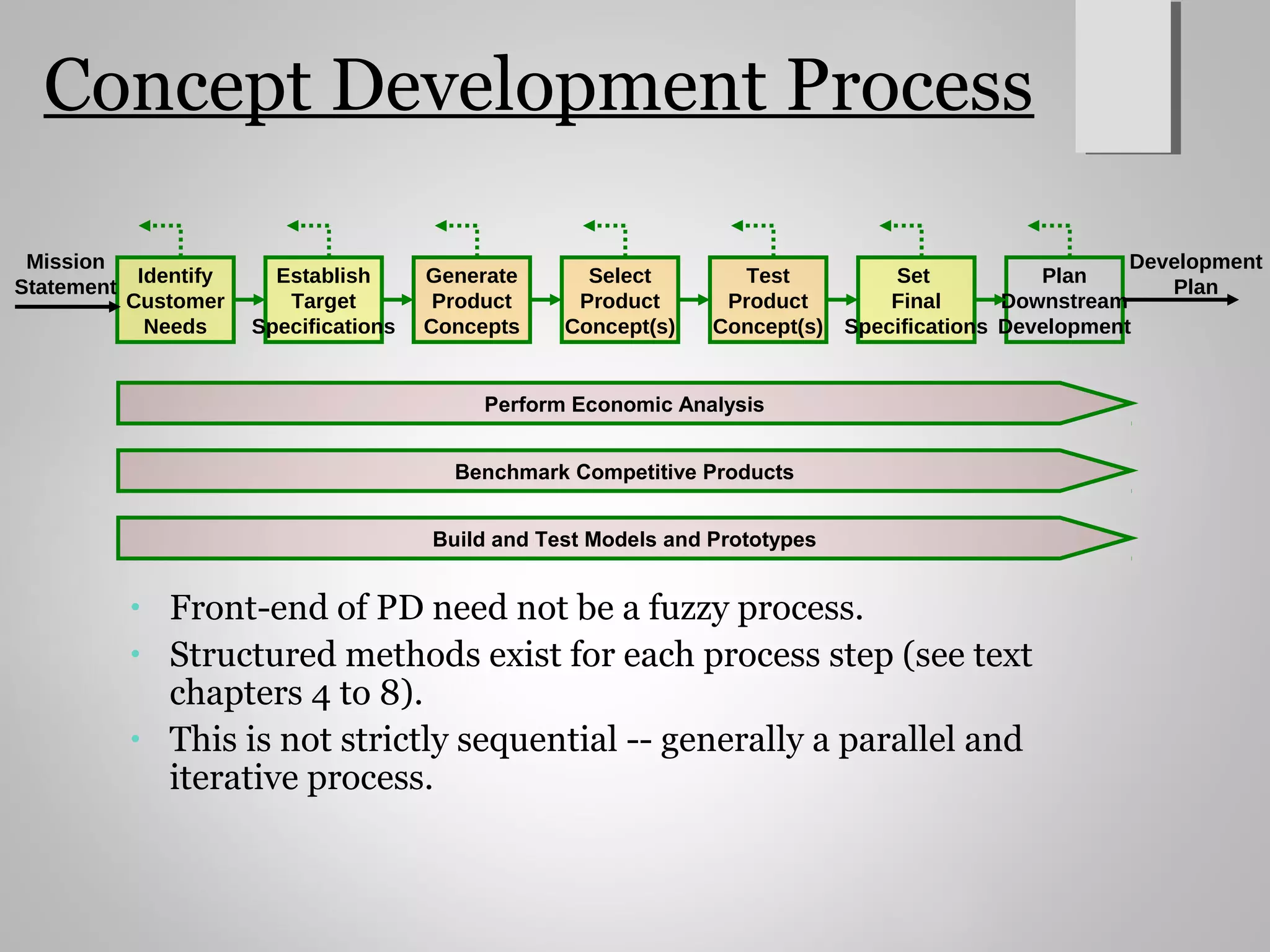
Concept Development Process
• Front-end of PD need not be a fuzzy process.
• Structured methods exist for each process step (see text
chapters 4 to 8).
• This is not strictly sequential -- generally a parallel and
iterative process.
Identify
Customer
Needs
Establish
Target
Specifications
Generate
Product
Concepts
Select
Product
Concept(s)
Set
Final
Specifications
Plan
Downstream
Development
Mission
Statement
Test
Product
Concept(s)
Development
Plan
Perform Economic Analysis
Benchmark Competitive Products
Build and Test Models and Prototypes
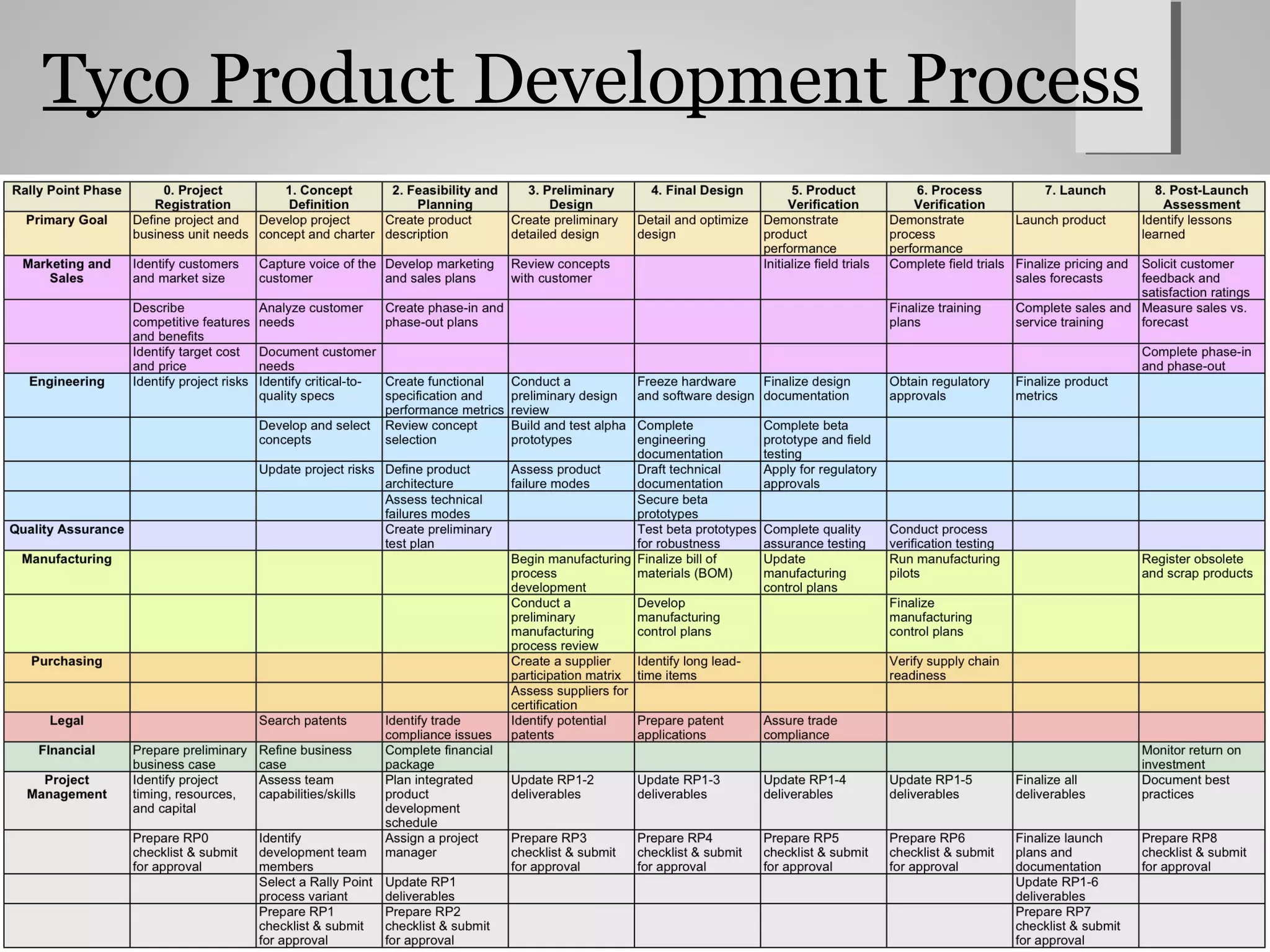
Project
Registration
Concept
Definition
Feasibility
and Planning
Preliminary
Design
Final
Design
Product
Verification
Process
Verification
Launch
Post-Launch
Assessment
RP
1
RP
2
RP
3
RP
4
RP
5
RP
6
RP
7
RP
8
RP
0
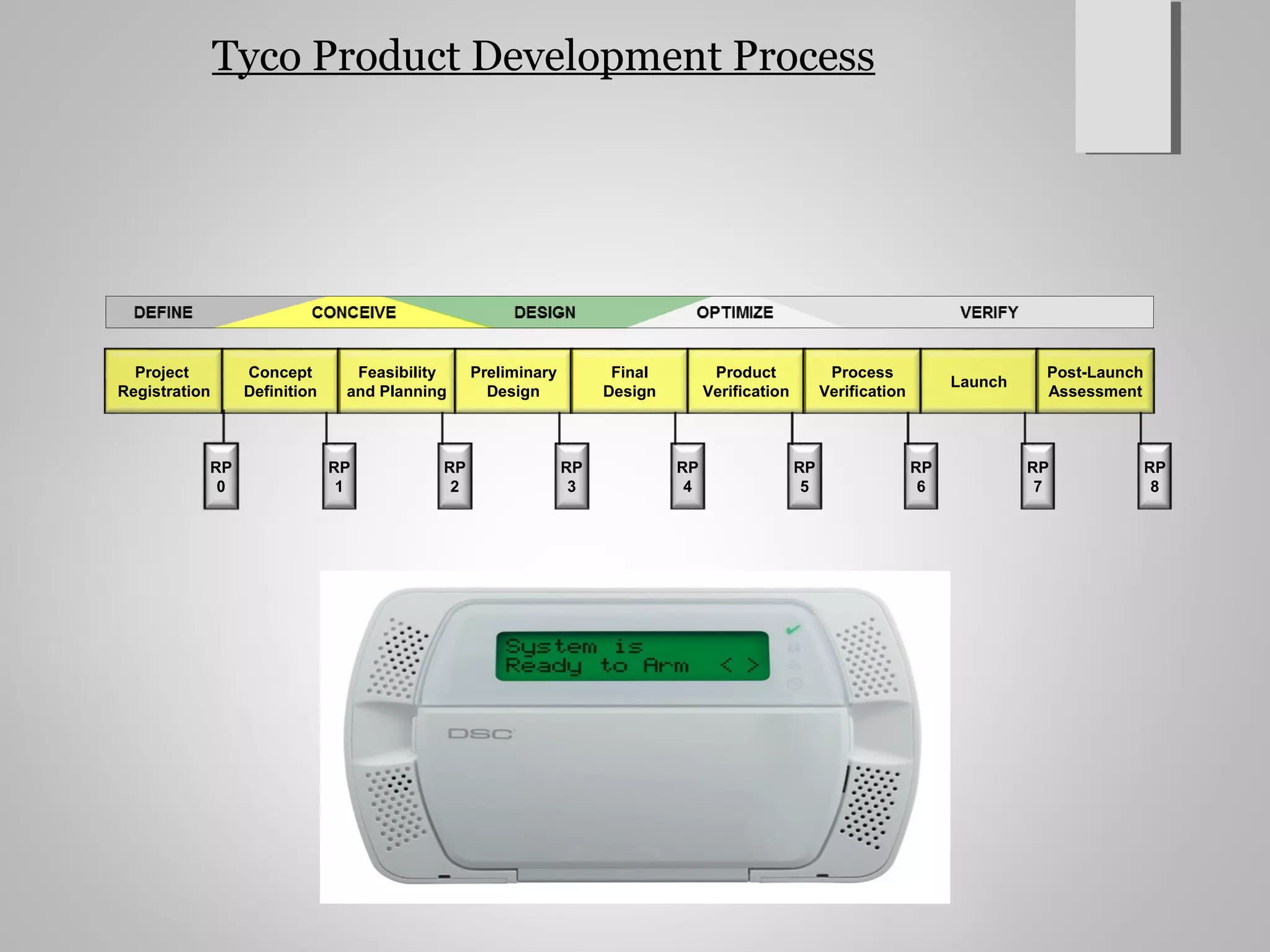
Tyco Product Development Process
Organizational types
 Strict functional organization
 Strict project organization
 Matrix organization
19
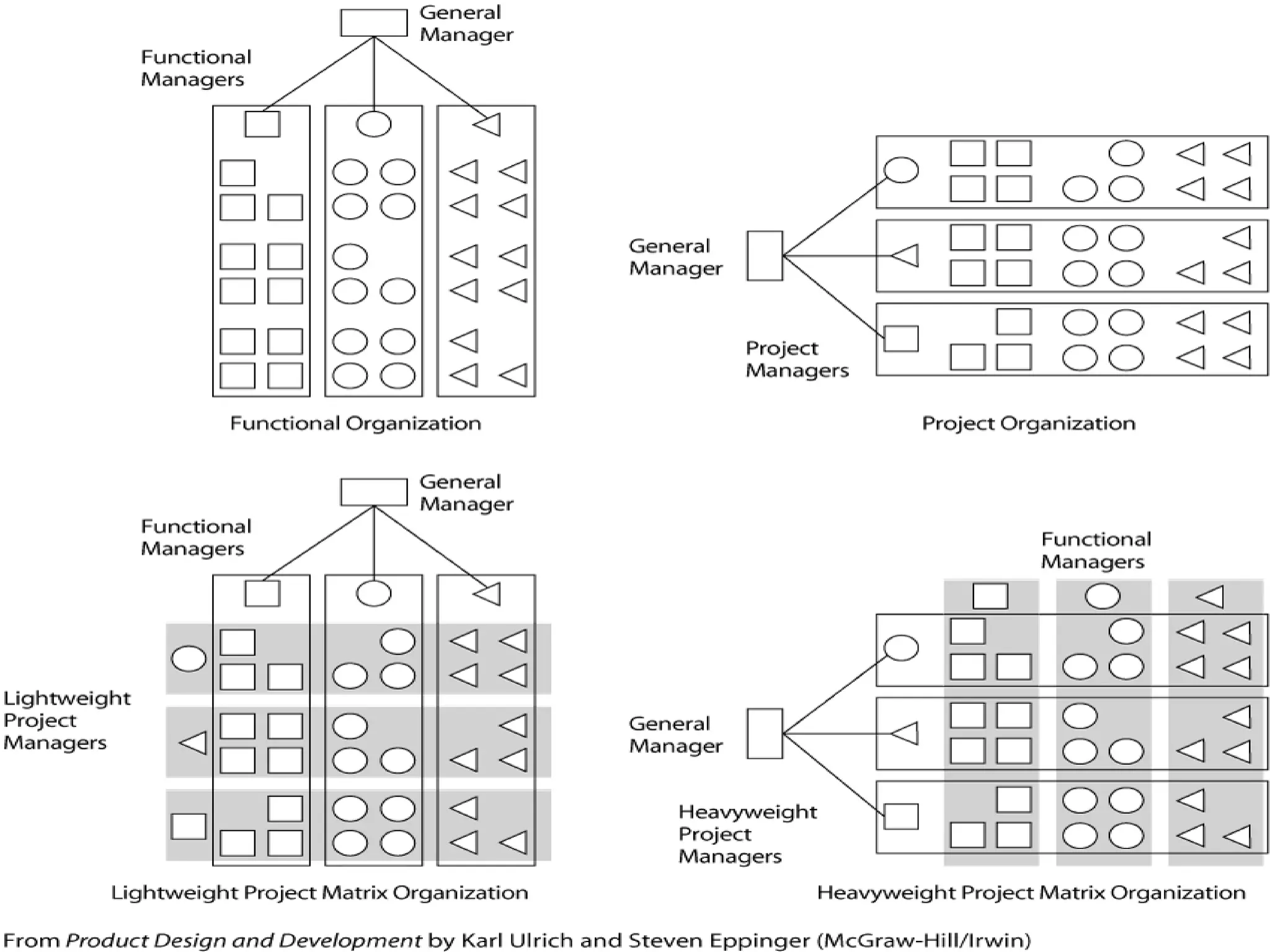
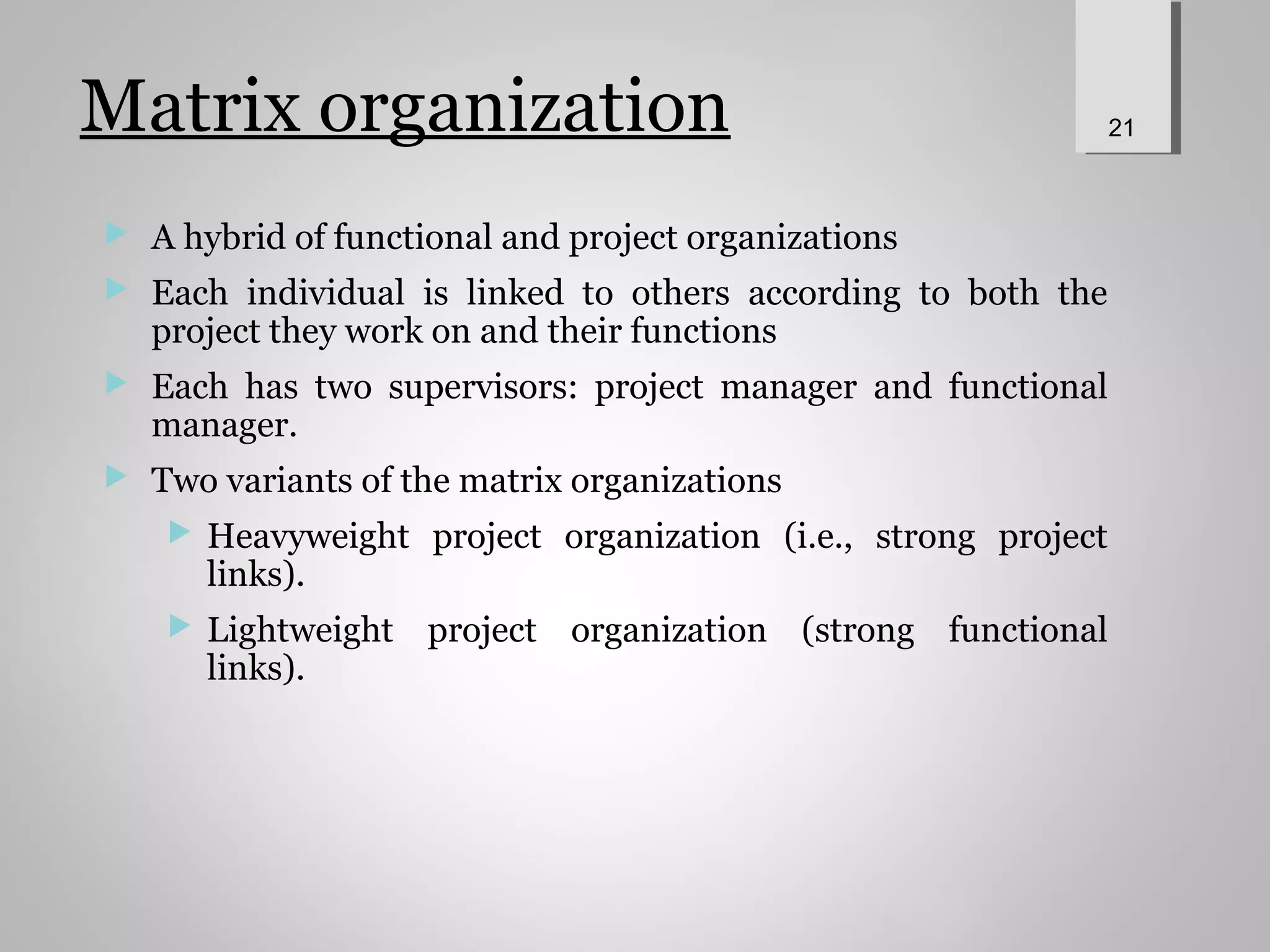
Matrix organization
 A hybrid of functional and project organizations
 Each individual is linked to others according to both the
project they work on and their functions
 Each has two supervisors: project manager and functional
manager.
 Two variants of the matrix organizations
 Heavyweight project organization (i.e., strong project
links).
 Lightweight project organization (strong functional
links).
21
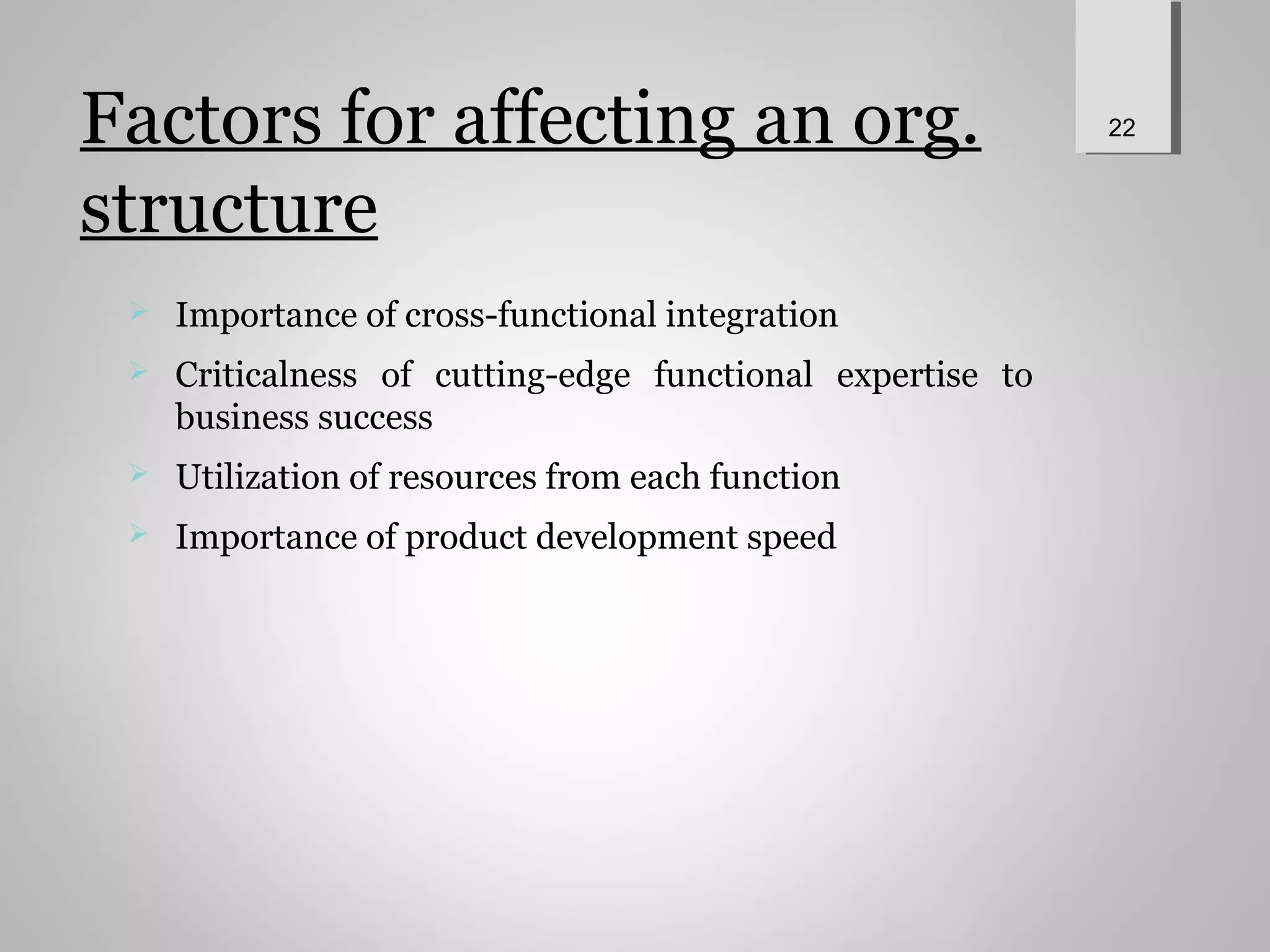
Factors for affecting an org.
structure
 Importance of cross-functional integration
 Criticalness of cutting-edge functional expertise to
business success
 Utilization of resources from each function
 Importance of product development speed
22
Organizational linkages
 Reporting relationship
 Financial arrangement
 Physical layout.
23
Variants of the development
process
 Market pull products
 Technology push products
 Platform products
 Process-intensive products
 Customized products
 high-risk product
 Quick build products
 Complex systems
24
Variants
 Market-pull products
 The firm finds a market opportunity and a
technology to meet customer's needs. Thermo care.
 Technology-push products
 The firm begins with a new technology and then
finds a market for it. Glue for “post-it.”
 Platform products
 Use of a proven technology platform to build a new
product. Instant film used in Polaroid cameras.
 Process-intensive products
 Develop product and process simultaneously.
25
Variants
 Customized products
 Build a new product by varying existing configurations.
 High-risk products
 Intensive and early test and analysis
 Quick-build products
 Rapid modeling & prototyping at testing phase
 Complex systems
 Subsystems and integration worked by teams
26
Traditional design methods
 Aggregation
 (include new functions)
 Adaptation
 (adapt to new conditions)
 Application
 (apply a proven technology to a new area)
 analysis of properties
 (thorough analysis of an existing design to improve)
 Brainstorming
 (find many solutions to a problem)
27
Traditional design methods
 systematic search of field
 (obtain complete possible information)
 Questioning
 (apply a system of questions to produce mental
simulation)
 mental experiment
 (observe an idealized mental model at work)
 value analysis
 Evaluation
 (find best variant among a few by point-
counting)
28
Traditional design methods
 invention
 Iteration
 (to solve a system with complicated interactions)
 experimentation
 division of totality
 math & computer modeling
29

Product design and development ch2

  • 1.
    Development Processes and Organizations Teachingmaterials to accompany: Product Design and Development Chapter 2
  • 2.
    Product Design andDevelopment Karl T. Ulrich and Steven D. Eppinger 5th edition, Irwin McGraw-Hill, 2012. Chapter Table of Contents: 1.Introduction 2.Development Processes and Organizations 3.Opportunity Identification 4.Product Planning 5.Identifying Customer Needs 6.Product Specifications 7.Concept Generation 8.Concept Selection 9.Concept Testing 10.Product Architecture 11.Industrial Design 12.Design for Environment 13.Design for Manufacturing 14.Prototyping 15.Robust Design 16.Patents and Intellectual Property 17.Product Development Economics 18.Managing Projects
  • 3.
    Concept Development Process Identify C ustom er N eeds E stablish Target S pecifications G enerate P roduct C oncepts Test P roduct C oncept(s) S et Final S pecifications P lan D ow nstream D evelopm ent D evelopm ent P lan M ission S tatem ent S elect P roduct C oncept(s) P erform E conom ic A nalysis B enchm ark C om petitive P roducts B uild and Test M odels and P rototypes
  • 4.
    Generic Product Development Process Planning PlanningConcept Development Concept Development System-Level Design System-Level Design Detail Design Detail Design Testing and Refinement Testing and Refinement Production Ramp-Up Production Ramp-Up Mission Approval Concept Review System Spec Review Critical Design Review Production Approval
  • 5.
    Core development stages Solution approach  Concept design  Architectural design  Detailed design  Process design  Fabrication and assembly  Test and deployment 5
  • 6.
    Solution Approach  Conceptfor solutions  DFX 6
  • 7.
    Concept development  Adescription of the form, function, and features of a product  A set of specifications  An economic justification of the project. 7
  • 8.
    System (architectural) design Definition of product architecture, with an assembly layout.  Division of the product into subsystems and components, each with a functional specification. 8
  • 9.
    Detailed design  Completespecification of the geometry, materials, and tolerances of each of the unique parts  Identification of all standard parts to be purchased.  Establishment of a process plan and tooling 9
  • 10.
    Test and refinement Construction and evaluation of multiple pre-production versions of the product.  Early (alpha) prototypes are usually built with production- intent parts (but may not be with the intended production processes) for testing in the designer's environment, if the design intent and key customer needs are met.  Later (beta) prototypes are built with parts supplied by the intended production processes (but may not be with the intended-assembly process), tested by customers in their environment, and to evaluate product performance and reliability. 10
  • 11.
    Production ramp-up  Theproduct is made using the intended production system.  To train the work force and to work out any remaining problems in the production processes. 11
  • 12.
    A generic conceptdevelopment process  Identifying customer needs  Establishing target specifications  Concept generation  Concept selection  Concept testing  Setting final specifications  Project planning  Economic analysis  Benchmarking of competitive products  Modeling and prototyping 12
  • 13.
    Rapid Iteration PDProcess Many Iteration Cycles Planning Planning Concept Development Concept Development System-Level Design System-Level Design Mission Approval Concept Review Cycle Plan Review Design Design Cycle Review Build Build Test Test Production Ramp-Up Production Ramp-Up
  • 14.
    Complex System PDProcess Planning Planning Concept Development Concept Development System-Level Design System-Level Design Mission Approval Concept Review System Review Design Design Production Approval Test Test Design Design Test Test Design Design Test Test Design Design Test Test Integrate and Test Integrate and Test Validation and Ramp-Up Validation and Ramp-Up
  • 15.
    Concept Development Process •Front-end of PD need not be a fuzzy process. • Structured methods exist for each process step (see text chapters 4 to 8). • This is not strictly sequential -- generally a parallel and iterative process. Identify Customer Needs Establish Target Specifications Generate Product Concepts Select Product Concept(s) Set Final Specifications Plan Downstream Development Mission Statement Test Product Concept(s) Development Plan Perform Economic Analysis Benchmark Competitive Products Build and Test Models and Prototypes
  • 16.
  • 17.
  • 19.
    Organizational types  Strictfunctional organization  Strict project organization  Matrix organization 19
  • 21.
    Matrix organization  Ahybrid of functional and project organizations  Each individual is linked to others according to both the project they work on and their functions  Each has two supervisors: project manager and functional manager.  Two variants of the matrix organizations  Heavyweight project organization (i.e., strong project links).  Lightweight project organization (strong functional links). 21
  • 22.
    Factors for affectingan org. structure  Importance of cross-functional integration  Criticalness of cutting-edge functional expertise to business success  Utilization of resources from each function  Importance of product development speed 22
  • 23.
    Organizational linkages  Reportingrelationship  Financial arrangement  Physical layout. 23
  • 24.
    Variants of thedevelopment process  Market pull products  Technology push products  Platform products  Process-intensive products  Customized products  high-risk product  Quick build products  Complex systems 24
  • 25.
    Variants  Market-pull products The firm finds a market opportunity and a technology to meet customer's needs. Thermo care.  Technology-push products  The firm begins with a new technology and then finds a market for it. Glue for “post-it.”  Platform products  Use of a proven technology platform to build a new product. Instant film used in Polaroid cameras.  Process-intensive products  Develop product and process simultaneously. 25
  • 26.
    Variants  Customized products Build a new product by varying existing configurations.  High-risk products  Intensive and early test and analysis  Quick-build products  Rapid modeling & prototyping at testing phase  Complex systems  Subsystems and integration worked by teams 26
  • 27.
    Traditional design methods Aggregation  (include new functions)  Adaptation  (adapt to new conditions)  Application  (apply a proven technology to a new area)  analysis of properties  (thorough analysis of an existing design to improve)  Brainstorming  (find many solutions to a problem) 27
  • 28.
    Traditional design methods systematic search of field  (obtain complete possible information)  Questioning  (apply a system of questions to produce mental simulation)  mental experiment  (observe an idealized mental model at work)  value analysis  Evaluation  (find best variant among a few by point- counting) 28
  • 29.
    Traditional design methods invention  Iteration  (to solve a system with complicated interactions)  experimentation  division of totality  math & computer modeling 29