Research Methods
What makes a science a science?
• Based on empirical methods (info. Gained from
direct observation and experiments)
• Objective (based on fact rather than opinion)
• Falsifiable (if something is UNFALSIABLE it can
neither be proved nor disproved)
• Only one paradigm (Kuhn, 1970)
• Based on testing hypotheses
(Karl Popper 1935, and his hypothetico-deductive
model)
Peer review:
• Assessment of scientific research by experts in
the field
• Ensures published research is of high quality
• Also used for:
1. Allocation of research funding
2. To test quality of university departments
3. Aid publication of works in journals and books
(Parliamentary Office of Science and Technology –
2002)
Peer review – Evaluation:
• Anonymity used to
remove bias
• It isn’t always possible to
find an expert in the field
• Publication bias – as
journals tend to prefer
publishing positive results
• Once a study is
published, if fault is later
found, it cannot be
removed from the public
domain
What is an aim?
• A general overview of what you set out to find
What is a theory?
• A well-established principle that has been
developed to explain an aspect of the natural
world.
• Arises from repeated observation and
incorporates facts, laws, predictions and
tested hypotheses
More general than a hypothesis
What are hypotheses?
• Specific, testable statements of prediction, it
states what the research expects to find out
• To operationalise the hypotheses, you need to
clearly state how the IV will be manipulated, and
how the DV will be measured
• IV – Independent Variable (what you change)
DV – Dependent Variable (cause of that change)
Null hypothesis:
• Statement of no difference.
• Example:
‘there will be no significant difference
between… blah blah blah’
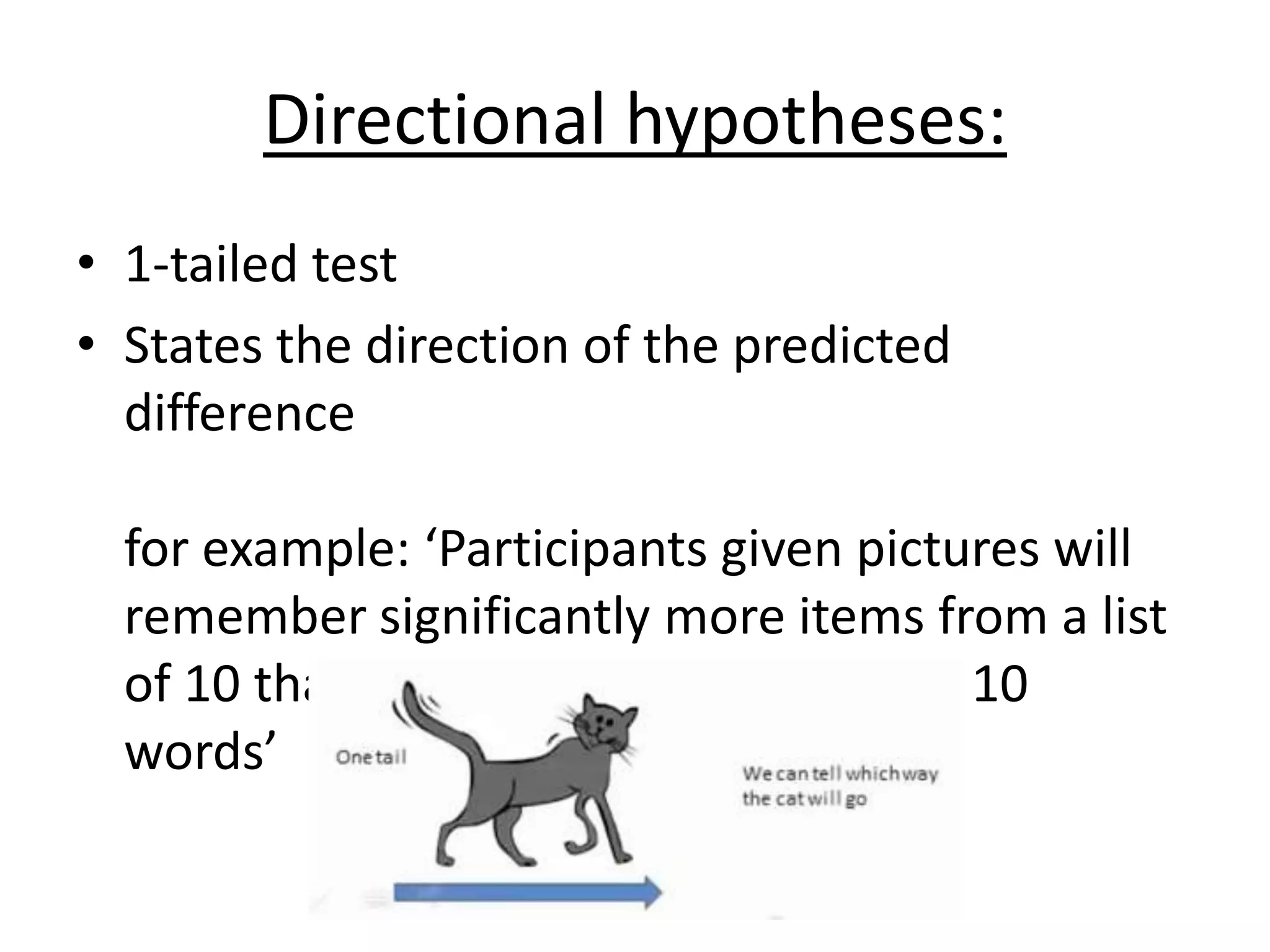
Directional hypotheses:
• 1-tailed test
• States the direction of the predicted
difference
for example: ‘Participants given pictures will
remember significantly more items from a list
of 10 than participants given a list of 10
words’
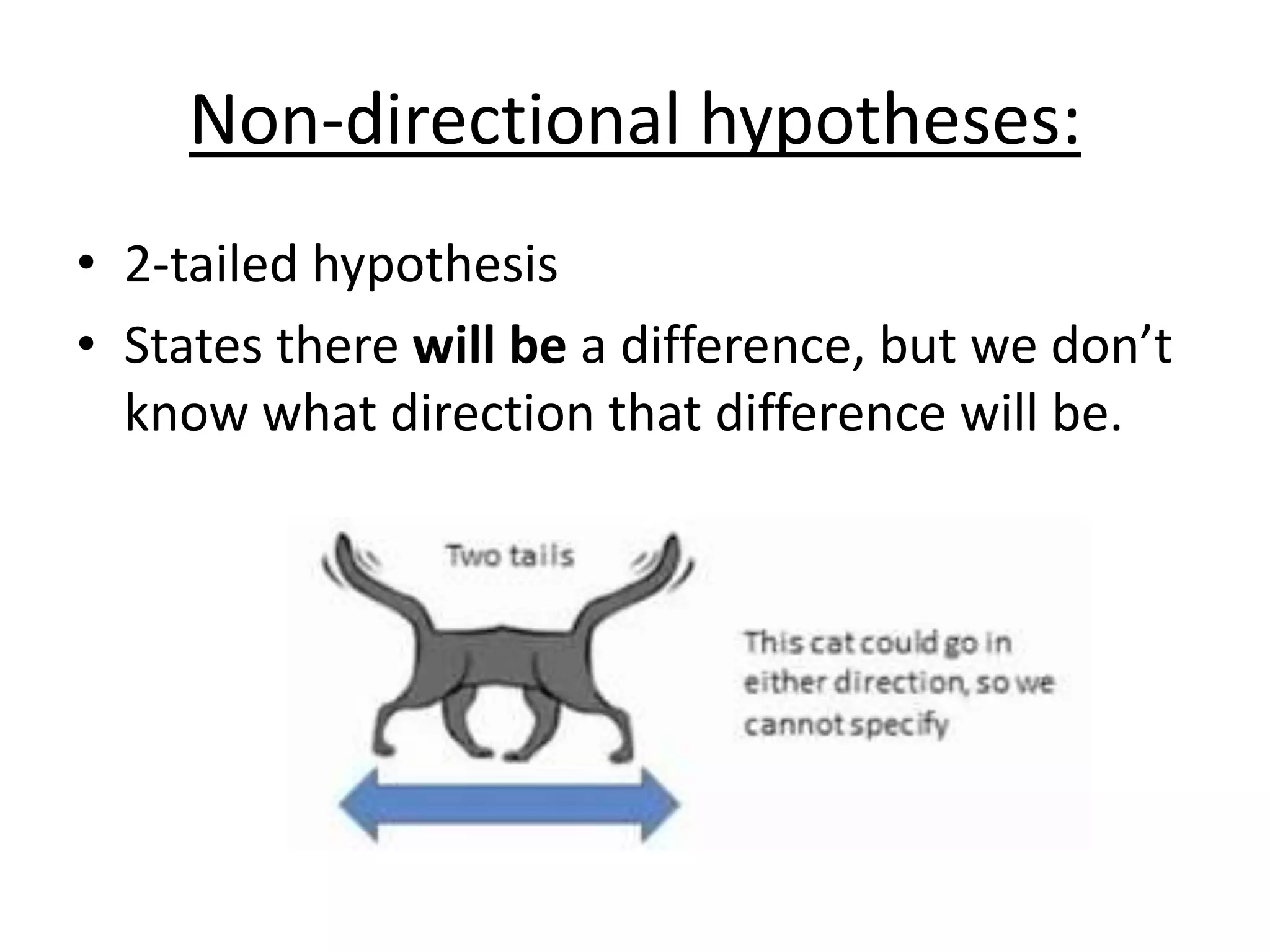
Non-directional hypotheses:
• 2-tailed hypothesis
• States there will be a difference, but we don’t
know what direction that difference will be.
Correlation hypothesis:
• Similar to null, directional and non-directional
hypothesis
• Just look for the word ‘correlation’ in the
hypothesis
Looking for significance:
• In psychology, we look for the P≤0.05 value
• This means that the results could be 5% due
to chance, however we are 95% sure the
value is significant
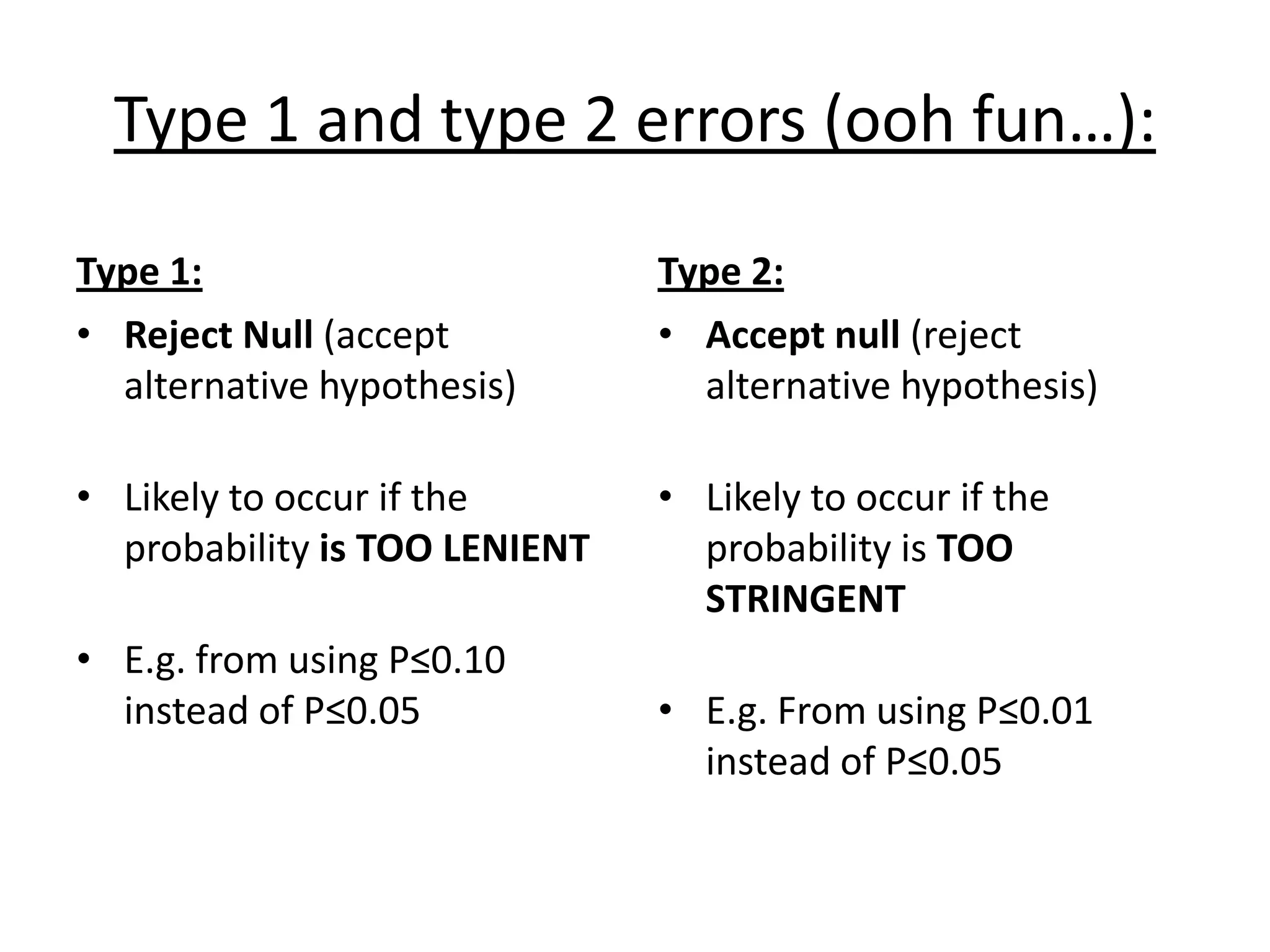
Type 1 and type 2 errors (ooh fun…):
Type 1:
• Reject Null (accept
alternative hypothesis)
• Likely to occur if the
probability is TOO LENIENT
• E.g. from using P≤0.10
instead of P≤0.05
Type 2:
• Accept null (reject
alternative hypothesis)
• Likely to occur if the
probability is TOO
STRINGENT
• E.g. From using P≤0.01
instead of P≤0.05
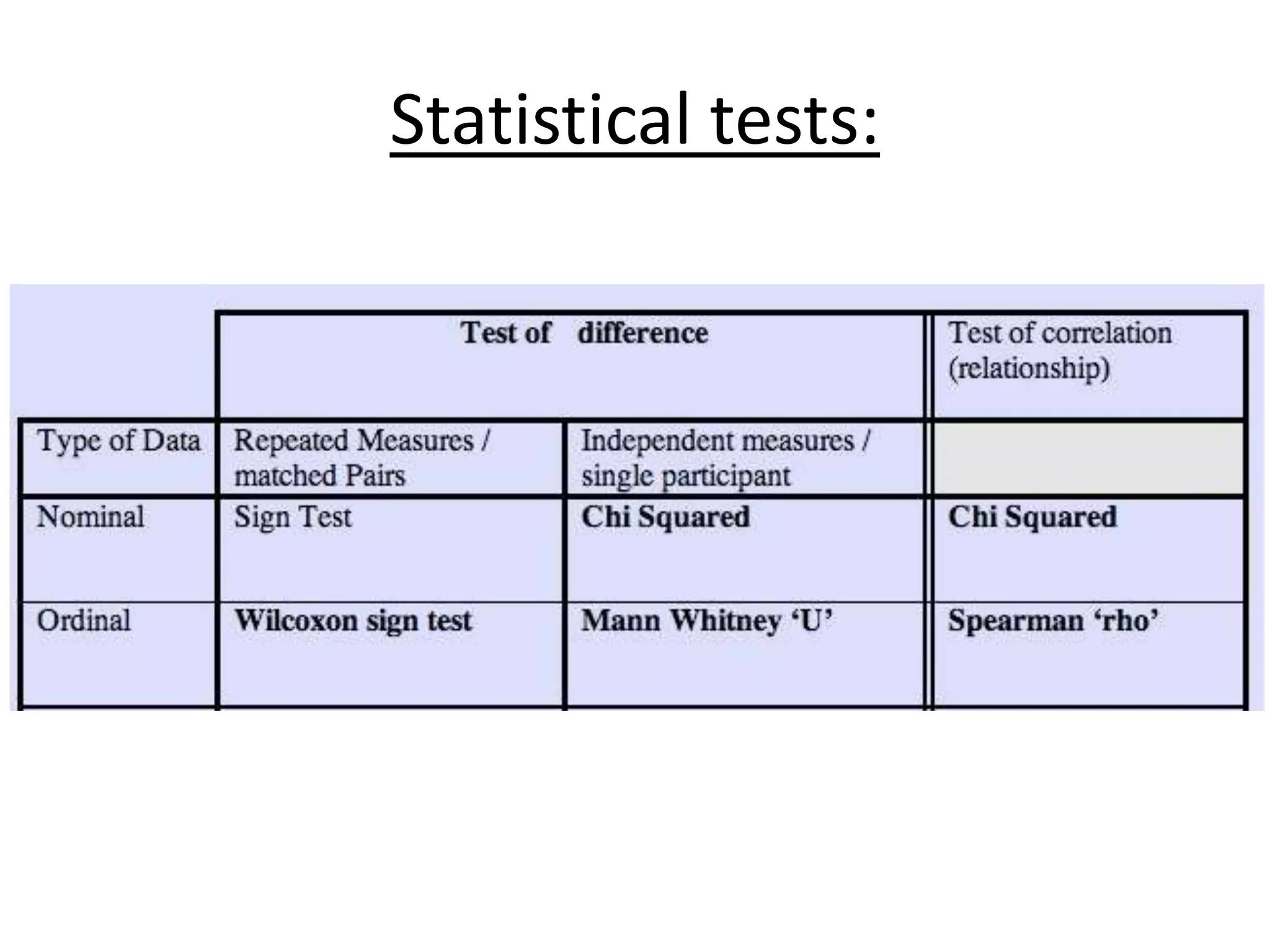
Statistical tests:
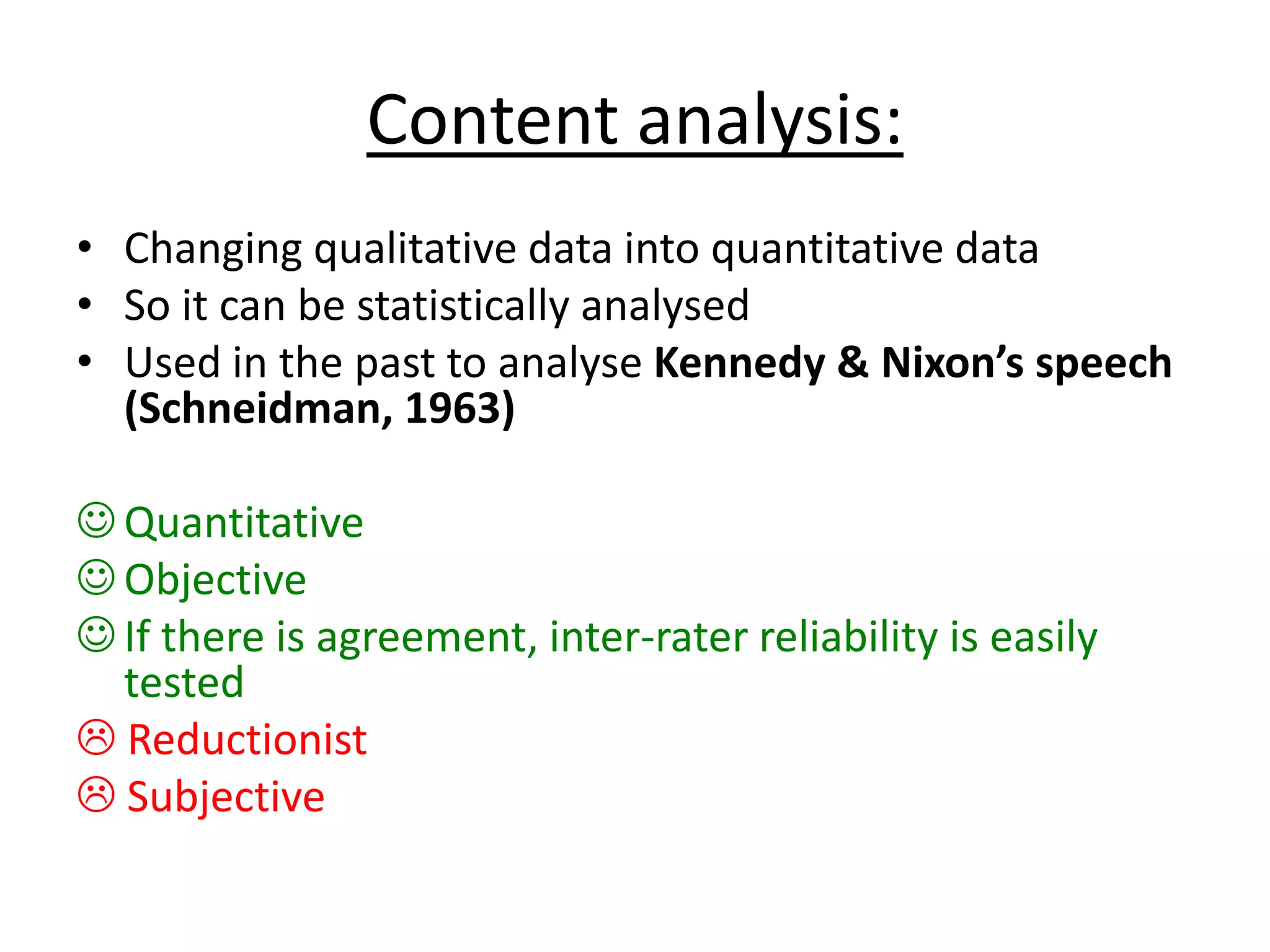
Content analysis:
• Changing qualitative data into quantitative data
• So it can be statistically analysed
• Used in the past to analyse Kennedy & Nixon’s speech
(Schneidman, 1963)
 Quantitative
 Objective
 If there is agreement, inter-rater reliability is easily
tested
 Reductionist
 Subjective
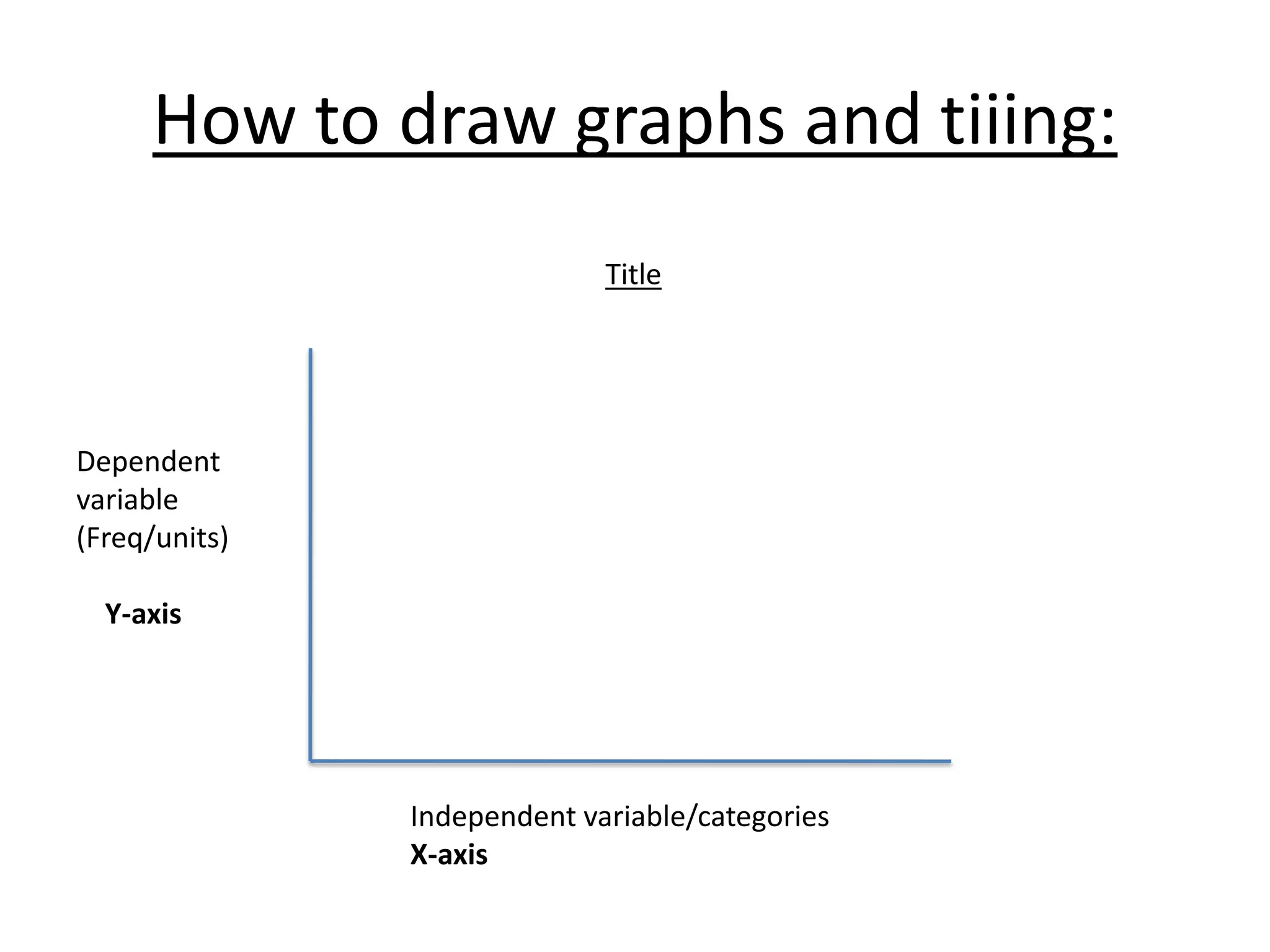
How to draw graphs and tiiing:
Independent variable/categories
X-axis
Dependent
variable
(Freq/units)
Y-axis
Title
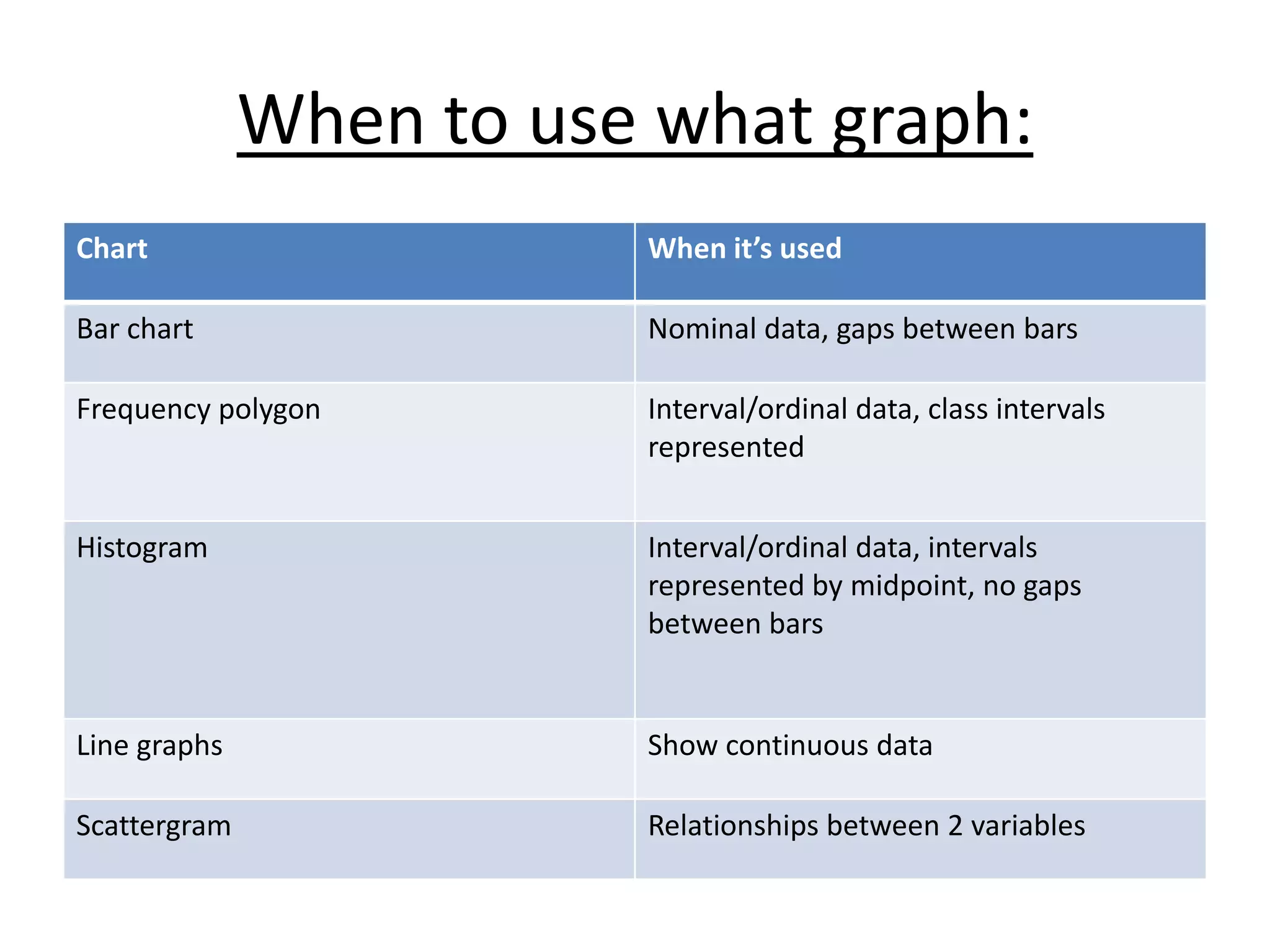
When to use what graph:
Chart When it’s used
Bar chart Nominal data, gaps between bars
Frequency polygon Interval/ordinal data, class intervals
represented
Histogram Interval/ordinal data, intervals
represented by midpoint, no gaps
between bars
Line graphs Show continuous data
Scattergram Relationships between 2 variables
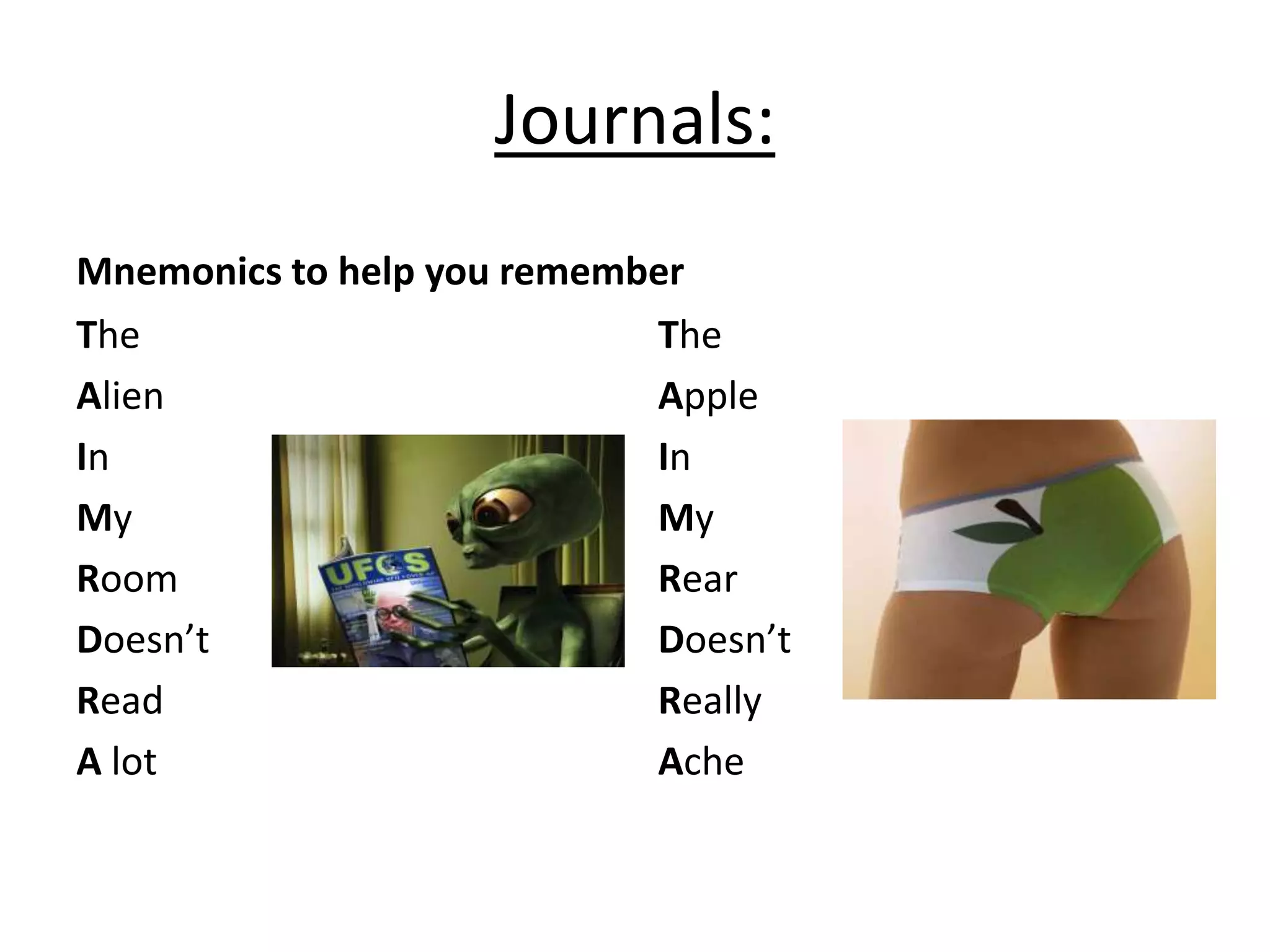
Journals:
Mnemonics to help you remember
The
Alien
In
My
Room
Doesn’t
Read
A lot
The
Apple
In
My
Rear
Doesn’t
Really
Ache
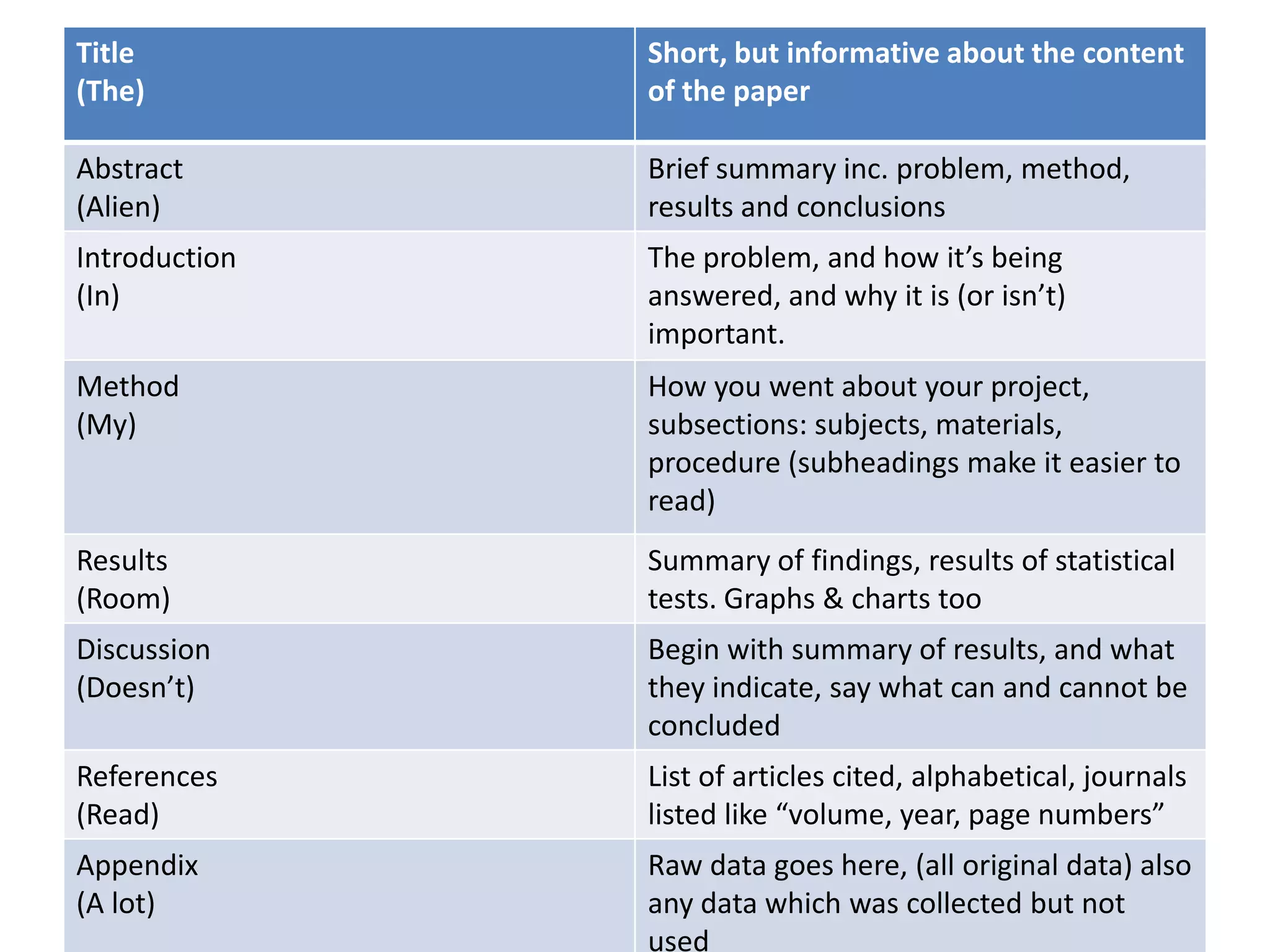
Title
(The)
Short, but informative about the content
of the paper
Abstract
(Alien)
Brief summary inc. problem, method,
results and conclusions
Introduction
(In)
The problem, and how it’s being
answered, and why it is (or isn’t)
important.
Method
(My)
How you went about your project,
subsections: subjects, materials,
procedure (subheadings make it easier to
read)
Results
(Room)
Summary of findings, results of statistical
tests. Graphs & charts too
Discussion
(Doesn’t)
Begin with summary of results, and what
they indicate, say what can and cannot be
concluded
References
(Read)
List of articles cited, alphabetical, journals
listed like “volume, year, page numbers”
Appendix
(A lot)
Raw data goes here, (all original data) also
any data which was collected but not
used
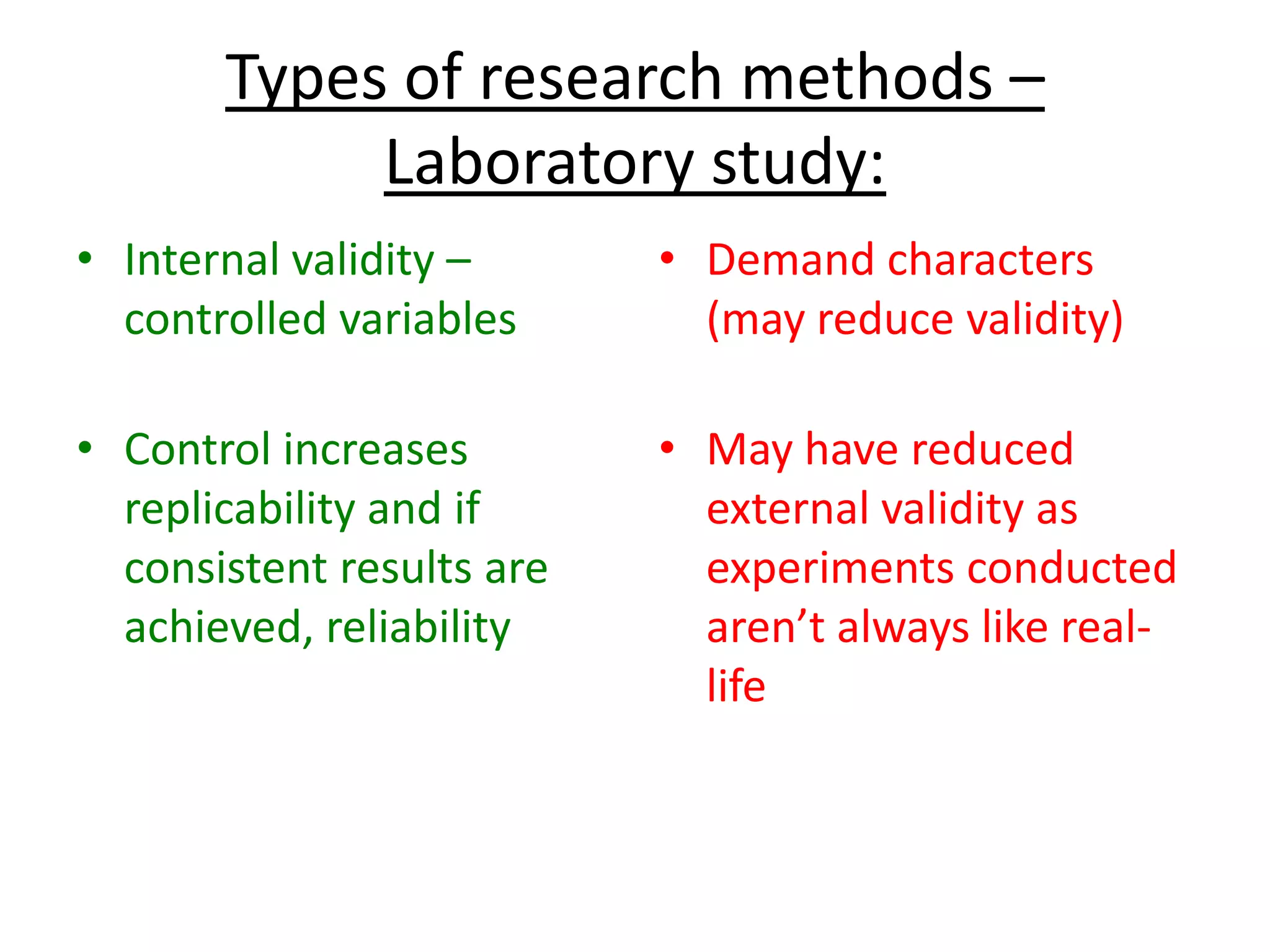
Types of research methods –
Laboratory study:
• Internal validity –
controlled variables
• Control increases
replicability and if
consistent results are
achieved, reliability
• Demand characters
(may reduce validity)
• May have reduced
external validity as
experiments conducted
aren’t always like real-
life
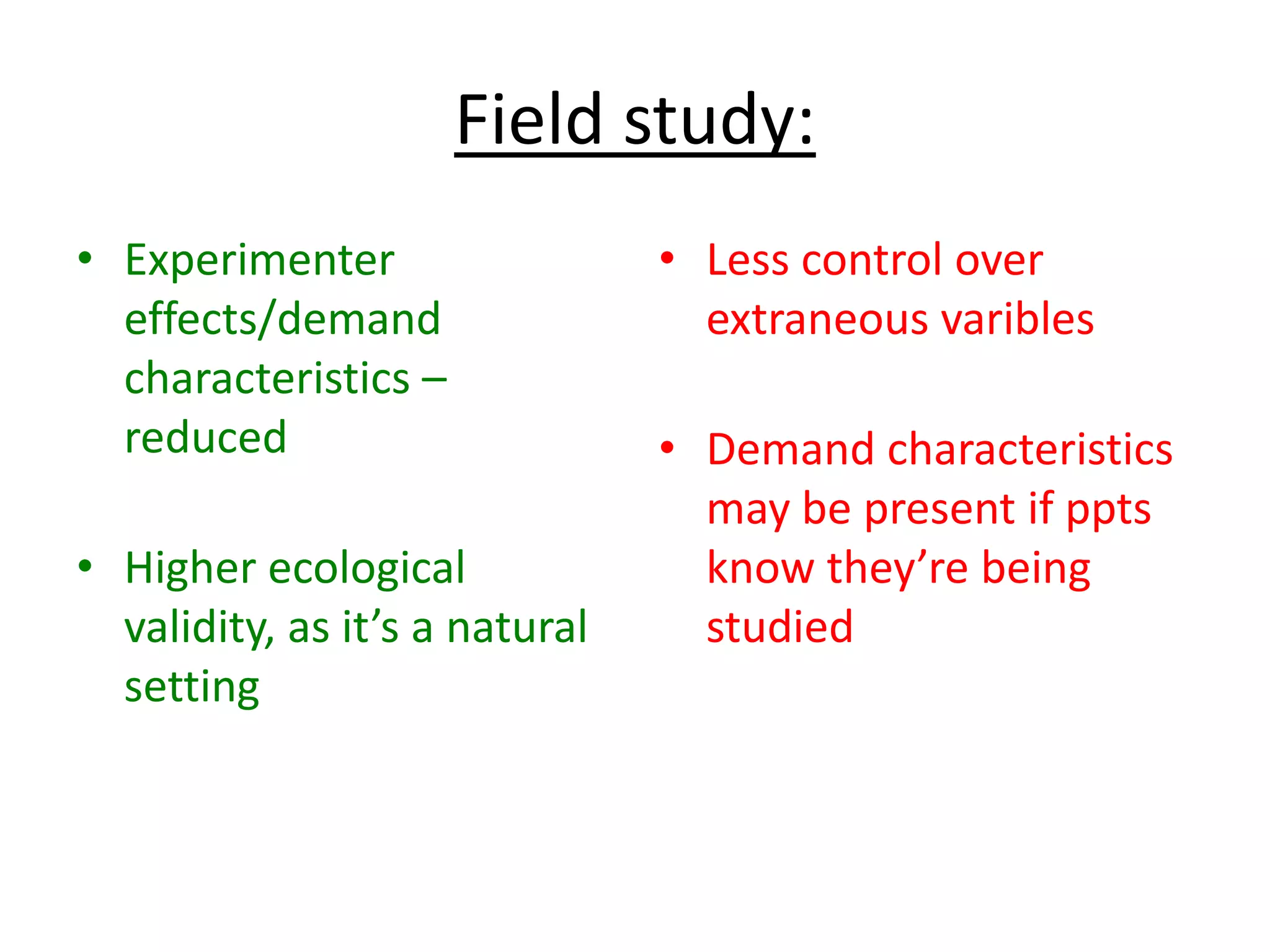
Field study:
• Experimenter
effects/demand
characteristics –
reduced
• Higher ecological
validity, as it’s a natural
setting
• Less control over
extraneous varibles
• Demand characteristics
may be present if ppts
know they’re being
studied
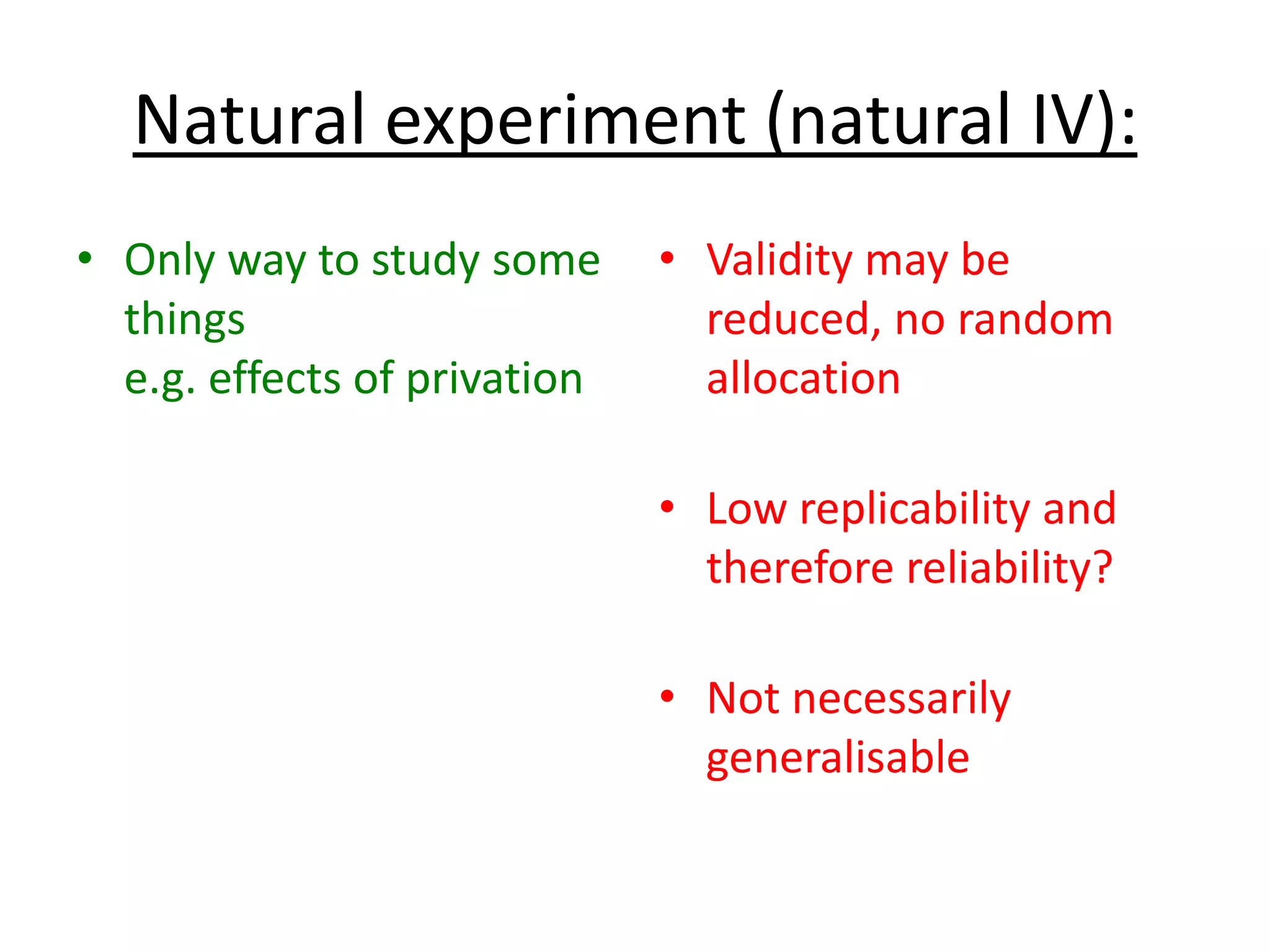
Natural experiment (natural IV):
• Only way to study some
things
e.g. effects of privation
• Validity may be
reduced, no random
allocation
• Low replicability and
therefore reliability?
• Not necessarily
generalisable
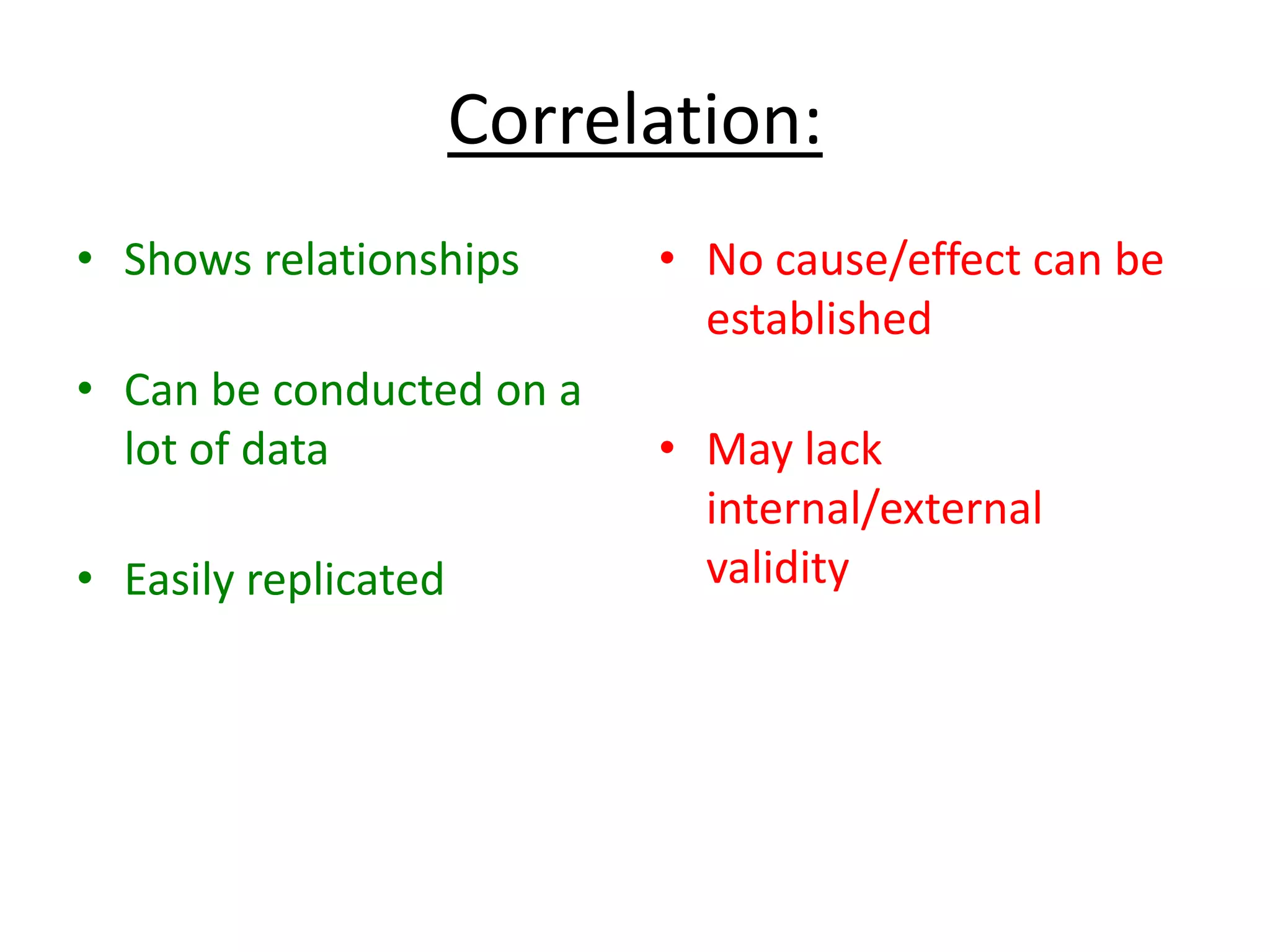
Correlation:
• Shows relationships
• Can be conducted on a
lot of data
• Easily replicated
• No cause/effect can be
established
• May lack
internal/external
validity
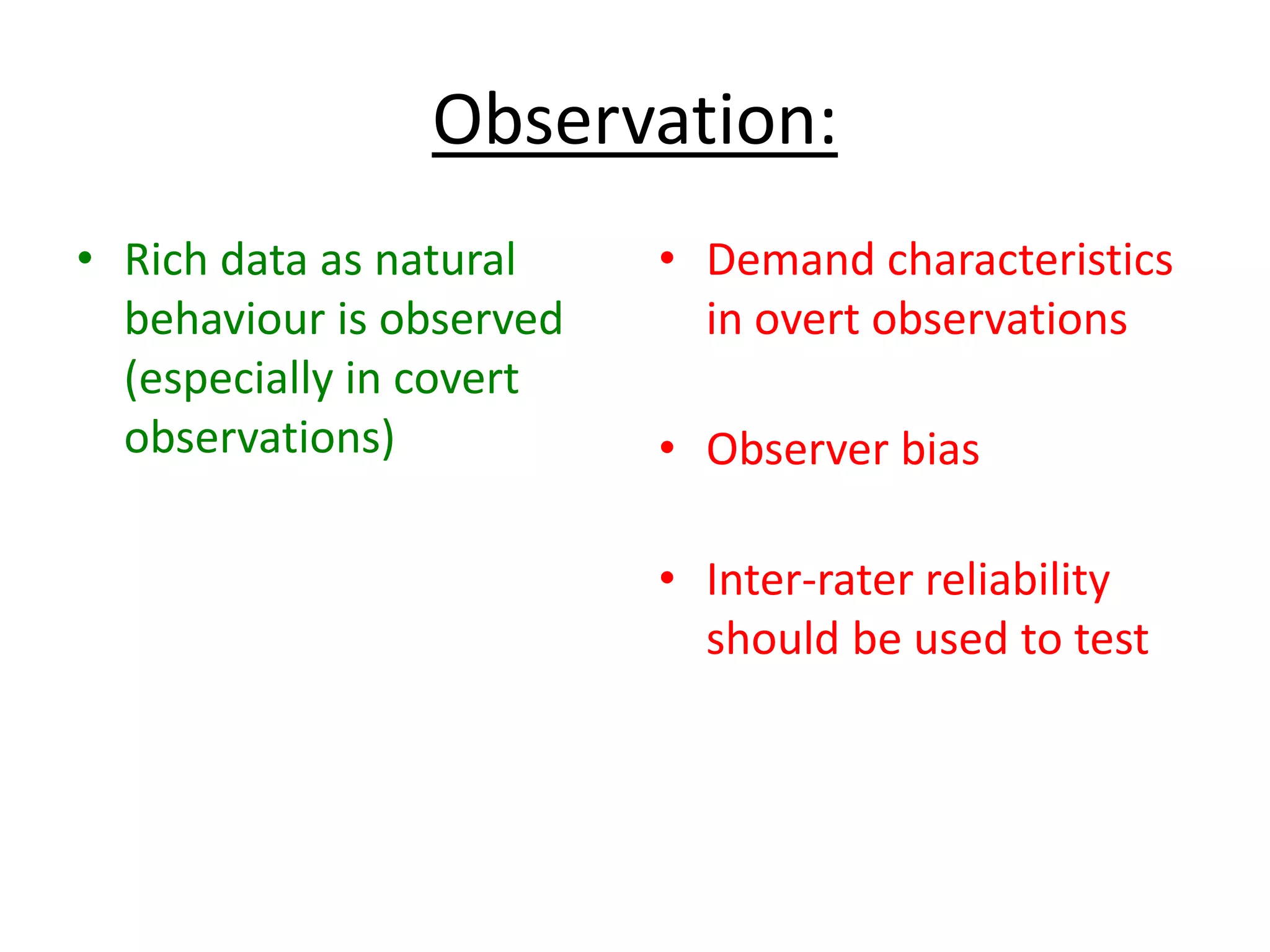
Observation:
• Rich data as natural
behaviour is observed
(especially in covert
observations)
• Demand characteristics
in overt observations
• Observer bias
• Inter-rater reliability
should be used to test
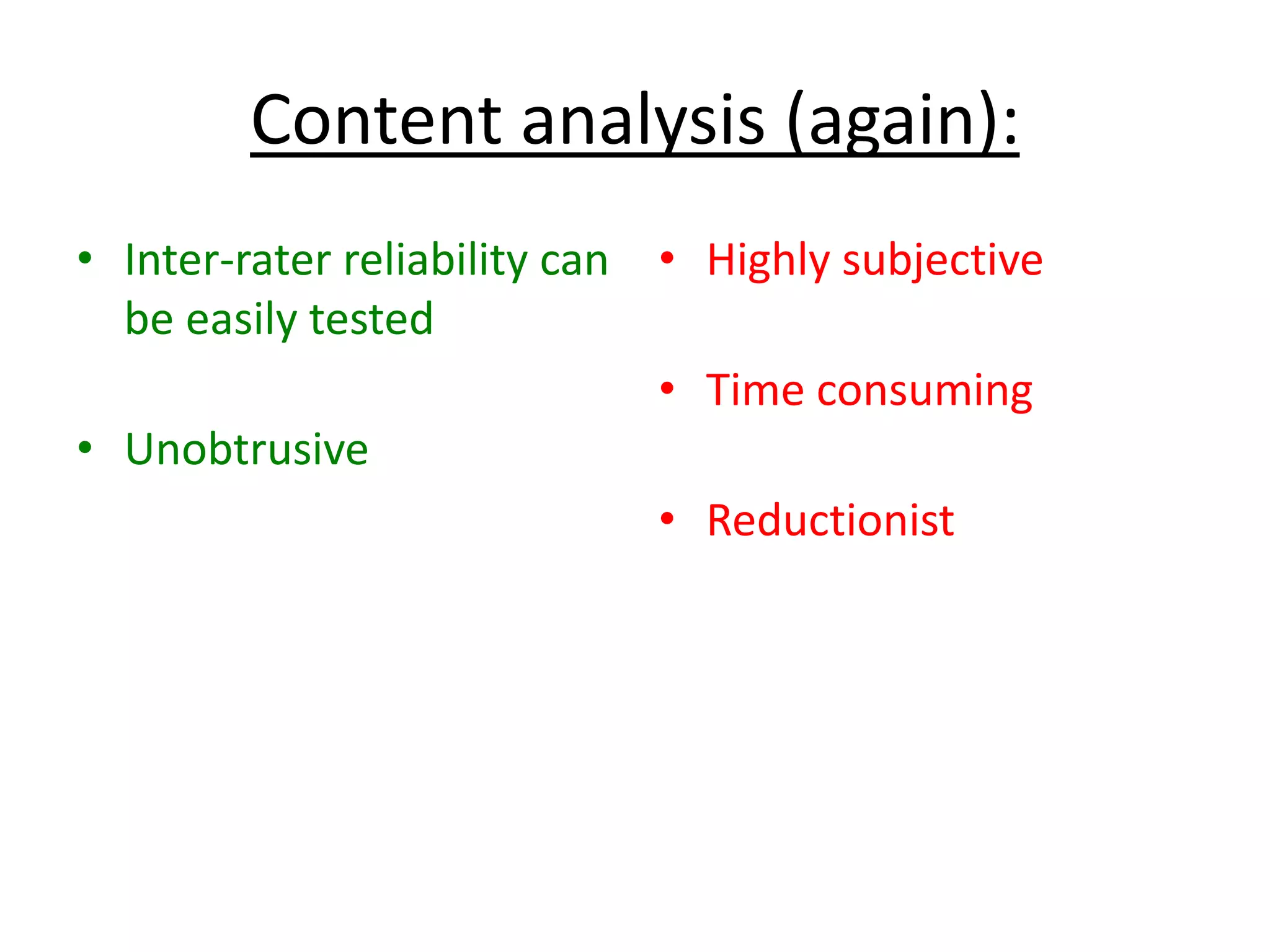
Content analysis (again):
• Inter-rater reliability can
be easily tested
• Unobtrusive
• Highly subjective
• Time consuming
• Reductionist
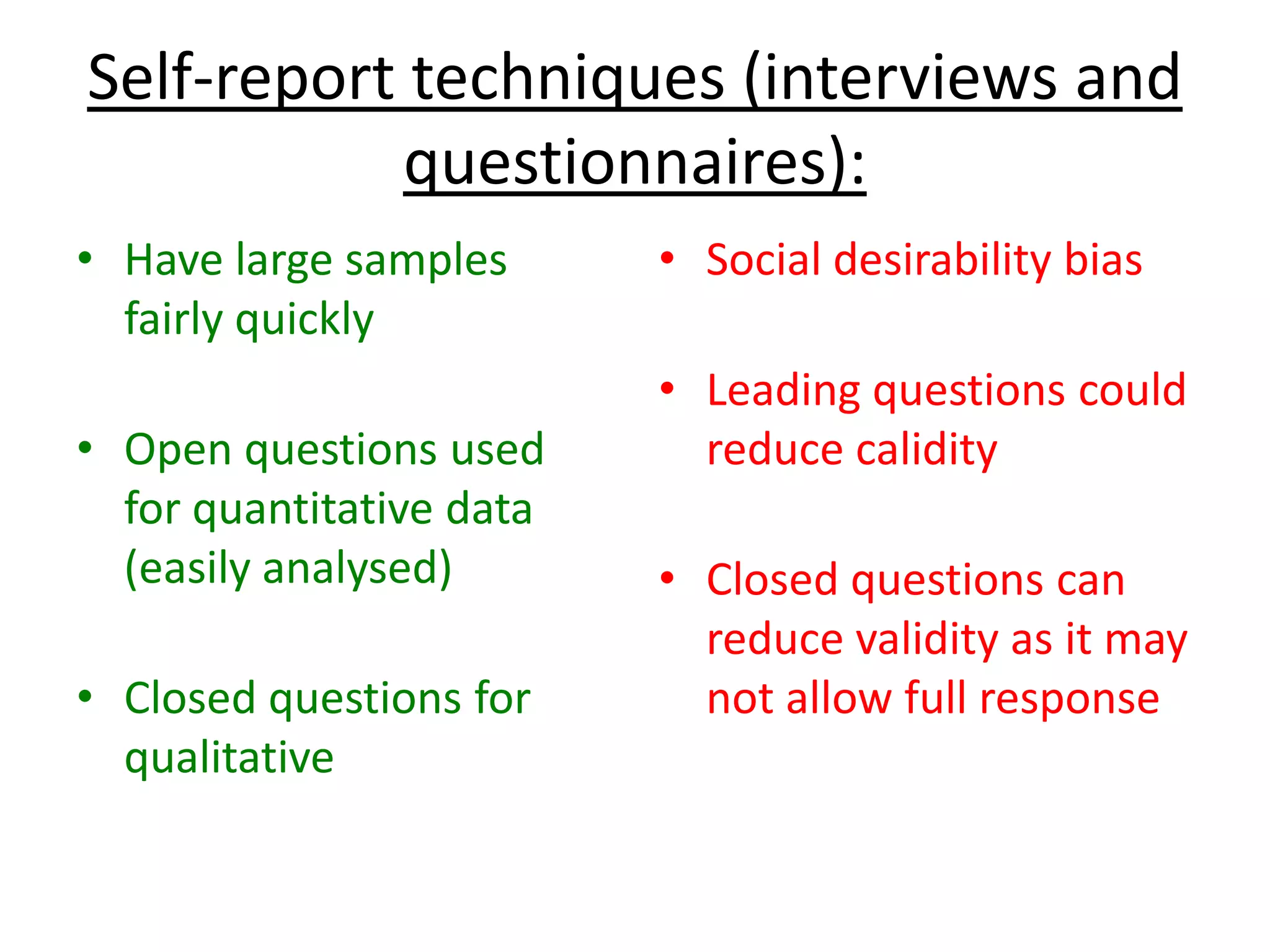
Self-report techniques (interviews and
questionnaires):
• Have large samples
fairly quickly
• Open questions used
for quantitative data
(easily analysed)
• Closed questions for
qualitative
• Social desirability bias
• Leading questions could
reduce calidity
• Closed questions can
reduce validity as it may
not allow full response
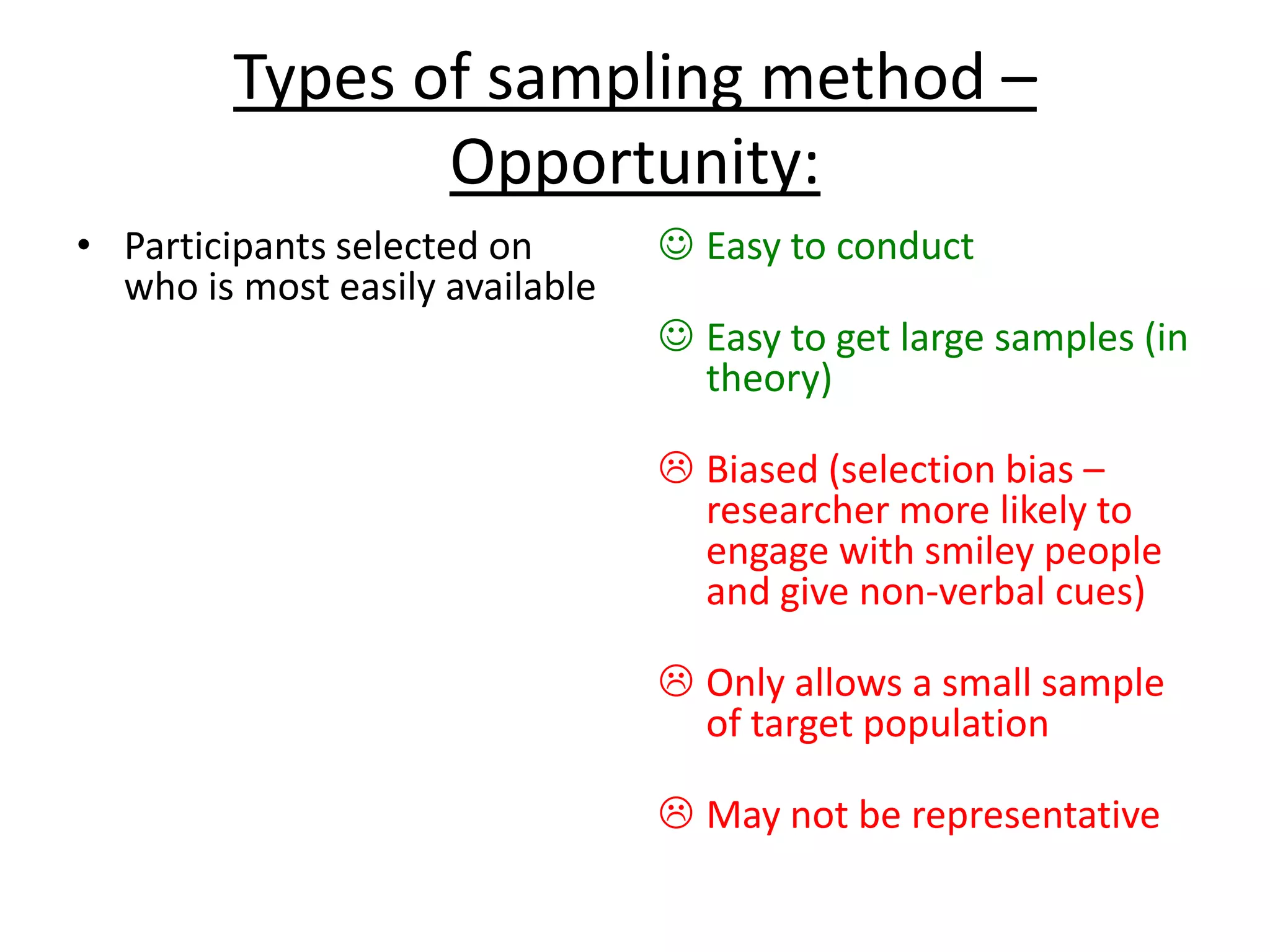
Types of sampling method –
Opportunity:
• Participants selected on
who is most easily available
 Easy to conduct
 Easy to get large samples (in
theory)
 Biased (selection bias –
researcher more likely to
engage with smiley people
and give non-verbal cues)
 Only allows a small sample
of target population
 May not be representative
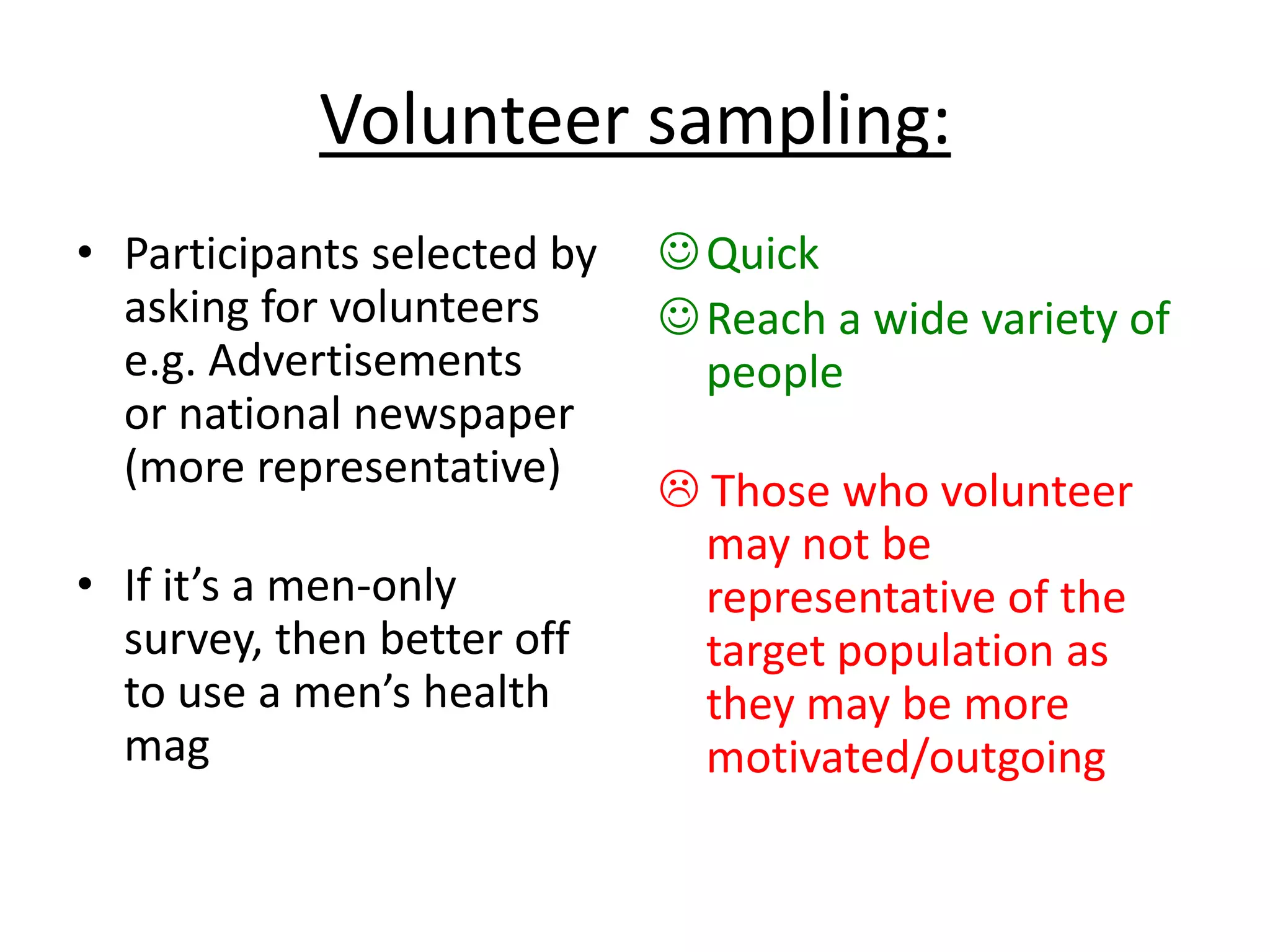
Volunteer sampling:
• Participants selected by
asking for volunteers
e.g. Advertisements
or national newspaper
(more representative)
• If it’s a men-only
survey, then better off
to use a men’s health
mag
Quick
Reach a wide variety of
people
 Those who volunteer
may not be
representative of the
target population as
they may be more
motivated/outgoing
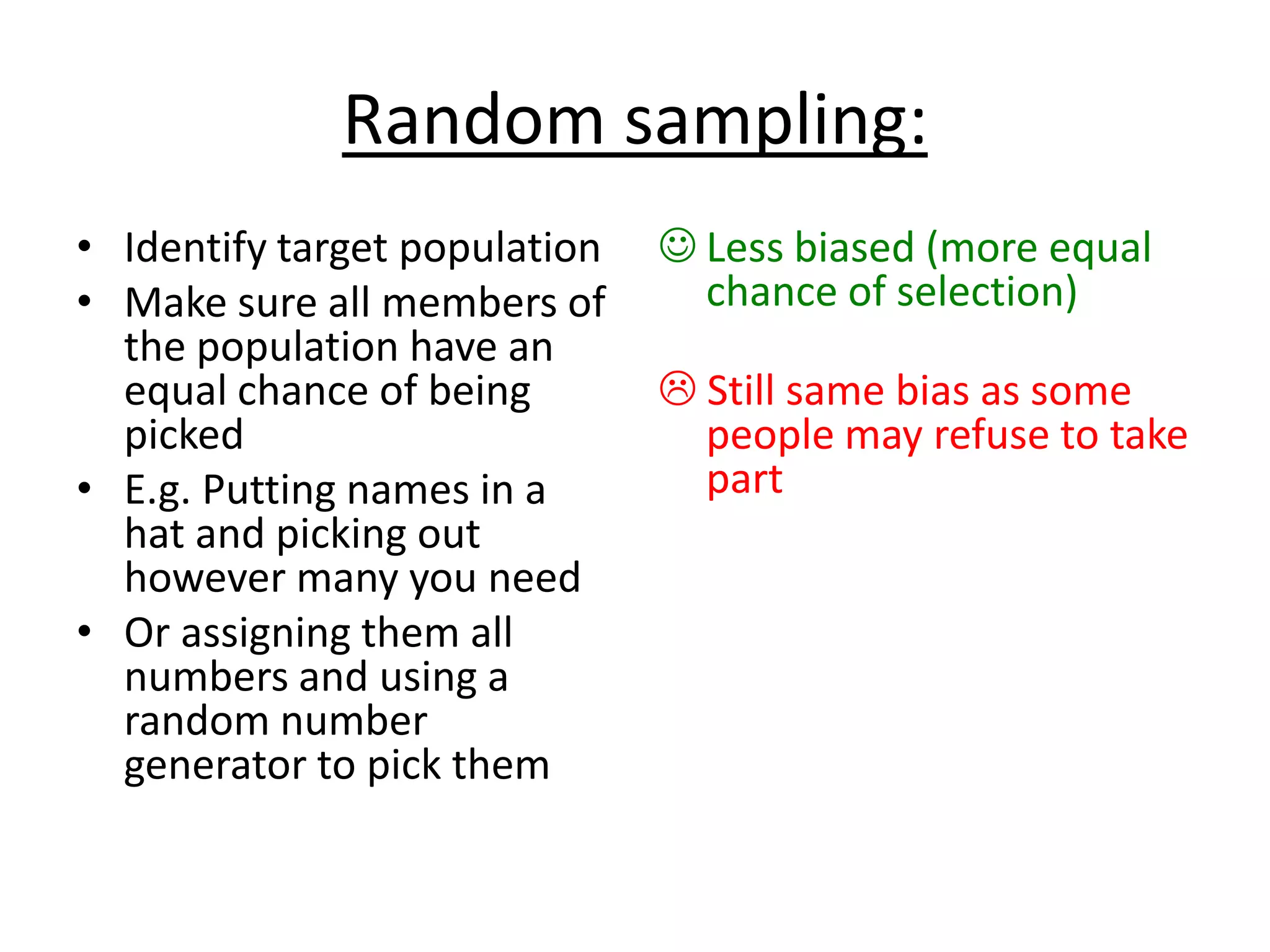
Random sampling:
• Identify target population
• Make sure all members of
the population have an
equal chance of being
picked
• E.g. Putting names in a
hat and picking out
however many you need
• Or assigning them all
numbers and using a
random number
generator to pick them
 Less biased (more equal
chance of selection)
 Still same bias as some
people may refuse to take
part
Ethical issues:
• Informed consent
• Confidentiality and anonymity
• Right to withdraw at any time
• Protection from harm
• Deception
• Debriefing
Dealing with ethical issues:
Alternatives to informed consent:
1) Presumptive consent (assuming the ppt would be
cool with whatever you’re testing)
2) Prior general consent (slightly misinforming the ppt)
Alternatives to deception:
1) Complete info. (ppts told everything, however Gallo
et al (1973) found that sometimes this DOES affect the
outcome, and sometimes it DOESN’T.
2) Role playing (ppts informed about the general
nature of the study and asked to role-play, however
this could lead to unreliable findings)
Reliability:
• Whether, when replicated, the findings are
consistent
Ways to test…
• Inter-rateror inter-observer tested by finding
a strong correlation between their results
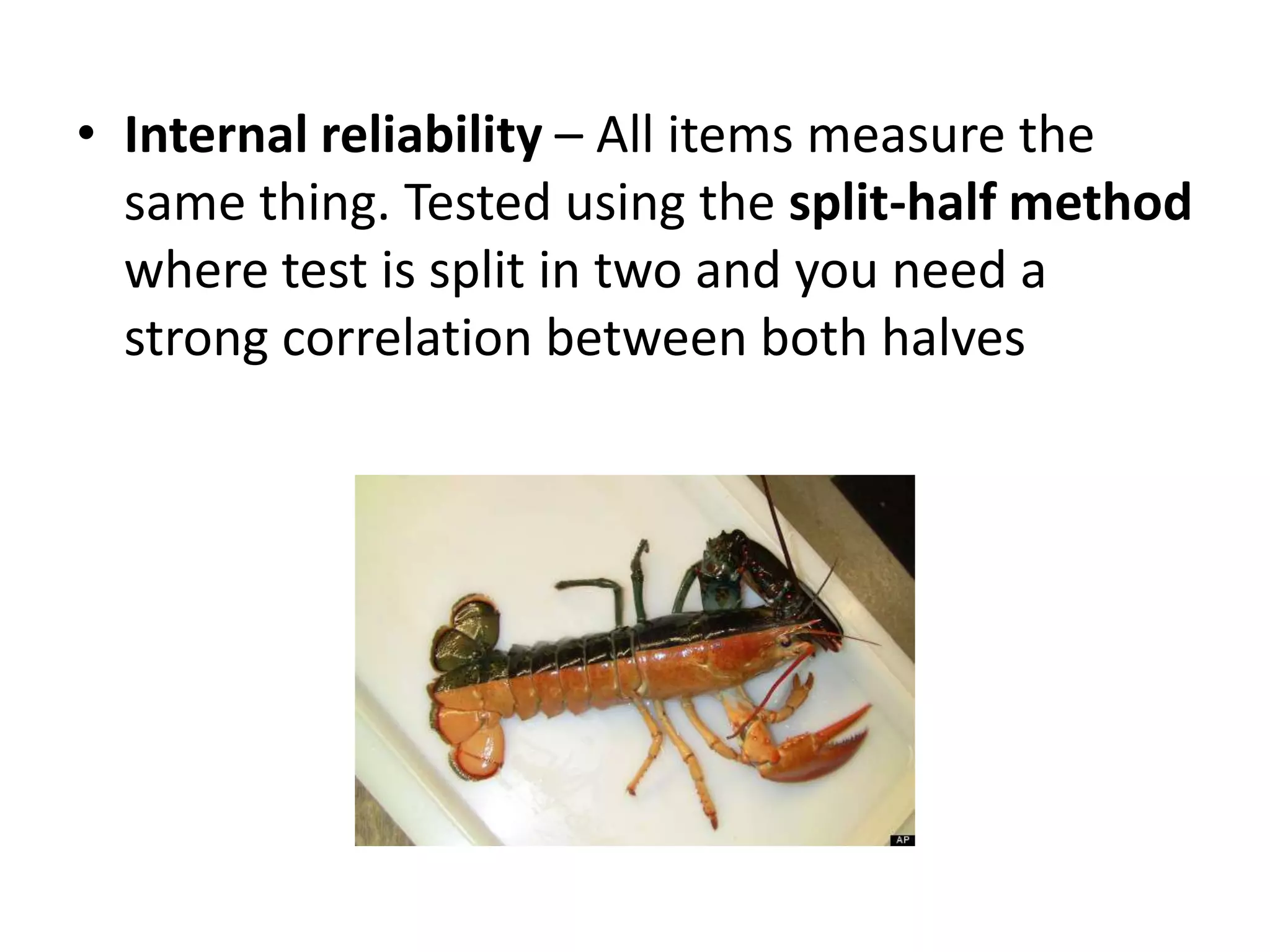
• Internal reliability – All items measure the
same thing. Tested using the split-half method
where test is split in two and you need a
strong correlation between both halves
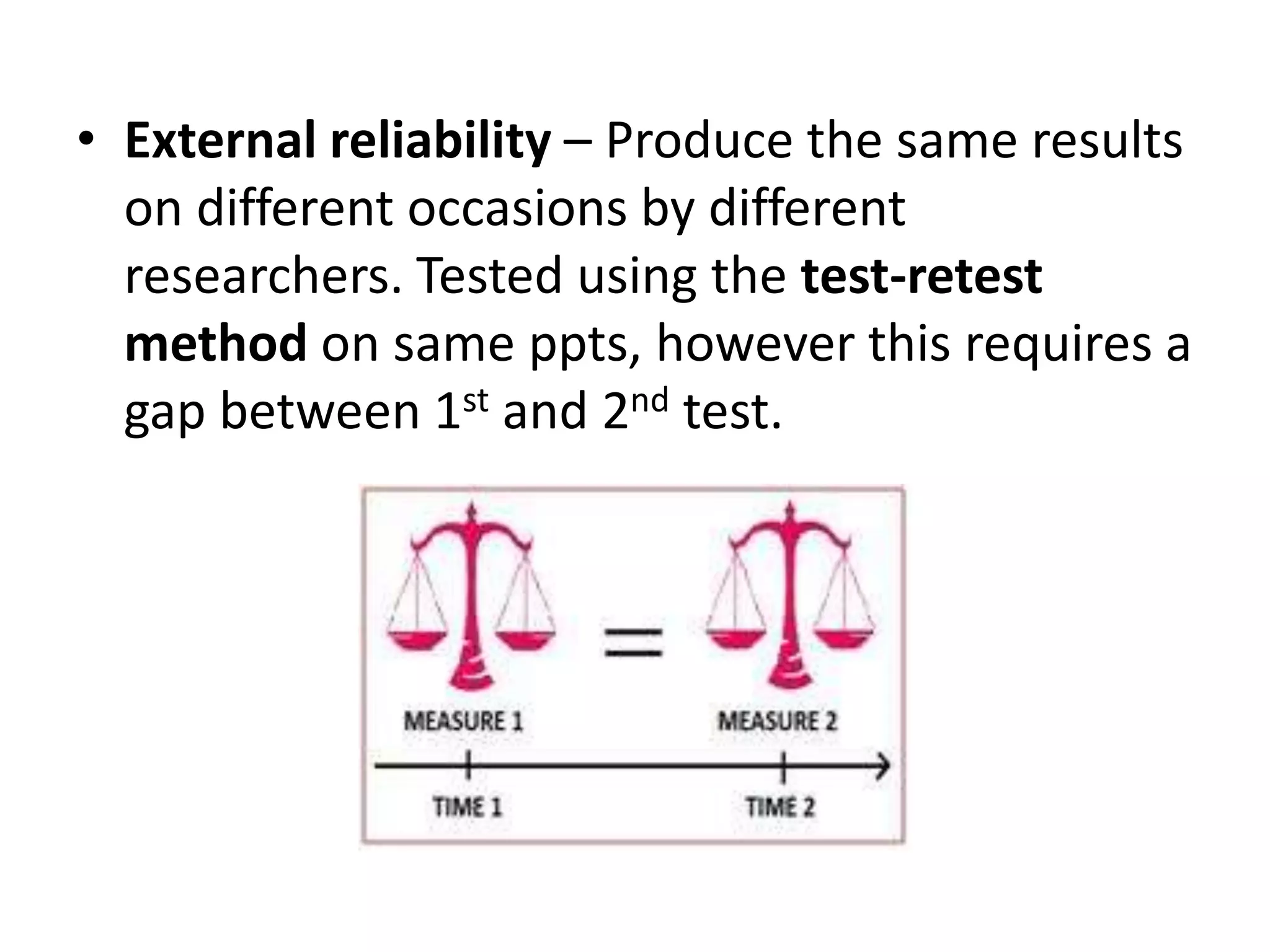
• External reliability – Produce the same results
on different occasions by different
researchers. Tested using the test-retest
method on same ppts, however this requires a
gap between 1st and 2nd test.
Validity:
• To what extent the research measures what it set
out to measure
• Internal validity – How well the method being
used measures what you set out to measure e.g.
a behaviour
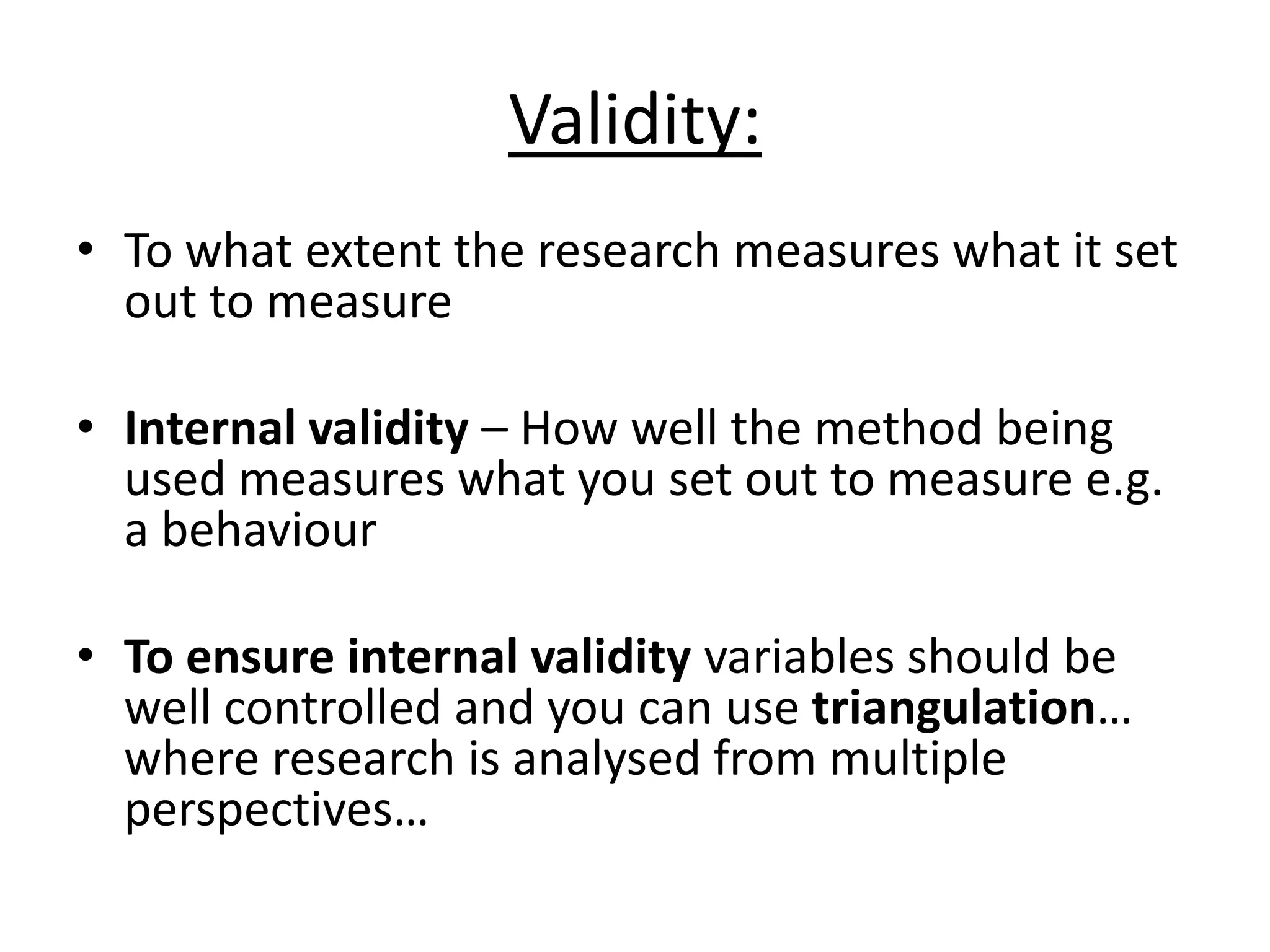
• To ensure internal validity variables should be
well controlled and you can use triangulation…
where research is analysed from multiple
perspectives…
Testing internal validity:
Naturalistic
observation
Interview
Laboratory
experiment
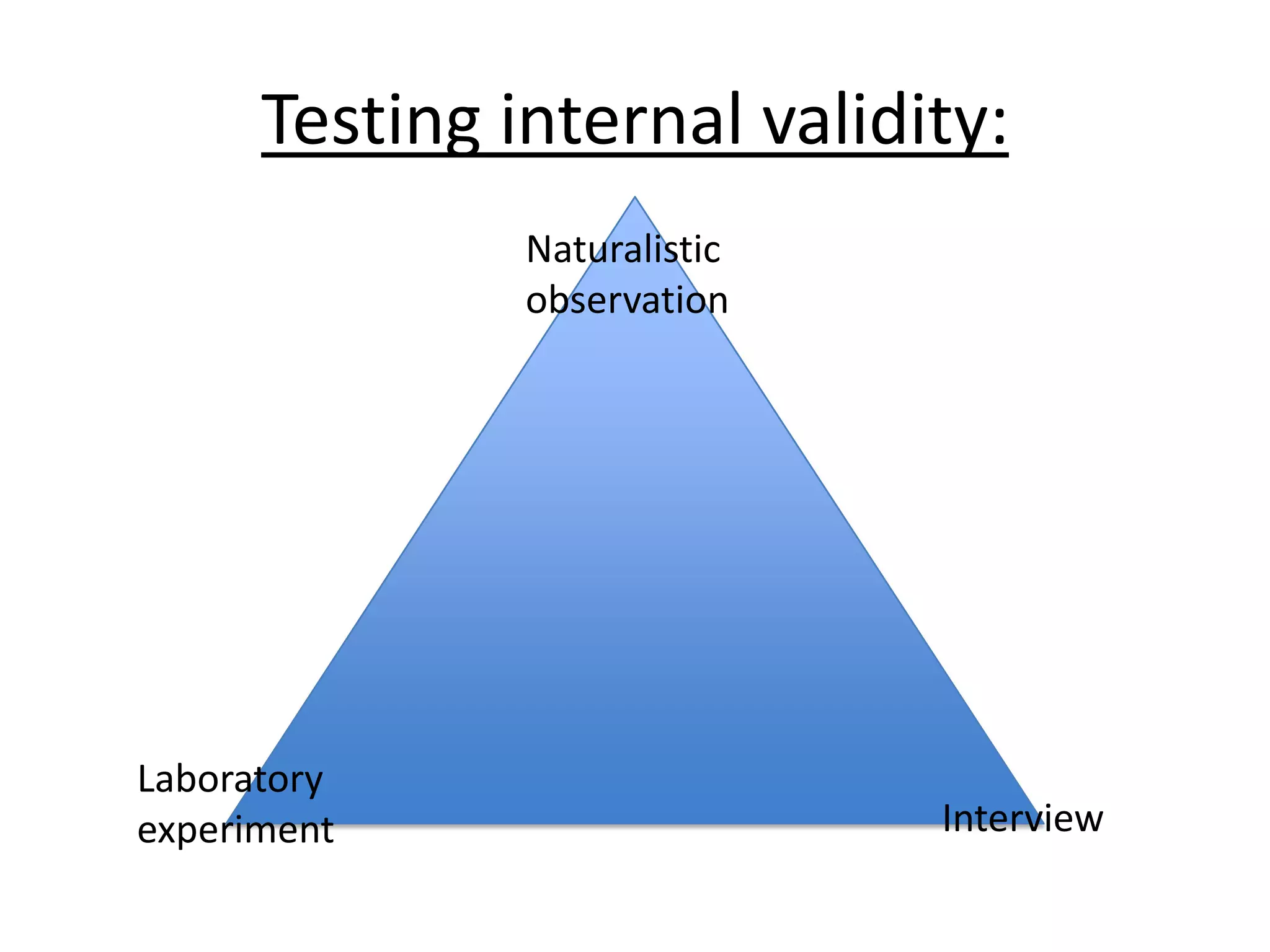
Internal validity can also be tested by using
counterbalancing:
Also tests that order effects aren’t affecting
the outcome
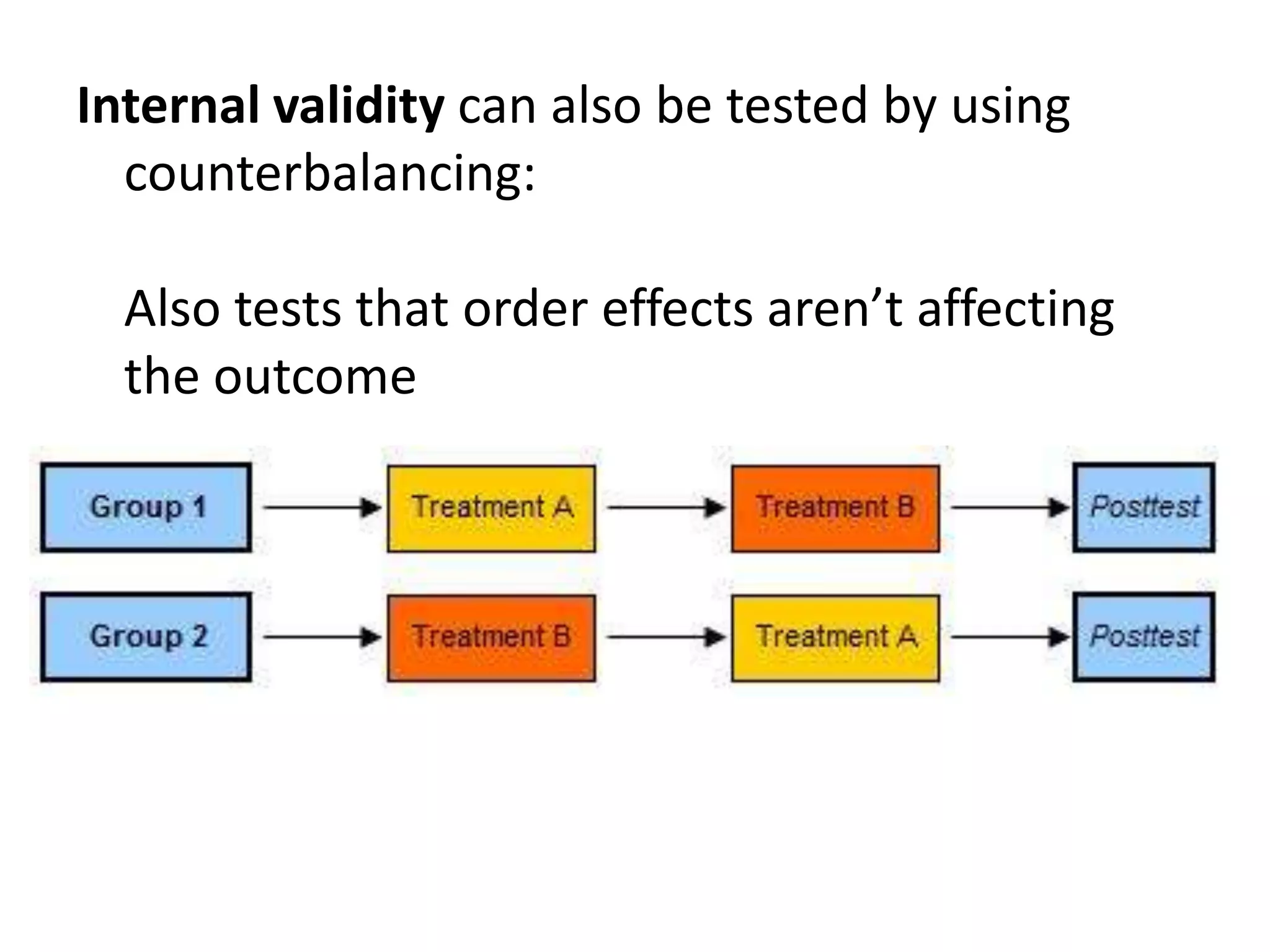
• External validity/ecological validity – How
well the research can be applied to the real
world, e.g. recalling nonsense words isn’t a
real-life task
What happens when you get a design
question? 
1. Don’t panic
2. If it’s a 12 marker, you gotta include this stuff:
- Hypothesis
- Independent variable
- Dependent variable
- Method
- Design
- Sample
- Procedure/participants
- Ethics
- Control
- (Analysis?)
Mnemonic: High iguanas don’t
mind drugs so pick… ecstasy/cannabis?
Handy dandy template for AO2:
1) Start with further evidence (make sure it’s
relevant)
2) Methodological criticisms (case studies/small
samples/ecological validity)
3) Positive IDA
4) Negative IDA
5) (Any additional research )
6) Conclusion

PSYA4 - Research methods

  • 1.
  • 2.
    What makes ascience a science? • Based on empirical methods (info. Gained from direct observation and experiments) • Objective (based on fact rather than opinion) • Falsifiable (if something is UNFALSIABLE it can neither be proved nor disproved) • Only one paradigm (Kuhn, 1970) • Based on testing hypotheses (Karl Popper 1935, and his hypothetico-deductive model)
  • 3.
    Peer review: • Assessmentof scientific research by experts in the field • Ensures published research is of high quality • Also used for: 1. Allocation of research funding 2. To test quality of university departments 3. Aid publication of works in journals and books (Parliamentary Office of Science and Technology – 2002)
  • 4.
    Peer review –Evaluation: • Anonymity used to remove bias • It isn’t always possible to find an expert in the field • Publication bias – as journals tend to prefer publishing positive results • Once a study is published, if fault is later found, it cannot be removed from the public domain
  • 5.
    What is anaim? • A general overview of what you set out to find
  • 6.
    What is atheory? • A well-established principle that has been developed to explain an aspect of the natural world. • Arises from repeated observation and incorporates facts, laws, predictions and tested hypotheses More general than a hypothesis
  • 7.
    What are hypotheses? •Specific, testable statements of prediction, it states what the research expects to find out • To operationalise the hypotheses, you need to clearly state how the IV will be manipulated, and how the DV will be measured • IV – Independent Variable (what you change) DV – Dependent Variable (cause of that change)
  • 8.
    Null hypothesis: • Statementof no difference. • Example: ‘there will be no significant difference between… blah blah blah’
  • 9.
    Directional hypotheses: • 1-tailedtest • States the direction of the predicted difference for example: ‘Participants given pictures will remember significantly more items from a list of 10 than participants given a list of 10 words’
  • 10.
    Non-directional hypotheses: • 2-tailedhypothesis • States there will be a difference, but we don’t know what direction that difference will be.
  • 11.
    Correlation hypothesis: • Similarto null, directional and non-directional hypothesis • Just look for the word ‘correlation’ in the hypothesis
  • 12.
    Looking for significance: •In psychology, we look for the P≤0.05 value • This means that the results could be 5% due to chance, however we are 95% sure the value is significant
  • 13.
    Type 1 andtype 2 errors (ooh fun…): Type 1: • Reject Null (accept alternative hypothesis) • Likely to occur if the probability is TOO LENIENT • E.g. from using P≤0.10 instead of P≤0.05 Type 2: • Accept null (reject alternative hypothesis) • Likely to occur if the probability is TOO STRINGENT • E.g. From using P≤0.01 instead of P≤0.05
  • 14.
  • 15.
    Content analysis: • Changingqualitative data into quantitative data • So it can be statistically analysed • Used in the past to analyse Kennedy & Nixon’s speech (Schneidman, 1963)  Quantitative  Objective  If there is agreement, inter-rater reliability is easily tested  Reductionist  Subjective
  • 16.
    How to drawgraphs and tiiing: Independent variable/categories X-axis Dependent variable (Freq/units) Y-axis Title
  • 17.
    When to usewhat graph: Chart When it’s used Bar chart Nominal data, gaps between bars Frequency polygon Interval/ordinal data, class intervals represented Histogram Interval/ordinal data, intervals represented by midpoint, no gaps between bars Line graphs Show continuous data Scattergram Relationships between 2 variables
  • 18.
    Journals: Mnemonics to helpyou remember The Alien In My Room Doesn’t Read A lot The Apple In My Rear Doesn’t Really Ache
  • 19.
    Title (The) Short, but informativeabout the content of the paper Abstract (Alien) Brief summary inc. problem, method, results and conclusions Introduction (In) The problem, and how it’s being answered, and why it is (or isn’t) important. Method (My) How you went about your project, subsections: subjects, materials, procedure (subheadings make it easier to read) Results (Room) Summary of findings, results of statistical tests. Graphs & charts too Discussion (Doesn’t) Begin with summary of results, and what they indicate, say what can and cannot be concluded References (Read) List of articles cited, alphabetical, journals listed like “volume, year, page numbers” Appendix (A lot) Raw data goes here, (all original data) also any data which was collected but not used
  • 20.
    Types of researchmethods – Laboratory study: • Internal validity – controlled variables • Control increases replicability and if consistent results are achieved, reliability • Demand characters (may reduce validity) • May have reduced external validity as experiments conducted aren’t always like real- life
  • 21.
    Field study: • Experimenter effects/demand characteristics– reduced • Higher ecological validity, as it’s a natural setting • Less control over extraneous varibles • Demand characteristics may be present if ppts know they’re being studied
  • 22.
    Natural experiment (naturalIV): • Only way to study some things e.g. effects of privation • Validity may be reduced, no random allocation • Low replicability and therefore reliability? • Not necessarily generalisable
  • 23.
    Correlation: • Shows relationships •Can be conducted on a lot of data • Easily replicated • No cause/effect can be established • May lack internal/external validity
  • 24.
    Observation: • Rich dataas natural behaviour is observed (especially in covert observations) • Demand characteristics in overt observations • Observer bias • Inter-rater reliability should be used to test
  • 25.
    Content analysis (again): •Inter-rater reliability can be easily tested • Unobtrusive • Highly subjective • Time consuming • Reductionist
  • 26.
    Self-report techniques (interviewsand questionnaires): • Have large samples fairly quickly • Open questions used for quantitative data (easily analysed) • Closed questions for qualitative • Social desirability bias • Leading questions could reduce calidity • Closed questions can reduce validity as it may not allow full response
  • 27.
    Types of samplingmethod – Opportunity: • Participants selected on who is most easily available  Easy to conduct  Easy to get large samples (in theory)  Biased (selection bias – researcher more likely to engage with smiley people and give non-verbal cues)  Only allows a small sample of target population  May not be representative
  • 28.
    Volunteer sampling: • Participantsselected by asking for volunteers e.g. Advertisements or national newspaper (more representative) • If it’s a men-only survey, then better off to use a men’s health mag Quick Reach a wide variety of people  Those who volunteer may not be representative of the target population as they may be more motivated/outgoing
  • 29.
    Random sampling: • Identifytarget population • Make sure all members of the population have an equal chance of being picked • E.g. Putting names in a hat and picking out however many you need • Or assigning them all numbers and using a random number generator to pick them  Less biased (more equal chance of selection)  Still same bias as some people may refuse to take part
  • 30.
    Ethical issues: • Informedconsent • Confidentiality and anonymity • Right to withdraw at any time • Protection from harm • Deception • Debriefing
  • 31.
    Dealing with ethicalissues: Alternatives to informed consent: 1) Presumptive consent (assuming the ppt would be cool with whatever you’re testing) 2) Prior general consent (slightly misinforming the ppt) Alternatives to deception: 1) Complete info. (ppts told everything, however Gallo et al (1973) found that sometimes this DOES affect the outcome, and sometimes it DOESN’T. 2) Role playing (ppts informed about the general nature of the study and asked to role-play, however this could lead to unreliable findings)
  • 32.
    Reliability: • Whether, whenreplicated, the findings are consistent Ways to test… • Inter-rateror inter-observer tested by finding a strong correlation between their results
  • 33.
    • Internal reliability– All items measure the same thing. Tested using the split-half method where test is split in two and you need a strong correlation between both halves
  • 34.
    • External reliability– Produce the same results on different occasions by different researchers. Tested using the test-retest method on same ppts, however this requires a gap between 1st and 2nd test.
  • 35.
    Validity: • To whatextent the research measures what it set out to measure • Internal validity – How well the method being used measures what you set out to measure e.g. a behaviour • To ensure internal validity variables should be well controlled and you can use triangulation… where research is analysed from multiple perspectives…
  • 36.
  • 37.
    Internal validity canalso be tested by using counterbalancing: Also tests that order effects aren’t affecting the outcome
  • 38.
    • External validity/ecologicalvalidity – How well the research can be applied to the real world, e.g. recalling nonsense words isn’t a real-life task
  • 39.
    What happens whenyou get a design question?  1. Don’t panic 2. If it’s a 12 marker, you gotta include this stuff: - Hypothesis - Independent variable - Dependent variable - Method - Design - Sample - Procedure/participants - Ethics - Control - (Analysis?) Mnemonic: High iguanas don’t mind drugs so pick… ecstasy/cannabis?
  • 41.
    Handy dandy templatefor AO2: 1) Start with further evidence (make sure it’s relevant) 2) Methodological criticisms (case studies/small samples/ecological validity) 3) Positive IDA 4) Negative IDA 5) (Any additional research ) 6) Conclusion