Research Methods
                              in Psychology

                    Sampling and Experimental
                             Designs

Friday, 27 January 2012
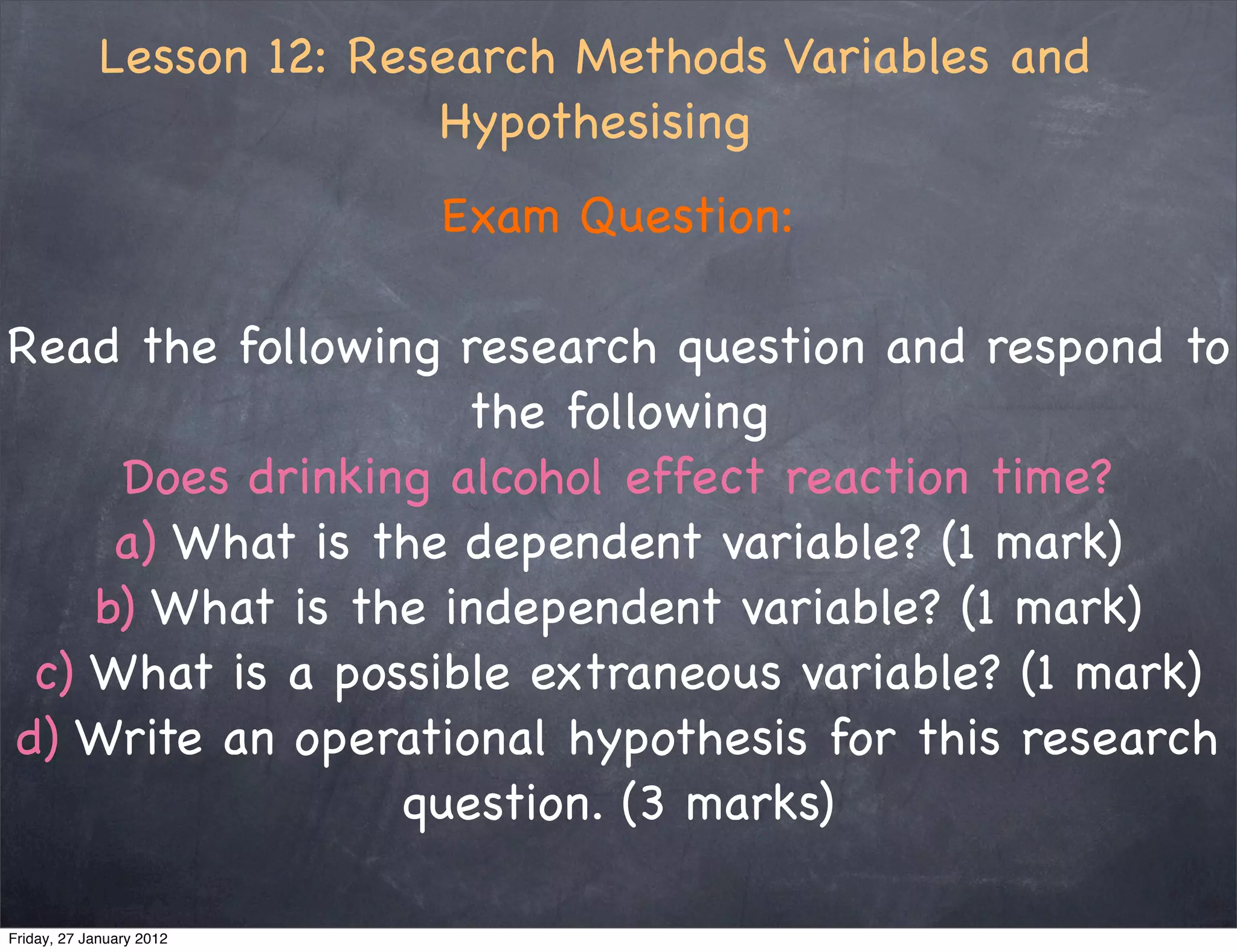
Lesson 12: Research Methods Variables and
                           Hypothesising
                           Exam Question:

Read the following research question and respond to
                    the following
     Does drinking alcohol effect reaction time?
     a) What is the dependent variable? (1 mark)
    b) What is the independent variable? (1 mark)
 c) What is a possible extraneous variable? (1 mark)
d) Write an operational hypothesis for this research
                 question. (3 marks)

Friday, 27 January 2012
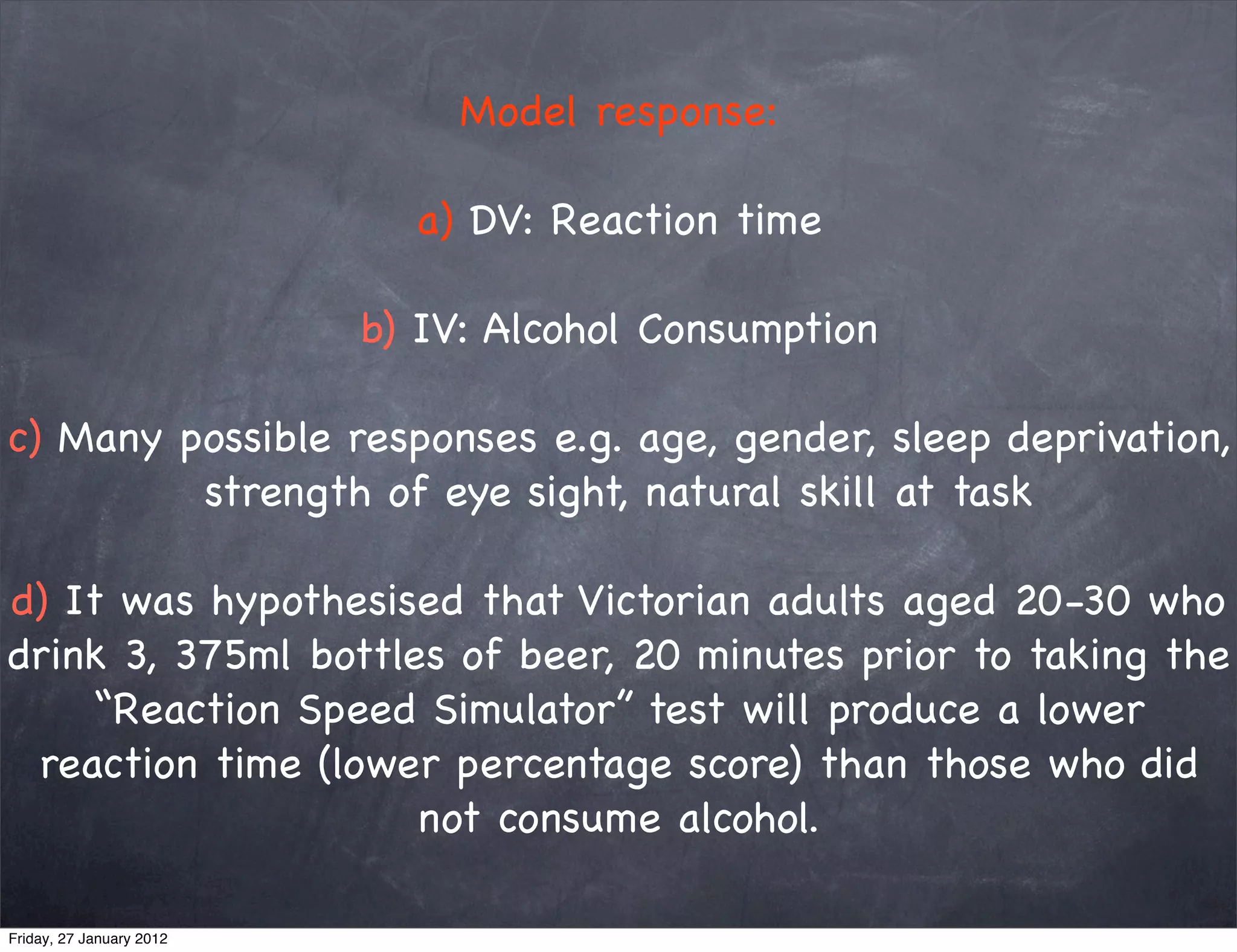
Model response:

                            a) DV: Reaction time

                          b) IV: Alcohol Consumption

c) Many possible responses e.g. age, gender, sleep deprivation,
         strength of eye sight, natural skill at task

d) It was hypothesised that Victorian adults aged 20-30 who
drink 3, 375ml bottles of beer, 20 minutes prior to taking the
    “Reaction Speed Simulator” test will produce a lower
 reaction time (lower percentage score) than those who did
                     not consume alcohol.

Friday, 27 January 2012
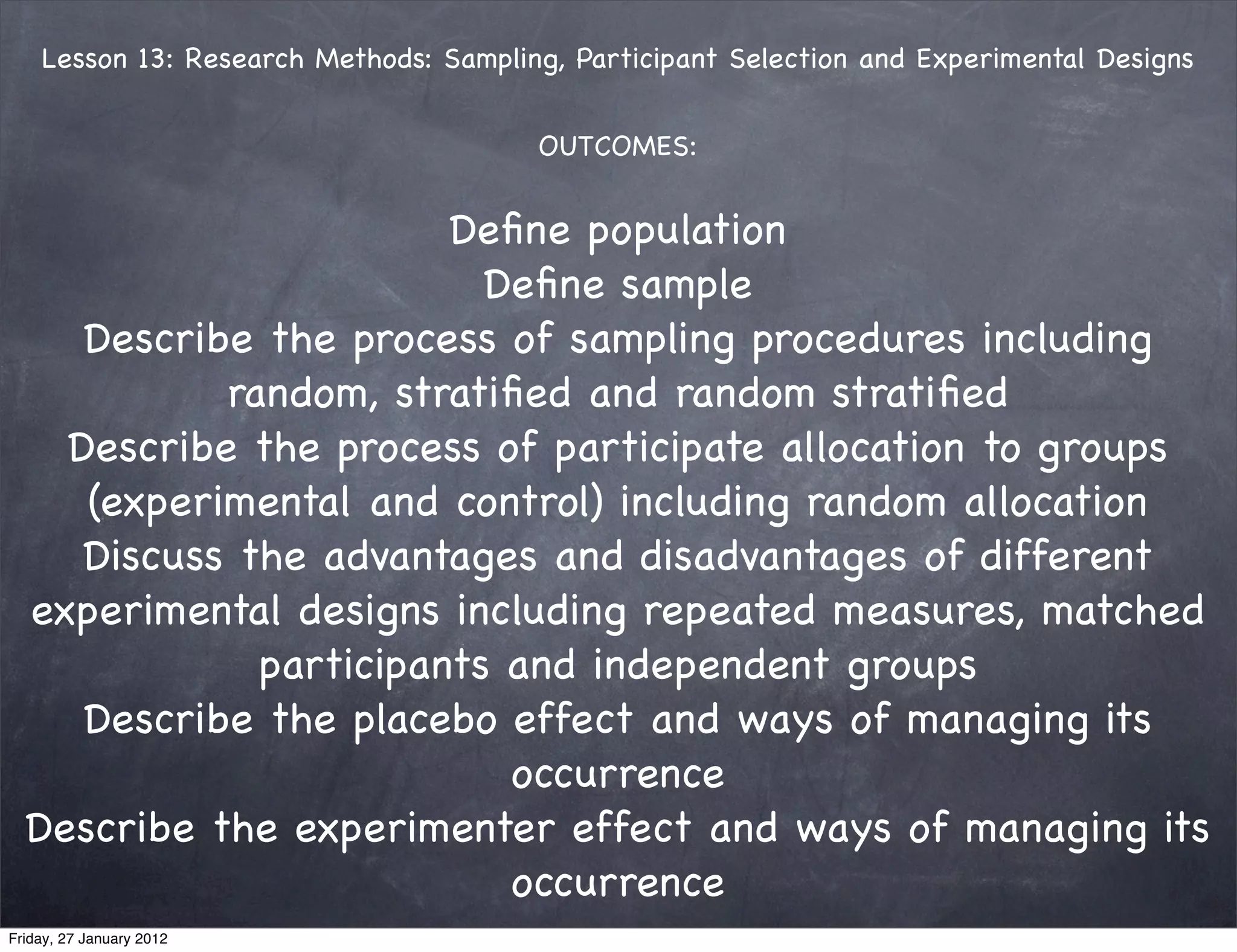
Lesson 13: Research Methods: Sampling, Participant Selection and Experimental Designs


                                        OUTCOMES:


                        Define population 
                          Define sample
     Describe the process of sampling procedures including
            random, stratified and random stratified
    Describe the process of participate allocation to groups
     (experimental and control) including random allocation
     Discuss the advantages and disadvantages of different
  experimental designs including repeated measures, matched
              participants and independent groups 
     Describe the placebo effect and ways of managing its
                           occurrence
  Describe the experimenter effect and ways of managing its
                           occurrence 
Friday, 27 January 2012           
Sampling
                 Sampling is the selection of participants for a
                 research.

                 Population refers to the group which the research
                 wishes to draw conclusions from.

                 The term sample refers to the members of the
                 population that have been chosen to take part in the
                 research.

                 Sampling procedures must ensure that the sample is
                 representative of the population.
Friday, 27 January 2012
Representative Samples

                          Two techniques are used to
                          ensure a representative sample:
                          1)Random Sampling
                          2)Stratified Sampling and
                          Stratified Random Sampling.


Friday, 27 January 2012
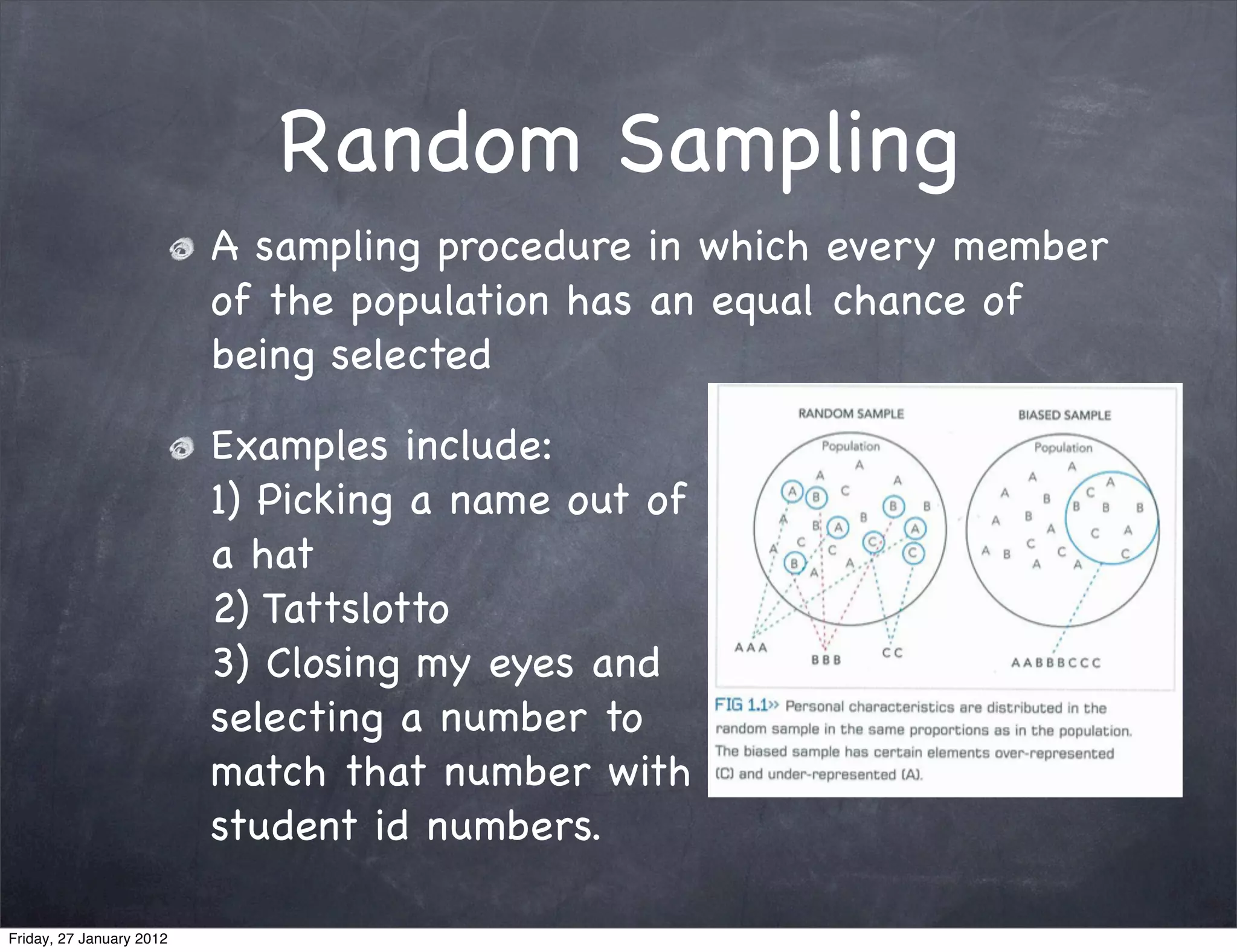
Random Sampling
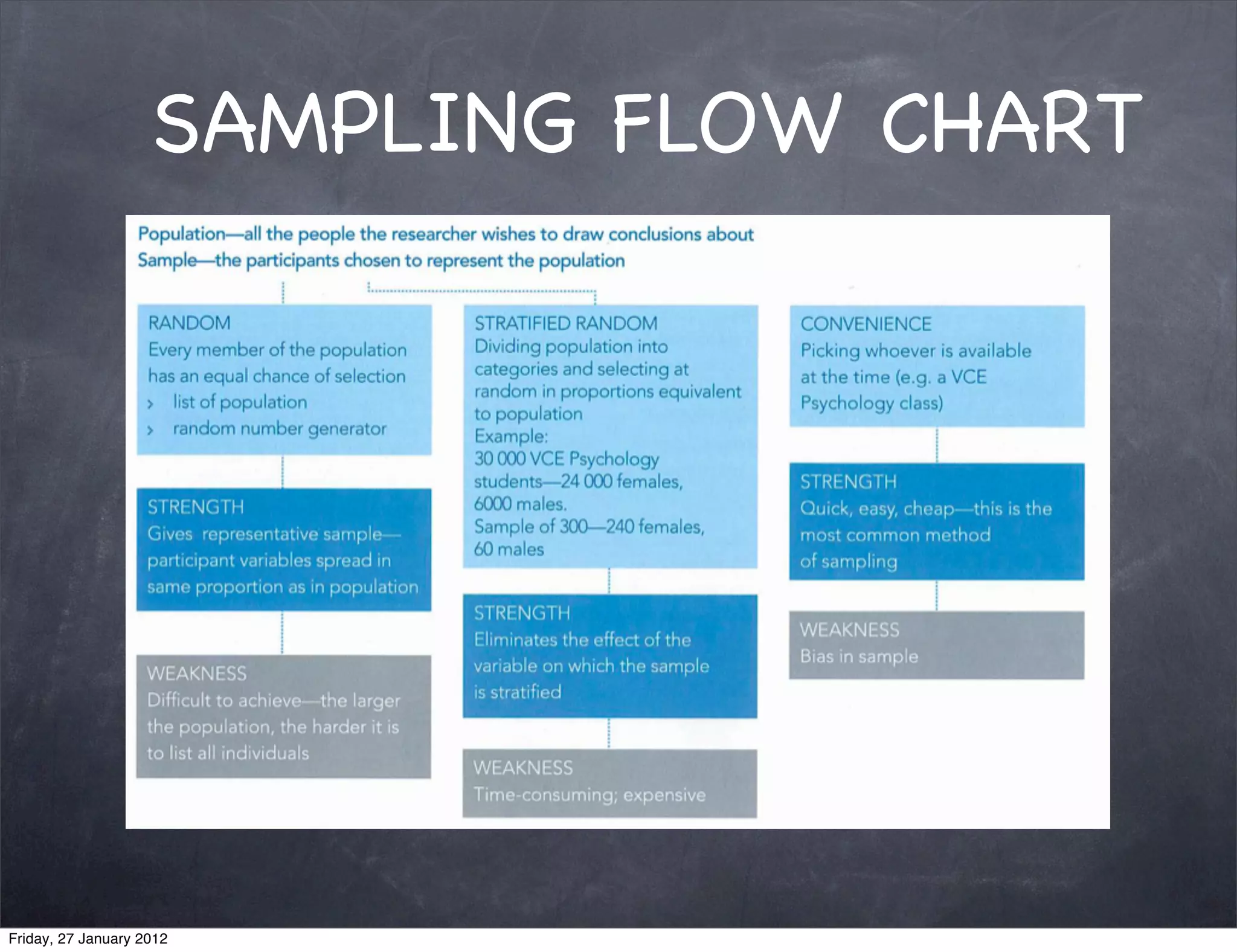
                          A sampling procedure in which every member
                          of the population has an equal chance of
                          being selected

                          Examples include:
                          1) Picking a name out of
                          a hat
                          2) Tattslotto
                          3) Closing my eyes and
                          selecting a number to
                          match that number with
                          student id numbers.

Friday, 27 January 2012
Stratified Sampling and
                  Stratified Random Sampling

             Is used when you wish to eliminate the effects of
             confounding variables.

             The effects of a certain variable can be eliminated as a
             possible confounding variable in an experiment.

             The variable could be any personal attribute, such as
             age, years of education, ethnicity, gender, IQ etc.

             Involves six procedures:


Friday, 27 January 2012
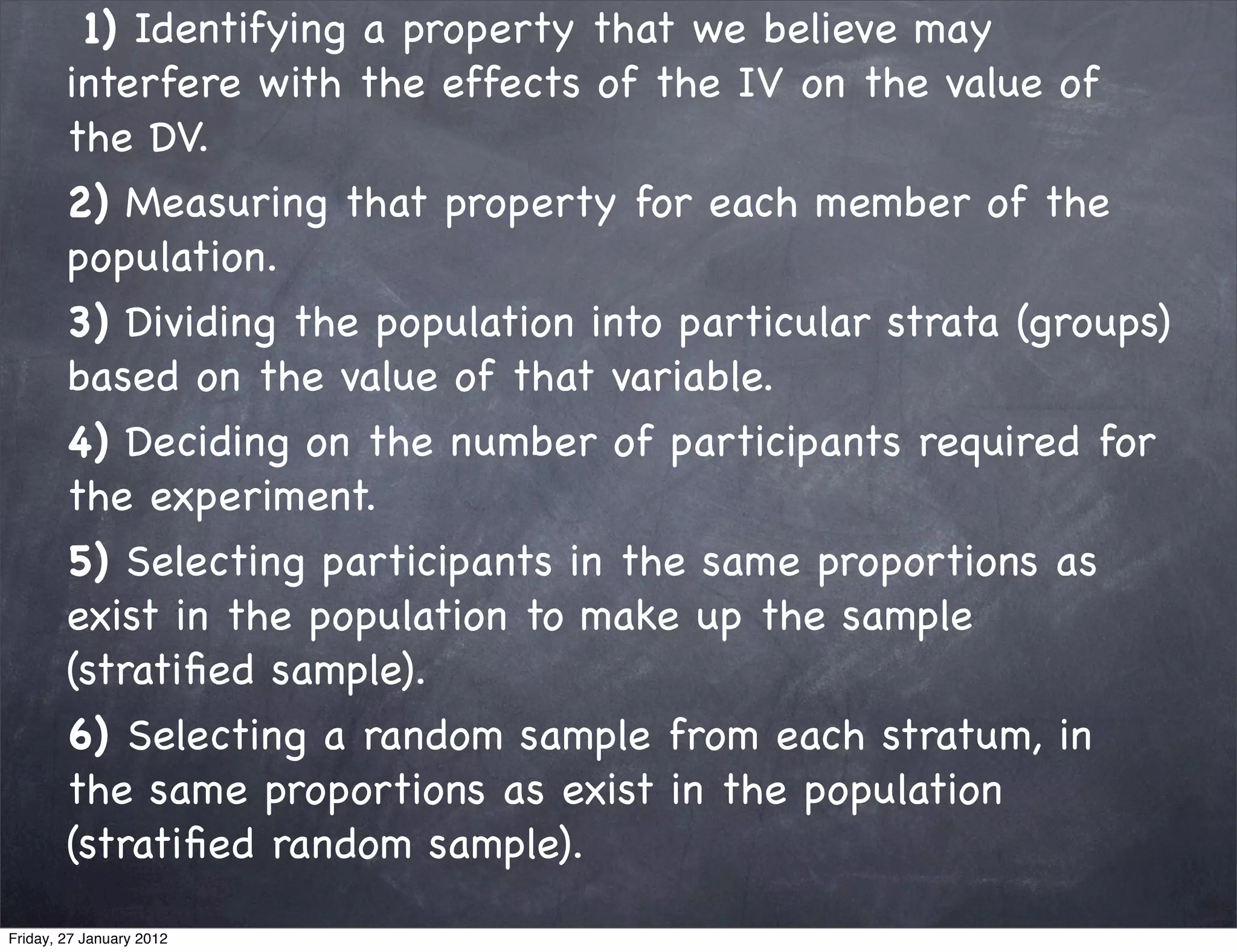
1) Identifying a property that we believe may
        interfere with the effects of the IV on the value of
        the DV.
        2) Measuring that property for each member of the
        population.
        3) Dividing the population into particular strata (groups)
        based on the value of that variable.
        4) Deciding on the number of participants required for
        the experiment.
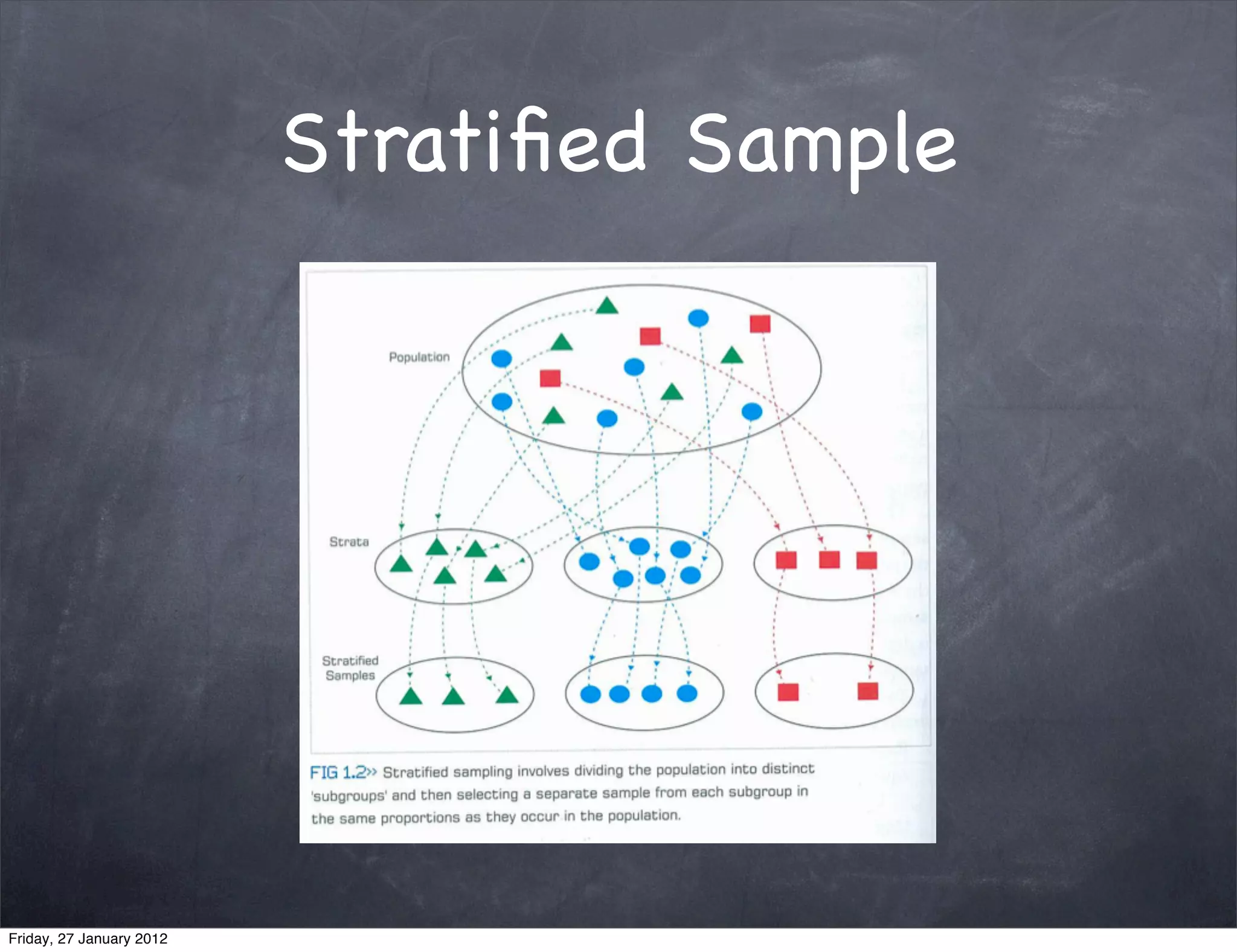
        5) Selecting participants in the same proportions as
        exist in the population to make up the sample
        (stratified sample).
        6) Selecting a random sample from each stratum, in
        the same proportions as exist in the population
        (stratified random sample).
Friday, 27 January 2012
Stratified Sample


Friday, 27 January 2012
Which to use?
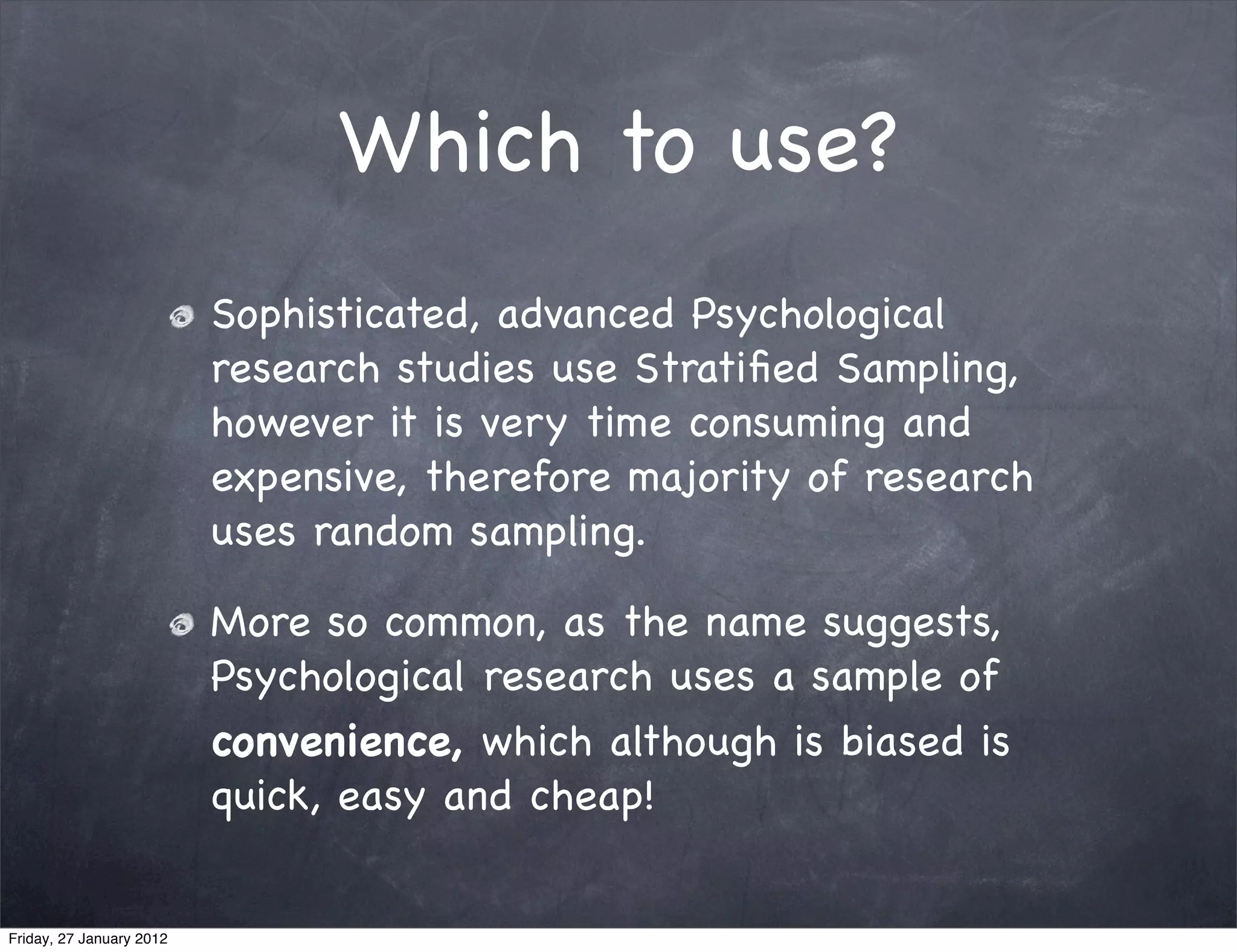
                          Sophisticated, advanced Psychological
                          research studies use Stratified Sampling,
                          however it is very time consuming and
                          expensive, therefore majority of research
                          uses random sampling.

                          More so common, as the name suggests,
                          Psychological research uses a sample of
                          convenience, which although is biased is
                          quick, easy and cheap!


Friday, 27 January 2012
SAMPLING FLOW CHART


Friday, 27 January 2012
Participant Allocation:
            Experimental & Control Groups
             The experimental method uses two different groups
             called the experimental and control groups.

             The experimental group are exposed to the IV, known
             as the ‘treatment’.

             The control group do not receive the treatment (IV).

             The purpose of the experimental group is to show the
             effects of the IV on the value of the DV.

             The purpose of the control group is to form a basis for
             comparison with the experimental group.
Friday, 27 January 2012
Experimental and Control Group
                Allocation
              It is super important that all participants have an
              equal chance of being in the experimental or control
              group. That is Random Allocation.

              When there is a large enough sample, both the
              experimental and control groups will be equivalent on
              all participant characteristics therefore the presence
              or absence of the IV is the only difference between
              them.

              E.G. If we had all males in the experimental group and
              all females in the control group, then an obvious
              extraneous variable will be gender.
Friday, 27 January 2012
Experimental Designs

                          There are three popular experimental
                          designs

                          Repeated Measures Design

                          Matched Participants Design

                          Independent Groups Design


Friday, 27 January 2012
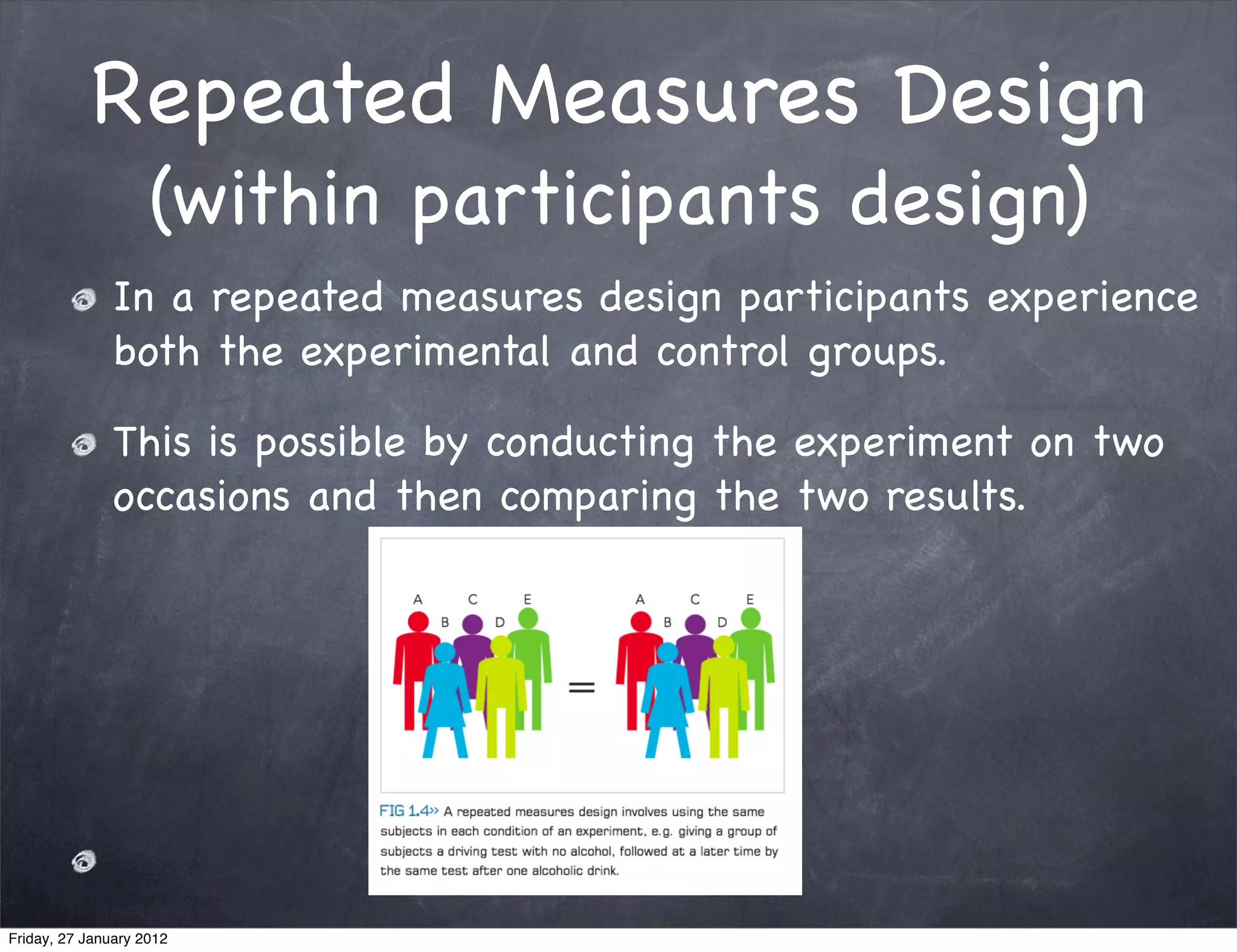
Repeated Measures Design
                    (within participants design)
               In a repeated measures design participants experience
               both the experimental and control groups.

               This is possible by conducting the experiment on two
               occasions and then comparing the two results.


Friday, 27 January 2012
ADVANTAGES:
           1)Using the same participants means that confounding
           variables that are participant depend are eliminated.
           2)Allows for fewer participants to be used than with
           other designs.

           DISADVANTAGES:
           1) Time consuming - drop outs
           2) Confounding variables such as Order Effects:
           a) Participants may perform better on the task when
           doing for a second time (practise effect).
           b) Participants may do worse the second time because
           of fatigue or boredom.
Friday, 27 January 2012
Counterbalancing

                          Used to overcome order effect.

                          In counterbalancing, half the participants
                          will first perform the task with the IV
                          present (experimental condition) and then
                          perform the task with the IV absent (control
                          condition). The other half of the participants
                          will experience the conditions in the reverse
                          order.


Friday, 27 January 2012
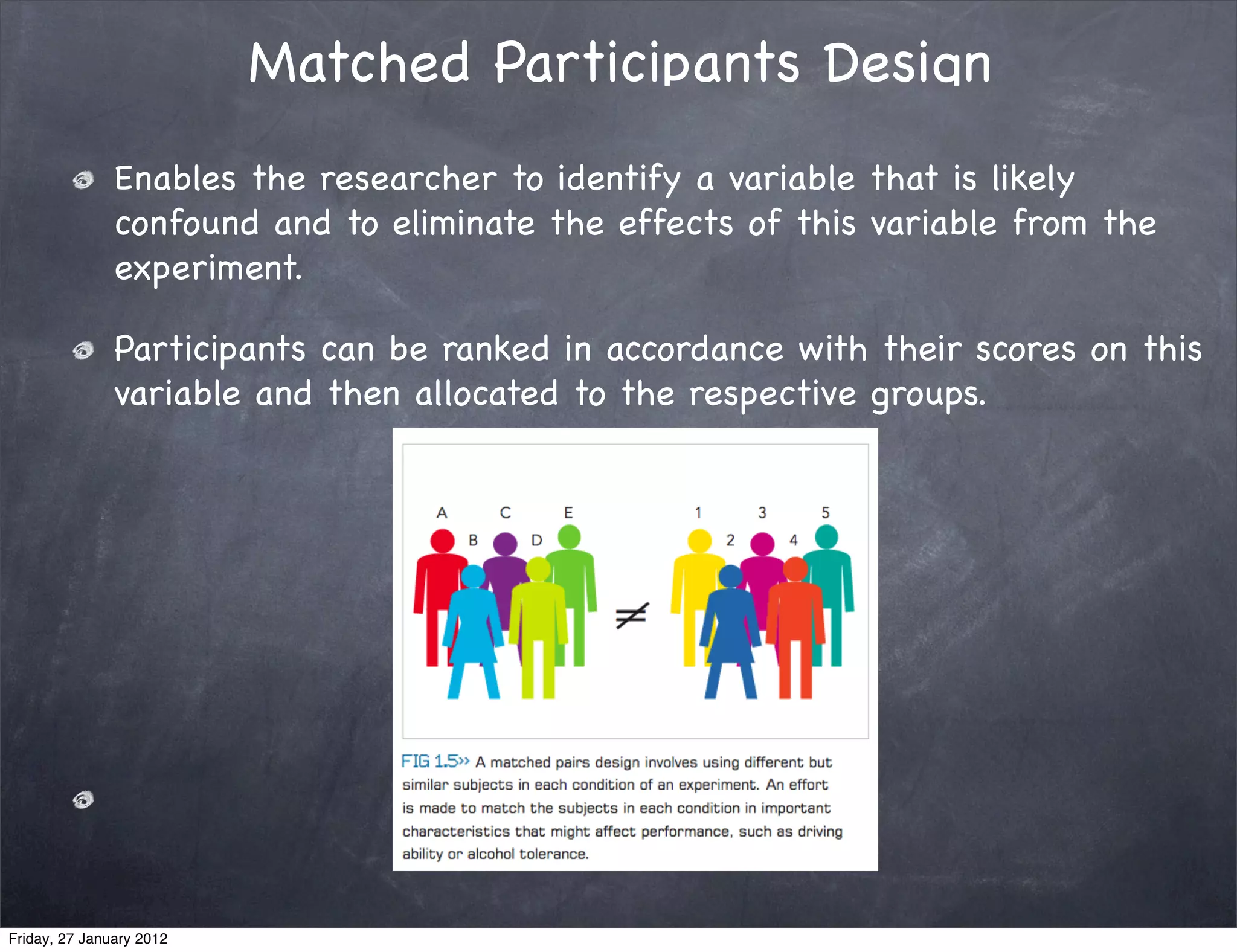
Matched Participants Design
               Enables the researcher to identify a variable that is likely
               confound and to eliminate the effects of this variable from the
               experiment.

               Participants can be ranked in accordance with their scores on this
               variable and then allocated to the respective groups.


Friday, 27 January 2012
E.G. A sports coach developed a new game plan that
              would help the team reach the playoffs. He decided to
              test this by giving the experimental group the
              instruction but not the control group. Because
              individual skills would be a confounding variable, he
              decided to ‘match’ the groups. The two highest skilled
              players will be randomly allocated to either the
              experimental or control group, the third and fourth
              most skilled will then be randomly allocated to either
              and so on and so forth until all players were allocated
              to a group resulting in the same mean skill percentage
              in both groups.


Friday, 27 January 2012
Advantages: The variable on which the
                          participants are ‘matched’ will not influence
                          the results because its effects will be the
                          same in the experimental and control groups.


                          Disadvantages: It is very time consuming
                          (and therefore expensive) to find out the
                          value of this variable for every participant.
                          Also, if one of the pair drops out, the scores
                          for the other must also be eliminated.


Friday, 27 January 2012
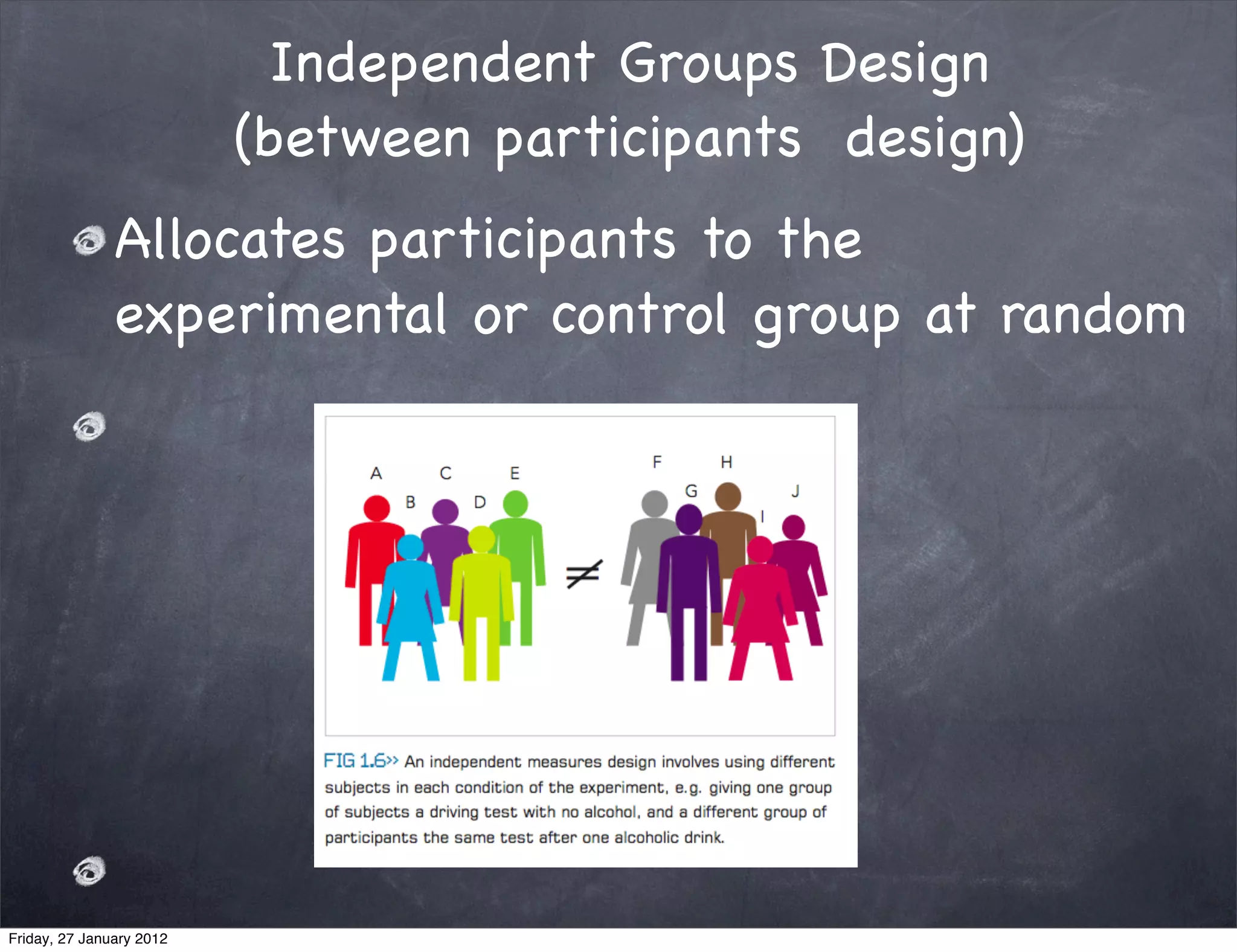
Independent Groups Design
                          (between participants design)
               Allocates participants to the
               experimental or control group at random


Friday, 27 January 2012
Advantages: The independent groups design
                          can be done at once and drop-outs are
                          unlikely.


                          Disadvantages: The procedure needs a large
                          number of participants to ensure that the
                          spread of participant variables in the sample
                          will match the spread in the population.


Friday, 27 January 2012
This may effect the DV
              Participants
                                    resulting in invalid
              expectations
                                          results


                          PLACEBO EFFECT

     Can be eliminated by using single blind procedure,
      that is participants are unaware of which group
                         they are in.

Friday, 27 January 2012
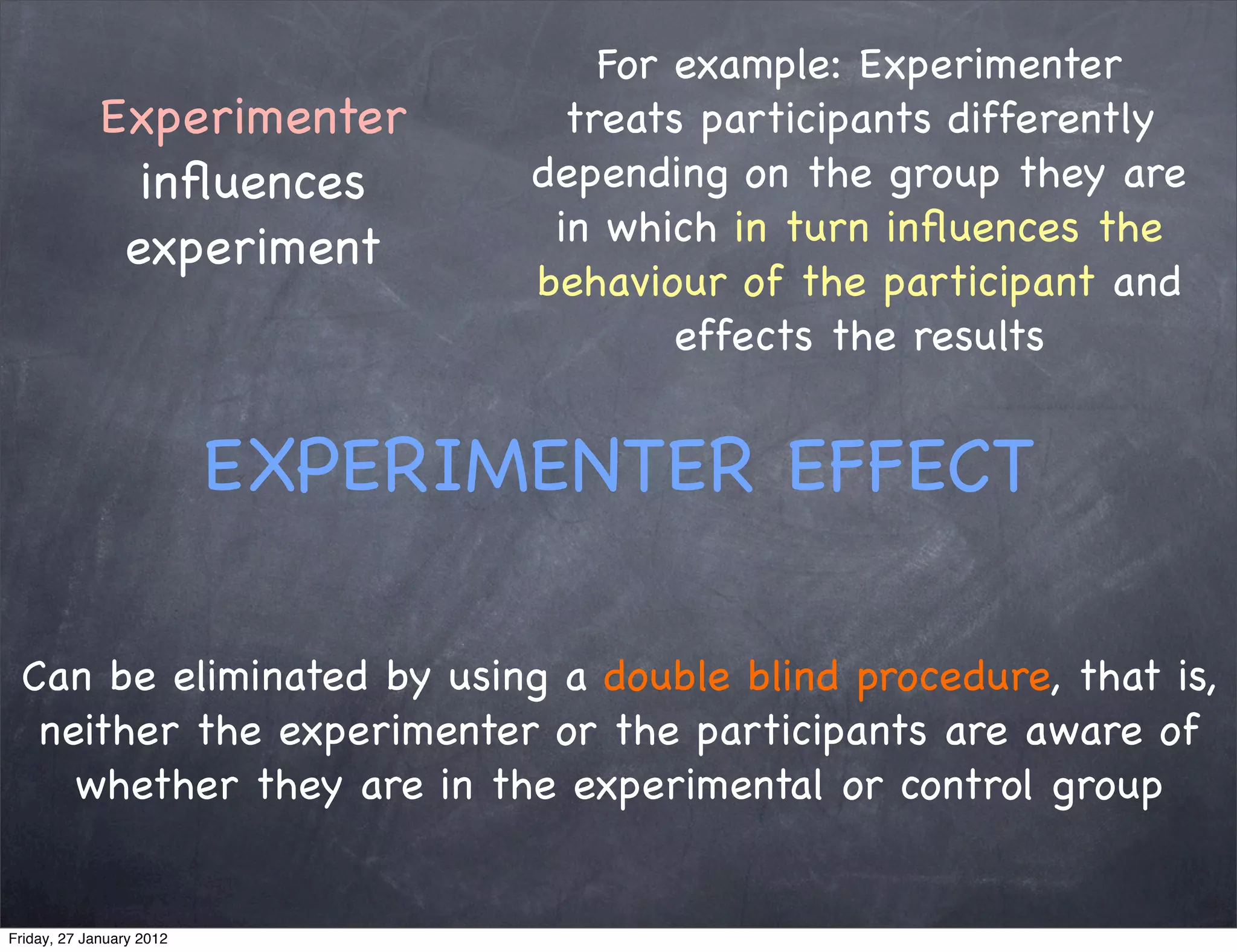
For example: Experimenter
             Experimenter          treats participants differently
               influences         depending on the group they are
                                  in which in turn influences the
              experiment
                                 behaviour of the participant and
                                         effects the results


                          EXPERIMENTER EFFECT

 Can be eliminated by using a double blind procedure, that is,
  neither the experimenter or the participants are aware of
    whether they are in the experimental or control group


Friday, 27 January 2012

Research Methods in Psychology Sampling and Experimental Design

  • 1.
    Research Methods in Psychology Sampling and Experimental Designs Friday, 27 January 2012
  • 2.
    Lesson 12: ResearchMethods Variables and Hypothesising Exam Question: Read the following research question and respond to the following Does drinking alcohol effect reaction time? a) What is the dependent variable? (1 mark) b) What is the independent variable? (1 mark) c) What is a possible extraneous variable? (1 mark) d) Write an operational hypothesis for this research question. (3 marks) Friday, 27 January 2012
  • 3.
    Model response: a) DV: Reaction time b) IV: Alcohol Consumption c) Many possible responses e.g. age, gender, sleep deprivation, strength of eye sight, natural skill at task d) It was hypothesised that Victorian adults aged 20-30 who drink 3, 375ml bottles of beer, 20 minutes prior to taking the “Reaction Speed Simulator” test will produce a lower reaction time (lower percentage score) than those who did not consume alcohol. Friday, 27 January 2012
  • 4.
    Lesson 13: ResearchMethods: Sampling, Participant Selection and Experimental Designs OUTCOMES: Define population  Define sample Describe the process of sampling procedures including random, stratified and random stratified Describe the process of participate allocation to groups (experimental and control) including random allocation Discuss the advantages and disadvantages of different experimental designs including repeated measures, matched participants and independent groups  Describe the placebo effect and ways of managing its occurrence Describe the experimenter effect and ways of managing its occurrence  Friday, 27 January 2012  
  • 5.
    Sampling Sampling is the selection of participants for a research. Population refers to the group which the research wishes to draw conclusions from. The term sample refers to the members of the population that have been chosen to take part in the research. Sampling procedures must ensure that the sample is representative of the population. Friday, 27 January 2012
  • 6.
    Representative Samples Two techniques are used to ensure a representative sample: 1)Random Sampling 2)Stratified Sampling and Stratified Random Sampling. Friday, 27 January 2012
  • 7.
    Random Sampling A sampling procedure in which every member of the population has an equal chance of being selected Examples include: 1) Picking a name out of a hat 2) Tattslotto 3) Closing my eyes and selecting a number to match that number with student id numbers. Friday, 27 January 2012
  • 8.
    Stratified Sampling and Stratified Random Sampling Is used when you wish to eliminate the effects of confounding variables. The effects of a certain variable can be eliminated as a possible confounding variable in an experiment. The variable could be any personal attribute, such as age, years of education, ethnicity, gender, IQ etc. Involves six procedures: Friday, 27 January 2012
  • 9.
    1) Identifying aproperty that we believe may interfere with the effects of the IV on the value of the DV. 2) Measuring that property for each member of the population. 3) Dividing the population into particular strata (groups) based on the value of that variable. 4) Deciding on the number of participants required for the experiment. 5) Selecting participants in the same proportions as exist in the population to make up the sample (stratified sample). 6) Selecting a random sample from each stratum, in the same proportions as exist in the population (stratified random sample). Friday, 27 January 2012
  • 10.
  • 11.
    Which to use? Sophisticated, advanced Psychological research studies use Stratified Sampling, however it is very time consuming and expensive, therefore majority of research uses random sampling. More so common, as the name suggests, Psychological research uses a sample of convenience, which although is biased is quick, easy and cheap! Friday, 27 January 2012
  • 12.
  • 13.
    Participant Allocation: Experimental & Control Groups The experimental method uses two different groups called the experimental and control groups. The experimental group are exposed to the IV, known as the ‘treatment’. The control group do not receive the treatment (IV). The purpose of the experimental group is to show the effects of the IV on the value of the DV. The purpose of the control group is to form a basis for comparison with the experimental group. Friday, 27 January 2012
  • 14.
    Experimental and ControlGroup Allocation It is super important that all participants have an equal chance of being in the experimental or control group. That is Random Allocation. When there is a large enough sample, both the experimental and control groups will be equivalent on all participant characteristics therefore the presence or absence of the IV is the only difference between them. E.G. If we had all males in the experimental group and all females in the control group, then an obvious extraneous variable will be gender. Friday, 27 January 2012
  • 15.
    Experimental Designs There are three popular experimental designs Repeated Measures Design Matched Participants Design Independent Groups Design Friday, 27 January 2012
  • 16.
    Repeated Measures Design (within participants design) In a repeated measures design participants experience both the experimental and control groups. This is possible by conducting the experiment on two occasions and then comparing the two results. Friday, 27 January 2012
  • 17.
    ADVANTAGES: 1)Using the same participants means that confounding variables that are participant depend are eliminated. 2)Allows for fewer participants to be used than with other designs. DISADVANTAGES: 1) Time consuming - drop outs 2) Confounding variables such as Order Effects: a) Participants may perform better on the task when doing for a second time (practise effect). b) Participants may do worse the second time because of fatigue or boredom. Friday, 27 January 2012
  • 18.
    Counterbalancing Used to overcome order effect. In counterbalancing, half the participants will first perform the task with the IV present (experimental condition) and then perform the task with the IV absent (control condition). The other half of the participants will experience the conditions in the reverse order. Friday, 27 January 2012
  • 19.
    Matched Participants Design Enables the researcher to identify a variable that is likely confound and to eliminate the effects of this variable from the experiment. Participants can be ranked in accordance with their scores on this variable and then allocated to the respective groups. Friday, 27 January 2012
  • 20.
    E.G. A sportscoach developed a new game plan that would help the team reach the playoffs. He decided to test this by giving the experimental group the instruction but not the control group. Because individual skills would be a confounding variable, he decided to ‘match’ the groups. The two highest skilled players will be randomly allocated to either the experimental or control group, the third and fourth most skilled will then be randomly allocated to either and so on and so forth until all players were allocated to a group resulting in the same mean skill percentage in both groups. Friday, 27 January 2012
  • 21.
    Advantages: The variableon which the participants are ‘matched’ will not influence the results because its effects will be the same in the experimental and control groups. Disadvantages: It is very time consuming (and therefore expensive) to find out the value of this variable for every participant. Also, if one of the pair drops out, the scores for the other must also be eliminated. Friday, 27 January 2012
  • 22.
    Independent Groups Design (between participants design) Allocates participants to the experimental or control group at random Friday, 27 January 2012
  • 23.
    Advantages: The independentgroups design can be done at once and drop-outs are unlikely. Disadvantages: The procedure needs a large number of participants to ensure that the spread of participant variables in the sample will match the spread in the population. Friday, 27 January 2012
  • 24.
    This may effectthe DV Participants resulting in invalid expectations results PLACEBO EFFECT Can be eliminated by using single blind procedure, that is participants are unaware of which group they are in. Friday, 27 January 2012
  • 25.
    For example: Experimenter Experimenter treats participants differently influences depending on the group they are in which in turn influences the experiment behaviour of the participant and effects the results EXPERIMENTER EFFECT Can be eliminated by using a double blind procedure, that is, neither the experimenter or the participants are aware of whether they are in the experimental or control group Friday, 27 January 2012