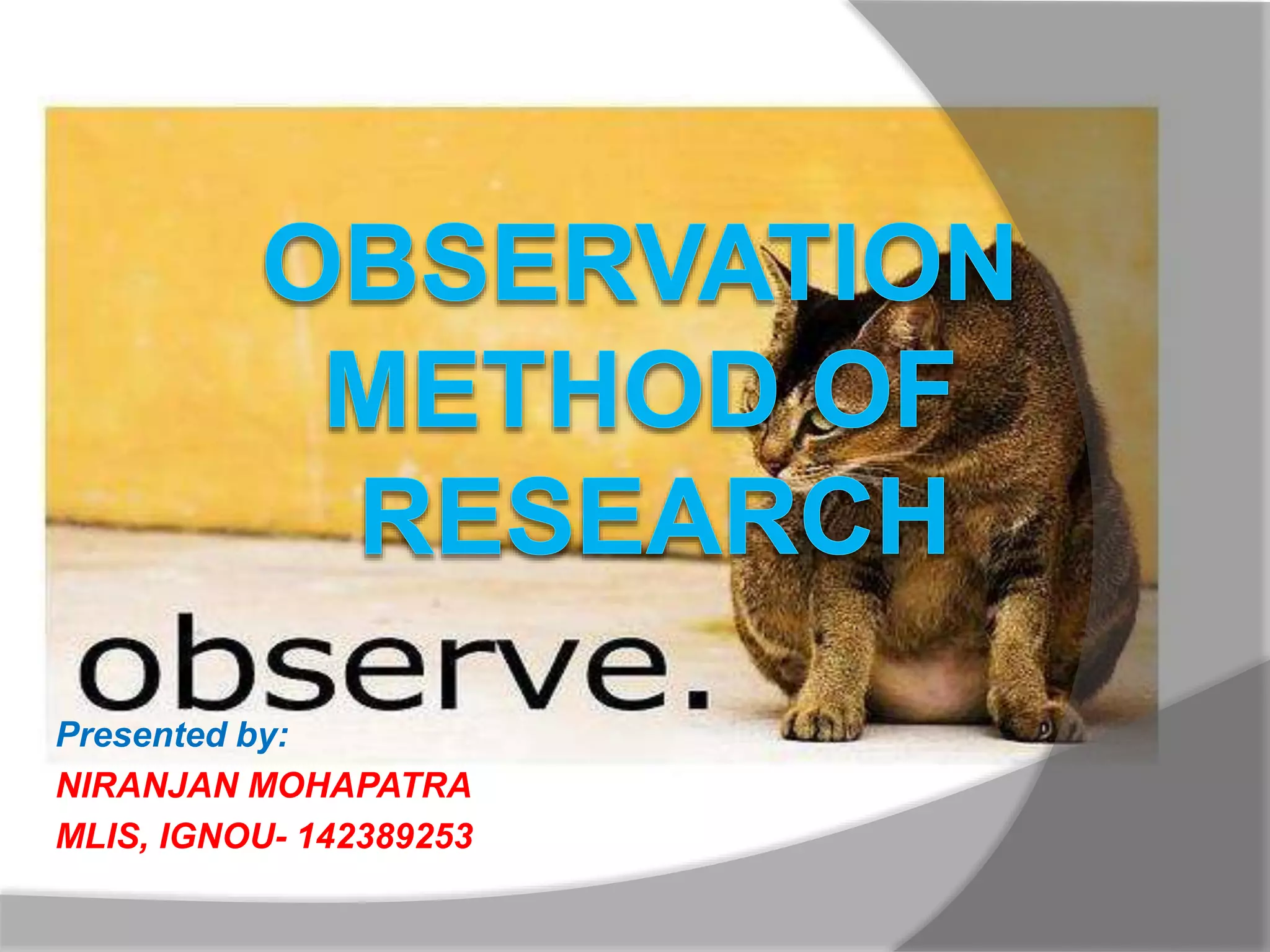
Presented by:
NIRANJAN MOHAPATRA
MLIS, IGNOU- 142389253
OBJECTIVES:
 To understand observation method;
 To identify its propose and characteristics
 To know its planning, processing record data
in research
 To identify the various types of observation.
 To describe advantages and disadvantages
of this method
 To know its application in Library
INTRODUCTION
 Two major approaches to gathering information about a
phenomenon:
â–Ş Primary data
â–Ş Secondary data
 There are several methods used to collect primary data:
â—‹ Observation Method
â—‹ Interview Method
â—‹ Questionnaire Method
â—‹ Experimental Method
â—‹ Case Study Method
 Observation method is one of the most useful methods of data
collection for research especially in social sciences.
 Even in the libraries this method is used to understand the
behaviour and attitude of the users.
CONCEPT:
 Observation means watching carefully.
 All the things, situations we are seeing in our routine
life, are not observation. (casual & without any purpose)
 Observation is being done systematically with a
definite purpose.
 In the process of observation the observer uses all
his sensory organs in an integrated manner.
 The observer obtains information about the World
around him for a definite purpose.
 This is one of the oldest method for collecting the
data and used by both the scientists and social
scientists.
DEFINITIONS:
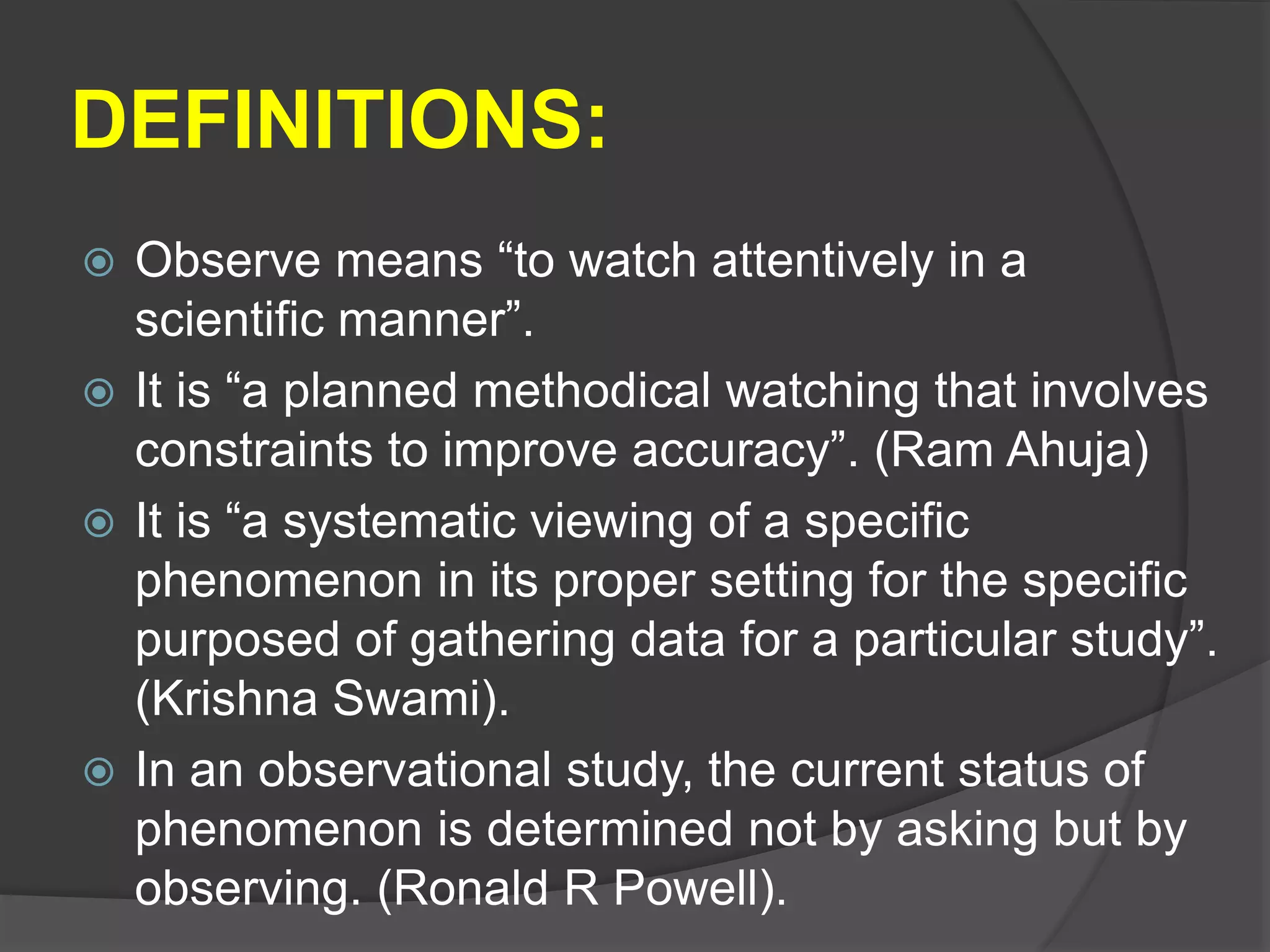
 Observe means “to watch attentively in a
scientific manner”.
 It is “a planned methodical watching that involves
constraints to improve accuracy”. (Ram Ahuja)
 It is “a systematic viewing of a specific
phenomenon in its proper setting for the specific
purposed of gathering data for a particular study”.
(Krishna Swami).
 In an observational study, the current status of
phenomenon is determined not by asking but by
observing. (Ronald R Powell).
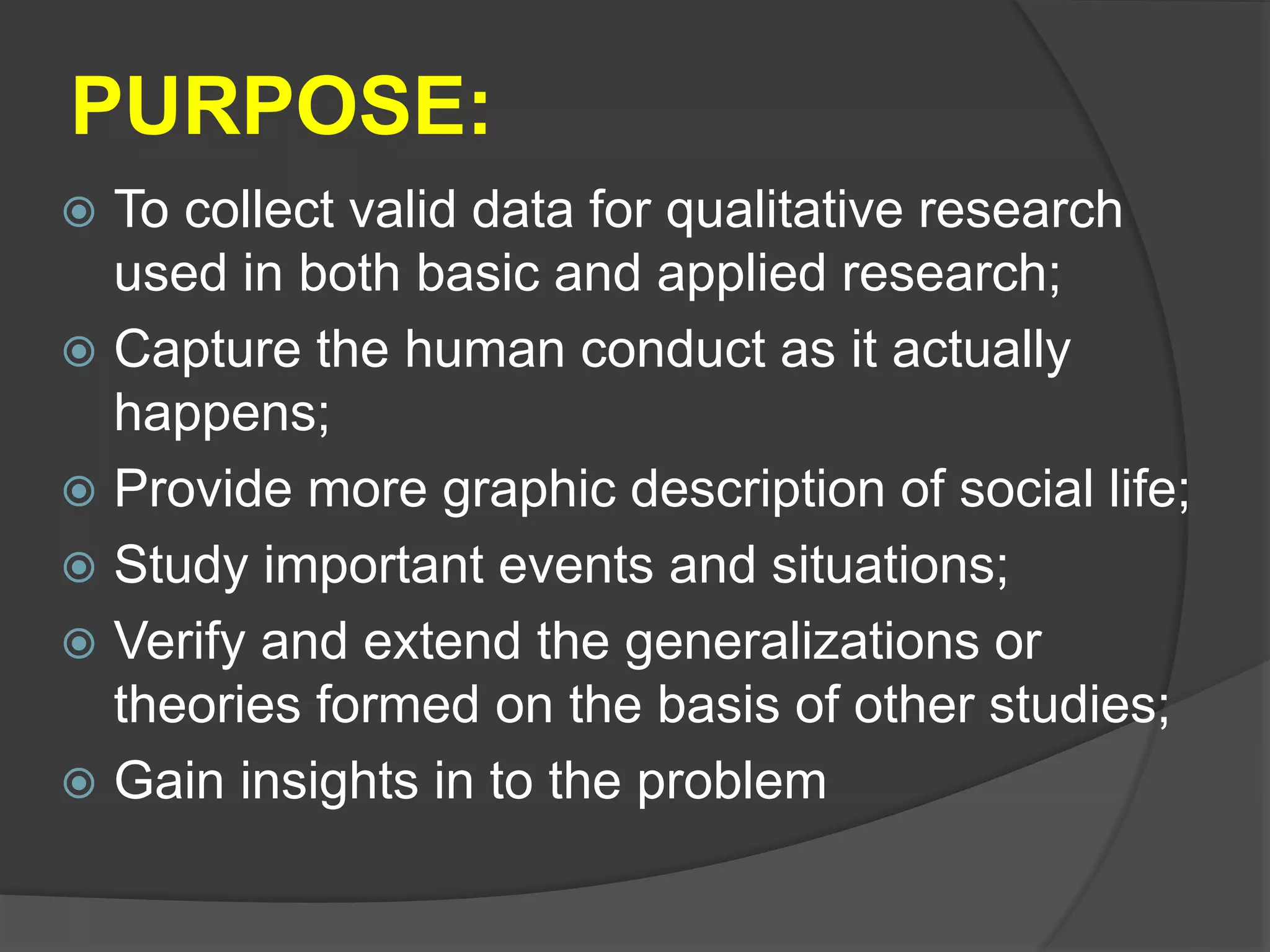
PURPOSE:
 To collect valid data for qualitative research
used in both basic and applied research;
 Capture the human conduct as it actually
happens;
 Provide more graphic description of social life;
 Study important events and situations;
 Verify and extend the generalizations or
theories formed on the basis of other studies;
 Gain insights in to the problem
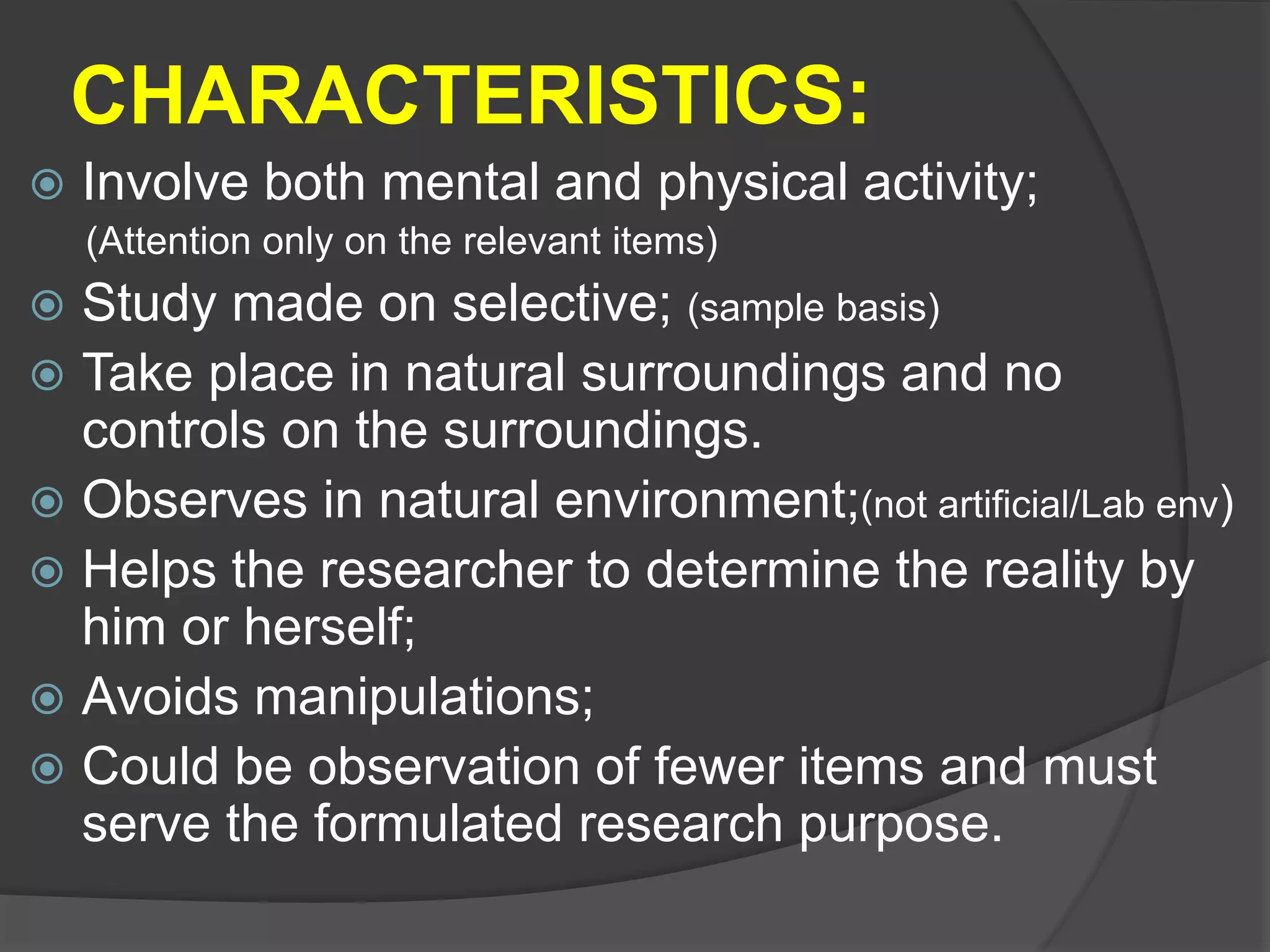
CHARACTERISTICS:
 Involve both mental and physical activity;
(Attention only on the relevant items)
 Study made on selective; (sample basis)
 Take place in natural surroundings and no
controls on the surroundings.
 Observes in natural environment;(not artificial/Lab env)
 Helps the researcher to determine the reality by
him or herself;
 Avoids manipulations;
 Could be observation of fewer items and must
serve the formulated research purpose.
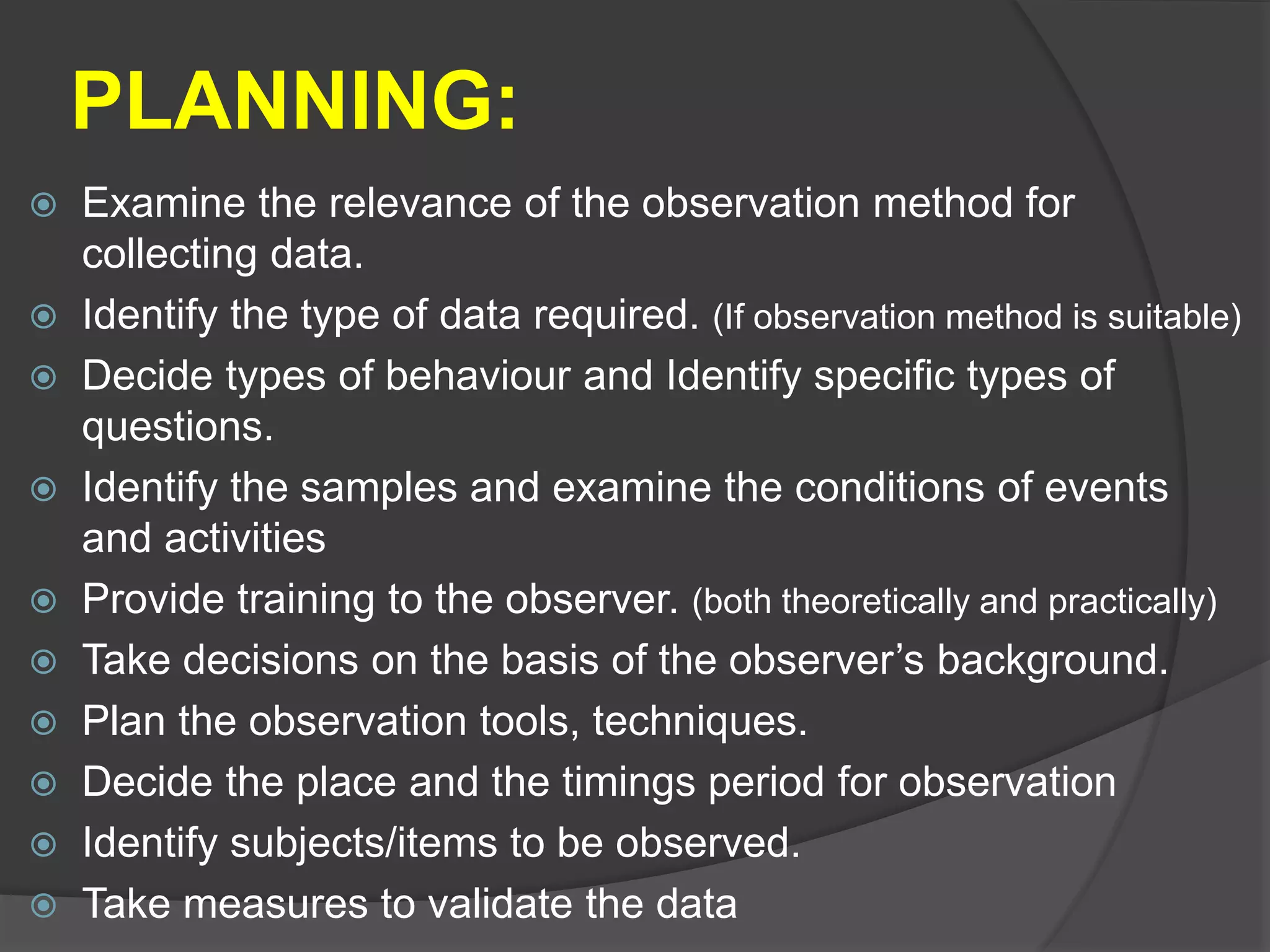
PLANNING:
 Examine the relevance of the observation method for
collecting data.
 Identify the type of data required. (If observation method is suitable)
 Decide types of behaviour and Identify specific types of
questions.
 Identify the samples and examine the conditions of events
and activities
 Provide training to the observer. (both theoretically and practically)
 Take decisions on the basis of the observer’s background.
 Plan the observation tools, techniques.
 Decide the place and the timings period for observation
 Identify subjects/items to be observed.
 Take measures to validate the data
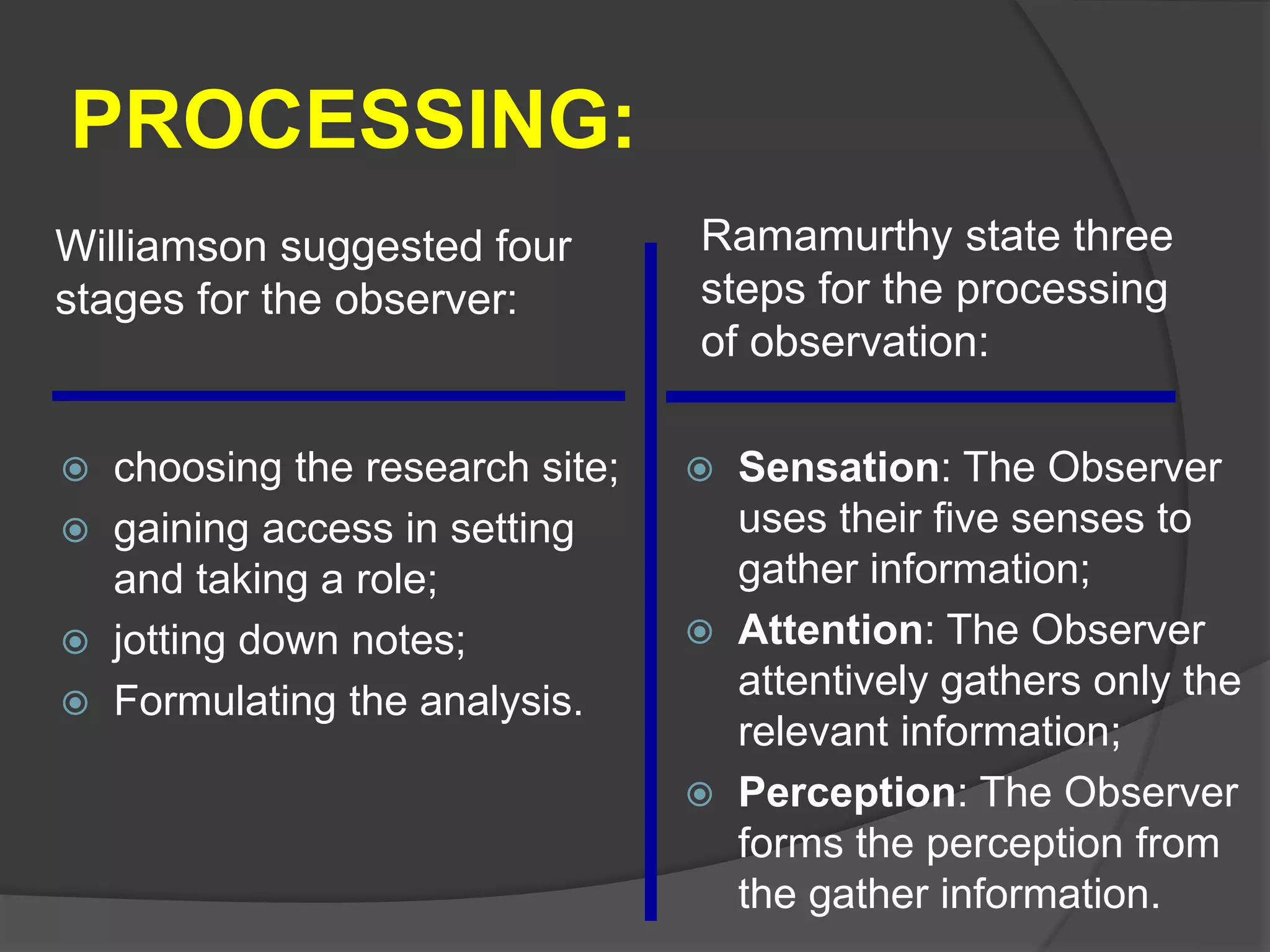
PROCESSING:
 choosing the research site;
 gaining access in setting
and taking a role;
 jotting down notes;
 Formulating the analysis.
Williamson suggested four
stages for the observer:
Ramamurthy state three
steps for the processing
of observation:
 Sensation: The Observer
uses their five senses to
gather information;
 Attention: The Observer
attentively gathers only the
relevant information;
 Perception: The Observer
forms the perception from
the gather information.
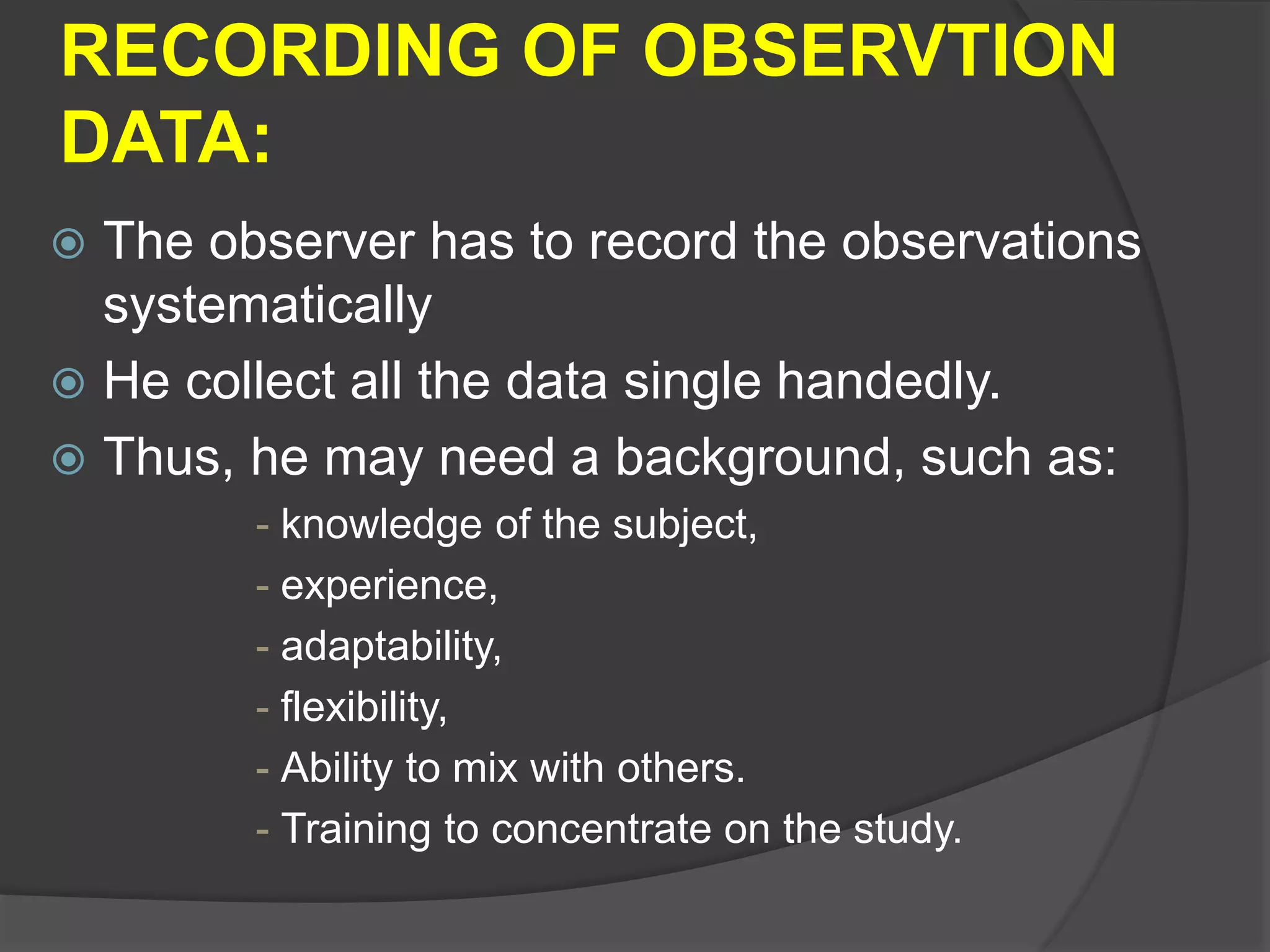
RECORDING OF OBSERVTION
DATA:
 The observer has to record the observations
systematically
 He collect all the data single handedly.
 Thus, he may need a background, such as:
- knowledge of the subject,
- experience,
- adaptability,
- flexibility,
- Ability to mix with others.
- Training to concentrate on the study.
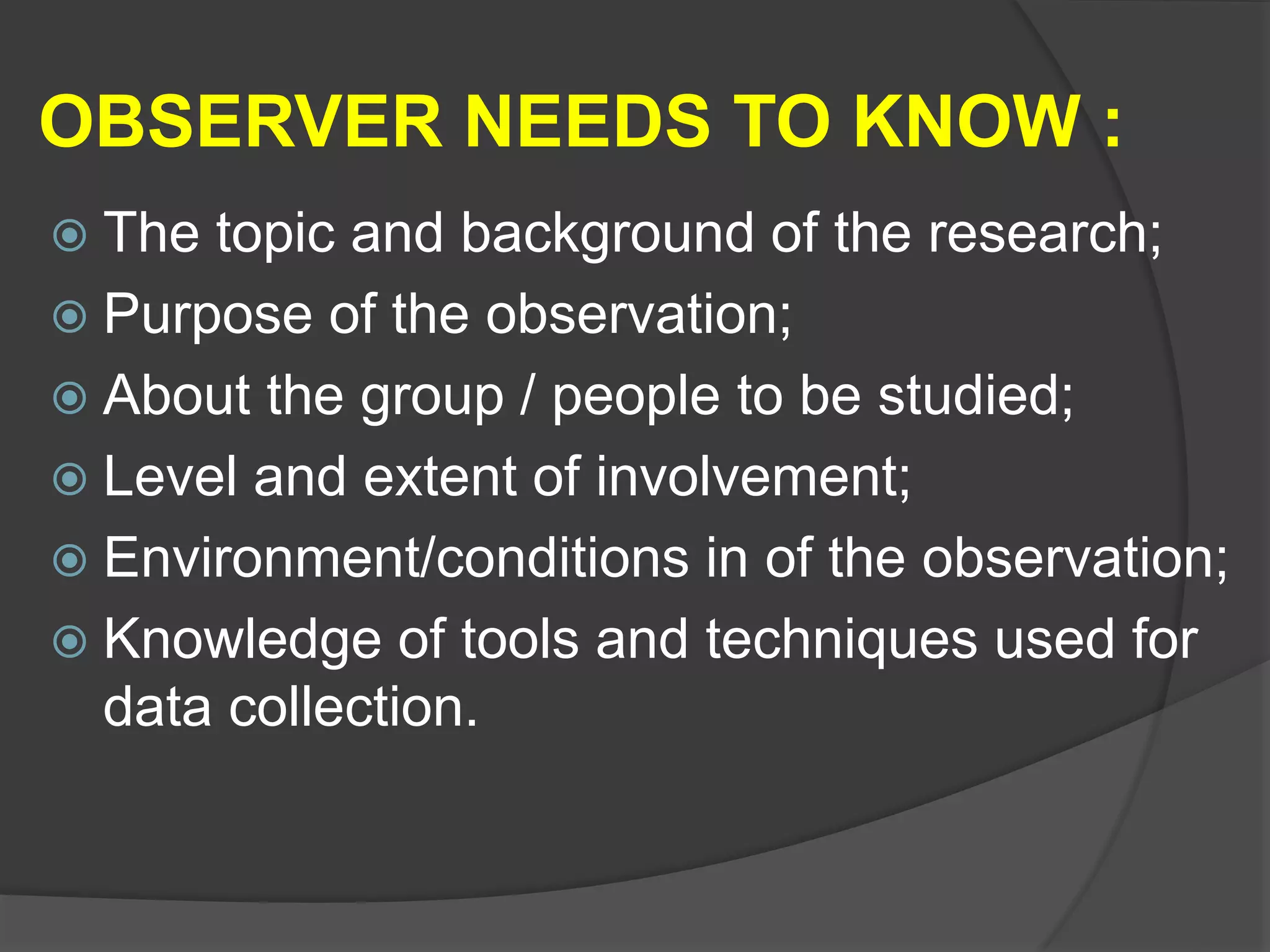
OBSERVER NEEDS TO KNOW :
 The topic and background of the research;
 Purpose of the observation;
 About the group / people to be studied;
 Level and extent of involvement;
 Environment/conditions in of the observation;
 Knowledge of tools and techniques used for
data collection.
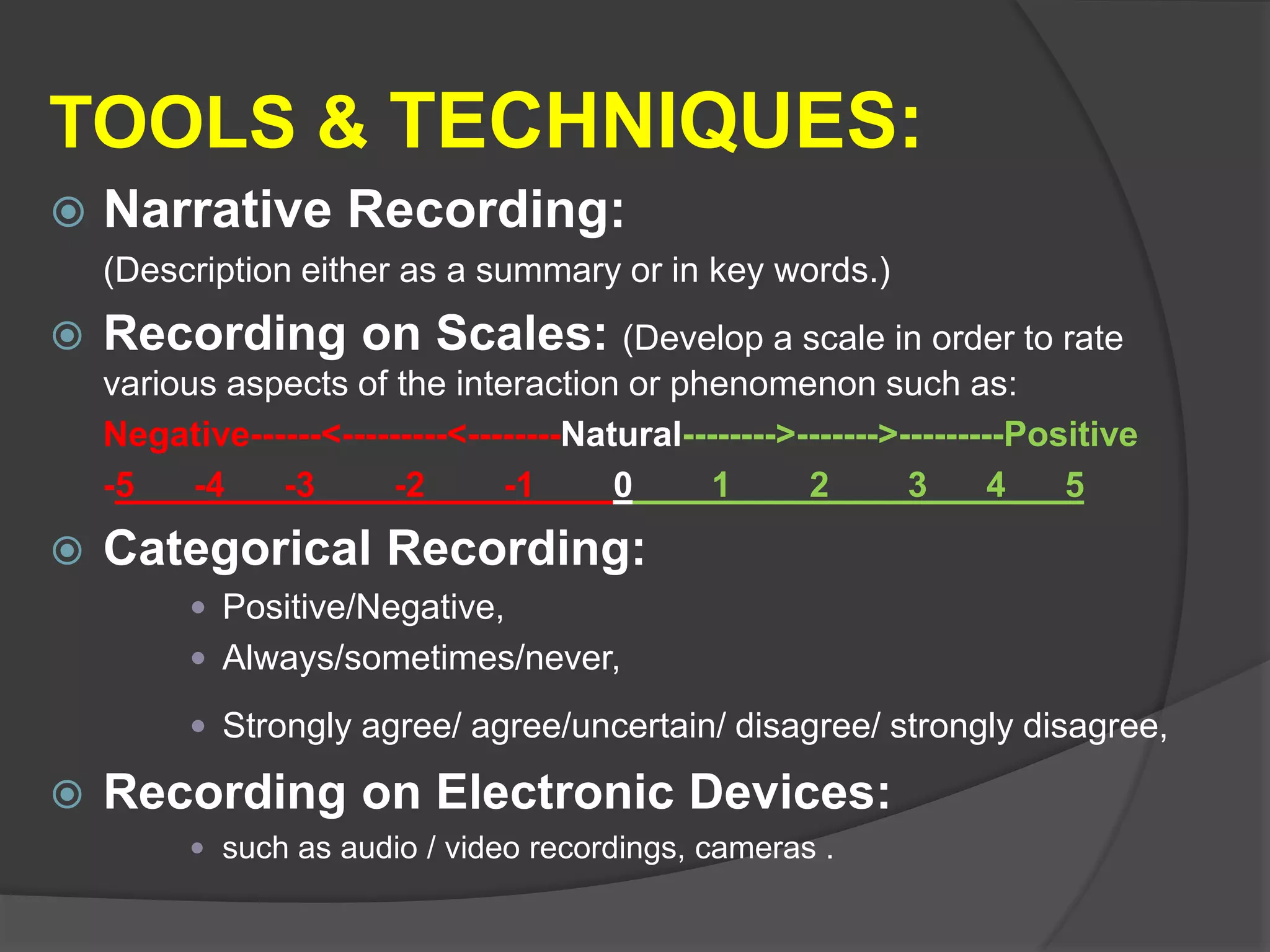
TOOLS & TECHNIQUES:
 Narrative Recording:
(Description either as a summary or in key words.)
 Recording on Scales: (Develop a scale in order to rate
various aspects of the interaction or phenomenon such as:
Negative------<---------<--------Natural-------->------->---------Positive
-5___-4___-3____-2____-1____0____1____2____3___4___5
 Categorical Recording:
ď‚— Positive/Negative,
ď‚— Always/sometimes/never,
ď‚— Strongly agree/ agree/uncertain/ disagree/ strongly disagree,
 Recording on Electronic Devices:
ď‚— such as audio / video recordings, cameras .
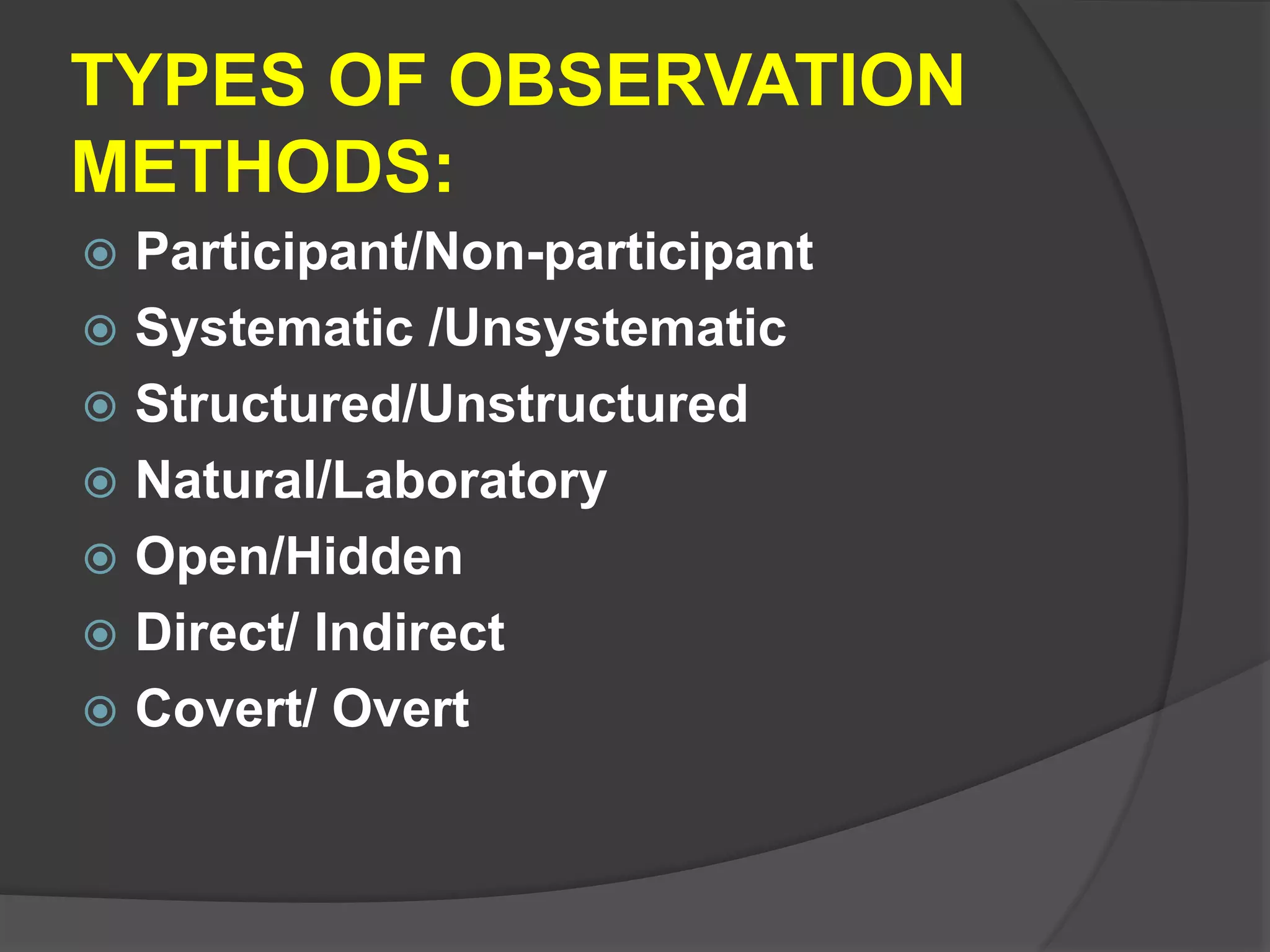
TYPES OF OBSERVATION
METHODS:
 Participant/Non-participant
 Systematic /Unsystematic
 Structured/Unstructured
 Natural/Laboratory
 Open/Hidden
 Direct/ Indirect
 Covert/ Overt
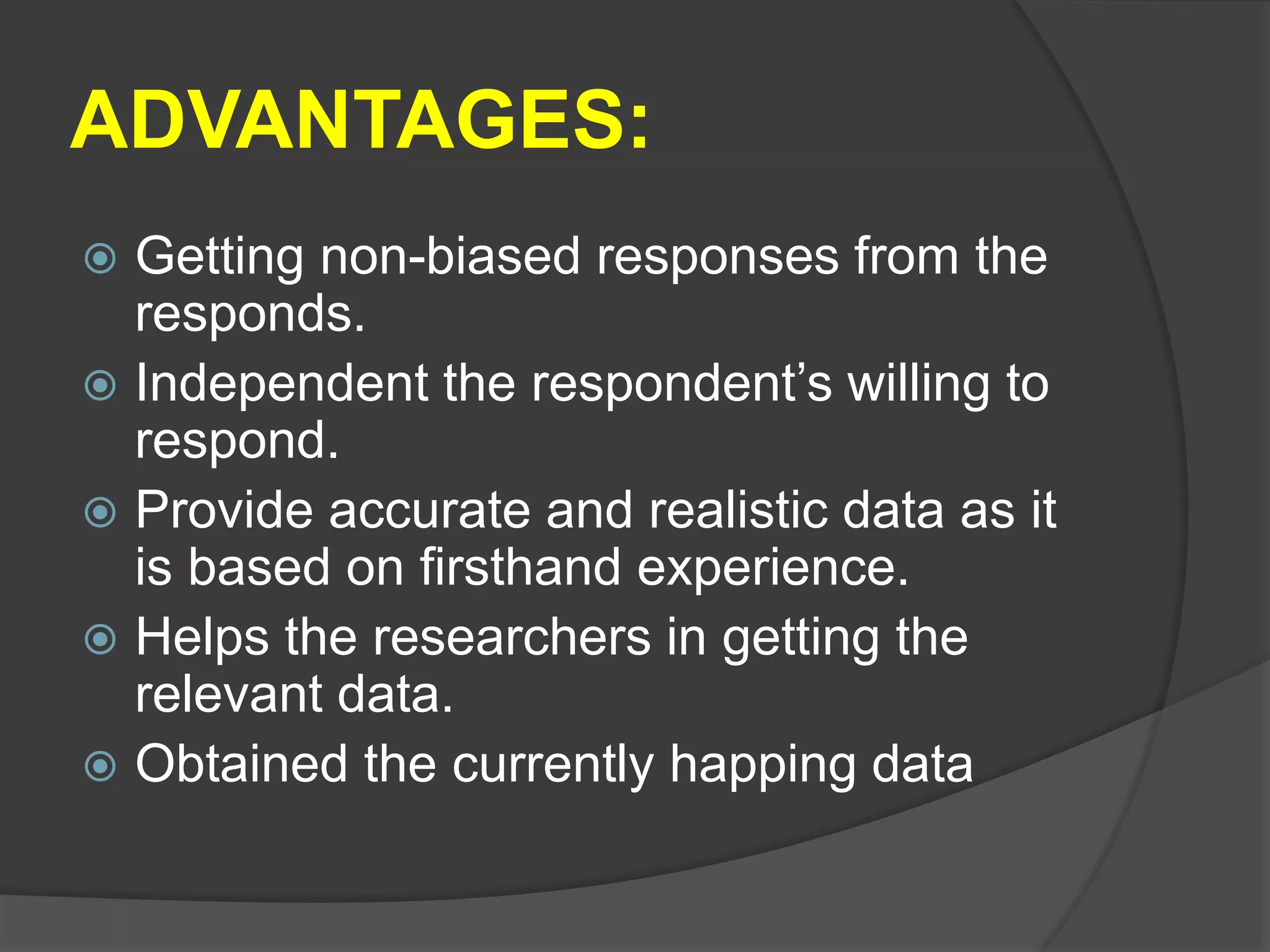
ADVANTAGES:
 Getting non-biased responses from the
responds.
 Independent the respondent’s willing to
respond.
 Provide accurate and realistic data as it
is based on firsthand experience.
 Helps the researchers in getting the
relevant data.
 Obtained the currently happing data
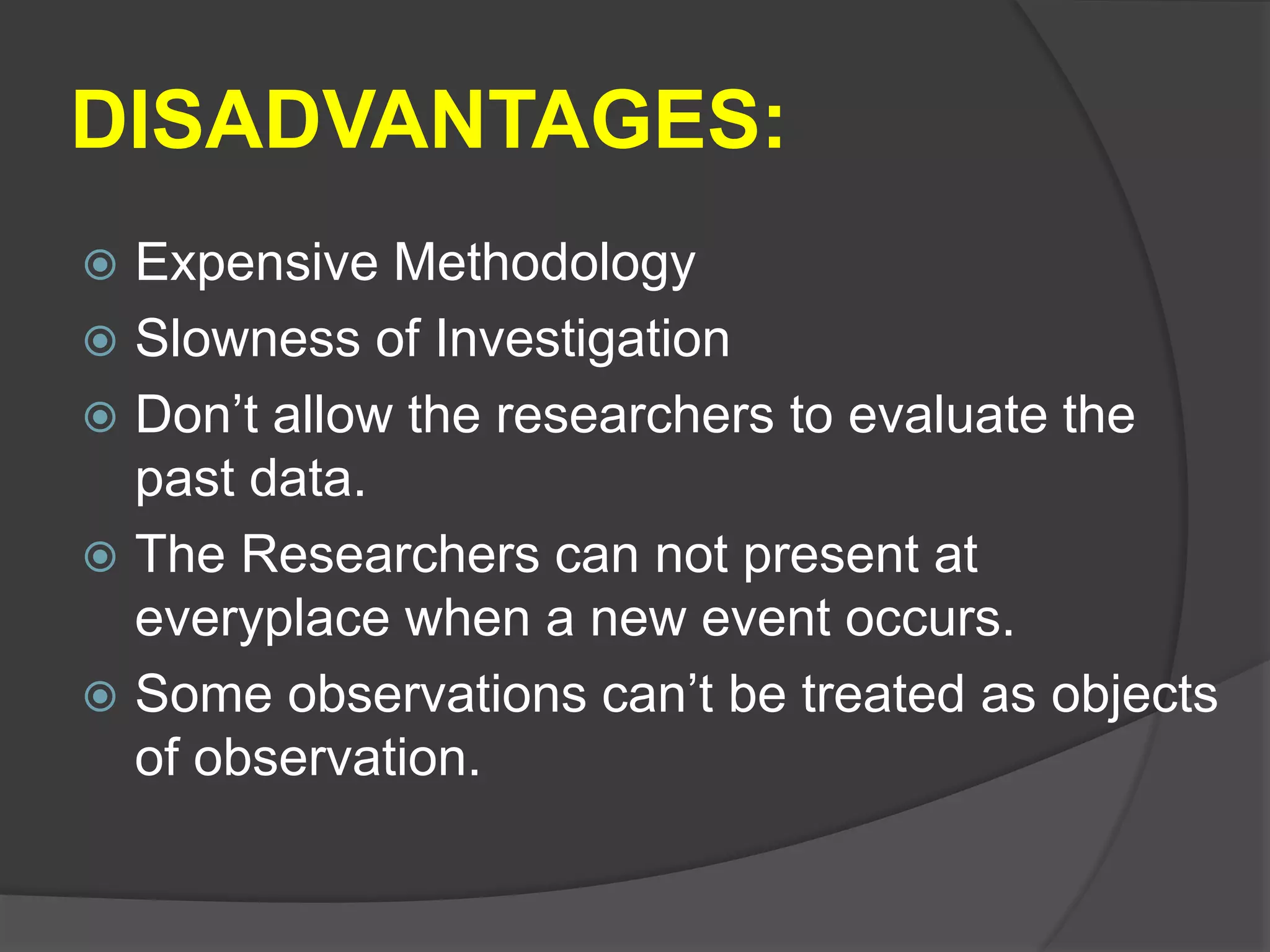
DISADVANTAGES:
 Expensive Methodology
 Slowness of Investigation
 Don’t allow the researchers to evaluate the
past data.
 The Researchers can not present at
everyplace when a new event occurs.
 Some observations can’t be treated as objects
of observation.
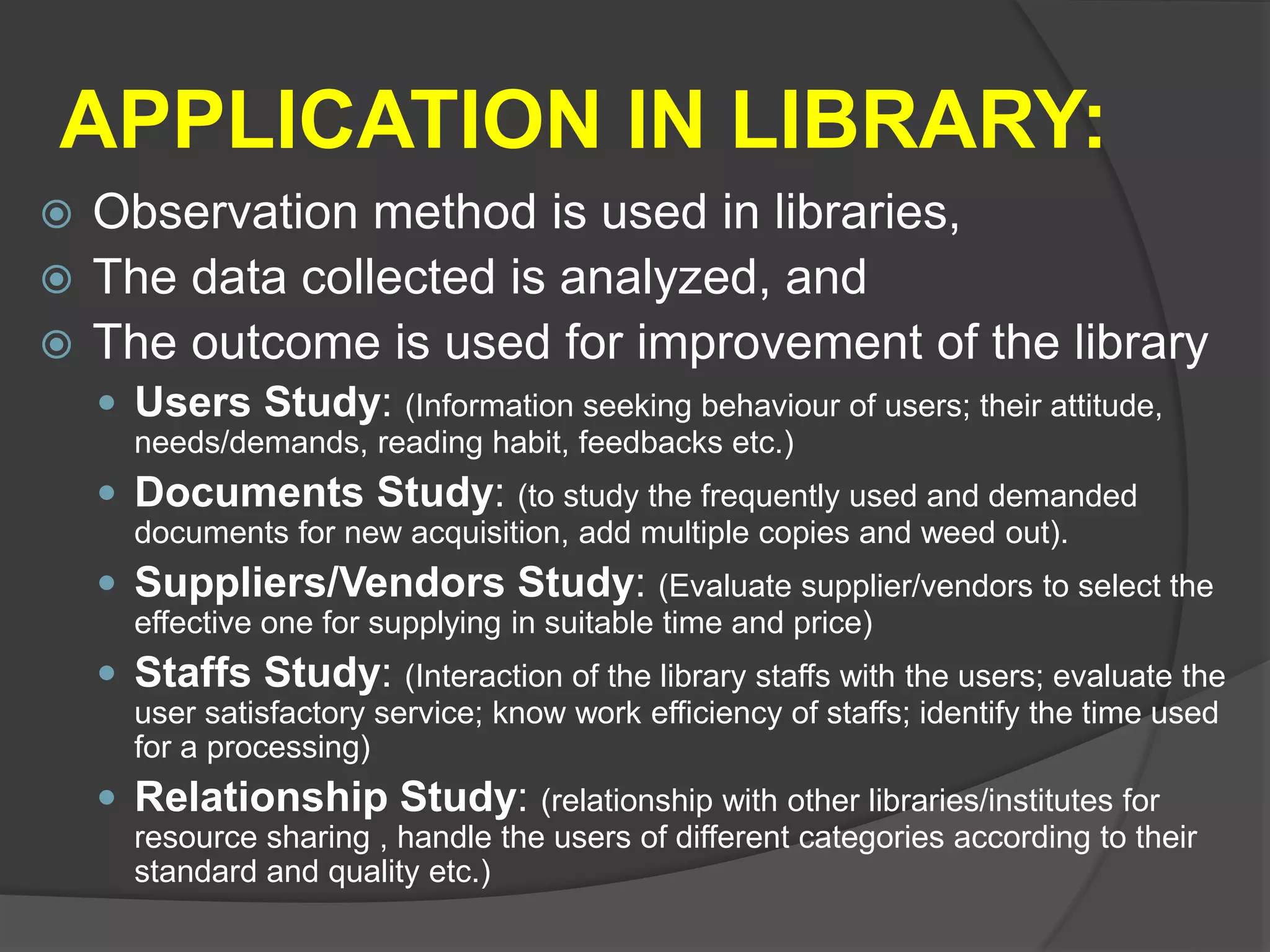
APPLICATION IN LIBRARY:
 Observation method is used in libraries,
 The data collected is analyzed, and
 The outcome is used for improvement of the library
ď‚— Users Study: (Information seeking behaviour of users; their attitude,
needs/demands, reading habit, feedbacks etc.)
ď‚— Documents Study: (to study the frequently used and demanded
documents for new acquisition, add multiple copies and weed out).
ď‚— Suppliers/Vendors Study: (Evaluate supplier/vendors to select the
effective one for supplying in suitable time and price)
ď‚— Staffs Study: (Interaction of the library staffs with the users; evaluate the
user satisfactory service; know work efficiency of staffs; identify the time used
for a processing)
ď‚— Relationship Study: (relationship with other libraries/institutes for
resource sharing , handle the users of different categories according to their
standard and quality etc.)
CONCLUSION:
 The researchers in LIS use questionnaire method of
data collection rather than observation method.
 If they use this method the results could be more
accurate.
 The data collected from observation may be
combined with the data collected through other
methods / sources and can be used for
improvement of the library.
 Observation method is very useful for librarians.
(both in service development as well as in management of libraries).
 It is a continuing method for libraries to study about
the users, documents, staffs and so on.
Thanks
?
If AnyQuestion
Please...

Observation Method of Research by Niranjan Mohapatra, MLIS, IGNOU- 142389253

  • 1.
  • 2.
    OBJECTIVES:  To understandobservation method;  To identify its propose and characteristics  To know its planning, processing record data in research  To identify the various types of observation.  To describe advantages and disadvantages of this method  To know its application in Library
  • 3.
    INTRODUCTION  Two majorapproaches to gathering information about a phenomenon: ▪ Primary data ▪ Secondary data  There are several methods used to collect primary data: ○ Observation Method ○ Interview Method ○ Questionnaire Method ○ Experimental Method ○ Case Study Method  Observation method is one of the most useful methods of data collection for research especially in social sciences.  Even in the libraries this method is used to understand the behaviour and attitude of the users.
  • 4.
    CONCEPT:  Observation meanswatching carefully.  All the things, situations we are seeing in our routine life, are not observation. (casual & without any purpose)  Observation is being done systematically with a definite purpose.  In the process of observation the observer uses all his sensory organs in an integrated manner.  The observer obtains information about the World around him for a definite purpose.  This is one of the oldest method for collecting the data and used by both the scientists and social scientists.
  • 5.
    DEFINITIONS:  Observe means“to watch attentively in a scientific manner”.  It is “a planned methodical watching that involves constraints to improve accuracy”. (Ram Ahuja)  It is “a systematic viewing of a specific phenomenon in its proper setting for the specific purposed of gathering data for a particular study”. (Krishna Swami).  In an observational study, the current status of phenomenon is determined not by asking but by observing. (Ronald R Powell).
  • 6.
    PURPOSE:  To collectvalid data for qualitative research used in both basic and applied research;  Capture the human conduct as it actually happens;  Provide more graphic description of social life;  Study important events and situations;  Verify and extend the generalizations or theories formed on the basis of other studies;  Gain insights in to the problem
  • 7.
    CHARACTERISTICS:  Involve bothmental and physical activity; (Attention only on the relevant items)  Study made on selective; (sample basis)  Take place in natural surroundings and no controls on the surroundings.  Observes in natural environment;(not artificial/Lab env)  Helps the researcher to determine the reality by him or herself;  Avoids manipulations;  Could be observation of fewer items and must serve the formulated research purpose.
  • 8.
    PLANNING:  Examine therelevance of the observation method for collecting data.  Identify the type of data required. (If observation method is suitable)  Decide types of behaviour and Identify specific types of questions.  Identify the samples and examine the conditions of events and activities  Provide training to the observer. (both theoretically and practically)  Take decisions on the basis of the observer’s background.  Plan the observation tools, techniques.  Decide the place and the timings period for observation  Identify subjects/items to be observed.  Take measures to validate the data
  • 9.
    PROCESSING:  choosing theresearch site;  gaining access in setting and taking a role;  jotting down notes;  Formulating the analysis. Williamson suggested four stages for the observer: Ramamurthy state three steps for the processing of observation:  Sensation: The Observer uses their five senses to gather information;  Attention: The Observer attentively gathers only the relevant information;  Perception: The Observer forms the perception from the gather information.
  • 10.
    RECORDING OF OBSERVTION DATA: The observer has to record the observations systematically  He collect all the data single handedly.  Thus, he may need a background, such as: - knowledge of the subject, - experience, - adaptability, - flexibility, - Ability to mix with others. - Training to concentrate on the study.
  • 11.
    OBSERVER NEEDS TOKNOW :  The topic and background of the research;  Purpose of the observation;  About the group / people to be studied;  Level and extent of involvement;  Environment/conditions in of the observation;  Knowledge of tools and techniques used for data collection.
  • 12.
    TOOLS & TECHNIQUES: Narrative Recording: (Description either as a summary or in key words.)  Recording on Scales: (Develop a scale in order to rate various aspects of the interaction or phenomenon such as: Negative------<---------<--------Natural-------->------->---------Positive -5___-4___-3____-2____-1____0____1____2____3___4___5  Categorical Recording:  Positive/Negative,  Always/sometimes/never,  Strongly agree/ agree/uncertain/ disagree/ strongly disagree,  Recording on Electronic Devices:  such as audio / video recordings, cameras .
  • 13.
    TYPES OF OBSERVATION METHODS: Participant/Non-participant  Systematic /Unsystematic  Structured/Unstructured  Natural/Laboratory  Open/Hidden  Direct/ Indirect  Covert/ Overt
  • 14.
    ADVANTAGES:  Getting non-biasedresponses from the responds.  Independent the respondent’s willing to respond.  Provide accurate and realistic data as it is based on firsthand experience.  Helps the researchers in getting the relevant data.  Obtained the currently happing data
  • 15.
    DISADVANTAGES:  Expensive Methodology Slowness of Investigation  Don’t allow the researchers to evaluate the past data.  The Researchers can not present at everyplace when a new event occurs.  Some observations can’t be treated as objects of observation.
  • 16.
    APPLICATION IN LIBRARY: Observation method is used in libraries,  The data collected is analyzed, and  The outcome is used for improvement of the library  Users Study: (Information seeking behaviour of users; their attitude, needs/demands, reading habit, feedbacks etc.)  Documents Study: (to study the frequently used and demanded documents for new acquisition, add multiple copies and weed out).  Suppliers/Vendors Study: (Evaluate supplier/vendors to select the effective one for supplying in suitable time and price)  Staffs Study: (Interaction of the library staffs with the users; evaluate the user satisfactory service; know work efficiency of staffs; identify the time used for a processing)  Relationship Study: (relationship with other libraries/institutes for resource sharing , handle the users of different categories according to their standard and quality etc.)
  • 17.
    CONCLUSION:  The researchersin LIS use questionnaire method of data collection rather than observation method.  If they use this method the results could be more accurate.  The data collected from observation may be combined with the data collected through other methods / sources and can be used for improvement of the library.  Observation method is very useful for librarians. (both in service development as well as in management of libraries).  It is a continuing method for libraries to study about the users, documents, staffs and so on.
  • 18.