

Copyright 2003 - 2010 Matheson Method-Time Measurement and Functional Capacity Evaluation
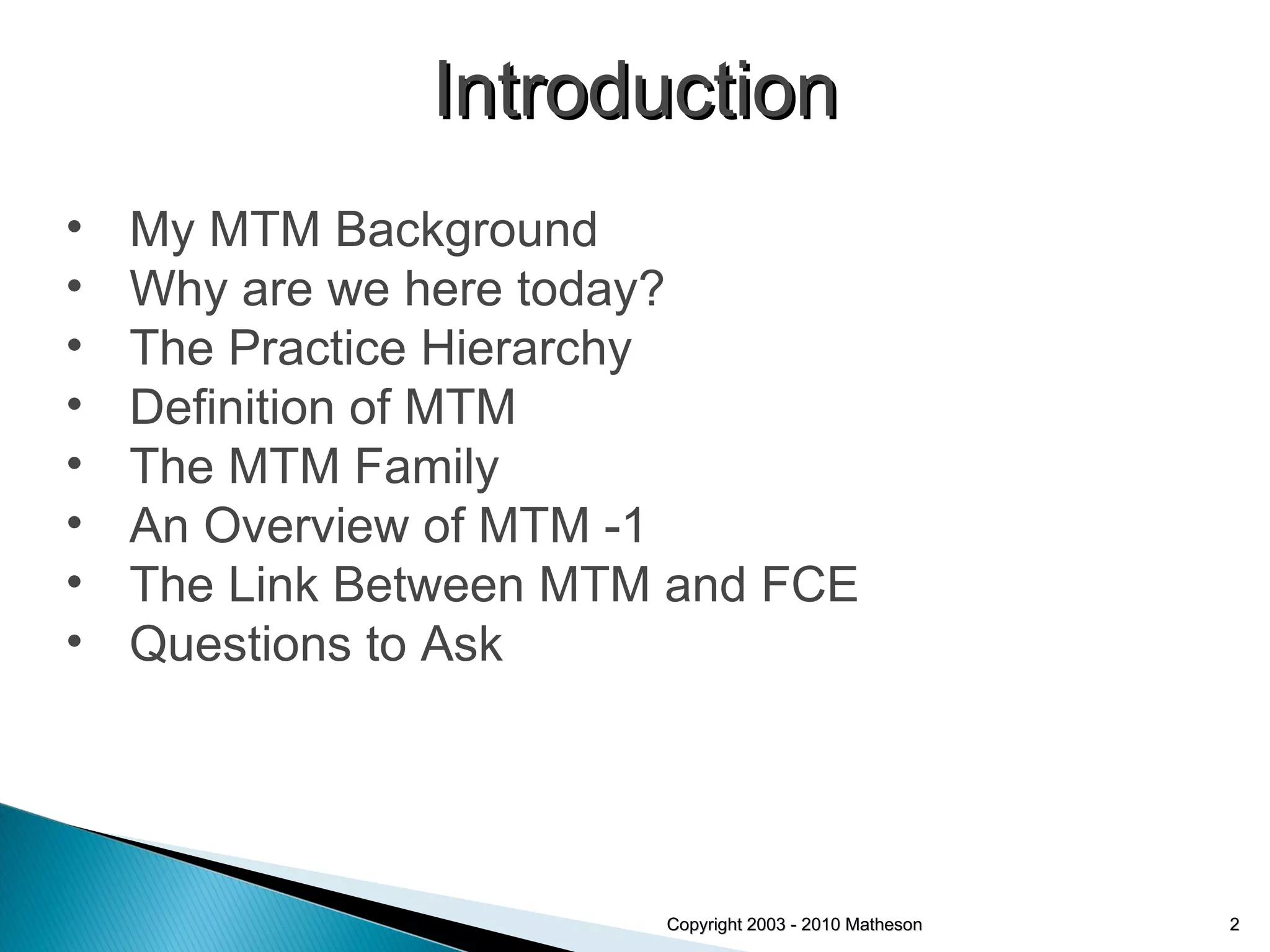
Copyright 2003 - 2010 Matheson My MTM Background Why are we here today? The Practice Hierarchy Definition of MTM The MTM Family An Overview of MTM -1 The Link Between MTM and FCE Questions to Ask Introduction
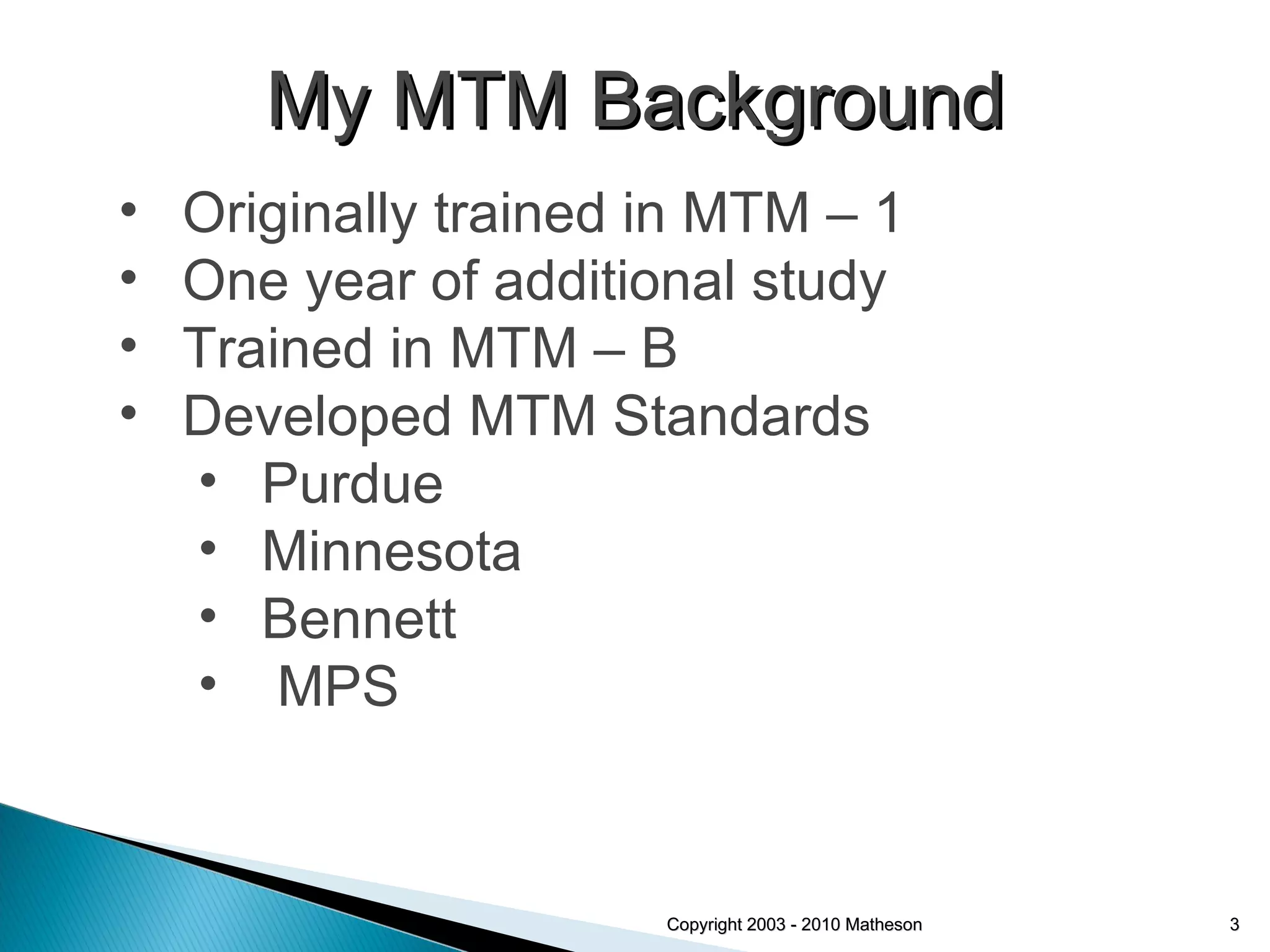
Copyright 2003 - 2010 Matheson Originally trained in MTM – 1 One year of additional study Trained in MTM – B Developed MTM Standards Purdue Minnesota Bennett MPS My MTM Background
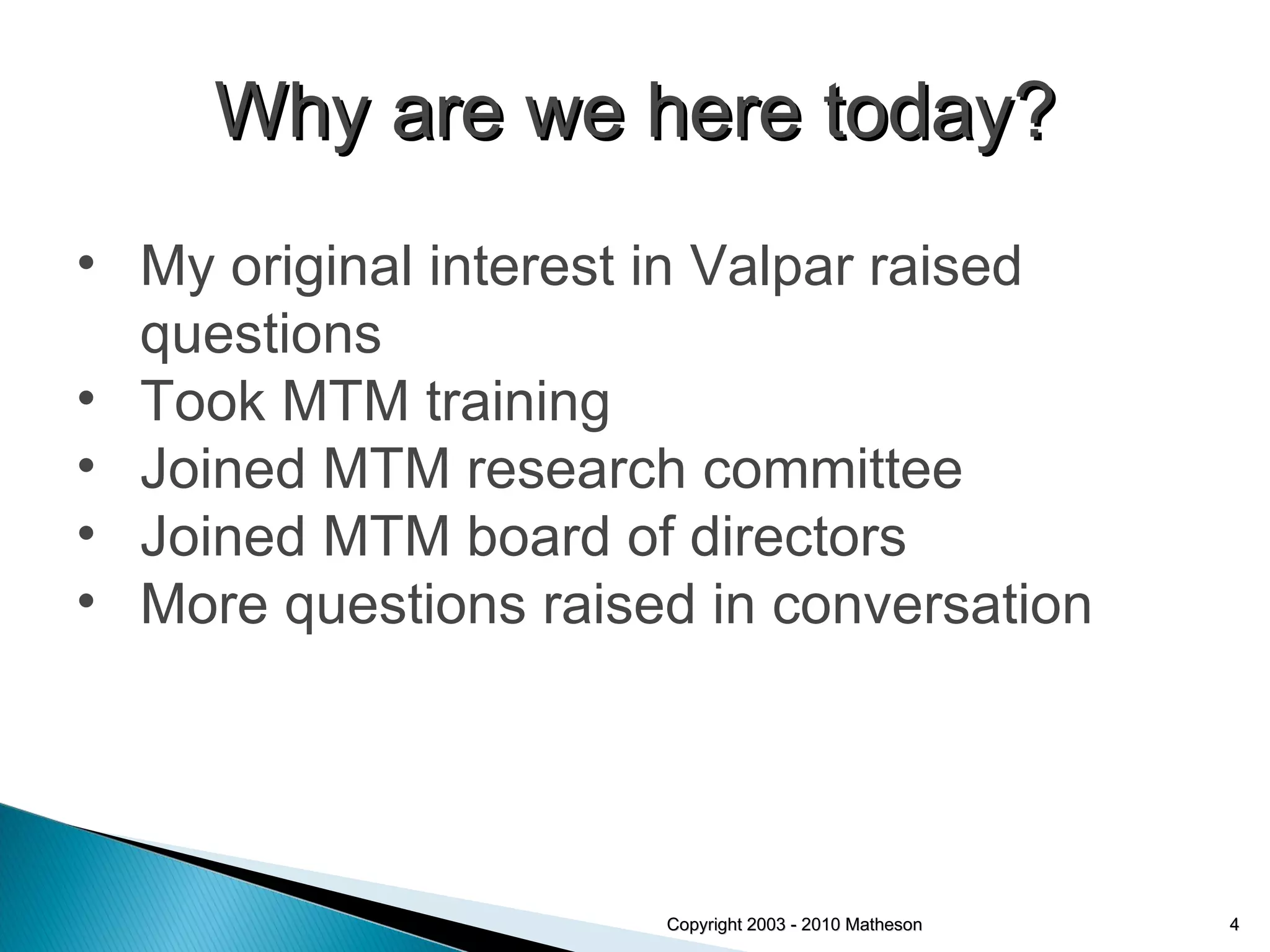
Copyright 2003 - 2010 Matheson My original interest in Valpar raised questions Took MTM training Joined MTM research committee Joined MTM board of directors More questions raised in conversation Why are we here today?
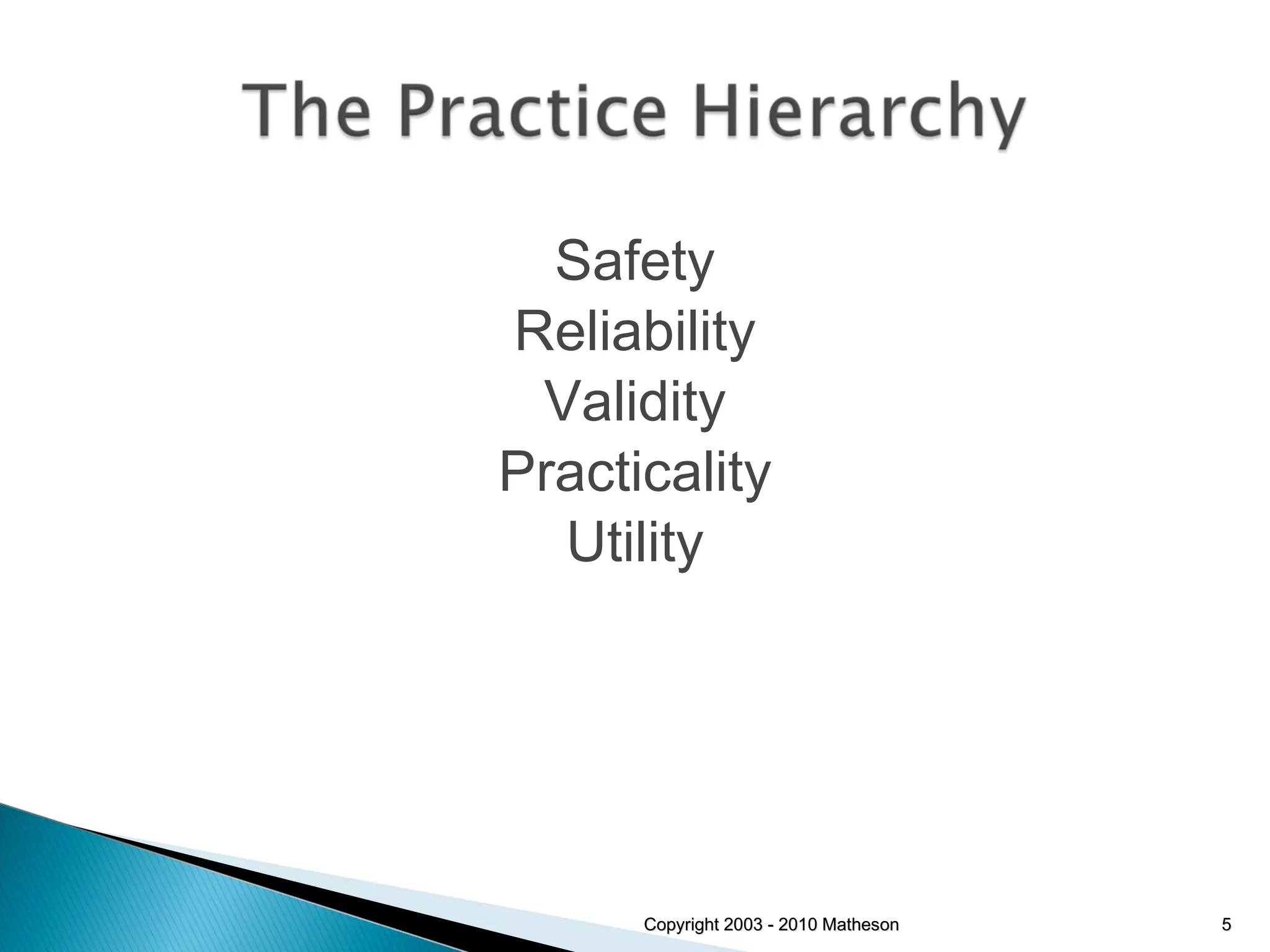
Safety Reliability Validity Practicality Utility Copyright 2003 - 2010 Matheson
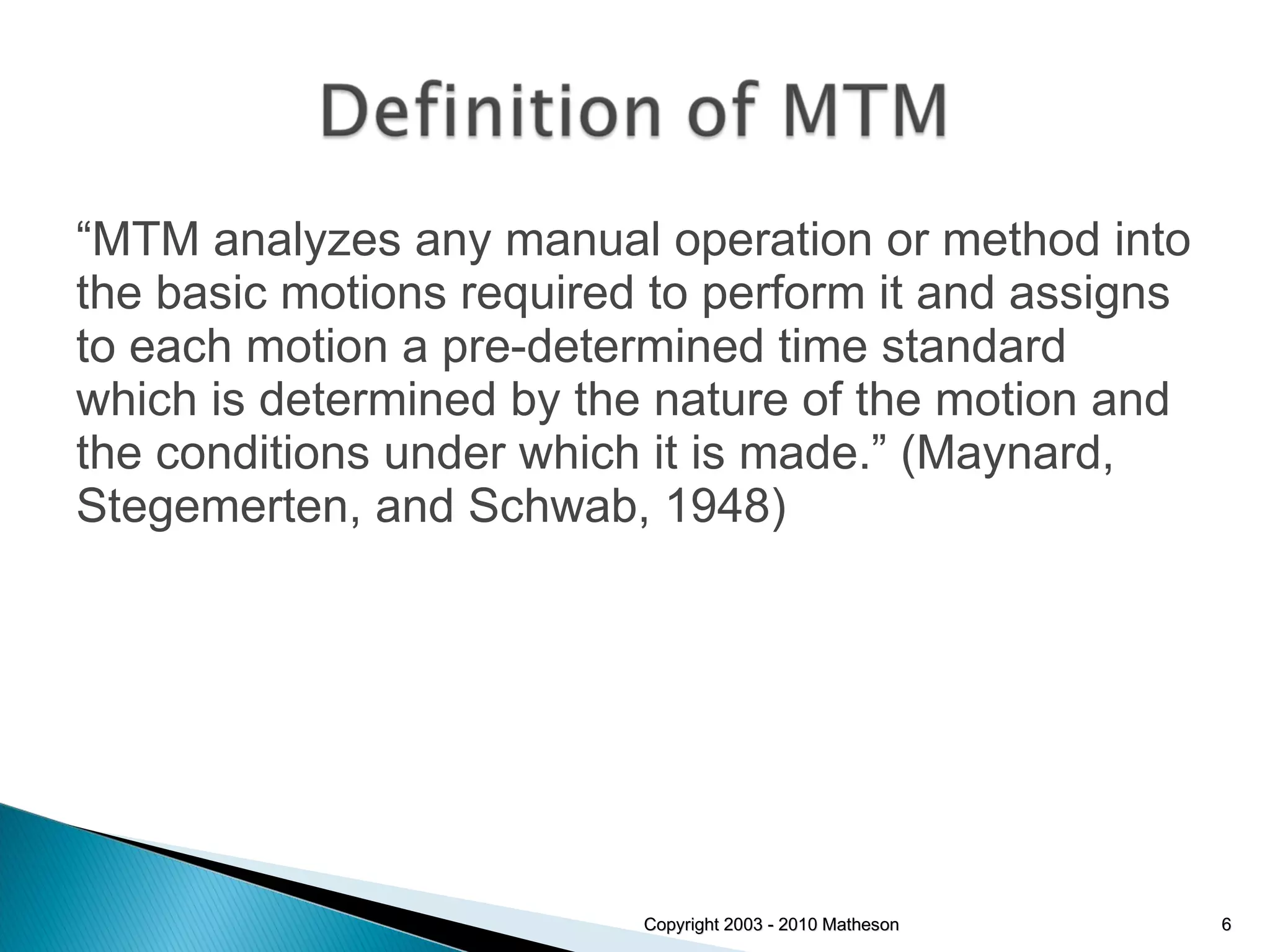
“ MTM analyzes any manual operation or method into the basic motions required to perform it and assigns to each motion a pre-determined time standard which is determined by the nature of the motion and the conditions under which it is made.” (Maynard, Stegemerten, and Schwab, 1948) Copyright 2003 - 2010 Matheson
Method-time: the name includes a hyphen to focus attention upon its basic nature. The specific method must be chosen or established before any meaningful time can be assigned. Copyright 2003 - 2010 Matheson
Procedure: There are definite analysis steps which must be made according to system rules. Copyright 2003 - 2010 Matheson
Manual operation: here manual means human. MTM evaluates the normal operations performed by people, giving the time as controlled by human energy. This excludes performance time controlled by equipment and the process, such as welding or machining time. Copyright 2003 - 2010 Matheson
Basic motions: this refers to the manual motions of the fingers, hands and arms as well as eye motions together with the body, leg, and foot motions of the operator. All of these are the motions shown on the MTM data card. Copyright 2003 - 2010 Matheson
Predetermined time: motions defined in the system require performance times standardized in advance for the average operator in the normal working population. These times predict the result of average skill and effort under average conditions for the operator in question. Copyright 2003 - 2010 Matheson
Copyright 2003 - 2010 Matheson
The most widely used predetermined time measurement system, is recognized worldwide as a standard by which other systems are measured. Besides time determination of the highest accuracy it also provides highly detailed method description. It is ideally suited for measuring high volume, short cycle operations where a high degree of accuracy is needed and the benefits of method improvement are optimal. Copyright 2003 - 2010 Matheson MTM 1
MTM–UAS MTM – C MTM – V MTM – TE MTM - B Copyright 2003 - 2010 Matheson The Other Members  of the MTM Family
Copyright 2003 - 2010 Matheson An Overview of MTM - 1
Copyright 2003 - 2010 Matheson An Overview of MTM-1 The Original Research Time Measurement Units The Data Card
Copyright 2003 - 2010 Matheson The researchers studied drill press operators.
Copyright 2003 - 2010 Matheson The human subjects have been described as ‘well-trained workers working at a speed that could be maintained all day.’
Copyright 2003 - 2010 Matheson An expanded description would include: Well-trained workers Working at a speed that could be maintained all day Who took personal time during the work day Who experienced interruptions in work cycles Who used well maintained equipment
Copyright 2003 - 2010 Matheson The researchers filmed subjects at a film rate speed of 16 frames per second. They then defined a specific set of ‘Film Frame Measure Points’ for each of the motions. Film Frame Measure Points for Motions
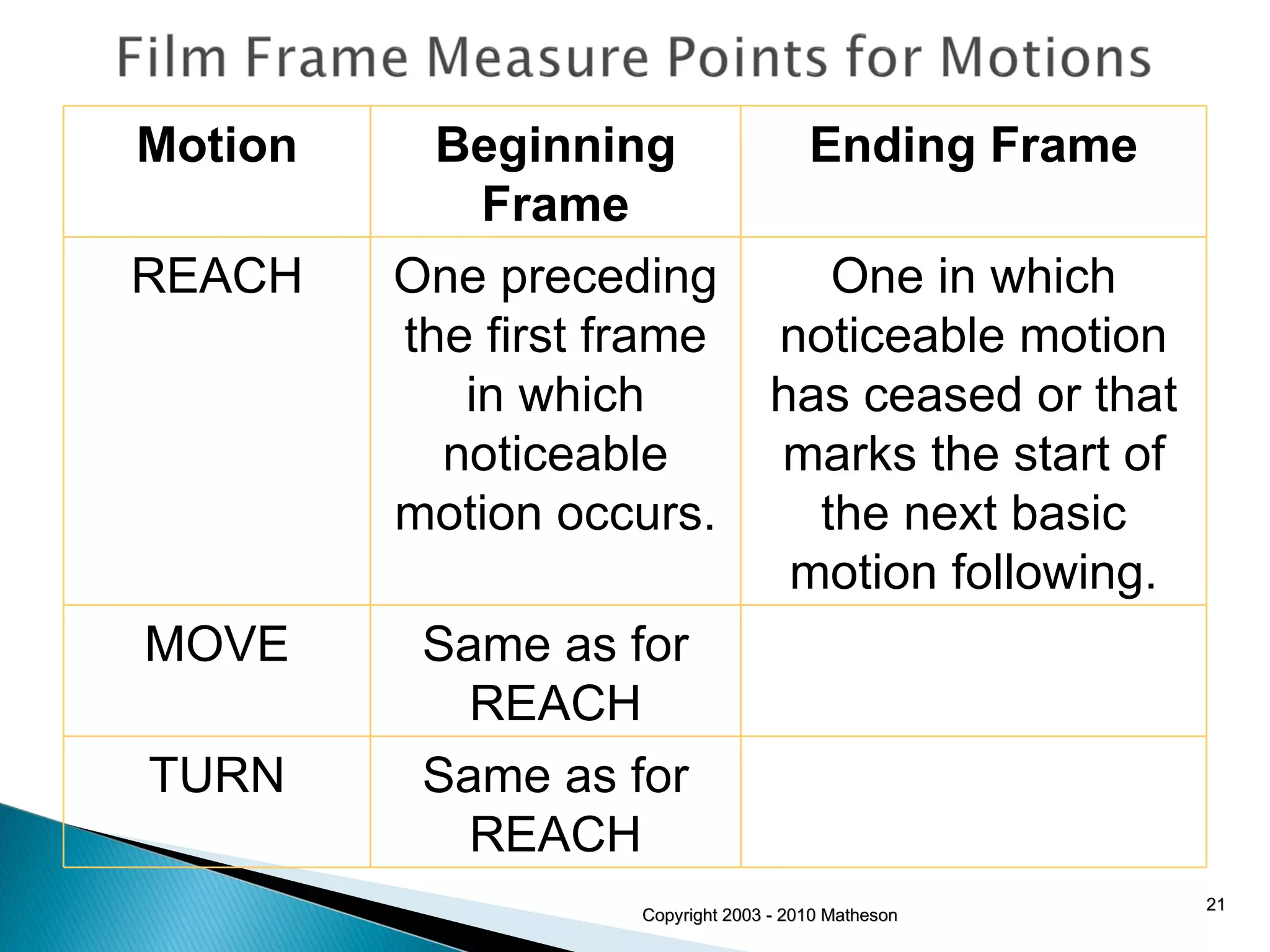
Copyright 2003 - 2010 Matheson Motion Beginning Frame Ending Frame REACH One preceding the first frame in which noticeable motion occurs. One in which noticeable motion has ceased or that marks the start of the next basic motion following. MOVE Same as for REACH TURN Same as for REACH
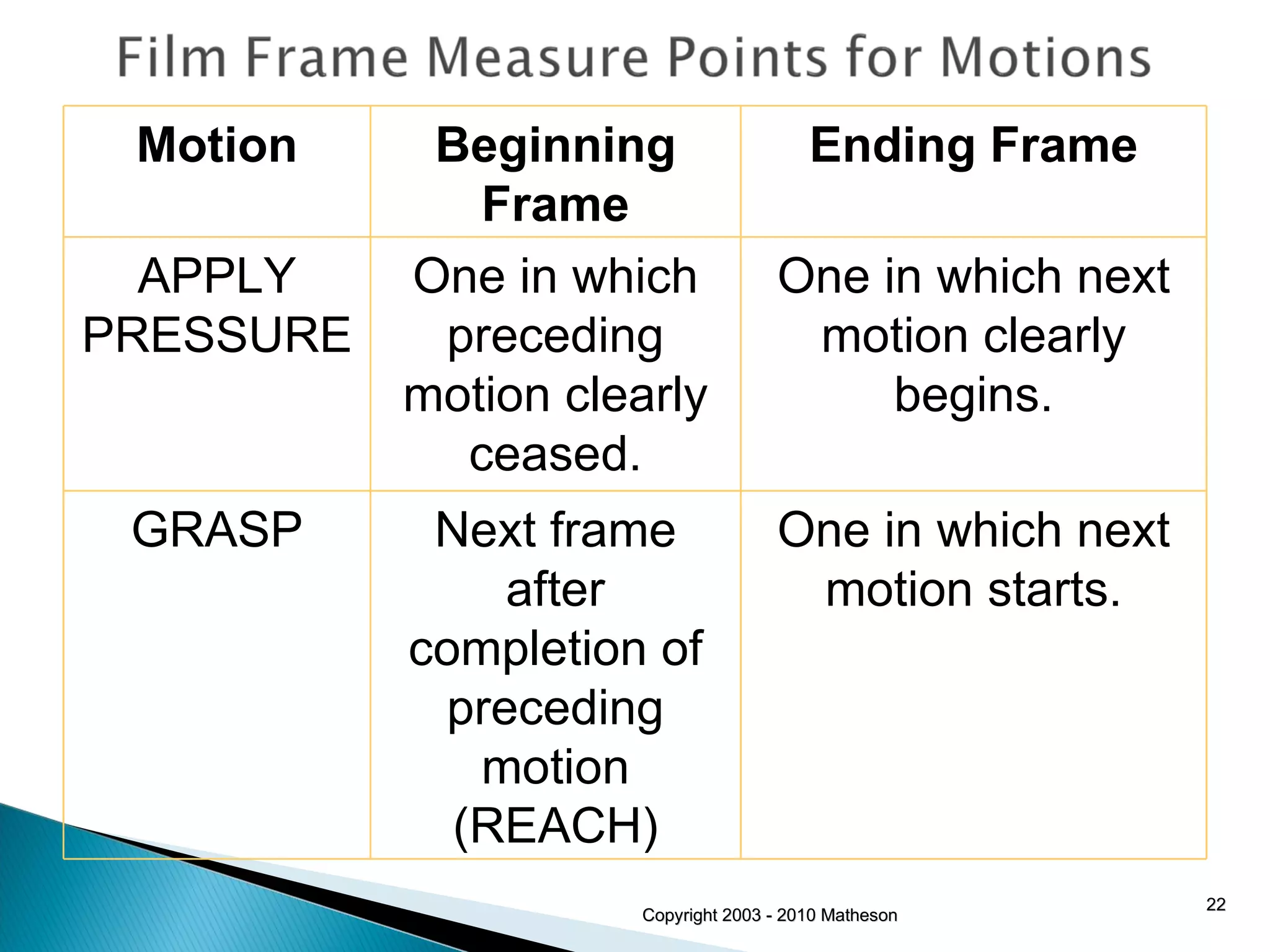
Copyright 2003 - 2010 Matheson Motion Beginning Frame Ending Frame APPLY PRESSURE One in which preceding motion clearly ceased. One in which next motion clearly begins. GRASP Next frame after completion of preceding motion (REACH) One in which next motion starts.
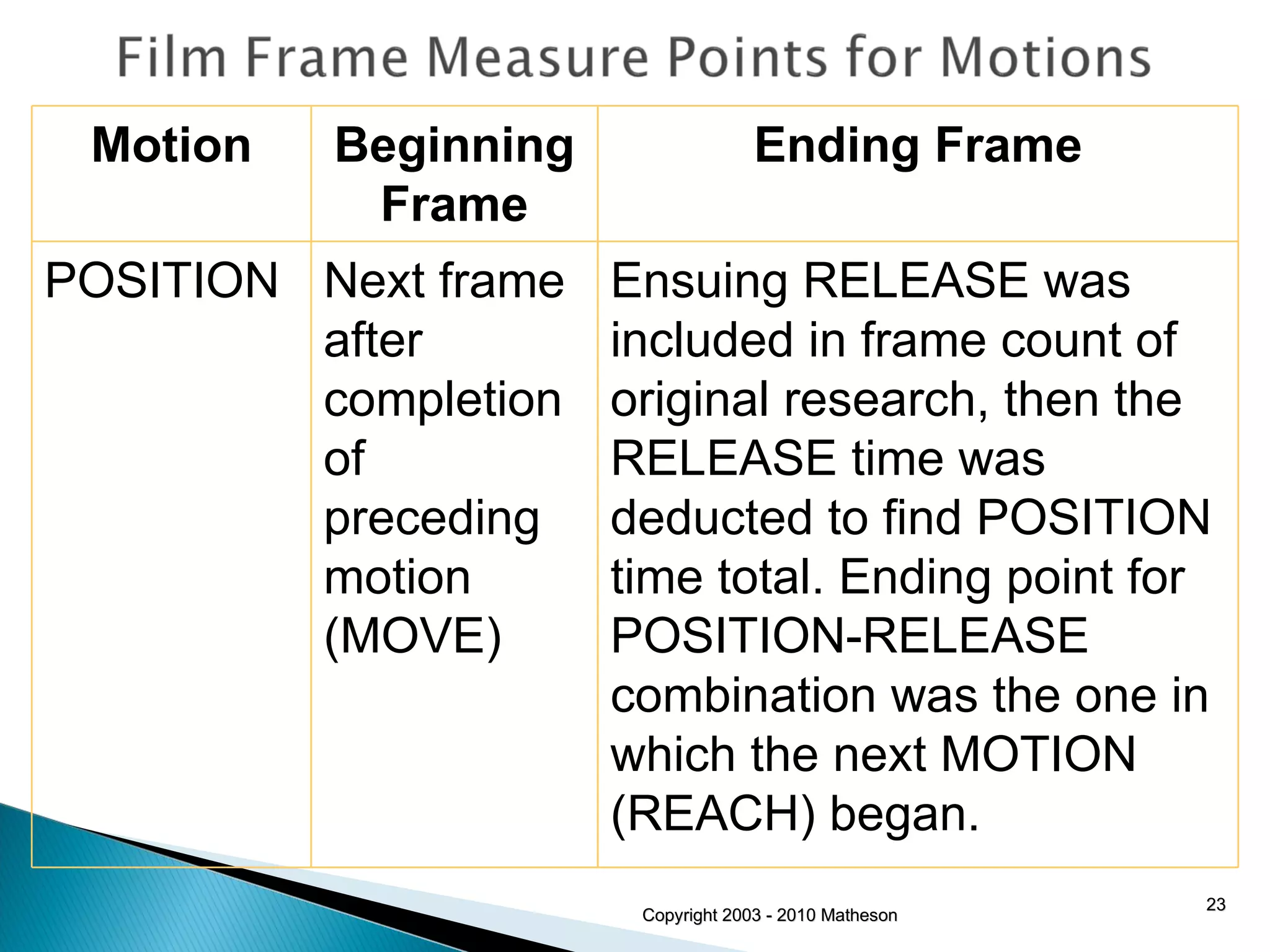
Copyright 2003 - 2010 Matheson Motion Beginning Frame Ending Frame POSITION Next frame after completion of preceding motion (MOVE) Ensuing RELEASE was included in frame count of original research, then the RELEASE time was deducted to find POSITION time total. Ending point for POSITION-RELEASE combination was the one in which the next MOTION (REACH) began.
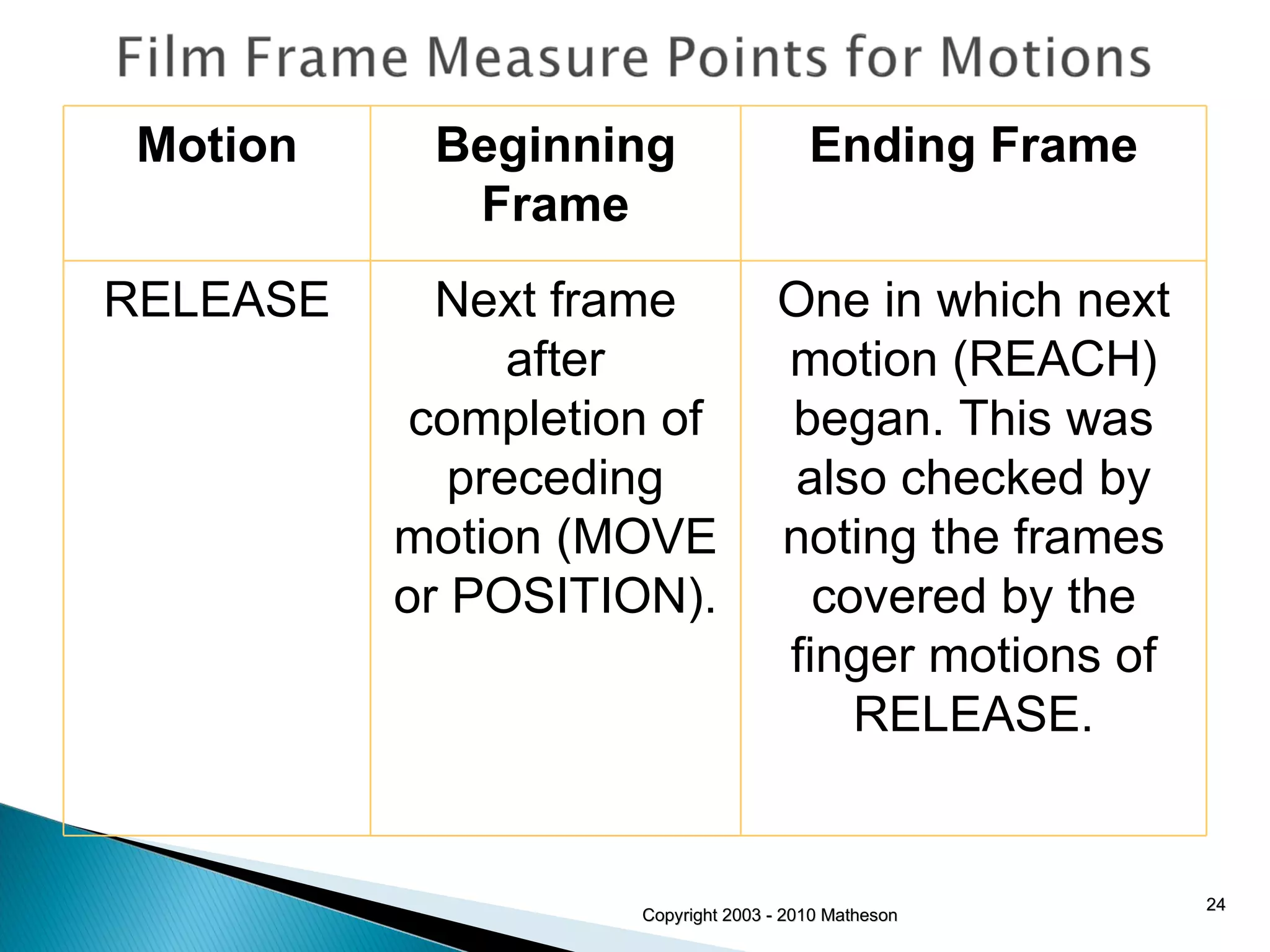
Copyright 2003 - 2010 Matheson Motion Beginning Frame Ending Frame RELEASE Next frame after completion of preceding motion (MOVE or POSITION). One in which next motion (REACH) began. This was also checked by noting the frames covered by the finger motions of RELEASE.
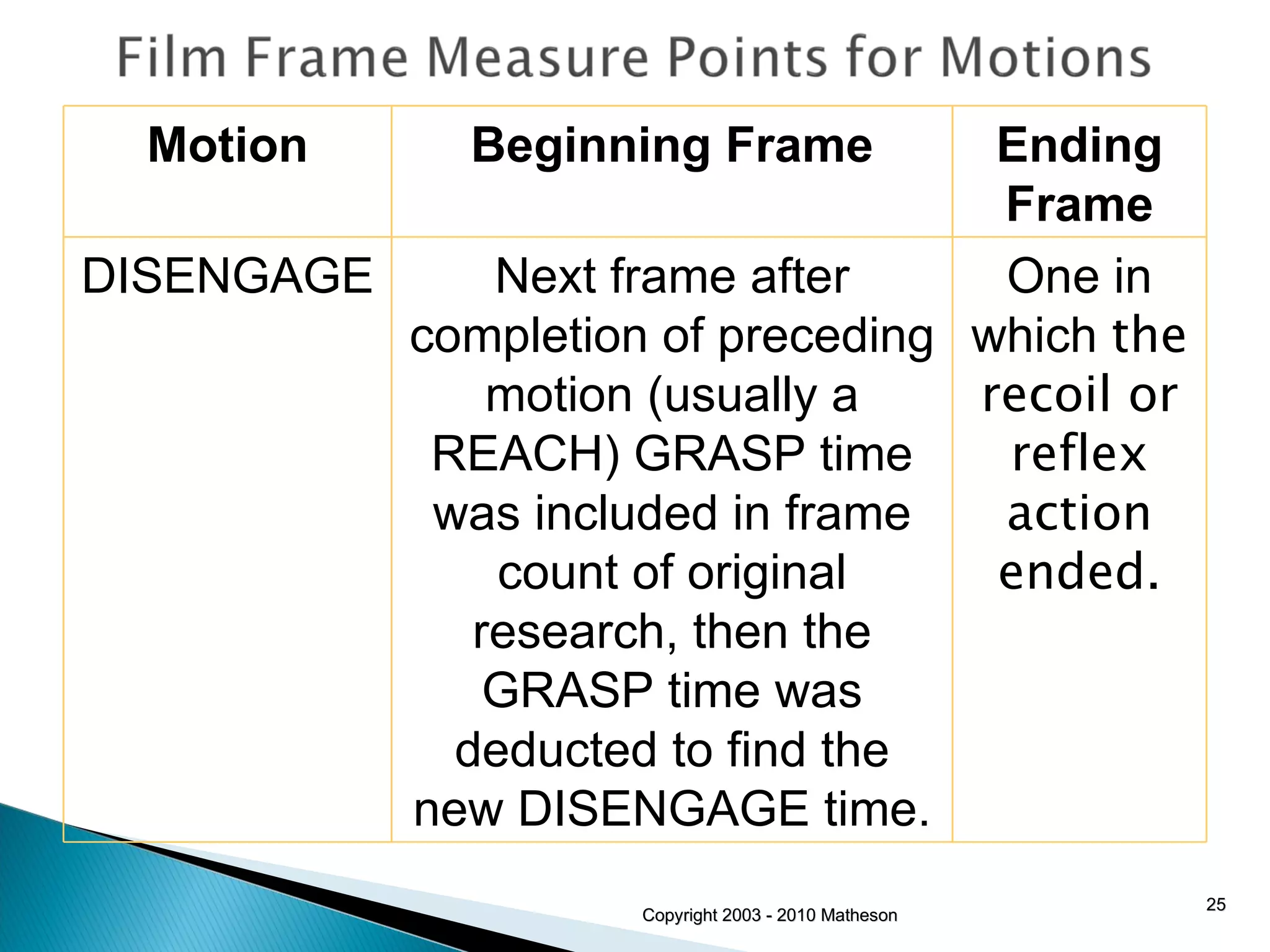
Copyright 2003 - 2010 Matheson Motion Beginning Frame Ending Frame DISENGAGE Next frame after completion of preceding motion (usually a REACH) GRASP time was included in frame count of original research, then the GRASP time was deducted to find the new DISENGAGE time. One in which  the recoil or reflex action ended.
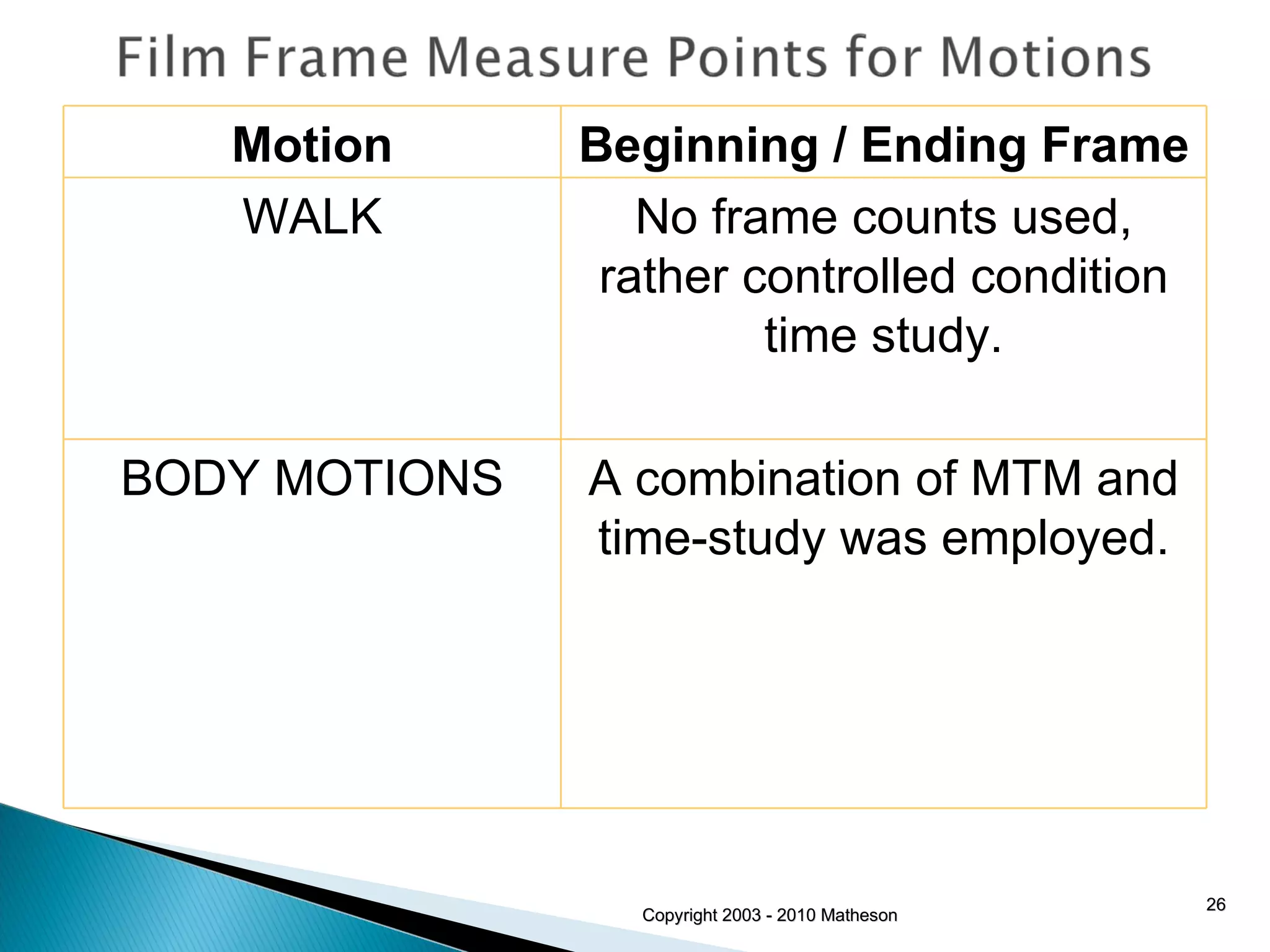
Copyright 2003 - 2010 Matheson Motion Beginning / Ending Frame WALK No frame counts used, rather controlled condition time study. BODY MOTIONS A combination of MTM and time-study was employed.
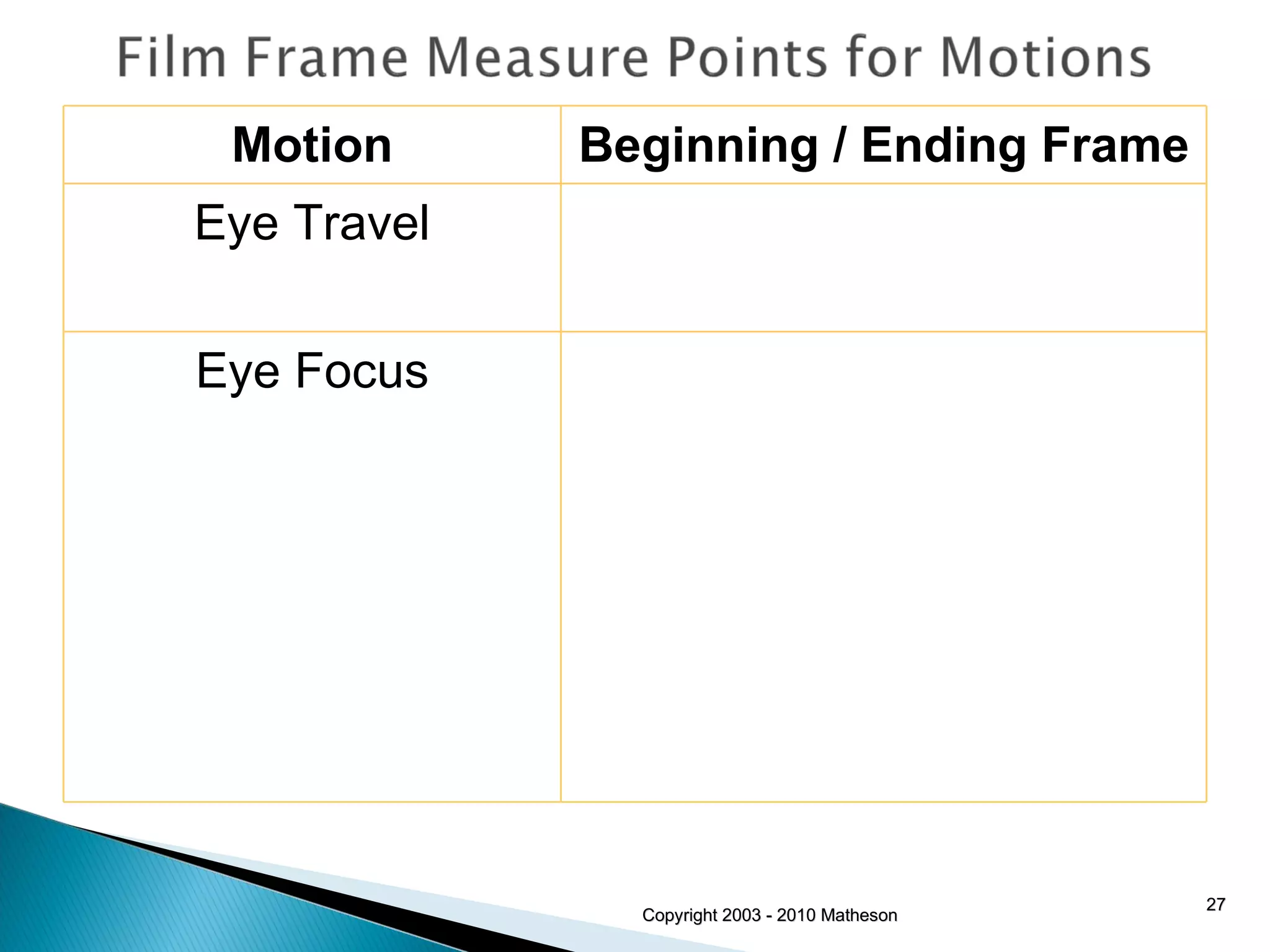
Copyright 2003 - 2010 Matheson Motion Beginning / Ending Frame Eye Travel Eye Focus
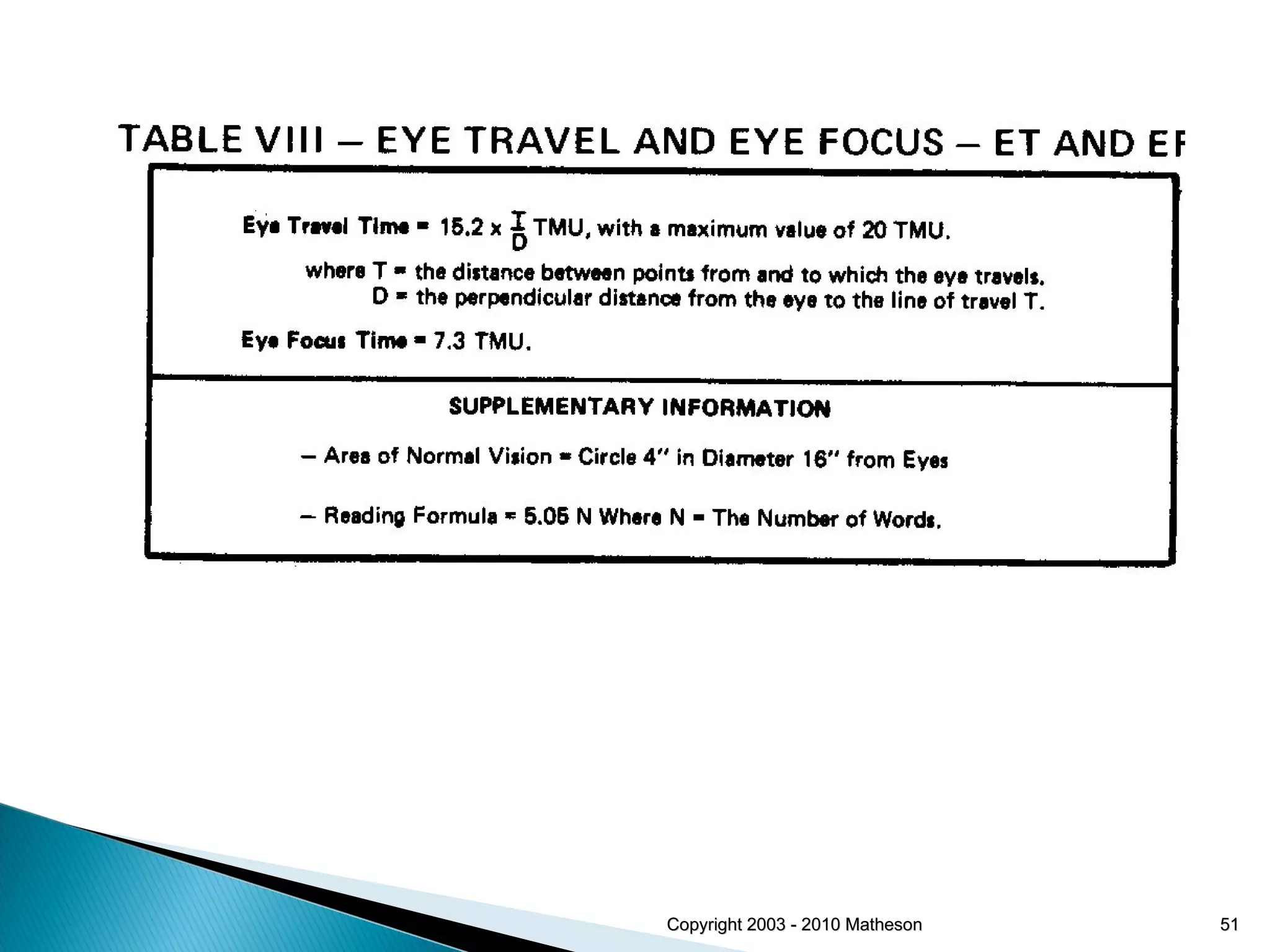
Copyright 2003 - 2010 Matheson
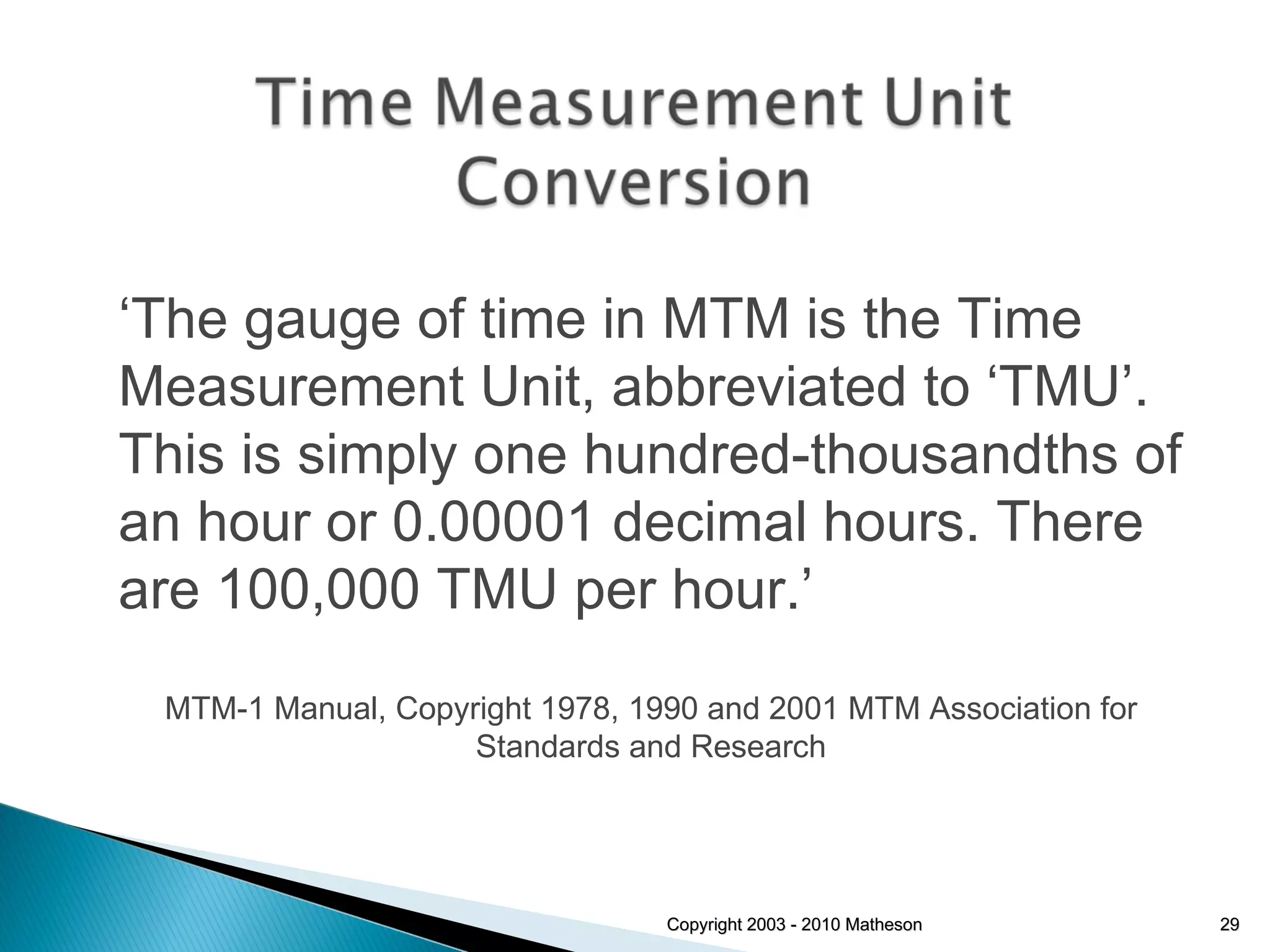
Copyright 2003 - 2010 Matheson ‘ The gauge of time in MTM is the Time Measurement Unit, abbreviated to ‘TMU’. This is simply one hundred-thousandths of an hour or 0.00001 decimal hours. There are 100,000 TMU per hour.’ MTM-1 Manual, Copyright 1978, 1990 and 2001 MTM Association for Standards and Research
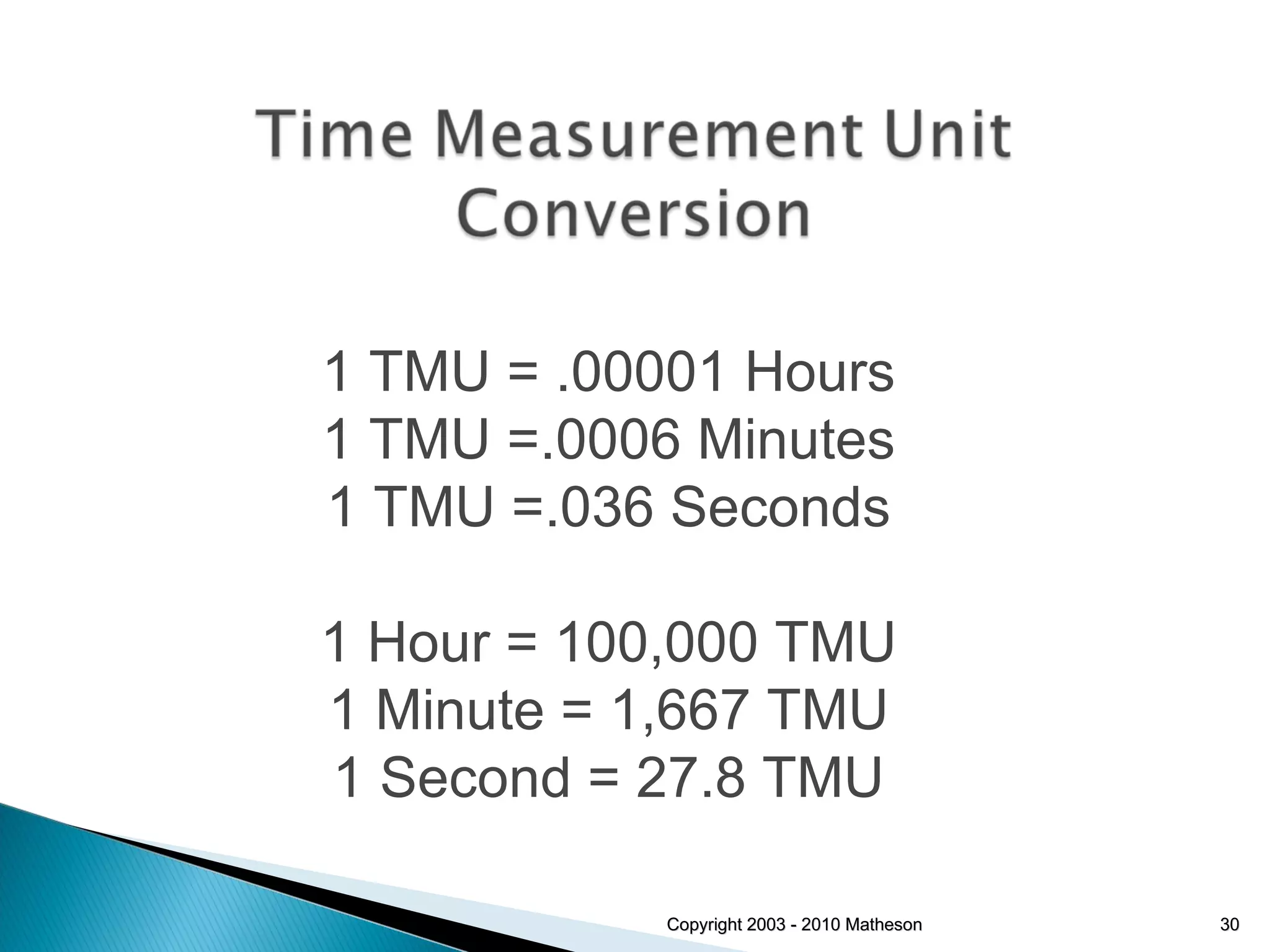
Copyright 2003 - 2010 Matheson 1 TMU = .00001 Hours 1 TMU =.0006 Minutes 1 TMU =.036 Seconds 1 Hour = 100,000 TMU 1 Minute = 1,667 TMU 1 Second = 27.8 TMU
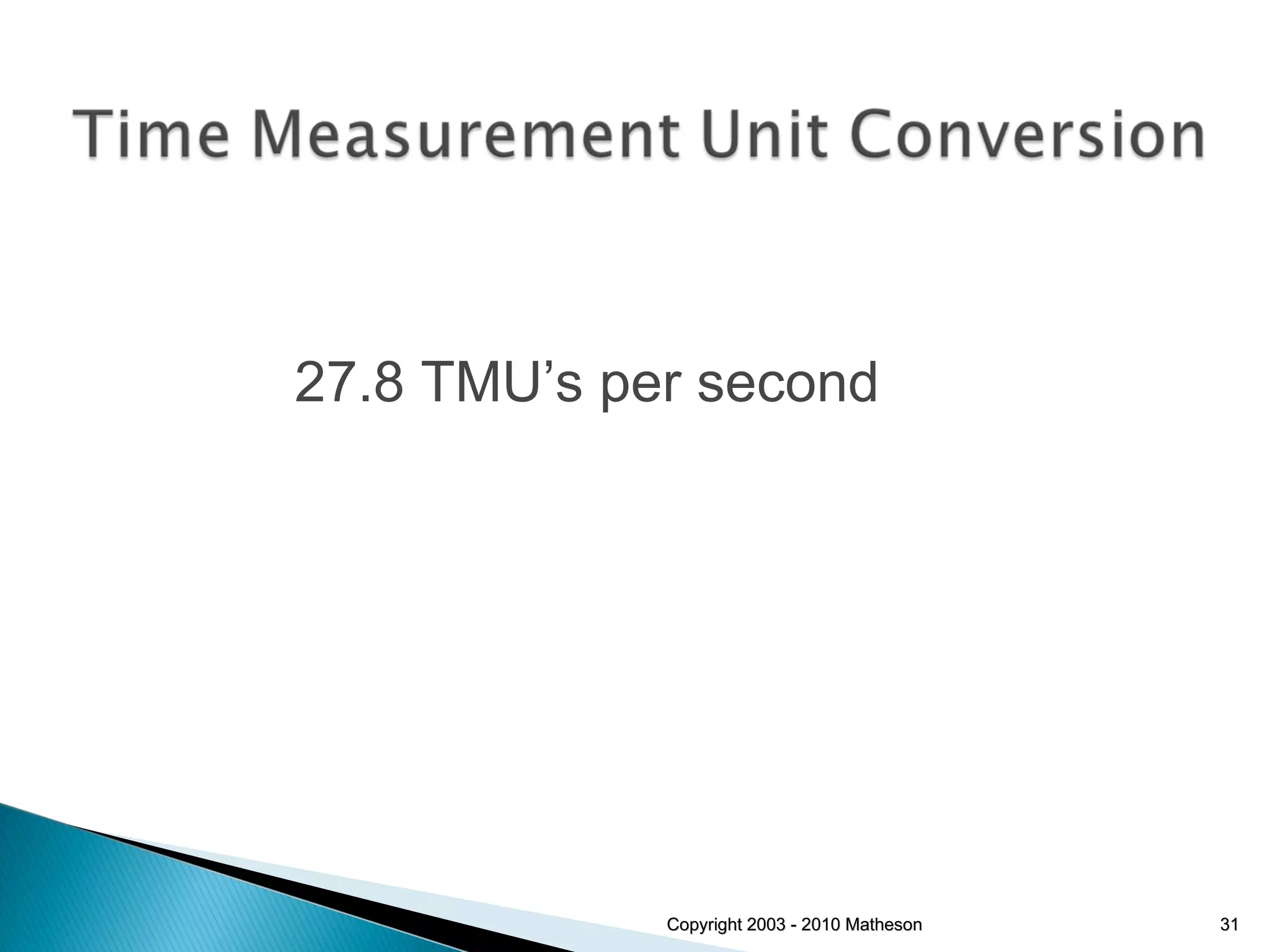
Copyright 2003 - 2010 Matheson 27.8 TMU’s per second
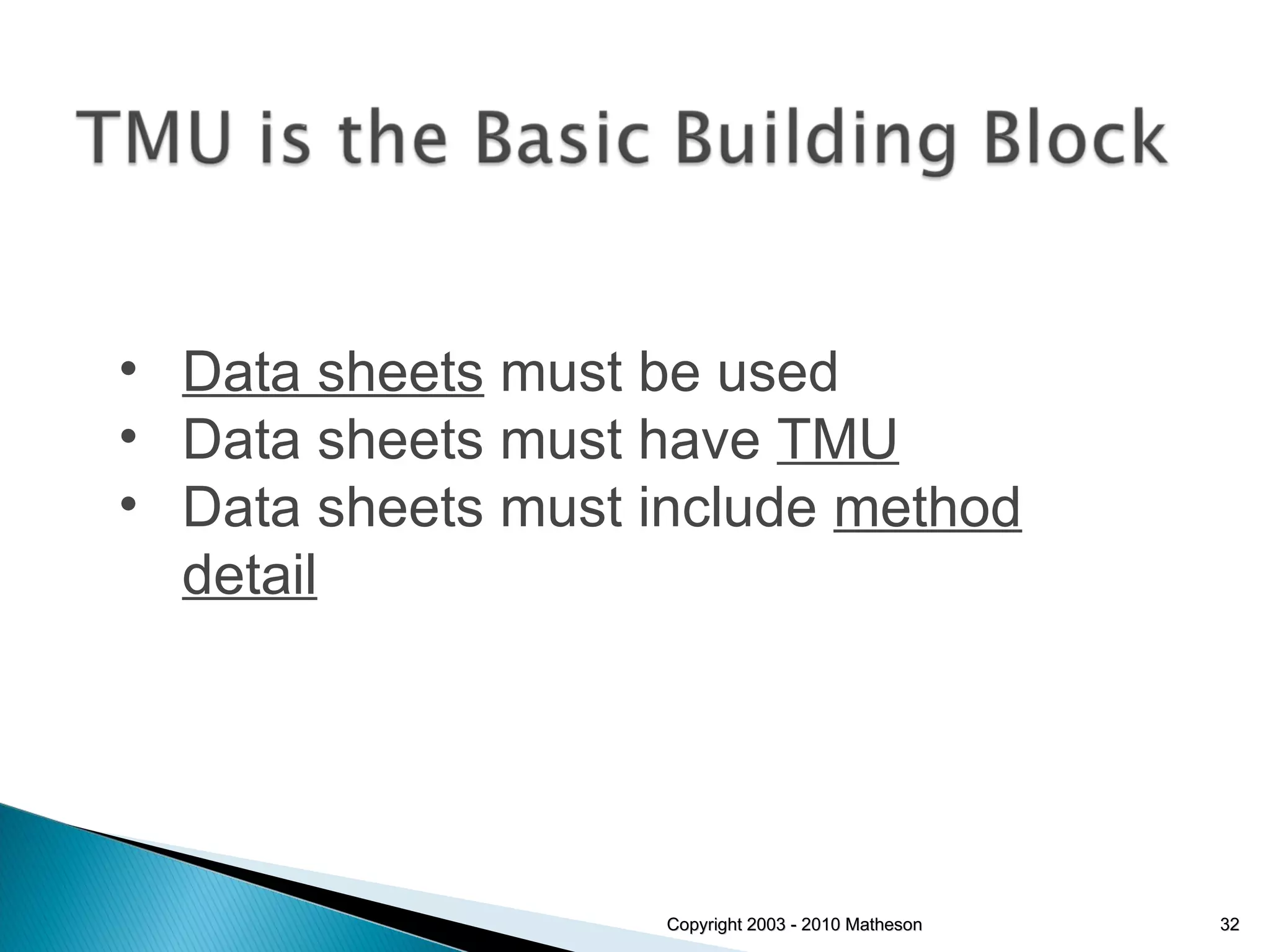
Copyright 2003 - 2010 Matheson Data sheets  must be used Data sheets must have  TMU Data sheets must include  method detail
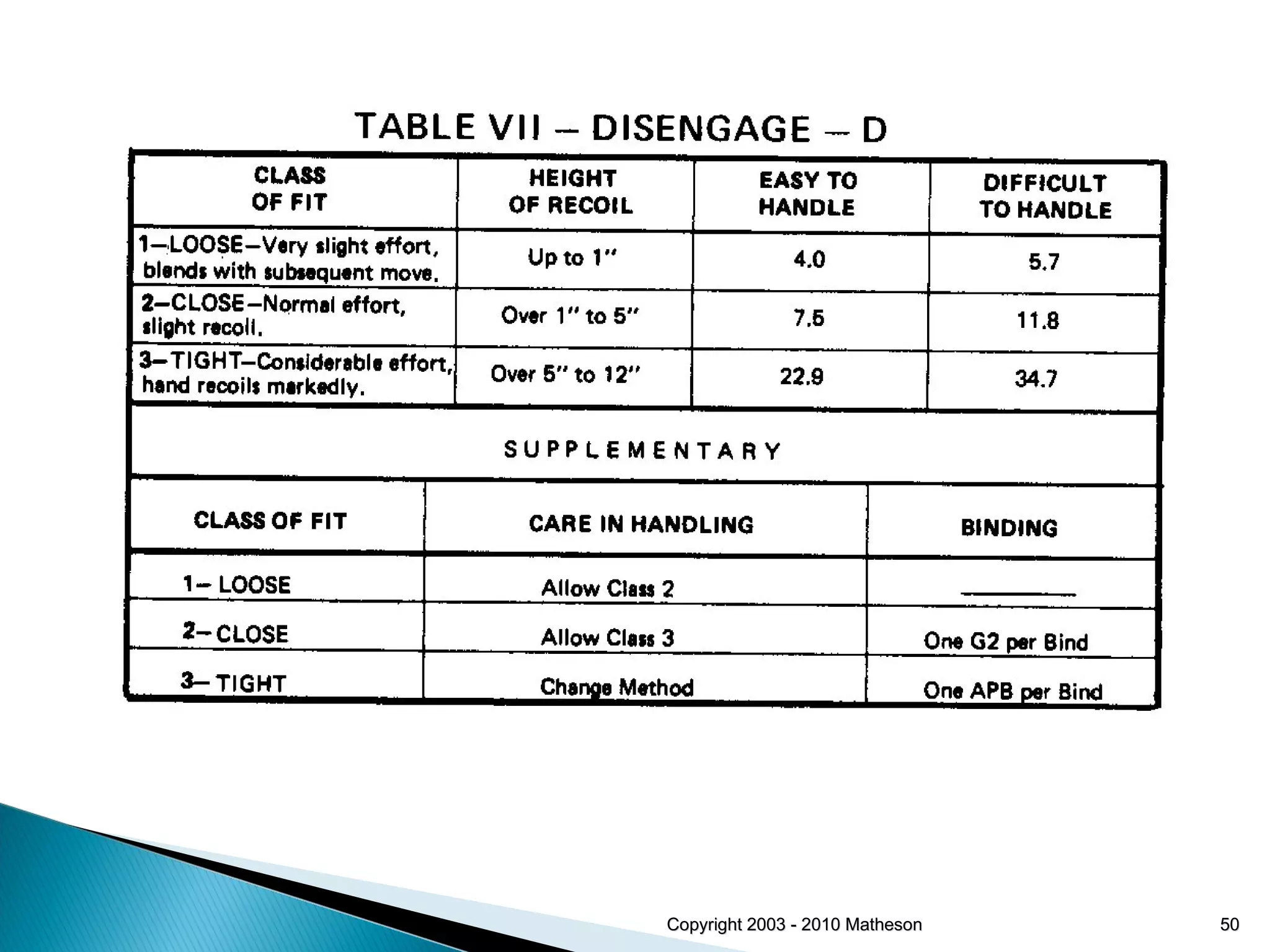
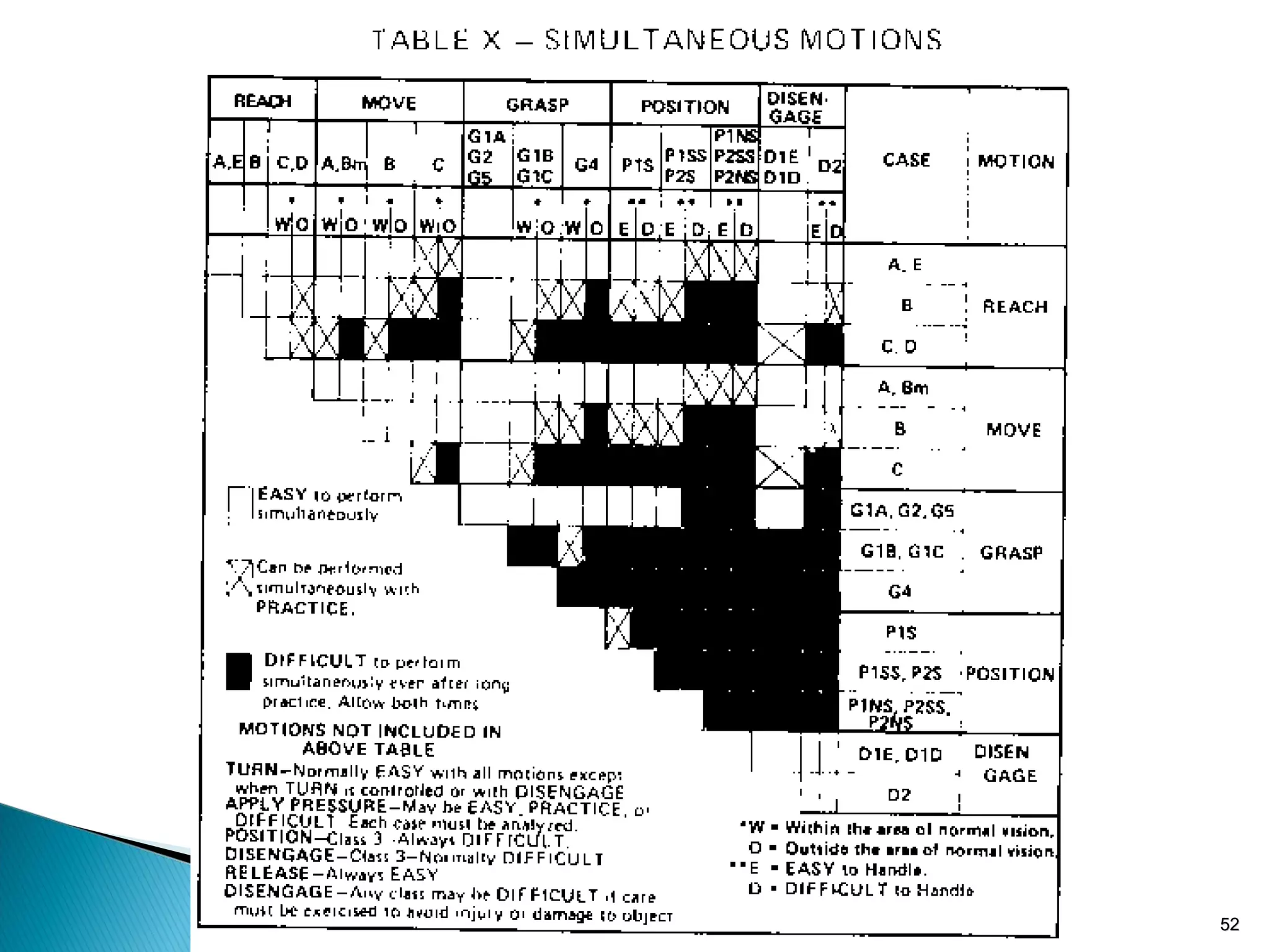
Copyright 2003 - 2010 Matheson
Copyright 2003 - 2010 Matheson ‘ The method-times measurement procedure recognizes eight manual movements, nine pedal and trunk movements and two ocular movements. Thus there are 19 fundamental motions motions that are considered in the establishment of any motion pattern.’ (Valpar International Corporation, Valpar 9 Component Work Sample)
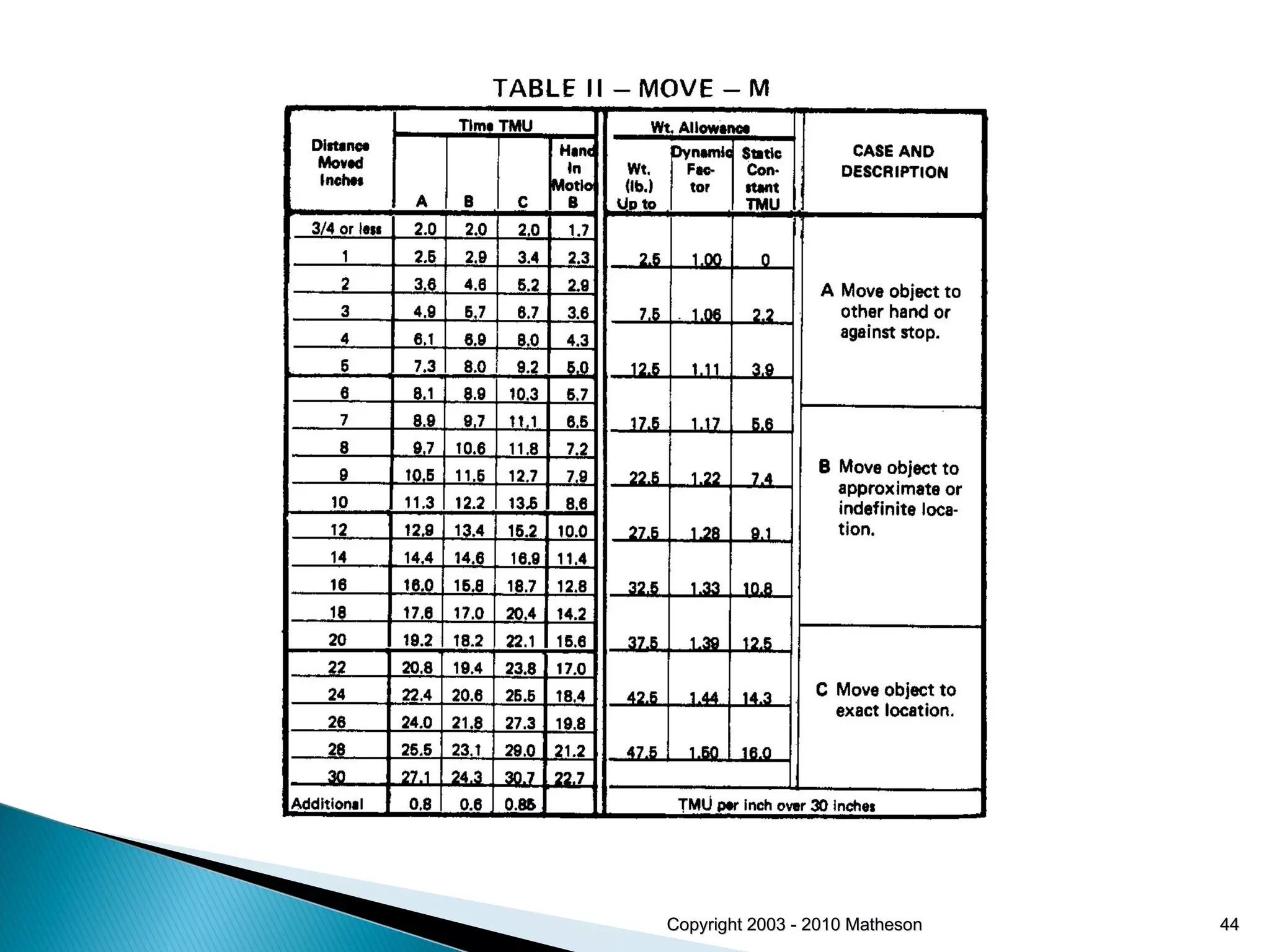
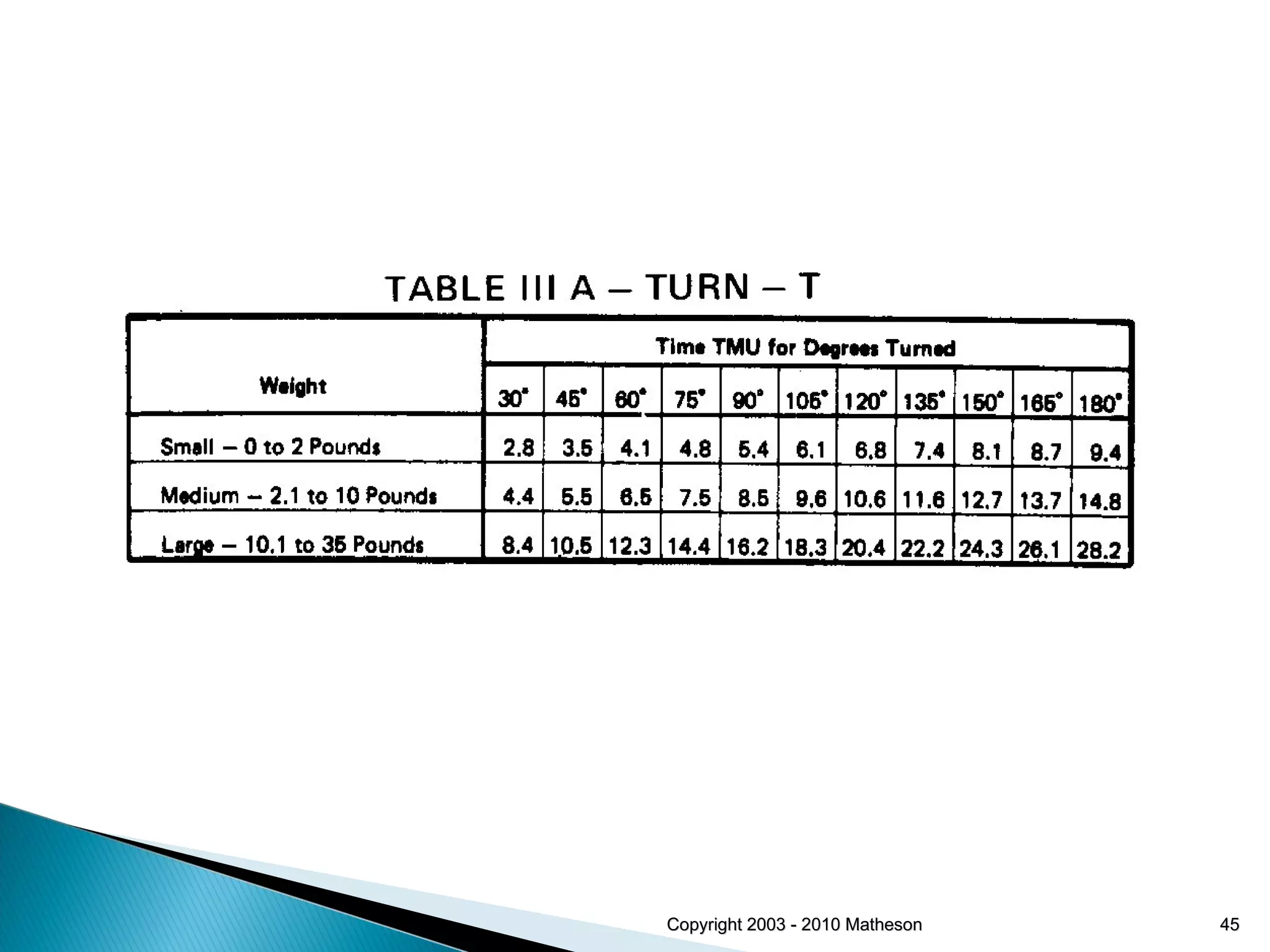
Copyright 2003 - 2010 Matheson For ease of use these 19 motions are organized on the MTM Data Card. The copyright to the Data Card is held my the MTM Association of America. It may not be reproduced in any form without advance, written permission of the Association.
Copyright 2003 - 2010 Matheson The 19 motions organized on the MTM Data Card are further separated into categories known as ‘Cases’. There are approximately 350 individual Case-specific measurements. Many case-specific measurements can be combined to form even more specific measurements.
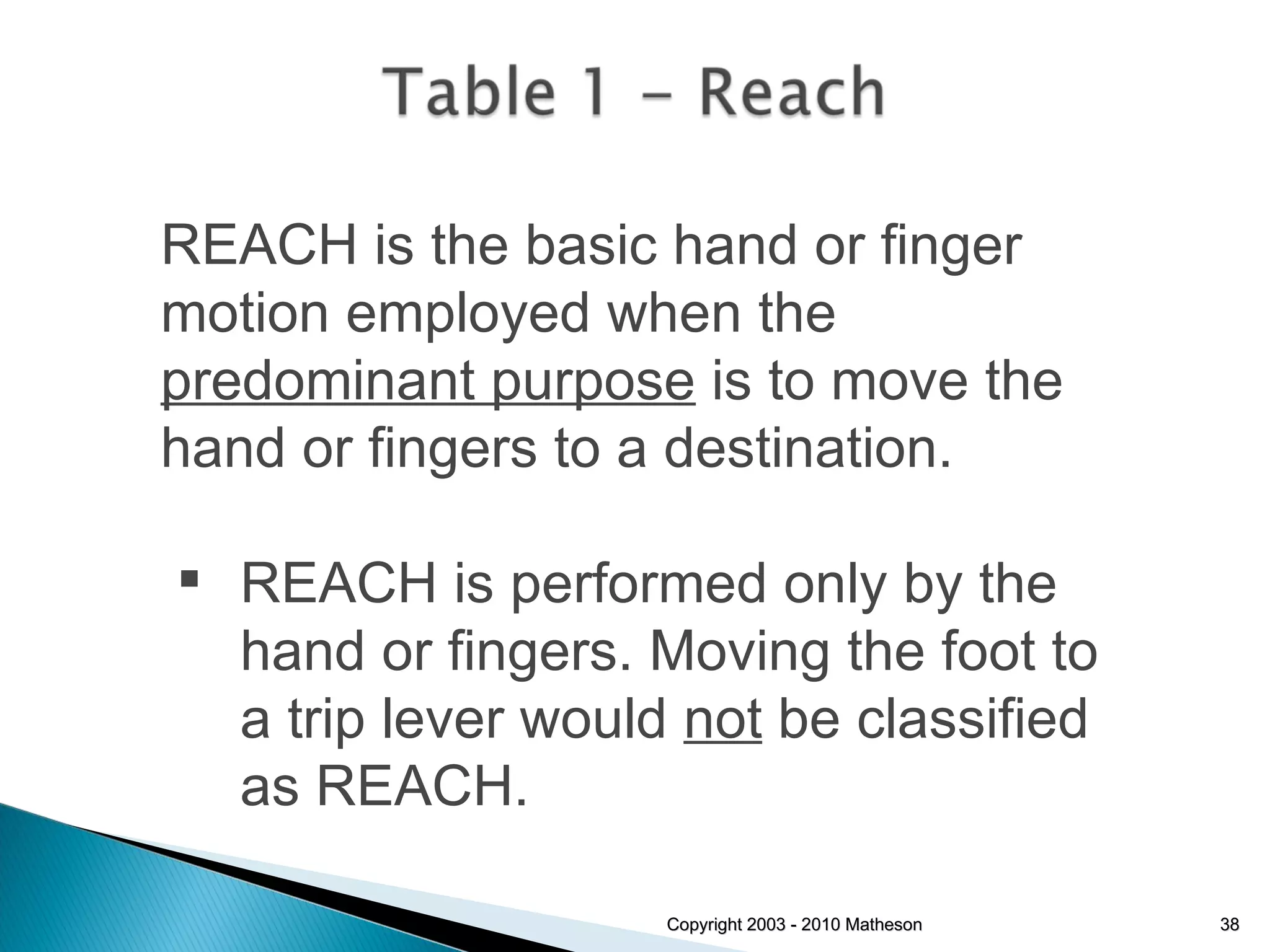
Copyright 2003 - 2010 Matheson REACH is the basic hand or finger motion employed when the  predominant purpose  is to move the hand or fingers to a destination. REACH is performed only by the hand or fingers. Moving the foot to a trip lever would  not  be classified as REACH.
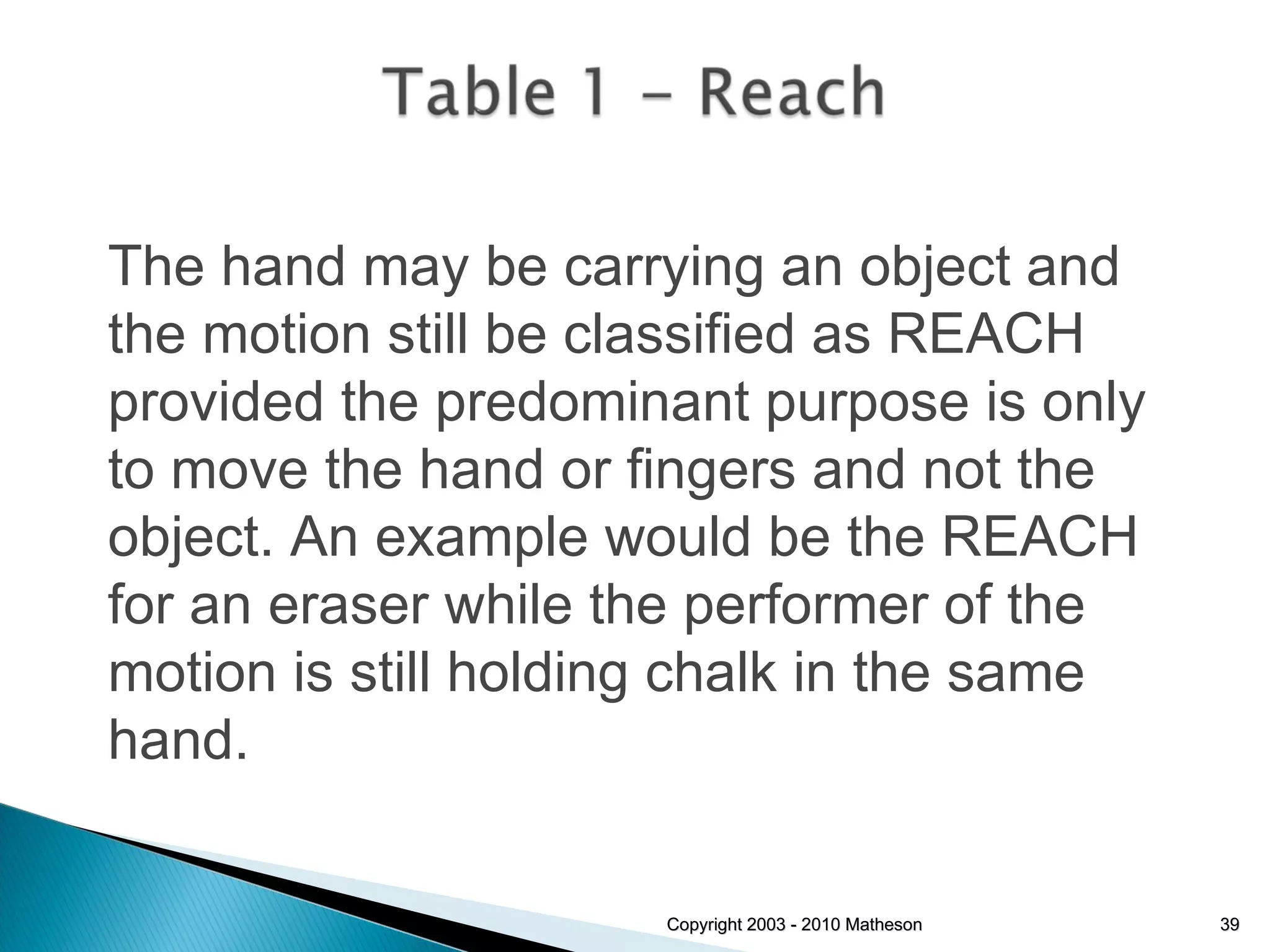
Copyright 2003 - 2010 Matheson The hand may be carrying an object and the motion still be classified as REACH provided the predominant purpose is only to move the hand or fingers and not the object. An example would be the REACH for an eraser while the performer of the motion is still holding chalk in the same hand.
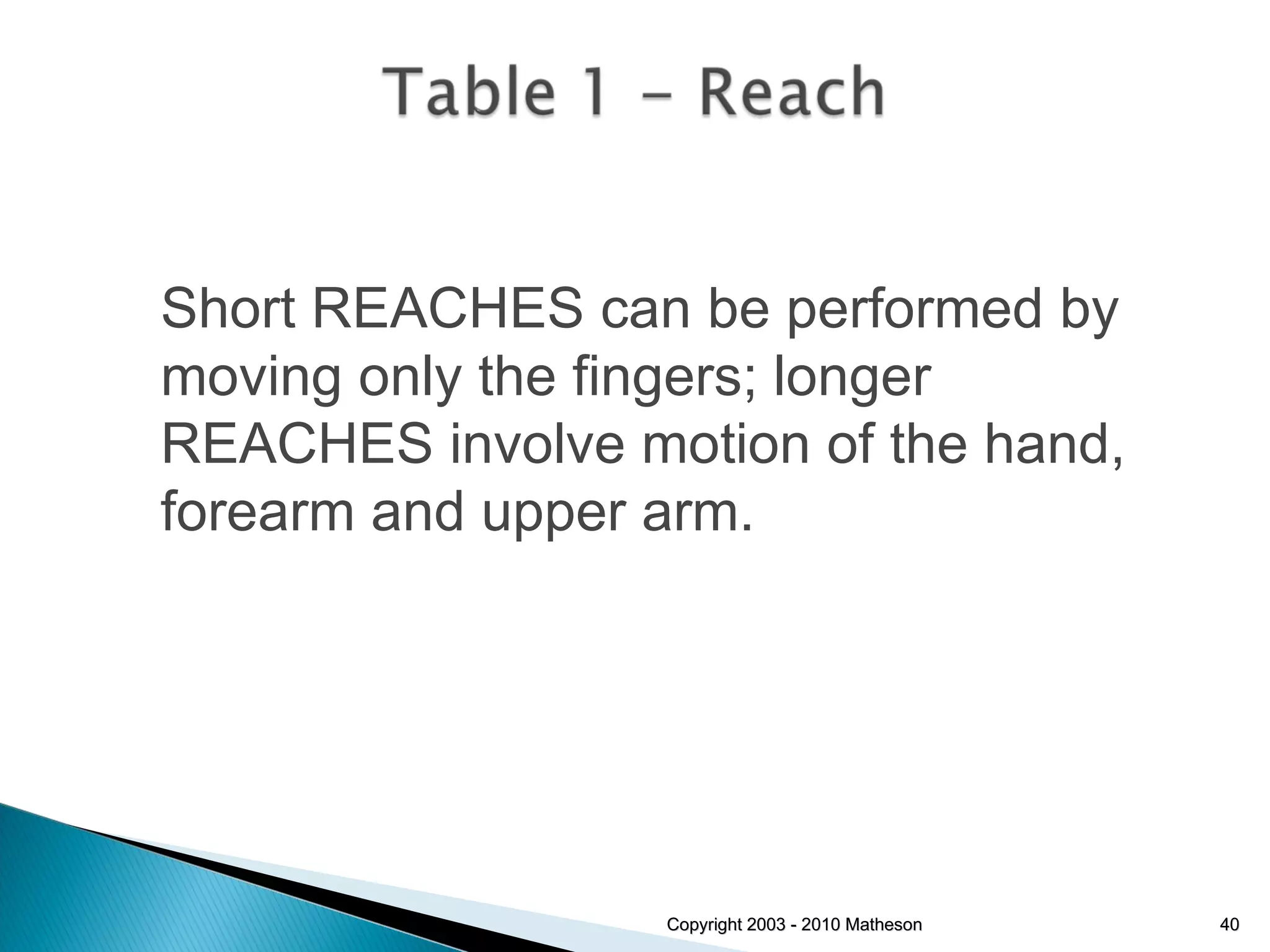
Copyright 2003 - 2010 Matheson Short REACHES can be performed by moving only the fingers; longer REACHES involve motion of the hand, forearm and upper arm.
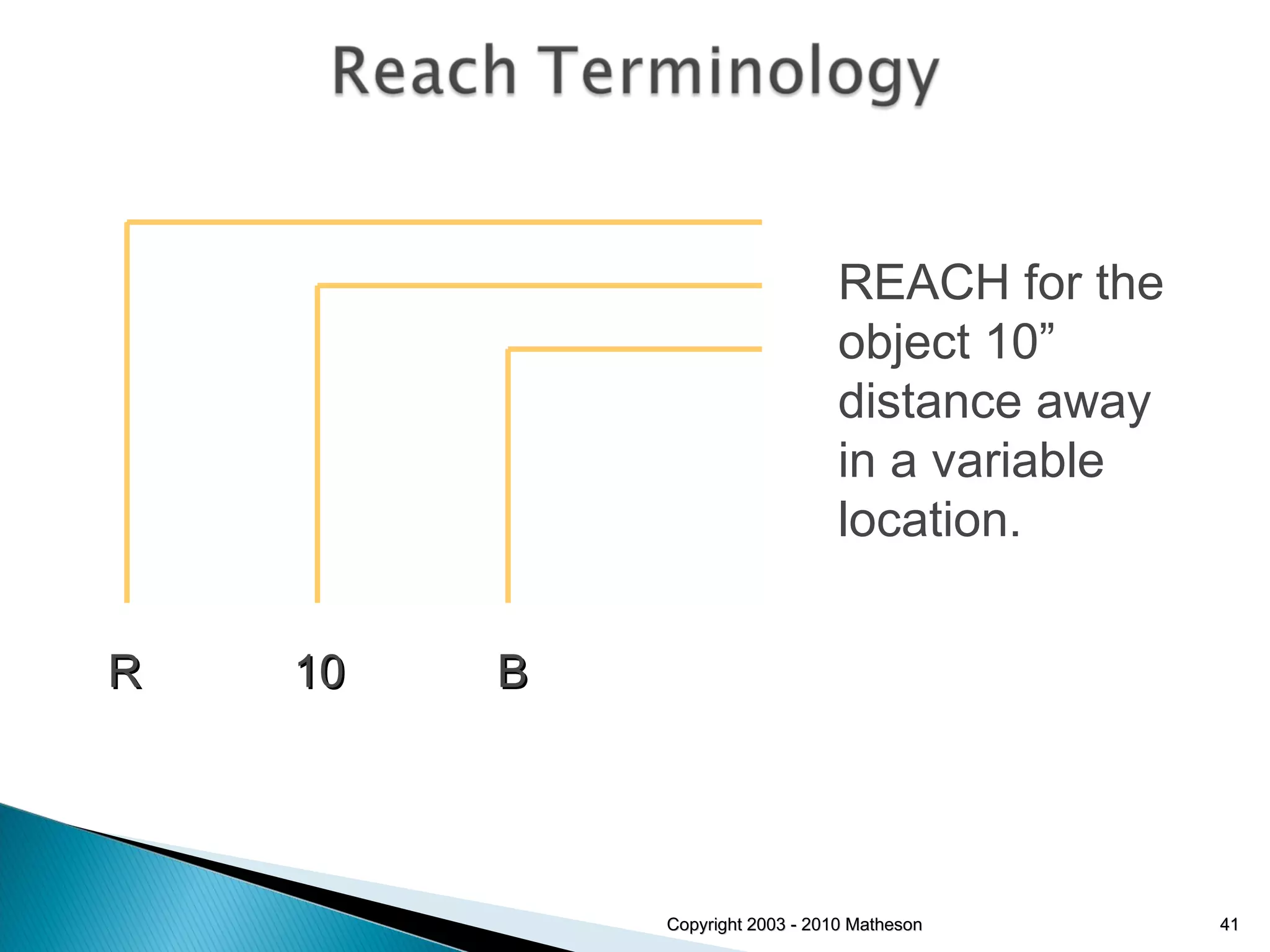
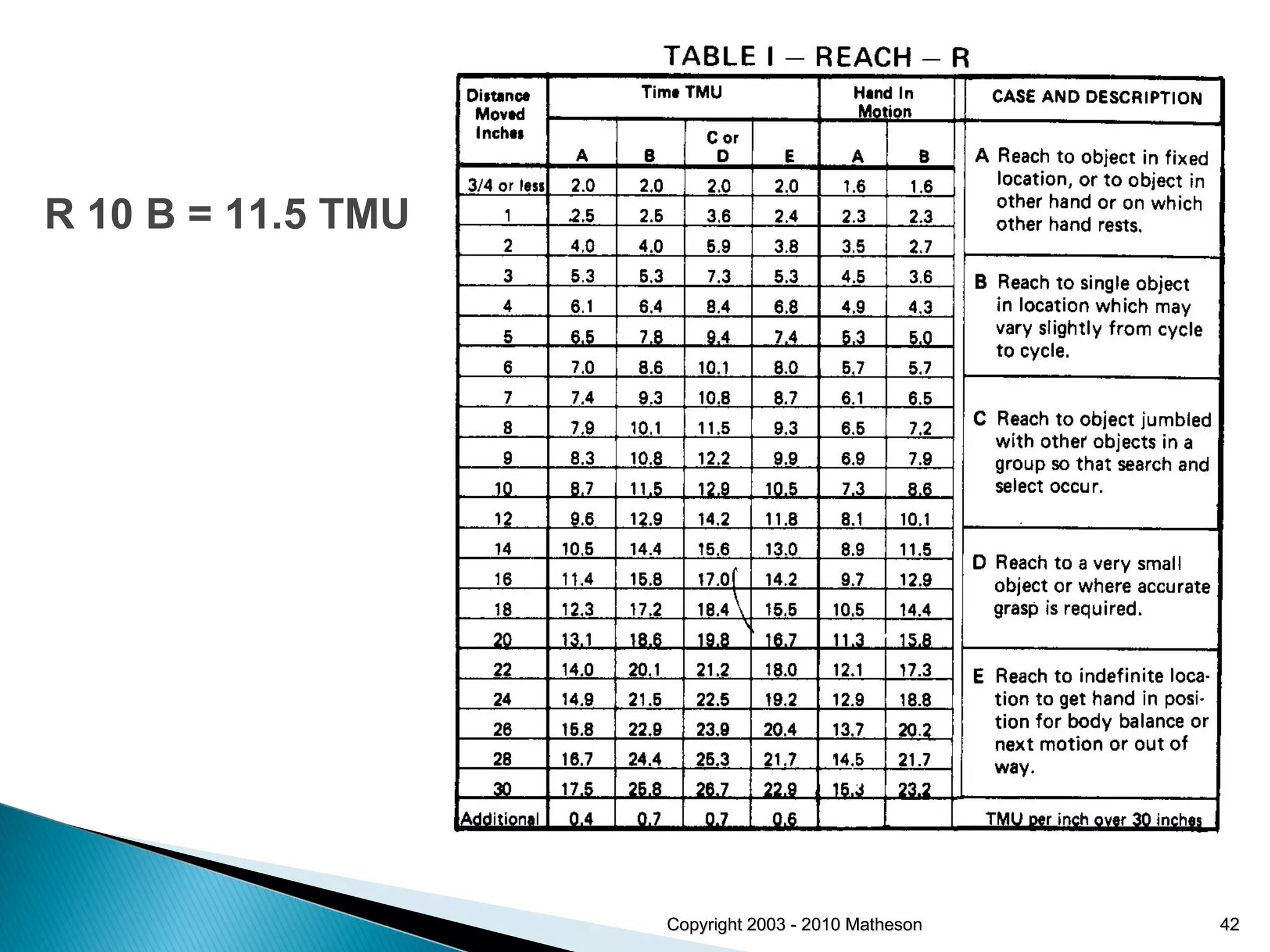
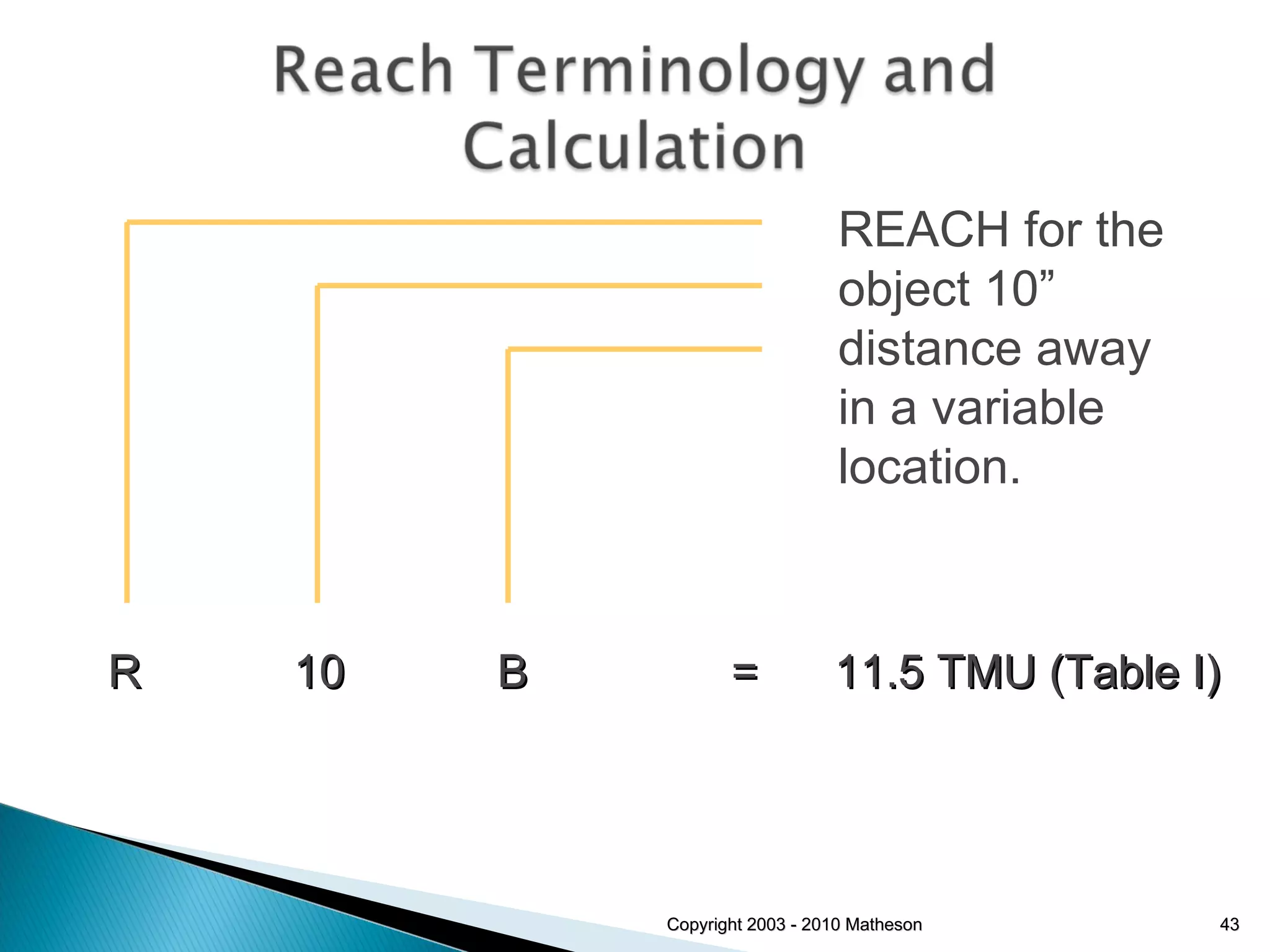
Copyright 2003 - 2010 Matheson REACH for the object 10” distance away in a variable location. R  10  B
Copyright 2003 - 2010 Matheson R 10 B = 11.5 TMU
Copyright 2003 - 2010 Matheson REACH for the object 10” distance away in a variable location. R  10  B  =  11.5 TMU (Table I)
Copyright 2003 - 2010 Matheson
Copyright 2003 - 2010 Matheson A Simple Demonstration Kneel on One Knee Arise from Kneel on One Knee
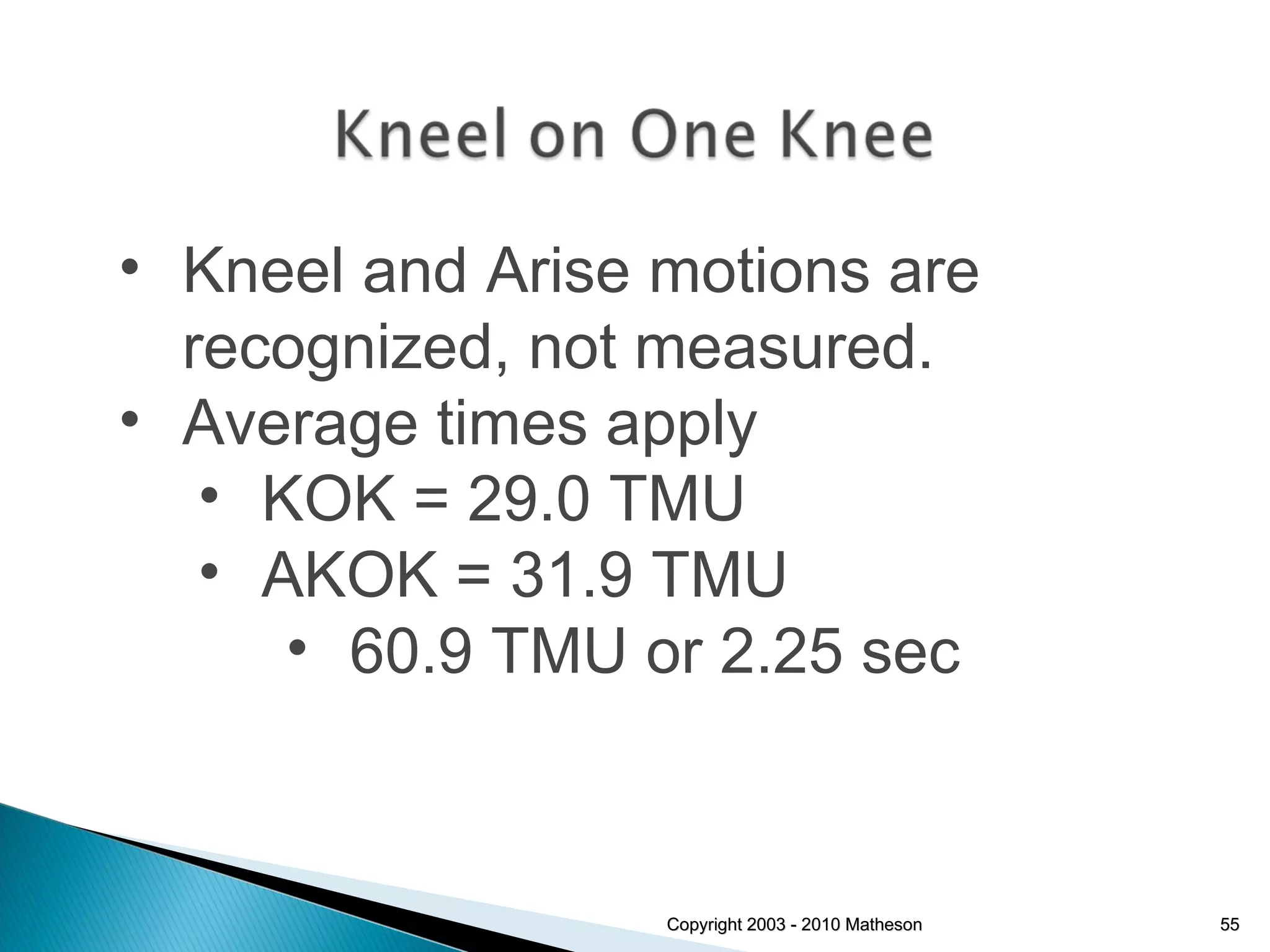
Copyright 2003 - 2010 Matheson Kneel and Arise motions are recognized, not measured. Average times apply KOK = 29.0 TMU AKOK = 31.9 TMU 60.9 TMU or 2.25 sec
Copyright 2003 - 2010 Matheson “ Occasional” is easy “ Frequent” is the question
Copyright 2003 - 2010 Matheson Which MTM system was used to set the time standard for my evaluation device? Who was the MTM analyst responsible for writing the time standard? May I see a copy of data sheets that set the time standard for an identifiable process?
Copyright 2003 - 2010 Matheson Antis, W., Honeycutt, Jr., J. M., Koch, E. N.  The Basic Motions of MTM.  5 th  Edition, Columbus, OH: Maynard Research Council, Inc., 1963. Aulanko, V., Hotanen, J., Salonen, A.  Standard Data Systems and Their Construction , Des Plaines, IL: The MTM Association for Standards and Research, 1977. Hovi-Lehmoskeski-Ojanen,  Havainnointimenepelma tyonputkimuksessa , Tietomies Maynard, H.B., Stegemerten, G.J. and Schwab, J.L.  Methods-time Measurement. , New York: McGraw-Hill, 1948. Niebel, B. W., Freivalds, A.  Methods, Standards, and Work Design . 11 th  Edition, New York: McGraw-Hill, 2003. Taylor, F.W.  The Principles of Scientific Management , New York: Harper, 1911.
Copyright 2003 - 2010 Matheson United States Department of Labor, Employment and Training Administration  Dictionary of Occupational Titles . 4 th  Edition, Washington, D.C.: U.S. Government Printing Office. United States Department of Labor, Employment and Training Administration  The Revised Handbook for Analyzing Jobs,  Washington, D.C.: U.S. Government Printing Office. United States Department of Labor  Revised Handbook for Analyzing Jobs,  Washington, D.C.: U.S. Government Printing Office, 1991.

Methods-Time Measurement and Functional Capacity Evaluation 041610

  • 1.
    Copyright 2003 -2010 Matheson Method-Time Measurement and Functional Capacity Evaluation
  • 2.
    Copyright 2003 -2010 Matheson My MTM Background Why are we here today? The Practice Hierarchy Definition of MTM The MTM Family An Overview of MTM -1 The Link Between MTM and FCE Questions to Ask Introduction
  • 3.
    Copyright 2003 -2010 Matheson Originally trained in MTM – 1 One year of additional study Trained in MTM – B Developed MTM Standards Purdue Minnesota Bennett MPS My MTM Background
  • 4.
    Copyright 2003 -2010 Matheson My original interest in Valpar raised questions Took MTM training Joined MTM research committee Joined MTM board of directors More questions raised in conversation Why are we here today?
  • 5.
    Safety Reliability ValidityPracticality Utility Copyright 2003 - 2010 Matheson
  • 6.
    “ MTM analyzesany manual operation or method into the basic motions required to perform it and assigns to each motion a pre-determined time standard which is determined by the nature of the motion and the conditions under which it is made.” (Maynard, Stegemerten, and Schwab, 1948) Copyright 2003 - 2010 Matheson
  • 7.
    Method-time: the nameincludes a hyphen to focus attention upon its basic nature. The specific method must be chosen or established before any meaningful time can be assigned. Copyright 2003 - 2010 Matheson
  • 8.
    Procedure: There aredefinite analysis steps which must be made according to system rules. Copyright 2003 - 2010 Matheson
  • 9.
    Manual operation: heremanual means human. MTM evaluates the normal operations performed by people, giving the time as controlled by human energy. This excludes performance time controlled by equipment and the process, such as welding or machining time. Copyright 2003 - 2010 Matheson
  • 10.
    Basic motions: thisrefers to the manual motions of the fingers, hands and arms as well as eye motions together with the body, leg, and foot motions of the operator. All of these are the motions shown on the MTM data card. Copyright 2003 - 2010 Matheson
  • 11.
    Predetermined time: motionsdefined in the system require performance times standardized in advance for the average operator in the normal working population. These times predict the result of average skill and effort under average conditions for the operator in question. Copyright 2003 - 2010 Matheson
  • 12.
    Copyright 2003 -2010 Matheson
  • 13.
    The most widelyused predetermined time measurement system, is recognized worldwide as a standard by which other systems are measured. Besides time determination of the highest accuracy it also provides highly detailed method description. It is ideally suited for measuring high volume, short cycle operations where a high degree of accuracy is needed and the benefits of method improvement are optimal. Copyright 2003 - 2010 Matheson MTM 1
  • 14.
    MTM–UAS MTM –C MTM – V MTM – TE MTM - B Copyright 2003 - 2010 Matheson The Other Members of the MTM Family
  • 15.
    Copyright 2003 -2010 Matheson An Overview of MTM - 1
  • 16.
    Copyright 2003 -2010 Matheson An Overview of MTM-1 The Original Research Time Measurement Units The Data Card
  • 17.
    Copyright 2003 -2010 Matheson The researchers studied drill press operators.
  • 18.
    Copyright 2003 -2010 Matheson The human subjects have been described as ‘well-trained workers working at a speed that could be maintained all day.’
  • 19.
    Copyright 2003 -2010 Matheson An expanded description would include: Well-trained workers Working at a speed that could be maintained all day Who took personal time during the work day Who experienced interruptions in work cycles Who used well maintained equipment
  • 20.
    Copyright 2003 -2010 Matheson The researchers filmed subjects at a film rate speed of 16 frames per second. They then defined a specific set of ‘Film Frame Measure Points’ for each of the motions. Film Frame Measure Points for Motions
  • 21.
    Copyright 2003 -2010 Matheson Motion Beginning Frame Ending Frame REACH One preceding the first frame in which noticeable motion occurs. One in which noticeable motion has ceased or that marks the start of the next basic motion following. MOVE Same as for REACH TURN Same as for REACH
  • 22.
    Copyright 2003 -2010 Matheson Motion Beginning Frame Ending Frame APPLY PRESSURE One in which preceding motion clearly ceased. One in which next motion clearly begins. GRASP Next frame after completion of preceding motion (REACH) One in which next motion starts.
  • 23.
    Copyright 2003 -2010 Matheson Motion Beginning Frame Ending Frame POSITION Next frame after completion of preceding motion (MOVE) Ensuing RELEASE was included in frame count of original research, then the RELEASE time was deducted to find POSITION time total. Ending point for POSITION-RELEASE combination was the one in which the next MOTION (REACH) began.
  • 24.
    Copyright 2003 -2010 Matheson Motion Beginning Frame Ending Frame RELEASE Next frame after completion of preceding motion (MOVE or POSITION). One in which next motion (REACH) began. This was also checked by noting the frames covered by the finger motions of RELEASE.
  • 25.
    Copyright 2003 -2010 Matheson Motion Beginning Frame Ending Frame DISENGAGE Next frame after completion of preceding motion (usually a REACH) GRASP time was included in frame count of original research, then the GRASP time was deducted to find the new DISENGAGE time. One in which the recoil or reflex action ended.
  • 26.
    Copyright 2003 -2010 Matheson Motion Beginning / Ending Frame WALK No frame counts used, rather controlled condition time study. BODY MOTIONS A combination of MTM and time-study was employed.
  • 27.
    Copyright 2003 -2010 Matheson Motion Beginning / Ending Frame Eye Travel Eye Focus
  • 28.
    Copyright 2003 -2010 Matheson
  • 29.
    Copyright 2003 -2010 Matheson ‘ The gauge of time in MTM is the Time Measurement Unit, abbreviated to ‘TMU’. This is simply one hundred-thousandths of an hour or 0.00001 decimal hours. There are 100,000 TMU per hour.’ MTM-1 Manual, Copyright 1978, 1990 and 2001 MTM Association for Standards and Research
  • 30.
    Copyright 2003 -2010 Matheson 1 TMU = .00001 Hours 1 TMU =.0006 Minutes 1 TMU =.036 Seconds 1 Hour = 100,000 TMU 1 Minute = 1,667 TMU 1 Second = 27.8 TMU
  • 31.
    Copyright 2003 -2010 Matheson 27.8 TMU’s per second
  • 32.
    Copyright 2003 -2010 Matheson Data sheets must be used Data sheets must have TMU Data sheets must include method detail
  • 33.
    Copyright 2003 -2010 Matheson
  • 34.
    Copyright 2003 -2010 Matheson
  • 35.
    Copyright 2003 -2010 Matheson ‘ The method-times measurement procedure recognizes eight manual movements, nine pedal and trunk movements and two ocular movements. Thus there are 19 fundamental motions motions that are considered in the establishment of any motion pattern.’ (Valpar International Corporation, Valpar 9 Component Work Sample)
  • 36.
    Copyright 2003 -2010 Matheson For ease of use these 19 motions are organized on the MTM Data Card. The copyright to the Data Card is held my the MTM Association of America. It may not be reproduced in any form without advance, written permission of the Association.
  • 37.
    Copyright 2003 -2010 Matheson The 19 motions organized on the MTM Data Card are further separated into categories known as ‘Cases’. There are approximately 350 individual Case-specific measurements. Many case-specific measurements can be combined to form even more specific measurements.
  • 38.
    Copyright 2003 -2010 Matheson REACH is the basic hand or finger motion employed when the predominant purpose is to move the hand or fingers to a destination. REACH is performed only by the hand or fingers. Moving the foot to a trip lever would not be classified as REACH.
  • 39.
    Copyright 2003 -2010 Matheson The hand may be carrying an object and the motion still be classified as REACH provided the predominant purpose is only to move the hand or fingers and not the object. An example would be the REACH for an eraser while the performer of the motion is still holding chalk in the same hand.
  • 40.
    Copyright 2003 -2010 Matheson Short REACHES can be performed by moving only the fingers; longer REACHES involve motion of the hand, forearm and upper arm.
  • 41.
    Copyright 2003 -2010 Matheson REACH for the object 10” distance away in a variable location. R 10 B
  • 42.
    Copyright 2003 -2010 Matheson R 10 B = 11.5 TMU
  • 43.
    Copyright 2003 -2010 Matheson REACH for the object 10” distance away in a variable location. R 10 B = 11.5 TMU (Table I)
  • 44.
    Copyright 2003 -2010 Matheson
  • 45.
    Copyright 2003 -2010 Matheson
  • 46.
    Copyright 2003 -2010 Matheson
  • 47.
    Copyright 2003 -2010 Matheson
  • 48.
    Copyright 2003 -2010 Matheson
  • 49.
    Copyright 2003 -2010 Matheson
  • 50.
    Copyright 2003 -2010 Matheson
  • 51.
    Copyright 2003 -2010 Matheson
  • 52.
    Copyright 2003 -2010 Matheson
  • 53.
    Copyright 2003 -2010 Matheson
  • 54.
    Copyright 2003 -2010 Matheson A Simple Demonstration Kneel on One Knee Arise from Kneel on One Knee
  • 55.
    Copyright 2003 -2010 Matheson Kneel and Arise motions are recognized, not measured. Average times apply KOK = 29.0 TMU AKOK = 31.9 TMU 60.9 TMU or 2.25 sec
  • 56.
    Copyright 2003 -2010 Matheson “ Occasional” is easy “ Frequent” is the question
  • 57.
    Copyright 2003 -2010 Matheson Which MTM system was used to set the time standard for my evaluation device? Who was the MTM analyst responsible for writing the time standard? May I see a copy of data sheets that set the time standard for an identifiable process?
  • 58.
    Copyright 2003 -2010 Matheson Antis, W., Honeycutt, Jr., J. M., Koch, E. N. The Basic Motions of MTM. 5 th Edition, Columbus, OH: Maynard Research Council, Inc., 1963. Aulanko, V., Hotanen, J., Salonen, A. Standard Data Systems and Their Construction , Des Plaines, IL: The MTM Association for Standards and Research, 1977. Hovi-Lehmoskeski-Ojanen, Havainnointimenepelma tyonputkimuksessa , Tietomies Maynard, H.B., Stegemerten, G.J. and Schwab, J.L. Methods-time Measurement. , New York: McGraw-Hill, 1948. Niebel, B. W., Freivalds, A. Methods, Standards, and Work Design . 11 th Edition, New York: McGraw-Hill, 2003. Taylor, F.W. The Principles of Scientific Management , New York: Harper, 1911.
  • 59.
    Copyright 2003 -2010 Matheson United States Department of Labor, Employment and Training Administration Dictionary of Occupational Titles . 4 th Edition, Washington, D.C.: U.S. Government Printing Office. United States Department of Labor, Employment and Training Administration The Revised Handbook for Analyzing Jobs, Washington, D.C.: U.S. Government Printing Office. United States Department of Labor Revised Handbook for Analyzing Jobs, Washington, D.C.: U.S. Government Printing Office, 1991.

Editor's Notes

  • #7 Manual not machine Method Predetermined time standards The reason teaching class is not to take a stand on the value of mtm as it relates to fce . The reason to teach the class is educate them about mtm so they can decide the value of mtm in their own fce. After all the challenge in this business is not whether one fce system is better than another but the value of work evaluation in general.
  • #8 Manual not machine Method Predetermined time standards The reason teaching class is not to take a stand on the value of mtm as it relates to fce . The reason to teach the class is educate them about mtm so they can decide the value of mtm in their own fce. After all the challenge in this business is not wether one fce system is better than another but the value of work evaluation in general.
  • #9 Manual not machine Method Predetermined time standards The reason teaching class is not to take a stand on the value of mtm as it relates to fce . The reason to teach the class is educate them about mtm so they can decide the value of mtm in their own fce. After all the challenge in this business is not wether one fce system is better than another but the value of work evaluation in general.
  • #10 Manual not machine Method Predetermined time standards The reason teaching class is not to take a stand on the value of mtm as it relates to fce . The reason to teach the class is educate them about mtm so they can decide the value of mtm in their own fce. After all the challenge in this business is not wether one fce system is better than another but the value of work evaluation in general.
  • #11 Manual not machine Method Predetermined time standards The reason teaching class is not to take a stand on the value of mtm as it relates to fce . The reason to teach the class is educate them about mtm so they can decide the value of mtm in their own fce. After all the challenge in this business is not whether one fce system is better than another but the value of work evaluation in general.
  • #12 Manual not machine Method Predetermined time standards The reason teaching class is not to take a stand on the value of mtm as it relates to fce . The reason to teach the class is educate them about mtm so they can decide the value of mtm in their own fce. After all the challenge in this business is not wither one fce system is better than another but the value of work evaluation in general.
  • #17 Film Frame Studies of Drill Press Operations
  • #43 This is an example of a noe