Carl D. Anderson Phys. Rev. 43, 491                                           1933


                       The Positive Electron
                           CARL D. ANDERSON,
          California Institute of Technology, Pasadena, California
                       (Received February 28, 1933)

                                    Abstract
          Out of a group of 1300 photographs of cosmic-ray tracks in a ver-
      tical Wilson chamber 15 tracks were of positive particles which could
      not have a mass as great as that of the proton. From an examina-
      tion of the energy-loss and ionization produced it is concluded thai the
      charge is less than twice, and is probably exactly equal to, that of the
      proton. If these particles carry unit positive charge the curvatures and
      ionizations produced require the mass to be less than twenty times the
      electron mass. These particles will be called positrons. Because they
      occur in groups associated with other tracks it is concluded that they
      must be secondary particles ejected from atomic nuclei.

                                                                       Editor

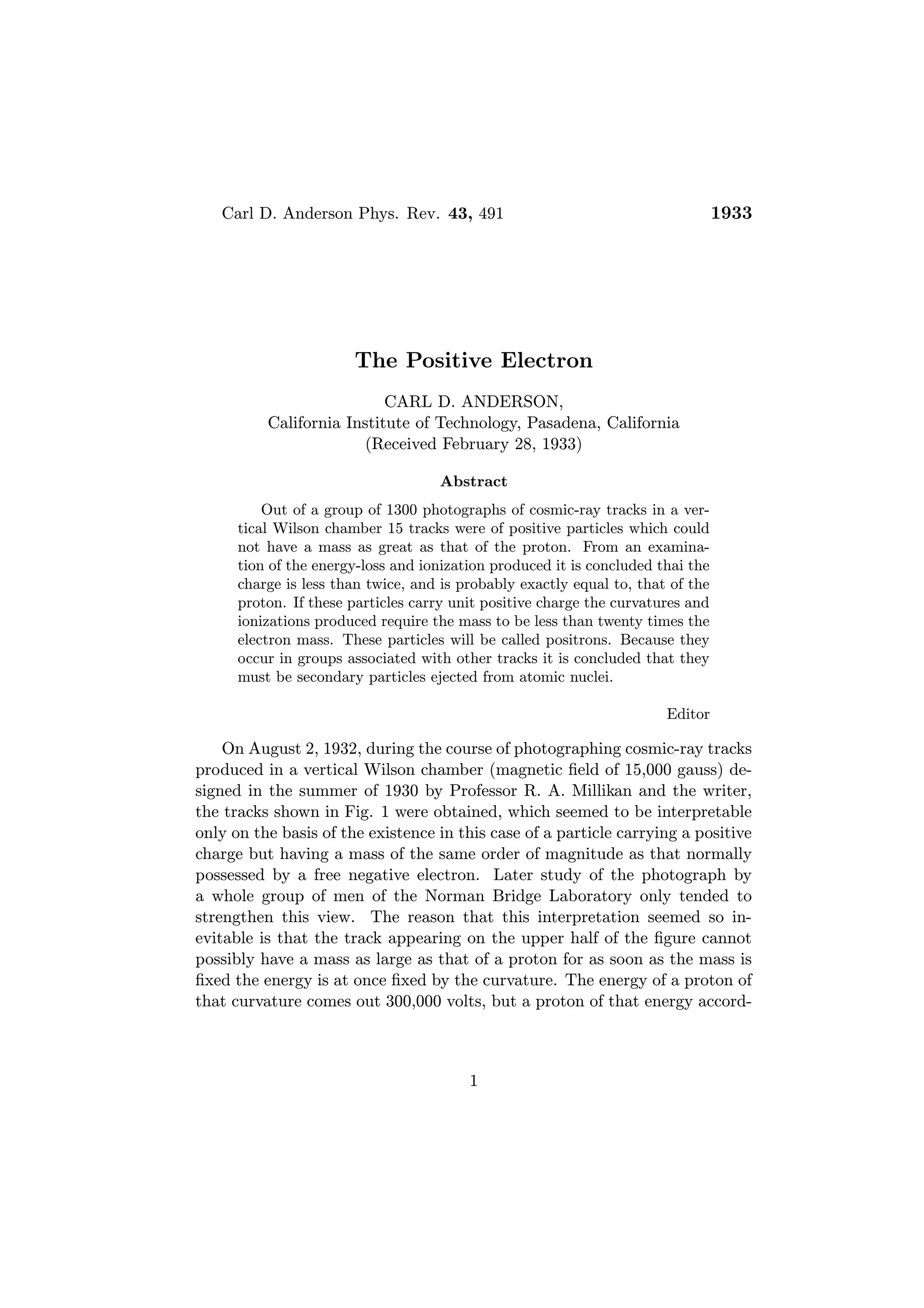
    On August 2, 1932, during the course of photographing cosmic-ray tracks
produced in a vertical Wilson chamber (magnetic field of 15,000 gauss) de-
signed in the summer of 1930 by Professor R. A. Millikan and the writer,
the tracks shown in Fig. 1 were obtained, which seemed to be interpretable
only on the basis of the existence in this case of a particle carrying a positive
charge but having a mass of the same order of magnitude as that normally
possessed by a free negative electron. Later study of the photograph by
a whole group of men of the Norman Bridge Laboratory only tended to
strengthen this view. The reason that this interpretation seemed so in-
evitable is that the track appearing on the upper half of the figure cannot
possibly have a mass as large as that of a proton for as soon as the mass is
fixed the energy is at once fixed by the curvature. The energy of a proton of
that curvature comes out 300,000 volts, but a proton of that energy accord-


                                         1
ing to well established and universally accepted determinations1 has a total
range of about 5 mm in air while that portion of the range actually visible in
this case exceeds 5 cm without a noticeable change in curvature. The only
escape from this conclusion would be to assume that at exactly the same
instant (and the sharpness of the tracks determines that instant to within
about a fiftieth of a second) two independent electrons happened to produce
two tracks so placed as to give the impression of a single particle shooting
through the lead plate. This assumption was dismissed on a probability
basis, since a sharp track of this order of curvature under the experimental
conditions prevailing occurred in the chamber only once in some 500 expo-
sures, and since there was practically no chance at all that two such tracks
should line up in this way. We also discarded as completely untenable the
assumption of an electron of 20 million volts entering the lead on one side
and coming out with an energy of 60 million volts on the other side. A
fourth possibility is that a photon, entering the lead from above, knocked
out of the nucleus of a lead atom two particles, one of which shot upward
and the other downward. But in this case the upward moving one would be
a positive of small mass so that either of the two possibilities leads to the
existence of the positive electron.
    In the course of the next few weeks other photographs were obtained
which could be interpreted logically only on the positive-electron basis, and
a brief report was then published2 with due reserve in interpretation in view
of the importance and striking nature of the announcement.


1       MAGNITUDE OF CHARGE AND MASS
It is possible with the present experimental data only to assign rather wide
limits to the magnitude of the charge and mass of the particle. The specific
ionization was not in these cases measured, but it appears very probable,
from a knowledge of the experimental conditions and by comparison with
many other photographs of high- and low-speed electrons taken under the
same conditions, that the charge cannot differ in magnitude from that of
an electron by an amount as great as a factor of two. Furthermore, if the
photograph is taken to represent a positive particle penetrating the 6 mm
lead plate, then the energy lost, calculated for unit charge, is approximately
    1
     Rutherford, Chadwick and Ellis, Radiations from Radioactive Substances, p. 294.
Assuming Rαv 3 and using data there given the range of a 300,000 volt proton in air
S.T.P. is about 5 mm.
   2
     C. D. Anderson, Science 76, 238 (1932).


                                         2
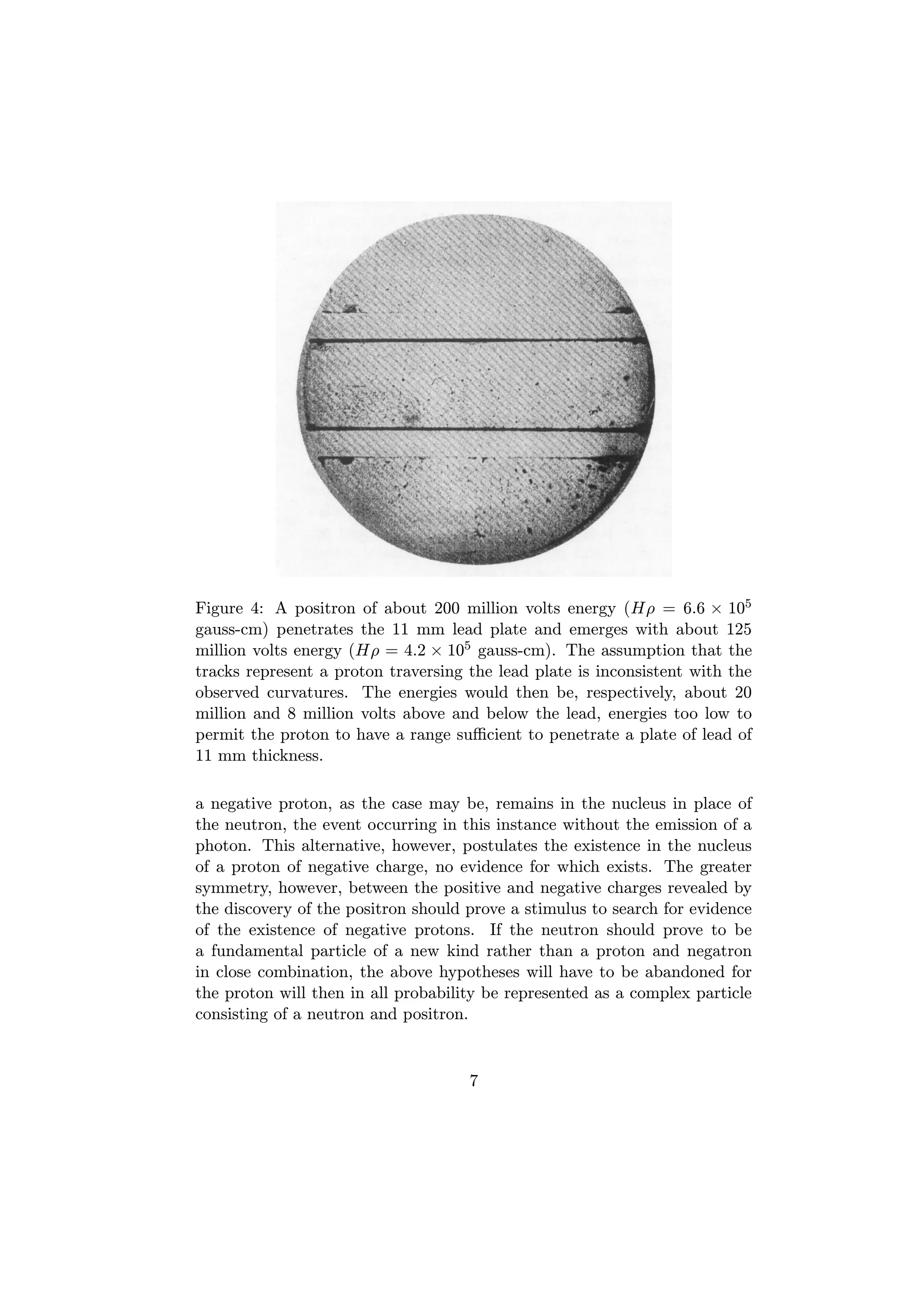
Figure 1: A 63 million volt positron (Hρ = 2.1 × 10⁵ gauss-cm) passing
through a 6 mm lead plate and emerging as a 23 million volt positron (Hρ =
7.5×10⁴ gauss-cm). The length of this latter path is at least ten times greater
than the possible length of a proton path of this curvature.


                                      3
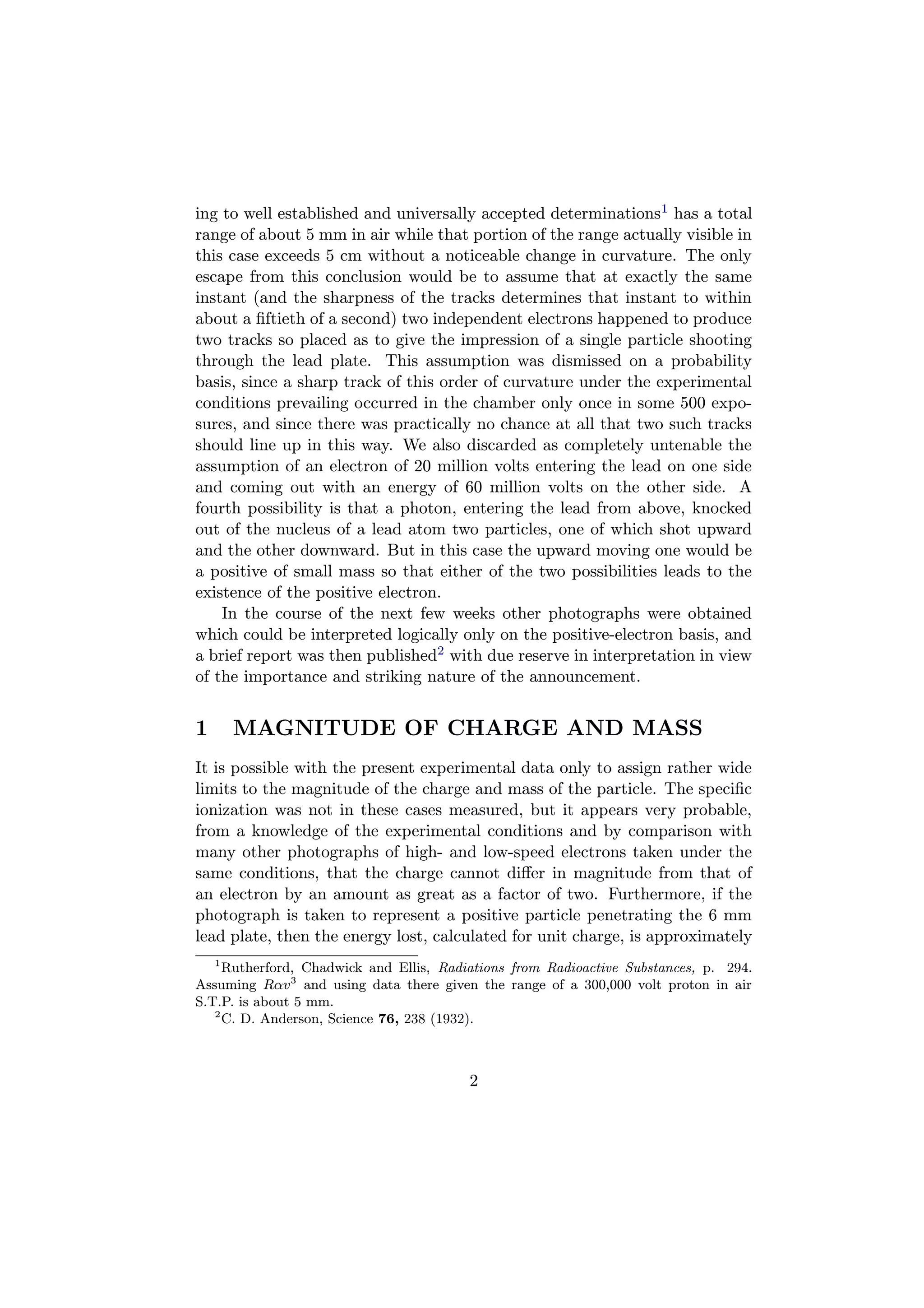
Figure 2: A positron of 20 million volts energy (Hρ = 7.1 × 10⁴ gauss-
cm) and a negatron of 30 million volts energy (Hρ = 10.2 × 10⁴ gauss-cm)
projected from a plate of lead. The range of the positive particle precludes
the possibility of ascribing it to a proton of the observed curvature.


38 million electron-volts, this value being practically independent of the
proper mass of the particle as long as it is not too many times larger than
that of a free negative electron. This value of 63 million volts per cm energy-
loss for the positive particle it was considered legitimate to compare with
the measured mean of approximately 35 million volts3 for negative electrons
of 200-300 million volts energy since the rate of energy-loss for particles of
small mass is expected to change only very slowly over an energy range
extending from several million to several hundred million volts. Allowance
being made for experimental uncertainties, an upper limit to the rate of loss
of energy for the positive particle can then be set at less than four times that
for an electron, thus fixing, by the usual relation between rate of ionization
and charge, an upper limit to the charge less than twice that of the negative
electron. It is concluded, therefore, that the magnitude of the charge of
the positive electron which we shall henceforth contract to positron is very
probably equal to that of a free negative electron which from symmetry
considerations would naturally then be called a negatron.
    It is pointed out that the effective depth of the chamber in the line of
sight which is the same as the direction of the magnetic lines of force was 1
  3
      C. D. Anderson, Phys. Rev. 43, 381A (1933).


                                          4
cm and its effective diameter at right angles to that line 14 cm, thus insuring
that the particle crossed the chamber practically normal to the lines of force.
The change in direction due to scattering in the lead4 , in this case about 8◦
measured in the plane of the chamber, is a probable value for a particle of
this energy though less than the most probable value.
     The magnitude of the proper mass cannot as yet be given further than to
fix an upper limit to it about twenty times that of the electron mass. If Fig.
1 represents a particle of unit charge passing through the lead plate then
the curvatures, on the basis of the information at hand on ionization, give
too low a value for the energy-loss unless the mass is taken less than twenty
times that of the negative electron mass. Further determinations of Hρ for
relatively low energy particles before and after they cross a known amount
of matter, together with a study of ballistic effects such as close encounters
with electrons, involving large energy transfers, will enable closer limits to
be assigned to the mass.
     To date, out of a group of 1300 photographs of cosmic-ray. tracks 15
of these show positive particles penetrating the lead, none of which can
be ascribed to particles with a mass as large as that of a proton, thus
establishing the existence of positive particles of unit charge and of mass
small compared to that of a proton. In many other cases due either to the
short section of track available for measurement or to the high energy of
the particle it is not possible to differentiate with certainty between protons
and positrons. A comparison of the six or seven hundred positive-ray tracks
which we have taken is, however, still consistent with the view that the
positive particle which is knocked out of the nucleus by the incoming primary
cosmic ray is in many cases a proton.
     From the fact that positrons occur in groups associated with other tracks
it is concluded that they must be secondary particles ejected from an atomic
nucleus. If we retain the view that a nucleus consists of protons and neutrons
(and α− particles) and that a neutron represents a close combination of a
proton and electron, then from the electromagnetic theory as to the origin of
mass the simplest assumption would seem to be that an encounter between
the incoming primary ray and a proton may take place in such a way as
to expand the diameter of the proton to the same value as that possessed
by the negatron. This process would release an energy of a billion electron-
volts appearing as a secondary photon. As a second possibility the primary
ray may disintegrate a neutron (or more than one) in the nucleus by the
ejection either of a negatron or a positron with the result that a positive or
  4
      C. D. Anderson, Phys. Rev. 43, 381A (1933).


                                          5
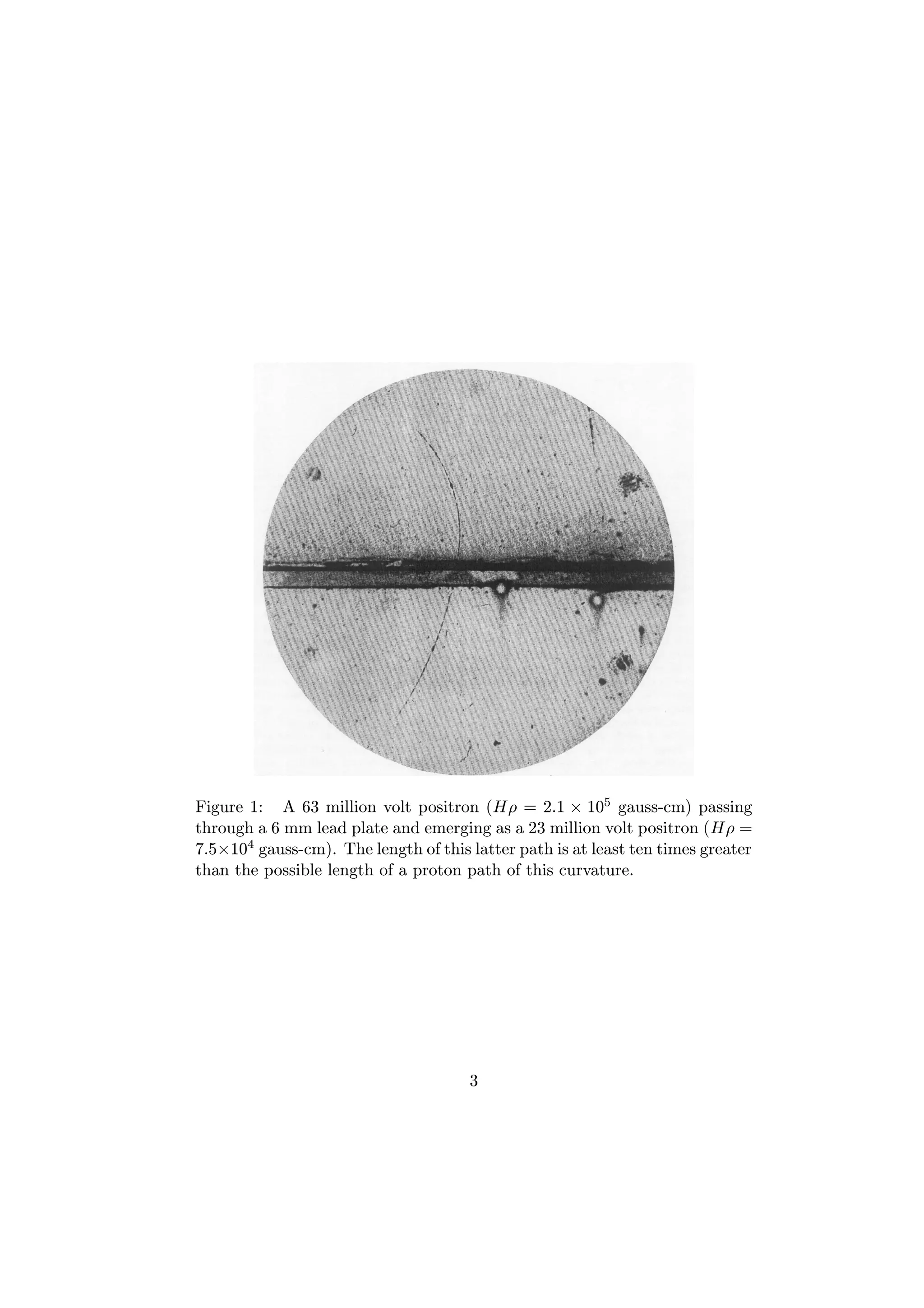
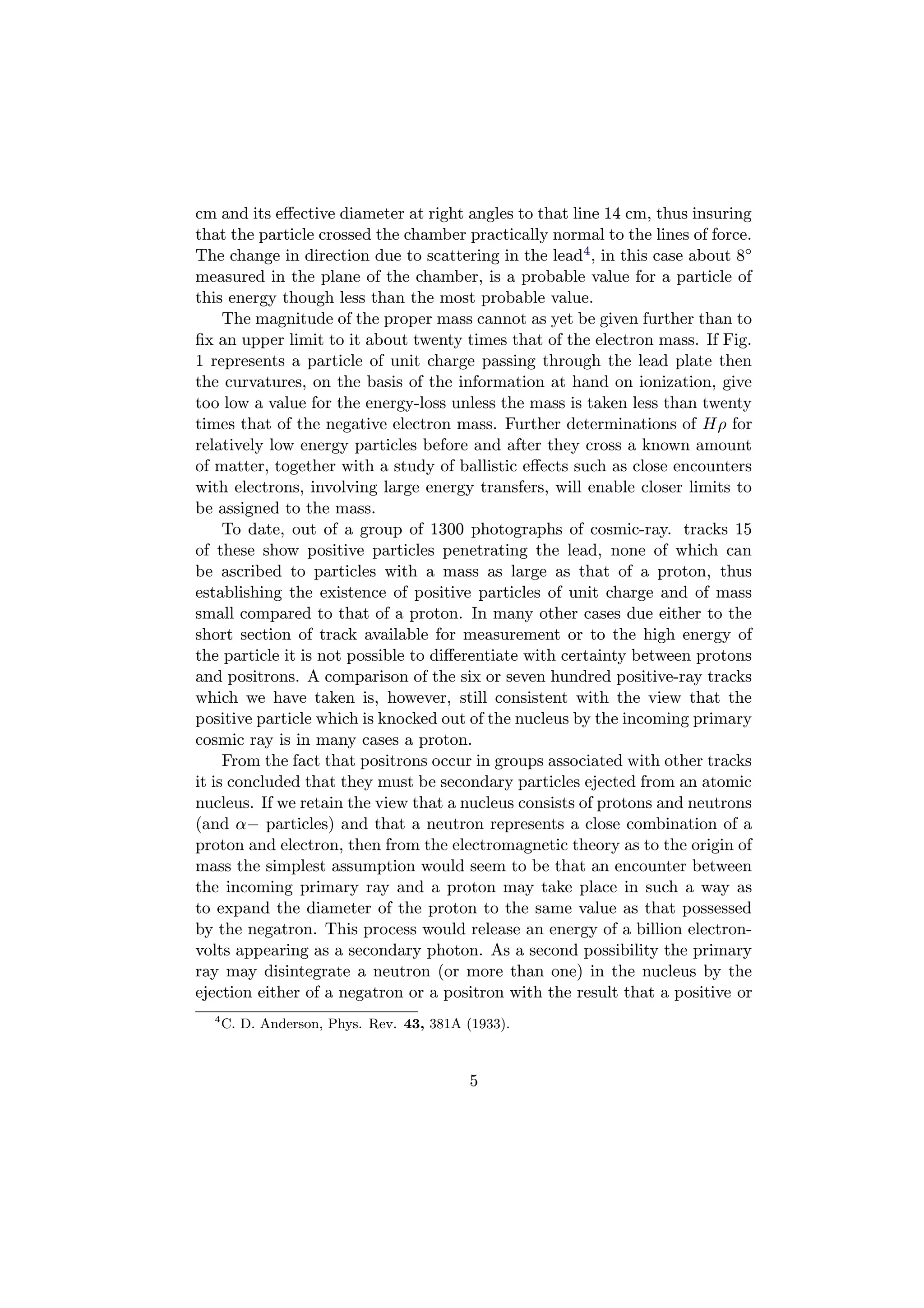
Figure 3: A group of six particles projected from a region in the wall of
the chamber. The track at the left of the central group of four tracks is a
negatron of about 18 million volts energy (Hρ = 6.2×10⁴ gauss-cm) and that
at the right a positron of about 20 million volts energy (Hρ = 7.0×10⁴ gauss-
cm). Identification of the two tracks in the center is not possible. A negatron
of about 15 million volts is shown at the left. This group represents early
tracks which were broadened by the diffusion of the ions. The uniformity
of this broadening for all the tracks shows that the particles entered the
chamber at the same time.


                                      6
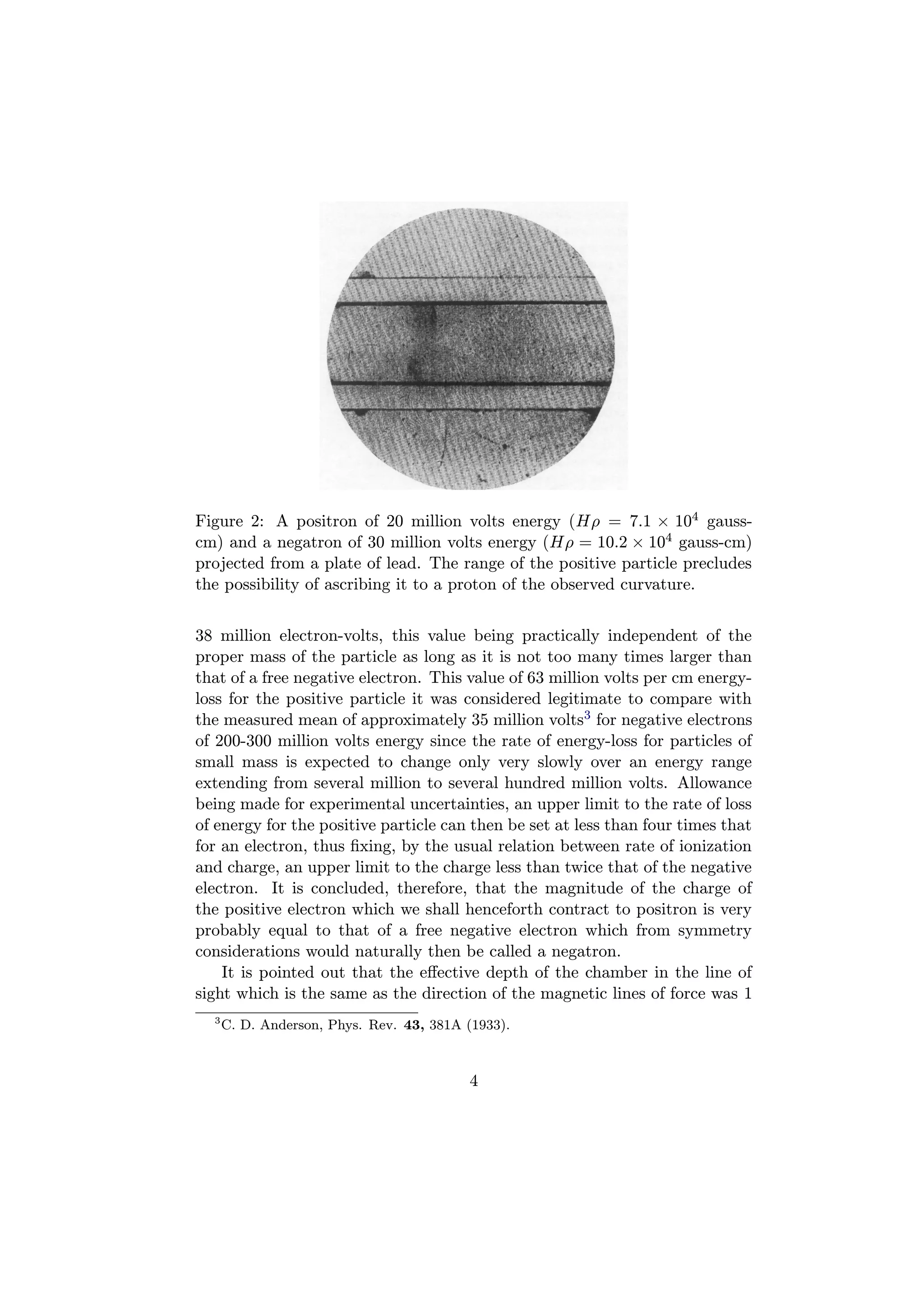
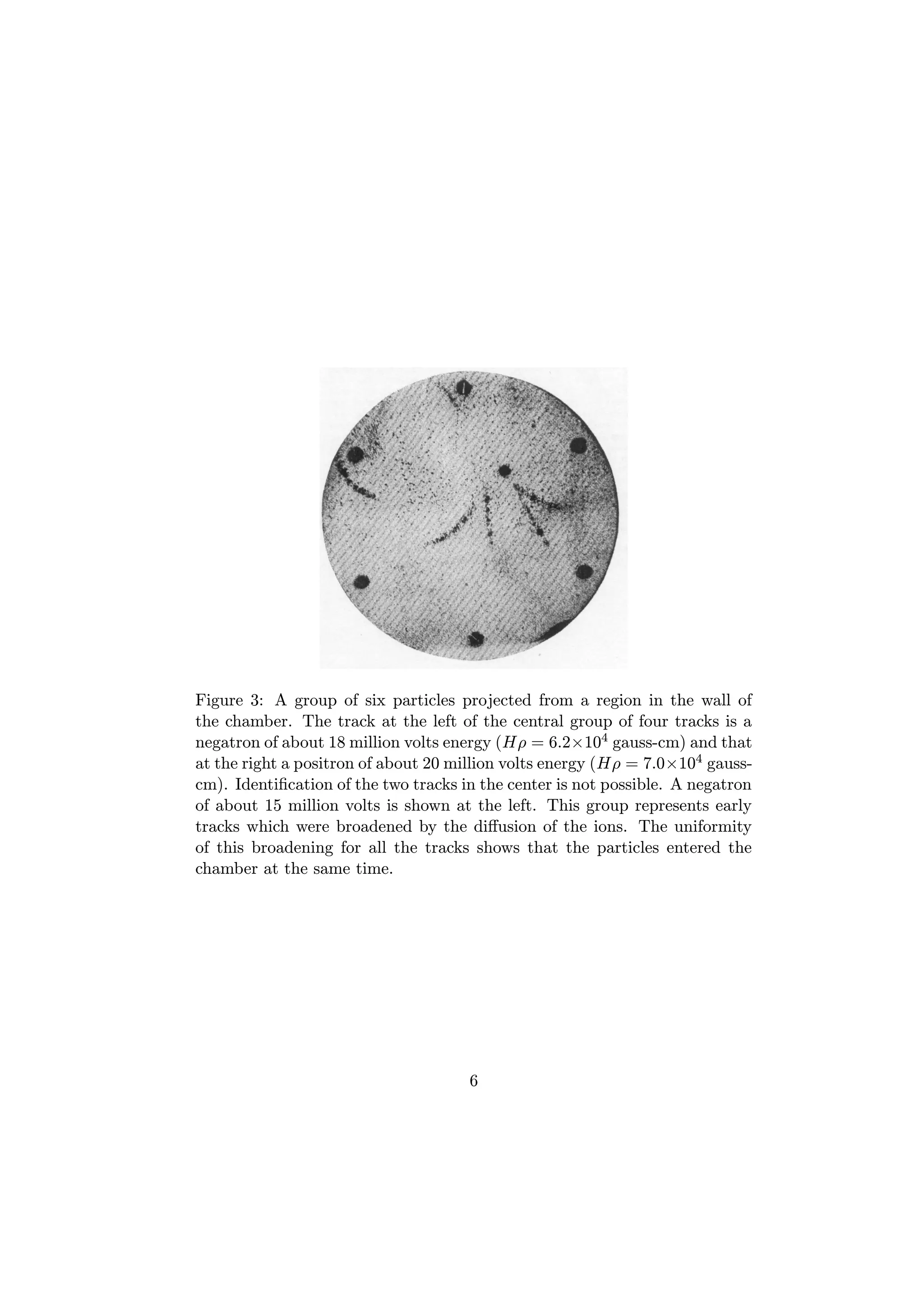
Figure 4: A positron of about 200 million volts energy (Hρ = 6.6 × 10⁵
gauss-cm) penetrates the 11 mm lead plate and emerges with about 125
million volts energy (Hρ = 4.2 × 10⁵ gauss-cm). The assumption that the
tracks represent a proton traversing the lead plate is inconsistent with the
observed curvatures. The energies would then be, respectively, about 20
million and 8 million volts above and below the lead, energies too low to
permit the proton to have a range sufficient to penetrate a plate of lead of
11 mm thickness.

a negative proton, as the case may be, remains in the nucleus in place of
the neutron, the event occurring in this instance without the emission of a
photon. This alternative, however, postulates the existence in the nucleus
of a proton of negative charge, no evidence for which exists. The greater
symmetry, however, between the positive and negative charges revealed by
the discovery of the positron should prove a stimulus to search for evidence
of the existence of negative protons. If the neutron should prove to be
a fundamental particle of a new kind rather than a proton and negatron
in close combination, the above hypotheses will have to be abandoned for
the proton will then in all probability be represented as a complex particle
consisting of a neutron and positron.


                                     7
While this paper was in preparation press reports have announced that
P. M. S. Blackett and G. Occhialini in an extensive study of cosmic-ray
tracks have also obtained evidence for the existence of light positive particles
confirming our earlier report.
    I wish to express my great indebtedness to Professor R. A. Millikan for
suggesting this research and for many helpful discussions during its progress.
The able assistance of Mr. Seth H. Neddermeyer is also appreciated.


                                       8

Anderson and the Positron

  • 1.
    Carl D. AndersonPhys. Rev. 43, 491 1933 The Positive Electron CARL D. ANDERSON, California Institute of Technology, Pasadena, California (Received February 28, 1933) Abstract Out of a group of 1300 photographs of cosmic-ray tracks in a ver- tical Wilson chamber 15 tracks were of positive particles which could not have a mass as great as that of the proton. From an examina- tion of the energy-loss and ionization produced it is concluded thai the charge is less than twice, and is probably exactly equal to, that of the proton. If these particles carry unit positive charge the curvatures and ionizations produced require the mass to be less than twenty times the electron mass. These particles will be called positrons. Because they occur in groups associated with other tracks it is concluded that they must be secondary particles ejected from atomic nuclei. Editor On August 2, 1932, during the course of photographing cosmic-ray tracks produced in a vertical Wilson chamber (magnetic field of 15,000 gauss) de- signed in the summer of 1930 by Professor R. A. Millikan and the writer, the tracks shown in Fig. 1 were obtained, which seemed to be interpretable only on the basis of the existence in this case of a particle carrying a positive charge but having a mass of the same order of magnitude as that normally possessed by a free negative electron. Later study of the photograph by a whole group of men of the Norman Bridge Laboratory only tended to strengthen this view. The reason that this interpretation seemed so in- evitable is that the track appearing on the upper half of the figure cannot possibly have a mass as large as that of a proton for as soon as the mass is fixed the energy is at once fixed by the curvature. The energy of a proton of that curvature comes out 300,000 volts, but a proton of that energy accord- 1
  • 2.
    ing to wellestablished and universally accepted determinations1 has a total range of about 5 mm in air while that portion of the range actually visible in this case exceeds 5 cm without a noticeable change in curvature. The only escape from this conclusion would be to assume that at exactly the same instant (and the sharpness of the tracks determines that instant to within about a fiftieth of a second) two independent electrons happened to produce two tracks so placed as to give the impression of a single particle shooting through the lead plate. This assumption was dismissed on a probability basis, since a sharp track of this order of curvature under the experimental conditions prevailing occurred in the chamber only once in some 500 expo- sures, and since there was practically no chance at all that two such tracks should line up in this way. We also discarded as completely untenable the assumption of an electron of 20 million volts entering the lead on one side and coming out with an energy of 60 million volts on the other side. A fourth possibility is that a photon, entering the lead from above, knocked out of the nucleus of a lead atom two particles, one of which shot upward and the other downward. But in this case the upward moving one would be a positive of small mass so that either of the two possibilities leads to the existence of the positive electron. In the course of the next few weeks other photographs were obtained which could be interpreted logically only on the positive-electron basis, and a brief report was then published2 with due reserve in interpretation in view of the importance and striking nature of the announcement. 1 MAGNITUDE OF CHARGE AND MASS It is possible with the present experimental data only to assign rather wide limits to the magnitude of the charge and mass of the particle. The specific ionization was not in these cases measured, but it appears very probable, from a knowledge of the experimental conditions and by comparison with many other photographs of high- and low-speed electrons taken under the same conditions, that the charge cannot differ in magnitude from that of an electron by an amount as great as a factor of two. Furthermore, if the photograph is taken to represent a positive particle penetrating the 6 mm lead plate, then the energy lost, calculated for unit charge, is approximately 1 Rutherford, Chadwick and Ellis, Radiations from Radioactive Substances, p. 294. Assuming Rαv 3 and using data there given the range of a 300,000 volt proton in air S.T.P. is about 5 mm. 2 C. D. Anderson, Science 76, 238 (1932). 2
  • 3.
    Figure 1: A63 million volt positron (Hρ = 2.1 × 10⁵ gauss-cm) passing through a 6 mm lead plate and emerging as a 23 million volt positron (Hρ = 7.5×10⁴ gauss-cm). The length of this latter path is at least ten times greater than the possible length of a proton path of this curvature. 3
  • 4.
    Figure 2: Apositron of 20 million volts energy (Hρ = 7.1 × 10⁴ gauss- cm) and a negatron of 30 million volts energy (Hρ = 10.2 × 10⁴ gauss-cm) projected from a plate of lead. The range of the positive particle precludes the possibility of ascribing it to a proton of the observed curvature. 38 million electron-volts, this value being practically independent of the proper mass of the particle as long as it is not too many times larger than that of a free negative electron. This value of 63 million volts per cm energy- loss for the positive particle it was considered legitimate to compare with the measured mean of approximately 35 million volts3 for negative electrons of 200-300 million volts energy since the rate of energy-loss for particles of small mass is expected to change only very slowly over an energy range extending from several million to several hundred million volts. Allowance being made for experimental uncertainties, an upper limit to the rate of loss of energy for the positive particle can then be set at less than four times that for an electron, thus fixing, by the usual relation between rate of ionization and charge, an upper limit to the charge less than twice that of the negative electron. It is concluded, therefore, that the magnitude of the charge of the positive electron which we shall henceforth contract to positron is very probably equal to that of a free negative electron which from symmetry considerations would naturally then be called a negatron. It is pointed out that the effective depth of the chamber in the line of sight which is the same as the direction of the magnetic lines of force was 1 3 C. D. Anderson, Phys. Rev. 43, 381A (1933). 4
  • 5.
    cm and itseffective diameter at right angles to that line 14 cm, thus insuring that the particle crossed the chamber practically normal to the lines of force. The change in direction due to scattering in the lead4 , in this case about 8◦ measured in the plane of the chamber, is a probable value for a particle of this energy though less than the most probable value. The magnitude of the proper mass cannot as yet be given further than to fix an upper limit to it about twenty times that of the electron mass. If Fig. 1 represents a particle of unit charge passing through the lead plate then the curvatures, on the basis of the information at hand on ionization, give too low a value for the energy-loss unless the mass is taken less than twenty times that of the negative electron mass. Further determinations of Hρ for relatively low energy particles before and after they cross a known amount of matter, together with a study of ballistic effects such as close encounters with electrons, involving large energy transfers, will enable closer limits to be assigned to the mass. To date, out of a group of 1300 photographs of cosmic-ray. tracks 15 of these show positive particles penetrating the lead, none of which can be ascribed to particles with a mass as large as that of a proton, thus establishing the existence of positive particles of unit charge and of mass small compared to that of a proton. In many other cases due either to the short section of track available for measurement or to the high energy of the particle it is not possible to differentiate with certainty between protons and positrons. A comparison of the six or seven hundred positive-ray tracks which we have taken is, however, still consistent with the view that the positive particle which is knocked out of the nucleus by the incoming primary cosmic ray is in many cases a proton. From the fact that positrons occur in groups associated with other tracks it is concluded that they must be secondary particles ejected from an atomic nucleus. If we retain the view that a nucleus consists of protons and neutrons (and α− particles) and that a neutron represents a close combination of a proton and electron, then from the electromagnetic theory as to the origin of mass the simplest assumption would seem to be that an encounter between the incoming primary ray and a proton may take place in such a way as to expand the diameter of the proton to the same value as that possessed by the negatron. This process would release an energy of a billion electron- volts appearing as a secondary photon. As a second possibility the primary ray may disintegrate a neutron (or more than one) in the nucleus by the ejection either of a negatron or a positron with the result that a positive or 4 C. D. Anderson, Phys. Rev. 43, 381A (1933). 5
  • 6.
    Figure 3: Agroup of six particles projected from a region in the wall of the chamber. The track at the left of the central group of four tracks is a negatron of about 18 million volts energy (Hρ = 6.2×10⁴ gauss-cm) and that at the right a positron of about 20 million volts energy (Hρ = 7.0×10⁴ gauss- cm). Identification of the two tracks in the center is not possible. A negatron of about 15 million volts is shown at the left. This group represents early tracks which were broadened by the diffusion of the ions. The uniformity of this broadening for all the tracks shows that the particles entered the chamber at the same time. 6
  • 7.
    Figure 4: Apositron of about 200 million volts energy (Hρ = 6.6 × 10⁵ gauss-cm) penetrates the 11 mm lead plate and emerges with about 125 million volts energy (Hρ = 4.2 × 10⁵ gauss-cm). The assumption that the tracks represent a proton traversing the lead plate is inconsistent with the observed curvatures. The energies would then be, respectively, about 20 million and 8 million volts above and below the lead, energies too low to permit the proton to have a range sufficient to penetrate a plate of lead of 11 mm thickness. a negative proton, as the case may be, remains in the nucleus in place of the neutron, the event occurring in this instance without the emission of a photon. This alternative, however, postulates the existence in the nucleus of a proton of negative charge, no evidence for which exists. The greater symmetry, however, between the positive and negative charges revealed by the discovery of the positron should prove a stimulus to search for evidence of the existence of negative protons. If the neutron should prove to be a fundamental particle of a new kind rather than a proton and negatron in close combination, the above hypotheses will have to be abandoned for the proton will then in all probability be represented as a complex particle consisting of a neutron and positron. 7
  • 8.
    While this paperwas in preparation press reports have announced that P. M. S. Blackett and G. Occhialini in an extensive study of cosmic-ray tracks have also obtained evidence for the existence of light positive particles confirming our earlier report. I wish to express my great indebtedness to Professor R. A. Millikan for suggesting this research and for many helpful discussions during its progress. The able assistance of Mr. Seth H. Neddermeyer is also appreciated. 8