Thermionic emission is the
thermally induced flow of
charge carriers from a
surface or over a
potential-energy barrier.
This occurs because the
thermal energy given to
the carrier overcomes the
work function of the
material.
THERMIONIC EMMISION:-
 Thermionic emission is the heat-induced flow of charge carriers from a surface
or over a potential-energy barrier.
 This occurs because the thermal energy given to the carrier overcomes the
binding potential, also known as work function of the metal.
 The charge carriers can be electrons or ions, and in older literature are
sometimes referred to as "thermions".
 After emission, a charge will initially be left behind in the emitting region that is
equal in magnitude and opposite in sign to the total charge emitted.
 But if the emitter is connected to a battery, then this charge left behind will be
neutralized by charge supplied by the battery, as the emitted charge carriers
move away from the emitter, and finally the emitter will be in the same state as it
was before emission.
 The thermionic emission of electrons is also known as thermal electron emission.
EDISON’S EXPERIMENT:-
 Thomas Edison on February 13, 1880, while trying to discover the reason
for breakage of lamp filaments and uneven blackening of the bulbs in his
incandescent lamp built several experiment bulbs, some with an extra
wire, a metal plate, or foil inside the bulb which was electrically separate
from the filament, and thus could serve as an electrode.
 He connected a galvanometer to the output of the extra metal
electrode. When the foil was charged negatively relative to the filament,
no charge flowed between the filament and the foil.
 In addition, charge did not flow from the foil to the filament because the
foil was not heated enough to emit charge. However, when the foil was
given a more positive charge than the filament, negative charge could
flow from the filament through the vacuum to the foil. This one-way
current was called the Edison effect.
 He found that the current emitted by the hot filament increased rapidly
with increasing voltage, and filed a patent application for a voltage-
regulating device using the effect on November 15.
FACTORS AFFECTING RATE OF EMMISION:-
i. Nature of the metal surface Lower the work function of the
metal, greater is the rate of emission of electrons from the
surface.
ii.Temperature of the surface Higher is the temperature, more
will be the rate of emission as the electrons will have more
kinetic energy to leave the surface.
iii. Surface area of the metal Larger the surface area of the
metal, more is the rate of emission as thermionic emission to
some extent is like evaporation.
CONDITIONS FOR GOOD ELECTRON EMITTER:-
 i. Low work function :The work function of the body should be
low so that the electrons could be emitted even when the
substance is not heated to a high temperature.
 ii. High melting point :The melting point of the substance
should be low so that the metal does not get melted when
heated.
CATHODE RAY TUBE:-
The cathode ray tube is a vacuum tube containing an
electron gun (a source of electrons or electron emitter)
and a fluorescent screen used to view images. It has a
means to accelerate and deflect the electron beam onto
the fluorescent screen to create the images.The images
may represent electrical waveforms (oscilloscope),
pictures (television ,computer monitor), radar targets
and others. CRTs have also been used as memory devices,
in which case the visible light emitted from the
fluorescent material is not intended to have significant
meaning to a visual observer (though the visible pattern
on the tube face may cryptically represent the stored
data).
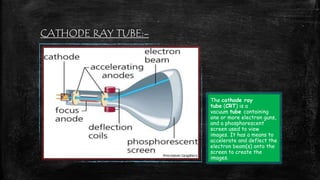
CATHODE RAY TUBE:-
The cathode ray
tube (CRT) is a
vacuum tube containing
one or more electron guns,
and a phosphorescent
screen used to view
images. It has a means to
accelerate and deflect the
electron beam(s) onto the
screen to create the
images.
Radioactivity:-
▪ Radioactivity also known as radioactive decay is a process
in which unstable atomic nucleus loses energy by emitting
radiation.
▪ Radiation is released in form of particles or
electromagnetic waves.
▪ The rate of radioactive decay is described in half-lives.
▪ The main source of radiation in Earth is sun. Radiation is
going through everywhere and all the time.
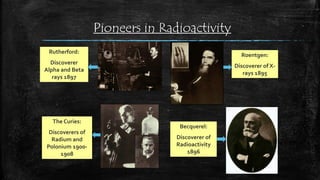
Pioneers in Radioactivity
Roentgen:
Discoverer of X-
rays 1895
Becquerel:
Discoverer of
Radioactivity
1896
The Curies:
Discoverers of
Radium and
Polonium 1900-
1908
Rutherford:
Discoverer
Alpha and Beta
rays 1897
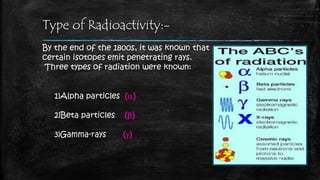
Type of Radioactivity:-
By the end of the 1800s, it was known that
certain isotopes emit penetrating rays.
Three types of radiation were known:
1)Alpha particles (a)
2)Beta particles (b)
3)Gamma-rays (g)
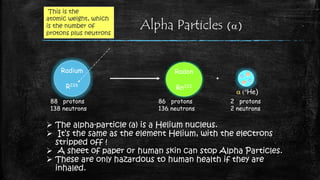
Alpha Particles (a)
Radium
R226
88 protons
138 neutrons
Radon
Rn222
This is the
atomic weight, which
is the number of
protons plus neutrons
86 protons
136 neutrons
+ n
np
p
a (4He)
2 protons
2 neutrons
 The alpha-particle (a) is a Helium nucleus.
 It’s the same as the element Helium, with the electrons
stripped off !
 A sheet of paper or human skin can stop Alpha Particles.
 These are only hazardous to human health if they are
inhaled.
Beta Particles (b)
Carbon
C14
6 protons
8 neutrons
Nitrogen
N14
7 protons
7 neutrons
+ e-
electron
(beta-particle)
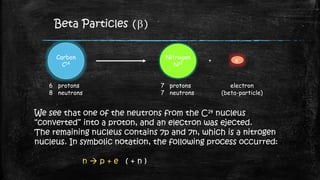
We see that one of the neutrons from the C14 nucleus
“converted” into a proton, and an electron was ejected.
The remaining nucleus contains 7p and 7n, which is a nitrogen
nucleus. In symbolic notation, the following process occurred:
n  p + e ( + n )
Beta Particles (b)
 They can travel a few feet in air but can usually be
stopped by clothing or a few centimeters of wood.
 They are considered hazardous mainly if ingested or
inhaled, but can cause radiation damage to the skin
if the exposure is large enough.
 Unstable Neutron decays into a proton.
Gamma particles (g)
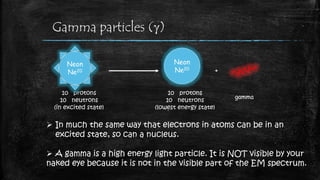
 In much the same way that electrons in atoms can be in an
excited state, so can a nucleus.
 A gamma is a high energy light particle. It is NOT visible by your
naked eye because it is not in the visible part of the EM spectrum.
Neon
Ne20
10 protons
10 neutrons
(in excited state)
10 protons
10 neutrons
(lowest energy state)
+
gamma
Neon
Ne20
Gamma particles (g)
 Occurs when an unstable nucleus emits electromagnetic
radiation. The radiation has no mass, and so its emission
does not change the element.
 They penetrate matter easily and are best stopped by water
or thick layers of lead or concrete.
 Gamma radiation is hazardous to people inside and outside
of the body.
 Gamma rays have the lowest ionizing power, but the highest
penetrating power.
Uses of radiation
• Radioactive tracers are used to locate tumors, to study the
functioning of a particular organ, or to monitor the flow of
blood. Such as iodine-131 is used for thyroid problems.
• used to treat cancer may involve the use of implanted
radioactive isotopes such as gold-198 or iridium-192.
• Radioactive particles often used to measure the thickness of
metal goods.
• Radio isotopes often used for smoke alarms.
• Nuclear fission is used to generate Electricity.
• The age of fossil or rock or anything can be determined by radio
isotopes suck as carbon-14. though it can measure only 50,000
years.
“THANK YOU”
“THANKYOU”
“THANKYOU”
“THANK YOU”

THERMIONIC EMMISION AND RADIOACTIVITY

  • 1.
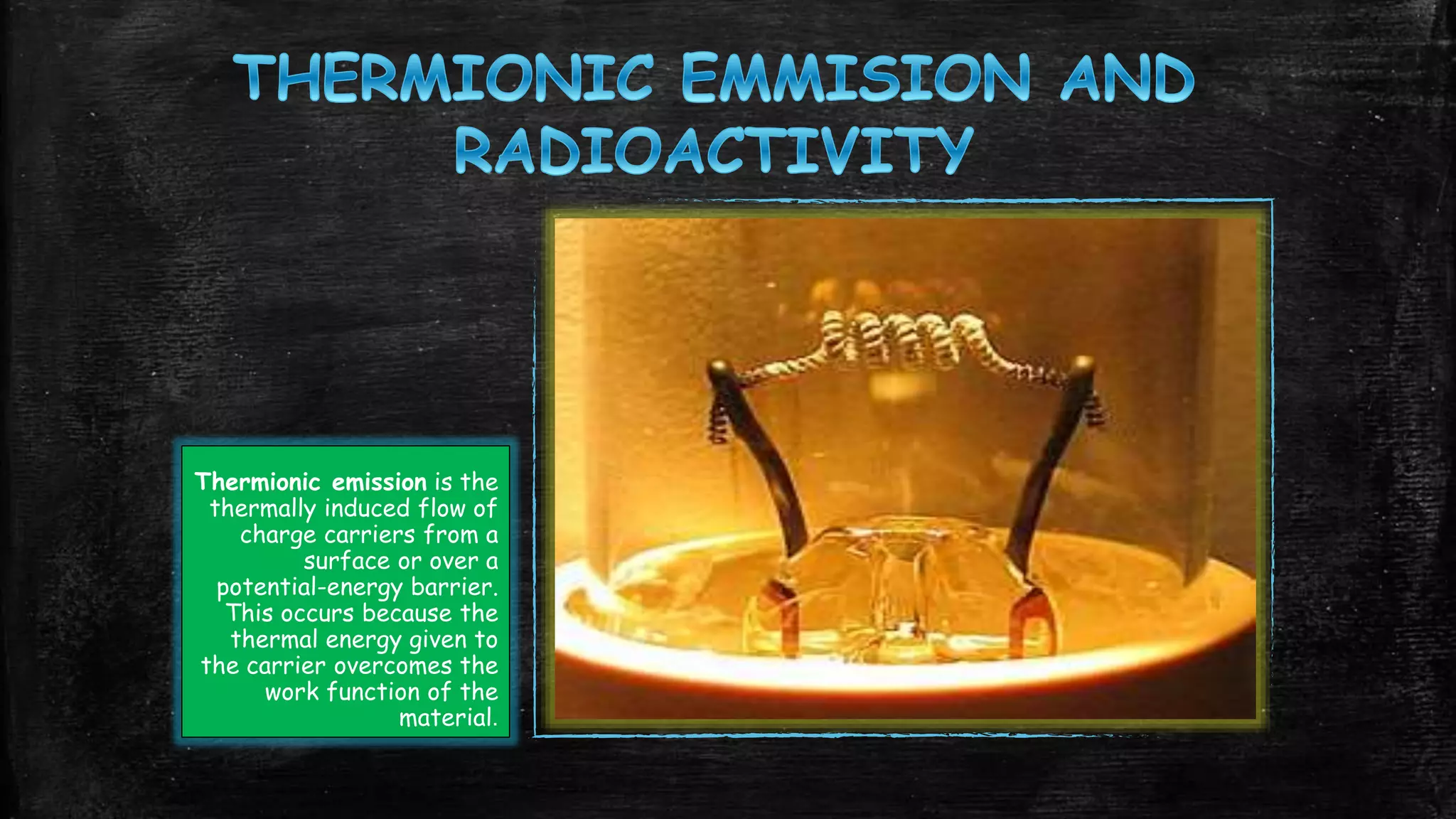
    Thermionic emission isthe thermally induced flow of charge carriers from a surface or over a potential-energy barrier. This occurs because the thermal energy given to the carrier overcomes the work function of the material.
  • 2.
    THERMIONIC EMMISION:-  Thermionicemission is the heat-induced flow of charge carriers from a surface or over a potential-energy barrier.  This occurs because the thermal energy given to the carrier overcomes the binding potential, also known as work function of the metal.  The charge carriers can be electrons or ions, and in older literature are sometimes referred to as "thermions".  After emission, a charge will initially be left behind in the emitting region that is equal in magnitude and opposite in sign to the total charge emitted.  But if the emitter is connected to a battery, then this charge left behind will be neutralized by charge supplied by the battery, as the emitted charge carriers move away from the emitter, and finally the emitter will be in the same state as it was before emission.  The thermionic emission of electrons is also known as thermal electron emission.
  • 3.
    EDISON’S EXPERIMENT:-  ThomasEdison on February 13, 1880, while trying to discover the reason for breakage of lamp filaments and uneven blackening of the bulbs in his incandescent lamp built several experiment bulbs, some with an extra wire, a metal plate, or foil inside the bulb which was electrically separate from the filament, and thus could serve as an electrode.  He connected a galvanometer to the output of the extra metal electrode. When the foil was charged negatively relative to the filament, no charge flowed between the filament and the foil.  In addition, charge did not flow from the foil to the filament because the foil was not heated enough to emit charge. However, when the foil was given a more positive charge than the filament, negative charge could flow from the filament through the vacuum to the foil. This one-way current was called the Edison effect.  He found that the current emitted by the hot filament increased rapidly with increasing voltage, and filed a patent application for a voltage- regulating device using the effect on November 15.
  • 4.
    FACTORS AFFECTING RATEOF EMMISION:- i. Nature of the metal surface Lower the work function of the metal, greater is the rate of emission of electrons from the surface. ii.Temperature of the surface Higher is the temperature, more will be the rate of emission as the electrons will have more kinetic energy to leave the surface. iii. Surface area of the metal Larger the surface area of the metal, more is the rate of emission as thermionic emission to some extent is like evaporation.
  • 5.
    CONDITIONS FOR GOODELECTRON EMITTER:-  i. Low work function :The work function of the body should be low so that the electrons could be emitted even when the substance is not heated to a high temperature.  ii. High melting point :The melting point of the substance should be low so that the metal does not get melted when heated.
  • 6.
    CATHODE RAY TUBE:- Thecathode ray tube is a vacuum tube containing an electron gun (a source of electrons or electron emitter) and a fluorescent screen used to view images. It has a means to accelerate and deflect the electron beam onto the fluorescent screen to create the images.The images may represent electrical waveforms (oscilloscope), pictures (television ,computer monitor), radar targets and others. CRTs have also been used as memory devices, in which case the visible light emitted from the fluorescent material is not intended to have significant meaning to a visual observer (though the visible pattern on the tube face may cryptically represent the stored data).
  • 7.
    CATHODE RAY TUBE:- Thecathode ray tube (CRT) is a vacuum tube containing one or more electron guns, and a phosphorescent screen used to view images. It has a means to accelerate and deflect the electron beam(s) onto the screen to create the images.
  • 8.
    Radioactivity:- ▪ Radioactivity alsoknown as radioactive decay is a process in which unstable atomic nucleus loses energy by emitting radiation. ▪ Radiation is released in form of particles or electromagnetic waves. ▪ The rate of radioactive decay is described in half-lives. ▪ The main source of radiation in Earth is sun. Radiation is going through everywhere and all the time.
  • 9.
    Pioneers in Radioactivity Roentgen: Discovererof X- rays 1895 Becquerel: Discoverer of Radioactivity 1896 The Curies: Discoverers of Radium and Polonium 1900- 1908 Rutherford: Discoverer Alpha and Beta rays 1897
  • 10.
    Type of Radioactivity:- Bythe end of the 1800s, it was known that certain isotopes emit penetrating rays. Three types of radiation were known: 1)Alpha particles (a) 2)Beta particles (b) 3)Gamma-rays (g)
  • 11.
    Alpha Particles (a) Radium R226 88protons 138 neutrons Radon Rn222 This is the atomic weight, which is the number of protons plus neutrons 86 protons 136 neutrons + n np p a (4He) 2 protons 2 neutrons  The alpha-particle (a) is a Helium nucleus.  It’s the same as the element Helium, with the electrons stripped off !  A sheet of paper or human skin can stop Alpha Particles.  These are only hazardous to human health if they are inhaled.
  • 12.
    Beta Particles (b) Carbon C14 6protons 8 neutrons Nitrogen N14 7 protons 7 neutrons + e- electron (beta-particle) We see that one of the neutrons from the C14 nucleus “converted” into a proton, and an electron was ejected. The remaining nucleus contains 7p and 7n, which is a nitrogen nucleus. In symbolic notation, the following process occurred: n  p + e ( + n )
  • 13.
    Beta Particles (b) They can travel a few feet in air but can usually be stopped by clothing or a few centimeters of wood.  They are considered hazardous mainly if ingested or inhaled, but can cause radiation damage to the skin if the exposure is large enough.  Unstable Neutron decays into a proton.
  • 14.
    Gamma particles (g) In much the same way that electrons in atoms can be in an excited state, so can a nucleus.  A gamma is a high energy light particle. It is NOT visible by your naked eye because it is not in the visible part of the EM spectrum. Neon Ne20 10 protons 10 neutrons (in excited state) 10 protons 10 neutrons (lowest energy state) + gamma Neon Ne20
  • 15.
    Gamma particles (g) Occurs when an unstable nucleus emits electromagnetic radiation. The radiation has no mass, and so its emission does not change the element.  They penetrate matter easily and are best stopped by water or thick layers of lead or concrete.  Gamma radiation is hazardous to people inside and outside of the body.  Gamma rays have the lowest ionizing power, but the highest penetrating power.
  • 16.
    Uses of radiation •Radioactive tracers are used to locate tumors, to study the functioning of a particular organ, or to monitor the flow of blood. Such as iodine-131 is used for thyroid problems. • used to treat cancer may involve the use of implanted radioactive isotopes such as gold-198 or iridium-192. • Radioactive particles often used to measure the thickness of metal goods. • Radio isotopes often used for smoke alarms. • Nuclear fission is used to generate Electricity. • The age of fossil or rock or anything can be determined by radio isotopes suck as carbon-14. though it can measure only 50,000 years.
  • 17.