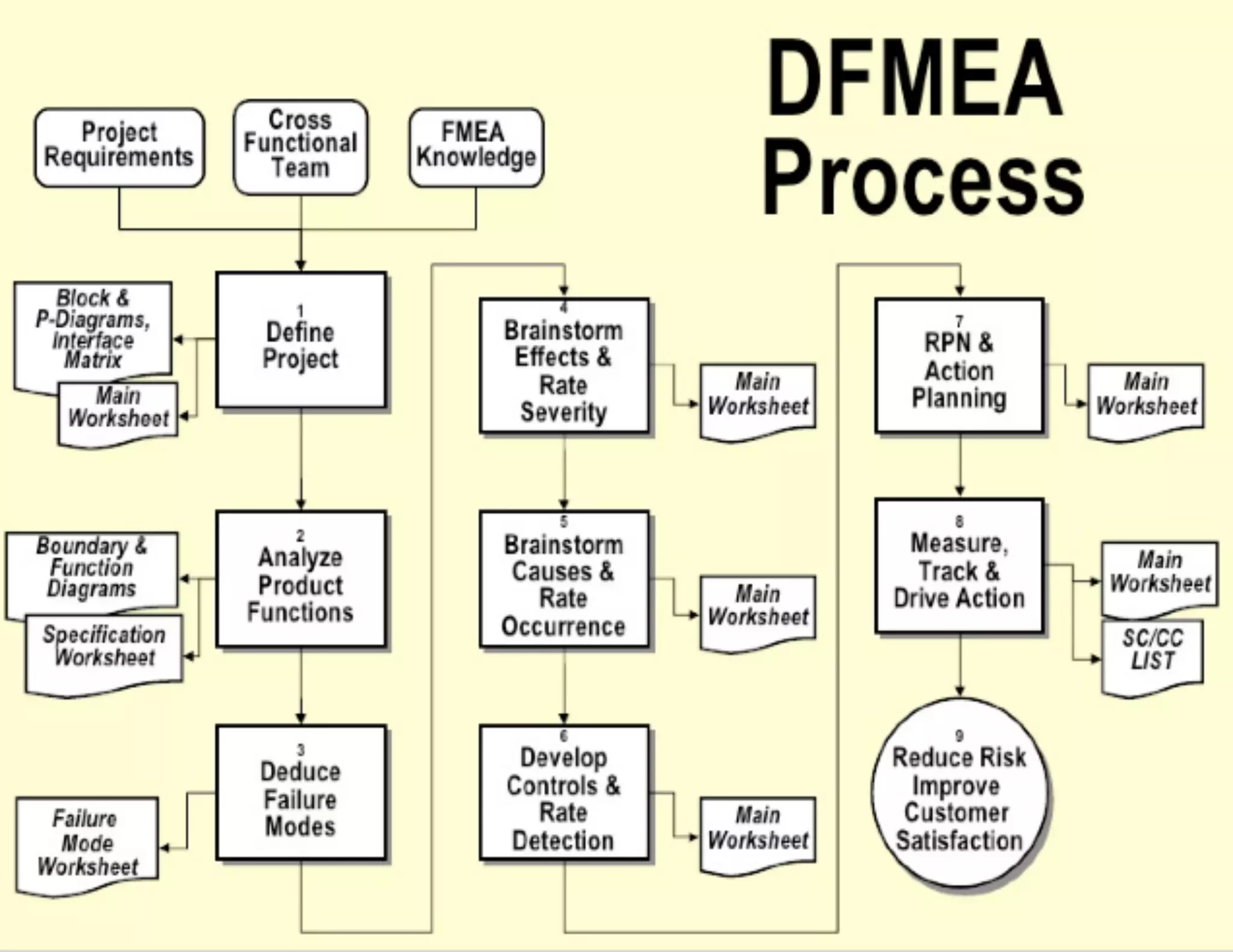
DFMEA
Purpose
To deepen understanding and refine
your current approach to Design
FMEA’s.
Definition of FMEA
A Failure Mode and Effect Analysis uses a
disciplined technique to identify and help eliminate
product and process potential failure modes.
o By ID of potential failures
o Assessing the risks caused by failure modes and Identify
corrective actions
o Prioritizing corrective actions
o Carry out corrective actions
Design FMEA's
Current practices/concerns?
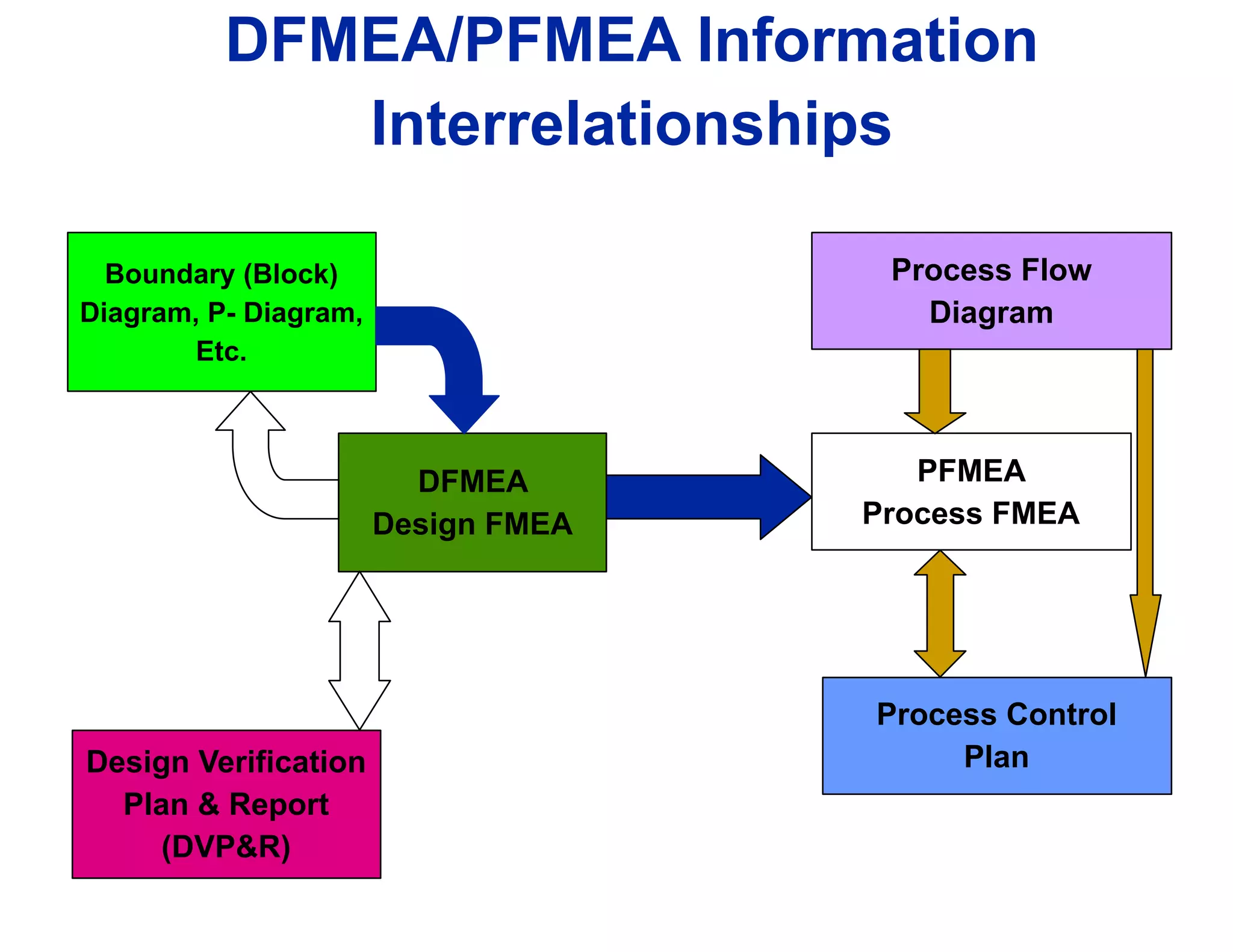
DFMEA/PFMEA Information
Interrelationships
DFMEA
Design FMEA
Process Flow
Diagram
PFMEA
Process FMEA
Boundary (Block)
Diagram, P- Diagram,
Etc.
Design Verification
Plan & Report
(DVP&R)
Process Control
Plan
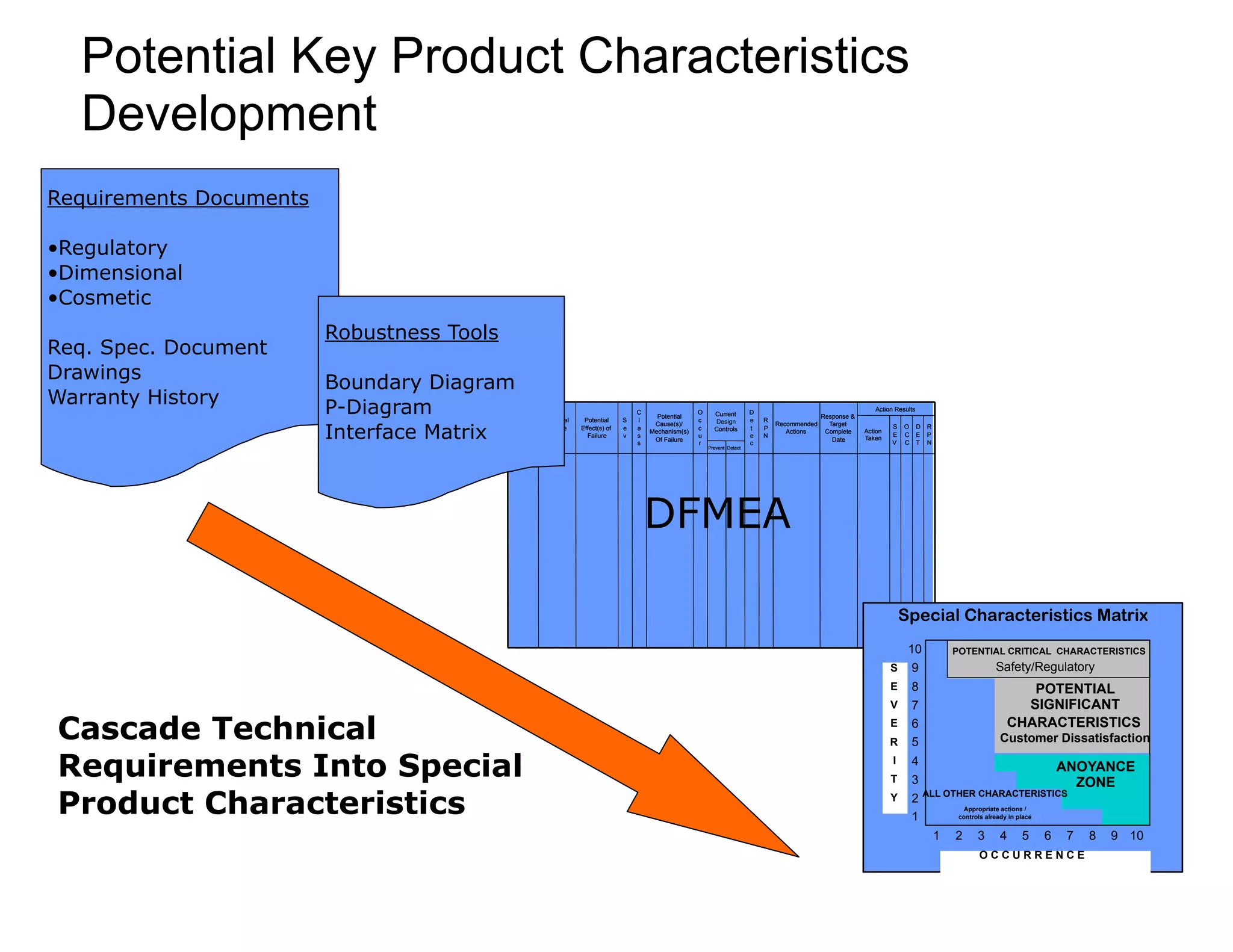
Potential Key Product Characteristics
Development
DetectPrevent
R
P
N
D
E
T
O
C
C
S
E
V
Action
Taken
Action Results
Response &
Target
Complete
Date
Recommended
Actions
R
P
N
D
e
t
e
c
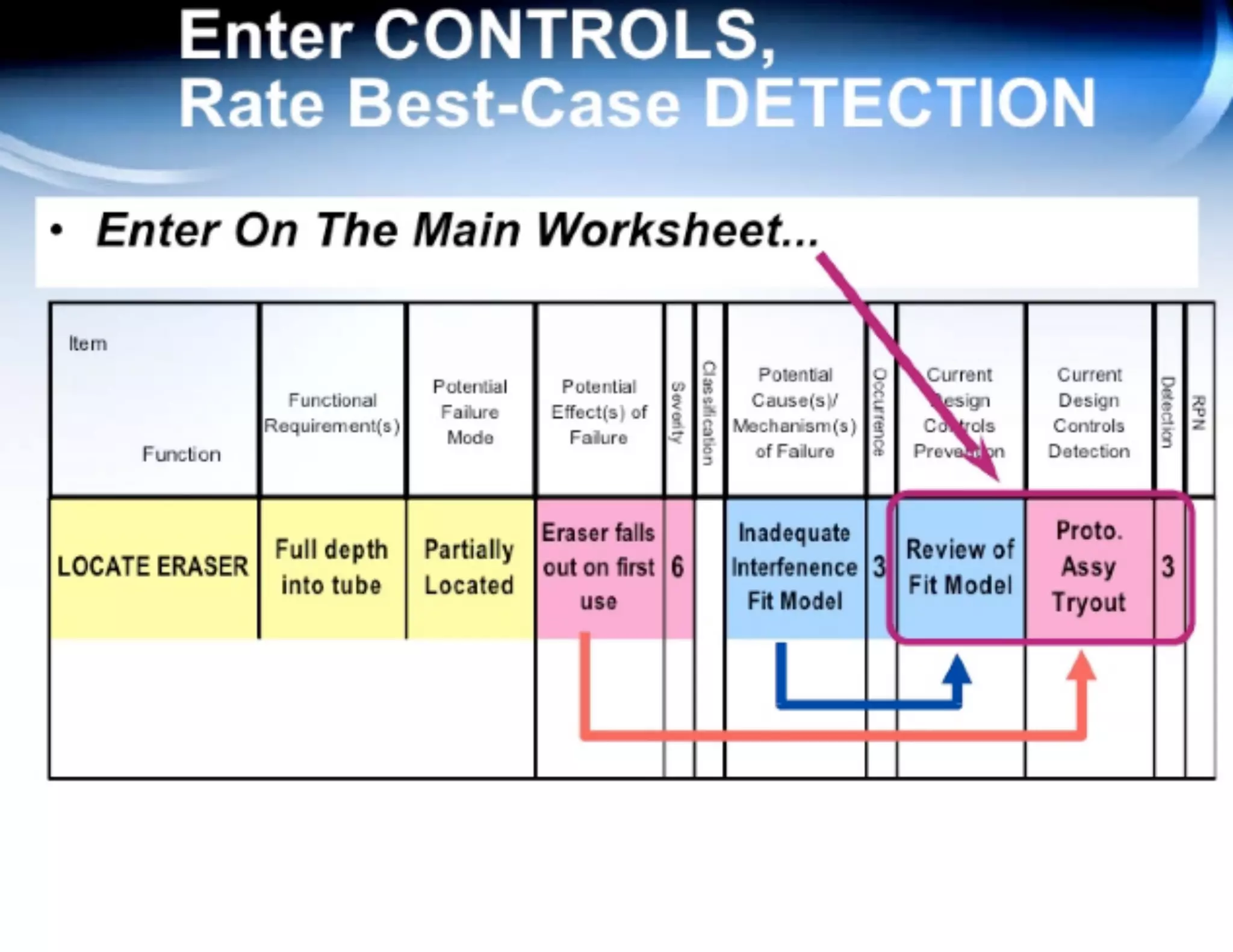
Current
Controls
O
c
c
u
r
Potential
Cause(s)/
Mechanism(s)
Of Failure
C
l
a
s
s
S
e
v
Potential
Effect(s) of
Failure
Potential
Failure
Mode
Item /
Process
Step
DetectPrevent
R
P
N
D
E
T
O
C
C
S
E
V
Action
Taken
Action Results
Response &
Target
Complete
Date
Recommended
Actions
R
P
N
D
e
t
e
c
Current
Design
Controls
O
c
c
u
r
Potential
Cause(s)/
Mechanism(s)
Of Failure
C
l
a
s
s
S
e
v
Potential
Effect(s) of
Failure
Potential
Failure
Mode
Item /
Process
Step
Function
DFMEA
Requirements Documents
!
•Regulatory
•Dimensional
•Cosmetic
!
Req. Spec. Document
Drawings
Warranty History
Robustness Tools
!
Boundary Diagram
P-Diagram
Interface Matrix
10
9
8
7
6
5
4
3
2
1
1 2 3 4 5 6 7 8 9 10
S
E
V
E
R
I
T
Y
O C C U R R E N C E
POTENTIAL CRITICAL CHARACTERISTICS
Safety/Regulatory
POTENTIAL
SIGNIFICANT
CHARACTERISTICS
Customer Dissatisfaction
Special Characteristics Matrix
ANOYANCE
ZONE
ALL OTHER CHARACTERISTICS
Appropriate actions /
controls already in place
Cascade Technical
Requirements Into Special
Product Characteristics
Example analysis
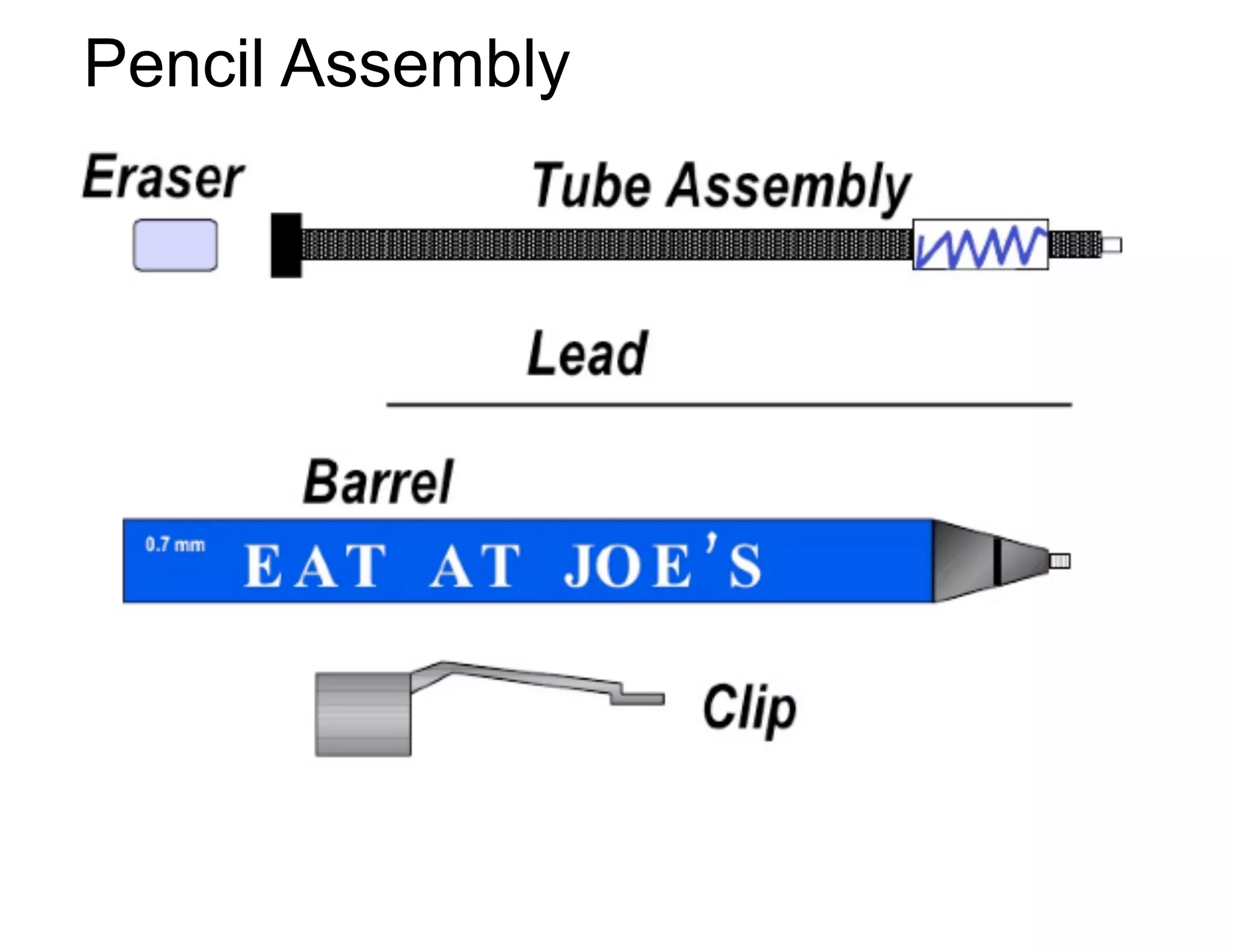
Pencil Assembly
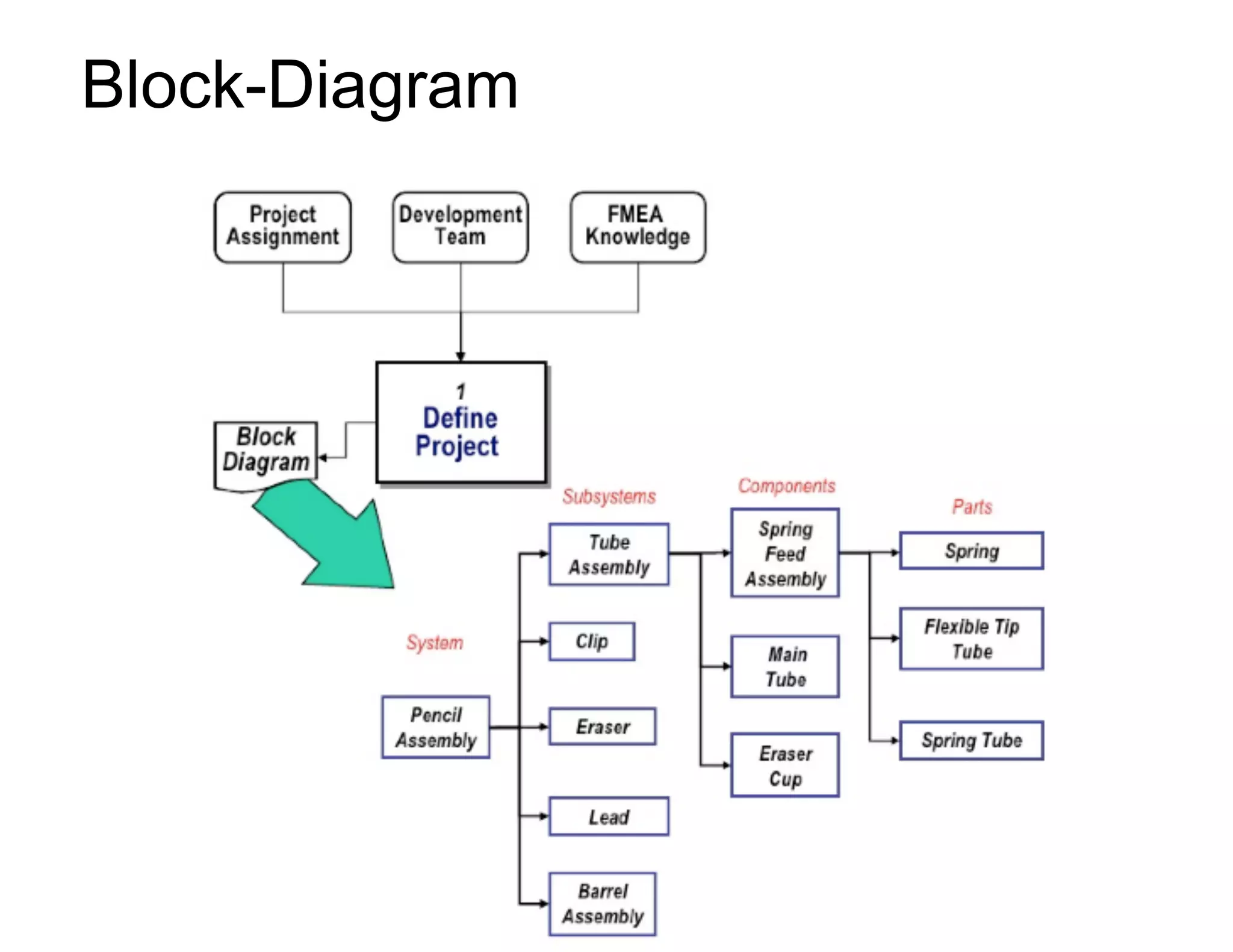
Block-Diagram
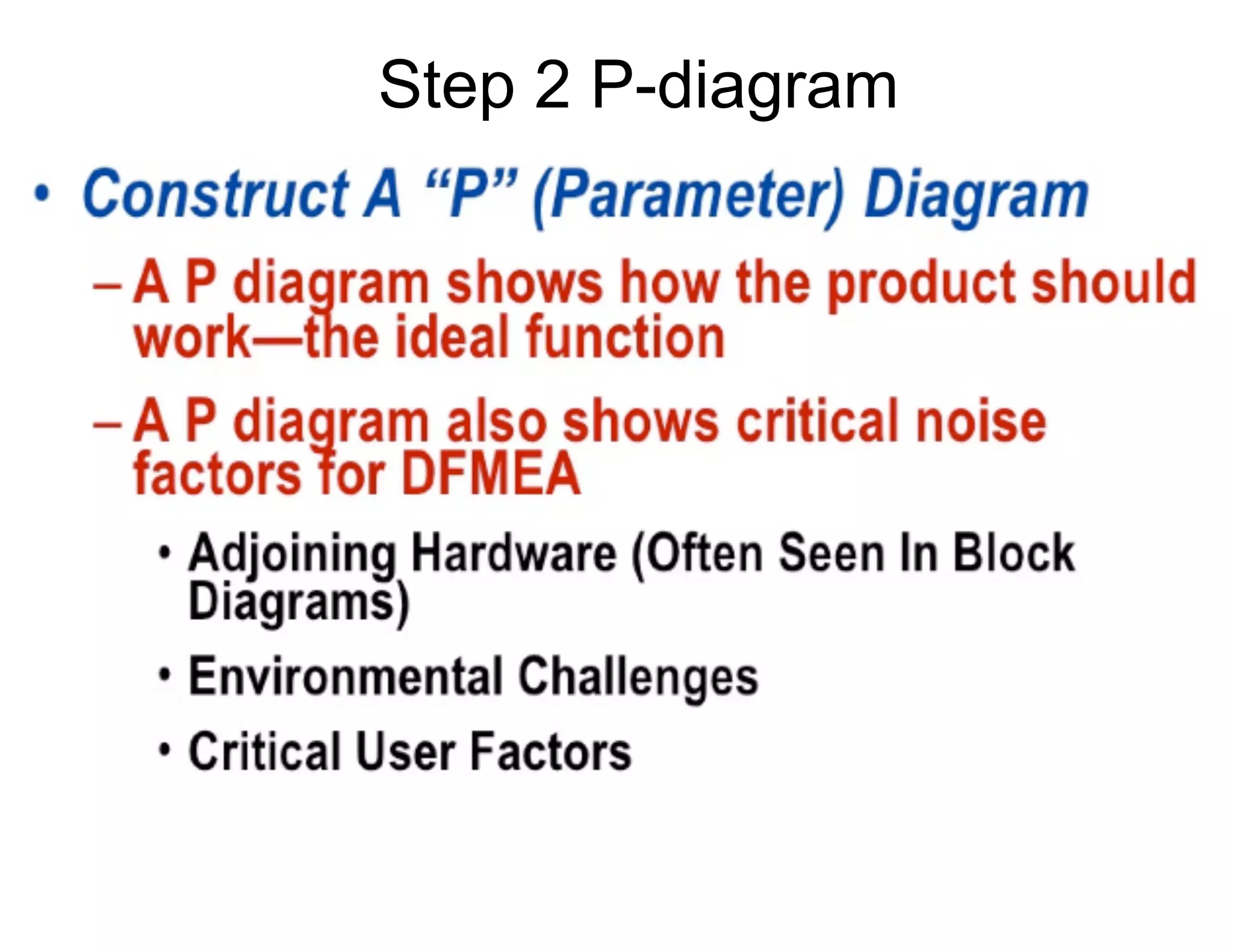
Step 2 P-diagram
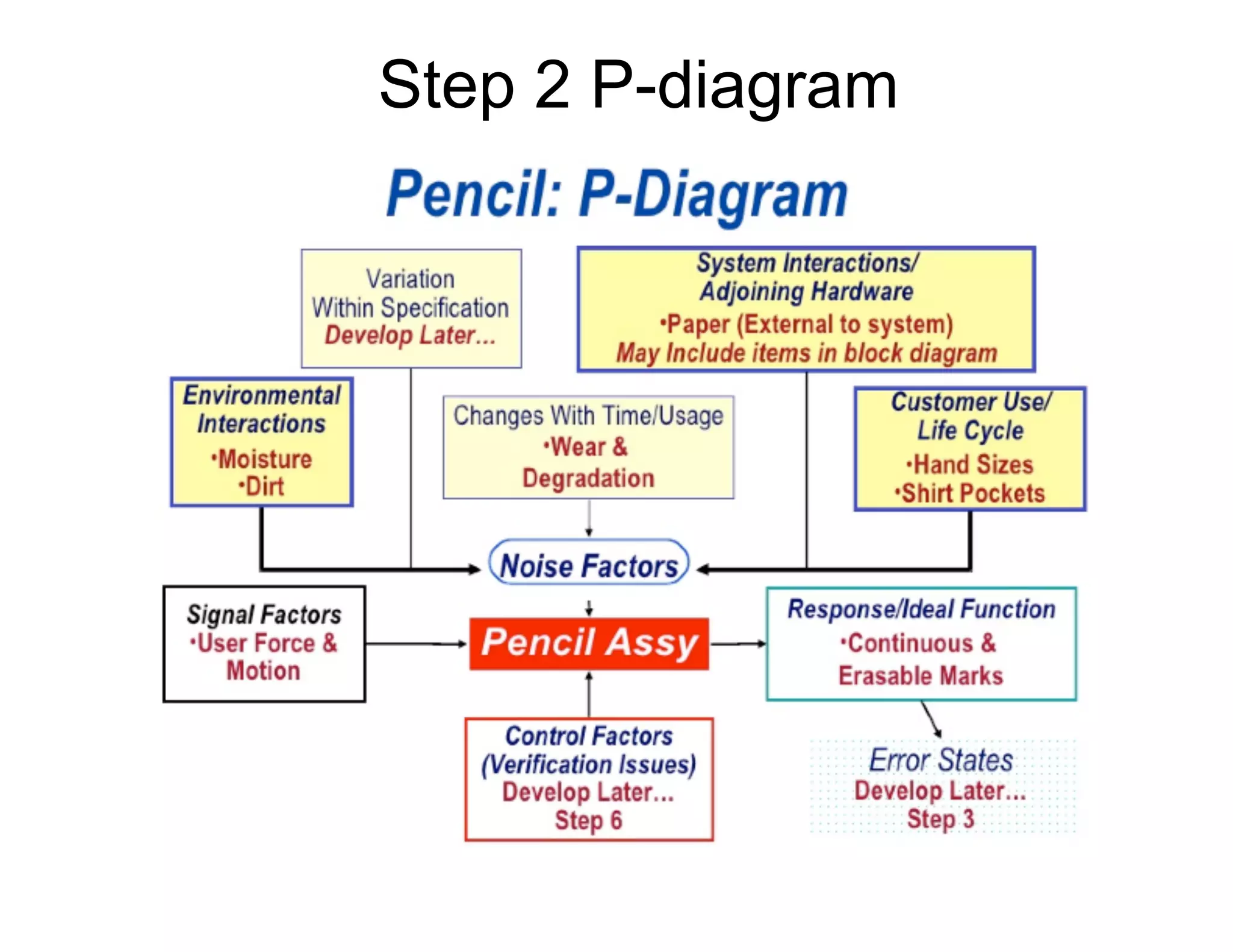
Step 2 P-diagram
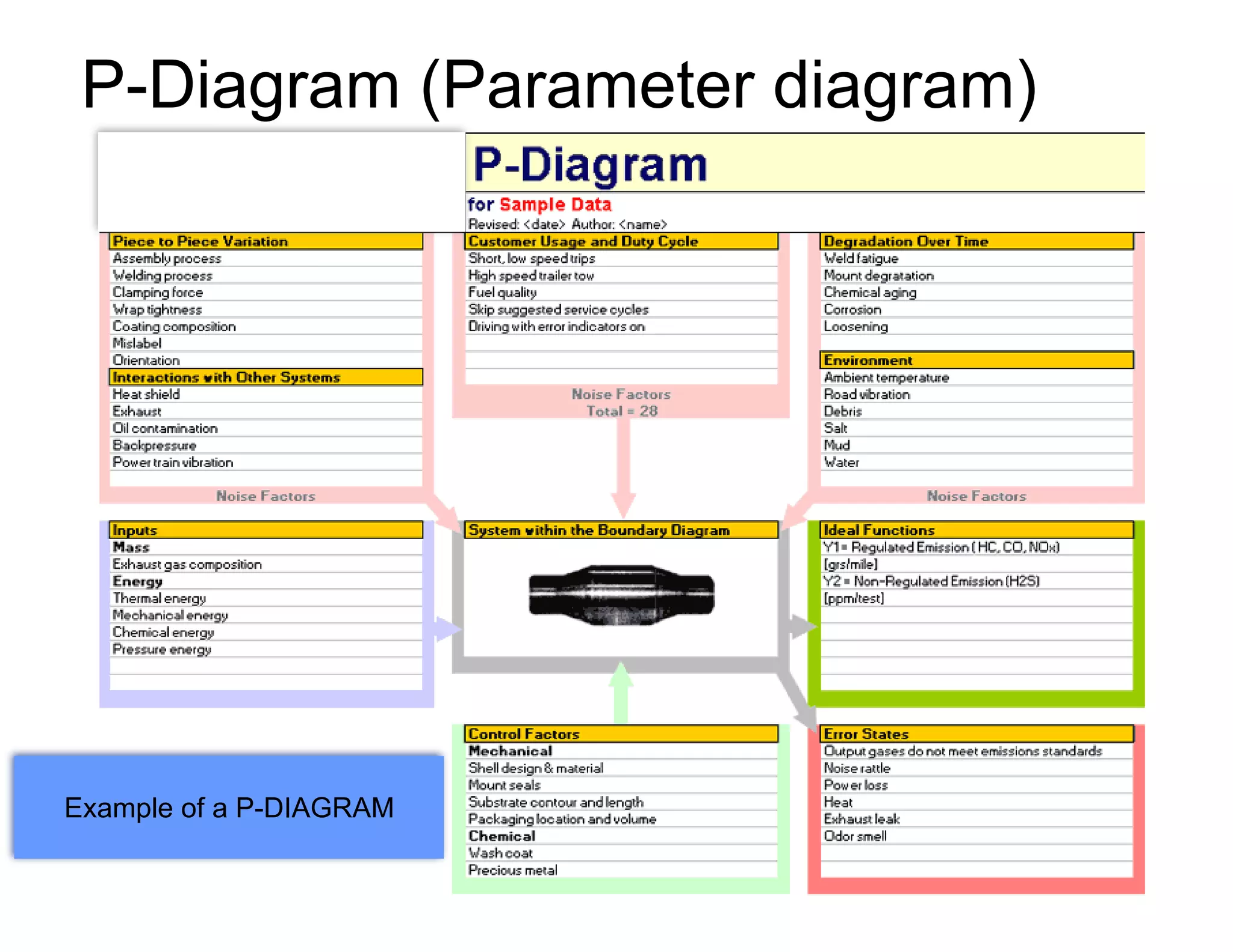
P-Diagram (Parameter diagram)
Example of a P-DIAGRAM
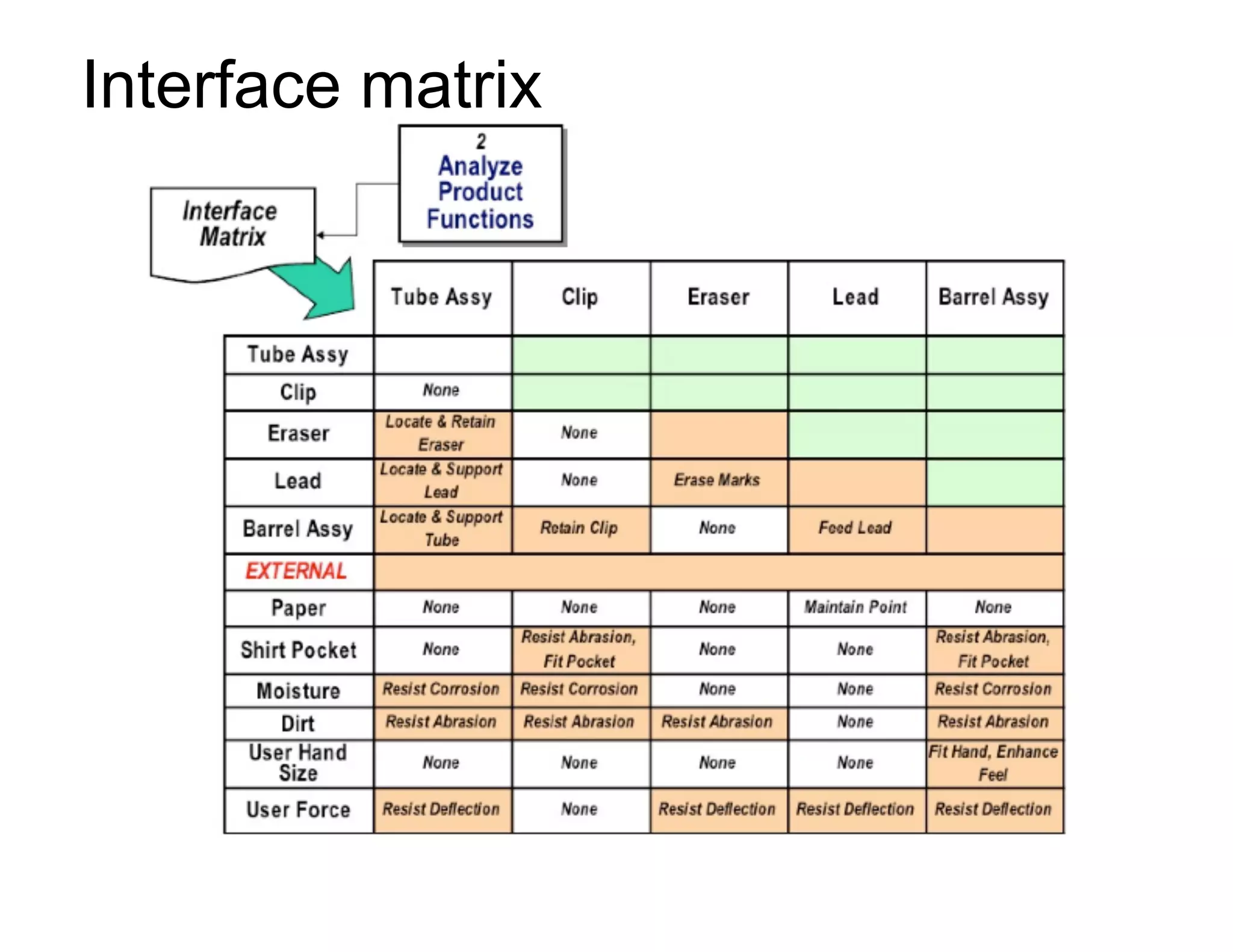
Interface matrix
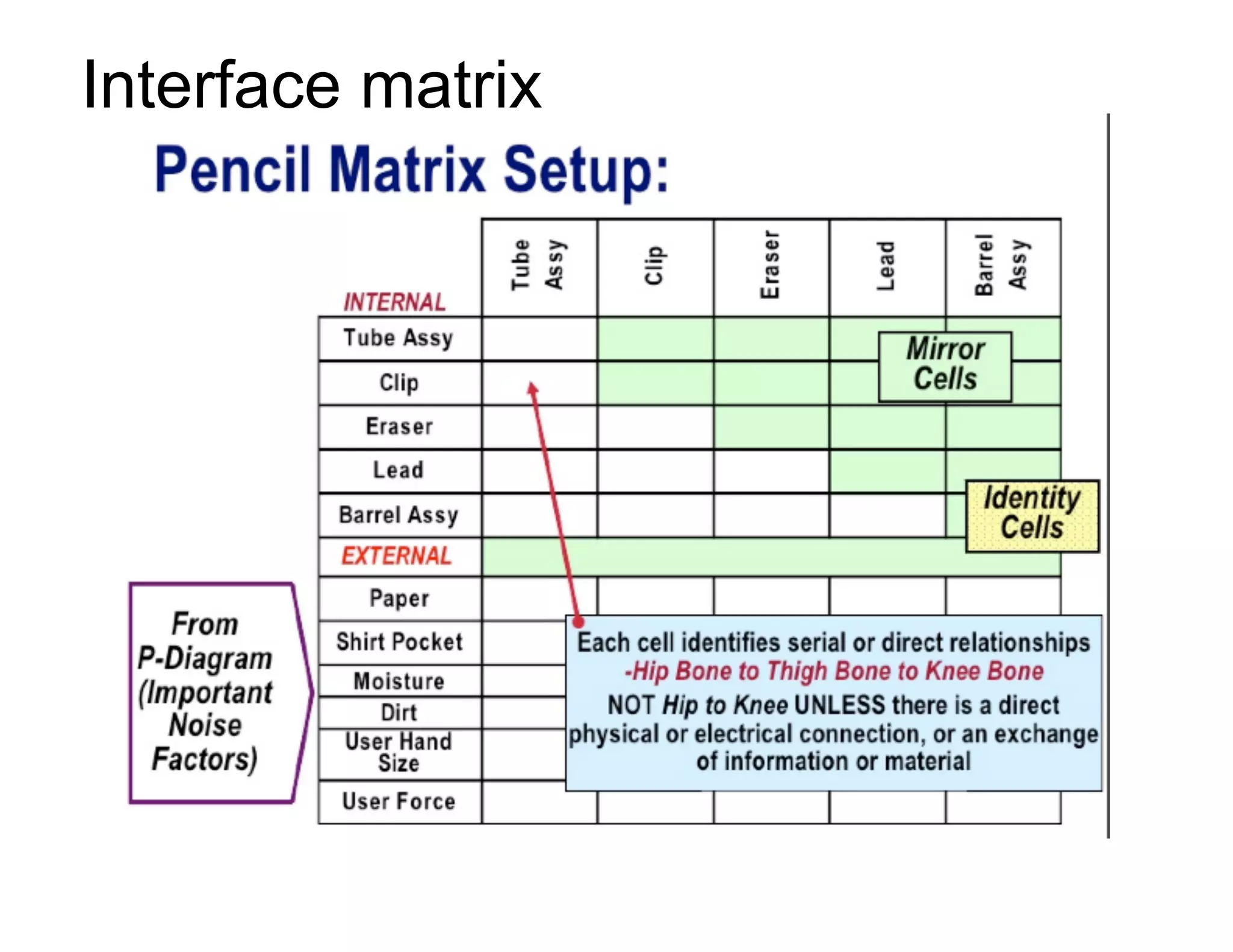
Interface matrix
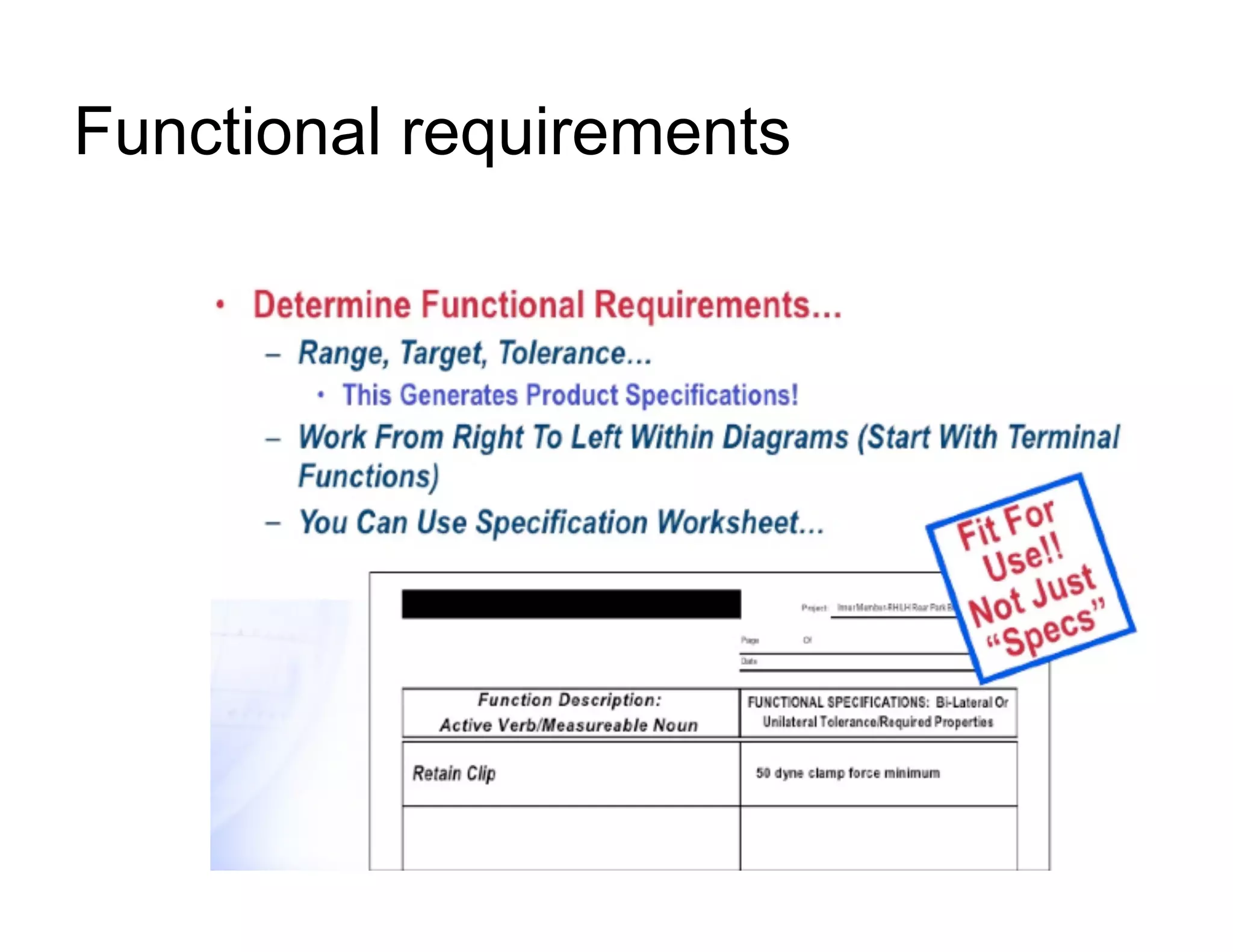
Functional requirements
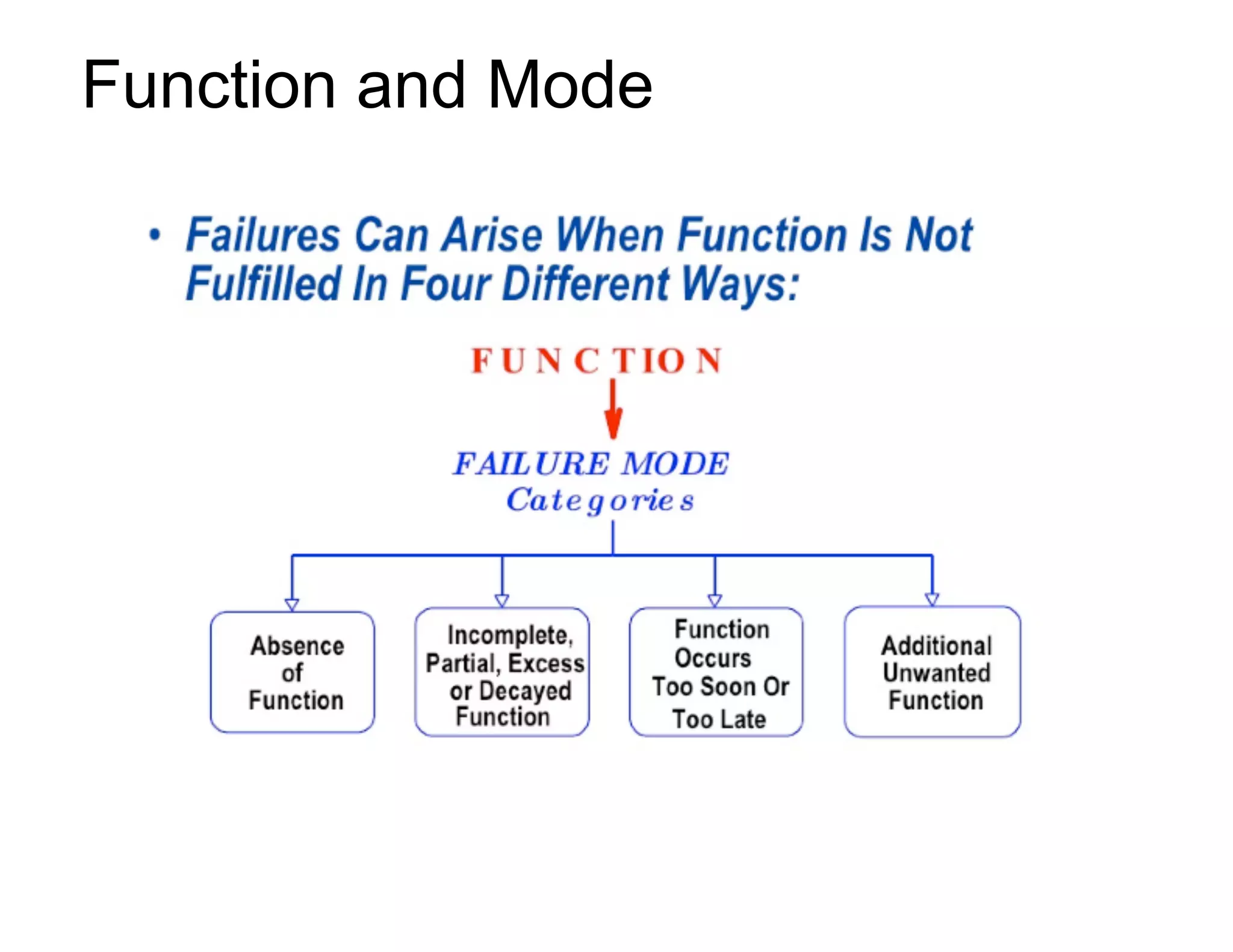
Function and Mode
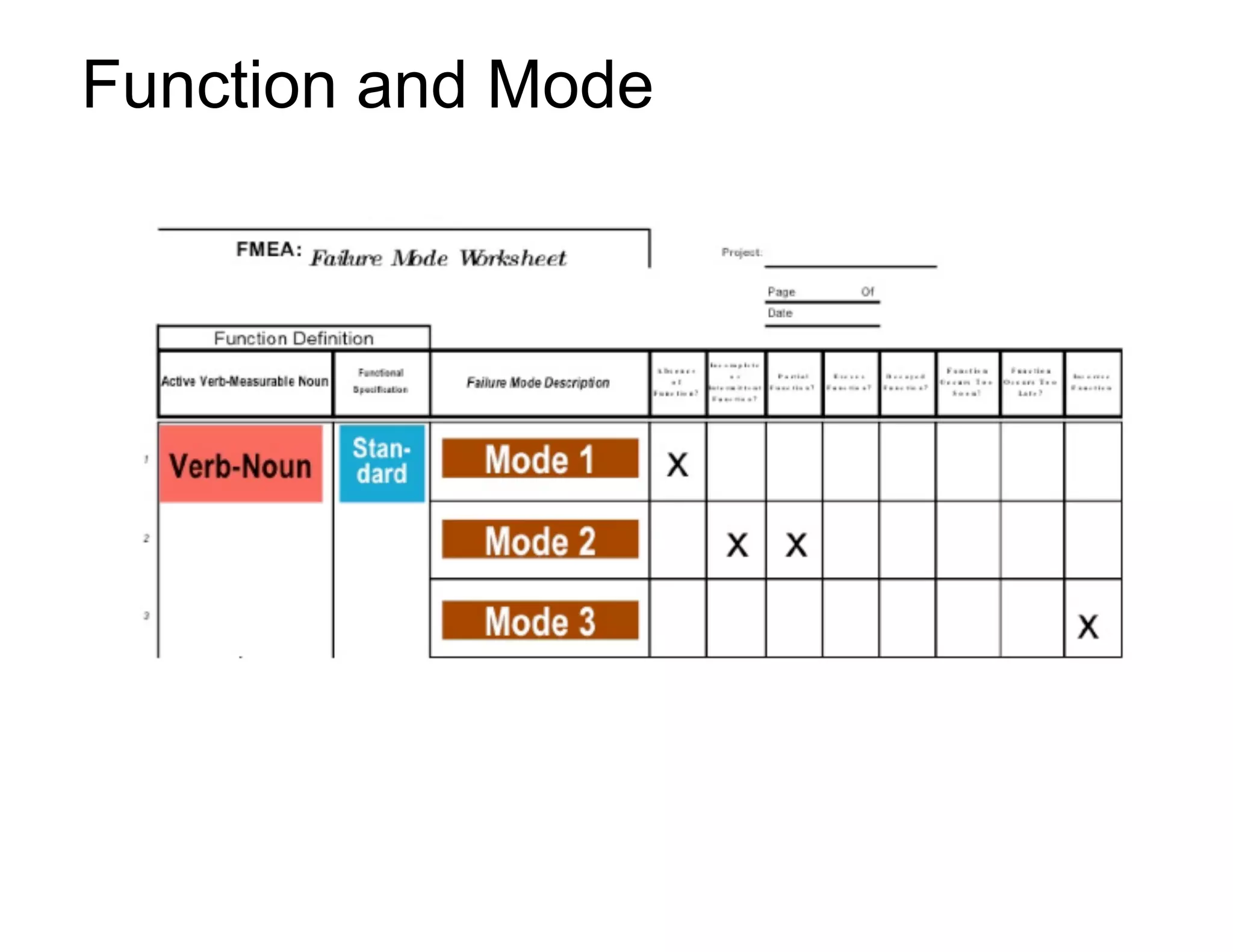
Function and Mode
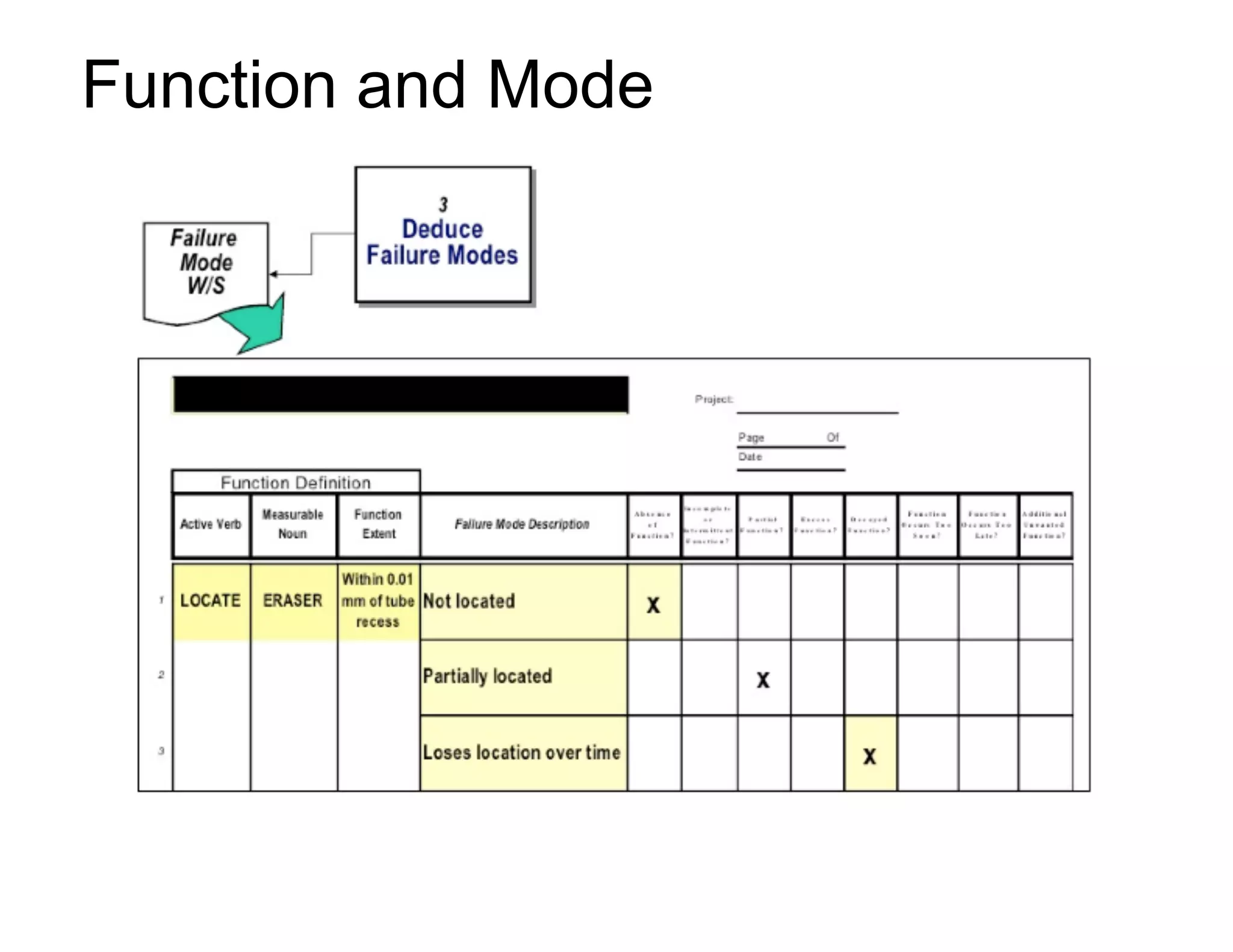
Function and Mode
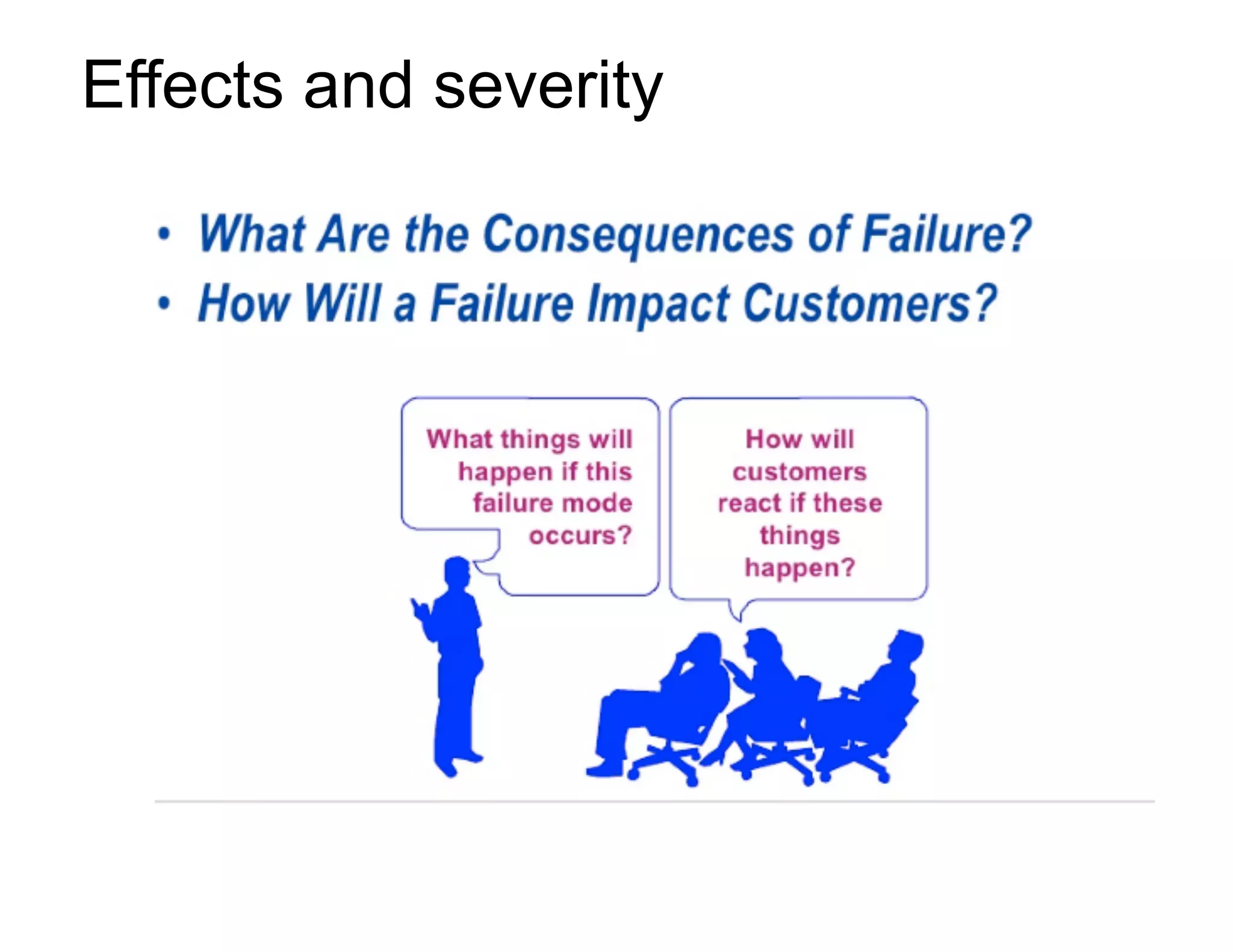
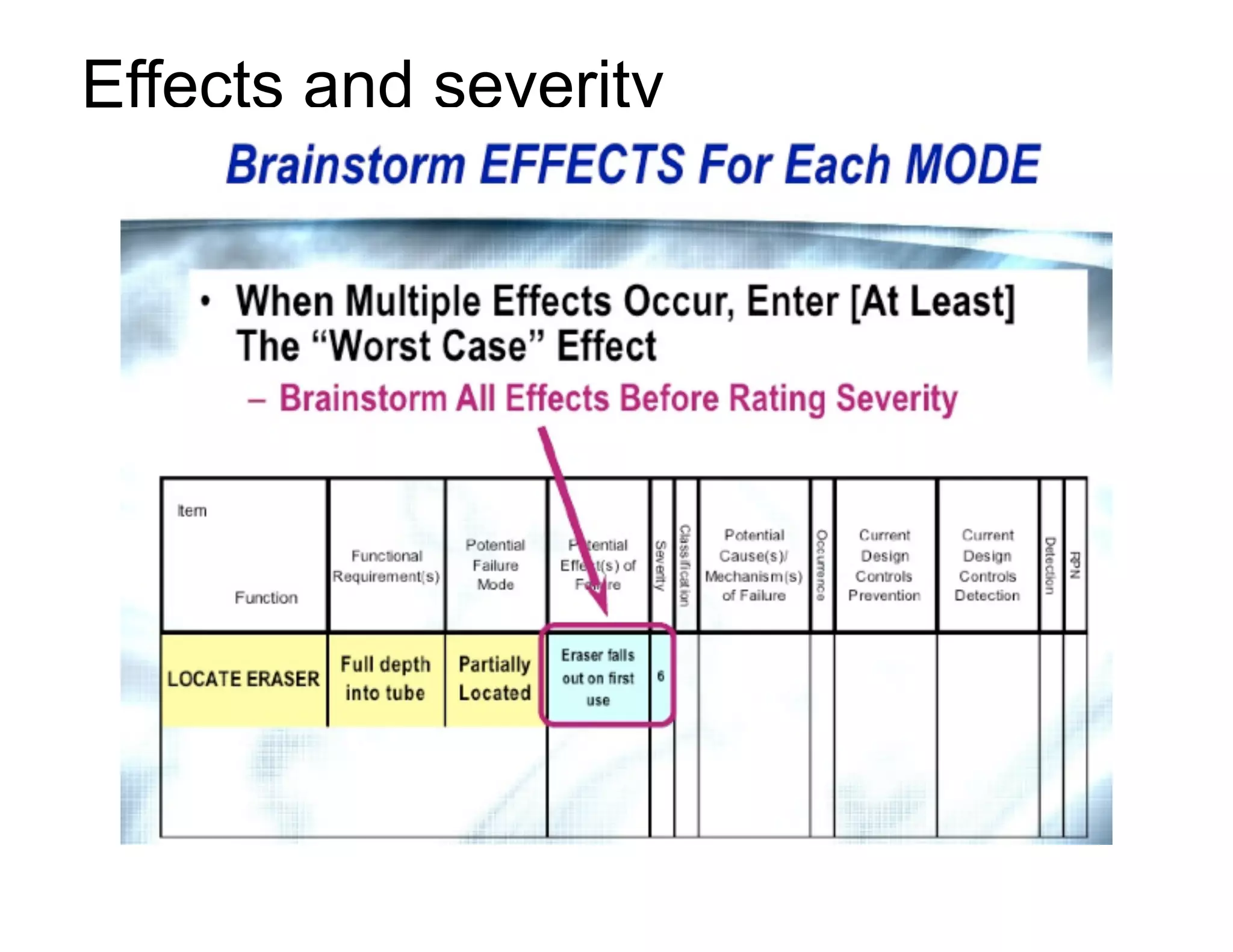
Effects and severity
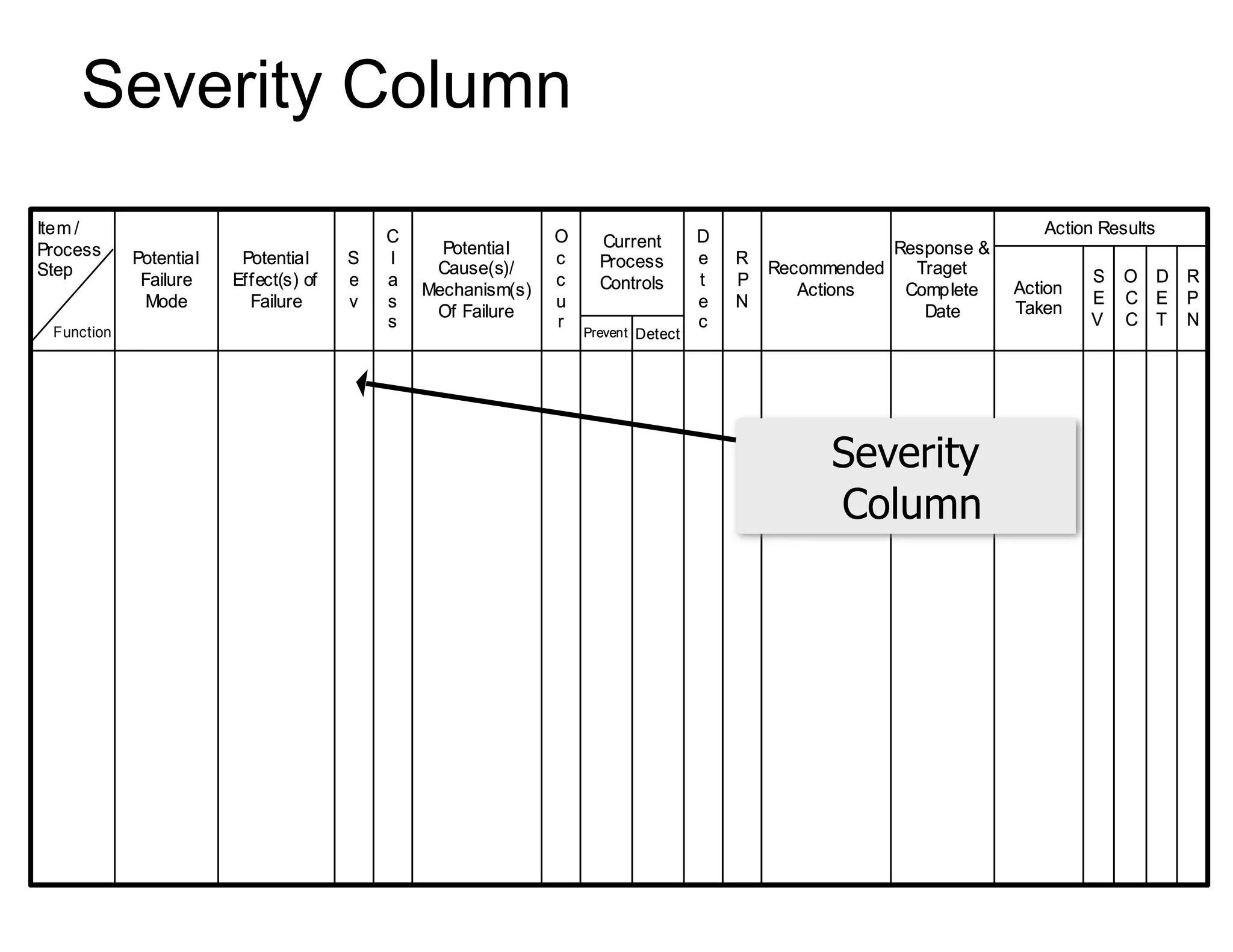
Severity Column
DetectPrevent
R
P
N
D
E
T
O
C
C
S
E
V
Action
Taken
Action Results
Response &
Traget
Complete
Date
Recommended
Actions
R
P
N
D
e
t
e
c
Current
Process
Controls
O
c
c
u
r
Potential
Cause(s)/
Mechanism(s)
Of Failure
C
l
a
s
s
S
e
v
Potential
Effect(s) of
Failure
Potential
Failure
Mode
Item /
Process
Step
DetectPrevent
R
P
N
D
E
T
O
C
C
S
E
V
Action
Taken
Action Results
Response &
Traget
Complete
Date
Recommended
Actions
R
P
N
D
e
t
e
c
Current
Process
Controls
O
c
c
u
r
Potential
Cause(s)/
Mechanism(s)
Of Failure
C
l
a
s
s
S
e
v
Potential
Effect(s) of
Failure
Potential
Failure
Mode
Item /
Process
Step
Function
Severity
Column
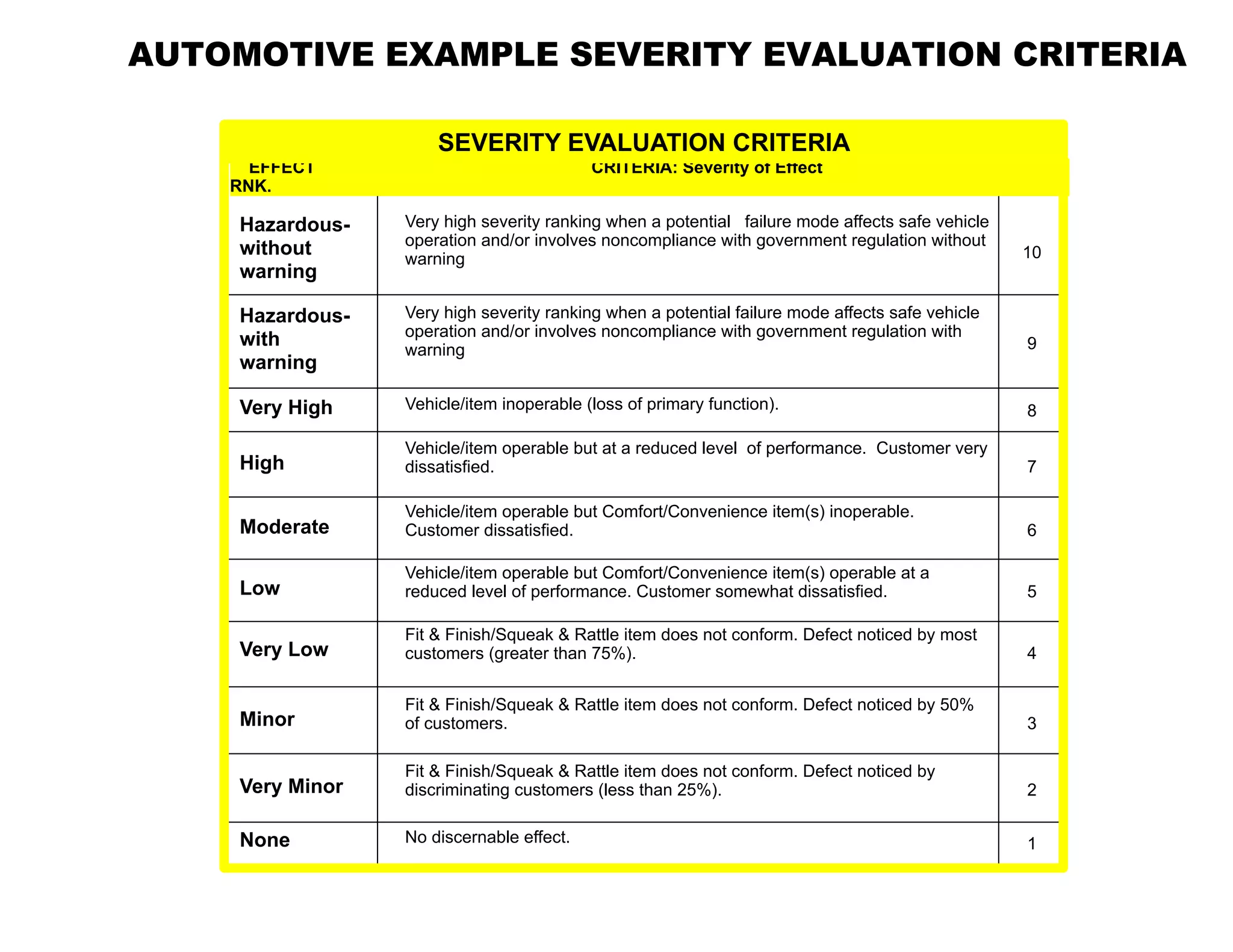
AUTOMOTIVE EXAMPLE SEVERITY EVALUATION CRITERIA
Hazardous-
with
warning
Very High
High
Very high severity ranking when a potential failure mode affects safe vehicle
operation and/or involves noncompliance with government regulation without
warning
Low
Very Low
Minor
Very Minor
None
Very high severity ranking when a potential failure mode affects safe vehicle
operation and/or involves noncompliance with government regulation with
warning
Vehicle/item inoperable (loss of primary function).
Vehicle/item operable but at a reduced level of performance. Customer very
dissatisfied.
Vehicle/item operable but Comfort/Convenience item(s) inoperable.
Customer dissatisfied.
Vehicle/item operable but Comfort/Convenience item(s) operable at a
reduced level of performance. Customer somewhat dissatisfied.
Fit & Finish/Squeak & Rattle item does not conform. Defect noticed by most
customers (greater than 75%).
Fit & Finish/Squeak & Rattle item does not conform. Defect noticed by 50%
of customers.
Fit & Finish/Squeak & Rattle item does not conform. Defect noticed by
discriminating customers (less than 25%).
No discernable effect.
10
8
7
6
3
2
1
Hazardous-
without
warning
Moderate
4
5
EFFECT CRITERIA: Severity of Effect
RNK.
SEVERITY EVALUATION CRITERIA
9
FMEA General
● For High Severity 9/10
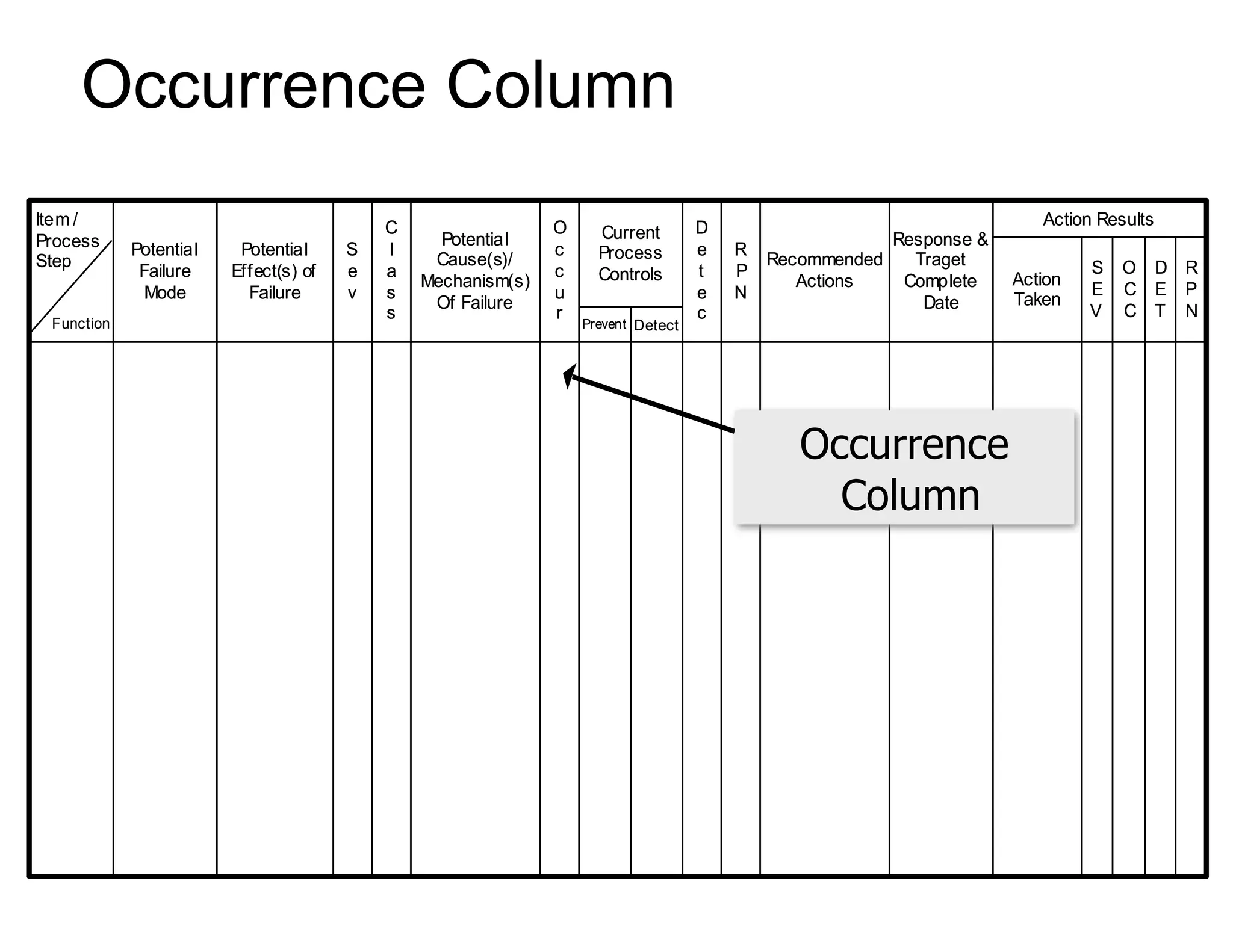
Occurrence Column
DetectPrevent
R
P
N
D
E
T
O
C
C
S
E
V
Action
Taken
Action Results
Response &
Traget
Complete
Date
Recommended
Actions
R
P
N
D
e
t
e
c
Current
Process
Controls
O
c
c
u
r
Potential
Cause(s)/
Mechanism(s)
Of Failure
C
l
a
s
s
S
e
v
Potential
Effect(s) of
Failure
Potential
Failure
Mode
Item /
Process
Step
DetectPrevent
R
P
N
D
E
T
O
C
C
S
E
V
Action
Taken
Action Results
Response &
Traget
Complete
Date
Recommended
Actions
R
P
N
D
e
t
e
c
Current
Process
Controls
O
c
c
u
r
Potential
Cause(s)/
Mechanism(s)
Of Failure
C
l
a
s
s
S
e
v
Potential
Effect(s) of
Failure
Potential
Failure
Mode
Item /
Process
Step
Function
Occurrence
Column
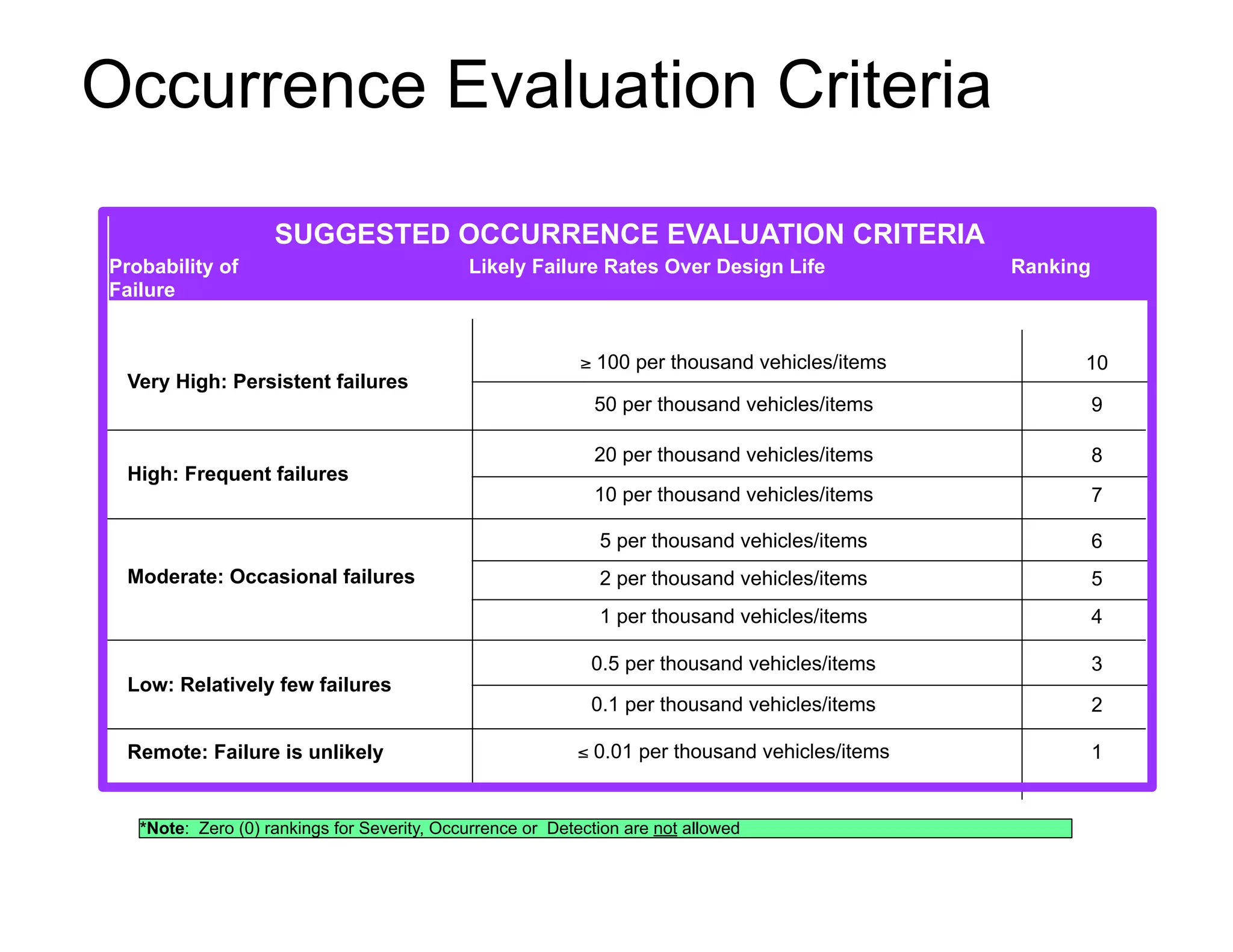
Occurrence Evaluation Criteria
*Note: Zero (0) rankings for Severity, Occurrence or Detection are not allowed
Probability of Likely Failure Rates Over Design Life Ranking
Failure
SUGGESTED OCCURRENCE EVALUATION CRITERIA
Very High: Persistent failures
High: Frequent failures
Moderate: Occasional failures
Low: Relatively few failures
Remote: Failure is unlikely
≥ 100 per thousand vehicles/items
50 per thousand vehicles/items
20 per thousand vehicles/items
10 per thousand vehicles/items
5 per thousand vehicles/items
2 per thousand vehicles/items
1 per thousand vehicles/items
0.5 per thousand vehicles/items
0.1 per thousand vehicles/items
≤ 0.01 per thousand vehicles/items
10
9
8
7
6
5
4
3
2
1
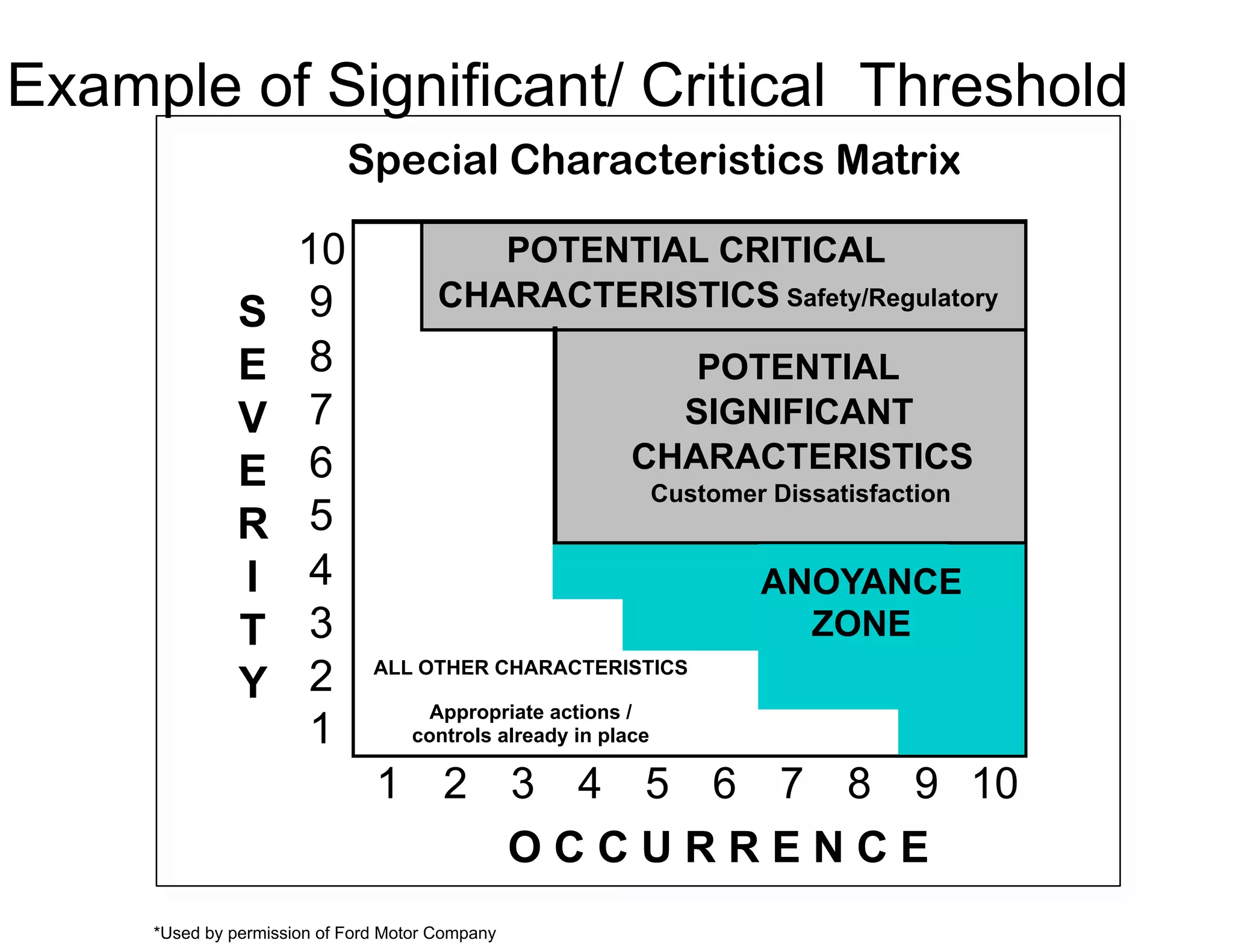
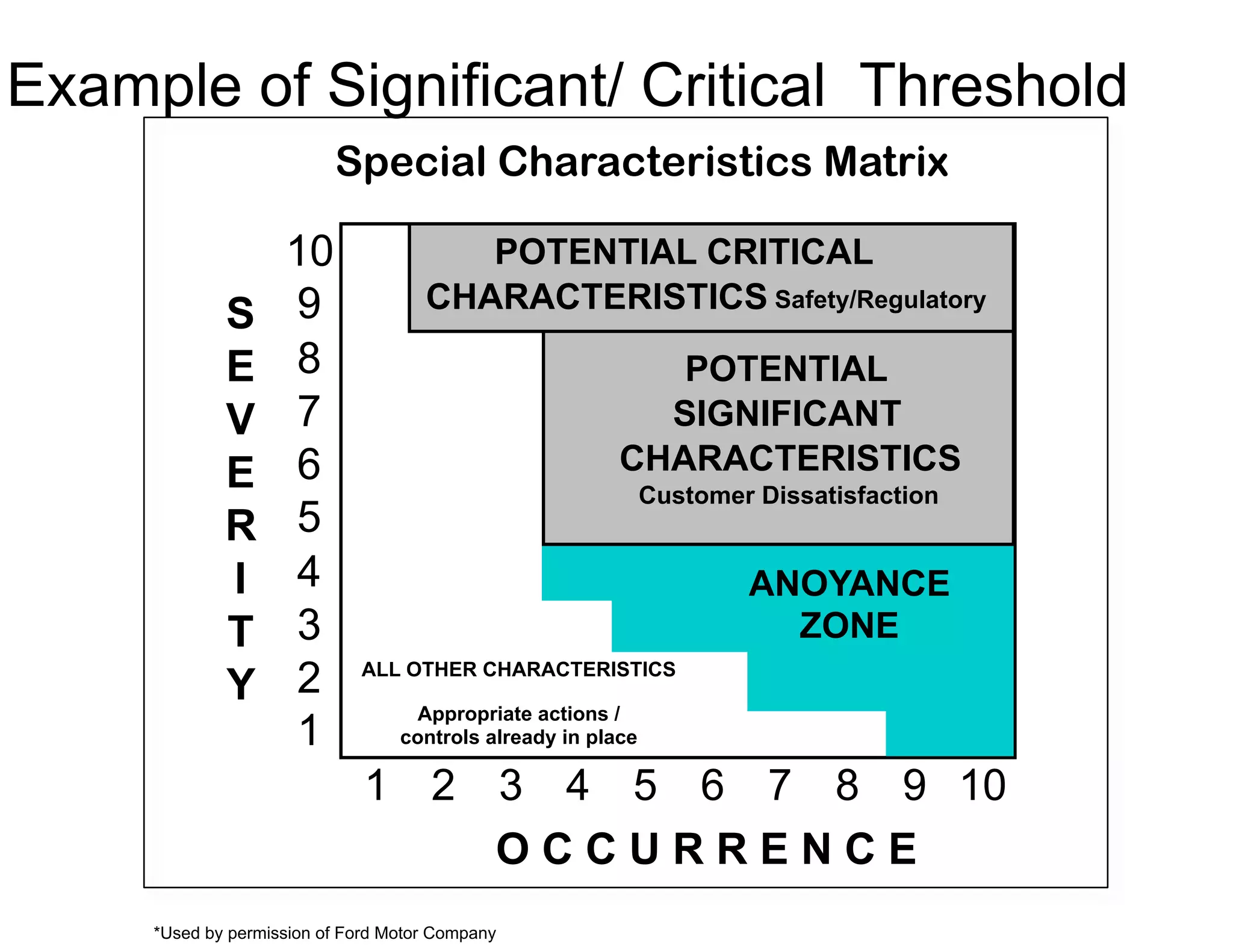
Example of Significant/ Critical Threshold
*Used by permission of Ford Motor Company
10
9
8
7
6
5
4
3
2
1
1 2 3 4 5 6 7 8 9 10
S
E
V
E
R
I
T
Y
O C C U R R E N C E
POTENTIAL CRITICAL
CHARACTERISTICS Safety/Regulatory
POTENTIAL
SIGNIFICANT
CHARACTERISTICS
Customer Dissatisfaction
ALL OTHER CHARACTERISTICS
Appropriate actions /
controls already in place
Special Characteristics Matrix
ANOYANCE
ZONE
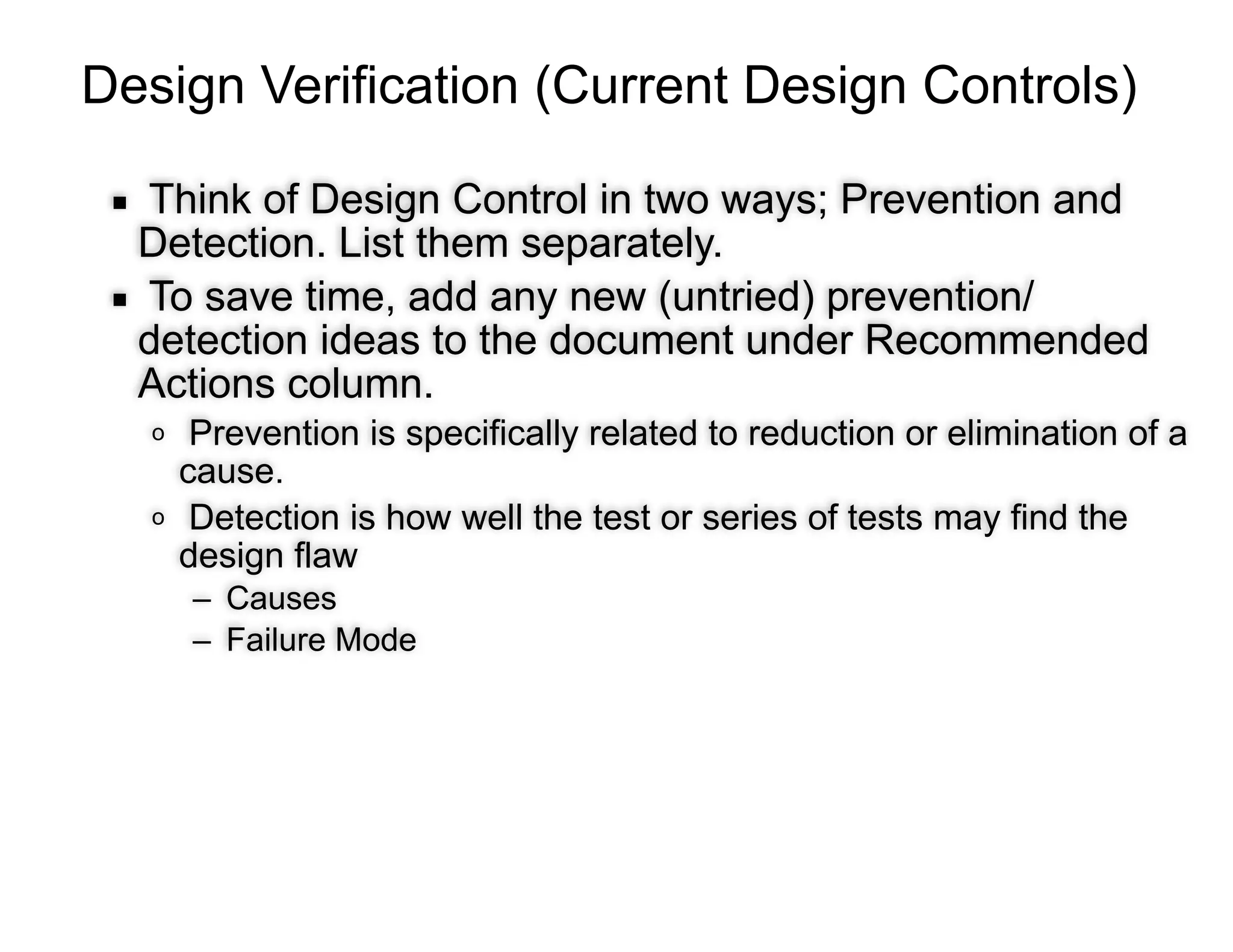
Design Verification (Current Design Controls)
▪ Think of Design Control in two ways; Prevention and
Detection. List them separately.
▪ To save time, add any new (untried) prevention/
detection ideas to the document under Recommended
Actions column.
o Prevention is specifically related to reduction or elimination of a
cause.
o Detection is how well the test or series of tests may find the
design flaw
– Causes
– Failure Mode
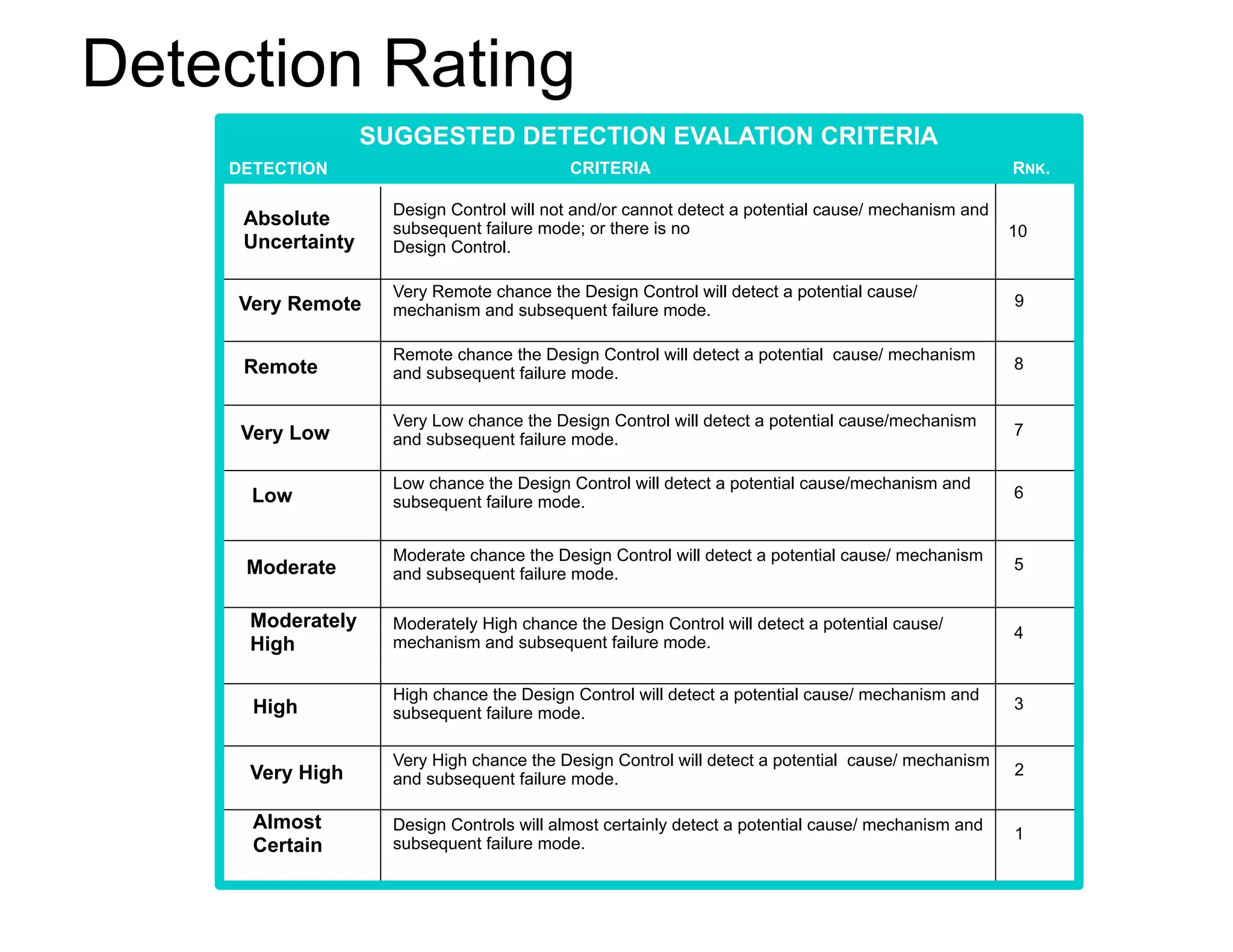
Detection Rating
Absolute
Uncertainty
Very Remote
Remote
Very Low
Low
Moderate
Moderately
High
High
Very High
Almost
Certain
10
9
8
7
6
5
4
3
2
1
Design Control will not and/or cannot detect a potential cause/ mechanism and
subsequent failure mode; or there is no
Design Control.
Very Remote chance the Design Control will detect a potential cause/
mechanism and subsequent failure mode.
Remote chance the Design Control will detect a potential cause/ mechanism
and subsequent failure mode.
Very Low chance the Design Control will detect a potential cause/mechanism
and subsequent failure mode.
Low chance the Design Control will detect a potential cause/mechanism and
subsequent failure mode.
Moderate chance the Design Control will detect a potential cause/ mechanism
and subsequent failure mode.
Moderately High chance the Design Control will detect a potential cause/
mechanism and subsequent failure mode.
Very High chance the Design Control will detect a potential cause/ mechanism
and subsequent failure mode.
High chance the Design Control will detect a potential cause/ mechanism and
subsequent failure mode.
Design Controls will almost certainly detect a potential cause/ mechanism and
subsequent failure mode.
DETECTION
SUGGESTED DETECTION EVALATION CRITERIA
CRITERIA RNK.
Analysis Of Risk
▪ RPN / RISK PRIORITY NUMBER
▪ What Is Risk?
▪ Probability of danger
▪ Severity/Occurrence/Cause
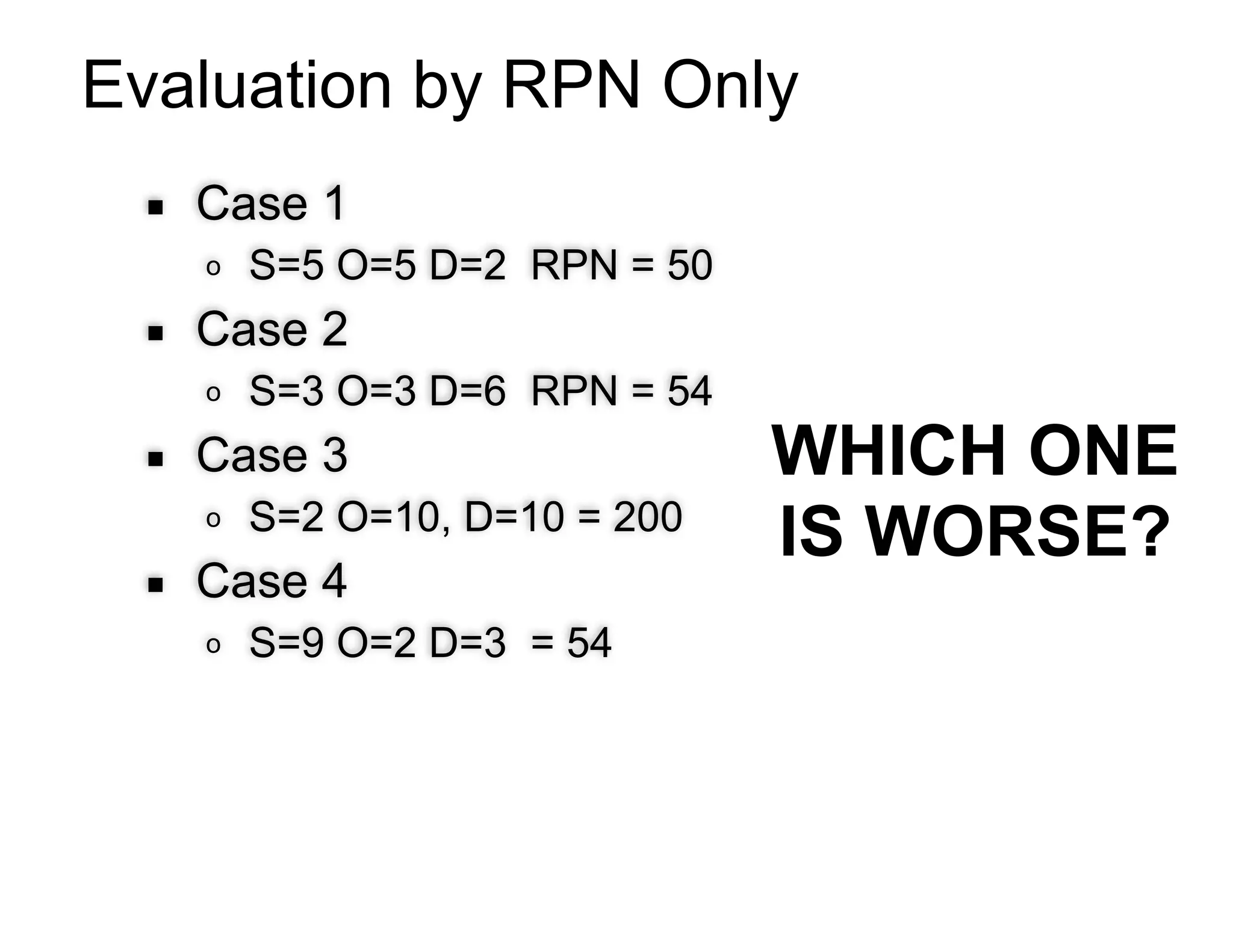
Evaluation by RPN Only
▪ Case 1
o S=5 O=5 D=2 RPN = 50
▪ Case 2
o S=3 O=3 D=6 RPN = 54
▪ Case 3
o S=2 O=10, D=10 = 200
▪ Case 4
o S=9 O=2 D=3 = 54
WHICH ONE
IS WORSE?
Example
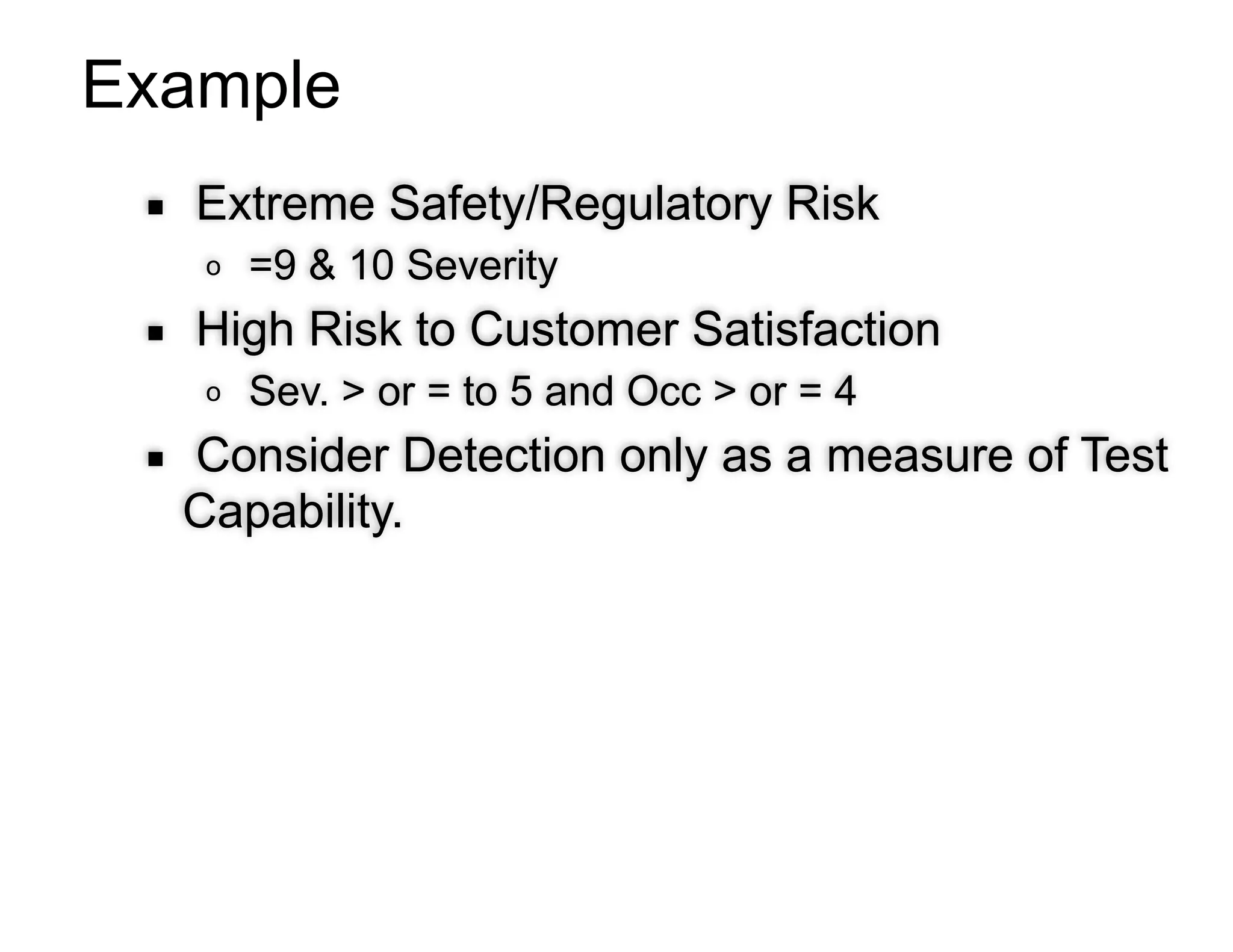
▪ Extreme Safety/Regulatory Risk
o =9 & 10 Severity
▪ High Risk to Customer Satisfaction
o Sev. > or = to 5 and Occ > or = 4
▪ Consider Detection only as a measure of Test
Capability.
Example of Significant/ Critical Threshold
*Used by permission of Ford Motor Company
10
9
8
7
6
5
4
3
2
1
1 2 3 4 5 6 7 8 9 10
S
E
V
E
R
I
T
Y
O C C U R R E N C E
POTENTIAL CRITICAL
CHARACTERISTICS Safety/Regulatory
POTENTIAL
SIGNIFICANT
CHARACTERISTICS
Customer Dissatisfaction
ALL OTHER CHARACTERISTICS
Appropriate actions /
controls already in place
Special Characteristics Matrix
ANOYANCE
ZONE
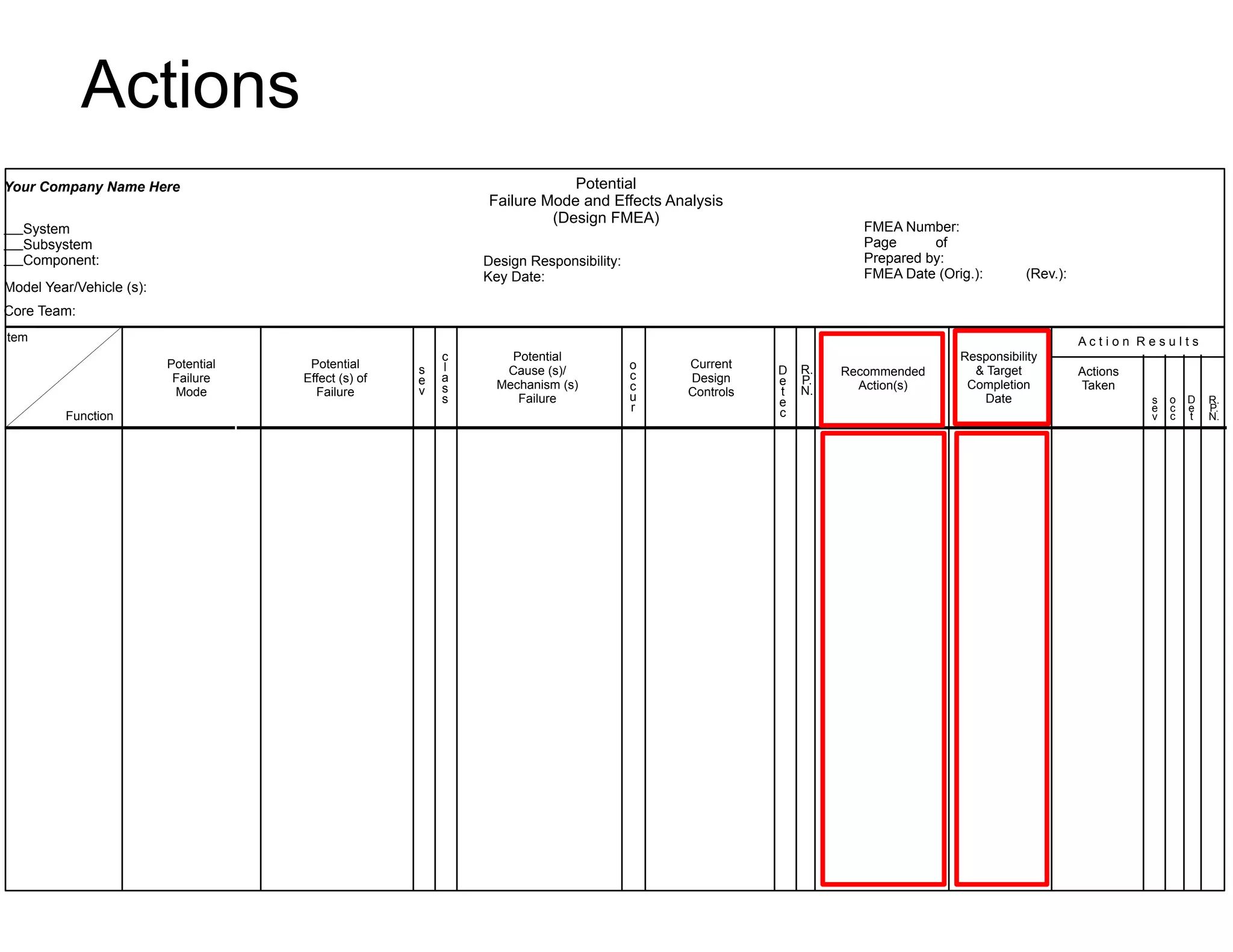
Actions
Item
Function
System
Subsystem
Component:
Model Year/Vehicle (s):
Core Team:
Your Company Name Here Potential
Failure Mode and Effects Analysis
(Design FMEA)
Design Responsibility:
Key Date:
FMEA Number:
Page of
Prepared by:
FMEA Date (Orig.): (Rev.):
Potential
Failure
Mode
Potential
Effect (s) of
Failure
s
e
v
c
l
a
s
s
Potential
Cause (s)/
Mechanism (s)
Failure
o
c
c
u
r
Current
Design
Controls
D
e
t
e
c
R.
P.
N.
Recommended
Action(s)
Responsibility
& Target
Completion
Date
Actions
Taken
s
e
v
o
c
c
D
e
t
R.
P.
N.
A c t i o n R e s u l t s
Actions
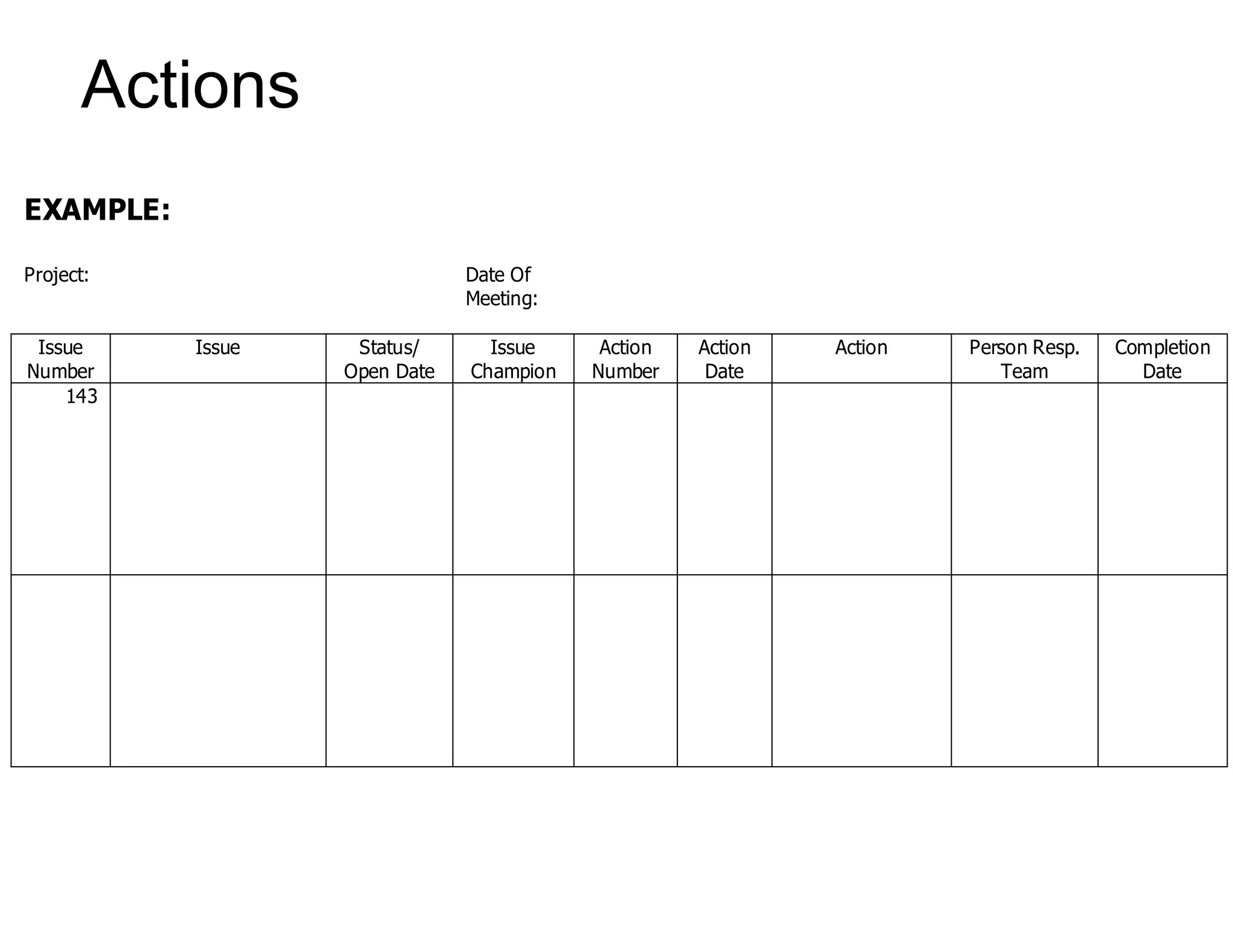
EXAMPLE:
Project: Date Of
Meeting:
Issue
Number
Issue Status/
Open Date
Issue
Champion
Action
Number
Action
Date
Action Person Resp.
Team
Completion
Date
143
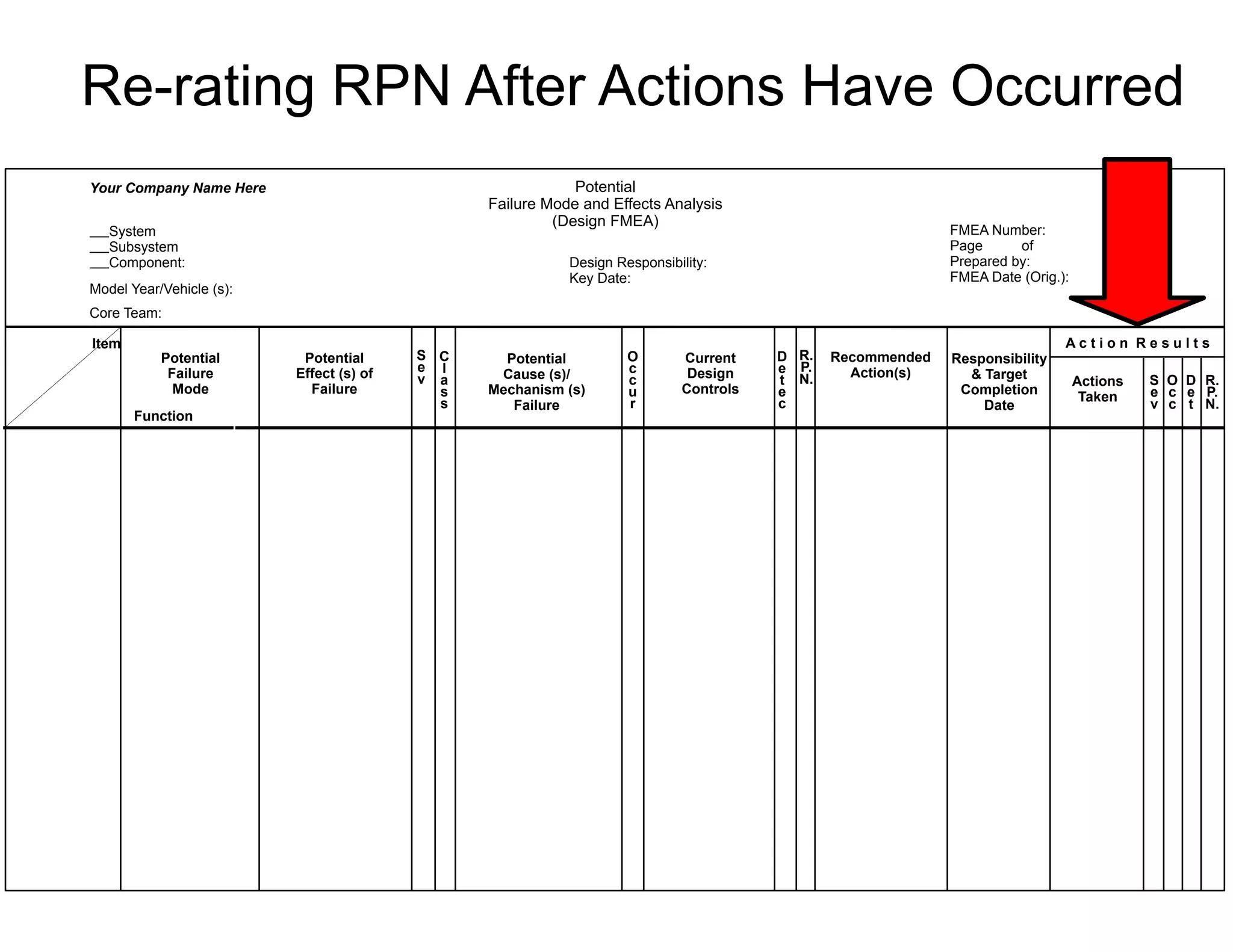
Re-rating RPN After Actions Have Occurred
Item
Function
System
Subsystem
Component:
Model Year/Vehicle (s):
Core Team:
Your Company Name Here Potential
Failure Mode and Effects Analysis
(Design FMEA)
Design Responsibility:
Key Date:
FMEA Number:
Page of
Prepared by:
FMEA Date (Orig.): (Rev.):
Potential
Failure
Mode
Potential
Effect (s) of
Failure
S
e
v
C
l
a
s
s
Potential
Cause (s)/
Mechanism (s)
Failure
O
c
c
u
r
Current
Design
Controls
D
e
t
e
c
R.
P.
N.
Recommended
Action(s)
Responsibility
& Target
Completion
Date
Actions
Taken
S
e
v
O
c
c
D
e
t
R.
P.
N.
A c t i o n R e s u l t s
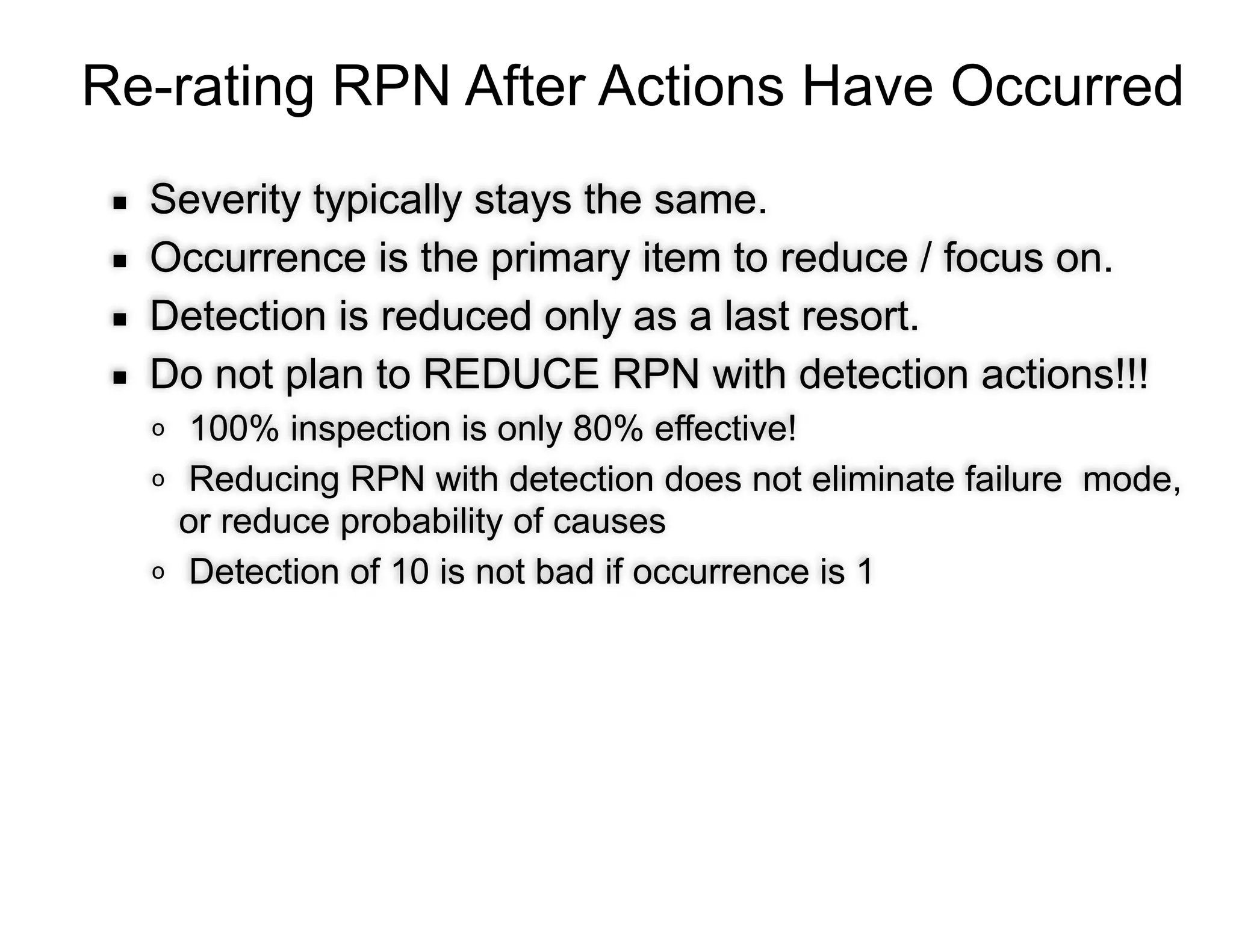
Re-rating RPN After Actions Have Occurred
▪ Severity typically stays the same.
▪ Occurrence is the primary item to reduce / focus on.
▪ Detection is reduced only as a last resort.
▪ Do not plan to REDUCE RPN with detection actions!!!
o 100% inspection is only 80% effective!
o Reducing RPN with detection does not eliminate failure mode,
or reduce probability of causes
o Detection of 10 is not bad if occurrence is 1
FMEA in a continuous flow process
●Steel Making example:
!
▪ Design FMEA was performed on a Crankshaft to
determine the best material for the product being
considered. This was a critical application.
!
▪ Key features such as Geometry, Strength, Duty Cycle,
were described to the Steel producer.

Design fmea

  • 1.
  • 2.
    Purpose To deepen understandingand refine your current approach to Design FMEA’s.
  • 3.
    Definition of FMEA AFailure Mode and Effect Analysis uses a disciplined technique to identify and help eliminate product and process potential failure modes. o By ID of potential failures o Assessing the risks caused by failure modes and Identify corrective actions o Prioritizing corrective actions o Carry out corrective actions
  • 4.
  • 5.
  • 7.
    DFMEA/PFMEA Information Interrelationships DFMEA Design FMEA ProcessFlow Diagram PFMEA Process FMEA Boundary (Block) Diagram, P- Diagram, Etc. Design Verification Plan & Report (DVP&R) Process Control Plan
  • 8.
    Potential Key ProductCharacteristics Development DetectPrevent R P N D E T O C C S E V Action Taken Action Results Response & Target Complete Date Recommended Actions R P N D e t e c Current Controls O c c u r Potential Cause(s)/ Mechanism(s) Of Failure C l a s s S e v Potential Effect(s) of Failure Potential Failure Mode Item / Process Step DetectPrevent R P N D E T O C C S E V Action Taken Action Results Response & Target Complete Date Recommended Actions R P N D e t e c Current Design Controls O c c u r Potential Cause(s)/ Mechanism(s) Of Failure C l a s s S e v Potential Effect(s) of Failure Potential Failure Mode Item / Process Step Function DFMEA Requirements Documents ! •Regulatory •Dimensional •Cosmetic ! Req. Spec. Document Drawings Warranty History Robustness Tools ! Boundary Diagram P-Diagram Interface Matrix 10 9 8 7 6 5 4 3 2 1 1 2 3 4 5 6 7 8 9 10 S E V E R I T Y O C C U R R E N C E POTENTIAL CRITICAL CHARACTERISTICS Safety/Regulatory POTENTIAL SIGNIFICANT CHARACTERISTICS Customer Dissatisfaction Special Characteristics Matrix ANOYANCE ZONE ALL OTHER CHARACTERISTICS Appropriate actions / controls already in place Cascade Technical Requirements Into Special Product Characteristics
  • 9.
  • 10.
  • 11.
  • 12.
  • 13.
  • 14.
  • 15.
  • 16.
  • 17.
  • 18.
  • 19.
  • 20.
  • 21.
  • 23.
  • 24.
    Severity Column DetectPrevent R P N D E T O C C S E V Action Taken Action Results Response& Traget Complete Date Recommended Actions R P N D e t e c Current Process Controls O c c u r Potential Cause(s)/ Mechanism(s) Of Failure C l a s s S e v Potential Effect(s) of Failure Potential Failure Mode Item / Process Step DetectPrevent R P N D E T O C C S E V Action Taken Action Results Response & Traget Complete Date Recommended Actions R P N D e t e c Current Process Controls O c c u r Potential Cause(s)/ Mechanism(s) Of Failure C l a s s S e v Potential Effect(s) of Failure Potential Failure Mode Item / Process Step Function Severity Column
  • 25.
    AUTOMOTIVE EXAMPLE SEVERITYEVALUATION CRITERIA Hazardous- with warning Very High High Very high severity ranking when a potential failure mode affects safe vehicle operation and/or involves noncompliance with government regulation without warning Low Very Low Minor Very Minor None Very high severity ranking when a potential failure mode affects safe vehicle operation and/or involves noncompliance with government regulation with warning Vehicle/item inoperable (loss of primary function). Vehicle/item operable but at a reduced level of performance. Customer very dissatisfied. Vehicle/item operable but Comfort/Convenience item(s) inoperable. Customer dissatisfied. Vehicle/item operable but Comfort/Convenience item(s) operable at a reduced level of performance. Customer somewhat dissatisfied. Fit & Finish/Squeak & Rattle item does not conform. Defect noticed by most customers (greater than 75%). Fit & Finish/Squeak & Rattle item does not conform. Defect noticed by 50% of customers. Fit & Finish/Squeak & Rattle item does not conform. Defect noticed by discriminating customers (less than 25%). No discernable effect. 10 8 7 6 3 2 1 Hazardous- without warning Moderate 4 5 EFFECT CRITERIA: Severity of Effect RNK. SEVERITY EVALUATION CRITERIA 9
  • 26.
    FMEA General ● ForHigh Severity 9/10
  • 29.
    Occurrence Column DetectPrevent R P N D E T O C C S E V Action Taken Action Results Response& Traget Complete Date Recommended Actions R P N D e t e c Current Process Controls O c c u r Potential Cause(s)/ Mechanism(s) Of Failure C l a s s S e v Potential Effect(s) of Failure Potential Failure Mode Item / Process Step DetectPrevent R P N D E T O C C S E V Action Taken Action Results Response & Traget Complete Date Recommended Actions R P N D e t e c Current Process Controls O c c u r Potential Cause(s)/ Mechanism(s) Of Failure C l a s s S e v Potential Effect(s) of Failure Potential Failure Mode Item / Process Step Function Occurrence Column
  • 30.
    Occurrence Evaluation Criteria *Note:Zero (0) rankings for Severity, Occurrence or Detection are not allowed Probability of Likely Failure Rates Over Design Life Ranking Failure SUGGESTED OCCURRENCE EVALUATION CRITERIA Very High: Persistent failures High: Frequent failures Moderate: Occasional failures Low: Relatively few failures Remote: Failure is unlikely ≥ 100 per thousand vehicles/items 50 per thousand vehicles/items 20 per thousand vehicles/items 10 per thousand vehicles/items 5 per thousand vehicles/items 2 per thousand vehicles/items 1 per thousand vehicles/items 0.5 per thousand vehicles/items 0.1 per thousand vehicles/items ≤ 0.01 per thousand vehicles/items 10 9 8 7 6 5 4 3 2 1
  • 31.
    Example of Significant/Critical Threshold *Used by permission of Ford Motor Company 10 9 8 7 6 5 4 3 2 1 1 2 3 4 5 6 7 8 9 10 S E V E R I T Y O C C U R R E N C E POTENTIAL CRITICAL CHARACTERISTICS Safety/Regulatory POTENTIAL SIGNIFICANT CHARACTERISTICS Customer Dissatisfaction ALL OTHER CHARACTERISTICS Appropriate actions / controls already in place Special Characteristics Matrix ANOYANCE ZONE
  • 32.
    Design Verification (CurrentDesign Controls) ▪ Think of Design Control in two ways; Prevention and Detection. List them separately. ▪ To save time, add any new (untried) prevention/ detection ideas to the document under Recommended Actions column. o Prevention is specifically related to reduction or elimination of a cause. o Detection is how well the test or series of tests may find the design flaw – Causes – Failure Mode
  • 35.
    Detection Rating Absolute Uncertainty Very Remote Remote VeryLow Low Moderate Moderately High High Very High Almost Certain 10 9 8 7 6 5 4 3 2 1 Design Control will not and/or cannot detect a potential cause/ mechanism and subsequent failure mode; or there is no Design Control. Very Remote chance the Design Control will detect a potential cause/ mechanism and subsequent failure mode. Remote chance the Design Control will detect a potential cause/ mechanism and subsequent failure mode. Very Low chance the Design Control will detect a potential cause/mechanism and subsequent failure mode. Low chance the Design Control will detect a potential cause/mechanism and subsequent failure mode. Moderate chance the Design Control will detect a potential cause/ mechanism and subsequent failure mode. Moderately High chance the Design Control will detect a potential cause/ mechanism and subsequent failure mode. Very High chance the Design Control will detect a potential cause/ mechanism and subsequent failure mode. High chance the Design Control will detect a potential cause/ mechanism and subsequent failure mode. Design Controls will almost certainly detect a potential cause/ mechanism and subsequent failure mode. DETECTION SUGGESTED DETECTION EVALATION CRITERIA CRITERIA RNK.
  • 36.
    Analysis Of Risk ▪RPN / RISK PRIORITY NUMBER ▪ What Is Risk? ▪ Probability of danger ▪ Severity/Occurrence/Cause
  • 37.
    Evaluation by RPNOnly ▪ Case 1 o S=5 O=5 D=2 RPN = 50 ▪ Case 2 o S=3 O=3 D=6 RPN = 54 ▪ Case 3 o S=2 O=10, D=10 = 200 ▪ Case 4 o S=9 O=2 D=3 = 54 WHICH ONE IS WORSE?
  • 38.
    Example ▪ Extreme Safety/RegulatoryRisk o =9 & 10 Severity ▪ High Risk to Customer Satisfaction o Sev. > or = to 5 and Occ > or = 4 ▪ Consider Detection only as a measure of Test Capability.
  • 39.
    Example of Significant/Critical Threshold *Used by permission of Ford Motor Company 10 9 8 7 6 5 4 3 2 1 1 2 3 4 5 6 7 8 9 10 S E V E R I T Y O C C U R R E N C E POTENTIAL CRITICAL CHARACTERISTICS Safety/Regulatory POTENTIAL SIGNIFICANT CHARACTERISTICS Customer Dissatisfaction ALL OTHER CHARACTERISTICS Appropriate actions / controls already in place Special Characteristics Matrix ANOYANCE ZONE
  • 40.
    Actions Item Function System Subsystem Component: Model Year/Vehicle (s): CoreTeam: Your Company Name Here Potential Failure Mode and Effects Analysis (Design FMEA) Design Responsibility: Key Date: FMEA Number: Page of Prepared by: FMEA Date (Orig.): (Rev.): Potential Failure Mode Potential Effect (s) of Failure s e v c l a s s Potential Cause (s)/ Mechanism (s) Failure o c c u r Current Design Controls D e t e c R. P. N. Recommended Action(s) Responsibility & Target Completion Date Actions Taken s e v o c c D e t R. P. N. A c t i o n R e s u l t s
  • 41.
    Actions EXAMPLE: Project: Date Of Meeting: Issue Number IssueStatus/ Open Date Issue Champion Action Number Action Date Action Person Resp. Team Completion Date 143
  • 42.
    Re-rating RPN AfterActions Have Occurred Item Function System Subsystem Component: Model Year/Vehicle (s): Core Team: Your Company Name Here Potential Failure Mode and Effects Analysis (Design FMEA) Design Responsibility: Key Date: FMEA Number: Page of Prepared by: FMEA Date (Orig.): (Rev.): Potential Failure Mode Potential Effect (s) of Failure S e v C l a s s Potential Cause (s)/ Mechanism (s) Failure O c c u r Current Design Controls D e t e c R. P. N. Recommended Action(s) Responsibility & Target Completion Date Actions Taken S e v O c c D e t R. P. N. A c t i o n R e s u l t s
  • 43.
    Re-rating RPN AfterActions Have Occurred ▪ Severity typically stays the same. ▪ Occurrence is the primary item to reduce / focus on. ▪ Detection is reduced only as a last resort. ▪ Do not plan to REDUCE RPN with detection actions!!! o 100% inspection is only 80% effective! o Reducing RPN with detection does not eliminate failure mode, or reduce probability of causes o Detection of 10 is not bad if occurrence is 1
  • 44.
    FMEA in acontinuous flow process ●Steel Making example: ! ▪ Design FMEA was performed on a Crankshaft to determine the best material for the product being considered. This was a critical application. ! ▪ Key features such as Geometry, Strength, Duty Cycle, were described to the Steel producer.