




Recommender Systems:
Backgrounds &
Advances in Collaborative Filtering
1
Changsung Moon
Department of Computer Science
North Carolina State University
2
Amazon.com
3
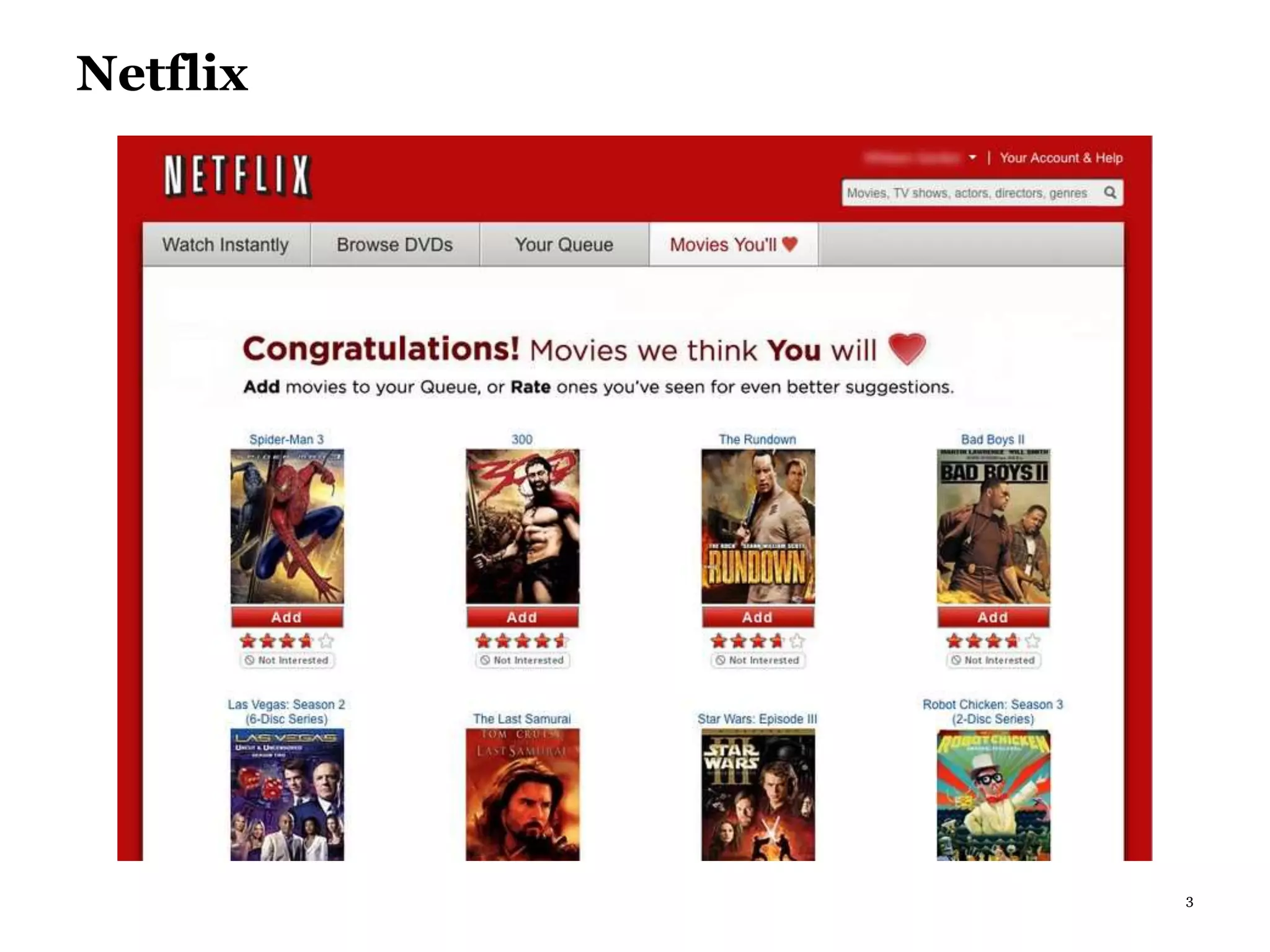
Netflix
4
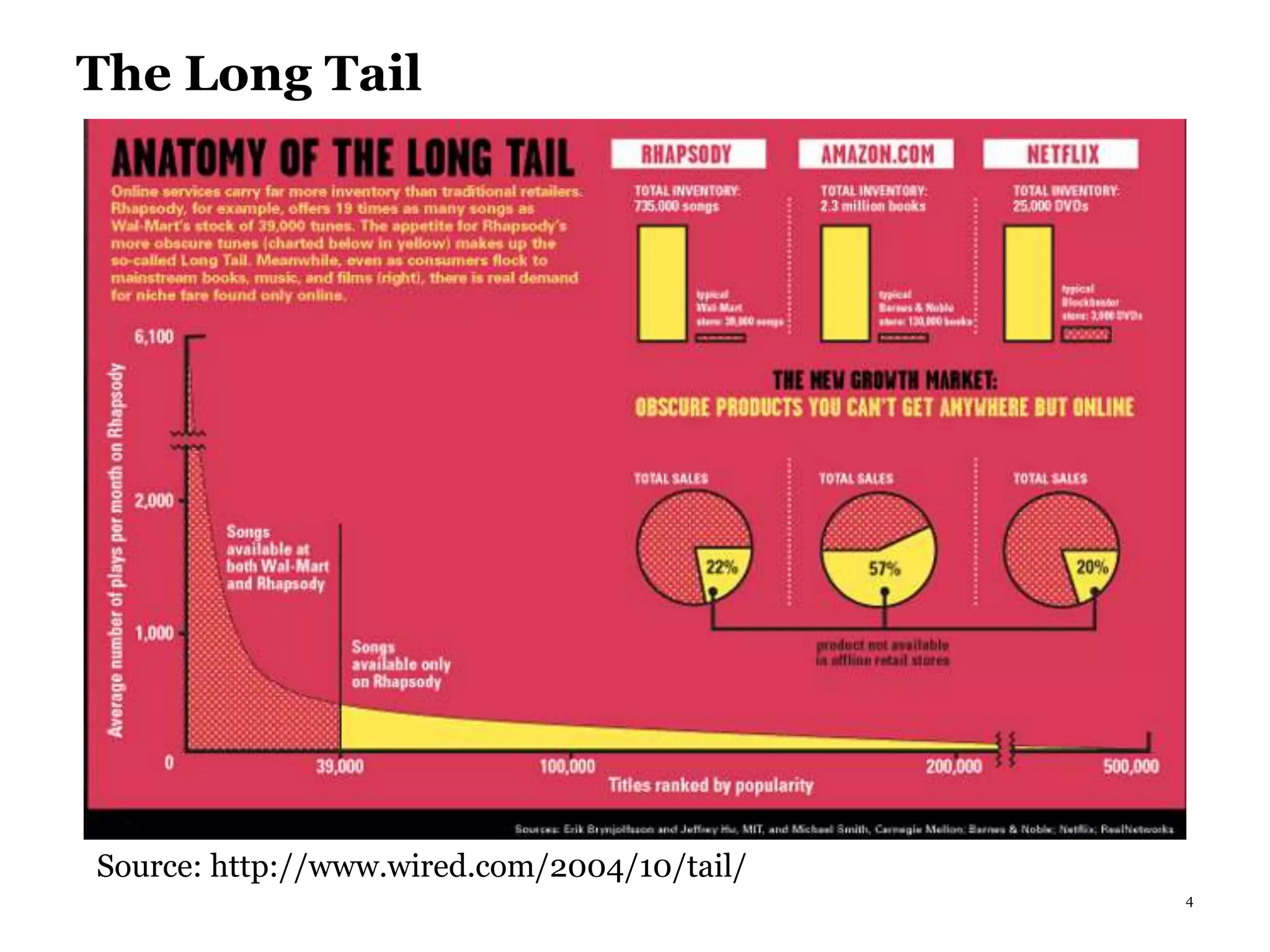
The Long Tail
Source: http://www.wired.com/2004/10/tail/
5
Information Overload
• Recommender systems help to match users with items
- Ease information overload
- Sales assistance (guidance, advisory, profit increase, ...)
6
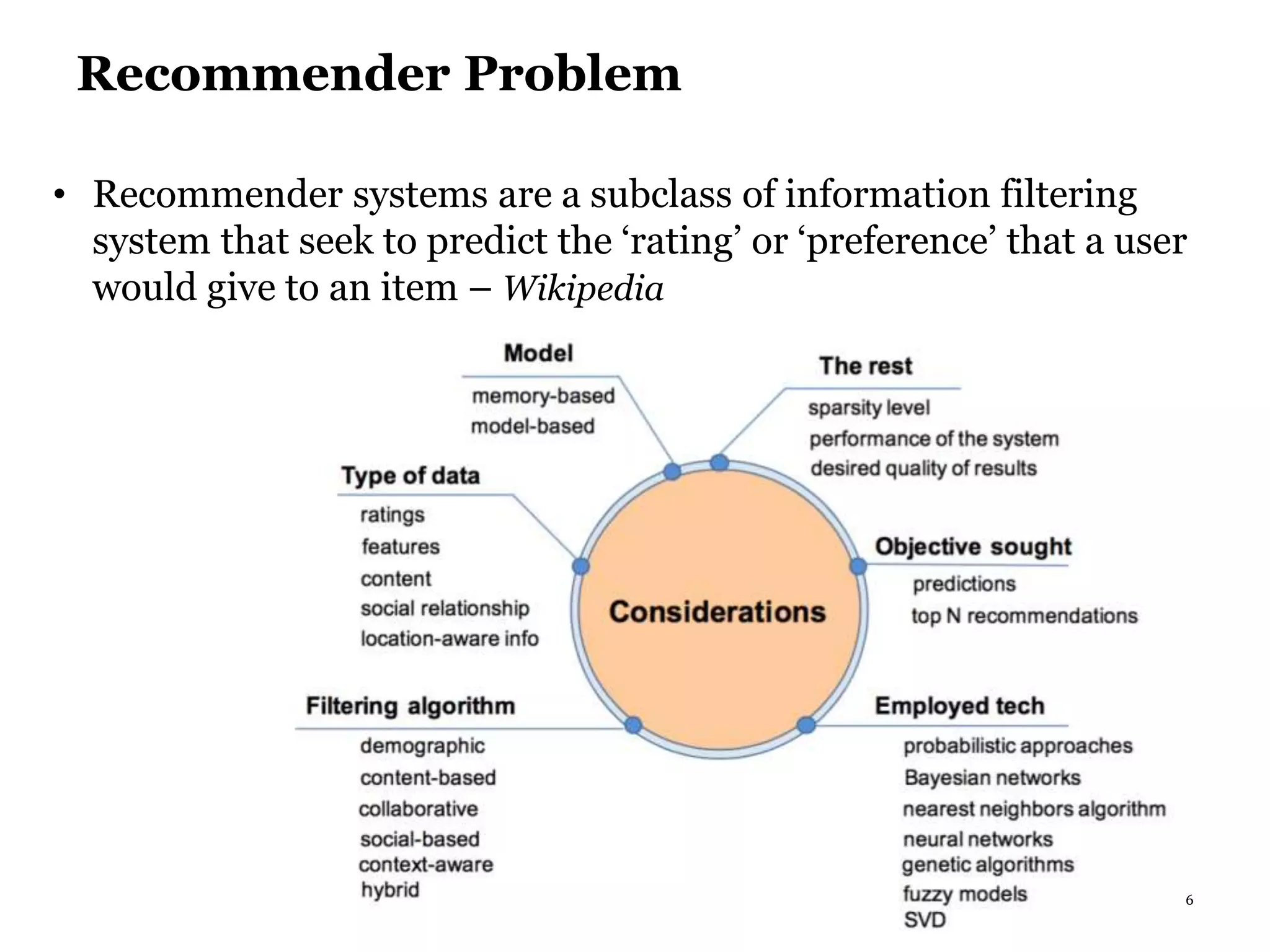
Recommender Problem
• Recommender systems are a subclass of information filtering
system that seek to predict the ‘rating’ or ‘preference’ that a user
would give to an item – Wikipedia
7
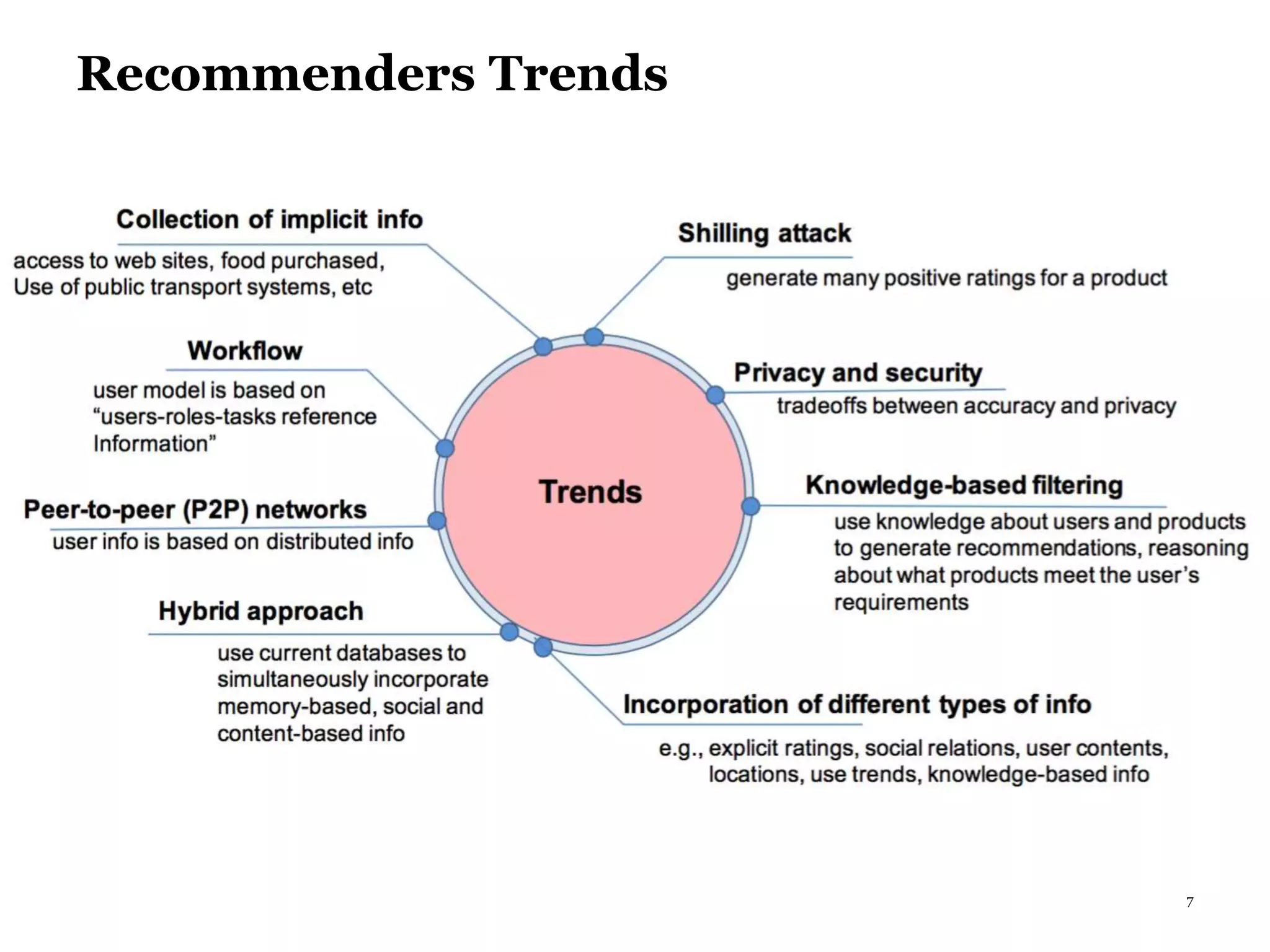
Recommenders Trends
8
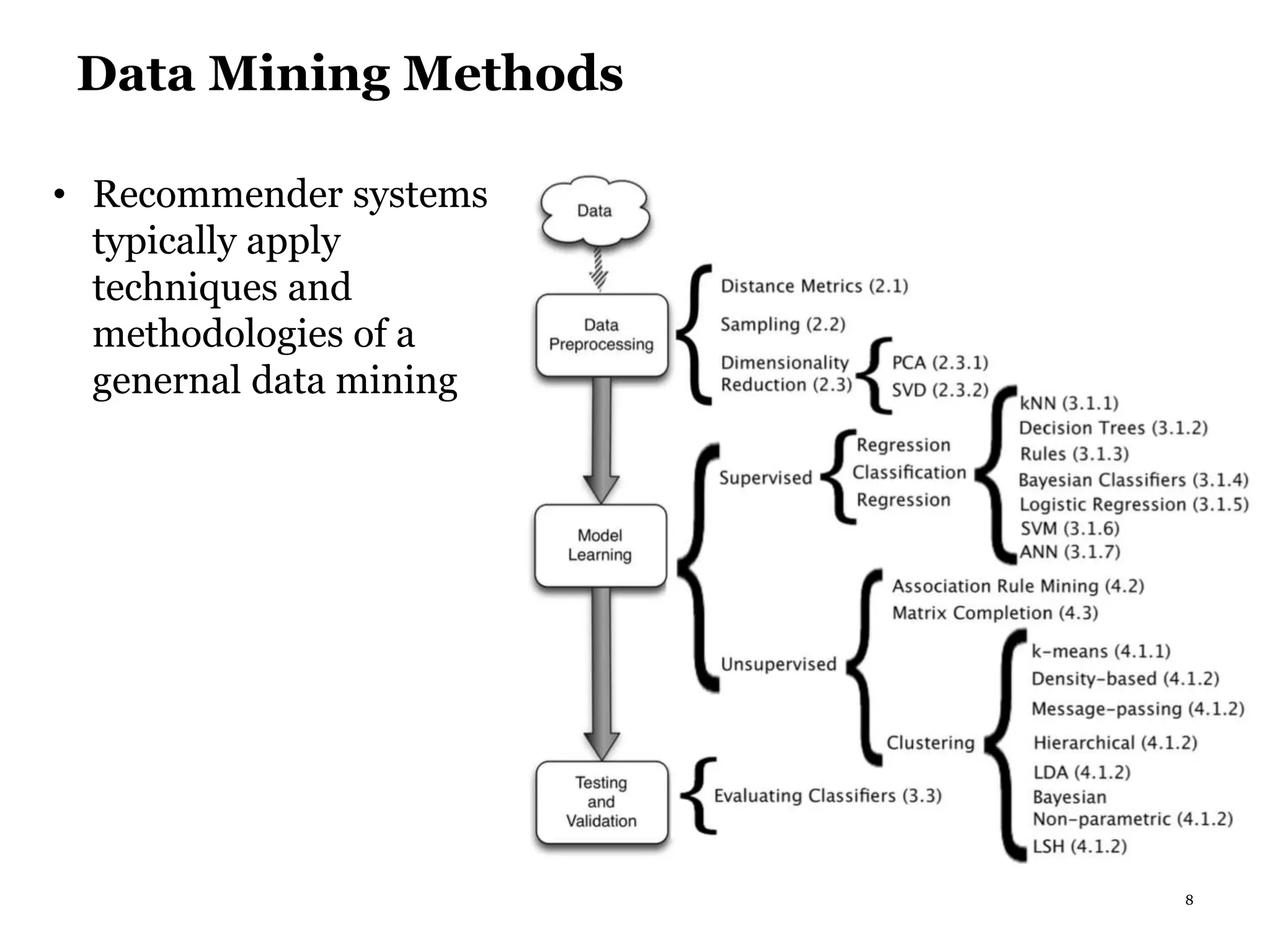
Data Mining Methods
• Recommender systems
typically apply
techniques and
methodologies of a
genernal data mining
9
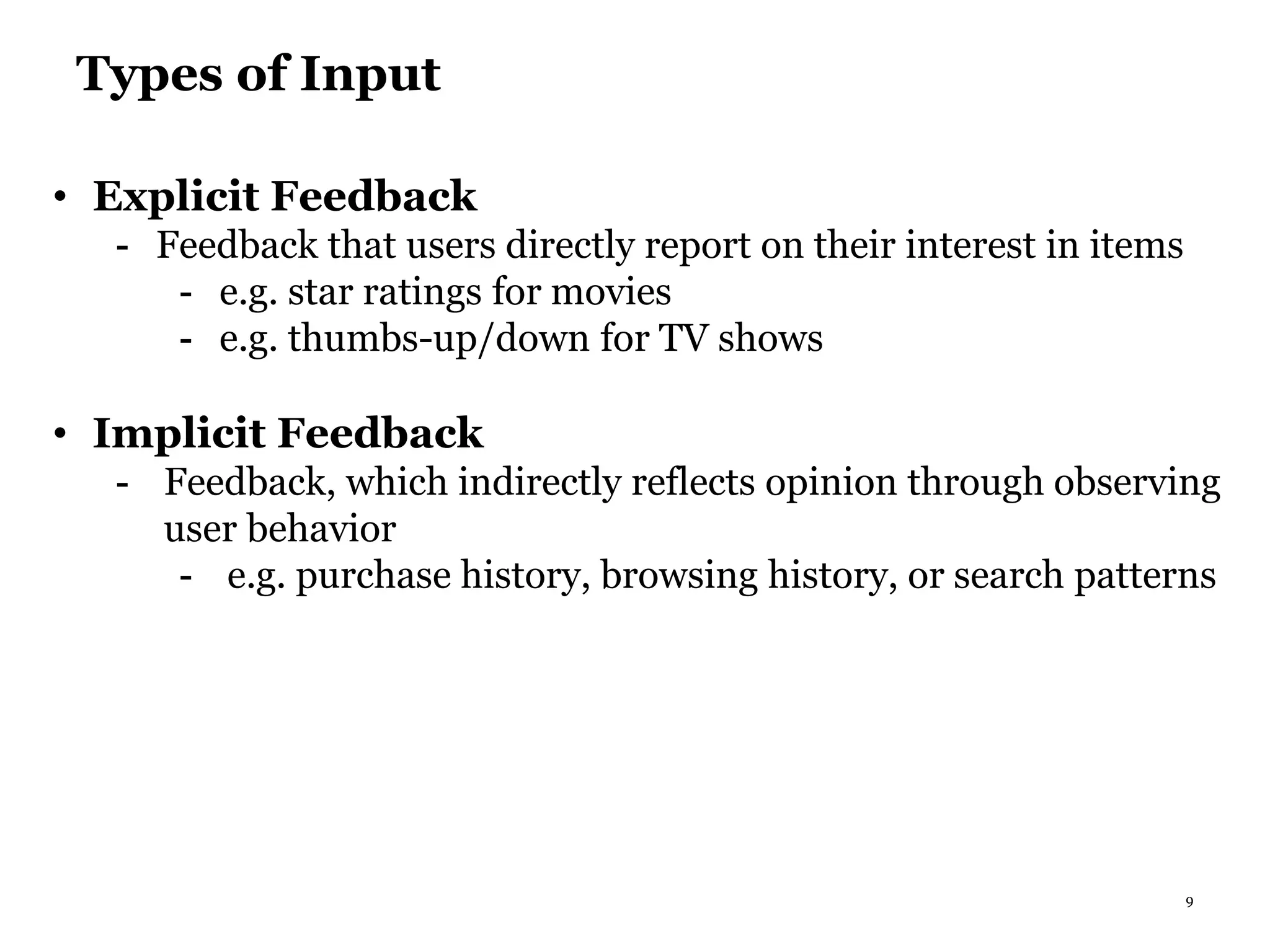
Types of Input
• Explicit Feedback
- Feedback that users directly report on their interest in items
- e.g. star ratings for movies
- e.g. thumbs-up/down for TV shows
• Implicit Feedback
- Feedback, which indirectly reflects opinion through observing
user behavior
- e.g. purchase history, browsing history, or search patterns
10
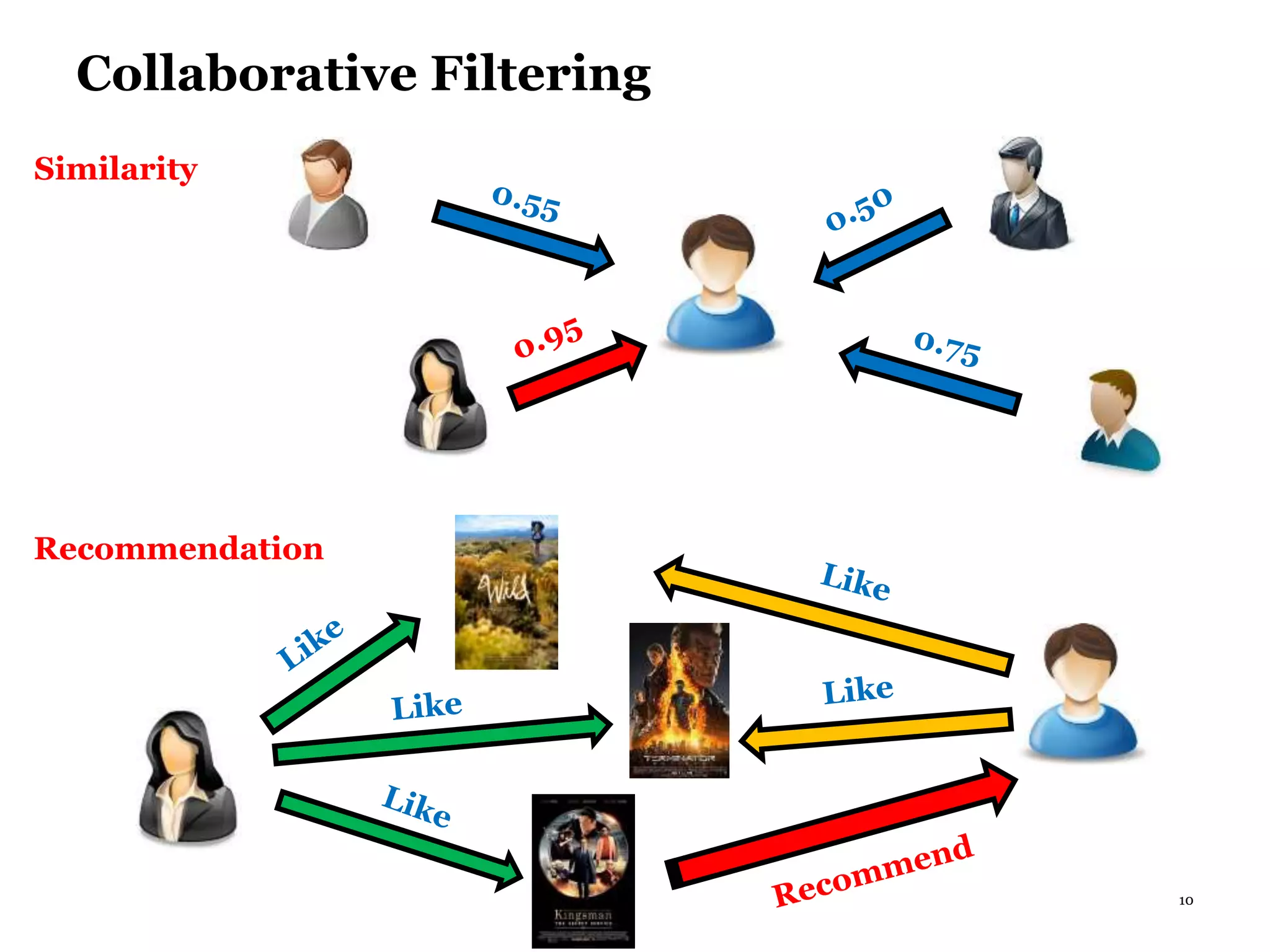
Collaborative Filtering
Similarity
Recommendation
11
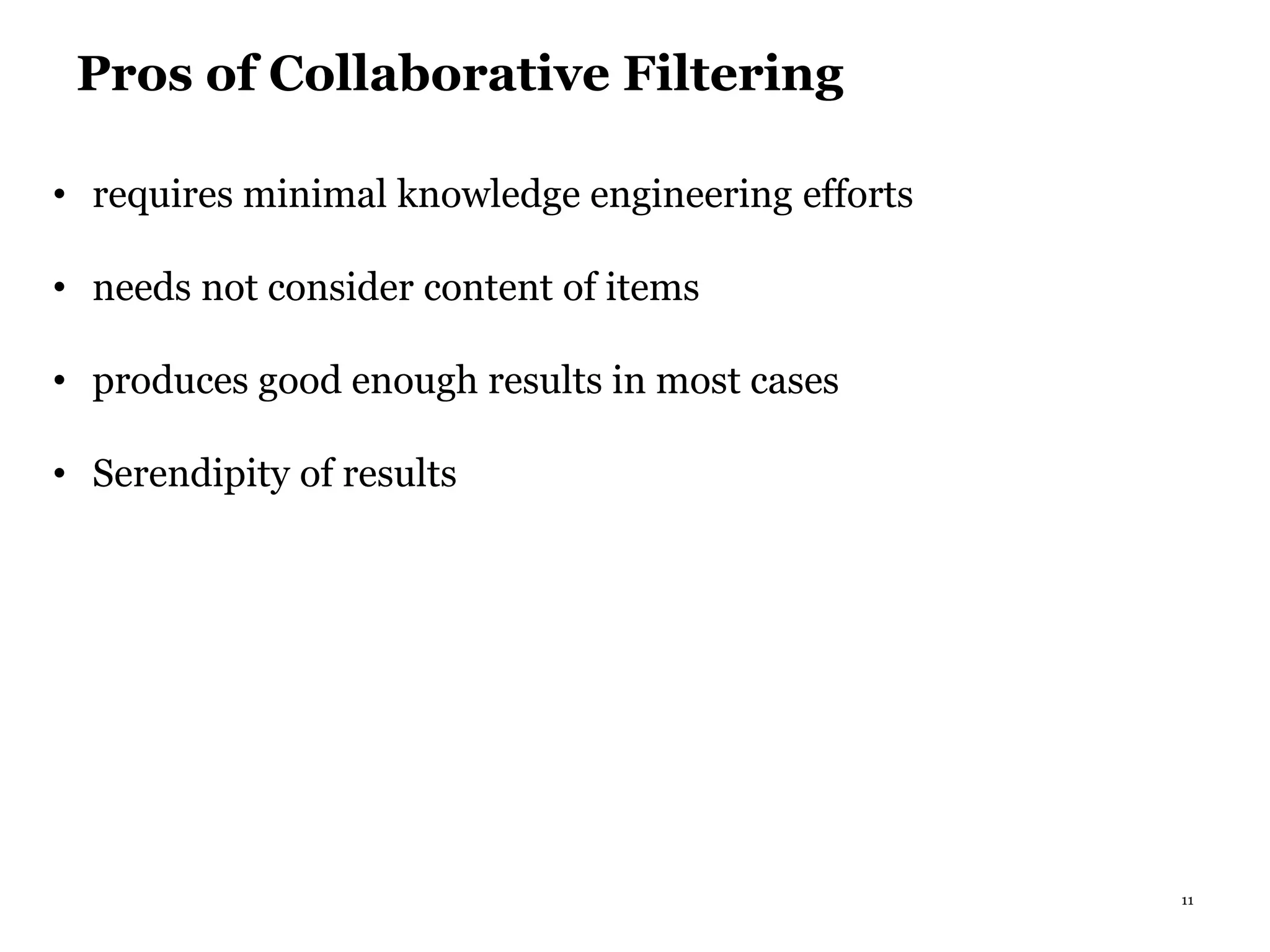
Pros of Collaborative Filtering
• requires minimal knowledge engineering efforts
• needs not consider content of items
• produces good enough results in most cases
• Serendipity of results
12
Challenges for Collaborative Filtering
• Sparsity
- Usually the vast majority of ratings are unknown
- e.g. 99% of ratings are missing in Netflix data
• Scalability
- Nearest neighbor techniques require computation that grows
with both the number of users and the number of items
• Cold Start Problem
- New items and new users can cause the cold-start problem, as
there will be insufficient data for CF to work accurately
13
Challenges for Collaborative Filtering
• Popularity Bias
- tends to recommend popular items
• Synonyms
- Same or very similar items having different names or entries
- Topic modeling like LDA could solve this by grouping
different words belonging to the same topic
• Shilling Attacks
- People may give positive ratings for their own items and
negative ratings for their competitors
14
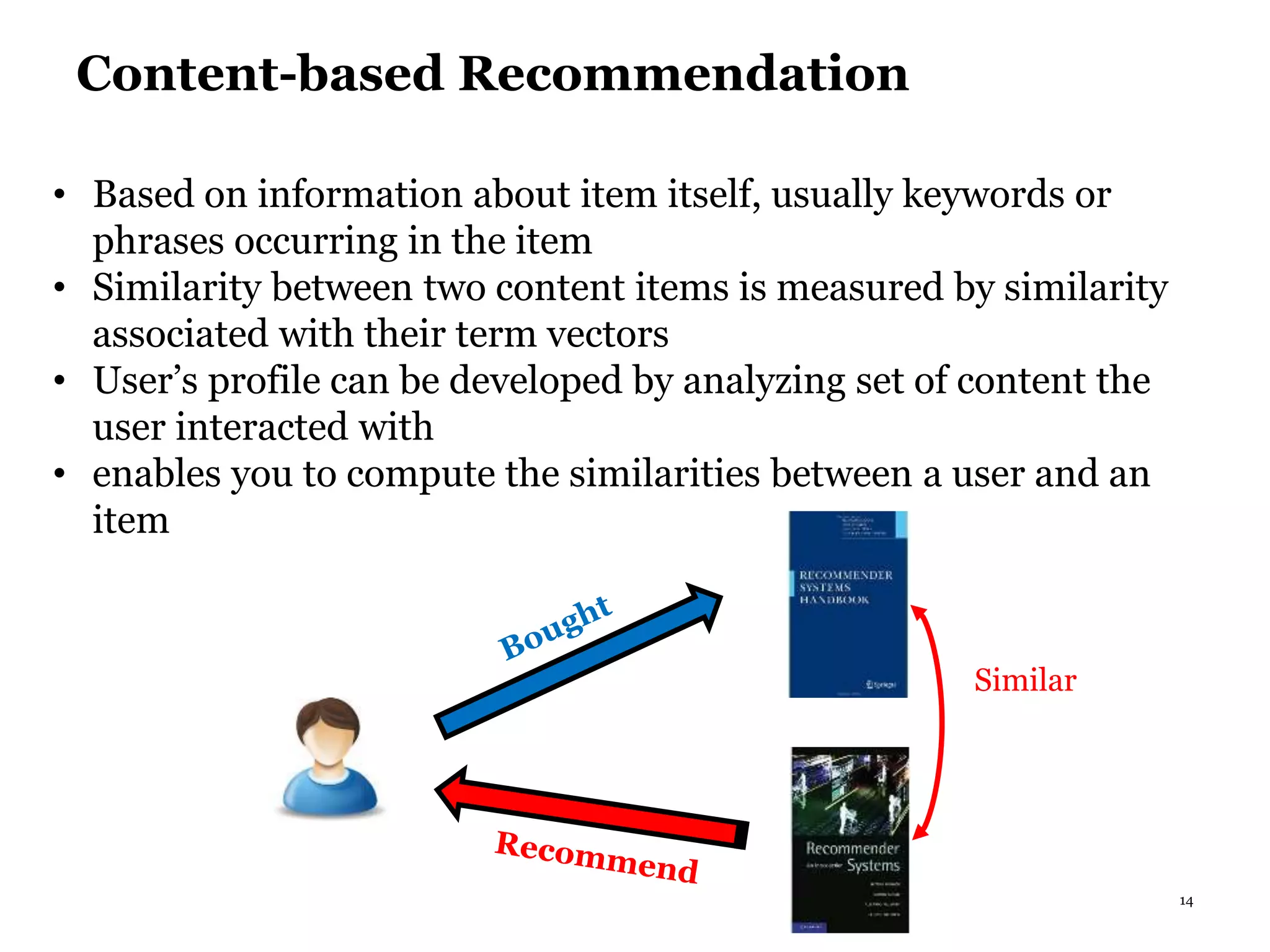
Content-based Recommendation
• Based on information about item itself, usually keywords or
phrases occurring in the item
• Similarity between two content items is measured by similarity
associated with their term vectors
• User’s profile can be developed by analyzing set of content the
user interacted with
• enables you to compute the similarities between a user and an
item
Similar
15
Pros/Cons of Content-based Approach
• Pros
- No need for data on other users: No cold-start or sparsity
- able to recommend to users with unique tastes
- able to recommend new and unpopular items
- provides explanations by listing content features
• Cons
- In certain domains (e.g., music, blogs and videos), it is
complicated to generate the features for items
- difficult to implement serendipity
- Users only receive recommendations that are very similar
to items they liked or prefered
16
Hybrid Methods
• Weighted
- Outputs from several techniques are combined with different
weights
• Switching
- Depending on situation, the system changes from one
technique to another
• Mixed
- Outputs from several techniques are presented at the same
time
• Cascade
- The output from one technique is used as input of another that
refines the results
17
Hybrid Methods
• Feature Combination
- Features from different recommendation sources are
combined as input to a single technique
• Feature Augmentation
- The output from one technique is used as input features to
another
• Meta-level
- The model learned by one recommender is used as input to
another
18
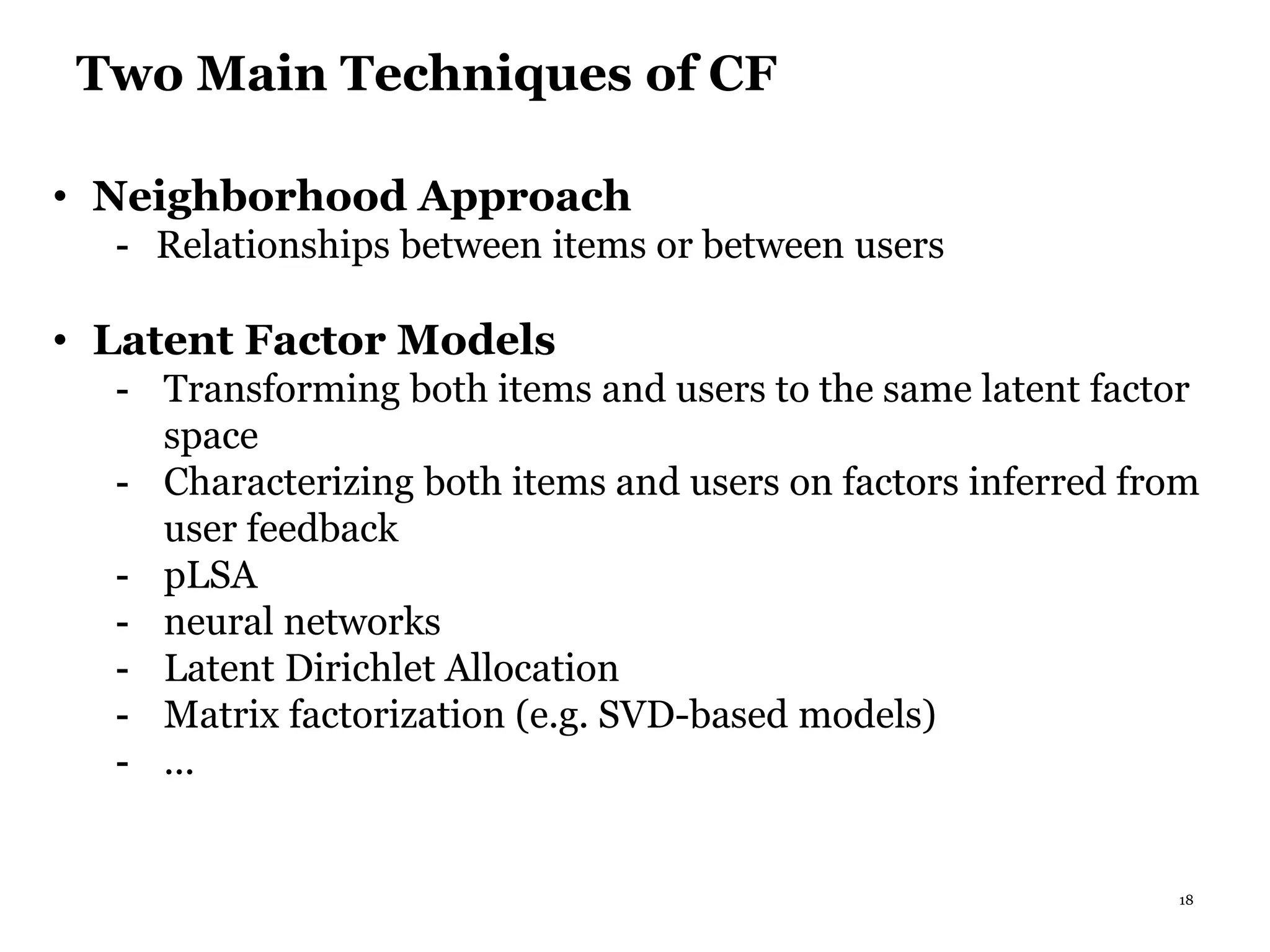
Two Main Techniques of CF
• Neighborhood Approach
- Relationships between items or between users
• Latent Factor Models
- Transforming both items and users to the same latent factor
space
- Characterizing both items and users on factors inferred from
user feedback
- pLSA
- neural networks
- Latent Dirichlet Allocation
- Matrix factorization (e.g. SVD-based models)
- ...
19
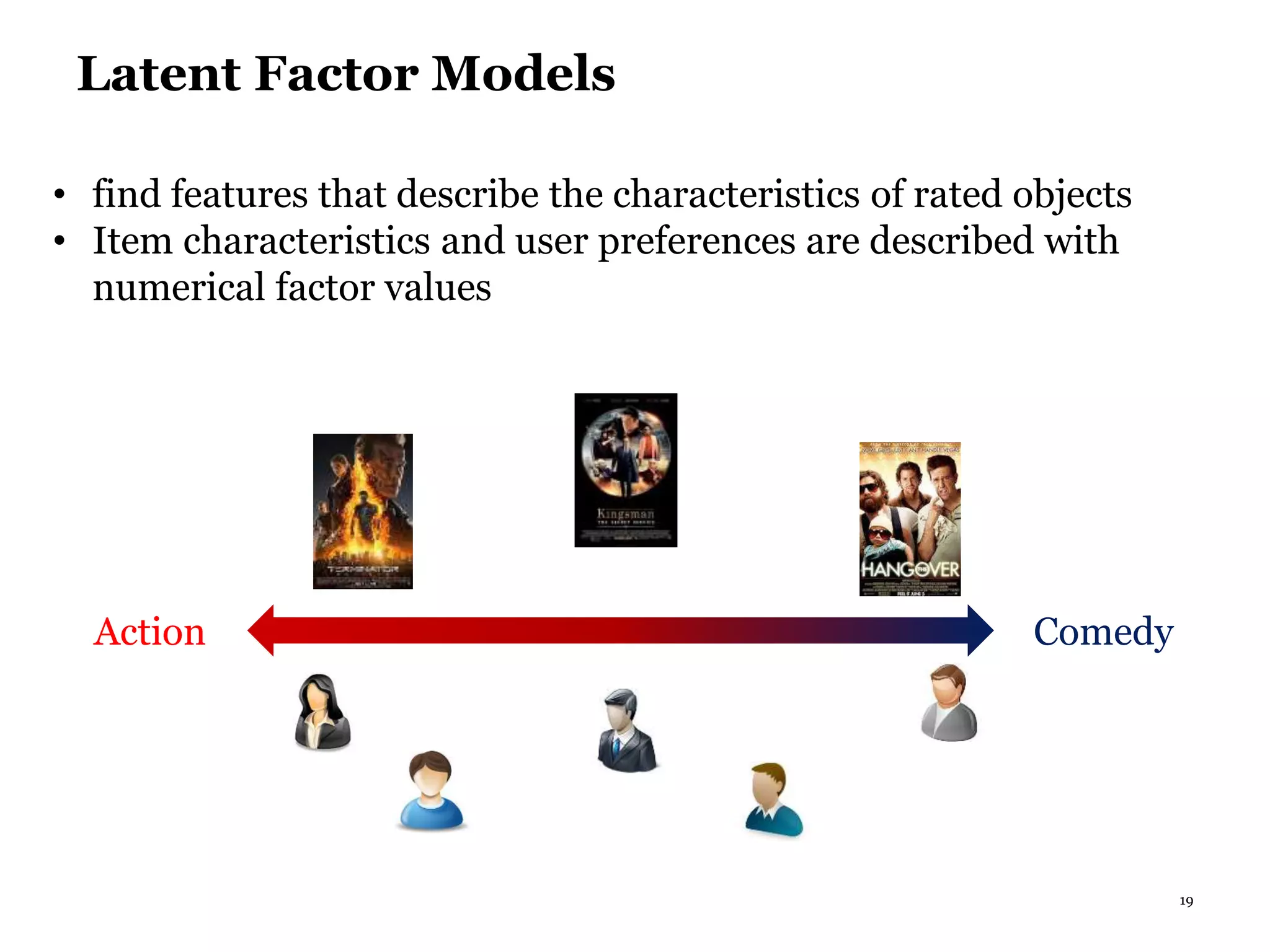
Latent Factor Models
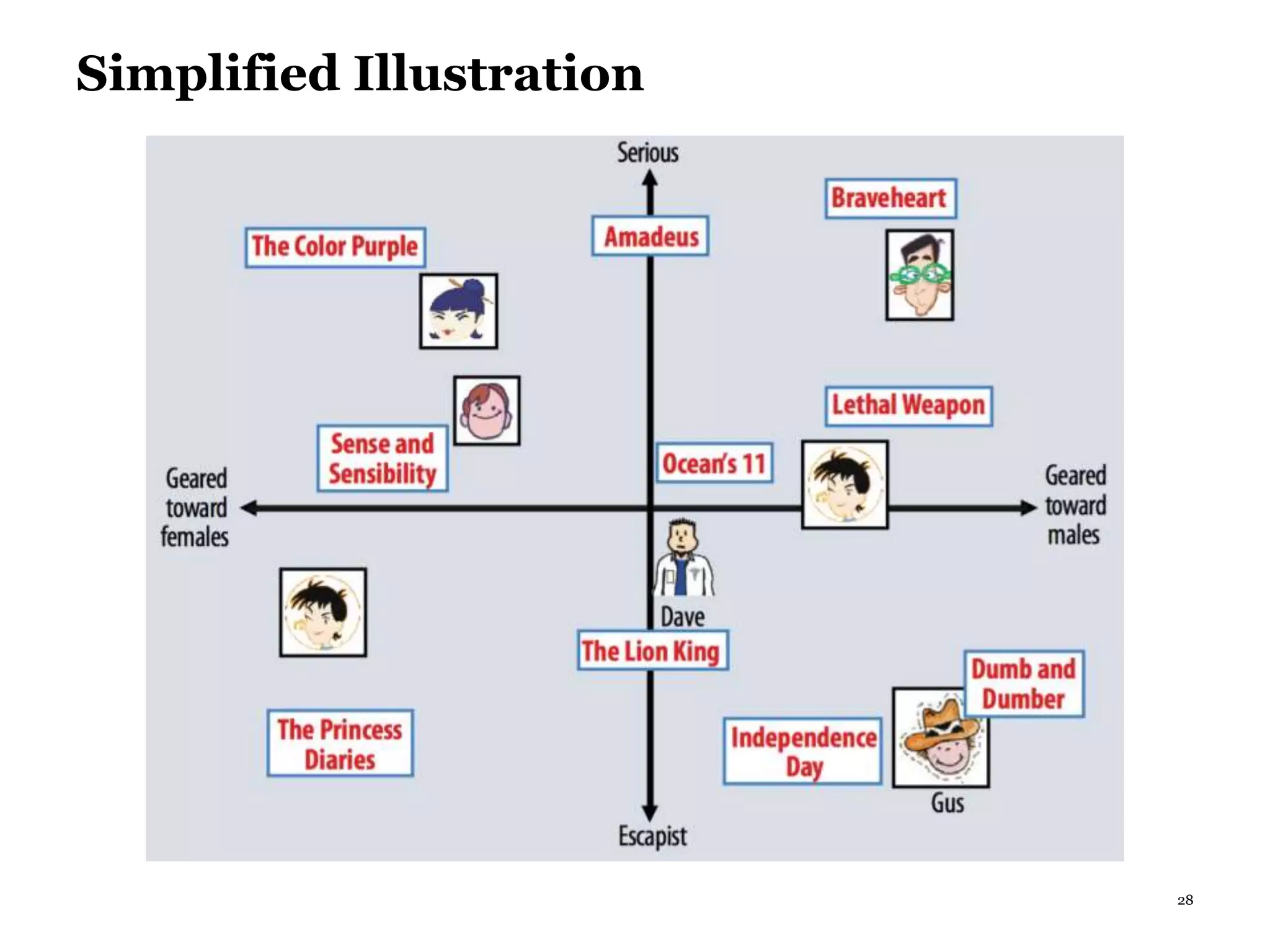
• find features that describe the characteristics of rated objects
• Item characteristics and user preferences are described with
numerical factor values
Action Comedy
20
Latent Factor Models
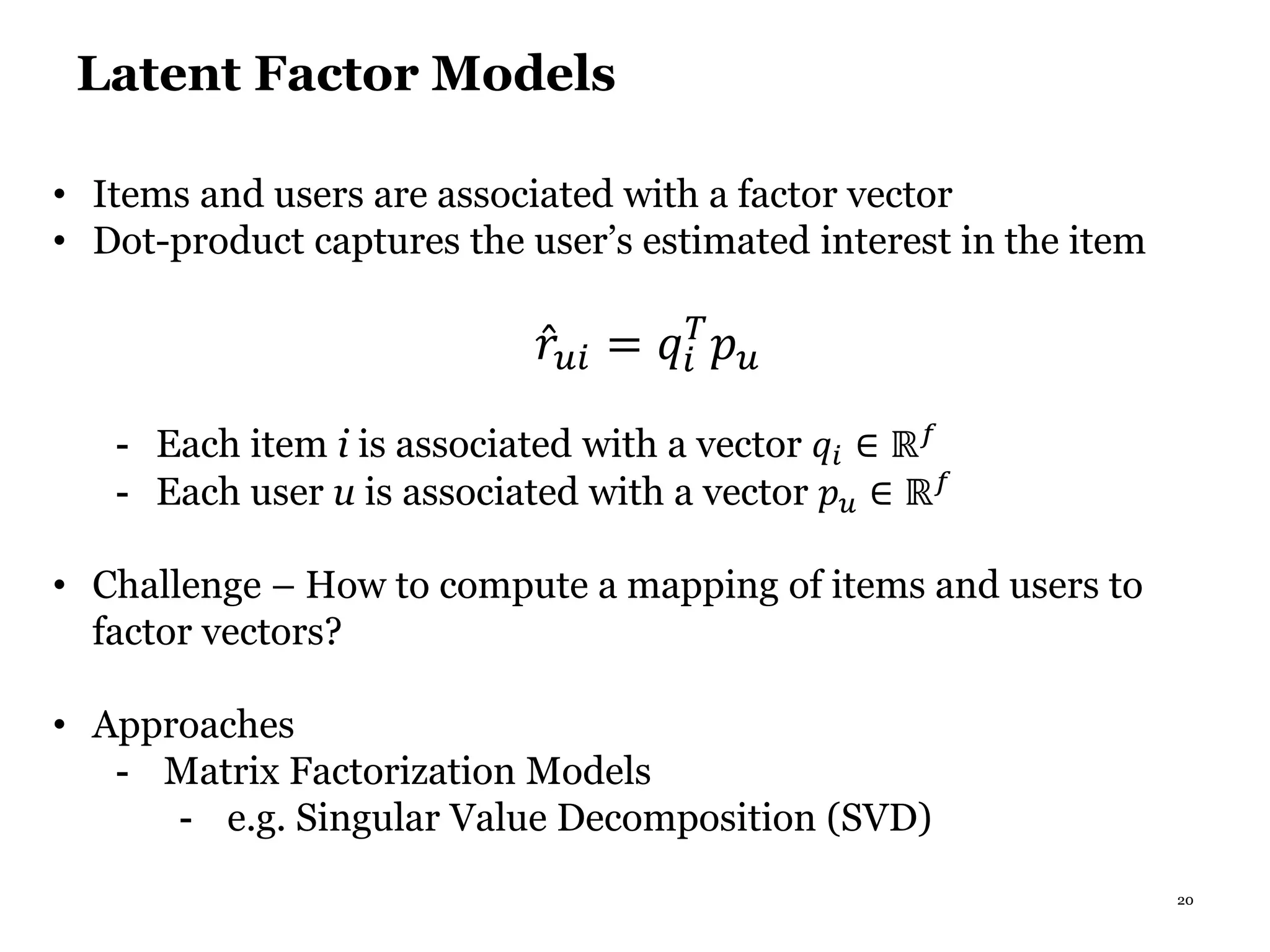
• Items and users are associated with a factor vector
• Dot-product captures the user’s estimated interest in the item
𝑟𝑢𝑖 = 𝑞𝑖
𝑇
𝑝 𝑢
- Each item i is associated with a vector 𝑞𝑖 ∈ ℝ 𝑓
- Each user u is associated with a vector 𝑝 𝑢 ∈ ℝ 𝑓
• Challenge – How to compute a mapping of items and users to
factor vectors?
• Approaches
- Matrix Factorization Models
- e.g. Singular Value Decomposition (SVD)
21
SVD
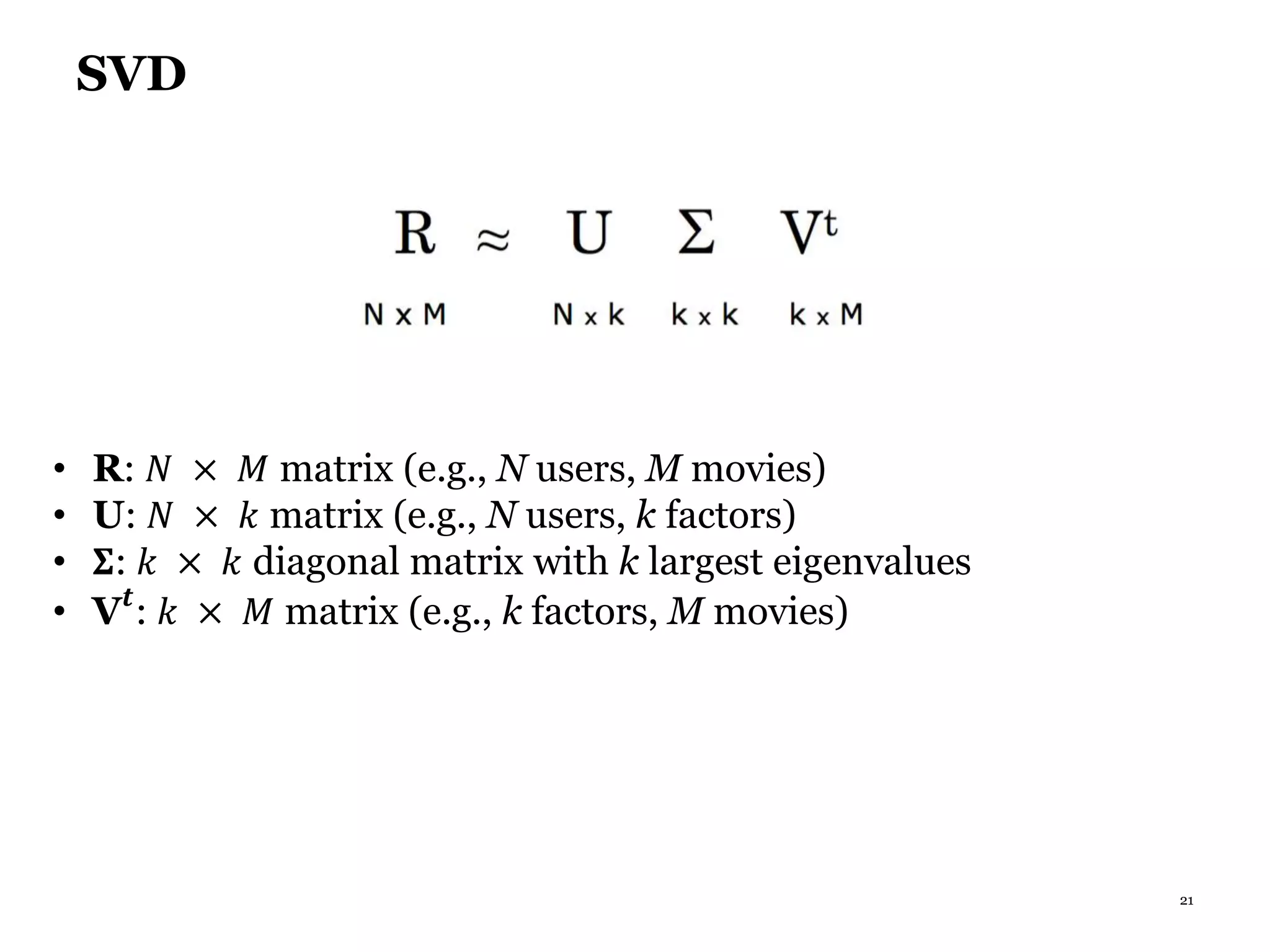
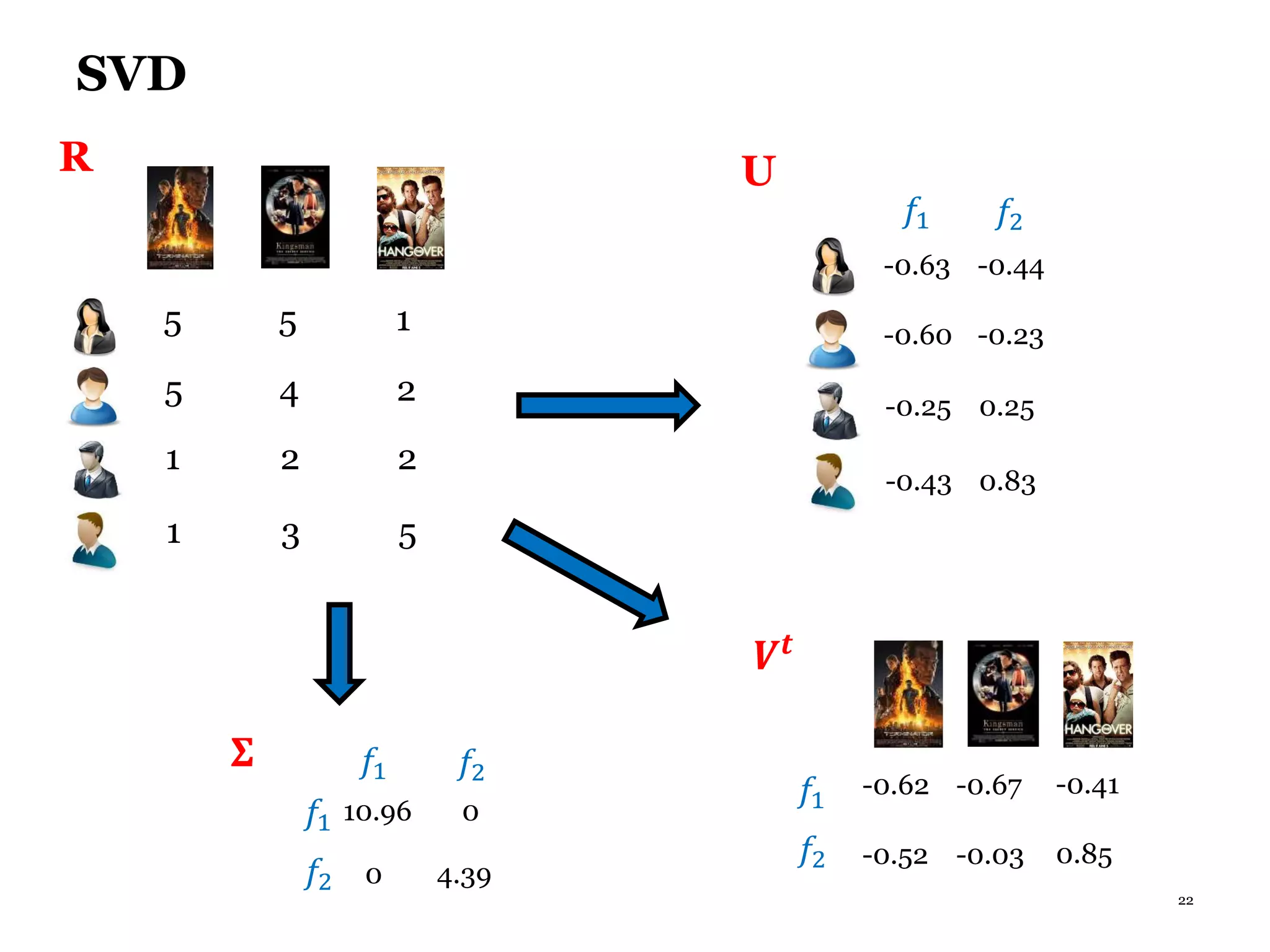
• R: 𝑁 × 𝑀 matrix (e.g., N users, M movies)
• U: 𝑁 × 𝑘 matrix (e.g., N users, k factors)
• 𝚺: 𝑘 × 𝑘 diagonal matrix with k largest eigenvalues
• V 𝒕
: 𝑘 × 𝑀 matrix (e.g., k factors, M movies)
22
SVD
5 5 1
5 4 2
1 2 2
1 3 5
𝑓1 𝑓2
-0.44-0.63
-0.23-0.60
0.25-0.25
0.83-0.43
𝑓1
𝑓2
-0.67-0.62
-0.03-0.52
-0.41
0.85
𝑓1
𝑓2
𝑓1 𝑓2
010.96
4.390
R U
𝑽 𝒕
𝚺
23
SVD
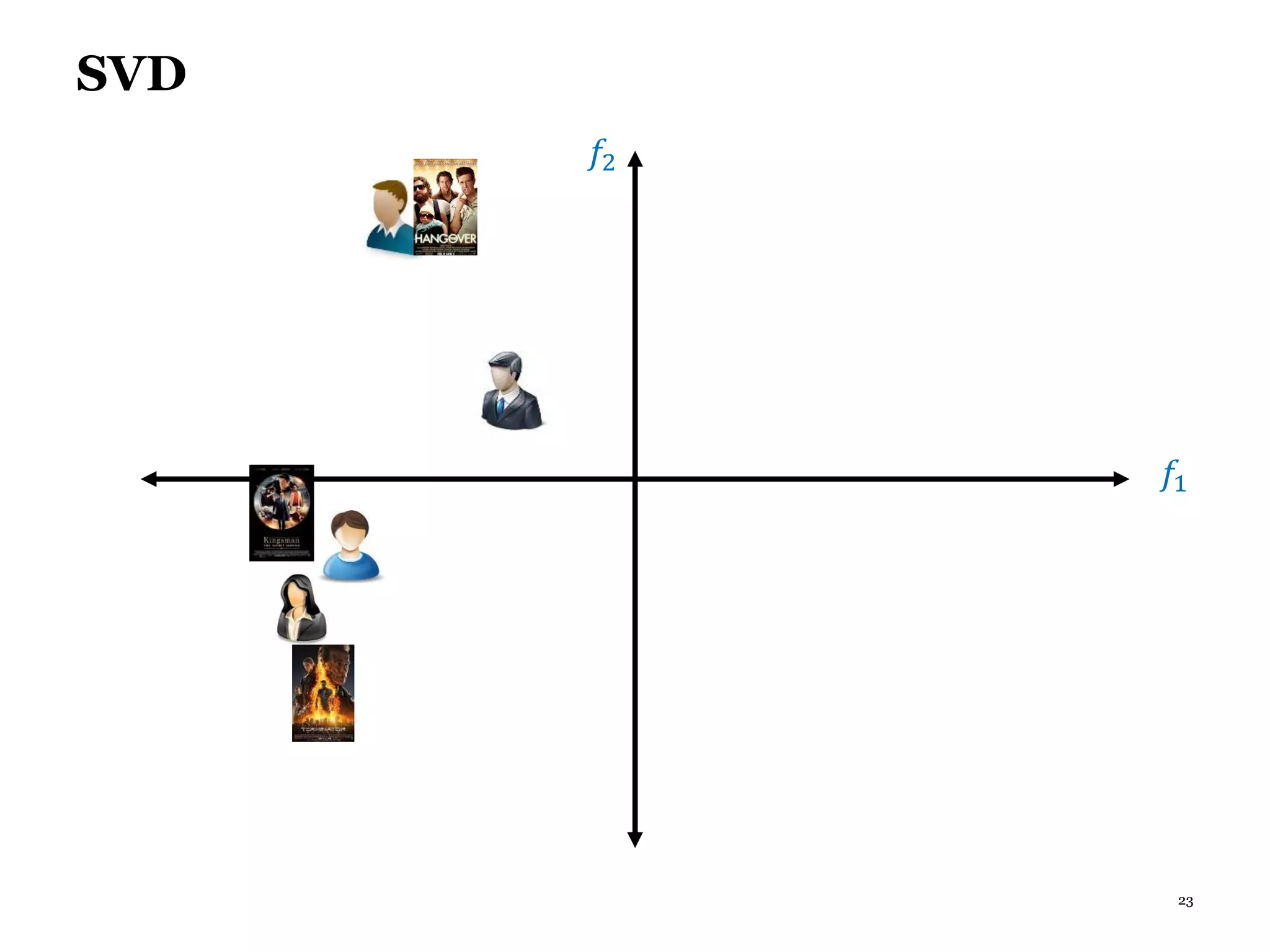
𝑓1
𝑓2
24
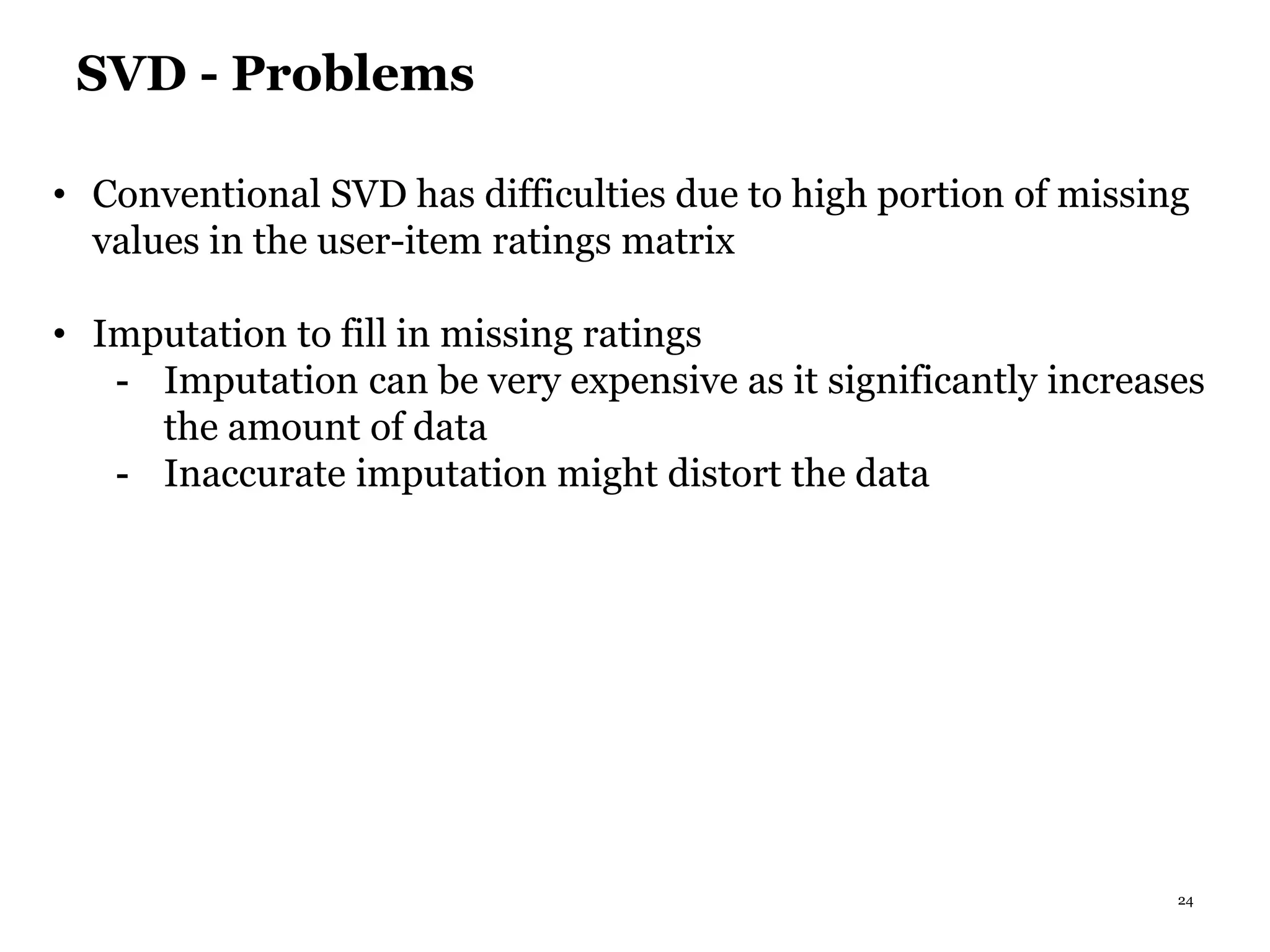
SVD - Problems
• Conventional SVD has difficulties due to high portion of missing
values in the user-item ratings matrix
• Imputation to fill in missing ratings
- Imputation can be very expensive as it significantly increases
the amount of data
- Inaccurate imputation might distort the data
25
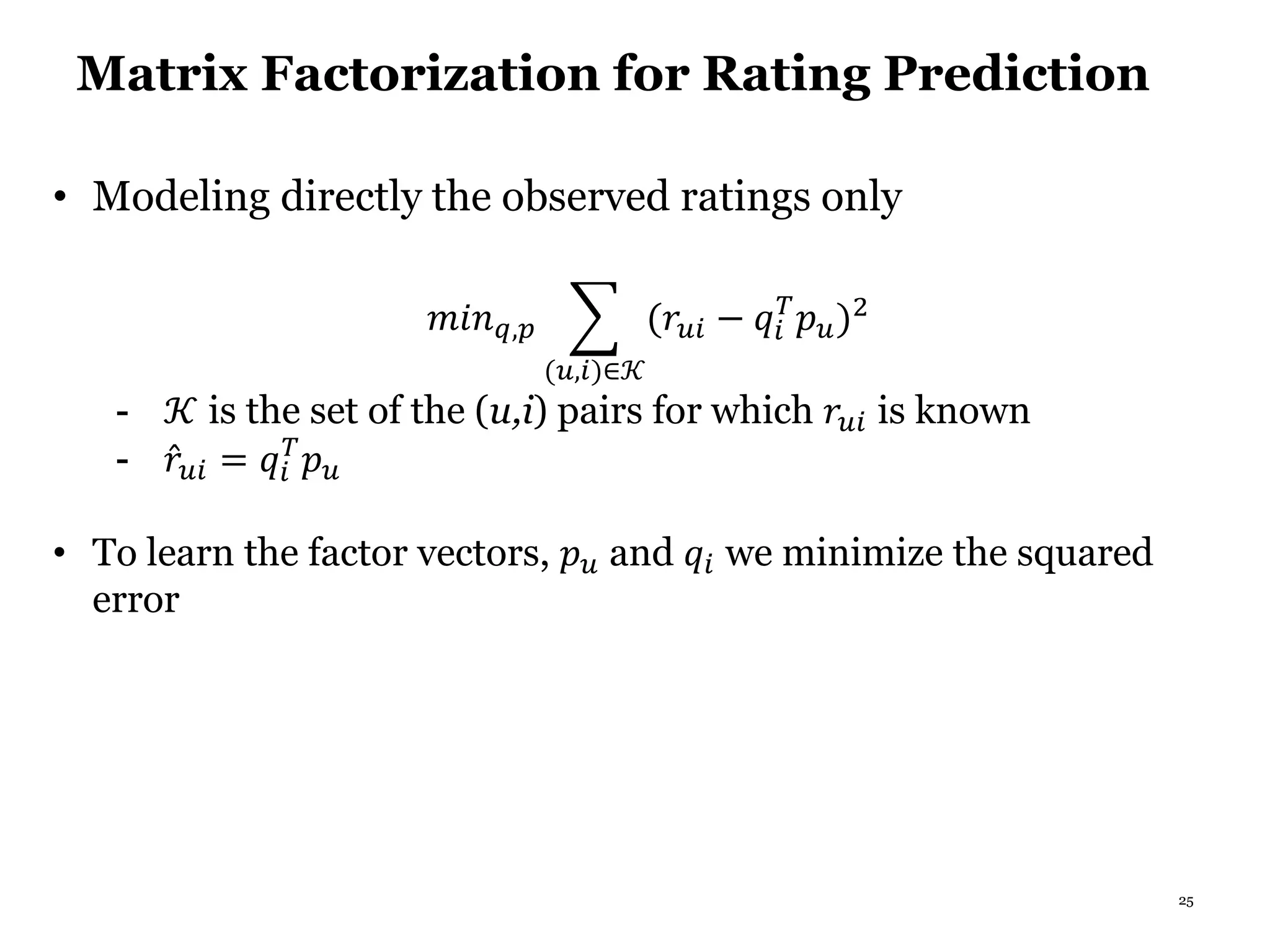
Matrix Factorization for Rating Prediction
• Modeling directly the observed ratings only
𝑚𝑖𝑛 𝑞,𝑝
(𝑢,𝑖)∈𝒦
(𝑟𝑢𝑖 − 𝑞𝑖
𝑇
𝑝 𝑢)2
- 𝒦 is the set of the (u,i) pairs for which 𝑟𝑢𝑖 is known
- 𝑟𝑢𝑖 = 𝑞𝑖
𝑇
𝑝 𝑢
• To learn the factor vectors, 𝑝 𝑢 and 𝑞𝑖 we minimize the squared
error
26
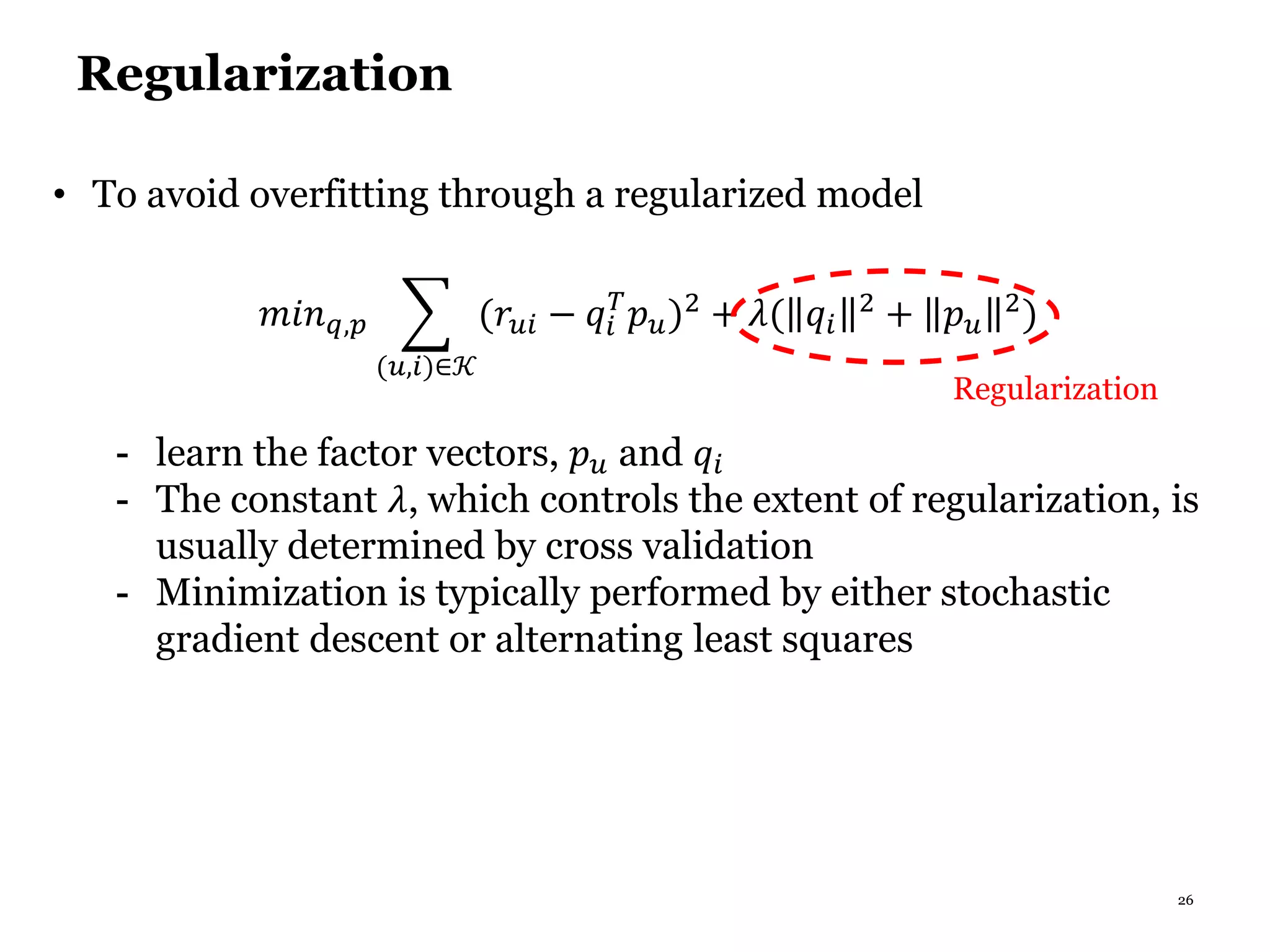
Regularization
• To avoid overfitting through a regularized model
𝑚𝑖𝑛 𝑞,𝑝
(𝑢,𝑖)∈𝒦
(𝑟𝑢𝑖 − 𝑞𝑖
𝑇
𝑝 𝑢)2
+ 𝜆( 𝑞𝑖
2
+ 𝑝 𝑢
2
)
- learn the factor vectors, 𝑝 𝑢 and 𝑞𝑖
- The constant 𝜆, which controls the extent of regularization, is
usually determined by cross validation
- Minimization is typically performed by either stochastic
gradient descent or alternating least squares
Regularization
27
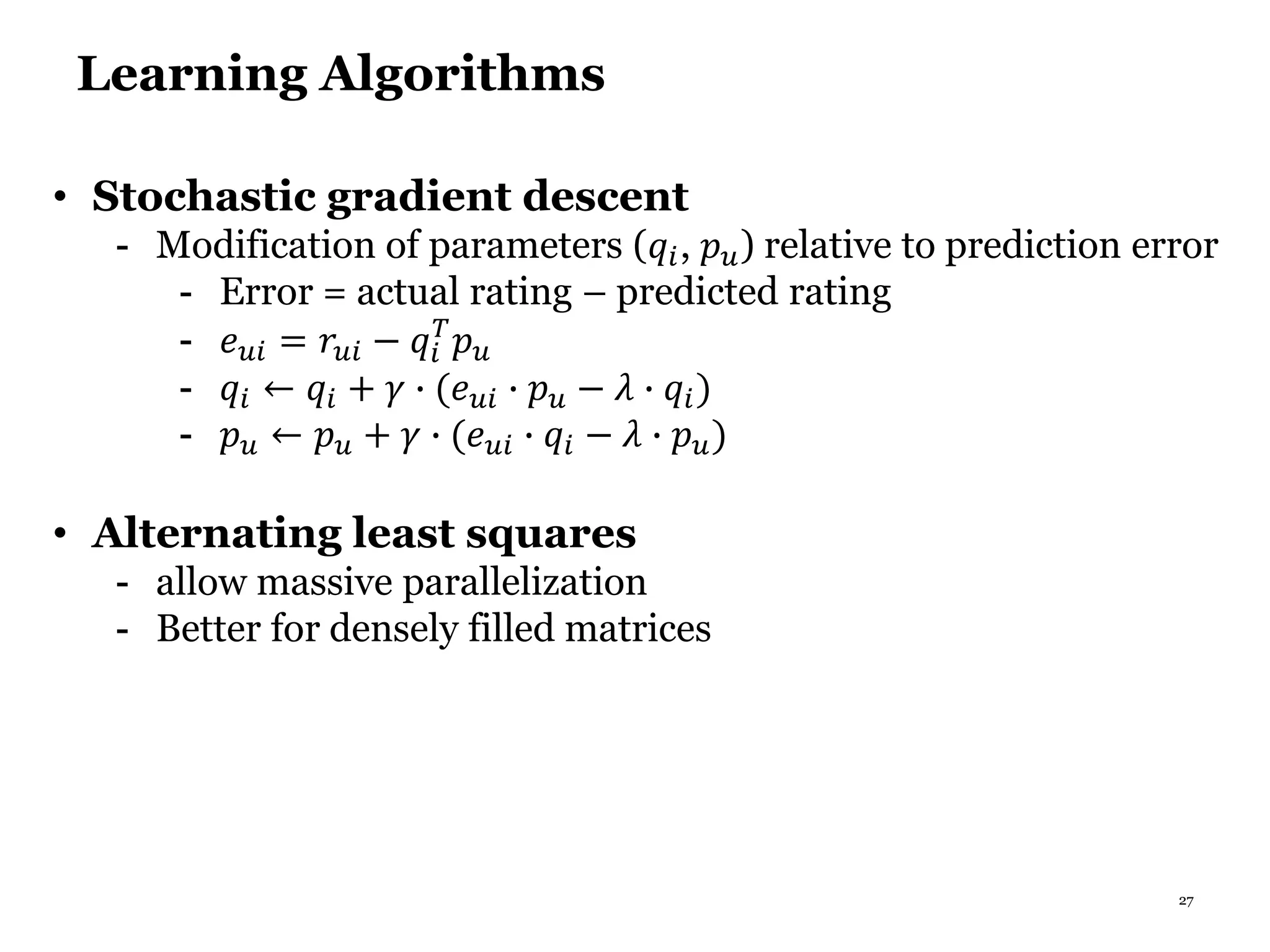
Learning Algorithms
• Stochastic gradient descent
- Modification of parameters (𝑞𝑖, 𝑝 𝑢) relative to prediction error
- Error = actual rating – predicted rating
- 𝑒 𝑢𝑖 = 𝑟𝑢𝑖 − 𝑞𝑖
𝑇
𝑝 𝑢
- 𝑞𝑖 ← 𝑞𝑖 + 𝛾 ∙ (𝑒 𝑢𝑖 ∙ 𝑝 𝑢 − 𝜆 ∙ 𝑞𝑖)
- 𝑝 𝑢 ← 𝑝 𝑢 + 𝛾 ∙ (𝑒 𝑢𝑖 ∙ 𝑞𝑖 − 𝜆 ∙ 𝑝 𝑢)
• Alternating least squares
- allow massive parallelization
- Better for densely filled matrices
28
Simplified Illustration
29
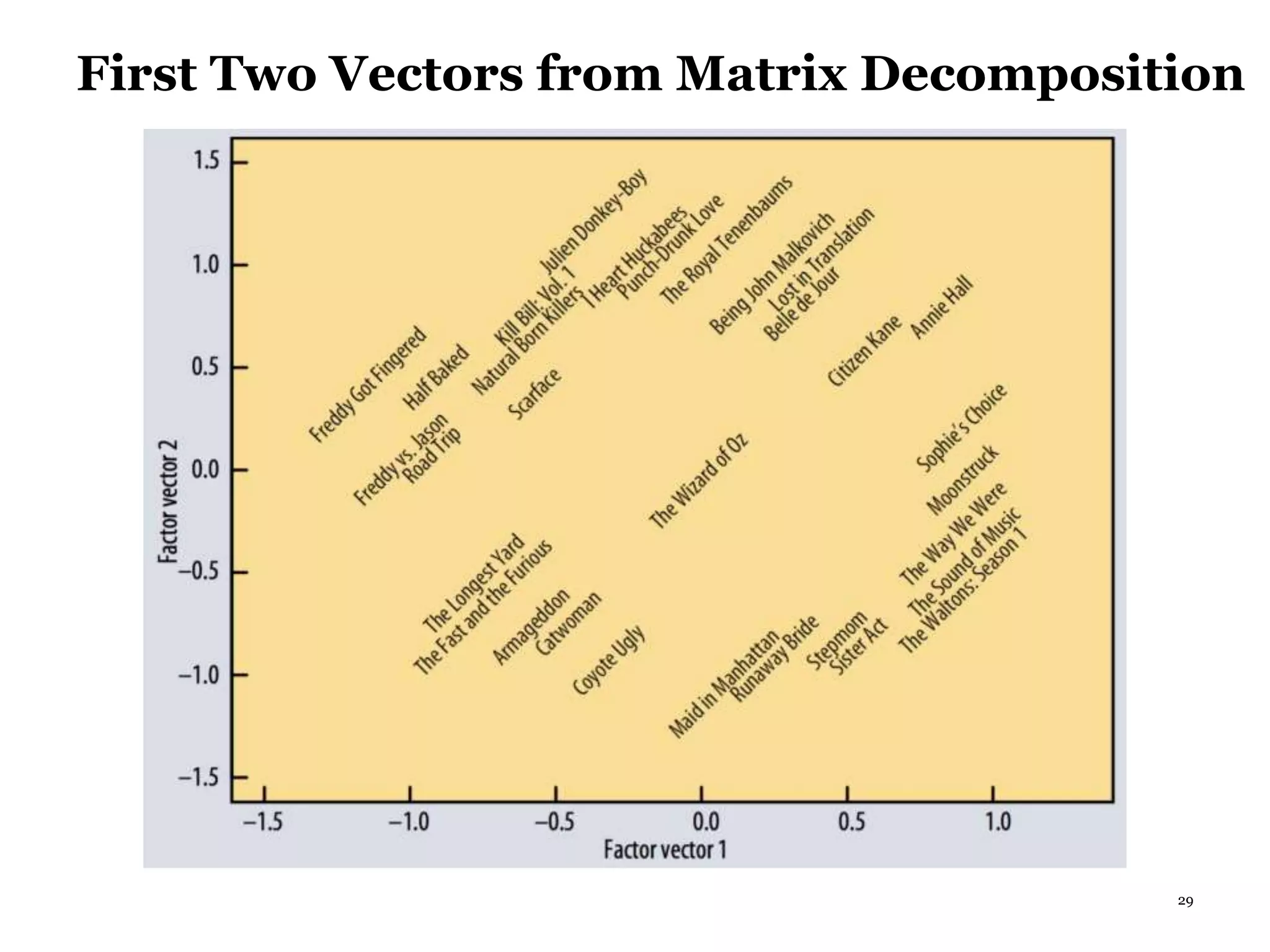
First Two Vectors from Matrix Decomposition
30
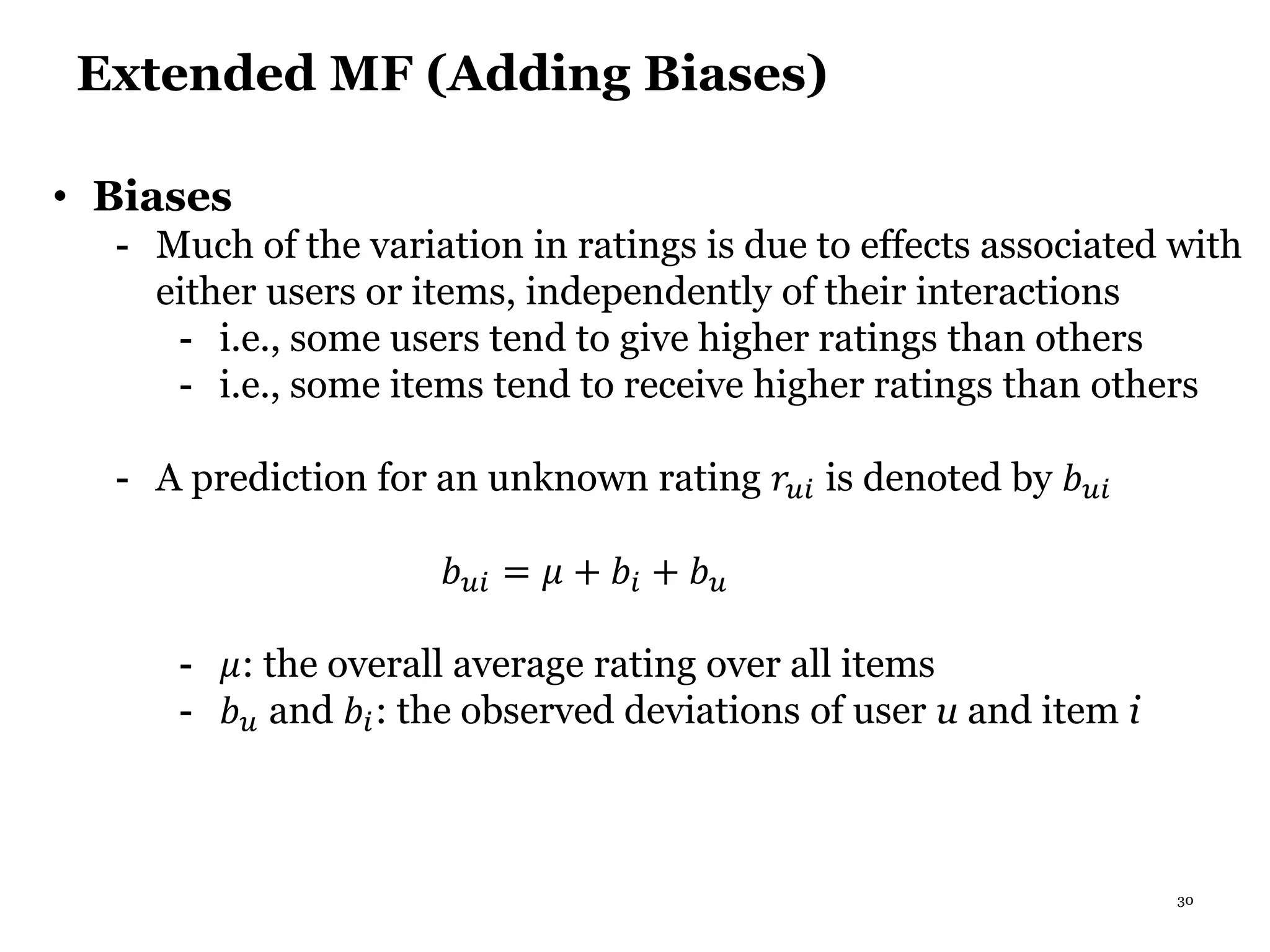
Extended MF (Adding Biases)
• Biases
- Much of the variation in ratings is due to effects associated with
either users or items, independently of their interactions
- i.e., some users tend to give higher ratings than others
- i.e., some items tend to receive higher ratings than others
- A prediction for an unknown rating 𝑟𝑢𝑖 is denoted by 𝑏 𝑢𝑖
𝑏 𝑢𝑖 = 𝜇 + 𝑏𝑖 + 𝑏 𝑢
- 𝜇: the overall average rating over all items
- 𝑏 𝑢 and 𝑏𝑖: the observed deviations of user u and item i
31
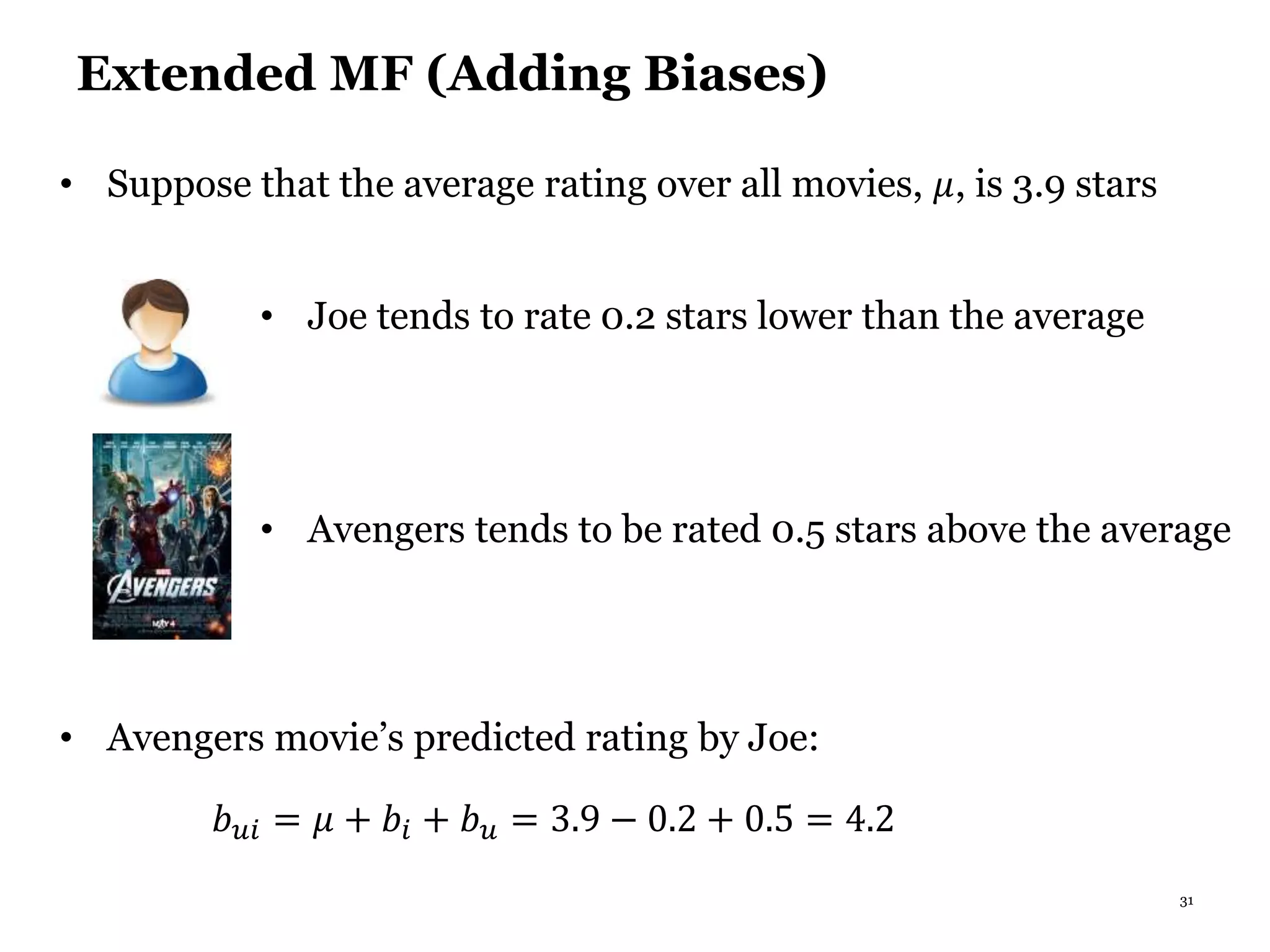
Extended MF (Adding Biases)
• Joe tends to rate 0.2 stars lower than the average
• Suppose that the average rating over all movies, 𝜇, is 3.9 stars
• Avengers tends to be rated 0.5 stars above the average
• Avengers movie’s predicted rating by Joe:
𝑏 𝑢𝑖 = 𝜇 + 𝑏𝑖 + 𝑏 𝑢 = 3.9 − 0.2 + 0.5 = 4.2
32
Extended MF (Adding Biases)
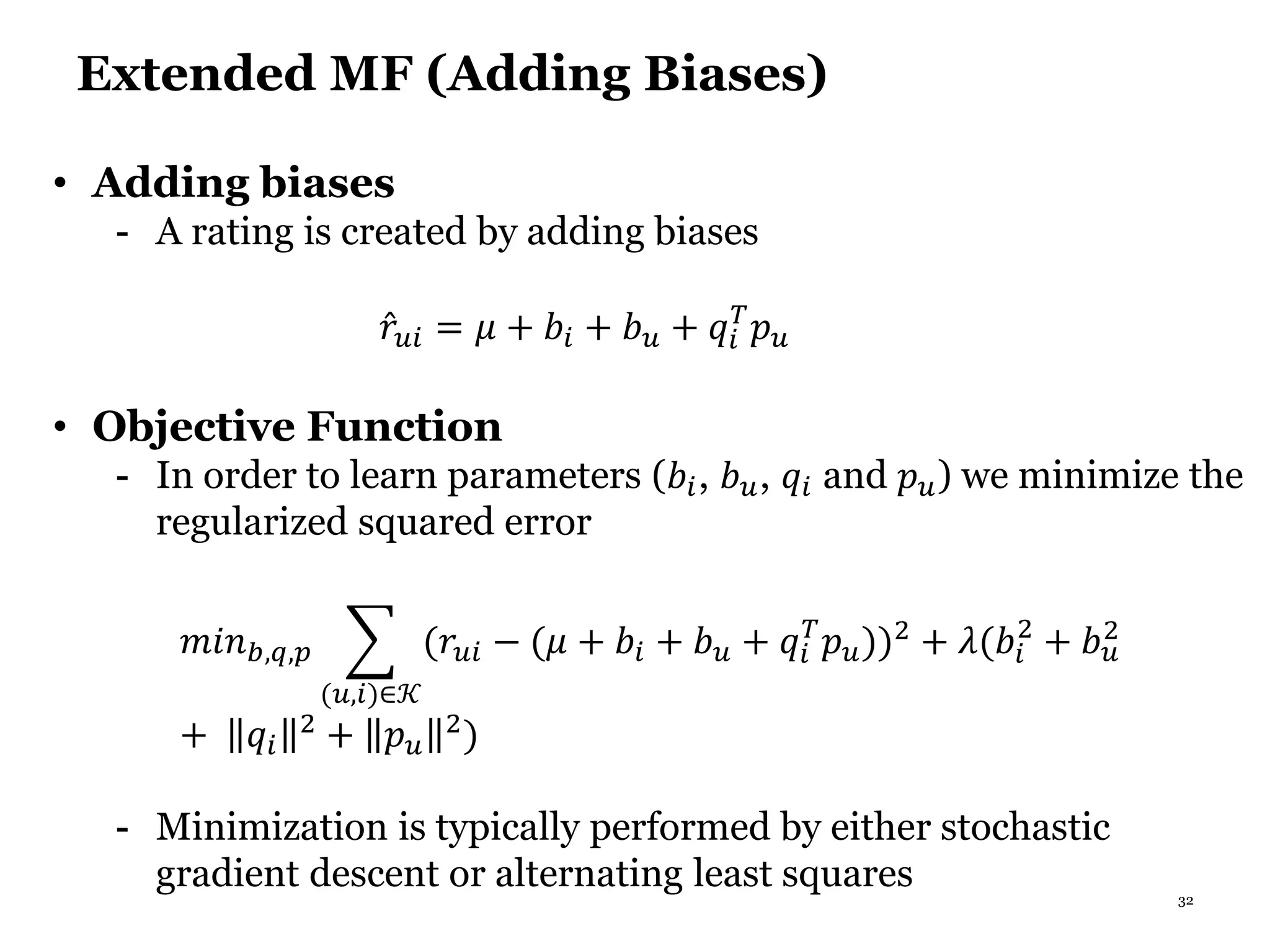
• Adding biases
- A rating is created by adding biases
𝑟𝑢𝑖 = 𝜇 + 𝑏𝑖 + 𝑏 𝑢 + 𝑞𝑖
𝑇
𝑝 𝑢
• Objective Function
- In order to learn parameters (𝑏𝑖, 𝑏 𝑢, 𝑞𝑖 and 𝑝 𝑢) we minimize the
regularized squared error
𝑚𝑖𝑛 𝑏,𝑞,𝑝
(𝑢,𝑖)∈𝒦
(𝑟𝑢𝑖 − (𝜇 + 𝑏𝑖 + 𝑏 𝑢 + 𝑞𝑖
𝑇
𝑝 𝑢))2 + 𝜆(𝑏𝑖
2
+ 𝑏 𝑢
2
+ 𝑞𝑖
2 + 𝑝 𝑢
2)
- Minimization is typically performed by either stochastic
gradient descent or alternating least squares
33
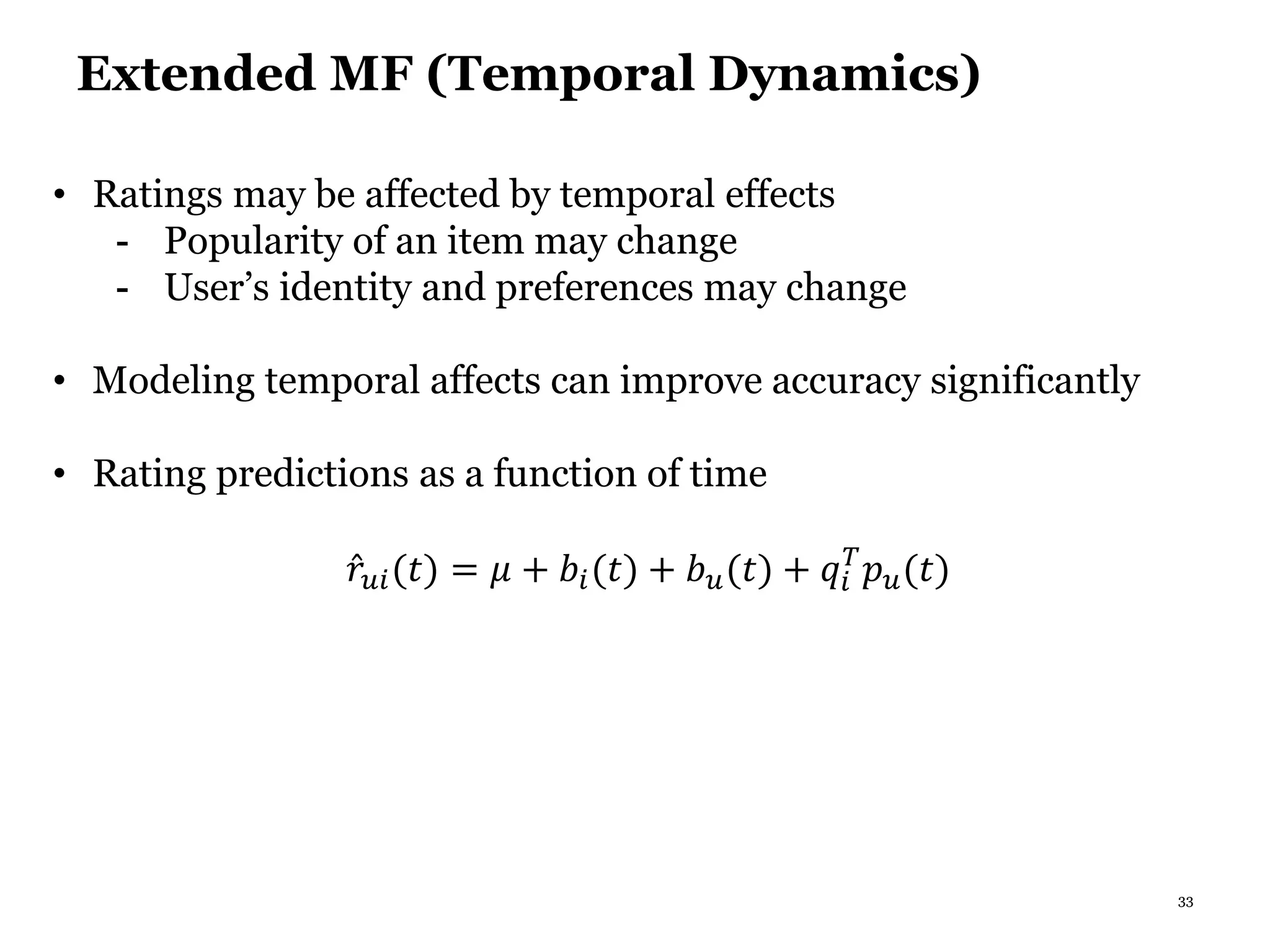
Extended MF (Temporal Dynamics)
• Ratings may be affected by temporal effects
- Popularity of an item may change
- User’s identity and preferences may change
• Modeling temporal affects can improve accuracy significantly
• Rating predictions as a function of time
𝑟𝑢𝑖(𝑡) = 𝜇 + 𝑏𝑖(𝑡) + 𝑏 𝑢(𝑡) + 𝑞𝑖
𝑇
𝑝 𝑢(𝑡)
34
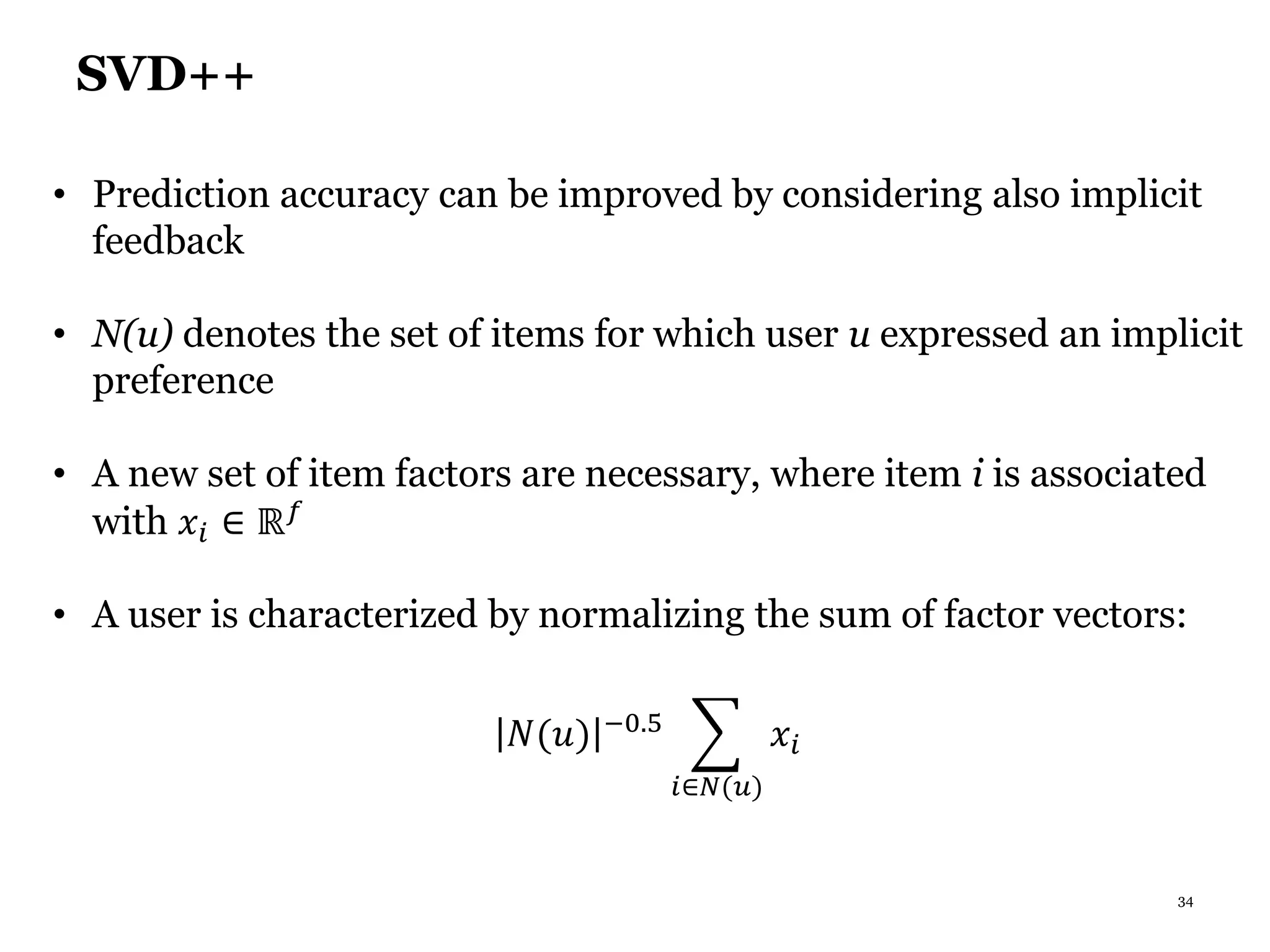
SVD++
• Prediction accuracy can be improved by considering also implicit
feedback
• N(u) denotes the set of items for which user u expressed an implicit
preference
• A new set of item factors are necessary, where item i is associated
with 𝑥𝑖 ∈ ℝ 𝑓
• A user is characterized by normalizing the sum of factor vectors:
𝑁(𝑢) −0.5
𝑖∈𝑁(𝑢)
𝑥𝑖
35
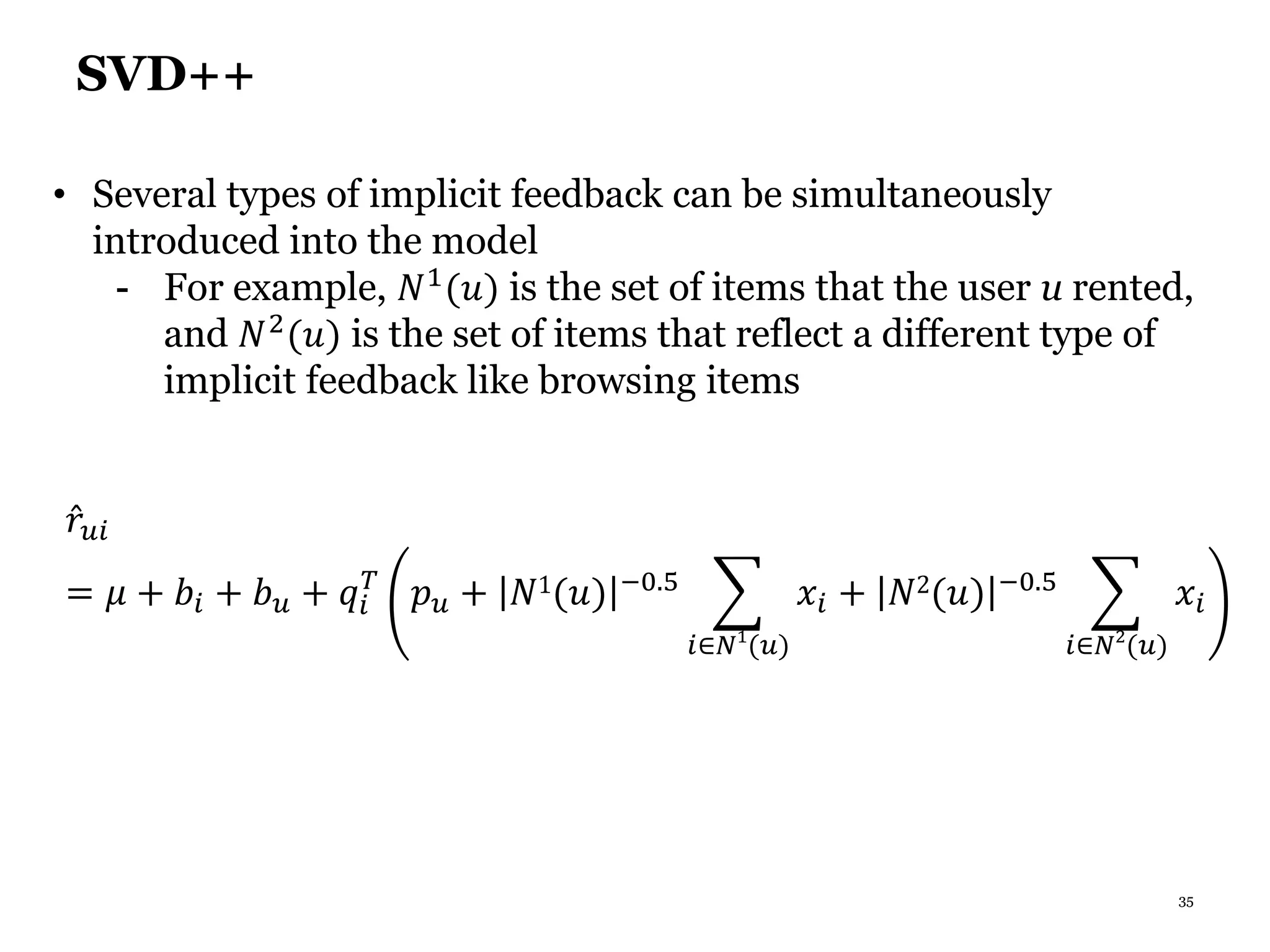
SVD++
• Several types of implicit feedback can be simultaneously
introduced into the model
- For example, 𝑁1
(𝑢) is the set of items that the user u rented,
and 𝑁2(𝑢) is the set of items that reflect a different type of
implicit feedback like browsing items
𝑟𝑢𝑖
= 𝜇 + 𝑏𝑖 + 𝑏 𝑢 + 𝑞𝑖
𝑇
𝑝 𝑢 + 𝑁1(𝑢) −0.5
𝑖∈𝑁1
(𝑢)
𝑥𝑖 + 𝑁2(𝑢) −0.5
𝑖∈𝑁2
(𝑢)
𝑥𝑖
36
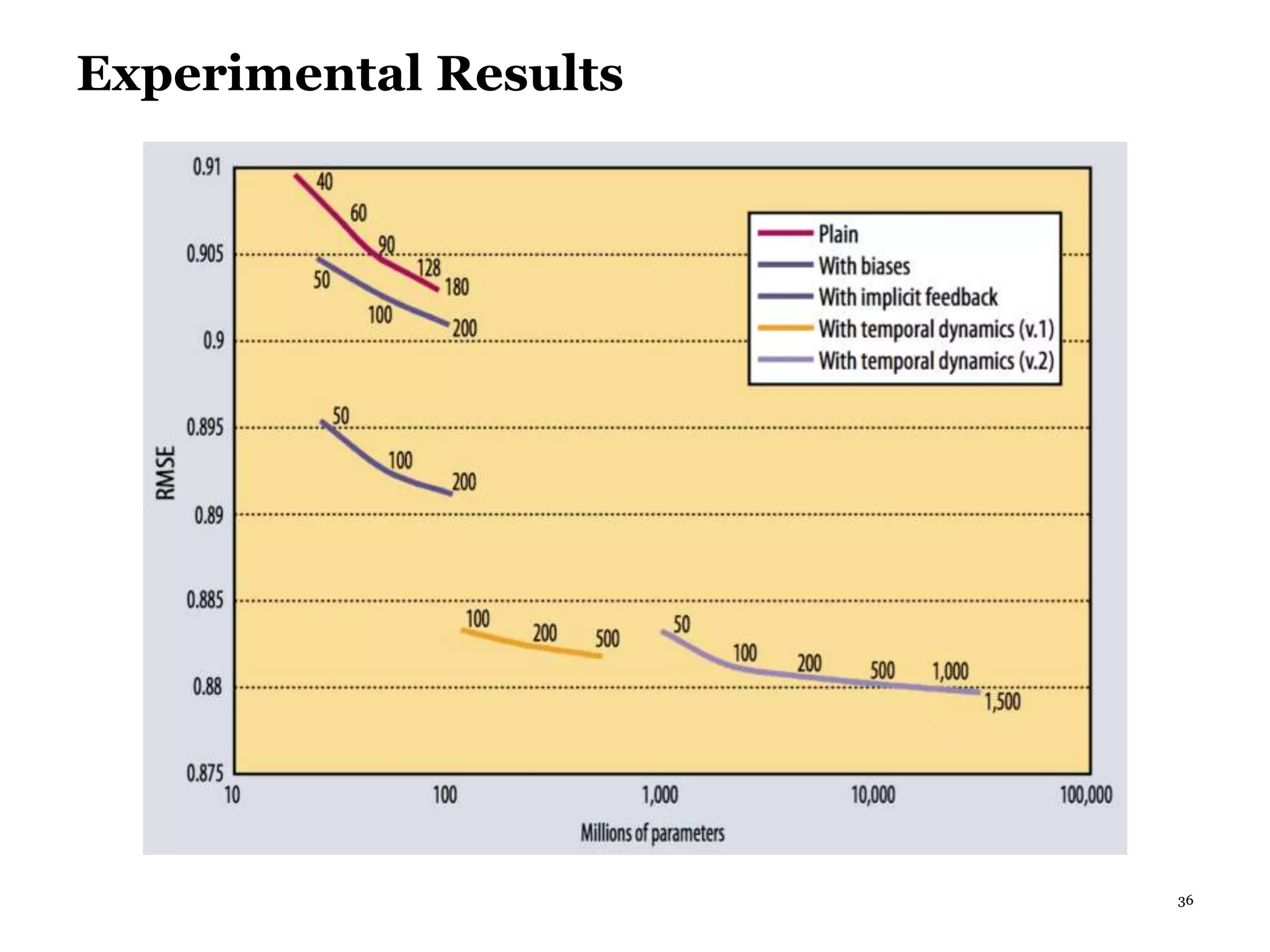
Experimental Results
37
References
1. Koren, Y. and Bell, R., Advances in collaborative filtering. In
Recommender systems handbook, pp. 145-186, Springer US,
2011
2. Amatriain, X., Jaimes, A., Oliver, N. and Pujol, J.M., Data mining
methods for recommender systems. In Recommender systems
handbook, pp. 39-71, Springer US, 2011
3. Koren, Y., Bell, R. and Volinsky, C., Matrix factorization
techniques for recommender systems. IEEE Computer, (8), pp.
30-37, 2009
4. Dietmar, J. and Gerhard F., Tutorial: Recommender Systems.
Proc. International Joint Conference on Artificial Intelligence
(IJCAI 13), Beijing, 2013
38
References
5. Amatriain, X. and Mobasher, B., The recommender problem
revisited: morning tutorial. In Proceedings of the 20th ACM
SIGKDD international conference on Knowledge discovery and
data mining, pp. 1971-1971, ACM, 2014
6. Bobadilla, J., Ortega, F., Hernando, A. and Gutierrez, A.,
Recommender systems survey. Knowledge-Based Systems, 46,
pp. 109-132, 2013
7. Moon, C., Recommender systems survey. SlideShare, 2014
(http://www.slideshare.net/ChangsungMoon/summary-of-rs-
survey-ver-07-20140915)
8. Freitag, M and Schwarz, J., Matrix factorization techniques for
recommender systems. Presentation Slides in Hasso Plattner
Institut, 2011
(http://hpi.de/fileadmin/user_upload/fachgebiete/naumann/leh
re/SS2011/Collaborative_Filtering/pres1-
matrixfactorization.pdf)

Recommender Systems: Advances in Collaborative Filtering

  • 1.
    Recommender Systems: Backgrounds & Advancesin Collaborative Filtering 1 Changsung Moon Department of Computer Science North Carolina State University
  • 2.
  • 3.
  • 4.
    4 The Long Tail Source:http://www.wired.com/2004/10/tail/
  • 5.
    5 Information Overload • Recommendersystems help to match users with items - Ease information overload - Sales assistance (guidance, advisory, profit increase, ...)
  • 6.
    6 Recommender Problem • Recommendersystems are a subclass of information filtering system that seek to predict the ‘rating’ or ‘preference’ that a user would give to an item – Wikipedia
  • 7.
  • 8.
    8 Data Mining Methods •Recommender systems typically apply techniques and methodologies of a genernal data mining
  • 9.
    9 Types of Input •Explicit Feedback - Feedback that users directly report on their interest in items - e.g. star ratings for movies - e.g. thumbs-up/down for TV shows • Implicit Feedback - Feedback, which indirectly reflects opinion through observing user behavior - e.g. purchase history, browsing history, or search patterns
  • 10.
  • 11.
    11 Pros of CollaborativeFiltering • requires minimal knowledge engineering efforts • needs not consider content of items • produces good enough results in most cases • Serendipity of results
  • 12.
    12 Challenges for CollaborativeFiltering • Sparsity - Usually the vast majority of ratings are unknown - e.g. 99% of ratings are missing in Netflix data • Scalability - Nearest neighbor techniques require computation that grows with both the number of users and the number of items • Cold Start Problem - New items and new users can cause the cold-start problem, as there will be insufficient data for CF to work accurately
  • 13.
    13 Challenges for CollaborativeFiltering • Popularity Bias - tends to recommend popular items • Synonyms - Same or very similar items having different names or entries - Topic modeling like LDA could solve this by grouping different words belonging to the same topic • Shilling Attacks - People may give positive ratings for their own items and negative ratings for their competitors
  • 14.
    14 Content-based Recommendation • Basedon information about item itself, usually keywords or phrases occurring in the item • Similarity between two content items is measured by similarity associated with their term vectors • User’s profile can be developed by analyzing set of content the user interacted with • enables you to compute the similarities between a user and an item Similar
  • 15.
    15 Pros/Cons of Content-basedApproach • Pros - No need for data on other users: No cold-start or sparsity - able to recommend to users with unique tastes - able to recommend new and unpopular items - provides explanations by listing content features • Cons - In certain domains (e.g., music, blogs and videos), it is complicated to generate the features for items - difficult to implement serendipity - Users only receive recommendations that are very similar to items they liked or prefered
  • 16.
    16 Hybrid Methods • Weighted -Outputs from several techniques are combined with different weights • Switching - Depending on situation, the system changes from one technique to another • Mixed - Outputs from several techniques are presented at the same time • Cascade - The output from one technique is used as input of another that refines the results
  • 17.
    17 Hybrid Methods • FeatureCombination - Features from different recommendation sources are combined as input to a single technique • Feature Augmentation - The output from one technique is used as input features to another • Meta-level - The model learned by one recommender is used as input to another
  • 18.
    18 Two Main Techniquesof CF • Neighborhood Approach - Relationships between items or between users • Latent Factor Models - Transforming both items and users to the same latent factor space - Characterizing both items and users on factors inferred from user feedback - pLSA - neural networks - Latent Dirichlet Allocation - Matrix factorization (e.g. SVD-based models) - ...
  • 19.
    19 Latent Factor Models •find features that describe the characteristics of rated objects • Item characteristics and user preferences are described with numerical factor values Action Comedy
  • 20.
    20 Latent Factor Models •Items and users are associated with a factor vector • Dot-product captures the user’s estimated interest in the item 𝑟𝑢𝑖 = 𝑞𝑖 𝑇 𝑝 𝑢 - Each item i is associated with a vector 𝑞𝑖 ∈ ℝ 𝑓 - Each user u is associated with a vector 𝑝 𝑢 ∈ ℝ 𝑓 • Challenge – How to compute a mapping of items and users to factor vectors? • Approaches - Matrix Factorization Models - e.g. Singular Value Decomposition (SVD)
  • 21.
    21 SVD • R: 𝑁× 𝑀 matrix (e.g., N users, M movies) • U: 𝑁 × 𝑘 matrix (e.g., N users, k factors) • 𝚺: 𝑘 × 𝑘 diagonal matrix with k largest eigenvalues • V 𝒕 : 𝑘 × 𝑀 matrix (e.g., k factors, M movies)
  • 22.
    22 SVD 5 5 1 54 2 1 2 2 1 3 5 𝑓1 𝑓2 -0.44-0.63 -0.23-0.60 0.25-0.25 0.83-0.43 𝑓1 𝑓2 -0.67-0.62 -0.03-0.52 -0.41 0.85 𝑓1 𝑓2 𝑓1 𝑓2 010.96 4.390 R U 𝑽 𝒕 𝚺
  • 23.
  • 24.
    24 SVD - Problems •Conventional SVD has difficulties due to high portion of missing values in the user-item ratings matrix • Imputation to fill in missing ratings - Imputation can be very expensive as it significantly increases the amount of data - Inaccurate imputation might distort the data
  • 25.
    25 Matrix Factorization forRating Prediction • Modeling directly the observed ratings only 𝑚𝑖𝑛 𝑞,𝑝 (𝑢,𝑖)∈𝒦 (𝑟𝑢𝑖 − 𝑞𝑖 𝑇 𝑝 𝑢)2 - 𝒦 is the set of the (u,i) pairs for which 𝑟𝑢𝑖 is known - 𝑟𝑢𝑖 = 𝑞𝑖 𝑇 𝑝 𝑢 • To learn the factor vectors, 𝑝 𝑢 and 𝑞𝑖 we minimize the squared error
  • 26.
    26 Regularization • To avoidoverfitting through a regularized model 𝑚𝑖𝑛 𝑞,𝑝 (𝑢,𝑖)∈𝒦 (𝑟𝑢𝑖 − 𝑞𝑖 𝑇 𝑝 𝑢)2 + 𝜆( 𝑞𝑖 2 + 𝑝 𝑢 2 ) - learn the factor vectors, 𝑝 𝑢 and 𝑞𝑖 - The constant 𝜆, which controls the extent of regularization, is usually determined by cross validation - Minimization is typically performed by either stochastic gradient descent or alternating least squares Regularization
  • 27.
    27 Learning Algorithms • Stochasticgradient descent - Modification of parameters (𝑞𝑖, 𝑝 𝑢) relative to prediction error - Error = actual rating – predicted rating - 𝑒 𝑢𝑖 = 𝑟𝑢𝑖 − 𝑞𝑖 𝑇 𝑝 𝑢 - 𝑞𝑖 ← 𝑞𝑖 + 𝛾 ∙ (𝑒 𝑢𝑖 ∙ 𝑝 𝑢 − 𝜆 ∙ 𝑞𝑖) - 𝑝 𝑢 ← 𝑝 𝑢 + 𝛾 ∙ (𝑒 𝑢𝑖 ∙ 𝑞𝑖 − 𝜆 ∙ 𝑝 𝑢) • Alternating least squares - allow massive parallelization - Better for densely filled matrices
  • 28.
  • 29.
    29 First Two Vectorsfrom Matrix Decomposition
  • 30.
    30 Extended MF (AddingBiases) • Biases - Much of the variation in ratings is due to effects associated with either users or items, independently of their interactions - i.e., some users tend to give higher ratings than others - i.e., some items tend to receive higher ratings than others - A prediction for an unknown rating 𝑟𝑢𝑖 is denoted by 𝑏 𝑢𝑖 𝑏 𝑢𝑖 = 𝜇 + 𝑏𝑖 + 𝑏 𝑢 - 𝜇: the overall average rating over all items - 𝑏 𝑢 and 𝑏𝑖: the observed deviations of user u and item i
  • 31.
    31 Extended MF (AddingBiases) • Joe tends to rate 0.2 stars lower than the average • Suppose that the average rating over all movies, 𝜇, is 3.9 stars • Avengers tends to be rated 0.5 stars above the average • Avengers movie’s predicted rating by Joe: 𝑏 𝑢𝑖 = 𝜇 + 𝑏𝑖 + 𝑏 𝑢 = 3.9 − 0.2 + 0.5 = 4.2
  • 32.
    32 Extended MF (AddingBiases) • Adding biases - A rating is created by adding biases 𝑟𝑢𝑖 = 𝜇 + 𝑏𝑖 + 𝑏 𝑢 + 𝑞𝑖 𝑇 𝑝 𝑢 • Objective Function - In order to learn parameters (𝑏𝑖, 𝑏 𝑢, 𝑞𝑖 and 𝑝 𝑢) we minimize the regularized squared error 𝑚𝑖𝑛 𝑏,𝑞,𝑝 (𝑢,𝑖)∈𝒦 (𝑟𝑢𝑖 − (𝜇 + 𝑏𝑖 + 𝑏 𝑢 + 𝑞𝑖 𝑇 𝑝 𝑢))2 + 𝜆(𝑏𝑖 2 + 𝑏 𝑢 2 + 𝑞𝑖 2 + 𝑝 𝑢 2) - Minimization is typically performed by either stochastic gradient descent or alternating least squares
  • 33.
    33 Extended MF (TemporalDynamics) • Ratings may be affected by temporal effects - Popularity of an item may change - User’s identity and preferences may change • Modeling temporal affects can improve accuracy significantly • Rating predictions as a function of time 𝑟𝑢𝑖(𝑡) = 𝜇 + 𝑏𝑖(𝑡) + 𝑏 𝑢(𝑡) + 𝑞𝑖 𝑇 𝑝 𝑢(𝑡)
  • 34.
    34 SVD++ • Prediction accuracycan be improved by considering also implicit feedback • N(u) denotes the set of items for which user u expressed an implicit preference • A new set of item factors are necessary, where item i is associated with 𝑥𝑖 ∈ ℝ 𝑓 • A user is characterized by normalizing the sum of factor vectors: 𝑁(𝑢) −0.5 𝑖∈𝑁(𝑢) 𝑥𝑖
  • 35.
    35 SVD++ • Several typesof implicit feedback can be simultaneously introduced into the model - For example, 𝑁1 (𝑢) is the set of items that the user u rented, and 𝑁2(𝑢) is the set of items that reflect a different type of implicit feedback like browsing items 𝑟𝑢𝑖 = 𝜇 + 𝑏𝑖 + 𝑏 𝑢 + 𝑞𝑖 𝑇 𝑝 𝑢 + 𝑁1(𝑢) −0.5 𝑖∈𝑁1 (𝑢) 𝑥𝑖 + 𝑁2(𝑢) −0.5 𝑖∈𝑁2 (𝑢) 𝑥𝑖
  • 36.
  • 37.
    37 References 1. Koren, Y.and Bell, R., Advances in collaborative filtering. In Recommender systems handbook, pp. 145-186, Springer US, 2011 2. Amatriain, X., Jaimes, A., Oliver, N. and Pujol, J.M., Data mining methods for recommender systems. In Recommender systems handbook, pp. 39-71, Springer US, 2011 3. Koren, Y., Bell, R. and Volinsky, C., Matrix factorization techniques for recommender systems. IEEE Computer, (8), pp. 30-37, 2009 4. Dietmar, J. and Gerhard F., Tutorial: Recommender Systems. Proc. International Joint Conference on Artificial Intelligence (IJCAI 13), Beijing, 2013
  • 38.
    38 References 5. Amatriain, X.and Mobasher, B., The recommender problem revisited: morning tutorial. In Proceedings of the 20th ACM SIGKDD international conference on Knowledge discovery and data mining, pp. 1971-1971, ACM, 2014 6. Bobadilla, J., Ortega, F., Hernando, A. and Gutierrez, A., Recommender systems survey. Knowledge-Based Systems, 46, pp. 109-132, 2013 7. Moon, C., Recommender systems survey. SlideShare, 2014 (http://www.slideshare.net/ChangsungMoon/summary-of-rs- survey-ver-07-20140915) 8. Freitag, M and Schwarz, J., Matrix factorization techniques for recommender systems. Presentation Slides in Hasso Plattner Institut, 2011 (http://hpi.de/fileadmin/user_upload/fachgebiete/naumann/leh re/SS2011/Collaborative_Filtering/pres1- matrixfactorization.pdf)