§ Netflix: 2/3 of the movies watched are recommended
§ Google News: recommendations generate 38% more
clickthrough
§ Amazon: 35% sales from recommendations
§ Choicestream: 28% of the people would buy more music if
they found what they liked.
25.08.2017Recommender Systems 2
§ In search, user know about item
§ In recommendation, user even do not know whether item
exists or not
25.08.2017Recommender Systems 3
§ Content Based Filtering
§ Collabrative Filtering
25.08.2017Recommender Systems 4
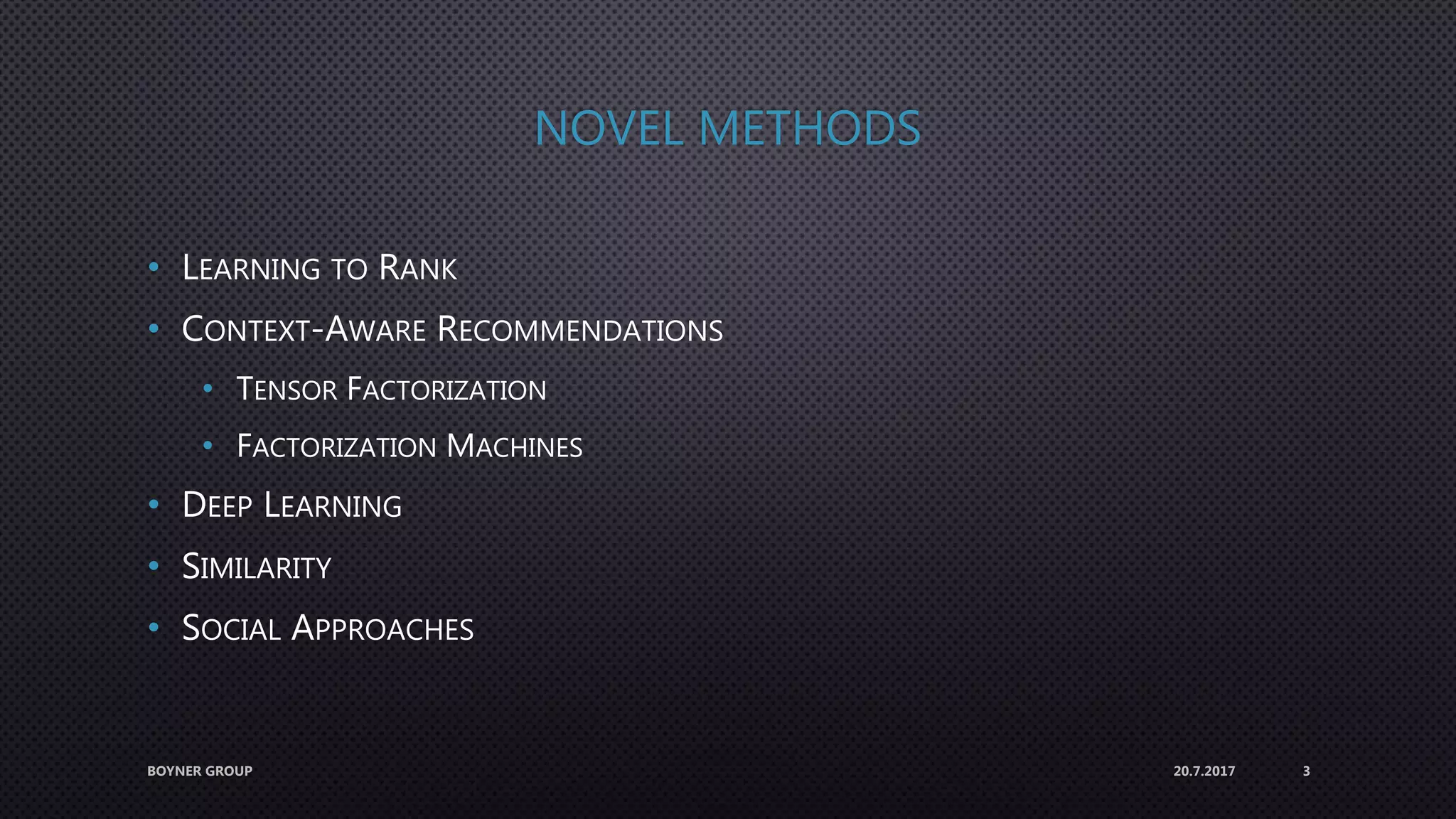
§ Learning to Rank
§ Context-Aware Recommendations
§ Tensor Factorization
§ Factorization Machines
§ Deep Learning
§ Similarity
§ Social Approaches
25.08.2017Recommender Systems 5
§ Collaborative Filtering: Recommend items based only on the users
past behavior
§ User-based: Find similar users to me and recommend what they liked
§ Item-based: Find similar items to those that I have previously liked
§ Content-based: Recommend based on item features
§ Personalized Learning to Rank:Treat recommendation as a ranking
problem
§ Demographic: Recommend based on user features
§ Social recommendations (trust-based)
§ Hybrid: Combine any of the above
25.08.2017Recommender Systems 6
25.08.2017Recommender Systems 7
Item1 Item2 Item3 Item4 Item5
Alice 5 3 4 4 ?
User1 3 1 2 3 3
User2 4 3 4 3 5
User3 3 3 1 5 4
User4 1 5 5 2 1
USER-MOVIE RATINGS
§ List of m Users and a list of n Items
§ Each user has a list of items with associated opinion
§ Explicit opinion - a rating score
§ Sometime the rating is implicitly – purchase records or listen to tracks
§ Active user for whom the CF prediction task is performed
§ Metric for measuring similarity between users
§ Method for selecting a subset of neighbors
§ Method for predicting a rating for items not currently rated by
the active user.
25.08.2017Recommender Systems 8
§ Identify set of ratings for the target/active user
§ Identify set of users most similar to the target/active user
according to a similarity function (neighborhood
formation)
§ Identify the products these similar users liked
§ Generate a prediction - rating that would be given by the
target user to the product - for each one of these products
§ Based on this predicted rating recommend a set of top N
products
25.08.2017Recommender Systems 9
§ Pros:
§ Requires minimal knowledge engineering efforts
§ Users and products are symbols without any internal structure or
characteristics
§ Produces good-enough results in most cases
§ Cons:
§ Requires a large number of reliable “user feedback data points”
to bootstrap
§ Requires products to be standardized (users should have bought
exactly the same product)
§ Assumes that prior behavior determines current behavior without
taking into account “contextual” knowledge (session-level)
25.08.2017Recommender Systems 10
§ CF recommendations are personalized since the “prediction” is
based on the ratings expressed by similar users
§ Those neighbors are different for each target user
§ A non-personalized collaborative-based recommendation can be
generated by averaging the recommendations of ALL the users
25.08.2017Recommender Systems 11
25.08.2017Recommender Systems 12
25.08.2017Recommender Systems 13
25.08.2017Recommender Systems 14
25.08.2017Recommender Systems 15
Item1 Item2 Item3 Item4 Item5
Alice 5 3 4 4 ?
User1 3 1 2 3 3
User2 4 3 4 3 5
User3 3 3 1 5 4
User4 1 5 5 2 1
sim =	0,85
sim =	0,70
sim =	-0,79
25.08.2017Recommender Systems 16
25.08.2017Recommender Systems 17
25.08.2017Recommender Systems 18
Item1 Item2 Item3 Item4 Item5
Alice 5 3 4 4 ?
User1 3 1 2 3 3
User2 4 3 4 3 5
User3 3 3 1 5 4
User4 1 5 5 2 1
§ Methods of dimensionality reduction
§ Matrix Factorization
§ Clustering
§ Projection (PCA, SVD …)
25.08.2017Recommender Systems 19
§ Memory based
§ Use the entire user-item database to generate a prediction.
§ Usage of statistical techniques to find the neighbors – e.g. nearest-
neighbor.
§ Memory based
§ First develop a model of user
§ Type of model:
§ Probabilistic (e.g. Bayesian Network)
§ Clustering
§ Rule-based approaches (e.g. Association Rules)
§ Classification, Regression
§ LDA
25.08.2017Recommender Systems 20
25.08.2017Recommender Systems 21
§ Common for recommending text-based products (web pages,
usenet news messages, )
§ Items to recommend are “described” by their associated
features (e.g. keywords)
§ User Model structured in a “similar” way as the content:
features/keywords more likely to occur in the preferred
documents (lazy approach)
§ Text documents recommended based on a comparison between their
content (words appearing) and user model (a set of preferred words)
§ The user model can also be a classifier based on whatever
technique (Neural Networks, Naïve Bayes...)
25.08.2017Recommender Systems 22
§ Let Content(s) be an item profile, i.e. a set of attributes
characterizing item s.
• Content usually described with keywords.
• “Importance” (or “informativeness”) of word kj in document dj
is determined with some weighting
• measure wij
• One of the best-known measures in IR is the term
frequency/inverse document frequency (TF- IDF)
25.08.2017Recommender Systems 23
§ Linear Regression
§ SVD
§ SVD++
§ Funk SVD
§ Matrix Factorization
§ Neural Networks
§ Locality-Sensitive Hashing (LSH)
§ Clustering
§ Association rules
25.08.2017Recommender Systems 24
Vk
T
Dim1 -0.44 -0.57 0.06 0.38 0.57
Dim2 0.58 -0.66 0.26 0.18 -0.36
Uk Dim1 Dim2
Alice 0.47 -0.30
Bob -0.44 0.23
Mary 0.70 -0.06
Sue 0.31 0.93 Dim1 Dim2
Dim1 5.63 0
Dim2 0 3.23
T
kkkk VUM ´S´=
kS
• SVD:
• Prediction:	
=	3	+	0.84	=	3.84
)()(ˆ EPLVAliceUrr T
kkkuui ´S´+=
25.08.2017Recommender Systems 25
25.08.2017Recommender Systems 26
HOSVD
§ Personalized recommendations—user-based
§ Similar items—item-based
§ Viewed this bought that—item-based cross-action
§ Popular Items and User-defined ranking
§ Item-set recommendations for complimentary purchases or
shopping carts—item-set-based
§ Hybrid collaborative filtering and content based
recommendations—limited content-based
§ Business rules
25.08.2017Recommender Systems 27
r = recommendations
hp = a user’s history of some action
(purchase for instance)
P = the history of all users’ primary action
rows are users, columns are items
(PtP) = compares column to column using
log-likelihood based correlation test
25.08.2017Recommender Systems 28
r = (PtP)hp
§ Let’s call (PtP) an indicator matrix for some primary action
like purchase
§ Rows = items, columns = items, element = similarity/correlation score
§ The score is row compared to column using a “similarity” or
“correlation” metric
§ Log-Likelihood Ratio (LLR) finds important/correlating co-
occurrences and filters out the rest—a major improvement in
quality over simple co-occurrence or other similarity
metrics.
§ Experiments on real-world data show LLR is significantly
better than other similarity metrics
25.08.2017Recommender Systems 29
§ This actually means to take the user’s
history hp and compare it to rows of the co-
occurrence matrix (PtP)
§ TF-IDF weighting of co-occurrence would
be nice to mitigate the undue influence
of popular items
§ Find items nearest to the user’s history
§ Sort these by similarity strength and
keep only the highest —you have
recommendations
§ hp
§ user1: [item2, item3]
§ (PtP)
§ item1: [item2, item3]
§ item2: [item1, item3, item95]
§ item3: […]
§ find item that most closely matches the
user’s history
§ item1 !
25.08.2017Recommender Systems 30
Single User History of Multi-modal Behavior
buy views
terms
in
search
users
products products categories terms
...
A B C E
input
categorypref
products
D
share
user-i
25.08.2017Recommender Systems 31
All User’s Buys Cooccurrence
users
products
A
users
products
At
X
=
cooccurrence
products
products
product-j
product-j had 2 other products that
were bought in common, we replace
cooccurrence magnitude with LLR
score, it adds the “correlation test” to
simple cooccurrence
25.08.2017Recommender Systems 32
Cooccurrence Analysis
25.08.2017Recommender Systems 33
How often do items co-occur?
// compute co-occurrence matrix
val C = A.t %*% A
25.08.2017Recommender Systems 34
Which cooccurences are interesting?
// compute some statistics
val interactionsPerItem =
drmBroadcast(A.colSums)
// convert to indicator matrix
val I = C.mapBlock() {
// compute LLR scores from
// cooccurrences and statistics
...
// only keep interesting cooccurrences
...
}
// save indicator matrix
I.writeDrm(...);
25.08.2017Recommender Systems 35
25.08.2017Recommender Systems 36
25.08.2017Recommender Systems 37
25.08.2017Recommender Systems 38
§ Virtually all existing collaborative filtering type
recommenders use only one indicator of preference
§ Virtually anything we know about the user can be used to
improve recommendations—purchase, view, category-
preference, location-preference, device-preference,
gender…
25.08.2017Recommender Systems 39
r = (PtP)hp + (PtV)hv + (PtC)hc + …
CROSS-OCCURRENCE
All User’s Buys Cross-occurrence with
Search terms
users
users
products
At
X
=
cross-
occur-
rence
products
product-j
product-j had 3 terms that were
searched for in common, we replace
cross-occurrence magnitude with LLR
score, it adds the “correlation test” to
simple cross-occurrence!
terms
in
search
terms terms
E
25.08.2017Recommender Systems 40
§ Comparing the history of the primary action to other actions finds
actions that lead to the one you want to recommend
§ Given strong data about user preferences on a general population we
can also use
§ items clicked
§ terms searched
§ categories viewed
§ items shared
§ people followed
§ items disliked (yes dislikes may predict likes)
§ location
§ device preference
§ gender
§ age bracket
§ Virtually any anything we know about the population can be tested for correlation
and used to predict a particular users preferences
25.08.2017Recommender Systems 41
§ Collaborative Topic Filtering
§ Use Latent Dirichlet Allocation (LDA) to model topics directly from the textual
content
§ Calculate based on Word2Vec type word vectors instead of bag-of-words
analysis to boost quality
§ Create cross-occurrence indicators from topics the user has preferred
§ Repeat periodically
§ Entity Preferences:
§ Use a Named Entity Recognition (NER) system to find entities in textual content
§ Create cross-occurrence indicators for these entities
§ Entities and Topics are long lived and richly describe user interests,
these are very good for use in the Universal Recommender.
25.08.2017Recommender Systems 42
§ The final calculation uses hp as the query on the Cooccurrence Matrix
(PtP), returns a ranked set of items
§ Query is a “similarity” query, not relational or key based fetch
§ Uses Search Engine as Cosine-based K-Nearest Neighbor (KNN)
Engine with norms and TF-IDF weighting
§ Highly optimized for serving these queries in realtime
§ Several (Solr, Elasticsearch) have High Availability, massively
scalable clustered auto-sharding features like the best of NoSQL DBs.
25.08.2017Recommender Systems 43
Indicators can also be based on content similarity
(TTt) is a calculation that compares every 2 documents to
each other and finds the most similar—based upon content
alone
25.08.2017Recommender Systems 44
r = (TTt)ht + l*L …
§ Cooccurrence
§ Find the best indicator of a user preference for the item type to be
recommended: examples are “buy”,“read”,“video_watch”,
“share”,“follow”,“like”.
§ Cross-occurrence
§ Item metadata as “user” preference, for example: treat item
category as a user category-preferences
§ Calculated from user actions on any data that may give information
about user— category-preferences, search terms, gender, location
§ Create with Mahout-Samsara SimilarityAnalysis.cooccurrence
25.08.2017Recommender Systems 45
§ Content or metadata
§ Content text, tags, categories, description text, anything describing
an item
§ Create with Mahout-Samsara SimilarityAnalysis.rowSimilarity
§ Intrinsic
§ Popularity rank, geo-location, anything describing an item
§ Some may be derived from usage data like popularity rank, or
hotness
§ Is a known or specially calculated property of the item
25.08.2017Recommender Systems 46
“Universal” means one query on all indicators at once
Unified query:
purchase-correlator: users-history-of-purchases
view-correlator: users-history-of-views
category-correlator: users-history-of-categories-viewed
tags-correlator: users-history-of-purchases
geo-location-correlator: users-location
25.08.2017Recommender Systems 47
r = (PtP)hp + (PtV)hv + (PtC)hc + …
(TTt)ht + l*L …
§ Dataset
25.08.2017Recommender Systems 48
25.08.2017Recommender Systems 49
25.08.2017Recommender Systems 50
25.08.2017Recommender Systems 51
25.08.2017Recommender Systems 52
25.08.2017Recommender Systems 53
25.08.2017Recommender Systems 54
§ getBiasedSimilarItems
§ Get similar items for an item,these are already in the action correlators in ES
§ getBoostedMetadata
§ Get all metadata fields that potentially have boosts (not filters)
§ getFilteringMetadata
§ Get all metadata fields that are filters (not boosts)
§ getFilteringDateRange
§ Get part of query for dates and date ranges
25.08.2017Recommender Systems 55
§ getExcludedItems
§ Create a list of item ids that the user has interacted with or are not to be included in
recommendations
§ getBiasedRecentUserActions
§ Get recent events of the user on items to create the recommendations query from
§ getExcludingMetadata
§ Get all metadata fields that are filters (not boosts)
25.08.2017Recommender Systems 56
§ Results
25.08.2017Recommender Systems 57
Cenk Bircanoğlu
25.08.2017Recommender Systems 58

Recommendation Systems

  • 2.
    § Netflix: 2/3of the movies watched are recommended § Google News: recommendations generate 38% more clickthrough § Amazon: 35% sales from recommendations § Choicestream: 28% of the people would buy more music if they found what they liked. 25.08.2017Recommender Systems 2
  • 3.
    § In search,user know about item § In recommendation, user even do not know whether item exists or not 25.08.2017Recommender Systems 3
  • 4.
    § Content BasedFiltering § Collabrative Filtering 25.08.2017Recommender Systems 4
  • 5.
    § Learning toRank § Context-Aware Recommendations § Tensor Factorization § Factorization Machines § Deep Learning § Similarity § Social Approaches 25.08.2017Recommender Systems 5
  • 6.
    § Collaborative Filtering:Recommend items based only on the users past behavior § User-based: Find similar users to me and recommend what they liked § Item-based: Find similar items to those that I have previously liked § Content-based: Recommend based on item features § Personalized Learning to Rank:Treat recommendation as a ranking problem § Demographic: Recommend based on user features § Social recommendations (trust-based) § Hybrid: Combine any of the above 25.08.2017Recommender Systems 6
  • 7.
    25.08.2017Recommender Systems 7 Item1Item2 Item3 Item4 Item5 Alice 5 3 4 4 ? User1 3 1 2 3 3 User2 4 3 4 3 5 User3 3 3 1 5 4 User4 1 5 5 2 1 USER-MOVIE RATINGS
  • 8.
    § List ofm Users and a list of n Items § Each user has a list of items with associated opinion § Explicit opinion - a rating score § Sometime the rating is implicitly – purchase records or listen to tracks § Active user for whom the CF prediction task is performed § Metric for measuring similarity between users § Method for selecting a subset of neighbors § Method for predicting a rating for items not currently rated by the active user. 25.08.2017Recommender Systems 8
  • 9.
    § Identify setof ratings for the target/active user § Identify set of users most similar to the target/active user according to a similarity function (neighborhood formation) § Identify the products these similar users liked § Generate a prediction - rating that would be given by the target user to the product - for each one of these products § Based on this predicted rating recommend a set of top N products 25.08.2017Recommender Systems 9
  • 10.
    § Pros: § Requiresminimal knowledge engineering efforts § Users and products are symbols without any internal structure or characteristics § Produces good-enough results in most cases § Cons: § Requires a large number of reliable “user feedback data points” to bootstrap § Requires products to be standardized (users should have bought exactly the same product) § Assumes that prior behavior determines current behavior without taking into account “contextual” knowledge (session-level) 25.08.2017Recommender Systems 10
  • 11.
    § CF recommendationsare personalized since the “prediction” is based on the ratings expressed by similar users § Those neighbors are different for each target user § A non-personalized collaborative-based recommendation can be generated by averaging the recommendations of ALL the users 25.08.2017Recommender Systems 11
  • 12.
  • 13.
  • 14.
  • 15.
    25.08.2017Recommender Systems 15 Item1Item2 Item3 Item4 Item5 Alice 5 3 4 4 ? User1 3 1 2 3 3 User2 4 3 4 3 5 User3 3 3 1 5 4 User4 1 5 5 2 1 sim = 0,85 sim = 0,70 sim = -0,79
  • 16.
  • 17.
  • 18.
    25.08.2017Recommender Systems 18 Item1Item2 Item3 Item4 Item5 Alice 5 3 4 4 ? User1 3 1 2 3 3 User2 4 3 4 3 5 User3 3 3 1 5 4 User4 1 5 5 2 1
  • 19.
    § Methods ofdimensionality reduction § Matrix Factorization § Clustering § Projection (PCA, SVD …) 25.08.2017Recommender Systems 19
  • 20.
    § Memory based §Use the entire user-item database to generate a prediction. § Usage of statistical techniques to find the neighbors – e.g. nearest- neighbor. § Memory based § First develop a model of user § Type of model: § Probabilistic (e.g. Bayesian Network) § Clustering § Rule-based approaches (e.g. Association Rules) § Classification, Regression § LDA 25.08.2017Recommender Systems 20
  • 21.
  • 22.
    § Common forrecommending text-based products (web pages, usenet news messages, ) § Items to recommend are “described” by their associated features (e.g. keywords) § User Model structured in a “similar” way as the content: features/keywords more likely to occur in the preferred documents (lazy approach) § Text documents recommended based on a comparison between their content (words appearing) and user model (a set of preferred words) § The user model can also be a classifier based on whatever technique (Neural Networks, Naïve Bayes...) 25.08.2017Recommender Systems 22
  • 23.
    § Let Content(s)be an item profile, i.e. a set of attributes characterizing item s. • Content usually described with keywords. • “Importance” (or “informativeness”) of word kj in document dj is determined with some weighting • measure wij • One of the best-known measures in IR is the term frequency/inverse document frequency (TF- IDF) 25.08.2017Recommender Systems 23
  • 24.
    § Linear Regression §SVD § SVD++ § Funk SVD § Matrix Factorization § Neural Networks § Locality-Sensitive Hashing (LSH) § Clustering § Association rules 25.08.2017Recommender Systems 24
  • 25.
    Vk T Dim1 -0.44 -0.570.06 0.38 0.57 Dim2 0.58 -0.66 0.26 0.18 -0.36 Uk Dim1 Dim2 Alice 0.47 -0.30 Bob -0.44 0.23 Mary 0.70 -0.06 Sue 0.31 0.93 Dim1 Dim2 Dim1 5.63 0 Dim2 0 3.23 T kkkk VUM ´S´= kS • SVD: • Prediction: = 3 + 0.84 = 3.84 )()(ˆ EPLVAliceUrr T kkkuui ´S´+= 25.08.2017Recommender Systems 25
  • 26.
  • 27.
    § Personalized recommendations—user-based §Similar items—item-based § Viewed this bought that—item-based cross-action § Popular Items and User-defined ranking § Item-set recommendations for complimentary purchases or shopping carts—item-set-based § Hybrid collaborative filtering and content based recommendations—limited content-based § Business rules 25.08.2017Recommender Systems 27
  • 28.
    r = recommendations hp= a user’s history of some action (purchase for instance) P = the history of all users’ primary action rows are users, columns are items (PtP) = compares column to column using log-likelihood based correlation test 25.08.2017Recommender Systems 28 r = (PtP)hp
  • 29.
    § Let’s call(PtP) an indicator matrix for some primary action like purchase § Rows = items, columns = items, element = similarity/correlation score § The score is row compared to column using a “similarity” or “correlation” metric § Log-Likelihood Ratio (LLR) finds important/correlating co- occurrences and filters out the rest—a major improvement in quality over simple co-occurrence or other similarity metrics. § Experiments on real-world data show LLR is significantly better than other similarity metrics 25.08.2017Recommender Systems 29
  • 30.
    § This actuallymeans to take the user’s history hp and compare it to rows of the co- occurrence matrix (PtP) § TF-IDF weighting of co-occurrence would be nice to mitigate the undue influence of popular items § Find items nearest to the user’s history § Sort these by similarity strength and keep only the highest —you have recommendations § hp § user1: [item2, item3] § (PtP) § item1: [item2, item3] § item2: [item1, item3, item95] § item3: […] § find item that most closely matches the user’s history § item1 ! 25.08.2017Recommender Systems 30
  • 31.
    Single User Historyof Multi-modal Behavior buy views terms in search users products products categories terms ... A B C E input categorypref products D share user-i 25.08.2017Recommender Systems 31
  • 32.
    All User’s BuysCooccurrence users products A users products At X = cooccurrence products products product-j product-j had 2 other products that were bought in common, we replace cooccurrence magnitude with LLR score, it adds the “correlation test” to simple cooccurrence 25.08.2017Recommender Systems 32
  • 33.
  • 34.
    How often doitems co-occur? // compute co-occurrence matrix val C = A.t %*% A 25.08.2017Recommender Systems 34
  • 35.
    Which cooccurences areinteresting? // compute some statistics val interactionsPerItem = drmBroadcast(A.colSums) // convert to indicator matrix val I = C.mapBlock() { // compute LLR scores from // cooccurrences and statistics ... // only keep interesting cooccurrences ... } // save indicator matrix I.writeDrm(...); 25.08.2017Recommender Systems 35
  • 36.
  • 37.
  • 38.
  • 39.
    § Virtually allexisting collaborative filtering type recommenders use only one indicator of preference § Virtually anything we know about the user can be used to improve recommendations—purchase, view, category- preference, location-preference, device-preference, gender… 25.08.2017Recommender Systems 39 r = (PtP)hp + (PtV)hv + (PtC)hc + … CROSS-OCCURRENCE
  • 40.
    All User’s BuysCross-occurrence with Search terms users users products At X = cross- occur- rence products product-j product-j had 3 terms that were searched for in common, we replace cross-occurrence magnitude with LLR score, it adds the “correlation test” to simple cross-occurrence! terms in search terms terms E 25.08.2017Recommender Systems 40
  • 41.
    § Comparing thehistory of the primary action to other actions finds actions that lead to the one you want to recommend § Given strong data about user preferences on a general population we can also use § items clicked § terms searched § categories viewed § items shared § people followed § items disliked (yes dislikes may predict likes) § location § device preference § gender § age bracket § Virtually any anything we know about the population can be tested for correlation and used to predict a particular users preferences 25.08.2017Recommender Systems 41
  • 42.
    § Collaborative TopicFiltering § Use Latent Dirichlet Allocation (LDA) to model topics directly from the textual content § Calculate based on Word2Vec type word vectors instead of bag-of-words analysis to boost quality § Create cross-occurrence indicators from topics the user has preferred § Repeat periodically § Entity Preferences: § Use a Named Entity Recognition (NER) system to find entities in textual content § Create cross-occurrence indicators for these entities § Entities and Topics are long lived and richly describe user interests, these are very good for use in the Universal Recommender. 25.08.2017Recommender Systems 42
  • 43.
    § The finalcalculation uses hp as the query on the Cooccurrence Matrix (PtP), returns a ranked set of items § Query is a “similarity” query, not relational or key based fetch § Uses Search Engine as Cosine-based K-Nearest Neighbor (KNN) Engine with norms and TF-IDF weighting § Highly optimized for serving these queries in realtime § Several (Solr, Elasticsearch) have High Availability, massively scalable clustered auto-sharding features like the best of NoSQL DBs. 25.08.2017Recommender Systems 43
  • 44.
    Indicators can alsobe based on content similarity (TTt) is a calculation that compares every 2 documents to each other and finds the most similar—based upon content alone 25.08.2017Recommender Systems 44 r = (TTt)ht + l*L …
  • 45.
    § Cooccurrence § Findthe best indicator of a user preference for the item type to be recommended: examples are “buy”,“read”,“video_watch”, “share”,“follow”,“like”. § Cross-occurrence § Item metadata as “user” preference, for example: treat item category as a user category-preferences § Calculated from user actions on any data that may give information about user— category-preferences, search terms, gender, location § Create with Mahout-Samsara SimilarityAnalysis.cooccurrence 25.08.2017Recommender Systems 45
  • 46.
    § Content ormetadata § Content text, tags, categories, description text, anything describing an item § Create with Mahout-Samsara SimilarityAnalysis.rowSimilarity § Intrinsic § Popularity rank, geo-location, anything describing an item § Some may be derived from usage data like popularity rank, or hotness § Is a known or specially calculated property of the item 25.08.2017Recommender Systems 46
  • 47.
    “Universal” means onequery on all indicators at once Unified query: purchase-correlator: users-history-of-purchases view-correlator: users-history-of-views category-correlator: users-history-of-categories-viewed tags-correlator: users-history-of-purchases geo-location-correlator: users-location 25.08.2017Recommender Systems 47 r = (PtP)hp + (PtV)hv + (PtC)hc + … (TTt)ht + l*L …
  • 48.
  • 49.
  • 50.
  • 51.
  • 52.
  • 53.
  • 54.
  • 55.
    § getBiasedSimilarItems § Getsimilar items for an item,these are already in the action correlators in ES § getBoostedMetadata § Get all metadata fields that potentially have boosts (not filters) § getFilteringMetadata § Get all metadata fields that are filters (not boosts) § getFilteringDateRange § Get part of query for dates and date ranges 25.08.2017Recommender Systems 55
  • 56.
    § getExcludedItems § Createa list of item ids that the user has interacted with or are not to be included in recommendations § getBiasedRecentUserActions § Get recent events of the user on items to create the recommendations query from § getExcludingMetadata § Get all metadata fields that are filters (not boosts) 25.08.2017Recommender Systems 56
  • 57.
  • 58.

Editor's Notes

  • #38 Figure 1: Formula used to calculate geospatial statistic (a modified log-likelihood ratio [LLR]) on the basis of geographic distribution of Mycobacterium tuberculosis genotype clusters, Washington, USA. Variables are classified as follows: a = number of tuberculosis (TB) cases with the genotype of interest in the selected county; b = number of cases with the genotype of interest in the United States; c = number of cases without the genotype of interest in the selected county; d = number of cases without the genotype of interest in the United States; N = total number of TB cases.