The views expressed in this presentation are the views of the author/s and do not necessarily reflect the views or policies of the Asian
Development Bank, or its Board of Governors, or the governments they represent. ADB does not guarantee the accuracy of the data included
in this presentation and accepts no responsibility for any consequence of their use. The countries listed in this presentation do not imply any
view on ADB's part as to sovereignty or independent status or necessarily conform to ADB's terminology.
Learning for Change
Olivier Serrat
2013
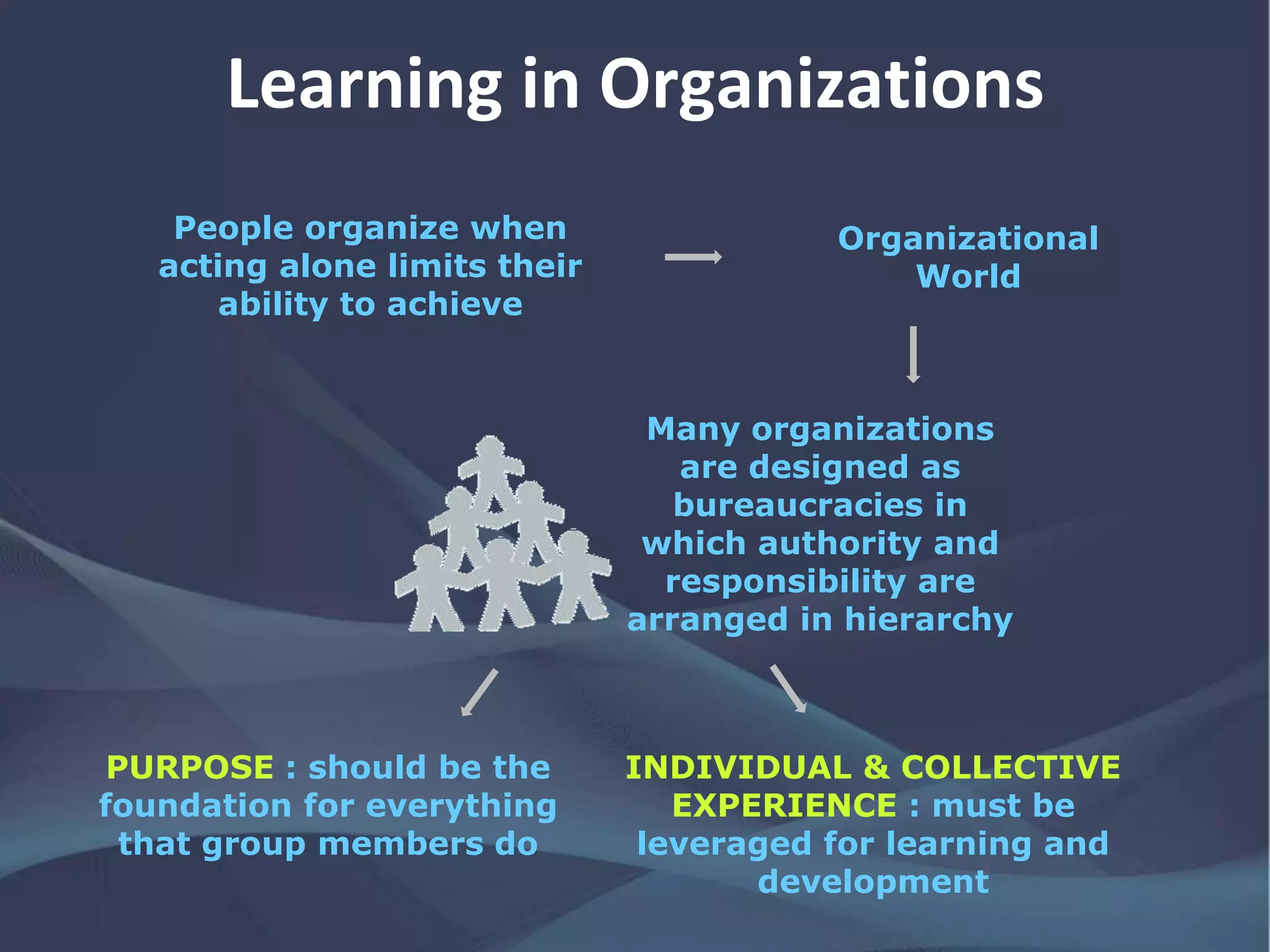
Learning in Organizations
Organizational
World
People organize when
acting alone limits their
ability to achieve
Many organizations
are designed as
bureaucracies in
which authority and
responsibility are
arranged in hierarchy
PURPOSE : should be the
foundation for everything
that group members do
INDIVIDUAL & COLLECTIVE
EXPERIENCE : must be
leveraged for learning and
development
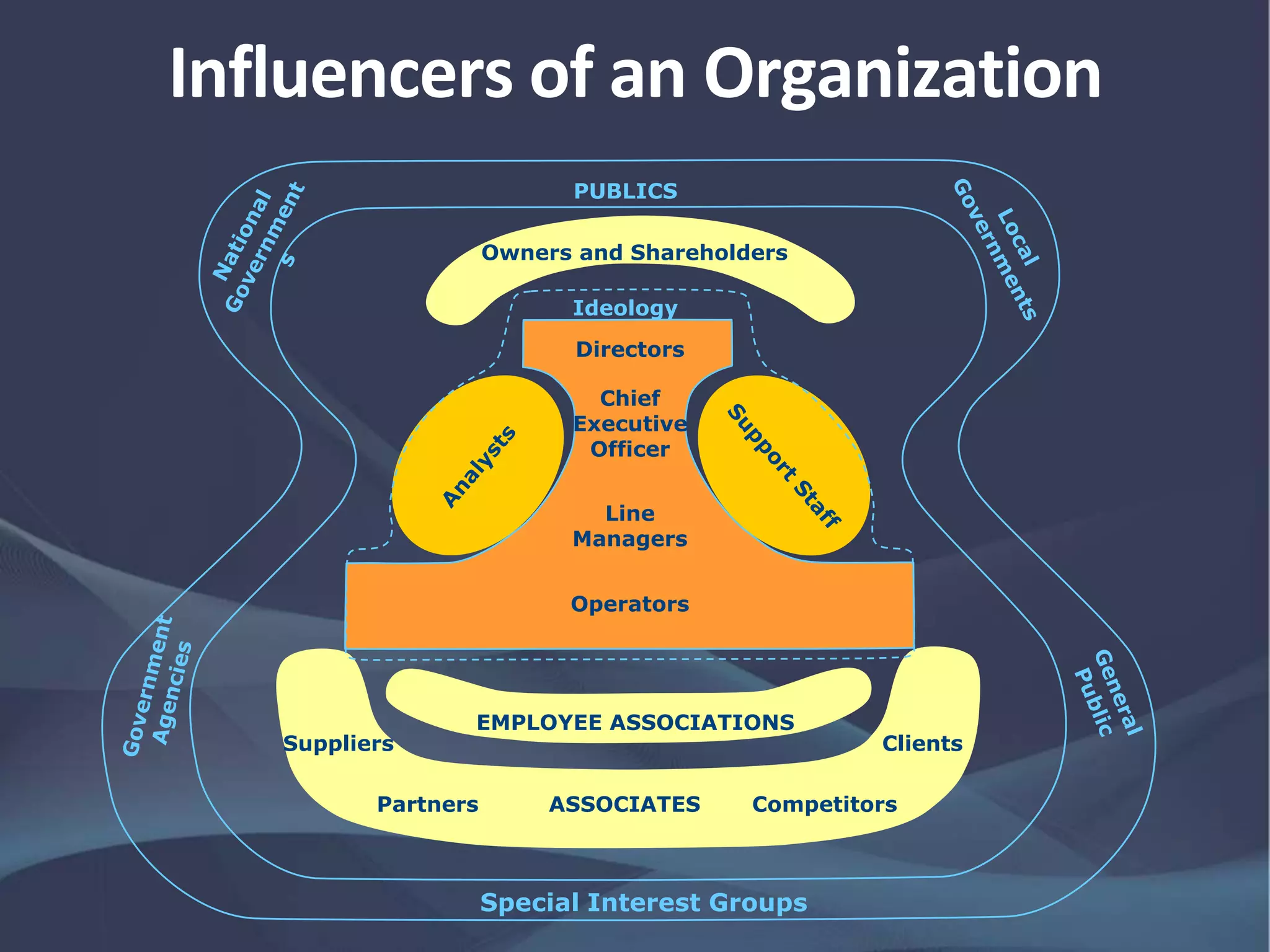
Influencers of an Organization
Operators
Line
Managers
Chief
Executive
Officer
Directors
EMPLOYEE ASSOCIATIONS
Owners and Shareholders
ASSOCIATES CompetitorsPartners
Suppliers Clients
Ideology
PUBLICS
Special Interest Groups
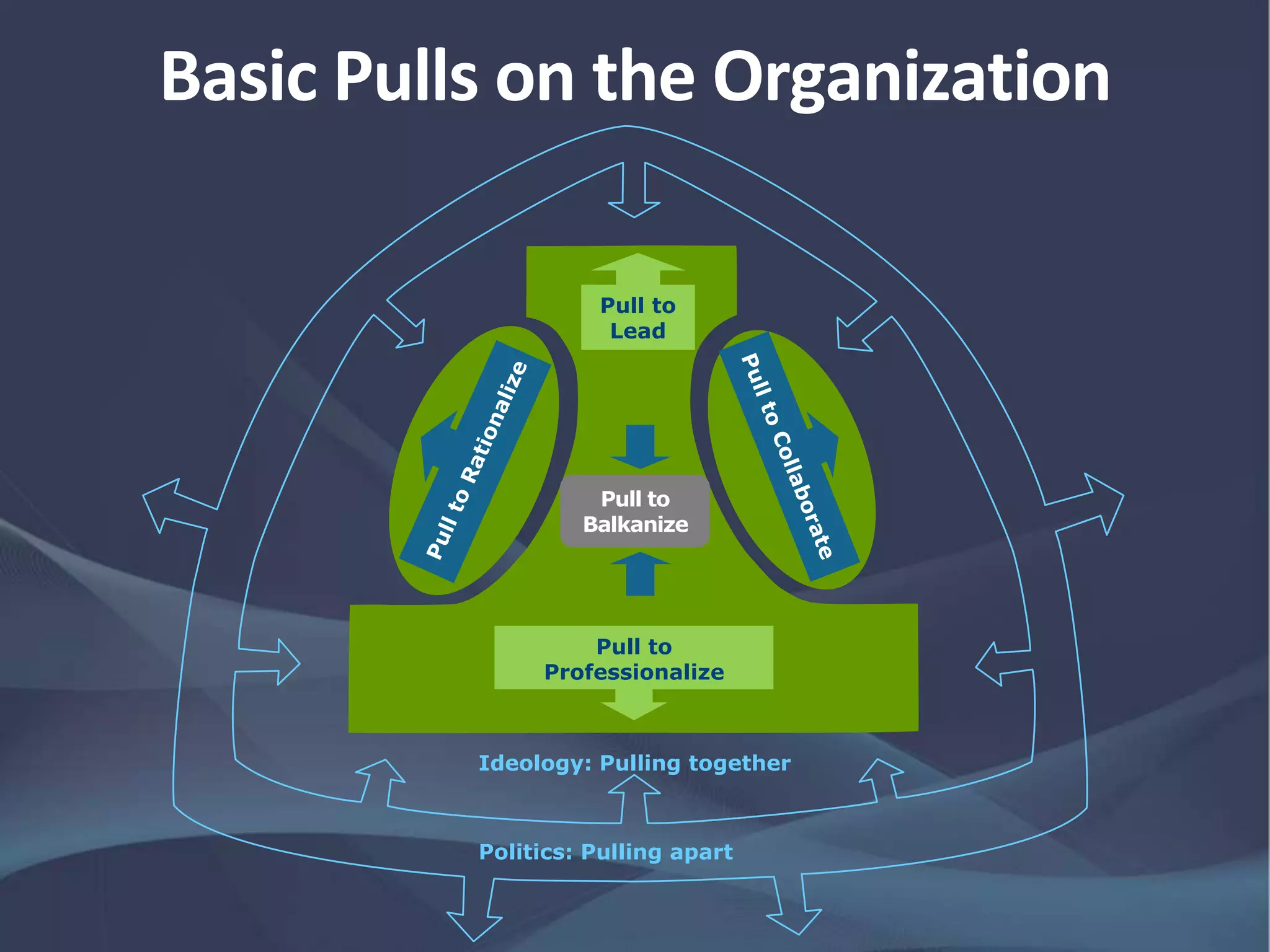
Basic Pulls on the Organization
Pull to
Professionalize
Pull to
Balkanize
Pull to
Lead
Ideology: Pulling together
Politics: Pulling apart
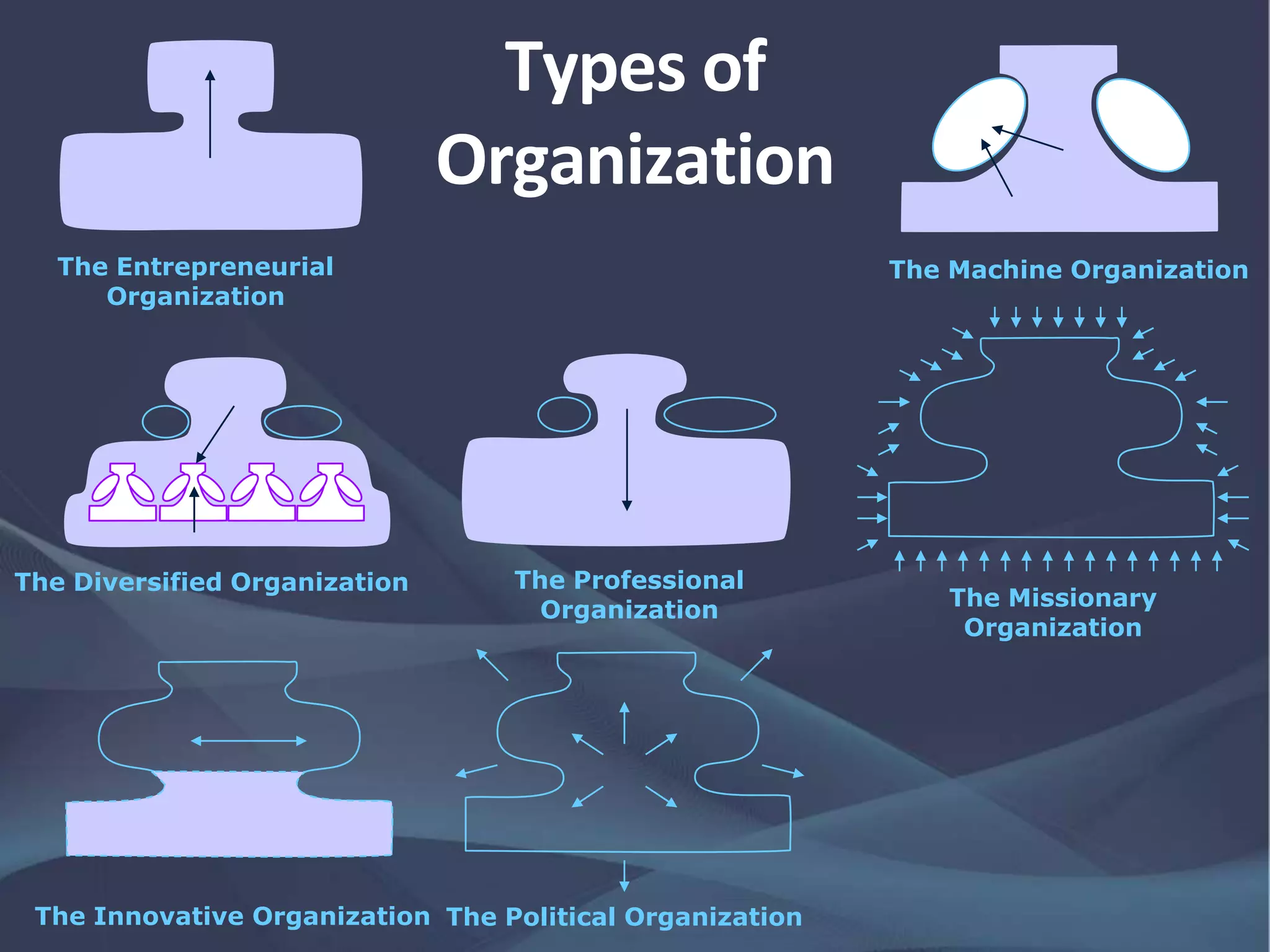
Types of
Organization
The Entrepreneurial
Organization
The Machine Organization
The Diversified
Organization
The Professional
Organization
The Innovative Organization
The Missionary
Organization
The Political Organization
Types of Organization
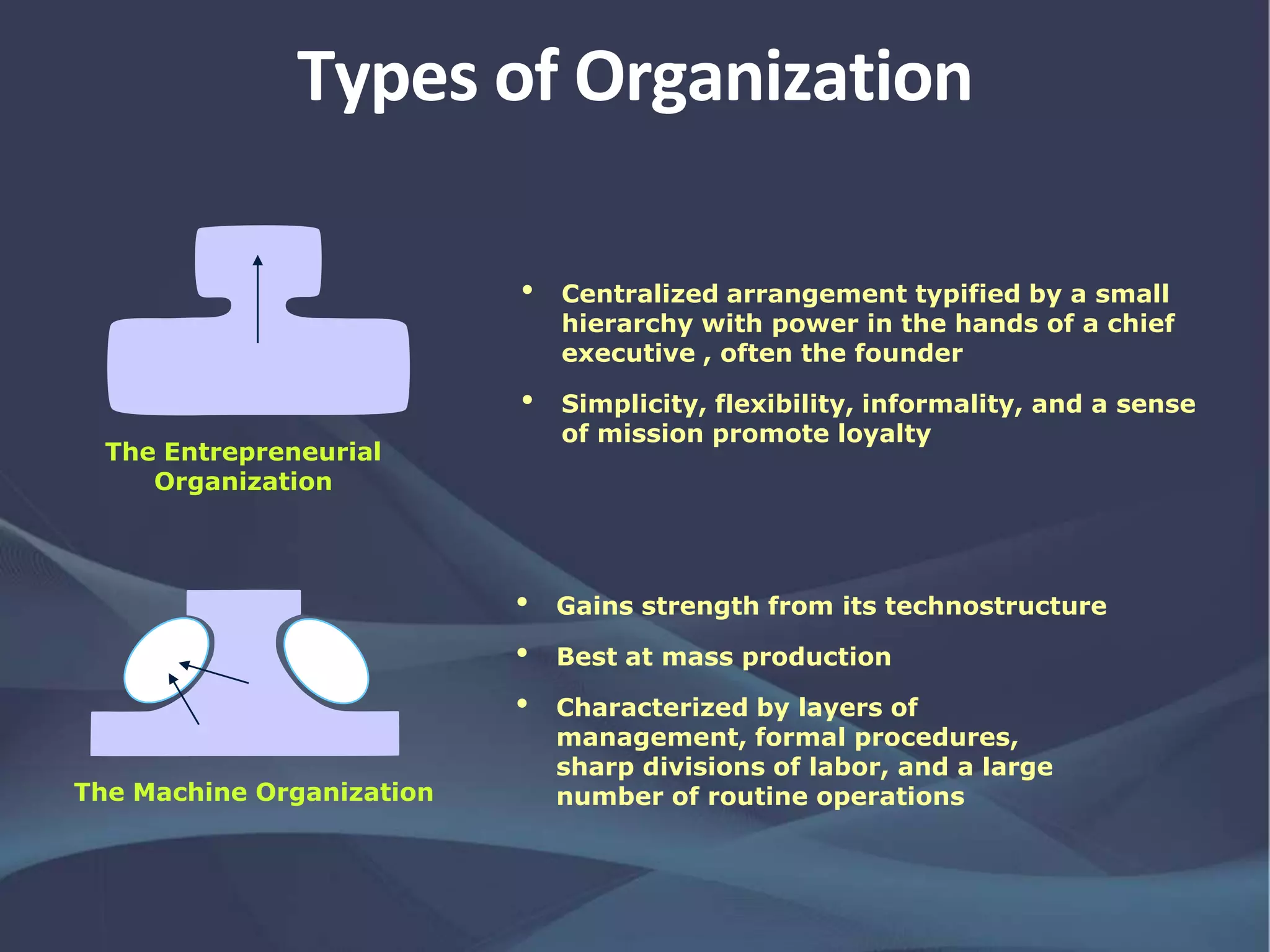
The Machine Organization
• Gains strength from its technostructure
• Best at mass production
• Characterized by layers of
management, formal procedures,
sharp divisions of labor, and a large
number of routine operations
The Entrepreneurial
Organization
• Centralized arrangement typified by a small
hierarchy with power in the hands of a chief
executive , often the founder
• Simplicity, flexibility, informality, and a sense
of mission promote loyalty
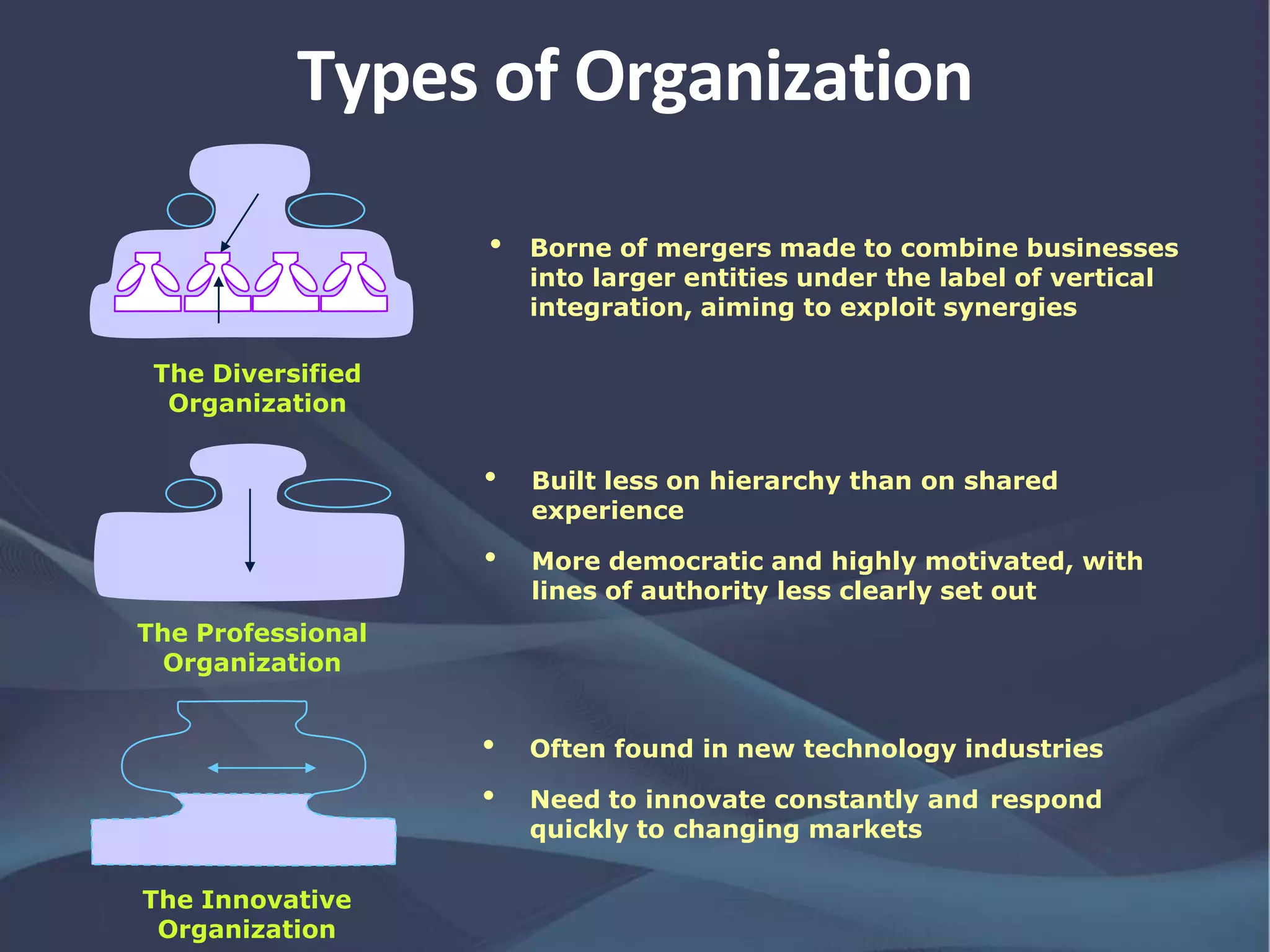
• Built less on hierarchy than on shared
experience
• More democratic and highly motivated, with
lines of authority less clearly set out
• Often found in new technology industries
• Need to innovate constantly and respond
quickly to changing markets
The Professional
Organization
The Innovative
Organization
The Diversified
Organization
• Borne of mergers made to combine businesses
into larger entities under the label of vertical
integration, aiming to exploit synergies
Types of Organization
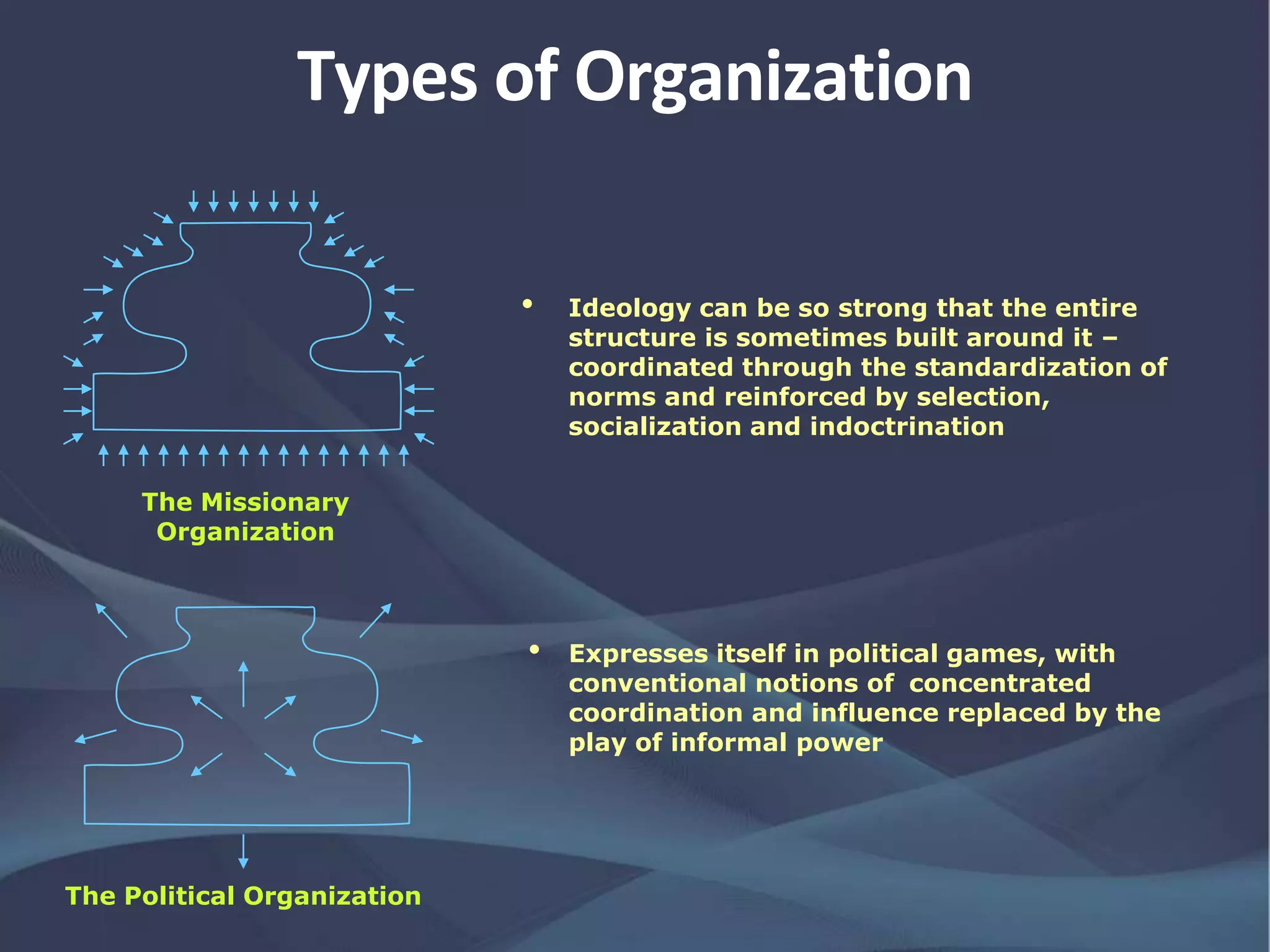
• Ideology can be so strong that the entire
structure is sometimes built around it –
coordinated through the standardization of
norms and reinforced by selection,
socialization and indoctrination
• Expresses itself in political games, with
conventional notions of concentrated
coordination and influence replaced by the
play of informal power
The Missionary
Organization
The Political Organization
Types of Organization
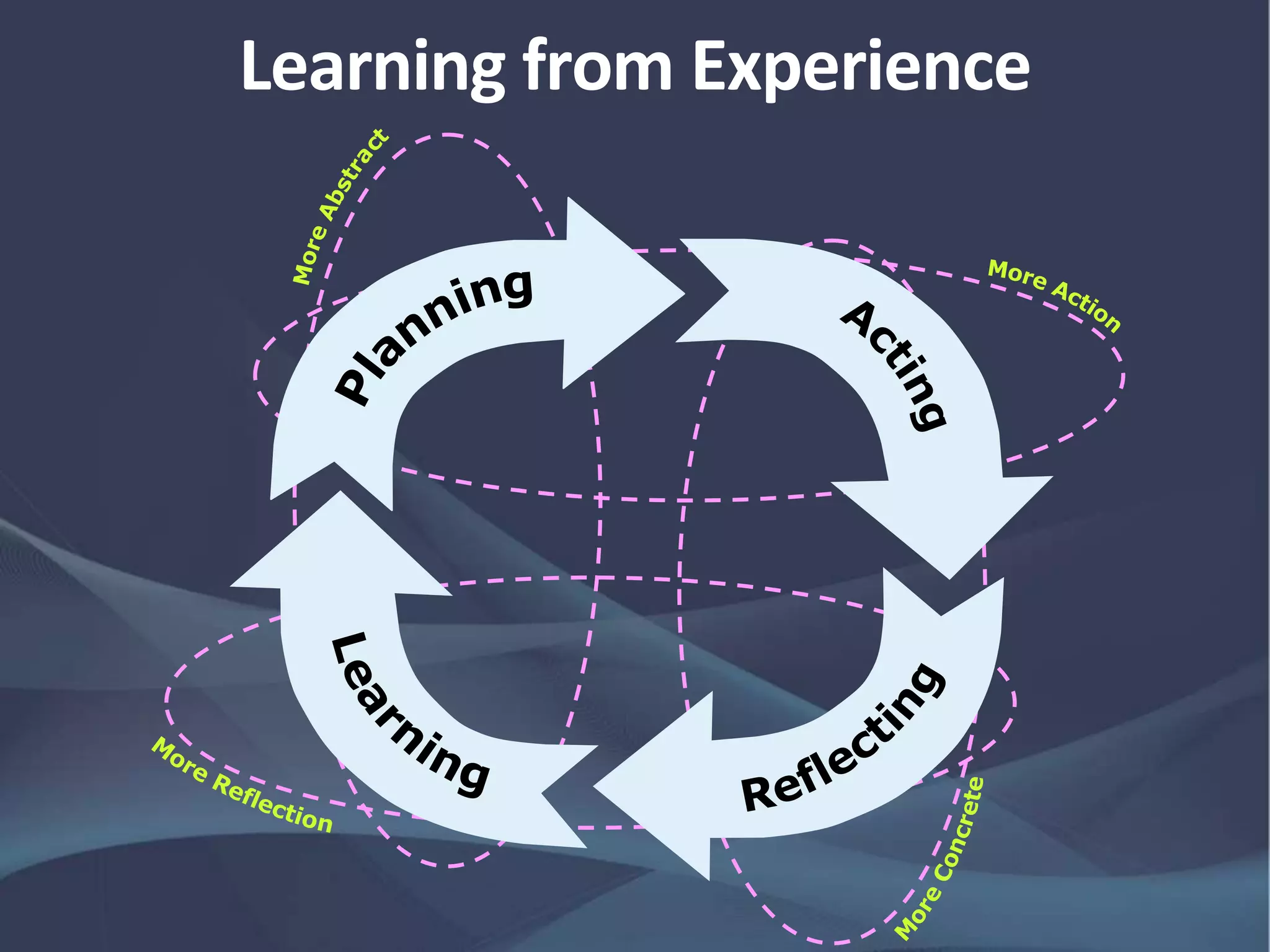
Learning from Experience
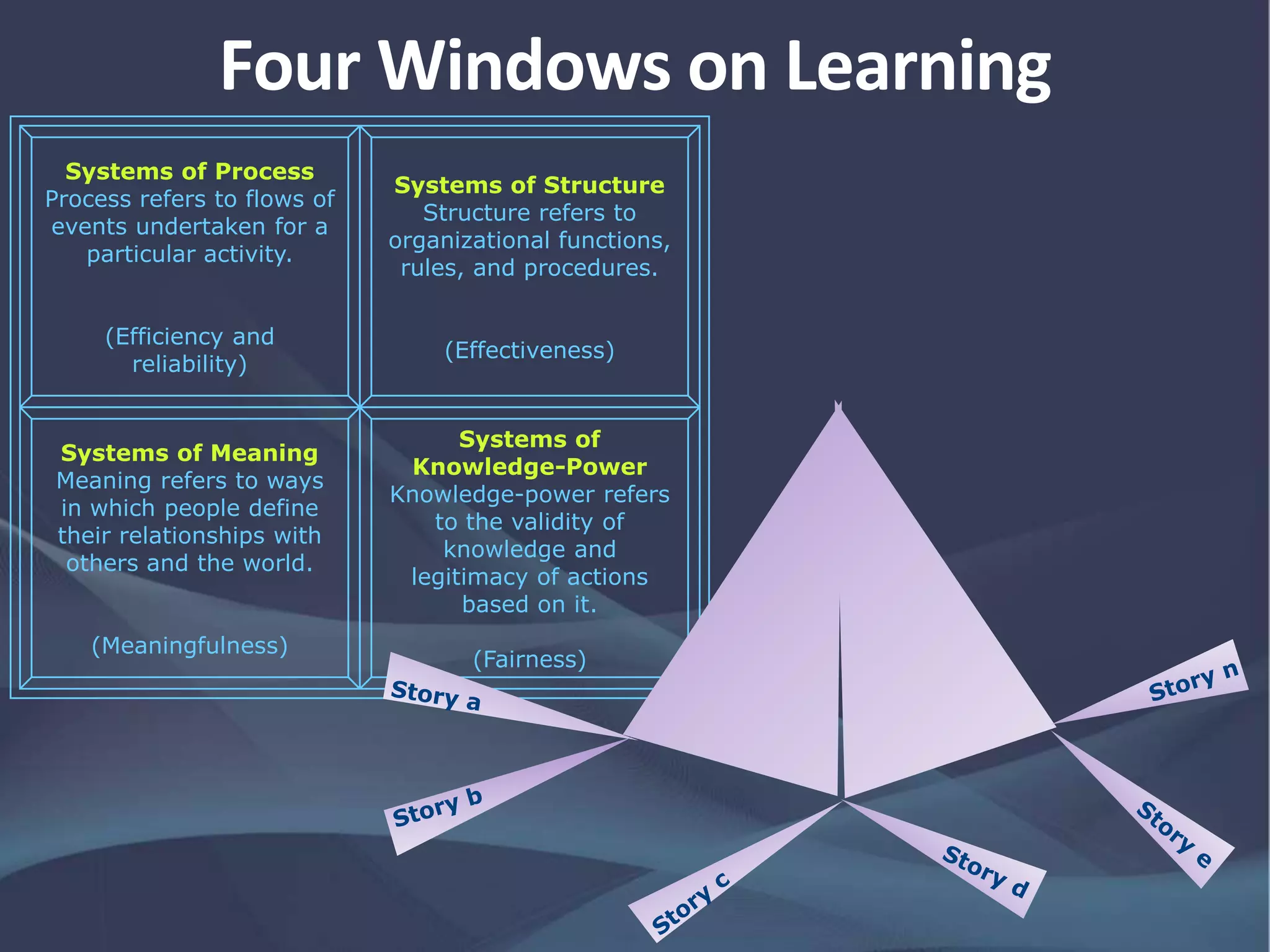
Four Windows on Learning
Systems of Structure
Structure refers to
organizational functions,
rules, and procedures.
(Effectiveness)
Systems of Process
Process refers to flows
of events undertaken for
a particular activity.
(Efficiency and
reliability)
Systems of
Knowledge-Power
Knowledge-power refers
to the validity of
knowledge and
legitimacy of actions
based on it.
(Fairness)
Systems of Meaning
Meaning refers to ways
in which people define
their relationships with
others and the world.
(Meaningfulness)
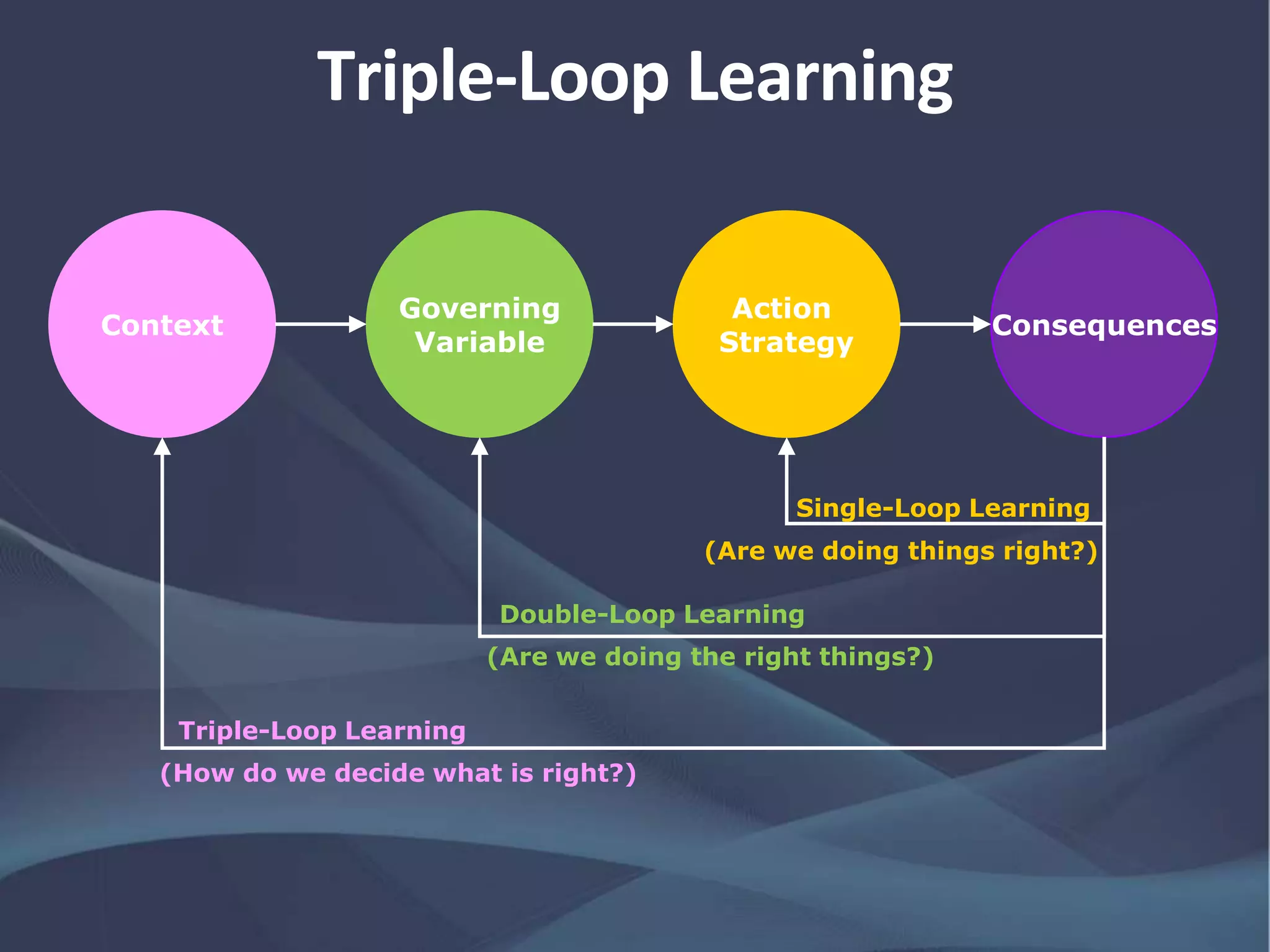
Triple-Loop Learning
Consequences
Action
Strategy
Governing
Variable
Context
Single-Loop Learning
Double-Loop Learning
Triple-Loop Learning
(Are we doing things right?)
(Are we doing the right things?)
(How do we decide what is right?)
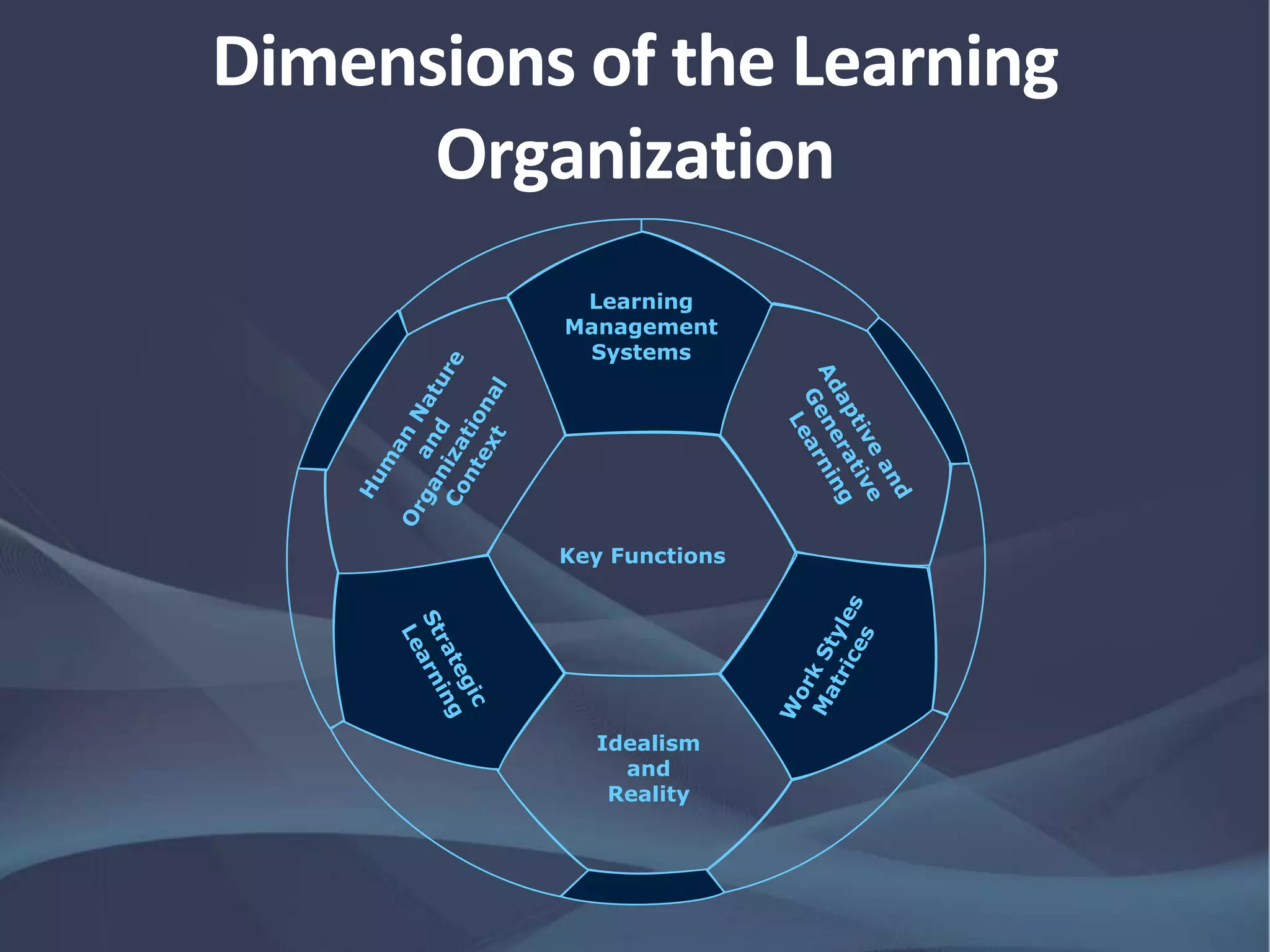
Dimensions of the Learning
Organization
Key Functions
Idealism
and
Reality
Learning
Management
Systems
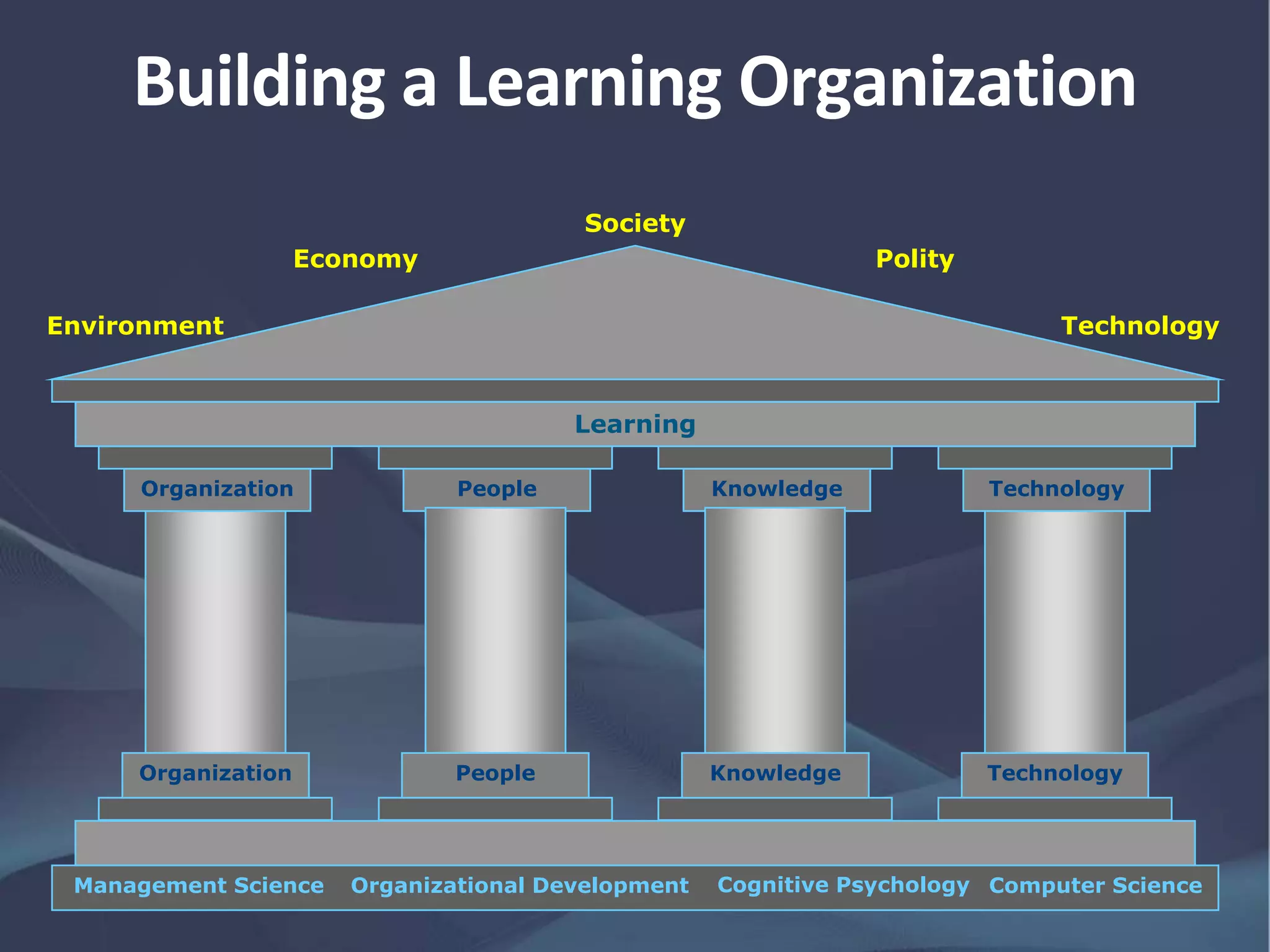
Building a Learning Organization
Technology
Multiple Approaches, including
TechnologyPeople Knowledge
People Knowledge
Management Science Organizational Development Computer ScienceCognitive Psychology
Environment
Economy Polity
Technology
Society
Learning
Organization
Organization
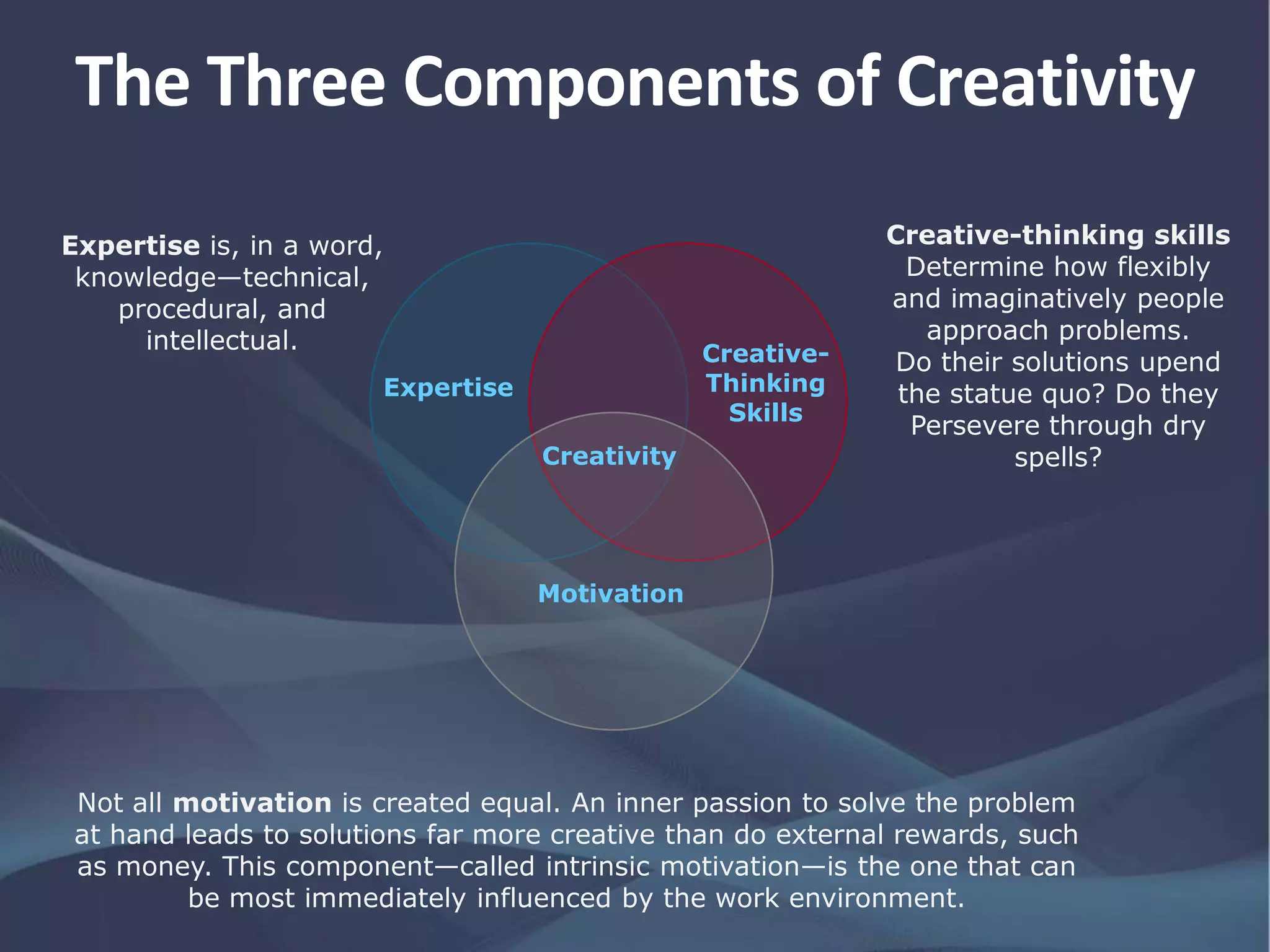
The Three Components of
Creativity
Expertise
Creativity
Creative-
Thinking
Skills
Motivation
Not all motivation is created equal. An inner passion to solve the problem
at hand leads to solutions far more creative than do external rewards, such
as money. This component—called intrinsic motivation—is the one that can
be most immediately influenced by the work environment.
Creative-thinking skills
Determine how flexibly
and imaginatively people
approach problems.
Do their solutions upend
the statue quo? Do they
Persevere through dry
spells?
Expertise is, in a word,
knowledge—technical,
procedural, and
intellectual.
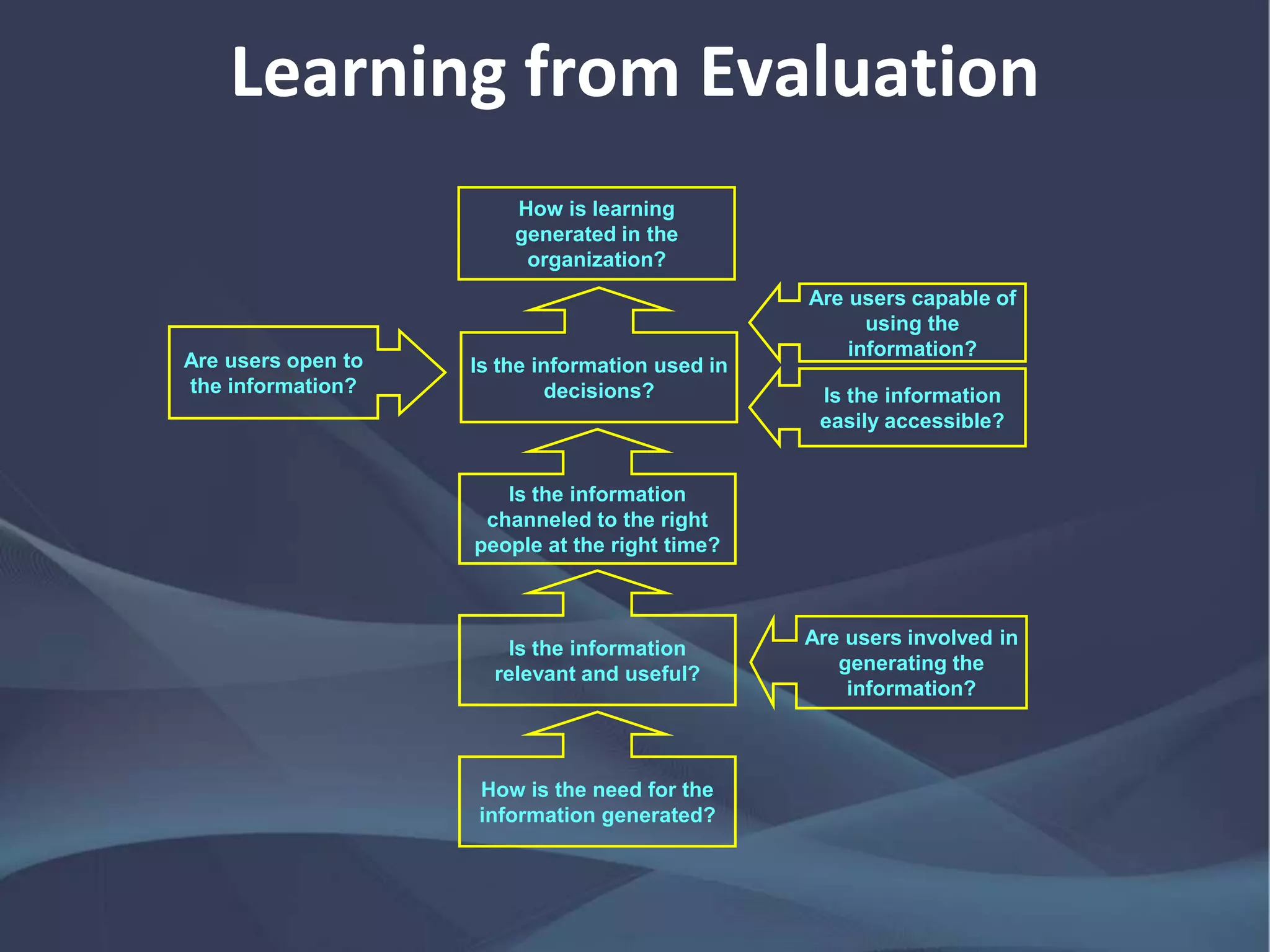
Learning from Evaluation
How is learning
generated in the
organization?
Is the information used in
decisions?
Are users capable of
using the
information?
Are users open to
the information?
Is the information
channeled to the right
people at the right time?
Is the information
relevant and useful?
Are users involved in
generating the
information?
How is the need for the
information generated?
Is the information
easily accessible?
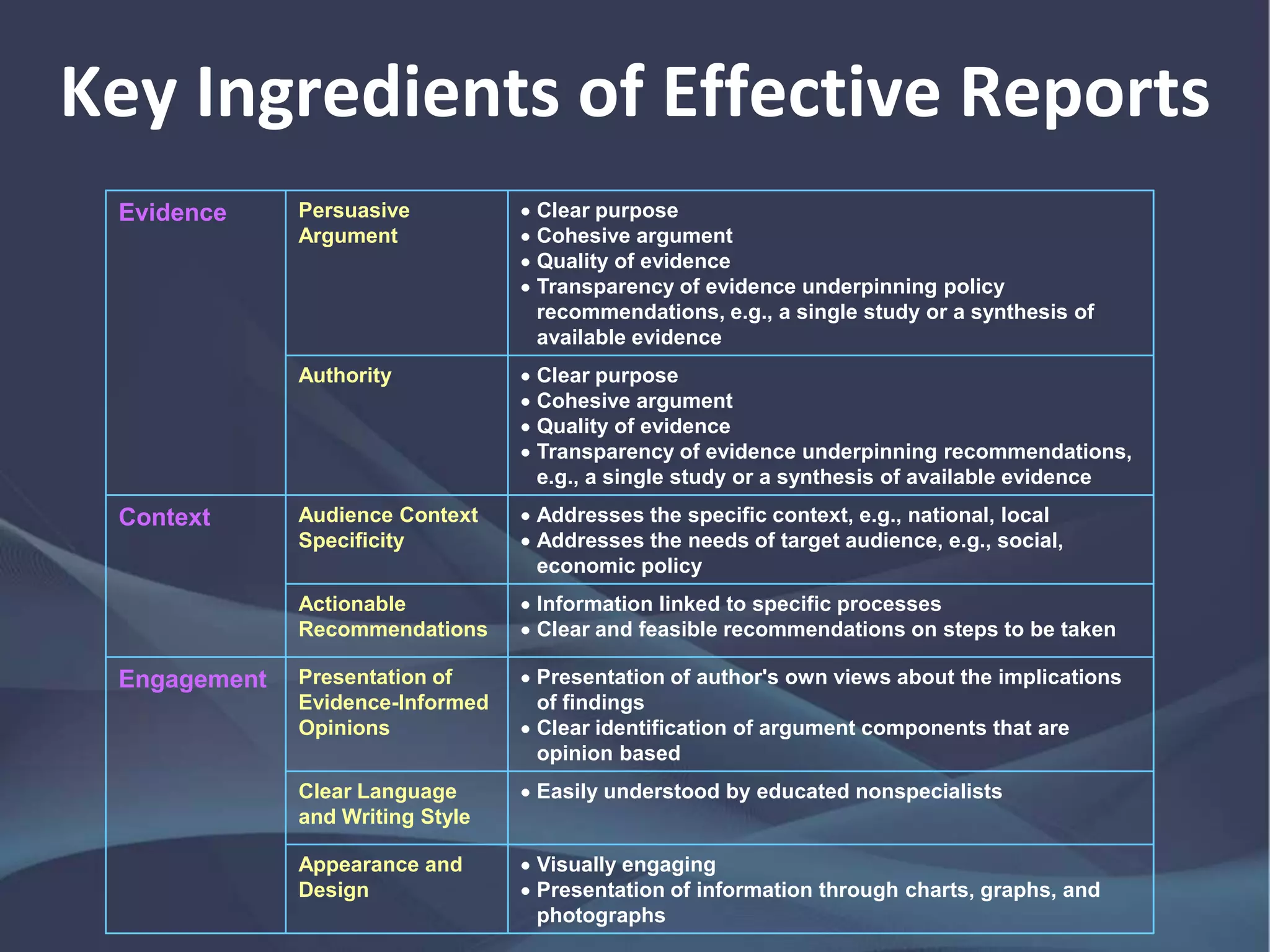
Key Ingredients of Effective
Reports
Evidence Persuasive
Argument
 Clear purpose
 Cohesive argument
 Quality of evidence
 Transparency of evidence underpinning policy
recommendations, e.g., a single study or a synthesis of
available evidence
Authority  Clear purpose
 Cohesive argument
 Quality of evidence
 Transparency of evidence underpinning recommendations,
e.g., a single study or a synthesis of available evidence
Context Audience Context
Specificity
 Addresses the specific context, e.g., national, local
 Addresses the needs of target audience, e.g., social,
economic policy
Actionable
Recommendations
 Information linked to specific processes
 Clear and feasible recommendations on steps to be taken
Engagement Presentation of
Evidence-Informed
Opinions
 Presentation of author's own views about the implications
of findings
 Clear identification of argument components that are
opinion based
Clear Language
and Writing Style
 Easily understood by educated nonspecialists
Appearance and
Design
 Visually engaging
 Presentation of information through charts, graphs, and
photographs
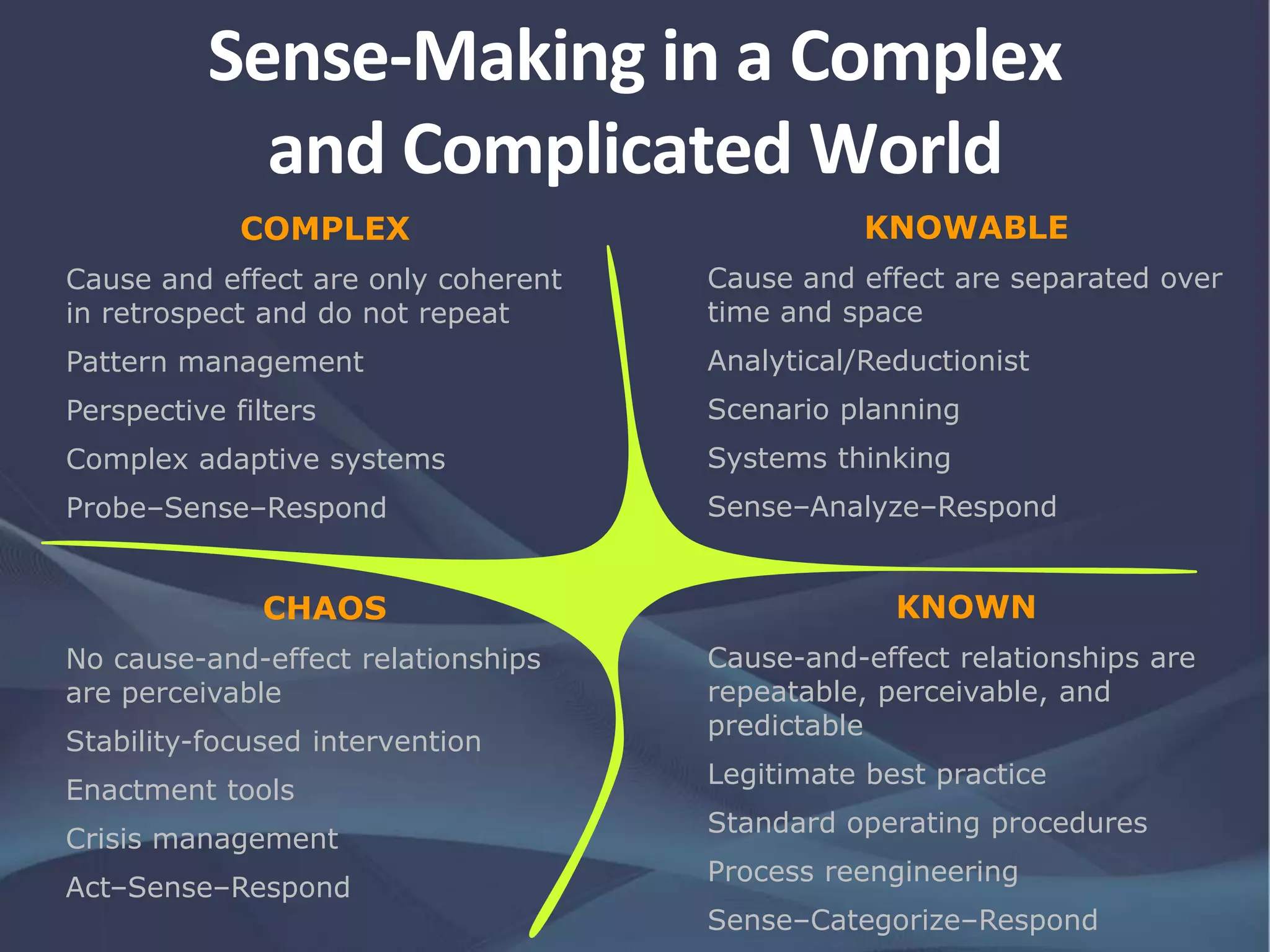
COMPLEX
Cause and effect are only coherent
in retrospect and do not repeat
Pattern management
Perspective filters
Complex adaptive systems
Probe–Sense–Respond
KNOWABLE
Cause and effect are separated over
time and space
Analytical/Reductionist
Scenario planning
Systems thinking
Sense–Analyze–Respond
CHAOS
No cause-and-effect relationships
are perceivable
Stability-focused intervention
Enactment tools
Crisis management
Act–Sense–Respond
KNOWN
Cause-and-effect relationships are
repeatable, perceivable, and
predictable
Legitimate best practice
Standard operating procedures
Process reengineering
Sense–Categorize–Respond
Sense-Making in a Complex
and Complicated World
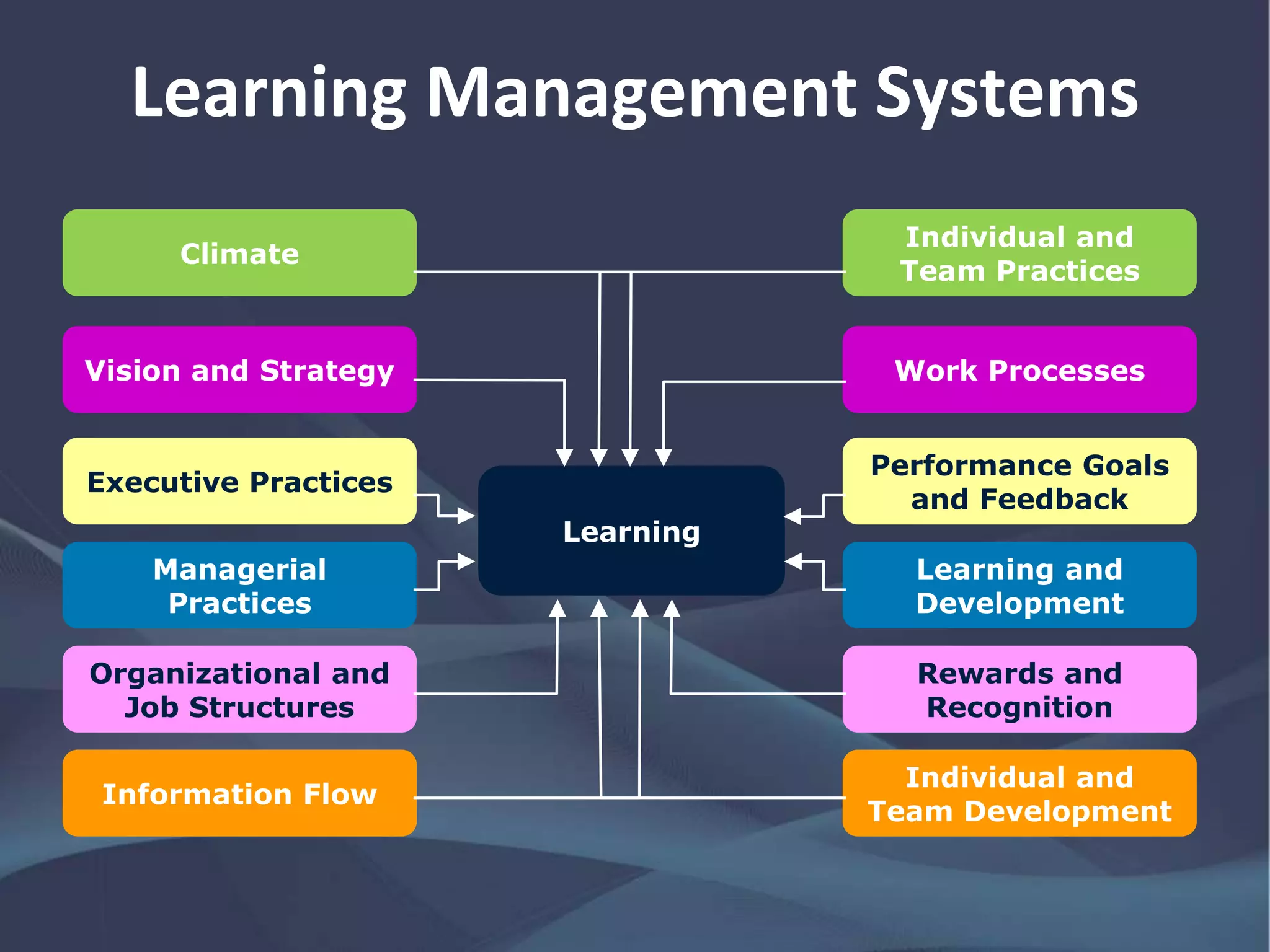
Learning Management Systems
Learning
Climate
Executive Practices
Vision and Strategy
Organizational and
Job Structures
Managerial
Practices
Information Flow
Individual and
Team Practices
Performance Goals
and Feedback
Work Processes
Rewards and
Recognition
Learning and
Development
Individual and
Team Development
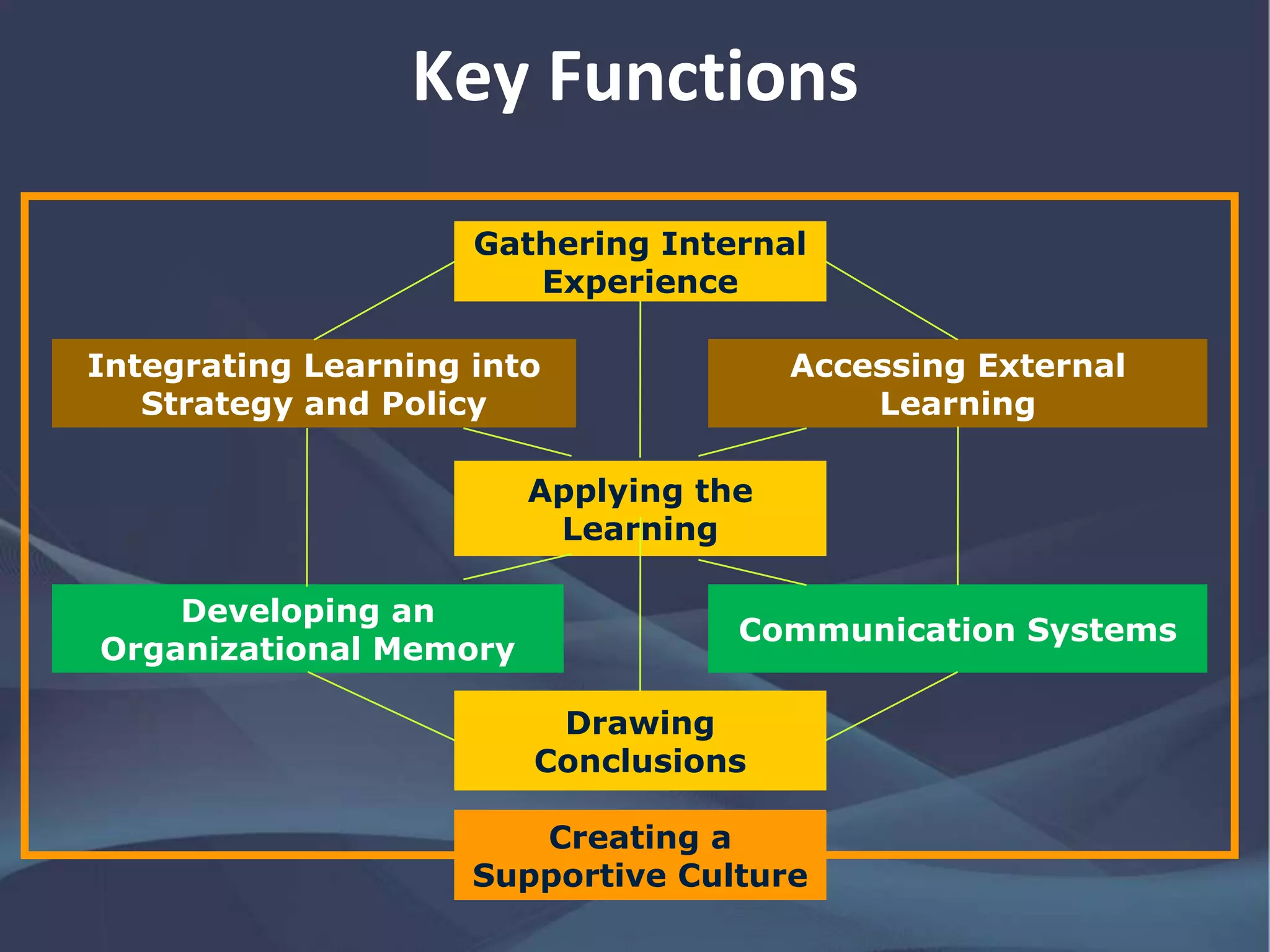
Key Functions
Gathering Internal
Experience
Communication Systems
Developing an
Organizational Memory
Accessing External
Learning
Integrating Learning into
Strategy and Policy
Applying the
Learning
Drawing
Conclusions
Creating a
Supportive Culture
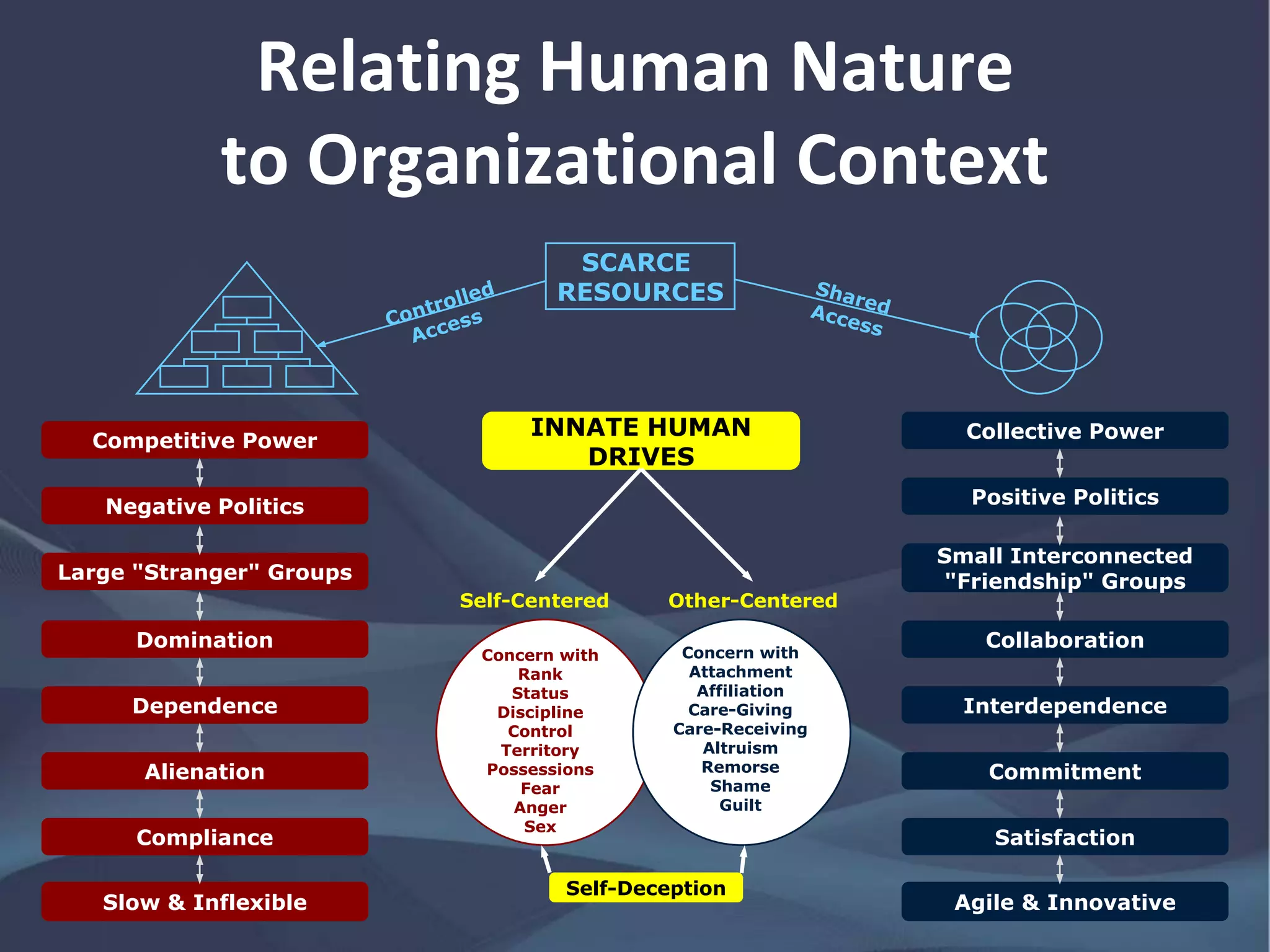
Relating Human Nature
to Organizational Context
Concern with
Attachment
Affiliation
Care-Giving
Care-Receiving
Altruism
Remorse
Shame
Guilt
Concern with
Rank
Status
Discipline
Control
Territory
Possessions
Fear
Anger
Sex
INNATE HUMAN
DRIVES
Self-Centered Other-Centered
Self-Deception
SCARCE
RESOURCES
Large "Stranger" Groups
Domination
Dependence
Competitive Power
Negative Politics
Alienation
Compliance
Slow & Inflexible
Small Interconnected
"Friendship" Groups
Collaboration
Interdependence
Collective Power
Positive Politics
Commitment
Satisfaction
Agile & Innovative
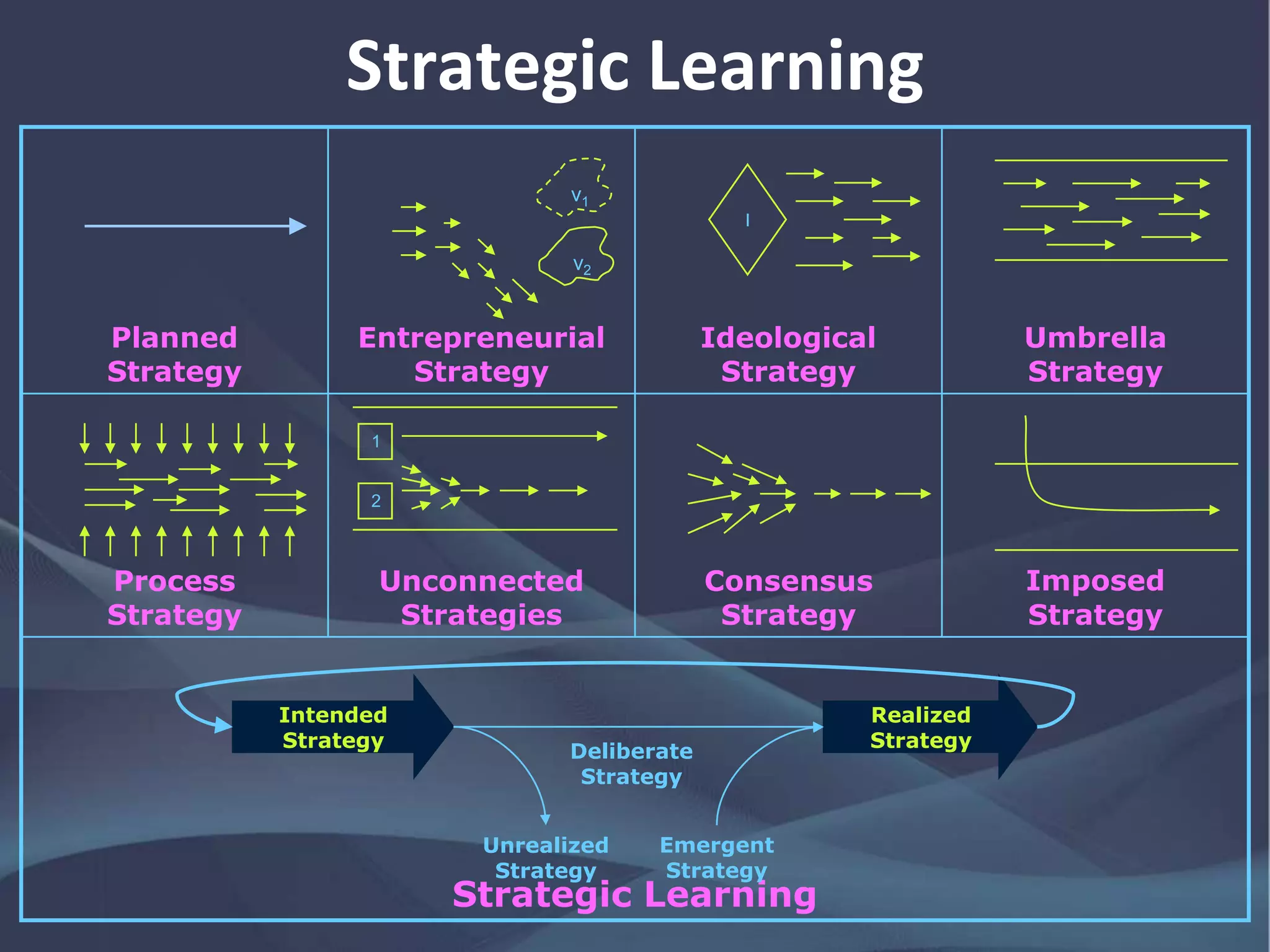
Strategic Learning
Planned
Strategy
Entrepreneurial
Strategy
Ideological
Strategy
Umbrella
Strategy
Process
Strategy
Unconnected
Strategies
Consensus
Strategy
Imposed
Strategy
Strategic Learning
I
1
2
v1
v2
Intended
Strategy
Realized
Strategy
Deliberate
Strategy
Unrealized
Strategy
Emergent
Strategy
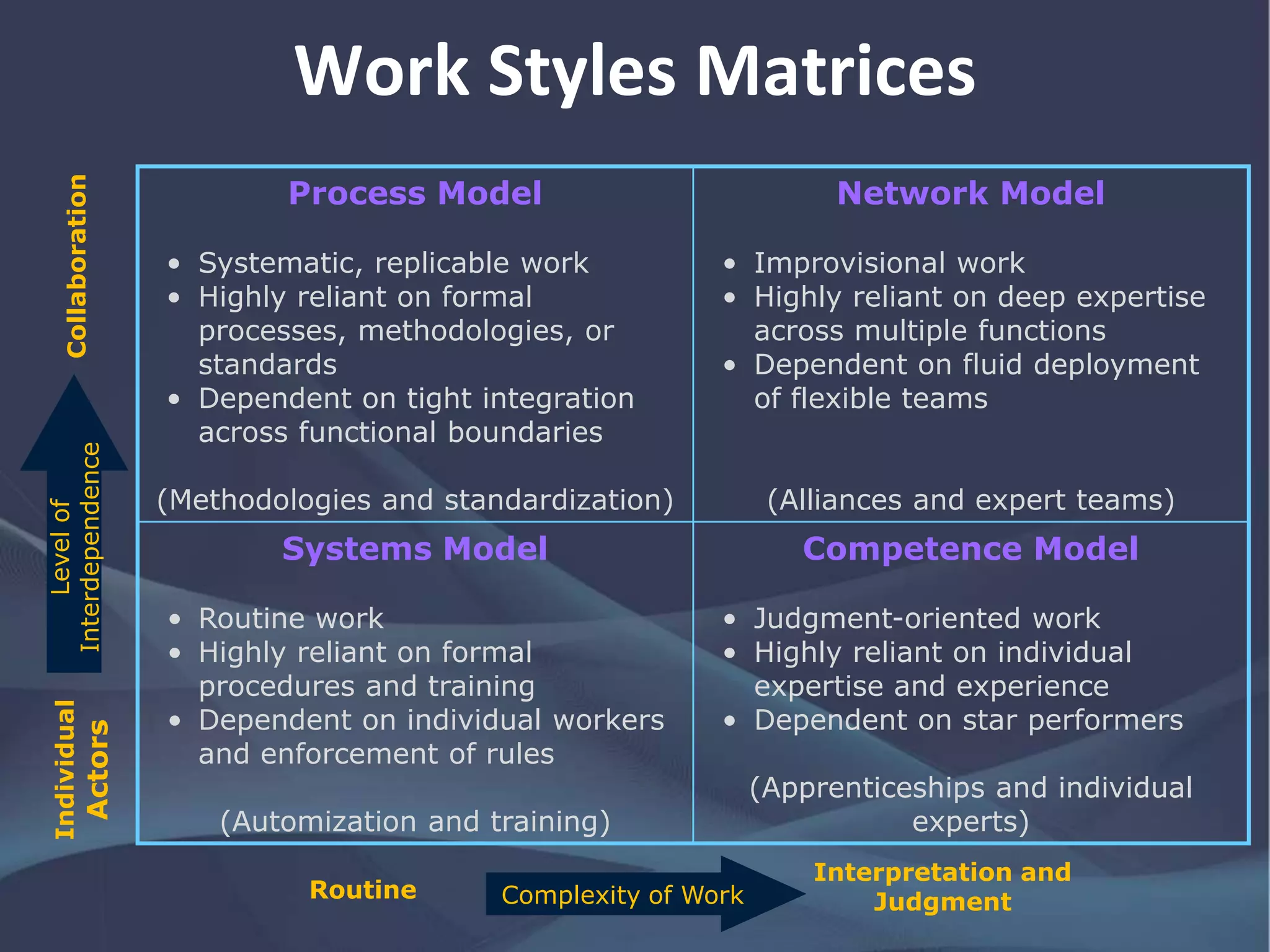
Process Model
• Systematic, replicable work
• Highly reliant on formal
processes, methodologies, or
standards
• Dependent on tight integration
across functional boundaries
(Methodologies and standardization)
Network Model
• Improvisional work
• Highly reliant on deep expertise
across multiple functions
• Dependent on fluid deployment
of flexible teams
(Alliances and expert teams)
Systems Model
• Routine work
• Highly reliant on formal
procedures and training
• Dependent on individual workers
and enforcement of rules
(Automization and training)
Competence Model
• Judgment-oriented work
• Highly reliant on individual
expertise and experience
• Dependent on star performers
(Apprenticeships and individual
experts)
Levelof
Interdependence
CollaborationIndividual
Actors
Routine
Interpretation and
JudgmentComplexity of Work
Work Styles Matrices
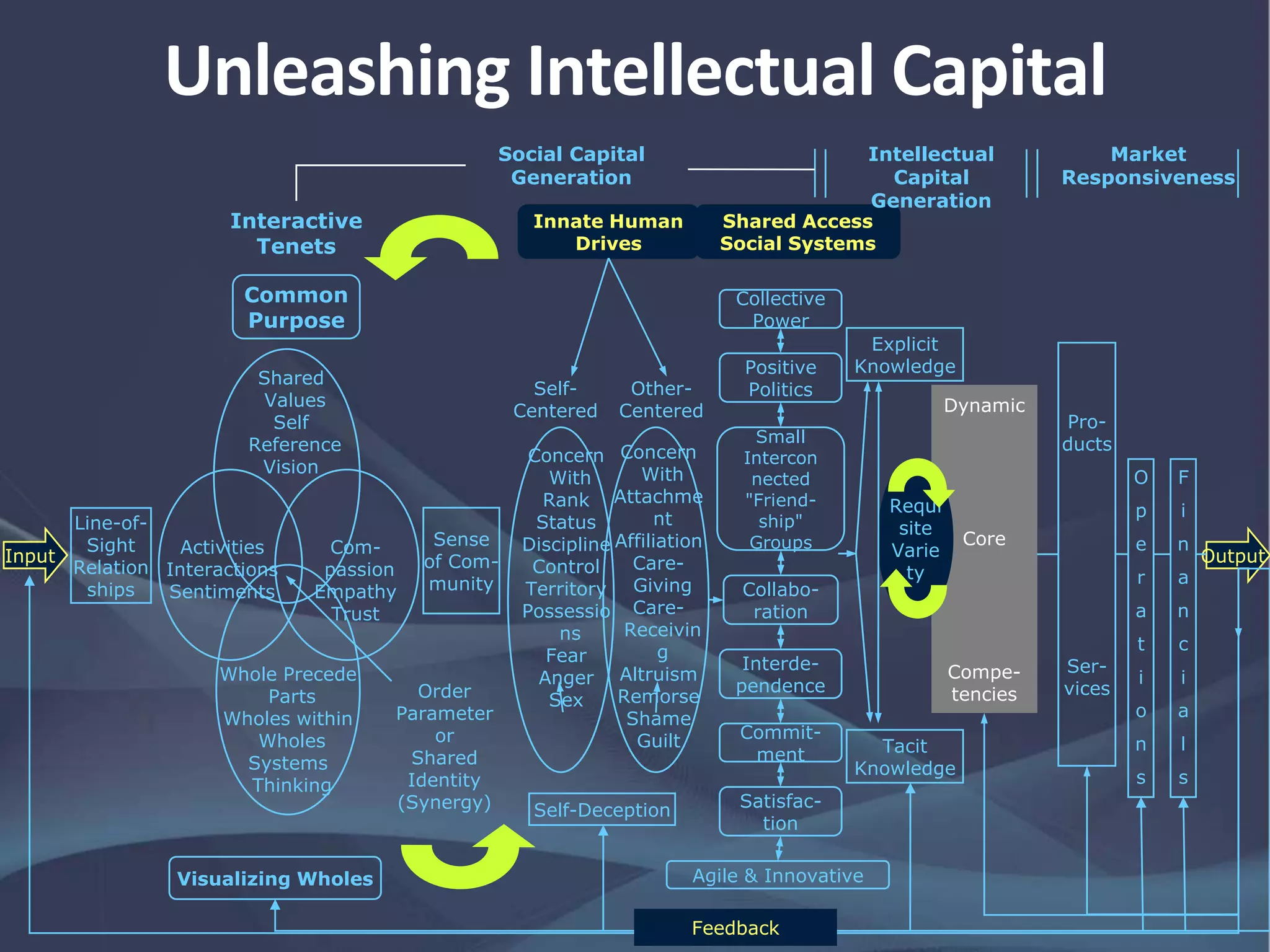
Unleashing Intellectual Capital
Concern
With
Attachme
nt
Affiliation
Care-
Giving
Care-
Receivin
g
Altruism
Remorse
Shame
Guilt
Dynamic
Core
Compe-
tencies
Input
Line-of-
Sight
Relation
ships
Shared
Values
Self
Reference
Vision
Com-
passion
Empathy
Trust
Whole Precede
Parts
Wholes within
Wholes
Systems
Thinking
Activities
Interactions
Sentiments
Common
Purpose
Visualizing Wholes
Sense
of Com-
munity
Concern
With
Rank
Status
Discipline
Control
Territory
Possessio
ns
Fear
Anger
Sex
Small
Intercon
nected
"Friend-
ship"
Groups
Collabo-
ration
Interde-
pendence
Collective
Power
Positive
Politics
Commit-
ment
Satisfac-
tion
Agile & Innovative
Shared Access
Social Systems
Requi
site
Varie
ty
Pro-
ducts
Ser-
vices
O
p
e
r
a
t
i
o
n
s
F
i
n
a
n
c
i
a
l
s
Output
Tacit
Knowledge
Explicit
Knowledge
Innate Human
Drives
Self-
Centered
Other-
Centered
Self-Deception
Feedback
Interactive
Tenets
Social Capital
Generation
Intellectual
Capital
Generation
Market
Responsiveness
Order
Parameter
or
Shared
Identity
(Synergy)
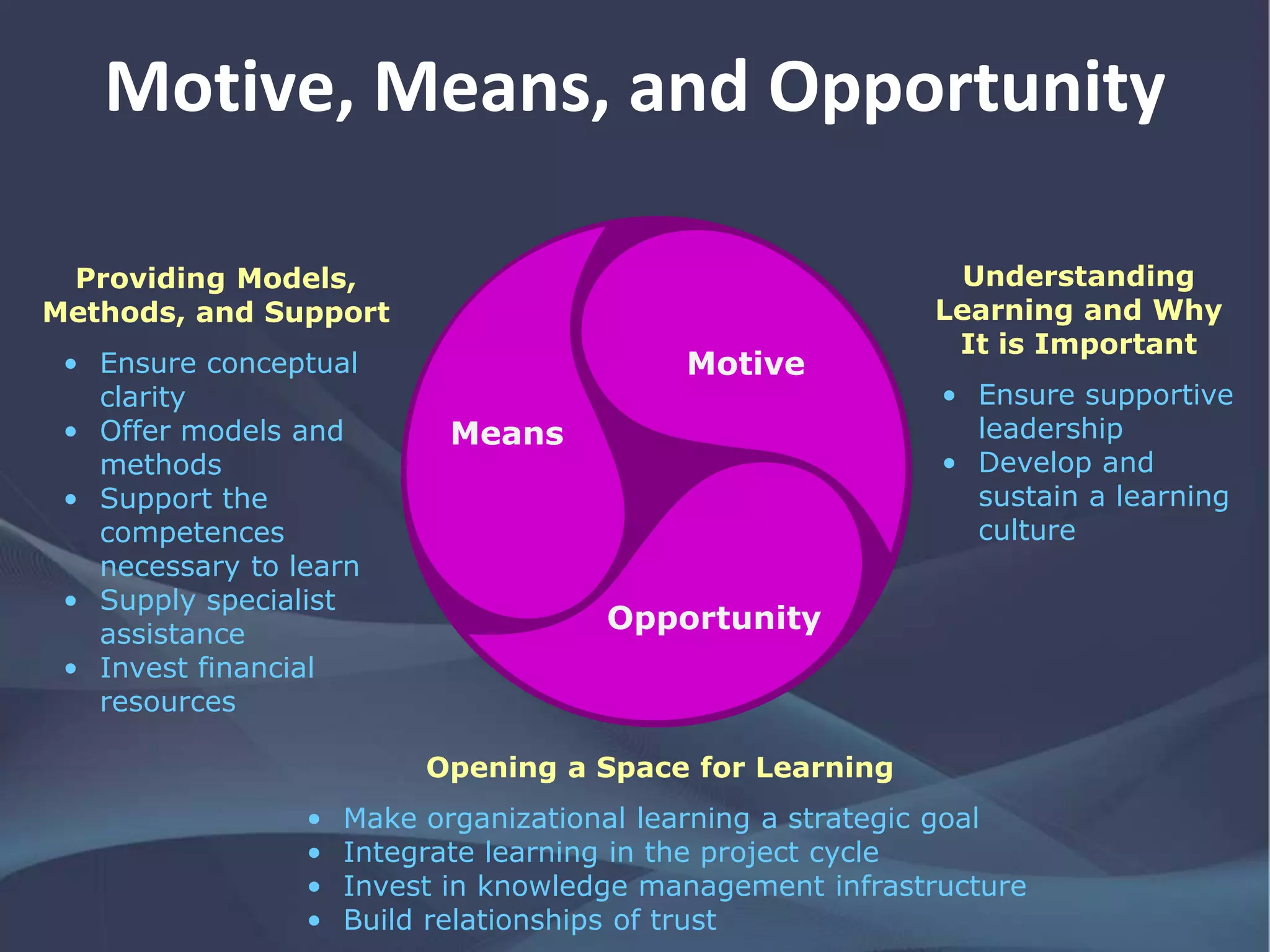
Motive, Means, and Opportunity
Understanding
Learning and Why
It is Important
• Ensure supportive
leadership
• Develop and
sustain a learning
culture
Providing Models,
Methods, and Support
• Ensure conceptual
clarity
• Offer models and
methods
• Support the
competences
necessary to learn
• Supply specialist
assistance
• Invest financial
resources
Opening a Space for Learning
• Make organizational learning a strategic goal
• Integrate learning in the project cycle
• Invest in knowledge management infrastructure
• Build relationships of trust
Means
Motive
Opportunity
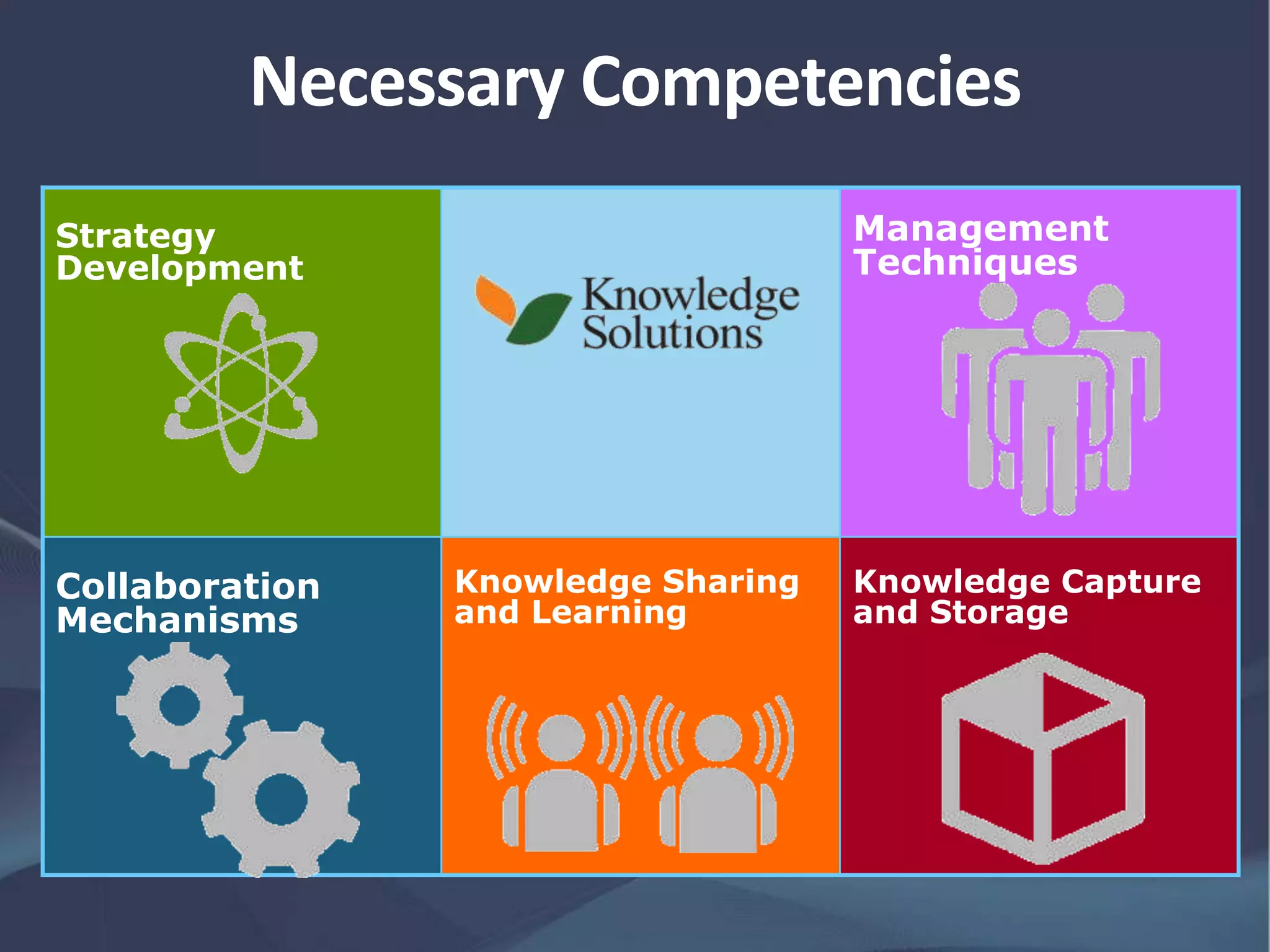
Strategy
Development
Management
Techniques
Collaboration
Mechanisms
Knowledge Sharing
and Learning
Knowledge Capture
and Storage
Necessary Competencies
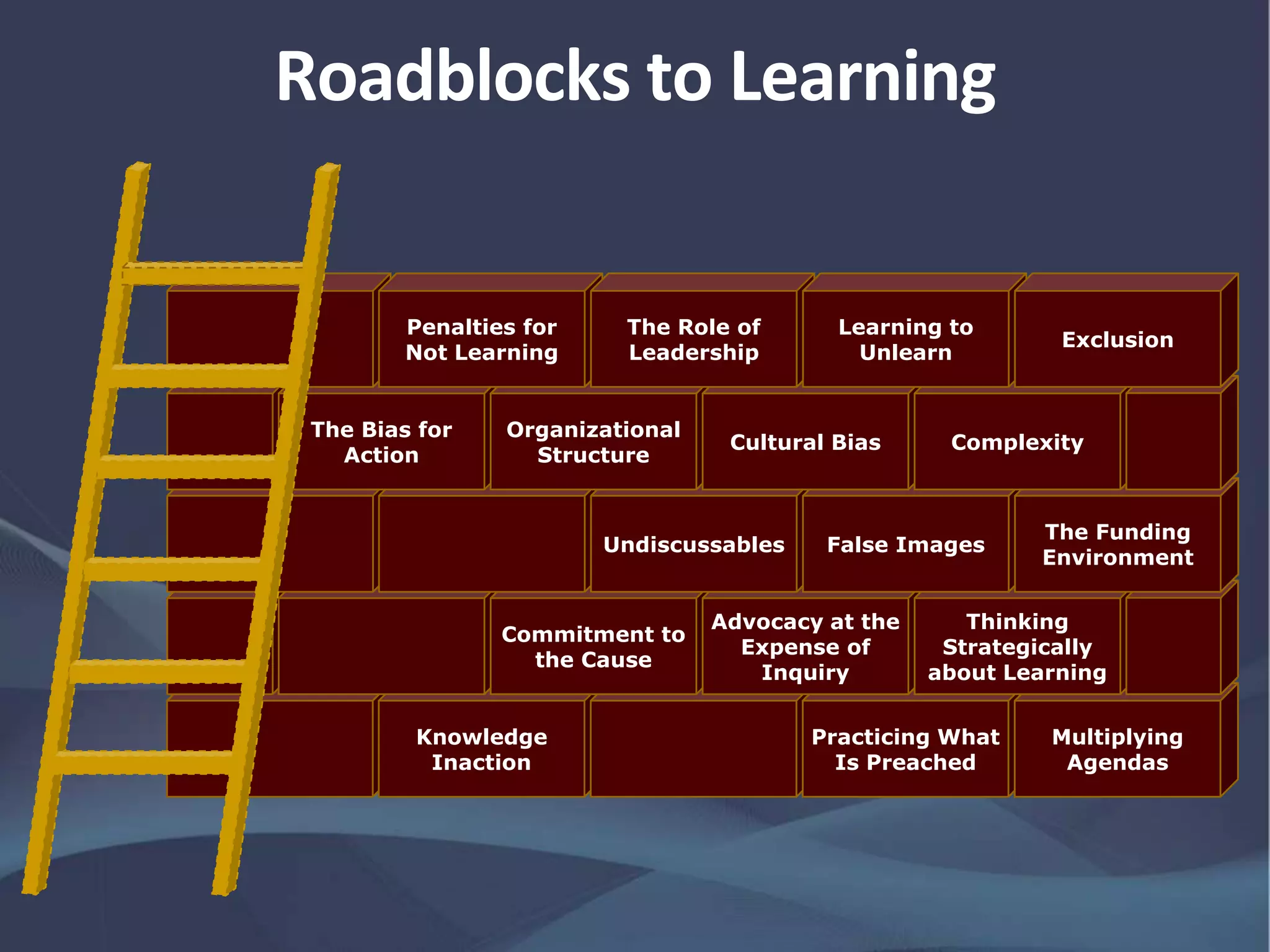
Roadblocks to Learning
Knowledge
Inaction
Practicing What
Is Preached
Multiplying
Agendas
Commitment to
the Cause
Advocacy at the
Expense of
Inquiry
Thinking
Strategically
about Learning
Undiscussables False Images
The Funding
Environment
The Bias for
Action
Organizational
Structure
Cultural Bias Complexity
Penalties for
Not Learning
The Role of
Leadership
Learning to
Unlearn
Exclusion
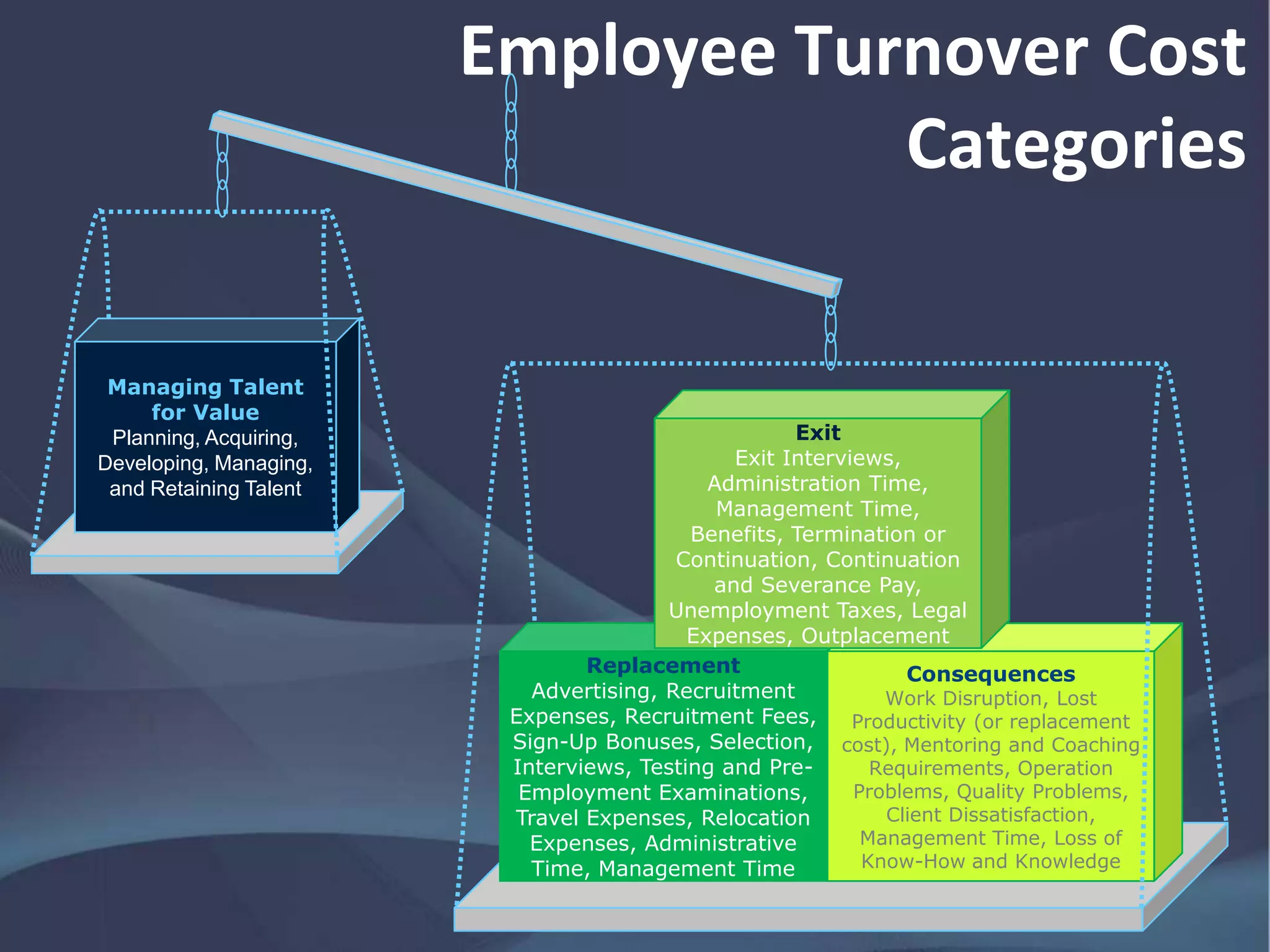
Employee Turnover
Cost Categories
Managing Talent
for Value
Planning, Acquiring,
Developing, Managing,
and Retaining Talent
Replacement
Advertising, Recruitment
Expenses, Recruitment Fees,
Sign-Up Bonuses, Selection,
Interviews, Testing and Pre-
Employment Examinations,
Travel Expenses, Relocation
Expenses, Administrative
Time, Management Time
Consequences
Work Disruption, Lost
Productivity (or replacement
cost), Mentoring and Coaching
Requirements, Operation
Problems, Quality Problems,
Client Dissatisfaction,
Management Time, Loss of
Know-How and Knowledge
Exit
Exit Interviews,
Administration Time,
Management Time,
Benefits, Termination or
Continuation, Continuation
and Severance Pay,
Unemployment Taxes, Legal
Expenses, Outplacement
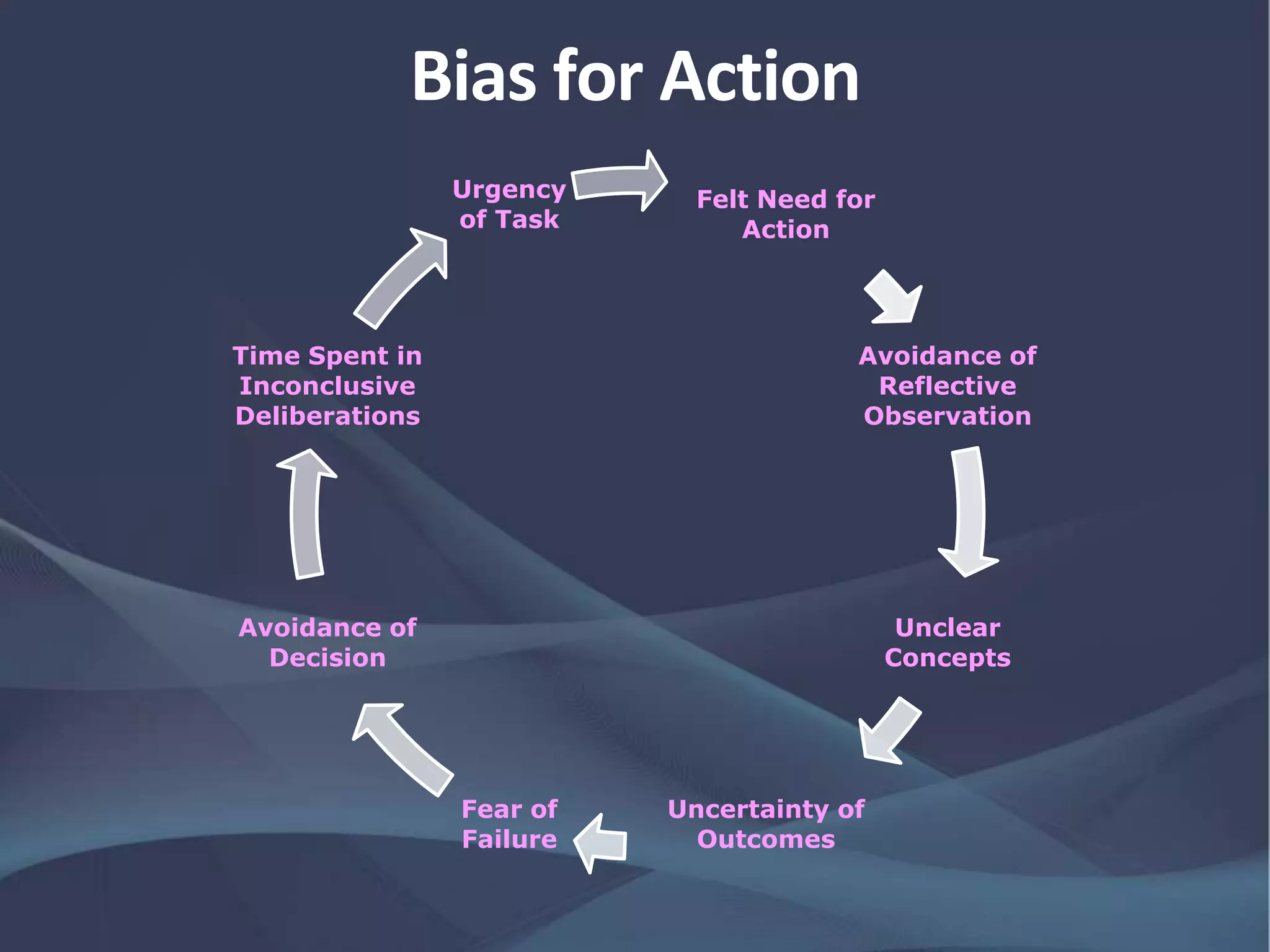
Bias for Action
Felt Need for
Action
Avoidance of
Reflective
Observation
Unclear
Concepts
Uncertainty of
Outcomes
Fear of
Failure
Avoidance of
Decision
Time Spent in
Inconclusive
Deliberations
Urgency
of Task
Organizational
Learning
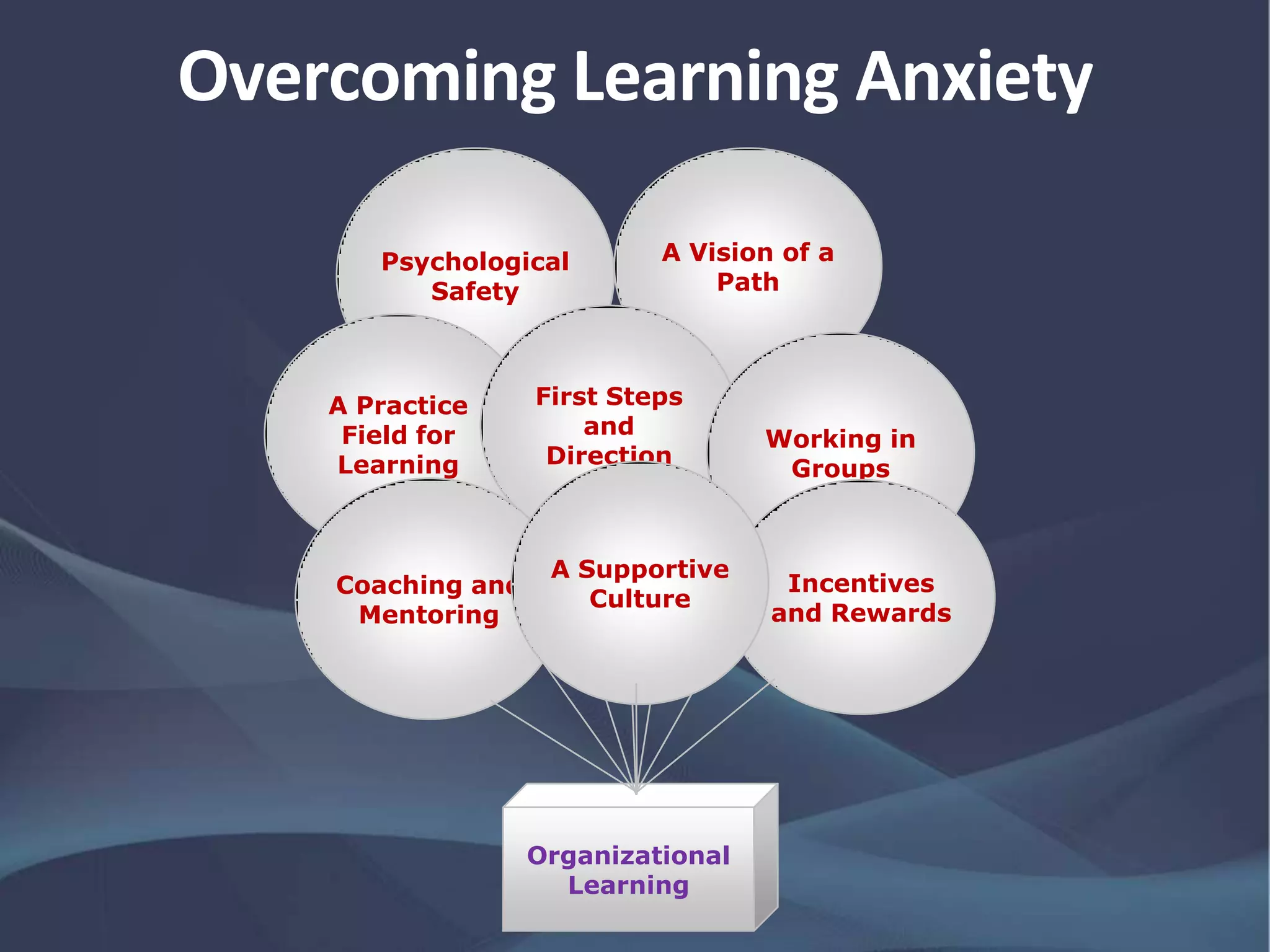
Psychological
Safety
A Vision of a
Path
A Practice
Field for
Learning
First Steps
and
Direction
Working in
Groups
Coaching and
Mentoring
Incentives
and Rewards
A Supportive
Culture
Overcoming Learning Anxiety
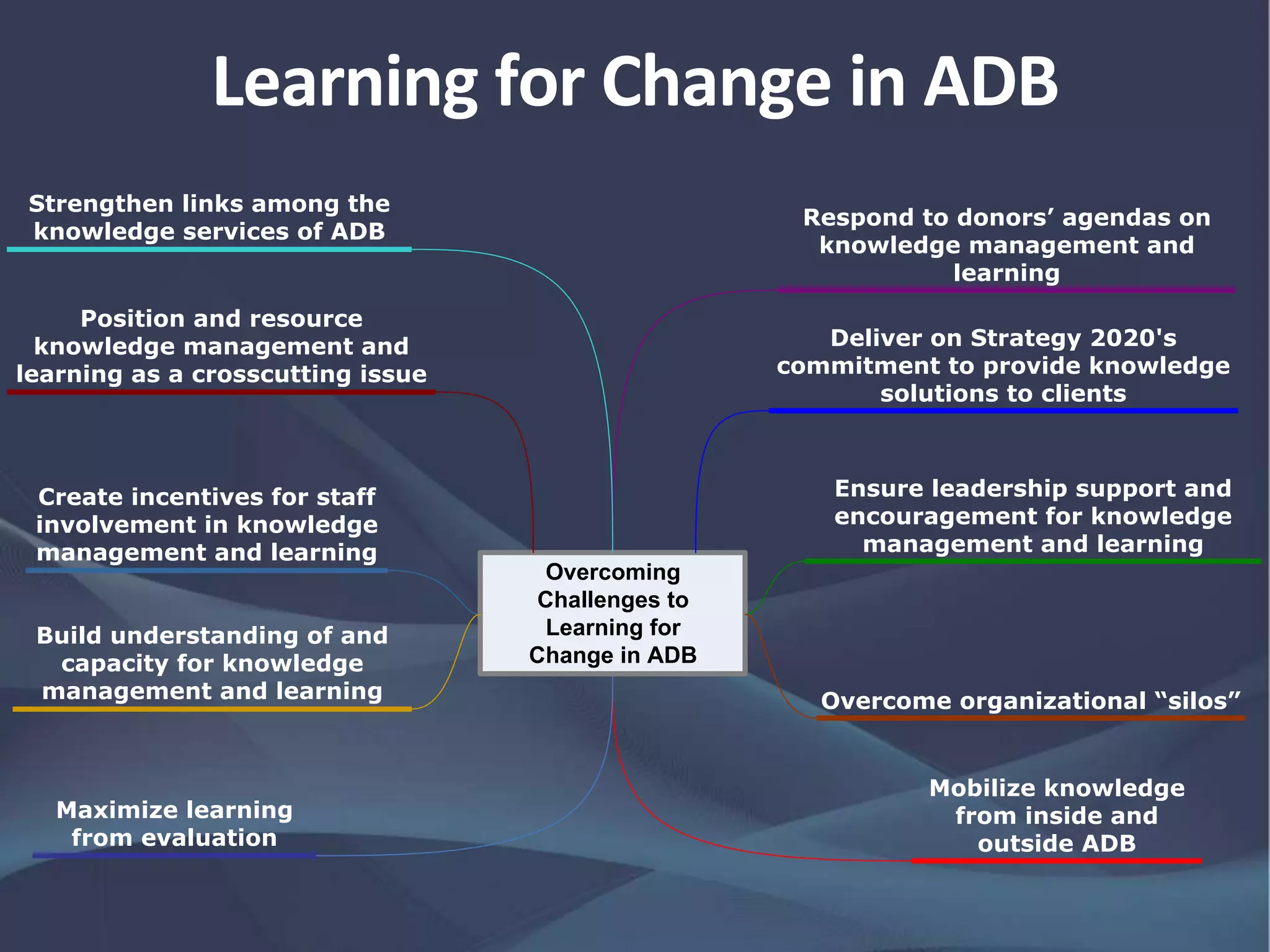
Overcoming
Challenges to
Learning for
Change in ADB
Respond to donors’ agendas on
knowledge management and
learning
Deliver on Strategy 2020's
commitment to provide knowledge
solutions to clients
Ensure leadership support and
encouragement for knowledge
management and learning
Overcome organizational “silos”
Mobilize knowledge
from inside and
outside ADB
Strengthen links among the
knowledge services of ADB
Position and resource
knowledge management and
learning as a crosscutting issue
Create incentives for staff
involvement in knowledge
management and learning
Maximize learning
from evaluation
Build understanding of and
capacity for knowledge
management and learning
Learning for Change in ADB
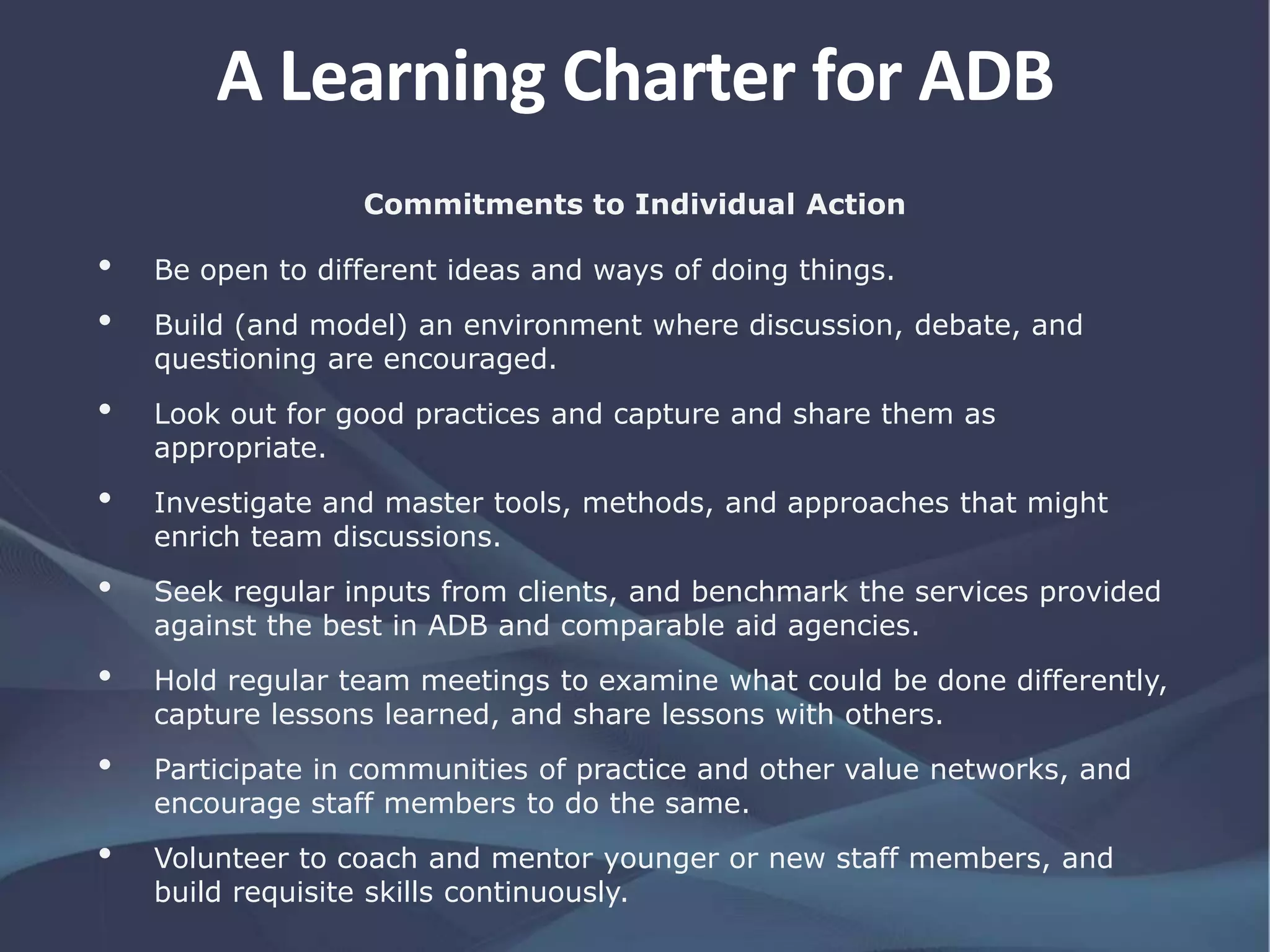
A Learning Charter for ADB
Statement of Intent
ADB embraces the concepts of the learning organization to work better
with its developing member countries and cultivate the talent of its staff
members.
Purpose and Results
• To take concrete actions to transform ADB into a learning organization
in its policies, strategies, programs, and projects, as well as the
business processes and partnerships associated with these, to meet the
challenges of the time.
• To support lifelong learning and development by staff members to
ensure that ADB is able to attract, retain, and develop the talent it
needs in support of its mission.
Commitments to Corporate Action
• Hold a regular caucus on learning (such as a forum on "Learning in
Action").
• Clarify, simplify, and drive governance for human resources
management, including learning and development.
• Make clear the roles and responsibilities for learning and development
so that there is clear accountability for results.
• Develop learning and development plans in every department and
office, and track and evaluate results.
• Establish a minimum annual commitment of funds or time for learning
for employees.
A Learning Charter for ADB
Commitments to Individual Action
• Be open to different ideas and ways of doing things.
• Build (and model) an environment where discussion, debate, and
questioning are encouraged.
• Look out for good practices and capture and share them as
appropriate.
• Investigate and master tools, methods, and approaches that might
enrich team discussions.
• Seek regular inputs from clients, and benchmark the services provided
against the best in ADB and comparable aid agencies.
• Hold regular team meetings to examine what could be done differently,
capture lessons learned, and share lessons with others.
• Participate in communities of practice and other value networks, and
encourage staff members to do the same.
• Volunteer to coach and mentor younger or new staff members, and
build requisite skills continuously.
A Learning Charter for ADB
Further Reading
• ADB. 2009. Learning for Change in ADB. Manila.
www.adb.org/publications/learning-change-adb
• ——. 2009. Overcoming Roadblocks to Learning . Manila.
www.adb.org/publications/overcoming-roadblocks-learning
• ——. 2009. Building a Learning Organization. Manila.
www.adb.org/publications/building-learning-organization
• ——. 2009. Drawing Learning Charters. Manila.
http://www.adb.org/publications/drawing-learning-charters
• ——. 2009. Learning from Evaluation. Manila.
www.adb.org/publications/learning-evaluation
Further Reading
• ADB. 2010. Seeking Feedback on Learning for Change. Manila.
www.adb.org/publications/seeking-feedback-learning-change
• ——. 2010. Learning in Development. Manila.
www.adb.org/publications/learning-development
• ——. 2012. On Organizational Configurations. Manila.
www.adb.org/publications/organizational-configurations
Quick Response Codes
@ADB
@ADB Sustainable
Development Timeline
@Academia.edu
@LinkedIn
@ResearchGate
@Scholar
@SlideShare
@Twitter

Learning for Change

  • 1.
    The views expressedin this presentation are the views of the author/s and do not necessarily reflect the views or policies of the Asian Development Bank, or its Board of Governors, or the governments they represent. ADB does not guarantee the accuracy of the data included in this presentation and accepts no responsibility for any consequence of their use. The countries listed in this presentation do not imply any view on ADB's part as to sovereignty or independent status or necessarily conform to ADB's terminology. Learning for Change Olivier Serrat 2013
  • 2.
    Learning in Organizations Organizational World Peopleorganize when acting alone limits their ability to achieve Many organizations are designed as bureaucracies in which authority and responsibility are arranged in hierarchy PURPOSE : should be the foundation for everything that group members do INDIVIDUAL & COLLECTIVE EXPERIENCE : must be leveraged for learning and development
  • 3.
    Influencers of anOrganization Operators Line Managers Chief Executive Officer Directors EMPLOYEE ASSOCIATIONS Owners and Shareholders ASSOCIATES CompetitorsPartners Suppliers Clients Ideology PUBLICS Special Interest Groups
  • 4.
    Basic Pulls onthe Organization Pull to Professionalize Pull to Balkanize Pull to Lead Ideology: Pulling together Politics: Pulling apart
  • 5.
    Types of Organization The Entrepreneurial Organization TheMachine Organization The Diversified Organization The Professional Organization The Innovative Organization The Missionary Organization The Political Organization
  • 6.
    Types of Organization TheMachine Organization • Gains strength from its technostructure • Best at mass production • Characterized by layers of management, formal procedures, sharp divisions of labor, and a large number of routine operations The Entrepreneurial Organization • Centralized arrangement typified by a small hierarchy with power in the hands of a chief executive , often the founder • Simplicity, flexibility, informality, and a sense of mission promote loyalty
  • 7.
    • Built lesson hierarchy than on shared experience • More democratic and highly motivated, with lines of authority less clearly set out • Often found in new technology industries • Need to innovate constantly and respond quickly to changing markets The Professional Organization The Innovative Organization The Diversified Organization • Borne of mergers made to combine businesses into larger entities under the label of vertical integration, aiming to exploit synergies Types of Organization
  • 8.
    • Ideology canbe so strong that the entire structure is sometimes built around it – coordinated through the standardization of norms and reinforced by selection, socialization and indoctrination • Expresses itself in political games, with conventional notions of concentrated coordination and influence replaced by the play of informal power The Missionary Organization The Political Organization Types of Organization
  • 9.
  • 10.
    Four Windows onLearning Systems of Structure Structure refers to organizational functions, rules, and procedures. (Effectiveness) Systems of Process Process refers to flows of events undertaken for a particular activity. (Efficiency and reliability) Systems of Knowledge-Power Knowledge-power refers to the validity of knowledge and legitimacy of actions based on it. (Fairness) Systems of Meaning Meaning refers to ways in which people define their relationships with others and the world. (Meaningfulness)
  • 11.
    Triple-Loop Learning Consequences Action Strategy Governing Variable Context Single-Loop Learning Double-LoopLearning Triple-Loop Learning (Are we doing things right?) (Are we doing the right things?) (How do we decide what is right?)
  • 12.
    Dimensions of theLearning Organization Key Functions Idealism and Reality Learning Management Systems
  • 13.
    Building a LearningOrganization Technology Multiple Approaches, including TechnologyPeople Knowledge People Knowledge Management Science Organizational Development Computer ScienceCognitive Psychology Environment Economy Polity Technology Society Learning Organization Organization
  • 14.
    The Three Componentsof Creativity Expertise Creativity Creative- Thinking Skills Motivation Not all motivation is created equal. An inner passion to solve the problem at hand leads to solutions far more creative than do external rewards, such as money. This component—called intrinsic motivation—is the one that can be most immediately influenced by the work environment. Creative-thinking skills Determine how flexibly and imaginatively people approach problems. Do their solutions upend the statue quo? Do they Persevere through dry spells? Expertise is, in a word, knowledge—technical, procedural, and intellectual.
  • 15.
    Learning from Evaluation Howis learning generated in the organization? Is the information used in decisions? Are users capable of using the information? Are users open to the information? Is the information channeled to the right people at the right time? Is the information relevant and useful? Are users involved in generating the information? How is the need for the information generated? Is the information easily accessible?
  • 16.
    Key Ingredients ofEffective Reports Evidence Persuasive Argument  Clear purpose  Cohesive argument  Quality of evidence  Transparency of evidence underpinning policy recommendations, e.g., a single study or a synthesis of available evidence Authority  Clear purpose  Cohesive argument  Quality of evidence  Transparency of evidence underpinning recommendations, e.g., a single study or a synthesis of available evidence Context Audience Context Specificity  Addresses the specific context, e.g., national, local  Addresses the needs of target audience, e.g., social, economic policy Actionable Recommendations  Information linked to specific processes  Clear and feasible recommendations on steps to be taken Engagement Presentation of Evidence-Informed Opinions  Presentation of author's own views about the implications of findings  Clear identification of argument components that are opinion based Clear Language and Writing Style  Easily understood by educated nonspecialists Appearance and Design  Visually engaging  Presentation of information through charts, graphs, and photographs
  • 17.
    COMPLEX Cause and effectare only coherent in retrospect and do not repeat Pattern management Perspective filters Complex adaptive systems Probe–Sense–Respond KNOWABLE Cause and effect are separated over time and space Analytical/Reductionist Scenario planning Systems thinking Sense–Analyze–Respond CHAOS No cause-and-effect relationships are perceivable Stability-focused intervention Enactment tools Crisis management Act–Sense–Respond KNOWN Cause-and-effect relationships are repeatable, perceivable, and predictable Legitimate best practice Standard operating procedures Process reengineering Sense–Categorize–Respond Sense-Making in a Complex and Complicated World
  • 18.
    Learning Management Systems Learning Climate ExecutivePractices Vision and Strategy Organizational and Job Structures Managerial Practices Information Flow Individual and Team Practices Performance Goals and Feedback Work Processes Rewards and Recognition Learning and Development Individual and Team Development
  • 19.
    Key Functions Gathering Internal Experience CommunicationSystems Developing an Organizational Memory Accessing External Learning Integrating Learning into Strategy and Policy Applying the Learning Drawing Conclusions Creating a Supportive Culture
  • 20.
    Relating Human Nature toOrganizational Context Concern with Attachment Affiliation Care-Giving Care-Receiving Altruism Remorse Shame Guilt Concern with Rank Status Discipline Control Territory Possessions Fear Anger Sex INNATE HUMAN DRIVES Self-Centered Other-Centered Self-Deception SCARCE RESOURCES Large "Stranger" Groups Domination Dependence Competitive Power Negative Politics Alienation Compliance Slow & Inflexible Small Interconnected "Friendship" Groups Collaboration Interdependence Collective Power Positive Politics Commitment Satisfaction Agile & Innovative
  • 21.
  • 22.
    Process Model • Systematic,replicable work • Highly reliant on formal processes, methodologies, or standards • Dependent on tight integration across functional boundaries (Methodologies and standardization) Network Model • Improvisional work • Highly reliant on deep expertise across multiple functions • Dependent on fluid deployment of flexible teams (Alliances and expert teams) Systems Model • Routine work • Highly reliant on formal procedures and training • Dependent on individual workers and enforcement of rules (Automization and training) Competence Model • Judgment-oriented work • Highly reliant on individual expertise and experience • Dependent on star performers (Apprenticeships and individual experts) Levelof Interdependence CollaborationIndividual Actors Routine Interpretation and JudgmentComplexity of Work Work Styles Matrices
  • 23.
    Unleashing Intellectual Capital Concern With Attachme nt Affiliation Care- Giving Care- Receivin g Altruism Remorse Shame Guilt Dynamic Core Compe- tencies Input Line-of- Sight Relation ships Shared Values Self Reference Vision Com- passion Empathy Trust WholePrecede Parts Wholes within Wholes Systems Thinking Activities Interactions Sentiments Common Purpose Visualizing Wholes Sense of Com- munity Concern With Rank Status Discipline Control Territory Possessio ns Fear Anger Sex Small Intercon nected "Friend- ship" Groups Collabo- ration Interde- pendence Collective Power Positive Politics Commit- ment Satisfac- tion Agile & Innovative Shared Access Social Systems Requi site Varie ty Pro- ducts Ser- vices O p e r a t i o n s F i n a n c i a l s Output Tacit Knowledge Explicit Knowledge Innate Human Drives Self- Centered Other- Centered Self-Deception Feedback Interactive Tenets Social Capital Generation Intellectual Capital Generation Market Responsiveness Order Parameter or Shared Identity (Synergy)
  • 24.
    Motive, Means, andOpportunity Understanding Learning and Why It is Important • Ensure supportive leadership • Develop and sustain a learning culture Providing Models, Methods, and Support • Ensure conceptual clarity • Offer models and methods • Support the competences necessary to learn • Supply specialist assistance • Invest financial resources Opening a Space for Learning • Make organizational learning a strategic goal • Integrate learning in the project cycle • Invest in knowledge management infrastructure • Build relationships of trust Means Motive Opportunity
  • 25.
  • 26.
    Roadblocks to Learning Knowledge Inaction PracticingWhat Is Preached Multiplying Agendas Commitment to the Cause Advocacy at the Expense of Inquiry Thinking Strategically about Learning Undiscussables False Images The Funding Environment The Bias for Action Organizational Structure Cultural Bias Complexity Penalties for Not Learning The Role of Leadership Learning to Unlearn Exclusion
  • 27.
    Employee Turnover Cost Categories ManagingTalent for Value Planning, Acquiring, Developing, Managing, and Retaining Talent Replacement Advertising, Recruitment Expenses, Recruitment Fees, Sign-Up Bonuses, Selection, Interviews, Testing and Pre- Employment Examinations, Travel Expenses, Relocation Expenses, Administrative Time, Management Time Consequences Work Disruption, Lost Productivity (or replacement cost), Mentoring and Coaching Requirements, Operation Problems, Quality Problems, Client Dissatisfaction, Management Time, Loss of Know-How and Knowledge Exit Exit Interviews, Administration Time, Management Time, Benefits, Termination or Continuation, Continuation and Severance Pay, Unemployment Taxes, Legal Expenses, Outplacement
  • 28.
    Bias for Action FeltNeed for Action Avoidance of Reflective Observation Unclear Concepts Uncertainty of Outcomes Fear of Failure Avoidance of Decision Time Spent in Inconclusive Deliberations Urgency of Task
  • 29.
    Organizational Learning Psychological Safety A Vision ofa Path A Practice Field for Learning First Steps and Direction Working in Groups Coaching and Mentoring Incentives and Rewards A Supportive Culture Overcoming Learning Anxiety
  • 30.
    Overcoming Challenges to Learning for Changein ADB Respond to donors’ agendas on knowledge management and learning Deliver on Strategy 2020's commitment to provide knowledge solutions to clients Ensure leadership support and encouragement for knowledge management and learning Overcome organizational “silos” Mobilize knowledge from inside and outside ADB Strengthen links among the knowledge services of ADB Position and resource knowledge management and learning as a crosscutting issue Create incentives for staff involvement in knowledge management and learning Maximize learning from evaluation Build understanding of and capacity for knowledge management and learning Learning for Change in ADB
  • 31.
    A Learning Charterfor ADB Statement of Intent ADB embraces the concepts of the learning organization to work better with its developing member countries and cultivate the talent of its staff members. Purpose and Results • To take concrete actions to transform ADB into a learning organization in its policies, strategies, programs, and projects, as well as the business processes and partnerships associated with these, to meet the challenges of the time. • To support lifelong learning and development by staff members to ensure that ADB is able to attract, retain, and develop the talent it needs in support of its mission.
  • 32.
    Commitments to CorporateAction • Hold a regular caucus on learning (such as a forum on "Learning in Action"). • Clarify, simplify, and drive governance for human resources management, including learning and development. • Make clear the roles and responsibilities for learning and development so that there is clear accountability for results. • Develop learning and development plans in every department and office, and track and evaluate results. • Establish a minimum annual commitment of funds or time for learning for employees. A Learning Charter for ADB
  • 33.
    Commitments to IndividualAction • Be open to different ideas and ways of doing things. • Build (and model) an environment where discussion, debate, and questioning are encouraged. • Look out for good practices and capture and share them as appropriate. • Investigate and master tools, methods, and approaches that might enrich team discussions. • Seek regular inputs from clients, and benchmark the services provided against the best in ADB and comparable aid agencies. • Hold regular team meetings to examine what could be done differently, capture lessons learned, and share lessons with others. • Participate in communities of practice and other value networks, and encourage staff members to do the same. • Volunteer to coach and mentor younger or new staff members, and build requisite skills continuously. A Learning Charter for ADB
  • 34.
    Further Reading • ADB.2009. Learning for Change in ADB. Manila. www.adb.org/publications/learning-change-adb • ——. 2009. Overcoming Roadblocks to Learning . Manila. www.adb.org/publications/overcoming-roadblocks-learning • ——. 2009. Building a Learning Organization. Manila. www.adb.org/publications/building-learning-organization • ——. 2009. Drawing Learning Charters. Manila. http://www.adb.org/publications/drawing-learning-charters • ——. 2009. Learning from Evaluation. Manila. www.adb.org/publications/learning-evaluation
  • 35.
    Further Reading • ADB.2010. Seeking Feedback on Learning for Change. Manila. www.adb.org/publications/seeking-feedback-learning-change • ——. 2010. Learning in Development. Manila. www.adb.org/publications/learning-development • ——. 2012. On Organizational Configurations. Manila. www.adb.org/publications/organizational-configurations
  • 36.
    Quick Response Codes @ADB @ADBSustainable Development Timeline @Academia.edu @LinkedIn @ResearchGate @Scholar @SlideShare @Twitter