Decision making inPlanning
1
Managers at all levels make decisions.
Top level : Organizational goals, expansions,
Middle level: schedule, improving performance, product quality , employee
compensation
Decision making is the core of planning.
Planning is incomplete unless a decision is made about allocation of recourses
Decision making
3
Perception
A processby which individuals organize and interpret their sensory impressions in order
to give meaning to their environment.
People’s behavior is based on their perception of what reality is, not on reality itself
Factors affecting perception:
• Factors in the situation
Time, work setting, social setting
• Factors in the perceiver
Attitudes, motives, interests, experience, expectations
• Factors in the target
Novelty, motion, sounds, size, background, proximity, similarity
4.
Decision making
4
Decision: Choicemade from the alternatives derived available data
All elements of the problem identification and decision making process are influenced
by perception.
To take accurate decisions:
• Problem must be recognized correctly
• Data must be selected and evaluated by removing perception biases
5.
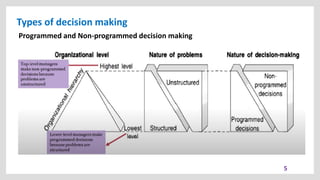
Types of decisionmaking
5
Programmed and Non-programmed decision making
6.
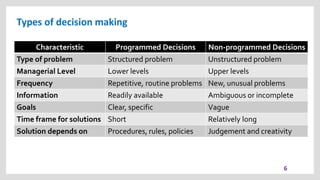
Types of decisionmaking
6
Characteristic Programmed Decisions Non-programmed Decisions
Type of problem Structured problem Unstructured problem
Managerial Level Lower levels Upper levels
Frequency Repetitive, routine problems New, unusual problems
Information Readily available Ambiguous or incomplete
Goals Clear, specific Vague
Time frame for solutions Short Relatively long
Solution depends on Procedures, rules, policies Judgement and creativity
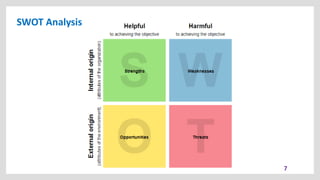
SWOT Analysis
8
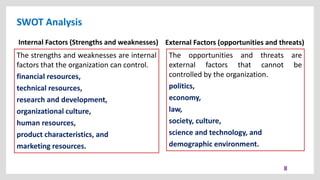
External Factors(opportunities and threats)
The opportunities and threats are
external factors that cannot be
controlled by the organization.
politics,
economy,
law,
society, culture,
science and technology, and
demographic environment.
The strengths and weaknesses are internal
factors that the organization can control.
financial resources,
technical resources,
research and development,
organizational culture,
human resources,
product characteristics, and
marketing resources.
Internal Factors (Strengths and weaknesses)
9.
SWOT Analysis
9
1. Leverage(S + O). Companies can use their internal strengths to pick up external
opportunities and fully integrate opportunities and strengths.
2. Constraint (Inhibitory) (W + O). Opportunities provided by the environment are not
suited to the internal resource advantages of the company. In this situation, companies
need to add certain resources to promote the transformation of internal resources and
weaknesses into strengths to cater to or adapt to external opportunities.
3. Vulnerability (S + T). When environmental conditions pose a threat to the
company’s strengths, the strengths cannot be fully exerted. In this situation,
companies must overcome the threats to take advantage of them.
4. Problematic (W + T). When the company’s internal weaknesses and corporate
external threats meet, companies face severe challenges. If they are not properly
handled, they may directly threaten the survival of the company.
SWOT Analysis
11
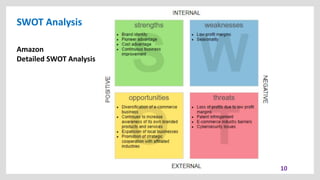
In additionto cloud computing and smart voice, Amazon has also contacted third-party
platforms such as logistics and suppliers, and even invested in the film and television
industry, making its business model more diversify.
In 2008, Amazon realized that content can attract and extend users’ time on the
platform, and began to provide original content on Prime Instant Video, Amazon’s
mainstream media video platform, and as part of the Prime membership service.
Amazon’s ecology can be described as a rotating flywheel. This flywheel is centered on
Prime’s membership system, and new interests have been added to it, gradually
creating an all-encompassing ecology.
While continuing to attract new users, Prime’s membership system has promoted the
development of Amazon’s e-commerce and other new businesses, and it will continue
to do so.
Organizing
13
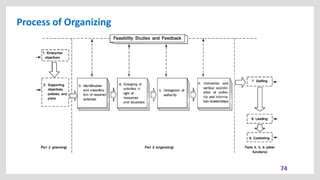
“Organizing is theprocess of identifying and grouping work
to be performed, defining and delegating responsibility and
authority and establishing relationships for the purpose of
enabling people to work most effectively together”
- Louis A. Allen (businessman, Mississippi, 1919-1964)
14.
Steps in Organizing
14
•Identificationand division of work: In accordance with previously determined
plans, the work is divided into manageable activities so that duplication can be
avoided and the burden of work can be shared among the employees.
•Departmentalization: Once work has been divided into small and manageable
activities, then those activities which are similar in nature are grouped together. Such
sets facilitate specialization. This grouping process is called departmentalization.
•Assignment of duties: Once departments have been formed, each of them is
placed under the charge of an individual. Jobs are then allocated to the members of
each department in accordance to their skills and competencies.
•Establishing reporting relationships: Each individual should also know who he
has to take orders from and to whom he is accountable. This helps to create a
hierarchical structure and helps in coordination amongst various departments.
15.
Nature of Organization
15
•Group of Persons: An organization is a group of people working together for the
achievement of common objectives. The group may be large or small. An organization is
a system of cooperative relationships of two or more persons.
• Common Objectives: Every organization has common objectives distinct from
personal objectives of the members. The common goal is the basis of cooperation
among the members.
• Division of Work: An organization comes into existence when the total task is divided
among the members of the group. This is necessary not only because one individual
cannot do all the work, but specialization results in efficiency and effectiveness.
• Cooperative Effort: The members of an organization are willing to help each other to
achieve desired goals. Cooperative relationships are stabilized both vertically and
horizontally among different units of the organization.
16.
Nature of Organization
16
•Communication: People who form an organization communicate with each other in
order to integrate or coordinate their efforts. The structure must be such that people
can perform together efficiently.
• Central Authority: In an organization, there is a central directing authority which
controls the concerted efforts of the group. The chain of authority - responsibility
relationships is known as the chain of command.
• Rules and Regulations: For the orderly and systematic working of the members,
rules and regulations are laid down and enforced by central authority
• The Dynamic Element: An organization is not a mere mechanical structure but a
living organism arising out of the sentiments, attitudes, and the behavior of people. The
people hold this structure together and give it vitality.
17.
Importance of Organizing
17
Benefitsof specialization:
• Leads to a systematic allocation of jobs among the workforce
• Enhances productivity as specific workers perform specific jobs on a regular basis
• Leads to increased expertise - Repetitive performance of a particular task
Clarity in working relationships:
• The establishment of working relationships clarifies lines of communication and
specifies who is to report to whom.
• This removes ambiguity in transfer of information and instructions
18.
Importance of Organizing
18
Optimumutilization of resources:
• Organizing leads to the proper usage of all material, financial and human resources
• The proper assignment of jobs avoids overlapping of work and makes the best use
of resources
Adapting to change:
• Allows a business enterprise to accommodate changes in the business environment
• Allows the organization structure to be suitably modified and the revision of inter-
relationships amongst managerial levels to pave the way for a smooth transition
19.
Importance of Organizing
19
Effectiveadministration:
• Provides a clear description of jobs and related duties
• Clarity in working relationships enables proper execution of work
• Management of an enterprise thereby becomes easy and this brings effectiveness
in administration
Expansion and growth:
• Helps in the growth and diversification of an enterprise by enabling it to deviate
from existing norms and taking up new challenges
• Provides flexibility for growth without losing control over various activities
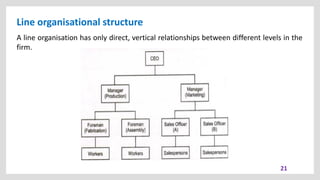
Line organisational structure
22
ADVANTAGES
•A line structure tends to simplify and
clarify responsibility, authority and
accountability in relationships. The
levels of responsibility and authority are
likely to be precise and understandable
• A line structure promotes fast decision
making and flexibility
• Because line organizations are usually
small, managements and employees
have greater closeness
DISADVANTAGES
• As the firm grows larger, line
organization becomes more ineffective
• Managers may require expertize in
many fields
• There is a tendency to become overly
dependent on the few key people who
can perform numerous jobs
23.
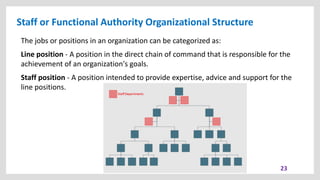
Staff or FunctionalAuthority Organizational Structure
23
The jobs or positions in an organization can be categorized as:
Line position - A position in the direct chain of command that is responsible for the
achievement of an organization's goals.
Staff position - A position intended to provide expertise, advice and support for the
line positions.
24.
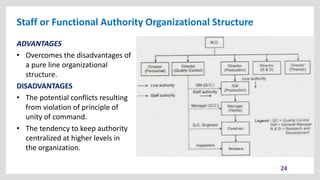
Staff or FunctionalAuthority Organizational Structure
24
ADVANTAGES
• Overcomes the disadvantages of
a pure line organizational
structure.
DISADVANTAGES
• The potential conflicts resulting
from violation of principle of
unity of command.
• The tendency to keep authority
centralized at higher levels in
the organization.
25.
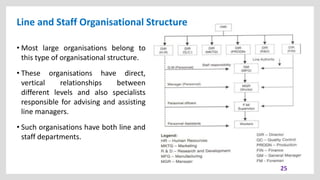
Line and StaffOrganisational Structure
25
• Most large organisations belong to
this type of organisational structure.
• These organisations have direct,
vertical relationships between
different levels and also specialists
responsible for advising and assisting
line managers.
• Such organisations have both line and
staff departments.
26.
Line and StaffOrganizational Structure
26
ADVANTAGES
• The primary advantage is the use of
expertise of staff specialists by the
line personnel.
• The span of control of line managers
can be increased because they are
relieved of many functions which the
staff people perform to assist the
line.
DISADVANTAGES
• Conflict between line and staff may
still arise.
• Staff officers may resent their lack of
authority.
• Coordination between line and staff
may become difficult.
27.
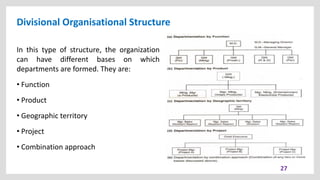
Divisional Organisational Structure
27
Inthis type of structure, the organization
can have different bases on which
departments are formed. They are:
• Function
• Product
• Geographic territory
• Project
• Combination approach
28.
Divisional Organisational Structure
28
ADVANTAGES
•Divisions work well because they allow a team to focus upon a single product or
service, with a leadership structure that supports its major strategic objectives.
• Having its own president or vice president makes it more likely the division will
receive the resources it needs from the company.
• A division's focus allows it to build a common culture and esprit de corps that
contributes both to higher morale and a better knowledge of the division's portfolio.
This is far more preferable to having its product or service dispersed among multiple
departments through the organization.
29.
Divisional Organisational Structure
29
DISADVANTAGES
•A company comprised of competing divisions may allow office politics instead of
sound strategic thinking to affect its view on such matters as allocation of company
resources. Thus, one division will sometimes act to undermine another.
• Also, divisions can bring compartmentalization that can lead to incompatibilities.
30.
Project Organisational Structure
30
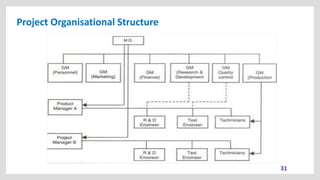
•A project organization is a temporary organization designed to achieve specific
results by using teams of specialists from different functional areas in the
organization.
• The project team focuses all its energies, resources and results on the assigned
project.
• Once the project has been completed, the team members from various cross
functional departments may go back to their previous positions or may be assigned
to a new project.
Project Organisational Structure
32
ADVANTAGES:
• It is an effective way of producing highly complex product systems
• Project organization, based on team concept, is the best means of getting the right
things done right
• In a turbulent environment, such organization is preferable for planning,
implementing and control of costs projects
• Diverse interests are consolidated to the above problems. Creativity is developed
through interaction with various specialists
• It leads to the development of strong teamwork
33.
Project Organisational Structure
33
DISADVANTAGES:
• A deliberate conflict is established between the project officer and the existing
department heads because of the overlapping of authority delegation.
• At the close of the project, there is very likelihood of insecurity of employment.
• There lurks a danger of over-specialization in the course of project involvement.
• Rotation from project to project reduces employees’ loyalty to the parent functional
department.
34.
Electronics
Matrix Organisational Structure
34
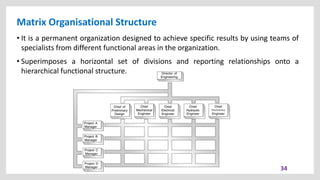
•It is a permanent organization designed to achieve specific results by using teams of
specialists from different functional areas in the organization.
• Superimposes a horizontal set of divisions and reporting relationships onto a
hierarchical functional structure.
35.
Matrix Organisational Structure
35
ADVANTAGES
•Decentralized decision making
• Strong product/project
coordination
• Improved environmental
monitoring
• Fast response to change
• Flexible use of resources
• Efficient use of support systems
DISADVANTAGES
• High administration cost
• Potential confusion over
authority and responsibility
• High prospects of conflict
• Overemphasis on group decision
making
• Excessive focus on internal
relations
36.
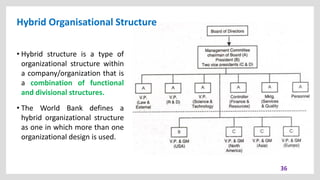
Hybrid Organisational Structure
36
•Hybrid structure is a type of
organizational structure within
a company/organization that is
a combination of functional
and divisional structures.
• The World Bank defines a
hybrid organizational structure
as one in which more than one
organizational design is used.
37.
Hybrid Organisational Structure
37
ADVANTAGES
•Alignment of corporate and divisional
goals.
• Functional expertise and efficiency
• Adaptability and flexibility in divisions
DISADVANTAGES
• Conflicts between corporate
departments and units.
• Excessive administration overhead.
• Slow response to exceptional
situations.
38.
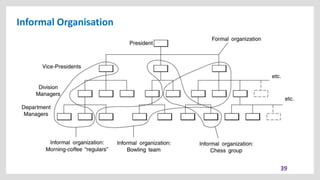
Informal Organisation
38
• Aninformal organization is the set of evolving relationships and patterns of human
interaction within an organization which are not officially presented.
• Alongside the formal organization, an informal organization structure exists which
consists of informal relationships created not by officially designated managers but by
organizational members at every level.
• Since managers cannot avoid these informal relationships, they must be trained to
cope with it.
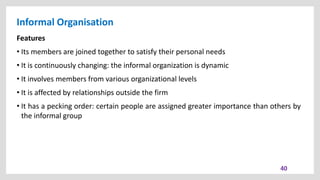
Informal Organisation
40
Features
• Itsmembers are joined together to satisfy their personal needs
• It is continuously changing: the informal organization is dynamic
• It involves members from various organizational levels
• It is affected by relationships outside the firm
• It has a pecking order: certain people are assigned greater importance than others by
the informal group
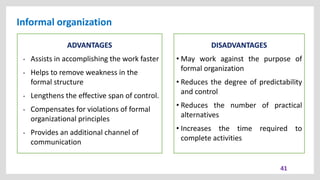
41.
Informal organization
41
ADVANTAGES
• Assistsin accomplishing the work faster
• Helps to remove weakness in the
formal structure
• Lengthens the effective span of control.
• Compensates for violations of formal
organizational principles
• Provides an additional channel of
communication
DISADVANTAGES
• May work against the purpose of
formal organization
• Reduces the degree of predictability
and control
• Reduces the number of practical
alternatives
• Increases the time required to
complete activities
Line/Staff Concepts AndFunctional Authority
43
• Line authority
• The relationship in which a superior exercises direct supervision over a
subordinate—an authority relationship in a direct line or steps.
• It gives a superior a line of authority over a subordinate. It exists in all organizations
as an uninterrupted scale or series of steps.
• Staff relationship
• The nature of staff relationship is advisory. The function of people in a pure staff
capacity is to investigate, research, and give advice to line managers.
•Functional authority
•The right delegated to an individual or a department to control specified
processes, practices, policies, or other matters relating to activities undertaken by
persons in other departments
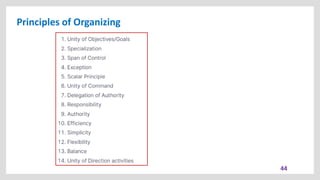
Principles of Organizing
45
(1)Unity of Objectives/Goals or Unity of Direction
The goals and objectives must be clearly defined for the entire organization, for each
department and even for each position in the organization structure. There must be
unity of objectives so that all efforts can be concentrated on the set goals.
(2) Specialization
An individual employee repeatedly performing a specific single job becomes an expert in
that job. The work assigned should be according to his abilities and aptitude. Thus,
specialization increases the output of the employees along with economy and efficiency.
46.
Principles of Organizing
46
(3)Principle of span of control
The principle states that there is a limit to the number of subordinates that each
manager can effectively supervise..
The term span of management refers to the number of employees reporting to a single
manager. Span of management is also known as span of control, span of supervision or
span of authority.
(4) Exception
Each manager should make all decisions within the limitation of delegated authority.
Exceptionally complex matters should be referred to the higher levels for their decision.
This will enable the top executives to devote time to more important and crucial issues.
47.
Principles of Organizing
47
(5)Chain of command or Scalar principle
The chain of command, sometimes called the scalar chain, is the formal line of
authority, communication, and responsibility within an organization.
The chain of command is usually depicted on an organizational chart, which identifies
the superior and subordinate relationships in the organizational structure.
(6) Unity of command
Unity of command means that each subordinate reports to one and only one superior.
Multiple subordination causes uneasiness, disorder, indiscipline, and undermining of
authority.
48.
Authority and power
48
Power
theability of individuals or groups to induce or influence the beliefs or
actions of other persons or groups.
Authority
the right in a position (and, through it, the right of the person occupying
the position) to exercise discretion in making decisions affecting others.
Authority is a type of power, but power within an organizational setting.
49.
Responsibility
49
The term responsibilityrefers to the obligation or duty to complete the tasks assigned
by performing the required activities. Responsibility may also be defined as the
employee’s obligation that arises when accepting the manager’s delegated authority.
It is essential for managers to ensure that the subordinates have just enough authority
to meet their responsibility.
When the subordinates are given responsibility without appropriate authority, it will
result in job stress and frustration, and employee dissatisfaction.
If too much of authority is accompanied with too little responsibility, it may result in
employee malpractice, recklessness, abusiveness and other dangerous situations.
Managers must therefore ensure a balance between responsibility and authority.
50.
Accountability
50
Accountability makes theemployees answerable for the satisfactory completion of a
specific task or assignment.
Accountability is actually a mechanism through which authority and responsibility are
brought into alignment.
At the time of delegation, managers must make certain that each employee knows
clearly what they are accountable for. This will then ensure that employees constantly
report and justify the outcome of their actions to the managers.
51.
Delegation
51
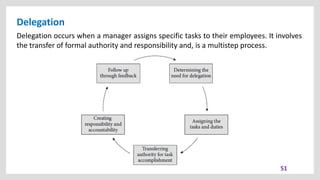
Delegation occurs whena manager assigns specific tasks to their employees. It involves
the transfer of formal authority and responsibility and, is a multistep process.
52.
Principles of Delegation
52
Clarityof delegation Whether specific or general, written or unwritten, delegation of
authority must be clear in terms of its contents, functional relations, scope, and
assignments. Ambiguity leads to poor results and makes the delegation less effective.
Delegation to be consistent with expected results The manager should know the
precise jobs to be done and the results expected of such delegation. Authority
delegation should be restricted to the extent to which it can give results.
Delegate duties and authority to the right and trustworthy persons at the right time for
the right purpose.
Assign the complete task to a subordinate, rather than dividing it among many
subordinates.
53.
Principles of Delegation
53
Nodelegation of responsibility The obligation to accomplish the assigned task is
absolute and is not partitioned when authority is delegated to the subordinate.
If this principle is violated, three important consequences will follow:
• If the manager is able to pass on an obligation along with delegation of authority
to the subordinate, the rule of single chain of command will be violated.
• The management at the top shall have great responsibility and yet not be
accountable for the results.
• When a manager is allowed to delegate their obligation, there will be no way of
knowing who is accountable for what.
Thus, when authority is delegated, obligations are not passed down the organization;
rather, new responsibilities are created at each level.
54.
Principles of Delegation
54
Allowonly as much authority as is required to the subordinate to perform the delegated
tasks. Managers should enable the subordinates know the extent of their authority.
Desist from delegating their entire authority and work to the subordinates.
Ensure unperturbed guidance to the subordinates and also support their initiatives.
Anticipate and answer the questions of the subordinates responsibly and in order.
Develop effective review mechanism to measure the performance of the subordinates
accurately and also recognize their superior performance.
Attach accountability to the delegated authority and responsibility.
Consult subordinates during the delegation and obtain their feedback continuously.
Keep the promises made to the subordinates at all times.
55.
Types of Delegation
55
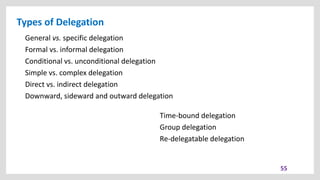
Generalvs. specific delegation
Formal vs. informal delegation
Conditional vs. unconditional delegation
Simple vs. complex delegation
Direct vs. indirect delegation
Downward, sideward and outward delegation
Time-bound delegation
Group delegation
Re-delegatable delegation
56.
Challenges to Delegation
56
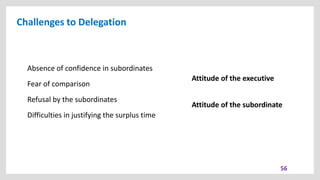
Absenceof confidence in subordinates
Fear of comparison
Refusal by the subordinates
Difficulties in justifying the surplus time
Attitude of the executive
Attitude of the subordinate
57.
Delegation vs Decentralisation
57
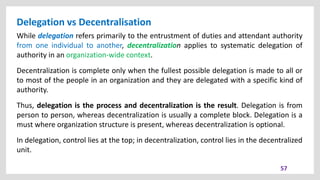
Whiledelegation refers primarily to the entrustment of duties and attendant authority
from one individual to another, decentralization applies to systematic delegation of
authority in an organization-wide context.
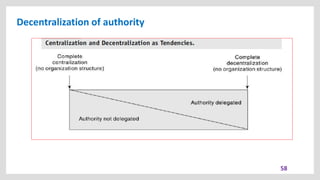
Decentralization is complete only when the fullest possible delegation is made to all or
to most of the people in an organization and they are delegated with a specific kind of
authority.
Thus, delegation is the process and decentralization is the result. Delegation is from
person to person, whereas decentralization is usually a complete block. Delegation is a
must where organization structure is present, whereas decentralization is optional.
In delegation, control lies at the top; in decentralization, control lies in the decentralized
unit.
Different Kinds ofCentralization
59
The term centralization has several meanings:
• Centralization of performance pertains to geographic concentration; it
characterizes, for example, a company operating in a single location.
• Departmental centralization refers to concentration of specialized activities,
generally in one department. For example, maintenance for a whole plant may be
carried out by a single department.
• Centralization of management is the tendency to restrict delegation of decision
making. A high degree of authority is held by managers at or near the top of the
organizational hierarchy.
60.
Advantages and Limitationsof Decentralization
60
Advantages
• Relieves top management of some burden of decision-making and forces upper-level
managers to let go.
• Encourages decision-making and assumption of authority and responsibility.
• Gives managers more freedom and independence in decision-making.
• Promotes establishment and use of broad controls that may increase motivation.
• Makes comparison of performance of different organizational units possible.
• Facilitates setting up of profit centers.
• Facilitates product diversification.
• Promotes development of general managers.
• Aids in adaptation to fast-changing environment.
61.
Advantages and Limitationsof Decentralization
61
Limitations
• Makes it more difficult to have a uniform policy.
• Increases complexity of coordination of decentralized organizational units.
• May result in loss of some control by upper-level managers.
• May be limited by inadequate control techniques.
• May be constrained by inadequate planning and control systems.
• Can be limited by the lack of qualified managers.
• Involves considerable expenses for training managers.
• May be limited by external forces (national labor unions, governmental controls, tax
policies).
• May not be favored by economies of scale of some operations.
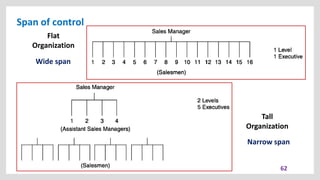
Span of control
63
Widespan—When a large number of subordinates are placed under one superior, it is
a wide span of management. It is also called operative span as it is meant primarily for
lower-level managers.
Organizations will have less hierarchical levels and a flat structure if they have wider
span of management. Employee empowerment, job autonomy and self- direction are
usually achieved through flat organizational structure.
Flatter structures are flexible and better able to adapt to changes. They also facilitate
faster communication, quicker decisions and responsiveness.
Flat structured organizations incur less administrative costs because of fewer
managers. However, managers tend to spend too much time supervising their
employees. Further, confusion over roles might be caused.
64.
Span of control
64
Narrowspan—When only a few subordinates are placed under a supervisor, it is a
narrow span of management. Narrow span is also called executive span as it is meant
basically for middle- and top-level managers of an organization.
Organizations will have more hierarchical levels and a tall structure if they have a
narrow span of management. Generally, higher levels of management have relatively
narrower span of management than the lower levels in many organizations.
Organizations with tall structures facilitate effective managerial control, reduce the
routine supervisory burden of managers and offer greater promotion opportunities to
the people. This enable them to focus on non-routine, creative planning activities.
Tall structures have the problems of (i) high administrative cost due to more managers,
(ii) less effective and slow communication due to lengthy communication channels and
(iii) inadequate direct contact b/w higher management and employees.
65.
Factors Influencing Spanof Management
65
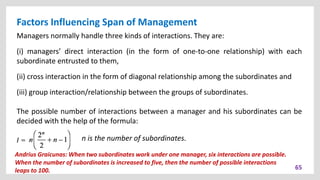
Managers normally handle three kinds of interactions. They are:
(i) managers’ direct interaction (in the form of one-to-one relationship) with each
subordinate entrusted to them,
(ii) cross interaction in the form of diagonal relationship among the subordinates and
(iii) group interaction/relationship between the groups of subordinates.
The possible number of interactions between a manager and his subordinates can be
decided with the help of the formula:
I n is the number of subordinates.
Andrius Graicunas: When two subordinates work under one manager, six interactions are possible.
When the number of subordinates is increased to five, then the number of possible interactions
leaps to 100.
66.
Factors Influencing Spanof Management
66
As the number of subordinates increases, the complexity of relationship also grows.
Besides the complexity of relationships, other factors which influence the decision
regarding span of management are:
• nature of work,
• knowledge, skills and ability (KSA) of the subordinates,
• competence and qualification of the managers,
• availability of a standard operating procedure,
• geographical location of the job,
• stability of the organization,
• training facilities,
• management’s philosophy and
• managers’ attitude and preferences.
Factors Affecting OrganizationalDesign and Structure
68
• Strategy
Organizational strategies for achieving targeted growth, better customer service,
diversification, reduced labour cost, prompt delivery of goods and services, low
attrition rates, etc. may require modifications in structure.
Specifically, if the management wants to reduce the labour cost through downsizing, it
may have to restructure the organization by identifying and eliminating the positions
and persons found to be in surplus.
Thus, product diversification and differentiation strategies may require flexible
structure while a more formal structure is suitable for low cost and less diversified
products.
69.
Factors Affecting OrganizationalDesign and Structure
69
• Environment
When changes in the organizational environment are swift and frequent, managers
design flexible structures for better adaptability and faster responses.
In a relatively stable environment, organizational structure can be more formal.
In difficult but stable environments, organizations can have a decentralized
bureaucratic structure. In contrast, organizations normally require centralized
bureaucratic structure in simple and stable environments.
70.
Factors Affecting OrganizationalDesign and Structure
70
• Technology
Technology consists of the conversion processes used to transform inputs like
material and information into outputs like products or services.
Organizations with complex technology usually have a tall structure with increased
number of levels of management.
In contrast, organizations with simpler technologies operate with flatter structures
and fewer levels of management.
71.
Factors Affecting OrganizationalDesign and Structure
71
• Employee skills
Organizations with higher employee skills and motivation levels typically have a wider
span of management and decentralized structure.
In contrast, narrow span of management and centralized structure are appropriate for
organizations with relatively low employee skills and motivation.
72.
Factors Affecting OrganizationalDesign and Structure
72
• Size
Typically, large organizations tend to have more formalized structure and less informal
communication.
Large organizations are generally more decentralized as their higher executives cannot
afford sufficient time and expertise for routine decision-making activities.
In contrast, small organizations prefer centralized structure for tight control and fast
decisions.
73.
Factors Affecting OrganizationalDesign and Structure
73
• Geographic Location
When the business of an organization is primarily located in one place, then the
managers can design a simple structure with minimum levels of management.
In contrast, managers may need to design a complex structure if the organization
maintains multiple centres of operations or business offices for effective coordination
and control.
References
• Essentials ofManagement – Harold Koontz, Heinz Weihrich
• Essentials of Management – David Boddy
• Principles of Management – Dipak Kumar Bhattacharyya
• Principles of Management – Pravin Durai
• Principles of Management – P. C. Tripathi, P. N. Reddy
• Principles of Management – Openstax Resources
75







![Final Powerpoint[1]](https://cdn.slidesharecdn.com/ss_thumbnails/finalpowerpoint1-1213130555438697-8-thumbnail.jpg?width=640&height=640&fit=bounds)


