ERIM
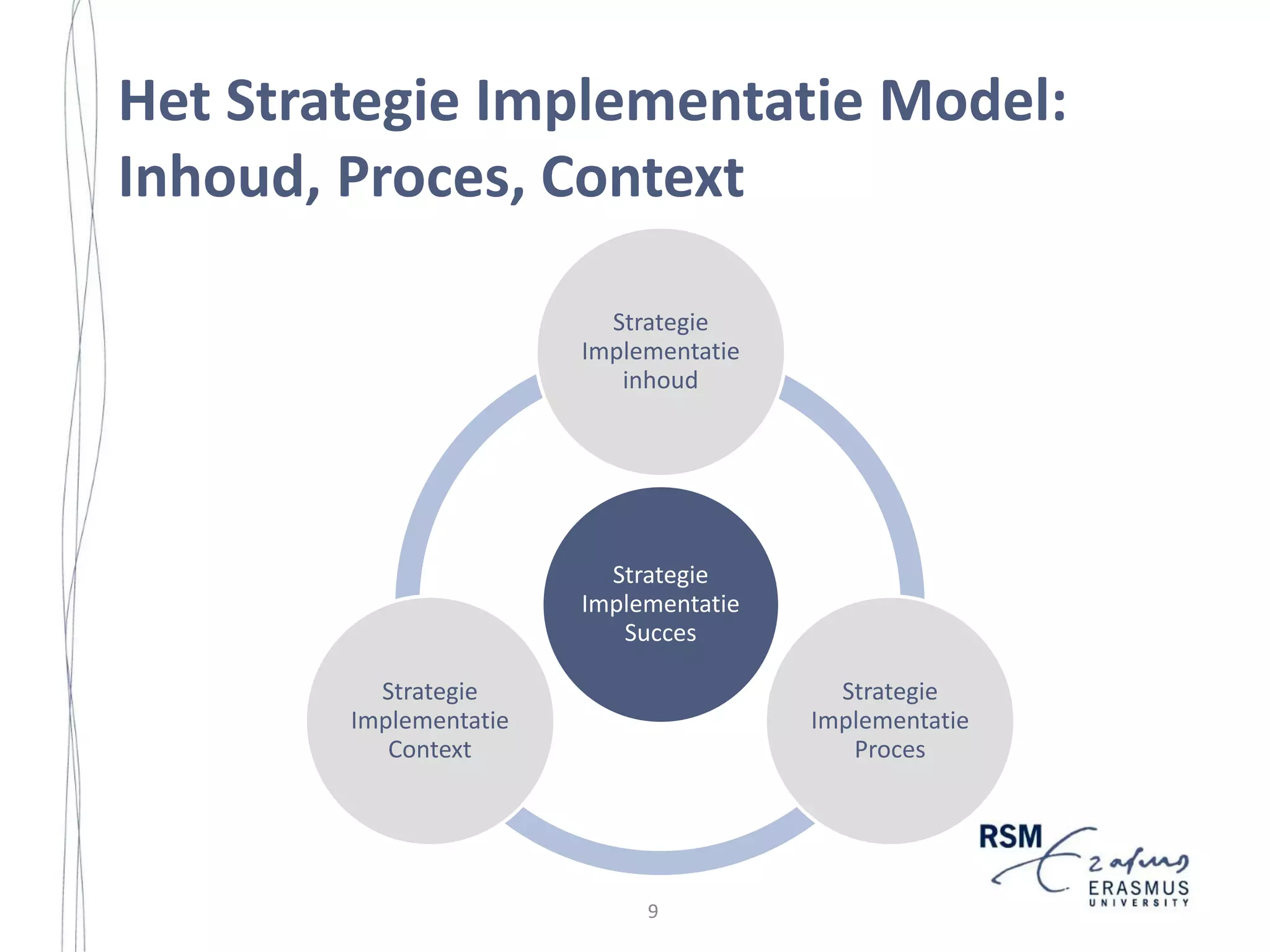
The Erasmus Research Institute of Management (ERIM) is the Research School (Onder zoekschool) in the field of management of the Erasmus University Rotterdam. The founding
participants of ERIM are Rotterdam School of Management, Erasmus University, and the
Erasmus School of Economics. ERIM was founded in 1999 and is officially accredited by the
Royal Netherlands Academy of Arts and Sciences (KNAW). The research undertaken by
ERIM is focussed on the management of the firm in its environment, its intra- and interfirm
relations, and its business processes in their interdependent connections.
The objective of ERIM is to carry out first rate research in management, and to offer an
advanced doctoral programme in Research in Management. Within ERIM, over three
hundred senior researchers and PhD candidates are active in the different research
programmes. From a variety of acade mic backgrounds and expertises, the ERIM commu nity
is united in striving for excellence and working at the fore front of creating new business
knowledge.

Print: Haveka

Strategy implementation is of high importance to organization science and practice,
due to its direct relation to organizational performance, its high complexity, and high
failure rate. This PhD thesis is about strategy implementation and the reasons for success
or failure. Despite its apparent importance for organizational performance, research on
the subject remains rather limited. Relevant literature exists but is fragmented among
other fields of management research. Especially research in non-North American and nonWestern European contexts remains scarce. In addition, little attention has been paid to
strategy implementation within developing economies and small island communities.
This PhD thesis investigates strategy implementation and its reasons for success or
failure. It reports on a qualitative survey of 55 executives with strategy implementation
responsibilities within 44 public and private organizations in the small Caribbean island
community of Curaçao. The study demonstrates that strategy implementation is a highly
complex organizational phenomenon which is influenced by a large number of factors
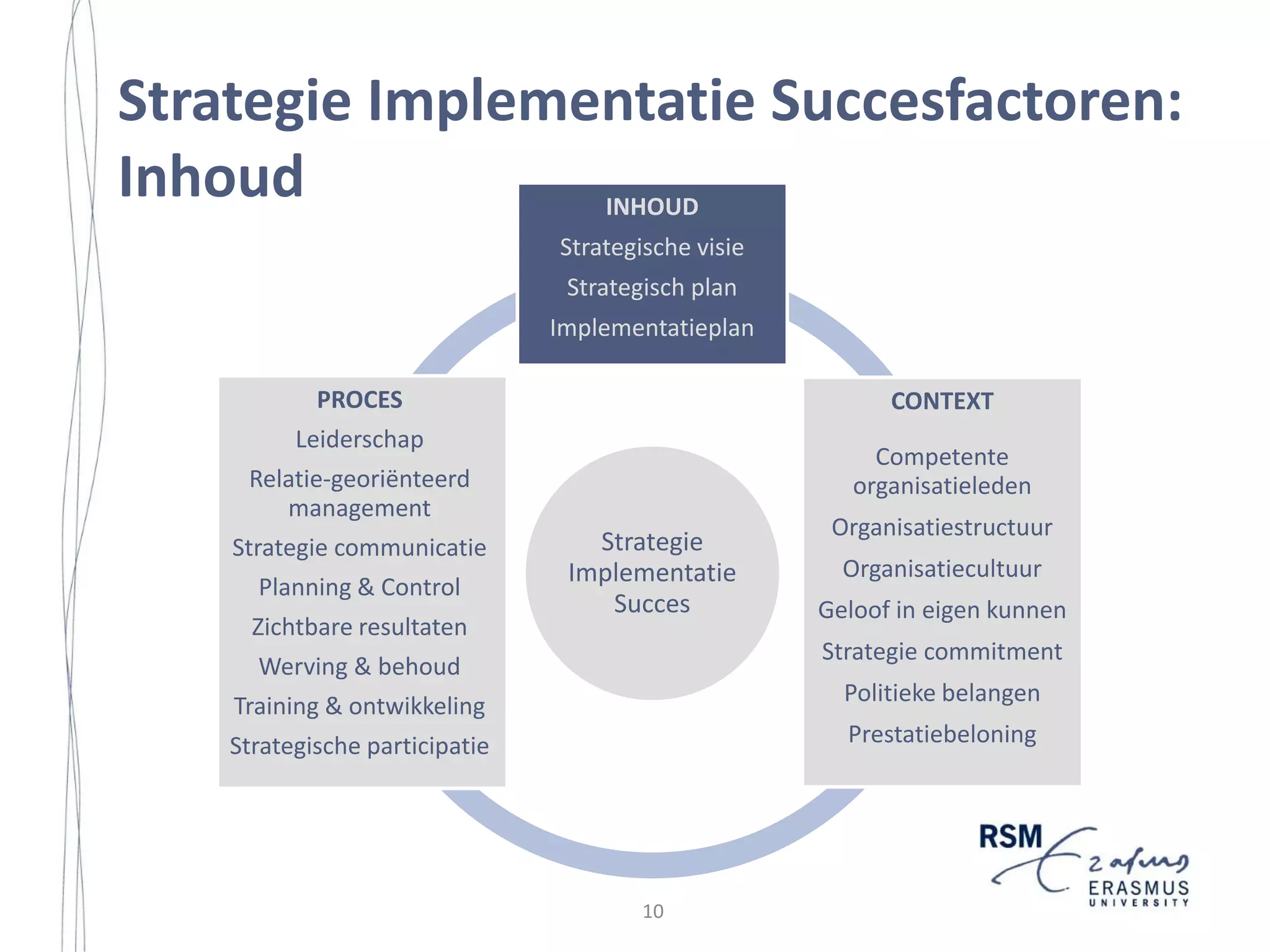
related to the process, content and context of an implementation effort. The present study
integrates a number of independent streams of research to develop a comprehensive and
integrative framework for strategy implementation, which is grounded in implementation
practice. This thesis further discusses the implications of these factors on strategy
implementation performance and makes recommendations for implementation practice.
The study provides important insights that are highly relevant for managers to
successfully implement strategies.

127

ARNOUD A. VAN DER MAAS - Strategy Implementation in a Small Island Community

Erasmus Research Institute of Management - E R I M

AN INTEGRATIVE FRAMEWORK

Design & layout: B&T Ontwerp en advies (www.b-en-t.nl)

STRATEGY IMPLEMENTATION IN A SMALL ISLAND COMMUNITY

(www.haveka.nl)

B&T28160 Erim - 08 Omslag Maas

ERIM PhD Series

Research in Management
Tel.
Fax
E-mail
Internet

+31 10 408 11 82
+31 10 408 96 40
info@erim.eur.nl
www.erim.eur.nl

ERIM

Rotterdam School of Management
Erasmus University
Erasmus School of Economics
P.O. Box 1738, 3000 DR Rotterdam
The Netherlands

ARNOUD A. VAN DER MAAS

Strategy Implementation in
a Small Island Community
An Integrative Framework
STRATEGY IMPLEMENTATION
IN A SMALL ISLAND COMMUNITY
AN INTEGRATIVE FRAMEWORK

1
2
STRATEGY IMPLEMENTATION
IN A SMALL ISLAND COMMUNITY
AN INTEGRATIVE FRAMEWORK

STRATEGIE IMPLEMENTATIE
IN EEN KLEINE EILANDGEMEENSCHAP:
EEN GEÏNTEGREERD FRAMEWORK

Thesis

to obtain the degree of Doctor from the
Erasmus University Rotterdam
by command of the
rector magnificus
Prof.dr. S.W.J. Lamberts
in accordance with the decision of the Doctorate Board.
The public defense shall be held on
Friday May 9th, 2008 at 11.00 hours

by

ARNOUD ANTHONY VAN DER MAAS
born at Rotterdam, the Netherlands

3
DOCTORAL COMMITTEE

Promotor:

Prof.dr. H.G. van Dissel

Other members:

Prof.dr.ir. E. van Heck
Prof.dr. S.J. Magala
Prof.dr.ing. V. Marcha

Copromotor:

Dr.ir. G.J. Cijntje

Erasmus Research Institute of Management (ERIM)
Rotterdam School of Management / Erasmus School of Economics
Erasmus University
Internet: http://www.erim.eur.nl
ERIM Electronic Series Portal: http://hdl.handle.net/1765/1
ERIM Ph.D. Series in Management nr 127
ISBN 978-90-5892-160-4
Design: B&T Ontwerp en Advies www.b-en-t.nl / Print: Haveka www.haveka.nl
 2008, Arnoud A. van der Maas
All rights reserved. No part of this publication may be reproduced or transmitted in any form or by
any means electronic or mechanical, including photocopying, recording, or by any information
storage and retrieval system, without permission in writing from the author.
Electronic copies are available from the author upon request.

4
There is nothing more difficult to take in hand, more perilous to
conduct, or more uncertain in its success, than to take the lead in the
introduction of a new order of things, because the innovator has for
enemies all those who have done well under the old conditions, and
lukewarm defenders in those who may do well under the new.
(Machiavelli, 1512)

5
6
TABLE OF CONTENTS

TABLE OF CONTENTS ...................................................................................... vii
FIGURES AND TABLES...................................................................................... ix
PREFACE .............................................................................................................. xi
1. INTRODUCTION............................................................................................... 1
1.1 The Importance of Strategy Implementation ................................................ 1
1.2 Research Objective and Questions................................................................ 9
1.3 The Outline of The Study............................................................................ 12
2. REVIEW OF LITERATURE............................................................................ 13
2.1 Introduction................................................................................................. 13
2.2 Defining Strategy Implementation.............................................................. 13
2.3 Perspectives on Strategy Implementation ................................................... 15
2.4 Strategy Implementation Frameworks ........................................................ 23
3. RESEARCH METHODOLOGY ...................................................................... 29
3.1 Introduction................................................................................................. 29
3.2 Research Philosophy ................................................................................... 29
3.3 Research Strategy........................................................................................ 31
3.4 Conceptual Lens.......................................................................................... 33
3.5 Research Design.......................................................................................... 38
3.6 Research Setting.......................................................................................... 50
3.7 Research Approach ..................................................................................... 59
3.8 Data Analysis .............................................................................................. 69
4. STRATEGY IMPLEMENTATION CONTEXT.............................................. 73
4.1 Introduction................................................................................................. 73
4.2 Environmental Level Context Factors......................................................... 73
4.3 Organizational Level Context Factors......................................................... 84
4.4 Individual Level Context Factors................................................................ 98
5. STRATEGY IMPLEMENTATION PROCESS ............................................. 107
5.1 Introduction............................................................................................... 107
5.2 Strategy Implementation Process Factors ................................................. 107
vii

7
Table of Contents
6. STRATEGY IMPLEMENTATION CONTENT............................................ 129
6.1 Introduction............................................................................................... 129
6.2 Strategy Implementation Content Factors................................................. 129
7. THEORETICAL REFLECTION .................................................................... 135
7.1 Introduction............................................................................................... 135
7.2 Strategy Implementation Context Revisited ............................................. 135
7.3 Strategy Implementation Process Revisited.............................................. 160
7.4 Strategy Implementation Content Revisited ............................................. 177
8. CONCLUSIONS AND RECOMMENDATIONS.......................................... 185
8.1 Introduction............................................................................................... 185
8.2 Main Findings ........................................................................................... 185
8.3 Practical Implications................................................................................ 199
8.4 Limitations of the Study............................................................................ 205
8.5 Suggestions for Further Research ............................................................. 208
APPENDICES..................................................................................................... 213
Appendix A: Strategy Implementation Context Quotes ................................. 213
Appendix B: Strategy Implementation Process Quotes .................................. 247
Appendix C: Strategy Implementation Content Quotes.................................. 267
REFERENCES.................................................................................................... 273
ABOUT THE AUTHOR..................................................................................... 297
SAMENVATTING (Summary in Dutch) ........................................................... 299

viii

8
FIGURES AND TABLES

LIST OF FIGURES
Figure 2.1
Figure 3.1
Figure 3.2
Figure 8.1
Figuur 8.1

McKinsey 7S Framework .................................................................. 25
A Conceptual Framework for Strategy Implementation.................... 33
Map of the Netherlands Antilles and Curaçao................................... 50
An Integrative Framework for Strategy Implementation ................ 186
Een geïntegreerd Framework voor Strategie Implementatie........... 300

LIST OF TABLES
Table 2.1
Table 3.1
Table 3.2
Table 8.1
Table 8.2
Table 8.3
Table 8.4

Definitions of Strategy Implementation .............................................. 14
Overview of Organizations and Implementation Projects................... 46
Summary of the Netherlands Antilles ................................................. 51
Order of Importance of Strategy Implementation Factors................. 187
Implementation Factors and Implementation Projects ...................... 189
Implementation Factors and Implementation Performance............... 191
Organization Type and Implementation Performance....................... 197

ix

9
10
PREFACE

This thesis originated from a fascination of strategy and policy implementation in
the colorful setting of the small Caribbean island Curaçao, but at the same time
from a worry about the high failure rate of strategy implementations on the island.
Little has been written on this subject in this interesting context and this thesis
aims to contribute to that gap.
The aim of this study is to contribute an interdisciplinary framework to analyze
the phenomena of strategy and policy implementation. We cross interdisciplinary
boundaries in an attempt to do justice to the complexity of our subject. We have
obtained elements of fields such as strategy formulation and implementation,
policy implementation, organizational change, development studies, comparative
management research, ICT implementation, organizational behavior, island studies
and integrated them into a comprehensive and integrative framework for strategy
implementation. The framework is to serve primarily as a qualitative tool to
analyze and understand strategy and policy implementation. Our framework has
deficiencies, of which we are aware. Following such an interdisciplinary approach
involves certain risks, since it is almost impossible to master all these fields.
This research has been supported financially by the department of Decision and
Information Sciences and Erasmus Research Institute of Management (ERIM) at
Rotterdam School of Management (RSM), Erasmus University. This research has
been supported operationally by the University of the Netherlands Antilles (UNA).
Over the past years, a number of people have been a source of support and
inspiration. First, I would like to thank my parents for supporting me all this time.
Without their continued support and encouragement, I would not have been able to
finish this Ph.D. thesis. They are the best parents one could wish for. Secondly, I
would like to thank my best friends who have supported me during the whole
process. These best friends are Aïcha Ahamri, Ruby Vrolijk, Otto Bengsch,
Najoua Aachboune, Mariëlle Sonnenberg, Esther Jonker, and of course my good
old friend Piotr Reedijk. Especially, my talks with Mariëlle were very helpful as

xi

11
Preface
only another Ph.D. candidate really understands what you are going through.
Furthermore, I would like to thank Naïma Zerhane for making my stay at the
department much more pleasant and interesting. Third, I would like to thank dr.ir.
Gilbert J. Cijntje and ir. Roy Evers of the University of the Netherlands Antilles
and CURISIS for helping me collect my data in Curaçao. Fourth, I would like to
thank department chairman prof.dr.ir. Jo van Nunen for providing the perfect
environment in which to freely pursue my academic interests. Fifth, I would like to
thank all the interviewees who participated in this research. Without their time,
help, knowledge and experience this thesis would have been impossible to write. It
has been a privilege and pleasure to meet all these people, to visit their
organizations, and to learn from their extensive experience. The interviewees that
participated in this research are: Walter Abernathy, Arnoud J. Aikema, Jan C.H.
Andreae, Karel Jan O. Aster, Mrs. Baromeo, U.R. Batta BSc., Raymond Begina,
Mrs. Bernadina, E.A.W. Best M.D., Rob van den Bergh, mr. Stanley M. Betrian,
drs. Paul van Bladel, Pablo Bourgos, Mr. Cardose, Anthon, C. Casperson MBA,
dr. ir. Gilbert Cijntje RI, Jacob Gelt Dekker, drs. Susan van Dijk, Oswald van der
Dijs, ir. E.F. (Roy) Evers, ir. Mario R. Evertsz, R.J. (Jean) Fransisca MBA, dr.
M.P. Goede, Phillip de Haan, dr. James R. Hepple, Erich D. TH. van der Hoeven,
Etienne van der Horst, Pierrôt Hurtado, Erik Isenia, Sidney Joubert, Ries van
Lomwel, ir. Wesley M. Kook MBA, prof.dr.ing. Valdemar Marcha, Robbin F.
Martina, drs. S.M.G. Melfor, Mr. Mervin, Arend J. Meijers, Alex Mollen, Mr.
Naar, drs. Jason E.G. Nisbet, Judric Pietersz M.A., Mr. E. Poulina, ir. F.J.M.
Versteeg, E.R. Vijzelman MSc., dr. Amado E.J. Römer, Gerda Rosalia, ir.ing.
Franklin J. Rosheuvel, Jan Sierhuis, drs. Michael de Sola, Eric R. Smeulders, Mr.
Smits, ir. Paul G.C. Stokkermans, J.P. van der Straaten, ir. Alfio R.B. Troeman
MBA PMP, drs. Dieudonne G. van der Veen, and Ivan de Windt RA. Sixth, I
would like to thank Jordan Srour for doing a thorough language check of my
thesis. Seventh, I would like to thank my supervisor Prof.dr. Han van Dissel for all
the help during the write up of this thesis. Finally, I would like to thank my best
friend God, the All That Is, for inspiring me to achieve the grandest vision I have
about myself. I am very grateful of the encouragement and support of all these
people.

Rotterdam, March 23, 2008

xii

12
1. INTRODUCTION

1.1 THE IMPORTANCE OF STRATEGY IMPLEMENTATION
Strategy implementation is an important topic in strategic management and in
organization science. Both practical experience and academic research indicate
that strategy implementation has a substantial impact on organizational
performance (Hrebiniak and Joyce, 1984), is crucial to organizational
effectiveness (Sproull and Hofmeister, 1986), is critical to the functioning of an
organization (Schilit, 1987) and is an essential factor in the formula for success of
any business or organization (Noble, 1999). The successful implementation of
strong and robust strategies will give any organization a significant competitive
edge (Giles, 1991), especially in industries were unique strategies are difficult to
achieve (Noble, 1999).
Strategy implementation is even more important in turbulent times. The
environment in which public and private organizations operate is increasingly
dynamic or even turbulent (Volberda, 1996; D’Aveni, 1999). Developments such
as the globalization of markets, rapid technological change, deregulation of
industries, a shift of organizations from the public to the private sector, and the
increasing aggressiveness of competition have radically altered the competitive
rules during the 1990s and beyond (Volberda, 1996). Short periods of competitive
advantage, punctuated by frequent disruptions, have replaced the long and stable
periods of the past in which organizations could achieve a sustainable competitive
advantage (Volberda, 1996; D’Aveni, 1994). These environmental developments
have resulted in strong pressures for (frequent) strategic change (Baden-Fuller and
Volberda, 1997; Thomas, 2002) to maintain a ‘fit’ with these changing
environments. In turbulent environments, the ability to implement new strategies
quickly and effectively may well mean the difference between success and failure
for an organization (Drazin and Howard, 1984; Hauc and Kovac, 2000). Even
slight delays can prove critical in highly competitive and dynamic environments

13
Strategy Implementation in a Small Island Community
(Eisenhardt, 1989b). Consequently, strategy implementation is a key concern in
the management of strategic change (Thomas, 2002).
However, well-formulated strategies only produce superior performance for an
organization when they are successfully implemented (Bonoma, 1984). The bestmade strategies are worthless if they cannot be implemented successfully (Schilit,
1987). Thus, strategic success not only requires an appropriate strategy but also
requires that the strategy is implemented successfully (Hussey, 1996), and timely.
Furthermore, strategies that fail to be implemented can be very costly, both in
terms of formulation costs and foregone benefits (Nutt, 1998).
Many Strategy Implementations Fail
Previous research has reported that many implementations fail (Nutt, 1986). The
implementation literature shows that implementation failure is ‘commonplace,
non-random, and patterned’ (Lin, 1996: 3). A major finding from studies of
decision-making is that the implementation of half of the decisions in
organizations fails (Nutt, 1999). Few intended strategies are successfully realized
(Mintzberg, 1990). A recent survey among senior operations executives in North
America found that 57 percent of the organizations were unsuccessful at
implementing strategic initiatives over the past three years (The Economist,
November 2004).
It has long been recognized that the majority of strategies fail in the
implementation phase (Noble, 1999)1. Apparently, an important part of these
failures can be traced to poor implementation (Nutt, 1999). Research by Nutt
(1999) found that implementation failure generally stemmed from elements, which
were under management control. After a comprehensive strategy or single
strategic decision has been formulated, significant difficulties are often
encountered during the subsequent implementation process (Alexander, 1985).
Consequently, there is a widely shared experience that all too often; plans do not
work out as intended (Wernham, 1984; Nutt, 1999). Many organizations have a
fundamental disconnect between the formulation of their strategy and the
implementation of that strategy into useful action (Kaplan, 1995). This has been
called the implementation problem: ‘the all too frequent failure to create change
after seemingly viable plans have been developed’ (Nutt, 1983). Therefore,
implementation constitutes an enigma and a source of frustration in many
companies (Noble, 1999b). Achieving successful implementation remains a
continuing challenge for managers responsible for executing strategies (Cravens,
1

The strategy implementation literature suggests two overall reasons why a plan or strategy can fail: the strategy
itself is inadequate or it is not properly implemented (Hussey, 1999).

2

14
Introduction
1998). The widely reported incidence of plan failure and the needs of managers
suggest that a careful examination of implementation practice should be a priority
(Nutt, 1987).
Strategy Implementation is Complex and Difficult
Because of the reported high failure rate, strategy implementation appears to be a
difficult organizational issue. A reason for this difficulty may be that strategy
implementation is a multifaceted and highly complex organizational phenomenon
(Wernham, 1985; Noble, 1999). deLeon (1999) even argues that the complexity of
implementation is more than daunting and apparently impenetrable or
‘unmodelable’ and results in ‘lacking predictive powers’. Implementation is
difficult and complex because the process is messy, ambiguous and often involves
many departments in the firm (Noble, 1999b, Schofield, 2004). Part of this
complexity arises from the social and political aspects of an implementation,
which need to be taken into account. Personality differences, politics,
communication problems, and struggles over power and leadership are just a few
obstacles that may undermine an implementation effort (De Kluyver and Pearce,
2003). Strategy formulation and implementation inevitably raise questions of
power within an organization (Pettigrew and Whipp, 1991). The very prospect of
change confronts established positions (ibid). Consequently, with respect to
implementation, the existence of conflicts, and the use of individual and group
power needs to be taken into consideration (Bergadaà, 1999).
Thus, given the importance of strategy implementation to organizational
performance, its complexity, and high failure rate, implementation should be a
topic of high interest for scholars and managers with implementation
responsibilities. Hence, there is a growing recognition that the most important
problems in the field of strategic management are in strategy implementation
(Flood et al., 2000).
Strategy Implementation Research remains Limited
Despite its apparent importance, Noble (1999) and Cravens (1998) argue that
strategy implementation receives relatively limited research attention. The explicit
study of implementation has swung in and out of fashion during the past quarter
century (O’Toole, 2000). Some exceptions excluded, the stream of research
explicitly aimed at implementation has abated since 1990 (ibid). As a result,
researchers who are interested in the subject of strategy implementation still face
the challenge of the lack of a significant body of literature on which to base new
efforts (Noble, 1999). In addition, as with other areas of strategic management,

3

15
Strategy Implementation in a Small Island Community
general rules for strategy implementation remain elusive (Reed and Buckley,
1988).
The limited research attention for strategy implementation has several possible
explanations. First, the field of strategic management has traditionally focused on
strategy formulation to the detriment of strategy implementation (Hrebiniak and
Joyce, 1984; Thomas, 2002). Research in the strategy field has placed emphasis on
the formulation of a strategy when the real challenge is argued to lie in
implementation (Rapert et al., 2002; Wooldridge and Floyd, 1989; MacMillan and
Guth, 1985; Noble, 1999). The majority of the literature so far has been focused on
the strategic planning process itself or the actual content of the strategy being
formulated (Alexander, 1985; Bonoma and Crittenden, 1988). Hussey (1999: 244)
even states that ‘much of the research into effective strategic management has
been directed at the planning process or the strategic decisions, almost as if the
desired end products were plans instead of actions’. This bias towards strategy
formulation over implementation dominates the strategic management literature
and limited empirical research is reported that pertains to the implementation
process (Parsa, 1999). Noble (1999) suggests that the lack of research attention is
due to the tendency of some strategists to treat strategy formulation as the only
necessary element for strategic success.
Second, the common view on strategy implementation is that it is ‘a relatively
straightforward operationalization of a clearly articulated strategic plan’ (Noble,
1999: 119). Once a strategy has been formulated, its implementation is often
viewed as a matter of operational detail and tactical adjustment (Pellegrinelli and
Bowman, 1994). Thus, strategy implementation is treated by some managers and
many researchers as a strategic afterthought (Noble, 1999: 119). On the other
hand, some scholars acknowledge that formulating a strategy is substantially easier
than successfully implementing a strategy (De Kluyver and Pearce, 2003).
‘Organizations are slower to change and more difficult and expensive to develop
than strategies are to prepare’, as noted by Miller et al. (2004: 201). While strategy
formulation is primary an intellectual and creative act, implementation is a handson and action oriented activity which requires leadership and managerial skills
(ibid).
Third, implementation is often perceived to be ‘not romantic; it is nuts and
bolts, details, and mundane problems’ (Sproull, 1986: 43). Whereas strategic
decision making is often viewed as ‘glamorous, exciting, even heroic’ (ibid).
Furthermore, ‘decision making is often assumed to be rather well-bounded in time
and space. It may have an observable end, often ratified by a vote, hand shake or
organizational announcement. Implementation, by contrast has no clear
boundaries’ (1986: 43) and is a highly complex phenomenon (Wernham, 1985).
4

16
Introduction
Strategy Implementation Research is Fragmented
Not only is the strategy implementation literature rather limited, it is rather
fragmented as well. Due to the lack of clear models on which to build, the research
on strategy implementation remains rather fragmented (Noble, 1999; Klein and
Sorra, 1996). There is little literature that has tried to look at implementation as a
whole, linking the numerous concepts that may be helpful (Hussey, 1996). Klein
and Sorra (1996: 1059) even argue that the literature on implementation appears to
be ‘a blur, a hodge-podge lacking organization and parsimony’. There is no
overarching or integrating framework for the sources of strategy implementation
failure or success (Hrebiniak and Joyce, 1984; Reed and Buckley, 1988).
The fragmentation of the strategy implementation literature is because of the
following reasons. First, the implementation literature is dominated by qualitative
single-site studies and each highlight a different set of one or more implementation
policies and practices (Klein and Sorra, 1996). Numerous factors have been
identified that either help or hinder implementation, but a parsimonious set of
factors that influence strategy implementation projects has not been developed
(Bryson and Bromiley, 1993). Instead, a large number of factors have been
theorized to be influential, a large number of factors have been identified as
influential in various case studies, and some have been shown to be influential in
other empirical formats (Klein and Sorra, 1996). As a result, there is a body of
literature consisting of a number of collections of success factors with no
integration whatsoever. Consequently, little overarching conclusions can be
reached when multiple authors, studying multiple organizations, identify differing
factors influencing implementation success and failure (ibid). In addition, these
success factors are often uncovered in a limited set of case studies, which inhibits
generalization.
Second, the contingent factors found by many studies have been drawn from a
variety of organizational levels: some involve the overall organization, others the
work unit and still others involve the characteristics of individual employees and
their roles within the organization (Walker and Ruekert, 1987).
Third, the implementation literature has generally reflected an aspect-oriented
approach to the subject emphasizing topics such as strategy-structure fit, resource
allocation and strategy success, and leadership style (Reed and Buckley, 1988).
Finally, the fragmentation of implementation research is a result of the diversity
of perspectives that have been taken in defining the concept of strategy
implementation (Noble, 1999). These perspectives include the structural view,
which is focused on the effects of the formal organization structure and control
mechanisms on implementation, and the interpersonal or behavioral view, which is

5

17
Strategy Implementation in a Small Island Community
focused on the influence of interpersonal processes and issues on strategy
implementation (ibid).
Strategy Implementation Research is Prescriptive and lacks Theory
A long-time challenge of the strategy implementation literature is that it tends to
be normative and oriented toward the logical and normative dimensions of strategy
making, as claimed by Chebat (1999). Skivington and Daft (1991) state that most
research on strategy implementation is conceptual and prescriptive in nature –
suggesting how strategy should be implemented. There are very few precedents in
the literature for studying how individual strategic decisions are actually
implemented (ibid). Therefore, Shrivastava (1986) states that the strategic
management literature is replete with normative models of strategy formulation
and implementation. A reason for this is that normative research has been
encouraged because of its value to practicing managers (ibid). Although the
prescriptive literature has offered many useful ideas for strategy implementation,
these ideas are based in logic rather than on data that supports the use of specific
guidelines, recommendations, and assertions (Nutt, 1986).
Not only tends the implementation literature to be prescriptive in nature, it often
lacks theory as well. This lack of theory development has also been noted in the
adjacent field of planned organizational change, as claimed by Robertson et al.
(1993). Strategy implementation (and formulation) frameworks are largely based
on simple logical analysis supported by case studies or small-sample survey data,
as argued by Shrivastava (1986). Most studies on implementation identify a set of
success factors or barriers to implementation. However, these sets are often not
very comprehensive and lack a theoretical underpinning. Strategy implementation
frameworks are often based on logical argumentations and are not very grounded
in practice (ibid). Consequently, researchers interested in strategy implementation
still face the challenge of a lack of conceptual models on which to build (Noble,
1999). Wernham (1985) argues that the field still lacks a comprehensive theory of
implementation because of the highly complex nature of the phenomenon.
Furthermore, the field of strategic management in general and strategy
implementation in specific often uses elaborate theoretical and normative
frameworks, which are often too complex to be operationalized (Chebat, 1999). As
a result, strategy implementation researchers are often faced with the dilemma to
either use elaborate theoretical frameworks that cannot be verified through
empirical data or observe managers without validated measurement tools (ibid).
Thus, our knowledge of the nature of strategy implementation and the reasons for
its success or failure remains limited (Noble and Mokwa, 1999). Therefore, Miller

6

18
Introduction
et al. (2004) state that strategy implementation or the interaction between
organization and strategy is long treated as something of a black box by strategists.
Focus on Strategy Implementation within Western Contexts
The implementation literature has a quite strong regional bias (Saetren, 2005).
Almost three out of four publications have either an American/Canadian author or
a North American empirical focus (Saetren, 2005; O’Toole, 2000). When Europe
is included, then the Western Hemisphere accounts for almost 90 percent of all
publications (ibid). Like the strategic management literature, the existing strategy
and policy implementation literatures have largely dealt with North American
organizations (Shrivastava, 1986; Schofield, 2004) and to a lesser extent Western
European firms (O’Toole, 2000). Among the other regions, Asia is researched
about twice as often as Africa and Latin America and Oceania constitute the most
neglected continents (Saetren, 2005).
As business has become more and more international, the transferability of
management theories and practices has become an increasingly debated subject
(Bigoness and Blakely, 1996). Investigations suggest that the implementation
approaches developed in Western liberal contexts may have limited utility in other
settings (O’Toole, 2000). This is because scientific theories and practices reflect
the cultural environment in which they were written (Hofstede, 1980). Based on
cultural differences between people, organizations, and countries, there are
cultural limits to management theories and concepts (Hofstede, 1994). Research
has found that models of managerial behavior do not adequately consider the role
of culture in shaping individual behavior, especially in non-Western contexts
(Bailey et al., 1997). Management theories have considerable cultural limits that
must be understood (Earley, 1994).
From research in the field of comparative management theory came the
realization that ‘although some similarities do exist across cultures, there are also
significant differences’ (Welsh et al., 1993: 59). Recognizing these similarities and
differences is important for our understanding of strategy implementation in
countries around the world. By understanding how management theories operate
in various cultural settings, this may result in better management of multinational
companies (Earley and Stubblebine, 1989). Research by Newman and Nollen
(1996) found that business performance is better when management practices are
congruent with national culture. When management practices are inconsistent with
the national culture, organizational members are likely to be dissatisfied,
distracted, uncomfortable and uncommitted (ibid). Consequently, organizational
members may be less able or willing to perform well (ibid). Management practices

7

19
Strategy Implementation in a Small Island Community
that reinforce national cultural values are consistent with existing behavioral
expectations and routines are more likely to yield predictable behavior (Wright
and Mischel, 1987), increased self-efficacy (Earley, 1994), and higher
performance (ibid). Therefore, when implementing a strategy the local culture
needs to be taken into account.
‘History, both recent and ancient, has fundamentally changed the values of
developing and industrialized countries, shaping in each largely different attitudes
toward the managerial implications of industrialization’ (Kiggundu et al., 1983:
78). Consequently, a theory developed in a modern Western setting may be
irrelevant or inadequate in the traditional setting of a developing country (ibid). In
addition, ‘the ‘highly ‘diffracted’ Western models of policy implementation would
be inevitably frustrated by the ‘prismatic’ conditions prevailing in the Third
World’ (Love and Sederberg, 1987: 155). Moreover, based on a literature review
Kiggundu et al. (1983) found that each time the environment of organizations was
involved, administrative theories developed for Western settings did not apply,
because they assumed contingencies that were not valid for developing countries.
Kiggundu et al. identify three major reasons why conventional administrative
theory does not always apply to developing countries: differing cultures, differing
economies, and differing institutions and political practices. As a result, the
existing implementation literature may not apply to non-western contexts.
A consequence of the internationalization of the field of management is the
‘growing concern about whether theories and techniques largely developed in the
United States apply to other cultures’ (Welsh et al., 1993). As a result, there is a
need for research to improve the understanding and management of strategy
implementation around the world.
Neglect of Islands and Developing Economies
The strategy implementation literature has largely been focused on strategy
implementation within North American and Western European contexts. Less
attention has been paid to strategy implementation within a small island
community. Close to 550 million people live on islands, which is almost one-tenth
of the world’s population (Baldacchino, 2004). Furthermore, one-fifth of the
world’s sovereign territories are exclusively island or archipelagic states and most
other territories have subnational island units (ibid). Baldacchino (2004: 327)
states that ‘islands hold powerful and important lessons about issues much larger
than themselves, particularly in a globalising world, and especially to other
islands’. For example, a small scale results in a ‘particular social ecology
composed of a closely knit, integrated but open society with highly personalized

8

20
Introduction
relationships’ (Farrugia, 1993). Furthermore, with such a small scale, the
government tends to play a very dominant role and ‘the dividing line between
private and public concerns tends to become blurred’ (Srebrnik, 2004: 334). These
special characteristics make ‘the social milieu of small states very different from
that of larger, developing countries’ (Farrugia, 1993: 221). Therefore, more
research is needed to improve our understanding of strategy implementation in a
small insular community.
As the implementation literature has been focused on industrialized Western
economies or developed market economies, less attention has been paid to
developing economies. The existing research on strategic management in
emerging and developing economies has been focused on China and some
countries of Central and Eastern Europe (Hoskisson et al., 2000). However, a
region such as the Caribbean has received very little research attention. As Hauc
and Kovac (2000) point out, managers in countries in transition or developing
countries have additional problems, which require new approaches to strategy
implementation. Hence, there is a need for a considerable widening of the research
agenda to embrace developments in developing economies.
1.2 RESEARCH OBJECTIVE AND QUESTIONS
This research has three main objectives. The first objective of this research is to
explore factors that may influence the level of success of an implementation effort.
The high failure rate of implementations, as reported in the literature, calls for a
better understanding of its success factors and their influence on the degree of
implementation success. Although it is often recognized that many factors
influence the degree of success in strategy implementation (see e.g. Galbraith and
Kazanjian, 1986), few studies have tried to identify exactly what these factors are,
as pointed out by Heide et al. (2002). We aim to add to the scientific body of
knowledge on strategy implementation by exploring these factors and to come up
with an as comprehensive as possible set of factors that may influence strategy
implementation performance.
To uncover the factors, evidence is collected as to what managers perceive to be
factors influencing strategy implementation success. This was done with the use of
a qualitative survey consisting of a series of semi-structured interviews with key
informants, allowing informants the opportunity of supplying information on a
wide range of issues related to implementation activities.
A second objective is to come up with new insights and understandings for
strategy implementation from the yet undocumented context of a non-North

9

21
Strategy Implementation in a Small Island Community
American or non-Western European small island economy (SIE): 2 the Caribbean
island of Curaçao, which is part of the Netherlands Antilles. As stated earlier, the
existing literature on strategy implementation has been focused mainly on North
American and Western European countries, and developing economies are largely
overlooked. Furthermore, limited research exists about strategy implementation in
small island communities, such as Curaçao. Therefore, an aim of this study is to
investigate to what extent the factors, which are found in this context, are similar
or different to those, which can be found in the existing implementation literature.
Researching strategy implementation in such a different and yet undocumented
context may yield an assessment of the robustness of the existing literature. In
addition, it may likely offer novel insights and understandings of the phenomenon
of strategy implementation, which might be applicable to other contexts.
A third objective of this study is to provide managers with implementation
responsibilities some practical guides for action. This is done by providing a
comprehensive set of factors, which managers can use to guide their
implementation actions. A well-recognized axiom in project management research
is that the implementation process can be greatly facilitated by addressing a
variety of critical success factors (Pinto and Prescott, 1990). These factors are
organized into an integrative framework for strategy implementation, which is
developed in this thesis (see Figure 8.1). In addition, a set of key factors is
identified which managers with implementation responsibilities may take into
account when implementing strategies.
In line with these research objectives, the overall research question that guides
this research is as follows:
What factors can influence strategy implementation performance within
public, private and third-sector organizations in a small island developing
state and how do they influence implementation performance?
1.2.2 Important Definitions
In this thesis, we refer to factors as those factors that can significantly increase the
likelihood of implementation success or failure, as perceived by managers with
implementation responsibilities. The purpose of this broad definition is twofold.
First, it widens the scope of the study, which allows for a more holistic
interpretation of the phenomena influencing strategy implementation (Giacchino
and Kakabadse, 2003).
2

A small island economy (SIE) is defined as a place having a population of under 1.5 million (Hampton and
Christensen, 2002: 1657).

10

22
Introduction
Second, it provides the opportunity to expose those hidden elements that have
the potential to influence the level of implementation success (ibid). Once
uncovered and made explicit, this makes it possible that managers with
implementation responsibilities can either influence or control their manifestation,
or account for them when planning and managing the implementation effort or at
the very least be aware of their existence and their potential to influence
implementation outcomes (ibid).
Based on definitions by Mintzberg (1994) and Andrews (1980), we define for
the purpose of this research, a strategy as the pattern of decisions and actions over
time in a company that determines and reveals its objectives, purposes, or goals,
and produces the principal policies and plans for achieving those goals. It has long
been recognized that strategies can be explicit or implicit (Heide et al., 2002), or
what Mintzberg and Waters (1985) call deliberate or emergent strategies. In this
research, we focus on the implementation of explicit or deliberate strategies. A
deliberate strategy is a strategy that is realized as intended (Mintzberg and Waters,
1985).
In this thesis, we define strategy implementation as ‘the sum total of the
activities and choices required for the execution of a strategic plan’ (Wheelen and
Hunger, 2004: 192). A strategy implementation effort may involve complex
changes inside or outside the scope of their on-going business. A more specific
type of strategy implementation is the implementation project. A strategy
implementation effort that ‘acts outside the existing process and culture to
transform the way an organization operates and helps embed new behaviors
required by a revolutionary strategy’ can be referred to as an implementation
project (Pellegrinelli and Bowman, 1994: 125). An implementation project
‘typically has a defined beginning and end and a specified budget and often
involves personnel from various departments on a temporary basis’ (Schultz et al.,
1987). However, strategy implementation efforts seldom have preset deadlines
(Gersick, 1994).) Strategic change can be delayed forever because many of the
strategic issues which organization face do not involve deadlines (Eisenhardt
(1989).
Finally, implementation success or implementation performance is defined as
‘the extent to which the implementation effort is considered successful by the
organization’ (Noble and Mokwa, 1999: 60).3 In this research, the organization
was represented by the interviewees. Clearly, this may have introduced a social
desirability bias in which the respondents may have an incentive to make an
3

However, even if a strategy is successfully implemented it may still be a failure or perhaps may even have
results opposed to those intended (Linder and Peters, 1987). For an overview of three alternative types of
implementation failure, see Linder and Peters (1987).

11

23
Strategy Implementation in a Small Island Community
implementation appear more successful than it was in reality. This bias is
discussed more in-depth in section 3.7.6.
1.3 THE OUTLINE OF THE STUDY
The structure of this thesis is as follows. Chapter 2 provides a concise review of
the strategy implementation literature. We give an overview of strategy
implementation definitions and discuss several dominant themes, perspectives and
frameworks within the strategy implementation literature.
In Chapter 3, the methodology, which underpins this research, is described. We
discuss the research philosophy, the exploratory and qualitative research strategy,
the conceptual lens that guided the research, the case study research design, the
research setting of Curaçao, the qualitative survey research approach, and the data
analysis method that was used to analyze the interview data.
In the following chapters, the factors comprising the integrative framework for
strategy implementation are presented. Using Pettigrew’s (1985) conceptual lens
we discuss the three dimensions of strategy implementation: strategy
implementation context, process, and content. In Chapter 4, the factors related to
strategy implementation context are investigated. We ascertain the environmental,
organizational, and individual factors that are perceived by the interviewees to
influence implementation performance.
Chapter 5 discusses the factors related to the strategy implementation process.
We ascertain the process factors that are perceived by the respondents to influence
the level of success of an implementation effort.
In Chapter 6, the factors relating to the content of strategy implementation are
analyzed. We ascertain the content factors that are perceived by the informants to
influence the level of implementation success.
In Chapter 7, a theoretical reflection on the factors that were found is presented.
We relate the factors to the strategy implementation literature and other relevant
fields of management research such as organizational change, strategic change,
policy implementation, ICT implementation, comparative management theory,
organizational behavior, industrial relations, development studies, and island
studies.
Chapter 8 concludes the thesis by presenting the developed integrative
framework for strategy implementation that identifies the factors that may
influence the performance of a strategy implementation effort. Moreover, we
discuss the main findings and limitations of this research. Finally, the practical
implications of our research and potential directions for future research are
discussed.
12

24
2. REVIEW OF LITERATURE

2.1 INTRODUCTION
In this chapter, a concise review of the strategy implementation literature which
informed our data analysis is presented. First, we give an overview of strategy
implementation definitions. Second, we discuss several major themes and
perspectives within the strategy implementation literature. A more in-depth
discussion of the implementation literature is presented in the theoretical reflection
on our findings in Chapter 7. Finally, we discuss six frameworks for strategy
implementation.
2.2 DEFINING STRATEGY IMPLEMENTATION
A review of the literature by Noble (1999) reveals that, as with ‘strategy’, there is
no universally accepted meaning of ‘implementation’ (Wernham, 1985). As shown
by Table 2.1, there is a wide variety of strategy implementation definitions. In
addition, most of the definitions on strategy implementation are rather general in
nature (e.g. Bryson and Bromiley, 1993; Floyd and Wooldridge, 1992; Flood et
al., 2000; Miller et al., 2004; Pennings, 1996; Pearce and Robinson, 1991; Simon,
1982; Thompson and Strickland, 1989). Most allude to a process by which the
formulated strategy is to be implemented. The most common view on strategy
implementation is that it is ‘a relatively straightforward operationalization of a
clearly articulated strategic plan’ as argued by Noble (1999: 119). How this
operationalization is to be done, or how this process can be characterized remains
largely unspecified. Only a few definitions (e.g. Hrebiniak and Joyce, 1984; Reed
and Buckley, 1988; Wheelen and Hunger, 1992) refer to concrete activities and
systems such as organization structures, personnel actions, control systems,
programs, budgets, procedures, and job requirements. In this thesis, we strategy

25
Strategy Implementation in a Small Island Community
implementation as follows: ‘the sum total of the activities and choices required for
the execution of a strategic plan’ (Wheelen and Hunger, 2004: 192).
Table 2.1 Definitions of Strategy Implementation























14

26

Strategy implementation refers to ‘all the processes and outcomes which accrue to a strategic
decision once authorization has been to go ahead and put the decision into practice’ (Miller et
al., 2004: 203).
Strategy implementation is ‘a process by which large, complex, and potentially unmanageable
strategic problems are factored into progressively smaller, less complex, and hence more
manageable proportions’ (Hrebiniak and Joyce, 1984: 90). And: implementation is a series of
interventions concerning organizational structures, key personnel actions, and control systems
designed to control performance with respect to desired ends (Hrebiniak and Joyce, 1984).
Strategy implementation is ‘the communication, interpretation, adoption, and enactment of
strategic plans’ (Noble, 1999: 120).
Strategy implementation is ‘the successful implementation of strategic decisions’ (Flood et al.,
2000: 2).
The implementation stage involves converting strategic alternatives into an operating plan
(Aaker, 1988).
Implementation is the managerial interventions that align organizational action with strategic
intention (Floyd and Wooldridge, 1992).
Implementation is the process that turns plans into action assignments and ensures that such
assignments are executed in a manner that accomplishes the plan’s stated objectives (Kotler,
1994).
‘Implementation of strategy comprises a series of subactivities that are primarily administrative’
(Andrews, 1987: 40).
Implementation is turning drawing board strategy into marketplace reality (Bonoma, 1984).
The planning and implementation process is defined as a set of generic activities that occur
across an entire problem-solving sequence (Bryson and Bromiley, 1993).
Implementation refers to the ‘how-to-do-it’ aspects of marketing. Implementation deals with
organizational issues, with development of specific marketing programs, and with the execution
of programs in the field (Cespedes, 1991).
During the implementation phase, a policy decision must be spelled out in operational detail and
resources allocated among programs (Laffan, 1983).
Strategy implementation is ‘the quest to convert intended strategy into a realized strategy’
(Pennings, 1996: 2133).
Strategy implementation is ‘the process by which strategies and policies are put into action
through the development of programs, budgets, and procedures’ (Wheelen and Hunger, 1992).
‘This process might involve changes within the overall culture, structure, and/or management
system of the organization’ (ibid).
Strategy implementation is ‘the sum total of the activities and choices required for the execution
of a strategic plan’ (Wheelen and Hunger, 2004: 192).
‘Implementation encompasses those actions by individuals (or groups) that affect the
achievement of objectives set forth in prior decisions’ (Van Horn and Van Meter, 1977).
Implementation is a series of steps taken by responsible organizational agents in planned change
to elicit compliance needed to install changes (Nutt, 1986: 230). In addition, ‘implementation is
Review of Literature








a procedure directed by a manager to install planned change in an organization’ (Nutt, 1986:
233).
Implementation takes place through managerial action-taking (Simon, 1982).
Strategy implementation is ‘acting on what has to be done internally to put the chosen strategy
into place and to actually achieve the targeted results’ (Thompson and Strickland, 1989).
Implementing strategy is viewed as ‘translating strategic thought into organizational action’
(Pearce and Robinson, 1991: 297).
‘Implementation is the transition period during which targeted organizational members ideally
become increasingly skillful, consistent, and committed in their use of an innovation’ (Klein and
Sorra, 1996: 1057).
Implementation is itself a period of high risk (Reed and Buckley, 1988: 68). ‘It typically
involves dealing with changes in the external environment and making changes internally to
organizational structures, budgeting, control systems, job requirements and many other
organizational features’ (1988:68).

Source: adapted and expanded from Noble (1999).

2.3 PERSPECTIVES ON STRATEGY IMPLEMENTATION
In this section, we briefly discuss the literature on strategy implementation. We
identify and discuss several major themes and perspectives on strategy
implementation within the academic literature.
2.3.1 Hard versus Soft Aspects of Strategy Implementation
A review of the implementation literature and the aforementioned definitions of
strategy implementation shows that the dominant view on the strategy
implementation is rather rational and logical in nature and tends to focus on the
‘hard’ aspects of implementation. It is often observed that approaches to strategy
implementation tend to be linear, logical, and rational based (Hrebiniak and Joyce,
1984; Guth and MacMillan, 1986; Wernham, 1984; De Wit and Meyer, 1999). In
this approach, it is presumed that the implementation process, in which the
formulated strategy is translated into a number of concrete activities that are then
carried out, is not only linear, but also rational (Wernham, 1984; Guth and
MacMillan, 1986; De Wit and Meyer, 1999). This view is part of the conventional
strategic management paradigm that views the strategy development process as a
sequential and rational process, which consists of steps such as goal formulation,
environmental analysis, strategy formulation, implementation, and control
(Wernham, 1984; Andersen, 2000).
Not only can the dominant view on strategy implementation considered rational
in nature, it also tends to focus on the ‘hard’ or analytical aspects of strategy
implementation. The hard or analytical dimension of strategy implementation
includes information analysis, evaluation, action and project plans, and monitoring
15

27
Strategy Implementation in a Small Island Community
and controlling (Hussey, 1996). Pennings (1998) refers to these hard aspects as the
‘hardware’ of strategy implementation, which includes organization structure,
reward systems, and control and information systems. Because of this rational and
hard focus, strategy implementation research has traditionally emphasized changes
in tangible organization structures and systems (Hrebiniak and Joyce, 1984;
Galbraith and Kazanjian, 1986; Skivington and Daft, 1991), while giving less
attention to intangible or behavioral aspects.
Contrary, researchers, such as Hussey (1996) and Pennings (1998) argue that
behavioral and ‘soft’ aspects are important to strategy implementation as well. Soft
or behavioral aspects include perception of information, creative thinking,
structure and culture fit, power and influence fit, communication, commitment,
and encouragement and support (Hussey, 1996). Pennings refers to selection and
socialization, power and politics and organizational culture as ‘software’. Others
point to the importance of soft aspects such as social and political aspects of
strategy implementation (see e.g. Steiner, 1972; Schilit, 1987; Pettigrew and Whip,
1991; Miller et al., 2004).
Schilit, for example (1987: 272), states that ‘although planning is logical, it
often promotes an illogical, emotional, irrational response that inhibits
implementation of plans as well as the planning process itself’. Furthermore, as
stated by Steiner (1972: 24), ‘the decision making process in a company is infused
with political, social and other considerations. To think it is a completely rational
process, (…), is to misunderstand not only the decision making process but the
human mind’. Strategy formulation and implementation inevitably raise questions
of power within an organization (Pettigrew and Whipp, 1991). The very prospect
of change confronts established positions (ibid). Hence, ‘the possibilities and
limitations of change in any organization are influenced by the history of attitudes
and relationships between interest groups in and outside the firm, and the
mobilisation of support for a change within the power structure’ (Pettigrew, 1985:
27). The importance of these social and political aspects is corroborated by
previous findings that indicate that a major reason of implementation failure is that
they do not take into account the social and political context of an implementation
(Miller et al., 2004). Therefore, with respect to implementation, the existence of
conflicts, and the use of individual and group power needs to be taken into
consideration (Bergadaà, 1999).
The soft and hard aspects need to fit together if the strategy is to be successfully
implemented (Hussey, 1996). There are both behavioral and analytical dimensions
to the process of strategic decision-making and the subsequent implementation of
a strategy (ibid). Often, ‘hard, analytical processes are affected by hidden
behavioral or soft considerations’ (1996: 3). Hence, attention should be given to
16

28
Review of Literature
both hard and soft aspects of implementation management and neglect of either
may cause implementation failure (ibid). Thus, it appears that a broader
perspective is needed to understand implementation which incorporates an
understanding of the organizational context and behavioral issues as well as the
more formal analytical aspects (e.g. Piercy and Morgan, 1994; Noble, 1999).
2.3.2 The Dichotomy of Strategy Formulation and Implementation
A debate within the strategy implementation literature is whether strategy
formulation and implementation should be treated as separate or intertwined
processes. In most cases where implementation is considered, many strategy
researchers have treated strategy implementation as a separate stage after strategy
formulation (i.e. Wheelen and Hunger, 1993; Johnson and Scholes, 2001; Hofer
and Schendel, 1997; Drazin and Howard, 1993). According to Guth and
MacMillan (1986: 313), ‘widely supported approaches to the general management
task divide it into strategy formulation and implementation, with the implication
that general management first formulates strategy, using rational procedures, then
designs an organization structure and a set of management processes to elicit
organizational behavior required to implement it’ (cf. Ansof, 1965; Learned et al.,
1969; Hofer and Schendel, 1997; Lorange and Vancil, 1977). This separation of
strategy formulation and implementation is what Mintzberg (1990) called the
dichotomy of thinking and doing.
The view of separation of formulation and implementation is not without
criticism. The tendency to treat strategy formulation and implementation as two
separate phases is often considered to be at the root of many failed strategies
(Quinn, Mintzberg, and James, 1988; Hambrick and Cannella, 1989). This is due
to the following reasons. First, when the formulation of a plan and the
implementation of the plan are separated, thinking is detached from doing, which
inhibits learning (Mintzberg, 1990).
Second, the dichotomy of formulation and implementation often ‘undermines
competitiveness by fostering an elitist view of management that tends to
disenfranchise most of the organization. Employees fail to identify with corporate
goals or involve themselves deeply in the work of becoming more competitive’
(Hamel and Prahalad, 1989: 75). Unsuccessful strategy implementation ‘is caused
by middle- and operating-level managers who are either ill-informed or
unsupportive of the chosen direction’ (Floyd and Wooldridge, 1992: 27). Middle
management’s involvement in strategy formulation enhances their commitment to
that strategy and its implementation (Wooldridge and Floyd, 1990; Oswald et al.,
1994). For example, if middle managers and lower-level employees are not

17

29
Strategy Implementation in a Small Island Community
involved in the strategy formulation process, they may not be very committed to
that strategy which may have very negative effects on its implementation.
Furthermore, a strategy, which is formulated without much employee
involvement, is more likely to have major flaws (Alexander, 1985).
Third, research suggests that strategy formulation and implementation affect
one another (Bonoma and Crittenden, 1988). Aspects of a strategy can have an
influence on implementation performance. For example, a well-formulated
strategy is one that is implementable (Hambrick and Cannella, 1989). No amount
of time and effort spent on implementation can rescue a strategic decision or plan
that is not well formulated to begin with (Alexander, 1985). Hence,
implementation may fail because the original plan was infeasible (Majone and
Wildavsky, 1978). Consequently, implementation must be considered during the
formulation process and not later, when it may be too late. Furthermore, the
process by which the strategy is formulated can have an influence on
implementation performance. An understanding of implementation cannot be
separated from the processes that generate policies (Baier et al., 1986).
Fourth, Pettigrew and Whipp (1991) have found evidence that strategic change
can most usefully be seen as a continuous process. They found that strategy
formation was not a linear movement with discrete stages but an experimental,
iterative process where the outcome of each stage was uncertain (ibid). Some
aspects of implementation may start before formulation processes are finished and
some sub-decisions may be taken thereafter (Miller, 1997). Furthermore, strategy
formulation is often not finished when implementation begins (Andrews, 1987).
Based on the shortcomings of the dichotomous approach to formulation and
implementation in conjunction with empirical evidence of strategy practice,
several scholars have argued that formulation and implementation should not be
treated separately (e.g. Mintzberg, 1990). Therefore, Noble (1999) and Miller
(1997) state that it is clear that strategy formulation and implementation are
intertwined processes and that success in both is necessary for superior firm
performance (Bonoma, 1984; Andrews, 1987; Cespedes, 1991).
2.3.3 Planned versus Emergent Strategy Implementation
The dominant view in strategic management is that top management formulates a
clearly defined strategy using rational procedures, which is subsequently
operationalized and implemented in a rational way (Guth and MacMillan, 1986).
This is consistent with the rational planning approach to the strategy process,
which is still central to the conventional strategic management paradigm
(Andersen, 2000); although some researchers have declared it obsolete (e.g.

18

30
Review of Literature
Mintzberg, 1994). The planning approach views strategy as ‘a plan – to be fully
formulated explicitly and rationally, and only then implemented’ (De Wit and
Meyer, 1994: 37). Hence, the planning approach is focused on deliberate strategies
(ibid). A deliberate strategy is a strategy that is realized as intended (Mintzberg
and Waters, 1985). In this approach strategy is implemented in a planned,
structured and rational way.
On the other hand, we have the incrementalist approach, which focuses on what
Mintzberg and Waters (1985: 257) call emergent strategies, which are ‘patterns of
consistencies realized despite, or in the absence of, intentions’. The incrementalist
approach views strategy as ‘a pattern in the stream of organizational activities –
strategy is formulated, implemented, tested, and adapted, sometimes rationally,
sometimes influenced by nonrational behavior, but always in small steps and on a
continuous basis, blurring the distinction between formulation and
implementation’ (De Wit and Meyer, 1994: 37). In this view a predetermined
strategy ‘is subject to modification during implementation as a response to either
changing circumstances or to new information in the feasibility or desirability of
certain actions’ (Pellegrinelli and Bowman, 1994: 129).
One of the main proponents of the incrementalist view on strategy formation
(strategy formulation and implementation), James Quinn (1980: 3), describes the
approach he calls logical incrementalism as follows: ‘executives managing
strategic change in large organizations should not – and do not – follow highly
formalized textbook approaches in long-range planning, goal generation and
strategy formulation. Instead they artfully blend formal analysis, behavioral
techniques, and power politics to bring about cohesive, step-by-step movement
toward ends that initially are broadly conceived, but that they are constantly
refined and reshaped as new information appears’. Thus, in the incrementalist
approach to strategy implementation no distinction is made between formulation
and implementation and strategy implementation is viewed as an emergent
process.
2.3.4 Top-Down versus Bottom-Up Strategy Implementation
Another dominant view in the implementation literature is to treat strategy
implementation as a rational and top-down process in which the strategy is
implemented with the use of a diverse set of control mechanisms (see e.g.
Hambrick and Cannella, 1989; Hrebiniak and Joyce, 1984; Hussey, 1996;
Galbraith and Kazanjian, 1986). In this approach, the top management team
formulates the strategy and then delegates implementation responsibilities
throughout the rest of the organization (Wooldridge and Floyd, 1989; Andersen,

19

31
Strategy Implementation in a Small Island Community
2000). Strategy implementation is seen as a rather centralized process, in which
the CEO (or top management team) conceives the strategic plan and imposes its
implementation on the rest of the organization (Andersen, 2000). Many strategy
implementation frameworks identify a set of levers with which management can
implement a strategy (see e.g. Galbraith and Kazanjian, 1986; Hambrick and
Cannella, 1989; Hussey, 1996; Noble, 1999b; Pennings, 1998; Peters and
Waterman, 1982). These levers often include organization structure, reward
systems, staff, culture, and information and control systems. Implicit to these
frameworks is that management can use these levers to impose a strategy on the
organization. Less attention is paid to the involvement of organizational members
in the process.
Research by Burgelman (1983) found that strategies can also be formulated
from the bottom up, without the participation of top management. Burgelman
found that strategy often results from autonomous initiatives at operational and
middle levels of the organization. Even if the top management team formulates the
strategy, the implementation of that strategy will almost certainly require the
involvement of employees lower in the organization (Miller, 1997; Schilit, 1987;
Wooldridge and Floyd, 1990; Kingsley and Reed, 1991). Thus, the fundamental
point of this approach is that strategy formulation and implementation takes place
at the lowest or mid level of the organization (Linder and Peters, 1987; deLeon,
1999).
The top-down approach to implementation is not without criticism. A major
criticism is that the approach fails to involve organizational members in the
strategy formulation and implementation processes, which may result in low
employee commitment to the strategy and its implementation. Successful strategy
implementation or organizational change is increasingly reliant on generating
employee support and enthusiasm for proposed changes, rather than overcoming
resistance (Piderit, 2000). Hence, several authors have stressed the need to gain
commitment from the organization to a particular strategy (Guth, 1976; Tichy,
1983; Yavitz and Newman, 1982; Guth and MacMillan, 1986; Floyd and
Wooldridge, 1992; Noble and Mokwa, 1999). Research by Guth and MacMillan
(1986) suggests that employees with low or negative commitment to the strategies
formulated by senior management create significant obstacles to effective
implementation. Uncommitted members of a decision-making team can delay or
sabotage the implementation of a strategy (Guth and MacMillan, 1986; Korsgaard
et al., 1995). This can result in strategic problems, as slight delays can prove
critical in highly competitive and dynamic environments (Eisenhardt, 1989).
Based on this criticism, several researchers have advocated a more participative
or bottom-up implementation style, based on the following arguments. First, a
20

32
Review of Literature
bottom-up strategy implementation style increases commitment from
organizational members. As noted by Reid (1989), commitment of those who have
to implement the strategy can be enhanced by their involvement and participation.
Commitment to a strategy is essential. A common cause of failure in strategy
implementation is that affected managers and employees are not involved from the
start in the strategy formation process (Alexander, 1985). The extent to which
team members are committed or agree and cooperate with a (strategic) decision
can have a large influence on the manager’s ability to implement that decision
(ibid). A strategic plan that is developed without the involvement of relevant
employees is likely to be resisted during implementation by the affected
employees (ibid). Furthermore, by involving middle managers and employees, top
management can try to formulate a strategy in which the goal alignment of the
organization and employees is as high as possible. Employees and managers are
motivated more by their perceived self-interest than by the goals of the
organization unless they coincide (Guth and MacMillan, 1986). Therefore, if the
perceived degree of goal alignment is low, the individual’s commitment to the
strategy will be low, and as a result, the amount of effort the employee would be
willing to invest in implementing that strategy will also be low (ibid).
Second, a strategic plan formulated without much employee involvement is
more likely to have major flaws because key employees and affected groups did
not participate in its formulation (Alexander, 1985). It is a well-established
organizational precept that decisions should be taken as close to the action areas as
possible (Reid, 1989).
Thus, implementation can be problematic whenever key people are not involved
(Alexander, 1985). Consequently, one of the most effective aids to implementation
is to involve people early on in the development and debate of a strategy
(Hambrick and Canella, 1989). Hence, the strategic plan should invite the
participation of those affected by the changes (Hrebiniak and Joyce, 1984). In
addition, it is essential that there is leadership that stimulates continuous
participation in the process of everyone who is capable of contributing (Reid,
1989).
2.3.5 External versus Internal Implementation Control
Based on a review of the strategy implementation literature, Noble (1999) asserts
that a common perspective in the strategic management literature is that
implementation is treated as synonymous with control. The conventional view in
strategy implementation suggests that rational, manageable control mechanisms
(appraisal and reward systems etc.) can be used to influence employees through

21

33
Strategy Implementation in a Small Island Community
external means to assure that the implementation and the organization achieve
their goals. An example of this perspective is the work Hrebiniak and Joyce (1984)
who view strategy implementation as an act of monitoring and control. Control
systems try to exert influence by identifying appropriate behavior, providing the
means to monitor the behavior that is taking place, and coordinating, rewarding
and punishing this behavior (Lawler and Rhode, 1976). The underlying
assumption of the perspective is to induce those behaviors and the performance
that are deemed to be supportive of the strategy or plan (Pennings, 1998).
Hrebiniak and Joyce (1984) state that Thorndike’s (1905) law of effect is relevant
here: behavior that is reinforced tends to be repeated. Incentive systems, in
combination with control systems, are viewed as essential for motivating
employees and ensuring appropriate behavior in relation to the strategy (Hrebiniak
and Joyce, 1984). The greater the internal change required by an implementation
effort, the more important the role played by effective incentives (Bourgeois and
Brodwin, 1984).
The external control perspective has come under increased criticism. From a
social psychological perspective the external control view on strategy
implementation is argued to collide with the individual’s natural inclination to
internal control. Individuals have a natural inclination to pursue feelings of
competence and self-determination (Deci, 1975, McClelland, 1975). There is clear
empirical evidence that individuals desire personal control (Greenberger and
Strasser, 1986). Numerous studies have indicated that people prefer choice and
control over no choice or no control (Erez and Kanfer, 1983). A person’s feeling
of self-determination and competence is central to the experience of intrinsic
motivation (Manz, 1986). Intrinsic motivation is derived from feelings of
competence, self-control, and purpose (ibid).
Any managerial strategy or technique that weakens the self-determination need
of employees will increase their feelings of powerlessness (Conger and Kanungo,
1988). Excessive external feedback can place external limits on the self-influence
of a person (Ilgen, Fisher, and Taylor, 1979). Over reliance on external controls
can lead to a number of dysfunctional employee behaviors such as ‘rigid
bureaucratic behavior’ (performance of only those behaviors that are rewarded by
the control system) or inputting of invalid information into management
information systems etc. (Manz, 1986: 587). In addition, decreases in personal
control, which may result from over reliance on external control mechanisms can
result in a variety of negative consequences for individuals and organizations, such
as increased stress, withdrawal, reduced performance, depression, organizationally
induced learned helplessness, lack of innovation (Greenberger and Strasser, 1986),

22

34
Review of Literature
and sabotage (Allen and Greenberger, 1980). Clearly, such behaviors and attitudes
do not facilitate the implementation effort.
To counter these negative consequences, Ilgen, Fisher and Taylor (1979)
indicate that in order to increase the internal locus of control in persons, external
control will likely need to be reduced to allow increased self-monitoring or selfcontrol. Internal control or empowering employees may be more effective to
induce the required behaviors. The concept of internal control is central to an
alternative perspective, which views each person as possessing an internal selfcontrol system (Manz, 1986). ‘Individuals possess self-generated personal
standards, engage in self-evaluation processes, and self-administer rewards and
punishments in managing their daily activities’ (1986: 586). ‘From an
organizational perspective, recognizing and facilitating employee self-regulating
systems pose a viable and more realistic view of control than views centered
entirely on external influence’ (1986: 587). Despite its limitations, the external
control view on strategy implementation remains the dominant perspective on
strategy implementation.
2.3.6 Conclusion
Our concise review of the strategy implementation literature shows that there are
many different perspectives on the subject. It can be concluded that the dominant
view on strategy implementation is rather prescriptive in nature and views strategy
implementation as a separate stage after strategy formulation, in which strategy is
implemented in a deliberate, planned, rational, linear, and top-down way with the
use of a diverse set of external control mechanisms. Increasingly this approach has
come under increased criticism. Strategy implementation is increasingly viewed as
a process which is intertwined with strategy formulation, in which soft or
behavioral aspects are as important as the hard aspects of implementation, and in
which strategy is implementation is implemented in a nonlinear, and sometimes
nonrational and emergent and bottom-up approach using internal control
mechanism of organizational members.
2.4 STRATEGY IMPLEMENTATION FRAMEWORKS
In this section, we discuss six frameworks for strategy implementation. These
frameworks mainly specify the ‘levers’ which can be used by management to
successfully implement a strategy.

23

35
Strategy Implementation in a Small Island Community
2.4.1 Pennings’ Framework for Strategy Implementation
Pennings (1996) has proposed a diagnostic framework of strategy implementation
and organizational change. Pennings (1998) argues that this framework is a simple
model for understanding the levers with which management can implement a
strategy. These six levers of implementation are organization structure, control and
information systems, reward systems, selection and socialization, power and
politics and organization culture (ibid). By taking into account and adjusting these
six factors, it is argued that management can implement a strategy successfully.
The factors should support the implementation effort and not inhibit it (ibid). In
addition, these levers enable a firm to learn from its implementation efforts (ibid).
2.4.2 Noble’s Framework for Strategy Implementation
Noble (1999b) identified five managerial ‘levers’ for strategy implementation.
These levers are goals, organizational structure, leadership, communications, and
incentives (ibid). Goals are important in effective implementation because an
implementation requires clear objectives. Changes in the organizational structure
are often needed during the implementation. Leadership often plays a critical role
in determining implementation performance. Especially the role of having a
powerful champion is considered important. Communications are important
because the details of the implementation effort need to be communicated as early
and thoroughly as possible. Finally, incentives are an important tool for inspiring
organizational members to change in accordance with the new strategy.
2.5.3 Hambrick and Cannella’s Framework for Strategy Implementation
Like Noble (1999b) and Pennings (1996), Hambrick and Cannella (1989) identify
five levers for implementation, or five major “make-happen” areas that the
strategist must consider: resource commitments, subunit policies and programs,
structure, rewards, and people. These levers form the implementation armament of
a manager. These elements are intertwined and must reinforce each other. The five
levers are as follows. When implementing a new strategy, resource commitments
often have to be changed. New strategies require some type of resource
reallocation. Subunit policies and programs are needed to translate the strategy
into concrete actions plans with the various organizational subunits. A new
strategy often also requires a revised organizational structure. Rewards are
considered a major basis for redirecting the efforts of individuals during
implementation. Finally, a strategy becomes a success through the aptitudes,
values, skills and contacts of people at all levels of the organization.

24

36
Review of Literature
2.4.4 McKinsey 7S Framework
Based on their study of the ‘best’ American companies in the 1980s, Peters and
Waterman (1982) developed a framework identifying the key factors to best
explain the superior performance of these companies. This framework best known
as McKinsey’s 7S framework is shown in Figure 2.1. This framework is argued to
provide a useful visualization of the key components managers have to consider in
successfully implementing a strategy (Pearce and Robinson, 1991). After the
strategy is formulated, the framework suggests that managers focus on six
components to ensure effective implementation: (organization) structure, systems,
shared values (culture), skills, style, and staff (Peters and Waterman, 1982).

Strategy

Structure

Systems

Shared
Values

Skills

Style

Staff

Figure 2.1 McKinsey 7S Framework (Peters and Waterman, 1982).
2.4.5. Hussey’s Framework for Implementation
Hussey (1996) identifies eight variables that should be examined when
implementing a strategy. Like Peters and Waterman’s 7S framework, Hussey
builds on the work of Leavitt (1964) who suggested that organizations are
25

37
Strategy Implementation in a Small Island Community
multivariate systems and that all variables interact with other variables. These
eight variables are tasks, people, structure, decision processes, culture, information
systems, control systems, and reward systems (ibid). Each of these variables can
potentially affect all other variables (ibid).
2.4.6 Galbraith and Kazanjian’s Framework of Strategy Implementation
A final framework for strategy implementation is that of Galbraith and Kazanjian
(1986). This framework consists of several design variables that should be
considered if a firm is to marshal its resources effectively and implement its
strategy. To be successful the choices regarding these variables should be
internally consistent and also consistent with the firm’s product-market strategy
(ibid). These design variables are tasks, people, structure, reward systems, and
information and decision processes (ibid).
2.4.7 Review of Implementation Frameworks
A review of these frameworks for strategy implementation gives rise to the
following observations. First, the strategy itself or the formulation of the strategy
is often not included in the framework, with the exception of McKinsey’s 7S
framework. This is in line with the majority of the implementation literature. As
we saw earlier in this chapter, the dominant view in strategy implementation
remains that strategy implementation is viewed a separate stage after strategy
implementation. However more recent, it is acknowledged more and more that
strategy formulation and implementation are intertwined processes (e.g.
Mintzberg, 1990; Pettigrew and Whipp, 1991; Noble, 1999, Miller, 1997).
Second, the view that management can implement a strategy using these levers
can be considered to be instrumental and top-down in nature. As discussed earlier
in this chapter, the dominant view on strategy implementation is rather top-down
in nature. However, as argued earlier, it is increasingly becoming apparent in the
implementation literature that subjects such as employee commitment and
involvement are important pillars for successful strategy implementation.
Third, these frameworks can be considered rather logical and rational in nature.
This is in line with our observation, earlier in this chapter, that dominant view on
implementation is rather logical and rational in nature. Part of this logical view is
the focus on ‘hard’ aspects of the implementation effort, such as organizational
structure (which is mentioned by all frameworks), reward systems and control and
information systems. Besides organization culture, less attention is paid to ‘soft’
aspects or the human side of implementation. For example, little attention is paid
to subjects such as, coaching and counseling, leadership, selection and
26

38
Review of Literature
socialization, employee motivation, and behavioral change.
In addition, little attention is paid to power and politics. As stated earlier,
strategy implementation unavoidably raises questions of power within an
organization. The very prospect of change confronts established positions. As
such, power and politics can have significant influence on an implementation
effort.
Fourth, these frameworks pay little attention to the context in which a strategy is
to be implemented. Although aspects of the context are considered such as
organization structure, culture, staff, and reward systems, they are viewed as
aspects, which can be changed. As such, they are not viewed as contextual aspects,
which may influence an implementation effort. In addition, little attention is paid
to influences on an implementation with may originate from outside of the
organization and from an individual level.
Finally, these normative frameworks are largely based on simple logical
analysis supported by case studies or small-sample survey data (Shrivastava,
1986). As such, ‘the models are factually underdetermined because of the limited
empirical evidence that they are based on and the narrow context (usually
medium- to large sized business firms in North America) in which this evidence is
collected’ (1986: 367).

27

39
40
3. RESEARCH METHODOLOGY

3.1 INTRODUCTION
In this chapter we describe the research methodology employed in this study. First,
we describe the philosophy underpinning the research methodology. Second, we
describe the research strategy. Third, we discuss the conceptual lens. Fourth, we
describe the research design of this study. Fifth, we describe the research setting of
Curaçao. Sixth, we discuss the qualitative survey research approach. Finally, we
discuss the data analysis process, which was used to analyze the collected data.
3.2 RESEARCH PHILOSOPHY
In the field of management research, different philosophical research perspectives4
can be identified. Different authors have made different classifications of these
perspectives. Lee (1991) and Ryan et al. (2002) propose the distinction between
the positivist and the interpretive approach. Guba and Lincoln (1994) identify
positivist, post-positivist and critical theory. Orlikowsky and Baroudi (1991)
propose positivist, interpretive and critical perspectives. In this thesis, we limit
ourselves to the two most important philosophical paradigms namely the positivist
and interpretive paradigms.5
Research conducted with a positivist perspective ‘seeks to identify relationships
between variables in a world that is seen to be objective and external to the
researcher’ (Ryan et al., 2002: 7). Lee (1991: 342) refers to the positivist
approach, as those procedures, which are associated with inferential statistics,
hypothesis testing, mathematical analysis, and experimental and quasiexperimental design. Positivist studies are in essence reductionist in nature, as they
4

5

41

A research perspective consists of the researcher’s paradigm, assumptions, worldview, as well as his or her
view on knowledge and knowledge acquisition (Meyers, 2001).
It should be noted that these are ideal types, and that in practice research methods often contain elements of both
approaches.
Strategy Implementation in a Small Island Community
seek ‘to isolate specific relationships or sets of relationships, and then constructing
explanations by combining these relationships into general theories’ (Ryan et al.,
2002). This type of research is primarily aimed at testing theory, in an attempt to
increase the predictive understanding of phenomena (Orlikowsky and Baroudi,
1991).
Research within the interpretive paradigm starts with ‘the belief that social
systems, because of their inherent complexity and recursiveness, cannot be treated
in the same way as natural phenomena’, as is done in positive research (Ryan et
al., 2002: 7). The interpretive approach refers to procedures associated with
ethnography, hermeneutics, phenomenology, and case studies (Lee, 1991). In this
approach, the world is seen as socially constructed as it can be changed by the
activities of human actors (Ryan et al., 2002). The empirical reality is interpreted
in terms of what it means to the observed people (Lee, 1991). These
intersubjectively created meanings are accepted as an integral part of the
phenomenon, which is studied (ibid). Contrary to reductionist positivist research,
interpretive research is more holistic in nature. This approach ‘is based on the
belief that social systems develop a characteristic wholeness or integrity and it is
inappropriate to study their individual parts taken out of context’ (Ryan et al.,
2002: 6). Therefore, holistic research methods attempt to explain this holistic
quality and to locate particular social systems in their practical context (ibid).
Contrary to positivist research, generalization from the setting to a population is
not the primary aim of this type of research (Orlikowsky and Baroudi, 1991). The
intent is ‘to understand the deeper structure of a phenomenon, which it is believed
can then be used to inform other settings’ (1991: 5).
In this research, we adopt an interpretive worldview. We follow Scapens and
Roberts (1993) who state that there is no ‘objective’ reality in case study research.
The social reality in which strategy implementation takes place must be interpreted
by the researcher. Furthermore, we rely on descriptions of events provided by
organizational members, which are themselves based on the individuals’ own
interpretation of their social reality (ibid).
This research is not attempting to come up with ‘universal truths’ or
generalizable theories, which explain success factors for strategy implementation
or reasons for implementation success or failure. Instead, it is our interpretation of
the particular circumstances of the cases, which provides explanations, success
factors and the degree of success of strategy implementations. We approach the
case study as an opportunity to explore and explain factors influencing strategy
implementation performance in a particular context. In addition, we use theoretical
generalization (Ryan et al., 2002) or analytical generalization (Yin, 1994) in order
to generalize the findings of our research to other contexts.
30

42
Research Methodology
Interpretive research often has a holistic orientation in that it seeks to provide a
deep and rich understanding of the social nature of the research phenomenon, and
attempts to locate the phenomenon in its organizational, economic, and social
contexts (Ryan et al., 2002). It is impossible to comprehend strategic change as a
separate episode divorced from the historical, organizational, and economic
circumstances from which it emerges (Pettigrew et al., 1989). Hence, the objective
of this research is to study strategy implementation as part of the broader
organizational, environmental, and social systems of which it is part.
3.3 RESEARCH STRATEGY
In this section, we discuss the overall research strategy6 of this study. The overall
research strategy of this study is to conduct interpretive qualitative research, which
is exploratory in nature.
3.3.1 Exploratory Research
This research can be qualified as exploratory in nature. The aim of this research is
to arrive at an as comprehensive as possible set of factors influencing strategy
implementation performance. As the context of Curaçao is a novel one, which has
not yet been researched by the academic management research community, it was
decided to focus on the exploration of factors which may influence strategy
implementation performance due to the following reasons. First, it is suspected
that researching the yet undocumented small island developing state setting of
Curaçao may yield new insights in the phenomenon of strategy implementation.
Such an undocumented context allows us to assess to what extent existing
implementation theory applies to such a context and perhaps develop new
concepts to explain the findings in this novel context. This novel context may
allow us to uncover novel factors influencing strategy implementation success. In
addition, it may be found that certain factors do not apply to this particular
context.
Second, the exploration of factors enables us to develop a framework regarding
influences on implementation performance, which can be tested in larger scale
studies. The primary focus of this research is, however, on the specific case of
strategy implementation in Curaçao. Theory is used to understand and explain the
specific, rather than to produce generalizations (Ryan et al., 2002).

6

A research strategy provides the overall direction of the research, including the process by which the research is
conducted (Remenyi et al., 1998: 44).

31

43
Strategy Implementation in a Small Island Community
Finally, as we have seen in Chapter 1, the literature on strategy implementation
remains limited and does not provide clear frameworks for the evaluation of
strategy implementation (see section 1.1). As a result, there is a need for
explorative and fundamental concept-building research. Such an approach allows
for the development more clear and comprehensive frameworks for strategy
implementation. Furthermore, the absence of prior research has led to the decision
to undertake a study to explore theoretical concepts, grounded in the real world of
organization (Glaser and Strauss, 1967).
3.3.2 Qualitative Research
For the purpose of this research, a qualitative research approach7 was chosen as
the best way to answer our research question and arrive at an encompassing view
of strategy implementation. Concerns of external validity were traded against
opportunities to gain insight into the phenomenon of strategy implementation in a
yet undocumented context. The qualitative research approach was chosen for the
following reasons. First, qualitative methods are considered appropriate when
exploring areas about which little is known or about which much is known in
order to gain new understandings (Stern, 1980). In-depth or semi-structured
interviews in which the informant is allowed to speak freely on the subject are
very suitable for the exploratory purposes of this research.
Second, in this study we ascertain the factors that have an influence on
implementation success or failure. Such an approach is difficult to capture in
quantitative models, and yields a more verbal account. It allows for the
development of concepts, theory, and hypotheses.
Third, the aim of this research is to derive new concepts and insights from the
data, which was gathered in a unique research setting. Qualitative research is more
suited for concept or theory-building research and quantitative methods are more
suited for theory-testing research.
Fourth, contrary to a quantitative approach, qualitative research allows for the
discovery of causal mechanisms in specific circumstances, explaining how
particular variables or factors interact (Lin, 1998). For the purposes of practical
relevance, identifying causal mechanisms is very beneficial (ibid). Without
establishing causal relationships, practitioners do not know which factors should
7

A common distinction in science is that between qualitative and quantitative research. Qualitative research is
often associated with an interpretive research philosophy and quantitative research is often associated to a
positivist philosophy. Qualitative research can be defined as ‘any type of research that produces findings not
arrived at by statistical procedures or other means of quantification’ (Strauss and Corbin, 1998: 10). Qualitative
research uses words to describe situations, individuals, or circumstances surrounding the research phenomenon
(Remenyi et al., 1998). Quantitative research uses numbers regularly in the form of measurements and counts
to give precision to a set of observations (Strauss and Corbin, 1998: 10).

32

44
Research Methodology
be addressed during strategy implementation (ibid). Furthermore, without
establishing the causal mechanism, practitioners will not understand how to
address those factors (ibid). A secondary research aim is to establish how certain
factors influence
Finally, qualitative approaches may be better suited to for the complex and
interactive research problems in the area of strategy implementation (Walker and
Ruekert, 1987). As we saw earlier, strategy implementation can be considered one
of the most complex phenomena in management research. Furthermore, qualitative
methods provide a better view of the contingencies and constraints under which
organizations in developing economies operate (Kiggundu et al., 1983), such as
Curaçao.
3.4 CONCEPTUAL LENS
Pettigrew’s (1985) process, content, and context framework served as a conceptual
lens for this study (see Figure 3.1). The conceptual lens was used as an organizing
framework and provided a basis for our exploratory empirical investigation. It was
used as a way of making sense of what we saw, and presenting our findings in an
organized manner. The framework was used to explore factors having an influence
on strategy implementation performance.

PROCESS

CONTEXT

Strategy
Implementation

CONTENT

Figure 3.1 A Conceptual Framework for Strategy Implementation
To obtain an in-depth and understanding of strategy implementation it is necessary
to merge process, content, and context into a three-dimensional view of strategy
implementation (Pettigrew, 1985). Strategy implementation is a multifaceted and
33

45
Strategy Implementation in a Small Island Community
highly complex organizational phenomenon (Harrigan, 1983; Wernham, 1985;
Noble, 1999). Given the highly complex nature of strategy implementation,
attempts to simplify it do so only at the expense of a loss of explanatory power
(Wernham, 1985). In order to study the highly complex subject certain analytical
distinctions needed to be made. The division of the implementation effort into
process, content, context allowed us to analytically dissect the implementation
effort, while leaving its multifaceted and complexity as much intact as possible.
The conceptual lens allowed us to organize and classify the factors, which were
identified to have an influence on implementation performance into a
comprehensive and integrative framework for strategy implementation (see Figure
8.1). These were reduced to a sub-set of three basic dimensions; factors related to
the content of a strategy implementation, factors related to the strategy
implementation process, and factors related to the context of the strategy
implementation. This way, the framework allowed for an integrative and holistic
view on strategy implementation, which can deepen our understanding of the
factors that increase or decrease the likelihood of implementation success.
The process, content, context framework was first developed by Pettigrew
(1985) and further extended by Pettigrew and Whipp (1991). The framework is
multi-directional and represents the three central aspects of strategy
implementation (Lau, 1999). Pettigrew (1985: 439) states that; ‘theoretically sound
and practically useful research on strategic change should involve the continuous
interplay between ideas about the context of change, the process of change, and
the content of change’. They are considered three essential dimensions necessary
to understand strategic change (Pettigrew and Whipp, 1991). Strategy
implementation process, content, and context are strongly interrelated and cannot
be taken apart and examined in isolation (De Wit and Meyer, 1994).
Boal and Bryson (1987) also argue that process, context, and outcomes are
interconnected, but leave out the content of the planning process. ‘Even the
simplest contingent model of the planning process should include four basic
elements: the context within which the planning occurs, the planning process
itself, the result or outcome of the planning and the interconnections among these
three elements’ (1987: 212). In their research, they found that there were
numerous links between context and process, and between process and outcomes.
For example, the context in which a strategy is formulated and implemented will
very likely have a significant influence on the strategy implementation process. A
highly politicized organizational context will very likely have a significant impact
on the implementation process. Therefore, an effective planning and
implementation process must be tailored to its particular context (Bryson and
Bromiley, 1993). Similarly, the way in which the strategy implementation process
34

46
Research Methodology
is organized will very likely have a strong influence on the content of the strategy
implementation.
However, what is not known is how context, process, content, and outcomes are
related (Boal and Bryson, 1987). Although, an in-depth investigation of the
interrelations of implementation content, process, and context falls outside of the
scope of this thesis, linkages between the factors are included in our discussion of
the factors in Chapters 4, 5, and 6. In the next sections we shortly discuss the three
dimensions of strategy implementation.
3.4.1 Strategy Implementation Context
The strategy context can be defined as ‘the set of circumstances under which both
the strategy process and the strategy content are determined’ (De Wit and Meyer,
1999: 6). Similarly, we define the strategy implementation context as the set of
circumstances under which both the strategy implementation process and the
strategy implementation content are determined. Therefore, we focus on context or
the ‘where’ of strategy implementation. Following reasoning of Pettigrew and
Whipp (1991), we take the view that strategy implementation is a process that
occurs in a given context. Managers attempting to implement a strategy have to
deal with a myriad of situational factors that have social and political overtones
(Nutt, 1998). Strategic change cannot be understood as a separate episode
detached from its historical, organizational, and economic circumstances from
which it emerges (Pettigrew et al., 1989). The context includes ‘the social,
economic, political, and business environment of the firm and changes thereof,
and various features of the internal context of the firm, the structures and systems,
leadership arrangements and processes, the culture or cultures of the organization,
and the systems and dynamics of control and power in the organization’
(Pettigrew, 1985: 439). Furthermore, the implementation of strategies in the past
also provides the context of today (ibid). In later work, Pettigrew (1988)
distinguishes between inner and outer context. Inner context refers to the
‘structure, corporate culture, and political context within the firm’ (1988: 5). Outer
context refers to the ‘economic, business, political, and societal formations in
which firms must operate’ (ibid).
In this research, the distinction is also made between inner context and outer
context. The inner and outer contexts are sub-divided into three levels of strategy
implementation. The outer context is referred to as the environmental level and the
inner context is sub-divided into two levels of analysis: the organizational and
individual level. Thus, in total, there are three levels of strategy implementation

35

47
Strategy Implementation in a Small Island Community
context: environmental, organizational, and individual level. In this thesis, we take
the view that factors on each level can influence implementation performance.
On the environmental level, we ascertain how certain environmental factors
have an influence on the implementation effort. We found that the historical
context, political context, and social context of an implementation effort can
influence implementation performance.
On the organizational level, we ascertained factors such as size of the
organization, organization structure, organizational culture, reward systems, and
external consultants can have an influence on implementation performance.
On the individual level we analyze the influence of skills, attitudes, and
perceptions of organizational members on the implementation effort. Personal
characteristics related to the background, experience, values, and perceptions of
organizational members have been hypothesized to mediate the ability to
implement a strategy successfully (Hambrick and Mason, 1984; Szilagyi and
Schweiger, 1984). More specific we ascertained factors such as the level of
competency, implementation self-efficacy, job motivation, and strategy
commitment of organizational members with implementation responsibilities.
3.4.2 Strategy Implementation Process
The strategy process can be defined as ‘the manner in which strategies come
about’ (De Wit and Meyer, 1999: 5). Huff and Reger (1987: 212) define the
strategy implementation process as ‘how decisions are put into action’. In this
research, we define the strategy implementation process as the manner in which a
strategy is implemented. We look at the activities leading to and supporting a
strategy implementation effort or ‘how’ the strategy is implemented (Ketchen et
al., 1996). Our analysis of the strategy formulation process yielded the following
factors: implementation leadership, strategy communication, achieving visible
results, monitoring, control and evaluation, rewarding implementation
performance, hiring, retaining and firing, training and education, relationshiporiented management and implementation pace.
3.4.3 Strategy Implementation Content
The content of a strategy can be referred to as ‘the product of a strategy process’
(De Wit and Meyer, 1999: 6). Similarly, we define strategy implementation
content as the product of the strategy implementation process. Therefore, we focus
on the subject of a strategic decision or the ‘what’ of strategy implementation.
Similar to our approach to the process of strategy implementation we do not make
a distinction between the content of strategy formulation and implementation. As a
36

48
Research Methodology
result, we look both at the content of the strategy and at the content of the
implementation. With respect to the strategy implementation content, the analysis
yielded the following factors: strategic vision, strategy, and implementation plan.
3.4.4 Motivation for Selection of Conceptual Lens
Strategy implementation is a multifaceted and highly complex organizational
phenomenon (Harrigan, 1983; Wernham, 1985; Noble, 1999). Given the highly
complex nature of strategy implementation, attempts to simplify it do so only at
the expense of a loss of explanatory power (Wernham, 1985). The overriding aim
of this research is to capture strategy implementation as holistically as possibly
and to leave its complexity in tact as much as possible. However, in order to study
the subject certain analytical distinctions need to be made. As argued by Pettigrew
(1985), to obtain an in-depth and understanding of strategy implementation it is
necessary to merge process, content, and context into a three-dimensional view of
strategy implementation.
The aim of this research is to come up with an as complete set as possible set of
factors influencing implementation performance in the not yet documented small
island developing state of Curaçao. To highlight the collective influence of the
multiple implementation factors, it was decided that Pettigrew’s framework was
the most suitable conceptual lens for this research. The division of an
implementation effort into its process, content, and context allows us to
analytically dissect the implementation effort, while leaving its multifaceted and
complexity as much intact as possible. The process, context, and content
framework, is the most comprehensive framework of the frameworks discussed
earlier in Chapter 2. Most implementation frameworks only focus on a few aspects
of the implementation effort. Others only mention a set of factors, which promote
or decrease implementation success. However, some of the factors we found,
especially related to the implementation context and content, do not fit into these
frameworks. Pettigrew’s framework was the only framework that allowed us to
present our findings in comprehensive and holistic way, without having leave out
any factors that we found.
Furthermore, Pettigrew’s framework is the only framework, which also
explicitly deals with the inner and more important the outer context of an
implementation effort. The strategy implementation literature has mostly focused
on the content, process and organizational level context of strategy
implementation. Less attention has been paid to the environmental and individual
level context in which the implementation takes place, and their influence on the
strategy implementation process. Research indicates that a major reason of why

37

49
Strategy Implementation in a Small Island Community
implementations fail is that they do not take into account the social and political
context of an implementation (Miller et al., 2004). Furthermore, as our research
was conducted in the yet undocumented small island developing state of Curaçao,
we wanted a framework which also included the external environment of an
organization. During the first stage of data collection, we found that environmental
factors can have a significant influence on the level of success of an
implementation effort.
Finally, the framework of Pettigrew (1985) is a rather general framework which
has not been operationalized yet into concrete factors, which may influence the
performance of an implementation effort. Providing such an operationalization
constitutes a contribution to the field of strategy implementation. In addition,
Pettigrew’s framework was originally developed to understand strategic change.
This research, however, has extended the framework to the field of strategy
implementation, which may be viewed as contribution as well.
3.5 RESEARCH DESIGN
In this section, we discuss the research design of this study, the research setting of
Curaçao in which the research was conducted, and the reasons for the selection of
the case study research design.
3.5.1 Case Study Design
The overall research design of this study is that of a case study. A case study is ‘an
empirical enquiry that investigates a contemporary phenomenon within its real-life
context, especially when the boundaries between phenomenon and context are not
clearly evident’ (Yin, 1994: 13). In this research, the context of the island of
Curaçao serves as a case of a non-North American or Western European context.
The case study design was chosen as the most appropriate overall design for this
research due to the following reasons. First, since research into strategy
implementation issues requires the collection of complex evidence of ‘how?’ and
‘why?’, simple survey techniques are not appropriate (Remenyi et al., 1998). In
such an instance, a case study or field study is more appropriate.
Second, case study research has a distinct advantage compared to other methods
when a ‘how’ or ‘why’ question is being asked about a contemporary set of events
over which the researcher has little or no control (Yin, 1994). In this research
‘what’ and ‘how’ questions are being asked. This research aims to answer one
principal question: what factors have an influence on implementation performance
and how do they influence implementation performance. In addition, strategy

38

50
Research Methodology
implementation in Curaçao is a contemporary event over which the researcher has
little control.
Third, the case study method covers both the phenomenon of interest and its
context resulting in a large number of potential relevant variables (Yin, 1994).
Because strategy implementation is a highly complex phenomenon resulting in a
large number of potential variables, standard experimental and survey designs are
not appropriate (Hartley, 1994). In addition, the boundaries between a strategy
implementation effort and its context are quite difficult to draw. A strategy
implementation effort may involve one or several departments, the whole
organization, and even sometimes parties outside the organization, such as
governments, unions and other external parties.
Finally, the case study approach is appropriate to research a phenomenon,
which is not isolated from its context (Hartley, 1994; Lin, 1998), such as strategy
implementation. Strategies can only be implemented in real-life contexts. In this
study, we deliberately focus on the context of Curaçao and its possible influence
on strategy implementation.
3.5.2 Case Study Selection
In this section, an explanation is given for the choice to study strategy
implementation efforts within organizations in the research setting of Curaçao.
When case studies are used it is important to state why the particular cases where
chosen (Yin, 1994). Curaçao can be considered an ‘extreme case’ (Ryan et al.,
2002). An extreme case allows for nuance in theory development (Huy, 2002).
The small island community of Curaçao with its developing economy and peculiar
culture can be considered an extreme case compared to contexts, such as North
America and Western Europe, which have largely been the focus of
implementation research. An extreme case can indicate the extent to which
existing strategy implementation literature or theories can be extended to provide
explanations in widely differing circumstances, and identify any areas in which
existing literature or theories need to be modified.
The selection of the case of private and public organizations on the island of
Curaçao was based on the following reasons.
Developing Economy
The current implementation literature has been focused on industrialized Western
economies or developed market economies (see section 1.1). However, as Hauc
and Kovac (2000) point out, managers in countries in transition or developing
countries have additional problems, which require new approaches to strategy
39

51
Strategy Implementation in a Small Island Community
implementation. Therefore, it was deemed interesting to research the phenomenon
of strategy implementation in a developing economy, such as Curaçao.8 The
existing research on strategic management in emerging (and developing)
economies has been focused on China and some countries of Central and Eastern
Europe (Hoskisson et al., 2000). Hence, there is a need for a considerable
widening of the research agenda to embrace developments in other emerging and
developing economies. The Caribbean has received very little research attention.
The inclusion of Curaçao provides a way to assess to what extent existing theories
and concepts of strategy implementation apply in such an undocumented context.
More importantly, there is a need to develop theoretical and empirical
understanding of strategy implementation in developing economies. There are four
main reasons for administrative science to focus on developing countries
(Kiggundu et al., 1983): (1) about 70 percent of the world’s population lives in
developing countries; (2) developing countries, such as Curaçao, are involved in
ambitious development programs that make use of modern administrative ideas
and practices for their execution; (3) as the world becomes more interdependent
and business becomes more globalized, more understanding is needed of
administration in developed and developing countries; (4) developing countries
face considerable administrative problems and show that developing countries are
characterized by change and instability.
In addition, developing countries tend to face the following challenges: political
and economic instability; lacking development of market institutions, such as legal
infrastructures that provide the basis for effective corporate governance; missing
institutional features (such as shortages of skilled labor, thin capital markets,
infrastructure problems); lack of (enforcement of) strong legal frameworks which
allows opportunism, rent shifting, bribery and corruption (Hoskisson et al., 2000).
Given these challenges, it was considered interesting to research strategy
implementation in such a dynamic and challenging context.
The Importance of Islands
Curaçao can be considered a small island developing state (SIDS) or a small
island economy (SIE).9 Moreover, Curaçao is a ‘dependent’10 small island
economy in that it is politically integrated with the metropolitan nation of the
Netherlands (Bertram, 2004). Many SIDS face special disadvantages associated
8

The Netherlands Antilles can be qualified as a developing country (OECD, 2005), and as a small island
developing state (SIDS) (United Nations, 2003).
9
A small island economy (SIE) is defined as a place having a population of under 1.5 million (Hampton and
Christensen, 2002: 1657).
10
McElroy and Mahoney (2000) classify island economies into two categories: independent or dependent
(comprising of territories freely associated or politically integrated with a metropolitan nation).

40

52
Research Methodology
with small size, insularity, remoteness and the high likelihood of natural disasters
(Briguglio, 1995). As a small island developing state Curaçao faces some unique
economic disadvantages compared to larger countries. First, its small size has the
following consequences: limited natural resources and high import, limitations on
import-substitution possibilities, small domestic market and dependence on export
markets, dependence on a narrow range of products, limited ability to influence
domestic prices, limited ability to exploit economies of scale, limitations of
domestic competition and problems of public administration (Briguglio, 1995:
1616). Second, insularity and remoteness results in high per-unit transport,
uncertainties of supply and large stocks (ibid). Third, islands are more prone to
natural disasters such as cyclones, earthquakes, landslides, and volcanic activity
(ibid). Fourth, islands tend to have a high degree of dependence on foreign sources
of finance and development assistance from donor countries (ibid). Finally, small
islands tend to have high levels of emigration from the country, which result in
brain and skill drains and social upheavals (ibid).
There is a widespread hesitation to consider ‘island studies’ a legitimate field of
academy enquiry (Baldacchino, 2004). However, close to 550 million people live
on islands, which is almost one-tenth of the world’s population (ibid).
Furthermore, one-fifth of the world’s sovereign territories are exclusively island or
archipelagic states and most other territories have subnational island units (ibid).
Baldacchino (2004: 327) states that ‘islands hold powerful and important lessons
about issues much larger than themselves, particularly in a globalising world, and
especially to other islands’. While it is widely acknowledged that islands have a
distinct character, much of this distinctiveness remains to be defined (Dommen,
1980).
Despite its importance and its distinctiveness, research on islands and especially
management within small island communities remains limited. Given the unique
economic features and the importance of islands, it is interesting to investigate
strategy implementation in such a different context, as compared to the usual
contexts, which are researched in the management literature, such the North
America and Western Europe.
The Importance of Micro-States
The island of Curaçao, with is population of 130.000 inhabitants (Central Bureau
of Statistics, 2001), can be considered a micro-state.11 Micro-states are
increasingly becoming an important research subject. The already large number of
11

In this thesis, we define a micro-state as a place with a population of less than half a million (Caldwell et al.,
1980).

41

53
Strategy Implementation in a Small Island Community
existing micro-states, is growing steadily through decolonization by the former
metropolitan European countries and the more recent break-up of larger states
(Armstrong et al., 1998). Of the total number of states, 40% have a total
population of less than half a million and have but one quarter of 1% of the
world’s total population (Caldwell et al., 1980).
Micro-states are not just smaller versions of macro-states but have very special
characteristics of their own (Caldwell et al., 1980). A primary difference is that
most of them are islands (79%), such as Curaçao, or coastal enclaves (15%) and
only 6% are inland (ibid). Most of these micro-states have been considerably
influenced by European colonization. 81% have a European language as the
official language and 85% are predominantly Christian in religion, as is the case in
Curaçao (ibid). Because of colonization most micro-states are no longer culturally
closest to the nearest indigenous population on the continents (ibid). Most microstates are products of the European maritime culture of the last past five centuries,
which has had a considerable influence on their culture and demography (ibid).
The cultural influence of colonization is a complex one (Peterson and Smith,
1997). Colonization can produce subgroups showing acceptance and rejection of
the colonizer, and cultural hybrids (ibid). Consequently, micro-states tend to be
culturally and demographically very different from the rest of the Third World.
Given their peculiar evolution compared to the Western World and the Third
World, microstates constitute a very interesting research subject (Caldwell et al.,
1980).
Micro-states have specific advantages and disadvantages, related to their size.
Small islands and small countries tend to have the following characteristics:
dependency on foreign trade, narrow range of resources and hence specialized
economy, dependency on one large foreign company, dependency on external
institutions, diseconomies of small scale in the provision of infrastructure service
and perhaps impossibility to provide some services at all, import substitution
industries face special difficulties in a country with a small GNP (Selwyn, 1980).
However, there are also some advantageous characteristics arising from the
smallness of a micro-state: greater social cohesion, greater flexibility and
efficiency in decision-making, greater openness to change, and the gains from
international trade (Armstrong et al., 1998).
As a micro-state, Curaçao is a micro cosmos of a country. Regardless of its size,
a national system needs a basic administrative organization to provide efficient
services (Farrugia, 1993). Therefore, Curaçao has its own government, airport,
harbor and public and private organizations. In addition, such a small scale results
in a ‘particular social ecology composed of a closely knit, integrated but open
society with highly personalized relationships’ (Farrugia, 1993). Furthermore, with
42

54
Research Methodology
such a small scale, the government tends to play a very dominant role and ‘the
dividing line between private and public concerns tends to become blurred’
(Srebrnik, 2004: 334). These special characteristics make ‘the social milieu of
small states very different from that of larger, developing countries’ (Farrugia,
1993: 221).
Because of its small scale, it is easier to investigate the impact of politics and
social networks on strategy implementation. Furthermore, it is clear that such a
small community has different characteristics and dynamics compared to large
countries such as the United States of America and Great Brittan, on which the
implementation literature has been focused.
It can be expected that such a community might result in a different socialeconomical and cultural context, which may have a significant impact on an
implementation effort. Especially, the way in which people interact can be
expected to be quite different from large communities and is likely to influence the
way organizational members interact during an implementation effort.
Consequently, it is interesting to investigate what novel insights may be gained
from such a small insular community.
Easy Access and Available Cases
Another reason for the selection of implementation efforts within Curaçaoan
organizations was rather opportunistic in nature. A major problem in doing field
studies is gaining access to organizations (Nutt, 1989). However, during a pilot
study of this research, a high degree of cooperation had been secured at several
companies and government agencies. It became apparent that many top managers
in a wide range of public, private and third-sector organizations were very willing
to cooperate in this research. In addition, most of these managers were willing to
participate in long interviews. Most interviews took around two to three hours,
which is advantageous considering the complexity of the strategy implementation
subject.
Furthermore, the Rotterdam School of Management, Erasmus University, where
this research has been conducted, maintains good relations with the University of
the Netherlands Antilles (UNA) in Curaçao. Therefore, employees of the local
university were able to introduce the researcher to managers who were willing to
participate in the research.
Finally, because of the small scale of the island most people tend to know each
other so it was easy for them to refer us to familiar managers at other
organizations. As a result, there was easy access to top managers of almost all

43

55
Strategy Implementation in a Small Island Community
public and private organizations on the island. Thus, considerable use was made of
snowball sampling.
High Societal Relevance
The poor economic situation of Curaçao and the Netherlands Antilles is a
regularly recurring subject in Dutch, Curaçaoan, and Antillean politics (see e.g.
Amigoe, August 31 2005). Given the lack of economic performance in this former
Dutch colony, it became interesting to research how the performance of Curaçaoan
organizations could be improved. As we saw earlier, strategy implementation has
an important influence on company performance. Furthermore, during our pilot
study, it became apparent that many strategy implementations, especially in the
public and third sector were considered unsuccessful. However, it was found that a
few organizations had been very successful in their implementation efforts.
Consequently, it became interesting to investigate why these implementations had
succeeded where others had failed. Based on their best practices,
recommendations can be made to less successful organizations to improve their
implementation practices.
Low Language Barrier
As Hoskisson et al. (2000: 258) point out ‘problems of data collection and
reliability of response may be exacerbated in emerging economies by the
difficulties experienced by respondents in understanding terms and concepts
familiar to managers in developed market economies’. Because Dutch is still an
official language, Curaçaoan people tend to speak Dutch fluently next to their
native language of Papiamento. As the interviewer is a native Dutch speaker and
the interviews were conducted in Dutch, there was a low language barrier between
the researcher and the participants. This greatly facilitated the conduct of the
interviews. In addition, two interviews were held in English, which is fluently
spoken by the researcher.
Politically and Economically unstable Environment
The political situation in Curaçao can be considered more unstable than for
example North American and European countries (Cijntje, 1999). For example, in
2006, Curaçao installed a fifth Executive Council in three years (Amigoe, May
29th 2006). As a result of this political instability, The Curaçao Trade and Industry
Association12 has called upon the political parties of Curaçao to form a stable and
balanced Executive Council (Vereniging Bedrijfsleven Curaçao, 2005).
12

Vereniging Bedrijfsleven Curaçao (VBC).

44

56
Research Methodology
Research by Bryson and Bromiley (1993) indicates that a stable economic and
political environment helps produce more successful implementation outcomes.
However, the world is becoming in many respects increasingly less stable
economically and politically (ibid). Thus, further research is needed on how best
to manage implementation projects in an economically and politically unstable
environment (ibid). The context of Curaçao allows us to research strategy
implementation in such an economic and political unstable environment.
3.5.3 Selection of Organizations
In order to study strategy implementation in Curaçao a sample was made of both
private and public organizations. Strategy implementations within 44 different
organizations were studied to identify factors that influence the likelihood of
implementation success or failure. In the in-depth survey, we covered a wide range
of strategy implementations in a wide variety of organizations and sectors. Instead
of focusing in-depth on a few companies, we decided to take a more general
approach. Organizations were approached in a wide variety of sectors. For a
complete overview of the participating organizations, see Table 3.1.
The organizations in our sample consisted of manufacturing and service
organizations in the public, private and third-sector.13 Fourteen organizations were
private firms, nine were public organizations and ten were third-sector
organizations. Compared to American or European measures most of the
organizations in our sample are of small or medium size.14 The average business
size of Curaçaoan organizations is rather small, with exceptions such as the oil
refinery, the dry dock, and the water and electricity company. In 2000, Curaçao
counted 13,030 local companies and a total number of employees of 52,236, which
results in an average number of employees of four employees per organization
(Curaçao Chamber of Commerce and Industry, 2002). The size of the surveyed
organizations varied from a very small export promotion agency (three employees)
to a medium size water and electricity production and distribution firm (730
employees).

13

14

Public organizations are governmental agencies funded by government taxes (Nutt, 1999). Private firms are
for-profit firms that offer products and services paid for by consumers (ibid). Third-sector organizations
include private, non-profit organizations (ibid).
In the Netherlands, a small sized enterprise refers to an organization with a maximum of 10 persons engaged
and a medium sized enterprise refers to an organization with a maximum of 100 persons engaged (Nooteboom,
1994).

45

57
Strategy Implementation in a Small Island Community
Table 3.1 Overview of Organizations and Implementation Projects15

Van Lanschot Bankiers

Financial services

Private services

RBTT Curaçao

Financial services

Private services

Strategy Implementation
Type
Reorganization of trust
company
Merger between two banks

Dutch Caribbean Airlines (DCA)

Airline company

Private services

Strategic turn-around

Curaçao Airport Partners (CAP)

Private services

Privatization

Private
manufacturing
Private services

Strategy implementation

Curaçao Port Services (CPS)

Airport development
company
Fast moving
consumer goods
Harbor services

Curaçao Port Authority (CPA)

Harbor authority

Public services

Reorganization

Department of Spatial Planning
and Housing

Public administration

Public services

Strategy implementation

Department of Education and
Culture

Public administration

Public services

Strategic change of
educational system

Department of Public Works

Public administration

Public services

Strategy implementation

Dienst Werk & Inkomen

Public administration

Public services

Reorganization

Transformashion Project

Public administration

Public services

Culture change project

Department of Economic Affairs

Public administration

Public services

Directorate Cultural &
Educational Affairs (KES)

Public administration

Public services

Several implementation
projects
Major reorganization and
closure

Geneeskundige &
Gezondheidsdienst (GGD)

Public health office

Public services

Privatization

Information Technology and
Services (IT&S)

ICT services

Private services

Privatization

Curoil

Oil distribution

Private services

Strategy implementation

Curinde

Private services

Strategy implementation

Selikor

Industrial & trade
development
Waste management

Privatization

Bureau Ziektekosten
Voorzieningen (BZV)

Medical insurance
agency

Private services
& manufacturing
Public services

Strategic Reorganization

Energy and Automation

Engineering services

Private services

Strategy implementation

Organization Name

Lovers Industrial Corporation

15

Organization Type

Strategic change

Other organizations also participated in this research but were not included in Table 3.1 because the strategy
implementations did not occur within their organization. These organizations were: Deloitte, KPMG Business
Advisory Services, IMD Consultancy, Capaz Consulting, Business School Training & Advies, Vishion Kòrsou,
PriceWaterhouseCoopers, VB Management, Program Management Office, the University of the Netherlands
Antilles (UNA) and its research institute CURISES, and the departments of Finance, the department of
Development Cooperation and the Staff Bureau for the Government Council.

46

58

Industry
Research Methodology
Madeco

Project management
services
Insurance services

Private services

Several implementation
projects
Reorganization

Onderlingehulp Antillen
Verzekeringen

Insurance services

Private services

Reorganization

FEFFIK Training Center

Educational services

Public services

Two reorganizations

United Telecom Services (UTS)

Private services

Privatization

Private services
& manufacturing

Privatization

Curaçao Tourist Board (CTB)

Telecom and Internet
services
Water and electricity
production &
distribution
Tourist promotion

Private services

Strategy implementation

Curaçao Medical Emergency
Services (CEMS)

Emergency medical
services

Private services

Privatization

Pierre Lauffer Foundation

Literature

Private services

Strategy implementation

Tourism Development Program
(TDP)

Tourism promotion

Public services

Collection of tourism
projects

Business Development Scheme
(BDS)

Export promotion

Public services

Foundation of organization

Edith Birgitta Foundation

Sports

Private services

Foundation of Olympic
swimming pool

ENNIA

Aqualectra

Private services

3.5.4 Selection of Interviewees
A major problem in doing field studies is gaining access to organizations (Nutt,
1989). This problem of gaining access is even more prevalent in studying
strategic-level organizational phenomena, such as strategy implementation.
Strategy formulation is one of the more difficult topics in organizational studies to
study empirically (Huber and Power, 1985). The main reason is that it costs a great
deal of time and money to gain access to the units of analysis (ibid). In order to
obtain a sample of for example 30 observations, the researcher must often gain
access to 30 organizations. This was also the case in this study. In order to obtain
our sample of 33 implementation efforts, we had to gain access to 44 organizations
and interview 55 informants.
To minimize the problem of gaining access, representatives of the participating
organizations were asked to select a strategy implementation effort in which they
had been involved. In addition, to gain their participation, respondents were
ensured that their responses would be anonymous and confidential. Fortunately,
many managers perceived the usefulness of the research and were very willing to
participate.
47

59
Strategy Implementation in a Small Island Community
Top managers of a wide variety of organizations were contacted by telephone to
request their participation in the research. The informants were chosen because
they were supposedly knowledgeable about strategy implementation and were able
and willing to communicate about the subject. Managers were selected based on
their involvement in a strategy implementation effort in the past few years. In
several instances, significant individuals who had left the organization were
followed up and interviewed. Within in each organization an interview was held
with a top manager in a position familiar with the organization’s strategy and its
implementation. Although a few mid-level managers were interviewed, we placed
an emphasis on senior executives. The informants were selected based on
organizational title. Following recommendations by Seidler (1974), we ascertained
that the person holding the title really carried out the duties envisioned and
whether the person held the position during the actual implementation effort.
In several instances when a specific strategy implementation was considered by
the researcher to be especially interesting, for example implementations, which
were argued to have gone very well or very badly, the informants were asked to
identify potential informants who would have a different or complementary
perspective on that implementation effort. These informants were subsequently
interviewed. An interview with an additional person can increase the researcher’s
understanding of the unit of analysis, either by offsetting the biases of the other
informant or by reducing inaccuracy through averaging and reconciling responses
(Huber and Power, 1985).
After the participation of informants was secured, they were told the purpose of
the study, and asked to suggest a strategy implementation effort they had
managed. When several plans were offered, the participants were asked to
compare a successful one with an unsuccessful one.
In all, 44 organizations on Curaçao were contacted in this way and almost all
managers, which were approached, agreed to participate. Although some biases
may have been introduced by allowing the contact person to select the
implementation effort, this approach helped us to ensure that the participants
would be cooperative throughout the interviews. A disadvantage of this selection
method is that it may screen out interesting cases because they may make the
organization appear inept (Nutt, 1989). However, this bias was minimized by
having a substantial proportion of failed implementations in our sample. Of the 33
implementations surveyed, 19 were considered successful by respondents and 14 a
failure. This rather balanced distribution of implementation success and failure
allows us to gain a better understanding of what factors influence the level of
success of an implementation effort (deLeon, 1999).

48

60
Research Methodology
3.5.5 Sample of Interviewees
The primary source of data in this research are 53 semi-structured depth interviews
held with 55 senior executives and consultants (chief executives, board level
directors, or department heads immediately below) who had been directly involved
in a strategy implementation. Interviews were conducted with executives who
initiated the implementation process and monitored its progress, and sometimes
other key people involved in the implementation. The interviewees consisted of
nine managing directors, six directors, six managers, five partners, two executive
directors, two deputy managing directors, one chief executive officer, one
chairman, one deputy general manager, one president, one general manager, one
operation manager, one medical manager, one interim manager, one finance
manager, one corporate strategist, one vice president commercial affairs, one
acting adjunct, one university professor, and one priest.
Of the interviewees, 38 were nationals from the Netherlands Antilles, fifteen
were expatriates from the Netherlands, one was from the United States of
America, and one was from the United Kingdom. 52 interviewees were male and
only three interviewees were female.
The interviews were conducted over two periods totaling seven months on the
island of Curaçao. The first round of interviews was conducted in the period of
May to June 2002. The second round of interviews was held in the period January
to April 2004.
3.5.6 Selection of Strategy Implementation Efforts
In the participating organizations, 33 strategy implementations were selected and
surveyed. The condition for inclusion was that each implementation had to be
‘strategic’ in the view of organizational members. In this thesis, we define an
implementation effort as strategic when the implementation aims to execute a
decision which is directed toward defining the organizations’ relationship to its
environment, takes the organization as a whole as the unit of analysis, and is
important to the success of the organization (Shirley, 1982). Therefore, the unit of
analysis of this study constituted the organization as a whole.
In this research, we use a broad definition of an ‘implementation effort’.
Therefore, a wide variety of strategy implementations within both public and
private organizations was surveyed. The wide range of implementations and
organizations was chosen to maximize the variety of rich and detailed data. The
type of implementations included mergers, privatizations, and organizational
restructurings.

49

61
Strategy Implementation in a Small Island Community
Ensuring a wide variety of implementation efforts and the participation of many
different types of organizations in our sample, improves our ability to generalize
the research findings across a wide range of industry and organizational contexts.
When similar factors influencing strategy implementation performance are found
across different contexts, it suggests that these factors are quite robust. Thus, the
diversity of implementation projects surveyed can be seen as a strength of the data.
3.6 RESEARCH SETTING
The research setting for this study is the Caribbean island of Curaçao, which is
part of the Netherlands Antilles (see Figure 3.2). Unlike most other Caribbean
islands, the Netherlands Antilles are still part of a larger political entity namely the
Kingdom of the Netherlands (Alofs et al., 1997). The Netherlands Antilles have
175,653 inhabitants (2001) and is situated in the Caribbean Sea (Government of
the Netherlands Antilles and the European Commission, 2004).

Figure 3.2 Map of the Netherlands Antilles and Curaçao (Government of the
Netherlands Antilles and the European Commission, 2004).
The Netherlands Antilles are a constitutional entity consisting of two island
groups. The Leeward Islands are located near the coast of Venezuela and the
Windward Islands are located about 180km east of Puerto Rico and 900km north50

62
Research Methodology
east of the Leeward Islands (ibid). The Leeward Islands consist of the island
territories of Curaçao (444km² - 130,627 inhabitants) and Bonaire (288km² 10,791 inhabitants) (ibid). The Windward Islands comprise of three islands: the
southern part of the Island of St. Maarten (34km² - 30,594 inhabitants), Saba
(13km² - 1,349 inhabitants) and St. Eustatius (21km² - 2,292 inhabitants) (ibid).
The island of Aruba used to be part of the Netherlands Antilles but achieved a
‘Status Aparte’ in 1986 and became an independent entity. For a summary of The
Netherlands Antilles, see Table 3.2.
Table 3.2 Summary of the Netherlands Antilles
Surface
Geographic region
Population, total, 2001
Membership of regional/international organizations
Population growth (average % past five years)
Life expectancy at birth (years), male and female
Fertility rate (births per woman)
Mortality of under 5 years (per 1000 children)
Illiteracy total (% age 15 –24 year olds)
Illiteracy female (% age 15 –24 year olds)
Primary enrolment (% of relevant age group), 2001
Secondary enrolment (% of relevant age group), 2001
Secondary enrolment, female (% of age group), 2001
Unemployment rate (% of labor force), 2001
Unemployment rate, females (% of female labor force), 2001
Poverty rate (percentage population below poverty line), 2001
HIV incidence (per 1000 population)
Main natural resources (items)
Inflation rate (% average past three years)
GDP per capita, 2001
GDP growth (average % past five years)
Value added in agriculture (% of GDP), 1999
Value added in industry (% of GDP), 1999
Value added in services (% of GDP), 1999
Exports of goods and services (% of GDP), 1999
Imports of goods and services (% of GDP), 1999
Number of tourists, average over past three years
Total debt (percentage of GDP), 2003
Foreign direct investment, flow (€ million, 2002)
Overall government budget balance (% of GDP), 2003
Fixed lines and mobile phones (per 1000 people)
Personal computers (per 1000 people)
Internet users (per 1000 people)

802 km2
Caribbean
175,653
CARICOM (observer), ACS (associate
member), WTO, CHA
-2.9
71.8 and 77.7
2.1
n.a.
1.1
1.0
99.6
92.6
93,9
14.6
16.8
22
7.6
Deep harbors
2.1
12,441 € (US$ 15,800)16
0.4
0.8
12.3
86.9
72
77
About 1 million (stay-over visitors)
80
10.9 €
-7.8
233 (fixed), 194 (mobile)
107
67

Source: Government of the Netherlands Antilles and the European Commission (2004).
16

The average exchange rate for November 2004 (1 € = US$ 1.27) has been used to convert US$ values into
Euros.

51

63
Strategy Implementation in a Small Island Community
Curaçao is situated in the Caribbean Sea about 70 kilometers off the north coast of
Venezuela. The island has a length of approximately 60 kilometers and a width
varying between 5 and 14 kilometers. The capital of Curaçao is Willemstad and
the island had 135.822 residents in 2005 (CBS Netherlands Antilles, 2006).
Curaçao is by far the largest island of the Antilles in terms of size and inhabitants.
3.6.1 A Short History of Curaçao
The island of Curaçao was hardly populated until the arrival of the Europeans in
the 15th century (Alofs et al., 1997). The first inhabitants were Indian tribes from
the South American mainland (ibid). The island was discovered by the Spanish
explorer Alonso de Ojeda in 1499 (ibid). The Spanish used Curaçao and the other
islands mainly as pasture grounds and for wood supply (ibid). In 1634, Curaçao
and the other lower wind islands (Aruba and Bonaire) were conquered by the
Dutch West Indian Company (ibid). The West Indian Company was founded in
1621 with trading as its primary objective. However, in reality; its primary
activities were privateering and the acquisition of colonies (ibid). Curaçao was
very attractive to colonize because of its convenient location just off the coast of
South America, the natural possibilities for salt mining, and the excellent natural
harbor, which was also easily defendable against hostile attacks (ibid). Soon
Curaçao became a trade post in the slave trade between North and South America
and the Netherlands (Hartog, 1967). During the following period, there were many
slave uprisings (ibid). The influence of this historical period on current societal
processes and developments is still being discussed fiercely on a daily basis at all
levels of the Curaçaoan society (Kibbelaar, 2005).
In 1816, the Netherlands Antilles were officially added to the Kingdom of the
Netherlands (Alofs et al., 1997). After a long period of slave trade, slavery was
abolished in the Netherlands West Indies in 1863 (ibid). Although it gave legal
freedom and equal civil rights to the former slaves, they were still regarded as
second-class citizens. Hence, the abolishment had only legal consequences, but the
social and economic situation remained largely the same (Römer, 1979). The
segmented society based on racial characteristics remained for a long time (Alofs
et al., 1997). Curaçao remained a colonial society with a hierarchical social
structure, in which social-economic differences were interwoven with racial
stratification (Kibbelaar, 2005).
In 1915, the industrialization and modernization of the island began with the
arrival of the major oil company Royal Dutch Shell (Hoetink, 1962; Römer, 1998).
Because of the discovery of the oil fields in Venezuela, the political stability of the
Dutch colonial rule, the availability of labor, and its strategic location with regard

52

64
Research Methodology
to South-America, the United States of America and the Panama Canal, Curaçao
was a very logical choice to build a large oil refinery (Dekker, 1982). Furthermore,
Curaçao has the largest natural harbor in the Caribbean and lies outside the
hurricane belt (ibid). As a result, there was an increase of the Dutch involvement
in Curaçaoan affairs (McCreedy, 1996). Curaçao was seen by the Dutch as an
opening to the large Latin American market as well as an opportunity to use the
island for the shipment of Latin American goods to Europe and the USA (Van
Blink, 1989). The increased involvement of the Dutch fuelled anti-Dutch
sentiments among the Curaçaoans (Van Soest, 1977). Nevertheless, the refinery
created tremendous structural changes on the island, which vastly improved
Curacao’s elementary infrastructure and poor facilities (McCreedy, 1996).
Although the local population benefited from the jobs created by the oil industry,
they were increasingly substituted by the large-scale immigration of foreign
workers who were contracted by Shell from the Windward Islands, Surinam, the
British West Indies of Barbados and Madeira and the Netherlands (ibid). In the
fifties, Shell began to lay off many workers, which resulted in a sharp increase in
unemployment and the marginalization of the working-class (Kibbelaar, 2005).
This high level of unemployment was not only the result of these layoffs but also
of the increase of the population (Römer, 1998; Van Soest, 1983). Consequently,
there were more and more tensions between different groups (Cijntje, 1999; Paula,
1998; Römer, 1998; Schrills, 1990; Van Soest, 1983).
During the Second World War, offshore banking emerged as a new economic
pillar (Alofs et al., 1997). Many Dutch companies benefited from the possibility to
run the flow of money through Curaçao (ibid). Nowadays, the offshore industry,
which is focused on providing attractive tax benefits to foreign companies,
remains an important pillar of the economy (ibid).
In 1954, the colonial status of the Netherlands Antilles was ended officially
(Schrills, 1990). The Statute for the Kingdom of the Netherlands gave the
Netherlands Antilles and Surinam, autonomy except in Kingdom affairs, such as
defense and foreign policy (Alofs et al., 1997).
During the fifties and sixties, transformation of the political system and the
growing social-economic tensions between different social groups cumulated in a
social crisis on Curaçao, which came to eruption during the social revolt of 30
May 1969 (Kibbelaar, 2005). This social uprising was an expression of social
unrest, dissatisfaction, and frustration as result of the growing social economic
tensions within the Curaçaoan society (Römer, 1998).
Despite the increased international economic influences on its society, Curaçao
remains a neocolonial society with postcolonial traits (Kibbelaar, 2005). Although
Curaçao gained its independence in 1954, it is still a neocolonial society because it
53

65
Strategy Implementation in a Small Island Community
remains very dependent on the Netherlands through a complex financial,
ideological, and economic system (ibid). Curaçao remains very dependent on
developmental funds from the Netherlands (ibid).
3.6.2 The Form of Government of Netherlands Antilles and Curaçao
Curaçao is part of the Netherlands Antilles, which in turn is part of the Kingdom
of the Netherlands, which is a constitutional monarchy with a parliamentary
democracy headed by the Queen of the Netherlands (Kibbelaar, 2005). The
Netherlands Antilles form an autonomous state within the Dutch Kingdom. The
Netherlands Antilles are responsible for domestic affairs, while foreign affairs and
defense fall under the responsibility of the Kingdom of the Netherlands.
The government of the Netherlands Antilles consists of two layers: a central or
federal level and a local, island, or state level. The central government consists of
a Governor (Gouverneur) who is appointed by H.M. the Queen of the Netherlands
and acts as a representative of the Queen, a Council of Ministers, and a twenty-two
member Parliament or Legislative Council (the ‘Staten’) (Curaçao Chamber of
Commerce, 2006). The Governor in consultation with the Parliament appoints the
ministers (International School of Curaçao, 1999). The parliament is elected every
four years by the electorate in Curaçao, Bonaire, Statia, Saba, and St. Maarten
(ibid). The central government of the Netherlands Antilles is responsible for state
affairs, which includes areas such as police, communications, taxes, public health,
education, establishment of enterprises, and labor legislations (Curaçao Chamber
of Commerce, 2006).
The island government consists of the Lieutenant Governor (Gezaghebber), an
Executive Council (Bestuurscollege) with seven members (Gedeputeerden) and an
Island Council of representatives (Eilandsraad) with twenty-one members, which
is elected every four years by the people (Curaçao Chamber of Commerce, 2006).
The local government on each island is responsible for their infrastructure (ibid).
The system of government consists of multiple parties, who can take a seat in
government when they get enough votes. Due to the diverse nature within the
population of each island, the elections normally result in a coalition government
consisting of various political organizations (ibid).
The Netherlands Antilles are represented in the Kingdom of the Netherlands by
a Minister Plenipotentiary who is appointed by the government of the Netherlands
Antilles. This person has a seat on the Cabinet Council of the Realm when affairs
related to the Netherlands are concerned (International School of Curaçao, 1999).

54

66
Research Methodology
3.6.3 The National Culture of the Netherlands Antilles
Each island of the Netherlands Antilles has its own cultural identity, which has
developed since the 16th century. These distinctive cultures originated from the
original American Indian populations, the practices of African slave trade and
European colonization (Marcha and Verweel, 1996). Each of these peoples
brought with them their own cultures, which they adapted to the local
circumstances (ibid). The African and Native American cultures were relegated to
be subordinate cultures (Marcha and Verweel, 1996). In the 20th century these
cultures were subjected to forceful North American influences (ibid). Moreover,
during this century a reasonably sizeable migration from the Middle East was
added to the existing cultural diversity (ibid).
Because the Netherlands Antilles are still part of the Kingdom of the
Netherlands, the Dutch culture has and continues to exercise a rather strong urban
cultural influence, which is both provincial and cosmopolitan in nature (Marcha
and Verweel, 1996). This influence can be seen in the Dutch educational and legal
systems, the use of Dutch as an official language, and the Roman Catholic
religion, which was brought to the Antilles by mainly Dutch missionaries (ibid).
Although the colonial influence is still significantly present in matters such as
architecture, language, and education, the Caribbean society has unique
characteristics, such as musical styles, culinary specialties, island pride, manners
and spiritual perception, literature, colors in the art of painting and the different
colonial influences (Alofs et al., 1997). Due to the relative isolation of islands,
recognizable differences emerged between the islands. On the one hand, there is
the search for an own identity, on the other hand, there is the remembrance of the
past and the love-hate relationship with the (former) motherland (ibid).
Thus, the Netherlands Antilles have very diverse cultures, with these different
cultures having learned to coexist. There is no universal Antillean culture because
each of the islands has a very distinctive culture. Unfortunately, there is no
classification available of the culture, such as the classifications of Trompenaars
and Hampden-Turner (1997) and Hofstede (1999).
3.6.4 The National Culture of Curaçao
The island of Curaçao has the largest cultural diversity of the Netherlands Antilles
(Marcha and Verweel, 1996). Curacao’s population is very diverse in composition
with respect to ethnicity and origin. As Curaçao is partly a former plantation
island, it is a society of transplanted people with a heterogeneous culture
(Lamusse, 1980). It is a kaleidoscope of different cultures and races in which
class, caste and race differences create a complex pattern (ibid). The pattern of
55

67
Strategy Implementation in a Small Island Community
immigration to the plantation colonies is reflected in the composition of the
community (ibid). Such a society is characterized by ‘great social distances’ a lack
of social mobility and a complex pattern of social divisions (ibid). Such a society
can be considered a ‘plural society’, which refers to a lack of consensus of values
between the various ethnic groups with respect to family, marriage, economics,
religion, and folklore (Goede, 2005).
The Afro-Antillean population accounts for approximately 75% of the residents,
the remaining 25% consists mainly of European Dutchmen, Americans, Jews, and
Portuguese (Alofs et al., 1997). There are communities of the descendants of AfroCaribbean slaves, Jewish traders from Europe, political refugees from the
mainland of South-America, mainly Venezuela and Colombia, immigrants from
the surrounding former British colonies, Middle-East, Eastern Europe, China,
Surinam, and Portugal (Alofs et al., 1997; Marcha and Verweel, 1996; van Soest,
1983). In this way, a melting pot of West-European, South-European, WestAfrican, and South-American cultures emerged (Alofs et al., 1997). Curaçao is a
fragmented society with over 50 nationalities, countless mixtures, but still a ‘local
village’ in a ‘global world’ (Marcha and Verweel, 2000). Therefore, there is no
universal culture with shared norms and values (ibid). Because of this mosaic of
different cultures, it is, difficult to speak of ‘the’ Curaçaoan society (ibid). Curaçao
is a collection of different communities with very different values, norms, and
lifestyles: European Dutchmen, British Caribbean immigrants, Arubans, Africans,
Portuguese from Madeira, Haitians, Chinese, Surinamese, Colombians, and
Venezuelans (ibid).
Despite the high degree of heterogeneity, the insularity and small size of the
community has a positive influence on the social cohesion of the Curaçaoan
community. When it comes to categorical heterogeneity, small units tend to be
more uniform in terms of attitudes and values (Anckar, 2004). The remoteness of
an island has a positive influence on social cohesiveness of a community as it has
to cope with problems that are related to remoteness shared by all its members
(ibid). Furthermore, there are four integrating forces in the society of Curaçao
(Marcha and Verweel, 2000):
 Although Dutch, Papiamentu and English are the official languages, Papiamentu
is the medium of communication in Curaçao. Papiamentu is a mixture of several
languages, namely African, Spanish, Portuguese, and Dutch (Breukel and Van
Eijk, 1999). The ability to speak the language is very important for participating
in the community of Curaçao (Marcha and Verweel, 2000). In addition,
newspapers and TV and radio programs are in Papiamentu.

56

68
Research Methodology
 ‘Yu di Korsou’ is a local term that refers to someone who was born and raised on
the Island (Marcha and Verweel, 2000). Although there are important
differences in terms of race and social position between the members of this
group, Yu di Korsou is a mental and social binding agent, and belonging to this
group has a certain social cultural status (ibid).
 Traditionally, the Roman Catholic Church has played an integrating role in the
society of Curaçao (Marcha and Verweel, 2000). The church is a place where
people from different backgrounds come together to celebrate and perform
services (ibid).
 The role of African magic in the society of Curaçao is gravely underestimated,
according to Marcha and Verweel (2000). It is estimated that approximately 40
percent of the Curaçaoans, with or without religious faith, practice magic (ibid).
Furthermore, it is estimated that almost 60 percent of the people regularly
consult spiritual mediums for guidance on their daily life (ibid). African magic
continues to play an important role in the daily life of Curaçaoans. However,
Marcha and Verweel note that is striking that the role and significance of magic
has received such little attention in European analyses and official Curaçaoan
sources.
3.6.5 The Economic Situation of Curaçao
The economic climate on the island is largely influenced by the fact that Curaçao
is a relatively small island, with no natural resources and a small home market.
The most important pillars of the economy are tourism, telecommunications and
transport, the financial services sector, and trade and industry (Curaçao Chamber
of Commerce, 2006).
After difficult economic years in the late nineties and 2000, the economy of
Curaçao is slowly recovering with economic growth rates in three consecutive
years: 1% in 2001, 0.7% in 2002, and 1.9% in 2003 (Economic Outlook Curaçao,
2004). In 2003, there was an inflation of 2.2% (ibid). Furthermore, the budget
deficit reached ANG17 55 million in 2003. The debt position of the island remains
a big problem in that the total debt increased by ANG 104 million in 2003,
reaching a total of 2.3 billion (ibid). In 2002, Curaçao had a Gross Domestic
Product of 2,001 US$ million (Curaçao Chamber of Commerce, 2003).
In August 2005, the Dutch minister of Administrative Reform and Kingdom
Relations gave a warning about the deterioration of the economic situation of the
17

The monetary unit of Curaçao is the Netherlands Antilles Guilder (ANG), which is also referred to as the Florin
(NAf) (Curaçao Chamber of Commerce, 2006). The monetary authorities maintain a fixed exchange rate of
ANG 1.79 for each US Dollar (ibid).

57

69
Strategy Implementation in a Small Island Community
Netherlands Antilles. The minister warned that if the current trend continues, the
Netherlands Antilles might face a financial crisis with devaluation, hyperinflation,
high unemployment rates, and negative economic growth (Amigoe, August 31
2005). The minister stated that the fast deterioration of government finance in
combination with a non-decisive social-economic policy gives rise to great
concern. The starkly increasing budget deficit (6.8 % of GNP in 2004) and the
strongly increasing government debt (in 2007 possible above 120% of GNP) are
indicative of this deterioration (ibid). The minister feared that when current policy
remains unchanged poverty will increase even further, purchasing power will
decrease and investors will withdraw from the island.
In 2005, the island had a high unemployment rate of 18.2% (CBS Netherlands
Antilles, 2006). Furthermore, the youth unemployment rate (age group 15-24) of
44.0% in 2005 is markedly higher than the adult rate (CBS Netherlands Antilles,
2006). Moreover, Curaçao has a very high dropout18 rate of 41.8% (CBS
Netherlands Antilles, 2003). The high dropout rate explains why so many young
people are jobless and tend to end up in the criminal circuit (Economic Outlook
Curaçao, 2004).
Curaçao’s labor market is rather small with a working population of just over
60,000 persons (Geo Strategy Partners, 2004). There is a shortage of qualified
workers with a ‘higher’ education19 and a surplus of ‘unqualified’ workers20 (CBS
Netherlands Antilles, 2001). In 2001, workers with a ‘very low’ education21 and
‘low’ education22 accounted for 61% of the total employed population (ibid). Of
the total employed population, 16.3 % have a higher education (ibid). There are
sufficient workers to meet the working demand, but the quality of supply causes a
mismatch between supply and demand (ibid). Furthermore, Curaçao experiences a
considerable brain drain. Only 17% of all Curaçaoan students with a HAVO23 or
VWO24 education who study abroad in the Netherlands or US return to the
Netherlands Antilles (Economic Outlook Curaçao, 1998). The high levels of
migratory labor flows to larger and more prosperous neighboring states are an
important feature of many small island states (Read, 2004).
The Curaçaoan society is culturally very diverse, as argued earlier. The cultural
diversity has an impact on the economic life in the island. The different ethnic
groups have resulted in different economic specializations. The African people
18

A dropout is ‘a person who is not following an education and does not hold a secondary education certificate’
(CBS Netherlands Antilles, 2003).
19
This refers to workers with a HBO or WO education (ibid).
20
This refers to workers with a primary school/LBO/MBO/MAVO/HAVO/VWO education (ibid).
21
This refers to workers with a primary school education (ibid).
22
This refers to workers with a LBO/MAVO education (ibid).
23
Hoger Algemeen Voorgezet Onderwijs
24
Voorbereidend Wetenschappelijk Onderwijs

58

70
Research Methodology
often work for the government, while the Europeans are active in trading, like the
Lebanese and Indians. The Indians are focused on jewelry and garments, the
Chinese own dry cleaners and restaurants, the Jews are mostly active in the
financial sector and the Portuguese are focused on supermarkets and horticulture
(Breukel en Van Dijk, 1999).
3.7 RESEARCH APPROACH
The research approach25 of this study is that of a qualitative survey or in-depth
survey of key informants who participated in the management of an
implementation effort. We discuss the qualitative survey and the motivation for its
use. This is followed by a discussion of the semi-structured interview instrument
used to gain an in-depth view of strategy implementation at the selected
organizations.
3.7.1 Qualitative Survey
A multi-firm cross-sectional approach was taken to investigate strategy
implementation within the yet undocumented context of Curaçao. The study
surveyed 33 implementation efforts within 44 private and public sector
organizations in Curaçao through a series of semi-structured interviews with 55
key informants. The aim of the survey was to explore and ascertain the factors
likely to increase implementation success, as perceived by these key informants. In
this research, it is assumed that an in-depth or qualitative survey of a large number
of strategy implementations conducted over the past few years yields sufficient
insight to explore and explain the factors influencing the degree of success of an
implementation effort and to develop an integrative framework for strategy
implementation, sound recommendations for improvement and new insights about
the phenomenon.
Jansen (2005) defines a qualitative survey as a research method whereby data
collection typically consists of interviews with representatives of a certain
population, usually a collection of persons in the same position, a comparative
analysis which results in one or more typologies (nominal classifications) and a
report in which the results are supported by quotations from the interviews. Wester
(1995) defines a qualitative survey as a method limited to one data collection
method, usually an interview, a relatively large number of cases (more than 50),
iteration of interviews and analysis aimed at (grounded) theory development. The
25

The research approach can be referred to as ‘the techniques which will be used to collect evidence and which
influence the way in which the evidence will be analyzed’ (Remenyi et al., 1998: 48).

59

71
Strategy Implementation in a Small Island Community
scientific goal of a qualitative survey is to ascertain diversity, which can have an
explorative or confirmatory goal (Jansen, 2005). A qualitative survey is also
sometimes referred to as an in-depth survey. An in-depth survey ‘attempts to
obtain detailed in-depth evidence from a relatively small number of informants
through a series of interviews’ (Remenyi et al., 1998: 55). With this research tactic
‘a questionnaire is generally not used, but rather the informant is allowed to speak
freely on the subject to the researcher’ (1998: 55). However, other data sources,
which provided supporting evidence, included local newspapers such as Amigoe,
annual reports, books, reports and daily conservations and observations.
The research method of a qualitative survey was chosen for the following
reasons. First, as strategy implementation is a field, which is relatively under
researched (Noble, 1999; Cravens, 1998), and this research is conducted in the yet
undocumented context of Curaçao, the use of an induction-based qualitative
survey approach, in which evidence is collected from practitioners, can be
considered appropriate. The qualitative survey method allows us to obtain more
rich data than using quantitative methods and allows us to survey more
organizations than in case study research.
Second, research on strategy implementation remains dominated by single-site
case studies each highlighting a different set of implementation policies and
practices (Klein and Sorra, 1996). Therefore, the implementation literature is very
fragmented and lacks organization (ibid). This research aims to take a first step
toward integration by conducting an in-depth survey to extract observations that
are more general in nature. It was decided to take a more general approach and
investigate strategy implementation in a variety of companies. A cross-sectional
qualitative survey of key informants can be used to conduct research in multiple
organizations.
Third, researchers are not always able to gain access to organizations in order to
take multiple measures over time. Strategy implementations can have a time
horizon of several years or more. As this research was conducted in another
country, it was difficult to take multiple interviews over time. Therefore, a crosssectional design was chosen because a longitudinal approach was beyond the
available resources.
The retrospective semi-structured interview was chosen to be the primary data
source for this research, for the following reasons. First, although subject to
various types of bias, retrospective interviews allow for a greater degree of
understanding of why events occurred as they did and how people felt about them
(Denis et al., 2001).
Second, semi-structured interviews allow the flexibility to pursue new issues
and ideas that are raised by the interviewee, and thereby allow for the exploration
60

72
Research Methodology
of emerging lines of inquiry (Ryan et al., 2002). Hence, interviewing is
appropriate for explorative research into a yet undocumented context (King,
1994), such as Curaçao and a highly complex phenomenon, such as strategy
implementation.
Third, ‘the use of retrospective data in which people reconstruct events is the
best way to get close to the phenomenon of interest – managerial implementation’
(Nutt, 1998: 219). As was the case in our research, the use of retrospective reports
often provides information that is not available from other sources (Huber and
Power, 1985). As we discuss in the chapter on implementation context, Curaçao
has an oral culture and thus little is written down on the implementation process.
Fourth, retrospective data, such as interviews, allows the ability to follow events
over time (Hickson et al., 2003). In addition, assumptions are made a posteriori
(Weick and Daft, 1983). ‘[An individual] cannot know what he is facing until he
faces it, and then looks back over the episode to sort out what happened’ (Weick,
1988: 305-306). Because interpretations tend to be formulated after and not during
events, researching events that have already occurred and around which a
viewpoint has had time to emerge is appropriate (Isabella, 1990). As a result,
interpretive research is often built on events that have already transpired (ibid).
Furthermore, Cray et al. (1988) found ‘that whilst retrospective accounts may lose
detail, they do not significantly change the main elements of the story’ (Hickson et
al., 2003: 1807).
Fifth, interviewing is a method which most participants accept readily, which is
partly due to familiarity with interviews in general (King, 1994). As important is
the fact that most persons like to talk about their work – whether to share
enthusiasm or to air complaints – but rarely have the opportunity to do so with
interested outsiders (ibid). This is corroborated by our own experience that
interviewees were very willing to participate, enjoyed being interviewed and
appeared to be very interested in the results of this study.
Sixth, experience by Kincaid and Bright (1957) and Dexter (1970) shows that
upper-level managers are often impatient with tedious and highly structured tasks.
In our study, managers were very willing to be interviewed but were not
enthusiastic about completing a survey, which was also prepared but was not used
primarily because of this reason.
Seventh, face-to-face interviews are considered especially suited for conducting
research in developing economies. This is because interviews allow the ability to
assess whether language terms are being understood by the respondent (Hoskisson
et al., 2000). In addition, interviews allow the ability to check and probe aspects of
behavior (ibid).

61

73
Strategy Implementation in a Small Island Community
Finally, the research interview can be used to tackle different types of research
questions in organizations. Therefore, interviewing is considered one of the most
flexible methods available (King, 1994).
3.7.4 Focus on Top Management
Like this research, many studies in strategic management have relied on
retrospective reports from managers positioned at the upper echelons of the
organization (Huber and Power, 1985). Retrospective reports from upper-level
managers are a frequent and important data source in strategic management
research (ibid). The main reason to interview (top) managers involved in strategy
implementation was to explore what they perceived as factors, which increased the
likelihood of success or failure of an implementation effort. The emphasis on top
management was adopted for several reasons. First, as strategy implementation
often requires the involvement of many departments or the whole of an
organization, top management is likely to have a complete overview of the
implementation effort.
Second, as top executives are very likely to have formulated the strategy, they
are likely to understand the goals of an implementation and the rationale behind it.
A senior manager has a more in-depth involvement with an implementation
project and its rationale, which should lead to a better appreciation of its context
and recall of the factors leading to implementation success or failure. Furthermore,
response errors are likely to be lower for informants whose roles are closely
associated with the phenomenon under study (Kumar et al., 1993).
Third, by investigating what strategic managers perceive as factors influencing
implementation success or failure and what they actually do to implement a
strategy eases the transition from prescription to use (Nutt, 1989). This offers ways
to modify implementation practices or tactics that managers like and are prone to
use to make organization members adopt the strategy (ibid). In addition,
executives managing implementation efforts are a rich source of ideas born out of
practical necessity (Nutt, 1989). The study of practitioners has long time been an
important source of insights on how to take practical action in organizations (ibid).
For research findings to apply to real-life strategizing, researchers need to collect
data from experienced, practicing managers – especially senior managers and
especially the members of top-management teams (Starbuck and Mezias, 1996).
Finally, top managers have structural connections to the greatest number of
people in an organization, send and receive the most information (Tichy, 1981),
and are most likely to have access to records of data (Sutton, 1987).

62

74
Research Methodology
In a medium-scale qualitative survey such as this, as opposed to a detailed
analysis of particular cases, it is only possible to survey managers’ perceptions of
factors influencing implementation success of failure. Hence, the results and
implications of this study have been based on managers’ subjective responses.
This focus on managerial perceptions was done for several reasons. First, although
managerial perceptions may not always equate with reality, they are important
because they are likely to be the basis of behavior (Collier et al., 2004). Even if the
perceptions of managers would be completely inconsistent with reality, they are
likely to act as if they were true (ibid). For example, if informants perceive power
and politics as a key factor influencing implementation success or failure, they are
likely to behave in ways that are consistent with that perception. To be important
the findings need not assume that perceptions of managers are equivalent to
objective reality (ibid).
Second, top management perspectives have significant power in shaping the
interpretations of organizational members (Sutton, 1987). Views of managers are
especially salient because managers appear to be at the center of the cognitive shift
that occurs during organization change (Isabella, 1990). ‘Numerous scholars have
contended that managers serve as a significant cognitive function in organizations
by interpreting events and ultimately using those interpretations to frame meaning
for other organizational participants’ (1990: 10). Thus, a manager’s dominant
reality (Gephart, 1984) or dominant logic (Prahalad and Bettis, 1986) may
influence constructed realities of others (Daft and Weick, 1984; Cray et al., 1985).
Because managers have the formal authority to prescribe interpretations, their
perspectives during organizational change can be highly significant and
instrumental (Isabella, 1990). Consequently, the interpretive literature has
identified managerial perspectives of important changes as critical (Keisler &
Sproull, 1982).
3.7.5 Content of the Interviews
The interviews typically ranged from one to four hours. Personal interviews were
held in the offices of the respondents, and in a few instances in restaurants. This
provided an opportunity to answer questions and ensure mutual understanding
about the implementation effort. A single interviewer gathered data from all
respondents. The interviews were not tape-recorded due to the sensitive nature of
the subject. Copious notes were taken during each interview and directly
afterwards a detailed transcript of the discussion was compiled by the interviewer,
including quotes or near quotes. This was done to give the interview a more
informal nature and to allow respondents to speak more openly about sensitive

63

75
Strategy Implementation in a Small Island Community
subjects (Walsham, 1995). During the early interviews it became apparent that
strategy implementation in Curaçao often involved sensitive subjects such as
power and politics, clientelism, cronyism and nepotism.
The interviews were a combination of an open-ended and a semi-structured
interview. As this research is exploratory in nature, open questions were used to
uncover the salient themes, patterns, and categories in strategy implementation in
this particular context. The interviews were aimed at tracing the factors associated
with strategy implementation and organizational change in order to identify and
understand why a particular strategy implementation failed or succeeded.
The interviews started with undirected accounts about the nature of strategy
implementation in the participant’s organization. These accounts were followed by
open-ended questions, which probed and extended those accounts further.
Subsequent exploration of specific points was facilitated by a series of questions.
This had the double advantage that the interviewer now knew about the nature and
context of the implementation to which these questions were directed, and
informants answered from an activated recall (Hickson et al., 2003). Such
narratives combined with semi-structured interviews are more like in-depth
conversations than solely question and answer sessions (Hakim, 1992; Potter and
Wetherell, 1987).
During the interview, the informant was allowed to speak freely on the subject
of strategy implementation. Participants were allowed as much freedom as
possible in answering the questions. It was considered critical that the interviewer
did not prejudge in any way the evidence that the participants offered. The
interviews were purely inductive, eliciting the managers’ views on the
implementation effort with little guidance from the interviewer. However, the
interviewees were continually prompted to discuss the reasons for success or
failure of the implementation effort. In addition, respondents were asked to give
examples where appropriate.
A semi-structured interview guide or schedule consisting of a list of issues was
prepared and used during the interviews. In research like this, ‘where research is
conducted across sites it is particularly important that such an instrument is used to
systemize the collection of evidence and to enable comparisons to be made during
the analysis phase’ (Remenyi et al., 1998: 111). The interview guide consisted of a
list of possible discussion topics, which were used as an interview schedule. These
topics were available to prompt the interviewee if the discussion required some
prompting or guidance. For example, the participants were asked to describe in
detail what they considered a successful and/or unsuccessful implementation effort
in which they had recently been involved. Participants were asked to describe the
goals of the strategy, and to what extend these goals were achieved. They were
64

76
Research Methodology
asked what their specific role was in the formulation and implementation of that
strategy. They were asked about the reasons why the implementation had
succeeded or failed. Moreover, they were asked to identify factors, which had an
influence on the performance of the implementation effort. Finally, they were
asked to identify and describe what went well and what did not go well during the
implementation process.
3.7.6 Limitations of Qualitative Survey Method
Every research method has its limitations. Therefore, the limitations of the
qualitative survey method should be recognized. The main limitation of this
method involves the use of retrospective perceptual measures provided by
managers. Although this method was appropriate given our objective to explore
the perceptions of managers with implementation responsibilities, any perceptual
measure is subject to various forms of response bias (Noble and Mokwa, 1999).
Therefore, self-reported accounts may not truly reflect the phenomena of interest
(Wooldridge and Floyd, 1990). Personal bias and misperceptions may influence
responses. However, the use of multiple informants in this study makes it unlikely
that individual perceptions are a major source of error in the data (Dooley et al.,
2000). In this section, four potential sources of data inaccuracy are discussed:
retrospective bias, respondent bias, social desirability bias, and interviewee
misinterpretation.
3.7.6.1 Retrospective Bias
A source of data inaccuracy in this research is the use of retrospective interview
data. As Hickson et al. (2003) point out; there are unavoidable concerns about
reliability of recall and bias of informants (Golden, 1997). Despite its inherent
problems, a large part of research in strategic management and organization
research has been and continues to be based on retrospective reports (Miller et al.,
2004) from key informants (Huber and Power, 1985).
A first source of retrospective bias is the apparent perceptual and cognitive
limitations of people in general (e.g. March and Simon, 1958; Nisbett and Ross,
1980). People seem to have limited and imperfect recall (Ericsson and Simon,
1980). Therefore, informant reports may be inaccurate because of memory failure
or inaccurate recall of past events (Golden, 1992) as well as from memory
distortion (Nutt, 1986). Glick et al. (1990: 302) note that informants may
‘selectively neglect some events that are important or focus on trends that are
actually unimportant but temporarily conspicuous to the informant’. ‘Errors of
recall can result from strong cognitive processes such as rationalization, self65

77
Strategy Implementation in a Small Island Community
presentation, simplification, attribution, or simple lapses of memory’ (1990: 302).
In addition, respondents can be influenced by the implicit or espoused theories
when they reconstruct the past (Duncan, 1979). In a few instances, multiple
interviews were held per implementation effort to minimize memory distortion
and memory failure, the two most common errors in reconstructing events
(Mintzberg et al., 1976).
A second source of biased or inaccurate reports is hindsight bias (Fischhoff and
Beyth, 1975; Fischhoff, 1982). Hindsight bias is the phenomenon that
retrospectively people have a tendency to see an event as having been inevitable,
regardless of their predictions before the event (Huber and Power, 1985).
There are also two reasons to expect individuals in the upper echelons of
organizations to accurately recall their organizations’ past (and often continuing)
strategy implementation efforts. First, formulating and implementing an
organization’s strategy is typically a high-involvement activity for top
management, both behaviorally and cognitively (Golden, 1992). An implication of
this considerable salience of a firm’s past strategy implementation, which results
from its importance to the organization and its personal relevance to higher-level
management, is that they should be able to recall the implementation accurately
(ibid).
Second, the effects of a recent strategy (and thus its implementation) are
generally enduring and thus, higher-level management may continually be
reminded of earlier decisions pertaining to that strategy (Golden, 1992). This may
improve the accuracy of their recall. Based on these two arguments we are
confident that retrospective bias in minimal in this research.
3.7.6.2 Respondent Bias
Respondent bias is of special importance to strategic management research, since
there are often only a few qualified respondents in the organization (Huber and
Power, 1985). Therefore, respondent bias, which can be introduced because of the
unique bias of an individual, is less likely to be offset or corrected by responses
from other individuals in the same organization (ibid). This can be especially a
problem in a study such as this, in which only a single or a few key informants
were interviewed per implementation effort. Our research relies on the
retrospective reports from managers positioned at the upper echelons of an
organization. However, many studies in strategic management have relied on
retrospective reports from key informants, as Huber and Power (1985) point out.
A first source of respondent bias is that informants may be motivated to provide
inaccurate or biased data (Huber and Power, 1985). Informants can be driven by

66

78
Research Methodology
needs for achievement, security, and social acceptance (ibid). The level of
accuracy decrease when the respondent believes that revealing certain information
could have an adverse impact on his or her career (Cohen, 1958; Athanassiades,
1973), or if they are highly committed, on their organization (Athanassiades,
1973). Furthermore, respondents may contrive or invent stories or facts in order to
appear knowledgeable and important (Huber and Power, 1985). To minimize this
bias, the researcher attempted to be critical about the statements of the interviewee
and tried to corroborate these statements as much as possible with other sources.
In addition, when it was suspected that interviewees were not very accurate in
their observation, examples with detailed descriptions were asked.
Another source of respondent bias is attributional bias (Nisbett and Ross, 1980;
Kahneman, Slovic and Tversky, 1982; Salancik and Meindl, 1984). Attributional
bias is the phenomenon that people can attribute outcomes to appealing but often
inappropriate causes (Huber and Power, 1985). This type of bias is especially
important in strategic management research in that it can cause respondents to
describe a decision process as being much more systematic and rational than it was
in reality (Schwenk, 1982). This type of bias is also very relevant to this research
in that interviewees may describe the implementation process as more systematic
and rational than it actually was. Consequently, the researcher attempted to be
critical about interviewee’s claims with respect to the implementation practices
they say they used (espoused theory) and tried to identify the actual way in the
strategy was implemented (theory in use). Furthermore, attributional bias may
cause persons to attribute favorable outcomes to their own actions or their
associates and unfavorable outcomes to uncontrollable forces (Bettman and Weitz,
1983). To minimize this bias the researcher was very critical when an interviewee
attributed unfavorable outcomes to uncontrollable forces.
A third source of respondent bias may be the respondent’s lack of information.
Strategic events, such as a strategy implementation effort, often involve multiple
participants of which a significant number may lack full information (Huber and
Power, 1985). In such instances, respondents may use second-hand information
and imagination to fill in information gaps, which can result in unintentional
inaccuracies (ibid). This bias can be minimized by asking follow-up questions and
asking respondents to give examples, which was done as much as possible during
the interviews.
3.7.6.3 Social Desirability Bias
Socially desirable responding or social desirability bias represents an important
and wide-ranging concern in organizational research (Zerbe and Paulhus, 1987).

67

79
Strategy Implementation in a Small Island Community
Socially desirable responding is referred to as ‘the tendency of individuals to
present themselves favorably with respect to current social norms and standards’
(1987: 250). Informants may want to convey an image of adherence to socially or
organizationally desirable practice or norms (Cannell and Henson, 1974; March
and Feldman, 1981). Furthermore, respondents are often unwilling or unable to
report accurately on sensitive topics for ego-defensive or impression management
reasons (Fisher, 1993). For example, managers may attempt to project a socially
desirable image by casting a light of rationality upon their past decisions and
behavior (Cannell and Henson, 1974; Feldman and March, 1981; Salancik and
Meindl, 1984; Tedeschi and Melburg, 1984). Individuals who respond in a socially
desirable manner do so to seek approval and avoid disapproval (Crowne and
Marlowe, 1964). Social desirability bias can lead to spurious and misleading
research results (Fisher, 1993). This is because the data is systematically biased
toward respondents’ perceptions of what is ‘correct’ or socially acceptable
(Maccoby and Maccoby, 1954).
We acknowledge that the findings of our study may be contaminated by socially
desirable responding of interviewees. It is likely that a number of interviewees
responded in a socially desirable manner. For example, the interviewees may
know that they should have a strategic vision or strategic plan, or that involving
employees in decision-making is considered more socially appropriate than, for
example, implementing a strategy in an authoritarian way. Hence, we can expect
that our results place a greater importance on these socially desirable managerial
practices than is warranted. In addition, interviewees may be reluctant to
acknowledge that the implementation project in which they had participated had
failed or that they made mistakes during the implementation. To minimize this
bias, the interviewees were first asked about the implementation and its success
factors before any mention of success, as recommended by Hickson et al. (2003).
In addition, we ensured that a significant portion of our sample consisted of
implementations, which interviewees considered as failures. Moreover, an attempt
was made to reduce this bias by asking follow-up questions and by asking
respondents to give examples of these socially desirable practices. Finally,
interviewees were promised that their responses would be anonymous and
confidential. Socially desirable responding is reduced under conditions of
anonymity (Zerbe and Paulhus, 1987). However, face-to-face interviews might
induce feelings of low anonymity (Fisher, 1993).
Another way to reduce informant bias is to use archival data for triangulation
purposes. However, in this research, archival data were often not available. As we
will see in Chapter 4, Curaçao has an oral culture, in which few things are

68

80
Research Methodology
committed to paper, and when they existed, they were frequently deficient and did
not converge with informant data.
To further improve the reliability of our research, we made use of multiple
source triangulation or data triangulation. Only those factors were included if
they were mentioned by at least three managers. In addition, multiple informants
were interviewed in a wide range of companies and projects. If interviewees in
different companies and projects come up with similar observations or factors, this
increases the credibility of our findings. Furthermore, in several cases, especially
with respect to a few implementations which were considered by other
respondents to be very successful we interviewed at least two managers to get a
more accurate picture of those successful efforts.
3.7.6.4 Interviewee Misinterpretation
Unstructured questions are more likely than structured questions to be
misinterpreted by the interviewee (Huber and Power, 1985). Moreover, the
answers are also more likely to be misinterpreted by the interviewer. In order to
minimize this interviewee misinterpretation inaccuracy, respondents were
sometimes asked to elaborate on certain matters or examples were requested.
Encouraging respondents to elaborate on their responses can increase the accuracy
of those responses (Huber and Power, 1985). During the interviews, probes were
regularly used to elicit more information from the interviewee. Questions were
asked such as ‘Could you elaborate on that?’, ‘Could you explain that to me?’,
‘Can you give an example of that?’, ‘So, you mean that … (then an interpretation
of the response was given)?’, ‘Do you want to add anything?’, ‘Does that cover
what happened?’. In addition, probes and pauses were used to give interviewees a
chance to remember information they may have forgotten when answering the
question, as recommended by Ericsson and Simon (1980).
3.8 DATA ANALYSIS
The challenge in qualitative data analysis is ‘to make sense of massive amounts of
data, reduce the volume of information, identify significant patterns, and construct
a framework for communicating the essence of what the data reveal’ (Patton,
1990: 371). The aim of the data analysis of this study was to uncover and classify
an as complete as possible set of factors that can influence implementation success
or failure as perceived by managers.
In this research, the interpretivist pattern model of explanation (Kaplan, 1964) is
used. Using the pattern model, a researcher seeks to identify patterns in the data
and uses theories to explain the observed relations (Ryan et al., 2003). The
69

81
Strategy Implementation in a Small Island Community
emerging patterns or explanations are then compared to the available theories or
concepts. The pattern model provides empirical explanations of particular
occurrences, which are intended to improve understanding of the phenomenon
(ibid).
The identification of factors or patterns that were associated with
implementation success or failure consisted of four stages. First, the interview
transcripts were analyzed to create a list of factors that where perceived by
interviewees as influential on implementation performance. Second, continual
synthesis of the data identified a set of factors influencing the level of strategy
implementation success. Third, these factors were subsequently used to construct a
framework for strategy implementation. Finally, the emerging patterns or factors
were compared to those in the literature.
Our data analysis also involved the search for competing explanations of
influences on implementation performance. We actively sought alternative
explanations for the primary explanations, which came out of the interviews.
Consequently, during data analysis special attention was paid to interviewees who
appeared to have diverging views as compared to the majority of views of
respondents. These conflicting views were then closely examined in an attempt to
come up with an explanation of these conflicting views.
3.8.1 The Data Analysis Process
The method of qualitative data analysis used in this study draws on
recommendations by Strauss and Corbin (1998), Miles and Huberman (1994) and
Glaser and Strauss (1967). The empirical technique of grounded theory26 (Glaser
and Straus 1967; Strauss and Corbin, 1998) was used to establish a point of
departure in the analysis of the interviews. The interviews were analyzed with
successive rounds of coding to come up with a comprehensive set of factors
perceived to influence implementation performance. With the qualitative survey
methodology, coding is done inductively and after data collection (Jansen, 2005).
In this research, the conventional approach was used in which we went through
the interview transcripts marking off different text fragments that cohered because
they dealt with the same topic, and then subdividing them into topics and
26

Strauss and Corbin (1998:13) describe grounded theory as a ‘method in which data collection, analysis, and
eventual theory stand in close relationship with each other. A researcher does not begin a project with a
preconceived theory in mind (unless his or her purpose is to elaborate and extend existing theory). Rather the
researcher begins with an area of study and allows the theory to emerge from the data. Theory derived from
data is more likely to resemble the ‘reality’ than is theory derived by putting together a series of concepts based
on experience of solely through speculation (how one thinks things should work). Grounded theories, because
they are drawn from data, are likely to offer insight, enhance understanding, and provide meaningful guide to
action’ (1998:13).

70

82
Research Methodology
subtopics at different levels of analysis (Agar, 1980: 104ff). The recurring topics
(or themes, gestalts or categories) were given a ‘name’ and examples of them were
marked with a label or code (Miles and Huberman, 1994). Goulding (1998: 52)
refers to this process as coding which is defined as ‘the process of breaking down
the data, most commonly interviews, and/or observations, into distinct units of
meaning which are labeled to generate concepts’. Miles and Huberman (1994: 56)
define codes as ‘tags or labels for assigning units of meaning to the descriptive or
inferential information compiled during a study’. The codes were subsequently
more finely differentiated, clustered, and relabeled (Miles and Huberman, 1994).
After this, the codes were grouped and regrouped in more abstract concepts or
categories. In this way, the analysis of the interview data proceeded in a step-wise
way, in which each step was an attempt to synthesize and condense the data into
factors, which appeared to have an impact on the degree of success of an
implementation effort. The first step was to ascertain the factors, which appeared
to influence the level of implementation success. These factors were ascertained
by investigating the factors, which managers perceived to have an influence on
implementation success or failure. Similar factors were then grouped together in
more high-level concepts. This way, the data was sorted and grouped into concepts
or factors, which seemed to have the largest influence on implementation success.
This sorting and grouping of data allowed concepts to emerge as in ‘grounded
theory’ (Glaser and Strauss, 1967). These concepts or factors are defined based on
the terminology of the interviewees.
The following example may illustrate this process of sorting and grouping. For
example, one interviewee argued that emotional and personal relations between
organizational members had a significant influence on the performance of an
implementation project. Subsequently, other interviews were scanned to find other
instances of emotional and personal relations influencing the implementation
effort. Subsequently, similar instances were grouped together under the concept or
factor of emotional and personal relations. The more frequent a factor was
mentioned as having an influence on the implementation, the more significant the
factor appeared to be. Furthermore, as a factor was mentioned by managers in
different organizations and influencing different types of implementation, their
significance was highlighted ever further. This process culminated in the definition
of a set of factors perceived to influence implementation performance. The factors
were then grouped together using our analytical framework. Using Pettigrew’s
(1985) process, context, content framework, the factors were grouped into
categories related to the implementation context, the implementation process, and
the implementation content.

71

83
84
4. STRATEGY IMPLEMENTATION CONTEXT

4.1 INTRODUCTION
In the following three chapters we present the findings of our qualitative survey of
executives with implementation responsibilities in private, public and third-sector
firms in Curaçao. The in-depth survey yielded 24 factors which were perceived by
the interviewees to have an influence on the level of implementation success. The
contents of the next three chapters are exclusively based on the viewpoints of the
interviewees. Illustrative quotes of interviewees from which the factors in this
chapter are derived can be found in Appendix A. Using our conceptual framework
the factors that were found were divided into three groups: factors related to the
context in which the implementation takes place, process with which the strategy
is implemented and the content of a strategy implementation.
In this chapter, we empirically ascertain what factors related to the context of a
strategy implementation may have an influence on the performance of a strategy
implementation effort, as perceived by interviewees. We identify three levels of
strategy implementation context: environmental, organizational, and individual
level. We found that factors on each level can influence implementation
performance.
4.2 ENVIRONMENTAL LEVEL CONTEXT FACTORS
In this section, we discuss the influence of the environmental context on an
implementation effort. This is done by discussing the following factors, which
were perceived by the interviewees as influential on implementation performance:
 Historical context
 Political context
 Social context

85
Strategy Implementation in a Small Island Community
4.2.1 Historical Context
In this research we found that the history of Curaçao can have a negative influence
on implementation performance within Curaçaoan organizations. Especially the
age of slavery and its aftermath is perceived to exert a considerable influence on
the behavior and attitudes of organizational members. The majority of the citizens
of Curaçao are descendents of slaves. Slavery created a whole pattern of life in the
plantation colonies, and created a hierarchy and life style of whites and blacks
(Lamusse, 1980). It left its mark on the attitudes of people, the social environment,
and the nature of group relations (ibid). After the emancipation of slaves, the
attitude toward former slaves continued to prevail (ibid). After the end of slavery a
new system of slavery was introduced that incorporated many of the repressive
features of the old system (ibid). Until present day, Curaçao has a small white or
light-colored elite with a majority of colored people who are in subordinate
positions (Shrills, 1990). Therefore, Curaçao is often considered to remain a
‘segmented society’ with limited social mobility (ibid).
The history of Curacao is perceived to have the following influences on the
behavior and attitudes of Curaçaoan organizational members. First, the history of
Curaçao has a negative influence on the ability and willingness of organizational
members to take initiative and make decisions on their own (see section 4.3.3).
During the age of slavery, a slave was part of a very dependent and hierarchical
relationship and was expected to follow orders and not to display initiative or
make decisions by themselves. When the age of slavery formally ended in 1863,
many former slaves remained very dependent on the Roman Catholic Church,
which acted in a paternalistic way.
In the 1920s, many Curaçaoans went to work for the Anglo-Dutch oil company
Shell, which came to Curaçao and started one of the largest oil refineries in the
world. When Shell left the island in 1985, many Curaçaoans went on to work for
the government. This had the consequence that many Curaçaoans have always
been ‘in service’ at an organization, first at Shell and later at the government.
Thus, many Curaçaoans have historically worked in centralized organizations in
which Dutchmen made the decisions and they were responsible for execution. The
management styles at these organizations tended to be rather authoritarian and
punitive in nature, leaving little room for initiative or autonomous decisionmaking. Consequently, Curaçaoans are traditionally more used to executing rather
than leading. Only since the May revolt of 1969 have Curaçaoans begun to make
policy themselves and lead themselves.
Contrary, the foreign workers (from the Windward Islands, Surinam, the British
West Indies of Barbados and Jamaica, Haiti, Madeira and the Netherlands

74

86
Strategy Implementation Context
(McCreedy, 1996)) who came along with Shell, and who were fired first when
Shell started to shrink, started business for themselves, and developed
entrepreneurial skills. These groups have learned to take initiative and make their
own decisions. These groups are now successful in various sectors in Curaçao,
such as import and export, furniture and food. When the refinery on Aruba was
shutdown, much earlier than the one in Curaçao, Arubans had to develop their
entrepreneurial skills by focusing on tourism, which they did successfully.
Second, because Curaçaoans traditionally remained in a dependent position, this
has contributed to a fatalistic attitude.27 Because there was always someone higher
up in the hierarchy who made the decisions, many Curaçaoans have learned to be
dependent on others to get what they want. Consequently, they perceive to have
little influence over their environments. As a result, they are perceived as being
quite passive, taking little action to improve their condition.
Finally, the age of slavery and its aftermath is perceived to have had a very
negative influence on the self-confidence and self-esteem of many Curaçaoans,
which in turn has a negative influence on implementation performance (see section
4.4.2). During this age, slaves were treated as objects without any rights, which
could be bought and sold and were treated as second-class citizens by the Dutch
and Jewish elites. This negative influence has been prolonged since the end of
slavery because Dutchmen remained the dominating party, while Curaçaoans, who
were descendents of slaves, often remained in a subordinate position. Marcha
states that the legacy of slavery and colonialism has resulted in an insecure black
people who have embarked on a search for an identity of their own in an
economically and politically repressive community (Allen et al., 2003).
Furthermore, black has traditionally been associated with negativity, such as black
magic, which has contributed to the low self-confidence and self-esteem of many
Curaçaoan organizational members.
4.2.2 Political Context
The governments28 of the Netherlands Antilles and Curaçao can have a
considerable influence on the strategy implementation process of public and third
sector organizations. Public sector organizations consist of government
departments and agencies, and the third sector consists of government

27

28

A person who has a fatalistic attitude is considered a person who submits to the belief that events are fixed in
advance and that human beings are powerless to change them (Merriam-Webster, 2006).
The Netherlands Antilles has two layers of government, one country level government and one island level
government.

75

87
Strategy Implementation in a Small Island Community
enterprises29 and government foundations.30 Unions are another constituency in
the political environment, which are able to exert considerable influence within
many Curaçaoan organizations.
4.2.2.1 Government Influence on Public Sector Organizations
The government is often able to exert considerable influence by imposing the
strategy on government agencies, through the yearly policy document and budget
of the government, which results in the civil service department plan. The yearly
policy plan is derived from the coalition agreement of the government. The civil
service department plan is essentially the strategy, which has to be implemented
by that department. Thus, the strategy of civil service departments is essentially
imposed top-down by the government. Moreover, the political environment of
public sector organizations often has a considerable influence on the execution of
strategies. The influence of government on government agencies can have the
following consequences for strategy implementation.
First, considerable political influence may limit the freedom of managers to
formulate and implement their strategies. For example, heads of public service
departments often have little authority to make decisions related to strategy
formulation and implementation on their own. Many decisions are made by the
government; decisions that should be made by professionals within the civil
service departments. This has two negative consequences for strategy
implementation. When a strategy is imposed top-down by government it can have
a negative influence on the commitment of organizational members to the strategy.
This can have a negative influence on implementation performance (see sections
4.3.2 and 4.4.4). Several examples were found where the strategy, which was
imposed top-down by government, resulted in implementation failure because of a
lack of strategy commitment.
In addition, politicians do not always have the required knowledge and
experience to make sound decisions contrary to civil service professionals who are
likely to be more knowledgeable on the subject. It occurred in several instances
that politicians made decisions for which they were not qualified, which had a
negative influence on implementation performance.
Second, when politicians are directly responsible for policy formulation but
only indirectly for policy implementation, they are often not particularly

29

30

A government enterprise (Overheids N.V.) is a limited liability company of which the government is the sole
shareholder.
A government foundation (Overheids Stichting) is a non-profit (private) foundation, which is founded by the
government.

76

88
Strategy Implementation Context
committed to an implementation effort. Politicians are involved in the formulation
of a policy but often not very involved in the actual implementation of that policy.
Third, implementations in the public and third sector tend to have a short-term
horizon. When a new administration is sworn in, the implementation projects of
predecessors are often terminated. In Curaçao, many implementation projects
within the public and third sector are initiated and managed by the government and
specifically by the relevant representative31 of the government. However, Curaçao
has many different parties and therefore has a coalition government. Because
administrations consist of several parties, they tend to be rather unstable. Hence,
the period of office averages only two years. For example, in the period 2003-2006
Curaçao had four different island councils (Amigoe, May 20 2006). Consequently,
the government tends to be oriented toward short-term plans. Politicians cannot
reap the rewards of successful long-term implementation projects. On the other
hand, they are also not affected by the consequences of an unsuccessful long-term
implementation project.
A short implementation horizon can have several negative effects on strategy
implementation performance. First, implementing strategic plans becomes more
difficult, if not impossible as they are often long-term oriented. Because
implementations are to be executed in the short term, they are more likely to
overrun their time or fail. Strategies are often comprehensive and ambitious in
nature and are therefore difficult to implement in a short period. In addition,
strategy implementations tend to go slowly and thus require a long implementation
horizon (see section 5.2.9). However, it is possible to implement more long-term
plans if the implementing organization is able to convince the new representative
to continue the plan of his or her predecessor.
Second, there is less time to think thoroughly about the content of the plan and
how to implement it. An implementation that is not well thought out and
thoroughly prepared is more likely to fail (see sections 6.2.2 and 6.2.3). In
addition, there is less time to allow for employee participation, so the strategy is
often imposed in a top-down fashion which can have several negative
consequences for implementation performance (see section 4.3.2).
4.2.2.2 Government Influence on Third Sector Organizations
In the third sector, the government is often able to wield considerable influence
through political appointments. In Curaçao, the government has the authority to
appoint directors in many government enterprises and government foundations.
31

In the Netherlands Antilles, a representative or commissioner (gedeputeerde) is the person who is politically
responsible for government foundations and government enterprises.

77

89
Strategy Implementation in a Small Island Community
This may differ per organization as it depends on the articles of incorporation of
the specific organization. The representative of government is often the
chairperson of the supervisory board. As chairperson, a representative has a large
influence over the appointment of persons in the organization. Often, the
government can appoint anyone they want to the board of directors. This gives
politicians a very considerable influence over the management of the organization
in general and the formulation and implementation of a strategy in specific. This
research suggests that there is a pervasive influence of political clientelism32 and
political patronage33 in Curaçao.
The presence of politically appointed persons on the boards of third sector
organizations can have several (negative) consequences for strategy
implementation. First, the appointed persons may not be appointed based on merit,
but based on political leanings. Politicians have a tendency to appoint persons to
(managerial) positions who are affiliated to their own party and those who support
them, such as persons who helped with the election campaign of a party. Also
family members may be appointed to managerial positions by representatives.
Politicians have a tendency to appoint persons who they know, can trust, and are
loyal to them. This does not have to be a problem if the people who are appointed
are competent. However, in Curaçao these persons often lack the required
competencies. This is because of the lack of competent people and especially
competent managers on the island (see section 4.4.1). Consequently, management
may not have the necessary capabilities to successfully manage an implementation
project having a very negative influence on implementation performance.
Second, when a representative is both part of the island council34 and is
chairperson of a government enterprise or foundation, this can create a conflict of
interest. For example, a representative may be under political pressure to reduce
the prices of an organization, while it may in the best interest of the organization
to raise prices. In addition, a disagreement within a coalition government can
result in a similar division within the supervisory board. When there is a coalition
government with different parties, the supervisory board often consists of the same
parties. Such a disagreement can make decision-making within the board more
difficult, which can have negative consequences on strategy formulation and
implementation processes.

32

Political clientelism is ‘the preference of governments for focusing on the provision of targeted benefits to
friends and supporters rather than on improving the quality of public policy and public goods broadly’ (Keefer,
2003: 2).
33
Political patronage refers to ‘ways in which party politicians distribute public jobs or special favors in
exchange for electoral support’ (Weingrod, 1968: 379).
34
The Island Council or ‘Eilandsraad’ is the governing body of Curaçao.

78

90
Strategy Implementation Context
Third, different parties can have fundamentally diverging viewpoints on the
management of an organization. For example, a labor party would likely want
more government influence over organizations, more jobs and no layoffs of
employees, while a liberal party, on the other hand, would likely want the
opposite. When the strategy to be implemented results in layoffs of organizational
members, this can lead to a division within the board of directors, which in turn
can have a negative impact on strategy formulation and implementation.
Furthermore, firing organizational members during reorganizations can become
difficult when the labor party is part of the supervisory board.
Finally, because administrations tend to have a short duration in Curaçao, the
composition of the board can also change each time, although some board
members are appointed for longer periods. Therefore, the board may change
regularly during an implementation effort. When a manager with implementation
responsibilities leaves during an implementation effort, this can create significant
problems for that implementation.
One interviewee argued that the level of government interference in government
foundations and enterprises is also dependent on the performance of an
organization. When an organization is performing poorly then the government
may intervene, which occurred in several instances. However, if a company
performs well the government often does not interfere with the organization. Thus,
making an organization perform well can be an effective way to reduce
government interference.
4.2.2.3 Indirect Government Influence
Indecisive government decision-making, lack of legislation, political climate, and
political party membership may influence implementation performance. Examples
of political influence on strategy formulation and implementation are numerous. A
large renovation project was started but was delayed because the required
legislation was not present. The government had promised to have the legislation
in place but failed to deliver on that promise. A chief executive officer of an
airline company argued that the market and therefore company performance was
determined by air traffic treaties and thus by politics. A third example was given
by the managing director of a tourist promotion agency. As the main goal of a
tourist agency is to increase the number of visiting foreigners, stricter immigration
laws can have a negative influence on these numbers. Another implementation
effort failed because prospective foreign investors were reluctant to invest in a
project because of the perceived instable political environment of Curaçao.

79

91
Strategy Implementation in a Small Island Community
Within the public and third sector, political party membership can have a
considerable influence on the way organizational members interact with each
other. This is because relations between members of different parties tend to be
rather antagonistic in Curaçao. When a person is a member of a certain party, then
that person is expected to be automatically against a member of another party. As
a result, organizational members from different parties may not even help each
other. For example, if a person is a member of the ‘wrong’ political party then that
person may not be promoted. In addition, organizational members tend to help
only other organizational members who are part of the same political party.
Therefore, organizational members in tend to be more on their qui vive and take
fewer risks in fear of political retaliation.
4.2.2.4 Influence of Trade Unions
Trade unions35 are another influential factor in the Curaçaoan political arena,
which can have an influence on strategy implementation performance. In the West
Indies, including Curaçao, there is a legacy of independent labor unions, which is
often lacking in most Third World countries (Srebrnik, 2004). In Curaçao, unions
tend to play an important role during strategy formulation and implementation.
Unions have a strong position within many Curaçaoan organizations, especially in
the public and third sector. The considerable influence stems from three sources.
First, a substantial number of organizational members are members of a union,
giving these unions a strong bargaining position. Second, union members are
sometimes part of the supervisory board, giving them considerable influence
within the organization. This can create difficult situations in the implementation
of a strategy, because union members will not approve the layoff of other union
members. Third, representatives of unions often have good relations with
politicians or are politicians themselves. This gives trade unions considerable
influence within organizations because politicians tend to have a large influence
over many organizations in the public and third sector, as argued above. Fourth,
unions have the weapon of going on strike, giving them considerable bargaining
power, especially if the organization is in crisis.
Given their strong influence, unions need to be involved in the formulation and
implementation of the strategy in order to increase the commitment of unions and
subsequently employees. Involving unions can also reduce the distrust of
organizational members toward a new strategy. Especially in times of crisis, it is
effective to involve unions to gain their support. Unions often have considerable
35

A union is an organization ‘designed to protect and enhance the economic and social welfare of their members
(Tannenbaum, 1965).

80

92
Strategy Implementation Context
influence on the attitude of organizational members during such times.
Furthermore, union support is especially important when the strategy
implementation consists of measures, which are tough for employees, such as
wage reduction and layoffs.
The importance of involving unions during strategy implementation was
demonstrated during the implementation of performance based reward systems at
several organizations. Unions on Curaçao tend to be very reluctant toward
implementing performance management systems. However, unions tend to be less
opposed to group incentive systems than individual incentive systems. Hence,
unions were extensively involved during the implementation of the reward system
which involved a lot of communication with them. The involvement consisted of
continually informing the unions about the strategy and asking their feedback on
it. Several organizations even appointed union members in commissions that
guided the implementation effort. This involvement of unions had very positive
effects. For example in one instance, the unions were very reserved toward the
implementation of a performance management system. However, after extensive
communication with the unions and explaining the system to them they even came
up with suggestions how to improve the reward system. Thus, involving unions
may even yield helpful suggestions for improving the implementation effort.
4.2.3 Social Context
The social context36 in which an organization is embedded can have a considerable
influence on implementation performance. The social context of Curaçao can be
characterized by a high level of relationship orientation37 and the important role of
family networks. The high relationship-orientation of Curaçaoan organizational
members can largely be explained by the small scale of the island. Curaçao is a
small island community with only 130.000 inhabitants. Many people are friends,
neighbors, acquaintances, or family. Consequently, most people know each other
well and tend to have close and personal relationships.
A high relationship orientation of organizational members and the importance
of family networks can have the following consequences for implementation
performance. First, organizational members can be reluctant to apply rational and
impersonal rules to people with which they have a close and personal relationship.
Acquaintances often feel offended when they have to comply with impersonal
rules. When persons have a close relationship with another person, it is expected
36

37

Following Robey and Rodriguez-Diaz (1989: 230), we define social context as ‘the wider cultural and national
setting within which the organization operates’.
Persons with a high relationship orientation are motivated primarily by establishing and maintaining good
personal relationships (Fiedler, 1967).

81

93
Strategy Implementation in a Small Island Community
that this person can ‘arrange’ something for them. When this does not happen, it is
often perceived as insulting. Consequently, in order to avoid upsetting the other
party, organizational members tend to make exceptions in applying the rules or
procedures to family, acquaintances, and neighbors. Second, if a person is
perceived too business-like then that person is considered an outsider within the
organization or community. Favoritism can have a negative influence in strategy
implementation where strict compliance with organizational rules and procedures
may be needed to successfully implement a strategy (see section 5.2.5).
Second, organizational members tend to avoid conflicts and may become
reluctant to judge or criticize others (see also section 7.2.2.3). As a consequence,
difficult decisions, which are likely to have a negative influence on persons that
you know personally, tend to be avoided. In addition, persons do not like to judge
other persons they know personally. Persons want to maintain a good relationship
with these persons and do not want them to become angry with them. This
tendency to avoid difficult decisions can have consequences for strategy
implementation. For example, management can be reluctant to take difficult
decisions such as firing organizational members during a reorganization, or to
confront an organizational member when their implementation performance is
lacking.
Third, because many organizational relations are based on personal relations
and family networks and supporters, social considerations can take precedence
over competency considerations when promoting or hiring organizational
members. Once an organizational member rises to power within an organization,
that person often has a tendency to hire family members or other persons that they
know very well. These persons are considered more familiar, more trustable, and
easier to influence. The tendency of arranging jobs for acquaintances is further
increased by the extensive poverty on the island, low unemployment benefits,
scarcity of jobs, and large families. However, family members do not always have
the required capabilities to implement a strategy successfully. The apparent
widespread phenomenon of nepotism38 has a negative influence on implementation
performance, especially when it concerns managerial positions (see section 4.4.1).
Finally, the importance of social relations may result in an informal power
structure within a company. Family, personal, and political relations can result in
an informal hierarchy. Such an informal organization structure can have
consequences for strategy implementation (see section 4.3.2).
In contrast, Curaçaoan managers appear to have a low relationship-orientation
towards subordinates. Many Curaçaoan managers are perceived to manage in an
38

Nepotism refers to ‘favoritism (as in appointment to a job) based on kinship’ (Merriam-Webster, 2006).

82

94
Strategy Implementation Context
authoritarian way with little attention for developing and maintaining good
relationships with subordinates. Being relationship oriented is not considered a
primary activity because it costs a great deal of effort and has to be maintained for
a considerable time before it yields any results.
However, individuals appear less inclined to have personal and close
relationships when they have achieved a position of power. Curaçaoans tend to
have high level of relationship because they are afraid for the negative
consequences of conflicts, which are aggravated by the small scale of the island
(see section 4.3.3.). However, it appears that when persons hold a position of
power and are relatively shielded from these negative consequences they are less
inclined to maintain harmonious relationships.
4.2.3.1 Level of Cooperation
Although Curaçaoan organizational members have a high level of relationship
orientation, social relations between organizational members can sometimes be
rather hostile and non-cooperative. Organizational members with implementation
responsibilities can be reluctant to help others, begrudge each other, and see others
as a threat. Although Curaçaoan organizational members try to avoid
confrontations with others, when arguments do arise between organizational
members this can have a very negative influence on their level of cooperation.
When a person dislikes another person or has an argument with that person, he or
she will likely not want to work with or help that person, instead of putting these
feelings aside and working together in a business-like way.
An example was given by a chief executive officer who perceived that his
organization was rather internally divided and that many organizational members
were rather individualistic. The individualism was made visible by the fact that
organizational members all had their own small personal office, and that they
wanted to demarcate their own things. This even extended to their work, which
they viewed as theirs, and as a result, another person should not do that work even
if they were ill. It is perceived a threat when someone else is doing your job. Then
that person is not irreplaceable and may lose his or her job in the future. Another
example of a non-cooperative culture is that organizational members are unwilling
to share their information with others. Knowledge is seen as power and is hence
kept for themselves for possible future use. Moreover, it is feared that this
information may be used against them. An example of this was given by a
manager who found that production figures were not passed on to others in the
organization. The person feared that this information would be passed to his
managers and that he would have to work harder to increase the figures.

83

95
Strategy Implementation in a Small Island Community
A low level of cooperation can have a negative influence on implementation
performance due to the following reasons. First, strategy implementation often
requires the cooperation of a team or even the whole organization to implement
the strategy. When organizational members with implementation responsibilities
do not cooperate much, this can have a negative influence on implementation
performance.
Second, a lack of cooperation among organizational members who have to
implement a strategy can result in tensions within a team, which can lead to a lack
of consensus, which in turn can negatively affect the implementation effort.
Finally, when information is not shared within the organization this can have a
negative influence on other organizational members who are dependent on this
information to perform their implementation tasks.
4.3 ORGANIZATIONAL LEVEL CONTEXT FACTORS
In this section, we investigate the influence of the organizational context on a
strategy implementation effort, as perceived by the interviewees. We discuss the
following organizational level factors:






Organization size
Organization structure
Organizational culture
Reward systems
External consultants

4.3.1 Organization Size
Most Curaçaoan organizations have a small size.39 The smallest organization in
our sample had three organizational members and the largest 730. The latter
organization was one of the largest organizations on the island. A small
organization size can have consequences for strategy implementation. First, small
organizations often lack the required (human) resources to implement larger sized
implementation projects. This was especially a problem in large projects financed
by the Netherlands or the European Union. Some organizations dealt with this
problem by hiring external expertise when the organization had sufficient financial
means. However, the use of consultants is not without problems (see section
4.3.5). Furthermore, these projects, financed by Dutch or European Union donor
organizations, bring along considerable administrative requirements, which are
difficult for smaller organizations to comply with. For example, a requirement of
39

Organization size is defined as the number of organizational members within an organization.

84

96
Strategy Implementation Context
this type of funding is that the applying organization has to come up with a very
comprehensive project file. Formulating such a project file takes a lot of time and
knowledge, which is often not available within small organizations. Furthermore,
the organization has to develop comprehensive quarterly progress reports, which is
also very time consuming and requires a significant amount of expertise.
Second, small organizations often lack specialized personnel. Organizational
members often have to perform tasks, which are done by different persons in
larger organizations. For example, in a small organization a design artist also has
to write specifications, while a larger organization may have design artists, who do
nothing else all day but drawing. Therefore, organizational members in small
organizations often have to perform tasks in which they are not specialized. This
can create insecurity because these persons have not always mastered these tasks
enough to be confident about performing them. Furthermore, organizational
members, especially managers or specialists, often lack a peer to ask for advice if
they have to perform a difficult task or make a difficult decision, which also may
increase their insecurity. A lack of confidence may have a negative influence on
the implementation performance of organizational members (see section 4.4.2).
Finally, mistakes made by organizational members can have a much larger
impact in a small organization than in a large one. Small organizations tend to
have less slack resources to compensate for mistakes. Consequently, employees
can become more afraid to make mistakes and become more reluctant to take
initiative or perform new and unfamiliar implementation tasks. This can have a
negative influence on implementation performance (see section 4.3.3).
4.3.2 Organization Structure
From our interview analysis emerged that the level of centralization and level of
formalization of the organization structure40 of an organization can have an
influence on the performance of a strategy implementation effort. Its significance
was highlighted by the fact that it was one of the factors that was mentioned most
by the interviewees.
4.3.2.1 Level of Centralization
Curaçaoan organizations tend to have a high level of centralization,41 especially
family-owned companies. Public and third sector organizations tend to be more
40

41

Organization structure is defined as the way in which tasks are allocated, who reports to whom, and the formal
coordinating mechanisms and interaction patterns that will be followed (Robbins, 1987).
The level of centralization is defined as the level in the organization at which decisions are taken (Hatch,
1997). In an organization with a high level of centralization, final decisions are almost made exclusively at high
levels and unquestioning acceptance of top-level decisions is expected (ibid).

85

97
Strategy Implementation in a Small Island Community
centralized than in the private sector, with a few notable exceptions. The degree of
centralization also differs per industry. For example, companies with educated and
specialist organizational members tend to be more decentralized. Management is
more dependent on these employees and therefore tends to involves them more in
decision-making. Furthermore, managers will be less inclined to tell an expert or
specialist what to do. In more low-skilled industries such as retailing and hotels,
the organization structure is more centralized
The high level of centralization of Curaçaoan organizations is due to the
following reasons. First, Curaçaoan managers tend to have an authoritarian
management style and tend to share little power. Often only one or two persons
make the decisions within an organization. This is in accordance with research by
the De Pablo (2002) who found that managers within the Curaçaoan government
tend to have an authoritarian management style. Lower and middle level
organizational participants have little authority to make decisions on their own,
and most decisions need to be approved by management.
Second, Curaçaoan organizational members are often unwilling or unable to
participate in decision-making (see section 4.3.3). A relatively high degree of
centralization can be necessary because many Curaçaoan organizational members
need and even want extensive leadership and supervision.
A high level of centralization can have the following consequences for strategy
implementation. First, when organizational members are not involved in the
strategy formation process, they are not likely to be committed to the strategy (see
section 4.4.4). A failure to involve organizational members in strategy formulation
and implementation can even result in implementation failure.
Second, implementing a strategy with a low level of involvement of
organizational members is only effective when the implementation tasks are
routine, simple and can be foreseen by management. When implementation tasks
are new, complex and contain matters not foreseeable by management, a top-down
implementation tactic can become problematic. During an implementation effort,
unforeseen circumstances may arise, which may require organizational member
initiative to deal with the situation.
Third, when employees only do what they are told and are not allowed to take
initiative, management has to specify everything to get things done. This requires
a great deal of close supervision from management, which may take up a lot of
time and energy.
Fourth, management is not always knowledgeable about issues at a lower level
in the organization. When lower-level organizational members are not involved in
the formulation and implementation of a strategy their potentially valuable

86

98
Strategy Implementation Context
expertise may not be tapped into. Lower-level employees have more knowledge
about day-to-day activities and are more familiar with the issues at hand.
Fifth, competent organizational members who want more responsibility may
become frustrated and leave the organization, having a negative influence on an
implementation effort (see section 4.4.1).
Sixth, when only a few individuals make decisions, too few decisions tend to be
made and decision making tends to take too long. This is because organizational
members relay many decisions to someone higher in the organization, which may
take considerable time, which may not always be available.
Seventh, a highly centralized organization structure can have a negative
influence on the level of competence, (implementation) self-efficacy and job
motivation of employees. When organizational members are not used to making
decisions, taking responsibility or initiative, and have little to say about the way in
which they perform their work, they will not come to view themselves as
competent and independent organizational members, having a negative influence
on their level of self-efficacy and job motivation (see sections 4.4.2 and 4.4.3).
Finally, a centralized organization structure can be problematic because
Curaçaoan employees tend to agree with everything a manager says even if they
do not agree. Many Curaçaoan organizational members are afraid to say ‘no’ to
someone higher up in the hierarchy (see section 4.3.3). Therefore, it is not always
clear if they are really going to follow the instruction. In addition, employees will
not go in against the imposed implementation but they will not be very motivated
or committed either, so the implementation tends to progress slowly.
In Curaçao, the formal power structure often does not really represent the
informal power structure. Family and political relationships often play an
important role in interactions within and outside of the organization (see sections
4.2.3 and 4.2.2). Therefore, the informal power structure can be very different
from the formal one, and is often considered more important. This creates
uncertainty about who is really in charge during an implementation effort (see
section 6.2.3).
4.3.2.2 Level of Formalization
The degree of formalization42 within an organization can have an influence on an
implementation effort. Curaçaoan organizations tend to have a low degree of
formalization. Almost everything is done in an informal way and few things are
committed to paper. Most matters are arranged by way of mutual adjustment
42

Formalization is referred to as the extent to which explicit rules, regulations, policies, and procedures govern
organizational activities (Hatch, 1997). A lack of formalization is referred to as informality.

87

99
Strategy Implementation in a Small Island Community
between employees. The way of doing business tends to be rather informal instead
of governed by explicit rules and procedures. Few explicit rules and procedures
are established and if they are present, they are often not adhered to.
A possible explanation of the low degree of formalization within Curaçaoan
organizations is that the Curaçaoan culture is orally oriented in which little is
written down. A second reason is that work is often that routine that it is not
committed to paper, nor are explicit procedures established. Finally, as Curaçaoan
organizations tend to be rather small and management tends to be rather
authoritarian, there is often close supervision, which makes formal rules less
necessary.
A low level of formalization within an organization can have several
consequences for strategy implementation. First, when few things related to the
implementation are formalized, this can create uncertainty and confusion among
organizational members during the implementation effort. When matters such as
implementation activities, procedures, and responsibilities are not formalized,
organizational members do not know what they can do and what they cannot do.
This is problematic when tasks are clear and routine and when responsibilities are
clearly known. However, in strategy implementation, new tasks are often
necessary to implement the strategy and without formal procedures, rules and
responsibilities, uncertainty can arise among organizational members. Moreover,
when problems arise during an implementation and responsibilities are not clearly
established, organizational members may blame each other (see section 6.2.3).
Second, a low degree of formalization can result in problems when an
organizational member leaves during an implementation effort. When there is little
written down on paper for the successor to use, this may result in confusion among
organizational members or implementation delays.
4.3.3 Organizational Culture
The organizational culture43 of an organization can have an influence on
implementation performance. Its significance was highlighted by the fact that it
was one of the factors that was mentioned most by the interviewees. Fear is
perceived to be an important factor in the organizational culture of many
Curaçaoan organizations. Some interviewees even referred to the existence of a
culture of fear within Curaçaoan organizations. This is in accordance with
research by Marcha and Verweel (2003), who argue that on Curaçao a culture of
43

Organizational culture is defined as ‘the glue that holds an organization together through a sharing of patterns
of meaning’ (Siehl and Martin, 1984: 227). ‘The culture focuses on the values, beliefs, and expectations that
members come to share’ (1984: 227).

88

100
Strategy Implementation Context
fear exists. We found that the culture of fear refers to the fear to offend others, to
make mistakes, to take initiative, to take responsibility, to participate and the fear
of change and job security.
4.3.3.1 Fear to Offend Others
Curaçaoan organizational members can be reluctant to confront or criticize other
organizational members because they are afraid to get into arguments and possibly
make enemies. Therefore, Curaçaoan organizational members tend to interact in a
non-confrontational way. The fear of offending others is due to the following
reasons. First, Curaçaoan organizational members are perceived to have a low
tolerance of criticism. Curaçaoans tend to take criticism very personally, are easily
offended, and can get angry quickly. Therefore, arguments can get personal very
quickly. When a person offends another person, this can have an effect over a long
period. One interviewee even argued that when you criticize a person you might
have offended that person for life. There are two reasons for the intolerance of
criticism. A first reason is that not losing one’s face is considered important in
Curaçao (see section 4.3.3). When someone is criticized in public, that person may
feel that he or she loses his or her face and may react very defensively. A second
reason is that many Curaçaoan organizational members have low self-confidence
and self-esteem (see section 4.4.2) and quickly feel that they are being attacked
and become very defensive.
Second, organizational members are reluctant to confront others when they
know that person well or when that person is the family member of a powerful
person within the organization or community. They are afraid that an argument
may have repercussions for them. Furthermore, because of the small scale of the
island, persons will keep meeting each other in private and business settings.
A reluctance to criticize has several consequences for implementation
performance. First, managers may become reluctant to address and correct
behavior, which is not in line with the new strategy. However, to control an
implementation effort effectively, adjustments need to be made when the
objectives of the implementation effort are not being met (see section 5.2.5). When
managers have to judge or confront others about their performance, it is very
possible that those persons will get angry with that person, which many do not
want. This is perceived to be the main reason why implementation performance is
often not rewarded within Curaçaoan organizations (see section 4.3.4). However, a
manager has to accept the consequence that someone may get angry when that
person is confronted about his or her responsibilities.

89

101
Strategy Implementation in a Small Island Community
Second, indirect communication is often used to avoid offending others. There
is perceived to be a wall of friendliness44 in Curaçao in that there is a lot of indirect
communication and people do not dare to say ‘no’, especially to someone higher
up in the hierarchy. For example, if an organizational member says ‘yes’ and
agrees to perform a certain task, the manager often has to find out whether that
person really means to say ‘yes’ or actually thinks ‘no’ and will not perform the
task but is afraid to say so. Such an indirect way of communicating can create
confusion during an implementation.
Finally, organizational members can become very reluctant to voice their
opinions. Curaçaoan organizational members are reluctant to voice an opinion
when it differs from other organizational members and especially when it differs
from a manager’s opinion. They do not want to confront other organizational
members and especially managers. This reluctance can have a negative influence
on the level of participation of organizational members (see section 4.3.3.6).
4.3.3.2 Fear for Job Security
Curaçaoan organizational members can be fearful to lose their job because of the
following reasons. First, Curaçao has a relatively small job market with a working
population of just over 60,000 (Geo Strategy Partners, 2004). In addition, the
island has a relatively high unemployment rate. In 2005, the island had a high
unemployment rate of 18.2% (CBS Netherlands Antilles, 2006). Furthermore, the
youth unemployment rate (age group 15-24) of 44.0% in 2005 can be considered
very high. Consequently, there is a significant competition for few jobs.
Second, a consequence of the small scale of the island is that most people know
each other. When a person is fired, prospective employers will be more reluctant
to hire a person knowing he or she has been fired. In large countries, such as in
Europe or the US, when someone is fired, that person can more easily find another
job in the same industry by moving to another city where nobody knows that
person.
Finally, in Curaçao there are very little unemployment benefits for the
unemployed. Thus, when a person is fired, it is very likely that the person will be
condemned to poverty, as one interviewee put it.
The fear of losing one’s job can have several consequences for strategy
implementation. Organizational members are often very afraid to make mistakes
and to take initiative and may view strategy implementation, which often involves
44

According to Marcha and Verweel (2000: 200), the wall of friendliness refers to the phenomenon that
‘Curaçaoans tend to say what the listener wants to hear’. ‘They rather say ‘yes’ and rather nothing instead of
‘no’’ (ibid). ‘Therefore, a Curaçaoan appears to be always willing to do something for another person’ (ibid).

90

102
Strategy Implementation Context
layoffs, as very threatening and may start to resist the implementation effort, as we
discus in the next sections.
4.3.3.3 Fear for making Mistakes
Curaçaoan organizational members can be fearful of making mistakes due to the
following reasons. First, organizational members are often fearful of losing face.
The fear of losing face is aggravated by the small scale of the island. When
everybody knows each other and a person makes a mistake, that person can
become a persona non grata. Mistakes are more visible in a small community.
Second, Curaçaoan managers tend to have a rather authoritarian management
style and tend to punish mistakes made by organizational members rather severely.
Third, Curaçaoan organizational members are often very fearful of losing their
job, as argued above. Making a mistake can have large consequences and may
even result in job loss.
Finally, organizational members are often afraid to make mistakes in order to
avoid criticism. Curaçaoan organizational participants tend to have a low tolerance
of criticism, as argued above.
Thus, because of the fear to make mistakes, Curaçaoan organizational members
tend to be rather risk-averse. In addition, organizational members are often
reluctant to finish their implementation tasks because they are afraid they may not
have been sufficiently performed. A fear to make mistakes and take risks can
result in a fear to take initiative, to take responsibility, and to participate in
decision-making, which are discussed in the next sections.
4.3.3.4 Fear for taking Initiative
Curaçaoan organizational members can be fearful of taking initiative due to the
following reasons. First, an initiative is often seen as an opportunity to make
mistakes, which can be punished, and may even result in job loss. When mistakes
tend to be punished and initiatives are not rewarded or even punished by
Curaçaoan managers, then the next time that person will not take any initiatives
any more. Second, organizational members tend to take little initiative because it
can change the balance of power within a company. This can result in political
repercussions for the initiative taker. Finally, the lack of initiative can perhaps
partly be explained by the age of slavery and its aftermath in which initiative was
not appreciated (see section 4.2.1).
A lack of organizational member initiative can have several consequences for
strategy implementation. First, when initiatives are not rewarded and mistakes are
punished, organizational members may become less committed to their work, only

91

103
Strategy Implementation in a Small Island Community
perform their (implementation) tasks and do what is asked of them by
management and nothing more.
Second, because of the lack of initiative and the tendency of organizational
members to only carry out what they are ordered to do, strategies are often
implemented in a top-down fashion in Curaçaoan organizations, which can have
several negative consequences for implementation performance (see section 4.3.2).
Finally, as strategy implementation often requires new tasks to be performed
and some initiative from organizational members, a reluctance to take initiative
may have a negative influence on an implementation effort. During an
implementation effort, unforeseen circumstances may arise which may require
organizational member initiative to deal with it in a timely and effective manner.
4.3.3.5 Fear for Responsibility
Curaçaoan organizational members can be fearful of responsibilities due to the
following reasons. First, when a person is responsible for something, that person
will be held accountable and may be punished when something goes wrong or
when a mistake is made.
Second, organizational members are often not used to dealing with
responsibilities because of the authoritarian management style of many Curaçaoan
managers and the historical context of Curaçao (see section 4.2.1). Hierarchical
organizations tend to make organizational members languid and thus unable
and/or unwilling to carry responsibilities. Curaçaoan organizational members have
a tendency to think in a hierarchical way in that management is responsible and
should therefore make the decisions (see section 4.3.2).
A fear of carrying responsibility has several consequences for strategy
implementation. First, Curaçaoan organizational members have a tendency to shift
responsibilities to other organizational members. This enables organizational
members to shift accountability to others when something fails. Curaçaoan
organizational members are perceived to be fond of group responsibility in which
the group as a whole is considered responsible for something instead of being
individually responsible. This is supported by research of Maduro (2006) who
found that Curaçaoan organizational members have a tendency toward collective
responsibility for mistakes. In addition, responsibilities are especially shifted to
management. When a decision is wrong, organizational members can shift
responsibility to management instead of to themselves. When organizational
members are reluctant to carry responsibility and are inclined to shift
responsibilities to others, it is possible that when an implementation task needs to

92

104
Strategy Implementation Context
be performed no one performs it because no one feels personally responsible to
perform that specific task.
Second, organizational members can be reluctant to perform their
implementation tasks when they have to carry the responsibility for them because
they do not want to make mistakes.
Finally, organizational members do not want to be involved in decision-making
during strategy formulation and implementation, as we discuss in the next
paragraph.
4.3.3.6 Fear for Participation
Curaçaoan organizational members can have a fear for participation.45 When
organizational members are given the opportunity to participate, many will not
take that opportunity. Organizational members often say that they want to
participate, but in when it comes down to it, they do not participate. Therefore,
involving them in decision-making tends to yield few ideas. Organizational
members often look to management to take decisions. Curaçaoan organizational
members are perceived to be rather passive, not very interested in participation and
democracy, and expecting extensive leadership and supervision from management.
Therefore, many Curaçaoan organizational participants are perceived to prefer a
highly centralized organization with little participation.
Because of the fear to participate, strategies tend to be implemented in a topdown way with little employee participation. This is in accordance with research
by Goede (1999) who found that Curaçaoan managers tend to have top-down
management style. However, such an implementation style can have several
consequences for strategy implementation such as low strategy commitment,
failure to tap into specialized expertise of lower-level organizational members, and
reduced self-confidence of organizational members (see section 5.2.3).
The low level of participation of Curaçaoan organizational members may be the
result of the following reasons. First, Curaçaoan organizational members tend to
be reluctant to participate because they are often afraid to carry responsibility, as
argued above.
Second, Curaçaoan organizational members are often not used to be involved in
decision-making and are used to management making the decisions. Curaçaoans
tend to think in a hierarchical way indicating that management should make the
decisions, not employees. This hierarchical way of thinking is perceived to be
partly because of the hierarchical nature of the Curaçaoan society. Institutions,
45

Participation is defined as the extent to which organizational members are involved in strategic planning for
the organization and their department (Oswald et al., 1994).

93

105
Strategy Implementation in a Small Island Community
such as school, family, and organizations tend to be hierarchical in that
participants are expected to do what they are told without questions.
Third, Curaçaoan organizational members are often reluctant to voice their
opinion when they are asked to participate in decision-making (see section 4.3.3).
Because many Curaçaoan organizational members have low self-confidence and
self-esteem they tend to be afraid to speak up for themselves during meetings.
They are afraid that their opinion or idea may be viewed as stupid or incorrect.
Fourth, many Curaçaoan organizational members are not trained to understand
complex and abstract ideas, such as a strategy (see section 4.4.1). Consequently,
they can be reluctant to participate in strategic discussions. In addition, because
many organizational members do not understand a strategy, management may
perceive it as useless to involve them in the formulation of a strategy and its
implementation.
Fifth, Curaçaoan organizational members can be reluctant to express themselves
in formal decision making meetings because they often lack language skills.
Because there are still a lot of Dutchmen on the island, especially in managerial
positions, Curaçaoans tend to speak Dutch when a Dutchman is present. However,
because Dutch is not their native language, many Curaçaoans have difficulty
expressing themselves clearly, especially in formal meetings. However, one
interviewee argued that many Curaçaoans hide behind their inability to speak
Dutch: indicating that when he asks people to say it in Papiamento instead they
still do not know what to say.
Finally, because employee involvement only yields indirect benefits and takes a
lot of time and energy, managers are often reluctant to seek it. Moreover, there is
not always enough time to involve employees, for example when an organization
is in crises. In such an instance, a top-down implementation style may be required.
On the other hand, there were interviewees who argued that many Curaçaoan
organizational members do want to participate in decision-making. The main
reason being that organizational members want to feel important to the
organization (see section 4.4.2). However, as argued above, Curaçaoan
organizational members are often not used to participating because of the high
level of centralization and authoritarian management style within many
organizations (see section 4.3.2). At first organizational members do not want to
participate but after a while when they see the importance of it and only then really
start to participate. When organizational members are used to participating for a
while they really come to think that it is important.
In addition, Curaçaoan organizational members often want to participate but are
afraid of the consequences when they make a mistake, as argued above. However,
when management creates an organizational culture in which organizational
94

106
Strategy Implementation Context
members are not punished when they make a mistake and are rewarded for taking
initiative and responsibility, organizational members do want to participate in
decision-making.
4.3.3.7 Fear of Change
A final manifestation of the culture of fear is that Curaçaoan organizational
members can be fearful of organizational change, which may stem from several
sources. First, organizational change often brings new challenges and are thus
opportunities to make mistakes or fail. Organizational members are often fearful
of new tasks at first because they are fearful of negative consequences when they
fail. They just want to avoid problems.
Second, organizational participants have a tendency to want to keep performing
the same routine tasks and do not want or need challenges. Persons have
sometimes been performing the same job for more than twenty years. They are
very used to that job and tend to be fearful of change. Especially older
organizational members are perceived to fear change. Novelty is often feared and
is perceived as threatening.
Third, during organizational change, established power positions may be
threatened. Consequently, organizational members may fear that they will lose
their position or (part of their) power.
Fourth, organizational change can involve layoffs, which is perceived by
organizational members to be very threatening, as argued previously.
Finally, organizational members can also become fearful of change when they
see that past implementations have failed or that the organization is performing
badly (see section 4.4.4).
A consequence of a fear of change is that resistance to change46 can arise,
which can have a very negative influence on implementation performance. To
maintain the status quo, organizational members may resist the implementation
effort or even sabotage an implementation effort. Sabotaging an implementation
effort is especially a problem when it concerns managers. Managers may be
fearful of losing their positions of power and preference and want to maintain the
status quo. For example, at a government enterprise, the government intervened to
change the organization. The strategy implementation was imposed by the
government because the company was performing poorly. However, top
management and department heads had positions of preference, which they wanted
to maintain. Thus, management had an interest in the organization remaining the
46

Resistance to change is defined as ‘any conduct that serves to maintain the status quo in the face of pressure to
alter the status quo’ (Zaltman and Duncan, 1977: 63).

95

107
Strategy Implementation in a Small Island Community
same. As a result, managers in key positions deliberately obstructed or delayed
certain implementation activities. In other implementations, middle management
sabotaged an implementation effort in which they would lose power and had to
fire a significant number of employees. Finally, there were instances where lowerlevel employees deliberately hindered the implementation effort because of fear of
change.
4.3.4 Reward Systems
An effective reward system47 can have a positive influence on implementation
success. Rewards may consist of monetary compensation such as salary and
bonuses but can also include non-monetary compensation such as compliments,
positive attention, praise, recognition, and good performance assessment
interviews. Other non-financial rewards include when organizational participants
perform well this is communicated to the whole organization and having
employees of the month and year. However, not only should well-performing
individuals be rewarded but poorly performing individuals should be addressed as
well. For example, when organizational members do not perform well, they can be
dealt with by having performance interviews, transferring them to another
department, not giving them a raise, demoting them, or firing them.
Despite its perceived importance, many Curaçaoan companies lack effective
reward systems, especially in the public sector. In the public sector, organizational
members are only rewarded with a fixed salary. This is because the reward
structure is fixed by regulations that apply to the whole government. Performance
interviews are often not held and salary scales are automatically adjusted. For
example, by the end of 1998, all civil service departments in Curaçao were
supposed to have implemented a performance appraisal system and reward
organizational members accordingly, but each year its implementation was
postponed. In 2004, these performance appraisal systems were still not
implemented. Thus, public organizations have no instruments to reward or punish
the performance of employees. In the private sector, on the other hand, effective
reward systems exist more often and it is easier to hire and fire employees.
However, even in the private sector many organizations lack performance-based
reward systems.
One reason why many organizations lack effective reward systems is the
reluctance of Curaçaoan managers to address organizational members when their
47

A reward system is defined as ‘the related set of processes through which behaviors are directed and motivated
to achieve individual and collaborative performances; the set of processes comprises of goal setting, assessing
performance, distributing rewards, and communicating feedback’ (Jansen and Von Glinow, 1985: 816).

96

108
Strategy Implementation Context
performance is lacking (see section 4.2.3). Therefore, performance appraisal
interviews are often ineffective and are hence not often held within Curaçaoan
organizations. Some organizations do have such reward systems but can be
considered a façade. An example of this is an international company, which has a
company-wide policy of holding performance appraisal interviews. Consequently,
the local subsidiary in Curaçao has to hold performance appraisal interviews. In
such an instance, everyone gets a good assessment and no one is reprimanded
when performance lacks.
A lack of an effective reward system can have several consequences for strategy
implementation: (1) there is no financial incentive for organizational members to
perform very well during an implementation effort; (2) organizational members
get little to no feedback about their performance. When organizational members
lack feedback about their performance, they do not learn from their performance
making it difficult to improve upon their performance.
There were, however, a few organizations, which had experienced very
successful strategy implementations, placing great emphasis on rewarding
performance. These organizations had implemented effective performance based
reward systems as part of their implementation effort. These reward practices are
discussed in section 5.2.6.
4.3.5 External Consultants
External consultants can play an important role in strategy formulation and
implementation. Especially in the formulation of strategies, consultants often play
an important role. This is mainly because organizations on the island of Curaçao
are relatively small and often lack competent or specialized organizational
members (see section 4.3.1). These small organizations often lack the human
resources needed to implement larger projects, such as those financed by the
Netherlands and the European Union (ibid). As a result, consultants are often hired
to provide the lacking skills and knowledge. Regularly, this involves consultants
from the Netherlands and Europe who are often funded by the European Union
and the Netherlands as well. However, the use of external expertise can have
several drawbacks. First, using external expertise can create a dependency of the
organization on the consultants. For example, it occurred that when consultants
left an organization, the implementation project, in which they were involved,
came to a halt.
Second, a separation of strategy formulation and implementation can arise
because of the use of consultants. External consultants are often only involved in
strategy formulation but not in implementation. Furthermore, these consultants so

97

109
Strategy Implementation in a Small Island Community
not always involve (lower-level) organizational members in the formulation of a
strategy. Implementations that are formulated without involving those who must
implement it are often doomed to fail. In addition, when consultants are involved
in strategy formulation but not in its implementation this tends to have a negative
influence on implementation performance.
Third, foreign consultants are regularly used by Curaçaoan organizations.
However, foreign consultants are not always knowledgeable of the local
circumstances on the island, such as its culture and economic situation, which can
be considered markedly different from that of European countries.
Fourth, consultants are not always experienced enough and can have
insufficient knowledge of the internal and external environment of an organization
to successfully formulate and implement a strategy. External consultants often do
not know the organizational members and their sensitivities within an
organization. This can result in problems because Curaçaoan organizational
members tend to have a high relationship orientation, as we have seen in section
4.3.2. Furthermore, consultants are not always mature enough to effectively lead
an implementation project.
Fifth, organizational members only learn new activities by performing the tasks
themselves. If a consultant does certain tasks for them, they may not learn to do it
themselves and thus remain dependent on external expertise.
Finally, consultants may be useful but often require a significant amount of
funding, which is often not present, especially in smaller organizations, or third
sector organizations. However, some organizations do acquire the required
funding by successfully applying to funding by the Netherlands or the EU.
Because of these drawbacks, there were a few organizations, which deliberately
chose not to use any consultants during strategy formulation and implementation.
Internal managers were perceived to have more knowledge of the organization, its
environment, and the people in it.
4.4 INDIVIDUAL LEVEL CONTEXT FACTORS
In this section, we discuss the individual factors that can have an influence on
strategy implementation as extracted from the interviews. The following factors
are discussed:





98

110

Competency of organizational members
Implementation self-efficacy
Job motivation
Strategy commitment
Strategy Implementation Context
4.4.1 Competency of Organizational Members
The availability of competent and qualified organizational members, able to
perform the implementation tasks successfully, can have a very positive influence
on implementation performance. Its significance was highlighted by the fact that it
was the factor that was mentioned most by the interviewees as influential on
implementation performance. Curaçao is perceived to lack competent
organizational members and especially competent managers. This is in accordance
with research by Goede (1999) who found that Curaçaoan organizational members
are often unable or unwilling to perform their tasks in a proper way. Many
Curaçaoan organizations lack competent managers with the required skills and
knowledge, especially in the public sector. However, Curaçaoan managers tend to
lack the required competence and knowledge to successfully manage an
implementation effort. They often lack the required managerial skills, such as
supervision, delegation, and control. Managers are often reluctant to be strict,
decisive and say no because they want to avoid conflicts (see section 4.2.3). In
addition, managers are often not knowledgeable about managerial disciplines such
as finance, human resources, marketing or the industry in which they work.
The shortage of competent organizational members is the result of the following
reasons. First, Curacao’s labor market has a shortage of qualified workers with a
higher education48 and a surplus of unqualified workers49 (CBS Netherlands
Antilles, 2001). In 2001, workers with very low education50 and low education51
accounted for 61% of the total employed population, 16.3% have a higher
education (ibid). There are sufficient workers to meet the working demand, but the
quality of supply causes a mismatch between supply and demand (ibid). The
shortage is further aggravated by a considerable brain drain to the Netherlands.
Only 30% of all Curaçaoan students with a HAVO or VWO education who study
abroad in the Netherlands return to the Netherlands Antilles (Amigoe, September 1
2007). In addition, a considerable amount of the more competent and educated
Curaçaoans leave the island to pursue a career in the Netherlands. As Curaçao is
part of the Kingdom of the Netherlands, Curaçaoans can easily move to the
Netherlands where they can earn more salary and have better career options.
Second, as Curaçao is a small island with a small population, organizations only
have a small pool of human resources from which to draw competent
organizational members.

48

This refers to workers with a HBO or WO education (CBS Netherlands Antilles, 2001)
This refers to workers with a primary school/LBO/MBO/MAVO/HAVO/VWO education (ibid)
This refers to workers with a primary school education (ibid).
51
This refers to workers with a LBO/MAVO education (ibid).
49
50

99

111
Strategy Implementation in a Small Island Community
Third, incompetent organizational members tend to remain at an organization
because management is often reluctant to fire them or it is difficult to fire them.
Poorly performing organizational members are often tolerated because it is
difficult for fired employees to find another job and unemployment benefits are
very low (see section 5.2.7). Especially, in the public sector, it is difficult to fire
organizational members when they do not perform sufficiently. Consequently,
poorly performing organizational members tend to stay at the organization.
Moreover, competent employees tend to leave to the private sector and the less
competent remain. Skilled employees tend to be expensive, and public
organizations are often not able to pay the high salaries, which are needed to
maintain these persons.
Fourth, social relations may take precedence over competency considerations
when hiring or firing organizational members. As we have seen, Curaçaoans have
a tendency to hire people with whom they have family, political and social
relations (see sections 4.2.2 and 4.2.3). However, these persons do not always
have the required competence to successfully fulfill the position. This is especially
problematic when it concerns a managerial position.
Finally, competent organizational members may be viewed as a threat by
colleagues and can be worked against. When a person is successful in his work,
other organizational members tend to become envious of the successful person. As
Curaçao is a small community, successful persons are very visible and envied
more. In addition, successful organizational members can be disliked because they
make their less performing colleagues look bad. Because of the resulting peer
pressure, organizational members can become more reluctant to be successful.
Furthermore, when an organizational member performs well and is confident, that
person can become a threat to the manager because he or she could take over his
or her job. Given this threat, attempts can be made to stop the successful person.
For example, managers may criticize the successful person very harshly in order to
keep that person in line. When successful persons are being worked against, they
are less likely to remain successful. Several interviewees called this the ‘crab
mentality’ phenomenon. When crabs are imprisoned in a barrel and one them tries
to climb out, the others will attempt to stop it by clinging on to it.
A lack of competent organizational members has the following consequences
for strategy implementation. First, when organizational members do not have the
required competencies, implementation tasks may not be performed as well as
necessary. When implementation tasks are not performed sufficiently a strategy
implementation effort cannot be successful. Especially, a lack of competent
managers has a very negative influence on implementation performance.
Competent top management is considered by the interviewees the most important
100

112
Strategy Implementation Context
factor in strategy implementation. When top management is incompetent, the
whole organization is affected and thus the implementation effort as well. In
addition, incompetent managers managing an implementation effort will likely
have a negative influence on its performance. Furthermore, when employees have
little confidence in the ability of management to execute it then their strategy
commitment will very likely be low (see section 4.4.4).
Second, because of the shortage, the available competent organizational
members tend to be overloaded. In several instances, competent managers where
involved in several implementation projects at once. Because they are overloaded,
certain implementation projects are reduced in priority or not executed at all.
Third, having incompetent members within a team or organization has a
negative influence on the performance of other organizational members. Wellperforming organizational members can have their motivation reduced when they
have to work with or are dependent on poor performing colleagues. If a wellperforming individual sees that another person performs poorly and gets away
with it, his or her motivation will likely decrease. Especially incompetent
managers can have a very negative influence on the performance level of
organizational members. If a person is competent and that person’s manager is not,
this is likely to have a negative influence on the level of motivation and
performance of that person. As a result, the individual tends to perform less well
during an implementation effort or may even leave the organization. The more
poorly performing or incompetent organizational members an organization has,
the more they pull the group or organization downward and vice versa.
Fourth, successful organizational members may leave an organization when
they feel that their success is not appreciated or worked against. When competent
organizational members start to perform less well or leave the organization, this
has a negative influence on implementation performance.
Fifth, because organizational members often lack the competency to perform
their implementation tasks successfully, management has to tell them what to do.
As a result, managers tend to use a top-down implementation style. This is in
accordance with research by Goede (1999) who found that Curaçaoan managers
tend to use a top-down leadership style because organizational members are often
unable or unwilling to perform their tasks in a proper way. However, such an
approach is not without drawbacks (see section 4.3.2).
Finally, because of the low level of education, Curaçaoan organizational
participants often lack writing skills. There are often only a few employees within
many organizations, who are able to write an effective letter. As a result, very few
things are committed to paper, which can have several consequences for strategy
implementation (see section 4.3.2). In addition, a lack of (Dutch and English)
101

113
Strategy Implementation in a Small Island Community
writing skills can be especially problematic in public and third sector
organizations. In Curaçao, many of these organizations are partly funded by the
Dutch government or the European Union. As a result, many funding proposals
are sent to the Netherlands and the European Union, which have to be written in
Dutch or English. Writing such a project file presents a major problem for many
Curaçaoans. Moreover, project proposals with grammatical errors are more often
rejected by reviewers from the EU and the Netherlands.
Another consequence of the low level of education is that many Curaçaoan
organizational members (and mangers) have a low ability to understand abstract
and complex ideas. This has several negative consequences for the strategy
formation process. Because of a lack of training in abstract thinking,
organizational members have difficulty grasping ideas such as a strategic vision or
strategy. Consequently, obtaining organizational member participation becomes
difficult. Furthermore, as it is difficult to convince organizational participants of
something abstract such as a strategy, it can be difficult to achieve commitment to
a strategy.
4.4.2 Implementation Self-Efficacy
The level of implementation self-efficacy52 of organizational members with
implementation responsibilities can have a positive influence on the execution of a
strategy. When an organizational member has the belief that he or she can perform
the implementation tasks successfully, he or she is more likely to perform well.
However, many Curaçaoan organizational members have low self-efficacy and
often lack the self-confidence to perform their implementation tasks (see section
4.4.1). A low implementation self-efficacy may stem from several sources. First,
the lack of self-efficacy is negatively influenced by the lack of self-confidence and
self-esteem, which is (partly) the result of the history of slavery and colonialism of
Curaçao (see section 4.2.1).
Second, organizational members often have a low level of self-efficacy because
of the authoritarian management style of many Curaçaoan managers. Being in a
subordinate position with little power has a negative influence on the level of selfefficacy of organizational members.
Third, organizational members are often not rewarded when they perform well
but do get criticism when something goes wrong, also negatively influencing their
level of implementation self-efficacy.

52

Following Gist (1987: 472) we define implementation self-efficacy, as ‘one’s belief in one’s capability to
perform one’s implementation tasks’ (Gist, 1987: 472).

102

114
Strategy Implementation Context
Finally, many organizational members have low implementation self-efficacy
because they see many things fail (including past implementations) around them.
When they see others fail, they are more likely to expect that they will fail as well.
A low level of implementation self-efficacy and self-confidence has the
following consequences for strategy implementation. First, organizational
members tend to have little ambition to perform new tasks, especially more
complex and unfamiliar tasks. As strategy implementation often entails new and
unfamiliar tasks, this can have a negative influence on the implementation. In
addition, even when organizational members do have the required capabilities they
can be afraid to take on a job with more responsibility, which entails more risk,
because of low self-efficacy. This is illustrated by an example of a woman, who
was very reluctant to become a manager, but when she finally accepted the offer
became a very capable manager.
Second, because of low self-efficacy, organizational members tend to be afraid
to make mistakes, take initiative, and participate in decision-making (see section
4.3.3). They are not confident that their endeavors will be successful.
Third, when organizational members have low self-confidence they are not
likely to be proud of themselves. However, individuals have a need to feel proud
about themselves, their work and their organization. Consequently, organizational
members are very eager to attain status, within the organization and their
community. Having a job, and especially wearing a uniform, is perceived by
organizational members to give status, which makes them feel proud.
Finally, when persons have low self-confidence, they more quickly feel that
they are being attacked personally when they are confronted or criticized, which
can have negative consequences for strategy implementation (see section 4.2.3).
4.4.3 Job Motivation
Higher levels of job motivation53 of organizational members with implementation
responsibilities can have a positive influence on implementation performance.
However, many Curaçaoan organizational members have low job motivation. For
example, a culture diagnosis, which was conducted at two government enterprises,
found that in general organizational members were not very motivated to perform
their job. A low level of motivation may be due to several reasons. First, it is
difficult for organizational members to get another job elsewhere, as we saw
earlier (see section 4.3.3). Employees with low job motivation tend to stay with
their organization even if they do not like their job.
53

Following Mitchell (1982) we define job motivation as the degree to which an individual wants and chooses to
engage in his or her job.

103

115
Strategy Implementation in a Small Island Community
Second, performance is not often rewarded in Curaçaoan organizations (see
sections 4.3.4 and 5.2.6). When organizational members are not rewarded for their
performance, they are not likely to be motivated to perform well. Furthermore,
organizational members are often punished when they make a mistake or do not
perform well enough, which can further reduce their level of motivation.
Third, competent organizational members may become less motivated when
they have to work with incompetent colleagues (see section 4.4.1). Moreover,
organizational members’ motivation may be lowered when they see that
incompetent persons in high positions earn a high salary. Many Curaçaoan
organizations have incompetent managers, who obtained their position because of
political or family relations (see sections 4.2.2, 4.2.3, and 4.4.1).
Fourth, organizational members may lose motivation when they have little
control over the way they perform their work. At one organization, several
organizational members became much more motivated when they got more
influence over the way they performed their daily activities. However, many
Curaçaoan organizations tend to be rather centralized with a high level of close
supervision, giving organizational members little influence over their work.
Fifth, when organizational members get the feeling that the implementation
effort does not yield any results, they will not be very motivated and may even
sabotage the effort (see section 5.2.4).
Finally, goals that are set too high may reduce motivation. When organizational
members have to reach goals, which they perceive as too difficult or impossible to
attain, they will not be very motivated. As discussed further on, Curaçaoan
implementation projects are often too ambitious in their goals (see section 6.2.2).
Organizational members who have a low motivation to perform their job can
have three negative consequences for strategy implementation performance: (1)
unmotivated organizational members tend to perform their implementation tasks
poorly; (2) unmotivated employees are not likely to be very committed to the
organization and its strategy (see section 4.4.4); (3) organizational members with a
low level of motivation often do not want to be involved in strategy formulation
and implementation decision-making.
4.4.4 Strategy Commitment
The level of strategy commitment54 of organizational members with
implementation responsibilities is another factor which may influence
implementation performance. Strategy commitment consists of two parts:
54

Based on definitions by Noble and Mokwa (1999) and Korsgaard et al. (1995) we define strategy commitment
as the extent to which organizational members comprehend, support, and intend to carry out a strategy.

104

116
Strategy Implementation Context
managerial commitment and employee commitment. Managerial commitment to
the strategy and its implementation is especially important due to two reasons.
When management is not committed to a strategy they will not be motivated to
make the implementation a success. Managers may even delay or sabotage an
implementation effort when they are not committed it. In addition, as management
serves as an example for the rest of the organization, a lack of managerial
commitment will very likely result in a lack of commitment by lower-level
organizational members. As noted by one interviewee, however, it is only
necessary that management is committed to the implementation effort. If
management really believes in the implementation then they can make their
employees believe or they can fire those who do not believe in the
implementation.
When employees are committed to a strategy and its implementation they are
likely to be more motivated to perform their implementation tasks well and make
the implementation a success. Contrary, low organizational member commitment
may result in frustration and even resistance to change. Curaçaoan organizational
members often have a low level of strategy commitment because of the following
reasons. First, organizational members are unlikely to be committed to a strategy
when they do not understand the rationale and need for the implementation.
Because of Curaçaoans tend to have a low level of education and the top-down
implementation of many Curaçaoan managers, in which little is explained to
organizational members, few employees understand the reasons for a new strategy
and its implementation.
Second, when management is not perceived to be committed to the strategy
implementation, organizational members are not likely to become committed
either. A reason for a lack of managerial commitment can be that management has
little influence on the formulation of the strategy. This is especially the case in
public organizations where the strategy is often imposed by the government. For
example, several government agencies had to be privatized based on advice from
the International Monetary Fund (IMF). However, management of these
organizations was uncommitted to the strategy, mainly because the privatization
resulted in significant layoffs. The lack of managerial commitment resulted in
implementation failure at several agencies.
Third, when employees have little confidence in the ability of management to
execute the strategy, then their commitment to the implementation will likely be
low. Especially when employees have experienced several managers who tried to
change things and failed, they will have little confidence in the latest manager who
wants to change things. When this new manager wants to change things,
subordinates will expect him to fail as well.
105

117
Strategy Implementation in a Small Island Community
Fourth, organizational members are often not allowed to participate in the
strategy formulation and implementation process (see section 4.3.2.1).
Organizational members tend to be more committed to an implementation effort
when they perceive that they can exert some influence over the strategy and its
implementation.
Finally, employees can have little confidence in the current implementation
when they have experienced failed implementations in the past. They expect the
next one to fail as well and thus are likely to be cynical about new
implementations. Furthermore, when an organization has been performing poorly
for a while, it is not likely that organizational members are going to be confident
in a new strategy.

106

118
5. STRATEGY IMPLEMENTATION PROCESS

5.1 INTRODUCTION
In this chapter, we empirically ascertain what factors related to the strategy
implementation process can have an influence on the level of success of an
implementation effort, as perceived by the interviewees. Implementation process
factors are implementation practices55 used by managers to implement a strategy.
Illustrative quotes of interviewees from which the factors in this chapter are
derived can be found in Appendix B.
5.2 STRATEGY IMPLEMENTATION PROCESS FACTORS
In the following sections, we discuss how the implementation process influences
the level of success achieved by the implementation effort, according to the
interviewees. We discuss the following implementation practices, which were
perceived to influence implementation performance:










55

119

Implementation leadership
Strategy communication
Achieving visible results
Implementation monitoring, control and evaluation
Rewarding implementation performance
Hiring, retaining and firing
Training and education
Relationship-oriented management
Implementation pace

Following a definition of Klein and Sorra (1996), we define implementation practices as the array of
managerial policies, practices, and characteristics that may influence implementation success.
Strategy Implementation in a Small Island Community
5.2.1 Implementation Leadership
Implementation leadership56 can have a positive influence on implementation
performance because of the following reasons. First, an implementation leader is
someone who is responsible for ‘owning’ or ‘pulling’ the implementation effort.
The leader functions as a project manager for the implementation effort. This
person supports the implementation project members, and creates the conditions
under which the project-members can perform their implementation tasks.
Furthermore, the leader pulls the project by motivating employees. A recurring
problem in the public and third sector is that the problem-owner at the government
is often not involved in the actual implementation of the plan. As a result, the
implementation often lacks committed leadership.
Second, implementation leadership may provide overall direction for the
implementation effort. By creating a strategic vision and communicating that
vision to organizational members, leaders can give direction to organizational
members during an implementation effort. This can give organizational members
clarity and security about the implementation. Moreover, it is effective to have one
clear leader who leads the implementation effort. Having, for example, two leaders
can create uncertainty among organizational members.
Third, the leader may radiate confidence during the strategy implementation to
the rest of the organization. By radiating confidence, management can build the
confidence of organizational members who have to implement the strategy.
Fourth, a leader can serve as an example for other organizational members. This
gives organizational members a model, which they can emulate and look up to.
Management should give the right example by ‘walking the talk’. When this
happens, they are perceived by organizational members to be a credible leader
whose example is to be followed. However, Curaçaoan managers are perceived to
not always do what they say.
Fifth, during strategy implementation, the leader may need to be decisive and
stand his or her ground when taking decisions, especially when faced with
considerable resistance to the implementation. By handling some matters
delicately and being steadfast in others, management can gain the support of the
organization. When top management shows that it is committed to the strategy and
takes decisive action, organizational members may perceive that the changes are
fixed and that resistance is futile.
Sixth, a leader may have to be able to make tough and unpleasant decisions
during an implementation effort. For example, an employee who continues to
56

We define implementation leadership as ‘the process whereby one person influences organizational members
with implementation responsibilities to work toward the successful implementation of a strategy.

108

120
Strategy Implementation Process
perform badly may need to be demoted, transferred to another department or even
be fired, posing a very difficult decision for a manager. A poorly performing
individual can have a very negative impact on an implementation effort and on the
performance of other organizational members (see section 4.4.1). However,
Curaçaoan managers are often reluctant to make tough decisions, such as firing
organizational members (see section 4.2.3). A result is that some strategic plans
are never executed; others come to a stop, or are delayed.
Seventh, when a leader is perceived to have integrity and make just decisions,
organizational members are more willing to follow that person during the
implementation and accept difficult measures, such as layoffs, more easily.
Organizational members will remember when someone was not honest to them.
As a result, employees will be reluctant to trust that person further, and will be less
willing to do something for that person. Therefore, management should use its
power in an honest and transparent way that benefits the company and not for
personal gain. However, the degree of honesty of a manager is dependent on the
skill level of a manager, as one interviewee argued. The more competent and
confident a person is, the more likely that person is to be open about matters.
Finally, one managing director pointed out that leadership should not be limited
to management but also applies to everyone in the organization. The objective of
leadership is to create leaders not followers. Management should inspire lowerlevel organizational members recognizing that everyone has different and equally
important competencies.
5.2.2 Strategy Communication
Strategy communication57 can have a positive influence on implementation
performance due to the following reasons. First, organizational members cannot
implement a strategy if they do not know what the strategy is and what its goals
are. This involves describing the content of the strategy, its goals, how it
influences the day-to-day work of organizational members, and the difference
between before and after the strategy implementation. In addition, it is especially
important to communicate the required implementation activities and the
responsibilities for the achievement of those activities and the results which are to
be achieved by organizational members.

57

Strategy communication refers to the way in which the strategy is communicated to organizational members.
Strategy communication consists of two components. First, it refers to the practice of communicating the
formulated strategy to organizational members who are influenced by the implementation effort. Second,
strategy communication refers to communicating the strategy to organizational members with implementation
responsibilities during the implementation effort.

109

121
Strategy Implementation in a Small Island Community
Second, when organizational members are well informed about the need and
rationale of the strategy, they are more likely to become committed to it (see
section 4.4.4). Therefore, the advantages of the new strategy should be
communicated in a clear and practical way. Employees need to be convinced that
the strategy is good for the company and for them individually. This can be done
by coming up with concrete plans, numbers, and budgets. It is perceived that
employees are naturally against such changes and really need to see results to be
convinced of the new strategy (see section 5.2.4).
The following practices may contribute to an effective communication of the
strategy to organizational members. First, the strategy needs to be clearly
communicated to organizational members with implementation responsibilities
and to those who are directly influenced by it. In addition, the strategy needs to be
communicated to every relevant stakeholder outside the organization. These
stakeholders are those who are influenced by the implementation effort and those
who are able to exert influence over the implementation effort, such as unions,
government, or customers. One organization identified which stakeholders would
be impacted by the implementation effort and developed a plan to communicate
the purpose of the implementation to them. Especially for public and third sector
organizations, it can be important to communicate externally to politicians. This is
because the government tends to have a large influence over many organizations
in these sectors (see section 4.2.2).
Second, it is effective to communicate the strategy in such a way that
organizational members understand it and become convinced that the strategy is
sound and effective. Therefore, the strategy is to be explained in a very simple
way, which can be clearly understood by organizational members. As we saw
earlier, Curaçaoan organizational members often have difficulty understanding
abstract and complex ideas such as a strategy (see section 4.4.1).
Third, communicating the strategy through a wide range of communication
means, such as magazines, email, leaflets, and information and publicity meetings
can also be effective. Two-way communication, such as (informal) meetings with
organizational members, is the most effective way to inform employees about the
strategy. When meetings are informal, management gets much more information
and feedback from organizational members. In these sessions, the strategy is
explained and organizational members get the opportunity to voice their views on
the strategy and its implementation.
Fourth, when explaining the strategy is very important to listen to feedback
from organizational members and to react immediately when remarks arise. When
organizational members come up with suggestions that are helpful to the
organization, these should be taken into account by management to show
110

122
Strategy Implementation Process
organizational members that they are really being listened too. This is especially
effective when organizational members are not used to management really
listening to them (see section 4.3.3). Although extensive listening to comments
from organizational members can take considerable time, it builds commitment to
the strategy. One interviewee argued that it is very effective to listen and try to
understand the viewpoint of employees first before management presents their
viewpoint.
Finally, the communication with organizational members needs to be very open
in nature. Management needs to give organizational members as much information
as possible to gain their understanding and commitment. The openness can
sometimes be limited because the information is strategically sensitive, as one
managing director argued. Furthermore, the communication needs to be honest, as
discussed in the next section.
5.2.3 Relationship-Oriented Management
The extent to which management is relationship-oriented58 toward organizational
members with implementation responsibilities can have an influence on strategy
execution. Its significance was highlighted by the fact that it was the second most
mentioned factor by the interviewees. However, despite its perceived importance,
many Curaçaoan managers tend to manage in an authoritarian way with little
attention to the human side of management (see section 4.3.2). Relationshiporiented management involves the following managerial practices, which can have
a positive influence on implementation performance:







Giving personal attention
Celebrating social activities
Making organizational members feel proud and important
Coaching and counseling
Involving organizational members
Empowering organizational members

5.2.3.1 Giving Personal Attention
During an implementation effort, management needs to give considerable personal
attention to organizational members and sincerely appreciate them. Managers need
to develop and maintain close personal relationships with their subordinates. They
58

Borrowing from the work of Hersey and Blanchard (1988), we refer to relationship-oriented management as
the extent to which a manager listens, provides support and encouragement, involves subordinates in decisionmaking, and celebrates social activities during an implementation effort.

111

123
Strategy Implementation in a Small Island Community
really need to know their employees and know how to approach them. An
individual approach of organizational members can have a positive influence on
implementation performance because of the following reasons.
First, work and private matters are not separated in Curaçao. Organizational
members may have a need to develop and maintain close and personal
relationships with their managers and other organizational members (see section
4.2.3). This is especially important during an implementation effort, which is often
perceived as a period of uncertainty.
Second, Curaçaoan organizational members may take things personally and
have difficulty dealing with criticism (see section 4.2.3). Hence, a manager has to
sense whether to approach an employee in a direct or indirect way to prompt an
employee to perform certain tasks. A manager should have a feeling for how his
employees are. This allows management to adjust the behavior of organizational
members during an implementation effort in a non-confrontational way.
Third, when a manager has a close and personal relationship with his or her
subordinates, he or she can decipher the indirect way of communicating of his
subordinates, which is often part of the organizational culture of Curaçaoan
organizations (see section 4.3.3). For example, one manager argued that he could
ascertain whether a subordinate would really perform a task, by the way he said
‘yes’ or the way he walks out the door. As we have seen, communication is very
important during an implementation effort.
Finally, a personal approach may allow management to stay in contact with
organizational members on the shop floor. This can be important because there is
often a distance between management and employees. Such a distance can have
negative influence on the level of cooperation during an implementation effort.
This distance can be reduced by talking to employees often and giving them
information. This way, employees may feel that management is involved with
them. On the other hand, managers need to beware that their close personal
relationships do not result in favoritism, which can have negative consequences
(see section 4.2.3) or in a reluctance to confront poorly performing employees.
5.2.3.2 Celebrating Social Activities
Celebrating social activities with organizational members with implementation
responsibilities may include activities such as new product launches, opening of a
new building, new year’s, Carnival, persons celebrating their jubilee and other
informal personnel festivities. Organizing social activities can have a positive
influence on implementation performance because of the following reasons. First,
social activities allow management to develop personal relationships with their

112

124
Strategy Implementation Process
subordinates, which has several advantages, as argued above. Moreover,
organizational members may develop more close relationships with each other.
The activities allow organizational members to get to know each other better and
to see their colleagues in a different setting.
Second, a positive atmosphere can be created within the organization, which in
turn may result in better execution. A good organizational atmosphere increases
organizational member commitment and reduces absenteeism. In addition,
organizational members may become more willing to put more effort into their
work.
Finally, personnel festivities can create more unity within an organization. This
has a positive influence on social relationships within the company and may
increase the level of cooperation among organizational members. In addition,
informal personal festivities are considered a good way to reduce the distance
between management and employees. As we have seen, Curaçaoan managers tend
to have hierarchical management style and Curaçaoan organizational members
tend to think in a hierarchical way (see section 4.3.2). As a result, there is often a
considerable distance between management and subordinates. Informal festivities
allow management to hear opinions about work and the company, which is more
difficult to hear during meetings that are more formal. This can be an advantage
because Curaçaoan organizational members are often reluctant to voice their
opinions, especially in formal settings (see section 4.3.3).
5.2.3.3 Making Organizational Members feel Proud and Important
Another part of relationship-oriented management is to make employees with
implementation responsibilities feel proud about themselves, their implementation
activities and their organization, and to make them feel that they are important for
the successful implementation of the strategy. This can have a positive influence
on implementation performance. When organizational members are proud of their
work, and feel that they play an important role in successfully implementing the
strategy, this can have a positive influence on their level of self-confidence. This
in turn may a positive influence on the level of motivation of organizational
members, which in turn may have a positive influence on their implementation
performance.
There are several ways to increase the feelings of pride and importance of
organizational members. First, it can be effective to communicate to
organizational members that the work they do is important to the implementation
effort, even if it is a simple job. Organizational members, thus get the feeling that
they really contribute to the implementation effort and the organization.

113

125
Strategy Implementation in a Small Island Community
Second, it is important to explain to organizational members that the services
they provide have a benefit to society. When organizational members perceive that
the services or products they provide have a benefit to society, they often become
very proud of their work.
Third, it is important to communicate the appreciation of clients and others
outside of the organization to organizational members. Organizational members
may become even more proud and motivated when they have the feeling that their
work is appreciated by the organization and their customers or clients.
Finally, feelings of pride and importance can be increased when management
conveys that everyone in the organization is equally important. This can be done
by involving employees in decision-making and profit sharing, having stories and
pictures of employees of the months in the annual report and really listening to
employees. The aim is to make employees proud about themselves.
5.2.3.4 Coaching and Counseling
Coaching and counseling59 of organizational members during an implementation
effort can have a positive influence on implementation performance because of the
following reasons. First, in strategy implementation, organizational members
eventually have to internalize the new activities, which are required to implement
the strategy. If management or consultants make the decisions or perform tasks for
employees, they will not learn to do it themselves. This way, organizational
members remain dependent on the managers and consultants, requiring more
supervision and involvement from them.
Second, coaching and counseling can be very effective to improve the
implementation performance of organizational members when they are passive.
Curaçaoan organizational members may be passive and reluctant to take initiative
or participate in decision-making related to the implementation effort (see section
4.3.3). By showing interest, coming down to the level of employees, and trying to
get them on a higher level, this passiveness may be slowly overcome.
Third, by coaching and counseling organizational members, they may become
more confident of their abilities and perform better. When people are intensively
coached, they can do a lot more than they originally think. As noted previously,
organizational members are often able to perform their implementation tasks, but
often think that they are not able to do it because they have low self-confidence
(see section 4.4.2). An example was an employee who had to take a computer
course. She was very reluctant to take the course and called in sick each time.
59

Coaching and counseling is referred to as having organizational members perform the implementation tasks
themselves, but are coached and counseled by management.

114

126
Strategy Implementation Process
However, when she started the course and using the computer more and was
coached, she gradually became very knowledgeable about it and really liked it.
Finally, coaching and counseling can be effective when the work at hand is very
demanding and stressful. As a strategy implementation effort often involves
change and uncertainty organizational members may become stressed. Under such
circumstances, management may need to extensively coach and counsel
organizational members to help them deal with stressful situations.
Despite its perceived importance, coaching and counseling does not happen
often within Curaçaoan organizations. Coaching and counseling is very time
consuming for managers and requires considerable social skills, which managers
do not always have.
5.2.3.5 Involving Organizational Members
Involving organizational members with implementation responsibilities in
decision-making during strategy formulation and implementation can have a
positive influence on implementation performance because of the following
reasons. First, by allowing participation, organizational members can be convinced
of the strategy and its implementation. Sitting down with employees, explaining
the strategy to them, and asking for comments can increase their understanding of
the strategy and their commitment to it. When organizational members feel that
they had significant input in the strategy and see that certain ideas of their own are
in it, they tend to be more committed to that strategy (see section 4.4.4).
Second, employee participation may allow management to tap into the
specialized knowledge of lower-level employees. This can improve the strategy
and the way in which certain tasks are performed. Lower-level employees are
more likely to have specific knowledge about day-to-day activities and are often
more familiar with the situation at hand.
Third, by allowing employees to participate their self-confidence can be
increased, which has a positive influence on their level of motivation and their
implementation performance (see section 4.4.2).
Fourth, participation allows management to stay in touch with what happens on
lower levels of the organizations. It is important for management to know what is
happening in the organization on all levels (see section 5.2.3.3).
Finally, by allowing employee participation, management may find out where
there is support for the strategy and where resistance can be expected. This can be
helpful for communicating the strategy to the organization and obtaining
organizational member commitment to the strategy.

115

127
Strategy Implementation in a Small Island Community
The importance of involving organizational member is illustrated by the fact
that it was fundamental to strategy formulation and implementation at several
successful organizations. These organizations used the following practices to
involve organizational members. First, organizational members were involved
during strategy formulation by allowing employees to develop and submit
proposals, which subsequently became part of the strategic plan. Employees
within the departments came up with initiatives, which were worked out in a very
concrete way. These initiatives were then communicated to higher management by
department heads. Subsequently, management decided which proposals were to be
implemented. In the end, these proposals were implemented by the organizational
members.
Second, after the strategy is formulated organizational members may be
involved using formal and informal sessions in which management discusses the
proposed strategy with the rest of the organization. During regularly held formal
sessions, higher management can explain the strategy, ask employees for
comments, and gain feedback on the strategy. When management perceives that
these comments can improve the strategy or the organization, they are considered.
Informal meetings, such as personnel parties and company drinks, were found
much more effective than formal ones in soliciting the views of middle managers
and employees. During the informal meetings, management explained the strategy
and asked comments from employees.
Third, organizational members may be involved in decision-making during the
implementation effort with the use of standard procedures. At one organization, a
standard form was used by employees to make suggestions to management. The
form specified the nature of the issue, who is responsible for solving it, and when
it was to be solved.
Fourth, organizational member participation may need to be increased slowly.
Curaçaoan organizational members are often not used to participating and taking
co-responsibility for decisions (see section 4.3.3). When organizational members
are made responsible too quickly it is likely that they cannot handle it. By
gradually involving organizational members, they become more accustomed to
participation. Therefore, participation needs to be maintained for a long time to be
effective. This is because it can take a long time to gain the confidence of
organizational members and to overcome their fear of responsibility and
participation.
Finally, when garnering organizational member participation, individuals who
complain a lot may need to be tackled. Employees can come up with a mountain
of small problems when they are allowed to voice their opinions. As a result,
management may have to be steadfast in focusing on the bigger issues.
116

128
Strategy Implementation Process
5.2.3.6 Implementation Empowerment60
By delegating more responsibility to organizational members, they have to learn to
solve problems themselves instead of going to management to ask for solutions – a
common practice in Curaçaoan organizations, as we have seen. However, not only
should responsibility be given to organizational members, but they have to account
for that responsibility as well. Empowering organizational members can have a
positive influence on implementation performance, because of the following
reasons. First, empowering organizational members can have a positive influence
on the level of motivation of organizational members. Organizational members
may become more motivated when they have more influence over the way in
which they perform their implementation activities. Individuals like to have
control over how they execute their work.
Second, giving organizational members more control over their work may make
them feel more proud, important, and involved during the implementation.
Curaçaoan organizational members often have a need to feel proud and important,
as we have seen (see section 4.4.2). When organizational members feel proud and
important this can have a positive influence on their level of self-confidence,
which in turn has a positive influence on implementation performance.
Third, empowerment can make organizational members more willing to take
initiative and participate in decision-making during strategy formulation and
implementation. Many Curaçaoan organizational members have a fear to make
mistakes, and are thus reluctant to take responsibility, initiative and participate
(see section 4.3.3). By slowly empowering organizational members, they become
less afraid to make mistakes, more willing to take initiative and more willing to
participate in decision-making.
Finally, lower-level organizational members are often the ones who encounter
the problems during the execution of their implementation tasks. Thus, they are
the ones who are most suited to solve these problems. For this reason, lower-level
organizational members need to be empowered to make decisions about matters
they are the most knowledgeable about.
5.2.4 Achieving Visible Results
Achieving visible results61 during the implementation effort can have a positive
influence on implementation performance due to the following reasons. First,
achieving visible results may have a positive influence on organizational
60

61

Following Hellriegel et al. (1995) we refer to implementation empowerment as ‘the employees’ right to make
decisions within their areas of responsibility during an implementation effort’ (Hellriegel et al., 1995).
By achieving visible results, we refer to results achieved during the implementation effort that can be perceived
by organizational members and possibly persons outside of the organization.

117

129
Strategy Implementation in a Small Island Community
members’ confidence and commitment to the implementation effort. When
organizational members see that a strategy can lead to concrete results, they may
become more confident in and supportive of the strategy. It is especially effective
to achieve results or ‘quick wins’ in the beginning of an implementation, in order
to gain the confidence of organizational members that the strategy works. This is
especially important when the company is in crisis and short-term results are
needed to let organizational members regain confidence. Furthermore,
organizational members are more inclined to accept new things when they see that
these things work and lead to results. As we have seen, there is often a significant
fear of change and novelty among Curaçaoan organizational members (see section
4.3.3). However, when the strategy leads to results, this fear of change can be
reduced or overcome.
Second, achieving visible results may increase the motivation of organizational
members. If employees see that the implementation leads to concrete results then
they become more motivated. Contrary, when organizational members perceive
that an implementation does not yield any results, they will not be very motivated
to continue with the implementation and may even sabotage the implementation.
Moreover, achieving results can make organizational members proud, which can
increase their motivation. Furthermore, when people outside of the organization
perceive that the organization is achieving results and has become successful, this
can also have a very positive effect on organizational members. It is very
rewarding for organizational participants to perceive that they have progressed
personally and as an organization as the result of an implementation effort.
Achievement of results and the feelings of pride that result from it are considered
more motivating than rewarding with salary (see section 5.2.6).
Finally, by achieving visible results a strategy can be made more tangible to
organizational members. For example, achieving visible results was considered
important in terms of image building at two privatizing organizations. After
privatization, these companies had to build a new image and communicate this
image to its organizational members and clients. With tangible changes such as a
new corporate logo, new vehicles, uniforms and improving the workplace
physically, management showed organizational participants that they were very
committed to the implementation effort and that things were really changing. This
had a very positive influence on their work attitude and commitment to the
strategy. In addition, tangible changes can make an abstract strategy more concrete
and thus easier to understand for organizational members with implementation
responsibilities. This can be effective when organizational members have
difficulty understanding abstract ideas such as a strategy (see section 4.4.1).

118

130
Strategy Implementation Process
5.2.5 Monitoring, Control and Evaluation
Monitoring, controlling, and evaluating the implementation effort by management
can have a positive influence on implementation performance.
5.2.5.1 Implementation Monitoring62
Assessing whether the goals of the implementation are being met can be very
important for effective strategy implementation. As discussed in section 6.2.3, it is
effective to formulate a clear strategy with concrete objectives. The strategic goals
are then operationalized into subordinate goals, such as department goals, with
performance indicators and milestones.63 Performance indicators can be measured
to monitor the extent to which the objectives are being achieved. This allows
management to assess whether the goals of the implementation are being met or
whether adjustments need to be made. Without monitoring, an implementation can
easily grow out of control or lose momentum. In addition, rewarding
implementation performance of organizational members may become difficult
without implementation monitoring.
5.2.5.2 Implementation Control64
Adjustments need to be made when the objectives of the implementation effort are
not being met. However, to make adjustments it is not only necessary to measure
the degree to which a target is being met, but clear responsibilities to achieve those
targets need to be assigned as well (see section 6.2.3). When the objectives are not
being met, the person or persons responsible for the achievement of those
objectives need to be held accountable. There are two ways in which
organizational members can be held accountable. First, organizational members
responsible for the implementation of the strategy write progress reports in which
is written down what targets were achieved. These progress reports can be used to
hold organizational members accountable for their responsibilities.
Second, regular meetings can be held in which the progress of the
implementation is discussed, and where measures can be taken when adjustments
are needed. During these meetings, the person who is responsible for meeting the
target can be addressed and solutions can be developed to achieve the target.
62

Borrowing from a definition of Pennings (1998), we refer to implementation monitoring as those activities
performed by management, which involve measuring and monitoring the behavior and performance of
organizational members implementing a strategy.
63
Milestones are defined as ‘the major events that punctuate significant advances in implementation’ (Allio,
2005: 16).
64
Following Pennings (1998), we refer to implementation control as those activities performed by management,
which involve coordinating, correcting and modifying the behavior and performance of organizational
members implementing a strategy.

119

131
Strategy Implementation in a Small Island Community
Implementation control implies that organizational members who do not
perform well with respect to the implementation effort have to be addressed about
this. However, it can be difficult to confront organizational members because of
the local culture of Curaçao (see section 4.3.3). Consequently, many managers are
reluctant to make adjustments during an implementation effort because they are
reluctant to offend organizational members. Thus, many Curaçaoan organizations
lack sufficient implementation control. Monitoring often occurs but no
consequences are taken when the implementation performance of organizational
members is lacking.
A solution for this is to address organizational members in less threatening
ways. For example, a low tolerance of criticism can be dealt with by addressing
employees collectively. Instead of addressing persons individually, the group as a
whole is addressed. This way, organizational members do not feel that they are
addressed personally and thus feel less threatened or offended. Another indirect
way of addressing organizational members is to let colleagues ask something of a
person, which is perceived less threatening by organizational members than when
the manager asks that person himself. For example, a manager may ask a
colleague of a person to ask another person a question instead of asking that
person directly.
A lack of implementation control can have several consequences for
implementation performance. First, many implementations fail, grow out of
control, or are not as successful as they could be because of the apparent
widespread lack of adjustments during the implementation effort.
Second, organizational members can work inefficiently without consequences.
When poor implementation performance has no negative consequences for an
organizational member, that person will not be very stimulated to perform well
during the implementation.
Finally, organizational members do not know if they perform their
implementation activities well or not. When organizational members do not know
how they perform, there can be no reward for good performance. This may reduce
the motivation of organizational members with implementation responsibilities.
5.2.5.3 Implementation Evaluation65
Evaluating an implementation after it has ended can have a positive influence on
implementation performance because of the following reasons. First, through the
65

Implementation evaluation refers to those activities performed by management in which the performance of a
finished implementation effort and managers and employees implementing it are assessed and evaluated. This
evaluation can be done with respect to the planning, goals and milestones of the implementation. The purpose
of the evaluation is to determine whether the implementation did achieve the goals it set out to achieve.

120

132
Strategy Implementation Process
evaluation of a project, the organization may learn what went well and what went
wrong. These lessons can then be applied to future implementations.
Second, when an implementation effort is concluded and evaluated
organizational members can see what the results are and what they have worked
for. In this way, a sense of closure can be achieved. This sense of closure can
make organizational members feel proud of what they have achieved and increase
their motivation and self-confidence.
Finally, when an implementation effort is evaluated, rewards can be based on
the implementation performance of organizational members. When organizational
members perceive that the implementation effort is not evaluated when it is
finished, they have less incentive to perform well and make the implementation a
success.
Within Curaçaoan organizations there is often is no evaluation after an
implementation effort has finished. Consequently, many organizations do not learn
from their past implementations. In addition, many new implementation projects
have to reinvent the wheel and make the same mistakes again later on.
Furthermore, it is more difficult and time consuming to develop and plan an
implementation effort from scratch.
5.2.6 Rewarding Implementation Performance
Rewarding good implementation performance and addressing poor
implementation performance can have a positive influence on implementation
performance, due to the following reasons. First, rewarding performance has a
positive influence on the level of motivation of organizational members. When
organizational members perform well during an implementation effort, they want
to be rewarded for it. Organizational members are unlikely to perform well when
there is no link between performance and pay. When persons are not rewarded
based on their performance they are not likely to be motivated to make an extra
effort and achieve results.
Second, when organizational members see that another organizational member
performs well and is rewarded for that, they may want those rewards as well.
Consequently, they can become motivated to perform better as well. Conversely,
organizational members are not motivated to work hard when their badly
performing colleague gets the same salary.
Finally, when organizational members are rewarded for their implementation
performance their implementation self-efficacy may be increased (see section
4.4.2). Many Curaçaoan organizational members are often insecure even when
they do posses the skills and knowledge to perform their implementation tasks.

121

133
Strategy Implementation in a Small Island Community
When they perform well and get rewards such as compliments from management,
they may be become more self-confident and more motivated to perform well
during the implementation.
Based on the best practices of several successful Curaçaoan organizations, the
following reward practices can have a positive influence on implementation
performance. First, an important part of rewarding performance is to give
organizational members performance feedback during an implementation effort.
When organizational members do not know whether they perform well or poorly,
they cannot improve their implementation performance. Moreover, many persons
have an internal drive to improve themselves, so when their performance is fed
back to them they are likely to want to improve that performance. An example of
performance feedback was given by an interviewee at whose organization
organizational members received individual feedback about their performance.
When performance was lacking, organizational members received a warning and
were asked why their performance is insufficient. After three months, a follow up
meeting was scheduled and when performance was satisfactory, the person
received compliments and a salary increase.
Second, rewarding in a non-financial way can be a very effective way of
rewarding (see section 4.3.4), even more so than financial rewards. This is because
giving compliments, praise, and recognition is really appreciated by organizational
participants. In addition, by giving compliments to organizational participants
when they perform well during the implementation effort, management can
increase their level of motivation and self-confidence. However, Curaçaoan
managers often do not give complements, but do give criticism when
implementation performance lacks. This can have a very negative effect on the
level of motivation, implementation-efficacy, and implementation performance of
organizational members. Moreover, organizational members are likely to become
afraid to make mistakes and take initiative (see section 4.3.3). Furthermore, nonfinancial rewards can be especially advantageous in organizations, which lack the
means to reward performance with extra salary or bonuses, such as in the public
and third sector (see section 4.3.4). Under such circumstances, rewarding
organizational members with praise and recognition may be the only way to
reward or motivate persons.
Third, the use of collective rewards66 can have a positive influence on
implementation performance. An example of these collective rewards was given
by an organization who had implemented a strategy very successfully. Part of the
66

By collective rewards, we refer to rewards such as profit sharing or bonuses with which an organization or a
department as a whole is rewarded for its collective performance.

122

134
Strategy Implementation Process
strategy implementation was rewarding collective performance. When the
implementation effort was successful and resulted in (increased) profits, the profits
were shared among the organizational members. This had a positive influence on
implementation performance because of the following reasons. First, rewarding
collective performance has a positive influence on the level of motivation of
organizational members with implementation responsibilities. The collective
rewards gave organizational members the feeling that they partly owned the
company. Organizational members felt that they were not working to increase
profits, which would only be shared among management and shareholders.
Second, when organizational members are partially rewarded for their collective
performance they have more incentive to make their department and the
organization as a whole perform better. When only individual incentives are used,
a well performing individual does not care whether his colleagues, the department,
or the organization perform insufficiently. By implementing a collective reward
system, the aim is that well performing individuals help underperforming
colleagues to perform better. The aim is to convey that an organization is an
interdependent system – individual performance is linked to organizational
performance.
Despite its perceived and espoused performance, rewarding implementation
performance does not occur often within Curaçaoan organizations. Curaçaoan
managers tend to act in authoritarian and punitive ways (see section 4.3.3), which
may have a negative influence on organizational member implementation selfefficacy, initiative, job motivation and thus on implementation performance.
5.2.7 Hiring, Retaining and Firing
A factor which may influence implementation performance is hiring, retaining and
firing of individuals during the implementation effort. Effective strategy
implementation requires the continuous assessment of which persons have the
required knowledge, skills, and attitudes to implement the new strategy
successfully and which persons do not. Hiring and hiring of organizational
members may have a positive influence on implementation performance because
of the following reasons. First, when during the implementation it become
apparent that existing organizational members lack the required knowledge, skills
or mindset to successfully implement the strategy, new ones can be hired who do
have the required capabilities.
Second, new organizational members may be hired who can serve as an
example to which existing organizational members are more likely to aspire to. By

123

135
Strategy Implementation in a Small Island Community
emulating their example, organizational members may improve their
implementation performance.
Hiring new organizational members can also have negative effects. First, new
organizational members may threaten an existing organizational culture. For
example, a newly hired authoritarian manager can have negative impact on a
previously existing egalitarian culture. Therefore, new organizational members
need to be carefully selected and may need to be socialized into the existing
culture.
Second, new organizational members may adapt themselves downward to the
rest of the organization, and start to perform less well. On the other hand, when an
incompetent person enters an organization, this may reduce the motivation and
performance of well-performing individuals.
Firing organizational members who are unable or unwilling to implement the
strategy successfully can have a positive influence on implementation performance
for obvious reasons. Moreover, poorly performing organizational members can
have a negative influence on the implementation performance of other
organizational members, as we have seen (see section 4.4.1). However, when
managers know that it is difficult to find another job and that there are little to
none unemployment benefits, they can be reluctant to fire underperforming
organizational members. Consequently, management tends to give
underperforming organizational members many chances before they are fired. As a
result, underperforming organizational members are often retained within
Curaçaoan organizations. This is especially the case in the public sector where it is
very difficult to fire underperforming organizational members. At most, a manager
can fire an organizational member with preservation of salary.
At several companies, senior organizational members were fired or persuaded to
go with early retirement. These older and often uneducated organizational
members often lacked the required knowledge, skills, motivation, and attitudes to
successfully implement the new strategy. As a result, organizational change may
be more difficult to achieve with a large contingent of older organizational
members. In several instances, many organizational members had been doing the
same work for more than twenty years and were not very willing to learn new
tasks. As a result, younger persons were hired who were more willing and able to
implement the new strategy successfully.
Finally, it is not only important to hire and fire organizational members, but also
to retain organizational members who have the required skills and knowledge.
Therefore, management needs to provide these organizational members with a
good salary, career options, and a good working atmosphere among other things.

124

136
Strategy Implementation Process
5.2.8 Training and Education
Another factor which can influence strategy implementation performance is the
training and education of organizational members with implementation
responsibilities so that they are able to perform their implementation activities
successfully. This training and education can consist of courses, collective classes,
and on-the-job training. The goal of training and education is to upgrade the
knowledge and skills of the existing organizational members in order to improve
their implementation performance. The importance of training and education is
underscored by the fact that several successful organizations placed great
importance on training and education of organizational members during the
implementation effort.
Training and education of organizational members can have a positive influence
on implementation performance for the following reasons. First, a new strategy
may require new activities and ways of thinking. Training and education may
teach organizational members ways of thinking and how to perform the new
activities.
Second, training and education may improve organizational member knowledge
and skills, improving their implementation performance. As we have seen, the
level of success of an implementation effort is dependent on the level of
competency of the organizational members who have to implement it (see section
4.4.1). In several organizations, many courses were given on various subjects,
which allowed organizational members to execute their tasks in a more
professional and skillful way.
Third, educating and training may increase the level of self-confidence and
motivation of organizational members. High levels of self-confidence and
motivation can have a positive influence on implementation performance (see
sections 4.4.2 and 4.4.3). In addition, increased self-confidence has a positive
influence on the level of participation of organizational members. For example, at
one organization self-leadership courses were given to empower organizational
members and make them more able and willing to participate. At another
company, motivational courses were used to increase the level of motivation of
organizational members.
Finally, training and education can play an important role when a new strategy
will yield cultural changes. During strategy implementations at several
organizations, training and education was given to educate organizational
members about the new organizational culture, such as practices, codes of
conduct, and values.

125

137
Strategy Implementation in a Small Island Community
5.2.9 Implementation Pace
The implementation pace67 of an implementation effort can have an influence on
implementation performance. The majority of interviewees perceived that
strategies implemented at an incremental implementation pace can have a positive
influence on implementation performance, for the following reasons. First,
strategies need to be implemented in incremental steps because people tend to
change slowly. The subsequent step should only be taken when the previous step
has been completed. Managers often need to invest a lot of time in a person before
that person exhibits the behavior that is desired to implement the strategy
successfully. Instructions often have to be repeated before organizational members
really understand and apply something.
Second, when a strategy is implemented too fast, it may be only forced through.
Management may overshoot its target when people do not fully understand the
strategy or have not really internalized it. In addition, sufficient support from
organizational members needs to be secured before the next step can be taken.
Furthermore, Curaçaoan organizational members often say that they understand
something when in reality they do not, but are afraid to admit it (see section 4.2.3).
Changing too fast can be a problem when organizational members cannot keep up
with the pace of change.
Third, involving organizational members during the implementation can have a
very positive influence on implementation performance (see section 5.2.3).
However, such involvement can take considerable time.
Finally, a slow implementation pace may be necessary because everything
needs to be explained in detail to organizational members, which can take a
considerable time (see section 5.2.2). Furthermore, Curaçaoan organizational
members tend to take things very personally (see section 4.2.3). Consequently,
decisions may need to be communicated very cautiously, which also takes time, as
argued in the former section.
There were also several interviewees who argued for a radical implementation
pace in which the strategy is implemented with one or a few big steps in a short
period. A fast implementation pace was perceived effective because of the
following reasons. First, because of external pressure, such as a crisis, it may be
necessary to implement a strategy in a short time period. When the environment of
an organization changes quickly, a high-speed implementation process may be

67

Implementation Pace is referred to as the pace at which a strategy can be implemented, which can be
incremental or radical. An incremental pace of change refers to an implementation process at which a strategy
is implemented slowly and with small steps. A radical implementation pace refers to a process in which many
changes are made in a short period.

126

138
Strategy Implementation Process
required. When a company faces a considerable crisis, small changes may not be
enough to alleviate the crisis.
Second, one interviewee had a completely different opinion than the others and
argued that a slow implementation pace can create more uncertainty. The longer
an implementation takes the more uncertain organizational members can become
which in turn can lead to more resistance to change. Hence, it can be more
effective to implement a strategy in a short period with one big change instead of
several small changes. Organizational members tend to perceive a small change
the same as a large change. Each change generates uncertainty and possible
resistance to change among organizational members. As perceived by this
interviewee, organizational members tend to prefer one big change instead of
several smaller ones.
Third, managers are not always willing to play a missionary role for an
extended period. As argued above, making organizational members change can
take considerable time and energy from a manager. Not many managers are
willing to invest this much time and effort over a long period and hence prefer to
implement the strategy in a quick implementation pace.
Finally, with respect to government projects, the longer the implementation
horizon the greater the change the project will fail. This is because Curaçaoan
governments tend to have a short period of office, due to the political instability,
which can have negative consequences for ongoing implementation projects (see
section 4.2.2).

127

139
140
6. STRATEGY IMPLEMENTATION CONTENT

6.1 INTRODUCTION
In this chapter, we empirically ascertain what factors related to the content of
strategy implementation can have an influence on the performance of an
implementation effort, as perceived by the interviewees. Illustrative quotes of
interviewees from which the factors in this chapter are derived can be found in
Appendix C.
6.2 STRATEGY IMPLEMENTATION CONTENT FACTORS
With respect to the content of a strategy implementation, the analysis focused on
the following topics:
 Strategic vision
 Strategy
 Implementation plan
6.2.1 Strategic Vision
A sound and clear strategic vision68 can have a positive influence on
implementation performance because of the following reasons. First, a clear
strategic vision may provide a general direction for the implementation effort.
Organization members need to know what they have to achieve with respect to the
implementation. If one does not know what one wants to achieve one cannot
achieve it. A clear strategic vision can increase the commitment of organizational
members to an implementation effort. In addition, a clear strategic vision can give
organizational members security about where they are going and what they have to
68

141

A strategic vision is defined as a description of what the organization is capable of becoming (Wheelen and
Hunger, 2004).
Strategy Implementation in a Small Island Community
do to achieve that vision. Thus, the strategic vision needs to be easy to understand
for organizational members.
Second, to guide the implementation effectively, the strategic vision needs to be
based on a sound idea and be well thought through. For example, a vision, which
is much too ambitious or unrealistic, will be difficult or impossible to gain. In
addition, strategic visions that are too ambitious tend to reduce the motivation of
the persons who have to implement it (see section 4.4.3). A recurring problem in
Curaçao is that strategic visions are often unfeasible in that they are too ambitious
in their goals. Especially plans, which are to be financed by international donors
such as the Dutch government and the European Union, are often too ambitious.
This is because these donors are perceived to favor plans that are ambitious.
However, Curaçaoan implementation efforts tend to lack a sound vision of what
the implementation is to achieve. Implementation projects are often started without
a clear vision of what is to be achieved with management just seeing where it will
lead. Curaçaoan managers tend to lack vision and a sense of reality (Goede, 1999).
An explanation for this lack of sound strategic visions is that it takes a competent
and knowledgeable manager to come up with a sound and clear vision, as one
interviewee argued. However, competent managers are scarce on Curaçao (see
section 4.4.1).
6.2.2 Strategy
A well-conceived and clear strategy69 can have a positive influence on
implementation performance because of the following reasons. First, a wellconceived strategy may serve as a roadmap to get where a company wants to go.
Therefore, the strategy must be able to achieve the strategic vision, which is
formulated by management. No strategy implementation can save a strategy that is
not based on a good idea to begin with.
Second, a strategy needs to be not only be sound, it should also be clear70 as
well. Organizational members need to understand what the objectives of the
implementation are, what the consequences are for them as an individual, and
what to do to make the strategy a success. Therefore, the strategy needs to be
simple and focus on the essence. When a strategy is clear and simple, it is easier to
understand for organizational members. This is important as lower-level
Curaçaoan organizational members are often perceived to lack the capability to

69

70

Following Wheelen and Hunger (2004), we define a strategy as a comprehensive master plan stating how the
organization will achieve its strategic vision.
With a clear strategy, we refer to a strategy that organizational members are able to understand.

130

142
Strategy Implementation Content
understand complex and abstract ideas (see section 4.4.1). When employees
understand the strategy they are more likely to be committed to it.
However, strategies in Curaçao tend to be rather vague and insufficiently
formulated. There were examples where because of insufficient strategies,
implementation efforts had failed. Implementation projects were often started
without much preparation and then the participants would just see where it leads.
Therefore, implementation failure more often happens during the formulation
phase than the actual implementation phase.
The lack of well formulated and clear strategies is due to the following reasons.
First, management needs to have sufficient competency to formulate a wellthought out strategy. To come up with a sound and clear strategy, a manager needs
to be knowledgeable about management, his or her organization, and the industry
in which the organization operates. Such expertise is often lacking (see section
4.4.1).
Second, formulating a sound and clear strategy requires that management
knows what they want with respect to the strategy. Curaçaoan managers are
perceived to have a tendency to keep the strategy rather vague. This is because
management does not always know what it wants or how to achieve it and wants
to avoid criticism when the strategy is not successful.
Finally, strategies or policies in the public sector tend to be rather vague
because of the political decision-making process by which these strategies and
policies are formulated. As a result of coalition governments, a lot of bargaining is
often required to come up with a strategy, which everyone can agree with. To gain
consensus from divergent constituencies, strategies tend to be formulated in a
vague way so that the relevant parties can agree with them.
Developing a concrete strategy can be difficult because of the following
reasons. First, a concrete strategy can be difficult to develop when the attainment
of the strategy depends on actors outside the company over which management
has little control. Another situation can be that the environment in which the
organization is rapidly changing. In such instances, an incremental approach with
a broad strategy may be more suitable which gives direction to implementation
effort but which consists of a broad set of shifting objectives. This approach
allows for more flexibility to capitalize on emerging opportunities and threats.
Under such conditions, the objectives may need to be changed in order to keep up
with environmental changes.
Second, for some types of projects it can be more difficult to formulate a
concrete strategy, than other projects. For example, formulating a concrete strategy
for a new marketing strategy is less difficult compared to the privatization of a
government agency.
131

143
Strategy Implementation in a Small Island Community
6.2.3 Implementation Plan
A concrete implementation plan,71 in which the content of the strategy and its
implementation is codified in a detailed way, can have a positive influence on
implementation performance. Its significance was highlighted by the fact that it
was one of the factors that was mentioned most by the interviewees. Despite its
perceived importance, many Curaçaoan organizations lack a well worked out
implementation plan. The implementation plan outlines in a detailed way the
manner in which the strategic vision is to be achieved. The implementation plan
translates the strategy into day-to-day management. The implementation plan may
also be part of the strategic plan. An implementation plan may consist of the
following three components: the objectives of the implementation, the tasks and
activities that are required to implement the strategy, and the responsibilities for
the achievement of those tasks.
6.2.3.1 Implementation Objectives
Translating the strategy into clear, concrete, measurable, and feasible
implementation objectives72 can have a positive influence on implementation
performance, due to the following reasons. First, organizational members who are
involved in the implementation effort need to know what its general objectives are
and what needs to be achieved in order to implement the strategy successfully. In
addition, organizational members need to know what concrete objectives they
have to attain individually. When organizational members have concrete (and
realistic) objectives to pursue, they have something to work towards. In addition,
when a strategy is translated into concrete goals it is easier to understand for
organizational members (see section 4.4.1), which in turn has a positive influence
on their strategy commitment. Without concrete objectives and milestones,
organizational members do not know what has to be achieved and where the
implementation effort is going.
Second, concrete implementation objectives facilitate implementation
monitoring, control and evaluation. Without concrete and measurable objectives
(and milestones), it is difficult to monitor whether the implementation is on track
or whether adjustments need to be made (see section 5.2.5).
Third, concrete implementation objectives allow for rewarding the
implementation performance of organizational members. This has a positive
71

Following Hrebiniak and Joyce (1984: 235) we define an implementation plan as ‘a comprehensive plan that
clearly outlines the objectives of an implementation, the activities which are needed to achieve these objectives
and who are responsible for these activities’.
72
An objective is defined as a precise statement of what is to be achieved and when the results are to be
accomplished, which is often quantified (Johnson and Scholes, 2002; Lynch, 2003).

132

144
Strategy Implementation Content
influence on their motivation to perform well during the implementation (see
section 5.2.6). When an implementation effort lacks concrete objectives,
organizational members cannot be rewarded when they achieve the objectives,
reducing their motivation and performance.
Finally, realistic implementation objectives may give organizational members a
challenge, which can have a positive influence on their level of motivation. When
the implementation objectives are too ambitious, this can have a very negative
influence on the level of motivation of organizational members (see section 4.4.3).
Despite its perceived importance, Curaçaoan strategy implementations often
lack concrete objectives. Implementation objectives are often too general in nature
and too ambitious. Therefore, it is not always clear what the strategy
implementation is to achieve exactly. A lack of concrete objectives was a reason
of implementation failure at two different organizations.
6.2.3.2 Implementation Tasks
Defining concrete implementation tasks, which are needed to achieve the
objectives of the implementation, can have a positive influence on implementation
performance because of the following reasons. First, organizational members with
implementation responsibilities know what specific tasks they have to perform to
implement the strategy successfully. This gives organizational members certainty
about the implementation effort and their role in it, which in turn can have a
positive influence on their level of motivation and strategy commitment.
Second, Curaçaoan organizational members may execute only what they are
told to execute and nothing more (see section 4.3.3). Consequently, very clear
implementation tasks may need to be assigned to organizational members to assure
that they are executed.
Third, translating the strategy into concrete implementation tasks and activities
forces managers to work out the proposed strategy in detail. As argued above,
Curaçaoan managers tend to have a tendency to come up with rather vague
strategies.
Finally, defining concrete implementation tasks can make a strategy more
concrete to organizational members, which makes it easier to communicate the
strategy to them. This can have a positive influence on implementation
performance because Curaçaoan organizational members tend to have difficulty in
understanding abstract ideas such as a strategy (see section 4.4.1).
However, Curaçaoan strategy implementations often lack a concrete definition
of implementation tasks. The main reason for this is that Curaçaoan organizations
tend to have a low level of formalization and an organizational culture, which is

133

145
Strategy Implementation in a Small Island Community
oral in nature (see sections 4.3.2 and 4.3.3). Consequently, little is documented
including implementation tasks and activities. Furthermore, describing concrete
implementation tasks requires considerable (operational) knowledge of a manager
and can take considerable time.
6.2.3.3 Implementation Responsibilities
Assigning clear responsibilities for the performance of implementation tasks can
have a positive influence on strategy implementation for the following three
reasons. First, when clear responsibilities are assigned, organizational members
may know what their situation is, which reduces uncertainty of organizational
members. This is important in strategy implementation, as an implementation
often creates uncertainty for organizational members (see section 4.3.3).
Second, without clear responsibilities, organizational members may become
languid and shirk their responsibilities. As noted by a CEO with a foreign
nationality, in Curaçao it is very important to be very specific and very detailed in
assigning responsibilities to organizational members. This is because there is often
group responsibility instead of individual responsibility (see section 4.3.3). Thus,
no one feels individually responsible for a certain task and tends to shift that
responsibility to other organizational members. In addition, Curaçaoan
organizational members have a tendency to do only what they are told and nothing
else and are reluctant to take initiative (see section 4.3.3). To counter these
tendencies, it is important to give each individual employee very clear and specific
responsibilities and tasks.
Finally, when implementation responsibilities are clearly assigned,
implementation control may become easier. When implementation objectives are
not being achieved as planned, the persons who are responsible for the
achievement of these objectives can be held accountable and adjustments may be
made.
However, implementations within Curaçaoan organizations often lack clearly
established responsibilities. As we have seen, strategies tend to be vaguely
formulated and poorly prepared and planned. In addition, because of their low
level of formalization, Curaçaoan organizations often lack a clear description of
(implementation) responsibilities.

134

146
7. THEORETICAL REFLECTION

7.1 INTRODUCTION
In this chapter, a theoretical reflection is presented on the factors which may
influence strategy implementation performance, as discussed in the empirical
Chapters 4, 5, and 6. The aim of this chapter is to investigate to what extent the
factors we found are in line with existing literature. This is done by comparing our
factors to the factors in the strategy implementation literature and other relevant
fields of management research. We examine what is similar and what is different
to the existing literature, what is missing in the literature or in the set of factors we
found, and why. The objective is to find out to what extent existing theory can
illuminate and explain the findings of our research.
In this analysis, we integrate a number of independent streams of management
research to reflect on our findings. A body of literature relevant to strategy
implementation is fragmented among other fields of management research
(Hrebiniak and Joyce, 1984; Hussey, 1996). We draw on related research areas
such as organizational change, strategic change, policy implementation, ICT
implementation, comparative management theory, organizational behavior,
industrial relations, development studies, and island studies.
7.2 STRATEGY IMPLEMENTATION CONTEXT REVISITED
In this section, we reflect on the contextual factors that were found in our study.
We relate the environmental, organizational, and individual level factors to the
existing management literature.
7.2.1 Environmental Level Factors
In the following sections, we reflect on the environmental factors, which were
perceived by interviewees to influence implementation performance:

147
Strategy Implementation in a Small Island Community
 Historical context
 Political context
 Social context
7.2.1.1 Historical Context
Organization structures and behavior reflect culture-specific historical
developments (Kieser, 1994). As a result, differences between organizations
within different cultural contexts cannot be explained completely when the
historical context is missing from the analysis (ibid). Historical developments are
considered especially important when comparing organizations of Western
cultures with organizations in non-Western cultures (ibid). This is in line with the
findings of this study, which suggests that the historical context of a place can help
to explain current structures and (implementation) behavior. We found that the
history of Curaçao, and especially the age of slavery and colonialism, can have a
significant influence on the behavior and attitudes of organizational members with
implementation responsibilities. It should be noted that the island of Curaçao and
its past of slavery and colonialism can be considered an extreme case, compared to
North American and European contexts. However, many countries in the
Caribbean, Latin America, Africa, and Asia have also experienced a history of
colonialism and sometimes slavery. It can be expected that in such contexts similar
historical influences are at play.
However, there appears to be a ‘lack of attention given to historical perspectives
in the mainstream strategy literature’ (Booth, 2003: 96). In addition, Goldman
(1994) states that there are scant academic articles dealing with historical themes
in the field of organization science. ‘With the elapse of time interest in the history
of organizations vanished, and nowadays excursions of organization researchers
into history have become extremely rare’ (Kieser, 1994: 609). A similar
observation has been made in management information systems (MIS) research.
For example, Mason et al. (1997) argue that the field of MIS research generally
lacked a historical perspective. There are exceptions such as Kumar, Van Dissel
and Bielli (1998) who found that the historical context of the region of Prato in
Italy had an important influence on the failure of the implementation of an
interorganizational information system.
7.2.1.2 Political Context
In the strategic management literature, frameworks explaining the influence of
government on organizations and industries are still in their infancy (Van den
Bosch, 1994). A reason for this apparent neglect is that the literature on strategy

136

148
Theoretical Reflection
implementation has been focused on private organizations with only a few
exceptions (e.g. Bryson and Bromiley, 1993; Wernham, 1985). However, from
this study the political context of Curaçao emerged as highly influential on
strategy implementation performance in private and especially public
organizations. Its importance is highlighted by the fact that it was the second most
often mentioned factor by the interviewees.
In this research, we found that a consequence of the influence of political
context is that implementations in the public sector may have a short
implementation horizon. This is in line with the policy implementation literature.
Policy implementation costs tend to be in the short term, while benefits are
generally achieved only in the long term (Crosby, 1996). In addition, when policy
is implemented the person responsible for its implementation will be held
accountable for the damage caused to the organization, but few will be inclined to
see the future benefits of those actions (ibid). In Curaçao, the average tenure of
politicians is about two years. Under such conditions, it is unlikely for politicians
to focus on unrewarded long-term results (Kiggundu, 1996).
Our research has shown that the short duration and instability of administrations
can result in discontinuity within boards of public and third sector organizations,
which can have a negative influence on implementation performance. This finding
is also in accordance with the public policy literature. As coalitions tend to be
unstable political tenure is brief, and agendas change constantly, strategic
management in the public sector requires management of discontinuity (Ring and
Perry, 1981), which applies to Curaçao as well.
Another finding is that in the public sector, policies tend to be implemented in a
top-down fashion by policy makers. Such an approach can have a negative
influence on the level of commitment of implementors. This finding is confirmed
by existing policy implementation research. Policy decision making in the public
sector is largely a top-down nonparticipative process confined to a narrow set of
decision makers (Crosby, 1996). Those with implementation responsibility are
often ‘simply the receptor of orders regarding policy change, with little
opportunity for input into the decision-making process and thus little sense of
ownership of the policy decision’ (1996: 1404).
In the public sector, politicians are often not very committed to policy
implementation, as this research suggests. Politicians are primarily responsible for
policy formulation and only indirectly responsible for implementation. Again, this
finding is confirmed by public administration research. Public administration
scholars have observed that the details of a policy’s implementation are
systematically less important to policy makers than its public statement (Baier,
1986). Voting for a certain policy with appropriate symbolic meaning can be more
137

149
Strategy Implementation in a Small Island Community
important to policy makers than its implementation (ibid). An explanation for this
follows from practical concerns with maintaining electoral support and the
considerable symbolic importance of political actions (ibid). An interest in the
support of constituents, whether voters, clients or stockholders, tends to make
policy makers enthusiastic in formulating policies but negligent in implementing
them (ibid). Furthermore, ‘individuals and groups support the adoption of policies
that symbolize important affirmations, even where they are relatively unconcerned
with the ultimate implementation of the policies’ (1986: 198).
A further outcome of this study is that disagreement within a coalition
government can have a negative influence on implementation performance. This is
in line with findings from the policy implementation literature. When a cabinet is
composed of multiple interests or representatives of a fragmented coalition (as is
often the case in developing countries), each minister may be highly sensitive to
turf issues (Crosby, 1996). Frequently, in the pursuit of political self-interest
ministers would just as soon see another fail (ibid). Furthermore, in the small
island studies literature, it has been pointed out that in small states the intense
political rivalry may cause opposition parties to oppose worthwhile government
initiatives and be reluctant to set aside political differences for the national good’
(Srebrnik, 2004: 335).
A subsequent finding is that politicians do not always have the required
knowledge and expertise to take sound policy decisions, which may have a
negative influence on implementation performance. In the policy implementation
literature, it has been pointed out that policy makers often ignore or underestimate
considerably, the administrative requirements of a policy, and thus develop
policies that guarantee administrative incapability (Baier et al., 1986). Given this
view, implementation problems are not attributed to characteristics of
organizations but to the naivety of policy makers. ‘Policy makers do not specify
objectives clearly enough, provide inadequate resources, fail to build a proper
administrative organization, fail to consult affected groups, or have too high
expectations’ (1986: 203).
In this study, we found that political clientelism and political patronage can
have a considerable influence on strategy implementation within the public and
third sector. In the policy implementation and development studies literature,
attention has been paid to these subjects. For example, a study by Batterbury
(2002) found that the pervasive influence of cultural and political clientelism in
the areas of Sardinia and Sicily (Boissevain, 1966) in Italy and Galicia in Spain
had an important influence on policy implementation effectiveness. The regional
system of patronage was a significant mechanism in the distribution of influence
and resources (ibid). An example of this system of patronage was that the public
138

150
Theoretical Reflection
administration was partly staffed by individuals who were perceived to have
received patronage in obtaining positions (ibid). As in Curaçao, this practice had a
negative influence on organizational efficiency as it demoralizes organizational
members who realize that promotion will not be achieved through merit (ibid). As
in Curaçao, a system of political appointments left an inexperienced lower tier of
the organization having to implement policies for which they were ill equipped
(ibid). This had a negative influence on organizational performance and effective
implementation (ibid), which was also the case in Curaçao.
In the small island studies literature, phenomena such as clientelism and
patronage are argued to be more widespread in small states and developing
economies (Srebrnik, 2004), such as Curaçao. In small states, governments tend to
have ‘aggrandized roles’ in the economy and society (2004: 334). Government
tends to play a very dominant role and ‘the dividing line between private and
public concerns tends to become blurred’ (2004: 334). Such state omnipresence
can promote nepotism, cronyism,73 patronage, and political clientelism (ibid). The
extensive informal contacts, which exist in the highly personalized societies of
small states, may be abused (Farrugia, 1993). These close personal and family
connections may lead to nepotism and corruption (ibid). Moreover, rent-seeking
behavior based on family ties or clientelism is likely to have a greater adverse
impact on growth and social cohesion in a small society (Read, 2004).
Influence of Trade Unions
Working with union representatives during radical organizational change may
reduce the likelihood of extreme (emotional) responses from organizational
members and massive sabotages and strikes can be avoided (Huy, 2002). This is in
accordance with this study which found that involving unions during strategy
implementation may have a positive influence on the commitment of unions and
organizational members to the implementation effort.
Another finding is that unions may oppose reward systems based on
performance, which are often an important part of strategy implementation. This
finding corroborates existing industrial relations literature on this subject.
Historically, unions have opposed many performance-based incentive plans
(Garen, 1999; Ng and Maki, 1994). As a result, incentive pay is less common for
unionized organizations (Garen, 1999). One explanation for this opposition is that
incentive pay increases earnings differentials among employees (ibid). One of the
aims of a union is to reduce wage inequality among unionized employees by
73

Cronyism refers to ‘partiality to cronies especially as evidenced in the appointment of political hangers-on to
office without regard to their qualifications’ (Merriam-Webster, 2006).

139

151
Strategy Implementation in a Small Island Community
instituting reward systems that pay for jobs instead of personal characteristics
(such as education or performance) as subjectively determined by supervisors
(Balkin, 1989). Therefore, unions aim for objective, nonjudgmental reward
systems with one pay level for all employees in a job category and an automatic
progression pay policy based on seniority (ibid). In addition, research has shown
that unions tend to oppose the use of performance appraisal results for evaluative
(pay or promotion) purposes but not for developmental (training) purposes (Ng
and Maki, 1994).
With respect to group pay incentive plans, research has found the position of
unions to be mixed (Balkin, 1989; Ng and Maki, 1994). Unions tend to oppose
individual incentive systems but are less opposed to group incentive systems
because such incentives avoid competition among organizational members (Ng
and Maki, 1994). This is in line with our research, which found that unions tended
to have fewer problems with collective reward systems.
7.2.1.3 Social Context
In the policy implementation literature, it has been demonstrated that particular
local and institutional conditions have a direct impact on policy implementation
(Batterbury, 2002). The prevailing socio-cultural environment has an influence on
behavioral and cultural norms of the individuals who are part of an organization
(ibid). This is in accordance with this research in which we found that the social
context in which organizations are embedded can substantially influence
implementation performance. In this study, we found that the high level of
relationship-orientation of Curaçaoan organizational members is largely due to the
small scale, insularity, and the apparent collectivist culture (as suggested by this
research and Maduro (2006)), of Curaçao.
In the development studies and island studies literatures, it has been pointed out
that in small-scale communities; people tend to develop ‘sophisticated modes of
accommodation’ or a high relationship-orientation because they must get along
with each other (Srebrnik, 2004: 332). These are ‘highly personalised and
transparent societies’ (2004: 332). As found in this study, a (public) administration
problem of a small island developing state is that persons know each other well
and are often related to each other (Briguglio, 1995). In small communities,
friendships and family loyalty may interfere with decisions and implementation
processes (Farrugia, 1993). As a result, the close social relationships tend to
undermine impartiality and efficiency in the public sector and are against meritbased recruitment and promotions (Briguglio, 1995). ‘In small states, public
officials are personally identified with the consequences of their decisions’

140

152
Theoretical Reflection
(Srebrnik, 2004: 335). Our research indicates that similar phenomena occur in the
private sector. It was found that friendships and family loyalty may interfere with
implementation processes.
Close family networks are another important aspect of social context, which
was found as influential on implementation performance. However, in the strategy
implementation literature, little could be found on the subject. A possible
explanation is that the existing literature on strategy implementation originates
from North American and European contexts. Within these organizations,
individualism is manifested as autonomy, individual responsibility for results, and
individual-level rewards (Newman and Nollen, 1996). On the contrary, individuals
in collective cultures, such as Curaçao, rely on membership in groups for identity
and status (such as social classes, communities, religions, or extended families)
(ibid). There is, however, an increasing body of literature that points to the
importance of family relations in collectivist cultures, such as Italy (Kumar, van
Dissel and Bielli, 1998) and Japan (Bhappu, 2000).
Another finding of this study is that a high level of relationship-orientation in
some circumstances may result in a very low level of cooperation among
organizational members having a negative influence on implementation
performance. We found that the level of cooperation among Curaçaoan
organizational members is determined by three contradictory forces. First, Curaçao
is a small community with close and personal relationships. Farrugia (1993)
argues that small communities tend to develop a high level of cohesion. However,
once the social unity has been broken, the resultant divisions may run deep and
take many years to heal (ibid). Disagreement on one issue may extend to
completely unrelated issues (ibid). Therefore, in small communities the costs of
conflict tend to be higher and more likely to polarize communities (ibid). When
organizational members do not sustain positive relationships with colleagues,
cooperation within a work group is likely to fail (Henderson and Argyle, 1986).
Similar things were found in this study.
Second, Curaçao appears to have a high power distance culture in which
individuals tend to perceive each other as a threat and tend to trust each other less
(Doney et al., 1998). In addition, individuals tend to have little faith in people and
have low levels of cooperation among employees (ibid).
Third, Curaçao appears to have a collectivist culture in which cooperation is
highly valued. Organizations within collectivistic cultures are more likely to
emphasize cooperation compared to more individualistic cultures (Galperin and
Lituchy, 1999).

141

153
Strategy Implementation in a Small Island Community
7.2.2 Organizational Level Factors
In this section, we relate the uncovered organizational factors to the strategy
implementation literature and other relevant literatures. This is done by discussing
the following factors: organization size, organization structure, organizational
culture, reward systems, and external consultants.
7.2.2.1 Organization Size
A small organization size was found to have several possible consequences for
strategy implementation. In the island studies literature, the small size of a state is
considered a problem for organizations and especially for organizations in the
public sector. In a small state, the actual number of people working in a branch,
section or unit will often be a lot smaller than in larger states (Farrugia, 1993).
Personnel often have to act in multifunctional roles in order to fulfill their
responsibilities (ibid). In larger states, the various administrative and professional
roles tend to be more separate and distributed among different officials (ibid). As a
result, individuals need to share their time and attention and need to develop
adequate level of knowledge and skills to fulfill their different responsibilities
(ibid). This tends to weaken the expertise of the multifunctional official (ibid).
Furthermore, shifting from role to role can be mentally and physically demanding
for officials (ibid). Consequently, the pressures on civil servants are
proportionately much higher compared to those in larger countries (ibid). Our
research indicates that this applies to small private sector companies as well.
We found that small organizations tend to lack sufficient resources to
implement a strategy successfully. This finding is substantiated by small business
research arguing that small organizations tend to have limited financial and human
resources (D’Amboise and Muldowney, 1988). Furthermore, according to the
development studies literature, government agencies in developing countries often
lack sufficient resources to implement policy change (Crosby, 1996). Because of
operational budget austerity and greater competition for declining capital budgets,
room for taking on new tasks is often very limited (ibid).
The idea that sufficient resources are needed to successfully implement a
strategy is widely acknowledged in the implementation literature (e.g. Heide et al.,
2002; Berry et al., 1998; Hambrick and Cannella, 1989; Pinto and Slevin, 1987;
Alexander, 1985; Wernham, 1984, 1985). The allocation of sufficient resources is
considered an essential part of strategy implementation (Heide et al., 2002).
Without sufficient resources, it is difficult if not impossible to implement a
strategy (ibid). Many strategies fail because resources where not decisively
reallocated at the beginning in line with the requirements of the new strategic
142

154
Theoretical Reflection
direction (Hambrick and Cannella, 1989). These resources include money,
material, time, and human resources both in numbers and required skills and
knowledge (Alexander, 1985; Wernham, 1985).
7.2.2.2 Organization Structure
While the relationship between strategy formulation and organization structure has
been extensively researched, only limited attention has been paid to the
relationship between strategy implementation and organization structure,
according to Noble (1999). A proper alignment between strategy and organization
structure is a necessary precursor to successful strategy implementation (Drazin
and Howard, 1984). Therefore, strategy implementation often requires a revised
organization structure (Noble, 1999b; Hussey, 1996; Pennings, 1996; Kotter,
1995; Trice and Beyer, 1991; Hambrick and Cannella, 1989; Galbraith and
Kazanjian, 1985). Although there is no evidence to suggest that a particular
organization structure is more or less suited for implementation (Miller et al.,
2001); this research suggests that a clear, relatively decentralized and relatively
formalized organization structure can have a positive influence on implementation
performance.
Level of Centralization
When an organization has a high degree of centralization and thus low decision
participation, implementation prospects fail (Nutt, 1983). Participatory settings are
more tolerant of change because organizational members are made aware of the
rationales that lie behind the plan (ibid). This is corroborated by research by Gupta
(1987) which indicated that a more decentralized organization structure resulted in
more effective implementation, which is completely in accordance with the
findings of this study.
This study found that a centralized organization structure can have a negative
influence on the willingness of organizational members to participate. This finding
is in line with organizational behavior research by Martinko and Gardner (1982)
who found that rigid organizational policies and structures combined with a
perceived of lack of control appear to be related to passive maladaptive behavior
in organizations. Individuals working in centralized organizations, tend to feel that
management does not trust their skills and abilities, which may result in a sense of
incompetence (Lawler, 1992). Centralized control reduces self-determination
(Spreitzer, 1996), which in turn reduces the intrinsic motivation of organizational
members (Conger and Kanungo, 1988; Lawler, 1992). An explanation for this is
that individuals tend to have a desire for personal control (Greenberger and

143

155
Strategy Implementation in a Small Island Community
Strasser, 1986). In addition, an authoritarian management style can remove control
and discretion from employees, which increases their sense of powerlessness
(Conger and Kanungo, 1988). Contrary, decentralized control helps organizational
members feel that they are contributing to the operations of the organization,
which promotes their sense of having impact (Martinko and Gardner, 1982).
In development studies literature, attention has also been paid to the effects of
centralized organizations. For example, ‘centralized decision-making, one-way
top-down communication and lack of inputs from lower levels of the organization,
all common among organizations in developing countries, may inhibit the
effective strategy formulation and implementation within the organization’
(Kiggundu, 1996: 1412).
Level of Formalization
Research in the field of organizational change indicates that a high level of
formalization reduces the propensity to change (see e.g. Hage and Aiken, 1970;
Bonoma and Zaltman, 1981). The greater the number of rules and regulations, the
greater the rigidity and inflexibility within an organization. A high level of
formalization discourages new ways of doing things and reinforces the status quo
(Hage and Aiken, 1970). However, in this study, we found that Curaçaoan
organizations tend to have little to no formalization at all. This is in accordance
with research by Love and Sederberg (1987) who observed that administration in
developing countries is seldom what it is formally defined to be and tends to very
informal. The informal traits and tendencies often influence the policy
implementation process (ibid). When formalization is low, organizational
members have few rules or procedures to fall back on during an implementation
effort. Thus, organizations should not be too formalized and become rigid but
should also not become too informal and become chaotic and uncontrollable
(Volberda, 1996), which is completely in line with our findings.
7.2.2.3 Organizational Culture
In the ICT implementation literature, it is acknowledged that organizational
culture may have an influence on implementation performance. For example,
Robey and Rodriguez (1989) argue that organizational culture provides individuals
an interpretive context that enables them to make sense of their environment and
guides their behavior. Therefore, organizational culture is relevant to
implementation (ibid), which is completely in line with this research.
In the policy implementation literature, it is also acknowledged that
implementation processes need to take into account organizational cultures as a

144

156
Theoretical Reflection
powerful aspect of the status quo (Barrett, 2004). However, limited research
appears to exist about how a prevailing organizational culture may exactly
influence an implementation effort. In this research, we describe how the
organizational culture may influence implementation.
Several implementation researchers (e.g. Pennings, 1996; Peters and Waterman,
1982; Hussey, 1996) have viewed organizational culture as a lever or variable with
which a strategy can be partly implemented. However, in this research we found
that the culture of an organization is difficult to change and may only be changed
slowly. Our research suggests that organizational culture is not an easy and
straightforward lever with which to implement a strategy. More often it may
constitute an obstacle to effective implementation.
We found that the emotion of fear and the behavior that results from it can be an
important part of organizational culture and can have a negative influence on
implementation performance. This is in accordance with research by Marcha and
Verweel (2000, 2003) who found that a ‘culture of fear’ exists in Curaçao. We
found that many Curaçaoan organizational members have a fear to lose their job,
make mistakes, take initiative, take responsibility, participate and experience
change.
However, it should be noted that these fears may stem from the specific
circumstances on Curaçao such as the small scale of the community, an
authoritarian management style, the lack of employment opportunities on the
island, and the low self-confidence and self-esteem of organizational members.
Consequently, it is likely that these fears are not as strong in contexts, such as the
North America and Western Europe.
However, the topic of emotions in the workplace is a long-neglected topic in
organizational behavior as claimed by Muchinsky (2000). A review of
management journal articles revealed that only a fraction of the articles (just over
one percent) focused on emotional issues (Wright and Doherty, 1998), such as
fear. Eriksson (2004) claims that even in the organizational change literature
surprisingly little attention has been paid to the subject of emotions. Only a few
studies have studied the role of emotions during organizational change. For
example, Huy (2002) found that fundamental change within an organization
triggers intense emotions, such as anxiety. These emotions in turn affect how
organizational members react to a proposed change (ibid). In addition, it has been
shown that emotions are infectious and may spread from person to person (Staw et
al., 1994), especially in more cohesive groups (Eriksson, 2004). Such emotional
contagion may be especially strong in radical change contexts (Huy, 2002).
Despite the potentially important effects of emotions on (radical) organizational
change, empirical research on the subject remains very limited (ibid). This
145

157
Strategy Implementation in a Small Island Community
research suggests that the study of emotions, such as fear during strategy
implementation has the potential to add to our understanding of strategy
implementation.
Fear to Offend Others
In the comparative management research literature, considerable attention has
been paid to the fear to offend others. For example, Jaeger (1986) argues that in
cultures with high uncertainty avoidance and high power distance, people tend to
smooth interpersonal problems. Bourgeois and Boltvinik (1981) point out that
Latin Americans traditionally deal with conflicts by ‘smoothing’ or ‘pleasing’
others rather than bringing a conflict into the open to deal with it, which applies to
Curaçao as well as this research suggests.
Furthermore, anecdotal evidence has indicated that face74 exerts a considerable
influence on social behavior in Asian societies and other collectivist cultures (Kim
and Nam, 1998), and as this research suggests: Curaçao. When a person perceives
that his or her face has been discredited in a social interaction, that person may
experience embarrassment, shame, or humiliation which may result in negative
responses such as hostility and withdrawal behavior (ibid). In collectivist cultures,
persons are easily shamed by criticism from other people (ibid). In such a culture,
concerns and opinions of others are very important to self-evaluation, compared to
more individualistic cultures (ibid). Because this embarrassment could disturb the
interaction, the person and the other participants have an interest in protecting the
face of the person in order to continue the social interaction in a smooth way
(ibid). Losing face may disrupt harmonious relationships and often triggers bitter
conflicts among participants (ibid). In a work environment, loss of face may result
in hostility and avoidance responses, which disrupts the harmonious relationship
among organizational members (ibid). Organizational members must avoid open
conflict because they will have to continue to interact within the organization,
even under conditions of hostility (Henderson and Argyle, 1986). This logic also
seems to extend to the small community environment in Curaçao, where people of
have to continue to interact with each other even when interpersonal relations are
hostile.

74

Face is defined as ‘the public self-image that every member wants to claim for himself’ (Brown and Levinson,
1987: 61).

146

158
Theoretical Reflection
Fear of Job security
Little systematic research in the field of organization behavior has been conducted
on the uncertainty of organizational members about job security75 in relation to
major organizational change, as claimed by Davy et al. (1997). In the ICT
implementation literature, however, attention has been paid to this subject. For
example, research by Robey and Rodriguez (1989) on information technology
implementation in Latin America found that job security can have an influence on
implementation success. Chilean workers resisted the implementation of
information technology because it was viewed as a threat to job security (ibid).
Research in the field of organizational behavior has indicated that job insecurity
is related to lower job satisfaction, lower organizational commitment, lower
motivation, lower job involvement, increased psychological withdrawal, greater
resistance to change, greater propensity to leave the organization, lower trust in
management (Borg and Dov, 1992), and withdrawal cognitions and behaviors
which include reduced work effort, increased absenteeism, and theft (Davy et al.,
1997). Given these behaviors and attitudes, it is logical that the relationship
between job insecurity and implementation performance is a negative one. This is
in accordance with our study in which we found that when organizational
members fear for their job security, this can have a negative influence on
implementation performance. Fear of job in security can result in a fear to make
mistakes and take initiative while engendering a fear of (organizational) change.
Furthermore, this research suggests job insecurity is more pronounced in a small
and developing economy, such as Curaçao, where there is a scarcity of jobs,
limited social welfare and where everybody knows each other.
Fear of making Mistakes and taking Initiative
In the organizational behavior literature, research by Edmondson (1999) found that
psychological safety has a positive influence on the level of risk taking within an
organization. When organizational members are allowed to take interpersonal risks
without fear of material or reputational harm this should facilitate willingness to
make mistakes (ibid). When organizational members believe that well intentioned
interpersonal risks will not be punished, this will foster learning behavior in work
teams (ibid). When superiors act in authoritarian and punitive ways, subordinates
may become reluctant to make mistakes and engage in learning behaviors, which
involves risks (ibid). This is completely in line with this study which found that
organizational members can be afraid to make mistakes and take initiative because
75

Job security is defined as ‘one’s expectations about continuity in a job situation’ (Davy et al., 1997: 323).

147

159
Strategy Implementation in a Small Island Community
they are afraid to be punished by management or lose face, having a negative
influence on implementation performance.
Other research in the organizational behavior literature suggests that certain
properties of an organization may result in passive and maladaptive behavior of
organizational members (Martinko and Gardner, 1982). For example, employees
may become shaped by organizations with high levels of centralization,
formalization, and rigid rules and may become passive and unable to be creative or
exercise initiative on the rare occasions when it is encouraged and rewarded (ibid).
This is in accordance with the findings of our study, where a centralized
organization structure was found to have a very negative influence on the
willingness of organizational members to take initiative.
Fear of Responsibility
In the organizational behavior literature, some attention has been paid to the
willingness of organizational members to take responsibility and its influence on
strategy implementation performance. For example, Hersey and Blanchard (1988)
developed the concept of task relevant maturity, which is defined as the ‘ability
and willingness of people to take responsibility for directing their own behavior
(…) in relation to a specific task to be performed’. In this study, it was found that
organizational members can have a low level of task relevant maturity which has a
negative influence on implementation performance.
In accordance with our findings, Newman (1956) argues that subordinates may
avoid responsibility because of the following reasons. Organizational members
may find it easier to ask the manager to make decisions, may fear criticism for
mistakes, may believe they lack the required resources and information to perform
well, may already be overloaded with work, and positive incentives may be
insufficient (ibid). In addition, it has been long recognized that rigidly defined jobs
with low autonomy encourages a narrow perspective of the persons who have to
perform these jobs (Parker et al., 1997). Such a narrow role orientation can also be
the result of ‘learned responses to early job experiences in which taking initiative
and using extra skill and judgment were severely penalized as stepping over the
bounds of one’s (unnecessarily restricted) authority’ (Karasek and Theorell, 1990:
174). This is confirmed by our research where it was found that a centralized
organization structure combined with an authoritarian and punitive management
style often resulted in a narrow role orientation and a low willingness to carry
responsibility.
In comparative management research, individual responsibility is regarded not
as important in collective cultures as opposed to individualistic cultures such as

148

160
Theoretical Reflection
the United States and the Netherlands. For example, research by Newman and
Nollen (1996) found that an emphasis on individual responsibility had a negative
influence on work unit performance in collective cultures. In collectivist cultures,
events are viewed as the result of efforts of all group members rather than from
individual contributions (Doney et al., 1998). Consequently, organizational
members in such cultures are not used to be individually responsible for certain
events and tasks, which appears to apply to Curaçao as well.
Fear of Participation
Within the organizational behavior literature, research exists supporting our
finding that organizational members can be fearful of participation, which can
have a negative influence on implementation performance. For example, research
by Vroom (1960) suggests that participation will only have a positive influence on
organizational members who have personalities with low needs for
authoritarianism and high needs of independence. Our research suggests that
Curaçaoan organizational members tend to have personalities with high needs for
authoritarianism and low needs of independence, which. This is substantiated by
the argument by Hofstede and Hofstede (2005) who state that less educated and
low-status employees (such as in Curaçao) tend to hold more ‘authoritarian’ values
than their higher status colleagues. Several scholars (Hulin, 1971; Singer, 1974)
suggest that many organizational members do not value participation that highly.
These scholars predict that participation may only be effective for middle- or
higher-level organizational members in certain types of organizations, such as
service organizations, rather than manufacturing organizations (Miller and Monge,
1986).
Our research suggests that lower-level organizational members often do want to
participate but may be fearful of it. This is in line with research by Labianca et al.
(2000) who argued that when invited to participate organizational members may
have to radically transform their beliefs about power and influence in the
organization. As Henderson and Argyle (1986) found, the relationship between
supervisors and employees tends to be seen as task-oriented, unequal, formal, and
hostile. Organizational members will have to get used to the concept that decisionmaking influence is to be shared among individuals who are hierarchically unequal
(Labianca et al., 2000). It can be very hard for organizational members to abandon
their old beliefs and values about decision-making, which may result in a very
reactive stance (ibid). Furthermore, organizational members tend to be very
skeptical of empowerment efforts of managers (ibid), which was also the case in
our study. However, in time, when participation efforts are genuine and

149

161
Strategy Implementation in a Small Island Community
maintained for a considerable time, organizational members tend to become very
appreciative of it and come to view it as important, as our research suggests.
In the comparative management literature, considerable attention has been paid
to the willingness to participate within other cultures. It has been found that
participation is less common in more collectivist cultures and cultures with a high
power distance. As argued earlier, this research suggests that Curaçao has a
collectivistic culture with a high power distance. Newman and Nollen (1996)
found evidence that the efficacy of employee participation is doubtful in high
power distance cultures. Organizational members in such cultures are likely to
view participation with fear, distrust and disrespect because it is not congruent
with the national culture (ibid). Managers who encourage employee participation
are likely to be seen as weak and incompetent (ibid), which was also found in this
research.
Moreover, speaking up is very unlikely in collective cultures as it can threaten
cohesiveness (Thomas and Au, 2002), which appears to be also the case in
Curaçao. Conformity is approved more and independence less (Doney et al.,
1998). In such cultures, speaking up is perceived as non-conformist and is
inconsistent with the conflict avoidance norm observed in such cultures (Thomas
and Au, 2002). Avoidance and compromise are the dominant way for conflict
resolution in collective cultures (ibid). Thus, as opposed to more horizontal and
individualistic cultures, such as the United States and the Netherlands (Hofstede,
1991), organizational members in more vertical and collective cultures, such as
Curaçao, will not voice their opinion when they are dissatisfied with their job but
are likely to prefer more indirect and non-confrontational responses (ibid).
Participation is not effective in high power distance cultures because
organizational members from different levels are uncomfortable interacting faceto-face in front of a group (Jaeger, 1986). Individuals in collective cultures with a
high power distance tend to be very sensitive to the status of the other person in an
exchange relationship (Thomas and Au, 2002). As a result, individuals are
reluctant to speak up against individuals with higher status, which was the case in
Curaçao as well.
Finally, research has shown that participation is not effective in all cultures. For
example, participation is positively related to performance in the U.S. but not in
Mexico (Morris and Pavett, 1992) or Russia (Welsh et al., 1993). However, the
experiment in Russia was only conducted in a very short period. Our research
suggests that participation may need to be maintained for a longer period to
overcome the reluctance of organizational members, as argued above.

150

162
Theoretical Reflection
Fear of Change
In the organization studies literature, research has shown that the change process
itself engenders tensions and insecurities among organizational members, which
lead to distress (Swanson and Power, 2001). Especially, radical organizational
change, which often involves major uncertainty, triggers intense emotions such as
fear (Huy, 1999, 2002) and stress (Bordia et al., 2004). Especially the experience
of job insecurity in the lead up to the changes has been shown to have a negative
influence on physical and mental health (Swanson and Power, 2001) This fear may
lead to paralysis but may also generate a readiness for action (Huy, 2002).
Furthermore, research has shown that negative emotions tend to spread more
quickly within a group compared to positive ones (Huy, 1999). These findings are
completely in accordance with the findings of this research.
A finding of this research is that fear of change may result in resistance to
change. In the organizational change literature, considerable attention has been
paid to the phenomenon of resistance to change. For example, Reid (1989) argues
that organizational members including managers often resist change and feel
uncomfortable with it. In addition, Kotter and Schlesinger (1979) argue that
organizational change is usually feared because it disturbs the status quo within an
organization, threatens people’s vested interests in their jobs, and upsets
established routines, which was the case in this research too.
7.2.2.4 Reward Systems
Within the field of strategy implementation, many scholars have pointed to the
importance of reward systems in effective strategy implementation (e.g. Noble,
1999; Hussey, 1996; Pennings, 1996; Floyd and Wooldridge, 1992; Skivington
and Daft, 1991; Hambrick and Cannella, 1989; Reed and Buckley, 1988; Galbraith
and Kazanjian, 1986; Hrebiniak and Joyce, 1984; Stonich, 1981; Goodman et al.,
1980; Salter, 1973). Organizations need a reward system that monitors progress
toward full implementation and demonstrates senior management’s interest and
investment in attaining the goals of the strategy (Stonich, 1981). The greater the
internal change required by a strategy, the more important effective incentives
become (Bourgeois and Brodwin, 1984). Reward or incentive systems are
essential for motivating staff and ensuring appropriate behavior in relation to the
strategy (Hrebiniak and Joyce, 1984). Finally, commitment to a strategy can be
enhanced by realigning rewards so that they represent the intended strategy (Floyd
and Wooldridge, 1992).
In the public administration literature, considerable attention has been given to
the role of reward systems in policy implementation. For example, Crosby (1996)
151

163
Strategy Implementation in a Small Island Community
argues that unless compelling incentives are given, implementing organizational
members will probably resist the mandated policy changes. New incentives may
have to be created to induce organizational members to adopt the new modes and
practices required by the policy change (ibid). The above arguments and findings
are completely in line with this study, which found that the existence of an
effective reward system can have a positive influence on implementation
performance. Without some basis for assessing performance, it is difficult to use
rewards and incentives to reinforce the desired strategic management behavior
(Sully de Luque and Sommer, 2000), which is in line with the findings of this
study.
This research found that Curaçaoan organizations tend to lack effective reward
systems, especially in the public sector. This finding is also in accordance with the
public administration literature. Compared to private sector firms, public
organizations tend to have inflexible reward systems (Robertson and Seneviratne,
1995). Furthermore, small states with weak economies (such as Curaçao) often
lack the financial means to reward deserving public sector personnel for their
valuable work (Farrugia, 1993).
Another possible explanation for the lack of effective reward systems within
Curaçaoan organizations, which was not mentioned by the interviewees, is that
most Curaçaoan organizations are rather small. Research has found that small
organizations tend to lack formal reward systems (Hornsby and Kuratko, 1990).
A final reason for the lack of incentive systems is given by development studies
literature where it is found that in developing countries, implementing
performance-based reward systems is often difficult because cultural norms make
it uncomfortable for managers to single out their subordinates either as excellent
or poor performers (Kiggundu, 1996). For example, in Gambia a performancebased reward system was developed by the government but managers did not use
the system (ibid), which was also the case in Curaçao. In holistic-oriented cultures,
evaluations entail more than task behavior but also long term implications, such as
the ability to ‘fit in’ (ibid).
The finding that Curaçaoan managers tend to be reluctant to punish or give
negative feedback to poor performers is corroborated by the organizational
behavior literature. Managers are often reluctant to give feedback to poorly
performing organizational members (Moss and Martinko, 1998). Managers dread
few tasks as much as disciplining employees (Berry et al., 1998). This reluctance
has been identified as the mum effect, which refers to the reluctance of individuals
to communicate undesirable messages (ibid). The reason for this reluctance
phenomenon is that it is psychologically uncomfortable for the provider and
unpleasant or threatening to the recipient and may create an unfavorable public
152

164
Theoretical Reflection
image or result in confrontation (ibid). Furthermore, except for instances where the
offense is severe enough to justify termination, a manager must continue to
interact daily with the subordinate after the punishment has been imposed (Berry
et al., 1998).
Our research suggests that the mum effect may be more pronounced in a smallscale and collectivist setting, such as Curaçao, with extensive and close personal
relationships among organizational members and strong conflict avoidance norms.
Furthermore, this research suggests that managers can become even more reluctant
to deliver undesirable news when the recipient is perceived is to have low selfesteem and/or a low tolerance of criticism.
7.2.2.5 External Consultants
In this study, we found that the use of external consultants in strategy
implementation (and formulation) can have some drawbacks. First, a separation of
strategy formulation and implementation can arise when consultants are used.
Consultants were often only involved in strategy formulation but not in
implementation. This finding is line with the ‘dichotomy of thinking and doing’ in
the strategic management literature (Mintzberg, 1991). When the formulation of a
plan and the implementation of that plan are separated, thinking is detached from
doing (Mintzberg, 1998; Drazin and Howard, 1984). Research by Alexander
(1985) even found that a cause of failure in strategy implementation was that key
formulators of the plan did not play an active enough role in the implementation
process.
Second, the use of foreign consultants can result in even greater problems in
strategy implementation and formulation. We found that foreign consultants may
not always be knowledgeable about the local circumstances on the island, such as
its culture. This is in accordance with development studies research by Kiggundu
(1990) who points out that expatriates and foreign consultants often find it very
challenging to gain an appropriate level of understanding and working knowledge
of developing country organizations and their social and cultural environments.
Generally, the more rooted in the sociocultural context the implementing
organization is, the more challenging it is for outsiders to gain full understanding
of the elements of the external environment and the more important local
knowledge and active participation becomes (ibid). When the cultures of
implementors and adaptors differ dramatically, resistance to change is more likely
to occur and, unless corrective measures are taken, may result in implementation
failure (Robey and Rodriguez-Diaz, 1989). Furthermore, outside consultants are
less informed about or concerned with the most important local issues and have no

153

165
Strategy Implementation in a Small Island Community
long-term commitment to the welfare of the local population (Srebrnik, 2004).
This is also in accordance with the findings of our study.
7.2.3 Individual Level Factors
In this section, we reflect on the following individual factors: the level of
competency, implementation self-efficacy, job motivation and strategy
commitment of organizational members with implementation responsibilities.
7.2.3.1 Competency of Organizational Members
The influence of the level of competence of managers and employees with
implementation responsibilities on implementation performance was found to play
out on three organizational levels. First, competent top management can have a
very important influence on implementation performance. This finding is in
accordance with the existing implementation literature. Several scholars have
pointed to the importance of capable management in strategy implementation (e.g.
Beer and Eisenstat, 2000; Pinto and Slevin, 1987; Alexander, 1985). Inadequate
capabilities of managers are a common cause of implementation failure
(Alexander, 1985).
Second, the finding that competent middle management is also important for
implementation performance is in line with the existing strategy implementation
literature (e.g. Beer and Eisenstat, 2000; Schilit, 1987; Majone and Wildavsky,
1978). For example, a study of strategy formulation and implementation by Schilit
(1987) found that middle managers are particularly influential in the
implementation of strategic decisions. Beer and Eisenstat (2000) even found that
inadequate leadership skills and development of middle managers constitute a
barrier to implementation. Our research suggests that competent middle
management is important for successful implementation, but not as important as
competent higher management. However, it should be noted that Curaçaoan
organizations tend to be rather small, and often lack a layer of middle managers.
Finally, we found that competent lower-level employees can have an important
influence on implementation performance. Contrary to the acknowledged
importance for competent managers, less could be found about the influence of
competent employees in the strategy implementation literature. The few scholars
who have pointed to the importance of competent personnel are Heide et al.
(2002) and Pinto and Slevin (1987). In order to implement a strategy effectively
organizational members need to have the necessary knowledge and skills to
implement it (Heide et al., 2002).

154

166
Theoretical Reflection
An easy assumption, which is commonly made in the strategy implementation
literature and practice, is that the people in the organization have the knowledge
and skills to do what is necessary to implement the strategy (Hussey, 1996). Our
research suggests that this assumption may apply to more developed countries in
which organizational members tend to have higher level of education, but it
appears that in small developing countries, like Curaçao, such an assumption often
does not hold.
Curaçaoan organizations often lack competent organizational members and
especially competent managers. This is in accordance with observations from the
development studies literature. Many developing countries suffer from a scarcity
to of skilled human resources to usefully implement new kinds of policies (and
strategies) (Crosby, 1996). Organizations in developing countries often lack a
critical mass of managers and staff with the necessary knowledge, skills, abilities,
experience, or personality attributes for meaningful participation in strategic
thinking, formulation, and implementation (Kiggundu, 1996). Because of the lack
of technical skills, which are needed to implement the policy, organizations are
often unable to accomplish the tasks they are assigned (Baier, 1986). This is
because the technical difficulties of implementing (major) programs are often
substantial (ibid).
In addition, small countries, such as Curaçao, have a small human resource base
from which to draw experienced and efficient administrators (Briguglio, 1995).
Small countries tend to have a narrow range of local skills and a specific problem
in matching jobs and skills (Selwyn, 1980). Moreover, local specialists tend to
immigrate to larger countries where their services are better exploited (ibid). Small
islands in general have considerable emigration from the country, which often
results in brain and skill drains (ibid). Even economically successful islands may
experience this, because of limited opportunities for specialization (Briguglio,
1995) and promotion (Farrugia, 1993). This is also the case in Curaçao, which has
a considerable skill and brain drain to the Netherlands. Small island developing
states tend to have a scarcity of seasoned public servants and skilled professionals
and are forced to be dependent on larger states for the provision of specialized
public administration services (Srebrnik, 2004). These are most often the excolonizing countries (Briguglio, 1995), as is also the case in Curaçao, which
remains heavily dependent on expertise from the Netherlands and the EU.
Another reason for the incompetence of organizational members is an
insufficient educational background. We found that a low level of education of
organizational members can have a negative influence on an implementation
effort. However, in the strategy implementation literature, little could be found
about the educational level of organizational members and their influence on
155

167
Strategy Implementation in a Small Island Community
strategy implementation. One of the few exceptions are Berry et al. (1998) who
argue that sufficient education has a positive influence on preparation adequacy of
implementing staff. Highly educated organizational members are more likely to
adapt to intellectual demands, such as the utilization of information technology
(Fuerst and Cheney, 1982), are more likely to be early adopters of a wide range of
innovations (Berry et al., 1998), and are more receptive to innovation and strategic
change (Wiersema and Bantel, 1992), which is likely to have a positive influence
of receptivity to change.
Another reason for the incompetence of organizational members was found to
be that when a competent organizational member performs well during an
implementation effort and is ambitious this can be perceived as threatening by
other organizational members and management. Consequently, these
organizational members can be worked against, which in turn can have a negative
influence on implementation performance. In the comparative management
literature, attention has been paid to the threat of performance. In collectivist
cultures, a person may feel uncomfortable when he or she is singled out publicly
(Kim and Nam, 1998). If an individual is rewarded by his or her superior, other
group members may feel defeated and experience a loss of face (ibid). A loss of
face could have a negative influence on the level of cooperation with the person
(ibid). As a result, the person may reduce his or her work effort to restore face for
others in the group (ibid). ‘Pushing oneself ahead of others and actively seeking
success does not appear to be universally valued’ (Markus and Kitayama, 1991:
241). This explanation also applies in the Curaçaoan context, which is rather
collectivist in nature, as argued earlier.
In the field of organizational behavior, research has shown that there is a
relationship between peer pressure and performance. Especially in groups with a
high level of cohesion, there is often more uniform productivity within the group,
which may also lead to a ‘restriction of output’ (Locke et al., 1988). This was also
the case at several organizations in Curaçao where output was restricted because
of group norms. Well-performing organizational members adjusted their
performance downward and more in line with colleagues.
A final explanation for the threat of performance and ambition is put forward by
the academic literature on micro-states. Because of the small size of organizations
in small states promotion opportunities are seriously limited and hence ambitious
organizational members need to vigorously compete for the few positions at the
top (Farrugia, 1993), which is also the case in Curacao. This may create friction
among colleagues and conflicts with superiors (ibid). This may lead to frustration
and stress which may become tenser in a small community (ibid).

156

168
Theoretical Reflection
Another finding of this study is that incompetent organizational members can
have a negative influence on competent organizational members during an
implementation effort and vice versa. In the strategy implementation literature,
there is some support for this finding. Daft and Macintosh (1984) argue that
individuals respond to the expectations of fellow employees especially in cohesive
groups during an implementation. When group members have low expectations
because they do not perform well, they may influence others in a negative way. In
the organizational behavior literature, the concept of collective efficacy76 appears
to support our finding. It has been found that despite a person believing he or she
has the ability to perform the task (self-efficacy), he or she is less likely to persist
if he or she has the belief that the group with which he or she has to perform the
task does not have the ability to perform the task (Lindsey et al., 1995).
7.2.3.2 Implementation Self-Efficacy
In the field of organizational psychology, considerable attention has been paid to
the subject of self-efficacy or personal efficacy within the organizational context
(see e.g. Gist, 1989; Gist et al., 1989; Gist and Mitchell, 1992; Riggs and Knight,
1994; Bandura, 1994, 1997; Gardner and Pierce, 1998; Paglis and Green, 2002).
Organizational members who believe they have the ability to succeed in the
performance of a specific task are more likely to approach and persist in the
performance of that task (Riggs and Knight, 1994). Many studies have reported a
significant correlation between self-efficacy and subsequent task performance
(Gist, 1987). When self-efficacy is enhanced, associated increases in performance
are observed (Gist, 1989; Gist et al., 1989). Our research shows similar findings
where it was found that implementation self-efficacy of organizational members
can have a positive influence on implementation performance.
An explanation for the relatively low level of self-efficacy of Curaçaoan
organizational members can be found in the social psychology literature. For
example, Hughes and Demo (1989) found that black Americans have relatively
low personal efficacy. Hughes and Demo suggest that the low level of personal
efficacy is the result of the institutional position of blacks within American
society. As Hughes and Demo (1989: 153) state: ‘discrimination in institutional
life has largely relegated blacks to subordinate positions and excluded them from
positions of power, resources, and contexts that allow them the best opportunities
to experience themselves as powerful and autonomous’, which impairs the
development of personal efficacy. This assertion is in line with the self-efficacy
76

Collective efficacy is defined as ‘the beliefs that individuals hold concerning the ability of their group to
successfully perform its work tasks’ (Riggs and Knight, 1994: 756).

157

169
Strategy Implementation in a Small Island Community
literature, which has found that performance positively influences self-efficacy,
which in turn influences performance (Lindsey et al., 1995). Thus, when
organizational members do not hold positions that allow them to experience
themselves as powerful and autonomous they are not likely to reach a high level of
self-efficacy. As argued earlier, Curaçaoan organizations tend to be highly
centralized with authoritarian managers, which do not allow organizational
members to experience themselves in ways that build their self-efficacy.
In this study, we found that organizational change can have a negative influence
on organizational member self-efficacy. This finding is confirmed by
organizational change research, which indicated that major organizational change
may result in organizational members experiencing powerlessness (Conger and
Kanungo, 1988). This is because ‘major organizational changes may seriously
challenge employees’ sense of control and competence as they deal with the
uncertainty of change and accept new responsibilities, skills, and guidelines for
action and behavior’ (1988: 477).
7.2.3.3 Job Motivation
In the organizational behavior literature, the subject of job motivation has received
considerable research attention. For example, Mitchell (1982) points out that
increases in job motivation should result in greater effort and higher job
performance. In addition, expectancy theory suggests that individuals are
motivated to perform a certain task when they view the expected outcomes as
valuable and reachable (Valle et al., 2003). These arguments are completely in
accordance with this research which found that the level of job motivation of
organizational members is influential on implementation performance. From our
research follows that the reverse also holds; too ambitious goals can have a
negative influence on organizational member motivation.
Moreover, in this study it was found that when organizational members are not
rewarded for their implementation performance this can have a negative influence
on their level of motivation. Again, this is line with expectancy theory, where it is
argued that when organizational members believe that their performance will be
rewarded with a reward that is valuable to them, they become more motivated
(Valle et al., 2003).
An additional finding of this research is that when organizational members have
little control over their work, their motivation may be reduced. This finding is also
in line with research in the organizational behavior literature. For example, Lawler
(1992) found that centralized control tends to have a negative influence on the
intrinsic motivation of organizational members.

158

170
Theoretical Reflection
7.2.3.4 Strategy Commitment
Many scholars in the field of strategy implementation and other fields have
pointed to the importance of organizational members’ commitment to the strategy
implementation (see e.g. Dooley et al., 2000; Noble and Mokwa, 1999; Best,
1997; Oswald et al., 1994; Mintzberg, 1990; Reid, 1989; Pinto and Slevin, 1987;
Alexander, 1985; Wernham, 1985; Hrebiniak and Joyce, 1984; Whitney and
Smith, 1983; Majone and Wildavsky, 1978). Strategy commitment has been
demonstrated to have a very positive influence on implementation success, which
is completely in accordance with the findings of this research. The main argument
is that commitment to the change should lead to greater acceptance and
permanence of that change (Goodman et al., 1980). In addition, committed
organizational members are argued more motivated to implement a strategy.
Furthermore, organizational members who strongly believe in the goals of the
organization are more likely to be willing to make extra efforts on its behalf
(Paglis and Green, 2002). Hence, the extent to which organizational members
agree with and are willing to cooperate with a decision can have a great influence
on the ability of the manager to implement it. Moreover, Giles (1991), Guth and
MacMillan (1986), and Alexander (1985) found that a lack of commitment can
result in implementation failure. This is also demonstrated by several cases in this
study. Finally, commitment can be enhanced by involvement (Oswald et al., 1994;
Mintzberg, 1990; Reid, 1989; Drazin and Howard, 1984), which is in line with the
findings of this research. It should be noted that the implementation literature is
mostly focused on managerial commitment. However, our research suggests that
employee commitment is also important for implementation success as well.
In this study, we found that organizational members may become uncommitted
to an implementation effort because of poor past implementation and
organizational performance. This is in accordance with the findings of a study by
Wernham (1985) in the implementation literature. Wernham (1985: 644) found
that ‘past experience with a strategy or strategies of a similar nature and the
expectations they generate can make a significant contribution to the expectations
and motivation of implementors’. This finding is further corroborated by research
by Riggs and Knight (1994) in the field of social psychology, which indicates that
experience by individuals of success or failure in efforts of the group to perform
its task, will influence subsequent expectations regarding the ability of the group
to perform the task. Thus, when individuals have experienced failure in group
efforts to implement a strategy this will very likely have a negative influence on
their expectations that a future strategy implementation will be successful. A low
expectation or confidence in the strategy implementation could lead to low effort

159

171
Strategy Implementation in a Small Island Community
and commitment leading to a positive feedback loop of poor implementation
(Wernham, 1985). Thus, historical performance of current and past plans and the
expectations of success or failure that have been created can cause problems in
implementation (Wernham, 1984).
In the organizational change literature, research has found that organizational
members can become very cynical when they have experienced failed
implementations in the past. According to Reichers et al. (1997: 48), ‘cynicism
about change involves a real loss of faith in the leaders of change and is a response
to a history of change attempts that are not entirely or clearly successful’. Such
cynicism can become a self-fulfilling prophecy when the cynics refuse to support
the change effort (ibid). Consequently, cynicism to change can be an important
barrier to organizational change (ibid), which corroborated the finding of this
study. We found that organizational members can become cynical of strategy
implementation when they do not understand the reasons for it, do not believe that
management is committed to it, and are not allowed to participate in decisionmaking related to the implementation effort. This is in line with research by
Reichers et al. (1997) who found that employees are likely to be cynical about
organizational change because of the following reasons: feeling uninformed, lack
of communication and respect from supervisors and union representatives,
negative disposition, and lacking participation in decision-making (ibid).
Finally, we found that organizational members are not likely to become
committed to a strategy implementation when top management is not committed
as well. This finding is in line with research by Lucas (1976) who argued that
explicit management support to the implementation is needed because
management provides leadership and rewards to organizational members.
7.3 STRATEGY IMPLEMENTATION PROCESS REVISITED
In this section, we relate the implementation process factors that we found to the
strategy implementation literature. We reflect on the following process factors:










Implementation leadership
Strategy communication
Relationship-oriented management
Achieving visible results
Implementation monitoring, control and evaluation
Rewarding implementation performance
Hiring, retaining and firing
Training and education
Implementation pace

160

172
Theoretical Reflection
7.3.1 Implementation Leadership
Leadership can have a significant influence on the level of success of an
implementation effort (Beer and Eisenstat, 2000; Noble 1999, 1999b; Reid, 1989;
Majone and Wildavsky, 1978). For example, research by Alexander (1985, 1991)
found that a lack of leadership and direction of management can present a barrier
to implementation. This is in accordance with this research which found that
implementation leadership can have an influence on implementation success.
Our study indicated that it is important for the leader to lead by example and do
what he or she says. This finding is in line with an argument made by Trice and
Beyer (1991) who state that most theories of leadership assume that behaviors of
leaders are crucial to their influence of followers. Most behaviors have dual
consequences; actions both do and say things (Leach, 1976). Our finding is further
confirmed by self-efficacy theory (Bandura, 1994), which states that self-beliefs of
efficacy can be increased by observing social models. When persons see similar
persons succeed through sustained effort, they may come to the belief that they too
posses the capabilities which are required to succeed (ibid).
The finding that leaders need to articulate an attractive vision of a possible
future is completely in line with research on transformational leadership (Keegan
and Den Hartog, 2004). A successful leader inspires followers through the
communication of a captivating vision designed to motivate followers to pursuit
ambitious goals (Huy, 1999).
Our finding that leaders need to display confidence during an implementation
effort is also in accordance with transformational leadership research. As noted by
Tushman et al. (1986), effective leaders need to have the ability to inspire
confidence and enthusiasm for the new direction.
Many implementation researchers have pointed to the importance of having a
problem owner for the implementation effort (see e.g. Noble, 1999b; Nutt, 1999;
Best, 1997; Skivington and Daft, 1991; Wernham, 1984; Goodman et al., 1980),
which is completely in line with our findings.
From this study emerged that implementation leaders need to be decisive in
decision-making during the implementation effort. The need for leaders to be
steadfast during an implementation effort is corroborated by the existing strategy
literature. Such literature teaches that managers who want to execute ambitious
and innovative plans need to be persistent in sticking to course through thick and
thin (Gersick, 1994).

161

173
Strategy Implementation in a Small Island Community
In the field of organizational behavior, there is a stream of knowledge dealing
with the role of fairness within organizations, labeled procedural fairness,77 or
procedural justice. Research on procedural justice has shown that organizational
members’ work attitudes and behaviors are dependent on the fairness of plan
formulation and implementation (Brockner et al., 2000). It has been demonstrated
that organizational members are more committed to decisions, decision-makers,
and the organization when procedures, which were used to arrive at the decision,
are perceived as fair (ibid). As Brockner et al. (2000: 138) state ‘it’s not only what
you do, but how you do it that matters’. Our study suggests that ‘procedural
justice’ also plays an important role in strategy implementation. It was found that
when managers implement strategy with the use of procedures, which are
perceived to be fair by organizational members, this can have a positive influence
on their level of commitment to the implementation.
In the field of comparative management research, Brockner et al. (2000) found
that persons in a collectivistic culture78 place more emphasis on procedural justice
compared to persons from an individualistic culture.79 Individualistic cultures tend
to be focused on the fairness of the decision outcome compared to collectivistic
cultures that tend to be focused on the fairness of the procedure used to arrive at
the decision. Therefore, in collectivistic cultures, organizations are more likely to
create a culture of fairness within the organization compared to organizations
within individualistic cultures (Galperin and Lituchy, 1999). Thus, it seems that
procedural fairness is more important than outcome fairness in more collectivistic
cultures, such as Curaçao, which is supported by this study.
In the field of business ethics, considerable attention has been paid to the moral
aspects of leadership, which further supports our findings. For example, Guillén
and González (2001) argue that the moral dimension of leaders, which includes
virtues like fairness, integrity, honesty, loyalty, determination, courage, and
responsibility, has a positive influence on the willingness of organizational
members to follow a leader. By practicing these virtues, leaders attract followers
with their behavior (ibid). When moral trust disappears because subordinates
discover that they are being manipulated or treated unjustly, free adhesion will
disappear (ibid). When doubt about the goodness or truthfulness of a leader arises,
his or her credibility diminishes (ibid). It thus becomes unlikely that followers will
continue to follow the will of such a leader (ibid). These arguments are in line with
the findings of our study.
77

Procedural fairness is the extent to which the procedure used in decision-making is perceived as fair (Daly and
Geyer, 1994).
A collectivistic culture is a culture that fosters interdependent self-construals (Brockner et al., 2000).
79
An individualistic culture is a culture that fosters independent self-construals (ibid).
78

162

174
Theoretical Reflection
Finally, comparative management research suggests that ideas about leadership
may differ in different cultures (Den Hartog and Koopman, 2002). For example, in
a culture, which endorses an authoritarian management style, leader sensitivity and
participative leadership may be perceived as weak (ibid). This was also the case in
our research were leader sensitivity was often perceived to be weak by Curaçaoan
organizational members.
7.3.2 Strategy Communication
Numerous scholars in the field of strategy implementation have stressed the
importance of effective strategy communication (see e.g. Heide et al., 2002;
Rapert et al., 2002; Miller et al., 2001; Beer and Eisenstat, 2000; Noble, 1999;
Kotter, 1995; Floyd and Wooldridge, 1992; Giles, 1991; Skivington and Daft,
1991; Hambrick and Canella, 1989; Reid, 1989; Reed and Buckley, 1988; Pinto
and Slevin, 1987; Alexander, 1985; Hax and Majluf, 1984; Hrebiniak and Joyce,
1984; Hambrick, 1981). In line with the literature, we found that effective strategy
communication can have a positive influence on implementation performance.
An important part of strategy communication, which emerged from the
interviews, is to communicate why the implementation is needed to organizational
members with implementation responsibilities. This finding is in line with the
strategy implementation literature which states that organizational members
should understand the why of a strategy implementation (e.g. Daly and Geyer,
1994; Hambrick and Cannella, 1989; Alexander, 1985; Kotter and Schlesinger,
1979). For example, Kotter and Schlesinger (1979) predict that explaining the
reasons for a specific change to organizational members increases their
commitment to that change. In the policy implementation literature, it is also
argued that unless compelling reasons are given, those responsible for policy
implementation will probably resist the mandated changes (Crosby, 1996).
Without an adequate need to change, organizational members may cling to old
patterns (Gersick, 1991). Furthermore, research in the field of organizational
behavior has shown that organizational members are more willing to accept
undesirable resource allocations when they have received clear and adequate
explanations for those decisions (Brockner et al., 1990).
Another finding was that management may need to communicate with external
stakeholders, such as government and unions. This is in accordance with
recommendations made by implementation scholars such as Hambrick and
Cannella (1989), and Nielsen (1983). We found that in the public sector, it is
especially important to communicate with external stakeholders. This is in
accordance with research in the policy implementation literature. For example,

163

175
Strategy Implementation in a Small Island Community
Ring and Perry (1981) argue that in the public sector, many of the key actors in the
strategy process are external to the organization and therefore skillful influence is
more likely necessary than the exercise of authority. Successful policy
implementation requires good political skills, and the capacity to convince those
who are opposed to or adversely influenced by the policy (Sabatier and
Mazmanian, 1979). Achieving policy objectives often requires frequent meetings
with and obtaining policy inputs from those who are not under the direct control of
a public manager (Ring and Perry, 1981).
Finally, we found that in a context such as Curaçao, organizational members
tend to have a low level of education. Hence, it is effective to clearly explain the
strategy in very simple and concrete terms. Our research suggests this is especially
important in less developed countries, such as Curaçao, because organizational
members may not be as formally educated as in Western countries. This finding
may apply as well to organizations in developed countries with organizational
members who have a very low educational background.
7.3.3 Relationship-Oriented Management
Another factor, which was found to influence implementation performance, is the
extent to which management is relationship-oriented toward organizational
members with implementation responsibilities.
7.3.3.1 Giving Personal Attention
In the organizational behavior literature, Henderson and Argyle (1986) argue that
as individuals go to work for both instrumental and social reasons, managers need
to pay attention to both task performance and social relationships of organizational
members. Furthermore, better social relations have a positive influence on
cooperation, motivation, and effectiveness of organizational members (ibid). In
addition, organizational members have the need to be treated with the dignity of a
human being – one with knowledge and free will (Guillén and González, 2001).
Therefore, a manager may provoke free adhesion from organizational members
when he treats them as people (ibid).
In the comparative management literature, it has been found that in other,
mostly non-western cultures, more importance is placed on personal relations
among organizational members. Especially in more collectivist cultures, such as
Curaçao, social relations are emphasized. In such a culture with an interdependent
construal of self, communication tends to be indirect and persons have to ‘read the
mind’ of the other (Markus and Kitayama, 1991). Furthermore, it is considered
very important to adjust and restrain oneself and maintain harmony with the social
164

176
Theoretical Reflection
context (ibid). ‘If people consider themselves as interdependent parts of larger
social wholes, it is important for them to be sensitive and knowledgeable about the
others who are coparticipants in various relationships and about the social
situations that enable these relationships’ (1991: 231). Thus, ‘maintaining one’s
relationships ensuring a harmonious social interaction requires a full
understanding of these others, that is, knowing how they are feeling, thinking, and
likely to act in the context of one’s relationships to them’ (1991: 231). This was
also the case in this study where we found that when managers get to know their
subordinates on a personal level this can have a positive influence on their
implementation performance. However, such close personal relationships can also
have several negative consequences for strategy implementation, as we saw in
section 4.2.3.
7.3.3.2 Celebrating Social Activities
In the literature on cultural change, authors such as and Beyer (1984, 1992) and
Carson (1986) have pointed to the importance of performing social activities with
organizational members. For example, Trice and Beyer (1984) argue that rites of
integration such as parties, dances, and picnics can be used to unite employees,
give them emotional support, and bind them to the company (Carson, 1986).
Furthermore, organizing organized leisure time activities for organizational
members (and their families) encourages commitment to the organization and
cooperation within the organization (Spagnolo, 1999). The notion that cooperative
social relations ease collaboration in the workplace is well established (ibid).
When organizational members experience that they are part of a cohesive group
with positive feelings to the organization, they are likely to be highly committed to
the organization (Vinton, 1987). In our study, we also found that social activities
can have a positive influence on the level of cooperation and commitment of
organizational members to the organization and the implementation effort.
In addition, we found that social activities can reduce the distance between
hierarchical levels and may contribute to a more egalitarian organizational culture,
which may increase the implementation performance, strategy commitment and
willingness to participate of organizational members. However, little could be
found on these subjects in the implementation literature.
7.3.3.3 Making Organizational Members feel Proud and Important
In the organizational behavior literature, there is a body of literature that
emphasizes the importance of feelings of purpose and belief in one’s work for
promoting task performance (Manz, 1986). The main idea is that having a reason

165

177
Strategy Implementation in a Small Island Community
or purpose for doing one’s job extending beyond rewards and punishment is
important for organizational members (ibid). These feelings of purpose are very
likely the result ‘from worthwhile contributions to something or someone other
than oneself (i.e. altruism)’ (Manz, 1983). ‘The good of others’ is a very human
kind of motivation (Guillén and González, 2001). This transcendental motivation,
or the motivation of doing ‘good’ to others, is argued to be a human need (ibid). It
refers to truly human fulfillment of others, to service for the common good (ibid).
If the possibility of looking out for the good of others is denied this may result in
disinterested behaviors of organizational members (ibid).
Furthermore, the feeling of personal importance that results from being valuable
to the organization can have a positive influence on organizational commitment
(Vinton, 1987). These arguments are in line with our findings, which suggest that
when organizational members are proud about themselves, their work and
organization, and view they are important to the organization and provide an
importance service to others, they are more likely to be motivated and committed
to the implementation effort.
7.3.3.4 Coaching and Counseling
In the strategy implementation literature, a few studies have paid attention to the
role of coaching and counseling (see e.g. Giles, 1991; Hambrick and Cannella,
1989; Kotter and Schlesinger, 1979). For example, Giles (1991) argues that
implementing organizations should have mentors, who act primarily as counselors
and conciliators. The task of these mentors is to challenge, probe and question the
findings of the implementation team, but they may never dictate answers nor lead
the team to their own favorite solutions (ibid). This mentorship creates a healthy
environment that promotes ownership of the strategy (ibid). In addition, a new
strategy often requires a change in the optimal mix of human resource for the
organization (Hambrick and Cannella, 1989). One of the means of attaining these
required human resources is through personal coaching and counseling (ibid).
In the field of organizational change, Kotter and Schlesinger (1979) argue that
management can reduce resistance to change by being facilitative and supportive
of organizational members. This may involve giving employees time off after a
demanding period and providing emotional support (ibid). Such an approach is
most helpful when organizational members are fearful or anxious (ibid), such as
during an implementation effort. These arguments are in accordance with this
study, which found that when managers support their subordinates with
implementation responsibilities, this can have a positive influence on
implementation performance.

166

178
Theoretical Reflection
7.3.3.5 Involving Organizational Members
An interesting discussion that emerged from the interviews was the debate
between allowing strategic involvement versus a top-down way of strategy
implementation. In the strategy implementation literature, much has been written
on a participative implementation style versus an authoritarian implementation
style. Many scholars have argued for the involvement of organization during
strategy formulation and implementation (see e.g. Collier et al., 2004; Beer and
Eisenstat, 2000; Nutt, 1998, 1987; Oswald et al., 1994; Giles, 1991; Mintzberg,
1990; Hambrick and Cannella, 1989; Drazin and Howard, 1984). The positive
effects ascribed by researchers to increasing the scope of involvement include:
improved strategy implementation, higher quality decisions, better understanding
of deliberate strategy, enhanced organizational learning, stronger organizational
commitment, higher job satisfaction, reduced resistance to change, improved
rationality and adaptability of the strategy process (Burgelman, 1994; Floyd and
Wooldridge, 1992, 1997; Nonaka, 1994; Oswald et al., 1994; Nutt, 1998; Collier
et al., 2004). In addition, Nutt (1987) and Beer and Eisenstat (2000) found that a
failure to involve key people can result in implementation failure. This is
corroborated by Nutt (1987) who found that a top-down way of implementation
was ineffective. Successful strategy formulation and implementation requires the
commitment and involvement of managers on all levels (Oswald et al., 1994;
Giles, 1991; Mintzberg, 1990). The main advantage of involving organizational
members is that it results in organizational members who are committed to the
strategy implementation (e.g. Collier et al., 2004; Oswald et al., 1994; Wooldridge
and Floyd, 1990; Goodman et al., 1980; Quinn, 1978), which is corroborated by
the majority of interviewees.
A finding of this research is that participation of organizational members can
have a positive influence on the quality and acceptance of the strategy. This is in
line with research by Beer and Eisenstat (2000) who argue that top management
can come up with a sound strategy by formulating the strategy and spending
significant amounts of time discussing it with lower levels within the organization.
In the organizational behavior literature, considerable attention has been paid to
the subject of participation. Participation has its origins in the human relations
literature and the classic study of Coch and French (1948) who found that
stakeholders react more favorably and become more committed if they participate
in a change-making process (Nutt, 1989). Moreover, it was found that
organizational member performance was directly proportional to the amount of
organizational member participation in decision-making. Furthermore, research by
Erez et al. (1985) has shown that participation by organizational members in the

167

179
Strategy Implementation in a Small Island Community
formulation of goals significantly increased their acceptance of those goals, which
in turn significantly contributed to performance. Participation in goal setting
appears especially effective in securing acceptance when individuals are presented
with a goal that they initially reject because it is perceived as unreasonable or too
difficult (ibid). In addition, research has shown that organizational members
accept a negative decision outcome more when they have a voice in the decision
making process (Davy et al., 1991).
Dunphy and Stace (1988) argue that a major limitation of the participative
approach to organizational change is that it has been limited to employee
participation. Besides managers and employees there is a potentially wider range
of organizational stakeholders who may have vital and legitimate interests in the
direction and extent of organizational change, such as customers/clients and
governments (ibid). Nielsen (1983) contends that consensus must be achieved both
within and outside of the organizations in order to successfully implement a
strategy. The organizations’ failure to at least ‘satisfice’ external constituencies
such as governments, unions and other relevant stakeholders can seriously
jeopardize an implementation effort if the constituency has the power to block or
delay key elements of the strategy (Noble, 1999). This was also the case in our
study in which strategy implementation sometimes required the involvement of
external constituencies, such as the government and unions.
In accordance with a minority of the interviewees, there are also scholars who
argue against participation and argue for a more top-down or authoritarian
implementation style (see e.g. Drazin and Howard, 1984; Hrebiniak and Joyce,
1984; Galbraith and Kazanjian, 1986; Pennings, 1996; Noble 1999b), because of
four main reasons. First, employee involvement can have negative effects on the
process of strategy making, such as increased political behavior and cultural
inertia (Collier et al., 2004). For example, involving managers whose careers may
be affected negatively by a proposed change in strategy may not be the best course
of action (Wooldridge and Floyd, 1990), which was also found in this research.
Second, managers often abandon a participative approach to change if that
approach is demonstrably unsuited for achieving the changes they value (Stace and
Dunphy, 1988). Participation may have been tried but failed, for example, if there
has not been a history or culture of participation within an organization (ibid),
which is in line with the findings of this study. Under such circumstances, a
coercive or top-down implementation approach may be effective in bringing about
the desired changes to an organization if the dominant coalition has sufficient
power to gain control of the change process (ibid).

168

180
Theoretical Reflection
Third, when a rapid response is critical to strategic effectiveness for competitive
reasons, then the time to secure organizational member involvement may outweigh
potential benefits (Wooldridge and Floyd, 1990) – also a finding of this research.
Fourth, since involvement is expensive in terms of managerial time and energy,
it may be counterproductive in less complex settings (ibid), again in line with the
findings of this study.
From this emerged that a few interviewees argued for a combination of topdown and bottom-up implementation; similarly there are scholars who argue for a
combination of both approaches. For example, Beer and Eisenstat (2000) argue for
a leadership style that embraces the paradox of top-down direction and upward
influence. The general manager advocates the overall strategic direction but learns
from the feedback of those lower in the organization (ibid).
While underscoring the importance of involving organizational members, this
study also uncovered additional insights. A finding of this study is that many
Curaçaoan organizations implement strategies with little involvement of
organizational members. The interviewees argued that strategic involvement is
very effective but difficult to implement. As stated earlier, Curaçaoan
organizational members are often reluctant to make mistakes, take initiative, voice
their opinions, and thus participate. In such a context, management needs to invest
a lot of time and energy in organizational members to make them participate.
Based on these arguments, several interviewees argued top-down implementation
approach to be more suitable for such a context. Therefore, this research suggests
that the often-advocated participative implementation style may not be as suitable
to other contexts as one may think based on the literature. In contexts such as
Curaçao, organizational members may not always be willing or able to participate
in decision-making. However, our research suggests that when organizational
members overcome their initial reluctance they tend to become very enthusiastic
about participation and come to view it as very important. In such a context,
employee involvement needs to be implemented in a gradual and serious way.
7.3.3.6 Empowering Organizational Members
In the organizational behavior literature, delegation or empowerment is widely
acknowledged an essential element of effective management (Yukl and Fu, 1999).
Despite its widely acknowledged importance, only a few empirical studies have
been conducted to discover the determinants, facilitating conditions, and outcomes
of delegation (ibid). From an organizational behavior perspective, delegation has a
positive influence on the level of competency of organizational members.
Delegation should give organizational members a greater scope for action and

169

181
Strategy Implementation in a Small Island Community
opportunities to develop their skills and abilities, and increase their commitment to
the organization (Vinton, 1987). Yukl and Fu (1999) identify the following
potential benefits of delegation: improved speed and quality of decisions, reduced
managerial overload, enrichment of subordinates’ job, increased motivation of
subordinates, and provision of opportunities for the development of leadership
skills of subordinates. Furthermore, empowerment has been found to positively
influence work performance (Cotton et al., 1988; Leana, 1986) and innovative
behavior (Kanter, 1983). This in turn increases their motivation by making
organizational members feel more powerful, and is suggested to be important for
stimulating and managing change in organizations (Conger and Kanungo, 1988).
The abovementioned observations and arguments are in accordance with the
findings of our research. We found that self-responsibility and self-empowerment
of organizational members makes them more motivated, self-confident and more
willing to take initiative, which is beneficial to the implementation effort.
However, our research suggests that empowering organizational members is a very
time consuming and long-term process, which can be difficult to implement,
especially in more hierarchic and collectivistic contexts with low levels of
employee autonomy, such as Curaçao.
7.3.4 Achieving Visible Results
Achieving visible improvements in performance or ‘(quick) wins’ are important
for successful strategy implementation (Kotter, 1995), especially in the beginning
of the implementation effort (e.g. Remus and Schub, 2003; Dooley and O’Sullivan
2000), which is completely in line with our research. Our findings are further
corroborated with empirical research by Friedland (1964) on charismatic
leadership. Friedland found that the charismatic vision of a leader must be
validated with the achievement of ‘some victory’. Successful performance defends
the influence of any leader (Trice and Beyer, 1991). It is especially necessary to
validate a radical vision and mission of a (cultural) leader (ibid). These ‘successes’
help to attract and hold followers and to legitimate a leader’s authority (ibid).
The finding of achieving visible results is also in line with research by Herzberg
(1974) in the field of organizational behavior. Herzberg found that a sense of
achievement (and personal growth) has a positive influence on the motivation and
job satisfaction of an individual. We also found that when organizational members
achieve results during an implementation effort, this can have a positive influence
on their level of strategy commitment and job commitment, which in turn has a
positive influence on implementation performance.

170

182
Theoretical Reflection
Furthermore, Herzberg (1974) found that hygiene factors, such as working
conditions, uniforms, and equipment can have a positive influence on the
motivation of organizational members. This is also in accordance with our
research where we found that better working conditions, new uniforms and
equipment had a positive influence the implementation performance of employees.
7.3.5 Implementation Monitoring, Control, and Evaluation
The need for monitoring and control of the implementation effort is underscored
by the strategy implementation literature (see e.g. Best, 1997; Thompson and
Strickland, 1989; Reed and Buckley, 1988; Pinto and Slevin, 1987; Kotter and
Schlesinger, 1979). A best practice for strategy implementation monitoring and
control is to meet regularly in structured and time-limited sessions (Allio, 2005).
As implementation plans are destined to change, implementation teams should
regularly meet in well-structured, punctuated sessions to share information and
reconfirm priorities (ibid). This way, management can make adjustments when
needed and thus control the implementation effort, as found in this study.
In the policy implementation literature, the need for implementation control is
also acknowledged. For example, Crosby (1996) found that it is important to
assess what affect the implementation is having and thereby correct or adjust the
policy should it happen to produce negative or unsatisfactory results. Ideally, such
monitoring or evaluation should begin early on in order to cut an errant strategy
before losses or negative impacts become too costly or damaging (ibid).
In this study, we found that monitoring is often present but that controlling was
often lacking because of the local culture and circumstances. This finding is in
accordance with observations in the development studies literature. Organizations
within developing countries tend to have accountability problems, which may be
due to lack of planning, the absence of a functioning management information
system, the lack of resources to develop and sustain such a system, or the
existence of cultural values which do not encourage holding persons, especially in
high positions, accountable (Kiggundu, 1996).
In this research, we found that post implementation evaluation can have a
positive influence on (future) implementation performance. This way, the
implementing organization can learn by evaluating what went well and what went
wrong, which is in accordance with the organizational learning literature (e.g.
Kransdorff, 1996), project management literature (e.g. Liu and Walker, 1998), and
ICT implementation literature (e.g. Kumar, 1990).

171

183
Strategy Implementation in a Small Island Community
7.3.6 Rewarding Implementation Performance
Considerable attention has been paid to the role of reward systems in the strategy
implementation literature, as discussed earlier in section 7.2.2.4. However, a
review of literature reveals that less attention has been paid to the manner in which
organizational members are to be rewarded for their implementation performance.
This study suggests that the practices of using non-financial rewards,
implementation performance feedback, and collective rewards have a positive
influence on implementation performance.
Besides Hambrick and Cannella (1989), little could be found in the
implementation literature on the subject of informal rewards (pats on the back, a
sense of pride, enthusiasm). Our research suggests that informal rewards are even
more effective for motivating organizational members than monetary incentives.
This is in accordance with the organizational behavior literature on praise and
reproof. Based on a review of the literature on praise and reproof, Kennedy and
Willcutt (1964) concluded that both incentives were effective, but that praise was
generally more effective in improving organizational member performance.
Furthermore, Welsh et al. (1993) have shown that praise and recognition improves
performance in very different contexts, such as the United States and Russia.
The effectiveness of giving organizational members feedback about their
implementation performance is in accordance with organizational behavior
research in which feedback has been portrayed as one of the most effective
methods of increasing individual and group performance (Moss and Martinko,
1998). A significant amount of organizational behavior literature promotes
feedback as a prompt for motivation, performance, and learning (Sully de Luque
and Sommer, 2000). ‘Feedback allows employees to asses their performance
accurately, learn from errors, see how they are perceived by others, replace
unproductive work habits, examine alternative modes of behavior, and increase
self-awareness’ (Vinton, 1987). However, not all feedback results in improved
performance and may often create inconsistent results (Sully de Luque and
Sommer, 2000). The effectiveness of feedback is contingent on individual
differences in performance, ability, and emotion (Arvey and Ivancevich, 1980).
Therefore, Ackerman (1987) suggests that feedback is carefully modified to fit the
receiver in order to maintain effort and performance. However, many managers
are not trained in coaching or feedback techniques (Vinton, 1987), which is line
with our findings.
Our research suggests that managers can be reluctant to give negative feedback
to subordinates, which can have a negative influence on implementation
performance. This finding is in accordance with comparative management

172

184
Theoretical Reflection
research by Sully de Luque and Sommer (2000) who argue that culture has an
influence on the way feedback is given and received and its effectiveness. For
example, in cultures with a holistic orientation,80 people tend to use indirect and
implicit messages and nonverbal cues to give feedback to others. In such a culture,
it is considered important to establish and maintain harmonious relationships.
Things are very easily taken personally and people go to great length to avoid
losing face (ibid). Therefore, considerable effort is taken to develop close
relationships and to behave in ways to avoid losing face (ibid). In order not to
disrupt the harmony of a relationship, people invest considerable effort in
developing an exchange relationship and being nonconfrontational (ibid). In
addition, in cultures with a high power distance orientation, subordinates resist
influence attempts by supervisors more and are less trusting of their supervisors’
feedback (Earley and Stubblebine, 1989). Finally, in cultures with a low tolerance
for ambiguity, individuals are easily threatened by opinions and behavior different
from their own (Sully de Luque and Sommer, 2000). These arguments apply to
Curacao as well, which appears to have a culture with a holistic orientation, a high
power distance and a low tolerance for ambiguity.
In organizational behavior literature, considerable attention has been given to
the subject of collective rewards. For example, Spagnolo (1999) argues that group
incentive schemes such as profit-sharing, gain-sharing and employee ownership
plans can be used to align the objectives of a team to the organization. Collective
rewards promote cooperation among organizational members as opposed to
individual rewards, which promote competition among organizational members
(Shaw et al., 2001). Despite these perceived advantages, empirical research on the
effectiveness of such incentive schemes remains inconclusive – in some instances,
they appear to work well while in others they seem to be completely ineffective
(Spagnolo, 1999).
In the comparative management literature, Galperin and Lituchy (1999) argue
that organizations in collectivistic cultures are more likely to use group-based
rewards compared to organizations in individualistic cultures. This is in
accordance with the findings of our study which suggests that the type of rewards
needs to be adapted to the local culture. Collective reward systems appear more
suitable to a more collectivistic culture, such a Curaçao. Rewarding individual
implementation performance in such a culture is more difficult.
80

Holistic-oriented cultures ‘blend areas of life, seeing them as interdependent rather then separate’ (Sully de
Luque and Sommer, 2000: 834). Contrary, specific-oriented cultures, such as the United States, ‘tend to
conceptualize life quite specifically, viewing interactions through an effect-outcome-oriented focus’ (2000:
834). ‘Specific-oriented cultures compartmentalize areas of life experiences (job, family, and education),
commonly avoiding overlap between areas’ (2000: 834).

173

185
Strategy Implementation in a Small Island Community
Finally, we found that when superiors act in authoritarian and punitive ways this
can have a negative influence on organizational member self-efficacy. Again, this
finding is in line with observations from the organizational behavior literature. For
example as Conger and Kanungo (1988) point out: ‘when rewards are not offered
for employee competence, initiative, and persistence in innovative job behavior,
employees’ sense of powerlessness increases’ (1988: 478).
7.3.7 Hiring, Retaining and Firing
Many researchers in the field of strategy implementation have pointed to the
importance of selecting and hiring new organizational members who have the
required skills, knowledge, and attitude to implement the new strategy
successfully (Pennings, 1996; Kotter, 1995; Skivington and Daft, 1991; Pinto and
Slevin, 1987; Jaeger and Baliga, 1985; Daft and Macintosh, 1984). Recruitment,
selection, promotion, and training should provide the needed competent personnel
who can implement the strategy (Kotter, 1995; Pinto and Slevin, 1987). Especially
when an organization desires a radical change, new organizational members and
especially managers are required to accomplish it (Stoddard and Jarvenpaa, 1995).
Tushman et al. (1986) found that newly hired managers are three times more
likely to initiate revolutionary change than existing management teams. In
addition, outsiders may provide new cognitive perspectives, fresh awareness about
the environment and an energizing assurance (Gersick, 1991). Existing
organizational members tend to have cognitive, motivational, and obligational
barriers to change and may have difficulty thinking ‘out-of-the-box’ (Stoddard and
Jarvenpaa, 1995). Existing organizational members are often comfortable with the
status quo, and may fear losing control, opportunities, or power, and their ability to
accomplish the new tasks (ibid). These findings and arguments are completely in
accordance with the findings of our study.
Another finding of this study is the importance of firing organizational members
with implementation responsibilities who do not have the required skills and
attitude to implement the strategy. This is what Skivington and Daft (1991) refer
to as manager replacement which be can be executed by managers through
demoting, firing, or easing employees out of the organization in order to attain
agreement and alignment of meanings and values within the organization.
Organizational members who dissent are let go (ibid). In addition, during a change
process, some existing organizational members may have to be removed to show
that resistance to change will not be tolerated (Stoddard and Jarvenpaa, 1995).
Especially during radical change, as opposed to evolutionary change, ‘people must
qualify for change rather than having change adapted to people’ (1995: 84).

174

186
Theoretical Reflection
A new insight that emerged from our research may be that hiring and firing of
organizational members often boils down to hiring younger organizational
members and firing older ones. We found that older organizational members and
especially those with long tenure were considered more reluctant to change. This
is in line with strategic change research suggesting that as people age they become
more rigid and resistant to change (Wiersema and Bantel, 1992). In addition, long
organization tenure is also found to be negatively related to willingness to change
and take risks. Persons with long tenure have increased understanding of
organizational policies and procedures and may be more reluctant to change
(these) (ibid).
7.3.8 Training and Education
In the strategy implementation literature, many scholars have pointed to the
important role of adequate training and education during strategy implementation
(see e.g. Alexander, 1985, 1991; Skivington and Daft, 1991; Hambrick and
Cannella, 1989; Pinto and Slevin, 1987; Alexander, 1985; Daft and Macintosh,
1984; Kotter and Schlesinger, 1979) A new strategy often requires a change in the
optimal mix of human resources for the organization (Hambrick and Cannella,
1989), which may require that employees are to be retrained through company
sponsored (technical) training programmes (Skivington and Daft, 1991). The
training should provide the needed competent personnel for the implementation
(Pinto and Slevin, 1987). Moreover, commitment to a change can be increased by
the education (explaining why the change is occurring and how it will affect them)
of employees (Kotter and Schlesinger, 1979). These arguments are completely in
accordance with the findings of this study.
In the policy implementation literature, Berry et al. (1998) argue that
implementing staff must be adequately prepared with specific training, as
confirmed by this study. Edwards and Sharkansky (1978) found that adequately
trained staff was one of the most critical steps top management can take to ensure
successful policy implementation.
Another finding of this research is that training and education may increase the
level of self-confidence and motivation of organizational members, having a
positive influence on their implementation performance. However, little could be
found on this subject in the implementation literature.
7.3.9 Implementation Pace
An interesting debate arose among the interviewees as to whether the pace in
which a strategy is implemented should be incremental or radical. The majority of
175

187
Strategy Implementation in a Small Island Community
respondents considered implementing a slow implementation with small steps as
having a positive influence on implementation performance. On the other hand, a
minority of interviewees argued for a radical pace of implementation. According
to Lamont et al. (1994), there are also conflicting views in management literature
on the relative effectiveness of radical versus incremental or gradual change.
In the strategy implementation literature, Dooley et al. (2000) found that
strongly committed decision teams lead to more effective implementation but
slows down strategy implementation. This combination of implementation
effectiveness with slower implementation speed suggests that it takes more time to
do something well (ibid). Therefore, Dunphy and Stace (1988) argue that
incremental change strategies are more suited for relatively stable environments.
These findings are in accordance with our research where the majority of
interviewees advocated a gradual pace of change.
In the policy implementation literature, it has been found that implementation
should occur incrementally so that organizations are not overwhelmed by trying to
implement too many changes simultaneously (e.g. Leighton, 1996).
The organizational development studies literature also suggests that gradual
change may be the preferred approach to organizational change (Dunphy and
Stace, 1988). A radical implementation pace in which large changes are quickly
made may not allow organizations the time to carefully plan and execute
successful reorganizations or to engage organizational member participation and
commitment (ibid). Moreover, operations can be dramatically disrupted and other
unintended consequences may occur (Beckhard and Harris, 1987; Beer et al.,
1990; Kilmann, 1989). In this perspective, slow and gradual implementations are
more open to planning and order, disrupts performance less, and results in more
thorough, appropriate, and generally accepted system wide changes (Lamont et al.,
1994). This is in line with the reasoning by Kotter (1995) who argues that the most
general lessons which can be learned from successful implementations is that the
change process goes through a series of phases, taking a considerable period of
time. This argument is underscored by Beer and Eisenstat (2000) who also argue
that change takes time.
Conversely, there are strategy and organization theorists who suggest that
radical change may be better, under certain circumstances (Dunphy and Stace,
1988). Stressing the role of power and the vested interests of organization
members in shaping the change process, several authors have considered that
radical reorganizations are less likely to be hindered by organizational politics,
resistance, and alternations between the old and new ways of doing things
(Lamont et al., 1994; Hinings and Greenwood, 1988; Miller and Friesen, 1984;
Tushman et al., 1986). In this view, radical reorganizations with a short horizon
176

188
Theoretical Reflection
encounter less resistance, bring about more decisive transformations, and result in
performance improvements faster than gradual ones (Lamont et al., 1994). This
was also argued by an interviewee in this study. Furthermore, radical times may
require radical remedies (Dunphy and Stace, 1988). Hence, a radical
implementation pace may apply when the organization is clearly out of fit, or
when the environment changes radically, and for the organization to survive, fit
must be achieved in a short period (ibid). This argument is also in accordance with
the statements of several interviewees in our study.
However, as Lamont et al. (1994) point out, support for both views is largely
anecdotal and no clear support exists for either one. Dunphy and Stace (1988)
argue that both approaches are complementary rather than conflicting, based on
the type of environment and the urgency of the need for change. As in our
research, there seems to be no consensus as to which approach is more
appropriate. However, from this study follows that in general an incremental
implementation pace may be more effective, but that certain conditions may
require a radical implementation pace. Thus, our findings appear to corroborate
Dunphy and Stace’s statement that both approaches have their merit.
7.4 STRATEGY IMPLEMENTATION CONTENT REVISITED
In the following sections, we relate the implementation content factors that we
found to the strategy implementation literature. We reflect on the factors, which
were perceived by interviewees to influence implementation performance:
 Strategic vision
 Strategy
 Implementation plan
7.4.1 Strategic Vision
In the strategy implementation literature it is well established that a clear and wellformulated strategic vision has a positive influence on implementation success.
For example, research by Miles et al. (1995) found that a clear strategic vision is a
key requirement for effective corporate redesign (see also Tushman and
Romanelli, 1985). In addition, the strategic vision or strategy should be clearly
defined and well formulated (Hussey, 1996). This is in line with this research
where a clear and sound strategic vision was found to be an important concept that
could explain implementation success or failure.
This finding is also in accordance with the organizational change literature. For
example, Kotter (1995) argued that successful organizational change has a vision,

177

189
Strategy Implementation in a Small Island Community
which creates a picture of the future that is relatively easy to communicate and
appeals to organizational members, customers, and stockholders. The strategic
vision helps clarify the direction in which an organization needs to move (ibid).
The vision or mission statement should be expressed in qualitative goals (Reid,
1989). Furthermore, a new vision can help to attract and unite organizational
members and stimulate them to increase their effort (Trice and Beyer, 1991). Thus,
it appears that the findings of this study are completely in line with the existing
literature on the subject. However, an additional finding of this research is that it
can be difficult for managers to come up with a sound and clear vision.
7.4.2 Strategy
The notion that the strategy, which is to be implemented, needs to be based on a
sound idea has been pointed out by scholars such as Alexander (1985) and Hussey
(1996) in the strategy implementation literature and by Majone and Wildavsky
(1978) in the public policy implementation literature. A key factor promoting
implementation success is that the strategy, which is to be implemented, should be
based on a fundamentally sound concept or idea (Alexander, 1986). A ‘failure to
think through the strategy may make it impossible to implement, except by
chance’ (Hussey, 1996: 7). This is underscored by Majone and Wildavsky (1978)
who argue that implementation may fail because the original plan was infeasible.
This is in accordance with this research where we found that a well-conceived can
have a positive influence on implementation performance.
The finding that a strategy should be clear is in line with research by Beer and
Eisenstat (2000) and arguments of Hussey (1996) and Giles (1991). An unclear
strategy and conflicting priorities presents a barrier to implementation (Beer and
Eisenstat, 2000). Therefore, a best practice for successful strategy implementation
is to keep the strategy simple. The strategy should be simple, unambiguous, and in
a format which the implementors can understand (Giles, 1991).
However, from the public administration literature follows the insight that
policies should be clear assumes that policy makers know what they want, and that
what they want is consistent, stable and unambiguous (Baier et al., 1986).
However, such a view is argued to ignore the reality of policymaking processes
within the public sector. Policies are often negotiated in a way that has a negative
influence on the level of clarity of the policy and makes implementation
problematic (ibid). Unlike private firms, public organizations are always created
and governed by some higher, controlling body, which consists of multiple and
competing interests (Ring and Perry, 1981). The public organization is largely
dependent on that body for the formulation of its objectives and the provision of

178

190
Theoretical Reflection
resources (ibid). The controlling body consists of policy makers who often have
different agendas, which are designed to benefit their own constituents, but not
necessarily those of others in the controlling group (Nutt, 1979). Therefore, there
is a need to create coalitions with multiple and often competing objectives in order
to agree on a certain policy (Baumer, 1978). A common method for securing
policy support is to increase the ambiguity of a proposed policy (Page, 1976). A
usual observation of policymaking processes is that ‘difficult issues are often
‘settled’ by leaving them unresolved or specifying them in a form requiring
subsequent interpretation’ (Baier et al., 1986: 206). ‘Policy ambiguity allows
different groups and individuals to support the same policy for different reasons
and with different expectations, including different expectations about the
administrative consequences of the policy’ (1986: 206). ‘Thus, official policy is
likely to be vague, contradictory, or adopted without generally shared expectations
about its meaning or implementation’ (1986: 206). The lack of clarity allows
policy makers to show their constituents that they have successfully represented
their interests (Nutt, 1979). ‘In this way, the ambiguity or a policy increases the
chance of its adoption, but at the cost of creating administrative complications’
(Baier et al., 1986: 207). Thus, policy ambiguity is less the result of deficiencies of
policy makers than a natural consequence of gaining the required support for the
policy and of changing preferences over time (ibid).
In the strategy implementation literature, Wrapp (1967) and (Quinn, 1980b) also
argue that it is best to keep strategies vague in order to limit potential conflicts.
Moreover, Hambrick and Cannella (1989) found in their study investigating
implementation success that successful managers started with broad game plans in
mind, but were flexible, open-minded, and always on the lookout for problems
with the new strategy and for ways of solving those problems. These managers
were opportunists, had broad guidance systems, and were spontaneous and
responsive (ibid). These arguments are in accordance with our research, which
found that policies (and strategies) tend to be vague and ambiguous in the public
sector and private sector.
The small business literature offers another possible explanation for the
apparent widespread lack of clear and concrete strategies in that Curaçaoan
organizations tend to be rather small. Small organizations tend to make limited use
of strategic planning because of a lack of time, limited knowledge of strategic
planning, lack of expertise and a lack of trust and openness (ibid). In addition,
several studies found that small organizations tend to have vague, inadequately
defined, pragmatic, and short-ranged goals (D’Amboise and Muldowney, 1988).
Furthermore, in small organizations, decision making tends to be focused on
‘satisficing’ (ibid). This is corroborated by our research, in which we found that
179

191
Strategy Implementation in a Small Island Community
managers of small organizations did not attempt to formulate ‘optimal’ strategies,
but simple and feasible strategies, which would ‘satisfice’. These small
organizations lacked the resources to formulate and implement ‘optimal’
strategies.
7.4.3 Implementation Plan
Besides Hrebiniak and Joyce (1986), little could be found about the subject of
having a concrete implementation plan in the strategy implementation literature.
Kaplan (1995) is one of the few exceptions who posits that a strategic plan cannot
be executed when it is not translated into operational terms. The strategy should be
distilled into a single, coherent document and game plan (Allio, 2005). However,
our research found that having a concrete, detailed and comprehensive
implementation plan can have a positive influence on the level of success of an
implementation effort, which in the line with the project management literature
(e.g. Pinto and Prescott, 1990). However, as argued above, we found that
managers have a tendency to keep the strategy rather vague and ambiguous.
Consequently, policies and strategies often lack a concrete and detailed
implementation plan.
An additional finding of this research is that in some instances it may be
beneficial to have a less concrete implementation plan. This is in accordance with
Mintzberg (1990) who argues that (concrete) plans are by their nature designed to
promote inflexibility. Hence, when the situation changes, the plan can become
(partly) obsolete (ibid). In the policy implementation literature, Brinkerhoff (1996)
argues that critical to (policy) implementation management is the ability to learn
while doing and to maintain flexibility. Therefore, it can be beneficial to have a
less concrete implementation plan.
7.4.3.1 Implementation Objectives
In the implementation literature, a considerable amount of research has pointed to
the importance of translating the strategy into concrete implementation objectives
(see e.g. Kaplan, 1995; Hambrick and Cannella, 1989; Reid, 1989; Reed and
Buckley, 1988; Wernham, 1985), which is completely in line with the findings of
this research. Goal setting provides a sense of direction and pace setting for the
implementation effort (Reid, 1989). Inadequate goal specification and misaligned
targets can have a negative effect on implementation (Wernham, 1985; Reed and
Buckley, 1988). Therefore, Reed and Buckley (1988) argue that a strategy should
be translated into concrete organizational goals. The concrete strategic objectives
should be translated into operational implementation sub-objectives (Reid, 1989),
180

192
Theoretical Reflection
be linked to departmental and individual goals (Kaplan, 1995), and be measurable
(Reid, 1989). In addition, progress measurement points or ‘milestones’ should be
established (Owen, 1982). Measurable objectives ultimately enable a more
effective basis for management control of the implementation (ibid).
From our research emerged that developing concrete and measurable objectives
can be difficult. This finding is substantiated by Reed and Buckley (1988) who
state that translating strategies into concrete organizational goals is a difficult
process. Furthermore, from the policy implementation literature we learn that
broad objectives are more common in the public sector. In this sector, the strategy
process tends to be emergent and more open to external influences (Ring and
Perry, 1981). Therefore, flexibility and adaptability are a requirement for public
managers (ibid). Furthermore, as we saw in the former section, a consequence of
policy making processes is that it tends to result in policies that are intentionally
vague and thus often lack concrete objectives.
This study found that the goals of an implementation effort not only should be
concrete but clear as well. This is in accordance with research on strategy
implementation (Noble, 1999b) and project management (Pinto and Slevin, 1987).
Developing a set of clear objectives is an important aspect of an effective
implementation process (Noble, 1999b). Before a strategy is implemented,
organizational members must be aware of the strategic goals of the firm (ibid).
Without this knowledge of the strategy, organizational members will not be able to
place the strategy being implemented within a broader context and assess its
importance (ibid).
The need for clear objectives is also corroborated by the policy implementation
literature. Several studies identified the lack of clear policy objectives as
contributing to implementation failure (Barrett, 2004). For example, Van Meter
and Van Horn (1976) contend that successful policy implementation requires clear
objectives, which should be accurately and consistently be communicated so that
organizational members with implementation responsibilities know what is
expected from them. Unclear objectives leave room for differential interpretation
and discretion in action and may thus contribute to ‘implementation failure’
(Barrett, 2004).
A finding of this research is that policies and strategies tend to have
overambitious goals, resulting in implementation disappointment. This is
substantiated by public administration research, which suggests that overambitious
goals are a natural outcome of policy formulation processes. Conventional
procedures of discussion, politics, and policy formation, whether in a legislature or
a boardroom involves ‘standard techniques of horse-trading, persuasion, bribes,
threats, and management of information’ (Baier et al., 1986: 205). One of the
181

193
Strategy Implementation in a Small Island Community
consequences of such a process is that adopted policies tend to be oversold (ibid).
As policies with mistakenly pessimistic expectations are not often adopted,
adopted policies are more likely to exhibit errors of over-optimism (Harrison and
March, 1984). However, inflated expectations about a policy that is successful in
gaining support from policymakers are likely to result in disappointment, when
implemented (Baier et al., 1986). As Baier et al. (1986: 205) put it: ‘great hopes
lead to action, but great hopes are invitations to disappointment’.
Goal setting research in the field of organizational behavior has found that
specific and hard goals, which are accepted by organizational members, result in
better task performance (Erez and Kanfer, 1983). For example, Locke (1968)
found that subjects who set high goals performed better than those who set
comparatively low goals. However, when organizational members have decided
that it is impossible to reach a goal they stop trying to reach that goal (ibid). Thus,
our research suggests that implementation goals should be ambitious but not too
ambitious.
An additional insight, which emerged from this study, is that in a less developed
context, such as Curaçao, the need to translate the strategy into clear and concrete
objectives, which can be understood by organizational members, is even more
important. This is because the average degree of education of the workforce is
relatively low as compared to developed countries.
7.4.3.2 Implementation Tasks and Responsibilities
In the implementation literature, scholars have pointed out the importance of
having clear implementation tasks and responsibilities (see e.g. Sandy, 1991; Pinto
and Slevin, 1987; Alexander, 1985; Owen, 1982). For example, Pinto and Slevin
(1987) found that a critical factor for implementation is that there is a detailed
specification of the individual steps required for the implementation. When
implementation behaviors are not well specified this may lead to implementation
breakdowns (Sandy, 1991). This is corroborated by Alexander (1985) who found
that when key implementation tasks and activities are not defined in enough detail
this constitutes a barrier to successful implementation. Implementation can only be
successful when there is a clear and shared understanding of who does what,
when, at what cost (Allio, 2005). This is completely in accordance with our study
with found that the tasks that are required to implement a strategy need to be
clearly defined.
The finding that clear implementation responsibilities have a positive influence
on implementation performance is confirmed by existing strategy implementation
research. Not only should the necessary actions to implement the strategy be

182

194
Theoretical Reflection
identified and planned, responsibility for these actions should be allocated as well
(Owen, 1982). Clear responsibility should be allocated for the successful outcome
of the implementation (ibid). By allocating clear responsibilities for the execution
of the implementation activities, progress can be measured and controlled (Reid,
1989).
In the organizational behavior literature, there is further support for the need to
have clear responsibilities for organizational members. According to role theory,
organizational members ‘should have a clear set of responsibilities in order for
management to provide appropriate guidance and direction to ultimately hold
subordinates accountable for their performance’ (Spreitzer, 1986: 487). When the
boundaries of decision authority are clear, ‘individuals can feel confident (i.e.
competent) about their decisions and not fear potential repercussions for decisions
made under ambiguous authority’ (ibid). Thus, clear task requirements and low
uncertainty are related to feelings of competency and intrinsic motivation (ibid).
This is in accordance with our research, in which we found that when
organizational members do not have clear tasks and responsibilities, they may
become confused, unmotivated, and insecure.

183

195
196
8. CONCLUSIONS AND RECOMMENDATIONS

8.1 INTRODUCTION
This concluding chapter is organized as follows. First, we present our integrative
framework for strategy implementation and discuss the main findings of our
research. Second, we discuss the practical implications of our research and discuss
key factors for achieving successful strategy implementation. Third, we discuss
the limitations of this study. Finally, we suggest some avenues for further research.
8.2 MAIN FINDINGS
In this section, we discuss the main findings of our research and present our
developed framework for strategy implementation. In addition, we identify three
sets of factors which can be considered key factors, success factors and failure
factors for strategy implementation.
8.2.1 An Integrative Framework for Strategy Implementation
Despite its acknowledged importance for the success of any organization, strategy
implementation remains a relatively under researched subject (Noble, 1999;
Cravens, 1998). deLeon (1999) even argues that the complexity of implementation
is more than daunting and apparently impenetrable or ‘unmodelable’. To
contribute to the implementation literature, an integrative framework for strategy
implementation was developed. This was done by identifying a wide range of
interconnected factors, which were perceived as influential on implementation
performance by top managers with implementation responsibilities in the private
and public sector in Curaçao. Using Pettigrew’s (1985) process, content, and
context framework, the diverse factors were organized into an integrative
framework for strategy implementation (see Figure 8.1). The factors were
categorized into three groups: factors related to the context in which an

197
Strategy Implementation in a Small Island Community
implementation takes place, the process by which the strategy is implemented and
the content of the implementation. This comprehensive framework allows for a
holistic view of the complex phenomenon of strategy implementation.
Reference to these factors was found in a wide range of different areas of
management research such as organizational change, policy implementation, ICT
implementation, project management, comparative management theory,
organizational behavior, industrial relations, comparative management research,
development studies and island studies. The present study integrates a number of
independent streams of research to develop an integrative framework for strategy
implementation. This is done by integrating the relevant concepts, theories and
insights from these diverse literatures into our framework.
CONTEXT

CONTENT

PROCESS

Environmental Level

Strategic Vision
Strategy
Implementation Plan

Implementation
Leadership
Strategy
Communication
Relationship-Oriented
Management
Achieving Visible
Results
Monitoring, Control
& Evaluation
Rewarding
Implementation
Performance
Hiring, Retaining
& Firing
Training & Education

Historical Context
Political Environment
Social Context
Organizational Level
Organization Size
Organization Structure
Organizational Culture
Reward Systems
External Consultants
Individual Level
Competency
Self-Efficacy
Job Motivation
Strategy Commitment

Implementation
Success

Implementation Pace

Figure 8.1 An Integrative Framework for Strategy Implementation
By developing this framework, this exploratory research contributes to a better
understanding of the factors that may have an influence on implementation
performance. In addition, this research reconfirms that strategy implementation is
a multifaceted, and highly complex organizational phenomenon involving a
multitude of interconnected factors (Wernham, 1985; Noble, 1999; Noble, 1999b;
deLeon, 1999; Schofield, 2004), which may each potentially affect all other
factors (Hussey, 1996) Furthermore, the identified factors and our integrative
framework for strategy implementation suggest important insights for researchers
and managers and raise opportunities for future research, which are discussed in
the next sections.
186

198
Conclusions and Recommendations
8.2.2 Key Factors for Strategy Implementation
This study has found a set of factors, which may be considered key factors for
strategy implementation in a small island community. We take the view that the
more often a factor is mentioned by interviewees as influential on implementation
performance the more likely that factor is important for strategy implementation
performance. As part of our interview analysis, we have scored the factors as to
how often they were mentioned by the interviewees. An overview of the factors
and their relative importance is given in Table 8.1.
Table 8.1 Order of Importance of Strategy Implementation Factors
Strategy Implementation Factor

Times
mentioned

Type

Nature
(hard/soft)

37
31
30
29
28
28
22
22
20
20
19
19
17
15
14
14
11
11
10
10
10
9
7
5

Context
Process
Context
Content
Context
Context
Process
Process
Process
Process
Context
Content
Process
Process
Process
Process
Context
Context
Context
Content
Process
Process
Context
Context

S
S
S
H
H
S
S
S
H
S
S
H
H
S
S
H
S
S
H
S
H
S
S
H

1. Competency of Organizational Members
2. Relationship-Oriented Management
3. Political Context
4. Implementation Plan
5. Organization Structure
6. Organizational Culture
7. Implementation Leadership
8. Strategy Communication
9. Monitoring, Control & Evaluation
10. Strategy Commitment
11. Social Context
12. Strategy
13. Achieving Visible Results
14. Training & Education
15. External Consultants
16. Rewarding Implementation Performance
17. Historical Context
18. Implementation Self-Efficacy
19. Reward Systems
20. Strategic Vision
21. Implementation Pace
22. Hiring, Retaining & Firing
23. Job Motivation
24. Organization Size

The six factors that were mentioned most by the interviewees as influential on the
performance of an implementation effort are the following:







Competency of organizational members
Relationship-oriented management
Political context
Implementation plan
Organization structure
Organizational culture
187

199
Strategy Implementation in a Small Island Community
These factors may be considered key factors for strategy implementation in the
small island developing state context of Curaçao and are discussed in more detail
in the practical implications of this research in section 8.3.1. By comparison,
factors such as organization size, job motivation, hiring, retaining and firing, and
implementation pace were cited less frequently.
Interestingly, contextual factors are mentioned more often than process and
content factors combined. This supports our contention that the context in which
an implementation takes place can have an important influence on an
implementation effort, as argued below.
8.2.3 Success and Failure Factors for Strategy Implementation
This research suggests that there are factors that may contribute to a positive
outcome of an implementation effort. An overview of the factors which were
mentioned by the interviews per implementation project is given in Table 8.2. The
factors that are mentioned more often in a successful implementation may be
considered as having a positive influence on implementation performance and may
be regarded success factors for strategy implementation. Table 8.3 suggests that
the following ten factors were mentioned considerably more often in relation to
successful implementations as compared to unsuccessful implementations and are
discussed in more detail in Chapters 4, 5, and 6:











Hiring, retaining & firing
Training & education
Rewarding implementation performance
Strategic vision
Implementation pace
Organization size
Implementation self-efficacy
Achieving visible results
Implementation plan
Implementation leadership

Interestingly, process factors are mentioned more often than context and content
factors combined. This suggests that implementations tend to be more successful
when managers adapt the implementation process to the context in which the
implementation takes place. While the context in which an implementation takes
place is largely given for managers which implementation responsibilities, they
have much more influence of the process (and content) of an implementation
effort.

188

200
201
-

2

x
x
-

-

-

x

-

x

-

-

-

-

Organization Size

Organization Structure

Organizational Culture

Reward Systems

External Consultants

Competency of Org. Members

Implementation Self-Efficacy

Job Motivation

Strategy Commitment

-

x

x

Social Context

-

x

-

-

-

-

Achieving Visible Results

Monitoring, Control & Evaluation

Rewarding Imp. Performance

Hiring, Retaining & Firing

Training & Education

Implementation Pace

-

-

Relationship-Oriented Management -

-

Strategy Communication

-

-

x

-

-

Strategic Vision

Strategy

Implementation Plan

Implementation Performance

-

-

-

-

-

-

-

-

x

x

-

-

-

-

-

-

x

-

x

-

-

-

-

x

-

3

+

x

x

-

x

-

x

x

x

-

x

x

x

x

-

-

x

-

x

x

x

-

x

-

-

4

+

-

-

-

-

-

-

-

-

-

-

-

x

x

x

-

x

x

-

-

-

-

-

-

-

5

+

x

x

-

x

-

-

x

x

x

x

-

x

x

-

-

-

x

-

x

x

-

-

x

-

6

+

x

-

-

-

-

-

-

-

-

-

x

x

x

-

-

-

-

-

-

-

-

-

x

-

7

Note: Implementation performance: (+) = positive, (-) = negative

-

-

-

-

Implementation Leadership

CONTENT FACTORS

-

-

x

x

Political Context

PROCESS FACTORS

-

-

1

Historical Context

CONTEXT FACTORS

Implementation Projects

-

x

-

-

-

-

-

-

-

-

-

x

x

x

-

-

-

-

-

-

-

-

-

x

-

8

+

x

-

-

x

-

-

x

-

x

x

x

-

x

-

x

x

-

-

x

x

-

x

-

-

9

+

x

-

-

-

-

-

x

-

-

-

x

-

-

-

x

x

-

-

x

x

-

-

-

-

10

-

x

-

-

-

-

-

x

x

-

x

-

x

x

x

-

x

-

-

x

x

-

x

x

-

11

-

-

x

-

-

-

-

-

x

-

x

x

-

x

x

x

x

-

-

x

x

-

x

x

-

12

Table 8.2 Implementation Factors and Implementation Projects

-

-

x

-

-

-

-

-

-

x

x

-

x

x

-

-

x

x

x

x

x

-

-

-

-

13

-

x

-

x

x

-

-

-

x

-

x

x

x

x

-

x

x

x

x

x

x

-

x

x

x

14

+

-

x

-

-

-

-

-

-

-

-

-

x

x

-

-

x

x

x

x

x

x

x

x

-

15

+

-

x

-

-

x

x

x

-

x

x

x

x

-

x

-

x

-

-

-

-

-

-

x

-

16

+

x

-

x

-

-

-

-

x

-

x

-

-

x

-

x

x

-

x

x

x

-

x

-

x

17

+

x

x

-

-

-

-

-

-

-

x

x

-

x

-

-

-

x

-

-

-

-

-

-

-

18

+

x

-

-

-

x

x

-

-

x

x

x

-

-

-

x

x

x

-

x

x

-

x

x

-

19

-

x

x

-

x

x

-

-

x

-

-

x

-

x

-

-

x

-

x

-

-

-

-

x

-

20

+

x

x

x

x

-

-

-

-

-

-

-

x

-

-

-

x

-

-

x

x

-

x

x

x

21

-

-

x

x

-

-

-

-

-

x

-

-

-

-

-

-

-

-

-

-

-

-

-

x

-

22

+

x

-

-

-

x

-

-

x

x

x

-

x

x

x

-

x

-

-

x

x

-

x

x

-

23

-

x

-

-

-

-

-

-

x

-

x

-

x

-

-

-

x

-

-

x

x

-

x

-

-

24

+

x

-

-

x

x

x

x

-

x

x

x

-

x

-

-

x

-

x

x

-

-

x

x

-

25

+

x

x

x

x

x

x

x

-

x

x

x

x

x

-

x

-

-

x

x

-

-

-

x

-

26

-

-

-

-

-

-

-

-

x

-

x

-

x

-

x

-

x

-

-

x

x

-

-

x

-

27

-

-

x

-

-

-

-

x

-

-

x

x

-

x

x

-

x

-

-

-

x

-

-

x

-

28

+

x

-

-

x

x

-

-

x

x

x

-

x

x

-

-

-

-

-

-

-

-

-

x

-

29

+

x

-

x

-

x

-

x

x

-

x

x

x

-

-

x

x

-

-

x

x

-

x

x

-

30

-

x

x

-

-

-

-

-

-

-

-

-

-

-

-

-

x

-

-

x

-

-

-

x

x

31

+

-

-

-

-

x

-

-

-

-

-

-

x

-

-

-

x

-

-

x

-

x

x

-

x

32

+

x

x

-

-

-

-

-

x

-

-

-

x

-

-

-

x

-

-

x

x

x

-

-

-

33
Strategy Implementation in a Small Island Community
Hiring, retaining, and firing and training and educating organizational members
during an implementation effort appear to have a very positive influence on the
performance of an implementation effort. This is completely in line with the
finding that the availability of competent employees and especially competent
managers was mentioned most by interviewees as influential on implementation
performance (see Table 8.1). When existing organizational members lack the
required competencies to implement the strategy successfully, management may
hire organizational members who do have the required skills and mindsets and
may lay off the ones who do not. In addition, organizational members may be
trained and educated so that they may acquire the required competencies.
Furthermore, it appears to have a positive influence on implementation
performance when organizational members are rewarded when they perform well
during an implementation; the strategy is implemented in a slow and step by step
process (except in crisis); when the organization does not have a small size;
organizational members feel that they have the required competencies to perform
the implementation activities successfully; visible results are achieved during the
implementation effort (especially in the beginning); when there is an
implementation plan that outlines the objectives of the implementation, the
activities needed to achieve these objectives and the responsibilities for the
achievement of these activities; and finally, when the implementation is led by a
leader who directs the implementation effort, radiates confidence, is decisive, is
perceived to have integrity and is able to take tough decisions.
Contrary, there were four factors that were mentioned considerably more often
in relation to unsuccessful strategic implementations as compared to successful
implementations (see Table 8.3). The following factors may be considered failure
factors for strategy implementation, and are discussed in more detail in Chapters
4, 5, and 6:





Job motivation
Monitoring, control & evaluation
Political context
Strategy

It appears that these factors contribute to a negative implementation outcome.
These factors can be considered failure factors for strategy implementation. These
factors suggest that a strategy implementation is more likely to fail when: (1)
organizational members are not motivated to perform their work; (2) monitoring,
control and evaluation of the implementation effort is lacking; (3) the political
context is able to exert considerable influence over the implementation effort; and
(4) the strategy, which is to be implemented, is not sound to begin with.
190

202
203
8
7
19
19
16
19
11
14
10
5
9
9

Implementation Self-Efficacy

Job Motivation

Strategy Commitment

PROCESS FACTORS
Implementation Leadership

Strategy Communication

Relationship-Oriented Management

Achieving Visible Results

Monitoring, Control & Evaluation

Rewarding Imp. Performance

Hiring, Retaining & Firing

Training & Education

Implementation Pace

317

25

Competency of Org. Members

Total / Average %

8

External Consultants

21

9

Reward Systems

Implementation Plan

23

Organizational Culture

5

18

Organization Structure

15

4

Organization Size

Strategy

16

Social Context

CONTENT FACTORS
Strategic Vision

5
22

Political Context

Times
mentioned in
all projects

CONTEXT FACTORS
Historical Context

Implementation Factors

201

15

8

4

7

8

5

8

6

8

12

10

13

12

3

6

14

5

5

14

11

3

10

11

3

Times
mentioned in
successful
projects

63%

71%

53%

80%

78%

89%

100%

80%

43%

73%

63%

63%

68%

63%

43%

75%

56%

63%

56%

61%

61%

75%

63%

50%

60%

Times
mentioned in
successful
projects
(%)

116

6

7

1

2

1

0

2

8

3

7

6

6

7

4

2

11

3

4

9

7

1

6

11

2

Times
mentioned in
unsuccessful
projects

37%

29%

47%

20%

22%

11%

0%

20%

57%

27%

37%

38%

32%

37%

57%

25%

44%

38%

44%

39%

39%

25%

38%

50%

40%

Times
mentioned in
unsuccessful
projects
(%)

Table 8.3 Implementation Factors and Implementation Performance

144

11

7

4

4

4

3

8

6

5

10

7

9

7

2

5

10

2

3

11

9

2

7

6

2

Times
mentioned in
private firms

45%

52%

47%

67%

44%

44%

60%

80%

43%

45%

53%

47%

47%

37%

29%

63%

40%

25%

33%

48%

50%

50%

44%

27%

40%

Times
mentioned in
private firms
(%)

85

6

5

1

3

3

0

1

5

4

5

5

6

8

2

1

6

2

4

3

4

0

2

8

1

Times
mentioned in
public
organizations

27%

29%

33%

17%

33%

33%

0%

10%

36%

36%

26%

33%

32%

42%

29%

13%

24%

25%

44%

13%

22%

0%

13%

36%

20%

Times
mentioned in
public
organizations
(%)

88

4

3

1

2

2

2

1

3

2

4

3

4

4

3

2

9

4

2

9

5

2

7

8

2

Times
mentioned in
third-sector
organizations

28%

19%

20%

17%

22%

22%

40%

10%

21%

18%

21%

20%

21%

21%

43%

25%

36%

50%

22%

39%

28%

50%

44%

36%

40%

Times
mentioned in
third-sector
organizations
(%)
Strategy Implementation in a Small Island Community
8.2.4 The Dominance of Soft Factors
The dominant view on the strategy implementation is rather rational and logical in
nature and tends to focus on the ‘hard’ aspects of implementation (see section
2.3.1). This research has found that ‘soft’ factors can have a considerable influence
on implementation performance as well. Of the 24 factors that were found to have
an influence on implementation performance, fifteen factors could be classified as
soft and nine as hard. This dominance of soft factors is further highlighted by the
fact that of the ten most mentioned factors; seven can be considered soft in nature
(see Table 8.1).
Of the soft factors, interpersonal or social factors were found to be especially
important in the context of Curaçao. These social factors include historical
context, family networks, nepotism, cronyism, close personal relations, political
patronage and clientelism, face, fear, implementation self-efficacy, coaching and
counseling and social activities. This research suggests that social or interpersonal
aspects of strategy implementation are magnified in a context such as Curaçao.
Because Curaçao is a small island community, there is considerable social
interaction between people. It is likely that these social and interpersonal aspects
are present in other contexts as well. For example, reference to these factors was
found in a wide variety of literatures, especially in the fields of organizational
behavior, comparative management research, development studies, and island
studies. However, it is less likely that these interpersonal factors are as visible as
in Curaçao with its unique social context. In small-scale communities; people tend
to develop ‘sophisticated modes of accommodation’ or a high relationshiporientation because they must get along with each other (Srebrnik, 2004: 332).
Therefore, the context of Curaçao provided a unique empirical setting to
investigate these social factors and their influence on strategy implementation in
more detail.
Interestingly, it was found that even in a ‘soft’ context such as Curaçao, ‘hard’
factors continue to play an important role in strategy implementation. Our research
suggests that in such a high relationship-oriented context, hard factors may even
become more important. For example, strict rules and procedures may be needed
to deal with the negative consequences of close personal relationships, such as
patronage, clientelism, and nepotism. As such, this study substantiates the
statement of Hussey (1996) that attention must be given to both the hard and soft
aspects of strategy implementation.
Despite the demonstrated importance of soft factors, the theoretical reflection in
Chapter 7 shows that ‘soft’ factors, have received less research attention compared
to ‘hard’ factors. Therefore, our observation that the strategy implementation

192

204
Conclusions and Recommendations
literature has largely been focused on the hard aspects of implementation (see
section 2.3.1) is in line with the findings of this study. Thus, this research suggests
that more research attention needs to be given to the soft aspects to increase the
applicability of the existing strategy implementation literature and practices to
non-North American and non-Western European contexts, and especially to small
island developing states, such as Curaçao.
8.2.5 The Importance of Implementation Context
This research found that the context of a strategy implementation effort can have a
considerable influence on the performance of an implementation effort. Of the 24
factors that were found, half were contextual in nature. This is in line with
Pettigrew (1985) who argues that strategic change processes are best understood in
their context. It is impossible to understand strategic change as a separate episode
divorced from its historical, organizational, and economic conditions from which
it emerges (Pettigrew et al., 1989).
The dominance of contextual factors suggests that the content and process of a
strategy implementation needs to be adapted to the context in which the
implementation effort takes place, as argued above. Without sufficient
consideration of the implementation context, an implementation effort is likely to
fail. We found that the context of an implementation effort plays out on three
levels: environmental, organizational, and individual level.
On the environmental level, the social context, political context, and historical
context of Curaçao may exert a substantial influence on implementation
performance. With respect to social context, it was found that the small size and
insularity of Curaçao can have a significant influence on the performance of an
implementation effort. One of the main influences was that individuals tend to
have close and personal relationships with each other. These close and personal
relationships were found to have significant influence on the way in which persons
interact with each other within organizations and therefore on implementation
performance.
The substantial influence of the political context on implementation
performance was one of the more interesting findings of this study, as little
research attention has been paid to the influence of political context on strategy
implementation. This importance can partly be explained by the
overrepresentation of public and third-sector organizations and the aggrandized
role of government in such a small community (Srebrnik, 2004). It was found that
practices such as political patronage, nepotism, cronyism, and political clientelism
can exert a considerable influence on implementation performance.

193

205
Strategy Implementation in a Small Island Community
On the organizational level, we found that organization size, organization
structure, organizational culture, external consultants, and reward systems can
exert considerable influence on implementation performance. These findings are
confirmed by existing literature on this subject. Especially the organization
structure and culture of the implementing organization were found to be very
influential on implementation performance.
On the individual level, it was found that the level of competency,
implementation self-efficacy, job motivation, and strategy commitment of
organizational members can have a considerable influence on implementation
performance. Especially the level of competency of organizational members, and
especially managers with implementation responsibilities was found to have an
important influence on implementation performance, as it was the factor that was
mentioned most by interviewees (see Table 8.1).
Despite its importance, as demonstrated by this study, limited research attention
appears to have been given in the strategy implementation literature to the context
of an implementation effort and its influence on implementation performance. As
stated by Pettigrew et al. (1989), the understanding of the effects of context on
strategic change remains immature. Of the twelve contextual factors, only three
factors have been explicitly dealt with by the existing strategy implementation
literature. Although the strategy implementation literature has paid considerable
research attention to the influence of organizational context on implementation
performance, less attention has been paid to the influence of the environmental and
individual level contexts. Thus, our research suggests that the strategy
implementation literature needs to pay more attention to the context of an
implementation effort and its influence on implementation performance. However,
reference to these contextual factors was found in other relevant literatures, such
as organizational behavior, comparative management theory, development studies
and island studies. It appears that the field of strategy implementation has much to
learn from other fields of management research. This study offers an attempt to
integrate the relevant knowledge of these bodies of literature into our integrative
framework for strategy implementation.
8.2.6 The Uniqueness of Strategy Implementation
Each strategy implementation effort has a unique constellation of factors that may
influence implementation performance, as suggested by Table 8.2. In every
implementation a different subset of the 24 implementation factors may influence
the implementation effort. Therefore, each implementation has a unique context
which needs to be taken into account. As argued above, the process and content of

194

206
Conclusions and Recommendations
an implementation effort needs to be adapted to the context in which the
implementation takes place. Although this research has yielded a comprehensive
set of factors which may influence implementation performance, each
implementation needs to be examined as to what extent these factor apply to a
particular implementation and how they may interact. As such, this framework
offers a starting point from which researchers and practitioners may understand the
peculiarities of the implementation effort.
8.2.7 The Cultural Relativity of Implementation Concepts and Practices
This research suggests that there are certain limits to the applicability and
universality of North American and Western European implementation theories,
concepts and practices to a context such as Curaçao. When the context of a
strategy implementation effort has such an important influence on its performance,
as argued above, it is likely that implementation concepts and practices, which are
mostly developed and validated in ‘Western’ contexts, are not always easily
transplantable to other contexts. Based on cultural differences between people,
organizations and countries, there are cultural limits of management theories and
concepts (Hofstede, 1994). Places and cultures are characterized by unique
contextually bound features (Batterbury, 2002). Implementations whose goals and
processes are adapted to the local social-cultural environment are more likely to be
effective and achieve the desired outcomes (ibid). When strategy implementation
concepts and practices are inconsistent with national culture, organizational
members are likely to be less able or willing to perform well during an
implementation effort.
These arguments are in line with this study which found that not all
implementation concepts theories and practices are easily transplantable to the
context of Curaçao. For example, this study suggests that implementation theories
and concepts that originate from individualistic cultures such as those of North
America and Western Europe are not easily transplantable to a collectivist culture,
such as Curaçao. It was found that individualistic implementation practices such as
employee participation, individual responsibility, and performance based reward
systems are difficult to implement in a collectivistic context. In general, this
research has supported the conclusion of Newman and Nollen (1996) who found
that management practices, which are favored in the United States, are likely to be
incongruent to some other countries that are culturally unlike the United States,
such as Curaçao. However, this research suggest that these concepts are
transplantable to a context such as Curaçao but that these practices may need to be
adapted to the local circumstances and the organizational members may need to

195

207
Strategy Implementation in a Small Island Community
adapt to the new practices. In this study it was found that with time, patience, and
persistence, managers may slowly adapt the existing culture to ‘Western’
implementation perspectives and practices. For example, it was found that initially
Curaçaoan organizational members tended to reject practices such as participation
but in time came to view participation as important and gladly participated. Thus,
the prominent influence of culture on strategy implementation suggests that
Western theoretical perspectives on strategy implementation and organizational
behavior may be in part culturally bound. Hence, our research suggests that
managers are well advised to take national culture into account and adjust their
implementation practices accordingly.
On the other hand, one of the main findings of this study is that the
universalistic claims of the implementation literature are largely substantiated by
our findings in the Curaçaoan context. All the factors, which were found by this
study as influential on implementation performance, were also found in the
strategy implementation literature or other relevant bodies of literature. Especially
insights derived from collective Asian cultures in the comparative management
theory, development studies and island studies literatures were found to be very
relevant to the Curaçaoan context. As such, the extended implementation literature
was well equipped to explain our findings from the peculiar context of Curaçao. It
appears that the field of strategy implementation has much to learn from other
streams of knowledge.
However, this research suggests that the relative importance of the factors varies
per context. For example, as argued above, soft factors tend to be relatively
important compared to hard factors in the context of Curaçao. Conversely, in a
North American or Western European context soft factors are likely to be
important as well but not as important as in a context such as Curaçao. Thus, it
seems that the current body of knowledge on strategy implementation is largely
applicable to an unconventional context such as Curaçao.
8.2.8 Strategy Implementation in Public Organizations versus Private Firms
The type of organization in which a strategy is implemented appears to have a
considerable influence on the outcome of an implementation effort, as suggested
by Table 8.4. Of the implementations within public organizations only 33% were
considered successful by the interviewees. Contrary, implementations within
private firms were considered much more often successful as 79% of the
implementations were considered successful. Strategy implementations within
third-sector organizations were considered as often successful as they were
considered unsuccessful.

196

208
Conclusions and Recommendations
Table 8.4 Organization Type and Implementation Performance
Organization type
Public organization

Number of
projects

Successful
projects

Successful
projects (%)

Unsuccessful
projects

Unsuccessful
projects (%)

9

3

33%

6

67%

Private firm

14

11

79%

3

21%

Third-sector organization

10

5

50%

5

50%

Total

33

19

58%

14

42%

Government corporation

6

3

50%

3

50%

Government foundation

8

4

50%

4

50%

Private foundation

2

1

50%

1

50%

Private corporation

8

8

100%

0

0%

Public organization

9

3

33%

6

67%

Total

33

19

58%

14

42%

Profit organization

14

11

79%

3

21%

Non-profit organization

19

8

42%

11

58%

Total

33

19

58%

14

42%

These findings suggest that strategic implementations within the private sector are
considerably more often successful than in the public sector. Furthermore, when
the government corporations (private firms which are controlled by the
government) are excluded from the private firms, then a 100% of the
implementations are considered successful. This suggests that a public
organization type and its political context can have a negative influence on
implementation performance. When we look more closely at Table 8.3, the four
factors that were mentioned more often in private firms as compared to public
organizations are as follows:
 Rewarding implementation performance. One of the main differences between
the private and public sector is that private firms have more freedom to reward
the implementation performance of organizational members. This is
considerably more difficult within public organizations where organizational
members only get a fixed salary and are difficult to fire. When organizational
members are not rewarded according to their performance they are not likely to
be perform well during an implementation effort.
 Strategic vision. Having a clear vision which guides the implementation effort
can have a positive influence on implementation performance. However,
197

209
Strategy Implementation in a Small Island Community
several interviewees argued that public sector managers often lack a clear
strategic vision of where the implementation is headed. One of the reasons
which was offered by interviewees is that government officials tend to be
appointed to a certain position based on their political leanings rather than their
level of competence. Developing a sound vision requires a thorough
understanding of an organization, its environment and future developments.
 Hiring, retaining and firing. The availability of competent organizational
members is considered the most important factor for strategy implementation,
as argued above. As a result, hiring, retaining and firing organizational
members can have a considerable influence on implementation performance.
However, hiring competent organizational members is considerably more
difficult for public firms, as their wages tend to be significantly lower compared
to the private sector. In addition, due to regulations it is rather difficult to fire
underperforming organizational members.
 Implementation self-efficacy. Another reason why an implementation may fail is
that organizational members do not have the confidence that they possess the
required competencies to successfully perform their assigned implementation
tasks. This can have a negative influence on their motivation to implement the
strategy.
The following five factors were mentioned more often in public organizations as
compared to private firms:
 Reward systems. Many interviewees in the public sector complained that they
have very little room to reward the implementation performance of their
organizational members. In addition, it is difficult to fire organizational
members when they perform poorly. As a result, organizational members have
little incentive to perform well during an implementation effort.
 Strategy commitment. A recurring reason for implementation failure within
public organizations was that organizational members were not committed to
the strategy (implementation). Often strategies are imposed in a top-down
fashion on an organization by politicians with little involvement of middle and
even higher management. As a result, managers and lower-level organizational
members may not be motivated to make the implementation a success or may
even delay or sabotage the implementation effort.
 Political context. The governments of the Netherlands Antilles and Curaçao
appear to have a considerable but often negative influence on strategy
implementations within the public and third sector. Apparent widespread
practices such as political clientelism, cronyism, and political patronage can
have a negative influence on implementation performance.
198

210
Conclusions and Recommendations
 Achieving visible results. When organizational members lack strategy
commitment because they have little confidence in the strategy and/or the
ability of management to implement it, which is often the case in public and
third sector organizations, the achievement of visible results can have a very
positive influence on their level of commitment and thus implementation
performance.
 Implementation monitoring, control and evaluation. Interviewees in the public
sector observed that few implementations were adequately monitored,
controlled and evaluated contributing to implementation failure.
8.3 PRACTICAL IMPLICATIONS
Besides theoretical contributions, this research has implications for business
practice as well. Since strategy implementation is an essential process in
organizational settings, improving strategy implementation processes also
contributes to the overall performance of an organization. Furthermore, research
has indicated that many implementations fail (Nutt, 1986, 1999; Lin, 1996; The
Economist, 2004). Because of the high failure rate, strategy implementation is a
difficult organizational issue. Achieving successful implementation remains a
continuing challenge for managers responsible for executing strategies (Cravens,
1998). Our integrative framework for strategy implementation can assist managers
during implementation by providing an empirically derived set of factors that need
to be taken into account to increase the likelihood of implementation success. The
wide range of factors needs to be taken into account by managers with
implementation responsibilities in order to successfully manage an implementation
effort. These factors are discussed in detail in Chapters 4, 5, and 6.
In addition, this research suggests that especially the contextual factors of an
implementation need to be taken into account by practitioners. The content of the
strategy and the process with which the strategy is implemented needs to be
adapted to the context in which it takes place. There needs to be a ‘fit’ or
‘alignment’ between the context, process and content of a strategy
implementation. However, this fit varies per implementation effort, as suggested
by Table 8.2. While the context of an implementation effort is often largely given,
managers have more control over the content of a strategy and the process with
which the strategy is implemented. As such, the content factors and process factors
can be viewed as levers which managers can implement a strategy in a given
context. Clearly, the context in which a strategy is implemented varies per
organization, industry and especially between organizations in different countries.
As a result, some factors may be more important in certain contexts than other
199

211
Strategy Implementation in a Small Island Community
contexts. Therefore, management needs to assess the importance of each factor in
a given context.
8.3.1 Key Factors for Strategy Implementation
In this thesis, we take the view that the more a factor was mentioned by
interviewees as influential on implementation performance the more likely that
factor is important for strategy implementation performance. As part of our
interview analysis, we have scored the factors as to how often they were
mentioned by the interviewees. The more often a factor was mentioned by
interviewees, the more important that factor is likely to be in the Curaçaoan
context. The six most often mentioned factors that may influence strategy
implementation performance are the following:







Competency of organizational members
Relationship-oriented management
Political context
Implementation plan
Organization structure
Organizational culture

The level of competency of organizational members was most frequently
mentioned as having an influence on implementation performance. Other
frequently cited factors included relationship-oriented management, political
context, implementation plan, organization structure, and organizational culture.
These six most often mentioned factors could be considered key factors for
strategy implementation. By comparison, factors such as organization size, job
motivation, hiring, retaining and firing, and implementation pace were cited less
frequently. Next, a short description of each factor is given and how managers
with implementation responsibilities can deal with them.
8.3.1.1 Competency of Organizational Members
Our research indicates that the level of competency of organizational members
with implementation responsibilities is the most important factor for strategy
implementation. Without competent organizational members, implementing a
strategy successfully becomes very difficult if not impossible. Organizational
members with implementation responsibilities need to have sufficient skills and
knowledge to implement the strategy. Eventually organizational members are the
ones who have to perform the implementation activities to make the strategy a
success.
200

212
Conclusions and Recommendations
Especially, having competent management is important. When top management
is incompetent, the whole organization is affected and thus the implementation
effort as well. Therefore, this research suggests that competent top management is
the most important factor for successful strategy implementation.
To increase the level of competency of organizational members several
practices can be used such as training and education, coaching and counseling,
giving feedback about performance, addressing poor performance, hiring and
firing of organizational members and bringing in external expertise.
8.3.1.2 Relationship-Oriented Management
Having a relationship-oriented management style is another key practice for
successful implementation. A relationship-oriented manager listens, provides
support and encouragement, involves subordinates in decision-making, and
celebrates social activities during an implementation effort. Our research found
that relationship-oriented management consists of five main aspects.
A first aspect is coaching and counseling employees during the implementation
effort. Employees eventually have to internalize the new activities, which are
required to implement the strategy. Therefore, management must guide and coach
the employees but they have to perform the implementation tasks themselves.
Moreover, organizational members are often quite capable of performing certain
implementation tasks but need help doing it. By coaching employees, they can
become more confident of their abilities and can become more involved and less
passive.
A second part of relationship-oriented management is to develop and maintain
close and personal relationships with subordinates. This is especially important in
collectivistic island societies with a high relationship orientation, such as Curaçao.
In such a society, work and private issues are not separated. On the other hand,
strict and impersonal rules and procedures need to be present and enforced to
reduce favoritism, nepotism etc.
Celebrating social activities with organizational members is a third aspect of
relationship-oriented management. Organizing social activities are a good way to
develop close and personal relationships among organizational members, can
create a positive atmosphere within the organization, create more unity within the
organization, reduce the distance between management and subordinates, and
increase organizational commitment.
Fourth, during the strategy formulation process, it was found important to
involve relevant stakeholders such as organizational members, unions, and
government officials. By involving these stakeholders their commitment to the

201

213
Strategy Implementation in a Small Island Community
strategy can be increased. In addition, participation allows management to tap into
the specialized knowledge of lower-level employees. This can improve the
strategy and the way in which certain implementation tasks are performed.
Furthermore, by allowing employees to participate their self-confidence can be
increased. Finally, management can find out where there is support for the strategy
and where resistance can be expected.
Empowering organizational members is a final aspect of relationship-oriented
management. Organizational members can be empowered by making them
independent, delegating responsibilities, allowing participation, giving them more
control over their work, giving them information about the strategy and its
implementation, and giving training and leadership courses. Self-responsibility
and self-empowerment of organizational participants makes them more motivated
and more willing to take initiative, which is beneficial to the implementation
effort. Moreover, empowerment increases self-determination, which increases the
self-confidence of employees. Furthermore, by giving employees more control
over their work they feel more proud, important, and involved. A final reason for
this delegation of authority to employees is that they are the ones who encounter
and consequently see the problems during their work and are thus the ones who
are most suited to solve these problems.
8.3.1.3 Political Context
The political context in which a company operates also needs to be taken into
account by managers with implementation responsibilities. Especially in the public
and third sector is the influence of government often considerable. Managers often
have to establish close ties with politicians or government officials who are able to
influence the implementation effort. This may involve the involvement of
politicians and government officials in the formulation of strategies and policies to
gain their commitment. When present, unions may also need to be involved to gain
their support. In addition, managers in the public sector may need to take into
account that strategies and policies often have to be implemented in a short period.
Furthermore, managers may have to deal with practices such as political
patronage, political clientelism, and cronyism.
8.3.1.4 Implementation Plan
A fourth key factor for strategy implementation is to write down the strategy
implementation in a comprehensive and well worked out implementation plan.
The plan clearly outlines the objectives of the implementation, the activities which
are needed to achieve its objectives, and who is responsible for the performance of

202

214
Conclusions and Recommendations
the activities and the achievement of the objectives. First, the implementation plan
contains a clear set of concrete objectives or targets, which are measurable. This
way, organizational members with implementation responsibilities know what
objectives need to be achieved to make the strategy a success.
Second, based on these targets, clear and specific tasks are defined which are
required to achieve these targets. When implementation tasks are clearly defined,
organizational members know what tasks they have to perform to implement the
strategy, this may create clarity and confidence for them.
Finally, organizational members need to be made responsible for certain
implementation tasks by assigning them clear responsibilities for the achievement
of these tasks. This enables control and adjustment of the implementation effort.
8.3.1.5 Organization Structure
The organization structure of an organization structure is a fifth key factor for
strategy implementation, which can often be (partly) influenced by management.
During an implementation effort, it is important to have a clear organization
structure in place. It should be clear whom the authority has to make decisions.
When possible, management should try to ensure that the organization structure is
clear, relatively decentralized and relatively formalized. When the existing
structure does not meet these requirements, it can represent a hindrance to strategy
implementation and needs to be changed.
The main advantage of a relatively decentralized organization structure is that
it increases the commitment of organizational members to decision-making;
decisions may be made more quickly, and may improve the quality of decisions as
it makes more use of specialized knowledge of organizational members at lower
levels in the organization. Furthermore, it may increase the motivation of
organizational members.
A relatively formalized organization structure has the advantage that it creates
clarity for organizational members. Clear procedures, rules and responsibilities
may give organizational members certainty during an implementation effort. It can
be a problem when problems arise and responsibilities are not clearly established,
organizational members tend to blame each other.
8.3.1.6 Organization Culture
In this research we found that the existing culture of an organization can exert a
considerable influence on the performance of an implementation effort. When the
prevailing organizational culture is not in line with the new strategy, that culture
needs to be changed. Habits and ways of thinking that are an obstacle to successful

203

215
Strategy Implementation in a Small Island Community
implementation need to be adapted. An organization culture can he characterized
by fear for job security, making mistakes, responsibility, participation, and change.
However, to implement a strategy successfully, proactive organizational members
are often needed who participate in strategy formulation and implementation. In
order to participate, organizational members need to dare to take initiative, voice
their opinion, and not be afraid to make mistakes. Therefore, an empowered and
fearless organization culture needs to be created in which organizational members
are able to make mistakes without being punished for it.
In this research we found that changing the culture of an organization is a
difficult and time-consuming process. It is difficult to change habits, which have
been the same for a very long time. Therefore, it can take a long time and
considerable energy to change a culture because it requires a lot of consultation,
discussion and coaching and counseling. However, such a long period is not
always available, for example when a company is in crisis. In such an instance, a
more authoritarian way of culture change may be required.
Our research suggests several strategies and tactics that can be used to change
the existing organizational culture. First, a very clear vision of the new
organizational culture should be developed. It is important to clearly describe the
new culture and how it differs from the old culture what its advantages and
disadvantages are. The description of the new culture should be focused on norms
and values, new ways of thinking and new ways of doing things. A cultural action
plan can be developed to guide this process. A culture survey can be used to assess
the current culture and to identify the desired culture. Based on this assessment a
management style can defined to move to the desired culture. The desired culture
is to be operationalized into several core values, which are subsequently translated
into desired core behaviors. These core behaviors are then worked out into do’s
and don’ts. A corporate code of conduct of the new corporate culture can be
developed. This way, organizational members know what the new culture entails.
However, such a code of conduct should also be enforced in order to be effective.
In addition, organizational members need to be rewarded when their behavior is in
alignment with the desired culture.
Second, the description of the new culture should be communicated very clearly
to the members of the organization. To communicate the new culture several types
of communication should be used including: meetings with the whole
organization, meetings with department heads, informal personnel parties, staff
magazines, email, memos, performance review meetings, and individual
conversations. Meetings which allow for two-way communication were found to
be most effective.
Third, organizational members should be individually coached and counseled to
204

216
Conclusions and Recommendations
make them adopt the new culture. This includes having open conversations with
organizational members. Managers should involve organizational members and
give them information about their performance and the new culture.
Fourth, providing training and education, especially motivational courses, can
be an effective way to change the organizational culture. In these courses,
organizational members learn the new behaviors and mindsets, which are required
to successfully implement the strategy.
A fifth tactic to change the existing culture is to transfer, demote or fire older
organizational members who were unwilling or unable to adapt to new culture and
the recruitment of new (and often younger) organizational members who were
more suitable for the new culture.
Sixth, visible changes, such as new uniforms, new equipment and a new
corporate logo can be used to make the culture change more visible and tangible to
organizational members.
A final tactic for changing a culture is top management leadership. Top
management serves as an example of the norms and values it wishes to convey to
organization. This way, top management can inspire organizational members to
internalize the new culture.
8.4 LIMITATIONS OF THE STUDY
Every research project has limitations, because of either limited resources,
imperfections, or rational choices (Boer, 2005). Therefore, the limitations of this
study should be recognized. In this section, we discuss the limitations with respect
to the qualitative survey method, the generalizability of our findings, the focus on
top management and small organizations, and the differences between public and
private organizations.
Qualitative Survey
In this study, the qualitative survey was deemed to be the most suitable research
approach to investigate our research question. As this study is exploratory in
nature a qualitative research approach was more appropriate than a quantitative
survey approach. During the pilot study of this research a quantitative survey was
developed and used. However, it was discovered that in the context of Curaçao,
few respondents were willing the fill in the survey. Furthermore, it was found that
respondents often lack the language skills to sufficiently understand the questions
posed in the survey. As established in this study, Curaçao has an oral culture and
many people lack the education to understand Dutch on a high level. Another

205

217
Strategy Implementation in a Small Island Community
reason for this is that although many Curaçaoans understand Dutch, Papiamentu
remains their native language.
Besides a quantitative survey, an in-depth single or comparative case study was
another possible research approach. Such a research approach would have been
very suited for the exploratory purpose of our research. However, as pointed out
earlier in this thesis, the strategy implementation literature is replete with case
studies which have limited generalizability. Therefore it was decided to opt for a
more general research approach which would be suited for our exploratory
purposes but which would allow for a more general approach to the phenomenon.
As such, the qualitative survey was viewed to be the most suitable research
approach for this study.
Generalizability of Findings
The generalizability of the findings in this study may constitute a limitation of this
research. One limitation involves the ability to generalize these findings from
Curaçaoan implementation projects to implementations in other countries.
Inductive, concept-building studies, such as these are at best suggestive (Huy,
2002). However, a strength of this research is the provision of contextualized and
textured information about strategy implementation in the context of Curaçao. We
agree with the view of Shrivastava (1986) that the search for generalizability
deemphasizes the importance of the context within which the findings are valid.
Thus, the results relate most to strategy implementation in Curaçao. Those who
have a primary interest in strategy implementation in other contexts may wish to
view these findings as suggestive only. However, by comparing the factors that we
found to those in the literature, it can be argued that these factors also apply to the
contexts on which the findings of the literature are based. The factors that we
found, which were not found in the literature, may only apply to this particular
context. Further research is required to ascertain whether these factors apply to
strategy implementations in other contexts.
The generalizability of the study’s findings may be limited to these
organizations. The rather small sample size of this study (33 implementations)
requires the exercise of caution in interpreting or generalizing the results. Despite
the fact that implementations within a wide range of private and public
organizations were surveyed, the findings may not apply to other organizations.
However, the wide variety of organizations ensures that the variety of
organizational settings is sufficient, which has a positive influence on the
generalizability of the findings.

206

218
Conclusions and Recommendations
Focus on Top Management
A limitation of this study is the focus on top management, which stems from the
key informant methodology. This methodology has several drawbacks (Kumar et
al., 1993). Informant bias can result from differences related to informants’
varying organizational roles (Phillips, 1981; Seidler, 1974). For instance, the
perceptions of CEOs may systematically vary from those of second-level
managers because their organizational roles may influence their interpretation of
events (Golden, 1992; Hambrick, 1981). Furthermore, the focus on top
management contributes to the universalization of sectional interests (Shrivastava,
1986). Top management’s values, interests, and desires are considered to be most
important and thus ignoring those of other stakeholders (ibid). Although
consultants were included in our study and a few middle managers, lower-level
organizational members were excluded from this study, which can be considered a
limitation of this research.
Focus on Small Organizations
As our sample consisted mostly of small organizations a bias may have been
introduced here. This is because small organizations have specific characteristics
compared to large firms. Small organizations tend to be more vulnerable to the
influence of their environments, have limited financial and human resources, have
a contracted hierarchy and centralized decision-making, rarely have a formalized
organization structure, have less interpersonal and structural differentiation, have
more personalized departmental interdependencies (D’Amboise and Muldowney,
1988) and tend to lack systematic reward systems (Hornsby and Kuratko, 1990).
However, a few larger organizations were present in our sample, for example a
company with 730 organizational members and one with 278 organizational
members. Thus, caution should be taken when generalizing the findings of this
study to larger organizations.
Conclusion
Given the aforementioned limitations, it must be acknowledged that definitive
conclusions cannot be drawn from this study. The results and implications of this
study have been based on managers’ subjective responses. While Hart (1992)
argues that subjective data are a form of reality and are appropriate measure for
addressing the strategy-making process, inferences based on such responses must
be viewed with proper caution (Oswald et al., 1994). Therefore, the results of this
study should be viewed as strongly suggestive and particularly relevant to the
implementation of strategies in the public and private sector on Curaçao. Future
207

219
Strategy Implementation in a Small Island Community
research may be needed to extend our findings to other contexts. However, the fact
that most of our findings are supported by the existing implementation literature or
otherwise other relevant management literature, adds credence that our findings
are (partly) generalizable to other contexts as well.
8.5 SUGGESTIONS FOR FURTHER RESEARCH
This thesis concludes with providing some directions for further research. The
research avenues are partly based on the limitations of this research and partly
based on the findings, which suggest further exploration or testing. The following
directions for further research arise from this study.
Identification of Critical Factors
This study has identified a comprehensive set of factors, having an influence on
implementation performance. However, the complexity of the subject makes it
difficult to reduce the factors to those few that are ‘critical’ (Goggin, 1986). Based
on this research, it is difficult to predict which factors are likely to be most
important under what circumstances. However, this study has made a first attempt
to indentify ‘critical’ factors or success or failure factors. In addition, this research
has classified a few key success factors based on those mentioned most by the
interviewees. However, these findings can be considered suggestive. To indentify
these critical factors a quantitative survey research design would be more suited.
Such a study could identify to what extent each of the 24 factors was present in
each implementation and link them to the performance of each project.
Another interesting research avenue would be to identify which factors are more
important under what circumstances. For this an in-depth (comparative) case study
research design would be suited.
Testing of Framework in other Contexts
Given that the research was conducted on the Caribbean island of Curaçao, the
results of this study may not generalize to other contexts. It is very likely that
researching strategy implementation in other contexts may yield new concepts or
factors influencing implementation performance. In addition, it is likely that
factors, which were found in this research, may not apply to other contexts. As a
result, more research is needed to test our framework in other contexts.
Furthermore, the rather small sample size of this study requires the exercise of
caution in interpreting or generalizing the results. Clearly, more research using
larger samples is needed.

208

220
Conclusions and Recommendations
The Interconnectedness of Process, Content, and Context
A suggestion for future research concerns the interconnections between strategy
implementation process, content, and context. As stated earlier, strategy
implementation process, content, and context are strongly interrelated. Therefore,
Boal and Bryson (1987) point out the need for more (longitudinal) studies on the
connections between context, process, and outcome factors. However, research,
which looks at the interconnections and how they influence the level of
implementation success, appears to remain non-existent. Although this research
has made a start by specifying relevant linkages between process, content and
context factors, more research is needed which focuses on the these linkages. The
reward we believe, will be significant improvement in public and private
implementation practice.
Inclusion of Middle Manager and Employee Perspectives
As most research on strategy implementation, our research focused almost
exclusively on top managers and their perceptions of the implementation process.
However, the examination of implementation should not be limited to the
perspective of the chief executive officer (Rapert et al., 2002). Critical theorists
and labor policy researchers argue that the interests of managers should not be
advantaged over the interests of employees when studying organizational change
(Jermier, Knights and Nord, 1994). Therefore, there is a need to broaden the
executive perspective vertically to include employees and processes at other levels
in the organization, which are crucial to implementing strategies and policies. The
perceptions of middle managers and employees need more attention. While there
is a significant body of literature on the role of middle management in strategy
implementation, there is still a lack of literature from the viewpoint of lower-level
organizational members. It would be especially interesting to contrast the
viewpoints of employees to those of management. Thus, further research may be
needed to include other viewpoints such as middle managers, employees and other
relevant stakeholders such as customers, politicians, and union representatives.
Longitudinal Research
This study had a cross-sectional design. Future studies would profit from
employing longitudinal designs. For example, it would be interesting to investigate
how the uncovered factors develop during an implementation. Are certain factors
more important during certain stages or phases of an implementation effort? How
do these factors develop during an implementation effort? Such a longitudinal

209

221
Strategy Implementation in a Small Island Community
approach would likely provide a more realistic understanding of implementation
processes (Lester et al., 1987).
The Influence of Context on Strategy Implementation
Our research indicated that the context can have a substantial influence on an
implementation effort. Consequently, more research is needed regarding
contextual influences on strategy implementation. Especially the influence of
environmental factors, such as political context, social context, and historical
context warrant more research attention. Based on our literature review it was
found that the influence of environmental factors needs more research attention in
the strategy implementation literature.
Another important area for future research concerns the interpersonal and
individual level influences on an implementation effort. One of the main findings
of this research is that individual- and interpersonal level factors can have a
considerable influence on implementation performance. However, from our
theoretical reflection it emerged that these individual- and interpersonal level
factors have received limited attention in the strategy implementation literature.
Therefore, more research is needed on the influence of interpersonal and
individual level factors and their influence on implementation performance.
Soft Aspects of Implementation
Our research found that more than two-third of the factors influencing
implementation performance can be considered soft in nature. However, as we saw
in the literature review, the strategy implementation literature remains relatively
logical and rational in nature with a focus on the ‘hard’ aspects of strategy
implementation. Although it is often argued that strategy implementation is very
dependent on the people participating in the process (e.g. Cravens, 1998), less
attention has been given to the subject. Therefore, considerable insights for
strategy implementation can be expected by investigating these soft aspects more
in-depth.
Differences between Public and Private Organizations
Ring and Perry (1981) argue that ‘if the field of management is to continue to
evolve beyond the mere study of corporate level strategy or business level policy,
it clearly requires the development of models with more general applicability’. As
argued earlier, the perspective is gaining ground among scholars that the
boundaries between the two sectors are blurring, and that any claims about a
distinctive set of characteristics of public organizations are not justified (see e.g.
210

222
Conclusions and Recommendations
Robertson and Seneviratne, 1995; Golembiewski et al., 1981; Whether these
distinctions are diminishing or not, more research is needed on this subject.
Following Ring and Perry (1981), we argue that more research on strategy
implementation needs to be undertaken within a framework that recognizes the
existence of differences between public and private organizations. An attempt has
been made in this study, but clearly much remains to be researched.
Interdisciplinary Research
This thesis has made an attempt to integrate several managerial fields in order to
obtain a more complete understanding of the complex phenomenon of strategy
implementation. This study has demonstrated that strategy implementation is a
highly complex phenomenon, touching on many aspects of organizational life. To
gain a more complete understanding, future research will have to integrate the
findings of adjacent fields of management, such as organizational change, policy
implementation, organizational behavior, organization theory, and ICT
implementation, which are relevant to strategy implementation. In addition, to
improve the applicability of current strategy implementation theories and concepts
to context outside North America and Western Europe integrating the findings
from fields such as comparative management research, development studies and
island studies may be fruitful. Thus, it seems that much research remains to be
done in the field of strategy implementation.

211

223
224
APPENDICES

APPENDIX A: STRATEGY IMPLEMENTATION CONTEXT QUOTES
The following tables include excerpts from the interviews to illustrate the
arguments and perceptions that support the factors. In this appendix, representative
quotes for the environmental, organizational, and individual context are presented.
A.1 Environmental Context Quotes
Table A.1.1 Historical Context Quotes
(Themes and) Representative Quotes and Interview Number (in parentheses)
‘The big problem of Curaçao is that they never recognized the freed slave as a human. The people were in the
hands of the clergy. The Catholic Church reigned supreme and did everything for the people and not with the
people. The church started to make the people independent. The church founded unions. It was very paternalistic.
Everything was done for the people.’ [41]
‘Curaçao became since the coming to Shell an industrial island. The refinery was the second largest in the world.
(…) It is very essential that you always worked for ‘the company’. There was always a higher power deciding.
‘You are in service’. Many foreigners came along with Shell and they were fired first. And they started shops.
Then it was the turn of Curaçaoans and they started nice business things, which often failed. Shell fell away and a
lot people went to work for the government. And the nice thing about government is that it is difficult to get rid of
you.’ [47]
‘We need a more entrepreneurial culture. After the age of slavery, many artisans did very nicely and made a
living. In the fifties Shell came and needed employees. People left the handicraft and went to work for Shell. In
the seventies, the same happened but then they moved to the government. People chose financial security instead
of entrepreneurship. On Curaçao, people loan money and go to college. Curaçaoans are not really entrepreneurs
but professional in service of companies.’ [19]
‘This society has always been very dependent on colonial powers. It does not matter what you want because are
not getting it anyway because of external circumstances. This is what the people have been learned. We have
always been dependent, not able to make our own choices.’ [36]
‘Curaçao has a lot of human capabilities compared to other countries. In Curaçao, the people are used to execute
and not lead themselves. The Curaçaoan has long been held out of the process – also because of political
interests. He must now make policy himself en controlling and he has never had to do that.’ [28]
‘You have fewer possibilities here. So if you fall from grace then it is difficult to get a job somewhere else. This is

225
Strategy Implementation in a Small Island Community
because of the small-scale. So there is little ambition – with the result that they do not dare, which in turn leads to
little ambition. It is a circle. This is partly because of the past, from the age of slavery – ambition was not
appreciated. So we have a lot of resignation here.’ [23]
‘You are the wrong address (Curaçao) to learn about management. Here it is not happening. Here it is how it
should not go. Holland should stop the funding [of Curaçao]. Here things go badly! The people did not learn to
be competitive. They got money each time all the same. We are completely not competitive, efficient. We created
an anti-economy here. We succeeded in chasing away 20.000 people to the Netherlands. You must make things
business-like, competitive. Results count at the end of the day.’ [54]
Self-Confidence and Fatalistic Attitude
‘They have a lack of self-confidence, because you see a lot of things fail so you have little ambition to undertake
action. Of course, because of the slavery a lot of self-confidence has been beaten out of them. We have no idea
how large and deep a wound that must have inflicted on the psyche of the Curaçaoan. Many Dutchmen come here
arrogantly. And Antilleans stay in the subordinate role. Dutchmen keep determining things. The Netherlands pay
and thus want to decide.’ [23]
‘My great-grandmother was a slave. That influenced by grandfather. That does not quickly go away. In Surinam,
an institute was founded to let free slaves work. Ex-slaves really did not want to work anymore. They would
rather steal. Many things are still there. For example, black and white. Many white people still think this way.
They think shouldn't you be with your own people? I know sayings my parents used to say. They were
discriminatory to both sides. They are so awful I will not even state them. For example, a dog is aggressive
toward a Negro and then they say that it is a good dog even with the Negro present.’ [47]
‘Emancipation and acceptation – that’s what it is all about. Emancipation after the slavery and acceptation: to
what extent does the Curaçaoan believe in himself? Before 1863, people were things! You could be bought or
sold. Only the Hoge Heren (high lords) were no things, they were white. Transfer mechanisms. The white man is
of good origin. That is passed on to the child. This results in a fatalistic attitude. As a destiny: we are black
ourselves. These mechanisms work trough family, friends etc. [We have] A low locus of control. Why does the
Netherlands do it – solve the problems here? Why do Antillean girls flatten their hair? Do they try to look like
whites? There is a high wall between Dutchmen and Curaçaoans. The wall of friendliness. Black magic is again
black. The word black is coupled to negativity. The Curaçaoan does not believe in himself. The Culture of fear.
People don't dare to be themselves.’ [29]
‘Giving criticism is very difficult [here] because people take things very personal. It is about self-confidence and
self-esteem. There is fine line between self-confidence and arrogance. When you have low self-esteem, you think
that people are attacking you personally. Historically, you have a master/slave relationship. There are certain
societal implications to management. In the Bahamas, you also have few fathers. You find that many people have
low self-esteem and this psychology can impact work behavior and [people] have unrealistic expectations. People
here easily switch languages. This negatively affects who they think to be fundamentally. Who are they
fundamentally in identity?’ [45]

Table A.1.2 Political Context Quotes
(Themes and) Representative Quotes and Interview Number (in parentheses)
Influence of Government on Strategy Formation
‘You have the yearly policy document and the budget. These are the tools to formulate your program. The points
of interest you want to achieve. This results in the civil service department plan, which contains the goals for the
coming year, which are the derived from the government program. These goals result in departmental plans. The
policy document is formulated by the civil service departments themselves together with the commissioners. For
example, the government says that combating poverty is a priority and the civil service departments fill it in. A
coalition agreement is for a period of four years and a policy document is for a period of one year, a civil service
department plan is also for one year. The civil service goals lead to the departmental plans.’ [42]

214

226
Appendices
‘Decisions are not always taken on a professional level and are not always taken in accordance with the
professional advice [of departments]. So heads of a public service department have little authority. Many
decisions are taken in the governing body that do not belong there.’ [27]
‘The idea for the new strategy came from politics, from the commissioner/representative. That woman really
believed in the idea. It was a top-down process with interactive sessions with the three most important parties, the
head of the public service department, consultants, and politics. It was a top-down process with little interaction.
Everyone could ask questions but the frames were fixed. The frames were imposed down from politics. (…) Also
in this project, the strategy came down from the government. The strategy fitted into the general policy of the
government to privatize government services. This happened because of advice of the International Monetary
Fund. So the idea was a result of a government-wide move toward privatization. There was much less thinking of
what this entailed exactly. And then the head of the public service department asked ten employees to work out
the plan.’ [14]
‘The whole organization had to be changed. This was tried a few times before but failed each time. The company
was doing very badly. That is why the government intervened. Now changes had to be made. The external
company got the assignment of the government. In the beginning of the 1990s, there was a race of privatizations
as a result of advice from the International Monetary Fund. Many public enterprises had to stand on their own
legs. The reason for the government to change the organization was to enable it to compete internationally in the
Caribbean area. So the incentive to change came from outside. The government put on so much pressure. People
in politics decided what would happen. They had no interests in the change. One party leader was on the daily
board. The board and department heads would lose their strong positions. They had positions of preference. So
higher management had an interest in that the organization would not be changed. There were many interests.
People in key positions were blocking everything. Favoritism – this happens in the Netherlands smarter.’ [17]
‘I was appointed by the government council but I was not associated to a political party. (…) I did not have to
execute an assignment for politics. That was the luck of [our organization]. We have the complete freedom to
decide on our strategy. And this is not the case in other government foundations. If you perform well then the
government does not interfere. If it performs badly then the representative will step in and, for example, appoint
someone from his own party in who he has more confidence. If you perform well they will leave you in peace. So
it depends on your performance and your structure how much freedom you have to decide on you strategy.’ [34]
‘There was little continuity. Within some years (6 to 7 years), we had many different commissioners and
directors. With the government as a shareholder, there is little continuity. The government has a lot of influence.
It is a government enterprise so the lines with the representative are very short. So with the formulation of the
policy there is a lot of influence of the government. There was a lot of uncertainty in the company. People within
the company addressed politicians. And politicians want to be popular. And when the rationale for existence is
bad then there is a lot of communication with the government. As a CEO, you have to take a position – that you
sometimes formulate and execute policy against the will of the shareholder. The company had loses for many
years. Everybody wants to be the savior, but no one wants to kill it. Politicians prefer to see us disappear, but it
may not be their fault. As a company, you have to consider this situation. Representatives of employees had good
relations with politics – and were partly part it. You have to take that into account. (…) Here [on the island] we
have a very complex society with many entanglements of interests. You do not know whether you can trust a
person or not. A problem is that politics is so close [to the company]. Politics is terrible. Every politician has his
own agenda. They just want to score and they do not care if the company goes down.’ [30]
Politicians in Board of Directors and Supervisory Board
‘We have a problem with the execution of the (strategic) plan. The composition of our shareholders changes each
election. The shareholder is the government and they appoint the supervisory board. So when there is a coalition
government then we get a similar segmentation in the supervisory board. And when the government is divided [on
an issue] our supervisory board is divided. For example, when the labor party is in power, we [as management]
do not need to come up with a redundancy scheme. So when you want to fire twenty employees or raise prices we
get a whole public debate that it is impossible. For example, the payment of dividend, normally there is dividend
per share. And then the government needs money, then they ask more than their share capital justifies. This
hinders the freedom to operate commercially. The board of advisors nominates two candidates per director
position and then the government chooses the candidate but the advisory board is shareholder. The influence of
the government on the strategic course is large. For example, a liberal government urges to lay off people and a
labor partly, on the contrary, wants no layoffs, but rather an expansion of employees with respect to employment.

215

227
Strategy Implementation in a Small Island Community
Decision-making is very centralized and sometimes the advisory board has to decide also and they have to
consult their grassroots support and that takes a long time. For example, technology X is [strategically] very
important to us and costs a lot, so politics is not going to approve that.’ [40]
‘At our company we have a tripartite management board, [consisting of] the government, (island territory), the
business community (industrial insurance board and chamber of commerce) and several unions. The board
consists of fourteen persons in total: four from the government (island territory), four from the chamber of
commerce, two from the school board, and four from the unions.’ [38]
‘Those government enterprises are political strongholds. The board of advisors appoints the board of directors,
so the board of directors does not nominate the people but the advisory board. The government appoints the
advisory board. At the island territory, there are several government enterprises that fall under the responsibility
of one representative. So they can appoint whoever they want. The chairperson of the advisory board in the
representative himself or appointed by the representative. The advisory board can often appoint the board of
directors. Sometime STIP is in-between. The advisory board of a company had appointed an interim director, but
STIP should have done that. The commissioners of party X have given themselves jobs.’ [53]
‘People who helped with the [election] campaign can take a seat in the advisory board.’ [34]
Directors are affiliated to Political Parties
‘Directors of government enterprises establish links with all the political parties. You infiltrate parties to
influence decisions. Politics is particularly being fought out under the roofs of government enterprises. They have
the money and there you station your people [as a politician].’ [28]
‘The government did not pick it up. They did not want to participate in the project, because he [the director] was
a member of the wrong party.’ [1]
Political Appointments
‘For example, the chairman of the advisory board is a representative. Often you have appointments that need to
be the same [political] color [as the representative]. (…) The advisory board appoints the management board.
The advisory board must be approved by the advisory board – and loans from the bank. People who helped with
the campaign can take a seat in the advisory board. I tried to have all the board members to have a non-political
background and then we had to come up with a balance otherwise the government council would never approve
it. The management board is also board of directors. The advisory board has little influence on our organization
compared to other foundations. The government cannot let the management board hire people. At other
government foundations, the government can appoint the management board.’ [34]
‘A lot of civil servants are politically appointed instead of on the basis of capabilities.’ [21]
‘In the past a lot of government corporations where civil service departments and they did not function well. So
they were privatized into a corporation. The representative becomes the chairman of the advisory board. So in
the morning they take a seat in the board and in the afternoon they sit in the government council. It is a conflict of
interest – I said. The representative must leave the advisory board. We have no board of directors. We do not
have structuur vennootschappen on Curaçao. As chairman of the advisory board the representative had a lot of
influence on the appointment of people. Now the statutes have been changed. There is still government influence.
But the government does not have as much influence as before. There is still influence, if management is weak.
There are for example still many directors who where once appointed by the government and they keep an eye on
the interests of the government.’ [28]
Political Appointments and Competency of Management
‘A critical success factor [for strategy implementation] is that the person who has to execute the project is not
always the most suitable person in the most suitable chair. So you can have a representative who no knowledge
about finance whatsoever but still gets the position of finance.’ [33]
‘Most of it does not go well – no leadership, no management – no character and competence. You have to be
accountable. If you do not have any skills [as a manager] and you still are appointed by politics then it goes
wrong.’ [20]

216

228
Appendices
‘People who helped with the [election] campaign can take a seat in the advisory board.’ [34]
‘We have a lot of backroom politics. I am a member of the Round Table myself. You just like to work with people
who you know. The problem on Curaçao is that friends and acquaintances are incapable. In the Netherlands you
have more capable people to appoint politically.’ [51]
Knowledge Level of Political Decision Makers
‘[With respect to] politicians. High quality individuals are saying; we do not want to get into politics, so this has
a negative impact on the quality of decision-making. I have been here for three years, and nobody knows where
the Netherlands Antilles are heading. So it is difficult to get people to invest a lot of money in, for example, a
hotel. I do not fully understand how the economy works or what the governmental future is. Is the currency
getting pegged to the Dollar or the Euro? I do not know and nobody seems to know. So it is policymaking in a
vacuum.’ [45]
‘Higher costs [of a project] can be purely a consequence of that your [project] definition is not good enough.
Here the decision-makers are often not well-grounded. They are often politicians and civil servants. For example,
when they approve of a project then they forget they approve all of these five factors (scope, organization, time,
quality, and cost). They only look at costs and leave out scope.’ [37]
‘Decisions are not always taken on a professional level and are not always taken in accordance with the
professional advice [of departments]. So heads of a public service department have little authority. Many
decisions are made in the governing body that do not belong there.’ [27]
‘Decision-making by the Government Council is a big problem. They back away from difficult decisions. They
disappear into the drawer. For example, for an essential part of the project. For example, when people are to
lose their job.’ [25]
Termination of Plans when Representative Departs
‘There is too often a discontinuity of management. In one case the there were three representatives in one year!
Then you can start over each time.’ [20]
‘In politics when people change [because of elections] then the past policy is burnt down. Politics has a lot of
influence on specific policy. If a new political group comes [into office] then everything must be done differently
than the one before.’ [27]
‘A disadvantage is our political instability. A new government continually wants to dismantle past policy.’ [34]
‘The change of the guard of representative was continually a threat to the project. So we continually had to
convince them to continue the project. That succeeded. A critical success factor is that the continuity of the
project should be guaranteed. In government, this is difficult with the arrival of a new administration. This often
results in reduced motivation. [You need] a lot of patience within the government. Because of the instability of the
organization, there is little continuity, because when a new council of representative arrives and they stop the
project. So [you need to] try with patience to let the project continue. For example, let the council get the
credits/score with it.’ [31]
Short-Term Horizon of Projects Because of Elections
‘Because of the elections the representative had to leave and then the project also goes. It was his [the
representative’s] project. The Wilhelmina Bridge is an example. (…) Civil service department heads never work
with plans longer than two years. What if they are halfway into a project and then a representative comes and
puts it to a stop? He for example wants that company X does not get the order but company Y and mister Z get it.’
[8]
‘A problem in this country is that we have a coalition government. Then you get interests and priorities. A critical
success factor in strategy implementation is ownership. The person who has the ownership in the government is
often not involved in the execution. Because of coalition government, the government only has a period of two
years. So they are not affected by the consequences. You cannot reap the benefits of your policy. You know that
you will leave in two years so you many short projects that score in the short-term. You cannot have the

217

229
Strategy Implementation in a Small Island Community
advantage of longer projects because then there are no results yet and then they have to go. Coalition
governments – you have cacophony of parties. [We often have] coalition governments of four parties, so they
easily break up. Within those coalitions, you have many struggles. Twenty-two months is the average length of a
government. So there are a lot of changing coalitions. The horizon of those who have ownership is too short.’
[33]
‘Politics is often short-term oriented, which results in short-term planning. As a result there is a large chance of
drawing out. No one knows who the pullers were or how or what and then the project just comes to a halt. Every
two years we have elections. The average duration of an administration is two years. You must then score in the
short term. And projects of predecessors are terminated or adjusted. Politicians want to score in the short term so
you have less time to consult and to think. Like: now it must happen and then it is just imposed, or the managers
do it themselves.’ [25]
‘The longer the duration of a project then it goes wrong. Long term plans cannot be made because of our
political system.’ [39]
Indirect Political Influence
‘Implementation is very challenging. It is very dependent on environmental factors. For example, legislation, to
build this room, you need legislation.’ [37]
‘There are a lot of problems with procedures to invite tenders and with the law. Take for example, a large
renovating project. This project was started but is delayed for two years. There was no policy framework for
traffic circles. Was there not enough preparation? Promises had been made by the government but we could not
foresee that they would not be acted upon. On beforehand you cannot indicate what will go wrong, but you can
indicate that something will go wrong. You are dependent on others. The Logical Framework of the International
Monetary Fund, which we use to manage projects with, has many assumptions and premises about environmental
factors. Even though you develop the best plan but if you are dependent on the government council, you have
problem. So you are very dependent on your environment.’ [50]
‘You also need luck. The market was continually determined by air traffic treaties and thus by politics. And
aviation has an emotional impact on the people.’ [30]
‘You always look at you strategic plan. It is not our money. We cannot say I want you to build a Marriott and not
bungalow. This is a problem. We are very dependent on external actors. You are dependent on foreign investors
who have the money. The job is to create an environment in which these options are available. Unless you have
the money yourself, you have no control. We are very reactive. This is a big challenge. Hundred percent of
funding comes from the island government. They make the budget each year and you never know until December
how much money you will get. So planning will be almost impossible. That is a big challenge. The holy grail of
sustainable funding is funding by the sector itself, but the sector is too small. Stakeholder management and a lot
of lobbying [is required]. There is a big discussion about DCA [a Curaçaoan airline company]. The government
owns 100 percent of DCA. The government has asked DCA to be financially viable but that is not in the best
interest of tourism. At the end of the day, DCA wants to keep the airfares up (to subsidize other routes) and we
want them down. For example, we want them to fly to New York, but it may not be profitable for them. So
sometimes, you are dependent on external parties. The same holds for the department of immigration; it is their
goal to keep people out and we want as much people in as possible. It is sometimes hard to tie the result to the
activity. For example, we want to increase the level of service [on the island]. That is more indirect. How to
improve taxis and restaurants? It is difficult to come up with programs to deal with that. It is difficult. Product
development is ten times more difficult than marketing. It is more difficult to measure the increase of the quality
of taxis. It is easier to measure the success of a marketing plan. You are selling a living community. So we are
promoting a product on which we only have a small influence. It is influence by persuasion instead of by
mandate. Implementation by persuasion. You have the four Ps in marketing: promotion, place, product, and
pricing. We are not the only one to promote. Kura Hulanda [a hotel on Curaçao] has its own plan. We have no
control on how they promote their product. So we only have a lot of influence on promotion. So then, our job is to
form alliances to persuade. Communication, communication. That is not easy on an island like this. [We are]
mostly managing externally. Presentations, small meetings, one on one meetings, Public Relations. You have to
have the number [of tourists] growing to get credibility. So no matter how much we communicate, we need to get
the number of visitors up. We have grown a lot these years so that gives us credibility to give recommendations.’
[45]

218

230
Appendices
‘[There are external factors which can influence a project]. For example, there was no legislation, technical
problems. Matters that you did not foresee. Sometimes you have no grip on political and economic factors.’ [4]
‘The plan was based on a good idea, but then problems arose. The business plan was well formulated. It failed
because of the perception [of Dutch politicians] of the Curaçao, over which we had no influence. So the project
failed because of unforeseen factors.’ [18]
Influence of Trade Unions
‘We place a large emphasis on people. We place a large emphasis on good relations with unions. [Being] people
oriented.’ (…) During the whole [implementation] process the unions played a big role. In the past, it was that
when management announced something then a lot or workers thought it was aimed against them. There was a
lot of distrust. So we negotiated a lot with unions. The unions consulted a lot with management.’ [40]
‘Unions have a large influence on strategy formation and implementation. We have union members in the board
of directors. With respect to unions – activities should have a certain level of efficiency and effectiveness and only
then talk about wages. For example, the unions see that the money comes from the Netherlands and immediately
they want higher pay and not improve efficiency and effectiveness. We really involved the people from the unions
[in the implementation effort]. (…) You regularly ask for feedback. You have to watch out that it does not become
your plan. There has to be commitment/support. (…) You find out where there is support and where you can
expect resistance. Especially at government enterprises, you have to deal with unions.’ [21]
‘In the daily management board there are two members of unions. In total, there are six. Unions are in the
organization and on the board so that can never work. I report to the board about an issue with a person who is a
member of a union. Then it is almost impossible to fire that person. In principle a union will never fire a person
who is member of them.’ [38]
‘I came in [as a CEO] and I could not pay the salaries in time, so I had to do something quickly. There were four
unions and they determine the attitude of the people in times of crisis. And I had to win their trust. I had to tell
everything as honest as possible and ask for understanding for the tough measures. So there was a lot of
consultation with the four unions. You had to deal with/approach each union in its own way. So if you wanted to
do difficult things you had to get the unions to support you/back you. Because of they were going to strike then the
company would be finished. So gain their trust. (…) Representatives of employees had very good relations with
politics and were partly part of it. You have to take that into account. (…) You need to have a clear vision and
mission. You need to formulate this mission with as much people as possible to enlarge the commitment. You also
need to be externally active through informal channels with politicians and unions. Here we have a very complex
society with a lot of entanglements of interests. (…) Representatives of employees had very good relations with
politics and were partly part of it. You have to take that into account.’ [30]
‘[A critical success factor in strategy implementation is] a good understanding with unions and involve them in
everything. And also going to personnel to employees but also going directly to personnel.’ [35]
‘[A critical success factor was] continually informing everybody including the union. And then we will raise this
to tackle those and those problems. (…) Everyone was involved plus al the stakeholders, for example
[organization XYZ] and truckers. So we have a communication plan per half year. What every stakeholder should
do. All stakeholders influence each other. We set up action items per party. This was part of a policy plan:
structure and culture. Continually inform everybody including the unions. And then we tackle this and those
problems. Make the strategy known. Make it clear. (...) Give clear information to the people and unions.
Communicating what is the strategy.’ [22]
‘A steering group was formed with several working groups from all the departments, supported by Consultancy
firm X, and they looked into the privatization. A social plan was developed where the people did not go backward
on it. In a guidance commission there were people from the union.’ [34]
‘[After the privatization] we had a collective labor agreement negotiation for the first time. In general, in
Curaçao, collective labor agreement negotiations tend to go together with strikes, clashed and slamming the fist
on the table. And we expected that here also. The people felt they were underpaid and did dirty work. We
expected them to seize this round of collective labor agreement negotiations to deal with everything, but on the
contrary. It was a very business-like negotiation. [We talked] not just about money, but also about education and
working conditions, meals etc. The wishes within the company. More in terms of points of interest instead of

219

231
Strategy Implementation in a Small Island Community
demands. It was a very agreeable attitude.’ [49]
‘You regularly ask for feedback. You have to watch out that it does not become your plan. There has to be
commitment/support. (…) On the level of the department ask for feedback; this is what we found and what do you
think of it? Then suggestions were made and opinions given. You find out where there is support and where you
can expect resistance. Especially at government enterprises, you have to deal with unions. (…) We involved the
people and institutionalized the process. So for example, institutionalized feedback rounds, and do that
regularly.’ [21]
Union Support of Performance Management System
‘We are increasingly implementing rewards based on performance. But the unions on Curaçao are very reserved
toward rewards based on performance. Management has one salary and no secondary conditions. Tier one gets
targets. In the past, we had lifelong employment, but we look more to human resources based on need. So we
communicate a lot with unions.’ [46]
‘We introduced a new structure of salaries and job evaluation. Especially the unions had difficulty with job
evaluation because they were unfamiliar with it. (…) Now we are implementing a performance management
system. So a task-setting agreement with the employees. This PM system consists of 1) individual performance, 2)
company performance and sometimes department performance. (…) So if he performs well and the company
badly then he will try to for example, at least make the department perform better. The unions say [then]: If I
work very hard and the company does not perform well, then I am working my butt off and because of external
circumstances, [I get less]. I do not have any influence over that. But I say: then the company goes out of business
and then I have to fire people. People were used that there was always money. You have to change that culture.
(…) The people from the unions now come up with suggestions themselves. For example, that we had to insert the
department into the performance management system. So not just company and individual [performance]. We
were consulting with eight union members and I said: we are sitting here with eight people are you are not
working that costs money and at first, they did not understand it but now they do. The secret is to involve the
people, explain what you doing, and see how they react to that.’ [55]
‘We have introduced a performance appraisal system. You have to implement this well. For example, without
employee participation it does not go well. You involve the people with formulation of the regulations and involve
the unions.’ [52]

Table A.1.3 Social Context Quotes
(Themes and) Representative Quotes and Interview Number (in parentheses)
High Relationship-Orientation
‘[We have] too many social relations and too little business-like relationships. To keep up appearance people act
formally when they know each other. Businesses do not function based on business economic principles. [People
in] the Netherlands are more business-like, more direct, and do not lose sight of the big picture. Being businesslike is difficult because of the social relations. (…) We have a person culture here. Interaction between people is
more personal and emotional instead of business-like.’ [1]
‘The emotional relational aspect is very important on Curaçao. (…) The European approach is based on ratio
and that of the Antilles is based on emotion. People are not business-like in their contact. Emotions are important
with regard to doing something for someone. So if he thinks that someone is an ass then you won’t do anything
for him. Many relations are based on supporters and family. No ratio but family networks. The power factor is
not only determined by position but there is also a lot informal power. For example, someone is family but has no
official position or belongs to a certain political party.’ [18]
‘Because of the small-scale people rather do not come into a position in which they have to judge others. People
interact with each other more in emotional than business-like way. (…) People interact more emotionally instead
of business-like.’ [36]

220

232
Appendices
‘We are good at making plans, but we don’t know how to execute. We are too personal – not business-like. We
begrudge each other. We do not argue like in the Netherlands. We are too emotional – too submissive. We let
people walk over us too much. We are easily satisfied with very little. We do not stand up for ourselves. We
quickly give in to blackmail. We do not dare to confront each other. Then we cannot have a drink afterwards
anymore, like in the Netherlands.’ [48]
‘Managing here or in the Netherlands is very different. In the Netherlands, you can say; do not moan but work.
That is not possible here. You have sense/feel, sometimes you have to approach someone directly and often
indirectly. As a manager, you must dare to say that someone is not working well.’ [52]
‘If you are business-like then you are an outsider. Everything must be done very carefully. You have too many
friends and you want remain friends with everybody and that is impossible. So people do not dare to comply with
the rules.’ [7]
‘Here thinks get personal quickly. There is a lot of; you promised this or that. (…) The person culture is very
strong. You never use the Yellow Pages. It always goes by the way of personal reference – do you know someone
for this?’ [53]
‘You have to explain everything. Everything is personal here. Work and private are not separated. So as a
manager you talk to everyone. ‘How is it going? How are your children? Did you sleep well?’ Everything is
emotion. You always have to take into account that rational and logical thinking do not come in the first place.
For example, a woman issued insurances and checked that insurance. So verifies herself. This is impossible, that
is a risk. So you take away the controlling and give that to someone else. Then she immediately thinks that you do
not trust her. That is a drama. You cannot verify yourself. Accountants also demand that. Then you have to talk a
lot and show her that this also happens in other parts of the organization but also in other organizations. So that
it has nothing to do with her. Another example of this personality: the refrigerator is broke [of an employee] and
then she comes to you to lend money. That is out of the question and then that person does not talk to you for
days. (…) It is all very personal. (…) Here you have many exceptions to the rules and everything is a special case
in itself. For example, family does not always have to pay premiums. This is connected to that everything is
personal. Every case is an exception and unique. It is a small community, everybody know each other –
acquaintances, family and neighbors.’ [15]
‘We don't want to hurt each other and stay good friends. And then they don't want to give someone an official
warning or a suspension. Everything gets personal quickly. For example, he is no good because his father is in
prison. Or: because he is an outside child he has an inferiority complex, which he abreacts on me. While that
person was just too late.’ [40]
Influence of Small Scale
‘On Curaçao we have a small scale: everybody knows each other. Curaçao is a village with many interests.
People have too many social relations. (…) In a small community you quickly end up in the sphere of interest.
Who does what? Each of the participating companies had its own interest – each had its own specific wishes.
Nitty-gritty. Everyone knows each other and then the mutual relations are fixed. If someone thinks you are jerk
then he still thinks that in ten years time. Then cooperating becomes difficult. Everything tends towards the status
quo – existing structures – formally and informally – and the responsibilities stay stable. For example, of old the
decisions in the harbor authorities are made by Freemasons. So the decision-making structures are pretty fixed.
You know all the players and you frequently encounter them. If you have a problem with a company in the
Netherlands then you don't often encounter them, but here each week.’ [21]
‘The small-scale [of the island]. As a result, people have a harmonious culture instead of a conflict culture.’ [31]
‘The people are very non-confrontational here. [This is] part of the island. Everybody knows everybody, so you
do not raise difficult issues, because you will keep meeting these people. So there is no ‘business’ mentality. They
do not dare to be tough. Take for example, DCA [an Antillean airline company]. They had no formal agreements
(with the airport). So there is a very informal way of doing business here. Curoil [an oil distributor] also had no
agreement with us. There were only oral understandings. We have an exclusive and it goes on forever. So we had
all these agreements into place before we took over. For example, the car rentals paid no money to the airport,
while it is very profitable. So they don’t address things in a business-like sense. Badges were never taken in, when
people were laid off. So everyone still came in. Towing away of cars (parked in front of the terminal) did not
happen, and now it does.’ [44]

221

233
Strategy Implementation in a Small Island Community
‘Brother, cousin – everything is small-scale. In the Netherlands, [prime minister] Balkenende makes a decision
but he never meets someone [who is directly affected by it]. And if you take a decision here then you know who it
impacts and then the decision remains in the drawer. You have to be very good in acting to survive here –
because we are so close on each other. When you take a decision that has consequences for people that you know
then you will think a hundred times before you take that decision. So you have a lot of thick reports with no
decisions.’ [28]
‘In a large percentage of the companies here there are no performance appraisal meetings held and when it
happens it is a facade. For example, a worldwide company must do it because it is company policy. So everyone
get a good assessment and no one is settled up – nothing is done with it. For example, they just take the average.
Because of the small-scale, people rather do not want to come into a position in which they have to judge
another. People interact more emotionally than business-like.’ [36]
Family Networks
‘Family relations have a lot of influence here.’ [1]
‘The European approach is based on ratio and that of the Antilles is based on emotion. People are not businesslike in their contact. Emotions are important with regard to doing something for someone. So if he thinks that
someone is an ass then you won’t do anything for him. Many relations are based on supporters and family. No
ratio but family networks. The power factor is not only determined by position but there is also a lot informal
power. For example, someone is family but has no official position or belongs to a certain political party. So
centralization of power is difficult to measure. Government enterprises are often politically colored because
representatives often place their people there. Even if you have a formal structure on paper then you still have to
take into account the informal structure.’ [18]
‘Family relations [are important here] – you have family, brother, mother, cousin. [Many people think:] when I
get into power then I want to get everyone in my family into power. And then you place your brother in a position
and you hope that he is competent. And if you don't understand that as an outsider, then you are out. Here no one
is surprised about this. If you are fired then it is difficult to get another job. Three sisters live together with
grandma and for example, both parents work and stay home with grandma. So you have much bigger families
here. So, for example, ten persons live in one house. So if you give one person a job then the whole house has it a
little better.’ [40]
‘Here you have a lot of exceptions of the rules and every case is a case in its own. For example, family does not
always have to pay premium. This is connected to that everything is personal. Every case is an exception and
unique. It is a small community – everyone knows each other; acquaintances, family neighbors.’ [15]
‘Representatives tend to appoint people that they know, for example family. They can easily influence them, but
they are often incompetent.’ [55]
Family Relations and Competency of Management
‘Family relations [are important here] – you have family, brother, mother, cousin. [Many people think:] when I
get into power then I want to get everyone in my family into power. And then you place your brother on a position
and you hope that he is competent. And if you don't understand that as an outsider, then you are out. Here no one
is surprised about this.’ [40]
‘Political appointments – management often places people on a position which that person cannot handle –
because it is a friend, lodge member, or relative. Everyone knows it but no one says something [about it]. The
person knows it himself and starts to avoid and then you don't see him anymore. (…) Because the island is so
small, you have large elite who like to keep things under control, because there are only a limited number of
positions in boards of directors and they should be for family and friends.’ [32]
‘Representatives tend to appoint people that they know, for example family. They can easily influence them, but
they are often incompetent.’ [55]
Level of Cooperation
‘Everyone is pulling the project. Everybody wants to score. [We have] many solo players – people who are not

222

234
Appendices
team members. A lot of it is culturally determined. Everybody wants to attract attention and be a star.’ [25]
‘Here it is everybody for themselves – the law of the strongest. The society is not yet so far. There is no common
interest.’ [23]
‘We are each other’s enemies. We are much divided but if you come in from the outside then we come together
and then a bloc is formed against the threat and change from outside. We don't have a cooperative culture.’ [43]
‘We good at making plans, but we don’t know how to execute. We are too personal – not business-like. We
begrudge each other. We do not argue like in the Netherlands. We are too emotional – too submissive. We let
people walk over is too much. We are easily satisfied with very little. We do not stand up for ourselves. We
quickly give in to blackmail.’ [48]
‘There were a lot of tensions in the team [which had to implement the team]. There was no homogeneity. This was
a problem. There was no consensus and then someone had to leave the team. And we don't dare that.’ [20]
‘We went to a club with all of the personnel, and afterward we had a barbecue and then 90 percent shows up.
That really brought us together. For example, they had to find ribbons and they were running to collect them!
Parties for the personnel are very important. Here they can sit next to each other for days and say nothing. There
can be very long arguments of which you know nothing about. (…) I wanted to make clear that when you are ill
that other people should be able to do their work. So if everybody was absent then their work was not done by
other people. Because it is threat for them because they are no longer indispensable. The work does not lay idle
anymore and then the people can just take it over. They want to demarcate their own thing. And what does not fit
within the culture is that they come to work and someone else has done your work because you were away for a
week. In the past, we had more than ten small rooms for each employees with pictures etc. and I had to make a
unit of it. So I had the partitions removed to make a unit of it.’ [53]
‘People sit on their information. Information is really seen as power. [They say]; even if I do nothing with it, you
will not get it, because I might need it in the future. I worked really hard to change that. I showed many people
that you could use information in a non-threatening way. For example, production figure are not passed on,
because you could perhaps show them to his boss. They do not see that what we do here has influence on other
departments. That for example, that department needs your work as an input to do their job well, en they will get
the blame, not you. The first reaction is feeling threatened when you ask for information and they immediately
ask: what are you going to do with it?’ [32]

A.2 Organizational Context Quotes
Table A.2.1 Organization Size Quotes
(Themes and) Representative Quotes and Interview Number (in parentheses)
‘Organizations are small [on Curaçao], so implementing bigger projects is difficult. The execution of larger
projects is laborious. Then you end up more quickly with external expertise. And when that leaves it [the project]
stops again. This is a dependency. There is too little local knowledge. As an organization you need a certain
critical size to be able to do it [implement a project].’ [21]
‘I had the advantage that I started at Shell as a graduate engineer. There you have to learn. You come into a
large group and you are you are carried along by the group. And you are allowed to make mistakes. They even
have fun when you make a mistake and the laugh at you. You are an engineer, but more than a hundred other
engineers work there, so you start to put yourself into perspective. You are what you know. Here you cannot make
mistakes because the impact it very large, There is no one standing beside you. People hope that you fail as a
manager. You have no sounding board. You are on your own. How do you know that you are wrong? (…) The
biggest problem [in the strategy implementation was] that so many inessentials were asked which were of no
importance for the project. This stifles the project. We cannot comply with all demands. They wanted to cover
their ass in the Netherlands. (…) [With respect to project X] they were asking too many things. For example, to

223

235
Strategy Implementation in a Small Island Community
write a project file of 250 pages in which to look at the project from all sides to see whether the project was
feasible or not. I do not have the time and knowledge for that. I do not have a battery of people next to me to
figure out things. (…) You have to be decisive. There are no organizations here, which have enough people to
carry all off that out. Often one person is doing what several persons should do. I have drawers, engineers, and
advisers. Often you have one person that does three things together. I cannot pay three persons. I do not have
enough projects. In the Netherlands, you have specifications writers who do nothing else the whole day. You must
take the essence and push that through and do not look at the frills. So most of them have to do things in which
they are not specialized and then they get insecure and afraid. The culture of fear. We are generalists, not
specialists! You know sometimes that you cannot comply with all the demands. Often is has to be sufficient
instead of perfect. We know that it is not good. It often not according to the book, but it is good enough given the
context and the matters stifles. So we try not to give in on the essence but we let go of the non-essential frills. So I
rather score a seven or eight and finish it in time instead of wanting to score a ten and I never make it. Look at
what is feasible and realistic. You must not give in on the essence. (…) On Curaçao, the specifications are ten
times less thin [than in the Netherlands], but that works very well. There is a big hiatus between what people
actually want and what they think the need to produce to want that. It succeeds in a large organization. There you
have to work everything out completely. For example, Shell is large; there you have human resources, housing,
procurement, administration. At my company, I have to do all off that myself. And they [government] come up
with all kinds of (labor) laws I have to comply with, but I don't have time for that, for example, to appeal to a
judge. At Shell, there is enough capacity for that. They for example have a large legal department. So it is difficult
for me to fire people. But then they demand of me that I comply with those conditions.’ [47]
‘Take for example my competitor Nestle. They have France as home country and I Curacao. I have to have
everything the same as them: research and development, maintenance. In terms of quality, we have the same
work. They have the people, the scale. I formulate my strategy with three managers and they with a 1000
managers. In terms of quality, we have to deliver the same, but they have the scale and resources. And this makes
it difficult for Curaçao.’ [54]
‘[There was] a shortage of resources to implement well. A shortage of manpower. Counterparts don't have
enough capacity.’ [7]
‘We have too little capacity. You are an island so we have too little knowledge.’ [25]

Table A.2.2 Organization Structure Quotes
(Themes and) Representative Quotes and Interview Number (in parentheses)
‘A critical success factor is good structure. You have to follow Mintzberg’s ‘Structure in Fives’. We have chosen
a functional structure. Sometimes departments have opposite interests and then someone higher up has to decide.
Who makes the decisions? You have to regulate that well. This is Mintzberg.’ [46]
‘You try to delegate as much as possible. However, first you need a clear organizational structure. This means:
clear responsibilities and authorities. A clear structure. Everybody must know what his situation is.’ [15]
‘Everybody is beginning to know his place. The structure is now clear. Everyone knows what his responsibilities
are. However, these responsibilities have become clearer.’ [26]
‘Organizational structures on Curaçao are often not efficient to work in. It is not common that public companies
and companies who are very close to the government (government enterprise, (civil) service foundations) and
which are thus dependent on the government, are scrutinized to see whether they are indeed efficient or not. For
example, if there is a financial loss at a government enterprise then the prices are simply raised. For these
organizations and the employees, it does not matter if they perform their work well or not. So they are inefficient.’
[21]
‘The existing structure, a functional structure was a hindrance. Too many matters fell between the desks.’ [16]
‘We changed the organizational structure. They had a very complex structure. It was customer based. (…) There
was no clear responsibility. We needed to centralize. We went back to a functional organization – commercial,

224

236
Appendices
business development, corporate communications and public relations, operations, and security. Everybody was
doing purchasing. These responsibilities were separated.’ [44]
LEVEL OF CENTRALIZATION
‘Organizations in Curaçao are very centralized and top down.’ [23]
‘You often have authoritarian managers here. Top down and a high centralization of power. For example, one or
two people have the power in a company. Family companies are often strictly led. In private companies, you often
witness that a financial manager comes with the following: I am looking for a new job. I was appointed as
director but then the owner comes and decides everything. Things are imposed on you from higher up – predecided facts.’ [19]
‘Our structure is too unwieldy. Taking decisions happens too little. (…) Decision-making is very centralized and
sometimes the advisory board has to decide also and they have to consult their grassroots support and that takes
a long time. For example, technology X is [strategically] very important to us and costs a lot, so politics is not
going to approve that. (…) Above a certain amount, the statutory director has to get an approval of the advisory
board. This is because in the past a lot of money has disappeared. It is a dilemma. Certain activities are stopped
for several weeks because the budget is finished. Then you have to go to the advisory board for approval and that
can take a while.’ [40]
‘[As a manager] you have to talk and convince a lot. There was once a study whether or not we should start a
steel factory on Curaçao. One of the factors of why Curaçao was more expensive than the Netherlands is because
your span of control must be smaller. Supervision must be must be much more direct. This costs a lot of time. Why
is the span of control smaller? The country is less developed. How emancipated are we? What are their
ambitions? There is here a completely invisible ethical structure. People behave in such a way that they need
more leadership and supervision. Newer insights such as coaching, do not work here. Many Dutch theories
presuppose a lot, for example, individuality, and assertiveness. Because of a smaller span of control you become
more expensive.’ [38]
‘Power is not only determined by position but there is also a lot of informal power. For example, someone is part
of a family but has no official position or belongs to a certain political party. So centralization of power is
difficult to measure. Government enterprises are often politically colored because representatives often place
their people there. Even if you have a formal structure on paper then you still have to take into account the
informal structure. (…) Companies on Curaçao are often rather hierarchical set-up. So few people are involved
in the formulation and the communication is not often a strong point of the Curaçaoan. So decisions are often
imposed unilateral and that is often asking for problems. It is imposed on them but they do not go in against
proposal when they do not agree with it. But then it can go very slowly. As a manager, you are dependent on your
personnel. The standard Curaçaoan does not want participation and democracy. There is often an 8 to 4
mentality here. A motivated person performs better. People are often very passive. (...) They are able to do it, but
for one way or another, it does not come out. If you involve them then you expect ideas, but then you do not get
them. People underestimate themselves often. It is a difference in mentality.’ [18]
‘The organizational culture on Curaçao is often very hierarchical. Especially the older generation of people. You
continually need approval, except as management. It is generational issue. Respect for elder people and parents.
The young persons have this less. Even if you ask then to say you to you they keep saying sir, especially the elder
ones.’ [13]
‘My predecessor (director) was very authoritarian and oppressive. They were used to get approval for
everything. This was emanated from a fear to make mistakes. There is a paradox here: everything is personal, but
still hierarchical. I think that when you really want to change something you cannot do it hierarchically because
then you won’t get them to come along. With something simple, it is possible, but for example with respect to a
mentality change, then you have to put a lot of time and personal energy into it. And don't think: I have told it
once and then it is finished. There is a lot of indirect communication, so everything is ‘clear’. They will never say
no. They understand everything and agree with everything. In time, you learn that have to continue to ask
questions. The ‘wall of friendliness’. And only then when you have a relationship based on mutual trust.’ [15]
‘We have too much hierarchy in our organizations. We are making civil service departments flatter. This results
in a larger span of control. People knew/had no responsibilities. Then you make people languid and then they
start to shift responsibilities to for example his boss. And at a certain moment then no one carries any

225

237
Strategy Implementation in a Small Island Community
responsibility anymore.’ [31]
‘I have the impression that we experience a very disadvantageous effect and that is the Dutch effect. You get
employees who are educated in the Netherlands. Who protest everything and do a lot of consulting. That does not
work here. You have too many adverse effects from that mentality that they want to have a say. I do not want
Antilleans coming from the Netherlands. That gives too much problems. There was one person here and he
started to tell everyone what their rights were and that they should have a say in things. It is not that we exploit
people here and that someone puts a finger on the sore spot. On Friday, no one leaves because something has to
be finished. For example, contractors have a great deal of involvement. So it is not that everything what the boss
says is bluntly done. In shops it is often every hierarchical. In this industry, it is not very hierarchical. We work
with specialties here. It is not like a hotel. I am dependent on my employees. I cannot draw as well as my drawers.
So we often have heated discussions about the content of the work.’ [47]
‘People listen less to management in government. This is different from the private sector. It is very hierarchical,
but productivity is low. People are difficult to catch because they can hide behind their imperfect environment.’
[50]
Top-Down Strategy Implementation
‘We used the IMK model to implement the strategy. The objectives were derived from the IMK model. As a result,
he had performance indicators per policy area. You get an internal discussion. You have to listen really well.
However, you have to steer. I believe in top-down. I am also occasionally dictatorial, because I am responsible. I
don't believe in bottom-up strategy formation.’ [46]
‘[The strategy was] top-down imposed. They [management and employees] did not want it! Because they did not
understand it, and therefore they were uncertain. For example, Internet experience (understanding what a
website is how you can use it) is very low here. Then it takes a very long time to explain and convince them.’ [39]
‘In both [projects] it was ultra top-down. From the bottom-up, they do not dare to take initiatives. It is
dangerous. That affects the status quo and the people are afraid of that.’ [23]
‘We had a cultural change project. This was a very nice session. The people were involved in the formulation of
the vision, mission, and target. And the people on the floor thought it was fantastic. They had never experienced
this. Management always decided. I wanted to give them a lot of input. (...) The people are not autonomous. They
say; you are the boss, and do we have to say how it should be done? Then I ask; how would you do it? Then they
say; ‘you are the manager. You have the education. Say it’. Then I say; ‘what is your idea?’ And then at a certain
moment it comes.’ [55]
‘A team came from [the American] company X. Very smart people, who were very eager. They jumped into
everything. They were dying to take initiative. This was not the case here. Let us do this, but you have to follow
up. Take their hand and get commitment. We had problems with implementing, because of the difference in
culture. Here you have to be very specific and explicit and lay everything out in great detail. This was new to us.
Still when you are so specific, they only do what they are told and not care about the outcome. So you have to
give much more detail on what we want done. They have to report back on how they did it. And report any
feedback you got from the people. We started an internal communications program. We had management
meetings. We decided and they did nothing. They have to document what they do. We want feedback. To
implement, we needed to be very top down. (…) It is still top-down. There was too little management control. We
brought the initiatives to the table. We want to improve communications and get input. We talked to them but we
made the decisions. We did not have enough time to sit all together and to come up with a plan.’ [44]
‘The vision-driven change (involving the people to develop the vision) does not work here [on the island]. During
the vision trajectory, you have already lost the people. They lack the ability to think and develop visionary and
abstract ideas. (Abstract) thinking is not so developed here. We live more in the short term, from day to day. And
inadequate education. This thinking is insufficiently developed. This is partly because the education is not in the
native language. Ask the people what they want in five years and they will not give you an answer. First seeing
and only then believing. Here it is difficult to convince people. With respect to implementations, you have to be
bold and swift. And support or commitment afterwards. No design [of the strategy] and then creating support and
commitment [afterwards]. Reaching consensus in abstraction does not succeed. Because of the multicultural
workforce, you achieve no consensus. They do not understand what you mean. When Selikor was privatized, then
others could follow. So when the people saw how it went at Selikor and saw the things that came with it, then they

226

238
Appendices
understood and went along with it. However, if you try to ‘sell’ it all, then you achieve nothing. Antillean leaders
do not know the participative model and are against it. You have to work toward the participative model. The
people do not understand visions very well. This is because of our educational system.’ [36]
‘The democratic way of the Netherlands does not work here. As in, everybody had his say and then someone has
to decide. That does not work here, this consultation and meeting. In a group, people do not quickly say what he
thinks or feels. Dutchmen defend themselves openly. People here do not call each other to account in public.’ [32]
‘Top down in organizations with unskilled personnel. They only carry out what they have been told to carry out
and then the organization never functions. They only do something when they get an order from above and not
from sideways. Sometimes this is explained with the slave era. As a boss you are doing everything yourself.
[There often is] a strict hierarchy and then the organization functions with difficulty. If you want to do something
new, especially complex things, and there are matters you did not foresee, and if these matters are not taken up
on a lower level, then it becomes difficult. Then you have to do everything yourself [as a manager].’ [21]
‘People say that they want to be involved, but when it comes to the crunch then they say nothing. Why? It has to
do with responsibility. People prefer to be taken by the hand. For example: unions, they wanted to be involved –
there was a social plan and it was valid for six months and as long as there is no new collective labor agreement
it stayed valid. And after five and a half years there is still no collective labor agreement. And the number of
initiatives from the union where zero. Responsibility – if you give the people the opportunity to take part in
deciding then they recoil. We think too much in hierarchies – the manager has to decide. People do not make use
of the opportunities they get to take part in deciding. There is our culture of fear. For example, there is a fear of
open door policy. There is a hierarchical way of thinking. A fear to make mistakes. [People have] a wrong
impression of what it possible. It is a learning process. They are afraid to be dealt with/judged. Here I can a
mistake and here I cannot – they cannot assess that well.’ [48]
‘We directly introduced a good consultative structure. There was no consultative culture. Everything was topdown. Little participation. You have to have a business plan which results in a consultative structure: team
meetings, department meetings, company meetings. It is expected that they [the employees] participate and they
get a say. At first they do not come, but a certain moment, they think it is important. And if it doesn’t happen, they
ask for it.’ [52]
LEVEL OF FORMALIZATION
‘Almost everything is done informally at our company. There is little real planning.’ [13]
‘You have a lot of informal procedures here. They have been doing the same for ten years so you don't have to set
it down on paper.’ [23]
‘Curaçaoans excel in the informal; with the formal they have problems.’ [29]
‘[Company X] had no formal agreements with our organization. So it is a very informal way of doing business.
[Company Y] also had no agreement with us. Only oral understandings. We have an exclusive and it goes on
forever. So we had to get all these agreements into place before we took over. For example, [several companies]
paid no money to [our organization]. While it is very profitable. So they don’t address things in a business-like
sense. Badges were never taken in, when people were laid off. So everyone still came in. Towing away of cars
(parked in front of the terminal) did not happen, and now it does. The traffic flow is much better now.’ [44]
‘The issue of putting it to paper. There are only a few people in this organization of 150 people who can make a
presentation or put something on paper. You feel the insecurity to work. They know what is happening. They are
able [to perform their work] but they cannot write a letter. It is an informal happening and then everything only
runs well if everyone knows where they have to go. Very informal. If not then you get problems and then they
point to each other.’ [32]
‘We document very little [in our company]. Therefore, we have to reinvent the wheel each time. This also has
consequences for continuity. If someone leaves then there is nothing on paper.’ [10]
‘Power is not only determined by position but there is also a lot of informal power. For example, someone is part
of a family but has no official position or belongs to a certain political party. So centralization of power is
difficult to measure. Government enterprises are often politically colored because representatives often place

227

239
Strategy Implementation in a Small Island Community
their people there. Even if you have a formal structure on paper then you still have to take into account the
informal structure.’ [18]
‘[You need to have] transparency [in strategy implementation]. Put things in writing. So that there is no more
discussion possible about, for example, the reward system. It is fixed. Then the people see it is serious. You have
to record things in writing.’ [52]
‘There are very clear procedures you are working towards. Nothing was put down on paper. [We had] bad
internal controls. Internal organization is very important for procedures against fraud. This should all be very
clear. (…) As formal as possible. Here you have many exceptions of the rules and every case is a case in its own.
For example, family does not always have to pay premium. This is connected to that everything is personal. Every
case is an exception and unique. It is a small community – everyone knows each other: acquaintances, family,
neighbors. Now we have a clear structure and everything is clear and then the people know what their situation
is.’ [15]
‘If you don't document as a company then things go wrong. Measuring is knowing. Implementing a culture where
a lot is documented is difficult.’ [46]
‘We must arrange the things increasingly more formally instead of informally. So the people get angry when they
have always arranged things informally. Then they don't like it when things become transparent.’ [28]

Table A.2.3 Organizational Culture Quotes
(Themes and) Representative Quotes and Interview Number (in parentheses)
FEAR TO OFFEND OTHERS
‘The formal governance model is based on the Dutch model. But the culture is 180 degrees opposite. You have to
plan, set deadlines. You have to confront people when is not working well. But that is impossible here [on the
island]. So management requires a lot more energy. How to confront, give criticism? Also one on one. Or they
say yes, or you get a very long answer and then he means no. And then I am going to fish out why no. Can’t he do
it? Does he not want to do it? Is there someone else with a different interest, who says to him; do not do it? They
do not dare [to say no]. They are ashamed to say that they cannot do it (especially toward Dutchmen). If he says
it is finished next week and it is not, then you hear nothing and he walking around whistling.’ [32]
‘On the Antilles, people have very long toes.’ [17]
‘[Here] it is difficult to manage well. They quickly get angry and then you must ask; are you angry?’ [52]
‘Not losing face is important here – this is less the case in the Netherlands. It is also easier in the Netherlands,
because it is more anonymous there. If you are a person of high standing then not losing your face is even more
important – because of this, you take less risks.’ [1]
‘We have a culture of losing face; so many matters are handled in a tender way. You have to take losing face into
account.’ [13]
‘[There are] local cultural aspects. The people have very long toes. How do you take that into account? You can
avoid the long toes by good communicating and being open. And sometimes saying that you can’t say something.
Be honest and do not be mysterious. People respect that. You have to accept differences of opinion, but you have
to do your work.’ [55]
‘People have long toes. The people quickly feel that they are attacked personally. This is a result of the smallscale. So have to address them collectively. So I count [the number of maps of finished work on the Intranet]. If
you want something as a manager then I let someone else ask. So that it is less sensitive than when the manager
asks. Then I ask someone else who is involved to ask it [to that person].’ [50]
‘They are so reluctant to give their views. If you tell something, they will never tell you it is not a good idea. But if

228

240
Appendices
you interact with them, so they don’t have to challenge you, the will tell what they think and if it is a bad idea.’
[44]
‘We quickly take everything personal and then we go into defense. (…) [We try] to stay friends with everybody.
We do not dare to confront each other. Then we cannot have a drink afterwards anymore, like in the
Netherlands.’ [48]
‘Giving criticism is very difficult here because people take things very personal. This has to do with selfconfidence and self-esteem. There is fine line between self-confidence and arrogance. When you have low selfesteem, you think that people are attacking you personally.’ [45]
‘We don't want to hurt each other and stay good friends. And then they don't want to give someone a official
warning or a suspension. Everything gets personal quickly. For example, they say; he is no good because his
father is in prison. Or; because he is an outside child he has an inferiority complex, which he abreacts on me.
While that person was just too late.’ [40]
‘The people are not able to manage and supervise. They cannot say ‘no’. Delegating, controlling, they do not
know about that. People rather not address the responsibilities of others. They are not used to that. You have to
accept the consequence that someone gets angry.’ [38]
‘Do I dare to correct the people? It is often said that Antilleans do not dare to give each other much criticism.
Everyone wants to be friends with everyone. But that is impossible as manager. People prefer to do their work
with as little effort as possible. Then it is your task as a manager to make them comply with the agreement.’ [35]
‘Performance interviews don’t work here. If you say to someone that he does not perform well then you have
insulted him for the rest of his life. They all think they do their job well. On a lower level: they say; look, I have a
job. And with that job I am doing something, and if they are at the job then they have already done their work.
Here work is a social happening. People work overtime on Saturday because they can comfortably in the airconditioning, get some food and have a pleasant talk instead of sitting at home with nine other persons. If you
come to work, then you are actually already working. I must grateful that everyone is on time on his or her job.
You really have to pay attention it that we have a person culture here, and that permeates all ranks. If one offends
another then that has an effect over a longer period of time. Mutual relations are very important. For example,
someone says that he does want to work with another person because they are having an argument.’ [53]
‘Nowhere here is performance rewarded. They do not dare to say to each other that they have performed badly.
Because you are often a distant cousin of that person. So let’s all just go with the merry-go-round and at the end
of the year we all say that we did not enough (salary).’ [23]
FEAR OF JOB SECURITY
‘There is a mentality of scarcity here. You have few jobs here. Everybody finds it difficult to get another job. You
cannot just go to Groningen [like in the Netherlands] where no one knows you. As a result there is a fear of
failure.’ [25]
‘You have fewer possibilities here. So if you fall from grace then it is difficult to get a job somewhere else. This is
because of the small-scale. So there is little ambition – with the result that they do not dare [to take initiative]
which in turn leads to low ambition. It is a circle.’ [23]
‘The labor market is small. There is no social security. So reorganizations are very threatening. It is difficult to
get another job.’ [36]
‘We have a culture of fear here. If you get fired then it is difficult to go to work somewhere else.’ [28]
‘There is a great fear to fail and to make decisions. If you are fired then you really have big problem, there is no
WAO or WW. So people tend to stay a long time with the same employer. Because of the small-scale, it is difficult
to get another job somewhere else. People know you. People don't like change.’ [48]
‘On Curaçao we have a small scale: everybody knows each other. Curaçao is a village with many interests.
People have too many social relations. Because everyone knows each other it is difficult to get another job.’ [21]
‘The small-scale [of the island]. As a result, people have a harmonious culture instead of a conflict culture.

229

241
Strategy Implementation in a Small Island Community
People have difficulty to get another job.’ [31]
FEAR TO MAKE MISTAKES
‘[Here we have a] culture of fear. So we pass responsibilities on to others. They are afraid of losing face –
especially in small communities. People take few risks. Everybody knows each other and then you are
immediately persona non grata. Especially high trees catch a lot of wind.’ [7]
‘People are afraid of criticism. And if there is criticism [you have to] turn it around and then together think of
solutions.’ [20]
‘There is a lot of uncertainty among personnel. Management does not give pats on the back, but does give
criticism when it goes wrong. As a result, personnel then say: so tell me exactly what to do and then I will do it
and no moaning. A challenge is threat, a pitfall to make mistakes.’ [25]
‘Here you often have authoritarian managers. Top down. (…) Everybody wants to take initiative, but how is it
handled? Often initiative is taken, but the manager goes off with it and then you won’t do it often anymore. And
often initiative is punished and then you do it once more but after that no more. There are two ways of handling
initiative. Often the people have something like: I could do more but I just do my task. The culture is often that
mistakes are punished and initiatives are not rewarded, especially in government and less in the private sector. A
nine to five mentality. In government, people do other things instead of really working. They do other things
during the employer’s time.’ [19]
FEAR TO TAKE INITIATIVE
‘The people are not autonomous. They say; you are the boss, and do we have to say how it should be done? Then
I ask; how would you do it? Then they say; you are the manager. You have the education. Say it. Then I say; what
is your idea? Then at a certain moment, it comes. You have to ask; why do you do it like this? And ask; why don't
you do it different? Instead of saying: I know how to do it, and you have always done it like this but that is wrong.
(…) Think in solutions and not in problems. If they come to me with a problem then I say; what is your solution?
Then they say; you are the boss. Then I say; what would you do if I were not there? Will you then wait for a
week? Uh no, they then say.’ [55]
‘We think too much in hierarchies – the manager has to decide. People do not make use of the opportunities they
get to take part in deciding. There is our culture of fear. For example, there is a fear of open door policy. A
hierarchical way of thinking. A fear to make mistakes. [People have] a wrong impression of what it possible. It is
a learning process. They are afraid to be dealt with/judged. Here I can a mistake and here I cannot – they cannot
assess that well.’ [48]
‘There are here too little own ideas – no entrepreneurship. But, for example, on St. Maarten there is. There they
do dare. This was stated by a World Bank rapport. On Curaçao, everybody thought that the government will
solve everything – the government will do it. On St. Maarten, the government has no money do they had to do
everything themselves. Realization goes very slowly on Curaçao. Vision lacks after the rich years.’ [7]
‘In Curaçao, the people are used to execute and not lead themselves. The Curaçaoan has long been held out of
the process – also because of political interests. He must now make policy himself en controlling and he has
never had to do that.’ [28]
‘One of the of the most important critical success factors in implementation in Curaçao is lack of initiatives. (…)
Here you often have authoritarian managers. Top down. High centralization of power. For example, one or two
people have the power in a company. Family companies are often strictly led. In private companies, you often
witness that a financial manager comes with the following: I am looking for a new job. I was appointed as
director but then the owner comes and decides everything. Things are imposed on you from higher up. Predecided facts. Everybody does take initiative, but how is it handled? Often initiative is taken, but the manager
goes off with it and then you won’t do it often anymore. And often initiative is punished and then you do it once
more but after that no more. There are two ways of handling initiative. Often the people have something like; I
could do more but I just do my task. The culture is often that mistakes are punished and initiatives are not
rewarded, especially in government and less in the private sector, a nine to five mentality.’ [19]
‘Giving [employees] influence in a change process is a good ambition but if it really works? This because the

230

242
Appendices
people here do not really have the need to assert influence, because it can have negative consequences and later
on everybody gives you the blame. But in the long run it is the proper way. However, it takes a lot of energy (…)
People have to be able to make mistakes if you want them to participate and that often does not happen. You have
to maintain participation for a long time to make it successful. (…) Everything has to be pre-chewed. They take
little initiative on their own. (…) From the bottom up, people don’t dare to take initiative. Why? It is dangerous.
That touches the status-quo and people are afraid of that. They start with a job at the age of eighteen and after
forty years, they are perhaps one level higher, for example, head of department. You have fewer possibilities here.
So if you fall from grace then it is difficult to get a job somewhere else. This is because of the small-scale. So
there is little ambition – with the result that they do not dare, which in turn leads to little ambition. It is a circle.
This is partly because of the past, from the age of slavery. Ambition was not appreciated. Resignation. Because of
the ISO norms, they had to install a suggestion box, which is never used. They hang there but they are not used.
(…) There is little initiative. People want everything to stay as it is. No change. That is in the West a lot more. In
the Netherlands, when something did not go well, then people did something about it – not here. People want
problems, because then they have work, within the companies.’ [23]
‘There is a lot of uncertainty among personnel. Management does not give pats on the back, but does give
criticism when it goes wrong. As a result, personnel then say; so tell me exactly what to do and then I will do it
and no moaning. A challenge is threat, a pitfall to make mistakes.’ [25]
‘A team came from Bechtel [a U.S. company]. Very smart people, who were very eager. They jumped into
everything. They were dying to take initiative. This was not the case here. You can say; let’s do this, but you have
to follow up. Take their hand and get commitment. We had problems with implementing, because of the difference
in culture. In the army, we had leadership games: construct a way to get across some water. Here you have to be
very specific and explicit and lay everything out in great detail. This was new to us. Still when you are so specific,
they only do what they are told and not care about the outcome. As a result, we give much more detail on what we
want done. They have to report back on how they did it. And report any feedback you got from the people. We
started an internal communications program. We had management meetings. We decided and they did nothing.
They have to document what they do. We want feedback. To implement, we needed to be very top down.’ [44]
FEAR FOR RESPONSIBILITY
‘Psychologically they all can handle the job, but they don't want to take any responsibility.’ [15]
‘They try not to cooperate [when they do not agree with management], but they don’t dare not to cooperate. They
try to shift away responsibilities. You do not say; I will not do it. They say; I did not know it. Or; my boss said
something different. In the end, as a manager, you have done it and you should have explained it better.
Employees hold out longer than managers do. Two are always stronger than one. You could fire one but they will
resent you for that for a very long time. That you got someone in such problems while you should have explained
it better. They try to remain invisible.’ [23]
‘People say that they want to be involved, but when it comes to the crunch then they say nothing. Why? It has to
do with responsibility. People prefer to be taken by the hand. For example: unions – there was a social plan and
it was valid for six months and as long as there is no new collective labor agreement it stayed valid. And after five
and a half years there is still no collective labor agreement. And the number of initiatives from the union where
zero. (…) Responsibility – if you give the people the opportunity to take part in deciding then they recoil. We
think too much in hierarchies – the manager has to decide. People do not make use of the opportunities they get
to take part in deciding. There is our culture of fear. For example, there is a fear of open door policy. A
hierarchical way of thinking. A fear to make mistakes. [People have] a wrong impression of what it possible. It is
a learning process. They are afraid to be dealt with/judged. Here I can a mistake and here I cannot – they cannot
assess that well.’ [48]
‘We are flattening our organization. A bigger span of control. People knew no responsibilities. Then you make
people languid. En then they shirk/shift their responsibilities to others, for example the boss. And at a certain
moment no one carries responsibility. (…) We had a good transition team. Everybody had assignments. (…)
Here [on the island] you have to be very specific and explicit and lay everything out in great detail. This was new
to us. And still when you are so specific, they only do what they are told and do not care about the outcome.
Therefore, we detailed much more what we want done.’ [44]
‘[On Curaçao], the mentality is the bottle-neck [in implementation]. Priests have always had a lot of influence.
As a result, there is more focus on the informal and collective than the individual. People expect me to help them

231

243
Strategy Implementation in a Small Island Community
with writing letters and he does things in return. People do that often here. You help each other with writing. If
one student can write well then he writes the thesis for the whole group. Together they make sure that everyone
makes it trough. They are fond of group responsibility here. They are responsible together. So no one feels
responsible for that one part. They are not ashamed when they fail, and they do not feel guilty. It seldom occurs
that someone says: I cannot manage it; can it be finished a week later? And if they can’t finish it and are late,
they are walking around whistling. They do not feel guilty. If it does not happen and you ask for it [as a
manager], then they shift/shirk responsibilities to others. So you have to describe responsibilities very specific.
They will not do anything that falls outside it. So job descriptions are very detailed here.’ [32]
FEAR FOR PARTICIPATION
‘The standard Curaçaoan does not want participation and democracy. Here there is often an eight to four
mentality. (…) People here are often very passive. Then coaching is very important. Show interest. Come down to
their level and nevertheless try to get them to a higher level. They are able to do it, but for one way or another, it
does not come out. If you involve them then you expect ideas, but then you do not get them. People underestimate
themselves often. It is a difference in mentality.’ [18]
‘People are not enough involved. This is culturally determined. Here as a culture, at home and at school, it is to
shut your mouth and listen. You are good when you listen and reproduce and not by thinking for yourself and
being critical. As a result, there is a fear to make mistakes. People want to earn well, but you have to tell exactly
what they have to do. As a result, people are not involved because, within in certain groups it is explained that
when you involve them you still do not get any input. Education here is very individualistic and non-critical. We
have not learned to express ourselves and to be critical. Because it is very hierarchical here. So participation
does not work here? For example, in a meeting then they have to say something and they find that difficult. And
so you just frustrate the people even more. Then they have to say something and then they panic and get nervous:
please ask me nothing.’ [25]
‘Curaçao has a lot of human capabilities compared to other countries. In Curaçao, the people are used to execute
and not lead themselves. The Curaçaoan has long been held out of the process – also because of political
interests. He must now make policy himself and has to control and he has never had to do that.’ [28]
‘The employee wants to be involved and feel important.’ [49]
‘We directly introduced a good consultative structure. There was no consultative culture. Everything was topdown. Little participation. You have to have a business plan which results in a consultative structure: team
meetings, department meetings, company meetings. It is expected that they [the employees] participate and they
get a say. At first they do not come, but a certain moment, they think it is important. And if it doesn’t happen, they
ask for it.’ [52]
‘We had a cultural change project. It was a very nice session. The people were involved in the formulation of the
vision, mission, and target. The people on the floor thought it was fantastic. They had never experienced this.
Management always decided. I wanted to give them a lot of input.’ [55]
FEAR OF CHANGE
‘There is a big fear to fail and to make mistakes. If you are fired then you really have a big problem – there is no
Disablement Insurance Act or Unemployment Insurance Act. Because of the small-scale, it is difficult to get a job
somewhere else. People know you. People do not like change. I want to look forward, not look backward.
Apparently, some people do not need a challenge. People like to do the same. For more than 20 years the have
been doing the same and they do not want more. It is different when you have a young group. There you have that
fear again. People like to do the same. For twenty years, [they have been doing the same] and they want no more.
This is a result of upbringing, which is authoritarian. Everything is thought for you and decisions are taken for
you. I had never learned to take decisions! When I came to the Netherlands as an eighteen year old, I was
completely surprised. What to eat? Here we have very authoritarian heads of family. A personnel consultant gave
me advice. It is not the fault of the people, who are authoritarian, but of how you deal with that. I became a
totally different person. It was a process of years.’ [48]
‘You also hear often: it has always been this way. There is so much fear for novelty. It is often seen as
threatening. If it is there for a while and it works then they want to join in.’ [51]

232

244
Appendices
‘Because of the fear people by definition don't like change. As Dutchmen, we do not know that fear. Here
criticism is quickly seen as offensive. That is very logical because here you do not have as much certainties as for
example in the Netherlands. If you lose your job here, you have had it. [Working for] the government is for
unemployed people instead of the Disablement Insurance Act or Unemployment Insurance Act. So there is not
much you can do with those people.’ [23]
‘Most of the people were afraid of this task enlargement. It look like it that people on Curaçao have a fear of
cold-water - a fear of failure. But if they have to do something then it often goes very well. Many people have
been doing the same for years and absolutely do not want to be a director. For example, a senior woman became
head of the department. We had to talk her into it five times and just did not want to do it, until a certain moment
she wanted to do it, and then she did it very well.’ [16]
‘Psychologically they all can handle the job, but they don't want to take any responsibility. My predecessor
(director) was very authoritarian and oppressive. They were used to get approval for everything. This was
emanated from a fear to make mistakes. There is a fear of responsibility. This is the biggest difference with the
Netherlands. (…) There is also a lot fear of change. They are afraid of the consequences and not so much that
they cannot do it. They just want to avoid problems and therefore shift/shirk problems.’ [15]
‘And then we started [with the implementation] and then the problems came. The people felt threatened by two
young people. It will fail, they thought and started to resist. (…) The regular fear to change is often large. (…)
Older heads of civil service department have difficulty with it when two young people with university knowledge
tell them what to do. Get the council to support you. Many informal sessions. Many conversations with
management. Show them the advantages of the project. Together with them, formulate the goals to give them a
hold. Take them serious. Talk to them. Because of this their fears lessen and then they are more open to the
project.’ [31]

Table A.2.4 Reward Systems Quotes
(Themes and) Representative Quotes and Interview Number (in parentheses)
‘In government it does not matter how hard you work, you get the same salary.’ [19]
‘Here we have no variable pay but a fixed salary.’ [7]
‘Rewards based on achievement never happen in government. (…) There were no consequences when people
performed badly. They were civil servants. If a manager is unsatisfied about an employee then he can do almost
nothing about primary and secondary terms of employment. At the most, you can fire him with preservation of
salary. It is deadly for an organization if you cannot steer or fire you people. You have absolutely no say over
these people. If you ask then nicely they can just say no. That is a very unhealthy structure. Organizational
structures on Curaçao are often not efficient to work in. It is not uncommon that public companies and companies
who are very close to the government (government enterprise, (civil) service foundations, which are thus
dependent on the government, are not scrutinized to see whether they are indeed efficient or not. For example, if
there is a financial loss at a government enterprise then the prices are simply raised. For these organizations and
the employees, it does not matter if they perform their work well or not. So they are inefficient. For example,
company Y must become more efficient, but they are not allowed to fire anyone. (…) A difference with private
companies is that there people are judged on their performance.’ [21]
‘In the private sector, you can choose your people. In government, you have to work with the people that you
have. The better ones leave and others are appointed. (…) In the private sector, you are more accountable. You
survive or you do not. The government here often served as an unemployment benefit and to provide work for the
people. So if you had no job, you could still go and work for the government. But an employee who does not
function well, is very difficult to fire, especially when he is a little committed to politics. Civil service was often an
initiative to provide employment. (…) We have no performance appraisal interviews. Salary scales are
automatic. Performance appraisal interviews are difficult to implement. So a lot of civil service department don't
do it (implementing performance appraisal interviews). By the end of 1998, all civil service departments had to
implement performance appraisal interviews and reward the people based on that, but each year there was an
excuse to postpone it. We do not like to bring ourselves up for discussion. We, for example, do not say; I dropped

233

245
Strategy Implementation in a Small Island Community
the cup, but; the cup has fallen. There is a culture of fear – a fear to make mistakes. (…) Low self-confidence. It
is self-fulfilling prophecy. There is a lot of uncertainty among personnel.’ [25]
‘With respect to motivation. [Before the privatization] there was a central personnel department (for the whole
government) and the whole reward structure was in accordance with a regulation that applied to the whole
island. You no instrument whatsoever to give good rewards or to take measures for bad performance. It was very
frustrating. You did have control over the instrument.’ [49]
‘We have very limited capability to reward good performance. The push and pull factors are limited. People are
not fired here. It is difficult to find another job and there is a continuous shortage of good staff. The legal position
of staff is strong. Almost no staff is fired. We are now working on attributing bonuses to good management.’ [27]
‘The new manager judged the people on their results and said: we are just going to do it. This brought about a
culture change. Here [on Curaçao] there is little judgment based on results.’ [8]
‘There is no reward for good work, you are rather punished because you overtake you boss. If you radiate selfconfidence and you know what you want and you can also do it or think you can do it; that is very threatening to
the manager. Nowhere here is performance rewarded. They do not dare to say to each other that they have
performed badly. Because you are often a distant cousin of that person. So let’s all just go with the merry-goround and at the end of the year we all say that we did not enough (salary).’ [23]
‘Performance interviews don’t work here. If you say to someone that he does not perform well then you have
insulted him for the rest of his life. They all think they do their job well. On a lower level: they say; look, I have a
job. And with that job I am doing something, and if they are at the job then they have already done their work.
And here is work a social happening. People work overtime on Saturday because they can comfortably in the airconditioning, get some food and have a pleasant talk instead of sitting at home with nine other persons. If you
come to work, then you are actually already working. I must grateful that everyone is on time on his or her job.
You really have to pay attention it that we have a person culture here, and that permeates all ranks. If one offends
another then that has an effect over a longer period. Mutual relations are very important.’ [53]
‘In a large percentage of the companies here there are no performance appraisal meetings held and when it
happens it is a facade. For example, a worldwide company must do it because it is company policy. So everyone
get a good assessment and no one is settled up – nothing is done with it. For example, they just take the average.
Because of the small-scale, people rather do not want to come into a position in which they have to judge
another. People interact more emotionally than business-like.’ [36]

Table A.2.5 External Consultants Quotes
(Themes and) Representative Quotes and Interview Number (in parentheses)
‘Organizations are small [in Curaçao], so implementing larger projects is difficult. As a result, you end up more
quickly with external expertise. And when they leave, the project comes to a halt again. Therefore, you have a
dependency relationship. There is too little local knowledge. As an organization, you need a certain critical mass
before you can do it yourself.’ [21]
‘It is a foundation, so no one was earning a lot of money. [So] not much work was done by others [outside the
organization]. Someone helped used with the [formulation of] the project file. This is a big problem. Dutch is not
our [native] language. We find it difficult to write [in Dutch]. With this project we did everything ourselves.
Reporting we also did ourselves. We had help from a bookkeeper, not an accountant. We did everything
ourselves. For example, twice we used a lawyer, which was very expensive.’ [11]
‘Plans in which the people implementing it were not involved in the formulation of that plan are doomed to fail.
For example, in the case of external consultants [who formulate the strategic plan but are not involved in the
execution of that plan].’ [3]
‘[There are] examples of projects of which the execution was not successful, where certain people were not
involved in either the preparation or in the execution. The problem lies in the split between preparation and

234

246
Appendices
execution.’ [4]
‘I think it is very good that the one who formulates also is involved in the implementation.’ [33]
‘An obstacle because of which the project was no success was where the project was thought out: and Irish
consultancy firm. The people who formulated the project had insufficient insight in the local possibilities and
impossibilities and society. You need people on the project file with knowledge of the local market. (…) They
knew too little of practice. You must be able to play into unforeseen situations in practice.’ [19]
‘There were no people involved from outside the organization. Only when the required expertise is not available
[are consultants hired]. The project was executed by our own people. Then you know the people and the
sensitivities.’ [1]
‘So you have policy plan, how are you going to implement it? Then the consultants come into play. The
consultants run the show/call the shots. But they lack knowledge of the internal organization. In addition, many
consultants are not mature enough. In addition, because of their enthusiasm they determine the implementation
for 70 percent. The people have to do it themselves. They have to internalize it. However, that is impossible
because of our culture because they think they cannot do it. So [you need to] advise a lot and give tips, but let
them do it themselves.’ [20]
‘We used a lot of consultants, but we [management] are in control. You have to be in control yourself. You need
to know what you want. As a manager, you need to know what you are doing. You also need to read the literature,
like for example Mintzberg. That's why we wanted the consultancy firm to work with a [certain management
framework we wanted to use].’ [46]
‘We only used internal consultant, no external [consultants]. Only people from outside the organization were
used for the attitude and teambuilding trainings.’ [24]
‘It turned out better than expected. We had expected more problems. Everyone participated. There were two
fulltime coaches who helped solve problems. [We had] no external people. We solved everything internally.
[There were] no consultants. You have the knowledge in-house.’ [26]

A.3 Individual Level Context Quotes
Table A.3.1 Competency of Organizational Members Quotes
(Themes and) Representative Quotes and Interview Number (in parentheses)
Competency of Top Management
‘A critical success factor [for strategy implementation] is that the person who has to execute is on not always the
most suitable person in the most suitable position. So you can have a representative who no knowledge about
finance whatsoever but still gets the position of finance.’ [33]
‘This project went well because of good management. [They were] very responsible, very neat. They were
volunteers!’ [7]
‘Good management is very important [in strategy implementation]. So work on the content. To get all the people
to go in one direction is very important.’ [52]
‘Companies such as Selikor and CEMS are good, because the top managers are good. Those are the crown
jewels [of Curaçao]. An organization degenerates within a few years when you have incompetent management. If
you have good management then the company will perform well, regardless of anything and it does not matter at
what company. Just like a building, you have to perform maintenance; otherwise, it will degenerate quickly. Just
like CEMS, appoint an incompetent manager there and within a few years it is nothing anymore. If an
incompetent manager starts somewhere then immediately it goes very wrong. It goes already wrong with the first

235

247
Strategy Implementation in a Small Island Community
decision and that is reinforced exponentially. As an incompetent manager, you are not able to hire a good
employee and if you hire an incompetent person then that starts to grow rampant, and the competent people
leave. These are vicious psychological processes. Organizations are living organisms. If you are competent and
the other is not, then that does not motivate. Then they start to perform worse or leave. Nothing is as bad as bad
management. Just like a building that is not maintained, it is the same with organizations, only it is much less
visible. Management is the key factor in Curaçao. (…) Everywhere where there is good management it goes well
and vice-versa.’ [38]
‘The problem is at the top [of the organization]. The people are never the problem; they are open to good things.
For example, the CEO appoints a manager who has to go do it. However, if the manager does not have the
charisma, then it goes wrong. For example, managers say yes but then they do not do it. Or they are not honest
with themselves and others. A certain type of people wants to be a manager, to have a nice car, nice office. But
they do not do what a manager should do; a lot of talking etc. Humility is very important. As a director, you have
to be able to walk with someone from the shop floor and do not just do the nice things. You have to be honest to
yourself. For example, that you are selfish and blind and that you achieved nothing. You made a nice PowerPoint
presentation, but you achieved nothing yourself and did nothing to adjust yourself – your behavior. The best
leader is the one who creates the most leaders, not the most followers. You have to let the people rise, bring them
up. But if they don't want that or see it then you have to remove them. Not immediately fire them, but when after
the necessary actions they still do not want to. But absolutely not allow that the bad ones bring down the good
ones. And be open to the people below you. You have to be open to substantiated and constructive criticism, but it
has to be substantiated. If you allow yourself to be pulled along by mediocrity then you are also going down.’
[54]
‘Good management is focused on winning over the people. By nature they are against it and do not trust it. You
have to play into that. People complain. You can say; we are going to do it this way or otherwise you are fired.
But that is easy. We consciously choose to provide everyone with equal opportunities. Giving a lot of information,
let them participate, give them clarity.’ [49]
‘The management board had [expertise on the subject] with a lot of good connections. Everyone wanted to talk to
them. It is a foundation, so no one earned much. The people were not on the board to get a reputation. So we did
not have a lot of board members with many additional jobs. Many people are too busy because of jobs at other
foundations. People often appoint a notary because it looks good. This is also the case with legal affairs, but they
do not have time because of all other jobs. Here we had people who really wanted to invest their spare time.’ [11]
Availability of Competent Top Management
‘The ability to execute, qualitative and quantitative is often underestimated. As a result, we have under spending
at developmental funds. We do not always have the right man in the right place. Many civil servants are
overloaded. As a result, many projects are left over or loose priority. The same people have to continually
execute the projects. (…) [A critical success factor is] the right management in the right place. We have too little
abilities. You are an island thus we have too little knowledge.’ [25]
‘Good management is scare [on the Island]. It is difficult to replace a loss.’ [50]
‘A have worked a lot with many management boards. Management thinks they can do a lot and formulate plans.
But often those plans do not work. The level of management is often very disappointing. [It is] elementary school
level. The cloths of the emperor. They think they know it, but they do not understand the company. Who wins is
the biggest jerk, which took responsibility for nothing, and lied and cheated the most. Top management often
lacks knowledge [of the subject]. And if you perform well then you are quickly a threat [to management. (…) At
project X it was more a problem of actors. They remain people with little managerial competences. You cannot
replace them because you cannot get anything better. So change is accompanied by many problems. It is
unsolvable. Can it be solved by training? No, if it has been going wrong for twenty or forty years then you cannot
solve it with a training program. Look at the Covey mass-program of the government. It failed.’ [23]
‘For example, a lot of department heads are incompetent. That is what you have lot here: incompetent people at
the top. The problem is that many incompetent managers think they are competent. They think that they can do it.
They really believe it and that translates itself into the healthy concept of ambition. I have many management
problems. The people are not able to manage and supervise. They cannot say ‘no’. Delegating, controlling, they
do not know about that. People rather not address the responsibilities of others. They are not used to that. You
have to accept the consequence that someone gets angry.’ [38]

236

248
Appendices
‘Often management does not have the right attitude or the right capability – or one of the two. (…) Managers and
entrepreneurs often have too few capabilities. Not everyone can be an entrepreneur or manager.’ [19]
‘We have good people and good quality on the island. We put internal policy advisors in management positions,
but managing is difficult. Knowledge is in cylinders, it does not spread out. People thought that management was
no expertise.’ [43]
‘The Bell curve is more skewed on a small island [like this]. There are only a few skilled people and they do most
of the work and they sit on a lot of boards and they get burned out. So then they bring in foreigners and then they
think: here comes another foreigner telling us what to do. And you have to convince them. It gets back to
relationships and confidence. They still consider you as an outsider. They don’t get personal because they think
that you will leave.’ [45]
‘Most of it does not go well – no leadership, no management. [Management has] no character and competence.
You have to be accountable. If you do not have any skills [as a manager] and you still are appointed by politics
then it goes wrong. In the Netherlands, there is more human capital to set off bad leadership. Here because of the
small-scale we cannot set this off.’ [20]
‘A critical success factor [for strategy implementation] is that the person who has to execute the project is not
always the most suitable person in the most suitable chair. So you can have a representative who no knowledge
about finance whatsoever but still gets the position of finance.’ [33]
Availability of Competent Middle Management
‘It is a disaster to find good middle-management.’ [53]
‘There are civil service departments on the island with not one good policy officer. There are too few people who
can formulate a relevant policy plan, which is also aimed at practice. And implementing without vision and a
policy plan becomes very difficult!’ [20]
‘You have a scarcity of good middle management here. So implementing is difficult. So we have too few capable
people and miserable structures. For example, bad terms of employment. And many civil servants are appointed
politically instead of based on capabilities.’ [21]
‘Then we had to find the project leaders. We have many sound quality civil servants. But we did not succeed in
detaching them and making them free time as a project leader. It took a great effort to find the project leaders. Or
we handed the complete project over to a civil service department. And then slowly but surely it started going into
the right direction. The problem was that there was too little capacity. People were already overloaded. You often
do not get good people out of a civil service department to lead such a project. The deadline was moved with a
great deal of effort, but the program was successfully implemented.’ [31]
Competency of Employees
‘[A critical success factor in strategy implementation is that] you need well-grounded people. It’s all about
people! ’ [37]
‘Good employees with a transparent organizational structure are the most important pillars [of strategy
implementation].’ [22]
‘[A critical success factor was] capable and motivated people with a lot of connections and few additional jobs.’
[11]
‘It goes well where there is good staff and bad where there is bad staff. You are very dependent on local people in
the field. That's why we really try to educate and improve the people in the field.’ [27]
‘The biggest problem is capacity to execute. Experience and knowledge is available but costs a lot of money.
Moreover, those people cannot be kept, because salaries are not favorable in the public sectors. (…) Often civil
service departments are understaffed or have no experience.’ [5]
‘The ability to execute, qualitative and quantitative is often underestimated. As a result, we have under spending
at developmental funds. We do not always have the right man in the right place. Many civil servants are

237

249
Strategy Implementation in a Small Island Community
overloaded. As a result, a lot of project have been left over or loose priority. The same people have to continually
execute the projects.’ [25]
‘Yes, our company had sufficient capacity to successfully implement the strategy. The employees provide the
services. We have trained staff to provide the services we need. They cannot make a business development plan,
so we bring in outside expertise. So we blend local with external expertise.’ [44]
‘We have a dependency on consultants. Therefore it is difficult to continue [with a project] when the expertise
leaves.’ [7]
Availability of Competent Organizational Members
‘We have a shortage of capable employees [on the island].’ [3]
‘[A critical success factor is] the right man in the right place. We have too little abilities. You are an island thus
we have too little knowledge. (…) In the private sector, you can choose your people. In government, you have to
work with the people that you have. The better ones leave and others are appointed. (…) In the private sector,
you are more accountable. You survive or you do not. The government here often served as unemployment benefit
program to provide work for the people. So if you had no job, you could still go and work for the government. But
an employee who does not function well, is very difficult to fire, especially when that person is a little committed
to politics. Civil service was often an initiative to provide employment.’ [25]
‘You constantly try a different piece with the same actors. The actors are continually the same. You have to row
with the ores that you have. The people here often have too little capabilities. They speak their languages badly.
They have little education, partly because of the brain drain. So there are also no people who can educate them.’
[23]
‘Only twenty percent of the people who study in the Netherlands come back to Curaçao. Too little expertise is a
big problem.’ [50]
No Shortage of Skilled Employees
‘There are enough capable people [in Curaçao], that is not the problem.’ [13]
‘Yes I thought we did [have enough capable employees to successfully implement the strategy]. I knew the people
very well.’ [16]
‘The level [of employees] was high enough and there were enough capabilities. There was sufficient knowledge
for strategy formulation. There were too little grammatical skills. This is general problem of Curaçao. And then
such a project file goes to the Netherlands – and then they pay extra attention to it.’ [18]
‘There were some weak persons, but in general, we had enough competent personnel. The more weak links you
have the more they pull the organization downward.’ [21]
‘Curaçao has a lot of human capabilities compared to other countries (in the region). In Curaçao, the people are
used to execute and not lead themselves. The Curaçaoan has long been held out of the process – also because of
political interests. He must now make policy himself en controlling and he has never had to do that.’ [28]
‘There are two graduated and the rest is uneducated. We have eleven full-time employees and eight freelancers.
Psychologically they all can handle the work but they do not want to take responsibility. My predecessor
(director) was very authoritarian and oppressive. They were used to get approval for everything. This emanated
from a fear to make mistakes. There is a fear of responsibility here. This is the biggest difference with the
Netherlands.’ [15]
‘Curaçaoans have too little self-confidence. There are capabilities but there is too little self-confidence. The
country is in development.’ [8]
Performance Level of Colleagues
‘Good employees with a transparent organizational structure are the most important pillars [of strategy
implementation].’ [22]

238

250
Appendices
‘There were some weak persons, but in general, we had enough competent personnel. The more weak links you
have, the more they pull the organization downward.’ [21]
‘If you get dragged along in mediocrity, then you also go down.’ [54]
‘The environment determines more than the individual. Because of environmental factors, we have reduced
motivation at our civil service department. Why should I work hard if others do not do their job well?
Environmental factors are very important. The human is not the problem. [The influence of] culture is really
underestimated. The mother is often on her own – child problems – drugs. Reduced motivation is because of
environmental factors. You are dependent on people who perform their job badly. So they start to do less
themselves and become disheartened. Then they start to hide behind their environment. Like saying; I did not
receive that rapport. You can really hide behind you imperfect environment. Colleague A does not do his work
and he say; I cannot do it because the piece came too late and that is difficult to check. If he is lazy then he gets
away with it by hiding behind the environment. Therefore, he gets away with it. Then another colleague sees that
he gets away with it and then he gets less motivated. And those lazy colleagues who hide behind their
environment criticize the work of the good colleagues! People are attacked on futilities, because then they know
they will be less attacked on the important matters. In a perfect environment, they would perform well. You wear
out because of it. It is process of wear and after a year you start to neglect.’ [50]
‘[To change the culture] we hired new employees with new blood who were more dynamic en they pull (up) the
rest. Although you have to watch out that they don't adapt to the rest.’ [48]
‘If an incompetent manager starts somewhere then immediately it goes very wrong. It goes wrong with the first
decision and that is reinforced exponentially. As an incompetent manager, you are not able to hire a good
employee and if you hire an incompetent person then that starts to grow rampant, and the competent people
leave. These are vicious psychological processes. Organizations are living organisms. If you are competent and
the other is not, then that does not motivate. Then they start to perform worse or leave.’ [38]
Threat of Performance and Ambition
‘We Curaçaoans fight a lot among ourselves. When mister A sees that you as a project-owner are going to score
then he will start moaning. As a result, there is little decisiveness. People begrudge each other. If things need to
be done, which hurt then it is imposed and if it goes wrong then suddenly it the responsibility of the executers. It
is a cultural historical consequence that we are each other’s enemies. There is a saying here that in there are
crabs in a barrel en when tries to climb out of it then the others will get him down. Everything that sticks out of
the ground level must be leveled. The space to excel exists but you must have exceptional power to excel. So the
good people don't get the upper hand, because well performing people are kept small because they are a threat to
managers.’ [33]
‘We have a crab-mentality here. The successful ones are stopped. This is the psychology of a small community.
People are very close upon each other. If you are part of a small community then people quickly see that you are
successful and then you get suspicion and jealousy. People want that also.’ [28]
‘If you are successful then you are stopped. You can take over my job. I knew someone who had a temporary job
during the holidays at a factory. He worked to fast at the conveyor belt and then the rest said; work more slowly
otherwise, the speed of the belt will be increased. If you perform well it radiates off on the rest. Then the manager
can say; look, he does understand the software program, so it was explained well. And the boss feels threatened
because he can take over the job of the boss. Top management often lacks knowledge and if you perform well then
you are quickly a threat. (…) If you radiate self-confidence and you know what you want and you can also get it
or think you do then that is super threatening for the manager.’ [23]
‘Ambitions are not appreciated here, by colleagues and management. I have wanted an assistant for years, and
have my sights on a smart and ambitious young person. When I told management I wanted to hire him, they said:
But he is not from party X? He is too ambitious and in the future, he will want to take over your job. You should
not do that [they said]. I said: I exactly want an ambitious person.’ [32]
‘Then we started and then the problems came. The people felt threatened by two young people. It will fail, they
thought and started to resist. (…) The regular fear to change is often large. (…) Older heads of civil service
department have difficulty with it when tow young people with university knowledge tell them what to do. Get the
council to support you. [We held] many informal sessions. [There were] many conversations with management.

239

251
Strategy Implementation in a Small Island Community
Show them the advantages of the project. Together with them, formulate the goals to give them a hold. Take them
serious. Talk to them. Because of this their fears lessen and then they are more open to the project.’ [31]
‘Here a lot of people have criticism on my article even from non-social administrators – but not in the
Netherlands. Here you get all sorts of letters for editor comities. Here you are often exposed to strange and tough
criticism, to keep you in line. You are quickly a threat when you are successful. You are threat to the leaders. We
have a very small-scale and a lot of different media. You have to listen each afternoon to the radio to hear if you
are still in the ‘game’ or if you are out, like in Big Brother or Idols. Like in a reality show, it is not about the
content. So if are doing well in the rating then you are attacked and taken down again. The collective is very
strong here. Collectivity has advantages, but here it works against the people. People fight each other. The whole
day there are talk shows on radio, TV and newspapers, in which people attack each other. The nightmare
scenario is that you become the topic of the day and that you are exit.’ [36]
‘They talk the crab-mentality into each other – it is a self-fulfilling prophecy.’ [51]
Educational Background
‘The level of education is lower than the Netherlands. However, people do like to learn. The people have less
ambition here than in the Netherlands.’ [16]
‘Here there is something wrong with the education of the people. The young persons are stuffed with knowledge,
which they have to spit back, and I want the people to think. Get out of them what is inside and not the other way
around. Now it is only programming. Society wants that.’ [41]
‘Education is here very individualistic and non-critical. People do not learn about teamwork or being critical.
They are not learned to express themselves and to be critical – because it is hierarchical here. As a culture, at
home and at school, it is shut up and listen. You are good when you listen and reproduce and not by thinking for
yourself and being critical. As a result, they are afraid to make mistakes. So participation does not work here.
For example, in a meeting, they have to say something and they find that difficult to do. And so you frustrate them
even more [by letting them participate]. Then they have to say something and them they panic. They get nervous
and think; please ask me nothing. There is a culture of fear – a fear to make mistakes. So that goes back to your
school period. You are blamed a lot for you blunders in school and then you will think twice of making another
blunder. It is also because of the strange language (Dutch) in which they are taught). The other students laugh at
you when you make a mistake – while they are not good at it themselves. Low self-confidence. It is a self-fulfilling
prophecy. There is a lot of uncertainty among personnel.’ [25]
Language Skills
‘So we had to implement a lot and we had a group of people with a low education. So I had a club of people of
which five were illiterate, but they did data-entry. A large portion cannot read.’ [52]
‘The issue of putting it to paper. There are only a few people in this organization of 150 people who can make a
presentation or put something on paper. You feel the insecurity. They know what is happening. They are
knowledgeable but they cannot write a letter. It is an informal happening here and then everything only runs well
if everyone knows where they have to go. Very informal. If not then you get problems and then they point to each
other.’ [32]
‘The project file. Someone helped us with the formulation of the project. This is a major problem. Dutch is not
our language. We cannot write well. Writing is difficult – to write a good piece to get subsidy. The proposal for
the European Union was also in Dutch. You must be able to write. Which Antillean can write such a report? A
project file is difficult for Antilleans. It is not their language. They are orally oriented. We have an oral culture so
there is little writing.’ [11]
‘There were too little grammatical skills. This is general problem of Curaçao. And then such a project file goes to
the Netherlands – and then they pay extra attention to it.’ [18]
‘You often have a Dutchman in the team and then we all have to talk Dutch and then the people clam up. They do
not know how to express themselves. [They are] afraid to be interpreted incorrectly.’ [10]
‘Because of Papiamento, they lack Dutch language skills and they don’t want to learn Dutch. So they are not

240

252
Appendices
good at both. The hide themselves behind that they are not good in Dutch. And they you ask: then do it in
Papiamento and then they still do not know it. So they hide behind it.’ [47]
‘[As a manager,] you have to row with ores that you got. The people often have too little capabilities. They speak
their languages badly. [They have] little education, partly because of the brain drain. So there are also no people
who can educate.’ [23]
Brain Drain
‘Unique to Curaçao compared to the other Caribbean islands is that the bright people can easily go to the
Netherlands. Other countries do not have that. If you have a sense of I may want to get the society to get better,
but then I will have to make sacrifices. So they rather get on a plane to Amsterdam instead of going for a long
term gain on the island.’ [45]
‘Twenty percent of the students who study in the Netherlands come back to Curaçao. Too little expertise is a big
problem.’ [50]
‘Survival of the fittest. Everyone who is fit leaves Curaçao.’ [21]
Level of Abstract Thinking
‘People have a low ability to deal with abstractions. For example, chefs have to make it concrete. For example,
that internal people are also you customer.’ [40]
‘The vision-driven change (involving the people to develop the vision) does not work here [on the island]. During
the vision trajectory, you have already lost the people. They lack the ability to think and develop visionary and
abstract ideas. (Abstract) thinking is not so developed here. We live more in the short term, from day to day. And
inadequate education. This thinking is insufficiently developed. This is partly because the education is not in the
native language. Ask the people what they want in five years and they will not give you an answer. First seeing
and only then believing. Here it is difficult to convince people. With respect to implementations, you have to be
bold and swift. And support or commitment afterwards. No design and then creating support and commitment.
Reaching consensus in abstraction does not succeed. Because of the multicultural workforce, you achieve no
consensus. They do not understand what you mean. When Selikor was privatized, then others could follow. So
when the people saw how it went at Selikor and saw the things that came with it, then they understood and went
along with it. But if you try to ‘sell’ it al, then you achieve nothing. Antillean leaders do not know the
participative model and are against it. You have to work toward the participative model. The people do not
understand visions very well. This is because of our educational system.’ [36]
‘They don’t understand it, even the experts. This plays a big role in e-business and e-commerce. If they
understand they will love their work.’ [39]

Table A.3.2 Implementation Self-Efficacy Quotes
(Themes and) Representative Quotes and Interview Number (in parentheses)
‘One of the most important critical success factors in implementation on Curaçao is a lack of self-confidence.
[Employees have] a too low valuation of one’s own ability. This the greatest bottleneck on Curaçao. As a
manager, you are busy the whole day motivating people. They are afraid of the end-result. For example, when
you ask someone to write a rapport and then you ask; have you finished it? And then you don't get it. People are
often afraid to fail. But if you ask for a draft to discuss it then they will gladly talk to you.’ [18]
‘They have a lack of self-confidence, because you see a lot of things fail so you have little ambition to undertake
action.’ [23]
‘Here the people have less ambition than in the Netherlands. (…) Many people have been doing the same for
years and absolutely do not want to be a director. For example, a senior woman became head of the department.
We had to talk her into it five times and just did not want to do it, until a certain moment she wanted to do it, and

241

253
Strategy Implementation in a Small Island Community
then she did it very well.’ [16]
‘Some people want to do each day the same, but they do want that it is important what they do. For example,
someone said during a performance interview that the last thing that she wanted to do was to be a manager.
Some people are completely satisfied with their simple work and absolutely do not strive for more. There are no
high-minded jobs here. For example, there are two people, who sit whole day behind the cash desk. So I try to
give them as much variety as possible, for example that they change position. But one absolutely does not want
that.’ [15]
‘The [average] Curaçaoan does not believe in himself. The culture of fear. People do not dare to be themselves. It
is a cultural psychological problem! Tell us what to do!’ [29]
‘We don’t like to bring ourselves up for discussion. We, for example, do not say; I dropped the cup, but; the cup
has fallen. There is a culture of fear – a fear to make mistakes. So that goes back to your school period. You are
blamed a lot for you blunders in school and then you will think twice of making another blunder. It is also
because of the strange language (Dutch – in which they are taught). The other students laugh at you when you
make a mistake – while they are not good at it themselves. So you get low self-confidence. It is self-fulfilling
prophecy. There is a lot of uncertainty among personnel. Management does not give pats on the back, but does
give criticism when it goes wrong. As a result, personnel then say; so tell me exactly what I have to do and then I
will do it and no moaning. A challenge is threat, a pitfall to make mistakes.’ [25]
‘Giving criticism is very difficult because people take things very personal. Self-confidence and self-esteem. There
is fine line between self-confidence and arrogance. When you have low self-esteem, you think that people are
attacking you personally. Historically, you have a master/slave history. There are certain societal implications to
management.’ [45]
‘As a director you have the responsibility to increase the self-confidence and locus of control of your employees.
With policies and procedures, you can give people authority and make them responsible. In this way, you can
increase their self-confidence. I only delegate when I trust it. I do not just delegate. We can make small mistakes,
but not large ones. You have to sow. You must let the people be their own boss, but it has to grow gradually. They
have to be their own boss. It has to be a living process.’ [54]
Organizational Members want to feel Proud and Important
‘People must be proud of their work. People must have the feeling that their work matters. That it matters what
they do, that they are a vital cog in the company. Some people want to do the same every day, but they do want
that it is important what they do. Someone said during a performance interview that the last thing she wanted to
do was to be a manager. Some people are completely satisfied with their simple work and absolutely don't strive
for more.’ [15]
‘Some people want to do the same each day, but they do want that it is important what they do.’ [16]
‘People want to be proud. We are proud that we nevertheless do many good things and that despite the person
culture we have gotten this far. The people really like to be praised. People interact in a neat way. Pride,
probably it stems from an inferiority complex. Single women who have to make a living with 1000 Guilders –
people who have debt of 60.000 Guilders but they still dress very proper. They are proud here and do not show
their poverty. Having a job gives status. That is why people like to wear uniforms. It gives status. (…) With the
employees we went for a long weekend to Bonaire. We attended the opening of a hospital with the whole
company. I want to show then what the results are of their work. To show them that with their money a hospital
was founded. And the people at the hospital were so happy and our personnel saw that and they saw what they
had done and were very proud. They really want to be proud of their work.’ [52]
‘For example, we are formulating a human resources plan. The personnel department is weak. They are not 100
percent capable to do that. There is low confidence. This is new work. So the whole plan can fall apart if that
department is not supported. And I am helping them with it. The side effect is that their personnel work has
become much more intensive. They have more fun. For example, I asked for all Higher Vocational Education
application letters of the year and that they had to sort it out and I got it a few hours later. A year ago, it would
have taken much longer. Now there is something happening in the department. People are working on renewal.
They feel more important and have a perspective of becoming much more important as an HRM department.
People really want to be important.’ [49]

242

254
Appendices
‘The employee wants to be involved and feel important. Before the change, the people did not feel welcome. It
was lowly paid and low standing work. The company had a bad image. The whole approach of the community
was the garbage man was not welcome. A negative, lesser image. Now people see the garbage man as a
professional who has respect within the community. Before, the privatization, if someone was to be punished
within the government he was transferred to garbage disposal. When the change was made, we immediately
noticed the positive effects of that we were approached in a more positive way and that personnel felt more
proud. For example, now we get twenty to thirty letters of application per day.’ [35]

Table A.3.3 Job Motivation Quotes
(Themes and) Representative Quotes and Interview Number (in parentheses)
‘The standard Curaçaoan does not want participation and democracy. Here there is often an eight to four
mentality. A motivated person performs better.’ [18]
‘The people here are often not motivated because they have little alternatives to work somewhere else. He is stuck
to the job. So as a manager you must really be committed to them [to motivate them].’ [22]
‘From a culture diagnosis it turned out that our employees have low performance motivation. [This means that
employees thought:] why should I work hard when my neighbor does nothing and earns the same salary?
Regardless of how hard you work, you get the same pay.’ [40]
‘If an incompetent manager starts somewhere then immediately it goes very wrong. It goes wrong with the first
decision and that is reinforced exponentially. As an incompetent manager, you are not able to hire a good
employee and if you hire an incompetent person then that starts to grow rampant, and the competent people
leave. These are vicious psychological processes. Organizations are living organisms. If you are competent and
the other is not, then that does not motivate. Then they start to perform worse or leave.’ [38]
‘[There is a] regression to the mean [here]. Everything develops itself to the average and the mediocre. That is
what happened. If you cannot reach the higher goals, then you choose lower goals. The goals were not well
thought out. Goals that are too high reduce motivation.’ [39]
‘You often see that people with a high position earn a big salary, while they can’t do anything. That reduces
motivation.’ [31]

Table A.3.4 Strategy Commitment Quotes
(Themes and) Representative Quotes and Interview Number (in parentheses)
‘A critical success factor is that there should be commitment from the leaders and the people.’ [31]
Managerial Commitment
‘A critical success factor is commitment, especially from the board.’ [25]
‘As a manager you have to have a lot of commitment and vision. Don’t let the bastards get you down’ [45]
‘The most important critical success factor is to be decisive. If you really want something, you have to go for it.
You have to go for it. You have a goal and you go for it and learn from your mistakes. You must and shall reach
your goal.’ [47]
‘The CEO was very committed [to the new strategy]. I was more involved in the execution.’ [49]
‘Because of advice from the IMF, as much government agencies as possible should be privatized. Some civil
services stopped providing certain tasks. The organization had no choice: the strategy was fixed. Management

243

255
Strategy Implementation in a Small Island Community
wondered if this was a good idea or not. Based on advice from the IMF, 30 percent of government personnel were
fired.’ [14]
‘At government enterprises, the issue is whether or not there really is a will to change. Often it is a façade that
they are involved in change management, but they do not really want to. Especially when it is not really
necessary because they have a monopoly position. So changes are not really followed though and the employees
sense that and have little confidence in it.’ [36]
Employee Commitment
‘Commitment from the organization [is important]. We tried to prepare everyone through working groups. Give
the employees the impression that they can have a say in it.’ [10]
‘An important critical success factor is that an individual employee could find himself within the process and
could feel himself part of it. The employees were committed. And after all we are talking about unskilled
employees with many financial problems.’ [49]
‘You regularly ask for feedback. You have to watch out that it does not become your plan. There has to be
commitment/support. (…) The most important is that they think it is their plan.’ [21]
‘The strategy was sound. The people where behind it. The people saw that the strategy was necessary. (…)
Everybody was very positive upfront. Almost no one had a problem with it [the strategy].’ [24]
‘If they are proud and committed then they gladly do their work.’ [34]
‘At this company, the idea was sound, but not well thought out. Too quickly, input was sought from a too big
group of people who were not committed to it. There was a lot of uncertainty at the company. The employees saw
many colleagues being laid off and this resulted in unrest. (…) And then ten employees were asked [by the head
of the civil service department] to work out this plan [of privatization]. The result was many different opinions.
The group was internally much divided. You ask people to work out an idea result of which they could lose their
job themselves.’ [14]
‘[Project Z] was a failure. [It was] top-down imposed. Participation of lower levels in the organization was
necessary for success. The employees said; if you want to change, why does management not change themselves?
And; why doesn’t management participate in the courses? This was a change with without commitment or
support.’ [19]
Strategy Confidence
‘Top management must believe in it and go for it.’ [34]
‘I really believed that we could do it well. We had to be able to perform professionally/efficient and that is
impossible as a civil service. (…) We worked out everything in a policy plan. After five years, we should be
profitable, but we were that already after three years. I had a lot of confidence in it, that I would be able to
motivate the people.’ [35]
‘When the people did not trust the change, we very clearly stated the frames, and we clearly stated what we
wanted to achieve. And we stated how we wanted to tackle it’ 49. We radiated confidence to the employees and
the island council. They had to approve it. (…) Management really believed it was possible.’ [49]
‘Leadership is very important. The ideas exist but pullers are needed. A big problem is a lack of good leaders.
Walk your talk. You really have to believe in what you are doing in order to give a certain radiation to the
people.’ [42]
‘Only management and top management must believe in it. If the employees do not believe in it then they leave, or
management changes them so that they will believe. They have to believe in it at the top of the pyramid. Then you
deploy to tier one. And if someone there does not believe, then make that person believe. For the man on the shop
floor, the work essentially stays the same. It is about how to make the management of the successive tiers believe
in it.’ [46]
‘In certain cases there was confidence. Confidence is a requirement for success. However, it does not determine

244

256
Appendices
everything. Sometimes there was good confidence but still it [the implementation project] failed because of
interests.’ [19]
‘Because of advice from the IMF, as much government agencies as possible should be privatized. Some civil
services stopped providing certain tasks. The organization had no choice: the strategy was fixed. Management
wondered if this was a good idea or not. (…) In hindsight the question was whether privatization was in the best
interest of the organization.’ [14]
Employee Confidence
‘Many people have seen many failures. And then a change comes and then they think: it will fail again. The older
people do not believe in it. (…) You have group you could call frustrated. Show the skeptics that you can achieve
results, because that is proof and then they will go along automatically. So even if they do not believe in it, you
have to keep informing them. I try to start with a team that believes in it, the enthusiasts.’ [42]
‘The whole organizations had to be changed. This was tried a few times before but failed each time. The company
was doing very badly. That is why the government intervened. Now changes had to be made. (…) The people
thought something like; this has been tried often before and failed each time. An external bureau continually
came with a plan and nothing happened with that plan. So the people were fed up. There was a lot of resistance.
There was a big aversion toward what came from outside the organization. They agreed that there was a need for
change, but they did not believe that again an external company would come to solve it. The external company
got the order from the government. (…) There was no confidence in the management. Just before, there had been
a strike because the company was losing too much money. Bills were not paid because there was no control. The
board and department heads would lose their strong positions. They had positions of preference. So higher
management had an interest that the organization would not be changed.’ [17]
‘If you come in as a [new] manager, then they are giggly. Like; you are number 26 who wants to change
something. That will not succeed. The others did not succeed, so you will not succeed also. And then they say; you
see? We tried it many times so it will fail anyway. So where did you get the guts to change us?’ [23]
‘People need results to start believing in it. You really have to convince them. Come up with concrete plans,
numbers, and budgets. An exemplary role/function is very important.’ [49]
‘If they are not informed well then they won’t get confidence. So you have to convince them that they will improve
because of it. What is it going to be? I know what I have now [they think]. You have to convince the people that
what they will get is as good or better. (…) That the people think: I am important to the organization, I am being
listened too.’ [34]
‘The confidence was gone after the shrinkage [of the government]. Many colleagues were gone but the same
amount of work remained. We had to build. And then we had to go to work and then the problems came. (…) It
will (probably) be a failure, they thought and they started resisting. (…) How did we try to convince them? Let
them participate. Involve the people. Sit down at a table with the people and talk and explain. Unveil plans, ask
for comments, and explain the advantages. Then it started working. Commitment/support was created to do the
work together. (…) If you encounter resistance, do not avoid. Just go talk. And sometimes say: we are going to do
it anyway. They do not always get what they want, and when we do not agree then a decision has to be made and
then the people see later on that it was good and then they accept it.’ [31]
Confidence Level because of Past Performance
‘From 1985 to 1999 it was a tragedy (in terms of company performance). There were many frauds perpetrated by
employees and management. They were absolutely not proud to work for the company. For example, no
investments were made in the building. Everything was old and brown. So when I came in [as CEO] I
immediately painted the walls white. So that the people see that things are really changing. There was little
confidence. Little was done about the organization, but everything just continued. There was little attention to
people.’ [15]
‘Civil service departments were kingdoms. Confidence was gone after the slimming down. A lot of colleagues had
left but the same amount of work remained. We had to rebuild again. And when we started and then the problems
came. The people felt threatened by two young people. It will fail, they thought and started to resist. (…) The
regular fear to change is often large. (…) Older heads of civil service department have difficulty with it when tow

245

257
Strategy Implementation in a Small Island Community
young people with university knowledge tell them what to do.’ [31]
‘If there has been a failed change then that influences the next change. Then the people are lot more skeptic, less
willing to change.’ [27]
‘The whole organizations had to be changed. This was tried a few times before but failed each time. The company
was doing very badly. That is why the government intervened. Now changes had to be made. The people thought
something like; this has been tried often before and failed each time. Each time an external bureau came with a
plan and nothing happened with that plan. So the people were fed up. There was a lot of resistance. There was a
lot of aversion to anything that came from outside of the organization. They agreed that changes had to be made,
but they did not believe in that again an external company would come to solve it.’ [17]
‘If you come in as a [new] manager, then they are giggly. Like; you are number 26 who wants to change
something. That will not succeed. The others did not succeed, so you will not succeed also. And then when it fails
they say: ‘you see?’ We have tried it many times so it will fail anyway. So where did you get the guts to try to
change us? (…) [There was a] lack of self-confidence because you see everything fail, so you have little ambition
to take action.’ [23]

246

258
Appendices
APPENDIX B: STRATEGY IMPLEMENTATION PROCESS QUOTES
The following tables include excerpts from the interviews to illustrate the
arguments and perceptions that support the factors. In this appendix, representative
quotes for the following factors are presented: implementation leadership, strategy
communication, relationship-oriented management, achieving visible results,
implementation monitoring, control and evaluation, rewarding implementation
performance, hiring, retaining and firing, training and education, and
implementation pace.
Table B.1 Implementation Leadership Quotes
(Themes and) Representative Quotes and Interview Number (in parentheses)
‘Leadership [is important in strategy implementation]. Try to walk the talk. Be an example for others.’ [40]
‘Leadership is very important. The ideas exist but pullers are needed. A big problem [in Curaçao] is a lack of
good leaders. Walk your talk. You really have to believe in what you are doing in order to give a certain
radiation to the people.’ [42]
‘You need one clear leader. The community works that way here. He must have an enormous communicative
ability! That he knows what and what not to say. That is why it often goes wrong with external people. Here we
had a strong CEO who had strict control over everything. His people did everything for him. He had the
confidence of politics and the Netherlands. He acquired funds. His vision was to keep your organization small
and hire as much external expertise as possible. Now we have a two-headed management and they say the
opposite: do as much in-house as possible with less focus on core competences. It is a very different management
approach. The span of control increases because of it. And two directors create uncertainty. Who should the
people approach?’ [32]
‘Good leadership? Leadership is not exclusive for the board. This applies to everyone. Everybody must be a
leader of himself and also for the upbringing of you family. To raise your son you need leadership. The higher
levels must inspire the people. I regularly tell these kinds of things to my people. You must give inspiration, a
vision to your people. That you have been given certain qualities by God and that you have to use these qualities.
You are not better than another person, but you have other qualities. For example, I can carry/bear greater
responsibilities, but I am the same as (or equal to) the garbage man. What you say has to be done. The real thing.
Be yourself. Only then can you use your God-given qualities. (…) You must make leaders. And the leaders have
to take a step back. You must be yourself and dare to give your opinion and then you can change the world. But
many people don't dare because they are afraid to lose their job and BMW.’ [54]
‘Management must be strong in what it wants and propagate that. Management must give the right example, for
example, the policy framework. As a manager, you must have strong beliefs. (...) We used many consultants, but
we [the management] are in control. You have to be in control yourself. You need to know what you want. As a
manager, you need to know what you are doing.’ [46]
‘The ones who lead the process must provide confidence and provide leadership. They have to translate the plan
into ultimate action. (…) Most of these things do not go well. [There is] no leadership, no management, no
character and competence, as in Covey. You must be accountable. If you do not have any skills and you still are
appointed by politics then it goes wrong. In the Netherlands, there is much more human capital to set off bad
leadership. Because of the small-scale here, we cannot compensate it. Leaders are the bottleneck of Curaçao.
(…) You have to invest in team-building. At company Z, there was no leadership or team. There were too many
tensions within the team. There was no homogeneity. This was a problem. There was no consensus and then
someone had to leave the team. And we don't dare to do that.’ [20]
‘The leadership style differed greatly with regard to projects within company X and company Y. The leadership
style, as in steering, convincing, strict control, was much better at X then at Y. At Y, they did not indicate well
enough, which direction they had to go. At company Y, the CEO had too little decisiveness and conviction. The

247

259
Strategy Implementation in a Small Island Community
CEO [of company Y] was more participative than company X, but had a group who opposed the vision and were
internally divided. However, at a certain moment a decision had to be made. For example, they delayed the
project so that perhaps new policy would come.’ [14]
Openness and Transparency
‘The only way to change is to be very transparent to the people. People become uncertain very quickly and then
they do not go in the right direction. And a company in such a bad financial situation cannot endure unrest. If you
are a service company then it is an extra big problem. For example, with shirts you can store up a supply, but you
have to transport people.’ [31]
‘Sometimes you see that certain people in certain position play power games. You must use power and not abuse
it. You do not have as much power as you think. You must use power in a transparent way that benefits the
company and not for personal gain. I could have been a millionaire but I sleep very well. If you do your job
honest, that is the best management tool. If everyone knows that you are honest then you achieve the most success
in the long term. If you have knowledge and you apply that knowledge and you give the impression that you have
lead everyone up the garden path, then the people will remember that. The community rather looks at how you
did it than what you achieved. People are not interested in the goal, but in how you achieve it. As a manager you
have to let the people understand what you did and what happened and then they don't care about the goal.’ [28]
‘Honesty and openness [are very important]!’ [49]
‘To make people changes you have to do what you say. Be honest. If you are credible then they will follow you.
You have to be straight and fair.’ [51]
‘[There are] local cultural aspects. The people have very long toes. How do you take that into account? You can
avoid the long toes by good communicating and being open. And sometimes saying that you can’t say something.
Be honest and do not be mysterious. People respect that. You have to accept differences of opinion, but you have
to do your work. (…) Be very open in your communication. Give the people the opportunity to tell what they want
to tell. Especially when haven been used for years that they cannot talk to a director. But take then also the time
for it.’ [55]
‘A management style of enforcing is sometimes needed. It [management] is often very directive. This often
depends on the skill of the manager. The more insecure you are the less you dare to be open about matters. That
perhaps an employee is better than the manager.’ [25]
Problem Owner
‘The role of the project leader or the one who is responsible is important. He has to arrange that the project
members can go to work. He has to tackle things so that the team does not experience delay.’ [10]
‘Identify the puller. You must have a problem-owner. Then they get the feeling that they are going for it. That
enhances the continuity. The ideas are there but pullers are needed. Leadership is very important.’ [42]
‘What is important is who the owner is? Who pulls the project? If they come from the world of civil service then
they think differently. Entrepreneurs want to make money. Civil servants, for example, want to make international
contacts. Entrepreneurs do want contacts, but that has to make money. And he has to pay the trip for himself but
then it has to make money. He wants return on investment.’ [19]
‘Often a different type of person is involved in the execution. You need an owner. In the public sector, ownership
can change because of political changes. (…) A problem in this country is that we have a coalition government.
Then you get interests and priorities. (…) A critical success factor [in strategy implementation] is ownership. [A
problem is that] the one has the ownership at the government often not involved in the implementation. We have a
coalition government here with a period of office of two years. So they are not affected by the consequence [of
projects that are longer than two years]. You cannot reap the rewards of your policy. You know that you will
leave after two years. So you take a lot of small project that score results in the short term. You cannot enjoy
longer projects, because there are no results yet and then they have to go.’ [33]
‘The most important is that they think it is their plan.’ [21]

248

260
Appendices
Managerial Decisiveness
‘The most important critical success factor is that you are decisive. If you want something, you have to go for it.
You must go for it. You have a goal and you go for it and learn from your mistakes. You must and shall reach that
goal.’ [47]
‘You are management: you have to decide! You have the steering wheel and you must steer. (…) Especially when
you want to achieve big and important things then you encounter evil. You have to fight evil. You must be strong.
(…) If you try to do well, you get resistance. Humanity has created a grey-area. For me it is black and white. If
you want to do it well and honest, then you will get enemies. All the other companies are my enemies. Because of
this, you need a lot of extra energy and strength. And do not begin to give in or deviate from your principles. Do
you want to go through life easily, or do you want to do the right thing, which is less easy but rewarding? I have
been busy for 27 years. I think that something is difficult for someone, and for me the same is much easier.
Difficult things get easier; you will see that you will achieve more. Because its gets normal for you to handle big
challenges. Difficult things get easier for you. Everybody has leadership skills and can achieve good things. And
that is only possible when you are yourself. If you allow yourself to be influenced by others, then you do not
follow yourself and then you are no leader. Everyone has god-given qualities. It is not easy! This is what I
learned in 27 years. (…) I am a tough judge. You get big problems with me. I get even with you with everything I
got. Everything they throw at me I throw back. I analyze the problem and then I throw a bomb. And then it is not
over. Desperate diseases require desperate remedies. I respect everyone, but if I see you are corrupt then you
have problem with me. You have to fight and they fight also. (…) I do not play games. No bullshit. If you have to
fire people, you have to do it a respectable way, but you have to fire them.’ [54]
‘Make the strategy known. (…) Communicate what is the strategy. If it goes wrong dare to say it to each other.
That is the culture here: covering each other. (…) How to deal with resistance to change? We had many
problems in the beginning, strikes, threats, and lawsuits. You had to stand your ground. In two years, 150
employees of the 250 left and of those 100 there are 60 left. You have to prepare very well. Record everything in
minutes. We raised in writing the agreements that were not complied with. We also went to the judge.
Management often won. And then everybody went to work, after the verdict. Settle agreements and then measures
were taken. The people who remained were willing. Harsh words were uttered. Knifes pulled. You really had to
stand your ground. They are good but difficult employees. You have to have a lot of patience and tact. You must
sense the matters and take decisions. You have to show that you are committed, and also dare to say: that is
bullshit.’ [22]
‘[As a manager you need] a lot of dynamics to stay the course of the project. Despite a lot of opposition. A lot of
energy and dynamics is needed. Go for it! Do not get guided away by kingdoms and fear. But always try to put
forward the advantage of the project to the organization. Belief in a project must be earned.’ [31]
‘For example, the unions were making difficulties. They wanted earnest money and to found a fund for all kinds
of educations. I said; that is impossible and I antagonized them. And later on there was no discussion anymore.
Sometimes you just have to say: this is impossible.’ [28]
‘I have the tendency to quickly compromise, but sometimes you have to be rigid and let the bomb explode and
then continue.’ [55]
‘You have to act corrective. People don't dare to decide and to correct.’ [37]
‘Do I dare to correct the people? It is often said that Antilleans do not dare to give each other much criticism.
Everyone wants to be friends with everyone. But that is impossible as manager. And people prefer to do it with a
little effort as possible. Then it your task as a manager is to make them comply with the agreement.’ [35]
‘I have many management problems. The people are not able to manage and supervise. They cannot say ‘no’.
Delegating, controlling, they do not know about that. People rather not address the responsibilities of others.
They are not used to that. You have to accept the consequence that someone gets angry. There are employees who
are difficult to manage. There are older people who are difficult to manage. Even if you do not have a
replacement, but that behavior has to stop.’ [38]
‘Decision-making by the Government Council is a big problem. They back away from difficult decisions. They
disappear into the drawer. For example, an essential part of the project, when people lose their job.’ [25]

249

261
Strategy Implementation in a Small Island Community
Table B.2 Strategy Communication Quotes
(Themes and) Representative Quotes and Interview Number (in parentheses)
‘A critical success factor is direct, reliable, and timely information about what the strategy is and to be prepared
to get feedback on it and reacting immediately when remarks of employees arise. (…) Good communication,
common sense and the willingness to listen really well. Explain the strategy in simple phrases. (…) You should be
clear with what you want.’ [22]
‘One of the most critical success factors in implementation on Curaçao is bad communication. (…)
Communication is not a strong point of the Curaçaoan. One of the most important critical success factors of
implementation on Curaçao is bad communication.’ [18]
‘[A reason for implementation failure is that] the communication before and during [the strategy
implementation] is insufficient! If you do not exactly know what you want then it is difficult to communicate it. So
the strategy is kept vague, because then you cannot be judged on the results. (…) There is lot of uncertainty and
that becomes evident in circumlocution. Thick reports, while it should be practical and concrete. You need to
know exactly what you want, in order to get it done. If you come up with a thick report then you know for sure
that no one will read it.’ [25]
‘You must communicate the goal and relevance [of the strategy (implementation)] very well.’ [51]
‘A critical success factor is good communication! [It] is continually very important. If the communication does
run well then there is problem. Give the employees in the field as much information as possible. And answer all
questions. But that is difficult. The piles of written material are not accessible enough. The layered structure of
the organization is often a problem. It is difficult. We use magazines, email, leaflets, information and publicity
meetings, conferences. Two-way means of communication and sometimes one-way, like newspaper, but this works
less well. (…) We try to inform the people as good as possible.’ [27]
‘Once a year [the board] meets with the employees in small groups to tell what we are working on. Sort of
motivation trainings. Then we talk about the goals and plans of the company in a small scale for two consecutive
days. So they know what is expected from them in terms of performance and norms and values. And very simple
and easy to understand. During these sessions, you feel what is going on. You find out what they think about
management and the work. (…) During the preparation [of the strategy implementation], we informed the
employees. There was a special working group that provided the information and send things around with
information. (…) What are we going to do? What do we want to achieve? What kind of advantages will it give?
This we communicated very clearly to the people. This is very important. Communication is very important.
Giving a lot of information to government administrators. [We use] many popular programs on local TV and
radio, newspaper articles. Internally we held information days, were we came together with all the employees to
talk to all the employees. [We have] many bulletins, A4 leaflets every two weeks with a short piece of information.
[This] is dependent on current events.’ [49]
‘Communication is essential – top -down and bottom-up.’ [52]
‘The secret is: involve the people! Explain what you are doing and watch how they react to it. Involving: if the
employees have problem: listen to them! It has a disadvantage. It can sometimes take a long time. Let it take long,
because at least you have commitment/support. Otherwise, you keep getting stuck and you have to constantly
discuss and then in the end it still takes as long. [There are] local cultural aspects. The people have very long
toes. How do you take that into account? You can avoid the long toes by communicating well and being open, and
sometimes saying that you cannot say something. Be honest and do not be mysterious. People respect that. You
have to accept differences of opinion, but you have to do your work. (…) Be very open in your communication.
Give the people the opportunity to tell what they want to tell. Especially, when they have been used to it for years
that they cannot talk to a director. But then take also the time for it. Seek to understand them, before to be
understood. Try to understand people.’ [55]
‘And don't think: I have told it once and then it is finished. There is a lot of indirect communication, so everything
is ‘clear’. They will never say no. They understand everything and agree with everything. In time, you learn that
have to continue to ask questions. [This is what is called in Curaçao] the ‘wall of friendliness’. And only then
when you have a relationship based on mutual trust.’ [14]

250

262
Appendices
‘Good communication! Openness. We held plenary meetings through the taskforce. Some things you do not tell
because it is strategically too important. But in principle there is complete openness.’ [10]
‘You must invest in making known the strategy in the whole organization.’ [20]
‘Communication is very important [in strategy implementation]! We have a team, a rollout procedures team. The
procedure has a communications plan. We identify who are being impacted by the procedure and then we make a
plan to communicate to them. It put a different process in the minds of people. Explain why we are doing things
and what the purpose of the procedure is. [We ask them] why are you doing this, what are the benefits? They are
so reluctant to give their views. If you tell something, they will never tell you it is not a good idea. But if you
interact with them, so they don’t have to challenge you, they will tell what they think and if it is a bad idea.’ [44]
‘Everyone was involved plus al the stakeholders, for example CPA and truckers. So we have a communication
plan per half year. What every stakeholder should do. All stakeholders influence each other. We set up action
items per party. This was part of a policy plan: structure and culture. Continually inform everybody including the
unions. And then we tackle this and those problems. Make the strategy known. Make it clear. You are good. You
are too old. Give clear information to the people and unions. Communicating what is the strategy.’ [22]
Explaining and Convincing People of the Strategy
‘People need results to start believing in it. You really have to convince them. Come up with concrete plans,
numbers, and budgets. (…) Make it convincing. How do you explain it? You must convey all advantages clearly
and practically. (…) Good management is focused on winning over the people. By nature they are against it and
do not trust it. You have to play into that. People complain. You can say; we are going to it like this, otherwise
you are fired. But that is easy. We consciously choose to provide everyone with equal opportunities. Giving a lot
of information, let them participate, give them clarity.’ [49]
‘We showed them the difference between the old and new Selikor and what are the advantages and disadvantages
for them [the employees]. [We asked them:] if we work like this, what is the result? En asking: do you agree with
the way of performing the activities? (…) We held informal sessions [with the employees] outside work. Then we
explain things and then the people can say what they want and afterwards we have a drink. When it is informal
you get much more information. We have weekly meetings for each department with points of interest and then we
record in the minutes and then we look at those minutes. Top down. Bottom up. So when they think it is better for
the organization then we will take it into account. I solemnly believe in bottom up.’ [35]
‘We made no use of hierarchy, but the power of persuasion. We tried to persuade the people, win them over. Let
them see for themselves what the problem is. We relatively easy got the people reasonably enthusiastic. The
people took it up very well. But you have to convince them that (1) it is good for the company and (2) good for
themselves individually.’ [16]
‘The people were made clear why the change was needed. They were very enthusiastic.’ [24]
‘[Change] step by step, in small steps. I learned this by being once bitten, twice shy. Explain everything.
Everything is personal.’ [15]
‘The change after this reorganization is that the people are alert again. There was too much overhead. [We had]
twenty employees and two human resource officials. That is too much. That is not possible. I really tried to make
that clear to the people. I really believe openness. Say everything, but respect everybody.’ [48]
‘The vision-driven change (involving the people to develop the vision) does not work here [on the island]. During
the vision trajectory, you have already lost the people. They lack the ability to think and develop visionary and
abstract ideas. (Abstract) thinking is not so developed here. We live more in the short term, from day to day. And
inadequate education. This thinking is insufficiently developed. This is partly because the education is not in the
native language. Ask the people what they want in five years and they will not give you an answer. First seeing
and only then believing. Here it is difficult to convince people. With respect to implementations, you have to be
bold and swift. And support or commitment afterwards. No design and then creating support and commitment.
Reaching consensus in abstraction does not succeed. Because of the multicultural workforce, you achieve no
consensus. They do not understand what you mean. When Selikor was privatized, then others could follow. So
when the people saw how it went at Selikor and saw the things that came with it, then they understood and went
along with it. But if you try to ‘sell’ it all, then you achieve nothing. Antillean leaders do not know the

251

263
Strategy Implementation in a Small Island Community
participative model and are against it. You have to work toward the participative model. The people do not
understand visions very well. This is because of our educational system.’ [36]
‘If they are not informed well then they won’t get confidence. So you have to convince them that they will improve
because of it. What is it going to be? I know what I have now [they think]. You have to convince the people that
what they will get is as good or better. (…) That the people think: I am important to the organization, I am being
listened too.’ [34]
Recognition of the Need for Change
‘The strategy was sound. The people where behind it. The people saw that the strategy was necessary. In the three
years before the merger there was not much happening [at the company]. The people knew that [the parent
company] would be going to divest. The regional manager knew this and did not want to undertake anything
anymore. The people realized that not much was happening anymore and when the company was to be acquired
by company X, it brought new élan. Everybody was very positive upfront. Almost no one had a problem with it
[the merger]. Now we are the biggest bank in the region. Suddenly we were important. This appealed to the
people a lot. Within the former bank we were just one the many subsidiaries.’ [24]
‘Yes, everyone knew that it [the new strategy] was important. We had to change because it was about the heart of
the organization. During their daily activities the people noticed the problems [which were addressed by the
strategy implementation.’ [26]
‘Company X had a very clear problem. There was unrest and crisis. The organization was about to collapse.
[With respect to project Y] there was also a crisis. Curaçaoans perform best in times of crisis – maximal effort in
a short period. We are hunters instead of campers. Hunters function well in crisis and in the short term and that
is why long term projects fail.’ [39]
‘We mainly wanted to work more efficient. There were many complaints about our company. We were a civil
service department. The need for change was very clearly present. Externally there was the community, which
was dissatisfied and internally we had the many bureaucratic procedures that apply to a civil service department,
but were becoming hindering to our organization. For example, when we wanted to buy tires [for our trucks] this
had to be approved centrally and thus took a long time.’ [49]
‘One change is more supported than another. For example, the people do think it is feasible or they do not feel
that it is their problem. They are not concerned with the problem.’ [27]

Table B.3 Relationship-Oriented Management Quotes
(Themes and) Representative Quotes and Interview Number (in parentheses)
‘A critical success factor [for strategy implementation] is to work with the people.’ [46]
‘[Implementation] it is about people!’ [37]
‘We place a large emphasis on people. We place a large emphasis on good relations with unions. [We try to be]
people oriented. For example, our salary structure is one of the highest on the island. So we have high salaries.
We have many social activities. For example, we have a lot of parties for personnel, the year’s end, Carnival,
persons celebrating their jubilee.’ [40]
‘We also gave a motivation course together with an external company. This resulted in our core values. These
were chosen by the employees. The values respect, integrity, discipline, professionalism, teamwork and the vision
and mission hang in all offices. In this way, we have open conversations with the people. Involve them, give good
information. We have a staff magazine. The people can react to proposals and make an appointment with the
board. An individual approach, individual coaching. If it does not go into the right direction, then we ask; what is
the matter? Why are you not functioning not properly? We talk about it. Approaching them individually has a lot
of effect. After three months we have an individually. If someone does something wrong then we deal with him
and if he does something well, he gets a compliment. Human resources policy: constant giving information and

252

264
Appendices
give attention. The people are the most important. (…) [It is important] that the people think that they are central
in the organization. [That they think:] they listen to me. I do not say; they are my employees, but my colleagues.
You constantly have to sincerely, sincerely appreciate [the people]! I do that in my speeches. The people sense
whether it is pretended or not. For example, once a year we have the Company Y award, and the people
themselves propose the nominee. That works really well. We invest a lot in employees: education, secondary
terms of employment, individual approach. Send positive mail from clients to employees. (…) We have good
secondary terms of employment. Because of the good salary they do not want to leave and because we have a
good atmosphere. This good atmosphere is proved by the commitment and sickness absence of our employees and
the good letters we receive from clients and that we are praised by the media. (…) We have a lot of personnel
parties.’ [34]
‘We try to create the ‘we feeling’ [with the organization] and also with the community. We have slogan ‘Together
you and [our organization] keep the island clean’. Everyone is equally important! Or the lower-level employees
are more important because they deal directly with the public. The annual report is only about people. [We have
an] employee of the year. The employees of the month are on the cover of the annual report, and in it. This really
works. Everyone wants to be employee of the month. They also get a reward for that. Pats on the back are very
important.’ [35]
‘My task as a manager is to make people strong: spiritual, mentally, physical, strong. Then the company is
strong. The people make what [our company] is, not the walls. It is a family community.’ [54]
‘It appears to be difficult to have such an approach to align your company to the people and often it is the other
way around. Participation cost a lot of time. It costs a lot of indirect effort, because you do not directly see the
result of it. It is officially not your work. It is not regarded as primary, to deal well with people. Whereas as a
manager you see that it is effective.’ [49]
‘As a manager you have to be both result-oriented and people-oriented. At Shell, they have many managerial
skills. They said you must be result and people-oriented. You have to focus on both. You should not be too
occupied with one of the two.’ [51]
‘Little was done about the organization, but everything just continued. There was little attention to people. Now I
try to give them a lot of attention. What do you think? Do you want it different? They really appreciate that.’ [15]
‘Managers have to know what happens on the shop floor. Contact with the people on the shop floor is very
important. In any case, have a good contact with the floor and middle management. And talk a lot with them,
[asking] How is it going? Do not go to the floor with your BOSS suit, you create distance with that. (…)
Managers often think; if you make nice spreadsheets then you can get ahead. You must stand between the people.
For example, you have to lunch with the union and don’t write thick reports, which young graduates tend to do.’
[22]
‘I am more process-oriented and little people-oriented. I actually thought that I was people oriented because I
involved the people. They mean more the appreciating of people by that. And acknowledging that is my weak side.
I am more process-oriented. But people really appreciate compliments. For example, I went to participation
evening and the people indicate they were really glad that I was there.’ [55]
Coaching and Counseling
‘We failed to involve the sectors themselves. We talked about the sector instead of with them. In the Netherlands,
a similar project also failed. The sector was not involved and we make that mistake each time. Money and
expertise were no problem. It was given as a present: here is the website and you have to do it like this. And then
no one keeps the website up-to-date. They have to do it and we must guide/coach them. Train the people. Here is
the first step and then let them fill it in. And as long as you cannot do it yourself, you are not going to get it.’ [39]
‘So you have policy plan, how are you going to implement it? Here the consultants come into play. The
consultants are in charge, but they lack knowledge of the internal organization. In addition, many consultants are
not mature enough and because of their enthusiasm, they determine the implementation for 70 percent. The
people have to do it themselves. They have to internalize it. However, that is impossible because of our culture
because they think they cannot do it. So [you need to] advise a lot and give tips, but let them do it themselves.’
[20]

253

265
Strategy Implementation in a Small Island Community
‘People are often very passive. Coaching is then very important. Show interest. Come down to their level and try
to get them on a higher level. They can do it, but in one way or another, it does not come out of them. If you
involve them, you expect ideas, but then you will not get them. They underestimate themselves often. It is a matter
of mentality.’ [18]
‘Everybody makes their own choices. You choose to do the same work for 20 years. You notice that when you
really guide/counsel/support the people, they can do it. You have to help them with it. For example, the cleaning
lady, must participate in an internet course. She did not want to and called in sick each time, but then step by
step, she started doing it. And now she knows a lot about it and she really likes it.’ [48]
‘We have team discussions, individual coaching consultations. Medical emergency is such specific work. The
people experience a lot and there is a lot of stress you have to counsel/guide/support. And you have to reward
them well.’ [52]
Giving Personal Attention
‘Managing here or in the Netherlands is very different. In the Netherlands, you can say; do not moan but work.
That is not possible here. You have sense/feel, sometimes you have to approach someone directly and often
indirectly. As a manager, you must dare to say that someone is not working well.’ [52]
‘You must not interfere with everything. And if you want to be popular [as a manager], you must have a feeling
for how people are.’ [49]
‘People have long toes. The people quickly feel that they are attacked personally. This is a result of the smallscale. So have to address them collectively. So I count [the number of maps of finished work on the Intranet. If
you want something as a manager then I let someone else ask. So that it is less sensitive than when the manager
asks. Then I ask someone else who is involved to ask it [for me].’ [50]
‘The non-verbal is very important. I can see if someone is going to do his work or whether it ends up on a pile.
From his attitude/posture and his face and way someone walks out of the door.’ [53]
‘[It is important] that the people think that they are important in the organization. [That they think:] they listen to
me. I do not say; they are my employees, but my colleagues. You constantly have to sincerely, sincerely
appreciate [the people! I do that in my speeches. The people sense whether it is pretended or not. For example,
once a year we have the CEMS award. And the people themselves propose the nominee. That works really well.
We invest a lot in employees: education, secondary terms of employment, individual approach. Send positive mail
from clients to employees. [We have] an individual approach. Individual coaching. If it does not go into the right
direction, then we ask; what is the matter? Why are you not functioning not properly? We talk about it.
Approaching them individually has a lot of effect. After three months we have an individually. If someone does
something wrong then we deal with him and if he does something well he gets a compliment. Human resource
policy [is]: constantly giving information and give attention. The people are the most important. (…) We have
good secondary terms of employment. Because of the good salary they do not want to leave and also because we
have a good atmosphere. This good atmosphere is proved by the commitment and sickness absence of our
employees and the good letters we receive from clients and that we are praised by the media. (…) We have a lot
of personnel parties.’ [34]
‘Section heads have to rapport on a monthly basis. But they are staff, not line managers. And they have to
convince others to do something what is not part of their daily work. Then you need managerial and
communicative skills. You can also say; you just have to do it. It can be done hierarchically, but as a manager,
you have to find a balance. Despite your authority, it is about the effect. You need to have skills. You need to
know your people. Know what is going on, and play into that. And don't be strict and punish mistakes. Sometimes,
you have to say; I am the boss and you have to do this. Bit often you have to see it in a broader context.’ [49]
Celebrating Social Activities
‘We started to celebrate all the occasions which were worthy to celebrate. Many happy hours on the occasion of
birthdays, the introduction of new containers, the departure of project leaders. Simply at the workplace, with
crates of beer, cola and snacks. For example, just with the department. Spontaneous. If it concerned the whole
company then it became more formal with the whole company. For example, with the introduction of the new
containers, we had a whole ceremony with the press attending. The new container was blessed. There was

254

266
Appendices
movement in the joint. You notice that the atmosphere gets better because of this. You get comments, the people
feel more involved. The distance between execution and management became less, because of these informal
happenings. More unity. People want to take an extra step/make an extra effort. People are willing to come an
afternoon in the weekend to decorate the location. It is profitable if they celebrate it in the working environment.
For example, during a soccer tournament such as the World Championships, they watch the final in the canteen.
Very spontaneous. This gives a positive atmosphere. I think that the working atmosphere has a direct influence on
execution. The atmosphere is very important! The core question is; how do you create that good atmosphere?
And how do you preserve it? [49]
Making Organizational Members feel Proud and Important
‘Make the people proud of their work. We show what we do and why! We do this by making use of several means
of communication: letter of the president, websites, and email etcetera.’ [46]
‘[It is important in strategy implementation] that they [the employees] see and feel that they have progressed and
the company has progressed is very important, and that outside work they hear that the company is doing well. In
this way, they become proud of their work and their company. That works much better than rewarding with
salary.’ [22]
‘The employee wants to be involved and feel important. Before the change, the people did not feel welcome. It
was lowly paid and low standing work. The company had a bad image. The whole approach of the community
was the garbage man was not welcome. We had a negative, lesser image. Now people see the garbage man as a
professional who has respect within the community. Before, the privatization, if someone was to be punished
within the government he was transferred to garbage disposal. When the change was made we immediately
noticed the affects that we were approached in a more positive way and that personnel felt more proud.’ [49]
‘People must be proud of their work. People must have the feeling that their work matters. That it matters what
they do, that they are a vital cog in the company. Some people want to do the same every day, but they do want
that it is important what they do. Someone said during a performance interview that the last thing she wanted to
do was to be a manager. Some people are completely satisfied with their simple work and absolutely don't strive
for more.’ [15]
‘They have a pride here and don't show their poverty. Having a job gives status. This is why people like to wear a
uniform it gives them status. Here they have their pride and don't show their poverty.’ [53]
‘The strategic vision was being customer-oriented. Allow employee participation and make them feel important.
Investing in the company.’ [49]
‘I had to give a presentation in a church and afterward all the people started praying and I stood there praying
between the people and then I was called forward and was thanked by all these people. This was really
emotional, the people were so warm. I showed that to our personnel (who were also present) that these people
were so happy that they had come. They were really impressed and emotional. Give them the feeling that they
have worth!’ [52]
‘Let the people make mistakes. Give them the feeling that they really contribute to the realization of the project.’
[31]
‘I am more for participative management. That team that worked on the conference – they worked really hard
and did it with love. They felt that there was a piece of them in it. That was because I gave them responsibility.
(…) People must have the feeling that there are really contributing their part to the whole, then suddenly they
will do three times as much.’ [32]
‘How do you motivate people? You must attend to it that a human gets the feeling that he is approached as a
human being. That he is appreciated as a person. Make him feel that he is valued as a man. That he is dependent
on others, and that others are dependent on him. You have obligations – interdependence. Everyone is
interdependent.’ [41]
Involving Organizational Members
‘One of the most important critical success factors for strategy implementation was to involve all employees and

255

267
Strategy Implementation in a Small Island Community
stakeholders. We showed them the difference between the old and new [Organization] and the advantages and
disadvantages for them [the employees]. [We asked them; if we work like this, what is the result? And asking: do
you agree with the way of performing the activities? (…) We had informal sessions [with the employees] outside
work. Then we explain things and then the people can say what they want and afterwards we have a drink. When
it is informal you get much more information. We have weekly meetings for each department with points of
interest and then we record in the minutes and then we look at those minutes. Top down. Bottom up. So when they
think it is better for the organization, we will take it into account. I solemnly believe in bottom up. We try to
create the ‘we feeling’, also with the community.’ [35]
‘The strategic vision was being customer-oriented. Allow employee participation and make them feel important,
investing in the company and being innovative. (…) Once a year [the board] meets with the employees in small
groups to tell them what we are working on – sort of motivation trainings. Two consecutive days in a small scale,
talking about the goals and plans of the company. So they know what is expected from them in terms of
performance and norms and values. Very simple and easy to understand. During these sessions, you feel what is
going on. You find out what they think about management and the work. (…) It is for them a confirmation that
they play an important role in the change process. An important critical success factor is that an individual
employee could find himself within the process and could feel himself part of it. The employees were committed.
After all, we are talking about unskilled employees with many financial problems. [We had a lot of] sessions.
During the preparation [of the strategy implementation], we informed the employees. There was a special
working group that provided the information and that send things around with information. (…) Participation
costs a lot of time. It costs a lot of indirect effort, because you do not directly see the result of it. It is officially not
your work [as a manager]. It is not regarded as primary, to deal well with people. Whereas as a manager you see
that it is effective.’ [49]
‘We make a lot of use of teams. For example, during a sub department meeting, if there is a proposal that has to
be worked out then we let them work it out and let them report back on it. The formulation of the service plan is
from the bottom up. Employees come up with initiatives, which are worked out in a very concrete way, and the
department head communicates these to the management board. Bottom-up. We thought this would yield the best
results during the execution. When you see something of yourself in a plan then you feel love.’ [42]
‘Nothing was imposed. (…) The people were in involved [in the implementation]. The employees themselves
came with proposals. You cannot involve everyone in everything and then it was just decided [by management].
Most of the ideas came from bottom-up. Authorities were imposed top-down. People came with solutions
themselves. They are the ones who have to work with them in the end.’ [24]
‘Giving [employees] influence in a change process is a good ambition but if it really works? This because the
people here do not really have the need to assert influence, because it can have negative consequences and later
on everybody gives you the blame. But in the long run it is the proper way. However, it takes a lot of energy (…)
People have to be able to make mistakes if you want them to participate and that often does not happen. You have
to maintain participation for a long time to make it successful. (…) Everything has to be pre-chewed. They take
little initiative on their own.’ [23]
‘The secret is; involve the people! Explain what you are doing and watch how they react to it. Involving: if the
employees have problem: listen to them! It has a disadvantage. It can sometimes take a long time. Let it take long,
because at least you have commitment/support. Otherwise, you keep getting stuck and you have to constantly
discuss and then the end it still takes as long. [There are] local cultural aspects. The people have very long toes.
How do you take that into account? You can avoid the long toes by communicating well and being open. And
sometimes saying that you can’t say something. Be honest and do not be mysterious. People respect that. You
have to accept differences of opinion, but you have to do your work. (…) Be very open in your communication.
Give the people the opportunity to tell what they want to tell. Especially when they have been used to it for years
that they cannot talk to a director. But then also take the time for it.’ [55]
‘Participation sounds very nice, but is very difficult. In the beginning, they come with a mountain of small
problems; I want this, I want that. You have to be very steadfast. (…) We have clear procedures for suggestion
[from employees]. They have to be dealt with within two weeks. It is a standard form, with who is responsible,
and when it should be solved. Managers have to know what happens on the shop floor. Do not impose top-down!
But from bottom-up. You have to make people independent and give them information but also tackle the whiners.
We have leadership courses for mid and higher-level employees. We have a lot of training. That gives them more
self-confidence. This costs a lot of money but personnel functions a lot better.’ [22]

256

268
Appendices
‘With policies and procedures, you can give people authority and make them responsible. In this way, you can
increase their self-confidence. I only delegate when I trust it. I do not just delegate. We can make small mistakes,
but not large ones. You have to sow. You must let the people be their own boss, but it has to grow gradually. They
have to be their own boss. It has to be a living process.’ [54]
‘You have to perform, with or without participation. Participation was only created as a concept to improve
performance. Participation also has negative aspects. It also gives stress. The bottom line counts – making profit.
Participation is nice. Participation enlarges commitment and enhances performance. The goal is just to make
people perform better.’ [38]
‘The people are very committed to their work. They defend their job outside the organization. They are very
committed. (…) We involved the personnel a lot in policy changes. We structurally meet with the ‘works council’.
On board level, we talk to them. We keep them informed about policy proposals and other matters. But
particularly, they are just interested. If employees disagree then they can talk with the works council of with the
board. For example, we form a commission to come up with improvements when there is a problem. They have
been coached to become so mature that they not always follow something. They want information first. They are
almost too independent.’ [34]
‘How do you convince the people of the strategy? By allowing participation – involve the people. Sit down at a
table with people, talking, explaining, unfolding plans, asking for comments, and explaining the advantages [of
the strategy]. Then it started working. The commitment was created to do the work together.’ [31]
‘They got more control over their work and because of this they were more motivated. In the past, it was the
board who decided the color and sort of paper and the people had to only execute it. In first instance, the board
wanted to decide everything. No, they did the layout, which they wanted themselves, and not what the board
wanted. That motivated. People like to have control over their own job. People want to have control over how
they execute things.’ [32]
‘An instrument what is motivating is that a part of the positive results of the company are shared with employees.
Profit sharing. With that you could show that they are part of the company and do not work for the directors and
their salaries. And that they can participate in the company.’ [49]
‘[Project Z] was a failure. [It was] top-down imposed. Participation of lower levels in the organization was
necessary for success. The employees said; if you want to change, why does management not change themselves?
And; why does management not participate in the courses? This was a change with without commitment or
support.’ [19]
Implementation Empowerment
‘My predecessor [CEO] was very authoritarian and oppressive. The people were used to get approval for
everything (three times). This was a result of a fear to make mistakes. I try to stimulate self-responsibility and
self-empowerment. (…) Very slowly, step by step. If someone made a mistake, I said; fine then you will learn from
it. In the past, it was covered up/glossed over. It is question of finding the balance. You let them free and then they
will look for the border. For example, they are allowed to leave work for a very short time. Just give notice when
you leave and return. But then increasingly more appointments are planned during working hours and then you
have to adjust again. And this adjusting is not typical for Curaçao. There is a big fear for responsibility here.
This is the biggest difference with the Netherlands and that everything is personal and emotional. There is also a
lot of fear of changes. So you first have to create a strong relation based on mutual trust and constantly give them
the feeling that they can take responsibility. (…) Now they think its fun to do something themselves. Now
occasionally they even come up with an idea! These people have almost all a low education and are unskilled.
(…) They are afraid of the consequences and not so much that they cannot do it. They just want to avoid
problems and therefore shirk responsibilities.’ [15]
‘Often it is the employee who sees and defines the problem and is the one who can best solve it. Because of this I
ask them to come with solutions, not problems.’ [13]
‘I am more an advocate for participative management. They worked very hard and did it with love. They felt that
there was a piece of themselves in it. That was because I gave them responsibility.’ [32]
‘You have to treat people as adults and give them responsibilities. That often pays itself back.’ [49]

257

269
Strategy Implementation in a Small Island Community
‘I give you responsibility but you have to account for that responsibility. These are the progress reports. What
targets did you achieve? Monitor things.’ [31]
‘With policies and procedures, you can give people authority and make them responsible. In this way, you can
increase their self-confidence. I only delegate when I trust it. I do not just delegate. We can make small mistakes,
but not large ones. You have to sow. You must let the people be their own boss, but it has to grow gradually. They
have to be their own boss. It has to be a living process. (…) The people make what the company is, not the walls.
The best leader is the one who creates the most leaders, not the most followers.’ [54]
‘You try to delegate as much as possible. However, first you need a clear organizational [structure]. This means:
Clear responsibilities and authorities. A clear structure. Everybody must know what his situation is.’ [15]
‘How to collect was an important issue then. We immediately introduced a more suitable collection method. So a
container for household garbage etc. in order to collect semi-automatically. (…) For the personnel this meant the
work was lightened and a more responsible way of dealing with equipment. This effect was clearly noticeable.
They started to feel more important. It was not just throwing in the bags anymore. They became an operator and
machinist. They had to receive trainings, instructions etc. With a container, you have to drive and stop, pull up
the container etc. Sometimes you have to take a decision, for example, write out a warning if it is not properly
presented. Thus, they felt more important. By giving them more control over their work, they feel more involved.
People also started to give suggestions.’ [49]
‘Don't impose top-down! But from bottom-up. You have to make people independent and give them information.
But also tackle the whiners. We have leadership courses for mid and higher-level employees. We have a lot of
training. That gives them more self-confidence. It costs a lot of money but the personnel functions a lot better.’
[22]
‘You have to make the people independent.’ [41]
‘Think in solutions and not in problems [I say to my employees]. If they come with a problem and then I say; what
is your solution? Then they say: you are the boss. Then I say; what would you do it I was not there? Will you then
wait a week? Euh no, they then say.’ [55]

Table B.4 Achieving Visible Results Quotes
(Themes and) Representative Quotes and Interview Number (in parentheses)
‘People need results to start believing in it. You really have to convince them. Come up with concrete plans,
numbers, and budgets. (…) An exemplary function is very important. Our predecessors were already privatized
public enterprises who had improved their working conditions. For example, Aqualectra, that was privatized and
did very well and had better working conditions etc.’ [49]
‘People accept things when they see that things work. It is important that a project is successfully closed, so that
they see the result. Then they know what they did it for.’ [31]
‘What we did: 1) we reduced personnel from 948 to 400, 2) we reduced secondary terms of employment by 23
percent and for the pilots by 31 percent. This profound intervention meant that people had to work more. The
productivity had to be increased a lot and the wages had to be reduces. Personnel did not like this. So a lot of
talking was needed to make the people believe in your plan. So you had to have success to gain confidence/trust.
We needed success in the short term to make the people believe in it. In December, the decision was taken to start
flying to Amsterdam. That was received well. The people started believing in it. Like: if that is possible then it
might become something.’ [30]
‘Many people have seen many failures. And then a change comes and then they think: it will fail again. The older
people do not believe in it. (…) You have a group you could call frustrated. Show the skeptics that you can
achieve results, because that is proof and then they will go along automatically. So even if they do not believe in
it, you have to keep informing them. I try to start with a team that believes in it, the enthusiasts.’ [42]

258

270
Appendices
‘To make people change you have to do what you say. Be honest. If you are credible then they will follow you.
You have to be straight and fair. Just like sports. Top coaches are sometime also tough. You also have to achieve
results. If people see that you achieve results then that stimulates. If they continually have to change but it does
not yield results then they will nothing anymore. Then they will start to sabotage and throw sand into the
cogwheels. (…) You often hear: it has always been this way. There is so much fear for innovation/novelty. It is
often seen as threatening. However, when it is there for a while and it works then they want to join in.’ [51]
‘You get motivation by achieving results.’ [19]
‘With the employees we went for a long weekend to Bonaire. We attended the opening of a hospital with the
whole company. I want to show them what the results are of their work. To show them that with their money a
hospital was founded. And the people at the hospital were so happy and our personnel saw that and they saw
what they had done and were very proud. They really want to be proud of their work.’ [52]
‘That they see and feel that they have progressed and the company has progressed is very important. And that the
people outside work hear that the company is doing well. In this way, they become proud of their work and their
company. That works much better than rewarding with salary.’ [22]
‘People saw little change [as result of the project]. Politics saw few results and the project ran down. You cannot
change people in a week, who have been working for the government for more than 25 years.’ [8]
‘With respect to the [implementation] process itself, really play into tangible things that mean progress. You start
and then immediately you want to show something tangible in terms of success. You have to show changes. For
example, the introduction of the containerization of the service provision. New trucks and uniforms had a big
impact.’ [35]
‘You have to convince the people that what they will get is as good or better. You have to make it tangible. For
example, a new company identity, new ambulances, new corporate logo, a new uniform. Straightaway
[introduce] a new policy so that the people know that things are changing.’ [34]
‘We immediately introduced new uniforms. Image-building is very important when they come from government.’
[53]
‘From 1985 to 1999 it was a tragedy (in terms of company performance). There were many frauds perpetrated by
employees and management. They were absolutely not proud to work for the company. For example, no
investments were made in the building. Everything was old and brown. So when I came in [as CEO] I
immediately painted the walls white. So that that the people see that things are really changing.’ [15]
‘We clearly look at Herzberg’s motivational theory. For example, we made the offices neater. In neat offices they
work better, they do not become dissatisfied. And also communicate this.’ [46]

Table B.5 Implementation Monitoring, Control and Evaluation Quotes
(Themes and) Representative Quotes and Interview Number (in parentheses)
Implementation Monitoring and Control
‘A critical success factor is strict planning and monitoring. We have weekly meetings with the project team
(which was responsible for the reorganization). And when a planning was not achieved, the person who was
responsible was addressed about it.’ [10]
‘A critical success factor is continuous measuring and monitoring. (...) We used the IMK model to implement the
strategy. The objectives were derived from the IMK model. As a result, we had performance indicators per policy
area. You get an internal discussion. You have to listen really well. However, you have to steer.’ [46]
‘There was a clear project plan with targets which was monitored on a weekly basis.’ [48]
‘We now try more to measure and to monitor what is changing. We now use standards to look at projects. So we

259

271
Strategy Implementation in a Small Island Community
can see whether a change was successful or not. Then it is not so subjective anymore. To see whether it was a
success or not.’ [27]
‘Sometimes there is insufficient monitoring. Then the project grows out of control.’ [4]
‘Company goals are worked out into department goals. We now determine performance indicators of to what
extend the objectives were reached. Not only measuring what is easy, but what is important. What projects are
needed to achieve the objectives? Based on that you steer. You monitor the activities to see to what degree they
are realized. (…) Of course we monitor the working groups [who implement the strategy]. And then we will look
to what extent they succeeded and whether or not adjustments need to be made.’ [42]
‘[A critical success factor in strategy implementation is] a lot of adjusting/steering and a managerial style that
motivates people and distributing the tasks fairly. So that no one thinks; I do a lot and he does nothing. At the
government, you of see that people in high positions make a lot of money, while they lack the skills for it. That
reduces motivation. (…) I give you responsibility but you have to account for that responsibility. These are the
progress reports. What targets did you achieve? Monitor things.’ [31]
‘Everyone has its task and you check/control it periodically.’ [20]
‘Responsibilities. You must achieve your objectives and targets and then you have achieved your mission. This is
easier said than done! In practice, we have meetings and then we can take action. (…) And then we have a
meeting with a management information system en then see how it goes. We have meetings with shareholders and
the advisory board, the advisory board and the board of directors. Managers have meetings with subdepartments and the sub-department heads with their employees. On all levels, meetings must be held regularly.
The frequency is fixed.’ [54]
‘Consultation meetings are very important. How else will you make adjustments? At company Z, we met weekly.
The department heads consulted weekly.’ [55]
‘The formal governance model is based on the Dutch model. However, the culture is 180 degrees opposite. You
have to plan, set deadlines. You have to confront people when is not working well. However, that is impossible
here [on the island]. So management requires a lot more energy. How to confront, give criticism? Also one on
one. Or they say yes, or you get a very long answer and then he means no. And then I am going to fish out why
no. Can’t he do it? Does he not want to do it? Is there someone else with a different interest, who says to him; do
not do it? They do not dare [to say no]. They are ashamed to say that they cannot do it (especially toward
Dutchmen). If he says it is finished next week and it is not, then you hear nothing and he walking around
whistling.’ [32]
‘We don't want to hurt each other and stay good friends. And then they do not want to give someone a official
warning or a suspension. Everything gets personal quickly. For example, he is no good because his father is in
prison. Or; because he is an outside child he has an inferiority complex, which he abreacts on me. While that
person was just late.’ [40]
‘The people here do not know strict steering/control. People do not talk about problems. They let others solve it.’
[18]
‘People here work without obligations, there is lack of monitoring. Often there are steering groups, but often they
don't steer that much.’ [25]
‘If no one supervises/checks/controls, then you can work inefficiently. Control is very important. The controllers
allowed themselves to be misled. Monitoring is present but no consequences are taken.’ [1]
‘If no one controls/supervises/monitors then you do not know if someone did his work good or bad and then there
is also no reward. And someone is not rewarded for good work or judged on bad work. The result is reduced
motivation. How does someone get certain or an organization? You have to control/supervise people. They are
entitled to it. And then we don't control and suddenly someone get a bad evaluation and then he asks: why did you
not say earlier to me that I was performing badly?’ [38]
‘Self-control/steering is important instead of external control. A world of self-control/steering is good. Read the
book by the Belgian professor Arnold Cornelis ‘the logic of feeling’. Humanity is being controlled trough fear.

260

272
Appendices
The breakthrough of self-control is that for the first time, fear is no longer the guiding principle. Self-control
instead of external control. Accountability and checking afterwards is a wrong way of control because it is
external.’ [23]
Implementation Evaluation
‘Evaluate the implementation, with respect to the planning, milestones. Based on that you measure and steer. The
end evaluation: include indicators in the plan to measure success. Check everything. Are target groups satisfied?
Take this into the planning phase, interim and afterwards.’ [4]
‘You must conclude projects en evaluate them, afterwards and interim. It is important to conclude a project
successfully, so that the people see the result. Then they know what they did it for.’ [31]
‘On Curaçao there is too little evaluation afterwards.’ [12]
‘Evaluation and monitoring is non-present [in implementation projects, funded by the Netherlands].’ [5]
‘Projects are not evaluated here. If you do not conclude a project, then you do not learn from it. On Curaçao, we
try to reinvent the wheel each time. We learn too little’. [8]
‘The projects are seldom evaluated and because of that the same mistakes are made again later on.’ [25]

Table B.6 Rewarding Implementation Performance Quotes
(Themes and) Representative Quotes and Interview Number (in parentheses)
‘Rewarding is very important [in strategy implementation]! We are the first government enterprise who has
introduced profit sharing among employees. Everyone gets a share of the 4 million ANG profit. We also have a
reward system, so that the people know why they do it. (…) We implemented a reward system with A, B, C, and D
and a salary raise based on appraisal. And when they perform well then the next year they get more money.’ [35]
‘The nature of the human is for rewarding performance. If there is no link between performance and pay, then it
goes wrong. You have motivating factors, which are long term and hygienic factors, for example salary, which
are short term. Salary is not a motivator. If people are dissatisfied and they want more salary and you give it to
them, then later on they will leave anyway.’ [39]
‘Here [in our organization] people with competences prevail. This is much less the case in government. In
government it does not matter how hard you work, you still get the same salary. In this organization, there are no
political interests. We try to do everything as objective as possible. If someone performs well that he is rewarded
for that. Good performance results in bonuses, options, good assessment interview, good compliments, a lot of
attention and a good evaluation/appraisal with financial consequences. If an employee sees that at another
person, then he thinks; I want that also and then, for example, he takes some more initiative and, for example
comes up with a good plan. We managed based on atmosphere. So creating a good atmosphere is very important.
Once in a while we get crying employees at our desk with: thanks for the bonus!’ [16]
‘Before it was like that no one cared who hard he worked. Everyone got the same reward, regardless of whether
they did a good job or not. They all got the same bonus. The employees did not know if the managers thought they
were doing their work good or bad. So why would you make an extra effort?’ [15]
‘We also reward people in kind, for example, by sending them to studies or seminars. We also have a man of the
year. We also reward by email. When, for example, a group has done something well then we send an email to
put them in the limelight. (…) From a culture diagnosis emerged that our employees have a high degree of low
performance motivation. [This meant that employees thought that:] why should I work hard when my neighbor
does nothing and earns the same salary? Regardless of how hard you work, you get the same pay.’ [40]
‘A secret is that people love challenges. So if you measure things and you show the results, then people want to
improve them. So for example, go from 60 percent to 70 percent. The challenge of results. It also ends somewhere
because also want to be rewarded for those results.’ [55]

261

273
Strategy Implementation in a Small Island Community
‘We could not give bonuses or fire them. So you could motivate people with praise and recognition.’ [44]
‘That they see and feel that they have progressed and the company has progressed is very important. And that the
people outside work hear that the company is doing well. In this way, they become proud of their work and their
company. That works much better than rewarding with salary.’ [22]
‘We are increasingly implementing rewards based on performance. But the unions on Curaçao are very reserved
toward rewards based on performance. Management has one salary and no secondary conditions. Tier one gets
targets. In the past, we had lifelong employment, but we look more to human resources based on need. So we
communicate a lot with unions. We clearly look at Herzberg’s motivational theory. For example, we made the
offices neater. In neat offices, they work better and they do not become dissatisfied. And also communicate this.’
[46]
Giving Feedback about Implementation Performance
‘If someone does something wrong, then we deal with him and when he does something well we give him a
compliment. In this way, we have open conversations with the people. Involve them, give them good information.
(…) The people can react to proposals and make an appointment with management. An individual approach –
individual coaching. If it does not in the right direction, then we ask; what is wrong? Why are you not functioning
well? We talk about that. An individual approach has a lot of effect. After three months, we have an evaluation
meeting. We have a reward structure. There were nine employees who had unsatisfactory marks. For example,
for coming too late. We also have team coaching. And the next year we only had one with an unsatisfactory mark.
And then you get a salary increase. If someone does something wrong then he gets a warning. If someone does
something for which he should have a warning then he immediately gets it as an example for others. And after
three months we will have an evaluation again. Mostly this is handled on an operational level en sometimes on a
management level.’ [34]
‘Now there is considerable feedback with respect to performance by the means of performance appraisal
interviews. At first, the only said three sentences. Now a lot more comes out of them. Now the people dare more.
They did not really dare. Now they think it is fun to think of something themselves and then executing it. And then
they are really proud and then it is very important that management gives them the appreciation that they
deserve. You something and that is appreciated a lot and they like that. Others see that and they want that
fulfillment and appreciation also. And those others start to see if they can also do something.’ [15]
‘We want to have more collective targets. Now we have too much individual targets. It is a learning process – just
like performance appraisal interviews, this happens not often on Curaçao. There is very little evaluation
(internally and externally) afterwards on Curaçao. That's why we don't really learn from our mistakes.’ [10]
‘Make the strategy known. Make it clear. You are good. You are too old. Give clear information to the people and
unions. Communicating what is the strategy. If it goes wrong, dare to say it to each other. That is the culture
here: covering each other. Now there is daily appraisal of people. As a result, when you perform badly, you are
taken out and placed in a different team and then we give them extra guidance, courses, and if you still perform
badly then you go to another department. As a result we have a culture of confidence in each other and having
pride in your work.’ [22]
Non-Financial Rewards
‘Pats on the back are very important. This is also the purpose of work evaluation and work council.’ [35]
‘Rewarding with communication. If they [employees] do certain things well then we communicate it. We try to
communicate the business to the people. For example, there was a meeting of 24 bishops and they needed water
quickly so we did that very quickly. [We did it] in a week and a half instead of the regular four weeks. And this
was communicated very clearly to the people. The thanks were passed on to the people.’ [46]
‘We could not give bonuses or fire them. So you could motivate people with praise and recognition.’ [44]
‘I am more process-oriented and little people-oriented. I actually thought that I was people oriented because I
involved the people. However, by that, they mean more the appreciating of people and I acknowledge that that is
my weak side. I am more process-oriented but people really appreciate compliments. For example, I went to a
participation evening and the people indicated they were really glad that I was there.’ [55]

262

274
Appendices
‘Management does not give pats on the back, but does give criticism when it goes wrong. As a result, personnel
then say; so tell me exactly what to do and then I will do it and no moaning. A challenge is threat, a pitfall to
make mistakes.’ [25]
‘We also give too much compliments when we should not give compliments. For example, there was a very bad
show on TV, but everyone says that it was good. People do not give sincere feedback and thus we do not improve
ourselves. And in this way we don't grow because we think we are already there. I am very scarce in giving
compliments. Then at least it has value. You must first be conscious of it that it has to be done different, before
you can work on it.’ [48]
Collective Rewards
‘Performance appraisal meetings were introduced, so rewarding on the basis of functioning. So every employee
got a job description and twice a year there are performance appraisal meetings with the manager and a human
resource employee. Once a year we have an evaluation and the adjustment of salary. An instrument, which is
motivating, is that a part of the positive results is shared with employees. Profit sharing. With that, we could show
them that they belong in the company and do not work for the directors and their salaries. And that they can
participate in the company. They have to do it themselves and the customer is king. And if the customer complains
then he will look for another company and then there is less income to share. In the beginning, it was difficult to
show that relationship. How do you get a street sweeper to understand that when he skips a pavement it has an
impact on his salary? For example, then a shopkeeper starts to complain and then the go to the government and
they could appoint another private company to do the job.’ [49]
‘We have spearheads per department, which result in personal spearheads. Evaluation is performance
management. How does an employee contribute to the company goals? First, the whole unit is evaluated and now
increasingly downward. For example, the department did badly but a good performing employee could still get
an A. If for example, a department has a ‘mediocre’ then the average of the department should also be
‘mediocre’. So we couple personal achievements to that of the department. The six company values are also in the
performance management system, which you can score on. You have to be accountable. We try to create a
culture. The goal is that people address each other: peer pressure. Because before it was like; I have an A so I am
not worried. We have profit sharing with a certain minimum. So profits should be above a certain level before
there is talk of profit sharing. We have an end-of year evaluation.’ [40]
‘[We have implemented such a reward system here that] when your colleague works badly then there is less profit
and you will not get a raise. There are three people on a truck and if one does not do his best then the other
cannot become employer of the month. The purpose is that they will address and correct each other. We also give
courses so that you know what not to do, because that is bad of the customers and then we get a bad assessment
and then there is not profit sharing, because there is no profit.’ [35]
‘Now we are implementing a performance management system. So a task-setting agreement with the employees.
This PM system consists of 1) individual performance, 2) company performance and sometimes department
performance. (…) So if he performs well and the company badly then he will try to for example, at least make the
department perform better. [Then] the unions say; if I work very hard and the company does not perform well,
then I am working my butt off and because of external circumstances, [I get less]. I do not have any influence
over that. But I say; then the company goes out of business and then I have to fire people. People were used that
there was always money. You have to change that culture. (…) The people from the unions now come up with
suggestions themselves. For example, that we had to insert the department into the performance management
system. So not just company and individual [performance].’ [55]

Table B.7 Hiring, Retaining and Firing Quotes
(Themes and) Representative Quotes and Interview Number (in parentheses)
‘We had to implement a lot. We had a group of people with a low education. So I had to manage a complete
turnaround to [an organization] that can also provide policy advice and can content wise develop healthcare
contracts. And that was where we had to go. Instead of only data entry. The information system had to be
adapted. We had to make turnaround in the company. So I had to bring in people with a certain level of thinking.

263

275
Strategy Implementation in a Small Island Community
Within the existing budget, I had to hire policy advisers and to find out how to retain these people in the future.
We educated a young man in several organizations in the Netherlands. So that he could learn and bring along his
knowledge.’ [52]
‘The strategy consisted of: knowledge, responsibility, and rejuvenation. We introduced new equipment, and
initiated rejuvenation. [We hired new young people] and arranged the early retirement of elder employees. Make
the strategy known. Make it clear. You are good. You are too old. (…) In two years 150 employees of the 250 left
and of those 100 there are 60 left. (…) We rejuvenated management instead of elder managers.’ [22]
‘The changeover between the ears is very important. We gave three months of extra training: how you can
release certain civil servant habits. Learning to think in terms of the provision of services and quality. (…) We
were lucky to have many new people from outside the organization. And a lot of elder people went with retirement
and reduced pay. Half are new employees and half of the other half was new. With a big department of veterans,
it is all much more difficult. Ten of the 55 employees came over from the GGD. The mentality change is very
important. You have to change their way of thinking and old habits.’ [53]
‘The average age was very high. People who had been doing the same work for 20 years. It is different when you
have young group. There you have the fear again. People like to do the same [things]. For 20 years, they have
been doing the same and they do not want to change anymore. There you have that fear again.’ [48]
‘There were some older employees (8) who were uneducated and badly motivated. They were going to cause
troubles and I convinced them to take the reduced pay, and then a new levy arrived. There was shortage so we
trained (14) new employees.’ [34]
‘[To change the culture] we hired new employees with new blood who were more dynamic en they pull (up) the
rest. Although you have to watch out that they don't adapt to the rest.’ [48]
‘You sometimes also have setbacks. You sometimes have the influx of other people. For example, highly educated
people and then you get an influx of another culture. They are appointed as an expert, and then they want to
appear as an expert. Small manners. People are very sensitive. The people who just came in, they sometimes still
have an attitude of; I know better, and that works against you. They are suspicious of people with an education.
For example, section heads have to rapport on a monthly basis. But they are staff, not line manager and they
have to convince others to do something what is not part of their daily work. Then you need managerial and
communicative skills. You can also say; you just have to do it. It can be done hierarchically, but as a manager,
you have to find a balance. Despite your authority, it is about the effect. You need to have skills. You need to
know your people. Know what takes place and play into that. And don't be strict and punish mistakes. Sometimes,
you have to say; I am the boss and you have to do this. But often you have to see it in a broader context.’ [49]

Table B.8 Training and Education Quotes
(Themes and) Representative Quotes and Interview Number (in parentheses)
‘A critical success factor [in strategy implementation] is to improve the people with education and courses.’ [31]
‘Knowledge and training are very important [in strategy implementation].’ [37]
‘It [implementation] goes well where there is good staff and bad where there is bad staff. You are very dependent
on the local people in the field. That is why we really try to educate and improve the people in the field.’ [27]
‘You must give the people opportunities to follow courses. For example, just after [finishing] the rapport we
started with a course mechanical engineering. I asked them afterwards: what did you think of it? They thought it
was very positive that the organization was helping them to do their work better. For example, once a year for the
department we let someone who indirectly involved to the work give a presentation. To broaden their horizon and
to give them more knowledge and then you get sense of belonging to a group.’ [42]
‘We directly began with culture change. Motivational courses. Show the difference between the old and new
Selikor and what the advantages and disadvantages are for them. If they do work like this what is the result? And

264

276
Appendices
asking; do you agree with the way of doing things? (…) We have courses on ‘How do you deal with the public?’,
and private courses on for example budgeting and computers. Courses are very important. We have: collective
courses, individual courses, sector related courses. We also bought seven new vehicles. Everyone is informed and
personnel get courses about motivation and how to work with the new equipment. Motivate why. For example,
that they should be proud on the vehicle and that they show the community that it is their vehicle and that it is
therefore ‘your’ vehicle and therefore must take good care of it.’ [35]
‘The changeover between the ears is very important. We gave three months of extra training: how you can
release certain civil servant habits. Learning to think in terms of the provision of services and quality. (…) They
[all the employees] are obliged to follow courses. They are professionals.’ [53]
‘We have a lot of training. That gives them more self-confidence. It costs a lot of money but personnel functions a
lot better. We have a yearly planning with educations from the HRM department. Each three months, we evaluate
the advantages and disadvantages. People are well educated here.’ [22]
‘We focused on recruitment and education and counseling. So that they can focus themselves on their job in a
professional and skillful way. Now we are working on an elaborate HRM plan. Stimulate people to learn. Give
targeted courses and stimulate interest in courses. They can follow courses on their own initiative.’ [49]
‘We invest a lot in employees: education, secondary terms of employment, individual approach. (…) We also
gave a motivation course together with an external company. This resulted in our core values. These were chosen
by the employees. The values respect, integrity, discipline, professionalism, teamwork and the vision and mission
hang in all offices.’ [34]
‘Companies who are managed well invest a lot of time in the education of people. For example, companies like
ABN-AMRO and GE are breeding grounds for managers who end up at other companies. When you enter the
company it already starts.’ [51]
‘The people are now being trained by experts from the USA. They like that. They want to learn.’ [55]
‘We had to implement a lot. We had a group of people with a low education. So I had to manage a complete
turnaround to [an organization] that can also provide policy advice and can content wise develop healthcare
contracts. That was where we had to go, instead of only data entry. The information system had to be adapted.
We had to make turnaround in the company. So I had to bring in people with a certain level of thinking. (…) We
educated a young man in several organizations in the Netherlands. So that he could learn and bring along his
knowledge. So I had a group of employees with a low level of education. There were five illiterate but they were
doing data entry! I introduced a new IT system and jack up those people on the job to a certain level.’ [52]
‘Now with this change, many things are changing. Now more is being automated. Now they get lessons. And the
new system is implemented through courses and counseling. There is an individual approach to the people. There
were classes and everyone got lessons. We make very clear how the process has changed. It is going well.
Everyone now understands it (the new IT system). (...) We postponed this phase so that everyone understands the
system. (…) And then there were training sessions with employees and there they could provide input on what
they saw as weak points. (…) There were courses and course material. (…) There were many courses. Everyone
was participating. There were two full time coaches who helped with solving problems.’ [26]

Table B.9 Implementation Pace Quotes
(Themes and) Representative Quotes and Interview Number (in parentheses)
‘[Implement] step by step, in small steps. I learned this by being once bitten twice shy.’ [15]
‘[Strategies should be implemented] stepwise. Keep repeating the old, before bringing the new and keep
repeating.’ [46]
‘Try to change with small steps and don't start at once with large goals. Like platform planning of Nolan Norton.
You do not immediately go to the mountaintop. However, you start climbing a bit and see how it goes. Here we

265

277
Strategy Implementation in a Small Island Community
start [see plateau figure], the steps are milestones; stations we have to pass. Essential things we have to get right;
things you have to get in order before you can continue. You have to know what is essential. You have to focus on
those and make priorities; certain key things that that minimally have to be done well. You cannot move forward
without a basis or foundation. It is a living process. (…) However, that requires ‘a long breath’ which is often not
there. Not in politics anyhow, and in private companies managers often dislike being a missionary for such an
extended period. Many projects promise a lot and in the end you got only one plateau higher.’ [23]
‘Everyone wants to get ahead. The art is to let the people realize it themselves. It costs a lot more time but it is
very important. You have to invest a lot of time in the person and it takes time before they exhibit the desired
behavior. You should not want to change too fast. Then it becomes forcing through. You can quickly overshoot
your target. Then they do not understand it. Then they say; yes, yes, but then they think; no, no. You have to take
their pace into consideration.’ [42]
‘Renewals go very slow. Change of organizations goes very slow and sometimes it goes fast in certain cases. But
people often change very slowly.’ [27]
‘Remember, that the [implementation process] is not finished tomorrow. We are still in the process for almost ten
years now.’ [49]
‘The big mistake was that we ran ahead [of the employees]. I looked back and they were way behind. However, it
had to be like that otherwise the company would not have existed anymore.’ [53]
‘It was strategically important that it [the strategy implementation] happened good and quick. There was maybe
the appearance of involvement/participation. And management listened an hour to personnel but just did what
they wanted. However, it was implemented top-down. There was time pressure and the market was moving fast.
Participation takes time. There will always be complains [in organization change], even if you allow them to
participate. So how much complaining do you want? And then you must say: this is the line, and we must
continue. The lower they are in the hierarchy, the more they complain. So when in the top of the organization
something [small] is decided, the people in the lower levels of the organization have to change a lot. And people
think: do have to change again?’ [51]
‘Within three months the organization was privatized. Changing in a short period is good. It should not take too
long. The longer it takes the more resistance you get and the uncertainty increases. They ask; when is it going to
happen. And; it will not happen after all.’ [48]
‘You have to create a shock to unfreeze the people. Otherwise, they will not come along. I establish the endresult, so that they have to. On Curaçao, the resistance toward new things and reorientation is very large. So fix
the end-result, in for example a law. Establish the end situation in a decision document with deadlines, which is
signed by everyone. And eventually it is started. If you have weak and stubborn management then you should fix
the end situation on the basis of the established vision. So rather one big shock instead of many smaller shocks.
These give much uncertainty. So do not negotiate with them but establish what we want. We do not have time for
small shocks. We do not have enough good managers to manage the processes and little shocks. The small shocks
have the same impact as a large shock. 110 or 220 volt makes no difference. Every shock is an opportunity for
new resistance. The people rather have one big shock because that gives less uncertainty. Rather one big shock
than four small ones. You continually have to negotiate. Snails have to have a new house, en in between the
houses they are naked. It wants to go to the new house immediately. Once you are vulnerable then you have to go
as quickly as possible to the new situation. Rather dead than changes.’ [43]

266

278
Appendices
APPENDIX C: STRATEGY IMPLEMENTATION CONTENT QUOTES
The following tables include excerpts from the interviews to illustrate the
arguments and perceptions that support the factors. In this appendix, representative
quotes for the following factors are presented: strategic vision, strategy, and
implementation plan.
Table C.1 Strategic Vision Quotes
(Themes and) Representative Quotes and Interview Number (in parentheses)
‘In a change effort: you have to have a vision and a mission. What do you want to do?’ [55]
‘If you do something, you have to think thoroughly upfront, about the vision. (...) Know what you are doing.
Prepare well before you go to work.’ [35]
‘You need to have a clear vision and then formulate a mission. (…) You need to know what you want. A good
vision of where you want to go. A well formulated strategy.’ [30]
‘You have to know where you are going and keep searching. You have to know in which direction you are
heading. Therefore, vision is very important. Without vision implementing a policy plan becomes very difficult.’
[20]
‘We have good reports, but there is no vision behind it, only tangible things: structures, money. (…) Because
there is no vision, no strategy, we fail in the implementation.’ [43]
‘With regard to the good [implementation] projects; it was clear what the board wanted.’ [25]
‘A critical success factor was a clear vision, and plan, like: we are going to do it like this! A clear structure and
strategy. (…) Policy should be clear. Everyone should know what he has to do. The frames have to be created
within everybody knows they can change.’ [24]
‘When the people did not trust the change, we very clearly stated the frames, and we clearly stated what we
wanted to achieve. And we stated how we wanted to tackle it.’ [49]

Table C.2 Strategy Quotes
(Themes and) Representative Quotes and Interview Number (in parentheses)
Soundness of Strategy
‘You need to know what you want. A good vision of where you want to go. [You need] a well-formulated
strategy.’ [30]
‘Often it is a nice idea, but insufficiently thought out how to continue it. [There are] no milestones, no financial
planning. Sometimes they just start and then see where it ends.’ [13]
‘The plan was not thought out. It is easy to say: we are going to export, but is it realistic?’ [12]
‘I often encounter that the priorities are not clearly defined. Then we look at how others did it and copy it, but
that does not always go well.’ [19]
‘A critical success factor is that the government almost never has a strategy. Impulses from the media, interest
groups – these are very powerful and homogeneous. There is no target, no vision. Where do we want to go?
Vision and strategy are absent. A ‘stuck in the middle’ strategy is often chosen, because we do not choose.

267

279
Strategy Implementation in a Small Island Community
Because there is no vision, no strategy, we fail in the implementation.’ [43]
‘Plans should be feasible and clear/explicit.’ [27]
‘A common problem is that projects are set up too big and ambitious. More planning upfront [is needed]. First fix
the ship and only then start sailing.’ [10]
‘Plans were ambitious but not realizable.’ [48]
‘You should not place the bar to high. Often the bars are placed to high on the island and then it does not go
well.’ [21]
‘The objectives were not well thought out. Goals set too high reduce motivation.’ [39]
‘The Netherlands wants ambitious plans and Curaçao can never live up to that. And the Dutch think: that is a
good plan. Because it could work in the Netherlands, but here it cannot succeed. It is too small. This is also
because a lot of plans are formulated by European consultants and they tell what the Netherlands want to hear.’
[47]
‘There was a good business plan. The plan was based on a sound idea, but problems arose. Because of
unforeseen circumstances it did not go through.’ [18]
‘The biggest problem with the implementation of plans is that there is not enough upfront thinking. Often it is a
nice idea, but it is not well enough thought out and analyzed. In the beginning, it goes already wrong. (…) Often
the idea is nice but it has not been thought out enough on how to continue with it. There are no milestones, no
financial planning. Sometimes they just start and then they will see where they end up.’ [13]
‘Preparation [of implementation efforts] is often poor. Preparation and planning often have shortcomings.
Limited literature research is done. We do not like to learn. Little data is available. So there is a lot of wild
guesswork. Projects are often not well defined. We start out of enthusiasm and halfway [the project] none one
knows where they were going. And no one knows what we set out to achieve.’ [25]
‘A critical success factor [in strategy implementation] is to work plan-based. If you do something, you have to
thoroughly think upfront [about the] vision. Involve all stakeholders and put it in writing is a critical success
factor. You have to know what you are doing. Prepare well before you go to work.’ [35]
Clearness of Strategy
‘Plans should be clear and feasible. (…) The people need to know what the objectives are. Very personal: what is
in it for me? What are the consequences for me? Objectives are now more operationalized than they were
before.’ [27]
‘A critical success factor was a clear vision, plan, like we are going to do it like this! A clear structure and
strategy. (…) Policy should be clear. Everyone should know what he has to do. The frames have to be created
within everybody knows they can change.’ [24]
‘Plans should be clear and short. However, to state clearly what you want, you have to know what you are doing,
which is often not the case. Managers like to keep plans vague. a) This is what I want to do. b) These are the
milestones. c) This is what it is going to cost. Plans should be short and concise. a) b) c) has to do with mentality.
A clear plan requires insight and vision. It is difficult to open yourself up to critique for management and
personnel. (…) There is a lot of uncertainty and that becomes evident in circumlocution. Thick reports, while it
should be practical and concrete. You need to know exactly what you want, in order to get it done. If you come up
with a thick report then you know for sure that no one will read it.’ [25]
‘Many things were too vague. There was too much sloganizing, while they do not know what they are really
talking about. A lot of circumlocution was used. For example, what is e-commerce really? Have you really
thought about what you want to do?’ [5]
Simple Strategy
‘You have to catch the essence [of the strategy]. Follow that through, and do not look at the frills. You know

268

280
Appendices
sometimes that you cannot meet all the requirements. But is has to be satisfactory instead of perfect. It is often not
according to the book but it is enough given the context. So we try to not lose in on the essence, but we let go of
the non-essential frills. Therefore, I rather score a 7 or 8, than trying to achieve a 10 and never achieving it. You
must not give in on the essentials.’ [47]
‘Good and clear information is the solution. No brilliant ideas that no one understands, but simple ideas, which
are easy to understand. (…) A manager should be clear in what he wants.’ [22]

Table C.3 Implementation Plan Quotes
Themes and) Representative Quotes and Interview Number (in parentheses)


‘In a change effort: you have to have a vision and a mission. What do you want to do? At my former company, the
yearly plans had to come from the departments. Here we are not yet that far. Every department has its business
plan, target, planning. How do you measure that? At my former company we had very clear targets. For example,
the number of permits issued, and then you could adjust that. Measuring very concrete indicators. (…) A business
plan with targets leads to a department plan with targets.’ [55]
‘A critical success factor is to work systematical. If you do something, you have to think thoroughly upfront about
the vision. Involve all stakeholders and put it on paper is a critical success factor. Know what you are doing.
Prepare well before you go to work. (…) With respect to implementation, carry as much as possible out of what
you have put on paper. Then you become credible with the people. Paper is patient. We had stated; within 5
years, we will have a turnover of 3 million NAF. And they [the employees] said; you are mad. And we achieved
it.’ [35]
‘You have to know where you are going and keep searching. You have to know in which direction you are
heading. So vision is very important. Without vision implementing a policy plan becomes very difficult.’ [20]
‘Transparency [is a critical success factor]. Commit things to paper, so that no discussion can arise over, for
example, the performance appraisal system. It is fixed. [Then] the people see that things are serious. You have to
put things in writing.’ [52]
‘A lot of time was put into preparation: a lot of communication and formulation of the plan.’ [16]
‘Often it is a nice idea, but insufficiently thought out how to continue it. No milestones, no financial planning.
Sometimes they just start en see where it ends. You need the Demming cycle: analysis, planning, execute, act.
There is no systematic approach from the beginning to the end.’ [13]
‘You have to formulate a plan, study its feasibility, and define the activities, within which term? Within which
budget?’ [4]
‘First, get clear on the problem. First, gather data about [the implementation]. So gather hard data about [the
implementation]. So measure. The facts speak for themselves. Then the people will understand. Second, solutions
should be realistic in order to achieve the goals.’ [27]
‘You should analyze risks, not just with respect to execution, but with respect to: scope, organization, time,
quality, and costs.’ [37]
‘How do you translate your strategy to day-to-day management?’ [46]
‘Preparation is often poor. Preparation and planning often have shortcomings. Limited literature research. We
don't like to learn. Little data is available. There is a lot of wild guesswork. Projects are often not well defined.
We start out of enthusiasm and halfway [the project] none one knows where they were going. And no one knows
what we were to achieve.’ [25]

269

281
Strategy Implementation in a Small Island Community
IMPLEMENTATION OBJECTIVES
Concrete Strategic Objectives
‘Talking in generalizations does not work well. Like promising golden mountains. Nowadays we try to state better
what we want. The people need to know what the objectives are. Very personal: what is in it for me? What are the
consequences for me? Objectives are now more operationalized than before.’ [27]
‘Goals have to be clear and operational. A distinction can be made between types of projects: infrastructural
projects are much easier. Measuring a road is easy, measuring [the effect of] a training is not. Therefore,
measurement indicators in a plan are important.’ [4]
‘You must work out the strategy into measurable goals as much as possible – certain key things that that
minimally have to be done well.’ [54]
‘You must work out the strategy as clear as possible into measurable goals such as, waiting lines and customer
orientation. (…) You can measure customer orientation.’ [37]
‘The objectives were formulated based on the IMK framework. Performance indicators per policy area.’ [46]
‘There was a clear project plan with targets, which was monitored weekly.’ [48]
‘At company X there is still no vision, no concrete goals.’ [14]
‘You have to translate your strategic goals into concrete action. On these points, it [the strategy] failed at
company Z. If you don’t have enough knowledge of practice or if the link with practice is insufficient then it goes
wrong.’ [20]
Concrete Objectives because of Education Level of Organizational Members
‘A culture assessment found that the employees had a low ability to deal with abstractions. Managers must make
it [the strategy] concrete.’ [40]
‘The vision driven change, in which the people are involved to develop the vision, does not work here. They lack
the capability to understand and develop visionary and abstract ideas. We live more in the short term, from day
to day. (…) This thinking in not enough developed. First seeing, and then believing.’ [36]
‘Nothing is happening in certain projects they have wanted to execute for years. On the other hand, [project X]
runs well. That is a concrete project. Not abstract. Is easy to visualize and understand. Management can deal
with that well. [Another project Y] went very well. But that was very complex project. (…) I made everything very
clear. You cannot just give them freedom. Then they cannot do it. You have to state concretely what they have to
do.’ [32]
Broad Objectives Instead of Concrete Objectives
‘It is implementing a strategy with people outside your company. We are very dependent on external actors. I
believe that you have to have a type of plan, but that you have to be very flexible. A broad set of objectives and
you are always shifting objectives. We are doing a bit of this and then a bit of that. Incrementalism. Strategic
objectives are important. You need a direction, where you want to go, but no planning. Planning does not work.
You want people to have the same direction. You have to let people make their own decisions, but centered on the
focus of objectives. It is difficult. You are selling a living community. Therefore, we are promoting a product over
which we only have a small influence. It is influence by persuasion instead of influence by mandate.
Implementation by persuasion. So you must be very flexible and reactive to jump in on opportunities and threats.’
[45]
‘Execution is very dynamic. You continually have to capitalize on trends.’ [49]
IMPLEMENTATION TASKS & RESPONSIBILITIES
‘Responsibilities – you have to reach your objectives and targets and then you have achieved your mission. The
mission and objectives follow from the business plan. The action list follows from the implementation: what has

270

282
Appendices
to done and when. (…) Policies and procedures, with those you can give people authority and make them
responsible.’ [54]
‘A critical success factor was that the tasks and responsibilities of a project leader and members should be clear.
As a project member, I have to know what my tasks and responsibilities are. Policy should be clear. Everyone
must know what he has to do. The frames should be created within everybody knows they can change. (…) [As a
manager] I give you responsibility, but you have to account for that responsibility. Those are the progress
reports. What milestones did you achieve? Monitor things.’ [31]
‘A critical success factor was a clear vision, plan like we are going to do it like this! A clear structure and
strategy. (…) Responsibilities changed. (…) Policy should be clear. Everyone should know what he has to do.
The frames have to be created within everybody knows they can change.’ [24]
‘You try to delegate as much as possible. However, first you need a clear organizational structure. This means:
clear responsibilities and authorities. A clear structure. Everybody must know what his situation is.’ [15]
‘You have to give everyone a clear task and responsibilities.’ [42]
‘We are flattening our organization. A bigger span of control. People knew no responsibilities. Then you make
people languid. En then they shirk/shift their responsibilities to others, for example the boss. And at a certain
moment no one carries responsibility. (…) We had a good transition team. Everybody had assignments. (…)
Here [on the island] you have to be very specific and explicit and lay everything out in great detail. This was new
to us. And still when you are so specific, they only do what they are told and do not care about the outcome.
Therefore, we detailed much more what we want done.’ [44]
‘[On Curaçao], the mentality is the bottle-neck [in implementation]. Priests have always had a lot of influence.
As a result, there is more focus on the informal and collective than the individual. People expect me to help them
with writing letters and he does things in return. People do that often here. You help each other with writing. If
one student can write well then he writes the thesis for the whole group. Together they make sure that everyone
makes it trough. They are fond of group responsibility here. They are responsible together. So no one feels
responsible for that one part. They are not ashamed when they fail, and they do not feel guilty. It seldom occurs
that someone says: I cannot manage it, can it be finished a week later? And if they can’t finish it and are late,
they are walking around whistling. They do not feel guilty. If it does not happen and you ask for it [as a
manager], then they shift/shirk responsibilities to others. So you have to describe responsibilities very specific.
They will not do anything that falls outside it. So job descriptions are very detailed here.’ [32]
‘All functions changed. Then the employees see that things are serious. It is expected that they participate, and
they get a say.’ [52]

271

283
284
REFERENCES

Aaker, D.A. (1988) Strategic Market Management, Second Edition, New York: Wiley &
Sons.
Ackerman, P.L. (1987) Individual Differences in Skill Learning: An Integration of
Psychometric and Information Processing Perspectives, Psychological Bulletin, 102: 327.
Agar, M.H. (1980) The Professional Stranger: An Informal Introduction to Ethnography,
New York: Academic Press.
Alexander, L.D. (1985) Successfully Implementing Strategic Decisions, Long Range
Planning, 18(3): 91-97.
Alexander, L.D. (1991) Strategy Implementation: Nature of the Problem, in: Hussey, D.E.
(ed.) International Review of Strategic Management, 2(1), Chichester: Wiley.
Allen, V.L. and Greenberger, D.B. (1980) Destruction and Perceived control, in: Baum, A.
and Singer, J.C. (eds) Advances in Environmental Psychology, Vol. 2, Hillsdale, NJ:
Erlbaum, 5-109.
Allen, R.M., Heijes, C. and Marcha V. (2003) Emancipatie & Acceptatie: Curaçao en
Curaçaoënaar: Beeldvorming en Identiteit Honderdveertig Jaar na Slavernij,
Amsterdam.
Allio, M.K. (2005) A Short, Practical Guide to Implementing Strategy, Journal of Business
Strategy, 26(4): 12-21.
Alofs, L., Casimiri, N., Carolina, G., Dalhuisen, L., Donk, R., Hofman, C., Hoogland, M.,
Hoogstraten, G., Ketelaars, H., Raeven, L., Rutgers, W., Steegh, F., Versteeg, A. and
Walhain, J. (1997) Geschiedenis van de Antillen, Aruba, Bonaire, Curaçao, Sint
Eustatius, Sint Maarten, Zuthpen: Walburg Pers.
Amigoe (2005) Pechtold zet Herstructurering Stil, August 31.
Amigoe (2006) Curaçao verslijt in Drie Jaar Vierde Bestuurscollege, May 20.
Amigoe (2007) Veel Curaçaos Talent blijft Definitief Weg, September 1.
Anckar, D. (2004) Direct Democracy in Microstates and Small Island States, World
Development, 32(2): 379-390.
Andersen, T.J. (2000) Strategic Planning, Autonomous Actions and Corporate
Performance, Long Range Planning, 33: 184-200.

285
Strategy Implementation in a Small Island Community
Andrews, K.R. (1980) The Concept of Corporate Strategy, Second Edition, Dow-Jones:
Irwin.
Andrews, K.R. (1987) The Concept of Corporate Strategy, Third Edition, Homewood:
Irwin.
Ansof, H.I. (1965) Corporate Strategy, Harmondsworth: Penguin Books.
Armstrong, H., De Kervenoael, H.A., Li, X. and Read, R. (1998) A Comparison of the
Economic Performance of Different Micro-States and Between Micro-States and Larger
Countries, World Development, 26(4): 639-656.
Arvey, R.D. and Ivancevich, J.M. (1980) Punishment in Organizations: A Review,
Propositions, and Research Suggestions, Journal of Management Review, 5: 123-132.
Athanassiades, J.C. (1973) The Distortion of Upward Communication in Hierarchical
Organizations, Academy of Management Journal, 16(2): 207-226.
Baden-Fuller, C. and Volberda, H.W. (1997) Strategic Renewal: How Large Complex
Organizations Prepare for the Future, International Studies of Management &
Organization, 27(2): 95-120.
Baier, V.E., March, J.G. and Saetren, H. (1986) Implementation and Ambiguity,
Scandinavian Journal of Management Studies, May: 197-212.
Baldacchino, G. (2004) Introduction, Part Special Issue: Island Studies, World
Development, 32(2): 327.
Balkin, D.B. (1989) Union Influences on Pay Policy: A Survey, Journal of Labor
Research, Summer, X(3): 299-310.
Bandura, A. (1994) Self-Efficacy, in: Ramachaudran, V.S. (ed.) Encyclopedia of Human
Behavior, Vol. 4: 71-81.
Bandura, A. (1997) Self-Efficacy: The Exercise of Control, New York: W.H. Freeman &
Company.
Barrett, S.M. (2004) Implementation Studies: Time for a Revival? Personal Reflections on
20 Years of Implementation Studies, Public Administration, 82(2): 249-262.
Batterbury, S.E. (2002) Evaluating Policy Implementation: The European Union’s Small
and Medium Sized Enterprise Policies in Galicia and Sardinia, Regional Studies, 36(8):
861-876.
Baumer, D.C. (1978) Implementing Public Service Employment, in: May, J.V. and
Wildavsky, A.B. (eds) The Policy Cycle, Beverley Hills, CA: Sage Publications, 169197.
Beckhard, R. and Harris, R. (1987) Organizational Transitions: Managing Complex
Change, Second Edition, Reading, MA: Addison-Wesley.
Beer, M., Eisenstat, R. and Spector, B. (1990) Why Change Programs don’t Produce
Change, Harvard Business Review, 68(6): 156-166.
Beer, M. and Eisenstat, R.A. (2000) The Silent Killers of Strategy Implementation and
Learning, Sloan Management Review, 41(4): 29-40.
Bergadaà, M. (1999) Strategic Decisions and Implementation: Prodin, a Prospective
Dialectic Interpersonal Method, Journal of Business Research, 45: 211-220.

274

286
References
Berry, F.S., Berry, W.D. and Foster, S.K. (1998) The Determinants of Success in
Implementing an Expert System in State Government, Public Administration Review,
58(4): 293-305.
Bertram, G. (2004) On the Convergence of Small Island Economies with Their
Metropolitan Patrons, World Development, 32(2): 242-364.
Bettman, J.R. and Weitz, B.A. (1983) Attribution in the Board Room: Causal Reasoning in
Corporate Annual Reports, Administrative Science Quarterly, 28(3): 165-183.
Bhappu, A.D. (2000) The Japanese Family: An Institutional Logic for Japanese Corporate
Networks and Japanese Management, Academy of Management Review, 25(2): 409415.
Bigoness, W.J. and Blakely, G.L. (1996) A Cross-National Study of Managerial Values,
Journal of International Business Studies, 27(4): 739-752.
Blink, M.J. van den (1989) Olie op de Golven. De Betrekkingen tussen Nederland/Curaçao
en Venezuela gedurende de eerste helft van de Twintigste Eeuw, Amsterdam: De
Bataafse Leeuw.
Boal, K.B. and Bryson, J.M. (1987) Representation, Testing and Policy Implications of
Planning Processes, Strategic Management Journal, 8(3): 211-231.
Boer, N.I. (2005) Knowledge Sharing within Organizations: A Situated and Relational
Perspective, PhD Thesis, Erasmus Research Institute of Management.
Bonoma, T.V. and Zaltman, G. (1981) Psychology for Management, Boston: Kent
Publishing.
Bonoma, T.V. (1984) Making Your Marketing Strategies Work, Harvard Business Review,
March/April, 62: 69-76.
Bonoma, T.V. and Crittenden, V.L. (1988) Managing Marketing Implementation, Sloan
Management Review, 29(1), Winter: 7-14.
Booth, C. (2003) Does History Matter in Strategy? The Possibilities and Problems of
Counterfactual Analysis, Management Decision, 41(1): 96-104.
Borg, I. and Dov, E. (1992) Job Insecurity: Correlates, Moderators and Measurement,
International Journal of Manpower, 13(2): 13-26.
Bourgeois, L.J. and Boltvinik, M. (1981) OD in Cross-Cultural Settings: Latin America,
California Management Review, 23(3): 75-81.
Bourgeois, L.J. and Brodwin, D.R. (1984) Strategic Implementation: Five Approaches to
an Elusive Phenomenon, Strategic Management Journal, 5: 241-264.
Breukel, E. and Van Eijk, I. (1999) Wereldwijd Zakendoen, Amsterdam/Antwerpen:
Contact.
Briguglio, L. (1995) Small Island Developing States and Their Economic Vulnerabilities,
World Development, 23(9): 1615-1632.
Brinkerhoff, D.W. (1996) Process Perspectives on Policy Change: Highlighting
Implementation, World Development, 24(9): 1395-1401.
Brockner, J., Chen, Y., Mannix, E.A., Leung, K. and Skarlicki, D.P. (2000) Culture and
Procedural Fairness: When the Effects of What You Do Depend on How You Do It,
Administrative Science Quarterly, 45(1): 139-159.

275

287
Strategy Implementation in a Small Island Community
Brockner, J., DeWitt, R.L., Grover, S. and Reed, T. (1990) When It is Especially Important
to Explain Why: Factors Affecting the Relationship between Managers’ Explanations of
a Layoff and Survivors’ Reactions to the Layoff, Journal of Experimental Social
Psychology, 26: 389-407.
Bryson, J.M. and Bromiley, P. (1993) Critical Factors Affecting the Planning and
Implementation of Major Projects, Strategic Management Journal, 14(5): 319-337.
Burgelman, R.A. (1983) A Model of the Interaction of Strategic Behavior, Corporate
Context, and the Concept of Strategy, Academy of Management Review, 8(1): 61-70.
Burgelman, R.A. (1994) Fading Memories: A Process Theory of Strategic Business Exits
in Dynamic Environments, Academy of Management Review, 17(2): 327-352.
Caldwell, J.C., Harrison, G.E. and Quiggin, P. (1980) The Demography of Micro-States,
World Development, 8: 953-967.
Cannell, C.F. and Henson, R. (1974) Incentives, Motives, and Response Bias, Annals of
Economic and Social Measurement, 3(2): 307-317.
Carson, G. (1986) The Fuller Brush Man, American Heritage, 32: 26-31.
Central Bureau of Statistics Netherlands Antilles (2001) Population and Housing Census
2001, Willemstad, http://www.cbs.an.
Central Bureau of Statistics Netherlands Antilles (2003) Dropouts Information Census
2001, Willemstad, http://www.cbs.an.
Central Bureau of Statistics Netherlands Antilles (2006) Population per Island, January 1,
Willemstad, http://www.cbs.an.
Central Bureau of Statistics Netherlands Antilles (2006) Werkloosheid in Curaçao is
Toegenomen, January 5, Willemstad, http://www.cbs.an.
Cespedes, F.V. (1991) Organizing and Implementing the Marketing Effort, Reading, MA:
Addison-Wesley Publishing.
Chebat, J. (1999) Introduction to Special Issue on Strategy Implementation and
Assessment Research: Research on Implementation Deserves as Much Attention as
Strategy Formation, Journal of Business Research, 45: 107-109.
Cijntje, G.J. (1999) Electorale Instabiliteit op Curaçao, Curaçao: Universiteit van de
Nederlandse Antillen.
Coch, L. and French, J. R. P. (1948) Overcoming Resistance to Change, Human Relations,
1(4): 512-532.
Cohen, A.R. (1958) Upward Communication in Experimentally Created Hierarchies,
Human Relations, 18: 41-53.
Collier, N., Fishwick, F. and Floyd, S.W. (2004) Managerial Involvement and Perceptions
of Strategy Process, Long Range Planning, 37: 67-83.
Conger, J.A. (1986) Empowering Leadership, working paper, Montreal: McGill
University.
Conger, J.A. and Kanungo, R.N. (1988) The Empowerment Process: Integrating Theory
and Practice, Academy of Management Review, 13(3): 471-482.
Connors, J. and Romberg, T. (1991) Middle Management and Quality Control: Strategies
for Obstructionism, Human Organization, 50:61-65.

276

288
References
Cotton, J.L., Vollrath, D.A., Froggatt, K.L., Lengnick-Hall, M.L. and Jennings, K.R.
(1988) Employee Participation: Diverse Forms and Different Outcomes, Academy of
Management Review, 13(1): 8-22.
Cravens, D.W. (1998) Implementing Strategies in the Market-Driven Era, Academy of
Marketing Science Journal, 26(3): 237-241.
Cray, D., Mallory, G.R., Butler, R.J., Hickson, D.J, and Wilson, D.C. (1988) Sporadic,
Fluid and Constricted Processes: Three types of Strategic Decision Making in
Organizations, Journal of Management Studies, 25(1): 13-39.
Crosby, B.J (1996) Policy Implementation: The Organizational Challenge, World
Development, 24(9): 1403-1415.
Crowne, D.P. and Marlowe, D. (1964) The Approval Motive: Studies in Evaluative
Dependence, New York: Wiley.
Curaçao Chamber of Commerce and Industry (2002) Economic Review 2002, April 15th,
Curaçao.
Curaçao Chamber of Commerce and Industry (2003) Doing Business in Curaçao, June,
Curaçao.
Curaçao Chamber of Commerce and Industry (2006) Economic Sectors,
http://www.curacao-chamber.an/c-info-htm/content/economicsectors.htm.
Curaçao Chamber of Commerce and Industry (2006) General Meeting of Shareholders,
http://www.curacao-chamber.an/c-info-htm/content/gms.htm.
Curaçao Chamber of Commerce and Industry (2006) Political Environment and System,
http://www.curacao-chamber.an/c-info-htm/content/politicalsystem.htm.
Curaçao Chamber of Commerce and Industry (2006) Managing Directors,
http://www.curacao-chamber.an/c-info-htm/content/managingdirector.htm.
Curaçao Chamber of Commerce and Industry (2006) Supervisory Directors,
http://www.curacao-chamber.an/c-info-htm/content/supervisorydirector.htm.
Daft, R.L. and Macintosh, N.B. (1984) The Nature and Use of Formal Control Systems for
Management Control and Strategy Implementation, Journal of Management, 10(1): 4366.
Daft, R. and Weick, K.E. (1984) Toward a Model of Organizations as Interpretation
Systems, Academy of Management Review, 9: 284-295.
Daly, J.P. and Geyer, P.D. (1994) The Role of Fairness in Implementing Large-Scale
Change: Employee Evaluations of Process and Outcome in Seven Facility Relocations,
Journal of Organizational Behavior, 15(7): 623-638.
D’Amboise, G.D. and Muldowney, M. (1988) Management Theory for Small Business:
Attempts and Requirements, Academy of Management Review, 13(2): 226-240.
D’Aveni R. (1994) Hypercompetition: Managing the Dynamics of Strategic Maneuvering,
New York: Free Press.
Davy, J.A., Kinicki, A.J. and Scheck, C.L. (1991) Developing and Testing a Model of
Survivor Responses to Layoffs, Journal of Vocational Behavior, 38: 302-317.
Davy, J.A., Kinicki, A.J. and Scheck, C.L. (1997) A Test of Job Security’s Direct and
Mediated Effects on Withdrawal Cognitions, Journal of Organizational Behavior,
18(4): 323-349.

277

289
Strategy Implementation in a Small Island Community
Deci, E.L. (1975) Intrinsic Motivation, New York: Plenum.
Dekker, J.J.H (1982) Curaçao zonder/met Shell: een Bijdrage tot Bestudering van
Demografische, Economische en Sociale Processen in de Periode 1900-1982, Zuthpen:
De Walburg Pers.
deLeon, P. (1999) The Missing Link Revisited: Contemporary Implementation Research,
Policy Studies Review, 16(3/4): 311-336.
Den Hartog, D.N. and Koopman, P.L. (2001) Leadership in Organizations, in: Anderson,
N., Ones, D.S., Sirangil, H.K. and Viswesvarin, C. (eds), Handbook of Industrial, Work
and Organizational Psychology, Vol. 4, London: Sage.
Denis, J., Lamothe, L., and Langley, A. (2001) The Dynamics of Collective Leadership
and Strategic Change in Pluralistic Organizations, Academy of Management Journal,
44(4): 809-837.
De Wit, B. and Meyer, R. (1994) Strategy Process, Content, Context: An International
Perspective, St. Paul: West Publishing Company.
De Wit, B. and Meyer, R. (1999) Strategy Synthesis: Resolving Strategy Paradoxes to
Create Competitive Advantage, London: International Thompson Business Press.
Dexter, L.A. (1970) Elite and Specialized Interviewing, Illinois: Northwestern University
Press, Evanston.
Doney, P.M., Cannon, J.P. and Mullen, M.R. (1998) Understanding the Influence of
National Culture on the Development of Trust, Academy of Management Journal,
23(3): 601-620.
Dooley, R.S., Fryxell, G.E. and Judge, W.Q. (2000) Belaboring the Not-So-Obvious:
Consensus, Commitment and Strategy Implementation Speed and Success, Journal of
Management, 26(6): 1237-1257.
Dooley, L. and O’Sullivan, D. (2000) Systems Innovation Manager, Production Planning
& Control, 11(4): 369-379.
Drazin, R. and Howard, P. (1984) Strategy Implementation: A Technique for
Organizational Design, Columbia Journal of World Business, 19 (summer), 40-46.
Department of Economic Affairs (1998) Economic Outlook Curaçao 1998, Department of
Economic Affairs, Island Territory of Curaçao, Molenplein z/n, Curaçao, Netherlands
Antilles.
Department of Economic Affairs (2003) Economic Outlook Curaçao 2003, Department of
Economic Affairs, Island Territory of Curaçao, Molenplein z/n, Curaçao, Netherlands
Antilles.
Department of Economic Affairs (2004) Economic Outlook Curaçao 2004, Department of
Economic Affairs, Island Territory of Curaçao, Molenplein z/n, Curaçao, Netherlands
Antilles.
Dommen, E. (1980) Some Distinguishing Characteristics of Island States, World
Development, 8: 931-943.
Duncan, R. (1979) Qualitative Research Methods in Strategic Management, in: Schendel,
D. and Hofer, C. (eds) Strategic Management: A New of Business Policy and Planning,
Boston, MA: Little Brown and Co.

278

290
References
Dunphy, D.C. and Stace, D.A. (1988) Transformational and Coercive Strategies for
Planned Organizational Change: Beyond the O.D. Model, Organization Studies, 9(3):
317-334.
Earley, P.C. (1994) Self or Group? Cultural Effects of Training on Self-Efficacy and
Performance, Administrative Science Quarterly, 39: 89-117.
Earley, P.C. (1989) Intercultural Assessment of Performance Feedback, Group and
Organizational Studies, 14: 161-181.
Earley, P.C. and Stubblebine, P. (1989) Intercultural Assessment of Performance
Feedback, Group and Organizational Studies, 14: 161-181.
Economist, the (2004) Strategy Execution: Achieving Operational Excellence, Economist
Intelligence Unit, November.
Edmondson, A. (1999) Psychological Safety and Learning Behavior in Work Teams,
Administrative Science Quarterly, 44(2): 350-383.
Edwards, G.C. and Sharkansky, I. (1978) The Policy Predicament: Making and
Implementing Public Policy, San Francisco: W.H. Freeman.
Eisenhardt, K.M. (1989) Building Theories from Case Study Research, Academy of
Management Review, 14(4): 532-550.
Eisenhardt, K.M. (1989b) Making Fast Decisions in High-Velocity Environments,
Academy of Management Journal, 32: 543-576.
Erez, M., Earley, C. and Hulin, C.L. (1985) The Impact of Participation on Goal
Acceptance and Performance: A Two-Step Model, Academy of Management Journal,
28(1): 50-66.
Erez, M. and Kanfer, F.H. (1983) The Role of Goal Acceptance in Goal Setting and Task
Performance, Academy of Management Review, 8(3): 454-463.
Ericsson, K.A. and Simon, H.A. (1980) Verbal Reports as Data, Psychological Review, 87:
215-251.
Eriksson, C.B. (2004) The Effects of Change Programs on Employees’ Emotions,
Personnel Review, 33(4): 110-126.
Farrugia, C. (1993) The Special Working Environment of Senior Administrators in Small
States, World Development, 21(2): 221-226.
Fiedler, F.E. (1967) A Theory of Leadership, New York: McGraw-Hill.
Fischhoff, B. (1982) For Those Condemned to Study the Past: Heuristics and Biases in
Hindsight, in: D. Kahneman, P. Slovic, and A. Tversky (eds) Judgment under
Uncertainty: Heuristics and Biases, Cambridge, UK: Cambridge University Press.
Fischhoff, B. and Beyth, R. (1975) I knew it would Happen: Remembered Probabilities of
Once-Future Things, Organizational Behavior and Human Performance, 13: 1-16.
Fisher, R.J. (1993) Social Desirability Bias and the Validity of Indirect Questioning,
Journal of Consumer Research, 20(September): 303-315.
Flood, P.C., Dromgoole, T., Carroll, S.J., and Gorman, L. (eds) (2000) Managing Strategy
Implementation, Oxford: Blackwell Publishers.
Floyd, S.W. and Wooldridge, B. (1992) Managing Strategic Consensus: The Foundation of
Effective Implementation, Academy of Management Executive, 6: 27-39.

279

291
Strategy Implementation in a Small Island Community
Floyd, S.W. and Wooldridge, B. (1992b) Middle Management Involvement in Strategy
and its Association with Strategic Type: A Research Note, Strategic Management
Journal, 13(Special Issue): 153-167.
Friedland, W.H. (1964) For a Sociological Concept of Charisma, Social Forces, 43: 18-26.
Fuerst, W.L. and Cheney, P.H. (1982) The Factors Affecting the Perceived Utilization of
Computer-Based Decision Support Systems in the Oil Industry, Decision Sciences,
13(4): 554-569.
Galbraith, J.R. and Kazanjian, R.K. (1986) Strategy Implementation: Structure, Systems,
and Process, Second Edition, St. Paul: West Publishing.
Gardner, D.G. and Pierce, J.L. (1998) Self-Esteem and Self-Efficacy within the
Organizational Context: An Empirical Examination, Group & Organization
Management, 23(1): 48-70.
Garen, J. (1999) Unions, Incentive Systems, and Job Design, Journal of Labor Research,
Fall, XX(4): 589-603.
Galperin, B.L. and Lituchy, T.R. (1999) The Implementation of Total Quality Management
in Canada and Mexico: A Case Study, International Business Review, 8: 323-349.
Geo Strategy Partners (2004) Investing in Curaçao Whitepaper – Curaçao – The Island of
Education and Sophistication, Aqualectra – Mirant Economic Development
Partnership.
Gephart, R.P., Jr. (1984) Making Sense of Organizationally based Environmental
Disasters, Journal of Management, 10(2): 205-225.
Gersick, C.J.G. (1991) Revolutionary Change Theories: A Multilevel Exploration of the
Punctuated Equilibrium Paradigm, Academy of Management Review, 16(1): 10-36.
Gersick, C.J.G. (1994) Pacing Strategic Change: The Case of a New Venture, Academy of
Management Journal, 37(1): 9-45.
Giacchino, S. and Kakabadse, A. (2003) Successful Policy Implementation: The Route to
Building Self-Confident Government, International Review of Administrative Sciences,
69: 139-160.
Gist, M.E. (1987) Self-Efficacy: Implications for Organizational Behavior and Human
Resource Management, Academy of Management Review, 12(3): 472-485.
Gist, M.E. (1989) The Influence of Training Method on Self-Efficacy and Idea Generation
among Managers, Personal Psychology, 42: 787-805.
Gist, M.E. and Mitchell, T.R. (1992) Self-Efficacy: A Theoretical Analysis of Its
Determinants and Malleability, Academy of Management Review, 17(2): 183-211.
Gist, M.E., Schwoerer, C., and Rosen, B. (1989) Effects of Alternative Training Methods
on Self-Efficacy and Performance in Computer Software Training, Journal of Applied
Psychology, 74: 884-891.
Glaser, B. and Strauss, A. (1967) The Discovery of Grounded Theory, Aldine, Chicago.
Glick, W.H., Huber, G.P., Miller, C.C., Doty, D.H., and Sutcliffe, K.M. (1990) Studying
Changes in Organizational Design and Effectiveness: Retrospective Event Histories and
Periodic Assessments, Organization Science, 1: 293-312.
Goede, M. (1999) Leiderschap op Curaçao: Naar Nieuw Leiderschap, November.

280

292
References
Goede, M. (2005) Groei en Fragmentatie van de Overheid op de Nederlandse Antillen en
Curaçao: Organisatieontwikkeling bij Verzelfstandigde Overheidsorganisaties en de
Kernoverheid van 1985 tot en met 2002, Enschede: Febodruk.
Goggin, M.L. (1986) The ‘Too Few Cases/Too Many Variables’ Problem in
Implementation Research, The Western Political Quarterly, 39(2): 328-347.
Golden, B.R. (1992) The Past is the Past – or is it? The Use of Retrospective Accounts as
indicators of past Strategy, Academy of Management Journal, 35(4): 848-860.
Golden, B.R. (1997) Further Remarks on Retrospective Accounts in Organizational and
Strategic Management Research, Academy of Management Journal, 40(5): 1243-1252.
Golembiewski, R.T., Proehl, C.W. and Sink, D. (1981) Success of OD Applications in the
Public Sector: Toting Up the Score for a Decade, More or Less, Public Administration
Review, 41: 679-682.
Goldman, P. (1994) Searching for History in Organizational Theory: Comment on Kieser,
Organization Science, 5(4): 621-623.
Goodman, P.S., Bazerman, M. and Conlon, E. (1980) Institutionalization of Planned
Organizational Change, in: Staw, B.M and Cummings, L.L (eds) Research in
Organizational Behavior, Greenwich Press, 2: 231-242.
Goulding, C. (1998) Grounded Theory: The Missing Methodology on the Interpretivist
Agenda, Qualitative Marketing Research, 1: 50-57.
Government of the Netherlands Antilles and the European Commission (2004) Single
Programming Document for the 9th EDF of the Netherlands Antilles 2004-2007,
European Development Fund, 1-23.
Guba, E.G. and Lincoln, Y.S. (1994) Competing Paradigms in Qualitative Research, in:
Denzin, N.K. and Lincoln, Y.S. (eds) Handbook of Qualitative Research, Thousand
Oaks: Sage Publications.
Guillén, M and González, T.F (2001) The Ethical Dimension of Managerial Leadership
Two Illustrative Case Studies in TQM, Journal of Business Ethics, 34(3/4): 175-189.
Gupta, A.K. (1987) SBU Strategies, Corporate-SBU Relations, and SBU Effectiveness in
Strategy Implementation, Academy of Management Journal, 30(3): 477-500.
Guth, W.D. and MacMillan, I.C. (1986) Strategy Implementation versus Middle
Management Self-Interest, Strategic Management Journal, 7: 313-327.
Greenberger, D.B. and Strasser, S. (1986) Development and Application of a Model of
Personal Control in Organizations, Academy of Management Review, 11(1): 164-177.
Hage, J. and Aiken, M. (1970) Social Change in Complex Organizations, New York:
Random House.
Hakim, C. (1992) Research Design, London: Routledge.
Hambrick, D. (1981) Strategic Management within Top Management Teams, Strategic
Management Journal, 2: 263-279.
Hambrick, D.C. and Cannella, A.A. (1989) Strategy Implementation as Substance and
Selling, Academy of Management Executive, 3(4): 278-285.
Hambrick, D.C. and Mason, P.A. (1984) The Organization as a Reflection of its Top
Managers, Academy of Management Review, 9: 193-206.

281

293
Strategy Implementation in a Small Island Community
Hamel, G. and Prahalad, C.K. (1989) Strategic Intent, Harvard Business Review,
67(May/June): 63-76.
Hampton, M.P and Christensen, J. (2002) Offshore Pariahs? Small Island Economies, Tax
Havens, and the Re-Configuration of Global Finance, World Development, 30(9): 16571673.
Harrison, J.R. and March, J.G. (1984) Decision Making and Post-Decision Surprises,
Administrative Science Quarterly, 29: 26-42.
Hart, S.L. (1992) An Integrative Framework for Strategy-Making Processes, Academy of
Management Review, 17(2): 327-351.
Hartley, J.F. (1994) Case Studies in Organizational Research, in: C. Cassell and G. Symon,
Qualitative Methods in Organizational Research, Sage, 208-229.
Hartog, J. (1967) Curaçao; Zijn Geschiedenis in het Kort, De Wit N.V., Aruba,
Nederlandse Antillen.
Hatch, M.J (1997) Organization Theory: Modern, Symbolic, and Postmodern Perspectives,
Oxford: Oxford University Press.
Hauc, A. and Kovac, J. (2000) Project Management in Strategy Implementation –
Experiences in Slovenia, International Journal of Project Management, 18: 61-67.
Hax, A.C. and Majluf, N.S. (1984) Strategic Management: An Integrative Perspective,
Englewood Cliffs, NJ: Prentice Hall.
Heide, M., Grønhaug, K., and Johannessen, S. (2002) Exploring Barriers to the Successful
Implementation of a Formulated Strategy, Scandinavian Journal of Management, 18:
217- 231.
Hellriegel, D., Slocum, J.W. and Woodman, R.W. (1995) Organizational Behavior,
Seventh Edition, St. Paul, MN: West Publishing Company.
Henderson, M. and Argyle, M. (1986) The Informal Rules of Working Relationships,
Journal of Occupational Behavior, 7(4): 259-275.
Hersey, P. and Blanchard, K.H. (1988) Management of Organizational Behavior, 5th
Edition, Englewood Cliffs, NJ: Prentice-Hall.
Herzberg, F. (1974) Work and the Nature of Man, Granada Publishing.
Hickson, D.J., Miller, S.J., and Wilson, D.C. (2003) Planned or Prioritized? Two Options
in Managing the Implementation of Strategic Decisions, Journal of Management, 40(7):
1803-1836.
Hinings, C. and Greenwood, R. (1988) The Dynamics of Strategic Change, Oxford: Basil
Blackwell.
Hoetink, H. (1962) De Gespleten Samenleving in het Caribisch Gebied, Assen: Van
Gorkum.
Hofer, C. and Schendel, D. (1997; 1978) Strategy Formulation, Analytical Concepts, St.
Paul: West Publishing Company.
Hofstede, G. (1980) Motivation, Leadership, and Organization: Do American Theories
Apply Abroad? Organizational Dynamics, summer, ANACOM, a division of American
Management Associations.
Hofstede, G. (1991) Cultures and Organizations, Software of the Mind, London: McGrawHill.

282

294
References
Hofstede, G. (1994) The Business of International Business is Culture, International
Business Review, 3(1): 1-14.
Hofstede, G. and Hofstede, G.J. (2005) Cultures and Organizations: Software of the Mind:
Intercultural Cooperation and Its Importance for Survival, New York: McGraw-Hill.
Hornsby, J.S. and Kuratko, D.F. (1990) Human Resource Management in Small Business:
Critical Issues for the 1990s, Journal of Small Business Management, July: 9-18.
Hoskisson, R.E., Eden, L., Lau, C.M. and Wright, M. (2000) Strategy in Emerging
Economies, Academy of Management Journal, 43(3): 249-267.
Hrebiniak, L.G., and Joyce, W.F. (1984) Implementing Strategy, New York: Macmillan
Publishing Company.
Huber, G.P. and Power, D.J. (1985) Retrospective Reports of Strategic-Level Managers:
Guidelines for Increasing their Accuracy, Strategic Management Journal, 6(2): 171180.
Huff, A.S. and Reger, R.K. (1987) A Review of Strategic Process Research, Journal of
Management, 13(2): 211-236.
Hughes, M. and Demo, D.H. (1989) Self-Perceptions of Black Americans: Self-Esteem
and Personal Efficacy, American Journal of Sociology, 95(1): 132-159.
Hulin, C.L. (1971) Individual Differences and Job Enrichment: The Case against General
Treatment. In: J.R. Maher (ed.) New Perspectives in Job Enrichment, 159-191, New
York: Van Nostrand Reinhold Co.
Hussey, D. (1999) Strategy and Planning: A Manager’s Guide, Chichester: Wiley & Sons.
Hussey, D. (ed.) (1996) The Implementation Challenge, Chichester: Wiley & Sons.
Huy, Q.N. (1999) Emotional Capability, Emotional Intelligence, and Radical Change,
Academy of Management Review, 24(2): 325-345.
Huy, Q.N. (2002) Emotional Balancing of Organizational Continuity and Radical Change:
The Contribution of Middle Managers, Administrative Science Quarterly, 47(1): 31-69.
Ilgen, D., Fisher, C. and Taylor, M.S. (1979) Consequences of Individual Feedback on
Behavior in Organizations, Journal of Applied Psychology, 64: 349-371.
International School of Curaçao (1999) Bon Bini: Orientation Booklet, Koninginnelaan,
Emmastad, Curaçao.
Isabella, L.A. (1990) Evolving Interpretations as a Change Unfolds: How Managers
Construe Key Organizational Events, Academy of Management Journal, 33(1): 7-41.
Jansen, E. and Von Glinow, M.A. (1985) Ethical Ambivalence and Organizational Reward
Systems, Academy of Management Review, 10(4): 814-822.
Jansen, H. (2005) De Kwalitatieve Survey: Methodologische Identiteit en Systematiek van
het meest uitgevoerde Type Kwalitatief Onderzoek, Kwalonjaarboek 2005, 10(3).
Jermier, J.M., Knights, D. and Nord, W.R. (eds) (1994) Resistance and Power in
Organizations, London: Routledge.
Jaeger, A.M. (1986) Organization Development and National Culture: Where’s the Fit?
Academy of Management Review, 11: 178-190.
Jaeger, A.M. and Baliga, B.R. (1985) Control Systems and Strategic Adaptation: Lessons
from the Japanese Experience, Strategic Management Journal, 6: 115-134.

283

295
Strategy Implementation in a Small Island Community
Johnson, G. and Scholes, K. (2001) Exploring Corporate Strategy, Englewood Cliffs, NJ:
Prentice Hall.
Kanter, R.M. (1983) The Change Masters, New York: Simon and Shuster.
Kaplan, A. (1964) The Conduct of Inquiry: Methodology for Behavioral Science. San
Francisco: Chandler Publishing Co.
Kaplan, R. (1995) Building a Management System to Implement Your Strategy: Strategic
Management Survey: Summary of Findings and Conclusions, London: Renaissance
Solutions.
Keefer, P. (2003) Democratization and Clientelism: Why are Young Democracies Badly
Governed? The World Bank, Development Research Group.
Keegan, A.E. and Den Hartog, D.N. (2004) Transformational Leadership in a ProjectBased Environment: A Comparative Study of Leadership Styles of Project Managers
and Line Managers, International Journal of Project Management, 22: 609-617.
Keisler, S., and Sproull, L. (1982) Managerial Response to Changing Environments:
Perspectives on Problem Sensing from Social Cognition, Administrative Science
Quarterly, 27: 548-570.
Kennedy, W.A. and Willcutt, H.C. (1964) Praise and Blame as Incentives, Psychological
Review, 62: 323-332.
Ketchen, D.J., Thomas, J.B. and McDaniel, R.R. (1996) Process, Content and Context:
Synergistic Effects on Organizational Performance, Journal of Management, 22(2):
231-257.
Kahneman, D., Slovic, P. and Tversky, A. (eds) Judgment under Uncertainty: Heuristics
and Biases, Cambridge, UK: Cambridge University Press.
Kibbelaar, P. (2005) Barsten in het Glazen Plafond: Opgeleide Vrouwen op de Curaçaose
Arbeidsmarkt, Mogelijkheden, Barrières en Strategieën, Amsterdam: SWP.
Kiggundu, M.N. (1990) Critical Issues for the Effective Performance of Overseas ShortTerm Consultants, Consultants, 9(1): 63-76.
Kiggundu, M.N. (1996) Integrating Strategic Management Tasks into Implementing
Agencies: From Firefighting to Prevention, World Development, 24(9): 1417-1430.
Kiggundu, M.N., Jørgensen, J.J. and Hafsi, T. (1983) Administrative Theory and Practice
in Developing Countries: A Synthesis, Administrative Science Quarterly, 28(1): 66-84.
Kilmann, R. (1989) Managing beyond the Quick Fix: A Completely Integrated Program
for Creating and Maintaining Organizational Success, San Francisco: Jossey-Bass.
Kim, J.Y. and Nam, S.H. (1998) The Concept and Dynamics of Face: Implications for
Organizational Behavior in Asia, Organization Science, 9(4): 522-434.
Kincaid, H.V. and Bright, M. (1957) Interviewing the Business Elite, American Journal of
Sociology, 63(3): 304-311.
Kieser, A. (1994) Why Organization Theory Needs Historical Analyses – And How This
Should Be Performed, Organization Science, 5(4): 608-620.
King, N. (1994) The Qualitative Research Interview, in: Cassell, C. and Symon, G.,
Qualitative Methods in Organizational Research, Sage, 14-36.

284

296
References
Kingsley, G.A. and Reed, P.N. (1991) Decision Process and Organizational Context: Level
and Sector Make a Difference, Public Productivity and Management Review, 14(4):
397-413.
Klein, K.J. and Sorra, J.P. (1996) The Challenge of Innovation Implementation, Academy
of Management Review, 21(4): 1055-1080.
Kluyver, de, C.A. and Pearce II, J.A. (2003) Strategy: A View from the Top: An Executive
Perspective, Pearson Education, Upper Saddle River: Prentice Hall.
Korpela, M. (1996) Traditional Culture or Political Economy? On the Root Causes of
Organizational Obstacles of IT in Developing Countries, Information Technology and
Development, 7: 29-43.
Korsgaard, M.A., Schweiger, D.M. and Sapienza, H.J. (1995) Building Commitment,
Attachment, and Trust in Strategic Decision-Making Teams: The Role of Procedural
Justice, Academy of Management Journal, 38(1): 60-84.
Kotler, P. (1994) Marketing Management: Analysis, Planning and Control, 8th edition,
Englewood Cliffs, NJ: Prentice Hall.
Kotter, J.P. and Schlesinger (1979) Choosing Strategies for Change, Harvard Business
Review, March-April, 106-114.
Kotter, J.P. (1995) Leading Change: Why Transformation Efforts Fail, Harvard Business
Review, March-April, 59-67.
Kotter, J.P. (1996) Leading Change, Boston: Harvard Business School Press.
Kransdorff, A. (1996) Using the Benefits of Hindsight – The Role of Post-Project
Analysis, The Learning Organization, 3(1): 11-15.
Kumar, K. (1990) Post Implementation Evaluation of Computer-Based Information
Systems: Current Practices, Communications of the ACM, 33(2): 203-212.
Kumar, K., van Dissel, H.G. and Bielli, P. (1998) The Merchant of Prato-Revisited:
Toward a Third Rationality of Information Systems, MIS Quarterly, 22(2): 199-226.
Kumar, N., Stern, L.W., and Anderson, J.C. (1993) Conducting Interorganizational
Research Using Key Informants, Academy of Management Journal, 36(6): 1633-1651.
Labianca, G., Gray, B. and Brass, D.J. (2000) A Grounded Model of Organizational
Schema Change during Empowerment, Organization Science, 11(2): 235-257.
Laffan, B. (1983) Policy Implementation in the European Community: The European
Social Fund as a Case Study, Journal of Common Market Studies, 21: 389-408.
Lamont, B.T., Williams, R.J., and Hoffman, J.J. (1994) Performance during ‘M-Form’
Reorganization and Recovery Time: The Effects of Prior Strategy and Implementation
Speed, Academy of Management Journal, 37(1): 153-166.
Lamusse, R. (1980) Labour Policy in the Plantation Islands, World Development, 8: 10351050.
Lawler, E.E. (1992) The Ultimate Advantage, San Francisco: Jossey-Bass.
Lawler, E.E. and Rhode, J.G. (1976) Information and Control in Organizations, Pacific
Palisades, CA: Goodyear.
Lau, A.T.T. (1999) Making Sense of Contemporary Strategic Implementation: Towards a
Conceptual Model, Public Administration and Management, 4(4): 494-507.

285

297
Strategy Implementation in a Small Island Community
Leach, E. (1976) Culture and Communication: The Logic by Which Symbols are
Connected, Cambridge: Cambridge University Press.
Leana, C.R. (1986) Predictors and Consequences of Delegation, Academy of Management
Journal, 29(4): 754-774.
Leavitt, H.J. (1964) Applied Organization Change in Industry: Structural, Technical and
Human Approaches, in: Cooper, W.W., Leavitt, H.J. and Shelly, M.W. (eds) New
Perspectives in Organizational Research, Wiley, 55-71.
Lee, A.S. (1991) Integrating Positivist and Interpretive Approaches to Organizational
Research, Organization Science, 2(4): 342-365.
Leighton, C. (1996) Strategies for Achieving Health Financing Reform in Africa, World
Development, 24(9): 1511-1525.
Lester, J.P., Bowman, A., Goggin, M.L. and O’Toole, L.J. (1987) Public Policy
Implementation: Evolution of the Field and Agenda for Future Research, Policy Studies
Review, 7(1): 200-216.
Lin, A.C. (1996) When Failure is better than Success: Subverted. Aborted, and NonImplementation, Paper presented and the 1996 Annual Meeting of the American
Political Science Association.
Lin, A.C. (1998) Bridging Positivist and Interpretivist Approaches to Qualitative Methods,
Policy Studies Journal, 26(1): 162-180.
Linder, S.H. and Peters, B.G. (1987) A Design Perspective on Policy Implementation: The
Fallacies of Misplaced Prescription, Policy Studies Review, 6(3): 459-475.
Lindsey, D.A., Brass, D.J. and Thomas, J.B. (1995) Efficacy-Performance Spirals: A
Multilevel Perspective, Academy of Management Review, 20(3): 645-678.
Liu, A.M.M. and Walker, A. (1998) Evaluation of Project Outcomes, Construction
Management and Economics, 16(2): 209-219.
Locke, E.A. (1968) Toward a Theory of Task Motivation and Incentives, Organizational
Behavior and Human Performance, 3: 157-189.
Locke, E.A., Latham, G.P. and Erez, M. (1988) The Determinants of Goal Commitment,
Academy of Management Review, 13(1): 23-39.
Love, J. and Sederberg, P.C. (1987) Euphony and Cacophony in Policy Implementation:
SCF and the Somali Refugee Problem, Policy Studies Review, 7(1): 155-173.
Lynch, R. (2003) Corporate Strategy, Third Edition, Edinburgh Gate, Harlow: Pearson
Education Limited.
Maccoby, E.E. and Maccoby, N. (1954) The Interview: A Tool of Social Science, in: L.
Gardiner (ed.) Handbook of Social Psychology, Vol. 1, MA: Addison-Wesley, 449-487.
Machiavelli, N. (1512) The Prince, The Project Gutenberg, translated by W.K. Marriott.
MacMillan, I.C. and Guth, W.D. (1985) Strategy Implementation and Middle Management
Coalitions, Advanced Strategic Management, 3: 233-54.
Maduro, R.A. (2006) Leidinggeven aan Kwaliteit in de Dienstverlening op Curaçao:
Dividivi of Flamboyant? Ph.D. Thesis, Amsterdam: SWP.
Majone, G. and Wildavsky, A. (1978) Implementation as Evolution, Policy Studies Review
Annual, 2: 103-117.

286

298
References
Manz, C.C. (1983) The Art of Self-Leadership: Strategies for Personal Effectiveness in
your Life and Work, Englewood Cliffs, NJ: Prentice-Hall.
Manz, C.C. (1986) Self-Leadership: Toward an Expanded Theory of Self-Influence
Processes in Organizations, Academy of Management Journal, 11(3): 585-600.
March, J.G. and Feldman, M.S. (1981) Information in Organizations as Signal and
Symbol, Administrative Science Quarterly, 26(2): 171-186.
March, J.G. and Simon, H.A. (1958) Organizations, New York: Wiley.
Marcha, V. (2003) Sociale Cohesie en Multiculturaliteit op Curaçao, May 26th, Utrecht.
Marcha, V. and Verweel, P. (1996) Management of Diversity in Antillean Organizations,
Utrecht: ISOR for the Center for Policy and Management Studies.
Marcha, V. and Verweel, P. (2000) De Waarheid van Curaçao, Amsterdam: SWP.
Marcha, V. and Verweel, P. (2003) De Cultuur van Angst: Paradoxale Ketenen van Angst
en Zwijgen op Curaçao, Amsterdam: SWP.
Markus, H.R. and Kitayama, S. (1991) Culture and the Self: Implications for Cognition,
Emotion, and Motivation, Psychological Review, 98: 224-253.
Martinko, M.J. and Gardner, W.L. (1982) Learned Helplessness: An Alternative
Explanation for Performance Deficits, Academy of Management Review, 7: 195-204.
McClelland, D.C. (1975) Power: The Inner Experience, New York: Irvington Press.
McCreedy, J. (1996) The Refinery: Cultures at Work, in: Marcha, V. and Verweel, P.,
Management of Diversity in Antillean Organizations, Utrecht: ISOR for the Center for
Policy and Management Studies.
McElroy, J. and Mahoney, M. (2000) The Propensity for Dependence in Island
Microstates, Insula, 9(1): 32-35.
Merriam-Webster (2006) Online Dictionary, http://www.m-w.com/dictionary.
Meyers, M.D. (2001) Qualitative Research in Information Systems, MIS Quarterly, 21(2):
241-242. MISQ Discovery, archival version, June 1997, http://www.misq961/isworld,
MSQ Discovery, updated version, last modified: April 23, 2001,
http://www.auckland.ac.nz/msis/isworld.
Miles, M.B. (1979) Qualitative Data as an Attractive Nuisance: The Problem of Analysis,
Administrative Science Quarterly, 24(4): 590-601.
Miles, M.B. and Huberman, A.M. (1994) Qualitative Data Analysis: An Expanded
Sourcebook, Thousand Oaks: Sage Publications.
Miles, R.E., Coleman, H.J. and Douglas Creed, W.E. (1995) Keys to Success in Corporate
Redesign, California Management Review, 37(3): 128-145.
Miller, C.C. and Cardinal, L.B., and Glick, W.H. (1997) Retrospective Reports in
Organizational Research: A Reexamination of Recent Evidence, Academy of
Management Journal, 40(1): 189-204.
Miller, D. and Friesen, P.H. (1982) Structural Change and Performance: Quantum versus
Piecemeal-Incremental Approaches, Academy of Management Journal, 25(4): 867-892.
Miller, D. and Friesen, P.H. (1984) Organizations: A Quantum View, Englewood Cliffs,
NJ: Prentice-Hall.
Miller, K.I. and Monge, P.R. (1986) Participation, Satisfaction, and Productivity: A MetaAnalytic Review, Academy of Management Journal, 29(4): 727-753.

287

299
Strategy Implementation in a Small Island Community
Miller, S. (1997) Implementing Strategic Decisions: Four Key Success Factors,
Organization Studies, 18(4): 577-602.
Miller, S., Wilson, D. and Hickson, D. (2004) Beyond Planning: Strategies for
Successfully Implementing Strategic Decisions, Long Range Planning, 37: 201-218.
Mintzberg, H. (1990) Strategy Formation: Schools of Thought, in: Frederickson, J.W.
(1990) Perspectives on Strategic Management, Harper & Row.
Mintzberg, H. (1990) The Design School: Reconsidering the Basic Premises of Strategic
Management, Strategic Management Journal, 11(3): 171-195.
Mintzberg, H. (1994) The Rise and Fall of Strategic Planning, New York: Prentice-Hall.
Mintzberg, H., Raisinghani, D., and Theoret, A. (1976) The Structure of Unstructured
Decision Processes, Administrative Science Quarterly, 21(2): 246-275.
Mintzberg, H. and Waters, J.A. (1985) Of Strategies, Deliberate and Emergent, Strategic
Management Journal, 6(1): 257-272.
Mitchell, T.R. (1982) Motivation: New Directions for Theory, Research and Practice,
Academy of Management Review, 7(1): 80-88.
Morris, M.H. and Pavett, C.M. (1992) Management Style and Productivity in Two
Cultures, Journal of International Business Studies, 23(1): 169-179.
Moss, S.E. and Martinko, M.J. (1998) The Effects of Performance Attributions and
Outcome Dependence on Leader Feedback Behavior Following Poor Subordinate
Performance, Journal of Organizational Behavior, 19(3): 259-274.
Muchinsky, P.M. (2000) Emotions in the Workplace: The Neglect of Organizational
Behavior, Journal of Organizational Behavior, 21: 801-805.
Newman, W.H. (1956) Overcoming Obstacles to effective Delegation, Management
Review, 45: 36-41.
Newman, K.L. and Nollen, S.D. (1996) Culture and Congruence: The Fit Between
Management Practices and National Culture, Journal of International Business Studies,
27(4): 743-779.
Ng, I. and Maki, D. (1994) Trade Union Influence on Human Resource Management
Practices, Industrial Relations, 33(1): 121-135.
Nielsen, R.P. (1983) Strategic Planning and Consensus building for External Relations –
Five Cases, Long Range Planning, 16: 74-81.
Nisbett, R. and Ross, L. (1980) Human Interference: Strategies and Shortcomings of
Social Judgment, Englewood Cliffs, NJ: Prentice-Hall.
Noble, C.H. (1999) The Eclectic Roots of Strategy Implementation Research, Journal of
Business Research, 45: 119-134.
Noble, C.H. (1999b) Building the Strategy Implementation Network, Business Horizons,
November-December, 19-28.
Noble, C.H. and Mokwa, M.P. (1999) Implementing Marketing Strategies: Developing and
Testing a Managerial theory, Journal of Marketing, 63: 57-73.
Nonaka, I. (1994) A Dynamic Theory of Organizational Knowledge Creation,
Organization Science, 5: 15-47.
Nooteboom, B. (1994) Innovation and Diffusion in Small Firms: Theory and Relevance,
Small Business Economics, 6: 327-347.

288

300
References
Nutt, P.C. (1979) Calling out and Calling off the Dogs: Managerial Diagnosis in Public
Service Organizations, Academy of Management Review, 4: 203-214.
Nutt, P.C. (1983) Implementation Approaches for Project Planning, Academy of
Management Review, 8(4): 600-611.
Nutt, P.C. (1986) Tactics of Implementation, Academy of Management Journal, 29(2):
230-261.
Nutt, P.C. (1987) Identifying and Appraising how Managers Install Strategy, Strategic
Management Journal, 8(1): 1-14.
Nutt, P.C. (1989) Selecting Tactics to Implement Strategic Plans, Strategic Management
Journal, 10: 145-161.
Nutt, P.C. (1998) Leverage, Resistance, and the Success of Implementation Approaches,
Journal of Management Studies, 35(2): 213-240.
Nutt, P.C. (1999) Surprising but True: Half the Decisions in Organizations Fail, Academy
of Management Executive, 13(4): 75-90.
OECD (2005) OECD Investment Policy Reviews, Caribbean Rim, Netherlands Antilles,
Organisation for Economic Co-operation and Development.
Orlikowsky, W.J. and Baroudi, J.J. (1991) Studying Information Technology in
Organisations: Research Approaches and Assumptions, Information Systems Research,
2(1): 1-28.
Oswald, S.K., Mossholder, K.W. and Harris, S.G. (1994) Vision Salience and Strategic
Involvement: Implications for Attachment to Organization and Job, Strategic
Management Journal, 15(6): 477-489.
O’Toole, L.J. (2000) Research on Policy Implementation: Assessment and Prospects,
Journal of Public Administration Research and Theory, 10(2): 263-288.
Owen, A. A. (1982) How to Implement Strategy, Management Today, July.
Pablo, R., de (2002) Leadership Styles in Governmental Corporations on Curaçao, June.
Page, B.I. (1976) The Theory of Political Ambiguity, American Political Science Review,
70: 742-752.
Paglis, L.L. and Green, S.A. (2002) Leadership Self-Efficacy and Managers’ Motivation
for Leading Change, Journal of Organizational behavior, 23: 215-235.
Parker, S.K., Wall, T.D. and Jackson, P.R. (1997) ‘That’s not my Job’: Developing
Flexible Employee Work Orientations, Academy of Management Journal, 40(4): 899929.
Parsa, H.G. (1999) Interaction of Strategy Implementation and Power Perception in
Franchise Systems: an Empirical Investigation, Journal of Business Research, 45: 173185.
Patton, M.Q. (1990) Qualitative Evaluation and Research Methods, Second Edition,
Newbury Park: Sage Publications.
Paula, A.F. (1998) Curaçao 30 mei 1969: Bezien tegen de Achtergrond van een
Wereldwijde Ontwaking en Gezagscrisis in de Jaren Zestig, in: Elias, M. and Reis, R.
(eds) Getuigen ondanks Zichzelf, 179-195, Maastricht: Shaker Publishing.
Pearce II, J.A. and Robinson, R.B. (1991) Formulation, Implementation and Control of
Competitive Strategy, Homewood, Boston, MA: Irwin.

289

301
Strategy Implementation in a Small Island Community
Pellegrinelli, S. and Bowman, C. (1994) Implementing Strategy through Projects, Long
Range Planning, 27(4): 125-132.
Pennings, J.M. (1996) Innovation and Change, in: International Encyclopedia of Business
and Management, Thomson Business Press.
Pennings, J.M. (1998) Strategy Implementation: A Diagnostic Framework, working paper,
the Wharton School, University of Pennsylvania.
Peters, T.J. and Waterman, R.H. (1982) In Search of Excellence, New York: Harper &
Row.
Pettigrew, A. M. (1985) The Awakening Giant: Continuity and Change in ICI, Oxford:
Basil Blackwell.
Pettigrew, A. M. (1988) Longitudinal Field Research on Change: Theory and Practice,
Paper presented at the National Science Foundation Conference on Longitudinal
Research Methods in Organizations, Austin.
Pettigrew, A.M. (1988) The Management of Strategic Change, Oxford: Basil Blackwell.
Pettigrew, A.M. (1990) Longitudinal Field Research on Change: Theory and Practice,
Organization Science, 1(3): 267-292.
Pettigrew, A.M. and Whipp, R. (1991) Managing Change for Competitive Success,
Oxford: Blackwell.
Pettigrew, A. M., and Whip, R. and Rosenfeld, R. (1989) Competitiveness and the
Management of Strategic Change Processes: A Research Agenda, in: Francis, A. and
Tharakan, M. (eds) The Competitiveness of European Industry: Country Policies and
Company Strategies, London: Routledge, 110-136.
Phillips, L.W. (1981) Assessing Measurement Error in Key Informant Reports: A
Methodological Note on Organizational Analysis in Marketing, Journal of Marketing
Research, 18(November): 395-415.
Piderit, S.K. (2000) Rethinking Resistance and Recognizing Ambivalence: A
Multidimensional View of Attitudes Toward an Organizational Change, Academy of
Management Review, 25(4): 783-794.
Piercy, N. and Morgan, N. (1994) The Marketing Planning Process: Behavioural Problems
Compared to Analytical Techniques in Exploring Marketing Plan Credibility, Journal
of Business Research, 29: 167-178.
Pinto, J.K. and Slevin, D.P. (1987) Critical Success Factors in Successful Project
Implementation, IEEE Transactions on Engineering Management, 34(1):
22-27.
Pinto, J.K. and Prescott, J.E. (1990) Planning and Tactical Factors in the Project
Implementation Process, Journal of Management Studies, 27(3): 305-327.
Potter, J. and Wetherell, M. (1987) Discourse and Social Psychology: Beyond Attitudes
and Behavior, London: Sage.
Prahalad, C.K. and Bettis, R.A. (1986) The Dominant Logic: A New Linkage between
Diversity and Performance, Strategic Management Journal, 7: 485-501.
Pressman, J.L. and Wildavsky, A.B. (1973) Implementation, Berkeley: University of
California Press.

290

302
References
Quinn, J.B. (1978) Strategic Change: Logical Incrementalism, Sloan Management Review,
(Fall): 7-21.
Quinn, J.B. (1980) Managing Strategic Change, Sloan Management Review, 21(4): 3-20.
Quinn, J.B. (1980b) Strategies for Change: Logical Incrementalism, Homewood, IL: Dow
Jones.
Quinn, J.B. (1981) Formulating Strategy One Step at a Time, Journal of Business Strategy,
1(3): 42-63.
Quinn, J.B., Mintzberg, H., and James, R.J. (1988) The Strategy Process, Englewood
Cliffs, NJ: Prentice Hall.
Rapert, M.I., Velliquette, A. and Garretson, J.A. (2002) The Strategic Implementation
Process: Evoking Strategic Consensus Through Communication, Journal of Business
Research, 55: 301-310.
Read, R. (2004) The Implications of Increasing Globalization and Regionalism for the
Economic Growth of Small Island States, World Development, 32(2): 365-378.
Reed, R. and Buckley, M.R. (1988) Strategy in Action – Techniques for Implementing
Strategy, Long Range Planning, 21(3): 67-74.
Reichers, A.E., Wanous, J.P. and Austin, J.T. (1997) Understanding and Managing
Cynicism about Organizational Change, Academy of Management Executive, 11(1): 4859.
Reid, D.M. (1989) Operationalizing Strategic Planning, Strategic Management Journal,
10(6): 553-567.
Remenyi, D., Williams, B., Money A. and Swartz, E. (1998) Doing Research in Business
and Management: An Introduction to Process and Method, London: Sage Publications.
Remus, U. and Schub, S. (2003) A Blueprint for the Implementation of Process-Oriented
Knowledge Management, Knowledge and Process Management, 10(4): 237-253.
Riggs, M.L. and Knight, P.A. (1994) The Impact of Perceived Group Success-Failure on
Motivational Beliefs and Attitudes: A Causal Model, Journal of Applied Psychology,
79: 755-766.
Ring, P.S. and Perry, J.L. (1985) Strategic Management in Public and Private
Organizations: Implications of Distinctive Contexts and Constraints, Academy of
Management Review, 10(2): 276-286.
Robertson, P.J., Roberts, D.R. and Porras, J.I. (1993) Dynamics of Planned Organizational
Change: Assessing Empirical Support for a Theoretical Model, Academy of
Management Journal, 38(3): 619-634.
Robertson, P.J. and Seneviratne, S.J. (1995) Outcomes of Planned Organizational Change
in the Public Sector: A Meta-Analytic Comparison to the Private Sector, Public
Administration Review, 55(6): 547-558.
Robey, D. and Rodriguez-Diaz, A. (1989) The Organizational and Cultural Context of
Systems Implementation: Case Experience from Latin America, Information and
Management, 17: 229-239.
Römer, R.A. (1979) Een Volk op Weg/Un Pueblo na Kaminda: Een Sociologische
Historische Studie van de Curaçaose Samenleving, Zuthpen: De Walburg Pers.
Römer, R.A. (1981) Curaçao, Curaçao: San Juan.

291

303
Strategy Implementation in a Small Island Community
Römer, R.A. (1998) De Curaçaose Samenleving, Curaçao: Amigoe.
Ryan, B., Scapens, R. W. and Theobald, M. (2002) Research Method and Methodology in
Finance and Accounting, second edition, Thomson.
Saetren, H. (2005) Facts and Myths about Research on Public Policy Implementation: Outof-Fashion, Allegedly Dead, But Still Very Much Alive and Relevant, The Policy
Studies Journal, 33(4): 559-582.
Salancik, G. and Meindl, J.R. (1984) Corporate Attributions as Strategic Illusions of
Management Control, Administrative Science Quarterly, 29: 238-254.
Salter, M.S. (1973) Tailor Incentive Compensation to Strategy, Harvard Business Review,
March/April: 94-102.
Sandy, W. (1991) Avoid the Breakdown between Planning and Implementation, Journal of
Business Strategy, 12(5): 30-34.
Scapens, R.W. and Roberts, J. (1993) Accounting and Control: A case Study of Resistance
of Accounting Change, Management Accounting Research, 4: 1- 32.
Schilit, W.K. (1987) An Examination of the Influence of Middle-Level Managers in
Formulating and Implementing Strategic Decisions, Journal of Management Studies,
24(3): 271-293.
Schofield, J. (2004) A Model of Learned Implementation, Public Administration, 82(2):
283-308.
Schrills, J.M.R. (1990) Een Democratie in Gevaar: Een Verslag van de Situatie op
Curaçao tot 1987, Assen/Maastricht: Van Gorcum.
Schultz, R.L., Slevin, D.P. and Pinto, J.K. (1987) Strategy and Tactics in a Process Model
of Project Implementation, Interfaces, 3(May-June): 34-46.
Seidler, J. (1974) On Using Informants: A Technique for Collecting Quantitative Data and
Controlling Measurement Error in Organizational Analysis, American Sociological
Review, 39(6): 816-831.
Selwyn, P. (1980) Smallness and Islandness, World Development, 8: 945-951.
Shaw, J.D., Gupta, N. and Delery, J.E. (2001) Congruence between Technology and
Compensation Systems: Implications for Strategy Implementation, Strategic
Management Journal, 22: 379-386.
Siehl, C. and Martin, J. (1984) The Role of Symbolic Management: How can Managers
Effectively Transmit Organizational Culture? in: Hunt, J.D., Hosking, D., Schriesheim,
C., and Stewards, R. (eds) Leaders and Managers: International Perspectives on
Managerial Behavior and Leadership, New York: Pergamon, 227-239.
Simon, M.A. (1982) Understanding Human Action, Albany, NW: Sun Press.
Singer, J.N. (1974) Participative Decision-Making about Work: An Overdue Look at
Variables which Mediate its Effects, Sociology of Work and Occupations, 1: 347-271.
Shaw, J.D., Gupta, N. and Delery, J.E. (2001) Congruence between Technology and
Compensation Systems: Implications for Strategy Implementation, Strategic
Management Journal, 22: 379-386.
Sherman, J.D. and Smith, H.L. (1984) The Influence of Organizational Structure on
Intrinsic Versus Extrinsic Motivation, Academy of Management Journal, 27(4): 877885.

292

304
References
Shirley, R.C. (1982) Limiting the Scope of Strategy: A Decision Based Approach,
Academy of Management Review, 7(2): 262-268.
Skivington, J.E. and Daft, R.L. (1991) A Study of Organizational ‘Framework’ and
‘Process’ Modalities for the Implementation of Business-Level Strategic Decisions,
Journal of Management Studies, 28(1): 45-68.
Soest, J. van (1977) Olie als Water: De Curaçaose Economie in de Eerste Helft van de
Twintigste Eeuw, Zuthpen: De Walburg Pers.
Soest, J. van (1983) Arbeid op Curaçao: Een Historische Verkenning van de Curaçaose
Arbeidsmarkt, Curaçao: Universiteit van de Nederlandse Antillen.
Spagnolo, G. (1999) Social Relations and Cooperation in Organizations, Journal of
Economic Behavior & Organization, 38: 1-25.
Sproull, L.S. and Hofmeister (1986) Thinking about Implementation, Journal of
Management, 12(1): 43-60.
Shrivastava, P. (1986) Is Strategic Management Ideological? Journal of Management,
12(3): 363-377.
Spreitzer, G.M. (1995) Psychological Empowerment in the Workplace: Dimensions,
Measurement, and Validation, Academy of Management Journal, 38(5): 1442-1465.
Spreitzer, G.M. (1996) Structural Characteristics of Psychological Empowerment,
Academy of Management Journal, 39(2): 483-504.
Srebrnik, H. (2004) Small Island Nations and Democratic Values, World Development,
32(2): 329-341.
Stace, D. and Dunphy, D. (1996) Translating Business Strategies into Action: Managing
Strategic Change, in: Hussey, D. (ed.) The Implementation Challenge, Chichester:
Wiley, 69-86.
Stanislao, J. and Stanislao, B.C. (1983) Dealing with Resistance to Change, Business
Horizons, July-August, 74-78.
Starbuck, W.H. and Mezias, J.M. (1996) Opening Pandora’s Box: Studying the Accuracy
of Managers’ Perceptions, Journal of Organizational Behavior, 17: 99-117.
Staw, B.M., Sutton, R.I. and Pelled, L.H. (1994) Employee Positive Emotion and
Favorable Outcomes at the Workplace, Organization Science, 5(1): 51-71.
Strauss, A. and Corbin, J. (1998) Basics of Qualitative Research: Techniques and
Procedures for Developing Grounded Theory, Thousand Oaks: Sage Publications.
Steiner, G.A. (1972) Pitfalls in Comprehensive Long Range Planning, Oxford, Ohio:
Planning Executives Institute.
Stern, P.N. (1980) Grounded Theory Methodology: Its Uses and Processes, Image, 12: 2023.
Stoddard, D.B. and Jarvenpaa, S.L. (1995) Business Process Redesign: Tactics for
Managing Radical Change, Journal of Management Information Systems, 12(1): 81107.
Stonich, P.J. (1981) Using Rewards in Implementing Strategy, Strategic Management
Journal, 2(4): 345-352.

293

305
Strategy Implementation in a Small Island Community
Sully de Luque, M.F. and Sommer, S.M. (2000) The Impact of Culture on FeedbackSeeking Behavior: An Integrated Model and Propositions, Academy of Management
Review, 25(4): 829-849.
Sutton, R.I. (1987) The Process of Organizational Death: Disbanding and Reconnecting,
Administrative Science Quarterly, 32(4): 542-569.
Swanson, V. and Power, K. (2001) Employees’ Perceptions of Organizational
Restructuring: The Role of Social Support, Work & Stress, 15(2): 161-178.
Tannenbaum, A.S. (1965) Unions, in: March, J.G. (ed.) Handbook of Organizations,
Chicago: Rand McNally.
Tedeschi, J.T. and Melburg, V. (1984) Impression Management and Influence in the
Organization, in: Bachrach, S.B. and Lawler, E.J. (eds) Research in the Sociology of
Organizations, 3: 31-58.
Tichy, N.M. (1981) Networks in Organizations, in: Nystrom, P.C. and Starbuck, W.H.
(eds) Handbook of Organizational Design, Vol. 2, Oxford: Oxford University Press,
225-249.
Tichy, N.M. (1983) Managing Strategic Change, New York: John Wiley & Sons.
Thomas, L.C. (2002) The Nature and Dynamics of Counter-Implementation in Strategic
Marketing: A Propositional Inventory, Journal of Strategic Marketing, 10: 189-204.
Thomas, D.C. and Au, K. (2002) The Effect of Cultural Differences on Behavioral
Responses to Low Job Satisfaction, Journal of International Business Studies, 33(2):
309-326.
Thompson, A.A. and Strickland III, A.J. (1989) Strategy Formulation and Implementation:
Tasks of the General Manager, Boston, MA: Homewood.
Trice, H.M. and Beyer, J.M. (1984) Studying Organizational Cultures Through Rites and
Ceremonials, Academy of Management Review, 9: 653-669.
Trice, H.M. and Beyer, J.M. (1991) Cultural Leadership in Organizations, Organization
Science, 2(2): 149-169.
Trice, H.M. and Beyer, J.M. (1992) The Culture of Work Organizations, Upper Saddle
River, NJ: Prentice Hall.
Trompenaars, F. and Hampden-Turner, C. (1997) Riding the Waves of Culture:
Understanding Cultural Diversity in Business, London: Nicholas Brealey Publishing.
Tushman, M.L., Newman, W.H. and Romanelli, E. (1986) Convergence and Upheaval:
Managing the Unsteady Pace of Organizational Evolution, California Management
Review, 29(1): 29-44.
Tushman, M.L. and Romanelli, E. (1985) Organizational Evolution: A Metamorphosis
Model of Convergence and Reorientation, in: Cummings, L.L. and Staw, B.M. (eds)
Research in Organizational Behavior, Vol. 7, Greenwich: JAI Press, 171-222.
United Nations (2003) World Statistics Pocketbook: Small Island Developing States,
Department of Economic and Social Affairs: Statistics Division, Series V, no. 24/SIDS,
Special Issue, Preliminary, New York: United Nations.
Valle, M., Kacmar, K.M. and Zivnuska, S. (2003) Self-Efficacy Outcome Expectations and
Organizational Politics Perceptions, Journal of Behavioral and Applied Management,
5(1): 13-24.

294

306
References
Van den Bosch (1994) Government’s Impact on the Business Environment and Strategic
Management, Journal of General Management, 19(3): 50-59.
Van Horn, C.E. and Van Meter, D.S. (1977) The Implementation of Intergovernmental
Policy, Policy Studies Review Annual, 1: 97-120.
Van Meter, D.S. and Van Horn, C.E. (1976) The Implementation of Intergovernmental
Policy, in: Jones, C.O. (ed.) Public Policy Making in a Federal System, Beverly Hills:
Sage.
Vereniging Bedrijfsleven Curaçao (2005) Stabiel en Evenwichtig Bestuurscollege,
Persbericht 30 mei 2005, http://www.vbc.an.
Vinton, D. (1987) Delegation for Employee Development, Training and Development
Journal, 41(1): 65-67.
Volberda, H.W. (1996) Toward the Flexible Form: How to Remain Vital in
Hypercompetitive Environments, Organization Science, 7(4): 359-387.
Vroom, V.H. (1960) Some Personality Determinants of the Effects of Participation,
Englewood Cliffs, NJ: Prentice-Hall.
Walker, O.C. and Ruekert, R.W. (1987) Marketing’s Role in the Implementation of
Business Strategies: A Critical Review and Conceptual Framework, Journal of
Marketing, July, 51: 15-33.
Walsham, G. (1995) Interpretive Case Studies in IS Research: Nature and Method,
European Journal of Information Systems, 4(2): 74-81.
Weick, K.E. (1988) Enacted Sensemaking in Crisis Situations, Journal of Management
Studies, 25: 305-317.
Weick, K.E. and Daft, R.L. (1983) The Effectiveness of Interpretation Systems, in:
Cameron, K.S. and Whetten, D.A. (eds) Organizational Effectiveness: A Comparison of
Multiple Models, New York: Academic Press, 71-94.
Weingrod, A. (1968) Patrons, Patronage, and Political Parties, Comparative Studies in
Society and History, 10(4): 377-400.
Welsh, D.H.B., Luthans, F. and Sommer, S.M. (1993) Managing Russian Factory
Workers: The Impact of U.S.-Based Behavioral and Participative Techniques, Academy
of Management Journal, 36(1): 58-79.
Wernham, R. (1984) Bridging the Awful Gap Between Strategy and Action, Long Range
Planning, 17(6): 34-42.
Wernham, R. (1985) Obstacles to Strategy Implementation in a Nationalized Industry,
Journal of Management Studies, 22 (6): 632-647.
Wheelen, T. L. and Hunger, J. D. (2004) Strategic Management and Business Policy,
Ninth Edition, Englewood Cliffs, NJ: Prentice Hall.
Whitney, J.C. and Smith, R.A. (1983) Effects of Group Cohesiveness on Attitude
Polarization and the Acquisition of Knowledge in a Strategic Planning Context, Journal
of Marketing Research, 20 (2): 167-176.
Wiersema, M.F. and Bantel, K.A. (1992) Top Management Team Demography and
Corporate Strategic Change, Academy of Management Journal, 35(1): 91-121.
Wooldridge, B. and Floyd, S.W. (1989) Research Notes and Communication Strategic
Process Effects on Consensus, Strategic Management Journal, 10: 295-302.

295

307
Strategy Implementation in a Small Island Community
Wooldridge, B. and Floyd, S.W. (1990) The Strategy Process, Middle Management
Involvement, and Organizational Performance, Strategic Management Journal, 11(3):
231-241.
Wrapp, H.E. (1967) Good Managers don’t Make Policy Decisions, Harvard Business
Review, 45: 91-99.
Wright, J.C. and Mischel, W. (1987) A Conditional Approach to Dispositional Constructs:
The Local Predictability of Social Behavior, Journal of Personality and Social
Psychology, 53: 1159-1177.
Wright, T.A. and Doherty, E.M. (1998) Organizational Behavior ‘Rediscovers’ the Role of
Emotional Well-Being, Journal of Organizational Behavior, 19: 481-485.
Yavitz, B. and Newman, W.H. (1982) Strategy in Action, New York: Free Press.
Yin, R.K. (1994) Case Study Research – Design and Methods, Second Edition, Newbury
Park, CA: Sage Publications.
Yukl, G. and Fu, P.P. (1999) Determinants of Delegation and Consultation by Managers,
Journal of Organizational Behavior, 20(2): 219-232.
Zaltman, G. and Duncan, R. (1977) Strategies for Planned Change, New York: John
Wiley & Sons.
Zerbe, W.J. and Paulhus, D.L. (1987) Socially Desirable Responding in Organizational
Behavior: A Reconception, Academy of Management Review, 12(2): 250-264.

296

308
ABOUT THE AUTHOR

Arnoud Anthony van der Maas was born June 29th 1972 in Rotterdam, the
Netherlands. In 1992, he started to study Economics at the Erasmus University
Rotterdam. After two years, he switched to Business Administration at the same
University. In 2001, Arnoud graduated with a Master’s degree in Strategic
Management/International Business with the average grade of 8. His Master’s
thesis was written at Compaq Computer and was titled ‘A Competitive Analysis of
the PC Industry’.
After his graduation, Arnoud was a Ph.D. candidate at the department of
Decision and Information Sciences at the Rotterdam School of Management
(RSM), Erasmus University and the Erasmus Research Institute of Management
(ERIM). Arnoud gave lectures and supervised graduation students with their
master’s thesis. In addition, he followed Ph.D. courses on topics such as strategic
management, organizational design, human resource management, and
(qualitative) research methodology. In addition, Arnoud served two years as a
member of the faculty council of the Rotterdam School of Management.
For his Ph.D. thesis, he conducted empirical research within 44 public and
private organizations in Curaçao, the Netherlands Antilles. In total 55 interviews
were held with senior executives on the topic of strategy implementation.
His research interests include strategy and policy formulation and
implementation, strategic business planning, organizational change, cross-cultural
management, organizational behavior, human resource management, international
business, qualitative research methodology, the health care and computer industry
and spiritual aspects of management and organizations.

309
310
SAMENVATTING (SUMMARY IN DUTCH)

Goed geformuleerde strategieën leiden alleen tot superieure bedrijfsprestaties
indien ze succesvol worden geïmplementeerd. Zelfs de beste strategieën hebben
weinig waarde als ze niet succesvol tot uitvoering worden gebracht.
Wetenschappelijk onderzoek en ervaringen uit de praktijk tonen aan dat strategie
implementatie een belangrijke invloed heeft op de prestaties van een organisatie.
Het succesvol implementeren van een effectieve strategie kan een organisatie een
belangrijk concurrentie voordeel opleveren. Als gevolg hiervan is strategie
implementatie een belangrijk onderwerp in strategisch management en in de
bedrijfskunde.
Wetenschappelijk onderzoek heeft echter aangetoond dat veel strategie
implementaties mislukken. Strategie implementatie blijkt een zeer complex
fenomeen. Binnen het veld van strategisch management is er dan ook een
toenemend besef dat de belangrijkste uitdagingen niet in strategie formulering
liggen maar eerder in strategie implementatie.
De huidige strategie implementatie literatuur is voornamelijk gericht op
strategie implementatie in Noord Amerikaanse en West-Europese contexten.
Minder aandacht wordt besteed aan implementatie binnen ‘niet-Westerse’
contexten. Daarnaast wordt weinig aandacht besteed aan strategie implementatie
binnen ontwikkelingslanden en kleine eiland gemeenschapen, zoals Curaçao.
Dit proefschrift beschrijft een onderzoek naar strategie implementatie in
publieke en private organisaties op het Antilliaanse eiland Curaçao. Het doel van
dit onderzoek was om een zo compleet mogelijke verzameling van factoren te
vinden die van invloed zijn op de implementatie van een strategie binnen een
organisatie. Hiertoe zijn 55 bestuursleden met verantwoordelijkheid voor
strategische implementaties in 44 private en publieke organisaties geinterviewd
door middel van een serie semi-gestructureerde interviews.
Het context, proces, content raamwerk van Pettigrew (1985) diende als
conceptuele lens voor het onderzoek. Volgens Pettigrew kan een goed begrip van
strategie implementatie alleen worden verkregen door te kijken naar de context

311
Strategy Implementation in a Small Island Community
waarbinnen de implementatie plaatsvindt, het proces waarmee de strategie wordt
geïmplementeerd en de inhoud van de implementatie.
Deze conceptuele lens maakte het mogelijk om de veelheid van factoren die
volgens de geïnterviewden een invloed kunnen hebben op strategie implementie te
organiseren en te klassificeren in een geïntegreerd model voor strategie
implementatie. De 24 factoren die tijdens de data verzameling en analyse zijn
gevonden zijn onder te verdelen in de drie door Pettigrew (1985) onderscheiden
groepen. (zie Figuur 8.1)
CONTEXT

INHOUD

PROCES

Omgeving Niveau

Strategische Visie
Strategie
Implementatie Plan

Implementatie
Leiderschap

Historische Context
Politieke Context
Sociale Context

Relatie-Georiënteerd
Management

Organisatie Niveau
Organisatiegrootte
Organisatie Structuur
Organisatie Cultuur
Beloningssystemen
Externe Consultants
Individueel Niveau
Competentie
Self-Efficacy
Werk Motivatie
Strategie Commitment

Strategie Communicatie

Zichtbare Resultaten
Monitoren, Controleren,
& Evalueren
Implementatie
Succes

Beloning Implementatie
Prestatie
Aannemen, Behouden
& Ontslaan
Training & Opleiding
Implementatie Snelheid

Figuur 8.1 Een geïntegreerd Framework voor Strategie Implementatie
Dit proefschrift bespreekt de implicaties van deze factoren voor het succesvol
implementeren van een strategie en geeft aanbevelingen voor het management van
een strategie implementatie traject. Dit promotie onderzoek biedt verschillende
nieuwe inzichten voor zowel wetenschappers als managers met implementatie
verantwoordelijkheden. De belangrijkste conclusie van dit onderzoek is dat
strategie implementatie een zeer complex fenomeen is waar een veelheid van
onderling gerelateerde factoren het succes van een strategie implementatie kunnen
beïnvloeden. De gevonden factoren zijn teruggevonden in verschillende
onderzoeksgebieden van management onderzoek zoals strategie implementatie,
organisatieverandering, project management, vergelijkend management
onderzoek, organisatie gedrag, arbeidsverhoudingen, ontwikkelingsstudies en
eiland studies.

300

312
Summary in Dutch
Een tweede conclusie is dat van de 24 gevonden factoren die van invloed zijn
op de mate van succes van een implementatie project er zes factoren als de
belangrijkste factoren voor strategie implementatie geïdentificeerd kunnen
worden. Deze factoren zijn het meest genoemd door de geïnterviewden als een
invloed hebbende op de mate van succes van de implementatie van een strategie.
Deze zes sleutel factoren zijn de volgende: capaciteiten van medewerkers en
management, relatie georiënteerd management, politieke context, implementatie
plan, organisatie structuur en organisatie cultuur. Deze factoren kunnen
beschouwd worden als sleutel factoren bij strategie implementatie in een kleine
eiland gemeenschap als Curaçao.
Daarnaast indentificeert dit onderzoek een set van factoren die aangemerkt
kunnen worden als succes factoren voor strategie implementatie. Deze tien succes
factoren zijn de volgende: aannemen, behouden en ontslaan, training en opleiding,
beloning implementatie prestaties, strategische visie, implementatie snelheid,
organisatie grootte, implementatie self-efficacy, behalen van zichtbare resultaten,
implementatie plan, en implementatie leiderschap. Tenslotte zijn er vier factoren
die als faal factoren voor strategie implementatie aangemerkt kunnen worden.
Deze vier factoren zijn: werk motivatie, monitoren, controleren en evalueren,
politiek context, strategie.
En derde conclusie is dat de context waarbinnen een strategie wordt
geïmplementeerd van groot belang is op de uitkomst van een strategie
implementatie. Deze uitkomst suggereert dat de inhoud van een strategie en het
proces waarmee de strategie geïmplementeerd word aangepast moeten worden aan
de lokale context. Wanneer deze context niet voldoende in acht wordt genomen is
de kans groter dat een implementatie zal mislukken. De invloed van de
implementatie context laat zich gelden op de volgende drie niveaus.
Op het niveau van de externe omgeving van de organisatie hebben de sociale
context, de politieke context, en de historische context vaak een belangrijke
invloed op de uitkomst van een strategische implementatie. Op organisatie niveau
blijkt dat de grootte van de organisatie, de structuur en cultuur van de organisatie,
externe adviseurs en beloningssystemen een invloed kunnen uitoefenen op een
strategie implementatie. Op individueel niveau kunnen de volgende factoren van
invloed kunnen zijn op een implementatie: het niveau van competenties van
organisatie leden, de mate van geloof van medewerkers dat ze in staat zijn om de
implementatie activiteiten succesvol uit te voeren (self-efficacy), de mate van
motivatie om het werk uit te voeren en de mate van toewijding aan de strategie en
haar implementatie.
Een vierde conclusie is dat er beperkingen zijn aan de toepasbaarheid en
universaliteit van Noord Amerikaanse en West Europese implementatie concepten
301

313
Strategy Implementation in a Small Island Community
en praktijken in een context zoals Curaçao. Dit onderzoek suggereert dat
implementatie theorieën en concepten die oorspronkelijk voortkomen uit
individualistische culturen zoals die van Noord Amerika en West Europa, niet
altijd direct toepasbaar zijn in een kleine eilandgemeenschap met een meer
collectivistische cultuur zoals Curaçao. Een bevinding van dit onderzoek is dat
individualistische implementatie praktijken zoals inspraak en participatie van
medewerkers, individuele verantwoordelijkheid en beloning op basis van
individuele prestaties niet makkelijk te implementeren zijn in een meer collectieve
context als Curaçao. Een andere bevinding van dit onderzoek is echter dat
dergelijke praktijken wel te implementeren zijn in een dergelijke context maar dat
dit veel tijd, geduld en doorzettingsvermogen van het management vereist.
Bijvoorbeeld bij diverse Curaçaose organisaties was er in het begin veel weerstand
en desinteresse in inspraak van medewerkers, maar na een tijd begonnen
medewerkers er de waarde van in te zien en actief te participeren.
Een vijfde conclusie is dat iedere strategie implementatie uniek is. Elk strategie
implementatie project heeft een unieke constellatie van de 24 factoren die van
invloed zijn op het implementatie project. Hierdoor heeft ieder implementatie
project een unieke context die in acht genomen moet worden door onderzoekers en
managers. Met name het proces waarmee de strategie word geïmplementeerd en
de inhoud van de implementatie dienen te worden aangepast aan de context
waarbinnen de strategie wordt geïmplementeerd. Het geïntegreerde raamwerk voor
strategie implementatie kan door onderzoekers en managers gebruikt worden om
de unieke situatie van een strategie implementatie in kaart brengen.
Een zesde conclusie van dit onderzoek is dat implementatie projecten binnen de
publieke sector over het algemeen een stuk slechter presteren dan projecten binnen
de private sector. Dit proefschrift presenteerd een aantal factoren die dit verschil
kunnen verklaren.
Een laatste conclusie van dit proefschrift is de dominante invloed van ‘zachte’
factoren op het niveau van succes van een strategie implementatie. Van de 24
gevonden factoren die van invloed kunnen zijn op de prestaties van een
implementatie project waren er 15 zacht van aard. Met name sociale of
interpersoonlijke factoren zoals historische context, familienetwerken, nepotisme,
nauwe persoonlijke relaties, politieke patronage en clientelisme, gezichtsverlies,
angst, coaching en counseling kunnen een grote invloed uitoefenen op de mate van
succes van een implementatie project. Ondanks de dominantie van zachte factoren
blijken harde factoren ook belangrijk in een dergelijke context. Zo kunnen strikte
regels en procedures nodig zijn om te gaan met de negatieve gevolgen van nauwe
persoonlijke relaties, zoals patronage, clientelisme, en nepotisme.

302

314
ERASMUS RESEARCH INSTITUTE OF MANAGEMENT (ERIM)

ERIM PH.D. SERIES
RESEARCH IN MANAGEMENT
ERIM Electronic Series Portal: http://hdl.handle.net/1765/1

Althuizen, N.A.P., Analogical Reasoning as a Decision Support Principle for Weakly
Structured Marketing Problems, Promotor: Prof. dr. ir. B. Wierenga, EPS-2006-095-MKT,
ISBN 90-5892-129-8, http://hdl.handle.net/1765/8190.
Alvarez, H.L., Distributed Collaborative Learning Communities Enabled by Information
Communication Technology, Promotor: Prof. dr. K. Kumar, EPS-2006-080-LIS, ISBN 905892-112-3, http://hdl.handle.net/1765/7830.
Appelman, J.H., Governance of Global Interorganizational Tourism Networks: Changing
Forms of Co-ordination between the Travel Agency and Aviation Sector, Promotors: Prof.
dr. F.M. Go & Prof. dr. B. Nooteboom, EPS-2004-036-MKT, ISBN 90-5892-060-7,
http://hdl.handle.net/1765/1199.
Baquero, G., On Hedge Fund Performance, Capital Flows and Investor Psychology,
Promotor: Prof. dr. M.J.C.M. Verbeek, EPS-2006-094-F&A, ISBN 90-5892-131-X,
http://hdl.handle.net/1765/8192.
Berens, G., Corporate Branding: The Development of Corporate Associations and their
Influence on Stakeholder Reactions, Promotor: Prof. dr. C. B. M. van Riel, EPS-2004-039ORG, ISBN 90-5892-065-8, http://hdl.handle.net/1765/1273.
Berghe, D.A.F. van den, Working Across Borders: Multinational Enterprises and the
Internationalization of Employment, Promotors: Prof. dr. R.J.M. van Tulder & Prof. dr.
E.J.J. Schenk, EPS-2003-029-ORG, ISBN 90-5892-05-34, http://hdl.handle.net/1765/1041.
Berghman, L.A., Strategic Innovation Capacity: A Mixed Method Study on Deliberate
Strategic Learning Mechanisms, Promotor: Prof. dr. P. Mattyssens, EPS-2006-087-MKT,
ISBN 90-5892-120-4, http://hdl.handle.net/1765/7991.
Bijman, W.J.J., Essays on Agricultural Co-operatives: Governance Structure in Fruit and
Vegetable Chains, Promotor: Prof. dr. G.W.J. Hendrikse, EPS-2002-015-ORG, ISBN: 905892-024-0, http://hdl.handle.net/1765/867.

315
Strategy Implementation in a Small Island Community
Bispo, A., Labour Market Segmentation: An investigation into the Dutch hospitality
industry, Promotors: Prof. dr. G.H.M. Evers & Prof. dr. A.R. Thurik, EPS-2007-108-ORG,
ISBN: 90-5892-136-9, http://hdl.handle.net/1765/10283.
Blindenbach-Driessen, F., Innovation Management in Project-Based Firms, Promotor:
Prof. dr. S.L. van de Velde, EPS-2006-082-LIS, ISBN: 90-5892-110-7,
http://hdl.handle.net/1765/7828.
Boer, C.A., Distributed Simulation in Industry, Promotors: Prof. dr. A. de Bruin & Prof.
dr. ir. A. Verbraeck, EPS-2005-065-LIS, ISBN: 90-5892-093-3, http://hdl.handle.net/
1765/6925.
Boer, N.I., Knowledge Sharing within Organizations: A situated and Relational
Perspective, Promotor: Prof. dr. K. Kumar, EPS-2005-060-LIS, ISBN: 90-5892-086-0,
http://hdl.handle.net/1765/6770.
Brito, M.P. de, Managing Reverse Logistics or Reversing Logistics Management?
Promotors: Prof. dr. ir. R. Dekker & Prof. dr. M. B. M. de Koster, EPS-2004-035-LIS,
ISBN: 90-5892-058-5, http://hdl.handle.net/1765/1132.
Brohm, R., Polycentric Order in Organizations: A Dialogue between Michael Polanyi and
IT-Consultants on Knowledge, Morality, and Organization, Promotors: Prof. dr. G. W. J.
Hendrikse & Prof. dr. H. K. Letiche, EPS-2005-063-ORG, ISBN: 90-5892-095-X,
http://hdl.handle.net/1765/6911.
Campbell, R.A.J., Rethinking Risk in International Financial Markets, Promotor: Prof. dr.
C.G. Koedijk, EPS-2001-005-F&A, ISBN: 90-5892-008-9, http://hdl.handle.net/1765/306.
Chen, Y., Labour Flexibility in China’s Companies: An Empirical Study, Promotors: Prof.
dr. A. Buitendam & Prof. dr. B. Krug, EPS-2001-006-ORG, ISBN: 90-5892-012-7,
http://hdl.handle.net/1765/307.
Damen, F.J.A., Taking the Lead: The Role of Affect in Leadership Effectiveness, Promotor:
Prof. dr. D.L. van Knippenberg, EPS-2007-107-ORG, http://hdl.handle.net/1765/10282.
Daniševská, P., Empirical Studies on Financial Intermediation and Corporate Policies,
Promotor: Prof. dr. C.G. Koedijk, EPS-2004-044-F&A, ISBN: 90-5892-070-4,
http://hdl.handle.net/1765/1518.
Delporte-Vermeiren, D.J.E., Improving the Flexibility and Profitability of ICT-enabled
Business Networks: An Assessment Method and Tool, Promotors: Prof. mr. dr. P.H.M.
Vervest & Prof. dr. ir. H.W.G.M. van Heck, EPS-2003-020-LIS, ISBN: 90-5892-040-2,
http://hdl.handle.net/1765/359.

304

316
ERIM Ph.D. Series
Derwall, J.M.M., The Economic Virtues of SRI and CSR, Promotor: Prof. dr. C.G. Koedijk,
EPS-2007-101-STR, ISBN: 90-5892-132-8, http://hdl.handle.net/1765/8986.
Dijksterhuis, M., Organizational Dynamics of Cognition and Action in the Changing
Dutch and US Banking Industries, Promotors: Prof. dr. ir. F.A.J. van den Bosch & Prof. dr.
H.W. Volberda, EPS-2003-026-STR, ISBN: 90-5892-048-8, http://hdl.handle.net/
1765/1037.
Elstak, M.N., Flipping the Identity Coin: The Comparative Effect of Perceived, Projected
and Desired Organizational Identity on Organizational Identification and Desired
Behavior, Promotor: Prof. dr. C.B.R. van Riel, EPS-2008-117-ORG, ISBN: 90-5892-1482, http://hdl.handle.net/1765/1.
Fenema, P.C. van, Coordination and Control of Globally Distributed Software Projects,
Promotor: Prof. dr. K. Kumar, EPS-2002-019-LIS, ISBN: 90-5892-030-5,
http://hdl.handle.net/1765/360.
Fleischmann, M., Quantitative Models for Reverse Logistics, Promotors: Prof. dr. ir.
J.A.E.E. van Nunen & Prof. dr. ir. R. Dekker, EPS-2000-002-LIS, ISBN: 35-4041-711-7,
http://hdl.handle.net/1765/1044.
Flier, B., Strategic Renewal of European Financial Incumbents: Coevolution of
Environmental Selection, Institutional Effects, and Managerial Intentionality, Promotors:
Prof. dr. ir. F.A.J. van den Bosch & Prof. dr. H.W. Volberda, EPS-2003-033-STR, ISBN:
90-5892-055-0, http://hdl.handle.net/1765/1071.
Fok, D., Advanced Econometric Marketing Models, Promotor: Prof. dr. P.H.B.F. Franses,
EPS-2003-027-MKT, ISBN: 90-5892-049-6, http://hdl.handle.net/1765/1035.
Ganzaroli , A., Creating Trust between Local and Global Systems, Promotors: Prof. dr. K.
Kumar & Prof. dr. R.M. Lee, EPS-2002-018-LIS, ISBN: 90-5892-031-3,
http://hdl.handle.net/1765/361.
Gilsing, V.A., Exploration, Exploitation and Co-evolution in Innovation Networks,
Promotors: Prof. dr. B. Nooteboom & Prof. dr. J.P.M. Groenewegen, EPS-2003-032-ORG,
ISBN 90-5892-054-2, http://hdl.handle.net/1765/1040.
Ginkel, W.P. van, The Use of Distributed Information in Decision Making Groups: The
Role of Shared Task Representations, Promotor: Prof. dr. D. van Knippenberg, EPS-2007097-ORG, http://hdl.handle.net/1765/8424.

305

317
Strategy Implementation in a Small Island Community
Govers, R., Virtual Tourism Destination Image: Glocal Identities Constructed, Perceived
and Experienced, Promotors: Prof. dr. F.M. Go & Prof. dr. K. Kumar, EPS-2005-069MKT, ISBN 90-5892-107-7, http://hdl.handle.net/1765/6981.
Graaf, G. de, Tractable Morality: Customer Discourses of Bankers, Veterinarians and
Charity Workers, Promotors: Prof. dr. F. Leijnse & Prof. dr. T. van Willigenburg, EPS2003-031-ORG, ISBN: 90-5892-051-8, http://hdl.handle.net/1765/1038.
Groot, E.A. de, Essays on Economic Cycles, Promotors: Prof. dr. Ph.H.B.F. Franses & Prof
Prof. dr. H.R. Commandeur, EPS-2006-091-MKT, ISBN: 90-5892-123-9,
http://hdl.handle.net/1765/8216.
Gutkowska, A.B., Essays on the Dynamic Portfolio Choice, Promotor: Prof. dr. A.C.F.
Vorst, EPS-2006-085-F&A, ISBN: 90-5892-118-2, http://hdl.handle.net/1765/7994.
Hagemeijer, R.E., The Unmasking of the Other, Promotors: Prof. dr. S.J. Magala & Prof.
dr. H.K. Letiche, EPS-2005-068-ORG, ISBN: 90-5892-097-6, http://hdl.handle.net/
1765/6963.
Hartigh, E. den, Increasing Returns and Firm Performance: An Empirical Study,
Promotor: Prof. dr. H.R. Commandeur, EPS-2005-067-STR, ISBN: 90-5892-098-4,
http://hdl.handle.net/1765/6939.
Hermans. J.M., ICT in Information Services; Use and Deployment of the Dutch Securities
Trade, 1860-1970. Promotor: Prof. dr. drs. F.H.A. Janszen, EPS-2004-046-ORG, ISBN
90-5892-072-0, http://hdl.handle.net/1765/1793.
Heugens, P.P.M.A.R., Strategic Issues Management: Implications for Corporate
Performance, Promotors: Prof. dr. ir. F.A.J. van den Bosch & Prof. dr. C.B.M. van Riel,
EPS-2001-007-STR, ISBN: 90-5892-009-7, http://hdl.handle.net/1765/358.
Heuvel, W. van den, The Economic Lot-Sizing Problem: New Results and Extensions,
Promotor: Prof. dr. A.P.L. Wagelmans, EPS-2006-093-LIS, ISBN: 90-5892-124-7,
http://hdl.handle.net/1765/1805.
Hooghiemstra, R., The Construction of Reality: Cultural differences in self-serving
behaviour in accounting narratives, Promotors: Prof. dr. L.G. van der Tas RA & Prof. dr.
A.Th.H. Pruyn, EPS-2003-025-F&A, ISBN: 90-5892-047-X, http://hdl.handle.net/
1765/871.
Hu, Y., Essays on the Governance of Agricultural Products: Cooperatives and Contract
Farming, Promotors: Prof. dr. G.W.J. Hendrkse & Prof. Dr. B. Krug, EPS-2007-113-ORG,
ISBN: 90-5892-145-1, http://hdl.handle.net/1765/1.

306

318
ERIM Ph.D. Series
Huij, J.J., New Insights into Mutual Funds: Performance and Family Strategies, Promotor:
Prof. dr. M.C.J.M. Verbeek, EPS-2007-099-F&A, ISBN: 90-5892-134-4,
http://hdl.handle.net/1765/9398.
Huurman, C.I., Dealing with Electricity Prices, Promotor: Prof. dr. C.D. Koedijk, EPS2007-098-F&A, ISBN: 90-5892-130-1, http://hdl.handle.net/1765/9399.
Iastrebova, K, Manager’s Information Overload: The Impact of Coping Strategies on
Decision-Making Performance, Promotor: Prof. dr. H.G. van Dissel, EPS-2006-077-LIS,
ISBN 90-5892-111-5, http://hdl.handle.net/1765/7329.
Iwaarden, J.D. van, Changing Quality Controls: The Effects of Increasing Product Variety
and Shortening Product Life Cycles, Promotors: Prof. dr. B.G. Dale & Prof. dr. A.R.T.
Williams, EPS-2006-084-ORG, ISBN 90-5892-117-4, http://hdl.handle.net/1765/7992.
Jansen, J.J.P., Ambidextrous Organizations, Promotors: Prof. dr. ir. F.A.J. Van den Bosch
& Prof. dr. H.W. Volberda, EPS-2005-055-STR, ISBN 90-5892-081-X,
http://hdl.handle.net/1765/6774.
Jong, C. de, Dealing with Derivatives: Studies on the Role, Informational Content and
Pricing of Financial Derivatives, Promotor: Prof. dr. C.G. Koedijk, EPS-2003-023-F&A,
ISBN: 90-5892-043-7, http://hdl.handle.net/1765/1043.
Keizer, A.B., The Changing Logic of Japanese Employment Practices: A Firm-Level
Analysis of Four Industries, Promotors: Prof. dr. J.A. Stam & Prof. dr. J.P.M.
Groenewegen, EPS-2005-057-ORG, ISBN: 90-5892-087-9, http://hdl.handle.net/
1765/6667.
Kijkuit, R.C., Social Networks in the Front End: The Organizational Life of an Idea,
Promotor: Prof. dr. B. Nooteboom, EPS-2007-104-ORG, ISBN 90-5892-137-6,
http://hdl.handle.net/1765/10074.
Kippers, J., Empirical Studies on Cash Payments, Promotor: Prof. dr. Ph.H.B.F. Franses,
EPS-2004-043-F&A, ISBN 90-5892-069-0, http://hdl.handle.net/1765/1520.
Kole, E., On Crises, Crashes and Comovements, Promotors: Prof. dr. C.G. Koedijk &
Prof. dr. M.J.C.M. Verbeek, EPS-2006-083-F&A, ISBN 90-5892-114-X,
http://hdl.handle.net/1765/7829.
Kooij-de Bode, J.M., Distributed Information and Group Decision-Making: Effects of
Diversity and Affect, Promotor: Prof. dr. D.L. van Knippenberg, EPS-2007-115-ORG,
http://hdl.handle.net/1765/1.

307

319
Strategy Implementation in a Small Island Community
Knapp, S., The Econometrics of Maritime Safety: Recommendations to Enhance Safety at
Sea, Promotor: Prof. dr. Ph.H.B.F. Franses, EPS-2007-096-ORG, ISBN 90-5892-127-1,
http://hdl.handle.net/1765/7913.
Koppius, O.R., Information Architecture and Electronic Market Performance, Promotors:
Prof. dr. P.H.M. Vervest & Prof. dr. ir. H.W.G.M. van Heck, EPS-2002-013-LIS, ISBN:
90-5892-023-2, http://hdl.handle.net/1765/921
Kotlarsky, J., Management of Globally Distributed Component-Based Software
Development Projects, Promotor: Prof. dr. K. Kumar, EPS-2005-059-LIS, ISBN: 90-5892088-7, http://hdl.handle.net/1765/6772.
Kuilman, J., The Re-Emergence of Foreign Banks in Shanghai: An Ecological Analysis,
Promotor: Prof. dr. B. Krug, EPS-2005-066-ORG, ISBN: 90-5892-096-8,
http://hdl.handle.net/1765/6926.
Langen, P.W. de, The Performance of Seaport Clusters: A Framework to Analyze Cluster
Performance and an Application to the Seaport Clusters of Durban, Rotterdam and the
Lower Mississippi, Promotors: Prof. dr. B. Nooteboom & Prof. drs. H.W.H. Welters, EPS2004-034-LIS, ISBN: 90-5892-056-9, http://hdl.handle.net/1765/1133.
Le Anh, T., Intelligent Control of Vehicle-Based Internal Transport Systems, Promotors:
Prof. dr. M.B.M. de Koster & Prof. dr. ir. R. Dekker, EPS-2005-051-LIS, ISBN 90-5892079-8, http://hdl.handle.net/1765/6554.
Le-Duc, T., Design and Control of Efficient Order Picking Processes, Promotor: Prof. dr.
M.B.M. de Koster, EPS-2005-064-LIS, ISBN 90-5892-094-1, http://hdl.handle.net/
1765/6910.
Leeuwen, E.P. van, Recovered-Resource Dependent Industries and the Strategic Renewal
of Incumbent Firm: A Multi-Level Study of Recovered Resource Dependence Management
and Strategic Renewal in the European Paper and Board Industry, Promotors: Prof. dr. ir.
F.A.J. Van den Bosch & Prof. dr. H.W. Volberda, EPS-2007-109-STR, ISBN 90-5892140-6, http://hdl.handle.net/1765/10183.
Lentink, R.M., Algorithmic Decision Support for Shunt Planning, Promotors: Prof. dr.
L.G. Kroon & Prof. dr. ir. J.A.E.E. van Nunen, EPS-2006-073-LIS, ISBN 90-5892-104-2,
http://hdl.handle.net/1765/7328.
Liang, G., New Competition: Foreign Direct Investment and Industrial Development in
China, Promotor: Prof. dr. R.J.M. van Tulder, EPS-2004-047-ORG, ISBN 90-5892-073-9,
http://hdl.handle.net/1765/1795.

308

320
ERIM Ph.D. Series
Liere, D.W. van, Network Horizon and the Dynamics of Network Positions: A MultiMethod Multi-Level Longitudinal Study of Interfirm Networks, Promotor: Prof. dr. P.H.M.
Vervest, EPS-2007-105-LIS, ISBN 90-5892-139-0, http://hdl.handle.net/1765/10181.
Loef, J., Incongruity between Ads and Consumer Expectations of Advertising, Promotors:
Prof. dr. W.F. van Raaij & Prof. dr. G. Antonides, EPS-2002-017-MKT, ISBN: 90-5892028-3, http://hdl.handle.net/1765/869.
Londoño, M. del Pilar, Institutional Arrangements that Affect Free Trade Agreements:
Economic Rationality Versus Interest Groups, Promotors: Prof. dr. H.E. Haralambides &
Prof. dr. J.F. Francois, EPS-2006-078-LIS, ISBN: 90-5892-108-5, http://hdl.handle.net/
1765/7578.
Maeseneire, W., de, Essays on Firm Valuation and Value Appropriation, Promotor: Prof.
dr. J.T.J. Smit, EPS-2005-053-F&A, ISBN 90-5892-082-8, http://hdl.handle.net/
1765/6768.
Mandele, L.M., van der, Leadership and the Inflection Point: A Longitudinal Perspective,
Promotors: Prof. dr. H.W. Volberda & Prof. dr. H.R. Commandeur, EPS-2004-042-STR,
ISBN 90-5892-067-4, http://hdl.handle.net/1765/1302.
Meer, J.R. van der, Operational Control of Internal Transport, Promotors: Prof. dr.
M.B.M. de Koster & Prof. dr. ir. R. Dekker, EPS-2000-001-LIS, ISBN: 90-5892-004-6,
http://hdl.handle.net/1765/859.
Mentink, A., Essays on Corporate Bonds, Promotor: Prof. dr. A.C.F. Vorst, EPS-2005070-F&A, ISBN: 90-5892-100-X, http://hdl.handle.net/1765/7121.
Meyer, R.J.H., Mapping the Mind of the Strategist: A Quantitative Methodology for
Measuring the Strategic Beliefs of Executives, Promotor: Prof. dr. R.J.M. van Tulder, EPS2007-106-STR, ISBN: 978-90-5892-141-3, http://hdl.handle.net/1765/10182.
Miltenburg, P.R., Effects of Modular Sourcing on Manufacturing Flexibility in the
Automotive Industry: A Study among German OEMs, Promotors: Prof. dr. J. Paauwe &
Prof. dr. H.R. Commandeur, EPS-2003-030-ORG, ISBN: 90-5892-052-6,
http://hdl.handle.net/1765/1039.
Moerman, G.A., Empirical Studies on Asset Pricing and Banking in the Euro Area,
Promotor: Prof. dr. C.G. Koedijk, EPS-2005-058-F&A, ISBN: 90-5892-090-9,
http://hdl.handle.net/1765/6666.

309

321
Strategy Implementation in a Small Island Community
Mol, M.M., Outsourcing, Supplier-relations and Internationalisation: Global Source
Strategy as a Chinese Puzzle, Promotor: Prof. dr. R.J.M. van Tulder, EPS-2001-010-ORG,
ISBN: 90-5892-014-3, http://hdl.handle.net/1765/355.
Mom, T.J.M., Managers’ Exploration and Exploitation Activities: The Influence of
Organizational Factors and Knowledge Inflows, Promotors: Prof. dr. ir. F.A.J. Van den
Bosch & Prof. dr. H.W. Volberda, EPS-2006-079-STR, ISBN: 90-5892-116-6,
http://hdl.handle.net/1765.
Mulder, A., Government Dilemmas in the Private Provision of Public Goods, Promotor:
Prof. dr. R.J.M. van Tulder, EPS-2004-045-ORG, ISBN: 90-5892-071-2,
http://hdl.handle.net/1765/1790.
Muller, A.R., The Rise of Regionalism: Core Company Strategies Under The Second Wave
of Integration, Promotor: Prof. dr. R.J.M. van Tulder, EPS-2004-038-ORG, ISBN 905892-062-3, http://hdl.handle.net/1765/1272.
Oosterhout, J., van, The Quest for Legitimacy: On Authority and Responsibility in
Governance, Promotors: Prof. dr. T. van Willigenburg & Prof.mr. H.R. van Gunsteren,
EPS-2002-012-ORG, ISBN: 90-5892-022-4, http://hdl.handle.net/1765/362.
Paape, L., Corporate Governance: The Impact on the Role, Position, and Scope of Services
of the Internal Audit Function, Promotors: Prof. dr. G.J. van der Pijl & Prof. dr. H.
Commandeur, EPS-2007-111-MKT, ISBN: 90-5892-143-7, http://hdl.handle.net/
1765/10417.
Pak, K., Revenue Management: New Features and Models, Promotor: Prof. dr. ir. R.
Dekker, EPS-2005-061-LIS, ISBN: 90-5892-092-5, http://hdl.handle.net/1765/362/6771.
Pattikawa, L.H, Innovation in the Pharmaceutical Industry: Evidence from Drug
Intriduction in the U.S., Promotors: Prof. dr. H.R.Commandeur, EPS-2007-102-MKT,
ISBN: 90-5892-135-2, http://hdl.handle.net/1765/9626.
Peeters, L.W.P., Cyclic Railway Timetable Optimization, Promotors: Prof. dr. L.G. Kroon
& Prof. dr. ir. J.A.E.E. van Nunen, EPS-2003-022-LIS, ISBN: 90-5892-042-9,
http://hdl.handle.net/1765/429.
Pietersz, R., Pricing Models for Bermudan-style Interest Rate Derivatives, Promotors:
Prof. dr. A.A.J. Pelsser & Prof. dr. A.C.F. Vorst, EPS-2005-071-F&A, ISBN 90-5892-0992, http://hdl.handle.net/1765/7122.
Popova, V., Knowledge Discovery and Monotonicity, Promotor: Prof. dr. A. de Bruin,
EPS-2004-037-LIS, ISBN 90-5892-061-5, http://hdl.handle.net/1765/1201.

310

322
ERIM Ph.D. Series
Pouchkarev, I., Performance Evaluation of Constrained Portfolios, Promotors: Prof. dr. J.
Spronk & Dr. W.G.P.M. Hallerbach, EPS-2005-052-F&A, ISBN 90-5892-083-6,
http://hdl.handle.net/1765/6731.
Puvanasvari Ratnasingam, P., Interorganizational Trust in Business to Business ECommerce, Promotors: Prof. dr. K. Kumar & Prof. dr. H.G. van Dissel, EPS-2001-009LIS, ISBN: 90-5892-017-8, http://hdl.handle.net/1765/356.
Rinsum, M. van, Performance Measurement and Managerial Time Orientation, Promotor:
Prof.
dr.
F.G.H.
Hartmann,
EPS-2006-088-F&A,
ISBN:
90-5892-121-2,
http://hdl.handle.net/1765/7993.
Romero Morales, D., Optimization Problems in Supply Chain Management, Promotors:
Prof. dr. ir. J.A.E.E. van Nunen & Dr. H.E. Romeijn, EPS-2000-003-LIS, ISBN: 909014078-6, http://hdl.handle.net/1765/865.
Roodbergen, K.J., Layout and Routing Methods for Warehouses, Promotors: Prof. dr.
M.B.M. de Koster & Prof. dr. ir. J.A.E.E. van Nunen, EPS-2001-004-LIS, ISBN: 90-5892005-4, http://hdl.handle.net/1765/861.
Schramade, W.L.J., Corporate Bonds Issuers, Promotor: Prof. dr. A. De Jong, EPS-2006092-F&A, ISBN: 90-5892-125-5, http://hdl.handle.net/1765/8191.
Schweizer, T.S., An Individual Psychology of Novelty-Seeking, Creativity and Innovation,
Promotor: Prof. dr. R.J.M. van Tulder. EPS-2004-048-ORG, ISBN: 90-5892-07-71,
http://hdl.handle.net/1765/1818.
Six, F.E., Trust and Trouble: Building Interpersonal Trust Within Organizations,
Promotors: Prof. dr. B. Nooteboom & Prof. dr. A.M. Sorge, EPS-2004-040-ORG, ISBN
90-5892-064-X, http://hdl.handle.net/1765/1271.
Slager, A.M.H., Banking across Borders, Promotors: Prof. dr. R.J.M. van Tulder & Prof.
dr.
D.M.N.
van
Wensveen,
EPS-2004-041-ORG,
ISBN
90-5892-066–6,
http://hdl.handle.net/1765/1301.
Sloot, L., Understanding Consumer Reactions to Assortment Unavailability, Promotors:
Prof. dr. H.R. Commandeur, Prof. dr. E. Peelen & Prof. dr. P.C. Verhoef, EPS-2006-074MKT, ISBN 90-5892-102-6, http://hdl.handle.net/1765/7438.
Smit, W., Market Information Sharing in Channel Relationships: Its Nature, Antecedents
and Consequences, Promotors: Prof. dr. ir. G.H. van Bruggen & Prof. dr. ir. B. Wierenga,
EPS-2006-076-MKT, ISBN 90-5892-106-9, http://hdl.handle.net/1765/7327.

311

323
Strategy Implementation in a Small Island Community
Sonnenberg, M., The Signalling Effect of HRM on Psychological Contracts of Employees:
A Multi-level Perspective, Promotor: Prof. dr. J. Paauwe, EPS-2006-086-ORG, ISBN 905892-119-0, http://hdl.handle.net/1765/7995.
Speklé, R.F., Beyond Generics: A closer Look at Hybrid and Hierarchical Governance,
Promotor: Prof. dr. M.A. van Hoepen RA, EPS-2001-008-F&A, ISBN: 90-5892-011-9,
http://hdl.handle.net/1765/357.
Teunter, L.H., Analysis of Sales Promotion Effects on Household Purchase Behavior,
Promotors: Prof. dr. ir. B. Wierenga & Prof. dr. T. Kloek, EPS-2002-016-MKT, ISBN: 905892-029-1, http://hdl.handle.net/1765/868.
Tims, B., Empirical Studies on Exchange Rate Puzzles and Volatility, Promotor: Prof. dr.
C.G. Koedijk, EPS-2006-089-F&A, ISBN: 90-5892-113-1, http://hdl.handle.net/
1765/8066.
Valck, K. de, Virtual Communities of Consumption: Networks of Consumer Knowledge
and Companionship, Promotors: Prof. dr. ir. G.H. van Bruggen & Prof. dr. ir. B. Wierenga,
EPS-2005-050-MKT, ISBN 90-5892-078-X, http://hdl.handle.net/1765/6663
Valk, W. van der, Buyer-Seller Interaction Patterns During Ongoing Service Exchange,
Promotors: Prof. dr. J.Y.F. Wynstra & Prof. dr. ir. B. Axelsson, EPS-2007-116-MKT,
ISBN 90-5892-146-8, http://hdl.handle.net/1765/1.
Verheul, I., Is There a (Fe)male Approach? Understanding Gender Differences in
Entrepreneurship, Prof. dr. A.R. Thurik, EPS-2005-054-ORG, ISBN 90-5892-080-1,
http://hdl.handle.net/1765/2005.
Vis, I.F.A., Planning and Control Concepts for Material Handling Systems, Promotors:
Prof. dr. M.B.M. de Koster & Prof. dr. ir. R. Dekker, EPS-2002-014-LIS, ISBN: 90-5892021-6, http://hdl.handle.net/1765/866.
Vlaar, P.W.L., Making Sense of Formalization in Interorganizational Relationships:
Beyond Coordination and Control, Promotors: Prof. dr. ir. F.A.J. Van den Bosch & Prof.
dr. H.W. Volberda, EPS-2006-075-STR, ISBN 90-5892-103-4, http://hdl.handle.net/
1765/7326.
Vliet, P. van, Downside Risk and Empirical Asset Pricing, Promotor: Prof. dr. G.T. Post,
EPS-2004-049-F&A, ISBN 90-5892-07-55, http://hdl.handle.net/1765/1819.
Vlist, P. van der, Synchronizing the Retail Supply Chain, Promotors: Prof. dr. ir. J.A.E.E.
van Nunen & Prof. dr. A.G. de Kok, EPS-2007-110-LIS, ISBN 90-5892-142-0,
http://hdl.handle.net/1765/10418.

312

324
ERIM Ph.D. Series
Vries-van Ketel E. de, How Assortment Variety Affects Assortment Attractiveness: A
Consumer Perspective, Promotors: Prof. dr. G.H. van Bruggen & Prof.dr.ir. A.Smidts,
EPS-2006-072-MKT, ISBN 90-5892-101-8, http://hdl.handle.net/1765/7193.
Vromans, M.J.C.M., Reliability of Railway Systems, Promotors: Prof. dr. L.G. Kroon, Prof.
dr. ir. R. Dekker & Prof. dr. ir. J.A.E.E. van Nunen, EPS-2005-062-LIS, ISBN: 90-5892089-5, http://hdl.handle.net/1765/6773.
Vroomen, B.L.K., The Effects of the Internet, Recommendation Quality and Decision
Strategies on Consumer Choice, Promotor: Prof. dr. Ph.H.B.F. Franses, EPS-2006-090MKT, ISBN: 90-5892-122-0, http://hdl.handle.net/1765/8067.
Waal, T. de, Processing of Erroneous and Unsafe Data, Promotor: Prof. dr. ir. R. Dekker,
EPS-2003-024-LIS, ISBN: 90-5892-045-3, http://hdl.handle.net/1765/870
Watkins Fassler, K., Macroeconomic Crisis and Firm Performance, Promotors: Prof. dr. J.
Spronk & Prof. dr. D.J. van Dijk, EPS-2007-103-F&A, ISBN 90-5892-138-3,
http://hdl.handle.net/1765/10065.
Wennekers, A.R.M., Entrepreneurship at Country Level: Economic and Non-Economic
Determinants, Promotor: Prof. dr. A.R. Thurik, EPS-2006-81-ORG, ISBN 90-5892-115-8,
http://hdl.handle.net/1765/7982.
Wielemaker, M.W., Managing Initiatives: A Synthesis of the Conditioning and
Knowledge-Creating View, Promotors: Prof. dr. H.W. Volberda & Prof. dr. C.W.F. BadenFuller, EPS-2003-28-STR, ISBN 90-5892-050-X, http://hdl.handle.net/1765/1042.
Wijk, R.A.J.L. van, Organizing Knowledge in Internal Networks: A Multilevel Study,
Promotor: Prof. dr. ir. F.A.J. van den Bosch, EPS-2003-021-STR, ISBN: 90-5892-039-9,
http://hdl.handle.net/1765/347.
Zhang, X., Strategizing of Foreign Firms in China: An Institution-based Perspective,
Promotor: Prof. dr. B. Krug, EPS-2007-114-ORG, ISBN: 90-5892-147-5,
http://hdl.handle.net/1765/1.
Zhu, Z., Essays on China’s Tax System, Promotors: Prof. dr. B. Krug & Prof. dr. G.W.J.
Hendrikse, EPS-2007-112-ORG, ISBN: 90-5892-144-4, http://hdl.handle.net/1765/1.

313

325
326
327
328
ERIM
The Erasmus Research Institute of Management (ERIM) is the Research School (Onder zoekschool) in the field of management of the Erasmus University Rotterdam. The founding
participants of ERIM are Rotterdam School of Management, Erasmus University, and the
Erasmus School of Economics. ERIM was founded in 1999 and is officially accredited by the
Royal Netherlands Academy of Arts and Sciences (KNAW). The research undertaken by
ERIM is focussed on the management of the firm in its environment, its intra- and interfirm
relations, and its business processes in their interdependent connections.
The objective of ERIM is to carry out first rate research in management, and to offer an
advanced doctoral programme in Research in Management. Within ERIM, over three
hundred senior researchers and PhD candidates are active in the different research
programmes. From a variety of acade mic backgrounds and expertises, the ERIM commu nity
is united in striving for excellence and working at the fore front of creating new business
knowledge.

Print: Haveka

Strategy implementation is of high importance to organization science and practice,
due to its direct relation to organizational performance, its high complexity, and high
failure rate. This PhD thesis is about strategy implementation and the reasons for success
or failure. Despite its apparent importance for organizational performance, research on
the subject remains rather limited. Relevant literature exists but is fragmented among
other fields of management research. Especially research in non-North American and nonWestern European contexts remains scarce. In addition, little attention has been paid to
strategy implementation within developing economies and small island communities.
This PhD thesis investigates strategy implementation and its reasons for success or
failure. It reports on a qualitative survey of 55 executives with strategy implementation
responsibilities within 44 public and private organizations in the small Caribbean island
community of Curaçao. The study demonstrates that strategy implementation is a highly
complex organizational phenomenon which is influenced by a large number of factors
related to the process, content and context of an implementation effort. The present study
integrates a number of independent streams of research to develop a comprehensive and
integrative framework for strategy implementation, which is grounded in implementation
practice. This thesis further discusses the implications of these factors on strategy
implementation performance and makes recommendations for implementation practice.
The study provides important insights that are highly relevant for managers to
successfully implement strategies.

127

ARNOUD A. VAN DER MAAS - Strategy Implementation in a Small Island Community

Erasmus Research Institute of Management - E R I M

AN INTEGRATIVE FRAMEWORK

Design & layout: B&T Ontwerp en advies (www.b-en-t.nl)

STRATEGY IMPLEMENTATION IN A SMALL ISLAND COMMUNITY

(www.haveka.nl)

B&T28160 Erim - 08 Omslag Maas

ERIM PhD Series

Research in Management
Tel.
Fax
E-mail
Internet

+31 10 408 11 82
+31 10 408 96 40
info@erim.eur.nl
www.erim.eur.nl

ERIM

Rotterdam School of Management
Erasmus University
Erasmus School of Economics
P.O. Box 1738, 3000 DR Rotterdam
The Netherlands

ARNOUD A. VAN DER MAAS

Strategy Implementation in
a Small Island Community
An Integrative Framework

PhD Thesis Strategy Implementation

  • 1.
    ERIM The Erasmus ResearchInstitute of Management (ERIM) is the Research School (Onder zoekschool) in the field of management of the Erasmus University Rotterdam. The founding participants of ERIM are Rotterdam School of Management, Erasmus University, and the Erasmus School of Economics. ERIM was founded in 1999 and is officially accredited by the Royal Netherlands Academy of Arts and Sciences (KNAW). The research undertaken by ERIM is focussed on the management of the firm in its environment, its intra- and interfirm relations, and its business processes in their interdependent connections. The objective of ERIM is to carry out first rate research in management, and to offer an advanced doctoral programme in Research in Management. Within ERIM, over three hundred senior researchers and PhD candidates are active in the different research programmes. From a variety of acade mic backgrounds and expertises, the ERIM commu nity is united in striving for excellence and working at the fore front of creating new business knowledge. Print: Haveka Strategy implementation is of high importance to organization science and practice, due to its direct relation to organizational performance, its high complexity, and high failure rate. This PhD thesis is about strategy implementation and the reasons for success or failure. Despite its apparent importance for organizational performance, research on the subject remains rather limited. Relevant literature exists but is fragmented among other fields of management research. Especially research in non-North American and nonWestern European contexts remains scarce. In addition, little attention has been paid to strategy implementation within developing economies and small island communities. This PhD thesis investigates strategy implementation and its reasons for success or failure. It reports on a qualitative survey of 55 executives with strategy implementation responsibilities within 44 public and private organizations in the small Caribbean island community of Curaçao. The study demonstrates that strategy implementation is a highly complex organizational phenomenon which is influenced by a large number of factors related to the process, content and context of an implementation effort. The present study integrates a number of independent streams of research to develop a comprehensive and integrative framework for strategy implementation, which is grounded in implementation practice. This thesis further discusses the implications of these factors on strategy implementation performance and makes recommendations for implementation practice. The study provides important insights that are highly relevant for managers to successfully implement strategies. 127 ARNOUD A. VAN DER MAAS - Strategy Implementation in a Small Island Community Erasmus Research Institute of Management - E R I M AN INTEGRATIVE FRAMEWORK Design & layout: B&T Ontwerp en advies (www.b-en-t.nl) STRATEGY IMPLEMENTATION IN A SMALL ISLAND COMMUNITY (www.haveka.nl) B&T28160 Erim - 08 Omslag Maas ERIM PhD Series Research in Management Tel. Fax E-mail Internet +31 10 408 11 82 +31 10 408 96 40 info@erim.eur.nl www.erim.eur.nl ERIM Rotterdam School of Management Erasmus University Erasmus School of Economics P.O. Box 1738, 3000 DR Rotterdam The Netherlands ARNOUD A. VAN DER MAAS Strategy Implementation in a Small Island Community An Integrative Framework
  • 2.
    STRATEGY IMPLEMENTATION IN ASMALL ISLAND COMMUNITY AN INTEGRATIVE FRAMEWORK 1
  • 3.
  • 4.
    STRATEGY IMPLEMENTATION IN ASMALL ISLAND COMMUNITY AN INTEGRATIVE FRAMEWORK STRATEGIE IMPLEMENTATIE IN EEN KLEINE EILANDGEMEENSCHAP: EEN GEÏNTEGREERD FRAMEWORK Thesis to obtain the degree of Doctor from the Erasmus University Rotterdam by command of the rector magnificus Prof.dr. S.W.J. Lamberts in accordance with the decision of the Doctorate Board. The public defense shall be held on Friday May 9th, 2008 at 11.00 hours by ARNOUD ANTHONY VAN DER MAAS born at Rotterdam, the Netherlands 3
  • 5.
    DOCTORAL COMMITTEE Promotor: Prof.dr. H.G.van Dissel Other members: Prof.dr.ir. E. van Heck Prof.dr. S.J. Magala Prof.dr.ing. V. Marcha Copromotor: Dr.ir. G.J. Cijntje Erasmus Research Institute of Management (ERIM) Rotterdam School of Management / Erasmus School of Economics Erasmus University Internet: http://www.erim.eur.nl ERIM Electronic Series Portal: http://hdl.handle.net/1765/1 ERIM Ph.D. Series in Management nr 127 ISBN 978-90-5892-160-4 Design: B&T Ontwerp en Advies www.b-en-t.nl / Print: Haveka www.haveka.nl  2008, Arnoud A. van der Maas All rights reserved. No part of this publication may be reproduced or transmitted in any form or by any means electronic or mechanical, including photocopying, recording, or by any information storage and retrieval system, without permission in writing from the author. Electronic copies are available from the author upon request. 4
  • 6.
    There is nothingmore difficult to take in hand, more perilous to conduct, or more uncertain in its success, than to take the lead in the introduction of a new order of things, because the innovator has for enemies all those who have done well under the old conditions, and lukewarm defenders in those who may do well under the new. (Machiavelli, 1512) 5
  • 7.
  • 8.
    TABLE OF CONTENTS TABLEOF CONTENTS ...................................................................................... vii FIGURES AND TABLES...................................................................................... ix PREFACE .............................................................................................................. xi 1. INTRODUCTION............................................................................................... 1 1.1 The Importance of Strategy Implementation ................................................ 1 1.2 Research Objective and Questions................................................................ 9 1.3 The Outline of The Study............................................................................ 12 2. REVIEW OF LITERATURE............................................................................ 13 2.1 Introduction................................................................................................. 13 2.2 Defining Strategy Implementation.............................................................. 13 2.3 Perspectives on Strategy Implementation ................................................... 15 2.4 Strategy Implementation Frameworks ........................................................ 23 3. RESEARCH METHODOLOGY ...................................................................... 29 3.1 Introduction................................................................................................. 29 3.2 Research Philosophy ................................................................................... 29 3.3 Research Strategy........................................................................................ 31 3.4 Conceptual Lens.......................................................................................... 33 3.5 Research Design.......................................................................................... 38 3.6 Research Setting.......................................................................................... 50 3.7 Research Approach ..................................................................................... 59 3.8 Data Analysis .............................................................................................. 69 4. STRATEGY IMPLEMENTATION CONTEXT.............................................. 73 4.1 Introduction................................................................................................. 73 4.2 Environmental Level Context Factors......................................................... 73 4.3 Organizational Level Context Factors......................................................... 84 4.4 Individual Level Context Factors................................................................ 98 5. STRATEGY IMPLEMENTATION PROCESS ............................................. 107 5.1 Introduction............................................................................................... 107 5.2 Strategy Implementation Process Factors ................................................. 107 vii 7
  • 9.
    Table of Contents 6.STRATEGY IMPLEMENTATION CONTENT............................................ 129 6.1 Introduction............................................................................................... 129 6.2 Strategy Implementation Content Factors................................................. 129 7. THEORETICAL REFLECTION .................................................................... 135 7.1 Introduction............................................................................................... 135 7.2 Strategy Implementation Context Revisited ............................................. 135 7.3 Strategy Implementation Process Revisited.............................................. 160 7.4 Strategy Implementation Content Revisited ............................................. 177 8. CONCLUSIONS AND RECOMMENDATIONS.......................................... 185 8.1 Introduction............................................................................................... 185 8.2 Main Findings ........................................................................................... 185 8.3 Practical Implications................................................................................ 199 8.4 Limitations of the Study............................................................................ 205 8.5 Suggestions for Further Research ............................................................. 208 APPENDICES..................................................................................................... 213 Appendix A: Strategy Implementation Context Quotes ................................. 213 Appendix B: Strategy Implementation Process Quotes .................................. 247 Appendix C: Strategy Implementation Content Quotes.................................. 267 REFERENCES.................................................................................................... 273 ABOUT THE AUTHOR..................................................................................... 297 SAMENVATTING (Summary in Dutch) ........................................................... 299 viii 8
  • 10.
    FIGURES AND TABLES LISTOF FIGURES Figure 2.1 Figure 3.1 Figure 3.2 Figure 8.1 Figuur 8.1 McKinsey 7S Framework .................................................................. 25 A Conceptual Framework for Strategy Implementation.................... 33 Map of the Netherlands Antilles and Curaçao................................... 50 An Integrative Framework for Strategy Implementation ................ 186 Een geïntegreerd Framework voor Strategie Implementatie........... 300 LIST OF TABLES Table 2.1 Table 3.1 Table 3.2 Table 8.1 Table 8.2 Table 8.3 Table 8.4 Definitions of Strategy Implementation .............................................. 14 Overview of Organizations and Implementation Projects................... 46 Summary of the Netherlands Antilles ................................................. 51 Order of Importance of Strategy Implementation Factors................. 187 Implementation Factors and Implementation Projects ...................... 189 Implementation Factors and Implementation Performance............... 191 Organization Type and Implementation Performance....................... 197 ix 9
  • 11.
  • 12.
    PREFACE This thesis originatedfrom a fascination of strategy and policy implementation in the colorful setting of the small Caribbean island Curaçao, but at the same time from a worry about the high failure rate of strategy implementations on the island. Little has been written on this subject in this interesting context and this thesis aims to contribute to that gap. The aim of this study is to contribute an interdisciplinary framework to analyze the phenomena of strategy and policy implementation. We cross interdisciplinary boundaries in an attempt to do justice to the complexity of our subject. We have obtained elements of fields such as strategy formulation and implementation, policy implementation, organizational change, development studies, comparative management research, ICT implementation, organizational behavior, island studies and integrated them into a comprehensive and integrative framework for strategy implementation. The framework is to serve primarily as a qualitative tool to analyze and understand strategy and policy implementation. Our framework has deficiencies, of which we are aware. Following such an interdisciplinary approach involves certain risks, since it is almost impossible to master all these fields. This research has been supported financially by the department of Decision and Information Sciences and Erasmus Research Institute of Management (ERIM) at Rotterdam School of Management (RSM), Erasmus University. This research has been supported operationally by the University of the Netherlands Antilles (UNA). Over the past years, a number of people have been a source of support and inspiration. First, I would like to thank my parents for supporting me all this time. Without their continued support and encouragement, I would not have been able to finish this Ph.D. thesis. They are the best parents one could wish for. Secondly, I would like to thank my best friends who have supported me during the whole process. These best friends are Aïcha Ahamri, Ruby Vrolijk, Otto Bengsch, Najoua Aachboune, Mariëlle Sonnenberg, Esther Jonker, and of course my good old friend Piotr Reedijk. Especially, my talks with Mariëlle were very helpful as xi 11
  • 13.
    Preface only another Ph.D.candidate really understands what you are going through. Furthermore, I would like to thank Naïma Zerhane for making my stay at the department much more pleasant and interesting. Third, I would like to thank dr.ir. Gilbert J. Cijntje and ir. Roy Evers of the University of the Netherlands Antilles and CURISIS for helping me collect my data in Curaçao. Fourth, I would like to thank department chairman prof.dr.ir. Jo van Nunen for providing the perfect environment in which to freely pursue my academic interests. Fifth, I would like to thank all the interviewees who participated in this research. Without their time, help, knowledge and experience this thesis would have been impossible to write. It has been a privilege and pleasure to meet all these people, to visit their organizations, and to learn from their extensive experience. The interviewees that participated in this research are: Walter Abernathy, Arnoud J. Aikema, Jan C.H. Andreae, Karel Jan O. Aster, Mrs. Baromeo, U.R. Batta BSc., Raymond Begina, Mrs. Bernadina, E.A.W. Best M.D., Rob van den Bergh, mr. Stanley M. Betrian, drs. Paul van Bladel, Pablo Bourgos, Mr. Cardose, Anthon, C. Casperson MBA, dr. ir. Gilbert Cijntje RI, Jacob Gelt Dekker, drs. Susan van Dijk, Oswald van der Dijs, ir. E.F. (Roy) Evers, ir. Mario R. Evertsz, R.J. (Jean) Fransisca MBA, dr. M.P. Goede, Phillip de Haan, dr. James R. Hepple, Erich D. TH. van der Hoeven, Etienne van der Horst, Pierrôt Hurtado, Erik Isenia, Sidney Joubert, Ries van Lomwel, ir. Wesley M. Kook MBA, prof.dr.ing. Valdemar Marcha, Robbin F. Martina, drs. S.M.G. Melfor, Mr. Mervin, Arend J. Meijers, Alex Mollen, Mr. Naar, drs. Jason E.G. Nisbet, Judric Pietersz M.A., Mr. E. Poulina, ir. F.J.M. Versteeg, E.R. Vijzelman MSc., dr. Amado E.J. Römer, Gerda Rosalia, ir.ing. Franklin J. Rosheuvel, Jan Sierhuis, drs. Michael de Sola, Eric R. Smeulders, Mr. Smits, ir. Paul G.C. Stokkermans, J.P. van der Straaten, ir. Alfio R.B. Troeman MBA PMP, drs. Dieudonne G. van der Veen, and Ivan de Windt RA. Sixth, I would like to thank Jordan Srour for doing a thorough language check of my thesis. Seventh, I would like to thank my supervisor Prof.dr. Han van Dissel for all the help during the write up of this thesis. Finally, I would like to thank my best friend God, the All That Is, for inspiring me to achieve the grandest vision I have about myself. I am very grateful of the encouragement and support of all these people. Rotterdam, March 23, 2008 xii 12
  • 14.
    1. INTRODUCTION 1.1 THEIMPORTANCE OF STRATEGY IMPLEMENTATION Strategy implementation is an important topic in strategic management and in organization science. Both practical experience and academic research indicate that strategy implementation has a substantial impact on organizational performance (Hrebiniak and Joyce, 1984), is crucial to organizational effectiveness (Sproull and Hofmeister, 1986), is critical to the functioning of an organization (Schilit, 1987) and is an essential factor in the formula for success of any business or organization (Noble, 1999). The successful implementation of strong and robust strategies will give any organization a significant competitive edge (Giles, 1991), especially in industries were unique strategies are difficult to achieve (Noble, 1999). Strategy implementation is even more important in turbulent times. The environment in which public and private organizations operate is increasingly dynamic or even turbulent (Volberda, 1996; D’Aveni, 1999). Developments such as the globalization of markets, rapid technological change, deregulation of industries, a shift of organizations from the public to the private sector, and the increasing aggressiveness of competition have radically altered the competitive rules during the 1990s and beyond (Volberda, 1996). Short periods of competitive advantage, punctuated by frequent disruptions, have replaced the long and stable periods of the past in which organizations could achieve a sustainable competitive advantage (Volberda, 1996; D’Aveni, 1994). These environmental developments have resulted in strong pressures for (frequent) strategic change (Baden-Fuller and Volberda, 1997; Thomas, 2002) to maintain a ‘fit’ with these changing environments. In turbulent environments, the ability to implement new strategies quickly and effectively may well mean the difference between success and failure for an organization (Drazin and Howard, 1984; Hauc and Kovac, 2000). Even slight delays can prove critical in highly competitive and dynamic environments 13
  • 15.
    Strategy Implementation ina Small Island Community (Eisenhardt, 1989b). Consequently, strategy implementation is a key concern in the management of strategic change (Thomas, 2002). However, well-formulated strategies only produce superior performance for an organization when they are successfully implemented (Bonoma, 1984). The bestmade strategies are worthless if they cannot be implemented successfully (Schilit, 1987). Thus, strategic success not only requires an appropriate strategy but also requires that the strategy is implemented successfully (Hussey, 1996), and timely. Furthermore, strategies that fail to be implemented can be very costly, both in terms of formulation costs and foregone benefits (Nutt, 1998). Many Strategy Implementations Fail Previous research has reported that many implementations fail (Nutt, 1986). The implementation literature shows that implementation failure is ‘commonplace, non-random, and patterned’ (Lin, 1996: 3). A major finding from studies of decision-making is that the implementation of half of the decisions in organizations fails (Nutt, 1999). Few intended strategies are successfully realized (Mintzberg, 1990). A recent survey among senior operations executives in North America found that 57 percent of the organizations were unsuccessful at implementing strategic initiatives over the past three years (The Economist, November 2004). It has long been recognized that the majority of strategies fail in the implementation phase (Noble, 1999)1. Apparently, an important part of these failures can be traced to poor implementation (Nutt, 1999). Research by Nutt (1999) found that implementation failure generally stemmed from elements, which were under management control. After a comprehensive strategy or single strategic decision has been formulated, significant difficulties are often encountered during the subsequent implementation process (Alexander, 1985). Consequently, there is a widely shared experience that all too often; plans do not work out as intended (Wernham, 1984; Nutt, 1999). Many organizations have a fundamental disconnect between the formulation of their strategy and the implementation of that strategy into useful action (Kaplan, 1995). This has been called the implementation problem: ‘the all too frequent failure to create change after seemingly viable plans have been developed’ (Nutt, 1983). Therefore, implementation constitutes an enigma and a source of frustration in many companies (Noble, 1999b). Achieving successful implementation remains a continuing challenge for managers responsible for executing strategies (Cravens, 1 The strategy implementation literature suggests two overall reasons why a plan or strategy can fail: the strategy itself is inadequate or it is not properly implemented (Hussey, 1999). 2 14
  • 16.
    Introduction 1998). The widelyreported incidence of plan failure and the needs of managers suggest that a careful examination of implementation practice should be a priority (Nutt, 1987). Strategy Implementation is Complex and Difficult Because of the reported high failure rate, strategy implementation appears to be a difficult organizational issue. A reason for this difficulty may be that strategy implementation is a multifaceted and highly complex organizational phenomenon (Wernham, 1985; Noble, 1999). deLeon (1999) even argues that the complexity of implementation is more than daunting and apparently impenetrable or ‘unmodelable’ and results in ‘lacking predictive powers’. Implementation is difficult and complex because the process is messy, ambiguous and often involves many departments in the firm (Noble, 1999b, Schofield, 2004). Part of this complexity arises from the social and political aspects of an implementation, which need to be taken into account. Personality differences, politics, communication problems, and struggles over power and leadership are just a few obstacles that may undermine an implementation effort (De Kluyver and Pearce, 2003). Strategy formulation and implementation inevitably raise questions of power within an organization (Pettigrew and Whipp, 1991). The very prospect of change confronts established positions (ibid). Consequently, with respect to implementation, the existence of conflicts, and the use of individual and group power needs to be taken into consideration (Bergadaà, 1999). Thus, given the importance of strategy implementation to organizational performance, its complexity, and high failure rate, implementation should be a topic of high interest for scholars and managers with implementation responsibilities. Hence, there is a growing recognition that the most important problems in the field of strategic management are in strategy implementation (Flood et al., 2000). Strategy Implementation Research remains Limited Despite its apparent importance, Noble (1999) and Cravens (1998) argue that strategy implementation receives relatively limited research attention. The explicit study of implementation has swung in and out of fashion during the past quarter century (O’Toole, 2000). Some exceptions excluded, the stream of research explicitly aimed at implementation has abated since 1990 (ibid). As a result, researchers who are interested in the subject of strategy implementation still face the challenge of the lack of a significant body of literature on which to base new efforts (Noble, 1999). In addition, as with other areas of strategic management, 3 15
  • 17.
    Strategy Implementation ina Small Island Community general rules for strategy implementation remain elusive (Reed and Buckley, 1988). The limited research attention for strategy implementation has several possible explanations. First, the field of strategic management has traditionally focused on strategy formulation to the detriment of strategy implementation (Hrebiniak and Joyce, 1984; Thomas, 2002). Research in the strategy field has placed emphasis on the formulation of a strategy when the real challenge is argued to lie in implementation (Rapert et al., 2002; Wooldridge and Floyd, 1989; MacMillan and Guth, 1985; Noble, 1999). The majority of the literature so far has been focused on the strategic planning process itself or the actual content of the strategy being formulated (Alexander, 1985; Bonoma and Crittenden, 1988). Hussey (1999: 244) even states that ‘much of the research into effective strategic management has been directed at the planning process or the strategic decisions, almost as if the desired end products were plans instead of actions’. This bias towards strategy formulation over implementation dominates the strategic management literature and limited empirical research is reported that pertains to the implementation process (Parsa, 1999). Noble (1999) suggests that the lack of research attention is due to the tendency of some strategists to treat strategy formulation as the only necessary element for strategic success. Second, the common view on strategy implementation is that it is ‘a relatively straightforward operationalization of a clearly articulated strategic plan’ (Noble, 1999: 119). Once a strategy has been formulated, its implementation is often viewed as a matter of operational detail and tactical adjustment (Pellegrinelli and Bowman, 1994). Thus, strategy implementation is treated by some managers and many researchers as a strategic afterthought (Noble, 1999: 119). On the other hand, some scholars acknowledge that formulating a strategy is substantially easier than successfully implementing a strategy (De Kluyver and Pearce, 2003). ‘Organizations are slower to change and more difficult and expensive to develop than strategies are to prepare’, as noted by Miller et al. (2004: 201). While strategy formulation is primary an intellectual and creative act, implementation is a handson and action oriented activity which requires leadership and managerial skills (ibid). Third, implementation is often perceived to be ‘not romantic; it is nuts and bolts, details, and mundane problems’ (Sproull, 1986: 43). Whereas strategic decision making is often viewed as ‘glamorous, exciting, even heroic’ (ibid). Furthermore, ‘decision making is often assumed to be rather well-bounded in time and space. It may have an observable end, often ratified by a vote, hand shake or organizational announcement. Implementation, by contrast has no clear boundaries’ (1986: 43) and is a highly complex phenomenon (Wernham, 1985). 4 16
  • 18.
    Introduction Strategy Implementation Researchis Fragmented Not only is the strategy implementation literature rather limited, it is rather fragmented as well. Due to the lack of clear models on which to build, the research on strategy implementation remains rather fragmented (Noble, 1999; Klein and Sorra, 1996). There is little literature that has tried to look at implementation as a whole, linking the numerous concepts that may be helpful (Hussey, 1996). Klein and Sorra (1996: 1059) even argue that the literature on implementation appears to be ‘a blur, a hodge-podge lacking organization and parsimony’. There is no overarching or integrating framework for the sources of strategy implementation failure or success (Hrebiniak and Joyce, 1984; Reed and Buckley, 1988). The fragmentation of the strategy implementation literature is because of the following reasons. First, the implementation literature is dominated by qualitative single-site studies and each highlight a different set of one or more implementation policies and practices (Klein and Sorra, 1996). Numerous factors have been identified that either help or hinder implementation, but a parsimonious set of factors that influence strategy implementation projects has not been developed (Bryson and Bromiley, 1993). Instead, a large number of factors have been theorized to be influential, a large number of factors have been identified as influential in various case studies, and some have been shown to be influential in other empirical formats (Klein and Sorra, 1996). As a result, there is a body of literature consisting of a number of collections of success factors with no integration whatsoever. Consequently, little overarching conclusions can be reached when multiple authors, studying multiple organizations, identify differing factors influencing implementation success and failure (ibid). In addition, these success factors are often uncovered in a limited set of case studies, which inhibits generalization. Second, the contingent factors found by many studies have been drawn from a variety of organizational levels: some involve the overall organization, others the work unit and still others involve the characteristics of individual employees and their roles within the organization (Walker and Ruekert, 1987). Third, the implementation literature has generally reflected an aspect-oriented approach to the subject emphasizing topics such as strategy-structure fit, resource allocation and strategy success, and leadership style (Reed and Buckley, 1988). Finally, the fragmentation of implementation research is a result of the diversity of perspectives that have been taken in defining the concept of strategy implementation (Noble, 1999). These perspectives include the structural view, which is focused on the effects of the formal organization structure and control mechanisms on implementation, and the interpersonal or behavioral view, which is 5 17
  • 19.
    Strategy Implementation ina Small Island Community focused on the influence of interpersonal processes and issues on strategy implementation (ibid). Strategy Implementation Research is Prescriptive and lacks Theory A long-time challenge of the strategy implementation literature is that it tends to be normative and oriented toward the logical and normative dimensions of strategy making, as claimed by Chebat (1999). Skivington and Daft (1991) state that most research on strategy implementation is conceptual and prescriptive in nature – suggesting how strategy should be implemented. There are very few precedents in the literature for studying how individual strategic decisions are actually implemented (ibid). Therefore, Shrivastava (1986) states that the strategic management literature is replete with normative models of strategy formulation and implementation. A reason for this is that normative research has been encouraged because of its value to practicing managers (ibid). Although the prescriptive literature has offered many useful ideas for strategy implementation, these ideas are based in logic rather than on data that supports the use of specific guidelines, recommendations, and assertions (Nutt, 1986). Not only tends the implementation literature to be prescriptive in nature, it often lacks theory as well. This lack of theory development has also been noted in the adjacent field of planned organizational change, as claimed by Robertson et al. (1993). Strategy implementation (and formulation) frameworks are largely based on simple logical analysis supported by case studies or small-sample survey data, as argued by Shrivastava (1986). Most studies on implementation identify a set of success factors or barriers to implementation. However, these sets are often not very comprehensive and lack a theoretical underpinning. Strategy implementation frameworks are often based on logical argumentations and are not very grounded in practice (ibid). Consequently, researchers interested in strategy implementation still face the challenge of a lack of conceptual models on which to build (Noble, 1999). Wernham (1985) argues that the field still lacks a comprehensive theory of implementation because of the highly complex nature of the phenomenon. Furthermore, the field of strategic management in general and strategy implementation in specific often uses elaborate theoretical and normative frameworks, which are often too complex to be operationalized (Chebat, 1999). As a result, strategy implementation researchers are often faced with the dilemma to either use elaborate theoretical frameworks that cannot be verified through empirical data or observe managers without validated measurement tools (ibid). Thus, our knowledge of the nature of strategy implementation and the reasons for its success or failure remains limited (Noble and Mokwa, 1999). Therefore, Miller 6 18
  • 20.
    Introduction et al. (2004)state that strategy implementation or the interaction between organization and strategy is long treated as something of a black box by strategists. Focus on Strategy Implementation within Western Contexts The implementation literature has a quite strong regional bias (Saetren, 2005). Almost three out of four publications have either an American/Canadian author or a North American empirical focus (Saetren, 2005; O’Toole, 2000). When Europe is included, then the Western Hemisphere accounts for almost 90 percent of all publications (ibid). Like the strategic management literature, the existing strategy and policy implementation literatures have largely dealt with North American organizations (Shrivastava, 1986; Schofield, 2004) and to a lesser extent Western European firms (O’Toole, 2000). Among the other regions, Asia is researched about twice as often as Africa and Latin America and Oceania constitute the most neglected continents (Saetren, 2005). As business has become more and more international, the transferability of management theories and practices has become an increasingly debated subject (Bigoness and Blakely, 1996). Investigations suggest that the implementation approaches developed in Western liberal contexts may have limited utility in other settings (O’Toole, 2000). This is because scientific theories and practices reflect the cultural environment in which they were written (Hofstede, 1980). Based on cultural differences between people, organizations, and countries, there are cultural limits to management theories and concepts (Hofstede, 1994). Research has found that models of managerial behavior do not adequately consider the role of culture in shaping individual behavior, especially in non-Western contexts (Bailey et al., 1997). Management theories have considerable cultural limits that must be understood (Earley, 1994). From research in the field of comparative management theory came the realization that ‘although some similarities do exist across cultures, there are also significant differences’ (Welsh et al., 1993: 59). Recognizing these similarities and differences is important for our understanding of strategy implementation in countries around the world. By understanding how management theories operate in various cultural settings, this may result in better management of multinational companies (Earley and Stubblebine, 1989). Research by Newman and Nollen (1996) found that business performance is better when management practices are congruent with national culture. When management practices are inconsistent with the national culture, organizational members are likely to be dissatisfied, distracted, uncomfortable and uncommitted (ibid). Consequently, organizational members may be less able or willing to perform well (ibid). Management practices 7 19
  • 21.
    Strategy Implementation ina Small Island Community that reinforce national cultural values are consistent with existing behavioral expectations and routines are more likely to yield predictable behavior (Wright and Mischel, 1987), increased self-efficacy (Earley, 1994), and higher performance (ibid). Therefore, when implementing a strategy the local culture needs to be taken into account. ‘History, both recent and ancient, has fundamentally changed the values of developing and industrialized countries, shaping in each largely different attitudes toward the managerial implications of industrialization’ (Kiggundu et al., 1983: 78). Consequently, a theory developed in a modern Western setting may be irrelevant or inadequate in the traditional setting of a developing country (ibid). In addition, ‘the ‘highly ‘diffracted’ Western models of policy implementation would be inevitably frustrated by the ‘prismatic’ conditions prevailing in the Third World’ (Love and Sederberg, 1987: 155). Moreover, based on a literature review Kiggundu et al. (1983) found that each time the environment of organizations was involved, administrative theories developed for Western settings did not apply, because they assumed contingencies that were not valid for developing countries. Kiggundu et al. identify three major reasons why conventional administrative theory does not always apply to developing countries: differing cultures, differing economies, and differing institutions and political practices. As a result, the existing implementation literature may not apply to non-western contexts. A consequence of the internationalization of the field of management is the ‘growing concern about whether theories and techniques largely developed in the United States apply to other cultures’ (Welsh et al., 1993). As a result, there is a need for research to improve the understanding and management of strategy implementation around the world. Neglect of Islands and Developing Economies The strategy implementation literature has largely been focused on strategy implementation within North American and Western European contexts. Less attention has been paid to strategy implementation within a small island community. Close to 550 million people live on islands, which is almost one-tenth of the world’s population (Baldacchino, 2004). Furthermore, one-fifth of the world’s sovereign territories are exclusively island or archipelagic states and most other territories have subnational island units (ibid). Baldacchino (2004: 327) states that ‘islands hold powerful and important lessons about issues much larger than themselves, particularly in a globalising world, and especially to other islands’. For example, a small scale results in a ‘particular social ecology composed of a closely knit, integrated but open society with highly personalized 8 20
  • 22.
    Introduction relationships’ (Farrugia, 1993).Furthermore, with such a small scale, the government tends to play a very dominant role and ‘the dividing line between private and public concerns tends to become blurred’ (Srebrnik, 2004: 334). These special characteristics make ‘the social milieu of small states very different from that of larger, developing countries’ (Farrugia, 1993: 221). Therefore, more research is needed to improve our understanding of strategy implementation in a small insular community. As the implementation literature has been focused on industrialized Western economies or developed market economies, less attention has been paid to developing economies. The existing research on strategic management in emerging and developing economies has been focused on China and some countries of Central and Eastern Europe (Hoskisson et al., 2000). However, a region such as the Caribbean has received very little research attention. As Hauc and Kovac (2000) point out, managers in countries in transition or developing countries have additional problems, which require new approaches to strategy implementation. Hence, there is a need for a considerable widening of the research agenda to embrace developments in developing economies. 1.2 RESEARCH OBJECTIVE AND QUESTIONS This research has three main objectives. The first objective of this research is to explore factors that may influence the level of success of an implementation effort. The high failure rate of implementations, as reported in the literature, calls for a better understanding of its success factors and their influence on the degree of implementation success. Although it is often recognized that many factors influence the degree of success in strategy implementation (see e.g. Galbraith and Kazanjian, 1986), few studies have tried to identify exactly what these factors are, as pointed out by Heide et al. (2002). We aim to add to the scientific body of knowledge on strategy implementation by exploring these factors and to come up with an as comprehensive as possible set of factors that may influence strategy implementation performance. To uncover the factors, evidence is collected as to what managers perceive to be factors influencing strategy implementation success. This was done with the use of a qualitative survey consisting of a series of semi-structured interviews with key informants, allowing informants the opportunity of supplying information on a wide range of issues related to implementation activities. A second objective is to come up with new insights and understandings for strategy implementation from the yet undocumented context of a non-North 9 21
  • 23.
    Strategy Implementation ina Small Island Community American or non-Western European small island economy (SIE): 2 the Caribbean island of Curaçao, which is part of the Netherlands Antilles. As stated earlier, the existing literature on strategy implementation has been focused mainly on North American and Western European countries, and developing economies are largely overlooked. Furthermore, limited research exists about strategy implementation in small island communities, such as Curaçao. Therefore, an aim of this study is to investigate to what extent the factors, which are found in this context, are similar or different to those, which can be found in the existing implementation literature. Researching strategy implementation in such a different and yet undocumented context may yield an assessment of the robustness of the existing literature. In addition, it may likely offer novel insights and understandings of the phenomenon of strategy implementation, which might be applicable to other contexts. A third objective of this study is to provide managers with implementation responsibilities some practical guides for action. This is done by providing a comprehensive set of factors, which managers can use to guide their implementation actions. A well-recognized axiom in project management research is that the implementation process can be greatly facilitated by addressing a variety of critical success factors (Pinto and Prescott, 1990). These factors are organized into an integrative framework for strategy implementation, which is developed in this thesis (see Figure 8.1). In addition, a set of key factors is identified which managers with implementation responsibilities may take into account when implementing strategies. In line with these research objectives, the overall research question that guides this research is as follows: What factors can influence strategy implementation performance within public, private and third-sector organizations in a small island developing state and how do they influence implementation performance? 1.2.2 Important Definitions In this thesis, we refer to factors as those factors that can significantly increase the likelihood of implementation success or failure, as perceived by managers with implementation responsibilities. The purpose of this broad definition is twofold. First, it widens the scope of the study, which allows for a more holistic interpretation of the phenomena influencing strategy implementation (Giacchino and Kakabadse, 2003). 2 A small island economy (SIE) is defined as a place having a population of under 1.5 million (Hampton and Christensen, 2002: 1657). 10 22
  • 24.
    Introduction Second, it providesthe opportunity to expose those hidden elements that have the potential to influence the level of implementation success (ibid). Once uncovered and made explicit, this makes it possible that managers with implementation responsibilities can either influence or control their manifestation, or account for them when planning and managing the implementation effort or at the very least be aware of their existence and their potential to influence implementation outcomes (ibid). Based on definitions by Mintzberg (1994) and Andrews (1980), we define for the purpose of this research, a strategy as the pattern of decisions and actions over time in a company that determines and reveals its objectives, purposes, or goals, and produces the principal policies and plans for achieving those goals. It has long been recognized that strategies can be explicit or implicit (Heide et al., 2002), or what Mintzberg and Waters (1985) call deliberate or emergent strategies. In this research, we focus on the implementation of explicit or deliberate strategies. A deliberate strategy is a strategy that is realized as intended (Mintzberg and Waters, 1985). In this thesis, we define strategy implementation as ‘the sum total of the activities and choices required for the execution of a strategic plan’ (Wheelen and Hunger, 2004: 192). A strategy implementation effort may involve complex changes inside or outside the scope of their on-going business. A more specific type of strategy implementation is the implementation project. A strategy implementation effort that ‘acts outside the existing process and culture to transform the way an organization operates and helps embed new behaviors required by a revolutionary strategy’ can be referred to as an implementation project (Pellegrinelli and Bowman, 1994: 125). An implementation project ‘typically has a defined beginning and end and a specified budget and often involves personnel from various departments on a temporary basis’ (Schultz et al., 1987). However, strategy implementation efforts seldom have preset deadlines (Gersick, 1994).) Strategic change can be delayed forever because many of the strategic issues which organization face do not involve deadlines (Eisenhardt (1989). Finally, implementation success or implementation performance is defined as ‘the extent to which the implementation effort is considered successful by the organization’ (Noble and Mokwa, 1999: 60).3 In this research, the organization was represented by the interviewees. Clearly, this may have introduced a social desirability bias in which the respondents may have an incentive to make an 3 However, even if a strategy is successfully implemented it may still be a failure or perhaps may even have results opposed to those intended (Linder and Peters, 1987). For an overview of three alternative types of implementation failure, see Linder and Peters (1987). 11 23
  • 25.
    Strategy Implementation ina Small Island Community implementation appear more successful than it was in reality. This bias is discussed more in-depth in section 3.7.6. 1.3 THE OUTLINE OF THE STUDY The structure of this thesis is as follows. Chapter 2 provides a concise review of the strategy implementation literature. We give an overview of strategy implementation definitions and discuss several dominant themes, perspectives and frameworks within the strategy implementation literature. In Chapter 3, the methodology, which underpins this research, is described. We discuss the research philosophy, the exploratory and qualitative research strategy, the conceptual lens that guided the research, the case study research design, the research setting of Curaçao, the qualitative survey research approach, and the data analysis method that was used to analyze the interview data. In the following chapters, the factors comprising the integrative framework for strategy implementation are presented. Using Pettigrew’s (1985) conceptual lens we discuss the three dimensions of strategy implementation: strategy implementation context, process, and content. In Chapter 4, the factors related to strategy implementation context are investigated. We ascertain the environmental, organizational, and individual factors that are perceived by the interviewees to influence implementation performance. Chapter 5 discusses the factors related to the strategy implementation process. We ascertain the process factors that are perceived by the respondents to influence the level of success of an implementation effort. In Chapter 6, the factors relating to the content of strategy implementation are analyzed. We ascertain the content factors that are perceived by the informants to influence the level of implementation success. In Chapter 7, a theoretical reflection on the factors that were found is presented. We relate the factors to the strategy implementation literature and other relevant fields of management research such as organizational change, strategic change, policy implementation, ICT implementation, comparative management theory, organizational behavior, industrial relations, development studies, and island studies. Chapter 8 concludes the thesis by presenting the developed integrative framework for strategy implementation that identifies the factors that may influence the performance of a strategy implementation effort. Moreover, we discuss the main findings and limitations of this research. Finally, the practical implications of our research and potential directions for future research are discussed. 12 24
  • 26.
    2. REVIEW OFLITERATURE 2.1 INTRODUCTION In this chapter, a concise review of the strategy implementation literature which informed our data analysis is presented. First, we give an overview of strategy implementation definitions. Second, we discuss several major themes and perspectives within the strategy implementation literature. A more in-depth discussion of the implementation literature is presented in the theoretical reflection on our findings in Chapter 7. Finally, we discuss six frameworks for strategy implementation. 2.2 DEFINING STRATEGY IMPLEMENTATION A review of the literature by Noble (1999) reveals that, as with ‘strategy’, there is no universally accepted meaning of ‘implementation’ (Wernham, 1985). As shown by Table 2.1, there is a wide variety of strategy implementation definitions. In addition, most of the definitions on strategy implementation are rather general in nature (e.g. Bryson and Bromiley, 1993; Floyd and Wooldridge, 1992; Flood et al., 2000; Miller et al., 2004; Pennings, 1996; Pearce and Robinson, 1991; Simon, 1982; Thompson and Strickland, 1989). Most allude to a process by which the formulated strategy is to be implemented. The most common view on strategy implementation is that it is ‘a relatively straightforward operationalization of a clearly articulated strategic plan’ as argued by Noble (1999: 119). How this operationalization is to be done, or how this process can be characterized remains largely unspecified. Only a few definitions (e.g. Hrebiniak and Joyce, 1984; Reed and Buckley, 1988; Wheelen and Hunger, 1992) refer to concrete activities and systems such as organization structures, personnel actions, control systems, programs, budgets, procedures, and job requirements. In this thesis, we strategy 25
  • 27.
    Strategy Implementation ina Small Island Community implementation as follows: ‘the sum total of the activities and choices required for the execution of a strategic plan’ (Wheelen and Hunger, 2004: 192). Table 2.1 Definitions of Strategy Implementation                  14 26 Strategy implementation refers to ‘all the processes and outcomes which accrue to a strategic decision once authorization has been to go ahead and put the decision into practice’ (Miller et al., 2004: 203). Strategy implementation is ‘a process by which large, complex, and potentially unmanageable strategic problems are factored into progressively smaller, less complex, and hence more manageable proportions’ (Hrebiniak and Joyce, 1984: 90). And: implementation is a series of interventions concerning organizational structures, key personnel actions, and control systems designed to control performance with respect to desired ends (Hrebiniak and Joyce, 1984). Strategy implementation is ‘the communication, interpretation, adoption, and enactment of strategic plans’ (Noble, 1999: 120). Strategy implementation is ‘the successful implementation of strategic decisions’ (Flood et al., 2000: 2). The implementation stage involves converting strategic alternatives into an operating plan (Aaker, 1988). Implementation is the managerial interventions that align organizational action with strategic intention (Floyd and Wooldridge, 1992). Implementation is the process that turns plans into action assignments and ensures that such assignments are executed in a manner that accomplishes the plan’s stated objectives (Kotler, 1994). ‘Implementation of strategy comprises a series of subactivities that are primarily administrative’ (Andrews, 1987: 40). Implementation is turning drawing board strategy into marketplace reality (Bonoma, 1984). The planning and implementation process is defined as a set of generic activities that occur across an entire problem-solving sequence (Bryson and Bromiley, 1993). Implementation refers to the ‘how-to-do-it’ aspects of marketing. Implementation deals with organizational issues, with development of specific marketing programs, and with the execution of programs in the field (Cespedes, 1991). During the implementation phase, a policy decision must be spelled out in operational detail and resources allocated among programs (Laffan, 1983). Strategy implementation is ‘the quest to convert intended strategy into a realized strategy’ (Pennings, 1996: 2133). Strategy implementation is ‘the process by which strategies and policies are put into action through the development of programs, budgets, and procedures’ (Wheelen and Hunger, 1992). ‘This process might involve changes within the overall culture, structure, and/or management system of the organization’ (ibid). Strategy implementation is ‘the sum total of the activities and choices required for the execution of a strategic plan’ (Wheelen and Hunger, 2004: 192). ‘Implementation encompasses those actions by individuals (or groups) that affect the achievement of objectives set forth in prior decisions’ (Van Horn and Van Meter, 1977). Implementation is a series of steps taken by responsible organizational agents in planned change to elicit compliance needed to install changes (Nutt, 1986: 230). In addition, ‘implementation is
  • 28.
    Review of Literature      aprocedure directed by a manager to install planned change in an organization’ (Nutt, 1986: 233). Implementation takes place through managerial action-taking (Simon, 1982). Strategy implementation is ‘acting on what has to be done internally to put the chosen strategy into place and to actually achieve the targeted results’ (Thompson and Strickland, 1989). Implementing strategy is viewed as ‘translating strategic thought into organizational action’ (Pearce and Robinson, 1991: 297). ‘Implementation is the transition period during which targeted organizational members ideally become increasingly skillful, consistent, and committed in their use of an innovation’ (Klein and Sorra, 1996: 1057). Implementation is itself a period of high risk (Reed and Buckley, 1988: 68). ‘It typically involves dealing with changes in the external environment and making changes internally to organizational structures, budgeting, control systems, job requirements and many other organizational features’ (1988:68). Source: adapted and expanded from Noble (1999). 2.3 PERSPECTIVES ON STRATEGY IMPLEMENTATION In this section, we briefly discuss the literature on strategy implementation. We identify and discuss several major themes and perspectives on strategy implementation within the academic literature. 2.3.1 Hard versus Soft Aspects of Strategy Implementation A review of the implementation literature and the aforementioned definitions of strategy implementation shows that the dominant view on the strategy implementation is rather rational and logical in nature and tends to focus on the ‘hard’ aspects of implementation. It is often observed that approaches to strategy implementation tend to be linear, logical, and rational based (Hrebiniak and Joyce, 1984; Guth and MacMillan, 1986; Wernham, 1984; De Wit and Meyer, 1999). In this approach, it is presumed that the implementation process, in which the formulated strategy is translated into a number of concrete activities that are then carried out, is not only linear, but also rational (Wernham, 1984; Guth and MacMillan, 1986; De Wit and Meyer, 1999). This view is part of the conventional strategic management paradigm that views the strategy development process as a sequential and rational process, which consists of steps such as goal formulation, environmental analysis, strategy formulation, implementation, and control (Wernham, 1984; Andersen, 2000). Not only can the dominant view on strategy implementation considered rational in nature, it also tends to focus on the ‘hard’ or analytical aspects of strategy implementation. The hard or analytical dimension of strategy implementation includes information analysis, evaluation, action and project plans, and monitoring 15 27
  • 29.
    Strategy Implementation ina Small Island Community and controlling (Hussey, 1996). Pennings (1998) refers to these hard aspects as the ‘hardware’ of strategy implementation, which includes organization structure, reward systems, and control and information systems. Because of this rational and hard focus, strategy implementation research has traditionally emphasized changes in tangible organization structures and systems (Hrebiniak and Joyce, 1984; Galbraith and Kazanjian, 1986; Skivington and Daft, 1991), while giving less attention to intangible or behavioral aspects. Contrary, researchers, such as Hussey (1996) and Pennings (1998) argue that behavioral and ‘soft’ aspects are important to strategy implementation as well. Soft or behavioral aspects include perception of information, creative thinking, structure and culture fit, power and influence fit, communication, commitment, and encouragement and support (Hussey, 1996). Pennings refers to selection and socialization, power and politics and organizational culture as ‘software’. Others point to the importance of soft aspects such as social and political aspects of strategy implementation (see e.g. Steiner, 1972; Schilit, 1987; Pettigrew and Whip, 1991; Miller et al., 2004). Schilit, for example (1987: 272), states that ‘although planning is logical, it often promotes an illogical, emotional, irrational response that inhibits implementation of plans as well as the planning process itself’. Furthermore, as stated by Steiner (1972: 24), ‘the decision making process in a company is infused with political, social and other considerations. To think it is a completely rational process, (…), is to misunderstand not only the decision making process but the human mind’. Strategy formulation and implementation inevitably raise questions of power within an organization (Pettigrew and Whipp, 1991). The very prospect of change confronts established positions (ibid). Hence, ‘the possibilities and limitations of change in any organization are influenced by the history of attitudes and relationships between interest groups in and outside the firm, and the mobilisation of support for a change within the power structure’ (Pettigrew, 1985: 27). The importance of these social and political aspects is corroborated by previous findings that indicate that a major reason of implementation failure is that they do not take into account the social and political context of an implementation (Miller et al., 2004). Therefore, with respect to implementation, the existence of conflicts, and the use of individual and group power needs to be taken into consideration (Bergadaà, 1999). The soft and hard aspects need to fit together if the strategy is to be successfully implemented (Hussey, 1996). There are both behavioral and analytical dimensions to the process of strategic decision-making and the subsequent implementation of a strategy (ibid). Often, ‘hard, analytical processes are affected by hidden behavioral or soft considerations’ (1996: 3). Hence, attention should be given to 16 28
  • 30.
    Review of Literature bothhard and soft aspects of implementation management and neglect of either may cause implementation failure (ibid). Thus, it appears that a broader perspective is needed to understand implementation which incorporates an understanding of the organizational context and behavioral issues as well as the more formal analytical aspects (e.g. Piercy and Morgan, 1994; Noble, 1999). 2.3.2 The Dichotomy of Strategy Formulation and Implementation A debate within the strategy implementation literature is whether strategy formulation and implementation should be treated as separate or intertwined processes. In most cases where implementation is considered, many strategy researchers have treated strategy implementation as a separate stage after strategy formulation (i.e. Wheelen and Hunger, 1993; Johnson and Scholes, 2001; Hofer and Schendel, 1997; Drazin and Howard, 1993). According to Guth and MacMillan (1986: 313), ‘widely supported approaches to the general management task divide it into strategy formulation and implementation, with the implication that general management first formulates strategy, using rational procedures, then designs an organization structure and a set of management processes to elicit organizational behavior required to implement it’ (cf. Ansof, 1965; Learned et al., 1969; Hofer and Schendel, 1997; Lorange and Vancil, 1977). This separation of strategy formulation and implementation is what Mintzberg (1990) called the dichotomy of thinking and doing. The view of separation of formulation and implementation is not without criticism. The tendency to treat strategy formulation and implementation as two separate phases is often considered to be at the root of many failed strategies (Quinn, Mintzberg, and James, 1988; Hambrick and Cannella, 1989). This is due to the following reasons. First, when the formulation of a plan and the implementation of the plan are separated, thinking is detached from doing, which inhibits learning (Mintzberg, 1990). Second, the dichotomy of formulation and implementation often ‘undermines competitiveness by fostering an elitist view of management that tends to disenfranchise most of the organization. Employees fail to identify with corporate goals or involve themselves deeply in the work of becoming more competitive’ (Hamel and Prahalad, 1989: 75). Unsuccessful strategy implementation ‘is caused by middle- and operating-level managers who are either ill-informed or unsupportive of the chosen direction’ (Floyd and Wooldridge, 1992: 27). Middle management’s involvement in strategy formulation enhances their commitment to that strategy and its implementation (Wooldridge and Floyd, 1990; Oswald et al., 1994). For example, if middle managers and lower-level employees are not 17 29
  • 31.
    Strategy Implementation ina Small Island Community involved in the strategy formulation process, they may not be very committed to that strategy which may have very negative effects on its implementation. Furthermore, a strategy, which is formulated without much employee involvement, is more likely to have major flaws (Alexander, 1985). Third, research suggests that strategy formulation and implementation affect one another (Bonoma and Crittenden, 1988). Aspects of a strategy can have an influence on implementation performance. For example, a well-formulated strategy is one that is implementable (Hambrick and Cannella, 1989). No amount of time and effort spent on implementation can rescue a strategic decision or plan that is not well formulated to begin with (Alexander, 1985). Hence, implementation may fail because the original plan was infeasible (Majone and Wildavsky, 1978). Consequently, implementation must be considered during the formulation process and not later, when it may be too late. Furthermore, the process by which the strategy is formulated can have an influence on implementation performance. An understanding of implementation cannot be separated from the processes that generate policies (Baier et al., 1986). Fourth, Pettigrew and Whipp (1991) have found evidence that strategic change can most usefully be seen as a continuous process. They found that strategy formation was not a linear movement with discrete stages but an experimental, iterative process where the outcome of each stage was uncertain (ibid). Some aspects of implementation may start before formulation processes are finished and some sub-decisions may be taken thereafter (Miller, 1997). Furthermore, strategy formulation is often not finished when implementation begins (Andrews, 1987). Based on the shortcomings of the dichotomous approach to formulation and implementation in conjunction with empirical evidence of strategy practice, several scholars have argued that formulation and implementation should not be treated separately (e.g. Mintzberg, 1990). Therefore, Noble (1999) and Miller (1997) state that it is clear that strategy formulation and implementation are intertwined processes and that success in both is necessary for superior firm performance (Bonoma, 1984; Andrews, 1987; Cespedes, 1991). 2.3.3 Planned versus Emergent Strategy Implementation The dominant view in strategic management is that top management formulates a clearly defined strategy using rational procedures, which is subsequently operationalized and implemented in a rational way (Guth and MacMillan, 1986). This is consistent with the rational planning approach to the strategy process, which is still central to the conventional strategic management paradigm (Andersen, 2000); although some researchers have declared it obsolete (e.g. 18 30
  • 32.
    Review of Literature Mintzberg,1994). The planning approach views strategy as ‘a plan – to be fully formulated explicitly and rationally, and only then implemented’ (De Wit and Meyer, 1994: 37). Hence, the planning approach is focused on deliberate strategies (ibid). A deliberate strategy is a strategy that is realized as intended (Mintzberg and Waters, 1985). In this approach strategy is implemented in a planned, structured and rational way. On the other hand, we have the incrementalist approach, which focuses on what Mintzberg and Waters (1985: 257) call emergent strategies, which are ‘patterns of consistencies realized despite, or in the absence of, intentions’. The incrementalist approach views strategy as ‘a pattern in the stream of organizational activities – strategy is formulated, implemented, tested, and adapted, sometimes rationally, sometimes influenced by nonrational behavior, but always in small steps and on a continuous basis, blurring the distinction between formulation and implementation’ (De Wit and Meyer, 1994: 37). In this view a predetermined strategy ‘is subject to modification during implementation as a response to either changing circumstances or to new information in the feasibility or desirability of certain actions’ (Pellegrinelli and Bowman, 1994: 129). One of the main proponents of the incrementalist view on strategy formation (strategy formulation and implementation), James Quinn (1980: 3), describes the approach he calls logical incrementalism as follows: ‘executives managing strategic change in large organizations should not – and do not – follow highly formalized textbook approaches in long-range planning, goal generation and strategy formulation. Instead they artfully blend formal analysis, behavioral techniques, and power politics to bring about cohesive, step-by-step movement toward ends that initially are broadly conceived, but that they are constantly refined and reshaped as new information appears’. Thus, in the incrementalist approach to strategy implementation no distinction is made between formulation and implementation and strategy implementation is viewed as an emergent process. 2.3.4 Top-Down versus Bottom-Up Strategy Implementation Another dominant view in the implementation literature is to treat strategy implementation as a rational and top-down process in which the strategy is implemented with the use of a diverse set of control mechanisms (see e.g. Hambrick and Cannella, 1989; Hrebiniak and Joyce, 1984; Hussey, 1996; Galbraith and Kazanjian, 1986). In this approach, the top management team formulates the strategy and then delegates implementation responsibilities throughout the rest of the organization (Wooldridge and Floyd, 1989; Andersen, 19 31
  • 33.
    Strategy Implementation ina Small Island Community 2000). Strategy implementation is seen as a rather centralized process, in which the CEO (or top management team) conceives the strategic plan and imposes its implementation on the rest of the organization (Andersen, 2000). Many strategy implementation frameworks identify a set of levers with which management can implement a strategy (see e.g. Galbraith and Kazanjian, 1986; Hambrick and Cannella, 1989; Hussey, 1996; Noble, 1999b; Pennings, 1998; Peters and Waterman, 1982). These levers often include organization structure, reward systems, staff, culture, and information and control systems. Implicit to these frameworks is that management can use these levers to impose a strategy on the organization. Less attention is paid to the involvement of organizational members in the process. Research by Burgelman (1983) found that strategies can also be formulated from the bottom up, without the participation of top management. Burgelman found that strategy often results from autonomous initiatives at operational and middle levels of the organization. Even if the top management team formulates the strategy, the implementation of that strategy will almost certainly require the involvement of employees lower in the organization (Miller, 1997; Schilit, 1987; Wooldridge and Floyd, 1990; Kingsley and Reed, 1991). Thus, the fundamental point of this approach is that strategy formulation and implementation takes place at the lowest or mid level of the organization (Linder and Peters, 1987; deLeon, 1999). The top-down approach to implementation is not without criticism. A major criticism is that the approach fails to involve organizational members in the strategy formulation and implementation processes, which may result in low employee commitment to the strategy and its implementation. Successful strategy implementation or organizational change is increasingly reliant on generating employee support and enthusiasm for proposed changes, rather than overcoming resistance (Piderit, 2000). Hence, several authors have stressed the need to gain commitment from the organization to a particular strategy (Guth, 1976; Tichy, 1983; Yavitz and Newman, 1982; Guth and MacMillan, 1986; Floyd and Wooldridge, 1992; Noble and Mokwa, 1999). Research by Guth and MacMillan (1986) suggests that employees with low or negative commitment to the strategies formulated by senior management create significant obstacles to effective implementation. Uncommitted members of a decision-making team can delay or sabotage the implementation of a strategy (Guth and MacMillan, 1986; Korsgaard et al., 1995). This can result in strategic problems, as slight delays can prove critical in highly competitive and dynamic environments (Eisenhardt, 1989). Based on this criticism, several researchers have advocated a more participative or bottom-up implementation style, based on the following arguments. First, a 20 32
  • 34.
    Review of Literature bottom-upstrategy implementation style increases commitment from organizational members. As noted by Reid (1989), commitment of those who have to implement the strategy can be enhanced by their involvement and participation. Commitment to a strategy is essential. A common cause of failure in strategy implementation is that affected managers and employees are not involved from the start in the strategy formation process (Alexander, 1985). The extent to which team members are committed or agree and cooperate with a (strategic) decision can have a large influence on the manager’s ability to implement that decision (ibid). A strategic plan that is developed without the involvement of relevant employees is likely to be resisted during implementation by the affected employees (ibid). Furthermore, by involving middle managers and employees, top management can try to formulate a strategy in which the goal alignment of the organization and employees is as high as possible. Employees and managers are motivated more by their perceived self-interest than by the goals of the organization unless they coincide (Guth and MacMillan, 1986). Therefore, if the perceived degree of goal alignment is low, the individual’s commitment to the strategy will be low, and as a result, the amount of effort the employee would be willing to invest in implementing that strategy will also be low (ibid). Second, a strategic plan formulated without much employee involvement is more likely to have major flaws because key employees and affected groups did not participate in its formulation (Alexander, 1985). It is a well-established organizational precept that decisions should be taken as close to the action areas as possible (Reid, 1989). Thus, implementation can be problematic whenever key people are not involved (Alexander, 1985). Consequently, one of the most effective aids to implementation is to involve people early on in the development and debate of a strategy (Hambrick and Canella, 1989). Hence, the strategic plan should invite the participation of those affected by the changes (Hrebiniak and Joyce, 1984). In addition, it is essential that there is leadership that stimulates continuous participation in the process of everyone who is capable of contributing (Reid, 1989). 2.3.5 External versus Internal Implementation Control Based on a review of the strategy implementation literature, Noble (1999) asserts that a common perspective in the strategic management literature is that implementation is treated as synonymous with control. The conventional view in strategy implementation suggests that rational, manageable control mechanisms (appraisal and reward systems etc.) can be used to influence employees through 21 33
  • 35.
    Strategy Implementation ina Small Island Community external means to assure that the implementation and the organization achieve their goals. An example of this perspective is the work Hrebiniak and Joyce (1984) who view strategy implementation as an act of monitoring and control. Control systems try to exert influence by identifying appropriate behavior, providing the means to monitor the behavior that is taking place, and coordinating, rewarding and punishing this behavior (Lawler and Rhode, 1976). The underlying assumption of the perspective is to induce those behaviors and the performance that are deemed to be supportive of the strategy or plan (Pennings, 1998). Hrebiniak and Joyce (1984) state that Thorndike’s (1905) law of effect is relevant here: behavior that is reinforced tends to be repeated. Incentive systems, in combination with control systems, are viewed as essential for motivating employees and ensuring appropriate behavior in relation to the strategy (Hrebiniak and Joyce, 1984). The greater the internal change required by an implementation effort, the more important the role played by effective incentives (Bourgeois and Brodwin, 1984). The external control perspective has come under increased criticism. From a social psychological perspective the external control view on strategy implementation is argued to collide with the individual’s natural inclination to internal control. Individuals have a natural inclination to pursue feelings of competence and self-determination (Deci, 1975, McClelland, 1975). There is clear empirical evidence that individuals desire personal control (Greenberger and Strasser, 1986). Numerous studies have indicated that people prefer choice and control over no choice or no control (Erez and Kanfer, 1983). A person’s feeling of self-determination and competence is central to the experience of intrinsic motivation (Manz, 1986). Intrinsic motivation is derived from feelings of competence, self-control, and purpose (ibid). Any managerial strategy or technique that weakens the self-determination need of employees will increase their feelings of powerlessness (Conger and Kanungo, 1988). Excessive external feedback can place external limits on the self-influence of a person (Ilgen, Fisher, and Taylor, 1979). Over reliance on external controls can lead to a number of dysfunctional employee behaviors such as ‘rigid bureaucratic behavior’ (performance of only those behaviors that are rewarded by the control system) or inputting of invalid information into management information systems etc. (Manz, 1986: 587). In addition, decreases in personal control, which may result from over reliance on external control mechanisms can result in a variety of negative consequences for individuals and organizations, such as increased stress, withdrawal, reduced performance, depression, organizationally induced learned helplessness, lack of innovation (Greenberger and Strasser, 1986), 22 34
  • 36.
    Review of Literature andsabotage (Allen and Greenberger, 1980). Clearly, such behaviors and attitudes do not facilitate the implementation effort. To counter these negative consequences, Ilgen, Fisher and Taylor (1979) indicate that in order to increase the internal locus of control in persons, external control will likely need to be reduced to allow increased self-monitoring or selfcontrol. Internal control or empowering employees may be more effective to induce the required behaviors. The concept of internal control is central to an alternative perspective, which views each person as possessing an internal selfcontrol system (Manz, 1986). ‘Individuals possess self-generated personal standards, engage in self-evaluation processes, and self-administer rewards and punishments in managing their daily activities’ (1986: 586). ‘From an organizational perspective, recognizing and facilitating employee self-regulating systems pose a viable and more realistic view of control than views centered entirely on external influence’ (1986: 587). Despite its limitations, the external control view on strategy implementation remains the dominant perspective on strategy implementation. 2.3.6 Conclusion Our concise review of the strategy implementation literature shows that there are many different perspectives on the subject. It can be concluded that the dominant view on strategy implementation is rather prescriptive in nature and views strategy implementation as a separate stage after strategy formulation, in which strategy is implemented in a deliberate, planned, rational, linear, and top-down way with the use of a diverse set of external control mechanisms. Increasingly this approach has come under increased criticism. Strategy implementation is increasingly viewed as a process which is intertwined with strategy formulation, in which soft or behavioral aspects are as important as the hard aspects of implementation, and in which strategy is implementation is implemented in a nonlinear, and sometimes nonrational and emergent and bottom-up approach using internal control mechanism of organizational members. 2.4 STRATEGY IMPLEMENTATION FRAMEWORKS In this section, we discuss six frameworks for strategy implementation. These frameworks mainly specify the ‘levers’ which can be used by management to successfully implement a strategy. 23 35
  • 37.
    Strategy Implementation ina Small Island Community 2.4.1 Pennings’ Framework for Strategy Implementation Pennings (1996) has proposed a diagnostic framework of strategy implementation and organizational change. Pennings (1998) argues that this framework is a simple model for understanding the levers with which management can implement a strategy. These six levers of implementation are organization structure, control and information systems, reward systems, selection and socialization, power and politics and organization culture (ibid). By taking into account and adjusting these six factors, it is argued that management can implement a strategy successfully. The factors should support the implementation effort and not inhibit it (ibid). In addition, these levers enable a firm to learn from its implementation efforts (ibid). 2.4.2 Noble’s Framework for Strategy Implementation Noble (1999b) identified five managerial ‘levers’ for strategy implementation. These levers are goals, organizational structure, leadership, communications, and incentives (ibid). Goals are important in effective implementation because an implementation requires clear objectives. Changes in the organizational structure are often needed during the implementation. Leadership often plays a critical role in determining implementation performance. Especially the role of having a powerful champion is considered important. Communications are important because the details of the implementation effort need to be communicated as early and thoroughly as possible. Finally, incentives are an important tool for inspiring organizational members to change in accordance with the new strategy. 2.5.3 Hambrick and Cannella’s Framework for Strategy Implementation Like Noble (1999b) and Pennings (1996), Hambrick and Cannella (1989) identify five levers for implementation, or five major “make-happen” areas that the strategist must consider: resource commitments, subunit policies and programs, structure, rewards, and people. These levers form the implementation armament of a manager. These elements are intertwined and must reinforce each other. The five levers are as follows. When implementing a new strategy, resource commitments often have to be changed. New strategies require some type of resource reallocation. Subunit policies and programs are needed to translate the strategy into concrete actions plans with the various organizational subunits. A new strategy often also requires a revised organizational structure. Rewards are considered a major basis for redirecting the efforts of individuals during implementation. Finally, a strategy becomes a success through the aptitudes, values, skills and contacts of people at all levels of the organization. 24 36
  • 38.
    Review of Literature 2.4.4McKinsey 7S Framework Based on their study of the ‘best’ American companies in the 1980s, Peters and Waterman (1982) developed a framework identifying the key factors to best explain the superior performance of these companies. This framework best known as McKinsey’s 7S framework is shown in Figure 2.1. This framework is argued to provide a useful visualization of the key components managers have to consider in successfully implementing a strategy (Pearce and Robinson, 1991). After the strategy is formulated, the framework suggests that managers focus on six components to ensure effective implementation: (organization) structure, systems, shared values (culture), skills, style, and staff (Peters and Waterman, 1982). Strategy Structure Systems Shared Values Skills Style Staff Figure 2.1 McKinsey 7S Framework (Peters and Waterman, 1982). 2.4.5. Hussey’s Framework for Implementation Hussey (1996) identifies eight variables that should be examined when implementing a strategy. Like Peters and Waterman’s 7S framework, Hussey builds on the work of Leavitt (1964) who suggested that organizations are 25 37
  • 39.
    Strategy Implementation ina Small Island Community multivariate systems and that all variables interact with other variables. These eight variables are tasks, people, structure, decision processes, culture, information systems, control systems, and reward systems (ibid). Each of these variables can potentially affect all other variables (ibid). 2.4.6 Galbraith and Kazanjian’s Framework of Strategy Implementation A final framework for strategy implementation is that of Galbraith and Kazanjian (1986). This framework consists of several design variables that should be considered if a firm is to marshal its resources effectively and implement its strategy. To be successful the choices regarding these variables should be internally consistent and also consistent with the firm’s product-market strategy (ibid). These design variables are tasks, people, structure, reward systems, and information and decision processes (ibid). 2.4.7 Review of Implementation Frameworks A review of these frameworks for strategy implementation gives rise to the following observations. First, the strategy itself or the formulation of the strategy is often not included in the framework, with the exception of McKinsey’s 7S framework. This is in line with the majority of the implementation literature. As we saw earlier in this chapter, the dominant view in strategy implementation remains that strategy implementation is viewed a separate stage after strategy implementation. However more recent, it is acknowledged more and more that strategy formulation and implementation are intertwined processes (e.g. Mintzberg, 1990; Pettigrew and Whipp, 1991; Noble, 1999, Miller, 1997). Second, the view that management can implement a strategy using these levers can be considered to be instrumental and top-down in nature. As discussed earlier in this chapter, the dominant view on strategy implementation is rather top-down in nature. However, as argued earlier, it is increasingly becoming apparent in the implementation literature that subjects such as employee commitment and involvement are important pillars for successful strategy implementation. Third, these frameworks can be considered rather logical and rational in nature. This is in line with our observation, earlier in this chapter, that dominant view on implementation is rather logical and rational in nature. Part of this logical view is the focus on ‘hard’ aspects of the implementation effort, such as organizational structure (which is mentioned by all frameworks), reward systems and control and information systems. Besides organization culture, less attention is paid to ‘soft’ aspects or the human side of implementation. For example, little attention is paid to subjects such as, coaching and counseling, leadership, selection and 26 38
  • 40.
    Review of Literature socialization,employee motivation, and behavioral change. In addition, little attention is paid to power and politics. As stated earlier, strategy implementation unavoidably raises questions of power within an organization. The very prospect of change confronts established positions. As such, power and politics can have significant influence on an implementation effort. Fourth, these frameworks pay little attention to the context in which a strategy is to be implemented. Although aspects of the context are considered such as organization structure, culture, staff, and reward systems, they are viewed as aspects, which can be changed. As such, they are not viewed as contextual aspects, which may influence an implementation effort. In addition, little attention is paid to influences on an implementation with may originate from outside of the organization and from an individual level. Finally, these normative frameworks are largely based on simple logical analysis supported by case studies or small-sample survey data (Shrivastava, 1986). As such, ‘the models are factually underdetermined because of the limited empirical evidence that they are based on and the narrow context (usually medium- to large sized business firms in North America) in which this evidence is collected’ (1986: 367). 27 39
  • 41.
  • 42.
    3. RESEARCH METHODOLOGY 3.1INTRODUCTION In this chapter we describe the research methodology employed in this study. First, we describe the philosophy underpinning the research methodology. Second, we describe the research strategy. Third, we discuss the conceptual lens. Fourth, we describe the research design of this study. Fifth, we describe the research setting of Curaçao. Sixth, we discuss the qualitative survey research approach. Finally, we discuss the data analysis process, which was used to analyze the collected data. 3.2 RESEARCH PHILOSOPHY In the field of management research, different philosophical research perspectives4 can be identified. Different authors have made different classifications of these perspectives. Lee (1991) and Ryan et al. (2002) propose the distinction between the positivist and the interpretive approach. Guba and Lincoln (1994) identify positivist, post-positivist and critical theory. Orlikowsky and Baroudi (1991) propose positivist, interpretive and critical perspectives. In this thesis, we limit ourselves to the two most important philosophical paradigms namely the positivist and interpretive paradigms.5 Research conducted with a positivist perspective ‘seeks to identify relationships between variables in a world that is seen to be objective and external to the researcher’ (Ryan et al., 2002: 7). Lee (1991: 342) refers to the positivist approach, as those procedures, which are associated with inferential statistics, hypothesis testing, mathematical analysis, and experimental and quasiexperimental design. Positivist studies are in essence reductionist in nature, as they 4 5 41 A research perspective consists of the researcher’s paradigm, assumptions, worldview, as well as his or her view on knowledge and knowledge acquisition (Meyers, 2001). It should be noted that these are ideal types, and that in practice research methods often contain elements of both approaches.
  • 43.
    Strategy Implementation ina Small Island Community seek ‘to isolate specific relationships or sets of relationships, and then constructing explanations by combining these relationships into general theories’ (Ryan et al., 2002). This type of research is primarily aimed at testing theory, in an attempt to increase the predictive understanding of phenomena (Orlikowsky and Baroudi, 1991). Research within the interpretive paradigm starts with ‘the belief that social systems, because of their inherent complexity and recursiveness, cannot be treated in the same way as natural phenomena’, as is done in positive research (Ryan et al., 2002: 7). The interpretive approach refers to procedures associated with ethnography, hermeneutics, phenomenology, and case studies (Lee, 1991). In this approach, the world is seen as socially constructed as it can be changed by the activities of human actors (Ryan et al., 2002). The empirical reality is interpreted in terms of what it means to the observed people (Lee, 1991). These intersubjectively created meanings are accepted as an integral part of the phenomenon, which is studied (ibid). Contrary to reductionist positivist research, interpretive research is more holistic in nature. This approach ‘is based on the belief that social systems develop a characteristic wholeness or integrity and it is inappropriate to study their individual parts taken out of context’ (Ryan et al., 2002: 6). Therefore, holistic research methods attempt to explain this holistic quality and to locate particular social systems in their practical context (ibid). Contrary to positivist research, generalization from the setting to a population is not the primary aim of this type of research (Orlikowsky and Baroudi, 1991). The intent is ‘to understand the deeper structure of a phenomenon, which it is believed can then be used to inform other settings’ (1991: 5). In this research, we adopt an interpretive worldview. We follow Scapens and Roberts (1993) who state that there is no ‘objective’ reality in case study research. The social reality in which strategy implementation takes place must be interpreted by the researcher. Furthermore, we rely on descriptions of events provided by organizational members, which are themselves based on the individuals’ own interpretation of their social reality (ibid). This research is not attempting to come up with ‘universal truths’ or generalizable theories, which explain success factors for strategy implementation or reasons for implementation success or failure. Instead, it is our interpretation of the particular circumstances of the cases, which provides explanations, success factors and the degree of success of strategy implementations. We approach the case study as an opportunity to explore and explain factors influencing strategy implementation performance in a particular context. In addition, we use theoretical generalization (Ryan et al., 2002) or analytical generalization (Yin, 1994) in order to generalize the findings of our research to other contexts. 30 42
  • 44.
    Research Methodology Interpretive researchoften has a holistic orientation in that it seeks to provide a deep and rich understanding of the social nature of the research phenomenon, and attempts to locate the phenomenon in its organizational, economic, and social contexts (Ryan et al., 2002). It is impossible to comprehend strategic change as a separate episode divorced from the historical, organizational, and economic circumstances from which it emerges (Pettigrew et al., 1989). Hence, the objective of this research is to study strategy implementation as part of the broader organizational, environmental, and social systems of which it is part. 3.3 RESEARCH STRATEGY In this section, we discuss the overall research strategy6 of this study. The overall research strategy of this study is to conduct interpretive qualitative research, which is exploratory in nature. 3.3.1 Exploratory Research This research can be qualified as exploratory in nature. The aim of this research is to arrive at an as comprehensive as possible set of factors influencing strategy implementation performance. As the context of Curaçao is a novel one, which has not yet been researched by the academic management research community, it was decided to focus on the exploration of factors which may influence strategy implementation performance due to the following reasons. First, it is suspected that researching the yet undocumented small island developing state setting of Curaçao may yield new insights in the phenomenon of strategy implementation. Such an undocumented context allows us to assess to what extent existing implementation theory applies to such a context and perhaps develop new concepts to explain the findings in this novel context. This novel context may allow us to uncover novel factors influencing strategy implementation success. In addition, it may be found that certain factors do not apply to this particular context. Second, the exploration of factors enables us to develop a framework regarding influences on implementation performance, which can be tested in larger scale studies. The primary focus of this research is, however, on the specific case of strategy implementation in Curaçao. Theory is used to understand and explain the specific, rather than to produce generalizations (Ryan et al., 2002). 6 A research strategy provides the overall direction of the research, including the process by which the research is conducted (Remenyi et al., 1998: 44). 31 43
  • 45.
    Strategy Implementation ina Small Island Community Finally, as we have seen in Chapter 1, the literature on strategy implementation remains limited and does not provide clear frameworks for the evaluation of strategy implementation (see section 1.1). As a result, there is a need for explorative and fundamental concept-building research. Such an approach allows for the development more clear and comprehensive frameworks for strategy implementation. Furthermore, the absence of prior research has led to the decision to undertake a study to explore theoretical concepts, grounded in the real world of organization (Glaser and Strauss, 1967). 3.3.2 Qualitative Research For the purpose of this research, a qualitative research approach7 was chosen as the best way to answer our research question and arrive at an encompassing view of strategy implementation. Concerns of external validity were traded against opportunities to gain insight into the phenomenon of strategy implementation in a yet undocumented context. The qualitative research approach was chosen for the following reasons. First, qualitative methods are considered appropriate when exploring areas about which little is known or about which much is known in order to gain new understandings (Stern, 1980). In-depth or semi-structured interviews in which the informant is allowed to speak freely on the subject are very suitable for the exploratory purposes of this research. Second, in this study we ascertain the factors that have an influence on implementation success or failure. Such an approach is difficult to capture in quantitative models, and yields a more verbal account. It allows for the development of concepts, theory, and hypotheses. Third, the aim of this research is to derive new concepts and insights from the data, which was gathered in a unique research setting. Qualitative research is more suited for concept or theory-building research and quantitative methods are more suited for theory-testing research. Fourth, contrary to a quantitative approach, qualitative research allows for the discovery of causal mechanisms in specific circumstances, explaining how particular variables or factors interact (Lin, 1998). For the purposes of practical relevance, identifying causal mechanisms is very beneficial (ibid). Without establishing causal relationships, practitioners do not know which factors should 7 A common distinction in science is that between qualitative and quantitative research. Qualitative research is often associated with an interpretive research philosophy and quantitative research is often associated to a positivist philosophy. Qualitative research can be defined as ‘any type of research that produces findings not arrived at by statistical procedures or other means of quantification’ (Strauss and Corbin, 1998: 10). Qualitative research uses words to describe situations, individuals, or circumstances surrounding the research phenomenon (Remenyi et al., 1998). Quantitative research uses numbers regularly in the form of measurements and counts to give precision to a set of observations (Strauss and Corbin, 1998: 10). 32 44
  • 46.
    Research Methodology be addressedduring strategy implementation (ibid). Furthermore, without establishing the causal mechanism, practitioners will not understand how to address those factors (ibid). A secondary research aim is to establish how certain factors influence Finally, qualitative approaches may be better suited to for the complex and interactive research problems in the area of strategy implementation (Walker and Ruekert, 1987). As we saw earlier, strategy implementation can be considered one of the most complex phenomena in management research. Furthermore, qualitative methods provide a better view of the contingencies and constraints under which organizations in developing economies operate (Kiggundu et al., 1983), such as Curaçao. 3.4 CONCEPTUAL LENS Pettigrew’s (1985) process, content, and context framework served as a conceptual lens for this study (see Figure 3.1). The conceptual lens was used as an organizing framework and provided a basis for our exploratory empirical investigation. It was used as a way of making sense of what we saw, and presenting our findings in an organized manner. The framework was used to explore factors having an influence on strategy implementation performance. PROCESS CONTEXT Strategy Implementation CONTENT Figure 3.1 A Conceptual Framework for Strategy Implementation To obtain an in-depth and understanding of strategy implementation it is necessary to merge process, content, and context into a three-dimensional view of strategy implementation (Pettigrew, 1985). Strategy implementation is a multifaceted and 33 45
  • 47.
    Strategy Implementation ina Small Island Community highly complex organizational phenomenon (Harrigan, 1983; Wernham, 1985; Noble, 1999). Given the highly complex nature of strategy implementation, attempts to simplify it do so only at the expense of a loss of explanatory power (Wernham, 1985). In order to study the highly complex subject certain analytical distinctions needed to be made. The division of the implementation effort into process, content, context allowed us to analytically dissect the implementation effort, while leaving its multifaceted and complexity as much intact as possible. The conceptual lens allowed us to organize and classify the factors, which were identified to have an influence on implementation performance into a comprehensive and integrative framework for strategy implementation (see Figure 8.1). These were reduced to a sub-set of three basic dimensions; factors related to the content of a strategy implementation, factors related to the strategy implementation process, and factors related to the context of the strategy implementation. This way, the framework allowed for an integrative and holistic view on strategy implementation, which can deepen our understanding of the factors that increase or decrease the likelihood of implementation success. The process, content, context framework was first developed by Pettigrew (1985) and further extended by Pettigrew and Whipp (1991). The framework is multi-directional and represents the three central aspects of strategy implementation (Lau, 1999). Pettigrew (1985: 439) states that; ‘theoretically sound and practically useful research on strategic change should involve the continuous interplay between ideas about the context of change, the process of change, and the content of change’. They are considered three essential dimensions necessary to understand strategic change (Pettigrew and Whipp, 1991). Strategy implementation process, content, and context are strongly interrelated and cannot be taken apart and examined in isolation (De Wit and Meyer, 1994). Boal and Bryson (1987) also argue that process, context, and outcomes are interconnected, but leave out the content of the planning process. ‘Even the simplest contingent model of the planning process should include four basic elements: the context within which the planning occurs, the planning process itself, the result or outcome of the planning and the interconnections among these three elements’ (1987: 212). In their research, they found that there were numerous links between context and process, and between process and outcomes. For example, the context in which a strategy is formulated and implemented will very likely have a significant influence on the strategy implementation process. A highly politicized organizational context will very likely have a significant impact on the implementation process. Therefore, an effective planning and implementation process must be tailored to its particular context (Bryson and Bromiley, 1993). Similarly, the way in which the strategy implementation process 34 46
  • 48.
    Research Methodology is organizedwill very likely have a strong influence on the content of the strategy implementation. However, what is not known is how context, process, content, and outcomes are related (Boal and Bryson, 1987). Although, an in-depth investigation of the interrelations of implementation content, process, and context falls outside of the scope of this thesis, linkages between the factors are included in our discussion of the factors in Chapters 4, 5, and 6. In the next sections we shortly discuss the three dimensions of strategy implementation. 3.4.1 Strategy Implementation Context The strategy context can be defined as ‘the set of circumstances under which both the strategy process and the strategy content are determined’ (De Wit and Meyer, 1999: 6). Similarly, we define the strategy implementation context as the set of circumstances under which both the strategy implementation process and the strategy implementation content are determined. Therefore, we focus on context or the ‘where’ of strategy implementation. Following reasoning of Pettigrew and Whipp (1991), we take the view that strategy implementation is a process that occurs in a given context. Managers attempting to implement a strategy have to deal with a myriad of situational factors that have social and political overtones (Nutt, 1998). Strategic change cannot be understood as a separate episode detached from its historical, organizational, and economic circumstances from which it emerges (Pettigrew et al., 1989). The context includes ‘the social, economic, political, and business environment of the firm and changes thereof, and various features of the internal context of the firm, the structures and systems, leadership arrangements and processes, the culture or cultures of the organization, and the systems and dynamics of control and power in the organization’ (Pettigrew, 1985: 439). Furthermore, the implementation of strategies in the past also provides the context of today (ibid). In later work, Pettigrew (1988) distinguishes between inner and outer context. Inner context refers to the ‘structure, corporate culture, and political context within the firm’ (1988: 5). Outer context refers to the ‘economic, business, political, and societal formations in which firms must operate’ (ibid). In this research, the distinction is also made between inner context and outer context. The inner and outer contexts are sub-divided into three levels of strategy implementation. The outer context is referred to as the environmental level and the inner context is sub-divided into two levels of analysis: the organizational and individual level. Thus, in total, there are three levels of strategy implementation 35 47
  • 49.
    Strategy Implementation ina Small Island Community context: environmental, organizational, and individual level. In this thesis, we take the view that factors on each level can influence implementation performance. On the environmental level, we ascertain how certain environmental factors have an influence on the implementation effort. We found that the historical context, political context, and social context of an implementation effort can influence implementation performance. On the organizational level, we ascertained factors such as size of the organization, organization structure, organizational culture, reward systems, and external consultants can have an influence on implementation performance. On the individual level we analyze the influence of skills, attitudes, and perceptions of organizational members on the implementation effort. Personal characteristics related to the background, experience, values, and perceptions of organizational members have been hypothesized to mediate the ability to implement a strategy successfully (Hambrick and Mason, 1984; Szilagyi and Schweiger, 1984). More specific we ascertained factors such as the level of competency, implementation self-efficacy, job motivation, and strategy commitment of organizational members with implementation responsibilities. 3.4.2 Strategy Implementation Process The strategy process can be defined as ‘the manner in which strategies come about’ (De Wit and Meyer, 1999: 5). Huff and Reger (1987: 212) define the strategy implementation process as ‘how decisions are put into action’. In this research, we define the strategy implementation process as the manner in which a strategy is implemented. We look at the activities leading to and supporting a strategy implementation effort or ‘how’ the strategy is implemented (Ketchen et al., 1996). Our analysis of the strategy formulation process yielded the following factors: implementation leadership, strategy communication, achieving visible results, monitoring, control and evaluation, rewarding implementation performance, hiring, retaining and firing, training and education, relationshiporiented management and implementation pace. 3.4.3 Strategy Implementation Content The content of a strategy can be referred to as ‘the product of a strategy process’ (De Wit and Meyer, 1999: 6). Similarly, we define strategy implementation content as the product of the strategy implementation process. Therefore, we focus on the subject of a strategic decision or the ‘what’ of strategy implementation. Similar to our approach to the process of strategy implementation we do not make a distinction between the content of strategy formulation and implementation. As a 36 48
  • 50.
    Research Methodology result, welook both at the content of the strategy and at the content of the implementation. With respect to the strategy implementation content, the analysis yielded the following factors: strategic vision, strategy, and implementation plan. 3.4.4 Motivation for Selection of Conceptual Lens Strategy implementation is a multifaceted and highly complex organizational phenomenon (Harrigan, 1983; Wernham, 1985; Noble, 1999). Given the highly complex nature of strategy implementation, attempts to simplify it do so only at the expense of a loss of explanatory power (Wernham, 1985). The overriding aim of this research is to capture strategy implementation as holistically as possibly and to leave its complexity in tact as much as possible. However, in order to study the subject certain analytical distinctions need to be made. As argued by Pettigrew (1985), to obtain an in-depth and understanding of strategy implementation it is necessary to merge process, content, and context into a three-dimensional view of strategy implementation. The aim of this research is to come up with an as complete set as possible set of factors influencing implementation performance in the not yet documented small island developing state of Curaçao. To highlight the collective influence of the multiple implementation factors, it was decided that Pettigrew’s framework was the most suitable conceptual lens for this research. The division of an implementation effort into its process, content, and context allows us to analytically dissect the implementation effort, while leaving its multifaceted and complexity as much intact as possible. The process, context, and content framework, is the most comprehensive framework of the frameworks discussed earlier in Chapter 2. Most implementation frameworks only focus on a few aspects of the implementation effort. Others only mention a set of factors, which promote or decrease implementation success. However, some of the factors we found, especially related to the implementation context and content, do not fit into these frameworks. Pettigrew’s framework was the only framework that allowed us to present our findings in comprehensive and holistic way, without having leave out any factors that we found. Furthermore, Pettigrew’s framework is the only framework, which also explicitly deals with the inner and more important the outer context of an implementation effort. The strategy implementation literature has mostly focused on the content, process and organizational level context of strategy implementation. Less attention has been paid to the environmental and individual level context in which the implementation takes place, and their influence on the strategy implementation process. Research indicates that a major reason of why 37 49
  • 51.
    Strategy Implementation ina Small Island Community implementations fail is that they do not take into account the social and political context of an implementation (Miller et al., 2004). Furthermore, as our research was conducted in the yet undocumented small island developing state of Curaçao, we wanted a framework which also included the external environment of an organization. During the first stage of data collection, we found that environmental factors can have a significant influence on the level of success of an implementation effort. Finally, the framework of Pettigrew (1985) is a rather general framework which has not been operationalized yet into concrete factors, which may influence the performance of an implementation effort. Providing such an operationalization constitutes a contribution to the field of strategy implementation. In addition, Pettigrew’s framework was originally developed to understand strategic change. This research, however, has extended the framework to the field of strategy implementation, which may be viewed as contribution as well. 3.5 RESEARCH DESIGN In this section, we discuss the research design of this study, the research setting of Curaçao in which the research was conducted, and the reasons for the selection of the case study research design. 3.5.1 Case Study Design The overall research design of this study is that of a case study. A case study is ‘an empirical enquiry that investigates a contemporary phenomenon within its real-life context, especially when the boundaries between phenomenon and context are not clearly evident’ (Yin, 1994: 13). In this research, the context of the island of Curaçao serves as a case of a non-North American or Western European context. The case study design was chosen as the most appropriate overall design for this research due to the following reasons. First, since research into strategy implementation issues requires the collection of complex evidence of ‘how?’ and ‘why?’, simple survey techniques are not appropriate (Remenyi et al., 1998). In such an instance, a case study or field study is more appropriate. Second, case study research has a distinct advantage compared to other methods when a ‘how’ or ‘why’ question is being asked about a contemporary set of events over which the researcher has little or no control (Yin, 1994). In this research ‘what’ and ‘how’ questions are being asked. This research aims to answer one principal question: what factors have an influence on implementation performance and how do they influence implementation performance. In addition, strategy 38 50
  • 52.
    Research Methodology implementation inCuraçao is a contemporary event over which the researcher has little control. Third, the case study method covers both the phenomenon of interest and its context resulting in a large number of potential relevant variables (Yin, 1994). Because strategy implementation is a highly complex phenomenon resulting in a large number of potential variables, standard experimental and survey designs are not appropriate (Hartley, 1994). In addition, the boundaries between a strategy implementation effort and its context are quite difficult to draw. A strategy implementation effort may involve one or several departments, the whole organization, and even sometimes parties outside the organization, such as governments, unions and other external parties. Finally, the case study approach is appropriate to research a phenomenon, which is not isolated from its context (Hartley, 1994; Lin, 1998), such as strategy implementation. Strategies can only be implemented in real-life contexts. In this study, we deliberately focus on the context of Curaçao and its possible influence on strategy implementation. 3.5.2 Case Study Selection In this section, an explanation is given for the choice to study strategy implementation efforts within organizations in the research setting of Curaçao. When case studies are used it is important to state why the particular cases where chosen (Yin, 1994). Curaçao can be considered an ‘extreme case’ (Ryan et al., 2002). An extreme case allows for nuance in theory development (Huy, 2002). The small island community of Curaçao with its developing economy and peculiar culture can be considered an extreme case compared to contexts, such as North America and Western Europe, which have largely been the focus of implementation research. An extreme case can indicate the extent to which existing strategy implementation literature or theories can be extended to provide explanations in widely differing circumstances, and identify any areas in which existing literature or theories need to be modified. The selection of the case of private and public organizations on the island of Curaçao was based on the following reasons. Developing Economy The current implementation literature has been focused on industrialized Western economies or developed market economies (see section 1.1). However, as Hauc and Kovac (2000) point out, managers in countries in transition or developing countries have additional problems, which require new approaches to strategy 39 51
  • 53.
    Strategy Implementation ina Small Island Community implementation. Therefore, it was deemed interesting to research the phenomenon of strategy implementation in a developing economy, such as Curaçao.8 The existing research on strategic management in emerging (and developing) economies has been focused on China and some countries of Central and Eastern Europe (Hoskisson et al., 2000). Hence, there is a need for a considerable widening of the research agenda to embrace developments in other emerging and developing economies. The Caribbean has received very little research attention. The inclusion of Curaçao provides a way to assess to what extent existing theories and concepts of strategy implementation apply in such an undocumented context. More importantly, there is a need to develop theoretical and empirical understanding of strategy implementation in developing economies. There are four main reasons for administrative science to focus on developing countries (Kiggundu et al., 1983): (1) about 70 percent of the world’s population lives in developing countries; (2) developing countries, such as Curaçao, are involved in ambitious development programs that make use of modern administrative ideas and practices for their execution; (3) as the world becomes more interdependent and business becomes more globalized, more understanding is needed of administration in developed and developing countries; (4) developing countries face considerable administrative problems and show that developing countries are characterized by change and instability. In addition, developing countries tend to face the following challenges: political and economic instability; lacking development of market institutions, such as legal infrastructures that provide the basis for effective corporate governance; missing institutional features (such as shortages of skilled labor, thin capital markets, infrastructure problems); lack of (enforcement of) strong legal frameworks which allows opportunism, rent shifting, bribery and corruption (Hoskisson et al., 2000). Given these challenges, it was considered interesting to research strategy implementation in such a dynamic and challenging context. The Importance of Islands Curaçao can be considered a small island developing state (SIDS) or a small island economy (SIE).9 Moreover, Curaçao is a ‘dependent’10 small island economy in that it is politically integrated with the metropolitan nation of the Netherlands (Bertram, 2004). Many SIDS face special disadvantages associated 8 The Netherlands Antilles can be qualified as a developing country (OECD, 2005), and as a small island developing state (SIDS) (United Nations, 2003). 9 A small island economy (SIE) is defined as a place having a population of under 1.5 million (Hampton and Christensen, 2002: 1657). 10 McElroy and Mahoney (2000) classify island economies into two categories: independent or dependent (comprising of territories freely associated or politically integrated with a metropolitan nation). 40 52
  • 54.
    Research Methodology with smallsize, insularity, remoteness and the high likelihood of natural disasters (Briguglio, 1995). As a small island developing state Curaçao faces some unique economic disadvantages compared to larger countries. First, its small size has the following consequences: limited natural resources and high import, limitations on import-substitution possibilities, small domestic market and dependence on export markets, dependence on a narrow range of products, limited ability to influence domestic prices, limited ability to exploit economies of scale, limitations of domestic competition and problems of public administration (Briguglio, 1995: 1616). Second, insularity and remoteness results in high per-unit transport, uncertainties of supply and large stocks (ibid). Third, islands are more prone to natural disasters such as cyclones, earthquakes, landslides, and volcanic activity (ibid). Fourth, islands tend to have a high degree of dependence on foreign sources of finance and development assistance from donor countries (ibid). Finally, small islands tend to have high levels of emigration from the country, which result in brain and skill drains and social upheavals (ibid). There is a widespread hesitation to consider ‘island studies’ a legitimate field of academy enquiry (Baldacchino, 2004). However, close to 550 million people live on islands, which is almost one-tenth of the world’s population (ibid). Furthermore, one-fifth of the world’s sovereign territories are exclusively island or archipelagic states and most other territories have subnational island units (ibid). Baldacchino (2004: 327) states that ‘islands hold powerful and important lessons about issues much larger than themselves, particularly in a globalising world, and especially to other islands’. While it is widely acknowledged that islands have a distinct character, much of this distinctiveness remains to be defined (Dommen, 1980). Despite its importance and its distinctiveness, research on islands and especially management within small island communities remains limited. Given the unique economic features and the importance of islands, it is interesting to investigate strategy implementation in such a different context, as compared to the usual contexts, which are researched in the management literature, such the North America and Western Europe. The Importance of Micro-States The island of Curaçao, with is population of 130.000 inhabitants (Central Bureau of Statistics, 2001), can be considered a micro-state.11 Micro-states are increasingly becoming an important research subject. The already large number of 11 In this thesis, we define a micro-state as a place with a population of less than half a million (Caldwell et al., 1980). 41 53
  • 55.
    Strategy Implementation ina Small Island Community existing micro-states, is growing steadily through decolonization by the former metropolitan European countries and the more recent break-up of larger states (Armstrong et al., 1998). Of the total number of states, 40% have a total population of less than half a million and have but one quarter of 1% of the world’s total population (Caldwell et al., 1980). Micro-states are not just smaller versions of macro-states but have very special characteristics of their own (Caldwell et al., 1980). A primary difference is that most of them are islands (79%), such as Curaçao, or coastal enclaves (15%) and only 6% are inland (ibid). Most of these micro-states have been considerably influenced by European colonization. 81% have a European language as the official language and 85% are predominantly Christian in religion, as is the case in Curaçao (ibid). Because of colonization most micro-states are no longer culturally closest to the nearest indigenous population on the continents (ibid). Most microstates are products of the European maritime culture of the last past five centuries, which has had a considerable influence on their culture and demography (ibid). The cultural influence of colonization is a complex one (Peterson and Smith, 1997). Colonization can produce subgroups showing acceptance and rejection of the colonizer, and cultural hybrids (ibid). Consequently, micro-states tend to be culturally and demographically very different from the rest of the Third World. Given their peculiar evolution compared to the Western World and the Third World, microstates constitute a very interesting research subject (Caldwell et al., 1980). Micro-states have specific advantages and disadvantages, related to their size. Small islands and small countries tend to have the following characteristics: dependency on foreign trade, narrow range of resources and hence specialized economy, dependency on one large foreign company, dependency on external institutions, diseconomies of small scale in the provision of infrastructure service and perhaps impossibility to provide some services at all, import substitution industries face special difficulties in a country with a small GNP (Selwyn, 1980). However, there are also some advantageous characteristics arising from the smallness of a micro-state: greater social cohesion, greater flexibility and efficiency in decision-making, greater openness to change, and the gains from international trade (Armstrong et al., 1998). As a micro-state, Curaçao is a micro cosmos of a country. Regardless of its size, a national system needs a basic administrative organization to provide efficient services (Farrugia, 1993). Therefore, Curaçao has its own government, airport, harbor and public and private organizations. In addition, such a small scale results in a ‘particular social ecology composed of a closely knit, integrated but open society with highly personalized relationships’ (Farrugia, 1993). Furthermore, with 42 54
  • 56.
    Research Methodology such asmall scale, the government tends to play a very dominant role and ‘the dividing line between private and public concerns tends to become blurred’ (Srebrnik, 2004: 334). These special characteristics make ‘the social milieu of small states very different from that of larger, developing countries’ (Farrugia, 1993: 221). Because of its small scale, it is easier to investigate the impact of politics and social networks on strategy implementation. Furthermore, it is clear that such a small community has different characteristics and dynamics compared to large countries such as the United States of America and Great Brittan, on which the implementation literature has been focused. It can be expected that such a community might result in a different socialeconomical and cultural context, which may have a significant impact on an implementation effort. Especially, the way in which people interact can be expected to be quite different from large communities and is likely to influence the way organizational members interact during an implementation effort. Consequently, it is interesting to investigate what novel insights may be gained from such a small insular community. Easy Access and Available Cases Another reason for the selection of implementation efforts within Curaçaoan organizations was rather opportunistic in nature. A major problem in doing field studies is gaining access to organizations (Nutt, 1989). However, during a pilot study of this research, a high degree of cooperation had been secured at several companies and government agencies. It became apparent that many top managers in a wide range of public, private and third-sector organizations were very willing to cooperate in this research. In addition, most of these managers were willing to participate in long interviews. Most interviews took around two to three hours, which is advantageous considering the complexity of the strategy implementation subject. Furthermore, the Rotterdam School of Management, Erasmus University, where this research has been conducted, maintains good relations with the University of the Netherlands Antilles (UNA) in Curaçao. Therefore, employees of the local university were able to introduce the researcher to managers who were willing to participate in the research. Finally, because of the small scale of the island most people tend to know each other so it was easy for them to refer us to familiar managers at other organizations. As a result, there was easy access to top managers of almost all 43 55
  • 57.
    Strategy Implementation ina Small Island Community public and private organizations on the island. Thus, considerable use was made of snowball sampling. High Societal Relevance The poor economic situation of Curaçao and the Netherlands Antilles is a regularly recurring subject in Dutch, Curaçaoan, and Antillean politics (see e.g. Amigoe, August 31 2005). Given the lack of economic performance in this former Dutch colony, it became interesting to research how the performance of Curaçaoan organizations could be improved. As we saw earlier, strategy implementation has an important influence on company performance. Furthermore, during our pilot study, it became apparent that many strategy implementations, especially in the public and third sector were considered unsuccessful. However, it was found that a few organizations had been very successful in their implementation efforts. Consequently, it became interesting to investigate why these implementations had succeeded where others had failed. Based on their best practices, recommendations can be made to less successful organizations to improve their implementation practices. Low Language Barrier As Hoskisson et al. (2000: 258) point out ‘problems of data collection and reliability of response may be exacerbated in emerging economies by the difficulties experienced by respondents in understanding terms and concepts familiar to managers in developed market economies’. Because Dutch is still an official language, Curaçaoan people tend to speak Dutch fluently next to their native language of Papiamento. As the interviewer is a native Dutch speaker and the interviews were conducted in Dutch, there was a low language barrier between the researcher and the participants. This greatly facilitated the conduct of the interviews. In addition, two interviews were held in English, which is fluently spoken by the researcher. Politically and Economically unstable Environment The political situation in Curaçao can be considered more unstable than for example North American and European countries (Cijntje, 1999). For example, in 2006, Curaçao installed a fifth Executive Council in three years (Amigoe, May 29th 2006). As a result of this political instability, The Curaçao Trade and Industry Association12 has called upon the political parties of Curaçao to form a stable and balanced Executive Council (Vereniging Bedrijfsleven Curaçao, 2005). 12 Vereniging Bedrijfsleven Curaçao (VBC). 44 56
  • 58.
    Research Methodology Research byBryson and Bromiley (1993) indicates that a stable economic and political environment helps produce more successful implementation outcomes. However, the world is becoming in many respects increasingly less stable economically and politically (ibid). Thus, further research is needed on how best to manage implementation projects in an economically and politically unstable environment (ibid). The context of Curaçao allows us to research strategy implementation in such an economic and political unstable environment. 3.5.3 Selection of Organizations In order to study strategy implementation in Curaçao a sample was made of both private and public organizations. Strategy implementations within 44 different organizations were studied to identify factors that influence the likelihood of implementation success or failure. In the in-depth survey, we covered a wide range of strategy implementations in a wide variety of organizations and sectors. Instead of focusing in-depth on a few companies, we decided to take a more general approach. Organizations were approached in a wide variety of sectors. For a complete overview of the participating organizations, see Table 3.1. The organizations in our sample consisted of manufacturing and service organizations in the public, private and third-sector.13 Fourteen organizations were private firms, nine were public organizations and ten were third-sector organizations. Compared to American or European measures most of the organizations in our sample are of small or medium size.14 The average business size of Curaçaoan organizations is rather small, with exceptions such as the oil refinery, the dry dock, and the water and electricity company. In 2000, Curaçao counted 13,030 local companies and a total number of employees of 52,236, which results in an average number of employees of four employees per organization (Curaçao Chamber of Commerce and Industry, 2002). The size of the surveyed organizations varied from a very small export promotion agency (three employees) to a medium size water and electricity production and distribution firm (730 employees). 13 14 Public organizations are governmental agencies funded by government taxes (Nutt, 1999). Private firms are for-profit firms that offer products and services paid for by consumers (ibid). Third-sector organizations include private, non-profit organizations (ibid). In the Netherlands, a small sized enterprise refers to an organization with a maximum of 10 persons engaged and a medium sized enterprise refers to an organization with a maximum of 100 persons engaged (Nooteboom, 1994). 45 57
  • 59.
    Strategy Implementation ina Small Island Community Table 3.1 Overview of Organizations and Implementation Projects15 Van Lanschot Bankiers Financial services Private services RBTT Curaçao Financial services Private services Strategy Implementation Type Reorganization of trust company Merger between two banks Dutch Caribbean Airlines (DCA) Airline company Private services Strategic turn-around Curaçao Airport Partners (CAP) Private services Privatization Private manufacturing Private services Strategy implementation Curaçao Port Services (CPS) Airport development company Fast moving consumer goods Harbor services Curaçao Port Authority (CPA) Harbor authority Public services Reorganization Department of Spatial Planning and Housing Public administration Public services Strategy implementation Department of Education and Culture Public administration Public services Strategic change of educational system Department of Public Works Public administration Public services Strategy implementation Dienst Werk & Inkomen Public administration Public services Reorganization Transformashion Project Public administration Public services Culture change project Department of Economic Affairs Public administration Public services Directorate Cultural & Educational Affairs (KES) Public administration Public services Several implementation projects Major reorganization and closure Geneeskundige & Gezondheidsdienst (GGD) Public health office Public services Privatization Information Technology and Services (IT&S) ICT services Private services Privatization Curoil Oil distribution Private services Strategy implementation Curinde Private services Strategy implementation Selikor Industrial & trade development Waste management Privatization Bureau Ziektekosten Voorzieningen (BZV) Medical insurance agency Private services & manufacturing Public services Strategic Reorganization Energy and Automation Engineering services Private services Strategy implementation Organization Name Lovers Industrial Corporation 15 Organization Type Strategic change Other organizations also participated in this research but were not included in Table 3.1 because the strategy implementations did not occur within their organization. These organizations were: Deloitte, KPMG Business Advisory Services, IMD Consultancy, Capaz Consulting, Business School Training & Advies, Vishion Kòrsou, PriceWaterhouseCoopers, VB Management, Program Management Office, the University of the Netherlands Antilles (UNA) and its research institute CURISES, and the departments of Finance, the department of Development Cooperation and the Staff Bureau for the Government Council. 46 58 Industry
  • 60.
    Research Methodology Madeco Project management services Insuranceservices Private services Several implementation projects Reorganization Onderlingehulp Antillen Verzekeringen Insurance services Private services Reorganization FEFFIK Training Center Educational services Public services Two reorganizations United Telecom Services (UTS) Private services Privatization Private services & manufacturing Privatization Curaçao Tourist Board (CTB) Telecom and Internet services Water and electricity production & distribution Tourist promotion Private services Strategy implementation Curaçao Medical Emergency Services (CEMS) Emergency medical services Private services Privatization Pierre Lauffer Foundation Literature Private services Strategy implementation Tourism Development Program (TDP) Tourism promotion Public services Collection of tourism projects Business Development Scheme (BDS) Export promotion Public services Foundation of organization Edith Birgitta Foundation Sports Private services Foundation of Olympic swimming pool ENNIA Aqualectra Private services 3.5.4 Selection of Interviewees A major problem in doing field studies is gaining access to organizations (Nutt, 1989). This problem of gaining access is even more prevalent in studying strategic-level organizational phenomena, such as strategy implementation. Strategy formulation is one of the more difficult topics in organizational studies to study empirically (Huber and Power, 1985). The main reason is that it costs a great deal of time and money to gain access to the units of analysis (ibid). In order to obtain a sample of for example 30 observations, the researcher must often gain access to 30 organizations. This was also the case in this study. In order to obtain our sample of 33 implementation efforts, we had to gain access to 44 organizations and interview 55 informants. To minimize the problem of gaining access, representatives of the participating organizations were asked to select a strategy implementation effort in which they had been involved. In addition, to gain their participation, respondents were ensured that their responses would be anonymous and confidential. Fortunately, many managers perceived the usefulness of the research and were very willing to participate. 47 59
  • 61.
    Strategy Implementation ina Small Island Community Top managers of a wide variety of organizations were contacted by telephone to request their participation in the research. The informants were chosen because they were supposedly knowledgeable about strategy implementation and were able and willing to communicate about the subject. Managers were selected based on their involvement in a strategy implementation effort in the past few years. In several instances, significant individuals who had left the organization were followed up and interviewed. Within in each organization an interview was held with a top manager in a position familiar with the organization’s strategy and its implementation. Although a few mid-level managers were interviewed, we placed an emphasis on senior executives. The informants were selected based on organizational title. Following recommendations by Seidler (1974), we ascertained that the person holding the title really carried out the duties envisioned and whether the person held the position during the actual implementation effort. In several instances when a specific strategy implementation was considered by the researcher to be especially interesting, for example implementations, which were argued to have gone very well or very badly, the informants were asked to identify potential informants who would have a different or complementary perspective on that implementation effort. These informants were subsequently interviewed. An interview with an additional person can increase the researcher’s understanding of the unit of analysis, either by offsetting the biases of the other informant or by reducing inaccuracy through averaging and reconciling responses (Huber and Power, 1985). After the participation of informants was secured, they were told the purpose of the study, and asked to suggest a strategy implementation effort they had managed. When several plans were offered, the participants were asked to compare a successful one with an unsuccessful one. In all, 44 organizations on Curaçao were contacted in this way and almost all managers, which were approached, agreed to participate. Although some biases may have been introduced by allowing the contact person to select the implementation effort, this approach helped us to ensure that the participants would be cooperative throughout the interviews. A disadvantage of this selection method is that it may screen out interesting cases because they may make the organization appear inept (Nutt, 1989). However, this bias was minimized by having a substantial proportion of failed implementations in our sample. Of the 33 implementations surveyed, 19 were considered successful by respondents and 14 a failure. This rather balanced distribution of implementation success and failure allows us to gain a better understanding of what factors influence the level of success of an implementation effort (deLeon, 1999). 48 60
  • 62.
    Research Methodology 3.5.5 Sampleof Interviewees The primary source of data in this research are 53 semi-structured depth interviews held with 55 senior executives and consultants (chief executives, board level directors, or department heads immediately below) who had been directly involved in a strategy implementation. Interviews were conducted with executives who initiated the implementation process and monitored its progress, and sometimes other key people involved in the implementation. The interviewees consisted of nine managing directors, six directors, six managers, five partners, two executive directors, two deputy managing directors, one chief executive officer, one chairman, one deputy general manager, one president, one general manager, one operation manager, one medical manager, one interim manager, one finance manager, one corporate strategist, one vice president commercial affairs, one acting adjunct, one university professor, and one priest. Of the interviewees, 38 were nationals from the Netherlands Antilles, fifteen were expatriates from the Netherlands, one was from the United States of America, and one was from the United Kingdom. 52 interviewees were male and only three interviewees were female. The interviews were conducted over two periods totaling seven months on the island of Curaçao. The first round of interviews was conducted in the period of May to June 2002. The second round of interviews was held in the period January to April 2004. 3.5.6 Selection of Strategy Implementation Efforts In the participating organizations, 33 strategy implementations were selected and surveyed. The condition for inclusion was that each implementation had to be ‘strategic’ in the view of organizational members. In this thesis, we define an implementation effort as strategic when the implementation aims to execute a decision which is directed toward defining the organizations’ relationship to its environment, takes the organization as a whole as the unit of analysis, and is important to the success of the organization (Shirley, 1982). Therefore, the unit of analysis of this study constituted the organization as a whole. In this research, we use a broad definition of an ‘implementation effort’. Therefore, a wide variety of strategy implementations within both public and private organizations was surveyed. The wide range of implementations and organizations was chosen to maximize the variety of rich and detailed data. The type of implementations included mergers, privatizations, and organizational restructurings. 49 61
  • 63.
    Strategy Implementation ina Small Island Community Ensuring a wide variety of implementation efforts and the participation of many different types of organizations in our sample, improves our ability to generalize the research findings across a wide range of industry and organizational contexts. When similar factors influencing strategy implementation performance are found across different contexts, it suggests that these factors are quite robust. Thus, the diversity of implementation projects surveyed can be seen as a strength of the data. 3.6 RESEARCH SETTING The research setting for this study is the Caribbean island of Curaçao, which is part of the Netherlands Antilles (see Figure 3.2). Unlike most other Caribbean islands, the Netherlands Antilles are still part of a larger political entity namely the Kingdom of the Netherlands (Alofs et al., 1997). The Netherlands Antilles have 175,653 inhabitants (2001) and is situated in the Caribbean Sea (Government of the Netherlands Antilles and the European Commission, 2004). Figure 3.2 Map of the Netherlands Antilles and Curaçao (Government of the Netherlands Antilles and the European Commission, 2004). The Netherlands Antilles are a constitutional entity consisting of two island groups. The Leeward Islands are located near the coast of Venezuela and the Windward Islands are located about 180km east of Puerto Rico and 900km north50 62
  • 64.
    Research Methodology east ofthe Leeward Islands (ibid). The Leeward Islands consist of the island territories of Curaçao (444km² - 130,627 inhabitants) and Bonaire (288km² 10,791 inhabitants) (ibid). The Windward Islands comprise of three islands: the southern part of the Island of St. Maarten (34km² - 30,594 inhabitants), Saba (13km² - 1,349 inhabitants) and St. Eustatius (21km² - 2,292 inhabitants) (ibid). The island of Aruba used to be part of the Netherlands Antilles but achieved a ‘Status Aparte’ in 1986 and became an independent entity. For a summary of The Netherlands Antilles, see Table 3.2. Table 3.2 Summary of the Netherlands Antilles Surface Geographic region Population, total, 2001 Membership of regional/international organizations Population growth (average % past five years) Life expectancy at birth (years), male and female Fertility rate (births per woman) Mortality of under 5 years (per 1000 children) Illiteracy total (% age 15 –24 year olds) Illiteracy female (% age 15 –24 year olds) Primary enrolment (% of relevant age group), 2001 Secondary enrolment (% of relevant age group), 2001 Secondary enrolment, female (% of age group), 2001 Unemployment rate (% of labor force), 2001 Unemployment rate, females (% of female labor force), 2001 Poverty rate (percentage population below poverty line), 2001 HIV incidence (per 1000 population) Main natural resources (items) Inflation rate (% average past three years) GDP per capita, 2001 GDP growth (average % past five years) Value added in agriculture (% of GDP), 1999 Value added in industry (% of GDP), 1999 Value added in services (% of GDP), 1999 Exports of goods and services (% of GDP), 1999 Imports of goods and services (% of GDP), 1999 Number of tourists, average over past three years Total debt (percentage of GDP), 2003 Foreign direct investment, flow (€ million, 2002) Overall government budget balance (% of GDP), 2003 Fixed lines and mobile phones (per 1000 people) Personal computers (per 1000 people) Internet users (per 1000 people) 802 km2 Caribbean 175,653 CARICOM (observer), ACS (associate member), WTO, CHA -2.9 71.8 and 77.7 2.1 n.a. 1.1 1.0 99.6 92.6 93,9 14.6 16.8 22 7.6 Deep harbors 2.1 12,441 € (US$ 15,800)16 0.4 0.8 12.3 86.9 72 77 About 1 million (stay-over visitors) 80 10.9 € -7.8 233 (fixed), 194 (mobile) 107 67 Source: Government of the Netherlands Antilles and the European Commission (2004). 16 The average exchange rate for November 2004 (1 € = US$ 1.27) has been used to convert US$ values into Euros. 51 63
  • 65.
    Strategy Implementation ina Small Island Community Curaçao is situated in the Caribbean Sea about 70 kilometers off the north coast of Venezuela. The island has a length of approximately 60 kilometers and a width varying between 5 and 14 kilometers. The capital of Curaçao is Willemstad and the island had 135.822 residents in 2005 (CBS Netherlands Antilles, 2006). Curaçao is by far the largest island of the Antilles in terms of size and inhabitants. 3.6.1 A Short History of Curaçao The island of Curaçao was hardly populated until the arrival of the Europeans in the 15th century (Alofs et al., 1997). The first inhabitants were Indian tribes from the South American mainland (ibid). The island was discovered by the Spanish explorer Alonso de Ojeda in 1499 (ibid). The Spanish used Curaçao and the other islands mainly as pasture grounds and for wood supply (ibid). In 1634, Curaçao and the other lower wind islands (Aruba and Bonaire) were conquered by the Dutch West Indian Company (ibid). The West Indian Company was founded in 1621 with trading as its primary objective. However, in reality; its primary activities were privateering and the acquisition of colonies (ibid). Curaçao was very attractive to colonize because of its convenient location just off the coast of South America, the natural possibilities for salt mining, and the excellent natural harbor, which was also easily defendable against hostile attacks (ibid). Soon Curaçao became a trade post in the slave trade between North and South America and the Netherlands (Hartog, 1967). During the following period, there were many slave uprisings (ibid). The influence of this historical period on current societal processes and developments is still being discussed fiercely on a daily basis at all levels of the Curaçaoan society (Kibbelaar, 2005). In 1816, the Netherlands Antilles were officially added to the Kingdom of the Netherlands (Alofs et al., 1997). After a long period of slave trade, slavery was abolished in the Netherlands West Indies in 1863 (ibid). Although it gave legal freedom and equal civil rights to the former slaves, they were still regarded as second-class citizens. Hence, the abolishment had only legal consequences, but the social and economic situation remained largely the same (Römer, 1979). The segmented society based on racial characteristics remained for a long time (Alofs et al., 1997). Curaçao remained a colonial society with a hierarchical social structure, in which social-economic differences were interwoven with racial stratification (Kibbelaar, 2005). In 1915, the industrialization and modernization of the island began with the arrival of the major oil company Royal Dutch Shell (Hoetink, 1962; Römer, 1998). Because of the discovery of the oil fields in Venezuela, the political stability of the Dutch colonial rule, the availability of labor, and its strategic location with regard 52 64
  • 66.
    Research Methodology to South-America,the United States of America and the Panama Canal, Curaçao was a very logical choice to build a large oil refinery (Dekker, 1982). Furthermore, Curaçao has the largest natural harbor in the Caribbean and lies outside the hurricane belt (ibid). As a result, there was an increase of the Dutch involvement in Curaçaoan affairs (McCreedy, 1996). Curaçao was seen by the Dutch as an opening to the large Latin American market as well as an opportunity to use the island for the shipment of Latin American goods to Europe and the USA (Van Blink, 1989). The increased involvement of the Dutch fuelled anti-Dutch sentiments among the Curaçaoans (Van Soest, 1977). Nevertheless, the refinery created tremendous structural changes on the island, which vastly improved Curacao’s elementary infrastructure and poor facilities (McCreedy, 1996). Although the local population benefited from the jobs created by the oil industry, they were increasingly substituted by the large-scale immigration of foreign workers who were contracted by Shell from the Windward Islands, Surinam, the British West Indies of Barbados and Madeira and the Netherlands (ibid). In the fifties, Shell began to lay off many workers, which resulted in a sharp increase in unemployment and the marginalization of the working-class (Kibbelaar, 2005). This high level of unemployment was not only the result of these layoffs but also of the increase of the population (Römer, 1998; Van Soest, 1983). Consequently, there were more and more tensions between different groups (Cijntje, 1999; Paula, 1998; Römer, 1998; Schrills, 1990; Van Soest, 1983). During the Second World War, offshore banking emerged as a new economic pillar (Alofs et al., 1997). Many Dutch companies benefited from the possibility to run the flow of money through Curaçao (ibid). Nowadays, the offshore industry, which is focused on providing attractive tax benefits to foreign companies, remains an important pillar of the economy (ibid). In 1954, the colonial status of the Netherlands Antilles was ended officially (Schrills, 1990). The Statute for the Kingdom of the Netherlands gave the Netherlands Antilles and Surinam, autonomy except in Kingdom affairs, such as defense and foreign policy (Alofs et al., 1997). During the fifties and sixties, transformation of the political system and the growing social-economic tensions between different social groups cumulated in a social crisis on Curaçao, which came to eruption during the social revolt of 30 May 1969 (Kibbelaar, 2005). This social uprising was an expression of social unrest, dissatisfaction, and frustration as result of the growing social economic tensions within the Curaçaoan society (Römer, 1998). Despite the increased international economic influences on its society, Curaçao remains a neocolonial society with postcolonial traits (Kibbelaar, 2005). Although Curaçao gained its independence in 1954, it is still a neocolonial society because it 53 65
  • 67.
    Strategy Implementation ina Small Island Community remains very dependent on the Netherlands through a complex financial, ideological, and economic system (ibid). Curaçao remains very dependent on developmental funds from the Netherlands (ibid). 3.6.2 The Form of Government of Netherlands Antilles and Curaçao Curaçao is part of the Netherlands Antilles, which in turn is part of the Kingdom of the Netherlands, which is a constitutional monarchy with a parliamentary democracy headed by the Queen of the Netherlands (Kibbelaar, 2005). The Netherlands Antilles form an autonomous state within the Dutch Kingdom. The Netherlands Antilles are responsible for domestic affairs, while foreign affairs and defense fall under the responsibility of the Kingdom of the Netherlands. The government of the Netherlands Antilles consists of two layers: a central or federal level and a local, island, or state level. The central government consists of a Governor (Gouverneur) who is appointed by H.M. the Queen of the Netherlands and acts as a representative of the Queen, a Council of Ministers, and a twenty-two member Parliament or Legislative Council (the ‘Staten’) (Curaçao Chamber of Commerce, 2006). The Governor in consultation with the Parliament appoints the ministers (International School of Curaçao, 1999). The parliament is elected every four years by the electorate in Curaçao, Bonaire, Statia, Saba, and St. Maarten (ibid). The central government of the Netherlands Antilles is responsible for state affairs, which includes areas such as police, communications, taxes, public health, education, establishment of enterprises, and labor legislations (Curaçao Chamber of Commerce, 2006). The island government consists of the Lieutenant Governor (Gezaghebber), an Executive Council (Bestuurscollege) with seven members (Gedeputeerden) and an Island Council of representatives (Eilandsraad) with twenty-one members, which is elected every four years by the people (Curaçao Chamber of Commerce, 2006). The local government on each island is responsible for their infrastructure (ibid). The system of government consists of multiple parties, who can take a seat in government when they get enough votes. Due to the diverse nature within the population of each island, the elections normally result in a coalition government consisting of various political organizations (ibid). The Netherlands Antilles are represented in the Kingdom of the Netherlands by a Minister Plenipotentiary who is appointed by the government of the Netherlands Antilles. This person has a seat on the Cabinet Council of the Realm when affairs related to the Netherlands are concerned (International School of Curaçao, 1999). 54 66
  • 68.
    Research Methodology 3.6.3 TheNational Culture of the Netherlands Antilles Each island of the Netherlands Antilles has its own cultural identity, which has developed since the 16th century. These distinctive cultures originated from the original American Indian populations, the practices of African slave trade and European colonization (Marcha and Verweel, 1996). Each of these peoples brought with them their own cultures, which they adapted to the local circumstances (ibid). The African and Native American cultures were relegated to be subordinate cultures (Marcha and Verweel, 1996). In the 20th century these cultures were subjected to forceful North American influences (ibid). Moreover, during this century a reasonably sizeable migration from the Middle East was added to the existing cultural diversity (ibid). Because the Netherlands Antilles are still part of the Kingdom of the Netherlands, the Dutch culture has and continues to exercise a rather strong urban cultural influence, which is both provincial and cosmopolitan in nature (Marcha and Verweel, 1996). This influence can be seen in the Dutch educational and legal systems, the use of Dutch as an official language, and the Roman Catholic religion, which was brought to the Antilles by mainly Dutch missionaries (ibid). Although the colonial influence is still significantly present in matters such as architecture, language, and education, the Caribbean society has unique characteristics, such as musical styles, culinary specialties, island pride, manners and spiritual perception, literature, colors in the art of painting and the different colonial influences (Alofs et al., 1997). Due to the relative isolation of islands, recognizable differences emerged between the islands. On the one hand, there is the search for an own identity, on the other hand, there is the remembrance of the past and the love-hate relationship with the (former) motherland (ibid). Thus, the Netherlands Antilles have very diverse cultures, with these different cultures having learned to coexist. There is no universal Antillean culture because each of the islands has a very distinctive culture. Unfortunately, there is no classification available of the culture, such as the classifications of Trompenaars and Hampden-Turner (1997) and Hofstede (1999). 3.6.4 The National Culture of Curaçao The island of Curaçao has the largest cultural diversity of the Netherlands Antilles (Marcha and Verweel, 1996). Curacao’s population is very diverse in composition with respect to ethnicity and origin. As Curaçao is partly a former plantation island, it is a society of transplanted people with a heterogeneous culture (Lamusse, 1980). It is a kaleidoscope of different cultures and races in which class, caste and race differences create a complex pattern (ibid). The pattern of 55 67
  • 69.
    Strategy Implementation ina Small Island Community immigration to the plantation colonies is reflected in the composition of the community (ibid). Such a society is characterized by ‘great social distances’ a lack of social mobility and a complex pattern of social divisions (ibid). Such a society can be considered a ‘plural society’, which refers to a lack of consensus of values between the various ethnic groups with respect to family, marriage, economics, religion, and folklore (Goede, 2005). The Afro-Antillean population accounts for approximately 75% of the residents, the remaining 25% consists mainly of European Dutchmen, Americans, Jews, and Portuguese (Alofs et al., 1997). There are communities of the descendants of AfroCaribbean slaves, Jewish traders from Europe, political refugees from the mainland of South-America, mainly Venezuela and Colombia, immigrants from the surrounding former British colonies, Middle-East, Eastern Europe, China, Surinam, and Portugal (Alofs et al., 1997; Marcha and Verweel, 1996; van Soest, 1983). In this way, a melting pot of West-European, South-European, WestAfrican, and South-American cultures emerged (Alofs et al., 1997). Curaçao is a fragmented society with over 50 nationalities, countless mixtures, but still a ‘local village’ in a ‘global world’ (Marcha and Verweel, 2000). Therefore, there is no universal culture with shared norms and values (ibid). Because of this mosaic of different cultures, it is, difficult to speak of ‘the’ Curaçaoan society (ibid). Curaçao is a collection of different communities with very different values, norms, and lifestyles: European Dutchmen, British Caribbean immigrants, Arubans, Africans, Portuguese from Madeira, Haitians, Chinese, Surinamese, Colombians, and Venezuelans (ibid). Despite the high degree of heterogeneity, the insularity and small size of the community has a positive influence on the social cohesion of the Curaçaoan community. When it comes to categorical heterogeneity, small units tend to be more uniform in terms of attitudes and values (Anckar, 2004). The remoteness of an island has a positive influence on social cohesiveness of a community as it has to cope with problems that are related to remoteness shared by all its members (ibid). Furthermore, there are four integrating forces in the society of Curaçao (Marcha and Verweel, 2000):  Although Dutch, Papiamentu and English are the official languages, Papiamentu is the medium of communication in Curaçao. Papiamentu is a mixture of several languages, namely African, Spanish, Portuguese, and Dutch (Breukel and Van Eijk, 1999). The ability to speak the language is very important for participating in the community of Curaçao (Marcha and Verweel, 2000). In addition, newspapers and TV and radio programs are in Papiamentu. 56 68
  • 70.
    Research Methodology  ‘Yudi Korsou’ is a local term that refers to someone who was born and raised on the Island (Marcha and Verweel, 2000). Although there are important differences in terms of race and social position between the members of this group, Yu di Korsou is a mental and social binding agent, and belonging to this group has a certain social cultural status (ibid).  Traditionally, the Roman Catholic Church has played an integrating role in the society of Curaçao (Marcha and Verweel, 2000). The church is a place where people from different backgrounds come together to celebrate and perform services (ibid).  The role of African magic in the society of Curaçao is gravely underestimated, according to Marcha and Verweel (2000). It is estimated that approximately 40 percent of the Curaçaoans, with or without religious faith, practice magic (ibid). Furthermore, it is estimated that almost 60 percent of the people regularly consult spiritual mediums for guidance on their daily life (ibid). African magic continues to play an important role in the daily life of Curaçaoans. However, Marcha and Verweel note that is striking that the role and significance of magic has received such little attention in European analyses and official Curaçaoan sources. 3.6.5 The Economic Situation of Curaçao The economic climate on the island is largely influenced by the fact that Curaçao is a relatively small island, with no natural resources and a small home market. The most important pillars of the economy are tourism, telecommunications and transport, the financial services sector, and trade and industry (Curaçao Chamber of Commerce, 2006). After difficult economic years in the late nineties and 2000, the economy of Curaçao is slowly recovering with economic growth rates in three consecutive years: 1% in 2001, 0.7% in 2002, and 1.9% in 2003 (Economic Outlook Curaçao, 2004). In 2003, there was an inflation of 2.2% (ibid). Furthermore, the budget deficit reached ANG17 55 million in 2003. The debt position of the island remains a big problem in that the total debt increased by ANG 104 million in 2003, reaching a total of 2.3 billion (ibid). In 2002, Curaçao had a Gross Domestic Product of 2,001 US$ million (Curaçao Chamber of Commerce, 2003). In August 2005, the Dutch minister of Administrative Reform and Kingdom Relations gave a warning about the deterioration of the economic situation of the 17 The monetary unit of Curaçao is the Netherlands Antilles Guilder (ANG), which is also referred to as the Florin (NAf) (Curaçao Chamber of Commerce, 2006). The monetary authorities maintain a fixed exchange rate of ANG 1.79 for each US Dollar (ibid). 57 69
  • 71.
    Strategy Implementation ina Small Island Community Netherlands Antilles. The minister warned that if the current trend continues, the Netherlands Antilles might face a financial crisis with devaluation, hyperinflation, high unemployment rates, and negative economic growth (Amigoe, August 31 2005). The minister stated that the fast deterioration of government finance in combination with a non-decisive social-economic policy gives rise to great concern. The starkly increasing budget deficit (6.8 % of GNP in 2004) and the strongly increasing government debt (in 2007 possible above 120% of GNP) are indicative of this deterioration (ibid). The minister feared that when current policy remains unchanged poverty will increase even further, purchasing power will decrease and investors will withdraw from the island. In 2005, the island had a high unemployment rate of 18.2% (CBS Netherlands Antilles, 2006). Furthermore, the youth unemployment rate (age group 15-24) of 44.0% in 2005 is markedly higher than the adult rate (CBS Netherlands Antilles, 2006). Moreover, Curaçao has a very high dropout18 rate of 41.8% (CBS Netherlands Antilles, 2003). The high dropout rate explains why so many young people are jobless and tend to end up in the criminal circuit (Economic Outlook Curaçao, 2004). Curaçao’s labor market is rather small with a working population of just over 60,000 persons (Geo Strategy Partners, 2004). There is a shortage of qualified workers with a ‘higher’ education19 and a surplus of ‘unqualified’ workers20 (CBS Netherlands Antilles, 2001). In 2001, workers with a ‘very low’ education21 and ‘low’ education22 accounted for 61% of the total employed population (ibid). Of the total employed population, 16.3 % have a higher education (ibid). There are sufficient workers to meet the working demand, but the quality of supply causes a mismatch between supply and demand (ibid). Furthermore, Curaçao experiences a considerable brain drain. Only 17% of all Curaçaoan students with a HAVO23 or VWO24 education who study abroad in the Netherlands or US return to the Netherlands Antilles (Economic Outlook Curaçao, 1998). The high levels of migratory labor flows to larger and more prosperous neighboring states are an important feature of many small island states (Read, 2004). The Curaçaoan society is culturally very diverse, as argued earlier. The cultural diversity has an impact on the economic life in the island. The different ethnic groups have resulted in different economic specializations. The African people 18 A dropout is ‘a person who is not following an education and does not hold a secondary education certificate’ (CBS Netherlands Antilles, 2003). 19 This refers to workers with a HBO or WO education (ibid). 20 This refers to workers with a primary school/LBO/MBO/MAVO/HAVO/VWO education (ibid). 21 This refers to workers with a primary school education (ibid). 22 This refers to workers with a LBO/MAVO education (ibid). 23 Hoger Algemeen Voorgezet Onderwijs 24 Voorbereidend Wetenschappelijk Onderwijs 58 70
  • 72.
    Research Methodology often workfor the government, while the Europeans are active in trading, like the Lebanese and Indians. The Indians are focused on jewelry and garments, the Chinese own dry cleaners and restaurants, the Jews are mostly active in the financial sector and the Portuguese are focused on supermarkets and horticulture (Breukel en Van Dijk, 1999). 3.7 RESEARCH APPROACH The research approach25 of this study is that of a qualitative survey or in-depth survey of key informants who participated in the management of an implementation effort. We discuss the qualitative survey and the motivation for its use. This is followed by a discussion of the semi-structured interview instrument used to gain an in-depth view of strategy implementation at the selected organizations. 3.7.1 Qualitative Survey A multi-firm cross-sectional approach was taken to investigate strategy implementation within the yet undocumented context of Curaçao. The study surveyed 33 implementation efforts within 44 private and public sector organizations in Curaçao through a series of semi-structured interviews with 55 key informants. The aim of the survey was to explore and ascertain the factors likely to increase implementation success, as perceived by these key informants. In this research, it is assumed that an in-depth or qualitative survey of a large number of strategy implementations conducted over the past few years yields sufficient insight to explore and explain the factors influencing the degree of success of an implementation effort and to develop an integrative framework for strategy implementation, sound recommendations for improvement and new insights about the phenomenon. Jansen (2005) defines a qualitative survey as a research method whereby data collection typically consists of interviews with representatives of a certain population, usually a collection of persons in the same position, a comparative analysis which results in one or more typologies (nominal classifications) and a report in which the results are supported by quotations from the interviews. Wester (1995) defines a qualitative survey as a method limited to one data collection method, usually an interview, a relatively large number of cases (more than 50), iteration of interviews and analysis aimed at (grounded) theory development. The 25 The research approach can be referred to as ‘the techniques which will be used to collect evidence and which influence the way in which the evidence will be analyzed’ (Remenyi et al., 1998: 48). 59 71
  • 73.
    Strategy Implementation ina Small Island Community scientific goal of a qualitative survey is to ascertain diversity, which can have an explorative or confirmatory goal (Jansen, 2005). A qualitative survey is also sometimes referred to as an in-depth survey. An in-depth survey ‘attempts to obtain detailed in-depth evidence from a relatively small number of informants through a series of interviews’ (Remenyi et al., 1998: 55). With this research tactic ‘a questionnaire is generally not used, but rather the informant is allowed to speak freely on the subject to the researcher’ (1998: 55). However, other data sources, which provided supporting evidence, included local newspapers such as Amigoe, annual reports, books, reports and daily conservations and observations. The research method of a qualitative survey was chosen for the following reasons. First, as strategy implementation is a field, which is relatively under researched (Noble, 1999; Cravens, 1998), and this research is conducted in the yet undocumented context of Curaçao, the use of an induction-based qualitative survey approach, in which evidence is collected from practitioners, can be considered appropriate. The qualitative survey method allows us to obtain more rich data than using quantitative methods and allows us to survey more organizations than in case study research. Second, research on strategy implementation remains dominated by single-site case studies each highlighting a different set of implementation policies and practices (Klein and Sorra, 1996). Therefore, the implementation literature is very fragmented and lacks organization (ibid). This research aims to take a first step toward integration by conducting an in-depth survey to extract observations that are more general in nature. It was decided to take a more general approach and investigate strategy implementation in a variety of companies. A cross-sectional qualitative survey of key informants can be used to conduct research in multiple organizations. Third, researchers are not always able to gain access to organizations in order to take multiple measures over time. Strategy implementations can have a time horizon of several years or more. As this research was conducted in another country, it was difficult to take multiple interviews over time. Therefore, a crosssectional design was chosen because a longitudinal approach was beyond the available resources. The retrospective semi-structured interview was chosen to be the primary data source for this research, for the following reasons. First, although subject to various types of bias, retrospective interviews allow for a greater degree of understanding of why events occurred as they did and how people felt about them (Denis et al., 2001). Second, semi-structured interviews allow the flexibility to pursue new issues and ideas that are raised by the interviewee, and thereby allow for the exploration 60 72
  • 74.
    Research Methodology of emerginglines of inquiry (Ryan et al., 2002). Hence, interviewing is appropriate for explorative research into a yet undocumented context (King, 1994), such as Curaçao and a highly complex phenomenon, such as strategy implementation. Third, ‘the use of retrospective data in which people reconstruct events is the best way to get close to the phenomenon of interest – managerial implementation’ (Nutt, 1998: 219). As was the case in our research, the use of retrospective reports often provides information that is not available from other sources (Huber and Power, 1985). As we discuss in the chapter on implementation context, Curaçao has an oral culture and thus little is written down on the implementation process. Fourth, retrospective data, such as interviews, allows the ability to follow events over time (Hickson et al., 2003). In addition, assumptions are made a posteriori (Weick and Daft, 1983). ‘[An individual] cannot know what he is facing until he faces it, and then looks back over the episode to sort out what happened’ (Weick, 1988: 305-306). Because interpretations tend to be formulated after and not during events, researching events that have already occurred and around which a viewpoint has had time to emerge is appropriate (Isabella, 1990). As a result, interpretive research is often built on events that have already transpired (ibid). Furthermore, Cray et al. (1988) found ‘that whilst retrospective accounts may lose detail, they do not significantly change the main elements of the story’ (Hickson et al., 2003: 1807). Fifth, interviewing is a method which most participants accept readily, which is partly due to familiarity with interviews in general (King, 1994). As important is the fact that most persons like to talk about their work – whether to share enthusiasm or to air complaints – but rarely have the opportunity to do so with interested outsiders (ibid). This is corroborated by our own experience that interviewees were very willing to participate, enjoyed being interviewed and appeared to be very interested in the results of this study. Sixth, experience by Kincaid and Bright (1957) and Dexter (1970) shows that upper-level managers are often impatient with tedious and highly structured tasks. In our study, managers were very willing to be interviewed but were not enthusiastic about completing a survey, which was also prepared but was not used primarily because of this reason. Seventh, face-to-face interviews are considered especially suited for conducting research in developing economies. This is because interviews allow the ability to assess whether language terms are being understood by the respondent (Hoskisson et al., 2000). In addition, interviews allow the ability to check and probe aspects of behavior (ibid). 61 73
  • 75.
    Strategy Implementation ina Small Island Community Finally, the research interview can be used to tackle different types of research questions in organizations. Therefore, interviewing is considered one of the most flexible methods available (King, 1994). 3.7.4 Focus on Top Management Like this research, many studies in strategic management have relied on retrospective reports from managers positioned at the upper echelons of the organization (Huber and Power, 1985). Retrospective reports from upper-level managers are a frequent and important data source in strategic management research (ibid). The main reason to interview (top) managers involved in strategy implementation was to explore what they perceived as factors, which increased the likelihood of success or failure of an implementation effort. The emphasis on top management was adopted for several reasons. First, as strategy implementation often requires the involvement of many departments or the whole of an organization, top management is likely to have a complete overview of the implementation effort. Second, as top executives are very likely to have formulated the strategy, they are likely to understand the goals of an implementation and the rationale behind it. A senior manager has a more in-depth involvement with an implementation project and its rationale, which should lead to a better appreciation of its context and recall of the factors leading to implementation success or failure. Furthermore, response errors are likely to be lower for informants whose roles are closely associated with the phenomenon under study (Kumar et al., 1993). Third, by investigating what strategic managers perceive as factors influencing implementation success or failure and what they actually do to implement a strategy eases the transition from prescription to use (Nutt, 1989). This offers ways to modify implementation practices or tactics that managers like and are prone to use to make organization members adopt the strategy (ibid). In addition, executives managing implementation efforts are a rich source of ideas born out of practical necessity (Nutt, 1989). The study of practitioners has long time been an important source of insights on how to take practical action in organizations (ibid). For research findings to apply to real-life strategizing, researchers need to collect data from experienced, practicing managers – especially senior managers and especially the members of top-management teams (Starbuck and Mezias, 1996). Finally, top managers have structural connections to the greatest number of people in an organization, send and receive the most information (Tichy, 1981), and are most likely to have access to records of data (Sutton, 1987). 62 74
  • 76.
    Research Methodology In amedium-scale qualitative survey such as this, as opposed to a detailed analysis of particular cases, it is only possible to survey managers’ perceptions of factors influencing implementation success of failure. Hence, the results and implications of this study have been based on managers’ subjective responses. This focus on managerial perceptions was done for several reasons. First, although managerial perceptions may not always equate with reality, they are important because they are likely to be the basis of behavior (Collier et al., 2004). Even if the perceptions of managers would be completely inconsistent with reality, they are likely to act as if they were true (ibid). For example, if informants perceive power and politics as a key factor influencing implementation success or failure, they are likely to behave in ways that are consistent with that perception. To be important the findings need not assume that perceptions of managers are equivalent to objective reality (ibid). Second, top management perspectives have significant power in shaping the interpretations of organizational members (Sutton, 1987). Views of managers are especially salient because managers appear to be at the center of the cognitive shift that occurs during organization change (Isabella, 1990). ‘Numerous scholars have contended that managers serve as a significant cognitive function in organizations by interpreting events and ultimately using those interpretations to frame meaning for other organizational participants’ (1990: 10). Thus, a manager’s dominant reality (Gephart, 1984) or dominant logic (Prahalad and Bettis, 1986) may influence constructed realities of others (Daft and Weick, 1984; Cray et al., 1985). Because managers have the formal authority to prescribe interpretations, their perspectives during organizational change can be highly significant and instrumental (Isabella, 1990). Consequently, the interpretive literature has identified managerial perspectives of important changes as critical (Keisler & Sproull, 1982). 3.7.5 Content of the Interviews The interviews typically ranged from one to four hours. Personal interviews were held in the offices of the respondents, and in a few instances in restaurants. This provided an opportunity to answer questions and ensure mutual understanding about the implementation effort. A single interviewer gathered data from all respondents. The interviews were not tape-recorded due to the sensitive nature of the subject. Copious notes were taken during each interview and directly afterwards a detailed transcript of the discussion was compiled by the interviewer, including quotes or near quotes. This was done to give the interview a more informal nature and to allow respondents to speak more openly about sensitive 63 75
  • 77.
    Strategy Implementation ina Small Island Community subjects (Walsham, 1995). During the early interviews it became apparent that strategy implementation in Curaçao often involved sensitive subjects such as power and politics, clientelism, cronyism and nepotism. The interviews were a combination of an open-ended and a semi-structured interview. As this research is exploratory in nature, open questions were used to uncover the salient themes, patterns, and categories in strategy implementation in this particular context. The interviews were aimed at tracing the factors associated with strategy implementation and organizational change in order to identify and understand why a particular strategy implementation failed or succeeded. The interviews started with undirected accounts about the nature of strategy implementation in the participant’s organization. These accounts were followed by open-ended questions, which probed and extended those accounts further. Subsequent exploration of specific points was facilitated by a series of questions. This had the double advantage that the interviewer now knew about the nature and context of the implementation to which these questions were directed, and informants answered from an activated recall (Hickson et al., 2003). Such narratives combined with semi-structured interviews are more like in-depth conversations than solely question and answer sessions (Hakim, 1992; Potter and Wetherell, 1987). During the interview, the informant was allowed to speak freely on the subject of strategy implementation. Participants were allowed as much freedom as possible in answering the questions. It was considered critical that the interviewer did not prejudge in any way the evidence that the participants offered. The interviews were purely inductive, eliciting the managers’ views on the implementation effort with little guidance from the interviewer. However, the interviewees were continually prompted to discuss the reasons for success or failure of the implementation effort. In addition, respondents were asked to give examples where appropriate. A semi-structured interview guide or schedule consisting of a list of issues was prepared and used during the interviews. In research like this, ‘where research is conducted across sites it is particularly important that such an instrument is used to systemize the collection of evidence and to enable comparisons to be made during the analysis phase’ (Remenyi et al., 1998: 111). The interview guide consisted of a list of possible discussion topics, which were used as an interview schedule. These topics were available to prompt the interviewee if the discussion required some prompting or guidance. For example, the participants were asked to describe in detail what they considered a successful and/or unsuccessful implementation effort in which they had recently been involved. Participants were asked to describe the goals of the strategy, and to what extend these goals were achieved. They were 64 76
  • 78.
    Research Methodology asked whattheir specific role was in the formulation and implementation of that strategy. They were asked about the reasons why the implementation had succeeded or failed. Moreover, they were asked to identify factors, which had an influence on the performance of the implementation effort. Finally, they were asked to identify and describe what went well and what did not go well during the implementation process. 3.7.6 Limitations of Qualitative Survey Method Every research method has its limitations. Therefore, the limitations of the qualitative survey method should be recognized. The main limitation of this method involves the use of retrospective perceptual measures provided by managers. Although this method was appropriate given our objective to explore the perceptions of managers with implementation responsibilities, any perceptual measure is subject to various forms of response bias (Noble and Mokwa, 1999). Therefore, self-reported accounts may not truly reflect the phenomena of interest (Wooldridge and Floyd, 1990). Personal bias and misperceptions may influence responses. However, the use of multiple informants in this study makes it unlikely that individual perceptions are a major source of error in the data (Dooley et al., 2000). In this section, four potential sources of data inaccuracy are discussed: retrospective bias, respondent bias, social desirability bias, and interviewee misinterpretation. 3.7.6.1 Retrospective Bias A source of data inaccuracy in this research is the use of retrospective interview data. As Hickson et al. (2003) point out; there are unavoidable concerns about reliability of recall and bias of informants (Golden, 1997). Despite its inherent problems, a large part of research in strategic management and organization research has been and continues to be based on retrospective reports (Miller et al., 2004) from key informants (Huber and Power, 1985). A first source of retrospective bias is the apparent perceptual and cognitive limitations of people in general (e.g. March and Simon, 1958; Nisbett and Ross, 1980). People seem to have limited and imperfect recall (Ericsson and Simon, 1980). Therefore, informant reports may be inaccurate because of memory failure or inaccurate recall of past events (Golden, 1992) as well as from memory distortion (Nutt, 1986). Glick et al. (1990: 302) note that informants may ‘selectively neglect some events that are important or focus on trends that are actually unimportant but temporarily conspicuous to the informant’. ‘Errors of recall can result from strong cognitive processes such as rationalization, self65 77
  • 79.
    Strategy Implementation ina Small Island Community presentation, simplification, attribution, or simple lapses of memory’ (1990: 302). In addition, respondents can be influenced by the implicit or espoused theories when they reconstruct the past (Duncan, 1979). In a few instances, multiple interviews were held per implementation effort to minimize memory distortion and memory failure, the two most common errors in reconstructing events (Mintzberg et al., 1976). A second source of biased or inaccurate reports is hindsight bias (Fischhoff and Beyth, 1975; Fischhoff, 1982). Hindsight bias is the phenomenon that retrospectively people have a tendency to see an event as having been inevitable, regardless of their predictions before the event (Huber and Power, 1985). There are also two reasons to expect individuals in the upper echelons of organizations to accurately recall their organizations’ past (and often continuing) strategy implementation efforts. First, formulating and implementing an organization’s strategy is typically a high-involvement activity for top management, both behaviorally and cognitively (Golden, 1992). An implication of this considerable salience of a firm’s past strategy implementation, which results from its importance to the organization and its personal relevance to higher-level management, is that they should be able to recall the implementation accurately (ibid). Second, the effects of a recent strategy (and thus its implementation) are generally enduring and thus, higher-level management may continually be reminded of earlier decisions pertaining to that strategy (Golden, 1992). This may improve the accuracy of their recall. Based on these two arguments we are confident that retrospective bias in minimal in this research. 3.7.6.2 Respondent Bias Respondent bias is of special importance to strategic management research, since there are often only a few qualified respondents in the organization (Huber and Power, 1985). Therefore, respondent bias, which can be introduced because of the unique bias of an individual, is less likely to be offset or corrected by responses from other individuals in the same organization (ibid). This can be especially a problem in a study such as this, in which only a single or a few key informants were interviewed per implementation effort. Our research relies on the retrospective reports from managers positioned at the upper echelons of an organization. However, many studies in strategic management have relied on retrospective reports from key informants, as Huber and Power (1985) point out. A first source of respondent bias is that informants may be motivated to provide inaccurate or biased data (Huber and Power, 1985). Informants can be driven by 66 78
  • 80.
    Research Methodology needs forachievement, security, and social acceptance (ibid). The level of accuracy decrease when the respondent believes that revealing certain information could have an adverse impact on his or her career (Cohen, 1958; Athanassiades, 1973), or if they are highly committed, on their organization (Athanassiades, 1973). Furthermore, respondents may contrive or invent stories or facts in order to appear knowledgeable and important (Huber and Power, 1985). To minimize this bias, the researcher attempted to be critical about the statements of the interviewee and tried to corroborate these statements as much as possible with other sources. In addition, when it was suspected that interviewees were not very accurate in their observation, examples with detailed descriptions were asked. Another source of respondent bias is attributional bias (Nisbett and Ross, 1980; Kahneman, Slovic and Tversky, 1982; Salancik and Meindl, 1984). Attributional bias is the phenomenon that people can attribute outcomes to appealing but often inappropriate causes (Huber and Power, 1985). This type of bias is especially important in strategic management research in that it can cause respondents to describe a decision process as being much more systematic and rational than it was in reality (Schwenk, 1982). This type of bias is also very relevant to this research in that interviewees may describe the implementation process as more systematic and rational than it actually was. Consequently, the researcher attempted to be critical about interviewee’s claims with respect to the implementation practices they say they used (espoused theory) and tried to identify the actual way in the strategy was implemented (theory in use). Furthermore, attributional bias may cause persons to attribute favorable outcomes to their own actions or their associates and unfavorable outcomes to uncontrollable forces (Bettman and Weitz, 1983). To minimize this bias the researcher was very critical when an interviewee attributed unfavorable outcomes to uncontrollable forces. A third source of respondent bias may be the respondent’s lack of information. Strategic events, such as a strategy implementation effort, often involve multiple participants of which a significant number may lack full information (Huber and Power, 1985). In such instances, respondents may use second-hand information and imagination to fill in information gaps, which can result in unintentional inaccuracies (ibid). This bias can be minimized by asking follow-up questions and asking respondents to give examples, which was done as much as possible during the interviews. 3.7.6.3 Social Desirability Bias Socially desirable responding or social desirability bias represents an important and wide-ranging concern in organizational research (Zerbe and Paulhus, 1987). 67 79
  • 81.
    Strategy Implementation ina Small Island Community Socially desirable responding is referred to as ‘the tendency of individuals to present themselves favorably with respect to current social norms and standards’ (1987: 250). Informants may want to convey an image of adherence to socially or organizationally desirable practice or norms (Cannell and Henson, 1974; March and Feldman, 1981). Furthermore, respondents are often unwilling or unable to report accurately on sensitive topics for ego-defensive or impression management reasons (Fisher, 1993). For example, managers may attempt to project a socially desirable image by casting a light of rationality upon their past decisions and behavior (Cannell and Henson, 1974; Feldman and March, 1981; Salancik and Meindl, 1984; Tedeschi and Melburg, 1984). Individuals who respond in a socially desirable manner do so to seek approval and avoid disapproval (Crowne and Marlowe, 1964). Social desirability bias can lead to spurious and misleading research results (Fisher, 1993). This is because the data is systematically biased toward respondents’ perceptions of what is ‘correct’ or socially acceptable (Maccoby and Maccoby, 1954). We acknowledge that the findings of our study may be contaminated by socially desirable responding of interviewees. It is likely that a number of interviewees responded in a socially desirable manner. For example, the interviewees may know that they should have a strategic vision or strategic plan, or that involving employees in decision-making is considered more socially appropriate than, for example, implementing a strategy in an authoritarian way. Hence, we can expect that our results place a greater importance on these socially desirable managerial practices than is warranted. In addition, interviewees may be reluctant to acknowledge that the implementation project in which they had participated had failed or that they made mistakes during the implementation. To minimize this bias, the interviewees were first asked about the implementation and its success factors before any mention of success, as recommended by Hickson et al. (2003). In addition, we ensured that a significant portion of our sample consisted of implementations, which interviewees considered as failures. Moreover, an attempt was made to reduce this bias by asking follow-up questions and by asking respondents to give examples of these socially desirable practices. Finally, interviewees were promised that their responses would be anonymous and confidential. Socially desirable responding is reduced under conditions of anonymity (Zerbe and Paulhus, 1987). However, face-to-face interviews might induce feelings of low anonymity (Fisher, 1993). Another way to reduce informant bias is to use archival data for triangulation purposes. However, in this research, archival data were often not available. As we will see in Chapter 4, Curaçao has an oral culture, in which few things are 68 80
  • 82.
    Research Methodology committed topaper, and when they existed, they were frequently deficient and did not converge with informant data. To further improve the reliability of our research, we made use of multiple source triangulation or data triangulation. Only those factors were included if they were mentioned by at least three managers. In addition, multiple informants were interviewed in a wide range of companies and projects. If interviewees in different companies and projects come up with similar observations or factors, this increases the credibility of our findings. Furthermore, in several cases, especially with respect to a few implementations which were considered by other respondents to be very successful we interviewed at least two managers to get a more accurate picture of those successful efforts. 3.7.6.4 Interviewee Misinterpretation Unstructured questions are more likely than structured questions to be misinterpreted by the interviewee (Huber and Power, 1985). Moreover, the answers are also more likely to be misinterpreted by the interviewer. In order to minimize this interviewee misinterpretation inaccuracy, respondents were sometimes asked to elaborate on certain matters or examples were requested. Encouraging respondents to elaborate on their responses can increase the accuracy of those responses (Huber and Power, 1985). During the interviews, probes were regularly used to elicit more information from the interviewee. Questions were asked such as ‘Could you elaborate on that?’, ‘Could you explain that to me?’, ‘Can you give an example of that?’, ‘So, you mean that … (then an interpretation of the response was given)?’, ‘Do you want to add anything?’, ‘Does that cover what happened?’. In addition, probes and pauses were used to give interviewees a chance to remember information they may have forgotten when answering the question, as recommended by Ericsson and Simon (1980). 3.8 DATA ANALYSIS The challenge in qualitative data analysis is ‘to make sense of massive amounts of data, reduce the volume of information, identify significant patterns, and construct a framework for communicating the essence of what the data reveal’ (Patton, 1990: 371). The aim of the data analysis of this study was to uncover and classify an as complete as possible set of factors that can influence implementation success or failure as perceived by managers. In this research, the interpretivist pattern model of explanation (Kaplan, 1964) is used. Using the pattern model, a researcher seeks to identify patterns in the data and uses theories to explain the observed relations (Ryan et al., 2003). The 69 81
  • 83.
    Strategy Implementation ina Small Island Community emerging patterns or explanations are then compared to the available theories or concepts. The pattern model provides empirical explanations of particular occurrences, which are intended to improve understanding of the phenomenon (ibid). The identification of factors or patterns that were associated with implementation success or failure consisted of four stages. First, the interview transcripts were analyzed to create a list of factors that where perceived by interviewees as influential on implementation performance. Second, continual synthesis of the data identified a set of factors influencing the level of strategy implementation success. Third, these factors were subsequently used to construct a framework for strategy implementation. Finally, the emerging patterns or factors were compared to those in the literature. Our data analysis also involved the search for competing explanations of influences on implementation performance. We actively sought alternative explanations for the primary explanations, which came out of the interviews. Consequently, during data analysis special attention was paid to interviewees who appeared to have diverging views as compared to the majority of views of respondents. These conflicting views were then closely examined in an attempt to come up with an explanation of these conflicting views. 3.8.1 The Data Analysis Process The method of qualitative data analysis used in this study draws on recommendations by Strauss and Corbin (1998), Miles and Huberman (1994) and Glaser and Strauss (1967). The empirical technique of grounded theory26 (Glaser and Straus 1967; Strauss and Corbin, 1998) was used to establish a point of departure in the analysis of the interviews. The interviews were analyzed with successive rounds of coding to come up with a comprehensive set of factors perceived to influence implementation performance. With the qualitative survey methodology, coding is done inductively and after data collection (Jansen, 2005). In this research, the conventional approach was used in which we went through the interview transcripts marking off different text fragments that cohered because they dealt with the same topic, and then subdividing them into topics and 26 Strauss and Corbin (1998:13) describe grounded theory as a ‘method in which data collection, analysis, and eventual theory stand in close relationship with each other. A researcher does not begin a project with a preconceived theory in mind (unless his or her purpose is to elaborate and extend existing theory). Rather the researcher begins with an area of study and allows the theory to emerge from the data. Theory derived from data is more likely to resemble the ‘reality’ than is theory derived by putting together a series of concepts based on experience of solely through speculation (how one thinks things should work). Grounded theories, because they are drawn from data, are likely to offer insight, enhance understanding, and provide meaningful guide to action’ (1998:13). 70 82
  • 84.
    Research Methodology subtopics atdifferent levels of analysis (Agar, 1980: 104ff). The recurring topics (or themes, gestalts or categories) were given a ‘name’ and examples of them were marked with a label or code (Miles and Huberman, 1994). Goulding (1998: 52) refers to this process as coding which is defined as ‘the process of breaking down the data, most commonly interviews, and/or observations, into distinct units of meaning which are labeled to generate concepts’. Miles and Huberman (1994: 56) define codes as ‘tags or labels for assigning units of meaning to the descriptive or inferential information compiled during a study’. The codes were subsequently more finely differentiated, clustered, and relabeled (Miles and Huberman, 1994). After this, the codes were grouped and regrouped in more abstract concepts or categories. In this way, the analysis of the interview data proceeded in a step-wise way, in which each step was an attempt to synthesize and condense the data into factors, which appeared to have an impact on the degree of success of an implementation effort. The first step was to ascertain the factors, which appeared to influence the level of implementation success. These factors were ascertained by investigating the factors, which managers perceived to have an influence on implementation success or failure. Similar factors were then grouped together in more high-level concepts. This way, the data was sorted and grouped into concepts or factors, which seemed to have the largest influence on implementation success. This sorting and grouping of data allowed concepts to emerge as in ‘grounded theory’ (Glaser and Strauss, 1967). These concepts or factors are defined based on the terminology of the interviewees. The following example may illustrate this process of sorting and grouping. For example, one interviewee argued that emotional and personal relations between organizational members had a significant influence on the performance of an implementation project. Subsequently, other interviews were scanned to find other instances of emotional and personal relations influencing the implementation effort. Subsequently, similar instances were grouped together under the concept or factor of emotional and personal relations. The more frequent a factor was mentioned as having an influence on the implementation, the more significant the factor appeared to be. Furthermore, as a factor was mentioned by managers in different organizations and influencing different types of implementation, their significance was highlighted ever further. This process culminated in the definition of a set of factors perceived to influence implementation performance. The factors were then grouped together using our analytical framework. Using Pettigrew’s (1985) process, context, content framework, the factors were grouped into categories related to the implementation context, the implementation process, and the implementation content. 71 83
  • 85.
  • 86.
    4. STRATEGY IMPLEMENTATIONCONTEXT 4.1 INTRODUCTION In the following three chapters we present the findings of our qualitative survey of executives with implementation responsibilities in private, public and third-sector firms in Curaçao. The in-depth survey yielded 24 factors which were perceived by the interviewees to have an influence on the level of implementation success. The contents of the next three chapters are exclusively based on the viewpoints of the interviewees. Illustrative quotes of interviewees from which the factors in this chapter are derived can be found in Appendix A. Using our conceptual framework the factors that were found were divided into three groups: factors related to the context in which the implementation takes place, process with which the strategy is implemented and the content of a strategy implementation. In this chapter, we empirically ascertain what factors related to the context of a strategy implementation may have an influence on the performance of a strategy implementation effort, as perceived by interviewees. We identify three levels of strategy implementation context: environmental, organizational, and individual level. We found that factors on each level can influence implementation performance. 4.2 ENVIRONMENTAL LEVEL CONTEXT FACTORS In this section, we discuss the influence of the environmental context on an implementation effort. This is done by discussing the following factors, which were perceived by the interviewees as influential on implementation performance:  Historical context  Political context  Social context 85
  • 87.
    Strategy Implementation ina Small Island Community 4.2.1 Historical Context In this research we found that the history of Curaçao can have a negative influence on implementation performance within Curaçaoan organizations. Especially the age of slavery and its aftermath is perceived to exert a considerable influence on the behavior and attitudes of organizational members. The majority of the citizens of Curaçao are descendents of slaves. Slavery created a whole pattern of life in the plantation colonies, and created a hierarchy and life style of whites and blacks (Lamusse, 1980). It left its mark on the attitudes of people, the social environment, and the nature of group relations (ibid). After the emancipation of slaves, the attitude toward former slaves continued to prevail (ibid). After the end of slavery a new system of slavery was introduced that incorporated many of the repressive features of the old system (ibid). Until present day, Curaçao has a small white or light-colored elite with a majority of colored people who are in subordinate positions (Shrills, 1990). Therefore, Curaçao is often considered to remain a ‘segmented society’ with limited social mobility (ibid). The history of Curacao is perceived to have the following influences on the behavior and attitudes of Curaçaoan organizational members. First, the history of Curaçao has a negative influence on the ability and willingness of organizational members to take initiative and make decisions on their own (see section 4.3.3). During the age of slavery, a slave was part of a very dependent and hierarchical relationship and was expected to follow orders and not to display initiative or make decisions by themselves. When the age of slavery formally ended in 1863, many former slaves remained very dependent on the Roman Catholic Church, which acted in a paternalistic way. In the 1920s, many Curaçaoans went to work for the Anglo-Dutch oil company Shell, which came to Curaçao and started one of the largest oil refineries in the world. When Shell left the island in 1985, many Curaçaoans went on to work for the government. This had the consequence that many Curaçaoans have always been ‘in service’ at an organization, first at Shell and later at the government. Thus, many Curaçaoans have historically worked in centralized organizations in which Dutchmen made the decisions and they were responsible for execution. The management styles at these organizations tended to be rather authoritarian and punitive in nature, leaving little room for initiative or autonomous decisionmaking. Consequently, Curaçaoans are traditionally more used to executing rather than leading. Only since the May revolt of 1969 have Curaçaoans begun to make policy themselves and lead themselves. Contrary, the foreign workers (from the Windward Islands, Surinam, the British West Indies of Barbados and Jamaica, Haiti, Madeira and the Netherlands 74 86
  • 88.
    Strategy Implementation Context (McCreedy,1996)) who came along with Shell, and who were fired first when Shell started to shrink, started business for themselves, and developed entrepreneurial skills. These groups have learned to take initiative and make their own decisions. These groups are now successful in various sectors in Curaçao, such as import and export, furniture and food. When the refinery on Aruba was shutdown, much earlier than the one in Curaçao, Arubans had to develop their entrepreneurial skills by focusing on tourism, which they did successfully. Second, because Curaçaoans traditionally remained in a dependent position, this has contributed to a fatalistic attitude.27 Because there was always someone higher up in the hierarchy who made the decisions, many Curaçaoans have learned to be dependent on others to get what they want. Consequently, they perceive to have little influence over their environments. As a result, they are perceived as being quite passive, taking little action to improve their condition. Finally, the age of slavery and its aftermath is perceived to have had a very negative influence on the self-confidence and self-esteem of many Curaçaoans, which in turn has a negative influence on implementation performance (see section 4.4.2). During this age, slaves were treated as objects without any rights, which could be bought and sold and were treated as second-class citizens by the Dutch and Jewish elites. This negative influence has been prolonged since the end of slavery because Dutchmen remained the dominating party, while Curaçaoans, who were descendents of slaves, often remained in a subordinate position. Marcha states that the legacy of slavery and colonialism has resulted in an insecure black people who have embarked on a search for an identity of their own in an economically and politically repressive community (Allen et al., 2003). Furthermore, black has traditionally been associated with negativity, such as black magic, which has contributed to the low self-confidence and self-esteem of many Curaçaoan organizational members. 4.2.2 Political Context The governments28 of the Netherlands Antilles and Curaçao can have a considerable influence on the strategy implementation process of public and third sector organizations. Public sector organizations consist of government departments and agencies, and the third sector consists of government 27 28 A person who has a fatalistic attitude is considered a person who submits to the belief that events are fixed in advance and that human beings are powerless to change them (Merriam-Webster, 2006). The Netherlands Antilles has two layers of government, one country level government and one island level government. 75 87
  • 89.
    Strategy Implementation ina Small Island Community enterprises29 and government foundations.30 Unions are another constituency in the political environment, which are able to exert considerable influence within many Curaçaoan organizations. 4.2.2.1 Government Influence on Public Sector Organizations The government is often able to exert considerable influence by imposing the strategy on government agencies, through the yearly policy document and budget of the government, which results in the civil service department plan. The yearly policy plan is derived from the coalition agreement of the government. The civil service department plan is essentially the strategy, which has to be implemented by that department. Thus, the strategy of civil service departments is essentially imposed top-down by the government. Moreover, the political environment of public sector organizations often has a considerable influence on the execution of strategies. The influence of government on government agencies can have the following consequences for strategy implementation. First, considerable political influence may limit the freedom of managers to formulate and implement their strategies. For example, heads of public service departments often have little authority to make decisions related to strategy formulation and implementation on their own. Many decisions are made by the government; decisions that should be made by professionals within the civil service departments. This has two negative consequences for strategy implementation. When a strategy is imposed top-down by government it can have a negative influence on the commitment of organizational members to the strategy. This can have a negative influence on implementation performance (see sections 4.3.2 and 4.4.4). Several examples were found where the strategy, which was imposed top-down by government, resulted in implementation failure because of a lack of strategy commitment. In addition, politicians do not always have the required knowledge and experience to make sound decisions contrary to civil service professionals who are likely to be more knowledgeable on the subject. It occurred in several instances that politicians made decisions for which they were not qualified, which had a negative influence on implementation performance. Second, when politicians are directly responsible for policy formulation but only indirectly for policy implementation, they are often not particularly 29 30 A government enterprise (Overheids N.V.) is a limited liability company of which the government is the sole shareholder. A government foundation (Overheids Stichting) is a non-profit (private) foundation, which is founded by the government. 76 88
  • 90.
    Strategy Implementation Context committedto an implementation effort. Politicians are involved in the formulation of a policy but often not very involved in the actual implementation of that policy. Third, implementations in the public and third sector tend to have a short-term horizon. When a new administration is sworn in, the implementation projects of predecessors are often terminated. In Curaçao, many implementation projects within the public and third sector are initiated and managed by the government and specifically by the relevant representative31 of the government. However, Curaçao has many different parties and therefore has a coalition government. Because administrations consist of several parties, they tend to be rather unstable. Hence, the period of office averages only two years. For example, in the period 2003-2006 Curaçao had four different island councils (Amigoe, May 20 2006). Consequently, the government tends to be oriented toward short-term plans. Politicians cannot reap the rewards of successful long-term implementation projects. On the other hand, they are also not affected by the consequences of an unsuccessful long-term implementation project. A short implementation horizon can have several negative effects on strategy implementation performance. First, implementing strategic plans becomes more difficult, if not impossible as they are often long-term oriented. Because implementations are to be executed in the short term, they are more likely to overrun their time or fail. Strategies are often comprehensive and ambitious in nature and are therefore difficult to implement in a short period. In addition, strategy implementations tend to go slowly and thus require a long implementation horizon (see section 5.2.9). However, it is possible to implement more long-term plans if the implementing organization is able to convince the new representative to continue the plan of his or her predecessor. Second, there is less time to think thoroughly about the content of the plan and how to implement it. An implementation that is not well thought out and thoroughly prepared is more likely to fail (see sections 6.2.2 and 6.2.3). In addition, there is less time to allow for employee participation, so the strategy is often imposed in a top-down fashion which can have several negative consequences for implementation performance (see section 4.3.2). 4.2.2.2 Government Influence on Third Sector Organizations In the third sector, the government is often able to wield considerable influence through political appointments. In Curaçao, the government has the authority to appoint directors in many government enterprises and government foundations. 31 In the Netherlands Antilles, a representative or commissioner (gedeputeerde) is the person who is politically responsible for government foundations and government enterprises. 77 89
  • 91.
    Strategy Implementation ina Small Island Community This may differ per organization as it depends on the articles of incorporation of the specific organization. The representative of government is often the chairperson of the supervisory board. As chairperson, a representative has a large influence over the appointment of persons in the organization. Often, the government can appoint anyone they want to the board of directors. This gives politicians a very considerable influence over the management of the organization in general and the formulation and implementation of a strategy in specific. This research suggests that there is a pervasive influence of political clientelism32 and political patronage33 in Curaçao. The presence of politically appointed persons on the boards of third sector organizations can have several (negative) consequences for strategy implementation. First, the appointed persons may not be appointed based on merit, but based on political leanings. Politicians have a tendency to appoint persons to (managerial) positions who are affiliated to their own party and those who support them, such as persons who helped with the election campaign of a party. Also family members may be appointed to managerial positions by representatives. Politicians have a tendency to appoint persons who they know, can trust, and are loyal to them. This does not have to be a problem if the people who are appointed are competent. However, in Curaçao these persons often lack the required competencies. This is because of the lack of competent people and especially competent managers on the island (see section 4.4.1). Consequently, management may not have the necessary capabilities to successfully manage an implementation project having a very negative influence on implementation performance. Second, when a representative is both part of the island council34 and is chairperson of a government enterprise or foundation, this can create a conflict of interest. For example, a representative may be under political pressure to reduce the prices of an organization, while it may in the best interest of the organization to raise prices. In addition, a disagreement within a coalition government can result in a similar division within the supervisory board. When there is a coalition government with different parties, the supervisory board often consists of the same parties. Such a disagreement can make decision-making within the board more difficult, which can have negative consequences on strategy formulation and implementation processes. 32 Political clientelism is ‘the preference of governments for focusing on the provision of targeted benefits to friends and supporters rather than on improving the quality of public policy and public goods broadly’ (Keefer, 2003: 2). 33 Political patronage refers to ‘ways in which party politicians distribute public jobs or special favors in exchange for electoral support’ (Weingrod, 1968: 379). 34 The Island Council or ‘Eilandsraad’ is the governing body of Curaçao. 78 90
  • 92.
    Strategy Implementation Context Third,different parties can have fundamentally diverging viewpoints on the management of an organization. For example, a labor party would likely want more government influence over organizations, more jobs and no layoffs of employees, while a liberal party, on the other hand, would likely want the opposite. When the strategy to be implemented results in layoffs of organizational members, this can lead to a division within the board of directors, which in turn can have a negative impact on strategy formulation and implementation. Furthermore, firing organizational members during reorganizations can become difficult when the labor party is part of the supervisory board. Finally, because administrations tend to have a short duration in Curaçao, the composition of the board can also change each time, although some board members are appointed for longer periods. Therefore, the board may change regularly during an implementation effort. When a manager with implementation responsibilities leaves during an implementation effort, this can create significant problems for that implementation. One interviewee argued that the level of government interference in government foundations and enterprises is also dependent on the performance of an organization. When an organization is performing poorly then the government may intervene, which occurred in several instances. However, if a company performs well the government often does not interfere with the organization. Thus, making an organization perform well can be an effective way to reduce government interference. 4.2.2.3 Indirect Government Influence Indecisive government decision-making, lack of legislation, political climate, and political party membership may influence implementation performance. Examples of political influence on strategy formulation and implementation are numerous. A large renovation project was started but was delayed because the required legislation was not present. The government had promised to have the legislation in place but failed to deliver on that promise. A chief executive officer of an airline company argued that the market and therefore company performance was determined by air traffic treaties and thus by politics. A third example was given by the managing director of a tourist promotion agency. As the main goal of a tourist agency is to increase the number of visiting foreigners, stricter immigration laws can have a negative influence on these numbers. Another implementation effort failed because prospective foreign investors were reluctant to invest in a project because of the perceived instable political environment of Curaçao. 79 91
  • 93.
    Strategy Implementation ina Small Island Community Within the public and third sector, political party membership can have a considerable influence on the way organizational members interact with each other. This is because relations between members of different parties tend to be rather antagonistic in Curaçao. When a person is a member of a certain party, then that person is expected to be automatically against a member of another party. As a result, organizational members from different parties may not even help each other. For example, if a person is a member of the ‘wrong’ political party then that person may not be promoted. In addition, organizational members tend to help only other organizational members who are part of the same political party. Therefore, organizational members in tend to be more on their qui vive and take fewer risks in fear of political retaliation. 4.2.2.4 Influence of Trade Unions Trade unions35 are another influential factor in the Curaçaoan political arena, which can have an influence on strategy implementation performance. In the West Indies, including Curaçao, there is a legacy of independent labor unions, which is often lacking in most Third World countries (Srebrnik, 2004). In Curaçao, unions tend to play an important role during strategy formulation and implementation. Unions have a strong position within many Curaçaoan organizations, especially in the public and third sector. The considerable influence stems from three sources. First, a substantial number of organizational members are members of a union, giving these unions a strong bargaining position. Second, union members are sometimes part of the supervisory board, giving them considerable influence within the organization. This can create difficult situations in the implementation of a strategy, because union members will not approve the layoff of other union members. Third, representatives of unions often have good relations with politicians or are politicians themselves. This gives trade unions considerable influence within organizations because politicians tend to have a large influence over many organizations in the public and third sector, as argued above. Fourth, unions have the weapon of going on strike, giving them considerable bargaining power, especially if the organization is in crisis. Given their strong influence, unions need to be involved in the formulation and implementation of the strategy in order to increase the commitment of unions and subsequently employees. Involving unions can also reduce the distrust of organizational members toward a new strategy. Especially in times of crisis, it is effective to involve unions to gain their support. Unions often have considerable 35 A union is an organization ‘designed to protect and enhance the economic and social welfare of their members (Tannenbaum, 1965). 80 92
  • 94.
    Strategy Implementation Context influenceon the attitude of organizational members during such times. Furthermore, union support is especially important when the strategy implementation consists of measures, which are tough for employees, such as wage reduction and layoffs. The importance of involving unions during strategy implementation was demonstrated during the implementation of performance based reward systems at several organizations. Unions on Curaçao tend to be very reluctant toward implementing performance management systems. However, unions tend to be less opposed to group incentive systems than individual incentive systems. Hence, unions were extensively involved during the implementation of the reward system which involved a lot of communication with them. The involvement consisted of continually informing the unions about the strategy and asking their feedback on it. Several organizations even appointed union members in commissions that guided the implementation effort. This involvement of unions had very positive effects. For example in one instance, the unions were very reserved toward the implementation of a performance management system. However, after extensive communication with the unions and explaining the system to them they even came up with suggestions how to improve the reward system. Thus, involving unions may even yield helpful suggestions for improving the implementation effort. 4.2.3 Social Context The social context36 in which an organization is embedded can have a considerable influence on implementation performance. The social context of Curaçao can be characterized by a high level of relationship orientation37 and the important role of family networks. The high relationship-orientation of Curaçaoan organizational members can largely be explained by the small scale of the island. Curaçao is a small island community with only 130.000 inhabitants. Many people are friends, neighbors, acquaintances, or family. Consequently, most people know each other well and tend to have close and personal relationships. A high relationship orientation of organizational members and the importance of family networks can have the following consequences for implementation performance. First, organizational members can be reluctant to apply rational and impersonal rules to people with which they have a close and personal relationship. Acquaintances often feel offended when they have to comply with impersonal rules. When persons have a close relationship with another person, it is expected 36 37 Following Robey and Rodriguez-Diaz (1989: 230), we define social context as ‘the wider cultural and national setting within which the organization operates’. Persons with a high relationship orientation are motivated primarily by establishing and maintaining good personal relationships (Fiedler, 1967). 81 93
  • 95.
    Strategy Implementation ina Small Island Community that this person can ‘arrange’ something for them. When this does not happen, it is often perceived as insulting. Consequently, in order to avoid upsetting the other party, organizational members tend to make exceptions in applying the rules or procedures to family, acquaintances, and neighbors. Second, if a person is perceived too business-like then that person is considered an outsider within the organization or community. Favoritism can have a negative influence in strategy implementation where strict compliance with organizational rules and procedures may be needed to successfully implement a strategy (see section 5.2.5). Second, organizational members tend to avoid conflicts and may become reluctant to judge or criticize others (see also section 7.2.2.3). As a consequence, difficult decisions, which are likely to have a negative influence on persons that you know personally, tend to be avoided. In addition, persons do not like to judge other persons they know personally. Persons want to maintain a good relationship with these persons and do not want them to become angry with them. This tendency to avoid difficult decisions can have consequences for strategy implementation. For example, management can be reluctant to take difficult decisions such as firing organizational members during a reorganization, or to confront an organizational member when their implementation performance is lacking. Third, because many organizational relations are based on personal relations and family networks and supporters, social considerations can take precedence over competency considerations when promoting or hiring organizational members. Once an organizational member rises to power within an organization, that person often has a tendency to hire family members or other persons that they know very well. These persons are considered more familiar, more trustable, and easier to influence. The tendency of arranging jobs for acquaintances is further increased by the extensive poverty on the island, low unemployment benefits, scarcity of jobs, and large families. However, family members do not always have the required capabilities to implement a strategy successfully. The apparent widespread phenomenon of nepotism38 has a negative influence on implementation performance, especially when it concerns managerial positions (see section 4.4.1). Finally, the importance of social relations may result in an informal power structure within a company. Family, personal, and political relations can result in an informal hierarchy. Such an informal organization structure can have consequences for strategy implementation (see section 4.3.2). In contrast, Curaçaoan managers appear to have a low relationship-orientation towards subordinates. Many Curaçaoan managers are perceived to manage in an 38 Nepotism refers to ‘favoritism (as in appointment to a job) based on kinship’ (Merriam-Webster, 2006). 82 94
  • 96.
    Strategy Implementation Context authoritarianway with little attention for developing and maintaining good relationships with subordinates. Being relationship oriented is not considered a primary activity because it costs a great deal of effort and has to be maintained for a considerable time before it yields any results. However, individuals appear less inclined to have personal and close relationships when they have achieved a position of power. Curaçaoans tend to have high level of relationship because they are afraid for the negative consequences of conflicts, which are aggravated by the small scale of the island (see section 4.3.3.). However, it appears that when persons hold a position of power and are relatively shielded from these negative consequences they are less inclined to maintain harmonious relationships. 4.2.3.1 Level of Cooperation Although Curaçaoan organizational members have a high level of relationship orientation, social relations between organizational members can sometimes be rather hostile and non-cooperative. Organizational members with implementation responsibilities can be reluctant to help others, begrudge each other, and see others as a threat. Although Curaçaoan organizational members try to avoid confrontations with others, when arguments do arise between organizational members this can have a very negative influence on their level of cooperation. When a person dislikes another person or has an argument with that person, he or she will likely not want to work with or help that person, instead of putting these feelings aside and working together in a business-like way. An example was given by a chief executive officer who perceived that his organization was rather internally divided and that many organizational members were rather individualistic. The individualism was made visible by the fact that organizational members all had their own small personal office, and that they wanted to demarcate their own things. This even extended to their work, which they viewed as theirs, and as a result, another person should not do that work even if they were ill. It is perceived a threat when someone else is doing your job. Then that person is not irreplaceable and may lose his or her job in the future. Another example of a non-cooperative culture is that organizational members are unwilling to share their information with others. Knowledge is seen as power and is hence kept for themselves for possible future use. Moreover, it is feared that this information may be used against them. An example of this was given by a manager who found that production figures were not passed on to others in the organization. The person feared that this information would be passed to his managers and that he would have to work harder to increase the figures. 83 95
  • 97.
    Strategy Implementation ina Small Island Community A low level of cooperation can have a negative influence on implementation performance due to the following reasons. First, strategy implementation often requires the cooperation of a team or even the whole organization to implement the strategy. When organizational members with implementation responsibilities do not cooperate much, this can have a negative influence on implementation performance. Second, a lack of cooperation among organizational members who have to implement a strategy can result in tensions within a team, which can lead to a lack of consensus, which in turn can negatively affect the implementation effort. Finally, when information is not shared within the organization this can have a negative influence on other organizational members who are dependent on this information to perform their implementation tasks. 4.3 ORGANIZATIONAL LEVEL CONTEXT FACTORS In this section, we investigate the influence of the organizational context on a strategy implementation effort, as perceived by the interviewees. We discuss the following organizational level factors:      Organization size Organization structure Organizational culture Reward systems External consultants 4.3.1 Organization Size Most Curaçaoan organizations have a small size.39 The smallest organization in our sample had three organizational members and the largest 730. The latter organization was one of the largest organizations on the island. A small organization size can have consequences for strategy implementation. First, small organizations often lack the required (human) resources to implement larger sized implementation projects. This was especially a problem in large projects financed by the Netherlands or the European Union. Some organizations dealt with this problem by hiring external expertise when the organization had sufficient financial means. However, the use of consultants is not without problems (see section 4.3.5). Furthermore, these projects, financed by Dutch or European Union donor organizations, bring along considerable administrative requirements, which are difficult for smaller organizations to comply with. For example, a requirement of 39 Organization size is defined as the number of organizational members within an organization. 84 96
  • 98.
    Strategy Implementation Context thistype of funding is that the applying organization has to come up with a very comprehensive project file. Formulating such a project file takes a lot of time and knowledge, which is often not available within small organizations. Furthermore, the organization has to develop comprehensive quarterly progress reports, which is also very time consuming and requires a significant amount of expertise. Second, small organizations often lack specialized personnel. Organizational members often have to perform tasks, which are done by different persons in larger organizations. For example, in a small organization a design artist also has to write specifications, while a larger organization may have design artists, who do nothing else all day but drawing. Therefore, organizational members in small organizations often have to perform tasks in which they are not specialized. This can create insecurity because these persons have not always mastered these tasks enough to be confident about performing them. Furthermore, organizational members, especially managers or specialists, often lack a peer to ask for advice if they have to perform a difficult task or make a difficult decision, which also may increase their insecurity. A lack of confidence may have a negative influence on the implementation performance of organizational members (see section 4.4.2). Finally, mistakes made by organizational members can have a much larger impact in a small organization than in a large one. Small organizations tend to have less slack resources to compensate for mistakes. Consequently, employees can become more afraid to make mistakes and become more reluctant to take initiative or perform new and unfamiliar implementation tasks. This can have a negative influence on implementation performance (see section 4.3.3). 4.3.2 Organization Structure From our interview analysis emerged that the level of centralization and level of formalization of the organization structure40 of an organization can have an influence on the performance of a strategy implementation effort. Its significance was highlighted by the fact that it was one of the factors that was mentioned most by the interviewees. 4.3.2.1 Level of Centralization Curaçaoan organizations tend to have a high level of centralization,41 especially family-owned companies. Public and third sector organizations tend to be more 40 41 Organization structure is defined as the way in which tasks are allocated, who reports to whom, and the formal coordinating mechanisms and interaction patterns that will be followed (Robbins, 1987). The level of centralization is defined as the level in the organization at which decisions are taken (Hatch, 1997). In an organization with a high level of centralization, final decisions are almost made exclusively at high levels and unquestioning acceptance of top-level decisions is expected (ibid). 85 97
  • 99.
    Strategy Implementation ina Small Island Community centralized than in the private sector, with a few notable exceptions. The degree of centralization also differs per industry. For example, companies with educated and specialist organizational members tend to be more decentralized. Management is more dependent on these employees and therefore tends to involves them more in decision-making. Furthermore, managers will be less inclined to tell an expert or specialist what to do. In more low-skilled industries such as retailing and hotels, the organization structure is more centralized The high level of centralization of Curaçaoan organizations is due to the following reasons. First, Curaçaoan managers tend to have an authoritarian management style and tend to share little power. Often only one or two persons make the decisions within an organization. This is in accordance with research by the De Pablo (2002) who found that managers within the Curaçaoan government tend to have an authoritarian management style. Lower and middle level organizational participants have little authority to make decisions on their own, and most decisions need to be approved by management. Second, Curaçaoan organizational members are often unwilling or unable to participate in decision-making (see section 4.3.3). A relatively high degree of centralization can be necessary because many Curaçaoan organizational members need and even want extensive leadership and supervision. A high level of centralization can have the following consequences for strategy implementation. First, when organizational members are not involved in the strategy formation process, they are not likely to be committed to the strategy (see section 4.4.4). A failure to involve organizational members in strategy formulation and implementation can even result in implementation failure. Second, implementing a strategy with a low level of involvement of organizational members is only effective when the implementation tasks are routine, simple and can be foreseen by management. When implementation tasks are new, complex and contain matters not foreseeable by management, a top-down implementation tactic can become problematic. During an implementation effort, unforeseen circumstances may arise, which may require organizational member initiative to deal with the situation. Third, when employees only do what they are told and are not allowed to take initiative, management has to specify everything to get things done. This requires a great deal of close supervision from management, which may take up a lot of time and energy. Fourth, management is not always knowledgeable about issues at a lower level in the organization. When lower-level organizational members are not involved in the formulation and implementation of a strategy their potentially valuable 86 98
  • 100.
    Strategy Implementation Context expertisemay not be tapped into. Lower-level employees have more knowledge about day-to-day activities and are more familiar with the issues at hand. Fifth, competent organizational members who want more responsibility may become frustrated and leave the organization, having a negative influence on an implementation effort (see section 4.4.1). Sixth, when only a few individuals make decisions, too few decisions tend to be made and decision making tends to take too long. This is because organizational members relay many decisions to someone higher in the organization, which may take considerable time, which may not always be available. Seventh, a highly centralized organization structure can have a negative influence on the level of competence, (implementation) self-efficacy and job motivation of employees. When organizational members are not used to making decisions, taking responsibility or initiative, and have little to say about the way in which they perform their work, they will not come to view themselves as competent and independent organizational members, having a negative influence on their level of self-efficacy and job motivation (see sections 4.4.2 and 4.4.3). Finally, a centralized organization structure can be problematic because Curaçaoan employees tend to agree with everything a manager says even if they do not agree. Many Curaçaoan organizational members are afraid to say ‘no’ to someone higher up in the hierarchy (see section 4.3.3). Therefore, it is not always clear if they are really going to follow the instruction. In addition, employees will not go in against the imposed implementation but they will not be very motivated or committed either, so the implementation tends to progress slowly. In Curaçao, the formal power structure often does not really represent the informal power structure. Family and political relationships often play an important role in interactions within and outside of the organization (see sections 4.2.3 and 4.2.2). Therefore, the informal power structure can be very different from the formal one, and is often considered more important. This creates uncertainty about who is really in charge during an implementation effort (see section 6.2.3). 4.3.2.2 Level of Formalization The degree of formalization42 within an organization can have an influence on an implementation effort. Curaçaoan organizations tend to have a low degree of formalization. Almost everything is done in an informal way and few things are committed to paper. Most matters are arranged by way of mutual adjustment 42 Formalization is referred to as the extent to which explicit rules, regulations, policies, and procedures govern organizational activities (Hatch, 1997). A lack of formalization is referred to as informality. 87 99
  • 101.
    Strategy Implementation ina Small Island Community between employees. The way of doing business tends to be rather informal instead of governed by explicit rules and procedures. Few explicit rules and procedures are established and if they are present, they are often not adhered to. A possible explanation of the low degree of formalization within Curaçaoan organizations is that the Curaçaoan culture is orally oriented in which little is written down. A second reason is that work is often that routine that it is not committed to paper, nor are explicit procedures established. Finally, as Curaçaoan organizations tend to be rather small and management tends to be rather authoritarian, there is often close supervision, which makes formal rules less necessary. A low level of formalization within an organization can have several consequences for strategy implementation. First, when few things related to the implementation are formalized, this can create uncertainty and confusion among organizational members during the implementation effort. When matters such as implementation activities, procedures, and responsibilities are not formalized, organizational members do not know what they can do and what they cannot do. This is problematic when tasks are clear and routine and when responsibilities are clearly known. However, in strategy implementation, new tasks are often necessary to implement the strategy and without formal procedures, rules and responsibilities, uncertainty can arise among organizational members. Moreover, when problems arise during an implementation and responsibilities are not clearly established, organizational members may blame each other (see section 6.2.3). Second, a low degree of formalization can result in problems when an organizational member leaves during an implementation effort. When there is little written down on paper for the successor to use, this may result in confusion among organizational members or implementation delays. 4.3.3 Organizational Culture The organizational culture43 of an organization can have an influence on implementation performance. Its significance was highlighted by the fact that it was one of the factors that was mentioned most by the interviewees. Fear is perceived to be an important factor in the organizational culture of many Curaçaoan organizations. Some interviewees even referred to the existence of a culture of fear within Curaçaoan organizations. This is in accordance with research by Marcha and Verweel (2003), who argue that on Curaçao a culture of 43 Organizational culture is defined as ‘the glue that holds an organization together through a sharing of patterns of meaning’ (Siehl and Martin, 1984: 227). ‘The culture focuses on the values, beliefs, and expectations that members come to share’ (1984: 227). 88 100
  • 102.
    Strategy Implementation Context fearexists. We found that the culture of fear refers to the fear to offend others, to make mistakes, to take initiative, to take responsibility, to participate and the fear of change and job security. 4.3.3.1 Fear to Offend Others Curaçaoan organizational members can be reluctant to confront or criticize other organizational members because they are afraid to get into arguments and possibly make enemies. Therefore, Curaçaoan organizational members tend to interact in a non-confrontational way. The fear of offending others is due to the following reasons. First, Curaçaoan organizational members are perceived to have a low tolerance of criticism. Curaçaoans tend to take criticism very personally, are easily offended, and can get angry quickly. Therefore, arguments can get personal very quickly. When a person offends another person, this can have an effect over a long period. One interviewee even argued that when you criticize a person you might have offended that person for life. There are two reasons for the intolerance of criticism. A first reason is that not losing one’s face is considered important in Curaçao (see section 4.3.3). When someone is criticized in public, that person may feel that he or she loses his or her face and may react very defensively. A second reason is that many Curaçaoan organizational members have low self-confidence and self-esteem (see section 4.4.2) and quickly feel that they are being attacked and become very defensive. Second, organizational members are reluctant to confront others when they know that person well or when that person is the family member of a powerful person within the organization or community. They are afraid that an argument may have repercussions for them. Furthermore, because of the small scale of the island, persons will keep meeting each other in private and business settings. A reluctance to criticize has several consequences for implementation performance. First, managers may become reluctant to address and correct behavior, which is not in line with the new strategy. However, to control an implementation effort effectively, adjustments need to be made when the objectives of the implementation effort are not being met (see section 5.2.5). When managers have to judge or confront others about their performance, it is very possible that those persons will get angry with that person, which many do not want. This is perceived to be the main reason why implementation performance is often not rewarded within Curaçaoan organizations (see section 4.3.4). However, a manager has to accept the consequence that someone may get angry when that person is confronted about his or her responsibilities. 89 101
  • 103.
    Strategy Implementation ina Small Island Community Second, indirect communication is often used to avoid offending others. There is perceived to be a wall of friendliness44 in Curaçao in that there is a lot of indirect communication and people do not dare to say ‘no’, especially to someone higher up in the hierarchy. For example, if an organizational member says ‘yes’ and agrees to perform a certain task, the manager often has to find out whether that person really means to say ‘yes’ or actually thinks ‘no’ and will not perform the task but is afraid to say so. Such an indirect way of communicating can create confusion during an implementation. Finally, organizational members can become very reluctant to voice their opinions. Curaçaoan organizational members are reluctant to voice an opinion when it differs from other organizational members and especially when it differs from a manager’s opinion. They do not want to confront other organizational members and especially managers. This reluctance can have a negative influence on the level of participation of organizational members (see section 4.3.3.6). 4.3.3.2 Fear for Job Security Curaçaoan organizational members can be fearful to lose their job because of the following reasons. First, Curaçao has a relatively small job market with a working population of just over 60,000 (Geo Strategy Partners, 2004). In addition, the island has a relatively high unemployment rate. In 2005, the island had a high unemployment rate of 18.2% (CBS Netherlands Antilles, 2006). Furthermore, the youth unemployment rate (age group 15-24) of 44.0% in 2005 can be considered very high. Consequently, there is a significant competition for few jobs. Second, a consequence of the small scale of the island is that most people know each other. When a person is fired, prospective employers will be more reluctant to hire a person knowing he or she has been fired. In large countries, such as in Europe or the US, when someone is fired, that person can more easily find another job in the same industry by moving to another city where nobody knows that person. Finally, in Curaçao there are very little unemployment benefits for the unemployed. Thus, when a person is fired, it is very likely that the person will be condemned to poverty, as one interviewee put it. The fear of losing one’s job can have several consequences for strategy implementation. Organizational members are often very afraid to make mistakes and to take initiative and may view strategy implementation, which often involves 44 According to Marcha and Verweel (2000: 200), the wall of friendliness refers to the phenomenon that ‘Curaçaoans tend to say what the listener wants to hear’. ‘They rather say ‘yes’ and rather nothing instead of ‘no’’ (ibid). ‘Therefore, a Curaçaoan appears to be always willing to do something for another person’ (ibid). 90 102
  • 104.
    Strategy Implementation Context layoffs,as very threatening and may start to resist the implementation effort, as we discus in the next sections. 4.3.3.3 Fear for making Mistakes Curaçaoan organizational members can be fearful of making mistakes due to the following reasons. First, organizational members are often fearful of losing face. The fear of losing face is aggravated by the small scale of the island. When everybody knows each other and a person makes a mistake, that person can become a persona non grata. Mistakes are more visible in a small community. Second, Curaçaoan managers tend to have a rather authoritarian management style and tend to punish mistakes made by organizational members rather severely. Third, Curaçaoan organizational members are often very fearful of losing their job, as argued above. Making a mistake can have large consequences and may even result in job loss. Finally, organizational members are often afraid to make mistakes in order to avoid criticism. Curaçaoan organizational participants tend to have a low tolerance of criticism, as argued above. Thus, because of the fear to make mistakes, Curaçaoan organizational members tend to be rather risk-averse. In addition, organizational members are often reluctant to finish their implementation tasks because they are afraid they may not have been sufficiently performed. A fear to make mistakes and take risks can result in a fear to take initiative, to take responsibility, and to participate in decision-making, which are discussed in the next sections. 4.3.3.4 Fear for taking Initiative Curaçaoan organizational members can be fearful of taking initiative due to the following reasons. First, an initiative is often seen as an opportunity to make mistakes, which can be punished, and may even result in job loss. When mistakes tend to be punished and initiatives are not rewarded or even punished by Curaçaoan managers, then the next time that person will not take any initiatives any more. Second, organizational members tend to take little initiative because it can change the balance of power within a company. This can result in political repercussions for the initiative taker. Finally, the lack of initiative can perhaps partly be explained by the age of slavery and its aftermath in which initiative was not appreciated (see section 4.2.1). A lack of organizational member initiative can have several consequences for strategy implementation. First, when initiatives are not rewarded and mistakes are punished, organizational members may become less committed to their work, only 91 103
  • 105.
    Strategy Implementation ina Small Island Community perform their (implementation) tasks and do what is asked of them by management and nothing more. Second, because of the lack of initiative and the tendency of organizational members to only carry out what they are ordered to do, strategies are often implemented in a top-down fashion in Curaçaoan organizations, which can have several negative consequences for implementation performance (see section 4.3.2). Finally, as strategy implementation often requires new tasks to be performed and some initiative from organizational members, a reluctance to take initiative may have a negative influence on an implementation effort. During an implementation effort, unforeseen circumstances may arise which may require organizational member initiative to deal with it in a timely and effective manner. 4.3.3.5 Fear for Responsibility Curaçaoan organizational members can be fearful of responsibilities due to the following reasons. First, when a person is responsible for something, that person will be held accountable and may be punished when something goes wrong or when a mistake is made. Second, organizational members are often not used to dealing with responsibilities because of the authoritarian management style of many Curaçaoan managers and the historical context of Curaçao (see section 4.2.1). Hierarchical organizations tend to make organizational members languid and thus unable and/or unwilling to carry responsibilities. Curaçaoan organizational members have a tendency to think in a hierarchical way in that management is responsible and should therefore make the decisions (see section 4.3.2). A fear of carrying responsibility has several consequences for strategy implementation. First, Curaçaoan organizational members have a tendency to shift responsibilities to other organizational members. This enables organizational members to shift accountability to others when something fails. Curaçaoan organizational members are perceived to be fond of group responsibility in which the group as a whole is considered responsible for something instead of being individually responsible. This is supported by research of Maduro (2006) who found that Curaçaoan organizational members have a tendency toward collective responsibility for mistakes. In addition, responsibilities are especially shifted to management. When a decision is wrong, organizational members can shift responsibility to management instead of to themselves. When organizational members are reluctant to carry responsibility and are inclined to shift responsibilities to others, it is possible that when an implementation task needs to 92 104
  • 106.
    Strategy Implementation Context beperformed no one performs it because no one feels personally responsible to perform that specific task. Second, organizational members can be reluctant to perform their implementation tasks when they have to carry the responsibility for them because they do not want to make mistakes. Finally, organizational members do not want to be involved in decision-making during strategy formulation and implementation, as we discuss in the next paragraph. 4.3.3.6 Fear for Participation Curaçaoan organizational members can have a fear for participation.45 When organizational members are given the opportunity to participate, many will not take that opportunity. Organizational members often say that they want to participate, but in when it comes down to it, they do not participate. Therefore, involving them in decision-making tends to yield few ideas. Organizational members often look to management to take decisions. Curaçaoan organizational members are perceived to be rather passive, not very interested in participation and democracy, and expecting extensive leadership and supervision from management. Therefore, many Curaçaoan organizational participants are perceived to prefer a highly centralized organization with little participation. Because of the fear to participate, strategies tend to be implemented in a topdown way with little employee participation. This is in accordance with research by Goede (1999) who found that Curaçaoan managers tend to have top-down management style. However, such an implementation style can have several consequences for strategy implementation such as low strategy commitment, failure to tap into specialized expertise of lower-level organizational members, and reduced self-confidence of organizational members (see section 5.2.3). The low level of participation of Curaçaoan organizational members may be the result of the following reasons. First, Curaçaoan organizational members tend to be reluctant to participate because they are often afraid to carry responsibility, as argued above. Second, Curaçaoan organizational members are often not used to be involved in decision-making and are used to management making the decisions. Curaçaoans tend to think in a hierarchical way indicating that management should make the decisions, not employees. This hierarchical way of thinking is perceived to be partly because of the hierarchical nature of the Curaçaoan society. Institutions, 45 Participation is defined as the extent to which organizational members are involved in strategic planning for the organization and their department (Oswald et al., 1994). 93 105
  • 107.
    Strategy Implementation ina Small Island Community such as school, family, and organizations tend to be hierarchical in that participants are expected to do what they are told without questions. Third, Curaçaoan organizational members are often reluctant to voice their opinion when they are asked to participate in decision-making (see section 4.3.3). Because many Curaçaoan organizational members have low self-confidence and self-esteem they tend to be afraid to speak up for themselves during meetings. They are afraid that their opinion or idea may be viewed as stupid or incorrect. Fourth, many Curaçaoan organizational members are not trained to understand complex and abstract ideas, such as a strategy (see section 4.4.1). Consequently, they can be reluctant to participate in strategic discussions. In addition, because many organizational members do not understand a strategy, management may perceive it as useless to involve them in the formulation of a strategy and its implementation. Fifth, Curaçaoan organizational members can be reluctant to express themselves in formal decision making meetings because they often lack language skills. Because there are still a lot of Dutchmen on the island, especially in managerial positions, Curaçaoans tend to speak Dutch when a Dutchman is present. However, because Dutch is not their native language, many Curaçaoans have difficulty expressing themselves clearly, especially in formal meetings. However, one interviewee argued that many Curaçaoans hide behind their inability to speak Dutch: indicating that when he asks people to say it in Papiamento instead they still do not know what to say. Finally, because employee involvement only yields indirect benefits and takes a lot of time and energy, managers are often reluctant to seek it. Moreover, there is not always enough time to involve employees, for example when an organization is in crises. In such an instance, a top-down implementation style may be required. On the other hand, there were interviewees who argued that many Curaçaoan organizational members do want to participate in decision-making. The main reason being that organizational members want to feel important to the organization (see section 4.4.2). However, as argued above, Curaçaoan organizational members are often not used to participating because of the high level of centralization and authoritarian management style within many organizations (see section 4.3.2). At first organizational members do not want to participate but after a while when they see the importance of it and only then really start to participate. When organizational members are used to participating for a while they really come to think that it is important. In addition, Curaçaoan organizational members often want to participate but are afraid of the consequences when they make a mistake, as argued above. However, when management creates an organizational culture in which organizational 94 106
  • 108.
    Strategy Implementation Context membersare not punished when they make a mistake and are rewarded for taking initiative and responsibility, organizational members do want to participate in decision-making. 4.3.3.7 Fear of Change A final manifestation of the culture of fear is that Curaçaoan organizational members can be fearful of organizational change, which may stem from several sources. First, organizational change often brings new challenges and are thus opportunities to make mistakes or fail. Organizational members are often fearful of new tasks at first because they are fearful of negative consequences when they fail. They just want to avoid problems. Second, organizational participants have a tendency to want to keep performing the same routine tasks and do not want or need challenges. Persons have sometimes been performing the same job for more than twenty years. They are very used to that job and tend to be fearful of change. Especially older organizational members are perceived to fear change. Novelty is often feared and is perceived as threatening. Third, during organizational change, established power positions may be threatened. Consequently, organizational members may fear that they will lose their position or (part of their) power. Fourth, organizational change can involve layoffs, which is perceived by organizational members to be very threatening, as argued previously. Finally, organizational members can also become fearful of change when they see that past implementations have failed or that the organization is performing badly (see section 4.4.4). A consequence of a fear of change is that resistance to change46 can arise, which can have a very negative influence on implementation performance. To maintain the status quo, organizational members may resist the implementation effort or even sabotage an implementation effort. Sabotaging an implementation effort is especially a problem when it concerns managers. Managers may be fearful of losing their positions of power and preference and want to maintain the status quo. For example, at a government enterprise, the government intervened to change the organization. The strategy implementation was imposed by the government because the company was performing poorly. However, top management and department heads had positions of preference, which they wanted to maintain. Thus, management had an interest in the organization remaining the 46 Resistance to change is defined as ‘any conduct that serves to maintain the status quo in the face of pressure to alter the status quo’ (Zaltman and Duncan, 1977: 63). 95 107
  • 109.
    Strategy Implementation ina Small Island Community same. As a result, managers in key positions deliberately obstructed or delayed certain implementation activities. In other implementations, middle management sabotaged an implementation effort in which they would lose power and had to fire a significant number of employees. Finally, there were instances where lowerlevel employees deliberately hindered the implementation effort because of fear of change. 4.3.4 Reward Systems An effective reward system47 can have a positive influence on implementation success. Rewards may consist of monetary compensation such as salary and bonuses but can also include non-monetary compensation such as compliments, positive attention, praise, recognition, and good performance assessment interviews. Other non-financial rewards include when organizational participants perform well this is communicated to the whole organization and having employees of the month and year. However, not only should well-performing individuals be rewarded but poorly performing individuals should be addressed as well. For example, when organizational members do not perform well, they can be dealt with by having performance interviews, transferring them to another department, not giving them a raise, demoting them, or firing them. Despite its perceived importance, many Curaçaoan companies lack effective reward systems, especially in the public sector. In the public sector, organizational members are only rewarded with a fixed salary. This is because the reward structure is fixed by regulations that apply to the whole government. Performance interviews are often not held and salary scales are automatically adjusted. For example, by the end of 1998, all civil service departments in Curaçao were supposed to have implemented a performance appraisal system and reward organizational members accordingly, but each year its implementation was postponed. In 2004, these performance appraisal systems were still not implemented. Thus, public organizations have no instruments to reward or punish the performance of employees. In the private sector, on the other hand, effective reward systems exist more often and it is easier to hire and fire employees. However, even in the private sector many organizations lack performance-based reward systems. One reason why many organizations lack effective reward systems is the reluctance of Curaçaoan managers to address organizational members when their 47 A reward system is defined as ‘the related set of processes through which behaviors are directed and motivated to achieve individual and collaborative performances; the set of processes comprises of goal setting, assessing performance, distributing rewards, and communicating feedback’ (Jansen and Von Glinow, 1985: 816). 96 108
  • 110.
    Strategy Implementation Context performanceis lacking (see section 4.2.3). Therefore, performance appraisal interviews are often ineffective and are hence not often held within Curaçaoan organizations. Some organizations do have such reward systems but can be considered a façade. An example of this is an international company, which has a company-wide policy of holding performance appraisal interviews. Consequently, the local subsidiary in Curaçao has to hold performance appraisal interviews. In such an instance, everyone gets a good assessment and no one is reprimanded when performance lacks. A lack of an effective reward system can have several consequences for strategy implementation: (1) there is no financial incentive for organizational members to perform very well during an implementation effort; (2) organizational members get little to no feedback about their performance. When organizational members lack feedback about their performance, they do not learn from their performance making it difficult to improve upon their performance. There were, however, a few organizations, which had experienced very successful strategy implementations, placing great emphasis on rewarding performance. These organizations had implemented effective performance based reward systems as part of their implementation effort. These reward practices are discussed in section 5.2.6. 4.3.5 External Consultants External consultants can play an important role in strategy formulation and implementation. Especially in the formulation of strategies, consultants often play an important role. This is mainly because organizations on the island of Curaçao are relatively small and often lack competent or specialized organizational members (see section 4.3.1). These small organizations often lack the human resources needed to implement larger projects, such as those financed by the Netherlands and the European Union (ibid). As a result, consultants are often hired to provide the lacking skills and knowledge. Regularly, this involves consultants from the Netherlands and Europe who are often funded by the European Union and the Netherlands as well. However, the use of external expertise can have several drawbacks. First, using external expertise can create a dependency of the organization on the consultants. For example, it occurred that when consultants left an organization, the implementation project, in which they were involved, came to a halt. Second, a separation of strategy formulation and implementation can arise because of the use of consultants. External consultants are often only involved in strategy formulation but not in implementation. Furthermore, these consultants so 97 109
  • 111.
    Strategy Implementation ina Small Island Community not always involve (lower-level) organizational members in the formulation of a strategy. Implementations that are formulated without involving those who must implement it are often doomed to fail. In addition, when consultants are involved in strategy formulation but not in its implementation this tends to have a negative influence on implementation performance. Third, foreign consultants are regularly used by Curaçaoan organizations. However, foreign consultants are not always knowledgeable of the local circumstances on the island, such as its culture and economic situation, which can be considered markedly different from that of European countries. Fourth, consultants are not always experienced enough and can have insufficient knowledge of the internal and external environment of an organization to successfully formulate and implement a strategy. External consultants often do not know the organizational members and their sensitivities within an organization. This can result in problems because Curaçaoan organizational members tend to have a high relationship orientation, as we have seen in section 4.3.2. Furthermore, consultants are not always mature enough to effectively lead an implementation project. Fifth, organizational members only learn new activities by performing the tasks themselves. If a consultant does certain tasks for them, they may not learn to do it themselves and thus remain dependent on external expertise. Finally, consultants may be useful but often require a significant amount of funding, which is often not present, especially in smaller organizations, or third sector organizations. However, some organizations do acquire the required funding by successfully applying to funding by the Netherlands or the EU. Because of these drawbacks, there were a few organizations, which deliberately chose not to use any consultants during strategy formulation and implementation. Internal managers were perceived to have more knowledge of the organization, its environment, and the people in it. 4.4 INDIVIDUAL LEVEL CONTEXT FACTORS In this section, we discuss the individual factors that can have an influence on strategy implementation as extracted from the interviews. The following factors are discussed:     98 110 Competency of organizational members Implementation self-efficacy Job motivation Strategy commitment
  • 112.
    Strategy Implementation Context 4.4.1Competency of Organizational Members The availability of competent and qualified organizational members, able to perform the implementation tasks successfully, can have a very positive influence on implementation performance. Its significance was highlighted by the fact that it was the factor that was mentioned most by the interviewees as influential on implementation performance. Curaçao is perceived to lack competent organizational members and especially competent managers. This is in accordance with research by Goede (1999) who found that Curaçaoan organizational members are often unable or unwilling to perform their tasks in a proper way. Many Curaçaoan organizations lack competent managers with the required skills and knowledge, especially in the public sector. However, Curaçaoan managers tend to lack the required competence and knowledge to successfully manage an implementation effort. They often lack the required managerial skills, such as supervision, delegation, and control. Managers are often reluctant to be strict, decisive and say no because they want to avoid conflicts (see section 4.2.3). In addition, managers are often not knowledgeable about managerial disciplines such as finance, human resources, marketing or the industry in which they work. The shortage of competent organizational members is the result of the following reasons. First, Curacao’s labor market has a shortage of qualified workers with a higher education48 and a surplus of unqualified workers49 (CBS Netherlands Antilles, 2001). In 2001, workers with very low education50 and low education51 accounted for 61% of the total employed population, 16.3% have a higher education (ibid). There are sufficient workers to meet the working demand, but the quality of supply causes a mismatch between supply and demand (ibid). The shortage is further aggravated by a considerable brain drain to the Netherlands. Only 30% of all Curaçaoan students with a HAVO or VWO education who study abroad in the Netherlands return to the Netherlands Antilles (Amigoe, September 1 2007). In addition, a considerable amount of the more competent and educated Curaçaoans leave the island to pursue a career in the Netherlands. As Curaçao is part of the Kingdom of the Netherlands, Curaçaoans can easily move to the Netherlands where they can earn more salary and have better career options. Second, as Curaçao is a small island with a small population, organizations only have a small pool of human resources from which to draw competent organizational members. 48 This refers to workers with a HBO or WO education (CBS Netherlands Antilles, 2001) This refers to workers with a primary school/LBO/MBO/MAVO/HAVO/VWO education (ibid) This refers to workers with a primary school education (ibid). 51 This refers to workers with a LBO/MAVO education (ibid). 49 50 99 111
  • 113.
    Strategy Implementation ina Small Island Community Third, incompetent organizational members tend to remain at an organization because management is often reluctant to fire them or it is difficult to fire them. Poorly performing organizational members are often tolerated because it is difficult for fired employees to find another job and unemployment benefits are very low (see section 5.2.7). Especially, in the public sector, it is difficult to fire organizational members when they do not perform sufficiently. Consequently, poorly performing organizational members tend to stay at the organization. Moreover, competent employees tend to leave to the private sector and the less competent remain. Skilled employees tend to be expensive, and public organizations are often not able to pay the high salaries, which are needed to maintain these persons. Fourth, social relations may take precedence over competency considerations when hiring or firing organizational members. As we have seen, Curaçaoans have a tendency to hire people with whom they have family, political and social relations (see sections 4.2.2 and 4.2.3). However, these persons do not always have the required competence to successfully fulfill the position. This is especially problematic when it concerns a managerial position. Finally, competent organizational members may be viewed as a threat by colleagues and can be worked against. When a person is successful in his work, other organizational members tend to become envious of the successful person. As Curaçao is a small community, successful persons are very visible and envied more. In addition, successful organizational members can be disliked because they make their less performing colleagues look bad. Because of the resulting peer pressure, organizational members can become more reluctant to be successful. Furthermore, when an organizational member performs well and is confident, that person can become a threat to the manager because he or she could take over his or her job. Given this threat, attempts can be made to stop the successful person. For example, managers may criticize the successful person very harshly in order to keep that person in line. When successful persons are being worked against, they are less likely to remain successful. Several interviewees called this the ‘crab mentality’ phenomenon. When crabs are imprisoned in a barrel and one them tries to climb out, the others will attempt to stop it by clinging on to it. A lack of competent organizational members has the following consequences for strategy implementation. First, when organizational members do not have the required competencies, implementation tasks may not be performed as well as necessary. When implementation tasks are not performed sufficiently a strategy implementation effort cannot be successful. Especially, a lack of competent managers has a very negative influence on implementation performance. Competent top management is considered by the interviewees the most important 100 112
  • 114.
    Strategy Implementation Context factorin strategy implementation. When top management is incompetent, the whole organization is affected and thus the implementation effort as well. In addition, incompetent managers managing an implementation effort will likely have a negative influence on its performance. Furthermore, when employees have little confidence in the ability of management to execute it then their strategy commitment will very likely be low (see section 4.4.4). Second, because of the shortage, the available competent organizational members tend to be overloaded. In several instances, competent managers where involved in several implementation projects at once. Because they are overloaded, certain implementation projects are reduced in priority or not executed at all. Third, having incompetent members within a team or organization has a negative influence on the performance of other organizational members. Wellperforming organizational members can have their motivation reduced when they have to work with or are dependent on poor performing colleagues. If a wellperforming individual sees that another person performs poorly and gets away with it, his or her motivation will likely decrease. Especially incompetent managers can have a very negative influence on the performance level of organizational members. If a person is competent and that person’s manager is not, this is likely to have a negative influence on the level of motivation and performance of that person. As a result, the individual tends to perform less well during an implementation effort or may even leave the organization. The more poorly performing or incompetent organizational members an organization has, the more they pull the group or organization downward and vice versa. Fourth, successful organizational members may leave an organization when they feel that their success is not appreciated or worked against. When competent organizational members start to perform less well or leave the organization, this has a negative influence on implementation performance. Fifth, because organizational members often lack the competency to perform their implementation tasks successfully, management has to tell them what to do. As a result, managers tend to use a top-down implementation style. This is in accordance with research by Goede (1999) who found that Curaçaoan managers tend to use a top-down leadership style because organizational members are often unable or unwilling to perform their tasks in a proper way. However, such an approach is not without drawbacks (see section 4.3.2). Finally, because of the low level of education, Curaçaoan organizational participants often lack writing skills. There are often only a few employees within many organizations, who are able to write an effective letter. As a result, very few things are committed to paper, which can have several consequences for strategy implementation (see section 4.3.2). In addition, a lack of (Dutch and English) 101 113
  • 115.
    Strategy Implementation ina Small Island Community writing skills can be especially problematic in public and third sector organizations. In Curaçao, many of these organizations are partly funded by the Dutch government or the European Union. As a result, many funding proposals are sent to the Netherlands and the European Union, which have to be written in Dutch or English. Writing such a project file presents a major problem for many Curaçaoans. Moreover, project proposals with grammatical errors are more often rejected by reviewers from the EU and the Netherlands. Another consequence of the low level of education is that many Curaçaoan organizational members (and mangers) have a low ability to understand abstract and complex ideas. This has several negative consequences for the strategy formation process. Because of a lack of training in abstract thinking, organizational members have difficulty grasping ideas such as a strategic vision or strategy. Consequently, obtaining organizational member participation becomes difficult. Furthermore, as it is difficult to convince organizational participants of something abstract such as a strategy, it can be difficult to achieve commitment to a strategy. 4.4.2 Implementation Self-Efficacy The level of implementation self-efficacy52 of organizational members with implementation responsibilities can have a positive influence on the execution of a strategy. When an organizational member has the belief that he or she can perform the implementation tasks successfully, he or she is more likely to perform well. However, many Curaçaoan organizational members have low self-efficacy and often lack the self-confidence to perform their implementation tasks (see section 4.4.1). A low implementation self-efficacy may stem from several sources. First, the lack of self-efficacy is negatively influenced by the lack of self-confidence and self-esteem, which is (partly) the result of the history of slavery and colonialism of Curaçao (see section 4.2.1). Second, organizational members often have a low level of self-efficacy because of the authoritarian management style of many Curaçaoan managers. Being in a subordinate position with little power has a negative influence on the level of selfefficacy of organizational members. Third, organizational members are often not rewarded when they perform well but do get criticism when something goes wrong, also negatively influencing their level of implementation self-efficacy. 52 Following Gist (1987: 472) we define implementation self-efficacy, as ‘one’s belief in one’s capability to perform one’s implementation tasks’ (Gist, 1987: 472). 102 114
  • 116.
    Strategy Implementation Context Finally,many organizational members have low implementation self-efficacy because they see many things fail (including past implementations) around them. When they see others fail, they are more likely to expect that they will fail as well. A low level of implementation self-efficacy and self-confidence has the following consequences for strategy implementation. First, organizational members tend to have little ambition to perform new tasks, especially more complex and unfamiliar tasks. As strategy implementation often entails new and unfamiliar tasks, this can have a negative influence on the implementation. In addition, even when organizational members do have the required capabilities they can be afraid to take on a job with more responsibility, which entails more risk, because of low self-efficacy. This is illustrated by an example of a woman, who was very reluctant to become a manager, but when she finally accepted the offer became a very capable manager. Second, because of low self-efficacy, organizational members tend to be afraid to make mistakes, take initiative, and participate in decision-making (see section 4.3.3). They are not confident that their endeavors will be successful. Third, when organizational members have low self-confidence they are not likely to be proud of themselves. However, individuals have a need to feel proud about themselves, their work and their organization. Consequently, organizational members are very eager to attain status, within the organization and their community. Having a job, and especially wearing a uniform, is perceived by organizational members to give status, which makes them feel proud. Finally, when persons have low self-confidence, they more quickly feel that they are being attacked personally when they are confronted or criticized, which can have negative consequences for strategy implementation (see section 4.2.3). 4.4.3 Job Motivation Higher levels of job motivation53 of organizational members with implementation responsibilities can have a positive influence on implementation performance. However, many Curaçaoan organizational members have low job motivation. For example, a culture diagnosis, which was conducted at two government enterprises, found that in general organizational members were not very motivated to perform their job. A low level of motivation may be due to several reasons. First, it is difficult for organizational members to get another job elsewhere, as we saw earlier (see section 4.3.3). Employees with low job motivation tend to stay with their organization even if they do not like their job. 53 Following Mitchell (1982) we define job motivation as the degree to which an individual wants and chooses to engage in his or her job. 103 115
  • 117.
    Strategy Implementation ina Small Island Community Second, performance is not often rewarded in Curaçaoan organizations (see sections 4.3.4 and 5.2.6). When organizational members are not rewarded for their performance, they are not likely to be motivated to perform well. Furthermore, organizational members are often punished when they make a mistake or do not perform well enough, which can further reduce their level of motivation. Third, competent organizational members may become less motivated when they have to work with incompetent colleagues (see section 4.4.1). Moreover, organizational members’ motivation may be lowered when they see that incompetent persons in high positions earn a high salary. Many Curaçaoan organizations have incompetent managers, who obtained their position because of political or family relations (see sections 4.2.2, 4.2.3, and 4.4.1). Fourth, organizational members may lose motivation when they have little control over the way they perform their work. At one organization, several organizational members became much more motivated when they got more influence over the way they performed their daily activities. However, many Curaçaoan organizations tend to be rather centralized with a high level of close supervision, giving organizational members little influence over their work. Fifth, when organizational members get the feeling that the implementation effort does not yield any results, they will not be very motivated and may even sabotage the effort (see section 5.2.4). Finally, goals that are set too high may reduce motivation. When organizational members have to reach goals, which they perceive as too difficult or impossible to attain, they will not be very motivated. As discussed further on, Curaçaoan implementation projects are often too ambitious in their goals (see section 6.2.2). Organizational members who have a low motivation to perform their job can have three negative consequences for strategy implementation performance: (1) unmotivated organizational members tend to perform their implementation tasks poorly; (2) unmotivated employees are not likely to be very committed to the organization and its strategy (see section 4.4.4); (3) organizational members with a low level of motivation often do not want to be involved in strategy formulation and implementation decision-making. 4.4.4 Strategy Commitment The level of strategy commitment54 of organizational members with implementation responsibilities is another factor which may influence implementation performance. Strategy commitment consists of two parts: 54 Based on definitions by Noble and Mokwa (1999) and Korsgaard et al. (1995) we define strategy commitment as the extent to which organizational members comprehend, support, and intend to carry out a strategy. 104 116
  • 118.
    Strategy Implementation Context managerialcommitment and employee commitment. Managerial commitment to the strategy and its implementation is especially important due to two reasons. When management is not committed to a strategy they will not be motivated to make the implementation a success. Managers may even delay or sabotage an implementation effort when they are not committed it. In addition, as management serves as an example for the rest of the organization, a lack of managerial commitment will very likely result in a lack of commitment by lower-level organizational members. As noted by one interviewee, however, it is only necessary that management is committed to the implementation effort. If management really believes in the implementation then they can make their employees believe or they can fire those who do not believe in the implementation. When employees are committed to a strategy and its implementation they are likely to be more motivated to perform their implementation tasks well and make the implementation a success. Contrary, low organizational member commitment may result in frustration and even resistance to change. Curaçaoan organizational members often have a low level of strategy commitment because of the following reasons. First, organizational members are unlikely to be committed to a strategy when they do not understand the rationale and need for the implementation. Because of Curaçaoans tend to have a low level of education and the top-down implementation of many Curaçaoan managers, in which little is explained to organizational members, few employees understand the reasons for a new strategy and its implementation. Second, when management is not perceived to be committed to the strategy implementation, organizational members are not likely to become committed either. A reason for a lack of managerial commitment can be that management has little influence on the formulation of the strategy. This is especially the case in public organizations where the strategy is often imposed by the government. For example, several government agencies had to be privatized based on advice from the International Monetary Fund (IMF). However, management of these organizations was uncommitted to the strategy, mainly because the privatization resulted in significant layoffs. The lack of managerial commitment resulted in implementation failure at several agencies. Third, when employees have little confidence in the ability of management to execute the strategy, then their commitment to the implementation will likely be low. Especially when employees have experienced several managers who tried to change things and failed, they will have little confidence in the latest manager who wants to change things. When this new manager wants to change things, subordinates will expect him to fail as well. 105 117
  • 119.
    Strategy Implementation ina Small Island Community Fourth, organizational members are often not allowed to participate in the strategy formulation and implementation process (see section 4.3.2.1). Organizational members tend to be more committed to an implementation effort when they perceive that they can exert some influence over the strategy and its implementation. Finally, employees can have little confidence in the current implementation when they have experienced failed implementations in the past. They expect the next one to fail as well and thus are likely to be cynical about new implementations. Furthermore, when an organization has been performing poorly for a while, it is not likely that organizational members are going to be confident in a new strategy. 106 118
  • 120.
    5. STRATEGY IMPLEMENTATIONPROCESS 5.1 INTRODUCTION In this chapter, we empirically ascertain what factors related to the strategy implementation process can have an influence on the level of success of an implementation effort, as perceived by the interviewees. Implementation process factors are implementation practices55 used by managers to implement a strategy. Illustrative quotes of interviewees from which the factors in this chapter are derived can be found in Appendix B. 5.2 STRATEGY IMPLEMENTATION PROCESS FACTORS In the following sections, we discuss how the implementation process influences the level of success achieved by the implementation effort, according to the interviewees. We discuss the following implementation practices, which were perceived to influence implementation performance:          55 119 Implementation leadership Strategy communication Achieving visible results Implementation monitoring, control and evaluation Rewarding implementation performance Hiring, retaining and firing Training and education Relationship-oriented management Implementation pace Following a definition of Klein and Sorra (1996), we define implementation practices as the array of managerial policies, practices, and characteristics that may influence implementation success.
  • 121.
    Strategy Implementation ina Small Island Community 5.2.1 Implementation Leadership Implementation leadership56 can have a positive influence on implementation performance because of the following reasons. First, an implementation leader is someone who is responsible for ‘owning’ or ‘pulling’ the implementation effort. The leader functions as a project manager for the implementation effort. This person supports the implementation project members, and creates the conditions under which the project-members can perform their implementation tasks. Furthermore, the leader pulls the project by motivating employees. A recurring problem in the public and third sector is that the problem-owner at the government is often not involved in the actual implementation of the plan. As a result, the implementation often lacks committed leadership. Second, implementation leadership may provide overall direction for the implementation effort. By creating a strategic vision and communicating that vision to organizational members, leaders can give direction to organizational members during an implementation effort. This can give organizational members clarity and security about the implementation. Moreover, it is effective to have one clear leader who leads the implementation effort. Having, for example, two leaders can create uncertainty among organizational members. Third, the leader may radiate confidence during the strategy implementation to the rest of the organization. By radiating confidence, management can build the confidence of organizational members who have to implement the strategy. Fourth, a leader can serve as an example for other organizational members. This gives organizational members a model, which they can emulate and look up to. Management should give the right example by ‘walking the talk’. When this happens, they are perceived by organizational members to be a credible leader whose example is to be followed. However, Curaçaoan managers are perceived to not always do what they say. Fifth, during strategy implementation, the leader may need to be decisive and stand his or her ground when taking decisions, especially when faced with considerable resistance to the implementation. By handling some matters delicately and being steadfast in others, management can gain the support of the organization. When top management shows that it is committed to the strategy and takes decisive action, organizational members may perceive that the changes are fixed and that resistance is futile. Sixth, a leader may have to be able to make tough and unpleasant decisions during an implementation effort. For example, an employee who continues to 56 We define implementation leadership as ‘the process whereby one person influences organizational members with implementation responsibilities to work toward the successful implementation of a strategy. 108 120
  • 122.
    Strategy Implementation Process performbadly may need to be demoted, transferred to another department or even be fired, posing a very difficult decision for a manager. A poorly performing individual can have a very negative impact on an implementation effort and on the performance of other organizational members (see section 4.4.1). However, Curaçaoan managers are often reluctant to make tough decisions, such as firing organizational members (see section 4.2.3). A result is that some strategic plans are never executed; others come to a stop, or are delayed. Seventh, when a leader is perceived to have integrity and make just decisions, organizational members are more willing to follow that person during the implementation and accept difficult measures, such as layoffs, more easily. Organizational members will remember when someone was not honest to them. As a result, employees will be reluctant to trust that person further, and will be less willing to do something for that person. Therefore, management should use its power in an honest and transparent way that benefits the company and not for personal gain. However, the degree of honesty of a manager is dependent on the skill level of a manager, as one interviewee argued. The more competent and confident a person is, the more likely that person is to be open about matters. Finally, one managing director pointed out that leadership should not be limited to management but also applies to everyone in the organization. The objective of leadership is to create leaders not followers. Management should inspire lowerlevel organizational members recognizing that everyone has different and equally important competencies. 5.2.2 Strategy Communication Strategy communication57 can have a positive influence on implementation performance due to the following reasons. First, organizational members cannot implement a strategy if they do not know what the strategy is and what its goals are. This involves describing the content of the strategy, its goals, how it influences the day-to-day work of organizational members, and the difference between before and after the strategy implementation. In addition, it is especially important to communicate the required implementation activities and the responsibilities for the achievement of those activities and the results which are to be achieved by organizational members. 57 Strategy communication refers to the way in which the strategy is communicated to organizational members. Strategy communication consists of two components. First, it refers to the practice of communicating the formulated strategy to organizational members who are influenced by the implementation effort. Second, strategy communication refers to communicating the strategy to organizational members with implementation responsibilities during the implementation effort. 109 121
  • 123.
    Strategy Implementation ina Small Island Community Second, when organizational members are well informed about the need and rationale of the strategy, they are more likely to become committed to it (see section 4.4.4). Therefore, the advantages of the new strategy should be communicated in a clear and practical way. Employees need to be convinced that the strategy is good for the company and for them individually. This can be done by coming up with concrete plans, numbers, and budgets. It is perceived that employees are naturally against such changes and really need to see results to be convinced of the new strategy (see section 5.2.4). The following practices may contribute to an effective communication of the strategy to organizational members. First, the strategy needs to be clearly communicated to organizational members with implementation responsibilities and to those who are directly influenced by it. In addition, the strategy needs to be communicated to every relevant stakeholder outside the organization. These stakeholders are those who are influenced by the implementation effort and those who are able to exert influence over the implementation effort, such as unions, government, or customers. One organization identified which stakeholders would be impacted by the implementation effort and developed a plan to communicate the purpose of the implementation to them. Especially for public and third sector organizations, it can be important to communicate externally to politicians. This is because the government tends to have a large influence over many organizations in these sectors (see section 4.2.2). Second, it is effective to communicate the strategy in such a way that organizational members understand it and become convinced that the strategy is sound and effective. Therefore, the strategy is to be explained in a very simple way, which can be clearly understood by organizational members. As we saw earlier, Curaçaoan organizational members often have difficulty understanding abstract and complex ideas such as a strategy (see section 4.4.1). Third, communicating the strategy through a wide range of communication means, such as magazines, email, leaflets, and information and publicity meetings can also be effective. Two-way communication, such as (informal) meetings with organizational members, is the most effective way to inform employees about the strategy. When meetings are informal, management gets much more information and feedback from organizational members. In these sessions, the strategy is explained and organizational members get the opportunity to voice their views on the strategy and its implementation. Fourth, when explaining the strategy is very important to listen to feedback from organizational members and to react immediately when remarks arise. When organizational members come up with suggestions that are helpful to the organization, these should be taken into account by management to show 110 122
  • 124.
    Strategy Implementation Process organizationalmembers that they are really being listened too. This is especially effective when organizational members are not used to management really listening to them (see section 4.3.3). Although extensive listening to comments from organizational members can take considerable time, it builds commitment to the strategy. One interviewee argued that it is very effective to listen and try to understand the viewpoint of employees first before management presents their viewpoint. Finally, the communication with organizational members needs to be very open in nature. Management needs to give organizational members as much information as possible to gain their understanding and commitment. The openness can sometimes be limited because the information is strategically sensitive, as one managing director argued. Furthermore, the communication needs to be honest, as discussed in the next section. 5.2.3 Relationship-Oriented Management The extent to which management is relationship-oriented58 toward organizational members with implementation responsibilities can have an influence on strategy execution. Its significance was highlighted by the fact that it was the second most mentioned factor by the interviewees. However, despite its perceived importance, many Curaçaoan managers tend to manage in an authoritarian way with little attention to the human side of management (see section 4.3.2). Relationshiporiented management involves the following managerial practices, which can have a positive influence on implementation performance:       Giving personal attention Celebrating social activities Making organizational members feel proud and important Coaching and counseling Involving organizational members Empowering organizational members 5.2.3.1 Giving Personal Attention During an implementation effort, management needs to give considerable personal attention to organizational members and sincerely appreciate them. Managers need to develop and maintain close personal relationships with their subordinates. They 58 Borrowing from the work of Hersey and Blanchard (1988), we refer to relationship-oriented management as the extent to which a manager listens, provides support and encouragement, involves subordinates in decisionmaking, and celebrates social activities during an implementation effort. 111 123
  • 125.
    Strategy Implementation ina Small Island Community really need to know their employees and know how to approach them. An individual approach of organizational members can have a positive influence on implementation performance because of the following reasons. First, work and private matters are not separated in Curaçao. Organizational members may have a need to develop and maintain close and personal relationships with their managers and other organizational members (see section 4.2.3). This is especially important during an implementation effort, which is often perceived as a period of uncertainty. Second, Curaçaoan organizational members may take things personally and have difficulty dealing with criticism (see section 4.2.3). Hence, a manager has to sense whether to approach an employee in a direct or indirect way to prompt an employee to perform certain tasks. A manager should have a feeling for how his employees are. This allows management to adjust the behavior of organizational members during an implementation effort in a non-confrontational way. Third, when a manager has a close and personal relationship with his or her subordinates, he or she can decipher the indirect way of communicating of his subordinates, which is often part of the organizational culture of Curaçaoan organizations (see section 4.3.3). For example, one manager argued that he could ascertain whether a subordinate would really perform a task, by the way he said ‘yes’ or the way he walks out the door. As we have seen, communication is very important during an implementation effort. Finally, a personal approach may allow management to stay in contact with organizational members on the shop floor. This can be important because there is often a distance between management and employees. Such a distance can have negative influence on the level of cooperation during an implementation effort. This distance can be reduced by talking to employees often and giving them information. This way, employees may feel that management is involved with them. On the other hand, managers need to beware that their close personal relationships do not result in favoritism, which can have negative consequences (see section 4.2.3) or in a reluctance to confront poorly performing employees. 5.2.3.2 Celebrating Social Activities Celebrating social activities with organizational members with implementation responsibilities may include activities such as new product launches, opening of a new building, new year’s, Carnival, persons celebrating their jubilee and other informal personnel festivities. Organizing social activities can have a positive influence on implementation performance because of the following reasons. First, social activities allow management to develop personal relationships with their 112 124
  • 126.
    Strategy Implementation Process subordinates,which has several advantages, as argued above. Moreover, organizational members may develop more close relationships with each other. The activities allow organizational members to get to know each other better and to see their colleagues in a different setting. Second, a positive atmosphere can be created within the organization, which in turn may result in better execution. A good organizational atmosphere increases organizational member commitment and reduces absenteeism. In addition, organizational members may become more willing to put more effort into their work. Finally, personnel festivities can create more unity within an organization. This has a positive influence on social relationships within the company and may increase the level of cooperation among organizational members. In addition, informal personal festivities are considered a good way to reduce the distance between management and employees. As we have seen, Curaçaoan managers tend to have hierarchical management style and Curaçaoan organizational members tend to think in a hierarchical way (see section 4.3.2). As a result, there is often a considerable distance between management and subordinates. Informal festivities allow management to hear opinions about work and the company, which is more difficult to hear during meetings that are more formal. This can be an advantage because Curaçaoan organizational members are often reluctant to voice their opinions, especially in formal settings (see section 4.3.3). 5.2.3.3 Making Organizational Members feel Proud and Important Another part of relationship-oriented management is to make employees with implementation responsibilities feel proud about themselves, their implementation activities and their organization, and to make them feel that they are important for the successful implementation of the strategy. This can have a positive influence on implementation performance. When organizational members are proud of their work, and feel that they play an important role in successfully implementing the strategy, this can have a positive influence on their level of self-confidence. This in turn may a positive influence on the level of motivation of organizational members, which in turn may have a positive influence on their implementation performance. There are several ways to increase the feelings of pride and importance of organizational members. First, it can be effective to communicate to organizational members that the work they do is important to the implementation effort, even if it is a simple job. Organizational members, thus get the feeling that they really contribute to the implementation effort and the organization. 113 125
  • 127.
    Strategy Implementation ina Small Island Community Second, it is important to explain to organizational members that the services they provide have a benefit to society. When organizational members perceive that the services or products they provide have a benefit to society, they often become very proud of their work. Third, it is important to communicate the appreciation of clients and others outside of the organization to organizational members. Organizational members may become even more proud and motivated when they have the feeling that their work is appreciated by the organization and their customers or clients. Finally, feelings of pride and importance can be increased when management conveys that everyone in the organization is equally important. This can be done by involving employees in decision-making and profit sharing, having stories and pictures of employees of the months in the annual report and really listening to employees. The aim is to make employees proud about themselves. 5.2.3.4 Coaching and Counseling Coaching and counseling59 of organizational members during an implementation effort can have a positive influence on implementation performance because of the following reasons. First, in strategy implementation, organizational members eventually have to internalize the new activities, which are required to implement the strategy. If management or consultants make the decisions or perform tasks for employees, they will not learn to do it themselves. This way, organizational members remain dependent on the managers and consultants, requiring more supervision and involvement from them. Second, coaching and counseling can be very effective to improve the implementation performance of organizational members when they are passive. Curaçaoan organizational members may be passive and reluctant to take initiative or participate in decision-making related to the implementation effort (see section 4.3.3). By showing interest, coming down to the level of employees, and trying to get them on a higher level, this passiveness may be slowly overcome. Third, by coaching and counseling organizational members, they may become more confident of their abilities and perform better. When people are intensively coached, they can do a lot more than they originally think. As noted previously, organizational members are often able to perform their implementation tasks, but often think that they are not able to do it because they have low self-confidence (see section 4.4.2). An example was an employee who had to take a computer course. She was very reluctant to take the course and called in sick each time. 59 Coaching and counseling is referred to as having organizational members perform the implementation tasks themselves, but are coached and counseled by management. 114 126
  • 128.
    Strategy Implementation Process However,when she started the course and using the computer more and was coached, she gradually became very knowledgeable about it and really liked it. Finally, coaching and counseling can be effective when the work at hand is very demanding and stressful. As a strategy implementation effort often involves change and uncertainty organizational members may become stressed. Under such circumstances, management may need to extensively coach and counsel organizational members to help them deal with stressful situations. Despite its perceived importance, coaching and counseling does not happen often within Curaçaoan organizations. Coaching and counseling is very time consuming for managers and requires considerable social skills, which managers do not always have. 5.2.3.5 Involving Organizational Members Involving organizational members with implementation responsibilities in decision-making during strategy formulation and implementation can have a positive influence on implementation performance because of the following reasons. First, by allowing participation, organizational members can be convinced of the strategy and its implementation. Sitting down with employees, explaining the strategy to them, and asking for comments can increase their understanding of the strategy and their commitment to it. When organizational members feel that they had significant input in the strategy and see that certain ideas of their own are in it, they tend to be more committed to that strategy (see section 4.4.4). Second, employee participation may allow management to tap into the specialized knowledge of lower-level employees. This can improve the strategy and the way in which certain tasks are performed. Lower-level employees are more likely to have specific knowledge about day-to-day activities and are often more familiar with the situation at hand. Third, by allowing employees to participate their self-confidence can be increased, which has a positive influence on their level of motivation and their implementation performance (see section 4.4.2). Fourth, participation allows management to stay in touch with what happens on lower levels of the organizations. It is important for management to know what is happening in the organization on all levels (see section 5.2.3.3). Finally, by allowing employee participation, management may find out where there is support for the strategy and where resistance can be expected. This can be helpful for communicating the strategy to the organization and obtaining organizational member commitment to the strategy. 115 127
  • 129.
    Strategy Implementation ina Small Island Community The importance of involving organizational member is illustrated by the fact that it was fundamental to strategy formulation and implementation at several successful organizations. These organizations used the following practices to involve organizational members. First, organizational members were involved during strategy formulation by allowing employees to develop and submit proposals, which subsequently became part of the strategic plan. Employees within the departments came up with initiatives, which were worked out in a very concrete way. These initiatives were then communicated to higher management by department heads. Subsequently, management decided which proposals were to be implemented. In the end, these proposals were implemented by the organizational members. Second, after the strategy is formulated organizational members may be involved using formal and informal sessions in which management discusses the proposed strategy with the rest of the organization. During regularly held formal sessions, higher management can explain the strategy, ask employees for comments, and gain feedback on the strategy. When management perceives that these comments can improve the strategy or the organization, they are considered. Informal meetings, such as personnel parties and company drinks, were found much more effective than formal ones in soliciting the views of middle managers and employees. During the informal meetings, management explained the strategy and asked comments from employees. Third, organizational members may be involved in decision-making during the implementation effort with the use of standard procedures. At one organization, a standard form was used by employees to make suggestions to management. The form specified the nature of the issue, who is responsible for solving it, and when it was to be solved. Fourth, organizational member participation may need to be increased slowly. Curaçaoan organizational members are often not used to participating and taking co-responsibility for decisions (see section 4.3.3). When organizational members are made responsible too quickly it is likely that they cannot handle it. By gradually involving organizational members, they become more accustomed to participation. Therefore, participation needs to be maintained for a long time to be effective. This is because it can take a long time to gain the confidence of organizational members and to overcome their fear of responsibility and participation. Finally, when garnering organizational member participation, individuals who complain a lot may need to be tackled. Employees can come up with a mountain of small problems when they are allowed to voice their opinions. As a result, management may have to be steadfast in focusing on the bigger issues. 116 128
  • 130.
    Strategy Implementation Process 5.2.3.6Implementation Empowerment60 By delegating more responsibility to organizational members, they have to learn to solve problems themselves instead of going to management to ask for solutions – a common practice in Curaçaoan organizations, as we have seen. However, not only should responsibility be given to organizational members, but they have to account for that responsibility as well. Empowering organizational members can have a positive influence on implementation performance, because of the following reasons. First, empowering organizational members can have a positive influence on the level of motivation of organizational members. Organizational members may become more motivated when they have more influence over the way in which they perform their implementation activities. Individuals like to have control over how they execute their work. Second, giving organizational members more control over their work may make them feel more proud, important, and involved during the implementation. Curaçaoan organizational members often have a need to feel proud and important, as we have seen (see section 4.4.2). When organizational members feel proud and important this can have a positive influence on their level of self-confidence, which in turn has a positive influence on implementation performance. Third, empowerment can make organizational members more willing to take initiative and participate in decision-making during strategy formulation and implementation. Many Curaçaoan organizational members have a fear to make mistakes, and are thus reluctant to take responsibility, initiative and participate (see section 4.3.3). By slowly empowering organizational members, they become less afraid to make mistakes, more willing to take initiative and more willing to participate in decision-making. Finally, lower-level organizational members are often the ones who encounter the problems during the execution of their implementation tasks. Thus, they are the ones who are most suited to solve these problems. For this reason, lower-level organizational members need to be empowered to make decisions about matters they are the most knowledgeable about. 5.2.4 Achieving Visible Results Achieving visible results61 during the implementation effort can have a positive influence on implementation performance due to the following reasons. First, achieving visible results may have a positive influence on organizational 60 61 Following Hellriegel et al. (1995) we refer to implementation empowerment as ‘the employees’ right to make decisions within their areas of responsibility during an implementation effort’ (Hellriegel et al., 1995). By achieving visible results, we refer to results achieved during the implementation effort that can be perceived by organizational members and possibly persons outside of the organization. 117 129
  • 131.
    Strategy Implementation ina Small Island Community members’ confidence and commitment to the implementation effort. When organizational members see that a strategy can lead to concrete results, they may become more confident in and supportive of the strategy. It is especially effective to achieve results or ‘quick wins’ in the beginning of an implementation, in order to gain the confidence of organizational members that the strategy works. This is especially important when the company is in crisis and short-term results are needed to let organizational members regain confidence. Furthermore, organizational members are more inclined to accept new things when they see that these things work and lead to results. As we have seen, there is often a significant fear of change and novelty among Curaçaoan organizational members (see section 4.3.3). However, when the strategy leads to results, this fear of change can be reduced or overcome. Second, achieving visible results may increase the motivation of organizational members. If employees see that the implementation leads to concrete results then they become more motivated. Contrary, when organizational members perceive that an implementation does not yield any results, they will not be very motivated to continue with the implementation and may even sabotage the implementation. Moreover, achieving results can make organizational members proud, which can increase their motivation. Furthermore, when people outside of the organization perceive that the organization is achieving results and has become successful, this can also have a very positive effect on organizational members. It is very rewarding for organizational participants to perceive that they have progressed personally and as an organization as the result of an implementation effort. Achievement of results and the feelings of pride that result from it are considered more motivating than rewarding with salary (see section 5.2.6). Finally, by achieving visible results a strategy can be made more tangible to organizational members. For example, achieving visible results was considered important in terms of image building at two privatizing organizations. After privatization, these companies had to build a new image and communicate this image to its organizational members and clients. With tangible changes such as a new corporate logo, new vehicles, uniforms and improving the workplace physically, management showed organizational participants that they were very committed to the implementation effort and that things were really changing. This had a very positive influence on their work attitude and commitment to the strategy. In addition, tangible changes can make an abstract strategy more concrete and thus easier to understand for organizational members with implementation responsibilities. This can be effective when organizational members have difficulty understanding abstract ideas such as a strategy (see section 4.4.1). 118 130
  • 132.
    Strategy Implementation Process 5.2.5Monitoring, Control and Evaluation Monitoring, controlling, and evaluating the implementation effort by management can have a positive influence on implementation performance. 5.2.5.1 Implementation Monitoring62 Assessing whether the goals of the implementation are being met can be very important for effective strategy implementation. As discussed in section 6.2.3, it is effective to formulate a clear strategy with concrete objectives. The strategic goals are then operationalized into subordinate goals, such as department goals, with performance indicators and milestones.63 Performance indicators can be measured to monitor the extent to which the objectives are being achieved. This allows management to assess whether the goals of the implementation are being met or whether adjustments need to be made. Without monitoring, an implementation can easily grow out of control or lose momentum. In addition, rewarding implementation performance of organizational members may become difficult without implementation monitoring. 5.2.5.2 Implementation Control64 Adjustments need to be made when the objectives of the implementation effort are not being met. However, to make adjustments it is not only necessary to measure the degree to which a target is being met, but clear responsibilities to achieve those targets need to be assigned as well (see section 6.2.3). When the objectives are not being met, the person or persons responsible for the achievement of those objectives need to be held accountable. There are two ways in which organizational members can be held accountable. First, organizational members responsible for the implementation of the strategy write progress reports in which is written down what targets were achieved. These progress reports can be used to hold organizational members accountable for their responsibilities. Second, regular meetings can be held in which the progress of the implementation is discussed, and where measures can be taken when adjustments are needed. During these meetings, the person who is responsible for meeting the target can be addressed and solutions can be developed to achieve the target. 62 Borrowing from a definition of Pennings (1998), we refer to implementation monitoring as those activities performed by management, which involve measuring and monitoring the behavior and performance of organizational members implementing a strategy. 63 Milestones are defined as ‘the major events that punctuate significant advances in implementation’ (Allio, 2005: 16). 64 Following Pennings (1998), we refer to implementation control as those activities performed by management, which involve coordinating, correcting and modifying the behavior and performance of organizational members implementing a strategy. 119 131
  • 133.
    Strategy Implementation ina Small Island Community Implementation control implies that organizational members who do not perform well with respect to the implementation effort have to be addressed about this. However, it can be difficult to confront organizational members because of the local culture of Curaçao (see section 4.3.3). Consequently, many managers are reluctant to make adjustments during an implementation effort because they are reluctant to offend organizational members. Thus, many Curaçaoan organizations lack sufficient implementation control. Monitoring often occurs but no consequences are taken when the implementation performance of organizational members is lacking. A solution for this is to address organizational members in less threatening ways. For example, a low tolerance of criticism can be dealt with by addressing employees collectively. Instead of addressing persons individually, the group as a whole is addressed. This way, organizational members do not feel that they are addressed personally and thus feel less threatened or offended. Another indirect way of addressing organizational members is to let colleagues ask something of a person, which is perceived less threatening by organizational members than when the manager asks that person himself. For example, a manager may ask a colleague of a person to ask another person a question instead of asking that person directly. A lack of implementation control can have several consequences for implementation performance. First, many implementations fail, grow out of control, or are not as successful as they could be because of the apparent widespread lack of adjustments during the implementation effort. Second, organizational members can work inefficiently without consequences. When poor implementation performance has no negative consequences for an organizational member, that person will not be very stimulated to perform well during the implementation. Finally, organizational members do not know if they perform their implementation activities well or not. When organizational members do not know how they perform, there can be no reward for good performance. This may reduce the motivation of organizational members with implementation responsibilities. 5.2.5.3 Implementation Evaluation65 Evaluating an implementation after it has ended can have a positive influence on implementation performance because of the following reasons. First, through the 65 Implementation evaluation refers to those activities performed by management in which the performance of a finished implementation effort and managers and employees implementing it are assessed and evaluated. This evaluation can be done with respect to the planning, goals and milestones of the implementation. The purpose of the evaluation is to determine whether the implementation did achieve the goals it set out to achieve. 120 132
  • 134.
    Strategy Implementation Process evaluationof a project, the organization may learn what went well and what went wrong. These lessons can then be applied to future implementations. Second, when an implementation effort is concluded and evaluated organizational members can see what the results are and what they have worked for. In this way, a sense of closure can be achieved. This sense of closure can make organizational members feel proud of what they have achieved and increase their motivation and self-confidence. Finally, when an implementation effort is evaluated, rewards can be based on the implementation performance of organizational members. When organizational members perceive that the implementation effort is not evaluated when it is finished, they have less incentive to perform well and make the implementation a success. Within Curaçaoan organizations there is often is no evaluation after an implementation effort has finished. Consequently, many organizations do not learn from their past implementations. In addition, many new implementation projects have to reinvent the wheel and make the same mistakes again later on. Furthermore, it is more difficult and time consuming to develop and plan an implementation effort from scratch. 5.2.6 Rewarding Implementation Performance Rewarding good implementation performance and addressing poor implementation performance can have a positive influence on implementation performance, due to the following reasons. First, rewarding performance has a positive influence on the level of motivation of organizational members. When organizational members perform well during an implementation effort, they want to be rewarded for it. Organizational members are unlikely to perform well when there is no link between performance and pay. When persons are not rewarded based on their performance they are not likely to be motivated to make an extra effort and achieve results. Second, when organizational members see that another organizational member performs well and is rewarded for that, they may want those rewards as well. Consequently, they can become motivated to perform better as well. Conversely, organizational members are not motivated to work hard when their badly performing colleague gets the same salary. Finally, when organizational members are rewarded for their implementation performance their implementation self-efficacy may be increased (see section 4.4.2). Many Curaçaoan organizational members are often insecure even when they do posses the skills and knowledge to perform their implementation tasks. 121 133
  • 135.
    Strategy Implementation ina Small Island Community When they perform well and get rewards such as compliments from management, they may be become more self-confident and more motivated to perform well during the implementation. Based on the best practices of several successful Curaçaoan organizations, the following reward practices can have a positive influence on implementation performance. First, an important part of rewarding performance is to give organizational members performance feedback during an implementation effort. When organizational members do not know whether they perform well or poorly, they cannot improve their implementation performance. Moreover, many persons have an internal drive to improve themselves, so when their performance is fed back to them they are likely to want to improve that performance. An example of performance feedback was given by an interviewee at whose organization organizational members received individual feedback about their performance. When performance was lacking, organizational members received a warning and were asked why their performance is insufficient. After three months, a follow up meeting was scheduled and when performance was satisfactory, the person received compliments and a salary increase. Second, rewarding in a non-financial way can be a very effective way of rewarding (see section 4.3.4), even more so than financial rewards. This is because giving compliments, praise, and recognition is really appreciated by organizational participants. In addition, by giving compliments to organizational participants when they perform well during the implementation effort, management can increase their level of motivation and self-confidence. However, Curaçaoan managers often do not give complements, but do give criticism when implementation performance lacks. This can have a very negative effect on the level of motivation, implementation-efficacy, and implementation performance of organizational members. Moreover, organizational members are likely to become afraid to make mistakes and take initiative (see section 4.3.3). Furthermore, nonfinancial rewards can be especially advantageous in organizations, which lack the means to reward performance with extra salary or bonuses, such as in the public and third sector (see section 4.3.4). Under such circumstances, rewarding organizational members with praise and recognition may be the only way to reward or motivate persons. Third, the use of collective rewards66 can have a positive influence on implementation performance. An example of these collective rewards was given by an organization who had implemented a strategy very successfully. Part of the 66 By collective rewards, we refer to rewards such as profit sharing or bonuses with which an organization or a department as a whole is rewarded for its collective performance. 122 134
  • 136.
    Strategy Implementation Process strategyimplementation was rewarding collective performance. When the implementation effort was successful and resulted in (increased) profits, the profits were shared among the organizational members. This had a positive influence on implementation performance because of the following reasons. First, rewarding collective performance has a positive influence on the level of motivation of organizational members with implementation responsibilities. The collective rewards gave organizational members the feeling that they partly owned the company. Organizational members felt that they were not working to increase profits, which would only be shared among management and shareholders. Second, when organizational members are partially rewarded for their collective performance they have more incentive to make their department and the organization as a whole perform better. When only individual incentives are used, a well performing individual does not care whether his colleagues, the department, or the organization perform insufficiently. By implementing a collective reward system, the aim is that well performing individuals help underperforming colleagues to perform better. The aim is to convey that an organization is an interdependent system – individual performance is linked to organizational performance. Despite its perceived and espoused performance, rewarding implementation performance does not occur often within Curaçaoan organizations. Curaçaoan managers tend to act in authoritarian and punitive ways (see section 4.3.3), which may have a negative influence on organizational member implementation selfefficacy, initiative, job motivation and thus on implementation performance. 5.2.7 Hiring, Retaining and Firing A factor which may influence implementation performance is hiring, retaining and firing of individuals during the implementation effort. Effective strategy implementation requires the continuous assessment of which persons have the required knowledge, skills, and attitudes to implement the new strategy successfully and which persons do not. Hiring and hiring of organizational members may have a positive influence on implementation performance because of the following reasons. First, when during the implementation it become apparent that existing organizational members lack the required knowledge, skills or mindset to successfully implement the strategy, new ones can be hired who do have the required capabilities. Second, new organizational members may be hired who can serve as an example to which existing organizational members are more likely to aspire to. By 123 135
  • 137.
    Strategy Implementation ina Small Island Community emulating their example, organizational members may improve their implementation performance. Hiring new organizational members can also have negative effects. First, new organizational members may threaten an existing organizational culture. For example, a newly hired authoritarian manager can have negative impact on a previously existing egalitarian culture. Therefore, new organizational members need to be carefully selected and may need to be socialized into the existing culture. Second, new organizational members may adapt themselves downward to the rest of the organization, and start to perform less well. On the other hand, when an incompetent person enters an organization, this may reduce the motivation and performance of well-performing individuals. Firing organizational members who are unable or unwilling to implement the strategy successfully can have a positive influence on implementation performance for obvious reasons. Moreover, poorly performing organizational members can have a negative influence on the implementation performance of other organizational members, as we have seen (see section 4.4.1). However, when managers know that it is difficult to find another job and that there are little to none unemployment benefits, they can be reluctant to fire underperforming organizational members. Consequently, management tends to give underperforming organizational members many chances before they are fired. As a result, underperforming organizational members are often retained within Curaçaoan organizations. This is especially the case in the public sector where it is very difficult to fire underperforming organizational members. At most, a manager can fire an organizational member with preservation of salary. At several companies, senior organizational members were fired or persuaded to go with early retirement. These older and often uneducated organizational members often lacked the required knowledge, skills, motivation, and attitudes to successfully implement the new strategy. As a result, organizational change may be more difficult to achieve with a large contingent of older organizational members. In several instances, many organizational members had been doing the same work for more than twenty years and were not very willing to learn new tasks. As a result, younger persons were hired who were more willing and able to implement the new strategy successfully. Finally, it is not only important to hire and fire organizational members, but also to retain organizational members who have the required skills and knowledge. Therefore, management needs to provide these organizational members with a good salary, career options, and a good working atmosphere among other things. 124 136
  • 138.
    Strategy Implementation Process 5.2.8Training and Education Another factor which can influence strategy implementation performance is the training and education of organizational members with implementation responsibilities so that they are able to perform their implementation activities successfully. This training and education can consist of courses, collective classes, and on-the-job training. The goal of training and education is to upgrade the knowledge and skills of the existing organizational members in order to improve their implementation performance. The importance of training and education is underscored by the fact that several successful organizations placed great importance on training and education of organizational members during the implementation effort. Training and education of organizational members can have a positive influence on implementation performance for the following reasons. First, a new strategy may require new activities and ways of thinking. Training and education may teach organizational members ways of thinking and how to perform the new activities. Second, training and education may improve organizational member knowledge and skills, improving their implementation performance. As we have seen, the level of success of an implementation effort is dependent on the level of competency of the organizational members who have to implement it (see section 4.4.1). In several organizations, many courses were given on various subjects, which allowed organizational members to execute their tasks in a more professional and skillful way. Third, educating and training may increase the level of self-confidence and motivation of organizational members. High levels of self-confidence and motivation can have a positive influence on implementation performance (see sections 4.4.2 and 4.4.3). In addition, increased self-confidence has a positive influence on the level of participation of organizational members. For example, at one organization self-leadership courses were given to empower organizational members and make them more able and willing to participate. At another company, motivational courses were used to increase the level of motivation of organizational members. Finally, training and education can play an important role when a new strategy will yield cultural changes. During strategy implementations at several organizations, training and education was given to educate organizational members about the new organizational culture, such as practices, codes of conduct, and values. 125 137
  • 139.
    Strategy Implementation ina Small Island Community 5.2.9 Implementation Pace The implementation pace67 of an implementation effort can have an influence on implementation performance. The majority of interviewees perceived that strategies implemented at an incremental implementation pace can have a positive influence on implementation performance, for the following reasons. First, strategies need to be implemented in incremental steps because people tend to change slowly. The subsequent step should only be taken when the previous step has been completed. Managers often need to invest a lot of time in a person before that person exhibits the behavior that is desired to implement the strategy successfully. Instructions often have to be repeated before organizational members really understand and apply something. Second, when a strategy is implemented too fast, it may be only forced through. Management may overshoot its target when people do not fully understand the strategy or have not really internalized it. In addition, sufficient support from organizational members needs to be secured before the next step can be taken. Furthermore, Curaçaoan organizational members often say that they understand something when in reality they do not, but are afraid to admit it (see section 4.2.3). Changing too fast can be a problem when organizational members cannot keep up with the pace of change. Third, involving organizational members during the implementation can have a very positive influence on implementation performance (see section 5.2.3). However, such involvement can take considerable time. Finally, a slow implementation pace may be necessary because everything needs to be explained in detail to organizational members, which can take a considerable time (see section 5.2.2). Furthermore, Curaçaoan organizational members tend to take things very personally (see section 4.2.3). Consequently, decisions may need to be communicated very cautiously, which also takes time, as argued in the former section. There were also several interviewees who argued for a radical implementation pace in which the strategy is implemented with one or a few big steps in a short period. A fast implementation pace was perceived effective because of the following reasons. First, because of external pressure, such as a crisis, it may be necessary to implement a strategy in a short time period. When the environment of an organization changes quickly, a high-speed implementation process may be 67 Implementation Pace is referred to as the pace at which a strategy can be implemented, which can be incremental or radical. An incremental pace of change refers to an implementation process at which a strategy is implemented slowly and with small steps. A radical implementation pace refers to a process in which many changes are made in a short period. 126 138
  • 140.
    Strategy Implementation Process required.When a company faces a considerable crisis, small changes may not be enough to alleviate the crisis. Second, one interviewee had a completely different opinion than the others and argued that a slow implementation pace can create more uncertainty. The longer an implementation takes the more uncertain organizational members can become which in turn can lead to more resistance to change. Hence, it can be more effective to implement a strategy in a short period with one big change instead of several small changes. Organizational members tend to perceive a small change the same as a large change. Each change generates uncertainty and possible resistance to change among organizational members. As perceived by this interviewee, organizational members tend to prefer one big change instead of several smaller ones. Third, managers are not always willing to play a missionary role for an extended period. As argued above, making organizational members change can take considerable time and energy from a manager. Not many managers are willing to invest this much time and effort over a long period and hence prefer to implement the strategy in a quick implementation pace. Finally, with respect to government projects, the longer the implementation horizon the greater the change the project will fail. This is because Curaçaoan governments tend to have a short period of office, due to the political instability, which can have negative consequences for ongoing implementation projects (see section 4.2.2). 127 139
  • 141.
  • 142.
    6. STRATEGY IMPLEMENTATIONCONTENT 6.1 INTRODUCTION In this chapter, we empirically ascertain what factors related to the content of strategy implementation can have an influence on the performance of an implementation effort, as perceived by the interviewees. Illustrative quotes of interviewees from which the factors in this chapter are derived can be found in Appendix C. 6.2 STRATEGY IMPLEMENTATION CONTENT FACTORS With respect to the content of a strategy implementation, the analysis focused on the following topics:  Strategic vision  Strategy  Implementation plan 6.2.1 Strategic Vision A sound and clear strategic vision68 can have a positive influence on implementation performance because of the following reasons. First, a clear strategic vision may provide a general direction for the implementation effort. Organization members need to know what they have to achieve with respect to the implementation. If one does not know what one wants to achieve one cannot achieve it. A clear strategic vision can increase the commitment of organizational members to an implementation effort. In addition, a clear strategic vision can give organizational members security about where they are going and what they have to 68 141 A strategic vision is defined as a description of what the organization is capable of becoming (Wheelen and Hunger, 2004).
  • 143.
    Strategy Implementation ina Small Island Community do to achieve that vision. Thus, the strategic vision needs to be easy to understand for organizational members. Second, to guide the implementation effectively, the strategic vision needs to be based on a sound idea and be well thought through. For example, a vision, which is much too ambitious or unrealistic, will be difficult or impossible to gain. In addition, strategic visions that are too ambitious tend to reduce the motivation of the persons who have to implement it (see section 4.4.3). A recurring problem in Curaçao is that strategic visions are often unfeasible in that they are too ambitious in their goals. Especially plans, which are to be financed by international donors such as the Dutch government and the European Union, are often too ambitious. This is because these donors are perceived to favor plans that are ambitious. However, Curaçaoan implementation efforts tend to lack a sound vision of what the implementation is to achieve. Implementation projects are often started without a clear vision of what is to be achieved with management just seeing where it will lead. Curaçaoan managers tend to lack vision and a sense of reality (Goede, 1999). An explanation for this lack of sound strategic visions is that it takes a competent and knowledgeable manager to come up with a sound and clear vision, as one interviewee argued. However, competent managers are scarce on Curaçao (see section 4.4.1). 6.2.2 Strategy A well-conceived and clear strategy69 can have a positive influence on implementation performance because of the following reasons. First, a wellconceived strategy may serve as a roadmap to get where a company wants to go. Therefore, the strategy must be able to achieve the strategic vision, which is formulated by management. No strategy implementation can save a strategy that is not based on a good idea to begin with. Second, a strategy needs to be not only be sound, it should also be clear70 as well. Organizational members need to understand what the objectives of the implementation are, what the consequences are for them as an individual, and what to do to make the strategy a success. Therefore, the strategy needs to be simple and focus on the essence. When a strategy is clear and simple, it is easier to understand for organizational members. This is important as lower-level Curaçaoan organizational members are often perceived to lack the capability to 69 70 Following Wheelen and Hunger (2004), we define a strategy as a comprehensive master plan stating how the organization will achieve its strategic vision. With a clear strategy, we refer to a strategy that organizational members are able to understand. 130 142
  • 144.
    Strategy Implementation Content understandcomplex and abstract ideas (see section 4.4.1). When employees understand the strategy they are more likely to be committed to it. However, strategies in Curaçao tend to be rather vague and insufficiently formulated. There were examples where because of insufficient strategies, implementation efforts had failed. Implementation projects were often started without much preparation and then the participants would just see where it leads. Therefore, implementation failure more often happens during the formulation phase than the actual implementation phase. The lack of well formulated and clear strategies is due to the following reasons. First, management needs to have sufficient competency to formulate a wellthought out strategy. To come up with a sound and clear strategy, a manager needs to be knowledgeable about management, his or her organization, and the industry in which the organization operates. Such expertise is often lacking (see section 4.4.1). Second, formulating a sound and clear strategy requires that management knows what they want with respect to the strategy. Curaçaoan managers are perceived to have a tendency to keep the strategy rather vague. This is because management does not always know what it wants or how to achieve it and wants to avoid criticism when the strategy is not successful. Finally, strategies or policies in the public sector tend to be rather vague because of the political decision-making process by which these strategies and policies are formulated. As a result of coalition governments, a lot of bargaining is often required to come up with a strategy, which everyone can agree with. To gain consensus from divergent constituencies, strategies tend to be formulated in a vague way so that the relevant parties can agree with them. Developing a concrete strategy can be difficult because of the following reasons. First, a concrete strategy can be difficult to develop when the attainment of the strategy depends on actors outside the company over which management has little control. Another situation can be that the environment in which the organization is rapidly changing. In such instances, an incremental approach with a broad strategy may be more suitable which gives direction to implementation effort but which consists of a broad set of shifting objectives. This approach allows for more flexibility to capitalize on emerging opportunities and threats. Under such conditions, the objectives may need to be changed in order to keep up with environmental changes. Second, for some types of projects it can be more difficult to formulate a concrete strategy, than other projects. For example, formulating a concrete strategy for a new marketing strategy is less difficult compared to the privatization of a government agency. 131 143
  • 145.
    Strategy Implementation ina Small Island Community 6.2.3 Implementation Plan A concrete implementation plan,71 in which the content of the strategy and its implementation is codified in a detailed way, can have a positive influence on implementation performance. Its significance was highlighted by the fact that it was one of the factors that was mentioned most by the interviewees. Despite its perceived importance, many Curaçaoan organizations lack a well worked out implementation plan. The implementation plan outlines in a detailed way the manner in which the strategic vision is to be achieved. The implementation plan translates the strategy into day-to-day management. The implementation plan may also be part of the strategic plan. An implementation plan may consist of the following three components: the objectives of the implementation, the tasks and activities that are required to implement the strategy, and the responsibilities for the achievement of those tasks. 6.2.3.1 Implementation Objectives Translating the strategy into clear, concrete, measurable, and feasible implementation objectives72 can have a positive influence on implementation performance, due to the following reasons. First, organizational members who are involved in the implementation effort need to know what its general objectives are and what needs to be achieved in order to implement the strategy successfully. In addition, organizational members need to know what concrete objectives they have to attain individually. When organizational members have concrete (and realistic) objectives to pursue, they have something to work towards. In addition, when a strategy is translated into concrete goals it is easier to understand for organizational members (see section 4.4.1), which in turn has a positive influence on their strategy commitment. Without concrete objectives and milestones, organizational members do not know what has to be achieved and where the implementation effort is going. Second, concrete implementation objectives facilitate implementation monitoring, control and evaluation. Without concrete and measurable objectives (and milestones), it is difficult to monitor whether the implementation is on track or whether adjustments need to be made (see section 5.2.5). Third, concrete implementation objectives allow for rewarding the implementation performance of organizational members. This has a positive 71 Following Hrebiniak and Joyce (1984: 235) we define an implementation plan as ‘a comprehensive plan that clearly outlines the objectives of an implementation, the activities which are needed to achieve these objectives and who are responsible for these activities’. 72 An objective is defined as a precise statement of what is to be achieved and when the results are to be accomplished, which is often quantified (Johnson and Scholes, 2002; Lynch, 2003). 132 144
  • 146.
    Strategy Implementation Content influenceon their motivation to perform well during the implementation (see section 5.2.6). When an implementation effort lacks concrete objectives, organizational members cannot be rewarded when they achieve the objectives, reducing their motivation and performance. Finally, realistic implementation objectives may give organizational members a challenge, which can have a positive influence on their level of motivation. When the implementation objectives are too ambitious, this can have a very negative influence on the level of motivation of organizational members (see section 4.4.3). Despite its perceived importance, Curaçaoan strategy implementations often lack concrete objectives. Implementation objectives are often too general in nature and too ambitious. Therefore, it is not always clear what the strategy implementation is to achieve exactly. A lack of concrete objectives was a reason of implementation failure at two different organizations. 6.2.3.2 Implementation Tasks Defining concrete implementation tasks, which are needed to achieve the objectives of the implementation, can have a positive influence on implementation performance because of the following reasons. First, organizational members with implementation responsibilities know what specific tasks they have to perform to implement the strategy successfully. This gives organizational members certainty about the implementation effort and their role in it, which in turn can have a positive influence on their level of motivation and strategy commitment. Second, Curaçaoan organizational members may execute only what they are told to execute and nothing more (see section 4.3.3). Consequently, very clear implementation tasks may need to be assigned to organizational members to assure that they are executed. Third, translating the strategy into concrete implementation tasks and activities forces managers to work out the proposed strategy in detail. As argued above, Curaçaoan managers tend to have a tendency to come up with rather vague strategies. Finally, defining concrete implementation tasks can make a strategy more concrete to organizational members, which makes it easier to communicate the strategy to them. This can have a positive influence on implementation performance because Curaçaoan organizational members tend to have difficulty in understanding abstract ideas such as a strategy (see section 4.4.1). However, Curaçaoan strategy implementations often lack a concrete definition of implementation tasks. The main reason for this is that Curaçaoan organizations tend to have a low level of formalization and an organizational culture, which is 133 145
  • 147.
    Strategy Implementation ina Small Island Community oral in nature (see sections 4.3.2 and 4.3.3). Consequently, little is documented including implementation tasks and activities. Furthermore, describing concrete implementation tasks requires considerable (operational) knowledge of a manager and can take considerable time. 6.2.3.3 Implementation Responsibilities Assigning clear responsibilities for the performance of implementation tasks can have a positive influence on strategy implementation for the following three reasons. First, when clear responsibilities are assigned, organizational members may know what their situation is, which reduces uncertainty of organizational members. This is important in strategy implementation, as an implementation often creates uncertainty for organizational members (see section 4.3.3). Second, without clear responsibilities, organizational members may become languid and shirk their responsibilities. As noted by a CEO with a foreign nationality, in Curaçao it is very important to be very specific and very detailed in assigning responsibilities to organizational members. This is because there is often group responsibility instead of individual responsibility (see section 4.3.3). Thus, no one feels individually responsible for a certain task and tends to shift that responsibility to other organizational members. In addition, Curaçaoan organizational members have a tendency to do only what they are told and nothing else and are reluctant to take initiative (see section 4.3.3). To counter these tendencies, it is important to give each individual employee very clear and specific responsibilities and tasks. Finally, when implementation responsibilities are clearly assigned, implementation control may become easier. When implementation objectives are not being achieved as planned, the persons who are responsible for the achievement of these objectives can be held accountable and adjustments may be made. However, implementations within Curaçaoan organizations often lack clearly established responsibilities. As we have seen, strategies tend to be vaguely formulated and poorly prepared and planned. In addition, because of their low level of formalization, Curaçaoan organizations often lack a clear description of (implementation) responsibilities. 134 146
  • 148.
    7. THEORETICAL REFLECTION 7.1INTRODUCTION In this chapter, a theoretical reflection is presented on the factors which may influence strategy implementation performance, as discussed in the empirical Chapters 4, 5, and 6. The aim of this chapter is to investigate to what extent the factors we found are in line with existing literature. This is done by comparing our factors to the factors in the strategy implementation literature and other relevant fields of management research. We examine what is similar and what is different to the existing literature, what is missing in the literature or in the set of factors we found, and why. The objective is to find out to what extent existing theory can illuminate and explain the findings of our research. In this analysis, we integrate a number of independent streams of management research to reflect on our findings. A body of literature relevant to strategy implementation is fragmented among other fields of management research (Hrebiniak and Joyce, 1984; Hussey, 1996). We draw on related research areas such as organizational change, strategic change, policy implementation, ICT implementation, comparative management theory, organizational behavior, industrial relations, development studies, and island studies. 7.2 STRATEGY IMPLEMENTATION CONTEXT REVISITED In this section, we reflect on the contextual factors that were found in our study. We relate the environmental, organizational, and individual level factors to the existing management literature. 7.2.1 Environmental Level Factors In the following sections, we reflect on the environmental factors, which were perceived by interviewees to influence implementation performance: 147
  • 149.
    Strategy Implementation ina Small Island Community  Historical context  Political context  Social context 7.2.1.1 Historical Context Organization structures and behavior reflect culture-specific historical developments (Kieser, 1994). As a result, differences between organizations within different cultural contexts cannot be explained completely when the historical context is missing from the analysis (ibid). Historical developments are considered especially important when comparing organizations of Western cultures with organizations in non-Western cultures (ibid). This is in line with the findings of this study, which suggests that the historical context of a place can help to explain current structures and (implementation) behavior. We found that the history of Curaçao, and especially the age of slavery and colonialism, can have a significant influence on the behavior and attitudes of organizational members with implementation responsibilities. It should be noted that the island of Curaçao and its past of slavery and colonialism can be considered an extreme case, compared to North American and European contexts. However, many countries in the Caribbean, Latin America, Africa, and Asia have also experienced a history of colonialism and sometimes slavery. It can be expected that in such contexts similar historical influences are at play. However, there appears to be a ‘lack of attention given to historical perspectives in the mainstream strategy literature’ (Booth, 2003: 96). In addition, Goldman (1994) states that there are scant academic articles dealing with historical themes in the field of organization science. ‘With the elapse of time interest in the history of organizations vanished, and nowadays excursions of organization researchers into history have become extremely rare’ (Kieser, 1994: 609). A similar observation has been made in management information systems (MIS) research. For example, Mason et al. (1997) argue that the field of MIS research generally lacked a historical perspective. There are exceptions such as Kumar, Van Dissel and Bielli (1998) who found that the historical context of the region of Prato in Italy had an important influence on the failure of the implementation of an interorganizational information system. 7.2.1.2 Political Context In the strategic management literature, frameworks explaining the influence of government on organizations and industries are still in their infancy (Van den Bosch, 1994). A reason for this apparent neglect is that the literature on strategy 136 148
  • 150.
    Theoretical Reflection implementation hasbeen focused on private organizations with only a few exceptions (e.g. Bryson and Bromiley, 1993; Wernham, 1985). However, from this study the political context of Curaçao emerged as highly influential on strategy implementation performance in private and especially public organizations. Its importance is highlighted by the fact that it was the second most often mentioned factor by the interviewees. In this research, we found that a consequence of the influence of political context is that implementations in the public sector may have a short implementation horizon. This is in line with the policy implementation literature. Policy implementation costs tend to be in the short term, while benefits are generally achieved only in the long term (Crosby, 1996). In addition, when policy is implemented the person responsible for its implementation will be held accountable for the damage caused to the organization, but few will be inclined to see the future benefits of those actions (ibid). In Curaçao, the average tenure of politicians is about two years. Under such conditions, it is unlikely for politicians to focus on unrewarded long-term results (Kiggundu, 1996). Our research has shown that the short duration and instability of administrations can result in discontinuity within boards of public and third sector organizations, which can have a negative influence on implementation performance. This finding is also in accordance with the public policy literature. As coalitions tend to be unstable political tenure is brief, and agendas change constantly, strategic management in the public sector requires management of discontinuity (Ring and Perry, 1981), which applies to Curaçao as well. Another finding is that in the public sector, policies tend to be implemented in a top-down fashion by policy makers. Such an approach can have a negative influence on the level of commitment of implementors. This finding is confirmed by existing policy implementation research. Policy decision making in the public sector is largely a top-down nonparticipative process confined to a narrow set of decision makers (Crosby, 1996). Those with implementation responsibility are often ‘simply the receptor of orders regarding policy change, with little opportunity for input into the decision-making process and thus little sense of ownership of the policy decision’ (1996: 1404). In the public sector, politicians are often not very committed to policy implementation, as this research suggests. Politicians are primarily responsible for policy formulation and only indirectly responsible for implementation. Again, this finding is confirmed by public administration research. Public administration scholars have observed that the details of a policy’s implementation are systematically less important to policy makers than its public statement (Baier, 1986). Voting for a certain policy with appropriate symbolic meaning can be more 137 149
  • 151.
    Strategy Implementation ina Small Island Community important to policy makers than its implementation (ibid). An explanation for this follows from practical concerns with maintaining electoral support and the considerable symbolic importance of political actions (ibid). An interest in the support of constituents, whether voters, clients or stockholders, tends to make policy makers enthusiastic in formulating policies but negligent in implementing them (ibid). Furthermore, ‘individuals and groups support the adoption of policies that symbolize important affirmations, even where they are relatively unconcerned with the ultimate implementation of the policies’ (1986: 198). A further outcome of this study is that disagreement within a coalition government can have a negative influence on implementation performance. This is in line with findings from the policy implementation literature. When a cabinet is composed of multiple interests or representatives of a fragmented coalition (as is often the case in developing countries), each minister may be highly sensitive to turf issues (Crosby, 1996). Frequently, in the pursuit of political self-interest ministers would just as soon see another fail (ibid). Furthermore, in the small island studies literature, it has been pointed out that in small states the intense political rivalry may cause opposition parties to oppose worthwhile government initiatives and be reluctant to set aside political differences for the national good’ (Srebrnik, 2004: 335). A subsequent finding is that politicians do not always have the required knowledge and expertise to take sound policy decisions, which may have a negative influence on implementation performance. In the policy implementation literature, it has been pointed out that policy makers often ignore or underestimate considerably, the administrative requirements of a policy, and thus develop policies that guarantee administrative incapability (Baier et al., 1986). Given this view, implementation problems are not attributed to characteristics of organizations but to the naivety of policy makers. ‘Policy makers do not specify objectives clearly enough, provide inadequate resources, fail to build a proper administrative organization, fail to consult affected groups, or have too high expectations’ (1986: 203). In this study, we found that political clientelism and political patronage can have a considerable influence on strategy implementation within the public and third sector. In the policy implementation and development studies literature, attention has been paid to these subjects. For example, a study by Batterbury (2002) found that the pervasive influence of cultural and political clientelism in the areas of Sardinia and Sicily (Boissevain, 1966) in Italy and Galicia in Spain had an important influence on policy implementation effectiveness. The regional system of patronage was a significant mechanism in the distribution of influence and resources (ibid). An example of this system of patronage was that the public 138 150
  • 152.
    Theoretical Reflection administration waspartly staffed by individuals who were perceived to have received patronage in obtaining positions (ibid). As in Curaçao, this practice had a negative influence on organizational efficiency as it demoralizes organizational members who realize that promotion will not be achieved through merit (ibid). As in Curaçao, a system of political appointments left an inexperienced lower tier of the organization having to implement policies for which they were ill equipped (ibid). This had a negative influence on organizational performance and effective implementation (ibid), which was also the case in Curaçao. In the small island studies literature, phenomena such as clientelism and patronage are argued to be more widespread in small states and developing economies (Srebrnik, 2004), such as Curaçao. In small states, governments tend to have ‘aggrandized roles’ in the economy and society (2004: 334). Government tends to play a very dominant role and ‘the dividing line between private and public concerns tends to become blurred’ (2004: 334). Such state omnipresence can promote nepotism, cronyism,73 patronage, and political clientelism (ibid). The extensive informal contacts, which exist in the highly personalized societies of small states, may be abused (Farrugia, 1993). These close personal and family connections may lead to nepotism and corruption (ibid). Moreover, rent-seeking behavior based on family ties or clientelism is likely to have a greater adverse impact on growth and social cohesion in a small society (Read, 2004). Influence of Trade Unions Working with union representatives during radical organizational change may reduce the likelihood of extreme (emotional) responses from organizational members and massive sabotages and strikes can be avoided (Huy, 2002). This is in accordance with this study which found that involving unions during strategy implementation may have a positive influence on the commitment of unions and organizational members to the implementation effort. Another finding is that unions may oppose reward systems based on performance, which are often an important part of strategy implementation. This finding corroborates existing industrial relations literature on this subject. Historically, unions have opposed many performance-based incentive plans (Garen, 1999; Ng and Maki, 1994). As a result, incentive pay is less common for unionized organizations (Garen, 1999). One explanation for this opposition is that incentive pay increases earnings differentials among employees (ibid). One of the aims of a union is to reduce wage inequality among unionized employees by 73 Cronyism refers to ‘partiality to cronies especially as evidenced in the appointment of political hangers-on to office without regard to their qualifications’ (Merriam-Webster, 2006). 139 151
  • 153.
    Strategy Implementation ina Small Island Community instituting reward systems that pay for jobs instead of personal characteristics (such as education or performance) as subjectively determined by supervisors (Balkin, 1989). Therefore, unions aim for objective, nonjudgmental reward systems with one pay level for all employees in a job category and an automatic progression pay policy based on seniority (ibid). In addition, research has shown that unions tend to oppose the use of performance appraisal results for evaluative (pay or promotion) purposes but not for developmental (training) purposes (Ng and Maki, 1994). With respect to group pay incentive plans, research has found the position of unions to be mixed (Balkin, 1989; Ng and Maki, 1994). Unions tend to oppose individual incentive systems but are less opposed to group incentive systems because such incentives avoid competition among organizational members (Ng and Maki, 1994). This is in line with our research, which found that unions tended to have fewer problems with collective reward systems. 7.2.1.3 Social Context In the policy implementation literature, it has been demonstrated that particular local and institutional conditions have a direct impact on policy implementation (Batterbury, 2002). The prevailing socio-cultural environment has an influence on behavioral and cultural norms of the individuals who are part of an organization (ibid). This is in accordance with this research in which we found that the social context in which organizations are embedded can substantially influence implementation performance. In this study, we found that the high level of relationship-orientation of Curaçaoan organizational members is largely due to the small scale, insularity, and the apparent collectivist culture (as suggested by this research and Maduro (2006)), of Curaçao. In the development studies and island studies literatures, it has been pointed out that in small-scale communities; people tend to develop ‘sophisticated modes of accommodation’ or a high relationship-orientation because they must get along with each other (Srebrnik, 2004: 332). These are ‘highly personalised and transparent societies’ (2004: 332). As found in this study, a (public) administration problem of a small island developing state is that persons know each other well and are often related to each other (Briguglio, 1995). In small communities, friendships and family loyalty may interfere with decisions and implementation processes (Farrugia, 1993). As a result, the close social relationships tend to undermine impartiality and efficiency in the public sector and are against meritbased recruitment and promotions (Briguglio, 1995). ‘In small states, public officials are personally identified with the consequences of their decisions’ 140 152
  • 154.
    Theoretical Reflection (Srebrnik, 2004:335). Our research indicates that similar phenomena occur in the private sector. It was found that friendships and family loyalty may interfere with implementation processes. Close family networks are another important aspect of social context, which was found as influential on implementation performance. However, in the strategy implementation literature, little could be found on the subject. A possible explanation is that the existing literature on strategy implementation originates from North American and European contexts. Within these organizations, individualism is manifested as autonomy, individual responsibility for results, and individual-level rewards (Newman and Nollen, 1996). On the contrary, individuals in collective cultures, such as Curaçao, rely on membership in groups for identity and status (such as social classes, communities, religions, or extended families) (ibid). There is, however, an increasing body of literature that points to the importance of family relations in collectivist cultures, such as Italy (Kumar, van Dissel and Bielli, 1998) and Japan (Bhappu, 2000). Another finding of this study is that a high level of relationship-orientation in some circumstances may result in a very low level of cooperation among organizational members having a negative influence on implementation performance. We found that the level of cooperation among Curaçaoan organizational members is determined by three contradictory forces. First, Curaçao is a small community with close and personal relationships. Farrugia (1993) argues that small communities tend to develop a high level of cohesion. However, once the social unity has been broken, the resultant divisions may run deep and take many years to heal (ibid). Disagreement on one issue may extend to completely unrelated issues (ibid). Therefore, in small communities the costs of conflict tend to be higher and more likely to polarize communities (ibid). When organizational members do not sustain positive relationships with colleagues, cooperation within a work group is likely to fail (Henderson and Argyle, 1986). Similar things were found in this study. Second, Curaçao appears to have a high power distance culture in which individuals tend to perceive each other as a threat and tend to trust each other less (Doney et al., 1998). In addition, individuals tend to have little faith in people and have low levels of cooperation among employees (ibid). Third, Curaçao appears to have a collectivist culture in which cooperation is highly valued. Organizations within collectivistic cultures are more likely to emphasize cooperation compared to more individualistic cultures (Galperin and Lituchy, 1999). 141 153
  • 155.
    Strategy Implementation ina Small Island Community 7.2.2 Organizational Level Factors In this section, we relate the uncovered organizational factors to the strategy implementation literature and other relevant literatures. This is done by discussing the following factors: organization size, organization structure, organizational culture, reward systems, and external consultants. 7.2.2.1 Organization Size A small organization size was found to have several possible consequences for strategy implementation. In the island studies literature, the small size of a state is considered a problem for organizations and especially for organizations in the public sector. In a small state, the actual number of people working in a branch, section or unit will often be a lot smaller than in larger states (Farrugia, 1993). Personnel often have to act in multifunctional roles in order to fulfill their responsibilities (ibid). In larger states, the various administrative and professional roles tend to be more separate and distributed among different officials (ibid). As a result, individuals need to share their time and attention and need to develop adequate level of knowledge and skills to fulfill their different responsibilities (ibid). This tends to weaken the expertise of the multifunctional official (ibid). Furthermore, shifting from role to role can be mentally and physically demanding for officials (ibid). Consequently, the pressures on civil servants are proportionately much higher compared to those in larger countries (ibid). Our research indicates that this applies to small private sector companies as well. We found that small organizations tend to lack sufficient resources to implement a strategy successfully. This finding is substantiated by small business research arguing that small organizations tend to have limited financial and human resources (D’Amboise and Muldowney, 1988). Furthermore, according to the development studies literature, government agencies in developing countries often lack sufficient resources to implement policy change (Crosby, 1996). Because of operational budget austerity and greater competition for declining capital budgets, room for taking on new tasks is often very limited (ibid). The idea that sufficient resources are needed to successfully implement a strategy is widely acknowledged in the implementation literature (e.g. Heide et al., 2002; Berry et al., 1998; Hambrick and Cannella, 1989; Pinto and Slevin, 1987; Alexander, 1985; Wernham, 1984, 1985). The allocation of sufficient resources is considered an essential part of strategy implementation (Heide et al., 2002). Without sufficient resources, it is difficult if not impossible to implement a strategy (ibid). Many strategies fail because resources where not decisively reallocated at the beginning in line with the requirements of the new strategic 142 154
  • 156.
    Theoretical Reflection direction (Hambrickand Cannella, 1989). These resources include money, material, time, and human resources both in numbers and required skills and knowledge (Alexander, 1985; Wernham, 1985). 7.2.2.2 Organization Structure While the relationship between strategy formulation and organization structure has been extensively researched, only limited attention has been paid to the relationship between strategy implementation and organization structure, according to Noble (1999). A proper alignment between strategy and organization structure is a necessary precursor to successful strategy implementation (Drazin and Howard, 1984). Therefore, strategy implementation often requires a revised organization structure (Noble, 1999b; Hussey, 1996; Pennings, 1996; Kotter, 1995; Trice and Beyer, 1991; Hambrick and Cannella, 1989; Galbraith and Kazanjian, 1985). Although there is no evidence to suggest that a particular organization structure is more or less suited for implementation (Miller et al., 2001); this research suggests that a clear, relatively decentralized and relatively formalized organization structure can have a positive influence on implementation performance. Level of Centralization When an organization has a high degree of centralization and thus low decision participation, implementation prospects fail (Nutt, 1983). Participatory settings are more tolerant of change because organizational members are made aware of the rationales that lie behind the plan (ibid). This is corroborated by research by Gupta (1987) which indicated that a more decentralized organization structure resulted in more effective implementation, which is completely in accordance with the findings of this study. This study found that a centralized organization structure can have a negative influence on the willingness of organizational members to participate. This finding is in line with organizational behavior research by Martinko and Gardner (1982) who found that rigid organizational policies and structures combined with a perceived of lack of control appear to be related to passive maladaptive behavior in organizations. Individuals working in centralized organizations, tend to feel that management does not trust their skills and abilities, which may result in a sense of incompetence (Lawler, 1992). Centralized control reduces self-determination (Spreitzer, 1996), which in turn reduces the intrinsic motivation of organizational members (Conger and Kanungo, 1988; Lawler, 1992). An explanation for this is that individuals tend to have a desire for personal control (Greenberger and 143 155
  • 157.
    Strategy Implementation ina Small Island Community Strasser, 1986). In addition, an authoritarian management style can remove control and discretion from employees, which increases their sense of powerlessness (Conger and Kanungo, 1988). Contrary, decentralized control helps organizational members feel that they are contributing to the operations of the organization, which promotes their sense of having impact (Martinko and Gardner, 1982). In development studies literature, attention has also been paid to the effects of centralized organizations. For example, ‘centralized decision-making, one-way top-down communication and lack of inputs from lower levels of the organization, all common among organizations in developing countries, may inhibit the effective strategy formulation and implementation within the organization’ (Kiggundu, 1996: 1412). Level of Formalization Research in the field of organizational change indicates that a high level of formalization reduces the propensity to change (see e.g. Hage and Aiken, 1970; Bonoma and Zaltman, 1981). The greater the number of rules and regulations, the greater the rigidity and inflexibility within an organization. A high level of formalization discourages new ways of doing things and reinforces the status quo (Hage and Aiken, 1970). However, in this study, we found that Curaçaoan organizations tend to have little to no formalization at all. This is in accordance with research by Love and Sederberg (1987) who observed that administration in developing countries is seldom what it is formally defined to be and tends to very informal. The informal traits and tendencies often influence the policy implementation process (ibid). When formalization is low, organizational members have few rules or procedures to fall back on during an implementation effort. Thus, organizations should not be too formalized and become rigid but should also not become too informal and become chaotic and uncontrollable (Volberda, 1996), which is completely in line with our findings. 7.2.2.3 Organizational Culture In the ICT implementation literature, it is acknowledged that organizational culture may have an influence on implementation performance. For example, Robey and Rodriguez (1989) argue that organizational culture provides individuals an interpretive context that enables them to make sense of their environment and guides their behavior. Therefore, organizational culture is relevant to implementation (ibid), which is completely in line with this research. In the policy implementation literature, it is also acknowledged that implementation processes need to take into account organizational cultures as a 144 156
  • 158.
    Theoretical Reflection powerful aspectof the status quo (Barrett, 2004). However, limited research appears to exist about how a prevailing organizational culture may exactly influence an implementation effort. In this research, we describe how the organizational culture may influence implementation. Several implementation researchers (e.g. Pennings, 1996; Peters and Waterman, 1982; Hussey, 1996) have viewed organizational culture as a lever or variable with which a strategy can be partly implemented. However, in this research we found that the culture of an organization is difficult to change and may only be changed slowly. Our research suggests that organizational culture is not an easy and straightforward lever with which to implement a strategy. More often it may constitute an obstacle to effective implementation. We found that the emotion of fear and the behavior that results from it can be an important part of organizational culture and can have a negative influence on implementation performance. This is in accordance with research by Marcha and Verweel (2000, 2003) who found that a ‘culture of fear’ exists in Curaçao. We found that many Curaçaoan organizational members have a fear to lose their job, make mistakes, take initiative, take responsibility, participate and experience change. However, it should be noted that these fears may stem from the specific circumstances on Curaçao such as the small scale of the community, an authoritarian management style, the lack of employment opportunities on the island, and the low self-confidence and self-esteem of organizational members. Consequently, it is likely that these fears are not as strong in contexts, such as the North America and Western Europe. However, the topic of emotions in the workplace is a long-neglected topic in organizational behavior as claimed by Muchinsky (2000). A review of management journal articles revealed that only a fraction of the articles (just over one percent) focused on emotional issues (Wright and Doherty, 1998), such as fear. Eriksson (2004) claims that even in the organizational change literature surprisingly little attention has been paid to the subject of emotions. Only a few studies have studied the role of emotions during organizational change. For example, Huy (2002) found that fundamental change within an organization triggers intense emotions, such as anxiety. These emotions in turn affect how organizational members react to a proposed change (ibid). In addition, it has been shown that emotions are infectious and may spread from person to person (Staw et al., 1994), especially in more cohesive groups (Eriksson, 2004). Such emotional contagion may be especially strong in radical change contexts (Huy, 2002). Despite the potentially important effects of emotions on (radical) organizational change, empirical research on the subject remains very limited (ibid). This 145 157
  • 159.
    Strategy Implementation ina Small Island Community research suggests that the study of emotions, such as fear during strategy implementation has the potential to add to our understanding of strategy implementation. Fear to Offend Others In the comparative management research literature, considerable attention has been paid to the fear to offend others. For example, Jaeger (1986) argues that in cultures with high uncertainty avoidance and high power distance, people tend to smooth interpersonal problems. Bourgeois and Boltvinik (1981) point out that Latin Americans traditionally deal with conflicts by ‘smoothing’ or ‘pleasing’ others rather than bringing a conflict into the open to deal with it, which applies to Curaçao as well as this research suggests. Furthermore, anecdotal evidence has indicated that face74 exerts a considerable influence on social behavior in Asian societies and other collectivist cultures (Kim and Nam, 1998), and as this research suggests: Curaçao. When a person perceives that his or her face has been discredited in a social interaction, that person may experience embarrassment, shame, or humiliation which may result in negative responses such as hostility and withdrawal behavior (ibid). In collectivist cultures, persons are easily shamed by criticism from other people (ibid). In such a culture, concerns and opinions of others are very important to self-evaluation, compared to more individualistic cultures (ibid). Because this embarrassment could disturb the interaction, the person and the other participants have an interest in protecting the face of the person in order to continue the social interaction in a smooth way (ibid). Losing face may disrupt harmonious relationships and often triggers bitter conflicts among participants (ibid). In a work environment, loss of face may result in hostility and avoidance responses, which disrupts the harmonious relationship among organizational members (ibid). Organizational members must avoid open conflict because they will have to continue to interact within the organization, even under conditions of hostility (Henderson and Argyle, 1986). This logic also seems to extend to the small community environment in Curaçao, where people of have to continue to interact with each other even when interpersonal relations are hostile. 74 Face is defined as ‘the public self-image that every member wants to claim for himself’ (Brown and Levinson, 1987: 61). 146 158
  • 160.
    Theoretical Reflection Fear ofJob security Little systematic research in the field of organization behavior has been conducted on the uncertainty of organizational members about job security75 in relation to major organizational change, as claimed by Davy et al. (1997). In the ICT implementation literature, however, attention has been paid to this subject. For example, research by Robey and Rodriguez (1989) on information technology implementation in Latin America found that job security can have an influence on implementation success. Chilean workers resisted the implementation of information technology because it was viewed as a threat to job security (ibid). Research in the field of organizational behavior has indicated that job insecurity is related to lower job satisfaction, lower organizational commitment, lower motivation, lower job involvement, increased psychological withdrawal, greater resistance to change, greater propensity to leave the organization, lower trust in management (Borg and Dov, 1992), and withdrawal cognitions and behaviors which include reduced work effort, increased absenteeism, and theft (Davy et al., 1997). Given these behaviors and attitudes, it is logical that the relationship between job insecurity and implementation performance is a negative one. This is in accordance with our study in which we found that when organizational members fear for their job security, this can have a negative influence on implementation performance. Fear of job in security can result in a fear to make mistakes and take initiative while engendering a fear of (organizational) change. Furthermore, this research suggests job insecurity is more pronounced in a small and developing economy, such as Curaçao, where there is a scarcity of jobs, limited social welfare and where everybody knows each other. Fear of making Mistakes and taking Initiative In the organizational behavior literature, research by Edmondson (1999) found that psychological safety has a positive influence on the level of risk taking within an organization. When organizational members are allowed to take interpersonal risks without fear of material or reputational harm this should facilitate willingness to make mistakes (ibid). When organizational members believe that well intentioned interpersonal risks will not be punished, this will foster learning behavior in work teams (ibid). When superiors act in authoritarian and punitive ways, subordinates may become reluctant to make mistakes and engage in learning behaviors, which involves risks (ibid). This is completely in line with this study which found that organizational members can be afraid to make mistakes and take initiative because 75 Job security is defined as ‘one’s expectations about continuity in a job situation’ (Davy et al., 1997: 323). 147 159
  • 161.
    Strategy Implementation ina Small Island Community they are afraid to be punished by management or lose face, having a negative influence on implementation performance. Other research in the organizational behavior literature suggests that certain properties of an organization may result in passive and maladaptive behavior of organizational members (Martinko and Gardner, 1982). For example, employees may become shaped by organizations with high levels of centralization, formalization, and rigid rules and may become passive and unable to be creative or exercise initiative on the rare occasions when it is encouraged and rewarded (ibid). This is in accordance with the findings of our study, where a centralized organization structure was found to have a very negative influence on the willingness of organizational members to take initiative. Fear of Responsibility In the organizational behavior literature, some attention has been paid to the willingness of organizational members to take responsibility and its influence on strategy implementation performance. For example, Hersey and Blanchard (1988) developed the concept of task relevant maturity, which is defined as the ‘ability and willingness of people to take responsibility for directing their own behavior (…) in relation to a specific task to be performed’. In this study, it was found that organizational members can have a low level of task relevant maturity which has a negative influence on implementation performance. In accordance with our findings, Newman (1956) argues that subordinates may avoid responsibility because of the following reasons. Organizational members may find it easier to ask the manager to make decisions, may fear criticism for mistakes, may believe they lack the required resources and information to perform well, may already be overloaded with work, and positive incentives may be insufficient (ibid). In addition, it has been long recognized that rigidly defined jobs with low autonomy encourages a narrow perspective of the persons who have to perform these jobs (Parker et al., 1997). Such a narrow role orientation can also be the result of ‘learned responses to early job experiences in which taking initiative and using extra skill and judgment were severely penalized as stepping over the bounds of one’s (unnecessarily restricted) authority’ (Karasek and Theorell, 1990: 174). This is confirmed by our research where it was found that a centralized organization structure combined with an authoritarian and punitive management style often resulted in a narrow role orientation and a low willingness to carry responsibility. In comparative management research, individual responsibility is regarded not as important in collective cultures as opposed to individualistic cultures such as 148 160
  • 162.
    Theoretical Reflection the UnitedStates and the Netherlands. For example, research by Newman and Nollen (1996) found that an emphasis on individual responsibility had a negative influence on work unit performance in collective cultures. In collectivist cultures, events are viewed as the result of efforts of all group members rather than from individual contributions (Doney et al., 1998). Consequently, organizational members in such cultures are not used to be individually responsible for certain events and tasks, which appears to apply to Curaçao as well. Fear of Participation Within the organizational behavior literature, research exists supporting our finding that organizational members can be fearful of participation, which can have a negative influence on implementation performance. For example, research by Vroom (1960) suggests that participation will only have a positive influence on organizational members who have personalities with low needs for authoritarianism and high needs of independence. Our research suggests that Curaçaoan organizational members tend to have personalities with high needs for authoritarianism and low needs of independence, which. This is substantiated by the argument by Hofstede and Hofstede (2005) who state that less educated and low-status employees (such as in Curaçao) tend to hold more ‘authoritarian’ values than their higher status colleagues. Several scholars (Hulin, 1971; Singer, 1974) suggest that many organizational members do not value participation that highly. These scholars predict that participation may only be effective for middle- or higher-level organizational members in certain types of organizations, such as service organizations, rather than manufacturing organizations (Miller and Monge, 1986). Our research suggests that lower-level organizational members often do want to participate but may be fearful of it. This is in line with research by Labianca et al. (2000) who argued that when invited to participate organizational members may have to radically transform their beliefs about power and influence in the organization. As Henderson and Argyle (1986) found, the relationship between supervisors and employees tends to be seen as task-oriented, unequal, formal, and hostile. Organizational members will have to get used to the concept that decisionmaking influence is to be shared among individuals who are hierarchically unequal (Labianca et al., 2000). It can be very hard for organizational members to abandon their old beliefs and values about decision-making, which may result in a very reactive stance (ibid). Furthermore, organizational members tend to be very skeptical of empowerment efforts of managers (ibid), which was also the case in our study. However, in time, when participation efforts are genuine and 149 161
  • 163.
    Strategy Implementation ina Small Island Community maintained for a considerable time, organizational members tend to become very appreciative of it and come to view it as important, as our research suggests. In the comparative management literature, considerable attention has been paid to the willingness to participate within other cultures. It has been found that participation is less common in more collectivist cultures and cultures with a high power distance. As argued earlier, this research suggests that Curaçao has a collectivistic culture with a high power distance. Newman and Nollen (1996) found evidence that the efficacy of employee participation is doubtful in high power distance cultures. Organizational members in such cultures are likely to view participation with fear, distrust and disrespect because it is not congruent with the national culture (ibid). Managers who encourage employee participation are likely to be seen as weak and incompetent (ibid), which was also found in this research. Moreover, speaking up is very unlikely in collective cultures as it can threaten cohesiveness (Thomas and Au, 2002), which appears to be also the case in Curaçao. Conformity is approved more and independence less (Doney et al., 1998). In such cultures, speaking up is perceived as non-conformist and is inconsistent with the conflict avoidance norm observed in such cultures (Thomas and Au, 2002). Avoidance and compromise are the dominant way for conflict resolution in collective cultures (ibid). Thus, as opposed to more horizontal and individualistic cultures, such as the United States and the Netherlands (Hofstede, 1991), organizational members in more vertical and collective cultures, such as Curaçao, will not voice their opinion when they are dissatisfied with their job but are likely to prefer more indirect and non-confrontational responses (ibid). Participation is not effective in high power distance cultures because organizational members from different levels are uncomfortable interacting faceto-face in front of a group (Jaeger, 1986). Individuals in collective cultures with a high power distance tend to be very sensitive to the status of the other person in an exchange relationship (Thomas and Au, 2002). As a result, individuals are reluctant to speak up against individuals with higher status, which was the case in Curaçao as well. Finally, research has shown that participation is not effective in all cultures. For example, participation is positively related to performance in the U.S. but not in Mexico (Morris and Pavett, 1992) or Russia (Welsh et al., 1993). However, the experiment in Russia was only conducted in a very short period. Our research suggests that participation may need to be maintained for a longer period to overcome the reluctance of organizational members, as argued above. 150 162
  • 164.
    Theoretical Reflection Fear ofChange In the organization studies literature, research has shown that the change process itself engenders tensions and insecurities among organizational members, which lead to distress (Swanson and Power, 2001). Especially, radical organizational change, which often involves major uncertainty, triggers intense emotions such as fear (Huy, 1999, 2002) and stress (Bordia et al., 2004). Especially the experience of job insecurity in the lead up to the changes has been shown to have a negative influence on physical and mental health (Swanson and Power, 2001) This fear may lead to paralysis but may also generate a readiness for action (Huy, 2002). Furthermore, research has shown that negative emotions tend to spread more quickly within a group compared to positive ones (Huy, 1999). These findings are completely in accordance with the findings of this research. A finding of this research is that fear of change may result in resistance to change. In the organizational change literature, considerable attention has been paid to the phenomenon of resistance to change. For example, Reid (1989) argues that organizational members including managers often resist change and feel uncomfortable with it. In addition, Kotter and Schlesinger (1979) argue that organizational change is usually feared because it disturbs the status quo within an organization, threatens people’s vested interests in their jobs, and upsets established routines, which was the case in this research too. 7.2.2.4 Reward Systems Within the field of strategy implementation, many scholars have pointed to the importance of reward systems in effective strategy implementation (e.g. Noble, 1999; Hussey, 1996; Pennings, 1996; Floyd and Wooldridge, 1992; Skivington and Daft, 1991; Hambrick and Cannella, 1989; Reed and Buckley, 1988; Galbraith and Kazanjian, 1986; Hrebiniak and Joyce, 1984; Stonich, 1981; Goodman et al., 1980; Salter, 1973). Organizations need a reward system that monitors progress toward full implementation and demonstrates senior management’s interest and investment in attaining the goals of the strategy (Stonich, 1981). The greater the internal change required by a strategy, the more important effective incentives become (Bourgeois and Brodwin, 1984). Reward or incentive systems are essential for motivating staff and ensuring appropriate behavior in relation to the strategy (Hrebiniak and Joyce, 1984). Finally, commitment to a strategy can be enhanced by realigning rewards so that they represent the intended strategy (Floyd and Wooldridge, 1992). In the public administration literature, considerable attention has been given to the role of reward systems in policy implementation. For example, Crosby (1996) 151 163
  • 165.
    Strategy Implementation ina Small Island Community argues that unless compelling incentives are given, implementing organizational members will probably resist the mandated policy changes. New incentives may have to be created to induce organizational members to adopt the new modes and practices required by the policy change (ibid). The above arguments and findings are completely in line with this study, which found that the existence of an effective reward system can have a positive influence on implementation performance. Without some basis for assessing performance, it is difficult to use rewards and incentives to reinforce the desired strategic management behavior (Sully de Luque and Sommer, 2000), which is in line with the findings of this study. This research found that Curaçaoan organizations tend to lack effective reward systems, especially in the public sector. This finding is also in accordance with the public administration literature. Compared to private sector firms, public organizations tend to have inflexible reward systems (Robertson and Seneviratne, 1995). Furthermore, small states with weak economies (such as Curaçao) often lack the financial means to reward deserving public sector personnel for their valuable work (Farrugia, 1993). Another possible explanation for the lack of effective reward systems within Curaçaoan organizations, which was not mentioned by the interviewees, is that most Curaçaoan organizations are rather small. Research has found that small organizations tend to lack formal reward systems (Hornsby and Kuratko, 1990). A final reason for the lack of incentive systems is given by development studies literature where it is found that in developing countries, implementing performance-based reward systems is often difficult because cultural norms make it uncomfortable for managers to single out their subordinates either as excellent or poor performers (Kiggundu, 1996). For example, in Gambia a performancebased reward system was developed by the government but managers did not use the system (ibid), which was also the case in Curaçao. In holistic-oriented cultures, evaluations entail more than task behavior but also long term implications, such as the ability to ‘fit in’ (ibid). The finding that Curaçaoan managers tend to be reluctant to punish or give negative feedback to poor performers is corroborated by the organizational behavior literature. Managers are often reluctant to give feedback to poorly performing organizational members (Moss and Martinko, 1998). Managers dread few tasks as much as disciplining employees (Berry et al., 1998). This reluctance has been identified as the mum effect, which refers to the reluctance of individuals to communicate undesirable messages (ibid). The reason for this reluctance phenomenon is that it is psychologically uncomfortable for the provider and unpleasant or threatening to the recipient and may create an unfavorable public 152 164
  • 166.
    Theoretical Reflection image orresult in confrontation (ibid). Furthermore, except for instances where the offense is severe enough to justify termination, a manager must continue to interact daily with the subordinate after the punishment has been imposed (Berry et al., 1998). Our research suggests that the mum effect may be more pronounced in a smallscale and collectivist setting, such as Curaçao, with extensive and close personal relationships among organizational members and strong conflict avoidance norms. Furthermore, this research suggests that managers can become even more reluctant to deliver undesirable news when the recipient is perceived is to have low selfesteem and/or a low tolerance of criticism. 7.2.2.5 External Consultants In this study, we found that the use of external consultants in strategy implementation (and formulation) can have some drawbacks. First, a separation of strategy formulation and implementation can arise when consultants are used. Consultants were often only involved in strategy formulation but not in implementation. This finding is line with the ‘dichotomy of thinking and doing’ in the strategic management literature (Mintzberg, 1991). When the formulation of a plan and the implementation of that plan are separated, thinking is detached from doing (Mintzberg, 1998; Drazin and Howard, 1984). Research by Alexander (1985) even found that a cause of failure in strategy implementation was that key formulators of the plan did not play an active enough role in the implementation process. Second, the use of foreign consultants can result in even greater problems in strategy implementation and formulation. We found that foreign consultants may not always be knowledgeable about the local circumstances on the island, such as its culture. This is in accordance with development studies research by Kiggundu (1990) who points out that expatriates and foreign consultants often find it very challenging to gain an appropriate level of understanding and working knowledge of developing country organizations and their social and cultural environments. Generally, the more rooted in the sociocultural context the implementing organization is, the more challenging it is for outsiders to gain full understanding of the elements of the external environment and the more important local knowledge and active participation becomes (ibid). When the cultures of implementors and adaptors differ dramatically, resistance to change is more likely to occur and, unless corrective measures are taken, may result in implementation failure (Robey and Rodriguez-Diaz, 1989). Furthermore, outside consultants are less informed about or concerned with the most important local issues and have no 153 165
  • 167.
    Strategy Implementation ina Small Island Community long-term commitment to the welfare of the local population (Srebrnik, 2004). This is also in accordance with the findings of our study. 7.2.3 Individual Level Factors In this section, we reflect on the following individual factors: the level of competency, implementation self-efficacy, job motivation and strategy commitment of organizational members with implementation responsibilities. 7.2.3.1 Competency of Organizational Members The influence of the level of competence of managers and employees with implementation responsibilities on implementation performance was found to play out on three organizational levels. First, competent top management can have a very important influence on implementation performance. This finding is in accordance with the existing implementation literature. Several scholars have pointed to the importance of capable management in strategy implementation (e.g. Beer and Eisenstat, 2000; Pinto and Slevin, 1987; Alexander, 1985). Inadequate capabilities of managers are a common cause of implementation failure (Alexander, 1985). Second, the finding that competent middle management is also important for implementation performance is in line with the existing strategy implementation literature (e.g. Beer and Eisenstat, 2000; Schilit, 1987; Majone and Wildavsky, 1978). For example, a study of strategy formulation and implementation by Schilit (1987) found that middle managers are particularly influential in the implementation of strategic decisions. Beer and Eisenstat (2000) even found that inadequate leadership skills and development of middle managers constitute a barrier to implementation. Our research suggests that competent middle management is important for successful implementation, but not as important as competent higher management. However, it should be noted that Curaçaoan organizations tend to be rather small, and often lack a layer of middle managers. Finally, we found that competent lower-level employees can have an important influence on implementation performance. Contrary to the acknowledged importance for competent managers, less could be found about the influence of competent employees in the strategy implementation literature. The few scholars who have pointed to the importance of competent personnel are Heide et al. (2002) and Pinto and Slevin (1987). In order to implement a strategy effectively organizational members need to have the necessary knowledge and skills to implement it (Heide et al., 2002). 154 166
  • 168.
    Theoretical Reflection An easyassumption, which is commonly made in the strategy implementation literature and practice, is that the people in the organization have the knowledge and skills to do what is necessary to implement the strategy (Hussey, 1996). Our research suggests that this assumption may apply to more developed countries in which organizational members tend to have higher level of education, but it appears that in small developing countries, like Curaçao, such an assumption often does not hold. Curaçaoan organizations often lack competent organizational members and especially competent managers. This is in accordance with observations from the development studies literature. Many developing countries suffer from a scarcity to of skilled human resources to usefully implement new kinds of policies (and strategies) (Crosby, 1996). Organizations in developing countries often lack a critical mass of managers and staff with the necessary knowledge, skills, abilities, experience, or personality attributes for meaningful participation in strategic thinking, formulation, and implementation (Kiggundu, 1996). Because of the lack of technical skills, which are needed to implement the policy, organizations are often unable to accomplish the tasks they are assigned (Baier, 1986). This is because the technical difficulties of implementing (major) programs are often substantial (ibid). In addition, small countries, such as Curaçao, have a small human resource base from which to draw experienced and efficient administrators (Briguglio, 1995). Small countries tend to have a narrow range of local skills and a specific problem in matching jobs and skills (Selwyn, 1980). Moreover, local specialists tend to immigrate to larger countries where their services are better exploited (ibid). Small islands in general have considerable emigration from the country, which often results in brain and skill drains (ibid). Even economically successful islands may experience this, because of limited opportunities for specialization (Briguglio, 1995) and promotion (Farrugia, 1993). This is also the case in Curaçao, which has a considerable skill and brain drain to the Netherlands. Small island developing states tend to have a scarcity of seasoned public servants and skilled professionals and are forced to be dependent on larger states for the provision of specialized public administration services (Srebrnik, 2004). These are most often the excolonizing countries (Briguglio, 1995), as is also the case in Curaçao, which remains heavily dependent on expertise from the Netherlands and the EU. Another reason for the incompetence of organizational members is an insufficient educational background. We found that a low level of education of organizational members can have a negative influence on an implementation effort. However, in the strategy implementation literature, little could be found about the educational level of organizational members and their influence on 155 167
  • 169.
    Strategy Implementation ina Small Island Community strategy implementation. One of the few exceptions are Berry et al. (1998) who argue that sufficient education has a positive influence on preparation adequacy of implementing staff. Highly educated organizational members are more likely to adapt to intellectual demands, such as the utilization of information technology (Fuerst and Cheney, 1982), are more likely to be early adopters of a wide range of innovations (Berry et al., 1998), and are more receptive to innovation and strategic change (Wiersema and Bantel, 1992), which is likely to have a positive influence of receptivity to change. Another reason for the incompetence of organizational members was found to be that when a competent organizational member performs well during an implementation effort and is ambitious this can be perceived as threatening by other organizational members and management. Consequently, these organizational members can be worked against, which in turn can have a negative influence on implementation performance. In the comparative management literature, attention has been paid to the threat of performance. In collectivist cultures, a person may feel uncomfortable when he or she is singled out publicly (Kim and Nam, 1998). If an individual is rewarded by his or her superior, other group members may feel defeated and experience a loss of face (ibid). A loss of face could have a negative influence on the level of cooperation with the person (ibid). As a result, the person may reduce his or her work effort to restore face for others in the group (ibid). ‘Pushing oneself ahead of others and actively seeking success does not appear to be universally valued’ (Markus and Kitayama, 1991: 241). This explanation also applies in the Curaçaoan context, which is rather collectivist in nature, as argued earlier. In the field of organizational behavior, research has shown that there is a relationship between peer pressure and performance. Especially in groups with a high level of cohesion, there is often more uniform productivity within the group, which may also lead to a ‘restriction of output’ (Locke et al., 1988). This was also the case at several organizations in Curaçao where output was restricted because of group norms. Well-performing organizational members adjusted their performance downward and more in line with colleagues. A final explanation for the threat of performance and ambition is put forward by the academic literature on micro-states. Because of the small size of organizations in small states promotion opportunities are seriously limited and hence ambitious organizational members need to vigorously compete for the few positions at the top (Farrugia, 1993), which is also the case in Curacao. This may create friction among colleagues and conflicts with superiors (ibid). This may lead to frustration and stress which may become tenser in a small community (ibid). 156 168
  • 170.
    Theoretical Reflection Another findingof this study is that incompetent organizational members can have a negative influence on competent organizational members during an implementation effort and vice versa. In the strategy implementation literature, there is some support for this finding. Daft and Macintosh (1984) argue that individuals respond to the expectations of fellow employees especially in cohesive groups during an implementation. When group members have low expectations because they do not perform well, they may influence others in a negative way. In the organizational behavior literature, the concept of collective efficacy76 appears to support our finding. It has been found that despite a person believing he or she has the ability to perform the task (self-efficacy), he or she is less likely to persist if he or she has the belief that the group with which he or she has to perform the task does not have the ability to perform the task (Lindsey et al., 1995). 7.2.3.2 Implementation Self-Efficacy In the field of organizational psychology, considerable attention has been paid to the subject of self-efficacy or personal efficacy within the organizational context (see e.g. Gist, 1989; Gist et al., 1989; Gist and Mitchell, 1992; Riggs and Knight, 1994; Bandura, 1994, 1997; Gardner and Pierce, 1998; Paglis and Green, 2002). Organizational members who believe they have the ability to succeed in the performance of a specific task are more likely to approach and persist in the performance of that task (Riggs and Knight, 1994). Many studies have reported a significant correlation between self-efficacy and subsequent task performance (Gist, 1987). When self-efficacy is enhanced, associated increases in performance are observed (Gist, 1989; Gist et al., 1989). Our research shows similar findings where it was found that implementation self-efficacy of organizational members can have a positive influence on implementation performance. An explanation for the relatively low level of self-efficacy of Curaçaoan organizational members can be found in the social psychology literature. For example, Hughes and Demo (1989) found that black Americans have relatively low personal efficacy. Hughes and Demo suggest that the low level of personal efficacy is the result of the institutional position of blacks within American society. As Hughes and Demo (1989: 153) state: ‘discrimination in institutional life has largely relegated blacks to subordinate positions and excluded them from positions of power, resources, and contexts that allow them the best opportunities to experience themselves as powerful and autonomous’, which impairs the development of personal efficacy. This assertion is in line with the self-efficacy 76 Collective efficacy is defined as ‘the beliefs that individuals hold concerning the ability of their group to successfully perform its work tasks’ (Riggs and Knight, 1994: 756). 157 169
  • 171.
    Strategy Implementation ina Small Island Community literature, which has found that performance positively influences self-efficacy, which in turn influences performance (Lindsey et al., 1995). Thus, when organizational members do not hold positions that allow them to experience themselves as powerful and autonomous they are not likely to reach a high level of self-efficacy. As argued earlier, Curaçaoan organizations tend to be highly centralized with authoritarian managers, which do not allow organizational members to experience themselves in ways that build their self-efficacy. In this study, we found that organizational change can have a negative influence on organizational member self-efficacy. This finding is confirmed by organizational change research, which indicated that major organizational change may result in organizational members experiencing powerlessness (Conger and Kanungo, 1988). This is because ‘major organizational changes may seriously challenge employees’ sense of control and competence as they deal with the uncertainty of change and accept new responsibilities, skills, and guidelines for action and behavior’ (1988: 477). 7.2.3.3 Job Motivation In the organizational behavior literature, the subject of job motivation has received considerable research attention. For example, Mitchell (1982) points out that increases in job motivation should result in greater effort and higher job performance. In addition, expectancy theory suggests that individuals are motivated to perform a certain task when they view the expected outcomes as valuable and reachable (Valle et al., 2003). These arguments are completely in accordance with this research which found that the level of job motivation of organizational members is influential on implementation performance. From our research follows that the reverse also holds; too ambitious goals can have a negative influence on organizational member motivation. Moreover, in this study it was found that when organizational members are not rewarded for their implementation performance this can have a negative influence on their level of motivation. Again, this is line with expectancy theory, where it is argued that when organizational members believe that their performance will be rewarded with a reward that is valuable to them, they become more motivated (Valle et al., 2003). An additional finding of this research is that when organizational members have little control over their work, their motivation may be reduced. This finding is also in line with research in the organizational behavior literature. For example, Lawler (1992) found that centralized control tends to have a negative influence on the intrinsic motivation of organizational members. 158 170
  • 172.
    Theoretical Reflection 7.2.3.4 StrategyCommitment Many scholars in the field of strategy implementation and other fields have pointed to the importance of organizational members’ commitment to the strategy implementation (see e.g. Dooley et al., 2000; Noble and Mokwa, 1999; Best, 1997; Oswald et al., 1994; Mintzberg, 1990; Reid, 1989; Pinto and Slevin, 1987; Alexander, 1985; Wernham, 1985; Hrebiniak and Joyce, 1984; Whitney and Smith, 1983; Majone and Wildavsky, 1978). Strategy commitment has been demonstrated to have a very positive influence on implementation success, which is completely in accordance with the findings of this research. The main argument is that commitment to the change should lead to greater acceptance and permanence of that change (Goodman et al., 1980). In addition, committed organizational members are argued more motivated to implement a strategy. Furthermore, organizational members who strongly believe in the goals of the organization are more likely to be willing to make extra efforts on its behalf (Paglis and Green, 2002). Hence, the extent to which organizational members agree with and are willing to cooperate with a decision can have a great influence on the ability of the manager to implement it. Moreover, Giles (1991), Guth and MacMillan (1986), and Alexander (1985) found that a lack of commitment can result in implementation failure. This is also demonstrated by several cases in this study. Finally, commitment can be enhanced by involvement (Oswald et al., 1994; Mintzberg, 1990; Reid, 1989; Drazin and Howard, 1984), which is in line with the findings of this research. It should be noted that the implementation literature is mostly focused on managerial commitment. However, our research suggests that employee commitment is also important for implementation success as well. In this study, we found that organizational members may become uncommitted to an implementation effort because of poor past implementation and organizational performance. This is in accordance with the findings of a study by Wernham (1985) in the implementation literature. Wernham (1985: 644) found that ‘past experience with a strategy or strategies of a similar nature and the expectations they generate can make a significant contribution to the expectations and motivation of implementors’. This finding is further corroborated by research by Riggs and Knight (1994) in the field of social psychology, which indicates that experience by individuals of success or failure in efforts of the group to perform its task, will influence subsequent expectations regarding the ability of the group to perform the task. Thus, when individuals have experienced failure in group efforts to implement a strategy this will very likely have a negative influence on their expectations that a future strategy implementation will be successful. A low expectation or confidence in the strategy implementation could lead to low effort 159 171
  • 173.
    Strategy Implementation ina Small Island Community and commitment leading to a positive feedback loop of poor implementation (Wernham, 1985). Thus, historical performance of current and past plans and the expectations of success or failure that have been created can cause problems in implementation (Wernham, 1984). In the organizational change literature, research has found that organizational members can become very cynical when they have experienced failed implementations in the past. According to Reichers et al. (1997: 48), ‘cynicism about change involves a real loss of faith in the leaders of change and is a response to a history of change attempts that are not entirely or clearly successful’. Such cynicism can become a self-fulfilling prophecy when the cynics refuse to support the change effort (ibid). Consequently, cynicism to change can be an important barrier to organizational change (ibid), which corroborated the finding of this study. We found that organizational members can become cynical of strategy implementation when they do not understand the reasons for it, do not believe that management is committed to it, and are not allowed to participate in decisionmaking related to the implementation effort. This is in line with research by Reichers et al. (1997) who found that employees are likely to be cynical about organizational change because of the following reasons: feeling uninformed, lack of communication and respect from supervisors and union representatives, negative disposition, and lacking participation in decision-making (ibid). Finally, we found that organizational members are not likely to become committed to a strategy implementation when top management is not committed as well. This finding is in line with research by Lucas (1976) who argued that explicit management support to the implementation is needed because management provides leadership and rewards to organizational members. 7.3 STRATEGY IMPLEMENTATION PROCESS REVISITED In this section, we relate the implementation process factors that we found to the strategy implementation literature. We reflect on the following process factors:          Implementation leadership Strategy communication Relationship-oriented management Achieving visible results Implementation monitoring, control and evaluation Rewarding implementation performance Hiring, retaining and firing Training and education Implementation pace 160 172
  • 174.
    Theoretical Reflection 7.3.1 ImplementationLeadership Leadership can have a significant influence on the level of success of an implementation effort (Beer and Eisenstat, 2000; Noble 1999, 1999b; Reid, 1989; Majone and Wildavsky, 1978). For example, research by Alexander (1985, 1991) found that a lack of leadership and direction of management can present a barrier to implementation. This is in accordance with this research which found that implementation leadership can have an influence on implementation success. Our study indicated that it is important for the leader to lead by example and do what he or she says. This finding is in line with an argument made by Trice and Beyer (1991) who state that most theories of leadership assume that behaviors of leaders are crucial to their influence of followers. Most behaviors have dual consequences; actions both do and say things (Leach, 1976). Our finding is further confirmed by self-efficacy theory (Bandura, 1994), which states that self-beliefs of efficacy can be increased by observing social models. When persons see similar persons succeed through sustained effort, they may come to the belief that they too posses the capabilities which are required to succeed (ibid). The finding that leaders need to articulate an attractive vision of a possible future is completely in line with research on transformational leadership (Keegan and Den Hartog, 2004). A successful leader inspires followers through the communication of a captivating vision designed to motivate followers to pursuit ambitious goals (Huy, 1999). Our finding that leaders need to display confidence during an implementation effort is also in accordance with transformational leadership research. As noted by Tushman et al. (1986), effective leaders need to have the ability to inspire confidence and enthusiasm for the new direction. Many implementation researchers have pointed to the importance of having a problem owner for the implementation effort (see e.g. Noble, 1999b; Nutt, 1999; Best, 1997; Skivington and Daft, 1991; Wernham, 1984; Goodman et al., 1980), which is completely in line with our findings. From this study emerged that implementation leaders need to be decisive in decision-making during the implementation effort. The need for leaders to be steadfast during an implementation effort is corroborated by the existing strategy literature. Such literature teaches that managers who want to execute ambitious and innovative plans need to be persistent in sticking to course through thick and thin (Gersick, 1994). 161 173
  • 175.
    Strategy Implementation ina Small Island Community In the field of organizational behavior, there is a stream of knowledge dealing with the role of fairness within organizations, labeled procedural fairness,77 or procedural justice. Research on procedural justice has shown that organizational members’ work attitudes and behaviors are dependent on the fairness of plan formulation and implementation (Brockner et al., 2000). It has been demonstrated that organizational members are more committed to decisions, decision-makers, and the organization when procedures, which were used to arrive at the decision, are perceived as fair (ibid). As Brockner et al. (2000: 138) state ‘it’s not only what you do, but how you do it that matters’. Our study suggests that ‘procedural justice’ also plays an important role in strategy implementation. It was found that when managers implement strategy with the use of procedures, which are perceived to be fair by organizational members, this can have a positive influence on their level of commitment to the implementation. In the field of comparative management research, Brockner et al. (2000) found that persons in a collectivistic culture78 place more emphasis on procedural justice compared to persons from an individualistic culture.79 Individualistic cultures tend to be focused on the fairness of the decision outcome compared to collectivistic cultures that tend to be focused on the fairness of the procedure used to arrive at the decision. Therefore, in collectivistic cultures, organizations are more likely to create a culture of fairness within the organization compared to organizations within individualistic cultures (Galperin and Lituchy, 1999). Thus, it seems that procedural fairness is more important than outcome fairness in more collectivistic cultures, such as Curaçao, which is supported by this study. In the field of business ethics, considerable attention has been paid to the moral aspects of leadership, which further supports our findings. For example, Guillén and González (2001) argue that the moral dimension of leaders, which includes virtues like fairness, integrity, honesty, loyalty, determination, courage, and responsibility, has a positive influence on the willingness of organizational members to follow a leader. By practicing these virtues, leaders attract followers with their behavior (ibid). When moral trust disappears because subordinates discover that they are being manipulated or treated unjustly, free adhesion will disappear (ibid). When doubt about the goodness or truthfulness of a leader arises, his or her credibility diminishes (ibid). It thus becomes unlikely that followers will continue to follow the will of such a leader (ibid). These arguments are in line with the findings of our study. 77 Procedural fairness is the extent to which the procedure used in decision-making is perceived as fair (Daly and Geyer, 1994). A collectivistic culture is a culture that fosters interdependent self-construals (Brockner et al., 2000). 79 An individualistic culture is a culture that fosters independent self-construals (ibid). 78 162 174
  • 176.
    Theoretical Reflection Finally, comparativemanagement research suggests that ideas about leadership may differ in different cultures (Den Hartog and Koopman, 2002). For example, in a culture, which endorses an authoritarian management style, leader sensitivity and participative leadership may be perceived as weak (ibid). This was also the case in our research were leader sensitivity was often perceived to be weak by Curaçaoan organizational members. 7.3.2 Strategy Communication Numerous scholars in the field of strategy implementation have stressed the importance of effective strategy communication (see e.g. Heide et al., 2002; Rapert et al., 2002; Miller et al., 2001; Beer and Eisenstat, 2000; Noble, 1999; Kotter, 1995; Floyd and Wooldridge, 1992; Giles, 1991; Skivington and Daft, 1991; Hambrick and Canella, 1989; Reid, 1989; Reed and Buckley, 1988; Pinto and Slevin, 1987; Alexander, 1985; Hax and Majluf, 1984; Hrebiniak and Joyce, 1984; Hambrick, 1981). In line with the literature, we found that effective strategy communication can have a positive influence on implementation performance. An important part of strategy communication, which emerged from the interviews, is to communicate why the implementation is needed to organizational members with implementation responsibilities. This finding is in line with the strategy implementation literature which states that organizational members should understand the why of a strategy implementation (e.g. Daly and Geyer, 1994; Hambrick and Cannella, 1989; Alexander, 1985; Kotter and Schlesinger, 1979). For example, Kotter and Schlesinger (1979) predict that explaining the reasons for a specific change to organizational members increases their commitment to that change. In the policy implementation literature, it is also argued that unless compelling reasons are given, those responsible for policy implementation will probably resist the mandated changes (Crosby, 1996). Without an adequate need to change, organizational members may cling to old patterns (Gersick, 1991). Furthermore, research in the field of organizational behavior has shown that organizational members are more willing to accept undesirable resource allocations when they have received clear and adequate explanations for those decisions (Brockner et al., 1990). Another finding was that management may need to communicate with external stakeholders, such as government and unions. This is in accordance with recommendations made by implementation scholars such as Hambrick and Cannella (1989), and Nielsen (1983). We found that in the public sector, it is especially important to communicate with external stakeholders. This is in accordance with research in the policy implementation literature. For example, 163 175
  • 177.
    Strategy Implementation ina Small Island Community Ring and Perry (1981) argue that in the public sector, many of the key actors in the strategy process are external to the organization and therefore skillful influence is more likely necessary than the exercise of authority. Successful policy implementation requires good political skills, and the capacity to convince those who are opposed to or adversely influenced by the policy (Sabatier and Mazmanian, 1979). Achieving policy objectives often requires frequent meetings with and obtaining policy inputs from those who are not under the direct control of a public manager (Ring and Perry, 1981). Finally, we found that in a context such as Curaçao, organizational members tend to have a low level of education. Hence, it is effective to clearly explain the strategy in very simple and concrete terms. Our research suggests this is especially important in less developed countries, such as Curaçao, because organizational members may not be as formally educated as in Western countries. This finding may apply as well to organizations in developed countries with organizational members who have a very low educational background. 7.3.3 Relationship-Oriented Management Another factor, which was found to influence implementation performance, is the extent to which management is relationship-oriented toward organizational members with implementation responsibilities. 7.3.3.1 Giving Personal Attention In the organizational behavior literature, Henderson and Argyle (1986) argue that as individuals go to work for both instrumental and social reasons, managers need to pay attention to both task performance and social relationships of organizational members. Furthermore, better social relations have a positive influence on cooperation, motivation, and effectiveness of organizational members (ibid). In addition, organizational members have the need to be treated with the dignity of a human being – one with knowledge and free will (Guillén and González, 2001). Therefore, a manager may provoke free adhesion from organizational members when he treats them as people (ibid). In the comparative management literature, it has been found that in other, mostly non-western cultures, more importance is placed on personal relations among organizational members. Especially in more collectivist cultures, such as Curaçao, social relations are emphasized. In such a culture with an interdependent construal of self, communication tends to be indirect and persons have to ‘read the mind’ of the other (Markus and Kitayama, 1991). Furthermore, it is considered very important to adjust and restrain oneself and maintain harmony with the social 164 176
  • 178.
    Theoretical Reflection context (ibid).‘If people consider themselves as interdependent parts of larger social wholes, it is important for them to be sensitive and knowledgeable about the others who are coparticipants in various relationships and about the social situations that enable these relationships’ (1991: 231). Thus, ‘maintaining one’s relationships ensuring a harmonious social interaction requires a full understanding of these others, that is, knowing how they are feeling, thinking, and likely to act in the context of one’s relationships to them’ (1991: 231). This was also the case in this study where we found that when managers get to know their subordinates on a personal level this can have a positive influence on their implementation performance. However, such close personal relationships can also have several negative consequences for strategy implementation, as we saw in section 4.2.3. 7.3.3.2 Celebrating Social Activities In the literature on cultural change, authors such as and Beyer (1984, 1992) and Carson (1986) have pointed to the importance of performing social activities with organizational members. For example, Trice and Beyer (1984) argue that rites of integration such as parties, dances, and picnics can be used to unite employees, give them emotional support, and bind them to the company (Carson, 1986). Furthermore, organizing organized leisure time activities for organizational members (and their families) encourages commitment to the organization and cooperation within the organization (Spagnolo, 1999). The notion that cooperative social relations ease collaboration in the workplace is well established (ibid). When organizational members experience that they are part of a cohesive group with positive feelings to the organization, they are likely to be highly committed to the organization (Vinton, 1987). In our study, we also found that social activities can have a positive influence on the level of cooperation and commitment of organizational members to the organization and the implementation effort. In addition, we found that social activities can reduce the distance between hierarchical levels and may contribute to a more egalitarian organizational culture, which may increase the implementation performance, strategy commitment and willingness to participate of organizational members. However, little could be found on these subjects in the implementation literature. 7.3.3.3 Making Organizational Members feel Proud and Important In the organizational behavior literature, there is a body of literature that emphasizes the importance of feelings of purpose and belief in one’s work for promoting task performance (Manz, 1986). The main idea is that having a reason 165 177
  • 179.
    Strategy Implementation ina Small Island Community or purpose for doing one’s job extending beyond rewards and punishment is important for organizational members (ibid). These feelings of purpose are very likely the result ‘from worthwhile contributions to something or someone other than oneself (i.e. altruism)’ (Manz, 1983). ‘The good of others’ is a very human kind of motivation (Guillén and González, 2001). This transcendental motivation, or the motivation of doing ‘good’ to others, is argued to be a human need (ibid). It refers to truly human fulfillment of others, to service for the common good (ibid). If the possibility of looking out for the good of others is denied this may result in disinterested behaviors of organizational members (ibid). Furthermore, the feeling of personal importance that results from being valuable to the organization can have a positive influence on organizational commitment (Vinton, 1987). These arguments are in line with our findings, which suggest that when organizational members are proud about themselves, their work and organization, and view they are important to the organization and provide an importance service to others, they are more likely to be motivated and committed to the implementation effort. 7.3.3.4 Coaching and Counseling In the strategy implementation literature, a few studies have paid attention to the role of coaching and counseling (see e.g. Giles, 1991; Hambrick and Cannella, 1989; Kotter and Schlesinger, 1979). For example, Giles (1991) argues that implementing organizations should have mentors, who act primarily as counselors and conciliators. The task of these mentors is to challenge, probe and question the findings of the implementation team, but they may never dictate answers nor lead the team to their own favorite solutions (ibid). This mentorship creates a healthy environment that promotes ownership of the strategy (ibid). In addition, a new strategy often requires a change in the optimal mix of human resource for the organization (Hambrick and Cannella, 1989). One of the means of attaining these required human resources is through personal coaching and counseling (ibid). In the field of organizational change, Kotter and Schlesinger (1979) argue that management can reduce resistance to change by being facilitative and supportive of organizational members. This may involve giving employees time off after a demanding period and providing emotional support (ibid). Such an approach is most helpful when organizational members are fearful or anxious (ibid), such as during an implementation effort. These arguments are in accordance with this study, which found that when managers support their subordinates with implementation responsibilities, this can have a positive influence on implementation performance. 166 178
  • 180.
    Theoretical Reflection 7.3.3.5 InvolvingOrganizational Members An interesting discussion that emerged from the interviews was the debate between allowing strategic involvement versus a top-down way of strategy implementation. In the strategy implementation literature, much has been written on a participative implementation style versus an authoritarian implementation style. Many scholars have argued for the involvement of organization during strategy formulation and implementation (see e.g. Collier et al., 2004; Beer and Eisenstat, 2000; Nutt, 1998, 1987; Oswald et al., 1994; Giles, 1991; Mintzberg, 1990; Hambrick and Cannella, 1989; Drazin and Howard, 1984). The positive effects ascribed by researchers to increasing the scope of involvement include: improved strategy implementation, higher quality decisions, better understanding of deliberate strategy, enhanced organizational learning, stronger organizational commitment, higher job satisfaction, reduced resistance to change, improved rationality and adaptability of the strategy process (Burgelman, 1994; Floyd and Wooldridge, 1992, 1997; Nonaka, 1994; Oswald et al., 1994; Nutt, 1998; Collier et al., 2004). In addition, Nutt (1987) and Beer and Eisenstat (2000) found that a failure to involve key people can result in implementation failure. This is corroborated by Nutt (1987) who found that a top-down way of implementation was ineffective. Successful strategy formulation and implementation requires the commitment and involvement of managers on all levels (Oswald et al., 1994; Giles, 1991; Mintzberg, 1990). The main advantage of involving organizational members is that it results in organizational members who are committed to the strategy implementation (e.g. Collier et al., 2004; Oswald et al., 1994; Wooldridge and Floyd, 1990; Goodman et al., 1980; Quinn, 1978), which is corroborated by the majority of interviewees. A finding of this research is that participation of organizational members can have a positive influence on the quality and acceptance of the strategy. This is in line with research by Beer and Eisenstat (2000) who argue that top management can come up with a sound strategy by formulating the strategy and spending significant amounts of time discussing it with lower levels within the organization. In the organizational behavior literature, considerable attention has been paid to the subject of participation. Participation has its origins in the human relations literature and the classic study of Coch and French (1948) who found that stakeholders react more favorably and become more committed if they participate in a change-making process (Nutt, 1989). Moreover, it was found that organizational member performance was directly proportional to the amount of organizational member participation in decision-making. Furthermore, research by Erez et al. (1985) has shown that participation by organizational members in the 167 179
  • 181.
    Strategy Implementation ina Small Island Community formulation of goals significantly increased their acceptance of those goals, which in turn significantly contributed to performance. Participation in goal setting appears especially effective in securing acceptance when individuals are presented with a goal that they initially reject because it is perceived as unreasonable or too difficult (ibid). In addition, research has shown that organizational members accept a negative decision outcome more when they have a voice in the decision making process (Davy et al., 1991). Dunphy and Stace (1988) argue that a major limitation of the participative approach to organizational change is that it has been limited to employee participation. Besides managers and employees there is a potentially wider range of organizational stakeholders who may have vital and legitimate interests in the direction and extent of organizational change, such as customers/clients and governments (ibid). Nielsen (1983) contends that consensus must be achieved both within and outside of the organizations in order to successfully implement a strategy. The organizations’ failure to at least ‘satisfice’ external constituencies such as governments, unions and other relevant stakeholders can seriously jeopardize an implementation effort if the constituency has the power to block or delay key elements of the strategy (Noble, 1999). This was also the case in our study in which strategy implementation sometimes required the involvement of external constituencies, such as the government and unions. In accordance with a minority of the interviewees, there are also scholars who argue against participation and argue for a more top-down or authoritarian implementation style (see e.g. Drazin and Howard, 1984; Hrebiniak and Joyce, 1984; Galbraith and Kazanjian, 1986; Pennings, 1996; Noble 1999b), because of four main reasons. First, employee involvement can have negative effects on the process of strategy making, such as increased political behavior and cultural inertia (Collier et al., 2004). For example, involving managers whose careers may be affected negatively by a proposed change in strategy may not be the best course of action (Wooldridge and Floyd, 1990), which was also found in this research. Second, managers often abandon a participative approach to change if that approach is demonstrably unsuited for achieving the changes they value (Stace and Dunphy, 1988). Participation may have been tried but failed, for example, if there has not been a history or culture of participation within an organization (ibid), which is in line with the findings of this study. Under such circumstances, a coercive or top-down implementation approach may be effective in bringing about the desired changes to an organization if the dominant coalition has sufficient power to gain control of the change process (ibid). 168 180
  • 182.
    Theoretical Reflection Third, whena rapid response is critical to strategic effectiveness for competitive reasons, then the time to secure organizational member involvement may outweigh potential benefits (Wooldridge and Floyd, 1990) – also a finding of this research. Fourth, since involvement is expensive in terms of managerial time and energy, it may be counterproductive in less complex settings (ibid), again in line with the findings of this study. From this emerged that a few interviewees argued for a combination of topdown and bottom-up implementation; similarly there are scholars who argue for a combination of both approaches. For example, Beer and Eisenstat (2000) argue for a leadership style that embraces the paradox of top-down direction and upward influence. The general manager advocates the overall strategic direction but learns from the feedback of those lower in the organization (ibid). While underscoring the importance of involving organizational members, this study also uncovered additional insights. A finding of this study is that many Curaçaoan organizations implement strategies with little involvement of organizational members. The interviewees argued that strategic involvement is very effective but difficult to implement. As stated earlier, Curaçaoan organizational members are often reluctant to make mistakes, take initiative, voice their opinions, and thus participate. In such a context, management needs to invest a lot of time and energy in organizational members to make them participate. Based on these arguments, several interviewees argued top-down implementation approach to be more suitable for such a context. Therefore, this research suggests that the often-advocated participative implementation style may not be as suitable to other contexts as one may think based on the literature. In contexts such as Curaçao, organizational members may not always be willing or able to participate in decision-making. However, our research suggests that when organizational members overcome their initial reluctance they tend to become very enthusiastic about participation and come to view it as very important. In such a context, employee involvement needs to be implemented in a gradual and serious way. 7.3.3.6 Empowering Organizational Members In the organizational behavior literature, delegation or empowerment is widely acknowledged an essential element of effective management (Yukl and Fu, 1999). Despite its widely acknowledged importance, only a few empirical studies have been conducted to discover the determinants, facilitating conditions, and outcomes of delegation (ibid). From an organizational behavior perspective, delegation has a positive influence on the level of competency of organizational members. Delegation should give organizational members a greater scope for action and 169 181
  • 183.
    Strategy Implementation ina Small Island Community opportunities to develop their skills and abilities, and increase their commitment to the organization (Vinton, 1987). Yukl and Fu (1999) identify the following potential benefits of delegation: improved speed and quality of decisions, reduced managerial overload, enrichment of subordinates’ job, increased motivation of subordinates, and provision of opportunities for the development of leadership skills of subordinates. Furthermore, empowerment has been found to positively influence work performance (Cotton et al., 1988; Leana, 1986) and innovative behavior (Kanter, 1983). This in turn increases their motivation by making organizational members feel more powerful, and is suggested to be important for stimulating and managing change in organizations (Conger and Kanungo, 1988). The abovementioned observations and arguments are in accordance with the findings of our research. We found that self-responsibility and self-empowerment of organizational members makes them more motivated, self-confident and more willing to take initiative, which is beneficial to the implementation effort. However, our research suggests that empowering organizational members is a very time consuming and long-term process, which can be difficult to implement, especially in more hierarchic and collectivistic contexts with low levels of employee autonomy, such as Curaçao. 7.3.4 Achieving Visible Results Achieving visible improvements in performance or ‘(quick) wins’ are important for successful strategy implementation (Kotter, 1995), especially in the beginning of the implementation effort (e.g. Remus and Schub, 2003; Dooley and O’Sullivan 2000), which is completely in line with our research. Our findings are further corroborated with empirical research by Friedland (1964) on charismatic leadership. Friedland found that the charismatic vision of a leader must be validated with the achievement of ‘some victory’. Successful performance defends the influence of any leader (Trice and Beyer, 1991). It is especially necessary to validate a radical vision and mission of a (cultural) leader (ibid). These ‘successes’ help to attract and hold followers and to legitimate a leader’s authority (ibid). The finding of achieving visible results is also in line with research by Herzberg (1974) in the field of organizational behavior. Herzberg found that a sense of achievement (and personal growth) has a positive influence on the motivation and job satisfaction of an individual. We also found that when organizational members achieve results during an implementation effort, this can have a positive influence on their level of strategy commitment and job commitment, which in turn has a positive influence on implementation performance. 170 182
  • 184.
    Theoretical Reflection Furthermore, Herzberg(1974) found that hygiene factors, such as working conditions, uniforms, and equipment can have a positive influence on the motivation of organizational members. This is also in accordance with our research where we found that better working conditions, new uniforms and equipment had a positive influence the implementation performance of employees. 7.3.5 Implementation Monitoring, Control, and Evaluation The need for monitoring and control of the implementation effort is underscored by the strategy implementation literature (see e.g. Best, 1997; Thompson and Strickland, 1989; Reed and Buckley, 1988; Pinto and Slevin, 1987; Kotter and Schlesinger, 1979). A best practice for strategy implementation monitoring and control is to meet regularly in structured and time-limited sessions (Allio, 2005). As implementation plans are destined to change, implementation teams should regularly meet in well-structured, punctuated sessions to share information and reconfirm priorities (ibid). This way, management can make adjustments when needed and thus control the implementation effort, as found in this study. In the policy implementation literature, the need for implementation control is also acknowledged. For example, Crosby (1996) found that it is important to assess what affect the implementation is having and thereby correct or adjust the policy should it happen to produce negative or unsatisfactory results. Ideally, such monitoring or evaluation should begin early on in order to cut an errant strategy before losses or negative impacts become too costly or damaging (ibid). In this study, we found that monitoring is often present but that controlling was often lacking because of the local culture and circumstances. This finding is in accordance with observations in the development studies literature. Organizations within developing countries tend to have accountability problems, which may be due to lack of planning, the absence of a functioning management information system, the lack of resources to develop and sustain such a system, or the existence of cultural values which do not encourage holding persons, especially in high positions, accountable (Kiggundu, 1996). In this research, we found that post implementation evaluation can have a positive influence on (future) implementation performance. This way, the implementing organization can learn by evaluating what went well and what went wrong, which is in accordance with the organizational learning literature (e.g. Kransdorff, 1996), project management literature (e.g. Liu and Walker, 1998), and ICT implementation literature (e.g. Kumar, 1990). 171 183
  • 185.
    Strategy Implementation ina Small Island Community 7.3.6 Rewarding Implementation Performance Considerable attention has been paid to the role of reward systems in the strategy implementation literature, as discussed earlier in section 7.2.2.4. However, a review of literature reveals that less attention has been paid to the manner in which organizational members are to be rewarded for their implementation performance. This study suggests that the practices of using non-financial rewards, implementation performance feedback, and collective rewards have a positive influence on implementation performance. Besides Hambrick and Cannella (1989), little could be found in the implementation literature on the subject of informal rewards (pats on the back, a sense of pride, enthusiasm). Our research suggests that informal rewards are even more effective for motivating organizational members than monetary incentives. This is in accordance with the organizational behavior literature on praise and reproof. Based on a review of the literature on praise and reproof, Kennedy and Willcutt (1964) concluded that both incentives were effective, but that praise was generally more effective in improving organizational member performance. Furthermore, Welsh et al. (1993) have shown that praise and recognition improves performance in very different contexts, such as the United States and Russia. The effectiveness of giving organizational members feedback about their implementation performance is in accordance with organizational behavior research in which feedback has been portrayed as one of the most effective methods of increasing individual and group performance (Moss and Martinko, 1998). A significant amount of organizational behavior literature promotes feedback as a prompt for motivation, performance, and learning (Sully de Luque and Sommer, 2000). ‘Feedback allows employees to asses their performance accurately, learn from errors, see how they are perceived by others, replace unproductive work habits, examine alternative modes of behavior, and increase self-awareness’ (Vinton, 1987). However, not all feedback results in improved performance and may often create inconsistent results (Sully de Luque and Sommer, 2000). The effectiveness of feedback is contingent on individual differences in performance, ability, and emotion (Arvey and Ivancevich, 1980). Therefore, Ackerman (1987) suggests that feedback is carefully modified to fit the receiver in order to maintain effort and performance. However, many managers are not trained in coaching or feedback techniques (Vinton, 1987), which is line with our findings. Our research suggests that managers can be reluctant to give negative feedback to subordinates, which can have a negative influence on implementation performance. This finding is in accordance with comparative management 172 184
  • 186.
    Theoretical Reflection research bySully de Luque and Sommer (2000) who argue that culture has an influence on the way feedback is given and received and its effectiveness. For example, in cultures with a holistic orientation,80 people tend to use indirect and implicit messages and nonverbal cues to give feedback to others. In such a culture, it is considered important to establish and maintain harmonious relationships. Things are very easily taken personally and people go to great length to avoid losing face (ibid). Therefore, considerable effort is taken to develop close relationships and to behave in ways to avoid losing face (ibid). In order not to disrupt the harmony of a relationship, people invest considerable effort in developing an exchange relationship and being nonconfrontational (ibid). In addition, in cultures with a high power distance orientation, subordinates resist influence attempts by supervisors more and are less trusting of their supervisors’ feedback (Earley and Stubblebine, 1989). Finally, in cultures with a low tolerance for ambiguity, individuals are easily threatened by opinions and behavior different from their own (Sully de Luque and Sommer, 2000). These arguments apply to Curacao as well, which appears to have a culture with a holistic orientation, a high power distance and a low tolerance for ambiguity. In organizational behavior literature, considerable attention has been given to the subject of collective rewards. For example, Spagnolo (1999) argues that group incentive schemes such as profit-sharing, gain-sharing and employee ownership plans can be used to align the objectives of a team to the organization. Collective rewards promote cooperation among organizational members as opposed to individual rewards, which promote competition among organizational members (Shaw et al., 2001). Despite these perceived advantages, empirical research on the effectiveness of such incentive schemes remains inconclusive – in some instances, they appear to work well while in others they seem to be completely ineffective (Spagnolo, 1999). In the comparative management literature, Galperin and Lituchy (1999) argue that organizations in collectivistic cultures are more likely to use group-based rewards compared to organizations in individualistic cultures. This is in accordance with the findings of our study which suggests that the type of rewards needs to be adapted to the local culture. Collective reward systems appear more suitable to a more collectivistic culture, such a Curaçao. Rewarding individual implementation performance in such a culture is more difficult. 80 Holistic-oriented cultures ‘blend areas of life, seeing them as interdependent rather then separate’ (Sully de Luque and Sommer, 2000: 834). Contrary, specific-oriented cultures, such as the United States, ‘tend to conceptualize life quite specifically, viewing interactions through an effect-outcome-oriented focus’ (2000: 834). ‘Specific-oriented cultures compartmentalize areas of life experiences (job, family, and education), commonly avoiding overlap between areas’ (2000: 834). 173 185
  • 187.
    Strategy Implementation ina Small Island Community Finally, we found that when superiors act in authoritarian and punitive ways this can have a negative influence on organizational member self-efficacy. Again, this finding is in line with observations from the organizational behavior literature. For example as Conger and Kanungo (1988) point out: ‘when rewards are not offered for employee competence, initiative, and persistence in innovative job behavior, employees’ sense of powerlessness increases’ (1988: 478). 7.3.7 Hiring, Retaining and Firing Many researchers in the field of strategy implementation have pointed to the importance of selecting and hiring new organizational members who have the required skills, knowledge, and attitude to implement the new strategy successfully (Pennings, 1996; Kotter, 1995; Skivington and Daft, 1991; Pinto and Slevin, 1987; Jaeger and Baliga, 1985; Daft and Macintosh, 1984). Recruitment, selection, promotion, and training should provide the needed competent personnel who can implement the strategy (Kotter, 1995; Pinto and Slevin, 1987). Especially when an organization desires a radical change, new organizational members and especially managers are required to accomplish it (Stoddard and Jarvenpaa, 1995). Tushman et al. (1986) found that newly hired managers are three times more likely to initiate revolutionary change than existing management teams. In addition, outsiders may provide new cognitive perspectives, fresh awareness about the environment and an energizing assurance (Gersick, 1991). Existing organizational members tend to have cognitive, motivational, and obligational barriers to change and may have difficulty thinking ‘out-of-the-box’ (Stoddard and Jarvenpaa, 1995). Existing organizational members are often comfortable with the status quo, and may fear losing control, opportunities, or power, and their ability to accomplish the new tasks (ibid). These findings and arguments are completely in accordance with the findings of our study. Another finding of this study is the importance of firing organizational members with implementation responsibilities who do not have the required skills and attitude to implement the strategy. This is what Skivington and Daft (1991) refer to as manager replacement which be can be executed by managers through demoting, firing, or easing employees out of the organization in order to attain agreement and alignment of meanings and values within the organization. Organizational members who dissent are let go (ibid). In addition, during a change process, some existing organizational members may have to be removed to show that resistance to change will not be tolerated (Stoddard and Jarvenpaa, 1995). Especially during radical change, as opposed to evolutionary change, ‘people must qualify for change rather than having change adapted to people’ (1995: 84). 174 186
  • 188.
    Theoretical Reflection A newinsight that emerged from our research may be that hiring and firing of organizational members often boils down to hiring younger organizational members and firing older ones. We found that older organizational members and especially those with long tenure were considered more reluctant to change. This is in line with strategic change research suggesting that as people age they become more rigid and resistant to change (Wiersema and Bantel, 1992). In addition, long organization tenure is also found to be negatively related to willingness to change and take risks. Persons with long tenure have increased understanding of organizational policies and procedures and may be more reluctant to change (these) (ibid). 7.3.8 Training and Education In the strategy implementation literature, many scholars have pointed to the important role of adequate training and education during strategy implementation (see e.g. Alexander, 1985, 1991; Skivington and Daft, 1991; Hambrick and Cannella, 1989; Pinto and Slevin, 1987; Alexander, 1985; Daft and Macintosh, 1984; Kotter and Schlesinger, 1979) A new strategy often requires a change in the optimal mix of human resources for the organization (Hambrick and Cannella, 1989), which may require that employees are to be retrained through company sponsored (technical) training programmes (Skivington and Daft, 1991). The training should provide the needed competent personnel for the implementation (Pinto and Slevin, 1987). Moreover, commitment to a change can be increased by the education (explaining why the change is occurring and how it will affect them) of employees (Kotter and Schlesinger, 1979). These arguments are completely in accordance with the findings of this study. In the policy implementation literature, Berry et al. (1998) argue that implementing staff must be adequately prepared with specific training, as confirmed by this study. Edwards and Sharkansky (1978) found that adequately trained staff was one of the most critical steps top management can take to ensure successful policy implementation. Another finding of this research is that training and education may increase the level of self-confidence and motivation of organizational members, having a positive influence on their implementation performance. However, little could be found on this subject in the implementation literature. 7.3.9 Implementation Pace An interesting debate arose among the interviewees as to whether the pace in which a strategy is implemented should be incremental or radical. The majority of 175 187
  • 189.
    Strategy Implementation ina Small Island Community respondents considered implementing a slow implementation with small steps as having a positive influence on implementation performance. On the other hand, a minority of interviewees argued for a radical pace of implementation. According to Lamont et al. (1994), there are also conflicting views in management literature on the relative effectiveness of radical versus incremental or gradual change. In the strategy implementation literature, Dooley et al. (2000) found that strongly committed decision teams lead to more effective implementation but slows down strategy implementation. This combination of implementation effectiveness with slower implementation speed suggests that it takes more time to do something well (ibid). Therefore, Dunphy and Stace (1988) argue that incremental change strategies are more suited for relatively stable environments. These findings are in accordance with our research where the majority of interviewees advocated a gradual pace of change. In the policy implementation literature, it has been found that implementation should occur incrementally so that organizations are not overwhelmed by trying to implement too many changes simultaneously (e.g. Leighton, 1996). The organizational development studies literature also suggests that gradual change may be the preferred approach to organizational change (Dunphy and Stace, 1988). A radical implementation pace in which large changes are quickly made may not allow organizations the time to carefully plan and execute successful reorganizations or to engage organizational member participation and commitment (ibid). Moreover, operations can be dramatically disrupted and other unintended consequences may occur (Beckhard and Harris, 1987; Beer et al., 1990; Kilmann, 1989). In this perspective, slow and gradual implementations are more open to planning and order, disrupts performance less, and results in more thorough, appropriate, and generally accepted system wide changes (Lamont et al., 1994). This is in line with the reasoning by Kotter (1995) who argues that the most general lessons which can be learned from successful implementations is that the change process goes through a series of phases, taking a considerable period of time. This argument is underscored by Beer and Eisenstat (2000) who also argue that change takes time. Conversely, there are strategy and organization theorists who suggest that radical change may be better, under certain circumstances (Dunphy and Stace, 1988). Stressing the role of power and the vested interests of organization members in shaping the change process, several authors have considered that radical reorganizations are less likely to be hindered by organizational politics, resistance, and alternations between the old and new ways of doing things (Lamont et al., 1994; Hinings and Greenwood, 1988; Miller and Friesen, 1984; Tushman et al., 1986). In this view, radical reorganizations with a short horizon 176 188
  • 190.
    Theoretical Reflection encounter lessresistance, bring about more decisive transformations, and result in performance improvements faster than gradual ones (Lamont et al., 1994). This was also argued by an interviewee in this study. Furthermore, radical times may require radical remedies (Dunphy and Stace, 1988). Hence, a radical implementation pace may apply when the organization is clearly out of fit, or when the environment changes radically, and for the organization to survive, fit must be achieved in a short period (ibid). This argument is also in accordance with the statements of several interviewees in our study. However, as Lamont et al. (1994) point out, support for both views is largely anecdotal and no clear support exists for either one. Dunphy and Stace (1988) argue that both approaches are complementary rather than conflicting, based on the type of environment and the urgency of the need for change. As in our research, there seems to be no consensus as to which approach is more appropriate. However, from this study follows that in general an incremental implementation pace may be more effective, but that certain conditions may require a radical implementation pace. Thus, our findings appear to corroborate Dunphy and Stace’s statement that both approaches have their merit. 7.4 STRATEGY IMPLEMENTATION CONTENT REVISITED In the following sections, we relate the implementation content factors that we found to the strategy implementation literature. We reflect on the factors, which were perceived by interviewees to influence implementation performance:  Strategic vision  Strategy  Implementation plan 7.4.1 Strategic Vision In the strategy implementation literature it is well established that a clear and wellformulated strategic vision has a positive influence on implementation success. For example, research by Miles et al. (1995) found that a clear strategic vision is a key requirement for effective corporate redesign (see also Tushman and Romanelli, 1985). In addition, the strategic vision or strategy should be clearly defined and well formulated (Hussey, 1996). This is in line with this research where a clear and sound strategic vision was found to be an important concept that could explain implementation success or failure. This finding is also in accordance with the organizational change literature. For example, Kotter (1995) argued that successful organizational change has a vision, 177 189
  • 191.
    Strategy Implementation ina Small Island Community which creates a picture of the future that is relatively easy to communicate and appeals to organizational members, customers, and stockholders. The strategic vision helps clarify the direction in which an organization needs to move (ibid). The vision or mission statement should be expressed in qualitative goals (Reid, 1989). Furthermore, a new vision can help to attract and unite organizational members and stimulate them to increase their effort (Trice and Beyer, 1991). Thus, it appears that the findings of this study are completely in line with the existing literature on the subject. However, an additional finding of this research is that it can be difficult for managers to come up with a sound and clear vision. 7.4.2 Strategy The notion that the strategy, which is to be implemented, needs to be based on a sound idea has been pointed out by scholars such as Alexander (1985) and Hussey (1996) in the strategy implementation literature and by Majone and Wildavsky (1978) in the public policy implementation literature. A key factor promoting implementation success is that the strategy, which is to be implemented, should be based on a fundamentally sound concept or idea (Alexander, 1986). A ‘failure to think through the strategy may make it impossible to implement, except by chance’ (Hussey, 1996: 7). This is underscored by Majone and Wildavsky (1978) who argue that implementation may fail because the original plan was infeasible. This is in accordance with this research where we found that a well-conceived can have a positive influence on implementation performance. The finding that a strategy should be clear is in line with research by Beer and Eisenstat (2000) and arguments of Hussey (1996) and Giles (1991). An unclear strategy and conflicting priorities presents a barrier to implementation (Beer and Eisenstat, 2000). Therefore, a best practice for successful strategy implementation is to keep the strategy simple. The strategy should be simple, unambiguous, and in a format which the implementors can understand (Giles, 1991). However, from the public administration literature follows the insight that policies should be clear assumes that policy makers know what they want, and that what they want is consistent, stable and unambiguous (Baier et al., 1986). However, such a view is argued to ignore the reality of policymaking processes within the public sector. Policies are often negotiated in a way that has a negative influence on the level of clarity of the policy and makes implementation problematic (ibid). Unlike private firms, public organizations are always created and governed by some higher, controlling body, which consists of multiple and competing interests (Ring and Perry, 1981). The public organization is largely dependent on that body for the formulation of its objectives and the provision of 178 190
  • 192.
    Theoretical Reflection resources (ibid).The controlling body consists of policy makers who often have different agendas, which are designed to benefit their own constituents, but not necessarily those of others in the controlling group (Nutt, 1979). Therefore, there is a need to create coalitions with multiple and often competing objectives in order to agree on a certain policy (Baumer, 1978). A common method for securing policy support is to increase the ambiguity of a proposed policy (Page, 1976). A usual observation of policymaking processes is that ‘difficult issues are often ‘settled’ by leaving them unresolved or specifying them in a form requiring subsequent interpretation’ (Baier et al., 1986: 206). ‘Policy ambiguity allows different groups and individuals to support the same policy for different reasons and with different expectations, including different expectations about the administrative consequences of the policy’ (1986: 206). ‘Thus, official policy is likely to be vague, contradictory, or adopted without generally shared expectations about its meaning or implementation’ (1986: 206). The lack of clarity allows policy makers to show their constituents that they have successfully represented their interests (Nutt, 1979). ‘In this way, the ambiguity or a policy increases the chance of its adoption, but at the cost of creating administrative complications’ (Baier et al., 1986: 207). Thus, policy ambiguity is less the result of deficiencies of policy makers than a natural consequence of gaining the required support for the policy and of changing preferences over time (ibid). In the strategy implementation literature, Wrapp (1967) and (Quinn, 1980b) also argue that it is best to keep strategies vague in order to limit potential conflicts. Moreover, Hambrick and Cannella (1989) found in their study investigating implementation success that successful managers started with broad game plans in mind, but were flexible, open-minded, and always on the lookout for problems with the new strategy and for ways of solving those problems. These managers were opportunists, had broad guidance systems, and were spontaneous and responsive (ibid). These arguments are in accordance with our research, which found that policies (and strategies) tend to be vague and ambiguous in the public sector and private sector. The small business literature offers another possible explanation for the apparent widespread lack of clear and concrete strategies in that Curaçaoan organizations tend to be rather small. Small organizations tend to make limited use of strategic planning because of a lack of time, limited knowledge of strategic planning, lack of expertise and a lack of trust and openness (ibid). In addition, several studies found that small organizations tend to have vague, inadequately defined, pragmatic, and short-ranged goals (D’Amboise and Muldowney, 1988). Furthermore, in small organizations, decision making tends to be focused on ‘satisficing’ (ibid). This is corroborated by our research, in which we found that 179 191
  • 193.
    Strategy Implementation ina Small Island Community managers of small organizations did not attempt to formulate ‘optimal’ strategies, but simple and feasible strategies, which would ‘satisfice’. These small organizations lacked the resources to formulate and implement ‘optimal’ strategies. 7.4.3 Implementation Plan Besides Hrebiniak and Joyce (1986), little could be found about the subject of having a concrete implementation plan in the strategy implementation literature. Kaplan (1995) is one of the few exceptions who posits that a strategic plan cannot be executed when it is not translated into operational terms. The strategy should be distilled into a single, coherent document and game plan (Allio, 2005). However, our research found that having a concrete, detailed and comprehensive implementation plan can have a positive influence on the level of success of an implementation effort, which in the line with the project management literature (e.g. Pinto and Prescott, 1990). However, as argued above, we found that managers have a tendency to keep the strategy rather vague and ambiguous. Consequently, policies and strategies often lack a concrete and detailed implementation plan. An additional finding of this research is that in some instances it may be beneficial to have a less concrete implementation plan. This is in accordance with Mintzberg (1990) who argues that (concrete) plans are by their nature designed to promote inflexibility. Hence, when the situation changes, the plan can become (partly) obsolete (ibid). In the policy implementation literature, Brinkerhoff (1996) argues that critical to (policy) implementation management is the ability to learn while doing and to maintain flexibility. Therefore, it can be beneficial to have a less concrete implementation plan. 7.4.3.1 Implementation Objectives In the implementation literature, a considerable amount of research has pointed to the importance of translating the strategy into concrete implementation objectives (see e.g. Kaplan, 1995; Hambrick and Cannella, 1989; Reid, 1989; Reed and Buckley, 1988; Wernham, 1985), which is completely in line with the findings of this research. Goal setting provides a sense of direction and pace setting for the implementation effort (Reid, 1989). Inadequate goal specification and misaligned targets can have a negative effect on implementation (Wernham, 1985; Reed and Buckley, 1988). Therefore, Reed and Buckley (1988) argue that a strategy should be translated into concrete organizational goals. The concrete strategic objectives should be translated into operational implementation sub-objectives (Reid, 1989), 180 192
  • 194.
    Theoretical Reflection be linkedto departmental and individual goals (Kaplan, 1995), and be measurable (Reid, 1989). In addition, progress measurement points or ‘milestones’ should be established (Owen, 1982). Measurable objectives ultimately enable a more effective basis for management control of the implementation (ibid). From our research emerged that developing concrete and measurable objectives can be difficult. This finding is substantiated by Reed and Buckley (1988) who state that translating strategies into concrete organizational goals is a difficult process. Furthermore, from the policy implementation literature we learn that broad objectives are more common in the public sector. In this sector, the strategy process tends to be emergent and more open to external influences (Ring and Perry, 1981). Therefore, flexibility and adaptability are a requirement for public managers (ibid). Furthermore, as we saw in the former section, a consequence of policy making processes is that it tends to result in policies that are intentionally vague and thus often lack concrete objectives. This study found that the goals of an implementation effort not only should be concrete but clear as well. This is in accordance with research on strategy implementation (Noble, 1999b) and project management (Pinto and Slevin, 1987). Developing a set of clear objectives is an important aspect of an effective implementation process (Noble, 1999b). Before a strategy is implemented, organizational members must be aware of the strategic goals of the firm (ibid). Without this knowledge of the strategy, organizational members will not be able to place the strategy being implemented within a broader context and assess its importance (ibid). The need for clear objectives is also corroborated by the policy implementation literature. Several studies identified the lack of clear policy objectives as contributing to implementation failure (Barrett, 2004). For example, Van Meter and Van Horn (1976) contend that successful policy implementation requires clear objectives, which should be accurately and consistently be communicated so that organizational members with implementation responsibilities know what is expected from them. Unclear objectives leave room for differential interpretation and discretion in action and may thus contribute to ‘implementation failure’ (Barrett, 2004). A finding of this research is that policies and strategies tend to have overambitious goals, resulting in implementation disappointment. This is substantiated by public administration research, which suggests that overambitious goals are a natural outcome of policy formulation processes. Conventional procedures of discussion, politics, and policy formation, whether in a legislature or a boardroom involves ‘standard techniques of horse-trading, persuasion, bribes, threats, and management of information’ (Baier et al., 1986: 205). One of the 181 193
  • 195.
    Strategy Implementation ina Small Island Community consequences of such a process is that adopted policies tend to be oversold (ibid). As policies with mistakenly pessimistic expectations are not often adopted, adopted policies are more likely to exhibit errors of over-optimism (Harrison and March, 1984). However, inflated expectations about a policy that is successful in gaining support from policymakers are likely to result in disappointment, when implemented (Baier et al., 1986). As Baier et al. (1986: 205) put it: ‘great hopes lead to action, but great hopes are invitations to disappointment’. Goal setting research in the field of organizational behavior has found that specific and hard goals, which are accepted by organizational members, result in better task performance (Erez and Kanfer, 1983). For example, Locke (1968) found that subjects who set high goals performed better than those who set comparatively low goals. However, when organizational members have decided that it is impossible to reach a goal they stop trying to reach that goal (ibid). Thus, our research suggests that implementation goals should be ambitious but not too ambitious. An additional insight, which emerged from this study, is that in a less developed context, such as Curaçao, the need to translate the strategy into clear and concrete objectives, which can be understood by organizational members, is even more important. This is because the average degree of education of the workforce is relatively low as compared to developed countries. 7.4.3.2 Implementation Tasks and Responsibilities In the implementation literature, scholars have pointed out the importance of having clear implementation tasks and responsibilities (see e.g. Sandy, 1991; Pinto and Slevin, 1987; Alexander, 1985; Owen, 1982). For example, Pinto and Slevin (1987) found that a critical factor for implementation is that there is a detailed specification of the individual steps required for the implementation. When implementation behaviors are not well specified this may lead to implementation breakdowns (Sandy, 1991). This is corroborated by Alexander (1985) who found that when key implementation tasks and activities are not defined in enough detail this constitutes a barrier to successful implementation. Implementation can only be successful when there is a clear and shared understanding of who does what, when, at what cost (Allio, 2005). This is completely in accordance with our study with found that the tasks that are required to implement a strategy need to be clearly defined. The finding that clear implementation responsibilities have a positive influence on implementation performance is confirmed by existing strategy implementation research. Not only should the necessary actions to implement the strategy be 182 194
  • 196.
    Theoretical Reflection identified andplanned, responsibility for these actions should be allocated as well (Owen, 1982). Clear responsibility should be allocated for the successful outcome of the implementation (ibid). By allocating clear responsibilities for the execution of the implementation activities, progress can be measured and controlled (Reid, 1989). In the organizational behavior literature, there is further support for the need to have clear responsibilities for organizational members. According to role theory, organizational members ‘should have a clear set of responsibilities in order for management to provide appropriate guidance and direction to ultimately hold subordinates accountable for their performance’ (Spreitzer, 1986: 487). When the boundaries of decision authority are clear, ‘individuals can feel confident (i.e. competent) about their decisions and not fear potential repercussions for decisions made under ambiguous authority’ (ibid). Thus, clear task requirements and low uncertainty are related to feelings of competency and intrinsic motivation (ibid). This is in accordance with our research, in which we found that when organizational members do not have clear tasks and responsibilities, they may become confused, unmotivated, and insecure. 183 195
  • 197.
  • 198.
    8. CONCLUSIONS ANDRECOMMENDATIONS 8.1 INTRODUCTION This concluding chapter is organized as follows. First, we present our integrative framework for strategy implementation and discuss the main findings of our research. Second, we discuss the practical implications of our research and discuss key factors for achieving successful strategy implementation. Third, we discuss the limitations of this study. Finally, we suggest some avenues for further research. 8.2 MAIN FINDINGS In this section, we discuss the main findings of our research and present our developed framework for strategy implementation. In addition, we identify three sets of factors which can be considered key factors, success factors and failure factors for strategy implementation. 8.2.1 An Integrative Framework for Strategy Implementation Despite its acknowledged importance for the success of any organization, strategy implementation remains a relatively under researched subject (Noble, 1999; Cravens, 1998). deLeon (1999) even argues that the complexity of implementation is more than daunting and apparently impenetrable or ‘unmodelable’. To contribute to the implementation literature, an integrative framework for strategy implementation was developed. This was done by identifying a wide range of interconnected factors, which were perceived as influential on implementation performance by top managers with implementation responsibilities in the private and public sector in Curaçao. Using Pettigrew’s (1985) process, content, and context framework, the diverse factors were organized into an integrative framework for strategy implementation (see Figure 8.1). The factors were categorized into three groups: factors related to the context in which an 197
  • 199.
    Strategy Implementation ina Small Island Community implementation takes place, the process by which the strategy is implemented and the content of the implementation. This comprehensive framework allows for a holistic view of the complex phenomenon of strategy implementation. Reference to these factors was found in a wide range of different areas of management research such as organizational change, policy implementation, ICT implementation, project management, comparative management theory, organizational behavior, industrial relations, comparative management research, development studies and island studies. The present study integrates a number of independent streams of research to develop an integrative framework for strategy implementation. This is done by integrating the relevant concepts, theories and insights from these diverse literatures into our framework. CONTEXT CONTENT PROCESS Environmental Level Strategic Vision Strategy Implementation Plan Implementation Leadership Strategy Communication Relationship-Oriented Management Achieving Visible Results Monitoring, Control & Evaluation Rewarding Implementation Performance Hiring, Retaining & Firing Training & Education Historical Context Political Environment Social Context Organizational Level Organization Size Organization Structure Organizational Culture Reward Systems External Consultants Individual Level Competency Self-Efficacy Job Motivation Strategy Commitment Implementation Success Implementation Pace Figure 8.1 An Integrative Framework for Strategy Implementation By developing this framework, this exploratory research contributes to a better understanding of the factors that may have an influence on implementation performance. In addition, this research reconfirms that strategy implementation is a multifaceted, and highly complex organizational phenomenon involving a multitude of interconnected factors (Wernham, 1985; Noble, 1999; Noble, 1999b; deLeon, 1999; Schofield, 2004), which may each potentially affect all other factors (Hussey, 1996) Furthermore, the identified factors and our integrative framework for strategy implementation suggest important insights for researchers and managers and raise opportunities for future research, which are discussed in the next sections. 186 198
  • 200.
    Conclusions and Recommendations 8.2.2Key Factors for Strategy Implementation This study has found a set of factors, which may be considered key factors for strategy implementation in a small island community. We take the view that the more often a factor is mentioned by interviewees as influential on implementation performance the more likely that factor is important for strategy implementation performance. As part of our interview analysis, we have scored the factors as to how often they were mentioned by the interviewees. An overview of the factors and their relative importance is given in Table 8.1. Table 8.1 Order of Importance of Strategy Implementation Factors Strategy Implementation Factor Times mentioned Type Nature (hard/soft) 37 31 30 29 28 28 22 22 20 20 19 19 17 15 14 14 11 11 10 10 10 9 7 5 Context Process Context Content Context Context Process Process Process Process Context Content Process Process Process Process Context Context Context Content Process Process Context Context S S S H H S S S H S S H H S S H S S H S H S S H 1. Competency of Organizational Members 2. Relationship-Oriented Management 3. Political Context 4. Implementation Plan 5. Organization Structure 6. Organizational Culture 7. Implementation Leadership 8. Strategy Communication 9. Monitoring, Control & Evaluation 10. Strategy Commitment 11. Social Context 12. Strategy 13. Achieving Visible Results 14. Training & Education 15. External Consultants 16. Rewarding Implementation Performance 17. Historical Context 18. Implementation Self-Efficacy 19. Reward Systems 20. Strategic Vision 21. Implementation Pace 22. Hiring, Retaining & Firing 23. Job Motivation 24. Organization Size The six factors that were mentioned most by the interviewees as influential on the performance of an implementation effort are the following:       Competency of organizational members Relationship-oriented management Political context Implementation plan Organization structure Organizational culture 187 199
  • 201.
    Strategy Implementation ina Small Island Community These factors may be considered key factors for strategy implementation in the small island developing state context of Curaçao and are discussed in more detail in the practical implications of this research in section 8.3.1. By comparison, factors such as organization size, job motivation, hiring, retaining and firing, and implementation pace were cited less frequently. Interestingly, contextual factors are mentioned more often than process and content factors combined. This supports our contention that the context in which an implementation takes place can have an important influence on an implementation effort, as argued below. 8.2.3 Success and Failure Factors for Strategy Implementation This research suggests that there are factors that may contribute to a positive outcome of an implementation effort. An overview of the factors which were mentioned by the interviews per implementation project is given in Table 8.2. The factors that are mentioned more often in a successful implementation may be considered as having a positive influence on implementation performance and may be regarded success factors for strategy implementation. Table 8.3 suggests that the following ten factors were mentioned considerably more often in relation to successful implementations as compared to unsuccessful implementations and are discussed in more detail in Chapters 4, 5, and 6:           Hiring, retaining & firing Training & education Rewarding implementation performance Strategic vision Implementation pace Organization size Implementation self-efficacy Achieving visible results Implementation plan Implementation leadership Interestingly, process factors are mentioned more often than context and content factors combined. This suggests that implementations tend to be more successful when managers adapt the implementation process to the context in which the implementation takes place. While the context in which an implementation takes place is largely given for managers which implementation responsibilities, they have much more influence of the process (and content) of an implementation effort. 188 200
  • 202.
    201 - 2 x x - - - x - x - - - - Organization Size Organization Structure OrganizationalCulture Reward Systems External Consultants Competency of Org. Members Implementation Self-Efficacy Job Motivation Strategy Commitment - x x Social Context - x - - - - Achieving Visible Results Monitoring, Control & Evaluation Rewarding Imp. Performance Hiring, Retaining & Firing Training & Education Implementation Pace - - Relationship-Oriented Management - - Strategy Communication - - x - - Strategic Vision Strategy Implementation Plan Implementation Performance - - - - - - - - x x - - - - - - x - x - - - - x - 3 + x x - x - x x x - x x x x - - x - x x x - x - - 4 + - - - - - - - - - - - x x x - x x - - - - - - - 5 + x x - x - - x x x x - x x - - - x - x x - - x - 6 + x - - - - - - - - - x x x - - - - - - - - - x - 7 Note: Implementation performance: (+) = positive, (-) = negative - - - - Implementation Leadership CONTENT FACTORS - - x x Political Context PROCESS FACTORS - - 1 Historical Context CONTEXT FACTORS Implementation Projects - x - - - - - - - - - x x x - - - - - - - - - x - 8 + x - - x - - x - x x x - x - x x - - x x - x - - 9 + x - - - - - x - - - x - - - x x - - x x - - - - 10 - x - - - - - x x - x - x x x - x - - x x - x x - 11 - - x - - - - - x - x x - x x x x - - x x - x x - 12 Table 8.2 Implementation Factors and Implementation Projects - - x - - - - - - x x - x x - - x x x x x - - - - 13 - x - x x - - - x - x x x x - x x x x x x - x x x 14 + - x - - - - - - - - - x x - - x x x x x x x x - 15 + - x - - x x x - x x x x - x - x - - - - - - x - 16 + x - x - - - - x - x - - x - x x - x x x - x - x 17 + x x - - - - - - - x x - x - - - x - - - - - - - 18 + x - - - x x - - x x x - - - x x x - x x - x x - 19 - x x - x x - - x - - x - x - - x - x - - - - x - 20 + x x x x - - - - - - - x - - - x - - x x - x x x 21 - - x x - - - - - x - - - - - - - - - - - - - x - 22 + x - - - x - - x x x - x x x - x - - x x - x x - 23 - x - - - - - - x - x - x - - - x - - x x - x - - 24 + x - - x x x x - x x x - x - - x - x x - - x x - 25 + x x x x x x x - x x x x x - x - - x x - - - x - 26 - - - - - - - - x - x - x - x - x - - x x - - x - 27 - - x - - - - x - - x x - x x - x - - - x - - x - 28 + x - - x x - - x x x - x x - - - - - - - - - x - 29 + x - x - x - x x - x x x - - x x - - x x - x x - 30 - x x - - - - - - - - - - - - - x - - x - - - x x 31 + - - - - x - - - - - - x - - - x - - x - x x - x 32 + x x - - - - - x - - - x - - - x - - x x x - - - 33
  • 203.
    Strategy Implementation ina Small Island Community Hiring, retaining, and firing and training and educating organizational members during an implementation effort appear to have a very positive influence on the performance of an implementation effort. This is completely in line with the finding that the availability of competent employees and especially competent managers was mentioned most by interviewees as influential on implementation performance (see Table 8.1). When existing organizational members lack the required competencies to implement the strategy successfully, management may hire organizational members who do have the required skills and mindsets and may lay off the ones who do not. In addition, organizational members may be trained and educated so that they may acquire the required competencies. Furthermore, it appears to have a positive influence on implementation performance when organizational members are rewarded when they perform well during an implementation; the strategy is implemented in a slow and step by step process (except in crisis); when the organization does not have a small size; organizational members feel that they have the required competencies to perform the implementation activities successfully; visible results are achieved during the implementation effort (especially in the beginning); when there is an implementation plan that outlines the objectives of the implementation, the activities needed to achieve these objectives and the responsibilities for the achievement of these activities; and finally, when the implementation is led by a leader who directs the implementation effort, radiates confidence, is decisive, is perceived to have integrity and is able to take tough decisions. Contrary, there were four factors that were mentioned considerably more often in relation to unsuccessful strategic implementations as compared to successful implementations (see Table 8.3). The following factors may be considered failure factors for strategy implementation, and are discussed in more detail in Chapters 4, 5, and 6:     Job motivation Monitoring, control & evaluation Political context Strategy It appears that these factors contribute to a negative implementation outcome. These factors can be considered failure factors for strategy implementation. These factors suggest that a strategy implementation is more likely to fail when: (1) organizational members are not motivated to perform their work; (2) monitoring, control and evaluation of the implementation effort is lacking; (3) the political context is able to exert considerable influence over the implementation effort; and (4) the strategy, which is to be implemented, is not sound to begin with. 190 202
  • 204.
    203 8 7 19 19 16 19 11 14 10 5 9 9 Implementation Self-Efficacy Job Motivation StrategyCommitment PROCESS FACTORS Implementation Leadership Strategy Communication Relationship-Oriented Management Achieving Visible Results Monitoring, Control & Evaluation Rewarding Imp. Performance Hiring, Retaining & Firing Training & Education Implementation Pace 317 25 Competency of Org. Members Total / Average % 8 External Consultants 21 9 Reward Systems Implementation Plan 23 Organizational Culture 5 18 Organization Structure 15 4 Organization Size Strategy 16 Social Context CONTENT FACTORS Strategic Vision 5 22 Political Context Times mentioned in all projects CONTEXT FACTORS Historical Context Implementation Factors 201 15 8 4 7 8 5 8 6 8 12 10 13 12 3 6 14 5 5 14 11 3 10 11 3 Times mentioned in successful projects 63% 71% 53% 80% 78% 89% 100% 80% 43% 73% 63% 63% 68% 63% 43% 75% 56% 63% 56% 61% 61% 75% 63% 50% 60% Times mentioned in successful projects (%) 116 6 7 1 2 1 0 2 8 3 7 6 6 7 4 2 11 3 4 9 7 1 6 11 2 Times mentioned in unsuccessful projects 37% 29% 47% 20% 22% 11% 0% 20% 57% 27% 37% 38% 32% 37% 57% 25% 44% 38% 44% 39% 39% 25% 38% 50% 40% Times mentioned in unsuccessful projects (%) Table 8.3 Implementation Factors and Implementation Performance 144 11 7 4 4 4 3 8 6 5 10 7 9 7 2 5 10 2 3 11 9 2 7 6 2 Times mentioned in private firms 45% 52% 47% 67% 44% 44% 60% 80% 43% 45% 53% 47% 47% 37% 29% 63% 40% 25% 33% 48% 50% 50% 44% 27% 40% Times mentioned in private firms (%) 85 6 5 1 3 3 0 1 5 4 5 5 6 8 2 1 6 2 4 3 4 0 2 8 1 Times mentioned in public organizations 27% 29% 33% 17% 33% 33% 0% 10% 36% 36% 26% 33% 32% 42% 29% 13% 24% 25% 44% 13% 22% 0% 13% 36% 20% Times mentioned in public organizations (%) 88 4 3 1 2 2 2 1 3 2 4 3 4 4 3 2 9 4 2 9 5 2 7 8 2 Times mentioned in third-sector organizations 28% 19% 20% 17% 22% 22% 40% 10% 21% 18% 21% 20% 21% 21% 43% 25% 36% 50% 22% 39% 28% 50% 44% 36% 40% Times mentioned in third-sector organizations (%)
  • 205.
    Strategy Implementation ina Small Island Community 8.2.4 The Dominance of Soft Factors The dominant view on the strategy implementation is rather rational and logical in nature and tends to focus on the ‘hard’ aspects of implementation (see section 2.3.1). This research has found that ‘soft’ factors can have a considerable influence on implementation performance as well. Of the 24 factors that were found to have an influence on implementation performance, fifteen factors could be classified as soft and nine as hard. This dominance of soft factors is further highlighted by the fact that of the ten most mentioned factors; seven can be considered soft in nature (see Table 8.1). Of the soft factors, interpersonal or social factors were found to be especially important in the context of Curaçao. These social factors include historical context, family networks, nepotism, cronyism, close personal relations, political patronage and clientelism, face, fear, implementation self-efficacy, coaching and counseling and social activities. This research suggests that social or interpersonal aspects of strategy implementation are magnified in a context such as Curaçao. Because Curaçao is a small island community, there is considerable social interaction between people. It is likely that these social and interpersonal aspects are present in other contexts as well. For example, reference to these factors was found in a wide variety of literatures, especially in the fields of organizational behavior, comparative management research, development studies, and island studies. However, it is less likely that these interpersonal factors are as visible as in Curaçao with its unique social context. In small-scale communities; people tend to develop ‘sophisticated modes of accommodation’ or a high relationshiporientation because they must get along with each other (Srebrnik, 2004: 332). Therefore, the context of Curaçao provided a unique empirical setting to investigate these social factors and their influence on strategy implementation in more detail. Interestingly, it was found that even in a ‘soft’ context such as Curaçao, ‘hard’ factors continue to play an important role in strategy implementation. Our research suggests that in such a high relationship-oriented context, hard factors may even become more important. For example, strict rules and procedures may be needed to deal with the negative consequences of close personal relationships, such as patronage, clientelism, and nepotism. As such, this study substantiates the statement of Hussey (1996) that attention must be given to both the hard and soft aspects of strategy implementation. Despite the demonstrated importance of soft factors, the theoretical reflection in Chapter 7 shows that ‘soft’ factors, have received less research attention compared to ‘hard’ factors. Therefore, our observation that the strategy implementation 192 204
  • 206.
    Conclusions and Recommendations literaturehas largely been focused on the hard aspects of implementation (see section 2.3.1) is in line with the findings of this study. Thus, this research suggests that more research attention needs to be given to the soft aspects to increase the applicability of the existing strategy implementation literature and practices to non-North American and non-Western European contexts, and especially to small island developing states, such as Curaçao. 8.2.5 The Importance of Implementation Context This research found that the context of a strategy implementation effort can have a considerable influence on the performance of an implementation effort. Of the 24 factors that were found, half were contextual in nature. This is in line with Pettigrew (1985) who argues that strategic change processes are best understood in their context. It is impossible to understand strategic change as a separate episode divorced from its historical, organizational, and economic conditions from which it emerges (Pettigrew et al., 1989). The dominance of contextual factors suggests that the content and process of a strategy implementation needs to be adapted to the context in which the implementation effort takes place, as argued above. Without sufficient consideration of the implementation context, an implementation effort is likely to fail. We found that the context of an implementation effort plays out on three levels: environmental, organizational, and individual level. On the environmental level, the social context, political context, and historical context of Curaçao may exert a substantial influence on implementation performance. With respect to social context, it was found that the small size and insularity of Curaçao can have a significant influence on the performance of an implementation effort. One of the main influences was that individuals tend to have close and personal relationships with each other. These close and personal relationships were found to have significant influence on the way in which persons interact with each other within organizations and therefore on implementation performance. The substantial influence of the political context on implementation performance was one of the more interesting findings of this study, as little research attention has been paid to the influence of political context on strategy implementation. This importance can partly be explained by the overrepresentation of public and third-sector organizations and the aggrandized role of government in such a small community (Srebrnik, 2004). It was found that practices such as political patronage, nepotism, cronyism, and political clientelism can exert a considerable influence on implementation performance. 193 205
  • 207.
    Strategy Implementation ina Small Island Community On the organizational level, we found that organization size, organization structure, organizational culture, external consultants, and reward systems can exert considerable influence on implementation performance. These findings are confirmed by existing literature on this subject. Especially the organization structure and culture of the implementing organization were found to be very influential on implementation performance. On the individual level, it was found that the level of competency, implementation self-efficacy, job motivation, and strategy commitment of organizational members can have a considerable influence on implementation performance. Especially the level of competency of organizational members, and especially managers with implementation responsibilities was found to have an important influence on implementation performance, as it was the factor that was mentioned most by interviewees (see Table 8.1). Despite its importance, as demonstrated by this study, limited research attention appears to have been given in the strategy implementation literature to the context of an implementation effort and its influence on implementation performance. As stated by Pettigrew et al. (1989), the understanding of the effects of context on strategic change remains immature. Of the twelve contextual factors, only three factors have been explicitly dealt with by the existing strategy implementation literature. Although the strategy implementation literature has paid considerable research attention to the influence of organizational context on implementation performance, less attention has been paid to the influence of the environmental and individual level contexts. Thus, our research suggests that the strategy implementation literature needs to pay more attention to the context of an implementation effort and its influence on implementation performance. However, reference to these contextual factors was found in other relevant literatures, such as organizational behavior, comparative management theory, development studies and island studies. It appears that the field of strategy implementation has much to learn from other fields of management research. This study offers an attempt to integrate the relevant knowledge of these bodies of literature into our integrative framework for strategy implementation. 8.2.6 The Uniqueness of Strategy Implementation Each strategy implementation effort has a unique constellation of factors that may influence implementation performance, as suggested by Table 8.2. In every implementation a different subset of the 24 implementation factors may influence the implementation effort. Therefore, each implementation has a unique context which needs to be taken into account. As argued above, the process and content of 194 206
  • 208.
    Conclusions and Recommendations animplementation effort needs to be adapted to the context in which the implementation takes place. Although this research has yielded a comprehensive set of factors which may influence implementation performance, each implementation needs to be examined as to what extent these factor apply to a particular implementation and how they may interact. As such, this framework offers a starting point from which researchers and practitioners may understand the peculiarities of the implementation effort. 8.2.7 The Cultural Relativity of Implementation Concepts and Practices This research suggests that there are certain limits to the applicability and universality of North American and Western European implementation theories, concepts and practices to a context such as Curaçao. When the context of a strategy implementation effort has such an important influence on its performance, as argued above, it is likely that implementation concepts and practices, which are mostly developed and validated in ‘Western’ contexts, are not always easily transplantable to other contexts. Based on cultural differences between people, organizations and countries, there are cultural limits of management theories and concepts (Hofstede, 1994). Places and cultures are characterized by unique contextually bound features (Batterbury, 2002). Implementations whose goals and processes are adapted to the local social-cultural environment are more likely to be effective and achieve the desired outcomes (ibid). When strategy implementation concepts and practices are inconsistent with national culture, organizational members are likely to be less able or willing to perform well during an implementation effort. These arguments are in line with this study which found that not all implementation concepts theories and practices are easily transplantable to the context of Curaçao. For example, this study suggests that implementation theories and concepts that originate from individualistic cultures such as those of North America and Western Europe are not easily transplantable to a collectivist culture, such as Curaçao. It was found that individualistic implementation practices such as employee participation, individual responsibility, and performance based reward systems are difficult to implement in a collectivistic context. In general, this research has supported the conclusion of Newman and Nollen (1996) who found that management practices, which are favored in the United States, are likely to be incongruent to some other countries that are culturally unlike the United States, such as Curaçao. However, this research suggest that these concepts are transplantable to a context such as Curaçao but that these practices may need to be adapted to the local circumstances and the organizational members may need to 195 207
  • 209.
    Strategy Implementation ina Small Island Community adapt to the new practices. In this study it was found that with time, patience, and persistence, managers may slowly adapt the existing culture to ‘Western’ implementation perspectives and practices. For example, it was found that initially Curaçaoan organizational members tended to reject practices such as participation but in time came to view participation as important and gladly participated. Thus, the prominent influence of culture on strategy implementation suggests that Western theoretical perspectives on strategy implementation and organizational behavior may be in part culturally bound. Hence, our research suggests that managers are well advised to take national culture into account and adjust their implementation practices accordingly. On the other hand, one of the main findings of this study is that the universalistic claims of the implementation literature are largely substantiated by our findings in the Curaçaoan context. All the factors, which were found by this study as influential on implementation performance, were also found in the strategy implementation literature or other relevant bodies of literature. Especially insights derived from collective Asian cultures in the comparative management theory, development studies and island studies literatures were found to be very relevant to the Curaçaoan context. As such, the extended implementation literature was well equipped to explain our findings from the peculiar context of Curaçao. It appears that the field of strategy implementation has much to learn from other streams of knowledge. However, this research suggests that the relative importance of the factors varies per context. For example, as argued above, soft factors tend to be relatively important compared to hard factors in the context of Curaçao. Conversely, in a North American or Western European context soft factors are likely to be important as well but not as important as in a context such as Curaçao. Thus, it seems that the current body of knowledge on strategy implementation is largely applicable to an unconventional context such as Curaçao. 8.2.8 Strategy Implementation in Public Organizations versus Private Firms The type of organization in which a strategy is implemented appears to have a considerable influence on the outcome of an implementation effort, as suggested by Table 8.4. Of the implementations within public organizations only 33% were considered successful by the interviewees. Contrary, implementations within private firms were considered much more often successful as 79% of the implementations were considered successful. Strategy implementations within third-sector organizations were considered as often successful as they were considered unsuccessful. 196 208
  • 210.
    Conclusions and Recommendations Table8.4 Organization Type and Implementation Performance Organization type Public organization Number of projects Successful projects Successful projects (%) Unsuccessful projects Unsuccessful projects (%) 9 3 33% 6 67% Private firm 14 11 79% 3 21% Third-sector organization 10 5 50% 5 50% Total 33 19 58% 14 42% Government corporation 6 3 50% 3 50% Government foundation 8 4 50% 4 50% Private foundation 2 1 50% 1 50% Private corporation 8 8 100% 0 0% Public organization 9 3 33% 6 67% Total 33 19 58% 14 42% Profit organization 14 11 79% 3 21% Non-profit organization 19 8 42% 11 58% Total 33 19 58% 14 42% These findings suggest that strategic implementations within the private sector are considerably more often successful than in the public sector. Furthermore, when the government corporations (private firms which are controlled by the government) are excluded from the private firms, then a 100% of the implementations are considered successful. This suggests that a public organization type and its political context can have a negative influence on implementation performance. When we look more closely at Table 8.3, the four factors that were mentioned more often in private firms as compared to public organizations are as follows:  Rewarding implementation performance. One of the main differences between the private and public sector is that private firms have more freedom to reward the implementation performance of organizational members. This is considerably more difficult within public organizations where organizational members only get a fixed salary and are difficult to fire. When organizational members are not rewarded according to their performance they are not likely to be perform well during an implementation effort.  Strategic vision. Having a clear vision which guides the implementation effort can have a positive influence on implementation performance. However, 197 209
  • 211.
    Strategy Implementation ina Small Island Community several interviewees argued that public sector managers often lack a clear strategic vision of where the implementation is headed. One of the reasons which was offered by interviewees is that government officials tend to be appointed to a certain position based on their political leanings rather than their level of competence. Developing a sound vision requires a thorough understanding of an organization, its environment and future developments.  Hiring, retaining and firing. The availability of competent organizational members is considered the most important factor for strategy implementation, as argued above. As a result, hiring, retaining and firing organizational members can have a considerable influence on implementation performance. However, hiring competent organizational members is considerably more difficult for public firms, as their wages tend to be significantly lower compared to the private sector. In addition, due to regulations it is rather difficult to fire underperforming organizational members.  Implementation self-efficacy. Another reason why an implementation may fail is that organizational members do not have the confidence that they possess the required competencies to successfully perform their assigned implementation tasks. This can have a negative influence on their motivation to implement the strategy. The following five factors were mentioned more often in public organizations as compared to private firms:  Reward systems. Many interviewees in the public sector complained that they have very little room to reward the implementation performance of their organizational members. In addition, it is difficult to fire organizational members when they perform poorly. As a result, organizational members have little incentive to perform well during an implementation effort.  Strategy commitment. A recurring reason for implementation failure within public organizations was that organizational members were not committed to the strategy (implementation). Often strategies are imposed in a top-down fashion on an organization by politicians with little involvement of middle and even higher management. As a result, managers and lower-level organizational members may not be motivated to make the implementation a success or may even delay or sabotage the implementation effort.  Political context. The governments of the Netherlands Antilles and Curaçao appear to have a considerable but often negative influence on strategy implementations within the public and third sector. Apparent widespread practices such as political clientelism, cronyism, and political patronage can have a negative influence on implementation performance. 198 210
  • 212.
    Conclusions and Recommendations Achieving visible results. When organizational members lack strategy commitment because they have little confidence in the strategy and/or the ability of management to implement it, which is often the case in public and third sector organizations, the achievement of visible results can have a very positive influence on their level of commitment and thus implementation performance.  Implementation monitoring, control and evaluation. Interviewees in the public sector observed that few implementations were adequately monitored, controlled and evaluated contributing to implementation failure. 8.3 PRACTICAL IMPLICATIONS Besides theoretical contributions, this research has implications for business practice as well. Since strategy implementation is an essential process in organizational settings, improving strategy implementation processes also contributes to the overall performance of an organization. Furthermore, research has indicated that many implementations fail (Nutt, 1986, 1999; Lin, 1996; The Economist, 2004). Because of the high failure rate, strategy implementation is a difficult organizational issue. Achieving successful implementation remains a continuing challenge for managers responsible for executing strategies (Cravens, 1998). Our integrative framework for strategy implementation can assist managers during implementation by providing an empirically derived set of factors that need to be taken into account to increase the likelihood of implementation success. The wide range of factors needs to be taken into account by managers with implementation responsibilities in order to successfully manage an implementation effort. These factors are discussed in detail in Chapters 4, 5, and 6. In addition, this research suggests that especially the contextual factors of an implementation need to be taken into account by practitioners. The content of the strategy and the process with which the strategy is implemented needs to be adapted to the context in which it takes place. There needs to be a ‘fit’ or ‘alignment’ between the context, process and content of a strategy implementation. However, this fit varies per implementation effort, as suggested by Table 8.2. While the context of an implementation effort is often largely given, managers have more control over the content of a strategy and the process with which the strategy is implemented. As such, the content factors and process factors can be viewed as levers which managers can implement a strategy in a given context. Clearly, the context in which a strategy is implemented varies per organization, industry and especially between organizations in different countries. As a result, some factors may be more important in certain contexts than other 199 211
  • 213.
    Strategy Implementation ina Small Island Community contexts. Therefore, management needs to assess the importance of each factor in a given context. 8.3.1 Key Factors for Strategy Implementation In this thesis, we take the view that the more a factor was mentioned by interviewees as influential on implementation performance the more likely that factor is important for strategy implementation performance. As part of our interview analysis, we have scored the factors as to how often they were mentioned by the interviewees. The more often a factor was mentioned by interviewees, the more important that factor is likely to be in the Curaçaoan context. The six most often mentioned factors that may influence strategy implementation performance are the following:       Competency of organizational members Relationship-oriented management Political context Implementation plan Organization structure Organizational culture The level of competency of organizational members was most frequently mentioned as having an influence on implementation performance. Other frequently cited factors included relationship-oriented management, political context, implementation plan, organization structure, and organizational culture. These six most often mentioned factors could be considered key factors for strategy implementation. By comparison, factors such as organization size, job motivation, hiring, retaining and firing, and implementation pace were cited less frequently. Next, a short description of each factor is given and how managers with implementation responsibilities can deal with them. 8.3.1.1 Competency of Organizational Members Our research indicates that the level of competency of organizational members with implementation responsibilities is the most important factor for strategy implementation. Without competent organizational members, implementing a strategy successfully becomes very difficult if not impossible. Organizational members with implementation responsibilities need to have sufficient skills and knowledge to implement the strategy. Eventually organizational members are the ones who have to perform the implementation activities to make the strategy a success. 200 212
  • 214.
    Conclusions and Recommendations Especially,having competent management is important. When top management is incompetent, the whole organization is affected and thus the implementation effort as well. Therefore, this research suggests that competent top management is the most important factor for successful strategy implementation. To increase the level of competency of organizational members several practices can be used such as training and education, coaching and counseling, giving feedback about performance, addressing poor performance, hiring and firing of organizational members and bringing in external expertise. 8.3.1.2 Relationship-Oriented Management Having a relationship-oriented management style is another key practice for successful implementation. A relationship-oriented manager listens, provides support and encouragement, involves subordinates in decision-making, and celebrates social activities during an implementation effort. Our research found that relationship-oriented management consists of five main aspects. A first aspect is coaching and counseling employees during the implementation effort. Employees eventually have to internalize the new activities, which are required to implement the strategy. Therefore, management must guide and coach the employees but they have to perform the implementation tasks themselves. Moreover, organizational members are often quite capable of performing certain implementation tasks but need help doing it. By coaching employees, they can become more confident of their abilities and can become more involved and less passive. A second part of relationship-oriented management is to develop and maintain close and personal relationships with subordinates. This is especially important in collectivistic island societies with a high relationship orientation, such as Curaçao. In such a society, work and private issues are not separated. On the other hand, strict and impersonal rules and procedures need to be present and enforced to reduce favoritism, nepotism etc. Celebrating social activities with organizational members is a third aspect of relationship-oriented management. Organizing social activities are a good way to develop close and personal relationships among organizational members, can create a positive atmosphere within the organization, create more unity within the organization, reduce the distance between management and subordinates, and increase organizational commitment. Fourth, during the strategy formulation process, it was found important to involve relevant stakeholders such as organizational members, unions, and government officials. By involving these stakeholders their commitment to the 201 213
  • 215.
    Strategy Implementation ina Small Island Community strategy can be increased. In addition, participation allows management to tap into the specialized knowledge of lower-level employees. This can improve the strategy and the way in which certain implementation tasks are performed. Furthermore, by allowing employees to participate their self-confidence can be increased. Finally, management can find out where there is support for the strategy and where resistance can be expected. Empowering organizational members is a final aspect of relationship-oriented management. Organizational members can be empowered by making them independent, delegating responsibilities, allowing participation, giving them more control over their work, giving them information about the strategy and its implementation, and giving training and leadership courses. Self-responsibility and self-empowerment of organizational participants makes them more motivated and more willing to take initiative, which is beneficial to the implementation effort. Moreover, empowerment increases self-determination, which increases the self-confidence of employees. Furthermore, by giving employees more control over their work they feel more proud, important, and involved. A final reason for this delegation of authority to employees is that they are the ones who encounter and consequently see the problems during their work and are thus the ones who are most suited to solve these problems. 8.3.1.3 Political Context The political context in which a company operates also needs to be taken into account by managers with implementation responsibilities. Especially in the public and third sector is the influence of government often considerable. Managers often have to establish close ties with politicians or government officials who are able to influence the implementation effort. This may involve the involvement of politicians and government officials in the formulation of strategies and policies to gain their commitment. When present, unions may also need to be involved to gain their support. In addition, managers in the public sector may need to take into account that strategies and policies often have to be implemented in a short period. Furthermore, managers may have to deal with practices such as political patronage, political clientelism, and cronyism. 8.3.1.4 Implementation Plan A fourth key factor for strategy implementation is to write down the strategy implementation in a comprehensive and well worked out implementation plan. The plan clearly outlines the objectives of the implementation, the activities which are needed to achieve its objectives, and who is responsible for the performance of 202 214
  • 216.
    Conclusions and Recommendations theactivities and the achievement of the objectives. First, the implementation plan contains a clear set of concrete objectives or targets, which are measurable. This way, organizational members with implementation responsibilities know what objectives need to be achieved to make the strategy a success. Second, based on these targets, clear and specific tasks are defined which are required to achieve these targets. When implementation tasks are clearly defined, organizational members know what tasks they have to perform to implement the strategy, this may create clarity and confidence for them. Finally, organizational members need to be made responsible for certain implementation tasks by assigning them clear responsibilities for the achievement of these tasks. This enables control and adjustment of the implementation effort. 8.3.1.5 Organization Structure The organization structure of an organization structure is a fifth key factor for strategy implementation, which can often be (partly) influenced by management. During an implementation effort, it is important to have a clear organization structure in place. It should be clear whom the authority has to make decisions. When possible, management should try to ensure that the organization structure is clear, relatively decentralized and relatively formalized. When the existing structure does not meet these requirements, it can represent a hindrance to strategy implementation and needs to be changed. The main advantage of a relatively decentralized organization structure is that it increases the commitment of organizational members to decision-making; decisions may be made more quickly, and may improve the quality of decisions as it makes more use of specialized knowledge of organizational members at lower levels in the organization. Furthermore, it may increase the motivation of organizational members. A relatively formalized organization structure has the advantage that it creates clarity for organizational members. Clear procedures, rules and responsibilities may give organizational members certainty during an implementation effort. It can be a problem when problems arise and responsibilities are not clearly established, organizational members tend to blame each other. 8.3.1.6 Organization Culture In this research we found that the existing culture of an organization can exert a considerable influence on the performance of an implementation effort. When the prevailing organizational culture is not in line with the new strategy, that culture needs to be changed. Habits and ways of thinking that are an obstacle to successful 203 215
  • 217.
    Strategy Implementation ina Small Island Community implementation need to be adapted. An organization culture can he characterized by fear for job security, making mistakes, responsibility, participation, and change. However, to implement a strategy successfully, proactive organizational members are often needed who participate in strategy formulation and implementation. In order to participate, organizational members need to dare to take initiative, voice their opinion, and not be afraid to make mistakes. Therefore, an empowered and fearless organization culture needs to be created in which organizational members are able to make mistakes without being punished for it. In this research we found that changing the culture of an organization is a difficult and time-consuming process. It is difficult to change habits, which have been the same for a very long time. Therefore, it can take a long time and considerable energy to change a culture because it requires a lot of consultation, discussion and coaching and counseling. However, such a long period is not always available, for example when a company is in crisis. In such an instance, a more authoritarian way of culture change may be required. Our research suggests several strategies and tactics that can be used to change the existing organizational culture. First, a very clear vision of the new organizational culture should be developed. It is important to clearly describe the new culture and how it differs from the old culture what its advantages and disadvantages are. The description of the new culture should be focused on norms and values, new ways of thinking and new ways of doing things. A cultural action plan can be developed to guide this process. A culture survey can be used to assess the current culture and to identify the desired culture. Based on this assessment a management style can defined to move to the desired culture. The desired culture is to be operationalized into several core values, which are subsequently translated into desired core behaviors. These core behaviors are then worked out into do’s and don’ts. A corporate code of conduct of the new corporate culture can be developed. This way, organizational members know what the new culture entails. However, such a code of conduct should also be enforced in order to be effective. In addition, organizational members need to be rewarded when their behavior is in alignment with the desired culture. Second, the description of the new culture should be communicated very clearly to the members of the organization. To communicate the new culture several types of communication should be used including: meetings with the whole organization, meetings with department heads, informal personnel parties, staff magazines, email, memos, performance review meetings, and individual conversations. Meetings which allow for two-way communication were found to be most effective. Third, organizational members should be individually coached and counseled to 204 216
  • 218.
    Conclusions and Recommendations makethem adopt the new culture. This includes having open conversations with organizational members. Managers should involve organizational members and give them information about their performance and the new culture. Fourth, providing training and education, especially motivational courses, can be an effective way to change the organizational culture. In these courses, organizational members learn the new behaviors and mindsets, which are required to successfully implement the strategy. A fifth tactic to change the existing culture is to transfer, demote or fire older organizational members who were unwilling or unable to adapt to new culture and the recruitment of new (and often younger) organizational members who were more suitable for the new culture. Sixth, visible changes, such as new uniforms, new equipment and a new corporate logo can be used to make the culture change more visible and tangible to organizational members. A final tactic for changing a culture is top management leadership. Top management serves as an example of the norms and values it wishes to convey to organization. This way, top management can inspire organizational members to internalize the new culture. 8.4 LIMITATIONS OF THE STUDY Every research project has limitations, because of either limited resources, imperfections, or rational choices (Boer, 2005). Therefore, the limitations of this study should be recognized. In this section, we discuss the limitations with respect to the qualitative survey method, the generalizability of our findings, the focus on top management and small organizations, and the differences between public and private organizations. Qualitative Survey In this study, the qualitative survey was deemed to be the most suitable research approach to investigate our research question. As this study is exploratory in nature a qualitative research approach was more appropriate than a quantitative survey approach. During the pilot study of this research a quantitative survey was developed and used. However, it was discovered that in the context of Curaçao, few respondents were willing the fill in the survey. Furthermore, it was found that respondents often lack the language skills to sufficiently understand the questions posed in the survey. As established in this study, Curaçao has an oral culture and many people lack the education to understand Dutch on a high level. Another 205 217
  • 219.
    Strategy Implementation ina Small Island Community reason for this is that although many Curaçaoans understand Dutch, Papiamentu remains their native language. Besides a quantitative survey, an in-depth single or comparative case study was another possible research approach. Such a research approach would have been very suited for the exploratory purpose of our research. However, as pointed out earlier in this thesis, the strategy implementation literature is replete with case studies which have limited generalizability. Therefore it was decided to opt for a more general research approach which would be suited for our exploratory purposes but which would allow for a more general approach to the phenomenon. As such, the qualitative survey was viewed to be the most suitable research approach for this study. Generalizability of Findings The generalizability of the findings in this study may constitute a limitation of this research. One limitation involves the ability to generalize these findings from Curaçaoan implementation projects to implementations in other countries. Inductive, concept-building studies, such as these are at best suggestive (Huy, 2002). However, a strength of this research is the provision of contextualized and textured information about strategy implementation in the context of Curaçao. We agree with the view of Shrivastava (1986) that the search for generalizability deemphasizes the importance of the context within which the findings are valid. Thus, the results relate most to strategy implementation in Curaçao. Those who have a primary interest in strategy implementation in other contexts may wish to view these findings as suggestive only. However, by comparing the factors that we found to those in the literature, it can be argued that these factors also apply to the contexts on which the findings of the literature are based. The factors that we found, which were not found in the literature, may only apply to this particular context. Further research is required to ascertain whether these factors apply to strategy implementations in other contexts. The generalizability of the study’s findings may be limited to these organizations. The rather small sample size of this study (33 implementations) requires the exercise of caution in interpreting or generalizing the results. Despite the fact that implementations within a wide range of private and public organizations were surveyed, the findings may not apply to other organizations. However, the wide variety of organizations ensures that the variety of organizational settings is sufficient, which has a positive influence on the generalizability of the findings. 206 218
  • 220.
    Conclusions and Recommendations Focuson Top Management A limitation of this study is the focus on top management, which stems from the key informant methodology. This methodology has several drawbacks (Kumar et al., 1993). Informant bias can result from differences related to informants’ varying organizational roles (Phillips, 1981; Seidler, 1974). For instance, the perceptions of CEOs may systematically vary from those of second-level managers because their organizational roles may influence their interpretation of events (Golden, 1992; Hambrick, 1981). Furthermore, the focus on top management contributes to the universalization of sectional interests (Shrivastava, 1986). Top management’s values, interests, and desires are considered to be most important and thus ignoring those of other stakeholders (ibid). Although consultants were included in our study and a few middle managers, lower-level organizational members were excluded from this study, which can be considered a limitation of this research. Focus on Small Organizations As our sample consisted mostly of small organizations a bias may have been introduced here. This is because small organizations have specific characteristics compared to large firms. Small organizations tend to be more vulnerable to the influence of their environments, have limited financial and human resources, have a contracted hierarchy and centralized decision-making, rarely have a formalized organization structure, have less interpersonal and structural differentiation, have more personalized departmental interdependencies (D’Amboise and Muldowney, 1988) and tend to lack systematic reward systems (Hornsby and Kuratko, 1990). However, a few larger organizations were present in our sample, for example a company with 730 organizational members and one with 278 organizational members. Thus, caution should be taken when generalizing the findings of this study to larger organizations. Conclusion Given the aforementioned limitations, it must be acknowledged that definitive conclusions cannot be drawn from this study. The results and implications of this study have been based on managers’ subjective responses. While Hart (1992) argues that subjective data are a form of reality and are appropriate measure for addressing the strategy-making process, inferences based on such responses must be viewed with proper caution (Oswald et al., 1994). Therefore, the results of this study should be viewed as strongly suggestive and particularly relevant to the implementation of strategies in the public and private sector on Curaçao. Future 207 219
  • 221.
    Strategy Implementation ina Small Island Community research may be needed to extend our findings to other contexts. However, the fact that most of our findings are supported by the existing implementation literature or otherwise other relevant management literature, adds credence that our findings are (partly) generalizable to other contexts as well. 8.5 SUGGESTIONS FOR FURTHER RESEARCH This thesis concludes with providing some directions for further research. The research avenues are partly based on the limitations of this research and partly based on the findings, which suggest further exploration or testing. The following directions for further research arise from this study. Identification of Critical Factors This study has identified a comprehensive set of factors, having an influence on implementation performance. However, the complexity of the subject makes it difficult to reduce the factors to those few that are ‘critical’ (Goggin, 1986). Based on this research, it is difficult to predict which factors are likely to be most important under what circumstances. However, this study has made a first attempt to indentify ‘critical’ factors or success or failure factors. In addition, this research has classified a few key success factors based on those mentioned most by the interviewees. However, these findings can be considered suggestive. To indentify these critical factors a quantitative survey research design would be more suited. Such a study could identify to what extent each of the 24 factors was present in each implementation and link them to the performance of each project. Another interesting research avenue would be to identify which factors are more important under what circumstances. For this an in-depth (comparative) case study research design would be suited. Testing of Framework in other Contexts Given that the research was conducted on the Caribbean island of Curaçao, the results of this study may not generalize to other contexts. It is very likely that researching strategy implementation in other contexts may yield new concepts or factors influencing implementation performance. In addition, it is likely that factors, which were found in this research, may not apply to other contexts. As a result, more research is needed to test our framework in other contexts. Furthermore, the rather small sample size of this study requires the exercise of caution in interpreting or generalizing the results. Clearly, more research using larger samples is needed. 208 220
  • 222.
    Conclusions and Recommendations TheInterconnectedness of Process, Content, and Context A suggestion for future research concerns the interconnections between strategy implementation process, content, and context. As stated earlier, strategy implementation process, content, and context are strongly interrelated. Therefore, Boal and Bryson (1987) point out the need for more (longitudinal) studies on the connections between context, process, and outcome factors. However, research, which looks at the interconnections and how they influence the level of implementation success, appears to remain non-existent. Although this research has made a start by specifying relevant linkages between process, content and context factors, more research is needed which focuses on the these linkages. The reward we believe, will be significant improvement in public and private implementation practice. Inclusion of Middle Manager and Employee Perspectives As most research on strategy implementation, our research focused almost exclusively on top managers and their perceptions of the implementation process. However, the examination of implementation should not be limited to the perspective of the chief executive officer (Rapert et al., 2002). Critical theorists and labor policy researchers argue that the interests of managers should not be advantaged over the interests of employees when studying organizational change (Jermier, Knights and Nord, 1994). Therefore, there is a need to broaden the executive perspective vertically to include employees and processes at other levels in the organization, which are crucial to implementing strategies and policies. The perceptions of middle managers and employees need more attention. While there is a significant body of literature on the role of middle management in strategy implementation, there is still a lack of literature from the viewpoint of lower-level organizational members. It would be especially interesting to contrast the viewpoints of employees to those of management. Thus, further research may be needed to include other viewpoints such as middle managers, employees and other relevant stakeholders such as customers, politicians, and union representatives. Longitudinal Research This study had a cross-sectional design. Future studies would profit from employing longitudinal designs. For example, it would be interesting to investigate how the uncovered factors develop during an implementation. Are certain factors more important during certain stages or phases of an implementation effort? How do these factors develop during an implementation effort? Such a longitudinal 209 221
  • 223.
    Strategy Implementation ina Small Island Community approach would likely provide a more realistic understanding of implementation processes (Lester et al., 1987). The Influence of Context on Strategy Implementation Our research indicated that the context can have a substantial influence on an implementation effort. Consequently, more research is needed regarding contextual influences on strategy implementation. Especially the influence of environmental factors, such as political context, social context, and historical context warrant more research attention. Based on our literature review it was found that the influence of environmental factors needs more research attention in the strategy implementation literature. Another important area for future research concerns the interpersonal and individual level influences on an implementation effort. One of the main findings of this research is that individual- and interpersonal level factors can have a considerable influence on implementation performance. However, from our theoretical reflection it emerged that these individual- and interpersonal level factors have received limited attention in the strategy implementation literature. Therefore, more research is needed on the influence of interpersonal and individual level factors and their influence on implementation performance. Soft Aspects of Implementation Our research found that more than two-third of the factors influencing implementation performance can be considered soft in nature. However, as we saw in the literature review, the strategy implementation literature remains relatively logical and rational in nature with a focus on the ‘hard’ aspects of strategy implementation. Although it is often argued that strategy implementation is very dependent on the people participating in the process (e.g. Cravens, 1998), less attention has been given to the subject. Therefore, considerable insights for strategy implementation can be expected by investigating these soft aspects more in-depth. Differences between Public and Private Organizations Ring and Perry (1981) argue that ‘if the field of management is to continue to evolve beyond the mere study of corporate level strategy or business level policy, it clearly requires the development of models with more general applicability’. As argued earlier, the perspective is gaining ground among scholars that the boundaries between the two sectors are blurring, and that any claims about a distinctive set of characteristics of public organizations are not justified (see e.g. 210 222
  • 224.
    Conclusions and Recommendations Robertsonand Seneviratne, 1995; Golembiewski et al., 1981; Whether these distinctions are diminishing or not, more research is needed on this subject. Following Ring and Perry (1981), we argue that more research on strategy implementation needs to be undertaken within a framework that recognizes the existence of differences between public and private organizations. An attempt has been made in this study, but clearly much remains to be researched. Interdisciplinary Research This thesis has made an attempt to integrate several managerial fields in order to obtain a more complete understanding of the complex phenomenon of strategy implementation. This study has demonstrated that strategy implementation is a highly complex phenomenon, touching on many aspects of organizational life. To gain a more complete understanding, future research will have to integrate the findings of adjacent fields of management, such as organizational change, policy implementation, organizational behavior, organization theory, and ICT implementation, which are relevant to strategy implementation. In addition, to improve the applicability of current strategy implementation theories and concepts to context outside North America and Western Europe integrating the findings from fields such as comparative management research, development studies and island studies may be fruitful. Thus, it seems that much research remains to be done in the field of strategy implementation. 211 223
  • 225.
  • 226.
    APPENDICES APPENDIX A: STRATEGYIMPLEMENTATION CONTEXT QUOTES The following tables include excerpts from the interviews to illustrate the arguments and perceptions that support the factors. In this appendix, representative quotes for the environmental, organizational, and individual context are presented. A.1 Environmental Context Quotes Table A.1.1 Historical Context Quotes (Themes and) Representative Quotes and Interview Number (in parentheses) ‘The big problem of Curaçao is that they never recognized the freed slave as a human. The people were in the hands of the clergy. The Catholic Church reigned supreme and did everything for the people and not with the people. The church started to make the people independent. The church founded unions. It was very paternalistic. Everything was done for the people.’ [41] ‘Curaçao became since the coming to Shell an industrial island. The refinery was the second largest in the world. (…) It is very essential that you always worked for ‘the company’. There was always a higher power deciding. ‘You are in service’. Many foreigners came along with Shell and they were fired first. And they started shops. Then it was the turn of Curaçaoans and they started nice business things, which often failed. Shell fell away and a lot people went to work for the government. And the nice thing about government is that it is difficult to get rid of you.’ [47] ‘We need a more entrepreneurial culture. After the age of slavery, many artisans did very nicely and made a living. In the fifties Shell came and needed employees. People left the handicraft and went to work for Shell. In the seventies, the same happened but then they moved to the government. People chose financial security instead of entrepreneurship. On Curaçao, people loan money and go to college. Curaçaoans are not really entrepreneurs but professional in service of companies.’ [19] ‘This society has always been very dependent on colonial powers. It does not matter what you want because are not getting it anyway because of external circumstances. This is what the people have been learned. We have always been dependent, not able to make our own choices.’ [36] ‘Curaçao has a lot of human capabilities compared to other countries. In Curaçao, the people are used to execute and not lead themselves. The Curaçaoan has long been held out of the process – also because of political interests. He must now make policy himself en controlling and he has never had to do that.’ [28] ‘You have fewer possibilities here. So if you fall from grace then it is difficult to get a job somewhere else. This is 225
  • 227.
    Strategy Implementation ina Small Island Community because of the small-scale. So there is little ambition – with the result that they do not dare, which in turn leads to little ambition. It is a circle. This is partly because of the past, from the age of slavery – ambition was not appreciated. So we have a lot of resignation here.’ [23] ‘You are the wrong address (Curaçao) to learn about management. Here it is not happening. Here it is how it should not go. Holland should stop the funding [of Curaçao]. Here things go badly! The people did not learn to be competitive. They got money each time all the same. We are completely not competitive, efficient. We created an anti-economy here. We succeeded in chasing away 20.000 people to the Netherlands. You must make things business-like, competitive. Results count at the end of the day.’ [54] Self-Confidence and Fatalistic Attitude ‘They have a lack of self-confidence, because you see a lot of things fail so you have little ambition to undertake action. Of course, because of the slavery a lot of self-confidence has been beaten out of them. We have no idea how large and deep a wound that must have inflicted on the psyche of the Curaçaoan. Many Dutchmen come here arrogantly. And Antilleans stay in the subordinate role. Dutchmen keep determining things. The Netherlands pay and thus want to decide.’ [23] ‘My great-grandmother was a slave. That influenced by grandfather. That does not quickly go away. In Surinam, an institute was founded to let free slaves work. Ex-slaves really did not want to work anymore. They would rather steal. Many things are still there. For example, black and white. Many white people still think this way. They think shouldn't you be with your own people? I know sayings my parents used to say. They were discriminatory to both sides. They are so awful I will not even state them. For example, a dog is aggressive toward a Negro and then they say that it is a good dog even with the Negro present.’ [47] ‘Emancipation and acceptation – that’s what it is all about. Emancipation after the slavery and acceptation: to what extent does the Curaçaoan believe in himself? Before 1863, people were things! You could be bought or sold. Only the Hoge Heren (high lords) were no things, they were white. Transfer mechanisms. The white man is of good origin. That is passed on to the child. This results in a fatalistic attitude. As a destiny: we are black ourselves. These mechanisms work trough family, friends etc. [We have] A low locus of control. Why does the Netherlands do it – solve the problems here? Why do Antillean girls flatten their hair? Do they try to look like whites? There is a high wall between Dutchmen and Curaçaoans. The wall of friendliness. Black magic is again black. The word black is coupled to negativity. The Curaçaoan does not believe in himself. The Culture of fear. People don't dare to be themselves.’ [29] ‘Giving criticism is very difficult [here] because people take things very personal. It is about self-confidence and self-esteem. There is fine line between self-confidence and arrogance. When you have low self-esteem, you think that people are attacking you personally. Historically, you have a master/slave relationship. There are certain societal implications to management. In the Bahamas, you also have few fathers. You find that many people have low self-esteem and this psychology can impact work behavior and [people] have unrealistic expectations. People here easily switch languages. This negatively affects who they think to be fundamentally. Who are they fundamentally in identity?’ [45] Table A.1.2 Political Context Quotes (Themes and) Representative Quotes and Interview Number (in parentheses) Influence of Government on Strategy Formation ‘You have the yearly policy document and the budget. These are the tools to formulate your program. The points of interest you want to achieve. This results in the civil service department plan, which contains the goals for the coming year, which are the derived from the government program. These goals result in departmental plans. The policy document is formulated by the civil service departments themselves together with the commissioners. For example, the government says that combating poverty is a priority and the civil service departments fill it in. A coalition agreement is for a period of four years and a policy document is for a period of one year, a civil service department plan is also for one year. The civil service goals lead to the departmental plans.’ [42] 214 226
  • 228.
    Appendices ‘Decisions are notalways taken on a professional level and are not always taken in accordance with the professional advice [of departments]. So heads of a public service department have little authority. Many decisions are taken in the governing body that do not belong there.’ [27] ‘The idea for the new strategy came from politics, from the commissioner/representative. That woman really believed in the idea. It was a top-down process with interactive sessions with the three most important parties, the head of the public service department, consultants, and politics. It was a top-down process with little interaction. Everyone could ask questions but the frames were fixed. The frames were imposed down from politics. (…) Also in this project, the strategy came down from the government. The strategy fitted into the general policy of the government to privatize government services. This happened because of advice of the International Monetary Fund. So the idea was a result of a government-wide move toward privatization. There was much less thinking of what this entailed exactly. And then the head of the public service department asked ten employees to work out the plan.’ [14] ‘The whole organization had to be changed. This was tried a few times before but failed each time. The company was doing very badly. That is why the government intervened. Now changes had to be made. The external company got the assignment of the government. In the beginning of the 1990s, there was a race of privatizations as a result of advice from the International Monetary Fund. Many public enterprises had to stand on their own legs. The reason for the government to change the organization was to enable it to compete internationally in the Caribbean area. So the incentive to change came from outside. The government put on so much pressure. People in politics decided what would happen. They had no interests in the change. One party leader was on the daily board. The board and department heads would lose their strong positions. They had positions of preference. So higher management had an interest in that the organization would not be changed. There were many interests. People in key positions were blocking everything. Favoritism – this happens in the Netherlands smarter.’ [17] ‘I was appointed by the government council but I was not associated to a political party. (…) I did not have to execute an assignment for politics. That was the luck of [our organization]. We have the complete freedom to decide on our strategy. And this is not the case in other government foundations. If you perform well then the government does not interfere. If it performs badly then the representative will step in and, for example, appoint someone from his own party in who he has more confidence. If you perform well they will leave you in peace. So it depends on your performance and your structure how much freedom you have to decide on you strategy.’ [34] ‘There was little continuity. Within some years (6 to 7 years), we had many different commissioners and directors. With the government as a shareholder, there is little continuity. The government has a lot of influence. It is a government enterprise so the lines with the representative are very short. So with the formulation of the policy there is a lot of influence of the government. There was a lot of uncertainty in the company. People within the company addressed politicians. And politicians want to be popular. And when the rationale for existence is bad then there is a lot of communication with the government. As a CEO, you have to take a position – that you sometimes formulate and execute policy against the will of the shareholder. The company had loses for many years. Everybody wants to be the savior, but no one wants to kill it. Politicians prefer to see us disappear, but it may not be their fault. As a company, you have to consider this situation. Representatives of employees had good relations with politics – and were partly part it. You have to take that into account. (…) Here [on the island] we have a very complex society with many entanglements of interests. You do not know whether you can trust a person or not. A problem is that politics is so close [to the company]. Politics is terrible. Every politician has his own agenda. They just want to score and they do not care if the company goes down.’ [30] Politicians in Board of Directors and Supervisory Board ‘We have a problem with the execution of the (strategic) plan. The composition of our shareholders changes each election. The shareholder is the government and they appoint the supervisory board. So when there is a coalition government then we get a similar segmentation in the supervisory board. And when the government is divided [on an issue] our supervisory board is divided. For example, when the labor party is in power, we [as management] do not need to come up with a redundancy scheme. So when you want to fire twenty employees or raise prices we get a whole public debate that it is impossible. For example, the payment of dividend, normally there is dividend per share. And then the government needs money, then they ask more than their share capital justifies. This hinders the freedom to operate commercially. The board of advisors nominates two candidates per director position and then the government chooses the candidate but the advisory board is shareholder. The influence of the government on the strategic course is large. For example, a liberal government urges to lay off people and a labor partly, on the contrary, wants no layoffs, but rather an expansion of employees with respect to employment. 215 227
  • 229.
    Strategy Implementation ina Small Island Community Decision-making is very centralized and sometimes the advisory board has to decide also and they have to consult their grassroots support and that takes a long time. For example, technology X is [strategically] very important to us and costs a lot, so politics is not going to approve that.’ [40] ‘At our company we have a tripartite management board, [consisting of] the government, (island territory), the business community (industrial insurance board and chamber of commerce) and several unions. The board consists of fourteen persons in total: four from the government (island territory), four from the chamber of commerce, two from the school board, and four from the unions.’ [38] ‘Those government enterprises are political strongholds. The board of advisors appoints the board of directors, so the board of directors does not nominate the people but the advisory board. The government appoints the advisory board. At the island territory, there are several government enterprises that fall under the responsibility of one representative. So they can appoint whoever they want. The chairperson of the advisory board in the representative himself or appointed by the representative. The advisory board can often appoint the board of directors. Sometime STIP is in-between. The advisory board of a company had appointed an interim director, but STIP should have done that. The commissioners of party X have given themselves jobs.’ [53] ‘People who helped with the [election] campaign can take a seat in the advisory board.’ [34] Directors are affiliated to Political Parties ‘Directors of government enterprises establish links with all the political parties. You infiltrate parties to influence decisions. Politics is particularly being fought out under the roofs of government enterprises. They have the money and there you station your people [as a politician].’ [28] ‘The government did not pick it up. They did not want to participate in the project, because he [the director] was a member of the wrong party.’ [1] Political Appointments ‘For example, the chairman of the advisory board is a representative. Often you have appointments that need to be the same [political] color [as the representative]. (…) The advisory board appoints the management board. The advisory board must be approved by the advisory board – and loans from the bank. People who helped with the campaign can take a seat in the advisory board. I tried to have all the board members to have a non-political background and then we had to come up with a balance otherwise the government council would never approve it. The management board is also board of directors. The advisory board has little influence on our organization compared to other foundations. The government cannot let the management board hire people. At other government foundations, the government can appoint the management board.’ [34] ‘A lot of civil servants are politically appointed instead of on the basis of capabilities.’ [21] ‘In the past a lot of government corporations where civil service departments and they did not function well. So they were privatized into a corporation. The representative becomes the chairman of the advisory board. So in the morning they take a seat in the board and in the afternoon they sit in the government council. It is a conflict of interest – I said. The representative must leave the advisory board. We have no board of directors. We do not have structuur vennootschappen on Curaçao. As chairman of the advisory board the representative had a lot of influence on the appointment of people. Now the statutes have been changed. There is still government influence. But the government does not have as much influence as before. There is still influence, if management is weak. There are for example still many directors who where once appointed by the government and they keep an eye on the interests of the government.’ [28] Political Appointments and Competency of Management ‘A critical success factor [for strategy implementation] is that the person who has to execute the project is not always the most suitable person in the most suitable chair. So you can have a representative who no knowledge about finance whatsoever but still gets the position of finance.’ [33] ‘Most of it does not go well – no leadership, no management – no character and competence. You have to be accountable. If you do not have any skills [as a manager] and you still are appointed by politics then it goes wrong.’ [20] 216 228
  • 230.
    Appendices ‘People who helpedwith the [election] campaign can take a seat in the advisory board.’ [34] ‘We have a lot of backroom politics. I am a member of the Round Table myself. You just like to work with people who you know. The problem on Curaçao is that friends and acquaintances are incapable. In the Netherlands you have more capable people to appoint politically.’ [51] Knowledge Level of Political Decision Makers ‘[With respect to] politicians. High quality individuals are saying; we do not want to get into politics, so this has a negative impact on the quality of decision-making. I have been here for three years, and nobody knows where the Netherlands Antilles are heading. So it is difficult to get people to invest a lot of money in, for example, a hotel. I do not fully understand how the economy works or what the governmental future is. Is the currency getting pegged to the Dollar or the Euro? I do not know and nobody seems to know. So it is policymaking in a vacuum.’ [45] ‘Higher costs [of a project] can be purely a consequence of that your [project] definition is not good enough. Here the decision-makers are often not well-grounded. They are often politicians and civil servants. For example, when they approve of a project then they forget they approve all of these five factors (scope, organization, time, quality, and cost). They only look at costs and leave out scope.’ [37] ‘Decisions are not always taken on a professional level and are not always taken in accordance with the professional advice [of departments]. So heads of a public service department have little authority. Many decisions are made in the governing body that do not belong there.’ [27] ‘Decision-making by the Government Council is a big problem. They back away from difficult decisions. They disappear into the drawer. For example, for an essential part of the project. For example, when people are to lose their job.’ [25] Termination of Plans when Representative Departs ‘There is too often a discontinuity of management. In one case the there were three representatives in one year! Then you can start over each time.’ [20] ‘In politics when people change [because of elections] then the past policy is burnt down. Politics has a lot of influence on specific policy. If a new political group comes [into office] then everything must be done differently than the one before.’ [27] ‘A disadvantage is our political instability. A new government continually wants to dismantle past policy.’ [34] ‘The change of the guard of representative was continually a threat to the project. So we continually had to convince them to continue the project. That succeeded. A critical success factor is that the continuity of the project should be guaranteed. In government, this is difficult with the arrival of a new administration. This often results in reduced motivation. [You need] a lot of patience within the government. Because of the instability of the organization, there is little continuity, because when a new council of representative arrives and they stop the project. So [you need to] try with patience to let the project continue. For example, let the council get the credits/score with it.’ [31] Short-Term Horizon of Projects Because of Elections ‘Because of the elections the representative had to leave and then the project also goes. It was his [the representative’s] project. The Wilhelmina Bridge is an example. (…) Civil service department heads never work with plans longer than two years. What if they are halfway into a project and then a representative comes and puts it to a stop? He for example wants that company X does not get the order but company Y and mister Z get it.’ [8] ‘A problem in this country is that we have a coalition government. Then you get interests and priorities. A critical success factor in strategy implementation is ownership. The person who has the ownership in the government is often not involved in the execution. Because of coalition government, the government only has a period of two years. So they are not affected by the consequences. You cannot reap the benefits of your policy. You know that you will leave in two years so you many short projects that score in the short-term. You cannot have the 217 229
  • 231.
    Strategy Implementation ina Small Island Community advantage of longer projects because then there are no results yet and then they have to go. Coalition governments – you have cacophony of parties. [We often have] coalition governments of four parties, so they easily break up. Within those coalitions, you have many struggles. Twenty-two months is the average length of a government. So there are a lot of changing coalitions. The horizon of those who have ownership is too short.’ [33] ‘Politics is often short-term oriented, which results in short-term planning. As a result there is a large chance of drawing out. No one knows who the pullers were or how or what and then the project just comes to a halt. Every two years we have elections. The average duration of an administration is two years. You must then score in the short term. And projects of predecessors are terminated or adjusted. Politicians want to score in the short term so you have less time to consult and to think. Like: now it must happen and then it is just imposed, or the managers do it themselves.’ [25] ‘The longer the duration of a project then it goes wrong. Long term plans cannot be made because of our political system.’ [39] Indirect Political Influence ‘Implementation is very challenging. It is very dependent on environmental factors. For example, legislation, to build this room, you need legislation.’ [37] ‘There are a lot of problems with procedures to invite tenders and with the law. Take for example, a large renovating project. This project was started but is delayed for two years. There was no policy framework for traffic circles. Was there not enough preparation? Promises had been made by the government but we could not foresee that they would not be acted upon. On beforehand you cannot indicate what will go wrong, but you can indicate that something will go wrong. You are dependent on others. The Logical Framework of the International Monetary Fund, which we use to manage projects with, has many assumptions and premises about environmental factors. Even though you develop the best plan but if you are dependent on the government council, you have problem. So you are very dependent on your environment.’ [50] ‘You also need luck. The market was continually determined by air traffic treaties and thus by politics. And aviation has an emotional impact on the people.’ [30] ‘You always look at you strategic plan. It is not our money. We cannot say I want you to build a Marriott and not bungalow. This is a problem. We are very dependent on external actors. You are dependent on foreign investors who have the money. The job is to create an environment in which these options are available. Unless you have the money yourself, you have no control. We are very reactive. This is a big challenge. Hundred percent of funding comes from the island government. They make the budget each year and you never know until December how much money you will get. So planning will be almost impossible. That is a big challenge. The holy grail of sustainable funding is funding by the sector itself, but the sector is too small. Stakeholder management and a lot of lobbying [is required]. There is a big discussion about DCA [a Curaçaoan airline company]. The government owns 100 percent of DCA. The government has asked DCA to be financially viable but that is not in the best interest of tourism. At the end of the day, DCA wants to keep the airfares up (to subsidize other routes) and we want them down. For example, we want them to fly to New York, but it may not be profitable for them. So sometimes, you are dependent on external parties. The same holds for the department of immigration; it is their goal to keep people out and we want as much people in as possible. It is sometimes hard to tie the result to the activity. For example, we want to increase the level of service [on the island]. That is more indirect. How to improve taxis and restaurants? It is difficult to come up with programs to deal with that. It is difficult. Product development is ten times more difficult than marketing. It is more difficult to measure the increase of the quality of taxis. It is easier to measure the success of a marketing plan. You are selling a living community. So we are promoting a product on which we only have a small influence. It is influence by persuasion instead of by mandate. Implementation by persuasion. You have the four Ps in marketing: promotion, place, product, and pricing. We are not the only one to promote. Kura Hulanda [a hotel on Curaçao] has its own plan. We have no control on how they promote their product. So we only have a lot of influence on promotion. So then, our job is to form alliances to persuade. Communication, communication. That is not easy on an island like this. [We are] mostly managing externally. Presentations, small meetings, one on one meetings, Public Relations. You have to have the number [of tourists] growing to get credibility. So no matter how much we communicate, we need to get the number of visitors up. We have grown a lot these years so that gives us credibility to give recommendations.’ [45] 218 230
  • 232.
    Appendices ‘[There are externalfactors which can influence a project]. For example, there was no legislation, technical problems. Matters that you did not foresee. Sometimes you have no grip on political and economic factors.’ [4] ‘The plan was based on a good idea, but then problems arose. The business plan was well formulated. It failed because of the perception [of Dutch politicians] of the Curaçao, over which we had no influence. So the project failed because of unforeseen factors.’ [18] Influence of Trade Unions ‘We place a large emphasis on people. We place a large emphasis on good relations with unions. [Being] people oriented.’ (…) During the whole [implementation] process the unions played a big role. In the past, it was that when management announced something then a lot or workers thought it was aimed against them. There was a lot of distrust. So we negotiated a lot with unions. The unions consulted a lot with management.’ [40] ‘Unions have a large influence on strategy formation and implementation. We have union members in the board of directors. With respect to unions – activities should have a certain level of efficiency and effectiveness and only then talk about wages. For example, the unions see that the money comes from the Netherlands and immediately they want higher pay and not improve efficiency and effectiveness. We really involved the people from the unions [in the implementation effort]. (…) You regularly ask for feedback. You have to watch out that it does not become your plan. There has to be commitment/support. (…) You find out where there is support and where you can expect resistance. Especially at government enterprises, you have to deal with unions.’ [21] ‘In the daily management board there are two members of unions. In total, there are six. Unions are in the organization and on the board so that can never work. I report to the board about an issue with a person who is a member of a union. Then it is almost impossible to fire that person. In principle a union will never fire a person who is member of them.’ [38] ‘I came in [as a CEO] and I could not pay the salaries in time, so I had to do something quickly. There were four unions and they determine the attitude of the people in times of crisis. And I had to win their trust. I had to tell everything as honest as possible and ask for understanding for the tough measures. So there was a lot of consultation with the four unions. You had to deal with/approach each union in its own way. So if you wanted to do difficult things you had to get the unions to support you/back you. Because of they were going to strike then the company would be finished. So gain their trust. (…) Representatives of employees had very good relations with politics and were partly part of it. You have to take that into account. (…) You need to have a clear vision and mission. You need to formulate this mission with as much people as possible to enlarge the commitment. You also need to be externally active through informal channels with politicians and unions. Here we have a very complex society with a lot of entanglements of interests. (…) Representatives of employees had very good relations with politics and were partly part of it. You have to take that into account.’ [30] ‘[A critical success factor in strategy implementation is] a good understanding with unions and involve them in everything. And also going to personnel to employees but also going directly to personnel.’ [35] ‘[A critical success factor was] continually informing everybody including the union. And then we will raise this to tackle those and those problems. (…) Everyone was involved plus al the stakeholders, for example [organization XYZ] and truckers. So we have a communication plan per half year. What every stakeholder should do. All stakeholders influence each other. We set up action items per party. This was part of a policy plan: structure and culture. Continually inform everybody including the unions. And then we tackle this and those problems. Make the strategy known. Make it clear. (...) Give clear information to the people and unions. Communicating what is the strategy.’ [22] ‘A steering group was formed with several working groups from all the departments, supported by Consultancy firm X, and they looked into the privatization. A social plan was developed where the people did not go backward on it. In a guidance commission there were people from the union.’ [34] ‘[After the privatization] we had a collective labor agreement negotiation for the first time. In general, in Curaçao, collective labor agreement negotiations tend to go together with strikes, clashed and slamming the fist on the table. And we expected that here also. The people felt they were underpaid and did dirty work. We expected them to seize this round of collective labor agreement negotiations to deal with everything, but on the contrary. It was a very business-like negotiation. [We talked] not just about money, but also about education and working conditions, meals etc. The wishes within the company. More in terms of points of interest instead of 219 231
  • 233.
    Strategy Implementation ina Small Island Community demands. It was a very agreeable attitude.’ [49] ‘You regularly ask for feedback. You have to watch out that it does not become your plan. There has to be commitment/support. (…) On the level of the department ask for feedback; this is what we found and what do you think of it? Then suggestions were made and opinions given. You find out where there is support and where you can expect resistance. Especially at government enterprises, you have to deal with unions. (…) We involved the people and institutionalized the process. So for example, institutionalized feedback rounds, and do that regularly.’ [21] Union Support of Performance Management System ‘We are increasingly implementing rewards based on performance. But the unions on Curaçao are very reserved toward rewards based on performance. Management has one salary and no secondary conditions. Tier one gets targets. In the past, we had lifelong employment, but we look more to human resources based on need. So we communicate a lot with unions.’ [46] ‘We introduced a new structure of salaries and job evaluation. Especially the unions had difficulty with job evaluation because they were unfamiliar with it. (…) Now we are implementing a performance management system. So a task-setting agreement with the employees. This PM system consists of 1) individual performance, 2) company performance and sometimes department performance. (…) So if he performs well and the company badly then he will try to for example, at least make the department perform better. The unions say [then]: If I work very hard and the company does not perform well, then I am working my butt off and because of external circumstances, [I get less]. I do not have any influence over that. But I say: then the company goes out of business and then I have to fire people. People were used that there was always money. You have to change that culture. (…) The people from the unions now come up with suggestions themselves. For example, that we had to insert the department into the performance management system. So not just company and individual [performance]. We were consulting with eight union members and I said: we are sitting here with eight people are you are not working that costs money and at first, they did not understand it but now they do. The secret is to involve the people, explain what you doing, and see how they react to that.’ [55] ‘We have introduced a performance appraisal system. You have to implement this well. For example, without employee participation it does not go well. You involve the people with formulation of the regulations and involve the unions.’ [52] Table A.1.3 Social Context Quotes (Themes and) Representative Quotes and Interview Number (in parentheses) High Relationship-Orientation ‘[We have] too many social relations and too little business-like relationships. To keep up appearance people act formally when they know each other. Businesses do not function based on business economic principles. [People in] the Netherlands are more business-like, more direct, and do not lose sight of the big picture. Being businesslike is difficult because of the social relations. (…) We have a person culture here. Interaction between people is more personal and emotional instead of business-like.’ [1] ‘The emotional relational aspect is very important on Curaçao. (…) The European approach is based on ratio and that of the Antilles is based on emotion. People are not business-like in their contact. Emotions are important with regard to doing something for someone. So if he thinks that someone is an ass then you won’t do anything for him. Many relations are based on supporters and family. No ratio but family networks. The power factor is not only determined by position but there is also a lot informal power. For example, someone is family but has no official position or belongs to a certain political party.’ [18] ‘Because of the small-scale people rather do not come into a position in which they have to judge others. People interact with each other more in emotional than business-like way. (…) People interact more emotionally instead of business-like.’ [36] 220 232
  • 234.
    Appendices ‘We are goodat making plans, but we don’t know how to execute. We are too personal – not business-like. We begrudge each other. We do not argue like in the Netherlands. We are too emotional – too submissive. We let people walk over us too much. We are easily satisfied with very little. We do not stand up for ourselves. We quickly give in to blackmail. We do not dare to confront each other. Then we cannot have a drink afterwards anymore, like in the Netherlands.’ [48] ‘Managing here or in the Netherlands is very different. In the Netherlands, you can say; do not moan but work. That is not possible here. You have sense/feel, sometimes you have to approach someone directly and often indirectly. As a manager, you must dare to say that someone is not working well.’ [52] ‘If you are business-like then you are an outsider. Everything must be done very carefully. You have too many friends and you want remain friends with everybody and that is impossible. So people do not dare to comply with the rules.’ [7] ‘Here thinks get personal quickly. There is a lot of; you promised this or that. (…) The person culture is very strong. You never use the Yellow Pages. It always goes by the way of personal reference – do you know someone for this?’ [53] ‘You have to explain everything. Everything is personal here. Work and private are not separated. So as a manager you talk to everyone. ‘How is it going? How are your children? Did you sleep well?’ Everything is emotion. You always have to take into account that rational and logical thinking do not come in the first place. For example, a woman issued insurances and checked that insurance. So verifies herself. This is impossible, that is a risk. So you take away the controlling and give that to someone else. Then she immediately thinks that you do not trust her. That is a drama. You cannot verify yourself. Accountants also demand that. Then you have to talk a lot and show her that this also happens in other parts of the organization but also in other organizations. So that it has nothing to do with her. Another example of this personality: the refrigerator is broke [of an employee] and then she comes to you to lend money. That is out of the question and then that person does not talk to you for days. (…) It is all very personal. (…) Here you have many exceptions to the rules and everything is a special case in itself. For example, family does not always have to pay premiums. This is connected to that everything is personal. Every case is an exception and unique. It is a small community, everybody know each other – acquaintances, family and neighbors.’ [15] ‘We don't want to hurt each other and stay good friends. And then they don't want to give someone an official warning or a suspension. Everything gets personal quickly. For example, he is no good because his father is in prison. Or: because he is an outside child he has an inferiority complex, which he abreacts on me. While that person was just too late.’ [40] Influence of Small Scale ‘On Curaçao we have a small scale: everybody knows each other. Curaçao is a village with many interests. People have too many social relations. (…) In a small community you quickly end up in the sphere of interest. Who does what? Each of the participating companies had its own interest – each had its own specific wishes. Nitty-gritty. Everyone knows each other and then the mutual relations are fixed. If someone thinks you are jerk then he still thinks that in ten years time. Then cooperating becomes difficult. Everything tends towards the status quo – existing structures – formally and informally – and the responsibilities stay stable. For example, of old the decisions in the harbor authorities are made by Freemasons. So the decision-making structures are pretty fixed. You know all the players and you frequently encounter them. If you have a problem with a company in the Netherlands then you don't often encounter them, but here each week.’ [21] ‘The small-scale [of the island]. As a result, people have a harmonious culture instead of a conflict culture.’ [31] ‘The people are very non-confrontational here. [This is] part of the island. Everybody knows everybody, so you do not raise difficult issues, because you will keep meeting these people. So there is no ‘business’ mentality. They do not dare to be tough. Take for example, DCA [an Antillean airline company]. They had no formal agreements (with the airport). So there is a very informal way of doing business here. Curoil [an oil distributor] also had no agreement with us. There were only oral understandings. We have an exclusive and it goes on forever. So we had all these agreements into place before we took over. For example, the car rentals paid no money to the airport, while it is very profitable. So they don’t address things in a business-like sense. Badges were never taken in, when people were laid off. So everyone still came in. Towing away of cars (parked in front of the terminal) did not happen, and now it does.’ [44] 221 233
  • 235.
    Strategy Implementation ina Small Island Community ‘Brother, cousin – everything is small-scale. In the Netherlands, [prime minister] Balkenende makes a decision but he never meets someone [who is directly affected by it]. And if you take a decision here then you know who it impacts and then the decision remains in the drawer. You have to be very good in acting to survive here – because we are so close on each other. When you take a decision that has consequences for people that you know then you will think a hundred times before you take that decision. So you have a lot of thick reports with no decisions.’ [28] ‘In a large percentage of the companies here there are no performance appraisal meetings held and when it happens it is a facade. For example, a worldwide company must do it because it is company policy. So everyone get a good assessment and no one is settled up – nothing is done with it. For example, they just take the average. Because of the small-scale, people rather do not want to come into a position in which they have to judge another. People interact more emotionally than business-like.’ [36] Family Networks ‘Family relations have a lot of influence here.’ [1] ‘The European approach is based on ratio and that of the Antilles is based on emotion. People are not businesslike in their contact. Emotions are important with regard to doing something for someone. So if he thinks that someone is an ass then you won’t do anything for him. Many relations are based on supporters and family. No ratio but family networks. The power factor is not only determined by position but there is also a lot informal power. For example, someone is family but has no official position or belongs to a certain political party. So centralization of power is difficult to measure. Government enterprises are often politically colored because representatives often place their people there. Even if you have a formal structure on paper then you still have to take into account the informal structure.’ [18] ‘Family relations [are important here] – you have family, brother, mother, cousin. [Many people think:] when I get into power then I want to get everyone in my family into power. And then you place your brother in a position and you hope that he is competent. And if you don't understand that as an outsider, then you are out. Here no one is surprised about this. If you are fired then it is difficult to get another job. Three sisters live together with grandma and for example, both parents work and stay home with grandma. So you have much bigger families here. So, for example, ten persons live in one house. So if you give one person a job then the whole house has it a little better.’ [40] ‘Here you have a lot of exceptions of the rules and every case is a case in its own. For example, family does not always have to pay premium. This is connected to that everything is personal. Every case is an exception and unique. It is a small community – everyone knows each other; acquaintances, family neighbors.’ [15] ‘Representatives tend to appoint people that they know, for example family. They can easily influence them, but they are often incompetent.’ [55] Family Relations and Competency of Management ‘Family relations [are important here] – you have family, brother, mother, cousin. [Many people think:] when I get into power then I want to get everyone in my family into power. And then you place your brother on a position and you hope that he is competent. And if you don't understand that as an outsider, then you are out. Here no one is surprised about this.’ [40] ‘Political appointments – management often places people on a position which that person cannot handle – because it is a friend, lodge member, or relative. Everyone knows it but no one says something [about it]. The person knows it himself and starts to avoid and then you don't see him anymore. (…) Because the island is so small, you have large elite who like to keep things under control, because there are only a limited number of positions in boards of directors and they should be for family and friends.’ [32] ‘Representatives tend to appoint people that they know, for example family. They can easily influence them, but they are often incompetent.’ [55] Level of Cooperation ‘Everyone is pulling the project. Everybody wants to score. [We have] many solo players – people who are not 222 234
  • 236.
    Appendices team members. Alot of it is culturally determined. Everybody wants to attract attention and be a star.’ [25] ‘Here it is everybody for themselves – the law of the strongest. The society is not yet so far. There is no common interest.’ [23] ‘We are each other’s enemies. We are much divided but if you come in from the outside then we come together and then a bloc is formed against the threat and change from outside. We don't have a cooperative culture.’ [43] ‘We good at making plans, but we don’t know how to execute. We are too personal – not business-like. We begrudge each other. We do not argue like in the Netherlands. We are too emotional – too submissive. We let people walk over is too much. We are easily satisfied with very little. We do not stand up for ourselves. We quickly give in to blackmail.’ [48] ‘There were a lot of tensions in the team [which had to implement the team]. There was no homogeneity. This was a problem. There was no consensus and then someone had to leave the team. And we don't dare that.’ [20] ‘We went to a club with all of the personnel, and afterward we had a barbecue and then 90 percent shows up. That really brought us together. For example, they had to find ribbons and they were running to collect them! Parties for the personnel are very important. Here they can sit next to each other for days and say nothing. There can be very long arguments of which you know nothing about. (…) I wanted to make clear that when you are ill that other people should be able to do their work. So if everybody was absent then their work was not done by other people. Because it is threat for them because they are no longer indispensable. The work does not lay idle anymore and then the people can just take it over. They want to demarcate their own thing. And what does not fit within the culture is that they come to work and someone else has done your work because you were away for a week. In the past, we had more than ten small rooms for each employees with pictures etc. and I had to make a unit of it. So I had the partitions removed to make a unit of it.’ [53] ‘People sit on their information. Information is really seen as power. [They say]; even if I do nothing with it, you will not get it, because I might need it in the future. I worked really hard to change that. I showed many people that you could use information in a non-threatening way. For example, production figure are not passed on, because you could perhaps show them to his boss. They do not see that what we do here has influence on other departments. That for example, that department needs your work as an input to do their job well, en they will get the blame, not you. The first reaction is feeling threatened when you ask for information and they immediately ask: what are you going to do with it?’ [32] A.2 Organizational Context Quotes Table A.2.1 Organization Size Quotes (Themes and) Representative Quotes and Interview Number (in parentheses) ‘Organizations are small [on Curaçao], so implementing bigger projects is difficult. The execution of larger projects is laborious. Then you end up more quickly with external expertise. And when that leaves it [the project] stops again. This is a dependency. There is too little local knowledge. As an organization you need a certain critical size to be able to do it [implement a project].’ [21] ‘I had the advantage that I started at Shell as a graduate engineer. There you have to learn. You come into a large group and you are you are carried along by the group. And you are allowed to make mistakes. They even have fun when you make a mistake and the laugh at you. You are an engineer, but more than a hundred other engineers work there, so you start to put yourself into perspective. You are what you know. Here you cannot make mistakes because the impact it very large, There is no one standing beside you. People hope that you fail as a manager. You have no sounding board. You are on your own. How do you know that you are wrong? (…) The biggest problem [in the strategy implementation was] that so many inessentials were asked which were of no importance for the project. This stifles the project. We cannot comply with all demands. They wanted to cover their ass in the Netherlands. (…) [With respect to project X] they were asking too many things. For example, to 223 235
  • 237.
    Strategy Implementation ina Small Island Community write a project file of 250 pages in which to look at the project from all sides to see whether the project was feasible or not. I do not have the time and knowledge for that. I do not have a battery of people next to me to figure out things. (…) You have to be decisive. There are no organizations here, which have enough people to carry all off that out. Often one person is doing what several persons should do. I have drawers, engineers, and advisers. Often you have one person that does three things together. I cannot pay three persons. I do not have enough projects. In the Netherlands, you have specifications writers who do nothing else the whole day. You must take the essence and push that through and do not look at the frills. So most of them have to do things in which they are not specialized and then they get insecure and afraid. The culture of fear. We are generalists, not specialists! You know sometimes that you cannot comply with all the demands. Often is has to be sufficient instead of perfect. We know that it is not good. It often not according to the book, but it is good enough given the context and the matters stifles. So we try not to give in on the essence but we let go of the non-essential frills. So I rather score a seven or eight and finish it in time instead of wanting to score a ten and I never make it. Look at what is feasible and realistic. You must not give in on the essence. (…) On Curaçao, the specifications are ten times less thin [than in the Netherlands], but that works very well. There is a big hiatus between what people actually want and what they think the need to produce to want that. It succeeds in a large organization. There you have to work everything out completely. For example, Shell is large; there you have human resources, housing, procurement, administration. At my company, I have to do all off that myself. And they [government] come up with all kinds of (labor) laws I have to comply with, but I don't have time for that, for example, to appeal to a judge. At Shell, there is enough capacity for that. They for example have a large legal department. So it is difficult for me to fire people. But then they demand of me that I comply with those conditions.’ [47] ‘Take for example my competitor Nestle. They have France as home country and I Curacao. I have to have everything the same as them: research and development, maintenance. In terms of quality, we have the same work. They have the people, the scale. I formulate my strategy with three managers and they with a 1000 managers. In terms of quality, we have to deliver the same, but they have the scale and resources. And this makes it difficult for Curaçao.’ [54] ‘[There was] a shortage of resources to implement well. A shortage of manpower. Counterparts don't have enough capacity.’ [7] ‘We have too little capacity. You are an island so we have too little knowledge.’ [25] Table A.2.2 Organization Structure Quotes (Themes and) Representative Quotes and Interview Number (in parentheses) ‘A critical success factor is good structure. You have to follow Mintzberg’s ‘Structure in Fives’. We have chosen a functional structure. Sometimes departments have opposite interests and then someone higher up has to decide. Who makes the decisions? You have to regulate that well. This is Mintzberg.’ [46] ‘You try to delegate as much as possible. However, first you need a clear organizational structure. This means: clear responsibilities and authorities. A clear structure. Everybody must know what his situation is.’ [15] ‘Everybody is beginning to know his place. The structure is now clear. Everyone knows what his responsibilities are. However, these responsibilities have become clearer.’ [26] ‘Organizational structures on Curaçao are often not efficient to work in. It is not common that public companies and companies who are very close to the government (government enterprise, (civil) service foundations) and which are thus dependent on the government, are scrutinized to see whether they are indeed efficient or not. For example, if there is a financial loss at a government enterprise then the prices are simply raised. For these organizations and the employees, it does not matter if they perform their work well or not. So they are inefficient.’ [21] ‘The existing structure, a functional structure was a hindrance. Too many matters fell between the desks.’ [16] ‘We changed the organizational structure. They had a very complex structure. It was customer based. (…) There was no clear responsibility. We needed to centralize. We went back to a functional organization – commercial, 224 236
  • 238.
    Appendices business development, corporatecommunications and public relations, operations, and security. Everybody was doing purchasing. These responsibilities were separated.’ [44] LEVEL OF CENTRALIZATION ‘Organizations in Curaçao are very centralized and top down.’ [23] ‘You often have authoritarian managers here. Top down and a high centralization of power. For example, one or two people have the power in a company. Family companies are often strictly led. In private companies, you often witness that a financial manager comes with the following: I am looking for a new job. I was appointed as director but then the owner comes and decides everything. Things are imposed on you from higher up – predecided facts.’ [19] ‘Our structure is too unwieldy. Taking decisions happens too little. (…) Decision-making is very centralized and sometimes the advisory board has to decide also and they have to consult their grassroots support and that takes a long time. For example, technology X is [strategically] very important to us and costs a lot, so politics is not going to approve that. (…) Above a certain amount, the statutory director has to get an approval of the advisory board. This is because in the past a lot of money has disappeared. It is a dilemma. Certain activities are stopped for several weeks because the budget is finished. Then you have to go to the advisory board for approval and that can take a while.’ [40] ‘[As a manager] you have to talk and convince a lot. There was once a study whether or not we should start a steel factory on Curaçao. One of the factors of why Curaçao was more expensive than the Netherlands is because your span of control must be smaller. Supervision must be must be much more direct. This costs a lot of time. Why is the span of control smaller? The country is less developed. How emancipated are we? What are their ambitions? There is here a completely invisible ethical structure. People behave in such a way that they need more leadership and supervision. Newer insights such as coaching, do not work here. Many Dutch theories presuppose a lot, for example, individuality, and assertiveness. Because of a smaller span of control you become more expensive.’ [38] ‘Power is not only determined by position but there is also a lot of informal power. For example, someone is part of a family but has no official position or belongs to a certain political party. So centralization of power is difficult to measure. Government enterprises are often politically colored because representatives often place their people there. Even if you have a formal structure on paper then you still have to take into account the informal structure. (…) Companies on Curaçao are often rather hierarchical set-up. So few people are involved in the formulation and the communication is not often a strong point of the Curaçaoan. So decisions are often imposed unilateral and that is often asking for problems. It is imposed on them but they do not go in against proposal when they do not agree with it. But then it can go very slowly. As a manager, you are dependent on your personnel. The standard Curaçaoan does not want participation and democracy. There is often an 8 to 4 mentality here. A motivated person performs better. People are often very passive. (...) They are able to do it, but for one way or another, it does not come out. If you involve them then you expect ideas, but then you do not get them. People underestimate themselves often. It is a difference in mentality.’ [18] ‘The organizational culture on Curaçao is often very hierarchical. Especially the older generation of people. You continually need approval, except as management. It is generational issue. Respect for elder people and parents. The young persons have this less. Even if you ask then to say you to you they keep saying sir, especially the elder ones.’ [13] ‘My predecessor (director) was very authoritarian and oppressive. They were used to get approval for everything. This was emanated from a fear to make mistakes. There is a paradox here: everything is personal, but still hierarchical. I think that when you really want to change something you cannot do it hierarchically because then you won’t get them to come along. With something simple, it is possible, but for example with respect to a mentality change, then you have to put a lot of time and personal energy into it. And don't think: I have told it once and then it is finished. There is a lot of indirect communication, so everything is ‘clear’. They will never say no. They understand everything and agree with everything. In time, you learn that have to continue to ask questions. The ‘wall of friendliness’. And only then when you have a relationship based on mutual trust.’ [15] ‘We have too much hierarchy in our organizations. We are making civil service departments flatter. This results in a larger span of control. People knew/had no responsibilities. Then you make people languid and then they start to shift responsibilities to for example his boss. And at a certain moment then no one carries any 225 237
  • 239.
    Strategy Implementation ina Small Island Community responsibility anymore.’ [31] ‘I have the impression that we experience a very disadvantageous effect and that is the Dutch effect. You get employees who are educated in the Netherlands. Who protest everything and do a lot of consulting. That does not work here. You have too many adverse effects from that mentality that they want to have a say. I do not want Antilleans coming from the Netherlands. That gives too much problems. There was one person here and he started to tell everyone what their rights were and that they should have a say in things. It is not that we exploit people here and that someone puts a finger on the sore spot. On Friday, no one leaves because something has to be finished. For example, contractors have a great deal of involvement. So it is not that everything what the boss says is bluntly done. In shops it is often every hierarchical. In this industry, it is not very hierarchical. We work with specialties here. It is not like a hotel. I am dependent on my employees. I cannot draw as well as my drawers. So we often have heated discussions about the content of the work.’ [47] ‘People listen less to management in government. This is different from the private sector. It is very hierarchical, but productivity is low. People are difficult to catch because they can hide behind their imperfect environment.’ [50] Top-Down Strategy Implementation ‘We used the IMK model to implement the strategy. The objectives were derived from the IMK model. As a result, he had performance indicators per policy area. You get an internal discussion. You have to listen really well. However, you have to steer. I believe in top-down. I am also occasionally dictatorial, because I am responsible. I don't believe in bottom-up strategy formation.’ [46] ‘[The strategy was] top-down imposed. They [management and employees] did not want it! Because they did not understand it, and therefore they were uncertain. For example, Internet experience (understanding what a website is how you can use it) is very low here. Then it takes a very long time to explain and convince them.’ [39] ‘In both [projects] it was ultra top-down. From the bottom-up, they do not dare to take initiatives. It is dangerous. That affects the status quo and the people are afraid of that.’ [23] ‘We had a cultural change project. This was a very nice session. The people were involved in the formulation of the vision, mission, and target. And the people on the floor thought it was fantastic. They had never experienced this. Management always decided. I wanted to give them a lot of input. (...) The people are not autonomous. They say; you are the boss, and do we have to say how it should be done? Then I ask; how would you do it? Then they say; ‘you are the manager. You have the education. Say it’. Then I say; ‘what is your idea?’ And then at a certain moment it comes.’ [55] ‘A team came from [the American] company X. Very smart people, who were very eager. They jumped into everything. They were dying to take initiative. This was not the case here. Let us do this, but you have to follow up. Take their hand and get commitment. We had problems with implementing, because of the difference in culture. Here you have to be very specific and explicit and lay everything out in great detail. This was new to us. Still when you are so specific, they only do what they are told and not care about the outcome. So you have to give much more detail on what we want done. They have to report back on how they did it. And report any feedback you got from the people. We started an internal communications program. We had management meetings. We decided and they did nothing. They have to document what they do. We want feedback. To implement, we needed to be very top down. (…) It is still top-down. There was too little management control. We brought the initiatives to the table. We want to improve communications and get input. We talked to them but we made the decisions. We did not have enough time to sit all together and to come up with a plan.’ [44] ‘The vision-driven change (involving the people to develop the vision) does not work here [on the island]. During the vision trajectory, you have already lost the people. They lack the ability to think and develop visionary and abstract ideas. (Abstract) thinking is not so developed here. We live more in the short term, from day to day. And inadequate education. This thinking is insufficiently developed. This is partly because the education is not in the native language. Ask the people what they want in five years and they will not give you an answer. First seeing and only then believing. Here it is difficult to convince people. With respect to implementations, you have to be bold and swift. And support or commitment afterwards. No design [of the strategy] and then creating support and commitment [afterwards]. Reaching consensus in abstraction does not succeed. Because of the multicultural workforce, you achieve no consensus. They do not understand what you mean. When Selikor was privatized, then others could follow. So when the people saw how it went at Selikor and saw the things that came with it, then they 226 238
  • 240.
    Appendices understood and wentalong with it. However, if you try to ‘sell’ it all, then you achieve nothing. Antillean leaders do not know the participative model and are against it. You have to work toward the participative model. The people do not understand visions very well. This is because of our educational system.’ [36] ‘The democratic way of the Netherlands does not work here. As in, everybody had his say and then someone has to decide. That does not work here, this consultation and meeting. In a group, people do not quickly say what he thinks or feels. Dutchmen defend themselves openly. People here do not call each other to account in public.’ [32] ‘Top down in organizations with unskilled personnel. They only carry out what they have been told to carry out and then the organization never functions. They only do something when they get an order from above and not from sideways. Sometimes this is explained with the slave era. As a boss you are doing everything yourself. [There often is] a strict hierarchy and then the organization functions with difficulty. If you want to do something new, especially complex things, and there are matters you did not foresee, and if these matters are not taken up on a lower level, then it becomes difficult. Then you have to do everything yourself [as a manager].’ [21] ‘People say that they want to be involved, but when it comes to the crunch then they say nothing. Why? It has to do with responsibility. People prefer to be taken by the hand. For example: unions, they wanted to be involved – there was a social plan and it was valid for six months and as long as there is no new collective labor agreement it stayed valid. And after five and a half years there is still no collective labor agreement. And the number of initiatives from the union where zero. Responsibility – if you give the people the opportunity to take part in deciding then they recoil. We think too much in hierarchies – the manager has to decide. People do not make use of the opportunities they get to take part in deciding. There is our culture of fear. For example, there is a fear of open door policy. There is a hierarchical way of thinking. A fear to make mistakes. [People have] a wrong impression of what it possible. It is a learning process. They are afraid to be dealt with/judged. Here I can a mistake and here I cannot – they cannot assess that well.’ [48] ‘We directly introduced a good consultative structure. There was no consultative culture. Everything was topdown. Little participation. You have to have a business plan which results in a consultative structure: team meetings, department meetings, company meetings. It is expected that they [the employees] participate and they get a say. At first they do not come, but a certain moment, they think it is important. And if it doesn’t happen, they ask for it.’ [52] LEVEL OF FORMALIZATION ‘Almost everything is done informally at our company. There is little real planning.’ [13] ‘You have a lot of informal procedures here. They have been doing the same for ten years so you don't have to set it down on paper.’ [23] ‘Curaçaoans excel in the informal; with the formal they have problems.’ [29] ‘[Company X] had no formal agreements with our organization. So it is a very informal way of doing business. [Company Y] also had no agreement with us. Only oral understandings. We have an exclusive and it goes on forever. So we had to get all these agreements into place before we took over. For example, [several companies] paid no money to [our organization]. While it is very profitable. So they don’t address things in a business-like sense. Badges were never taken in, when people were laid off. So everyone still came in. Towing away of cars (parked in front of the terminal) did not happen, and now it does. The traffic flow is much better now.’ [44] ‘The issue of putting it to paper. There are only a few people in this organization of 150 people who can make a presentation or put something on paper. You feel the insecurity to work. They know what is happening. They are able [to perform their work] but they cannot write a letter. It is an informal happening and then everything only runs well if everyone knows where they have to go. Very informal. If not then you get problems and then they point to each other.’ [32] ‘We document very little [in our company]. Therefore, we have to reinvent the wheel each time. This also has consequences for continuity. If someone leaves then there is nothing on paper.’ [10] ‘Power is not only determined by position but there is also a lot of informal power. For example, someone is part of a family but has no official position or belongs to a certain political party. So centralization of power is difficult to measure. Government enterprises are often politically colored because representatives often place 227 239
  • 241.
    Strategy Implementation ina Small Island Community their people there. Even if you have a formal structure on paper then you still have to take into account the informal structure.’ [18] ‘[You need to have] transparency [in strategy implementation]. Put things in writing. So that there is no more discussion possible about, for example, the reward system. It is fixed. Then the people see it is serious. You have to record things in writing.’ [52] ‘There are very clear procedures you are working towards. Nothing was put down on paper. [We had] bad internal controls. Internal organization is very important for procedures against fraud. This should all be very clear. (…) As formal as possible. Here you have many exceptions of the rules and every case is a case in its own. For example, family does not always have to pay premium. This is connected to that everything is personal. Every case is an exception and unique. It is a small community – everyone knows each other: acquaintances, family, neighbors. Now we have a clear structure and everything is clear and then the people know what their situation is.’ [15] ‘If you don't document as a company then things go wrong. Measuring is knowing. Implementing a culture where a lot is documented is difficult.’ [46] ‘We must arrange the things increasingly more formally instead of informally. So the people get angry when they have always arranged things informally. Then they don't like it when things become transparent.’ [28] Table A.2.3 Organizational Culture Quotes (Themes and) Representative Quotes and Interview Number (in parentheses) FEAR TO OFFEND OTHERS ‘The formal governance model is based on the Dutch model. But the culture is 180 degrees opposite. You have to plan, set deadlines. You have to confront people when is not working well. But that is impossible here [on the island]. So management requires a lot more energy. How to confront, give criticism? Also one on one. Or they say yes, or you get a very long answer and then he means no. And then I am going to fish out why no. Can’t he do it? Does he not want to do it? Is there someone else with a different interest, who says to him; do not do it? They do not dare [to say no]. They are ashamed to say that they cannot do it (especially toward Dutchmen). If he says it is finished next week and it is not, then you hear nothing and he walking around whistling.’ [32] ‘On the Antilles, people have very long toes.’ [17] ‘[Here] it is difficult to manage well. They quickly get angry and then you must ask; are you angry?’ [52] ‘Not losing face is important here – this is less the case in the Netherlands. It is also easier in the Netherlands, because it is more anonymous there. If you are a person of high standing then not losing your face is even more important – because of this, you take less risks.’ [1] ‘We have a culture of losing face; so many matters are handled in a tender way. You have to take losing face into account.’ [13] ‘[There are] local cultural aspects. The people have very long toes. How do you take that into account? You can avoid the long toes by good communicating and being open. And sometimes saying that you can’t say something. Be honest and do not be mysterious. People respect that. You have to accept differences of opinion, but you have to do your work.’ [55] ‘People have long toes. The people quickly feel that they are attacked personally. This is a result of the smallscale. So have to address them collectively. So I count [the number of maps of finished work on the Intranet]. If you want something as a manager then I let someone else ask. So that it is less sensitive than when the manager asks. Then I ask someone else who is involved to ask it [to that person].’ [50] ‘They are so reluctant to give their views. If you tell something, they will never tell you it is not a good idea. But if 228 240
  • 242.
    Appendices you interact withthem, so they don’t have to challenge you, the will tell what they think and if it is a bad idea.’ [44] ‘We quickly take everything personal and then we go into defense. (…) [We try] to stay friends with everybody. We do not dare to confront each other. Then we cannot have a drink afterwards anymore, like in the Netherlands.’ [48] ‘Giving criticism is very difficult here because people take things very personal. This has to do with selfconfidence and self-esteem. There is fine line between self-confidence and arrogance. When you have low selfesteem, you think that people are attacking you personally.’ [45] ‘We don't want to hurt each other and stay good friends. And then they don't want to give someone a official warning or a suspension. Everything gets personal quickly. For example, they say; he is no good because his father is in prison. Or; because he is an outside child he has an inferiority complex, which he abreacts on me. While that person was just too late.’ [40] ‘The people are not able to manage and supervise. They cannot say ‘no’. Delegating, controlling, they do not know about that. People rather not address the responsibilities of others. They are not used to that. You have to accept the consequence that someone gets angry.’ [38] ‘Do I dare to correct the people? It is often said that Antilleans do not dare to give each other much criticism. Everyone wants to be friends with everyone. But that is impossible as manager. People prefer to do their work with as little effort as possible. Then it is your task as a manager to make them comply with the agreement.’ [35] ‘Performance interviews don’t work here. If you say to someone that he does not perform well then you have insulted him for the rest of his life. They all think they do their job well. On a lower level: they say; look, I have a job. And with that job I am doing something, and if they are at the job then they have already done their work. Here work is a social happening. People work overtime on Saturday because they can comfortably in the airconditioning, get some food and have a pleasant talk instead of sitting at home with nine other persons. If you come to work, then you are actually already working. I must grateful that everyone is on time on his or her job. You really have to pay attention it that we have a person culture here, and that permeates all ranks. If one offends another then that has an effect over a longer period of time. Mutual relations are very important. For example, someone says that he does want to work with another person because they are having an argument.’ [53] ‘Nowhere here is performance rewarded. They do not dare to say to each other that they have performed badly. Because you are often a distant cousin of that person. So let’s all just go with the merry-go-round and at the end of the year we all say that we did not enough (salary).’ [23] FEAR OF JOB SECURITY ‘There is a mentality of scarcity here. You have few jobs here. Everybody finds it difficult to get another job. You cannot just go to Groningen [like in the Netherlands] where no one knows you. As a result there is a fear of failure.’ [25] ‘You have fewer possibilities here. So if you fall from grace then it is difficult to get a job somewhere else. This is because of the small-scale. So there is little ambition – with the result that they do not dare [to take initiative] which in turn leads to low ambition. It is a circle.’ [23] ‘The labor market is small. There is no social security. So reorganizations are very threatening. It is difficult to get another job.’ [36] ‘We have a culture of fear here. If you get fired then it is difficult to go to work somewhere else.’ [28] ‘There is a great fear to fail and to make decisions. If you are fired then you really have big problem, there is no WAO or WW. So people tend to stay a long time with the same employer. Because of the small-scale, it is difficult to get another job somewhere else. People know you. People don't like change.’ [48] ‘On Curaçao we have a small scale: everybody knows each other. Curaçao is a village with many interests. People have too many social relations. Because everyone knows each other it is difficult to get another job.’ [21] ‘The small-scale [of the island]. As a result, people have a harmonious culture instead of a conflict culture. 229 241
  • 243.
    Strategy Implementation ina Small Island Community People have difficulty to get another job.’ [31] FEAR TO MAKE MISTAKES ‘[Here we have a] culture of fear. So we pass responsibilities on to others. They are afraid of losing face – especially in small communities. People take few risks. Everybody knows each other and then you are immediately persona non grata. Especially high trees catch a lot of wind.’ [7] ‘People are afraid of criticism. And if there is criticism [you have to] turn it around and then together think of solutions.’ [20] ‘There is a lot of uncertainty among personnel. Management does not give pats on the back, but does give criticism when it goes wrong. As a result, personnel then say: so tell me exactly what to do and then I will do it and no moaning. A challenge is threat, a pitfall to make mistakes.’ [25] ‘Here you often have authoritarian managers. Top down. (…) Everybody wants to take initiative, but how is it handled? Often initiative is taken, but the manager goes off with it and then you won’t do it often anymore. And often initiative is punished and then you do it once more but after that no more. There are two ways of handling initiative. Often the people have something like: I could do more but I just do my task. The culture is often that mistakes are punished and initiatives are not rewarded, especially in government and less in the private sector. A nine to five mentality. In government, people do other things instead of really working. They do other things during the employer’s time.’ [19] FEAR TO TAKE INITIATIVE ‘The people are not autonomous. They say; you are the boss, and do we have to say how it should be done? Then I ask; how would you do it? Then they say; you are the manager. You have the education. Say it. Then I say; what is your idea? Then at a certain moment, it comes. You have to ask; why do you do it like this? And ask; why don't you do it different? Instead of saying: I know how to do it, and you have always done it like this but that is wrong. (…) Think in solutions and not in problems. If they come to me with a problem then I say; what is your solution? Then they say; you are the boss. Then I say; what would you do if I were not there? Will you then wait for a week? Uh no, they then say.’ [55] ‘We think too much in hierarchies – the manager has to decide. People do not make use of the opportunities they get to take part in deciding. There is our culture of fear. For example, there is a fear of open door policy. A hierarchical way of thinking. A fear to make mistakes. [People have] a wrong impression of what it possible. It is a learning process. They are afraid to be dealt with/judged. Here I can a mistake and here I cannot – they cannot assess that well.’ [48] ‘There are here too little own ideas – no entrepreneurship. But, for example, on St. Maarten there is. There they do dare. This was stated by a World Bank rapport. On Curaçao, everybody thought that the government will solve everything – the government will do it. On St. Maarten, the government has no money do they had to do everything themselves. Realization goes very slowly on Curaçao. Vision lacks after the rich years.’ [7] ‘In Curaçao, the people are used to execute and not lead themselves. The Curaçaoan has long been held out of the process – also because of political interests. He must now make policy himself en controlling and he has never had to do that.’ [28] ‘One of the of the most important critical success factors in implementation in Curaçao is lack of initiatives. (…) Here you often have authoritarian managers. Top down. High centralization of power. For example, one or two people have the power in a company. Family companies are often strictly led. In private companies, you often witness that a financial manager comes with the following: I am looking for a new job. I was appointed as director but then the owner comes and decides everything. Things are imposed on you from higher up. Predecided facts. Everybody does take initiative, but how is it handled? Often initiative is taken, but the manager goes off with it and then you won’t do it often anymore. And often initiative is punished and then you do it once more but after that no more. There are two ways of handling initiative. Often the people have something like; I could do more but I just do my task. The culture is often that mistakes are punished and initiatives are not rewarded, especially in government and less in the private sector, a nine to five mentality.’ [19] ‘Giving [employees] influence in a change process is a good ambition but if it really works? This because the 230 242
  • 244.
    Appendices people here donot really have the need to assert influence, because it can have negative consequences and later on everybody gives you the blame. But in the long run it is the proper way. However, it takes a lot of energy (…) People have to be able to make mistakes if you want them to participate and that often does not happen. You have to maintain participation for a long time to make it successful. (…) Everything has to be pre-chewed. They take little initiative on their own. (…) From the bottom up, people don’t dare to take initiative. Why? It is dangerous. That touches the status-quo and people are afraid of that. They start with a job at the age of eighteen and after forty years, they are perhaps one level higher, for example, head of department. You have fewer possibilities here. So if you fall from grace then it is difficult to get a job somewhere else. This is because of the small-scale. So there is little ambition – with the result that they do not dare, which in turn leads to little ambition. It is a circle. This is partly because of the past, from the age of slavery. Ambition was not appreciated. Resignation. Because of the ISO norms, they had to install a suggestion box, which is never used. They hang there but they are not used. (…) There is little initiative. People want everything to stay as it is. No change. That is in the West a lot more. In the Netherlands, when something did not go well, then people did something about it – not here. People want problems, because then they have work, within the companies.’ [23] ‘There is a lot of uncertainty among personnel. Management does not give pats on the back, but does give criticism when it goes wrong. As a result, personnel then say; so tell me exactly what to do and then I will do it and no moaning. A challenge is threat, a pitfall to make mistakes.’ [25] ‘A team came from Bechtel [a U.S. company]. Very smart people, who were very eager. They jumped into everything. They were dying to take initiative. This was not the case here. You can say; let’s do this, but you have to follow up. Take their hand and get commitment. We had problems with implementing, because of the difference in culture. In the army, we had leadership games: construct a way to get across some water. Here you have to be very specific and explicit and lay everything out in great detail. This was new to us. Still when you are so specific, they only do what they are told and not care about the outcome. As a result, we give much more detail on what we want done. They have to report back on how they did it. And report any feedback you got from the people. We started an internal communications program. We had management meetings. We decided and they did nothing. They have to document what they do. We want feedback. To implement, we needed to be very top down.’ [44] FEAR FOR RESPONSIBILITY ‘Psychologically they all can handle the job, but they don't want to take any responsibility.’ [15] ‘They try not to cooperate [when they do not agree with management], but they don’t dare not to cooperate. They try to shift away responsibilities. You do not say; I will not do it. They say; I did not know it. Or; my boss said something different. In the end, as a manager, you have done it and you should have explained it better. Employees hold out longer than managers do. Two are always stronger than one. You could fire one but they will resent you for that for a very long time. That you got someone in such problems while you should have explained it better. They try to remain invisible.’ [23] ‘People say that they want to be involved, but when it comes to the crunch then they say nothing. Why? It has to do with responsibility. People prefer to be taken by the hand. For example: unions – there was a social plan and it was valid for six months and as long as there is no new collective labor agreement it stayed valid. And after five and a half years there is still no collective labor agreement. And the number of initiatives from the union where zero. (…) Responsibility – if you give the people the opportunity to take part in deciding then they recoil. We think too much in hierarchies – the manager has to decide. People do not make use of the opportunities they get to take part in deciding. There is our culture of fear. For example, there is a fear of open door policy. A hierarchical way of thinking. A fear to make mistakes. [People have] a wrong impression of what it possible. It is a learning process. They are afraid to be dealt with/judged. Here I can a mistake and here I cannot – they cannot assess that well.’ [48] ‘We are flattening our organization. A bigger span of control. People knew no responsibilities. Then you make people languid. En then they shirk/shift their responsibilities to others, for example the boss. And at a certain moment no one carries responsibility. (…) We had a good transition team. Everybody had assignments. (…) Here [on the island] you have to be very specific and explicit and lay everything out in great detail. This was new to us. And still when you are so specific, they only do what they are told and do not care about the outcome. Therefore, we detailed much more what we want done.’ [44] ‘[On Curaçao], the mentality is the bottle-neck [in implementation]. Priests have always had a lot of influence. As a result, there is more focus on the informal and collective than the individual. People expect me to help them 231 243
  • 245.
    Strategy Implementation ina Small Island Community with writing letters and he does things in return. People do that often here. You help each other with writing. If one student can write well then he writes the thesis for the whole group. Together they make sure that everyone makes it trough. They are fond of group responsibility here. They are responsible together. So no one feels responsible for that one part. They are not ashamed when they fail, and they do not feel guilty. It seldom occurs that someone says: I cannot manage it; can it be finished a week later? And if they can’t finish it and are late, they are walking around whistling. They do not feel guilty. If it does not happen and you ask for it [as a manager], then they shift/shirk responsibilities to others. So you have to describe responsibilities very specific. They will not do anything that falls outside it. So job descriptions are very detailed here.’ [32] FEAR FOR PARTICIPATION ‘The standard Curaçaoan does not want participation and democracy. Here there is often an eight to four mentality. (…) People here are often very passive. Then coaching is very important. Show interest. Come down to their level and nevertheless try to get them to a higher level. They are able to do it, but for one way or another, it does not come out. If you involve them then you expect ideas, but then you do not get them. People underestimate themselves often. It is a difference in mentality.’ [18] ‘People are not enough involved. This is culturally determined. Here as a culture, at home and at school, it is to shut your mouth and listen. You are good when you listen and reproduce and not by thinking for yourself and being critical. As a result, there is a fear to make mistakes. People want to earn well, but you have to tell exactly what they have to do. As a result, people are not involved because, within in certain groups it is explained that when you involve them you still do not get any input. Education here is very individualistic and non-critical. We have not learned to express ourselves and to be critical. Because it is very hierarchical here. So participation does not work here? For example, in a meeting then they have to say something and they find that difficult. And so you just frustrate the people even more. Then they have to say something and then they panic and get nervous: please ask me nothing.’ [25] ‘Curaçao has a lot of human capabilities compared to other countries. In Curaçao, the people are used to execute and not lead themselves. The Curaçaoan has long been held out of the process – also because of political interests. He must now make policy himself and has to control and he has never had to do that.’ [28] ‘The employee wants to be involved and feel important.’ [49] ‘We directly introduced a good consultative structure. There was no consultative culture. Everything was topdown. Little participation. You have to have a business plan which results in a consultative structure: team meetings, department meetings, company meetings. It is expected that they [the employees] participate and they get a say. At first they do not come, but a certain moment, they think it is important. And if it doesn’t happen, they ask for it.’ [52] ‘We had a cultural change project. It was a very nice session. The people were involved in the formulation of the vision, mission, and target. The people on the floor thought it was fantastic. They had never experienced this. Management always decided. I wanted to give them a lot of input.’ [55] FEAR OF CHANGE ‘There is a big fear to fail and to make mistakes. If you are fired then you really have a big problem – there is no Disablement Insurance Act or Unemployment Insurance Act. Because of the small-scale, it is difficult to get a job somewhere else. People know you. People do not like change. I want to look forward, not look backward. Apparently, some people do not need a challenge. People like to do the same. For more than 20 years the have been doing the same and they do not want more. It is different when you have a young group. There you have that fear again. People like to do the same. For twenty years, [they have been doing the same] and they want no more. This is a result of upbringing, which is authoritarian. Everything is thought for you and decisions are taken for you. I had never learned to take decisions! When I came to the Netherlands as an eighteen year old, I was completely surprised. What to eat? Here we have very authoritarian heads of family. A personnel consultant gave me advice. It is not the fault of the people, who are authoritarian, but of how you deal with that. I became a totally different person. It was a process of years.’ [48] ‘You also hear often: it has always been this way. There is so much fear for novelty. It is often seen as threatening. If it is there for a while and it works then they want to join in.’ [51] 232 244
  • 246.
    Appendices ‘Because of thefear people by definition don't like change. As Dutchmen, we do not know that fear. Here criticism is quickly seen as offensive. That is very logical because here you do not have as much certainties as for example in the Netherlands. If you lose your job here, you have had it. [Working for] the government is for unemployed people instead of the Disablement Insurance Act or Unemployment Insurance Act. So there is not much you can do with those people.’ [23] ‘Most of the people were afraid of this task enlargement. It look like it that people on Curaçao have a fear of cold-water - a fear of failure. But if they have to do something then it often goes very well. Many people have been doing the same for years and absolutely do not want to be a director. For example, a senior woman became head of the department. We had to talk her into it five times and just did not want to do it, until a certain moment she wanted to do it, and then she did it very well.’ [16] ‘Psychologically they all can handle the job, but they don't want to take any responsibility. My predecessor (director) was very authoritarian and oppressive. They were used to get approval for everything. This was emanated from a fear to make mistakes. There is a fear of responsibility. This is the biggest difference with the Netherlands. (…) There is also a lot fear of change. They are afraid of the consequences and not so much that they cannot do it. They just want to avoid problems and therefore shift/shirk problems.’ [15] ‘And then we started [with the implementation] and then the problems came. The people felt threatened by two young people. It will fail, they thought and started to resist. (…) The regular fear to change is often large. (…) Older heads of civil service department have difficulty with it when two young people with university knowledge tell them what to do. Get the council to support you. Many informal sessions. Many conversations with management. Show them the advantages of the project. Together with them, formulate the goals to give them a hold. Take them serious. Talk to them. Because of this their fears lessen and then they are more open to the project.’ [31] Table A.2.4 Reward Systems Quotes (Themes and) Representative Quotes and Interview Number (in parentheses) ‘In government it does not matter how hard you work, you get the same salary.’ [19] ‘Here we have no variable pay but a fixed salary.’ [7] ‘Rewards based on achievement never happen in government. (…) There were no consequences when people performed badly. They were civil servants. If a manager is unsatisfied about an employee then he can do almost nothing about primary and secondary terms of employment. At the most, you can fire him with preservation of salary. It is deadly for an organization if you cannot steer or fire you people. You have absolutely no say over these people. If you ask then nicely they can just say no. That is a very unhealthy structure. Organizational structures on Curaçao are often not efficient to work in. It is not uncommon that public companies and companies who are very close to the government (government enterprise, (civil) service foundations, which are thus dependent on the government, are not scrutinized to see whether they are indeed efficient or not. For example, if there is a financial loss at a government enterprise then the prices are simply raised. For these organizations and the employees, it does not matter if they perform their work well or not. So they are inefficient. For example, company Y must become more efficient, but they are not allowed to fire anyone. (…) A difference with private companies is that there people are judged on their performance.’ [21] ‘In the private sector, you can choose your people. In government, you have to work with the people that you have. The better ones leave and others are appointed. (…) In the private sector, you are more accountable. You survive or you do not. The government here often served as an unemployment benefit and to provide work for the people. So if you had no job, you could still go and work for the government. But an employee who does not function well, is very difficult to fire, especially when he is a little committed to politics. Civil service was often an initiative to provide employment. (…) We have no performance appraisal interviews. Salary scales are automatic. Performance appraisal interviews are difficult to implement. So a lot of civil service department don't do it (implementing performance appraisal interviews). By the end of 1998, all civil service departments had to implement performance appraisal interviews and reward the people based on that, but each year there was an excuse to postpone it. We do not like to bring ourselves up for discussion. We, for example, do not say; I dropped 233 245
  • 247.
    Strategy Implementation ina Small Island Community the cup, but; the cup has fallen. There is a culture of fear – a fear to make mistakes. (…) Low self-confidence. It is self-fulfilling prophecy. There is a lot of uncertainty among personnel.’ [25] ‘With respect to motivation. [Before the privatization] there was a central personnel department (for the whole government) and the whole reward structure was in accordance with a regulation that applied to the whole island. You no instrument whatsoever to give good rewards or to take measures for bad performance. It was very frustrating. You did have control over the instrument.’ [49] ‘We have very limited capability to reward good performance. The push and pull factors are limited. People are not fired here. It is difficult to find another job and there is a continuous shortage of good staff. The legal position of staff is strong. Almost no staff is fired. We are now working on attributing bonuses to good management.’ [27] ‘The new manager judged the people on their results and said: we are just going to do it. This brought about a culture change. Here [on Curaçao] there is little judgment based on results.’ [8] ‘There is no reward for good work, you are rather punished because you overtake you boss. If you radiate selfconfidence and you know what you want and you can also do it or think you can do it; that is very threatening to the manager. Nowhere here is performance rewarded. They do not dare to say to each other that they have performed badly. Because you are often a distant cousin of that person. So let’s all just go with the merry-goround and at the end of the year we all say that we did not enough (salary).’ [23] ‘Performance interviews don’t work here. If you say to someone that he does not perform well then you have insulted him for the rest of his life. They all think they do their job well. On a lower level: they say; look, I have a job. And with that job I am doing something, and if they are at the job then they have already done their work. And here is work a social happening. People work overtime on Saturday because they can comfortably in the airconditioning, get some food and have a pleasant talk instead of sitting at home with nine other persons. If you come to work, then you are actually already working. I must grateful that everyone is on time on his or her job. You really have to pay attention it that we have a person culture here, and that permeates all ranks. If one offends another then that has an effect over a longer period. Mutual relations are very important.’ [53] ‘In a large percentage of the companies here there are no performance appraisal meetings held and when it happens it is a facade. For example, a worldwide company must do it because it is company policy. So everyone get a good assessment and no one is settled up – nothing is done with it. For example, they just take the average. Because of the small-scale, people rather do not want to come into a position in which they have to judge another. People interact more emotionally than business-like.’ [36] Table A.2.5 External Consultants Quotes (Themes and) Representative Quotes and Interview Number (in parentheses) ‘Organizations are small [in Curaçao], so implementing larger projects is difficult. As a result, you end up more quickly with external expertise. And when they leave, the project comes to a halt again. Therefore, you have a dependency relationship. There is too little local knowledge. As an organization, you need a certain critical mass before you can do it yourself.’ [21] ‘It is a foundation, so no one was earning a lot of money. [So] not much work was done by others [outside the organization]. Someone helped used with the [formulation of] the project file. This is a big problem. Dutch is not our [native] language. We find it difficult to write [in Dutch]. With this project we did everything ourselves. Reporting we also did ourselves. We had help from a bookkeeper, not an accountant. We did everything ourselves. For example, twice we used a lawyer, which was very expensive.’ [11] ‘Plans in which the people implementing it were not involved in the formulation of that plan are doomed to fail. For example, in the case of external consultants [who formulate the strategic plan but are not involved in the execution of that plan].’ [3] ‘[There are] examples of projects of which the execution was not successful, where certain people were not involved in either the preparation or in the execution. The problem lies in the split between preparation and 234 246
  • 248.
    Appendices execution.’ [4] ‘I thinkit is very good that the one who formulates also is involved in the implementation.’ [33] ‘An obstacle because of which the project was no success was where the project was thought out: and Irish consultancy firm. The people who formulated the project had insufficient insight in the local possibilities and impossibilities and society. You need people on the project file with knowledge of the local market. (…) They knew too little of practice. You must be able to play into unforeseen situations in practice.’ [19] ‘There were no people involved from outside the organization. Only when the required expertise is not available [are consultants hired]. The project was executed by our own people. Then you know the people and the sensitivities.’ [1] ‘So you have policy plan, how are you going to implement it? Then the consultants come into play. The consultants run the show/call the shots. But they lack knowledge of the internal organization. In addition, many consultants are not mature enough. In addition, because of their enthusiasm they determine the implementation for 70 percent. The people have to do it themselves. They have to internalize it. However, that is impossible because of our culture because they think they cannot do it. So [you need to] advise a lot and give tips, but let them do it themselves.’ [20] ‘We used a lot of consultants, but we [management] are in control. You have to be in control yourself. You need to know what you want. As a manager, you need to know what you are doing. You also need to read the literature, like for example Mintzberg. That's why we wanted the consultancy firm to work with a [certain management framework we wanted to use].’ [46] ‘We only used internal consultant, no external [consultants]. Only people from outside the organization were used for the attitude and teambuilding trainings.’ [24] ‘It turned out better than expected. We had expected more problems. Everyone participated. There were two fulltime coaches who helped solve problems. [We had] no external people. We solved everything internally. [There were] no consultants. You have the knowledge in-house.’ [26] A.3 Individual Level Context Quotes Table A.3.1 Competency of Organizational Members Quotes (Themes and) Representative Quotes and Interview Number (in parentheses) Competency of Top Management ‘A critical success factor [for strategy implementation] is that the person who has to execute is on not always the most suitable person in the most suitable position. So you can have a representative who no knowledge about finance whatsoever but still gets the position of finance.’ [33] ‘This project went well because of good management. [They were] very responsible, very neat. They were volunteers!’ [7] ‘Good management is very important [in strategy implementation]. So work on the content. To get all the people to go in one direction is very important.’ [52] ‘Companies such as Selikor and CEMS are good, because the top managers are good. Those are the crown jewels [of Curaçao]. An organization degenerates within a few years when you have incompetent management. If you have good management then the company will perform well, regardless of anything and it does not matter at what company. Just like a building, you have to perform maintenance; otherwise, it will degenerate quickly. Just like CEMS, appoint an incompetent manager there and within a few years it is nothing anymore. If an incompetent manager starts somewhere then immediately it goes very wrong. It goes already wrong with the first 235 247
  • 249.
    Strategy Implementation ina Small Island Community decision and that is reinforced exponentially. As an incompetent manager, you are not able to hire a good employee and if you hire an incompetent person then that starts to grow rampant, and the competent people leave. These are vicious psychological processes. Organizations are living organisms. If you are competent and the other is not, then that does not motivate. Then they start to perform worse or leave. Nothing is as bad as bad management. Just like a building that is not maintained, it is the same with organizations, only it is much less visible. Management is the key factor in Curaçao. (…) Everywhere where there is good management it goes well and vice-versa.’ [38] ‘The problem is at the top [of the organization]. The people are never the problem; they are open to good things. For example, the CEO appoints a manager who has to go do it. However, if the manager does not have the charisma, then it goes wrong. For example, managers say yes but then they do not do it. Or they are not honest with themselves and others. A certain type of people wants to be a manager, to have a nice car, nice office. But they do not do what a manager should do; a lot of talking etc. Humility is very important. As a director, you have to be able to walk with someone from the shop floor and do not just do the nice things. You have to be honest to yourself. For example, that you are selfish and blind and that you achieved nothing. You made a nice PowerPoint presentation, but you achieved nothing yourself and did nothing to adjust yourself – your behavior. The best leader is the one who creates the most leaders, not the most followers. You have to let the people rise, bring them up. But if they don't want that or see it then you have to remove them. Not immediately fire them, but when after the necessary actions they still do not want to. But absolutely not allow that the bad ones bring down the good ones. And be open to the people below you. You have to be open to substantiated and constructive criticism, but it has to be substantiated. If you allow yourself to be pulled along by mediocrity then you are also going down.’ [54] ‘Good management is focused on winning over the people. By nature they are against it and do not trust it. You have to play into that. People complain. You can say; we are going to do it this way or otherwise you are fired. But that is easy. We consciously choose to provide everyone with equal opportunities. Giving a lot of information, let them participate, give them clarity.’ [49] ‘The management board had [expertise on the subject] with a lot of good connections. Everyone wanted to talk to them. It is a foundation, so no one earned much. The people were not on the board to get a reputation. So we did not have a lot of board members with many additional jobs. Many people are too busy because of jobs at other foundations. People often appoint a notary because it looks good. This is also the case with legal affairs, but they do not have time because of all other jobs. Here we had people who really wanted to invest their spare time.’ [11] Availability of Competent Top Management ‘The ability to execute, qualitative and quantitative is often underestimated. As a result, we have under spending at developmental funds. We do not always have the right man in the right place. Many civil servants are overloaded. As a result, many projects are left over or loose priority. The same people have to continually execute the projects. (…) [A critical success factor is] the right management in the right place. We have too little abilities. You are an island thus we have too little knowledge.’ [25] ‘Good management is scare [on the Island]. It is difficult to replace a loss.’ [50] ‘A have worked a lot with many management boards. Management thinks they can do a lot and formulate plans. But often those plans do not work. The level of management is often very disappointing. [It is] elementary school level. The cloths of the emperor. They think they know it, but they do not understand the company. Who wins is the biggest jerk, which took responsibility for nothing, and lied and cheated the most. Top management often lacks knowledge [of the subject]. And if you perform well then you are quickly a threat [to management. (…) At project X it was more a problem of actors. They remain people with little managerial competences. You cannot replace them because you cannot get anything better. So change is accompanied by many problems. It is unsolvable. Can it be solved by training? No, if it has been going wrong for twenty or forty years then you cannot solve it with a training program. Look at the Covey mass-program of the government. It failed.’ [23] ‘For example, a lot of department heads are incompetent. That is what you have lot here: incompetent people at the top. The problem is that many incompetent managers think they are competent. They think that they can do it. They really believe it and that translates itself into the healthy concept of ambition. I have many management problems. The people are not able to manage and supervise. They cannot say ‘no’. Delegating, controlling, they do not know about that. People rather not address the responsibilities of others. They are not used to that. You have to accept the consequence that someone gets angry.’ [38] 236 248
  • 250.
    Appendices ‘Often management doesnot have the right attitude or the right capability – or one of the two. (…) Managers and entrepreneurs often have too few capabilities. Not everyone can be an entrepreneur or manager.’ [19] ‘We have good people and good quality on the island. We put internal policy advisors in management positions, but managing is difficult. Knowledge is in cylinders, it does not spread out. People thought that management was no expertise.’ [43] ‘The Bell curve is more skewed on a small island [like this]. There are only a few skilled people and they do most of the work and they sit on a lot of boards and they get burned out. So then they bring in foreigners and then they think: here comes another foreigner telling us what to do. And you have to convince them. It gets back to relationships and confidence. They still consider you as an outsider. They don’t get personal because they think that you will leave.’ [45] ‘Most of it does not go well – no leadership, no management. [Management has] no character and competence. You have to be accountable. If you do not have any skills [as a manager] and you still are appointed by politics then it goes wrong. In the Netherlands, there is more human capital to set off bad leadership. Here because of the small-scale we cannot set this off.’ [20] ‘A critical success factor [for strategy implementation] is that the person who has to execute the project is not always the most suitable person in the most suitable chair. So you can have a representative who no knowledge about finance whatsoever but still gets the position of finance.’ [33] Availability of Competent Middle Management ‘It is a disaster to find good middle-management.’ [53] ‘There are civil service departments on the island with not one good policy officer. There are too few people who can formulate a relevant policy plan, which is also aimed at practice. And implementing without vision and a policy plan becomes very difficult!’ [20] ‘You have a scarcity of good middle management here. So implementing is difficult. So we have too few capable people and miserable structures. For example, bad terms of employment. And many civil servants are appointed politically instead of based on capabilities.’ [21] ‘Then we had to find the project leaders. We have many sound quality civil servants. But we did not succeed in detaching them and making them free time as a project leader. It took a great effort to find the project leaders. Or we handed the complete project over to a civil service department. And then slowly but surely it started going into the right direction. The problem was that there was too little capacity. People were already overloaded. You often do not get good people out of a civil service department to lead such a project. The deadline was moved with a great deal of effort, but the program was successfully implemented.’ [31] Competency of Employees ‘[A critical success factor in strategy implementation is that] you need well-grounded people. It’s all about people! ’ [37] ‘Good employees with a transparent organizational structure are the most important pillars [of strategy implementation].’ [22] ‘[A critical success factor was] capable and motivated people with a lot of connections and few additional jobs.’ [11] ‘It goes well where there is good staff and bad where there is bad staff. You are very dependent on local people in the field. That's why we really try to educate and improve the people in the field.’ [27] ‘The biggest problem is capacity to execute. Experience and knowledge is available but costs a lot of money. Moreover, those people cannot be kept, because salaries are not favorable in the public sectors. (…) Often civil service departments are understaffed or have no experience.’ [5] ‘The ability to execute, qualitative and quantitative is often underestimated. As a result, we have under spending at developmental funds. We do not always have the right man in the right place. Many civil servants are 237 249
  • 251.
    Strategy Implementation ina Small Island Community overloaded. As a result, a lot of project have been left over or loose priority. The same people have to continually execute the projects.’ [25] ‘Yes, our company had sufficient capacity to successfully implement the strategy. The employees provide the services. We have trained staff to provide the services we need. They cannot make a business development plan, so we bring in outside expertise. So we blend local with external expertise.’ [44] ‘We have a dependency on consultants. Therefore it is difficult to continue [with a project] when the expertise leaves.’ [7] Availability of Competent Organizational Members ‘We have a shortage of capable employees [on the island].’ [3] ‘[A critical success factor is] the right man in the right place. We have too little abilities. You are an island thus we have too little knowledge. (…) In the private sector, you can choose your people. In government, you have to work with the people that you have. The better ones leave and others are appointed. (…) In the private sector, you are more accountable. You survive or you do not. The government here often served as unemployment benefit program to provide work for the people. So if you had no job, you could still go and work for the government. But an employee who does not function well, is very difficult to fire, especially when that person is a little committed to politics. Civil service was often an initiative to provide employment.’ [25] ‘You constantly try a different piece with the same actors. The actors are continually the same. You have to row with the ores that you have. The people here often have too little capabilities. They speak their languages badly. They have little education, partly because of the brain drain. So there are also no people who can educate them.’ [23] ‘Only twenty percent of the people who study in the Netherlands come back to Curaçao. Too little expertise is a big problem.’ [50] No Shortage of Skilled Employees ‘There are enough capable people [in Curaçao], that is not the problem.’ [13] ‘Yes I thought we did [have enough capable employees to successfully implement the strategy]. I knew the people very well.’ [16] ‘The level [of employees] was high enough and there were enough capabilities. There was sufficient knowledge for strategy formulation. There were too little grammatical skills. This is general problem of Curaçao. And then such a project file goes to the Netherlands – and then they pay extra attention to it.’ [18] ‘There were some weak persons, but in general, we had enough competent personnel. The more weak links you have the more they pull the organization downward.’ [21] ‘Curaçao has a lot of human capabilities compared to other countries (in the region). In Curaçao, the people are used to execute and not lead themselves. The Curaçaoan has long been held out of the process – also because of political interests. He must now make policy himself en controlling and he has never had to do that.’ [28] ‘There are two graduated and the rest is uneducated. We have eleven full-time employees and eight freelancers. Psychologically they all can handle the work but they do not want to take responsibility. My predecessor (director) was very authoritarian and oppressive. They were used to get approval for everything. This emanated from a fear to make mistakes. There is a fear of responsibility here. This is the biggest difference with the Netherlands.’ [15] ‘Curaçaoans have too little self-confidence. There are capabilities but there is too little self-confidence. The country is in development.’ [8] Performance Level of Colleagues ‘Good employees with a transparent organizational structure are the most important pillars [of strategy implementation].’ [22] 238 250
  • 252.
    Appendices ‘There were someweak persons, but in general, we had enough competent personnel. The more weak links you have, the more they pull the organization downward.’ [21] ‘If you get dragged along in mediocrity, then you also go down.’ [54] ‘The environment determines more than the individual. Because of environmental factors, we have reduced motivation at our civil service department. Why should I work hard if others do not do their job well? Environmental factors are very important. The human is not the problem. [The influence of] culture is really underestimated. The mother is often on her own – child problems – drugs. Reduced motivation is because of environmental factors. You are dependent on people who perform their job badly. So they start to do less themselves and become disheartened. Then they start to hide behind their environment. Like saying; I did not receive that rapport. You can really hide behind you imperfect environment. Colleague A does not do his work and he say; I cannot do it because the piece came too late and that is difficult to check. If he is lazy then he gets away with it by hiding behind the environment. Therefore, he gets away with it. Then another colleague sees that he gets away with it and then he gets less motivated. And those lazy colleagues who hide behind their environment criticize the work of the good colleagues! People are attacked on futilities, because then they know they will be less attacked on the important matters. In a perfect environment, they would perform well. You wear out because of it. It is process of wear and after a year you start to neglect.’ [50] ‘[To change the culture] we hired new employees with new blood who were more dynamic en they pull (up) the rest. Although you have to watch out that they don't adapt to the rest.’ [48] ‘If an incompetent manager starts somewhere then immediately it goes very wrong. It goes wrong with the first decision and that is reinforced exponentially. As an incompetent manager, you are not able to hire a good employee and if you hire an incompetent person then that starts to grow rampant, and the competent people leave. These are vicious psychological processes. Organizations are living organisms. If you are competent and the other is not, then that does not motivate. Then they start to perform worse or leave.’ [38] Threat of Performance and Ambition ‘We Curaçaoans fight a lot among ourselves. When mister A sees that you as a project-owner are going to score then he will start moaning. As a result, there is little decisiveness. People begrudge each other. If things need to be done, which hurt then it is imposed and if it goes wrong then suddenly it the responsibility of the executers. It is a cultural historical consequence that we are each other’s enemies. There is a saying here that in there are crabs in a barrel en when tries to climb out of it then the others will get him down. Everything that sticks out of the ground level must be leveled. The space to excel exists but you must have exceptional power to excel. So the good people don't get the upper hand, because well performing people are kept small because they are a threat to managers.’ [33] ‘We have a crab-mentality here. The successful ones are stopped. This is the psychology of a small community. People are very close upon each other. If you are part of a small community then people quickly see that you are successful and then you get suspicion and jealousy. People want that also.’ [28] ‘If you are successful then you are stopped. You can take over my job. I knew someone who had a temporary job during the holidays at a factory. He worked to fast at the conveyor belt and then the rest said; work more slowly otherwise, the speed of the belt will be increased. If you perform well it radiates off on the rest. Then the manager can say; look, he does understand the software program, so it was explained well. And the boss feels threatened because he can take over the job of the boss. Top management often lacks knowledge and if you perform well then you are quickly a threat. (…) If you radiate self-confidence and you know what you want and you can also get it or think you do then that is super threatening for the manager.’ [23] ‘Ambitions are not appreciated here, by colleagues and management. I have wanted an assistant for years, and have my sights on a smart and ambitious young person. When I told management I wanted to hire him, they said: But he is not from party X? He is too ambitious and in the future, he will want to take over your job. You should not do that [they said]. I said: I exactly want an ambitious person.’ [32] ‘Then we started and then the problems came. The people felt threatened by two young people. It will fail, they thought and started to resist. (…) The regular fear to change is often large. (…) Older heads of civil service department have difficulty with it when tow young people with university knowledge tell them what to do. Get the council to support you. [We held] many informal sessions. [There were] many conversations with management. 239 251
  • 253.
    Strategy Implementation ina Small Island Community Show them the advantages of the project. Together with them, formulate the goals to give them a hold. Take them serious. Talk to them. Because of this their fears lessen and then they are more open to the project.’ [31] ‘Here a lot of people have criticism on my article even from non-social administrators – but not in the Netherlands. Here you get all sorts of letters for editor comities. Here you are often exposed to strange and tough criticism, to keep you in line. You are quickly a threat when you are successful. You are threat to the leaders. We have a very small-scale and a lot of different media. You have to listen each afternoon to the radio to hear if you are still in the ‘game’ or if you are out, like in Big Brother or Idols. Like in a reality show, it is not about the content. So if are doing well in the rating then you are attacked and taken down again. The collective is very strong here. Collectivity has advantages, but here it works against the people. People fight each other. The whole day there are talk shows on radio, TV and newspapers, in which people attack each other. The nightmare scenario is that you become the topic of the day and that you are exit.’ [36] ‘They talk the crab-mentality into each other – it is a self-fulfilling prophecy.’ [51] Educational Background ‘The level of education is lower than the Netherlands. However, people do like to learn. The people have less ambition here than in the Netherlands.’ [16] ‘Here there is something wrong with the education of the people. The young persons are stuffed with knowledge, which they have to spit back, and I want the people to think. Get out of them what is inside and not the other way around. Now it is only programming. Society wants that.’ [41] ‘Education is here very individualistic and non-critical. People do not learn about teamwork or being critical. They are not learned to express themselves and to be critical – because it is hierarchical here. As a culture, at home and at school, it is shut up and listen. You are good when you listen and reproduce and not by thinking for yourself and being critical. As a result, they are afraid to make mistakes. So participation does not work here. For example, in a meeting, they have to say something and they find that difficult to do. And so you frustrate them even more [by letting them participate]. Then they have to say something and them they panic. They get nervous and think; please ask me nothing. There is a culture of fear – a fear to make mistakes. So that goes back to your school period. You are blamed a lot for you blunders in school and then you will think twice of making another blunder. It is also because of the strange language (Dutch) in which they are taught). The other students laugh at you when you make a mistake – while they are not good at it themselves. Low self-confidence. It is a self-fulfilling prophecy. There is a lot of uncertainty among personnel.’ [25] Language Skills ‘So we had to implement a lot and we had a group of people with a low education. So I had a club of people of which five were illiterate, but they did data-entry. A large portion cannot read.’ [52] ‘The issue of putting it to paper. There are only a few people in this organization of 150 people who can make a presentation or put something on paper. You feel the insecurity. They know what is happening. They are knowledgeable but they cannot write a letter. It is an informal happening here and then everything only runs well if everyone knows where they have to go. Very informal. If not then you get problems and then they point to each other.’ [32] ‘The project file. Someone helped us with the formulation of the project. This is a major problem. Dutch is not our language. We cannot write well. Writing is difficult – to write a good piece to get subsidy. The proposal for the European Union was also in Dutch. You must be able to write. Which Antillean can write such a report? A project file is difficult for Antilleans. It is not their language. They are orally oriented. We have an oral culture so there is little writing.’ [11] ‘There were too little grammatical skills. This is general problem of Curaçao. And then such a project file goes to the Netherlands – and then they pay extra attention to it.’ [18] ‘You often have a Dutchman in the team and then we all have to talk Dutch and then the people clam up. They do not know how to express themselves. [They are] afraid to be interpreted incorrectly.’ [10] ‘Because of Papiamento, they lack Dutch language skills and they don’t want to learn Dutch. So they are not 240 252
  • 254.
    Appendices good at both.The hide themselves behind that they are not good in Dutch. And they you ask: then do it in Papiamento and then they still do not know it. So they hide behind it.’ [47] ‘[As a manager,] you have to row with ores that you got. The people often have too little capabilities. They speak their languages badly. [They have] little education, partly because of the brain drain. So there are also no people who can educate.’ [23] Brain Drain ‘Unique to Curaçao compared to the other Caribbean islands is that the bright people can easily go to the Netherlands. Other countries do not have that. If you have a sense of I may want to get the society to get better, but then I will have to make sacrifices. So they rather get on a plane to Amsterdam instead of going for a long term gain on the island.’ [45] ‘Twenty percent of the students who study in the Netherlands come back to Curaçao. Too little expertise is a big problem.’ [50] ‘Survival of the fittest. Everyone who is fit leaves Curaçao.’ [21] Level of Abstract Thinking ‘People have a low ability to deal with abstractions. For example, chefs have to make it concrete. For example, that internal people are also you customer.’ [40] ‘The vision-driven change (involving the people to develop the vision) does not work here [on the island]. During the vision trajectory, you have already lost the people. They lack the ability to think and develop visionary and abstract ideas. (Abstract) thinking is not so developed here. We live more in the short term, from day to day. And inadequate education. This thinking is insufficiently developed. This is partly because the education is not in the native language. Ask the people what they want in five years and they will not give you an answer. First seeing and only then believing. Here it is difficult to convince people. With respect to implementations, you have to be bold and swift. And support or commitment afterwards. No design and then creating support and commitment. Reaching consensus in abstraction does not succeed. Because of the multicultural workforce, you achieve no consensus. They do not understand what you mean. When Selikor was privatized, then others could follow. So when the people saw how it went at Selikor and saw the things that came with it, then they understood and went along with it. But if you try to ‘sell’ it al, then you achieve nothing. Antillean leaders do not know the participative model and are against it. You have to work toward the participative model. The people do not understand visions very well. This is because of our educational system.’ [36] ‘They don’t understand it, even the experts. This plays a big role in e-business and e-commerce. If they understand they will love their work.’ [39] Table A.3.2 Implementation Self-Efficacy Quotes (Themes and) Representative Quotes and Interview Number (in parentheses) ‘One of the most important critical success factors in implementation on Curaçao is a lack of self-confidence. [Employees have] a too low valuation of one’s own ability. This the greatest bottleneck on Curaçao. As a manager, you are busy the whole day motivating people. They are afraid of the end-result. For example, when you ask someone to write a rapport and then you ask; have you finished it? And then you don't get it. People are often afraid to fail. But if you ask for a draft to discuss it then they will gladly talk to you.’ [18] ‘They have a lack of self-confidence, because you see a lot of things fail so you have little ambition to undertake action.’ [23] ‘Here the people have less ambition than in the Netherlands. (…) Many people have been doing the same for years and absolutely do not want to be a director. For example, a senior woman became head of the department. We had to talk her into it five times and just did not want to do it, until a certain moment she wanted to do it, and 241 253
  • 255.
    Strategy Implementation ina Small Island Community then she did it very well.’ [16] ‘Some people want to do each day the same, but they do want that it is important what they do. For example, someone said during a performance interview that the last thing that she wanted to do was to be a manager. Some people are completely satisfied with their simple work and absolutely do not strive for more. There are no high-minded jobs here. For example, there are two people, who sit whole day behind the cash desk. So I try to give them as much variety as possible, for example that they change position. But one absolutely does not want that.’ [15] ‘The [average] Curaçaoan does not believe in himself. The culture of fear. People do not dare to be themselves. It is a cultural psychological problem! Tell us what to do!’ [29] ‘We don’t like to bring ourselves up for discussion. We, for example, do not say; I dropped the cup, but; the cup has fallen. There is a culture of fear – a fear to make mistakes. So that goes back to your school period. You are blamed a lot for you blunders in school and then you will think twice of making another blunder. It is also because of the strange language (Dutch – in which they are taught). The other students laugh at you when you make a mistake – while they are not good at it themselves. So you get low self-confidence. It is self-fulfilling prophecy. There is a lot of uncertainty among personnel. Management does not give pats on the back, but does give criticism when it goes wrong. As a result, personnel then say; so tell me exactly what I have to do and then I will do it and no moaning. A challenge is threat, a pitfall to make mistakes.’ [25] ‘Giving criticism is very difficult because people take things very personal. Self-confidence and self-esteem. There is fine line between self-confidence and arrogance. When you have low self-esteem, you think that people are attacking you personally. Historically, you have a master/slave history. There are certain societal implications to management.’ [45] ‘As a director you have the responsibility to increase the self-confidence and locus of control of your employees. With policies and procedures, you can give people authority and make them responsible. In this way, you can increase their self-confidence. I only delegate when I trust it. I do not just delegate. We can make small mistakes, but not large ones. You have to sow. You must let the people be their own boss, but it has to grow gradually. They have to be their own boss. It has to be a living process.’ [54] Organizational Members want to feel Proud and Important ‘People must be proud of their work. People must have the feeling that their work matters. That it matters what they do, that they are a vital cog in the company. Some people want to do the same every day, but they do want that it is important what they do. Someone said during a performance interview that the last thing she wanted to do was to be a manager. Some people are completely satisfied with their simple work and absolutely don't strive for more.’ [15] ‘Some people want to do the same each day, but they do want that it is important what they do.’ [16] ‘People want to be proud. We are proud that we nevertheless do many good things and that despite the person culture we have gotten this far. The people really like to be praised. People interact in a neat way. Pride, probably it stems from an inferiority complex. Single women who have to make a living with 1000 Guilders – people who have debt of 60.000 Guilders but they still dress very proper. They are proud here and do not show their poverty. Having a job gives status. That is why people like to wear uniforms. It gives status. (…) With the employees we went for a long weekend to Bonaire. We attended the opening of a hospital with the whole company. I want to show then what the results are of their work. To show them that with their money a hospital was founded. And the people at the hospital were so happy and our personnel saw that and they saw what they had done and were very proud. They really want to be proud of their work.’ [52] ‘For example, we are formulating a human resources plan. The personnel department is weak. They are not 100 percent capable to do that. There is low confidence. This is new work. So the whole plan can fall apart if that department is not supported. And I am helping them with it. The side effect is that their personnel work has become much more intensive. They have more fun. For example, I asked for all Higher Vocational Education application letters of the year and that they had to sort it out and I got it a few hours later. A year ago, it would have taken much longer. Now there is something happening in the department. People are working on renewal. They feel more important and have a perspective of becoming much more important as an HRM department. People really want to be important.’ [49] 242 254
  • 256.
    Appendices ‘The employee wantsto be involved and feel important. Before the change, the people did not feel welcome. It was lowly paid and low standing work. The company had a bad image. The whole approach of the community was the garbage man was not welcome. A negative, lesser image. Now people see the garbage man as a professional who has respect within the community. Before, the privatization, if someone was to be punished within the government he was transferred to garbage disposal. When the change was made, we immediately noticed the positive effects of that we were approached in a more positive way and that personnel felt more proud. For example, now we get twenty to thirty letters of application per day.’ [35] Table A.3.3 Job Motivation Quotes (Themes and) Representative Quotes and Interview Number (in parentheses) ‘The standard Curaçaoan does not want participation and democracy. Here there is often an eight to four mentality. A motivated person performs better.’ [18] ‘The people here are often not motivated because they have little alternatives to work somewhere else. He is stuck to the job. So as a manager you must really be committed to them [to motivate them].’ [22] ‘From a culture diagnosis it turned out that our employees have low performance motivation. [This means that employees thought:] why should I work hard when my neighbor does nothing and earns the same salary? Regardless of how hard you work, you get the same pay.’ [40] ‘If an incompetent manager starts somewhere then immediately it goes very wrong. It goes wrong with the first decision and that is reinforced exponentially. As an incompetent manager, you are not able to hire a good employee and if you hire an incompetent person then that starts to grow rampant, and the competent people leave. These are vicious psychological processes. Organizations are living organisms. If you are competent and the other is not, then that does not motivate. Then they start to perform worse or leave.’ [38] ‘[There is a] regression to the mean [here]. Everything develops itself to the average and the mediocre. That is what happened. If you cannot reach the higher goals, then you choose lower goals. The goals were not well thought out. Goals that are too high reduce motivation.’ [39] ‘You often see that people with a high position earn a big salary, while they can’t do anything. That reduces motivation.’ [31] Table A.3.4 Strategy Commitment Quotes (Themes and) Representative Quotes and Interview Number (in parentheses) ‘A critical success factor is that there should be commitment from the leaders and the people.’ [31] Managerial Commitment ‘A critical success factor is commitment, especially from the board.’ [25] ‘As a manager you have to have a lot of commitment and vision. Don’t let the bastards get you down’ [45] ‘The most important critical success factor is to be decisive. If you really want something, you have to go for it. You have to go for it. You have a goal and you go for it and learn from your mistakes. You must and shall reach your goal.’ [47] ‘The CEO was very committed [to the new strategy]. I was more involved in the execution.’ [49] ‘Because of advice from the IMF, as much government agencies as possible should be privatized. Some civil services stopped providing certain tasks. The organization had no choice: the strategy was fixed. Management 243 255
  • 257.
    Strategy Implementation ina Small Island Community wondered if this was a good idea or not. Based on advice from the IMF, 30 percent of government personnel were fired.’ [14] ‘At government enterprises, the issue is whether or not there really is a will to change. Often it is a façade that they are involved in change management, but they do not really want to. Especially when it is not really necessary because they have a monopoly position. So changes are not really followed though and the employees sense that and have little confidence in it.’ [36] Employee Commitment ‘Commitment from the organization [is important]. We tried to prepare everyone through working groups. Give the employees the impression that they can have a say in it.’ [10] ‘An important critical success factor is that an individual employee could find himself within the process and could feel himself part of it. The employees were committed. And after all we are talking about unskilled employees with many financial problems.’ [49] ‘You regularly ask for feedback. You have to watch out that it does not become your plan. There has to be commitment/support. (…) The most important is that they think it is their plan.’ [21] ‘The strategy was sound. The people where behind it. The people saw that the strategy was necessary. (…) Everybody was very positive upfront. Almost no one had a problem with it [the strategy].’ [24] ‘If they are proud and committed then they gladly do their work.’ [34] ‘At this company, the idea was sound, but not well thought out. Too quickly, input was sought from a too big group of people who were not committed to it. There was a lot of uncertainty at the company. The employees saw many colleagues being laid off and this resulted in unrest. (…) And then ten employees were asked [by the head of the civil service department] to work out this plan [of privatization]. The result was many different opinions. The group was internally much divided. You ask people to work out an idea result of which they could lose their job themselves.’ [14] ‘[Project Z] was a failure. [It was] top-down imposed. Participation of lower levels in the organization was necessary for success. The employees said; if you want to change, why does management not change themselves? And; why doesn’t management participate in the courses? This was a change with without commitment or support.’ [19] Strategy Confidence ‘Top management must believe in it and go for it.’ [34] ‘I really believed that we could do it well. We had to be able to perform professionally/efficient and that is impossible as a civil service. (…) We worked out everything in a policy plan. After five years, we should be profitable, but we were that already after three years. I had a lot of confidence in it, that I would be able to motivate the people.’ [35] ‘When the people did not trust the change, we very clearly stated the frames, and we clearly stated what we wanted to achieve. And we stated how we wanted to tackle it’ 49. We radiated confidence to the employees and the island council. They had to approve it. (…) Management really believed it was possible.’ [49] ‘Leadership is very important. The ideas exist but pullers are needed. A big problem is a lack of good leaders. Walk your talk. You really have to believe in what you are doing in order to give a certain radiation to the people.’ [42] ‘Only management and top management must believe in it. If the employees do not believe in it then they leave, or management changes them so that they will believe. They have to believe in it at the top of the pyramid. Then you deploy to tier one. And if someone there does not believe, then make that person believe. For the man on the shop floor, the work essentially stays the same. It is about how to make the management of the successive tiers believe in it.’ [46] ‘In certain cases there was confidence. Confidence is a requirement for success. However, it does not determine 244 256
  • 258.
    Appendices everything. Sometimes therewas good confidence but still it [the implementation project] failed because of interests.’ [19] ‘Because of advice from the IMF, as much government agencies as possible should be privatized. Some civil services stopped providing certain tasks. The organization had no choice: the strategy was fixed. Management wondered if this was a good idea or not. (…) In hindsight the question was whether privatization was in the best interest of the organization.’ [14] Employee Confidence ‘Many people have seen many failures. And then a change comes and then they think: it will fail again. The older people do not believe in it. (…) You have group you could call frustrated. Show the skeptics that you can achieve results, because that is proof and then they will go along automatically. So even if they do not believe in it, you have to keep informing them. I try to start with a team that believes in it, the enthusiasts.’ [42] ‘The whole organizations had to be changed. This was tried a few times before but failed each time. The company was doing very badly. That is why the government intervened. Now changes had to be made. (…) The people thought something like; this has been tried often before and failed each time. An external bureau continually came with a plan and nothing happened with that plan. So the people were fed up. There was a lot of resistance. There was a big aversion toward what came from outside the organization. They agreed that there was a need for change, but they did not believe that again an external company would come to solve it. The external company got the order from the government. (…) There was no confidence in the management. Just before, there had been a strike because the company was losing too much money. Bills were not paid because there was no control. The board and department heads would lose their strong positions. They had positions of preference. So higher management had an interest that the organization would not be changed.’ [17] ‘If you come in as a [new] manager, then they are giggly. Like; you are number 26 who wants to change something. That will not succeed. The others did not succeed, so you will not succeed also. And then they say; you see? We tried it many times so it will fail anyway. So where did you get the guts to change us?’ [23] ‘People need results to start believing in it. You really have to convince them. Come up with concrete plans, numbers, and budgets. An exemplary role/function is very important.’ [49] ‘If they are not informed well then they won’t get confidence. So you have to convince them that they will improve because of it. What is it going to be? I know what I have now [they think]. You have to convince the people that what they will get is as good or better. (…) That the people think: I am important to the organization, I am being listened too.’ [34] ‘The confidence was gone after the shrinkage [of the government]. Many colleagues were gone but the same amount of work remained. We had to build. And then we had to go to work and then the problems came. (…) It will (probably) be a failure, they thought and they started resisting. (…) How did we try to convince them? Let them participate. Involve the people. Sit down at a table with the people and talk and explain. Unveil plans, ask for comments, and explain the advantages. Then it started working. Commitment/support was created to do the work together. (…) If you encounter resistance, do not avoid. Just go talk. And sometimes say: we are going to do it anyway. They do not always get what they want, and when we do not agree then a decision has to be made and then the people see later on that it was good and then they accept it.’ [31] Confidence Level because of Past Performance ‘From 1985 to 1999 it was a tragedy (in terms of company performance). There were many frauds perpetrated by employees and management. They were absolutely not proud to work for the company. For example, no investments were made in the building. Everything was old and brown. So when I came in [as CEO] I immediately painted the walls white. So that the people see that things are really changing. There was little confidence. Little was done about the organization, but everything just continued. There was little attention to people.’ [15] ‘Civil service departments were kingdoms. Confidence was gone after the slimming down. A lot of colleagues had left but the same amount of work remained. We had to rebuild again. And when we started and then the problems came. The people felt threatened by two young people. It will fail, they thought and started to resist. (…) The regular fear to change is often large. (…) Older heads of civil service department have difficulty with it when tow 245 257
  • 259.
    Strategy Implementation ina Small Island Community young people with university knowledge tell them what to do.’ [31] ‘If there has been a failed change then that influences the next change. Then the people are lot more skeptic, less willing to change.’ [27] ‘The whole organizations had to be changed. This was tried a few times before but failed each time. The company was doing very badly. That is why the government intervened. Now changes had to be made. The people thought something like; this has been tried often before and failed each time. Each time an external bureau came with a plan and nothing happened with that plan. So the people were fed up. There was a lot of resistance. There was a lot of aversion to anything that came from outside of the organization. They agreed that changes had to be made, but they did not believe in that again an external company would come to solve it.’ [17] ‘If you come in as a [new] manager, then they are giggly. Like; you are number 26 who wants to change something. That will not succeed. The others did not succeed, so you will not succeed also. And then when it fails they say: ‘you see?’ We have tried it many times so it will fail anyway. So where did you get the guts to try to change us? (…) [There was a] lack of self-confidence because you see everything fail, so you have little ambition to take action.’ [23] 246 258
  • 260.
    Appendices APPENDIX B: STRATEGYIMPLEMENTATION PROCESS QUOTES The following tables include excerpts from the interviews to illustrate the arguments and perceptions that support the factors. In this appendix, representative quotes for the following factors are presented: implementation leadership, strategy communication, relationship-oriented management, achieving visible results, implementation monitoring, control and evaluation, rewarding implementation performance, hiring, retaining and firing, training and education, and implementation pace. Table B.1 Implementation Leadership Quotes (Themes and) Representative Quotes and Interview Number (in parentheses) ‘Leadership [is important in strategy implementation]. Try to walk the talk. Be an example for others.’ [40] ‘Leadership is very important. The ideas exist but pullers are needed. A big problem [in Curaçao] is a lack of good leaders. Walk your talk. You really have to believe in what you are doing in order to give a certain radiation to the people.’ [42] ‘You need one clear leader. The community works that way here. He must have an enormous communicative ability! That he knows what and what not to say. That is why it often goes wrong with external people. Here we had a strong CEO who had strict control over everything. His people did everything for him. He had the confidence of politics and the Netherlands. He acquired funds. His vision was to keep your organization small and hire as much external expertise as possible. Now we have a two-headed management and they say the opposite: do as much in-house as possible with less focus on core competences. It is a very different management approach. The span of control increases because of it. And two directors create uncertainty. Who should the people approach?’ [32] ‘Good leadership? Leadership is not exclusive for the board. This applies to everyone. Everybody must be a leader of himself and also for the upbringing of you family. To raise your son you need leadership. The higher levels must inspire the people. I regularly tell these kinds of things to my people. You must give inspiration, a vision to your people. That you have been given certain qualities by God and that you have to use these qualities. You are not better than another person, but you have other qualities. For example, I can carry/bear greater responsibilities, but I am the same as (or equal to) the garbage man. What you say has to be done. The real thing. Be yourself. Only then can you use your God-given qualities. (…) You must make leaders. And the leaders have to take a step back. You must be yourself and dare to give your opinion and then you can change the world. But many people don't dare because they are afraid to lose their job and BMW.’ [54] ‘Management must be strong in what it wants and propagate that. Management must give the right example, for example, the policy framework. As a manager, you must have strong beliefs. (...) We used many consultants, but we [the management] are in control. You have to be in control yourself. You need to know what you want. As a manager, you need to know what you are doing.’ [46] ‘The ones who lead the process must provide confidence and provide leadership. They have to translate the plan into ultimate action. (…) Most of these things do not go well. [There is] no leadership, no management, no character and competence, as in Covey. You must be accountable. If you do not have any skills and you still are appointed by politics then it goes wrong. In the Netherlands, there is much more human capital to set off bad leadership. Because of the small-scale here, we cannot compensate it. Leaders are the bottleneck of Curaçao. (…) You have to invest in team-building. At company Z, there was no leadership or team. There were too many tensions within the team. There was no homogeneity. This was a problem. There was no consensus and then someone had to leave the team. And we don't dare to do that.’ [20] ‘The leadership style differed greatly with regard to projects within company X and company Y. The leadership style, as in steering, convincing, strict control, was much better at X then at Y. At Y, they did not indicate well enough, which direction they had to go. At company Y, the CEO had too little decisiveness and conviction. The 247 259
  • 261.
    Strategy Implementation ina Small Island Community CEO [of company Y] was more participative than company X, but had a group who opposed the vision and were internally divided. However, at a certain moment a decision had to be made. For example, they delayed the project so that perhaps new policy would come.’ [14] Openness and Transparency ‘The only way to change is to be very transparent to the people. People become uncertain very quickly and then they do not go in the right direction. And a company in such a bad financial situation cannot endure unrest. If you are a service company then it is an extra big problem. For example, with shirts you can store up a supply, but you have to transport people.’ [31] ‘Sometimes you see that certain people in certain position play power games. You must use power and not abuse it. You do not have as much power as you think. You must use power in a transparent way that benefits the company and not for personal gain. I could have been a millionaire but I sleep very well. If you do your job honest, that is the best management tool. If everyone knows that you are honest then you achieve the most success in the long term. If you have knowledge and you apply that knowledge and you give the impression that you have lead everyone up the garden path, then the people will remember that. The community rather looks at how you did it than what you achieved. People are not interested in the goal, but in how you achieve it. As a manager you have to let the people understand what you did and what happened and then they don't care about the goal.’ [28] ‘Honesty and openness [are very important]!’ [49] ‘To make people changes you have to do what you say. Be honest. If you are credible then they will follow you. You have to be straight and fair.’ [51] ‘[There are] local cultural aspects. The people have very long toes. How do you take that into account? You can avoid the long toes by good communicating and being open. And sometimes saying that you can’t say something. Be honest and do not be mysterious. People respect that. You have to accept differences of opinion, but you have to do your work. (…) Be very open in your communication. Give the people the opportunity to tell what they want to tell. Especially when haven been used for years that they cannot talk to a director. But take then also the time for it.’ [55] ‘A management style of enforcing is sometimes needed. It [management] is often very directive. This often depends on the skill of the manager. The more insecure you are the less you dare to be open about matters. That perhaps an employee is better than the manager.’ [25] Problem Owner ‘The role of the project leader or the one who is responsible is important. He has to arrange that the project members can go to work. He has to tackle things so that the team does not experience delay.’ [10] ‘Identify the puller. You must have a problem-owner. Then they get the feeling that they are going for it. That enhances the continuity. The ideas are there but pullers are needed. Leadership is very important.’ [42] ‘What is important is who the owner is? Who pulls the project? If they come from the world of civil service then they think differently. Entrepreneurs want to make money. Civil servants, for example, want to make international contacts. Entrepreneurs do want contacts, but that has to make money. And he has to pay the trip for himself but then it has to make money. He wants return on investment.’ [19] ‘Often a different type of person is involved in the execution. You need an owner. In the public sector, ownership can change because of political changes. (…) A problem in this country is that we have a coalition government. Then you get interests and priorities. (…) A critical success factor [in strategy implementation] is ownership. [A problem is that] the one has the ownership at the government often not involved in the implementation. We have a coalition government here with a period of office of two years. So they are not affected by the consequence [of projects that are longer than two years]. You cannot reap the rewards of your policy. You know that you will leave after two years. So you take a lot of small project that score results in the short term. You cannot enjoy longer projects, because there are no results yet and then they have to go.’ [33] ‘The most important is that they think it is their plan.’ [21] 248 260
  • 262.
    Appendices Managerial Decisiveness ‘The mostimportant critical success factor is that you are decisive. If you want something, you have to go for it. You must go for it. You have a goal and you go for it and learn from your mistakes. You must and shall reach that goal.’ [47] ‘You are management: you have to decide! You have the steering wheel and you must steer. (…) Especially when you want to achieve big and important things then you encounter evil. You have to fight evil. You must be strong. (…) If you try to do well, you get resistance. Humanity has created a grey-area. For me it is black and white. If you want to do it well and honest, then you will get enemies. All the other companies are my enemies. Because of this, you need a lot of extra energy and strength. And do not begin to give in or deviate from your principles. Do you want to go through life easily, or do you want to do the right thing, which is less easy but rewarding? I have been busy for 27 years. I think that something is difficult for someone, and for me the same is much easier. Difficult things get easier; you will see that you will achieve more. Because its gets normal for you to handle big challenges. Difficult things get easier for you. Everybody has leadership skills and can achieve good things. And that is only possible when you are yourself. If you allow yourself to be influenced by others, then you do not follow yourself and then you are no leader. Everyone has god-given qualities. It is not easy! This is what I learned in 27 years. (…) I am a tough judge. You get big problems with me. I get even with you with everything I got. Everything they throw at me I throw back. I analyze the problem and then I throw a bomb. And then it is not over. Desperate diseases require desperate remedies. I respect everyone, but if I see you are corrupt then you have problem with me. You have to fight and they fight also. (…) I do not play games. No bullshit. If you have to fire people, you have to do it a respectable way, but you have to fire them.’ [54] ‘Make the strategy known. (…) Communicate what is the strategy. If it goes wrong dare to say it to each other. That is the culture here: covering each other. (…) How to deal with resistance to change? We had many problems in the beginning, strikes, threats, and lawsuits. You had to stand your ground. In two years, 150 employees of the 250 left and of those 100 there are 60 left. You have to prepare very well. Record everything in minutes. We raised in writing the agreements that were not complied with. We also went to the judge. Management often won. And then everybody went to work, after the verdict. Settle agreements and then measures were taken. The people who remained were willing. Harsh words were uttered. Knifes pulled. You really had to stand your ground. They are good but difficult employees. You have to have a lot of patience and tact. You must sense the matters and take decisions. You have to show that you are committed, and also dare to say: that is bullshit.’ [22] ‘[As a manager you need] a lot of dynamics to stay the course of the project. Despite a lot of opposition. A lot of energy and dynamics is needed. Go for it! Do not get guided away by kingdoms and fear. But always try to put forward the advantage of the project to the organization. Belief in a project must be earned.’ [31] ‘For example, the unions were making difficulties. They wanted earnest money and to found a fund for all kinds of educations. I said; that is impossible and I antagonized them. And later on there was no discussion anymore. Sometimes you just have to say: this is impossible.’ [28] ‘I have the tendency to quickly compromise, but sometimes you have to be rigid and let the bomb explode and then continue.’ [55] ‘You have to act corrective. People don't dare to decide and to correct.’ [37] ‘Do I dare to correct the people? It is often said that Antilleans do not dare to give each other much criticism. Everyone wants to be friends with everyone. But that is impossible as manager. And people prefer to do it with a little effort as possible. Then it your task as a manager is to make them comply with the agreement.’ [35] ‘I have many management problems. The people are not able to manage and supervise. They cannot say ‘no’. Delegating, controlling, they do not know about that. People rather not address the responsibilities of others. They are not used to that. You have to accept the consequence that someone gets angry. There are employees who are difficult to manage. There are older people who are difficult to manage. Even if you do not have a replacement, but that behavior has to stop.’ [38] ‘Decision-making by the Government Council is a big problem. They back away from difficult decisions. They disappear into the drawer. For example, an essential part of the project, when people lose their job.’ [25] 249 261
  • 263.
    Strategy Implementation ina Small Island Community Table B.2 Strategy Communication Quotes (Themes and) Representative Quotes and Interview Number (in parentheses) ‘A critical success factor is direct, reliable, and timely information about what the strategy is and to be prepared to get feedback on it and reacting immediately when remarks of employees arise. (…) Good communication, common sense and the willingness to listen really well. Explain the strategy in simple phrases. (…) You should be clear with what you want.’ [22] ‘One of the most critical success factors in implementation on Curaçao is bad communication. (…) Communication is not a strong point of the Curaçaoan. One of the most important critical success factors of implementation on Curaçao is bad communication.’ [18] ‘[A reason for implementation failure is that] the communication before and during [the strategy implementation] is insufficient! If you do not exactly know what you want then it is difficult to communicate it. So the strategy is kept vague, because then you cannot be judged on the results. (…) There is lot of uncertainty and that becomes evident in circumlocution. Thick reports, while it should be practical and concrete. You need to know exactly what you want, in order to get it done. If you come up with a thick report then you know for sure that no one will read it.’ [25] ‘You must communicate the goal and relevance [of the strategy (implementation)] very well.’ [51] ‘A critical success factor is good communication! [It] is continually very important. If the communication does run well then there is problem. Give the employees in the field as much information as possible. And answer all questions. But that is difficult. The piles of written material are not accessible enough. The layered structure of the organization is often a problem. It is difficult. We use magazines, email, leaflets, information and publicity meetings, conferences. Two-way means of communication and sometimes one-way, like newspaper, but this works less well. (…) We try to inform the people as good as possible.’ [27] ‘Once a year [the board] meets with the employees in small groups to tell what we are working on. Sort of motivation trainings. Then we talk about the goals and plans of the company in a small scale for two consecutive days. So they know what is expected from them in terms of performance and norms and values. And very simple and easy to understand. During these sessions, you feel what is going on. You find out what they think about management and the work. (…) During the preparation [of the strategy implementation], we informed the employees. There was a special working group that provided the information and send things around with information. (…) What are we going to do? What do we want to achieve? What kind of advantages will it give? This we communicated very clearly to the people. This is very important. Communication is very important. Giving a lot of information to government administrators. [We use] many popular programs on local TV and radio, newspaper articles. Internally we held information days, were we came together with all the employees to talk to all the employees. [We have] many bulletins, A4 leaflets every two weeks with a short piece of information. [This] is dependent on current events.’ [49] ‘Communication is essential – top -down and bottom-up.’ [52] ‘The secret is: involve the people! Explain what you are doing and watch how they react to it. Involving: if the employees have problem: listen to them! It has a disadvantage. It can sometimes take a long time. Let it take long, because at least you have commitment/support. Otherwise, you keep getting stuck and you have to constantly discuss and then in the end it still takes as long. [There are] local cultural aspects. The people have very long toes. How do you take that into account? You can avoid the long toes by communicating well and being open, and sometimes saying that you cannot say something. Be honest and do not be mysterious. People respect that. You have to accept differences of opinion, but you have to do your work. (…) Be very open in your communication. Give the people the opportunity to tell what they want to tell. Especially, when they have been used to it for years that they cannot talk to a director. But then take also the time for it. Seek to understand them, before to be understood. Try to understand people.’ [55] ‘And don't think: I have told it once and then it is finished. There is a lot of indirect communication, so everything is ‘clear’. They will never say no. They understand everything and agree with everything. In time, you learn that have to continue to ask questions. [This is what is called in Curaçao] the ‘wall of friendliness’. And only then when you have a relationship based on mutual trust.’ [14] 250 262
  • 264.
    Appendices ‘Good communication! Openness.We held plenary meetings through the taskforce. Some things you do not tell because it is strategically too important. But in principle there is complete openness.’ [10] ‘You must invest in making known the strategy in the whole organization.’ [20] ‘Communication is very important [in strategy implementation]! We have a team, a rollout procedures team. The procedure has a communications plan. We identify who are being impacted by the procedure and then we make a plan to communicate to them. It put a different process in the minds of people. Explain why we are doing things and what the purpose of the procedure is. [We ask them] why are you doing this, what are the benefits? They are so reluctant to give their views. If you tell something, they will never tell you it is not a good idea. But if you interact with them, so they don’t have to challenge you, they will tell what they think and if it is a bad idea.’ [44] ‘Everyone was involved plus al the stakeholders, for example CPA and truckers. So we have a communication plan per half year. What every stakeholder should do. All stakeholders influence each other. We set up action items per party. This was part of a policy plan: structure and culture. Continually inform everybody including the unions. And then we tackle this and those problems. Make the strategy known. Make it clear. You are good. You are too old. Give clear information to the people and unions. Communicating what is the strategy.’ [22] Explaining and Convincing People of the Strategy ‘People need results to start believing in it. You really have to convince them. Come up with concrete plans, numbers, and budgets. (…) Make it convincing. How do you explain it? You must convey all advantages clearly and practically. (…) Good management is focused on winning over the people. By nature they are against it and do not trust it. You have to play into that. People complain. You can say; we are going to it like this, otherwise you are fired. But that is easy. We consciously choose to provide everyone with equal opportunities. Giving a lot of information, let them participate, give them clarity.’ [49] ‘We showed them the difference between the old and new Selikor and what are the advantages and disadvantages for them [the employees]. [We asked them:] if we work like this, what is the result? En asking: do you agree with the way of performing the activities? (…) We held informal sessions [with the employees] outside work. Then we explain things and then the people can say what they want and afterwards we have a drink. When it is informal you get much more information. We have weekly meetings for each department with points of interest and then we record in the minutes and then we look at those minutes. Top down. Bottom up. So when they think it is better for the organization then we will take it into account. I solemnly believe in bottom up.’ [35] ‘We made no use of hierarchy, but the power of persuasion. We tried to persuade the people, win them over. Let them see for themselves what the problem is. We relatively easy got the people reasonably enthusiastic. The people took it up very well. But you have to convince them that (1) it is good for the company and (2) good for themselves individually.’ [16] ‘The people were made clear why the change was needed. They were very enthusiastic.’ [24] ‘[Change] step by step, in small steps. I learned this by being once bitten, twice shy. Explain everything. Everything is personal.’ [15] ‘The change after this reorganization is that the people are alert again. There was too much overhead. [We had] twenty employees and two human resource officials. That is too much. That is not possible. I really tried to make that clear to the people. I really believe openness. Say everything, but respect everybody.’ [48] ‘The vision-driven change (involving the people to develop the vision) does not work here [on the island]. During the vision trajectory, you have already lost the people. They lack the ability to think and develop visionary and abstract ideas. (Abstract) thinking is not so developed here. We live more in the short term, from day to day. And inadequate education. This thinking is insufficiently developed. This is partly because the education is not in the native language. Ask the people what they want in five years and they will not give you an answer. First seeing and only then believing. Here it is difficult to convince people. With respect to implementations, you have to be bold and swift. And support or commitment afterwards. No design and then creating support and commitment. Reaching consensus in abstraction does not succeed. Because of the multicultural workforce, you achieve no consensus. They do not understand what you mean. When Selikor was privatized, then others could follow. So when the people saw how it went at Selikor and saw the things that came with it, then they understood and went along with it. But if you try to ‘sell’ it all, then you achieve nothing. Antillean leaders do not know the 251 263
  • 265.
    Strategy Implementation ina Small Island Community participative model and are against it. You have to work toward the participative model. The people do not understand visions very well. This is because of our educational system.’ [36] ‘If they are not informed well then they won’t get confidence. So you have to convince them that they will improve because of it. What is it going to be? I know what I have now [they think]. You have to convince the people that what they will get is as good or better. (…) That the people think: I am important to the organization, I am being listened too.’ [34] Recognition of the Need for Change ‘The strategy was sound. The people where behind it. The people saw that the strategy was necessary. In the three years before the merger there was not much happening [at the company]. The people knew that [the parent company] would be going to divest. The regional manager knew this and did not want to undertake anything anymore. The people realized that not much was happening anymore and when the company was to be acquired by company X, it brought new élan. Everybody was very positive upfront. Almost no one had a problem with it [the merger]. Now we are the biggest bank in the region. Suddenly we were important. This appealed to the people a lot. Within the former bank we were just one the many subsidiaries.’ [24] ‘Yes, everyone knew that it [the new strategy] was important. We had to change because it was about the heart of the organization. During their daily activities the people noticed the problems [which were addressed by the strategy implementation.’ [26] ‘Company X had a very clear problem. There was unrest and crisis. The organization was about to collapse. [With respect to project Y] there was also a crisis. Curaçaoans perform best in times of crisis – maximal effort in a short period. We are hunters instead of campers. Hunters function well in crisis and in the short term and that is why long term projects fail.’ [39] ‘We mainly wanted to work more efficient. There were many complaints about our company. We were a civil service department. The need for change was very clearly present. Externally there was the community, which was dissatisfied and internally we had the many bureaucratic procedures that apply to a civil service department, but were becoming hindering to our organization. For example, when we wanted to buy tires [for our trucks] this had to be approved centrally and thus took a long time.’ [49] ‘One change is more supported than another. For example, the people do think it is feasible or they do not feel that it is their problem. They are not concerned with the problem.’ [27] Table B.3 Relationship-Oriented Management Quotes (Themes and) Representative Quotes and Interview Number (in parentheses) ‘A critical success factor [for strategy implementation] is to work with the people.’ [46] ‘[Implementation] it is about people!’ [37] ‘We place a large emphasis on people. We place a large emphasis on good relations with unions. [We try to be] people oriented. For example, our salary structure is one of the highest on the island. So we have high salaries. We have many social activities. For example, we have a lot of parties for personnel, the year’s end, Carnival, persons celebrating their jubilee.’ [40] ‘We also gave a motivation course together with an external company. This resulted in our core values. These were chosen by the employees. The values respect, integrity, discipline, professionalism, teamwork and the vision and mission hang in all offices. In this way, we have open conversations with the people. Involve them, give good information. We have a staff magazine. The people can react to proposals and make an appointment with the board. An individual approach, individual coaching. If it does not go into the right direction, then we ask; what is the matter? Why are you not functioning not properly? We talk about it. Approaching them individually has a lot of effect. After three months we have an individually. If someone does something wrong then we deal with him and if he does something well, he gets a compliment. Human resources policy: constant giving information and 252 264
  • 266.
    Appendices give attention. Thepeople are the most important. (…) [It is important] that the people think that they are central in the organization. [That they think:] they listen to me. I do not say; they are my employees, but my colleagues. You constantly have to sincerely, sincerely appreciate [the people]! I do that in my speeches. The people sense whether it is pretended or not. For example, once a year we have the Company Y award, and the people themselves propose the nominee. That works really well. We invest a lot in employees: education, secondary terms of employment, individual approach. Send positive mail from clients to employees. (…) We have good secondary terms of employment. Because of the good salary they do not want to leave and because we have a good atmosphere. This good atmosphere is proved by the commitment and sickness absence of our employees and the good letters we receive from clients and that we are praised by the media. (…) We have a lot of personnel parties.’ [34] ‘We try to create the ‘we feeling’ [with the organization] and also with the community. We have slogan ‘Together you and [our organization] keep the island clean’. Everyone is equally important! Or the lower-level employees are more important because they deal directly with the public. The annual report is only about people. [We have an] employee of the year. The employees of the month are on the cover of the annual report, and in it. This really works. Everyone wants to be employee of the month. They also get a reward for that. Pats on the back are very important.’ [35] ‘My task as a manager is to make people strong: spiritual, mentally, physical, strong. Then the company is strong. The people make what [our company] is, not the walls. It is a family community.’ [54] ‘It appears to be difficult to have such an approach to align your company to the people and often it is the other way around. Participation cost a lot of time. It costs a lot of indirect effort, because you do not directly see the result of it. It is officially not your work. It is not regarded as primary, to deal well with people. Whereas as a manager you see that it is effective.’ [49] ‘As a manager you have to be both result-oriented and people-oriented. At Shell, they have many managerial skills. They said you must be result and people-oriented. You have to focus on both. You should not be too occupied with one of the two.’ [51] ‘Little was done about the organization, but everything just continued. There was little attention to people. Now I try to give them a lot of attention. What do you think? Do you want it different? They really appreciate that.’ [15] ‘Managers have to know what happens on the shop floor. Contact with the people on the shop floor is very important. In any case, have a good contact with the floor and middle management. And talk a lot with them, [asking] How is it going? Do not go to the floor with your BOSS suit, you create distance with that. (…) Managers often think; if you make nice spreadsheets then you can get ahead. You must stand between the people. For example, you have to lunch with the union and don’t write thick reports, which young graduates tend to do.’ [22] ‘I am more process-oriented and little people-oriented. I actually thought that I was people oriented because I involved the people. They mean more the appreciating of people by that. And acknowledging that is my weak side. I am more process-oriented. But people really appreciate compliments. For example, I went to participation evening and the people indicate they were really glad that I was there.’ [55] Coaching and Counseling ‘We failed to involve the sectors themselves. We talked about the sector instead of with them. In the Netherlands, a similar project also failed. The sector was not involved and we make that mistake each time. Money and expertise were no problem. It was given as a present: here is the website and you have to do it like this. And then no one keeps the website up-to-date. They have to do it and we must guide/coach them. Train the people. Here is the first step and then let them fill it in. And as long as you cannot do it yourself, you are not going to get it.’ [39] ‘So you have policy plan, how are you going to implement it? Here the consultants come into play. The consultants are in charge, but they lack knowledge of the internal organization. In addition, many consultants are not mature enough and because of their enthusiasm, they determine the implementation for 70 percent. The people have to do it themselves. They have to internalize it. However, that is impossible because of our culture because they think they cannot do it. So [you need to] advise a lot and give tips, but let them do it themselves.’ [20] 253 265
  • 267.
    Strategy Implementation ina Small Island Community ‘People are often very passive. Coaching is then very important. Show interest. Come down to their level and try to get them on a higher level. They can do it, but in one way or another, it does not come out of them. If you involve them, you expect ideas, but then you will not get them. They underestimate themselves often. It is a matter of mentality.’ [18] ‘Everybody makes their own choices. You choose to do the same work for 20 years. You notice that when you really guide/counsel/support the people, they can do it. You have to help them with it. For example, the cleaning lady, must participate in an internet course. She did not want to and called in sick each time, but then step by step, she started doing it. And now she knows a lot about it and she really likes it.’ [48] ‘We have team discussions, individual coaching consultations. Medical emergency is such specific work. The people experience a lot and there is a lot of stress you have to counsel/guide/support. And you have to reward them well.’ [52] Giving Personal Attention ‘Managing here or in the Netherlands is very different. In the Netherlands, you can say; do not moan but work. That is not possible here. You have sense/feel, sometimes you have to approach someone directly and often indirectly. As a manager, you must dare to say that someone is not working well.’ [52] ‘You must not interfere with everything. And if you want to be popular [as a manager], you must have a feeling for how people are.’ [49] ‘People have long toes. The people quickly feel that they are attacked personally. This is a result of the smallscale. So have to address them collectively. So I count [the number of maps of finished work on the Intranet. If you want something as a manager then I let someone else ask. So that it is less sensitive than when the manager asks. Then I ask someone else who is involved to ask it [for me].’ [50] ‘The non-verbal is very important. I can see if someone is going to do his work or whether it ends up on a pile. From his attitude/posture and his face and way someone walks out of the door.’ [53] ‘[It is important] that the people think that they are important in the organization. [That they think:] they listen to me. I do not say; they are my employees, but my colleagues. You constantly have to sincerely, sincerely appreciate [the people! I do that in my speeches. The people sense whether it is pretended or not. For example, once a year we have the CEMS award. And the people themselves propose the nominee. That works really well. We invest a lot in employees: education, secondary terms of employment, individual approach. Send positive mail from clients to employees. [We have] an individual approach. Individual coaching. If it does not go into the right direction, then we ask; what is the matter? Why are you not functioning not properly? We talk about it. Approaching them individually has a lot of effect. After three months we have an individually. If someone does something wrong then we deal with him and if he does something well he gets a compliment. Human resource policy [is]: constantly giving information and give attention. The people are the most important. (…) We have good secondary terms of employment. Because of the good salary they do not want to leave and also because we have a good atmosphere. This good atmosphere is proved by the commitment and sickness absence of our employees and the good letters we receive from clients and that we are praised by the media. (…) We have a lot of personnel parties.’ [34] ‘Section heads have to rapport on a monthly basis. But they are staff, not line managers. And they have to convince others to do something what is not part of their daily work. Then you need managerial and communicative skills. You can also say; you just have to do it. It can be done hierarchically, but as a manager, you have to find a balance. Despite your authority, it is about the effect. You need to have skills. You need to know your people. Know what is going on, and play into that. And don't be strict and punish mistakes. Sometimes, you have to say; I am the boss and you have to do this. Bit often you have to see it in a broader context.’ [49] Celebrating Social Activities ‘We started to celebrate all the occasions which were worthy to celebrate. Many happy hours on the occasion of birthdays, the introduction of new containers, the departure of project leaders. Simply at the workplace, with crates of beer, cola and snacks. For example, just with the department. Spontaneous. If it concerned the whole company then it became more formal with the whole company. For example, with the introduction of the new containers, we had a whole ceremony with the press attending. The new container was blessed. There was 254 266
  • 268.
    Appendices movement in thejoint. You notice that the atmosphere gets better because of this. You get comments, the people feel more involved. The distance between execution and management became less, because of these informal happenings. More unity. People want to take an extra step/make an extra effort. People are willing to come an afternoon in the weekend to decorate the location. It is profitable if they celebrate it in the working environment. For example, during a soccer tournament such as the World Championships, they watch the final in the canteen. Very spontaneous. This gives a positive atmosphere. I think that the working atmosphere has a direct influence on execution. The atmosphere is very important! The core question is; how do you create that good atmosphere? And how do you preserve it? [49] Making Organizational Members feel Proud and Important ‘Make the people proud of their work. We show what we do and why! We do this by making use of several means of communication: letter of the president, websites, and email etcetera.’ [46] ‘[It is important in strategy implementation] that they [the employees] see and feel that they have progressed and the company has progressed is very important, and that outside work they hear that the company is doing well. In this way, they become proud of their work and their company. That works much better than rewarding with salary.’ [22] ‘The employee wants to be involved and feel important. Before the change, the people did not feel welcome. It was lowly paid and low standing work. The company had a bad image. The whole approach of the community was the garbage man was not welcome. We had a negative, lesser image. Now people see the garbage man as a professional who has respect within the community. Before, the privatization, if someone was to be punished within the government he was transferred to garbage disposal. When the change was made we immediately noticed the affects that we were approached in a more positive way and that personnel felt more proud.’ [49] ‘People must be proud of their work. People must have the feeling that their work matters. That it matters what they do, that they are a vital cog in the company. Some people want to do the same every day, but they do want that it is important what they do. Someone said during a performance interview that the last thing she wanted to do was to be a manager. Some people are completely satisfied with their simple work and absolutely don't strive for more.’ [15] ‘They have a pride here and don't show their poverty. Having a job gives status. This is why people like to wear a uniform it gives them status. Here they have their pride and don't show their poverty.’ [53] ‘The strategic vision was being customer-oriented. Allow employee participation and make them feel important. Investing in the company.’ [49] ‘I had to give a presentation in a church and afterward all the people started praying and I stood there praying between the people and then I was called forward and was thanked by all these people. This was really emotional, the people were so warm. I showed that to our personnel (who were also present) that these people were so happy that they had come. They were really impressed and emotional. Give them the feeling that they have worth!’ [52] ‘Let the people make mistakes. Give them the feeling that they really contribute to the realization of the project.’ [31] ‘I am more for participative management. That team that worked on the conference – they worked really hard and did it with love. They felt that there was a piece of them in it. That was because I gave them responsibility. (…) People must have the feeling that there are really contributing their part to the whole, then suddenly they will do three times as much.’ [32] ‘How do you motivate people? You must attend to it that a human gets the feeling that he is approached as a human being. That he is appreciated as a person. Make him feel that he is valued as a man. That he is dependent on others, and that others are dependent on him. You have obligations – interdependence. Everyone is interdependent.’ [41] Involving Organizational Members ‘One of the most important critical success factors for strategy implementation was to involve all employees and 255 267
  • 269.
    Strategy Implementation ina Small Island Community stakeholders. We showed them the difference between the old and new [Organization] and the advantages and disadvantages for them [the employees]. [We asked them; if we work like this, what is the result? And asking: do you agree with the way of performing the activities? (…) We had informal sessions [with the employees] outside work. Then we explain things and then the people can say what they want and afterwards we have a drink. When it is informal you get much more information. We have weekly meetings for each department with points of interest and then we record in the minutes and then we look at those minutes. Top down. Bottom up. So when they think it is better for the organization, we will take it into account. I solemnly believe in bottom up. We try to create the ‘we feeling’, also with the community.’ [35] ‘The strategic vision was being customer-oriented. Allow employee participation and make them feel important, investing in the company and being innovative. (…) Once a year [the board] meets with the employees in small groups to tell them what we are working on – sort of motivation trainings. Two consecutive days in a small scale, talking about the goals and plans of the company. So they know what is expected from them in terms of performance and norms and values. Very simple and easy to understand. During these sessions, you feel what is going on. You find out what they think about management and the work. (…) It is for them a confirmation that they play an important role in the change process. An important critical success factor is that an individual employee could find himself within the process and could feel himself part of it. The employees were committed. After all, we are talking about unskilled employees with many financial problems. [We had a lot of] sessions. During the preparation [of the strategy implementation], we informed the employees. There was a special working group that provided the information and that send things around with information. (…) Participation costs a lot of time. It costs a lot of indirect effort, because you do not directly see the result of it. It is officially not your work [as a manager]. It is not regarded as primary, to deal well with people. Whereas as a manager you see that it is effective.’ [49] ‘We make a lot of use of teams. For example, during a sub department meeting, if there is a proposal that has to be worked out then we let them work it out and let them report back on it. The formulation of the service plan is from the bottom up. Employees come up with initiatives, which are worked out in a very concrete way, and the department head communicates these to the management board. Bottom-up. We thought this would yield the best results during the execution. When you see something of yourself in a plan then you feel love.’ [42] ‘Nothing was imposed. (…) The people were in involved [in the implementation]. The employees themselves came with proposals. You cannot involve everyone in everything and then it was just decided [by management]. Most of the ideas came from bottom-up. Authorities were imposed top-down. People came with solutions themselves. They are the ones who have to work with them in the end.’ [24] ‘Giving [employees] influence in a change process is a good ambition but if it really works? This because the people here do not really have the need to assert influence, because it can have negative consequences and later on everybody gives you the blame. But in the long run it is the proper way. However, it takes a lot of energy (…) People have to be able to make mistakes if you want them to participate and that often does not happen. You have to maintain participation for a long time to make it successful. (…) Everything has to be pre-chewed. They take little initiative on their own.’ [23] ‘The secret is; involve the people! Explain what you are doing and watch how they react to it. Involving: if the employees have problem: listen to them! It has a disadvantage. It can sometimes take a long time. Let it take long, because at least you have commitment/support. Otherwise, you keep getting stuck and you have to constantly discuss and then the end it still takes as long. [There are] local cultural aspects. The people have very long toes. How do you take that into account? You can avoid the long toes by communicating well and being open. And sometimes saying that you can’t say something. Be honest and do not be mysterious. People respect that. You have to accept differences of opinion, but you have to do your work. (…) Be very open in your communication. Give the people the opportunity to tell what they want to tell. Especially when they have been used to it for years that they cannot talk to a director. But then also take the time for it.’ [55] ‘Participation sounds very nice, but is very difficult. In the beginning, they come with a mountain of small problems; I want this, I want that. You have to be very steadfast. (…) We have clear procedures for suggestion [from employees]. They have to be dealt with within two weeks. It is a standard form, with who is responsible, and when it should be solved. Managers have to know what happens on the shop floor. Do not impose top-down! But from bottom-up. You have to make people independent and give them information but also tackle the whiners. We have leadership courses for mid and higher-level employees. We have a lot of training. That gives them more self-confidence. This costs a lot of money but personnel functions a lot better.’ [22] 256 268
  • 270.
    Appendices ‘With policies andprocedures, you can give people authority and make them responsible. In this way, you can increase their self-confidence. I only delegate when I trust it. I do not just delegate. We can make small mistakes, but not large ones. You have to sow. You must let the people be their own boss, but it has to grow gradually. They have to be their own boss. It has to be a living process.’ [54] ‘You have to perform, with or without participation. Participation was only created as a concept to improve performance. Participation also has negative aspects. It also gives stress. The bottom line counts – making profit. Participation is nice. Participation enlarges commitment and enhances performance. The goal is just to make people perform better.’ [38] ‘The people are very committed to their work. They defend their job outside the organization. They are very committed. (…) We involved the personnel a lot in policy changes. We structurally meet with the ‘works council’. On board level, we talk to them. We keep them informed about policy proposals and other matters. But particularly, they are just interested. If employees disagree then they can talk with the works council of with the board. For example, we form a commission to come up with improvements when there is a problem. They have been coached to become so mature that they not always follow something. They want information first. They are almost too independent.’ [34] ‘How do you convince the people of the strategy? By allowing participation – involve the people. Sit down at a table with people, talking, explaining, unfolding plans, asking for comments, and explaining the advantages [of the strategy]. Then it started working. The commitment was created to do the work together.’ [31] ‘They got more control over their work and because of this they were more motivated. In the past, it was the board who decided the color and sort of paper and the people had to only execute it. In first instance, the board wanted to decide everything. No, they did the layout, which they wanted themselves, and not what the board wanted. That motivated. People like to have control over their own job. People want to have control over how they execute things.’ [32] ‘An instrument what is motivating is that a part of the positive results of the company are shared with employees. Profit sharing. With that you could show that they are part of the company and do not work for the directors and their salaries. And that they can participate in the company.’ [49] ‘[Project Z] was a failure. [It was] top-down imposed. Participation of lower levels in the organization was necessary for success. The employees said; if you want to change, why does management not change themselves? And; why does management not participate in the courses? This was a change with without commitment or support.’ [19] Implementation Empowerment ‘My predecessor [CEO] was very authoritarian and oppressive. The people were used to get approval for everything (three times). This was a result of a fear to make mistakes. I try to stimulate self-responsibility and self-empowerment. (…) Very slowly, step by step. If someone made a mistake, I said; fine then you will learn from it. In the past, it was covered up/glossed over. It is question of finding the balance. You let them free and then they will look for the border. For example, they are allowed to leave work for a very short time. Just give notice when you leave and return. But then increasingly more appointments are planned during working hours and then you have to adjust again. And this adjusting is not typical for Curaçao. There is a big fear for responsibility here. This is the biggest difference with the Netherlands and that everything is personal and emotional. There is also a lot of fear of changes. So you first have to create a strong relation based on mutual trust and constantly give them the feeling that they can take responsibility. (…) Now they think its fun to do something themselves. Now occasionally they even come up with an idea! These people have almost all a low education and are unskilled. (…) They are afraid of the consequences and not so much that they cannot do it. They just want to avoid problems and therefore shirk responsibilities.’ [15] ‘Often it is the employee who sees and defines the problem and is the one who can best solve it. Because of this I ask them to come with solutions, not problems.’ [13] ‘I am more an advocate for participative management. They worked very hard and did it with love. They felt that there was a piece of themselves in it. That was because I gave them responsibility.’ [32] ‘You have to treat people as adults and give them responsibilities. That often pays itself back.’ [49] 257 269
  • 271.
    Strategy Implementation ina Small Island Community ‘I give you responsibility but you have to account for that responsibility. These are the progress reports. What targets did you achieve? Monitor things.’ [31] ‘With policies and procedures, you can give people authority and make them responsible. In this way, you can increase their self-confidence. I only delegate when I trust it. I do not just delegate. We can make small mistakes, but not large ones. You have to sow. You must let the people be their own boss, but it has to grow gradually. They have to be their own boss. It has to be a living process. (…) The people make what the company is, not the walls. The best leader is the one who creates the most leaders, not the most followers.’ [54] ‘You try to delegate as much as possible. However, first you need a clear organizational [structure]. This means: Clear responsibilities and authorities. A clear structure. Everybody must know what his situation is.’ [15] ‘How to collect was an important issue then. We immediately introduced a more suitable collection method. So a container for household garbage etc. in order to collect semi-automatically. (…) For the personnel this meant the work was lightened and a more responsible way of dealing with equipment. This effect was clearly noticeable. They started to feel more important. It was not just throwing in the bags anymore. They became an operator and machinist. They had to receive trainings, instructions etc. With a container, you have to drive and stop, pull up the container etc. Sometimes you have to take a decision, for example, write out a warning if it is not properly presented. Thus, they felt more important. By giving them more control over their work, they feel more involved. People also started to give suggestions.’ [49] ‘Don't impose top-down! But from bottom-up. You have to make people independent and give them information. But also tackle the whiners. We have leadership courses for mid and higher-level employees. We have a lot of training. That gives them more self-confidence. It costs a lot of money but the personnel functions a lot better.’ [22] ‘You have to make the people independent.’ [41] ‘Think in solutions and not in problems [I say to my employees]. If they come with a problem and then I say; what is your solution? Then they say: you are the boss. Then I say; what would you do it I was not there? Will you then wait a week? Euh no, they then say.’ [55] Table B.4 Achieving Visible Results Quotes (Themes and) Representative Quotes and Interview Number (in parentheses) ‘People need results to start believing in it. You really have to convince them. Come up with concrete plans, numbers, and budgets. (…) An exemplary function is very important. Our predecessors were already privatized public enterprises who had improved their working conditions. For example, Aqualectra, that was privatized and did very well and had better working conditions etc.’ [49] ‘People accept things when they see that things work. It is important that a project is successfully closed, so that they see the result. Then they know what they did it for.’ [31] ‘What we did: 1) we reduced personnel from 948 to 400, 2) we reduced secondary terms of employment by 23 percent and for the pilots by 31 percent. This profound intervention meant that people had to work more. The productivity had to be increased a lot and the wages had to be reduces. Personnel did not like this. So a lot of talking was needed to make the people believe in your plan. So you had to have success to gain confidence/trust. We needed success in the short term to make the people believe in it. In December, the decision was taken to start flying to Amsterdam. That was received well. The people started believing in it. Like: if that is possible then it might become something.’ [30] ‘Many people have seen many failures. And then a change comes and then they think: it will fail again. The older people do not believe in it. (…) You have a group you could call frustrated. Show the skeptics that you can achieve results, because that is proof and then they will go along automatically. So even if they do not believe in it, you have to keep informing them. I try to start with a team that believes in it, the enthusiasts.’ [42] 258 270
  • 272.
    Appendices ‘To make peoplechange you have to do what you say. Be honest. If you are credible then they will follow you. You have to be straight and fair. Just like sports. Top coaches are sometime also tough. You also have to achieve results. If people see that you achieve results then that stimulates. If they continually have to change but it does not yield results then they will nothing anymore. Then they will start to sabotage and throw sand into the cogwheels. (…) You often hear: it has always been this way. There is so much fear for innovation/novelty. It is often seen as threatening. However, when it is there for a while and it works then they want to join in.’ [51] ‘You get motivation by achieving results.’ [19] ‘With the employees we went for a long weekend to Bonaire. We attended the opening of a hospital with the whole company. I want to show them what the results are of their work. To show them that with their money a hospital was founded. And the people at the hospital were so happy and our personnel saw that and they saw what they had done and were very proud. They really want to be proud of their work.’ [52] ‘That they see and feel that they have progressed and the company has progressed is very important. And that the people outside work hear that the company is doing well. In this way, they become proud of their work and their company. That works much better than rewarding with salary.’ [22] ‘People saw little change [as result of the project]. Politics saw few results and the project ran down. You cannot change people in a week, who have been working for the government for more than 25 years.’ [8] ‘With respect to the [implementation] process itself, really play into tangible things that mean progress. You start and then immediately you want to show something tangible in terms of success. You have to show changes. For example, the introduction of the containerization of the service provision. New trucks and uniforms had a big impact.’ [35] ‘You have to convince the people that what they will get is as good or better. You have to make it tangible. For example, a new company identity, new ambulances, new corporate logo, a new uniform. Straightaway [introduce] a new policy so that the people know that things are changing.’ [34] ‘We immediately introduced new uniforms. Image-building is very important when they come from government.’ [53] ‘From 1985 to 1999 it was a tragedy (in terms of company performance). There were many frauds perpetrated by employees and management. They were absolutely not proud to work for the company. For example, no investments were made in the building. Everything was old and brown. So when I came in [as CEO] I immediately painted the walls white. So that that the people see that things are really changing.’ [15] ‘We clearly look at Herzberg’s motivational theory. For example, we made the offices neater. In neat offices they work better, they do not become dissatisfied. And also communicate this.’ [46] Table B.5 Implementation Monitoring, Control and Evaluation Quotes (Themes and) Representative Quotes and Interview Number (in parentheses) Implementation Monitoring and Control ‘A critical success factor is strict planning and monitoring. We have weekly meetings with the project team (which was responsible for the reorganization). And when a planning was not achieved, the person who was responsible was addressed about it.’ [10] ‘A critical success factor is continuous measuring and monitoring. (...) We used the IMK model to implement the strategy. The objectives were derived from the IMK model. As a result, we had performance indicators per policy area. You get an internal discussion. You have to listen really well. However, you have to steer.’ [46] ‘There was a clear project plan with targets which was monitored on a weekly basis.’ [48] ‘We now try more to measure and to monitor what is changing. We now use standards to look at projects. So we 259 271
  • 273.
    Strategy Implementation ina Small Island Community can see whether a change was successful or not. Then it is not so subjective anymore. To see whether it was a success or not.’ [27] ‘Sometimes there is insufficient monitoring. Then the project grows out of control.’ [4] ‘Company goals are worked out into department goals. We now determine performance indicators of to what extend the objectives were reached. Not only measuring what is easy, but what is important. What projects are needed to achieve the objectives? Based on that you steer. You monitor the activities to see to what degree they are realized. (…) Of course we monitor the working groups [who implement the strategy]. And then we will look to what extent they succeeded and whether or not adjustments need to be made.’ [42] ‘[A critical success factor in strategy implementation is] a lot of adjusting/steering and a managerial style that motivates people and distributing the tasks fairly. So that no one thinks; I do a lot and he does nothing. At the government, you of see that people in high positions make a lot of money, while they lack the skills for it. That reduces motivation. (…) I give you responsibility but you have to account for that responsibility. These are the progress reports. What targets did you achieve? Monitor things.’ [31] ‘Everyone has its task and you check/control it periodically.’ [20] ‘Responsibilities. You must achieve your objectives and targets and then you have achieved your mission. This is easier said than done! In practice, we have meetings and then we can take action. (…) And then we have a meeting with a management information system en then see how it goes. We have meetings with shareholders and the advisory board, the advisory board and the board of directors. Managers have meetings with subdepartments and the sub-department heads with their employees. On all levels, meetings must be held regularly. The frequency is fixed.’ [54] ‘Consultation meetings are very important. How else will you make adjustments? At company Z, we met weekly. The department heads consulted weekly.’ [55] ‘The formal governance model is based on the Dutch model. However, the culture is 180 degrees opposite. You have to plan, set deadlines. You have to confront people when is not working well. However, that is impossible here [on the island]. So management requires a lot more energy. How to confront, give criticism? Also one on one. Or they say yes, or you get a very long answer and then he means no. And then I am going to fish out why no. Can’t he do it? Does he not want to do it? Is there someone else with a different interest, who says to him; do not do it? They do not dare [to say no]. They are ashamed to say that they cannot do it (especially toward Dutchmen). If he says it is finished next week and it is not, then you hear nothing and he walking around whistling.’ [32] ‘We don't want to hurt each other and stay good friends. And then they do not want to give someone a official warning or a suspension. Everything gets personal quickly. For example, he is no good because his father is in prison. Or; because he is an outside child he has an inferiority complex, which he abreacts on me. While that person was just late.’ [40] ‘The people here do not know strict steering/control. People do not talk about problems. They let others solve it.’ [18] ‘People here work without obligations, there is lack of monitoring. Often there are steering groups, but often they don't steer that much.’ [25] ‘If no one supervises/checks/controls, then you can work inefficiently. Control is very important. The controllers allowed themselves to be misled. Monitoring is present but no consequences are taken.’ [1] ‘If no one controls/supervises/monitors then you do not know if someone did his work good or bad and then there is also no reward. And someone is not rewarded for good work or judged on bad work. The result is reduced motivation. How does someone get certain or an organization? You have to control/supervise people. They are entitled to it. And then we don't control and suddenly someone get a bad evaluation and then he asks: why did you not say earlier to me that I was performing badly?’ [38] ‘Self-control/steering is important instead of external control. A world of self-control/steering is good. Read the book by the Belgian professor Arnold Cornelis ‘the logic of feeling’. Humanity is being controlled trough fear. 260 272
  • 274.
    Appendices The breakthrough ofself-control is that for the first time, fear is no longer the guiding principle. Self-control instead of external control. Accountability and checking afterwards is a wrong way of control because it is external.’ [23] Implementation Evaluation ‘Evaluate the implementation, with respect to the planning, milestones. Based on that you measure and steer. The end evaluation: include indicators in the plan to measure success. Check everything. Are target groups satisfied? Take this into the planning phase, interim and afterwards.’ [4] ‘You must conclude projects en evaluate them, afterwards and interim. It is important to conclude a project successfully, so that the people see the result. Then they know what they did it for.’ [31] ‘On Curaçao there is too little evaluation afterwards.’ [12] ‘Evaluation and monitoring is non-present [in implementation projects, funded by the Netherlands].’ [5] ‘Projects are not evaluated here. If you do not conclude a project, then you do not learn from it. On Curaçao, we try to reinvent the wheel each time. We learn too little’. [8] ‘The projects are seldom evaluated and because of that the same mistakes are made again later on.’ [25] Table B.6 Rewarding Implementation Performance Quotes (Themes and) Representative Quotes and Interview Number (in parentheses) ‘Rewarding is very important [in strategy implementation]! We are the first government enterprise who has introduced profit sharing among employees. Everyone gets a share of the 4 million ANG profit. We also have a reward system, so that the people know why they do it. (…) We implemented a reward system with A, B, C, and D and a salary raise based on appraisal. And when they perform well then the next year they get more money.’ [35] ‘The nature of the human is for rewarding performance. If there is no link between performance and pay, then it goes wrong. You have motivating factors, which are long term and hygienic factors, for example salary, which are short term. Salary is not a motivator. If people are dissatisfied and they want more salary and you give it to them, then later on they will leave anyway.’ [39] ‘Here [in our organization] people with competences prevail. This is much less the case in government. In government it does not matter how hard you work, you still get the same salary. In this organization, there are no political interests. We try to do everything as objective as possible. If someone performs well that he is rewarded for that. Good performance results in bonuses, options, good assessment interview, good compliments, a lot of attention and a good evaluation/appraisal with financial consequences. If an employee sees that at another person, then he thinks; I want that also and then, for example, he takes some more initiative and, for example comes up with a good plan. We managed based on atmosphere. So creating a good atmosphere is very important. Once in a while we get crying employees at our desk with: thanks for the bonus!’ [16] ‘Before it was like that no one cared who hard he worked. Everyone got the same reward, regardless of whether they did a good job or not. They all got the same bonus. The employees did not know if the managers thought they were doing their work good or bad. So why would you make an extra effort?’ [15] ‘We also reward people in kind, for example, by sending them to studies or seminars. We also have a man of the year. We also reward by email. When, for example, a group has done something well then we send an email to put them in the limelight. (…) From a culture diagnosis emerged that our employees have a high degree of low performance motivation. [This meant that employees thought that:] why should I work hard when my neighbor does nothing and earns the same salary? Regardless of how hard you work, you get the same pay.’ [40] ‘A secret is that people love challenges. So if you measure things and you show the results, then people want to improve them. So for example, go from 60 percent to 70 percent. The challenge of results. It also ends somewhere because also want to be rewarded for those results.’ [55] 261 273
  • 275.
    Strategy Implementation ina Small Island Community ‘We could not give bonuses or fire them. So you could motivate people with praise and recognition.’ [44] ‘That they see and feel that they have progressed and the company has progressed is very important. And that the people outside work hear that the company is doing well. In this way, they become proud of their work and their company. That works much better than rewarding with salary.’ [22] ‘We are increasingly implementing rewards based on performance. But the unions on Curaçao are very reserved toward rewards based on performance. Management has one salary and no secondary conditions. Tier one gets targets. In the past, we had lifelong employment, but we look more to human resources based on need. So we communicate a lot with unions. We clearly look at Herzberg’s motivational theory. For example, we made the offices neater. In neat offices, they work better and they do not become dissatisfied. And also communicate this.’ [46] Giving Feedback about Implementation Performance ‘If someone does something wrong, then we deal with him and when he does something well we give him a compliment. In this way, we have open conversations with the people. Involve them, give them good information. (…) The people can react to proposals and make an appointment with management. An individual approach – individual coaching. If it does not in the right direction, then we ask; what is wrong? Why are you not functioning well? We talk about that. An individual approach has a lot of effect. After three months, we have an evaluation meeting. We have a reward structure. There were nine employees who had unsatisfactory marks. For example, for coming too late. We also have team coaching. And the next year we only had one with an unsatisfactory mark. And then you get a salary increase. If someone does something wrong then he gets a warning. If someone does something for which he should have a warning then he immediately gets it as an example for others. And after three months we will have an evaluation again. Mostly this is handled on an operational level en sometimes on a management level.’ [34] ‘Now there is considerable feedback with respect to performance by the means of performance appraisal interviews. At first, the only said three sentences. Now a lot more comes out of them. Now the people dare more. They did not really dare. Now they think it is fun to think of something themselves and then executing it. And then they are really proud and then it is very important that management gives them the appreciation that they deserve. You something and that is appreciated a lot and they like that. Others see that and they want that fulfillment and appreciation also. And those others start to see if they can also do something.’ [15] ‘We want to have more collective targets. Now we have too much individual targets. It is a learning process – just like performance appraisal interviews, this happens not often on Curaçao. There is very little evaluation (internally and externally) afterwards on Curaçao. That's why we don't really learn from our mistakes.’ [10] ‘Make the strategy known. Make it clear. You are good. You are too old. Give clear information to the people and unions. Communicating what is the strategy. If it goes wrong, dare to say it to each other. That is the culture here: covering each other. Now there is daily appraisal of people. As a result, when you perform badly, you are taken out and placed in a different team and then we give them extra guidance, courses, and if you still perform badly then you go to another department. As a result we have a culture of confidence in each other and having pride in your work.’ [22] Non-Financial Rewards ‘Pats on the back are very important. This is also the purpose of work evaluation and work council.’ [35] ‘Rewarding with communication. If they [employees] do certain things well then we communicate it. We try to communicate the business to the people. For example, there was a meeting of 24 bishops and they needed water quickly so we did that very quickly. [We did it] in a week and a half instead of the regular four weeks. And this was communicated very clearly to the people. The thanks were passed on to the people.’ [46] ‘We could not give bonuses or fire them. So you could motivate people with praise and recognition.’ [44] ‘I am more process-oriented and little people-oriented. I actually thought that I was people oriented because I involved the people. However, by that, they mean more the appreciating of people and I acknowledge that that is my weak side. I am more process-oriented but people really appreciate compliments. For example, I went to a participation evening and the people indicated they were really glad that I was there.’ [55] 262 274
  • 276.
    Appendices ‘Management does notgive pats on the back, but does give criticism when it goes wrong. As a result, personnel then say; so tell me exactly what to do and then I will do it and no moaning. A challenge is threat, a pitfall to make mistakes.’ [25] ‘We also give too much compliments when we should not give compliments. For example, there was a very bad show on TV, but everyone says that it was good. People do not give sincere feedback and thus we do not improve ourselves. And in this way we don't grow because we think we are already there. I am very scarce in giving compliments. Then at least it has value. You must first be conscious of it that it has to be done different, before you can work on it.’ [48] Collective Rewards ‘Performance appraisal meetings were introduced, so rewarding on the basis of functioning. So every employee got a job description and twice a year there are performance appraisal meetings with the manager and a human resource employee. Once a year we have an evaluation and the adjustment of salary. An instrument, which is motivating, is that a part of the positive results is shared with employees. Profit sharing. With that, we could show them that they belong in the company and do not work for the directors and their salaries. And that they can participate in the company. They have to do it themselves and the customer is king. And if the customer complains then he will look for another company and then there is less income to share. In the beginning, it was difficult to show that relationship. How do you get a street sweeper to understand that when he skips a pavement it has an impact on his salary? For example, then a shopkeeper starts to complain and then the go to the government and they could appoint another private company to do the job.’ [49] ‘We have spearheads per department, which result in personal spearheads. Evaluation is performance management. How does an employee contribute to the company goals? First, the whole unit is evaluated and now increasingly downward. For example, the department did badly but a good performing employee could still get an A. If for example, a department has a ‘mediocre’ then the average of the department should also be ‘mediocre’. So we couple personal achievements to that of the department. The six company values are also in the performance management system, which you can score on. You have to be accountable. We try to create a culture. The goal is that people address each other: peer pressure. Because before it was like; I have an A so I am not worried. We have profit sharing with a certain minimum. So profits should be above a certain level before there is talk of profit sharing. We have an end-of year evaluation.’ [40] ‘[We have implemented such a reward system here that] when your colleague works badly then there is less profit and you will not get a raise. There are three people on a truck and if one does not do his best then the other cannot become employer of the month. The purpose is that they will address and correct each other. We also give courses so that you know what not to do, because that is bad of the customers and then we get a bad assessment and then there is not profit sharing, because there is no profit.’ [35] ‘Now we are implementing a performance management system. So a task-setting agreement with the employees. This PM system consists of 1) individual performance, 2) company performance and sometimes department performance. (…) So if he performs well and the company badly then he will try to for example, at least make the department perform better. [Then] the unions say; if I work very hard and the company does not perform well, then I am working my butt off and because of external circumstances, [I get less]. I do not have any influence over that. But I say; then the company goes out of business and then I have to fire people. People were used that there was always money. You have to change that culture. (…) The people from the unions now come up with suggestions themselves. For example, that we had to insert the department into the performance management system. So not just company and individual [performance].’ [55] Table B.7 Hiring, Retaining and Firing Quotes (Themes and) Representative Quotes and Interview Number (in parentheses) ‘We had to implement a lot. We had a group of people with a low education. So I had to manage a complete turnaround to [an organization] that can also provide policy advice and can content wise develop healthcare contracts. And that was where we had to go. Instead of only data entry. The information system had to be adapted. We had to make turnaround in the company. So I had to bring in people with a certain level of thinking. 263 275
  • 277.
    Strategy Implementation ina Small Island Community Within the existing budget, I had to hire policy advisers and to find out how to retain these people in the future. We educated a young man in several organizations in the Netherlands. So that he could learn and bring along his knowledge.’ [52] ‘The strategy consisted of: knowledge, responsibility, and rejuvenation. We introduced new equipment, and initiated rejuvenation. [We hired new young people] and arranged the early retirement of elder employees. Make the strategy known. Make it clear. You are good. You are too old. (…) In two years 150 employees of the 250 left and of those 100 there are 60 left. (…) We rejuvenated management instead of elder managers.’ [22] ‘The changeover between the ears is very important. We gave three months of extra training: how you can release certain civil servant habits. Learning to think in terms of the provision of services and quality. (…) We were lucky to have many new people from outside the organization. And a lot of elder people went with retirement and reduced pay. Half are new employees and half of the other half was new. With a big department of veterans, it is all much more difficult. Ten of the 55 employees came over from the GGD. The mentality change is very important. You have to change their way of thinking and old habits.’ [53] ‘The average age was very high. People who had been doing the same work for 20 years. It is different when you have young group. There you have the fear again. People like to do the same [things]. For 20 years, they have been doing the same and they do not want to change anymore. There you have that fear again.’ [48] ‘There were some older employees (8) who were uneducated and badly motivated. They were going to cause troubles and I convinced them to take the reduced pay, and then a new levy arrived. There was shortage so we trained (14) new employees.’ [34] ‘[To change the culture] we hired new employees with new blood who were more dynamic en they pull (up) the rest. Although you have to watch out that they don't adapt to the rest.’ [48] ‘You sometimes also have setbacks. You sometimes have the influx of other people. For example, highly educated people and then you get an influx of another culture. They are appointed as an expert, and then they want to appear as an expert. Small manners. People are very sensitive. The people who just came in, they sometimes still have an attitude of; I know better, and that works against you. They are suspicious of people with an education. For example, section heads have to rapport on a monthly basis. But they are staff, not line manager and they have to convince others to do something what is not part of their daily work. Then you need managerial and communicative skills. You can also say; you just have to do it. It can be done hierarchically, but as a manager, you have to find a balance. Despite your authority, it is about the effect. You need to have skills. You need to know your people. Know what takes place and play into that. And don't be strict and punish mistakes. Sometimes, you have to say; I am the boss and you have to do this. But often you have to see it in a broader context.’ [49] Table B.8 Training and Education Quotes (Themes and) Representative Quotes and Interview Number (in parentheses) ‘A critical success factor [in strategy implementation] is to improve the people with education and courses.’ [31] ‘Knowledge and training are very important [in strategy implementation].’ [37] ‘It [implementation] goes well where there is good staff and bad where there is bad staff. You are very dependent on the local people in the field. That is why we really try to educate and improve the people in the field.’ [27] ‘You must give the people opportunities to follow courses. For example, just after [finishing] the rapport we started with a course mechanical engineering. I asked them afterwards: what did you think of it? They thought it was very positive that the organization was helping them to do their work better. For example, once a year for the department we let someone who indirectly involved to the work give a presentation. To broaden their horizon and to give them more knowledge and then you get sense of belonging to a group.’ [42] ‘We directly began with culture change. Motivational courses. Show the difference between the old and new Selikor and what the advantages and disadvantages are for them. If they do work like this what is the result? And 264 276
  • 278.
    Appendices asking; do youagree with the way of doing things? (…) We have courses on ‘How do you deal with the public?’, and private courses on for example budgeting and computers. Courses are very important. We have: collective courses, individual courses, sector related courses. We also bought seven new vehicles. Everyone is informed and personnel get courses about motivation and how to work with the new equipment. Motivate why. For example, that they should be proud on the vehicle and that they show the community that it is their vehicle and that it is therefore ‘your’ vehicle and therefore must take good care of it.’ [35] ‘The changeover between the ears is very important. We gave three months of extra training: how you can release certain civil servant habits. Learning to think in terms of the provision of services and quality. (…) They [all the employees] are obliged to follow courses. They are professionals.’ [53] ‘We have a lot of training. That gives them more self-confidence. It costs a lot of money but personnel functions a lot better. We have a yearly planning with educations from the HRM department. Each three months, we evaluate the advantages and disadvantages. People are well educated here.’ [22] ‘We focused on recruitment and education and counseling. So that they can focus themselves on their job in a professional and skillful way. Now we are working on an elaborate HRM plan. Stimulate people to learn. Give targeted courses and stimulate interest in courses. They can follow courses on their own initiative.’ [49] ‘We invest a lot in employees: education, secondary terms of employment, individual approach. (…) We also gave a motivation course together with an external company. This resulted in our core values. These were chosen by the employees. The values respect, integrity, discipline, professionalism, teamwork and the vision and mission hang in all offices.’ [34] ‘Companies who are managed well invest a lot of time in the education of people. For example, companies like ABN-AMRO and GE are breeding grounds for managers who end up at other companies. When you enter the company it already starts.’ [51] ‘The people are now being trained by experts from the USA. They like that. They want to learn.’ [55] ‘We had to implement a lot. We had a group of people with a low education. So I had to manage a complete turnaround to [an organization] that can also provide policy advice and can content wise develop healthcare contracts. That was where we had to go, instead of only data entry. The information system had to be adapted. We had to make turnaround in the company. So I had to bring in people with a certain level of thinking. (…) We educated a young man in several organizations in the Netherlands. So that he could learn and bring along his knowledge. So I had a group of employees with a low level of education. There were five illiterate but they were doing data entry! I introduced a new IT system and jack up those people on the job to a certain level.’ [52] ‘Now with this change, many things are changing. Now more is being automated. Now they get lessons. And the new system is implemented through courses and counseling. There is an individual approach to the people. There were classes and everyone got lessons. We make very clear how the process has changed. It is going well. Everyone now understands it (the new IT system). (...) We postponed this phase so that everyone understands the system. (…) And then there were training sessions with employees and there they could provide input on what they saw as weak points. (…) There were courses and course material. (…) There were many courses. Everyone was participating. There were two full time coaches who helped with solving problems.’ [26] Table B.9 Implementation Pace Quotes (Themes and) Representative Quotes and Interview Number (in parentheses) ‘[Implement] step by step, in small steps. I learned this by being once bitten twice shy.’ [15] ‘[Strategies should be implemented] stepwise. Keep repeating the old, before bringing the new and keep repeating.’ [46] ‘Try to change with small steps and don't start at once with large goals. Like platform planning of Nolan Norton. You do not immediately go to the mountaintop. However, you start climbing a bit and see how it goes. Here we 265 277
  • 279.
    Strategy Implementation ina Small Island Community start [see plateau figure], the steps are milestones; stations we have to pass. Essential things we have to get right; things you have to get in order before you can continue. You have to know what is essential. You have to focus on those and make priorities; certain key things that that minimally have to be done well. You cannot move forward without a basis or foundation. It is a living process. (…) However, that requires ‘a long breath’ which is often not there. Not in politics anyhow, and in private companies managers often dislike being a missionary for such an extended period. Many projects promise a lot and in the end you got only one plateau higher.’ [23] ‘Everyone wants to get ahead. The art is to let the people realize it themselves. It costs a lot more time but it is very important. You have to invest a lot of time in the person and it takes time before they exhibit the desired behavior. You should not want to change too fast. Then it becomes forcing through. You can quickly overshoot your target. Then they do not understand it. Then they say; yes, yes, but then they think; no, no. You have to take their pace into consideration.’ [42] ‘Renewals go very slow. Change of organizations goes very slow and sometimes it goes fast in certain cases. But people often change very slowly.’ [27] ‘Remember, that the [implementation process] is not finished tomorrow. We are still in the process for almost ten years now.’ [49] ‘The big mistake was that we ran ahead [of the employees]. I looked back and they were way behind. However, it had to be like that otherwise the company would not have existed anymore.’ [53] ‘It was strategically important that it [the strategy implementation] happened good and quick. There was maybe the appearance of involvement/participation. And management listened an hour to personnel but just did what they wanted. However, it was implemented top-down. There was time pressure and the market was moving fast. Participation takes time. There will always be complains [in organization change], even if you allow them to participate. So how much complaining do you want? And then you must say: this is the line, and we must continue. The lower they are in the hierarchy, the more they complain. So when in the top of the organization something [small] is decided, the people in the lower levels of the organization have to change a lot. And people think: do have to change again?’ [51] ‘Within three months the organization was privatized. Changing in a short period is good. It should not take too long. The longer it takes the more resistance you get and the uncertainty increases. They ask; when is it going to happen. And; it will not happen after all.’ [48] ‘You have to create a shock to unfreeze the people. Otherwise, they will not come along. I establish the endresult, so that they have to. On Curaçao, the resistance toward new things and reorientation is very large. So fix the end-result, in for example a law. Establish the end situation in a decision document with deadlines, which is signed by everyone. And eventually it is started. If you have weak and stubborn management then you should fix the end situation on the basis of the established vision. So rather one big shock instead of many smaller shocks. These give much uncertainty. So do not negotiate with them but establish what we want. We do not have time for small shocks. We do not have enough good managers to manage the processes and little shocks. The small shocks have the same impact as a large shock. 110 or 220 volt makes no difference. Every shock is an opportunity for new resistance. The people rather have one big shock because that gives less uncertainty. Rather one big shock than four small ones. You continually have to negotiate. Snails have to have a new house, en in between the houses they are naked. It wants to go to the new house immediately. Once you are vulnerable then you have to go as quickly as possible to the new situation. Rather dead than changes.’ [43] 266 278
  • 280.
    Appendices APPENDIX C: STRATEGYIMPLEMENTATION CONTENT QUOTES The following tables include excerpts from the interviews to illustrate the arguments and perceptions that support the factors. In this appendix, representative quotes for the following factors are presented: strategic vision, strategy, and implementation plan. Table C.1 Strategic Vision Quotes (Themes and) Representative Quotes and Interview Number (in parentheses) ‘In a change effort: you have to have a vision and a mission. What do you want to do?’ [55] ‘If you do something, you have to think thoroughly upfront, about the vision. (...) Know what you are doing. Prepare well before you go to work.’ [35] ‘You need to have a clear vision and then formulate a mission. (…) You need to know what you want. A good vision of where you want to go. A well formulated strategy.’ [30] ‘You have to know where you are going and keep searching. You have to know in which direction you are heading. Therefore, vision is very important. Without vision implementing a policy plan becomes very difficult.’ [20] ‘We have good reports, but there is no vision behind it, only tangible things: structures, money. (…) Because there is no vision, no strategy, we fail in the implementation.’ [43] ‘With regard to the good [implementation] projects; it was clear what the board wanted.’ [25] ‘A critical success factor was a clear vision, and plan, like: we are going to do it like this! A clear structure and strategy. (…) Policy should be clear. Everyone should know what he has to do. The frames have to be created within everybody knows they can change.’ [24] ‘When the people did not trust the change, we very clearly stated the frames, and we clearly stated what we wanted to achieve. And we stated how we wanted to tackle it.’ [49] Table C.2 Strategy Quotes (Themes and) Representative Quotes and Interview Number (in parentheses) Soundness of Strategy ‘You need to know what you want. A good vision of where you want to go. [You need] a well-formulated strategy.’ [30] ‘Often it is a nice idea, but insufficiently thought out how to continue it. [There are] no milestones, no financial planning. Sometimes they just start and then see where it ends.’ [13] ‘The plan was not thought out. It is easy to say: we are going to export, but is it realistic?’ [12] ‘I often encounter that the priorities are not clearly defined. Then we look at how others did it and copy it, but that does not always go well.’ [19] ‘A critical success factor is that the government almost never has a strategy. Impulses from the media, interest groups – these are very powerful and homogeneous. There is no target, no vision. Where do we want to go? Vision and strategy are absent. A ‘stuck in the middle’ strategy is often chosen, because we do not choose. 267 279
  • 281.
    Strategy Implementation ina Small Island Community Because there is no vision, no strategy, we fail in the implementation.’ [43] ‘Plans should be feasible and clear/explicit.’ [27] ‘A common problem is that projects are set up too big and ambitious. More planning upfront [is needed]. First fix the ship and only then start sailing.’ [10] ‘Plans were ambitious but not realizable.’ [48] ‘You should not place the bar to high. Often the bars are placed to high on the island and then it does not go well.’ [21] ‘The objectives were not well thought out. Goals set too high reduce motivation.’ [39] ‘The Netherlands wants ambitious plans and Curaçao can never live up to that. And the Dutch think: that is a good plan. Because it could work in the Netherlands, but here it cannot succeed. It is too small. This is also because a lot of plans are formulated by European consultants and they tell what the Netherlands want to hear.’ [47] ‘There was a good business plan. The plan was based on a sound idea, but problems arose. Because of unforeseen circumstances it did not go through.’ [18] ‘The biggest problem with the implementation of plans is that there is not enough upfront thinking. Often it is a nice idea, but it is not well enough thought out and analyzed. In the beginning, it goes already wrong. (…) Often the idea is nice but it has not been thought out enough on how to continue with it. There are no milestones, no financial planning. Sometimes they just start and then they will see where they end up.’ [13] ‘Preparation [of implementation efforts] is often poor. Preparation and planning often have shortcomings. Limited literature research is done. We do not like to learn. Little data is available. So there is a lot of wild guesswork. Projects are often not well defined. We start out of enthusiasm and halfway [the project] none one knows where they were going. And no one knows what we set out to achieve.’ [25] ‘A critical success factor [in strategy implementation] is to work plan-based. If you do something, you have to thoroughly think upfront [about the] vision. Involve all stakeholders and put it in writing is a critical success factor. You have to know what you are doing. Prepare well before you go to work.’ [35] Clearness of Strategy ‘Plans should be clear and feasible. (…) The people need to know what the objectives are. Very personal: what is in it for me? What are the consequences for me? Objectives are now more operationalized than they were before.’ [27] ‘A critical success factor was a clear vision, plan, like we are going to do it like this! A clear structure and strategy. (…) Policy should be clear. Everyone should know what he has to do. The frames have to be created within everybody knows they can change.’ [24] ‘Plans should be clear and short. However, to state clearly what you want, you have to know what you are doing, which is often not the case. Managers like to keep plans vague. a) This is what I want to do. b) These are the milestones. c) This is what it is going to cost. Plans should be short and concise. a) b) c) has to do with mentality. A clear plan requires insight and vision. It is difficult to open yourself up to critique for management and personnel. (…) There is a lot of uncertainty and that becomes evident in circumlocution. Thick reports, while it should be practical and concrete. You need to know exactly what you want, in order to get it done. If you come up with a thick report then you know for sure that no one will read it.’ [25] ‘Many things were too vague. There was too much sloganizing, while they do not know what they are really talking about. A lot of circumlocution was used. For example, what is e-commerce really? Have you really thought about what you want to do?’ [5] Simple Strategy ‘You have to catch the essence [of the strategy]. Follow that through, and do not look at the frills. You know 268 280
  • 282.
    Appendices sometimes that youcannot meet all the requirements. But is has to be satisfactory instead of perfect. It is often not according to the book but it is enough given the context. So we try to not lose in on the essence, but we let go of the non-essential frills. Therefore, I rather score a 7 or 8, than trying to achieve a 10 and never achieving it. You must not give in on the essentials.’ [47] ‘Good and clear information is the solution. No brilliant ideas that no one understands, but simple ideas, which are easy to understand. (…) A manager should be clear in what he wants.’ [22] Table C.3 Implementation Plan Quotes Themes and) Representative Quotes and Interview Number (in parentheses) ‘In a change effort: you have to have a vision and a mission. What do you want to do? At my former company, the yearly plans had to come from the departments. Here we are not yet that far. Every department has its business plan, target, planning. How do you measure that? At my former company we had very clear targets. For example, the number of permits issued, and then you could adjust that. Measuring very concrete indicators. (…) A business plan with targets leads to a department plan with targets.’ [55] ‘A critical success factor is to work systematical. If you do something, you have to think thoroughly upfront about the vision. Involve all stakeholders and put it on paper is a critical success factor. Know what you are doing. Prepare well before you go to work. (…) With respect to implementation, carry as much as possible out of what you have put on paper. Then you become credible with the people. Paper is patient. We had stated; within 5 years, we will have a turnover of 3 million NAF. And they [the employees] said; you are mad. And we achieved it.’ [35] ‘You have to know where you are going and keep searching. You have to know in which direction you are heading. So vision is very important. Without vision implementing a policy plan becomes very difficult.’ [20] ‘Transparency [is a critical success factor]. Commit things to paper, so that no discussion can arise over, for example, the performance appraisal system. It is fixed. [Then] the people see that things are serious. You have to put things in writing.’ [52] ‘A lot of time was put into preparation: a lot of communication and formulation of the plan.’ [16] ‘Often it is a nice idea, but insufficiently thought out how to continue it. No milestones, no financial planning. Sometimes they just start en see where it ends. You need the Demming cycle: analysis, planning, execute, act. There is no systematic approach from the beginning to the end.’ [13] ‘You have to formulate a plan, study its feasibility, and define the activities, within which term? Within which budget?’ [4] ‘First, get clear on the problem. First, gather data about [the implementation]. So gather hard data about [the implementation]. So measure. The facts speak for themselves. Then the people will understand. Second, solutions should be realistic in order to achieve the goals.’ [27] ‘You should analyze risks, not just with respect to execution, but with respect to: scope, organization, time, quality, and costs.’ [37] ‘How do you translate your strategy to day-to-day management?’ [46] ‘Preparation is often poor. Preparation and planning often have shortcomings. Limited literature research. We don't like to learn. Little data is available. There is a lot of wild guesswork. Projects are often not well defined. We start out of enthusiasm and halfway [the project] none one knows where they were going. And no one knows what we were to achieve.’ [25] 269 281
  • 283.
    Strategy Implementation ina Small Island Community IMPLEMENTATION OBJECTIVES Concrete Strategic Objectives ‘Talking in generalizations does not work well. Like promising golden mountains. Nowadays we try to state better what we want. The people need to know what the objectives are. Very personal: what is in it for me? What are the consequences for me? Objectives are now more operationalized than before.’ [27] ‘Goals have to be clear and operational. A distinction can be made between types of projects: infrastructural projects are much easier. Measuring a road is easy, measuring [the effect of] a training is not. Therefore, measurement indicators in a plan are important.’ [4] ‘You must work out the strategy into measurable goals as much as possible – certain key things that that minimally have to be done well.’ [54] ‘You must work out the strategy as clear as possible into measurable goals such as, waiting lines and customer orientation. (…) You can measure customer orientation.’ [37] ‘The objectives were formulated based on the IMK framework. Performance indicators per policy area.’ [46] ‘There was a clear project plan with targets, which was monitored weekly.’ [48] ‘At company X there is still no vision, no concrete goals.’ [14] ‘You have to translate your strategic goals into concrete action. On these points, it [the strategy] failed at company Z. If you don’t have enough knowledge of practice or if the link with practice is insufficient then it goes wrong.’ [20] Concrete Objectives because of Education Level of Organizational Members ‘A culture assessment found that the employees had a low ability to deal with abstractions. Managers must make it [the strategy] concrete.’ [40] ‘The vision driven change, in which the people are involved to develop the vision, does not work here. They lack the capability to understand and develop visionary and abstract ideas. We live more in the short term, from day to day. (…) This thinking in not enough developed. First seeing, and then believing.’ [36] ‘Nothing is happening in certain projects they have wanted to execute for years. On the other hand, [project X] runs well. That is a concrete project. Not abstract. Is easy to visualize and understand. Management can deal with that well. [Another project Y] went very well. But that was very complex project. (…) I made everything very clear. You cannot just give them freedom. Then they cannot do it. You have to state concretely what they have to do.’ [32] Broad Objectives Instead of Concrete Objectives ‘It is implementing a strategy with people outside your company. We are very dependent on external actors. I believe that you have to have a type of plan, but that you have to be very flexible. A broad set of objectives and you are always shifting objectives. We are doing a bit of this and then a bit of that. Incrementalism. Strategic objectives are important. You need a direction, where you want to go, but no planning. Planning does not work. You want people to have the same direction. You have to let people make their own decisions, but centered on the focus of objectives. It is difficult. You are selling a living community. Therefore, we are promoting a product over which we only have a small influence. It is influence by persuasion instead of influence by mandate. Implementation by persuasion. So you must be very flexible and reactive to jump in on opportunities and threats.’ [45] ‘Execution is very dynamic. You continually have to capitalize on trends.’ [49] IMPLEMENTATION TASKS & RESPONSIBILITIES ‘Responsibilities – you have to reach your objectives and targets and then you have achieved your mission. The mission and objectives follow from the business plan. The action list follows from the implementation: what has 270 282
  • 284.
    Appendices to done andwhen. (…) Policies and procedures, with those you can give people authority and make them responsible.’ [54] ‘A critical success factor was that the tasks and responsibilities of a project leader and members should be clear. As a project member, I have to know what my tasks and responsibilities are. Policy should be clear. Everyone must know what he has to do. The frames should be created within everybody knows they can change. (…) [As a manager] I give you responsibility, but you have to account for that responsibility. Those are the progress reports. What milestones did you achieve? Monitor things.’ [31] ‘A critical success factor was a clear vision, plan like we are going to do it like this! A clear structure and strategy. (…) Responsibilities changed. (…) Policy should be clear. Everyone should know what he has to do. The frames have to be created within everybody knows they can change.’ [24] ‘You try to delegate as much as possible. However, first you need a clear organizational structure. This means: clear responsibilities and authorities. A clear structure. Everybody must know what his situation is.’ [15] ‘You have to give everyone a clear task and responsibilities.’ [42] ‘We are flattening our organization. A bigger span of control. People knew no responsibilities. Then you make people languid. En then they shirk/shift their responsibilities to others, for example the boss. And at a certain moment no one carries responsibility. (…) We had a good transition team. Everybody had assignments. (…) Here [on the island] you have to be very specific and explicit and lay everything out in great detail. This was new to us. And still when you are so specific, they only do what they are told and do not care about the outcome. Therefore, we detailed much more what we want done.’ [44] ‘[On Curaçao], the mentality is the bottle-neck [in implementation]. Priests have always had a lot of influence. As a result, there is more focus on the informal and collective than the individual. People expect me to help them with writing letters and he does things in return. People do that often here. You help each other with writing. If one student can write well then he writes the thesis for the whole group. Together they make sure that everyone makes it trough. They are fond of group responsibility here. They are responsible together. So no one feels responsible for that one part. They are not ashamed when they fail, and they do not feel guilty. It seldom occurs that someone says: I cannot manage it, can it be finished a week later? And if they can’t finish it and are late, they are walking around whistling. They do not feel guilty. If it does not happen and you ask for it [as a manager], then they shift/shirk responsibilities to others. So you have to describe responsibilities very specific. They will not do anything that falls outside it. So job descriptions are very detailed here.’ [32] ‘All functions changed. Then the employees see that things are serious. It is expected that they participate, and they get a say.’ [52] 271 283
  • 285.
  • 286.
    REFERENCES Aaker, D.A. (1988)Strategic Market Management, Second Edition, New York: Wiley & Sons. Ackerman, P.L. (1987) Individual Differences in Skill Learning: An Integration of Psychometric and Information Processing Perspectives, Psychological Bulletin, 102: 327. Agar, M.H. (1980) The Professional Stranger: An Informal Introduction to Ethnography, New York: Academic Press. Alexander, L.D. (1985) Successfully Implementing Strategic Decisions, Long Range Planning, 18(3): 91-97. Alexander, L.D. (1991) Strategy Implementation: Nature of the Problem, in: Hussey, D.E. (ed.) International Review of Strategic Management, 2(1), Chichester: Wiley. Allen, V.L. and Greenberger, D.B. (1980) Destruction and Perceived control, in: Baum, A. and Singer, J.C. (eds) Advances in Environmental Psychology, Vol. 2, Hillsdale, NJ: Erlbaum, 5-109. Allen, R.M., Heijes, C. and Marcha V. (2003) Emancipatie & Acceptatie: Curaçao en Curaçaoënaar: Beeldvorming en Identiteit Honderdveertig Jaar na Slavernij, Amsterdam. Allio, M.K. (2005) A Short, Practical Guide to Implementing Strategy, Journal of Business Strategy, 26(4): 12-21. Alofs, L., Casimiri, N., Carolina, G., Dalhuisen, L., Donk, R., Hofman, C., Hoogland, M., Hoogstraten, G., Ketelaars, H., Raeven, L., Rutgers, W., Steegh, F., Versteeg, A. and Walhain, J. (1997) Geschiedenis van de Antillen, Aruba, Bonaire, Curaçao, Sint Eustatius, Sint Maarten, Zuthpen: Walburg Pers. Amigoe (2005) Pechtold zet Herstructurering Stil, August 31. Amigoe (2006) Curaçao verslijt in Drie Jaar Vierde Bestuurscollege, May 20. Amigoe (2007) Veel Curaçaos Talent blijft Definitief Weg, September 1. Anckar, D. (2004) Direct Democracy in Microstates and Small Island States, World Development, 32(2): 379-390. Andersen, T.J. (2000) Strategic Planning, Autonomous Actions and Corporate Performance, Long Range Planning, 33: 184-200. 285
  • 287.
    Strategy Implementation ina Small Island Community Andrews, K.R. (1980) The Concept of Corporate Strategy, Second Edition, Dow-Jones: Irwin. Andrews, K.R. (1987) The Concept of Corporate Strategy, Third Edition, Homewood: Irwin. Ansof, H.I. (1965) Corporate Strategy, Harmondsworth: Penguin Books. Armstrong, H., De Kervenoael, H.A., Li, X. and Read, R. (1998) A Comparison of the Economic Performance of Different Micro-States and Between Micro-States and Larger Countries, World Development, 26(4): 639-656. Arvey, R.D. and Ivancevich, J.M. (1980) Punishment in Organizations: A Review, Propositions, and Research Suggestions, Journal of Management Review, 5: 123-132. Athanassiades, J.C. (1973) The Distortion of Upward Communication in Hierarchical Organizations, Academy of Management Journal, 16(2): 207-226. Baden-Fuller, C. and Volberda, H.W. (1997) Strategic Renewal: How Large Complex Organizations Prepare for the Future, International Studies of Management & Organization, 27(2): 95-120. Baier, V.E., March, J.G. and Saetren, H. (1986) Implementation and Ambiguity, Scandinavian Journal of Management Studies, May: 197-212. Baldacchino, G. (2004) Introduction, Part Special Issue: Island Studies, World Development, 32(2): 327. Balkin, D.B. (1989) Union Influences on Pay Policy: A Survey, Journal of Labor Research, Summer, X(3): 299-310. Bandura, A. (1994) Self-Efficacy, in: Ramachaudran, V.S. (ed.) Encyclopedia of Human Behavior, Vol. 4: 71-81. Bandura, A. (1997) Self-Efficacy: The Exercise of Control, New York: W.H. Freeman & Company. Barrett, S.M. (2004) Implementation Studies: Time for a Revival? Personal Reflections on 20 Years of Implementation Studies, Public Administration, 82(2): 249-262. Batterbury, S.E. (2002) Evaluating Policy Implementation: The European Union’s Small and Medium Sized Enterprise Policies in Galicia and Sardinia, Regional Studies, 36(8): 861-876. Baumer, D.C. (1978) Implementing Public Service Employment, in: May, J.V. and Wildavsky, A.B. (eds) The Policy Cycle, Beverley Hills, CA: Sage Publications, 169197. Beckhard, R. and Harris, R. (1987) Organizational Transitions: Managing Complex Change, Second Edition, Reading, MA: Addison-Wesley. Beer, M., Eisenstat, R. and Spector, B. (1990) Why Change Programs don’t Produce Change, Harvard Business Review, 68(6): 156-166. Beer, M. and Eisenstat, R.A. (2000) The Silent Killers of Strategy Implementation and Learning, Sloan Management Review, 41(4): 29-40. Bergadaà, M. (1999) Strategic Decisions and Implementation: Prodin, a Prospective Dialectic Interpersonal Method, Journal of Business Research, 45: 211-220. 274 286
  • 288.
    References Berry, F.S., Berry,W.D. and Foster, S.K. (1998) The Determinants of Success in Implementing an Expert System in State Government, Public Administration Review, 58(4): 293-305. Bertram, G. (2004) On the Convergence of Small Island Economies with Their Metropolitan Patrons, World Development, 32(2): 242-364. Bettman, J.R. and Weitz, B.A. (1983) Attribution in the Board Room: Causal Reasoning in Corporate Annual Reports, Administrative Science Quarterly, 28(3): 165-183. Bhappu, A.D. (2000) The Japanese Family: An Institutional Logic for Japanese Corporate Networks and Japanese Management, Academy of Management Review, 25(2): 409415. Bigoness, W.J. and Blakely, G.L. (1996) A Cross-National Study of Managerial Values, Journal of International Business Studies, 27(4): 739-752. Blink, M.J. van den (1989) Olie op de Golven. De Betrekkingen tussen Nederland/Curaçao en Venezuela gedurende de eerste helft van de Twintigste Eeuw, Amsterdam: De Bataafse Leeuw. Boal, K.B. and Bryson, J.M. (1987) Representation, Testing and Policy Implications of Planning Processes, Strategic Management Journal, 8(3): 211-231. Boer, N.I. (2005) Knowledge Sharing within Organizations: A Situated and Relational Perspective, PhD Thesis, Erasmus Research Institute of Management. Bonoma, T.V. and Zaltman, G. (1981) Psychology for Management, Boston: Kent Publishing. Bonoma, T.V. (1984) Making Your Marketing Strategies Work, Harvard Business Review, March/April, 62: 69-76. Bonoma, T.V. and Crittenden, V.L. (1988) Managing Marketing Implementation, Sloan Management Review, 29(1), Winter: 7-14. Booth, C. (2003) Does History Matter in Strategy? The Possibilities and Problems of Counterfactual Analysis, Management Decision, 41(1): 96-104. Borg, I. and Dov, E. (1992) Job Insecurity: Correlates, Moderators and Measurement, International Journal of Manpower, 13(2): 13-26. Bourgeois, L.J. and Boltvinik, M. (1981) OD in Cross-Cultural Settings: Latin America, California Management Review, 23(3): 75-81. Bourgeois, L.J. and Brodwin, D.R. (1984) Strategic Implementation: Five Approaches to an Elusive Phenomenon, Strategic Management Journal, 5: 241-264. Breukel, E. and Van Eijk, I. (1999) Wereldwijd Zakendoen, Amsterdam/Antwerpen: Contact. Briguglio, L. (1995) Small Island Developing States and Their Economic Vulnerabilities, World Development, 23(9): 1615-1632. Brinkerhoff, D.W. (1996) Process Perspectives on Policy Change: Highlighting Implementation, World Development, 24(9): 1395-1401. Brockner, J., Chen, Y., Mannix, E.A., Leung, K. and Skarlicki, D.P. (2000) Culture and Procedural Fairness: When the Effects of What You Do Depend on How You Do It, Administrative Science Quarterly, 45(1): 139-159. 275 287
  • 289.
    Strategy Implementation ina Small Island Community Brockner, J., DeWitt, R.L., Grover, S. and Reed, T. (1990) When It is Especially Important to Explain Why: Factors Affecting the Relationship between Managers’ Explanations of a Layoff and Survivors’ Reactions to the Layoff, Journal of Experimental Social Psychology, 26: 389-407. Bryson, J.M. and Bromiley, P. (1993) Critical Factors Affecting the Planning and Implementation of Major Projects, Strategic Management Journal, 14(5): 319-337. Burgelman, R.A. (1983) A Model of the Interaction of Strategic Behavior, Corporate Context, and the Concept of Strategy, Academy of Management Review, 8(1): 61-70. Burgelman, R.A. (1994) Fading Memories: A Process Theory of Strategic Business Exits in Dynamic Environments, Academy of Management Review, 17(2): 327-352. Caldwell, J.C., Harrison, G.E. and Quiggin, P. (1980) The Demography of Micro-States, World Development, 8: 953-967. Cannell, C.F. and Henson, R. (1974) Incentives, Motives, and Response Bias, Annals of Economic and Social Measurement, 3(2): 307-317. Carson, G. (1986) The Fuller Brush Man, American Heritage, 32: 26-31. Central Bureau of Statistics Netherlands Antilles (2001) Population and Housing Census 2001, Willemstad, http://www.cbs.an. Central Bureau of Statistics Netherlands Antilles (2003) Dropouts Information Census 2001, Willemstad, http://www.cbs.an. Central Bureau of Statistics Netherlands Antilles (2006) Population per Island, January 1, Willemstad, http://www.cbs.an. Central Bureau of Statistics Netherlands Antilles (2006) Werkloosheid in Curaçao is Toegenomen, January 5, Willemstad, http://www.cbs.an. Cespedes, F.V. (1991) Organizing and Implementing the Marketing Effort, Reading, MA: Addison-Wesley Publishing. Chebat, J. (1999) Introduction to Special Issue on Strategy Implementation and Assessment Research: Research on Implementation Deserves as Much Attention as Strategy Formation, Journal of Business Research, 45: 107-109. Cijntje, G.J. (1999) Electorale Instabiliteit op Curaçao, Curaçao: Universiteit van de Nederlandse Antillen. Coch, L. and French, J. R. P. (1948) Overcoming Resistance to Change, Human Relations, 1(4): 512-532. Cohen, A.R. (1958) Upward Communication in Experimentally Created Hierarchies, Human Relations, 18: 41-53. Collier, N., Fishwick, F. and Floyd, S.W. (2004) Managerial Involvement and Perceptions of Strategy Process, Long Range Planning, 37: 67-83. Conger, J.A. (1986) Empowering Leadership, working paper, Montreal: McGill University. Conger, J.A. and Kanungo, R.N. (1988) The Empowerment Process: Integrating Theory and Practice, Academy of Management Review, 13(3): 471-482. Connors, J. and Romberg, T. (1991) Middle Management and Quality Control: Strategies for Obstructionism, Human Organization, 50:61-65. 276 288
  • 290.
    References Cotton, J.L., Vollrath,D.A., Froggatt, K.L., Lengnick-Hall, M.L. and Jennings, K.R. (1988) Employee Participation: Diverse Forms and Different Outcomes, Academy of Management Review, 13(1): 8-22. Cravens, D.W. (1998) Implementing Strategies in the Market-Driven Era, Academy of Marketing Science Journal, 26(3): 237-241. Cray, D., Mallory, G.R., Butler, R.J., Hickson, D.J, and Wilson, D.C. (1988) Sporadic, Fluid and Constricted Processes: Three types of Strategic Decision Making in Organizations, Journal of Management Studies, 25(1): 13-39. Crosby, B.J (1996) Policy Implementation: The Organizational Challenge, World Development, 24(9): 1403-1415. Crowne, D.P. and Marlowe, D. (1964) The Approval Motive: Studies in Evaluative Dependence, New York: Wiley. Curaçao Chamber of Commerce and Industry (2002) Economic Review 2002, April 15th, Curaçao. Curaçao Chamber of Commerce and Industry (2003) Doing Business in Curaçao, June, Curaçao. Curaçao Chamber of Commerce and Industry (2006) Economic Sectors, http://www.curacao-chamber.an/c-info-htm/content/economicsectors.htm. Curaçao Chamber of Commerce and Industry (2006) General Meeting of Shareholders, http://www.curacao-chamber.an/c-info-htm/content/gms.htm. Curaçao Chamber of Commerce and Industry (2006) Political Environment and System, http://www.curacao-chamber.an/c-info-htm/content/politicalsystem.htm. Curaçao Chamber of Commerce and Industry (2006) Managing Directors, http://www.curacao-chamber.an/c-info-htm/content/managingdirector.htm. Curaçao Chamber of Commerce and Industry (2006) Supervisory Directors, http://www.curacao-chamber.an/c-info-htm/content/supervisorydirector.htm. Daft, R.L. and Macintosh, N.B. (1984) The Nature and Use of Formal Control Systems for Management Control and Strategy Implementation, Journal of Management, 10(1): 4366. Daft, R. and Weick, K.E. (1984) Toward a Model of Organizations as Interpretation Systems, Academy of Management Review, 9: 284-295. Daly, J.P. and Geyer, P.D. (1994) The Role of Fairness in Implementing Large-Scale Change: Employee Evaluations of Process and Outcome in Seven Facility Relocations, Journal of Organizational Behavior, 15(7): 623-638. D’Amboise, G.D. and Muldowney, M. (1988) Management Theory for Small Business: Attempts and Requirements, Academy of Management Review, 13(2): 226-240. D’Aveni R. (1994) Hypercompetition: Managing the Dynamics of Strategic Maneuvering, New York: Free Press. Davy, J.A., Kinicki, A.J. and Scheck, C.L. (1991) Developing and Testing a Model of Survivor Responses to Layoffs, Journal of Vocational Behavior, 38: 302-317. Davy, J.A., Kinicki, A.J. and Scheck, C.L. (1997) A Test of Job Security’s Direct and Mediated Effects on Withdrawal Cognitions, Journal of Organizational Behavior, 18(4): 323-349. 277 289
  • 291.
    Strategy Implementation ina Small Island Community Deci, E.L. (1975) Intrinsic Motivation, New York: Plenum. Dekker, J.J.H (1982) Curaçao zonder/met Shell: een Bijdrage tot Bestudering van Demografische, Economische en Sociale Processen in de Periode 1900-1982, Zuthpen: De Walburg Pers. deLeon, P. (1999) The Missing Link Revisited: Contemporary Implementation Research, Policy Studies Review, 16(3/4): 311-336. Den Hartog, D.N. and Koopman, P.L. (2001) Leadership in Organizations, in: Anderson, N., Ones, D.S., Sirangil, H.K. and Viswesvarin, C. (eds), Handbook of Industrial, Work and Organizational Psychology, Vol. 4, London: Sage. Denis, J., Lamothe, L., and Langley, A. (2001) The Dynamics of Collective Leadership and Strategic Change in Pluralistic Organizations, Academy of Management Journal, 44(4): 809-837. De Wit, B. and Meyer, R. (1994) Strategy Process, Content, Context: An International Perspective, St. Paul: West Publishing Company. De Wit, B. and Meyer, R. (1999) Strategy Synthesis: Resolving Strategy Paradoxes to Create Competitive Advantage, London: International Thompson Business Press. Dexter, L.A. (1970) Elite and Specialized Interviewing, Illinois: Northwestern University Press, Evanston. Doney, P.M., Cannon, J.P. and Mullen, M.R. (1998) Understanding the Influence of National Culture on the Development of Trust, Academy of Management Journal, 23(3): 601-620. Dooley, R.S., Fryxell, G.E. and Judge, W.Q. (2000) Belaboring the Not-So-Obvious: Consensus, Commitment and Strategy Implementation Speed and Success, Journal of Management, 26(6): 1237-1257. Dooley, L. and O’Sullivan, D. (2000) Systems Innovation Manager, Production Planning & Control, 11(4): 369-379. Drazin, R. and Howard, P. (1984) Strategy Implementation: A Technique for Organizational Design, Columbia Journal of World Business, 19 (summer), 40-46. Department of Economic Affairs (1998) Economic Outlook Curaçao 1998, Department of Economic Affairs, Island Territory of Curaçao, Molenplein z/n, Curaçao, Netherlands Antilles. Department of Economic Affairs (2003) Economic Outlook Curaçao 2003, Department of Economic Affairs, Island Territory of Curaçao, Molenplein z/n, Curaçao, Netherlands Antilles. Department of Economic Affairs (2004) Economic Outlook Curaçao 2004, Department of Economic Affairs, Island Territory of Curaçao, Molenplein z/n, Curaçao, Netherlands Antilles. Dommen, E. (1980) Some Distinguishing Characteristics of Island States, World Development, 8: 931-943. Duncan, R. (1979) Qualitative Research Methods in Strategic Management, in: Schendel, D. and Hofer, C. (eds) Strategic Management: A New of Business Policy and Planning, Boston, MA: Little Brown and Co. 278 290
  • 292.
    References Dunphy, D.C. andStace, D.A. (1988) Transformational and Coercive Strategies for Planned Organizational Change: Beyond the O.D. Model, Organization Studies, 9(3): 317-334. Earley, P.C. (1994) Self or Group? Cultural Effects of Training on Self-Efficacy and Performance, Administrative Science Quarterly, 39: 89-117. Earley, P.C. (1989) Intercultural Assessment of Performance Feedback, Group and Organizational Studies, 14: 161-181. Earley, P.C. and Stubblebine, P. (1989) Intercultural Assessment of Performance Feedback, Group and Organizational Studies, 14: 161-181. Economist, the (2004) Strategy Execution: Achieving Operational Excellence, Economist Intelligence Unit, November. Edmondson, A. (1999) Psychological Safety and Learning Behavior in Work Teams, Administrative Science Quarterly, 44(2): 350-383. Edwards, G.C. and Sharkansky, I. (1978) The Policy Predicament: Making and Implementing Public Policy, San Francisco: W.H. Freeman. Eisenhardt, K.M. (1989) Building Theories from Case Study Research, Academy of Management Review, 14(4): 532-550. Eisenhardt, K.M. (1989b) Making Fast Decisions in High-Velocity Environments, Academy of Management Journal, 32: 543-576. Erez, M., Earley, C. and Hulin, C.L. (1985) The Impact of Participation on Goal Acceptance and Performance: A Two-Step Model, Academy of Management Journal, 28(1): 50-66. Erez, M. and Kanfer, F.H. (1983) The Role of Goal Acceptance in Goal Setting and Task Performance, Academy of Management Review, 8(3): 454-463. Ericsson, K.A. and Simon, H.A. (1980) Verbal Reports as Data, Psychological Review, 87: 215-251. Eriksson, C.B. (2004) The Effects of Change Programs on Employees’ Emotions, Personnel Review, 33(4): 110-126. Farrugia, C. (1993) The Special Working Environment of Senior Administrators in Small States, World Development, 21(2): 221-226. Fiedler, F.E. (1967) A Theory of Leadership, New York: McGraw-Hill. Fischhoff, B. (1982) For Those Condemned to Study the Past: Heuristics and Biases in Hindsight, in: D. Kahneman, P. Slovic, and A. Tversky (eds) Judgment under Uncertainty: Heuristics and Biases, Cambridge, UK: Cambridge University Press. Fischhoff, B. and Beyth, R. (1975) I knew it would Happen: Remembered Probabilities of Once-Future Things, Organizational Behavior and Human Performance, 13: 1-16. Fisher, R.J. (1993) Social Desirability Bias and the Validity of Indirect Questioning, Journal of Consumer Research, 20(September): 303-315. Flood, P.C., Dromgoole, T., Carroll, S.J., and Gorman, L. (eds) (2000) Managing Strategy Implementation, Oxford: Blackwell Publishers. Floyd, S.W. and Wooldridge, B. (1992) Managing Strategic Consensus: The Foundation of Effective Implementation, Academy of Management Executive, 6: 27-39. 279 291
  • 293.
    Strategy Implementation ina Small Island Community Floyd, S.W. and Wooldridge, B. (1992b) Middle Management Involvement in Strategy and its Association with Strategic Type: A Research Note, Strategic Management Journal, 13(Special Issue): 153-167. Friedland, W.H. (1964) For a Sociological Concept of Charisma, Social Forces, 43: 18-26. Fuerst, W.L. and Cheney, P.H. (1982) The Factors Affecting the Perceived Utilization of Computer-Based Decision Support Systems in the Oil Industry, Decision Sciences, 13(4): 554-569. Galbraith, J.R. and Kazanjian, R.K. (1986) Strategy Implementation: Structure, Systems, and Process, Second Edition, St. Paul: West Publishing. Gardner, D.G. and Pierce, J.L. (1998) Self-Esteem and Self-Efficacy within the Organizational Context: An Empirical Examination, Group & Organization Management, 23(1): 48-70. Garen, J. (1999) Unions, Incentive Systems, and Job Design, Journal of Labor Research, Fall, XX(4): 589-603. Galperin, B.L. and Lituchy, T.R. (1999) The Implementation of Total Quality Management in Canada and Mexico: A Case Study, International Business Review, 8: 323-349. Geo Strategy Partners (2004) Investing in Curaçao Whitepaper – Curaçao – The Island of Education and Sophistication, Aqualectra – Mirant Economic Development Partnership. Gephart, R.P., Jr. (1984) Making Sense of Organizationally based Environmental Disasters, Journal of Management, 10(2): 205-225. Gersick, C.J.G. (1991) Revolutionary Change Theories: A Multilevel Exploration of the Punctuated Equilibrium Paradigm, Academy of Management Review, 16(1): 10-36. Gersick, C.J.G. (1994) Pacing Strategic Change: The Case of a New Venture, Academy of Management Journal, 37(1): 9-45. Giacchino, S. and Kakabadse, A. (2003) Successful Policy Implementation: The Route to Building Self-Confident Government, International Review of Administrative Sciences, 69: 139-160. Gist, M.E. (1987) Self-Efficacy: Implications for Organizational Behavior and Human Resource Management, Academy of Management Review, 12(3): 472-485. Gist, M.E. (1989) The Influence of Training Method on Self-Efficacy and Idea Generation among Managers, Personal Psychology, 42: 787-805. Gist, M.E. and Mitchell, T.R. (1992) Self-Efficacy: A Theoretical Analysis of Its Determinants and Malleability, Academy of Management Review, 17(2): 183-211. Gist, M.E., Schwoerer, C., and Rosen, B. (1989) Effects of Alternative Training Methods on Self-Efficacy and Performance in Computer Software Training, Journal of Applied Psychology, 74: 884-891. Glaser, B. and Strauss, A. (1967) The Discovery of Grounded Theory, Aldine, Chicago. Glick, W.H., Huber, G.P., Miller, C.C., Doty, D.H., and Sutcliffe, K.M. (1990) Studying Changes in Organizational Design and Effectiveness: Retrospective Event Histories and Periodic Assessments, Organization Science, 1: 293-312. Goede, M. (1999) Leiderschap op Curaçao: Naar Nieuw Leiderschap, November. 280 292
  • 294.
    References Goede, M. (2005)Groei en Fragmentatie van de Overheid op de Nederlandse Antillen en Curaçao: Organisatieontwikkeling bij Verzelfstandigde Overheidsorganisaties en de Kernoverheid van 1985 tot en met 2002, Enschede: Febodruk. Goggin, M.L. (1986) The ‘Too Few Cases/Too Many Variables’ Problem in Implementation Research, The Western Political Quarterly, 39(2): 328-347. Golden, B.R. (1992) The Past is the Past – or is it? The Use of Retrospective Accounts as indicators of past Strategy, Academy of Management Journal, 35(4): 848-860. Golden, B.R. (1997) Further Remarks on Retrospective Accounts in Organizational and Strategic Management Research, Academy of Management Journal, 40(5): 1243-1252. Golembiewski, R.T., Proehl, C.W. and Sink, D. (1981) Success of OD Applications in the Public Sector: Toting Up the Score for a Decade, More or Less, Public Administration Review, 41: 679-682. Goldman, P. (1994) Searching for History in Organizational Theory: Comment on Kieser, Organization Science, 5(4): 621-623. Goodman, P.S., Bazerman, M. and Conlon, E. (1980) Institutionalization of Planned Organizational Change, in: Staw, B.M and Cummings, L.L (eds) Research in Organizational Behavior, Greenwich Press, 2: 231-242. Goulding, C. (1998) Grounded Theory: The Missing Methodology on the Interpretivist Agenda, Qualitative Marketing Research, 1: 50-57. Government of the Netherlands Antilles and the European Commission (2004) Single Programming Document for the 9th EDF of the Netherlands Antilles 2004-2007, European Development Fund, 1-23. Guba, E.G. and Lincoln, Y.S. (1994) Competing Paradigms in Qualitative Research, in: Denzin, N.K. and Lincoln, Y.S. (eds) Handbook of Qualitative Research, Thousand Oaks: Sage Publications. Guillén, M and González, T.F (2001) The Ethical Dimension of Managerial Leadership Two Illustrative Case Studies in TQM, Journal of Business Ethics, 34(3/4): 175-189. Gupta, A.K. (1987) SBU Strategies, Corporate-SBU Relations, and SBU Effectiveness in Strategy Implementation, Academy of Management Journal, 30(3): 477-500. Guth, W.D. and MacMillan, I.C. (1986) Strategy Implementation versus Middle Management Self-Interest, Strategic Management Journal, 7: 313-327. Greenberger, D.B. and Strasser, S. (1986) Development and Application of a Model of Personal Control in Organizations, Academy of Management Review, 11(1): 164-177. Hage, J. and Aiken, M. (1970) Social Change in Complex Organizations, New York: Random House. Hakim, C. (1992) Research Design, London: Routledge. Hambrick, D. (1981) Strategic Management within Top Management Teams, Strategic Management Journal, 2: 263-279. Hambrick, D.C. and Cannella, A.A. (1989) Strategy Implementation as Substance and Selling, Academy of Management Executive, 3(4): 278-285. Hambrick, D.C. and Mason, P.A. (1984) The Organization as a Reflection of its Top Managers, Academy of Management Review, 9: 193-206. 281 293
  • 295.
    Strategy Implementation ina Small Island Community Hamel, G. and Prahalad, C.K. (1989) Strategic Intent, Harvard Business Review, 67(May/June): 63-76. Hampton, M.P and Christensen, J. (2002) Offshore Pariahs? Small Island Economies, Tax Havens, and the Re-Configuration of Global Finance, World Development, 30(9): 16571673. Harrison, J.R. and March, J.G. (1984) Decision Making and Post-Decision Surprises, Administrative Science Quarterly, 29: 26-42. Hart, S.L. (1992) An Integrative Framework for Strategy-Making Processes, Academy of Management Review, 17(2): 327-351. Hartley, J.F. (1994) Case Studies in Organizational Research, in: C. Cassell and G. Symon, Qualitative Methods in Organizational Research, Sage, 208-229. Hartog, J. (1967) Curaçao; Zijn Geschiedenis in het Kort, De Wit N.V., Aruba, Nederlandse Antillen. Hatch, M.J (1997) Organization Theory: Modern, Symbolic, and Postmodern Perspectives, Oxford: Oxford University Press. Hauc, A. and Kovac, J. (2000) Project Management in Strategy Implementation – Experiences in Slovenia, International Journal of Project Management, 18: 61-67. Hax, A.C. and Majluf, N.S. (1984) Strategic Management: An Integrative Perspective, Englewood Cliffs, NJ: Prentice Hall. Heide, M., Grønhaug, K., and Johannessen, S. (2002) Exploring Barriers to the Successful Implementation of a Formulated Strategy, Scandinavian Journal of Management, 18: 217- 231. Hellriegel, D., Slocum, J.W. and Woodman, R.W. (1995) Organizational Behavior, Seventh Edition, St. Paul, MN: West Publishing Company. Henderson, M. and Argyle, M. (1986) The Informal Rules of Working Relationships, Journal of Occupational Behavior, 7(4): 259-275. Hersey, P. and Blanchard, K.H. (1988) Management of Organizational Behavior, 5th Edition, Englewood Cliffs, NJ: Prentice-Hall. Herzberg, F. (1974) Work and the Nature of Man, Granada Publishing. Hickson, D.J., Miller, S.J., and Wilson, D.C. (2003) Planned or Prioritized? Two Options in Managing the Implementation of Strategic Decisions, Journal of Management, 40(7): 1803-1836. Hinings, C. and Greenwood, R. (1988) The Dynamics of Strategic Change, Oxford: Basil Blackwell. Hoetink, H. (1962) De Gespleten Samenleving in het Caribisch Gebied, Assen: Van Gorkum. Hofer, C. and Schendel, D. (1997; 1978) Strategy Formulation, Analytical Concepts, St. Paul: West Publishing Company. Hofstede, G. (1980) Motivation, Leadership, and Organization: Do American Theories Apply Abroad? Organizational Dynamics, summer, ANACOM, a division of American Management Associations. Hofstede, G. (1991) Cultures and Organizations, Software of the Mind, London: McGrawHill. 282 294
  • 296.
    References Hofstede, G. (1994)The Business of International Business is Culture, International Business Review, 3(1): 1-14. Hofstede, G. and Hofstede, G.J. (2005) Cultures and Organizations: Software of the Mind: Intercultural Cooperation and Its Importance for Survival, New York: McGraw-Hill. Hornsby, J.S. and Kuratko, D.F. (1990) Human Resource Management in Small Business: Critical Issues for the 1990s, Journal of Small Business Management, July: 9-18. Hoskisson, R.E., Eden, L., Lau, C.M. and Wright, M. (2000) Strategy in Emerging Economies, Academy of Management Journal, 43(3): 249-267. Hrebiniak, L.G., and Joyce, W.F. (1984) Implementing Strategy, New York: Macmillan Publishing Company. Huber, G.P. and Power, D.J. (1985) Retrospective Reports of Strategic-Level Managers: Guidelines for Increasing their Accuracy, Strategic Management Journal, 6(2): 171180. Huff, A.S. and Reger, R.K. (1987) A Review of Strategic Process Research, Journal of Management, 13(2): 211-236. Hughes, M. and Demo, D.H. (1989) Self-Perceptions of Black Americans: Self-Esteem and Personal Efficacy, American Journal of Sociology, 95(1): 132-159. Hulin, C.L. (1971) Individual Differences and Job Enrichment: The Case against General Treatment. In: J.R. Maher (ed.) New Perspectives in Job Enrichment, 159-191, New York: Van Nostrand Reinhold Co. Hussey, D. (1999) Strategy and Planning: A Manager’s Guide, Chichester: Wiley & Sons. Hussey, D. (ed.) (1996) The Implementation Challenge, Chichester: Wiley & Sons. Huy, Q.N. (1999) Emotional Capability, Emotional Intelligence, and Radical Change, Academy of Management Review, 24(2): 325-345. Huy, Q.N. (2002) Emotional Balancing of Organizational Continuity and Radical Change: The Contribution of Middle Managers, Administrative Science Quarterly, 47(1): 31-69. Ilgen, D., Fisher, C. and Taylor, M.S. (1979) Consequences of Individual Feedback on Behavior in Organizations, Journal of Applied Psychology, 64: 349-371. International School of Curaçao (1999) Bon Bini: Orientation Booklet, Koninginnelaan, Emmastad, Curaçao. Isabella, L.A. (1990) Evolving Interpretations as a Change Unfolds: How Managers Construe Key Organizational Events, Academy of Management Journal, 33(1): 7-41. Jansen, E. and Von Glinow, M.A. (1985) Ethical Ambivalence and Organizational Reward Systems, Academy of Management Review, 10(4): 814-822. Jansen, H. (2005) De Kwalitatieve Survey: Methodologische Identiteit en Systematiek van het meest uitgevoerde Type Kwalitatief Onderzoek, Kwalonjaarboek 2005, 10(3). Jermier, J.M., Knights, D. and Nord, W.R. (eds) (1994) Resistance and Power in Organizations, London: Routledge. Jaeger, A.M. (1986) Organization Development and National Culture: Where’s the Fit? Academy of Management Review, 11: 178-190. Jaeger, A.M. and Baliga, B.R. (1985) Control Systems and Strategic Adaptation: Lessons from the Japanese Experience, Strategic Management Journal, 6: 115-134. 283 295
  • 297.
    Strategy Implementation ina Small Island Community Johnson, G. and Scholes, K. (2001) Exploring Corporate Strategy, Englewood Cliffs, NJ: Prentice Hall. Kanter, R.M. (1983) The Change Masters, New York: Simon and Shuster. Kaplan, A. (1964) The Conduct of Inquiry: Methodology for Behavioral Science. San Francisco: Chandler Publishing Co. Kaplan, R. (1995) Building a Management System to Implement Your Strategy: Strategic Management Survey: Summary of Findings and Conclusions, London: Renaissance Solutions. Keefer, P. (2003) Democratization and Clientelism: Why are Young Democracies Badly Governed? The World Bank, Development Research Group. Keegan, A.E. and Den Hartog, D.N. (2004) Transformational Leadership in a ProjectBased Environment: A Comparative Study of Leadership Styles of Project Managers and Line Managers, International Journal of Project Management, 22: 609-617. Keisler, S., and Sproull, L. (1982) Managerial Response to Changing Environments: Perspectives on Problem Sensing from Social Cognition, Administrative Science Quarterly, 27: 548-570. Kennedy, W.A. and Willcutt, H.C. (1964) Praise and Blame as Incentives, Psychological Review, 62: 323-332. Ketchen, D.J., Thomas, J.B. and McDaniel, R.R. (1996) Process, Content and Context: Synergistic Effects on Organizational Performance, Journal of Management, 22(2): 231-257. Kahneman, D., Slovic, P. and Tversky, A. (eds) Judgment under Uncertainty: Heuristics and Biases, Cambridge, UK: Cambridge University Press. Kibbelaar, P. (2005) Barsten in het Glazen Plafond: Opgeleide Vrouwen op de Curaçaose Arbeidsmarkt, Mogelijkheden, Barrières en Strategieën, Amsterdam: SWP. Kiggundu, M.N. (1990) Critical Issues for the Effective Performance of Overseas ShortTerm Consultants, Consultants, 9(1): 63-76. Kiggundu, M.N. (1996) Integrating Strategic Management Tasks into Implementing Agencies: From Firefighting to Prevention, World Development, 24(9): 1417-1430. Kiggundu, M.N., Jørgensen, J.J. and Hafsi, T. (1983) Administrative Theory and Practice in Developing Countries: A Synthesis, Administrative Science Quarterly, 28(1): 66-84. Kilmann, R. (1989) Managing beyond the Quick Fix: A Completely Integrated Program for Creating and Maintaining Organizational Success, San Francisco: Jossey-Bass. Kim, J.Y. and Nam, S.H. (1998) The Concept and Dynamics of Face: Implications for Organizational Behavior in Asia, Organization Science, 9(4): 522-434. Kincaid, H.V. and Bright, M. (1957) Interviewing the Business Elite, American Journal of Sociology, 63(3): 304-311. Kieser, A. (1994) Why Organization Theory Needs Historical Analyses – And How This Should Be Performed, Organization Science, 5(4): 608-620. King, N. (1994) The Qualitative Research Interview, in: Cassell, C. and Symon, G., Qualitative Methods in Organizational Research, Sage, 14-36. 284 296
  • 298.
    References Kingsley, G.A. andReed, P.N. (1991) Decision Process and Organizational Context: Level and Sector Make a Difference, Public Productivity and Management Review, 14(4): 397-413. Klein, K.J. and Sorra, J.P. (1996) The Challenge of Innovation Implementation, Academy of Management Review, 21(4): 1055-1080. Kluyver, de, C.A. and Pearce II, J.A. (2003) Strategy: A View from the Top: An Executive Perspective, Pearson Education, Upper Saddle River: Prentice Hall. Korpela, M. (1996) Traditional Culture or Political Economy? On the Root Causes of Organizational Obstacles of IT in Developing Countries, Information Technology and Development, 7: 29-43. Korsgaard, M.A., Schweiger, D.M. and Sapienza, H.J. (1995) Building Commitment, Attachment, and Trust in Strategic Decision-Making Teams: The Role of Procedural Justice, Academy of Management Journal, 38(1): 60-84. Kotler, P. (1994) Marketing Management: Analysis, Planning and Control, 8th edition, Englewood Cliffs, NJ: Prentice Hall. Kotter, J.P. and Schlesinger (1979) Choosing Strategies for Change, Harvard Business Review, March-April, 106-114. Kotter, J.P. (1995) Leading Change: Why Transformation Efforts Fail, Harvard Business Review, March-April, 59-67. Kotter, J.P. (1996) Leading Change, Boston: Harvard Business School Press. Kransdorff, A. (1996) Using the Benefits of Hindsight – The Role of Post-Project Analysis, The Learning Organization, 3(1): 11-15. Kumar, K. (1990) Post Implementation Evaluation of Computer-Based Information Systems: Current Practices, Communications of the ACM, 33(2): 203-212. Kumar, K., van Dissel, H.G. and Bielli, P. (1998) The Merchant of Prato-Revisited: Toward a Third Rationality of Information Systems, MIS Quarterly, 22(2): 199-226. Kumar, N., Stern, L.W., and Anderson, J.C. (1993) Conducting Interorganizational Research Using Key Informants, Academy of Management Journal, 36(6): 1633-1651. Labianca, G., Gray, B. and Brass, D.J. (2000) A Grounded Model of Organizational Schema Change during Empowerment, Organization Science, 11(2): 235-257. Laffan, B. (1983) Policy Implementation in the European Community: The European Social Fund as a Case Study, Journal of Common Market Studies, 21: 389-408. Lamont, B.T., Williams, R.J., and Hoffman, J.J. (1994) Performance during ‘M-Form’ Reorganization and Recovery Time: The Effects of Prior Strategy and Implementation Speed, Academy of Management Journal, 37(1): 153-166. Lamusse, R. (1980) Labour Policy in the Plantation Islands, World Development, 8: 10351050. Lawler, E.E. (1992) The Ultimate Advantage, San Francisco: Jossey-Bass. Lawler, E.E. and Rhode, J.G. (1976) Information and Control in Organizations, Pacific Palisades, CA: Goodyear. Lau, A.T.T. (1999) Making Sense of Contemporary Strategic Implementation: Towards a Conceptual Model, Public Administration and Management, 4(4): 494-507. 285 297
  • 299.
    Strategy Implementation ina Small Island Community Leach, E. (1976) Culture and Communication: The Logic by Which Symbols are Connected, Cambridge: Cambridge University Press. Leana, C.R. (1986) Predictors and Consequences of Delegation, Academy of Management Journal, 29(4): 754-774. Leavitt, H.J. (1964) Applied Organization Change in Industry: Structural, Technical and Human Approaches, in: Cooper, W.W., Leavitt, H.J. and Shelly, M.W. (eds) New Perspectives in Organizational Research, Wiley, 55-71. Lee, A.S. (1991) Integrating Positivist and Interpretive Approaches to Organizational Research, Organization Science, 2(4): 342-365. Leighton, C. (1996) Strategies for Achieving Health Financing Reform in Africa, World Development, 24(9): 1511-1525. Lester, J.P., Bowman, A., Goggin, M.L. and O’Toole, L.J. (1987) Public Policy Implementation: Evolution of the Field and Agenda for Future Research, Policy Studies Review, 7(1): 200-216. Lin, A.C. (1996) When Failure is better than Success: Subverted. Aborted, and NonImplementation, Paper presented and the 1996 Annual Meeting of the American Political Science Association. Lin, A.C. (1998) Bridging Positivist and Interpretivist Approaches to Qualitative Methods, Policy Studies Journal, 26(1): 162-180. Linder, S.H. and Peters, B.G. (1987) A Design Perspective on Policy Implementation: The Fallacies of Misplaced Prescription, Policy Studies Review, 6(3): 459-475. Lindsey, D.A., Brass, D.J. and Thomas, J.B. (1995) Efficacy-Performance Spirals: A Multilevel Perspective, Academy of Management Review, 20(3): 645-678. Liu, A.M.M. and Walker, A. (1998) Evaluation of Project Outcomes, Construction Management and Economics, 16(2): 209-219. Locke, E.A. (1968) Toward a Theory of Task Motivation and Incentives, Organizational Behavior and Human Performance, 3: 157-189. Locke, E.A., Latham, G.P. and Erez, M. (1988) The Determinants of Goal Commitment, Academy of Management Review, 13(1): 23-39. Love, J. and Sederberg, P.C. (1987) Euphony and Cacophony in Policy Implementation: SCF and the Somali Refugee Problem, Policy Studies Review, 7(1): 155-173. Lynch, R. (2003) Corporate Strategy, Third Edition, Edinburgh Gate, Harlow: Pearson Education Limited. Maccoby, E.E. and Maccoby, N. (1954) The Interview: A Tool of Social Science, in: L. Gardiner (ed.) Handbook of Social Psychology, Vol. 1, MA: Addison-Wesley, 449-487. Machiavelli, N. (1512) The Prince, The Project Gutenberg, translated by W.K. Marriott. MacMillan, I.C. and Guth, W.D. (1985) Strategy Implementation and Middle Management Coalitions, Advanced Strategic Management, 3: 233-54. Maduro, R.A. (2006) Leidinggeven aan Kwaliteit in de Dienstverlening op Curaçao: Dividivi of Flamboyant? Ph.D. Thesis, Amsterdam: SWP. Majone, G. and Wildavsky, A. (1978) Implementation as Evolution, Policy Studies Review Annual, 2: 103-117. 286 298
  • 300.
    References Manz, C.C. (1983)The Art of Self-Leadership: Strategies for Personal Effectiveness in your Life and Work, Englewood Cliffs, NJ: Prentice-Hall. Manz, C.C. (1986) Self-Leadership: Toward an Expanded Theory of Self-Influence Processes in Organizations, Academy of Management Journal, 11(3): 585-600. March, J.G. and Feldman, M.S. (1981) Information in Organizations as Signal and Symbol, Administrative Science Quarterly, 26(2): 171-186. March, J.G. and Simon, H.A. (1958) Organizations, New York: Wiley. Marcha, V. (2003) Sociale Cohesie en Multiculturaliteit op Curaçao, May 26th, Utrecht. Marcha, V. and Verweel, P. (1996) Management of Diversity in Antillean Organizations, Utrecht: ISOR for the Center for Policy and Management Studies. Marcha, V. and Verweel, P. (2000) De Waarheid van Curaçao, Amsterdam: SWP. Marcha, V. and Verweel, P. (2003) De Cultuur van Angst: Paradoxale Ketenen van Angst en Zwijgen op Curaçao, Amsterdam: SWP. Markus, H.R. and Kitayama, S. (1991) Culture and the Self: Implications for Cognition, Emotion, and Motivation, Psychological Review, 98: 224-253. Martinko, M.J. and Gardner, W.L. (1982) Learned Helplessness: An Alternative Explanation for Performance Deficits, Academy of Management Review, 7: 195-204. McClelland, D.C. (1975) Power: The Inner Experience, New York: Irvington Press. McCreedy, J. (1996) The Refinery: Cultures at Work, in: Marcha, V. and Verweel, P., Management of Diversity in Antillean Organizations, Utrecht: ISOR for the Center for Policy and Management Studies. McElroy, J. and Mahoney, M. (2000) The Propensity for Dependence in Island Microstates, Insula, 9(1): 32-35. Merriam-Webster (2006) Online Dictionary, http://www.m-w.com/dictionary. Meyers, M.D. (2001) Qualitative Research in Information Systems, MIS Quarterly, 21(2): 241-242. MISQ Discovery, archival version, June 1997, http://www.misq961/isworld, MSQ Discovery, updated version, last modified: April 23, 2001, http://www.auckland.ac.nz/msis/isworld. Miles, M.B. (1979) Qualitative Data as an Attractive Nuisance: The Problem of Analysis, Administrative Science Quarterly, 24(4): 590-601. Miles, M.B. and Huberman, A.M. (1994) Qualitative Data Analysis: An Expanded Sourcebook, Thousand Oaks: Sage Publications. Miles, R.E., Coleman, H.J. and Douglas Creed, W.E. (1995) Keys to Success in Corporate Redesign, California Management Review, 37(3): 128-145. Miller, C.C. and Cardinal, L.B., and Glick, W.H. (1997) Retrospective Reports in Organizational Research: A Reexamination of Recent Evidence, Academy of Management Journal, 40(1): 189-204. Miller, D. and Friesen, P.H. (1982) Structural Change and Performance: Quantum versus Piecemeal-Incremental Approaches, Academy of Management Journal, 25(4): 867-892. Miller, D. and Friesen, P.H. (1984) Organizations: A Quantum View, Englewood Cliffs, NJ: Prentice-Hall. Miller, K.I. and Monge, P.R. (1986) Participation, Satisfaction, and Productivity: A MetaAnalytic Review, Academy of Management Journal, 29(4): 727-753. 287 299
  • 301.
    Strategy Implementation ina Small Island Community Miller, S. (1997) Implementing Strategic Decisions: Four Key Success Factors, Organization Studies, 18(4): 577-602. Miller, S., Wilson, D. and Hickson, D. (2004) Beyond Planning: Strategies for Successfully Implementing Strategic Decisions, Long Range Planning, 37: 201-218. Mintzberg, H. (1990) Strategy Formation: Schools of Thought, in: Frederickson, J.W. (1990) Perspectives on Strategic Management, Harper & Row. Mintzberg, H. (1990) The Design School: Reconsidering the Basic Premises of Strategic Management, Strategic Management Journal, 11(3): 171-195. Mintzberg, H. (1994) The Rise and Fall of Strategic Planning, New York: Prentice-Hall. Mintzberg, H., Raisinghani, D., and Theoret, A. (1976) The Structure of Unstructured Decision Processes, Administrative Science Quarterly, 21(2): 246-275. Mintzberg, H. and Waters, J.A. (1985) Of Strategies, Deliberate and Emergent, Strategic Management Journal, 6(1): 257-272. Mitchell, T.R. (1982) Motivation: New Directions for Theory, Research and Practice, Academy of Management Review, 7(1): 80-88. Morris, M.H. and Pavett, C.M. (1992) Management Style and Productivity in Two Cultures, Journal of International Business Studies, 23(1): 169-179. Moss, S.E. and Martinko, M.J. (1998) The Effects of Performance Attributions and Outcome Dependence on Leader Feedback Behavior Following Poor Subordinate Performance, Journal of Organizational Behavior, 19(3): 259-274. Muchinsky, P.M. (2000) Emotions in the Workplace: The Neglect of Organizational Behavior, Journal of Organizational Behavior, 21: 801-805. Newman, W.H. (1956) Overcoming Obstacles to effective Delegation, Management Review, 45: 36-41. Newman, K.L. and Nollen, S.D. (1996) Culture and Congruence: The Fit Between Management Practices and National Culture, Journal of International Business Studies, 27(4): 743-779. Ng, I. and Maki, D. (1994) Trade Union Influence on Human Resource Management Practices, Industrial Relations, 33(1): 121-135. Nielsen, R.P. (1983) Strategic Planning and Consensus building for External Relations – Five Cases, Long Range Planning, 16: 74-81. Nisbett, R. and Ross, L. (1980) Human Interference: Strategies and Shortcomings of Social Judgment, Englewood Cliffs, NJ: Prentice-Hall. Noble, C.H. (1999) The Eclectic Roots of Strategy Implementation Research, Journal of Business Research, 45: 119-134. Noble, C.H. (1999b) Building the Strategy Implementation Network, Business Horizons, November-December, 19-28. Noble, C.H. and Mokwa, M.P. (1999) Implementing Marketing Strategies: Developing and Testing a Managerial theory, Journal of Marketing, 63: 57-73. Nonaka, I. (1994) A Dynamic Theory of Organizational Knowledge Creation, Organization Science, 5: 15-47. Nooteboom, B. (1994) Innovation and Diffusion in Small Firms: Theory and Relevance, Small Business Economics, 6: 327-347. 288 300
  • 302.
    References Nutt, P.C. (1979)Calling out and Calling off the Dogs: Managerial Diagnosis in Public Service Organizations, Academy of Management Review, 4: 203-214. Nutt, P.C. (1983) Implementation Approaches for Project Planning, Academy of Management Review, 8(4): 600-611. Nutt, P.C. (1986) Tactics of Implementation, Academy of Management Journal, 29(2): 230-261. Nutt, P.C. (1987) Identifying and Appraising how Managers Install Strategy, Strategic Management Journal, 8(1): 1-14. Nutt, P.C. (1989) Selecting Tactics to Implement Strategic Plans, Strategic Management Journal, 10: 145-161. Nutt, P.C. (1998) Leverage, Resistance, and the Success of Implementation Approaches, Journal of Management Studies, 35(2): 213-240. Nutt, P.C. (1999) Surprising but True: Half the Decisions in Organizations Fail, Academy of Management Executive, 13(4): 75-90. OECD (2005) OECD Investment Policy Reviews, Caribbean Rim, Netherlands Antilles, Organisation for Economic Co-operation and Development. Orlikowsky, W.J. and Baroudi, J.J. (1991) Studying Information Technology in Organisations: Research Approaches and Assumptions, Information Systems Research, 2(1): 1-28. Oswald, S.K., Mossholder, K.W. and Harris, S.G. (1994) Vision Salience and Strategic Involvement: Implications for Attachment to Organization and Job, Strategic Management Journal, 15(6): 477-489. O’Toole, L.J. (2000) Research on Policy Implementation: Assessment and Prospects, Journal of Public Administration Research and Theory, 10(2): 263-288. Owen, A. A. (1982) How to Implement Strategy, Management Today, July. Pablo, R., de (2002) Leadership Styles in Governmental Corporations on Curaçao, June. Page, B.I. (1976) The Theory of Political Ambiguity, American Political Science Review, 70: 742-752. Paglis, L.L. and Green, S.A. (2002) Leadership Self-Efficacy and Managers’ Motivation for Leading Change, Journal of Organizational behavior, 23: 215-235. Parker, S.K., Wall, T.D. and Jackson, P.R. (1997) ‘That’s not my Job’: Developing Flexible Employee Work Orientations, Academy of Management Journal, 40(4): 899929. Parsa, H.G. (1999) Interaction of Strategy Implementation and Power Perception in Franchise Systems: an Empirical Investigation, Journal of Business Research, 45: 173185. Patton, M.Q. (1990) Qualitative Evaluation and Research Methods, Second Edition, Newbury Park: Sage Publications. Paula, A.F. (1998) Curaçao 30 mei 1969: Bezien tegen de Achtergrond van een Wereldwijde Ontwaking en Gezagscrisis in de Jaren Zestig, in: Elias, M. and Reis, R. (eds) Getuigen ondanks Zichzelf, 179-195, Maastricht: Shaker Publishing. Pearce II, J.A. and Robinson, R.B. (1991) Formulation, Implementation and Control of Competitive Strategy, Homewood, Boston, MA: Irwin. 289 301
  • 303.
    Strategy Implementation ina Small Island Community Pellegrinelli, S. and Bowman, C. (1994) Implementing Strategy through Projects, Long Range Planning, 27(4): 125-132. Pennings, J.M. (1996) Innovation and Change, in: International Encyclopedia of Business and Management, Thomson Business Press. Pennings, J.M. (1998) Strategy Implementation: A Diagnostic Framework, working paper, the Wharton School, University of Pennsylvania. Peters, T.J. and Waterman, R.H. (1982) In Search of Excellence, New York: Harper & Row. Pettigrew, A. M. (1985) The Awakening Giant: Continuity and Change in ICI, Oxford: Basil Blackwell. Pettigrew, A. M. (1988) Longitudinal Field Research on Change: Theory and Practice, Paper presented at the National Science Foundation Conference on Longitudinal Research Methods in Organizations, Austin. Pettigrew, A.M. (1988) The Management of Strategic Change, Oxford: Basil Blackwell. Pettigrew, A.M. (1990) Longitudinal Field Research on Change: Theory and Practice, Organization Science, 1(3): 267-292. Pettigrew, A.M. and Whipp, R. (1991) Managing Change for Competitive Success, Oxford: Blackwell. Pettigrew, A. M., and Whip, R. and Rosenfeld, R. (1989) Competitiveness and the Management of Strategic Change Processes: A Research Agenda, in: Francis, A. and Tharakan, M. (eds) The Competitiveness of European Industry: Country Policies and Company Strategies, London: Routledge, 110-136. Phillips, L.W. (1981) Assessing Measurement Error in Key Informant Reports: A Methodological Note on Organizational Analysis in Marketing, Journal of Marketing Research, 18(November): 395-415. Piderit, S.K. (2000) Rethinking Resistance and Recognizing Ambivalence: A Multidimensional View of Attitudes Toward an Organizational Change, Academy of Management Review, 25(4): 783-794. Piercy, N. and Morgan, N. (1994) The Marketing Planning Process: Behavioural Problems Compared to Analytical Techniques in Exploring Marketing Plan Credibility, Journal of Business Research, 29: 167-178. Pinto, J.K. and Slevin, D.P. (1987) Critical Success Factors in Successful Project Implementation, IEEE Transactions on Engineering Management, 34(1): 22-27. Pinto, J.K. and Prescott, J.E. (1990) Planning and Tactical Factors in the Project Implementation Process, Journal of Management Studies, 27(3): 305-327. Potter, J. and Wetherell, M. (1987) Discourse and Social Psychology: Beyond Attitudes and Behavior, London: Sage. Prahalad, C.K. and Bettis, R.A. (1986) The Dominant Logic: A New Linkage between Diversity and Performance, Strategic Management Journal, 7: 485-501. Pressman, J.L. and Wildavsky, A.B. (1973) Implementation, Berkeley: University of California Press. 290 302
  • 304.
    References Quinn, J.B. (1978)Strategic Change: Logical Incrementalism, Sloan Management Review, (Fall): 7-21. Quinn, J.B. (1980) Managing Strategic Change, Sloan Management Review, 21(4): 3-20. Quinn, J.B. (1980b) Strategies for Change: Logical Incrementalism, Homewood, IL: Dow Jones. Quinn, J.B. (1981) Formulating Strategy One Step at a Time, Journal of Business Strategy, 1(3): 42-63. Quinn, J.B., Mintzberg, H., and James, R.J. (1988) The Strategy Process, Englewood Cliffs, NJ: Prentice Hall. Rapert, M.I., Velliquette, A. and Garretson, J.A. (2002) The Strategic Implementation Process: Evoking Strategic Consensus Through Communication, Journal of Business Research, 55: 301-310. Read, R. (2004) The Implications of Increasing Globalization and Regionalism for the Economic Growth of Small Island States, World Development, 32(2): 365-378. Reed, R. and Buckley, M.R. (1988) Strategy in Action – Techniques for Implementing Strategy, Long Range Planning, 21(3): 67-74. Reichers, A.E., Wanous, J.P. and Austin, J.T. (1997) Understanding and Managing Cynicism about Organizational Change, Academy of Management Executive, 11(1): 4859. Reid, D.M. (1989) Operationalizing Strategic Planning, Strategic Management Journal, 10(6): 553-567. Remenyi, D., Williams, B., Money A. and Swartz, E. (1998) Doing Research in Business and Management: An Introduction to Process and Method, London: Sage Publications. Remus, U. and Schub, S. (2003) A Blueprint for the Implementation of Process-Oriented Knowledge Management, Knowledge and Process Management, 10(4): 237-253. Riggs, M.L. and Knight, P.A. (1994) The Impact of Perceived Group Success-Failure on Motivational Beliefs and Attitudes: A Causal Model, Journal of Applied Psychology, 79: 755-766. Ring, P.S. and Perry, J.L. (1985) Strategic Management in Public and Private Organizations: Implications of Distinctive Contexts and Constraints, Academy of Management Review, 10(2): 276-286. Robertson, P.J., Roberts, D.R. and Porras, J.I. (1993) Dynamics of Planned Organizational Change: Assessing Empirical Support for a Theoretical Model, Academy of Management Journal, 38(3): 619-634. Robertson, P.J. and Seneviratne, S.J. (1995) Outcomes of Planned Organizational Change in the Public Sector: A Meta-Analytic Comparison to the Private Sector, Public Administration Review, 55(6): 547-558. Robey, D. and Rodriguez-Diaz, A. (1989) The Organizational and Cultural Context of Systems Implementation: Case Experience from Latin America, Information and Management, 17: 229-239. Römer, R.A. (1979) Een Volk op Weg/Un Pueblo na Kaminda: Een Sociologische Historische Studie van de Curaçaose Samenleving, Zuthpen: De Walburg Pers. Römer, R.A. (1981) Curaçao, Curaçao: San Juan. 291 303
  • 305.
    Strategy Implementation ina Small Island Community Römer, R.A. (1998) De Curaçaose Samenleving, Curaçao: Amigoe. Ryan, B., Scapens, R. W. and Theobald, M. (2002) Research Method and Methodology in Finance and Accounting, second edition, Thomson. Saetren, H. (2005) Facts and Myths about Research on Public Policy Implementation: Outof-Fashion, Allegedly Dead, But Still Very Much Alive and Relevant, The Policy Studies Journal, 33(4): 559-582. Salancik, G. and Meindl, J.R. (1984) Corporate Attributions as Strategic Illusions of Management Control, Administrative Science Quarterly, 29: 238-254. Salter, M.S. (1973) Tailor Incentive Compensation to Strategy, Harvard Business Review, March/April: 94-102. Sandy, W. (1991) Avoid the Breakdown between Planning and Implementation, Journal of Business Strategy, 12(5): 30-34. Scapens, R.W. and Roberts, J. (1993) Accounting and Control: A case Study of Resistance of Accounting Change, Management Accounting Research, 4: 1- 32. Schilit, W.K. (1987) An Examination of the Influence of Middle-Level Managers in Formulating and Implementing Strategic Decisions, Journal of Management Studies, 24(3): 271-293. Schofield, J. (2004) A Model of Learned Implementation, Public Administration, 82(2): 283-308. Schrills, J.M.R. (1990) Een Democratie in Gevaar: Een Verslag van de Situatie op Curaçao tot 1987, Assen/Maastricht: Van Gorcum. Schultz, R.L., Slevin, D.P. and Pinto, J.K. (1987) Strategy and Tactics in a Process Model of Project Implementation, Interfaces, 3(May-June): 34-46. Seidler, J. (1974) On Using Informants: A Technique for Collecting Quantitative Data and Controlling Measurement Error in Organizational Analysis, American Sociological Review, 39(6): 816-831. Selwyn, P. (1980) Smallness and Islandness, World Development, 8: 945-951. Shaw, J.D., Gupta, N. and Delery, J.E. (2001) Congruence between Technology and Compensation Systems: Implications for Strategy Implementation, Strategic Management Journal, 22: 379-386. Siehl, C. and Martin, J. (1984) The Role of Symbolic Management: How can Managers Effectively Transmit Organizational Culture? in: Hunt, J.D., Hosking, D., Schriesheim, C., and Stewards, R. (eds) Leaders and Managers: International Perspectives on Managerial Behavior and Leadership, New York: Pergamon, 227-239. Simon, M.A. (1982) Understanding Human Action, Albany, NW: Sun Press. Singer, J.N. (1974) Participative Decision-Making about Work: An Overdue Look at Variables which Mediate its Effects, Sociology of Work and Occupations, 1: 347-271. Shaw, J.D., Gupta, N. and Delery, J.E. (2001) Congruence between Technology and Compensation Systems: Implications for Strategy Implementation, Strategic Management Journal, 22: 379-386. Sherman, J.D. and Smith, H.L. (1984) The Influence of Organizational Structure on Intrinsic Versus Extrinsic Motivation, Academy of Management Journal, 27(4): 877885. 292 304
  • 306.
    References Shirley, R.C. (1982)Limiting the Scope of Strategy: A Decision Based Approach, Academy of Management Review, 7(2): 262-268. Skivington, J.E. and Daft, R.L. (1991) A Study of Organizational ‘Framework’ and ‘Process’ Modalities for the Implementation of Business-Level Strategic Decisions, Journal of Management Studies, 28(1): 45-68. Soest, J. van (1977) Olie als Water: De Curaçaose Economie in de Eerste Helft van de Twintigste Eeuw, Zuthpen: De Walburg Pers. Soest, J. van (1983) Arbeid op Curaçao: Een Historische Verkenning van de Curaçaose Arbeidsmarkt, Curaçao: Universiteit van de Nederlandse Antillen. Spagnolo, G. (1999) Social Relations and Cooperation in Organizations, Journal of Economic Behavior & Organization, 38: 1-25. Sproull, L.S. and Hofmeister (1986) Thinking about Implementation, Journal of Management, 12(1): 43-60. Shrivastava, P. (1986) Is Strategic Management Ideological? Journal of Management, 12(3): 363-377. Spreitzer, G.M. (1995) Psychological Empowerment in the Workplace: Dimensions, Measurement, and Validation, Academy of Management Journal, 38(5): 1442-1465. Spreitzer, G.M. (1996) Structural Characteristics of Psychological Empowerment, Academy of Management Journal, 39(2): 483-504. Srebrnik, H. (2004) Small Island Nations and Democratic Values, World Development, 32(2): 329-341. Stace, D. and Dunphy, D. (1996) Translating Business Strategies into Action: Managing Strategic Change, in: Hussey, D. (ed.) The Implementation Challenge, Chichester: Wiley, 69-86. Stanislao, J. and Stanislao, B.C. (1983) Dealing with Resistance to Change, Business Horizons, July-August, 74-78. Starbuck, W.H. and Mezias, J.M. (1996) Opening Pandora’s Box: Studying the Accuracy of Managers’ Perceptions, Journal of Organizational Behavior, 17: 99-117. Staw, B.M., Sutton, R.I. and Pelled, L.H. (1994) Employee Positive Emotion and Favorable Outcomes at the Workplace, Organization Science, 5(1): 51-71. Strauss, A. and Corbin, J. (1998) Basics of Qualitative Research: Techniques and Procedures for Developing Grounded Theory, Thousand Oaks: Sage Publications. Steiner, G.A. (1972) Pitfalls in Comprehensive Long Range Planning, Oxford, Ohio: Planning Executives Institute. Stern, P.N. (1980) Grounded Theory Methodology: Its Uses and Processes, Image, 12: 2023. Stoddard, D.B. and Jarvenpaa, S.L. (1995) Business Process Redesign: Tactics for Managing Radical Change, Journal of Management Information Systems, 12(1): 81107. Stonich, P.J. (1981) Using Rewards in Implementing Strategy, Strategic Management Journal, 2(4): 345-352. 293 305
  • 307.
    Strategy Implementation ina Small Island Community Sully de Luque, M.F. and Sommer, S.M. (2000) The Impact of Culture on FeedbackSeeking Behavior: An Integrated Model and Propositions, Academy of Management Review, 25(4): 829-849. Sutton, R.I. (1987) The Process of Organizational Death: Disbanding and Reconnecting, Administrative Science Quarterly, 32(4): 542-569. Swanson, V. and Power, K. (2001) Employees’ Perceptions of Organizational Restructuring: The Role of Social Support, Work & Stress, 15(2): 161-178. Tannenbaum, A.S. (1965) Unions, in: March, J.G. (ed.) Handbook of Organizations, Chicago: Rand McNally. Tedeschi, J.T. and Melburg, V. (1984) Impression Management and Influence in the Organization, in: Bachrach, S.B. and Lawler, E.J. (eds) Research in the Sociology of Organizations, 3: 31-58. Tichy, N.M. (1981) Networks in Organizations, in: Nystrom, P.C. and Starbuck, W.H. (eds) Handbook of Organizational Design, Vol. 2, Oxford: Oxford University Press, 225-249. Tichy, N.M. (1983) Managing Strategic Change, New York: John Wiley & Sons. Thomas, L.C. (2002) The Nature and Dynamics of Counter-Implementation in Strategic Marketing: A Propositional Inventory, Journal of Strategic Marketing, 10: 189-204. Thomas, D.C. and Au, K. (2002) The Effect of Cultural Differences on Behavioral Responses to Low Job Satisfaction, Journal of International Business Studies, 33(2): 309-326. Thompson, A.A. and Strickland III, A.J. (1989) Strategy Formulation and Implementation: Tasks of the General Manager, Boston, MA: Homewood. Trice, H.M. and Beyer, J.M. (1984) Studying Organizational Cultures Through Rites and Ceremonials, Academy of Management Review, 9: 653-669. Trice, H.M. and Beyer, J.M. (1991) Cultural Leadership in Organizations, Organization Science, 2(2): 149-169. Trice, H.M. and Beyer, J.M. (1992) The Culture of Work Organizations, Upper Saddle River, NJ: Prentice Hall. Trompenaars, F. and Hampden-Turner, C. (1997) Riding the Waves of Culture: Understanding Cultural Diversity in Business, London: Nicholas Brealey Publishing. Tushman, M.L., Newman, W.H. and Romanelli, E. (1986) Convergence and Upheaval: Managing the Unsteady Pace of Organizational Evolution, California Management Review, 29(1): 29-44. Tushman, M.L. and Romanelli, E. (1985) Organizational Evolution: A Metamorphosis Model of Convergence and Reorientation, in: Cummings, L.L. and Staw, B.M. (eds) Research in Organizational Behavior, Vol. 7, Greenwich: JAI Press, 171-222. United Nations (2003) World Statistics Pocketbook: Small Island Developing States, Department of Economic and Social Affairs: Statistics Division, Series V, no. 24/SIDS, Special Issue, Preliminary, New York: United Nations. Valle, M., Kacmar, K.M. and Zivnuska, S. (2003) Self-Efficacy Outcome Expectations and Organizational Politics Perceptions, Journal of Behavioral and Applied Management, 5(1): 13-24. 294 306
  • 308.
    References Van den Bosch(1994) Government’s Impact on the Business Environment and Strategic Management, Journal of General Management, 19(3): 50-59. Van Horn, C.E. and Van Meter, D.S. (1977) The Implementation of Intergovernmental Policy, Policy Studies Review Annual, 1: 97-120. Van Meter, D.S. and Van Horn, C.E. (1976) The Implementation of Intergovernmental Policy, in: Jones, C.O. (ed.) Public Policy Making in a Federal System, Beverly Hills: Sage. Vereniging Bedrijfsleven Curaçao (2005) Stabiel en Evenwichtig Bestuurscollege, Persbericht 30 mei 2005, http://www.vbc.an. Vinton, D. (1987) Delegation for Employee Development, Training and Development Journal, 41(1): 65-67. Volberda, H.W. (1996) Toward the Flexible Form: How to Remain Vital in Hypercompetitive Environments, Organization Science, 7(4): 359-387. Vroom, V.H. (1960) Some Personality Determinants of the Effects of Participation, Englewood Cliffs, NJ: Prentice-Hall. Walker, O.C. and Ruekert, R.W. (1987) Marketing’s Role in the Implementation of Business Strategies: A Critical Review and Conceptual Framework, Journal of Marketing, July, 51: 15-33. Walsham, G. (1995) Interpretive Case Studies in IS Research: Nature and Method, European Journal of Information Systems, 4(2): 74-81. Weick, K.E. (1988) Enacted Sensemaking in Crisis Situations, Journal of Management Studies, 25: 305-317. Weick, K.E. and Daft, R.L. (1983) The Effectiveness of Interpretation Systems, in: Cameron, K.S. and Whetten, D.A. (eds) Organizational Effectiveness: A Comparison of Multiple Models, New York: Academic Press, 71-94. Weingrod, A. (1968) Patrons, Patronage, and Political Parties, Comparative Studies in Society and History, 10(4): 377-400. Welsh, D.H.B., Luthans, F. and Sommer, S.M. (1993) Managing Russian Factory Workers: The Impact of U.S.-Based Behavioral and Participative Techniques, Academy of Management Journal, 36(1): 58-79. Wernham, R. (1984) Bridging the Awful Gap Between Strategy and Action, Long Range Planning, 17(6): 34-42. Wernham, R. (1985) Obstacles to Strategy Implementation in a Nationalized Industry, Journal of Management Studies, 22 (6): 632-647. Wheelen, T. L. and Hunger, J. D. (2004) Strategic Management and Business Policy, Ninth Edition, Englewood Cliffs, NJ: Prentice Hall. Whitney, J.C. and Smith, R.A. (1983) Effects of Group Cohesiveness on Attitude Polarization and the Acquisition of Knowledge in a Strategic Planning Context, Journal of Marketing Research, 20 (2): 167-176. Wiersema, M.F. and Bantel, K.A. (1992) Top Management Team Demography and Corporate Strategic Change, Academy of Management Journal, 35(1): 91-121. Wooldridge, B. and Floyd, S.W. (1989) Research Notes and Communication Strategic Process Effects on Consensus, Strategic Management Journal, 10: 295-302. 295 307
  • 309.
    Strategy Implementation ina Small Island Community Wooldridge, B. and Floyd, S.W. (1990) The Strategy Process, Middle Management Involvement, and Organizational Performance, Strategic Management Journal, 11(3): 231-241. Wrapp, H.E. (1967) Good Managers don’t Make Policy Decisions, Harvard Business Review, 45: 91-99. Wright, J.C. and Mischel, W. (1987) A Conditional Approach to Dispositional Constructs: The Local Predictability of Social Behavior, Journal of Personality and Social Psychology, 53: 1159-1177. Wright, T.A. and Doherty, E.M. (1998) Organizational Behavior ‘Rediscovers’ the Role of Emotional Well-Being, Journal of Organizational Behavior, 19: 481-485. Yavitz, B. and Newman, W.H. (1982) Strategy in Action, New York: Free Press. Yin, R.K. (1994) Case Study Research – Design and Methods, Second Edition, Newbury Park, CA: Sage Publications. Yukl, G. and Fu, P.P. (1999) Determinants of Delegation and Consultation by Managers, Journal of Organizational Behavior, 20(2): 219-232. Zaltman, G. and Duncan, R. (1977) Strategies for Planned Change, New York: John Wiley & Sons. Zerbe, W.J. and Paulhus, D.L. (1987) Socially Desirable Responding in Organizational Behavior: A Reconception, Academy of Management Review, 12(2): 250-264. 296 308
  • 310.
    ABOUT THE AUTHOR ArnoudAnthony van der Maas was born June 29th 1972 in Rotterdam, the Netherlands. In 1992, he started to study Economics at the Erasmus University Rotterdam. After two years, he switched to Business Administration at the same University. In 2001, Arnoud graduated with a Master’s degree in Strategic Management/International Business with the average grade of 8. His Master’s thesis was written at Compaq Computer and was titled ‘A Competitive Analysis of the PC Industry’. After his graduation, Arnoud was a Ph.D. candidate at the department of Decision and Information Sciences at the Rotterdam School of Management (RSM), Erasmus University and the Erasmus Research Institute of Management (ERIM). Arnoud gave lectures and supervised graduation students with their master’s thesis. In addition, he followed Ph.D. courses on topics such as strategic management, organizational design, human resource management, and (qualitative) research methodology. In addition, Arnoud served two years as a member of the faculty council of the Rotterdam School of Management. For his Ph.D. thesis, he conducted empirical research within 44 public and private organizations in Curaçao, the Netherlands Antilles. In total 55 interviews were held with senior executives on the topic of strategy implementation. His research interests include strategy and policy formulation and implementation, strategic business planning, organizational change, cross-cultural management, organizational behavior, human resource management, international business, qualitative research methodology, the health care and computer industry and spiritual aspects of management and organizations. 309
  • 311.
  • 312.
    SAMENVATTING (SUMMARY INDUTCH) Goed geformuleerde strategieën leiden alleen tot superieure bedrijfsprestaties indien ze succesvol worden geïmplementeerd. Zelfs de beste strategieën hebben weinig waarde als ze niet succesvol tot uitvoering worden gebracht. Wetenschappelijk onderzoek en ervaringen uit de praktijk tonen aan dat strategie implementatie een belangrijke invloed heeft op de prestaties van een organisatie. Het succesvol implementeren van een effectieve strategie kan een organisatie een belangrijk concurrentie voordeel opleveren. Als gevolg hiervan is strategie implementatie een belangrijk onderwerp in strategisch management en in de bedrijfskunde. Wetenschappelijk onderzoek heeft echter aangetoond dat veel strategie implementaties mislukken. Strategie implementatie blijkt een zeer complex fenomeen. Binnen het veld van strategisch management is er dan ook een toenemend besef dat de belangrijkste uitdagingen niet in strategie formulering liggen maar eerder in strategie implementatie. De huidige strategie implementatie literatuur is voornamelijk gericht op strategie implementatie in Noord Amerikaanse en West-Europese contexten. Minder aandacht wordt besteed aan implementatie binnen ‘niet-Westerse’ contexten. Daarnaast wordt weinig aandacht besteed aan strategie implementatie binnen ontwikkelingslanden en kleine eiland gemeenschapen, zoals Curaçao. Dit proefschrift beschrijft een onderzoek naar strategie implementatie in publieke en private organisaties op het Antilliaanse eiland Curaçao. Het doel van dit onderzoek was om een zo compleet mogelijke verzameling van factoren te vinden die van invloed zijn op de implementatie van een strategie binnen een organisatie. Hiertoe zijn 55 bestuursleden met verantwoordelijkheid voor strategische implementaties in 44 private en publieke organisaties geinterviewd door middel van een serie semi-gestructureerde interviews. Het context, proces, content raamwerk van Pettigrew (1985) diende als conceptuele lens voor het onderzoek. Volgens Pettigrew kan een goed begrip van strategie implementatie alleen worden verkregen door te kijken naar de context 311
  • 313.
    Strategy Implementation ina Small Island Community waarbinnen de implementatie plaatsvindt, het proces waarmee de strategie wordt geïmplementeerd en de inhoud van de implementatie. Deze conceptuele lens maakte het mogelijk om de veelheid van factoren die volgens de geïnterviewden een invloed kunnen hebben op strategie implementie te organiseren en te klassificeren in een geïntegreerd model voor strategie implementatie. De 24 factoren die tijdens de data verzameling en analyse zijn gevonden zijn onder te verdelen in de drie door Pettigrew (1985) onderscheiden groepen. (zie Figuur 8.1) CONTEXT INHOUD PROCES Omgeving Niveau Strategische Visie Strategie Implementatie Plan Implementatie Leiderschap Historische Context Politieke Context Sociale Context Relatie-Georiënteerd Management Organisatie Niveau Organisatiegrootte Organisatie Structuur Organisatie Cultuur Beloningssystemen Externe Consultants Individueel Niveau Competentie Self-Efficacy Werk Motivatie Strategie Commitment Strategie Communicatie Zichtbare Resultaten Monitoren, Controleren, & Evalueren Implementatie Succes Beloning Implementatie Prestatie Aannemen, Behouden & Ontslaan Training & Opleiding Implementatie Snelheid Figuur 8.1 Een geïntegreerd Framework voor Strategie Implementatie Dit proefschrift bespreekt de implicaties van deze factoren voor het succesvol implementeren van een strategie en geeft aanbevelingen voor het management van een strategie implementatie traject. Dit promotie onderzoek biedt verschillende nieuwe inzichten voor zowel wetenschappers als managers met implementatie verantwoordelijkheden. De belangrijkste conclusie van dit onderzoek is dat strategie implementatie een zeer complex fenomeen is waar een veelheid van onderling gerelateerde factoren het succes van een strategie implementatie kunnen beïnvloeden. De gevonden factoren zijn teruggevonden in verschillende onderzoeksgebieden van management onderzoek zoals strategie implementatie, organisatieverandering, project management, vergelijkend management onderzoek, organisatie gedrag, arbeidsverhoudingen, ontwikkelingsstudies en eiland studies. 300 312
  • 314.
    Summary in Dutch Eentweede conclusie is dat van de 24 gevonden factoren die van invloed zijn op de mate van succes van een implementatie project er zes factoren als de belangrijkste factoren voor strategie implementatie geïdentificeerd kunnen worden. Deze factoren zijn het meest genoemd door de geïnterviewden als een invloed hebbende op de mate van succes van de implementatie van een strategie. Deze zes sleutel factoren zijn de volgende: capaciteiten van medewerkers en management, relatie georiënteerd management, politieke context, implementatie plan, organisatie structuur en organisatie cultuur. Deze factoren kunnen beschouwd worden als sleutel factoren bij strategie implementatie in een kleine eiland gemeenschap als Curaçao. Daarnaast indentificeert dit onderzoek een set van factoren die aangemerkt kunnen worden als succes factoren voor strategie implementatie. Deze tien succes factoren zijn de volgende: aannemen, behouden en ontslaan, training en opleiding, beloning implementatie prestaties, strategische visie, implementatie snelheid, organisatie grootte, implementatie self-efficacy, behalen van zichtbare resultaten, implementatie plan, en implementatie leiderschap. Tenslotte zijn er vier factoren die als faal factoren voor strategie implementatie aangemerkt kunnen worden. Deze vier factoren zijn: werk motivatie, monitoren, controleren en evalueren, politiek context, strategie. En derde conclusie is dat de context waarbinnen een strategie wordt geïmplementeerd van groot belang is op de uitkomst van een strategie implementatie. Deze uitkomst suggereert dat de inhoud van een strategie en het proces waarmee de strategie geïmplementeerd word aangepast moeten worden aan de lokale context. Wanneer deze context niet voldoende in acht wordt genomen is de kans groter dat een implementatie zal mislukken. De invloed van de implementatie context laat zich gelden op de volgende drie niveaus. Op het niveau van de externe omgeving van de organisatie hebben de sociale context, de politieke context, en de historische context vaak een belangrijke invloed op de uitkomst van een strategische implementatie. Op organisatie niveau blijkt dat de grootte van de organisatie, de structuur en cultuur van de organisatie, externe adviseurs en beloningssystemen een invloed kunnen uitoefenen op een strategie implementatie. Op individueel niveau kunnen de volgende factoren van invloed kunnen zijn op een implementatie: het niveau van competenties van organisatie leden, de mate van geloof van medewerkers dat ze in staat zijn om de implementatie activiteiten succesvol uit te voeren (self-efficacy), de mate van motivatie om het werk uit te voeren en de mate van toewijding aan de strategie en haar implementatie. Een vierde conclusie is dat er beperkingen zijn aan de toepasbaarheid en universaliteit van Noord Amerikaanse en West Europese implementatie concepten 301 313
  • 315.
    Strategy Implementation ina Small Island Community en praktijken in een context zoals Curaçao. Dit onderzoek suggereert dat implementatie theorieën en concepten die oorspronkelijk voortkomen uit individualistische culturen zoals die van Noord Amerika en West Europa, niet altijd direct toepasbaar zijn in een kleine eilandgemeenschap met een meer collectivistische cultuur zoals Curaçao. Een bevinding van dit onderzoek is dat individualistische implementatie praktijken zoals inspraak en participatie van medewerkers, individuele verantwoordelijkheid en beloning op basis van individuele prestaties niet makkelijk te implementeren zijn in een meer collectieve context als Curaçao. Een andere bevinding van dit onderzoek is echter dat dergelijke praktijken wel te implementeren zijn in een dergelijke context maar dat dit veel tijd, geduld en doorzettingsvermogen van het management vereist. Bijvoorbeeld bij diverse Curaçaose organisaties was er in het begin veel weerstand en desinteresse in inspraak van medewerkers, maar na een tijd begonnen medewerkers er de waarde van in te zien en actief te participeren. Een vijfde conclusie is dat iedere strategie implementatie uniek is. Elk strategie implementatie project heeft een unieke constellatie van de 24 factoren die van invloed zijn op het implementatie project. Hierdoor heeft ieder implementatie project een unieke context die in acht genomen moet worden door onderzoekers en managers. Met name het proces waarmee de strategie word geïmplementeerd en de inhoud van de implementatie dienen te worden aangepast aan de context waarbinnen de strategie wordt geïmplementeerd. Het geïntegreerde raamwerk voor strategie implementatie kan door onderzoekers en managers gebruikt worden om de unieke situatie van een strategie implementatie in kaart brengen. Een zesde conclusie van dit onderzoek is dat implementatie projecten binnen de publieke sector over het algemeen een stuk slechter presteren dan projecten binnen de private sector. Dit proefschrift presenteerd een aantal factoren die dit verschil kunnen verklaren. Een laatste conclusie van dit proefschrift is de dominante invloed van ‘zachte’ factoren op het niveau van succes van een strategie implementatie. Van de 24 gevonden factoren die van invloed kunnen zijn op de prestaties van een implementatie project waren er 15 zacht van aard. Met name sociale of interpersoonlijke factoren zoals historische context, familienetwerken, nepotisme, nauwe persoonlijke relaties, politieke patronage en clientelisme, gezichtsverlies, angst, coaching en counseling kunnen een grote invloed uitoefenen op de mate van succes van een implementatie project. Ondanks de dominantie van zachte factoren blijken harde factoren ook belangrijk in een dergelijke context. Zo kunnen strikte regels en procedures nodig zijn om te gaan met de negatieve gevolgen van nauwe persoonlijke relaties, zoals patronage, clientelisme, en nepotisme. 302 314
  • 316.
    ERASMUS RESEARCH INSTITUTEOF MANAGEMENT (ERIM) ERIM PH.D. SERIES RESEARCH IN MANAGEMENT ERIM Electronic Series Portal: http://hdl.handle.net/1765/1 Althuizen, N.A.P., Analogical Reasoning as a Decision Support Principle for Weakly Structured Marketing Problems, Promotor: Prof. dr. ir. B. Wierenga, EPS-2006-095-MKT, ISBN 90-5892-129-8, http://hdl.handle.net/1765/8190. Alvarez, H.L., Distributed Collaborative Learning Communities Enabled by Information Communication Technology, Promotor: Prof. dr. K. Kumar, EPS-2006-080-LIS, ISBN 905892-112-3, http://hdl.handle.net/1765/7830. Appelman, J.H., Governance of Global Interorganizational Tourism Networks: Changing Forms of Co-ordination between the Travel Agency and Aviation Sector, Promotors: Prof. dr. F.M. Go & Prof. dr. B. Nooteboom, EPS-2004-036-MKT, ISBN 90-5892-060-7, http://hdl.handle.net/1765/1199. Baquero, G., On Hedge Fund Performance, Capital Flows and Investor Psychology, Promotor: Prof. dr. M.J.C.M. Verbeek, EPS-2006-094-F&A, ISBN 90-5892-131-X, http://hdl.handle.net/1765/8192. Berens, G., Corporate Branding: The Development of Corporate Associations and their Influence on Stakeholder Reactions, Promotor: Prof. dr. C. B. M. van Riel, EPS-2004-039ORG, ISBN 90-5892-065-8, http://hdl.handle.net/1765/1273. Berghe, D.A.F. van den, Working Across Borders: Multinational Enterprises and the Internationalization of Employment, Promotors: Prof. dr. R.J.M. van Tulder & Prof. dr. E.J.J. Schenk, EPS-2003-029-ORG, ISBN 90-5892-05-34, http://hdl.handle.net/1765/1041. Berghman, L.A., Strategic Innovation Capacity: A Mixed Method Study on Deliberate Strategic Learning Mechanisms, Promotor: Prof. dr. P. Mattyssens, EPS-2006-087-MKT, ISBN 90-5892-120-4, http://hdl.handle.net/1765/7991. Bijman, W.J.J., Essays on Agricultural Co-operatives: Governance Structure in Fruit and Vegetable Chains, Promotor: Prof. dr. G.W.J. Hendrikse, EPS-2002-015-ORG, ISBN: 905892-024-0, http://hdl.handle.net/1765/867. 315
  • 317.
    Strategy Implementation ina Small Island Community Bispo, A., Labour Market Segmentation: An investigation into the Dutch hospitality industry, Promotors: Prof. dr. G.H.M. Evers & Prof. dr. A.R. Thurik, EPS-2007-108-ORG, ISBN: 90-5892-136-9, http://hdl.handle.net/1765/10283. Blindenbach-Driessen, F., Innovation Management in Project-Based Firms, Promotor: Prof. dr. S.L. van de Velde, EPS-2006-082-LIS, ISBN: 90-5892-110-7, http://hdl.handle.net/1765/7828. Boer, C.A., Distributed Simulation in Industry, Promotors: Prof. dr. A. de Bruin & Prof. dr. ir. A. Verbraeck, EPS-2005-065-LIS, ISBN: 90-5892-093-3, http://hdl.handle.net/ 1765/6925. Boer, N.I., Knowledge Sharing within Organizations: A situated and Relational Perspective, Promotor: Prof. dr. K. Kumar, EPS-2005-060-LIS, ISBN: 90-5892-086-0, http://hdl.handle.net/1765/6770. Brito, M.P. de, Managing Reverse Logistics or Reversing Logistics Management? Promotors: Prof. dr. ir. R. Dekker & Prof. dr. M. B. M. de Koster, EPS-2004-035-LIS, ISBN: 90-5892-058-5, http://hdl.handle.net/1765/1132. Brohm, R., Polycentric Order in Organizations: A Dialogue between Michael Polanyi and IT-Consultants on Knowledge, Morality, and Organization, Promotors: Prof. dr. G. W. J. Hendrikse & Prof. dr. H. K. Letiche, EPS-2005-063-ORG, ISBN: 90-5892-095-X, http://hdl.handle.net/1765/6911. Campbell, R.A.J., Rethinking Risk in International Financial Markets, Promotor: Prof. dr. C.G. Koedijk, EPS-2001-005-F&A, ISBN: 90-5892-008-9, http://hdl.handle.net/1765/306. Chen, Y., Labour Flexibility in China’s Companies: An Empirical Study, Promotors: Prof. dr. A. Buitendam & Prof. dr. B. Krug, EPS-2001-006-ORG, ISBN: 90-5892-012-7, http://hdl.handle.net/1765/307. Damen, F.J.A., Taking the Lead: The Role of Affect in Leadership Effectiveness, Promotor: Prof. dr. D.L. van Knippenberg, EPS-2007-107-ORG, http://hdl.handle.net/1765/10282. Daniševská, P., Empirical Studies on Financial Intermediation and Corporate Policies, Promotor: Prof. dr. C.G. Koedijk, EPS-2004-044-F&A, ISBN: 90-5892-070-4, http://hdl.handle.net/1765/1518. Delporte-Vermeiren, D.J.E., Improving the Flexibility and Profitability of ICT-enabled Business Networks: An Assessment Method and Tool, Promotors: Prof. mr. dr. P.H.M. Vervest & Prof. dr. ir. H.W.G.M. van Heck, EPS-2003-020-LIS, ISBN: 90-5892-040-2, http://hdl.handle.net/1765/359. 304 316
  • 318.
    ERIM Ph.D. Series Derwall,J.M.M., The Economic Virtues of SRI and CSR, Promotor: Prof. dr. C.G. Koedijk, EPS-2007-101-STR, ISBN: 90-5892-132-8, http://hdl.handle.net/1765/8986. Dijksterhuis, M., Organizational Dynamics of Cognition and Action in the Changing Dutch and US Banking Industries, Promotors: Prof. dr. ir. F.A.J. van den Bosch & Prof. dr. H.W. Volberda, EPS-2003-026-STR, ISBN: 90-5892-048-8, http://hdl.handle.net/ 1765/1037. Elstak, M.N., Flipping the Identity Coin: The Comparative Effect of Perceived, Projected and Desired Organizational Identity on Organizational Identification and Desired Behavior, Promotor: Prof. dr. C.B.R. van Riel, EPS-2008-117-ORG, ISBN: 90-5892-1482, http://hdl.handle.net/1765/1. Fenema, P.C. van, Coordination and Control of Globally Distributed Software Projects, Promotor: Prof. dr. K. Kumar, EPS-2002-019-LIS, ISBN: 90-5892-030-5, http://hdl.handle.net/1765/360. Fleischmann, M., Quantitative Models for Reverse Logistics, Promotors: Prof. dr. ir. J.A.E.E. van Nunen & Prof. dr. ir. R. Dekker, EPS-2000-002-LIS, ISBN: 35-4041-711-7, http://hdl.handle.net/1765/1044. Flier, B., Strategic Renewal of European Financial Incumbents: Coevolution of Environmental Selection, Institutional Effects, and Managerial Intentionality, Promotors: Prof. dr. ir. F.A.J. van den Bosch & Prof. dr. H.W. Volberda, EPS-2003-033-STR, ISBN: 90-5892-055-0, http://hdl.handle.net/1765/1071. Fok, D., Advanced Econometric Marketing Models, Promotor: Prof. dr. P.H.B.F. Franses, EPS-2003-027-MKT, ISBN: 90-5892-049-6, http://hdl.handle.net/1765/1035. Ganzaroli , A., Creating Trust between Local and Global Systems, Promotors: Prof. dr. K. Kumar & Prof. dr. R.M. Lee, EPS-2002-018-LIS, ISBN: 90-5892-031-3, http://hdl.handle.net/1765/361. Gilsing, V.A., Exploration, Exploitation and Co-evolution in Innovation Networks, Promotors: Prof. dr. B. Nooteboom & Prof. dr. J.P.M. Groenewegen, EPS-2003-032-ORG, ISBN 90-5892-054-2, http://hdl.handle.net/1765/1040. Ginkel, W.P. van, The Use of Distributed Information in Decision Making Groups: The Role of Shared Task Representations, Promotor: Prof. dr. D. van Knippenberg, EPS-2007097-ORG, http://hdl.handle.net/1765/8424. 305 317
  • 319.
    Strategy Implementation ina Small Island Community Govers, R., Virtual Tourism Destination Image: Glocal Identities Constructed, Perceived and Experienced, Promotors: Prof. dr. F.M. Go & Prof. dr. K. Kumar, EPS-2005-069MKT, ISBN 90-5892-107-7, http://hdl.handle.net/1765/6981. Graaf, G. de, Tractable Morality: Customer Discourses of Bankers, Veterinarians and Charity Workers, Promotors: Prof. dr. F. Leijnse & Prof. dr. T. van Willigenburg, EPS2003-031-ORG, ISBN: 90-5892-051-8, http://hdl.handle.net/1765/1038. Groot, E.A. de, Essays on Economic Cycles, Promotors: Prof. dr. Ph.H.B.F. Franses & Prof Prof. dr. H.R. Commandeur, EPS-2006-091-MKT, ISBN: 90-5892-123-9, http://hdl.handle.net/1765/8216. Gutkowska, A.B., Essays on the Dynamic Portfolio Choice, Promotor: Prof. dr. A.C.F. Vorst, EPS-2006-085-F&A, ISBN: 90-5892-118-2, http://hdl.handle.net/1765/7994. Hagemeijer, R.E., The Unmasking of the Other, Promotors: Prof. dr. S.J. Magala & Prof. dr. H.K. Letiche, EPS-2005-068-ORG, ISBN: 90-5892-097-6, http://hdl.handle.net/ 1765/6963. Hartigh, E. den, Increasing Returns and Firm Performance: An Empirical Study, Promotor: Prof. dr. H.R. Commandeur, EPS-2005-067-STR, ISBN: 90-5892-098-4, http://hdl.handle.net/1765/6939. Hermans. J.M., ICT in Information Services; Use and Deployment of the Dutch Securities Trade, 1860-1970. Promotor: Prof. dr. drs. F.H.A. Janszen, EPS-2004-046-ORG, ISBN 90-5892-072-0, http://hdl.handle.net/1765/1793. Heugens, P.P.M.A.R., Strategic Issues Management: Implications for Corporate Performance, Promotors: Prof. dr. ir. F.A.J. van den Bosch & Prof. dr. C.B.M. van Riel, EPS-2001-007-STR, ISBN: 90-5892-009-7, http://hdl.handle.net/1765/358. Heuvel, W. van den, The Economic Lot-Sizing Problem: New Results and Extensions, Promotor: Prof. dr. A.P.L. Wagelmans, EPS-2006-093-LIS, ISBN: 90-5892-124-7, http://hdl.handle.net/1765/1805. Hooghiemstra, R., The Construction of Reality: Cultural differences in self-serving behaviour in accounting narratives, Promotors: Prof. dr. L.G. van der Tas RA & Prof. dr. A.Th.H. Pruyn, EPS-2003-025-F&A, ISBN: 90-5892-047-X, http://hdl.handle.net/ 1765/871. Hu, Y., Essays on the Governance of Agricultural Products: Cooperatives and Contract Farming, Promotors: Prof. dr. G.W.J. Hendrkse & Prof. Dr. B. Krug, EPS-2007-113-ORG, ISBN: 90-5892-145-1, http://hdl.handle.net/1765/1. 306 318
  • 320.
    ERIM Ph.D. Series Huij,J.J., New Insights into Mutual Funds: Performance and Family Strategies, Promotor: Prof. dr. M.C.J.M. Verbeek, EPS-2007-099-F&A, ISBN: 90-5892-134-4, http://hdl.handle.net/1765/9398. Huurman, C.I., Dealing with Electricity Prices, Promotor: Prof. dr. C.D. Koedijk, EPS2007-098-F&A, ISBN: 90-5892-130-1, http://hdl.handle.net/1765/9399. Iastrebova, K, Manager’s Information Overload: The Impact of Coping Strategies on Decision-Making Performance, Promotor: Prof. dr. H.G. van Dissel, EPS-2006-077-LIS, ISBN 90-5892-111-5, http://hdl.handle.net/1765/7329. Iwaarden, J.D. van, Changing Quality Controls: The Effects of Increasing Product Variety and Shortening Product Life Cycles, Promotors: Prof. dr. B.G. Dale & Prof. dr. A.R.T. Williams, EPS-2006-084-ORG, ISBN 90-5892-117-4, http://hdl.handle.net/1765/7992. Jansen, J.J.P., Ambidextrous Organizations, Promotors: Prof. dr. ir. F.A.J. Van den Bosch & Prof. dr. H.W. Volberda, EPS-2005-055-STR, ISBN 90-5892-081-X, http://hdl.handle.net/1765/6774. Jong, C. de, Dealing with Derivatives: Studies on the Role, Informational Content and Pricing of Financial Derivatives, Promotor: Prof. dr. C.G. Koedijk, EPS-2003-023-F&A, ISBN: 90-5892-043-7, http://hdl.handle.net/1765/1043. Keizer, A.B., The Changing Logic of Japanese Employment Practices: A Firm-Level Analysis of Four Industries, Promotors: Prof. dr. J.A. Stam & Prof. dr. J.P.M. Groenewegen, EPS-2005-057-ORG, ISBN: 90-5892-087-9, http://hdl.handle.net/ 1765/6667. Kijkuit, R.C., Social Networks in the Front End: The Organizational Life of an Idea, Promotor: Prof. dr. B. Nooteboom, EPS-2007-104-ORG, ISBN 90-5892-137-6, http://hdl.handle.net/1765/10074. Kippers, J., Empirical Studies on Cash Payments, Promotor: Prof. dr. Ph.H.B.F. Franses, EPS-2004-043-F&A, ISBN 90-5892-069-0, http://hdl.handle.net/1765/1520. Kole, E., On Crises, Crashes and Comovements, Promotors: Prof. dr. C.G. Koedijk & Prof. dr. M.J.C.M. Verbeek, EPS-2006-083-F&A, ISBN 90-5892-114-X, http://hdl.handle.net/1765/7829. Kooij-de Bode, J.M., Distributed Information and Group Decision-Making: Effects of Diversity and Affect, Promotor: Prof. dr. D.L. van Knippenberg, EPS-2007-115-ORG, http://hdl.handle.net/1765/1. 307 319
  • 321.
    Strategy Implementation ina Small Island Community Knapp, S., The Econometrics of Maritime Safety: Recommendations to Enhance Safety at Sea, Promotor: Prof. dr. Ph.H.B.F. Franses, EPS-2007-096-ORG, ISBN 90-5892-127-1, http://hdl.handle.net/1765/7913. Koppius, O.R., Information Architecture and Electronic Market Performance, Promotors: Prof. dr. P.H.M. Vervest & Prof. dr. ir. H.W.G.M. van Heck, EPS-2002-013-LIS, ISBN: 90-5892-023-2, http://hdl.handle.net/1765/921 Kotlarsky, J., Management of Globally Distributed Component-Based Software Development Projects, Promotor: Prof. dr. K. Kumar, EPS-2005-059-LIS, ISBN: 90-5892088-7, http://hdl.handle.net/1765/6772. Kuilman, J., The Re-Emergence of Foreign Banks in Shanghai: An Ecological Analysis, Promotor: Prof. dr. B. Krug, EPS-2005-066-ORG, ISBN: 90-5892-096-8, http://hdl.handle.net/1765/6926. Langen, P.W. de, The Performance of Seaport Clusters: A Framework to Analyze Cluster Performance and an Application to the Seaport Clusters of Durban, Rotterdam and the Lower Mississippi, Promotors: Prof. dr. B. Nooteboom & Prof. drs. H.W.H. Welters, EPS2004-034-LIS, ISBN: 90-5892-056-9, http://hdl.handle.net/1765/1133. Le Anh, T., Intelligent Control of Vehicle-Based Internal Transport Systems, Promotors: Prof. dr. M.B.M. de Koster & Prof. dr. ir. R. Dekker, EPS-2005-051-LIS, ISBN 90-5892079-8, http://hdl.handle.net/1765/6554. Le-Duc, T., Design and Control of Efficient Order Picking Processes, Promotor: Prof. dr. M.B.M. de Koster, EPS-2005-064-LIS, ISBN 90-5892-094-1, http://hdl.handle.net/ 1765/6910. Leeuwen, E.P. van, Recovered-Resource Dependent Industries and the Strategic Renewal of Incumbent Firm: A Multi-Level Study of Recovered Resource Dependence Management and Strategic Renewal in the European Paper and Board Industry, Promotors: Prof. dr. ir. F.A.J. Van den Bosch & Prof. dr. H.W. Volberda, EPS-2007-109-STR, ISBN 90-5892140-6, http://hdl.handle.net/1765/10183. Lentink, R.M., Algorithmic Decision Support for Shunt Planning, Promotors: Prof. dr. L.G. Kroon & Prof. dr. ir. J.A.E.E. van Nunen, EPS-2006-073-LIS, ISBN 90-5892-104-2, http://hdl.handle.net/1765/7328. Liang, G., New Competition: Foreign Direct Investment and Industrial Development in China, Promotor: Prof. dr. R.J.M. van Tulder, EPS-2004-047-ORG, ISBN 90-5892-073-9, http://hdl.handle.net/1765/1795. 308 320
  • 322.
    ERIM Ph.D. Series Liere,D.W. van, Network Horizon and the Dynamics of Network Positions: A MultiMethod Multi-Level Longitudinal Study of Interfirm Networks, Promotor: Prof. dr. P.H.M. Vervest, EPS-2007-105-LIS, ISBN 90-5892-139-0, http://hdl.handle.net/1765/10181. Loef, J., Incongruity between Ads and Consumer Expectations of Advertising, Promotors: Prof. dr. W.F. van Raaij & Prof. dr. G. Antonides, EPS-2002-017-MKT, ISBN: 90-5892028-3, http://hdl.handle.net/1765/869. Londoño, M. del Pilar, Institutional Arrangements that Affect Free Trade Agreements: Economic Rationality Versus Interest Groups, Promotors: Prof. dr. H.E. Haralambides & Prof. dr. J.F. Francois, EPS-2006-078-LIS, ISBN: 90-5892-108-5, http://hdl.handle.net/ 1765/7578. Maeseneire, W., de, Essays on Firm Valuation and Value Appropriation, Promotor: Prof. dr. J.T.J. Smit, EPS-2005-053-F&A, ISBN 90-5892-082-8, http://hdl.handle.net/ 1765/6768. Mandele, L.M., van der, Leadership and the Inflection Point: A Longitudinal Perspective, Promotors: Prof. dr. H.W. Volberda & Prof. dr. H.R. Commandeur, EPS-2004-042-STR, ISBN 90-5892-067-4, http://hdl.handle.net/1765/1302. Meer, J.R. van der, Operational Control of Internal Transport, Promotors: Prof. dr. M.B.M. de Koster & Prof. dr. ir. R. Dekker, EPS-2000-001-LIS, ISBN: 90-5892-004-6, http://hdl.handle.net/1765/859. Mentink, A., Essays on Corporate Bonds, Promotor: Prof. dr. A.C.F. Vorst, EPS-2005070-F&A, ISBN: 90-5892-100-X, http://hdl.handle.net/1765/7121. Meyer, R.J.H., Mapping the Mind of the Strategist: A Quantitative Methodology for Measuring the Strategic Beliefs of Executives, Promotor: Prof. dr. R.J.M. van Tulder, EPS2007-106-STR, ISBN: 978-90-5892-141-3, http://hdl.handle.net/1765/10182. Miltenburg, P.R., Effects of Modular Sourcing on Manufacturing Flexibility in the Automotive Industry: A Study among German OEMs, Promotors: Prof. dr. J. Paauwe & Prof. dr. H.R. Commandeur, EPS-2003-030-ORG, ISBN: 90-5892-052-6, http://hdl.handle.net/1765/1039. Moerman, G.A., Empirical Studies on Asset Pricing and Banking in the Euro Area, Promotor: Prof. dr. C.G. Koedijk, EPS-2005-058-F&A, ISBN: 90-5892-090-9, http://hdl.handle.net/1765/6666. 309 321
  • 323.
    Strategy Implementation ina Small Island Community Mol, M.M., Outsourcing, Supplier-relations and Internationalisation: Global Source Strategy as a Chinese Puzzle, Promotor: Prof. dr. R.J.M. van Tulder, EPS-2001-010-ORG, ISBN: 90-5892-014-3, http://hdl.handle.net/1765/355. Mom, T.J.M., Managers’ Exploration and Exploitation Activities: The Influence of Organizational Factors and Knowledge Inflows, Promotors: Prof. dr. ir. F.A.J. Van den Bosch & Prof. dr. H.W. Volberda, EPS-2006-079-STR, ISBN: 90-5892-116-6, http://hdl.handle.net/1765. Mulder, A., Government Dilemmas in the Private Provision of Public Goods, Promotor: Prof. dr. R.J.M. van Tulder, EPS-2004-045-ORG, ISBN: 90-5892-071-2, http://hdl.handle.net/1765/1790. Muller, A.R., The Rise of Regionalism: Core Company Strategies Under The Second Wave of Integration, Promotor: Prof. dr. R.J.M. van Tulder, EPS-2004-038-ORG, ISBN 905892-062-3, http://hdl.handle.net/1765/1272. Oosterhout, J., van, The Quest for Legitimacy: On Authority and Responsibility in Governance, Promotors: Prof. dr. T. van Willigenburg & Prof.mr. H.R. van Gunsteren, EPS-2002-012-ORG, ISBN: 90-5892-022-4, http://hdl.handle.net/1765/362. Paape, L., Corporate Governance: The Impact on the Role, Position, and Scope of Services of the Internal Audit Function, Promotors: Prof. dr. G.J. van der Pijl & Prof. dr. H. Commandeur, EPS-2007-111-MKT, ISBN: 90-5892-143-7, http://hdl.handle.net/ 1765/10417. Pak, K., Revenue Management: New Features and Models, Promotor: Prof. dr. ir. R. Dekker, EPS-2005-061-LIS, ISBN: 90-5892-092-5, http://hdl.handle.net/1765/362/6771. Pattikawa, L.H, Innovation in the Pharmaceutical Industry: Evidence from Drug Intriduction in the U.S., Promotors: Prof. dr. H.R.Commandeur, EPS-2007-102-MKT, ISBN: 90-5892-135-2, http://hdl.handle.net/1765/9626. Peeters, L.W.P., Cyclic Railway Timetable Optimization, Promotors: Prof. dr. L.G. Kroon & Prof. dr. ir. J.A.E.E. van Nunen, EPS-2003-022-LIS, ISBN: 90-5892-042-9, http://hdl.handle.net/1765/429. Pietersz, R., Pricing Models for Bermudan-style Interest Rate Derivatives, Promotors: Prof. dr. A.A.J. Pelsser & Prof. dr. A.C.F. Vorst, EPS-2005-071-F&A, ISBN 90-5892-0992, http://hdl.handle.net/1765/7122. Popova, V., Knowledge Discovery and Monotonicity, Promotor: Prof. dr. A. de Bruin, EPS-2004-037-LIS, ISBN 90-5892-061-5, http://hdl.handle.net/1765/1201. 310 322
  • 324.
    ERIM Ph.D. Series Pouchkarev,I., Performance Evaluation of Constrained Portfolios, Promotors: Prof. dr. J. Spronk & Dr. W.G.P.M. Hallerbach, EPS-2005-052-F&A, ISBN 90-5892-083-6, http://hdl.handle.net/1765/6731. Puvanasvari Ratnasingam, P., Interorganizational Trust in Business to Business ECommerce, Promotors: Prof. dr. K. Kumar & Prof. dr. H.G. van Dissel, EPS-2001-009LIS, ISBN: 90-5892-017-8, http://hdl.handle.net/1765/356. Rinsum, M. van, Performance Measurement and Managerial Time Orientation, Promotor: Prof. dr. F.G.H. Hartmann, EPS-2006-088-F&A, ISBN: 90-5892-121-2, http://hdl.handle.net/1765/7993. Romero Morales, D., Optimization Problems in Supply Chain Management, Promotors: Prof. dr. ir. J.A.E.E. van Nunen & Dr. H.E. Romeijn, EPS-2000-003-LIS, ISBN: 909014078-6, http://hdl.handle.net/1765/865. Roodbergen, K.J., Layout and Routing Methods for Warehouses, Promotors: Prof. dr. M.B.M. de Koster & Prof. dr. ir. J.A.E.E. van Nunen, EPS-2001-004-LIS, ISBN: 90-5892005-4, http://hdl.handle.net/1765/861. Schramade, W.L.J., Corporate Bonds Issuers, Promotor: Prof. dr. A. De Jong, EPS-2006092-F&A, ISBN: 90-5892-125-5, http://hdl.handle.net/1765/8191. Schweizer, T.S., An Individual Psychology of Novelty-Seeking, Creativity and Innovation, Promotor: Prof. dr. R.J.M. van Tulder. EPS-2004-048-ORG, ISBN: 90-5892-07-71, http://hdl.handle.net/1765/1818. Six, F.E., Trust and Trouble: Building Interpersonal Trust Within Organizations, Promotors: Prof. dr. B. Nooteboom & Prof. dr. A.M. Sorge, EPS-2004-040-ORG, ISBN 90-5892-064-X, http://hdl.handle.net/1765/1271. Slager, A.M.H., Banking across Borders, Promotors: Prof. dr. R.J.M. van Tulder & Prof. dr. D.M.N. van Wensveen, EPS-2004-041-ORG, ISBN 90-5892-066–6, http://hdl.handle.net/1765/1301. Sloot, L., Understanding Consumer Reactions to Assortment Unavailability, Promotors: Prof. dr. H.R. Commandeur, Prof. dr. E. Peelen & Prof. dr. P.C. Verhoef, EPS-2006-074MKT, ISBN 90-5892-102-6, http://hdl.handle.net/1765/7438. Smit, W., Market Information Sharing in Channel Relationships: Its Nature, Antecedents and Consequences, Promotors: Prof. dr. ir. G.H. van Bruggen & Prof. dr. ir. B. Wierenga, EPS-2006-076-MKT, ISBN 90-5892-106-9, http://hdl.handle.net/1765/7327. 311 323
  • 325.
    Strategy Implementation ina Small Island Community Sonnenberg, M., The Signalling Effect of HRM on Psychological Contracts of Employees: A Multi-level Perspective, Promotor: Prof. dr. J. Paauwe, EPS-2006-086-ORG, ISBN 905892-119-0, http://hdl.handle.net/1765/7995. Speklé, R.F., Beyond Generics: A closer Look at Hybrid and Hierarchical Governance, Promotor: Prof. dr. M.A. van Hoepen RA, EPS-2001-008-F&A, ISBN: 90-5892-011-9, http://hdl.handle.net/1765/357. Teunter, L.H., Analysis of Sales Promotion Effects on Household Purchase Behavior, Promotors: Prof. dr. ir. B. Wierenga & Prof. dr. T. Kloek, EPS-2002-016-MKT, ISBN: 905892-029-1, http://hdl.handle.net/1765/868. Tims, B., Empirical Studies on Exchange Rate Puzzles and Volatility, Promotor: Prof. dr. C.G. Koedijk, EPS-2006-089-F&A, ISBN: 90-5892-113-1, http://hdl.handle.net/ 1765/8066. Valck, K. de, Virtual Communities of Consumption: Networks of Consumer Knowledge and Companionship, Promotors: Prof. dr. ir. G.H. van Bruggen & Prof. dr. ir. B. Wierenga, EPS-2005-050-MKT, ISBN 90-5892-078-X, http://hdl.handle.net/1765/6663 Valk, W. van der, Buyer-Seller Interaction Patterns During Ongoing Service Exchange, Promotors: Prof. dr. J.Y.F. Wynstra & Prof. dr. ir. B. Axelsson, EPS-2007-116-MKT, ISBN 90-5892-146-8, http://hdl.handle.net/1765/1. Verheul, I., Is There a (Fe)male Approach? Understanding Gender Differences in Entrepreneurship, Prof. dr. A.R. Thurik, EPS-2005-054-ORG, ISBN 90-5892-080-1, http://hdl.handle.net/1765/2005. Vis, I.F.A., Planning and Control Concepts for Material Handling Systems, Promotors: Prof. dr. M.B.M. de Koster & Prof. dr. ir. R. Dekker, EPS-2002-014-LIS, ISBN: 90-5892021-6, http://hdl.handle.net/1765/866. Vlaar, P.W.L., Making Sense of Formalization in Interorganizational Relationships: Beyond Coordination and Control, Promotors: Prof. dr. ir. F.A.J. Van den Bosch & Prof. dr. H.W. Volberda, EPS-2006-075-STR, ISBN 90-5892-103-4, http://hdl.handle.net/ 1765/7326. Vliet, P. van, Downside Risk and Empirical Asset Pricing, Promotor: Prof. dr. G.T. Post, EPS-2004-049-F&A, ISBN 90-5892-07-55, http://hdl.handle.net/1765/1819. Vlist, P. van der, Synchronizing the Retail Supply Chain, Promotors: Prof. dr. ir. J.A.E.E. van Nunen & Prof. dr. A.G. de Kok, EPS-2007-110-LIS, ISBN 90-5892-142-0, http://hdl.handle.net/1765/10418. 312 324
  • 326.
    ERIM Ph.D. Series Vries-vanKetel E. de, How Assortment Variety Affects Assortment Attractiveness: A Consumer Perspective, Promotors: Prof. dr. G.H. van Bruggen & Prof.dr.ir. A.Smidts, EPS-2006-072-MKT, ISBN 90-5892-101-8, http://hdl.handle.net/1765/7193. Vromans, M.J.C.M., Reliability of Railway Systems, Promotors: Prof. dr. L.G. Kroon, Prof. dr. ir. R. Dekker & Prof. dr. ir. J.A.E.E. van Nunen, EPS-2005-062-LIS, ISBN: 90-5892089-5, http://hdl.handle.net/1765/6773. Vroomen, B.L.K., The Effects of the Internet, Recommendation Quality and Decision Strategies on Consumer Choice, Promotor: Prof. dr. Ph.H.B.F. Franses, EPS-2006-090MKT, ISBN: 90-5892-122-0, http://hdl.handle.net/1765/8067. Waal, T. de, Processing of Erroneous and Unsafe Data, Promotor: Prof. dr. ir. R. Dekker, EPS-2003-024-LIS, ISBN: 90-5892-045-3, http://hdl.handle.net/1765/870 Watkins Fassler, K., Macroeconomic Crisis and Firm Performance, Promotors: Prof. dr. J. Spronk & Prof. dr. D.J. van Dijk, EPS-2007-103-F&A, ISBN 90-5892-138-3, http://hdl.handle.net/1765/10065. Wennekers, A.R.M., Entrepreneurship at Country Level: Economic and Non-Economic Determinants, Promotor: Prof. dr. A.R. Thurik, EPS-2006-81-ORG, ISBN 90-5892-115-8, http://hdl.handle.net/1765/7982. Wielemaker, M.W., Managing Initiatives: A Synthesis of the Conditioning and Knowledge-Creating View, Promotors: Prof. dr. H.W. Volberda & Prof. dr. C.W.F. BadenFuller, EPS-2003-28-STR, ISBN 90-5892-050-X, http://hdl.handle.net/1765/1042. Wijk, R.A.J.L. van, Organizing Knowledge in Internal Networks: A Multilevel Study, Promotor: Prof. dr. ir. F.A.J. van den Bosch, EPS-2003-021-STR, ISBN: 90-5892-039-9, http://hdl.handle.net/1765/347. Zhang, X., Strategizing of Foreign Firms in China: An Institution-based Perspective, Promotor: Prof. dr. B. Krug, EPS-2007-114-ORG, ISBN: 90-5892-147-5, http://hdl.handle.net/1765/1. Zhu, Z., Essays on China’s Tax System, Promotors: Prof. dr. B. Krug & Prof. dr. G.W.J. Hendrikse, EPS-2007-112-ORG, ISBN: 90-5892-144-4, http://hdl.handle.net/1765/1. 313 325
  • 327.
  • 328.
  • 329.
  • 330.
    ERIM The Erasmus ResearchInstitute of Management (ERIM) is the Research School (Onder zoekschool) in the field of management of the Erasmus University Rotterdam. The founding participants of ERIM are Rotterdam School of Management, Erasmus University, and the Erasmus School of Economics. ERIM was founded in 1999 and is officially accredited by the Royal Netherlands Academy of Arts and Sciences (KNAW). The research undertaken by ERIM is focussed on the management of the firm in its environment, its intra- and interfirm relations, and its business processes in their interdependent connections. The objective of ERIM is to carry out first rate research in management, and to offer an advanced doctoral programme in Research in Management. Within ERIM, over three hundred senior researchers and PhD candidates are active in the different research programmes. From a variety of acade mic backgrounds and expertises, the ERIM commu nity is united in striving for excellence and working at the fore front of creating new business knowledge. Print: Haveka Strategy implementation is of high importance to organization science and practice, due to its direct relation to organizational performance, its high complexity, and high failure rate. This PhD thesis is about strategy implementation and the reasons for success or failure. Despite its apparent importance for organizational performance, research on the subject remains rather limited. Relevant literature exists but is fragmented among other fields of management research. Especially research in non-North American and nonWestern European contexts remains scarce. In addition, little attention has been paid to strategy implementation within developing economies and small island communities. This PhD thesis investigates strategy implementation and its reasons for success or failure. It reports on a qualitative survey of 55 executives with strategy implementation responsibilities within 44 public and private organizations in the small Caribbean island community of Curaçao. The study demonstrates that strategy implementation is a highly complex organizational phenomenon which is influenced by a large number of factors related to the process, content and context of an implementation effort. The present study integrates a number of independent streams of research to develop a comprehensive and integrative framework for strategy implementation, which is grounded in implementation practice. This thesis further discusses the implications of these factors on strategy implementation performance and makes recommendations for implementation practice. The study provides important insights that are highly relevant for managers to successfully implement strategies. 127 ARNOUD A. VAN DER MAAS - Strategy Implementation in a Small Island Community Erasmus Research Institute of Management - E R I M AN INTEGRATIVE FRAMEWORK Design & layout: B&T Ontwerp en advies (www.b-en-t.nl) STRATEGY IMPLEMENTATION IN A SMALL ISLAND COMMUNITY (www.haveka.nl) B&T28160 Erim - 08 Omslag Maas ERIM PhD Series Research in Management Tel. Fax E-mail Internet +31 10 408 11 82 +31 10 408 96 40 info@erim.eur.nl www.erim.eur.nl ERIM Rotterdam School of Management Erasmus University Erasmus School of Economics P.O. Box 1738, 3000 DR Rotterdam The Netherlands ARNOUD A. VAN DER MAAS Strategy Implementation in a Small Island Community An Integrative Framework