Amr Hassan, M.D.,FEBN
Associate professor of Neurology
Cairo University
2017
Afferent visual pathway
Agenda
2
• Anatomy of visual pathway
• Visual pathway disorders
• Quiz
Agenda
3
• Anatomy of visual pathway
• Visual pathway disorders
• Quiz
4
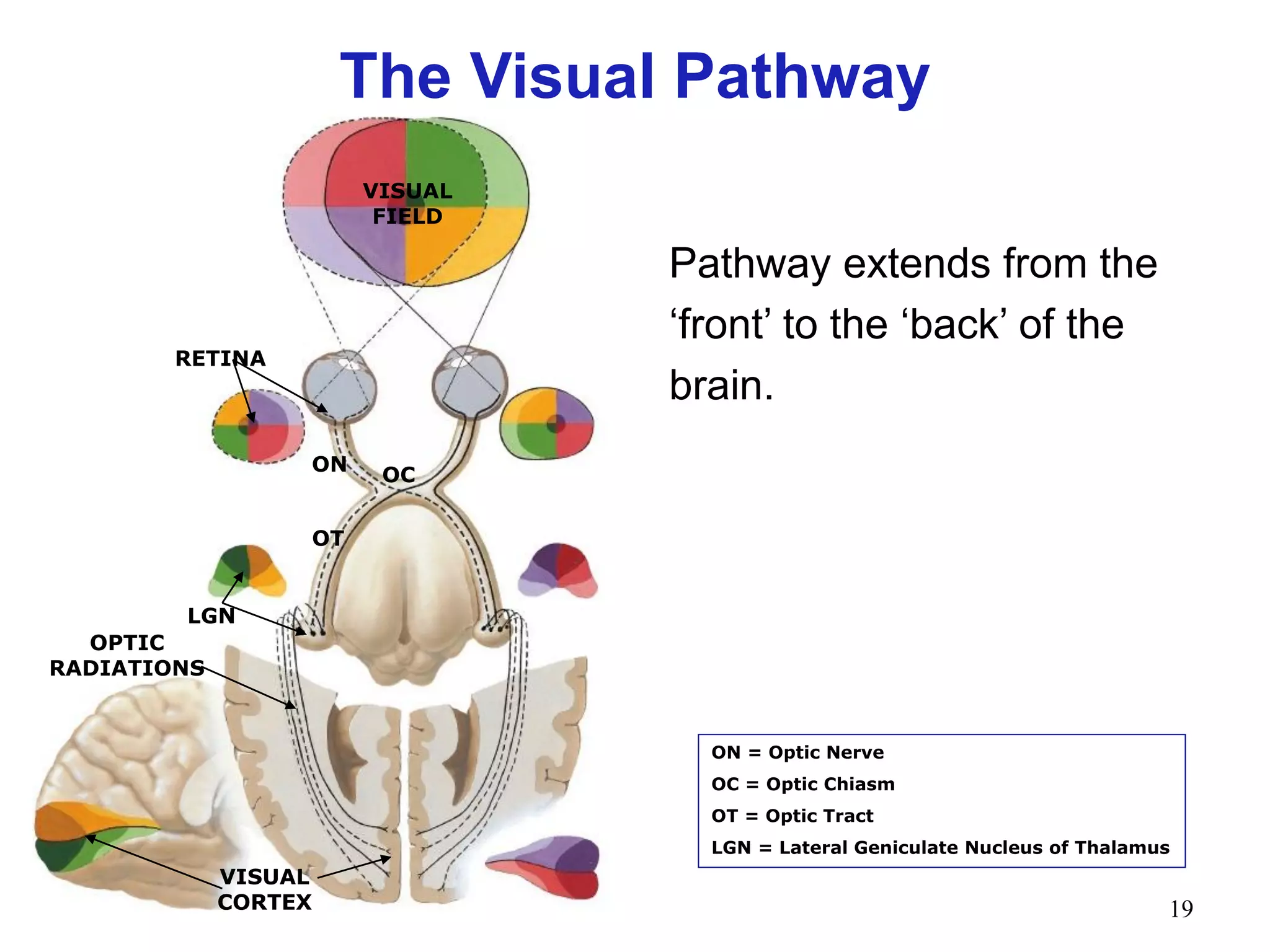
Pathway extends from the
„front‟ to the „back‟ of the
brain.
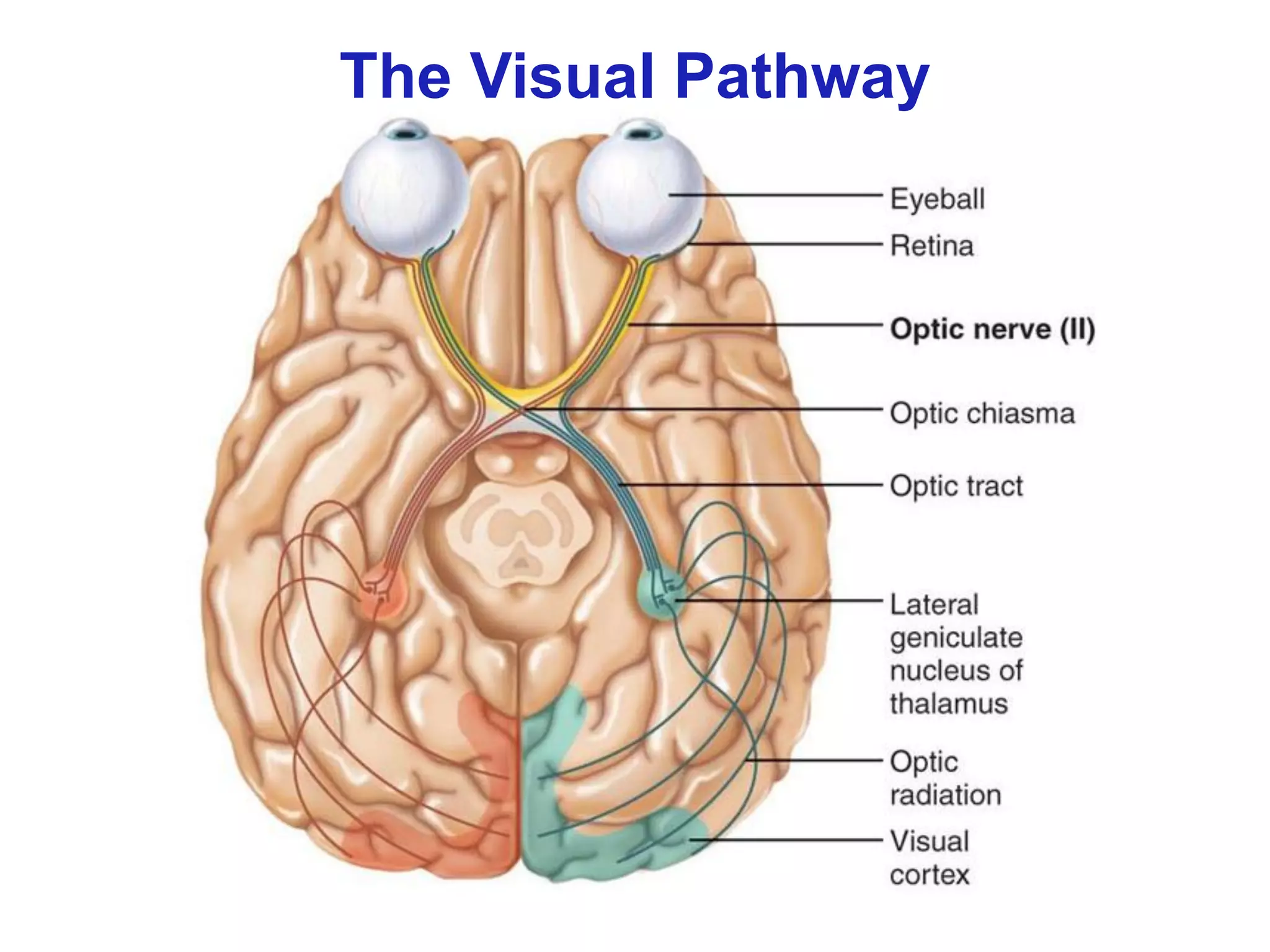
The Visual Pathway
OT
ON
OC
VISUAL
CORTEX
RETINA
VISUAL
FIELD
LGN
OPTIC
RADIATIONS
ON = Optic Nerve
OC = Optic Chiasm
OT = Optic Tract
LGN = Lateral Geniculate Nucleus of Thalamus
The Visual Pathway
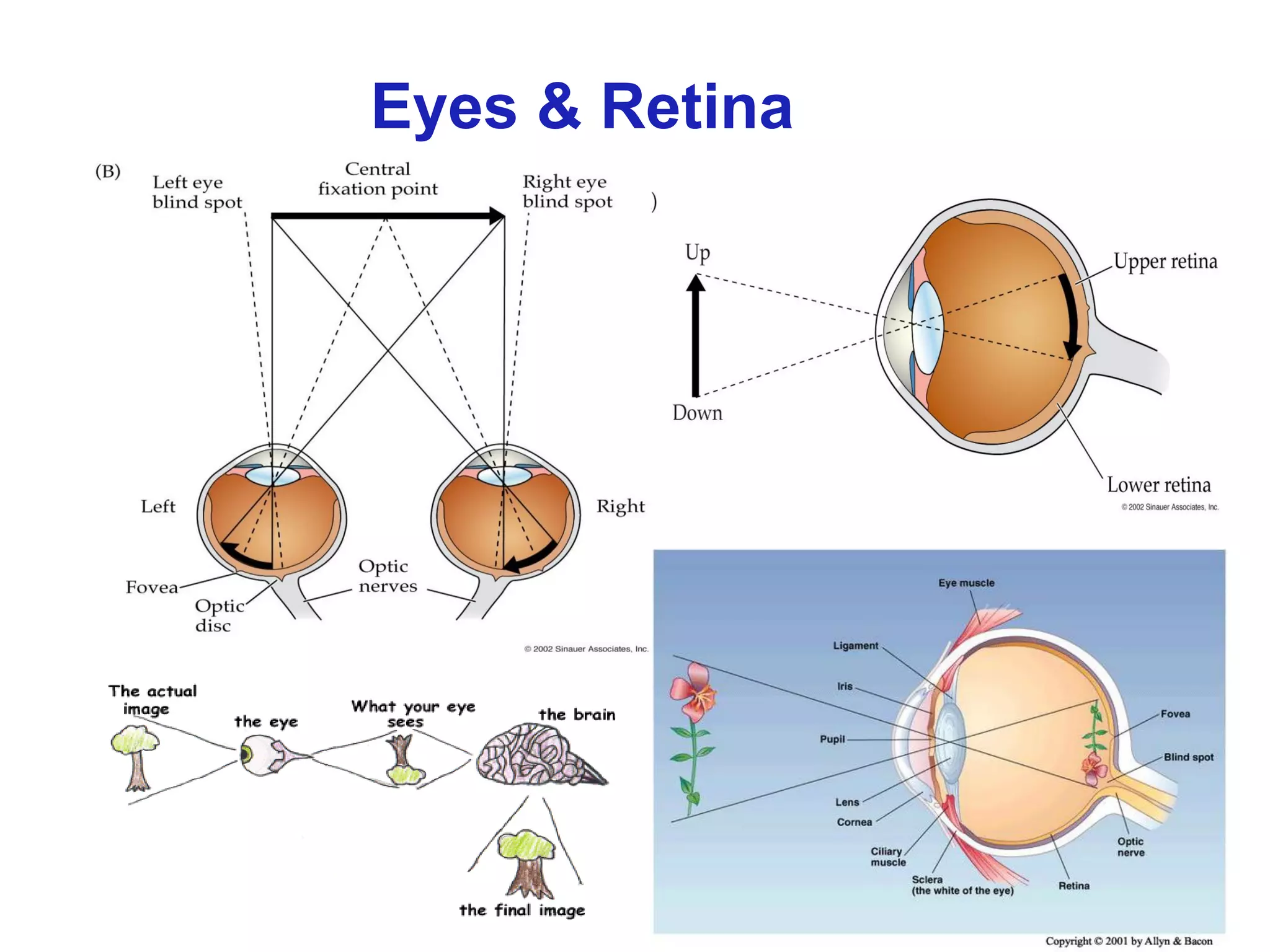
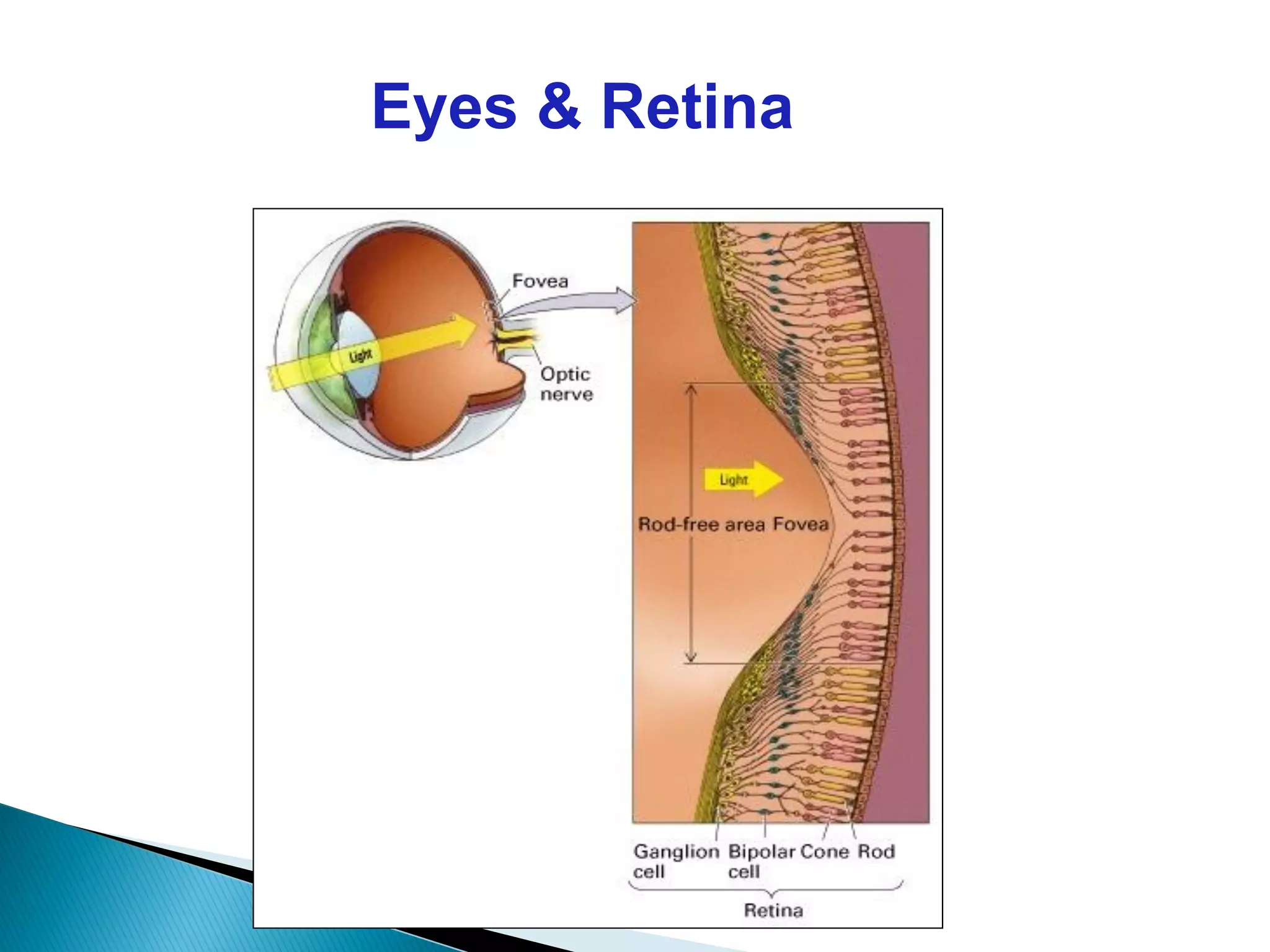
Eyes & Retina
Light >> lens >> retina (inverted and reversed image).
Eyes & Retina
• Macula: oval region
approximately 3-5
mm that surrounds
the fovea, also has
high visual acuity.
• Fovea: central
fixation point of
each eye// region
of the retina with
highest visual
acuity.
Eyes & Retina
Eyes & Retina
• Optic disc: region
where axons
leaving the retina
gather to form the
Optic nerve.
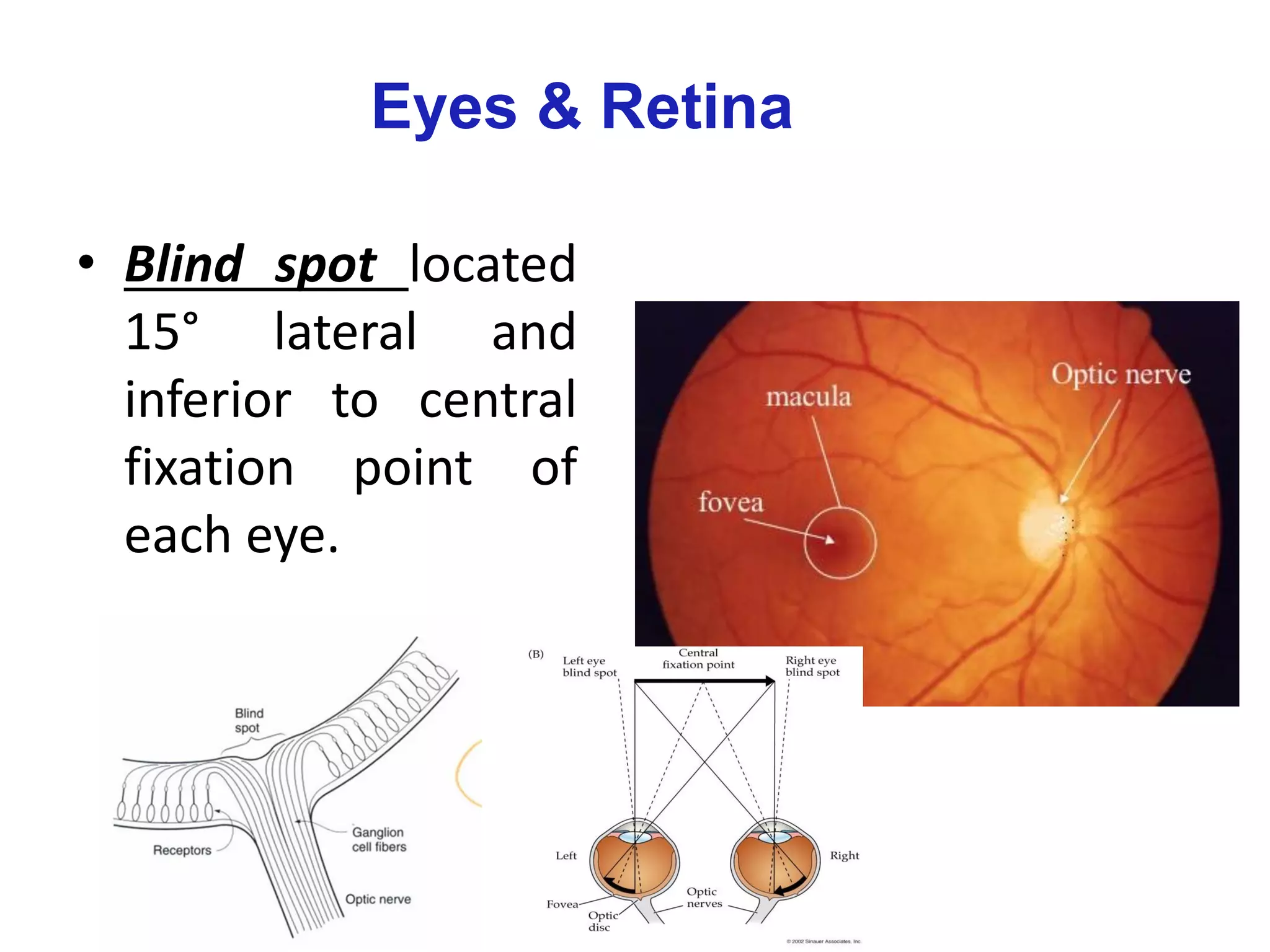
Eyes & Retina
• Blind spot located
15° lateral and
inferior to central
fixation point of
each eye.
11
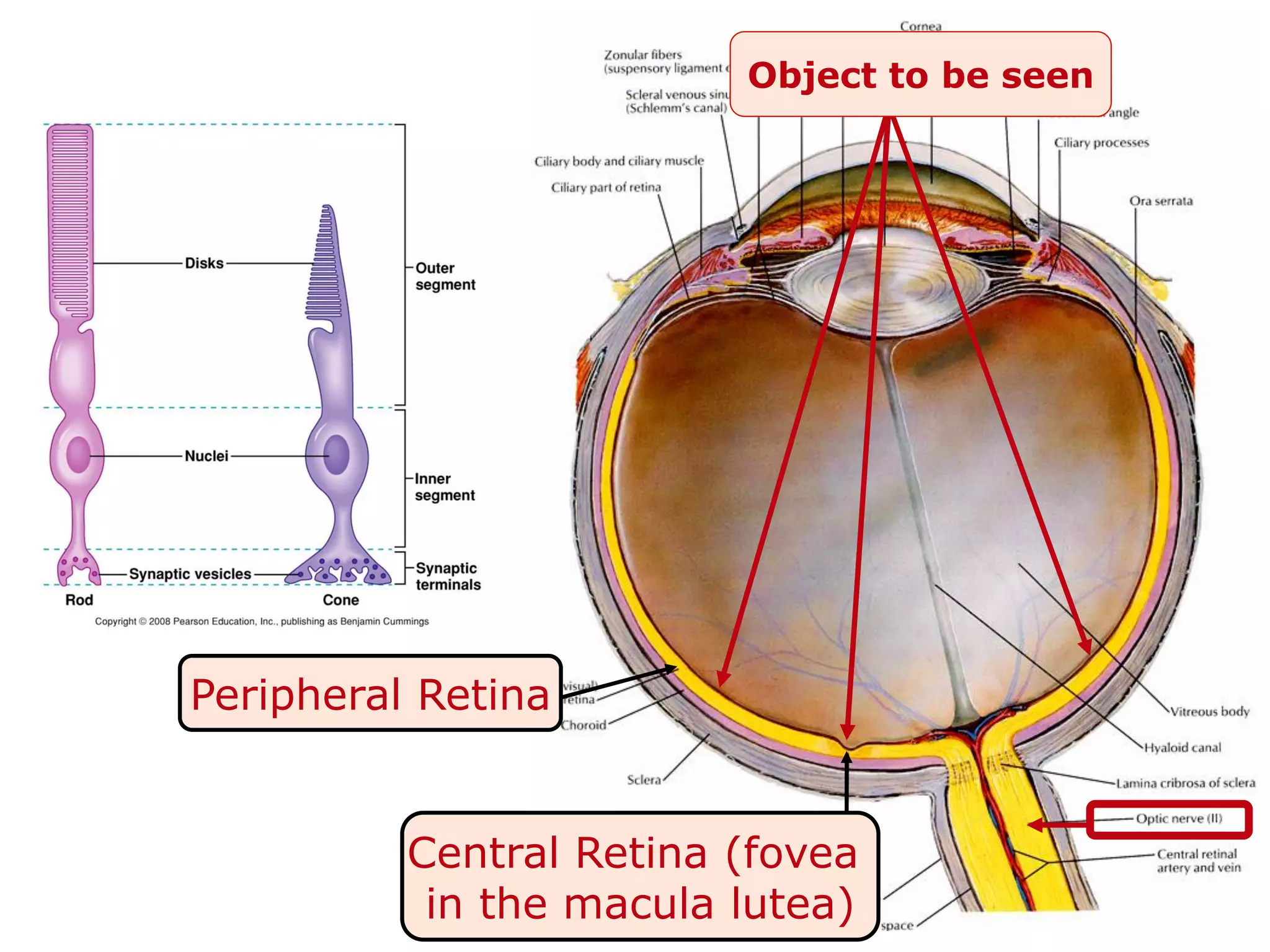
Object to be seen
Peripheral Retina
Central Retina (fovea
in the macula lutea)
© Stephen E. Palmer, 2002
Photoreceptors
© Stephen E. Palmer, 2002
Cones
• Cone-shaped
• Less sensitive
• Operate in high light
• Color vision
• Less numerous
• Highly represented in the
fovea >> have high spatial &
temporal resolution >> they
detect colors.
Photoreceptors
© Stephen E. Palmer, 2002
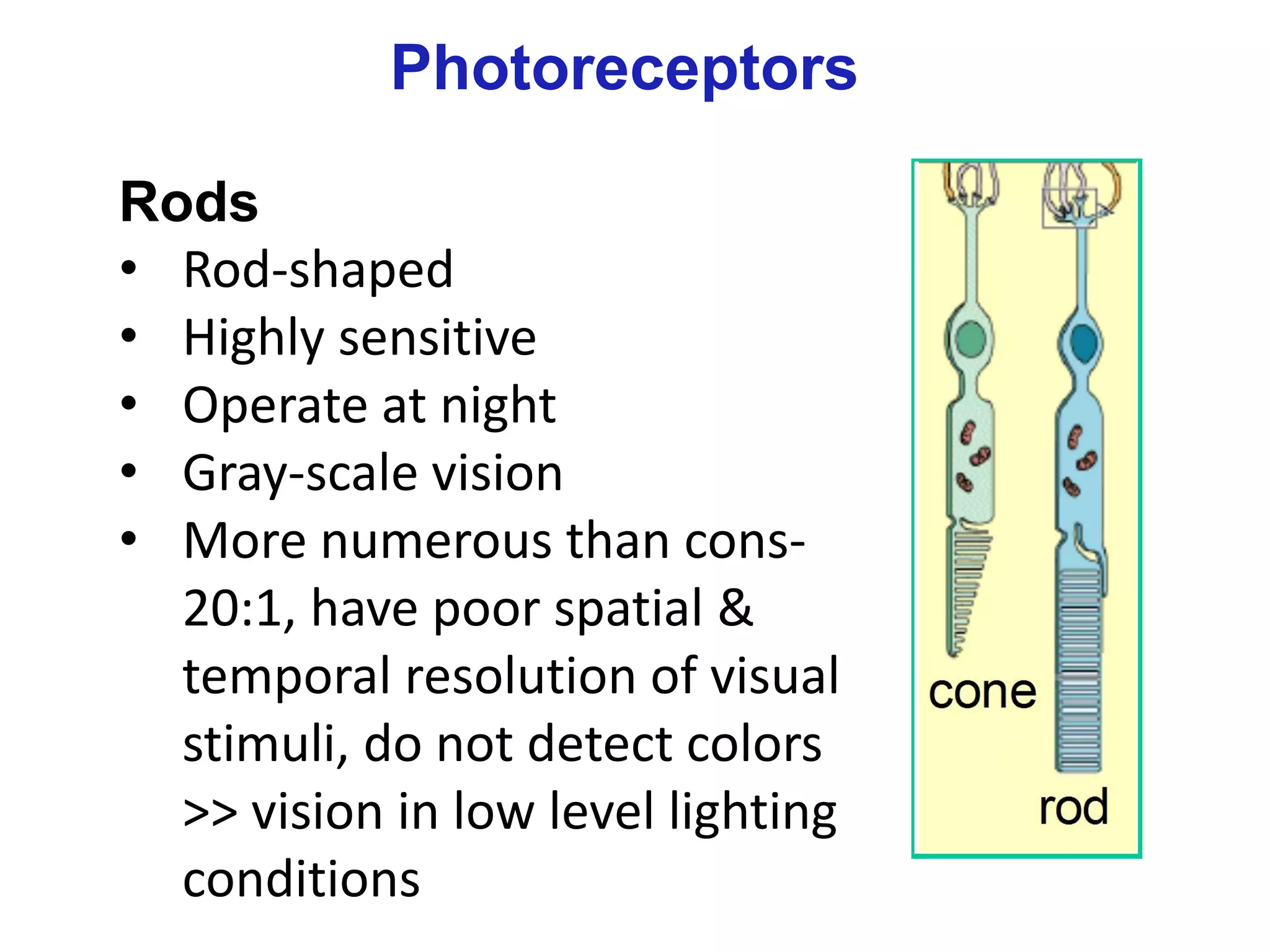
Rods
• Rod-shaped
• Highly sensitive
• Operate at night
• Gray-scale vision
• More numerous than cons-
20:1, have poor spatial &
temporal resolution of visual
stimuli, do not detect colors
>> vision in low level lighting
conditions
Photoreceptors
Retina up-close
Light
16
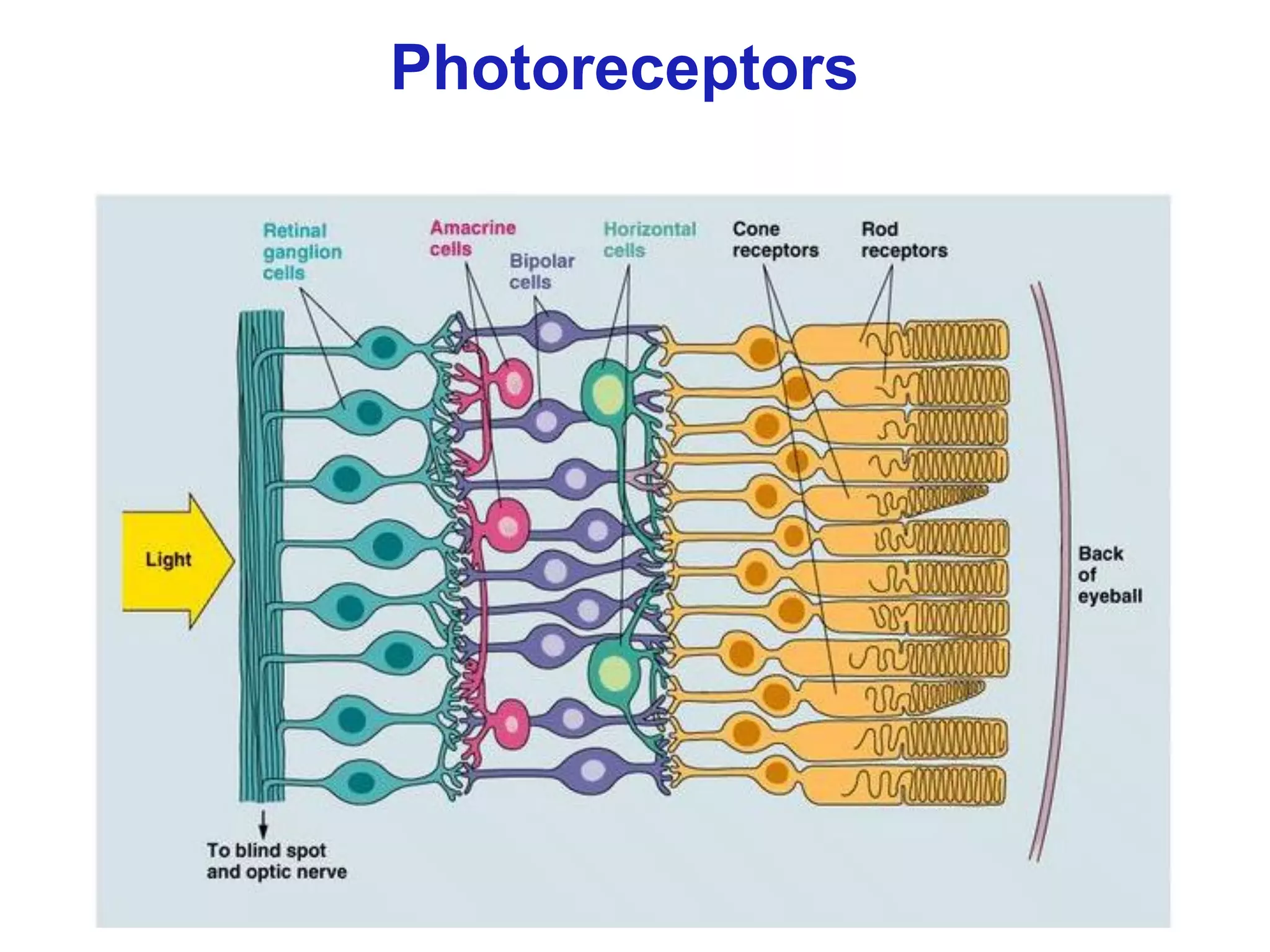
Rods and Cones
(Receptors)
Ganglion cells axons form the optic nerve
Bipolar cells
Photoreceptors
Photoreceptors
19
Pathway extends from the
„front‟ to the „back‟ of the
brain.
The Visual Pathway
OT
ON
OC
VISUAL
CORTEX
RETINA
VISUAL
FIELD
LGN
OPTIC
RADIATIONS
ON = Optic Nerve
OC = Optic Chiasm
OT = Optic Tract
LGN = Lateral Geniculate Nucleus of Thalamus
20
Retinal Quadrants
nose
UTQ UTQ
LTQ LTQLNQLNQ
UNQ UNQ
Right retina Left retina
Papilla (optic
nerve head)
Macula with
fovea centralis
Retina as you would see it through the
ophthalmoscope & the patient‟s pupil
Temporal Hemiretina
UTQ = upper temporal quadrant
LTQ = lower temporal quadrant
Nasal Hemiretina
UNQ = upper nasal quadrant
LNQ = lower nasal quadrant
Horizontal Meridian
Vertical Meridian
The blind spot in the Visual Field corresponds to the location of
the optic nerve head on the NASAL side of the retina.
21
Definition: The entire area that
can be “seen” by the patient
without movement of the head
and with the eyes fixed on a
single spot.
Monocular Visual Fields
Mapping of Visual Fields:
• Confrontational method
• Perimetry (Manual or
Automated)
Temporal Field of
Left Eye
Nasal Field of
Left Eye
F
Normal Monocular Visual
Field of Right Eye
Normal Monocular Visual
Field of Left Eye
F
Monocular Visual Fields:
• Each eye is tested separately.
• The monocular visual field is plotted with the Fovea (F) at the center.
• The monocular visual field (colored area -- blue for left; green for right in this example) is
not round.
• Horizontal and Vertical Meridians correspond to those of the retina and divide the visual
field into upper temporal, upper nasal, lower temporal and lower nasal quadrants.
Vertical
Meridian
Horizontal
Meridian
UpperFieldof
LeftEye
LowerFieldof
LeftEye
UTQ
LTQ
UNQ
LNQ
22
Blind Spot
• 15° to the temporal side
of the visual field of each
eye
• On the horizontal
meridian
• Corresponds to the
location of the optic
nerve head 15° to the
nasal side of the retina of
each eye.
Demonstration of the Blind Spot:
• Draw the star and box on a piece of paper.
• Close your left eye; Look at the star with your right eye; Move paper back and forth
until the green box disappears.
• Open your left eye and the box can be seen because even though it was falling on the
blind spot of the right eye, it is not falling on the blind spot of your left eye.
• With both eyes open & binocular vision intact, you don‟t realize that there is a blind
spot since the corresponding spot on the contralateral retina will see the object.
Temporal Field of
Left Eye
Nasal Field of
Left Eye
Normal Monocular Visual
Field of Left Eye
F F
Normal Monocular Visual
Field of Right Eye
UpperFieldofLeft
Eye
LowerFieldofLeft
Eye
Monocular Visual Fields
23
• Understand the difference
between the “monocular
visual field of the left eye”
vs. the “Left Visual Field”
• and vice versa for the right
counterparts.
Normal Binocular Visual Field
F
Right Visual FieldLeft Visual Field
Upper Fields
Lower Fields
Temporal Field of
Left Eye
Nasal Field of
Left Eye
Normal Monocular Visual
Field of Left Eye
F F
Normal Monocular Visual
Field of Right Eye
Binocular Visual
Fields
24
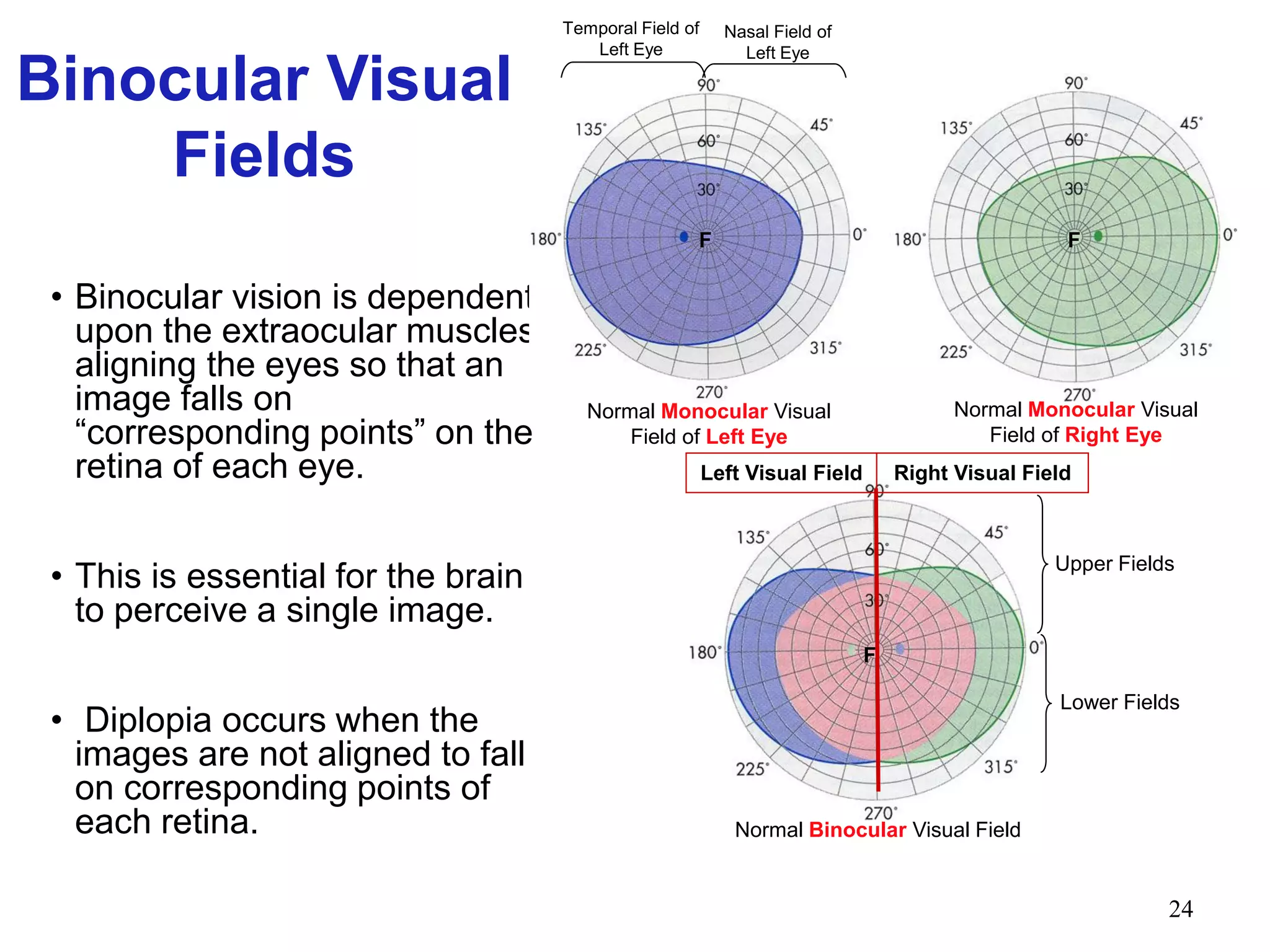
• Binocular vision is dependent
upon the extraocular muscles
aligning the eyes so that an
image falls on
“corresponding points” on the
retina of each eye.
• This is essential for the brain
to perceive a single image.
• Diplopia occurs when the
images are not aligned to fall
on corresponding points of
each retina. Normal Binocular Visual Field
F
Right Visual FieldLeft Visual Field
Upper Fields
Lower Fields
Temporal Field of
Left Eye
Nasal Field of
Left Eye
Normal Monocular Visual
Field of Left Eye
F F
Normal Monocular Visual
Field of Right Eye
Binocular Visual
Fields
25
Retina of Left Eye Retina of Right Eye
Binocular
Visual Field
Monocular Crescent of
Right Eye
Monocular Crescent of
Left Eye
The Visual Pathway
26
Visual Pathway
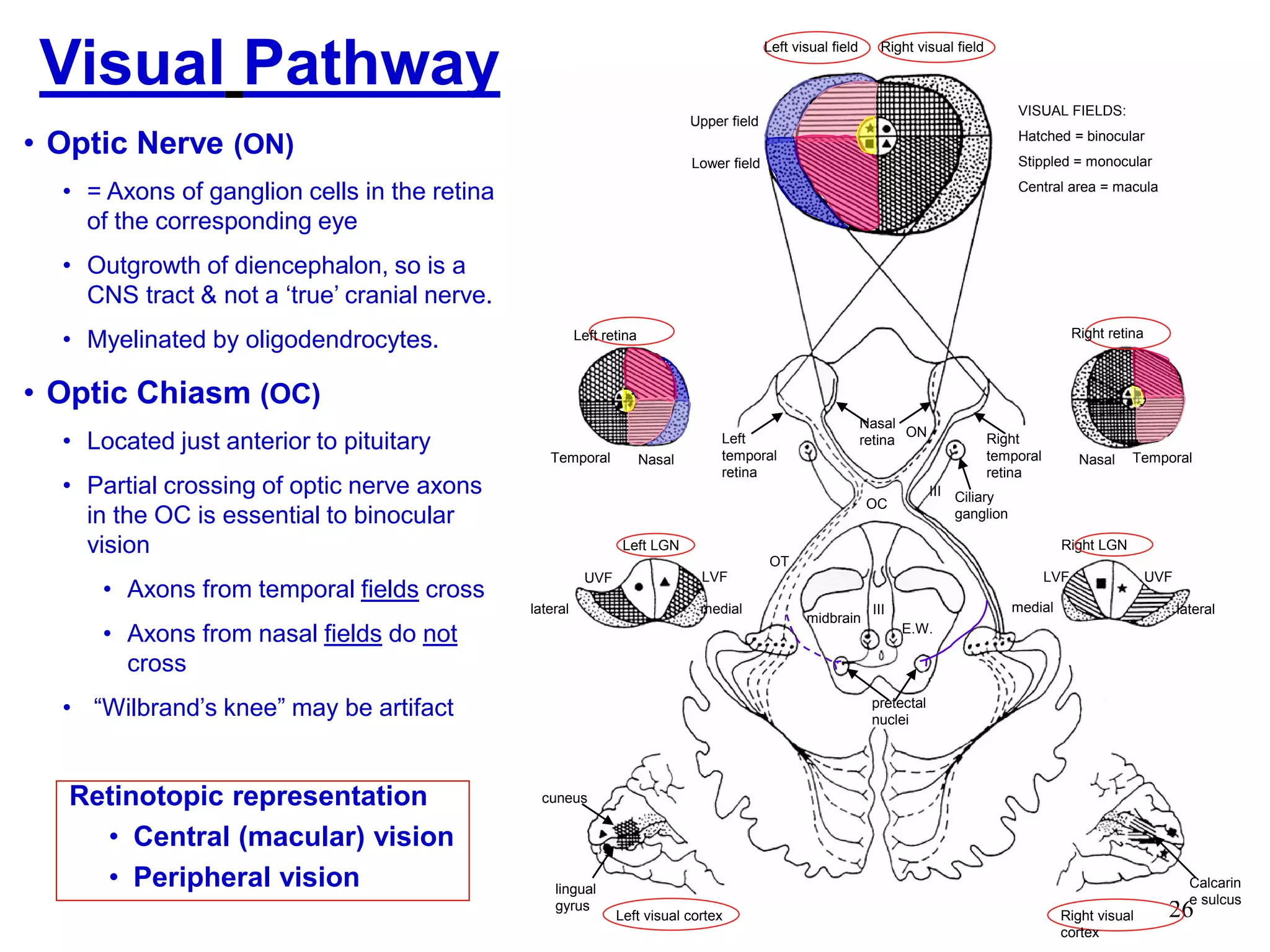
• Optic Nerve (ON)
• = Axons of ganglion cells in the retina
of the corresponding eye
• Outgrowth of diencephalon, so is a
CNS tract & not a „true‟ cranial nerve.
• Myelinated by oligodendrocytes.
• Optic Chiasm (OC)
• Located just anterior to pituitary
• Partial crossing of optic nerve axons
in the OC is essential to binocular
vision
• Axons from temporal fields cross
• Axons from nasal fields do not
cross
• “Wilbrand‟s knee” may be artifact
Retinotopic representation
• Central (macular) vision
• Peripheral vision
Left visual field Right visual field
Right retinaLeft retina
Left LGN
Temporal Nasal TemporalNasal
lateral lateralmedial medial
LVFLVF UVFUVF
E.W.
Right visual
cortex
midbrain
Right LGN
Left visual cortex
Left
temporal
retina
Right
temporal
retina
Nasal
retina
Ciliary
ganglion
pretectal
nuclei
cuneus
lingual
gyrus
Calcarin
e sulcus
III
III
Upper field
Lower field
VISUAL FIELDS:
Hatched = binocular
Stippled = monocular
Central area = macula
ON
OC
OT
27
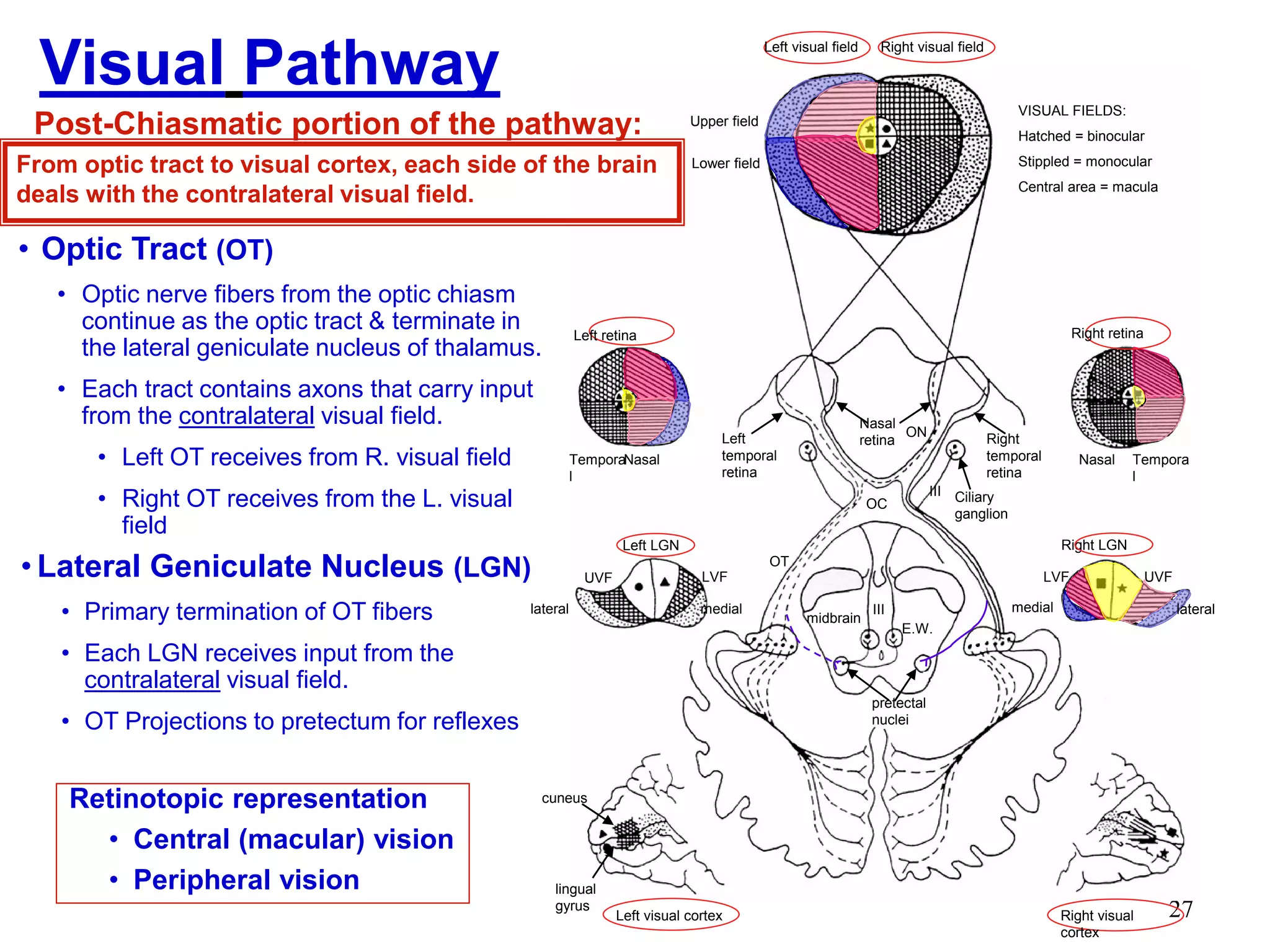
• Optic Tract (OT)
• Optic nerve fibers from the optic chiasm
continue as the optic tract & terminate in
the lateral geniculate nucleus of thalamus.
• Each tract contains axons that carry input
from the contralateral visual field.
• Left OT receives from R. visual field
• Right OT receives from the L. visual
field
Retinotopic representation
• Central (macular) vision
• Peripheral vision
Left visual field Right visual field
Right retinaLeft retina
Left LGN
Tempora
l
Nasal Tempora
l
Nasal
lateral lateralmedial medial
LVFLVF UVFUVF
E.W.
Right visual
cortex
midbrain
Right LGN
Left visual cortex
Left
temporal
retina
Right
temporal
retina
Nasal
retina
Ciliary
ganglion
pretectal
nuclei
cuneus
lingual
gyrus
III
III
Visual Pathway
Post-Chiasmatic portion of the pathway:
From optic tract to visual cortex, each side of the brain
deals with the contralateral visual field.
Upper field
Lower field
VISUAL FIELDS:
Hatched = binocular
Stippled = monocular
Central area = macula
ON
OC
OT
• Lateral Geniculate Nucleus (LGN)
• Primary termination of OT fibers
• Each LGN receives input from the
contralateral visual field.
• OT Projections to pretectum for reflexes
28
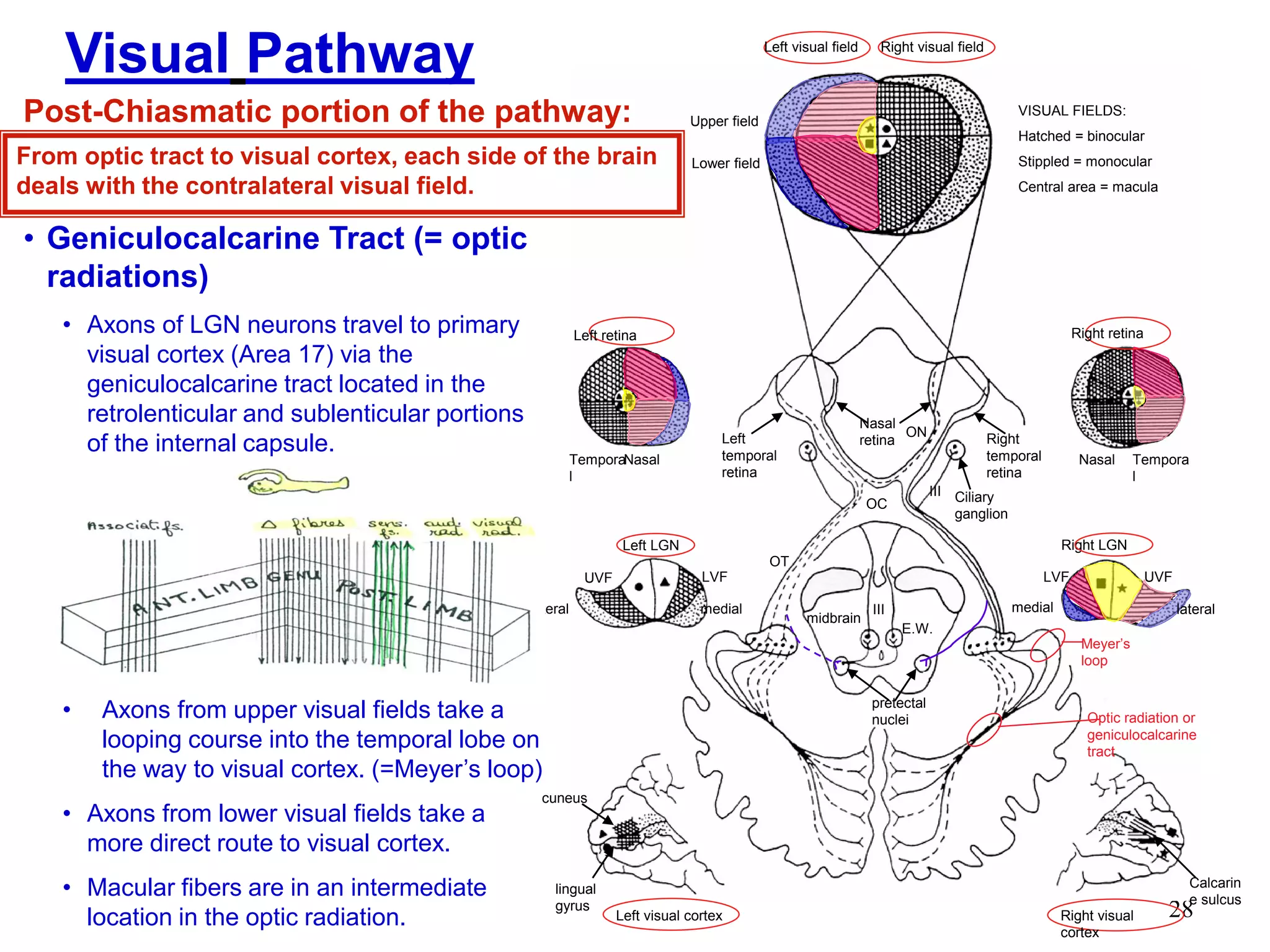
• Geniculocalcarine Tract (= optic
radiations)
• Axons of LGN neurons travel to primary
visual cortex (Area 17) via the
geniculocalcarine tract located in the
retrolenticular and sublenticular portions
of the internal capsule.
• Axons from upper visual fields take a
looping course into the temporal lobe on
the way to visual cortex. (=Meyer‟s loop)
• Axons from lower visual fields take a
more direct route to visual cortex.
• Macular fibers are in an intermediate
location in the optic radiation.
Left visual field Right visual field
Right retinaLeft retina
Left LGN
Tempora
l
Nasal Tempora
l
Nasal
lateral lateralmedial medial
LVFLVF UVFUVF
E.W.
Right visual
cortex
midbrain
Right LGN
Left visual cortex
Left
temporal
retina
Right
temporal
retina
Nasal
retina
Ciliary
ganglion
pretectal
nuclei
cuneus
lingual
gyrus
Calcarin
e sulcus
III
III
Meyer‟s
loop
Optic radiation or
geniculocalcarine
tract
Visual Pathway
Post-Chiasmatic portion of the pathway:
From optic tract to visual cortex, each side of the brain
deals with the contralateral visual field.
Upper field
Lower field
VISUAL FIELDS:
Hatched = binocular
Stippled = monocular
Central area = macula
ON
OC
OT
29
Visual Pathway
Retinotopic representation
• Central (macular) vision
• Peripheral vision
Left visual field Right visual field
Right retinaLeft retina
Left LGN
Tempora
l
Nasal Tempora
l
Nasal
lateral lateralmedial medial
LVFLVF UVFUVF
E.W.
Right visual cortex
midbrain
Right LGN
Left visual cortex
Left
temporal
retina
Right
temporal
retina
Nasal
retina
Ciliary
ganglion
pretectal
nuclei
cuneus
lingual
gyrus
Calcarin
e sulcus
III
III
Meyer‟s
loop
Optic radiation or
geniculocalcarine
tract
Upper field
Lower field
VISUAL FIELDS:
Hatched = binocular
Stippled = monocular
Central area = macula
ON
OC
OT
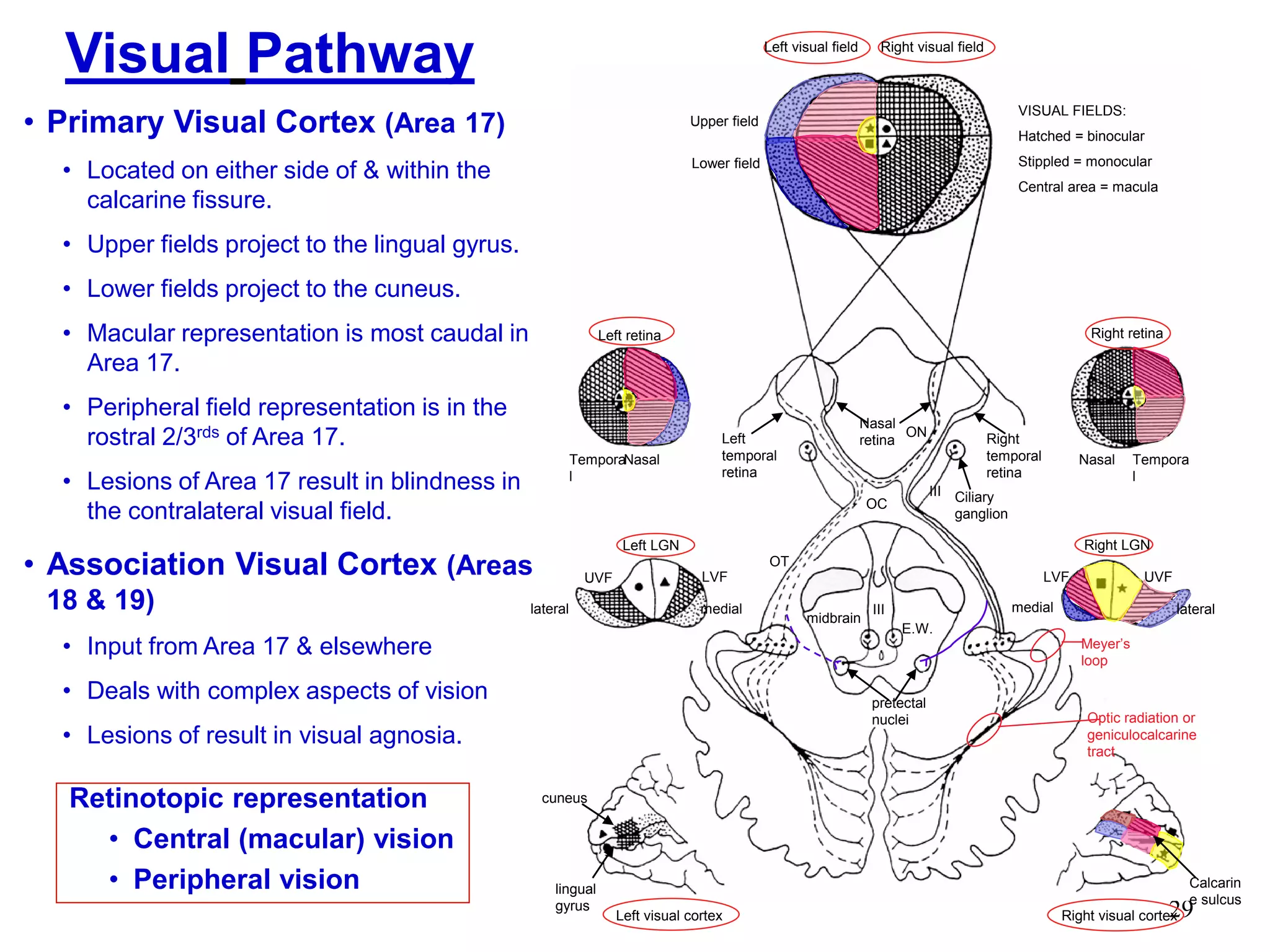
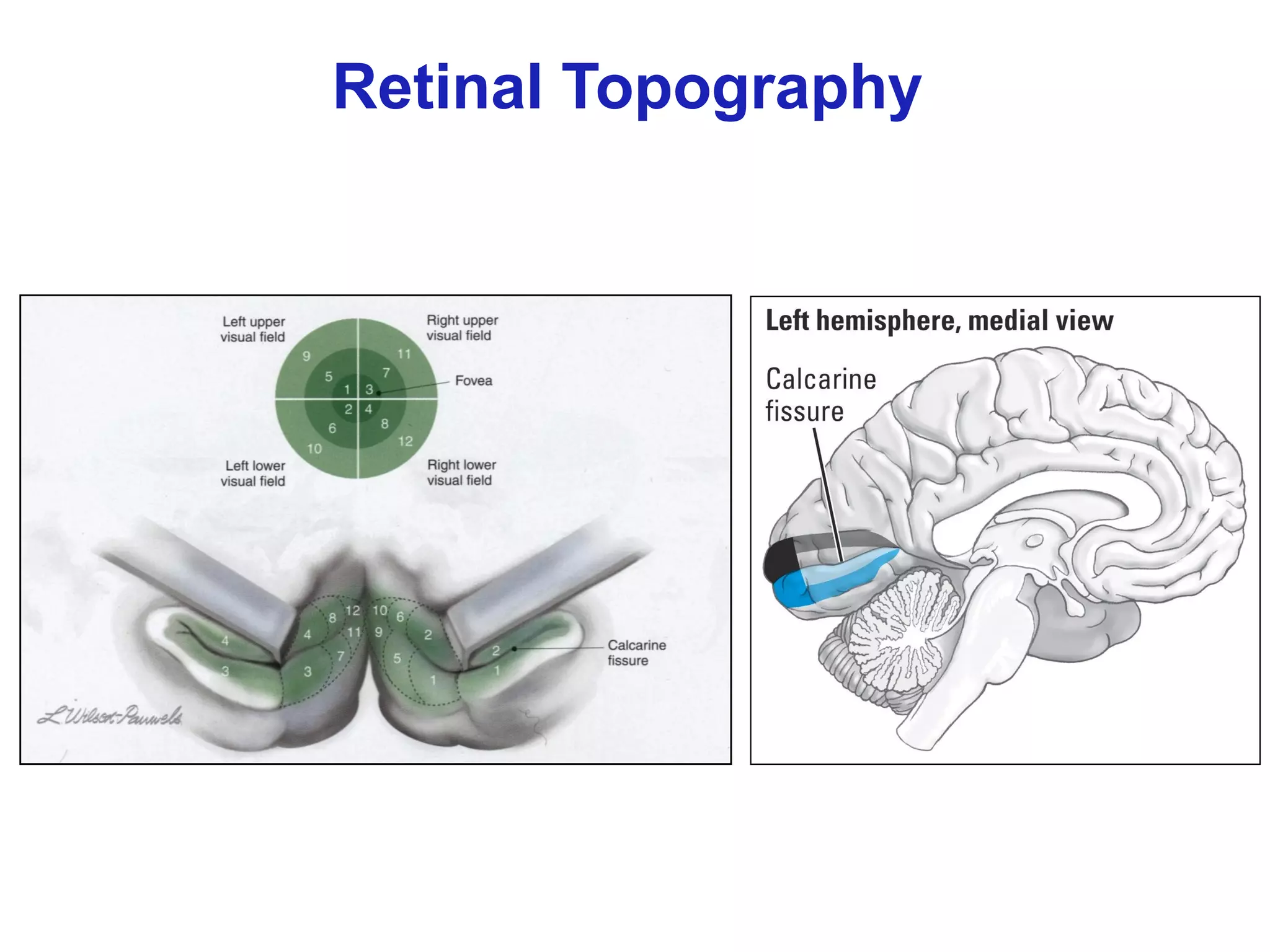
• Primary Visual Cortex (Area 17)
• Located on either side of & within the
calcarine fissure.
• Upper fields project to the lingual gyrus.
• Lower fields project to the cuneus.
• Macular representation is most caudal in
Area 17.
• Peripheral field representation is in the
rostral 2/3rds of Area 17.
• Lesions of Area 17 result in blindness in
the contralateral visual field.
• Association Visual Cortex (Areas
18 & 19)
• Input from Area 17 & elsewhere
• Deals with complex aspects of vision
• Lesions of result in visual agnosia.
Form Eye to the CNS
Form Eye to the CNS
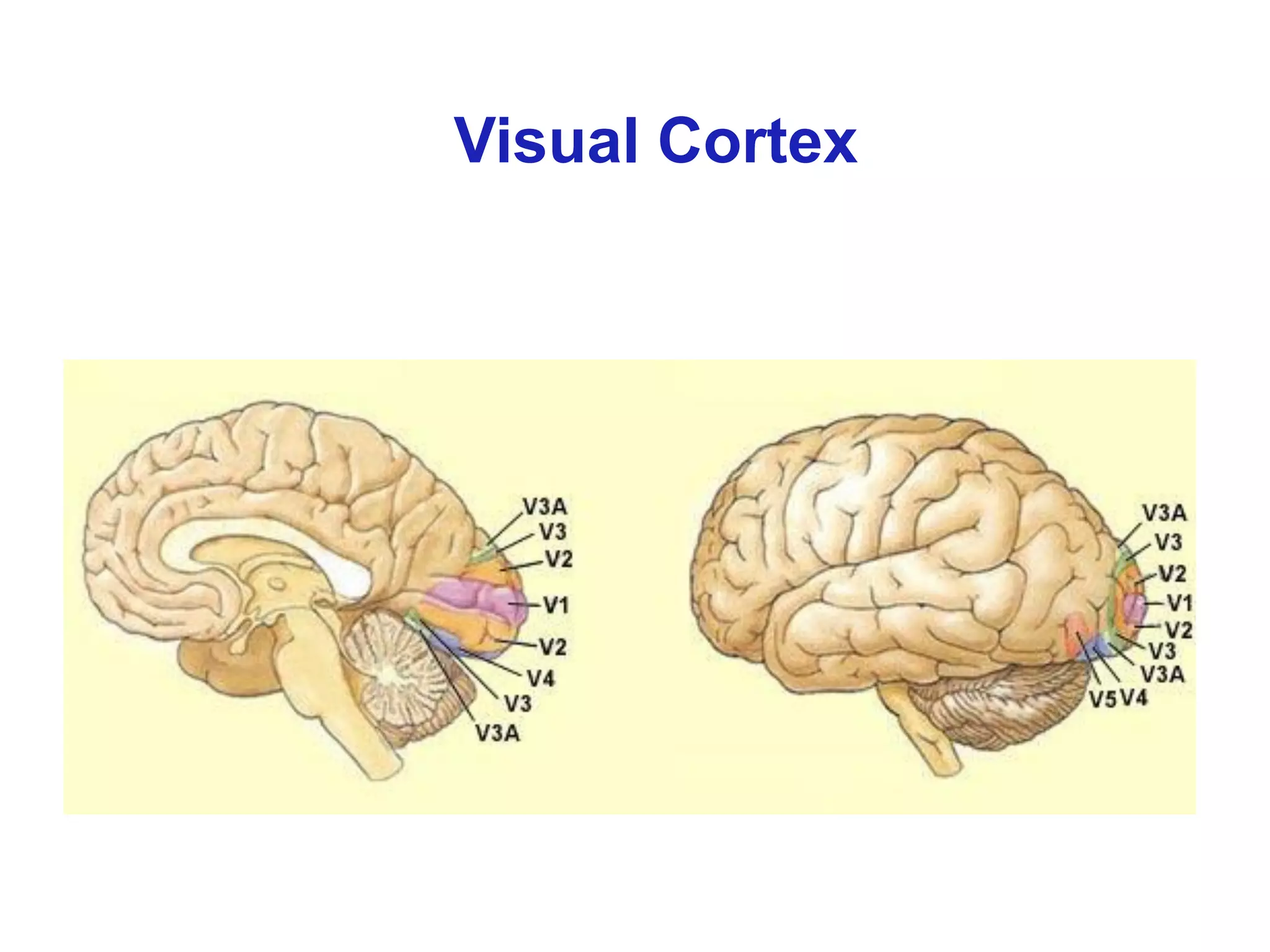
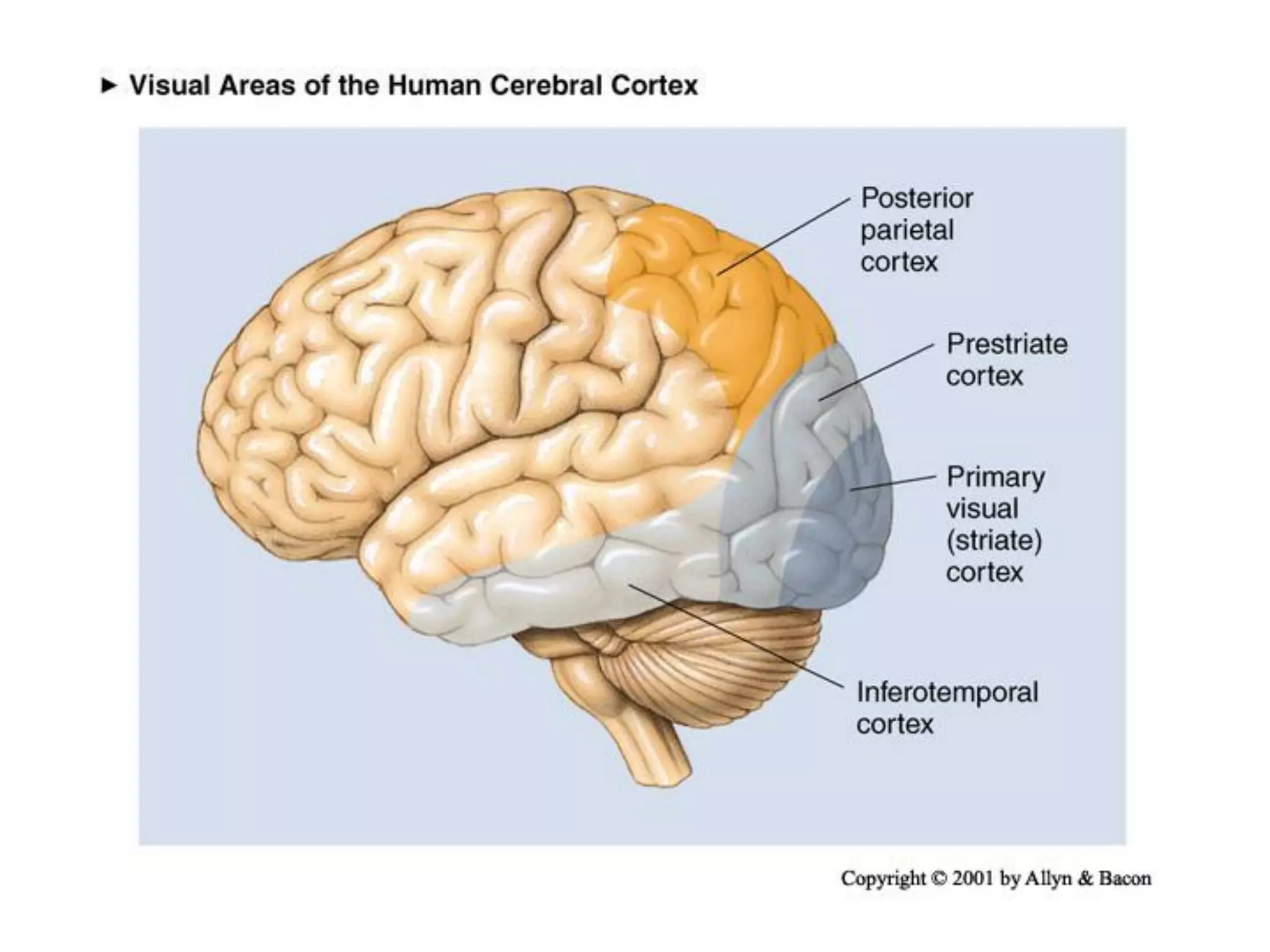
• Different names for primary visual
cortex:
• Brodmann’s area 17
• V1
• primary visual cortex
• striate cortex (“striped” cortex)
Visual Cortex – Primary Visual
Cortex
Retinal Topography
Visual Cortex
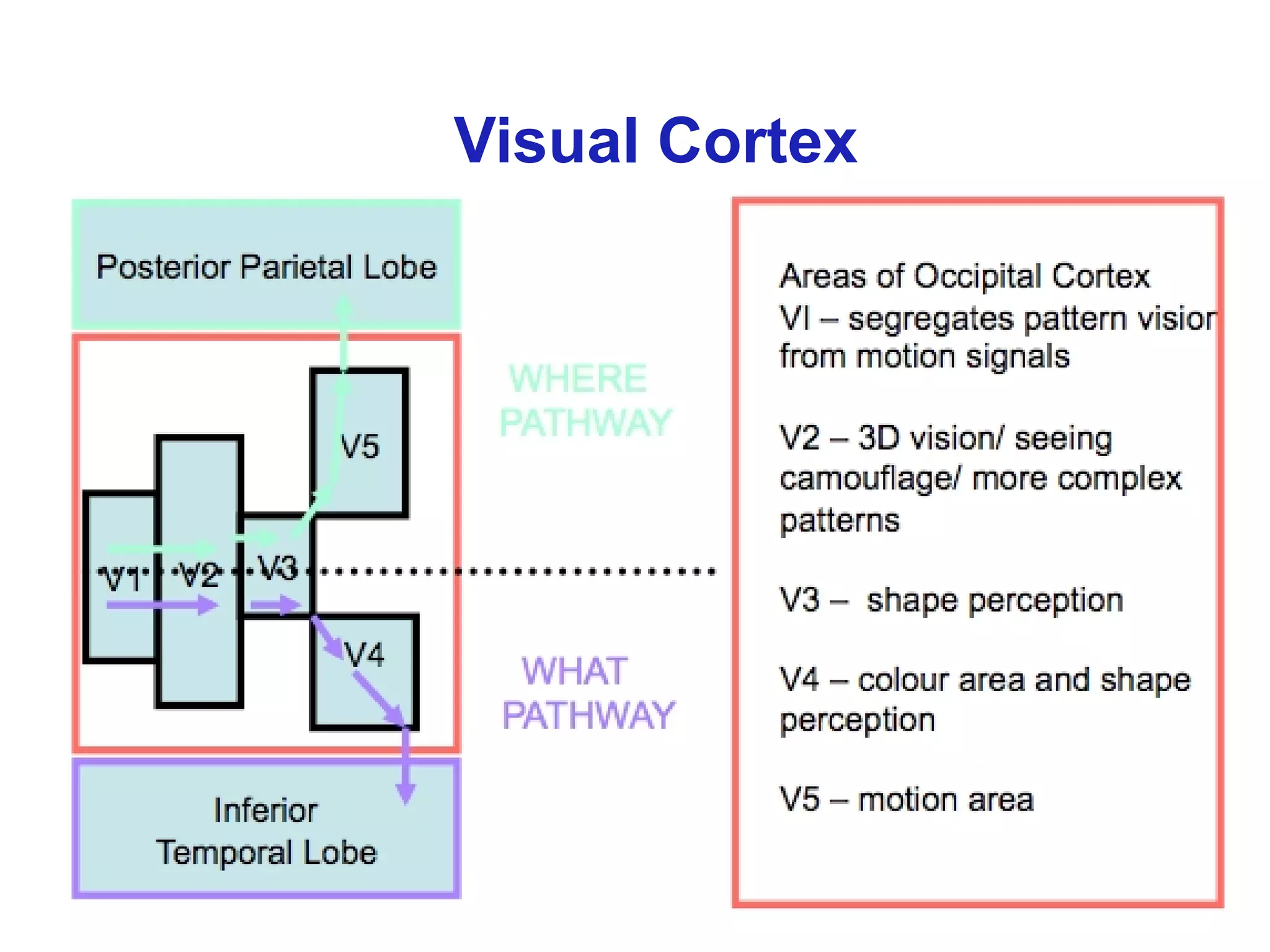
• Cells in area MT or V5
respond to movement
but not color
• For example, this
particular neuron in this
monkey’s V5 area
responds best when
stimulus moved down
and to the left
Visual Cortex: Area MT or V5
MOTION
Visual Cortex:Area V4
COLOUR
Visual Cortex
Visual Cortex
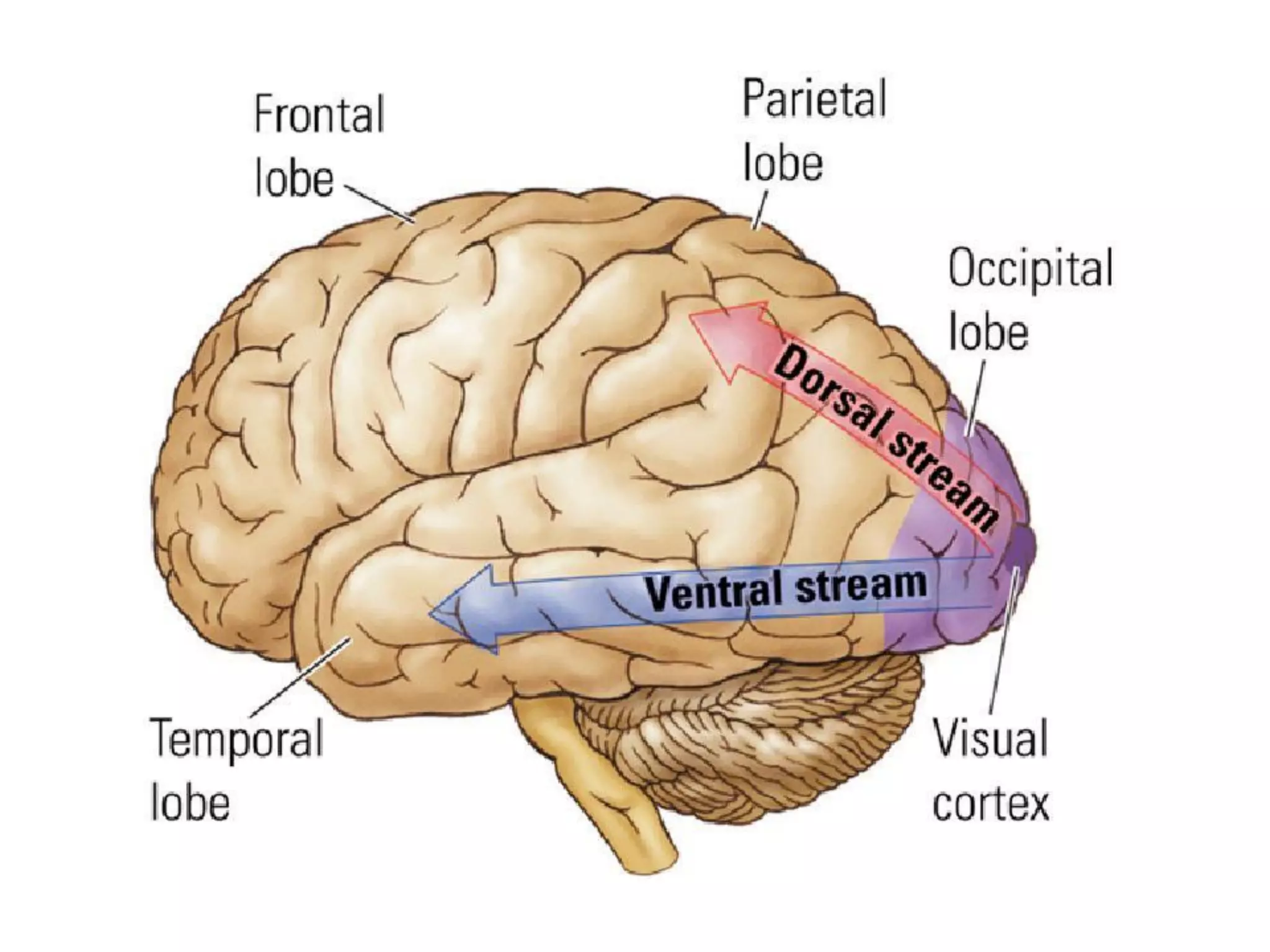
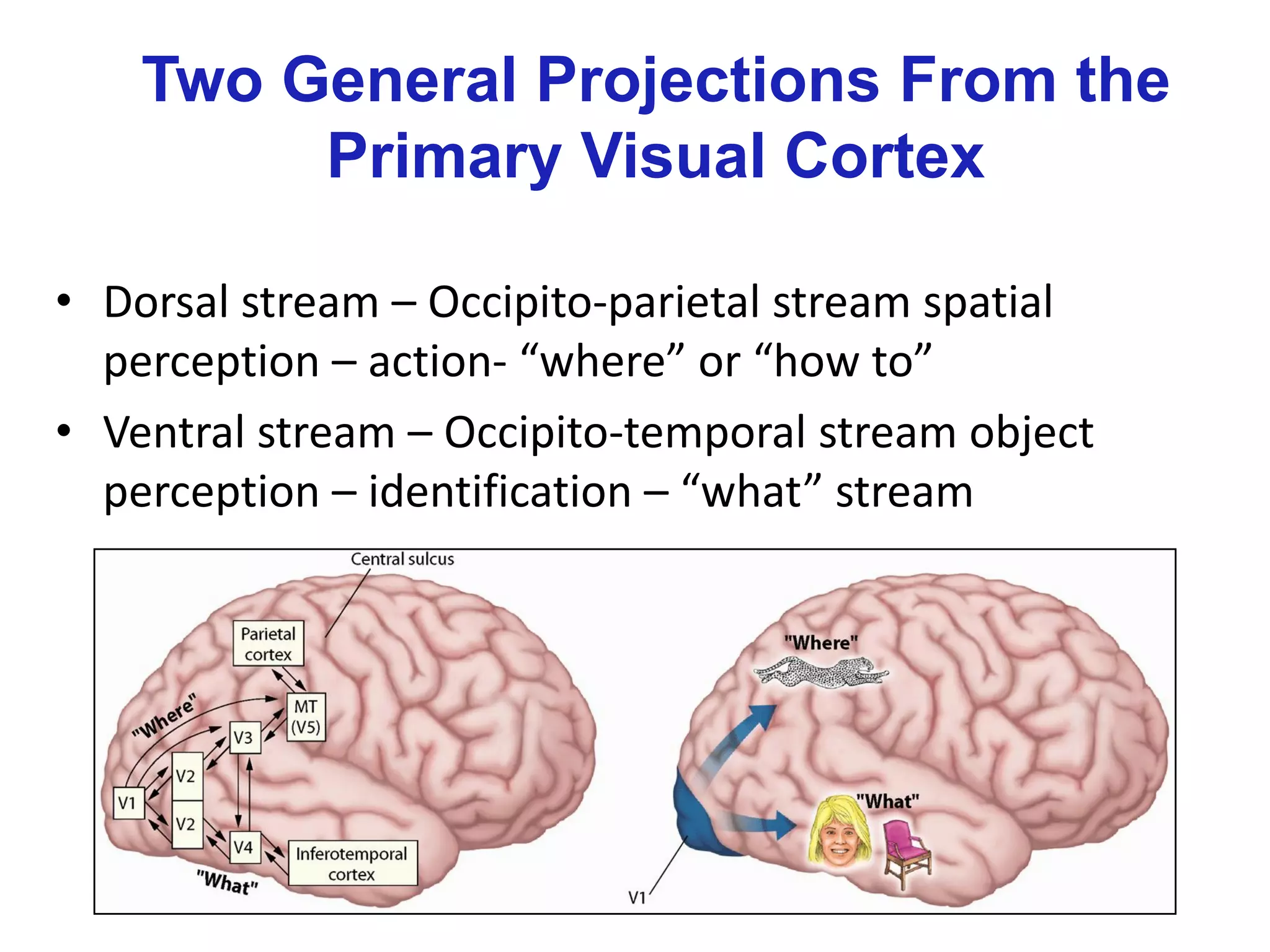
Two General Projections From the
Primary Visual Cortex
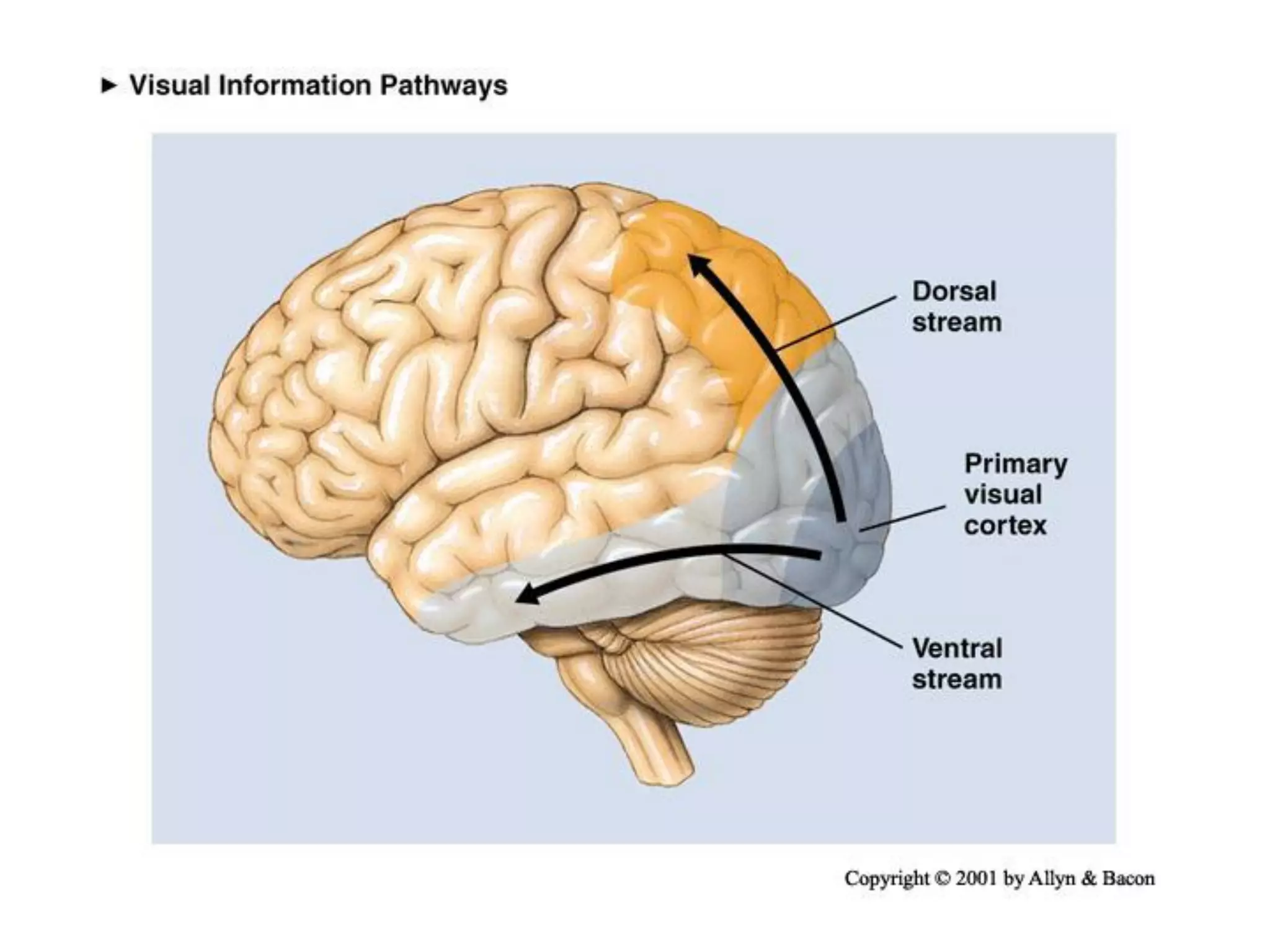
• Dorsal stream – Occipito-parietal stream spatial
perception – action- “where” or “how to”
• Ventral stream – Occipito-temporal stream object
perception – identification – “what” stream
Agenda
43
• Anatomy of visual pathway
• Visual pathway disorders
• Quiz
Agenda
44
• Anatomy of visual pathway
• Visual pathway disorders
• Quiz
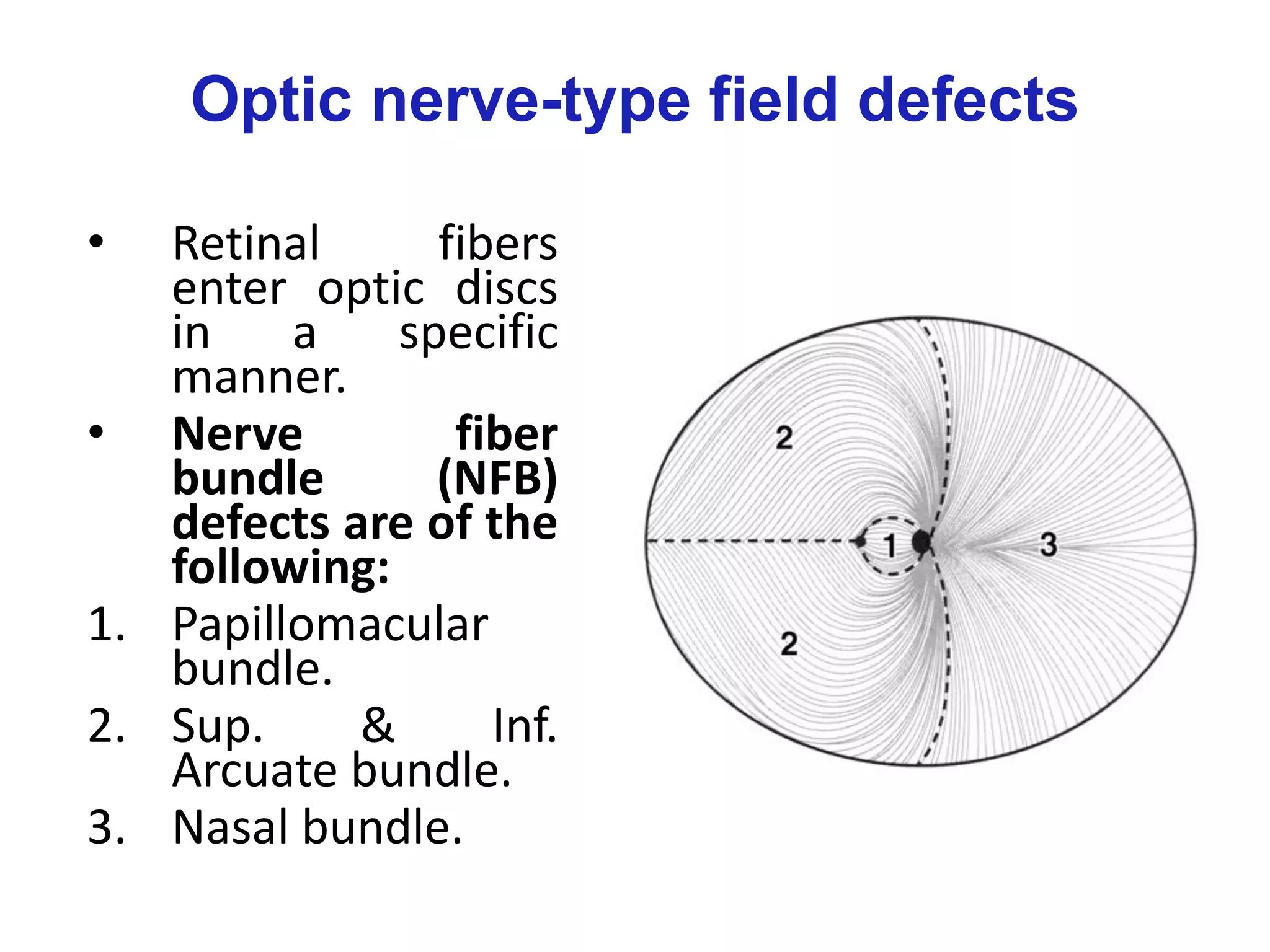
Optic nerve-type field defects
• Retinal fibers
enter optic discs
in a specific
manner.
• Nerve fiber
bundle (NFB)
defects are of the
following:
1. Papillomacular
bundle.
2. Sup. & Inf.
Arcuate bundle.
3. Nasal bundle.
Papillomacular Bundle
• Macular fibers that enter the temporal
aspect of the disc.
• Defect, result in the following:
1. Central scotoma: defect covering central
fixation.
2. Centrocecal scotoma: a central scotoma
conneted to the blind spot.
3. Paracentral scotoma: defect of some of the
fibers of the papillomacular bundle lying
next to, but not involving central fixation.
Papillomacular bundle-defects
48
Lesions of the Visual Pathway
1. Normal visual fields
2. Blindness of the right eye
3. Blindness of right eye + contralateral left upper
quadrantanopia
4. Bitemporal heteronymous hemianopsia
5. Left homonymous hemianopsia
6. Left upper homonymous quadrantanopsia
7. Left homonymous hemianopsia with macular
sparing
RightLeft
Definitions
Strabismus
Diplopia
Amblyopia
Scotoma
Quadrantanopsia - # 3, 6
Hemianopsia - # 4, 5, 7
Heteronymous Defects - # 3, 4
Homonymous Defects - # 5, 6, 7
Congruous Defects - # 5, 6, 7
Incongruous Defects - # 3
Altitudinal Defects - # 6
Masked area = area
of visual loss
Aka
“field
cuts”
Fields, not
retinal
quadrants
49
Lesions of the Visual Pathway
1. Normal visual fields
2. Blindness of the right eye
3. Blindness of right eye + contralateral left upper
quadrantanopia
4. Bitemporal heteronymous hemianopsia
5. Left homonymous hemianopsia
6. Left upper homonymous quadrantanopsia
7. Left homonymous hemianopsia with macular
sparing
RightLeft
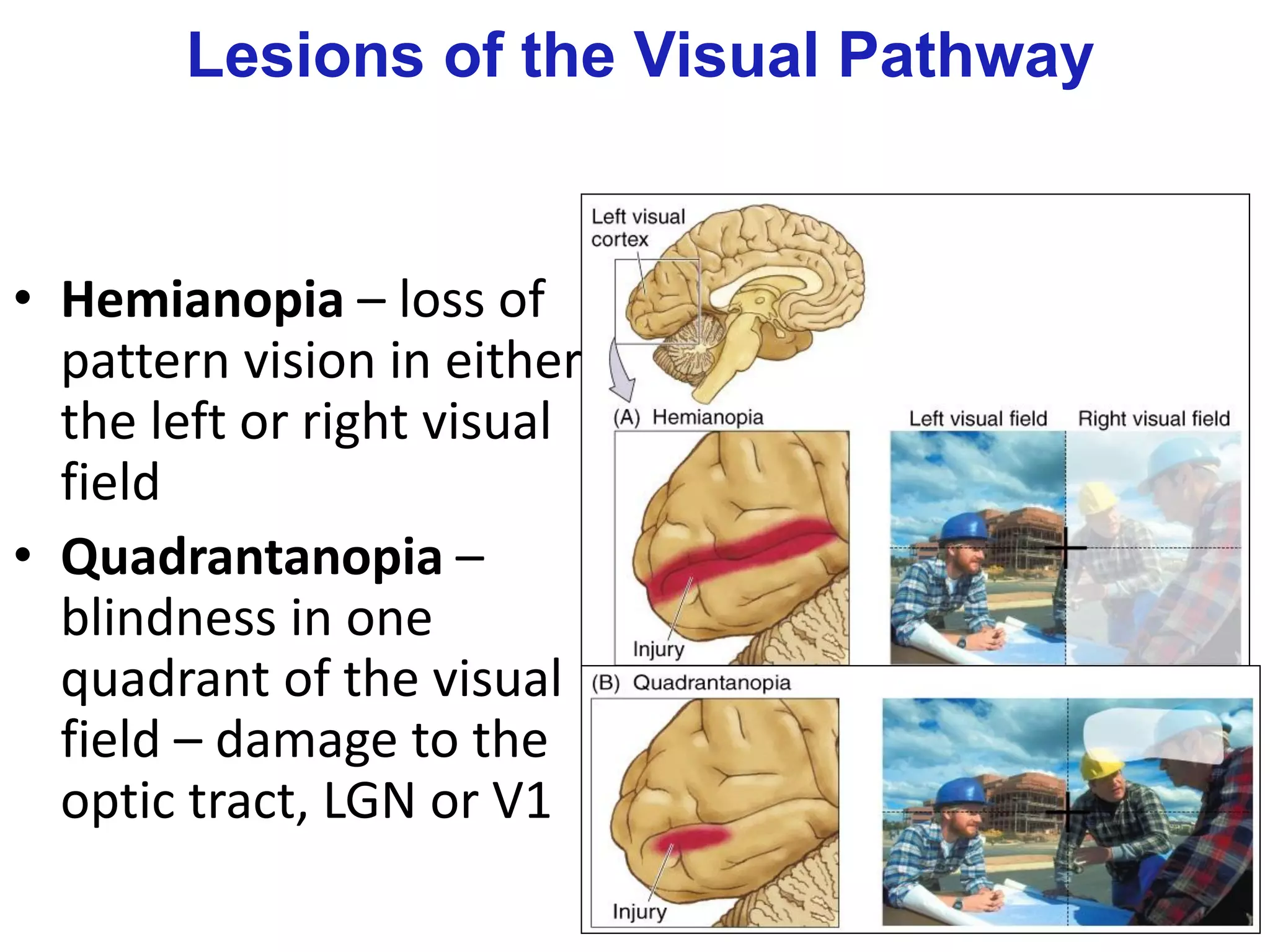
• Hemianopia – loss of
pattern vision in either
the left or right visual
field
• Quadrantanopia –
blindness in one
quadrant of the visual
field – damage to the
optic tract, LGN or V1
Lesions of the Visual Pathway
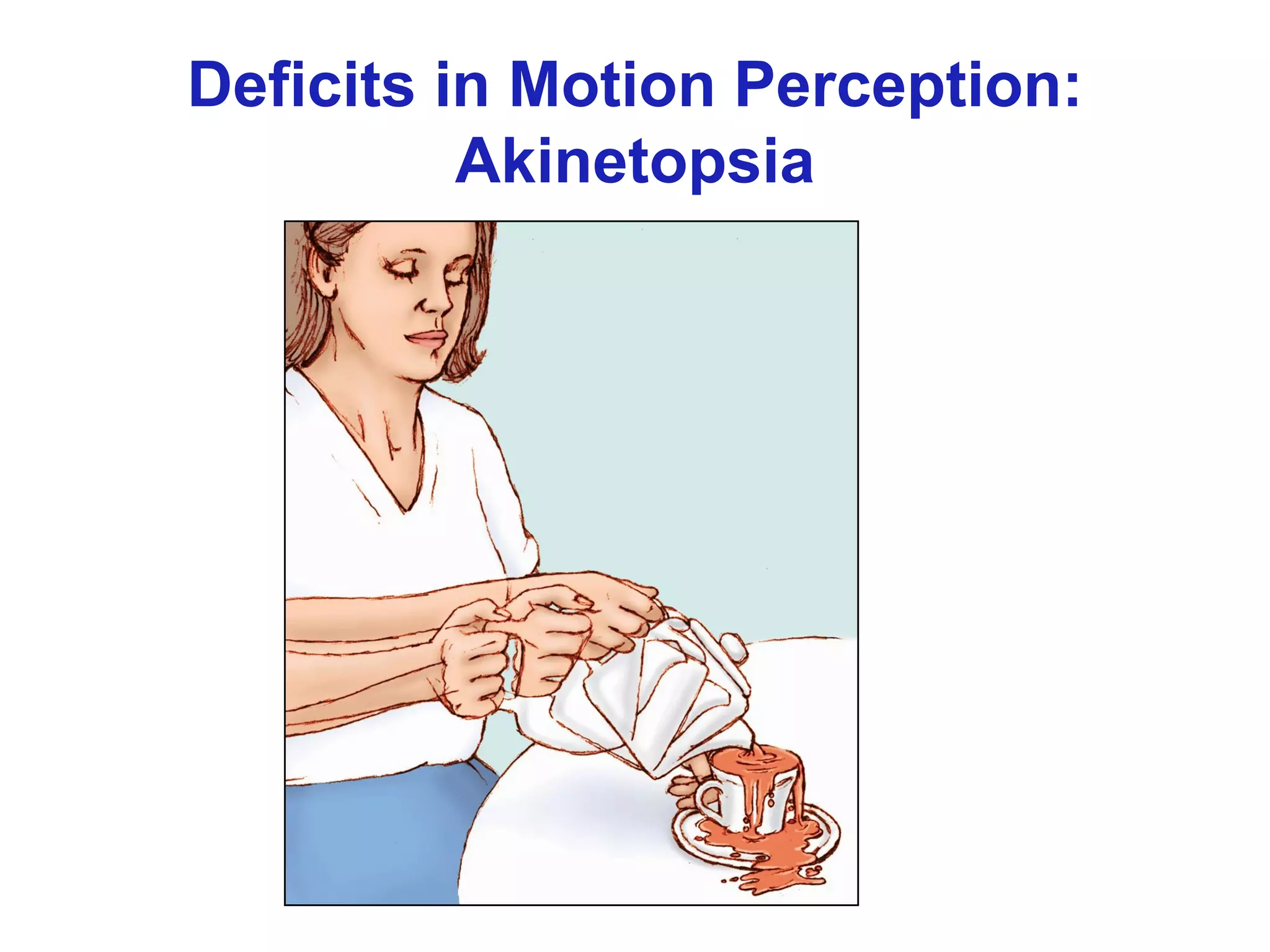
Deficits in Motion Perception:
Akinetopsia
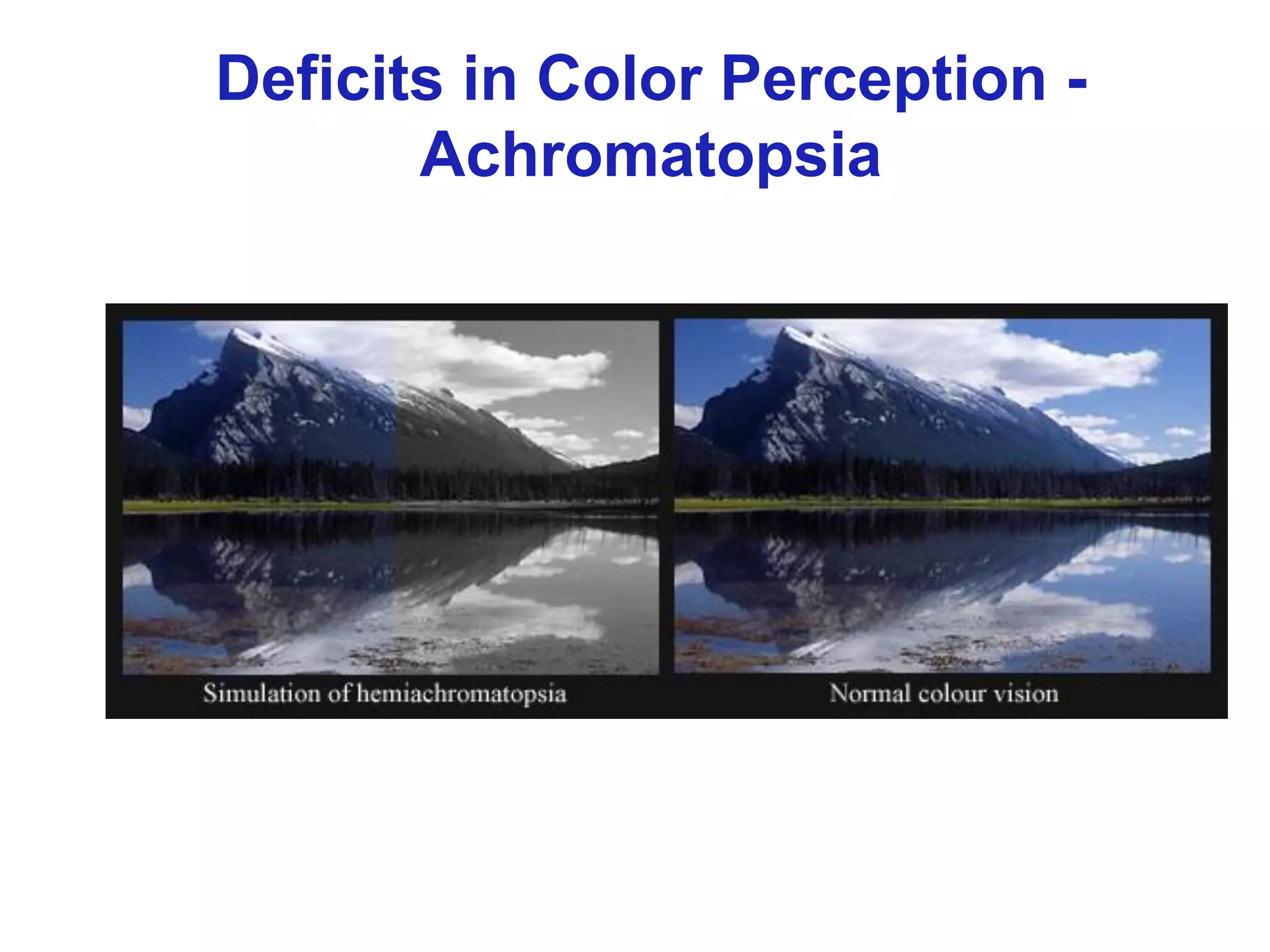
Deficits in Color Perception -
Achromatopsia
• Congenital colorblindness (dichromats)
vs. acquired colorblindness
• Usually associated with damage to V4
• Object recognition OK
Deficits in Color Perception -
Achromatopsia
Deficits Following Damage to the
WHAT Pathway
• Visual agnosia – partial or total inability
to recognize visual stimuli,
unexplainable by a defect in elementary
sensation or reduced level of alertness
or memory
Agenda
57
• Anatomy of visual pathway
• Visual pathway disorders
• Quiz
Agenda
58
• Anatomy of visual pathway
• Visual pathway disorders
• Quiz
Describe the visual field defect ?
1
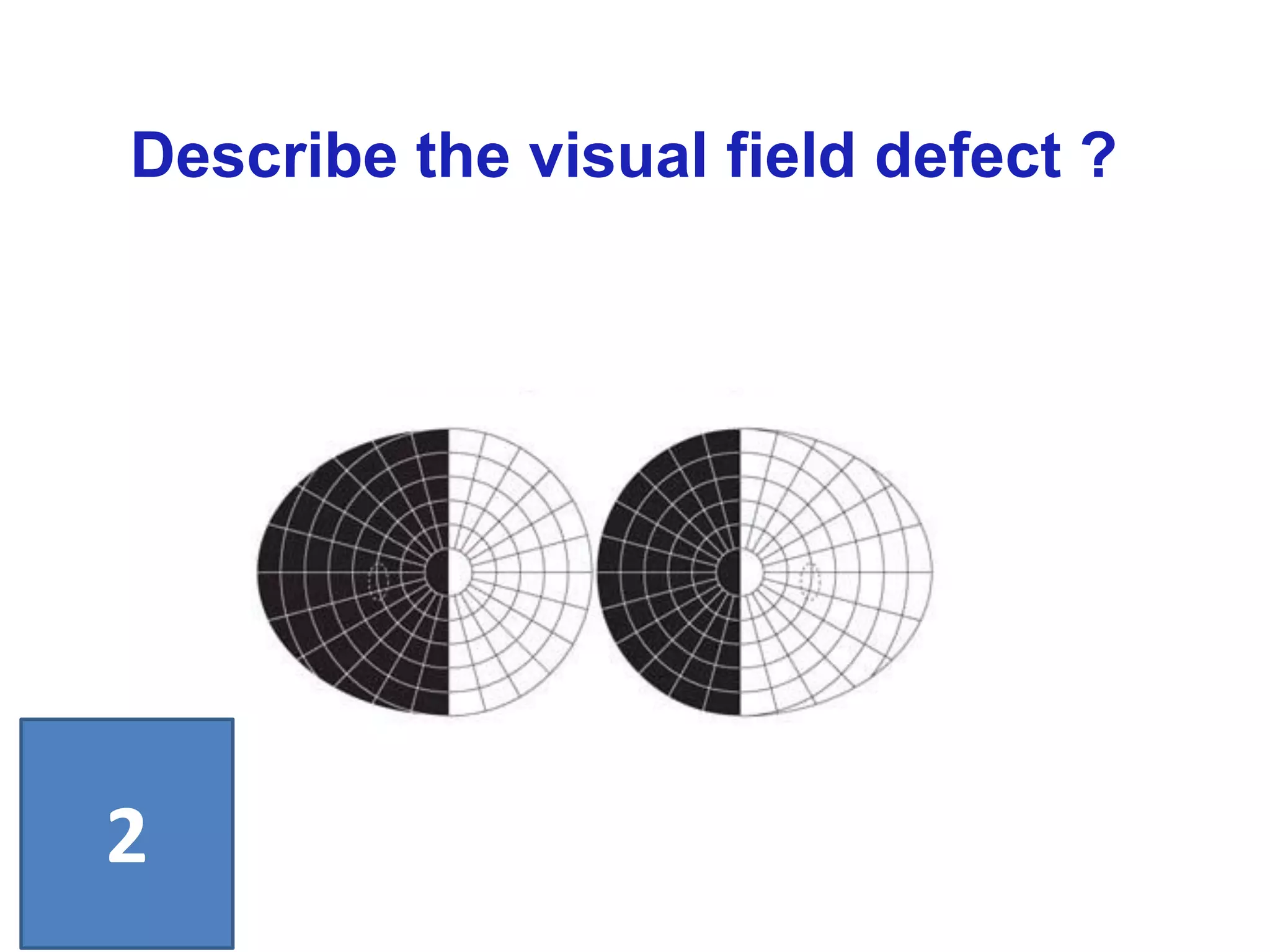
Describe the visual field defect ?
2
Describe the visual field defect ?
3
Describe the visual field defect ?
4
Describe the visual field defect ?
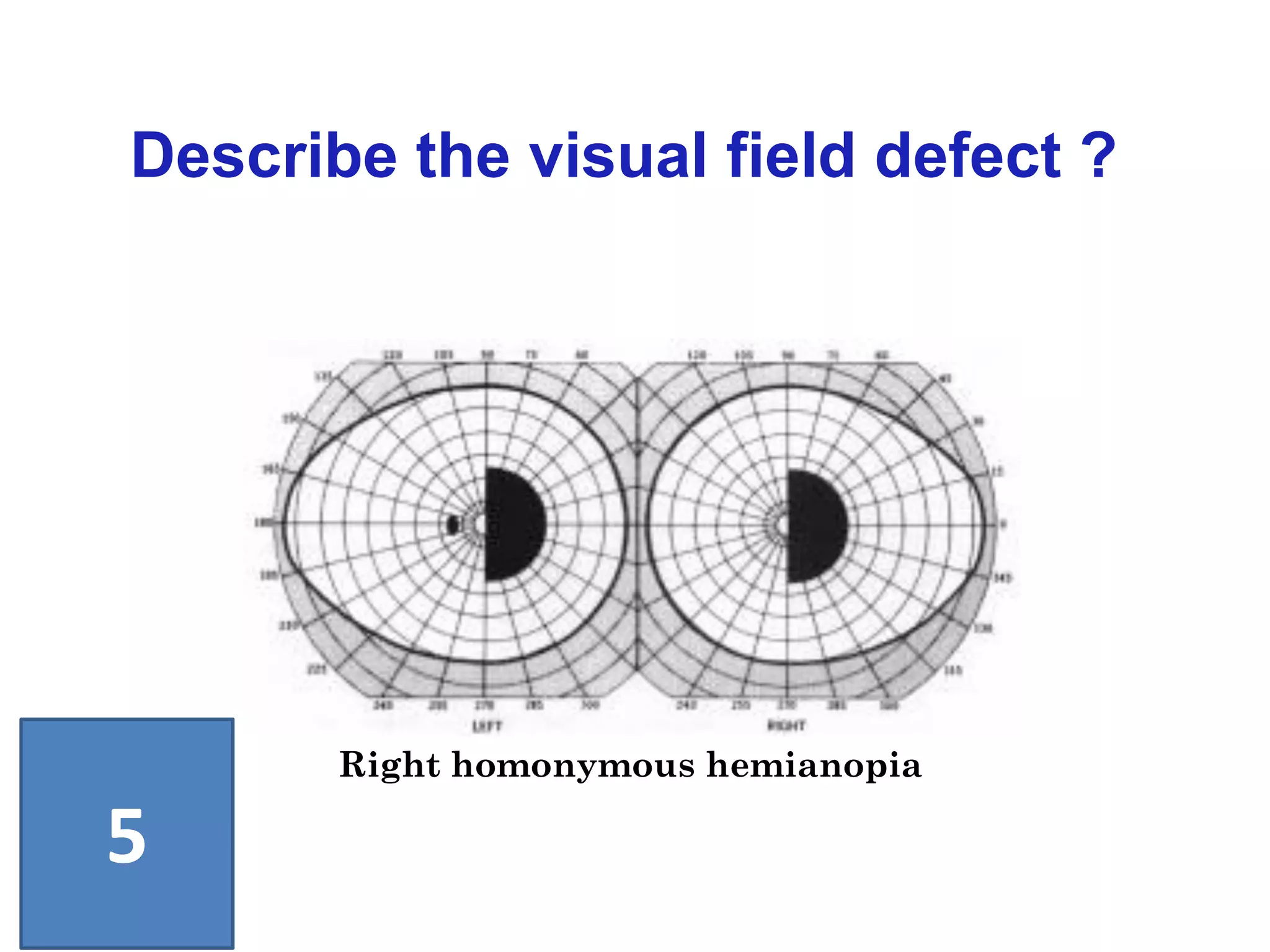
5
Describe the visual field defect ?
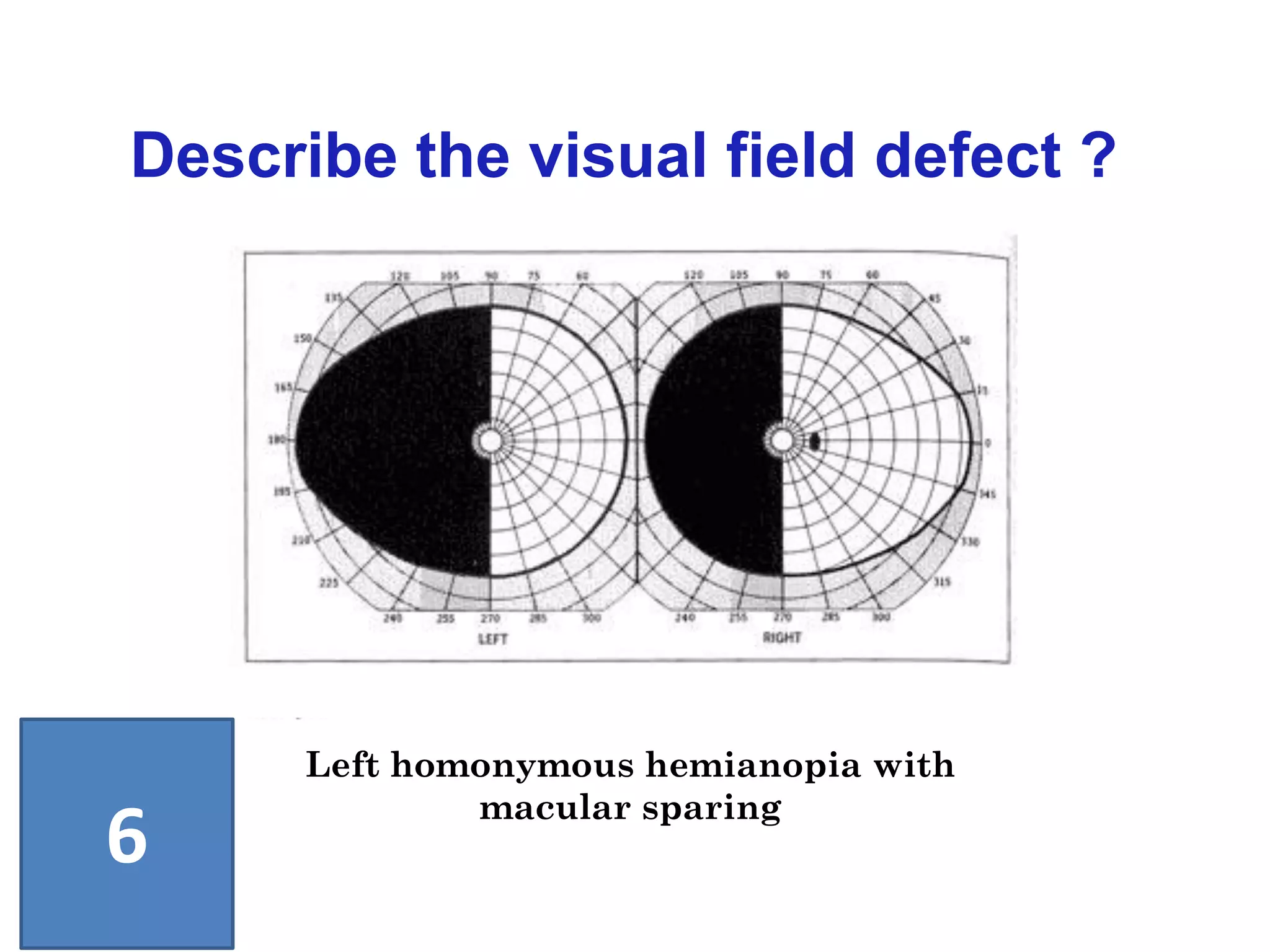
6
Describe the visual field defect ?
7
Describe the visual field defect ?
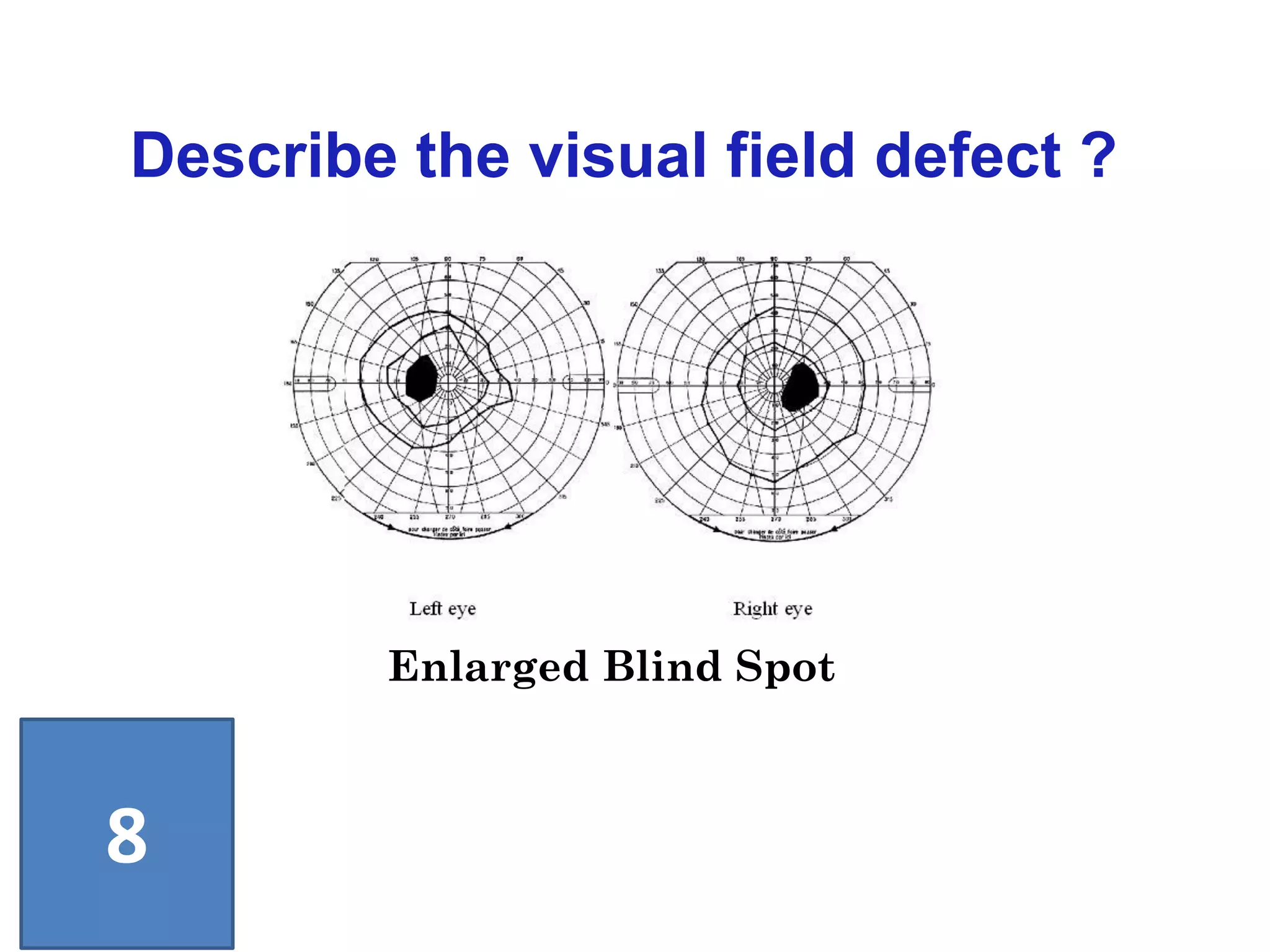
8
Describe the visual field defect ?
9
Describe the visual field defect ?
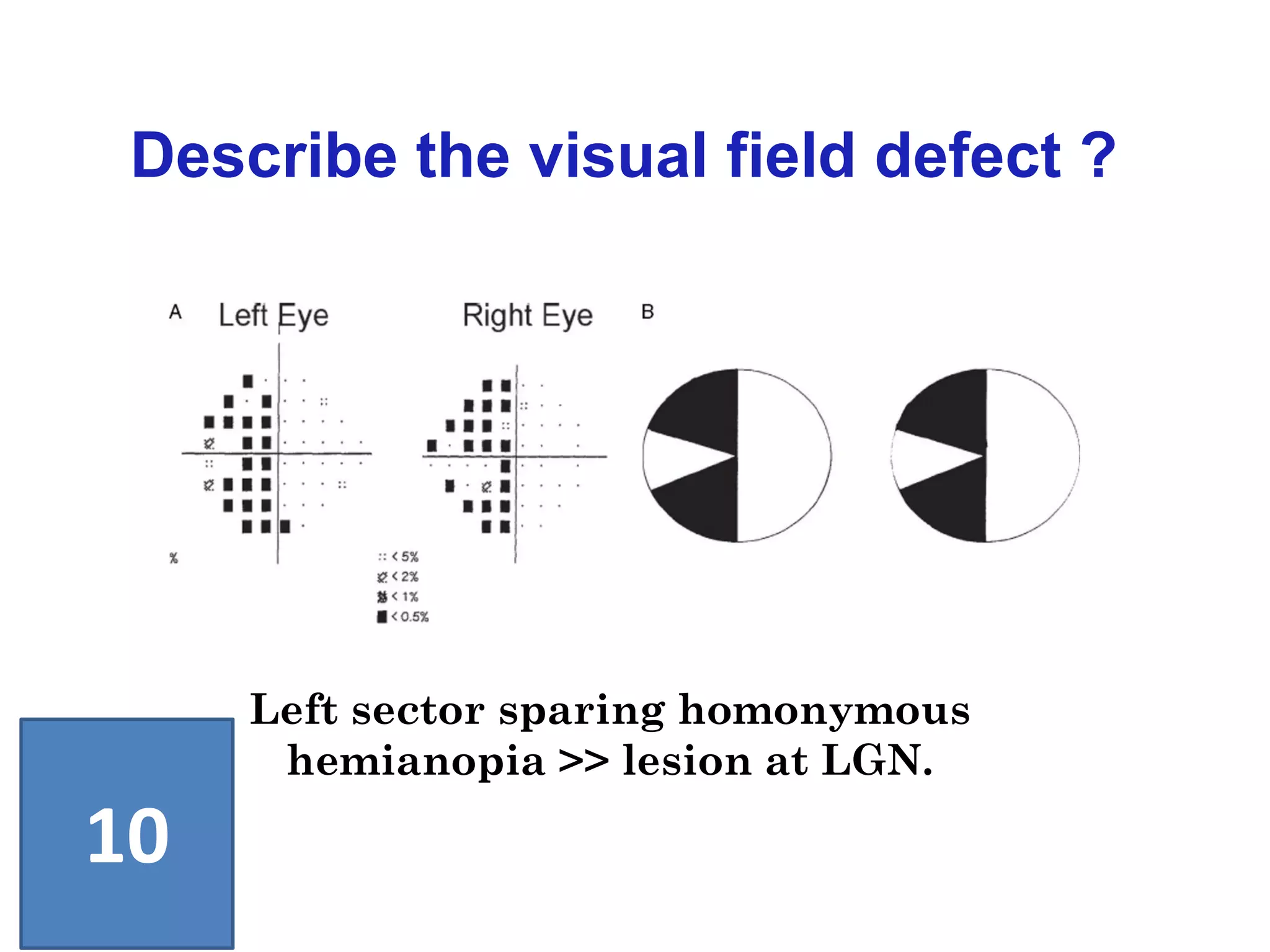
10
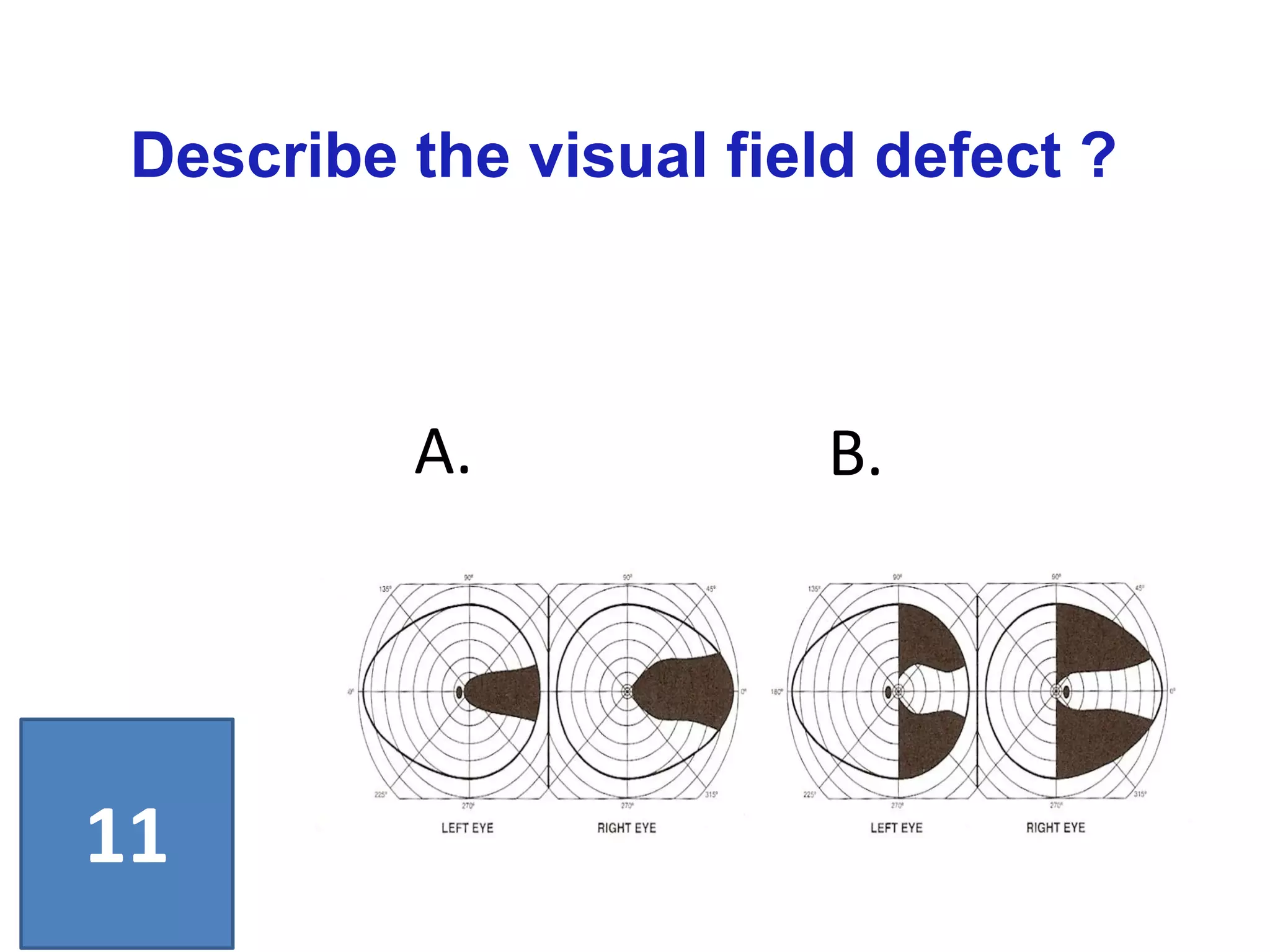
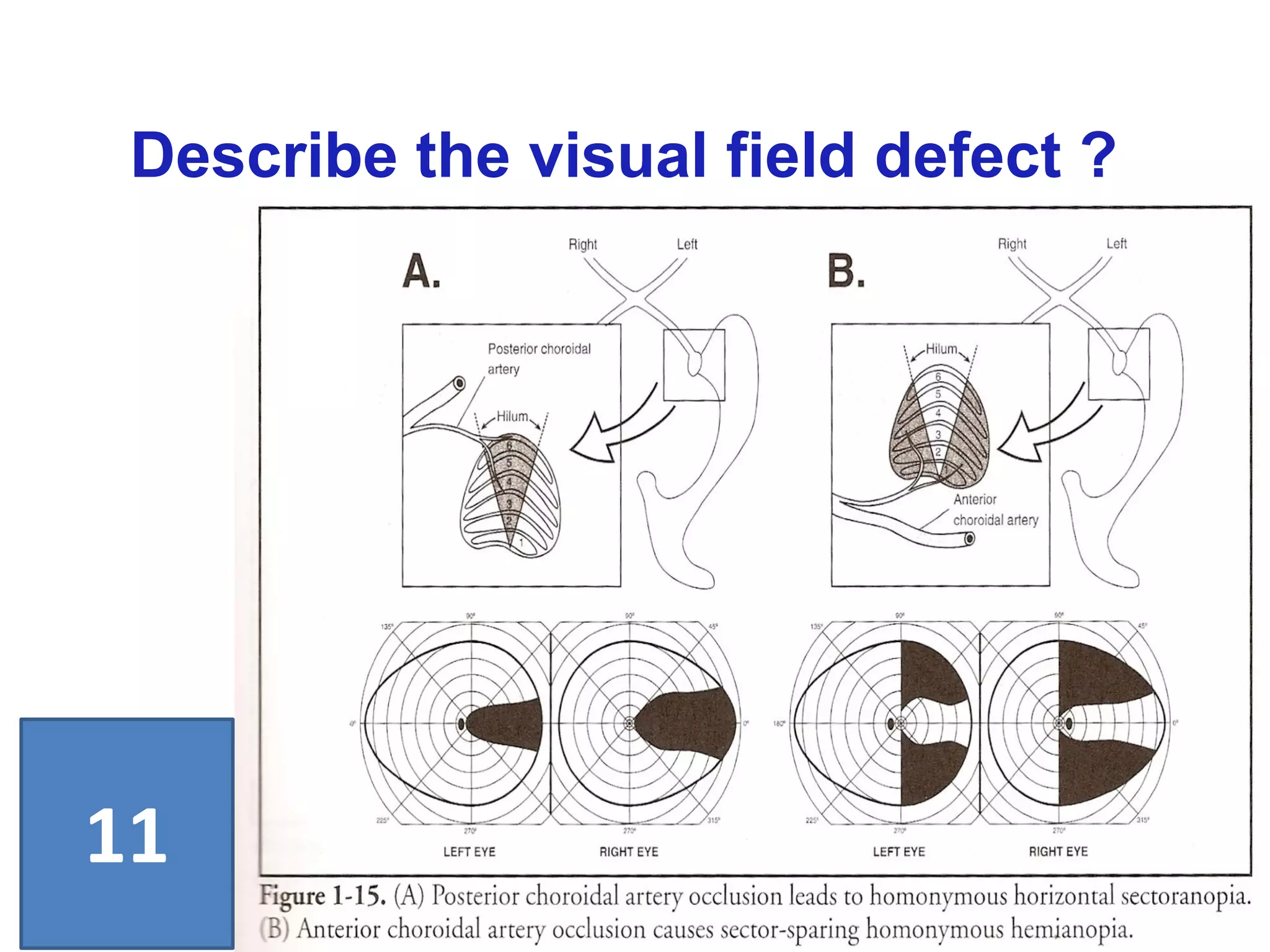
Describe the visual field defect ?
11
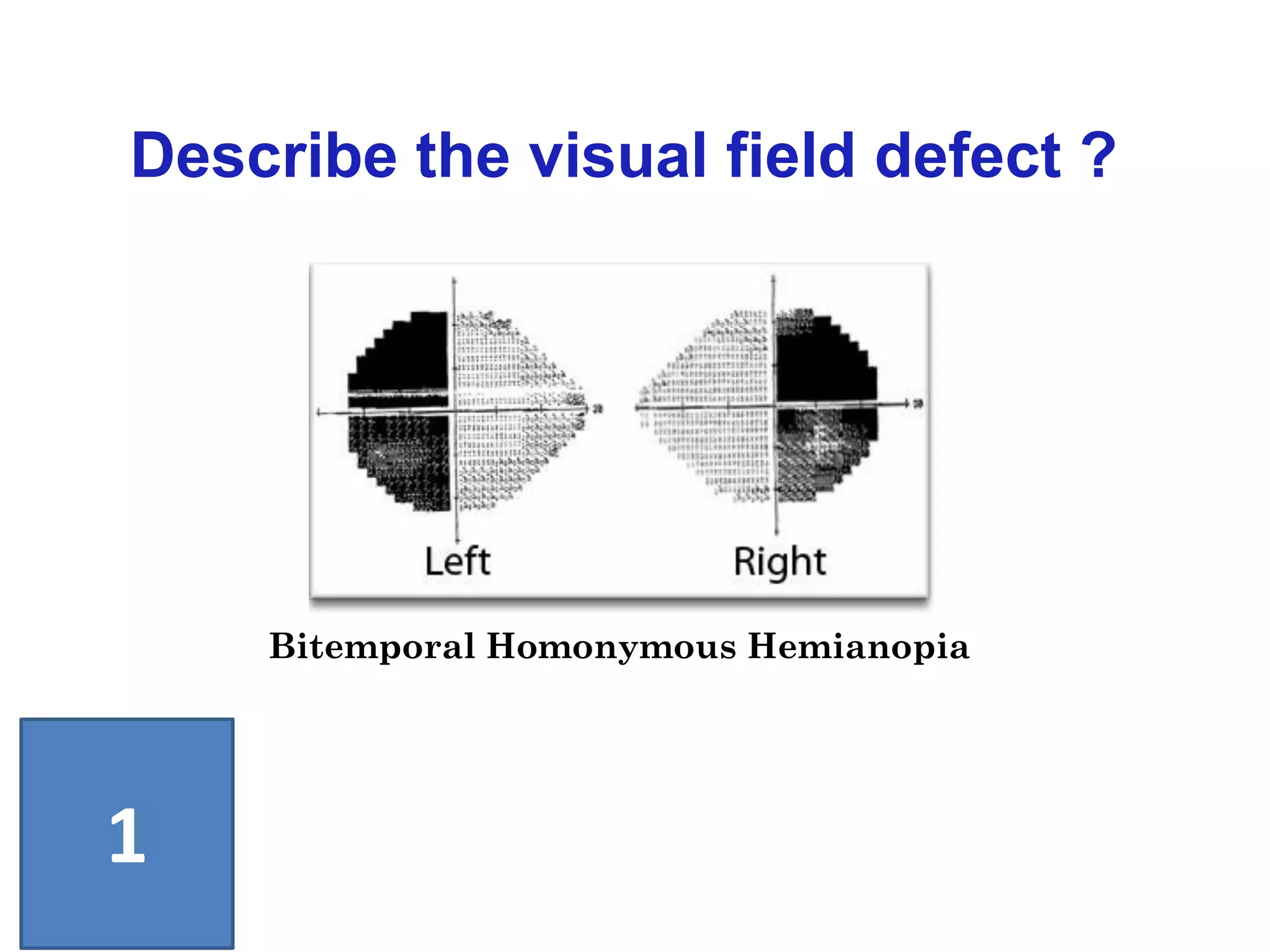
Bitemporal Homonymous Hemianopia
Describe the visual field defect ?
1
Describe the visual field defect ?
2
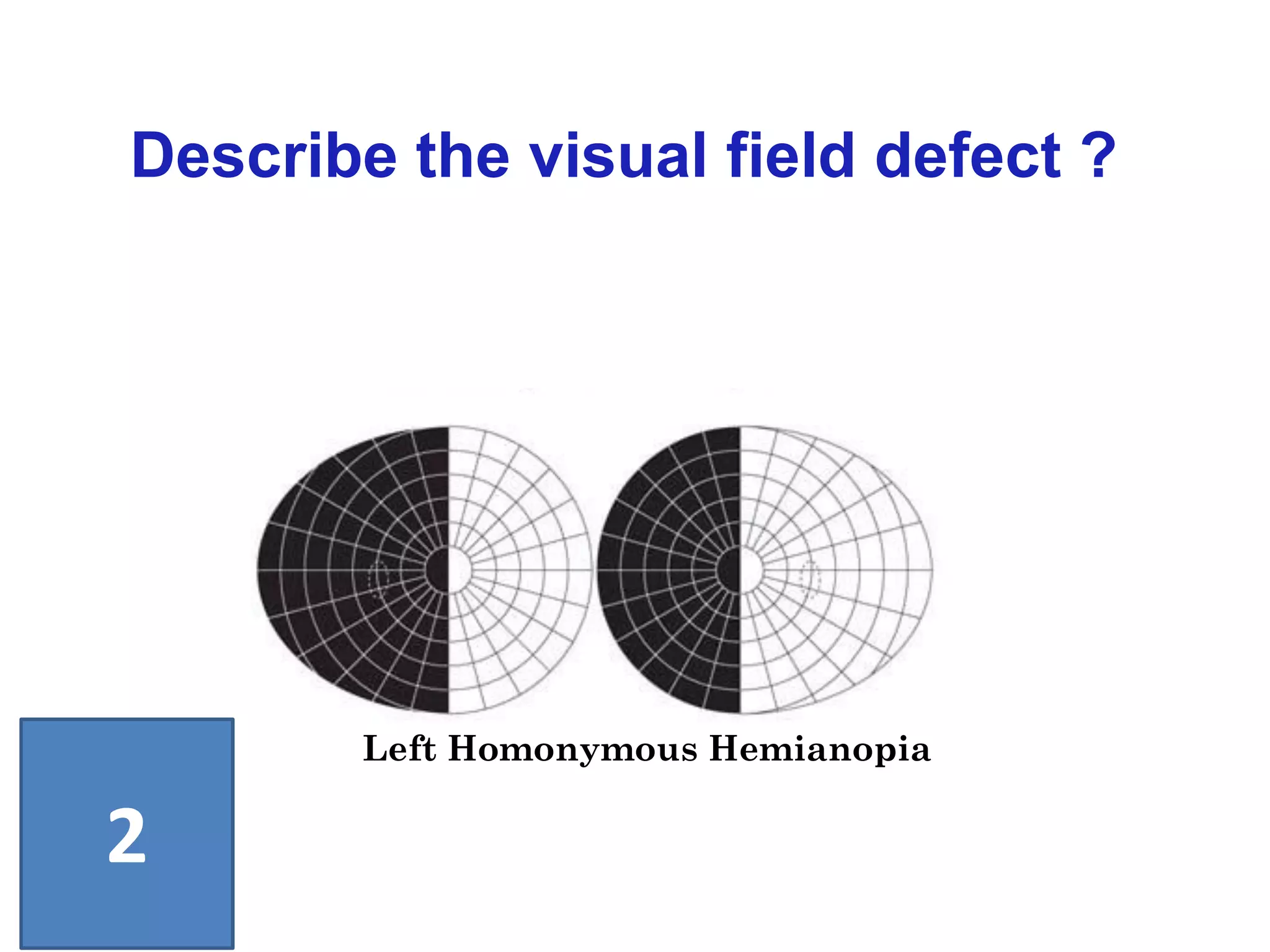
Left Homonymous Hemianopia
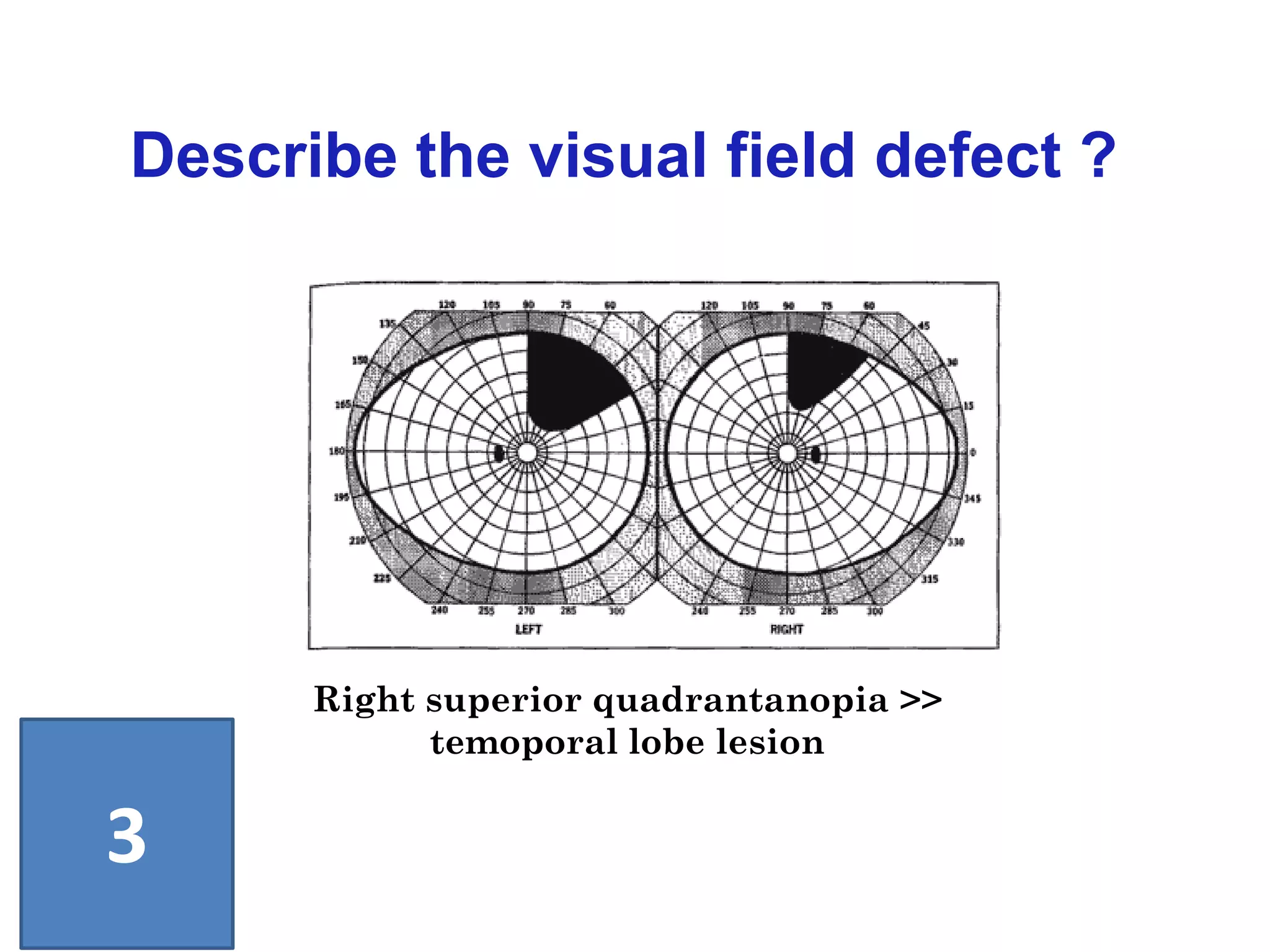
Right superior quadrantanopia >>
temoporal lobe lesion
Describe the visual field defect ?
3
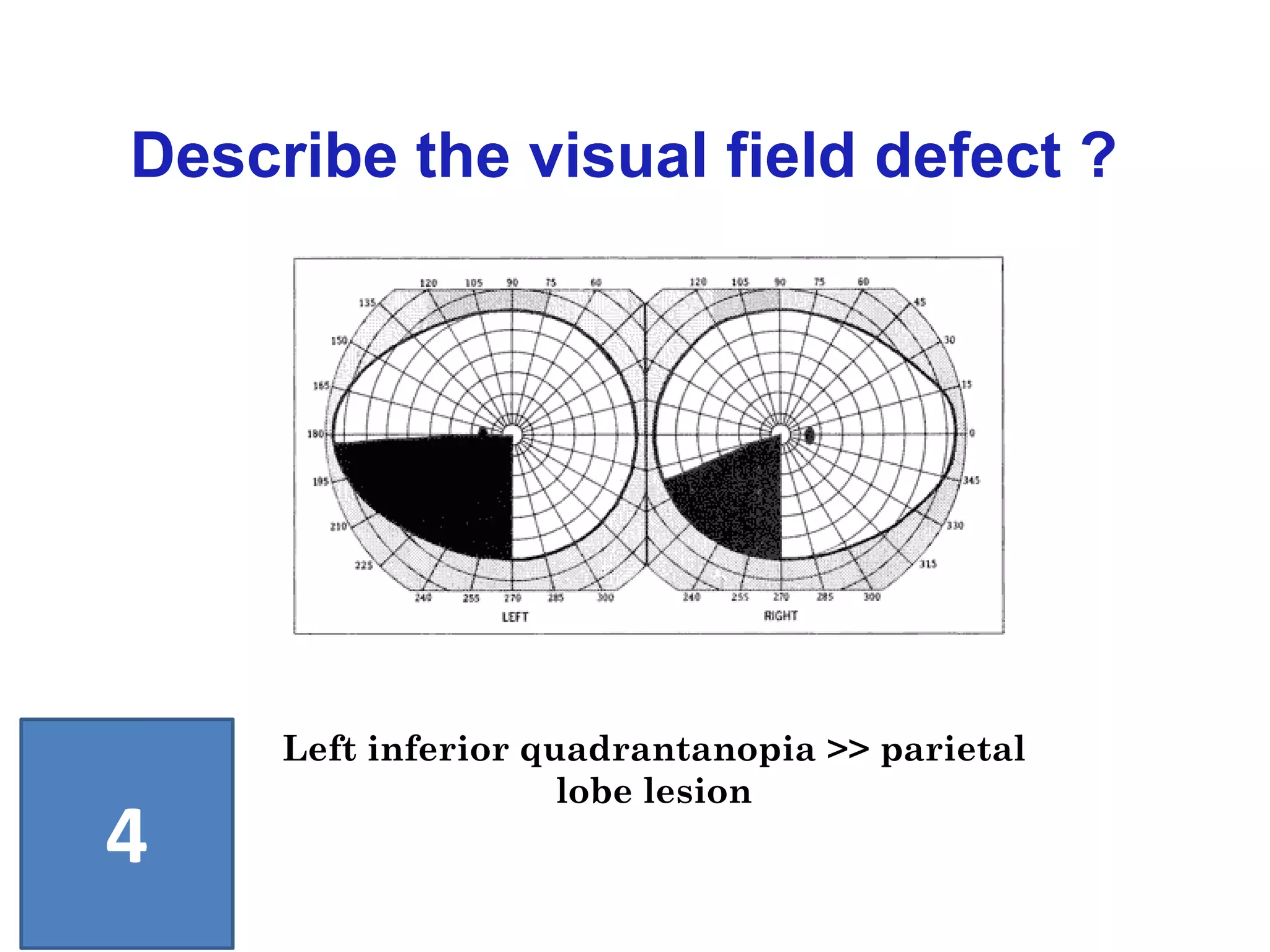
Left inferior quadrantanopia >> parietal
lobe lesion
Describe the visual field defect ?
4
Describe the visual field defect ?
5
Right homonymous hemianopia
Left homonymous hemianopia with
macular sparing
Describe the visual field defect ?
6
Left incongruous homonymous hemianopia
Describe the visual field defect ?
7
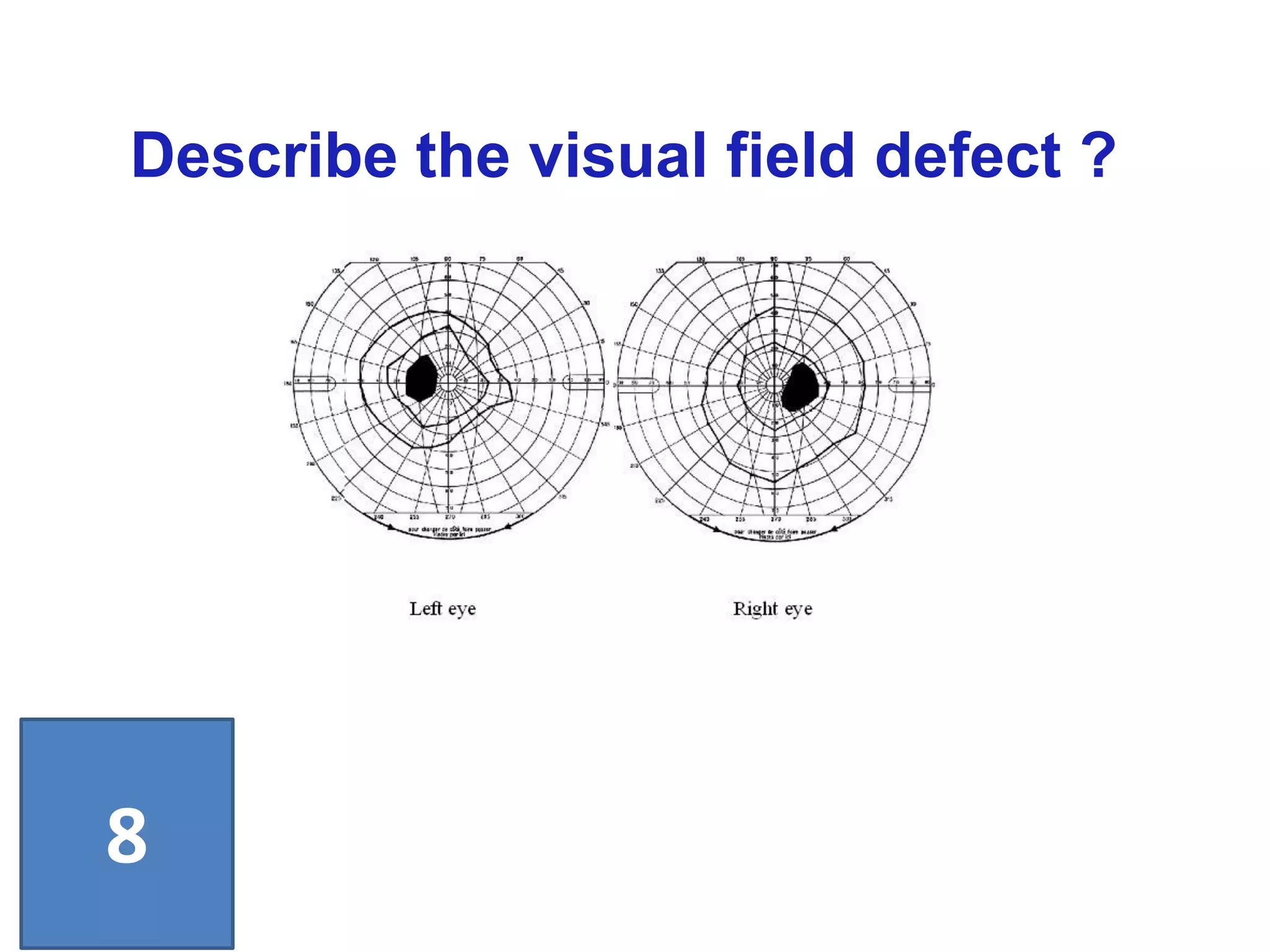
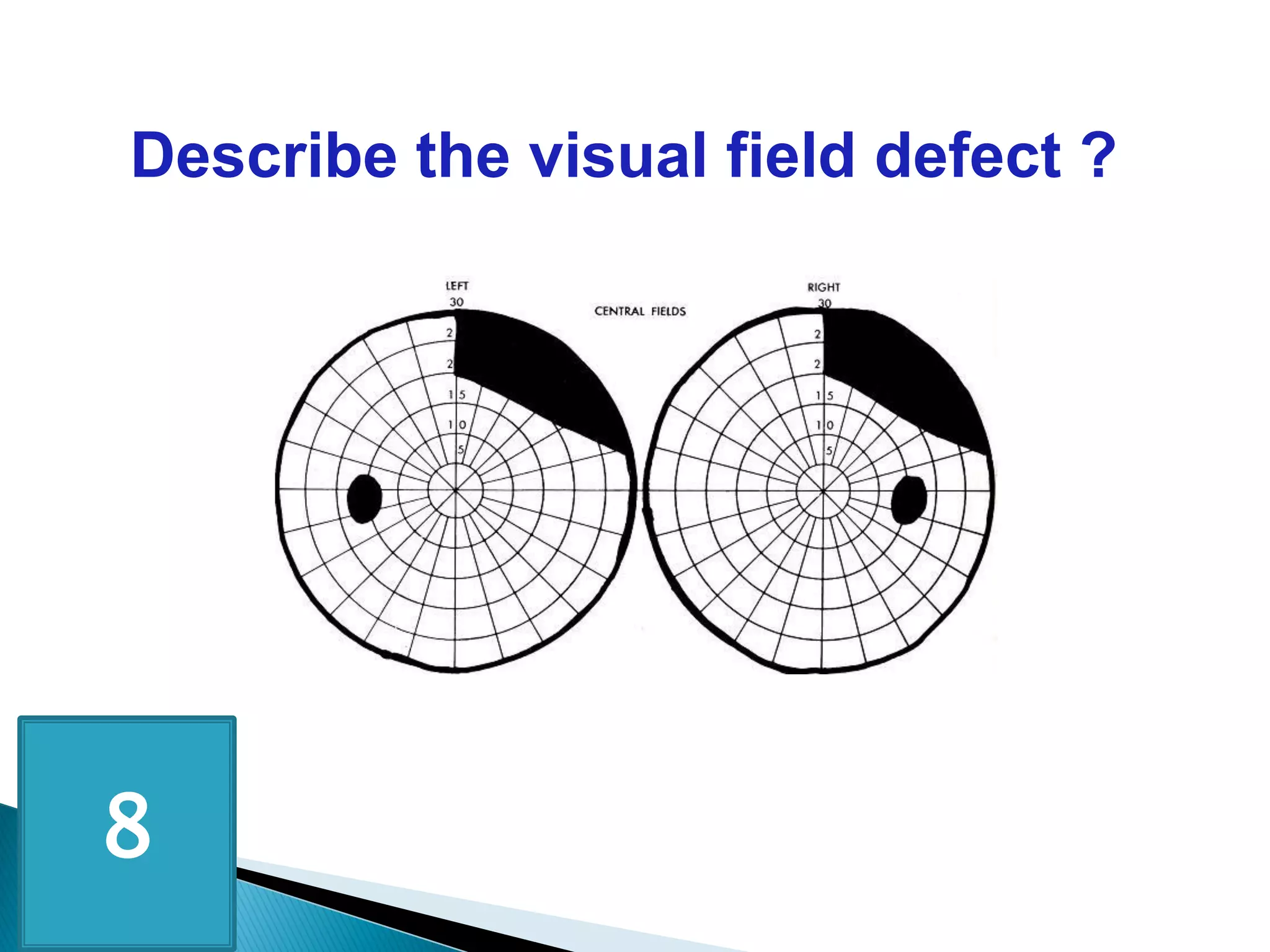
Enlarged Blind Spot
Describe the visual field defect ?
8
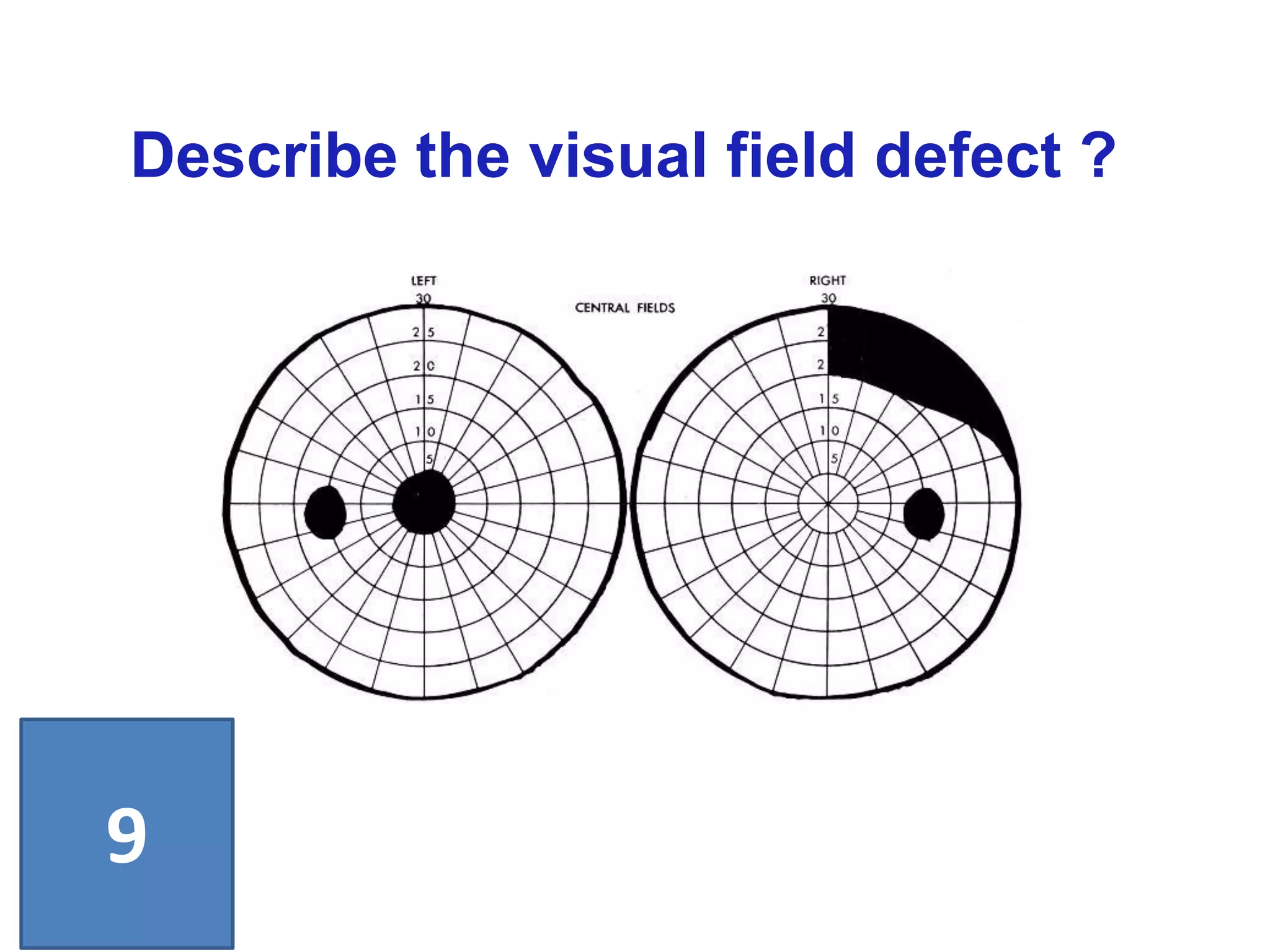
Describe the visual field defect ?
Junctional scotoma: lesion at junction of
optic nerve and chiasm
9
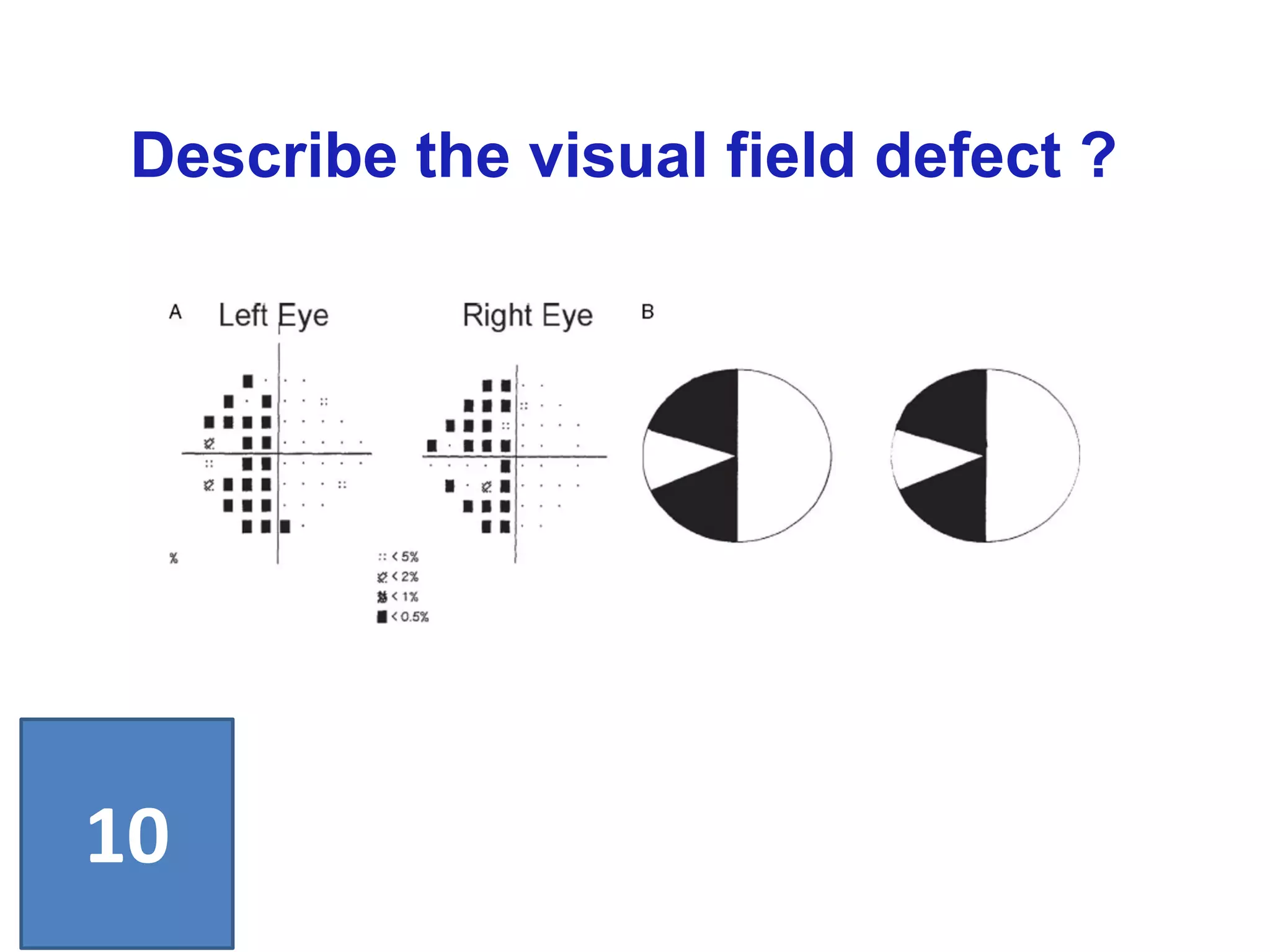
Left sector sparing homonymous
hemianopia >> lesion at LGN.
Describe the visual field defect ?
10
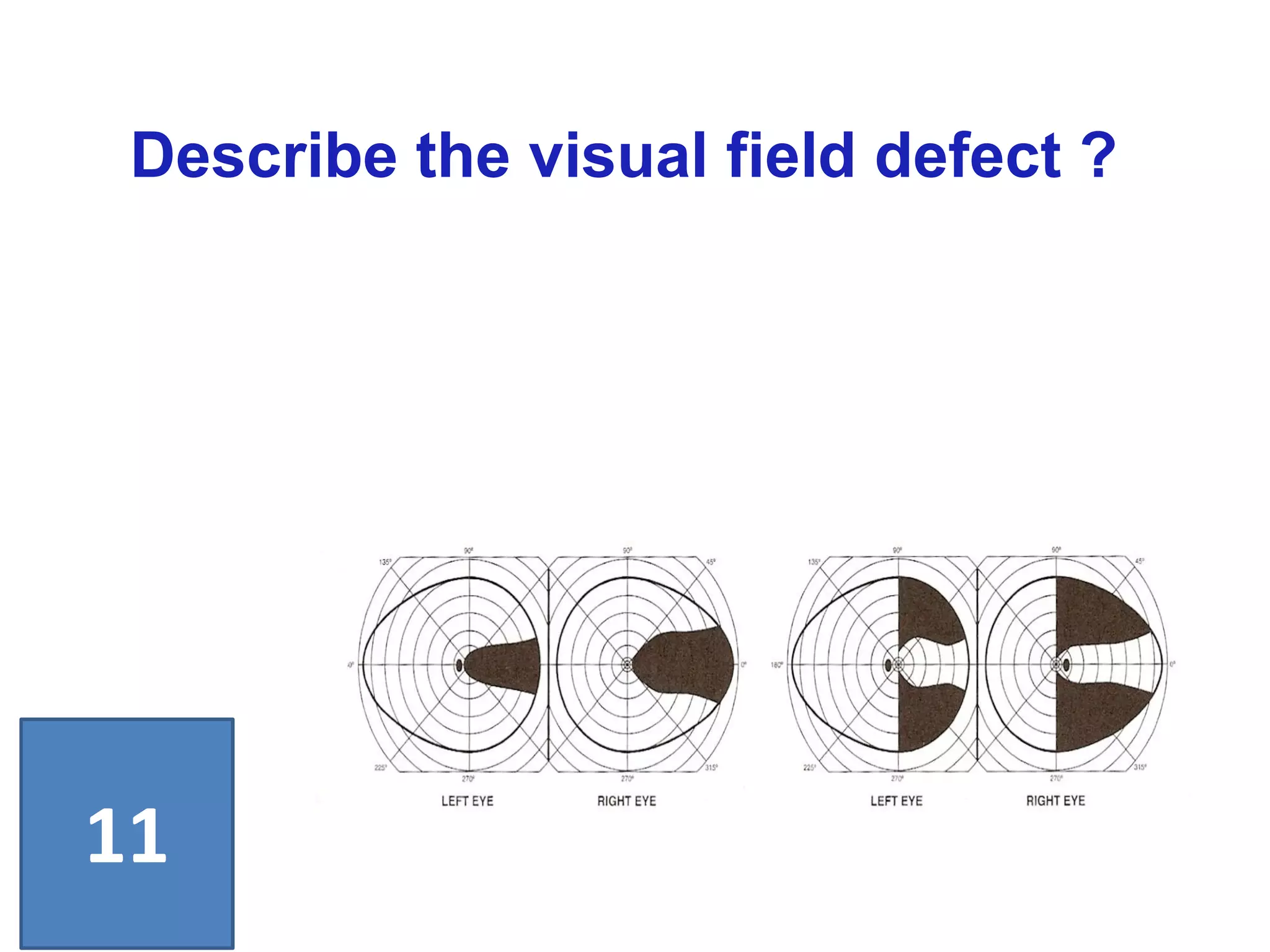
Describe the visual field defect ?
11
A. B.
Describe the visual field defect ?
11
THANK YOU
Eyes & Retina
 ~30 cortical visual
areas with distinct
functions
 Each visual area
has a topographic
representation of
external space in
the contralateral
hemifield
(however, these
get ‘less’
topographic as we
get further up in
the system)
Describe the visual field defect ?
8
Right congruous homonymous hemianopia
Describe the visual field defect ?

Afferent visual pathway

  • 1.
    Amr Hassan, M.D.,FEBN Associateprofessor of Neurology Cairo University 2017 Afferent visual pathway
  • 2.
    Agenda 2 • Anatomy ofvisual pathway • Visual pathway disorders • Quiz
  • 3.
    Agenda 3 • Anatomy ofvisual pathway • Visual pathway disorders • Quiz
  • 4.
    4 Pathway extends fromthe „front‟ to the „back‟ of the brain. The Visual Pathway OT ON OC VISUAL CORTEX RETINA VISUAL FIELD LGN OPTIC RADIATIONS ON = Optic Nerve OC = Optic Chiasm OT = Optic Tract LGN = Lateral Geniculate Nucleus of Thalamus
  • 5.
  • 6.
    Eyes & Retina Light>> lens >> retina (inverted and reversed image).
  • 7.
  • 8.
    • Macula: ovalregion approximately 3-5 mm that surrounds the fovea, also has high visual acuity. • Fovea: central fixation point of each eye// region of the retina with highest visual acuity. Eyes & Retina
  • 9.
    Eyes & Retina •Optic disc: region where axons leaving the retina gather to form the Optic nerve.
  • 10.
    Eyes & Retina •Blind spot located 15° lateral and inferior to central fixation point of each eye.
  • 11.
    11 Object to beseen Peripheral Retina Central Retina (fovea in the macula lutea)
  • 12.
    © Stephen E.Palmer, 2002 Photoreceptors
  • 13.
    © Stephen E.Palmer, 2002 Cones • Cone-shaped • Less sensitive • Operate in high light • Color vision • Less numerous • Highly represented in the fovea >> have high spatial & temporal resolution >> they detect colors. Photoreceptors
  • 14.
    © Stephen E.Palmer, 2002 Rods • Rod-shaped • Highly sensitive • Operate at night • Gray-scale vision • More numerous than cons- 20:1, have poor spatial & temporal resolution of visual stimuli, do not detect colors >> vision in low level lighting conditions Photoreceptors
  • 15.
  • 16.
    16 Rods and Cones (Receptors) Ganglioncells axons form the optic nerve Bipolar cells
  • 17.
  • 18.
  • 19.
    19 Pathway extends fromthe „front‟ to the „back‟ of the brain. The Visual Pathway OT ON OC VISUAL CORTEX RETINA VISUAL FIELD LGN OPTIC RADIATIONS ON = Optic Nerve OC = Optic Chiasm OT = Optic Tract LGN = Lateral Geniculate Nucleus of Thalamus
  • 20.
    20 Retinal Quadrants nose UTQ UTQ LTQLTQLNQLNQ UNQ UNQ Right retina Left retina Papilla (optic nerve head) Macula with fovea centralis Retina as you would see it through the ophthalmoscope & the patient‟s pupil Temporal Hemiretina UTQ = upper temporal quadrant LTQ = lower temporal quadrant Nasal Hemiretina UNQ = upper nasal quadrant LNQ = lower nasal quadrant Horizontal Meridian Vertical Meridian The blind spot in the Visual Field corresponds to the location of the optic nerve head on the NASAL side of the retina.
  • 21.
    21 Definition: The entirearea that can be “seen” by the patient without movement of the head and with the eyes fixed on a single spot. Monocular Visual Fields Mapping of Visual Fields: • Confrontational method • Perimetry (Manual or Automated) Temporal Field of Left Eye Nasal Field of Left Eye F Normal Monocular Visual Field of Right Eye Normal Monocular Visual Field of Left Eye F Monocular Visual Fields: • Each eye is tested separately. • The monocular visual field is plotted with the Fovea (F) at the center. • The monocular visual field (colored area -- blue for left; green for right in this example) is not round. • Horizontal and Vertical Meridians correspond to those of the retina and divide the visual field into upper temporal, upper nasal, lower temporal and lower nasal quadrants. Vertical Meridian Horizontal Meridian UpperFieldof LeftEye LowerFieldof LeftEye UTQ LTQ UNQ LNQ
  • 22.
    22 Blind Spot • 15°to the temporal side of the visual field of each eye • On the horizontal meridian • Corresponds to the location of the optic nerve head 15° to the nasal side of the retina of each eye. Demonstration of the Blind Spot: • Draw the star and box on a piece of paper. • Close your left eye; Look at the star with your right eye; Move paper back and forth until the green box disappears. • Open your left eye and the box can be seen because even though it was falling on the blind spot of the right eye, it is not falling on the blind spot of your left eye. • With both eyes open & binocular vision intact, you don‟t realize that there is a blind spot since the corresponding spot on the contralateral retina will see the object. Temporal Field of Left Eye Nasal Field of Left Eye Normal Monocular Visual Field of Left Eye F F Normal Monocular Visual Field of Right Eye UpperFieldofLeft Eye LowerFieldofLeft Eye Monocular Visual Fields
  • 23.
    23 • Understand thedifference between the “monocular visual field of the left eye” vs. the “Left Visual Field” • and vice versa for the right counterparts. Normal Binocular Visual Field F Right Visual FieldLeft Visual Field Upper Fields Lower Fields Temporal Field of Left Eye Nasal Field of Left Eye Normal Monocular Visual Field of Left Eye F F Normal Monocular Visual Field of Right Eye Binocular Visual Fields
  • 24.
    24 • Binocular visionis dependent upon the extraocular muscles aligning the eyes so that an image falls on “corresponding points” on the retina of each eye. • This is essential for the brain to perceive a single image. • Diplopia occurs when the images are not aligned to fall on corresponding points of each retina. Normal Binocular Visual Field F Right Visual FieldLeft Visual Field Upper Fields Lower Fields Temporal Field of Left Eye Nasal Field of Left Eye Normal Monocular Visual Field of Left Eye F F Normal Monocular Visual Field of Right Eye Binocular Visual Fields
  • 25.
    25 Retina of LeftEye Retina of Right Eye Binocular Visual Field Monocular Crescent of Right Eye Monocular Crescent of Left Eye The Visual Pathway
  • 26.
    26 Visual Pathway • OpticNerve (ON) • = Axons of ganglion cells in the retina of the corresponding eye • Outgrowth of diencephalon, so is a CNS tract & not a „true‟ cranial nerve. • Myelinated by oligodendrocytes. • Optic Chiasm (OC) • Located just anterior to pituitary • Partial crossing of optic nerve axons in the OC is essential to binocular vision • Axons from temporal fields cross • Axons from nasal fields do not cross • “Wilbrand‟s knee” may be artifact Retinotopic representation • Central (macular) vision • Peripheral vision Left visual field Right visual field Right retinaLeft retina Left LGN Temporal Nasal TemporalNasal lateral lateralmedial medial LVFLVF UVFUVF E.W. Right visual cortex midbrain Right LGN Left visual cortex Left temporal retina Right temporal retina Nasal retina Ciliary ganglion pretectal nuclei cuneus lingual gyrus Calcarin e sulcus III III Upper field Lower field VISUAL FIELDS: Hatched = binocular Stippled = monocular Central area = macula ON OC OT
  • 27.
    27 • Optic Tract(OT) • Optic nerve fibers from the optic chiasm continue as the optic tract & terminate in the lateral geniculate nucleus of thalamus. • Each tract contains axons that carry input from the contralateral visual field. • Left OT receives from R. visual field • Right OT receives from the L. visual field Retinotopic representation • Central (macular) vision • Peripheral vision Left visual field Right visual field Right retinaLeft retina Left LGN Tempora l Nasal Tempora l Nasal lateral lateralmedial medial LVFLVF UVFUVF E.W. Right visual cortex midbrain Right LGN Left visual cortex Left temporal retina Right temporal retina Nasal retina Ciliary ganglion pretectal nuclei cuneus lingual gyrus III III Visual Pathway Post-Chiasmatic portion of the pathway: From optic tract to visual cortex, each side of the brain deals with the contralateral visual field. Upper field Lower field VISUAL FIELDS: Hatched = binocular Stippled = monocular Central area = macula ON OC OT • Lateral Geniculate Nucleus (LGN) • Primary termination of OT fibers • Each LGN receives input from the contralateral visual field. • OT Projections to pretectum for reflexes
  • 28.
    28 • Geniculocalcarine Tract(= optic radiations) • Axons of LGN neurons travel to primary visual cortex (Area 17) via the geniculocalcarine tract located in the retrolenticular and sublenticular portions of the internal capsule. • Axons from upper visual fields take a looping course into the temporal lobe on the way to visual cortex. (=Meyer‟s loop) • Axons from lower visual fields take a more direct route to visual cortex. • Macular fibers are in an intermediate location in the optic radiation. Left visual field Right visual field Right retinaLeft retina Left LGN Tempora l Nasal Tempora l Nasal lateral lateralmedial medial LVFLVF UVFUVF E.W. Right visual cortex midbrain Right LGN Left visual cortex Left temporal retina Right temporal retina Nasal retina Ciliary ganglion pretectal nuclei cuneus lingual gyrus Calcarin e sulcus III III Meyer‟s loop Optic radiation or geniculocalcarine tract Visual Pathway Post-Chiasmatic portion of the pathway: From optic tract to visual cortex, each side of the brain deals with the contralateral visual field. Upper field Lower field VISUAL FIELDS: Hatched = binocular Stippled = monocular Central area = macula ON OC OT
  • 29.
    29 Visual Pathway Retinotopic representation •Central (macular) vision • Peripheral vision Left visual field Right visual field Right retinaLeft retina Left LGN Tempora l Nasal Tempora l Nasal lateral lateralmedial medial LVFLVF UVFUVF E.W. Right visual cortex midbrain Right LGN Left visual cortex Left temporal retina Right temporal retina Nasal retina Ciliary ganglion pretectal nuclei cuneus lingual gyrus Calcarin e sulcus III III Meyer‟s loop Optic radiation or geniculocalcarine tract Upper field Lower field VISUAL FIELDS: Hatched = binocular Stippled = monocular Central area = macula ON OC OT • Primary Visual Cortex (Area 17) • Located on either side of & within the calcarine fissure. • Upper fields project to the lingual gyrus. • Lower fields project to the cuneus. • Macular representation is most caudal in Area 17. • Peripheral field representation is in the rostral 2/3rds of Area 17. • Lesions of Area 17 result in blindness in the contralateral visual field. • Association Visual Cortex (Areas 18 & 19) • Input from Area 17 & elsewhere • Deals with complex aspects of vision • Lesions of result in visual agnosia.
  • 30.
    Form Eye tothe CNS
  • 31.
    Form Eye tothe CNS
  • 32.
    • Different namesfor primary visual cortex: • Brodmann’s area 17 • V1 • primary visual cortex • striate cortex (“striped” cortex) Visual Cortex – Primary Visual Cortex
  • 33.
  • 34.
  • 35.
    • Cells inarea MT or V5 respond to movement but not color • For example, this particular neuron in this monkey’s V5 area responds best when stimulus moved down and to the left Visual Cortex: Area MT or V5 MOTION
  • 36.
  • 37.
  • 41.
  • 42.
    Two General ProjectionsFrom the Primary Visual Cortex • Dorsal stream – Occipito-parietal stream spatial perception – action- “where” or “how to” • Ventral stream – Occipito-temporal stream object perception – identification – “what” stream
  • 43.
    Agenda 43 • Anatomy ofvisual pathway • Visual pathway disorders • Quiz
  • 44.
    Agenda 44 • Anatomy ofvisual pathway • Visual pathway disorders • Quiz
  • 45.
    Optic nerve-type fielddefects • Retinal fibers enter optic discs in a specific manner. • Nerve fiber bundle (NFB) defects are of the following: 1. Papillomacular bundle. 2. Sup. & Inf. Arcuate bundle. 3. Nasal bundle.
  • 46.
    Papillomacular Bundle • Macularfibers that enter the temporal aspect of the disc. • Defect, result in the following: 1. Central scotoma: defect covering central fixation. 2. Centrocecal scotoma: a central scotoma conneted to the blind spot. 3. Paracentral scotoma: defect of some of the fibers of the papillomacular bundle lying next to, but not involving central fixation.
  • 47.
  • 48.
    48 Lesions of theVisual Pathway 1. Normal visual fields 2. Blindness of the right eye 3. Blindness of right eye + contralateral left upper quadrantanopia 4. Bitemporal heteronymous hemianopsia 5. Left homonymous hemianopsia 6. Left upper homonymous quadrantanopsia 7. Left homonymous hemianopsia with macular sparing RightLeft Definitions Strabismus Diplopia Amblyopia Scotoma Quadrantanopsia - # 3, 6 Hemianopsia - # 4, 5, 7 Heteronymous Defects - # 3, 4 Homonymous Defects - # 5, 6, 7 Congruous Defects - # 5, 6, 7 Incongruous Defects - # 3 Altitudinal Defects - # 6 Masked area = area of visual loss Aka “field cuts” Fields, not retinal quadrants
  • 49.
    49 Lesions of theVisual Pathway 1. Normal visual fields 2. Blindness of the right eye 3. Blindness of right eye + contralateral left upper quadrantanopia 4. Bitemporal heteronymous hemianopsia 5. Left homonymous hemianopsia 6. Left upper homonymous quadrantanopsia 7. Left homonymous hemianopsia with macular sparing RightLeft
  • 50.
    • Hemianopia –loss of pattern vision in either the left or right visual field • Quadrantanopia – blindness in one quadrant of the visual field – damage to the optic tract, LGN or V1 Lesions of the Visual Pathway
  • 53.
    Deficits in MotionPerception: Akinetopsia
  • 54.
    Deficits in ColorPerception - Achromatopsia • Congenital colorblindness (dichromats) vs. acquired colorblindness • Usually associated with damage to V4 • Object recognition OK
  • 55.
    Deficits in ColorPerception - Achromatopsia
  • 56.
    Deficits Following Damageto the WHAT Pathway • Visual agnosia – partial or total inability to recognize visual stimuli, unexplainable by a defect in elementary sensation or reduced level of alertness or memory
  • 57.
    Agenda 57 • Anatomy ofvisual pathway • Visual pathway disorders • Quiz
  • 58.
    Agenda 58 • Anatomy ofvisual pathway • Visual pathway disorders • Quiz
  • 59.
    Describe the visualfield defect ? 1
  • 60.
    Describe the visualfield defect ? 2
  • 61.
    Describe the visualfield defect ? 3
  • 62.
    Describe the visualfield defect ? 4
  • 63.
    Describe the visualfield defect ? 5
  • 64.
    Describe the visualfield defect ? 6
  • 65.
    Describe the visualfield defect ? 7
  • 66.
    Describe the visualfield defect ? 8
  • 67.
    Describe the visualfield defect ? 9
  • 68.
    Describe the visualfield defect ? 10
  • 69.
    Describe the visualfield defect ? 11
  • 70.
    Bitemporal Homonymous Hemianopia Describethe visual field defect ? 1
  • 71.
    Describe the visualfield defect ? 2 Left Homonymous Hemianopia
  • 72.
    Right superior quadrantanopia>> temoporal lobe lesion Describe the visual field defect ? 3
  • 73.
    Left inferior quadrantanopia>> parietal lobe lesion Describe the visual field defect ? 4
  • 74.
    Describe the visualfield defect ? 5 Right homonymous hemianopia
  • 75.
    Left homonymous hemianopiawith macular sparing Describe the visual field defect ? 6
  • 76.
    Left incongruous homonymoushemianopia Describe the visual field defect ? 7
  • 77.
    Enlarged Blind Spot Describethe visual field defect ? 8
  • 78.
    Describe the visualfield defect ? Junctional scotoma: lesion at junction of optic nerve and chiasm 9
  • 79.
    Left sector sparinghomonymous hemianopia >> lesion at LGN. Describe the visual field defect ? 10
  • 80.
    Describe the visualfield defect ? 11 A. B.
  • 81.
    Describe the visualfield defect ? 11
  • 82.
  • 83.
  • 84.
     ~30 corticalvisual areas with distinct functions  Each visual area has a topographic representation of external space in the contralateral hemifield (however, these get ‘less’ topographic as we get further up in the system)
  • 85.
    Describe the visualfield defect ? 8
  • 86.
    Right congruous homonymoushemianopia Describe the visual field defect ?