Understanding  Knowledge Services   Natural Resources Canada  Knowledge Services Task Group Transforming Government:  Better Outcomes for Citizens   September 12-14, 2005
An Opening Thought… “ One of the saddest features of the real world is that goods do not spontaneously present themselves for distribution.”      The Economist (Nov. 5, 1994)
Presentation Goals Speaker :   Share results of the NRCan Knowledge Services Task Group Audience :   Gain awareness and relate to your context Conference :   Begin interdepartmental dialogue to develop shared understanding
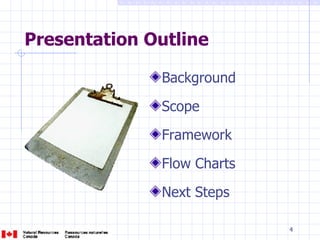
Presentation Outline Background Scope Framework Flow Charts Next Steps
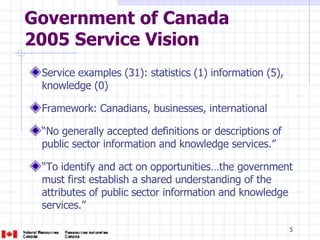
Government of Canada  2005 Service Vision Service examples (31): statistics (1) information (5), knowledge (0) Framework: Canadians, businesses, international “ No generally accepted definitions or descriptions of public sector information and knowledge services.” “ To identify and act on opportunities…the government must first establish a shared understanding of the attributes of public sector information and knowledge services.”
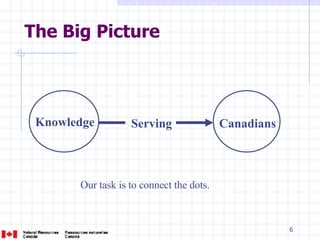
The Big Picture Our task is to connect the dots. Knowledge Canadians Serving
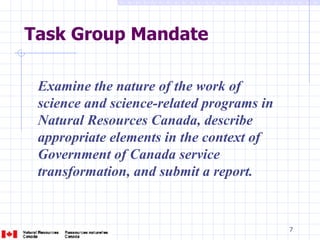
Task Group Mandate Examine the nature of the work of science and science-related programs in Natural Resources Canada, describe appropriate elements in the context of Government of Canada service transformation, and submit a report.
Task Group Members John Broome  (Earth Sciences) Malcolm Drury  (Energy Technology) Brian Haddon  (Canadian Forest Service) Bob O’Neil  (Earth Sciences) Dave Pasho  (Metals & Minerals) Al Simard  (Canadian Forest Service) Mark Williamson  (Earth Sciences)
Questions & Answers Who is the audience?  Treasury Board and NRCan senior managers. What do we want them to do?  Adapt programs to the nature of  S&T knowledge services to better serve Canadians. What will we do that causes this response?  Increase understanding of S&T knowledge services. How will we increase understanding?  Develop a descriptive model and classification framework for S&T knowledge services.
Knowledge Services:   Steps Establish Task Group   Determine approach     Outline and define system framework     List and define system functions   Report on progress & seek endorsement   List components & parameters   Define components and parameters   List sub-components & sub-parameters   Conduct Classification case studies   Begin writing report   Define sub-components & sub-parameters Submit report
Presentation Outline Background Scope Framework Flow Charts Next Steps
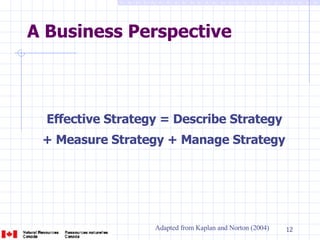
A Business Perspective Effective Strategy = Describe Strategy  + Measure Strategy + Manage Strategy   Adapted from Kaplan and Norton (2004)
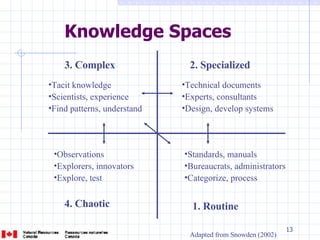
Knowledge Spaces Adapted from Snowden (2002) 1. Routine Standards, manuals Bureaucrats, administrators Categorize, process 2. Specialized Technical documents Experts, consultants Design, develop systems 3. Complex Tacit knowledge Scientists, experience Find patterns, understand  4. Chaotic Observations Explorers, innovators Explore, test
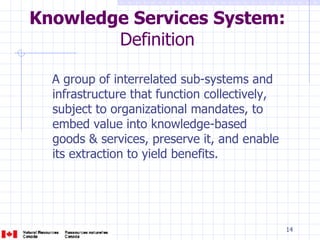
Knowledge Services System: Definition A group of interrelated sub-systems and infrastructure that function collectively, subject to organizational mandates, to embed value into knowledge-based goods & services, preserve it, and enable its extraction to yield benefits.
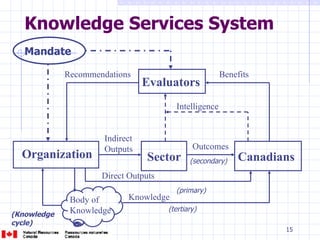
Knowledge Services System Indirect Outputs Sector Outcomes Canadians Intelligence Organization Mandate Body of Knowledge (Knowledge cycle) Direct Outputs Evaluators Recommendations Benefits (tertiary) (secondary) (primary) Knowledge
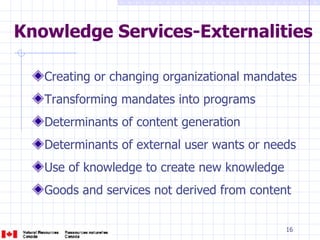
Knowledge Services-Externalities Creating or changing organizational mandates Transforming mandates into programs Determinants of content generation Determinants of external user wants or needs Use of knowledge to create new knowledge Goods and services not derived from content
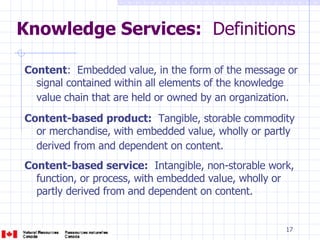
Knowledge Services:   Definitions  Content :  Embedded value, in the form of the message or signal contained within all elements of the knowledge value chain that are held or owned by an organization.   Content-based product:   Tangible, storable commodity or merchandise, with embedded value, wholly or partly derived from and dependent on content.   Content-based service:   Intangible, non-storable work, function, or process, with embedded value, wholly or partly derived from and dependent on content.
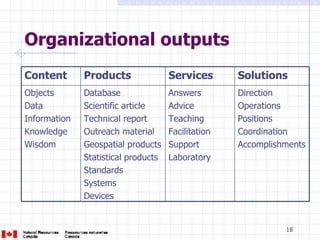
Organizational outputs Direction Operations Positions Coordination Accomplishments Answers Advice Teaching Facilitation Support Laboratory Database Scientific article Technical report Outreach material Geospatial products Statistical products Standards Systems Devices Objects Data Information Knowledge  Wisdom Solutions Services Products Content
Presentation Outline Background Scope Framework Flow Charts Next Steps
Knowledge Services - Approach Focus on organizations or groups of organizations Driven by organizational mandates; responds to user needs Includes supply- and demand-driven processes Based on flow of goods & services through a value chain Two resolutions: measuring system performance; classifying organizational activities.
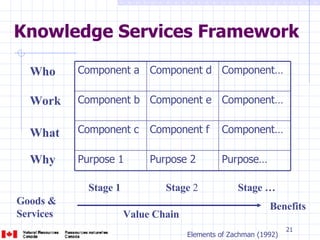
Knowledge Services Framework Elements of Zachman (1992) Component… Component f Component c Component… Component e Component b Purpose… Purpose 2 Purpose 1 Component… Component d Component a Stage 1 Stage  2 Stage … Goods & Services Value Chain Benefits Who Work What Why
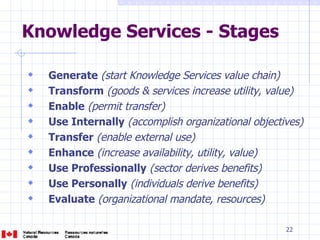
Knowledge Services - Stages Generate   (start Knowledge Services value chain) Transform   (goods & services increase utility, value) Enable   (permit transfer) Use Internally   (accomplish organizational objectives) Transfer   (enable external use) Enhance   (increase availability, utility, value)   Use Professionally   (sector derives benefits) Use Personally   (individuals derive benefits) Evaluate  (organizational mandate, resources)
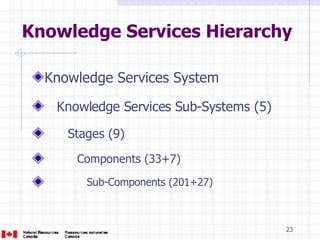
Knowledge Services Hierarchy Knowledge Services System Knowledge Services Sub-Systems (5) Stages (9) Components (33+7) Sub-Components (201+27)
Presentation Outline Background Scope Framework Components Next Steps
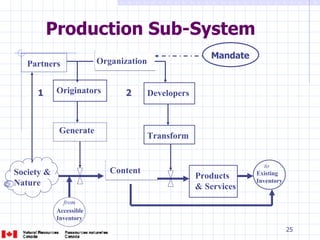
Production Sub-System to  Existing Inventory from   Accessible   Inventory Society & Nature Content Generate Originators 1 Products & Services Transform Developers 2 Partners Organization Mandate
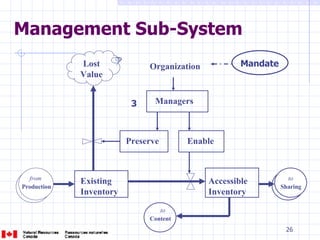
Management Sub-System Managers Lost Value Preserve 3 Organization Mandate from   Production Existing Inventory Enable Accessible Inventory to   Content to   Sharing
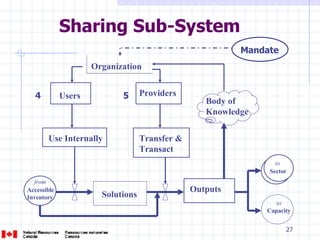
Sharing Sub-System Body of Knowledge  to   Sector to   Capacity Solutions Users Use Internally from   Accessible Inventory 4 Outputs Providers Transfer & Transact 5 Organization Mandate
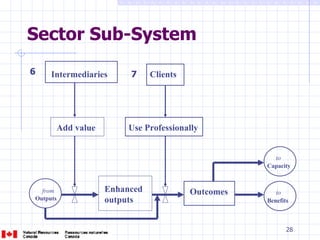
Sector Sub-System to   Capacity to   Benefits from   Outputs Enhanced outputs Intermediaries Add value 6 Outcomes Clients Use Professionally 7
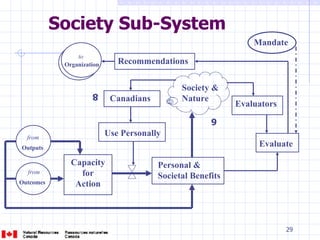
Society Sub-System Capacity for Action from  Outcomes   from  Outputs   Personal & Societal Benefits Use Personally Canadians 8 Society & Nature 9 Evaluate Evaluators to   Organization Mandate Recommendations
Presentation Outline Background Scope Framework Flow Charts Next Steps
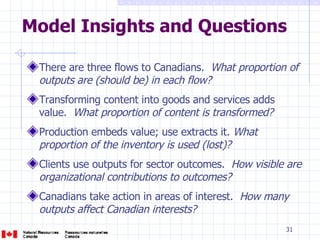
Model Insights and Questions There are three flows to Canadians.  What proportion of outputs are (should be) in each flow? Transforming content into goods and services adds value.  What proportion of content is transformed? Production embeds value; use extracts it.  What proportion of the inventory is used (lost)? Clients use outputs for sector outcomes.  How visible are organizational contributions to outcomes? Canadians take action in areas of interest.  How many outputs affect Canadian interests?
Measurement Strategies Case studies (horizontal flow) Survey activity at key points Process studies (vertical flow) Measure processes at key points
Classification Case Studies Canadian Wildland Fire Information System GeoScience Data Repository National Atlas of Canada National Forestry Database Program RETScreen Energy Decision Support Centre
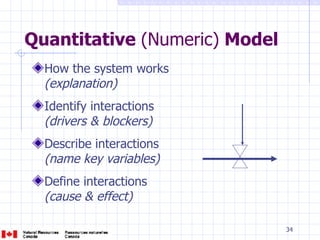
Quantitative  (Numeric)  Model How the system works  (explanation) Identify interactions  (drivers & blockers) Describe interactions  (name key variables) Define interactions  (cause & effect)
What could we do? Measure criteria and indicators Evaluate system performance Diagnose system problems Identify risks and opportunities Establish priorities Allocate resources Adapt programs
A Final Thought… “ The first task of any theory is to clarify terms and concepts that are confused… Only after agreement has been reached regarding terms and concepts can we hope to consider the issues easily and clearly and expect to share the same viewpoint.” Karl Von Clausewitz (1780-1831)

Understanding Knowledge Services

  • 1.
    Understanding KnowledgeServices Natural Resources Canada Knowledge Services Task Group Transforming Government: Better Outcomes for Citizens September 12-14, 2005
  • 2.
    An Opening Thought…“ One of the saddest features of the real world is that goods do not spontaneously present themselves for distribution.”      The Economist (Nov. 5, 1994)
  • 3.
    Presentation Goals Speaker: Share results of the NRCan Knowledge Services Task Group Audience : Gain awareness and relate to your context Conference : Begin interdepartmental dialogue to develop shared understanding
  • 4.
    Presentation Outline BackgroundScope Framework Flow Charts Next Steps
  • 5.
    Government of Canada 2005 Service Vision Service examples (31): statistics (1) information (5), knowledge (0) Framework: Canadians, businesses, international “ No generally accepted definitions or descriptions of public sector information and knowledge services.” “ To identify and act on opportunities…the government must first establish a shared understanding of the attributes of public sector information and knowledge services.”
  • 6.
    The Big PictureOur task is to connect the dots. Knowledge Canadians Serving
  • 7.
    Task Group MandateExamine the nature of the work of science and science-related programs in Natural Resources Canada, describe appropriate elements in the context of Government of Canada service transformation, and submit a report.
  • 8.
    Task Group MembersJohn Broome (Earth Sciences) Malcolm Drury (Energy Technology) Brian Haddon (Canadian Forest Service) Bob O’Neil (Earth Sciences) Dave Pasho (Metals & Minerals) Al Simard (Canadian Forest Service) Mark Williamson (Earth Sciences)
  • 9.
    Questions & AnswersWho is the audience? Treasury Board and NRCan senior managers. What do we want them to do? Adapt programs to the nature of S&T knowledge services to better serve Canadians. What will we do that causes this response? Increase understanding of S&T knowledge services. How will we increase understanding? Develop a descriptive model and classification framework for S&T knowledge services.
  • 10.
    Knowledge Services: Steps Establish Task Group  Determine approach  Outline and define system framework  List and define system functions  Report on progress & seek endorsement  List components & parameters  Define components and parameters  List sub-components & sub-parameters  Conduct Classification case studies  Begin writing report  Define sub-components & sub-parameters Submit report
  • 11.
    Presentation Outline BackgroundScope Framework Flow Charts Next Steps
  • 12.
    A Business PerspectiveEffective Strategy = Describe Strategy + Measure Strategy + Manage Strategy Adapted from Kaplan and Norton (2004)
  • 13.
    Knowledge Spaces Adaptedfrom Snowden (2002) 1. Routine Standards, manuals Bureaucrats, administrators Categorize, process 2. Specialized Technical documents Experts, consultants Design, develop systems 3. Complex Tacit knowledge Scientists, experience Find patterns, understand 4. Chaotic Observations Explorers, innovators Explore, test
  • 14.
    Knowledge Services System:Definition A group of interrelated sub-systems and infrastructure that function collectively, subject to organizational mandates, to embed value into knowledge-based goods & services, preserve it, and enable its extraction to yield benefits.
  • 15.
    Knowledge Services SystemIndirect Outputs Sector Outcomes Canadians Intelligence Organization Mandate Body of Knowledge (Knowledge cycle) Direct Outputs Evaluators Recommendations Benefits (tertiary) (secondary) (primary) Knowledge
  • 16.
    Knowledge Services-Externalities Creatingor changing organizational mandates Transforming mandates into programs Determinants of content generation Determinants of external user wants or needs Use of knowledge to create new knowledge Goods and services not derived from content
  • 17.
    Knowledge Services: Definitions Content : Embedded value, in the form of the message or signal contained within all elements of the knowledge value chain that are held or owned by an organization. Content-based product: Tangible, storable commodity or merchandise, with embedded value, wholly or partly derived from and dependent on content. Content-based service: Intangible, non-storable work, function, or process, with embedded value, wholly or partly derived from and dependent on content.
  • 18.
    Organizational outputs DirectionOperations Positions Coordination Accomplishments Answers Advice Teaching Facilitation Support Laboratory Database Scientific article Technical report Outreach material Geospatial products Statistical products Standards Systems Devices Objects Data Information Knowledge Wisdom Solutions Services Products Content
  • 19.
    Presentation Outline BackgroundScope Framework Flow Charts Next Steps
  • 20.
    Knowledge Services -Approach Focus on organizations or groups of organizations Driven by organizational mandates; responds to user needs Includes supply- and demand-driven processes Based on flow of goods & services through a value chain Two resolutions: measuring system performance; classifying organizational activities.
  • 21.
    Knowledge Services FrameworkElements of Zachman (1992) Component… Component f Component c Component… Component e Component b Purpose… Purpose 2 Purpose 1 Component… Component d Component a Stage 1 Stage 2 Stage … Goods & Services Value Chain Benefits Who Work What Why
  • 22.
    Knowledge Services -Stages Generate (start Knowledge Services value chain) Transform (goods & services increase utility, value) Enable (permit transfer) Use Internally (accomplish organizational objectives) Transfer (enable external use) Enhance (increase availability, utility, value) Use Professionally (sector derives benefits) Use Personally (individuals derive benefits) Evaluate (organizational mandate, resources)
  • 23.
    Knowledge Services HierarchyKnowledge Services System Knowledge Services Sub-Systems (5) Stages (9) Components (33+7) Sub-Components (201+27)
  • 24.
    Presentation Outline BackgroundScope Framework Components Next Steps
  • 25.
    Production Sub-System to Existing Inventory from Accessible Inventory Society & Nature Content Generate Originators 1 Products & Services Transform Developers 2 Partners Organization Mandate
  • 26.
    Management Sub-System ManagersLost Value Preserve 3 Organization Mandate from Production Existing Inventory Enable Accessible Inventory to Content to Sharing
  • 27.
    Sharing Sub-System Bodyof Knowledge to Sector to Capacity Solutions Users Use Internally from Accessible Inventory 4 Outputs Providers Transfer & Transact 5 Organization Mandate
  • 28.
    Sector Sub-System to Capacity to Benefits from Outputs Enhanced outputs Intermediaries Add value 6 Outcomes Clients Use Professionally 7
  • 29.
    Society Sub-System Capacityfor Action from Outcomes from Outputs Personal & Societal Benefits Use Personally Canadians 8 Society & Nature 9 Evaluate Evaluators to Organization Mandate Recommendations
  • 30.
    Presentation Outline BackgroundScope Framework Flow Charts Next Steps
  • 31.
    Model Insights andQuestions There are three flows to Canadians. What proportion of outputs are (should be) in each flow? Transforming content into goods and services adds value. What proportion of content is transformed? Production embeds value; use extracts it. What proportion of the inventory is used (lost)? Clients use outputs for sector outcomes. How visible are organizational contributions to outcomes? Canadians take action in areas of interest. How many outputs affect Canadian interests?
  • 32.
    Measurement Strategies Casestudies (horizontal flow) Survey activity at key points Process studies (vertical flow) Measure processes at key points
  • 33.
    Classification Case StudiesCanadian Wildland Fire Information System GeoScience Data Repository National Atlas of Canada National Forestry Database Program RETScreen Energy Decision Support Centre
  • 34.
    Quantitative (Numeric) Model How the system works (explanation) Identify interactions (drivers & blockers) Describe interactions (name key variables) Define interactions (cause & effect)
  • 35.
    What could wedo? Measure criteria and indicators Evaluate system performance Diagnose system problems Identify risks and opportunities Establish priorities Allocate resources Adapt programs
  • 36.
    A Final Thought…“ The first task of any theory is to clarify terms and concepts that are confused… Only after agreement has been reached regarding terms and concepts can we hope to consider the issues easily and clearly and expect to share the same viewpoint.” Karl Von Clausewitz (1780-1831)