Knowledge Management in the  Canadian Forest Service Albert Simard  Canadian Forest Service Presented to Interdepartmental Knowledge Management Forum May 28, 2003 “ Connecting the Past, Present, and Future”
An opening thought… “ Although all decisions we make are about the future, all our knowledge stems from the past”   Ian Wilson (National Archivist of Canada) Crossing Boundaries Conference (May 8, 2003)
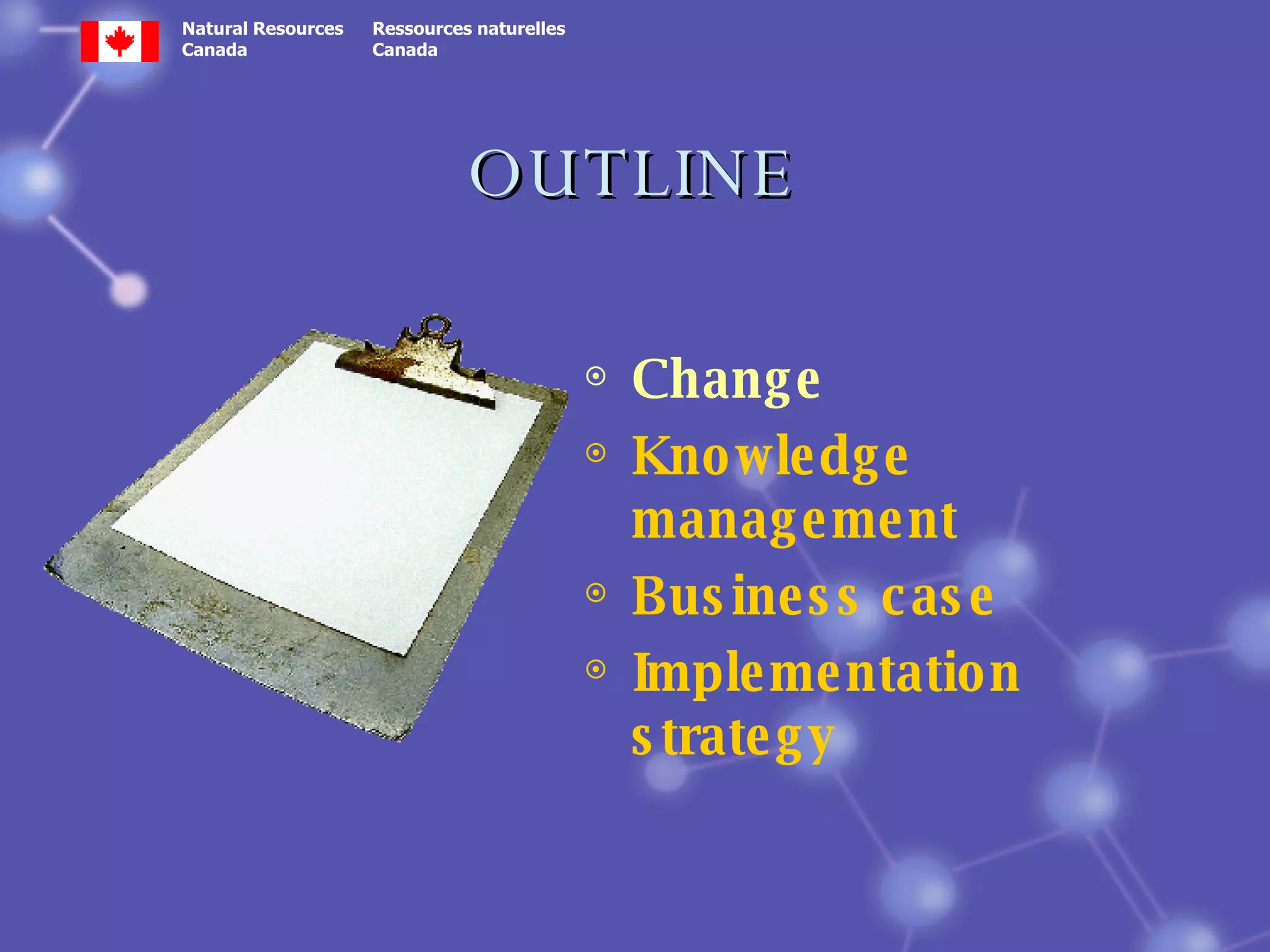
OUTLINE Change Knowledge management Business case  Implementation strategy
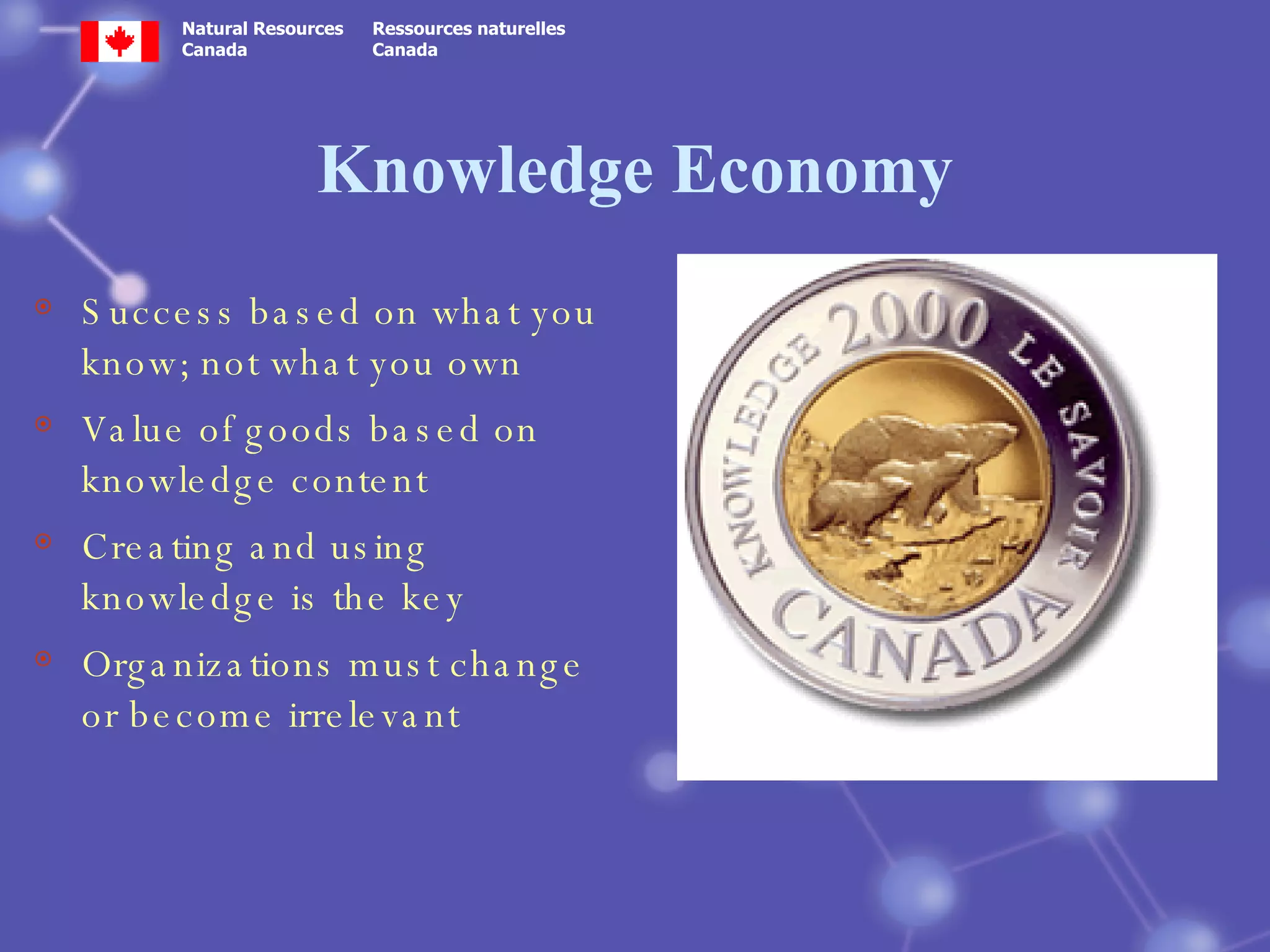
Knowledge Economy Success based on what you know; not what you own  Value of goods based on knowledge content  Creating and using knowledge is the key Organizations must change or become irrelevant
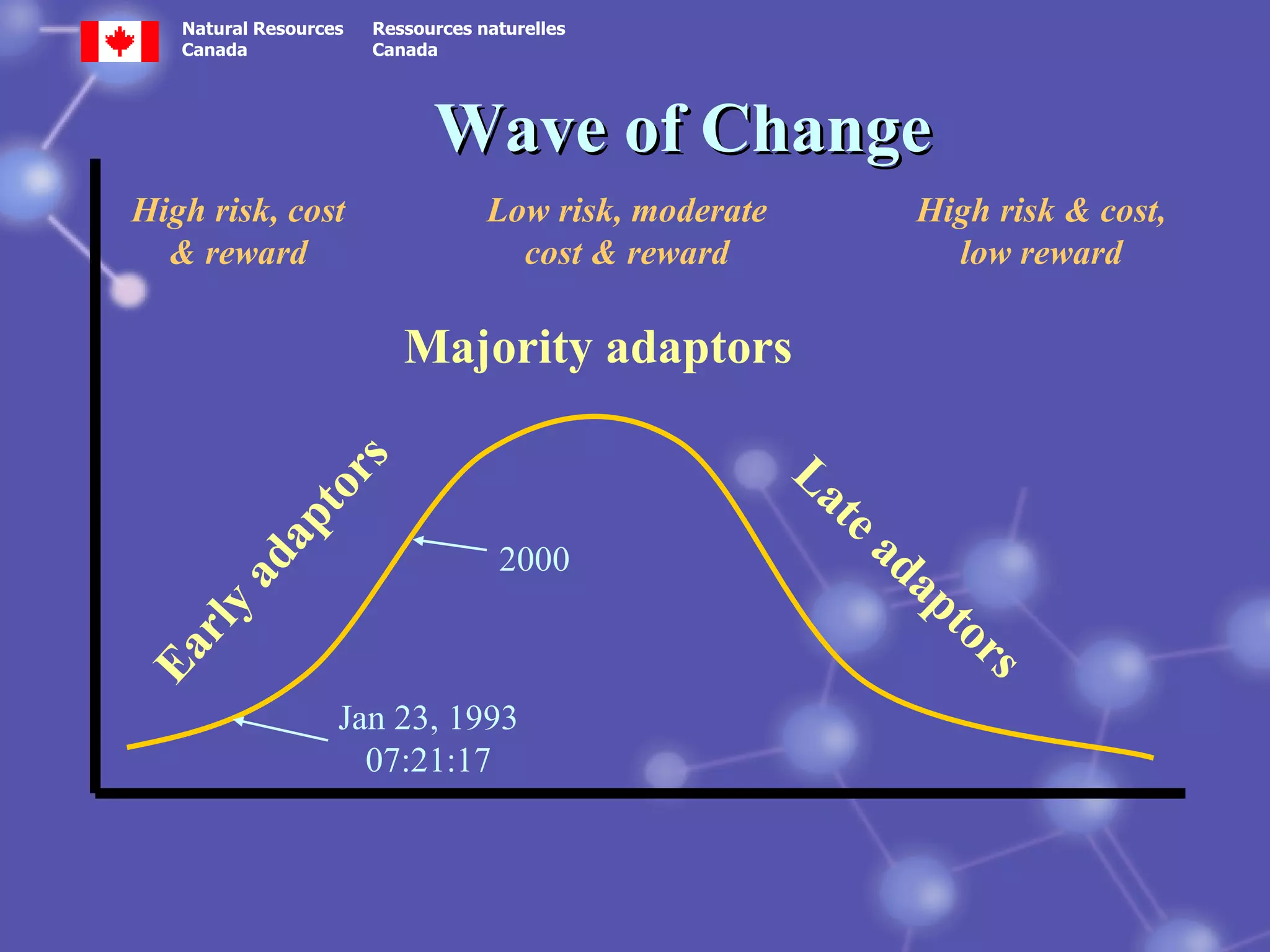
Wave of Change Early adaptors Majority adaptors Late adaptors High risk, cost & reward High risk & cost, low reward Low risk, moderate cost & reward 2000 Jan 23, 1993 07:21:17
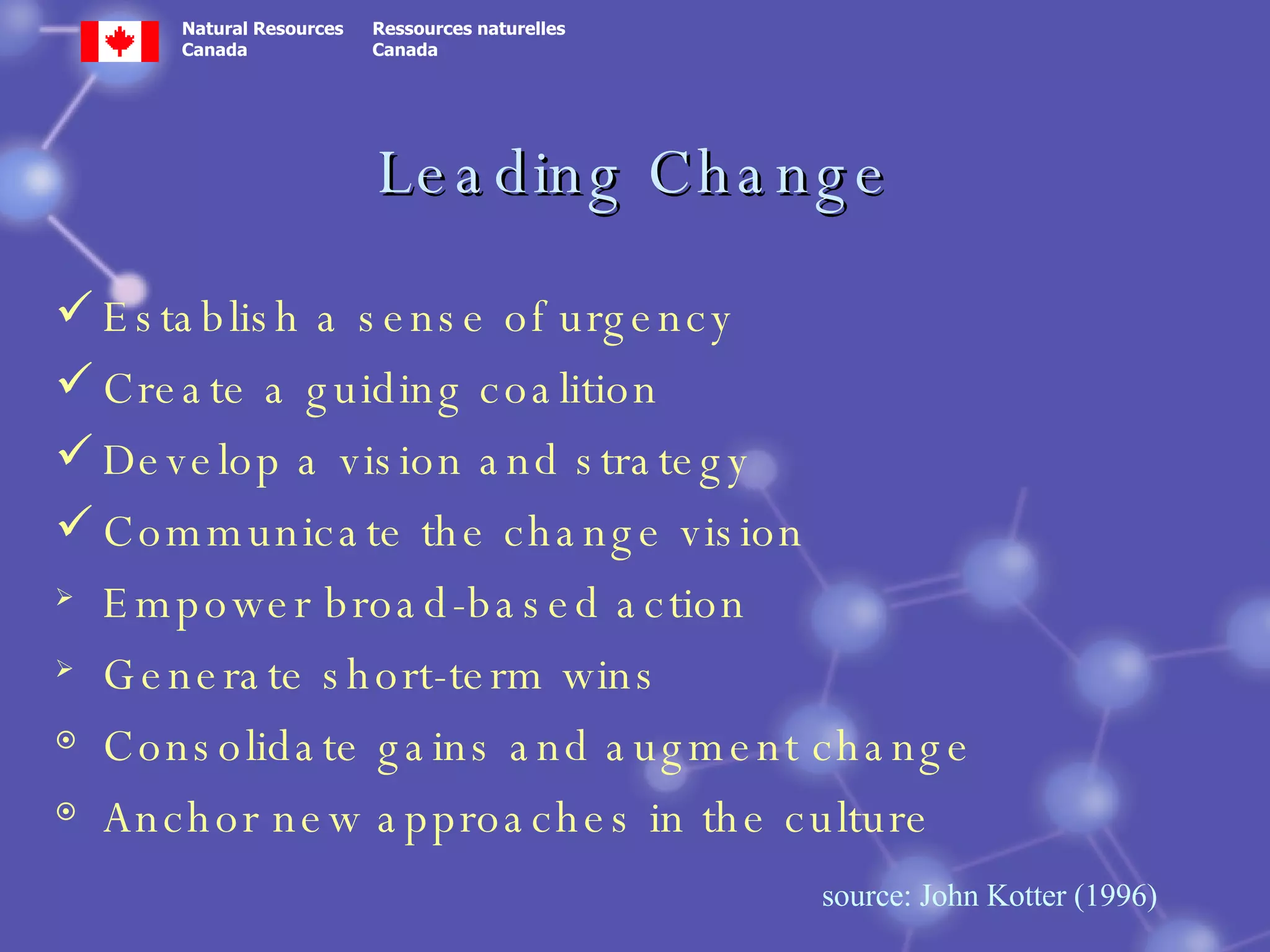
Leading Change Establish a sense of urgency Create a guiding coalition Develop a vision and strategy Communicate the change vision Empower broad-based action Generate short-term wins Consolidate gains and augment change Anchor new approaches in the culture source: John Kotter (1996)
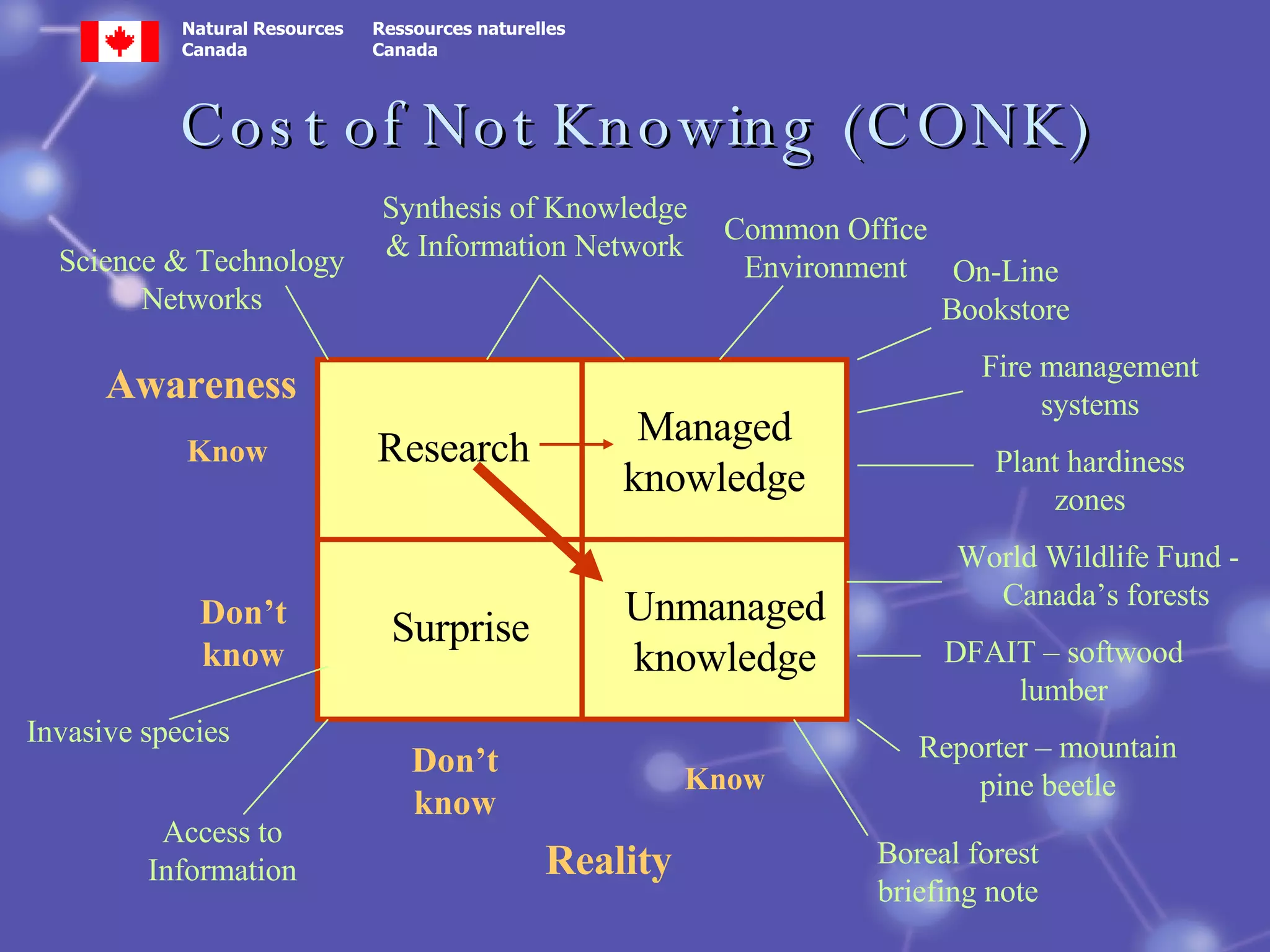
Cost of Not Knowing (CONK) Research Managed knowledge Surprise Unmanaged knowledge Awareness Know Don’t know Reality Know Don’t know World Wildlife Fund -  Canada’s forests DFAIT – softwood lumber Reporter – mountain pine beetle Boreal forest briefing note Invasive species Access to Information Science & Technology Networks Synthesis of Knowledge & Information Network Fire management systems On-Line Bookstore Common Office Environment Plant hardiness zones
Consultant’s Report: “ There is no doubt that making no change in response to these findings would represent a risk of deteriorating relevancy and support across a range of audiences.”
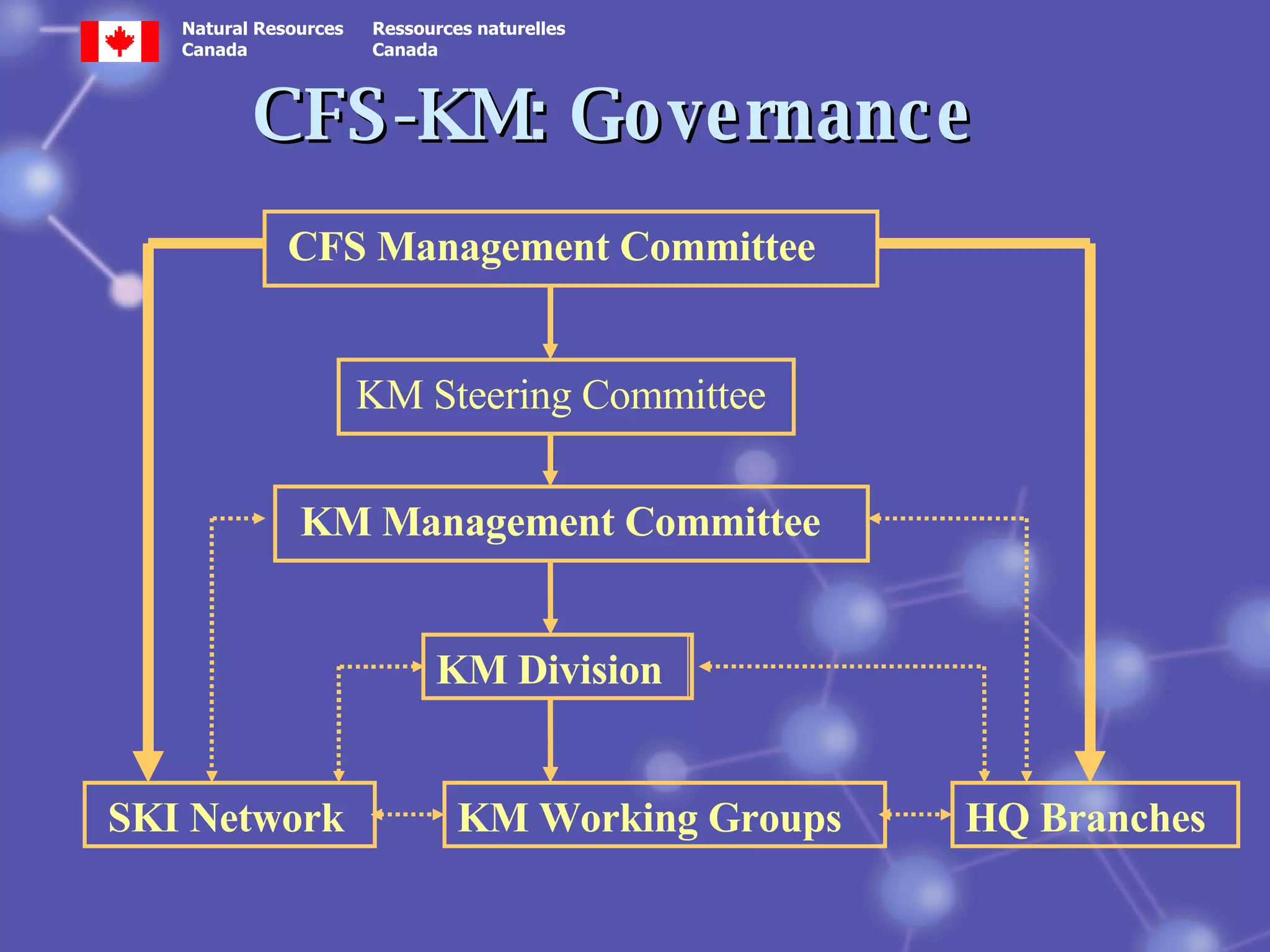
CFS-KM: Governance  CFS Management Committee KM Division SKI Network KM Working Groups HQ Branches KM Steering Committee KM Management Committee
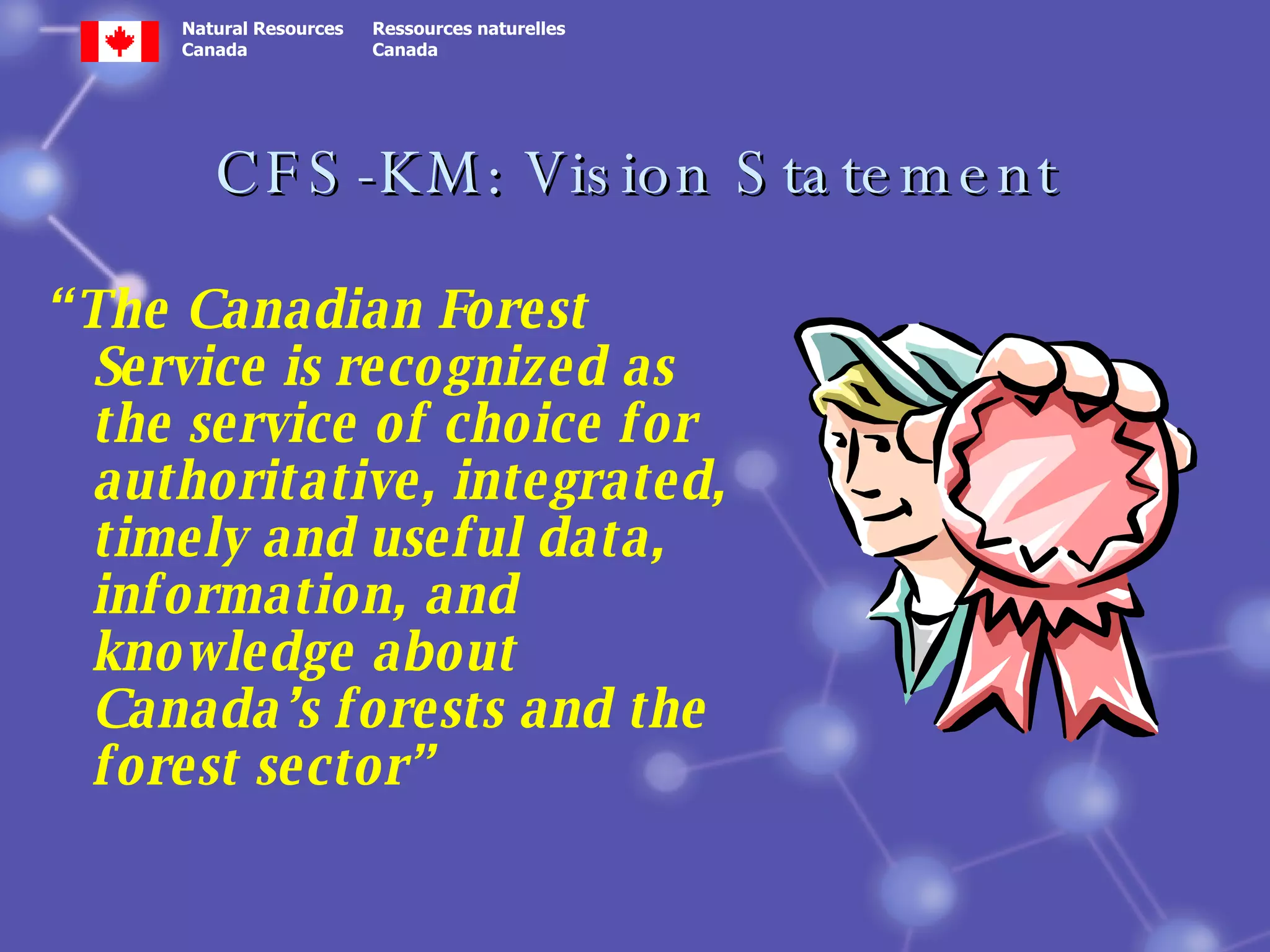
CFS-KM: Vision Statement “ The Canadian Forest Service is recognized as the service of choice for authoritative, integrated, timely and useful data, information, and knowledge about Canada’s forests and the forest sector”
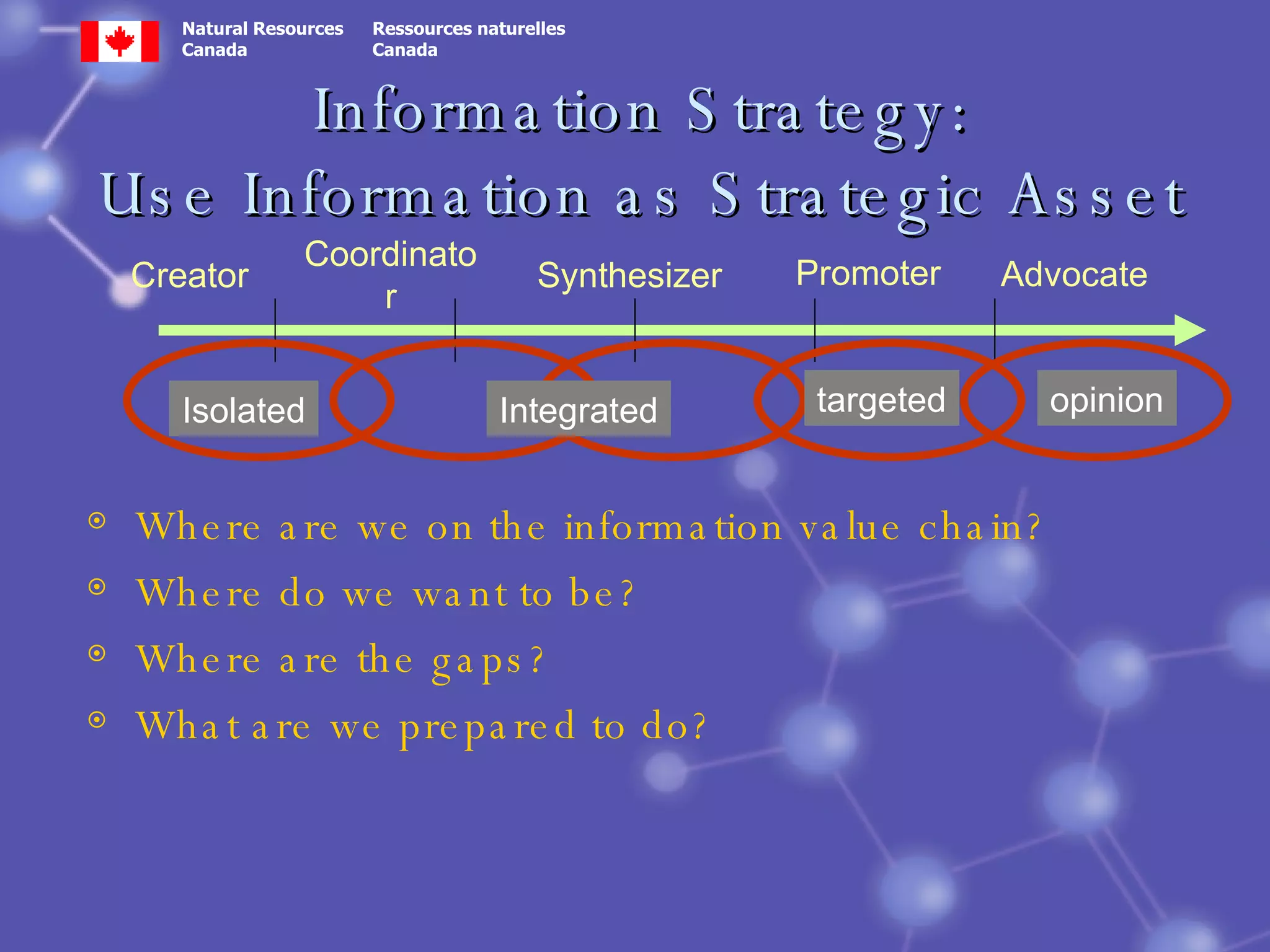
Information Strategy: Use Information as Strategic Asset Where are we on the information value chain? Where do we want to be?  Where are the gaps?  What are we prepared to do?  Coordinator Synthesizer Advocate Promoter Creator Isolated opinion Integrated targeted
KM Communication: Goals Increase awareness of KM Program Create a shared understanding of concepts Develop a consensus on need and direction Promote buy-in and participation Establish an ongoing feedback process
KM Communication: Messages Senior management  Organizational mandate, relevance Middle Management  Organizational efficiency and effectiveness Knowledge workers Participation , self-interest External Government, forestry, international
OUTLINE Change Knowledge management Business case  Implementation strategy
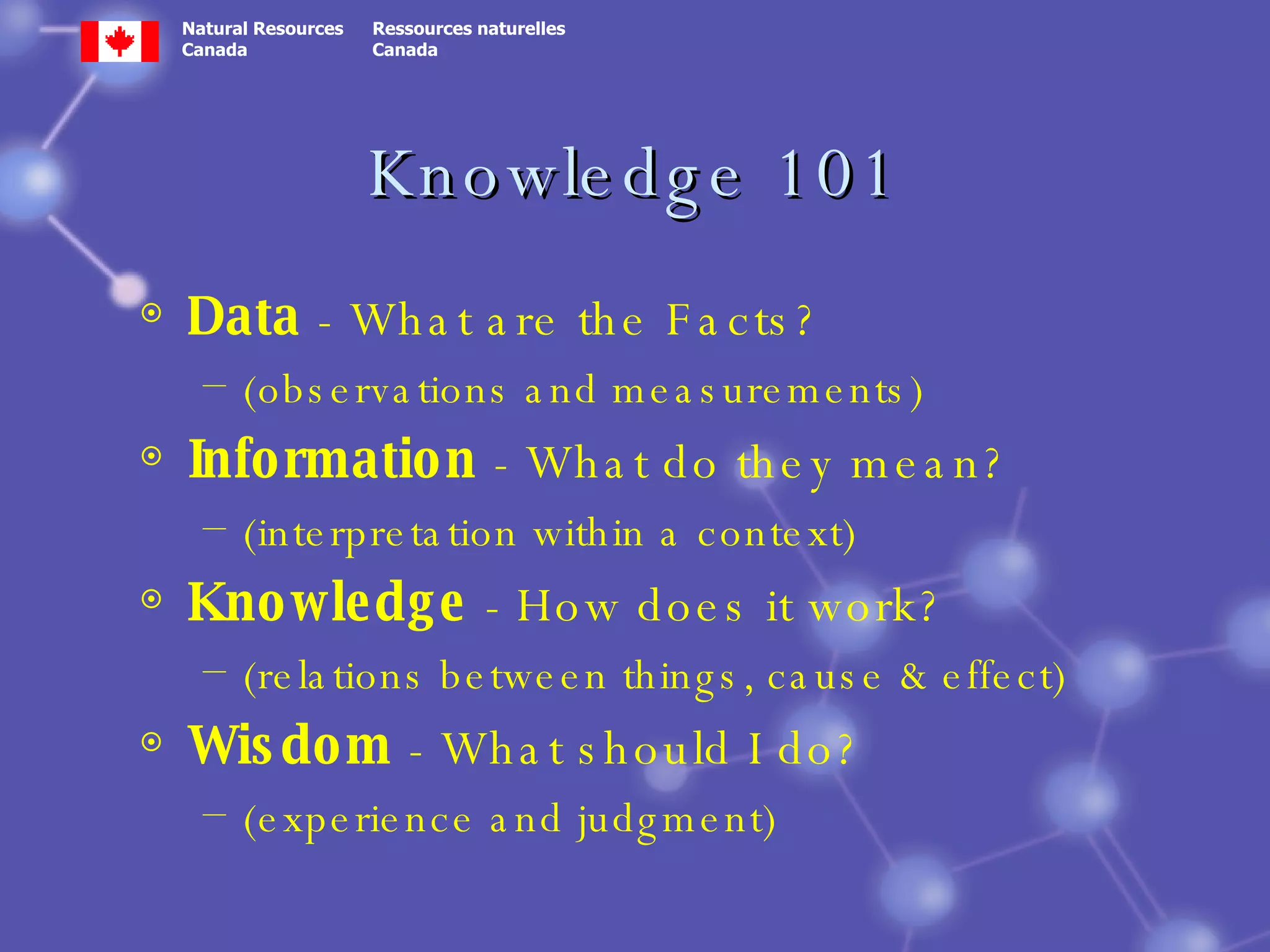
Knowledge 101 Data  - What are the Facts? (observations and measurements) Information  - What do they mean? (interpretation within a context) Knowledge  - How does it work? (relations between things, cause & effect) Wisdom  - What should I do? (experience and judgment)
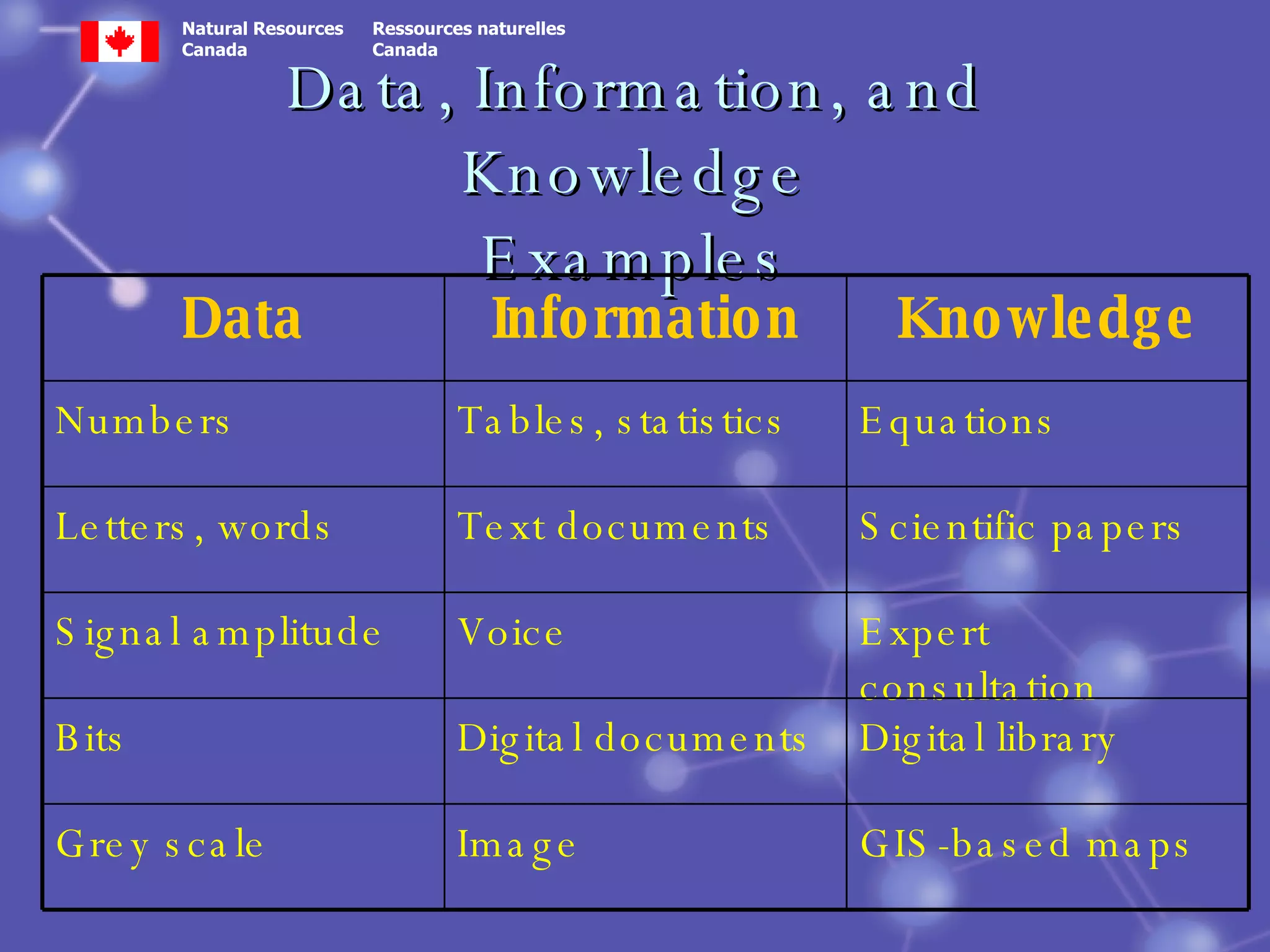
Data, Information, and Knowledge Examples GIS-based maps Image Grey scale Digital library Digital documents Bits Expert consultation Voice Signal amplitude Scientific papers Text documents Letters, words Equations  Tables, statistics Numbers Knowledge Information Data
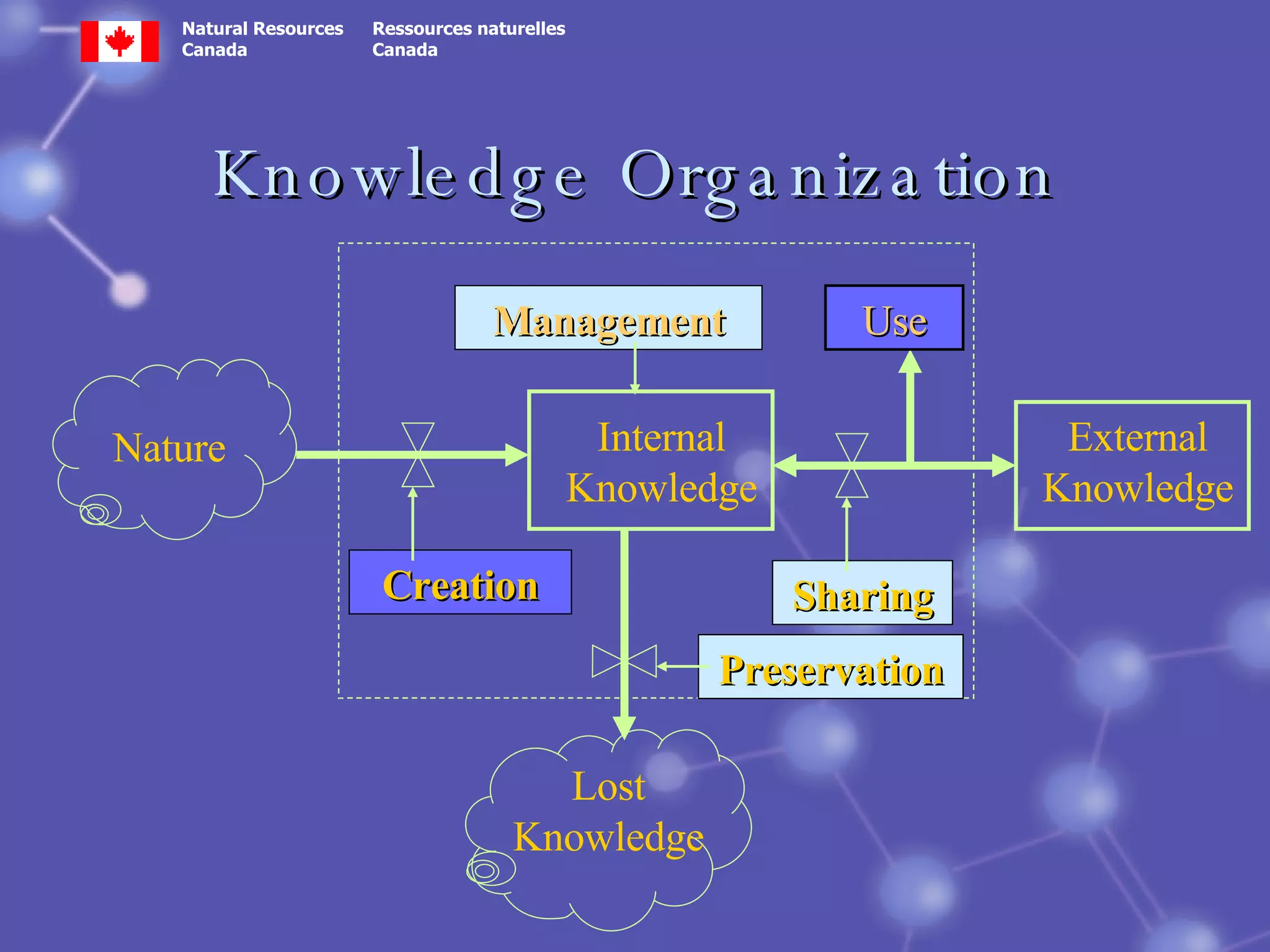
Knowledge Organization External Knowledge Sharing Creation Nature Internal Knowledge Management Preservation Lost Knowledge Use
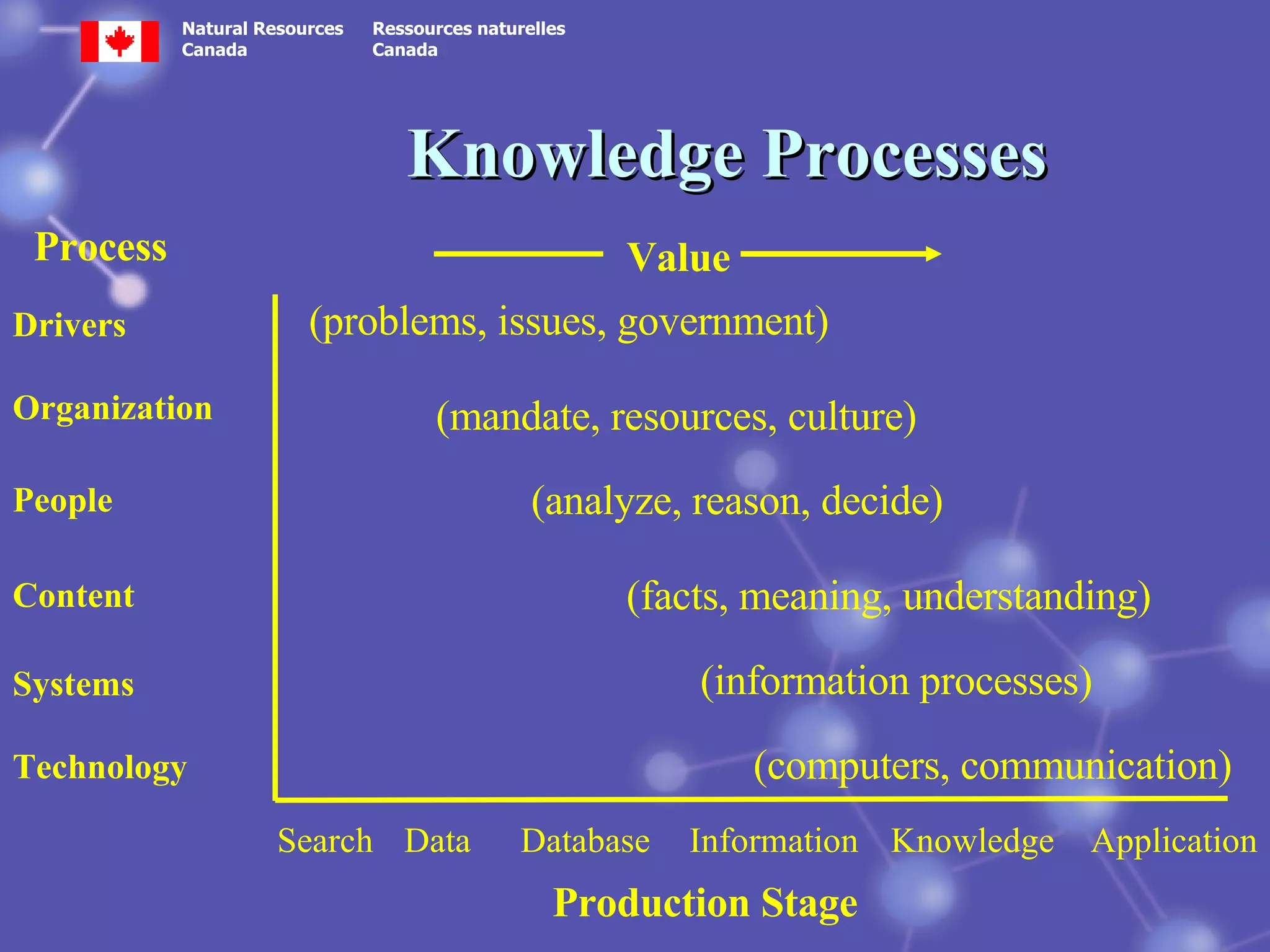
Knowledge Processes   Drivers (problems, issues, government) Organization (mandate, resources, culture) People (analyze, reason, decide) Content   (facts, meaning, understanding) Systems (information processes) Technology (computers, communication) Process Data Database Information Knowledge Application Search Production Stage Value
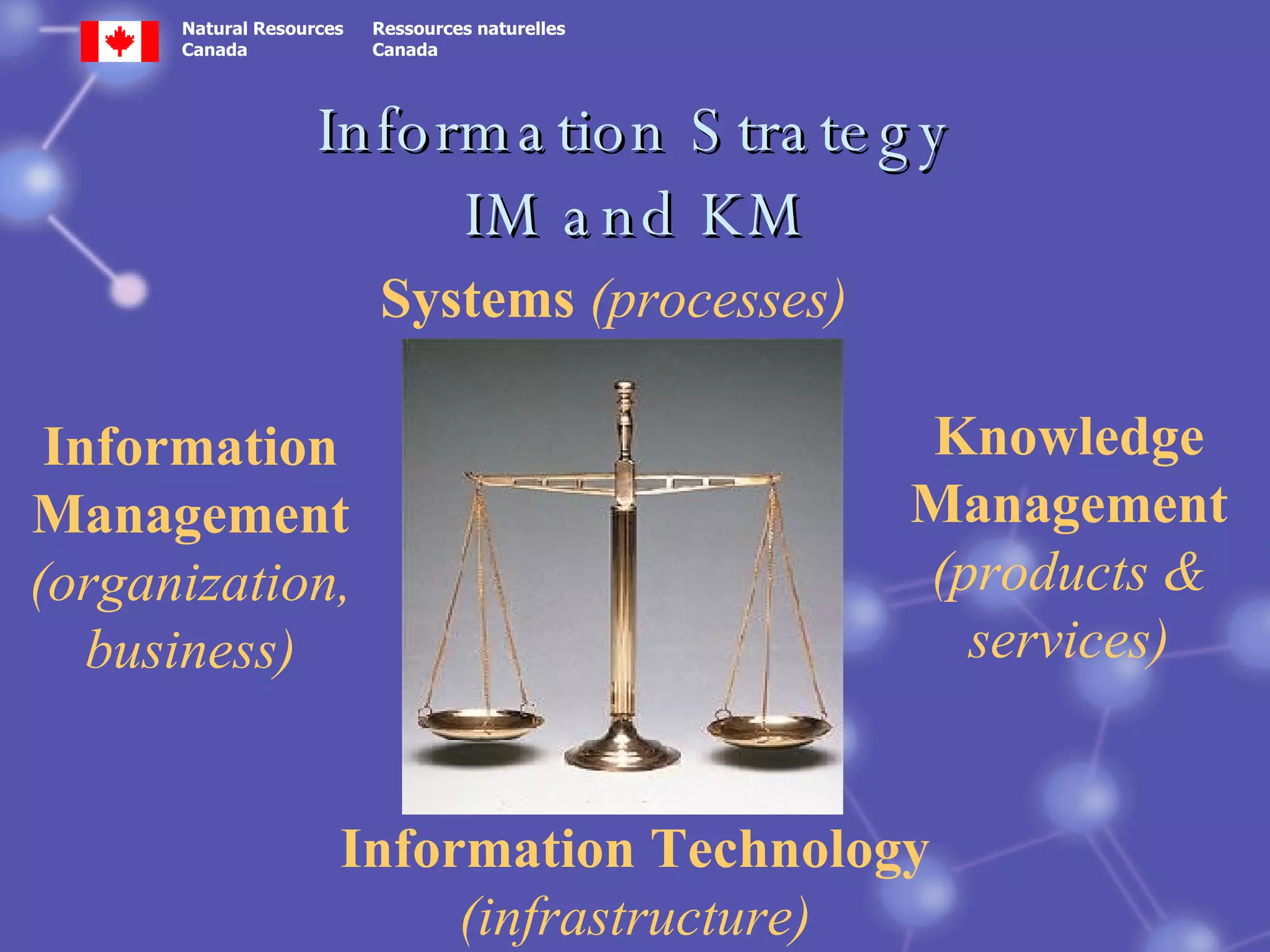
Information Strategy IM and KM Information Technology  (infrastructure) Information Management  (organization, business) Knowledge Management  (products & services) Systems  (processes)
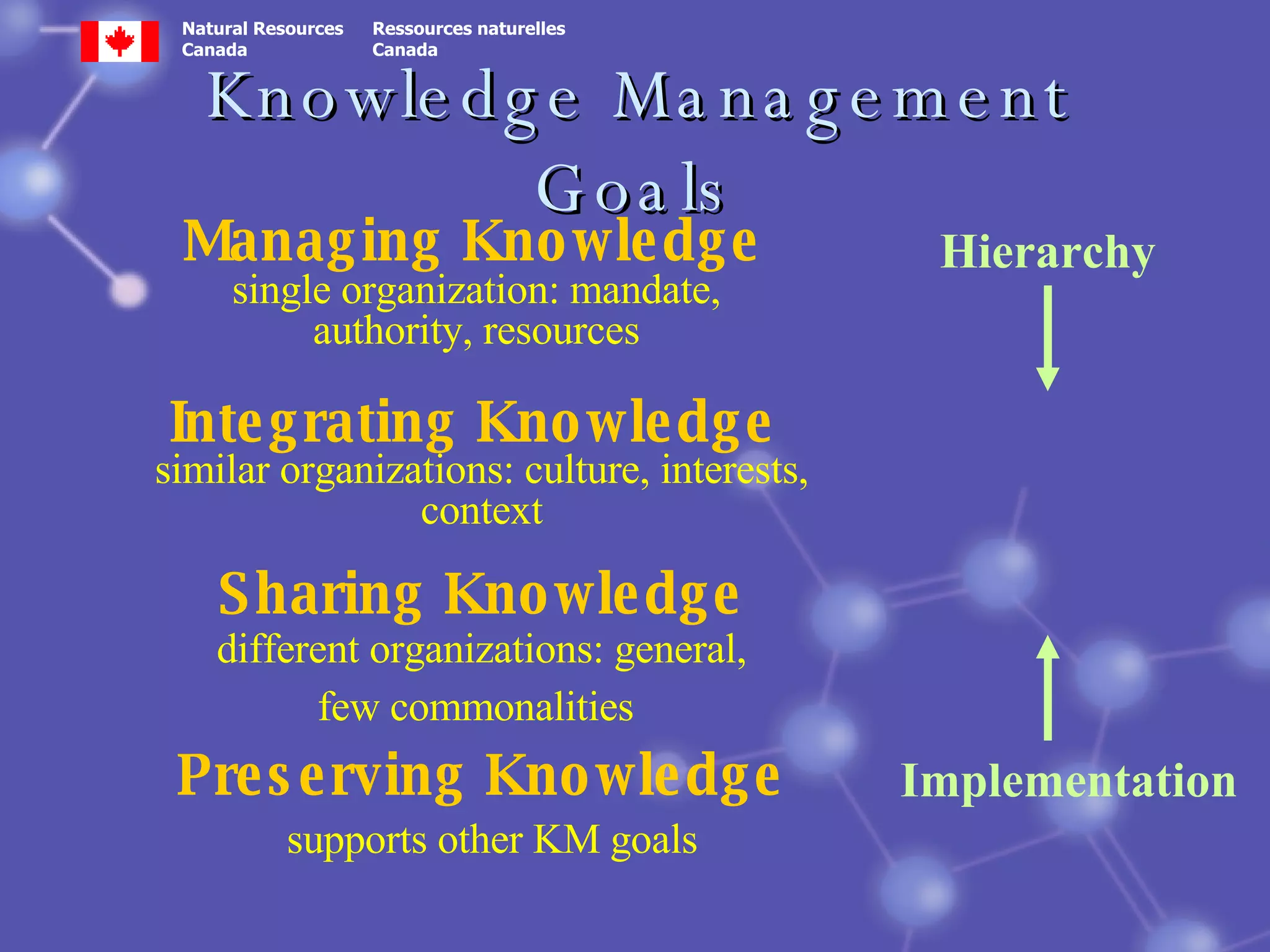
Knowledge Management Goals Managing Knowledge   Integrating Knowledge   Sharing Knowledge Preserving Knowledge single organization: mandate, authority, resources similar organizations: culture, interests, context different organizations: general, few commonalities   supports other KM goals Hierarchy Implementation
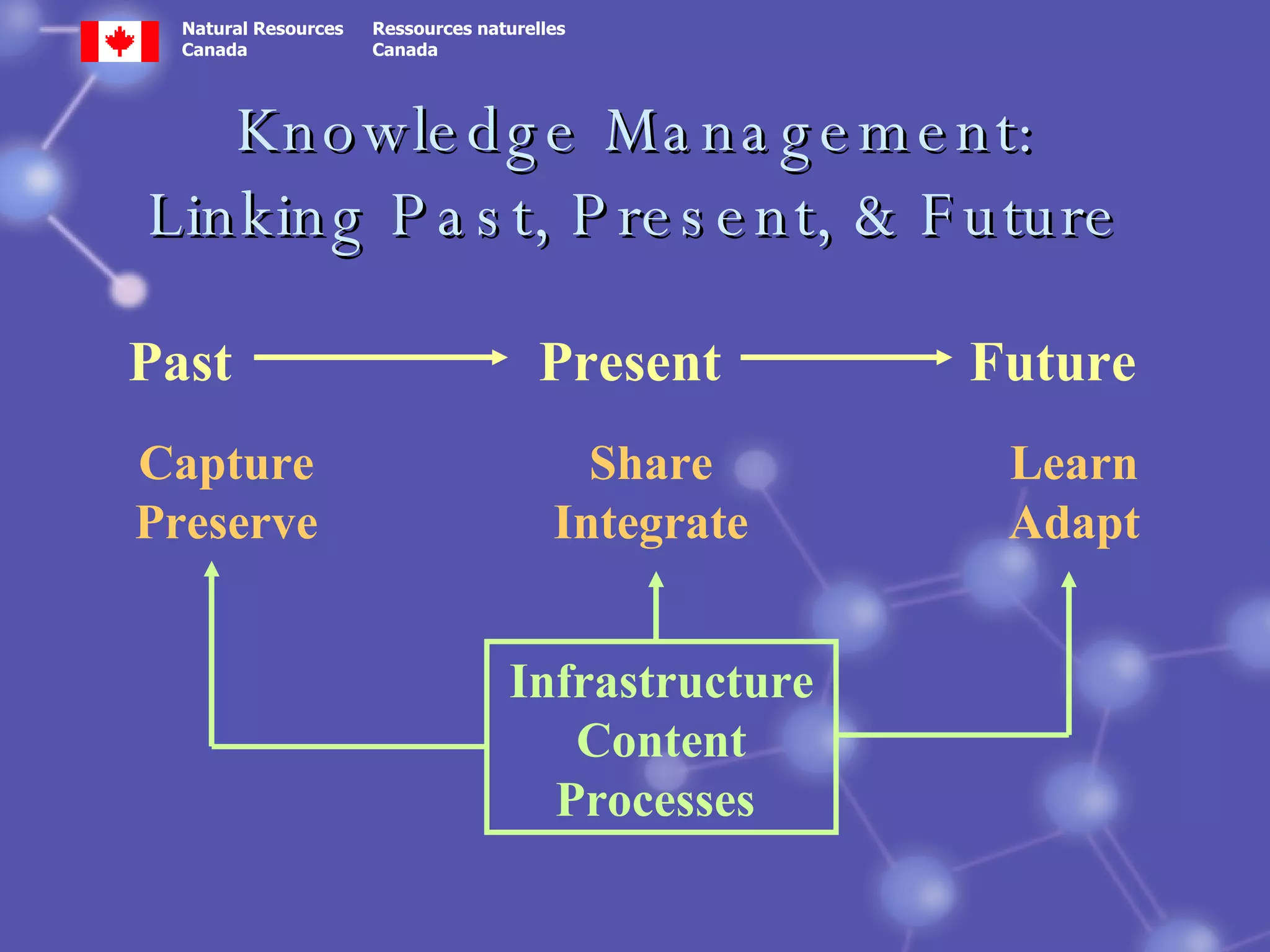
Knowledge Management: Linking Past, Present, & Future Capture   Preserve Share Integrate Learn Adapt Past Present Future Infrastructure Content Processes
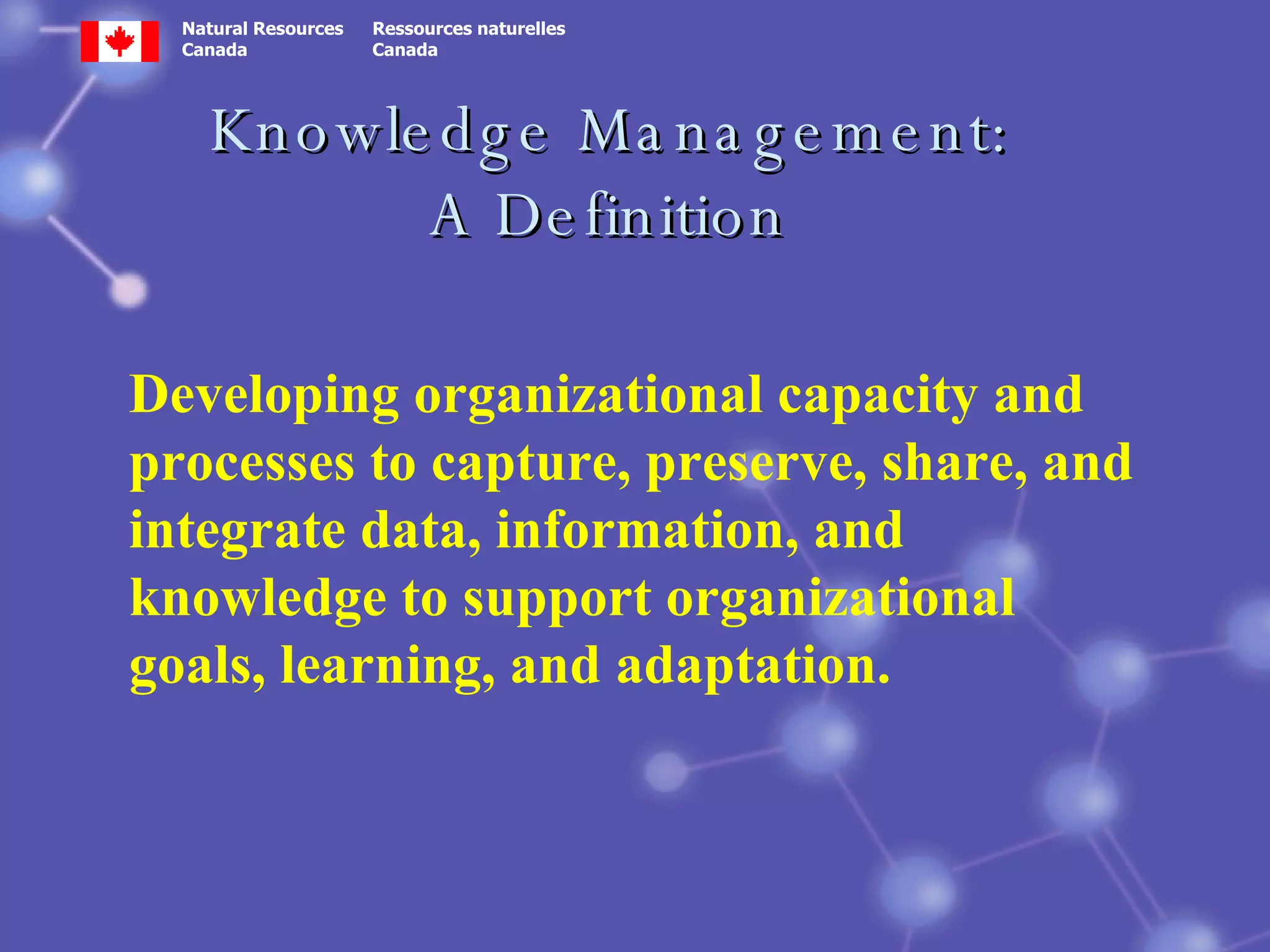
Knowledge Management: A Definition Developing organizational capacity and processes to capture, preserve, share, and integrate data, information, and knowledge to support organizational goals, learning, and adaptation.
OUTLINE Change Knowledge management Business case   Implementation strategy
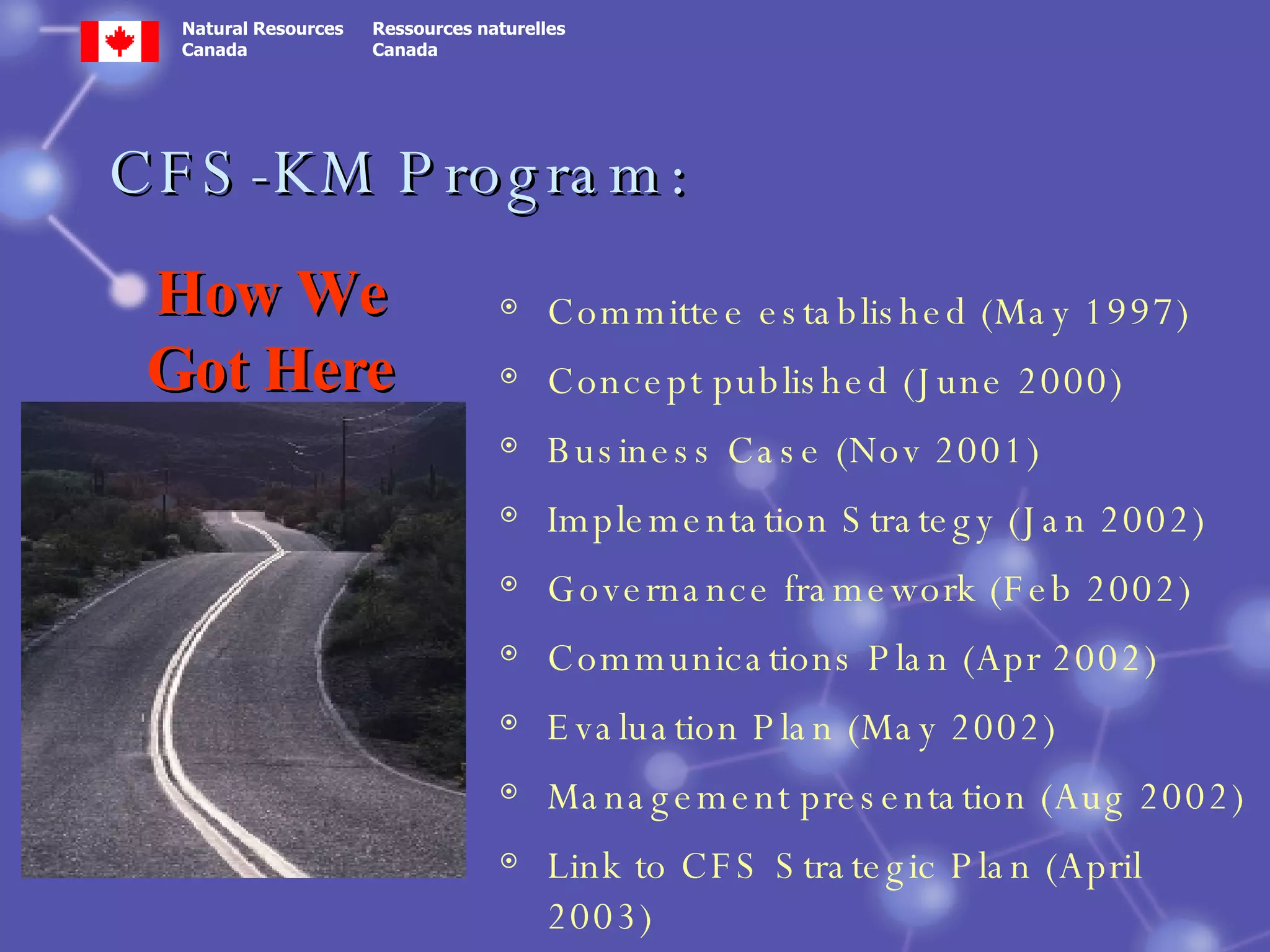
CFS-KM Program: Committee established (May 1997) Concept published (June 2000) Business Case (Nov 2001) Implementation Strategy (Jan 2002) Governance framework (Feb 2002) Communications Plan (Apr 2002) Evaluation Plan (May 2002) Management presentation (Aug 2002) Link to CFS Strategic Plan (April 2003) How We Got Here
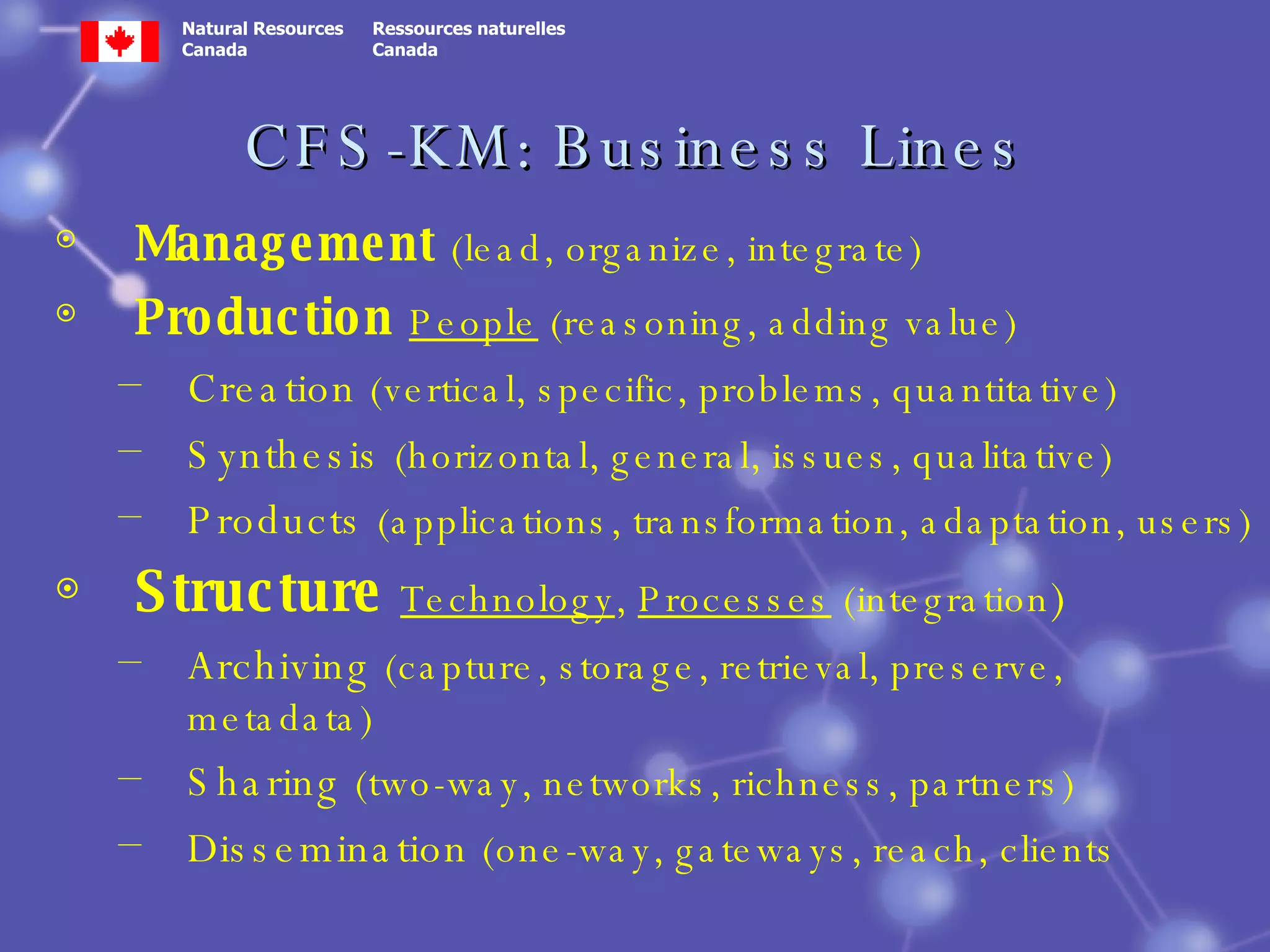
CFS-KM: Business Lines Management   (lead, organize, integrate) Production   People  (reasoning, adding value) Creation  (vertical, specific, problems, quantitative) Synthesis  (horizontal, general, issues, qualitative)   Products  (applications, transformation, adaptation, users) Structure   Technology ,  Processes  (integration ) Archiving  (capture, storage, retrieval, preserve, metadata) Sharing  (two-way, networks, richness, partners) Dissemination  (one-way, gateways, reach, clients
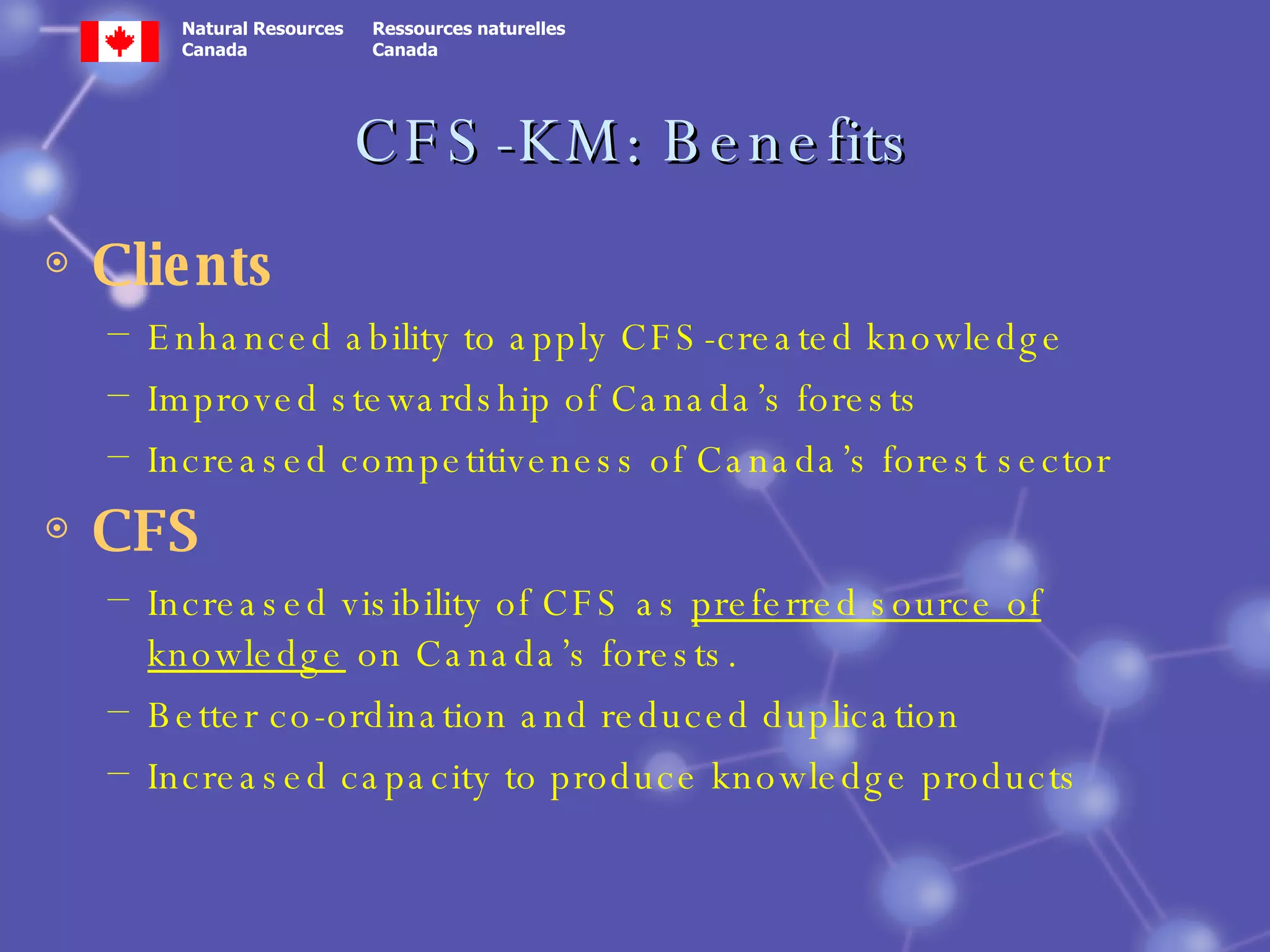
CFS-KM: Benefits Clients Enhanced ability to apply CFS-created knowledge Improved stewardship of Canada’s forests Increased competitiveness of Canada’s forest sector CFS Increased visibility of CFS as  preferred source of knowledge  on Canada’s forests.  Better co-ordination and reduced duplication Increased capacity to produce knowledge products
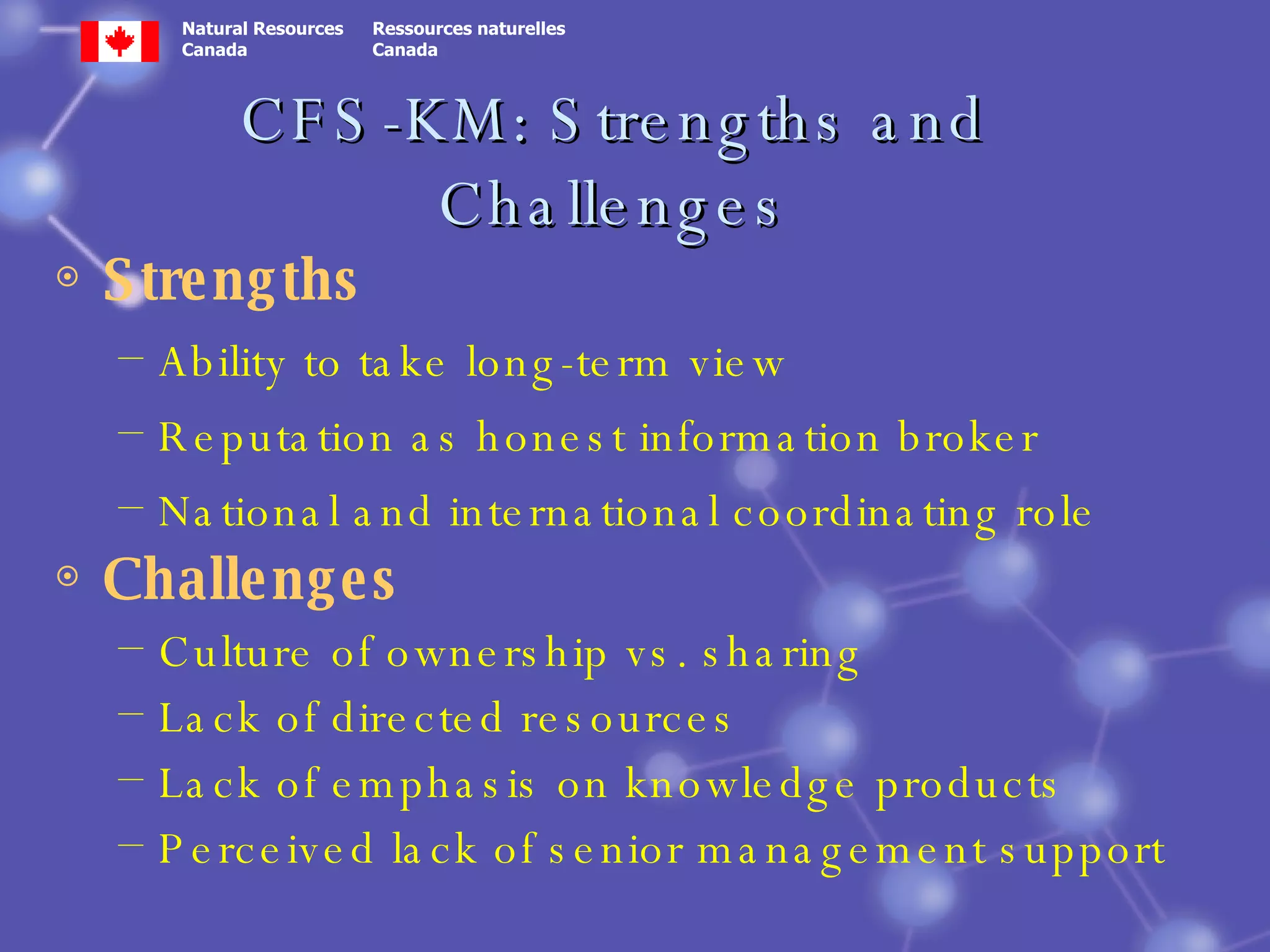
CFS-KM: Strengths and Challenges Strengths Ability to take long-term view Reputation as honest information broker National and international coordinating role Challenges Culture of ownership vs. sharing Lack of directed resources  Lack of emphasis on knowledge products  Perceived lack of senior management support
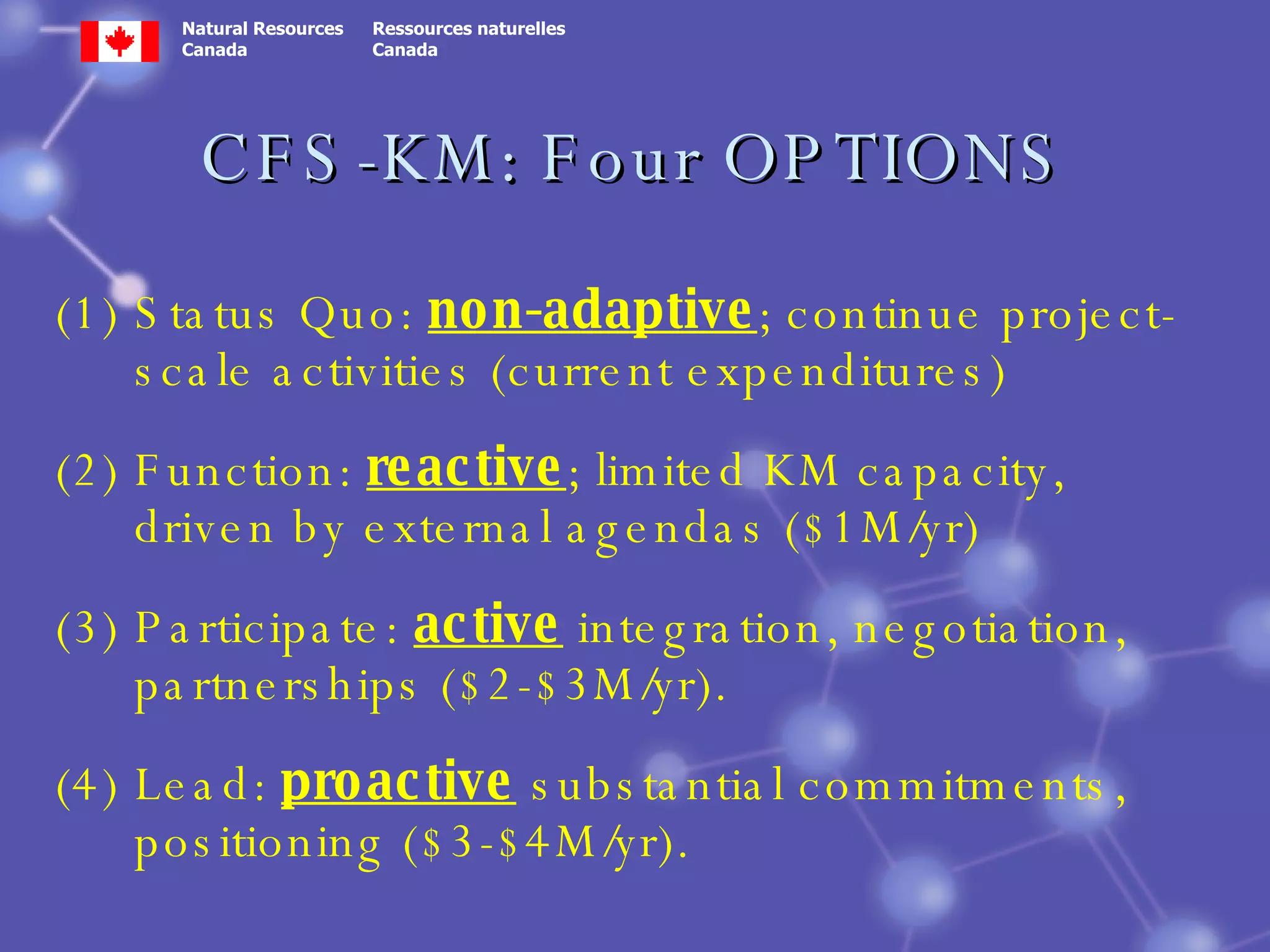
CFS-KM: Four OPTIONS (1) Status Quo:  non-adaptive ; continue project-scale activities (current expenditures) (2) Function:  reactive ; limited KM capacity, driven by external agendas ($1M/yr) (3) Participate:  active  integration, negotiation, partnerships ($2-$3M/yr). (4) Lead:  proactive  substantial commitments, positioning ($3-$4M/yr).
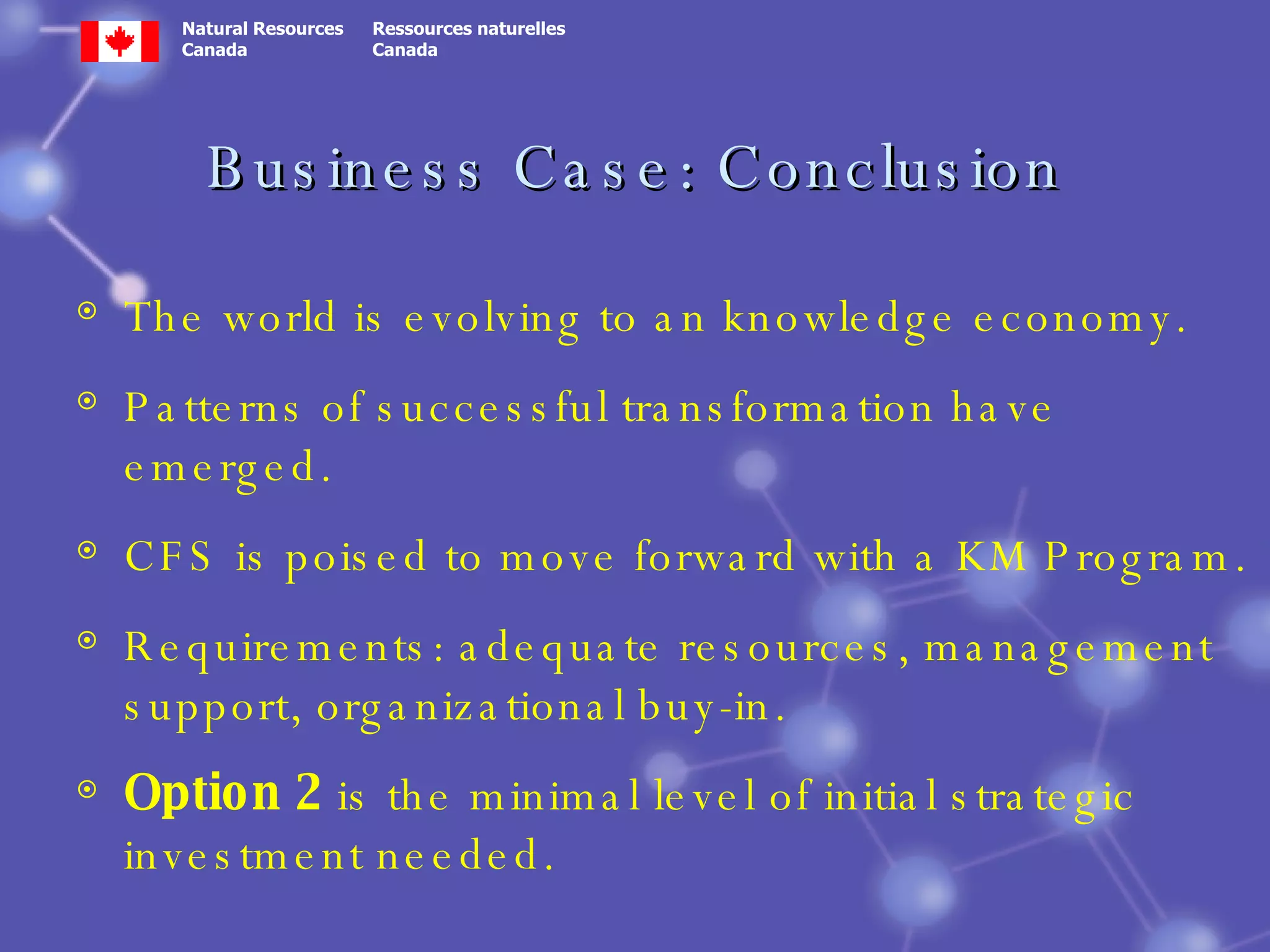
Business Case: Conclusion The world is evolving to an knowledge economy.  Patterns of successful transformation have emerged. CFS is poised to move forward with a KM Program. Requirements: adequate resources, management support, organizational buy-in. Option 2  is the minimal level of initial strategic investment needed.
OUTLINE Change Knowledge management Business case   Implementation strategy
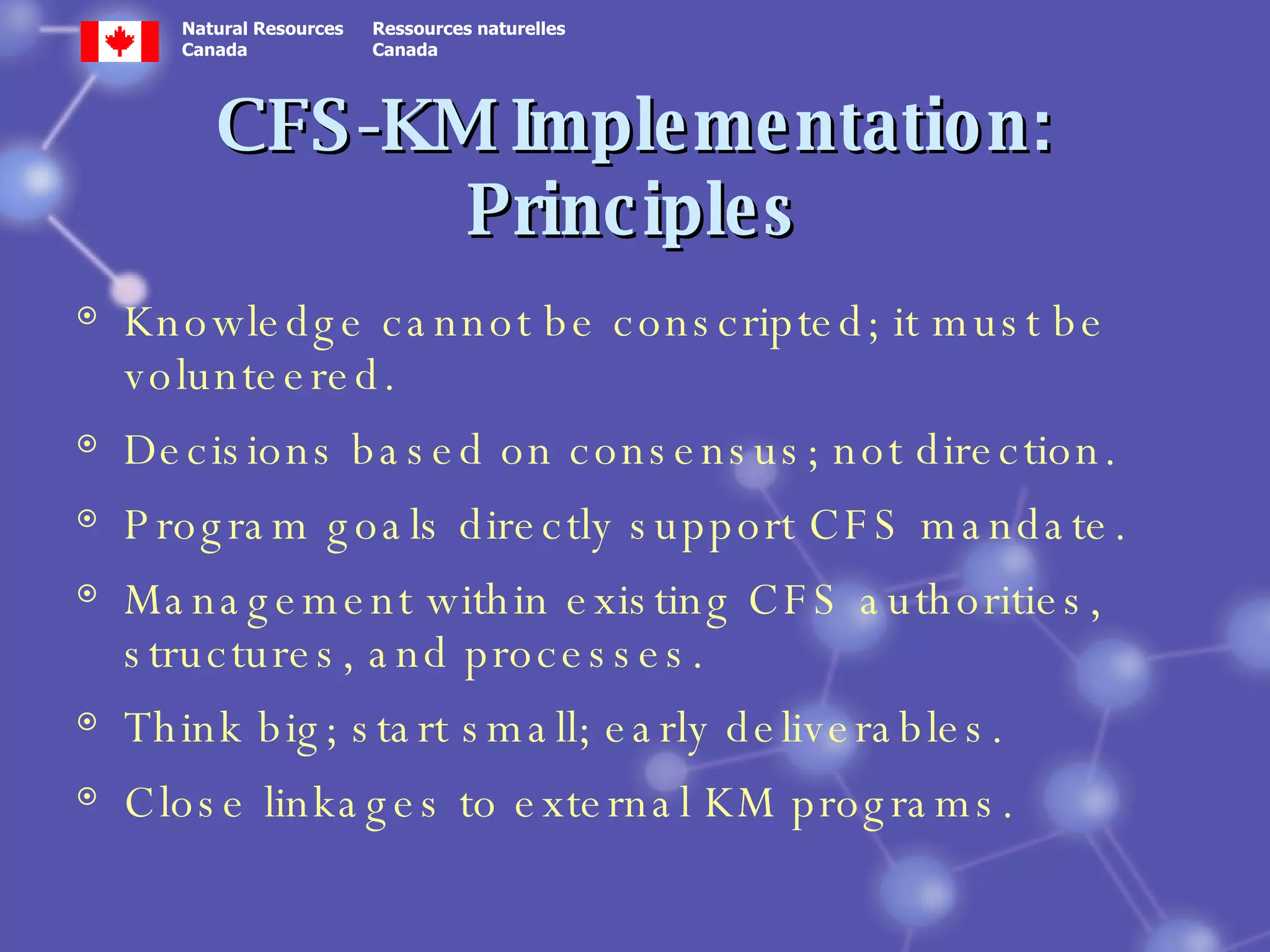
CFS-KM Implementation: Principles Knowledge cannot be conscripted; it must be volunteered. Decisions based on consensus; not direction. Program goals directly support CFS mandate. Management within existing CFS authorities, structures, and processes. Think big; start small; early deliverables. Close linkages to external KM programs.
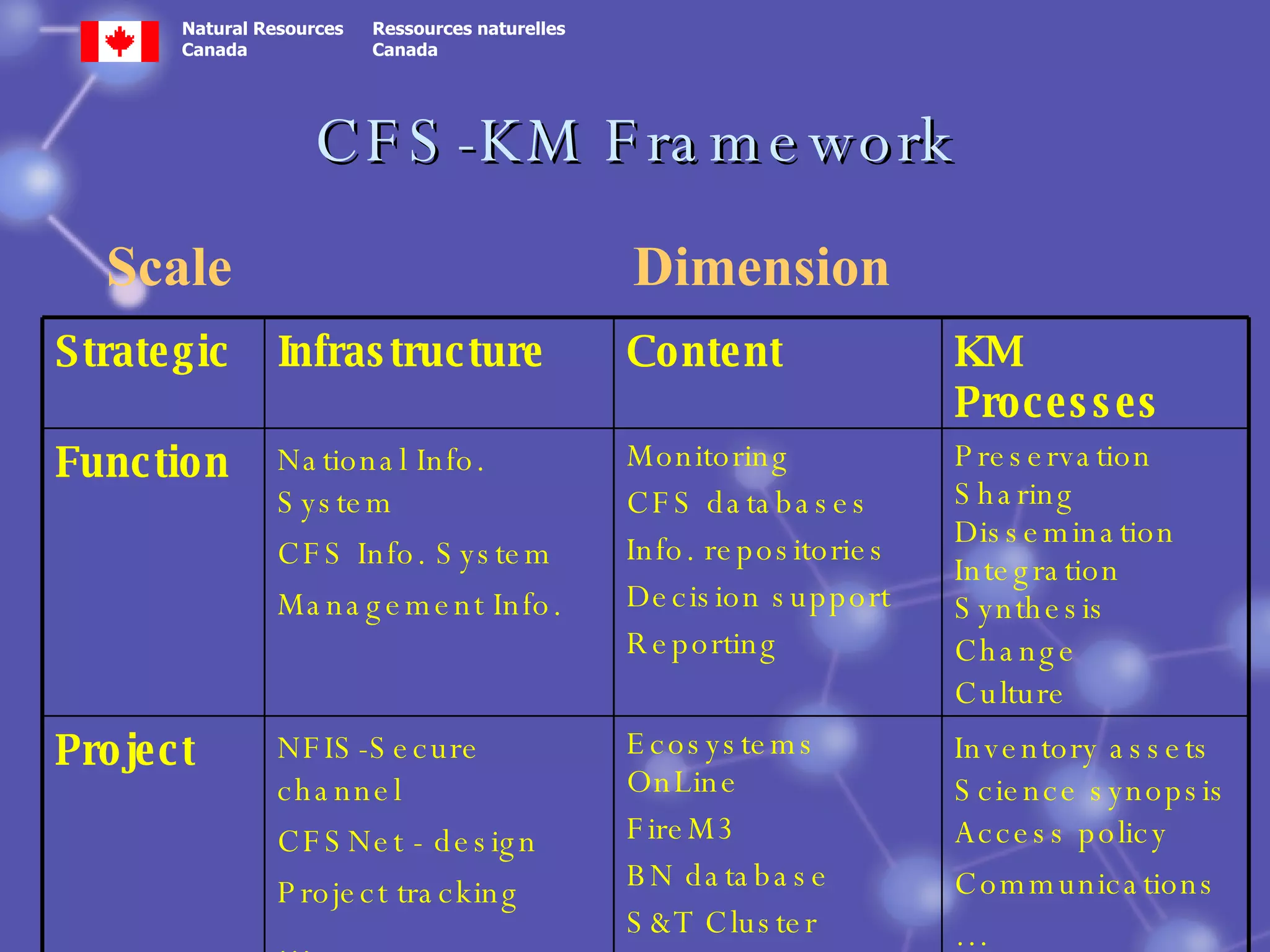
CFS-KM Framework Scale Dimension Inventory assets Science synopsis Access policy  Communications … Ecosystems OnLine FireM3 BN database  S&T Cluster … NFIS-Secure channel CFSNet - design Project tracking  … Project Preservation Sharing Dissemination Integration Synthesis Change  Culture Monitoring CFS databases Info. repositories Decision support Reporting National Info. System CFS Info. System Management Info.  Function KM Processes Content Infrastructure   Strategic
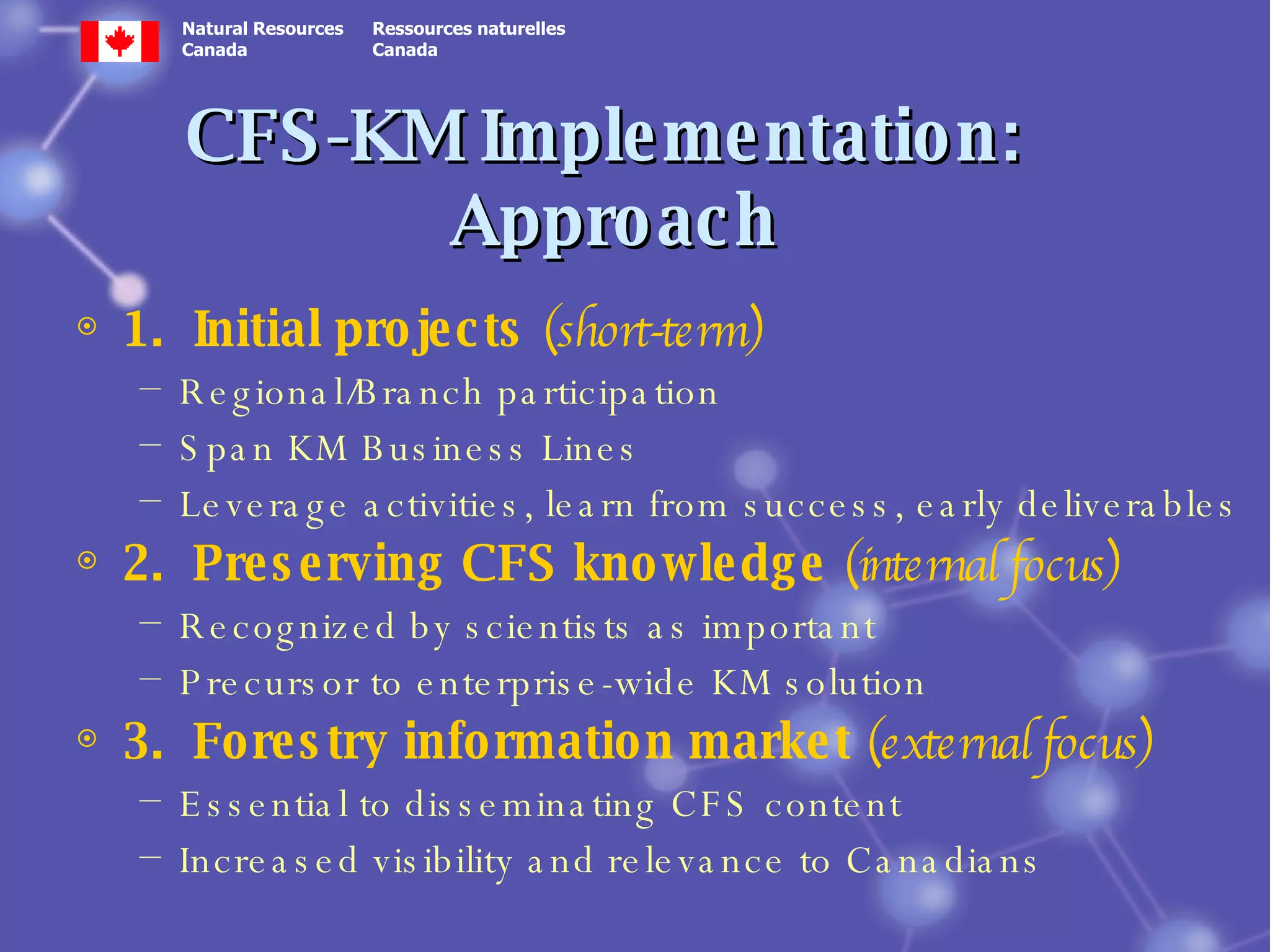
CFS-KM Implementation:  Approach 1.  Initial projects  (short-term) Regional/Branch participation Span KM Business Lines Leverage activities, learn from success, early deliverables 2.  Preserving CFS knowledge  (internal focus) Recognized by scientists as important Precursor to enterprise-wide KM solution 3.  Forestry information market  (external focus) Essential to disseminating CFS content Increased visibility and relevance to Canadians
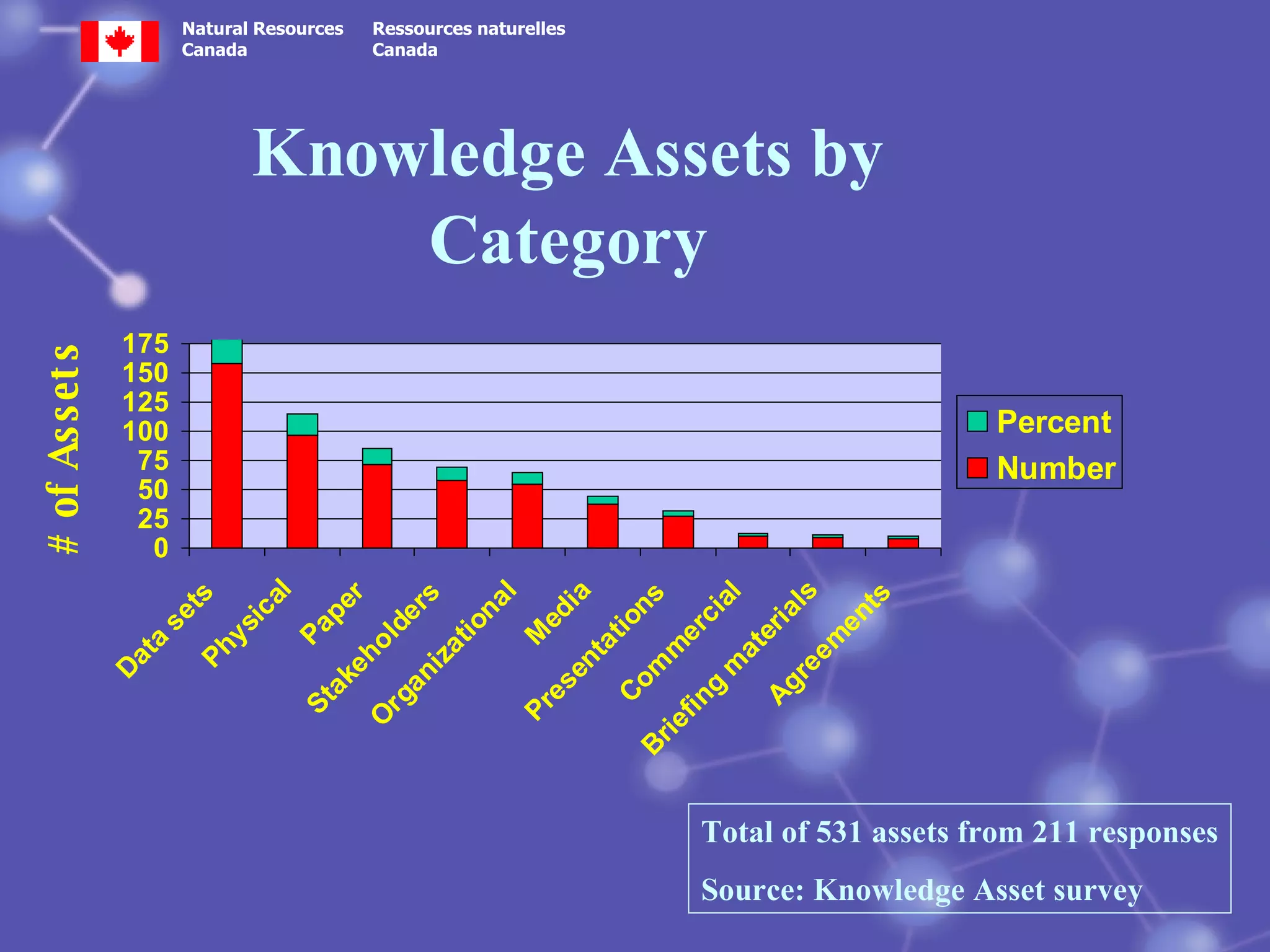
Total of 531 assets from 211 responses Source: Knowledge Asset survey
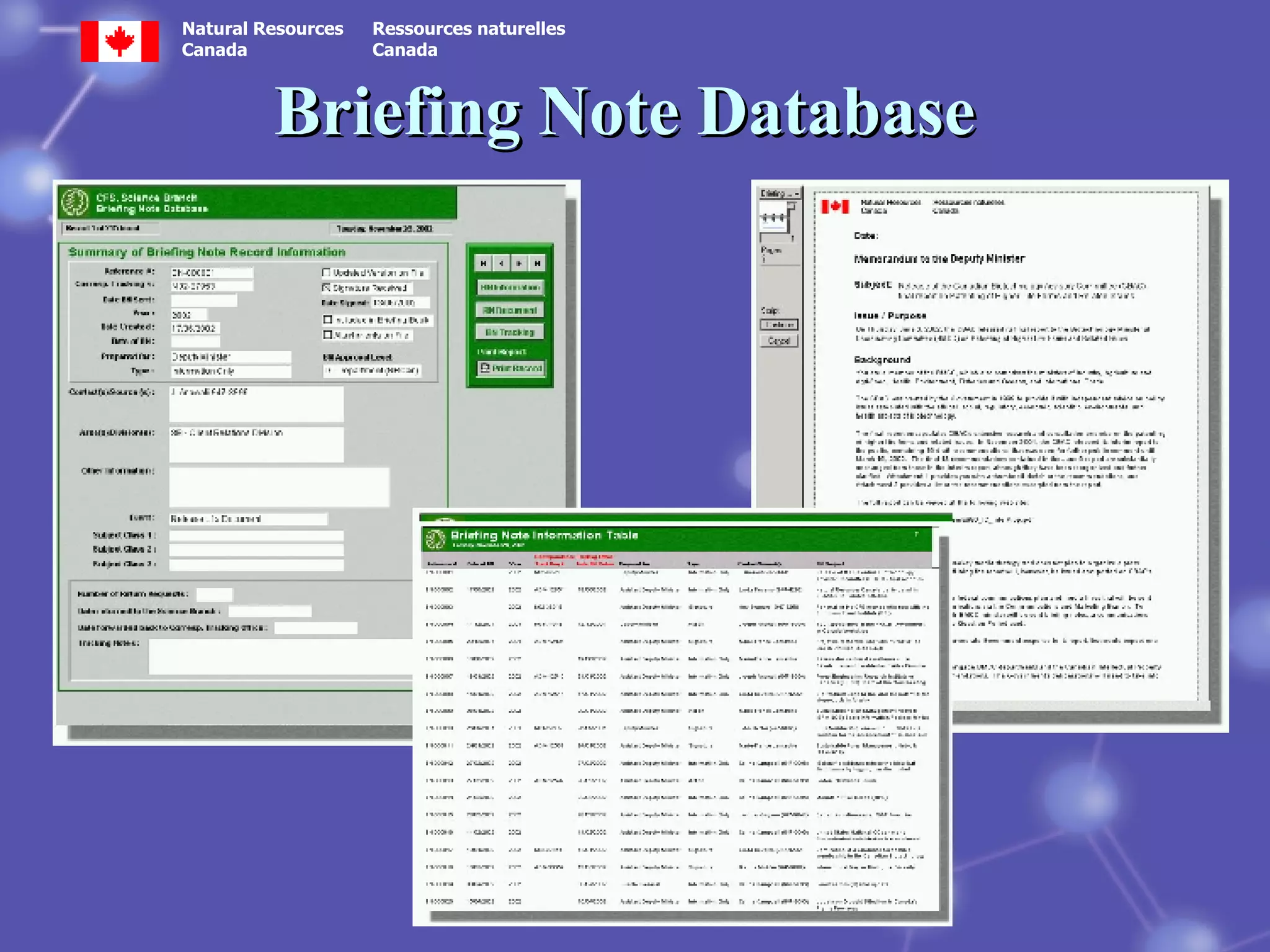
Briefing Note Database
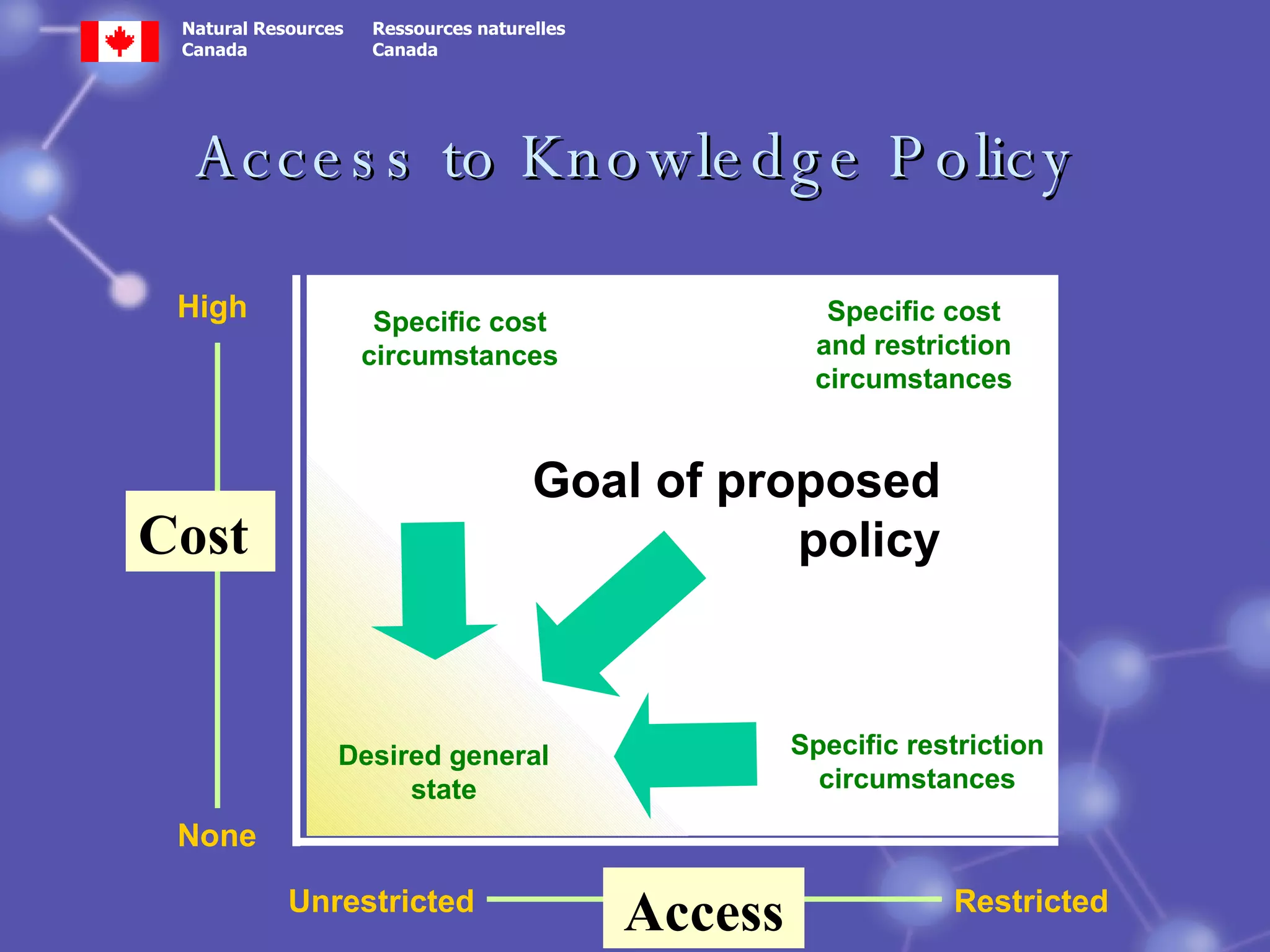
Access to Knowledge Policy Desired general state Specific cost circumstances Specific restriction circumstances Specific cost and restriction circumstances Goal of proposed policy Restricted Unrestricted Access None High Cost
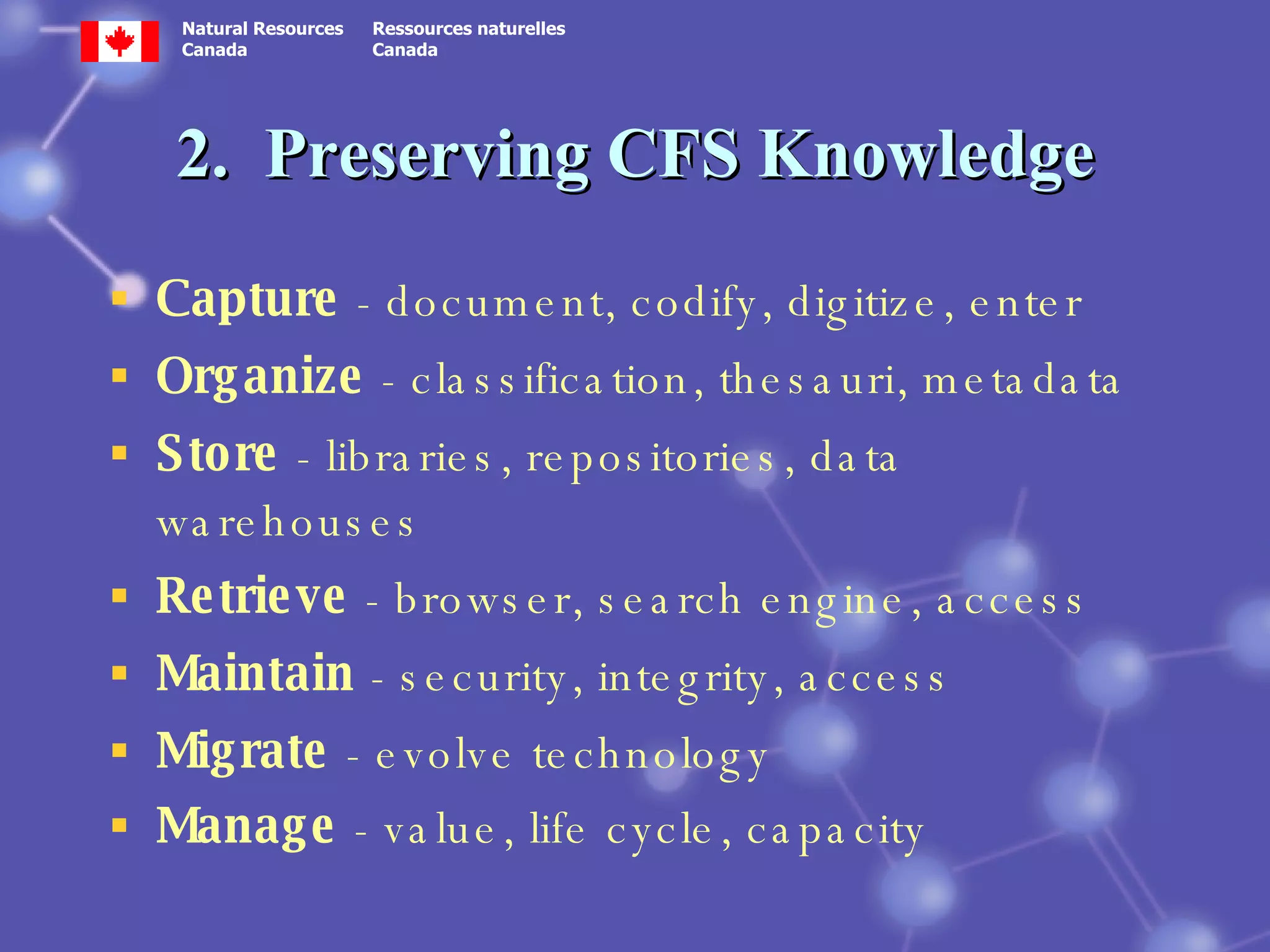
2.  Preserving CFS Knowledge Capture  - document, codify, digitize, enter Organize  - classification, thesauri, metadata Store  - libraries, repositories, data warehouses Retrieve  - browser, search engine, access Maintain  - security, integrity, access Migrate  - evolve technology Manage  - value, life cycle, capacity
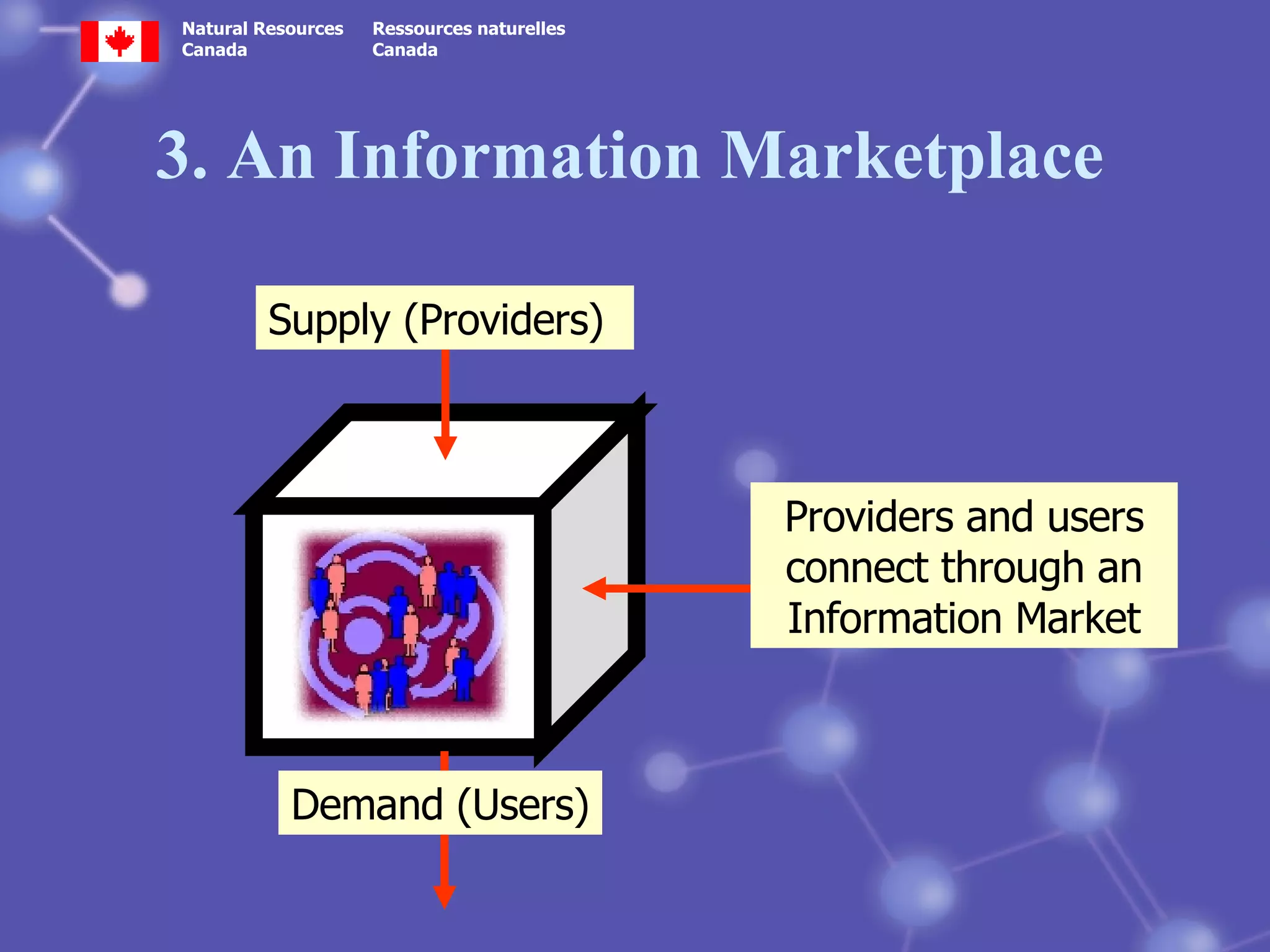
3. An Information Marketplace Supply (Providers) Demand (Users) Providers and users connect through an Information Market
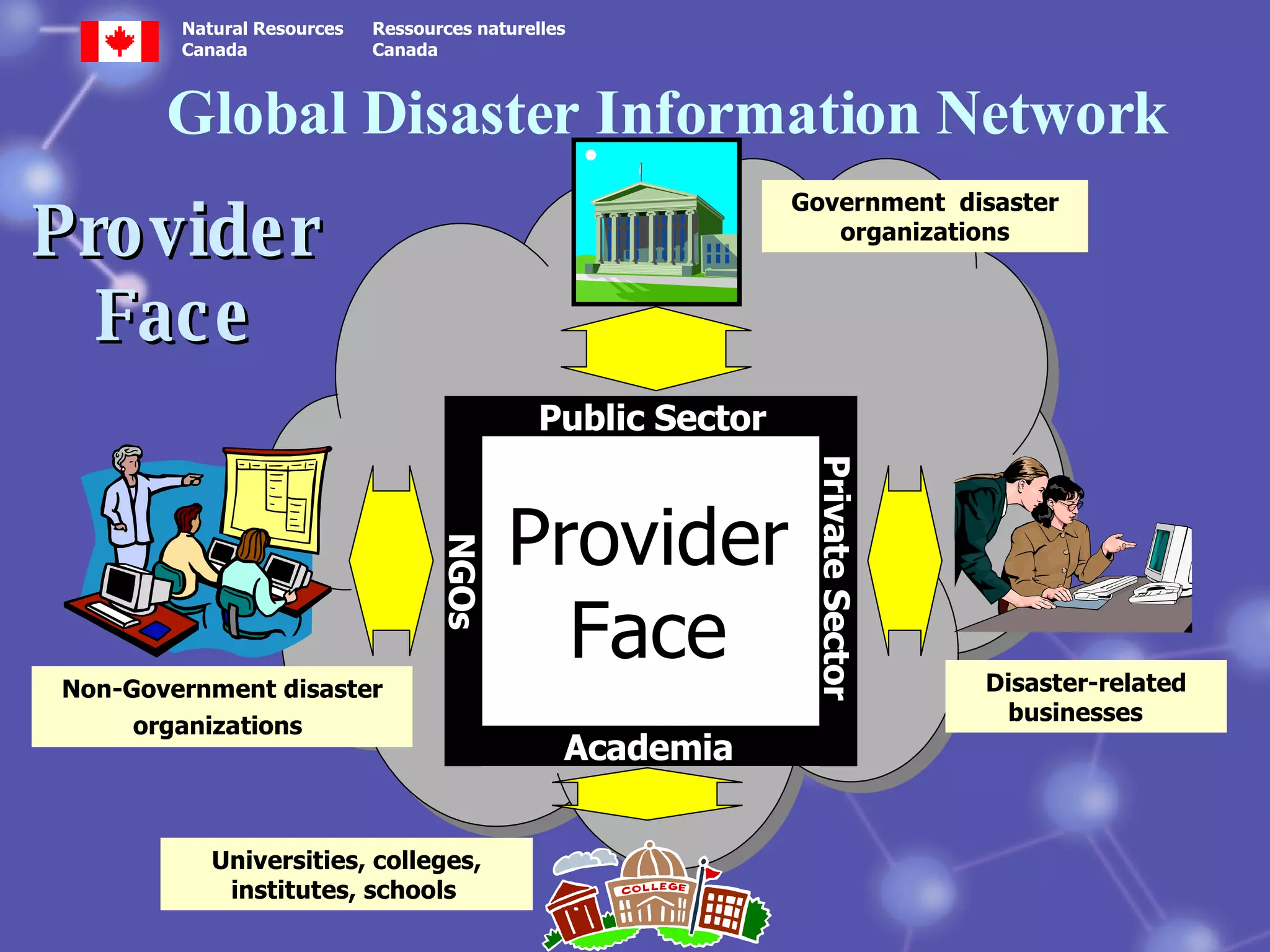
Provider Face Global Disaster Information Network Provider Face Academia NGOs Private Sector   Public Sector Government  disaster organizations Universities, colleges, institutes, schools   Disaster-related businesses  Non-Government disaster organizations
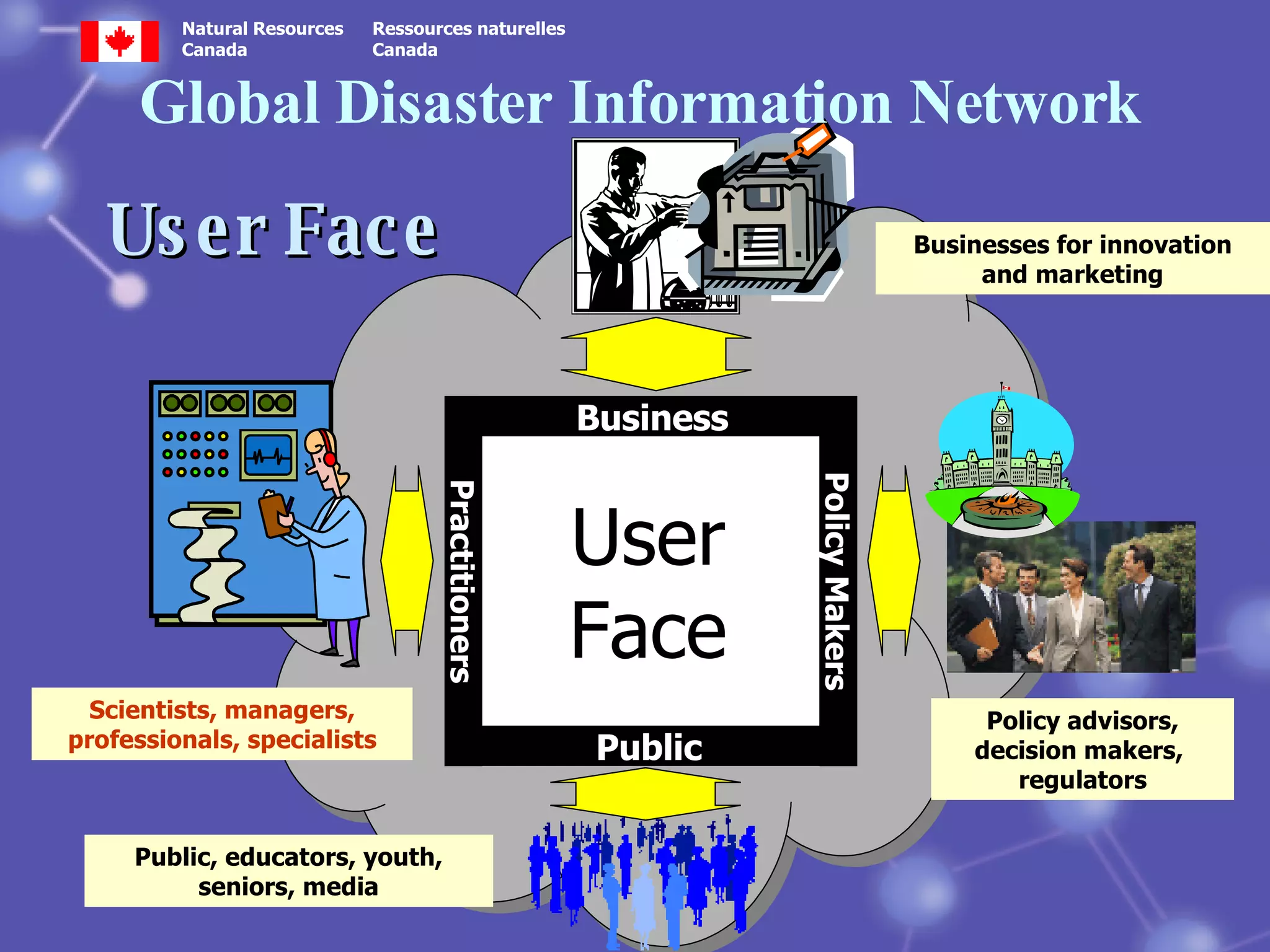
User Face Global Disaster Information Network Public, educators, youth, seniors, media Policy advisors, decision makers,  regulators User Face Public Practitioners Policy Makers Business Businesses for innovation and marketing Scientists, managers, professionals, specialists
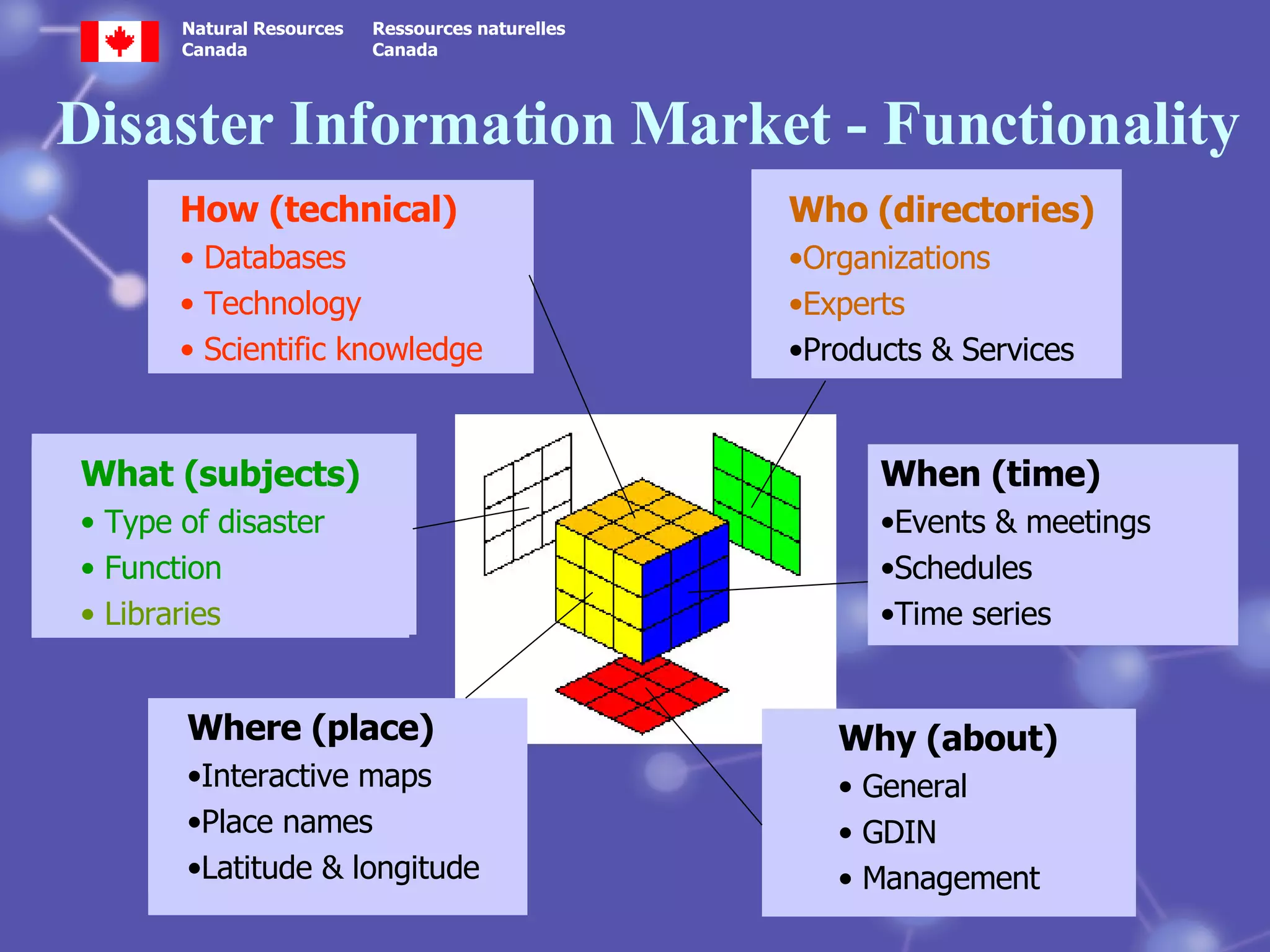
Disaster Information Market - Functionality How (technical) Databases Technology Scientific knowledge  What (subjects) Type of disaster Function Libraries   Where (place) Interactive maps Place names Latitude & longitude Who (directories) Organizations Experts Products  &  Services When (time) Events & meetings Schedules Time series Why (about) General   GDIN Management
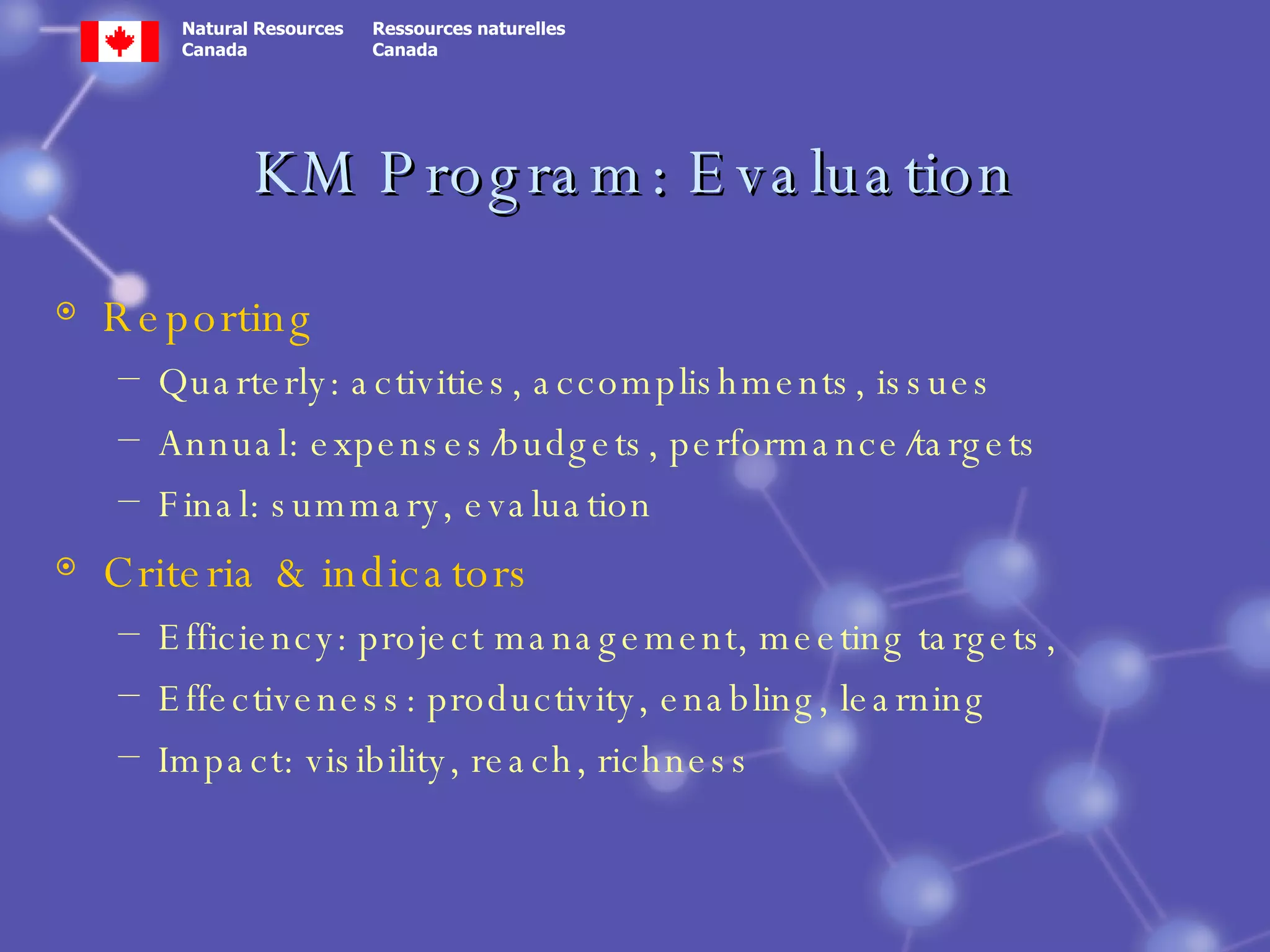
KM Program: Evaluation Reporting Quarterly: activities, accomplishments, issues Annual: expenses/budgets, performance/targets Final: summary, evaluation Criteria & indicators Efficiency: project management, meeting targets,  Effectiveness: productivity, enabling, learning Impact: visibility, reach, richness
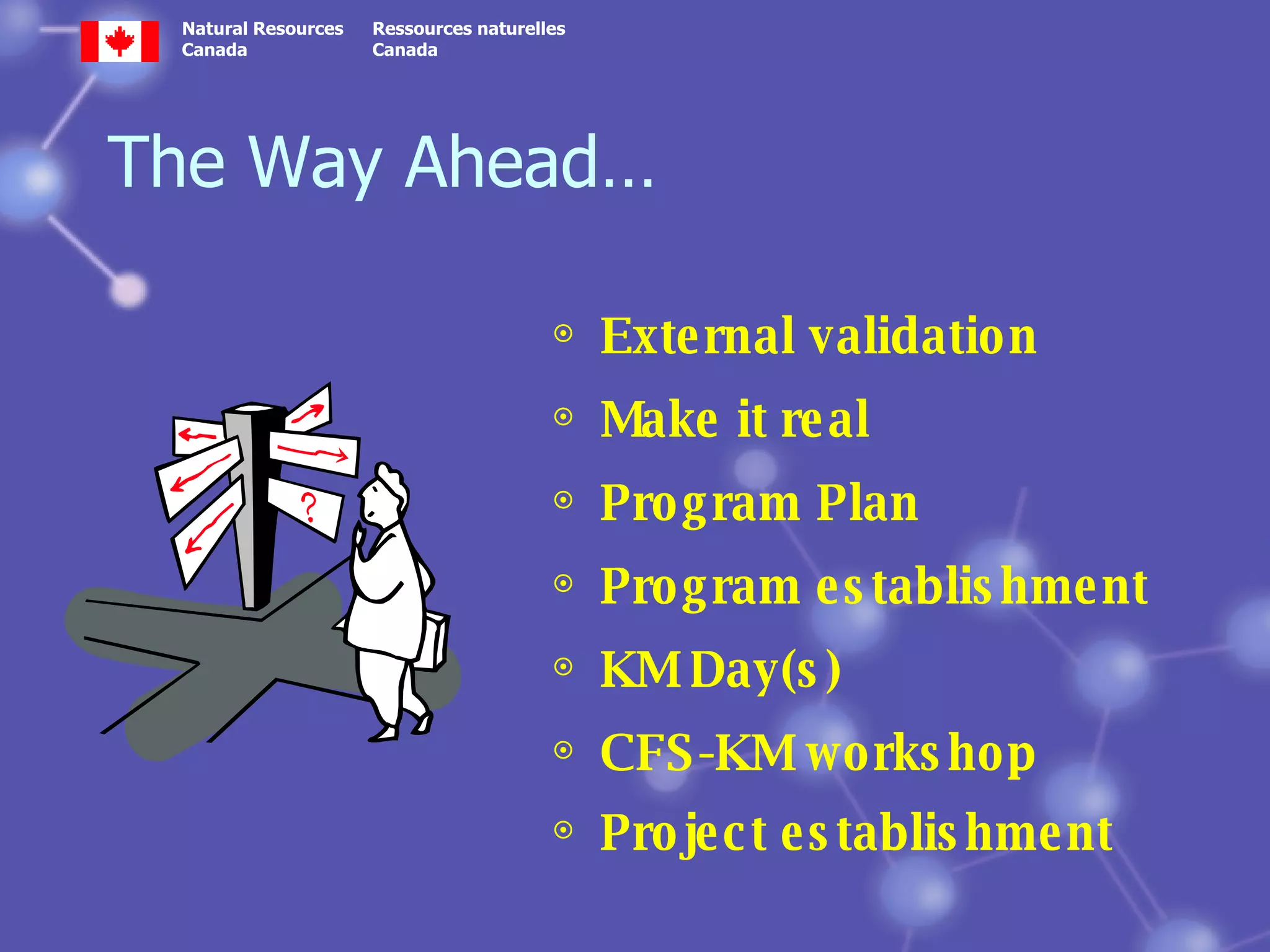
The Way Ahead… External validation Make it real  Program Plan Program establishment KM Day(s)  CFS-KM workshop  Project establishment
A final thought… “ Nothing in the world can take the place of persistence.  Talent will not; nothing is more common than unsuccessful men with talent.  Genius will not; unrewarded genius is almost a proverb.  Education alone will not; the world is full of educated derelicts.  Persistence and determination alone are omnipotent” Calvin Coolidge (1872-1933)

Knowledge Management Program in the Canadian Forest Service

  • 1.
    Knowledge Management inthe Canadian Forest Service Albert Simard Canadian Forest Service Presented to Interdepartmental Knowledge Management Forum May 28, 2003 “ Connecting the Past, Present, and Future”
  • 2.
    An opening thought…“ Although all decisions we make are about the future, all our knowledge stems from the past” Ian Wilson (National Archivist of Canada) Crossing Boundaries Conference (May 8, 2003)
  • 3.
    OUTLINE Change Knowledgemanagement Business case Implementation strategy
  • 4.
    Knowledge Economy Successbased on what you know; not what you own Value of goods based on knowledge content Creating and using knowledge is the key Organizations must change or become irrelevant
  • 5.
    Wave of ChangeEarly adaptors Majority adaptors Late adaptors High risk, cost & reward High risk & cost, low reward Low risk, moderate cost & reward 2000 Jan 23, 1993 07:21:17
  • 6.
    Leading Change Establisha sense of urgency Create a guiding coalition Develop a vision and strategy Communicate the change vision Empower broad-based action Generate short-term wins Consolidate gains and augment change Anchor new approaches in the culture source: John Kotter (1996)
  • 7.
    Cost of NotKnowing (CONK) Research Managed knowledge Surprise Unmanaged knowledge Awareness Know Don’t know Reality Know Don’t know World Wildlife Fund - Canada’s forests DFAIT – softwood lumber Reporter – mountain pine beetle Boreal forest briefing note Invasive species Access to Information Science & Technology Networks Synthesis of Knowledge & Information Network Fire management systems On-Line Bookstore Common Office Environment Plant hardiness zones
  • 8.
    Consultant’s Report: “There is no doubt that making no change in response to these findings would represent a risk of deteriorating relevancy and support across a range of audiences.”
  • 9.
    CFS-KM: Governance CFS Management Committee KM Division SKI Network KM Working Groups HQ Branches KM Steering Committee KM Management Committee
  • 10.
    CFS-KM: Vision Statement“ The Canadian Forest Service is recognized as the service of choice for authoritative, integrated, timely and useful data, information, and knowledge about Canada’s forests and the forest sector”
  • 11.
    Information Strategy: UseInformation as Strategic Asset Where are we on the information value chain? Where do we want to be? Where are the gaps? What are we prepared to do? Coordinator Synthesizer Advocate Promoter Creator Isolated opinion Integrated targeted
  • 12.
    KM Communication: GoalsIncrease awareness of KM Program Create a shared understanding of concepts Develop a consensus on need and direction Promote buy-in and participation Establish an ongoing feedback process
  • 13.
    KM Communication: MessagesSenior management Organizational mandate, relevance Middle Management Organizational efficiency and effectiveness Knowledge workers Participation , self-interest External Government, forestry, international
  • 14.
    OUTLINE Change Knowledgemanagement Business case Implementation strategy
  • 15.
    Knowledge 101 Data - What are the Facts? (observations and measurements) Information - What do they mean? (interpretation within a context) Knowledge - How does it work? (relations between things, cause & effect) Wisdom - What should I do? (experience and judgment)
  • 16.
    Data, Information, andKnowledge Examples GIS-based maps Image Grey scale Digital library Digital documents Bits Expert consultation Voice Signal amplitude Scientific papers Text documents Letters, words Equations Tables, statistics Numbers Knowledge Information Data
  • 17.
    Knowledge Organization ExternalKnowledge Sharing Creation Nature Internal Knowledge Management Preservation Lost Knowledge Use
  • 18.
    Knowledge Processes Drivers (problems, issues, government) Organization (mandate, resources, culture) People (analyze, reason, decide) Content (facts, meaning, understanding) Systems (information processes) Technology (computers, communication) Process Data Database Information Knowledge Application Search Production Stage Value
  • 19.
    Information Strategy IMand KM Information Technology (infrastructure) Information Management (organization, business) Knowledge Management (products & services) Systems (processes)
  • 20.
    Knowledge Management GoalsManaging Knowledge Integrating Knowledge Sharing Knowledge Preserving Knowledge single organization: mandate, authority, resources similar organizations: culture, interests, context different organizations: general, few commonalities supports other KM goals Hierarchy Implementation
  • 21.
    Knowledge Management: LinkingPast, Present, & Future Capture Preserve Share Integrate Learn Adapt Past Present Future Infrastructure Content Processes
  • 22.
    Knowledge Management: ADefinition Developing organizational capacity and processes to capture, preserve, share, and integrate data, information, and knowledge to support organizational goals, learning, and adaptation.
  • 23.
    OUTLINE Change Knowledgemanagement Business case Implementation strategy
  • 24.
    CFS-KM Program: Committeeestablished (May 1997) Concept published (June 2000) Business Case (Nov 2001) Implementation Strategy (Jan 2002) Governance framework (Feb 2002) Communications Plan (Apr 2002) Evaluation Plan (May 2002) Management presentation (Aug 2002) Link to CFS Strategic Plan (April 2003) How We Got Here
  • 25.
    CFS-KM: Business LinesManagement (lead, organize, integrate) Production People (reasoning, adding value) Creation (vertical, specific, problems, quantitative) Synthesis (horizontal, general, issues, qualitative) Products (applications, transformation, adaptation, users) Structure Technology , Processes (integration ) Archiving (capture, storage, retrieval, preserve, metadata) Sharing (two-way, networks, richness, partners) Dissemination (one-way, gateways, reach, clients
  • 26.
    CFS-KM: Benefits ClientsEnhanced ability to apply CFS-created knowledge Improved stewardship of Canada’s forests Increased competitiveness of Canada’s forest sector CFS Increased visibility of CFS as preferred source of knowledge on Canada’s forests. Better co-ordination and reduced duplication Increased capacity to produce knowledge products
  • 27.
    CFS-KM: Strengths andChallenges Strengths Ability to take long-term view Reputation as honest information broker National and international coordinating role Challenges Culture of ownership vs. sharing Lack of directed resources Lack of emphasis on knowledge products Perceived lack of senior management support
  • 28.
    CFS-KM: Four OPTIONS(1) Status Quo: non-adaptive ; continue project-scale activities (current expenditures) (2) Function: reactive ; limited KM capacity, driven by external agendas ($1M/yr) (3) Participate: active integration, negotiation, partnerships ($2-$3M/yr). (4) Lead: proactive substantial commitments, positioning ($3-$4M/yr).
  • 29.
    Business Case: ConclusionThe world is evolving to an knowledge economy. Patterns of successful transformation have emerged. CFS is poised to move forward with a KM Program. Requirements: adequate resources, management support, organizational buy-in. Option 2 is the minimal level of initial strategic investment needed.
  • 30.
    OUTLINE Change Knowledgemanagement Business case Implementation strategy
  • 31.
    CFS-KM Implementation: PrinciplesKnowledge cannot be conscripted; it must be volunteered. Decisions based on consensus; not direction. Program goals directly support CFS mandate. Management within existing CFS authorities, structures, and processes. Think big; start small; early deliverables. Close linkages to external KM programs.
  • 32.
    CFS-KM Framework ScaleDimension Inventory assets Science synopsis Access policy Communications … Ecosystems OnLine FireM3 BN database S&T Cluster … NFIS-Secure channel CFSNet - design Project tracking … Project Preservation Sharing Dissemination Integration Synthesis Change Culture Monitoring CFS databases Info. repositories Decision support Reporting National Info. System CFS Info. System Management Info. Function KM Processes Content Infrastructure Strategic
  • 33.
    CFS-KM Implementation: Approach 1. Initial projects (short-term) Regional/Branch participation Span KM Business Lines Leverage activities, learn from success, early deliverables 2. Preserving CFS knowledge (internal focus) Recognized by scientists as important Precursor to enterprise-wide KM solution 3. Forestry information market (external focus) Essential to disseminating CFS content Increased visibility and relevance to Canadians
  • 34.
    Total of 531assets from 211 responses Source: Knowledge Asset survey
  • 35.
  • 36.
    Access to KnowledgePolicy Desired general state Specific cost circumstances Specific restriction circumstances Specific cost and restriction circumstances Goal of proposed policy Restricted Unrestricted Access None High Cost
  • 37.
    2. PreservingCFS Knowledge Capture - document, codify, digitize, enter Organize - classification, thesauri, metadata Store - libraries, repositories, data warehouses Retrieve - browser, search engine, access Maintain - security, integrity, access Migrate - evolve technology Manage - value, life cycle, capacity
  • 38.
    3. An InformationMarketplace Supply (Providers) Demand (Users) Providers and users connect through an Information Market
  • 39.
    Provider Face GlobalDisaster Information Network Provider Face Academia NGOs Private Sector Public Sector Government disaster organizations Universities, colleges, institutes, schools Disaster-related businesses Non-Government disaster organizations
  • 40.
    User Face GlobalDisaster Information Network Public, educators, youth, seniors, media Policy advisors, decision makers, regulators User Face Public Practitioners Policy Makers Business Businesses for innovation and marketing Scientists, managers, professionals, specialists
  • 41.
    Disaster Information Market- Functionality How (technical) Databases Technology Scientific knowledge What (subjects) Type of disaster Function Libraries Where (place) Interactive maps Place names Latitude & longitude Who (directories) Organizations Experts Products & Services When (time) Events & meetings Schedules Time series Why (about) General GDIN Management
  • 42.
    KM Program: EvaluationReporting Quarterly: activities, accomplishments, issues Annual: expenses/budgets, performance/targets Final: summary, evaluation Criteria & indicators Efficiency: project management, meeting targets, Effectiveness: productivity, enabling, learning Impact: visibility, reach, richness
  • 43.
    The Way Ahead…External validation Make it real Program Plan Program establishment KM Day(s) CFS-KM workshop Project establishment
  • 44.
    A final thought…“ Nothing in the world can take the place of persistence. Talent will not; nothing is more common than unsuccessful men with talent. Genius will not; unrewarded genius is almost a proverb. Education alone will not; the world is full of educated derelicts. Persistence and determination alone are omnipotent” Calvin Coolidge (1872-1933)

Editor's Notes

  • #2 Today, I’d like to talk about knowledge management. I’ll use the development and establishment of a knowledge management program in the Canadian Forest Service as a case study.