Sector learning & KM The WELL KM experiences November 2008, Pels, IRC
DfID <– WELL <– Partners <–> IRC / WEDC / LS Outputs + Capacity development Participatory needs assessment Writing skills ‘ Know your client’ (proposal writing) … Knowledge management Big steps 1
Round of introduction; plenary (ice breaker) Fears and expectations; plenary (links to ‘Are expectations met’ just before closure) Introduction of concepts Information Management Knowledge Management  KM, a play on words What is knowledge? Why knowledge cannot be managed directly  KM perspectives; three levels: Personal Organisational Community / network (of practice) KM landscape: KM applications: from stock to flow transactional, analytical, asset management, process, developmental and innovation and creation Enabling technology (same scale as applications) Weggeman framework Operational processes (KVC versus ODV matrix) Big steps 2
KM ‘instruments’: access, create, share and evaluate Activity: personal information behaviour / personal KM; buzz groups and plenary Activity: organisational profile; individual, buzz groups and plenary Introduction to KM scan, relation with Weggeman model Activity: perform KM scan Introduction of concepts: How to become a Resource Centre Activity: where do we stand?; buzz groups and plenary Activity: how to network outside the organisation?; buzz groups and plenary Recap knowledge value chain / examples Activity: based on vision and mission discuss goals; buzz groups Activity; make KM plan(s); group work Activity; presentation KM plans; plenary; feed back by management Are expectations met; plenary round based on list; take homes Feed back on workshop; questionnaire  Closure Big steps 3
Introducing KM as a concept and its underlying principles; (initiating) Providing assistance in developing KM plans; (advisory) Sharing lessons learned from WEDC’s and IRC’s own experiences in this area; (advisory) Facilitating local workshops hosted by the partners; (instigating) Providing guidance on appropriate literature (instigating) Big steps 4
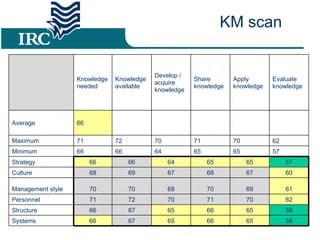
KM scan Knowledge needed Knowledge available Develop / acquire knowledge Share knowledge Apply knowledge Evaluate knowledge Average 66 Maximum 71 72 70 71 70 62 Minimum 66 66 64 65 65 57 Strategy 66 66 64 65 65 57 Culture 68 69 67 68 67 60 Management style  70 70 68 70 69 61 Personnel 71 72 70 71 70 62 Structure 66 67 65 66 65 58 Systems 66 67 65 66 65 58
The Socio-Economic Unit Foundation India has a Coordinating Office, four regional offices, one technical supporting wing and seven project offices. It has the ambition to become a leading resource centre in the region. They identified a lack of information sharing in SEUF as a major drawback in achieving their ambition and have developed two plans to address this.  KM Plan 1: Information sharing though SEUF website use skills gained through the Learn@WELL writing skills module to provide quality material for the website; repackage existing outputs to serve different online target groups; develop an inventory of staff skills, attitudes and experiences and use to allocate responsibilities for website management and to inform organisational HR needs. KM Plan - SEUF
KM Plan 2: Internal information sharing through improved project documentation make results and experiences from projects more explicit, thereby creating leverage for information sharing; document proposal development; create central project overview (track record); document project activities and outcomes. These two plans were developed during a workshop attended by staff from two SEUF regional offices. A section of the workshop attendees in turn facilitated second workshops with colleagues in the four remaining regional offices to introduce them to KM concepts and acquaint them with the KM plans developed. The implementation of these plans will cut across all six regional office. Meanwhile, SEUF has plans to change its web architecture as well as developing an Intranet under an RCD (IRC Resource centre development) initiative. These two initiatives dovetail well with the KM plans developed and when implemented, will be a major step towards SEUF becoming a resource centre. New additional KM plans were drawn up in the second workshop to complement the two shown above. KM Plan - SEUF
AMREF is a large organisation  The module was used at the AMREF Kenya country office in the water and health department.  From the AMREF headquarters, also based in Nairobi Kenya, some staff joint the workshop and we found that in HQ a KM initiative was running for a while. KM plan AMREF
IWSD (Institute of Water and Sanitation Development  The aim of holding this KM workshop at IWSD was to provide an understanding of how KM can be used to leverage corporate knowledge to meet IWSD’s vision, mission, and goals. A major exercise in the workshop was the development of KM plans. Fortunately, the high attendance by IWSD staff at the workshop has meant that it has been possible to develop four KM plans. The topics of each plan are detailed in the box below. Thematic Groups - Strategic Issues / KM plan  Research - Resource generation /Acquisition  Info. and Marketing - Positioning / branding IWSD, Profile raising, Web-presence Technical & Training  - Product development, New work Admin & Finance - Resource allocation /Transparency /Compliance Our interpretation of these topics reveals a common thread in the four proposed KM plans; and this is that they all address key strategic issues for the organisation. Our interpretation of these issues is detailed in the second column of the box above under the heading ‘Strategic Issues’ KM plan IWSD
KM as has been stated, involves organisational change. It is well known that organisational change often meets with resistance. Fortunately, this has not been the case with the organisations we have worked with. This is attributable to the fact that the idea for the KM module came from the partners themselves. They also took responsibility for organising the workshop and creating its terms of reference.  Consequently, even though it was not fully understood exactly what it would entail, the commitment to see the module through (organizing a workshop, go through the exercises mentioned above, draw up KM plans, take ownership and implement them) has been present. In this regard, the incentive to adopt the KM approach was pre-established and therefore required not to put in place an incentive structure. Further, we have articulated in the workshops, some of the benefits that would accrue from implementing a KM plan, together with commitment from management, have served as additional incentives.  Incentives for adopting KM
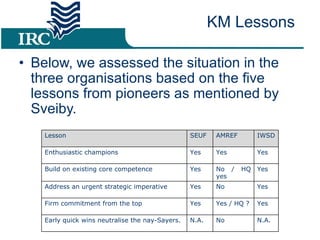
Below, we assessed the situation in the three organisations based on the five lessons from pioneers as mentioned by Sveiby. KM Lessons Lesson SEUF AMREF IWSD Enthusiastic champions Yes Yes Yes Build on existing core competence Yes No / HQ yes Yes Address an urgent strategic imperative Yes No Yes Firm commitment from the top Yes Yes / HQ ? Yes Early quick wins neutralise the nay-Sayers. N.A. No N.A.
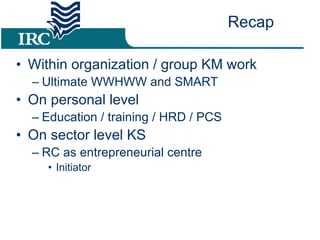
Within organization / group KM work Ultimate WWHWW and SMART On personal level  Education / training / HRD / PCS On sector level KS RC as entrepreneurial centre Initiator Recap
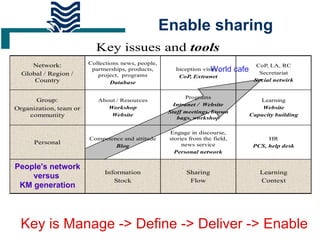
Enable sharing Key is Manage -> Define -> Deliver -> Enable World cafe People's network versus  KM generation
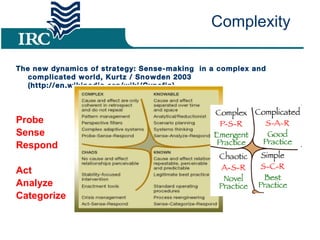
Complexity The new dynamics of strategy: Sense-making  in a complex and complicated world, Kurtz / Snowden 2003  (http://en.wikipedia.org/wiki/Cynefin) Probe Sense Respond Act Analyze Categorize
KM work IRC IRC Mission / Vision: ‘ use  of I & K’ =>  flow Network secretariat => association (Success) ‏ Streams of Knowledge GWA World bank: Intranet water-staff (no credits) ‏ UN / WSSCC: KM dialogue (stopped) ‏ WIS 6 KM workshop (2003) ‏ KM workshops Well  WEDC conference 2005 KM titles / 40 years Lib services & News + Pubs KM job for RNE's / DgIS? Key is KM
So... How big is your sector? Individuals: teaching; PCS => champions In organizations => KM make organizations knowledge friendly (financial sustainable first) ‏ In sector => KS RC or secretariat Thought leaders Information (library / flyer / news (paper) / workshops ) ‏ Organize players / certify / influence policy Co-others? Civil society? The sector is complex so... Key is SCALE
WELL KM lessons Supporting learning processes of various organizations  KM workshops all staff! Hands-on create KM plan according to a model by Weggeman; presentation at WEDC conference KM lessons from the pioneers (Sveiby 2001)  Enthusiastic champions Build on existing core competence  Address an urgent strategic imperative  Firm commitment from the top  Early quick wins neutralize the nay-Sayers.  Key is KM
Sector learning Deconstructing Sector: What? Learning: What ... learning? ... knowledge is needed for ... information ... ... attitude ... ... institutional framework ... ... reputation ... ... quality control assurance ... ... acquisition ... ... competences ... Key is focus
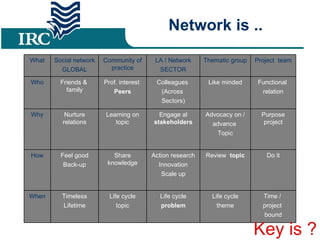
Network is .. Key is ? When How Why Who What Time /  project  bound Life cycle theme Life cycle problem Life cycle topic Timeless Lifetime Do it Review  topic Action research Innovation Scale up Share knowledge Feel good Back-up Purpose project Advocacy on / advance  Topic Engage al  stakeholders Learning on topic Nurture relations Functional  relation Like minded Colleagues  (Across  Sectors) ‏ Prof. interest  Peers Friends &  family Project  team Thematic group LA / Network SECTOR Community of practice Social network GLOBAL
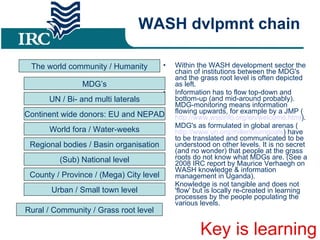
WASH dvlpmnt chain Within the WASH development sector the chain of institutions between the MDG's and the grass root level is often depicted as left. Information has to flow top-down and bottom-up (and mid-around probably). MDG-monitoring means information flowing upwards, for example by a JMP ( http://www.wssinfo.org/en/welcome.html ). MDG's as formulated in global arenas ( http://www.un.org/millenniumgoals ) have to be translated and communicated to be understood on other levels. It is no secret (and no wonder) that people at the grass roots do not know what MDGs are. (See a 2008 IRC report by Maurice Verhaegh on WASH knowledge & information management in Uganda). Knowledge is not tangible and does not 'flow' but is locally re-created in learning processes by the people populating the various levels. Rural / Community / Grass root level The world community / Humanity MDG’s UN / Bi- and multi laterals Continent wide donors: EU and NEPAD World fora / Water-weeks Regional bodies / Basin organisation (Sub) National level County / Province / (Mega) City level Urban / Small town level Key is learning
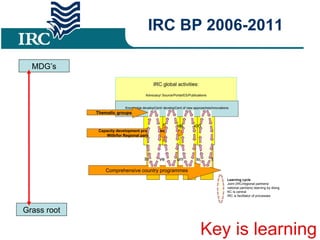
IRC BP 2006-2011 Grass root MDG’s Key is learning
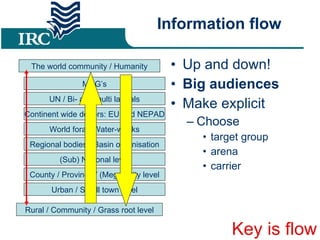
Information flow Up and down! Big audiences Make explicit Choose  target group arena carrier Rural / Community / Grass root level The world community / Humanity MDG’s UN / Bi- and multi laterals Continent wide donors: EU and NEPAD World fora / Water-weeks Regional bodies / Basin organisation (Sub) National level County / Province / (Mega) City level Urban / Small town level Key is flow
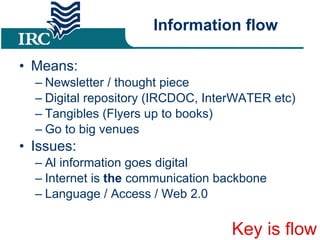
Information flow Means: Newsletter / thought piece Digital repository (IRCDOC, InterWATER etc) ‏ Tangibles (Flyers up to books) ‏ Go to big venues Issues: Al information goes digital Internet is  the  communication backbone Language / Access / Web 2.0 Key is flow
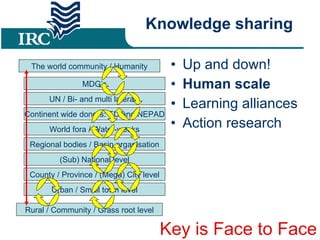
Knowledge sharing Up and down! Human scale Learning alliances Action research Rural / Community / Grass root level The world community / Humanity MDG’s UN / Bi- and multi laterals Continent wide donors: EU and NEPAD World fora / Water-weeks Regional bodies / Basin organisation (Sub) National level County / Province / (Mega) City level Urban / Small town level Key is Face to Face
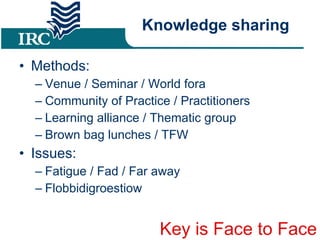
Knowledge sharing Methods: Venue / Seminar / World fora Community of Practice / Practitioners Learning alliance / Thematic group Brown bag lunches / TFW Issues: Fatigue / Fad / Far away Flobbidigroestiow Key is Face to Face
Communication Audience Access Language Relevance Power F2F: CoP, LA, TG etc Keys!
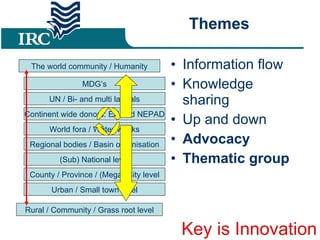
Themes Information flow Knowledge sharing Up and down Advocacy Thematic group Rural / Community / Grass root level The world community / Humanity MDG’s UN / Bi- and multi laterals Continent wide donors: EU and NEPAD World fora / Water-weeks Regional bodies / Basin organisation (Sub) National level County / Province / (Mega) City level Urban / Small town level Key is Innovation
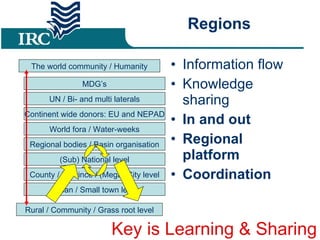
Regions Information flow Knowledge sharing In and out Regional platform Coordination Rural / Community / Grass root level The world community / Humanity MDG’s UN / Bi- and multi laterals Continent wide donors: EU and NEPAD World fora / Water-weeks Regional bodies / Basin organisation (Sub) National level County / Province / (Mega) City level Urban / Small town level Key is Learning & Sharing
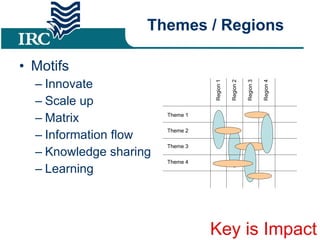
Themes / Regions Motifs Innovate Scale up Matrix Information flow Knowledge sharing Learning Key is Impact
Today How did you support these organizations? How did they try to develop a learning process in-house and in the sector in their country, what this has led to etc. KM plan / closure at WEDC conference  Anything related to the broader topic of sector learning? Key is KM
Operators / Engineers / Managers Information specialists / Sector professionals / Decision makers Activities / Frameworks / Discipline What … learned?
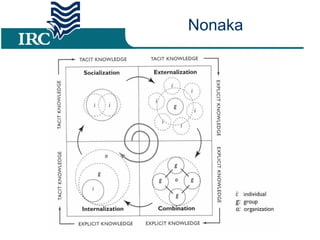
Nonaka

2008 sector-learning

  • 1.
    Sector learning &KM The WELL KM experiences November 2008, Pels, IRC
  • 2.
    DfID <– WELL<– Partners <–> IRC / WEDC / LS Outputs + Capacity development Participatory needs assessment Writing skills ‘ Know your client’ (proposal writing) … Knowledge management Big steps 1
  • 3.
    Round of introduction;plenary (ice breaker) Fears and expectations; plenary (links to ‘Are expectations met’ just before closure) Introduction of concepts Information Management Knowledge Management KM, a play on words What is knowledge? Why knowledge cannot be managed directly KM perspectives; three levels: Personal Organisational Community / network (of practice) KM landscape: KM applications: from stock to flow transactional, analytical, asset management, process, developmental and innovation and creation Enabling technology (same scale as applications) Weggeman framework Operational processes (KVC versus ODV matrix) Big steps 2
  • 4.
    KM ‘instruments’: access,create, share and evaluate Activity: personal information behaviour / personal KM; buzz groups and plenary Activity: organisational profile; individual, buzz groups and plenary Introduction to KM scan, relation with Weggeman model Activity: perform KM scan Introduction of concepts: How to become a Resource Centre Activity: where do we stand?; buzz groups and plenary Activity: how to network outside the organisation?; buzz groups and plenary Recap knowledge value chain / examples Activity: based on vision and mission discuss goals; buzz groups Activity; make KM plan(s); group work Activity; presentation KM plans; plenary; feed back by management Are expectations met; plenary round based on list; take homes Feed back on workshop; questionnaire Closure Big steps 3
  • 5.
    Introducing KM asa concept and its underlying principles; (initiating) Providing assistance in developing KM plans; (advisory) Sharing lessons learned from WEDC’s and IRC’s own experiences in this area; (advisory) Facilitating local workshops hosted by the partners; (instigating) Providing guidance on appropriate literature (instigating) Big steps 4
  • 6.
    KM scan Knowledgeneeded Knowledge available Develop / acquire knowledge Share knowledge Apply knowledge Evaluate knowledge Average 66 Maximum 71 72 70 71 70 62 Minimum 66 66 64 65 65 57 Strategy 66 66 64 65 65 57 Culture 68 69 67 68 67 60 Management style 70 70 68 70 69 61 Personnel 71 72 70 71 70 62 Structure 66 67 65 66 65 58 Systems 66 67 65 66 65 58
  • 7.
    The Socio-Economic UnitFoundation India has a Coordinating Office, four regional offices, one technical supporting wing and seven project offices. It has the ambition to become a leading resource centre in the region. They identified a lack of information sharing in SEUF as a major drawback in achieving their ambition and have developed two plans to address this. KM Plan 1: Information sharing though SEUF website use skills gained through the Learn@WELL writing skills module to provide quality material for the website; repackage existing outputs to serve different online target groups; develop an inventory of staff skills, attitudes and experiences and use to allocate responsibilities for website management and to inform organisational HR needs. KM Plan - SEUF
  • 8.
    KM Plan 2:Internal information sharing through improved project documentation make results and experiences from projects more explicit, thereby creating leverage for information sharing; document proposal development; create central project overview (track record); document project activities and outcomes. These two plans were developed during a workshop attended by staff from two SEUF regional offices. A section of the workshop attendees in turn facilitated second workshops with colleagues in the four remaining regional offices to introduce them to KM concepts and acquaint them with the KM plans developed. The implementation of these plans will cut across all six regional office. Meanwhile, SEUF has plans to change its web architecture as well as developing an Intranet under an RCD (IRC Resource centre development) initiative. These two initiatives dovetail well with the KM plans developed and when implemented, will be a major step towards SEUF becoming a resource centre. New additional KM plans were drawn up in the second workshop to complement the two shown above. KM Plan - SEUF
  • 9.
    AMREF is alarge organisation The module was used at the AMREF Kenya country office in the water and health department. From the AMREF headquarters, also based in Nairobi Kenya, some staff joint the workshop and we found that in HQ a KM initiative was running for a while. KM plan AMREF
  • 10.
    IWSD (Institute ofWater and Sanitation Development The aim of holding this KM workshop at IWSD was to provide an understanding of how KM can be used to leverage corporate knowledge to meet IWSD’s vision, mission, and goals. A major exercise in the workshop was the development of KM plans. Fortunately, the high attendance by IWSD staff at the workshop has meant that it has been possible to develop four KM plans. The topics of each plan are detailed in the box below. Thematic Groups - Strategic Issues / KM plan Research - Resource generation /Acquisition Info. and Marketing - Positioning / branding IWSD, Profile raising, Web-presence Technical & Training - Product development, New work Admin & Finance - Resource allocation /Transparency /Compliance Our interpretation of these topics reveals a common thread in the four proposed KM plans; and this is that they all address key strategic issues for the organisation. Our interpretation of these issues is detailed in the second column of the box above under the heading ‘Strategic Issues’ KM plan IWSD
  • 11.
    KM as hasbeen stated, involves organisational change. It is well known that organisational change often meets with resistance. Fortunately, this has not been the case with the organisations we have worked with. This is attributable to the fact that the idea for the KM module came from the partners themselves. They also took responsibility for organising the workshop and creating its terms of reference. Consequently, even though it was not fully understood exactly what it would entail, the commitment to see the module through (organizing a workshop, go through the exercises mentioned above, draw up KM plans, take ownership and implement them) has been present. In this regard, the incentive to adopt the KM approach was pre-established and therefore required not to put in place an incentive structure. Further, we have articulated in the workshops, some of the benefits that would accrue from implementing a KM plan, together with commitment from management, have served as additional incentives. Incentives for adopting KM
  • 12.
    Below, we assessedthe situation in the three organisations based on the five lessons from pioneers as mentioned by Sveiby. KM Lessons Lesson SEUF AMREF IWSD Enthusiastic champions Yes Yes Yes Build on existing core competence Yes No / HQ yes Yes Address an urgent strategic imperative Yes No Yes Firm commitment from the top Yes Yes / HQ ? Yes Early quick wins neutralise the nay-Sayers. N.A. No N.A.
  • 13.
    Within organization /group KM work Ultimate WWHWW and SMART On personal level Education / training / HRD / PCS On sector level KS RC as entrepreneurial centre Initiator Recap
  • 14.
    Enable sharing Keyis Manage -> Define -> Deliver -> Enable World cafe People's network versus KM generation
  • 15.
    Complexity The newdynamics of strategy: Sense-making in a complex and complicated world, Kurtz / Snowden 2003 (http://en.wikipedia.org/wiki/Cynefin) Probe Sense Respond Act Analyze Categorize
  • 16.
    KM work IRCIRC Mission / Vision: ‘ use of I & K’ => flow Network secretariat => association (Success) ‏ Streams of Knowledge GWA World bank: Intranet water-staff (no credits) ‏ UN / WSSCC: KM dialogue (stopped) ‏ WIS 6 KM workshop (2003) ‏ KM workshops Well WEDC conference 2005 KM titles / 40 years Lib services & News + Pubs KM job for RNE's / DgIS? Key is KM
  • 17.
    So... How bigis your sector? Individuals: teaching; PCS => champions In organizations => KM make organizations knowledge friendly (financial sustainable first) ‏ In sector => KS RC or secretariat Thought leaders Information (library / flyer / news (paper) / workshops ) ‏ Organize players / certify / influence policy Co-others? Civil society? The sector is complex so... Key is SCALE
  • 18.
    WELL KM lessonsSupporting learning processes of various organizations KM workshops all staff! Hands-on create KM plan according to a model by Weggeman; presentation at WEDC conference KM lessons from the pioneers (Sveiby 2001) Enthusiastic champions Build on existing core competence Address an urgent strategic imperative Firm commitment from the top Early quick wins neutralize the nay-Sayers. Key is KM
  • 19.
    Sector learning DeconstructingSector: What? Learning: What ... learning? ... knowledge is needed for ... information ... ... attitude ... ... institutional framework ... ... reputation ... ... quality control assurance ... ... acquisition ... ... competences ... Key is focus
  • 20.
    Network is ..Key is ? When How Why Who What Time / project bound Life cycle theme Life cycle problem Life cycle topic Timeless Lifetime Do it Review topic Action research Innovation Scale up Share knowledge Feel good Back-up Purpose project Advocacy on / advance Topic Engage al stakeholders Learning on topic Nurture relations Functional relation Like minded Colleagues (Across Sectors) ‏ Prof. interest Peers Friends & family Project team Thematic group LA / Network SECTOR Community of practice Social network GLOBAL
  • 21.
    WASH dvlpmnt chainWithin the WASH development sector the chain of institutions between the MDG's and the grass root level is often depicted as left. Information has to flow top-down and bottom-up (and mid-around probably). MDG-monitoring means information flowing upwards, for example by a JMP ( http://www.wssinfo.org/en/welcome.html ). MDG's as formulated in global arenas ( http://www.un.org/millenniumgoals ) have to be translated and communicated to be understood on other levels. It is no secret (and no wonder) that people at the grass roots do not know what MDGs are. (See a 2008 IRC report by Maurice Verhaegh on WASH knowledge & information management in Uganda). Knowledge is not tangible and does not 'flow' but is locally re-created in learning processes by the people populating the various levels. Rural / Community / Grass root level The world community / Humanity MDG’s UN / Bi- and multi laterals Continent wide donors: EU and NEPAD World fora / Water-weeks Regional bodies / Basin organisation (Sub) National level County / Province / (Mega) City level Urban / Small town level Key is learning
  • 22.
    IRC BP 2006-2011Grass root MDG’s Key is learning
  • 23.
    Information flow Upand down! Big audiences Make explicit Choose target group arena carrier Rural / Community / Grass root level The world community / Humanity MDG’s UN / Bi- and multi laterals Continent wide donors: EU and NEPAD World fora / Water-weeks Regional bodies / Basin organisation (Sub) National level County / Province / (Mega) City level Urban / Small town level Key is flow
  • 24.
    Information flow Means:Newsletter / thought piece Digital repository (IRCDOC, InterWATER etc) ‏ Tangibles (Flyers up to books) ‏ Go to big venues Issues: Al information goes digital Internet is the communication backbone Language / Access / Web 2.0 Key is flow
  • 25.
    Knowledge sharing Upand down! Human scale Learning alliances Action research Rural / Community / Grass root level The world community / Humanity MDG’s UN / Bi- and multi laterals Continent wide donors: EU and NEPAD World fora / Water-weeks Regional bodies / Basin organisation (Sub) National level County / Province / (Mega) City level Urban / Small town level Key is Face to Face
  • 26.
    Knowledge sharing Methods:Venue / Seminar / World fora Community of Practice / Practitioners Learning alliance / Thematic group Brown bag lunches / TFW Issues: Fatigue / Fad / Far away Flobbidigroestiow Key is Face to Face
  • 27.
    Communication Audience AccessLanguage Relevance Power F2F: CoP, LA, TG etc Keys!
  • 28.
    Themes Information flowKnowledge sharing Up and down Advocacy Thematic group Rural / Community / Grass root level The world community / Humanity MDG’s UN / Bi- and multi laterals Continent wide donors: EU and NEPAD World fora / Water-weeks Regional bodies / Basin organisation (Sub) National level County / Province / (Mega) City level Urban / Small town level Key is Innovation
  • 29.
    Regions Information flowKnowledge sharing In and out Regional platform Coordination Rural / Community / Grass root level The world community / Humanity MDG’s UN / Bi- and multi laterals Continent wide donors: EU and NEPAD World fora / Water-weeks Regional bodies / Basin organisation (Sub) National level County / Province / (Mega) City level Urban / Small town level Key is Learning & Sharing
  • 30.
    Themes / RegionsMotifs Innovate Scale up Matrix Information flow Knowledge sharing Learning Key is Impact
  • 31.
    Today How didyou support these organizations? How did they try to develop a learning process in-house and in the sector in their country, what this has led to etc. KM plan / closure at WEDC conference Anything related to the broader topic of sector learning? Key is KM
  • 32.
    Operators / Engineers/ Managers Information specialists / Sector professionals / Decision makers Activities / Frameworks / Discipline What … learned?
  • 33.

Editor's Notes

  • #15 Annex 4: Future elements of information strategy – together with brief justification / explanation The Internet is the communication channel within the period of the coming business plan next to face to face interaction. Second, all explicit information is going digital. Given the fact that IRC’s prime target group will be offered assistance in local governance, IRC’s information strategy will focus there. More and more this target group gets connected as is the global community. The all are to be addressed by information flows within the knowledge cycles. The information strategy consists of a palette of information products and services. Products like a newsletter, public ‘blue pages’ and bibliographic database, services entail a help desk, question and answer / library service. The tools and methodology used are shared and competence in use is back stopped. Te picture below depicts key issues to address and tools to use, staring from a personal up to a network level (vertical). The emphasis (horizontal), shifts from information management to knowledge sharing, to end with learning. Within IRC the current databases (top left) around thesaurus, InterWATER and IRCDOC will be stored in separate websites (upper right) and CoP’s are planned around them to achieve co-creation in global news services. Workshops with partners and clients concentrate around organisational level in information (Stock) and knowledge management / knowledge sharing (flow). Thematic groups are supported in their CoP or LA (upper right), when needed starting on lower organisational / team level and / or with stock / flow angle. The justification of this strategy is IRC’s aim to work the bulk (&gt;75%) decentralised on regional or national level. The target group for services and products based on information management and competencies to use ICT and / or to use ICT for local products and services is in the network around IRC staff. In co-production and co-creation the strategy addresses the global level. Publication of hard copy, based on the digital form, will be on a ‘demand led, need to have’ basis.