Dr.AkramJaffar
Applied Anatomy of Nerve Injuries in the Lower LimbApplied Anatomy of Nerve Injuries in the Lower Limb
Common peroneal nerveCommon peroneal nerve
Akram Jaffar, Ph.D.
Subscribe to Human Anatomy Education Channel
https://www.youtube.com/user/akramjfr
Human Anatomy Education platforms by Akram Jaffar
Follow @AkramJaffar Like Human Anatomy Education Page
https://www.facebook.com/AnatomyEducation
Dr.AkramJaffar
References and suggested reading
• Ellis H (2006): Clinical anatomy, A revision and applied anatomy for clinical students.
11th
Ed. Blackwell Publishing. Massachusetts
• Moore KL & Dalley AF (2006): Clinically oriented anatomy. 5th
ed. Lippincott Williams
& Wilkins. Baltimore
• Brust JCM (2007): Current Diagnosis & Treatment in Neurology. 2nd
ed. McGraw-Hill
Professional.
• Hamdan FB, Jaffar AA, & Ossi RG (2008): The propensity of the common peroneal
nerve in thigh level injuries. J Trauma. 64:300-303.
Dr.AkramJaffar
Objectives
After completion of this session, students should be able to discuss, identify, and describe:
– The anatomical factors predisposing to nerve injuries.
– The anatomy of deformity, weakness and sensory loss following the nerve injury.
– The applied anatomy of clinical examination for specific nerves.
– Surgical anatomy of treating nerve injuries.
Dr.AkramJaffar
Common peroneal nerve injury
• Most commonly injured nerve in the
lower limb because it winds
superficially around the neck of the
fibula.
• Common causes of injury:
– Fracture of the neck of the fibula.
– Pressure exerted on the region
of the head of the fibula by a
tightly applied plaster cast or the
sharp edge of the bed during
sleep.
Dr.AkramJaffar
Common peroneal nerve injury
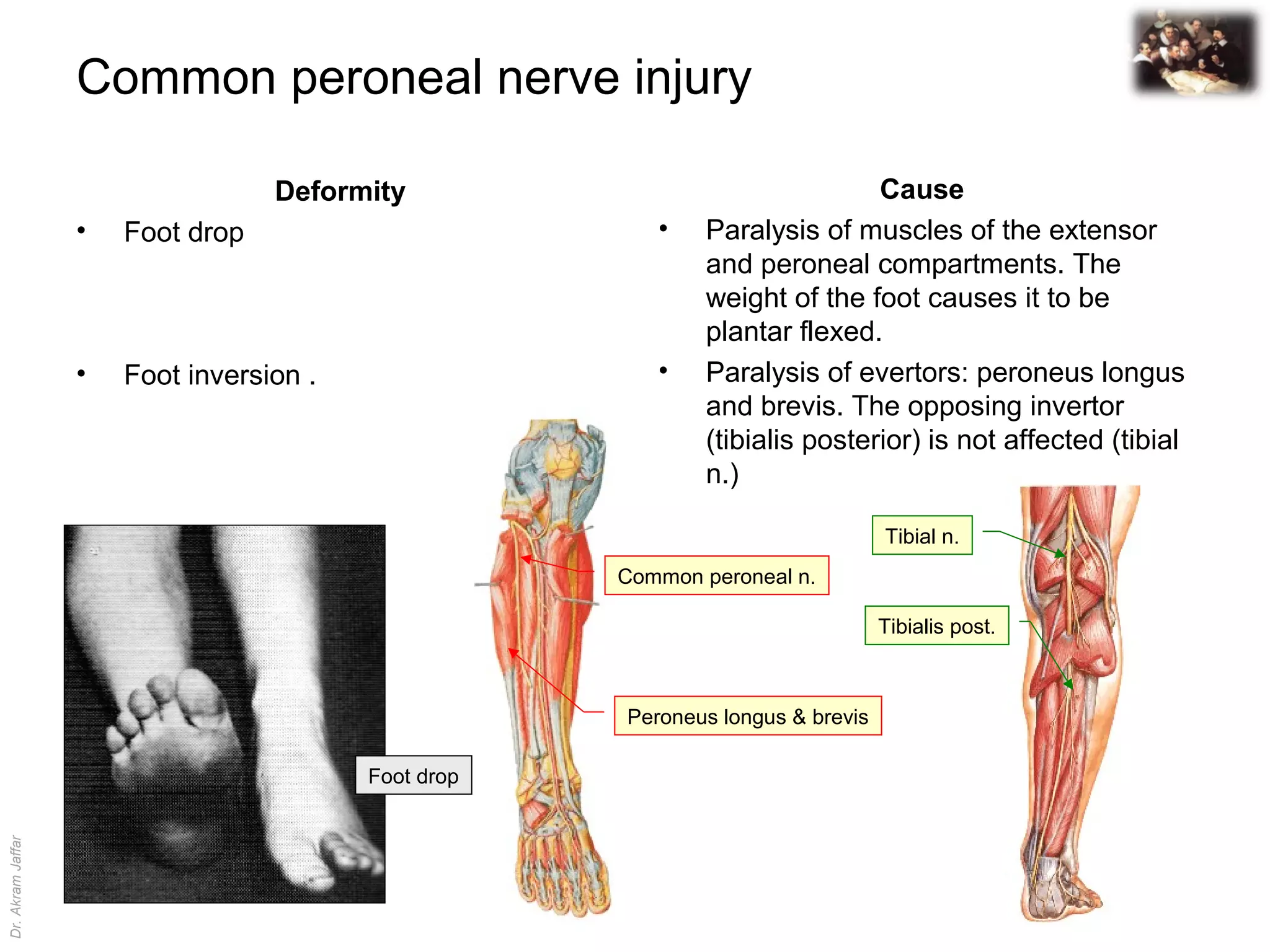
Deformity
• Foot drop
• Foot inversion .
Cause
• Paralysis of muscles of the extensor
and peroneal compartments. The
weight of the foot causes it to be
plantar flexed.
• Paralysis of evertors: peroneus longus
and brevis. The opposing invertor
(tibialis posterior) is not affected (tibial
n.)
Peroneus longus & brevis
Foot drop
Tibialis post.
Common peroneal n.
Tibial n.
Dr.AkramJaffar
Common peroneal nerve injury
Deformity
• Abnormal gait (steppage gait): the
patient raises the foot higher than
usual and brings it down suddenly
making a flapping noise since
otherwise his toes drag and the tip of
the shoe scratches the ground
Cause
• Paralysis of muscles of the extensor
compartment. The weight of the foot
causes it to be plantar flexed.
Dr.AkramJaffar
Common peroneal nerve injury
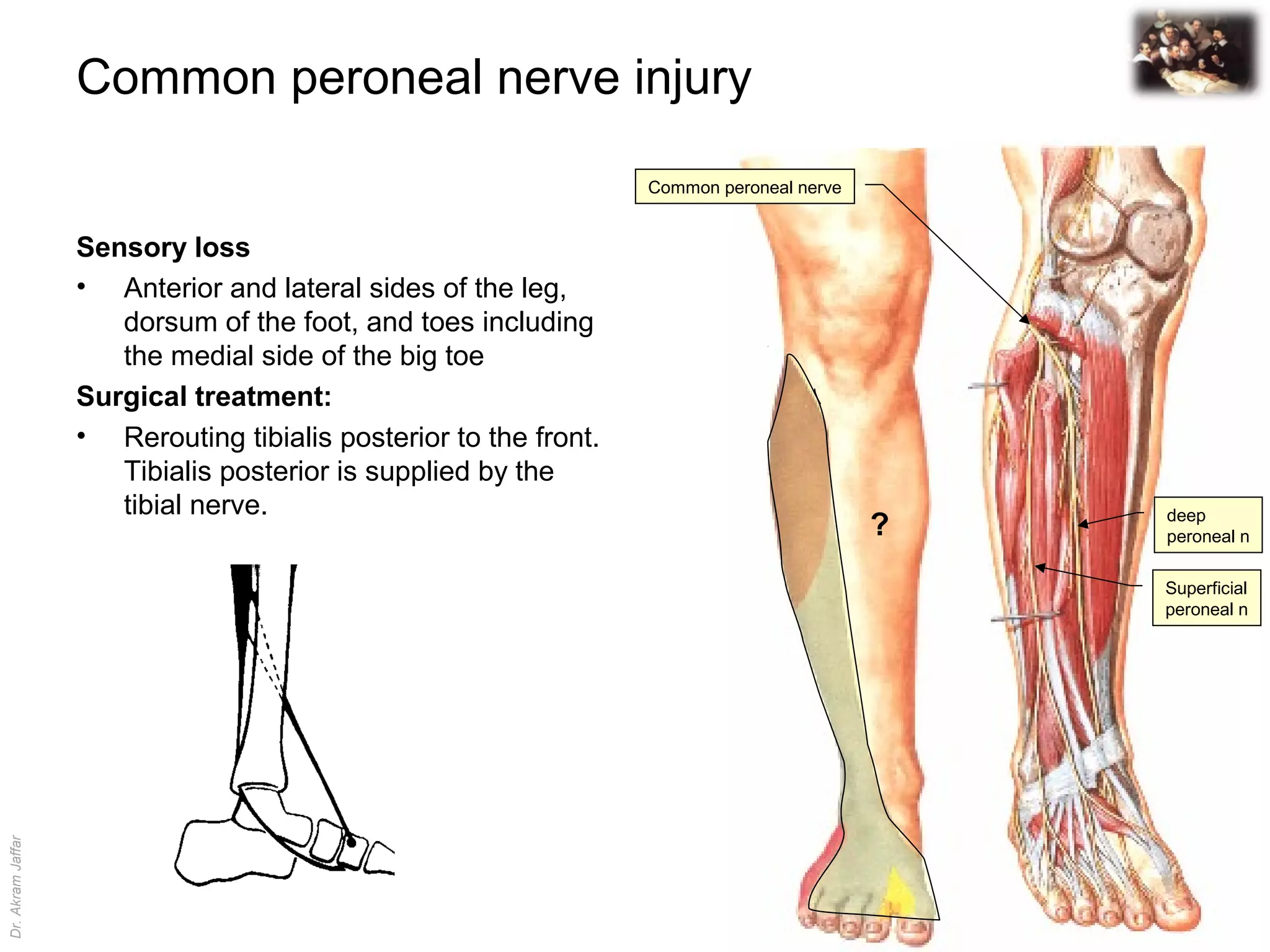
Sensory loss
• Anterior and lateral sides of the leg,
dorsum of the foot, and toes including
the medial side of the big toe
Surgical treatment:
• Rerouting tibialis posterior to the front.
Tibialis posterior is supplied by the
tibial nerve.
?
Common peroneal nerve
Superficial
peroneal n
deep
peroneal n

Applied anatomy common peroneal nerve injury

  • 1.
    Dr.AkramJaffar Applied Anatomy ofNerve Injuries in the Lower LimbApplied Anatomy of Nerve Injuries in the Lower Limb Common peroneal nerveCommon peroneal nerve Akram Jaffar, Ph.D. Subscribe to Human Anatomy Education Channel https://www.youtube.com/user/akramjfr Human Anatomy Education platforms by Akram Jaffar Follow @AkramJaffar Like Human Anatomy Education Page https://www.facebook.com/AnatomyEducation
  • 2.
    Dr.AkramJaffar References and suggestedreading • Ellis H (2006): Clinical anatomy, A revision and applied anatomy for clinical students. 11th Ed. Blackwell Publishing. Massachusetts • Moore KL & Dalley AF (2006): Clinically oriented anatomy. 5th ed. Lippincott Williams & Wilkins. Baltimore • Brust JCM (2007): Current Diagnosis & Treatment in Neurology. 2nd ed. McGraw-Hill Professional. • Hamdan FB, Jaffar AA, & Ossi RG (2008): The propensity of the common peroneal nerve in thigh level injuries. J Trauma. 64:300-303.
  • 3.
    Dr.AkramJaffar Objectives After completion ofthis session, students should be able to discuss, identify, and describe: – The anatomical factors predisposing to nerve injuries. – The anatomy of deformity, weakness and sensory loss following the nerve injury. – The applied anatomy of clinical examination for specific nerves. – Surgical anatomy of treating nerve injuries.
  • 4.
    Dr.AkramJaffar Common peroneal nerveinjury • Most commonly injured nerve in the lower limb because it winds superficially around the neck of the fibula. • Common causes of injury: – Fracture of the neck of the fibula. – Pressure exerted on the region of the head of the fibula by a tightly applied plaster cast or the sharp edge of the bed during sleep.
  • 5.
    Dr.AkramJaffar Common peroneal nerveinjury Deformity • Foot drop • Foot inversion . Cause • Paralysis of muscles of the extensor and peroneal compartments. The weight of the foot causes it to be plantar flexed. • Paralysis of evertors: peroneus longus and brevis. The opposing invertor (tibialis posterior) is not affected (tibial n.) Peroneus longus & brevis Foot drop Tibialis post. Common peroneal n. Tibial n.
  • 6.
    Dr.AkramJaffar Common peroneal nerveinjury Deformity • Abnormal gait (steppage gait): the patient raises the foot higher than usual and brings it down suddenly making a flapping noise since otherwise his toes drag and the tip of the shoe scratches the ground Cause • Paralysis of muscles of the extensor compartment. The weight of the foot causes it to be plantar flexed.
  • 7.
    Dr.AkramJaffar Common peroneal nerveinjury Sensory loss • Anterior and lateral sides of the leg, dorsum of the foot, and toes including the medial side of the big toe Surgical treatment: • Rerouting tibialis posterior to the front. Tibialis posterior is supplied by the tibial nerve. ? Common peroneal nerve Superficial peroneal n deep peroneal n