Dr.AkramJaffar
Applied Anatomy of Nerve Injuries in the Upper LimbApplied Anatomy of Nerve Injuries in the Upper Limb
Long thoracic nerveLong thoracic nerve
Akram Jaffar, Ph.D.
Subscribe to Human Anatomy Education Channel
https://www.youtube.com/user/akramjfr
Human Anatomy Education platforms by Akram Jaffar
Follow @AkramJaffar Like Human Anatomy Education Page
https://www.facebook.com/AnatomyEducation
Dr.AkramJaffar
References and suggested reading
• Ellis H (2006): Clinical anatomy, A revision and applied anatomy for clinical students.
11th
Ed. Blackwell Publishing. Massachusetts
• Moore KL & Dalley AF (2006): Clinically oriented anatomy. 5th
ed. Lippincott Williams
& Wilkins. Baltimore
• Brust JCM (2007): Current Diagnosis & Treatment in Neurology. 2nd
ed. McGraw-Hill
Professional.
Dr.AkramJaffar
Objectives
After completion of this session, students should be able to discuss, identify, and describe:
– The anatomical factors predisposing to nerve injuries.
– The anatomy of deformity, weakness and sensory loss following the nerve injury.
– The applied anatomy of clinical examination for specific nerves.
– Surgical anatomy of treating nerve injuries.
Dr.AkramJaffar
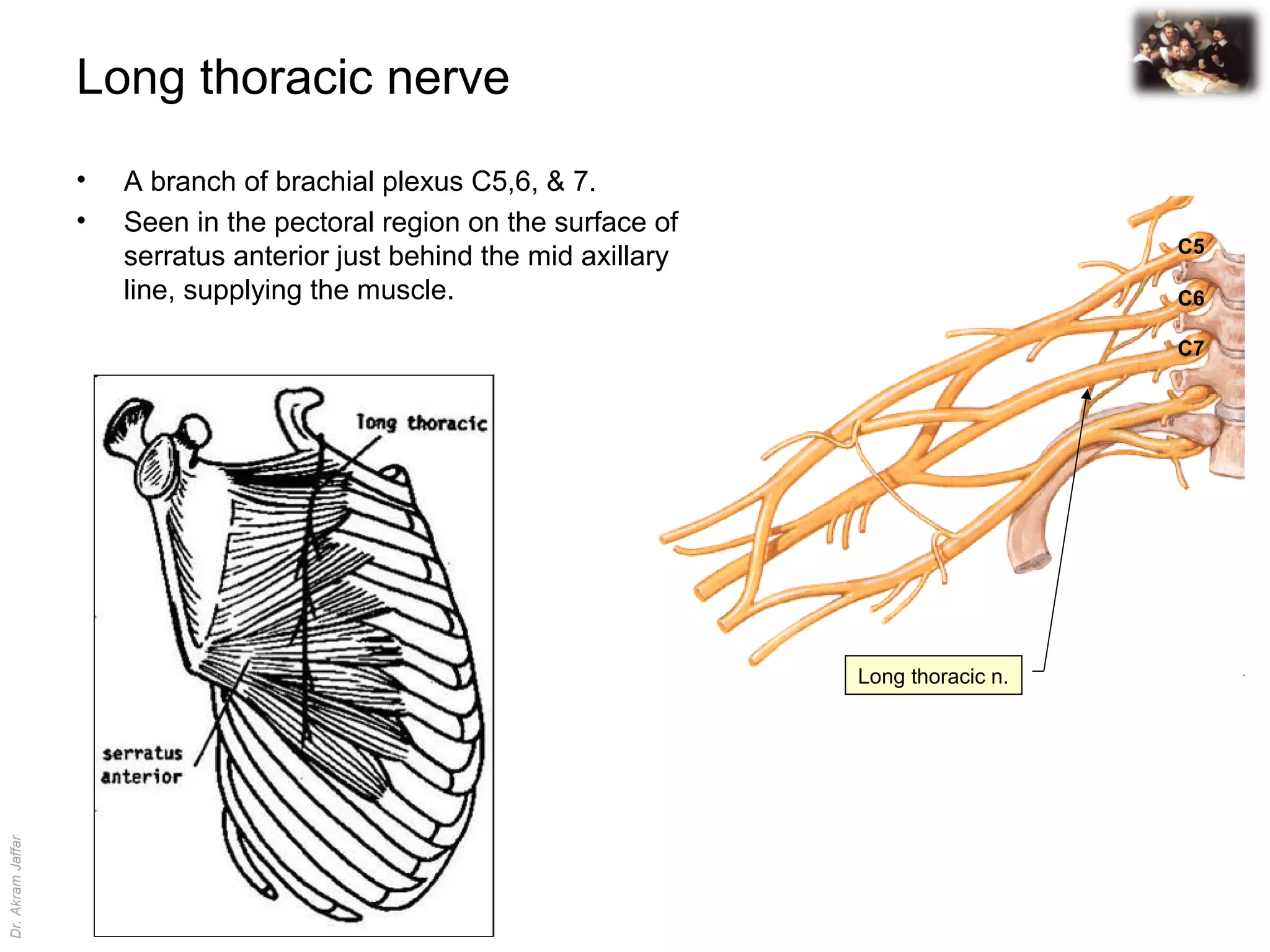
Long thoracic nerve
Long thoracic n.
C5
C6
C7
• A branch of brachial plexus C5,6, & 7.
• Seen in the pectoral region on the surface of
serratus anterior just behind the mid axillary
line, supplying the muscle.
Dr.AkramJaffar
Long thoracic nerve injury
• During radical mastectomy
• Stab wound
• Thoracic surgery
• Chest tube insertion.
• Crushed between clavicle and the first rib
while carrying a heavy object on the
shoulder.
Radical mastectomy bed
Chest tube
Dr.AkramJaffar
Long thoracic nerve injury
• Paralysis of serratus anterior.
• Winging of the scapula: medial border of the
scapula projects backwards when the
patient presses against a wall, giving the
appearance of a wing
• Inability to raise the arm above the head:
inability to rotate the scapula during
abduction of the arm above a right angle. 3
trapezius
2
deltoid
1
supraspinatus
3
trapezius
3
serratus anterior
Mechanism of shoulder abduction
Dr.AkramJaffar
Long thoracic nerve injury
• Paralysis of serratus anterior.
• Winging of the scapula: medial border of the
scapula projects backwards when the
patient presses against a wall, giving the
appearance of a wing
• Inability to raise the arm above the head:
inability to rotate the scapula during
abduction of the arm above a right angle. 3
trapezius
2
deltoid
1
supraspinatus
3
trapezius
3
serratus anterior
Mechanism of shoulder abduction

Applied anatomy long thoracic nerve injury

  • 1.
    Dr.AkramJaffar Applied Anatomy ofNerve Injuries in the Upper LimbApplied Anatomy of Nerve Injuries in the Upper Limb Long thoracic nerveLong thoracic nerve Akram Jaffar, Ph.D. Subscribe to Human Anatomy Education Channel https://www.youtube.com/user/akramjfr Human Anatomy Education platforms by Akram Jaffar Follow @AkramJaffar Like Human Anatomy Education Page https://www.facebook.com/AnatomyEducation
  • 2.
    Dr.AkramJaffar References and suggestedreading • Ellis H (2006): Clinical anatomy, A revision and applied anatomy for clinical students. 11th Ed. Blackwell Publishing. Massachusetts • Moore KL & Dalley AF (2006): Clinically oriented anatomy. 5th ed. Lippincott Williams & Wilkins. Baltimore • Brust JCM (2007): Current Diagnosis & Treatment in Neurology. 2nd ed. McGraw-Hill Professional.
  • 3.
    Dr.AkramJaffar Objectives After completion ofthis session, students should be able to discuss, identify, and describe: – The anatomical factors predisposing to nerve injuries. – The anatomy of deformity, weakness and sensory loss following the nerve injury. – The applied anatomy of clinical examination for specific nerves. – Surgical anatomy of treating nerve injuries.
  • 4.
    Dr.AkramJaffar Long thoracic nerve Longthoracic n. C5 C6 C7 • A branch of brachial plexus C5,6, & 7. • Seen in the pectoral region on the surface of serratus anterior just behind the mid axillary line, supplying the muscle.
  • 5.
    Dr.AkramJaffar Long thoracic nerveinjury • During radical mastectomy • Stab wound • Thoracic surgery • Chest tube insertion. • Crushed between clavicle and the first rib while carrying a heavy object on the shoulder. Radical mastectomy bed Chest tube
  • 6.
    Dr.AkramJaffar Long thoracic nerveinjury • Paralysis of serratus anterior. • Winging of the scapula: medial border of the scapula projects backwards when the patient presses against a wall, giving the appearance of a wing • Inability to raise the arm above the head: inability to rotate the scapula during abduction of the arm above a right angle. 3 trapezius 2 deltoid 1 supraspinatus 3 trapezius 3 serratus anterior Mechanism of shoulder abduction
  • 7.
    Dr.AkramJaffar Long thoracic nerveinjury • Paralysis of serratus anterior. • Winging of the scapula: medial border of the scapula projects backwards when the patient presses against a wall, giving the appearance of a wing • Inability to raise the arm above the head: inability to rotate the scapula during abduction of the arm above a right angle. 3 trapezius 2 deltoid 1 supraspinatus 3 trapezius 3 serratus anterior Mechanism of shoulder abduction