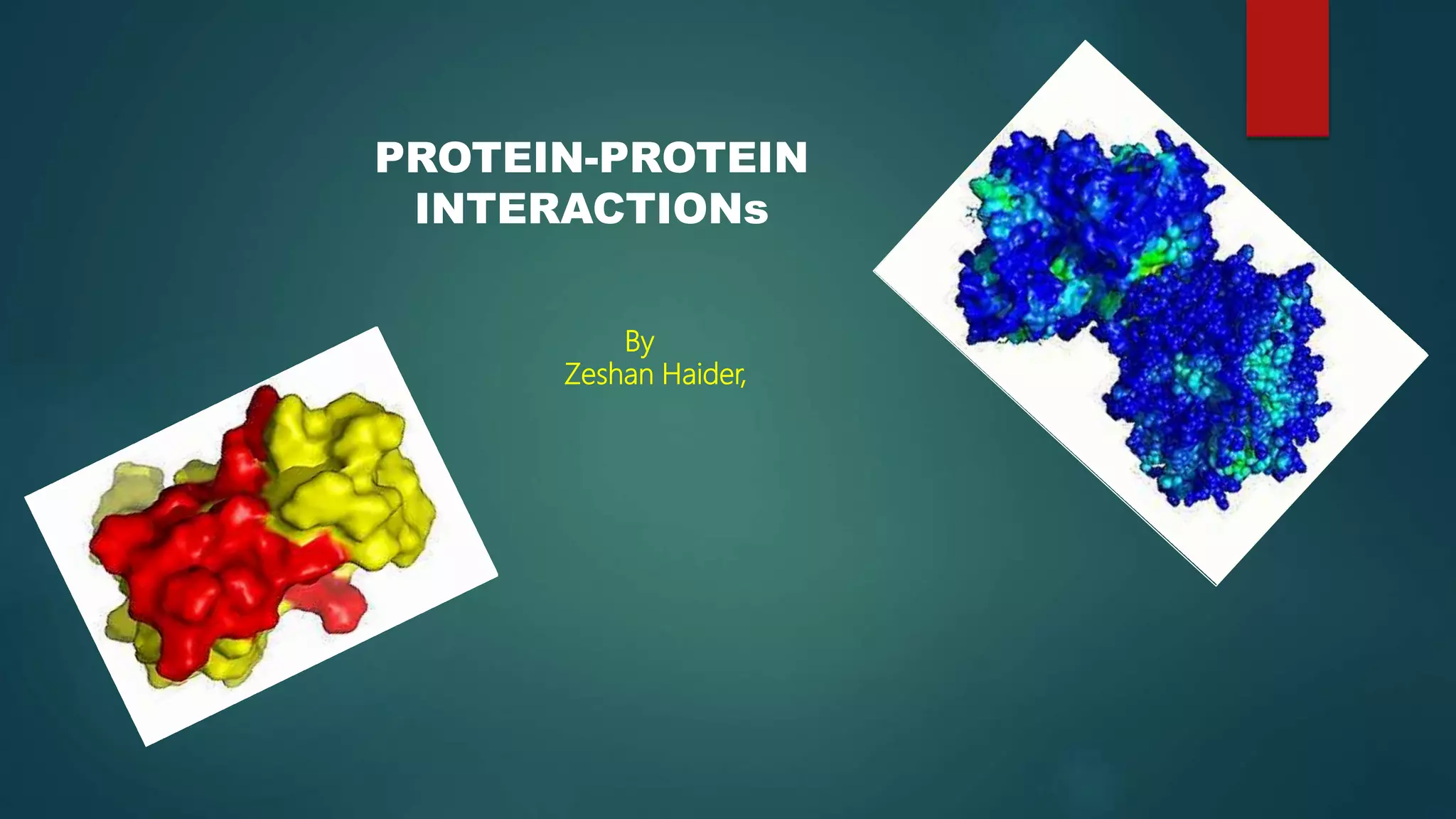
PROTEIN-PROTEIN
INTERACTIONs
By
Zeshan Haider,
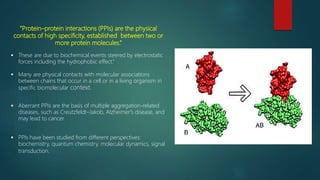
“Protein–protein interactions (PPIs) are the physical
contacts of high specificity, established between two or
more protein molecules.”
 These are due to biochemical events steered by electrostatic
forces including the hydrophobic effect.”
 Many are physical contacts with molecular associations
between chains that occur in a cell or in a living organism in
specific biomolecular context.
 Aberrant PPIs are the basis of multiple aggregation-related
diseases, such as Creutzfeldt–Jakob, Alzheimer's disease, and
may lead to cancer.
 PPIs have been studied from different perspectives:
biochemistry, quantum chemistry, molecular dynamics, signal
transduction.
Examples of protein-protein interactions
 Signal Transduction: activity of cells is regulated through this way in form of extracellular signals
 Transport across cell membrane: a protein may be carrying another protein
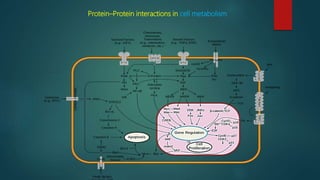
 Cell metabolism: In many metabolic pathways different proteins interact to perform a specific function.
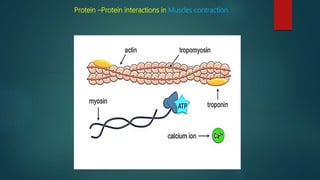
 Muscles contraction: myosin filaments act as molecular motors and by binding to actin enable filament
sliding
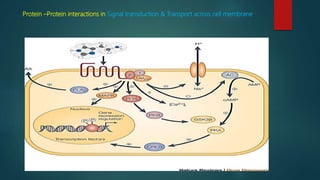
Protein –Protein interactions in Signal transduction & Transport across cell membrane
Protein–Protein interactions in cell metabolism
Protein –Protein interactions in Muscles contraction
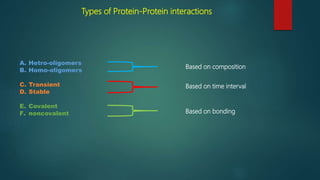
Types of Protein-Protein interactions
A. Hetro-oligomers
B. Homo-oligomers
C. Transient
D. Stable
E. Covalent
F. noncovalent
Based on composition
Based on bonding
Based on time interval
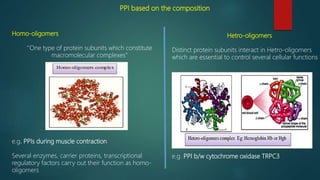
PPI based on the composition
Homo-oligomers
‘’One type of protein subunits which constitute
macromolecular complexes”
e.g. PPIs during muscle contraction
Several enzymes, carrier proteins, transcriptional
regulatory factors carry out their function as homo-
oligomers
Hetro-oligomers
Distinct protein subunits interact in Hetro-oligomers
which are essential to control several cellular functions
e.g. PPI b/w cytochrome oxidase TRPC3
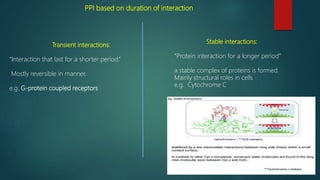
PPI based on duration of interaction
Transient interactions:
“Interaction that last for a shorter period.”
Mostly reversible in manner.
e.g. G-protein coupled receptors
Stable interactions:
“Protein interaction for a longer period”
a stable complex of proteins is formed.
Mainly structural roles in cells
e.g. Cytochrome C
PPI based on Bonding
Covalent
Strongest bond
Disulphide bond or electron sharing
e.g. Ubiquitination & sumoylation
Non-covalent
Weak bonds
Transient interaction
 H-bonds
 Ionic interactions
 Wander Waal forces
 Hydrophobic bonds
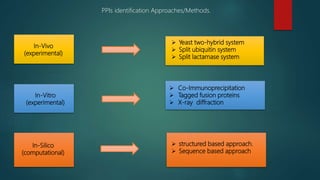
PPIs identification Approaches/Methods.
In-Vivo
(experimental)
 Yeast two-hybrid system
 Split ubiquitin system
 Split lactamase system
In-Vitro
(experimental)
In-Silico
(computational)
 Co-Immunoprecipitation
 Tagged fusion proteins
 X-ray diffraction
 structured based approach.
 Sequence based approach
In silico method for protein
protein interactions
History
• "In silico" was briefly challenged by "in silicium," which is
correct Latin for "in silicon".
• The Latin term for silicon, silicium, was created at the
beginning of the 19th century by Berzelius.
• he expression in silico was first used in public in 1989 in the
workshop in Los Alamos, New Mexico
• In silico has been used in white papers written to support the
creation of bacterial genome programs by the Commission of the
European Community.
• The first referenced paper where "in silico" appears was written
by a French team in 1991.
• The first referenced book chapter where "in silico" appears was
written by Hans B. Sieburg in 1990 and presented during a
Summer School on Complex Systems at the Santa Fe Institute
• The phrase "in silico" originally applied only to computer
simulations that modeled natural or laboratory processes (in all
the natural sciences), and did not refer to calculations done by
computer generically.
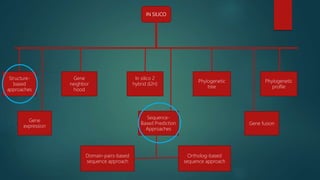
IN SILICO
Structure-
based
approaches
Gene
neighbor
hood
In silico 2
hybrid (I2H)
Phylogenetic
tree
Phylogenetic
profile
Gene fusion
Gene
expression
Sequence-
Based Prediction
Approaches
Ortholog-based
sequence approach
Domain-pairs-based
sequence approach
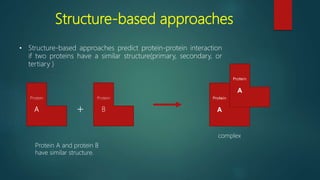
Structure-based approaches
• Structure-based approaches predict protein-protein interaction
if two proteins have a similar structure(primary, secondary, or
tertiary )
Protein
A
Protein
B+
complex
Protein A and protein B
have similar structure.
Sequence-Based Prediction Approaches
• Predictions of PPIs have been carried out by integrating evidence of known interactions with
information regarding sequential homology.
• This approach is based on the concept that an interaction found in one species can be used
to infer the interaction in other species .
1. Ortholog-based sequence approach.
• Ortholog based sequence approach based on the Homologous nature of the
query protein in the annotated protein data bases using pair wise local
sequence algorithm.
2. Domain-pairs-based sequence approach.
• Domain-pairs-based approach predicts protein interactions based on
domain-domain interactions .
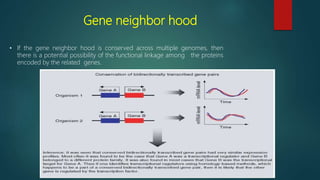
Gene neighbor hood
• If the gene neighbor hood is conserved across multiple genomes, then
there is a potential possibility of the functional linkage among the proteins
encoded by the related genes.
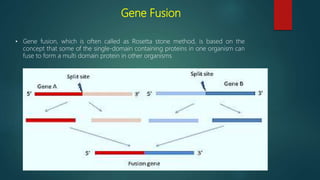
Gene Fusion
• Gene fusion, which is often called as Rosetta stone method, is based on the
concept that some of the single-domain containing proteins in one organism can
fuse to form a multi domain protein in other organisms
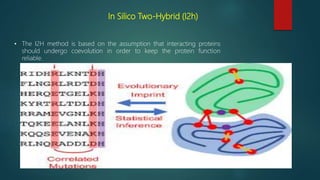
In Silico Two-Hybrid (I2h)
• The I2H method is based on the assumption that interacting proteins
should undergo coevolution in order to keep the protein function
reliable.
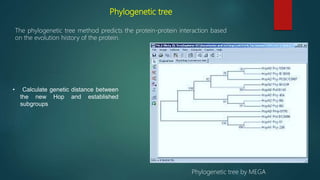
Phylogenetic tree
The phylogenetic tree method predicts the protein-protein interaction based
on the evolution history of the protein.
• Calculate genetic distance between
the new Hop and established
subgroups
Phylogenetic tree by MEGA
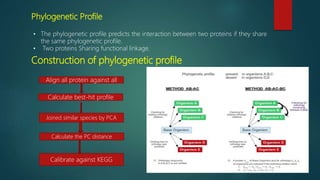
Phylogenetic Profile
• The phylogenetic profile predicts the interaction between two proteins if they share
the same phylogenetic profile.
• Two proteins Sharing functional linkage.
Construction of phylogenetic profile
Align all protein against all
Calculate best-hit profile
Joined similar species by PCA
Calculate the PC distance
Calibrate against KEGG
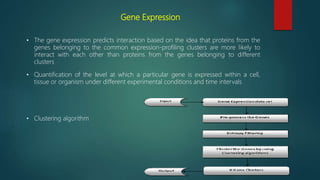
Gene Expression
• The gene expression predicts interaction based on the idea that proteins from the
genes belonging to the common expression-profiling clusters are more likely to
interact with each other than proteins from the genes belonging to different
clusters
• Quantification of the level at which a particular gene is expressed within a cell,
tissue or organism under different experimental conditions and time intervals
• Clustering algorithm
Mechanisms for
Protein modeling and analysis
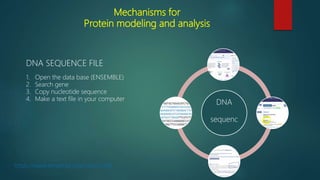
DNA SEQUENCE FILE
1. Open the data base (ENSEMBLE)
2. Search gene
3. Copy nucleotide sequence
4. Make a text file in your computer
DNA
sequenc
https://www.ensembl.org/index.html
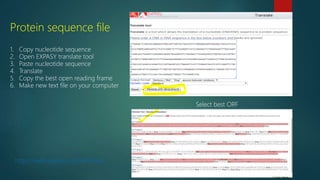
Protein sequence file
1. Copy nucleotide sequence
2. Open EXPASY translate tool
3. Paste nucleotide sequence
4. Translate
5. Copy the best open reading frame
6. Make new text file on your computer
Select best ORF
https://web.expasy.org/translate/
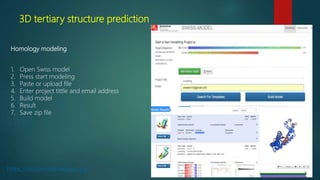
3D tertiary structure prediction
Homology modeling
1. Open Swiss model
2. Press start modeling
3. Paste or upload file
4. Enter project tittle and email address
5. Build model
6. Result
7. Save zip file
https://swissmodel.expasy.org/
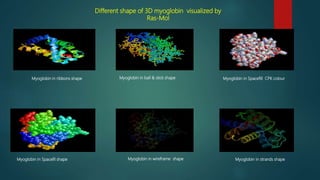
Different shape of 3D myoglobin visualized by
Ras-Mol
Myoglobin in ribbons shape Myoglobin in ball & stick shape Myoglobin in Spacefill CPK colour
Myoglobin in Spacefil shape Myoglobin in wireframe shape Myoglobin in strands shape
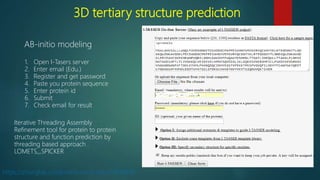
3D tertiary structure prediction
AB-initio modeling
1. Open I-Tasers server
2. Enter email (Edu.)
3. Register and get password
4. Paste you protein sequence
5. Enter protein id
6. Submit
7. Check email for result
https://zhanglab.ccmb.med.umich.edu/I-TASSER/
Iterative Threading Assembly
Refinement tool for protein to protein
structure and function prediction by
threading based approach .
LOMETS,,,SPICKER
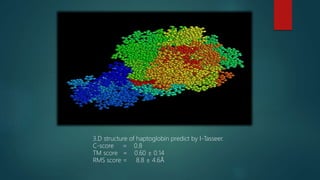
3.D structure of haptoglobin predict by I-Tasseer.
C-score = 0.8
TM score = 0.60 ± 0.14
RMS score = 8.8 ± 4.6Å
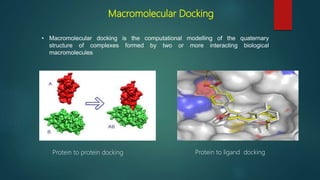
Macromolecular Docking
• Macromolecular docking is the computational modelling of the quaternary
structure of complexes formed by two or more interacting biological
macromolecules
Protein to protein docking Protein to ligand docking
Protein to protein docking
• play a central role in various aspects of the structural
and functional organization of the cell
• A better understanding of processes such as
metabolic control, signal transduction, and gene
regulation. Genome-wide proteomics studies.
• Thus docking methods that can elucidate the details
of specific interactions at the atomic level.
1. Protein to protein docking software
There are many software for protein to protein docking such as Z Dock server (http://zdock.umassmed.edu/) )
Patch Dock ( https://bioinfo3d.cs.tau.ac.il/PatchDock/ ) Auto Dock ( http://autodock.scripps.edu/ HEX server( http://hexserver.loria.fr)
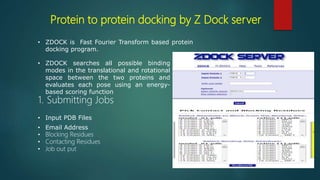
Protein to protein docking by Z Dock server
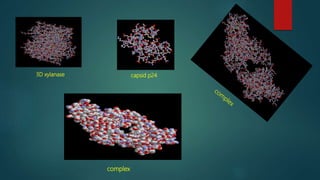
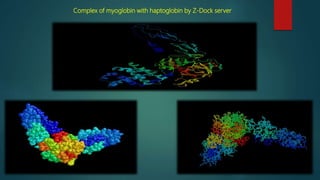
• ZDOCK is Fast Fourier Transform based protein
docking program.
• ZDOCK searches all possible binding
modes in the translational and rotational
space between the two proteins and
evaluates each pose using an energy-
based scoring function
1. Submitting Jobs
• Input PDB Files
• Email Address
• Blocking Residues
• Contacting Residues
• Job out put
3D xylanase capsid p24
complex
Complex of myoglobin with haptoglobin by Z-Dock server
DATABASES.
• Protein–protein interactions are only the raw material for
networks. To build a network, researchers typically combine
interaction data sets with other sources of data. Primary
databases that contain protein–protein interactions include
DIP (http://dip.doe-mbi.ucla.edu), BioGRID, IntAct
(http://www.ebi.ac.uk/intact) and MINT
(http://mint.bio.uniroma2.it).
• These databases have committed to making records
available through a common language called PSICQUIC, to
maximize access.
CONCLUSION
• The predictive power of the interactome model allows us to
examine the organization and coordination of multiple complex
cellular processes and determine how they are organized into
pathways.
• The interactome model can be used to predict poorly
characterized proteins into their functional context according to
their interacting partners within a module.
• One-to-many relationship can be used for pathway discovery.
REFERENCES
1. Protein-Protein Interaction Detection: Methods and AnalysisV.SrinivasaRao,1 K.Srinivas,1
G.N.Sujini,2 andG.N.SunandKumar1 1
DepartmentofCSE,VRSiddharthaEngineeringCollege,Vijayawada520007,India
2DepartmentofCSE,MahatmaGandhiInstituteofTechnology,Hyderabad500075,India
CorrespondenceshouldbeaddressedtoV.SrinivasaRao;drvsrao9@gmail.com
2. https://www.slideshare.net/Prianca12/protein-protein-interactions-29100706
3. https://youtu.be/mvo_xL1LESM
4. https://youtu.be/kl2SU6gTRDI
protein-protein  interaction

protein-protein interaction

  • 1.
  • 2.
    “Protein–protein interactions (PPIs)are the physical contacts of high specificity, established between two or more protein molecules.”  These are due to biochemical events steered by electrostatic forces including the hydrophobic effect.”  Many are physical contacts with molecular associations between chains that occur in a cell or in a living organism in specific biomolecular context.  Aberrant PPIs are the basis of multiple aggregation-related diseases, such as Creutzfeldt–Jakob, Alzheimer's disease, and may lead to cancer.  PPIs have been studied from different perspectives: biochemistry, quantum chemistry, molecular dynamics, signal transduction.
  • 3.
    Examples of protein-proteininteractions  Signal Transduction: activity of cells is regulated through this way in form of extracellular signals  Transport across cell membrane: a protein may be carrying another protein  Cell metabolism: In many metabolic pathways different proteins interact to perform a specific function.  Muscles contraction: myosin filaments act as molecular motors and by binding to actin enable filament sliding
  • 4.
    Protein –Protein interactionsin Signal transduction & Transport across cell membrane
  • 5.
  • 6.
    Protein –Protein interactionsin Muscles contraction
  • 7.
    Types of Protein-Proteininteractions A. Hetro-oligomers B. Homo-oligomers C. Transient D. Stable E. Covalent F. noncovalent Based on composition Based on bonding Based on time interval
  • 8.
    PPI based onthe composition Homo-oligomers ‘’One type of protein subunits which constitute macromolecular complexes” e.g. PPIs during muscle contraction Several enzymes, carrier proteins, transcriptional regulatory factors carry out their function as homo- oligomers Hetro-oligomers Distinct protein subunits interact in Hetro-oligomers which are essential to control several cellular functions e.g. PPI b/w cytochrome oxidase TRPC3
  • 9.
    PPI based onduration of interaction Transient interactions: “Interaction that last for a shorter period.” Mostly reversible in manner. e.g. G-protein coupled receptors Stable interactions: “Protein interaction for a longer period” a stable complex of proteins is formed. Mainly structural roles in cells e.g. Cytochrome C
  • 10.
    PPI based onBonding Covalent Strongest bond Disulphide bond or electron sharing e.g. Ubiquitination & sumoylation Non-covalent Weak bonds Transient interaction  H-bonds  Ionic interactions  Wander Waal forces  Hydrophobic bonds
  • 11.
    PPIs identification Approaches/Methods. In-Vivo (experimental) Yeast two-hybrid system  Split ubiquitin system  Split lactamase system In-Vitro (experimental) In-Silico (computational)  Co-Immunoprecipitation  Tagged fusion proteins  X-ray diffraction  structured based approach.  Sequence based approach
  • 12.
    In silico methodfor protein protein interactions
  • 13.
    History • "In silico"was briefly challenged by "in silicium," which is correct Latin for "in silicon". • The Latin term for silicon, silicium, was created at the beginning of the 19th century by Berzelius. • he expression in silico was first used in public in 1989 in the workshop in Los Alamos, New Mexico
  • 14.
    • In silicohas been used in white papers written to support the creation of bacterial genome programs by the Commission of the European Community. • The first referenced paper where "in silico" appears was written by a French team in 1991. • The first referenced book chapter where "in silico" appears was written by Hans B. Sieburg in 1990 and presented during a Summer School on Complex Systems at the Santa Fe Institute • The phrase "in silico" originally applied only to computer simulations that modeled natural or laboratory processes (in all the natural sciences), and did not refer to calculations done by computer generically.
  • 15.
    IN SILICO Structure- based approaches Gene neighbor hood In silico2 hybrid (I2H) Phylogenetic tree Phylogenetic profile Gene fusion Gene expression Sequence- Based Prediction Approaches Ortholog-based sequence approach Domain-pairs-based sequence approach
  • 16.
    Structure-based approaches • Structure-basedapproaches predict protein-protein interaction if two proteins have a similar structure(primary, secondary, or tertiary ) Protein A Protein B+ complex Protein A and protein B have similar structure.
  • 17.
    Sequence-Based Prediction Approaches •Predictions of PPIs have been carried out by integrating evidence of known interactions with information regarding sequential homology. • This approach is based on the concept that an interaction found in one species can be used to infer the interaction in other species . 1. Ortholog-based sequence approach. • Ortholog based sequence approach based on the Homologous nature of the query protein in the annotated protein data bases using pair wise local sequence algorithm. 2. Domain-pairs-based sequence approach. • Domain-pairs-based approach predicts protein interactions based on domain-domain interactions .
  • 18.
    Gene neighbor hood •If the gene neighbor hood is conserved across multiple genomes, then there is a potential possibility of the functional linkage among the proteins encoded by the related genes.
  • 19.
    Gene Fusion • Genefusion, which is often called as Rosetta stone method, is based on the concept that some of the single-domain containing proteins in one organism can fuse to form a multi domain protein in other organisms
  • 20.
    In Silico Two-Hybrid(I2h) • The I2H method is based on the assumption that interacting proteins should undergo coevolution in order to keep the protein function reliable.
  • 21.
    Phylogenetic tree The phylogenetictree method predicts the protein-protein interaction based on the evolution history of the protein. • Calculate genetic distance between the new Hop and established subgroups Phylogenetic tree by MEGA
  • 22.
    Phylogenetic Profile • Thephylogenetic profile predicts the interaction between two proteins if they share the same phylogenetic profile. • Two proteins Sharing functional linkage. Construction of phylogenetic profile Align all protein against all Calculate best-hit profile Joined similar species by PCA Calculate the PC distance Calibrate against KEGG
  • 23.
    Gene Expression • Thegene expression predicts interaction based on the idea that proteins from the genes belonging to the common expression-profiling clusters are more likely to interact with each other than proteins from the genes belonging to different clusters • Quantification of the level at which a particular gene is expressed within a cell, tissue or organism under different experimental conditions and time intervals • Clustering algorithm
  • 24.
    Mechanisms for Protein modelingand analysis DNA SEQUENCE FILE 1. Open the data base (ENSEMBLE) 2. Search gene 3. Copy nucleotide sequence 4. Make a text file in your computer DNA sequenc https://www.ensembl.org/index.html
  • 25.
    Protein sequence file 1.Copy nucleotide sequence 2. Open EXPASY translate tool 3. Paste nucleotide sequence 4. Translate 5. Copy the best open reading frame 6. Make new text file on your computer Select best ORF https://web.expasy.org/translate/
  • 26.
    3D tertiary structureprediction Homology modeling 1. Open Swiss model 2. Press start modeling 3. Paste or upload file 4. Enter project tittle and email address 5. Build model 6. Result 7. Save zip file https://swissmodel.expasy.org/
  • 27.
    Different shape of3D myoglobin visualized by Ras-Mol Myoglobin in ribbons shape Myoglobin in ball & stick shape Myoglobin in Spacefill CPK colour Myoglobin in Spacefil shape Myoglobin in wireframe shape Myoglobin in strands shape
  • 28.
    3D tertiary structureprediction AB-initio modeling 1. Open I-Tasers server 2. Enter email (Edu.) 3. Register and get password 4. Paste you protein sequence 5. Enter protein id 6. Submit 7. Check email for result https://zhanglab.ccmb.med.umich.edu/I-TASSER/ Iterative Threading Assembly Refinement tool for protein to protein structure and function prediction by threading based approach . LOMETS,,,SPICKER
  • 29.
    3.D structure ofhaptoglobin predict by I-Tasseer. C-score = 0.8 TM score = 0.60 ± 0.14 RMS score = 8.8 ± 4.6Å
  • 30.
    Macromolecular Docking • Macromoleculardocking is the computational modelling of the quaternary structure of complexes formed by two or more interacting biological macromolecules Protein to protein docking Protein to ligand docking
  • 31.
    Protein to proteindocking • play a central role in various aspects of the structural and functional organization of the cell • A better understanding of processes such as metabolic control, signal transduction, and gene regulation. Genome-wide proteomics studies. • Thus docking methods that can elucidate the details of specific interactions at the atomic level. 1. Protein to protein docking software There are many software for protein to protein docking such as Z Dock server (http://zdock.umassmed.edu/) ) Patch Dock ( https://bioinfo3d.cs.tau.ac.il/PatchDock/ ) Auto Dock ( http://autodock.scripps.edu/ HEX server( http://hexserver.loria.fr)

  • 32.
    Protein to proteindocking by Z Dock server • ZDOCK is Fast Fourier Transform based protein docking program. • ZDOCK searches all possible binding modes in the translational and rotational space between the two proteins and evaluates each pose using an energy- based scoring function 1. Submitting Jobs • Input PDB Files • Email Address • Blocking Residues • Contacting Residues • Job out put
  • 33.
    3D xylanase capsidp24 complex
  • 34.
    Complex of myoglobinwith haptoglobin by Z-Dock server
  • 35.
    DATABASES. • Protein–protein interactionsare only the raw material for networks. To build a network, researchers typically combine interaction data sets with other sources of data. Primary databases that contain protein–protein interactions include DIP (http://dip.doe-mbi.ucla.edu), BioGRID, IntAct (http://www.ebi.ac.uk/intact) and MINT (http://mint.bio.uniroma2.it). • These databases have committed to making records available through a common language called PSICQUIC, to maximize access.
  • 36.
    CONCLUSION • The predictivepower of the interactome model allows us to examine the organization and coordination of multiple complex cellular processes and determine how they are organized into pathways. • The interactome model can be used to predict poorly characterized proteins into their functional context according to their interacting partners within a module. • One-to-many relationship can be used for pathway discovery.
  • 37.
    REFERENCES 1. Protein-Protein InteractionDetection: Methods and AnalysisV.SrinivasaRao,1 K.Srinivas,1 G.N.Sujini,2 andG.N.SunandKumar1 1 DepartmentofCSE,VRSiddharthaEngineeringCollege,Vijayawada520007,India 2DepartmentofCSE,MahatmaGandhiInstituteofTechnology,Hyderabad500075,India CorrespondenceshouldbeaddressedtoV.SrinivasaRao;drvsrao9@gmail.com 2. https://www.slideshare.net/Prianca12/protein-protein-interactions-29100706 3. https://youtu.be/mvo_xL1LESM 4. https://youtu.be/kl2SU6gTRDI